
Breed profile
Levriero Sardo: Italy Has a Route for Breeds Like This, and This One Is Not on It
The page every search engine puts first is a three-sentence stub with a citation warning on it. The Italian source underneath that stub says, in four words, that no standard exists. Here is what Italy's own national register actually holds, why that matters more than the FCI, and what the famous hundred surviving dogs really were.
Quick answer
The Levriero Sardo is Sardinia's coursing sighthound, standing 60 to 70 cm and weighing 17 to 25 kg, and it has no written breed standard and no studbook anywhere. Italy runs an open register for exactly this situation and another Sardinian breed is already on it, so the absence is a choice nobody has made rather than a door nobody opened. It cannot be bought in India and none is offered there.
This guide summarises Italian registry documents, a regional newspaper report, Indian breeding and import law, Indian parasitology surveys and satellite climate data as general information for Indian pet owners. It is not a diagnosis and it is not treatment advice. No health screening data exists for this dog and none is invented here. For any decision about a live animal in your care, consult a registered veterinary practitioner who has examined that animal.
Levriero Sardo trait ratings, and what can honestly be rated
What the Levriero Sardo is, and the register Italy built for exactly this dog
The Levriero Sardo is a rustic Sardinian coursing sighthound of 60 to 70 cm and 17 to 25 kg, called Cani de lepuri, hare dog, in Sardinian, and it holds no written breed standard and no studbook entry anywhere in the world. What makes that worth a page is not the absence itself but the alternative sitting unused: Italy runs an open register purpose-built for Italian populations being recovered as breeds, and another Sardinian breed is already on it.
Start with the origin, because the sources agree on it. This is a hare-coursing dog of rural Sardinia, reported in two regional varieties, a light-coated one around Ploaghe in the north and a black-coated one in the Sulcis-Iglesiente and parts of the Campidano and Oristanese in the south. Italian Wikipedia dates arrival on the island to the tenth century BC on Phoenician ships and cites terracotta sighthound heads from the Santa Gilla archaeological area.
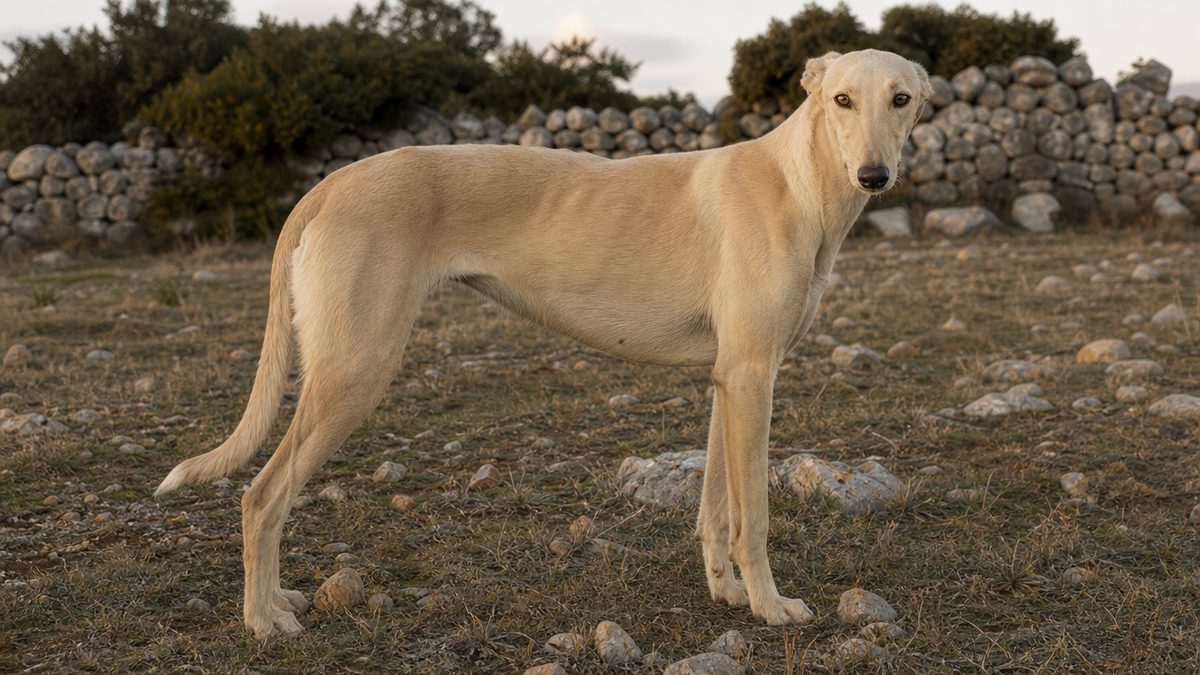
Physical appearance is where the single published description does its real work, and it is worth quoting rather than paraphrasing. Agraria.org gives a rustic sighthound of medium size, dry and muscular, 60 to 70 cm at the withers for 17 to 25 kg, with a small head carrying a muzzle almost twice the length of the skull, large eyes, a prominent nose, ears either rose or fully erect, and notably developed canines it says are shared with Sardinia's other breeds. The coat is smooth or short and soft to the touch, in sandy, black, pied, white, brindle or grey, with sandy the commonest and most prized. That is a hardy working outline rather than a show dog's, and it is the only physical description of this animal that exists anywhere.
The two-condition test: a written standard anywhere, a studbook anywhere
A name becomes a breed when two documents exist. The first is a written standard, a published description a judge or breeder could apply. The second is a studbook, a register in which individual animals are entered with parentage. This dog has neither, and both halves were checked against open registers with in-document controls rather than inferred from silence.
The standard half is settled in four words by the closest thing to a description that exists. Agraria.org, an ISSN-registered Italian agricultural-education atlas, prints 'Classificazione F.C.I.: RAZZA NON RICONOSCIUTA' at the top of its entry, and under its own Standard heading the complete text reads 'Non esiste uno standard.' No standard exists. That page is written by Pietro Perra, who is also named as an owner and photographer of the dogs in its own captions, so it is the closest anyone has come and it is not a registry document.
Why ENCI settles this and the FCI does not
Most pages stop at the FCI, and the FCI is the wrong register to ask first. The English-language stub that ranks first for this term says only that the dog is not recognised as a breed by any major kennel club, which is true and tells a reader nothing about the route. Italy has its own national body and it is more open than the international one. ENCI's Libro genealogico operates under the supervision of the Ministry of Agriculture, Food Sovereignty and Forestry, and article 8 of its disciplinare establishes two registers, the ROI and the RSR. Clause 4 then adds a third in these words: an open supplementary register, the RSA, 'per l'iscrizione di soggetti appartenenti a popolazioni tipiche italiane in fase di recupero come razze';.
Read that clause again with this dog in mind. It is a register for typical Italian populations in the process of being recovered as breeds. That is not an approximation of the Levriero Sardo's situation. It is a description of it.
The Cane Fonnese, a Sardinian guarding breed, sits on the RSA right now. Its ENCI record states twice, under both Storia and Aspetto Generale, that it is a 'Razza ammessa al RSA (Registro Supplementare Aperto) per la quale sono state avviate le procedure di riconoscimento', a breed admitted to the open register for which recognition procedures have been started. It carries a downloadable ENCI standard, a ten-year registration statistics chart running 2016 to 2025, an affix-breeders list and a champions list. So the door is open, it opens for Sardinian breeds, and somebody walked another one through it. Nobody has walked this one.
| Register opened | Control that passed inside the same document | Result for this dog |
|---|---|---|
| ENCI Group 10, Levrieri | Thirteen breeds listed, Piccolo Levriero Italiano present as Italy's only native entry | Absent; would sort between Levriero Polacco and Magyar Agar |
| ENCI Group 2, as a control on the lists themselves | CANE FONNESE present despite being an RSA breed | Proves the group lists include the open register |
| ENCI Razze Italiane, 18 breeds | Spino degli Iblei and Mastino Siciliano present, both FCI-less | Absent; no Sardinian breed on the list at all |
| FCI Group 10, Sighthounds | Greyhound 158, Whippet 162, Saluki 269, Azawakh 307 present | Absent; Italy's only entry is Piccolo Levriero Italiano 200 |
| FCI definitive nomenclature, letter L | Labrador Retriever present; eight entries total | Absent; would sort between LEONBERGER and LHASA APSO |
| FCI provisional register, 20 breeds | Two Italian breeds present, Segugio dell'Appennino and Segugio Maremmano | Absent; no Sardinian breed on it |
The second row is the one that closes the case, and it took a deliberate control to get. If ENCI's per-group breed lists showed only fully recognised breeds, then Group 10's silence would prove nothing about the RSA. But the Cane Fonnese appears in ENCI's Group 2 list, between Cane di San Bernardo and Cao de Gado Transmontano, while being an RSA breed. So the group lists include the open register, and Group 10's thirteen entries are the complete picture across all three registers. The FCI side was checked the same way. Its definitive letter L index holds only eight entries, LABRADOR RETRIEVER, LAGOTTO ROMAGNOLO, LAKELAND TERRIER, LANCASHIRE HEELER, LANDSEER, LAPINPOROKOIRA, LEONBERGER and LHASA APSO, with the Labrador as the in-document control, and a LEVRIERO SARDO would sort between LEONBERGER and LHASA APSO. It is absent from that adjacent position.
One trap this page had to avoid
The Cane Fonnese record prints a row reading 'Codice FCI 902, Gruppo 2, Sezione 2'. That row is ENCI's own internal filing, not an FCI grant. The FCI's letter C index holds forty-four entries including four Italian breeds under Italian names, Cane Corso Italiano 343, Cane da Pastore Abruzzese Maremmano 201, Cane da Pastore Bergamasco 194 and Cirneco dell'Etna 199, and CANE FONNESE is not among them. An FCI classification printed by anyone other than the FCI is that body's filing, and only the FCI's own register settles recognition.
So the verdict on the first question a reader has is clean. This is a real, living Sardinian type with a real job and a real regional distribution, and it is not a breed in the registry sense. It is unrecognised in the strict way: not a standard somebody declined to accept, but no standard for anyone to accept. The comparison the site can offer is the Old Croatian Sighthound, which failed the same two-condition test and, unlike this dog, did not survive the gap.
Levriero Sardo price in India: none exists, and no pedigree could be issued anyway
There is no Levriero Sardo price in India, and unusually there is a second reason beyond scarcity: no register anywhere holds the breed, so no pedigree, pet book or export certificate can be issued for one. Bonbeno found zero Indian for-sale listings under this name across two search engines whose Labrador controls both passed in the same sessions Brave Search results page for 'levriero….
That second reason is worth dwelling on because it is structural rather than temporary. India's import route for a pet dog turns on a valid pet book in the importer's name. A pet book is issued against a registry entry. A dog from a population no registry holds cannot have one, so the ordinary pet-import path is closed to this breed by definition, not by scarcity.
The commercial route is closed too
Policy Condition 8 provides that import of commercial dogs for breeding or any other commercial activity is not permitted, and Policy Condition 7 limits import to a pet dog with a valid pet book and records in the importer's name, to R and D organisations holding a CPCSEA recommendation, and to internal security by the Defence and Police forces. Bonbeno could not open that notice on the DGFT server, which returned HTTP 403, so the text is cited from a compliance publisher's reproduction and labelled as one.
What the pages ranking for this term are actually selling
Three of the top results are commerce wearing an encyclopedia's clothes, and each fails differently. Creatures.com runs section headings reading 'Levriero Sardos for Sale', 'Levriero Sardo Herdbook', 'Levriero Sardo Breeders' and 'Find Breeders' for a population no register holds, which is a herdbook offered where no herdbook can exist.
The Dogs Mag publishes a lifespan, suitability scores, a climate-suitability rating and a puppy growth curve headed 'From puppy weight to adult size' and 'Follow weight from puppyhood to adult size';. A growth curve is a measurement of a cohort. There is no cohort. It also promises 'source information' and a 'review status', which is the shape of rigour rather than rigour.
The third-ranking result in India is a blog article on a Shopify store that sells sighthound gear, and its related-article rail gives the game away: 'Do Greyhounds Need Coats in Winter?', 'Why Greyhounds Need Different Collars', 'Training Tips for Sighthounds' and 'Italian Greyhound Care Essentials'. Its meta description invites the reader to find out why this could be the perfect companion, for a dog whose entire documented population is about a hundred animals on one island.
The fourth pattern is quieter and worth naming because it inflates the apparent evidence base. Animalia carries only five sections, Appearance, Origin, Temperament, Keeping conditions and References, and its content repeats the English Wikipedia stub including the vertreddru gloss. It is a downstream copy rather than an independent source, so a reader counting four pages that agree is really counting one page four times.
Bing India's AI summary for this breed states that it is at high risk of extinction with only 100 specimens left on the island, and that it has an average daily exercise requirement of 90 minutes, and links both claims to the English Wikipedia page. That page contains neither figure. The hundred traces to a 2009 newspaper article whose own named source says the number needs confirming, and the ninety minutes traces to nothing at all. A figure gains no credibility from appearing in a generated answer.
- Ask which register the seller's pedigree comes from, and stop when the answer is none, because no register anywhere holds this breed.
- Trace any quoted price to the page it came from and confirm the figure appears in that page's own markup, since a citation can be real while the number is invented.
- Divide any suspicious rupee figure by 84.38 and by 74, and ask whether the quotient is a price a seller would actually print.
- Treat a herdbook, a breeder directory or a puppy growth curve on an unregistered breed as evidence of a template, not evidence of a population.
- Read the related-article rail on any breed profile, because a store selling greyhound collars is not a disinterested source on a rare sighthound.
If the reason you arrived here was a lean, independent coursing dog rather than this particular name, the honest answer for an Indian reader is a living Indian sighthound. The Mudhol Hound, Rampur Greyhound and Chippiparai are all extant, all verifiable and all adoptable.
What a lean 20 to 25 kg sighthound actually costs to keep in India
A 20 to 25 kg short-coated sighthound costs roughly Rs 5,000 to Rs 11,000 a month to keep well in an Indian metro, and every line below comes from a named Indian clinic, retailer or municipal fee table. This section exists because the purchase price is the one number that cannot honestly be given for this breed, while running costs are real, published and identical for any dog of this build.
Separate the two questions and the page becomes useful. What a dog costs to buy is a market fact, and there is no market. What a dog costs to keep is a care fact, and it applies to a 17 to 25 kg coursing dog living in Chennai whether or not the breed is registered anywhere.
Vaccination, and why four Indian sources disagree
Indian vaccination pricing has no single answer, so four are printed rather than one. Vetic, a clinic chain with branches across Delhi, Gurgaon, Noida, Ghaziabad, Faridabad, Mumbai, Pune, Bengaluru, Hyderabad, Chennai and Kolkata, publishes a full puppy course from Rs 6,499 against a struck-through Rs 8,111, an annual booster from Rs 3,199, anti-rabies from Rs 699, Puppy DP from Rs 849, 9-in-1 DHPPiL from Rs 899, Canine Corona from Rs 899 and Kennel Cough from Rs 1,349. Those are promotional floors from one chain and they sit well above the editorial schedules.
| Source | Full puppy course | Anti-rabies, single | Annual booster |
|---|---|---|---|
| Vetic, clinic chain card price | From Rs 6,499 | From Rs 699 | From Rs 3,199 |
| Omelo | Rs 2,500 to Rs 6,000 | Rs 300 to Rs 800 | Rs 1,000 to Rs 3,000 |
| PetYaari | Rs 2,500 to Rs 4,500 | Rs 250 to Rs 500 | Not stated |
A puppy course quoted anywhere from Rs 2,500 to Rs 6,499 is a two-and-a-half-fold range on one procedure, and the reason is that a clinic chain's card price and an editorial estimate measure different things. Omelo also records the single largest variable in a real Indian bill, which is that government veterinary hospitals often provide rabies vaccines free or at minimal cost.
Registration is a legal obligation with a published rejection rate
In Delhi a dog owner must register the animal with the Municipal Corporation under section 399 of the Delhi Municipal Corporation Act 1957. New registration costs Rs 500, renewal costs Rs 500, and a late renewal carries Rs 100 per month after a one-month grace period tied to the anti-rabies certificate's expiry. The same portal publishes counters no breed page quotes: 18,958 certificates issued since 2021, and 1,006 applications in financial year 2026-27 of which 426 are approved, 509 under process and 71 rejected. Plan for the paperwork failing.
Chennai is dramatically cheaper and most readers do not know why. A Greater Chennai Corporation pet licence costs Rs 50, 9,115 were issued during 2024, and the Corporation's six veterinary pet clinics provide all treatment and anti-rabies vaccination free of cost for pet animals. For an Indian household that is a materially different cost base from a private chain's Rs 6,499 puppy course.
| Line | Published figure | Per year |
|---|---|---|
| Core vaccination, adult booster | From Rs 3,199 at a private chain | Rs 3,199 upward |
| Anti-rabies at a Chennai Corporation pet clinic | Free of cost, six clinics | Rs 0 |
| Municipal registration, Delhi | Rs 500 new or renewal | Rs 500 |
| Municipal pet licence, Chennai | Rs 50 | Rs 50 |
| Routine consultation, private clinic | Rs 500 to Rs 1,000 per visit | Rs 2,000 to Rs 4,000 at four visits |
| Parasite cover, NexGard Spectra 15-30 kg | Rs 3,308 per 3 tablets, Rs 1,103 a month | About Rs 13,236 |
One figure in that table needs a warning. The Rs 500 to Rs 1,000 consultation band appears byte-identical on a dog sanctuary's site and on a general insurer's blog, along with an identical Rs 1,500 to Rs 3,000 vaccination band. Two unrelated organisations agreeing exactly on two separate quantities is not two confirmations, so it is treated here as one data point.
For a 20 to 25 kg dog, NexGard Spectra in the 15 to 30 kg band runs Rs 3,308 for three tablets against an MRP of Rs 3,375, which is Rs 1,103 a month and covers ticks, fleas, roundworm, hookworm, whipworm and heartworm in one chew of afoxolaner 75 mg with milbemycin oxime 15 mg. Drontal Plus runs Rs 754 for six tablets against an MRP of Rs 838, dosed one per 10 kg, so a deworming for this size of dog is Rs 251 to Rs 314. On Indian tick pressure this is not a discretionary spend for a short-coated dog.
Heat tolerance: Sardinia is genuinely warm, and India is still 10 degrees warmer
This breed has more heat in its background than any northern European sighthound and still could not be described as heat-adapted for India. Cagliari in the southern Campidano averages 18.20 C across the year with August at 25.89 C, while Chennai's coolest month averages 24.09 C and Delhi reaches a June mean of 35.88 C NASA POWER climatology for Chennai NASA POWER climatology for Delhi.
The comparison worth holding is this. Chennai's coolest month is only 1.8 C below Cagliari's hottest. So the coolest weather an Indian coastal dog will experience is roughly the hottest weather this breed's southern population has ever known, and everything above that is new.
All figures come from NASA POWER queried by explicit latitude and longitude rather than a place-name lookup, because climate sites serve the wrong city at HTTP 200 with some regularity. Ploaghe was queried at 40.6667 N, 8.75 E, and its cell reports 347.73 m against a real town elevation near 450 m, so it runs about 0.7 C warm at a standard lapse rate and the true annual mean is nearer 14.8 C.
| Place | Annual mean | Coolest month | Warmest month | Mean humidity |
|---|---|---|---|---|
| Ploaghe, northern Sardinia | 15.47 C, about 14.8 C corrected | January, 7.57 C | July, 24.55 C | 72.20 percent |
| Cagliari, southern Campidano | 18.20 C | February, 11.82 C | August, 25.89 C | 75.83 percent |
| Chennai | 27.95 C | January, 24.09 C | May, 31.51 C | 72.39 percent |
| Delhi | 25.60 C | January, 13.61 C | June, 35.88 C | 45.56 percent |
The island's own two climates map onto its two coat varieties
The two Sardinian points differ by 2.73 C in the annual mean and 4.25 C in the coolest month, which is a real internal gradient on one island. That matters because the reported coat varieties are geographically split, light around Ploaghe in the cooler north and black in the Sulcis-Iglesiente and Campidano in the warmer south. Nobody has tested whether the coat difference tracks the climate difference, and this page does not claim it does. It records that the two reported varieties do sit in measurably different climates.
Humidity is the half most Indian pages skip, and here it cuts in an unexpected direction. Cagliari at 75.83 percent mean relative humidity is more humid than Chennai at 72.39 percent. So a Sardinian coastal dog is not naive about humid heat, which is genuinely unusual among European breeds and is the strongest single point in this dog's favour for a coastal Indian home. It is the temperature, not the moisture, that is foreign.
What Indian law says about housing a heat-naive dog outdoors
Second Schedule Part IV paragraph 21(1) of the 2017 Rules bars keeping in outdoor facilities, without the attending veterinary practitioner's written approval, dogs not accustomed to local temperatures, breeds that cannot tolerate them such as long-haired breeds in high temperature locations, and sick, infirm, aged or young animals. A dog from a 15 to 18 C island is not accustomed to a Delhi June, so the first limb bites.
Note the citation form, because most Indian pages get it wrong. This is a Second Schedule paragraph, not a Rule. The Rules run 1 to 13, so any citation reading 'Rule 21' is wrong by construction, and the string 'Rule 21' appears zero times in the gazette.
In a UK cohort of 905,543 dogs under primary veterinary care, 652 of the 879 heat-related illness events with a recorded trigger, or 74.2 percent, were exertional rather than environmental, with 113 environmental and 46 following vehicular confinement. A running dog does not need a hot car to overheat, it needs a hot afternoon and permission to run. This breed appears in no such model, so only the direction of the finding transfers and no breed-specific odds ratio is claimed here.
That paper is cited precisely because the site has mixed it up before: the percentages are computed on the 879 triggered events rather than on 1,259, and it is the Animals paper rather than the Scientific Reports paper of the same year using the same cohort with a different case definition.
Temperament: a sweet, reserved, semi-wild hunting dog, on one source's own words
The published temperament of this breed is four claims from one paragraph, and they are unusually specific for a dog with no standard. Agraria.org describes a perfect hunting dog with a highly developed predatory instinct, a very sweet character, and an animal that nonetheless stays reserved and very independent, in some respects remaining wild.
That combination is coherent for a farm coursing hound and it is worth taking at face value, because it is the only first-hand-adjacent temperament description in existence, written by someone who keeps the dogs.
The four claims, and one that complicates the picture
- Prey drive at the ceiling, described as an istinto predatorio sviluppatissimo, a highly developed predatory instinct, in a dog whose Sardinian name means hare dog.
- Sweetness toward its own people, described as a dolcissimo character, which is the trait most sighthound owners recognise.
- Reserve toward everyone else, which on a rural working dog means wariness rather than aggression.
- Independence to the point of remaining, in the source's own phrase, somewhat wild, which is the trait that decides whether this dog fits a household.
The complication comes from the 2009 newspaper report. Francesco Ruiu, one of the two named Ploaghe keepers, says he used his dogs 'come cani da pastore e per andare a caccia', as shepherd dogs and for hunting. A pure coursing sighthound does not usually double as a flock dog, so either the working use is broader than the coursing framing suggests, or the local population is less specialised than the breed label implies. This page records the tension rather than resolving it.
Why household fit cannot be rated honestly
Household fit is a comparison between observed behaviour and a home, and one half is missing. No dog of this type has been observed living in an apartment anywhere, in India or in Italy, so the apartment rating on this page sits at the floor for honesty rather than as a judgement. What the ranking pages do instead is publish suitability scores and a household-fit section for the same absent evidence.
Never substitute a related breed's numbers. Where a trait cannot be sourced for this dog it is left blank here and the blank is stated, rather than filled in from a Greyhound or an Italian Greyhound. The four claims above are what exists, and a page that offers ten is not better researched, it is less honest.
For a reader who wants the temperament profile above in a dog they can actually verify, the closest registered analogues are the Greyhound and the Whippet, both of which combine high prey drive with unusual gentleness indoors, and both of which rest on populations large enough to describe.
Training a semi-wild coursing hound, and the Indian legal frame around it
To train a dog of this type you would work with the chase rather than against it, because a hare-coursing hound selected for independent decisions at speed does not take direction while running. That is transferable context from coursing sighthounds generally, offered as such, because no training account of this specific breed exists in any language.
The source's own description sets the ceiling. A dog called reserved, very independent and in some respects still wild is not a dog that will drill obedience for the pleasure of it. It is a dog you build a working relationship with and then design the environment around.
What transfers from the coursing record
- Recall competes with sight, so an unfenced Indian park is a risk to design around rather than a training problem to solve.
- Motivation runs on movement, so chase games, lure work and short sprints reward this build where food-first drilling does not.
- Sessions stay short, because a sprinting hound holds effort in seconds and minutes rather than in a retriever's long working sessions.
- Handling stays gentle, since thin skin, light bone and a lean low-fat frame make heavy physical correction both cruel and counterproductive.
- Socialisation starts early, which on an independent, reserved breed matters more than it does on a biddable one.
None of that is specific to this breed and the page does not pretend otherwise. What is specific is the setting: these are dogs that hunt loose over Sardinian scrub and stubble, and nothing in the record describes them being trained in any modern sense at all.
The Indian timing constraint on training a running dog
Training sessions for a heat-naive coursing dog in India have to be scheduled around the thermometer. Chennai's warmest month averages 31.51 C with a climatological daily maximum of 42.70 C, so working sessions move to the ninety minutes after sunrise. Delhi is workable through the winter at a January mean of 13.61 C and effectively closed at a June mean of 35.88 C.
A population of roughly a hundred dogs invites exactly the wrong response, which is close breeding to preserve type. In India that is unlawful. Second Schedule Part II paragraph 6(3) prohibits in breeding, defined as breeding between relatives of the 2nd to 4th grade in straight or side line within the first four generations with uncle to niece, nephew to aunt, cousin to cousin and grandparent to grandchild given as examples, and incest breeding between parents and children or brother and sister. A recovery programme run on close kinship would break Indian law even though it might look like conservation.
That clause is a Second Schedule paragraph rather than a Rule, and the distinction is not pedantry. The Rules' own Rule 6 is a different provision headed 'Requirements to be met by breeders and establishments', and what it does is make the Second Schedule binding, which is why the paragraph has force but is not itself a Rule. Citing it as 'Rule 6(3)' misdirects any reader who looks it up.
The 2009 report also names the practical threat that no training can address. Ruiu says several of his dogs were poisoned the previous year and some fatally wounded, which is why he was down to two. On a population of that size, deliberate poisoning is a bigger variable than any breeding decision.
Exercise: what a hare dog needs, and the ninety-minute claim nobody can source
A dog of this build needs daily hard running in short bursts rather than long-distance walking, and in India the binding constraint is not the dog's appetite but the hours in which running is safe. The specific figure circulating online, ninety minutes a day, has no source and should not be treated as one.
Take the invented number first, because it is instructive. Bing India's AI summary states an average daily exercise requirement of 90 minutes for this breed and attributes it, with everything else in the summary, to the English Wikipedia page. That page is a three-sentence stub with a citations banner standing since September 2019 and it contains no exercise figure at all. The number was generated, then presented as sourced.
What the record actually supports
The breed's own name is the strongest evidence. Cani de lepuri means hare dog, and the published description gives a perfect hunting dog with a highly developed predatory instinct and a physique the source calls dry and muscular, forged by hard selection into an animal exceptional physically and in endurance. That is a sprint-and-recover animal with good recovery, which is a different profile from a herding dog's sustained trot.
| City and season | Published temperature | Practical exercise window |
|---|---|---|
| Delhi, December to February | January mean 13.61 C | Most of the day; closest India comes to a Sardinian winter |
| Delhi, May to July | June mean 35.88 C, max 48.79 C | Pre-dawn only, and hard running is inadvisable at all |
| Chennai, December to February | January mean 24.09 C | Early morning and after dark; still near Cagliari's August |
| Chennai, April to June | May mean 31.51 C, max 42.70 C | Pre-dawn walking only, no sprint work |
That table is the single most useful thing this page gives an Indian reader considering any large short-coated running dog, and it is why the climate work was done by explicit coordinates rather than by looking up a city name.
- Move all hard running to the ninety minutes after sunrise, and keep evening sessions to walking until the ground has cooled.
- Test the surface with the back of your hand before sprint work, because a coursing dog's pads take the full contact load at speed.
- Carry water on every outing longer than fifteen minutes and offer it before the dog looks like it needs it.
- Fence the run rather than trusting recall, because prey drive beats a cue at distance on any coursing breed.
- Stop at the first widened, squared-off pant rather than waiting for staggering.
If the profile above is what attracted you, three living Indian sighthounds deliver it and can be adopted rather than imported. The Rampur Greyhound, the Mudhol Hound and the Chippiparai were all bred for coursing on Indian ground in Indian heat, which means their heat tolerance is an observation rather than an inference from an island's annual mean.
One caution on transferring the endurance claim. Agraria.org's line about a physically exceptional dog forged by hard selection is a breeder's characterisation, not a measurement, and no performance data of any kind exists for this population. Treat it as what the people who keep these dogs say about them, which is worth something and is not a study.
Grooming a short, soft coat in Indian humidity, where the real job is ticks
Coat care for this breed takes minutes a week, and that is the easy half. The hard half in India is that a short single coat over thin skin is the most difficult kind to keep free of ticks, not the easiest, which is why coat maintenance is rated 2 here rather than 1.
The published description is short and specific. The coat is raso o corto, smooth or short, and morbido al tatto, soft to the touch, in sandy, black, pied, white, brindle in various tones or grey, with sandy called very common and prized. A soft short coat needs no stripping, no clipping and no de-matting at all, so weekly work with a rubber curry or hound glove is the entire routine.
Why a short coat is the worst coat for Indian tick pressure
Tick burden in India is the dominant parasitic pressure and the published range is enormous. A four-location survey of 525 dogs found 278, or 53 percent, tick-infested on visual inspection, with Mumbai at 80 percent of 162 dogs and Delhi at 75.3 percent of 162, against Sikkim at 17 percent of 101 and Ladakh at 11 percent of 100. A Tamil Nadu series found 229 of 230 dogs infested, or 99.6 percent, at a mean intensity of 5.6 ticks per dog.
Those two figures, 11 percent in Ladakh and 99.6 percent in Tamil Nadu, are the real range an Indian owner faces, and no single national number describes it. Both studies sampled clinic or survey populations rather than random ones, so the honest framing on a public page is dogs examined in veterinary settings.
| Finding | Four-location survey, n=525 | Tamil Nadu series, n=230 |
|---|---|---|
| Dogs tick-infested | 278 of 525, 53 percent | 229 of 230, 99.6 percent |
| Mumbai | 80 percent of 162 | Not sampled |
| Delhi | 75.3 percent of 162 | Not sampled |
| Ladakh | 11 percent of 100 | Not sampled |
| Hepatozoon canis | 30 percent | Co-infection with Anaplasma platys 8.3 percent |
| Ehrlichia canis | 20.6 percent overall, 39.5 percent in Delhi | Not separately reported |
Rhipicephalus is the dominant genus in both series, and Rhipicephalus sanguineus sensu lato was identified on 98.3 percent of infested dogs in the Tamil Nadu work. Ehrlichia canis ran at 39.5 percent in Delhi and 27.2 percent in Mumbai against zero in both Sikkim and Ladakh, which is the clearest evidence that tick-borne disease pressure in India is a location question before it is a breed question.
Second Schedule Part IV paragraph 27 of the 2017 Rules requires that regular de-ticking be practised at the time of grooming. On a short-coated dog that is easy to comply with, because every tick is visible against the skin without parting a coat, and a five-minute check after each walk is realistic. That accessibility is the one genuine grooming advantage this coat has in India.
The routine, and one piece of overseas advice that does not transfer
- Brush weekly with a rubber curry or hound glove; a soft short coat needs nothing more.
- Check for ticks daily in the monsoon and after every walk in Mumbai, Delhi or Chennai, working the ears, groin, armpits and between the toes.
- Bathe only when genuinely dirty, because frequent bathing on thin skin over light muscle causes more trouble than it solves.
- Dry the ears deliberately after any bath rather than letting the dog air dry, since letting a wet dog dry itself is advice written for a temperate climate.
That last item is a correction rather than a tip. Overseas breed clubs and sighthound blogs routinely tell owners to towel a dog and let it air dry, which is sound in a European summer and poor practice in an Indian monsoon. Note that the third-ranking page on this term in India is a European sighthound-gear store whose neighbouring articles are about whether greyhounds need coats in winter, which is exactly the climate mismatch to watch for.
Skin colour is a practical point too. Sandy is the commonest colour and white is permitted, so a large share of these dogs carry unpigmented or lightly pigmented skin under thin hair. In Indian sun that is a burn and long-term skin-damage risk on the nose, ear tips and belly that a black-coated dog of the same breed does not carry to the same degree.
Health and lifespan: no screening scheme, no cohort, no published lifespan
No health data of any kind exists for this breed, and the correct response is to say so rather than borrow a Greyhound's figures. There is no screening scheme, no registry to hold results, no cohort study and no published lifespan. Every number circulating under this name was copied from another sighthound or generated.
That claim is only worth making if the search behind it was proved to work, so it was. PubMed returned zero records for 'Levriero Sardo' quoted and unquoted, 'Sardinian greyhound', 'Sardinian sighthound', 'Cani de lepori' and 'vertreddru'. The database broadened rather than narrowed every one of them, expanding Sardinian to a supplementary concept and AND-ing the remaining terms across all fields, and still found nothing. Controls in the same session returned 126 records for Labrador Retriever with hip dysplasia, 87 for Dalmatian with urate, and 831 for greyhound in title or abstract.
The bare word levriero returns exactly one record, PMID 21121916, Lange-Consiglio and colleagues on spermatozoa in three Italian dog breeds, which does not concern this dog. That is the whole literature: one paper that is about something else.
Why no lifespan figure appears anywhere on this page
The largest UK longevity study of companion dogs covers recognised breeds with recorded deaths, and no name this dog carries appears in its breed tables, so no median life expectancy from that source can honestly be attached to it. Meanwhile a ranking page publishes a lifespan under a FAQ heading reading 'What is the size and lifespan of a Levriero Sardo?', alongside a puppy growth curve. Neither can be a measurement.
| Evidence type | Where it was looked for | Result |
|---|---|---|
| Peer-reviewed literature | PubMed, five name forms, three passing controls | Zero records; one hit on the bare word levriero is a different study |
| Breed lifespan | McMillan 2024 UK longevity tables | Breed absent; no median can be quoted |
| Screening scheme | ENCI ROI, RSR and RSA; FCI | None exists; no register to hold results |
| Written standard | agraria.org, ENCI, FCI definitive and provisional | None; nothing to screen against |
| Genetic work | La Nuova Sardegna 2009, Sassari veterinary faculty | DNA studies described as under way in 2009; no published result located |
That last row deserves a note rather than a dismissal. Professor Marco Zedda of the Sassari veterinary faculty told the newspaper in 2009 that DNA studies were then under way to evaluate implications for Sardinia's autochthonous populations, and compared the dogs to the Cirneco dell'Etna. Bonbeno could not locate a published result from that work through PubMed under any name form for the breed. The honest statement is that the work was announced and its output was not found, not that it never happened.
The risks that are real for a short-coated sighthound living in India
- Tick-borne disease, the dominant risk, with Hepatozoon canis at 30 percent, Ehrlichia canis at 20.6 percent overall and 39.5 percent in Delhi, Mycoplasma haemocanis at 12.2 percent, Anaplasma platys at 6.5 percent, Babesia vogeli at 5.5 percent and Babesia gibsoni at 0.2 percent across 525 dogs.
- Exertional heat illness, at 74.2 percent of the 879 triggered events in a 905,543-dog cohort, which is the running dog's characteristic emergency.
- Sun damage on unpigmented skin, a direct consequence of a sandy or white short coat in Indian light.
- Traffic and roaming injury, the practical consequence of a highly developed prey drive in an unfenced Indian city.
- Deliberate poisoning, which is not a health risk in the usual sense but is the one named cause of loss in the only field report that exists.
Those prevalences come from the four-location survey and are quoted with its denominator rather than as national rates. The heat figure is from the Animals paper and its percentages rest on 879 triggered events, not on the 1,259 total.
Second Schedule Part III paragraph 8(10) of the 2017 Rules requires that breeding dogs be tested for genetic defects including hip dysplasia, progressive retinal atrophy, night blindness, hypothyroidism, entropion, ectropion, overshot, undershot jaw, wry mouth, two or more missing teeth, and unilateral or full cryptorchidism. Sighthounds are the one breed group in which a low thyroid reading is the normal finding rather than a disease, so anyone screening a coursing hound in India needs a vet who will read the result against sighthound reference ranges. The word is 'including', so the list is illustrative rather than closed.
The gazette also never mentions deafness. Across the whole document 'BAER' appears zero times and 'deaf' zero times, and the single occurrence of 'hearing' is an appeal hearing before the Secretary, Animal Husbandry. So there is no Indian statutory hearing-test requirement, which is worth knowing on a breed that permits white and pied coats.
One health observation does exist for a neighbouring Sardinian breed and it is quietly encouraging. ENCI's Cane Fonnese record notes that veterinary examinations carried out to declare it a breed found very few animals positive for leishmaniasis and none for other diseases, despite the poor conditions many were kept in. That is what a recognition process produces: health data where there was none. It is exactly what this breed's absence from the register costs it.
Nutrition and feeding for a lean 17 to 25 kg coursing dog in India
Feed a coursing-built dog to a visible waist and two or three palpable ribs rather than to a weight chart, and budget separately for parasite cover, which runs about Rs 1,103 a month for a dog in this band. Body condition is the operative measure, because a lean, dry-muscled sighthound at correct weight looks underfed to anyone used to a Labrador.
The published figures put this dog at 60 to 70 cm and 17 to 25 kg, which is a wide weight range for a narrow height range and tells you the population is not uniform. Feed the animal in front of you rather than the band.
Why this page prints no monthly kibble figure
Bonbeno's own Indian care-cost reference recorded a 15 kg bag of Royal Canin Maxi Adult at Rs 9,548 against an MRP of Rs 11,000, or Rs 636.53 per kilogram. Re-checked for this page, that URL now serves a different product entirely: a Maxi Adult dry and wet combo of 4 kg dry plus twenty 140 g wet sachets, listed at Rs 4,593 down from Rs 6,010 against an MRP of Rs 6,830, with a unit price of Rs 85 per 100 g.
So no monthly kibble cost appears here. The old figure cannot be re-verified at its own address, and a monthly number was always arithmetic rather than a quoted price, since no retailer prints one. An Indian reader budgeting for a 20 kg dog should read the grams per day off the pack they actually buy and multiply by that week's shelf price, which is the only method that survives a retailer changing a listing.
| Stage | Approach | The Indian complication |
|---|---|---|
| 8 weeks to 4 months | Medium to large puppy food, four meals, growth not pushed | Sale below eight weeks is prohibited under Rule 8(1)(a) |
| 4 to 9 months | Three meals, controlled growth, no supplementary calcium | Puppies should be fully vaccinated before group socialisation; a course runs Rs 2,500 to Rs 6,499 |
| 9 to 18 months | Two meals, adult transition, weight held deliberately lean | Deworming interval matters more at this age than brand choice does |
| Adult | Two meals, condition-scored monthly | Kibble prices move; parasite cover at Rs 1,103 a month does not |
| Senior | Two meals, protein maintained, joints monitored | No breed-specific senior guidance exists for this dog |
The eight-week floor is a genuine Rule rather than a Second Schedule paragraph: Rule 8(1)(a) provides that pups less than eight weeks in age are not sold. The vaccination band spans three published Indian schedules that disagree with each other PetYaari, 'Dog Vaccinations In India.
Deworming and parasite cover are part of the food budget in India
For a dog in this weight band, NexGard Spectra in the 15 to 30 kg presentation runs Rs 3,308 for three tablets, which is Rs 1,103 a month, covering ticks and fleas together with roundworm, hookworm, whipworm and heartworm in one chew of afoxolaner 75 mg with milbemycin oxime 15 mg. Drontal Plus runs Rs 754 for six tablets dosed at one per 10 kg, so a single deworming for a 20 to 25 kg dog costs Rs 251 to Rs 314.
Given tick infestation of 53 percent across four Indian locations and 99.6 percent in a Tamil Nadu series, that monthly figure is not optional for a short-coated dog in a lowland Indian city.
Every published weight range for this dog traces back to one agricultural-education page written by a man who owns some of the animals. There is no breed weight standard because there is no standard. Feed to a waist visible from above, an abdominal tuck visible from the side, and ribs you can feel under light pressure without seeing them across a room. And treat every retail figure on any breed page as perishable: one of the food prices this site recorded a day earlier no longer exists at its own URL.
Indian availability of large-breed food is good in the metros and thinner elsewhere, which is a real constraint for a 25 kg dog. A reader outside Delhi, Mumbai, Bengaluru, Chennai, Hyderabad, Pune or Kolkata should confirm a reliable supply line before committing to any dog of this size, because switching foods abruptly on a lean dog costs condition quickly.
The first year, and why no growth curve for this breed can be real
No month-by-month development record exists for this breed, and the ranking page that publishes a growth curve for it is publishing a template. What follows is the general first-year timeline for a medium to large sighthound-type puppy in India, attached at each stage to a verified Indian fact, and labelled as general rather than breed-specific.
The growth curve nobody could have measured
A puppy growth curve is a longitudinal measurement of a cohort: many puppies weighed repeatedly across their first year and aggregated. For that to exist here somebody would have had to identify a population, obtain owner consent, weigh puppies monthly and publish. No register holds the breed, no breed club is recorded anywhere, and PubMed returns nothing under any of its names. Yet a ranking page carries headings reading 'Levriero Sardo puppy growth', 'From puppy weight to adult size' and 'Follow weight from puppyhood to adult size';.
Naming that is more useful to a reader than reproducing it would be. A growth curve looks like the most rigorous thing on a breed page and is often the most fabricated, because it is the hardest to check.
| Age | What is happening | The Indian complication |
|---|---|---|
| 0 to 8 weeks | With the dam; sale before this point is unlawful | Rule 8(1)(a) provides that pups less than eight weeks in age are not sold |
| 8 to 12 weeks | Primary socialisation and first vaccinations | A full puppy course runs Rs 2,500 to Rs 6,499 across three published Indian sources |
| 3 to 5 months | Rapid growth; second and third vaccinations | Monsoon months make daily outdoor socialisation harder to schedule |
| 5 to 8 months | Leg length outruns coordination; no forced exercise | Heat forces activity into the ninety minutes after sunrise in most cities |
| 8 to 12 months | Muscle fills in; adult coat and near-full height | Municipal registration and the first annual booster both fall due |
| 12 months on | Adult condition, held deliberately lean | Tick cover at Rs 1,103 a month becomes a permanent line |
Every row is a general sighthound timeline attached to a verified Indian fact, and none is a claim about this breed Municipal Corporation of Delhi Supertails product page for Boehringer….
What the population's own numbers imply about litters
One thing can be said about breeding here, and it is arithmetic rather than biology. In 2009 two named Ploaghe keepers held seven dogs between them, Francesco Ruiu with two after several were poisoned and Mauro Masala with five, of which four were males and one a female. A four-to-one sex ratio in the larger of the two holdings is a serious constraint on any breeding plan, and it is exactly the situation in which a keeper reaches for close breeding.
Second Schedule Part II paragraph 6(3) prohibits in breeding, defined as breeding between relatives of the 2nd to 4th grade in straight or side line within the first four generations, and incest breeding between parents and children or brother and sister. A recovery programme on a hundred-dog population would run straight into that clause. An Indian reader who reads a conservation-breeding account approvingly should check it against paragraph 6(3) before repeating it.
The route that avoids the problem is the one Italy already built. An open register with recognition procedures started produces a recorded pedigree base, which is what makes outbreeding plannable in the first place, and the Cane Fonnese's ten-year ENCI registration chart is what that looks like in practice.
Head to head against the sighthounds a reader is really choosing between
Nobody is cross-shopping a Levriero Sardo in India, because none is offered. The comparison that matters is against the registered sighthounds this breed gets confused with, and against the Sardinian breed that took the route this one has not.
| Breed | Written standard | Studbook | Available in India | Heat background |
|---|---|---|---|---|
| Levriero Sardo | None, from any body | None, in any register | No; none offered | Mediterranean island, warm and humid |
| Cane Fonnese | Yes, ENCI, downloadable | Yes, ENCI RSA, recognition under way | No | Same island, inland highland |
| Piccolo Levriero Italiano | Yes, FCI 200 | Yes, ROI and worldwide | Yes, as the Italian Greyhound | Italian, but a toy companion breed |
| Greyhound | Yes, FCI 158 | Yes, worldwide | Yes | Northern European; managed in India |
| Mudhol Hound | Indian, KCI-recognised | Yes, in India | Yes, with state breeding support | Bred in Deccan heat |
Read the first two rows together and the page's argument is complete. Two Sardinian breeds, one island, one route. The Cane Fonnese has a standard you can download, a register entry, a ten-year registration chart and health data generated by the recognition process itself. The Levriero Sardo has a four-word entry saying no standard exists.
The Italian Greyhound confusion, and why it matters
Italy's only native sighthound in any register is the Piccolo Levriero Italiano, FCI 200, standard published 13 November 2015, and it is the sole Italian entry in FCI Group 10. It is also a toy companion breed. The Levriero Sardo stands 60 to 70 cm. So a reader searching Italian sighthounds meets a dog less than half this one's height, and the two share a country and a group and nothing else. The Italian Greyhound page covers that breed properly.
Two Italian breeds that prove the national route works
ENCI's eighteen Italian breeds include the Spino degli Iblei and the Mastino Siciliano, and Bonbeno checked both against the FCI: SPINONE ITALIANO is present on the FCI letter S index while SPINO DEGLI IBLEI is absent, and MASTINO NAPOLETANO is present on letter M while MASTINO SICILIANO is absent. Both missing breeds are Sicilian, so ENCI's route is demonstrably open to island breeds the FCI does not hold.
There is also a live example of the route completing. The Segugio dell'Appennino reached the FCI's provisional register on 11 February 2026 after ENCI had already held it nationally, and it sits among ENCI's eighteen. That is the full path from local population to international recognition, walked inside living memory by an Italian breed.
- For the registered Sardinian breed that took the route, read about the Cane Fonnese on ENCI's own record.
- For the island sighthound a Sassari anatomist compared these dogs to, read the Cirneco dell'Etna page.
- For the registered coursing hound every description of this dog is written against, read the Greyhound page.
- For the closest thing available in India, read the Mudhol Hound and Rampur Greyhound pages.
- For the sibling case of a coursing type that failed the same test and died out, read the Old Croatian Sighthound page.
That last comparison is the one this site can make and nobody else can. The Old Croatian Sighthound had no standard and no studbook either, and it is extinct. This dog has no standard and no studbook either, and it is not. The difference is not the paperwork, but the paperwork is what would make the difference survivable, which is the whole point of an open register.
For the Indian reader the practical bottom line is simpler still. Of the five rows in the table, exactly three describe dogs you can get in India, and two of those three are the Greyhound and the Mudhol Hound.
Six mistakes readers make with this breed
The commonest error is checking the FCI, finding nothing, and concluding the story is told. It is not, because Italy runs its own registers and the interesting one is open. Below are the six mistakes that actually cost Indian readers money or credibility, in the order they usually happen.
1. Treating FCI absence as the whole answer
The FCI is one register and it is the least likely one to hold a recovering local population. ENCI's Libro genealogico runs three: the ROI, the RSR and the open RSA for typical Italian populations being recovered as breeds. A reader who checks only the FCI learns that this dog is not internationally recognised, which was never in doubt, and misses that Italy built a route for it and nobody used it.
2. Checking the wrong ENCI list and calling it done
The mirror-image error. ENCI's 'Razze Italiane' page lists eighteen fully held Italian breeds and the Cane Fonnese is not among them, so a reader stopping there would conclude the RSA does not surface on the site at all. The per-group lists are the ones that include it, which is why this page checked Group 2 as a control before trusting Group 10's silence.
3. Reading an FCI code printed by a national body as FCI recognition
ENCI prints 'Codice FCI 902' on the Cane Fonnese record, and the FCI's own letter C index does not hold the breed, while carrying four other Italian breeds under Italian names as controls. An FCI classification printed by anyone other than the FCI is that body's own filing. Only the FCI's register settles recognition, and only with a control breed visible on the same document.
4. Repeating the hundred-dogs figure as a current census
Italian Wikipedia still presents roughly a hundred surviving dogs as the population, and Bing's AI summary now restates it as fact Bing India results page for 'levriero…. It comes from one newspaper article published in December 2009, which does assert the figure and, in the same piece, quotes the forestry official who owns some of the dogs saying the first job is to confirm their exact number. A seventeen-year-old estimate its own source called unconfirmed is not a census.
5. Copying another sighthound's health and lifespan figures across
There is no lifespan for this dog. The largest UK longevity study's breed tables contain no name it carries, and PubMed returns zero under five name forms against three passing controls. Borrowing a Greyhound median and printing it under this name is the single most common fabrication in this breed's search results, and a puppy growth curve is the same error wearing a chart.
6. Assuming a homonym problem where there is not one
This one is a methodological trap rather than a factual error, and it is worth recording because it did not fire. 'Sardo' is an ordinary Italian and Sardinian word, so the expected failure here was homonym capture or query-insensitivity, where an engine returns identical results for genuinely different questions. It was tested: two different Bing query forms returned different ten-result sets, and both Labrador controls passed Brave Search results page for 'levriero…. The results are usable, and saying so is as important as flagging a failure would have been.
Before accepting that any name is a breed, ask two questions. Has any body anywhere published a written standard for it? Has any studbook anywhere held an entry for it? Then open the registers yourself, including every register the national body runs and not just the one you know about, and confirm a control breed is visible in the same document. On this dog the answer to both questions is no, and the fact that Italy's open register exists and is being used by a neighbouring Sardinian breed is what makes the answer interesting rather than merely negative.
Adoption: the coursing dogs an Indian reader can actually give a home to
You cannot adopt a Levriero Sardo in India, and the useful version of this section is the list of coursing dogs you can. India has three native sighthound breeds in living populations plus a steady supply of sighthound-built dogs in rescue, and every one of them is available without an import licence or a pedigree that no register could issue.
Adoption is not a consolation here. It is the only route to what the reader actually wanted, which was a lean, independent, short-coated running dog, and the Indian versions are better adapted to Indian heat than a Mediterranean island dog would be.
The Indian sighthounds, and where they sit
- Rampur Greyhound, the large north Indian coursing hound, closest in height to a 70 cm Levriero Sardo.
- Mudhol Hound, the Deccan sighthound with genuine state breeding support and a KCI route, which makes provenance easier to verify than for most Indian breeds.
- Chippiparai, the south Indian sighthound, lighter framed and well adapted to Tamil Nadu heat.
- Kanni, the closely related south Indian type, rarer and harder to source honestly.
- Indian free-ranging dogs of sighthound build, which appear constantly in municipal and NGO rescue and cost nothing to adopt.
The Rampur Greyhound, Mudhol Hound and Chippiparai pages carry price, care and health detail for each, and unlike this page they rest on populations that exist and registers that hold them.
What responsible sourcing looks like in India, concretely
- Verify the seller against the 2017 Rules first, because breeding without registration is prohibited and a breeder who cannot show registration is operating unlawfully.
- Refuse any pup under eight weeks, which Rule 8(1)(a) prohibits from being sold at all.
- Reject a docked tail or cropped ears outright, since Second Schedule Part II paragraph 6(8) forbids tail docking, ear cropping, de-barking, de-clawing, branding, dyeing and any change of appearance by artificial means.
- Ask what the parents were screened for and expect the paragraph 8(10) list including hip dysplasia and hypothyroidism, remembering that a low thyroid reading is normal in sighthounds.
- Register the dog with your municipal corporation, which costs Rs 500 in Delhi and Rs 50 in Chennai and is a legal obligation rather than a formality.
Each clause was read from the gazette rather than paraphrased from a summary, because this document is routinely misquoted with tidy rule numbers it does not contain. Note the citation form: paragraphs 6(8), 6(3) and 8(10) are Second Schedule paragraphs, while 8(1)(a) is a genuine Rule, and the Rules stop at Rule 13.
The public-sector route most Indian readers do not know about
Municipal veterinary services are real and cheap. The Greater Chennai Corporation runs six veterinary pet clinics providing all treatment and anti-rabies vaccination free of cost for pet animals, alongside five Animal Birth Control centres and sixteen dog-catching vehicles, and it caught 20,296 stray dogs in 2024 under the Animal Birth Control Rules 2023. For a household adopting an Indian sighthound rather than buying one, that is a materially different cost base from a private chain's Rs 6,499 puppy course.
The Levriero Sardo is a real dog with no paperwork, in a country that built the paperwork route and is already using it for another Sardinian breed. If you are an Indian reader, the practical answer is that you cannot have one and the useful answer is that you can adopt a native Indian sighthound that handles the heat better and can actually be verified. If you are anywhere near this breed, the useful answer is that the open register is right there.
One last note on method, because it is the reason to trust the page. Every register named here was opened and read with a control breed visible inside the same document, the group-list control was run before any absence was claimed, every legal clause was extracted from the gazette rather than summarised, every climate figure was queried by explicit latitude and longitude, and every Indian price was re-checked against the seller's own page. One of those re-checks failed, and that failure is published in the feeding section rather than hidden.
Levriero Sardo questions people actually ask
Is the Levriero Sardo a recognised breed?
No, and not by any body at any level. It is absent from the FCI's definitive and provisional registers, from ENCI's eighteen Italian autochthonous breeds, and from ENCI's thirteen-breed Group 10 sighthound list. More tellingly it is absent from ENCI's open RSA register, which exists specifically for Italian populations being recovered as breeds.
Does the Levriero Sardo have a breed standard?
No. The closest thing to a written description is the agraria.org entry, and under its own Standard heading that page prints exactly four words: 'Non esiste uno standard.' There is no standard exists. Without a standard there is nothing for a judge to apply or a breeder to select toward.
How much does a Levriero Sardo cost in India?
There is no price, because there is no supply. Bonbeno found zero Indian for-sale listings under this name across two search engines whose Labrador controls both passed in the same sessions. Any Indian listing using the name is describing a different dog, and no figure quoted against it should be treated as a breed price.
Are there really only 100 Levriero Sardo left?
That figure comes from one newspaper article in 2009 and it should be read carefully. The piece does assert a hundred survivors with pure lines of descent, but it also quotes Roberto Balia, a forestry official who owns some of the dogs, saying the first job is to confirm their exact number. The two keepers named in the same article held seven dogs between them.
What does Cani de lepuri mean?
Cani de lepuri is Sardinian for hare dog, which describes the job rather than naming a breed. The dogs are also called vertreddru locally, glossed as roughly little hunting dog. Both are functional descriptions, which is what you would expect for a working type that no register has ever formalised.
How big is a Levriero Sardo?
Sixty to seventy centimetres at the withers for seventeen to twenty-five kilograms, on the only published description that exists. That is a medium to large coursing build, taller than a Whippet and lighter than a Greyhound. The same source gives a small head with a muzzle almost twice the length of the skull, large eyes and a prominent nose.
What is the Levriero Sardo's life expectancy?
Unknown, and no page should print one. There is no registry, no cohort and no published study. The largest UK longevity dataset covers recognised breeds with recorded deaths and contains no name this dog carries, so no median can honestly be attached to it. Any lifespan you see quoted was copied from another sighthound or generated.
Can you import a Levriero Sardo into India?
No, on two separate grounds. No register anywhere holds the breed, so no pedigree or pet book can be issued for one, and India's import policy permits dogs only for a pet with a valid pet book in the importer's name, for research with a CPCSEA recommendation, or for Defence and Police use. Commercial import for breeding is not permitted.
Is the Levriero Sardo the same as an Italian Greyhound?
No, and the confusion is worth naming because Italy's only native sighthound in any register is the Piccolo Levriero Italiano. That is a toy-sized companion breed holding FCI number 200. The Levriero Sardo stands 60 to 70 centimetres and is a working hare-coursing dog, so the two share a country and a group and nothing else.
Could the Levriero Sardo be recognised in future?
Yes, and that is what makes this page different from an extinct breed's. Italy runs an open supplementary register, the RSA, expressly for typical Italian populations being recovered as breeds, and the Sardinian Cane Fonnese is already on it with recognition procedures started. The route exists and is in use nearby. Nobody has put this dog on it.
How would a Levriero Sardo cope with the Indian climate?
Better than most European sighthounds and still not well. Sardinia is genuinely warm, with Cagliari averaging 18.20 C annually and 25.89 C in August, so summer heat is not foreign to this dog. But Chennai's coolest month at 24.09 C is barely below Cagliari's hottest, and Delhi's June mean of 35.88 C exceeds anything on the island.
What colour is a Levriero Sardo?
Sandy is the commonest and most prized colour, and the published description also permits black, pied, white, brindle in various tones and grey. Two regional varieties are reported, a light-coated one around Ploaghe in the north and a black-coated one in the Sulcis-Iglesiente and parts of the Campidano in the south.
Compare with similar breeds
Levriero Sardo sits in 2 Bonbeno groups. Each one compares it directly against the breeds it is genuinely an alternative to, on the same figures.