
Breed profile
Italian Greyhound Price in India: What Is Actually Being Sold
The smallest sighthound in the world, sold in India by pages that have none of them.
Quick answer
No Indian seller publishes an Italian Greyhound price in india, which is the honest answer to the query. The two Indian marketplaces ranking for it show eleven animals between them and not one is an Italian Greyhound. Budget instead for what an Italian Greyhound actually costs to keep here: roughly Rs 3,000 to Rs 6,000 for the first-year vaccination course and Rs 2,000 to Rs 8,000 for each dental scaling, which this breed needs more than most.
This page reports published veterinary research and registry data for general information. It is not a diagnosis and it is not treatment advice for your dog. Screening percentages describe populations, not individuals. Consult a registered veterinarian before acting on anything here, and take any limping, lameness, eye change, bleeding or breathing difficulty to a veterinarian the same day.
Italian Greyhound at a glance
What an Italian Greyhound actually is
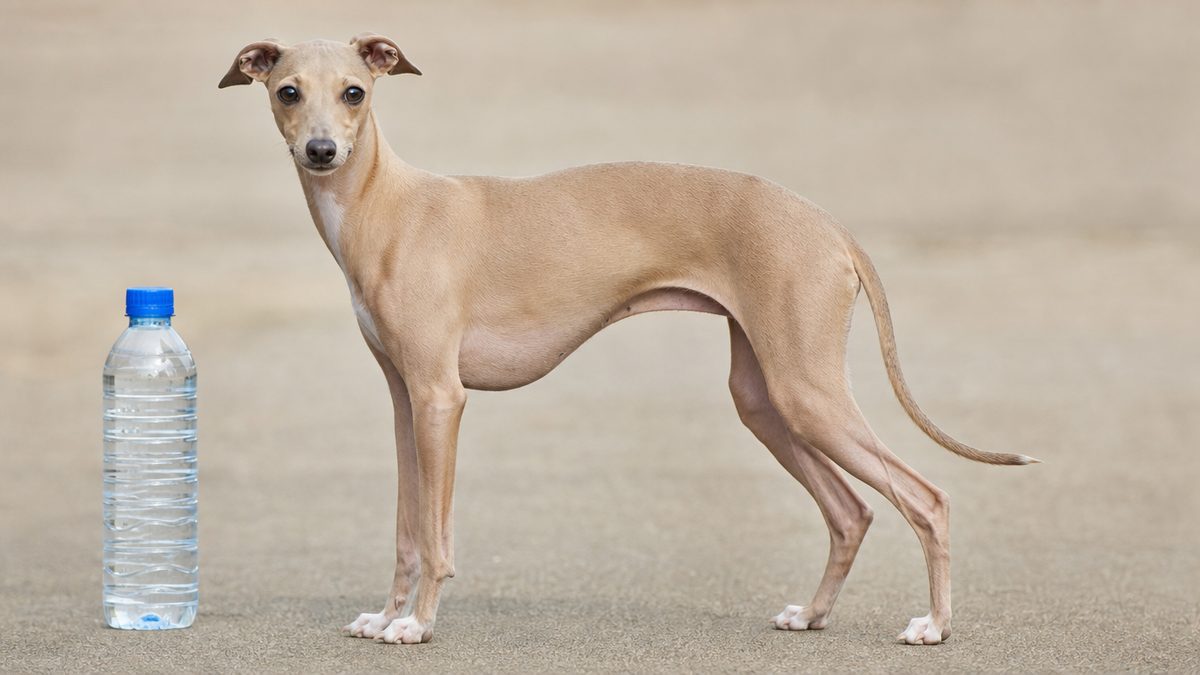
An Italian Greyhound is a toy sighthound of 32 to 38 cm at the withers and a maximum of 5 kg, registered by the Federation Cynologique Internationale as standard number 200 under its Italian name, Piccolo Levriero Italiano. It is the smallest sighthound in the world, and it is not a small Greyhound.
The FCI files the breed in Group 10, Sighthounds, Section 3, Shorthaired sighthounds, without working trial, and gives its utilisation in one word: racing dog. Its own Group 10 index lists the breed under its Italian name with the number 200 beside it, which is how we resolved the standard rather than assembling a URL. The Royal Kennel Club files the same animal in the Toy group, and so does the American Kennel Club. That split is not pedantry. It tells you the two things a buyer needs to know at once, that this is a companion-sized dog with a coursing hound's instincts, and it explains why the breed appears on toy-dog lists and sighthound lists that describe it completely differently.
The breed standard, in the numbers that matter
The standard is unusually tight on size, and the tightness is the point. Height at the withers runs 32 to 38 cm for males and females alike, weight is capped at 5 kg for both, and anything below 32 cm or above 38 cm is a disqualifying fault rather than a mere penalty. Purina India's breed panel gives a working range inside that, 3.5 to 4.5 kg and 32 to 38 cm. The AKC describes the ideal as 13 to 15 inches at the shoulder, which is the same window in other units.
The standard calls the breed the prototype of refinement and elegance and a model of grace and distinction, and an elegant dog is what the rest of the text then specifies in load-bearing detail, because it is describing a fragile animal. The forearm is specified as straight with refined bone structure, flat and lean; the chest is narrow and deep to the elbows; the loin is slightly arched and the croup very sloping; the coat is short, silky and fine all over the body without the slightest trace of fringes. There is no undercoat and no body fat to speak of. Every welfare issue further down this page follows from those four sentences.
| Source | Group | Height | Weight |
|---|---|---|---|
| FCI standard 200 | Group 10 Sighthounds, Section 3 | 32 to 38 cm | Maximum 5 kg |
| Royal Kennel Club | Toy | Not stated on the breed page | Not stated on the breed page |
| American Kennel Club | Toy | 13 to 15 inches ideal | Not stated on the breed page |
| Purina India | Toy | 32 to 38 cm | 3.5 to 4.5 kg |
Where the breed comes from, and where the popular history goes wrong
The FCI's own historical note traces the breed to small sighthounds at the Egyptian court, through Laconia in Greece, arriving in Italy at the start of the fifth century BC and reaching its peak at Renaissance courts. Purina India adds the part most pages leave out: the fashion for ever smaller dogs pushed the breed toward serious health problems and near-extinction, and late-Victorian breeders deliberately rebuilt it into a hardier animal. That is the useful version of the history, because it says the delicacy was manufactured and partly undone rather than being an eternal breed trait.
Colour is where the registries genuinely disagree
FCI standard 200 permits three colours and nothing else: self-coloured black, grey and isabella in all shades, with white tolerated only on the chest and feet, and it lists a multi-coloured coat and white anywhere else as disqualifying faults. The Royal Kennel Club's breed standard colour list for the same breed runs to twenty entries and includes Black & White, Blue & White Pied, Fawn & White, Red & White, Cream, Liver and plain White. The AKC's registration list runs to twenty-two and adds Brindle, Chocolate, Black & Tan and Blue & Tan.
This matters more in India than in Britain or America, and almost nobody says so. India is a full member of the FCI, represented by the Kennel Club of India in Chennai, which means an Indian pedigree is issued against FCI nomenclature. A piebald or brindle Italian Greyhound advertised in India as show quality is a dog that FCI standard 200 disqualifies outright, whatever a British or American colour list says about it.
If an Indian seller offers you a white-and-fawn or brindle Italian Greyhound and calls it KCI registered, ask which standard the registration is against. The Kennel Club of India works to FCI nomenclature, and FCI standard 200 lists a multi-coloured coat as a disqualifying fault.
Italian Greyhound price in india: there is not one
No Indian seller publishes an Italian Greyhound puppy price, and the pages that rank for the query do not tell you that. We checked every page on the first results page for this term in India on 31 August 2026, and not one of them carries a rupee figure attached to an actual Italian Greyhound.
That is the finding, and it is more useful than any number we could have printed. What follows is exactly what those pages contain instead, so you can verify it in a browser in about four minutes.
What the ranking Indian sellers are actually offering
Puppiezo holds position two for this query. Its Italian Greyhound page carries a carousel headed Available Italian Greyhound Puppies For Sale containing eight animals, and none of them is an Italian Greyhound. The eight are two Maltipoos, two Poodles, a Goldendoodle, a Cane Corso, a Rottweiler and a Doxiepoo. Their prices run Rs 76,499 to Rs 1,20,000, and Rs 98,999 appears three times on that single page, attached to a Maltipoo, a second Maltipoo and a Doxiepoo. The category page for the breed is emptier still, listing one card that links back to the same product page with no price at all, while its meta description promises Italian Greyhound Price and the word rare.
Mr n Mrs Pet holds position six. Its Italian Greyhound page is headed Italian greyhound Puppies For Sale and its meta description promises KCI registered Italian Greyhound puppies for sale in India at affordable prices. The three dogs on the page are a Border Collie, a French Bulldog and a Goldendoodle.
So across the two Indian marketplaces that rank for this term, eleven animals are advertised under the breed's name and zero are the breed.
The Rs 98,999 house price, tested three ways
Rs 98,999 is not an Italian Greyhound price and it is not any breed's price. Bonbeno has now recorded it on eleven separate pages of this one site, attached to whichever puppy is in stock. Run the standard conversion tests on it and none of them lands anywhere a seller would price a dog.
| Rupee figure | At 84.38 | At 74.00 | At 66.67 | At 80.00 |
|---|---|---|---|---|
| Rs 98,999 | 1,173.25 | 1,337.82 | 1,484.91 | 1,237.49 |
| Rs 94,999 | 1,125.85 | 1,283.77 | 1,424.91 | 1,187.49 |
| Rs 92,599 | 1,097.40 | 1,251.34 | 1,388.92 | 1,157.49 |
| Rs 76,499 | 906.60 | 1,033.77 | 1,147.43 | 956.24 |
| Rs 1,20,000 | 1,422.14 | 1,621.62 | 1,800.00 | 1,500.00 |
Read the quotients rather than whether the division worked. No seller anywhere prices a dog at 1,173.25 dollars. These are rupee-native charm prices ending in 999 and 499, not a converted foreign list, which is a different kind of contamination from the dollar tables this site has caught elsewhere and needs saying differently.
Two of those rows do divide cleanly, and both are traps. Rs 1,20,000 gives exactly 1,500.00 at 80 and exactly 1,800.00 at 66.67, but that proves nothing at all: 66.67 is 200 divided by 3, so any figure ending in three zeros divides to a whole number by construction, and 1,000 divided by 80 is 12.5, which does the same job. A clean quotient is only evidence when the figure does not end in three zeros.
The price that does rank, and the dog it belongs to
Search this term in India and the numbers you are shown mostly belong to the full-size Greyhound. Mr n Mrs Pet publishes an Indian Greyhound band of INR 90,000 to INR 3,50,000 and above, split into basic quality at INR 90,000 to INR 1,50,000, KCI registered at INR 1,50,000 to INR 2,50,000 and champion bloodline at INR 2,50,000 to INR 3,50,000, repeated identically for Bangalore, Delhi and Mumbai. That is a dog of 27 to 30 kg. Applying it to a 4 kg Italian Greyhound is a seven-fold error in the animal.
Google's own answer is in dollars
The clearest evidence that no Indian price exists is what Google India returns for a query that contains the words in india. Its AI answer for this term on 31 August 2026 replied entirely in US dollars, quoting 1,100 to 3,000 dollars from breeders, 500 to 750 dollars from the Italian Greyhound Rescue Foundation and 75 to 300 dollars from local shelters, and linking Mid Atlantic Italian Greyhound Rescue and a UK marketplace. It contained no rupee figure of any kind.
We will not convert a dollar price into rupees and present it as an Indian price. That manufactures a market that does not exist, and this site has repeatedly caught Indian pages doing exactly that. If you are quoted a figure for an Italian Greyhound in India, ask to see the dog, its parents and its registration papers before you discuss money at all.
How rare is it really, and a Kennel Club table that does not add up
The Italian Greyhound is not a rare breed abroad and it is one of the few Toy breeds growing. Establishing that took a cell-by-cell check of two Royal Kennel Club documents, and the check found an error in one of them.
The Royal Kennel Club publishes registration figures in two places, a ten-yearly comparative table and a quarterly table, both linked from the same statistics index. Bonbeno's standing guidance is that the Terrier and Toy groups in these documents are known-unreliable while Hound, Gundog and Pastoral have been verified clean, so we compared all twenty-four Toy rows across both documents rather than trusting either.
The Italian Greyhound's own numbers agree, and they are rising
Both documents give the breed 659 registrations for 2025, so the figures for the breed this page is about are consistent The Royal Kennel Club. The ten-year series reads 326, 346, 426, 390, 544, 571, 593, 611, 541 and 659, a rise of 102 percent across a decade in which the Toy group as a whole fell 61.4 percent. The quarterly table breaks 2025 into 142, 162, 187 and 168, which sums to the printed 659, and shows 133 and 142 for the first two quarters of 2026.
The Toy group's arithmetic fails, and we can name the cell
The ten-yearly Toy table prints a 2025 group total of 10,500. Its own twenty-four breed rows sum to 10,503. The quarterly Toy table prints the same 10,500 total, and its twenty-four rows sum to exactly 10,500, with its four quarterly columns also summing to 10,500.
Comparing the two documents cell by cell, exactly one of the twenty-four cells differs: the Yorkshire Terrier's 2025 figure reads 385 in the ten-yearly table and 382 in the quarterly table. The quarterly figure is corroborated inside its own document, because that breed's four quarters of 85, 112, 111 and 74 sum to 382. So the three-dog discrepancy in the group total is entirely attributable to one cell in the ten-yearly table, and the quarterly document is the one that reconciles.
| Ten-yearly table | Quarterly table | |
|---|---|---|
| Italian Greyhound | 659 | 659 |
| Yorkshire Terrier | 385 | 382 |
| Other 22 breeds | identical | identical |
| Sum of the 24 rows | 10,503 | 10,500 |
| Printed group total | 10,500 | 10,500 |
| Reconciles? | No, out by 3 | Yes, exactly |
We report this as found. The defect in the Toy group is real, it is smaller than a reader might fear, and it does not touch the Italian Greyhound. If you need a Toy group registration figure for any breed, take it from the quarterly document.
Where the breed sits, and who looks after it
At 659 registrations the Italian Greyhound was the 6th most registered of the 24 Toy breeds in 2025, behind the Cavalier King Charles Spaniel at 3,224, the Pomeranian at 1,541, the long-coated Chihuahua at 885, the Pug at 834 and the smooth-coated Chihuahua at 807, and ahead of the Maltese at 490. In 2016 it ranked 11th. The American Kennel Club puts it at 53 of 210 on popularity, and the AKC parent club is the Italian Greyhound Club of America.
None of that translates into Indian availability, and the gap between the two is the point of this page. A breed can be the sixth most registered Toy dog in Britain and simultaneously have no verifiable listing anywhere in India, because registration measures interest where a supply chain exists and India has none.
We went looking for a discrepancy because our own guidance says the Toy group carries one, and the risk in that is finding what you expect. So we checked all twenty-four rows rather than sampling, published the twenty-three that agree, and named the single cell that does not.
Monthly cost of ownership in India
Budget roughly Rs 3,500 to Rs 8,000 a month to keep an Italian Greyhound in an Indian metro, plus two irregular costs this breed carries more heavily than most: dental work and orthopaedic emergencies. The recurring cost of ownership is low because the dog is small; the tail risk is not.
A 4 kg dog eats very little, needs almost no grooming spend and fits every small-dog price band a boarding kennel publishes. That makes the running cost genuinely cheap by Indian standards. The honest budget is dominated by the two lines below, and both are avoidable in part with prevention.
The first year
The core puppy vaccination course runs across the first sixteen weeks and costs about Rs 3,000 to Rs 6,000 in total, made up of DHPPi or the seven-in-one at Rs 500 to Rs 1,200 per dose, anti-rabies at Rs 300 to Rs 600, plus a consultation or injection charge of roughly Rs 300 to Rs 800 on each visit. The nine-in-one runs Rs 800 to Rs 1,500 per dose, and kennel cough at Rs 500 to Rs 900 is worth it only if the dog will board. The annual booster afterwards, one DHPPi plus one rabies, is around Rs 1,000 to Rs 2,000 all in.
The dental line, which is where this breed differs
Set aside a scaling budget from year two, not year six. A professional dental cleaning in India, meaning a pre-anaesthetic check, general anaesthesia, full-mouth scaling above and below the gum line, polishing and an oral examination, runs Rs 2,000 to Rs 8,000 or more, at the higher end in metro and specialist clinics. Extractions are billed on top at Rs 500 to Rs 3,000 or more per tooth, and a surgical extraction of a multi-rooted tooth costs considerably more than lifting an already mobile incisor.
Why this breed and not another: enamel defects and periodontal disease are both documented as prevalent in Italian Greyhounds in the peer-reviewed literature, and the OFA register ranks the breed second of all breeds for familial enamel hypoplasia carriers. A dog whose enamel is thin from birth accumulates plaque faster, so the interval between cleanings is shorter than the breed-average advice assumes.
| Line | Typical range | Note |
|---|---|---|
| Food, 3.5 to 5 kg adult | Rs 900 to Rs 2,200 | Small kibble volume. A premium small-breed food is affordable at this body weight |
| Preventives, tick and flea plus deworming | Rs 400 to Rs 900 | Non-negotiable in India, see the tick-borne disease load below |
| Vaccination, amortised | Rs 85 to Rs 170 | Rs 1,000 to Rs 2,000 annual booster spread across twelve months |
| Grooming | Rs 0 to Rs 400 | A rubber mitt at home covers it. Salon visits are optional for this coat |
| Routine vet consultation | Rs 300 to Rs 800 per visit | Budget three to four visits a year for a healthy adult |
| Dental scaling, amortised | Rs 170 to Rs 670 | Rs 2,000 to Rs 8,000 per cleaning, assume annual for this breed |
| Coat or jumper, north India only | Rs 0 to Rs 150 | One-off Rs 500 to Rs 1,500, and unnecessary south of roughly Pune |
| Realistic monthly total | Rs 3,500 to Rs 8,000 | Excluding emergencies and excluding the purchase, which does not exist here |
The cost nobody budgets for
A distal radius and ulna fracture in a dog this size is specialist orthopaedic surgery, not a splint. The published series repair these with locking plates of 1.5 mm and 2.0 mm, or with multiplanar external skeletal fixation, and report median time to bone union of about 60 days with implant removal at a median of 89 days. Complications are common even in expert hands: in one series of 140 fractures, minor complications occurred in 52 fractures across 61 events. Refracture after the plate comes out is a documented risk, occurring in 5 of 40 limbs in the plate-removal group of one Japanese study.
Indian clinics able to do this well are concentrated in the metros. Bonbeno found no published Indian price list for small-breed antebrachial fracture repair, so we are not going to invent one. Ask a referral orthopaedic surgeon in your city for an itemised estimate covering imaging, implants, anaesthesia and the second procedure to remove the plate, and treat that number as the real cost of owning this breed.
Do not let the tail risk hide the ordinary economics. On food, grooming and boarding an Italian Greyhound is one of the cheapest purebred dogs you can keep in an Indian city, because almost every cost that scales with body weight is being applied to a 4 kg animal.
Indian climate: the cold-weather advice does not transfer
An Italian Greyhound suits most of India better than the international care advice implies, because that advice is written for places colder than anywhere Indians live. The breed's real Indian problem is heat, and the one study that names it by name says so.
Every major source warns about cold. Purina India says the breed prefers a warm home and does not tolerate the cold well at all. The AKC calls it a short-coat, low-fat breed that requires extra care in cold weather. Both statements are true and both were written for readers in Britain and North America. Held against Indian climatology they mostly stop applying.
Delhi in January is milder than Rome
We queried NASA POWER by explicit latitude and longitude rather than by place name, and recorded the grid cell elevation each query returned so the figures can be checked against the real town. The result inverts the usual framing.
| Place | Cell elevation | Annual mean | January mean | May maximum |
|---|---|---|---|---|
| Rome, the breed's homeland | 198.41 m | 15.95 C | 7.01 C | 31.62 C |
| Delhi | 206.37 m | 25.60 C | 13.61 C | 48.08 C |
| Chennai | 48.95 m | 27.95 C | 24.09 C | 42.70 C |
| Mumbai | 97.15 m | 26.77 C | 23.19 C | 44.85 C |
| Bengaluru | 841.72 m | 23.74 C | 21.10 C | 39.88 C |
| Pune | 635.99 m | 23.86 C | 19.85 C | 43.07 C |
Rome's January mean is 7.01 C and the cell's recorded January minimum is minus 4.08 C. Delhi's January mean is 13.61 C, nearly seven degrees warmer, and Chennai never drops below a January minimum of 17.24 C. A breed that evolved and still lives comfortably through Roman winters is not being asked to do anything difficult by an Indian one. The coat sold to Indian owners for this breed is useful on a Delhi or Chandigarh night in December and January, and is decorative anywhere south of roughly Pune.
The heat finding nobody quotes
The universal cold framing has hidden the opposite risk. A study of heat-related illness in dogs in New South Wales identified 119 cases across 1997 to 2017 with a fatality rate of 23 percent, and listed the breeds at elevated risk against crossbreeds. The Italian Greyhound is on that list, alongside the British Bulldog, French Bulldog, Pug, Chow Chow, Samoyed and Airedale Terrier. Older dogs were at increased risk, and cases clustered in December and January, the Australian summer.
That is not what a thin single coat would predict, and it is the most decision-relevant sentence on this page for an Indian buyer. A dog with almost no subcutaneous fat and a very high surface-area-to-mass ratio loses heat quickly and gains it quickly. Its thermal buffer is poor in both directions, which is why it is simultaneously the breed most often photographed in a jumper and a heat-sensitive breed named on an elevated heat-illness list. Learn to recognise heat stroke before summer rather than during it, because on a dog this small the margin between heavy panting and collapse is short.
What that means city by city
- Chennai, Mumbai and Kolkata. Walk before sunrise and after dark from March to June. Annual mean humidity sits near 72 percent in Chennai and July humidity reaches 89.6 percent in Mumbai, and humid heat defeats panting, which is the only cooling mechanism a dog has. No coat is ever needed.
- Delhi, Lucknow and Chandigarh. The only Indian cities where the cold advice partly applies. Buy one jumper for December and January nights, then put it away. A May cell maximum of 48.08 C in Delhi is the far bigger hazard.
- Bengaluru and Pune. The easiest Indian climate for this breed, with annual means near 23.7 C and 23.9 C and no month requiring either a coat or an air conditioner.
- Hill stations. Verify the elevation before trusting any climate figure. NASA POWER returned a cell elevation of 897.65 m for Shimla against a real town elevation near 2,200 m, a gap of about 1,302 m, so the cell reads far too warm. Corrected at the standard lapse rate of 6.5 C per 1,000 m, Shimla's annual mean is roughly 12.7 C rather than the 21.15 C the cell reports, and we publish that as an estimate rather than a measurement.
Humidity, monsoon and the coat advantage
The short single coat is a genuine Indian asset and it is worth saying plainly, because most imported breeds arrive with a double coat that traps moisture through the monsoon. There is nothing on an Italian Greyhound to trap water. It dries in minutes, it has no fringing anywhere on the body by breed standard, and it will not develop the hot spots and matting that make July miserable for a Golden Retriever in Kochi.
The heat clause of the Prevention of Cruelty to Animals (Dog Breeding and Marketing) Rules 2017 is Second Schedule Part IV paragraph 21(1), not a numbered Rule, and it is usually quoted for long-haired breeds. Read it properly and its first limb catches a thin-coated Italian Greyhound just as squarely. It bars keeping in outdoor facilities, without the attending veterinary practitioner's written approval, (i) dogs that are not accustomed to the temperatures prevalent in the area, (ii) breeds that cannot tolerate them such as long-haired breeds in high temperature locations, and (iii) sick, infirm, aged or young animals. The same paragraph requires outdoor shelters to protect animals from the direct rays of the sun and to provide adequate protection from heat and cold. An imported heat-sensitive toy sighthound kept outdoors in an Indian summer is the case limb (i) was written for.
Of the roughly two dozen Toy breeds sold in India, this is among the few whose coat is actively suited to a humid Indian summer. What it lacks is not heat tolerance in the coat, it is the body mass and fat to buffer a temperature swing in either direction.
Temperament and who should not buy one
An Italian Greyhound is an affectionate one-person dog that is clean, quiet indoors and nearly always bonded to a single household member. It is a poor choice for a busy family with young children, and the reasons are physical as much as behavioural.
Purina India describes the breed as clean, shy and gentle, notes that it loves to snuggle partly out of affection and partly because it needs to keep warm, and says plainly that once bonded it is nearly always a one-person dog, often disinterested in other people and other dogs. The AKC frames the same animal from the other side, as a decorative couch dog that is at heart a coursing hound with an instinct for pursuit. Both are accurate, and an owner gets both.
The delicacy is a temperament issue, not only a health one
Purina India's guidance is unusually direct for a manufacturer page: Italian Greyhounds generally do not make great family dogs because they are too delicate and sensitive for all but the quietest of families, and they bond exclusively to one person. In an Indian joint-family flat with cousins visiting and a toddler learning to walk, that is a real constraint rather than a caveat. A 4 kg dog that startles and bolts under a moving chair is at risk from ordinary household traffic.
The breed also carries documented separation-related behaviour. Purina India records that Italian Greyhounds very often have separation-related behaviour issues, which in an Indian apartment means barking that your neighbours will hear through a shared wall long before you do.
Who this breed genuinely suits
- A quiet adult household with someone home most of the day. This is the single strongest predictor of a good outcome with this breed.
- A small flat with non-slip flooring. Floor area does not matter; the Royal Kennel Club rates the breed as suited to a small house with a small or medium garden. Polished granite and marble do matter.
- An owner who wants a low-grooming dog. The Royal Kennel Club puts grooming at once a week and records the coat as short.
- Someone who will accept a dog that ignores visitors. The one-person bond is a feature of the breed, not a training failure to be corrected.
Who should buy a different dog
- Households with children under about eight. Too fragile for ordinary rough handling, and Purina India says so directly.
- Homes with an open staircase or high beds. The commonest fracture mechanism in this breed is a jump the dog chose to make.
- Anyone who needs a reliable recall off-lead. This is a sighthound. Purina India advises teaching recall while explicitly saying it should not necessarily be relied upon.
- First-time owners who are out ten hours a day. The separation-related behaviour risk plus slow house-training makes this a difficult first dog in that pattern.
- Anyone wanting a guard dog. The Royal Kennel Club and Purina India both note the breed barks and alerts, which is not the same thing as guarding a 4 kg body.
Other dogs, cats and the prey drive
Treat the sighthound instinct as permanent. Purina India records that Italian Greyhounds are known to chase cars, bikes, people and cats, and that they may require training to live with other pets. In Indian cities that specific list is the problem: a dog that bolts after a scooter on a residential lane is in traffic within two seconds. Every Indian owner of this breed should assume the dog stays on a harness and lead outdoors for life, and should socialise it early and deliberately with the street noise it will actually meet.
Purina India recommends early socialisation so the dog accepts new people and situations more readily, while being clear that it will still be a one-person dog. The realistic goal is a dog that tolerates the outside world calmly, not one that greets it warmly.
Purina India advises teaching this breed to walk on a harness and a lead specifically. A neck collar on a dog with this neck and this bolt reflex is a poor idea, and the standard describes a lean neck with no dewlap and a throat line only slightly convex.
Training: what works and what this breed refuses
Train an Italian Greyhound in short reward-based sessions and accept two limits from the start: house-training is genuinely slow in this breed, and recall will never be reliable enough to trust off-lead. Both are documented breed characteristics rather than owner failures.
Purina India puts it bluntly. An Italian Greyhound sees training as beneath it, although it is quite capable of learning the basics; it should be taught to walk on a harness and lead; a good recall should be taught although not necessarily relied upon; and toilet training can be slow in the breed. The Royal Kennel Club lists the breed as suitable for owners with some experience and needing basic training. Read those together and the picture is a bright dog with low compliance, not a stupid one.
House-training in an Indian flat, realistically
Plan for six months, not six weeks, and plan around the monsoon. A small thin-coated dog that dislikes rain will refuse to toilet outdoors through a Mumbai or Kolkata July, which is exactly when most owners give up and the habit sets. Two things fix this in practice. Set up an indoor toilet option on the balcony from week one so the dog always has a legal place to go, and take the dog out on a fixed schedule after every sleep, meal and play session rather than waiting for a signal it will not give clearly.
Do not use punishment for accidents with this breed. A dog Purina India describes as shy and sensitive learns to hide the behaviour rather than to stop it, and you lose the ability to supervise it.
The five things worth teaching first
- Harness acceptance, before anything else. Purina India specifies harness and lead for this breed, and a dog that fights the harness never gets walked properly.
- Four on the floor, meaning no jumping down from beds, sofas or arms. This is the single highest-value behaviour you can install in this breed, because the commonest foreleg fracture mechanism is a jump the dog chose.
- Station on a mat, so the dog has a safe place to be when the door opens. It removes the bolt opportunity that this breed's prey drive creates.
- Handling and mouth tolerance, so you can brush teeth daily. Given the enamel and periodontal load in this breed, a dog that accepts a toothbrush is worth thousands of rupees a year in avoided scaling.
- Crate or pen comfort, taught before you ever need it. It is what makes eight weeks of post-fracture cage rest survivable if the day comes.
Recall, and why the answer is a long line
Teach recall properly and still never test it near traffic. The breed is a sighthound with the FCI's own listed utilisation as a racing dog, and Purina India records it chasing cars, bikes, people and cats. In an Indian residential lane, the gap between a dog seeing a cat and reaching a road is under three seconds. Use a long line of ten to fifteen metres in an enclosed space, and treat free running as something that happens only inside a fully fenced area.
Purina India also notes it is best to let the Italian Greyhound run in a confined space, because it can run off in pursuit of prey and is too small and easily injured to safely play with anything other than the gentlest of dogs. That second clause matters in Indian dog parks, where a friendly Labrador colliding with a 4 kg sighthound at speed is a genuine injury risk rather than a social problem.
Realistic timelines
| Skill | Realistic timeline | Note |
|---|---|---|
| Harness and lead accepted | 2 to 4 weeks | Start indoors with the harness on for meals |
| Name response and sit | 1 to 2 weeks | The breed learns fast when the reward is worth it |
| Reliable indoors house-training | 4 to 6 months | Slower through the monsoon. Purina India records slow toilet training as a breed trait |
| Settled alone for two hours | 3 to 6 months | Build in minutes. Separation-related behaviour is common in the breed |
| Recall inside a fenced area | 3 to 6 months | Never extend this to unfenced ground |
| Accepts daily tooth brushing | 4 to 8 weeks | Start with a finger and paste, not a brush |
Generic socialisation advice was written for quiet suburbs. Deliberately socialise an Indian Italian Greyhound puppy to horns, two-wheelers, cattle, street dogs behind a barrier and firecracker season, in short calm exposures well below the dog's fear threshold.
Daily exercise, and the jumping problem
An adult Italian Greyhound needs up to an hour of exercise a day, and the Royal Kennel Club rates it exactly that way. The harder question in India is not how much, it is where, because the surfaces and the traffic are the constraint rather than the distance.
Purina India frames the requirement as at least an hour daily for a healthy adult, while stressing that the dog will also want to go everywhere with its owner. In practice most of that hour is walking, and the sprinting the breed actually enjoys is a few short bursts in a safe enclosure rather than a sustained run.
Exercise has to be rationed while the dog is growing
Purina India is specific and this is the most important sentence in its exercise guidance: exercise should be carefully monitored until the dog is fully grown, along with any stairs, and even then care should be taken with the breed's often-delicate limbs. The reason sits in the orthopaedic literature. Refracture after radial-ulnar repair in small breeds was linked in one study to the change with growth in the position of the most distal screw, which is a growing-skeleton effect, and the standard describes a forearm with refined, flat, lean bone. A young Italian Greyhound's antebrachium is thin bone in a fast-growing limb.
A workable Indian routine
- Two walks of 20 to 30 minutes, timed before sunrise and after dark from March to June. Test the tarmac with the back of your hand for five seconds before you step out.
- One indoor session of 10 to 15 minutes, using a flirt pole or a rolled sock on a corridor runner. This is how the dog gets exercised through a monsoon week without going out.
- Free running only inside a fenced space, which Purina India recommends explicitly because the breed can run off in pursuit of prey.
- No forced distance work before about twelve months, and no repeated stair descents at any age.
- Skip the dog park at peak hours. Purina India notes the breed is too small and easily injured to safely play with anything other than the gentlest of dogs.
What happens without it
An under-exercised Italian Greyhound does not become destructive in the way a working breed does. It becomes vocal and clingy, which in a flat surfaces as barking when you leave and as a dog that cannot settle. Because separation-related behaviour is already common in the breed, skipping exercise compounds the problem you are most likely to have anyway.
The second consequence is weight. A dog whose standard caps weight at 5 kg has almost no margin, and half a kilogram of extra body mass on a 4 kg sighthound is a twelve percent gain loading the same fine forelimbs. Keep the last two ribs easily felt and the waist visible from above.
Making an Indian home safe, which matters more than the walk
The exercise plan is the easy half. Retro-fitting an Indian apartment is the half that prevents fractures, and it is cheap.
| Change | Typical cost | Why |
|---|---|---|
| Runners or rugs on polished granite, marble or vitrified tile | Rs 800 to Rs 4,000 | Removes the slip that turns a normal turn into a fall. This is the highest-value change in an Indian flat |
| A ramp or two steps to the bed and sofa | Rs 1,200 to Rs 3,500 | Jumping down is the commonest fracture mechanism owners describe |
| A gate at the top and bottom of any internal staircase | Rs 1,500 to Rs 4,000 | Purina India names stairs specifically as something to monitor while the dog grows |
| Balcony grille mesh, closing gaps under the railing | Rs 2,000 to Rs 8,000 | A 4 kg sighthound fits through gaps that hold a Labrador puppy |
| A harness rather than a neck collar | Rs 400 to Rs 1,200 | Purina India specifies harness and lead for this breed |
Owners plan the walk and forget the furniture. Most fractures in toy sighthounds happen indoors, at home, in front of the owner, from a jump the dog made confidently. Teach four on the floor and buy the ramp before the puppy arrives, not after the first radiograph.
Grooming and coat care in Indian humidity
Grooming an Italian Greyhound takes about five minutes a week with a rubber mitt, which makes it one of the lowest-maintenance coats sold in India. The work that actually matters on this breed is dental, nails and skin, not hair.
The Royal Kennel Club records grooming as once a week and the coat as short. The FCI standard describes hair that is short, silky and fine all over the body without the slightest trace of fringes. There is no undercoat to strip, no feathering to mat and nothing to clip. In a Kochi or Guwahati monsoon, that is a real advantage over any double-coated breed.
The shedding question, and the allergy claim that follows it
Two of the sources this page uses disagree, and the disagreement is worth printing rather than resolving. The Royal Kennel Club's breed panel records Sheds: No The Royal Kennel Club, Italian Greyhound. Puppiezo's Indian page prints Shedding: Yes on the specification card it publishes under this breed's name, although that card also gives the height as 27 to 30 inches and the origin as England, so it is describing a different dog entirely. Purina India, which is describing the right dog, records the breed as non hypoallergenic.
Purina India has that right, and it is the answer to the question Indian buyers actually ask. There is no such thing as a hypoallergenic dog. Vredegoor and colleagues measured the Can f 1 allergen across 196 dogs of so-called hypoallergenic breeds against 160 control dogs and found the hypoallergenic group came back higher, not lower, with 2.26 micrograms per gram of hair against 0.77 and 27.04 in coat samples against 12.98, and no difference in airborne allergen. A dog that leaves little hair on your sofa is still a dog that produces Can f 1. Do not pay a premium for an allergy-safe Italian Greyhound.
The weekly routine
- Rubber grooming mitt, once a week, two minutes. It lifts dead hair and distributes skin oil. A slicker brush is unnecessary and uncomfortable on skin the standard describes as fine and tight.
- Brush the teeth daily. This is the real grooming task for this breed and it is not optional, given the documented enamel and periodontal load.
- Check and trim nails fortnightly. Long nails change how a fine forelimb loads on landing, which matters more here than on a heavier dog.
- Wipe the coat down after a monsoon walk and dry the ears. The coat dries in minutes, but wet ears in Indian humidity are how otitis starts.
- Bathe only when actually dirty, roughly every four to eight weeks. Over-bathing a thin single coat strips oil and leaves flaky skin.
Skin, sun and parasites in India
A short thin coat exposes skin, and two Indian problems follow. The first is sunburn on the muzzle, ear tips and the thinly haired belly, which is a genuine risk on a fawn or isabella dog walking at midday. Walk in the dark and the problem disappears. The second is ticks, which reach this breed's skin more easily than a dense-coated dog's. A survey of canine tick-borne diseases in India documents a substantial disease load carried by *Rhipicephalus sanguineus* across Indian cities, so keep a year-round preventive on regardless of how clean the coat looks.
One thing this coat will not do is hide a problem. On a Golden Retriever a lump or a rash goes unnoticed for weeks. On an Italian Greyhound you will see it the day it appears, which is the quiet advantage of a breed you can groom in five minutes.
If you are choosing this breed partly to escape grooming bills, the arithmetic works. Redirect what you would have spent on a monthly salon visit into an annual dental scaling at Rs 2,000 to Rs 8,000, which is where this breed's real maintenance cost sits.
Health risks, screening and life expectancy
An Italian Greyhound has a median survival of 14.0 years with a 95 percent confidence interval of 13.2 to 15.1, calculated on 70 recorded deaths in a UK study covering 155 purebred breeds. That is among the longest medians in the dataset and two full years above the crossbred figure of 12.0 in the same tables.
We checked one thing before quoting that median, and it is the check most pages skip. The same paper's Table S5 reclassifies some breeds into a close relative for its phylogeny, which silently merges two breeds into one row. The Italian Greyhound is not merged. Its row carries no reclassification, abbreviation ITGY, Toy group, sighthound, small, dolichocephalic, and it stands separately from the Greyhound and the Whippet, which also stand alone. So the 14.0-year figure describes this breed and nothing else.
| Breed | Median survival | 95% CI | Recorded deaths |
|---|---|---|---|
| Italian Greyhound | 14.0 years | 13.2 to 15.1 | 70 |
| Irish Terrier | 13.5 years | 13.1 to 14.0 | 146 |
| Whippet | 13.4 years | 13.2 to 13.7 | 1,483 |
| Crossbred baseline | 12.0 years | 12.0 to 12.1 | 72,445 |
| Greyhound | 11.5 years | 11.4 to 11.6 | 3,025 |
One caution on the sample size. The paper's Table S3 gives the Italian Greyhound an N of 389 while Table S6 gives 393, and this discrepancy runs through the dataset in both directions. The death count is identical in both tables at 70, which is why we quote deaths rather than N. We checked four breeds and found the same pattern each time. The paper also carries an Author Correction, and we read it: it changes only the Miniature Dachshund median in a figure legend and touches nothing on this breed.
What the OFA register actually shows
The Royal Kennel Club asks for one screening test in this breed, eye testing under the BVA, KC and ISDS Eye Scheme, and offers no breed-specific DNA package. The OFA register in the United States goes considerably further, and its numbers are the most useful health data available anywhere for this breed.
| Test | Evaluations | Result | Breed rank |
|---|---|---|---|
| Progressive retinal atrophy | 310 | 43.9% normal, 54.5% carrier, 1.6% affected | 3rd |
| Primary closed angle glaucoma | 274 | 81.4% normal, 18.6% carrier, 0% affected | 1st |
| Familial enamel hypoplasia | 333 | 74.5% normal, 24.9% carrier, 0.6% affected | 2nd |
| Eyes (summary line) | 1,981 | 91.4% normal, 8.6% abnormal | 32nd |
| Thyroid | 610 | 76.1% normal, 20.3% equivocal | 53rd |
| Patella | 1,357 | 97.7% normal, 2.3% abnormal | 80th |
| Hips | 502 | 99.4% normal, 0.6% dysplastic | 220th |
| Basic cardiac | 131 | 98.5% normal | 9th |
Two of those rows deserve reading twice. More than half of Italian Greyhounds tested for progressive retinal atrophy are carriers, and the breed is the single highest-ranked of any for primary closed angle glaucoma carriers. Carrier status is not disease, and the affected rates are low precisely because breeders are using the tests. But it means a mating between two untested Italian Greyhounds is a genuine coin toss, and it is why the screening question below is not a formality.
The hip figure is the good news and worth stating plainly: 99.4 percent normal across 502 evaluations, with the components 51.2 percent excellent, 44.6 percent good and 3.6 percent fair summing exactly to the 99.4. Hip dysplasia is not this breed's problem.
The Prevention of Cruelty to Animals (Dog Breeding and Marketing) Rules 2017, Second Schedule Part III paragraph 8(10), requires that breeding dogs shall have been tested for genetic defects including hip dysplasia, progressive retinal atrophy, night blindness, hypothyroidism, entropion, ectropion and others. Progressive retinal atrophy is named by name, and it is the test on which 54.5 percent of 310 Italian Greyhounds came back carriers. An Indian breeder of this breed who has not run it is not meeting the standard the Rules set.
The eye picture, and an OFA contradiction worth knowing about
Eyes are the Italian Greyhound's most consistently documented health issue, and three independent bodies of evidence agree on which finding dominates. They also expose a contradiction inside OFA's own eye data that no breed page anywhere mentions.
Start with the contradiction, because it changes how you should read every eye percentage you see for this breed. OFA's summary eye table reports 91.4 percent normal across 1,981 evaluations. OFA's detail rows, on a near-identical denominator of 1,979, report NORMAL for 1,202 dogs, which is 60.7 percent. That is a gap of 30.7 percentage points between two tables published by the same registry about the same breed.
It gets worse arithmetically. The summary says 8.6 percent abnormal, while a single detail row, vitreous degeneration in the anterior chamber, accounts for 406 of 1,979 dogs, or 20.5 percent on its own, and a second row, vitreous degeneration with syneresis, accounts for another 324 dogs at 16.4 percent. A part cannot exceed its whole, so the two tables are not measuring the same thing, and neither should be quoted as the breed's eye rate. We publish both and the arithmetic, and we quote neither as the figure.
Vitreous degeneration is the breed's signature eye finding
Three separate sources converge on it, which is unusual and makes the finding solid.
- An Italian clinical series. Across 462 dogs of three small Italian breeds examined between 1994 and 2015, 306 dogs (66.2 percent, 95% CI 61.8 to 70.4) had at least one eye disorder known or presumed to be inherited. Cataract was the commonest finding overall, but in the Italian Greyhound specifically the commonest was presentation of vitreous in the anterior chamber at 46.7 percent of the breed's findings. Note that the 66.2 percent is the pooled figure for Maltese, Bolognese and Italian Greyhound together, not this breed alone.
- A US registry study using the Greyhound as its control. A retrospective of 4,217 dogs screened through the Companion Animal Eye Registry between 2013 and 2016 found that Italian Greyhounds, Brussels Griffons and Shih Tzus had a significantly higher likelihood of vitreous degeneration than the negative control breed, the Greyhound, and that each additional year of age raised the likelihood by 24 percent.
- OFA's own detail rows, where the two vitreous categories are far and away the largest non-normal entries for the breed.
The same US study found no association between vitreous degeneration and cataracts, lens luxation, glaucoma or retinal detachment, which is genuinely reassuring. Vitreous degeneration in this breed appears to be common and age-related rather than a gateway to blinding disease.
The two DNA tests that matter, and what a carrier result means
Progressive retinal atrophy and primary closed angle glaucoma both have DNA tests, and the Italian Greyhound ranks 3rd and 1st respectively among all breeds for carrier frequency. Both are recessive, so a carrier dog is clinically normal and only a carrier-to-carrier mating produces affected puppies. That is exactly why the tests exist and why the affected rates on the register are low, 1.6 percent and zero.
For an Indian buyer the practical consequence is short. Ask for the parents' PRA and glaucoma results in writing, and understand that carrier-to-clear is a perfectly responsible mating while carrier-to-carrier is not. A breeder who does not know what those words mean has not done the work.
What the Royal Kennel Club asks for, and what it does not
The Royal Kennel Club lists eye testing under the BVA, KC and ISDS Eye Scheme as best practice for this breed and states that it does not currently offer a breed-specific DNA testing package for it. Its Breed Watch entry is Category 1, meaning no points of concern specific to the breed have been identified for special attention by judges. Read the OFA carrier frequencies alongside that and the gap is obvious: the clinical eye examination catches vitreous degeneration and cataract, and it cannot catch a carrier of anything.
Bonbeno has now recorded this summary-versus-detail contradiction on seven breeds, and at 30.7 points the Italian Greyhound's is the widest we have found. If a page tells you 91 percent of Italian Greyhounds have normal eyes, it has read one table and not the other.
Leg fractures: what the literature does and does not say
The Italian Greyhound's reputation for breaking legs is real, but the published evidence behind it is thinner and more specific than almost every page claims. Exactly one PubMed-indexed paper links this breed to a fracture, and it is a single case report.
We searched PubMed for the breed name combined with fracture, bone and leg. One record came back: a 2008 case report describing recombinant human bone morphogenetic protein-2 used to treat extreme radial bone atrophy secondary to fracture management in an Italian Greyhound, in a dog with a history of recurring fractures, which needed a pancarpal arthrodesis seven months later and was still mildly lame at two years. Our controls in the same session returned 124 records for Labrador plus hip dysplasia and 13 for Bergamasco plus dog, so the search was working.
That does not mean the risk is imaginary. It means the risk is documented by body weight rather than by breed, and the Italian Greyhound sits inside every published band.
| Study | Inclusion | Cases | Key result |
|---|---|---|---|
| Aikawa 2019, Veterinary Surgery | Dogs up to 7 kg | 119 dogs, 140 fractures | All healed. Median union 60 days, implant removal 89 days. Major complications in 4 fractures, minor in 52 |
| Aikawa 2018, VCOT | Body weight under 7 kg | 65 fractures | All healed without non-union. Minor complications in 7, major in 4 |
| Muroi 2025, VCOT | Small-breed dogs | 141 limbs plate-retained, 40 plate-removed | Refracture in 5 of 141 and 5 of 40 respectively |
| Nelson 2017, VCOT | Dogs 4 kg or less | 13 fractures in 12 dogs | 3 major complications with the 1.5 mm plate, 1 with the 2.0 mm plate |
An Italian Greyhound at 3.5 to 5 kg qualifies for the 7 kg bands, the 6 kg bands and the 4 kg band. So the honest statement is this: no study gives an Italian Greyhound fracture incidence, and there is no denominator anywhere from which one could be calculated. What exists is a body of surgical literature about dogs of exactly this size, and it is unanimous that these fractures are repairable, that they heal, and that the repair is difficult enough to have generated four separate papers about which plate to use.
Why the distal forelimb, specifically
The anatomy explains the pattern better than the anecdotes do. FCI standard 200 specifies a forearm that is straight with refined bone structure, flat and lean, in perfect vertical position, with a well-evident furrow from carpus to elbow. A thin, straight, lightly muscled antebrachium on a dog that lands from height is the mechanical worst case, and the distal third is where every published series concentrates.
The growth-plate dimension matters for a puppy owner. The refracture study found that refracture in dogs whose plate stayed in was linked to the relative change with growth in the position of the most distal screw, and in dogs whose plate came out it was linked to reduced radial thickness and bone density beneath the plate. Both are growing-skeleton effects, which is why Purina India's instruction to monitor exercise and stairs until the dog is fully grown is the operative advice rather than a general caution.
What an Indian owner should take from this
- Prevent the jump rather than fearing the walk. Ramps, runners and stair gates cost under Rs 10,000 in total and address the actual mechanism.
- Know your referral surgeon before you need one. These repairs use 1.5 mm and 2.0 mm locking plates or multiplanar external fixators, which is specialist orthopaedic equipment rather than general-practice kit.
- Expect a second procedure. Implant removal at a median of 89 days is normal in this literature, not a complication.
- Expect a good outcome. In the largest series every fracture healed and every dog returned to normal limb function at final follow-up. That is worth saying to an owner who has just been told their puppy needs surgery.
A page that tells you Italian Greyhounds have a high fracture rate and cites nothing is repeating a reputation. The truthful version is that the fracture literature for dogs of this size is extensive and reassuring about outcomes, and that no study has ever measured how often this particular breed breaks a leg.
Teeth, bloodwork and surgery: three things to tell your Indian vet
Three facts about this breed will change how a competent Indian vet treats it, and none of them is widely known here. It has a named enamel defect, it needs sighthound bloodwork reference intervals, and it carries a bleeding-risk variant at a higher frequency than the Whippet.
1. The enamel defect has a name and a DNA test
Italian Greyhounds carry a familial enamel hypoplasia resembling non-syndromic autosomal recessive amelogenesis imperfecta in humans, caused by a five base-pair deletion in exon 10 of the enamelin (ENAM) gene. It affects deciduous and permanent teeth alike, producing enamel roughening and thinning with brownish mottling, and affected teeth are often small and pointed with increased gaps.
The prevalence figures are the useful part and they show a test working. When the condition was characterised, 14 percent of Italian Greyhounds were affected and 30 percent of dogs with normal teeth were carriers. On the OFA register today, after the DNA test became available, the breed sits at 24.9 percent carriers of 333 tested and only 0.6 percent affected. Two things follow: the test has driven the affected rate down by more than twentyfold in the tested population, and a quarter of the register is still carrying the variant, so the test still matters.
Two nuances the popular version gets wrong. The paper is explicit that basic tooth structure is usually maintained through life and that fractures and dental cavities are not a serious problem in affected dogs the way they are in affected humans, and it found no relationship between the enamel defect and either autoimmunity or periodontal disease. So enamel hypoplasia and periodontal disease are two separate problems in this breed, both prevalent, and fixing one does not fix the other.
2. Standard bloodwork reference intervals do not fit this breed
A study of 63 clinically healthy privately owned Italian Greyhounds, with routine haematology and biochemistry run on 58 of them, concluded that most reference intervals published in veterinary textbooks cannot be validated for the breed. The breed ran higher for mean corpuscular haemoglobin, mean cell haemoglobin concentration and cell haemoglobin concentration mean, lower for large unstained cells, and higher for albumin, calcium and iron, while total protein and cholesterol needed wider intervals.
This is the sighthound bloodwork trap in a smaller package, and Indian owners meet it as an unnecessary second opinion or an unnecessary treatment. Tell the clinic the dog is a sighthound before the sample goes to the lab, and ask whether the laboratory holds sighthound intervals. If it does not, ask that any out-of-range red cell or protein result be interpreted against the published Italian Greyhound intervals rather than the general canine ones.
The same caution applies to the heart. An echocardiographic study of 60 sighthounds, 20 each of racing Greyhounds, Whippets and Italian Greyhounds, found that commonly used ejection phase indices are significantly affected by body size, with larger sighthounds showing lower values, and that body surface area predicted dimensional measurements better than body weight. An Italian Greyhound is the small end of that spectrum, and its numbers should be read against sighthound data rather than against a general canine reference.
3. The bleeding variant is present, and at a higher frequency than in the Whippet
Delayed postoperative haemorrhage is a sighthound problem in which dogs bleed heavily 36 hours or more after routine surgery despite normal clotting tests, and it is associated with a variant in SERPINF2, the gene producing the fibrinolysis inhibitor alpha-2-antiplasmin. A survey of 4,359 dogs across 63 breeds put the Italian Greyhound's variant allele prevalence at 42 percent, fourth of all breeds surveyed behind the Greyhound at 52 percent, the Irish Wolfhound at 51 percent and the Basenji at 49 percent, and ahead of the Galgo Espanol at 34 percent, the Saluki at 30 percent and the Whippet at 25 percent. Breeds in that high band showed high-risk T/T genotype prevalence running from 21 to 24 percent.
A separate Japanese referral-hospital cohort of 433 successfully genotyped dogs detected the high-risk homozygous T/T genotype in one Italian Greyhound, one Whippet and two Shiba Inu, with heterozygotes found in the Saluki, Italian Greyhound, Shiba Inu, French Bulldog, Boston Terrier, Jack Russell Terrier, Chihuahua and mixed-breed dogs. Small numbers, but they confirm the variant is not confined to the large sighthounds.
Tell your vet the dog is a sighthound with a documented SERPINF2 bleeding-risk variant frequency and ask whether pre-emptive aminocaproic or tranexamic acid is appropriate. Then watch the surgical site at the 36-hour mark rather than on the day. This applies to a dental extraction, which Indian owners routinely treat as trivial, exactly as it applies to a spay.
Feeding a 4 kg sighthound in India
Feed an adult Italian Greyhound a small-breed complete food little and often, and keep it lean enough that the last two ribs are easily felt. On a dog whose breed standard caps weight at 5 kg, portion control is the single most consequential feeding decision.
Purina India sets out the physiology behind that: toy dogs have a fast metabolism and burn energy at a high rate, while their small stomachs mean they must eat little and often, and small-breed foods are formulated with appropriate nutrient levels and smaller kibble that encourages chewing and improves digestion. Kibble size is not a marketing detail for a dog with this jaw.
Life-stage feeding
| Stage | Meals per day | What to prioritise |
|---|---|---|
| 8 to 16 weeks | 4 | Small-breed puppy food. Never free-feed. This is when skeletal growth is happening in a very fine limb |
| 4 to 8 months | 3 | Hold the dog lean through the growth phase. Extra weight on a growing antebrachium is the wrong bet |
| 8 to 14 months | 2 to 3 | Transition to adult food. Introduce daily tooth brushing now while the mouth is comfortable |
| Adult, 1 to 8 years | 2 | Small-breed adult food. Weigh the portion rather than scooping it |
| Senior, 8 years and up | 2 to 3 | This breed commonly lives past 13, so the senior phase is long. Watch dental comfort and body condition together |
Body condition, measured rather than eyeballed
A sighthound is supposed to look thin, and that confuses Indian owners and Indian relatives in equal measure. The FCI standard describes a narrow chest with slight spring of ribs, deep and let down to the elbows, with a slightly arched loin and lean muscles throughout. So the last two ribs visible in profile and a clear tuck-up are correct, not evidence of neglect.
Use a weighing scale rather than an opinion. Weigh the dog monthly on a kitchen scale until it is a year old, and any time you change food. A 400 gram gain on a 4 kg dog is a ten percent increase in the load its forelimbs carry on every landing, and it will not be visible under this coat until it is substantial.
Dental-aware feeding, because this breed needs it
Feeding decisions and dental disease interact more in this breed than in most, given the documented enamel defect and prevalent periodontal disease. Four practical points follow.
- Dry kibble is not a substitute for brushing. It helps slightly. Daily brushing is what actually changes the interval between the Rs 2,000 to Rs 8,000 scalings.
- Use vet-approved dental chews sized for a 4 kg jaw, not a Labrador-sized chew broken in half. VOSD's guidance is that chews supplement brushing and do not replace professional care.
- Watch for a dog that starts chewing on one side, drops food, or develops bad breath. Those are the early signs VOSD names, and acting on them early keeps treatment simple and cheap.
- Do not switch a dog with sore teeth to soft food and stop there. Soft food accelerates plaque. It is a bridge to a dental appointment, not an alternative to one.
Indian availability and water
Small-breed complete foods from the major brands are widely stocked across Indian metros and online, and the quantities involved are small enough that a premium food is genuinely affordable for this breed. A 4 kg dog eating roughly 100 to 140 grams a day gets through a 3 kg bag in about three to four weeks, which is why the food line in the cost table above stays under Rs 2,200 a month even on a good food.
Water deserves one line of its own in an Indian summer. A dog with this little body mass dehydrates fast, and the same New South Wales study that names the breed on its elevated heat-illness list found cases clustering in the hottest months. Keep two bowls in different rooms, refill them twice a day rather than topping up, and carry water on any walk over fifteen minutes from March to June.
Prepare for this if you keep an Italian Greyhound in an Indian joint family. Print the breed standard's description of the narrow chest and slightly arched loin, ask your vet to record a body condition score at each visit, and use that number rather than an argument.
Month by month through the first year
The first year with an Italian Greyhound is organised around one goal, getting a very fine skeleton to adulthood without a fracture, and one habit, daily tooth brushing. Everything below is arranged around those two.
Indian law sets the floor on when the puppy can come home. Rule 8(1)(a) of the Prevention of Cruelty to Animals (Dog Breeding and Marketing) Rules 2017 provides that pups less than eight weeks in age are not sold. A seller offering a six-week-old puppy is breaking that rule, and on a breed this fragile an early separation is a welfare problem as well as a legal one.
| Age | What is happening | What you do |
|---|---|---|
| Before arrival | You are choosing, not receiving | Ask for parents' PRA and glaucoma DNA results and eye screening. Buy runners, a ramp and stair gates now |
| 8 to 9 weeks | Earliest lawful age to leave the litter | Confirm the first DHPPi is done. Start crate and mat work. No stairs at all |
| 9 to 11 weeks | Second DHPPi booster due | Begin harness desensitisation indoors. Start touching the mouth daily with a finger, no brush yet |
| 12 to 14 weeks | Third DHPPi plus first anti-rabies | Socialise deliberately to horns, two-wheelers and street noise from a carried position or a safe distance |
| 14 to 16 weeks | Final puppy booster, anti-rabies completed | Keep off unknown ground until about a week after the last booster. Full course costs Rs 3,000 to Rs 6,000 |
| 4 to 6 months | Deciduous teeth being replaced | Look for the mottled, thin or pointed enamel that signals the ENAM defect. Start a real toothbrush |
| 6 to 8 months | Growth plates still open, dog feels athletic | This is the highest-risk window. Enforce four on the floor. No jumping off beds, no repeated stair descents |
| 8 to 10 months | Adolescence, recall degrades | Move to a long line. Do not test off-lead recall now or ever near traffic |
| 10 to 12 months | Skeleton finishing | Ease into longer walks. First adult dental check. Weigh monthly and keep the dog lean |
| 12 months on | Adult food, adult routine | Annual booster at Rs 1,000 to Rs 2,000. Schedule the first scaling conversation with your vet |
Vaccination timing in India, and why the last dose is the one that counts
The Indian core schedule starts DHPPi at six to eight weeks and repeats every three to four weeks, with anti-rabies from around twelve weeks and the course usually complete by sixteen weeks. The Rules themselves record that vaccination can start at seven to eight weeks and is usually completed at eighteen weeks. The rule that matters is that the final dose must land at or after sixteen weeks whatever came before it, because the mother's fading antibodies can quietly block an earlier shot from taking.
Keep an unfinished puppy off unknown ground and away from strange dogs until about a week after that last booster. For a dog this small in an Indian city, that also means avoiding lifts and lobbies where street dogs pass, not only parks.
The five habits worth having by the first birthday
- The dog waits to be lifted off furniture rather than jumping. This is the fracture-prevention habit and it must be automatic.
- The dog accepts a toothbrush without a fight. Given the enamel and periodontal load, this is worth thousands of rupees a year.
- The dog settles alone for two hours. Built in minutes, from week one, before separation-related behaviour has a chance to set.
- The dog walks calmly in a harness, which Purina India specifies for this breed.
- The dog has a body condition score recorded at every vet visit, so growth is being measured rather than guessed.
Owners brace for the vaccination window and relax at six months, which is exactly when a confident adolescent with open growth plates starts jumping off the bed. Purina India names monitoring exercise and stairs until the dog is fully grown, and fully grown for this breed means around twelve months, not six.
Italian Greyhound against the breeds Indian buyers cross-shop
Indian buyers reach this breed from two directions, from the sighthounds and from the toy breeds, and it loses on availability against both. Here is the head-to-head that decides it.
The first comparison is the one the search engine keeps making for you. Search this breed's price in India and you are shown Greyhound numbers, because that is the dog with an Indian market. The two are not interchangeable at any level.
| Italian Greyhound | Whippet | Greyhound | |
|---|---|---|---|
| Registry group | Toy (RKC and AKC), Sighthound (FCI) | Hound | Hound |
| Height | 32 to 38 cm | 47 to 51 cm (RKC, dogs) | 71 to 76 cm (male) |
| Weight | Maximum 5 kg | About 15 kg median | 65 to 70 lb |
| Median survival | 14.0 years on 70 deaths | 13.4 years on 1,483 deaths | 11.5 years on 3,025 deaths |
| SERPINF2 variant allele frequency | 42 percent | 25 percent | Highest T/T genotype prevalence, 29 percent |
| Published Indian price | None found | Rs 20,000 to Rs 60,000 | INR 90,000 to INR 3,50,000 and above |
| Indian availability | Effectively nil | Very scarce | Real but small |
| Dominant health issue | Eyes, teeth, distal forelimb | Cardiac murmurs, bleeding risk | Bloodwork misreading, osteosarcoma, bleeding risk |
Read the survival row carefully, because it is the strongest argument for this breed that exists. On the same dataset, with the same method, the Italian Greyhound outlives the Whippet by 0.6 years and the Greyhound by 2.5 years. Sighthound longevity falls with size across these three, and this is the small one.
Against the toy breeds, which is the comparison that decides most purchases
The other route into this breed is from the Indian toy-dog market, where a buyer is choosing between a Chihuahua, a Pug, a Shih Tzu and this. On paper the Italian Greyhound wins on grooming and longevity and loses on fragility and, decisively, on availability.
| Italian Greyhound | Chihuahua | Pug | |
|---|---|---|---|
| UK registrations 2025 | 659 | 885 long coat, 807 smooth coat | 834 |
| Ten-year direction | Up 102 percent from 326 | Down from 1,846 and 3,394 | Down 92 percent from 10,408 |
| Grooming load | Once a week, short coat | Low to moderate | Moderate, plus facial folds |
| Indian heat suitability | Fair, but named on an elevated heat-illness list | Fair | Poor, brachycephalic |
| Buy one in India today | No published listing found | Widely available | Widely available |
| Dominant risk | Distal forelimb fracture, eyes, teeth | Patellar luxation, dental | Airway, eyes, spine |
The registration trend nobody in India has noticed
The Italian Greyhound is one of the very few Toy breeds growing anywhere. Across 2016 to 2025 the Royal Kennel Club's Toy group fell 61.4 percent, from 27,237 registrations to 10,500, and the Pug alone collapsed 92 percent from 10,408 to 834. In the same decade the Italian Greyhound went from 326 to 659, a 102 percent rise, moving from 11th to 6th of the 24 Toy breeds. Only three other Toy breeds rose at all.
That is worth knowing before you conclude the breed is obscure. It is not declining, it is one of the fastest-rising Toy breeds in the largest registry that publishes the data, and its absence from the Indian market is a supply problem rather than a lack of interest.
The nearest available substitutes on temperament and grooming are the Whippet, which shares the coat, the quiet and the sighthound behaviour at three times the weight and is far more robust, and adoption of an Indian pariah dog, which is the only option on this page with genuine Indian heat adaptation. Neither is the same dog, and pretending otherwise would be the same error the marketplaces are making.
Mistakes Indian owners and buyers actually make
Six mistakes account for most of what goes wrong with this breed in India, and the first one happens before the dog exists. They are listed in the order they cost you money.
1. Paying a deposit for a dog nobody has
This is the expensive one. Both Indian marketplaces ranking for this breed advertise it and stock other dogs Mr n Mrs Pet, Italian Greyhound Puppies…, and both invite a phone call rather than showing a priced animal. If you cannot see the puppy, its dam and its registration paperwork, there is nothing to buy. Ask for a video call with the litter and the mother in the same frame before any money moves.
2. Believing an Indian rupee figure without asking what it is attached to
Rs 98,999 appears three times on a single Italian Greyhound page, attached to two Maltipoos and a Doxiepoo. It divides to 1,173.25 dollars at 84.38 and to nothing sensible at any other rate, so it is not even a converted foreign price, it is a house charm price applied to whatever is in stock. India's biggest published dog prices deserve the same scepticism: when a Bengaluru breeder claimed a Rs 50 crore wolfdog, the Enforcement Directorate searched his premises and found no dog and no documents.
3. Buying the cold-weather advice and missing the heat risk
Owners buy a jumper for a Chennai dog and walk it at noon. The cold advice is written for northern Europe and North America, and Delhi's January mean of 13.6 C is nearly seven degrees warmer than Rome's 7.0 C. Meanwhile the one study that names this breed by name lists it among breeds at elevated heat-illness risk, in a series where 23 percent of cases were fatal. Reverse your priorities.
4. Treating dental as cosmetic
Indian owners routinely defer scaling until the breath is unbearable. On a breed where a quarter of the OFA register carries an enamel-hypoplasia variant and where periodontal disease is described as prevalent in the peer-reviewed literature, deferral converts a Rs 2,000 to Rs 8,000 cleaning into that plus Rs 500 to Rs 3,000 per extraction. Brush daily from four months, and book the first scaling on the vet's advice rather than on the smell.
5. Polished floors, high beds and no ramp
The commonest fracture mechanism owners describe is a jump the dog chose to make, indoors, in front of them. Indian flats are finished in granite, marble and vitrified tile, which is the worst possible surface for a dog with this limb. Runners and a ramp cost under Rs 8,000 together and Purina India specifically names monitoring stairs until the dog is fully grown.
6. Not telling the vet it is a sighthound
Two avoidable problems follow from this one omission. Standard laboratory reference intervals cannot be validated for this breed, which produces false alarms on red cell indices, albumin, calcium and iron, and the breed carries the SERPINF2 delayed-haemorrhage variant at a 42 percent allele frequency, higher than the Whippet's 25 percent. Say the word sighthound before the blood draw and before any surgery, including a dental.
Two more that cost less but happen constantly
- Using a neck collar rather than a harness. Purina India specifies harness and lead for this breed, and a bolting sighthound on a neck collar is a bad combination.
- Trusting recall because the dog is small. It is a sighthound whose FCI utilisation is recorded as racing dog, and Purina India records it chasing cars, bikes, people and cats. Small does not mean slow.
Ask: may I see the sire and dam's progressive retinal atrophy and primary closed angle glaucoma DNA results? A breeder working properly with this breed will answer immediately, because those are the two tests on which it ranks 3rd and 1st of all breeds for carrier frequency. A seller who has never heard of them does not have the dog they say they have.
Adoption and responsible sourcing in India
Adopt rather than buy if you want a dog now, because there is no verified Italian Greyhound supply in India to buy from. If you specifically want this breed, the honest route is a wait of months to years, an FCI-pedigreed litter, and a set of questions that most Indian sellers will fail.
Why the Indian supply is thin, in law rather than in sentiment
Two facts explain the empty listings better than demand does. India lists live dogs as a restricted import, and applications made for trading or breeding purposes are rejected, so no lawful commercial pipeline can form to stock a rare breed here. And the breed's registration route runs through the Kennel Club of India, which is the FCI's full member for India, based in Chennai. That means a genuine Indian pedigree is issued against FCI nomenclature, and FCI standard 200 is the document any Indian show dog of this breed is judged against.
So a seller advertising KCI registered Italian Greyhound puppies at short notice is claiming something with a paper trail, and you can ask to see it.
What to verify, in order
- The dog exists. A live video call with the puppy and its dam in the same frame, at a time you choose rather than a clip they send.
- The age. Rule 8(1)(a) of the 2017 Rules provides that pups less than eight weeks are not sold. Ask for the whelping date and the dam's records.
- The registration. A KCI certificate naming the sire and dam, not a photograph of a generic pedigree form.
- The health screening. PRA and primary closed angle glaucoma DNA results for both parents, plus an eye examination under a recognised scheme.
- The colour against the standard. FCI 200 permits self-coloured black, grey and isabella only, with white tolerated on chest and feet, and lists a multi-coloured coat as a disqualifying fault.
- The tail. An undocked, full-length tail. FCI 200 lists anury or a short tail, congenital or artificial, as a disqualifying fault, and the 2017 Rules forbid tail docking outright.
What Indian law says about how the dog was bred
Three provisions of the Prevention of Cruelty to Animals (Dog Breeding and Marketing) Rules 2017 apply directly to this breed and are worth quoting rather than paraphrasing, because they give you standing to ask. Second Schedule Part II paragraph 6(8) provides that there shall be no tail docking, ear cropping, de-barking, de-clawing, branding, dyeing or any other kind of mutilation, and that any change of appearance by artificial means is strictly forbidden. Second Schedule Part II paragraph 6(3) prohibits in-breeding and incest breeding, defining the first as breeding between relatives of the second to fourth grade within the first four generations. Second Schedule Part III paragraph 8(10) requires testing for genetic defects including progressive retinal atrophy.
That in-breeding clause deserves a sentence for this breed specifically. A genetic study found that 18 percent of the genome of contemporary US Italian Greyhounds is shared with a single sire born in 1978, and that virtually all of them carry him in a ten-generation pedigree. The same work found that dogs affected by autoimmune disease were significantly more homozygous in the dog leukocyte antigen region than healthy controls, and an earlier study documented a multiple autoimmune diseases syndrome in the breed resembling autoimmune polyendocrine syndrome type 2 in humans. Ask any breeder what the litter's coefficient of inbreeding is. It is a fair question in this breed and the answer is informative.
The adoption route, which is a real answer and not a consolation
Breed-specific Italian Greyhound rescue does not exist in India, and we found none. What does exist is a very large population of Indian pariah dogs in shelters in every metro, adoptable for a nominal fee or nothing. An indie is the only dog discussed anywhere on this page that is genuinely adapted to Indian heat, needs no coat in any month, and carries none of the eye, enamel or forelimb risks catalogued above.
If it is specifically the sighthound temperament you want, the quiet, the cat-like cleanliness and the low grooming load, say so to a shelter. Sighthound-type indies and lurcher-type crosses turn up regularly in Indian rescue, and a shelter that knows you are looking will call you.
We do not link puppy listings, recommend breeders or take payment from sellers. Everything above is published so you can verify a seller yourself, and the most useful thing on this page is the finding that the pages ranking above us have no Italian Greyhound to sell you.
Italian Greyhound in India: the questions people actually search
How much do Italian Greyhounds cost?
Nobody in India publishes a price for one. Every Indian page ranking for this query either shows other breeds or quotes the full-size Greyhound's band of INR 90,000 to INR 3,50,000, which is a different dog roughly seven times the weight. Abroad the breed sells in the low thousands of dollars, but converting a foreign price into rupees invents an Indian market that does not exist, so we do not do it.
Which dog is 20 crore price in India?
That figure comes from a January 2023 Bangalore Mirror report on Cadabom Hayder, a Caucasian Shepherd bought by a Bengaluru breeder, and it is not an Italian Greyhound. Treat it carefully: when the same breeder later claimed a Rs 50 crore wolfdog, the Enforcement Directorate searched his premises, found no such dog and no documents, and Hindustan Times reported the story as a fabrication.
Which dog is under RS 5000?
An adopted Indian pariah dog is, and no Italian Greyhound is. Indian shelter adoption fees are nominal or nil, and an indie is the only dog on this site genuinely adapted to Indian heat. The Italian Greyhound is not available in India at Rs 5,000 or at any other price, because no Indian seller currently has one to sell.
What is the no. 1 costly dog?
On the pages that rank for this query in India, the highest published band is the full-size Greyhound at INR 3,50,000 and above, not the Italian Greyhound. Indian mega-price claims running into crores trace to press reports about individual imported guardian dogs, and at least one such claim was found by the Enforcement Directorate to have no dog and no paperwork behind it.
Do Italian Greyhounds really break their legs easily?
The risk is real but the published evidence is thinner than the reputation. Exactly one PubMed-indexed paper links this breed to fractures, and it is a single case report of a dog with recurring fractures and severe radial bone atrophy. The large surgical series on distal radius and ulna fractures are banded by weight rather than breed, covering dogs under 7 kg, under 6 kg and under 4 kg, and an Italian Greyhound sits inside all three.
Can an Italian Greyhound handle Indian heat?
Reasonably well in a fan-cooled flat, and badly on an open afternoon walk. A study of heat-related illness in New South Wales names the Italian Greyhound among breeds at elevated risk against crossbreeds, so the universal cold-sensitivity framing is only half the story. Walk before sunrise and after dark from March to June, and never on hot tarmac.
Does an Italian Greyhound need a coat in India?
Only in a north Indian winter, and less than the foreign advice implies. NASA POWER climatology puts Delhi's January mean at 13.6 C against 7.0 C for Rome, so the breed's own homeland is colder in winter than Delhi is. In Chennai, where the January minimum sits above 17 C, a coat is decorative rather than useful.
What health tests should an Italian Greyhound breeder have done?
Ask for eye screening plus DNA results for progressive retinal atrophy and primary closed angle glaucoma. On the OFA register 54.5 percent of 310 Italian Greyhounds tested were PRA carriers and 18.6 percent of 274 were glaucoma carriers, and Indian law names progressive retinal atrophy by name in the genetic-defect testing clause of the 2017 breeding Rules.
How long do Italian Greyhounds live?
Median survival is 14.0 years with a 95 percent confidence interval of 13.2 to 15.1, calculated on 70 recorded deaths in a UK study of 155 purebred breeds. That is two years above the crossbred median of 12.0 in the same dataset and among the longest of any breed in it, so this is a genuinely long-lived dog by the best available evidence.
Are Italian Greyhounds hypoallergenic?
No dog breed is, and the evidence is settled. A study measuring the Can f 1 allergen across 196 dogs of so-called hypoallergenic breeds against 160 controls found the hypoallergenic group had higher levels in hair and coat, not lower. The Royal Kennel Club records this breed as not shedding, and Purina India records it as a non-hypoallergenic breed, which is the correct pairing.
Is an Italian Greyhound a good first dog for an Indian apartment?
For a quiet adult household, often yes. For a family with young children or a house with a marble staircase, no. The dog is small, near-silent, needs a rubber mitt once a week and exercises happily indoors, but it is fragile enough that a jump from a bed can end in orthopaedic surgery, and it house-trains slowly.
Can I import an Italian Greyhound into India?
Only as your own pet, never to sell or breed. India lists live dogs as a restricted import, and applications made for trading or breeding purposes are rejected, so there is no lawful commercial route by which an Indian marketplace could stock this breed. That, rather than demand, is why the listings you see contain other dogs.
Compare with similar breeds
Italian Greyhound sits in 1 Bonbeno group. Each one compares it directly against the breeds it is genuinely an alternative to, on the same figures.