
Dog breed profile
Chihuahua in India: Price, the Molera Myth and Full Breed Guide
What a Chihuahua costs in India across five published sources that disagree by a factor of 50, why the molera and the teacup label are the same problem, and why this is one of the few imported breeds the heat evidence actually favours.
Quick answer
The chihuahua price in india runs Rs 4,000 to Rs 2,00,000 in 2026, a fifty-fold spread across five published sources, and the highest figure comes from the one source that brokers the sale. Bonbeno rates the Chihuahua 4 of 5 for heat tolerance, unusually good for an imported breed, because the largest UK study found it among the lowest odds of heat-related illness. Budget for dental disease, not grooming, and ignore the teacup label entirely.
This guide is general information for Indian pet owners and is not a diagnosis. Always consult a registered veterinarian near you before acting on anything you read here, and treat any sudden change in your dog's condition as urgent.
Chihuahua at a glance
What a Chihuahua actually is
The Chihuahua is the smallest recognised dog breed in the world, a short-coated or long-coated companion dog from Mexico built around one defining feature, a well-rounded apple head. Four major registries describe it, they do not agree with each other, and the disagreement matters more in India than anywhere else because Indian buyers are being sold as premium features two things the standard that applies in India actually disqualifies.
Start with the parts every registry agrees on. The Chihuahua is compact, alert and confident out of all proportion to its size. The American Kennel Club standard describes a graceful, swift-moving little dog with a saucy expression and terrier-like qualities of temperament, projecting self importance, confidence and self-reliance. The FCI calls it quick, alert, lively and very courageous. The Royal Kennel Club in Britain says gay, spirited and intelligent, neither snappy nor withdrawn. Nobody describes a timid dog, and no standard anywhere asks for one.
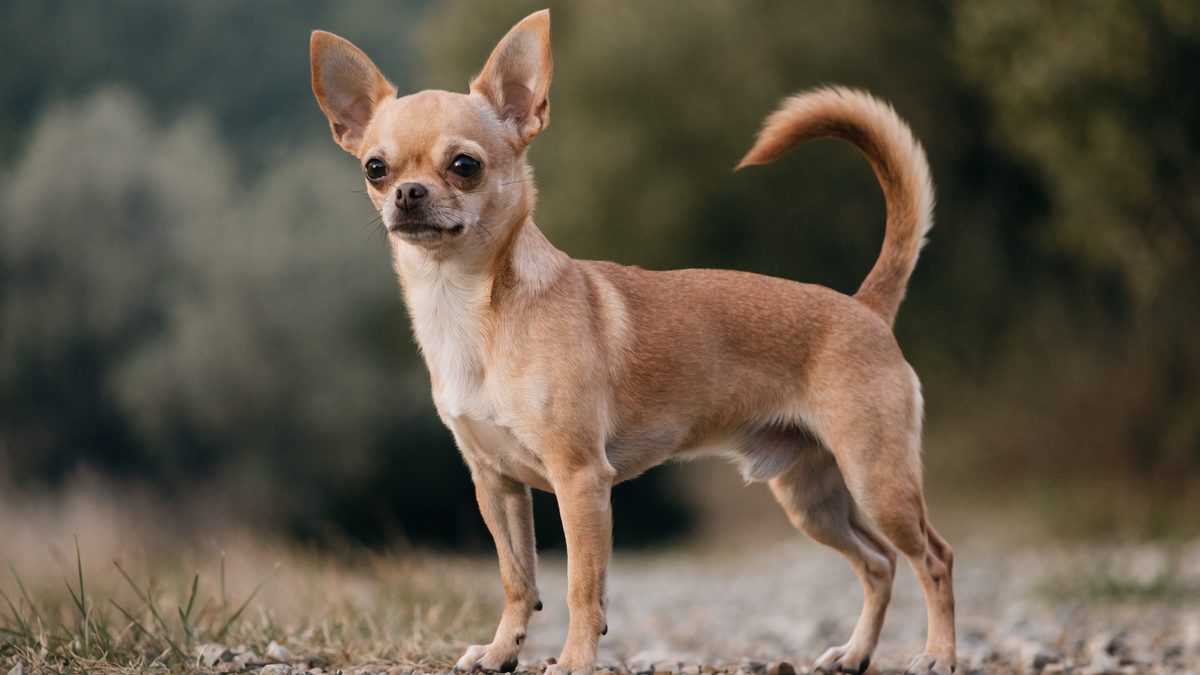
The head is the breed. A well rounded apple dome skull, a well defined stop forming a near 90 degree angle where the muzzle joins the skull, and large erect ears held upright when alert but flaring to the sides at a 45 degree angle in repose. Eyes are full, round, not protruding, luminous dark or luminous ruby. The feet are small and dainty, with toes well split up but not spread. The tail is moderately long and carried sickle, either up or out or in a loop over the back, and never tucked between the legs.
There are two coat varieties and only two. The AKC standard recognises the Smooth Coat and the Long Coat, and the Chihuahua Club of America states plainly that coat type is the only official description used to identify a difference within this breed, and that the standard does not categorise the Chihuahua by size at all. Remember that sentence when you read the price section.
Four registries, four different Chihuahuas
Here is where an Indian buyer needs to pay attention. The four standards that get quoted in Indian listings set materially different limits, and on two points they contradict each other outright.
| Registry | Weight rule | Molera / open fontanelle | Merle colour |
|---|---|---|---|
| American Kennel Club, approved 2008 | Not to exceed 6 lb. Disqualification: any dog over 6 lb. No minimum weight | Permitted. Skull described as 'with or without molera' | Not excluded. Colour clause reads 'any colour, solid, marked or splashed' |
| FCI Standard N 218, valid 2019 | 1 to 3 kg, ideal 1.5 to 2.5 kg. Disqualified under 1 kg and over 3 kg | Disqualifying fault: 'dogs with an open fontanel' | Disqualifying fault. All colours admitted 'except merle colour' |
| United Kennel Club, revised 2017 | Ideal 3 to 6.5 lb. Eliminating fault over 6.5 lb and under 1 lb | Disqualification: 'an open fontanel, a hole or gap in the centre of the skull, referred to as a molero' | Disqualification: merle colour, and albinism |
| Royal Kennel Club, updated 2025 | Up to 2.7 kg (6 lb), with 1.8 to 2.7 kg (4 to 6 lb) preferred | Not mentioned anywhere in the standard | 'Any colour or mixture of colours but never merle (dapple), which is unacceptable' |
The Kennel Club of India is a member of the Federation Cynologique Internationale, listed in the FCI register at its Anna Nagar, Chennai address. That makes FCI-Standard N 218 the standard behind a KCI registration. Under it, an open fontanel is a disqualifying fault and a dog weighing under 1 kg is disqualified outright. Indian sellers routinely present both the molera and sub-1 kg size as evidence of quality and charge more for them. Under the standard your KCI paperwork actually sits on, both are disqualifications.
This is not a technicality invented for this page. It is a real and recent divergence. The AKC standard, approved 12 August 2008 and still current, keeps the historic language permitting the molera. The FCI standard, whose valid version is dated 4 September 2019, lists dogs with an open fontanel among its disqualifying faults. The UKC, revised 1 May 2017, disqualifies the same thing and names it a molero. The British standard, last updated 1 August 2025, has simply dropped the subject and does not mention a molera at all. Four registries, four positions, and no Indian page currently ranking for this query mentions any of it.
Apple head, deer head, and a word Indian listings should not use
The apple head is the breed characteristic; the 'deer head' is not a type, it is a fault. Indian listings frequently advertise 'deer head' Chihuahuas as a variety, sometimes at a different price. No standard recognises such a variety. The FCI goes further and makes it a disqualifying fault, listing 'deer type dogs (dogs with an atypical or extremely stylized structure: refined head, long neck, slender body, long limbs)' among the reasons a dog is disqualified. If a seller in Delhi or Hyderabad offers you a choice between an apple head and a deer head as though both are correct, that seller is either unaware of the standard or is counting on you being unaware of it.
This is not confined to small sellers. A major Indian pet food brand's Chihuahua guide lists 'Apple Head vs Deer Head' under its types-of-Chihuahua heading and explains that deer head Chihuahuas have a longer muzzle and are usually taller, presenting the two as parallel options. Under the standard behind Indian registration, one of those two is the breed and the other is a disqualification Federation Cynologique Internationale.
Merle is the same story. Merle has been deliberately bred into a number of breeds that never historically carried the gene, the Chihuahua among them, and dogs homozygous for merle can show deafness and microphthalmia. Three of the four registries above disqualify or reject merle outright United Kennel Club The Royal Kennel Club, Breed Standard. At least one Indian price page nonetheless lists merle as a standard Chihuahua colour alongside fawn and black. Treat a merle Chihuahua advertised at a premium as a red flag about the breeder, not a rarity worth paying for.
Where the breed came from
The Chihuahua carries the name of the largest state of the Mexican Republic, and the FCI records the assumption that these dogs once lived wild and were captured and domesticated at the time of the Toltec civilisation. Representations of a toy dog called the Techichi, which lived in Tula, were used as decoration on town architecture, and those statues closely resemble the present-day dog. The AKC records the Techichi, kept by the Toltecs in what is now Mexico as early as the 9th century AD, as the progenitor of the modern breed. Chihuahuas first appeared in American dog shows in 1890 and the United Kennel Club recognised the breed in 1948.
For an Indian household the practical summary is short. You are looking at a tiny, bold, loyal, mostly indoor companion of roughly 1.5 to 3 kg, standing 5 to 8 inches at the shoulder, that will live in a flat without difficulty, that needs very little space, and whose real costs sit in dentistry and orthopaedics rather than food. What it is not is a bargain, a status accessory, or a dog that should ever be bought sight unseen off a reel.
Chihuahua price in india
A Chihuahua puppy is published at anywhere from Rs 4,000 to Rs 2,00,000 in India in 2026. That is a fifty-fold spread for the same breed, and it is the single most useful fact on this page, because it tells you the number is not a market price. It is a negotiating position that varies with who is publishing it.
Bonbeno compared every published Indian price band we could open for this query. Read them side by side and the disagreement is not a detail, it is the whole picture.
| Source | Published range | What the page also is |
|---|---|---|
| Petsworld | Rs 4,000 to Rs 25,000 | Pet retailer blog that also advertises puppies for sale |
| Boggos | Rs 8,000 to Rs 30,000 | Dog food retailer blog |
| HankPets | Rs 10,000 to Rs 80,000 | Pet accessories retailer blog |
| Supertails | Rs 15,000 to Rs 50,000 | Pet pharmacy and food retailer, all-breed price list |
| Mr n Mrs Pet | Rs 60,000 to Rs 2,00,000 | Puppy marketplace that brokers the sale itself |
Look at what the third column does to the second. The lowest published floor and the highest published ceiling differ by a factor of 50, and the source quoting the highest band is the only one in the set that earns money when you buy the puppy. Its bottom figure, Rs 60,000, sits above the top figure of two other published sources and above the top of the Supertails all-breed list Boggos, Chihuahua Price In India And Breed… Petsworld, Chihuahua Puppy For Adoption. Nobody is auditing any of these numbers, and Bonbeno is not endorsing any of them.
The tier structure, and what it is really selling
Only one Indian source publishes a tiered breakdown, and it runs as follows.
| Tier | Published band |
|---|---|
| Basic quality | Rs 60,000 to Rs 1,00,000 |
| KCI registered | Rs 1,00,000 to Rs 1,50,000 |
| Champion bloodline | Rs 1,50,000 to Rs 2,00,000 |
The same source lists Hyderabad, Bangalore, Delhi, Chennai, Lucknow, Mumbai, Jaipur and Pune, and quotes every one of those eight cities at the identical Rs 60,000 to Rs 2,00,000. A city-wise table in which no city differs is not city-wise data. Treat it as one seller's national ask price with city names appended, and treat any Indian page that presents city-level Chihuahua pricing as a market survey with the same scepticism.
A Kennel Club of India registration documents pedigree. It is not a health certificate. Registration says the parents were recorded, not that they were screened, not that the puppy has been examined, and not that the dog conforms to the standard behind the registration. The KCI's own published forms bear this out: litter registration, single dog registration, transfer of ownership, prefix and affix registration, change of name and a tariff sheet, with no health-screening or health-testing form among them. Given that FCI-Standard N 218 disqualifies an open fontanel and any dog under 1 kg, and that KCI registers under the FCI, a KCI premium charged on a sub-1 kg puppy with a molera is a premium charged for two disqualifications.
The teacup premium is the clearest overcharge in the Indian market
No registry recognises a teacup Chihuahua. Teacup is a marketing label not endorsed by official canine organisations, applied to dogs bred well under breed standards, usually below about 2.25 kg. The Royal Kennel Club does not recognise any teacup breeds and will not record a dog as teacup on its register. The Chihuahua Club of America is blunter about the money. It states that terms such as teacup, pocket size, tiny toy and miniature 'may be used to entice prospective buyers into thinking that puppies described in this way are of greater monetary value. They are not and the use of these terms is incorrect and misleading';. The Royal Kennel Club puts the same point in one sentence for buyers: 'Your puppy shouldn't cost any more than other dogs in the breed';.
Indian sellers charge the premium anyway. The social results ranking for this exact query advertise 'teacup size chihuahua puppy's available for sale', and the tag #teacuppuppies appears on the reels sitting in the top ten. You are being asked to pay more for a label that the breed's own parent club describes as misleading, that the British registry refuses to record, and that the standard behind Indian registration disqualifies below 1 kg.
In India, breeding and selling dogs is regulated. Under the Prevention of Cruelty to Animals (Dog Breeding and Marketing) Rules, 2017, notified on 23 May 2017, breeders must hold a certificate of registration from the State Board, and no licence is issued without registration. Breeding without registration is an offence and can result in confiscation of breeding stock and puppies plus a fine, no puppy may be sold until it has reached 8 weeks of age and is fully weaned, and a registered person may hold no more than 6 breeding bitches and 2 stud dogs. A Rs 4,000 Chihuahua has almost certainly not passed through any of that. So has a Rs 2,00,000 one, necessarily; price alone proves nothing in either direction.
There is a specific reason the age rule matters for this breed. Teacup breeders have been documented selling puppies younger than 8 weeks precisely to pass them off as smaller than they are, and unscrupulous sellers misrepresent young puppies as teacups when they are simply young, leaving the buyer with a standard-sized dog. In India the same act is also a breach of the 2017 Rules. If a seller will not tell you the litter's date of birth, you have learned what you needed to learn.
What legitimately moves the price, and what does not
- Coat variety. Long coat is quoted higher than smooth coat by Indian sellers. This is the one size-and-appearance variable the standards actually recognise, since coat type is the only official division within the breed.
- Registration status. A KCI-registered puppy carries a published premium of roughly Rs 40,000 over the basic tier. Judge whether the paperwork is worth that to you, and do not read it as a health guarantee.
- Who is publishing the number. Two of the five sources above sell puppies or pet products directly, and the highest band comes from the one that brokers the sale. None of them discloses that interest on the page.
- Size below the standard. This should move the price down or off the table, not up. It is a disqualification under the FCI standard, a refused category at the Royal Kennel Club, and a documented welfare risk.
Bonbeno does not broker puppy sales, does not publish breeder listings, and does not quote a live price as an offer. Every figure above is reported from a third party so you can weigh the spread yourself and price the uncertainty into your own decision.
The real monthly cost of a Chihuahua in India
Published Indian estimates put the monthly cost of a Chihuahua between Rs 2,500 and Rs 10,000. The purchase price is the small number in this equation, and the line every Indian estimate under-budgets is dentistry, which the veterinary record says is the most common health problem this breed has.
Three Indian sources publish a monthly figure, and they do not agree either.
| Source | Monthly total | Basis |
|---|---|---|
| Boggos | Rs 2,500 to Rs 10,000 | Chihuahua specifically, itemised across food, grooming, health, toys and training |
| Supertails | Rs 4,000 to Rs 8,000 | Small breed generally, worked example given as Pomeranian and Shih Tzu |
| Mr n Mrs Pet | Rs 8,000 to Rs 10,000 | Chihuahua specifically, quality food plus grooming, vet visits and routine care |
| VOSD | Over Rs 5,000 | Average lifetime upkeep per dog at a 1,800-dog Indian sanctuary, all breeds |
The most detailed line-by-line breakdown available for a small dog in India runs as follows, and it is worth reading with one specific caution in mind.
| Cost line | Small breed, per month |
|---|---|
| Dry or wet food | Rs 1,500 to Rs 2,500 |
| Routine vet visits | Rs 500 to Rs 1,000 |
| Vaccinations | Rs 1,200 per year |
| Grooming | Rs 1,500 to Rs 3,000 |
| Training, over 6 months | Rs 0 to Rs 3,000 |
| Treats and toys | Rs 300 to Rs 800 |
| Flea, tick and deworming | Rs 300 to Rs 600 |
| Monthly total | Rs 4,000 to Rs 8,000 |
The table above names its worked examples as Pomeranian and Shih Tzu. Both carry heavy coats that need professional grooming. A smooth-coat Chihuahua does not. The AKC says the smooth coat needs only occasional brushing and regular baths, while the long coat should be brushed at least once a week to avoid tangles. If you keep a short-coated Chihuahua, you can reasonably strike most of the Rs 1,500 to Rs 3,000 grooming line and move that money to the dental budget, where this breed actually needs it. Generic Indian small-breed cost tables systematically misallocate spend for this breed.
The line every Indian estimate leaves out
Dentistry is the single largest predictable veterinary cost in a Chihuahua's life, and not one of the Indian monthly estimates above carries a line for it. The evidence is unambiguous. In the largest primary-care study of the breed, covering 11,647 Chihuahuas in the UK with detailed disorder data extracted for a random sample of 5,660, dental disorders affected 19.0 percent of dogs and periodontal disease alone affected 13.5 percent, making it the most common specific disorder recorded in the breed. Retained deciduous dentition, meaning baby teeth that never fell out, affected a further 5.7 percent.
That is not an incidental finding. Small dogs are more likely than large dogs to suffer retained deciduous teeth and periodontal disease, plausibly because of small mouths and crowded teeth, and their smaller, more delicate jaws carry less bone, which makes them more susceptible to loose teeth, pathologic bone loss and even mandibular fracture during dental procedures. A dental under general anaesthetic is not a minor procedure in a 2 kg dog. Toy breeds are more susceptible to anaesthetic complications such as hypothermia and are harder to monitor accurately while under.
So budget for it deliberately. Indian veterinary pricing varies too much between a Tier 1 metro practice and a small-town clinic for Bonbeno to publish a rupee figure we cannot source, and we will not invent one. What we can tell you is the frequency the evidence supports: daily tooth brushing at home, which the AKC lists as necessary care for this breed, and a scaling under anaesthetic when your vet says the mouth needs it rather than when the dog stops eating.
The other costs a tiny dog changes
- Vet visit frequency. Very small dogs are commonly advised to be seen every 6 months rather than annually, because symptoms escalate faster in a body this size. Double the routine vet line rather than the food line.
- Food. This is where a Chihuahua is genuinely affordable. A dog of 1.5 to 3 kg eats a fraction of what a Labrador eats, and the published small-breed food line of Rs 1,500 to Rs 2,500 is the top of the realistic range, not the bottom.
- Emergency risk. Tiny dogs are more likely to suffer severe dehydration secondary to diarrhoeal disease than large dogs, which makes veterinary care more urgent for the same illness. Keep a contingency fund, not just a monthly budget.
- Orthopaedics. Patellar luxation is diagnosed in 4.9 percent of Chihuahuas in primary-care records. Surgical management is a real possibility over a 12-year life and is not a monthly cost, it is a one-off you should be able to absorb.
Set against a purchase price published anywhere from Rs 4,000 to Rs 2,00,000 Mr n Mrs Pet, Chihuahua Puppies For Sale…, a monthly cost of Rs 4,000 to Rs 8,000 over a median 11.8-year life means the dog costs far more to keep than to buy, at every price point in the published range. That is the calculation to run before you argue with a seller about Rs 10,000.
Heat tolerance, Indian summers and the monsoon
The Chihuahua is one of the few imported breeds where the veterinary evidence is genuinely reassuring about heat. In the largest study of heat-related illness in dogs, the Chihuahua recorded among the lowest odds of any breed analysed, and was the only breed with statistically reduced odds of exertional heat illness against crossbred dogs. Bonbeno rates it 4 of 5 for heat tolerance, and the reason is physics rather than origin.
Most imported breeds arrive in India carrying a heat problem. This one mostly does not, and it is worth being precise about why, because the reasoning also tells you where the real limits are.
A study of heat-related illness across UK dogs under primary veterinary care in 2016 found that body mass dominates the risk. Dogs over 50 kg had 3.42 times the odds of heat-related illness compared with dogs weighing under 10 kg. The authors attribute this to more efficient radiative heat loss in small bodies, and note the practical consequence directly: the purebred breeds with the lowest odds of heat-related illness are all small breeds, and of those analysed the Lhasa Apso, Shih Tzu and Chihuahua had the lowest odds of all. A Chihuahua at 1.5 to 3 kg sits at the extreme favourable end of that relationship.
The companion study went further. Looking specifically at exertional heat-related illness, the type triggered by activity rather than by being shut in a hot room or car, only Chihuahuas were identified with reduced odds, at an odds ratio of 0.42 with a 95 percent confidence interval of 0.20 to 0.92, compared with non-designer crossbred dogs. Every other breed in that analysis was either neutral or worse. Being heat-tolerant is, unusually, an evidenced property of this breed rather than a marketing claim.
Both studies are UK primary-care data from 2016 Hall EJ, Carter AJ. A UK summer is not a Nagpur summer, and these figures describe relative risk between breeds in a temperate country, not absolute safety in a country where daytime temperatures routinely pass 45 C. India publishes no breed-wise heat-illness surveillance that Bonbeno could find, so no Indian figure exists to check this against. What the evidence supports is that among imported breeds, the Chihuahua starts from an unusually good position. It does not support leaving any dog out in an Indian afternoon.
Indian sources rate this breed the opposite way, so here is both
Indian pet brands and clinics generally tell Indian buyers the Chihuahua handles heat badly. Bonbeno prints that disagreement rather than resolving it silently.
| Source | Verdict | Basis |
|---|---|---|
| Hall et al., Scientific Reports | Among the lowest odds of heat-related illness of all breeds analysed | UK primary-care records, 2016. Attributed to efficient radiative heat loss in small bodies |
| Hall et al., Animals | Odds ratio 0.42, the only breed with reduced odds of exertional heat illness | Same dataset, exertional cases analysed separately |
| Drools | Heat tolerance rated 'Low', below Shih Tzu and Indian Spitz | Indian pet food brand comparison table. No basis published |
| VetScan Diagnostics, Delhi | 'They also overheat easily.' Air conditioning or good fans called a necessity | Indian veterinary diagnostics provider. No basis published |
Bonbeno weights the peer-reviewed epidemiology above the unsourced ratings, so we rate the breed 4 of 5 rather than low. But the Indian advice is not useless, because it is really advice about behaviour rather than physiology. Keep the dog indoors in the afternoon, never walk it on hot pavement, and always provide fresh water. That is correct guidance for any dog in an Indian May, and following it costs you nothing even if the breed is genuinely heat-tolerant.
The short coat helps, and so does needing almost no outdoor exercise
Two breed features compound the size advantage. The smooth coat is short, close and glossy, lying flat over the body, with none of the dense insulating undercoat that makes Arctic and mountain breeds miserable on the plains. And the exercise requirement is met indoors. The AKC states that this breed loves to run and play and can usually get enough exercise in a very small space, that simply trotting around following their people is usually enough, and that short, slow walks keep the dog in good condition.
That combination solves the problem most Indian owners of imported breeds cannot solve. You do not have to choose between a 6 am walk and an under-exercised dog, because a Chihuahua that has spent the evening chasing a toy across a living room has had a real workout. The AKC adds the one caution that matters in Indian heat: avoid overexerting the dog, and if it is panting and working hard to keep up, pick it up and carry it home. In a dog this size that is trivially easy to do.
The real climate risk in India is the airway, not heatstroke
Here is the finding that no Indian Chihuahua page carries. Tracheal collapse is a progressive disease common in toy and small breeds, it has no cure, and coughing is exacerbated by a specific list of triggers: stress, excitement, physical activity, heat and humidity, inhaled irritants such as smoke, and pressure on the neck. Read that list against an Indian metro in May, or Delhi in November, and the overlap is close to total. Heat, humidity and particulate air pollution are the ambient conditions, not the exceptions.
This reframes what climate management means for the breed in India. You are not primarily protecting a Chihuahua from heatstroke, because the evidence says it handles heat comparatively well. You are protecting an airway from heat plus humidity plus smoke. The practical difference is real: a cooler, cleaner indoor environment during high-pollution weeks matters more for this breed than a pre-dawn walking schedule does.
- Walk on a harness, never a neck collar. Pressure on the neck is a named trigger for tracheal collapse coughing, and this is the cheapest risk reduction available to you.
- Avoid hot pavement rather than avoiding daylight. Short, slow walks are all the breed needs, so shift them to early morning or after dark in summer and let indoor play carry the rest.
- Treat smoke as a health exposure. Diwali, crop-burning season and heavy traffic corridors are inhaled-irritant events for a dog with a toy-breed airway.
- Keep the dog lean. Obesity contributes to more severe tracheal collapse signs, and obesity was recorded in 5.9 percent of Chihuahuas in primary-care data.
Cold and air conditioning, the Indian problem nobody expects
The Chihuahua's genuine temperature weakness in India is the opposite of the one you would guess. A tiny body loses heat quickly, and Indian guidance specifically flags that these dogs feel cold easily and need warm bedding and clothing in winter or in air-conditioned environments. The AKC likewise notes that special care must be taken in cold weather. In practice this means a Delhi, Chandigarh or Shimla winter needs a coat, and so does a Chennai flat with the air conditioner set to 18 C. Give the dog a warm bed away from the vent and let it burrow; the breed's habit of disappearing under blankets is normal behaviour, not a sign of illness.
Temperament, and the aggression finding nobody publishes
Every breed standard describes a confident, alert, self-reliant little dog, and every standard is accurate. What the standards do not tell you is that aggression is recorded in 4.2 percent of Chihuahuas in primary-care veterinary records, a higher figure than comparable studies of other small breeds, and that the breed is among the ten most commonly surrendered to shelters. Both facts are manageable. Neither is discussed on any Indian page.
The standards first, because they set the correct expectation. The AKC describes terrier-like attitudes of self importance, confidence and self-reliance. The FCI says quick, alert, lively and very courageous. The Royal Kennel Club specifies gay, spirited and intelligent, neither snappy nor withdrawn. That last phrase is doing real work. A snappy Chihuahua is not fulfilling the standard, it is failing it.
The AKC also records a quirk worth knowing before you buy a second dog: the Chihuahua is clannish, preferring companions of its own breed. Two Chihuahuas often work better than one Chihuahua and one Labrador.
What the veterinary record actually shows
In the VetCompass study of 5,660 Chihuahuas under UK primary veterinary care, aggression was the fifth most common specific disorder recorded, at 4.2 percent with a 95 percent confidence interval of 3.7 to 4.8. Males were recorded at 4.9 percent against 3.5 percent for females. The authors set that in context rather than leaving it hanging: aggression did not feature among the most common specific disorders in a similarly designed study of Pugs, and was only the thirteenth most common disorder in French Bulldogs at 2.3 percent.
They go further. A study of veterinarians' opinions classified the Chihuahua as very aggressive, and the breed has been reported as one of the most common to exhibit serious aggression, meaning bites or bite attempts, toward humans including both strangers and owners, alongside other small breeds such as the Dachshund and Jack Russell. And the Chihuahua has been reported as among the ten dog breeds most commonly surrendered to animal shelters, often with undesirable behaviour cited as a contributing factor.
The same literature is careful about causation, and so is Bonbeno. Whether body size drives the prevalence of aggressive behaviour, or human perception of behaviour as aggressive, or human response to it, has not to the authors' knowledge been established. Warning behaviours that precede a bite, such as stiffening, staring and growling, are simply harder to notice in a 2 kg dog than a 30 kg one. What is documented is that the risk exists and that it is the leading behavioural reason small dogs lose their homes.
Why small dogs behave worse, and what that means for you
There is a measured inverse relationship between a dog's size and the number of problematic behaviours it shows. In one study covering 14 behaviour categories including stranger-directed, owner-directed and dog-directed aggression, dog rivalry, fear, touch sensitivity, separation-related behaviour, excitability and energy level, the regression coefficients against size were negative for every category except trainability and stranger-directed fear.
The likely explanation is not that small dogs are born worse. It is that we raise them differently. Owners tolerate behaviour in a small dog that they would never tolerate in a large one, sometimes finding it cute and reinforcing it; a small dog may not be required to respond to commands, may be carried rather than expected to walk, and may be overprotected in ways that interfere with its socialisation with other people and dogs. There are also physiological causes for some of it, since a bladder this small genuinely does need more frequent trips outside.
Read that as an instruction sheet. Every one of those failure modes is a decision you control. Make the dog walk. Make it respond to a cue before it gets what it wants. Let strangers exist without being picked up and shielded from them. Socialise it in the same weeks and with the same seriousness you would a German Shepherd. The AKC puts the principle in one line: never allow your Chihuahua puppy to do anything that will be unacceptable in an adult.
Who this breed suits in an Indian home
- Suits flat-dwellers in any Indian city. Space is genuinely not a constraint, and the exercise need is met indoors.
- Suits households with older children who understand handling. The dog is fragile enough that a fall from sofa height or an accidental step can fracture a bone.
- Suits people who want an alert, vocal watchdog. Chihuahuas are courageous little watchdogs more than willing to defend their territory against strange people and dogs. That is a feature in a ground-floor flat and a problem in a shared wall.
- Suits one-person or two-person homes. The breed bonds intensely and is deeply attached to its owners.
- Does not suit homes with toddlers. The combination of a fragile skeleton and a documented aggression prevalence higher than other toy breeds makes unsupervised toddler contact a bad idea in both directions.
- Does not suit anyone who wants a low-effort dog. The behaviour outcome depends almost entirely on whether you do the socialisation work in year one.
One Indian page ranking for this query describes Chihuahuas as being 'used as a toy by the kids for playing' and 'served like toys to the children' while, in the same passage, warning that they are short tempered and can attack anytime. Bonbeno disagrees with the first half and would put the second half differently. A Chihuahua is not a toy, and a dog that has been treated as one is exactly the dog that ends up in the 4.2 percent.
How to train a Chihuahua, and what it resists
To train a Chihuahua, use short positive-reinforcement sessions from day one and enforce the same rules you would enforce on a large dog. The breed is intelligent and eager to please, and the evidence says small size does not predict poor trainability. The two genuine difficulties are house-training, which is a bladder-size problem, and the owner's own willingness to be consistent with a dog that is very good at being cute.
The AKC assessment is direct. The Chihuahua is a very alert little dog of high intelligence, eager to please and responsive to positive training practices, and can excel in obedience training and other canine sports. Then comes the sentence every Chihuahua owner eventually recognises: 'Chihuahuas seem well aware of how cute they are and learn how to get their way. From the very beginning you must enforce the fact that you are in charge';. The breed carries a touch of terrier temperament, so a firm but gentle hand is what works.
Across a study of 14 behaviour categories measured against dog size, almost every category worsened as dogs got smaller. Trainability was one of only two exceptions, the other being stranger-directed fear. In other words, small dogs really do show more behaviour problems on average, but reduced trainability is not one of them. If your Chihuahua is not learning, the constraint is the training, not the breed.
House-training is the hard part, and it is anatomical
House-training is where Indian owners lose patience, and the reason is not stubbornness. Toilet training can be difficult in very small dogs because of the minute capacity of the bladder, which means these dogs need to be taken outside more frequently than larger dogs. Indian pages describe Chihuahuas as difficult to house-train and requiring patience and consistency, which is true but leaves out the cause and therefore the fix.
- Increase frequency before you increase correction. A puppy this size may need an opportunity every hour when awake and immediately after every sleep, meal and play session.
- Set up an indoor option for the monsoon. In Mumbai, Kochi or Kolkata there will be weeks when going outside on schedule is not realistic. Decide in advance whether you are using a training pad or a tray, and keep the location fixed.
- Reward at the spot, not at the door. A dog this small loses the association within a few steps.
- Expect regression during illness. Diarrhoeal disease dehydrates a tiny dog fast, and house-training lapses are the least of the problem in that situation.
The socialisation window versus the vaccination schedule
This is the timing problem specific to India, and it is worth planning around rather than discovering. Under the 2017 Rules, puppy vaccination can start at seven to eight weeks of age and is usually completed at the age of eighteen weeks, and no puppy may lawfully be sold before eight weeks. So a legally purchased puppy arrives at eight weeks and is not fully covered until roughly eighteen weeks. The most valuable socialisation weeks fall inside that gap.
Waiting until eighteen weeks to let the dog meet the world is how you produce the adult in the aggression statistics. Waiting is also how the overprotection pattern begins, where a small dog is carried rather than walked and never learns that strangers are unremarkable. The workable compromise is to socialise intensively in controlled settings during those ten weeks: carry the puppy through a busy market so it hears and sees without contacting street dogs, invite vaccinated adult dogs and a stream of different people into your home, and introduce lifts, autorickshaws, doorbells, pressure cookers and building watchmen deliberately.
Barking, and being honest about it
The Chihuahua is a watchdog by design. The UKC standard describes courageous little watchdogs more than willing to defend their territory against strange people and dogs, and Indian guides consistently list alert barking at strangers and unusual sounds as a core trait. You cannot train the alerting instinct out, and you should not try. You can train the dog to stop after being acknowledged, which is the realistic goal in a flat with shared walls.
A realistic first-year timeline
- Weeks 8 to 18. Name, house-training routine, handling tolerance including mouth and feet, controlled exposure to people and sounds, first vaccinations under way.
- Weeks 12 to 20. Daily tooth brushing established as a normal event, because the AKC lists dental care as necessary for this breed and it is far easier to build before adolescence than after.
- Months 5 to 8. Reliable sit, recall indoors, settled harness walking, and adolescence, which is when the cute-gets-its-way pattern sets in if you let it.
- Months 9 to 12. Consolidation. Retained baby teeth become visible around now and affect 5.7 percent of the breed, so have your vet check the mouth rather than assume they will fall out.
Daily exercise, and why indoors is enough
A Chihuahua's daily exercise requirement is met by short, slow walks plus indoor play, and the AKC states the breed can usually get enough exercise in a very small space. That makes it one of the few imported breeds whose exercise needs an Indian flat genuinely satisfies. The failure mode is not under-exercise, it is obesity, which then makes two of the breed's main health problems worse.
The requirement, stated by the registry rather than estimated: the Chihuahua loves to run and play and can usually get enough exercise in a very small space, simply trotting around following their people is usually enough, and short, slow walks will keep the dog in good weight and condition. Indian guidance agrees, recommending short daily walks plus indoor playtime, and adding a caution about rough play given the breed's fragile bones.
Indian sources put a usable number on it. One Delhi veterinary provider specifies one or two short walks of 10 to 15 minutes each per day, combined with indoor playtime, and an Indian pet food brand gives the same shape of answer as short indoor play plus one or two short outdoor walks. Twenty to thirty minutes of walking a day, split in two, is the working target.
Compare that with the more than two hours a day that working and Arctic breeds demand and the practical consequence for an Indian household is obvious. There is no scenario in which an Indian summer prevents this dog from getting the activity it needs, because most of that activity happens on your living room floor. This is the breed's strongest practical argument in a hot country, and it is a bigger deal than the price difference between any two sellers.
The AKC's caution runs in both directions. Avoid overexerting the Chihuahua, and if the dog is panting and working hard to keep up, pick it up and carry it home. But the same source ties short walks directly to keeping the dog in good weight and condition. A Chihuahua that never leaves the flat gets fat, and a fat Chihuahua has a harder time with both of the conditions this breed is prone to.
Obesity is the mechanism that turns two manageable problems into serious ones
Obesity was recorded in 5.9 percent of Chihuahuas under primary veterinary care, making it the second most common specific disorder in the breed after periodontal disease. The study authors flag that this figure is likely to understate the long-run picture, because increasing age is a risk factor for obesity with dogs aged 5 to 10 years particularly prone, and the Chihuahua population studied was youthful. In other words, the prevalence rises as a Chihuahua cohort ages, which is precisely the situation in India now that the breed is popular here.
Two consequences follow directly. Obesity is named among the coinciding conditions that contribute to more severe tracheal collapse signs, and in a retrospective study of 110 small-breed dogs with tracheal collapse, chronic cough improved in 86.6 percent of cases with weight reduction, environmental changes and medication. Weight is one of the few levers you fully control, and it demonstrably moves the outcome.
How to weigh and read the dog
Do not judge a 2 kg dog by eye. Weigh it on a kitchen scale monthly and write the number down, because a 200 g gain on a 2 kg Chihuahua is a 10 percent change that would be invisible on a Labrador. Track body condition alongside the number: you should be able to feel the ribs easily under a thin layer of covering, and see a waist from above.
The portion arithmetic is brutal at this size. A single bite of human food for a toy dog is equivalent to feeding a large-breed dog an entire cheeseburger, and treats and human foods should not exceed 10 percent of total daily calories. In an Indian household where the dog is present at every meal and several people feed it, this is the single most likely route to obesity. Agree a family rule before the puppy arrives.
What safe exercise looks like for this breed
- Two short walks a day on a harness, timed for early morning and after dark in summer, avoiding neck pressure and hot pavement.
- Indoor chase and retrieve games in short bursts, which satisfy most of the requirement.
- Ramps instead of jumps. Use ramps rather than letting the dog leap off beds and sofas, and keep floors non-slip. This matters because patellar luxation affects 4.9 percent of the breed.
- No rough play and no unsupervised play with larger dogs, given the fracture risk from a short fall, a jump, or being stepped on.
- Mental work. Scatter feeding and simple scent games use up more energy than distance ever will in a dog this size.
Grooming a Chihuahua in Indian humidity
To groom a Chihuahua, brush a smooth coat occasionally and a long coat at least once a week, trim the nails regularly, check the ears, and brush the teeth daily. Coat care is the cheapest part of owning this breed, which is exactly why the money saved should go into the mouth instead.
There are two coats and they need different work. The AKC is specific: the smooth-coat Chihuahua needs only occasional brushing and regular baths, while the longhaired variety should have its coat brushed at least once a week to avoid any tangles or mats. Indian guidance sets the long coat slightly higher at two to three times a week, which is a reasonable adjustment for a climate where dust and sweat load the coat faster.
What each coat should look like is worth knowing, because it tells you when something is wrong. The smooth coat is of soft texture, close and glossy, lying well over the body, with a ruff on the neck preferred and more scanty coat on head and ears. The long coat is soft, either flat or slightly wavy, with an undercoat preferred, fringed ears, a full plumed tail, feathering on feet and legs and a large neck ruff.
Both the FCI and UKC standards disqualify a bald patch, listed as alopecia, in the smooth-haired variety United Kennel Club, and the AKC disqualifies a long coat so thin it resembles bareness. Registries do not disqualify cosmetic accidents; they disqualify things that indicate a problem. Alopecia was among the disorders recorded in the VetCompass Chihuahua population, with a median age of onset of 1.5 years, the youngest of the 28 most common disorders. Patchy hair loss in a young Chihuahua warrants a vet visit rather than a different shampoo.
A realistic Indian grooming routine
- Brush the smooth coat once or twice a week and the long coat two to three times a week, working through the ruff and behind the ears where mats start.
- Bathe only when the dog is actually dirty. A tiny body loses heat quickly, so dry the dog thoroughly and keep it out of air-conditioned draughts afterwards.
- Check the ears every week and remove excess wax or debris, which the AKC lists explicitly to avoid ear infections. The large, open, upright ear that defines the breed collects dust, and Indian humidity does the rest.
- Trim nails every two to three weeks. The AKC lists nail trimming for both varieties, Indian veterinary guidance puts the interval at two to three weeks and offers a useful test, that nails clicking on the floor are already too long, and the standard describes nails as particularly well arched and moderately long.
- Brush the teeth daily. This is the one grooming task that is not optional in this breed, and Indian veterinary guidance calls it the single best thing you can do for a Chihuahua's long-term health.
Why the teeth are the real grooming job
Good dental care is necessary for a Chihuahua and should include brushing the dog's teeth, with your vet possibly recommending treats designed as part of a tooth-care programme. Set that instruction against the prevalence data and it stops sounding like routine advice. Dental disorders affected 19.0 percent of Chihuahuas in primary-care records, periodontal disease alone 13.5 percent, and retained deciduous dentition 5.7 percent. Nothing else in the breed comes close.
Small dogs are structurally set up for this. Retained deciduous teeth and periodontal disease are more likely in small dogs than large ones, plausibly because of small mouths and crowded teeth. In dogs bred below the standard the crowding is worse still, with teeth that do not fit in tiny jaws leading to decay and pain, and dental cleanings often needed annually. A daily two-minute habit started in puppyhood is the cheapest veterinary intervention available to you.
The grooming budget correction
Indian small-breed cost tables put grooming at Rs 1,500 to Rs 3,000 a month, but they build that figure on the Pomeranian and Shih Tzu, both of which need professional coat work that a short-coated Chihuahua simply does not. If you keep a smooth coat, most of that line is available to redirect. Move it to dentistry, six-monthly vet checks, and a decent harness. That is the single highest-return reallocation in the Indian Chihuahua budget, and no ranking page makes it.
Health, lifespan and inherited risk
The Chihuahua's median life expectancy in the largest UK dataset is 11.8 years, which is below the all-purebred median of 12.7 and below crossbred dogs at 12.0. Every Indian page publishes 12 to 18 years. The most common health problem is dental disease, the most common cause of death is heart disease, and the third most common is traumatic injury, which is the fragility of the breed showing up in the mortality record.
Lifespan, where the sources disagree sharply
This is the largest factual disagreement on the page after price, and it runs in the opposite direction to what Indian buyers are told.
| Source | Figure | Basis |
|---|---|---|
| McMillan et al., Scientific Reports Dogs Trust, Life expectancy for 155 breeds… | 11.8 years median (95% CI 11.5 to 11.9) | 10,788 Chihuahuas including 3,848 deceased, within a UK dataset of 584,734 dogs across 155 breeds |
| O'Neill et al., VetCompass | 8.2 years median age at death | UK primary-care records, 2016. Authors state this is biased downwards by a youthful population |
| American Kennel Club | 14 to 16 years | Breed vital statistics, basis not published |
| Petsworld | 12 to 18 years | Indian retailer page, basis not published |
| Boggos | 13 to 18 years | Indian retailer page, basis not published |
| HankPets | 12 to 18 years | Indian retailer page, basis not published |
| VetScan Diagnostics, Delhi | 12 to 18 years | Indian veterinary diagnostics provider, basis not published |
| Drools | 12 to 16+ years | Indian pet food brand, basis not published |
Bonbeno does not average these. We will say which one we weight most heavily and why. The 11.8-year figure comes from the largest breed-level longevity analysis published, built from 18 UK charities and organisations, with a confidence interval of just 0.4 years around it and 3,848 Chihuahua deaths behind it. The 8.2-year figure is real but the authors themselves caution that a youthful study population biases age at death downwards, and note it sits against an all-breed median age at death of 12.0 years. The 12-to-18 range on the Indian retailer pages carries no stated basis at all.
In the same table that puts the Chihuahua at 11.8 years, the Papillon reaches 14.5, the Lhasa Apso and Miniature Dachshund 14.0, the Miniature Pinscher 13.7, the Yorkshire Terrier 13.3, the Shih Tzu 12.8 and the Pomeranian 12.2. Across the whole dataset, purebred dogs had a median life expectancy of 12.7 years, crossbred dogs 12.0, and small breeds specifically 12.7. The Chihuahua sits below its own size class, below crossbreeds, and below almost every toy breed it is cross-shopped against. Only the Pug, at 11.6 years, is lower among the popular small breeds.
The sex gap is unusually wide and worth planning around. Median age at death for female Chihuahuas was 10.2 years against 6.9 years for males in the VetCompass data. A female longevity advantage is a general trend in dogs, but a 3.3-year gap is striking.
What Chihuahuas actually get sick with
The largest study of Chihuahua health using primary-care data characterised the demography of 11,647 dogs and extracted full disorder data for a random sample of 5,660. At least one disorder was recorded during the year for 55.0 percent of them, spanning 352 separate disorder terms.
| Disorder | Prevalence | 95% CI |
|---|---|---|
| Periodontal disease | 13.5% | 12.6 to 14.4 |
| Obesity | 5.9% | 5.3 to 6.5 |
| Retained deciduous dentition | 5.7% | 5.1 to 6.4 |
| Anal sac impaction | 4.9% | 4.4 to 5.5 |
| Aggression | 4.2% | 3.7 to 4.8 |
Grouped by body system, dental disorders led at 19.0 percent, followed by behavioural at 6.6 percent, anal sac at 6.4 percent, musculoskeletal at 6.0 percent and obesity at 5.9 percent. Dental disease is the defining health issue of this breed, and it is the one Indian ownership guides mention least.
A dedicated study of periodontal disease across the UK dog population explains why a Chihuahua carries so much of this risk, and it stacks three separate multipliers on the same dog. The one-year period prevalence of periodontal disease across all dogs was 12.52 percent, roughly one dog in eight every year. Against that baseline, the Kennel Club Toy group showed 1.89 times the odds (95% CI 1.66 to 2.15), dogs weighing under 10 kg carried 3.07 times the risk of dogs weighing 30 to 40 kg, and dogs aged 12 years and over carried 3.91 times the risk of dogs aged 2 to 4 years Royal Veterinary College. A Chihuahua is a Toy-group dog, under 10 kg, that commonly reaches 12. It collects all three.
Causes of death, including the one about fragility
The most common grouped causes of death were heart disease at 18.8 percent, lower respiratory tract disorder at 16.3 percent and traumatic injury at 13.8 percent. The cardiac finding is corroborated elsewhere: an analysis of 74,556 dog deaths from US veterinary teaching hospitals placed the Chihuahua third highest among breeds for the relative proportion of cardiovascular causes of death, at 0.185. Myxomatous mitral valve disease, one of the most common causes of canine heart disease, is much more common in small and toy breeds.
Traumatic injury as the third most common cause of death is the number to sit with. Tiny, fragile bones combined with the canine tendency to be underfoot mean fractures can follow a short fall, a jump, being stepped or sat on, or even rough play. This is not a theoretical risk in a busy Indian household; it is 13.8 percent of recorded deaths.
Patellar luxation, the orthopaedic signature of the breed
The kneecap slipping out of its groove is the breed's characteristic orthopaedic problem, and the numbers are well established. Across 210,824 dogs at 119 clinics in England, overall prevalence of diagnosed patellar luxation was 1.30 percent. Chihuahuas were diagnosed at 4.9 percent (95% CI 3.8 to 6.0), with 5.9 times the odds of crossbred dogs (95% CI 4.4 to 7.9), behind only the Pomeranian at 6.5 percent and the Yorkshire Terrier at 5.4 percent.
A second study of the breed specifically put patellar luxation at 4.0 percent of Chihuahuas. Bonbeno prints both rather than splitting the difference; the studies used different populations and years, and the honest reading is that roughly one Chihuahua in twenty to twenty-five will be diagnosed with it.
- Neutering is a risk factor. Neutered dogs had 2.4 times the odds of patellar luxation compared with entire animals. Discuss timing with your vet rather than defaulting to an early date.
- Fewer than 30 percent of cases were bilateral, so a limp on one side is the typical presentation.
- Breeding away from extremes helps. Increasing risk with reducing physical size for patellar luxation, cryptorchidism and retained deciduous dentition suggests benefits from breeding away from the diminutive extreme conformations of the Chihuahua. That is the veterinary literature arguing directly against the teacup market.
The molera, and the disagreement you are entitled to see
This is the point on which the breed's own parent club and the most recent imaging study do not agree, so Bonbeno publishes both.
The parent club's position. The Chihuahua Club of America states that a domed head with a molera present does not predispose the Chihuahua to hydrocephalus, and cites three supports: Green and Braund, who stated that many clinically normal toy breeds may have open fontanels without associated hydrocephalus; Drs Walker and Rivers at the University of Minnesota, who concluded there did not appear to be any relationship between the presence or size of a fontanel and hydrocephalus; and Dr Alexander de Lahunta of Cornell, who stated it would be wrong to conclude that any opening is abnormal. The club's summary is that the presence of a molera does not mean the Chihuahua has a medical problem.
What the 2021 imaging study found. Computed tomography of 50 client-owned Chihuahuas found that 46 dogs, or 92 percent, had one or more persistent fontanelles, with a mean of 2.8 per dog and a range from 0 to 13. A total of 138 persistent fontanelles occupied 118 cranial sutures, 48 percent of them dorsal, 37 percent caudal and 14 percent lateral, meaning the classic single molera on top of the skull is not the whole picture. Critically, the number of sutures affected was significantly higher (P less than or equal to 0.001) and total fontanelle area significantly larger (P equals 0.003) in dogs showing clinical signs related to Chiari-like malformation and syringomyelia. The authors concluded that critical re-evaluation is necessary for the inclusion of a large molera in the breed standard as a desired trait.
And the finding that ties the molera to the teacup market. The companion paper from the same team examined what those fontanelles travel with. It reports that persistent fontanelles are more numerous and larger in Chihuahuas with low body weight, as well as in dogs with older age, syringomyelia, a dilated fourth ventricle, ventriculomegaly and craniocervical junction overcrowding. The association with lower bodyweight was statistically significant at P equals 0.007. The authors put the implication in the plainest possible terms: their findings challenge the current concept that persistent fontanelles are a clinically irrelevant finding not associated with other structural abnormalities, and the association between lower body weight and more numerous, larger fontanelles questions the ethics of selective breeding of Chihuahuas with very low body weights.
Read that against the Indian market and the two things being sold at a premium turn out to be the same thing. The smaller a Chihuahua is bred, the more skull gaps it tends to have and the larger they tend to be, and those gaps travel with syringomyelia, ventriculomegaly and craniocervical crowding. A teacup Chihuahua with a prominent molera is not a dog with two desirable rarities. It is a dog showing two correlated signs of the same breeding decision.
One scale detail is worth noting for context. The 50 dogs in that study had a median bodyweight of 2.8 kg, which already exceeds the AKC and British standard guideline of 2.7 kg and sits at the upper reference limit of the FCI range of 3.0 kg, preferably 1.5 to 2.5 kg. These were not teacup dogs. The bodyweight effect was measured across a normally sized sample, which makes the extrapolation to deliberately miniaturised dogs a concern rather than a reassurance.
These findings are not flatly contradictory. A molera can be common, can occur in clinically normal dogs, and can still be correlated with severity when other skull problems are present. The defensible position for a buyer is this: an open fontanelle in a Chihuahua is not by itself proof of hydrocephalus, it is also not a mark of purity or a reason to pay more, and larger or multiple fontanelles are associated with dogs that have clinical signs and with lower bodyweight. Two of the four registries disqualify it outright, including the one behind Indian registration United Kennel Club. Nobody credible treats it as a feature to select for.
Tracheal collapse
Tracheal collapse is a progressive disease of the windpipe causing chronic coughing, common in toy and small breeds that are middle-aged or older, with no cure but with medical management that improves signs and quality of life. The classic sign is a persistent, harsh, dry, goose-honking cough, which can progress to wheezing on inhalation and, in severe cases, difficulty breathing, blue gums or tongue, or fainting, all of which are emergencies.
In a retrospective study of 110 small-breed dogs diagnosed between 2022 and 2024, the Chihuahua was among the four most commonly affected breeds alongside the Maltese, Pomeranian and Poodle, accounting for 8 dogs or 7.3 percent of cases. Mean age at diagnosis was 11.4 years and mean bodyweight 4.68 kg. Chronic cough was present in 98.1 percent of cases. The encouraging finding is that in 86.6 percent of cases chronic cough improved with weight reduction, environmental changes and medication. Among the top four breeds, Chihuahuas had the lowest incidence of bronchial collapse.
The conditions that come with breeding below the standard
Several risks scale directly with how small the dog has been bred, which is why they cluster in the teacup market rather than the breed as a whole.
- Hypoglycaemia. Toy and teacup dogs may need feeding multiple times a day because of their propensity toward hypoglycaemia. Signs include lethargy, trembling, disorientation or seizures, particularly in puppies, and it is a medical emergency.
- Hydrocephalus. Diminutively sized teacup dogs may be predisposed to persistent open fontanelles and hydrocephalus, which presents with a domed skull, vision problems and seizures and is seen particularly in the tiniest Chihuahuas.
- Fractures. Fragile bones break from short falls, jumps or being stepped on.
- Liver shunts and temperature regulation. Both are listed among teacup health risks, alongside a life expectancy generally shorter than standard-size counterparts.
- Dystocia. Difficult birth due to maternal-fetal disproportion, and therefore the need for caesarean section, is more common in petite dogs.
- Cryptorchidism. Retained testicles affected 3.9 percent of male Chihuahuas, and risk increases as physical size decreases.
- Merle-associated defects. Deafness and microphthalmia can occur in dogs homozygous for the merle gene, which has been introduced into the Chihuahua in recent years.
What to screen for and what to ask
There is no equivalent of a hip score to demand for this breed, so the useful questions are behavioural and documentary rather than a certificate list. Screen a prospective purchase this way, and be willing to walk away.
- Ask the parents' weights and see the parents. The Royal Kennel Club advises that the mother and father should be health screened for the same conditions as any other breeding dog of the same breed, and that their health and temperament should always be more important than their size.
- Ask the litter's date of birth and refuse anything under 8 weeks, which is also the legal floor in India.
- Watch the puppy move. Ask about any skipping or hopping gait, which is how patellar luxation shows.
- Look in the mouth. Crowded or retained baby teeth are the breed's most common problem later.
- Ask about the fontanelle plainly, and treat a seller who sells it to you as a feature as a seller who has not read the standard behind their own registration.
- Verify the breeder's State Board registration under the 2017 Rules.
Feeding a Chihuahua in India
To feed a Chihuahua, give a high-quality small-breed food appropriate to the dog's life stage, split into three or four small meals a day rather than one or two, and keep all treats and human food under 10 percent of daily calories. Meal frequency matters more in this breed than in almost any other, because very small dogs are prone to hypoglycaemia.
The registry advice is short. A high-quality dog food appropriate to the dog's age, whether puppy, adult or senior, will have all the nutrients the breed needs, and because some Chihuahuas are prone to getting overweight you should watch calorie consumption and weight level. Treats can be an important training aid but too many cause obesity, table scraps should be given sparingly if at all, and cooked bones and high-fat foods should be avoided.
Split the day into small meals
This is the one feeding rule that is genuinely breed-specific rather than general good practice. Toy and teacup dogs may need to be fed multiple times a day due to their propensity toward hypoglycaemia, and the practical recommendation is three to four small meals a day rather than one or two large ones, using a nutrient-dense food formulated for small breeds.
Know the warning signs, because low blood sugar in a small dog escalates quickly. Lethargy, trembling, disorientation or seizures, especially in a puppy, constitute a medical emergency. Owners of very small dogs are commonly advised to keep a glucose supplement on hand for exactly this situation. If you are buying a dog at the small end of the breed, ask your vet at the first consultation what they want you to do while you travel to the clinic.
An occasional bite of human food for a toy dog is equivalent to a large-breed dog being fed an entire cheeseburger, which makes obesity and nutrient imbalance a real concern; as a general guideline, treats and human foods should not exceed 10 percent of total daily calories. In an Indian home where the dog attends every meal and three or four people each slip it something, this is the mechanism behind the 5.9 percent obesity prevalence recorded in the breed. Set one family rule: one person feeds, everything else goes in the bowl.
What it costs and what is available
Food is the cheapest line in a Chihuahua budget. Indian published estimates put small-breed food at Rs 1,500 to Rs 2,500 a month, with a lower Chihuahua-specific estimate of Rs 500 to Rs 2,000. For a dog of 1.5 to 3 kg the lower half of that range is realistic, and small-breed and toy-breed dry formulations are widely stocked by Indian pet retailers, including baked small-breed puppy foods.
Because the quantity is small, quality is unusually affordable here. The difference between a mediocre and a good food for a 2.5 kg dog is a few hundred rupees a month, not a few thousand. Spend it.
Life-stage feeding
- Puppy, 8 weeks to about 6 months. Four small meals a day of a small-breed puppy food. This is the highest-risk window for hypoglycaemia, and the phase when tooth-brushing should be introduced as routine.
- Adolescent, 6 to 12 months. Move to three meals. Weigh the dog monthly and adjust, since a 200 g drift is 8 percent of bodyweight at this size.
- Adult, 1 to 8 years. Two to three meals. Watch the 5-to-10-year window specifically, because increasing age is a risk factor for obesity with dogs aged 5 to 10 particularly prone.
- Senior, 8 years and over. Reassess with your vet. Heart disease is the leading cause of death in this breed at 18.8 percent, and weight control is part of managing both cardiac and airway disease.
One thing to ask about the litter
Feeding quality starts before you buy. Ingestion of colostrum in the first 12 to 16 hours of life is essential to a puppy's growth and survival, and the smallest pups in a litter are disadvantaged because their suckling ability is often reduced compared with larger siblings. Inadequate colostrum intake affects temperature and glucose regulation and intestinal development, and the risk of neonatal mortality is much higher for these puppies, particularly in the first 48 hours.
This is the biological reason the teacup trade is a problem rather than merely a marketing one. Deliberately selecting the smallest puppy in a litter selects the puppy that was most likely to have started life nutritionally behind, and some breeders have been documented failing to provide appropriate nourishment specifically to stunt growth. A responsible breeder will talk about birth weights and early feeding without being pushed. A seller who cannot is telling you something.
Chihuahua puppy timeline, month by month
A Chihuahua puppy legally reaches you at 8 weeks, completes vaccination at around 18 weeks, and reaches adult weight inside the first year. The two decisions that shape the adult dog both fall in the first four months: how much socialisation you manage before vaccination finishes, and whether tooth brushing becomes routine before the adult teeth arrive.
| Age | What is happening | What you do |
|---|---|---|
| Birth to 8 weeks | Colostrum in the first 12 to 16 hours determines growth, temperature and glucose regulation; neonatal mortality risk peaks in the first 48 hours. Vaccination can begin at 7 to 8 weeks | You are not yet the owner. Ask the breeder about birth weights and whether any pup needed help feeding |
| 8 weeks | Legal earliest sale. No puppy may be sold before 8 weeks and fully weaned | Collect. Refuse any earlier date, whatever reason is offered |
| 8 to 12 weeks | Highest hypoglycaemia risk window. Bladder capacity is minute | Feed four small meals daily. Toilet opportunity roughly hourly when awake. Begin controlled socialisation |
| 12 to 18 weeks | Vaccination course completes at around 18 weeks. Socialisation window is closing | Carry the puppy through busy places. Introduce lifts, doorbells, watchmen, autorickshaws. Start daily tooth brushing |
| 4 to 6 months | Teething. Adult teeth push in behind baby teeth | Check the mouth weekly. Introduce a harness rather than a neck collar |
| 6 to 9 months | Adolescence. Retained deciduous dentition becomes visible, affecting 5.7 percent of the breed. A skipping gait may first appear | Vet check for retained teeth and patella. Hold the training line; this is when cute starts getting its way |
| 9 to 12 months | Adult weight reached. Standards put the adult at 1 to 3 kg or not exceeding 6 lb | Weigh and record. Discuss neuter timing, given neutered dogs showed 2.4 times the odds of patellar luxation |
The fontanelle question, answered by timing
Owners often ask when the soft spot will close. In dogs, closure of the bregmatic fontanelle is assumed to occur at birth or within a month afterward. That is the fact that makes the word persistent meaningful: a molera still present in a four-month-old Chihuahua is not late, it is persistent, and it is likely to stay. In imaging of 50 adult Chihuahuas, 92 percent had at least one persistent fontanelle, so this is the norm rather than the exception in the breed.
Practically, that means two things for a puppy owner. Do not wait for it to close. And handle the head with care, because whatever the debate about clinical significance, a gap in the skull is a gap in the skull.
The first four months decide the adult
Everything difficult about adult Chihuahuas traces back to this window. The aggression prevalence of 4.2 percent, the behaviour problems that rise as dog size falls, and the surrender statistics that put this breed among the ten most commonly relinquished are all downstream of decisions made before month five.
- Socialise despite the vaccination gap. Exposure without street-dog contact is achievable and is the difference between a confident adult and a defensive one.
- Make the puppy walk. Carrying rather than walking a small dog is a documented contributor to poor socialisation.
- Brush the teeth from week 12. Dental disorders reach 19.0 percent in this breed; the habit is far easier to build now.
- Enforce adult rules from day one. Never allow the puppy to do anything that will be unacceptable in an adult.
- Puppy-proof for fragility. Ramps rather than jumps, non-slip floors, no unsupervised toddler contact.
You do not need to solve the Indian summer to raise this puppy. Because the exercise requirement is met in a very small space and by trotting around after you, the socialisation and training programme above can run entirely on your schedule and indoors during May and June. Owners of large imported breeds do not have that option, and it is a genuine reason the Chihuahua succeeds in Indian flats where other imports struggle.
Chihuahua compared with the breeds Indian buyers cross-shop
Against the Pomeranian, Shih Tzu and Pug, the Chihuahua is mid-priced, shortest-lived but one, second worst for patellar luxation, and best in class for heat. Against adopting an indie, it costs between five and fifty times more to acquire and offers no measured longevity advantage.
Indian buyers rarely shortlist a Chihuahua alone. The realistic comparison set is the small and toy breeds sold through the same channels, plus the option almost no seller mentions. Here is the same set of questions asked of each.
| Breed | Published India price | Median life expectancy | Patellar luxation prevalence | Heat-related illness odds |
|---|---|---|---|---|
| Chihuahua | Rs 15,000 to Rs 50,000 | 11.8 years | 4.9% | Among the lowest of all breeds analysed |
| Pomeranian | Rs 8,000 to Rs 80,000 | 12.2 years | 6.5%, the highest reported | Not individually reported |
| Shih Tzu | Rs 20,000 to Rs 80,000 | 12.8 years | Not among the most affected breeds reported | Among the lowest of all breeds analysed |
| Pug | Rs 8,000 to Rs 30,000 | 11.6 years | Not among the most affected breeds reported | Identified with greater odds of heat-related illness |
| Indie or street dog, adopted | Rs 0 to Rs 3,000 | No Indian data. UK crossbred median is 12.0 years | 1.30% across all dogs, crossbred is the comparison baseline | Not individually reported |
The longevity, patella and heat figures are all UK data O'Neill DG, Meeson RL, Sheridan Hall EJ, Carter AJ. They are the best breed-level evidence that exists, but India publishes no equivalent, and the UK crossbred median of 12.0 years is not a measurement of Indian indie dogs, which are a different population in a different environment. Bonbeno prints the gap rather than filling it with a guess. The price column is a single Indian source and should be read against the fifty-fold spread documented in the price section.
Where the Chihuahua actually wins
Heat, decisively. This is the strongest argument for the breed in India and it is evidence-backed rather than asserted. Of the breeds analysed in the largest UK heat-illness study, the Chihuahua was among the three with the lowest odds, and in the exertional heat-illness analysis it was the only breed with statistically reduced odds against crossbred dogs. Against a Pug, which sits on the greater-odds list and shares the small-flat, low-exercise appeal, this is not a close call in an Indian climate.
Space and exercise. The requirement is met in a very small space, which is a genuine advantage over every medium and large breed and roughly a tie with the other toys.
Coat work. A smooth-coat Chihuahua needs only occasional brushing, against a Pomeranian or Shih Tzu that needs sustained professional grooming and carries the Rs 1,500 to Rs 3,000 monthly line those cost tables are built on.
Where it loses
Lifespan. At 11.8 years the Chihuahua is shorter-lived than the Pomeranian, the Shih Tzu, the UK crossbred median, the small-breed median of 12.7 years and the all-purebred median of 12.7 years Dogs Trust, Longevity of UK Dog Breeds. Only the Pug is lower among this set. Anyone choosing a Chihuahua because Indian pages promise 18 years is choosing on a number the best evidence does not support.
Knees. At 4.9 percent diagnosed prevalence the Chihuahua is behind only the Pomeranian and Yorkshire Terrier, and carries 5.9 times the odds of a crossbred dog.
Behaviour risk. Aggression at 4.2 percent is higher than similarly designed studies found in Pugs, where it did not feature among the most common disorders at all, and higher than French Bulldogs at 2.3 percent.
The comparison the sellers leave out
The forty-first row on the Indian price list most people never scroll to is the indie or street dog, published at Rs 0 to Rs 3,000 and carrying the highest suitability rating on that entire list of forty breeds. India has an estimated 62 million stray dogs. If your reason for wanting a Chihuahua is that you have a small flat and limited time, an adopted indie meets that brief at a fraction of the price and without the patella, dental and airway risk profile documented above.
That is not an argument against the breed. It is an argument for being clear about what you are paying for. If you want a bold, loyal, apple-headed dog of two and a half kilos that will sit under your blanket for eleven years, the Chihuahua is a real and reasonable choice with a verified evidence base. If what you want is a small dog, adopt one.
Ten mistakes Indian Chihuahua owners make
The most expensive mistakes Indian Chihuahua buyers make are paying a premium for a teacup label no registry recognises, treating the molera as proof of quality when the standard behind Indian registration disqualifies it, and budgeting for grooming instead of dentistry. All ten below are documented rather than anecdotal.
- Paying more for a teacup. No registry recognises the category. The Royal Kennel Club will not record a dog as teacup and states your puppy should not cost any more than other dogs in the breed. The Chihuahua Club of America says the terms are used to make buyers think such puppies are of greater monetary value, that they are not, and that the usage is incorrect and misleading. Under FCI-Standard N 218, which sits behind a KCI registration, a dog under 1 kg is disqualified.
- Treating the molera as a mark of purity. It was historically read that way, but the FCI and UKC both list an open fontanel as a disqualifying fault United Kennel Club, the British standard no longer mentions it, and the most recent imaging study calls for critical re-evaluation of treating a large molera as a desired trait. Paying extra for one is paying extra for a disqualification.
- Paying a premium for merle. Merle was introduced into the Chihuahua relatively recently, and homozygous merle dogs can show deafness and microphthalmia. Three of the four registries reject the colour outright United Kennel Club The Royal Kennel Club, Breed Standard, yet Indian pages still list it as a standard breed colour.
- Shopping for a deer head. There is no such variety. The apple head is the breed characteristic, and deer type dogs with a refined head, long neck, slender body and long limbs are a disqualifying fault under the FCI standard.
- Budgeting Rs 3,000 a month for grooming and nothing for teeth. Indian small-breed cost tables are built on the Pomeranian and Shih Tzu, whose coats need work a smooth Chihuahua's does not. Meanwhile dental disorders affect 19.0 percent of the breed and periodontal disease alone 13.5 percent, the single most common disorder recorded. Budget the other way round.
- Believing the 15-to-18-year lifespan. Indian retailer pages publish 12 to 18 years Boggos, Chihuahua Price In India And Breed… HankPets, Chihuahua Dog. The largest UK longevity dataset, built on 10,788 Chihuahuas including 3,848 deaths, puts the median at 11.8 years, below the all-purebred median of 12.7 and below crossbred dogs at 12.0.
- Walking the dog on a neck collar. Pressure on the neck is a named trigger for the coughing of tracheal collapse, a condition for which the Chihuahua is among the four most commonly affected breeds. Use a harness from the first walk.
- Carrying instead of walking, and shielding from strangers. Small dogs are often carried rather than expected to walk and are overprotected in ways that interfere with socialisation. This is the documented route to the 4.2 percent aggression prevalence and to the breed's place among the ten most commonly surrendered. Socialise the dog like a large one.
- Feeding from the table. For a toy dog a single bite of human food is equivalent to a large dog being given a whole cheeseburger, and treats plus human food should stay under 10 percent of daily calories. Obesity is the second most common disorder in the breed at 5.9 percent, and it worsens both tracheal collapse and joint load.
- Not verifying the breeder or the puppy's age. Under the 2017 Rules a breeder must hold a State Board certificate of registration, and no licence is issued without registration. No puppy may be sold before 8 weeks and fully weaned, and selling underage puppies is a documented tactic for passing them off as smaller than they are Voice of Stray Dogs (VOSD). Verify both, in writing.
Two more that are specific to Indian homes
Over-cooling the dog. The heat evidence is good for this breed, but a tiny body loses heat fast, and Indian guidance specifically flags air-conditioned environments alongside winter as situations needing warm bedding and clothing. A Chihuahua shivering under the split AC in a Chennai flat is a common and entirely avoidable sight.
Letting children handle the dog unsupervised. Fractures follow short falls, jumps, being stepped on or sat on, and rough play, and traumatic injury is the third most common cause of death in the breed at 13.8 percent. One Indian page ranking for this query describes these dogs as being used as toys by children. A fragile 2 kg animal with a documented bite risk is not a toy, and treating it as one endangers the child and the dog.
Adoption, and how to source a Chihuahua responsibly
Chihuahuas do end up needing homes. The breed is among the ten most commonly surrendered to animal shelters, often with undesirable behaviour cited as a contributing factor, which means adopting an adult Chihuahua is a real option rather than a rhetorical one. If you buy instead, the 2017 Rules and one visit to the breeder's premises settle most of what you need to know.
Start with the fact that reframes this section. The Chihuahua has been reported as among the ten dog breeds most commonly surrendered to animal shelters, often with undesirable behaviour cited as a contributing factor. Behaviour issues are one of the most common reasons dogs are relinquished generally. So the supply of Chihuahuas needing homes is not hypothetical, and a proportion of those dogs are being given up for problems that better socialisation would have prevented rather than for anything intrinsic to them.
Indian retailer pages list the ordinary reasons a small dog becomes available: the previous owner could no longer care for the dog for personal or financial reasons, the dog was not a good fit for its previous home, the dog was rescued from a neglectful situation, or the dog was found as a stray and never claimed. None of those is a reflection on the dog.
India publishes no breed-wise shelter or surrender data that we could find, so nobody can tell you how many Chihuahuas are in Indian rescue at any time, in which cities, or how long they wait. Bonbeno will not invent a number or name specific shelters we have not verified as currently holding the breed. What we can say is that the route exists, that adoption of an indie or street dog is published at Rs 0 to Rs 3,000 against Rs 15,000 to Rs 50,000 for a Chihuahua puppy, and that India has an estimated 62 million stray dogs.
Adopting an adult Chihuahua
An adult has one large advantage over a puppy in this breed: what you see is what you get. Temperament is already formed, the mouth can be examined, a skipping gait is visible, and any cough is audible. Given that the breed's characteristic problems are dental, patellar and airway, and that all three are assessable in an adult and invisible in an eight-week-old, adopting is a genuine risk reduction as well as a cost one.
- Ask why the dog is being rehomed, and take a behaviour answer seriously rather than as a dealbreaker. Aggression in small dogs is substantially a product of how they were raised.
- Have the mouth examined before you commit. Periodontal disease at 13.5 percent prevalence can mean an immediate dental under anaesthetic, which carries extra risk in toy breeds.
- Listen for a goose-honking cough, the classic sign of tracheal collapse.
- Watch the dog walk on a hard floor for the intermittent skip that indicates patellar luxation.
- Budget for six-monthly vet visits rather than annual ones, as advised for very small dogs.
If you buy, this is the verification list
The Royal Kennel Club's guidance for buying any puppy, and specifically for avoiding the teacup trade, is the clearest available. You need to visit the puppy at home and meet its mother, just as you would with any other puppy. The mother and father should be health screened for the same conditions as any other breeding dog of the same breed, and their health and temperament should always be more important than their size. Never buy from anyone you think has not taken every step to make a puppy's health their priority.
In India, add the legal layer. Verify that the breeder holds a certificate of registration from the State Board, since no licence is issued without registration and breeding unregistered is an offence. Confirm the litter's date of birth and refuse any puppy under 8 weeks or not fully weaned. A registered breeder may hold no more than 6 breeding bitches and 2 stud dogs, so an operation showing you twenty adults is not what it claims to be.
| Walk toward | Walk away from |
|---|---|
| You meet the mother, at the premises where the litter was raised | The seller offers to deliver, or meets you at a third location |
| State Board registration shown on request | Registration is 'in process' or replaced by a KCI paper you cannot check |
| Date of birth given, puppy over 8 weeks and weaned | Age vague, or a very small puppy sold as ready to go early |
| Parents' weights discussed, size treated as secondary to health | Teacup, pocket size or tiny toy used as a selling point and a price premium |
| Apple head, standard weight range, no fontanelle claim | Molera, deer head or merle marketed as rare and worth more Freyer JL. The small dog trend |
Bonbeno does not recommend breeders, link puppy listings or broker sales. If a seller quotes you a figure far outside the published Rs 4,000 to Rs 2,00,000 range at either end Mr n Mrs Pet, Chihuahua Puppies For Sale…, that tells you something about the seller and nothing about the dog. Take the extra week, visit in person, meet the mother, and be willing to leave without a puppy.
Chihuahua questions Indians actually search
What is the Chihuahua price in India in 2026?
Published Indian sources put a Chihuahua puppy anywhere from Rs 4,000 to Rs 2,00,000, a fifty-fold spread. The lowest figure comes from a pet retailer blog and the highest from a marketplace that brokers the sale itself. Supertails, which sells neither puppies nor placement, publishes Rs 15,000 to Rs 50,000. Treat any single quoted number as one seller's asking price rather than a market rate.
How big do teacup dogs get?
Teacup dogs typically weigh 2 to 5 pounds and stand under about 7 inches tall fully grown, but teacup is not a size recognised by any major kennel club. For a Chihuahua the actual standard is 1 to 3 kg under the FCI, which disqualifies any dog weighing under 1 kg outright, so the smallest teacup dogs fall below the breed standard rather than above it.
Are teacup dogs healthy?
Generally no, teacup dogs are more prone to health problems than standard-sized dogs, because the extreme selective breeding used to produce them compounds genetic defects. Documented risks include hypoglycaemia, fragile bones that fracture from short falls, heart defects, dental overcrowding, persistent open fontanelles and hydrocephalus. In Chihuahuas specifically, lower bodyweight is associated with more numerous and larger skull fontanelles.
How long do teacup dogs live?
Teacup dogs typically live 7 to 12 years, shorter than the 12 to 16 years standard toy breeds reach. The Royal Kennel Club states that teacup dogs are more likely to live significantly shorter lives than other dogs and may face an increased risk of painful health issues. For context, the Chihuahua median in the largest UK dataset is 11.8 years.
Can teacup dogs be left alone?
Not for long periods. Very small dogs are prone to separation anxiety and can experience hypoglycaemic episodes if they skip meals, which is why three to four small meals a day are advised rather than one or two. They do best in homes where someone is present most of the day, which matters for working couples in Indian metros.
Are teacup dogs good for first-time owners?
They can be, but only for owners who have researched the responsibilities properly, because fragility and health demands make them more challenging than a typical beginner pet. Bonbeno's position is firmer: buy a standard-sized Chihuahua instead. The Chihuahua Club of America says teacup labels are incorrect and misleading, and no registry recognises the category.
Are Chihuahuas easy to train?
Yes, reasonably. The Chihuahua is a very alert dog of high intelligence that is eager to please and responds well to positive training, and evidence shows small size does not predict poor trainability. The two hard parts are house-training, which is limited by a very small bladder, and staying consistent with a dog that is skilled at getting its own way.
Is Chihuahua a Good Dog for Indian Homes?
Yes, on space and climate it is one of the better imported choices. It needs no garden, meets its exercise requirement indoors, and records among the lowest odds of heat-related illness of any breed studied. The genuine cautions are dental disease, patellar luxation, fragility around small children, and feeling cold in an air-conditioned flat.
What Is a Chihuahua Dog?
The Chihuahua is the smallest recognised dog breed in the world, a companion dog from the Mexican state of Chihuahua, defined by a well-rounded apple dome skull and large erect ears. It comes in exactly two varieties, smooth coat and long coat, and weighs 1 to 3 kg under the FCI standard that governs registration in India.
Can a Chihuahua survive in Indian heat?
Better than almost any other imported breed. In the largest UK study of heat-related illness, the Chihuahua recorded among the lowest odds of any breed analysed, and in the exertional heat analysis it was the only breed with statistically reduced odds against crossbred dogs. Small body mass sheds heat efficiently, and the short coat helps. Avoid hot pavement and never leave any dog in a parked car.
Is a molera in a Chihuahua dangerous?
A molera by itself is not proof of hydrocephalus, and the Chihuahua Club of America cites veterinary sources saying many clinically normal toy breeds have open fontanels. However, imaging of 50 Chihuahuas found 92 percent had persistent fontanelles, and those fontanelles were more numerous and larger in dogs with lower bodyweight, syringomyelia and ventriculomegaly. It is not a mark of purity and not worth paying extra for.
How long do Chihuahuas live in India?
No Indian longevity data exists, so the honest answer uses the best available international figure. The largest UK dataset, covering 10,788 Chihuahuas including 3,848 deaths, puts median life expectancy at 11.8 years. That is below the all-purebred median of 12.7 years and below crossbred dogs at 12.0. Indian pages claiming 12 to 18 years publish no basis for the figure.
What is the monthly cost of a Chihuahua in India?
Published Indian estimates range from Rs 2,500 to Rs 10,000 a month, with a detailed small-breed breakdown landing at Rs 4,000 to Rs 8,000. Food sits at the low end for a 2 kg dog. The line most Indian budgets miss is dentistry, since dental disorders affect 19.0 percent of the breed and are its single most common health problem.
Is a KCI registered Chihuahua worth the extra money?
That depends on what you think you are buying. KCI registration documents pedigree, not health, and the club's published forms cover litter registration, single dog registration, ownership transfer and fees with no health-screening form among them. The published premium is roughly Rs 40,000 over the basic tier. It is paperwork, not a health guarantee.
Is a Chihuahua a good family dog?
For a one-person or two-person home, or a family with older children who understand handling, yes. The breed bonds intensely and is deeply attached to its owners, needs no garden and meets its exercise requirement indoors. It is too fragile for toddlers, because a fall from sofa height or an accidental step can fracture a bone, traumatic injury is the third most common cause of death in the breed at 13.8 percent, and aggression is recorded at 4.2 percent. A Chihuahua is not a toy, and the dog that has been treated as one is exactly the dog that ends up in that 4.2 percent.
What are the behavior issues of a Chihuahua?
Alert barking, bite risk when mishandled, and the attachment problems of a one-person dog. Behavioural disorders were recorded in 6.6 percent of Chihuahuas in UK primary care and aggression in 4.2 percent. The UKC standard describes courageous little watchdogs more than willing to defend their territory against strange people and dogs, so the alerting instinct cannot be trained out; the realistic goal in a flat with shared walls is a dog that stops after being acknowledged. Early socialisation of the puppy changes stranger wariness more than breeding does.
Why are Chihuahuas so special?
It is the smallest recognised dog breed in the world, a companion dog from the Mexican state of Chihuahua defined by a well-rounded apple dome skull and large erect ears, weighing 1 to 3 kg under the FCI standard that governs registration in India, in exactly two varieties, smooth coat and long coat. For Indian homes the distinctive point is climate: in the largest UK study it recorded among the lowest odds of heat-related illness of any breed, unusually good for an imported dog, and it needs no garden and very little floor space.
Are Chihuahuas high maintenance?
Low on coat, high on teeth. A smooth-coat Chihuahua needs only occasional brushing and the long coat a weekly brush, so the Rs 1,500 to Rs 3,000 monthly grooming line in Indian small-breed cost tables, built on the Pomeranian and Shih Tzu, does not apply. What does apply is dentistry: dental disorders affected 19.0 percent of Chihuahuas in UK primary care and periodontal disease 13.5 percent, the most common disorder in the breed, so daily tooth brushing from week 12 and six-monthly vet checks are the real maintenance, along with strict portion control for a 2 kg dog.
Compare with similar breeds
Chihuahua sits in 3 Bonbeno groups. Each one compares it directly against the breeds it is genuinely an alternative to, on the same figures.