
Breed profile
Xoloitzcuintle Dog: The Mexican Hairless Breed in India
A 3,000-year-old Mexican breed with a mapped hairlessness mutation, real screening data, and a skin that Indian sun treats very differently from Mexican highland sun.
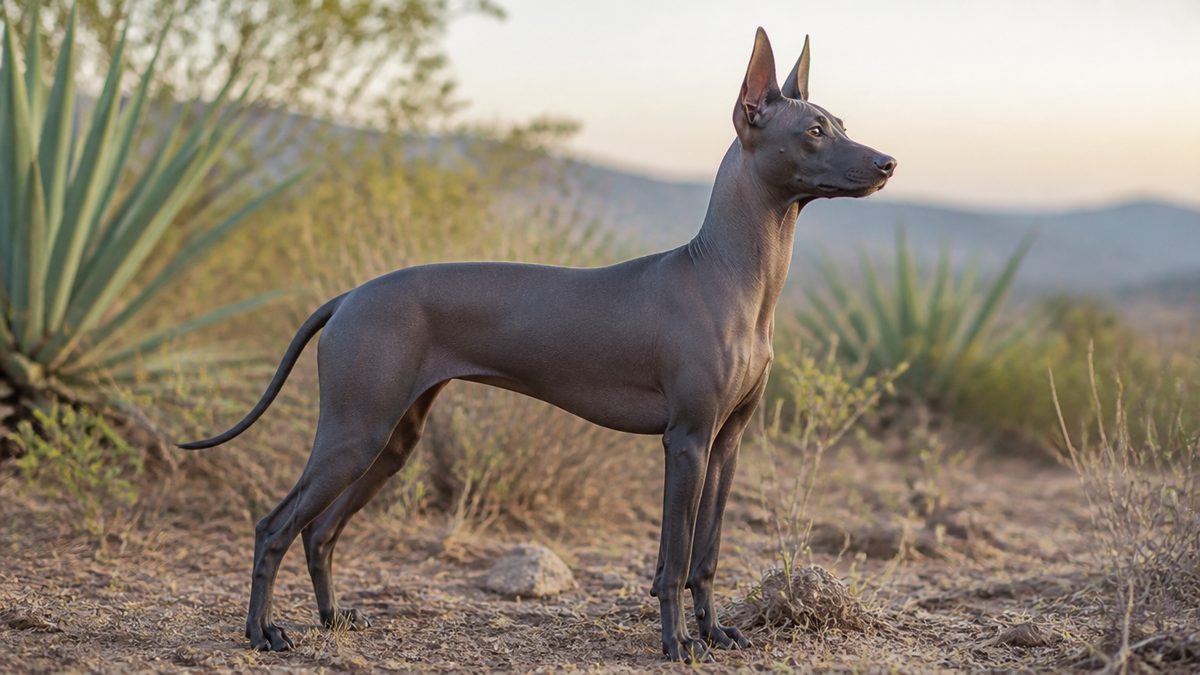
Quick answer
The Xoloitzcuintle dog is a Mexican breed held by the FCI as standard 234 in three sizes, Miniature 25 to 35 cm, Intermediate 36 to 45 cm and Standard 46 to 60 cm, in a hairless and a coated variety. Its hairlessness comes from a FOXI3 mutation that also removes teeth. No Indian breeder market exists and no rupee price for a live Xolo could be sourced.
This page reports published veterinary research and registry screening data for general information. It is not a diagnosis and it is not a treatment plan for your dog. Skin disease, sunburn, dental disease and heat injury all need hands-on examination, so consult your nearby vet before acting on anything here.
Xoloitzcuintle traits, rated for Indian conditions
What the Xoloitzcuintle dog is
The Xoloitzcuintle dog is a Mexican primitive-type breed held by the Fédération Cynologique Internationale as standard 234, accepted on a definitive basis on 6 November 1961, and bred in two varieties, hairless and coated, across three sizes.
Start with the document rather than the legend, because the legend is where most pages start and it is why they get the numbers wrong. FCI standard 234 files the breed in Group 5, Spitz and primitive types, Section 6, Primitive type, without working trial, and names Mexico as the country of origin. The authentic language of the standard is Spanish, and the English text on the FCI's own site is a translation supplied by the Federación Canófila Mexicana and revised by Renee Sporre-Willes. That matters on a page like this one, because where an English figure and a Spanish figure disagree the Spanish governs.
The breed comes in three sizes and the standard is precise about them. Standard variety runs 46 to 60 cm at the withers with a tolerance of plus 2 cm in top-quality dogs, Intermediate 36 to 45 cm, and Miniature 25 to 35 cm. Dogs over 62 cm or under 25 cm are disqualified. The three sizes are given different jobs on the same page: Standard and Intermediate are listed as watchdogs, Miniature as a companion dog.
| Variety | Height at withers | Utilisation named in the standard |
|---|---|---|
| Standard | 46 to 60 cm, tolerance +2 cm | Watchdog |
| Intermediate | 36 to 45 cm | Watchdog |
| Miniature | 25 to 35 cm | Companion dog |
| Disqualifying | Over 62 cm or under 25 cm | Not applicable |
Appearance, in the standard's own words
On general appearance the standard describes an ancient natural primitive dog, modelled by evolution, attractive, slim and elegant, moderate in all aspects, expressing speed, harmony and strength without appearing coarse, with a clean-cut outline, ample chest, well-sprung ribs and long limbs and tail. The body is slightly longer than high at roughly 10 to 9, and skull and muzzle are approximately equal in length. The ears are long, large, of fine texture and reminiscent of bat ears; droopy or cropped ears are disqualifying. The two varieties are identical in conformation except for coat and dentition.
The Spanish text carries the same appearance description under the heading *Variedad sin pelo y Variedad con pelo*, and since Spanish is the authentic language it governs wherever the English translation and the original diverge. English Wikipedia's own article on the breed splits its coverage the same way the registries do, with separate Fédération Cynologique Internationale and American Kennel Club subsections under a Registry heading, plus Genetics and Health subsections.
Here is the first thing worth knowing that almost nobody prints: the standard gives no weight at all, at any size. It sets heights, proportions and a disqualifying ceiling, and it stops there. So every weight range you meet for this breed comes from somewhere other than the breed standard, and a page quoting one as though the FCI said it has not read the FCI. The one hard weight in the veterinary literature is a single patient: a 10-week-old male Xoloitzcuintle weighing 8.9 kg, described in a 2023 case report.
The name, and why the spelling decides what you find
The standard explains the name itself. It records that the meat of the dog was eaten in ceremonies in pre-Hispanic Mexico and that the animal was regarded as a representative of the god Xolotl, from which the name comes, its task being to guide the souls of the dead to their eternal destination. It also gives the alternative names: the hairless variety is known as *perro pelón mexicano*, the Mexican Hairless Dog, and the coated variety was known by the natives as *itzcuintle*.
That spelling question is not trivia, and it is worth showing an Indian reader what it does. Searching the clinical literature under the name this page uses returns almost nothing, while searching the plain English name returns a real body of work.
| Query | PubMed records |
|---|---|
| "Xoloitzcuintle"[tiab] | 1 |
| "Xoloitzcuintles"[tiab] | 0 |
| "Xoloitzcuintli"[tiab] | 6 |
| "Mexican Hairless Dog"[tiab] | 12 |
| "Mexican Hairless Dogs"[tiab] | 27 |
| "Mexican hairless"[tiab] | 50 |
Read that table as a warning rather than as trivia. A writer who searches only the breed's own Nahuatl-derived name concludes that the Xoloitzcuintle has one paper to its name. A writer who searches the plain English phrase finds fifty. The singular and plural forms alone differ by fifteen records, because PubMed's phrase index does not stem plurals. Any page telling you this rare breed has no literature has searched one string.
Every figure here names the document it came from and, where two documents disagree, both are printed. Where no figure could be sourced, the page says so instead of borrowing one from a related breed. That happens three times below, on price, on lifespan and on weight.
The FOXI3 mutation, and whether it is really this breed's evidence
The Xoloitzcuintle's hairlessness comes from a frameshift mutation in FOXI3, and this breed is one of the three the mutation was actually discovered in rather than a breed the finding was later transferred to.
Drögemüller and colleagues published the mapping in *Science* in 2008. Their abstract opens by naming the animals studied: 'Mexican and Peruvian hairless dogs and Chinese crested dogs are characterized by missing hair and teeth, a phenotype termed canine ectodermal dysplasia'. The Mexican Hairless Dog is the Xoloitzcuintle. So when this page says FOXI3, it is reporting a result obtained on this breed, not a result imported from a neighbour.
The mechanics are worth stating plainly. Genome-wide association mapped the causal interval to 102 kilobase pairs on chromosome 17, and inside that interval sat a then-uncharacterised member of the forkhead box transcription factor family, FOXI3, expressed specifically in developing hair and teeth. Mutation analysis found a frameshift in the FOXI3 coding sequence in hairless dogs, and the trait is inherited as a monogenic autosomal semidominant.
A later paper pins down the variant and its effect on teeth. Kupczik and colleagues describe a semi-dominant 7-base-pair duplication in the first exon of FOXI3 shared by all three hairless breeds, recovered it from a historical museum sample of pedigreed hairless dog skulls using ancient-DNA extraction, and set out the dental phenotype: loss of the permanent canines, premolars and to some extent incisors, and molars lacking their distal and lingual cusps.
Not every hairless dog is a FOXI3 dog
This is the part that stops the finding being over-applied, and it comes from the same laboratory. Hytönen and Lohi investigated hairlessness in 66 Scottish Deerhounds and found a one-base-pair insertion in exon 2 of SGK3, a completely different gene, producing a frameshift and a very early truncation, segregating fully with the hairlessness and carried by 12 percent of the breed. They state that the known FOXI3 and SGK3 variants do not explain hairlessness in all breeds.
So the honest position for a reader is this. Hairlessness in dogs is not one condition with one gene. In the Xoloitzcuintle it is FOXI3 and it drags the teeth along with it. In the Scottish Deerhound it is SGK3 and it is recessive. Anyone telling you that a hairless dog is a hairless dog has flattened two different pieces of biology. The American Hairless Terrier is the useful comparison, because it is hairless and keeps a full mouth.
What the standard tells breeders to do about it, and what the genetics implies
FCI standard 234 carries a preamble that reads like a breeding instruction, and it is unusual enough to quote. It states that the gene producing the absence of hair is dominant, that hairless-to-hairless breeding produces the fewest coated dogs and has therefore been preferred, and that this breeding maintains and improves the quality of the breed. It permits well-constructed coated Xoloitzcuintles to be used for breeding to provide genetic diversity, requires coated breeding stock to descend from at least three generations of hairless-to-hairless breeding, and then forbids one specific mating outright: 'The breeding between two coated Xoloitzcuintles is not permitted'.
Read that against the semidominant inheritance Drögemüller reports and a tension appears that no ranking page discusses. A hairless-to-hairless mating is a cross between two heterozygotes, which is precisely the mating that produces homozygous offspring. The standard also tells you why the coated variety exists at all inside a hairless breed: it is the reservoir. Bonbeno makes no claim here about homozygote survival, because no source consulted for this page measured it, and inventing a number to complete a neat story is exactly the failure this site exists to avoid.
A Xolo's coat status is a genotype claim, and a coated Xolo from a coated-to-coated mating is a dog bred against its own standard. If anyone ever offers you this breed in India, the question is not what the puppy looks like. It is which registry issued the pedigree and what the parents' coat varieties were.
Teeth, dentition and a direct collision with Indian law
The hairless Xoloitzcuintle's dentition is nearly always incomplete, its own breed standard instructs judges not to penalise the gaps, and Indian breeding law names two or more missing teeth as a genetic defect a breeding dog must have been tested for Prevention of Cruelty to Animals.
Take the standard first. On dentition it separates the two varieties. For the hairless variety a complete set of incisors is preferred, but 'the absence of a few incisors, canines, molars, pre-molars or rotated teeth should not be penalized, as many dogs do not have deep roots', and it adds the reason: 'Genetically, the absence of hair is closely linked to the absence of teeth.' For the coated variety it requires full dentition of 42 teeth, normally developed and normally positioned, with a scissor or pincer bite.
That is a coherent position for a breed whose defining gene removes teeth. It is also, word for word, the thing Indian law lists as a defect.
| Document | What it says about missing teeth |
|---|---|
| FCI standard 234, hairless variety | Absence of a few incisors, canines, molars or pre-molars should not be penalised; hairlessness and toothlessness are genetically linked |
| FCI standard 234, coated variety | Full dentition of 42 teeth required, normally developed and normally positioned |
| Dog Breeding and Marketing Rules 2017, Second Schedule Part III para 8(10) | Breeding dogs 'shall have been tested for genetic defects, including' a list that names 'two or more missing teeth' |
The clause was read out of the gazette itself rather than from a summary, because this document has handed at least three agents on this project fabricated rule numbers. The PDF retrieved for this page ran to 160,481 bytes and 14 pages, extracted to 51,953 characters with a real text layer, and paragraph 8(10) reads: 'The dogs shall have been tested for genetic defects, including hip dysplasia, progressive retinal atrophy, night blindness, hypothyroidism, entropion, ectropion, overshot, undershot jaw (when incisors do not touch or mesh), wry mouth, two or more missing teeth, unilateral cryptorchid or full cryptorchid males'.
What the collision does and does not mean
Two limits keep this honest. The word in the clause is 'including', so the list is illustrative rather than closed, and the clause requires testing rather than exclusion: it says a breeding dog shall have been tested, not that a dog with missing teeth may not be bred. And the provision is a Second Schedule paragraph, not a Rule. The Rules themselves run 1 to 13 and stop there, so a citation reading 'Rule 8(10)' is wrong by construction, and this page cites Second Schedule Part III paragraph 8(10) because that is where the words sit.
What it does mean is that an Indian breeder of this breed would be operating where the breed standard and the statutory schedule point in opposite directions on the same anatomical feature, and would need advice before starting. That is a genuinely unusual position and it is the sort of thing a buyer should hear before a purchase, not after.
Practical dental care for a dog with fewer teeth
Fewer teeth does not mean less dental work. It usually means more, because the remaining teeth carry loads they were not spaced to carry and the gaps change how food clears the mouth.
- Check the mouth weekly from puppyhood, so a dog that dislikes handling is not learning that lesson during a problem.
- Count the teeth once and write the number down, because a tooth lost later is only detectable against a baseline.
- Feed in a way that suits the mouth in front of you rather than the breed average, since dentition varies dog to dog within one litter.
- Ask your vet at every visit to look at the remaining canines specifically, which do the most work in an incomplete mouth.
The Rules govern breeders and breeding establishments. Owning a dog with incomplete dentition is not regulated by them, and nothing here suggests a Xolo may not be kept in India. The clause bites on breeding, which is the activity nobody in India is currently doing with this breed.
Which registries hold the Xoloitzcuintle, and how to check one yourself
The Fédération Cynologique Internationale holds the Xoloitzcuintle as breed number 234, recognised on a definitive basis, and the American Kennel Club maintains its own breed page and parent club for the same dog American Kennel Club.
The FCI record was read directly rather than inferred. It gives the group as 5, Spitz and primitive types, the section as Primitive type, the country of origin as Mexico, the official authentic language as Spanish, definitive acceptance as 11/6/1961, the valid standard as published 10/8/2012, and the varieties as Miniature, Intermediate and Standard.
Those two dates need a word, because the FCI writes dates month first and reading them the Indian way gets the month wrong. The record's own page settles the format without any house knowledge: it also carries 1/28/2014, and 28 cannot be a month. So 11/6/1961 is 6 November 1961 and 10/8/2012 is 8 October 2012, and the standard PDF confirms the second independently by printing 08.10.2012 in day-first form.
A method any reader can repeat
The FCI's nomenclature server resolves on the trailing number in the URL and ignores the breed name entirely, which is why a guessed URL there serves a real page for the wrong dog. The safe technique is to probe by number and read the title the page returns. Bonbeno probed records 1 to 400 on 10 September 2026. All 400 answered, 378 is the highest number returning a distinct breed record, and everything from 379 upward returns the generic index page.
That sweep produced a warning worth passing on to anyone checking a breed against the FCI. The register titles breeds in their own language, not in English.
| FCI number | Title the register returns | English name most people search |
|---|---|---|
| 234 | XOLOITZCUINTLE | Mexican Hairless Dog |
| 218 | CHIHUAHUEÑO | Chihuahua |
| 153 | DALMATINSKI PAS | Dalmatian |
| 277 | HRVATSKI OVCAR | Croatian Sheepdog |
| 122 | LABRADOR RETRIEVER | Labrador Retriever |
Search that register for 'Chihuahua' and you find nothing, for one of the most popular dogs on earth. The absence is manufactured by the query, not by the register. This page's own claim that four other breeds are absent from the FCI rests on the same sweep, run with these controls passing.
The American side, and what a second registry adds
The AKC serves a full Xoloitzcuintli breed page covering the breed standard, colours and markings, health, grooming, exercise, training and nutrition. Its parent club, the Xoloitzcuintli Club of America, states that the breed comes in three sizes, which it names standard, miniature and toy, and two varieties, hairless and coated, and that statues identical to the hairless variety date back over 3,000 years.
Note the small disagreement rather than smoothing it over. The FCI's smallest size is called Miniature; the American parent club calls its smallest size toy Xoloitzcuintli Club of America. Both bodies hold three sizes and both are describing the same dog. This is a naming difference between registries, not a dispute about the animal, and a reader comparing a US pedigree against an FCI one should expect the label to change.
A breed held by two independent bodies has two published standards to check a dog against and two sets of records. That is more verification than most rare breeds offer, and it is the reason this page can be as specific as it is.
Xoloitzcuintle price in india, and why this page prints no rupee figure
No Indian price for a live Xoloitzcuintle could be sourced, and the rupee figures that do attach to the breed's name in India are merchandise prices rather than animals.
That is the finding, and it is the most useful thing this section can tell an Indian buyer, so it goes first rather than last.
The search was run through an instrument proved in the same session. A control query for Labrador Retriever puppies in India returned eight genuine Indian results carrying real rupee ranges from named Indian sellers, so the tool was working. The same tool, same session, asked for Xoloitzcuintli puppies in India and returned no Indian breeder at all.
The Indian search page itself was captured too, and it is worth knowing what Google India actually shows for this breed. The query 'xoloitzcuintle dog' with gl=IN returned 'About 124 results' and a genuine on-breed result set led by Wikipedia, the American Kennel Club and the breed's American parent club, with no Indian seller anywhere in it. A commercial market leaves commercial results. This one leaves encyclopedias.
What it returned instead, which is the content
Three kinds of result came back, and each is worth naming because a reader will meet all three.
- Merchandise dressed as a marketplace. An Etsy storefront titled 'Buy Xoloitzcuintli Dogs Online In India' carrying prices of Rs 1,295, Rs 802, Rs 1,991 and Rs 230. Those are prints and downloads. The page title is what a price scraper reads, and it is what an answer engine reads too.
- A listing for a different dog. One Indian social post advertised Xoloitzcuintli puppies on order, and its own body text described a top-quality male Toy Poodle. That is not a near miss; the advertisement and the animal are different breeds.
- Genuine prices, all foreign. Every real figure returned was in US dollars from US sources, quoted between about 850 and 4,000 dollars depending on breeder and papers.
Bonbeno converts none of those into rupees, and the refusal is deliberate. A foreign asking price divided by an exchange rate is an arithmetic result, not an observation of an Indian market, and this project has repeatedly caught answer engines performing exactly that division and presenting the output as an Indian price. The honest sentence is that there is no Indian price in india for this breed because there is no Indian supply.
Why no supply chain forms
Two facts explain the absence between them. The breed has no Indian breeding population to draw on, and the country's only route to a pedigree runs through the Kennel Club of India against FCI nomenclature, which means a genuine Xolo in India would be an imported dog with an imported pedigree rather than a locally bred one. A single imported dog does not make a market, and a market is what a price is a measurement of.
Ask three questions before anything else. Which registry issued the pedigree and what is the number on it. Where were the parents, and can you see them. And is the dog hairless or coated, since a coated Xolo from two coated parents was bred against its own standard. A seller who answers none of those is selling a description.
Monthly cost of ownership in India for a dog this size
Expect roughly Rs 4,000 to Rs 9,000 a month to keep a 15 to 20 kg dog properly in an Indian metro, built from named published prices rather than from a template.
There is no Indian purchase price for this breed, but there is a real Indian cost of ownership, because vaccination, parasite control, grooming, boarding and municipal registration all cost the same for a Xolo as for any dog of the same weight. Those figures are sourceable and they are what an Indian reader actually needs.
| Item | Published price | Source |
|---|---|---|
| Anti-rabies vaccine, single | Rs 699 | Vetic clinic price list |
| 9-in-1 DHPPiL | Rs 899 | Vetic clinic price list |
| Kennel cough | Rs 1,349 | Vetic clinic price list |
| Bath, Delhi | from Rs 934 | Vetic grooming, Delhi |
| Complete bath and styling, Delhi | from Rs 1,869 | Vetic grooming, Delhi |
| NexGard Spectra, 15 to 30 kg, 3 tablets | Rs 3,308, so Rs 1,103 per month | Supertails listing |
| Boarding, 24 hours, Bengaluru | Rs 899 | PawSpace Bengaluru |
| Consultation | Rs 500 to 1,000 | VOSD |
| Delhi municipal dog registration | Rs 500 | MCD Delhi portal |
| Chennai pet licence | Rs 50 | Greater Chennai Corporation |
| Microchipping, Chennai | Rs 1,250 | SKS Veterinary Hospital |
Two of those rows deserve comment rather than repetition. The VOSD consultation range of Rs 500 to 1,000 is published byte-identically by a large general insurer as well, and two unrelated organisations agreeing to the rupee on two separate quantities is evidence of copying rather than of corroboration, so this page treats it as one data point. And the Vetic prices are promotional floors from one chain that quotes different course prices on different city pages, so they are a real published price rather than a national average.
The spread is the finding, not any single number
For one identical vaccine the Indian price is a function of who delivers it rather than of the drug. A government veterinary hospital, a private urban chain and a vet-at-home service can differ by more than three times on the same 9-in-1. In Chennai the effect is starker still, because the Greater Chennai Corporation runs six municipal pet clinics that provide treatment and anti-rabies vaccination free of cost, against Rs 699 for the same shot at a private chain.
That is worth more to a reader than a monthly average, because it is actionable. A Chennai owner on a budget has a free route to the single most important vaccine a dog receives in India, and most breed pages never mention it.
Boarding is the other line where the delivery model rather than the dog sets the price. A Bengaluru operator publishes an hourly rate to four hours at Rs 599, daycare to ten hours at Rs 799 and an overnight stay to 24 hours at Rs 899, so a week away costs about Rs 6,300 before anything else. Budget it before you travel rather than after.
What this breed changes about the total
Three line items move for a hairless dog, and only one of them moves upward.
- Grooming falls. There is no coat to clip or strip, so the Rs 1,359 haircut line does not apply and the cost collapses to bathing.
- Skin protection appears. A dog-safe sunscreen is a recurring cost that a coated breed simply does not have, and it is the one genuinely breed-specific addition to an Indian budget.
- Coat-related veterinary visits fall. Hot spots and matting under a double coat in the monsoon are a real Indian expense on coated breeds and are largely absent here.
Municipal fees move rarely and retail prices move within weeks. The Delhi and Chennai figures above can be relied on for a while; re-check any product price before you budget on it. Delhi's own portal reports 18,958 pet dog certificates issued since 2021 and 71 of 1,006 applications rejected in the current financial year, which tells you the process is real and that applications do fail.
Suitability for the Indian climate, starting with the homeland
The Xoloitzcuintle's homeland is cool, not hot: NASA POWER puts Mexico City's annual mean at 13.83 C against Chennai's 27.94 C, so the common assumption that a hairless dog is a tropical dog does not survive contact with the numbers.
This is the section where most pages about this breed go wrong, and the error is one of reasoning rather than of data. A dog with no coat looks adapted to heat. The breed's actual place of origin is a highland basin at over two kilometres of altitude, and the climate figures are not close.
Every point below was queried by explicit latitude and longitude, and the grid-cell elevation NASA POWER reports is printed beside the real elevation, because POWER returns a cell rather than a point and in hilly terrain the cell can miss the town underneath it badly.
| Place | Cell elevation vs real | Annual mean T2M | Hottest month | Peak wet bulb |
|---|---|---|---|---|
| Mexico City | 2,626.86 m vs ~2,240 m, +387 m | 13.83 C | May, 17.17 C | June, 12.53 C |
| Colima, Mexican Pacific lowland | 531.66 m vs ~494 m, +38 m | 24.67 C | May, 26.52 C | August, 22.97 C |
| Delhi | 206.37 m vs ~216 m, -10 m | 25.57 C | June, 35.88 C | July, 26.50 C |
| Mumbai | 97.15 m vs ~14 m, +83 m | 26.77 C | May, 31.19 C | June, 25.77 C |
| Chennai | 48.95 m vs ~6 m, +43 m | 27.94 C | May, 31.51 C | May, 26.11 C |
| Bengaluru | 841.72 m vs ~920 m, -78 m | 23.74 C | April, 28.37 C | May, 21.86 C |
| Pune | 635.99 m vs ~560 m, +76 m | 23.86 C | April, 28.93 C | June, 22.97 C |
Read the Mexico City row with its caveat attached. The cell sits 387 m above the real city, which in a mountain basin is enough to matter, so the true annual mean is somewhat warmer than 13.83 C. It is not fourteen degrees warmer. Even generously corrected, the homeland is a temperate highland climate and Chennai is not.
Two Indian cities that surprise people, and one that does not
Delhi peaks in June at 35.88 C rather than in May, and Bengaluru and Pune both peak in April and are coolest in December rather than January. Chennai does peak in May, at 31.51 C, and its peak wet bulb of 26.11 C in May is the number that actually constrains a dog, because wet bulb combines heat and humidity into the load an animal has to shed.
For an Indian reader the practical translation is that the difficult months differ by city and the calendar advice on most breed pages is written for one of them. In Delhi the hard month is June, in Bengaluru and Pune it is April, and in Chennai and Mumbai it is May.
The Mexican lowland comparison, which is the fair one
Colima, on the Mexican Pacific lowland, runs an annual mean of 24.67 C with a peak wet bulb of 22.97 C in August. That is a genuinely warm place where this breed also occurs, and it is closer to Bengaluru at 23.74 C than to Chennai at 27.94 C. So the fair conclusion is not that the Xolo cannot live in a warm climate. It is that Bengaluru and Pune sit inside the range the breed has actually experienced, and Chennai, Kolkata and Ahmedabad sit outside it.
Wet bulb is computed here from mean temperature and mean relative humidity by the Stull approximation, never from the period-extreme maximum, which would produce impossible values. A peak of 26.11 C in Chennai is not a comfortable figure for any dog. It is the reason walks move to dawn and after dark from March to June regardless of coat.
The claim in the breed standard that an Indian owner must not act on
FCI standard 234 states that the Xoloitzcuintle sweats through its feet and 'seldom pants, except in extreme heat', and no Indian owner should let that sentence change how they respond to a hot dog.
This is the single most consequential sentence written about this breed, it sits in the breed's governing document, and every page that mentions it repeats it without comment. It appears in the standard's SKIN section, which is worth quoting at length because the passage argues with itself.
The standard says the skin of the hairless variety 'is smooth, sensitive to touch and feels warmer because of direct heat emission due to the lack of hair; however, its body temperature is the same as in other dogs with hair'. It then contrasts the breed with coated dogs, 'which disperse body heat through natural ventilation', notes that the skin needs more care from sun exposure for lack of natural protection, and concludes: 'The dog tends to sweat through its feet (foot pads and inter-digital membranes), which is why it seldom pants, except in extreme heat'.
What the standard gets right, and where it goes further than its evidence
Two parts of that passage are unarguable and useful. The skin genuinely does feel warmer to the hand, because heat leaves it directly instead of through fur. And the standard says outright that the dog's body temperature is the same as any coated dog's, which is the sentence that should govern an owner's expectations.
The claim that goes further is the causal one, that foot sweating explains reduced panting. The best-published quantitative treatment of how a dog sheds heat is Potter and colleagues' canine thermal model, built for military working dogs. It is a two-compartment core and skin model taking air temperature, relative humidity, solar radiation and wind velocity as inputs, and it represents heat loss through respiration including panting, through skin blood flow, through the tongue and lingual tissues, and through the thermal insulation properties of fur. Paw sweating is not among the routes it models.
Bonbeno could find no study that measured the contribution of paw sweating to heat loss in this breed, or that tested whether Xolos pant less than coated dogs of the same size at the same load. So the position this page takes is narrow and, we think, the only defensible one: the standard's observation may well describe something breeders have noticed, and it has not been quantified, and it must not be read as licence to treat a hot Xolo differently from any other hot dog.
| Source | What it says about how this dog sheds heat |
|---|---|
| FCI standard 234, SKIN | Sweats through foot pads and inter-digital membranes, and therefore seldom pants except in extreme heat |
| FCI standard 234, same paragraph | Body temperature is the same as in other dogs with hair |
| Potter et al. 2020 canine thermal model | Models heat loss via respiration including panting, skin blood flow, tongue and lingual tissues, and fur insulation, with solar radiation as an environmental input |
| Any source measuring paw-sweat heat loss in this breed | None found |
Why this matters more in Chennai than in Mexico City
An owner who believes their dog does not really need to pant has been given a reason to wait. In a Delhi June with a mean of 35.88 C, or a Chennai May at a peak wet bulb of 26.11 C, waiting is the expensive decision. Hall and colleagues' study of 905,543 UK dogs recorded 395 confirmed heat-related illness events and found exertion, not a parked car, to be the commonest trigger, which is the scenario an Indian owner walks their dog into every morning that starts too late.
Heavy panting, a dog that lies down and will not get up, brick-red or very pale gums, vomiting, wobbliness or collapse are an emergency in a Xoloitzcuintle exactly as in a Labrador. Cool the dog with room-temperature water, move it into shade and moving air, and consult your nearby vet immediately. Do not conclude from a sentence in a breed standard that a Xolo which is not panting is comfortable.
Skin care and sun exposure, the real Indian problem
Sun exposure, not insulation, is the constraint a hairless Xoloitzcuintle faces in India, because the mutation that removed the coat removed the only physical barrier between the skin and ultraviolet light FCI-Standard N° 234.
The standard names the risk itself. It records that the difference from coated breeds is that 'the skin requires more care from exposure to the sun and elements due to its lack of natural protection', and it adds a detail buyers should know: accidental scars are not penalised in the ring, which tells you how routinely this skin gets marked.
It also tells you which dogs start with the most protection. Solid, uniform, dark coloured skin is preferred, and the accepted range runs black, blackish grey, slate grey, dark grey, reddish, liver, bronze or blond, with spots of any colour permitted. A dark-skinned Xolo carries more melanin than a blond one. That is a real difference in a country where the April Bengaluru mean is 28.37 C under a near-vertical sun.
A practical Indian routine
The whole grooming job for this breed is skin management, so it is worth setting out as steps rather than as advice.
- Shift the walk. Dawn and after dark for eight months of the year, and check the pavement with the back of your hand before the dog's feet touch it.
- Apply a veterinary-approved, zinc-oxide-free sunscreen to the back, shoulders, muzzle bridge and ear tips before any daytime exposure, and ask your nearby vet which product to use rather than reaching for a human one.
- Bathe gently and infrequently. Over-washing strips the skin's own oils and is a commoner cause of trouble in this breed than under-washing.
- Dry the neck folds after every bathe, since the standard notes that puppies show folds which disappear with age, and a damp fold in a Mumbai June is where trouble starts.
- Inspect weekly in good light for comedones, new pigmented patches and any lesion that does not resolve, and photograph anything you are unsure about so change is measurable.
One reassurance is worth giving alongside the caution. The Indian monsoon is genuinely easier on this breed than on a coated one. A double coat holds damp against the skin for hours and is the reason hot spots and otitis cluster in July and August on many imported breeds. Bare skin dries in minutes.
The hypoallergenic claim, which is the commonest reason people buy a hairless dog
It is not supported, and this is settled rather than contested. Vredegoor and colleagues measured Can f 1 across 196 dogs of so-called hypoallergenic breeds against 160 control dogs and found the hypoallergenic group carried more allergen on hair and coat, not less, with no difference in airborne allergen, concluding that there is no evidence for classifying any breed as hypoallergenic. The allergen is in dander and saliva, and a hairless dog produces both. Note also that FCI standard 234 makes no allergy claim anywhere in its text.
There is almost nothing to shed onto Indian upholstery, and there is no undercoat to mat in humidity. Both are real advantages and neither is an allergy claim. Buy the dog for those if you like; do not buy it to solve an allergy.
Temperament and household fit
The Xoloitzcuintle is described by its own standard as a silent, calm, cheerful, alert and intelligent dog, a good watchdog and an excellent companion that is never aggressive, though it may be suspicious toward strangers.
That description is worth taking seriously because it is prescriptive, not merely descriptive. Aggressive or overly shy behaviour sits in the standard's disqualifying faults, alongside any dog clearly showing physical or behavioural abnormalities. A registry that disqualifies a temperament is telling breeders what to select for.
The word doing the most work for an Indian household is silent. A calm dog that does not bark much is a different proposition in a Mumbai flat with shared walls than in a house with a garden, and the standard's own utilisation table makes the same point from the other direction by naming the Miniature a companion dog and the two larger sizes watchdogs.
Who this breed suits
- Adults in a flat who want a quiet, undemonstrative dog and can commit to a strict sun routine.
- Households with older children who understand that a thin-skinned dog is easier to injure by accident than a robust one.
- Owners who enjoy a dog that thinks, rather than one that waits for instructions.
Who it does not suit
- Families wanting a dog that greets every visitor, since reserve toward strangers is normal here and is written into the standard.
- Anyone buying a hairless dog to solve an allergy, which the evidence does not support.
- Households that cannot restructure walks around the hot months, because this dog's skin has no margin.
The primitive-type classification is a practical warning rather than a compliment. FCI Group 5 dogs generally retain more independence and a longer fuse for repetitive obedience than the gundog and herding groups, and the Xolo is filed in Section 6, Primitive type, without working trial. Expect a dog that cooperates because the relationship is good rather than because it is biddable.
The standard notes that the tongue is generally pink but may have black markings, spots or marks, and calls this a common characteristic of the breed. New owners sometimes read a spotted tongue as a health problem. It is not, and the same standard disqualifies only a paralysed tongue hanging outside the mouth.
Training approach, and what this breed resists
To train a Xoloitzcuintle, work in short sessions with high-value food, build the relationship first and accept that a primitive-type dog filed in FCI Group 5 without working trial will negotiate rather than obey on reflex.
The standard calls the breed alert and intelligent, and those two words together describe a dog that learns quickly and then decides whether the exercise is worth repeating. That is not stubbornness. It is what selection for independent watchfulness produces, and it means the training plan has to earn cooperation rather than assume it.
Three things follow for an Indian owner in particular.
- Train in the cool hours. A dog working in a Delhi afternoon learns that training is unpleasant, and in June that afternoon averages 35.88 C.
- Socialise deliberately and early, because reserve toward strangers is the breed's default and an under-socialised watchdog in a crowded Indian building becomes a problem for everyone.
- Reward with food rather than rough physical praise, since this is a thin-skinned dog and enthusiastic patting is genuinely less pleasant for it than for a Labrador.
The socialisation window and Indian reality
The practical Indian obstacle is that the puppy's most useful weeks for social learning often fall while it is still completing its vaccination course, and the course is not short. A Vetic schedule prices a puppy course across multiple visits, with the individual vaccines running from Rs 699 for anti-rabies to Rs 1,349 for kennel cough. Waiting for full cover before any social exposure costs more in behaviour than it saves in risk, so discuss carrying the puppy to safe, controlled environments with your nearby vet rather than keeping it indoors alone.
What not to train out
Do not train away the watchfulness, and do not punish the reserve. The standard describes a dog that may be suspicious toward strangers and is a good watchdog, and a Xolo that alerts and then settles is doing exactly what it was selected to do. What needs training is the settling, not the alerting.
Teach the dog to accept sunscreen application, full-body inspection and foot handling as a game in the first three months. Every one of those is a lifelong weekly requirement for this breed in India, and a dog that resents them makes the routine collapse in the second year.
Daily exercise requirement, and what happens without it
A Xoloitzcuintle needs a genuine daily walk plus play, roughly 45 to 60 minutes for the Standard variety and 30 to 45 for the Miniature, and in most Indian cities that time has to move to dawn and after dark for eight months of the year.
The standard describes movement that tells you what the dog was built to do: 'The dog should move freely with a long, elegant, springy step; the trot is quick and flowing with head and tail carried high'. That is a trotting dog, not a sprinter and not a couch ornament, and the two larger sizes are named as watchdogs with the physical stamina that implies.
The exercise question in India is almost entirely a timing question rather than a quantity question.
| City | Hardest month | Mean that month | Peak wet bulb |
|---|---|---|---|
| Delhi | June | 35.88 C | 26.50 C in July |
| Ahmedabad | May | 35.06 C | 26.11 C in June |
| Hyderabad | May | 33.30 C | 23.35 C in June |
| Chennai | May | 31.51 C | 26.11 C in May |
| Kolkata | May | 31.53 C | 27.09 C in June |
| Mumbai | May | 31.19 C | 25.77 C in June |
| Pune | April | 28.93 C | 22.97 C in June |
| Bengaluru | April | 28.37 C | 21.86 C in May |
Kolkata's June wet bulb of 27.09 C is the highest figure in that table and it is the one to plan around, because wet bulb is what a dog actually has to shed. Pune and Bengaluru, peaking in April rather than May and running the lowest wet bulbs, are the two large Indian cities where this breed's exercise routine is least constrained.
Exertional heat illness is the real risk, and it is avoidable
Hall and colleagues' study of 905,543 UK dogs under primary veterinary care in 2016 recorded 395 confirmed heat-related illness events, and the pattern that matters is that exertion rather than a hot car is the dominant trigger. That is a finding about walks. A dog exercised at the wrong hour is the commonest way this happens, and it is entirely under an owner's control.
The Xoloitzcuintle is not among the breeds that study modelled individually, and this page does not borrow an odds ratio from a breed the authors did not study. What transfers is the mechanism, not a number.
What under-exercise looks like
The standard supplies the tell for a related breed group and it applies here: a working dog that does not work needs adequate physical activity to keep its innate balance. In practice an under-exercised Xolo becomes restless indoors, more vocal at the door than the breed's silent reputation suggests, and harder to settle at night. None of that is a temperament fault. It is an unmet requirement.
Hot tarmac burns pads, and a hairless dog lying on a sun-warmed terrace floor is in direct contact with it along its whole body rather than through fur. Check surfaces with your own hand, and give the dog a shaded, ventilated place to lie that is not stone that has been in the sun.
Grooming and coat care in Indian humidity
Grooming a hairless Xoloitzcuintle takes almost no time and a great deal of consistency, because the job is not brushing a coat, it is protecting and monitoring bare skin.
Deal with the coated variety first, because it is simpler and because roughly one in a litter can be coated. The standard requires a completely short coated dog whose coat is 'tight, flat and smooth with no undercoat'. No undercoat is the operative phrase for India: this is one of the easiest coats there is in a monsoon, needing a weekly rubber curry and nothing else.
The hairless variety is not entirely hairless and the standard is specific about how much hair is allowed. Some short, coarse, thick hairs of any colour may sit on the forehead and back of the neck, never longer than 2.5 centimetres and never forming a long soft topknot, and coarse hair is commonly found on the feet and the end of the tail. A Xolo with a tuft is not a badly bred Xolo.
| Task | Hairless variety | Coated variety |
|---|---|---|
| Brushing | Not applicable | Weekly rubber curry |
| Bathing | Every 2 to 4 weeks, gentle, from about Rs 934 at a Delhi salon or at home | Every 4 to 6 weeks |
| Sunscreen | Before any daytime exposure, all year | Nose and ear tips in peak summer |
| Skin inspection | Weekly in good light | Fortnightly |
| Nail trimming | Fortnightly; the standard says nails should be trimmed | Fortnightly |
| Fold drying | After every bathe, especially on a young dog | After every bathe |
Vetic's Delhi price list gives bathing from Rs 934 and complete bath and styling from Rs 1,869, with a haircut from Rs 1,359. For a hairless Xolo the haircut line simply does not exist, which is the one place this breed is cheaper to keep than a coated dog of the same size.
The mistake that comes from overseas care advice
Breed care guidance is written for the climate the writer lives in, and this is a breed whose owners are mostly in Mexico and the United States. Advice to bathe frequently to control skin oil, written for a temperate climate, becomes over-bathing in a humid Indian city and strips a skin that has no coat to protect it. Advice to let a dog air-dry is fine on a Colorado afternoon and questionable in a Mumbai August at 90 percent humidity. Ask what climate a care instruction assumes before you follow it.
The ears are described as long, large, of fine texture and reminiscent of bat ears, carried erect when alert at 50 to 80 degrees from horizontal. Large erect ears collect less moisture than drop ears, which is good news in a monsoon, but they expose more thin skin to sun. Ear tips are the commonest site of sun damage on this breed, so they go on the sunscreen list.
Health risks, screening data and life expectancy
The Xoloitzcuintle has real published screening data, unusually for a rare breed: the Orthopedic Foundation for Animals holds 281 hip evaluations at 4.3 percent dysplastic, 146 elbow evaluations, 153 patella evaluations and 418 eye examinations.
Those numbers mean something because the OFA does not publish a breed until it has enough dogs. Its own threshold is stated plainly: 'For hips, each breed must have at least 100 evaluations in the database. For all other databases, there must be at least 50'. This breed clears the bar in four databases, which is more than many far commoner breeds manage.
Every row below was validated arithmetically before it was published, because a figure taken from a two-million-character statistics dump is only trustworthy if it closes.
| Database | Evaluations | Normal | Abnormal | Does the row close? |
|---|---|---|---|---|
| Hips | 281 | 95.7 percent | 4.3 percent dysplastic | Yes. Excellent 23.5 + good 65.8 + fair 6.4 = 95.7, and mild 1.8 + moderate 1.8 + severe 0.7 = 4.3 |
| Elbows | 146 | 94.5 percent | 5.5 percent | Yes, all of it grade I |
| Patella | 153 | 97.4 percent | 2.6 percent | Yes, all of it grade I |
| Eyes, summary line | 418 | 96.2 percent | 3.8 percent | See the note below |
| Advanced cardiac | 69 | 98.6 percent | 1.4 percent | Yes |
| Basic cardiac | 188 | 100 percent | 0 percent | Yes |
Put the hip figure in context rather than leaving it bare. At 4.3 percent dysplastic on 281 evaluations the Xoloitzcuintle screens better than the Labrador Retriever, which shows 11.3 percent dysplastic on 324,954 evaluations in the same dump. Both rows close arithmetically. The caveat that belongs with any OFA percentage is that these are dogs whose owners chose to submit radiographs, which is a selected population rather than a random one.
The eye numbers contradict themselves, and both are printed here
OFA's eye registry reports a summary line and a set of per-diagnosis detail rows, and for this breed they do not agree. The summary says 96.2 percent normal of 418 examinations. The detail rows sit on a denominator of 417 and give 355 as the largest single category, which is 85.1 percent. That is a gap of 11.1 percentage points on effectively the same denominator.
Bonbeno quotes neither as 'the' rate. This inconsistency has now been observed on more than a dozen breeds and it is a property of how the tables are built rather than a finding about the Xoloitzcuintle. Show a breeder both numbers and ask which examination their dog actually had.
Life expectancy, and why this page gives no number
No breed-specific median lifespan from a large veterinary dataset exists for the Xoloitzcuintle. McMillan and colleagues' 2024 study of UK companion-dog longevity lists the breed in supplementary Table S5 as 'Miniature and Standard Xoloitzcuintle', with the phylogeny reclassification 'Mexican Hairless', KC group Utility, body size Small and cephalic index Dolichocephalic, and with the inclusion flag set to N.
That flag is the answer, and it is a better answer than a borrowed figure. It means the breed was in the study's frame of 344 breeds and was genuinely excluded from the survival analysis, rather than being overlooked or merged into another breed's row. Where a breed is merged, S5 records the reclassification; here it does not. So there is no median to quote, and any lifespan you see for this breed is a breed-club estimate.
The other large UK dataset an owner might expect to answer this does not either. Teng and colleagues built annual life tables for companion dogs in the United Kingdom from primary-care records, and the breed-level tables they publish cover the commonest breeds rather than the rarest, so a breed with no Indian market and a small UK population does not appear in them. Two independent datasets, the same answer: no median exists for this dog.
Hips, elbows, patellae and eyes are the four databases in which this breed has published numbers, so those are the four to ask about. A breeder who cannot produce a result for at least one has not screened. Ask separately about dentition, because the incomplete mouth is normal for the hairless variety and is not a health failure. Consult your nearby vet about what any individual result means for the dog in front of you.
Health issues that are Indian rather than breed-specific
Tick-borne disease is the health risk an Indian owner of any dog should plan for first, and published Indian series report prevalence far above what overseas breed guidance prepares owners for Shil S, Chini DS, Mukherjee.
Nothing in this section is about the Xoloitzcuintle specifically, and that is the point. A rare breed's inherited risks are usually less relevant to an Indian owner than the diseases that are common where the dog will live.
| Study | Where | Dogs tested | Headline finding |
|---|---|---|---|
| Venugopal et al. 2026 | Kerala, southern India | 120 | Babesia in 80 of 120 dogs tested, 66.7 percent; Ehrlichia canis 5.0 percent; peak before the monsoon, March to May |
| Shil et al. 2026 | West Bengal | 584 | Babesia gibsoni 76.54 percent; Anaplasma 55.75 percent; 72.9 percent of the 584 dogs screened carried two or more pathogens |
| Chakraborty et al. 2024 | Odisha, eastern India | 178 | Ehrlichia canis in 56 of 178, 31.46 percent; 75 percent of infected dogs were over 20 kg; 79 percent had a tick history |
The framing caveat is mandatory and this page states it rather than burying it. These studies sampled clinically suspected dogs or veterinary clinic caseloads, not random populations, so the correct reading is 'among dogs tested at veterinary clinics'. A figure of 76.54 percent is not the chance your dog has babesiosis. It is a measure of how heavily the pathogen features in Indian clinical practice, which is why parasite control is the single highest-value line in the monthly budget.
That control costs about Rs 1,103 a month for a dog in the 15 to 30 kg band on NexGard Spectra, which covers the tick and flea role and the roundworm and hookworm role in one tablet.
Anaesthesia, where a recent study cuts against the conventional wisdom
If this dog ever needs surgery in India, one 2025 paper is worth your vet knowing about. Redondo and colleagues analysed 55,019 anaesthetics, 54,542 after exclusions, and found overall mortality of 0.69 percent, or 378 of 54,542. Crude rates were higher for the German Shepherd Dog, Chihuahua and Bulldog, but after adjusting for ASA physical status only two breeds retained excess risk, and the authors conclude that between-breed differences largely reflected case severity rather than breed.
The Xoloitzcuintle was not among the breeds analysed, so nothing here is a Xolo-specific anaesthetic finding. What transfers is the framing: ask your vet about the dog's ASA status rather than about its breed.
Heat injury, in the one number that matters
Hall and colleagues followed 905,543 UK dogs through 2016 and confirmed 395 heat-related illness events, with exertion the dominant trigger. Indian conditions are hotter than the ones that produced those events. The Second Schedule of India's own breeding rules recognises the principle, barring outdoor housing without a veterinary practitioner's written approval for dogs not accustomed to local temperatures and for breeds that cannot tolerate them, naming long-haired breeds in high temperature locations as its example.
The Greater Chennai Corporation runs six municipal pet clinics that provide all treatment and anti-rabies vaccination free of cost, and issued 9,115 pet licences in 2024 against a licence fee of Rs 50. For an owner on a budget in that city, that is a better first stop than any private chain's promotional price.
Feeding and nutrition through the life stages
Feed a Xoloitzcuintle to body condition rather than to a chart, because the breed spans 25 to 60 cm across three sizes and its own standard sets no weight at all to feed toward.
That absence is the practical starting point. Most breed pages open a feeding section with a weight range and grams per day. FCI standard 234 gives heights, proportions and disqualifying limits and no weight at any size, so a grams-per-day figure presented as breed guidance has been invented somewhere downstream. Feed the dog in front of you.
Life stages
- Puppy, to about six months. Three to four meals a day on a complete growth food. Watch condition weekly, because a thin-skinned dog's ribs are easier to see and easier to misread than a coated dog's.
- Adolescent, six to twelve months. Down to two meals. This is where Indian owners most often overfeed, because a dog that looks lean under bare skin does not always look lean to a visitor.
- Adult. Two meals, adjusted by season. Intake usually falls in the hot months and rises slightly in December and January.
- Senior. Two meals with the protein maintained rather than cut, and an annual conversation with your nearby vet about whether the dental situation has changed what the dog can chew.
The dentition point deserves its own line in a feeding section, because this is the one breed where it genuinely changes the plan. A hairless Xolo's mouth is nearly always incomplete and the standard says so. A dog missing canines and premolars cannot shear a large hard kibble the way an intact mouth can. Match kibble size to the mouth, not to the body weight on the packet.
Indian availability and cost
Complete dry foods for small and medium dogs are widely available in Indian metros and a monthly figure is arithmetic rather than a quoted price: it depends on the grams per day the pack specifies for the dog's actual weight. Verify grams per day against the pack before you budget a monthly number, and re-price the bag, because retail food prices on Indian sites have been observed to move within days while municipal fees stay put.
One reassurance about the growth phase, from the OFA rather than from a food brand. Hip dysplasia is polygenic and inherited; a high-calorie diet during rapid growth may exacerbate changes in hips that are already dysplastic but will not create hip dysplasia, and there is no evidence in the scientific literature that supplements such as vitamin C prevent it. So feed a growing puppy moderately, and do not buy a supplement to fix a genetic risk.
A hairless dog in an Indian summer should never be more than a room away from water. Multiple bowls, changed twice daily, refilled before the walk and offered after it. It costs nothing and it is the single most effective thing an owner does between March and June.
Month by month through the first year
A Xoloitzcuintle puppy's first year in India is organised around three things: the vaccination course, the socialisation window, and building the sun and handling routines that will run for the dog's whole life.
| Age | What happens | Breed-specific |
|---|---|---|
| 8 to 10 weeks | Home, settling, first vet visit, deworming, vaccination course begins | Note and record the number of teeth present |
| 10 to 14 weeks | Vaccination course continues; controlled socialisation in safe environments | Begin sunscreen handling as a game, before it is needed |
| 3 to 4 months | Lead work, house training consolidates, neck folds still prominent | Dry folds carefully after every bathe |
| 4 to 6 months | Adult teeth erupt, or in the hairless variety often do not | Count teeth again against the baseline and tell your vet |
| 6 to 9 months | Adolescence, testing boundaries, exercise increases gradually | Skin darkens and toughens in many dogs; keep sunscreen discipline anyway |
| 9 to 12 months | Approaching adult height; two meals a day | First full skin inspection with the vet, establishing what normal looks like |
| 12 months | Municipal registration renewal in Delhi, licence renewal in Chennai | Not breed-specific but easily forgotten |
The two decisions that matter most in the first year
The first is when to start socialising, and the answer is earlier than most Indian owners think, in controlled settings, discussed with your vet rather than decided alone. The behaviour cost of waiting for full vaccine cover in a watchful, reserved breed is real.
The second is establishing the skin routine before there is a problem to solve. A dog that learns at four months that sunscreen and inspection are ordinary will accept them at seven years. A dog that first meets them during a skin complaint will resist them for life.
What to expect that will worry you and should not
- Missing teeth in the hairless variety, which the breed standard treats as normal and instructs judges not to penalise.
- Neck folds on a young dog, which the standard notes disappear with age.
- Coarse hairs on the forehead, neck, feet and tail tip, permitted up to 2.5 cm.
- A spotted tongue, described in the standard as a common characteristic of the breed.
Any skin lesion that does not resolve within two weeks, any new raised or changing pigmented patch, or any area that stays sore after sun exposure needs a veterinary opinion rather than a wait-and-see. On a dog with no coat, the skin is the organ most exposed to Indian conditions, and it is also the one you can see. Consult your nearby vet.
Head to head against the breeds buyers cross-shop
Buyers considering a Xoloitzcuintle almost always compare it with the Chinese Crested Dog, the American Hairless Terrier and the Chihuahua, and the four differ on gene, dentition, registry status and Indian availability Hytönen MK, Lohi H. A frameshift insertion….
The comparison that matters is not looks. It is which gene produced the coat, because that decides whether the teeth come with it, and whether you can actually buy the dog in India.
| Breed | Hairless gene | Dentition | Available in India | OFA hip row |
|---|---|---|---|---|
| Xoloitzcuintle | FOXI3, semidominant | Nearly always incomplete in the hairless variety | No listing found with a passing control | 281 evaluations, 4.3 percent dysplastic |
| Chinese Crested Dog | FOXI3, the same 7 bp duplication | Affected in the hairless variety | Occasionally listed | Held in OFA's breed list |
| American Hairless Terrier | Not FOXI3 | Full dentition | Rare | Held in OFA's breed list |
| Chihuahua | Not applicable, coated | Full dentition | Widely available, Rs 4,000 to over Rs 2,00,000 across published Indian sources | 175 evaluations, 5.7 percent dysplastic |
Two rows in that table are worth expanding. The Chinese Crested Dog shares not merely a gene with the Xolo but the same 7-base-pair duplication in the first exon of FOXI3, which is why Drögemüller's original mapping treated Mexican, Peruvian and Chinese Crested hairless dogs as one phenotype Kupczik K, Cagan A, Brauer S. The American Hairless Terrier is the control that proves hairlessness and toothlessness are not inevitably linked, since it is hairless and keeps a full mouth.
The comparison an Indian buyer will actually face
In practice the choice is not between four hairless breeds. It is between a Xoloitzcuintle you cannot buy here and a Chihuahua you can. That is worth being blunt about, and it is worth showing what the Chihuahua's Indian pricing actually looks like, because it is a mess.
| Indian source | Price range quoted |
|---|---|
| Petsworld | Rs 4,000 to Rs 25,000 |
| Quora answer | Rs 15,000 to Rs 25,000 |
| Supertails | Rs 15,000 to Rs 60,000 for pet quality |
| Mr n Mrs Pet | Rs 60,000 to over Rs 2,00,000, with KCI registered at Rs 1,00,000 to Rs 1,50,000 |
The floor and the ceiling differ by a factor of fifty for one breed, which tells you the number is not measuring the dog. Note also that one of those sites prints an identical price band for eight different Indian cities, which is a template rather than a market observation. Compare sources before you compare dogs.
If you want this specific breed, you are looking at an import with an imported pedigree, and that is a long, expensive and heavily regulated route. If what attracted you was a quiet, low-shedding, flat-friendly dog, several breeds available in India meet that description, and an Indian shelter will have dogs that meet it too.
Mistakes Indian owners actually make with hairless breeds
Six mistakes recur with hairless dogs in India, and five of them come from reading care advice written for a temperate climate.
- Assuming a hairless dog is a hot-weather dog. The homeland annual mean is 13.83 C in Mexico City against 27.94 C in Chennai, so the breed is not adapted to Indian heat by virtue of having no coat.
- Believing the standard's sentence about foot sweating and reduced panting, and therefore under-reacting to a dog in trouble. Treat heat signs exactly as in any other dog.
- Skipping sunscreen because the dog's skin is dark. Dark skin has more melanin and still burns, and ear tips and the muzzle bridge burn first.
- Over-bathing to control skin oil, which strips a skin with no coat over it and causes the problem it was meant to prevent.
- Panicking about missing teeth and pursuing dental work the dog does not need, when incomplete dentition is normal for the hairless variety and written into its standard.
- Buying on a hypoallergenic claim, which the evidence does not support for any breed.
A seventh mistake, made by writers rather than owners
Quoting a weight for this breed as though the FCI published one. It did not. When a page gives you a confident weight range for a Xoloitzcuintle attributed to the breed standard, that page has not opened the standard, and it is reasonable to distrust its other numbers too.
How to verify a claim about this breed in two minutes
Every claim on this page can be checked, and the method generalises to any breed page you read.
- Open the FCI record by number rather than by name, since the server ignores the name and resolves on the trailing digits.
- Read the breed name printed on the returned document before you take a single figure from it.
- Check whether the figure you were given appears in the standard at all, and specifically whether a weight does.
- Search the clinical literature under at least three name forms, singular and plural, because this breed's record count runs from 1 to 50 depending on which string you type.
Tail docking, ear cropping and other mutilations are strictly forbidden under Second Schedule Part II paragraph 6(8) of India's Dog Breeding and Marketing Rules 2017. The Xolo's ears are naturally erect and its tail naturally long, so the question rarely arises for this breed, but the principle governs every image on this site.
Adoption and responsible sourcing in India
Adopt rather than import, because there is no Indian Xoloitzcuintle population to buy from and Indian shelters hold thousands of dogs that meet the same practical brief.
That is the honest recommendation and this page will not soften it. A control-proven search found no Indian breeder offering this breed, one advertisement that described a different dog entirely, and a set of merchandise listings. There is nothing to source here responsibly, because there is nothing to source.
What people actually want when they want this breed
Asked why they are drawn to a Xolo, most Indian buyers name three things: a dog that does not shed on the furniture, a dog that is quiet in a flat, and a dog that will not overheat. The first two are widely available in India. The third, as this page has shown, is not what a hairless dog delivers anyway.
- Visit a municipal or registered shelter and ask specifically for a short-coated adult dog, which is the closest genuine match on shedding and heat.
- Adopt an adult rather than a puppy if the household is quiet, because an adult's temperament is already visible rather than predicted.
- Verify the shelter's vaccination and deworming records before the dog comes home, and register it with your municipality afterwards.
- Budget the same monthly figure either way, since food, parasite cover and vaccination cost what they cost regardless of how the dog arrived.
If you are determined to import
Then treat it as a documents exercise from the start. India is a full FCI member represented by the Kennel Club of India, so a genuine pedigree for this breed traces to FCI nomenclature and to standard 234. Any dog offered without a registry, a number and traceable parents is not this breed with missing paperwork; it is a description. And an imported dog still has to live through a Delhi June at 35.88 C or a Chennai May at a wet bulb of 26.11 C, which is the part no pedigree helps with.
Register the dog wherever you live. Delhi charges Rs 500 for a new pet dog registration and the same to renew, with a late fee of Rs 100 a month, and its own portal reports 18,958 certificates issued since 2021. Chennai charges Rs 50 for a pet licence and microchipping runs about Rs 1,250 at a named Chennai clinic.
Not being bought. The Xoloitzcuintle is a well-documented, well-screened, ancient breed with a mapped mutation and a real standard, and reading about it properly teaches you exactly what to demand from any breeder of any breed: a registry, a number, screening results that close arithmetically, and a document you can open yourself.
Xoloitzcuintle questions Indian buyers actually ask
How much does a Xoloitzcuintli dog cost?
No Indian rupee price for a live Xoloitzcuintli could be sourced. A control-proven search of Indian listings returned no breeder offering the breed, an Etsy storefront titled 'Buy Xoloitzcuintli Dogs Online In India' selling prints at Rs 1,295 and Rs 802, and one Indian advertisement whose own body text described a Toy Poodle. Overseas prices quoted by named US sources run from about 850 to 4,000 US dollars, and Bonbeno will not convert those into rupees, because a converted foreign asking price is not an Indian observation.
Do Xolos dogs still exist?
Yes. The Xolo is a living, actively registered breed, not an extinct one. The Fédération Cynologique Internationale holds it as standard 234, accepted on a definitive basis on 6 November 1961, and the record was live when this page was written. The confusion comes from its history: the standard itself records that the breed reached a point of near extinction before the Federación Canófila Mexicana rescued it and put it on the club logo in 1940.
Are Xolo dogs good pets?
For the right household, yes. The FCI standard describes a silent, calm, cheerful, alert and intelligent dog that is an excellent companion and never aggressive. The honest qualifications for India are that the hairless variety needs daily skin management in strong sun, that the breed is essentially unavailable here, and that a primitive-type dog rewards patient handling rather than drilling.
Are Xolo dogs aggressive?
No, and the breed standard says so in terms. FCI standard 234 states that the Xoloitzcuintle is never aggressive, while allowing that it may be suspicious toward strangers and is a good watchdog. Aggressive or overly shy behaviour is listed among the disqualifying faults, so a dog showing it should not be bred from or awarded in the ring.
Is the Xoloitzcuintle hypoallergenic?
No dog breed is, and a hairless one is not an exception. Vredegoor and colleagues measured Can f 1 in 196 dogs of so-called hypoallergenic breeds against 160 control dogs and found the hypoallergenic group carried more allergen on hair and coat, not less, with no difference in airborne allergen. Their conclusion is that there is no evidence for classifying any breed as hypoallergenic. Allergy is to dander and saliva proteins, and a hairless dog still makes both.
Does a hairless dog cope better with Indian heat?
Not reliably, and the assumption behind the question is worth unpicking. The Xolo's homeland is not hot: NASA POWER puts Mexico City's annual mean at 13.83 degrees against Chennai's 27.94. Losing a coat removes insulation but also removes the only barrier between skin and ultraviolet light, so the Indian risk shifts from overheating toward sunburn and long-term sun damage. Treat the dog as heat-sensitive until it proves otherwise.
Why do Xoloitzcuintles have missing teeth?
Because the same mutation does both jobs. Drögemüller and colleagues mapped canine ectodermal dysplasia to a frameshift in FOXI3, a forkhead box transcription factor expressed specifically in developing hair and teeth, so hairlessness and incomplete dentition are two effects of one gene. FCI standard 234 says the dentition of the hairless variety is nearly always incomplete and instructs judges not to penalise missing incisors, canines, molars or premolars.
What is the Xoloitzcuintle life expectancy?
No breed-specific median from a large veterinary dataset exists, and saying so is more useful than borrowing one. McMillan and colleagues' 2024 UK longevity study lists the breed in supplementary Table S5 as 'Miniature and Standard Xoloitzcuintle' with the inclusion flag set to N, which means it was considered and genuinely excluded rather than overlooked. Any figure you see quoted for this breed comes from breed-club estimate, not from a survival analysis.
Can you keep a Xoloitzcuintle in a Mumbai or Delhi flat?
The Miniature at 25 to 35 cm and the Intermediate at 36 to 45 cm are flat-sized dogs, and the standard's description of a silent, calm animal suits shared buildings. The Standard variety reaches 60 cm and is described as a watchdog rather than a companion, so it wants more room and more work. In Delhi the binding constraint is not floor area but the June mean of 35.88 degrees, which pushes every walk to dawn and after dark.
Does Indian law say anything about breeding a Xoloitzcuintle?
It does, and the collision is specific. The Prevention of Cruelty to Animals (Dog Breeding and Marketing) Rules, 2017, Second Schedule Part III paragraph 8(10), requires breeding dogs to have been tested for genetic defects 'including' a list that names 'two or more missing teeth'. FCI standard 234 records that the hairless variety's dentition is nearly always incomplete. So Indian law lists as a defect to be tested for exactly what this breed's standard treats as normal. Consult your nearby vet and a competent lawyer before breeding here.
How much does it cost to keep a dog like this in India each month?
Reckon on Rs 4,000 to Rs 9,000 a month for a 15 to 20 kg dog, built from published figures rather than a template. Monthly parasite cover is about Rs 1,103 for NexGard Spectra in the 15 to 30 kg band, grooming from Rs 934 for a bath in Delhi, boarding Rs 899 for 24 hours in Bengaluru, and an annual vaccination course whose per-vaccine prices run from Rs 699 for anti-rabies to Rs 1,349 for kennel cough. Food is the variable that moves the total.
Is the Xoloitzcuintle recognised by the Kennel Club of India?
That question cannot be answered from the KCI directly, and the honest answer says why. The Kennel Club of India publishes no breed list at all, so a query there returns nothing for this breed and nothing for any control breed either, which is a broken instrument rather than a finding. What is checkable is that India is a full FCI member represented by the KCI, so the KCI issues pedigrees against FCI nomenclature, and the FCI holds the Xoloitzcuintle as standard 234.
What screening should a Xoloitzcuintle breeder show me?
Ask for hips, patellae and eyes, because those are the three databases in which the breed has enough dogs to be published at all. The OFA holds 281 hip evaluations, 153 patella evaluations and 418 eye examinations for the breed, which clears its own publication threshold of 100 hip evaluations and 50 for every other database. A breeder who cannot produce a number for at least one of those has not screened.
Compare with similar breeds
Xoloitzcuintle sits in 3 Bonbeno groups. Each one compares it directly against the breeds it is genuinely an alternative to, on the same figures.