
Dog breed profile
American Hairless Terrier in India: Price, Sun Risk, Heat Tolerance and Full Breed Guide
What an American Hairless Terrier would cost in India if one existed, why the recessive SGK3 mutation makes this the only hairless breed with normal teeth, and why a bare-skinned dog in a 47 C country is a harder problem than it sounds.
Quick answer
No verifiable American Hairless Terrier price in India exists in 2026. Bonbeno opened every Indian page that ranks for the query and found zero actual dogs of this breed for sale, only shell listings whose priced puppies are other breeds. Overseas, published prices run 800 to 4,000 US dollars and about 1,500 euro in Europe. India has no lawful commercial import route and no FCI or KCI recognition.
This guide is general information for Indian pet owners and is not a diagnosis. Consult your nearby vet, a registered veterinarian, before acting on anything you read here, and ask them specifically about sun protection for unpigmented skin before your dog goes outdoors in Indian daylight. Treat any sudden change in your dog's condition as urgent.
American Hairless Terrier traits, rated for Indian conditions
What an American Hairless Terrier actually is
The American Hairless Terrier is a small American working terrier that lost its coat to a single recessive mutation, and it comes in two registrable varieties, hairless and coated. It descends entirely from the Rat Terrier. One hairless female puppy named Josephine was born in 1972 into a litter of purebred coated Rat Terriers in Louisiana, and every dog of the breed alive today traces back to her line Parker HG, Harris A, Dreger DL, Davis BW.
Two facts separate this breed from every other hairless dog, and both of them matter more to an Indian buyer than anything on its show record. The hairlessness is recessive, not dominant, so a hairless dog can carry two copies without the lethality that the dominant hairless gene causes in the homozygous state. And the mutation sits in a completely different gene from the one that makes the Xoloitzcuintle and the Chinese Crested hairless, which is why this is the one hairless breed with normal dentition University of California Davis Veterinary…. The health section takes that claim apart properly, because it is the breed's main selling point and it deserves testing rather than repeating.
The Rat Terrier relationship, stated precisely
The American Hairless Terrier is a Rat Terrier with one gene changed, and the paper that found the gene says so in almost those words. The Ostrander laboratory at the US National Human Genome Research Institute traced the breed's pedigree from 1972 to the present and reported that the first hairless dog was the offspring of two coated Rat Terriers, that the hairless trait was then captured through generations of careful backcrossing, and that unrelated coated Rat Terriers were deliberately brought back into the gene pool in the mid to late 1990s. Owing to their heritage, the paper notes, the American Hairless Terrier is strikingly similar in appearance to its ancestor and was considered a variety of Rat Terrier for many years.
The registries recorded that history in real time. When the United Kennel Club recognised the Rat Terrier in 1999, the breeder Edwin Scott and his colleagues agreed to enter the hairless dogs into the UKC registry as Rat Terriers, hairless variety, and on separation the hairless dogs and all their coated descendants were given the name Scott had chosen at the start. The Rat Terrier itself is not an ancient breed either. It came out of mixed-breed terriers called Feists brought from Europe to North America in the eighteenth century, with Beagle, Miniature Pinscher and Italian Greyhound blood added later. If you have read Bonbeno's Beagle and Miniature Pinscher pages, you have already met two of this breed's great-grandparents.
The coated variety is not a mistake, it is a requirement
A coated American Hairless Terrier is a fully registrable dog of the breed, and it exists because the gene pool needs it. The AKC standard opens its coat clause with the sentence that the breed is hairless but has a coated counterpart, and it describes the coated variety as covered with a short, smooth and dense coat that has a sheen. The UKC standard is blunter about why. While it may seem contradictory to have coated dogs in a hairless breed, it says, it will be necessary for the foreseeable future to continue to include some Rat Terrier crosses until there are sufficient hairless dogs to maintain a separate and healthy gene pool. UKC shows the breed by variety, coated first, then hairless.
The DNA test explains the mechanics. UC Davis's Veterinary Genetics Laboratory reports three genotypes: C/C is coated and clear, C/H is coated but carries one copy of the hairless variant, and H/H is hairless. Mate two carriers and roughly 25 percent of the litter is expected to be hairless and another 50 percent to be coated carriers. That is the whole reason a coated dog is worth registering. It is the only way to widen the gene pool without losing the trait, and the laboratory says outcrosses are performed precisely to create a healthier, more diverse gene pool.
| Question | AKC | UKC |
|---|---|---|
| Is the coated variety registrable | Yes. The standard describes it as the hairless breed's coated counterpart | Yes. Named as a variety and shown separately |
| Order of judging | Not split by variety in the standard text | Shown by variety, coated first then hairless |
| Coat fault in the coated dog | A coated dog lacking a full coat is seriously faulted | Wire, broken or long coat is a disqualification |
| Vellus hair on a hairless dog | Short, very fine vellus hair may be present on a mature dog | Serious fault if vellus hair is longer than 1 mm after six months |
| When the birth coat should be gone | Approximately eight to ten weeks | Age six to eight weeks |
| Tail docking | Permitted and optional on the coated variety. Docked tail on a hairless dog is a disqualification | Permitted on the coated variety, between the second and third joint |
| Height | Ideal 12 to 16 inches at the withers | 10 to 18 inches |
Both standards permit a docked tail on the coated variety, and India forbids it. The Prevention of Cruelty to Animals (Dog Breeding and Marketing) Rules, 2017 state that there shall be no tail docking, ear cropping, de-barking, de-clawing, branding, dyeing or injecting of substances, and that mutilation of any body part of the pup and any change of appearance by artificial means is strictly forbidden. UKC itself notes that cropping and docking are forbidden in some countries and that no dog in a UKC event shall be penalised for a full tail or natural ears. If you are ever shown a coated American Hairless Terrier in India with a docked tail, the docking was not lawful here.
Size, shape and what the standards actually say
AKC puts the ideal height at 12 to 16 inches at the withers, with a rectangular body slightly longer than tall in a 10:9 ratio measured from prosternum to point of buttocks and from withers to ground. AKC's breed page gives a weight of 12 to 28 pounds, roughly 5.4 to 12.7 kg, and a life expectancy of 14 to 16 years. UKC allows a wider 10 to 18 inches and disqualifies a short-legged dog whose proportions vary significantly from the 10:9 ratio. The skull is broad and slightly domed, the head forms a blunt wedge from front and side, and the ears are V-shaped, set at the outside edges of the skull, erect preferred, tipped or button acceptable United Kennel Club. Hanging ears are a disqualification in both United Kennel Club.
Watch the size figures on Indian and aggregator pages, because they disagree with the standards by a wide margin. The page that currently ranks first in India for this breed gives height as 7 to 16 inches and weight as 5 to 16 pounds, or 2.5 to 7 kg. Puppiezo's Indian page gives 10 to 12 inches and 3 to 5 kg with a life expectancy of 12 to 14 years. Neither matches the AKC standard's 12 to 16 inches, AKC's 12 to 28 pounds or AKC's 14 to 16 years American Kennel Club. A buyer using those numbers to judge whether the dog in front of them is the right breed would be checking against the wrong dog.
The skin, described the way the standards describe it
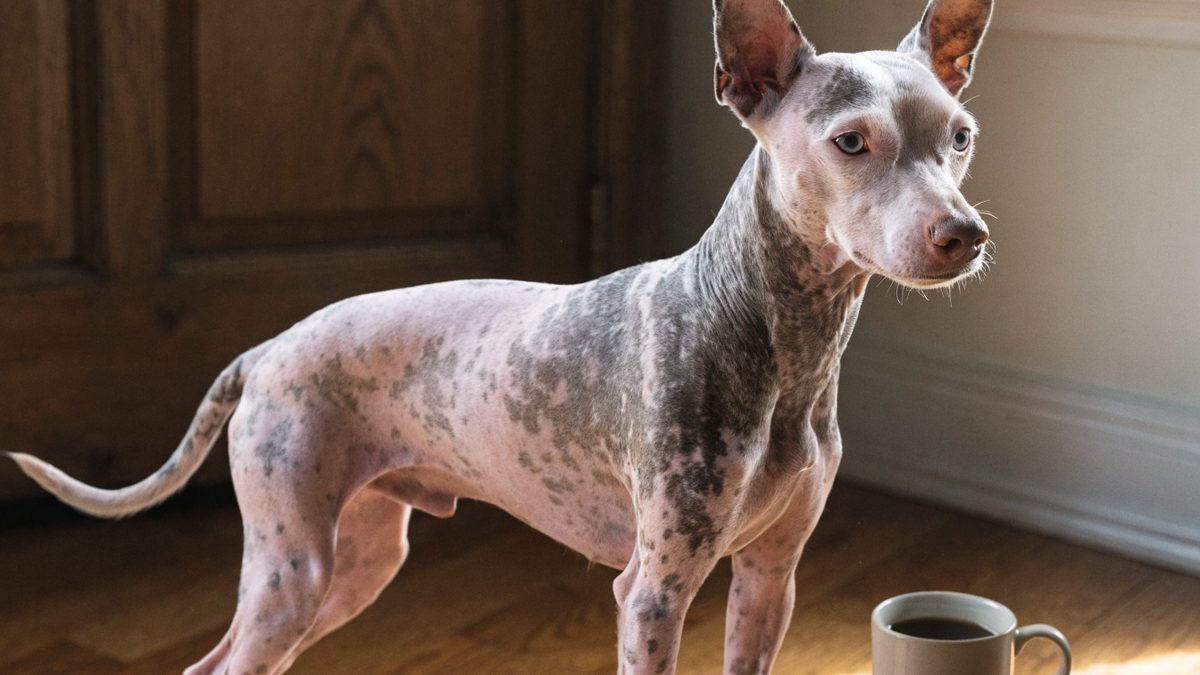
A mature hairless dog is free of hair except for whiskers and the guard hairs on the muzzle and eyebrows, and the skin is smooth and warm to the touch. The colour clause is where the Indian relevance hides. UKC says any skin colour is acceptable, that the skin is usually parti-coloured with an underlying skin colour and freckles or spots of contrasting colour, that freckles enlarge with age, and that skin colour will darken when exposed to the sun. That last clause is a breed standard describing melanogenesis. It is the skin responding to ultraviolet light because there is no coat in the way, and it is the mildest possible version of what the climate and health sections describe.
AKC allows any colour or combination of colours except albino or merle, and disqualifies both. UKC disqualifies albinism outright and, in the coated variety, merle, absence of white, and any solid colour other than white. For an Indian buyer the pigment question is not cosmetic. A dog with large unpigmented areas has less natural protection than a dark-skinned one, and the veterinary literature on solar dermatitis is explicit that melanin pigmentation is one of the three things that normally shields a dog from ultraviolet damage.
Registry recognition, with the dates
Recognition arrived recently and it is not global. UKC recognised the American Hairless Terrier on 1 January 2004, and its current standard is the version revised on 26 July 2006. AKC first recorded the breed in its Foundation Stock Service in October 2011, approved the breed standard on 9 March 2010 with an effective date of 1 January 2014, and granted full recognition in the Terrier Group with effect from 1 January 2016 American Kennel Club American Kennel Club. The AKC announcement notes the breed joined alongside the Sloughi and raised AKC's total to 189 breeds. The AKC parent club is the American Hairless Terrier Club of America.
The Federation Cynologique Internationale does not recognise this breed at all. Bonbeno read the FCI's Group 3 Terriers nomenclature in full on 19 August 2026 and the American Hairless Terrier is not in any of its four sections, which between them list every definitively recognised terrier from the Airedale to the Yorkshire. It is not on the FCI's provisional list either, which as of the same date runs from the Australian Stumpy Tail Cattle Dog through to the Macedonian Shepherd Dog Karaman. The United Kingdom's Royal Kennel Club does not list it in its Terrier group, although the RKC does publish standards for the Chinese Crested and for three sizes of Xoloitzcuintle. The price section explains what that combination means for anyone in India.
- Group: Terrier, in both AKC and UKC. OFA records the breed under groups AKC Terrier Group and UKC Terrier Group.
- Origin: Louisiana, United States, 1972, from a litter of purebred coated Rat Terriers Dog Breeds List, American Hairless Terrier.
- Founding dog: A hairless female named Josephine, bred on by Edwin and Willie Scott.
- Gene: A four-base deletion in exon 4 of SGK3, autosomal recessive University of California Davis Veterinary….
- Varieties: Hairless and coated, both registrable.
- Not recognised by: FCI, and therefore not by the Kennel Club of India through the FCI route.
One correction to a claim that appears on nearly every page about this breed, including AKC's own. The hairless variety is described as being as hypoallergenic as a dog can get, and the AKC recognition announcement says the breed is well known for its propensity for fewer allergic reactions. PetMD, which is veterinary-reviewed, is the honest one here: it says the breed may be a good fit for some people with allergies and is sometimes considered hypoallergenic, though there is really no such thing. AKC's own care copy notes the dogs do not shed hair but do shed skin cells. If your allergy is to proteins in dander and saliva rather than to hair itself, a hairless dog does not remove the allergen. It removes the carrier, and AKC's own page says the skin cells still shed.
American Hairless Terrier price in India, and why there is no number to give you
There is no verifiable American Hairless Terrier price in India, because Bonbeno could not find a single American Hairless Terrier for sale anywhere in the country. Every Indian page that ranks for the query is a shell. The two that carry rupee figures are showing you other breeds. Overseas prices exist and are published, and this section prints them, but they describe a transaction that cannot lawfully take place into India.
Bonbeno opened both Indian results on 19 August 2026 and read what they actually served, not what their page titles promised. The finding is specific enough to check yourself.
| Page | What it promises | What it actually shows |
|---|---|---|
| Puppiezo, American Hairless Terrier Puppies For Sale | Meta description says buy American Hairless Terrier puppies in India at best prices, KCI registered | The available-puppies panel for the breed is empty. Every priced dog on the page is another breed: a Maltipoo at Rs 98,999, two Poodles at Rs 92,599 each, a Cane Corso at Rs 94,999, a Goldendoodle at Rs 1,20,000, a Rottweiler at Rs 76,499 and a Doxiepoo at Rs 98,999 |
| Mr n Mrs Pet, American Hairless Terrier Puppies for sale in Chennai | American Hairless Terrier dog price in Chennai, all from KCI-Registered breeders | The page reads 3 Result Found and then lists an Australian Shepherd in Chennai, a French Bulldog in Hyderabad and a Cavalier King Charles Spaniel in Delhi. No American Hairless Terrier appears |
That is the template pattern the agent doc for rare breeds describes, and it is worth naming rather than working around. Both sites hold a page for every breed name in a long dropdown list, so a page exists whether or not a dog does. Mr n Mrs Pet's own breed selector carries 300-odd names including Rat Terrier, Japanese Terrier and Pashmi Hound. A page appearing for a breed is evidence that the site has a breed list, not that the breed is in India.
The published prices that do exist, and the currencies they are in
Four overseas sources publish a price for this breed and they broadly agree, which is unusual and worth recording.
| Source | Market | Published figure |
|---|---|---|
| Dog Breeds List | United States | 2,000 to 4,000 US dollars |
| Good Dog | United States, national | 2,000 to 3,000 US dollars, 25 puppies listed |
| Adopt a Pet | United States, from a breeder | 800 to 2,500 US dollars or more |
| Adopt a Pet | United States, adoption fee | 100 to 500 US dollars |
| Wuuff | Europe, 7 dogs listed | Average 1,543 euro, minimum 1,500, maximum 1,600 |
| Any Indian source | India | None. No Indian listing carries a price for an actual dog of this breed |
Bonbeno is deliberately not converting those figures into rupees. A conversion would imply an Indian price band, and the transaction it describes is one an Indian buyer cannot lawfully complete. Printing a rupee number here would create exactly the false impression this page exists to remove. The overseas spread is roughly a factor of five from the bottom of Adopt a Pet's breeder range to the top of the Dog Breeds List range, and the European market clusters far more tightly than the American one, on a sample of seven dogs Adopt a Pet, How much does an American… Dog Breeds List, American Hairless Terrier.
Why no Indian supply chain can form
Two independent facts close the route, and neither is about this breed's popularity. The first is import law. India's import policy classifies mammals other than the named categories under ITC (HS) 01061900 as Restricted, and Policy Condition 7 permits the import of dogs only for three purposes: a pet dog with a valid pet book and relevant records in the name of the importer, dogs imported by research and development organisations with the recommendation of the CPCSEA, and dogs for internal security by the Defence and Police Force. Policy Condition 8 states that the import of commercial dogs for breeding or any other commercial activity is not permitted, and paragraph 6 of the same Trade Notice states that any applications for trading or breeding purposes, or applications made on behalf of another person or entity, shall be duly rejected. Import is allowed only through the airports and seaports of Delhi, Mumbai, Chennai, Hyderabad, Bengaluru and Kolkata and, since October 2024, Kochi airport Department of Animal Husbandry…. The full route is set out in how to import a dog to India.
There is a lawful route for exactly one kind of person. Someone transferring residence to India after two years of continuous stay abroad may bring up to two pets in as passenger baggage without a DGFT authorisation, and anything outside that needs an import authorisation applied for at least two months before travel, plus an advance no-objection certificate from the quarantine officer at one of the seven ports seven days before the date of travel Department of Animal Husbandry…. That is a route for a returning family with their own dog. It is not a route that produces a breeder in Pune.
The second fact is registry. The Kennel Club of India is the FCI's member body for India, and the FCI does not recognise this breed. Bonbeno read the FCI Group 3 Terriers list in full and the American Hairless Terrier is absent from all four sections, and it is absent from the FCI's provisional list too. So the phrase KCI registered, which both Indian pages use in connection with this breed, has no obvious meaning here Mr n Mrs Pet, American Hairless Terrier…. To put the scale of Indian pedigree registration in context, the KCI registered 32,219 puppies in 2025 across all breeds, against an approximate national dog population of 17,111,342. A breed with no FCI standard is not going to be a meaningful slice of a 32,000-dog studbook.
First, it is a different hairless dog. The Chinese Crested hairless variety and the Xoloitzcuintle are both FCI-recognised, so they have a registry route this breed does not, and both look superficially similar to an untrained eye. Second, it is a coated Rat Terrier or a small crossbred terrier being sold on the name. Third, it is a dog with hair loss from mange, endocrine disease or another cause, not a genetically hairless dog. The cheapest way to tell the first two apart is the DNA test, because UC Davis's Hairlessness in Terriers assay is specific to the recessive SGK3 variant and does not detect the dominant mutation found in the Peruvian Inca Orchid, the Chinese Crested and the Xoloitzcuintle. The way to tell the third apart is your nearby vet.
What the price of this breed would be driven by, if a market existed
Three things set the overseas price and they would set an Indian one. Litter size is small at a reported three to five puppies, the breed is genuinely uncommon, with a recorded AKC popularity ranking of 106th in 2016 and then between 120th and 136th every year through 2022, and the recessive inheritance means a hairless-to-hairless mating breeds true while any outcross to widen the gene pool produces a litter that is mostly coated. A breeder selling hairless dogs is therefore selling a fraction of what they raise. None of that changes in India. What changes is that the supply side does not legally exist.
Bonbeno will not print an American Hairless Terrier price in India, because no Indian source publishes one for a real dog and manufacturing a range from overseas figures would be a fabrication with a decimal point on it. If you find a genuine Indian listing with a verifiable dog behind it, that is new information and this page will be updated with the source. Until then the correct answer to the question is that the breed is not commercially available in India, and the reason is legal rather than commercial.
Monthly cost of keeping an American Hairless Terrier in India
No published Indian monthly cost exists for this breed, and Bonbeno is not going to invent one. What can be stated precisely is the structure, which is genuinely different from a coated small terrier of the same size. You delete one recurring cost, coat grooming, and you add three: sun protection, skin care, and climate control at both ends of the year.
Start with the deletion, because it is real. AKC says that for the hairless variety there is little maintenance involved other than keeping the ears clean and making sure the dog is protected from sunburn. There is no clipping, no de-shedding, no hand-stripping and no monsoon coat-drying. Against a Bonbeno breed like the Shih Tzu or the Lhasa Apso, whose Indian grooming bill is a recurring line item, that is a genuine saving.
Now the additions, each of which is documented by a source rather than guessed.
| Cost line | Why this breed incurs it | What is published |
|---|---|---|
| Sun protection, topical | The skin is susceptible to sunburn and AKC states the dog must either have sunscreen applied or protective clothing put on before going outside | VIN names Epi-Pet and Dermoscent SunFree as animal-specific products and warns that human products carry irritating scents and potential toxicity. No Indian retail price is published for either |
| Sun protection, clothing | The parent club recommends lightweight UPF 50+ sunshirts as a chemical-free alternative for prolonged exposure | No Indian price published. VIN notes a sunsuit or even a T-shirt is better than nothing, with leg holes cut so tummy and back are covered |
| Winter clothing | Lacking an insulating coat, the breed loses body heat quickly and the parent club recommends a fleece sweater below 10 C | Relevant for Delhi NCR, Punjab, UP and the hill states from December to February. No Indian price published |
| Bathing consumables | PetMD recommends regular baths, preferably weekly, with lukewarm water and mild shampoo | The parent club disagrees and says only occasional bathing with a mild oatmeal-based or hypoallergenic shampoo. Budget for the higher frequency and reduce it on veterinary advice |
| Skin moisturiser | Because they lack hair to absorb natural oils, the parent club advises a suitable balm and warns against heavy human lotions, which clog pores and cause blackheads | PetMD recommends a dog-specific lotion or cream. No Indian price published |
| Cooling and heating | The climate section explains why this dog needs a shaded, cooled room from March to July and a warm corner in a north Indian January Mota-Rojas D, Titto CG, de Mira Geraldo | An electricity cost that varies by city and tariff. Bonbeno does not publish a figure it cannot source |
| Genetic screening, one-off | The CHIC panel for this breed requires a DNA-based primary lens luxation test from an approved laboratory, among five other screenings | UC Davis prices its Hairlessness in Terriers coat test at 58 US dollars as a single test per animal, or 27 as an additional test on the same animal |
| Skin surveillance at the vet | Solar damage is a progressive condition and the definitive diagnosis requires histopathology of a skin biopsy | No Indian consultation or biopsy tariff is published for this breed specifically. Ask your nearby vet what a dermatology consult and a punch biopsy cost at their clinic |
Why Bonbeno is not printing a rupee monthly cost here
A monthly cost figure has to come from somewhere. For a Labrador or a Beagle it comes from multiple published Indian sources that disagree, and printing the disagreement is useful. For this breed there is nothing to disagree with. Neither Indian page that ranks for the breed publishes a monthly cost at all Mr n Mrs Pet, American Hairless Terrier…, no Indian pet publication covers it, and the overseas sources that publish a purchase price do not publish a running cost Adopt a Pet, How much does an American…. Borrowing the figure from a coated small terrier would silently delete the sun-protection and climate lines that are the whole point of this section, which is exactly the substitution the rest of this page argues against.
What you can do instead is build the number yourself from the structure above, using the food, vaccination and consultation prices your own city actually charges. Two of the eight lines are one-off rather than monthly. Two of them, cooling and clothing, are seasonal rather than year-round, and they peak in opposite months.
- Food scales with a 5.4 to 12.7 kg adult, so it sits at the small-dog end of any Indian food budget.
- Grooming is close to zero for the hairless variety, and a rubber-brush ten minutes for the coated one.
- Sun protection is the line no coated breed has, and in India it runs from roughly March to July at full intensity.
- Clothing is bought twice, once for sun and once for winter, and the parent club specifies both.
- Screening is front-loaded into the first two years and covers six CHIC tests, five of them required.
- Dermatology is the specialty you will see most, which is unusual for a terrier and normal for a hairless dog.
A dog with no coat cannot mat, cannot hold monsoon damp against the skin under a dense undercoat, and does not need a groomer's appointment in a humid Indian August. Bonbeno's Chow Chow and Samoyed pages describe the opposite problem in detail. If your objection to a small coated terrier was the grooming, this breed removes it completely. It replaces it with a skin routine you perform yourself, weekly, for the dog's whole life.
Heat tolerance in India, argued in both directions
Bonbeno rates the American Hairless Terrier at 2 out of 5 for heat tolerance in Indian conditions, and the number is low for a reason that has nothing to do with insulation. Removing the coat does remove the insulation problem that makes an Indian May dangerous for a double-coated dog. It also removes the barrier that stops solar radiation reaching skin, in a country where the ultraviolet index sits above 10 across four major metros from March to July. A hairless dog is better off than a Husky indoors and worse off than almost anything outdoors.
Take the two halves in order, because sellers only ever tell you the first one.
The case for a high rating, which is real as far as it goes
Hair is a physical barrier that intervenes in heat loss or heat retention, which is exactly why coat structure decides which breeds struggle in the tropics. Bonbeno's Siberian Husky, Chow Chow and Samoyed pages all rest on that mechanism. A double coat traps metabolic heat against the skin in a 43 C afternoon while the dog has very little capacity to shed it. An American Hairless Terrier has no such layer. In animals with glabrous skin, the same review notes, vascular responses are more important in regulating temperature because thermal exchange occurs more quickly than in animals with protective layers.
Body size helps too, and this is measured rather than asserted. In a VetCompass study of heat-related illness across UK primary-care practice, every bodyweight group over 10 kg carried significantly higher odds of heat-related illness than dogs weighing under 10 kg, and dogs over 50 kg had the highest odds of all. The stated mechanism is that smaller dogs have a high heat storage to radiative surface area ratio, which produces more rapid heat loss, so they can exercise for longer before overheating. An adult of this breed weighs 5.4 to 12.7 kg, so it sits at or just above the bottom of that scale. It is also not brachycephalic, which matters because brachycephaly is the single most consistently identified anatomical risk factor for canine heat-related illness Hall EJ, Carter AJ. The airway that does the actual cooling work is unobstructed.
So indoors, in shade, in a cooled room, this dog handles Indian ambient heat better than a coated breed of the same weight. That much is fair and Bonbeno will not argue with it.
The case against, which is the half nobody prints
The same review that says a coat traps heat also says a coat blocks radiation. In animals exposed to intense heat or warm climates, dense fur protects them from absorbing high solar radiation levels through the dermal surface, and in hot environments with intense solar radiation the coat plays what the authors call a paradoxical role. Remove the coat and you remove that shield. The consequence is stated directly: because hair is a physical barrier, hairless animals are more sensitive to extreme temperatures and are predisposed to consequences such as sunburn when exposed to direct solar radiation.
India is a bad country in which to have no shield. A study of ultraviolet radiation over Chennai, Mumbai, Delhi and Kolkata found the UV index in the high to extreme range in Chennai at 8.1 to 15.33, moderate to extreme in Mumbai and Kolkata at 5 to 16.5, and low to extreme over Delhi at 3 to 15. Over all four locations the index sat in the extreme range, above 10, through the pre-monsoon months of March to May and into the early monsoon months of June and July. On the conventional scale, 7 to 9 is high and above 10 is very high or extreme. That is four months a year of extreme ultraviolet across the cities where most Indian pedigree dogs live.
The UV index is calibrated to human skin. The clear-sky index is based on the CIE action spectrum for the susceptibility of Caucasian skin to sunburn, and it is valid for cloud-free conditions. Nobody has published a dog-specific ultraviolet exposure index, for this breed or any other. The index tells you how much erythemally weighted radiation is arriving, not precisely what it does to canine epidermis. Bonbeno uses it as a measure of the incoming dose, which is what it is, and not as a canine risk score, which it is not. The same study also found that Indian urban aerosol loading reduces the UV erythemal dose substantially, by up to 47.1 percent per unit increase in aerosol optical depth over Chennai in the post-monsoon season. Do not read that as protection. It means the dose on a clear day after rain, when the air is washed and the family goes out, is higher than the hazy-day average an owner gets used to.
What ultraviolet light actually does to unprotected canine skin
Canine solar dermatitis is chronic sunburn, and the pathology is well described. The haircoat, the stratum corneum and melanin pigmentation are the three things that normally protect a dog against ultraviolet radiation, which is why breeds with a short haircoat or light pigmentation, named as Beagles, Boxers, Bull Terriers, Dalmatians, pit bulls and Whippets, are more frequently affected. Long-term exposure to UVA at 320 to 400 nm and UVB at 290 to 320 nm causes oxidative damage and cell death, immune suppression, and inhibition of tumour suppression, and intermittent chronic exposure produces keratinocyte proliferation, mutagenesis and premalignant actinic keratosis, which can evolve into sun-induced tumours including squamous cell carcinoma, haemangioma and cutaneous haemangiosarcoma.
Read the list of affected sites against a hairless dog and the problem becomes obvious. Solar dermatitis typically occurs on the medial aspect of the legs, the ventrolateral abdomen and thorax, the lateral flank and the bridge of the nose in non-pigmented skin. Those are the sparsely haired regions of a normal dog. On this breed they are not regions. VIN's veterinary reference makes the same point from the other side: most of the time a good fur coat is all the protection a dog needs, and the two problems are the tummy, which is sparsely furred in most dogs, and short white fur, which sunlight readily penetrates. A dog with no fur anywhere has the tummy problem everywhere.
Bonbeno's Dalmatian, Bull Terrier and Whippet pages cover breeds that appear on the solar dermatitis risk list with a coat. This breed is on the same list without one.
The sweating claim, corrected
The page that currently ranks first in India for this breed tells readers that since they have sweat glands they do not drool at the mouth or pant in order to balance their body heat. That sentence is wrong and it is the most dangerous single statement on the Indian SERP for this breed. Dogs rely on evaporative cooling through panting once their thermoregulatory set point has been exceeded, with ambient temperature, humidity and windspeed all influencing the rate of cooling. An American Hairless Terrier pants like every other dog. An owner who has been told it does not will miss the earliest sign of trouble.
The sweating itself is real but modest, and the honest position is that nobody has measured what it is worth. The UKC standard notes that the hairless variety may sweat when overheated or stressed and that this is not to be faulted in the ring. PetMD calls the breed one of the few dogs who can sweat. What no source provides is a measurement of how much heat that sweating removes. The peer-reviewed thermoregulation review covers Sphynx cats, the Xoloitzcuintle and the Chinese Crested and reports that they sweat in the same way as other domestic animals, but that insensible perspiration is higher than in animals with hair or a full coat because of the bare skin. Crucially, that review does not cover the American Hairless Terrier at all, and its specific finding about structural and functional defects in sweat glands applies to the Xoloitzcuintle and the Crested, which are the ectodermal dysplasia breeds. Bonbeno is not transferring it. No study has measured evaporative heat loss, core temperature regulation or heatstroke incidence in an American Hairless Terrier, in India or anywhere else.
Nor does the epidemiology settle it. The VetCompass heat-related illness work explicitly reports that coat type is potentially an important risk factor but that it was not possible to retrieve coat type accurately from veterinary records, so it was never tested. There is no population evidence that hairless dogs get less heatstroke. There is no population evidence that they get more. Anyone telling you either way is guessing.
The Sphynx parallel, and where it breaks
Bonbeno's Sphynx page argues the identical mechanism for cats and lands on 3 out of 5 for heat tolerance. Removing the coat removes the insulation problem and replaces it with three others: bare skin burns, the animal loses heat faster so it needs a warmer room, and hot humid skin grows yeast. The canine version of that argument is the same on the first two points and different on the third and, decisively, on a fourth.
| Factor | Sphynx cat | American Hairless Terrier |
|---|---|---|
| Insulation removed | Yes, and it helps in ambient heat | Yes, and it helps in ambient heat |
| Skin exposed to solar radiation | Yes. Registries instruct owners to protect from sunburn and skin damage | Yes. AKC states the dog must have sunscreen applied or protective clothing put on before going outside |
| Can be kept permanently indoors | Yes, and both major cat registries say it should be | No. A dog must be walked and toileted outdoors, which is why this page rates heat tolerance a point lower than the Sphynx page does |
| Main heat-loss route | Panting and vascular response | Panting, which is the dominant evaporative route in dogs |
| Exertional heat risk | Low. Cats self-limit | High. Exertional heat-related illness is a greater threat to dogs than hot cars, and young active dogs carry the greatest odds |
| Humid skin fold problem | Documented, with 81 percent yeast carriage in one Sphynx cohort | Not documented in this breed. The parent club lists atopic dermatitis and demodicosis among reported conditions but publishes no prevalence |
The fourth factor is the one that moves the rating. A Sphynx can live its entire life without leaving an air-conditioned flat, and its registries recommend exactly that. A terrier cannot. This is an energetic dog with a working ancestry, it needs daily outdoor exercise, and every one of those outings in an Indian March to June is an exposure event. That is why Bonbeno rates the dog 2 and the cat 3, from the same biology.
The exertion problem, which is separate from the sun problem
Exertional heat-related illness is a greater threat to dogs than the hot car everybody warns about, and the risk profile fits this breed uncomfortably well. Young, active dogs carry the greatest odds for exertional heat-related illness, and exertional cases produce almost ten times the health welfare burden of vehicular cases. Severe heat-related illness occurs when core body temperature exceeds a critical threshold of 43 C, and progression from mild or moderate to severe disease has been reported to cut survival from over 90 percent to 43 percent. No formal guidelines exist for dogs training or working in hot environments, and a review of military working dogs found three-quarters of heat-related illness events occurred above a wet-bulb globe temperature of 26.7 C, with the lowest recorded event at 20.4 C, in fit and fully heat-acclimatised animals. Your pet terrier is neither.
The practical consequence in India is that the walk, not the weather, is usually what hurts a small terrier. A 40 C Delhi afternoon with the dog asleep under a fan is a manageable day. The same 40 C with twenty minutes of chase in a park is not.
City by city and season by season
| Condition | Where and when | What it means for this breed |
|---|---|---|
| Extreme dry heat | Rajasthan, UP, MP, Delhi NCR, March to June | Better placed than any coated breed on insulation, since there is none to trap heat. India recorded 47.6 C at Banda in Uttar Pradesh on 21 May 2026. The room still needs cooling and the dog still needs zero direct sun on skin |
| Extreme ultraviolet | Chennai, Mumbai, Kolkata and Delhi, March to July | The binding constraint. UV index above 10 across all four cities in this window. Walk before sunrise and after sunset, and treat the middle of the day as indoors only |
| Humid heat | Chennai, Mumbai, Kolkata, Kerala and coastal Odisha | Humidity reduces the efficiency of evaporative cooling by panting, which is the dog's main route. The same walk is harder here than in dry Jaipur at the same temperature |
| Monsoon | Most of India, June to September | Reduced ultraviolet on overcast days but a wet, warm skin surface. The parent club's reported condition list includes atopic dermatitis and both localised and generalised demodicosis, so watch the skin rather than relaxing |
| Reflected sun | Any white concrete terrace, marble balcony or light-coloured society driveway | VIN specifically warns that large expanses of white concrete are highly reflective and will expose a tummy to sunlight even without sunbathing. Indian terraces and marble are exactly this surface |
| Indoor air conditioning | Any metro flat, April to July | A room at 18 C is a cold room for a dog with no coat. The parent club recommends a fleece sweater below 10 C and notes rapid heat loss without an insulating coat. Give the dog a covered bed it can choose |
| North Indian winter | Delhi NCR, Punjab, Haryana, UP, December to February | Needs clothing. The parent club's threshold for a fleece sweater is 50 F, which is 10 C, and a north Indian winter night sits under it |
| Hill cold | Himachal, Uttarakhand, Sikkim and the Northeast, winter | The worst Indian posting for this breed. Bare skin plus sustained cold plus wet is the combination the standards warn about, and UKC states plainly that the hairless dogs require protection from the sun and winter cold weather |
What actually reduces the risk in an Indian home
- Move the walk off the sun. VIN's advice for a sun-damaged dog is to keep the pet indoors between 11 a.m. and 2 p.m.. In India, from March to July, widen that to roughly 9 a.m. to 5 p.m. and do both walks in darkness or deep shade.
- Cover the dog before it goes out, every time. AKC states the skin is susceptible to sunburn and the dog must either have sunscreen applied or protective clothing put on before going outside. The parent club prefers lightweight UPF 50+ sunshirts because they are chemical-free and do not cause overheating.
- Choose the sunscreen carefully, then apply it to the dog rather than to your own habits. Avoid zinc oxide and salicylates. With repeated skin exposure to zinc oxide pets can develop zinc toxicity, which damages red blood cells, and salicylates can cause skin redness and irritation. VIN names Epi-Pet and Dermoscent SunFree as animal products and warns that human products carry irritating scents and toxicity potential, with zinc oxide toxic if licked.
- Block the reflective surfaces, not just the direct sun. A shaded terrace with white flooring still delivers a dose to the belly.
- Watch for panting that starts early or does not settle. Mild heat-related illness presents as lethargy and altered respiration, and the whole point of catching it there is that survival collapses once it becomes severe.
- Keep the room in the 20s, not the teens. A dog that loses heat quickly needs a warmer ambient than a coated dog, and the parent club's threshold for adding a fleece is 10 C.
- Inspect the skin weekly and take anything that looks like a blood blister to your nearby vet. VIN says any blood blisters on the skin, especially the tummy, should be seen by a veterinarian.
Heat tolerance 2 out of 5 for India. If the question were only whether this dog copes with warm indoor air, the answer would be 4. The question an Indian buyer is really asking is whether the dog can live a normal Indian dog life, which includes going outside twice a day in a country with four months of extreme ultraviolet, and the answer to that is no, not without a routine that most owners will not sustain for fourteen to sixteen years. It is not a heat-tolerant breed. It is a heat-sensitive breed whose heat sensitivity happens to run through the skin rather than through the coat.
Temperament, household fit and who should not buy one
The American Hairless Terrier is a friendly, busy, people-focused terrier that both standards describe in almost identical words: energetic, alert, curious and intelligent, and given early socialisation and training it excels as a companion with great affection for its owners and family United Kennel Club. It is the softest-tempered breed in the terrier group's Indian shortlist, and the reason is written into the show rules.
Start with the clause that tells you the most in the fewest words. Both the AKC and UKC standards state that American Hairless Terriers should not be sparred during conformation judging United Kennel Club. Sparring is the terrier-ring practice of letting two dogs face off at close quarters so a judge can see the fire in them, and it is normal in most terrier breeds. A standard that removes it is a standard telling judges not to provoke this dog. Bonbeno's Jack Russell Terrier page describes a breed with the opposite instruction set. The Jack Russell is a working earth dog whose standard rewards fearlessness at close quarters. This one is a companion built from that stock with the working job removed.
The rest of the temperament description follows from that. UKC calls it an exceptionally friendly companion that gets along well with children, other dogs and even cats, and says these dogs enjoy human companionship immensely and will enthusiastically share any activity with their owners. Both registries fault aggression and extreme shyness, and UKC makes viciousness or extreme shyness an outright disqualification United Kennel Club. PetMD, which is veterinary-reviewed, describes an intelligent and energetic dog that is content as an indoor companion but still needs regular exercise, and notes it forms strong bonds with its people.
The hunting instinct that survived the coat
Do not read affectionate as low-drive. UKC states that the ancestors of this breed were bred to hunt, that the lack of coat makes the hairless variety unsuited for hunting, but that both varieties still have a strong hunting instinct, and that the coated dogs are fearless, tenacious hunters with seemingly unlimited energy. The AKC standard makes the same distinction, saying the lack of coat renders the hairless variety unsuited for most hunting activities while the breed has retained a strong hunting instinct and excels in many other activities and sports. The jaws are described as hinged well back, allowing the dog to open its mouth wide enough to catch rats and other rodents. That is not decorative language.
For an Indian flat that means the same three things it means for any small terrier. Cats already in the home are usually fine if introduced young, since UKC specifically names cats among the animals this breed gets along with. Free-roaming birds, hamsters and rabbits are not. And a street cat or a squirrel across a Bengaluru road will pull a dog that has not been taught a reliable recall.
Noise, which is the flat-living issue
This is a terrier and it talks. PetMD notes that like all terriers these dogs can be watchful and bark to alert their family to visitors or strange noises, and that training, exercise and mental stimulation reduce excess barking. One aggregator rates barking tendency as occasional at two stars out of five. In a Mumbai or Gurugram apartment with a shared corridor and a doorbell that rings for every delivery, plan for alert barking and train an off switch early rather than hoping the rating holds.
Children, and the one real caution
Both the standard and the vet-reviewed sources are positive on children. UKC lists children first among the company this breed keeps well, PetMD says these dogs can be great playmates for children thanks to their rambunctious energy while repeating the universal advice to supervise young children with any dog, and one aggregator rates child friendliness at four stars. The caution is not temperament, it is skin. A dog with no coat has no buffer between a child's fingernail and its dermis, and the parent club's whole care programme is built around protecting that surface. Teach small children to stroke rather than grab, and to lift with two hands or not at all.
Who this breed suits, and who it does not
| Household | Verdict | Why |
|---|---|---|
| Flat, someone home most of the day, walks at dawn and after dark | Good fit in principle | Apartment size is not the constraint. The sun schedule is, and this household can keep it |
| Flat, both adults out ten hours, dog walked at 8 a.m. and 6 p.m. | Poor fit | Those are the two worst hours in an Indian summer for a dog with no coat, and a busy terrier left alone all day digs and barks |
| House with an open sunny terrace or courtyard the dog can use freely | Poor fit without modification | Unrestricted access to direct sun and to reflective white flooring is the exact exposure to remove |
| Family with a child under six | Conditional | Temperament is fine. Skin fragility is the reason to supervise |
| Home with a resident cat, introduced young | Usually fine | UKC names cats among the animals this breed gets on with |
| Home with free-roaming small pets | Poor fit | Both varieties retain a strong hunting instinct |
| First-time owner who wants a low-effort dog | Poor fit | Grooming is near zero, skin care is not, and the routine runs for the whole 14 to 16 year life expectancy |
| Hill-station or high-altitude home | Poor fit | UKC states the hairless dogs require protection from winter cold weather |
AKC describes the hairless variety as about as hypoallergenic as a dog can get and its recognition announcement cites the breed's propensity for fewer allergic reactions American Kennel Club. PetMD's veterinary-reviewed version is more careful and says the breed may suit some people with allergies and is sometimes considered hypoallergenic, though there is really no such thing. AKC's own care page notes these dogs do not shed hair but do shed skin cells. If a family member has a diagnosed dog allergy, the responsible order of operations is an allergist first and a breed decision second, not the other way round.
Training an American Hairless Terrier, and what it will resist
Train this breed with short, reward-based sessions and it learns quickly, because both standards and every vet-reviewed source describe an intelligent, curious dog that is easy to teach United Kennel Club PetMD, American Hairless Terrier dog breed…. What it resists is repetition, isolation and being handled roughly, and in India there is a fourth thing to train that no overseas page mentions: tolerating clothing and sunscreen every single day.
UKC puts it directly. The American Hairless Terrier is an energetic, alert dog whose curiosity and intelligence make him easy to train. AKC's care copy says the breed is very intelligent and eager to please, so training is usually an easy and enjoyable activity. PetMD adds that the temperament lends itself well to training because these dogs are energetic and eager to please, that they thrive with obedience and agility work, and that sessions should be kept short and full of positive reinforcement. The parent club's own material notes the breed excels in agility, obedience and conformation rings.
The four things to teach first, in order
- Handling and body inspection. This is first because the whole health plan depends on it. You need to be able to run your hands over every square centimetre of skin weekly and look at the belly, and a dog that objects at three years old is a dog that stops being inspected. Start on day one, pair it with food, and make it boring.
- Wearing a shirt. The parent club recommends lightweight UPF 50+ sunshirts for prolonged exposure, and AKC states the dog must have sunscreen applied or protective clothing put on before going outside. A dog that fights the shirt goes out without it, which is the failure mode. Teach it as a puppy game with the shirt on for ten seconds, then twenty.
- Recall. Both varieties retain a strong hunting instinct and the jaws are built to catch rodents. Indian streets, open society gates and stray dogs make recall a safety skill rather than a party trick.
- An alone-time routine. PetMD warns that without regular exercise and mental stimulation these smart, high-energy dogs develop undesirable and destructive behaviours such as digging, and one aggregator notes plainly that they love to dig. Build the alone-time habit before you need it.
Socialisation, and the Indian complication
The AKC standard ties good adult temperament directly to early work: given early socialisation and training they excel as companions, displaying great affection for their owners and family. So socialise deliberately, and in India that means a specific list. Autorickshaw and two-wheeler noise, apartment lifts, marble and tile floors, the building watchman, delivery riders at the door, temple and wedding drumming, monsoon thunder, and other dogs on lead at a distance. Do all of it in the cool hours, because the same outings that build a confident dog are also ultraviolet exposure events.
One thing not to do. Terrier people sometimes socialise a young terrier by letting it face off against another dog to build confidence. The standards for this breed specifically remove sparring from the show ring United Kennel Club, which is a strong hint about what the breed's temperament is meant to be. Build confidence with novelty and food, not with confrontation.
What it will resist
- Long drill sessions. PetMD's guidance is short sessions with positive reinforcement, which is standard advice for a busy, quick-learning small breed.
- Harsh handling. Both standards fault extreme shyness and both fault or disqualify aggression, and a soft-tempered terrier handled roughly produces one or the other.
- Being ignored. UKC says these dogs enjoy human companionship immensely and will enthusiastically share any activity with their owners. A breed that wants to be with you does badly on a balcony.
- Recall against live prey once the chase has started. Manage the environment rather than relying on training to win that argument.
Indoor mental work is the answer for four months of the year. Obedience and trick training, agility foundation work on flat mats indoors, scent games with treats hidden around a flat, and puzzle feeders all count. PetMD specifically lists puzzle feeders and puzzle toys as suitable activities and recommends a puzzle feeder to add stimulation at mealtimes. A tired brain buys you an easier evening than a hot walk does.
How much exercise this breed actually needs, and what the sources disagree about
Published daily exercise figures for this breed run from 20 minutes to 45 minutes, and AKC describes the requirement as only moderate Puppiezo, American Hairless Terrier Puppies…. Treat 45 minutes across two sessions as the working figure for an adult, and understand that in India the constraint is not the dog's stamina, it is the four-month window when those two sessions have to happen in the dark.
The disagreement is narrow and worth printing, because it is one of the few areas where the sources are close enough that a buyer can act.
| Source | Figure | Framing |
|---|---|---|
| American Kennel Club | Not given in minutes | States the breed has only moderate exercise needs |
| Dog Breeds List | 20 to 30 minutes a day | Says the breed will do OK in an apartment on that, rates exercise needs 2 out of 5, and recommends a long daily walk |
| Puppiezo, India | 30 to 45 minutes per day | Rates energy level as high and ideal space as apartment |
| PetMD | Not given in minutes | Regular walks and indoor playtime, with mental stimulation treated as a co-requirement |
| UKC breed standard | Not given | Describes the coated dogs as having seemingly unlimited energy and both varieties as retaining a strong hunting instinct |
Notice the shape of that disagreement. The two sources that give a number are both aggregators, and the two that describe the dog rather than scoring it, the standard and the vet-reviewed page, both point at higher drive than 20 minutes implies. The safe read is that 20 to 30 minutes keeps the dog physically sound and 45 minutes plus indoor mental work keeps it behaviourally sound. PetMD is explicit that without regular exercise and mental stimulation these dogs develop destructive behaviours including digging.
What happens without it, in an Indian flat
Digging is the named failure mode and it does not need soil. A bored terrier in a 2BHK digs at sofa cushions, at the gap under a door and at the corner of a mattress Dog Breeds List, American Hairless Terrier. Alert barking rises, because a dog with nothing to do makes the corridor its job. And weight goes on, which matters more here than in most small breeds. Obesity is faulted in both breed standards, unusually for a temperament-focused document United Kennel Club, and AKC's care copy warns that some dogs are prone to getting overweight. Body condition also feeds directly into heat risk, since dogs at or above the mean adult bodyweight for their breed and sex carried increased odds of heat-related illness in the UK data.
The Indian exercise timetable, month by month
| Months | Morning walk | Evening walk | Notes |
|---|---|---|---|
| November to February | Any time before 10 a.m. | Any time after 4 p.m. | The easy season. Add a fleece in the north on cold mornings, since the parent club's threshold is 10 C |
| March to May | Before sunrise, finish by 7 a.m. | After sunset only | UV index in the extreme range above 10 across Chennai, Mumbai, Kolkata and Delhi. Shirt on, even at 6.30 a.m. |
| June and July | Before sunrise | After sunset | Still extreme UV in the early monsoon months, plus humidity that reduces the efficiency of panting |
| August to October | Before 8 a.m. | After 5 p.m. | Overcast days lower the dose but do not remove it. Dry the dog properly after rain |
The rule underneath the table is simple. Exertion in heat is the trigger that matters. Exertional heat-related illness is a greater threat to dogs than hot cars, young active dogs carry the greatest odds, and severe cases begin when core temperature passes 43 C Hall EJ, Carter AJ, Chico G, Bradbury J. A hairless dog gains nothing on that axis from having no coat, because the cooling route the dog is using is respiratory, not cutaneous.
Sports this breed is genuinely good at
Agility, obedience and rally suit it. The parent club states the breed excels in agility, obedience and conformation and maintains a page of performance-titled dogs, and PetMD lists agility, obedience training, walking, hiking and puzzle toys among suitable activities. All of those except hiking can happen indoors or under cover, which is exactly what an Indian summer requires. The standard describes movement that is smooth and effortless with good reach and drive and a jaunty attitude suggesting agility, power and speed, and a dog built that way is wasted on a lead walk alone.
Grooming and skin care in Indian humidity, and the bathing advice that conflicts
Grooming an American Hairless Terrier means skin care, not coat care, and the two are not the same job. There is no brushing, no clipping, no de-shedding and no hand-stripping. In their place sits a weekly routine of inspection, washing, moisturising and sun protection that runs for the dog's entire 14 to 16 year life. Two respected sources give directly opposite advice on how often to bathe, and this section prints the disagreement rather than picking the convenient side.
AKC states the position for the hairless variety in one sentence: there is little maintenance involved other than keeping the ears clean and making sure the dog is protected from sunburn. That is true as far as coat work goes and it understates what the parent club actually asks of an owner.
The bathing disagreement, printed
| Source | Instruction | Stated reason |
|---|---|---|
| PetMD, veterinary-reviewed | Regular baths, preferably every week, in lukewarm water with mild shampoo | To avoid skin issues, and to create a weekly opportunity to inspect for dry spots, redness and flaky areas |
| American Hairless Terrier Club of America | Occasional bathing with a mild oatmeal-based or hypoallergenic pet shampoo | Because they lack hair to absorb natural oils, so the skin's own oil balance is easier to strip |
Bonbeno is not going to declare a winner between a veterinary-reviewed reference and the breed's own parent club, but the mechanism favours a middle position and there is a way to get the benefit of both. The inspection is the part that matters, and you can do it every week without lathering the dog every week. Bathe on the schedule your dog's skin actually needs, which in a humid Chennai August will be more often than in a dry Jaipur December, and run your hands over the whole animal weekly regardless. If the skin gets greasier or flakier after you increase frequency, that is the answer to which side was right for your dog. Ask your nearby vet before settling on a shampoo, because a medicated product and a cosmetic one behave very differently on bare skin.
Moisturising, and the specific thing not to use
Because they lack hair to absorb natural oils, the parent club recommends keeping the skin moisturised and warns explicitly against heavy human lotions, which can clog their pores and cause blackheads. PetMD gives the same instruction and recommends a dog-specific lotion or cream. Aloe vera gel is the parent club's suggestion for soothing mild sunburns. The blackhead point is not cosmetic trivia. PetMD notes the breed is prone to acne and that medicated wipes can help with skin infections including acne, and advises talking to your vet about it. One aggregator makes the same observation from an owner's angle, that these dogs have sweat glands and will get pimples.
Sun protection is a grooming task, not an occasional one
In India this is the routine that decides how the dog's skin looks at ten years old. AKC is unambiguous that the skin is susceptible to sunburn and the dog must either have sunscreen applied or protective clothing put on before going outside. The parent club prefers clothing, describing lightweight UPF 50+ sunshirts as excellent chemical-free protection that does not cause the dog to overheat, and calls a pet-safe non-toxic sunscreen mandatory for prolonged exposure.
- Avoid zinc oxide. With repeated exposure on the skin, pets can develop zinc toxicity, which damages red blood cells. VIN adds that zinc oxide can be toxic if licked.
- Avoid salicylates, or accept only a low concentration. Applied to skin they can cause mild redness and irritation, and a large ingested quantity can cause stomach ulcers and, rarely, liver damage.
- Use an animal product. VIN names Epi-Pet and Dermoscent SunFree, and warns that human products carry irritating scents and toxicity potential because they are not formulated on the assumption that they will be licked.
- Cover the belly. VIN's practical note is that a sunsuit or even a T-shirt beats nothing, with leg holes cut so that the tummy and back are well covered, which unfortunately leaves the legs vulnerable.
- Reapply after a bath and after the dog swims, because you cannot see the film wearing off on bare skin the way you can feel a coat drying.
Ears, nails and teeth
Ear care is one of only two maintenance jobs AKC names for the hairless variety. Ears should be checked regularly to remove foreign matter and avoid a buildup of wax, and PetMD lists ear scratching, head shaking, discharge or a bad smell as the signs to act on. Nails should be trimmed regularly, which matters more than usual in a breed whose own skin is what those nails scratch. Teeth should be brushed regularly, and in this breed there is a full set of them to brush, which is the point the health section develops.
Both breed standards state that rear dewclaws must be removed, and both fault a dog that still has them United Kennel Club. India's Prevention of Cruelty to Animals (Dog Breeding and Marketing) Rules, 2017 state that mutilation of any body part of the pup and any change of appearance by artificial means is strictly forbidden, in the same clause that bans tail docking, ear cropping, de-barking, de-clawing, branding and dyeing. Bonbeno is not a law firm and this page is not legal advice. It is worth asking a registered Indian veterinarian how they read that clause against a cosmetic show requirement before anyone performs the procedure on a puppy in India.
The monsoon and the one genuine grooming advantage
Everything Bonbeno's coated breed pages warn about in an Indian monsoon, the matted undercoat that will not dry, the hot spot under a dense ruff, the groomer's bill in August, simply does not apply here. There is no coat to hold water against the skin. Dry the dog with a towel after rain and the job is finished.
There is a second advantage that no overseas page thinks to mention. A tick on a hairless dog is visible. On a coated terrier you find ticks by feel, one at a time, through hair. On this breed a full-body check is a look rather than a search, which makes the daily habit far more likely to actually happen in a country where that habit matters. Do the check under a light after every walk, along with the sun-damage inspection, since you are already touching the whole dog.
Health, the dentition claim tested, and what the OFA data actually shows
The American Hairless Terrier's headline health claim is that it is the only hairless breed with normal dentition, and the claim holds up mechanically but has never been quantified. Its hairlessness comes from a recessive four-base deletion in SGK3, a gene involved in post-natal hair follicle development, and not from the FOXI3 variant that causes canine ectodermal dysplasia in the Xoloitzcuintle, the Chinese Crested and the Peruvian Inca Orchid University of California Davis Veterinary… Drogemuller C, Karlsson EK, Hytonen MK. Different gene, different developmental pathway, no missing teeth. This section verifies that chain link by link, prints the one registry clause that complicates it, and then gives the numbers.
The genetics, verified from the primary sources
The mutation was identified by Heidi Parker and colleagues in Elaine Ostrander's laboratory and published in Philosophical Transactions of the Royal Society B in 2017. Starting from DNA samples from 11 hairless dogs run on a canine SNP chip, the team found a region of 363 contiguous SNPs on chromosome 29 homozygous in all 11, then whole-genome sequenced a single hairless dog and identified a deletion removing four bases, TTAG, from within exon 4 of the serum and glucocorticoid regulated kinase family member 3 gene, SGK3. The deletion is predicted to knock out the gene's original function because it removes the entire catalytic domain the gene is named for. Resequencing in 12 hairless dogs and four coated Rat Terriers found all 12 hairless dogs carried two copies and all four Rat Terriers were wild type at both alleles. The variant is designated SGK3 Val96GlyfsTer50.
The paper states the consequence directly. The American Hairless Terrier is the only hairless breed in which the trait is recessive, and therefore the homozygous state is not lethal, and the dogs are described in the paper's own words as remarkably healthy animals born with a sparse, fuzzy coat that is lost completely within the first months. Both breed standards describe that birth coat: AKC says hairless puppies are born with a soft vestigial down known as the birth coat and should be completely hairless by approximately eight to ten weeks, and UKC puts it at six to eight weeks United Kennel Club.
UC Davis's Veterinary Genetics Laboratory, which runs the commercial test, states the dentition point as plainly as anyone does. Contrary to the dominant form, it says, there are no adverse effects on dentition or fecundity associated with the recessive Terrier hairlessness. The dominant form, present in the Peruvian Inca Orchid, Chinese Crested and Mexican Xoloitzcuintle, is lethal in the homozygous state.
What the dominant hairless breeds actually get, so the contrast is concrete
The comparison only means something if you know what is being avoided. The FOXI3 mutation in hairless dogs was identified in Science in 2008 and implicates the gene in ectodermal development. A later study of a historical pedigreed skull collection described the resulting dental phenotype precisely. A seven-base-pair duplication in the first exon of FOXI3 causes a frameshift and a premature stop codon, producing the semi-dominantly inherited condition known as canine ectodermal dysplasia, and the affected dogs showed, in both upper and lower jaws, loss of the permanent canines and premolars and to some extent the incisors, plus deciduous fourth premolars and permanent first and second molars that consistently lacked the distal and lingual cusps. The Parker paper summarises the same thing from the other direction: dogs with FOXI3 mutations often have problems with dentition, such as missing teeth, and less commonly malformations of the ear Parker HG, Harris A, Dreger DL, Davis BW.
Missing canines and premolars is not a cosmetic show fault. It is a functional dental deficit in an animal that uses its mouth to eat and hold things. That is the thing this breed does not have.
AKC states flatly that they are the only hairless breed with normal dentition, and the parent club says they do not suffer from the missing premolars or severe genetic skin disorders associated with dominant hairless genes. Two things stop Bonbeno from repeating that as settled fact. First, there is no published dentition survey of this breed. OFA maintains a dentition registry, and no dentition line appears in the American Hairless Terrier's cumulative testing table, which means too few dogs have been evaluated for a figure to be published. The claim is supported by mechanism and by an absence of reports, not by a count. Second, AKC's own breed standard contains the clause missing pre-molars are not to be faulted, while the UKC standard requires a complete set of good-sized, evenly spaced, white teeth and faults missing teeth. Two registries do not write opposite clauses about a trait that is uniformly present. The parent club also lists malocclusions first among its reported conditions. Bonbeno's position is that the mechanism is solid and the marketing is ahead of the data: this breed does not carry the ectodermal dysplasia dental phenotype, and nobody has counted its teeth at population scale.
The OFA numbers, which are the only real health data this breed has
The Orthopedic Foundation for Animals publishes cumulative screening results by breed. Bonbeno read the breed code AHT out of OFA's own breed markup rather than guessing it, confirmed that the returned page prints the heading AMERICAN HAIRLESS TERRIER, and took the figures below from that table on 19 August 2026. These are live registers and they move as evaluations are added, so every percentage below is published with the sample size it rests on.
| Screening | Dogs tested | Normal or clear | Abnormal | Carrier | OFA breed rank |
|---|---|---|---|---|---|
| Patella | 489 | 482, or 98.6 percent | 7, or 1.4 percent | - | 102 |
| Primary lens luxation, DNA | 385 | 347, or 90.1 percent | - | 38, or 9.9 percent | 18 |
| Hips | 333 | 330, or 99.1 percent | 2, or 0.6 percent | - | 219 |
| Legg-Calve-Perthes | 274 | 274, or 100 percent | - | - | 41 |
| Eyes | 257 | 255, or 99.2 percent | 2, or 0.8 percent | - | 232 |
| BAER hearing test | 247 | 245, or 99.2 percent | 2, or 0.8 percent | - | 20 |
| Basic cardiac | 236 | 236, or 100 percent | - | - | 138 |
| Elbow | 227 | 227, or 100 percent | - | - | 166 |
| Progressive retinal atrophy, DNA | 163 | 163, or 100 percent | - | - | 46 |
| Congenital cardiac | 156 | 156, or 100 percent | - | - | 84 |
| Degenerative myelopathy, DNA | 137 | 108, or 78.8 percent | 1, or 0.7 percent | 28, or 20.4 percent | 71 |
| Serum bile acid | 91 | 90, or 98.9 percent | - | - | 1 |
| Congenital hypothyroidism with goitre, DNA | 85 | 85, or 100 percent | - | - | 1 |
Within the hip evaluations, 133 of 333 dogs graded excellent at 39.9 percent, 182 graded good at 54.7 percent and 15 graded fair at 4.5 percent, with two mildly dysplastic and none moderate or severe.
Read against the Rat Terrier, which is the only fair comparison
The Rat Terrier is this breed's direct ancestor and coated outcrosses from it are still being made United Kennel Club, so the two share a gene pool in a way no other pair of breeds does. Bonbeno pulled the Rat Terrier's table the same way, by reading breed code RAT from OFA's markup and confirming the heading RAT TERRIER on the returned page. On the two screenings that matter most, the hairless breed reads better.
| Screening | American Hairless Terrier | Rat Terrier |
|---|---|---|
| Primary lens luxation carriers | 9.9 percent, 38 of 385 tested. OFA breed rank 18 | 30.6 percent, 498 of 1,629 tested, plus 35 affected at 2.1 percent. OFA breed rank 3 |
| Patella abnormal | 1.4 percent, 7 of 489 | 3.2 percent, 58 of 1,808 |
| Hips dysplastic | 0.6 percent, 2 of 333 | 3.4 percent, 34 of 997 |
| Hips excellent | 39.9 percent of 333 | 19.6 percent of 997 |
| Elbow dysplastic | 0 of 227 | 2.5 percent, 16 of 641 |
| Legg-Calve-Perthes abnormal | 0 of 274 | 0.2 percent, 2 of 847 |
| Degenerative myelopathy carriers | 20.4 percent, 28 of 137 | 0 of 98 |
| Parent club health survey | Not initiated for this breed | Published, self-selected respondents |
Two honest caveats before anyone quotes those rows. First, the Rat Terrier's sample sizes are three to five times larger, so its figures are more stable and the hairless breed's percentages will move more as testing continues. Second, and more important, OFA statistics are built from results that owners and breeders chose to submit. They describe the screened population, which skews towards dogs bred by people who screen, and not the breed as a whole. That caveat applies equally to both columns, which is precisely why the two are worth reading side by side rather than in isolation.
What to test for, and what the parent club requires
The American Hairless Terrier is a CHIC breed, and the required panel is unusually long for a small terrier Orthopedic Foundation for Animals. Screen for all five required items before breeding, and treat the same list as the question set for any breeder you talk to.
| Screening | Accepted method | Status |
|---|---|---|
| Cardiac evaluation | Basic cardiac exam or advanced cardiac exam | Required |
| Hip dysplasia | OFA radiographic hip evaluation or PennHIP registered with OFA | Required |
| Patellar luxation | Veterinary evaluation registered with OFA | Required |
| Legg-Calve-Perthes | OFA radiographic evaluation | Required |
| Congenital deafness | BAER hearing test registered with OFA | Required |
| Primary lens luxation | DNA-based PLL test from an approved laboratory | Required |
| ACVO eye examination | Annual eye exams until 96 months, registered with OFA | Optional |
| Elbow dysplasia | OFA radiographic elbow evaluation | Optional |
| Progressive retinal atrophy | DNA-based prcd-PRA test from an approved laboratory | Optional |
A dog also has to be permanently identified by microchip or tattoo to qualify for a CHIC number, and CHIC certification requires only that the results be in the public domain, not that they be normal. That distinction matters when a seller waves a CHIC number at you. It means the tests were done and published, not that they all came back clear.
The conditions the parent club reports, and its own warning about them
The American Hairless Terrier Club of America publishes a list of 25 reported conditions and opens it with a paragraph most parent clubs would not write. It would be wonderful to say that this breed is problem-free, the club says, but reality says that this is not the case, all breeds have problems, and testing has just begun, therefore definitive numbers and statistics are not fully available yet. Bonbeno treats that sentence as the single most useful health statement about this breed, because it tells you the correct confidence level for everything else.
The reported list includes malocclusions, juvenile and generalised demodectic mange, Legg-Calve-Perthes disease, patellar luxation, portosystemic shunt, deafness, epilepsy, hip dysplasia, diabetes mellitus, cleft palate, immune-mediated haemolytic anaemia, colour dilution alopecia, club foot, atopic dermatitis, von Willebrand's disease, heart murmur, Cushing's disease, hypothyroidism, haemophilia A, primary lens luxation, microvascular dysplasia and masticatory muscle myositis. None of those carries a prevalence figure, because none has been counted. Treat the list as a differential to keep in mind with your vet, never as a risk profile.
The four conditions worth understanding properly
- Primary lens luxation. The lens falls out of position, and PetMD notes it commonly occurs when affected dogs are three to eight years old, with tearing, squinting and a cloudy eye as the signs. It is on the required CHIC panel because a cheap DNA test exists. Nine point nine percent of tested American Hairless Terriers are carriers, against 30.6 percent of tested Rat Terriers Orthopedic Foundation for Animals. Two carriers bred together produce affected pups, which is why the test matters even though carriers themselves are clinically normal.
- Patellar luxation. The kneecap slips out of the groove, common in small breeds, mild cases are found by a vet on examination and severe ones produce a bunny-hopping gait, managed with weight control and joint support or surgically in severe cases. Only 1.4 percent of 489 tested dogs were abnormal.
- Congenital deafness. UKC makes unilateral or bilateral deafness an outright disqualification, which is a strong signal that the breed's founders took it seriously. BAER testing is on the required CHIC panel and 2 of 247 tested dogs were abnormal. Bonbeno's Dalmatian page explains how a BAER test works and why a unilaterally deaf dog is easy to miss at home.
- Heart disease. PetMD notes it can develop particularly with age, that the first sign is often a murmur found by a vet, and that symptoms include coughing, weight loss, fatigue and fainting on excitement or exercise. All 236 basic cardiac and all 156 congenital cardiac evaluations on record were normal, which is reassuring at the screening stage and says nothing about acquired disease in old age.
Skin health, which is where India changes the risk
AKC's position is that skin problems are quite rare in the breed, and one aggregator agrees that the breed does not have the major skin problems commonly seen in hairless dogs, while noting rashes including grass allergy. Both statements are made in temperate countries. India adds an exposure that neither accounts for. Chronic ultraviolet damage to unpigmented skin produces solar dermatitis, whose lesions begin as erythema and scaling and evolve into thick, firm, wrinkled skin with alopecia and comedones, and whose chronic form causes premalignant actinic keratosis that can evolve into squamous cell carcinoma, haemangioma and cutaneous haemangiosarcoma. A definitive diagnosis can only be reached by histopathological examination of a skin biopsy, and the best treatment option is to minimise exposure to sunlight.
VIN's clinical guidance for a dog already showing damage lists topical disinfection or oral antibiotics for the usual secondary Staphylococcus infection, a short course of animal-specific topical steroids for inflammation, daily vitamin A protocols shown to reduce the development of skin cancer, pentoxifylline to improve skin perfusion, and for precancerous skin, non-steroidal anti-inflammatories and topical imiquimod. Surgery is often curative for a solitary tumour, especially early, but the difficulty is that multiple tumours can arise and on an abdomen there is only so much skin that can be removed, so some dogs come in monthly as new tumours appear. None of that is a reason to panic. All of it is a reason to run the sun protection routine from the day the puppy arrives rather than from the day the first lesion appears.
Life expectancy, and what that figure rests on
AKC gives a life expectancy of 14 to 16 years, PetMD says 14 to 16 years on average and one aggregator repeats 14 to 16. Puppiezo's Indian page says 12 to 14. Bonbeno could not find a peer-reviewed life-table or longevity study that includes this breed, in any country. The 14 to 16 figure is a registry and reference-site assertion, and it is a plausible one for a small, non-brachycephalic terrier with low screened orthopaedic disease, but it is not a measurement. Say so rather than quoting it as though it came from a cohort.
Everything in this section is general information and none of it is a diagnosis. Consult your nearby vet, a registered veterinarian, before acting on any of it. Two conversations are worth having specifically because of this breed's skin. First, ask what sun protection they recommend for unpigmented canine skin in your city and season, and confirm any product is free of zinc oxide and low in salicylates before it touches the dog Brooks W, DVM DABVP. Actinic. Second, agree a schedule for skin examinations and ask them to look at anything that resembles a blood blister on the belly without waiting for the next routine visit. Treat any sudden change in your dog's condition as urgent.
Feeding an American Hairless Terrier in India
Feed this breed as a small dog with a normal metabolism, on a complete food appropriate to its life stage, and watch the body condition closely because both breed standards fault obesity. There is one widely repeated claim to be careful with: hairless animals are sometimes said to need extra calories to hold their body temperature, and for this breed nobody has published a measurement to support it.
PetMD's veterinary-reviewed guidance is the practical baseline. Feed a food that meets AAFCO nutritional guidelines, keep puppies on a puppy-specific food until they are a year old, and then move to adult food. Puppies under four months benefit from four or five small meals a day to avoid the low blood sugar seen in small-breed puppies, and a fully grown dog does well on two meals a day. AKC's line is that the breed should do well on a high-quality dog food, whether commercially manufactured or home-prepared with veterinary supervision and approval, and that some dogs are prone to getting overweight so calorie consumption and weight should be watched.
Body condition is a health screening, not vanity
Obesity is faulted in both breed standards, which is unusual language for documents that mostly describe structure United Kennel Club. There are three reasons to take it seriously in India specifically. Extra weight loads a patella that is already the breed's most commonly abnormal orthopaedic finding at 1.4 percent of 489 tested dogs, PetMD notes that keeping this small breed at a healthy weight avoids orthopaedic and metabolic issues with age, and dogs at or above the mean adult bodyweight for their breed and sex showed increased odds of heat-related illness in UK primary-care data. In a country with four months of extreme heat, that last one is not academic.
The target range is an adult of 12 to 28 pounds, or 5.4 to 12.7 kg, at 12 to 16 inches at the withers American Kennel Club. That is a wide band, so use ribs and waist rather than the scale. On a hairless dog you can see the outline directly, which is one of the few places where the missing coat makes an owner's job easier.
The extra-calories claim, handled honestly
You will read that a hairless animal burns more energy holding its temperature. The mechanism is plausible, since a body without an insulating layer exchanges heat with the room faster in both directions, and Bonbeno's Sphynx page covers the same argument for cats. For this breed Bonbeno found no such statement in either breed standard, on the AKC breed page, on the parent club's health pages or in the veterinary-reviewed PetMD guidance United Kennel Club American Kennel Club American Hairless Terrier Club of America PetMD, American Hairless Terrier dog breed…. Nobody has published a measured energy requirement for an American Hairless Terrier. Do not feed extra on the theory. Feed to body condition, and if your dog is genuinely running lean in a cold Delhi January, add a sweater before you add calories, because the parent club's own answer to heat loss below 10 C is a fleece.
Skin and diet, where the honest answer is a shrug
Owners of hairless dogs are sold a lot of skin supplements. PetMD's position is that dogs eating an AAFCO-compliant food should receive all the nutrients they need, that a vet may prescribe supplements where a particular dog has joint or eye issues, and that no supplement should be given without veterinary oversight. The one dietary intervention with a documented role in this breed's biggest India-specific risk is not a coat supplement at all. VIN notes that protocols using daily vitamin A have been shown to reduce the development of skin cancer and lessen sun damage, and says your veterinarian can tell you what to get. Vitamin A is fat-soluble and toxic in excess, so that is a prescription conversation and not a shelf purchase.
Practical Indian feeding notes
- Water availability is the summer priority. Panting is the dog's main evaporative cooling route and it costs water. Two bowls, refreshed, in different rooms.
- Shift the main meal away from the hottest hours, so digestion and the day's peak heat load do not coincide.
- Use a puzzle feeder as enrichment, which PetMD recommends specifically for this breed to add mental stimulation at mealtimes. In an Indian summer that mental work substitutes for the walk you cannot take.
- Keep the four-to-five-meal puppy schedule until four months, because small-breed puppies are the ones at risk of hypoglycaemia.
- Read the pack's feeding guide as a starting point only. It gives a 24-hour total and your vet gives the adjustment for your individual dog.
The first year, month by month
An American Hairless Terrier puppy has one developmental milestone no other terrier has: it arrives with a coat and loses it. Plan the first year around that, around the socialisation window, and around the fact that in India the puppy's first summer is the first serious test of a routine you will run for fourteen years.
| Age | What is happening | What you do |
|---|---|---|
| Birth to 3 weeks | Hairless puppies are born with a soft vestigial down called the birth coat, generally covering the body. A newborn hairless pup looks like a coated one | Nothing, the pup is with the dam. UC Davis recommends waiting until puppies are at least three weeks old before DNA testing |
| 3 to 8 weeks | The birth coat diminishes. UKC puts complete hairlessness at 6 to 8 weeks, AKC at approximately 8 to 10 weeks American Kennel Club | This is when a breeder can tell hairless from coated by eye. The DNA test distinguishes C/C, C/H and H/H and is what tells a coated pup's future owner whether it carries the variant |
| 8 weeks | The legal floor for sale in India. The Prevention of Cruelty to Animals (Dog Breeding and Marketing) Rules, 2017 state that pups less than eight weeks in age are not sold, that each pup sold is micro-chipped, and that only dogs in good health that have been given medical inoculations are sold | If a seller offers you a younger pup, that is a rule breach and a reason to walk away, not to negotiate |
| 8 to 12 weeks | Homecoming and the core socialisation window. The Indian Rules state that all pups shall be vaccinated and that vaccination can start at the age of seven to eight weeks | Begin the handling routine on day one. Introduce the sunshirt as a ten-second game. Start indoor surface, sound and people exposure. Keep every outdoor session in the dark hours if it is summer |
| 3 to 4 months | Fast growth, four or five small meals a day to avoid low blood sugar in a small-breed puppy | Weekly full-body skin inspection becomes a habit. Ear checks begin, since ear care is one of only two maintenance jobs AKC names |
| 4 to 6 months | Teething, and the moment to look properly at the mouth | Count the teeth and note the bite. The AKC standard asks for a scissors bite, with a level bite acceptable, and the parent club lists malocclusions among reported conditions American Hairless Terrier Club of America. Raise anything odd with your nearby vet |
| 6 months | Ear carriage may still be settling. UKC notes carriage may not stabilise until maturity and that dogs under a year should not be penalised for variation | Vellus hair matters now. UKC makes vellus hair longer than 1 mm on a dog over six months a serious fault, which is a cosmetic point rather than a health one |
| 6 to 9 months | Adolescence, the digging and barking phase if exercise and mental work are short | Hold the routine. Recall work moves outdoors in the cool hours. This is when most owners quietly stop the daily skin check, and the ones who do not are the ones with a healthy ten-year-old |
| 9 to 12 months | Adult size approached. AKC ideal is 12 to 16 inches and 12 to 28 pounds American Kennel Club | Move to adult food at about a year. Two meals a day |
| 12 to 24 months | Screening age for the orthopaedic tests | The CHIC panel for this breed needs cardiac evaluation, hips, patellar luxation, Legg-Calve-Perthes, BAER hearing and a DNA-based PLL test. The PLL DNA test can be done at any age and is worth doing early so you know what you have |
The first Indian summer is the real milestone
Whatever month the puppy comes home, its first March to July decides whether the sun routine becomes automatic or optional. Two habits have to be fully formed before then. The dog accepts a shirt without a fight, and the household has moved both walks off the sun. UV index across Chennai, Mumbai, Kolkata and Delhi sits in the extreme range above 10 through those months, and AKC's instruction is that sunscreen or protective clothing goes on before the dog goes outside, not after it starts to redden.
Adolescent hairless dogs get spots. The parent club warns that heavy human lotions clog the pores and cause blackheads, PetMD notes the breed is prone to acne and that medicated wipes can help, and one owner-facing reference simply says these dogs have sweat glands and will get pimples, and that they go away on their own. Spots that come and go on a young dog are common. Spots that spread, weep, smell or sit on a red thickened patch are a different thing, and those are the ones for your nearby vet.
How the American Hairless Terrier compares with the breeds it is confused with
Compare this breed on three axes and the picture resolves quickly: which gene made it hairless, whether that gene costs it teeth, and whether it has a registry route into India. On the first two it wins every comparison with another hairless breed. On the third it loses to all of them.
| Breed | Hairless gene | Dentition | Registry route into India | Availability in India |
|---|---|---|---|---|
| American Hairless Terrier | SGK3, four-base deletion, autosomal recessive, not lethal when homozygous University of California Davis Veterinary… | No ectodermal dysplasia dental phenotype. AKC calls it the only hairless breed with normal dentition | None. Absent from the FCI Group 3 terrier list and from the FCI provisional list Federation Cynologique Internationale | None found. Both Indian listing pages return other breeds Mr n Mrs Pet, American Hairless Terrier… |
| Xoloitzcuintle | FOXI3, seven-base duplication, semi-dominant, lethal in the homozygous state University of California Davis Veterinary… | Canine ectodermal dysplasia. Loss of permanent canines, premolars and some incisors, plus missing molar cusps | Recognised internationally. The Royal Kennel Club publishes standards for three sizes | Rare, but a registry route exists that this breed lacks |
| Chinese Crested | FOXI3, the same dominant variant shared by the three dominant hairless breeds Drogemuller C, Karlsson EK, Hytonen MK | Same ectodermal dysplasia dental phenotype | Listed on the FCI breeds nomenclature and in the Royal Kennel Club's Toy group The Royal Kennel Club | Occasionally listed in India. Mr n Mrs Pet carries it in its breed dropdown |
| Peruvian Inca Orchid | The same dominant mutation, which the UC Davis terrier test explicitly does not detect | Same dominant-hairless dental pattern | Recognised by AKC. Bonbeno found no Indian presence | Effectively absent |
| Rat Terrier | None. This is the coated ancestor and coated outcrosses are still made into the hairless breed United Kennel Club | Normal. In the Rat Terrier parent club's self-selected health survey, 6 owners reported hypodontia, 12 percent of the subgroup reporting any dental disorder | Not in the FCI Group 3 terrier list either | Listed in Indian broker dropdowns but Bonbeno has not verified a real Indian population |
| Jack Russell Terrier | None, full coat, smooth or rough | Normal | FCI Standard 345, Group 3 Section 2, so a KCI route exists | Genuinely available and priced in India, unlike this breed |
Against the Rat Terrier, the only comparison that is really about the same dog
Everything except the coat is shared. The two breeds have a common gene pool that is still being mixed, and the practical difference for a buyer is that one of them needs a sun routine for life and the other does not. On the OFA screening data the hairless breed reads better on primary lens luxation, patellae, hips and elbows, and worse on degenerative myelopathy carrier rate, at 20.4 percent of 137 tested against zero of 98 Rat Terriers Orthopedic Foundation for Animals. Both figures rest on small samples and should be re-checked before anyone leans on them. Bonbeno's Rat Terrier page will carry that breed's own numbers when it is published.
Against the Jack Russell Terrier, which is what an Indian buyer can actually get
If what you want is a small, bright, busy terrier in India, the honest comparison is not with another hairless dog. It is with the Jack Russell Terrier, which is available here, has an FCI standard at number 345 and therefore a KCI route, and has published Indian prices that Bonbeno can print. The trade is real in both directions. The Jack Russell has a much higher prey drive and a working temperament that the American Hairless Terrier's standards deliberately soften, since both of the latter's standards remove sparring from the show ring United Kennel Club. The Jack Russell also has a coat, which means it needs no sunscreen and it does need a brush.
| Axis | American Hairless Terrier | Jack Russell Terrier |
|---|---|---|
| Available in India | No verified dog found Mr n Mrs Pet, American Hairless Terrier… | Yes, widely, with published Indian prices |
| Registry route | None via FCI or KCI | FCI Standard 345 |
| Coat grooming | None for the hairless variety | Weekly, plus hand-stripping for a rough coat |
| Skin routine | Weekly inspection, moisturiser, sunscreen or shirt before every outing American Hairless Terrier Club of America | None beyond normal |
| Sun risk in India | High, and it is the defining constraint Ganta C, Schneider S. Canine Solar… | Low, the coat does the work |
| Temperament in the ring | Not to be sparred United Kennel Club | Sparring is normal in the terrier ring |
| Exercise | Moderate, 20 to 45 minutes published Puppiezo, American Hairless Terrier Puppies… | Up to an hour, and it will use all of it |
The comparison Bonbeno would actually make
If the appeal is a small dog that does not shed hair around an Indian flat, there are coated breeds that shed very little and carry no skin-cancer exposure at all. If the appeal is the look, understand that the look is the risk. And if the appeal is a low-maintenance dog, this is the wrong breed on a technicality that catches people out: it has the lowest grooming requirement of almost any terrier and one of the highest daily care requirements of any dog you could keep in India. The Indian Pariah Dog sits at the opposite end of every axis on this page. It is coated, heat-adapted to the country it evolved in, free to adopt, and available in every Indian city today.
Ten mistakes Indian buyers make with this breed
Most of the mistakes below start from one wrong idea, that a dog with no coat is a dog with no coat problem. The rest come from Indian listings that describe a breed nobody in the country actually has.
- Assuming hairless means heat-tolerant. It means the insulation problem is gone and the radiation problem has arrived. Dense fur protects animals from absorbing high solar radiation levels through the dermal surface, and hairless animals are predisposed to sunburn under direct solar radiation. In four Indian metros the UV index sits above 10 from March to July.
- Believing the dog does not pant. The page ranking first in India for this breed says that because they have sweat glands they do not pant to balance their body heat. Dogs rely on evaporative cooling through panting once the thermoregulatory set point is exceeded. An owner who does not expect panting will miss the first sign of heat-related illness, and survival falls from over 90 percent to 43 percent once mild disease becomes severe.
- Paying for a listing that has no dog behind it. Puppiezo's American Hairless Terrier page shows no dog of this breed and prices a Maltipoo, two Poodles, a Cane Corso, a Goldendoodle, a Rottweiler and a Doxiepoo instead. Mr n Mrs Pet's Chennai page says 3 Result Found and returns an Australian Shepherd, a French Bulldog and a Cavalier King Charles Spaniel. Always ask to see the specific dog before any money moves.
- Treating the phrase KCI registered as meaningful for this breed. The FCI does not list the American Hairless Terrier in its terrier group or on its provisional list, and the KCI is the FCI's Indian member body. Ask what registry issued the paper and check the breed appears in that registry's own nomenclature.
- Applying a human sunscreen. Avoid zinc oxide, which with repeated skin exposure can cause zinc toxicity that damages red blood cells, and avoid or minimise salicylates. VIN warns that human products have irritating scents and toxicity potential, and that zinc oxide is toxic if licked. Use an animal product such as those VIN names.
- Keeping the standard Indian walk times. Eight in the morning and six in the evening are the two most common Indian dog-walking slots and, from March to July, two of the worst. Move both into darkness and treat the middle of the day as indoors, extending VIN's 11 a.m. to 2 p.m. guidance to Indian conditions Aerosol modulation of ultraviolet radiation….
- Letting the dog sunbathe on a terrace. Dogs enjoy it and the parent club notes that these dogs love to sunbathe but will burn just like a human. VIN adds the point Indian homes need most: large expanses of white concrete are highly reflective and will expose a tummy to sunlight even without sunbathing. Indian marble balconies and society driveways are exactly that surface.
- Skipping the shirt because the sky is grey. Indian aerosol loading does reduce the ultraviolet erythemal dose substantially, by up to 47.1 percent per unit of aerosol optical depth over Chennai, which trains owners to relax. The clear day after rain then delivers a dose the dog is not conditioned to, on skin that has no adaptation to fall back on.
- Over-bathing, or reaching for a human moisturiser. The parent club warns that heavy human lotions clog the pores and cause blackheads, and prefers occasional bathing with a mild oatmeal-based or hypoallergenic shampoo, while PetMD prefers weekly baths. Pick a frequency with your nearby vet and judge it by the skin, not by the calendar.
- Buying it as a hypoallergenic dog. AKC calls the hairless variety about as hypoallergenic as a dog can get, but PetMD's veterinary-reviewed version says there is really no such thing, and AKC itself notes these dogs still shed skin cells. See an allergist before you choose a breed.
Both breed standards permit a docked tail on the coated variety. AKC calls it permitted and optional, UKC specifies docking between the second and third joint, and a docked tail on a hairless dog is an AKC disqualification United Kennel Club. India's 2017 dog breeding Rules state that there shall be no tail docking, ear cropping, de-barking, de-clawing, branding or dyeing, and that mutilation of any body part of the pup and any change of appearance by artificial means is strictly forbidden. A docked coated puppy offered in India was either imported, which the same law makes very difficult, or docked here, which the Rules forbid. Either way it is a question worth asking out loud.
Adoption, sourcing, and how to verify anything you are told
There is no American Hairless Terrier rescue in India and there is no lawful commercial route to import one, so for almost every reader the honest answer is that this breed is not obtainable here. This section covers the one narrow legal route that does exist, how to verify a seller against Indian law if you are ever offered a dog, and the adoption option that is available in every Indian city today.
The one lawful route, and who it is for
India's import policy makes dogs Restricted and permits their entry for only three purposes: a pet dog with a valid pet book and relevant records in the name of the importer, dogs imported by research and development organisations with a CPCSEA recommendation, and dogs for internal security by the Defence and Police Force. Import of commercial dogs for breeding or any other commercial activity is not permitted, and applications made for trading or breeding purposes, or on behalf of another person or entity, shall be duly rejected.
So the route exists for one person: somebody who already owns the dog abroad and is moving to India with it. Up to two pets may come as passenger baggage without a DGFT authorisation if the owner is transferring residence after two years of continuous stay abroad, and anything outside that needs a DGFT import authorisation applied for at least two months before travel, using form ANF-2M against an Importer Exporter Code or the permanent code for personal-use imports. Entry is limited to the airports and seaports of Delhi, Mumbai, Chennai, Hyderabad, Bengaluru and Kolkata and, since October 2024, Kochi airport, an advance no-objection certificate from the quarantine officer at that port is needed seven days before travel, and disease testing must be done in the exporting country with the reports travelling with the animal Department of Animal Husbandry….
A dog moving from a temperate country to Chennai or Delhi is moving to a place with four months of extreme ultraviolet, and it arrives with no acclimatisation. Heat acclimatisation takes weeks to develop and requires graded exertion in a hot environment. Have the sunshirts, the veterinary sunscreen and the walk schedule in place before the dog lands, and book a first appointment with a nearby vet to look at the skin and agree a monitoring plan.
How to verify a breeder against Indian law
If anybody in India offers you a puppy of this or any breed, the 2017 Rules give you a checklist you can hold them to. Verify each item and ask for it in writing.
- A certificate of registration from the State Animal Welfare Board. Every breeder must hold one for the establishment used for breeding or housing dogs, must display it prominently in the establishment, and it is valid for two years and non-transferable.
- A puppy at least eight weeks old. The Rules state that pups less than eight weeks in age are not sold.
- A microchip. Each pup sold must be micro-chipped, with a complete record of treatment and vaccination maintained.
- Health and vaccination records handed over. Only dogs in good health that have been given medical inoculations may be sold, and the records of any dog sold shall be provided to the purchaser.
- No mutilation. No tail docking, ear cropping, de-barking, de-clawing, branding, dyeing or any change of appearance by artificial means.
- A named breed registry that actually lists the breed. For this breed that means AKC or UKC, not KCI, because the FCI nomenclature does not carry it.
- Screening results in the public domain. The CHIC panel for this breed is cardiac, hips, patellae, Legg-Calve-Perthes, BAER hearing and a DNA-based primary lens luxation test. Ask for the OFA record numbers and look them up yourself.
One more verification specific to this breed. A DNA test settles what you are actually buying, because the UC Davis Hairlessness in Terriers assay is specific to the recessive SGK3 variant and does not detect the dominant mutation found in the Peruvian Inca Orchid, the Chinese Crested and the Xoloitzcuintle. A hairless dog that tests C/C on that panel is not an American Hairless Terrier. The test costs 58 US dollars as a single test per animal at UC Davis, or 27 as an additional test on the same animal, and needs only a cheek swab.
The adoption route that is actually open
No breed-specific rescue for the American Hairless Terrier exists in India, because there is no Indian population to rescue from. Overseas the picture is different: Adopt a Pet puts the cost of adopting one at 100 to 500 US dollars against 800 to 2,500 or more from a breeder, and AKC operates a rescue network across the United States. Neither helps a reader in Pune.
What is open is the same route that is open for every dog in this country. Indian shelters and city rescues have small, bright, adoptable dogs today, and the Indian Pariah Dog in particular is the animal that evolved in the climate you are asking about. It has a coat that shades its own skin, it needs no sunscreen, it costs nothing to adopt, and it is not waiting on a registry decision or an import licence. If what drew you to this breed was a compact, intelligent, affectionate dog for an Indian flat, that description is sitting in a shelter within driving distance of wherever you are reading this.
Bonbeno will update this page the moment a verifiable American Hairless Terrier appears in India with documentation behind it: a named dog, a registry number from AKC or UKC, an import authorisation, and a price attached to that animal rather than to a page template. Until then the page stands on what the sources actually show, which is a well-documented American breed with unusually clean screening data, a genuine and honest genetic advantage over the other hairless dogs, no lawful commercial route into this country, and a skin that India's sun is not kind to.
American Hairless Terrier questions, answered
How much is a hairless American terrier?
Overseas, published figures run 800 to 2,500 US dollars or more from a breeder and 100 to 500 to adopt in the United States, 2,000 to 4,000 on one breed database, 2,000 to 3,000 nationally on Good Dog, and an average of 1,543 euro across seven dogs listed in Europe. In India there is no answer, because no Indian listing carries a price attached to a real dog of this breed.
What is the average price of a American Hairless Terrier?
The tightest published average is 1,543 euro, calculated by the European marketplace Wuuff across the seven dogs it had listed when Bonbeno read the page, with a minimum of 1,500 and a maximum of 1,600. American sources are wider and disagree by roughly a factor of five between the lowest breeder figure and the highest database figure.
Is the American Hairless Terrier available in India?
No verifiable dog of this breed was for sale in India when Bonbeno checked on 19 August 2026. The two Indian pages that rank for the breed name both return other breeds when you open them, one showing a Maltipoo, Poodles and a Rottweiler and the other an Australian Shepherd, a French Bulldog and a Cavalier King Charles Spaniel. There is also no lawful commercial import route.
Is the American Hairless Terrier recognised by the Kennel Club of India?
Bonbeno found no route for it. The Kennel Club of India is the Federation Cynologique Internationale's member body for India, and the FCI does not list the American Hairless Terrier anywhere in its Group 3 terrier nomenclature or on its provisional recognition list. It is recognised by the American Kennel Club, in the Terrier Group with effect from 1 January 2016, and by the United Kennel Club since 1 January 2004.
Can an American Hairless Terrier survive Indian summer?
Indoors in a shaded, cooled room, yes, and better than a double-coated breed because there is no coat trapping heat against the skin. Outdoors it is the wrong dog for an Indian summer. The ultraviolet index sits above 10 across Chennai, Mumbai, Kolkata and Delhi from March to July, the dog has no natural protection anywhere on its body, and AKC states it must have sunscreen or clothing on before it goes outside.
Do American Hairless Terriers have teeth?
Yes, and a full set is the point of the breed. Its hairlessness comes from a recessive mutation in SGK3, not from the FOXI3 variant that causes canine ectodermal dysplasia in the Xoloitzcuintle and Chinese Crested, and those breeds lose permanent canines, premolars and some incisors. AKC calls this the only hairless breed with normal dentition, although no population dentition survey of the breed has been published.
What health problems do American Hairless Terriers have?
The parent club lists 25 reported conditions including malocclusions, demodectic mange, Legg-Calve-Perthes disease, patellar luxation, liver shunt, deafness, epilepsy and primary lens luxation, and says plainly that testing has just begun so definitive statistics are not yet available. The OFA screening data is reassuring, with 1.4 percent abnormal patellae in 489 dogs and 0.6 percent dysplastic hips in 333. Consult your nearby vet about any health issues you notice.
How long do American Hairless Terriers live?
AKC and PetMD both give 14 to 16 years, and one Indian listing page says 12 to 14. Bonbeno could not find a peer-reviewed life-table or longevity study that includes this breed in any country, so treat 14 to 16 as a plausible registry assertion for a small non-brachycephalic terrier rather than as a measured figure from a cohort.
Are American Hairless Terriers hypoallergenic?
Not in the way the word suggests. AKC describes the hairless variety as about as hypoallergenic as a dog can get, but the veterinary-reviewed position at PetMD is that there is really no such thing, and AKC's own page notes these dogs still shed skin cells even though they shed no hair. If someone in the household has a diagnosed dog allergy, see an allergist before you choose a breed.
Are American hairless terriers good pets?
For the right household, yes. Both breed standards describe an energetic, alert, curious and intelligent dog that excels as a companion given early socialisation, and UKC calls it exceptionally friendly with children, other dogs and even cats. The catch in India is not temperament, it is the daily sun and skin routine that has to hold for fourteen to sixteen years.
Are American Hairless Terriers cuddly?
Yes. UKC states that these dogs enjoy human companionship immensely and will enthusiastically share any activity with their owners, and the AKC standard describes great affection for owners and family. PetMD adds that they form strong bonds with their people and are content as indoor companions between exercise sessions.
Do American hairless terriers bark a lot?
They are watchful and will bark to alert the family to visitors or strange noises, which is normal terrier behaviour, and PetMD notes that training, exercise and mental stimulation reduce excess barking. One breed database rates barking tendency as occasional at two out of five. In an Indian apartment with a busy corridor, train an off switch early.
Are American Hairless Terriers smart?
Yes, and every source agrees. UKC says curiosity and intelligence make this dog easy to train, AKC calls the breed very intelligent and eager to please, and PetMD reports that they thrive with obedience and agility work in short positive sessions. The parent club states the breed excels in agility, obedience and conformation.
What is the difference between an American Hairless Terrier and a Xoloitzcuintle?
The gene. The American Hairless Terrier's hairlessness is a recessive four-base deletion in SGK3 that is not lethal when homozygous and does not affect the teeth, while the Xoloitzcuintle carries a semi-dominant FOXI3 duplication that causes canine ectodermal dysplasia, is lethal in the homozygous state, and produces loss of permanent canines, premolars and some incisors. The UC Davis terrier test does not detect the Xoloitzcuintle mutation.
Compare with similar breeds
American Hairless Terrier sits in 4 Bonbeno groups. Each one compares it directly against the breeds it is genuinely an alternative to, on the same figures.