
Breed profile
Chinese Crested Dog: The India Guide
Every hairless Chinese Crested alive carries one copy of a lethal allele, because the dogs that carried two were never born. That single genetic fact decides which mating a breeder may use, why the dog's teeth are missing, and why nobody selling one in India has mentioned any of it.
Quick answer
The Chinese Crested Dog is a 4-5.4 kg toy breed that comes in a hairless variety and a coated Powderpuff variety born in the same litter. Hairlessness is a semidominant FOXI3 mutation whose homozygote dies before birth, so every hairless dog carries one copy and hairless-to-hairless matings lose about a quarter of the litter. Measured median lifespan is 13.4 years on 394 deaths. Heat tolerance rates 2 of 5, because ten of eleven Indian cities out-dose a London June on ultraviolet.
This page summarises published breed-standard text, registry statistics, government notifications and peer-reviewed veterinary research for general information. It is not a diagnosis and it is not treatment advice. Consult a registered veterinarian who has examined your own dog before acting on anything here, and be aware that almost no Indian veterinarian will have seen this breed before, so it is worth taking the screening list on this page to the first appointment. Three things warrant a same-day appointment rather than a wait. A sudden painful, cloudy or squinting eye in a Chinese Crested of any age may be primary lens luxation, which causes glaucoma if it is left. A new cough, laboured breathing or a sudden drop in exercise tolerance is how mitral valve disease usually announces itself in a small breed. And any skin lesion on a hairless dog that thickens, ulcerates or fails to resolve within two weeks needs looking at rather than watching, because ultraviolet-associated tumours in dogs develop precisely on sparsely haired and unpigmented skin.
Trait ratings, and what each one is built on
What the Chinese Crested Dog is, and what FCI-288 actually says
The Chinese Crested Dog is a small companion breed that exists in two coat varieties born in the same litter, the Hairless and the Powder Puff, and is registered by the FCI as standard number 288 in Group 9, Companion and Toy Dogs, Section 4, Hairless breeds. The standard gives its origin as China and its patronage to Great Britain, and the currently valid text was published on 27 July 2021.
Read the standard rather than the seller copy, because the two disagree on almost every number. FCI-288 gives an ideal height at the withers of 28-33 cm for males and 23-30 cm for females, and it gives no weight at all, anywhere in six pages. The Royal Kennel Club, which holds the patronage standard and last updated it in April 2025, repeats those heights in both centimetres and inches and adds a ceiling: "Weight varies considerably, but should not be over 5.4 kgs (12 lbs)";. The AKC standard says only "Ideally 11 to 13 inches" and carries no weight clause either, while the AKC's own breed page prints 8-12 pounds American Kennel Club.
So there are three governing documents, two of which decline to state a weight, and every Indian page prints one anyway. Puppiezo says 4-6 kg. Asia Pets says 2-5 kg. Tailsbuddy says 3.5-5.5 kg. TradeIndia says 10-13 pounds, which is 4.5-5.9 kg. Wikipedia says the same 10-13 lb. Two of those five bands top out above the only weight ceiling any registry has published.
| Source | Height | Weight | Merle |
|---|---|---|---|
| FCI-288, valid 27.07.2021 | M 28-33 cm, F 23-30 cm | Not stated | Not excluded |
| Royal Kennel Club, April 2025 | M 28-33 cm, F 23-30 cm | Not over 5.4 kg | Unacceptable |
| AKC, approved 1990 | Ideally 11-13 inches | Not stated in the standard | Not excluded |
| Puppiezo (India, position 1) | 11-13 inches | 4-6 kg | Not mentioned |
| Asia Pets (India, position 2) | 23-33 cm | 2-5 kg | Not mentioned |
| Tailsbuddy (India) | 11-13 inches | 3.5-5.5 kg | Not mentioned |
The merle clause the FCI has not caught up with
One difference on that table is not a rounding error. The Royal Kennel Club's colour clause now reads "Any colour or combination of colours, except merle, which is unacceptable", with the exclusion set in bold as a recent amendment. FCI-288, published in 2021 and still current, reads simply "Any colour or combination of colours" with no merle exclusion at all. The patronage club has closed a door that the international standard it wrote leaves open, and an Indian buyer shown a merle Crested and told it is standard-permitted is being told something that is true of one document and false of the other.
What the breed actually looks like
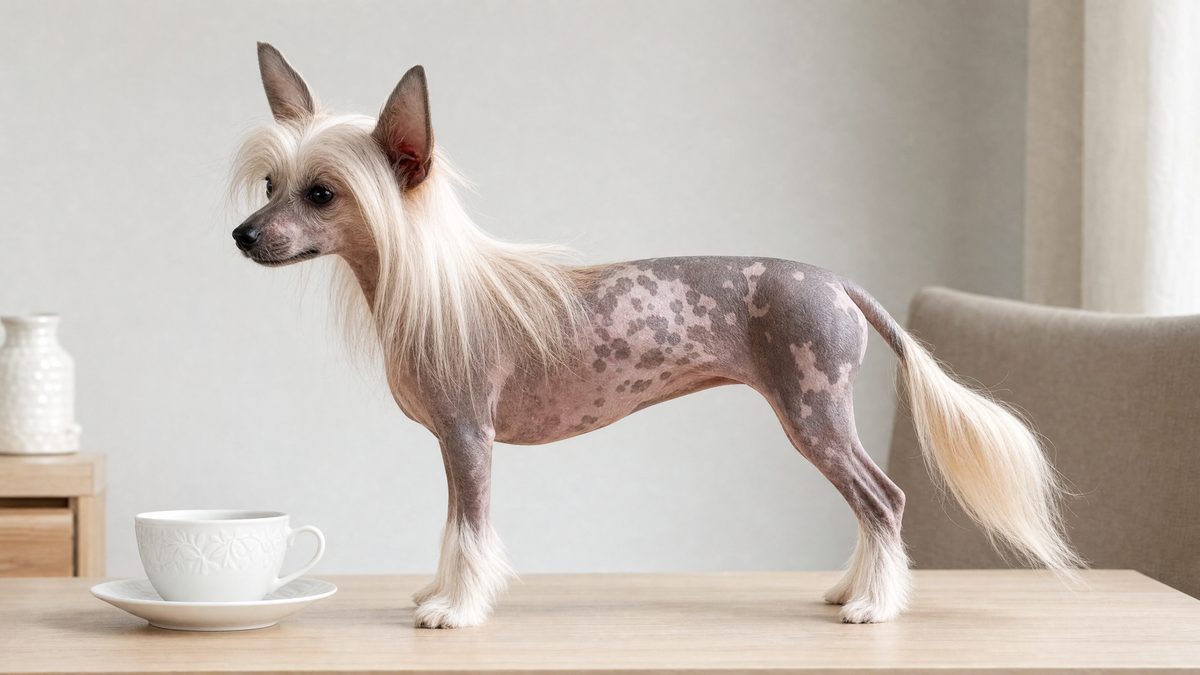
The standard describes a small, active and graceful dog, medium to fine-boned, in two body types the FCI names outright: Deer type, racy and fine-boned, and Cobby type, heavier in body and bone. In the Hairless, hair grows only on the head as a crest, on the feet as socks and on the tail as a plume confined to its lower two-thirds. The skin is described in three words that matter later on this page: "Fine-grained, smooth, warm to the touch." The ears are set low, large and erect, and drop ears are permissible only in the Powder Puff. The Powder Puff itself is covered in an undercoat plus a soft veil of long hair, which the standard calls a feature rather than a fault.
Colour is unrestricted apart from the Kennel Club's merle exclusion, and the AKC's own description of the breed opens with "their spotted pink skin";. Pink, unpigmented skin is normal for this breed and permitted by every standard. Remember that when you reach the sun section, because it is the whole argument.
Where it came from, and why nobody agrees
The FCI's own historical summary hedges: "While it is difficult to pinpoint their origin, it is said that they were owned by families of the Han Dynasty of China", and it records that the breed was "seen at shows in America from 1885 to 1926 but then were rarely ever seen for some fifty years". Wikipedia, which ranks eighth in India for the buying query, disagrees with the FCI in its own infobox and gives the origin as Mexico. The genetic argument sits behind that: the same FOXI3 variant is shared by the Chinese Crested, the Mexican Hairless and the Peruvian Hairless, which is easier to explain by common descent than by three independent mutations on three continents.
The breed's other claim to fame is less flattering and entirely real. A hairless Chinese Crested named Sam won the World's Ugliest Dog contest three years running, from 2003 to 2005, and a TradeIndia listing selling the breed in Mumbai still leads with that fact in its product copy.
The Hairless and the Powder Puff are not two breeds and are not crosses. They are the two phenotypes a single gene produces, they appear in the same litter, and the Kennel Club simply adds the words Powder Puff after the breed name on the registration certificate when a litter is registered online. Anyone selling you a Powderpuff as a separate or lesser animal has told you they do not understand the breed.
The hairless gene: a semidominant FOXI3 mutation that kills its own homozygote
Hairlessness in the Chinese Crested is caused by a 7-base-pair duplication in the first exon of the FOXI3 gene, inherited as a monogenic autosomal semidominant trait, and the homozygote dies before birth. That single sentence explains the breed's coat, its teeth, its litter sizes and the one mating decision an Indian breeder must never get wrong.
The mapping was done in 2008. A genome-wide association study located the canine ectodermal dysplasia mutation to a 102-kilobase interval on chromosome 17, found a previously uncharacterised forkhead box transcription factor there that is expressed specifically in developing hair and teeth, and identified a frameshift mutation in its coding sequence in hairless dogs. The paper names the trait as "inherited as a monogenic autosomal semidominant trait" and covers Mexican, Peruvian and Chinese Crested dogs together. A 2017 study recovered the same variant from museum skulls by ancient-DNA extraction and describes it precisely as "a semi-dominant 7-base-pair duplication in the first exon of the forkhead box I3 gene (FOXI3) shared by all three breeds";.
The lethality was worked out earlier and by classical genetics. A 1985 note in the Journal of Heredity states it in four sentences that have not needed revision since: "The Chinese crested dog is devoid of hair except for the crown of the head, lower part of the limbs and tail. The breed is produced by a dominant gene for hypotrichosis (Hr) in combination with the gene for long hair (l). The homozygote HrHr is a prenatal lethal, hence the Chinese crested dog is an obligate heterozygote. The long haired segregants, ++ ll, are known as powderpuffs".
Read those two together and the whole architecture falls out. Every hairless Chinese Crested alive is a heterozygote, because the alternative genotype never gets born. Every Powderpuff is homozygous for the wild-type allele. There is no third option, and there is no such thing as a hairless dog that breeds true.
| Mating | Hairless | Powderpuff | Lost in utero |
|---|---|---|---|
| Hairless x Powderpuff | 50% | 50% | None |
| Hairless x Hairless | 50% of conceptions, 2 of every 3 born | 25% of conceptions, 1 of every 3 born | 25% of conceptions |
| Powderpuff x Powderpuff | 0% | 100% | None |
The parent club states the first and third rows correctly and omits the second entirely: "If both parents are Powderpuffs, all of the puppies will be Powderpuffs but a Hairless Chinese Crested can produce either Hairless or Powderpuff puppies";. Both halves of that are true. What it does not say is what happens when two hairless dogs are bred together, which is the mating a breeder chasing hairless puppies is tempted into, and the one that quietly costs a quarter of the litter.
The allele that makes this dog look the way it does is lethal when it is doubled. Not "associated with reduced viability", not "linked to smaller litters": a prenatal lethal, established in the peer-reviewed literature forty years ago. Not one of the ten pages ranking in India for this breed's buying query mentions it.
What the genetics catalogue adds: resorbed embryos, and higher neonatal death in hairless pups
Online Mendelian Inheritance in Animals files this trait as OMIA:000323-9615 and adds two facts the breed standards and the parent club leave out. The homozygous embryos are resorbed rather than stillborn, so a breeder never sees them. And neonatal deaths are more common in hairless puppies than in their coated littermates.
The curated genetics catalogue that veterinary geneticists actually cite says the same thing as the primary papers and adds the mechanism. Online Mendelian Inheritance in Animals, run by the Sydney School of Veterinary Science, files this as OMIA:000323-9615, Ectodermal dysplasia in the dog, mode of inheritance autosomal incomplete dominant, key variant known, first reported 2008. Its species summary reads: "Early breeding studies demonstrated embryonal lethality of homozygous mutant animals and an autosomal semidominant mode of inheritance (Robinson, 1985). In detail, homozygous mutant embryos die very early during pregnancy and are resorbed, heterozygous dogs exhibit the ectodermal dysplasia phenotype... This is a desired trait in several breeds, including the Peruvian Inca, Mexican Hairless, and Chinese Crested Dog".
Resorbed is the word that matters to a breeder. There is no stillbirth to count and no small litter to explain. The conceptions simply disappear, and the breeder sees a normal-looking litter that is one puppy short of what it should have been.
The same entry carries one clinical line that goes further than the in-utero loss and that no page selling this breed mentions: "Neonatal deaths are more common in hairless pups than in their normal littermates". It also notes that toenails in affected dogs "may be long and brittle", which is a small practical point that lands in the grooming section.
How the mutation was narrowed down
Before FOXI3 was found, the obvious candidate was EDAR, the gene behind X-linked ectodermal dysplasia. A 2005 paper analysed the canine EDAR gene and excluded it as a candidate for the hairless phenotype in the Chinese Crested dog, which is stated in that paper's title. That exclusion matters clinically as well as historically, because the two conditions are not the same disease. A histological study of 22 Chinese Crested dogs found that "apocrine glands in the skin and respiratory mucous glands of the mutant Chinese crested dogs were present and normal", which is the opposite of what X-linked ectodermal dysplasia does.
That same study found something an owner can see. The FOXI3 mutants carried only simple primary hair follicles, while the non-mutant Powderpuffs had compound follicles identical to every other dog breed, and all Chinese Cresteds had an anagen-dominated hair cycle. It also splits the breed into three phenotypes rather than two: true hairless, semi-coated and powderpuff. The semi-coated dog, sometimes sold as a "hairy hairless", is a FOXI3 heterozygote whose follicular anomalies are milder. It is genetically hairless and needs the same sun routine.
How the mapping was actually done
The OMIA entry records the study design in a level of detail worth having if a breeder ever tells you the genetics are unsettled. Drogemuller and colleagues ran a genome-wide association study on "20 hairless and 19 coated Chinese Crested dogs", each genotyped on an Affymetrix v2 SNP chip yielding 12,353 informative markers, and found a single associated SNP on chromosome 17. Fine mapping reduced the candidate region to "a 102-kb interval between positions 41,045,331 and 41,147,100 on CFA 17", which contained only two predicted genes, and sequencing the more likely of the two produced the 7-base-pair tandem duplication in exon 1 of FOXI3.
Thirty-nine dogs is a small study by modern standards and it did not need to be larger, because a monogenic semidominant trait with a clean phenotype is about the easiest thing in canine genetics to map. The variant has since been recovered independently from museum skulls by ancient-DNA extraction, which is a stronger confirmation than a larger cohort would have been.
Ask what happened to the rest of the litter. A breeder who has read any of this will tell you that a hairless-to-hairless mating resorbs its homozygotes and that hairless puppies also die neonatally more often than their coated littermates. A breeder who has not will tell you the litter was simply small.
What the lethal allele means for an Indian breeder, and where Indian law sits
An Indian breeder has exactly one safe mating for this breed: hairless to Powderpuff. That pairing produces roughly half hairless puppies, loses nothing in utero, and needs no genetic argument to defend. Every other route to a hairless litter either produces none at all or destroys a quarter of the conceptions.
Work the arithmetic on a real litter. The OFA owner survey records an average litter size of three to four puppies in 95 of 168 responses for this breed, with five or more in another 48. Take four conceptions from a hairless-to-hairless mating. One is a HrHr homozygote and does not develop. Two are heterozygotes and are born hairless. One is homozygous wild type and is born a Powderpuff. The breeder sees a litter of three, two of them hairless, and has no way of knowing from the whelping box that a fourth was ever conceived.
Now take the same four conceptions from a hairless-to-Powderpuff mating. Two are born hairless, two are born Powderpuffs, and four puppies leave the box. The breeder gets the same two hairless dogs and two extra live puppies. There is no economic case for the first mating either, once you count what it costs.
Where the Dog Breeding and Marketing Rules 2017 actually bite
Two provisions of the Second Schedule to the Prevention of Cruelty to Animals (Dog Breeding and Marketing) Rules 2017 are worth reading before anyone breeds this dog in India, and they are commonly cited wrongly, so here is the text as it appears in the machine-readable gazette copy of G.S.R. 496(E).
Part II paragraph 6(9) reads in full: "Breeding to create new breeds of dogs or unusual looks shall be strictly prohibited". Read it carefully. It prohibits breeding to create new breeds or unusual looks. The Chinese Crested is not a new breed and its look was not created by any Indian breeder; it is a recognised breed with a published standard held by the FCI since 1987, the AKC since 1991 and the Kennel Club for longer. Breeding within a recognised breed is not the activity 6(9) describes, and this page will not claim otherwise. What sits closest to the line is the deliberate hairless-to-hairless mating, chosen specifically to raise the proportion of the unusual-looking variety, in full knowledge that a quarter of the conceptions will not survive. That is a welfare question on its own terms whether or not 6(9) reaches it.
Part II paragraph 6(3) is the one that will actually catch an Indian kennel, and it is a paragraph of the Second Schedule, not a Rule. It prohibits "in breeding, mating between dogs that are related... breeding between relatives of the 2nd to 4th grade in straight or side line within the first four generations e.g. uncle to niece, nephew to aunt, cousin to cousin, grandparents to grandchildren", and separately prohibits "incest breeding, mating between parents and children or between brother and sister". Only out breeding and line breeding are permitted.
That matters here because of population size. There is no Indian breed club for the Chinese Crested, the FCI's return for the Kennel Club of India records 33,880 pure-bred dogs registered across all breeds in 2025, and this breed appears nowhere in the top ten of the largest Indian listing site, which counts 650 Shih Tzus and 136 Pomeranians. A breeder working from two or three imported founders runs out of unrelated partners in one generation. The Royal Kennel Club's Good Practice recommendation for this breed is a single item, and it is "prioritising genetic diversity";, which is the same problem stated politely.
The practical rule
- Breed hairless to Powderpuff. It is the only mating that produces hairless puppies without in-utero loss.
- Keep the Powderpuffs in the breeding programme. They are the reservoir of unrelated wild-type genetics and the safest partner for every hairless dog you own.
- Map four generations before every mating, because paragraph 6(3) reaches back that far and names the exact relationships it forbids.
- Do not import founders on a commercial pretext. DGFT Policy Condition (8) states that "Import of commercial dogs for breeding or any other commercial activities... is not permitted", and applications for trading or breeding "shall be duly rejected";.
Every hairless Chinese Crested is a carrier of a lethal allele, and its safest mate is the coated sibling variety it was born alongside. A breeder who understands that will never produce a hairless-to-hairless litter, and a buyer who understands it can tell in one question whether a breeder does.
Dentition is part of the mutation, and the three standards treat it three ways
The same FOXI3 variant that removes the coat removes teeth, so all three governing standards excuse missing dentition in the Hairless variety and only one of them says anything about the Powderpuff. Reading the exact wording is worth five minutes, because it is the difference between a normal dog and a faulted one.
FCI-288 says this, and prints it in bold: "Jaws strong, with perfect, regular scissor bite, i.e. the upper teeth closely overlapping the lower teeth and set square to the jaws. The hairless variety will have the primitive trait of forward pointing canines and should not be penalised for absence of full dentition." The last line of the same document reads "The latest amendments are in bold characters", which dates that clause to the standard published on 27 July 2021 rather than to anything older.
The Royal Kennel Club's Mouth clause, last updated April 2025, is word for word identical and, like the FCI, says nothing at all about the Powderpuff. The AKC is the outlier and the clearest: "Bite - Scissors or level in both varieties. Missing teeth in the Powderpuff are to be faulted. The Hairless variety is not to be penalized for absence of full dentition."
| Standard | Hairless | Powderpuff |
|---|---|---|
| FCI-288 (27.07.2021) | Not penalised for absence of full dentition; forward-pointing canines named as a primitive trait | Silent |
| Royal Kennel Club (April 2025) | Identical wording to the FCI | Silent |
| AKC (approved 1990) | Not to be penalized for absence of full dentition | Missing teeth are to be faulted |
That asymmetry is not a drafting accident. It is the genetics written into a show rulebook. A Powderpuff carries no FOXI3 mutation, so a Powderpuff with missing teeth has a defect from some other cause and the AKC faults it. A Hairless carries the mutation by definition, so absent teeth are the expected phenotype and no standard penalises them.
Exactly which teeth go, and why the molars change shape
The dental phenotype was described properly in 2017, from pedigreed hairless dog skulls in a museum collection whose FOXI3 status was confirmed by ancient-DNA extraction. Compared with coated wild-type dogs, the hairless dogs showed, in both upper and lower jaws, "a loss of the permanent canines, premolars and to some extent incisors". Beyond simple absence, the deciduous fourth premolars and the permanent first and second molars "consistently lacked the distal and lingual cusps", leaving a single enlarged cusp in the basin-like heel of the tooth.
So this is not just a dog with gaps. It is a dog whose remaining molars have a simplified crown, which is why the paper compares the pattern to hypercarnivorous carnivorans and suggests FOXI3 may be involved in cusp development across mammals generally. For an owner the practical consequence is that the grinding surfaces a dog normally uses on kibble are reduced, which is a feeding question rather than a cosmetic one.
Wikipedia's summary of the same point, on the page that ranks eighth in India, is accurate as far as it goes: "Hairless Chinese Crested Dogs often lack a full set of premolar teeth, but this is not considered a fault", and "Most dogs of the Powderpuff variety have few, if any, dental defects";.
What owners actually report
The OFA breed health survey gives a rough check on all of this from the other end. Dental disorders were reported for 68 of 408 dogs, 17 percent. The commonest single entries were premature tooth loss in 30 dogs, missing premolar teeth in 21, abnormal tartar build-up in 16 and retained baby canines in 15. The variety split on the missing-premolar entry is the striking one: 20 of the 21 reports came from hairless dogs, with a single female Powderpuff making up the difference. Retained baby canines split 13 hairless to 2 Powderpuff.
Those figures are owner-reported and self-selected, and OFA prints that caveat on its own page, so they cannot be read as prevalence. As a direction check against Kupczik's skull data they line up exactly, and two independent methods agreeing is worth more than either alone.
Forward-pointing canines that look wrong and are not, fewer premolars than a normal dog, and molars with a simplified chewing surface. None of that is a breeder's fault, none of it is a nutrition failure, and no standard treats it as one. What it does mean is that this dog needs its teeth brushed and checked from the start, which is what the parent club advises: brush regularly, provide appropriate chew toys, and have a veterinarian check the teeth yearly.
Indian law names missing teeth as a genetic defect, and the standards excuse them
Second Schedule Part III paragraph 8(10) of the Dog Breeding and Marketing Rules 2017 requires that dogs "shall have been tested for genetic defects" and names, in a list of eleven, "two or more missing teeth". That is the exact trait every breed standard tells a judge to ignore in the Hairless Chinese Crested. No page anywhere on the Indian result set notices the collision.
Here is the clause as it appears in the machine-readable gazette text of G.S.R. 496(E), which is worth quoting in full because summaries of this document have been fabricated before: "The dogs shall have been tested for genetic defects, including hip dysplasia, progressive retinal atrophy, night blindness, hypothyroidism, entropion, ectropion, overshot, undershot jaw (when incisors do not touch or mesh), wry mouth, two or more missing teeth, unilateral cryptorchid or full cryptorchid males".
Four of those eleven land on this breed with unusual force.
| Named defect | Where it meets the Chinese Crested |
|---|---|
| Two or more missing teeth | The expected phenotype of the Hairless variety. Kupczik 2017 records loss of permanent canines and premolars |
| Progressive retinal atrophy | A CHIC-required DNA test for this breed in two forms, prcd-PRA and RCD3-PRA |
| Wry mouth, overshot and undershot jaw | Reported by owners in the OFA survey: 4 malocclusion and 6 underbite entries |
| Hip dysplasia | Optional under CHIC, and the breed's OFA figure is 0.7 percent dysplastic on 145 evaluations |
What the clause does and does not require
Be precise about this, because the temptation is to overstate it. Paragraph 8(10) imposes a testing obligation on the breeder. It says the dogs shall have been tested for the listed defects. It does not, on its own text, prohibit breeding a dog that has one, and it does not name the Chinese Crested or any other breed. So an Indian breeder is not barred from breeding a hairless dog with absent premolars. What the breeder cannot lawfully do is treat that dentition as invisible: it sits on a statutory list of genetic defects, and the Rules require it to have been tested for and, under paragraph 8(2), for a monthly medical examination record to be kept for every dog in the establishment.
There is a second reading worth putting in front of a buyer. The reason the standards excuse missing dentition is that it is inseparable from the coat trait the breed is sold on. In Indian regulatory language, the defect and the desirable feature are the same allele. A breeder who advertises the hairless variety and then presents its dentition as unremarkable is describing one consequence of a mutation while omitting the other, and Second Schedule Part II paragraph 6(9)'s concern with breeding for unusual looks sits in the background of that choice even if its text does not reach a recognised breed.
What an Indian buyer should actually do with this
- Ask to see the dam's and sire's mouths, not a photograph. Count what is there and write it down.
- Ask which variety each parent is. A Powderpuff parent with missing teeth is a different signal from a Hairless parent with missing teeth, because only the second is explained by the mutation.
- Get the puppy's dentition recorded by your own veterinarian at the first visit, so you have a baseline before anything is lost to periodontal disease later.
- Ask for the two progressive retinal atrophy DNA results, because 8(10) names PRA and the breed has CHIC requirements for both prcd-PRA and RCD3-PRA.
- Do not accept "it is normal for the breed" as a closing answer. It is normal for the Hairless variety, and that is a fact about a gene, not a reason to skip the paperwork Indian law requires.
The single feature that makes a hairless Chinese Crested worth a premium in India is genetically inseparable from a trait that Indian law lists as a genetic defect a breeder must test for. Both of those statements are true at the same time, and any page that gives you only one of them is selling you something.
Recognition: four registries confirmed from their own records, and one Indian answer that is unproven
The Chinese Crested is fully recognised on a definitive basis by the FCI as standard 288, by the American Kennel Club since 1 April 1991, by the Royal Kennel Club in the Toy group, and by the Canadian Kennel Club and United Kennel Club. Each of those was read out of a register rather than assumed. The Kennel Club of India position could not be established from a KCI document, and this page says so rather than guessing.
Start with the FCI, because it is the register the Indian kennel club belongs to. FCI-288 is a definitive standard, Group 9 Companion and Toy Dogs, Section 4 Hairless breeds, without working trial, origin China, patronage Great Britain, and the currently valid text was published on 27 July 2021. The breed page at fci.be carries the standard in English, French, German and Spanish, and the breed name printed inside the returned document was checked against the breed being written about before any figure was taken from it. Wikipedia dates FCI recognition to 1987.
The AKC position is dated exactly by the standard itself, which carries the lines "Approved June 12, 1990" and "Effective April 1, 1991";. The AKC's breed page confirms the same year in prose and prints a current breed-popularity readout of 72 of 210. That is mid-table, not rare: it sits in the same band as breeds an Indian buyer would consider ordinary.
Four registries in one line of markup
The cleanest single confirmation came from an unexpected place. OFA's advanced-search page carries a breed checkbox for this breed whose raw HTML reads `value="CHC" data-species="C" data-key="Toy" data-name="CHINESE CRESTED" data-groups="AKC Toy Group;CKC Toy Group;UKC Companion Dog Group;TKC Toy Group"`. That single attribute records the breed's group placement in four registries at once: the American Kennel Club and the Canadian Kennel Club both place it in Toy, the United Kennel Club places it in its Companion Dog group, and The Kennel Club places it in Toy. The same retrieval was checked against a control entry, the American Hairless Terrier, to confirm the breed list had actually loaded before any absence was read off it.
The Royal Kennel Club's own breed page confirms the Toy placement independently, records the breed as not a vulnerable native breed, puts it in Colour Watch Category 0 meaning there are no non-breed-standard colour registration options, and places it in Breed Watch Category 2.
The Indian answer, and why this page will not fake it
The Kennel Club of India is an FCI member national canine organisation, and the FCI publishes its annual return under the heading "Statistics: Kennel Club of India (INDIA)", which was confirmed inside the returned document before any figure was used. For 2025 it records 32,219 puppies and 33,880 pure-bred dogs registered with the studbook, 7,412 litters, 80 member clubs, 342 individual members, 28 FCI judges and 1,425,001 pure-bred dogs registered since the studbook was created.
What could not be established is whether the KCI publishes a breed list containing the Chinese Crested. A direct request to the KCI's breed page failed with the connection closing, and a full URL map of kennelclubofindia.org returned nine pages, none of them a breed register. That is a failed retrieval, not a finding, and it would be dishonest to convert it into either a yes or a no. What can be said is narrower and still useful: the KCI is an FCI member, FCI members register breeds against FCI standards, FCI-288 is a definitive standard, and the KCI publishes its own checklist for registering a dog brought in from abroad, which requires an original export pedigree, an original airway bill, a DGFT licence, customs clearance, quarantine clearance, a pet passport and a notarised affidavit.
Set against that, every Indian seller ranking for this breed advertises KCI paperwork. Puppiezo's meta description promises "KCI registered" puppies "delivered across India";. Mr n Mrs Pet promises "healthy, purebred KCI-certified Chinese Crested Puppies in India";. Tailsbuddy prices a KCI-registered puppy at Rs 45,000-55,000, a full tier above its basic band. A buyer paying that premium is paying for a document, and the only way to check a document is to ask to see it. An independent search restricted to India, run on the same day across two engines, returned the same set of sellers and no Indian breed club, breeder register or KCI registration listing for this breed anywhere.
Ask for the registration certificate and the sire and dam's registration numbers before any money moves, and if an imported founder is claimed anywhere in the pedigree, ask for the DGFT licence and the quarantine clearance that the KCI's own import checklist demands. A breeder who has done it properly has the file. A seller who has not will offer you a photograph of a logo.
Chinese Crested Dog price in India: five published bands that disagree by ten times
Published Chinese Crested Dog price in india figures run from Rs 15,000 to Rs 1,50,000 and above, a spread of at least ten times across five sources, and not one of those sources has a dog behind it. The page that ranks first for the query carries no price for this breed at all. Read the spread as a measure of how little anybody actually knows, because that is what it is.
Here is every rupee figure published for this breed in India that could be retrieved on 26 August 2026, with where it sits on the Indian search results page.
| Source | Position | Figure published | Dog actually offered |
|---|---|---|---|
| Puppiezo | 1 | No price for this breed | None |
| Asia Pets, breed page | 2 | Rs 30,000 to Rs 70,000 | None |
| Mr n Mrs Pet | 3 | Behind a sign-up wall | Two French Bulldogs and an Australian Shepherd |
| Quora | 4 | USD 500 to USD 5,000 | None, and three years old |
| TradeIndia | 5 | Get Latest Price | None |
| AdoptAPet | 6 | USD 1,000 to USD 4,000 | None, and a US page |
| Supertails | 7 | Breed absent from the list | None |
| Asia Pets, listing page | 9 | Rs 100 | One listing, no seller named |
| Tailsbuddy | off page one | Rs 35,000 to Rs 85,000 across three tiers | None |
| GoodFurs | off page one | Rs 50,000 to Rs 1,50,000 and above across four tiers | None for this breed |
| poodles.in | off page one | Rs 15,000 to Rs 50,000 | None |
| BarkJunction | off page one | Around Rs 35,000 | None |
| Google AI Overview | above position 1 | Rs 30,000 to Rs 1,00,000 | None |
Two sources structure the market and they do not agree with each other. Tailsbuddy splits it three ways: basic at Rs 35,000-45,000, KCI registered at Rs 45,000-55,000 and show quality at Rs 55,000-85,000. GoodFurs splits it four ways and starts where Tailsbuddy finishes: Pet Quality Hairless at Rs 60,000-90,000, Show Quality Hairless at Rs 90,000-1,50,000, Powderpuff at Rs 50,000-80,000 and Imported Lineage at Rs 1,50,000 and above. Asia Pets prints a single flat band of Rs 30,000-70,000 with no tiering and no source. Poodles.in undercuts everyone at Rs 15,000-50,000. BarkJunction gives one figure and attaches it to a city pair no rare-breed market would ever produce: "In Bhopal and Mahbubnagar, a basic Chinese Crested puppy can cost around 35,000";.
Five sources, none with a dog, disagreeing by at least ten times, is not a price range. It is five independent guesses. Treat any figure quoted to you for this breed in India as an opening position with nothing behind it, and negotiate on the paperwork rather than on the number.
The tiers, the AI Overview, and how thin the Indian market actually is
A show-quality hairless puppy costs Rs 55,000 at one Indian seller and Rs 1,50,000 at another, which is the same tier, the same breed, the same country and a factor of 2.7 between them. Behind both figures sits a market Google measures at about 155 results nationwide.
The one useful thing GoodFurs publishes
GoodFurs is the only Indian source that prices the two varieties separately, and it prices the Powderpuff below the hairless at every tier: Rs 50,000-80,000 against Rs 60,000-90,000. Google's AI Overview says the same thing in prose and attributes it to "higher demand and breeding rarity";. Half of that is right. Demand for the hairless is plainly higher. Rarity is not the reason, because the hairless is the heterozygote every hairless parent produces about half the time. So the Indian market has, without meaning to, priced the safer, healthier, easier-to-keep variety at a discount.
Google's own answer is higher than any source it cites
The AI Overview that sits above every one of those results states: "A Chinese Crested dog puppy in India generally costs between Rs 30,000 and Rs 1,00,000", and links exactly two sources for it, Puppiezo and Asia Pets. Puppiezo publishes no price for this breed. Asia Pets publishes Rs 30,000 to Rs 70,000. The lower bound is Asia Pets' lower bound. The upper bound of Rs 1,00,000 appears in neither cited source, and appears nowhere else on the Indian result set except as Tailsbuddy's show-quality ceiling of Rs 85,000, which is 15 percent lower and was not cited.
The same AI Overview adds a claim about the varieties that inverts the genetics: "Hairless Chinese Crested puppies often cost more than the fully-coated Powderpuff variety due to higher demand and breeding rarity";. Higher demand, plausibly. Breeding rarity, no. The Hairless is the heterozygote that every hairless parent produces about half the time; the Powderpuff is the homozygous recessive. Neither is rarer than the other in any meaningful sense, and the OFA owner survey happens to record 284 hairless dogs against 135 Powderpuffs, which is the reverse of scarce.
The scale of the market, in two numbers
Google reports about 155 results in India for this query, twice on the same page. Bing, with country set to India, reports about 1,310. For comparison, the largest Indian listing site's own popularity counter shows 650 Shih Tzus, 549 Siberian Huskies, 487 Golden Retrievers and 136 Pomeranians currently listed, and no Chinese Crested in the top ten at all. India's most-read dog price list, Supertails' 40-breed guide, contains zero occurrences of the string "Chinese Crested" against ten for the control term "Labrador";.
The oldest test is the plainest. DogsIndia has been India's breeder directory since long before any of these listing sites existed, and its home page carries 26 mentions of the Beagle, 22 of the Poodle, 21 of the Labrador, 16 of the Great Dane, 14 of the Rottweiler, 10 of the Chihuahua, 8 of the Shih Tzu, 4 of the Rajapalayam and 2 of the Mudhol Hound. It carries zero mentions of the Chinese Crested, and zero of the word hairless.
About 155 Google results nationwide, zero occurrences on India's oldest breeder directory and zero on its most-read price list is not a market with a going rate. It is a market where the first person who finds a dog sets the number. That is a bad position for a buyer on price and an excellent one on terms, because a seller with one buyer has every reason to produce the paperwork you ask for.
Testing every rupee figure: this one is not a converted American price list
Every Indian rupee figure for this breed was divided by the three exchange rates known to be in circulation on Indian pet pages, and none of them resolves to a US dollar price. That is a different result from several other imported breeds on this site, and it changes the conclusion: these numbers were not converted from an American list, they were made up in rupees.
The test is simple and you can repeat it on a phone. Indian pages routinely publish a "price" that is a US dollar figure run through a single exchange rate, and the tell is that the rupee number divides cleanly into a round dollar amount a seller would actually print. Three rates have been caught doing this: 84.38, 74 and a flat 80.
| Rupee figure | Divided by 84.38 | Divided by 74 | Divided by 80 |
|---|---|---|---|
| Rs 15,000 | 177.77 | 202.70 | 187.50 |
| Rs 30,000 | 355.53 | 405.41 | 375.00 |
| Rs 35,000 | 414.79 | 472.97 | 437.50 |
| Rs 45,000 | 533.30 | 608.11 | 562.50 |
| Rs 50,000 | 592.56 | 675.68 | 625.00 |
| Rs 55,000 | 651.81 | 743.24 | 687.50 |
| Rs 60,000 | 711.07 | 810.81 | 750.00 |
| Rs 70,000 | 829.58 | 945.95 | 875.00 |
| Rs 80,000 | 948.09 | 1,081.08 | 1,000.00 |
| Rs 85,000 | 1,007.35 | 1,148.65 | 1,062.50 |
| Rs 90,000 | 1,066.60 | 1,216.22 | 1,125.00 |
| Rs 1,00,000 | 1,185.10 | 1,351.35 | 1,250.00 |
| Rs 1,50,000 | 1,777.67 | 2,027.03 | 1,875.00 |
Read the 84.38 column first, because it is the strong test. Not one of the thirteen quotients is a number a seller would print. There is no 500, no 800, no 1,200, no 1,500. The closest miss is Rs 85,000, which divides to 1,007.35, within about three-quarters of a percent of a thousand dollars. That is close enough to notice and not close enough to conclude anything: a genuine conversion of USD 1,000 at 84.38 produces Rs 84,380, and a page that had converted would have printed Rs 84,380 or rounded to Rs 84,000, not landed on 85,000 as the top of a three-tier ladder.
The 74 column fails harder. Every quotient is an untidy number, and the two US figures actually on the Indian result set, AdoptAPet's USD 1,000-4,000 and Quora's USD 500-5,000, map to Rs 74,000-2,96,000 and Rs 37,000-3,70,000 at that rate. Neither range resembles any Indian band on the table.
Why the 80 column proves nothing at all
The third column looks like a clean sweep and is worthless, and it is worth being explicit about why. Dividing by 80 is the same as multiplying by 0.0125, so any rupee figure ending in three zeros divides cleanly at 80 by construction. One thousand divided by eighty is 12.5. All thirteen figures on this table end in at least three zeros, so all thirteen "match" at 80 as a matter of arithmetic rather than of evidence, and only three of the thirteen quotients (375, 1,000 and 1,250) are even numbers a seller might print. GoodFurs' Rs 80,000 divides to exactly 1,000 dollars at 80, which is the single most suggestive cell on the whole table and is still not evidence: it is one row of thirteen, its neighbours in the same four-tier table give 750, 1,125 and 1,875, and no converted list produces one round number and three untidy ones. The flat-80 test can never be run alone, and on a table like this one it cannot be run at all.
The one figure that is definitively not a price
Rs 98,999 appears three times on the Puppiezo page that ranks first for this breed's buying query. It is attached to two Maltipoos named Fizey and Samy and a Doxiepoo named Yoki, and the same carousel prints Rs 92,599 twice for two Poodles, Rs 94,999 for a Cane Corso, Rs 76,499 for a Rottweiler and Rs 1,20,000 for a Goldendoodle. Not one of those seven dogs is a Chinese Crested. The page carries no price for the breed it is selling.
Rs 98,999 divided by 84.38 is 1,173.25, which is not a conversion of anything. It is a rupee-native charm price, the retail equivalent of Rs 99, and it travels from listing to listing attached to whichever puppy is in stock. It has now been recorded on this site across many breed pages the same seller does not stock. Never report it as any breed's price, and treat a page that shows it beside a breed it has no dog for as a page with nothing to sell you.
Unlike several other imported breeds documented on this site, the Indian Chinese Crested bands are not a converted American price list. They are rupee-native inventions. That is not better news for a buyer. A converted figure at least traces to a real market somewhere; an invented one traces to nothing, which is why four sources can disagree by 5.7 times without any of them being wrong about anything.
What the ranking pages are actually offering you
Open the top five Indian results and count the Chinese Cresteds for sale. The answer is zero. What is on offer instead is a sign-up wall, a carousel of other breeds, a livestock listing filed beside lion cubs, and a Rs 100 placeholder.
Position 1: a seller page with no price for its own breed
Puppiezo's Chinese Crested page carries a full spec card, a Did You Know panel and a comparison chart of Silver, Gold and Platinum service tiers with a replacement guarantee, and no price for a Chinese Crested. Its Available Chinese Crested Dog Puppies For Sale panel is empty. The only prices on the page belong to its Other Available Pets rail, which is a Maltipoo, two Poodles, a Cane Corso, a Goldendoodle, a Rottweiler, a second Maltipoo and a Doxiepoo. Its meta description promises "KCI registered, vaccinated, and delivered across India" and markets the breed as "low-shedding", while its own spec card prints Shedding: NO.
Position 3: three results, none of them this breed
Mr n Mrs Pet's page is headed "Chinese crested Puppies For Sale" and states "3 Result Found";. The three cards that render sit under the heading "Similar breeds at other locations" and are an Australian Shepherd in Jaipur and two French Bulldogs, one in Delhi and one in Patna. Every price is replaced by a "View Price" button that opens a sign-up form. The page copy promises "healthy, purebred KCI-certified Chinese Crested Puppies in India" from "verified Chinese Crested dog breeders near you".
Position 5: filed under Livestock, next to the lion cubs
TradeIndia's listing sits in the Livestock category, carries an In Stock badge, and shows "Get Latest Price" where a price would be. The seller is recorded as "Merial - A Sanofi Company", registered in 2015 at an Andheri East address given as "C/O Sanofi-Synthelabo (India) Limited", with the proprietor named as "Dr. Kali Dupont". The same seller's other listings include White Lion Cubs, a Hyacinth Macaw, an Umbrella Cockatoo, a Palm Cockatoo, an African Grey Parrot, a Savannah Cat, a Tibetan Mastiff, a Sahiwal Cow, Murrah Buffaloes and four kinds of goat. A pharmaceutical company's name is attached to a page offering lion cubs. Nothing about that listing describes a real supply chain for a toy dog.
The "Price: 350 INR, MOQ 100 Bottle/Bottles" that Google prints against this result is worth understanding, because it looks like a price for a dog and is not. It belongs to a veterinary vaccine in the page's Related Products rail Google web search, gl=in, hl=en, num=20. A search snippet lifted a figure from a different product on the same page, and a reader skimming the results page would come away believing a Chinese Crested costs Rs 350.
Position 9: Rs 100
Asia Pets' individual listing is summarised on both Google's and Bing's results pages as "Health-checked. Price: Rs 100"; Bing web search with country set to India…. The figure does not render in the page's server-delivered HTML, so it could not be confirmed on the page itself, only in two independent search engines' summaries of it. Rs 100 is not a price for a purebred imported toy dog under any reading; it is a placeholder in a template. The same listing page's Similar Breeds rail offers a Labrador puppy, a Poodle female, a Labrador champion line and a Toy Poodle in Delhi.
What Google itself substitutes when the query is this thin
The People also ask box on this query does not contain a single question about the Chinese Crested. All four are generic expensive-dog questions: "Which dog costs 20 crore?", "Which dog is RS 5000?", "Which dog costs 1 crore?" and "What is the no. 1 costly dog?";. The People also search for rail is the same story, offering Pomeranian dog price in India, Indie dog price in India, Mastiff dog price in India and Shar Pei dog price. Google has no breed-specific question cluster for this breed in India because there are not enough Indian searchers asking breed-specific questions to build one.
Exactly one Indian page on page one claims an actual animal, the Asia Pets individual listing at position 9, and both Google and Bing render its price as Rs 100 Bing web search with country set to India…. The four selling pages above it had no Chinese Crested available on 26 August 2026. A deposit paid against a listing with no animal behind it buys a promise to source one, which in this breed usually means a broker looking for a litter that does not exist yet.
Monthly cost of ownership in India, and the line item no other breed has
Budget Rs 4,000-8,000 a month for a small dog in India, which is the published small-breed band from the country's most-read cost guide, then move money between two line items rather than adding to the total. A hairless Chinese Crested costs less to groom than a Shih Tzu and more to protect from the sun than any breed in the country.
Start from a published Indian baseline rather than a guess. Supertails' 2026 cost breakdown gives a small breed, using a Pomeranian or Shih Tzu as its example, the following monthly figures.
| Line item | Published small-breed figure | Hairless Chinese Crested |
|---|---|---|
| Dry or wet food | Rs 1,500-2,500 | Lower end. This is a 4-5.4 kg dog |
| Routine vet visits | Rs 500-1,000 | Same, plus a skin check at each visit |
| Vaccinations | Rs 1,200 a year | Same |
| Grooming | Rs 1,500-3,000 | Much lower. There is no coat to clip |
| Training, six months | Rs 0-3,000 | Budget the upper half. Breed Watch flags nervous temperament |
| Treats and toys | Rs 300-800 | Same, with chew toys prioritised for the teeth |
| Flea, tick and deworming | Rs 300-600 | Same, and non-negotiable on bare skin |
| Sun protection | Not a line item for any other breed | New spend, every month, year round |
| Published monthly total | Rs 4,000-8,000 | Roughly the same total, differently spent |
A second Indian source specific to this breed puts the monthly total lower, at Rs 3,300-5,400, built from food at Rs 1,200-1,800 and grooming at Rs 900-1,800. Both figures are worth having, and the gap between them is mostly grooming. A third Indian page prices a single professional grooming session at Rs 1,500-5,000, which is a Powderpuff figure. On a hairless dog that spend largely disappears, because there is nothing to clip, dematt or blow-dry.
Where the saved grooming money has to go
The parent club's own routine for the hairless variety is a weekly bath with a quality shampoo and conditioner, clean clothes and bedding, and human-type acne management for blackheads. Translate that into Indian rupees and you get a monthly consumable bill: a mild veterinary shampoo, a conditioner or moisturiser, a sunscreen suitable for a dog that will lick it, and washable dog clothing that has to be changed and laundered far more often in Indian humidity than in a temperate climate. No Indian source publishes a rupee figure for any of these on this breed, so this page will not invent one. What it will say is that the line item exists, that it recurs every month for the life of the dog, and that it is the only line item on the table that is not optional.
The one-off costs an Indian buyer should plan for
- Three DNA tests. Primary lens luxation, prcd-PRA and RCD3-PRA are all CHIC requirements for this breed. A buyer should be shown the parents' results rather than paying for them, but a rescue or an unpapered adult may need its own.
- A cardiac evaluation after 24 months. OFA's advanced cardiac table ranks this breed sixth of all breeds at 13.2 percent abnormal on 114 evaluations, which makes this the screen most worth buying in adulthood.
- An annual eye examination. It is the first item on the CHIC list and the breed's eye findings are its largest recorded disease burden.
- Dental work, earlier than you expect. The commonest owner-reported dental entry in the OFA survey is premature tooth loss, in 30 dogs.
Indian prices for those procedures could not be verified against a published Indian source during this research and are therefore not printed here. Ask two clinics in your own city before you commit, because the same guide that publishes the monthly band also reports that Mumbai and Delhi command a 20-35 percent premium over tier-2 cities.
Rs 4,000-8,000 a month, with the grooming money moved into skin and sun, plus an annual eye examination and a one-off cardiac screen after the dog turns two. What you must not do is treat the grooming saving as a saving. It is a transfer, and the thing it transfers to is the only part of this dog's care with a cancer endpoint.
Heat tolerance: this breed's Indian problem is skin, not airway
The Chinese Crested is not brachycephalic and is not in the size band that dominates canine heatstroke, so it does not carry the acute heat risk a Pug or a French Bulldog does in India. Its heat tolerance rates 2 of 5 on this page for a completely different reason: bare skin has no barrier between it and the sun, and the damage is cumulative rather than sudden.
Get the airway question out of the way first, because it is where most Indian breed pages stop. The 2024 UK longevity study that produced this breed's lifespan figure also classifies every breed by cephalic index, and it records the Chinese Crested as mesocephalic. That is the normal-muzzled category. It is not a flat-faced dog and its standard describes a muzzle "tapering slightly but never pointed" with a stop "slightly pronounced, but not extreme";.
That matters because of what the largest study of canine heat-related illness actually found. Working from the primary-care records of 905,543 UK dogs in a single year, it identified 395 confirmed heat-related illness events, an incidence of 0.04 percent with an event fatality rate of 14.18 percent. The significant risk factors were breed, with Chow Chow, Bulldog and French Bulldog named, higher bodyweight relative to the breed and sex mean, age over two years, a brachycephalic skull shape, and a bodyweight over 50 kg. A 5 kg mesocephalic toy dog is in none of those groups.
The OFA owner survey supports the same reading from the other direction. Respiratory disorders were the rarest category in the whole survey, reported for 7 of 408 dogs, 2 percent, against 17 percent for skin and 19 percent for eyes. This is not a breed whose owners report breathing trouble.
So what is the heat problem?
It is the absence of the thing that normally sits between a dog's skin and the sun. Veterinary dermatology is explicit that the haircoat, the stratum corneum and melanin are what ordinarily protect canine skin from ultraviolet, and that the dogs which develop solar disease are the sparsely haired and lightly pigmented ones. A hairless Chinese Crested has removed the first of those three defences by genotype, and may have very little of the third: adult hairless dogs are described in the veterinary literature as clinically nonpigmented, clinically lightly pigmented, or spotty pigmented, with the pigment coming from melanin granules in the epidermis. The AKC's own breed description opens with "their spotted pink skin";.
The number that makes this concrete comes from a 991-dog life-span study of beagles housed in outdoor pens in a high-altitude, high-sunshine environment. Solar dermatosis was diagnosed in 363 of the 991 dogs, an incidence of 36.6 percent, and it was restricted to the sparsely haired, nonpigmented abdominal skin. Those were coated dogs. The only part of them that behaved like a hairless dog's whole body was the bare belly, and better than one in three of them developed solar damage there.
The sentence on the Indian results page that this section exists to answer
The page ranking tenth in India for this breed's buying query states, under the heading Vulnerability to hot weather: "Understandably, the Hairless variety of the Chinese Crested tolerates heat very well". Read narrowly and as a statement about air temperature and thermoregulation, that is defensible: no coat means no insulation to shed. Read as advice to an Indian owner it is dangerous, because it addresses the one aspect of Indian sun that is not the problem and says nothing about the one that is. The same page's grooming section confines sun cream to "the summer months" and describes it as something "some vets advise";.
The Indian sources make the same omission from the other direction. An Indian vet-recommended list of the ten best dog breeds for the Indian climate, published in November 2025, sets out its selection criteria as heat tolerance, humidity tolerance and "a short or moderate coat length". Searched locally, that page contains zero occurrences of "Chinese Crested" and zero of "hairless", against ten for the control term "Labrador";. An Indian seller's own FAQ answers "Are Chinese Crested dogs suitable for Indian climate?" with four words: "Yes, they adapt well indoors in India";. That answer is actually correct, and it is correct for a reason the seller does not give.
Cold is the other half, and India has that too
Every source on this breed agrees it feels cold, and Indian pages list "Sensitive to cold" among the drawbacks. That is not an academic point in a country whose northern winters are real. NASA POWER puts Shimla's annual mean air temperature at 21.15 degrees Celsius and Delhi's at 25.6, and a hairless dog in a Delhi January or a hill-station winter needs a coat indoors as well as out. The Powderpuff does not.
A 2 of 5 heat rating on a mesocephalic toy dog looks wrong until you understand what is being rated. This breed will not suffer an airway collapse in a Chennai summer the way a brachycephalic breed can. It will accumulate ultraviolet damage on skin that has no coat and often no pigment, in a country where the average day is sunnier than a London June. The risk is real, it is chronic, and it is almost entirely preventable by an owner who understands it.
Indian ultraviolet, measured: ten of eleven cities beat a London June every day of the year
Ten of the eleven Indian cities checked have an annual mean ultraviolet index above London's single sunniest month. Bengaluru's average day runs 3.30 times London's average day, and exceeds Beijing's sunniest month by 56 percent, which matters because Beijing is the country the FCI standard names as this breed's origin.
Every figure below is a MERRA-2 monthly climatological mean of the all-sky surface ultraviolet index, queried from NASA POWER by explicit latitude and longitude, with the coordinates and elevation echoed back in each response and checked before use. Querying by coordinates rather than by place name matters: climate sites have repeatedly served this project a complete, correctly formatted page for an entirely different city, and a coordinate pair cannot do that.
| Place | Annual mean UV index | Peak month | Peak value | Times London's annual mean |
|---|---|---|---|---|
| Bengaluru | 2.08 | April | 2.54 | 3.30 |
| Kochi | 2.04 | March | 2.50 | 3.24 |
| Chennai | 1.95 | April | 2.40 | 3.10 |
| Ahmedabad | 1.89 | May | 2.75 | 3.00 |
| Hyderabad | 1.88 | May | 2.45 | 2.98 |
| Mumbai | 1.79 | May | 2.53 | 2.84 |
| Pune | 1.75 | May | 2.51 | 2.78 |
| Jodhpur | 1.69 | May | 2.41 | 2.68 |
| Kolkata | 1.54 | May | 1.99 | 2.44 |
| Shimla | 1.48 | May | 2.30 | 2.35 |
| Delhi | 1.36 | May | 2.06 | 2.16 |
| Madrid | 1.13 | July | 2.27 | 1.79 |
| Beijing | 0.77 | May | 1.33 | 1.22 |
| London | 0.63 | June | 1.44 | 1.00 |
| Copenhagen | 0.58 | June | 1.44 | 0.92 |
| Stockholm | 0.50 | June | 1.31 | 0.79 |
Read the second column against the fourth. London's sunniest month averages 1.44. Stockholm's averages 1.31 and Copenhagen's 1.44. Ten of the eleven Indian cities have an annual mean above every one of those three peaks, which means that in ten Indian cities the average day of the year is sunnier than the sunniest month those three European capitals ever see. Only Delhi, at 1.36, falls below London's June, and Delhi's own May reaches 2.06, which is 43 percent above it.
The line worth keeping is the Chinese one. FCI-288 gives the breed's origin as China. Beijing's annual mean ultraviolet index is 0.77 and its sunniest month, May, averages 1.33. Bengaluru's annual mean of 2.08 is 2.70 times Beijing's annual mean and 56 percent above Beijing's sunniest month. Whatever this breed's coat genetics evolved alongside, it was not this.
Two caveats a careful reader deserves
First, these are NASA POWER's all-sky surface ultraviolet index values, which are monthly climatological means across all hours. They are not the number a weather app shows you. The WHO, which developed the UV index jointly with the United Nations Environment Programme, the World Meteorological Organization and the International Commission on Non-Ionizing Radiation Protection, is explicit about what the reported index is: "In reporting the UVI, the maximum daily UV level, which occurs during the four-hour period around solar noon, is provided on a given day";. A solar-noon maximum is necessarily much higher than a 24-hour mean, which is why every figure on the table above is far below the 0 to 11-plus range a person recognises. Every figure on the table is on the same NASA POWER scale, so the comparisons between them hold exactly; the absolute values must not be read as app UV index numbers.
Second, an annual mean hides seasonality, and in India the seasonality is not where a European expects it. Kochi's ultraviolet peaks in March, before the monsoon, not in the hottest month. Bengaluru peaks in April. Seven of the eleven cities peak in May. For a hairless dog that means the dangerous window opens well before the heat does, and an owner waiting for the temperature to warn them will start protecting the dog six to eight weeks late.
Humidity, which is the second half of the skin problem
The same queries returned annual mean relative humidity, and it is the number that decides how the skin behaves rather than how much ultraviolet reaches it. Kochi runs 78.83 percent across the year, Kolkata 73.93, Chennai 72.39, Bengaluru 67.94, Mumbai 67.39, Pune 66.80, Hyderabad 60.30, Shimla 50.32, Ahmedabad 48.32, Delhi 45.56 and Jodhpur 40.11. A weekly bath, which the parent club recommends, behaves very differently at 79 percent humidity in Kochi than at 40 percent in Jodhpur, and so does a dog wearing a shirt for sun protection.
Not one of the ten pages ranking in India for this breed's buying query publishes a single ultraviolet figure for a single Indian city. Google's own AI Overview tells the reader to use "air conditioning in hot Indian summers";, which addresses temperature and does nothing at all about the exposure that actually damages this dog's skin.
The sun routine an Indian owner actually has to run, and the club advice that does not transfer
Protect this dog from ultraviolet the way you would protect a fair-skinned child, every day of the year, starting in February rather than in May. The parent club's advice was written for a North American summer and one sentence of it is actively wrong in India.
The American Chinese Crested Club, which has been the AKC parent club since 1979, says this on its breed health page: "Hairless Chinese Crested's skin may become sunburned. It is good for them to spend time outside on a sunny day but you may need to limit their exposure to the sun by providing shady areas, protective clothing and/or sunscreen. Some dogs are not as sensitive to the sun and others may build up a base tan towards the end of the summer so they do not burn as easily";.
Three parts of that are sound and one is not. Shade, protective clothing and sunscreen are exactly what the current veterinary review recommends, which lists indoor confinement during peak ultraviolet periods, shade and sun-protective clothing as the primary strategies with sunscreen as an additional one. "It is good for them to spend time outside on a sunny day" is climate-dependent advice, and in a country where ten of eleven cities have an annual mean ultraviolet index above London's sunniest month it does not transfer. The base-tan sentence is the one to discard outright.
Why the base-tan idea fails on the only data that measured it
The beagles in the 991-dog study lived outdoors continuously, in a high-altitude, high-sunshine environment, for up to fourteen years. If continuous exposure produced protective adaptation, that is the population it would show up in. It did not. Solar dermatosis was diagnosed in 363 of the 991 dogs, 36.6 percent, confined to the sparsely haired nonpigmented abdominal skin, and of the dogs with solar dermatosis 93 (26 percent) developed a haemangioma, haemangiosarcoma or squamous cell carcinoma of the skin against 44 (7 percent) of the dogs without it. Cumulative exposure did not buy tolerance. It bought tumours.
The Indian routine, in the order it matters
- Move both walks out of the ultraviolet window. Before 8 a.m. and after 6 p.m., every day. This is the single highest-value change on the page and it costs nothing.
- Start in February, not in May. Kochi's ultraviolet peaks in March and Bengaluru's in April, well before the heat arrives. Temperature is a bad proxy for exposure.
- Dress the dog rather than only creaming it. A close-woven shirt is a physical barrier that cannot be licked off, and the same review names sun-protective clothing alongside shade as a primary strategy. In Kochi at 78.83 percent annual humidity, change and launder it far more often than a temperate guide suggests.
- Cream the parts a shirt does not cover. The nose, the ear leathers, the eyelids and any unpigmented patch. The tumours in question develop in sparsely haired or hairless regions such as the nose and ventrum.
- Watch the belly, because that is where it starts. Solar dermatosis in the beagle series was restricted to the abdominal skin, and a dog lying on a bright terrace takes reflected ultraviolet on the one surface no shirt covers.
- Give the dog somewhere dark to lie. Indoor confinement during peak ultraviolet is the first strategy the review lists, not the last.
- Run a monthly skin check with your hands and eyes: new lumps, scaling, persistent redness, thickened plaques, or any lesion that does not resolve in two weeks.
What you are watching for, and what happens if you miss it
Ultraviolet-associated skin tumours in dogs are dermal haemangiosarcoma and squamous cell carcinoma. The review describes them as causing substantial local disease and often requiring repeated surgery because they recur and seed new lesions in sun-damaged skin, creating a notable welfare and financial burden. A retrospective series of 193 dogs with dermal squamous cell carcinoma at a single institution found documented histopathologic actinic change in 38 percent of them, and reported an overall median survival of 1,004 days, longer in the actinic group at 1,359 days than in the non-actinic group at 680. That longer survival is genuinely reassuring about prognosis and says nothing at all about prevention: it is a median measured in years of repeated surgery.
Hairless dogs also get inflammatory skin conditions that are barely described in coated breeds. A 2025 case series reported putative erythema annulare centrifugum in three hairless dogs, two Peruvian Hairless and one Chinese Crested, with complete clinical resolution on oral or topical glucocorticoids. Three dogs is a case series and not a prevalence, but it is a reminder that an Indian vet seeing a ring-shaped red lesion on a hairless dog is not necessarily looking at ringworm.
Walk before 8 and after 6. Shirt on outdoors. Cream the nose and ears. Check the belly on the first of every month. Start in February. Those five lines are worth more than any product you can buy, and they are the whole difference between a dog that reaches its measured median of 13.4 years and one that spends its last years in and out of a surgical theatre.
Sunscreen on a dog that licks: what the evidence actually supports
Use a non-nanoparticle zinc oxide sunscreen and stop the dog licking it, because that is the only formulation the current veterinary review describes as appearing safe in dogs and cats. The safety of organic ultraviolet filters in pets remains unclear, and "baby sunscreen", which is what the internet recommends for this breed, is not a category with a known answer.
The 2026 review from the University of Queensland's School of Veterinary Science is the most current summary and it is unusually direct about the limits of what is known. Its conclusion on formulation: "Sunscreens containing non-nanoparticle zinc oxide appear safe for dogs and cats when ingestion is prevented or minimised, whereas the safety of organic UV filters remains unclear due to limited safety data in both humans and animals. Non-nanoparticle titanium dioxide is a possible alternative to zinc oxide and organic filters, but there is currently little information on its safety when ingested by dogs and cats";.
Two words in that sentence are load-bearing and both get skipped by the pages that quote it. Non-nanoparticle is the first. Zinc oxide nanoparticles are not inert in dogs: a controlled study gave nine mongrel dogs daily subcutaneous injections of zinc oxide nanoparticles at 50 and 100 parts per million for seven days and found dose-dependent oxidative-stress damage in lung, liver, kidney and spleen with disturbed liver and kidney biomarkers. That was an injected route, not a topical one, and it does not show that nano sunscreen harms a dog through the skin. What it does show is that the nano form is biologically active, which is why the review's recommendation specifies the non-nano form rather than zinc oxide generally.
When ingestion is prevented or minimised is the second. This is a hairless dog. There is no coat to hold a lotion off the tongue, and a Chinese Crested can reach most of its own body.
The advice circulating for this breed, tested
Wikipedia's grooming section, on the page ranking eighth in India for the buying query, states that "Many owners apply baby sunscreen to their pets before spending time in strong sun";. As a description of owner behaviour that is probably accurate. As a recommendation it is unusable, because "baby sunscreen" is not a formulation: some are non-nano mineral, some are nano mineral, and many contain exactly the organic ultraviolet filters the veterinary review says it cannot vouch for in pets. Read the ingredient list, not the label on the front.
The AKC's care page tells owners that "skin treatments specifically for your dog's skin type, sunscreen, and acne lotions are necessary to maintain a healthy pet" and, under exercise, that "care must be taken to use either sunscreen or place protective clothing on him";. Note the word "either". In Indian ultraviolet the honest reading is "and", not "either", and where you can only manage one of the two, choose the clothing, because a shirt cannot be licked off.
How to actually apply it
- Cover the skin with fabric first, then cream only what fabric cannot cover: nose, ear leathers, eyelids, and any unpigmented patch.
- Choose a product whose active ingredient list says zinc oxide and does not say nano or nanoparticle, and whose ingredient list you have actually read.
- Occupy the dog for fifteen minutes after application so the product settles before the tongue reaches it. A chew or a short training session does the job and gives you a reason to practise recall.
- Reapply after a bath or a swim, and remember the parent club recommends a weekly bath for the hairless variety anyway.
- Stop and ask a veterinarian if any treated area reddens, thickens or itches. Hairless dogs get inflammatory dermatoses that a coated dog would never present with.
Acne, blackheads and the human-products question
The parent club says most products used to treat and prevent acne in humans can also be used on the hairless Chinese Crested, and that prevention is the key: a weekly bath with a quality shampoo and conditioner, clean clothes and bedding, fresh water, a good diet, fresh air and exercise. It is emphatic on one point: "Resist the urge to squeeze pimples or blackheads. This can cause infections, scarring and discolor the skin";. Take the squeezing instruction as written. Take the human-products instruction to your own veterinarian first, because a hairless dog ingests a proportion of everything applied to it, and because pyoderma was the third commonest skin entry in the OFA owner survey with 13 reports, ten of them in male hairless dogs.
Do not reach for a human sunscreen because it is what is in the house, and do not assume a product marketed for babies is therefore safe for a dog. The only formulation with a positive safety statement in the current veterinary literature is non-nanoparticle zinc oxide, and even that carries the condition that ingestion is prevented or minimised.
Temperament and household fit: an affectionate dog with a nerve problem on the record
The Chinese Crested is an affectionate, alert, people-oriented toy dog that suits apartment living, and the single point of concern on the Kennel Club's Breed Watch list for it is nervous temperament. Both of those are true, they come from different sources, and an Indian buyer needs both before choosing.
The standards are brief and agree. FCI-288 gives behaviour and temperament in three words: "Happy, never vicious";. The Royal Kennel Club uses the same phrase. The AKC standard says "Gay and alert";. None of those is a description you could act on.
The parent club fills it in usefully: a gay and alert dog that enjoys human companionship, "funny little dogs that like to please their owners", frequently described as cat-like and inclined to sit in high places such as the back of a couch, with an activity level it calls medium to high and an explicit note that they "can adjust well to apartment living";. That last point matters in Indian metros more than anywhere, and it is one of the breed's genuine strengths.
The finding no Indian seller mentions
The Royal Kennel Club runs Breed Watch, a judges' monitoring scheme, and publishes the points of concern for each breed. For the Chinese Crested the list contains exactly one entry, in full: Nervous temperament. That is the only thing the Kennel Club asks judges to watch for in this breed, and the breed sits in Breed Watch Category 2.
A completely independent dataset says the same thing. The OFA breed health survey records temperament disorders for 45 of 406 dogs, 11 percent, and the top of the list is not aggression. It is timid in 18 dogs and shyness in 16, with aggression towards people third at 12, dominance aggression at 10, fear aggression at 10, fear of noise at 9 and same-sex aggression at 9. Those figures are owner-reported and self-selected, with OFA's own caveat attached, so they are direction rather than prevalence. The direction points exactly where Breed Watch does.
Set that against how the breed is sold in India. Puppiezo's Top 5 Traits are Affectionate, Alert, Playful, Sensitive and Intelligent. Asia Pets scores friendliness with family at 5 of 5, children at 3, other pets at 4 and strangers at 3, and lists "Can be needy" and "Fragile" among its considerations. BarkJunction lists Kids Friendly: yes and Trainability: Easy. Not one of them mentions nerves.
What that means in an Indian flat
A shy dog and a small flat are usually a good match, and this one genuinely is. Where it goes wrong in India is at the edges of the household rather than inside it: the doorbell that rings for deliveries, the stairwell traffic, the building's watchman, the festival season. Fear of noise was reported in 9 of the 45 dogs with a temperament entry, and an Indian October is not a quiet month. Plan for that in advance rather than after the first bad night.
The breed's people-orientation cuts the same way. It is affectionate to the point of needing company, which is a virtue in a household with someone home and a problem in one where the dog is alone eleven hours a day. Separation anxiety appears in the survey at 5 of 45.
Who this breed suits, and who it does not
| Household | Fit | Why |
|---|---|---|
| Adults or a couple, someone home most days, flat | Strong | Apartment-adjusted, affectionate, low exercise need |
| Family with older children who understand a fragile dog | Good | A 4-5.4 kg dog with fine bone needs supervised handling |
| Family with toddlers | Poor | Timid and shy are the two commonest reported temperament entries |
| Empty house from 9 to 8 | Poor | A people-oriented breed with separation anxiety on the record |
| Buyer who wants a guard dog | None | The standard's own words are happy, never vicious |
| Buyer who wants an outdoor dog | None | Every ultraviolet figure on this page argues against it |
Buy this breed for its company, not for its confidence. An affectionate, alert, cat-like little dog that wants to be on the back of your sofa is exactly what it says on the tin. A bombproof dog that shrugs at a stairwell full of strangers is not, and the only breed-specific welfare flag any kennel club publishes about it says so.
Training: a quick, sensitive dog on an Indian timetable that ultraviolet sets
Train this breed with short, gentle, high-frequency sessions and start socialising the day the puppy legally arrives. It learns fast and it does not tolerate correction-based handling, and in India the biggest constraint on training is not the dog's attention span but the hours of the day when it can safely be outdoors.
The consensus on method is unusually clean. Wikipedia's summary is the plain version: "Being an intelligent breed, this dog does well in obedience type sports. Consistency is a must; however, this breed can be relatively sensitive and should have a gentle trainer";. The parent club agrees and goes further, noting that Chinese Cresteds "learn quickly and can do well in various performance activities such as Agility, Obedience, Fly Ball, Lure Coursing and many other dog sports";. An Indian page ranking for the buying query rates trainability simply as Easy.
Take "sensitive" literally rather than as a compliment. This is the breed whose only Breed Watch entry is nervous temperament and whose owners most often report timidity and shyness. A raised voice or a leash correction costs more progress in this breed than it does in a Labrador, and it costs it faster.
Socialisation, and the Indian dates that constrain it
The parent club is explicit: "As with all breeds, the Chinese Crested needs early socialization. They should be exposed to many different environments, people and other pets when they are young";. Indian law sets two of the dates around that. Rule 8(1)(a) of the Dog Breeding and Marketing Rules 2017 makes it unlawful to sell a pup under eight weeks old, so eight weeks is the earliest a puppy can lawfully arrive. Second Schedule Part III paragraph 8(9) records that "All pups shall be vaccinated which can start at the age of seven-eight weeks, and are usually completed at the age of eighteen weeks";.
So the puppy arrives at eight weeks and its vaccination course is not complete until around eighteen. Those ten weeks are when the socialising the club asks for has to happen, and they are also the weeks when an unvaccinated puppy should not be walking on Indian streets. Solve it the way experienced Indian owners do: carry the puppy, invite people in rather than taking the puppy out, use clean private terraces and the homes of vaccinated adult dogs, and treat sounds, surfaces and handling as three separate curricula you can run indoors.
The training day, set by ultraviolet rather than by convenience
Everything outdoors happens before 8 a.m. and after 6 p.m., for the reasons set out in the sun sections, and that constraint is tighter in India than the heat alone would suggest because ultraviolet peaks in March, April or May depending on the city rather than in the hottest month. That leaves roughly two usable outdoor windows a day, and it makes indoor training disproportionately valuable in this breed.
- Recall, taught indoors first, because a 4 kg dog off-leash outdoors in an Indian street has no margin for error.
- Handling and restraint, drilled from week one. This dog will need its skin examined monthly, sunscreen applied to its face, and its teeth brushed. A dog that objects to being touched makes every one of those a fight.
- Wearing clothes. A shirt is a primary sun defence, and a puppy taught to enjoy dressing at nine weeks will wear one at nine years.
- Crate or bed settling, which gives an anxious dog somewhere to go when the doorbell goes.
- Sound work, run gently and early. Fear of noise appears in the OFA survey and Indian festival seasons are loud.
- Toothbrush conditioning, because the parent club advises brushing regularly and a yearly veterinary dental check and this breed's dentition starts compromised.
Realistic timelines
Expect house training to take four to eight weeks of consistency, basic sits and downs within a fortnight, a reliable indoor recall by four months and a reliable outdoor one considerably later. Expect socialisation to be the work of the whole first year rather than the first month, and expect a shy puppy to need more repetitions at lower intensity rather than fewer at higher. India's budget guides put six months of training at Rs 0-3,000 for a small breed; in this breed the upper half of that band is money well spent, because the trait you are buying help with is the one the Kennel Club flags.
If a session ends with the dog keener than it started, it worked. If it ends with the dog flat, hiding or slow to come back, it did not, and repeating it harder will make it worse. That is true of most dogs and it is close to absolute in a breed whose commonest reported temperament entries are timid and shy.
Daily exercise requirement: 30 minutes, in two windows the sun chooses
The published requirement is up to 30 minutes a day, and this is one of the few breeds where the amount is easy and the timing is the whole problem. Split it into a walk before 8 a.m. and a walk after 6 p.m., and put the rest of the dog's activity indoors.
The Royal Kennel Club's breed panel gives the exercise requirement as "Up to 30 minutes per day" and the size of home as flat or apartment. Puppiezo's Indian spec card gives the same 30 minutes with a Medium energy level. The AKC puts it in prose: "The exercise needs of the Chinese Crested can usually be satisfied with daily short walks with his owner and play-sessions in his backyard";. The parent club calls the activity level medium to high and notes the breed does well in agility, obedience, flyball and lure coursing.
Those two descriptions are not in conflict. Thirty minutes of walking is the floor, and a dog that enjoys agility has capacity well beyond it. What sets the ceiling in India is not the dog's fitness. It is the number of daylight hours in which a bare-skinned dog can safely be outside.
Why the joints are not the limit here
It is worth saying plainly, because "fine-boned" and "fragile" get read as "do not exercise". OFA's patella table gives the Chinese Crested 96.7 percent normal and 3.3 percent abnormal across 1,047 evaluations, against an all-breeds figure of 3.5 percent abnormal computed over 225,469 dogs. This breed's knees are marginally better than the average dog's and dramatically better than the Pomeranian's 29.1 percent on 3,500 evaluations. Its hips return 99.3 percent normal on 145 evaluations with 0.7 percent dysplastic against an all-breed 14.2 percent, and its elbows are 100 percent normal on 54 evaluations, which is below OFA's reporting threshold and so carries no rank.
Owner reports agree: orthopedic disorders were entered for 31 of 399 dogs, 8 percent, with patellar luxation the commonest at 12 and Legg-Calve-Perthes at 4. Legg-Calve-Perthes is worth knowing about because OFA offers it as an optional screen for this breed off the same radiographic view as the hip evaluation, and because it presents as a young small dog going lame on one back leg.
The Indian week that actually works
| When | What | Why |
|---|---|---|
| Before 8 a.m. | 15-20 minute walk, shirt on | Lowest ultraviolet of the usable day |
| Mid-morning | Indoor training or scent games, 10 minutes | Mental load without exposure |
| Afternoon | Sleep somewhere dark | Peak ultraviolet hours, indoors is the first strategy |
| After 6 p.m. | 15-20 minute walk plus play | The second usable window |
| Two evenings a week | Agility or trick training indoors | A breed the parent club says does well at it |
| Monsoon days | All indoors, and dry the dog properly | Damp skin under clothing is where trouble starts |
That routine gets the dog well past 30 minutes of movement without a single minute of midday exposure. It also solves the second Indian problem, which is that pavements hot enough to burn a paw are common in April and May in most of the country and there is no coat between this dog's belly and the radiated heat coming back off them.
The monsoon variation
In the monsoon the exposure problem eases and a different one starts. A hairless dog that comes home wet has no coat to hold moisture away from the skin, and it will usually be wearing a shirt, which does the opposite. Dry the dog and change the clothing rather than letting either air-dry, and remember that Kochi averages 78.83 percent relative humidity across the year and Kolkata 73.93. Pyoderma, meaning skin infection with pus-filled lesions, was reported for 13 dogs in the OFA survey, ten of them male hairless. Damp fabric against bare skin in a humid month is how that starts.
A medium-to-high-energy breed kept indoors all day for its own protection and given no substitute will find its own occupation, and in a shy dog that usually shows up as barking, chewing or clinginess rather than as anything dramatic. The fix is not more sun. It is more indoor work.
Grooming a hairless dog in Indian humidity is skin care, not coat care
You will not brush this dog and you will not clip it. What you will do instead is bathe it weekly, moisturise it, dress it, cream the parts fabric misses and inspect it every month, and in Indian humidity the bath and the clothing are where things go wrong. Skin disorders were the joint-commonest complaint in the breed's own owner survey, and 60 of the 69 reports came from hairless dogs.
Start with what the skin actually is. FCI-288 describes it in five words, "Fine-grained, smooth, warm to the touch", and requires "No large patches of hair anywhere on body" with hair confined to the crest, the socks and the tail plume. Histologically it is not simply a dog with the coat removed: the FOXI3 mutants carry only simple primary hair follicles where a normal dog has compound follicles, and the whole breed runs an anagen-dominated hair cycle. What is normal is the sweat apparatus. Apocrine glands in the skin were present and normal in the mutant dogs, which is one of the ways this condition differs from X-linked ectodermal dysplasia.
The AKC states the practical consequence bluntly, and it is the opposite of what the low-maintenance marketing implies: "because his skin is exposed, the hairless Crested is prone to skin irritations, allergies, and sunburn. Careful grooming, including skin treatments specifically for your dog's skin type, sunscreen, and acne lotions are necessary to maintain a healthy pet";.
What owners actually report going wrong
The OFA breed health survey recorded skin disorders for 69 of 407 dogs, 17 percent, and the variety split is the most useful number in the whole survey: 35 male hairless, 25 female hairless, 7 female Powderpuff and 0 male Powderpuff. Sixty of sixty-nine reports came from hairless dogs.
| Problem | Reports | OFA's printed percentage |
|---|---|---|
| Skin allergies | 30 | 49% |
| Seasonal allergies | 14 | 23% |
| Pyoderma, skin infection with pus-filled lesions | 13 | 21% |
| Sebaceous cysts | 12 | 20% |
| Hot spots | 10 | 16% |
| Spiculosis, hard or abnormal hair follicles | 7 | 11% |
| Tumours of the skin | 5 | 8% |
| Seborrhea | 3 | 5% |
| Dermatophytosis, fungal | 2 | 3% |
| Demodectic mange | 1 | 2% |
Ten of the thirteen pyoderma reports were male hairless dogs. Two notes on how to read that table. The percentages are OFA's own, and OFA computes each one against the number of owners who answered that particular sub-question rather than against the 69 dogs with a skin entry, so the column is a ranking rather than a prevalence. And these are self-selected owner reports with OFA's no-verification caveat attached. The ranking is what an Indian owner will meet: allergy, infection and follicular problems, in that order.
The weekly bath, and why Indian humidity changes it
The parent club's prevention routine is "A weekly bath with a quality shampoo and conditioner, clean clothes and bedding, fresh water, a good diet, fresh air and exercise";. The Royal Kennel Club's breed panel puts grooming at once a week, which is the same thing. That schedule was written for temperate conditions, and it is the schedule, not the frequency, that needs adjusting here.
NASA POWER puts annual mean relative humidity at 78.83 percent in Kochi, 73.93 in Kolkata, 72.39 in Chennai, 67.94 in Bengaluru, 67.39 in Mumbai and 66.80 in Pune, against 40.11 in Jodhpur and 45.56 in Delhi. In the first six cities a dog that is bathed and then dressed before it is completely dry is wearing damp fabric against bare skin, which is close to a recipe for the pyoderma the survey ranks third. Dry the dog properly, change and launder the clothing far more often than a temperate guide suggests, and in the monsoon consider spacing the bath rather than tightening it.
You will see a problem on this dog weeks before the owner of a Shih Tzu sees the same problem on theirs. There is no coat to hide a tick, a lesion, a hot spot or a lump under, which turns the monthly skin check from a chore into the most efficient piece of preventive care available to any Indian dog owner.
Ears, nails, ticks and the shedding claim Indian sellers get wrong
The Chinese Crested's large erect ears are a genuine advantage in Indian humidity, and ear disorders were the second-rarest complaint in the breed's owner survey at 4 percent. What Indian sellers get wrong is the coat: two of them advertise this breed as non-shedding and hypoallergenic, and the Royal Kennel Club's own panel records that it sheds.
Ears, nails and the parasites Indian skin gets
The ears are one of this breed's quiet advantages. FCI-288 requires them "Large and erect", low set, with drop ears permissible only in Powder Puffs, and a large upright ear ventilates in a way a heavy drop ear cannot. The OFA survey bears that out: ear disorders were reported for just 17 of 408 dogs, 4 percent, the second-rarest category in the whole survey. Clean with a cotton ball and a mild dog ear cleaner, and take redness, odour or dark brown residue to a veterinarian rather than treating it at home.
Nails need routine trimming and, in this breed specifically, more of it. The OMIA clinical description of canine ectodermal dysplasia records that in affected dogs "toenails may be long and brittle";, and the parent club warns that untrimmed nails create splayed feet and make walking uncomfortable. On the hairless variety the standard permits nails of any colour and moderate length.
Parasites deserve an Indian note. A study of 75 pet dogs in Mizoram found Demodex canis in 25 of them "irrespective of age, sex, breed or coat", including on apparently healthy skin. A hairless dog gives you no coat to hide a lesion under, which is genuinely useful: you will see a problem weeks earlier than the owner of a Shih Tzu will. Use that. It is the one respect in which this coat makes an Indian owner's job easier.
The shedding claim, and a page that contradicts itself in one line
Wamiz, ranking tenth in India for this breed's buying query, prints a Shedding field reading "None" and then, in the very next sentence, "The Powderpuff sheds moderately; the hairier types of Hairless will also shed in moderation";. Both varieties shed, on the same page that says the breed does not. GoodFurs sells the breed as "a popular choice for allergy sufferers due to its minimal shedding";.
The Royal Kennel Club's own breed panel records Sheds: Yes for the Chinese Crested. Puppiezo's spec card prints Shedding: NO and its Did You Know panel calls the breed "Considered hypoallergenic in its hairless form";; Asia Pets lists Hypoallergenic as its first advantage; GoodFurs advertises a "hypoallergenic coat (or lack thereof)";. The evidence is settled and points the other way: across 196 dogs of so-called hypoallergenic breeds against 160 controls, Can f 1 was higher in hair at 2.26 against 0.77 micrograms per gram and higher in coat at 27.04 against 12.98, with no difference in airborne allergen, and the authors conclude "There is no evidence for the classification of certain dog breeds as being 'hypoallergenic'". No hairless breed was among the four tested, so nobody has measured this one. An allergic buyer in India should meet the individual dog before paying anything.
Grooming the Powderpuff: a veil coat in a country that is 70 percent humid
The Powderpuff needs daily brushing and no clipping, because its coat is a double coat with long thin guard hairs over a short silky undercoat and the standards treat the veil as a feature rather than a style. In Indian coastal humidity that coat is the variety's one real disadvantage, and it is the mirror image of the hairless dog's sun problem.
FCI-288 describes the Powder Puff coat as "an undercoat with soft veil of long hair, veil coat a feature";. The AKC standard is more detailed: "The Powderpuff variety is completely covered with a double soft and silky coat. Close examination reveals long thin guard hairs over the short silky undercoat. The coat is straight, of moderate density and length. Excessively heavy, kinky or curly coat is to be penalized. Grooming is minimal, consisting of presenting a clean and neat appearance";.
Note what "grooming is minimal" means in that sentence. It is a show instruction about trimming and presentation, not a care instruction about brushing. The AKC's own care page says the opposite about maintenance: "The Powderpuff version needs to be brushed daily to maintain his fluffy coat";, and the parent club says Cresteds should be brushed regularly, "especially the Powderpuff variety";.
Both standards permit trimming the hair on the ears and face for neatness in either variety, and the parent club notes that this may include shaving those areas American Kennel Club. Nothing in any standard permits clipping the body coat, and there is no reason to: this is a fine veil, not a Poodle jacket.
Why the Powderpuff coat is genuinely different
This is not just a coated Chinese Crested. The histological study of 22 dogs found that the non-mutant Powderpuffs "had compound follicles identical to other dog breeds" while the FOXI3 mutants had only simple primary follicles. In other words the Powderpuff's skin is a normal dog's skin, with a normal dog's follicular architecture, which is exactly why it does not get the hairless variety's problems. Zero of the 61 male Powderpuffs in the OFA owner survey had a skin disorder reported, against 35 of 147 male hairless dogs.
The Indian humidity problem, stated honestly
A long veil coat over an undercoat is a moisture trap in a country whose coastal cities average 70 to 79 percent relative humidity across the whole year. That is the Powderpuff's real Indian cost, and it is a brushing and drying discipline rather than a disease:
- Brush daily, right down to the skin rather than over the surface, because a veil coat mats at the base first.
- Dry to the skin after every bath and every monsoon walk. Towel and then air is a temperate instruction; in Kochi or Kolkata it leaves the undercoat damp.
- Watch the ear if it is a drop ear. FCI-288 permits drop ears in Powder Puffs only, and a drop ear over a damp coat behaves completely differently from the breed's usual erect one.
- Do not shave the body to cope with heat. There is no evidence it helps and the standards do not contemplate it; the answer to Indian heat in this variety is timing and shade, exactly as for the hairless.
- Check between the toes and under the armpits weekly, which is where a humid coat starts to fail first.
Which variety an Indian buyer should actually choose
Set the two grooming loads side by side and the answer depends on the city more than on preference. A hairless dog in Jodhpur at 40.11 percent humidity has an easy skin regime and a hard sun regime. A Powderpuff in Kochi at 78.83 percent has an easy sun regime and a demanding coat regime. In every case the sun regime is the one with a cancer endpoint and the coat regime is the one with a brush.
A Powderpuff is the same breed, born in the same litter, with the same registration, the same temperament, the same lifespan data and a normal dog's skin. It carries no lethal allele, keeps its dentition, and needs no sunscreen. In Indian conditions it is the easier animal to keep by a wide margin, and it is usually the cheaper one because Indian sellers price the hairless higher.
Health risks and lifespan: the heart is where the numbers are, and two OFA tables disagree
The Chinese Crested's most consequential internal finding is cardiac. OFA's advanced cardiac table ranks it sixth of all breeds at 13.2 percent abnormal on 114 evaluations, and a prospective study of 102 healthy Swedish Chinese Cresteds found mitral regurgitation on echocardiography in 38 percent of them. Its orthopaedic and hearing numbers, by contrast, are better than the all-breed average.
Take the whole OFA picture first, because it is unusually complete for a numerically small breed. Every figure below was read from OFA's own tables on 26 August 2026 with the breed code CHC taken out of OFA's markup rather than guessed, and each percentage is printed beside the sample it rests on.
| Screen | Tested | Normal or clear | Abnormal | All-breeds abnormal |
|---|---|---|---|---|
| Advanced cardiac | 114 | 84.2% | 13.2% | 5.4% of 93,365 |
| Basic cardiac | 271 | 98.9% | 0.4% | 0.2% of 120,724 |
| Congenital cardiac | 302 | 99.0% | 0.3% | 0.5% of 209,851 |
| Patella | 1,047 | 96.7% | 3.3% | 3.5% of 225,469 |
| Hips | 145 | 99.3% | 0.7% dysplastic | 14.2% of 1,712,315 |
| Elbows | 54 | 100.0% | 0.0% | not ranked, below threshold |
| BAER hearing | 136 | 99.3% | 0.7% | 4.0% of 46,820 |
| Eyes, CAER summary | 1,974 | 96.3% | 3.7% | 6.6% of 886,458 |
| Primary lens luxation, DNA | 2,137 | 71.0% clear | 1.1% affected, 27.8% carrier | 1.9% of 17,612 |
| prcd-PRA, DNA | 217 | 96.8% clear | 0.0% affected, 3.2% carrier | 1.1% of 44,154 |
| RCD3-PRA, DNA | 155 | 100.0% clear | 0.0% | 0.0% of 821 |
| Degenerative myelopathy, DNA | 108 | 95.4% clear | 0.9% affected | 13.2% of 90,483 |
| Canine multiple system degeneration, DNA | 81 | 96.3% clear | 3.7% affected | 1.0% of 288 |
Six of those rows are good news and one is not. Hips at 0.7 percent dysplastic against an all-breed 14.2 percent, patellae marginally better than average, elbows perfect on a small sample, and BAER hearing at 0.7 percent abnormal against 4.0 percent all-breed. This is not the fragile animal its fine bone suggests, and deafness is not one of its problems.
The cardiac row, and why two OFA tables say opposite things
Read the first three rows against each other and something looks wrong. Basic cardiac says 0.4 percent abnormal on 271 dogs. Advanced cardiac says 13.2 percent abnormal on 114. Those cannot both be describing the same population, and they are not. A basic cardiac evaluation is an auscultation; an advanced one includes echocardiography. The same dog can be silent on a stethoscope and show a leaking valve on a scan.
That is exactly what the only prospective study of this breed's heart found. One hundred and two privately owned, clinically healthy Chinese Cresteds were recruited through the Swedish breed club and given clinical examination, blood pressure measurement and echocardiography with Doppler. Mitral regurgitation was present in 39 dogs (38 percent) while a systolic murmur was present in only 35 (34 percent). Mitral valve prolapse appeared in 32 (31 percent) and tricuspid regurgitation in 29 (28 percent). The dogs with mitral regurgitation were older, with a median age of 9.5 years, and males were over-represented.
The study's own framing is worth quoting because it is more careful than any breed page: "The prevalence of MR in CCD is similar to reports in other small breeds. Whether the MR detected in these dogs is a sign of MMVD is unknown." Its introduction also records that Swedish insurance data show Chinese Crested dogs "are twice as likely to visit the veterinarian for a heart-related problem than other breeds";.
So the honest reading is this. Mitral regurgitation is common in this breed by middle age, at a rate similar to other small breeds rather than dramatically worse, and the OFA advanced figure of 13.2 percent abnormal reflects dogs scanned mostly at the CHIC minimum age of 24 months rather than at nine. Both numbers are real. Neither is the whole picture, and the number that matters to you is the one your own dog produces at eight years old.
Owner reports line up. Cardiovascular disorders were entered for 42 of 409 dogs in the OFA survey, 10 percent, of which 31 were a heart murmur, 8 congestive heart failure and 4 a mitral valve defect.
A cardiac evaluation is a CHIC requirement for this breed and carries a minimum age of 24 months. Book one when the dog turns two and repeat it annually from about six, and ask for auscultation plus echocardiography rather than auscultation alone, because in this breed the scan found more disease than the stethoscope did. A new cough, laboured breathing or a sudden drop in exercise tolerance is a same-day appointment at any age.
The eyes: 27.8 percent carry primary lens luxation, and DNA testing visibly worked
Primary lens luxation is the Chinese Crested's signature eye disease, 27.8 percent of 2,137 tested dogs are carriers, and the percentage of clear dogs by birth year rose from 57.6 for dogs born 2011-2015 to 92.2 for dogs born from 2021. That is one of the clearest examples on this site of a DNA screening programme changing a breed inside a decade.
Primary lens luxation is a condition in which the ligaments holding the lens fail and the lens moves out of position. It is painful, it causes secondary glaucoma, and it is a surgical emergency. A retrospective study of 134 dogs presented to the University of Zurich veterinary teaching hospital between 2000 and 2011 found that 86 of them (64 percent) had primary rather than secondary lens luxation, and concluded that the study "shows the predisposition for primary lens luxations in terrier breeds, Chinese Crested dogs, Pinscher and Spitz". Dogs with primary lens luxation averaged 7.39 plus or minus 3.02 years at presentation, significantly younger than the 9.12 plus or minus 3.38 years of the secondary cases, and 85.5 percent of the primary cases were bilateral.
Read those two numbers together and you get the clinical shape of the disease. It arrives in middle age, and once one eye has gone the other very probably will.
The screening result, and the trend that proves it worked
OFA's primary lens luxation table gives this breed 2,137 tests, 1,518 clear (71.0 percent), 595 carriers (27.8 percent) and 24 affected (1.1 percent), ranking it eighth of all breeds tested. That carrier rate is almost identical to the all-breeds carrier rate of 27.9 percent across 17,612 tests, which is unsurprising given that the breeds tested for PLL are precisely the ones that have it.
The interesting column is the trend by birth year. OFA publishes the percentage clear for each birth cohort, and for this breed it reads 77.3 percent for dogs born 1996-2000, 77.2 for 2001-2005, 69.9 for 2006-2010, 57.6 for 2011-2015, then 80.0 for 2016-2020 and 92.2 for dogs born from 2021 onwards.
| Birth years | Percentage clear |
|---|---|
| 1996-2000 | 77.3% |
| 2001-2005 | 77.2% |
| 2006-2010 | 69.9% |
| 2011-2015 | 57.6% |
| 2016-2020 | 80.0% |
| 2021 onwards | 92.2% |
The dip and the recovery both mean something. The dip reflects testing reaching dogs that had never been tested, so more carriers were found. The recovery reflects breeders using the results: carriers bred to clear dogs produce no affected puppies, and over two cohorts the clear proportion rose by 34.6 percentage points. It is a screening success, and it is the single most encouraging number on this page.
A sudden painful eye in a middle-aged Chinese Crested, with squinting, cloudiness, redness or a visibly displaced lens, is a same-day emergency and not a wait-and-see. Primary lens luxation presents at an average of 7.39 years, is bilateral in 85.5 percent of cases, and causes glaucoma if it is left. The DNA test that tells you whether your dog is at risk costs a cheek swab and is a CHIC requirement for the breed.
Two forms of PRA, a mutation borrowed from a Corgi, and 1,974 eye examinations
The breed carries CHIC requirements for two separate progressive retinal atrophy DNA tests, and one Chinese Crested has been found homozygous for a mutation that normally belongs to the Cardigan Welsh Corgi. Its 1,974 recorded eye examinations are better than the all-breed average on one OFA table and considerably worse on another.
Two forms of progressive retinal atrophy, and a mutation that came from a Corgi
The breed has CHIC requirements for two separate PRA DNA tests, prcd-PRA and RCD3-PRA. OFA records 217 prcd-PRA tests at 96.8 percent clear, 3.2 percent carrier and no affected dogs, and 155 RCD3-PRA tests at 100 percent clear.
Why does a toy breed need the Cardigan Welsh Corgi's mutation tested? Because it turned up in one. A screen of 231 dogs with progressive retinal atrophy across 36 breeds, run at the Kennel Club Genetics Centre, found that "one Chinese Crested dog was homozygous for the RCD3-associated mutation usually found in the Cardigan Welsh Corgi". The paper's broader conclusion is the one to remember: PRA is genetically heterogeneous within and between breeds, and in 15 of the 21 breeds where a PRA mutation is known to segregate, cases were found that carried none of the known mutations. A clear DNA result is good news about one form of the disease and is not a guarantee against all of them.
Two OFA tables, 1,974 eye examinations, two different normal rates
OFA's summary eye table gives the Chinese Crested 1,974 CAER examinations at 96.3 percent normal and 3.7 percent abnormal, ranking it 144th and putting it better than the all-breeds 6.6 percent abnormal across 886,458 examinations. OFA's detailed CAER breakdown covers the same 1,974 examinations and its NORMAL (OTHER .000) row reads 1,553 of 1,974, 78.7 percent.
Those two tables describe the same examinations and disagree by 17.6 percentage points, and this page is not going to average them. They are counting different things: the summary appears to count dogs without a disqualifying inherited abnormality, and the detail row counts examinations coded as wholly normal with no finding of any kind. Publish both, name the disagreement, and note that the practical figure for a buyer is the second one, because about one examination in five records something.
What gets recorded, on that same denominator of 1,974, is mostly minor: vitreous degeneration-syneresis in 121 (6.1 percent), findings suspected as not inherited in 81 (4.1 percent), vitreous degeneration in the anterior chamber in 68 (3.4 percent), cataract of unknown significance in 64 (3.2 percent), persistent pupillary membranes iris to iris in 56 (2.8 percent), punctate anterior cortical cataract in 42 (2.1 percent), distichiasis in 23 (1.2 percent) and lens subluxation or luxation in 11 (0.6 percent).
Owner reports from the same breed put the emphasis in the same place. Eye disorders were entered for 79 of 408 dogs, 19 percent, the largest single category in the survey, with vitreous degeneration in the anterior chamber and lens luxation as the two commonest specific entries at 15 and 13 respectively, followed by keratoconjunctivitis sicca at 10 and late-onset glaucoma at 7.
An annual eye examination by a veterinary ophthalmologist is the first item on this breed's CHIC list. In India that means a metro referral centre and a yearly appointment rather than a one-off, and it is the screen most likely to find something, because about one examination in five in this breed records a finding of some kind.
Two neurological diseases that are almost this breed's alone, and how rare they actually are
The Chinese Crested is one of only two breeds in the world with canine multiple system degeneration, and one of very few with a documented MFSD8 neuronal ceroid lipofuscinosis. Both are real, both have DNA tests, and the published denominators show both are rare enough that an Indian buyer should ask about them rather than fear them.
Canine multiple system degeneration
Canine multiple system degeneration is described as "an early onset, progressive movement disorder affecting Kerry Blue Terriers and Chinese Crested dogs", with pathological lesions in the cerebellum, the caudate nucleus and the substantia nigra, inherited as an autosomal recessive trait in both breeds. Whole-genome sequencing of an affected dog of each breed located different variants in the same gene: a nonsense variant in exon 15 of SERAC1 in the Kerry Blue Terrier, and in the Chinese Crested a 4 base-pair deletion in the SERAC1 exon 4 acceptor splice site that causes exon 4 to be skipped. Genotyping large cohorts of both breeds showed complete concordance between genotype and disease.
OFA's table for this disease contains exactly two breeds, which is the clearest possible illustration of how narrow it is. The Chinese Crested sits at rank 1 with 81 dogs tested, 96.3 percent normal and 3.7 percent affected, the Kerry Blue Terrier at rank 2 with 199 tested, and the all-breeds line reads 288 tests in total. Two hundred and eighty-eight dogs have been tested for this disease worldwide, and 81 of them were Chinese Cresteds.
Note what the 3.7 percent means and does not mean. Three affected dogs out of 81 tested is a figure from a self-selecting population: dogs get tested because a breeder has a reason to test them. It is not a prevalence estimate for the breed.
Neuronal ceroid lipofuscinosis, and a genuinely useful denominator
The neuronal ceroid lipofuscinoses are inherited lysosomal storage diseases causing progressive neurological decline. A case report described a rescue dog reported as a young adult Chinese Crested, euthanised at approximately 19 months after progressive decline that included blindness, anxiety and cognitive impairment, and traced the disease to a homozygous single-base deletion, MFSD8:c.843delT, predicted to truncate the protein.
The number that puts it in proportion comes from the same paper: "The genotyping of archived DNA from 1478 Chinese Cresteds did not identify any additional MFSD8:c.843delT homozygotes and found only one heterozygote";. One carrier in 1,478 dogs. This is a documented disease of the breed and it is vanishingly rare, and a page that lists it beside primary lens luxation without that denominator has misled you about which one matters.
Degenerative myelopathy and the rest of the neurological picture
OFA records 108 degenerative myelopathy DNA tests in the breed at 95.4 percent clear, 3.7 percent carrier and 0.9 percent affected, ranking it 66th, against an all-breeds picture of 65.5 percent clear and 13.2 percent affected across 90,483 tests. This breed is well clear of the high-risk group, which is dominated by the Wire Fox Terrier, Pembroke Welsh Corgi and Boxer.
Owner reports fill in the ordinary end. Neurological or muscular disorders were entered for 23 of 403 dogs, 6 percent, the commonest entries being circling in 7, senile dementia in 3, ataxia in 2 and hydrocephalus in 1. Seizure disorders were entered separately for 19 of 401, 5 percent, and epilepsy in a dog over five years old accounted for 11 of those 19. All of these carry OFA's self-selection caveat.
Deafness is not on this list, and that is worth saying
Hairless and white-marked breeds attract deafness questions, and this one does not earn them. OFA's BAER hearing table gives the breed 136 tests at 99.3 percent normal and 0.7 percent abnormal, which is a single dog, against an all-breeds abnormal rate of 4.0 percent across 46,820 tests. BAER testing is listed as optional in the breed's CHIC requirements rather than required, and deafness is not named anywhere in the Indian Dog Breeding and Marketing Rules 2017 either.
Ask a breeder for the primary lens luxation result first, the two PRA results second and the cardiac evaluation third. Canine multiple system degeneration is worth one question and a look at whether the kennel has ever tested for it. Neuronal ceroid lipofuscinosis, on a published denominator of one carrier in 1,478 dogs, does not belong on a buyer's checklist at all.
Life expectancy: a measured median of 13.4 years on 394 deaths, against five published claims
The Chinese Crested's measured median life expectancy is 13.4 years, with a 95 percent confidence interval of 13.0 to 13.8, built on 394 recorded deaths in UK primary-care records. That is 1.4 years above the crossbred reference and comfortably above most small breeds. It is also below what the breed's own parent club claims and below what four Indian pages print.
The figure comes from a 2024 study of UK companion-dog longevity, and the reason to trust it is that it counts deaths rather than surveying opinions. Its supplementary Table S3 gives the Chinese Crested a median survival of 13.4 years, 95 percent confidence interval 13.0 to 13.8, on 394 deaths, with a hazard ratio of 0.77 (0.70 to 0.85) against the crossbred reference group, p less than 0.001. The crossbred reference itself is 12.0 years, measured on 72,445 deaths.
The sample-size disagreement inside the paper, and why the death count is the number to use
The paper's own supplementary tables do not agree on how many dogs this breed contributed. Table S3 gives 928. Table S6, which reports sample sizes as alive, deceased and total, gives 494 alive plus 394 deceased for a total of 888. The death count is identical in both at 394.
That is a 40-dog discrepancy in the denominator and none at all in the numerator, and the same pattern has now been recorded on three other breeds from the same paper. Whatever causes it, it does not touch deaths. So the right way to quote this breed's lifespan is on the deaths and the confidence interval, naming the disagreement rather than silently picking one N. The paper also carries an Author Correction, which almost nobody cites; it alters only a Miniature Dachshund figure in a figure legend and does not touch this breed.
What everybody else says, and how far off it is
| Source | Claim | Distance from 13.4 measured |
|---|---|---|
| McMillan 2024, Table S3, 394 deaths | 13.4 yrs (13.0-13.8) | The measurement |
| American Chinese Crested Club | 15 years or more | Above the upper confidence bound |
| American Kennel Club | 13-18 years | Upper bound 4.6 years above |
| Puppiezo (India) | 13-18 years | Copies the AKC band |
| Asia Pets (India) | 13-18 years | Copies the AKC band |
| TradeIndia (India) | 12-14 years | Straddles the measurement |
| Royal Kennel Club | Over 12 years | Compatible, and usefully vague |
The parent club's line reads "Chinese Cresteds are generally healthy dogs with an average life expectancy of 15 years or more";. Fifteen sits outside the upper bound of a confidence interval built on 394 deaths, so the two statements cannot both be right. The AKC's 13-18 band and the two Indian pages that copy it have the same problem at the top end Puppiezo, Chinese Crested Dog Puppies… Asia Pets, Chinese Crested. TradeIndia's 12-14 is the only Indian figure that brackets the measurement, and it comes from a listing that also sells lion cubs.
How it compares, on the same dataset
Against other small breeds measured the same way, 13.4 years is a genuinely good result: Yorkshire Terrier 13.3 on 9,509 deaths, Maltese 13.1 on 666, Shih Tzu 12.8 on 5,894, Pomeranian 12.2 on 1,170, Chihuahua 11.8 on 3,848, Pug 11.6 on 2,782 and French Bulldog 9.8 on 2,495. The breeds that beat it are the Papillon at 14.5 and the Miniature Dachshund and Italian Greyhound at 14.0. The purebred small-dog medians in the same paper are 12.7 for males and 12.8 for females, so this breed sits comfortably above its own size class.
The owner survey tells a bleaker story, and why
The OFA breed health survey asked owners of deceased dogs at what age the dog died, and 60 answered. Seventeen died between 5 and 10 years (28 percent), 14 over 15 years (23 percent), 14 between 10 and 15 (23 percent), 10 between 2 and 5 (17 percent), 4 between 6 months and 2 years (7 percent) and one under 6 months. Read naively that says a quarter of the breed dies before five, which contradicts a median of 13.4 outright.
Read properly, it does not contradict anything. A voluntary survey of 60 deaths collects the deaths owners feel moved to report, and an owner whose dog died young has more reason to fill in a form than one whose dog died at fifteen. OFA prints exactly this caveat on the page: respondents are self-selected and there is no verification or duplicate checking. Use the 394-death median for the expectation and use the survey for the shape of what goes wrong.
Plan for thirteen to fourteen years, budget for a cardiac evaluation from two and annually from six, and understand that the largest controllable variable in this breed is not its heart or its eyes. It is how much ultraviolet its skin absorbs over those thirteen years.
What Indian conditions add, and the literature that does not exist
There is no veterinary literature on this breed in India. A PubMed search for "Chinese Crested" and India returns zero records with a clean query translation, run in the same session as controls that returned 167 and 26. Everything below is therefore Indian evidence about dogs generally, applied to a breed nobody here has studied.
Two method notes before the findings, because absence claims are only as good as the machinery behind them. Every identifier on this page was resolved through NCBI's official PMC ID converter rather than by pattern, so that no citation here points at a real but unrelated paper. And every absence below was tested against a control in the same session.
Prove the search works before believing an absence, because an unproven absence is a broken query rather than a finding. PubMed E-utilities was run on 26 August 2026 with the reported query translation read for every term. The control term "basenji" returned 167 records and "hairless dog" returned 26, so the search surface was live. "Chinese Crested" AND India returned zero, translated as `"Chinese Crested"[All Fields] AND ("india"[MeSH Terms] OR "india"[All Fields] OR "india s"[All Fields] OR "indias"[All Fields])`. That is a genuine absence, not a manufactured one.
A warning about the breed's own search results
There is a second trap in the same query and it cuts the other way. Searching the bare phrase "Chinese Crested" returns 36 records, which looks like a literature. Open the titles and at least ten of them are about the Chinese Crested Tern or the Chinese Crested Duck: a critically endangered seabird's mitochondrial genome, tern diet metabarcoding, crest cushion development in ducks, duck muscle fatty acid profiles. A non-zero result count is not proof a search worked. The narrower phrase "Chinese Crested dog" returns 15, and those are the real ones.
What Indian evidence about dogs generally suggests
Three Indian findings are worth an owner's attention, each with its limits stated.
Demodex is common on Indian pet skin, including healthy skin. A study of 75 dogs kept as pets in Mizoram, examined by skin scraping with and without lesions, found Demodex canis in 25 of them "irrespective of age, sex, breed or coat", and the authors note the value of molecular identification for finding the follicular mite "even from apparently healthy skin";. Twenty-five of 75 is one district and one clinic population, not a national rate. It is enough to make demodicosis a real differential when a hairless dog develops patchy irritation, rather than assuming sunburn.
Vector-borne disease pressure in Indian dogs is substantial. A 2025 survey of 75 dogs in Kani tribal settlements in the Western Ghats of Kerala found Leishmania donovani in 39 of them (52.0 percent, 95 percent confidence interval 40.2 to 63.7) and Dirofilaria in 19 (25.3 percent). Those are free-ranging village dogs in one district and not owned toy dogs in a flat, and the figures should not be read across to a pet Chinese Crested in Bengaluru. What they establish is that the exposure exists in Indian conditions at rates a European owner never contemplates.
Whether hairlessness changes vector exposure is unstudied. It is tempting to argue that a dog with no coat is easier for a sandfly or a tick to bite, and this page will not make that argument, because no study has tested it in any hairless breed. What can be said without inventing anything is that ectoparasite control is not optional on this dog, that the Indian budget line for flea and tick treatment is Rs 300-600 a month for a small breed, and that a hairless dog at least lets you see a tick the day it attaches.
The infectious diseases the American survey barely saw
The OFA owner survey recorded infectious disease in just 4 of 392 dogs, and the individual entries were one Ehrlichia, one Lyme disease and one Rocky Mountain spotted fever, all three in male Powderpuffs. That is a North American picture. Ehrlichia is the one that transfers: it is tick-borne, it is present in India, and a single case in an American survey of 392 dogs tells an Indian owner nothing about their own risk except that the organism travels with the tick.
The heat picture, restated for India
Nothing in the Indian evidence changes the conclusion of the climate sections. This breed is mesocephalic and therefore outside the skull-shape risk group that dominates canine heat-related illness, and its Indian problem is chronic ultraviolet exposure rather than acute heatstroke. An Indian veterinarian seeing a hairless Chinese Crested for the first time should be told that explicitly, because the reflex with any unusual-looking small dog in an Indian summer is to think airway first.
Almost no Indian veterinarian will have seen this breed. Everything on this page is published data from registers, standards and peer-reviewed studies, none of it collected in India, and none of it is a substitute for someone examining your dog. Print the OFA table and the CHIC list and take them to the first appointment.
What screening you can actually buy in India, and what Indian law asks for instead
Every DNA test this breed needs travels as a cheek swab and can be run from India, and OFA will list an overseas dog's results and issue a CHIC number on a case-by-case basis. What Indian law asks a breeder to test for is a different list from the one the breed actually needs, and the gap between them is worth seeing side by side.
The breed's CHIC requirements are an annual ACVO eye examination registered with OFA, an OFA patellar luxation evaluation with a minimum age of 24 months, one cardiac evaluation (basic or advanced) with the same minimum age, and DNA tests for primary lens luxation, prcd-PRA and RCD3-PRA. BAER hearing and a hip evaluation, which doubles as a Legg-Calve-Perthes clearance off the same radiograph, are optional. Permanent identification by microchip or tattoo is required for a CHIC number in every participating breed, and OFA records that the current requirements took effect on 1 June 2017.
For an Indian owner the practical point is the one buried at the bottom of the same page: "For dogs residing outside the US or Canada, owners may submit their country's equivalent health screening results for listing on the OFA website. These requests are reviewed on a case by case basis and fees apply";. An Indian-resident Chinese Crested can therefore be listed and, if it meets everything, can hold a CHIC number.
The two lists, side by side
| Test | Required by CHIC for this breed | Named in para 8(10) |
|---|---|---|
| Primary lens luxation DNA | Yes | No |
| prcd-PRA DNA | Yes | Progressive retinal atrophy is named |
| RCD3-PRA DNA | Yes | Progressive retinal atrophy is named |
| Annual ACVO eye examination | Yes | Entropion, ectropion and night blindness are named |
| Patellar luxation, from 24 months | Yes | No |
| Cardiac evaluation, from 24 months | Yes | No |
| Hip dysplasia | Optional | Yes |
| BAER hearing | Optional | No, and deafness is not named anywhere in the Rules |
| Hypothyroidism | No | Yes |
| Two or more missing teeth | No | Yes |
| Overshot, undershot jaw, wry mouth | No | Yes |
| Cryptorchidism | No | Yes |
Two mismatches are worth naming. Indian law does not name primary lens luxation, which is the single most informative test this breed has and the one whose carrier rate is 27.8 percent. And Indian law does name two or more missing teeth, which is the expected phenotype of the hairless variety. An Indian breeder who tests only what the Rules list will have missed the disease that matters and documented the trait the standards excuse.
How to actually get each test done from India
- The three DNA tests are buccal swabs. They are collected at home or at a clinic, posted to an approved laboratory, and returned as clear, carrier or affected. They are once-per-lifetime results.
- The cardiac evaluation needs a veterinary cardiologist and, for this breed, is worth doing as an echocardiogram rather than auscultation alone, because in a prospective study of 102 dogs the scan found mitral regurgitation in 38 percent while a murmur was audible in 34 percent.
- The eye examination needs a veterinary ophthalmologist. In India that means a metro referral centre, and it is an annual rather than a once-off.
- The patella evaluation is a physical examination by a veterinarian and is the easiest of the set to arrange anywhere in India.
- Hips and Legg-Calve-Perthes come off one standard ventrodorsal radiograph, which most Indian small-animal practices can take.
No verified Indian rupee price could be found for any of these during this research, so none is printed. Ask two clinics in your own city, and expect metro pricing: the same Indian guide that publishes the small-breed monthly band reports that Mumbai and Delhi run 20-35 percent above tier-2 cities on dog-related costs.
Get the primary lens luxation DNA result, on your own dog if the breeder cannot produce the parents'. It is a cheek swab, it answers the question once for the animal's whole life, and it concerns a painful blinding condition that presents at an average of 7.39 years and is bilateral in 85.5 percent of cases.
Feeding a 5 kg dog in India: keep it lean, and let the mouth set the format
Feed a small or toy formulation appropriate to the life stage, keep the adult under the Kennel Club's 5.4 kg ceiling, and let the dog's dentition rather than the packet decide whether the food is dry, softened or wet. Indian budgets put small-breed food at Rs 1,200-2,500 a month.
The AKC's nutrition guidance for the breed is short and correct: "A high-quality dog food appropriate to the dog's age (puppy, adult, or senior) and ideally formulated for small or toy breeds will have all the nutrients the Chinese Crested needs. Some dogs are prone to getting overweight, so watch your dog's calorie consumption and weight level";.
Two Indian sources bracket the cost. Supertails' 2026 breakdown gives dry or wet food for a small breed at Rs 1,500-2,500 a month; a breed-specific Indian page gives Rs 1,200-1,800. At 4-5.4 kg this dog sits at the light end of the small-breed class, so the lower figure is the realistic one in most households.
The weight target, and why it is not cosmetic
The Royal Kennel Club is the only registry that publishes a ceiling, and it is explicit: "Weight varies considerably, but should not be over 5.4 kgs (12 lbs)";. Indian sellers print bands that reach past it, with Puppiezo at 4-6 kg and Wikipedia at 4.5-5.9 kg.
Hold the line at the ceiling for a reason that is specific to India rather than to shows. The largest study of canine heat-related illness found higher bodyweight relative to the breed and sex mean to be a significant risk factor independently of skull shape. This breed's protection against Indian heat is that it is small and mesocephalic. An overweight Crested has spent part of that protection.
What Indian law says about feeding, which is more than most owners expect
The Dog Breeding and Marketing Rules 2017 regulate feeding in a breeding establishment in some detail, and the standards are a useful floor even for a pet household. Second Schedule Part I paragraph 4 requires dogs to be supplied with "adequate quantity of wholesome food at suitable intervals of not more than eight hours", plus "adequate supply of fresh, clean drinking water in a safe receptacle... available at all times". Paragraph 25 adds that food "shall be uncontaminated, wholesome, palatable and of sufficient quantity and nutritive value to maintain the normal condition and weight of the animal" and that "the diet shall be appropriate for the individual animal's age and condition";.
There is also a paperwork right most Indian buyers never exercise. Rule 8(2) requires that "the breeder shall furnish to the purchaser in writing, details of feeding, dates of inoculations and de-worming of the pup and the name and address of the veterinary practitioner who was attending to it";. Ask for that document. A breeder who cannot produce it has not been keeping the records the Rules require.
A practical Indian feeding plan
- Puppy to six months: three meals a day, small or toy puppy formulation, and never intervals longer than the eight hours the Rules set as a floor.
- Six months to adult: two meals a day, transitioning to an adult small-breed formulation.
- Adult: two meals, weighed rather than scooped, with treats counted against the daily total.
- Water everywhere, always. A dog wearing a shirt in an Indian April loses more than one that is not.
- Weigh monthly on a kitchen scale and record it, so a 300 g drift is visible before it becomes 800 g.
The Puppiezo page for this breed carries a Never Feed panel listing almonds, avocados, cherries, grapes, lemon, onions, salt and sugar. Grapes and onions belong on any such list. Take the rest to your veterinarian rather than treating a seller's graphic as clinical advice.
Owner-reported gastrointestinal trouble is uncommon in the breed: 29 of 410 dogs, 7 percent, with coprophagia the single commonest entry at 8, inflammatory bowel disease at 5 and irritable bowel syndrome at 4. This is not a delicate-stomach breed by reputation or by the data.
5.4 kg. It is the only weight any registry publishes for this breed, it is achievable on Rs 1,200-1,800 of food a month in India, and staying under it protects the one advantage this breed has in an Indian summer.
Feeding a dog whose molars are missing cusps, and the dental work that follows
The hairless variety's mouth is short of canines and premolars and its remaining molars have simplified crowns, so it grinds less efficiently than a normal dog. That is a feeding format question, and premature tooth loss is the commonest dental complaint its owners report.
The dental phenotype is not vague. Compared with coated wild-type dogs, hairless dogs with the FOXI3 variant show, in both jaws, "a loss of the permanent canines, premolars and to some extent incisors", and the deciduous fourth premolars and permanent first and second molars "consistently lacked the distal and lingual cusps", leaving a single enlarged cusp in the basin-like heel of the tooth. In plain terms: fewer teeth, and the ones that remain have less grinding surface.
That has three consequences a bowl can address.
- Kibble size matters more than usual. A small-breed kibble is designed for a full small-dog dentition. Watch whether your dog is actually crushing it or swallowing it whole, and step down a size or soften it if the second is happening.
- Softening is not a defeat. Warm water on dry food for ten minutes is a legitimate answer in a dog whose molars have a single cusp, and it is not the same as switching to an all-wet diet.
- Chewing still has to happen. The parent club's dental advice is to brush regularly, provide appropriate chew toys and have a veterinarian check the teeth yearly, and a dog that cannot chew hard food still needs something safe to work its jaw on.
What owners report going wrong in the mouth
The OFA survey recorded dental disorders for 68 of 408 dogs, 17 percent, and ranked them: premature tooth loss in 30, missing premolar teeth in 21, abnormal tartar build-up in 16, retained baby canines in 15, underbite in 6, delayed dentition in 6 and abnormal upper third incisors in 5.
| Problem | Reports | Hairless | Powderpuff |
|---|---|---|---|
| Premature tooth loss | 30 | 26 | 4 |
| Missing premolar teeth | 21 | 20 | 1 |
| Abnormal tartar build-up | 16 | 10 | 6 |
| Retained baby canines | 15 | 13 | 2 |
| Underbite | 6 | 5 | 1 |
| Delayed dentition | 6 | 6 | 0 |
Premature tooth loss at the top of that list is the entry an Indian owner should act on, because it is the one that is partly preventable. Missing premolars are genotype. Retained baby canines are genotype-adjacent and usually need extracting. Tartar and premature loss are what daily brushing and yearly veterinary dental checks exist to prevent, and the parent club asks for both. These are self-selected owner reports with OFA's own caveat attached, so read the ordering rather than the rates.
Retained baby canines, and why they matter now rather than later
Thirteen of the fifteen retained-baby-canine reports came from hairless dogs. A retained deciduous canine sits alongside the adult tooth, traps food between the two, and starts periodontal disease at the exact site where a dog with reduced dentition can least afford to lose another tooth. Ask your veterinarian to check for them between four and seven months, which is the window when the adult canines come through, and treat any retained deciduous tooth as something to plan an extraction around rather than watch.
And the Indian legal footnote
Second Schedule Part III paragraph 8(10) requires that dogs "shall have been tested for genetic defects" including "two or more missing teeth", "overshot, undershot jaw (when incisors do not touch or mesh)" and "wry mouth";. Four dogs in the OFA survey were reported with malocclusion described as wry mouth and six with an underbite. So three of the eleven defects on India's statutory list are things this breed's owners actually report, and the commonest of them is the one the standards excuse.
Buy a toothbrush the same day you buy the dog, count the teeth at the first veterinary visit and write the number down, and expect to soften food earlier in this breed's life than you would in a Pomeranian's.
Indian law and this breed: the prohibited procedure here is not docking, it is ear taping
Most imported breeds collide with Indian law over tail docking or ear cropping. The Chinese Crested does not, because its ears are naturally erect and its tail is naturally long. The collision is somewhere nobody looks: the breed's own parent club advises taping a puppy's ears upright, and Second Schedule Part II paragraph 6(8) forbids "any change of appearance by artificial means".
Here is the clause in full, from the machine-readable gazette text of G.S.R. 496(E): "There shall be no tail docking, ear cropping, de-barking, de-clawing, branding, dyeing, injecting substances to enhance visual appeal, performing a surgery or procedure to camouflage or hide any defect or infirmity or any other kind of mutilation of any body part of the pup and any change of appearance by artificial means is strictly forbidden".
Now here is the parent club, on its breed health page: "Ears on a Chinese Crested puppy are down and may require taping to strengthen and train the ears to stand upright. Improperly taped ears can lead to ear and skin infections. A new owner should not tape a puppy's ears without proper instructions and guidance. The Crested ears must be erect for showing but a pet owner may decide to leave them down".
Read those together honestly. Taping is not surgery, it is not mutilation, and it is reversible. It is also, on the face of the clause, a change of appearance by artificial means, undertaken for the express purpose of making the ears stand the way a show standard requires. FCI-288 requires ears "Large and erect";, and the club says plainly that erect ears are a show requirement. This page is not a legal opinion and it will not tell you a court has ruled on ear taping in India, because none has. What it will tell you is that the plain text of paragraph 6(8) reaches conduct of exactly this description, and that an Indian pet owner who leaves the ears alone is on the right side of it without losing anything at all.
The dewclaw sentence in the AKC standard
The AKC standard for this breed says "Dewclaws may be removed", once under Forequarters and once under Hindquarters. That is permissive in the United States and it is the second thing on this page an Indian breeder must not copy, for the same reason: removing a dewclaw for appearance is a removal of a body part, and paragraph 6(8) forbids "any other kind of mutilation of any body part of the pup";. A dewclaw removed by a veterinarian for a medical reason is a different matter and a different conversation.
Where paragraph 6(9) does and does not reach
Paragraph 6(9) reads "Breeding to create new breeds of dogs or unusual looks shall be strictly prohibited";. The Chinese Crested's look is unusual and it was not created in India; it is a breed recognised on a definitive basis by the FCI with a published standard. Breeding within a recognised breed is not what that clause describes, and this page will not pretend otherwise. The clause is worth reading anyway, because it tells you what the Indian legislature was worried about, and because the one mating in this breed that is chosen purely to increase the proportion of the unusual-looking variety is also the one that loses a quarter of the litter before birth.
Do not tape the ears. Do not let anybody remove a dewclaw for looks. Both are changes of appearance by artificial means, both are avoidable at zero cost to a pet dog, and neither is worth the risk of the ear and skin infections the parent club itself warns improper taping causes.
Sixteen provisions an Indian Chinese Crested kennel has to satisfy
An Indian breeder of this breed meets sixteen distinct requirements across the Dog Breeding and Marketing Rules 2017 and their Second Schedule, and a buyer can use most of them as verification questions. Two of the sixteen are worth an ordinary pet buyer's attention on their own.
| Provision | Requirement |
|---|---|
| Second Schedule Part II para 5(2) | Only normal, healthy, mature females that have reached their eighteenth month may be bred, certified healthy by a veterinary practitioner at least ten days beforehand |
| Second Schedule Part II para 5(3) | No female dog shall be exploited to produce litters in two consecutive breeding seasons |
| Second Schedule Part II para 6(3) | In breeding and incest breeding prohibited; only out breeding and line breeding permitted |
| Second Schedule Part II para 6(4) | Female dogs shall not be mated after the age of eight years |
| Second Schedule Part II para 6(8) | No docking, cropping, de-barking, de-clawing, branding, dyeing or any change of appearance by artificial means |
| Second Schedule Part II para 6(9) | Breeding to create new breeds of dogs or unusual looks strictly prohibited |
| Second Schedule Part III para 8(9) | Pups vaccinated from seven to eight weeks, usually completed at eighteen weeks |
| Second Schedule Part III para 8(10) | Dogs tested for genetic defects including progressive retinal atrophy and two or more missing teeth |
| Second Schedule para 30 | Every dog identified by an official collar tag; all breeding stock and pups over three months micro-chipped by a veterinary practitioner |
| Rule 8(1)(a) | Pups less than eight weeks in age are not sold |
| Rule 8(1)(b) | Dogs over six months not sold without first being sterilised, unless sold to another licensed breeder |
| Rule 8(1)(e) | Each pup sold is micro-chipped with a complete treatment and vaccination record |
| Rule 8(1)(f) | Pups are not displayed in public places for the purpose of immediate sale |
| Rule 8(1)(g) | A sale receipt is provided, and a copy retained with the pup's micro-chip number and the purchaser's details |
| Rule 8(2) | The breeder furnishes the purchaser, in writing, details of feeding, inoculation and de-worming dates and the attending veterinarian's name and address |
| Rule 8(3) | The breeder screens prospective purchasers for their ability to care for the breed |
Two of those are worth an Indian buyer's specific attention. Rule 8(1)(b) means an adult Chinese Crested over six months old cannot lawfully be sold to a pet home unsterilised, which is relevant because a rehomed adult is often the realistic route into this breed in India. And Rule 8(3) puts a duty on the breeder to screen you, which is a useful test in reverse: a seller who asks you nothing at all is not operating the way the Rules describe.
The female-dog provisions, which decide whether a litter should exist
Three paragraphs together set the lawful breeding life of a bitch in India and they are stricter than most Indian buyers expect. Paragraph 5(2) of the Second Schedule allows only "normal, healthy, mature female dogs that have reached their eighteenth month" to be bred, and requires certification as healthy by a veterinary practitioner at least ten days beforehand. Paragraph 5(3) states that "No female dog shall be exploited to produce litters in two consecutive breeding seasons." Paragraph 6(4) bars mating a female dog after the age of eight years.
In a breed with a population this small, those three provisions bite harder than they do in a Labrador kennel. A breeder working from two or three bitches has very few lawful litters available across their whole breeding lives, which is one more reason the safe mating, hairless to Powderpuff, matters: it wastes none of them.
Identification, which is how a buyer verifies everything else
Second Schedule paragraph 30 requires that "every dog is identified by an official tag affixed to the collar" and that "identification of all breeding stock and of pups over three months are performed by a veterinary practitioner through micro-chipping". Rule 8(1)(e) requires each pup sold to be micro-chipped with a complete record of treatment and vaccination, and Rule 8(1)(g) requires a sale receipt whose copy is retained with the pup's micro-chip number and the purchaser's name, address and phone number.
That chain is the practical one. A micro-chip number connects a specific animal to a specific record, and it is the only element of the whole transaction that cannot be reprinted. Ask for it before money moves, and check it against the chip in the puppy at your own veterinarian's first appointment.
How old is the dam, and was she certified healthy within ten days before mating? Did she have a litter last season? How old is the pup today? Is it micro-chipped, and what is the number? May I have the written feeding, inoculation and de-worming record? And what did you want to know about my household? A breeder operating under these Rules answers all six without hesitating.
Importing one, and what an "imported bloodline" claim is actually claiming
You cannot lawfully import a Chinese Crested into India to breed from or to sell. DGFT Policy Condition (8) states that import of commercial dogs for breeding or any other commercial activity is not permitted, and applications for trading or breeding purposes "shall be duly rejected". That constraint is the reason there is no supply chain behind any of the prices on page one.
The governing document is DGFT Trade Notice No. 22/2022-23 of 19 December 2022, and it was downloaded and text-extracted for this page rather than summarised from a search result. Under ITC(HS) 01061900, mammals other, the import policy is Restricted. Policy Condition (7) permits import of dogs only for three purposes: "Pet dog with valid pet book and relevant records/documents in the name of importer", dogs imported by R&D organisations with CPCSEA recommendation, and dogs "For the internal security by the Defence and Police Force". Policy Condition (8) adds: "Import of commercial dogs for breeding or any other commercial activities other than the purposes mentioned above is not permitted";.
Paragraph 6 of the same notice says it again in operational terms: "any applications for trading/breeding purposes, or applications made on behalf of some another person/entity shall be duly rejected";.
The one lawful route, and how narrow it is
A person moving to India can bring their own pet. Import as passenger baggage without a DGFT authorisation is open only to "persons transferring their residence to India after two years of continuous stay abroad", for up to two animals, and only cats and dogs qualify under the baggage rules. Everything else needs a DGFT import authorisation, applied for through the Import Management System against the importer's own IEC or the standing personal-use code. Entry is limited to the airports and seaports of Delhi, Mumbai, Chennai, Hyderabad, Bengaluru and Kolkata and, since October 2024, Kochi airport, with quarantine at those ports where required, and applicants are advised to start at least two months before travel. The full route is set out in how to import a dog to India.
So the lawful founder population for this breed in India is a handful of dogs brought in by returning residents as personal pets, which is a very different thing from a breeding programme.
What the KCI itself asks for
The Kennel Club of India publishes its own checklist for registering a dog as an import, and reading it is the fastest way to test a seller's paperwork claim. The documents it requires are the single dog registration form, the export pedigree in original, the airway bill in original from the country of import to the final destination, the air ticket in original, the boarding pass, the DGFT Licence, the customs clearance document, the quarantine clearance document, the pet passport and a duly notarised affidavit.
Two of those items are the ones to ask for. A DGFT licence exists only where DGFT granted one, and DGFT does not grant them for breeding or trading. A quarantine clearance exists only where the animal actually passed through one of the seven named ports.
So what does "imported bloodline" mean on an Indian listing?
It can mean three things and only one of them is a document. It can mean an ancestor was imported lawfully as somebody's pet and later bred from, which is possible and traceable through the export pedigree. It can mean semen was imported rather than a dog, which is a different regulatory question the trade notice does not address. Or it can mean nothing at all, because the phrase is unverifiable unless the seller produces paperwork.
The Indian pages ranking for this breed lean on the paperwork claim heavily. Puppiezo advertises "KCI registered" puppies "delivered across India";; Mr n Mrs Pet promises "KCI-certified Chinese Crested Puppies" while showing two French Bulldogs and an Australian Shepherd; Tailsbuddy prices a KCI-registered puppy a full tier above a basic one, at Rs 45,000-55,000 against Rs 35,000-45,000. That tier is worth roughly Rs 10,000, and it is worth exactly nothing without the certificate in your hand.
If any part of a pedigree is claimed as imported, ask for the DGFT licence number, the quarantine clearance and the original export pedigree, because those are three of the ten items the KCI itself demands before it will register an imported dog. A breeder who imported a founder lawfully has all three in a folder. A seller who is repeating a phrase will change the subject.
The first year, month by month, on the dates Indian law and Indian sun actually fix
Two calendars run through a Chinese Crested puppy's first year in India. One is set by the Dog Breeding and Marketing Rules 2017, which fix eight weeks as the earliest lawful sale and eighteen weeks as the usual end of the vaccination course. The other is set by ultraviolet, which peaks in March, April or May depending on your city and does not wait for the puppy to be ready.
| Age | What is happening | What you do |
|---|---|---|
| Before 8 weeks | Still legally with the breeder. Vaccination can start at seven to eight weeks | Visit. See both parents, both mouths, and the DNA results |
| 8 weeks | Earliest lawful sale under Rule 8(1)(a). The pup must be micro-chipped under Rule 8(1)(e) | Collect the written feeding, inoculation and de-worming record Rule 8(2) requires |
| 8-10 weeks | Socialisation window open, vaccination course incomplete | Carry the puppy. Invite people in. Start shirt and toothbrush conditioning |
| 10-14 weeks | Ears may still be down. Vaccination continuing | Leave the ears alone. Sound work, handling, indoor recall |
| Around 18 weeks | Vaccination usually complete under Part III para 8(9) | Street walks begin, before 8 a.m. and after 6 p.m. only |
| 4-7 months | Adult canines erupt; retained deciduous canines show up here | Veterinary dental check. Ask specifically about retained baby canines |
| 6 months | Rule 8(1)(b) bars unsterilised sale of a dog over six months to a pet home | Discuss neutering timing with your veterinarian |
| 6-9 months | Adult skin behaviour becomes apparent; first Indian summer or monsoon | Establish the monthly skin check. Photograph the belly for a baseline |
| 9-12 months | Adult weight approached; keep under 5.4 kg | Monthly weigh-in on a kitchen scale, recorded |
| 12 months | First birthday | Annual ACVO eye examination if you can reach an ophthalmologist |
| 24 months | CHIC minimum age for patella and cardiac evaluation | Book both. This is the year the cardiac baseline is worth having |
The socialisation problem, stated precisely
Indian law lets the puppy leave the breeder at eight weeks and records that the vaccination course "can start at the age of seven-eight weeks, and are usually completed at the age of eighteen weeks";. The parent club asks for early socialisation with exposure to "many different environments, people and other pets when they are young";. Those ten weeks are when a shy-prone breed forms its view of the world, and they are also the weeks when an incompletely vaccinated puppy should stay off Indian streets.
Resolve it indoors and in carried arms rather than by delaying. Visitors, surfaces laid on your own floor, recorded sounds at low volume, car journeys, handling by different pairs of hands, and the homes of adult dogs you know to be vaccinated. This matters more in this breed than in most because its only Breed Watch entry is nervous temperament and its owners' commonest reported temperament problems are timidity and shyness.
The sun calendar, which nobody warns new owners about
A puppy that arrives in December in Bengaluru meets its first serious ultraviolet in April, four months later, by which time the household has settled into a walking routine that will be wrong. A puppy that arrives in Kochi in January meets it in March. The parent club's own warning is the one to keep: "In general, young puppies that have never been exposed to the sun will burn very quickly";.
So set the walking hours in the first week regardless of the season, because a routine established in a mild month survives into a harsh one and a routine established in a harsh month has to be fought for.
Three things to write down in the first fortnight
- The tooth count, taken by your veterinarian, so you know what the dog started with rather than guessing later.
- The pigment map, photographed. Which parts of the skin are pigmented and which are pink decides where sunscreen goes for the next thirteen years, and adult hairless dogs range from clinically nonpigmented to spotty pigmented.
- The micro-chip number, from the record Rule 8(1)(e) and Rule 8(1)(g) require the breeder to keep and provide.
A monthly skin check on the first of every month, done with hands and eyes on a well-lit table, takes four minutes. On a coated dog it would find almost nothing. On this one it is how you catch a change in skin that has no coat over it, in a country where the average day out-doses a London June.
Auditing the pages an Indian buyer reads first
Ten pages rank in India for this breed's buying query and none of them is written for India. Four are sellers with no dog, two are US question pages, one is a UK breed page, one is a 40-breed Indian price list that does not contain the breed, and the two encyclopaedic entries disagree with the governing standard about which country the dog comes from.
| Page | Strongest claim | The problem with it |
|---|---|---|
| Puppiezo (1) | Full spec card and service tiers | No price for this breed; markets it as hypoallergenic and prints Shedding: NO |
| Asia Pets (2) | The only page that asks about sunscreen | Prints Rs 30,000-70,000 with no source; lists Hypoallergenic as advantage one |
| Mr n Mrs Pet (3) | Names KCI certification | Says 3 Result Found and shows two French Bulldogs and an Australian Shepherd |
| Quora (4) | Top answer points at the parent club | Three years old, USD figures, no Indian content |
| TradeIndia (5) | Correct on Sam the Ugliest Dog | Filed under Livestock; seller also lists lion cubs; no price at all |
| AdoptAPet (6) | Honest USD 1,000-4,000 band | A US page answering a US question |
| Supertails (7) | Best Indian cost data on the SERP | Contains zero occurrences of this breed's name |
| Wikipedia (8) | States the prenatal lethal correctly | Infobox origin says Mexico; FCI-288 says China |
| Asia Pets listing (9) | An actual listing | Search engines render its price as Rs 100 |
| Wamiz (10) | Clean UK breed structure | No India content of any kind |
The two pages that get the genetics right, and the one that does not
Credit where it is due. Wikipedia states the central fact accurately in three separate places: "the 'hairless' gene has a prenatal lethal effect when homozygous", "hairlessness is an incomplete dominant trait within a single breed" and "Powderpuffs are homozygous recessive for the trait";. The parent club states the mating rules correctly as far as it goes, and simply omits the hairless-to-hairless case.
Google's AI Overview, which sits above all ten results, gets it backwards. It tells an Indian buyer that hairless puppies cost more "due to higher demand and breeding rarity". The hairless is the heterozygote every hairless parent produces about half the time. There is no rarity in it, and the actual scarce genotype, the homozygote, is never born at all.
What the auto-generated Indian pages give away
Three tells recur across the Indian pages and are worth learning, because they generalise to every rare breed. The first is the city pair: BarkJunction's only price sentence reads "In Bhopal and Mahbubnagar, a basic Chinese Crested puppy can cost around 35,000";. No real market for a rare toy breed produces Bhopal and Mahbubnagar as its two reference cities; a template does.
The second is the trait card that contradicts the registry. BarkJunction lists Shedding: Minimal, Grooming: Low maintenance and Kids Friendly: yes, and Puppiezo lists Shedding: NO Puppiezo, Chinese Crested Dog Puppies…, while the Royal Kennel Club's own panel for the breed reads Sheds: Yes.
The third is the borrowed origin. BarkJunction and Wikipedia both give the origin as Mexico while FCI-288 gives China Wikipedia, Chinese Crested Dog Federation Cynologique Internationale. The genetic case for a shared ancestry with the Mexican and Peruvian hairless dogs is real and rests on the shared FOXI3 variant, but a page that flatly prints one country while the governing standard prints another has copied rather than checked.
What none of the ten does
None of the ten publishes an ultraviolet figure for any Indian city. Only Wikipedia mentions the homozygous lethal. None mentions Second Schedule Part III paragraph 8(10) or the fact that missing teeth sit on India's statutory genetic-defect list. None mentions Breed Watch or nervous temperament. None cites OFA. None cites a lifespan study by name. None tests a rupee figure against an exchange rate. Of the pages that could be read in full, only Wikipedia mentions primary lens luxation, which is the disease this breed most needs a buyer to ask about and the one with a 27.8 percent carrier rate. Three of the ten, Quora, AdoptAPet and Wamiz, returned a 403 or would not render fully for this audit and are judged on their search snippets and headings only.
Check three things before you believe any of it. Does the page name a registry document and quote it, or paraphrase? Does the trait card agree with what the registry publishes? And is there an animal behind the price, or only a price? On this query, applying those three tests removes all ten results.
Head to head against the small breeds an Indian buyer actually cross-shops
Against the toy breeds India actually sells, the Chinese Crested wins on lifespan and joints and loses on sun and supply. It outlives the Pug by 1.8 years and the French Bulldog by 3.6 on the same UK dataset, its patellae are the soundest of any toy breed with a four-figure OFA sample, and it is one of the few small companions that is not brachycephalic. What it cannot do is arrive. One Indian listing site carries 650 Shih Tzus and no Chinese Crested at all.
Read the lifespan column first, because it is the one figure on this table that comes from measured deaths rather than from marketing. Every median below is from the same UK study of primary-care records, and every one is quoted with the number of deaths it rests on.
| Breed | Median lifespan (deaths) | Skull shape | OFA patella abnormal (n) | Listings on one Indian site |
|---|---|---|---|---|
| Chinese Crested | 13.4 yrs (394) | Mesocephalic | 3.3% (1,047) | 0 real |
| Yorkshire Terrier | 13.3 yrs (9,509) | Mesocephalic | 17.0% (3,178) | not listed |
| Maltese | 13.1 yrs (666) | Mesocephalic | not ranked | not listed |
| Shih Tzu | 12.8 yrs (5,894) | Brachycephalic | not ranked | 650 |
| Pomeranian | 12.2 yrs (1,170) | Mesocephalic | 29.1% (3,500) | 136 |
| Chihuahua | 11.8 yrs (3,848) | Mesocephalic | not ranked | not listed |
| Cavalier King Charles Spaniel | 11.8 yrs (6,879) | Brachycephalic | not ranked | not listed |
| Pug | 11.6 yrs (2,782) | Brachycephalic | not ranked | not listed |
| French Bulldog | 9.8 yrs (2,495) | Brachycephalic | not ranked | not listed |
The patella column is the surprise. Toy breeds are supposed to be the luxating-patella group, and the Pomeranian earns that reputation with 29.1 percent abnormal across 3,500 OFA evaluations. The Chinese Crested comes back at 3.3 percent abnormal across 1,047, which is fractionally better than the 3.5 percent all-breed figure computed over 225,469 dogs. A thousand-plus sample is enough to trust. On knees this is not a fragile breed, whatever the fine-boned look suggests.
The heat column is where the comparison inverts
The Chinese Crested is the only small companion on that list with no airway penalty and the largest skin penalty. McMillan's own breed table classes it as mesocephalic, not brachycephalic, and the largest study of canine heat-related illness, covering 905,543 UK dogs in a single year, found brachycephalic skull shape and bodyweight over 50 kg among the significant risk factors while a small mesocephalic toy dog sat in neither group. So a Chinese Crested will not collapse on a Chennai pavement the way a Pug can. It will burn instead, and the burn compounds over years rather than minutes.
That is a genuinely different risk profile from every other breed on the table, and it changes what you shop for. Against a Pug you are comparing an acute risk with a chronic one. The Pug's danger is a single hot afternoon; the Crested's is the cumulative dose of ultraviolet its bare skin absorbs across a decade in a country where the average day out-doses a London June.
Hairless against Powderpuff: the comparison inside the breed
The most useful head to head for an Indian buyer is not against another breed at all. It is between the two varieties of this one, and the Powderpuff wins on almost every Indian axis.
| What differs | Hairless | Powderpuff |
|---|---|---|
| Genotype at FOXI3 | Heterozygote, always | Homozygous wild type |
| Can be bred to another of the same variety without in-utero loss | No | Yes |
| Full dentition expected by the standard | No, absence is excused | Yes, missing teeth are faulted by the AKC |
| Skin-disorder reports in the OFA owner survey | 60 of 69 | 7 of 69 |
| Missing-premolar reports in the same survey | 20 of 21 | 1 of 21 |
| Sun protection needed in India | Every outing, year round | The coat does the work |
| Grooming load in Indian humidity | Skin routine, no clipping | Brushing, and a coat that traps damp |
Those survey splits are owner-reported and self-selected, and OFA prints that warning on its own page, so treat them as direction rather than prevalence. The direction is unambiguous, and it matches the biology exactly: the same FOXI3 variant that removes the coat also removes the teeth.
It is the same breed, the same litter, the same registration, and the Kennel Club simply prints the words Powder Puff after the breed name on the certificate. It carries no lethal allele, keeps its teeth, and comes with a coat that solves the single hardest problem this breed has in Indian conditions.
Twelve mistakes Indian buyers and owners make with this breed
The commonest mistake is treating the hairless coat as a grooming saving. It is a grooming transfer: what you stop spending on brushing you start spending on sun management, and unlike brushing, skipping it has a cancer endpoint. The rest of this list follows from the same misreading.
- Buying the hairless because it looks lower maintenance. The AKC's own care page says the hairless "is prone to skin irritations, allergies, and sunburn" and that skin treatments, sunscreen and acne lotions "are necessary". That is more daily work than brushing a Powderpuff, not less.
- Believing the hypoallergenic label. Puppiezo markets this breed as "Considered hypoallergenic in its hairless form" and prints Shedding: NO, and Asia Pets lists Hypoallergenic as advantage number one. The Royal Kennel Club's own breed panel records Sheds: Yes, and the largest measurement study found so-called hypoallergenic breeds carried more Can f 1 in hair and coat than controls, not less.
- Mating hairless to hairless to get more hairless puppies. The homozygote dies before birth, so about a quarter of that litter is lost in utero. Breed hairless to Powderpuff and nothing is lost.
- Letting the puppy sunbathe to build tolerance. The parent club's page suggests some dogs "build up a base tan towards the end of the summer". That advice was written for a North American summer. In Bengaluru the annual mean ultraviolet index exceeds London's sunniest month, and the 991-dog beagle study that measured this outcome found solar dermatosis in 36.6 percent of dogs kept outdoors in high sunshine, confined to sparsely haired unpigmented skin.
- Walking at 11 a.m. because the dog is small and the walk is short. Ultraviolet dose does not care about the size of the dog or the length of the walk. Move the walk to before 8 a.m. and after 6 p.m. and the single largest controllable risk on this page drops.
- Using a human sunscreen off the bathroom shelf. The current veterinary review supports non-nanoparticle zinc oxide when ingestion is prevented and reports that the safety of organic ultraviolet filters in pets "remains unclear". A hairless dog licks what you put on it.
- Squeezing the blackheads. The parent club is explicit: "Resist the urge to squeeze pimples or blackheads. This can cause infections, scarring and discolor the skin".
- Taping the puppy's ears up. Second Schedule Part II paragraph 6(8) of the Dog Breeding and Marketing Rules 2017 forbids "any change of appearance by artificial means". A pet Crested with soft ears is a pet Crested with soft ears.
- Skipping the DNA tests because the dog is a pet. Primary lens luxation is the breed's signature eye disease and 27.8 percent of 2,137 tested dogs are carriers. A cheek swab posted abroad settles it once, for life.
- Assuming missing teeth mean neglect. In the hairless variety they are the mutation, not the diet. All three governing standards excuse absent dentition in the hairless and only the AKC faults it in the Powderpuff.
- Paying a KCI premium without asking to see the paperwork. The KCI's own checklist for registering an imported dog demands an original export pedigree, an original airway bill, a DGFT licence, customs clearance and quarantine clearance. Ask for the file.
- Taking any price on page one at face value. The page that ranks first carries no price for this breed at all; the three figures its carousel prints belong to two Maltipoos and a Doxiepoo.
Ultraviolet-associated tumours in dogs, meaning dermal haemangiosarcoma and squamous cell carcinoma, develop in sparsely haired or hairless regions, cause substantial local disease and often need repeated surgery because they recur and seed new lesions in sun-damaged skin. In the beagle series, dogs with solar dermatosis carried at least one of those three tumour types at 26 percent against 7 percent of dogs without it. Sun management on this breed is oncology prevention, not cosmetics.
Adoption, and how to verify a Chinese Crested breeder in India
Adopt first, because the arithmetic of this breed in India makes a rehomed adult more likely to reach you than a litter. Google returns about 155 results in the whole country for the buying query, India's most-read dog price list contains zero occurrences of the breed name against ten for the Labrador control, and the largest listing site's three claimed results are two French Bulldogs and an Australian Shepherd.
Start with the national breed club rather than a listing site, which is exactly what the top-voted answer on the Quora result ranking fourth for this query tells people to do. The American Chinese Crested Club runs a release route and asks owners who can no longer keep a dog to contact the breeder first, then the club. There is no Indian equivalent, so an Indian buyer looking for an adult usually has to work through general rescue and through the breed's small owner community.
Why an adult is the better-evidenced buy in this breed
An adult Chinese Crested has already told you three things a puppy cannot. You can see whether its skin has a pigment pattern or is uniformly pale, which is the single biggest determinant of its sun risk. You can see its dentition, which in the hairless variety is settled by genotype rather than by care. And past two years it can hold a valid cardiac and patella evaluation, because both OFA screens carry a minimum age of 24 months. On temperament the case is stronger still: the Royal Kennel Club's Breed Watch list for this breed contains exactly one entry, nervous temperament, and an adult has already shown you whether it has one.
The eight questions that separate a breeder from a shop
- Which variety is each parent, and what did the litter split? A hairless parent bred to a Powderpuff gives roughly half and half; two hairless parents give roughly two hairless to one Powderpuff among the survivors and lose the homozygotes before birth.
- May I see the primary lens luxation DNA result for both parents? It is a CHIC requirement for this breed and the single most informative test it has.
- May I see the prcd-PRA and RCD3-PRA results? Both are also CHIC requirements, and progressive retinal atrophy is named in Second Schedule Part III paragraph 8(10) of the Indian Rules.
- Has either parent had a cardiac evaluation after 24 months? OFA's advanced cardiac table puts this breed sixth of all breeds at 13.2 percent abnormal on 114 evaluations.
- How are the sire and dam related? Second Schedule Part II paragraph 6(3) prohibits mating uncle to niece, nephew to aunt, cousin to cousin and grandparent to grandchild within four generations, and prohibits parent-child and sibling matings outright.
- How old is the dam? Paragraph 6(4) of the same Schedule bars mating a female dog after the age of eight years.
- How old is the puppy? Rule 8(1)(a) makes it unlawful to sell a pup under eight weeks.
- If an imported founder is claimed, may I see the DGFT licence and the customs and quarantine clearances? The KCI itself demands all three before it will register an imported dog.
Any breeder who cannot answer the first two is not breeding this breed on purpose. The variety question is not a preference question, it is a genetics question, and a breeder who does not know why hairless-to-hairless matings lose puppies should not be selling a dog whose defining allele is lethal when doubled.
What Bonbeno will not do
We do not name breeders, link puppy listings or quote a live price as an offer. Every rupee figure on this page is reported editorially, with its source and its date, so you can go and check whether it still stands. If you want a Chinese Crested in India and cannot verify a breeder against the eight questions above, the honest answer is to wait, or to take the Powderpuff, or to adopt a small indoor dog that does not need a sun-management routine at all. See our breed index for the alternatives, and the Indian pariah dog page for the one animal in this country that needs no sun routine, no import licence and no breeder at all.
The Powderpuff is not a consolation prize. It is the same breed, born in the same litter, registered under the same name with two extra words on the certificate, and in Indian conditions it is the easier dog to keep by a wide margin.
Questions Google actually shows for this breed in India, answered as asked
Which dog costs 20 crore?
Not a Chinese Crested. The Rs 20 crore dog Google's own answer names is Cadabom Hayder, a Caucasian Shepherd in Bengaluru, and the figure comes from a widely reported offer rather than a verified transaction. Published Indian bands for the Chinese Crested run from Rs 15,000 to Rs 85,000, and none of them has an actual dog behind it.
Which dog is RS 5000?
At Rs 5,000 in India you are looking at an indie or native dog rather than an imported pedigree. India's most-read price guide puts the floor at Rs 2,000 for an indie and notes it is very hard to get a healthy vaccinated pedigree puppy under Rs 2,000 even from small breeders. No Chinese Crested is offered anywhere near Rs 5,000.
Which dog costs 1 crore?
No Indian transaction at exactly one crore could be verified for this page. The Indian ceiling that is actually reported is the Rs 20 crore Caucasian Shepherd, and the highest ordinary published Indian band on the same result set is a Tibetan Mastiff at Rs 1,00,000 to over Rs 10,00,000 for elite bloodlines. The Chinese Crested is not in that market.
What is the no. 1 costly dog?
By reported Indian price it is the Caucasian Shepherd, on the strength of the Bengaluru dog valued at Rs 20 crore. By everyday Indian retail it is the Tibetan Mastiff. By the cost of keeping rather than buying, a hairless Chinese Crested is unusually expensive because sun protection is a monthly consumable no other breed needs.
Do Chinese Crested dogs need sunscreen?
Yes, and in India they need shade and clothing more. The current veterinary review lists indoor confinement at peak ultraviolet, shade and sun-protective clothing as the primary strategies with sunscreen as an additional one, and supports non-nanoparticle zinc oxide when ingestion is prevented while calling the safety of organic ultraviolet filters in pets unclear.
How much does a Chinese Crested cost?
In India, published bands run Rs 15,000 to Rs 85,000 across four sources that disagree by 5.7 times, and none of them has a dog attached. In the United States the two question pages ranking on the Indian results give USD 1,000 to 4,000 and USD 500 to 5,000. Every Indian figure was tested against three exchange rates and none resolves to a converted dollar price.
How much does a Chinese Crested Dog cost and where can you get one from?
The best answer on that Quora thread is the right one: start with the national breed club rather than a listing site. In India there is no breed club, no page among the five highest-ranking sellers had a dog available, and commercial import for breeding is not permitted, so the realistic routes are a rehomed adult or a lawfully imported personal pet.
How common are powder puff Chinese crested dogs? What's the percent chance of having them in a litter?
It depends entirely on the parents. Hairless bred to Powderpuff gives about half Powderpuffs. Two Powderpuffs give one hundred percent Powderpuffs. Two hairless parents give about one Powderpuff in every three puppies born, because the quarter of conceptions that inherit two hairless alleles die before birth. In one large owner survey 135 of 419 dogs were Powderpuffs.
Where can you get a truly hairless Chinese crested dog? I only ever see hairy hairless.
The hairy hairless is a real and recognised subphenotype rather than a mixed-breed dog. A histological study of 22 Chinese Cresteds describes three subphenotypes, true hairless, semi-coated and powderpuff, and the semi-coated dogs are FOXI3 mutants with milder follicular anomalies. A semi-coated dog is genetically hairless and needs exactly the same sun routine.
Are Chinese Crested Dogs good for first-time pet parents?
Yes on temperament and no on routine. It is a small, affectionate, biddable dog that adjusts well to apartment living, which suits a first-time owner. It also needs a daily sun and skin discipline no other breed in India needs, and the only welfare flag any kennel club publishes about it is nervous temperament, so early gentle socialisation is not optional.
Are Chinese Crested dogs hypoallergenic?
No, and the Royal Kennel Club's own breed panel records that this breed sheds. The largest measurement study compared 196 dogs of so-called hypoallergenic breeds against 160 controls and found more Can f 1 in their hair and coat, not less, with no difference in airborne allergen, concluding there is no evidence for classifying any dog breed as hypoallergenic.
Do Chinese Crested dogs lose their teeth?
The hairless variety is expected to lack teeth from birth rather than lose them, because the same FOXI3 mutation removes the coat and the dentition. Museum-skull work found loss of the permanent canines, premolars and some incisors, with molars missing their distal and lingual cusps. All three governing standards excuse absent dentition in the hairless variety.
Can a Chinese Crested Dog live in the Indian climate?
Yes, indoors, with a sun routine. The breed is mesocephalic and sits outside the skull-shape risk group for canine heatstroke, so Indian heat is not the acute danger it is for a Pug. Ultraviolet is the chronic one, because ten of the eleven Indian cities checked have an annual mean ultraviolet index above London's sunniest month.
Is the Chinese Crested Dog available in India?
Barely. On 26 August 2026 none of the five highest-ranking Indian pages had one available, the page ranking third showed two French Bulldogs and an Australian Shepherd under a Chinese Crested heading, and India's most-read 40-breed price list contains zero occurrences of the breed name against ten for the Labrador control.
Is it safe to breed two hairless Chinese Cresteds together?
No, and there is no reason to. The homozygote for the hairless allele is a prenatal lethal, so about a quarter of the conceptions in a hairless-to-hairless mating die before birth. Breeding hairless to Powderpuff produces the same proportion of hairless puppies with nothing lost, which makes the coated variety the genetically safer mating partner.
Compare with similar breeds
Chinese Crested Dog sits in 3 Bonbeno groups. Each one compares it directly against the breeds it is genuinely an alternative to, on the same figures.