
Dog breed profile
Whippet in India: Price, Heat Tolerance and Full Breed Guide
What a Whippet costs in India, why only three were listed for sale nationally, what the veterinary evidence says about a breed where 92.5 percent of healthy dogs have a heart murmur, and how it compares with the Indian sighthounds.
Quick answer
The Whippet price in India runs Rs 20,000 to Rs 60,000 across published sources in 2026, but availability matters more than price: India's largest marketplace listed three Whippets in the entire country. Bonbeno rates the breed 4 of 5 for heat tolerance and 1 of 5 for cold tolerance. Before you buy, find a veterinary cardiologist, because 92.5 percent of healthy Whippets have an audible heart murmur.
This guide is general information for Indian pet owners and is not a diagnosis. Always consult a registered veterinarian near you before acting on anything you read here, and treat any sudden change in your dog's condition as urgent.
Whippet at a glance
What a Whippet is, and what it is not
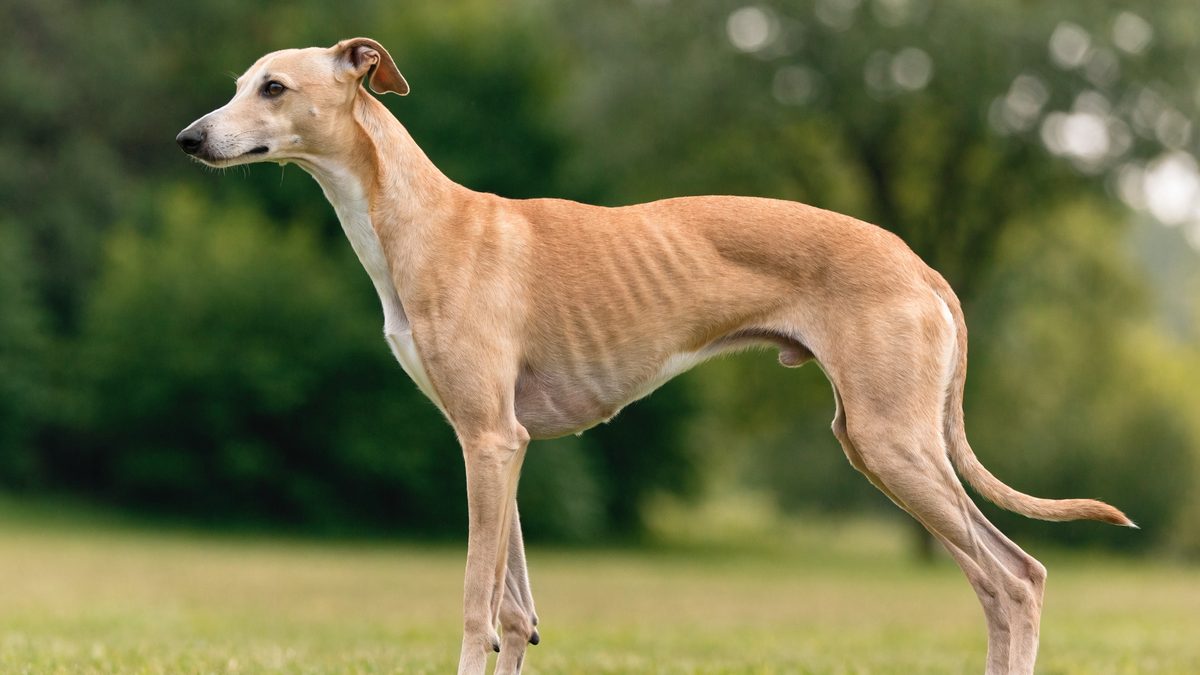
A Whippet is a medium-sized British sighthound standing 47 to 51 cm at the withers for dogs and 44 to 47 cm for bitches, built for short-distance pursuit by sight and kept today mainly as a quiet house companion. In India the first thing you need to know about the breed is not its price. It is that the dog most Indian buyers think they are looking at is a different breed entirely.
The Royal Kennel Club breed standard, last updated 1 April 2025, calls for a balanced combination of muscular power and strength with elegance and grace of outline, built for speed and work, with all forms of exaggeration avoided. Desirable height is 47 to 51 cm (18.5 to 20 inches) for dogs and 44 to 47 cm (17.5 to 18.5 inches) for bitches. The coat is fine, short and close in texture. Any colour or mixture of colours is allowed, with merle explicitly unacceptable. The FCI standard, No 162, places the breed in Group 10 Sighthounds, Section 3 Short-haired sighthounds, gives Great Britain as the country of origin, and repeats the same height figures and the same merle exclusion.
Four published sources, four different heights
Here is the first thing no ranking page tells you. The published adult size of this breed is not settled, and the spread is wide enough to change which dog you think you are buying.
| Source | Height, dogs | Height, bitches | Weight |
|---|---|---|---|
| Royal Kennel Club standard | 47 to 51 cm (18.5 to 20 in) | 44 to 47 cm (17.5 to 18.5 in) | Not specified |
| FCI-Standard No 162 | 47 to 51 cm (18.5 to 20 in) | 44 to 47 cm (17.5 to 18.5 in) | Not specified |
| AKC standard | 19 to 22 in (48 to 56 cm) | 18 to 21 in (46 to 53 cm) | Not in the standard; AKC breed page gives 25 to 40 lb |
| American Whippet Club fact panel | 18.5 to 22.5 in | 17.5 to 21.5 in | 25 to 40 lb |
| DogsIndia breed panel | 43 to 51 cm, sexes not separated | 43 to 51 cm, sexes not separated | About 13 kg |
| Puppiezo Indian sales panel | 18 to 22 in, sexes not separated | 18 to 22 in, sexes not separated | 8 to 16 kg |
The gap is real and it matters. A dog at the AKC ceiling of 22 inches is 56 cm, five centimetres above the Royal Kennel Club's upper limit, and the AKC disqualifies anything more than half an inch outside its own range. The Indian panels are looser again, with one publishing a 43 cm floor that sits below every kennel club minimum. Bonbeno does not average these. Decide which standard your breeder claims to breed to, then measure against that one.
Weight is looser still, running from about 9 kg in the PLoS Genetics description of a typical whippet to 25 to 40 pounds, roughly 11 to 18 kg, from the AKC and the breed club. Use the measured figure instead: median weight across 200 healthy adults was 15 kg, range 9 to 22 kg. That comes from weighing real dogs rather than from a specification table.
The Greyhound confusion, settled with a ruler
The Whippet is not a small Greyhound and it is not a large Italian Greyhound, and the three separate cleanly on height. Bonbeno's Greyhound page names Whippet confusion as a hero reject criterion for exactly this reason, and the kennel club ladder is the fastest test you can run before you pay.
| Breed | Height at withers, dogs | What settles it |
|---|---|---|
| Greyhound | 71 to 76 cm | Roughly half as tall again as a Whippet. See the Greyhound page |
| Whippet | 47 to 51 cm | Same outline, two-thirds the frame. Rose ears, deep brisket, definite tuck up |
| Italian Greyhound | 32 to 38 cm | A toy dog. See the Greyhound page for the standard figures |
The Royal Kennel Club is direct about where the confusion came from. Early breed standards of both the Whippet and the Italian Greyhound referred to a greyhound in miniature, but the conformation of all three has developed along different paths since. A modern Whippet is its own breed, not a scaled drawing of another one.
History, kept to what is documented
Dogs of Whippet type were common in the Middle Ages, and genetic studies in the twenty-first century determined that the breed originated from the Greyhound, a Celtic breed known to the Romans as Vertragus. By the nineteenth century the Whippet was a recognisable breed used for hunting small game and killing vermin, which the Victorians developed into a gambling sport. Whippet racing became popular in the mining areas of the North of England and Wales, and also in London and the Midlands. The breed is now far more common in the show ring than on the track. The AKC records the nicknames that came out of that period, the Poor Man's Racehorse and the Lightning Rag Dog, and traces the name itself to whappet, an older word for a small dog that yaps.
The AKC gives up to 35 miles per hour, about 56 km/h, and calls the Whippet the fastest breed of its size. The PLoS Genetics paper that sequenced the breed's myostatin gene uses the same 35 mph figure. An Indian breed directory publishes up to 65 km/h, about 40 mph. Bonbeno reports both and does not split the difference. Treat 35 mph as the figure with a published source behind it in more than one place.
Temperament in the standards is unusually consistent across three registries. The Royal Kennel Club describes an ideal companion, highly adaptable in domestic and sporting surroundings, gentle and affectionate with an even disposition. The FCI repeats that wording word for word. The AKC adds the qualifier that matters most in an Indian street: amiable, friendly and gentle, but capable of great intensity during sporting pursuits. Everything difficult about keeping this dog in an Indian city follows from that second clause.
Whippet price in India, and the scarcity nobody reports
The Whippet price in India runs Rs 20,000 to Rs 60,000 across the published sources in 2026. The more useful fact is that almost nobody is selling one. India's largest puppy marketplace listed three Whippets in the entire country on the day this page was researched, against 549 Siberian Huskies, and India's biggest pet publisher leaves the breed off a 40-breed national price list altogether.
Two Indian publishers put a number on the breed. They disagree by Rs 5,000 at the floor and Rs 10,000 at the ceiling, which is a narrow spread by Indian standards and tells you something on its own: there is not enough trade in this breed for the numbers to have diverged.
| Source | Published puppy price | Published monthly cost | Listings available |
|---|---|---|---|
| Happy Pet Care | Rs 20,000 to Rs 50,000 | Rs 3,550 basic to Rs 5,400 premium | Not a marketplace |
| WrapInFur | Rs 25,000 to Rs 60,000 | Rs 3,500 to Rs 6,500 | Not a marketplace |
| Mr n Mrs Pet | Not shown without sign-up | Not published | 3 nationally |
| Puppiezo | Not shown on the breed page | Not published | 0 in stock on the day of the pull |
| Supertails 40-breed price list | Breed not listed | Breed not listed | Not a marketplace |
| DogsIndia breeders' list | No price published | Not published | 5 kennel listings, several past their renewal date |
How rare is rare, in numbers
Scarcity is measurable, and the measurement is sitting in plain sight on the marketplace page itself. Mr n Mrs Pet publishes a live count beside every breed it lists. On the Whippet page the count was 3, while the sidebar of most popular breeds on the same page showed Shih Tzu at 650, Siberian Husky at 549, Golden Retriever at 487, Labrador Retriever at 454, German Shepherd at 412, Beagle at 274, Poodle at 263, Rottweiler at 162, Pomeranian at 136 and Cane Corso at 134. A YouTube result ranking on page one for this query is literally titled Very Rare Dog Breed WHIPPET in India. The SERP is telling you the answer before you click anything.
That has three practical consequences for your budget and your timeline.
- Waiting is normal. With three listings nationally, you are not choosing between litters, you are joining a queue for one. Plan on months, not weekends.
- Travel is normal. Every Whippet kennel on India's oldest breeder directory is in the south: Chennai, Bengaluru and two in Coimbatore. If you are in Delhi or Kolkata, the dog is coming to you by air or you are going to it.
- Stale listings are normal. Of the five kennel entries on that directory, one carries a renewal date of 2013 and another of 2024. Treat every Indian Whippet listing as out of date until you have spoken to a human.
What the price is actually tracking
Four things move the number, and only two of them are worth paying for.
- Imported bloodline. The Indian kennel listings name sires and dams imported from or titled in Germany, Australia, New Zealand and Hong Kong. Import and quarantine costs are real and they sit in the price. This is the single biggest legitimate driver in a breed this scarce.
- Kennel Club of India registration. Marketplaces sort Indian puppies into pet quality, KCI registered and champion bloodline tiers. The Kennel Club of India publishes its own litter registration, single dog registration, transfer of ownership and prefix or affix forms, along with a revised tariff sheet effective 1 April 2024. A KCI certificate documents pedigree. It is not a health certificate, and it says nothing about whether the sire and dam were screened for the heart problem covered later on this page.
- Show potential. Indian Whippet litters are advertised for show homes rather than pet homes. If you want a companion, say so, and expect to be offered a puppy the breeder has graded out of the show ring. That dog is not worse. It is cheaper for reasons that have nothing to do with health.
- Colour. Ignore it. Every kennel club allows any colour or mixture of colours, and the AKC standard says in two words that colour is immaterial. Only merle is excluded, and a merle Whippet is a red flag about the pedigree rather than a premium.
With three dogs listed nationally, a Rs 12,000 Whippet advertised in a city with no Whippet kennel is far more likely to be a young Indian sighthound or a sighthound cross than a purebred Whippet. Published Indian prices for the Mudhol Hound start at Rs 3,000 and for the Chippiparai at Rs 4,000. Those are excellent dogs sold honestly at honest prices. What you must not do is pay a Whippet price for one, or a low price and assume you got a bargain. Measure the puppy's parents against the 47 to 51 cm standard before anything else.
Bonbeno reports these figures as published editorial, not as offers. We do not broker puppy sales and we do not list breeders. Where the sources disagree, both numbers are printed above so you can price the uncertainty into your own decision rather than take one publisher's word for it.
Monthly cost of keeping a Whippet in India
Budget Rs 3,500 to Rs 6,500 a month, then add two lines that no published Indian estimate contains. The Whippet is a genuinely cheap dog to run by imported-breed standards, because a short-coated 15 kg dog eats less than a Labrador and needs almost no professional grooming. The costs that catch Indian owners out are cardiac screening and year-round tick prevention.
Two Indian publishers give a monthly figure for this breed. They agree closely, which is unusual, and both are generic templates rather than Whippet-specific research.
| Line item | Happy Pet Care | WrapInFur |
|---|---|---|
| Food | Rs 2,250 to Rs 3,000 | Not itemised |
| Veterinary | Rs 600 to Rs 1,200 | Not itemised |
| Grooming | Rs 700 to Rs 1,200 | Not itemised |
| Published monthly total | Rs 3,550 to Rs 5,400 | Rs 3,500 to Rs 6,500 |
Take the grooming line with suspicion. The AKC states that the Whippet's short, smooth coat needs little maintenance beyond regular weekly grooming with a brush and the occasional bath, and the Royal Kennel Club rates grooming for this breed at once a week. A dog you can groom yourself in ten minutes on a Sunday does not need Rs 1,200 a month at a salon. Most Indian Whippet owners can delete that line and spend it on the two below.
The two lines the published estimates miss
- Cardiac screening. The American Whippet Club recommends that breeding stock be given periodic echocardiograms, and the AKC lists a cardiac exam as one of three recommended health tests from the national breed club. For a pet Whippet the practical version is an echocardiogram by a cardiologist if and when a murmur is heard, and the health section on this page explains why an Indian general practice vet will very probably hear one. Bonbeno found no published Indian price for a veterinary echocardiogram, so no figure is quoted here. Ask your nearest referral hospital before you buy the dog, not after.
- Year-round tick prevention. In a survey of 525 dogs across Delhi, Mumbai, Sikkim and Ladakh, 278 dogs (53 percent) were visibly infested with ticks and 261 (49.7 percent) carried at least one tick-borne pathogen by PCR. That survey was dominated by strays and shelter dogs, 77 percent and 23 percent respectively, so it does not describe a well-kept house pet. It does describe the environment your Whippet will run in.
One-time costs to plan for
- Soft, deep bedding. With almost no subcutaneous fat, a Whippet develops pressure sores on hard surfaces, and Indian tile is the worst case. Buy a proper orthopaedic bed, not a mat.
- A coat for winter and for air conditioning. Geriatric Whippets need extra warmth, commonly supplied as sweaters and fleece pyjamas. In Delhi, Lucknow or Chandigarh, plan for this from year one.
- A secure run or a long line. The AKC says always keep the dog on lead when not in a fenced area, which in an Indian city means paying for fenced access or buying a 15 metre line.
- Air travel from a southern kennel. Every listed Indian Whippet kennel is in Tamil Nadu or Karnataka, so a northern buyer should price transport into the purchase.
Feeding cost is the one line you can predict with confidence, because it scales with a body weight the studies actually measured. At a median 15 kg, the Whippet sits between an Indie and a Labrador. One Indian publisher puts daily energy requirement at 1,100 kcal for puppies and 800 kcal for adults and monthly food at Rs 2,250 to Rs 3,000. Treat that as a starting estimate, then correct it against body condition using the method in the feeding section rather than against the bag.
Three genuinely expensive problems in Indian dog keeping barely touch this breed. Hip and elbow dysplasia are described by the breed club as essentially unknown in the Whippet. There is no double coat to blow twice a year, so there is no de-shedding bill and no summer clipping argument. And the Royal Kennel Club recommends no breed-specific DNA test for the Whippet at all, listing only the general good-practice item of prioritising genetic diversity. Very few imported breeds in India can say that.
Heat tolerance, cold intolerance and the Indian climate
Bonbeno rates the Whippet 4 of 5 for heat tolerance and 1 of 5 for cold tolerance, and that second number surprises Indian buyers far more than the first. A fine, short, close coat sheds heat efficiently and the breed is absent from the standard high-risk heat-stroke lists. The same coat, over a body with almost no subcutaneous fat, makes this one of the least cold-tolerant dogs you can keep in a North Indian winter or on a tiled floor under an air conditioner.
Start with what the evidence does and does not say. Purina India's heat-stroke guidance names the breeds at particular risk as short-faced dogs such as Boxers, Bulldogs, Pugs and Pekingese, and dogs with heavy coats such as Huskies and Newfoundlands. The Whippet is neither. It has a long muzzle, a single fine coat and a high surface area for its 15 kg Stepien RL, Kellihan HB. That is a real advantage over most imported breeds sold in India, and one ranking page is not wrong to call the breed well suited to the climate. It is just not the whole answer.
Purina India is equally clear that all types of dogs can suffer heat exhaustion given the right conditions, and lists the risk factors that actually apply here: lack of water, enclosed space, excessive humidity, intense exercise and lack of acclimatisation. Read that list against a sighthound and the Whippet-specific danger becomes obvious. The walk is not what hurts this breed. The sprint is.
Why a sprinter is a different heat problem
The AKC describes Whippets as sprinters by nature, and says adequate exercise can take the form of several vigorous retrieving sessions a week with a ball or flying disc, or play sessions with another dog in a safely fenced area. That is a dog capable of 35 mph going from lying on the sofa to full output in about two seconds, with no build-up and no self-regulation. Purina India records that a dog can develop heat stroke in as little as 30 minutes of vigorous exercise in hot weather, that a raised temperature of 40.5 C or above is a warning sign, and that cooling should stop once the dog reaches 39.4 C to avoid tipping into hypothermia.
- Never let a Whippet run flat out in Indian daytime heat, even for one lap. A single 30-second sprint at 2 pm carries more risk than an hour of walking at 6 am.
- Cool the dog before it feels hot to you. Spray or sponge with cool, not cold, water so it reaches the skin, wet the belly and inside the legs, and use a fan. Never use an ice bath, which prevents the core temperature falling.
- Never leave the dog in a car. At 26 C outside, a car reaches 32 C in five minutes and 43 C in 25 minutes.
The warming-nights problem, which is new
The standard Indian advice for any heat-sensitive dog is to walk before 7 am and after 8 pm. That window is closing, and this is the part no competing Whippet page covers. India Meteorological Department data reported in 2026 shows that in the last week of May, minimum night temperatures across many parts of India were 3.1 C to 5.0 C warmer than normal, with several locations recording minimums close to 30 C.
| Measure | Figure | What it changes |
|---|---|---|
| India's 1991-2020 average minimum temperature | About 21 C | The baseline your evening walk was measured against |
| 2025 annual departure, maximum vs minimum | Max 0.10 C above the 1991-2020 average, minimum 0.49 C above | Nights warming roughly five times faster than days |
| Night-time warming rate, national and in 141 cities | 0.26 C per decade nationally, 0.53 C per decade in cities | Metro owners lose the cool window fastest |
| States and Union Territories with rising night temperatures | 35 out of 36 | No Indian city is exempt |
| Urban heat island effect | Urban centres 2 C to 10 C hotter than surrounding areas | Concrete releases stored heat all night |
| Smart Cities with recorded night-time heatwaves, 2001 to 2024 | 30 of 100 | Night heat is a measured event, not a feeling |
The IMD's own definition of a warm night requires the minimum temperature to be at least 4.5 to 6.4 C above normal while the maximum is 40 C or more, and a very warm night is a departure over 6.4 C. India has no policy for warm nights and most Heat Action Plans are still written around daytime maximums. Practically, that means the number your weather app shows at 9 pm is a worse guide than it used to be, and you should touch the pavement with the back of your hand before every summer walk rather than trust the forecast.
The cold side, which Indian buyers underrate
A Whippet gets cold indoors in India, and it gets cold in ways that look like other problems. The breed has a fine single coat and very little body fat, and the American Whippet Club advises that geriatric Whippets need additional warmth, which owners commonly supply as custom-made sweaters and fleece pyjamas, both to help maintain weight and to ease arthritis discomfort. Do not wait for old age to act on that in Delhi, Lucknow, Jaipur, Chandigarh, Shimla or Srinagar. A December night in the North Indian plains is well outside the 15 C to 30 C ideal weather band one Indian publisher gives for the breed.
The same problem appears year-round in air-conditioned flats and on bare stone or tile. Give the dog a soft, raised, insulated place to sleep that is not directly under the vent, and expect it to burrow under blankets, which is normal breed behaviour rather than a sign of illness.
Monsoon, and one honest conflict about vaccination
The monsoon brings a specific Indian risk that interacts badly with breed-club advice, and Bonbeno is going to print the conflict rather than resolve it for you. In a Kerala study, 146 of 205 dog sera (71.12 percent) tested positive for leptospiral antibodies by microscopic agglutination test, with serovar Autumnalis the most prevalent, followed by Australis and Pomona. The authors note that the commercial vaccines in use contained Icterohaemorrhagiae and Canicola, and concluded that the emergence of serovars outside the vaccine composition needs addressing, because immunity is largely serovar specific.
The American Whippet Club records that some breeders have found Whippet puppies can be sensitive to the leptospirosis component of some combination shots and recommend it is not given to puppies, while adding that this advice should be tempered by how prevalent the disease is in your area. In Kerala, coastal Karnataka, Tamil Nadu and Maharashtra, prevalence is not theoretical. Bonbeno is not going to tell you which way to go on a live clinical decision. Take both of these paragraphs to your veterinarian, ask what serovars are circulating locally, and decide with them.
Temperament, household fit and the Indian street problem
A Whippet is a quiet, gentle, affectionate house dog that sleeps most of the day and asks for very little, with one hard constraint that governs everything else. Its prey drive is silent, instant and faster than your reaction time. In a British field that is a manageable quirk. On an Indian road with street cats, pigeons, chickens and two-wheelers, it is the single thing most likely to kill the dog.
Three registries describe the same animal. The Royal Kennel Club and the FCI both call the Whippet an ideal companion, highly adaptable in domestic and sporting surroundings, gentle and affectionate with an even disposition Federation Cynologique Internationale. The AKC standard says amiable, friendly, gentle, but capable of great intensity during sporting pursuits. The AKC breed page fills in the domestic half: between bursts of intense pursuit, Whippets love to stretch out and relax for long hours, they do nicely in cosy apartments as long as they are exercised properly, and they rarely bark.
For an Indian flat, that last point is worth more than it sounds. A dog that does not bark at every lift door and every delivery is a dog your neighbours will tolerate. An Indian sales page lists quiet nature as the specific reason the breed suits apartments, and it is one of the few claims on that page the kennel clubs support.
What living with one is actually like
- Velcro-close indoors. Whippets attach hard to their people and are notorious for laid-back couch cuddling despite the racing background.
- Blanket burrowers. They sleep under covers by preference, which is a thermoregulation behaviour in a thin-coated dog rather than a personality quirk.
- Sensitive to correction. They are easily affected by harsh words or scolding, and positive reinforcement is the only approach that works.
- Playful for life. The puppy-like playfulness does not fade with age, and neither does the occasional indoor zoomie, which in a small Indian flat means moving anything breakable.
- Rain-averse. Many dislike wet walks, which in an Indian monsoon means planning indoor enrichment rather than winning an argument.
The silent chase, and why Indian traffic is the real risk
Whippets hunt using a silent prey-chasing technique, and you may not notice the dog is hunting until the chase is over. That is the opposite of most breeds, which telegraph a lunge with barking or a stiffened posture. A Whippet simply goes, at up to 35 mph, from a standing start, in the direction of something you have not yet seen.
The breed club puts the traffic point more bluntly than any Indian page does. Writing about deaf Whippets, the American Whippet Club notes they make successful pets if trained to hand signals and kept safe from traffic, which hearing Whippets often ignore as well. Read that sentence twice. A breed club telling you that hearing dogs of its own breed routinely ignore traffic is as strong a warning as you will find in this literature, and it maps directly onto Indian roads.
The AKC instruction is to always keep your Whippet on lead when not in a fenced area, and to confine young Whippets safely when unsupervised because they are smart, agile, mischievous, and can jump and climb. In an Indian context that means no off-lead beach walks, no off-lead park time in an unfenced park, and no trusting a recall that has worked a hundred times. The hundred and first time there is a cat.
Who should buy this breed, and who should not
The Whippet suits a specific Indian household and fails badly outside it.
| Situation | Verdict | Why |
|---|---|---|
| Apartment with a quiet routine and a fenced space nearby | Strong fit | Quiet, low-shedding, sleeps most of the day, needs up to an hour of exercise |
| Family with older children | Good fit | Gentle and family-friendly when socialised early, with supervision |
| Household with a resident cat, rabbits or poultry | Proceed carefully | The chasing instinct triggers on smaller animals; early socialisation helps but does not remove it |
| Buyer who wants a guard dog | Wrong breed | Gentle, affectionate and even-tempered by standard, with no guarding brief anywhere in it |
| Buyer with no access to any safely fenced ground | Wrong breed | The AKC exercise brief is built entirely around a securely fenced area |
| Home that uses shouting or physical correction to train | Wrong breed | Whippets are sensitive and shut down under harsh handling |
One more Indian-specific point. A Whippet is a thin-skinned dog with no protective coat and it generally gets the worst of any dogfight, according to its own breed club. In neighbourhoods with a confident free-ranging dog population, walk with a route in mind rather than a wander, and do not let a first meeting happen in a narrow lane.
Training a Whippet, and the test to run before you blame the dog
Train a Whippet with short, gentle, reward-based sessions, start puppy classes as early as your vaccination schedule allows, and accept from day one that off-lead recall will never be fully reliable. If your Whippet's recall is genuinely worse than it should be, book a BAER hearing test before you conclude the training failed. A small percentage of Whippets hear in only one ear, and you cannot detect that any other way.
The AKC's training brief for the breed is short and it says two things. Early socialisation and puppy training classes are recommended and help ensure the dog grows into a well-adjusted, well-mannered companion. And young Whippets are smart, agile and mischievous, they can jump and climb, so confining them safely while unsupervised is a must. Indian owners tend to act on the first and skip the second, then discover the puppy on the kitchen counter.
Temperamentally the breed rewards patience and punishes pressure. Whippets can have a stubborn streak, and patience with positive reinforcement works where correction does not, because they are sensitive and easily affected by harsh words or scolding. Choke chains, shouting and the alpha-rollover advice still circulating in Indian dog training will produce a shut-down dog rather than a trained one. There is no version of this breed that responds to force.
A realistic first-year training order
- Socialise first, obedience second. Get the puppy meeting people, surfaces, lifts, traffic noise and calm adult dogs while it is still small enough to carry, working around the vaccination schedule your vet sets.
- Train a hand signal for every verbal cue. Do this whether or not you suspect a hearing problem. It costs nothing, and it is the exact method the breed club recommends for deaf Whippets.
- Build an emergency stop, not just a recall. A sighthound already in a chase is not listening. A trained stop, taught on a long line at low arousal, is the cue that has a chance.
- Teach lead manners on a wide, padded harness or a martingale. A Whippet's neck is long and muscular and its head is narrower than its neck, so a plain flat collar slips off.
- Practise handling for the vet. Feet, ears, mouth and, above all, standing still with a stethoscope on the chest. You will be doing that a lot with this breed, for reasons the health section explains.
The BAER test, and why it belongs in a training section
Congenital deafness is rare in the Whippet but the breed club recommends that all breeding stock be tested for normal hearing in both ears, and the AKC lists BAER testing as one of three recommended health tests from the national breed club American Kennel Club. The important detail for a pet owner is this one: a small percentage of Whippets have unilateral hearing, meaning they hear well from one ear but not the other, and such dogs generally cannot be distinguished from normally hearing Whippets without the BAER test.
A unilaterally deaf dog cannot locate where your voice is coming from. It hears you and looks the wrong way. In a training class that reads as distraction or stubbornness. On an Indian road it means the dog turns towards the traffic instead of away from it. If a Whippet puppy from an Indian litter comes without a BAER result, ask the breeder whether the sire and dam were tested, and get it done yourself if the answer is vague.
Do not spend two years trying to build a bombproof off-lead recall in open ground. The AKC's own instruction is to always keep your Whippet on lead when not in a fenced area, and the chase is silent, so you get no warning. Spend that effort on a long line, a fenced space and an emergency stop instead. This is a breeding trait, not a training failure.
How much exercise a Whippet actually needs
Give a Whippet up to one hour of exercise a day, split into two walks plus regular access to a securely fenced space where it can sprint, and it will sleep through the rest. That is the Royal Kennel Club figure, and it is lower than most owners expect from a racing breed. The published Indian figures disagree with each other, and one ranking page contradicts itself on the same URL.
The Royal Kennel Club puts the Whippet at up to 1 hour per day, with a small house and a small to medium garden listed as the ideal home. Two Indian pages give 30 minutes to 1 hour daily Happy Pet Care, Whippet Dog Breed: Price. The same Indian page that publishes a 30 to 60 minute exercise routine in its health panel answers its own FAQ with 1 to 2 hours of daily exercise. Bonbeno prints the contradiction rather than picking a side, and recommends you plan for the Kennel Club's up-to-an-hour and adjust to the dog in front of you.
| Source | Published requirement |
|---|---|
| Royal Kennel Club | Up to 1 hour per day |
| Puppiezo, India | 30 minutes to 1 hour daily |
| Happy Pet Care health panel | 30 to 60 minutes |
| Happy Pet Care FAQ, same page | 1 to 2 hours daily |
Quality beats quantity in a sprinting breed
The AKC frames the requirement by type rather than by clock. Whippets are sprinters by nature, and adequate exercise can take the form of several vigorous retrieving sessions a week with a ball or flying disc, regular walks, or play sessions with another dog in a safely fenced area, with organised activities such as lure coursing and agility as healthy outlets for the breed's energy. In other words, two hours of pavement plodding is worse for this dog than 40 minutes of walking plus one genuine run.
The counterweight comes from an Indian veterinary source and it is worth taking seriously. Regular exercise is vital, but overexertion can strain their slender bodies, so the right balance is moderate daily walks with occasional sprints. This is not a dog you take on a 15 km run. It is a dog you take on a 3 km walk and then let off in a safe enclosure for four minutes.
The Indian surface problem
Where a Whippet runs matters more in India than in Britain, because the available ground is harder and dirtier. The breed club reports that the most common injuries in the breed are skin lacerations and athletic or orthopaedic injuries, particularly to the toes, that a Whippet's skin can be torn if it runs fast through underbrush because it has no protective coat, and that toe injuries generally require a period of crate rest and reduced activity to heal.
- Avoid gravel, rubble, construction debris and thorny scrub. These are the standard surfaces of an Indian empty plot and the standard cause of a split toe or a torn pad, and skin lacerations in this breed come from running through cover.
- Check the pavement with the back of your hand before any summer walk. A thin-coated dog is not a heat-proof dog when its feet are on stored heat.
- Inspect feet after every run. Seek veterinary advice promptly if your Whippet comes up lame or with a swollen toe.
- Restrain the puppy. Free play beats forced distance for the first year, because a young Whippet's frame is still growing.
Exercise the dog on grass, sand or packed earth wherever you can find it, and reserve the sprint for ground you have walked over yourself first. One honest gap. Bonbeno found no published Indian lure coursing circuit or organised sighthound racing schedule during this research. In Britain the infrastructure is a century old: The Whippet Club, founded in 1899 and the world's first Whippet breed club, still runs the Whippet Club Racing Association and published full results from its third WCRA Championships in 2026. India has no equivalent. The AKC recommends lure coursing as the breed's natural outlet, and in India that will most likely mean improvising with a flirt pole in a fenced space rather than joining an event. If you know of an active Indian circuit, that is genuinely useful information the internet does not currently have.
The AKC's own light-hearted framing is that Whippets need regular exercise unless you want to deal with a torn couch. In practice an under-exercised Whippet in an Indian flat gets destructive, does indoor zoomies into furniture, and becomes harder rather than more energetic to walk. The mental half matters too: a lack of mental stimulation is a real problem in this breed, and engaging toys and puzzles help.
Grooming a Whippet in Indian humidity
Groom a Whippet for about ten minutes once a week, and spend nine of those minutes on skin, teeth, nails and ears rather than on coat. The Royal Kennel Club rates grooming for this breed at once a week, and the coat is the easiest of any imported breed sold in India. What replaces coat work is a tick check, a tartar check and a laceration check.
The coat requirement is genuinely trivial. The standards call for hair that is fine, short and close in texture with no feathering anywhere Federation Cynologique Internationale, and the AKC says the short, smooth coat needs little maintenance beyond regular weekly grooming with a brush and the occasional bath. The Royal Kennel Club lists coat length as short, grooming as once a week, and confirms that the breed does shed. An Indian source rates shedding as low. Both are true: a Whippet sheds continuously and lightly rather than in seasonal blowouts, so you get hair on dark trousers but you never get the twice-yearly undercoat storm that a double-coated import brings.
The weekly ten minutes, in order
- Run both hands over the whole dog, feeling for cuts, punctures, lumps and any warm swollen toe. Skin lacerations are among the commonest injuries in the breed because there is no protective coat.
- Check every tick site, meaning ears, between toes, under the collar, armpits and groin. In an Indian survey of 525 dogs, 278 (53 percent) were visibly infested.
- Check the ears and the back molars. The AKC recommends regular ear checks for signs of infection, and rose ears fold along the neck and trap monsoon moisture. Look for tartar while you are there.
- Trim the nails, often, if they are not worn down naturally, because overly long nails cause discomfort.
- Then brush the coat. A hound glove, two minutes, finished.
Dental care is the line item that actually needs work
Dental disease is the grooming task that catches Indian sighthound owners out, and both the breed club and an Indian veterinary source flag it. The American Whippet Club advises attention be paid to dental health, that owners who cannot brush their Whippet's teeth or scale tartar themselves should have the veterinarian perform regular dental cleanings, and that while many owners give raw marrow bones or other chew items to help keep back molars free of tartar, in most cases this alone will not be sufficient, so the adult Whippet's mouth should be checked regularly. An Indian veterinary chain makes the same point in one line: regular dental care is essential in this breed.
Bonbeno's Greyhound page carries the full evidence on why dental disease dominates sighthound veterinary caseloads, including the primary-care prevalence figures. That evidence is Greyhound-specific and is not repeated here. What transfers cleanly to the Whippet is the practical instruction: brush, and if you will not brush, budget for scaling.
A tick on a Whippet is visible in three seconds. A tick on a double-coated import is found a week later when it has already fed. In a country where 53 percent of surveyed dogs were carrying ticks on visual inspection, being able to see the whole skin surface of your dog every day is a genuine health advantage, not a cosmetic one. Use it. Make the tick sweep a daily habit rather than a weekly one during and after the monsoon.
Bathing needs no schedule beyond the occasional bath the AKC describes. On a humid Indian afternoon, dry the dog properly afterwards, especially the ear folds and the skin behind the elbows, and do not leave a damp Whippet under a fan or an air-conditioning vent, because this breed loses heat fast and has almost no insulation to lose.
One last point about handling. Thin skin is the defining maintenance issue in this breed and it is the reason the weekly check comes before the weekly brush. The breed club records that without a protective coat a Whippet's skin can be torn if it runs fast through underbrush, and that suturing results in speedy healing. Treat a laceration as a same-day veterinary job rather than something to watch, and keep a clean dressing at home so you can cover the site on the way.
Health, the murmur trap, and what the sighthound picture does and does not transfer
The Whippet is one of the healthiest purebred dogs available in India, and its healthy heart both sounds and measures abnormal. In the largest study of the breed, 185 of 200 clinically healthy Whippets, 92.5 percent, had an audible left-sided systolic heart murmur. Most of those murmurs were innocent. An Indian general practice veterinarian who has never worked with the breed will hear one, and the two obvious responses, dismissing it or starting cardiac medication, are both wrong.
Start with the good news, because it is substantial. The breed club describes the Whippet as generally among the healthier breeds of purebred dog, with very few health problems requiring frequent maintenance or lifelong medication, and states that they are generally not prone to the frequent ear infections, skin allergies, joint problems, food allergies or digestive problems that afflict other breeds. Hip and elbow dysplasia are described as essentially unknown in the breed. The Royal Kennel Club places the Whippet in Breed Watch Category 1, meaning no points of concern specific to the breed have been identified for special attention by judges, and recommends no breed-specific DNA test at all, listing only the general good-practice item of prioritising genetic diversity.
The murmur trap, with the actual numbers
In a prospective cross-sectional study of 200 healthy client-owned Whippets examined at American Whippet Club national shows between 2005 and 2009, one cardiologist auscultated every dog and a second performed Doppler echocardiography, each blinded to the other's findings. The results are the most important veterinary facts on this page.
| Finding | Number | Share of the 200 dogs |
|---|---|---|
| Any left-sided systolic murmur | 185 | 92.5 percent |
| No murmur heard at all | 15 | 7.5 percent |
| Left basilar systolic murmur, typically the innocent flow type | 128 | 64 percent |
| Left apical systolic murmur, the type associated with mitral regurgitation | 57 | 29 percent |
| Mitral regurgitation confirmed on echocardiography | 76 | 38 percent |
A second, independent European study found the same phenomenon at a lower rate, and Bonbeno prints both rather than choosing. In 105 client-owned Whippets in Belgium, 44 of 105 (41.9 percent) had no murmur at all, meaning roughly 58 percent did. The point of maximal intensity was at the aortic valve in 50 dogs (47.6 percent), the pulmonic valve in 8 (7.6 percent) and the mitral valve in 3 (2.9 percent). Dogs with an aortic murmur had significantly higher aortic and pulmonic blood flow velocity and cardiac output than dogs without one, which is the signature of a flow murmur rather than a leaking valve. The authors found no influence of sex, of race-type versus show-type pedigree, or of whether the dog was in training.
So the honest range for how many healthy Whippets have an audible murmur is roughly 58 percent in a European population and 92.5 percent in a North American show population Stepien RL, Kellihan HB. Either figure destroys the assumption that a murmur in this breed is abnormal. Neither figure tells you that a murmur is safe to ignore.
Prevalence of echocardiographic mitral regurgitation rose steeply and predictably with age, correlating at r = 0.96 (p = 0.0028). It was present in 15 percent of dogs aged 2 years or under, 59 percent of 7 to 8 year olds, 72 percent of 9 to 10 year olds and 80 percent of dogs aged 13 or over. Male and neutered male dogs were affected more often than females, 50 of 96 (46 percent) against 32 of 104 (31 percent), p = 0.03.
Listening alone does not settle it. Detection of a left apical murmur of any intensity predicted echocardiographic mitral regurgitation with sensitivity 65 percent, specificity 94 percent, positive predictive value 86 percent and negative predictive value 81 percent. In the breeding-age subset of 85 dogs aged 2 to 5, sensitivity fell to 35 percent, meaning auscultation missed roughly two of every three affected young dogs. The authors' conclusion is unambiguous: Doppler echocardiographic examination may be required to exclude a diagnosis of mitral regurgitation in dogs with low-intensity left-sided systolic murmurs.
The healthy Whippet heart also measures abnormal
Two separate studies establish that a normal Whippet heart looks enlarged and under-contracting against general canine reference values. In 105 apparently healthy Whippets without cardiac symptoms, the breed had a significantly larger left ventricular diameter, increased left ventricular wall and interventricular septum thickness in both diastole and systole, and significantly lower fractional shortening than the general reference. The authors state plainly that breed-specific reference values are needed in order to avoid overinterpretation of cardiac dilation, hypertrophy or decreased contractility in these dogs.
The electrocardiogram tells the same story. In 105 healthy Whippets, the breed showed higher median R-wave amplitudes in several leads, and for P-wave amplitude, ST-segment deflection, T-wave amplitude and one R-wave lead, a marked percentage of Whippet values sat above the published maximum reference data. The authors concluded that Whippets have electrocardiographic characteristics similar to athletic heart syndrome in humans, that some of these could be erroneously taken as evidence of cardiac disease, and that clinicians should be aware of them to prevent unnecessary investigations in healthy dogs. If your Indian vet runs an ECG and reports abnormal amplitudes, that sentence is the one to quote.
A later study of 100 healthy North American Whippets found the same thing and added a twist that matters if your dog is fit. Conditioned Whippets had larger left ventricular chamber diameter and higher calculated left ventricular mass than unconditioned Whippets even after normalising for body weight, and may show eccentric left ventricular hypertrophy at peak condition. The paper's closing line is the one to take to your vet: normal values for cardiac size and function in North American Whippets might be considered abnormal if population-specific Whippet reference intervals are not used in analysis.
Do not accept a diagnosis and do not accept a dismissal. The breed club's position is that many Whippets have an innocent athletic or flow murmur throughout their lives, that some puppies are born with mild murmurs they outgrow, and that any murmur should nonetheless be considered serious enough to warrant an echocardiogram by an experienced veterinary cardiologist, because a portion of the population has minimal to mild mitral valve regurgitation which can progress to significant mitral valve disease. Ask for an echocardiogram, ask whether the cardiologist is using Whippet-specific reference intervals Stepien RL, Kellihan HB, Visser LC, and tell them whether the dog is in athletic condition.
The breed club is candid that cardiac disease is an area of mounting concern, driven partly by more sensitive diagnostic testing and partly by a widely held perception that cardiac problems have increased in recent years. It recommends periodic echocardiograms for breeding stock and that individuals with significant cardiac findings at younger ages not be bred, and records that it has worked with a research group on a long-term study of Whippet hearts since 2004. Valvular disease first appearing at 12 years or older is not considered genetic, but a by-product of ageing. If you are buying an Indian Whippet puppy, the single most useful question you can ask the breeder is what the sire and dam's echocardiograms showed.
The myostatin story, and the bully whippet
The Whippet carries the best-evidenced performance gene in dogs, and it comes with a DNA test. A 2007 PLoS Genetics study found a two-base-pair deletion at nucleotides 939 and 940 in the third exon of the myostatin gene, producing a premature stop codon at amino acid 313 and removing the last 63 amino acids of the 375-amino-acid protein, roughly 17 percent of it. Myostatin is a negative regulator of muscle mass, so losing it produces more muscle.
- Two copies produce a bully whippet. Dogs homozygous for the deletion are grossly over-muscled with broad chests and unusually developed leg and neck musculature. Owners report no health abnormality other than muscle cramping in the shoulder and thigh, and about 50 percent have a distinctive overbite.
- One copy produces a faster dog. Heterozygous males carried on average 17 percent more mass per centimetre of height, 0.333 kg/cm against 0.284 kg/cm (p = 0.00017), and the mutation explained roughly 60 percent of the variation in mass-to-height ratio and neck girth.
- And it shows up on the track. Among 85 genotyped racing dogs, 12 of 41 dogs in the two fastest grades carried the deletion, against 1 of 43 in the two slowest grades (p = 0.00073, Fisher's exact test). This was the first time a myostatin mutation was quantitatively linked to athletic performance in any species.
- It is not rare. In an unselected sample of 146 racing and non-racing Whippets, 20 were heterozygous and 2 were homozygous, so roughly 15 percent carried the deletion.
The practical Indian point is short. Inheritance is simple autosomal recessive, all bullies came from carrier-to-carrier matings, and a DNA test exists. If a breeder markets an unusually heavy, thick-necked Whippet as a superior specimen, that dog is a phenotype with a name and a genotype, not a better dog. If a breeder is mating two visibly heavy Whippets, ask whether both parents have been genotyped for MSTN. The paper also notes that bully whippets are often euthanised young because they do not conform to the breed standard, which is a welfare reason to test rather than guess.
Anaesthesia: what transfers from the Greyhound, and what does not
Bonbeno's Greyhound page sets out the sighthound clinical-pathology picture in full, including breed-specific haematology and biochemistry reference intervals, the thyroid over-diagnosis finding and the delayed postoperative bleeding protocol. That research is not repeated here. The honest question for a Whippet owner is how much of it applies, and the answer is: some of it, with published support, and some of it not yet.
| Finding | Status for the Whippet | Evidence |
|---|---|---|
| Breed-specific echocardiographic reference intervals needed | Established, twice, in the Whippet itself | 105 healthy Whippets and 100 healthy North American Whippets |
| High prevalence of innocent flow murmurs | Established in the Whippet | 185 of 200 healthy dogs had a murmur |
| Slow-metabolism CYP2B11-H3 haplotype affecting anaesthetic drugs | Present in the Whippet, but on a very small sample | H3 was found homozygous in a Whippet, and the paper places the Whippet in Sighthound Group 1 with the Greyhound, Scottish Deerhound, Irish Wolfhound, Borzoi and Italian Greyhound, noting H3 occurred in every Group 1 breed except the Irish Wolfhound |
| Low body fat prolonging recovery from lipophilic anaesthetics | Mechanistically applicable, and flagged for the Whippet by an Indian vet source | Anaesthetic sensitivity was originally attributed to naturally low body fat limiting redistribution of lipophilic drugs; an Indian veterinary chain tells owners to inform the vet of the breed before any procedure |
| Delayed postoperative haemorrhage and the antifibrinolytic protocol | Partly transfers, with a Whippet-specific prevalence figure and an explicit breed-foundation position | SERPINF2 mutations were present in 25 percent of 168 Whippets, yet clinical DEPOH appears uncommon in the breed. The Whippet Health Foundation still advises that preemptive aminocaproic or tranexamic acid should be a strong consideration before major surgery |
| Whippet-specific haematology reference intervals | Not located in this research | No published Whippet platelet or packed cell volume reference interval was found. Ask your laboratory whether it holds sighthound intervals |
DEPOH: the bleeding risk, with a Whippet-specific number
Bonbeno's Greyhound page documents delayed postoperative bleeding in that breed and the antifibrinolytic protocol used to prevent it. The obvious question is whether a Whippet owner needs to care, and the Whippet Health Foundation has published a direct answer, co-authored by Guillermo Couto, the clinician whose group first described the condition in Greyhounds.
The condition is now called Delayed Postoperative Hemorrhage (DEPOH). Affected dogs bleed excessively 36 hours or more after routine surgery or trauma despite normal coagulation test results. The mechanism identified by Court's group at Washington State University is a mutation in SERPINF2, the gene producing antiplasmin, an inhibitor of the fibrinolytic system. Without enough antiplasmin, fibrinolysis runs unchecked and clots break down.
- The mutation is present in Whippets, and the two published framings differ. The Whippet Health Foundation reports SERPINF2 mutation prevalence in 168 Whippets at 25 percent, roughly 5 percent MUTANT/MUTANT and 20 percent MUTANT/Normal. The primary breed survey, covering 4,359 dogs across 63 breeds, reports the Whippet's variant allele frequency at 25 percent, placing it in the moderate band whose high-risk T/T genotype prevalence ran from 5 to 13 percent. Those are two different measurements that happen to share a number, so do not read them as confirming each other.
- The Whippet is materially lower risk than the Greyhound. In the same survey, Greyhounds had the highest T/T genotype prevalence at 29 percent, which sits inside the 26 to 30 percent of Greyhounds affected by DEPOH in prospective studies. Irish Wolfhounds came second at 24 percent and Scottish Deerhounds eighth at 6 percent. Nine of 16 sighthound breeds had T/T prevalence of at least 5 percent, while none of 47 non-sighthound breeds did.
- The disease still appears uncommon in Whippets. The Foundation states plainly that despite the apparently high prevalence of the mutation, DEPOH appears to be uncommon in the breed, and to date case reports have been published only for Greyhounds, Scottish Deerhounds and now one Irish Wolfhound.
- The link is only validated in one breed. The correlation between SERPINF2 mutations and DEPOH has been validated only in Scottish Deerhounds, and it is not known whether the mutation confers additional DEPOH risk in Whippets.
- The test exists but may not help you. Washington State University offers the DEPOHGEN cheek-swab test, valid for use in Whippets, but the Foundation says its practical value as a predictor of DEPOH has not yet been shown in most sighthound breeds including this one.
- The protocol advice is still yes, for major surgery. For abdominal, thoracic, cancer or amputation surgery, the Foundation advises families and veterinarians that preemptive aminocaproic or tranexamic acid should be a strong consideration, noting the safety profiles of both drugs are very broad.
In most dogs with DEPOH the surgical site bruises within 36 hours of surgery, and the bleeding under the skin may extend beyond the surgical site. After trauma, the affected site starts bleeding roughly 36 hours after the event with new fresh blood appearing. The Foundation notes this also applies to bleeding after dental extractions. In India, dogs are routinely discharged the same day. Ask to be told what to look for, keep the dog under direct observation on day two rather than day one, and photograph the site each morning so you can tell bruising from shadow.
The mechanism behind sighthound anaesthetic sensitivity is now partly genetic rather than purely anatomical. Greyhound livers metabolise CYP2B11 substrates more slowly and carry less CYP2B11 protein, and the CYP2B11-H3 haplotype showed over 70 percent lower gene expression than the reference haplotype in reporter assays. Compared with 63 other dog breeds, Greyhounds had the highest H3 allele frequency, at nearly 60 percent in AKC Greyhounds, and H3 was significantly more prevalent among sighthounds generally. A Whippet in that study was homozygous for H3. One dog is one dog, and Bonbeno is not going to inflate that into a breed frequency. It is, however, enough to justify telling your surgeon that your dog is a sighthound before any procedure.
What else is on the list, and how heavily
- Genetic eye defects are found but quite uncommon, and blindness in young dogs is very rare. The club still recommends eyes checked clear on all breeding stock, and the AKC lists an ophthalmologist evaluation among its three tests.
- Congenital deafness is rare but detectable in very young puppies, and all breeding stock should be BAER tested.
- Hypothyroidism is present but relatively uncommon, with a large national-show sample showing a very low incidence of thyroid concern.
- Idiopathic epilepsy is sporadic and rare, usually appearing between 1 and 3 years of age and treatable with medication. Addison's disease and certain autoimmune blood and skin disorders are rare but documented.
- Fibrocartilaginous embolism, arthritis, cancer and kidney disease appear in older Whippets, though the breed should stay fairly active until geriatric.
Life expectancy, and what the biggest study actually shows
Published life expectancy for the Whippet clusters tightly at 12 to 15 years, and the sources still manage to disagree with themselves. The AKC gives 12 to 15 years. The American Whippet Club says most Whippets will live 12 to 15 years in its body text and prints 12 to 14 years in its own fact panel on the same page. Indian publishers give 12 to 14 and 12 to 15 Puppiezo, Whippet Puppies For Sale in India…. The Royal Kennel Club simply says over 12 years.
The largest UK longevity dataset, covering 584,734 dogs including 284,734 deceased across 155 breeds, put median survival at 12.5 years across all dogs, 12.7 years for purebreds and 12.0 years for crossbreds, with females outliving males 12.7 to 12.4 years. The Whippet appears in neither the ten breeds most at risk of early death nor the nine least at risk in that study. It does have a row of its own in that study's breed table, and the row is better than the middle: median survival 13.4 years, with a 95 percent confidence interval of 13.2 to 13.7 years, from 1,483 recorded deaths, and a hazard ratio of 0.70 (0.66 to 0.73) against the crossbred group at p<0.001. So the breed sits above the 12.5-year all-dog median and above the 12.7-year purebred median on a large sample, rather than merely avoiding both extreme lists. For context, the Italian Greyhound made the least-at-risk list at a median 14.0 years.
There is no Indian lifespan series, no Indian breed registry count and no Indian morbidity dataset for the Whippet. Every survival figure on this page comes from the UK or the United States. Any Indian page quoting a Whippet lifespan specific to Indian conditions is extrapolating, and so is Bonbeno if it pretends otherwise. What Indian conditions plausibly change is not the genetics but the exposure: heat, traffic, ticks and monsoon-borne infection Ambily R, Mini M, Joseph S, Krishna SV Purina India, Heat Stroke in Dogs.
The Indian confounder nobody mentions
One Indian factor deserves its own paragraph because it collides with sighthound physiology. In a PCR survey of 525 dogs across Delhi, Mumbai, Sikkim and Ladakh, 261 dogs (49.7 percent) carried at least one tick-borne pathogen, with Hepatozoon canis at 30 percent and Ehrlichia canis at 20.6 percent the two commonest, and 39 percent of infected dogs carrying more than one pathogen at once. Ehrlichia canis prevalence was 39.5 percent in Delhi and 27.2 percent in Mumbai, against 0 percent in Sikkim and 0 percent in Ladakh. That population was 77 percent strays and 23 percent shelter dogs, so it overstates the risk to a house pet, but it establishes the environment.
Canine ehrlichiosis characteristically lowers platelet counts. Sighthound haematology already differs from the general canine reference, as Bonbeno's Greyhound page documents in detail. Bonbeno located no published Whippet-specific platelet reference interval during this research, so it will not claim one. The practical instruction stands regardless: if an Indian laboratory reports low platelets in your Whippet, the answer is a tick-borne disease panel and a conversation about breed-specific intervals, not a shrug in either direction.
Feeding a Whippet in India, and what correct body condition looks like
Feed a Whippet a high-quality complete food split across two meals, keep it visibly lean for life, and judge condition by counting vertebrae rather than by reading a scale. The AKC gives an unusually precise target for this breed: a mature adult should not appear ribby, but should have two to four visible vertebrae, with hipbones that do not look sunk into dimples of fat. In India, the hard part is not feeding correctly. It is withstanding everyone who tells you the dog is starving.
The AKC's nutrition brief is the standard one. A Whippet should do well on a high-quality dog food, commercially manufactured or home-prepared with your veterinarian's supervision and approval, appropriate to the dog's age, with clean fresh water available at all times, and with treats counted because too many cause obesity. Indian sources add that the diet should be protein-rich with minimal fillers and no artificial additives or preservatives, and that maintaining lean weight is crucial for joint health in a slender athletic dog.
One Indian publisher gives a daily energy figure: 1,100 kcal for puppies and 800 kcal for adults, with monthly food cost at Rs 2,250 to Rs 3,000. Treat that as an opening estimate for a median 15 kg dog and then correct it against the dog's body rather than the bag.
The vertebra test, which is the whole method
This is the most useful paragraph on this page for day-to-day ownership, and it comes straight from the breed's own authorities. The AKC states that the Whippet frame is not well suited to carrying excessive weight, that young Whippets may appear gangly and have difficulty keeping their ribs covered during rapid growth, and that a mature adult should not appear ribby but should have two to four visible vertebrae with hipbones not sunk into dimples of fat. It adds that a Whippet at a healthy weight will likely appear skinny to people accustomed to heavier-bodied breeds, and that lifelong portion control will extend the dog's life and avoid many painful and expensive orthopaedic problems.
The American Whippet Club words the same test slightly differently, and the difference is worth keeping: you should be able to detect at least two vertebrae at the top of the spine, the ribs should not protrude but should be easily felt under a thin layer of flesh, and the hipbones should not be sunk into fat so as to give the appearance of dimples.
| What you see | Verdict | Action |
|---|---|---|
| Ribs protruding sharply, hip bones prominent, no muscle over the loin | Too thin | Increase portions and see a vet. This is not the breed standard, it is a dog in deficit |
| Two to four vertebrae visible, last ribs faintly visible, ribs easily felt under a thin layer of flesh, clear muscle over thigh and loin | Correct | Hold. This is the target American Whippet Club, Whippet Health |
| No vertebrae visible, ribs hard to feel, hipbones sunk into dimples | Overweight | Cut portions and treats. Excess weight is specifically flagged as an orthopaedic risk in this frame |
A correctly conditioned Whippet in an Indian park will attract comment. Neighbours, relatives, watchmen and occasionally veterinarians who have never handled a sighthound will tell you the dog is underfed. The AKC anticipated this exact situation: a Whippet at healthy weight will likely appear skinny to those accustomed to heavier-bodied, less fleet breeds. Learn the two-to-four vertebrae test, be able to state it, and do not feed your dog up to satisfy an audience. Obesity in this frame costs more than the conversation does.
Life stages
- Puppy. Expect gangly. Young Whippets have difficulty keeping their ribs covered during rapid growth, so do not overfeed a puppy into a rounder shape.
- Adult. Two meals, measured portions, the vertebra test weekly, at roughly 30 percent protein with healthy fats.
- Athletic adult. Tell your cardiologist if the dog is genuinely conditioned, because conditioning itself enlarges the heart in this breed.
- Senior. Adjust food to overall condition and add warmth to help maintain weight, with six-monthly vet checks and blood tests.
What not to feed, and one warning about generic lists
The toxic-food lists on the Indian ranking pages are worth following: chocolate, grapes and raisins, onions and garlic, xylitol, alcohol, avocado, macadamia and almonds, excess salt and sugar all appear across them Puppiezo, Whippet Puppies For Sale in India…. What is not worth following is the health section on the same page.
One page ranking on page one for this query lists the breed's common health issues as bloat, canine distemper, hip dysplasia, kennel cough, heartworm, leptospirosis, parvovirus and parasites. Six of those eight are infectious diseases that affect every dog in India equally, and hip dysplasia is described by the Whippet's own breed club as essentially unknown in the breed. That is a generic template with a breed name on top. The genuine Whippet health list is in the health section above, and mitral valve disease, which is the one that actually matters, appears on none of the Indian ranking pages.
Whippet puppy timeline: month by month through the first year
A Whippet puppy needs its socialisation started the week it arrives, its hand signals trained alongside every verbal cue, its BAER hearing status known before you judge its recall, and its growing frame protected from forced distance until it is around a year old. Indian law sets the earliest legal collection date at eight weeks, and requires the puppy to be micro-chipped before it is sold.
Before you collect: what Indian law requires the breeder to have done
The Prevention of Cruelty to Animals (Dog Breeding and Marketing) Rules, 2017, notified on 23 May 2017, set out what a legal Indian breeder must do. Pups less than eight weeks in age must not be sold. Each pup sold must be micro-chipped, with a complete record of treatment and vaccination maintained. A receipt must be provided carrying the micro-chip number and the purchaser's name, address and phone number. And the breeder must furnish to the purchaser, in writing, details of feeding, the dates of inoculations and de-worming, and the name and address of the attending veterinary practitioner. If your Indian Whippet breeder cannot produce those items, the sale does not comply with the rules.
| Age | What is happening | What you do |
|---|---|---|
| 0 to 8 weeks | With the dam. Legally cannot be sold before 8 weeks and must be fully weaned | Ask the breeder for the sire and dam's cardiac, eye and BAER results. Ask about MSTN if either parent looks heavily muscled |
| 8 to 10 weeks | Collection. Distemper and parvovirus vaccination typically begins at 6 to 8 weeks | Collect the micro-chip number, the written feeding and inoculation record and the receipt. Set up an insulated bed away from tile and the air-conditioning vent |
| 10 to 12 weeks | Second distemper and parvovirus dose. Prime socialisation period | Start socialisation, carrying the puppy where the ground is unsafe. Pair a hand signal with every verbal cue |
| 14 to 16 weeks | Rabies vaccination | Begin lead and harness work. Book the BAER test if the breeder did not supply a result |
| 18 to 20 weeks | Distemper, parvovirus and leptospirosis dose in the standard Indian schedule | Raise the breed club's leptospirosis caution against your local serovar picture before this visit Ambily R, Mini M, Joseph S, Krishna SV |
| 4 to 6 months | Rapid growth. The puppy looks gangly and struggles to keep its ribs covered | Free play in a fenced space, not forced distance. Do not feed the puppy round to fix the gangly look |
| 6 to 9 months | Adolescence. Prey drive comes fully online. Jumping and climbing ability arrives before judgement does | Long line only, everywhere outside a fence. Secure the balcony and the gate. Most Whippet breeders do not recommend neutering until growth is complete |
| 9 to 12 months | Adult height reached. Frame fills out slowly | Introduce controlled sprints on safe ground. Inspect feet after every run |
| 12 months | Young adult. Roughly 15 percent of Whippets aged 2 or under already have echocardiographic mitral regurgitation | Get a baseline auscultation recorded, and an echocardiogram before any elective surgery. Tell the anaesthetist the dog is a sighthound Martinez SE, Andresen MC, Zhu Z |
Ask whether the puppy has a heart murmur, and write down the answer. Some Whippet puppies are born with mild murmurs that they outgrow. Knowing whether your dog had one at eight weeks, at six months and at a year turns a frightening finding at age five into a documented trend. Given that 92.5 percent of healthy adult Whippets have an audible murmur, a baseline record is the cheapest diagnostic tool you will ever own.
Two Indian-specific additions to the standard first-year plan. First, run the tick sweep daily from the day the puppy arrives, because the risk is environmental rather than age-related. Second, plan the summer around the puppy's first hot season deliberately. A young Whippet has no sense of its own limits, and a dog capable of 35 mph from a standing start can overheat inside 30 minutes of vigorous activity in warm weather.
Whippet vs the Indian sighthounds: the comparison Indian buyers actually need
Compare the Whippet against the Indian sighthounds on four things: price, heat adaptation, availability and veterinary complexity. On price the Indian breeds win by a factor of three to eight. On availability they win outright. On veterinary complexity the Whippet loses badly, because it carries a documented cardiac picture that Indian general practice is not set up to read. What the Whippet wins on is size, temperament in a flat, and the fact that a real breed standard exists to hold a breeder to.
Two Indian publishers price the whole field, and they disagree with each other on every Indian breed. Bonbeno prints both columns rather than averaging them, because the spread itself is the finding.
| Breed | Supertails price | WrapInFur price | WrapInFur monthly cost | WrapInFur lifespan |
|---|---|---|---|---|
| Whippet | Not listed among 40 breeds | Rs 25,000 to Rs 60,000 | Rs 3,500 to Rs 6,500 | 12 to 15 years |
| Mudhol Hound | Rs 3,000 to Rs 15,000 | Rs 8,000 to Rs 25,000 | Rs 3,000 to Rs 5,500 | 10 to 15 years |
| Chippiparai | Rs 4,000 to Rs 15,000 | Rs 8,000 to Rs 25,000 | Rs 3,000 to Rs 5,000 | 10 to 13 years |
| Kanni | Rs 3,000 to Rs 12,000 | Rs 8,000 to Rs 25,000 | Rs 3,000 to Rs 5,000 | 10 to 14 years |
| Rampur Greyhound | Not listed | Rs 10,000 to Rs 35,000 | Rs 3,000 to Rs 5,500 | 10 to 14 years |
| Rajapalayam | Rs 5,000 to Rs 20,000 | Rs 10,000 to Rs 30,000 | Rs 3,000 to Rs 5,500 | 10 to 12 years |
| Indian Pariah Dog | Rs 0, adoption | Adoption to Rs 15,000 | Rs 2,000 to Rs 4,000 | 13 to 15 years |
Read the two price columns against each other and the disagreement is systematic. One publisher prices every Indian sighthound roughly two to three times higher than the other. On the Kanni the gap is Rs 3,000 against Rs 8,000 at the floor and Rs 12,000 against Rs 25,000 at the ceiling WrapInFur, Dog Price List in India 2026. Nobody is auditing either set. What both agree on is the direction: an Indian sighthound costs a fraction of a Whippet and roughly the same to run each month.
Four axes, decided
- Price goes to the Indian breeds, by a factor of three to eight. Even at the higher published set, a Mudhol Hound or Chippiparai costs Rs 8,000 to Rs 25,000 against Rs 25,000 to Rs 60,000 for a Whippet.
- Availability goes to the Indian breeds, outright. Three Whippets were listed nationally on the largest marketplace and five kennels appear on the oldest directory, all in the south.
- Veterinary simplicity goes to the Indian breeds. Nothing on this page about murmurs, ECG amplitudes, echocardiographic reference intervals or DEPOH has to be explained to a vet treating a Mudhol Hound.
- Size and screening go to the Whippet. At 47 to 51 cm and a median 15 kg it is the smallest of the group, with a small house listed as sufficient The Kennel Club (Royal Kennel Club), three published standards you can measure a breeder against Federation Cynologique Internationale, a named screening triad and a breed health foundation funding research. No Indian sighthound has that infrastructure yet.
Bonbeno publishes full pages on the Mudhol Hound, the Rampur Greyhound, the Chippiparai and the Kanni, and on the Greyhound at the top of the height ladder. If the Whippet appeals because you want a quiet, gentle, short-coated, low-grooming sighthound that folds itself onto a sofa, read the Chippiparai page before you commit, because the description overlaps more than the price does.
Neither. They are different purchases. Buy a Whippet if you specifically want this breed, you have found a real breeder, you can wait months, you can travel, and you are prepared to run a cardiac conversation with your vet that most Indian owners never have to have. Buy an Indian sighthound if you want a fast, lean, affectionate sighthound that is available now, costs a fifth as much, and is adapted to the ground it will run on. Both are good answers. What is not a good answer is buying a Whippet because a listing said it was rare.
Mistakes Indian Whippet owners actually make
Eight mistakes account for most of what goes wrong with this breed in India. Two of them are fatal, three are expensive, and three are simply avoidable once someone tells you. They are listed in the order they tend to happen, starting before the dog is bought.
1. Buying a breed that is not there
The Whippet is genuinely scarce in India, and scarcity plus demand produces misrepresentation. India's largest marketplace listed three Whippets nationally, the top-ranking sales page had none in stock, and India's biggest pet publisher does not include the breed on a 40-breed price list. Before you pay, measure the parents against 47 to 51 cm for dogs and 44 to 47 cm for bitches and check them against the Greyhound and Italian Greyhound figures on the Greyhound page.
2. Letting a general practice vet act on a heart murmur without an echocardiogram
This is the costliest avoidable mistake in the breed and it will happen to you. 185 of 200 healthy Whippets, 92.5 percent, had an audible left-sided systolic murmur, most of them innocent flow murmurs. A healthy Whippet heart also measures larger and less contractile than the general canine reference, and a fit Whippet measures larger still. The breed club's position is that any murmur warrants an echocardiogram by an experienced cardiologist, precisely because you cannot tell innocent from significant by listening. Neither a shrug nor a prescription is an acceptable answer on day one.
3. Booking major surgery without mentioning DEPOH
SERPINF2 mutations were found in 25 percent of 168 Whippets, and while clinical delayed postoperative haemorrhage appears uncommon in the breed, the Whippet Health Foundation advises that preemptive aminocaproic or tranexamic acid should be a strong consideration before major surgery. Raise it before the procedure, and watch the site at the 36-hour mark rather than on the day. The same applies after dental extractions, which is the surgery Indian owners most often treat as trivial.
4. Trusting a recall
The chase is silent, so you get no warning, and the dog accelerates to 35 mph from standing. The breed club notes that hearing Whippets often ignore traffic, and the AKC's instruction is to always keep the dog on lead when not in a fenced area. On an Indian road there is no version of this that ends well. Use a long line.
5. Feeding the dog up because visitors say it looks starved
A correctly conditioned Whippet shows two to four vertebrae and no dimples of fat over the hips, and will look skinny to anyone used to heavier breeds. The breed club's version is at least two vertebrae detectable, ribs easily felt under a thin layer of flesh but not protruding. Excess weight on this frame is specifically flagged as causing painful and expensive orthopaedic problems.
6. Sprinting the dog in daytime heat
The Whippet is not on the standard high-risk heat-stroke breed lists, which name short-faced and heavy-coated breeds. That is not permission. Vigorous exercise in hot weather can produce heat stroke in as little as 30 minutes, and a sighthound does not pace itself. The evening window is also narrowing, with Indian city nights warming at about 0.53 C per decade and urban centres running 2 C to 10 C hotter than surrounding areas.
7. Treating a thin coat as if it were no coat problem at all
Three separate issues follow from the fine, short, close coat over almost no body fat. The dog gets cold on tile and under air conditioning and will need warmth long before it is geriatric. Its skin tears where a coated dog's would not, and it gets the worst of any dogfight. And running through Indian scrub, gravel or construction debris produces the lacerations and toe injuries that the breed club names as its most common injuries.
8. Skipping the vaccination conversation and the tick routine
Two Indian exposures need a decision rather than a default. The breed club records that some breeders find Whippet puppies sensitive to the leptospirosis component of combination shots, while adding that the advice must be weighed against local prevalence, and Indian prevalence is high, with 146 of 205 dog sera positive in a Kerala study. Separately, 53 percent of dogs in an Indian survey were visibly carrying ticks and 49.7 percent carried a tick-borne pathogen. Neither is a reason to avoid the breed. Both are reasons to plan.
Indian buyers arrive at this breed braced for hip dysplasia, heavy shedding and grooming bills. None of the three is a real Whippet problem. Hip and elbow dysplasia are essentially unknown in the breed, and it is not prone to the frequent ear infections, skin allergies, joint problems, food allergies or digestive problems that affect other breeds. Grooming is once a week. The Royal Kennel Club recommends no breed-specific DNA test and places the breed in Breed Watch Category 1 with no points of concern. Spend the worry on the heart, the lead and the heat instead.
Sourcing a Whippet in India, verification and the adoption route
Adoption is the normal route into this breed almost everywhere except India, where there is no Whippet rescue network because there is barely a Whippet population. That leaves you with one of two honest paths: source carefully from one of the small number of real Indian kennels, or adopt an Indian sighthound or an Indie instead. Both are legitimate. What is not legitimate is buying from a seller who cannot meet the requirements Indian law already places on them.
The legal checklist, straight from the rules
The Prevention of Cruelty to Animals (Dog Breeding and Marketing) Rules, 2017 were notified by the Ministry of Environment, Forest and Climate Change on 23 May 2017. They are not advisory. Use them as your verification list, because a breeder who complies with all of this is almost certainly the kind of breeder you want anyway.
- A certificate of registration from the State Animal Welfare Board. No breeder may carry on breeding or house dogs for breeding and sale without one, and it must be prominently displayed in the establishment.
- An establishment open to inspection. Every breeder must keep the premises open for inspection by a person authorised by the State Board, and a registered establishment must be inspected at least once each year.
- A puppy at least eight weeks old and fully weaned. Selling below eight weeks is prohibited.
- A micro-chip. Each pup sold must be micro-chipped, with a complete record of treatment and vaccination maintained.
- A receipt carrying the micro-chip number and your name, address and phone number.
- Written details of feeding, inoculation and de-worming dates, plus the name and address of the attending veterinary practitioner.
- Questions asked of you. Every breeder must screen prospective purchasers for their ability to care for the breed, including grooming, socialising, spatial and veterinary needs and the expense of upkeep. A breeder who asks you nothing is failing a legal duty, not being relaxed.
The certificate itself is valid for two years and renewable, the application fee is Rs 5,000, and the registration is non-transferable and cannot be held in a company's name for the premises in the way a shop licence can. If a seller tells you registration is not required for small-scale breeding, that is simply wrong.
The breed-specific questions to add on top
- What did the sire and dam's cardiac exams show, and who performed them? The AKC's recommended tests are a cardiac exam, an ophthalmologist evaluation and BAER, and the club recommends periodic echocardiograms for breeding stock.
- Has the litter been BAER tested, and have the parents' eyes been checked clear? Unilateral hearing loss cannot be detected any other way, and the club recommends eye screening for all breeding stock.
- If either parent is unusually heavy or thick-necked, have they been genotyped for MSTN? Carrier-to-carrier matings produce bully whippets, inheritance is simple autosomal recessive, and a test exists.
- Are the imports documented? Indian litters are advertised on German, Australian, New Zealand and Hong Kong lines. Ask for the paperwork, not the pedigree chart.
- What is the return arrangement? The rules require a breeder to track every pup sold, obtain health information at least yearly, and rehabilitate an unsold pup within six months through an Animal Welfare Organisation. A breeder who has never followed up is not running the operation the rules describe.
The adoption route, described honestly
Outside India, retired and rehomed Whippets move through breed rescue networks, and the AKC points prospective owners to a dedicated Whippet rescue channel alongside its parent club. Bonbeno found no equivalent Indian Whippet rescue during this research, and with three dogs listed for sale nationally there is no realistic surrender pipeline for one to exist. Saying otherwise would be inventing a service.
What does exist in India, in every city, is a shelter and rescue network full of Indian dogs, including sighthound and sighthound-cross dogs in the districts where the native breeds are common. An Indie is published at Rs 0 through adoption by one Indian source and adoption to Rs 15,000 by another, with monthly costs of Rs 2,000 to Rs 4,000 and a 13 to 15 year lifespan, which is the longest on either list. If your reason for wanting a Whippet is the temperament rather than the pedigree, adopt one of those dogs and put the difference towards the veterinary care every dog in India needs.
Whichever route you take, verify before you pay rather than after. Measure the parents, read the registration certificate, and ask for the cardiac, eye and BAER paperwork in writing. A verified breeder will produce all of it without being pushed, because the rules already require most of it and the breed club already recommends the rest. If you are buying rather than adopting, and the seller resists any single item on that list, walk away and keep waiting. In a breed with three national listings, waiting is the normal experience and is not a reason to lower the bar.
Find out whether your city has a veterinary cardiologist before you buy this dog. Not after the murmur, not after the surgery. Before. Ninety-two and a half percent of healthy Whippets have an audible murmur, a healthy Whippet heart measures abnormal on both echocardiography and ECG against general canine references Bavegems V, Duchateau L, Van Ham L, and the one thing that turns all of that from frightening into routine is a clinician who can read it. That single phone call is worth more than every price comparison on this page.
Whippet questions Indians actually search
When was a whippet first used?
Dogs of Whippet type were common in the Middle Ages, and the breed became recognisable in the nineteenth century, used for hunting small game and killing vermin before the Victorians turned that into a gambling sport. Whippet racing then spread through the mining areas of northern England and Wales.
How much does a dog cost in India in 2026?
Indian dog prices in 2026 span roughly Rs 0 to over Rs 1,50,000 depending on breed and source. An adopted Indie costs nothing to nominal, Indian sighthounds such as the Mudhol Hound and Chippiparai are published at Rs 3,000 to Rs 25,000, and a Whippet is published at Rs 20,000 to Rs 60,000.
Is a whippet a good breed?
Yes, for the right Indian household. It is gentle, affectionate, quiet, low-shedding, needs up to an hour of exercise a day, and is one of the healthier purebred dogs, with hip and elbow dysplasia essentially unknown. It is a poor choice if you want a guard dog or have no fenced space.
Are Whippets good hunting dogs?
Whippets were bred for hunting small game and for rabbit coursing, and they still hunt by sight using a silent chasing technique. The AKC standard describes a dog that is amiable and gentle but capable of great intensity during sporting pursuits, which is exactly what a hunting sighthound is.
Can a Whippet survive Indian heat?
Yes, better than most imported breeds. Bonbeno rates the Whippet 4 of 5 for heat tolerance, because a fine short coat and a long muzzle keep it off the high-risk lists that name short-faced and heavy-coated breeds. The real risk is sprinting in daytime heat, which can produce heat stroke within 30 minutes.
Why does my Whippet have a heart murmur?
Because most healthy Whippets do. In a study of 200 clinically healthy Whippets, 185 of them, or 92.5 percent, had an audible left-sided systolic murmur, and 64 percent had the basilar flow type usually considered innocent. Ask for an echocardiogram rather than accepting either a dismissal or a diagnosis.
Do Whippets get heart disease?
Yes, mitral valve disease is documented in the breed and rises steeply with age. Echocardiographic mitral regurgitation was present in 15 percent of Whippets aged two or under, 59 percent at seven to eight years, 72 percent at nine to ten, and 80 percent at thirteen or older.
What is a bully whippet?
A bully whippet is a Whippet carrying two copies of a two-base-pair deletion in the myostatin gene, which produces a double-muscled body with a broad chest and heavy neck and leg musculature. Owners report no health problem beyond shoulder and thigh cramping, and about half have a distinctive overbite.
Is a Whippet the same as a small Greyhound?
No. They are separate breeds and separate at a glance once you measure. A Whippet dog stands 47 to 51 cm at the withers against 71 to 76 cm for a Greyhound and 32 to 38 cm for an Italian Greyhound. Early standards called both the Whippet and the Italian Greyhound a greyhound in miniature, but all three developed along different paths.
How long do Whippets live?
Published life expectancy for the Whippet is 12 to 15 years, with the breed club and the AKC both giving that range. In the largest UK longevity study, covering 584,734 dogs across 155 breeds, the Whippet appeared in neither the ten breeds most at risk of early death nor the nine least at risk.
Do Whippets need a lot of exercise?
Less than people expect. The Royal Kennel Club puts it at up to one hour a day and lists a small house with a small to medium garden as the ideal home. What the breed needs is not distance but the chance to sprint safely, because it is a sprinter rather than an endurance runner.
Are Whippets good for apartments in India?
Usually yes. Whippets rarely bark, shed lightly, sleep for long stretches and adapt well to cosy flats provided they are exercised properly. Bonbeno rates apartment suitability 4 of 5. The binding constraint is not floor area but whether you can reach a safely fenced space where the dog can run.
Is it safe to neuter a Whippet?
Generally yes, with a conversation first. SERPINF2 mutations linked to delayed postoperative haemorrhage were found in 25 percent of 168 Whippets, though clinical bleeding appears uncommon. The Whippet Health Foundation advises that preemptive aminocaproic or tranexamic acid be a strong consideration before major surgery, and that bruising typically appears within 36 hours.
Where can I buy a Whippet in India?
Almost nowhere, which is the honest answer. India's largest marketplace listed three Whippets nationally and the oldest breeder directory carries five kennel entries, all in Chennai, Bengaluru or Coimbatore, several past their renewal dates. Expect to wait months, travel, and verify every legal document before paying.
Are Whippets a good family dog?
Yes, for a quiet household with older children and access to a fenced space. The Royal Kennel Club and the FCI both call the Whippet an ideal companion, gentle and affectionate with an even disposition, and the AKC adds that it rarely barks and loves to stretch out and relax for long hours between bursts of pursuit. It is the wrong breed for anyone wanting a guard dog, for a home with a resident cat, rabbits or poultry, for a home with no safely fenced ground, and for a home that trains by shouting, because Whippets shut down under harsh handling.
What are the disadvantages of a Whippet?
Five, and the first is the one that kills dogs in India. The prey drive is silent and instant, the AKC records speeds up to 35 mph from a standing start, and the American Whippet Club notes that hearing Whippets often ignore traffic. The thin skin and lack of coat mean it gets the worst of any dogfight and rates 1 of 5 for cold tolerance. In a study of 200 clinically healthy Whippets, 92.5 percent had an audible heart murmur, so you need a veterinary cardiologist. SERPINF2 mutations linked to delayed post-operative bleeding were found in 25 percent of 168 Whippets. And availability: three listings nationally on India's largest marketplace.
Are Whippet dogs expensive?
Not by Indian pedigree standards, but rare enough that price is the smaller problem. Two Indian publishers put the breed at Rs 20,000 to Rs 50,000 and Rs 25,000 to Rs 60,000, a narrow spread that itself shows how little trade there is. India's largest puppy marketplace listed three Whippets in the entire country against 549 Siberian Huskies, and every kennel on the oldest breeder directory is in the south, in Chennai, Bengaluru and Coimbatore. Imported bloodlines from Germany, Australia, New Zealand and Hong Kong are the one legitimate price driver; colour is immaterial under every standard.
Are Whippets the fastest dogs?
Fast enough that the AKC records the breed reaching up to 35 mph from a standing start, which is why the silent chase is the single biggest risk to a Whippet on an Indian road. Bonbeno does not publish a fastest-breed ranking, and the Greyhound, which stands 71 to 76 cm against the Whippet's 47 to 51 cm, is covered on its own page. What is documented for this breed is the genetics of speed: among 85 genotyped racing Whippets, 12 of 41 dogs in the two fastest grades carried the myostatin deletion against 1 of 43 in the two slowest grades.
Compare with similar breeds
Whippet sits in 3 Bonbeno groups. Each one compares it directly against the breeds it is genuinely an alternative to, on the same figures.