
Dog breed profile
Scottish Deerhound Price in India, Heat Risk and Care Guide
What a Scottish Deerhound costs in India, why two sites disagree by eight times on the price while sharing one cost table, and why a Highland deer hound is the hardest sighthound to keep in an Indian summer.
Quick answer
The Scottish Deerhound price in India cannot be verified: poodles.in quotes Rs 50,000 to Rs 1,50,000 and happypet.care quotes Rs 4,00,000 to Rs 7,00,000 for the same breed, while both print an identical monthly cost row to the rupee. What is verifiable is harder news. The breed carries the highest osteosarcoma odds of any UK breed at 118.40 against crossbreds, and a Highland climate that never reaches Delhi's coolest month.
This guide is general information for Indian pet owners and is not a diagnosis. Consult your nearby veterinarian before acting on anything here, especially before any anaesthetic procedure and at the first sign of lameness in a large sighthound, and treat any sudden change in your dog's condition as urgent.
Scottish Deerhound at a glance, rated for India
What the Scottish Deerhound is, and what the FCI calls it
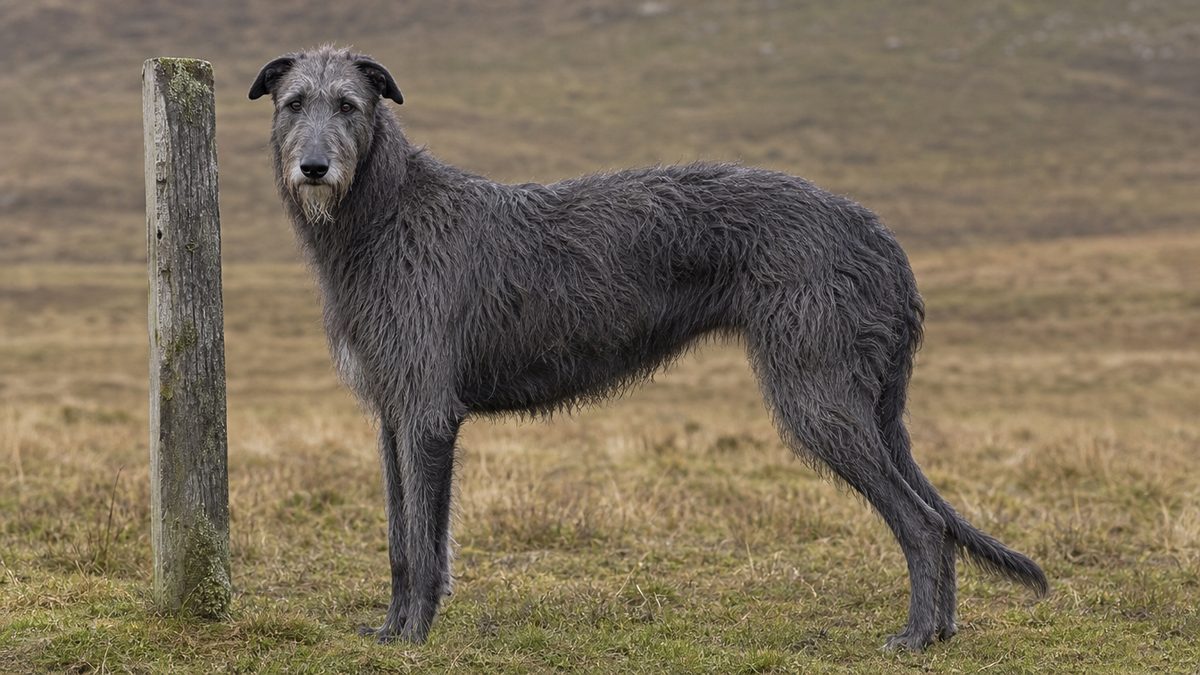
The Scottish Deerhound is a rough-coated Scottish coursing hound held by the FCI as standard 164, in Group 10, Section 2, rough-haired sighthounds, without working trial. The FCI files the breed simply as the DEERHOUND, and its own history section notes that the dog was known at one time as the Scottish Deerhound.
The breed standard's general appearance clause is one line and does most of the work: the breed resembles a rough-coated greyhound of larger size and bone. Everything else follows from that. Size is given as a minimum rather than a range. Males have a minimum desirable height at the withers of 76 cm and a weight of about 45.5 kg; females 71 cm and about 36.5 kg. No maximum height is stated anywhere in the document. The AKC translates this into 30 to 32 inches and 85 to 110 pounds for males.
The coat is a working specification, not a look
FCI 164 asks for hair on the body, neck and quarters that is harsh and wiry, about 8 cm to 10 cm long, close-lying and ragged, with much softer hair on the head, breast and belly, a good moustache of rather silky hair and some beard. A woolly coat is unacceptable. That is a weatherproof outer layer built for wet Highland hillside, and it explains a great deal about how the breed copes in India.
Colour runs dark blue-grey, darker and lighter greys, brindles and yellows, sandy-red or red fawns with black points. A white chest, white toes and a slight white tip to the stern are permissible but the less white the better, and a white blaze on the head or a white collar is unacceptable.
| Register | Status | What the record says |
|---|---|---|
| FCI | Fully recognised, standard 164, as DEERHOUND | Letter D index returns 25 breeds including DEERHOUND 164 |
| Kennel Club of India | Covered by FCI nomenclature | India is an FCI full member represented by the KCI, so Indian pedigrees run on FCI numbers |
| AKC | Fully recognised 1886, Hound Group | AKC code 418, popularity rank 156 of 210 in 2025 |
| UKC | Sighthound and Pariah group | Listed in the UKC breed-standards index |
History, as the standard tells it
FCI 164 is unusually direct about its own uncertainty. It records that the breed's origins are shrouded in mystery, offers the possibility that the Deerhound was introduced to Scotland by Phoenician traders, notes that running hounds were certainly present when the Romans arrived, and states that the breed has hunted the red deer for a thousand years and remained similar in type over the centuries. That is a claim about continuity of type, not a documented pedigree, and it is worth reading as the standard writes it rather than as breeders repeat it.
These are the two breeds Indian buyers most often confuse. The Deerhound is FCI 164, Section 2 rough-haired, minimum desirable 76 cm and about 45.5 kg for a male, and is built as a rough-coated greyhound. The Irish Wolfhound is a separate standard, taller and considerably heavier in bone and substance. A Deerhound that looks like a Wolfhound is too heavy for its own standard, and in Indian heat extra mass is a liability rather than an asset.
Scottish Deerhound price in India, and the eight-times disagreement
Two Indian sites publish a Scottish Deerhound price, and they disagree by roughly eight times at the ceiling while printing an identical monthly cost table to the rupee. That combination is the clearest evidence available that neither headline figure was measured.
poodles.in quotes Rs 50,000 to Rs 1,50,000. happypet.care quotes Rs 4,00,000 to Rs 7,00,000. Those are not two estimates of the same thing. The gap between Rs 1,50,000 and Rs 7,00,000 is larger than the entire price range most Indian buyers consider for any breed.
The cost table underneath is identical, which settles it
| Line | poodles.in | happypet.care |
|---|---|---|
| Food, monthly | Rs 3,000 to Rs 4,500 | Rs 3,000 to Rs 4,500 |
| Health, monthly | Rs 1,500 to Rs 2,250 | Rs 1,500 to Rs 2,250 |
| Grooming, monthly | Rs 1,200 to Rs 1,800 | Rs 1,200 to Rs 1,800 |
| Monthly total | Rs 5,700 to Rs 8,550 | Rs 5,700 to Rs 8,550 |
| Buying price | Rs 50,000 to Rs 1,50,000 | Rs 4,00,000 to Rs 7,00,000 |
Add the component lines. 3,000 plus 1,500 plus 1,200 is 5,700, and 4,500 plus 2,250 plus 1,800 is 8,550. The monthly total is arithmetic on three preset lines rather than a survey of anything, and the same site assigns a different preset row to the Sloughi, built from the same food line of Rs 3,000 to Rs 4,500 with a cheaper health and grooming line. Cost rows on these sites are assembled from a small menu of lines and assigned per breed. They are not observations of what a Deerhound costs in Chennai.
What the division tests show, and what they do not
Run the higher band through the exchange-rate tests and Rs 4,00,000 and Rs 7,00,000 come out at USD 5,000 and USD 8,750 at a flat rate of 80. That looks tidy, and it proves very little on its own, because any rupee figure ending in three zeros divides cleanly at 80 by construction. The lower band gives 625 and 1,875 at the same rate, and 1,875 is not a number a seller would print. The honest reading is that neither band survives a test strongly enough to be called a converted foreign price, and both fail the more basic test of agreeing with each other happypet.care, Scottish Deerhound India.
Treat every published Scottish Deerhound price in India as unsourced. There is no lawful commercial import route for breeding or sale stock into India, so any Indian litter must trace to dogs that entered as accompanied pets. Ask which register the litter is recorded in, ask to see the FCI or KCI pedigree, and ask for the parents' cardiac screening before you discuss money at all.
Bonbeno does not broker puppy sales, publishes no breeder listings and treats these figures as reported prices rather than offers. Where two sources disagree this far, the disagreement is the finding, and averaging them would manufacture a number that neither source supports.
What a Scottish Deerhound actually costs to keep in India
Budget roughly Rs 7,000 to Rs 14,000 a month for a 45 kg Deerhound in an Indian metro, and add a real cooling line that no breed page includes. The cost of ownership is sourceable from Indian rate cards even though the purchase price is not.
Two things make this breed more expensive to keep in India than its size alone suggests. It is a very large dog, so every consumable scales, and it is a cold-climate dog, so the household spends money keeping it comfortable that a Pariah Dog owner does not.
| Item | Published figure | Source and caveat |
|---|---|---|
| Puppy core vaccination course | From Rs 6,499 | Vetic national page, a promotional floor from one chain |
| Annual booster | From Rs 3,199 | Vetic national page |
| Anti-rabies, single dose | Rs 699 privately, free at a Chennai municipal clinic | Vetic list price against Greater Chennai Corporation Greater Chennai Corporation |
| Consultation | Rs 500 to Rs 1,000 | VOSD, treated as one data point |
| Monthly parasite cover | About Rs 1,103 at 15 to 30 kg, more at 45 kg | NexGard Spectra pricing; a Deerhound needs the larger presentation |
| Boarding, per 24 hours | Rs 500 to Rs 2,000 | VOSD range, and giant breeds sit at the top of it |
| Municipal registration, Delhi | Rs 500 | MCD pet dog registration |
| Municipal licence, Chennai | Rs 50 | Greater Chennai Corporation, which issued 9,115 licences in 2024 |
The lines that are genuinely bigger for this breed
- Cooling. A dog bred for a hillside that averages 12.47 degrees Celsius in its warmest month needs a cool floor, a fan and, in the hot months in most Indian cities, air conditioning. Nobody publishes that as a breed cost and everybody pays it.
- Food. At 45 kg the food line is roughly twice a medium dog's, and the Indian breed pages that quote Rs 3,000 to Rs 4,500 give the identical figure to the Sloughi, a dog around 25 kg.
- Cardiac screening. Preclinical dilated cardiomyopathy was found in 21.6 percent of 99 healthy UK deerhounds, so an annual echocardiogram read against breed reference intervals is a recurring cost rather than a one-off.
- Orthopaedic imaging. The breed carries the highest published osteosarcoma odds of any UK breed, so radiographs for any persistent lameness are a cost you should expect to incur at least once.
- Anaesthesia done properly. Sedative premedication, no thiobarbiturates, isoflurane maintenance, close temperature monitoring, and awareness that the breed's 35 percent POR-H3 allele cut propofol oxidation by 34 to 37 percent in recombinant enzyme experiments, so recovery can run longer.
Before you accept any Indian monthly cost figure for this breed, open the Deerhound page and the Sloughi page on the same site and compare the food, health and grooming lines to the rupee. They share the food line exactly poodles.in, Sloughi Price in India, Diet. A cost table that gives a 45 kg Highland hound and a 25 kg desert hound the same food budget is a template, and you should build your own budget from the rate-card table above.
Heat tolerance: the coldest homeland of any breed Bonbeno has measured
A Scottish Deerhound is the least heat-tolerant sighthound Bonbeno has measured, and the reason is not humidity. Its homeland is wetter than any Indian city and roughly twenty degrees cooler, so the shock is heat alone.
Bonbeno pulled NASA POWER climatology by explicit latitude and longitude and echoed the returned cell elevation each time, because a grid cell sitting hundreds of metres above the town would corrupt the comparison. Scotland turned out to need that check. Inverness returned a cell 237.87 m above the town and Perth 125.47 m above it, so both are unusable. Aberdeen returned 18.28 m against a real elevation near 20 m, an error of 1.72 m, and Braemar returned 413.84 m against about 339 m NASA POWER climatology. Aberdeen is therefore the clean coastal point and Braemar the usable Highland glen point.
| Place | Annual mean temperature | Annual mean relative humidity | Hottest month mean | Coolest month mean |
|---|---|---|---|---|
| Braemar, Scottish Highlands | 6.08 C | 91.07 percent | 12.47 C (Jul) | 0.77 C (Feb) |
| Aberdeen, Scotland | 9.41 C | 85.33 percent | 14.06 C (Aug) | 5.37 C (Feb) |
| Pune | 23.86 C | 66.80 percent | 28.93 C (Apr) | 19.62 C (Dec) |
| Bengaluru | 23.74 C | 67.94 percent | 28.37 C (Apr) | 20.22 C (Dec) |
| Delhi | 25.60 C | 45.56 percent | 35.88 C (Jun) | 13.61 C (Jan) |
| Mumbai | 26.77 C | 67.39 percent | 31.19 C (May) | 23.19 C (Jan) |
| Chennai | 27.95 C | 72.39 percent | 31.51 C (May) | 24.09 C (Jan) |
| Kolkata | 25.81 C | 73.93 percent | 31.53 C (May) | 17.31 C (Jan) |
The single sentence that decides this breed in India
Braemar's hottest month averages 12.47 degrees Celsius. Delhi's coolest month averages 13.61 degrees NASA POWER climatology API. The warmest month the breed's home glen ever sees is colder than the coldest month in the Indian capital. There is no month, anywhere in plains India, that resembles a Highland summer.
Humidity is not the problem, and saying it is misleads owners
Indian breed pages routinely warn that a Scottish dog will struggle in Indian humidity. The data says the opposite. Braemar runs 91.07 percent annual relative humidity and Aberdeen 85.33 percent, against Kolkata's 73.93 percent and Chennai's 72.39 percent NASA POWER climatology NASA POWER climatology API. The Deerhound comes from a wetter place than any Indian city. What it has never met is a humid day at 31 degrees, and that combination, not the dampness by itself, is what carries the load.
The harsh 8 to 10 cm coat is an insulating and protective layer, and a woolly coat is what the standard rejects, not a long one. Clipping a rough-coated sighthound removes sun protection from thin, lightly pigmented skin and does not lower core temperature. Provide shade, airflow and a cool floor instead, and remember that Second Schedule Part IV paragraph 21(1) of the Dog Breeding and Marketing Rules 2017 explicitly names long-haired breeds in high temperature locations among the dogs that must not be kept in outdoor facilities without written veterinary approval.
The heat evidence that exists for the group
The Deerhound was not separately modelled in the largest study of canine heat-related illness, because a breed type entered that model only with five or more cases and/or 5,000 or more dogs in the cohort. The Greyhound was, and it carried 4.26 times the odds of heat-related illness compared with the Labrador Retriever, at p = 0.001, which the authors attribute to high lean muscle mass rather than to fat. A Deerhound is a larger version of the same body plan carrying more of that muscle, so the reasonable inference is greater exposure, not less. Where a breed is unmodelled, that is what the honest sentence looks like: the group finding transfers, the breed-specific number does not exist.
Practical consequence for an Indian household. Bengaluru and Pune, peaking in April at around 28.5 degrees, are the most workable Indian cities for this breed. Chennai, Mumbai and Kolkata are the least. Delhi is livable in winter and hostile from April to July, when the mean alone reaches 35.88 degrees in June.
Temperament: the friendliest standard in the sighthound group
FCI 164 describes the Scottish Deerhound as gentle and friendly, obedient and easy to train because eager to please, docile and good tempered, never suspicious, aggressive or nervous, and carrying itself with quiet dignity. That is warmer language than any other sighthound standard uses, and it is accurate.
The AKC files the breed's temperament as independent, gentle and noble. Put the two together and you have an affectionate dog that genuinely likes people, does not guard, does not bark much, and is far more biddable than a Saluki or an Afghan Hound. The trade-off is that it is not a watchdog and should not be bought as one.
What living with one is like
- Very quiet indoors. A properly exercised Deerhound spends most of the day asleep on the coolest surface it can find, which in India is usually the bathroom floor.
- Physically large in a way Indian homes are not built for. A standing dog's back is at kitchen-counter height and its tail clears a coffee table. Plan the furniture, not the dog.
- Prey drive is real despite the gentleness. This is a coursing hound bred to run down red deer. Cats, chickens and small dogs moving fast will trigger the chase, and the standard's docility does not switch that off.
- Sensitive to harsh handling. An eager-to-please dog shuts down under correction. Reward-based work is not a preference here, it is the only thing that works.
- Not a guard dog, at all. Never suspicious is in the standard. A Deerhound will greet an intruder.
Who should not buy this breed in India
Anyone in a flat, anyone in Chennai, Mumbai or Kolkata without reliable cooling, and anyone who wants a dog to live outdoors. Indian law is specific on that last point: Second Schedule Part IV paragraph 21(1) bars keeping in outdoor facilities, without the attending veterinary practitioner's written approval, dogs not accustomed to local temperatures and breeds that cannot tolerate them, naming long-haired breeds in high temperature locations as an example.
This breed's median survival is 10.5 years against 13.3 for a Saluki and 13.4 for a Whippet in the same cohort, and its most likely serious illness is a bone cancer that typically appears around nine and a half years of age. A family choosing a Deerhound should know before the puppy arrives that the breed's own literature describes a shorter life with a specific ending, and should ask a veterinarian what early lameness in a giant sighthound is investigated for.
Training a Scottish Deerhound, and what the standard promises
Train a Deerhound with short, gentle, reward-based sessions and expect more cooperation than any other sighthound gives. FCI 164 calls the breed obedient and easy to train because eager to please, and that is unusual enough in a sighthound standard to be worth taking seriously.
Socialise the puppy early and widely. Between eight and sixteen weeks, introduce lifts, stairs, traffic, motorbikes, market noise and being handled by strangers, and do it while the vaccination course is still running. The 2017 Rules record that puppies are vaccinated from about seven to eight weeks with the course usually completed at about eighteen weeks, which sets the practical timetable.
What works with this breed
- Short sessions and quiet praise. Three to five minutes, several times a day. This is a sensitive dog and volume works against you.
- Teach a stand for examination early. A 45 kg dog that will not stand still for a stethoscope or an ultrasound probe gets sedated instead, and sedation is exactly what this breed's pharmacology makes complicated.
- Long-line work for recall. Fifteen metres of line, used for two years, is how you build distance control without gambling on an untested recall.
- Lead manners before adolescence. A dog that pulls at 20 kg is manageable and at 45 kg is not. Fix it at four months, not at twelve.
What will not work
Harsh corrections, long repetitive drills and afternoon training in Indian heat all fail. So does trusting recall near live quarry, whatever the standard says about obedience, because a coursing hound in sight of a moving animal is doing the job it was bred for. Manage the environment: fenced ground, a long line, and a lead everywhere else.
House training is generally settled by four months. Lead manners take two to three months of daily short sessions and must be finished before the adolescent growth spurt. A reliable sit, down and stand for examination take about six months. Recall in a fenced field is achievable by twelve to eighteen months. Recall in an open Indian street with a cat present is not a target to set.
One legal point. Tail docking, ear cropping, de-barking, de-clawing and any change of appearance by artificial means are strictly forbidden under Second Schedule Part II paragraph 6(8) of the 2017 Rules. Nothing in FCI 164 calls for any of them, and a Deerhound offered with an altered tail or ears was altered outside both the standard and Indian law.
Exercise: a giant coursing hound in a country with no cool afternoons
A Scottish Deerhound needs two long walks a day plus a weekly free gallop on soft ground, and in India all of it has to happen before sunrise or after dark for most of the year. Distance is not the constraint here. Temperature is.
FCI 164 gives the breed's utilization as racing dog, hunting dog and companion, and describes a gait that is easy, active and true with a long stride. This is an animal built to cover open hillside at speed, and lead walking on tarmac does not satisfy it.
A workable Indian week
- Two walks a day, 45 to 60 minutes each, at the coolest hours. In Delhi in June that means before 06:00 and after 21:00, because the June mean alone is 35.88 degrees.
- One free gallop a week, inside a fully fenced space, on grass or soft earth, for fifteen to twenty minutes. A Deerhound sprints and then lies down.
- Nothing hard within two hours of a meal, in either direction. A deep-chested giant is the wrong shape to take chances with.
- No running at all on hot ground. Press the back of your hand to the tarmac for five seconds. If you cannot hold it, the dog does not walk on it.
Growth changes the rules for the first eighteen months
A giant sighthound's growth plates do not close early. Free movement on grass is fine at any age, but forced distance running, repeated jumping and stair work should wait until around 18 months. The breed has a documented osteochondrodysplasia, a dwarfing skeletal disorder described in Scottish Deerhounds with clinical, radiographic, pathological and genetic features set out in the literature, and cervical articular facet arthrosis has been reported and treated as a case series in the breed. Neither is caused by exercise, and both are reasons to take a growing Deerhound's skeleton seriously.
Osteosarcoma is the single most likely serious illness a Scottish Deerhound will face, with an annual prevalence of 3.28 percent against 0.037 percent across all dogs and a median age at diagnosis of 9.64 years. Persistent lameness, a firm swelling on a limb, or reluctance to bear weight in a middle-aged or older Deerhound warrants radiographs promptly. Consult your nearby veterinarian rather than resting the dog and waiting to see.
Mental work matters more here than owners expect, because the physical outlet is so often blocked by the weather. Scent games, food-finding routines and short training bursts indoors keep an intelligent giant hound settled through the two months of the Indian year when going outside at any hour is uncomfortable.
Grooming a harsh Deerhound coat in Indian humidity
Groom a Scottish Deerhound weekly with a comb and a stripping knife, keep the coat harsh rather than soft, and never clip it short to cool the dog down. The coat is a working layer that the standard specifies by texture and length.
FCI 164 asks for hair on the body, neck and quarters that is harsh and wiry, close-lying, ragged, about 8 cm to 10 cm long, with much softer hair on the head, breast and belly, a good moustache and some beard, and a slight hairy fringe inside the fore and hind legs. It calls a woolly coat unacceptable and a shaggy but not over-coated dog correct.
A weekly routine for Indian conditions
- Comb through to the skin once a week. A rough-coated dog mats at the elbows, behind the ears and in the trousers, and a comb that only touches the surface hides it.
- Hand strip the dead coat two or three times a year rather than clipping. Clipping softens the texture permanently and removes the sun protection the coat provides.
- Check the skin under the beard and moustache. Damp facial furnishings in humid weather are where the first hot spots appear in India.
- Run a tick check every day in tick season, ears, toes, groin and tail base first. The 2017 Rules make regular de-ticking part of routine grooming rather than an extra, in Second Schedule Part IV paragraph 27.
- Trim nails fortnightly. A 45 kg sighthound's gait deteriorates quickly on long nails, and Indian tile floors give no wear.
The clipping question, answered plainly
Indian groomers routinely offer to clip a rough-coated dog short for summer, and for this breed that is the wrong advice. The harsh outer coat shades the skin and sheds water, and removing it exposes lightly pigmented skin to sun in a country where a Deerhound is already outside its temperature range. Provide shade, airflow and a cool floor instead. Indian law asks for the same thing from anyone housing dogs outdoors: Second Schedule Part IV paragraph 21(2) requires one or more separate outside areas of shade, large enough to hold all the animals at once and to protect them from the direct rays of the sun.
The Rs 1,200 to Rs 1,800 monthly grooming line the Indian breed pages give this breed is a preset that also appears on other breeds' pages on the same site poodles.in, Sloughi Price in India, Diet. A Deerhound genuinely needs a comb, a stripping knife and a nail clipper, which are one-off purchases, plus perhaps two professional hand-stripping sessions a year. Spend the difference on year-round tick prevention, which in a country where 76.54 percent of dogs screened at one Kolkata centre were positive for Babesia gibsoni is not optional.
Scottish Deerhound health: four findings to give your vet in writing
The Scottish Deerhound has the shortest median survival of the sighthounds in the largest UK study, and four specific, published health issues drive most of the risk: bone cancer, silent heart disease, a bleeding variant and a drug-metabolism variant.
Start with lifespan. Supplementary Table S3 of a 155-breed UK study gives the Scottish Deerhound a median survival of 10.5 years, 95 percent CI 9.7 to 11.3, on 191 deaths among 426 dogs, with a hazard ratio of 1.43 (1.24 to 1.65) at p < 0.001 against crossbred dogs. That hazard ratio is significant, unlike the Saluki's, so the shortened life expectancy is a real finding rather than noise. Table S6 of the same paper counts 226 alive and 191 deceased for a total of 417, disagreeing with S3's 426 while the death count is identical, so the death count is the number to quote. The AKC publishes 8 to 11 years.
1. Osteosarcoma, and the largest odds ratio in the UK data
McMillan's own supplementary classification files the breed as a large, dolichocephalic hound in the FCI sighthound group, and skull shape turns out to matter. A VetCompass study of 905,552 UK dogs found 331 confirmed osteosarcoma cases, a one-year period prevalence of 0.037 percent. The Scottish Deerhound's annual prevalence was 3.28 percent (95 percent CI 0.90 to 8.18), and after multivariable modelling its odds ratio against crossbred dogs was 118.40 (95 percent CI 41.12 to 340.95), the highest of the eleven breeds with raised odds and roughly twice the Leonberger's 55.79. Median age at diagnosis across the study was 9.64 years, and breeds with dolichocephalic skulls carried 2.72 times the odds of mesocephalic breeds. Heritability work in the breed puts the trait under substantial genetic control and traces it through named families Dillberger JE, McAtee SA. Osteosarcoma….
A confidence interval running from 41 to 341 is wide because Deerhounds are rare, and the lower bound of 41 still makes this the highest-risk breed in the study. Practically: treat persistent lameness, a firm limb swelling or reluctance to bear weight in a Deerhound over about seven as a reason for prompt radiographs, not for rest and review. Consult your nearby veterinarian early, because in this breed the common causes of lameness are not the likely ones.
2. Dilated cardiomyopathy, usually silent
A prospective longitudinal study screened 99 healthy UK deerhounds and found preclinical dilated cardiomyopathy in 21.6 percent. Ventricular arrhythmias were present in 13.6 percent of the whole population and in 42 percent of affected dogs. The authors proposed diagnostic cut-offs of an end-diastolic volume index at or above 140.2 mL/m2, an end-systolic volume index at or above 71.9 mL/m2 and an ejection fraction at or below 42.1 percent, and published breed-specific reference intervals because healthy deerhounds carry higher left ventricular dimensions than other breeds. Screening a dog that looks completely well is therefore the point, not a precaution.
3. Delayed postoperative haemorrhage, with a genetic test
A whole-genome study of 269 privately owned Scottish Deerhounds identified a single locus on chromosome 9 and, within it, SERPINF2 c.605 C>T (p.A202V), the gene encoding alpha-2 antiplasmin. Against the reference C/C genotype, the T/T genotype carried an odds ratio of 1235 (95 percent CI 23 to 6752, p = 0.0005) for delayed postoperative haemorrhage and the C/T genotype 28 (1.4 to 542, p = 0.03). A later cross-breed survey put the Deerhound's variant allele prevalence at 23 percent with the eighth highest T/T genotype prevalence at 6 percent, behind the Greyhound at 29 percent and the Irish Wolfhound at 24 percent. Bleeding starts a day or two after an operation that looked uneventful, once the dog is home.
4. A propofol-metabolism variant this breed shares with the Greyhound
The general sighthound anaesthesia protocol applies here: thiopental, or any other thiobarbiturate, should not be used, propofol and ketamine with diazepam are the recommended alternatives, isoflurane maintenance is preferred, and core temperature must be watched during and after anaesthesia. There is a breed-specific refinement worth carrying to the clinic. A pharmacogenomics survey of 68 dog breeds found the POR-H3 allele largely restricted to greyhounds and Scottish deerhounds, at 35 percent allele frequencies, the joint highest of the 68 breeds surveyed alongside racing-registered Greyhounds. In recombinant enzyme experiments the same study measured Vmax for propofol oxidation by CYP2B11 falling 34 to 37 percent when the enzyme was coexpressed with POR-H3 rather than the reference POR-H1, with Km unchanged. That is an in vitro measurement on expressed enzyme, not a clinical outcome. The authors state that their predictions rest solely on in vitro work extrapolated to the living dog and that additional in vivo studies are warranted, and no published study reports how much longer a Deerhound carrying the allele takes to wake up. So propofol stays the recommended alternative to thiopental, and the reasonable expectation is slower clearance and a longer recovery rather than a different drug. That is not a contradiction to resolve on a web page. It is a dosing and monitoring conversation to have with your veterinarian before the dog is on the table.
Other documented conditions
- Congenital hypothyroidism in puppies, described as a breed-associated condition in Scottish Deerhound litters. Note separately that Second Schedule Part III paragraph 8(10) of India's Dog Breeding and Marketing Rules 2017 requires breeding dogs to have been tested for genetic defects including hypothyroidism.
- Osteochondrodysplasia, a dwarfing skeletal disorder with clinical, radiographic, pathological and genetic features described in the breed.
- Cervical articular facet arthrosis, reported and treated as a nine-case series in Scottish Deerhounds.
- Recessive hairlessness, caused by a frameshift insertion in SGK3 and offered as a candidate gene for human alopecia conditions.
Do not hand this breed the Greyhound's blood values
Haematological and biochemical values have been published specifically for North American Scottish deerhounds, and they exist because the breed's normal ranges differ from a general canine reference interval. Note also what does not exist: the one study that compared sighthound breeds against each other tested eight breeds, the Whippet, Greyhound, Italian Greyhound, Sloughi, Saluki, Borzoi, Pharaoh Hound and Azawakh, and the Scottish Deerhound is not among them. Its conclusion, that applying the Greyhound laboratory profile to other sighthounds is not recommended, therefore applies to the Deerhound as a warning rather than as a measurement.
The India-specific health load is parasitic. Among 584 client-owned dogs screened at a Kolkata animal health centre, 76.54 percent were positive for *Babesia gibsoni*, 55.75 percent for *Anaplasma* species and 16.61 percent for *Ehrlichia canis*, and 72.9 percent of the dogs screened carried two or more pathogens at once. Those are clinic cases rather than a random population sample, and they still make year-round tick control a fixed requirement in a breed that is already carrying a bleeding-risk allele.
Feeding a Scottish Deerhound in India: lean, split and slow
Feed a Scottish Deerhound to a lean body condition across two or three meals a day, never around exercise, and slow the growth of a puppy rather than pushing it. A giant sighthound carrying extra weight is loading a skeleton that already has documented problems.
The standard's frame is a rough-coated greyhound of larger size and bone, with a well arched loin and a chest that is deep rather than broad. A correctly fed adult keeps a visible waist from above and a clear tuck-up from the side. Anyone used to Labradors will think the dog is underfed.
A practical Indian feeding plan
- Two or three meals a day for an adult, never one large one. Deep-chested giants are the shape most at risk from a single big meal.
- Four meals a day for a puppy to six months, then three to nine months, then two.
- No hard exercise for two hours either side of a meal.
- Do not push growth. A giant-breed puppy grown fast carries more weight on immature joints, and this breed has a documented skeletal dysplasia in its literature.
- Weigh monthly and record it. At 45 kg, a five percent change is more than 2 kg and easy to miss by eye.
Indian availability is not a problem for a large dog. Every national brand sells a large or giant adult formula, and a vet-formulated home diet on chicken, curd, rice and vegetables works if calcium and phosphorus are balanced properly, which matters more in a giant breed than in a medium one.
You should be able to feel every rib with light pressure, see a clear waist from above, see a marked tuck-up from the side, and see the last one or two ribs faintly when the dog moves. If the tuck-up has flattened, the dog is heavy. Ask your veterinarian to score body condition at every visit and to write the number in the file, because in a breed with a 21.6 percent preclinical cardiomyopathy rate, unexplained weight change is information rather than a cosmetic issue.
Two Indian adjustments. Appetite drops sharply in the hot months and a Deerhound eating less through April and May is behaving normally, not falling ill. And because tick-borne disease is a routine clinic finding here, sudden inappetence in this breed is a reason to test rather than to change the food.
Ignore the published Indian food line for this breed. Both Indian sites quote Rs 3,000 to Rs 4,500 a month, and the same site gives the identical food line to the Sloughi, a dog roughly half the weight. Build the budget from the pack's own feeding guide and the dog's measured weight.
The first eighteen months with a Scottish Deerhound puppy
Plan a Deerhound puppy's first eighteen months around slow growth, early handling training and Indian heat. This is a giant breed, so the skeleton is still finishing long after the dog looks adult.
| Age | What is happening | What you do |
|---|---|---|
| Under 8 weeks | With the litter. Indian law prohibits sale under eight weeks | Refuse any younger puppy, under Rule 8(1)(a) |
| 8 to 12 weeks | Core vaccination course under way from about seven to eight weeks | Socialise safely and constantly. Start handling feet, ears and mouth daily |
| 12 to 16 weeks | Socialisation window closing | Traffic, lifts, stairs, crowds, other dogs, and a stand for examination |
| 16 to 18 weeks | Vaccination course usually complete at about eighteen weeks | Short cool-hour lead walks. Register with the municipality |
| 4 to 8 months | Very fast height growth, gangly and uncoordinated | Lead manners must be finished now. No forced running, no repeated jumping |
| 8 to 12 months | Adolescence, dog is tall but unfinished | Long line stays on. Keep weight lean, resist feeding for size |
| 12 to 18 months | Filling out, growth plates closing | Introduce controlled galloping on soft ground inside a fence |
| 18 months on | Adult | Build real distance work. Begin annual cardiac screening |
Checks to make before you collect a puppy
- Age at least eight weeks and a microchip. Rule 8(1)(a) prohibits sale below eight weeks and Rule 8(1)(e) requires every pup sold to be micro-chipped with a complete treatment and vaccination record maintained.
- Cardiac screening on both parents, read against deerhound reference intervals rather than general canine ones.
- A SERPINF2 genotype on the parents if the breeder can obtain one, because the test exists and the high-risk genotype is present in 6 percent of the breed Court MH, Hardy M, Forbes KR, Yang H.
- Family cancer history. Osteosarcoma in this breed has been traced through named families, so a breeder who cannot discuss it has not looked.
- A truthful answer about where the founding stock came from, since dogs are a Restricted import into India and applications for trading or breeding purposes are to be duly rejected.
A growing Deerhound has a large body, a heavy coat and no judgement. From March to October in most of India, take a puppy out before 06:30 and after sunset only, keep sessions short, and stop at the first sign of heavy open-mouthed panting. Consult your nearby veterinarian immediately if a puppy becomes unsteady, vomits or collapses after exertion, and do not attempt to cool it with ice water.
Expect an adult dog that is far calmer than the puppy. Most owners describe the demanding phase as six to fourteen months, which is exactly the window in which the long line, the finished lead manners and the lean feeding plan pay for themselves.
Scottish Deerhound against the giant hounds Indian buyers cross-shop
Indian buyers looking at a Scottish Deerhound are usually also considering an Irish Wolfhound, a Great Dane or a large Indian sighthound. Lifespan, heat fitness and cancer risk separate them more sharply than looks do.
| Scottish Deerhound | Saluki | Whippet | Rampur Greyhound | |
|---|---|---|---|---|
| Median survival, UK cohort | 10.5 years on 191 deaths | 13.3 years on 169 deaths | 13.4 years on 1,483 deaths | No cohort study exists |
| Hazard ratio vs crossbreds | 1.43, significant | 0.87, not significant | 0.70, significant | Not studied |
| Osteosarcoma odds | 118.40, highest in the study | Not among the raised breeds | Not among the raised breeds | Not studied |
| SERPINF2 bleeding allele | 23 percent, T/T 6 percent | 30 percent | 25 percent | Not surveyed |
| Homeland hottest month | 12.47 C at Braemar | 36.00 C at Riyadh | Temperate England | Indian plains |
| Heat fitness in India | Lowest of the group | Good in dry heat | Moderate | Bred in the climate |
| Indian availability | Two sites, prices eight times apart | No verifiable transaction price | Advertised widely | Genuine Indian breeders |
Two rows decide most decisions. The osteosarcoma row is the hardest single number on this page: an odds ratio of 118.40 against crossbred dogs, with a lower confidence bound of 41.12, is not a small elevated risk. The homeland row is the second: a breed whose native summer is colder than Delhi's winter is being asked to do something no amount of care fully solves NASA POWER climatology API.
Against that, the Deerhound has genuine advantages. It is the friendliest sighthound by standard, gentle and docile with children, and unusually easy to train for the group. And it has more published breed-specific clinical data than almost any Indian sighthound: cardiac reference intervals, haematological values, a bleeding genotype and a drug-metabolism allele. A vet willing to read that literature can manage this dog far better than a Rampur Greyhound, for which none of it exists.
Choose a Scottish Deerhound only if you live in Bengaluru, Pune or a hill town, can keep the dog indoors and cool through the hot months, can afford annual cardiac screening, and accept a median survival of 10.5 years with a specific and likely cause of death. If any of those is uncertain, an adopted Indian Pariah Dog or a Rampur Greyhound is the better animal for this country, and neither carries a 118.40 osteosarcoma odds ratio.
Six mistakes Indian Scottish Deerhound owners make
Most Deerhound problems in India trace to six errors, and four of them are decided before the dog arrives.
1. Believing a published price
Two Indian sites quote Rs 50,000 to Rs 1,50,000 and Rs 4,00,000 to Rs 7,00,000 for the same breed while sharing an identical monthly cost table to the rupee. Neither is an observation. Ask for pedigree, screening and origin before you discuss a number.
2. Clipping the coat for the Indian summer
The harsh 8 to 10 cm coat shades lightly pigmented skin and sheds water; a woolly coat is what the standard rejects, not a long one. Clipping does not lower core temperature and removes sun protection. Cool the environment instead.
3. Treating lameness as a soft-tissue strain
This breed carries an osteosarcoma odds ratio of 118.40 against crossbred dogs and an annual prevalence of 3.28 percent, with a median diagnosis age of 9.64 years. In a middle-aged Deerhound, persistent lameness is radiographed, not rested.
4. Skipping the echocardiogram because the dog looks well
Preclinical dilated cardiomyopathy was present in 21.6 percent of 99 apparently healthy UK deerhounds, and ventricular arrhythmias in 13.6 percent of the whole group. The word preclinical means the dog looks fine. Screen anyway, against breed reference intervals.
5. Allowing thiopental, or assuming propofol is simple
Thiopental and other thiobarbiturates should not be used in sighthounds, and this breed additionally carries the POR-H3 allele at 35 percent, the joint highest of the 68 breeds surveyed alongside racing Greyhounds, which cut propofol oxidation by CYP2B11 by 34 to 37 percent in recombinant enzyme experiments. Propofol is still the right alternative, and the thing to plan for is a longer recovery. Both facts belong in the clinical file, in writing.
6. Keeping the dog outdoors
Second Schedule Part IV paragraph 21(1) of the 2017 Rules bars keeping in outdoor facilities, without written veterinary approval, dogs not accustomed to local temperatures and breeds that cannot tolerate them, naming long-haired breeds in high temperature locations. A Highland deer hound in an Indian courtyard is exactly the case that clause describes.
A well-conditioned Deerhound looks bony to Indian eyes, and owners feed it up. Resist. The standard describes a well arched loin over a deep rather than broad chest, and extra weight loads a skeleton with a documented dysplasia in its literature. Ask your veterinarian for a body condition score at each visit so you are working from a number.
Adoption and responsible sourcing for a Scottish Deerhound in India
Adopt first, and if you buy, verify the litter against Indian law and the breed's own screening list before money changes hands. This is a rare breed in India with no verifiable market price, and that is a reason to move slowly.
Why adoption is the stronger option here
The single biggest problem this breed has in India is the climate, and the single best answer to that problem is a dog that evolved here. An adopted Indian Pariah Dog is lean, quiet, low-shedding, heat-adapted, free and available in every Indian city. If what you want is a large calm gentle hound, a Rampur Greyhound from an Indian breeder or a large shelter dog delivers most of it without a 118.40 osteosarcoma odds ratio or a homeland twenty degrees cooler than Delhi.
If you are buying, verify these eight things
- A pedigree you can read, FCI or KCI, with the breed recorded against standard 164.
- A microchip number, which Rule 8(1)(e) makes mandatory on every pup sold.
- Age at least eight weeks, under Rule 8(1)(a).
- A vaccination record consistent with a course started at seven to eight weeks and completed near eighteen weeks.
- Cardiac screening on both parents against deerhound-specific reference intervals.
- A SERPINF2 genotype where obtainable.
- An honest family cancer history, since osteosarcoma has been traced through named Deerhound families.
- No altered ears or tail, which are prohibited under Second Schedule Part II paragraph 6(8), and a truthful account of how the founding stock entered India.
A seller quoting a price before you have asked a question, a price that matches neither published Indian band, a puppy offered below eight weeks, or a refusal to discuss cardiac screening are all reasons to stop. A large rough-coated dog offered cheaply may be an Irish Wolfhound cross or a large Indian dog, and neither is a fraud unless it is sold as a Deerhound.
What you owe the dog if you go ahead
Indoor living with real cooling through the hot months, walks and gallops only at cool hours, year-round tick control in a country where 72.9 percent of dogs screened at one Kolkata centre carried two or more blood pathogens, annual cardiac screening from about eighteen months, prompt radiographs for lameness, and a written note in the clinical file covering the anaesthesia protocol and the bleeding risk Court MH, Hardy M, Forbes KR, Yang H.
Bonbeno does not sell animals, broker puppy sales or accept breeder listings, and nothing on this page is an offer. Where sources disagree, this page prints the disagreement rather than picking the convenient figure.
Scottish Deerhound questions Indian buyers need answered
How much do Scottish Deerhounds cost?
There is no reliable figure. The two Indian sites carrying a price disagree by roughly eight times at the top end, poodles.in quoting Rs 50,000 to Rs 1,50,000 and happypet.care quoting Rs 4,00,000 to Rs 7,00,000, while printing an identical monthly cost table to the rupee. A shared cost table under two irreconcilable prices means neither price was measured.
How long do Scottish Deerhounds live?
The median survival in the largest UK study is 10.5 years, with a 95 percent confidence interval of 9.7 to 11.3 years, calculated on 191 deaths among 426 dogs. The hazard ratio against crossbred dogs is 1.43, which is a real and statistically significant shortening rather than a rounding difference. The AKC publishes a narrower 8 to 11 years.
Do Scottish Deerhounds get bone cancer?
More than any other breed measured. In a VetCompass study of 905,552 UK dogs the Scottish Deerhound had an annual osteosarcoma prevalence of 3.28 percent against 0.037 percent across all dogs, and odds of 118.40 against crossbred dogs, the highest of the eleven breeds with raised odds. The median age at diagnosis across the study was 9.64 years.
Can a Scottish Deerhound live in India?
It can live indoors in a cool home and it cannot work outdoors in most of the country. Braemar in the Scottish Highlands averages 12.47 degrees Celsius in its hottest month, which is below Delhi's coolest month at 13.61 degrees, so the whole Indian year sits above the top of the breed's native temperature range.
How big does a Scottish Deerhound get?
FCI Standard 164 gives a minimum desirable height at the withers of 76 cm for males with a weight of about 45.5 kg, and 71 cm for females at about 36.5 kg, and states no maximum height at all. The AKC gives 30 to 32 inches and 85 to 110 pounds for males.
Is the Deerhound the same as the Scottish Deerhound?
Yes, and the registers disagree about the name. The FCI files the breed as DEERHOUND under standard 164 and its own history section says the breed was known at one time as the Scottish Deerhound, while the AKC and the UKC both use Scottish Deerhound. Search either name and you will find the same dog.
Why do Deerhounds need a special anaesthetic?
Two reasons stack. The general sighthound review states that thiopental, or any other thiobarbiturate, should not be used in these dogs and that isoflurane maintenance is preferred. On top of that, a pharmacogenomics survey of 68 breeds found the POR-H3 allele largely restricted to greyhounds and Scottish deerhounds at 35 percent, and that allele reduced propofol oxidation by CYP2B11 by 34 to 37 percent in recombinant enzyme experiments. That is a laboratory measurement, so propofol remains the recommended alternative and the practical effect to plan for is a slower recovery. Tell your vet the dog is a Scottish Deerhound, and consult your nearby veterinarian before any procedure.
What is delayed postoperative bleeding in a Deerhound?
It is haemorrhage starting a day or two after a surgery that appeared uneventful. A study of 269 privately owned Scottish Deerhounds identified a SERPINF2 variant behind it, with the T/T genotype carrying an odds ratio of 1235 for the complication and the C/T genotype 28. A genetic test exists, and 6 percent of the breed carries the high-risk genotype.
Do Scottish Deerhounds get heart disease?
Frequently, and often silently. In 99 healthy UK deerhounds screened prospectively, preclinical dilated cardiomyopathy was found in 21.6 percent, and ventricular arrhythmias were present in 13.6 percent of the whole group and 42 percent of affected dogs. Breed-specific echocardiographic reference intervals exist because standard canine ranges do not fit the breed.
Are Scottish Deerhounds good with children?
Temperamentally yes. FCI 164 calls the breed gentle and friendly, docile and good tempered, never suspicious, aggressive or nervous, which is unusually warm language for a sighthound standard. The practical caution is physical rather than behavioural: a 45 kg dog with a tail at table height knocks small children over without any intent.
What does a Scottish Deerhound cost per month in India?
Budget roughly Rs 7,000 to Rs 14,000 a month for a 45 kg dog once food, year-round parasite cover, routine veterinary care and grooming are built from real Indian rate cards. A 45 kg dog needs the larger parasite presentation than the Rs 1,103 per month figure quoted for 15 to 30 kg dogs, and cooling costs are a genuine additional line here.
Can I import a Scottish Deerhound into India?
Only as an accompanied pet, never for breeding or sale. DGFT Trade Notice 22/2022-23 makes dogs a Restricted import under ITC(HS) 01061900, allows entry for a pet with a valid pet book in the importer's name, for research on CPCSEA recommendation or for Defence and Police use, and states that applications for trading or breeding purposes shall be duly rejected.
Is the Scottish Deerhound a good pet?
By temperament, yes. FCI Standard 164 describes the breed as gentle and friendly, obedient and easy to train because eager to please, docile and good tempered, and never suspicious, aggressive or nervous, which is warmer language than any other sighthound standard uses. The cautions are practical rather than behavioural: a male stands at least 76 cm and weighs about 45.5 kg, the breed's median survival in the largest UK study is 10.5 years with osteosarcoma as its most likely serious illness, and its Highland homeland never reaches Delhi's coolest month, so in India it is an indoor dog in a cool home rather than an outdoor one.
Are Deerhounds aggressive?
No. FCI Standard 164 states that the breed is never suspicious, aggressive or nervous, and describes it as gentle and friendly, docile and good tempered, carrying itself with quiet dignity. That is the friendliest wording in the sighthound group, and the breed is also unusually easy to train for a sighthound because it is eager to please. The only risk to small children is physical, not behavioural: a 45 kg dog with a tail at table height knocks a toddler over without any intent.
What's bigger, a Scottish Deerhound or an Irish Wolfhound?
The Irish Wolfhound is bigger. It is a separate standard, taller and considerably heavier in bone and substance, while the Deerhound under FCI 164 is a rough-coated greyhound with a minimum desirable height of 76 cm and a weight of about 45.5 kg for a male, and 71 cm at about 36.5 kg for a female, with no maximum height stated. These are the two breeds Indian buyers most often confuse, and a Deerhound that looks like a Wolfhound is too heavy for its own standard, which in Indian heat makes the extra mass a liability rather than an asset.
Compare with similar breeds
Scottish Deerhound sits in 1 Bonbeno group. Each one compares it directly against the breeds it is genuinely an alternative to, on the same figures.