
Breed profile
Borzoi in India: Price, Anaesthesia Risk and Heat Tolerance
A Russian coursing sighthound built for snow, with a documented drug-metabolism problem, a documented heart-rhythm problem and no Indian supply chain.
Quick answer
No Borzoi price in India can honestly be quoted in 2026, because every page ranking for the query publishes zero Borzoi listings. Asia Pets returns 0 results, Mr n Mrs Pet shows French Bulldogs under a Borzoi heading, Puppiezo's ₹98,999 belongs to a Maltipoo, and DogsIndia lists no Borzoi breeder at all. The one real published Indian figure is Rs 22 lakh, an import cost from 2013.
This page reports published veterinary research and registry data for general information. It is not veterinary advice and it does not diagnose or treat any animal. Always consult a qualified veterinarian who has examined your dog before making any decision about anaesthesia, medication, screening, diet or treatment.
Borzoi at a glance
What a Borzoi actually is
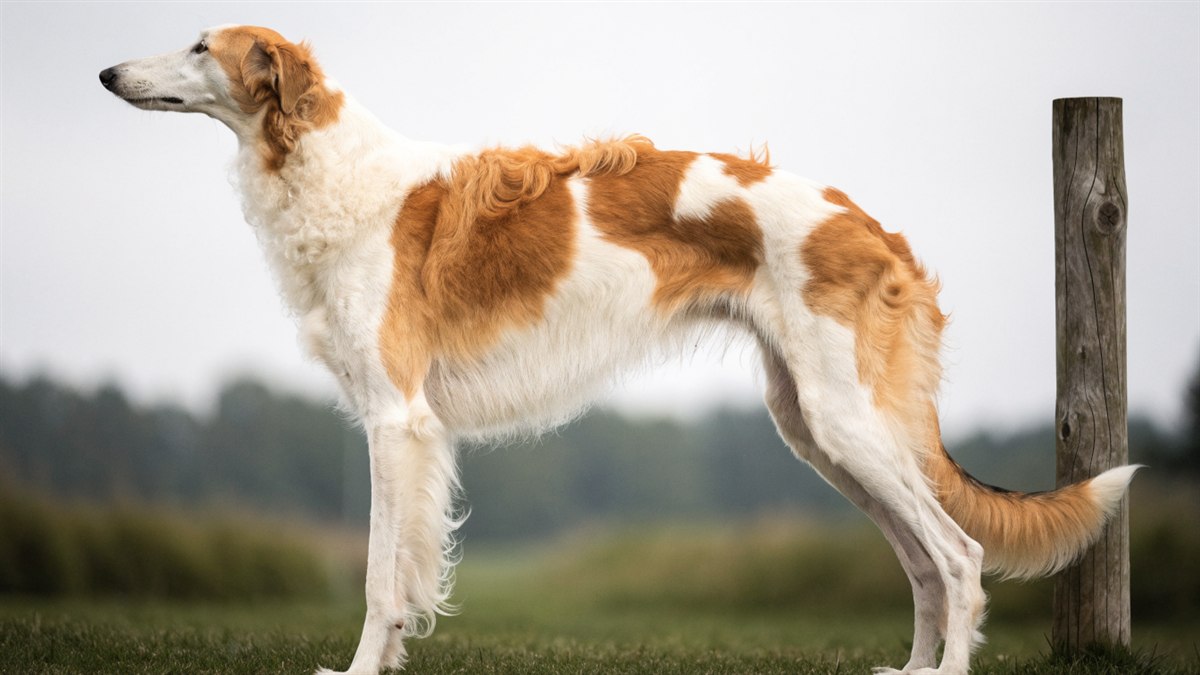
A Borzoi is a giant Russian coursing sighthound standing 75 to 85 cm at the withers in males and 68 to 78 cm in females, carrying a long silky wavy coat and a heavy curly frill around the neck. Its FCI name is Russkaya Psovaya Borzaya, and its job was chasing hare and fox, and less often wolf, across open Russian country.
The word does the describing for you. Borzoi is the masculine singular of an archaic Russian adjective meaning fast, and psovaya comes from *psovina*, the Russian word for a wavy silky coat. So the breed's own name in Russian says coated fast dog. Everything on this page follows from those two words: a sprinting build wearing a cold-climate coat.
The FCI standard describes a dog of aristocratic appearance, tall, lean and strong, rather high-legged and fairly narrow in body, with skin that is thin and elastic and muscles that are lean and elongated. The chest is oval in cross-section, deep, let down almost to the elbow-joints, and the belly is abruptly tucked up towards the flanks. That is a deep-chested giant, and the reason bloat gets its own section below.
The three standards do not agree on size
Three kennel clubs publish a Borzoi standard and none of them gives the same numbers. The FCI sets a desirable band with both a floor and a ceiling. The Royal Kennel Club sets a minimum only. The AKC sets a lower minimum than either and is the only one of the three that publishes a weight.
| Standard | Males | Females | Weight given? |
|---|---|---|---|
| FCI No 193, valid 04.09.2019 | 75 to 85 cm desirable | 68 to 78 cm desirable | No |
| Royal Kennel Club, updated 01.04.2025 | 74 cm minimum | 68 cm minimum | No |
| AKC, approved 13.06.1972 | 28 in (71.1 cm) minimum | 26 in (66.0 cm) minimum | 75 to 105 lb males |
Read the table again and the gap is real. The AKC's floor for a male, 71.1 cm, sits 3.9 cm below the FCI's floor of 75 cm, and its floor for a female, 66.0 cm, sits 2.0 cm below the FCI's 68 cm Federation Cynologique Internationale The Royal Kennel Club (UK). Only the FCI penalises a dog for being too big, treating over- or undersize by 2 cm as a fault and by more than 2 cm as a severe fault.
The most useful weight figure is not in any standard. A 2024 study that weighed 146 clinically healthy adult Borzoi recorded males at 38.3 plus or minus 4.1 kg and females at 30.4 plus or minus 3.8 kg. That is a measured population, not a breeders' estimate, and it is the number to plan food and drug doses against. Indian listing pages quote 34 to 48 kg and 27 to 48 kg Asia Pets, Borzoi Puppies for Sale…, both of which overstate the typical female.
The coat is two coats in one dog
The Borzoi's silky coat is deliberately uneven in length. On the head, the ears and the inner side of the limbs the hair is very short and close lying; on the back and neck it is longer and often wavy; on the outer thigh and the sides it may form finer curls. The long shining feathering sits in five specific places: the neck, where it forms a muff, the lower chest and belly, the backs of the forelegs and thighs, and under the tail. The Royal Kennel Club puts it in six words, a large curly frill on the neck.
That neck frill matters more in Chennai than in Moscow, because it sits directly over the carotid arteries and the jugular grooves, the part of a dog you cool first.
The Borzoi sheds heavily. The co-ranking international breed page rates its shedding 5 out of 5 and labels it constant, and answers hypoallergenic with a flat no. The Indian listing page that ranks second for this query prints Shedding: Yes on its own spec panel. No standard describes the coat as low-shedding; the FCI in fact penalises a coat that is too harsh in shedding, which presupposes that it sheds.
Where the breed came from, and why that matters to an Indian buyer
The Borzoi was assembled in Russia from at least five earlier types, and its first written standard was adopted by the Moscow Hunting Society in 1888 Russkaya Psovaya Borzaya. Every line of that document describes a dog for cold open country, which is the single most important fact for anyone considering one in India.
The FCI standard prints the pedigree of the breed itself. It dates the history to the fifteenth century and the Mongol invasion, when Tatars used sighthounds of Arab origin called Koutsi while Russian hunters used extraordinarily strong Loshaya dogs able to catch a deer or an elk. Crosses between Koutsi and Loshaya became the prototype. Polsky Chart blood came in during the sixteenth and seventeenth centuries, then the Klock, described as a huge, strong and fierce bearded Courland sighthound, produced the beardless long-fine-haired dogs that began the Gustopsovy type.
Greyhound blood added at the same period produced the Chistopsovy type, and Mountain (Gorsky) and Crimean sighthounds were used later for their endurance. Five source populations, one purpose.
The Pershino hunt and why the breed nearly vanished
Hunts using large packs of sighthounds and hounds with mounted riders appeared in the eighteenth and nineteenth centuries, and some ran to several hundred dogs. The most renowned was the Pershino hunt of Grand Duke Nikolai Nikolaevich, praised both for the beauty of its dogs and for their speed and passion for the game Borzoi, English Wikipedia.
Because the breed was a symbol of the aristocracy, it was almost destroyed during the Bolshevik revolution, and a small number of breeders saved it by exporting dogs to Britain, Canada and the United States. The AKC recognised the breed in 1891 and the FCI definitively accepted the Russkaya Psovaya Borzaya in 1956 Borzoi, English Wikipedia.
The first congress of Borzoi lovers met in 1874, and the Moscow Hunting Society adopted the first unified standard in 1888, written by N.P. Yermolov. Its fundamental principles survive nine revisions, in 1925, 1939, 1951, 1963, 1969, 1980, 1993, 1995 and 2006. A breed standard that has been revised nine times in a century and still says the same thing is a standard with a settled idea of the dog.
Read the utilisation clause before you read anything else
The FCI standard's Utilization line is the most decision-relevant sentence on the whole document for an Indian household. It reads that the Borzoi is a hunting sighthound to be used mostly for chasing hare and fox, less for wolf hunting, combining high agility with endurance and the ability to tackle a game deftly at once. The Royal Kennel Club's Characteristics line is shorter and no softer: a coursing hound which must be courageous, powerful and of great speed.
The gait section spells out the two speeds the breed has. In everyday life the typical gait is the extended, free, easy trot; when hunting the gait is a full rushing gallop. The AKC puts a number on the gallop, 35 to 40 miles per hour, which is 56 to 64 km per hour.
The Russian Kynological Federation publishes the standard in Russian with the same date of 04.09.2019 and the same measurements, and it keeps the native vocabulary the English translation has to gloss: the coat is *psovina* and the neck feathering is a *mufta*, a muff. Russian Wikipedia records the same 1888 date for the first standard and gives working weights of 34 to 47 kg for males and 25 to 40 kg for females, which the standard itself does not state. Where the Russian and the FCI English text differ, they differ only in idiom, not in substance.
One more piece of Russian context is worth knowing before you meet a Borzoi in India. The silhouette of this breed is the emblem of the Russian Kynological Federation itself. This is a national dog in the way the Rajapalayam is a regional one, and a lot of the breed's Indian mystique is borrowed prestige rather than practical fit.
Borzoi price in India: there is no price, and here is the proof
No honest Borzoi price in India exists in 2026, because no page that ranks for the query publishes one. We opened all ten. Six are listing shells returning other breeds, one is a 40-breed price list with no Borzoi row, one is India's oldest breed directory reporting no breeders, one is a US page quoting dollars, and one is a 2013 news report about a single imported dog.
This is the finding, not a gap in our research. A reader typing price in india after this breed name is being served pages that look like a market and are not one.
What each ranking page actually shows when you open it
| Page | Borzoi price shown | What is actually on the page |
|---|---|---|
| Asia Pets, rank 1, titled Best Price | None | Showing 0 results. Offers a Chihuahua, a Yorkshire Terrier and a Toy Pom instead |
| Puppiezo, rank 2 | None | Prices of ₹98,999, ₹92,599, ₹94,999 and ₹1,20,000 shown belong to a Maltipoo, two Poodles, a Cane Corso and a Goldendoodle |
| Mr n Mrs Pet, rank 3 | None | 3 Result Found: two French Bulldogs and a Border Collie |
| Mr n Mrs Pet Kolkata, titled Borzoi Price in Kolkata | None | 3 Result Found: two French Bulldogs and a Cavalier King Charles Spaniel |
| DogsIndia | None | There are no breeders listed currently under this breed |
| Supertails Dog Price List in India, 40 breeds | None | No Borzoi row, although the list carries the Great Dane, Saint Bernard, Samoyed and Mudhol Hound |
| Dog Breeds List (US) | USD 1,500 to USD 3,000 | A dollar figure, not an Indian one |
| NDTV, 3 December 2013 | Rs 22 lakh | The import cost of one named dog, not a puppy price |
The Puppiezo case deserves naming, because a reader skimming Google sees ₹98,999 in the snippet next to the word Borzoi. Open the page and that price is attached to an eight-week-old Maltipoo called Fizey in the Other Available Pets carousel. The Borzoi panel on the same page carries height, weight, life expectancy, shedding, origin and exercise, and no price at all.
Run the 84.38 test on every rupee figure you are shown
Indian breed pages routinely publish a US dollar figure run through one exchange rate and print it as an Indian price. The test is to divide the rupee number by 84.38 and see whether a round dollar amount falls out. Do it here and the results are clean.
| Figure as published | Divided by 84.38 | Verdict |
|---|---|---|
| Rs 22,00,000 (NDTV import cost) | USD 26,073 | Genuine rupee figure, not a conversion |
| USD 1,500 to USD 3,000 (Dog Breeds List) | Would print as Rs 1,26,570 to Rs 2,53,140 | A dollar band. If you see that rupee range on an Indian page, it is this figure converted |
| ₹98,999 (Puppiezo snippet) | USD 1,173 | Not a Borzoi price at all. It belongs to a Maltipoo |
So the only genuine published Indian rupee figure for this breed is Rs 22 lakh, and it is not a purchase price. NDTV, reporting an IANS story with a Chandigarh dateline on 3 December 2013, described a three-year-old Borzoi imported by a Jaipur-based professional groomer, and reported that he cost his owner a whopping Rs 22 lakh to import him and has to be kept in an air-conditioned environment. The owner claimed the dog was the only one of its kind in Asia.
Rs 22 lakh is an import cost, covering purchase, permits, quarantine and freight, in 2013 rupees, for one dog. Treating it as a market price would be as wrong as treating the Maltipoo's ₹98,999 as one.
We will not average Rs 22 lakh with a converted dollar band and publish a range. There is no Indian Borzoi market to average. If a seller quotes you a figure, ask which KCI-registered Indian sire and dam the puppy descends from, and read the [law and imports](#law) section before you pay a deposit.
Monthly cost of ownership, bounded honestly
Budget a Borzoi as a giant breed, which in India means Rs 12,000 to Rs 20,000 a month before anything goes wrong. Two Borzoi-specific costs sit on top of that and neither appears on any Indian page: year-round cooling, and cardiac screening by a specialist rather than a general practitioner.
There is no published Indian cost breakdown for this breed, so the honest method is to take a published Indian giant-breed structure and adjust it for what the evidence says this dog needs. Supertails' 2026 giant-breed column gives food at Rs 6,000 to Rs 10,000, routine vet visits at Rs 1,500 to Rs 3,000, annual vaccination at Rs 2,000, grooming at Rs 600 to Rs 1,500, treats and toys at Rs 800 to Rs 1,500 and flea and deworming at Rs 600 to Rs 1,000, totalling Rs 12,000 to Rs 20,000 a month.
Three adjustments a Borzoi forces on that budget
- Add cooling as a fixed line, not a summer one. The only Indian Borzoi ever reported in the national press was kept in air conditioning 24 hours a day, seven days a week. Treat that as the baseline requirement rather than an anecdote, and price the electricity for one room running continuously through eight months of the year.
- Add specialist cardiology, not a stethoscope. The parent club's own CHIC requirement is an echocardiogram by a board-certified cardiologist, and the OFA lists the screening as an Advanced Cardiac Exam. In India that means travelling to a referral centre in a metro, not a neighbourhood clinic. Budget it annually.
- Add grooming time rather than grooming money. The coat is long but it is described as resistant to dirt and mud, which drops off as the coat dries, and the recommended routine is a weekly brush with a pin brush and a bath only as needed. The recurring cost here is your hours, not a salon bill.
| Line | Rs per month | Basis |
|---|---|---|
| Food, 30 to 40 kg dog | 6,000 to 10,000 | Published Indian giant-breed range |
| Routine veterinary | 1,500 to 3,000 | Published Indian giant-breed range |
| Vaccination, annualised | 165 to 170 | Rs 2,000 a year, divided by 12 |
| Parasite control, year-round | 600 to 1,000 | Not seasonal in India, see the tick figures in health |
| Grooming supplies | 600 to 1,500 | Published Indian giant-breed range |
| Treats, toys, miscellaneous | 800 to 1,500 | Published Indian giant-breed range |
| Cooling, one room, most of the year | Not published for India | Bonbeno does not invent a figure; price your own tariff |
| Specialist echocardiogram, annualised | Not published for India | Referral-centre pricing varies too widely to quote |
| Comparable published total | 12,000 to 20,000 | Supertails giant-breed column |
Two rows in that table say not published, and they stay that way. No Indian source we could open prices continuous air conditioning for a dog or a veterinary echocardiogram by breed, and inventing a number would be worse than leaving the row honest. Ask two referral hospitals in your city for their echocardiogram fee before you commit.
The cost nobody budgets is the anaesthetic one
A Borzoi will need anaesthesia at some point, for a dental, a radiograph, a neuter or an emergency. In this breed that is not a routine procedure at a routine price, because the safe version needs a pre-anaesthetic conversation, potentially a different induction agent, and a longer recovery watch. The [anaesthesia section](#anaesthesia) sets out what to ask for. Budget the extra monitoring time rather than discovering it at the counter.
Borzoi are quiet indoors. The breed is rated 1 of 5 for barking tendency and described as rare, and 1 of 5 for watchdog ability. A dog that does not bark at every passer-by is a genuine saving in an Indian apartment block, where noise complaints cost more relationships than money.
Heat tolerance: rated 1 of 5, and here is the arithmetic
Bonbeno rates Borzoi heat tolerance 1 out of 5, the lowest score we give. The reason is a single comparison: in Chennai, Mumbai and Bengaluru, the coolest month of the year is warmer than the warmest month in the breed's origin climate. Delhi is the only one of the four where that is not true.
We took every figure below from one source on one methodology, NASA POWER's temporal climatology endpoint, queried by explicit latitude and longitude so that no city can be substituted for another by a slug lookup. T2M is the long-term mean air temperature at two metres.
| Place and coordinates | Annual mean T2M | Warmest month mean | Coolest month mean | Recorded max |
|---|---|---|---|---|
| Moscow, 55.7558 N 37.6173 E | 4.28 C | 18.98 C (July) | -10.65 C (January) | 35.06 C |
| Tambov steppe, 52.7212 N 41.4523 E | 5.90 C | 21.59 C (July) | -10.53 C (January) | 41.11 C |
| Delhi, 28.6139 N 77.2090 E | 25.60 C | 35.88 C (June) | 13.61 C (January) | 48.79 C |
| Mumbai, 19.0760 N 72.8777 E | 26.77 C | 31.19 C (May) | 23.19 C (January) | 44.91 C |
| Chennai, 13.0827 N 80.2707 E | 27.95 C | 31.51 C (May) | 24.09 C (January) | 42.70 C |
| Bengaluru, 12.9716 N 77.5946 E | 23.74 C | 28.37 C (April) | 20.22 C (December) | 40.38 C |
The one number that settles it
Moscow's warmest month averages 18.98 C. Now read the coolest-month column. Chennai's coolest month, January, averages 24.09 C, Mumbai's January 23.19 C and Bengaluru's December 20.22 C, all above that. In three of India's four largest metros, a Borzoi never once in the calendar year experiences a monthly mean as cool as a Moscow summer.
Delhi is the exception and the exception is instructive. Delhi's January mean of 13.61 C sits 5.37 C below Moscow's July mean, so a Delhi winter is genuinely comfortable for this coat. Then June arrives at a mean of 35.88 C, which is 16.90 C above the warmest month the breed was built for, with a recorded maximum of 48.79 C. Delhi does not give a Borzoi a mild climate. It gives it four good months and a lethal one.
Bengaluru is the mildest Indian option on the table and it is still 9.39 C above Moscow's peak in April and 19.5 C above Moscow's annual mean. There is no Indian metro on this list where the honest answer is that the climate is fine.
Humidity removes the second cooling route
A dog sheds heat mainly by evaporation from the respiratory tract, and evaporation slows as ambient humidity rises. Mumbai's July mean relative humidity is 89.56 percent and Chennai's annual mean is 72.39 percent. Moscow's annual mean humidity is high too at 87.53 percent, but at an annual mean of 4.28 C humidity is close to irrelevant. Humid heat is the combination that matters, and coastal India delivers it for months.
The risk is exercise, not a parked car
The largest study of canine heat illness reviewed 905,543 UK dogs under primary veterinary care and identified 1,259 heat-related illness events in 1,222 dogs. Exertion was the trigger in 74.2 percent of the 879 events where a cause was recorded, environment in 12.9 percent and vehicular confinement in only 5.2 percent, and death following exertional heat illness was about as likely as death following the hot-car version. That study was done in Britain. A sighthound in India that decides to gallop after a cat in May is the exact case it describes, in a climate 16 C hotter.
Move all exercise to before sunrise and after full dark, year-round rather than in summer only. Never let a Borzoi run in daylight between March and June anywhere on the plains. Cool the dog by wetting the belly, the inner thighs and the underside of the neck where the coat is short, not by soaking the frill, which holds water against the skin and slows heat loss. And never clip the coat to make the dog cooler: the FCI standard treats an equal length of coat all over the body as a fault, and a clipped double-length coat regrows unevenly.
Every Indian buyer should also know that the only Borzoi ever reported in the Indian press lived in air conditioning around the clock, and the article says so in the same sentence as the price. That was not luxury. It was the condition of keeping the dog alive.
Anaesthesia: what to tell your vet, in specifics
Tell your vet three things before any Borzoi is anaesthetised. The breed is named in the pharmacogenomics literature as a carrier of the slow-metabolism CYP2B11-H3 haplotype, it has very little body fat to buffer a lipophilic drug, and 38 percent of clinically healthy Borzoi have first-degree atrioventricular block on a resting ECG. All three are breed-specific and all three are cited below.
The AKC's own breed page says only that sighthounds, including Borzoi, are more sensitive to anesthesia than other breeds. That sentence is true and useless in a consulting room. Here is the version a vet can act on.
1. The genetic finding names this breed, so it is not borrowed from the Greyhound
Martinez and colleagues genotyped 2,057 dogs across 64 breeds, with a minimum of ten dogs per breed, covering 19 sighthound breeds, 45 non-sighthound breeds and 153 mixed-breed dogs. They identified a CYP2B11 haplotype, H3, differentiated by a mutation in the gene's 3' untranslated region. In a luciferase reporter assay, H3 showed markedly lower gene expression than the reference H1 haplotype, by over 70 percent, at P equals 0.001. CYP2B11 is the liver enzyme that clears propofol and the thiobarbiturates.
The haplotype is not evenly spread. H3 was found in 10 of 19 sighthound breeds, which is 53 percent, against 10 of 45 non-sighthound breeds, which is 22 percent, and the average frequency was 9 plus or minus 3 percent in sighthounds against 1.7 plus or minus 0.7 percent in others, at P equals 0.003. AKC-registered Greyhounds carried the highest frequency of any breed sampled at 59 percent.
So does it transfer to the Borzoi? The paper answers that directly, and this is why this page can be specific where others cannot. Its discussion names the six breeds of Sighthound Group 1 as Greyhound, Whippet, Scottish Deerhound, Irish Wolfhound, Borzoi and Italian Greyhound, and states that the CYP2B11-H3 haplotype was found in all of the Sighthound Group 1 breeds except Irish Wolfhound. The Borzoi is inside that set by name. Only one of the seven Group 2 sighthound breeds sampled carried it at all.
The paper prints its per-breed haplotype frequencies in a chart, Figure 5, rather than in the body text, so we can state that the Borzoi carries H3 but we cannot quote a Borzoi-specific percentage from the text we read. Nor does carrying the haplotype mean every Borzoi is affected: the authors predict that some, but not all, would have decreased CYP2B11 expression, with the lowest expression in dogs of the H3/H3 diplotype, about 70 percent lower than H1/H1. Treat it as a breed-level flag that justifies caution, not as a diagnosis.
2. Low body fat is a second, separate mechanism
A Borzoi is a lean dog by standard. The FCI describes skin that is thin and elastic without folds, muscles that are lean and elongated, bone that is strong but not massive, and a belly abruptly tucked up towards the flanks. A measured population of 146 healthy adults averaged 38.3 kg for males and 30.4 kg for females on a frame 75 to 85 cm tall Federation Cynologique Internationale. That is very little adipose tissue relative to body length.
Lipophilic induction agents redistribute into fat. With little fat to redistribute into, more of the dose stays in blood and central nervous system, and a liver clearing it slowly then keeps it there. The two mechanisms stack rather than substitute.
3. The resting ECG is the finding nobody mentions
This is the part that is genuinely new to Indian readers and to most Indian clinics. Wesselowski and colleagues recruited 98 clinically healthy Borzoi between October 2020 and December 2022 and analysed the 82 with a structurally normal echocardiogram. In those 82 healthy dogs they found first-degree atrioventricular block, defined as a PR interval over 130 milliseconds, in 31 dogs, which is 38 percent. QT intervals over 240 milliseconds appeared in 29 dogs, 35 percent, and over 250 milliseconds in 15, 18 percent. Early repolarisation notches or slurs appeared in 67 of 82, 82 percent, and an ST segment abnormality in 17 of 82, 21 percent. Ventricular arrhythmias were documented in 8 dogs, 10 percent, all with normal cardiac troponin I.
The authors conclude that P, PR and QRS durations are commonly prolonged compared to general canine reference intervals, and call for breed-specific ECG reference intervals and for study into heritable channelopathies given the frequency of ventricular arrhythmias, repolarisation abnormalities and sudden death in the breed.
"This is a Borzoi. It is a Sighthound Group 1 breed that carries the CYP2B11-H3 variant associated with slow propofol and thiobarbiturate clearance, it has almost no body fat, and a prolonged PR interval or a long QT on its pre-anaesthetic ECG may be normal for the breed rather than pathology. Please dose to lean body mass, plan for a longer recovery watch, and interpret the ECG against Borzoi data rather than general canine reference intervals." Then let the veterinarian, who has examined the dog, choose the protocol. Bonbeno does not recommend drugs.
Temperament and household fit
A Borzoi is calm, quiet and aloof indoors and single-minded outdoors, which is a better apartment temperament than most Indian buyers expect and a worse street temperament than any of them expect. The FCI describes the temperament as calm, with visual response well evident, and the attitude towards people as neutral to friendly.
Three standards describe this dog's character and they converge. The FCI gives calm with a strong visual response. The Royal Kennel Club gives sensitive, alert and aloof. The AKC standard is the outlier: it has no temperament section at all, mentioning only courage and agility inside the general appearance clause. Its breed page fills the gap with calm, agreeable temperament and regally dignified.
Aloof is the operative word and it is not a synonym for unfriendly. An aloof dog is polite to strangers and reserves its attachment. Indian visitors expecting a Labrador greeting will find this dog walks past them, and that is normal breed behaviour, not a training failure.
Who this breed suits in India
- Households with a securely enclosed space. Not a balcony, not a gated society lawn, an actual fence the dog cannot see a cat through.
- Owners in a genuinely temperate location. A hill station or a home where a cooled room is available every day of the year, not just in a heatwave.
- Adults who want a quiet dog. Barking is rated 1 of 5 and described as rare, and the breed is calm and relatively inactive indoors.
- People who value an independent animal. This is a hound bred to make its own decisions at 60 km per hour, out of earshot of a handler on a horse.
Who this breed does not suit
- Homes with cats or small dogs. Cat friendliness and dog friendliness are both rated 1 of 5, and the AKC notes that the sight of a cat or squirrel on the run will quickly stir their pursuit instinct American Kennel Club.
- Families wanting a rough-and-tumble children's dog. Child friendliness is rated 2 of 5, and the AKC describes Borzoi as a bit too dignified to wholeheartedly enjoy a lot of roughhousing American Kennel Club.
- Anyone who will walk the dog off-lead on an Indian street. See the [exercise section](#exercise). This is the single most dangerous mismatch on the page.
- First-time owners in Chennai, Mumbai or any plains city. The climate arithmetic in the [climate section](#climate) does not work.
What the owner survey says about temperament, with its denominator
The OFA breed health survey is self-selected and unverified, and OFA says so on the page, but it is the largest body of Borzoi owner reports available. Of roughly 1,092 owners answering the temperament question, 65 reported a temperament disorder, which is 6 percent. Within those 65 the two commonest reports were timid, 24 dogs, and aggressive, 24 dogs, followed by rage syndrome, 10 dogs.
Read that carefully. Timidity and aggression were reported at exactly equal frequency, and the sex split diverged sharply: 21 of the 24 timid dogs were female and 17 of the 24 aggressive dogs were male. Those are small numbers from a voluntary survey and should not be treated as prevalence. They do suggest that the failure mode in this breed is more often fearfulness than aggression, which matches a sensitive, aloof hound.
The Royal Kennel Club's one-word temperament summary is sensitive, and the breed is described as becoming bored quickly with repetitive tasks and learning only in an atmosphere of mutual respect. Harsh correction, still common in Indian street-side training practice, produces a shut-down Borzoi rather than a compliant one. Plan for that before you hire a trainer.
Training: what works, what this breed refuses, and realistic timelines
To train a Borzoi, build every session around short, varied, reward-based repetitions and accept that recall will never be reliable enough to trust off-lead near traffic. Trainability is rated 2 of 5 and the breed is described as not the most naturally obedient dog, becoming bored quickly with repetitive tasks.
Independence is the trait, and it was selected for. A hound coursing hare across open steppe worked out of voice range of a mounted handler and had to decide for itself. The FCI standard's phrase for what replaced obedience is visual response is well evident. You are training an animal whose primary input is sight and whose default response to a moving object is to run at it.
What works
- Short sessions. Three to five minutes, several times a day, stopped before the dog disengages.
- Food and motion as reward. A dog that will not repeat a sit for the tenth time will chase a thrown toy on cue all evening.
- Mutual respect rather than correction. The published guidance is that the breed will learn what is expected of it if trained in an atmosphere of mutual respect, and the AKC advises patience, consistency and good humour.
- Lure coursing and scent work as outlets. The AKC notes that Borzoi excel in canine sports such as agility and lure coursing, and the parent club runs coursing, agility, obedience and scent work programmes. A dog with a legal outlet for the chase is a calmer dog on lead.
What this breed refuses
Drilling. Ten repetitions of the same exercise in one session will end with a Borzoi lying down. The breed nonetheless competes successfully in obedience and agility trials, which tells you the ceiling is high and the route to it is variety.
It also refuses to prioritise you over a moving cat. Treat that as a permanent structural limit rather than a training gap, and manage it with equipment.
A realistic first-year timeline
| Age | Priority | What good looks like |
|---|---|---|
| 8 to 12 weeks | Socialise to Indian street noise, horns, cattle, free-roaming dogs, all from a carried or safely distanced position | Dog observes without freezing or lunging |
| 3 to 5 months | Lead manners and a name response indoors. Crate or safe-room conditioning for hot afternoons | Walks on a loose lead in a quiet lane before sunrise |
| 4 to 6 months | Fit and condition a martingale or wide sighthound collar. A flat collar slips a Borzoi's narrow head | Collar cannot be backed out of under pressure |
| 6 to 9 months | Recall in a fully enclosed space only, never on open ground. Handling practice for grooming and vet exams | Dog returns from a distraction inside a fence |
| 9 to 12 months | Introduce a legal chase outlet, lure coursing or a flirt pole in an enclosed area. Restrict jumping and hard turns | Dog is tired by pursuit, not by distance |
| 12 months and beyond | Maintain, do not expand. Assume recall will fail once | You never test that assumption near a road |
Two Indian-specific notes belong in that timeline. First, socialisation to free-roaming dogs is not optional here, because a Borzoi is rated 1 of 5 for dog friendliness and will meet loose dogs on almost every walk. Second, all of the outdoor work above has to happen in darkness or near-darkness for most of the year, which shortens the available training window to two short periods a day.
De-barking is prohibited in India. The Prevention of Cruelty to Animals (Dog Breeding and Marketing) Rules, 2017, Second Schedule Part II paragraph 6(8), states that there shall be no tail docking, ear cropping, de-barking, de-clawing, branding, dyeing, injecting substances to enhance visual appeal, performing a surgery or procedure to camouflage or hide any defect or infirmity or any other kind of mutilation of any body part of the pup and any change of appearance by artificial means is strictly forbidden. A quiet breed makes the point moot, but the clause applies.
Exercise, and what off-lead means on an Indian street
Give a Borzoi one to two hours a day, split between a long lead walk and a short burst of running inside a fence. Off-lead exercise on any open Indian ground is not a training question. The AKC's wording is unambiguous: it is never advisable to allow a Borzoi to run loose.
Start with what the dog is for. The FCI standard says the Borzoi combines high agility with endurance and the ability to tackle a game deftly at once, and that when hunting the gait is a full rushing gallop. The AKC puts the gallop at 35 to 40 miles per hour, 56 to 64 km per hour. A dog accelerating to highway speed in a few strides, triggered by sight, is the animal you are walking.
Why the Indian street changes the calculation
In a British park, a Borzoi that breaks after a squirrel runs across grass and comes back. In an Indian city it runs across a road carrying continuous two-wheeler traffic, through a market, or into a group of free-roaming dogs. The published guidance already anticipates this: in the city he should only be let off the lead in a safe, enclosed space, and in some countries it is forbidden to allow dogs in this fleet-footed hunting category off the leash at all.
The AKC states it three ways on one page. Being sighthounds, they are apt to chase anything that moves, so they should always be in an enclosed area or on a leash. Fenced-in running room is a must. It is never advisable to allow a Borzoi to run loose.
Bonbeno's position is that in India this is not advice, it is the condition of ownership. If you do not have an enclosed space this dog can gallop in, you cannot exercise this dog adequately and you should choose a different breed.
A workable Indian routine
- Walk before sunrise. Forty-five to sixty minutes on a martingale collar and a fixed-length lead, never a retractable one, in the coolest part of the day.
- Sprint inside a fence. Ten to fifteen minutes of self-selected galloping, two or three times a week, on grass or soft ground rather than concrete.
- Walk again after full dark. Thirty to forty-five minutes, once surface temperatures have dropped enough to touch the back of your hand to the pavement for five seconds.
- Rest through the middle of the day. The breed is described as relatively inactive indoors and will do this willingly.
- Stop entirely above a wet-bulb threshold you set with your vet. Exertion caused 74.2 percent of heat-illness events in the largest study of the question, in a far cooler country.
Equipment that actually holds a Borzoi
The breed's head is narrower than its neck. The FCI describes a head so lean that the principal veins show through the skin, a skull narrow and elongated seen from above, and a neck that is long, dry and oval in section. A conventional flat collar loose enough to be comfortable is loose enough to be reversed over that head by a dog that plants its feet. Use a martingale or a wide sighthound collar fitted so it cannot be backed out of.
Jogging and cycling are both listed as suitable Borzoi activities, with an explicit warning that a Borzoi is quite likely to shoot off after any prey it catches sight of, and that you will need to react very quickly. A 38 kg dog changing direction at speed while tethered to a moving bicycle is a fall waiting to happen. In Indian traffic, do not cycle with this dog.
Lure coursing is what this breed was built to do and the parent club runs it as a formal sport alongside agility, obedience and scent work American Kennel Club. India has no organised lure-coursing circuit for this breed, but a flirt pole in an enclosed compound reproduces the same motor pattern at low cost. A Borzoi that has chased something legal today is a Borzoi that is easier to hold on a lead tomorrow.
Grooming and coat care in Indian humidity
Brush a Borzoi weekly with a pin brush, check the mat-prone points every time, and bathe only when the dog is actually dirty. The coat is easier than it looks, because it is described as resistant to dirt and mud, which just drops off when the coat dries. That last clause is written for a dry climate and needs adjusting here.
Know what you are brushing. The coat is long, supple, silky, light, wavy or forming large curls, and it is different lengths on different parts of the body: very short and close lying on the head, ears and inner limbs, longer and often wavy on the back and neck, shorter with finer curls on the outer thighs and sides. The long feathering sits on the neck as a muff, on the lower chest and belly, on the backs of the forelegs and thighs, and under the tail.
The four places a Borzoi mats
- Behind the ears, where short head coat meets long neck coat.
- Where the legs meet the body, in the armpit and groin folds.
- Inside the neck frill, which is the densest and curliest hair on the dog.
- The trousers and tail feathering, which is described as rather long and shining and which picks up burrs and seeds.
Work each of those four with a pin brush and fingers weekly. A mat in the groin of a giant dog in a humid climate becomes a hot spot in days.
Where the overseas advice does not transfer
The standard grooming line for this breed, written for temperate countries, is that mud drops off once the coat dries. In Mumbai, where July mean relative humidity is 89.56 percent, and in Chennai, at an annual mean of 72.39 percent, a dense curly neck frill does not simply dry. Monsoon rain plus a coat that stays damp against the skin is how a clean dog becomes a dog with pyoderma.
So adjust in two ways. Towel and actively dry the frill, the chest feathering and the groin after any wet walk rather than letting the dog air dry, and lift the coat to check the skin underneath weekly rather than judging by the surface. The Indian monsoon is not the climate this care advice was written for, and the fix is drying rather than more bathing.
Shedding, and the thing you must not do
The Borzoi sheds heavily and constantly, rated 5 of 5. Regular brushing is the only realistic control. Expect hair on furniture and floors year-round in a warm climate, where the seasonal moult that structures shedding in Russia is blunted.
Two reasons. The coat is uneven by design, and the FCI standard lists an equal length of the coat all over the body as a fault, together with too straight, furry, dull, tousled coat and poorly developed fringes and featherings. More practically, clipping removes the layer that shades the skin without removing the dog's real heat problem, which is a giant body producing metabolic heat in a humid climate. Cool the skin at the short-coated points instead: the inner thighs, the belly and the underside of the neck.
Ears, teeth and feet
The AKC's routine care line is short and worth following: a Borzoi's ears should be checked regularly, and the teeth should be brushed often. Dental disease shows up in this breed's own data: OFA has 259 Borzoi dentition evaluations with 23 abnormal, 8.9 percent, and the owner survey's commonest dental report was missing premolar teeth in 39 dogs. That second one is partly a standards question rather than a disease, since the FCI accepts the absence of third molars and one or two P1 while treating the absence of one or two PM2 as a fault.
The feet need weekly attention for a different reason. The standard requires nails long, strong, touching the ground, on lean narrow hare feet with long arched tight toes. On Indian concrete those nails wear unevenly and split. Check them when you brush.
Health risks, screening and life expectancy, with denominators
The Borzoi screens well on joints and badly on nothing, but its two real problems are cardiac and neoplastic and neither has a screening test. Its parent club opens its own health statement with the line that the breed overall has relatively few and low incidences of health problems, then names osteosarcoma, haemangiosarcoma, bloat, chylothorax, lung lobe torsion and GOLPP as concerns with no test available.
Every OFA figure below was read from the OFA page whose own heading and page title print BORZOI, retrieved using registration code BZ, which OFA itself publishes against BORZOI in its DNA test ordering table Orthopedic Foundation for Animals. Counts on a live register move, so the sample size sits next to every percentage.
| Registry | Evaluated | Normal / clear | Abnormal | OFA breed rank |
|---|---|---|---|---|
| Thyroid (autoimmune thyroiditis) | 2,647 | 2,212 (83.6%) | 142 (5.4%), plus 293 equivocal (11.1%) | 36 |
| Eyes (CAER) | 2,633 | 2,563 (97.3%) | 70 (2.7%) | 187 |
| Degenerative myelopathy DNA | 2,569 | 1,967 clear (76.6%) | 43 at risk (1.7%), 559 carriers (21.8%) | 55 |
| Congenital cardiac | 1,950 | 1,865 (95.6%) | 25 (1.3%), plus 60 equivocal (3.1%) | 17 |
| Advanced cardiac | 1,624 | 1,429 (88.0%) | 114 (7.0%), plus 60 equivocal (3.7%) | 30 |
| Hips | 925 | 905 (97.8%) | 19 dysplastic (2.1%) | 210 |
| Dentition | 259 | 236 (91.1%) | 23 (8.9%) | 22 |
| Elbows | 104 | 102 (98.1%) | 2 dysplastic (1.9%) | 130 |
Hips and elbows are genuinely good, and the rank proves it
Hip dysplasia is close to a non-issue in this breed. Of 925 hip evaluations, 905 were normal, 285 excellent, 579 good and 41 fair, and only 19 were dysplastic: 17 mild, 1 moderate and 1 severe. Divide it out and 19 of 925 is 2.1 percent. OFA prints a breed rank of 210 against the hip registry and 130 against elbows, where elbows ran 2 dysplastic of 104 evaluated, 1.9 percent. We report those rank numbers as OFA prints them and do not interpret which direction the list runs, because the page does not say.
Set that against the giant breeds an Indian buyer cross-shops. This is a giant dog whose joints are not the problem.
The thyroid figure is a trap, and Indian law walks into it
Read the thyroid row again. Only 5.4 percent of 2,647 Borzoi were frankly abnormal, but 293, which is 11.1 percent, came back equivocal. That equivocal share is by far the largest of any Borzoi registry and it is the sighthound signature: a low thyroid reading in a lean coursing hound is often the breed's normal, not disease.
Now the Indian legal complication. The Prevention of Cruelty to Animals (Dog Breeding and Marketing) Rules, 2017, Second Schedule Part III paragraph 8(10), requires that dogs shall have been tested for genetic defects, including hip dysplasia, progressive retinal atrophy, night blindness, hypothyroidism, entropion, ectropion, overshot, undershot jaw, wry mouth, two or more missing teeth, unilateral cryptorchid or full cryptorchid males. Indian law therefore mandates a hypothyroidism test on a breed in which roughly one evaluation in nine returns an equivocal result. Have the test done, and have it interpreted by someone who knows sighthound reference intervals before a dog is treated or excluded from breeding on the strength of it.
Degenerative myelopathy: the carrier rate is the number that matters
Only 1.7 percent of 2,569 Borzoi tested at risk for degenerative myelopathy, but 559, which is 21.8 percent, were carriers. Roughly one Borzoi in five carries one copy. That is a breeding decision, not a health scare: two carriers bred together can produce affected pups. The DNA SOD1A test is one of the four CHIC requirements the parent club sets.
Life expectancy
Published life expectancy for the Borzoi ranges from 9 to 14 years at the AKC, 10 to 14 at an Indian listing page, 9 to 14 at another, and 10 to 12 on the co-ranking international page Asia Pets, Borzoi Puppies for Sale… Dog Breeds List, Borzoi: Price. The most useful figure has a denominator. In the OFA owner survey, 612 owners reported a deceased dog, and the age at death broke down as over 10 years for 267 dogs (44 percent), 5 to 10 years for 260 (42 percent), 2 to 5 years for 54 (9 percent), 6 months to 2 years for 30 (5 percent) and under 6 months for 1. Those five counts sum exactly to 612.
The English Wikipedia article states that a 2024 UK study found an average life expectancy of 12 years for Borzois, with a sample size of 43, attributing it to McMillan et al. We could not confirm it. The Nature page for that paper redirected twice to an authentication endpoint, and the per-breed figures sit in supplementary tables we did not open. Bonbeno does not publish a figure it has not seen in the source, so treat 12 years at n equals 43 as unverified here and use the 612-dog OFA distribution above instead.
The heart: three Borzoi studies, 396 dogs, and why a murmur may be normal
Cardiac disease is the best-documented health topic in this breed and the least reported by Indian pages. Three Borzoi-specific studies published between 2023 and 2024 examined 152, 146 and 98 dogs, and together they explain why the parent club requires an echocardiogram by a board-certified cardiologist rather than a stethoscope Wesselowski S, Janacek B, Sykes KT Borzoi Club of America.
Start with the counterintuitive finding, because it prevents a wasted panic. Most Borzoi heart murmurs are not disease.
Study one: 146 clinically healthy Borzoi
Wesselowski and colleagues examined 146 clinically healthy adult Borzoi by auscultation and standard echocardiogram. 119 of 146, which is 81.5 percent, were structurally normal. Within those 119 structurally normal dogs, physiologic heart murmurs were identified in 64, which is 53.8 percent. Thirty-six of them, 30.2 percent, had trace or mild mitral regurgitation and 43, 36.1 percent, had trace or mild tricuspid regurgitation.
Structural cardiac disease was found in 21 of the 146 dogs, 14.4 percent: 9 dogs, 6.2 percent, with dilated cardiomyopathy, 9 dogs, 6.2 percent, with stage B1 myxomatous mitral valve disease, and 3, 2.1 percent, with congenital abnormalities. A further 7, 4.8 percent, were equivocal.
So a Borzoi with a murmur is more likely to be a normal Borzoi than a sick one, and the only way to tell is an echocardiogram. An Indian general practitioner hearing a murmur in this breed and treating for heart failure would be wrong more than half the time.
Study two: 152 Borzoi seen by cardiologists over 20 years
Sykes and colleagues searched records from 14 centres over a study period of up to 20 years and assembled 152 client-owned Borzoi. Of the 131 of 152, 86 percent, that had an echocardiogram, 85 of 131, 65 percent, were structurally normal, and 40 of those 85, 47 percent, had trace or mild atrioventricular valve regurgitation.
Dilated cardiomyopathy was diagnosed in 13 of 131 dogs and myxomatous mitral valve disease in 12 of 131, at similar frequencies, though 92 percent of the valve disease cases were mild. Tricuspid valve dysplasia was the commonest congenital diagnosis, in 6 dogs. Ventricular arrhythmias were identified in 25 of 131, 19 percent, of which 76 percent had minimal or no structural cardiac disease and five had a family history of sudden death. A sudden death outcome was reported in 3 of 55 Borzoi with long-term outcome data, 5 percent.
The Sykes abstract states that dogs most commonly presented for pre-breed screening in 87/152 (52%). Eighty-seven divided by 152 is 57.2 percent, not 52 percent. The same wording appears on the journal page and on the PubMed record, so it is the published text rather than a transcription slip. Bonbeno uses the raw counts throughout this section and flags the discrepancy rather than repeating a percentage that fails its own arithmetic.
Study three: the resting ECG, and why it changes anaesthesia
Of 98 clinically healthy Borzoi recruited between October 2020 and December 2022, 82 had a structurally normal echocardiogram and were analysed. In those 82 dogs, 31, 38 percent, had first-degree atrioventricular block; 29, 35 percent, had a QT interval over 240 milliseconds and 15, 18 percent, over 250; 67, 82 percent, had early repolarisation notches or slurs; 17, 21 percent, had an ST segment abnormality; and 8, 10 percent, had ventricular arrhythmias with normal cardiac troponin I.
The authors conclude that P, PR and QRS durations are commonly prolonged compared with general canine reference intervals, and call for study into heritable channelopathies given the frequency of ventricular arrhythmias, repolarisation abnormalities and sudden death in the breed. Their keywords include Brugada and long QT syndrome.
What that means for an Indian owner
OFA's register agrees with the studies. Of 1,624 advanced cardiac evaluations, 114 were abnormal, 7.0 percent, with a further 60 equivocal, 3.7 percent, and OFA ranks the Borzoi 30th on that registry. The parent club's response is structural: it requires an echocardiogram by a board-certified cardiologist for CHIC, and it runs a Holter monitor rental programme with a standing Holter Committee so that owners can screen for arrhythmias between visits Borzoi Club of America.
In India that translates into one concrete action. Find the nearest veterinary cardiology referral service before you need it, not during an emergency, and get a baseline echocardiogram and ECG on a healthy adult so that later readings have something breed-appropriate to be compared against.
Osteosarcoma: what is known, and the honest gap
Osteosarcoma is the cancer the Borzoi's own parent club names first, and it is the commonest cancer type in the breed's owner survey, reported for 77 dogs Orthopedic Foundation for Animals. What does not exist is a Borzoi-specific prevalence figure from a veterinary population study, and we can show why.
The Borzoi Club of America's health statement, approved 20 August 2024, lists five conditions as areas of some concern that currently do not have screening tests, and cancer heads the list: osteosarcoma and haemangiosarcoma. That is the parent club naming the problem it cannot test for.
What the owner survey shows, with its denominator
In the OFA breed health survey, 254 of 1,124 owners answering the cancer question reported cancer or tumours, which OFA prints as 23 percent. Divide it out and 254 of 1,124 is 22.6 percent, so that one holds.
Within the cancer-type question, osteosarcoma was the single most-reported diagnosis at 77 dogs, ahead of other cancer at 34 and haemangiosarcoma at 33. OFA prints osteosarcoma as 34 percent. Note that 77 divided by the 254 dogs reported with cancer is 30.3 percent, not 34, so OFA's denominator for the cancer-type question is the smaller set of owners who answered it, roughly 226. Use the count of 77 rather than either percentage.
Two caveats stay attached to those numbers. OFA states on the page that respondents are self-selected and there is no verification of the responses or duplicate checking. And an owner survey oversamples the memorable, so cancer reporting is likely to run high.
The Borzoi is absent from the largest osteosarcoma study, and that is a real finding
The definitive population study is O'Neill and colleagues' VetCompass analysis of 905,552 UK dogs under primary veterinary care, which confirmed 331 osteosarcoma cases and a one-year period prevalence of 0.037 percent. We searched the full text for Borzoi and found zero occurrences. The same search returned Scottish Deerhound 13 times, Greyhound 11 times and Rottweiler 10 times in the same session, so the search worked and the absence is genuine. The Borzoi is simply too rare in a UK primary-care population to have reached the study's reporting threshold.
What that study does tell you about this breed
The Borzoi is absent by name and present by conformation. The study found that increasing adult bodyweight was strongly associated with increasing odds of osteosarcoma, that dogs heavier than their own breed average had 1.65 times the risk of lighter ones, and that breeds with dolichocephalic (long) skull conformation had 2.72 times the odds of mesocephalic breeds, 95 percent CI 2.06 to 3.58. Chondrodystrophic short-legged breeds had 0.10 times the odds, and the authors conclude that breed, bodyweight and longer leg or longer skull length are all strong risk factors.
There is no longer-skulled, longer-legged breed than the Borzoi. Its standard requires a head so lean the principal veins show through the skin, a long narrow oval skull, and a dog that is rather high-legged at 75 to 85 cm. It sits at the extreme of both conformational risk factors the study identified.
The nearest named comparator is instructive and it is another giant sighthound. The Scottish Deerhound had the highest annual osteosarcoma prevalence of any breed in that population, 3.28 percent, with odds 118 times those of crossbred dogs O'Neill DG, Edmunds GL, Urquhart-Gilmore J. Bonbeno will not transfer that number to the Borzoi, because they are different breeds and this site does not substitute one breed's figure for another's. State it as the boundary of what is known.
Osteosarcoma presents as lameness with bony or soft-tissue swelling, and the median age at diagnosis across all breeds was 9.64 years. In a giant sighthound, a persistent limp in a dog over seven that does not resolve in a week is a radiograph, not a course of anti-inflammatories. That is the whole of the practical advice, and it is worth more than a borrowed percentage.
One further note on the OFA survey. The commonest cancers reported after osteosarcoma and haemangiosarcoma were mammary cancer in 25 dogs, all female, and lung cancer in 21. Mammary tumours are substantially preventable by early spaying, which is a live decision in India where entire bitches are common.
Bloat and gastric dilatation-volvulus: what is proven for this breed
The Borzoi is not named in the definitive gastric dilatation-volvulus cohort study, and we can prove the search worked. What does exist for this breed is its own owner survey, in which bloat or gastric torsion was the commonest gastrointestinal report, named for 52 dogs, and its parent club's health statement, which lists GDV as a concern with no screening test Borzoi Club of America.
GDV is the reason a deep-chested giant breed page has to be careful. The stomach fills with gas and rotates, and without surgery the dog dies. Fatality rates commonly range from 15 to 24 percent.
Glickman's cohort does not include the Borzoi
The reference study is Glickman and colleagues' prospective cohort of 1,914 dogs, published in the Journal of the American Veterinary Medical Association in January 2000. It compared incidence and breed-related risk factors for GDV among 11 named breeds: Akita, Bloodhound, Collie, Great Dane, Irish Setter, Irish Wolfhound, Newfoundland, Rottweiler, Saint Bernard, Standard Poodle and Weimaraner. The Borzoi is not one of them.
That absence is a finding rather than a failure of research. We downloaded the paper and searched its full text: Borzoi returned zero occurrences, while Great Dane returned 15 and Irish Setter returned 12 in the same pass, so the search worked.
What Glickman does give you, and the closest legitimate comparator
Across the whole cohort, incidence of GDV was 23 cases per 1,000 dog-years at risk for the 7 large breeds and 26 per 1,000 for the 4 giant breeds. Of the 105 dogs that developed GDV, 30 died, 28.6 percent. Cumulative incidence was 5.7 percent for all breeds.
The one breed in that cohort that resembles a Borzoi is the Irish Wolfhound, a giant deep-chested sighthound. It contributed 392.0 dog-years of follow-up, 10 dogs developed GDV, giving an incidence of 26 cases per 1,000 dog-years, 95 percent CI 10 to 42, or 2.6 percent of dogs per year. The Great Dane in the same study ran at 53 per 1,000, 95 percent CI 34 to 72, from 31 cases in 586.9 dog-years.
| Breed | Dog-years of follow-up | Dogs developing GDV | Incidence per 1,000 dog-years |
|---|---|---|---|
| Great Dane | 586.9 | 31 | 53 (95% CI 34 to 72) |
| Irish Wolfhound | 392.0 | 10 | 26 (95% CI 10 to 42) |
| Newfoundland | 499.4 | 5 | 10 (95% CI 1 to 19) |
| Saint Bernard | 346.6 | 2 | 6 (95% CI -2 to 14) |
| Borzoi | not studied | not studied | not studied |
Bonbeno will not carry the Irish Wolfhound's 26 per 1,000 across to the Borzoi. Two giant sighthounds are not interchangeable, and this site does not substitute one breed's number for another's. The row stays blank on purpose.
The Borzoi's own bloat number
The breed does have a figure, and it comes from the OFA breed health survey. Of roughly 1,095 owners answering the gastrointestinal question, 98 reported a gastrointestinal disorder, 9 percent. Within the follow-up question, bloat or gastric torsion was the commonest single answer, named for 52 dogs, well ahead of inflammatory bowel disease at 12 and colitis at 10. Fifty-two of the 98 owners reporting a gastrointestinal disorder is 53.1 percent; OFA prints 57 percent, because its denominator for the follow-up question is the smaller set who answered it. Use the count.
The survey is self-selected and unverified, and OFA says so. It is still the only Borzoi bloat data that exists, and 52 owner-reported cases is not nothing. The parent club independently names gastric dilatation volvulus in its approved health statement as one of six concerns with no screening test.
The standing advice for this breed is to avoid large meals and feed small meals two or three times a day, and to avoid exercise after meals. Learn the signs before you need them: an unproductive retch, a visibly distending abdomen, restlessness and drooling. The Indian wrinkle is timing. Because heat forces all Borzoi exercise into two narrow windows around dawn and after dark, the temptation is to feed and walk close together. Do not. Separate feeding and exertion by at least an hour in each direction, and shift the meal rather than the walk.
Feeding, body condition and the Indian diet question
Feed a Borzoi small meals two or three times a day rather than one large one, keep it lean, and take the diet question seriously because two dogs in one Borzoi cardiac study had their dilated cardiomyopathy diagnosis reverse after a diet change Wesselowski S, Sykes KT, Saunders AB. Body condition matters more in this breed than in almost any other, for two reasons that pull in opposite directions.
The first reason is bloat. Small frequent meals and no exercise around mealtimes is the standing recommendation for the breed, and the [bloat section](#bloat) explains why.
The second is anaesthetic dosing. A sighthound's low body fat is part of why it recovers slowly from lipophilic drugs. Let a Borzoi become obese to buffer that and you have traded an anaesthetic risk for a cancer risk: in the VetCompass osteosarcoma study, dogs weighing more than their own breed average had 1.65 times the risk of those below it. Lean is correct.
What lean actually is, with a number
The most useful body-condition anchor for this breed is not a chart, it is a measured population. In 146 clinically healthy adult Borzoi, males weighed 38.3 plus or minus 4.1 kg and females 30.4 plus or minus 3.8 kg. Weigh your dog against that, not against a listing page. Indian listings quoting 34 to 48 kg and 27 to 48 kg substantially overstate the typical female.
The FCI standard gives you the visual check. The belly should be abruptly tucked up towards the flanks, the skin thin and elastic, the muscles lean and elongated, and belly insufficiently tucked up, paunchy or pendulous is listed as a fault. A Borzoi with a straight underline is overweight by its own standard.
The diet-associated DCM question, stated carefully
In the 146-dog echocardiographic study, two dogs originally diagnosed with dilated cardiomyopathy, one occult and one equivocal, normalised after a diet change. Two dogs is a small number and the paper reports it as an observation rather than a trial result. Bonbeno reports it the same way. It is enough to justify one action: if your Borzoi is ever diagnosed with DCM, tell the cardiologist exactly what it eats, brand and formulation, before anything else is decided.
Life-stage feeding for a giant, slow-maturing sighthound
| Stage | Meals per day | Priority |
|---|---|---|
| 8 weeks to 4 months | 4 | Large-breed puppy formulation. Controlled growth, not maximum growth |
| 4 to 9 months | 3 | Keep ribs easily felt. Do not supplement calcium |
| 9 to 18 months | 3 | Transition to adult food late; this breed matures slowly |
| Adult | 2 to 3 | Small meals, never one large one. Rest an hour either side of exertion |
| Senior, from about 7 | 2 to 3 | Watch for weight loss, which in a giant sighthound can be the first cancer sign |
Indian availability, honestly
Large-breed and giant-breed dry foods are widely available in Indian metros, and the published Indian giant-breed food budget is Rs 6,000 to Rs 10,000 a month. There is no Borzoi-specific commercial diet anywhere and there does not need to be. What India does not reliably offer is a veterinary nutritionist, so if you plan a home-prepared or raw diet for a 38 kg sighthound with a documented cardiac profile, get it formulated rather than improvised.
A giant dog in an Indian summer drinks a great deal, and the instinct is to let it drink its fill immediately after a walk. In a deep-chested breed with a documented bloat concern, that is the wrong moment. Cool the dog first at the short-coated points, let the breathing settle, then offer water in stages. Never withhold water in heat; stage it.
One food-safety note worth keeping on the fridge. The Indian listing page that ranks second for this breed publishes its own do-not-feed list for Borzoi: almonds, avocados, cherries, grapes, lemon, onions, salt and sugar. Grapes and onions in particular are ordinary items in an Indian kitchen and both are genuinely toxic to dogs.
Month by month through the first year
Plan a Borzoi's first year around three constraints an Indian owner cannot negotiate: the eight-week legal floor on sale, the heat calendar, and a growth plate that closes late in a giant breed. Everything below assumes a puppy legally sold at eight weeks or older, as Rule 8(1)(a) of the Dog Breeding and Marketing Rules, 2017, requires.
Before the puppy arrives
Do three things first. Confirm the enclosed space exists, because without it you cannot exercise this dog. Identify the nearest veterinary cardiology referral service, because the parent club's screening standard is an echocardiogram by a board-certified cardiologist. And write the anaesthesia note from the [anaesthesia section](#anaesthesia) into your regular clinic's file at the very first appointment, before any procedure is on the table.
| Age | Health and legal | Exercise and heat | Training and coat |
|---|---|---|---|
| 8 to 10 weeks | Puppy vaccination course begins; the Rules note vaccination can start at seven to eight weeks and usually completes by eighteen weeks. Register the dog as a sighthound in the clinic file | Indoors and cooled. No outdoor exposure in daylight | Handling practice daily. Touch feet, ears, mouth |
| 10 to 16 weeks | Complete the vaccination course. Start year-round tick and flea prevention now, not seasonally | Short carried or on-lead exposure trips before sunrise only | Socialise to horns, cattle, free-roaming dogs from a safe distance |
| 4 to 6 months | Deworming schedule. First dental check | Lead walks lengthening to 20 minutes, twice a day, in darkness | Fit a martingale collar. A flat collar slips this head |
| 6 to 9 months | Neutering decision; note the Rules bar sale of a dog over six months without prior sterilisation, so ask a rescue what has been done | No forced running, no stairs work, no jumping. Growth plates are open | Recall practice inside a fence only |
| 9 to 12 months | Baseline echocardiogram and ECG in a healthy dog, so later readings have a comparator | Introduce short self-selected sprints on soft ground | Coat begins lengthening; start weekly pin-brush routine |
| 12 to 18 months | Thyroid, eye and DM DNA tests if breeding is contemplated | Adult routine: one to two hours a day, split, always out of the sun | Adult frill fully in. Add the four mat-check points weekly |
| 18 months to 3 years | Hips and elbows optional under CHIC but cheap reassurance | Full adult workload. Assume recall fails once | Coat at full length; expect constant shedding |
The heat calendar reshapes the whole year
A puppy born in India in October gets a comfortable first five months and hits its high-growth phase in March. A puppy born in March spends its entire socialisation window indoors in a cooled room, which is safe but costs it the street exposure it needs. If you have any influence over the timing, take an autumn or early-winter puppy. In Delhi, where January averages 13.61 C and May averages 35.05 C, that choice is worth several months of usable outdoor time.
Parasites from week one, not from the first tick
India's tick-borne disease load is the reason prevention starts at the first vet visit rather than at the first tick. A survey of 525 dogs across Mumbai, Delhi, Sikkim and Ladakh found Hepatozoon canis in 158 of 525 dogs, 30 percent, Ehrlichia canis in 108 of 525, 20.6 percent, Mycoplasma haemocanis in 64 of 525, 12.2 percent, Anaplasma platys in 34 of 525, 6.5 percent, and Babesia vogeli in 29 of 525, 5.5 percent. A long-coated dog with a dense neck frill is harder to tick-check than a short-coated one, which makes prophylaxis more important here, not less.
This is the one thing a well-meaning Indian breeder or vet may offer to do to a Borzoi puppy, and it is illegal here. The AKC standard says hind dewclaws are generally removed and forelegs may be removed, and the FCI standard makes presence of dewclaws a disqualifying fault in the show ring. Indian law overrides both: Second Schedule Part II paragraph 6(8) forbids de-clawing and any other kind of mutilation of any body part of the pup. See the [law section](#law).
Borzoi against the breeds Indian buyers cross-shop
Indian buyers looking at a Borzoi are usually choosing between four things: a Borzoi, an Afghan Hound, a Great Dane, and an Indian sighthound such as the Mudhol Hound or Rampur Greyhound. On price and availability the Indian sighthound wins outright, and on every practical criterion the Borzoi is the hardest of the four to keep here.
| Borzoi | Afghan Hound | Great Dane | Mudhol Hound | |
|---|---|---|---|---|
| Published Indian price | None exists; only an Rs 22 lakh import cost from 2013 | Quoted across Indian sources | Rs 20,000 to Rs 80,000 | Rs 3,000 to Rs 15,000 |
| On Supertails' 40-breed India list | No | No | Yes | Yes |
| Breeders on DogsIndia | None listed | Listed | Listed | Listed |
| Coat | Long silky with a heavy neck frill | Long, uniformly, including a topknot | Short | Short |
| Heat tolerance, Bonbeno rating | 1 of 5 | See our Afghan Hound guide | See our Great Dane guide | Bred for this climate |
| Sighthound anaesthesia flag | Yes, named in Sighthound Group 1 | Yes, sighthound | No, but giant-breed caution applies | Yes, sighthound |
| Breed-specific cardiac literature | Three studies, 396 dogs Sykes KT, Wesselowski S, Saunders AB Wesselowski S, Janacek B, Sykes KT | Limited | Extensive for DCM | Almost none |
| Named in Glickman's GDV cohort | No Glickman LT, Glickman NW, Schellenberg DB | No | Yes, 53 per 1,000 dog-years | No |
| Can be exercised off-lead in India | No American Kennel Club | No | With training | No |
Borzoi against the Afghan Hound
These are the two long-coated sighthounds of FCI Group 10 Section 1, and Indian buyers routinely confuse them. The distinguishing feature is where the coat is short. A Borzoi has very short close-lying hair on the head, ears and inner limbs, with the length concentrated in a neck muff and in feathering. An Afghan Hound is long-coated over the head as well. If a photograph shows a long-haired head, it is not a Borzoi.
For India, that difference cuts in the Borzoi's favour by a small margin, because a short-coated head and short-coated inner thighs give you two places to apply cooling directly to skin. It does not change the overall verdict.
Borzoi against the Great Dane
Both are giant and deep-chested, and the Great Dane is the better-documented bloat risk by a wide margin: 31 cases in 586.9 dog-years, an incidence of 53 per 1,000 dog-years. The Great Dane also has a real Indian market at Rs 20,000 to Rs 80,000 and appears on the standard Indian price lists. If the appeal is a large elegant dog and the constraint is India, the Great Dane is the more available answer and the short coat is a genuine advantage in heat.
Borzoi against an Indian sighthound
This is the comparison Bonbeno thinks most Indian buyers should actually make. The Mudhol Hound at Rs 3,000 to Rs 15,000 and the Rajapalayam at Rs 5,000 to Rs 20,000 are sighthounds evolved in the Deccan, and both are described as very good on health in the same Indian price guide that omits the Borzoi entirely. They give you the same coursing temperament, the same aloof affection, and the same need for a lead in traffic, without the coat, the import problem or the cooling bill.
What they do not give you is the documented health literature. The Borzoi has three breed-specific cardiac studies and a 2,647-dog thyroid dataset; the Mudhol Hound has almost nothing published. That is a genuine trade-off in the Borzoi's favour, and it is worth stating rather than pretending the Indian breeds are strictly better in every respect.
Bonbeno publishes full guides to the Afghan Hound, the Great Dane, the Greyhound, the Whippet, the Mudhol Hound and the Rampur Greyhound. Each carries its own heat rating on the same NASA POWER methodology used here, so the ratings are comparable across breeds rather than being one writer's impression.
Nine mistakes Indian owners and buyers make with this breed
Most Borzoi mistakes in India are made before the dog arrives, at the point of buying, and the rest are made in the first hot season. Each of the nine below is tied to a specific published figure rather than to opinion.
- Believing a price you saw in a search snippet. The ₹98,999 that appears next to the word Borzoi on the page ranking second is attached to an eight-week-old Maltipoo named Fizey in a carousel of other available pets. Open the page before you believe the number.
- Treating a listing count as inventory. Mr n Mrs Pet prints 3 Result Found on both its national Borzoi page and its Borzoi Price in Kolkata page. On the first the three are two French Bulldogs and a Border Collie; on the second they are two French Bulldogs and a Cavalier King Charles Spaniel Mr n Mrs Pet, Borzoi Puppies for sale…. Asia Pets, ranking first and titled Best Price, prints Showing 0 results.
- Assuming a Rs 22 lakh figure means the breed is simply expensive. It was a 2013 import cost for one dog, and the same sentence records that the dog had to be kept in an air-conditioned environment 24x7. The cooling was part of the deal, not an extravagance.
- Letting the dog off-lead because it seems calm indoors. The breed is relatively inactive indoors and rated 1 of 5 for barking, and it accelerates to 56 to 64 km per hour at the sight of a moving animal. The AKC's line is that it is never advisable to allow a Borzoi to run loose.
- Using a flat collar. The FCI standard describes a narrow elongated skull and a long oval neck. A comfortable flat collar reverses over that head. Fit a martingale.
- Clipping the coat to keep the dog cool. It does not work, and the FCI standard lists an equal length of coat all over the body as a fault. Cool the short-coated points instead: inner thighs, belly, underside of the neck.
- Panicking at a heart murmur. In 146 clinically healthy Borzoi, 64 of the 119 structurally normal dogs, 53.8 percent, had physiologic murmurs. Get an echocardiogram before anyone starts cardiac medication.
- Accepting a general anaesthetic without a conversation. The Borzoi is named in Sighthound Group 1 as carrying the CYP2B11-H3 haplotype associated with slow propofol and thiobarbiturate clearance, and 38 percent of clinically healthy Borzoi have first-degree atrioventricular block on a resting ECG Wesselowski S, Janacek B, Sykes KT. Say both sentences at the clinic.
- Letting a breeder remove the dewclaws. The AKC standard says hind dewclaws are generally removed and the FCI disqualifies a dog that has them, but de-clawing is strictly forbidden in India under Second Schedule Part II paragraph 6(8).
The mistake behind all nine
Every one of these is a version of the same error: treating advice written for another country as though it were written for this one. The grooming line that mud drops off when the coat dries was written for a climate that is not 89.56 percent humid in July Dog Breeds List, Borzoi: Price. The dewclaw instruction was written for jurisdictions where the procedure is lawful. The off-lead guidance assumes a park, not a market road.
Bonbeno's rule when reading any overseas breed-club or kennel-club care advice is to ask two questions of every instruction. What climate does this assume, and what law does this assume? On this breed both questions change the answer.
Indian owners generally do understand that a giant dog needs space, and the Borzoi is one of the few giants that is genuinely undemanding indoors. It will do okay in an apartment if sufficiently exercised, being relatively inactive indoors and so peaceful it might escape notice, but it still needs somewhere outside to walk and run. Apartment living is not the disqualifier here. The absence of an enclosed running space is.
Indian law, imports, and why no Borzoi supply chain can form
Two Indian legal texts explain the empty market better than any market analysis. DGFT Trade Notice No. 22/2022-23 makes dog imports Restricted and states that applications for trading or breeding purposes shall be duly rejected, and the Dog Breeding and Marketing Rules, 2017 govern what a domestic breeder may do Ministry of Environment. Read together they mean a Borzoi can enter India as somebody's pet and cannot enter as stock.
What the import notice actually says
Trade Notice No. 22/2022-23 was issued by the Directorate General of Foreign Trade on 19 December 2022 and addressed to all international airlines, all Indian embassies and consulates abroad, and pet owners concerned. Under ITC(HS) 01061900, Mammals: Other, the import policy is Restricted, subject to Policy Condition 6.
Policy Condition (7) limits dog imports to three purposes: a pet dog with a valid pet book and relevant records or documents in the name of the importer; dogs imported by R&D organisations for research with the recommendation of CPCSEA; and internal security by the Defence and Police Force. Policy Condition (8) states that import of commercial dogs for breeding or any other commercial activities other than the purposes mentioned above is not permitted.
Paragraph 6 is blunt: any applications for trading/breeding purposes, or applications made on behalf of some another person/entity shall be duly rejected. Paragraph 7 limits entry to the airports and seaports of Delhi, Mumbai, Chennai, Hyderabad, Bangalore and Kolkata, with quarantine at the government station where required. DAHD added a seventh port, Cochin International Airport at Kochi, for pets arriving under the baggage rules in October 2024. The full route is set out in how to import a dog to India.
For permanent imports of up to two pets, entry is allowed as passenger baggage without DGFT authorisation only for persons transferring their residence to India after two years of continuous stay abroad; anything else needs an authorisation, applied for at least two months before travel.
Put that beside the registry evidence
DogsIndia, the country's oldest breed directory, states there are no breeders listed currently under this breed. So the lawful route in is a returning resident's personal pet, and there is no visible domestic breeding population for that dog to be bred into. That is the whole explanation for the empty SERP, and it is a better answer than any price range.
The dewclaw conflict, which is specific to this breed
Three documents give three different answers about the same body part, and an Indian breeder following either of the overseas ones would break Indian law.
| Authority | Position |
|---|---|
| AKC breed standard, 1972 | Dewclaws, if any, on the hind legs are generally removed; dewclaws on the forelegs may be removed |
| FCI standard No 193, 2019 | Presence of dewclaws is listed under DISQUALIFYING FAULTS |
| Dog Breeding and Marketing Rules, 2017, India | Second Schedule Part II paragraph 6(8): no de-clawing or any other kind of mutilation of any body part of the pup, and any change of appearance by artificial means is strictly forbidden |
The FCI position is the sharper trap. A Borzoi born with dewclaws is disqualified from the FCI show ring, and removing them in India is prohibited. A breeder cannot lawfully make an Indian-bred Borzoi conform to that clause. Say so to anyone who offers.
Other clauses that bind an Indian Borzoi breeder
- Rule 8(1)(a): pups less than eight weeks in age are not sold.
- Rule 8(1)(b): dogs over six months in age are not sold without first being sterilised, unless sold to another licensed breeder.
- Second Schedule Part II paragraph 6(3): in breeding, defined as mating between relatives of the second to fourth grade within four generations, and incest breeding between parents and children or brother and sister, are both prohibited. Only out breeding and line breeding are permitted.
- Second Schedule Part II paragraph 6(9): breeding to create new breeds of dogs or unusual looks is strictly prohibited.
- Second Schedule Part III paragraph 8(10): dogs shall have been tested for genetic defects including hip dysplasia, progressive retinal atrophy, night blindness, hypothyroidism, entropion, ectropion and cryptorchidism.
The 2017 Rules number clauses twice. There is a Rule 8, Conditions for sale, in the body of the Rules, and a separate paragraph 8, Veterinary care, in Part III of the Second Schedule. The eight-week sale floor is Rule 8(1)(a); the mandatory genetic-defect testing is Second Schedule Part III paragraph 8(10). We read both in the machine-readable gazette text of G.S.R. 496(E) hosted by the Animal Welfare Board of India and quote the clause we actually saw.
Adoption and responsible sourcing
Adopting a Borzoi in India is close to impossible, and that is the honest starting point. There is no domestic breeding population to surrender from, DogsIndia lists no breeders under this breed, and the country's oldest directory has been asking readers to send a photograph of one for years. What you can adopt is the temperament you actually wanted.
Read the DogsIndia page for this breed and you find a request rather than a listing. The site asks that if you have this breed, or know anyone who does, please send a good profile photograph of the dog, and its breeders' list reads there are no breeders listed currently under this breed. India's longest-running dog directory does not have a picture of an Indian Borzoi.
If you are offered a Borzoi in India, verify these five things
- Ask which registry the dog is on and see the paper. Not a screenshot of a certificate, the certificate, with the sire and dam named.
- Ask where the parents live. A domestically bred puppy needs an Indian sire and dam. If the seller cannot name where they are, the puppy is not what is being described.
- Ask how the parents entered India. Under Trade Notice 22/2022-23 the lawful routes are a returning resident's pet, an R&D import with CPCSEA recommendation, or Defence and Police use, and applications for breeding purposes shall be duly rejected.
- Check the age. Sale below eight weeks is prohibited by Rule 8(1)(a).
- Look at the dog against the standard. A long-coated head means an Afghan Hound. A short coat with no neck frill means a Greyhound cross. The Borzoi has a short-coated head and a heavy curly frill on the neck.
If any of the first three cannot be answered plainly, walk away. Bonbeno does not name, rank or link breeders, and we do not broker sales.
What to adopt instead, and why it is not a consolation prize
The temperament people want from a Borzoi is a quiet, aloof, low-barking sighthound that sleeps most of the day and gallops for ten minutes. India has that dog in several forms, and they are available for adoption or at Rs 3,000 to Rs 20,000 rather than an import bill.
- Mudhol Hound, Rs 3,000 to Rs 15,000, described as athletic and agile with very good health in the same Indian guide that has no Borzoi row. See our Mudhol Hound guide.
- Rajapalayam, Rs 5,000 to Rs 20,000, loyal and protective, rated very good on health. See our Rajapalayam guide.
- Chippiparai and Kanni, Rs 3,000 to Rs 15,000, both South Indian sighthounds. See our Chippiparai guide.
- Indian indie or street dog, Rs 0 to Rs 3,000 through adoption, rated excellent on health for hybrid vigour. See our Indian Pariah Dog guide.
Every one of those is a dog whose ancestors solved the Indian heat problem without air conditioning. That is not a compromise. On the single criterion that decides whether a dog is comfortable in Chennai in May, they beat the Borzoi outright.
If you already have a Borzoi in India
Nothing above is a reason to rehome a dog you already love. Do five things instead. Register it as a sighthound in your clinic's file today, before any procedure is scheduled. Get a baseline echocardiogram and ECG while the dog is healthy. Move all exercise into darkness. Keep one room cooled and available year-round. And learn the bloat signs, because in a deep-chested giant the difference between a survivable case and a fatal one is measured in hours.
This site does not tell anyone which dog to buy, and it does not moralise about pedigree ownership. It reports what the evidence says. On this breed the evidence says three things clearly: there is no Indian Borzoi market to buy into, the climate arithmetic does not work in any Indian metro, and the breed carries two documented medical flags, anaesthetic and cardiac, that most Indian clinics will not know about unless you tell them. Everything else is preference.
Borzoi questions Indian buyers actually ask
What is the Borzoi price in India?
No Borzoi price in India can be quoted honestly. Every page ranking for the query publishes zero Borzoi listings: Asia Pets shows 0 results, Mr n Mrs Pet shows French Bulldogs, and DogsIndia lists no breeders. The only real published rupee figure is Rs 22 lakh, an import cost reported by NDTV in 2013 for a single dog.
Is INR 3,000 a lot for a dog?
Not for an Indian breed, and it is nowhere near a Borzoi. Published Indian guides put the Mudhol Hound at Rs 3,000 to Rs 15,000 and an adopted indie at Rs 0 to Rs 3,000, both of which are better suited to Indian heat than any imported sighthound. This question is asked verbatim on a page that ranks for Indian dog prices.
Are Borzoi sensitive to anaesthesia?
Yes, and for this breed the evidence is specific rather than borrowed. Martinez and colleagues name the Borzoi among the Sighthound Group 1 breeds in which the CYP2B11-H3 haplotype was found, and that haplotype showed over 70 percent lower gene expression than the reference version in a luciferase reporter assay.
Can a Borzoi live in Indian heat?
Only in a permanently cooled home. Moscow's warmest month averages 18.98 C, while the coolest month in Chennai averages 24.09 C, in Mumbai 23.19 C and in Bengaluru 20.22 C. In three of India's four largest metros a Borzoi never experiences a monthly mean as cool as a Moscow summer.
Do Borzoi get bloat?
The breed's parent club lists gastric dilatation volvulus as a concern with no screening test, and bloat or gastric torsion was the commonest gastrointestinal report in the OFA owner survey, named for 52 dogs. The Borzoi is not one of the 11 breeds in Glickman's definitive GDV cohort study.
Why does my healthy Borzoi have a heart murmur?
Because most Borzoi murmurs are physiologic. In a study of 146 clinically healthy adult Borzoi, 119 were structurally normal and 64 of those 119, which is 53.8 percent, had physiologic heart murmurs. An echocardiogram is the only way to separate a normal murmur from disease in this breed.
Can you let a Borzoi off the lead?
Not in India, and the American Kennel Club says not anywhere. Its breed page states that Borzoi should always be in an enclosed area or on a leash and that it is never advisable to allow a Borzoi to run loose, because they will chase anything that moves at 35 to 40 miles per hour.
How big does a Borzoi get?
The FCI standard gives a desirable height of 75 to 85 cm at the withers for males and 68 to 78 cm for females. A study that actually weighed 146 healthy adults recorded 38.3 kg for males and 30.4 kg for females, which is lighter than most Indian listing pages claim.
Are Borzoi hypoallergenic?
No. The Borzoi sheds heavily and constantly, rated 5 out of 5 for shedding on the co-ranking international breed page, which answers the hypoallergenic question with a flat no. The Indian listing page that ranks second for this breed prints Shedding: Yes on its own specification panel.
Can I import a Borzoi into India?
Only as a personal pet, and never for breeding. DGFT Trade Notice 22/2022-23 makes dogs a Restricted import, permits entry only for a pet with a valid pet book in the importer's name, R&D with CPCSEA recommendation, or Defence and Police use, and states that applications for trading or breeding purposes shall be duly rejected.
Is a Borzoi good for an apartment in India?
Indoors, yes. The breed is quiet, rated 1 of 5 for barking, and relatively inactive in the house. The disqualifier is not the flat, it is the absence of an enclosed space outside where a 38 kg sighthound can safely gallop out of the sun.
Should Borzoi dewclaws be removed?
Not in India, where it is illegal. The AKC standard says hind dewclaws are generally removed and the FCI standard disqualifies a dog that has them, but Second Schedule Part II paragraph 6(8) of the Dog Breeding and Marketing Rules, 2017 forbids de-clawing and any other kind of mutilation of any body part of the pup.
How long do Borzoi live?
The AKC gives 9 to 14 years. The figure with a denominator comes from the OFA owner survey, in which 612 owners reported a deceased dog: 267 died over 10 years of age, 260 between 5 and 10, 54 between 2 and 5, 30 between 6 months and 2 years, and 1 under 6 months.
Do Borzoi have hip dysplasia?
Rarely. Of 925 OFA hip evaluations, 905 were normal and only 19 were dysplastic, which is 2.1 percent, placing the Borzoi 210th on OFA's hip ranking. Elbows are similar at 2 dysplastic of 104 evaluated. Joints are not this breed's problem; the heart and cancer are.
Which dogs are best for apartments in India?
For a sighthound temperament in an Indian flat, the Indian breeds are the practical answer. Published Indian pricing puts the Mudhol Hound at Rs 3,000 to Rs 15,000 and the Chippiparai at Rs 4,000 to Rs 15,000, and both evolved in this climate rather than in Russian snow.
Why are Borzoi so rare?
In India, because no lawful way exists to build a breeding population. DGFT Trade Notice 22/2022-23 makes dogs a Restricted import, permits entry only as a personal pet, and rejects any application for trading or breeding, so India's oldest breed directory lists no Borzoi breeders and every page ranking for the price query shows zero Borzoi listings. The only genuine published rupee figure is the Rs 22 lakh NDTV reported in 2013 as the import cost of one Jaipur dog whose owner claimed it was the only one of its kind in Asia.
Is Borzoi a good family dog?
For adults who want a quiet, dignified dog, yes; for a rough-and-tumble children's household, no. The FCI describes a calm temperament with a neutral to friendly attitude to people, the breed is rated 1 of 5 for barking and is calm indoors, but child friendliness is rated 2 of 5 and the AKC calls Borzoi a bit too dignified to enjoy roughhousing. Cat and dog friendliness are both rated 1 of 5, the sight of a cat on the run stirs the pursuit instinct, and the dog needs a securely enclosed space and a lead on every Indian street.
How much does a Borzoi puppy cost?
In India, no honest figure exists: every page ranking for the price query publishes zero Borzoi listings, and the Rs 98,999 shown in one snippet belongs to a Maltipoo in the site's carousel. The one US page in the Indian results quotes USD 1,500 to USD 3,000, which would print as Rs 1,26,570 to Rs 2,53,140 at 84.38 rupees to the dollar, and the only genuine rupee figure is Rs 22 lakh, the 2013 import cost of a single adult dog covering purchase, permits, quarantine and freight.
Compare with similar breeds
Borzoi sits in 1 Bonbeno group. Each one compares it directly against the breeds it is genuinely an alternative to, on the same figures.