
Dog breed profile
Staghound: One Word, Five Different Dogs, and No Registry
The word staghound has been carried by an extinct English pack hound, a living American coursing crossbreed, three surviving British hunt packs, the Australian Kangaroo Dog and the Scottish Deerhound under an old name. Five registers were read in full and none of them holds it. India sells none, and the top result for a staghound price in India is an armoured car.
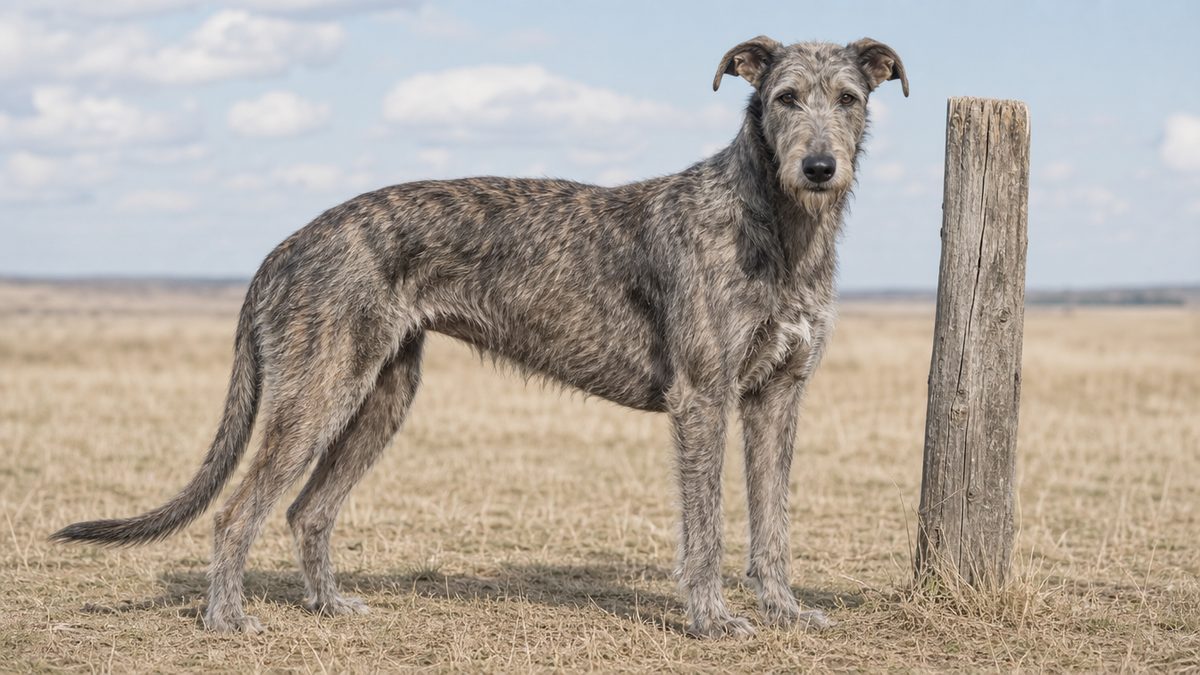
Quick answer
Staghound is not one breed. The word names an extinct English pack scent hound, a living American sighthound crossbreed that no kennel club recognises, three surviving British hunt packs whose hounds are Foxhound-derived, the Australian Kangaroo Dog, and an old name for the Scottish Deerhound. No FCI, AKC, UKC, Royal Kennel Club or ICAR-NBAGR register carries it, no breed standard exists, and nobody in India sells one.
This guide is general information for Indian pet owners and is not a diagnosis. No registry, studbook, health survey or screening scheme exists for any staghound, so nothing here should be read as a health profile for any individual dog, and the founding-breed figures quoted are labelled as such. Consult a registered veterinarian who has examined your dog before acting on anything you read here.
Staghound at a glance, rated for India
What a staghound is, and why the answer depends on who is speaking
Staghound is not one dog. The word is a job description that at least five different populations have carried, on three continents, across four centuries, and no kennel club anywhere registers any of them under that name. Before an Indian reader can ask what a staghound costs or how it copes with heat, the page has to settle which animal is being discussed, because the honest answers differ completely.
The oldest sense is a dead one. The English Staghound was a heavy pack scent hound bred to hunt red deer in England, standing up to 27 inches (69 cm), short-coated, usually white with yellow, lemon or badger patches. Wikipedia files it under extinct dog breeds and dates its end to the 19th century, when the last pack was sold.
The living sense is American. The American Staghound is a sighthound crossbreed developed in the United States from the 19th century, built from Greyhound, Scottish Deerhound, Irish Wolfhound and Borzoi stock and used to run coyote and later deer. Its own Wikipedia infobox records its status in one line: 'Not recognized as a breed by any major kennel club'. The most detailed page on it opens by saying the same thing, that it 'is not recognized as a breed, but is a type of sighthound'.
A third sense is a set of institutions rather than a dog. Three hunt packs in the English West Country are named Staghounds and still meet: the Devon and Somerset, the Quantock and the Tiverton. Their hounds are not English Staghounds. Wikipedia is blunt about it: after the 1820s, 'all hound packs kept in England for the hunting of deer are predominantly derived from Foxhounds, despite their usually being referred to as Staghounds'.
A fourth sense is Australian. The Kangaroo Dog, created in the early 1800s from Greyhound and Scottish Deerhound stock, carries Staghound as one of its listed alternative names, and is likewise 'Not recognised as a breed by any major kennel club'. Working hunters there use the two words to split coat type, calling the rough-coated dogs Staghounds and the smooth-coated ones Kangaroo Dogs.
A fifth sense is a discarded synonym. The Scottish Deerhound was once called the Scotch Staghound. That is not folklore: a kennel column in The Queenslander of 7 May 1892 reports a Townsville importer landing 'a dog and two bitches, purebred, of the long-haired Scotch staghound breed'.
Staghound is the British service name for the American T17 armoured car. On an Indian search for a staghound price, the armoured car wins the page. Model kits, auction lots and a forum thread about four T17E2 hulls parked at a Mumbai engineering college outrank every dog result. A 1851 clipper ship called Stag Hound holds the same name again.
Bonbeno's position is that the honest headline is the ambiguity itself. There is no single staghound to price, no breed standard to quote, no studbook to check and no health survey to summarise. What there is, is a set of clearly separable populations, each with its own evidence, and this page keeps them apart rather than blending them into a composite animal that has never existed.
Five dogs, one word: the disambiguation table
Read the table first, then the rest of the page. Every later section states which of these five it is talking about, because a claim that is true of one is usually false of the others.
| Sense | What it is | Status | Registry position |
|---|---|---|---|
| English Staghound | Heavy pack scent hound of England, up to 27 in (69 cm), short coat, bred to hunt red deer in packs | Extinct. Last pack sold 1825 to 1826 | Never registered. No surviving written standard |
| American Staghound | Living sighthound crossbreed of Greyhound, Scottish Deerhound, Irish Wolfhound and Borzoi, used to course coyote and deer | Living, with a real breeder community in the United States | Recognised by no major kennel club. No breed standard, no studbook |
| The three British packs | Devon and Somerset, Quantock and Tiverton Staghounds, hunting the Exmoor and Quantock red deer | Living institutions, meeting under the Hunting Act exemptions | The hounds are Foxhound-derived. The governing body is the Masters of Deerhounds Association |
| Australian Staghound | Rough-coated form of the Kangaroo Dog, Greyhound crossed onto Scottish Deerhound, now used on feral pig and fox | Living, dwindling, kept by hunters who reject standardisation | Recognised by no major kennel club, and no ANKC recognition sought |
| Scotch Staghound | A 19th-century name for the Scottish Deerhound itself | The name is obsolete; the dog is not | The Deerhound is registered by the FCI at number 164 under that name |
Two of those five are the ones an Indian buyer will meet online, and they are the two furthest apart. The English Staghound was a scent hound that ran in a hunt pack and killed nothing by speed; the American Staghound is a sighthound that kills by speed and hunts largely alone or in twos. Selling the second under the history of the first is the commonest error on the ranking set.
The confusion has a documented mechanism. An Australian working hunter writing about staghounds set it out in 2013: Deerhounds 'have been referred to by various names such as a Rough Coated Greyhound, Irish Greyhound, Scottish Staghound, Scotch Grey Hound and Highland Greyhound', and he added that 'There was in fact a breed of Dog in England and France known as the Staghound but they were large, long legged pack hunting dogs that hunted deer by scent, not by sight and speed as did the Deerhounds'. A working hunter with no academic stake got the distinction right; several commercial breed pages did not.
Look for three tells. If the page says pack, scent, red deer and England, it means the extinct hound. If it says coyote, coursing, Greyhound cross and prairie, it means the American dog. If it says kangaroo, feral pig or ute, it means the Australian dog. If it gives a temperament section for a dog it has just called extinct, as the position 7 result does, it is not describing anything.
The English Staghound died twice, and the sources disagree about how
The extinct English Staghound ended between 1824 and 1826 when its last pack was broken up and shipped abroad, but the two most-read accounts of that sale do not match, and the difference matters because everything later written about the breed rests on it.
Take the agreed part first. The Staghound most likely descended from the Southern Hound, itself descended from the Talbot and Norman hounds the Normans brought to England after 1066. From at least the reign of Henry III (1216 to 1272), England kept different hounds for different deer, the Staghound for stag and the smaller Buckhound for fallow deer. Louis XV of France sought English Staghounds early in his reign because they were described as 'fleeter and more vigorous and better hunters' than his own royal pack. From the 17th century the sport declined as forest was cleared, fox hunting took over, and the Staghound was folded into the making of the Foxhound.
Where the two accounts split
| Point | Wikipedia, Staghound | Wikipedia, Devon and Somerset Staghounds |
|---|---|---|
| Owner of the last pack | The North Devon Hunt, predecessor of the Devon and Somerset Staghounds | The North Devon Staghounds, a subscription pack from 1803 |
| Date and manner of sale | Sold at Tattersalls in 1825 | 'In 1824/5, 30 couples of hounds, the last of the true staghounds, were sold to a baron in Germany' |
| Intermediate owner | Bought by Mr Charles Shard of Somborne House, Hampshire, whose flintier ground injured the hounds' feet | Not mentioned |
| Second sale | Sold again in 1826 after a single season, the majority to a German buyer | Treated as a single sale |
| Fate in Germany | Most of the animals destroyed in a rabies outbreak | Not stated |
| Number of hounds | Not given | 30 couples, that is 60 hounds |
Bonbeno publishes the disagreement rather than merging it. The Devon and Somerset article carries an unresolved 'may contain original research' banner dated July 2013, and a 'when?' tag on the sentence about the surviving packs, so its single-sale version is the weaker of the two. The Staghound article is sourced to four named books: Alderton's *Hounds of the World* (2000), Gilbey's *Hounds in Old Days* (1913), Morris's *Dogs* (2001) and Hancock's *Hounds: Hunting by Scent* (2014). Neither account can be checked further from open sources, and Bonbeno has not read those four books, so the honest statement is that the pack left England in the mid-1820s and that the exact route is contested.
What survived, and where it went
Three bitches survived by accident. Parson Jack Russell, upset at losing the breed, bought three of them in 1826 before they sailed. Unable to rebuild a pack from three animals, he passed them to John Dillwyn Llewelyn of Swansea, who used them on local Welsh Hounds, and their influence is still credited in that breed. Separately, hounds acquired earlier by Devon enthusiasts including Parson John Froude are thought to have fed into the West Country Harrier. Another group went to enthusiasts near Epping Forest in 1826 and their fate is simply unknown.
So the genetic material is not gone. It is dispersed into the Foxhound, the Welsh Hound and the West Country Harrier, none of which is called a staghound. That is the ordinary way a working type ends: not with a last individual, but with absorption.
The extinct English Staghound is a historical subject, not a purchase decision. No living dog anywhere descends from it as an identifiable line, no standard survives that describes it, and any Indian page offering an English Staghound puppy is describing an animal that stopped existing roughly two centuries ago.
Registry recognition: five registers read in full, five absences, every one with a control
No kennel club recognises any staghound. Bonbeno read the FCI definitive and provisional lists, the American Kennel Club breed index, the United Kennel Club breed-standards inventory, the Royal Kennel Club standards index and India's own ICAR-NBAGR registration count on 23 August 2026, and paired every absence with a control breed that is present, because an absence is worth reporting only when the search that produced it has proved it works.
| Register | Document read | Staghound | Control that passed |
|---|---|---|---|
| FCI, definitive | Nomenclature filtered to S, 41 breeds from Saarlooswolfhond 311 to Svensk Lapphund 135 | Absent. The list runs straight from Staffordshire Bull Terrier 76 to Steirische Rauhhaarbracke 62 | Saluki 269 and Sloughi 188 both present and numbered |
| FCI, definitive | Nomenclature filtered to D, 25 breeds | Absent | DEERHOUND present at number 164, under that plain name |
| FCI, provisional | The provisional list, 21 breeds with recognition dates | Absent | Kazakh Tazy 372, a sighthound, recognised provisionally on 3 September 2024; four further breeds added 11 February 2026 |
| AKC | List of Breeds by Group, all seven groups plus the Miscellaneous Class and the Foundation Stock Service, 290 breed pages in one document | Absent. Zero case-insensitive matches for staghound | Deerhound returns the Scottish Deerhound; Borzoi, Greyhound and Irish Wolfhound all present |
| UKC | Breed Standards index, a register stating it recognises over 300 breeds | Absent from the Sighthound and Pariah group's 25 breeds, from every other group, and from the Bloodlines Listing Service tier | Silken Windhound present, a sighthound created in the United States in the 1980s, so the register does admit new American sighthounds |
| Royal Kennel Club | Breed standards index, all seven groups in one page | Absent from every group and from the Imported Breed Register | The Hound group carries the Deerhound, the Foxhound and the Harrier, so the register does carry British pack hounds |
| ICAR-NBAGR (India) | Registered indigenous breed count after the 10th Breed Registration Committee, 31 August 2022 | Absent. India registers three dog breeds in total, out of 212 registered indigenous breeds | The count itself is the control: 53 cattle, 44 sheep, 37 goat and 3 dog breeds are enumerated in the same sentence |
Read the control column, not the absence column. These are not registers that exclude unfashionable dogs. The UKC lists the Silken Windhound, a sighthound created in the United States within living memory, alongside the Scottish Deerhound, Borzoi and Spanish Greyhound. The Royal Kennel Club lists the Foxhound and the Harrier, the two other British pack hounds, in the same Hound group where a Staghound would sit. The FCI provisionally recognised the Kazakh Tazy, a Central Asian sighthound, as recently as September 2024. The doors are open. There is simply nothing to enter under this name.
One line in that table is easy to misread, so read it slowly. The FCI does list a hound of exactly this build and exactly this job: the Deerhound, at number 164, on the same alphabetical page where a Staghound would appear if one existed. The AKC lists the same dog as the Scottish Deerhound and calls it a coursing hound struck from the ancient Greyhound template. The registers are not missing the concept. They are missing this name.
The reason is not neglect, it is a deliberate refusal
This is the unusual part, and no ranking page says it. The people who breed staghounds do not want recognition. The most detailed page on the American dog states it plainly: 'There are no breed standards, and currently there is no movement to push the Staghound into breed recognition. Most huntsmen believe that the Staghound should be left unrecognized as a breed so it will be preserved as a coursing animal bred for work and not for show'. Wikipedia records the same choice on the Australian side, where keepers 'have rejected standardization' and do not pursue Australian National Kennel Council recognition.
That refusal has a cost the buyer pays. A dog with no breed standard has no agreed size, no agreed coat and no fault list. A dog with no stud book has no traceable pedigree. A dog with no parent club has no health scheme. Every gap on the rest of this page traces back to that one decision, and it was made on purpose by people who valued function over paperwork.
While researching this page, a guessed Indian Kanoon document id returned a real, complete, correctly formatted judgment at HTTP 200. It was a 2002 Allahabad High Court service matter about the compulsory retirement of an electricity board engineer, not the wildlife statute requested. It was caught by reading the case title printed inside the returned page. Every register above was confirmed the same way, by reading the breed names printed inside the document rather than trusting the URL.
The living American Staghound: a working function with four founding breeds and no studbook
The American Staghound is a real, living population of working sighthounds, and it exists because a specific job needed doing. Settlers moving west in the 19th century lost livestock to wolves and coyotes, and large sighthounds proved the most effective answer, so hunters crossed the sighthounds they had until they got a dog that could catch a coyote in rough country.
Four breeds do the founding work, and the sources agree on all four. Wikipedia names the British Greyhound, the Scottish Deerhound and the Irish Wolfhound plus the Russian Borzoi as the principal foundation stock, and records that Whippets and Salukis 'have rarely if ever been used'. A United States rescue that specialises in the type describes its intake in the same four terms.
The breeding pattern is the interesting part, and it is what separates this dog from a first-cross lurcher. The type has been bred staghound to staghound since the 1800s, not remade from purebred parents each generation, although good Greyhound and Deerhound first crosses are still added when a hunter wants something specific. Wikipedia puts it the same way: some are still bred from pedigree parents, but many are bred to each other, producing successive generations of staghound ancestry.
The three coat types, which are the nearest thing to a standard
- Shag, the rough-coated form, closest to the Scottish Deerhound.
- Slick, the smooth-coated form, closest to the Greyhound.
- Broken, the intermediate form between the two.
Those three words are the closest thing the American Staghound has to a written description, and they come from a hobbyist page rather than a registry. Wikipedia describes the type as 'usually rough-coated'. Size figures also come from that same non-registry source: 26 to 32 inches (66 to 81 cm) and 55 to 90 pounds (25 to 41 kg) for males, 24 to 29 inches (61 to 74 cm) and 45 to 85 pounds (20 to 39 kg) for females. Wikipedia's own range is wider still at 25 to 33 inches (64 to 84 cm) and 65 to 100 pounds (29 to 45 kg). When two of the three sources that exist disagree by four inches at the top, there is no agreed size.
Does a studbook exist? No, and Bonbeno checked
No studbook, register or pedigree authority for the American Staghound was found. The page that documents the type most fully states that no breed standards exist and that no movement toward recognition is under way. The four registers read for this page hold nothing under the nameUnited Kennel Club, Breed Standards index. On the Australian side, the working hunter who wrote the most substantial article on staghounds closed it by inviting readers to contact him if they were 'interested in starting up a register for these dogs', which is as clear a statement that none exists as a source can give.
Bonbeno therefore states it plainly. The American Staghound is a crossbred working type with a genuine community and a genuine job, and it has no pedigree infrastructure of any kind. That is a description, not an insult. It is exactly what the people who keep it intend.
Three packs in Britain still hunt under the name, and their hounds are Foxhounds
Yes, a pack in Britain still uses the name, and there are three of them. The Devon and Somerset Staghounds hunt inside Exmoor National Park, the Quantock Staghounds work the Quantock and Brendon Hills to the east, and the Tiverton Staghounds work the valleys of the Exe, Taw and Torridge. All three sit under the Masters of Deerhounds Association, itself part of the British Hound Sports Association.
The naming is a mess and the governing body proves it. The association that runs three packs of staghounds is called the Masters of Deerhounds Association, and its own page opens by stating that it 'consists of three packs of staghounds'. A Deerhound, in every register on earth, is a Scottish sighthound. The hounds in these packs are not that, and they are not English Staghounds either.
What they are is Foxhound-derived. The Staghound article states that after the mid-1820s dispersal, 'all hound packs kept in England for the hunting of deer are predominantly derived from Foxhounds, despite their usually being referred to as Staghounds'. So the three surviving packs carry a historical name over a different dog, in the same way a regiment keeps a battle honour.
What the packs do now, and under what law
The Hunting Act 2004 changed the activity, not the name. Section 1 of the Act reads in full: 'A person commits an offence if he hunts a wild animal with a dog, unless his hunting is exempt'. The Masters of Deerhounds Association states that 'Staghunting, as it was practised, was banned by the Hunting Act of 2004' and that the three packs nonetheless continue to meet two or three times a week in season, operating 'within the restrictions of the Hunting Act', monitoring the numbers, distribution and health of the herd and running a 24-hour casualty service for sick or wounded deer.
The season runs from early August to the end of April, and the association puts the local red deer herd at close to 4,000 head, describing it as by far the largest in England. A campaigning group that monitors the same three packs agrees on the identities and the season, states that between them they hunt five days a week, and adds that the packs rely on the research and observation exemption and use two dogs at a time. Bonbeno records both accounts and takes no position on the lawfulness of what the packs do, which is contested in Britain and is a matter for British courts.
| Pack | Country hunted | Hound type |
|---|---|---|
| Devon and Somerset Staghounds | Exmoor National Park | Predominantly Foxhound-derived |
| Quantock Staghounds | Quantock and Brendon Hills, Somerset | Predominantly Foxhound-derived |
| Tiverton Staghounds | Valleys of the Exe, Taw and Torridge, Devon | Predominantly Foxhound-derived |
Wikipedia's external link for the Devon and Somerset Staghounds points at devonandsomersetstaghounds.net. On 23 August 2026 that domain returned HTTP 200 and served a search-engine content farm headed 'Smart Tech Solutions: Security, Connectivity, and the Future of Innovation', with articles on USB adapters and links to an Instagram downloader. Nothing on the page concerned hounds, deer or Exmoor. Treat any figure attributed to that domain with suspicion.
The Australian Staghound is the same idea, built for a different animal
Australia produced its own staghound independently, from the same two breeds, for the same reason. Colonists from the early 1800s crossed the Greyhound with the Scottish Deerhound to make a dog fast enough to catch a kangaroo and tough enough to survive being kicked by one, and the result carries the names Kangaroo Dog, Roo Dog and Staghound interchangeably.
The dates are documented rather than folkloric. Darug people are reported to have had kangaroo dogs as early as 1802, colonists sailed them to Tasmania in 1804, and the earliest known print reference is a classified advertisement in the Sydney Gazette and New South Wales Advertiser of 3 November 1805. Borzoi and Saluki were added to the mix later, exactly as in America.
The Australian usage splits the type by coat, and that split is the single most useful thing on this page for an Indian reader. Working hunters call the rough-coated dogs Staghounds and the smooth-coated dogs Kangaroo Dogs. A hunter with thirty years in the type set out the trade-off directly: 'Hot and humid climates are generally not suitable for the rough coated dog as they tend to overheat quicker than the smooth coated dog', while 'The smooth coated dog is ideally suited for warmer areas of Australia'.
That is not a breed-club care leaflet written for Yorkshire. It is a working judgement made in a hot country by someone whose dogs' performance depends on getting it right, and it transfers to India better than almost anything else on this subject.
Size, from the only person who gave a number
The same hunter's ideal is 70 to 100 pounds (31 to 45 kg) and 27 to 30 inches (68 to 76 cm), with the reasoning attached: 'Any taller and heavier they will loose too much speed, any smaller and lighter they have a tendency to get hurt easier'. Treat that as one experienced opinion, not a standard, because there is no standard. Wikipedia states outright that keepers 'have rejected standardization, and so there is no one correct way for a Kangaroo Dog to look'.
The job changed, and the population shrank
Hunting native species with hounds is now strictly illegal in Australia, so the original purpose is gone. The dogs are dwindling but survive in pockets of Western Australia and elsewhere on introduced pest species, chiefly feral pig and red fox. The same source records an intermediate chapter that explains the numbers: during the rabbit plague, staghounds and kangaroo dogs were bred up in huge numbers and crossed with anything that would chase a rabbit, and a professional rabbiter might keep up to 100 assorted dogs. Myxomatosis ended the rabbit packs and the population collapsed with them.
America and Australia arrived at the same dog independently, from the same two breeds, for two different quarry species, and neither wanted it registered. When a functional type is invented twice by people who have never met, the type is real even though the breed is not. That is the strongest single argument that staghound names something genuine, and it is also the reason no register can hold it.
Staghound price in india: there is no price, and the figure you will be quoted is not one
No staghound of any sense is sold in India, at any price, and Bonbeno could not find a single Indian listing for one. That is the first line of this section rather than the last, because it is the answer to the question. What follows is the evidence for the absence, the control that proves the search worked, and the identity of the number you will actually be shown.
Start with the control, because a zero is worthless without one. The same searches, in the same session, return abundant Indian pricing for ordinary breeds. Mr n Mrs Pet publishes a price in india for the Labrador Retriever in three bands, Rs 30,000 to Rs 60,000 basic, Rs 60,000 to Rs 90,000 KCI registered and Rs 90,000 to Rs 1,20,000 champion bloodline, repeated across eight cities. The searches work.
| Source checked | Staghound result | Control on the same source |
|---|---|---|
| Dogs India classifieds, 'Puppies Available' | Zero mentions of staghound. Also zero deerhound, zero greyhound, zero borzoi | 16 whippet, 11 mudhol, 10 saluki, 6 rampur, 69 labrador. The page does list sighthounds |
| Mr n Mrs Pet, site-wide | No staghound page of any kind | Carries Borzoi and Black Mouth Cur pages, so its catalogue does reach rare and obscure breeds |
| Puppiezo, site-wide | No staghound page of any kind | Carries Borzoi, Beauceron and Black Russian Terrier pages |
| Justdial, 'Pet Shops For American Staghound Dog in Ludhiana' | An auto-generated shell listing six shops, none of them in Ludhiana, and no staghound | The shops' own listed categories are Pet Shops For Dog, Pet Shops For Labrador Dog and Pet Shops For German Shepherd Dog |
The Justdial page deserves a closer look because it is the only Indian result that names the breed. It lists Doon Pets World in Dehradun, Pupp Shup in Delhi, The Golden Pet Shop in Jhansi, Gokula Dog Kennel in Bijapur, Vijaya's Kennels in Kolar and Singh Pet Shop in Surat. Not one is in Ludhiana. The body copy is boilerplate that names its own example businesses 'Shop A', 'Shop B' and 'Shop C'. No staghound appears, and no price appears.
The Rs 98,999 you will be shown, and what it actually is
Indian puppy sites recur on a house price point, and Bonbeno has now caught it on nine pages. Puppiezo's page for the Indian Pariah Dog, a breed that lives free on Indian streets, offers no Indian Pariah puppy at all. What it offers instead, in a carousel, is Fizey a Maltipoo at Rs 98,999, Samy another Maltipoo at Rs 98,999, Yoki a Doxiepoo at Rs 98,999, Kuzo and Dugu two Poodles at Rs 92,599 each, Kazuka a Cane Corso at Rs 94,999, Doir a Goldendoodle at Rs 1,20,000 and Tugi a Rottweiler at Rs 76,499. The same Rs 98,999 sits on the same site's Newfoundland page.
Three unrelated dogs at one identical figure is not a price for any of them. It is a slot. If a seller quotes you Rs 98,999 for a staghound, they are quoting the slot, and the animal in it will be whatever is in stock.
Indian pages often publish a dollar figure converted at 84.38 rupees. Divide the Puppiezo numbers by 84.38 and none of them resolves to a round dollar amount: Rs 98,999 gives 1,173.25, Rs 92,599 gives 1,097.40, Rs 94,999 gives 1,125.85, Rs 1,20,000 gives 1,422.14 and Rs 76,499 gives 906.60. The test comes back negative here. These are prices set in rupees for the Indian market, not converted American ones, which makes them a different problem from the converted-dollar pages this site has caught elsewhere.
Why no lawful supply chain can form in India, even if you found a dog
Two Indian statutes close the route independently, and either one alone would be enough. Import law blocks the animal from arriving for any commercial purpose, and wildlife law makes the dog's entire working function an offence once it is here.
Getting one in: DGFT Trade Notice 22/2022-23
Dogs enter India under ITC(HS) 01061900, 'Mammals: Other', which is a Restricted line, and the Directorate General of Foreign Trade set out the conditions in Trade Notice No. 22/2022-23 dated 19 December 2022. Policy Condition (7) permits dog imports for exactly three purposes: a pet dog with a valid pet book and records in the importer's own name, dogs imported by research organisations with a CPCSEA recommendation, and dogs for internal security by the Defence and Police Force. Policy Condition (8) states that import of commercial dogs for breeding or any other commercial activity is not permitted.
Paragraph 6 removes the workaround. Any application 'for trading/breeding purposes, or applications made on behalf of some another person/entity shall be duly rejected'. So an Indian breeder cannot lawfully import foundation stock, and cannot lawfully have someone else import it for them.
- Ports: entry is allowed only through the airports and seaports of Delhi, Mumbai, Chennai, Hyderabad, Bengaluru and Kolkata and, since October 2024, Kochi airport, with quarantine at the same ports where required Department of Animal Husbandry….
- Baggage route: permanent import as passenger baggage is open only to a person transferring residence to India after two years of continuous stay abroad, and covers up to two pets.
- Lead time: DGFT advises starting the import authorisation application at least two months before travel.
- Paperwork: an Advance No Objection Certificate from the Animal Quarantine and Certification Service is needed seven days before travel, relaxable to three.
A returning resident could therefore legally bring in a staghound they already own. Nobody can legally import one to breed from or to sell, and a breed with no studbook has no pet book to present either.
Using one here: the Wild Life (Protection) Act 1972
This is the part that makes the dog pointless in India rather than merely unavailable. Section 2(16) of the Wild Life (Protection) Act 1972 defines hunting to include 'capturing, coursing, snaring, trapping, driving or baiting any wild or captive animal and every attempt to do so'. Coursing is named in the statute. Section 9 then states: 'No person shall hunt any wild animal specified in [Schedules I and II] except as provided under section 11 and section 12'.
India's deer are wild animals under that Act. The American Staghound's job is coursing deer and coyote; the English Staghound's job was hunting red deer in a hunt pack; the Australian Staghound's job was kangaroo and is now feral pig. Every one of those functions, performed on Indian wildlife, is hunting within the statutory definition and prohibited by section 9. An Indian owner who let a staghound do the only thing it was bred to do would be committing an offence.
Read the two statutes together. Import law means no lawful breeding population can form here. Wildlife law means that even a lawfully imported pet cannot be worked. A dog whose supply is blocked and whose purpose is illegal is not a gap in the Indian market. It is a dog with no place in it.
Cost of ownership: what can honestly be costed, and what cannot
Only the recurring costs can be estimated for a staghound in India, and only by size class, because the breed-specific inputs that drive a real budget do not exist. There is no purchase price, no screening panel, no parent-club health scheme and no insurance product written against verified data.
| Line item | Can it be costed? | Why |
|---|---|---|
| Purchase price | No | No Indian listing exists at any price, and no lawful import route exists for a commercial sale |
| Registration fee | No | No registry anywhere holds the name, so there is nothing to register |
| Breed health screening | No | No parent club, no screening scheme, no breed-specific panel |
| Food | Yes, by weight | A 25 to 45 kg working sighthound eats as a large dog eats. The weight range itself is disputed by four inches at the top |
| Routine veterinary care | Yes, by size | Vaccination, deworming and ectoparasite control price on body weight, not on breed |
| Anaesthetic risk premium | Partly | A named risk exists in the parent breeds and is discussed in the health section, but no staghound has been genotyped |
| Insurance | Marketed, not evidenced | One ranking page sells insurance under the heading 'Health Issues Common to American Staghounds' for a population with no health survey |
For a floor, use an Indian figure from an organisation that keeps dogs at scale and publishes its own number. Voice of Stray Dogs states that the average cost of a dog's upkeep is over Rs 5,000 per month, and gives the context honestly: that is the average across the lifetime of the dog at a facility housing more than 1,800 dogs on seven acres as of January 2026, with over 100 staff and freshly prepared food twice a day. A bulk operation of that size buys food and drugs far cheaper than a household does, so Rs 5,000 a month is a floor rather than a forecast, and it is a floor for an average Indian dog, not for a 40 kg sighthound.
Scale it honestly rather than inventing a total. A dog two to three times the body weight of the average Indian street dog eats two to three times the food, needs larger drug doses by weight for deworming and tick control, and needs a bigger vehicle to reach the vet. Bonbeno publishes no rupee total for a staghound because doing so would mean stacking three estimates on a purchase price that does not exist.
The cost nobody prices, which is the real one
The expensive part of keeping a coursing sighthound in an Indian city is not money. It is secure space. A dog bred for a few hundred generations to chase and kill anything that runs must be muzzled when off lead and needs a pen that keeps it separate from other animals when unsupervised. In most Indian housing that means either a walled compound or a dog that never runs free, and the second option is a welfare failure rather than a saving.
Every recurring line above is identical for a Mudhol Hound or a Rampur Greyhound, both of which are Indian sighthounds of similar build that are legally available, actually present in the country, and registered by India's own ICAR-NBAGR. The only cost line that differs is the one that cannot be filled in for a staghound.
Heat tolerance: two origin climates, neither of them an Indian monsoon
Rate a staghound's heat tolerance by its coat, not by its name, and the answer for the commonest form is poor. The rough-coated dog that most American Staghounds are is the one working hunters in a hot country say overheats first, and neither origin climate combines Indian heat with Indian humidity.
The mechanism is coat, and the evidence is from a hot country rather than a cold one. Australian staghound keepers split the type by coat and are explicit about the consequence: 'Hot and humid climates are generally not suitable for the rough coated dog as they tend to overheat quicker than the smooth coated dog', whereas the smooth coat 'is ideally suited for warmer areas of Australia'. Wikipedia describes the American Staghound as 'usually rough-coated', and the three American coat type names, shag, slick and broken, describe the same gradient. So the modal American Staghound carries the wrong coat for coastal India.
The origin climates, measured rather than asserted
Bonbeno queried NASA POWER by explicit latitude and longitude and checked the returned coordinates against the request in every case, because slug-based climate sites have served this project six wrong cities at HTTP 200.
| Place | Coordinates | Annual mean air temp (C) | Hottest monthly max (C) | July relative humidity (%) |
|---|---|---|---|---|
| Exmoor, home of the English Staghound and the surviving packs | 51.13N, 3.65W | 10.28 | 27.14 (Jul) | 84.48 |
| Western Kansas short-grass plains, coyote-coursing country | 38.50N, 100.00W | 13.28 | 45.42 (Jun) | 54.15 |
| Delhi | 28.614N, 77.209E | 25.60 | 48.79 (Jun) | 62.72 |
| Mumbai | 19.076N, 72.878E | 26.77 | 44.91 | 89.56 |
| Chennai | 13.083N, 80.271E | 27.95 | 42.70 (May) | 67.47 |
| Pune | 18.520N, 73.857E | 23.86 | 43.20 | 89.09 |
| Bengaluru | 12.972N, 77.595E | 23.74 | 40.38 | 76.76 |
Three readings out of that table do the work.
- The English hound was a cold-weather dog in a wet place. Exmoor's annual mean is 10.28 C against Chennai's 27.95 C, a gap of 17.67 C, and its hottest month peaks 15.56 C below Chennai's. Exmoor is humid, at 84.48 percent July humidity, but it is humid and cold.
- The American dog is a hot-weather dog, but a dry one. Western Kansas peaks at 45.42 C in June, which is 2.72 C hotter than Chennai's hottest month. Raw temperature is not this dog's problem. July humidity of 54.15 percent against Mumbai's 89.56 percent is a gap of 35.41 points, and that is.
- Mumbai in July is Exmoor plus seven degrees. Mumbai's July humidity of 89.56 percent sits only 5.08 points above Exmoor's 84.48 percent, but Mumbai's July maximum of 34.16 C runs 7.02 C above Exmoor's 27.14 C. A rough coat that works in wet British cold is the same coat in wet Indian heat, doing the opposite job.
The risk is exercise, not the parked car
This matters more for a coursing dog than for almost any other type. A VetCompass review of 905,543 dogs under UK primary veterinary care in 2016 identified 1,259 heat-related illness events in 1,222 dogs and found that exertional heat-related illness was the predominant trigger at 74.2 percent of the 879 events where a cause was recorded, against 12.9 percent environmental and 5.2 percent vehicular confinement. The authors conclude that in the UK exertional heat illness affects more dogs, and kills more dogs, than confinement in a hot vehicle.
Now put those two findings together. Three quarters of British canine heat illness is caused by exercise, in a country whose staghound country never reaches 28 C. A dog selected for a few hundred generations to run flat out after quarry, exercised at Indian temperatures, is the same mechanism with the thermostat moved fifteen degrees.
Delhi and inland north India in May and June are the closest Indian analogue to the American dog's home, because the heat is high and the humidity is not, but Delhi's 48.79 C peak is still 3.37 C above anything western Kansas produces. Mumbai, Pune, Chennai and the coastal belt have no analogue at all in either origin climate, because they pair heat with monsoon humidity that suppresses evaporative cooling. Bengaluru is the mildest of the five and the only one Bonbeno would call workable, and even there the dog should never run in the middle of the day.
Temperament: gentle in the house, lethal in the yard, and both at once
A staghound is calm and affectionate indoors and an unmodified predator outdoors, and the two facts do not cancel. Every description of the living American and Australian dogs says the same thing in different words, and an Indian buyer who reads only the first half will make a serious mistake.
Indoors, the reports are consistent and warm. The American Staghound 'is very calm around the home', craves human attention, is very affectionate with its owner and is described as gentle with children, though its size is a hazard around small ones. It is not hyperactive; once mature it can look lazy in the house. The Australian account matches: 'The temperament of this dog is very calm and gentle. These dogs are loyal and fairly intelligent'.
Outdoors, the same source is unambiguous. 'The coursing instinct in the American Staghound is unsurpassed, so anything that runs may be considered quarry.' Staghounds have been bred for one purpose, to hunt, and only the best hunters were bred from, so even puppies raised in a home grow into strong hunting instincts. Most were bred to hunt predators rather than prey, meaning something that fights back when caught.
The two sentences an Indian buyer must read twice
The first: staghounds 'have to be muzzled when unsupervised or running off leash', and 'require a special pen to keep them separate from the other animals when the owner is not able to supervise'. The second, on cats: 'A Staghound may be friends with a cat, but this same dog contently sleeping with the cat will still chase and kill a cat or dog. It has a strong instinct to chase and kill things that are running'.
Read that against an ordinary Indian street. Free-roaming dogs, cats, goats, poultry and children on bicycles are all things that run. A dog whose selection history rewards catching a coyote does not distinguish. The problem is not aggression, which is a different trait; the dog is friendly to people. The problem is that predation and friendliness are separate systems, and only one of them was ever selected against.
Guarding: it will not
Both sources agree and both explain why. Most staghounds make good watchdogs because their vision is excellent, but 'they are not guardians or protective'. The Australian account is franker still: these dogs 'will protect livestock from predators such as foxes and dingoes but otherwise are not good guard dogs, being too friendly towards humans'. Anyone buying a large dog in India for security should look elsewhere entirely.
The most detailed temperament account available is on a hobbyist page whose training section is framed around achieving 'pack leader status' over the dog. That dominance framing is dated and Bonbeno does not reproduce it. The behavioural observations about prey drive, muzzling and separate penning are field reports from people who keep the dogs and are reliable in a way the training theory around them is not.
Training: recall is the permanent weak point, and containment does the work
To train a staghound, build containment first and obedience second, because no amount of training removes a coursing instinct that a few hundred generations of selection put there. A sighthound that has locked onto a running animal is not disobeying; it has stopped receiving.
Accept the ceiling before setting the goal. The type was culled specifically for characteristics favouring pursuit, and only the best hunters were bred from. Recall against a moving target is therefore the one command that will fail, and it will fail on the day it matters. Plan for a dog that is off lead only inside a fence you have personally walked, and muzzled whenever it is loose and unsupervised.
Timelines, which differ inside the same litter
This is the practical consequence of having no standard. An Australian hunter of thirty years' experience explains that maturity depends on which parent the puppy throws to: 'the more Greyhoundy pup may start hunting at 6 months of age where as the pup which throws more to the Deerhound may take anywhere from 12 to 18 months before it reaches maturity and therefore requires a different approach to training'. Two puppies from one litter can be a year apart in readiness.
- Socialise from the day the puppy arrives. Both living populations produce sound family dogs when properly socialised, and both sources say so.
- Take short runs from about six months, and do not over-exercise: pups under twelve months still have developing bones.
- Pair a young dog only with experienced older dogs that have no bad habits.
- Protect the puppy from early injury. A young dog ripped or bitten before it is mentally ready 'could ruin him for good', and turning a prospect loose too young has spoiled many.
- Muzzle by default outdoors, and treat the muzzle as ordinary equipment rather than punishment.
The Indian modification nobody else will tell you
Everything above assumes the dog will eventually work. In India it cannot. Coursing is inside the statutory definition of hunting in section 2(16) of the Wild Life (Protection) Act 1972, and section 9 prohibits hunting the wild animals listed in the schedules. So an Indian owner is training a purpose-bred hunting dog for a life in which the purpose is unlawful.
That is not an argument for leaving the drive unmanaged. It is an argument for replacing the outlet. Lure work on a private, fenced ground, long-line sprints at first light, and structured scent games give the dog something to finish. What it cannot have is a live target, and a household that cannot supply a safe substitute should not take the dog.
Indian owners often resist a basket muzzle because of how it reads on the street. Fit it at home over two weeks with food through the front, so the dog associates it with meals rather than restraint. A muzzled sighthound on a long line in a public park is a responsible dog; an unmuzzled one that catches a neighbourhood cat has ended the argument for everybody.
Exercise: a place to run free, which most Indian households cannot supply
A staghound needs daily hard exercise and, specifically, somewhere it can gallop. The requirement is not a distance figure, because none of the sources publishes one; it is a facility, and that is the harder thing to find in an Indian city.
The wording in the fullest account is precise about the type of need rather than the amount. The Staghound 'requires daily exercise to mature physically and mentally. It lives to run and should have a place to run free', and it suits an owner who jogs or cycles often, provided the dog is over twelve months old. Under twelve months, the same source warns against overwork because the bones are still developing.
On housing the two living populations get the same verdict. The American dog is 'Not an apartment dog, but can do well in an urban setting if given time to exercise in a fenced-in yard or taken on walks', and is 'Best suited for rural areas'. The Australian account allows town living with a condition attached: staghounds 'can be kept in town if allowed daily exercise although they are much happier living on a farm with more room to move'.
What that means in an Indian city, with the clock attached
Combine the exercise need with the heat data and the window closes fast. Exertional heat illness accounted for 74.2 percent of heat-related illness events in a VetCompass review of 905,543 UK dogs, and Indian city maxima run 13 to 21 degrees above the UK staghound country that produced those cases.
| City | Hottest monthly max (C) | July humidity (%) | Practical window |
|---|---|---|---|
| Delhi | 48.79 | 62.72 | First light only from April to June. Evening is unusable through the pre-monsoon peak |
| Mumbai | 44.91 | 89.56 | Pre-dawn year round. Monsoon months are humid enough to block evaporative cooling even at 34 C |
| Pune | 43.20 | 89.09 | Pre-dawn in summer; the monsoon is cooler than Mumbai's but just as humid at 89.09 percent |
| Chennai | 42.70 | 67.47 | Pre-dawn year round. The annual mean of 27.95 C leaves no genuinely cool season |
| Bengaluru | 40.38 | 76.76 | The most workable of the five. Early morning and late evening for most of the year |
Note what the table is not saying. It is not saying to exercise the dog less. A staghound that does not run becomes a destructive, frustrated animal, and reducing exercise to avoid heat simply swaps one welfare problem for another. It is saying that the exercise has to move to the coolest hour available, which in most of India means before sunrise, every day, for the life of the dog.
The fence is not optional
Free running for this type means inside a boundary. The same source that says the dog must have a place to run free also says it must be muzzled when running off lead and penned separately from other animals when unsupervised. An Indian owner therefore needs a walled or fully fenced ground large enough for a 40 kg sighthound to reach speed, available before dawn, every day. Households that cannot answer that in a sentence should read the adoption section instead.
There is no version of this dog that works in a flat with two walks a day. The kindest thing an apartment-dwelling reader can do with this page is close it and look at a breed whose exercise need matches the space they actually have.
Grooming: light work on paper, and a monsoon problem in practice
Coat care for a staghound is genuinely low effort, and the only published instruction is one line: 'Just a periodic brushing from time to time, depending on type of coat'. The complication is that the coat is not one coat, and the two versions fail in opposite ways in Indian conditions.
The single grooming instruction on record comes from the fullest page on the American dog and is exactly that sentence. There is no parent-club grooming guide to consult, because there is no parent club, and no breed standard describing the coat, because there is no standard.
The two coats, and what each one does wrong here
| Coat | Strength | Weakness in Indian conditions |
|---|---|---|
| Rough-coated (shag) | Protects skin against rips and bites; tolerates cold far better | Overheats faster in hot and humid climates; a magnet for burrs, and embedded burrs 'can cause serious infections' |
| Smooth-coated (slick) | Ideally suited to warm areas; no matting or burr load | Softer skin than most breeds and tends to rip more easily; needs a coat in genuine cold |
| Broken (intermediate) | Sits between the two | No published guidance exists for it at all |
The rough-coated dog is the one most American Staghounds are, and it is the one the Australian source says to keep out of hot and humid places. In Mumbai and Pune, where August relative humidity runs at 90.36 and 90.80 percent, that is the whole coastal monsoon.
Practical routine, honestly labelled as inference
- Brush the rough coat twice weekly in dry months and after every off-lead run, and go through the feathering and between the toes for burrs and grass seed.
- Dry the dog properly after a monsoon walk rather than letting a rough coat air dry against the skin at 90 percent ambient humidity.
- Check ears, armpits and groin weekly through the monsoon, where a damp rough coat holds water longest.
- Protect the smooth-coated dog's skin instead. Thin skin over a low body-fat frame tears on fencing and thorn, so the grooming job there is wound checking, not brushing.
Bonbeno flags the last four points as reasoned from the coat descriptions and the measured humidity, not as published breed guidance, because no published breed guidance exists. Anyone who tells you otherwise is describing a Deerhound or a Greyhound and changing the label.
The reflex to clip a rough-coated dog in an Indian summer removes the layer that keeps direct sun off the skin without adding any evaporative cooling, because dogs do not sweat through the coat. The correct heat management for either coat type is timing and shade, which the exercise section sets out, not clippers.
Health problems and life expectancy: no denominator exists, and here is how that was established
No breed health data exists for any staghound, in any register, in any country. Bonbeno established that rather than assuming it, and publishes no borrowed percentage as if it belonged to this dog. What follows is the absence, the controls that prove the searches worked, and the only figures that can honestly be put beside it.
| Source | Staghound result | Control in the same retrieval |
|---|---|---|
| OFA Disease Statistics, full inline dump, about 2.23 million characters | Zero rows, case-insensitively | Labrador 109 rows, Greyhound 93, Borzoi 62, Scottish Deerhound 14. The dump loaded |
| McMillan et al. 2024 breed longevity study, 584,734 dogs | No staghound in the breed table | The paper's own crossbred and purebred medians are reported below |
| Martinez et al. 2020 pharmacogenomics, 64 breeds | Zero occurrences of staghound, zero of lurcher | Greyhound, Whippet, Scottish Deerhound, Irish Wolfhound and Borzoi all named |
OFA's threshold explains the first row honestly: a breed needs 100 hip evaluations, or 50 for the other databases, to appear at all. A population with no registry generates no submissions, so it never reaches the threshold. Registry recognition and health data are the same problem wearing two hats.
What the founding breeds show, labelled as founding-breed data
These figures are not staghound figures. They describe the four breeds that built the American dog, they are published with their sample sizes, and they are offered as context only.
| Breed | Evaluations | Normal % | Dysplastic % |
|---|---|---|---|
| Irish Wolfhound | 3,129 | 95.4 | 4.3 |
| Borzoi | 925 | 97.8 | 2.1 |
| Greyhound | 408 | 97.1 | 2.2 |
| Scottish Deerhound | Absent from the hips table | - | - |
| American Staghound | None. No rows anywhere in the dump | - | - |
Two notes on that table. First, the arithmetic checks: the Greyhound's mild, moderate and severe columns read 1.2, 0.5 and 0.5, summing to the printed 2.2, and the Irish Wolfhound's read 2.7, 1.5 and 0.1, summing to the printed 4.3. The Borzoi's read 1.8, 0.1 and 0.1, summing to 2.0 against a printed 2.1, which is rounding rather than error. Second, even the Scottish Deerhound, a fully recognised breed with a parent club, does not clear OFA's 100-evaluation threshold for hips. Hip dysplasia screening data is scarce across this whole group, not just for the unregistered members. These are live counts and they move, so quote the sample size whenever you quote the percentage.
Life expectancy: one claim, one anecdote, and one real denominator
The only published life expectancy for a staghound reads '12-14 years or more if properly cared for', followed by a story about a male siring two litters at sixteen. That is a hobbyist estimate plus an anecdote, with no cohort behind it.
The nearest thing to a denominator comes from a study that did not include the breed. McMillan and colleagues followed 584,734 dogs and reported median survival of 12.5 years overall, 12.7 years for pure breeds across 473,681 dogs with 212,289 deaths, and 12.0 years for crossbreds across 111,053 dogs with 72,445 deaths. The American Staghound is a crossbred, so 12.0 years is the closest honest anchor, and it is a population figure for all crossbreds rather than for this one.
The same page that reports the lifespan states that 'There are no known genetic health problems' and that the dog is 'very healthy', and then in the next two sentences names anaesthetic sensitivity and warns against running the dog after a large meal because of torsion bloat risk. Absence of surveillance is not absence of disease. A population with no registry, no studbook and no health survey cannot know what it has, and 'no known problems' is a statement about the state of the records, not about the dogs.
Anaesthesia and blood tests: the risk your vet needs to hear about before surgery
Tell any Indian vet operating on a staghound that it is a sighthound cross, because two well-documented sighthound findings change what a normal result looks like and what an anaesthetic should be. Neither finding has been measured in a staghound, and Bonbeno labels the transfer rather than hiding it.
The anaesthetic haplotype, and exactly how far it reaches
Greyhounds recover slowly from certain injectable anaesthetics, and the mechanism is now identified. Martinez and colleagues resequenced the CYP2B11 gene and found three haplotypes; compared with 63 other dog breeds, Greyhounds carried the highest frequency of the CYP2B11-H3 variant, which reduced gene expression by over 70 percent relative to the reference.
The breed distribution is the part that matters here, and it is quoted exactly. 'Sighthound Group 1 contains the following breeds; Greyhound, Whippet, Scottish Deerhound, Irish Wolfhound, Borzoi, and Italian Greyhound.' And: 'The CYP2B11-H3 haplotype was found in all of the Sighthound Group 1 breeds except Irish Wolfhound'.
| Founding breed | In Sighthound Group 1? | H3 haplotype found? |
|---|---|---|
| Greyhound | Yes | Yes, the highest frequency of all breeds sampled, near 60 percent in AKC Greyhounds |
| Scottish Deerhound | Yes | Yes |
| Borzoi | Yes | Yes |
| Irish Wolfhound | Yes | No. The one Group 1 breed where it was not found |
| American Staghound | Not sampled | Unknown. The paper contains zero occurrences of the word staghound |
Bonbeno's position: this is inheritance from named parents, not a figure borrowed from an unrelated breed. Three of the four founding breeds are named carriers and the fourth is the named exception, so an individual staghound's risk depends on which ancestors dominate its pedigree, and with no studbook nobody can tell you which they are. Treat every staghound as a probable slow metaboliser and let the anaesthetist plan accordingly. Do not quote a percentage for the breed, because none has been measured.
The thyroid trap, which Indian law walks straight into
Sighthounds have basal total T4 concentrations below non-breed-specific reference intervals, and the consequence is systematic misdiagnosis. In a retrospective study of 398 sighthounds, comprising 347 Greyhounds, 22 Borzois, 11 Salukis, 14 Irish Wolfhounds and 4 Scottish Deerhounds, hypothyroidism had been diagnosed in 286 of the 398, which is 71.9 percent, on low total T4 or T3 alone. Only 65 of the 398, 16.3 percent, had corroborating abnormalities such as high TSH or a positive thyroglobulin autoantibody, and 30 dogs, 7.5 percent, were diagnosed despite results inside the reference interval.
Now read the Indian rule. Sub-rule (10) of the veterinary care provision of the Prevention of Cruelty to Animals (Dog Breeding and Marketing) Rules 2017 requires that 'The dogs shall have been tested for genetic defects, including hip dysplasia, progressive retinal atrophy, night blindness, hypothyroidism, entropion, ectropion, overshot, undershot jaw...'. Indian law mandates a hypothyroidism test on every bred dog, and in the one group where a low thyroid reading is the normal finding, the standard test flags roughly seven dogs in ten.
Two sentences before any procedure. One: this is a sighthound crossbred from Greyhound, Deerhound, Wolfhound and Borzoi stock, so please treat it as a possible slow metaboliser of injectable anaesthetics. Two: if a thyroid panel comes back low, please verify it against a breed-appropriate interval and look for high TSH or autoantibodies before starting supplementation. Both requests are cheap, and both are supported by published work on the parent breeds.
Feeding: judge by body condition, because no chart exists for this dog
Feed a staghound to a target body condition rather than to a breed chart, because no breed chart exists and the published weight range spans 20 to 45 kg across two sources that disagree. A feeding guide keyed to a breed with no agreed adult weight is arithmetic dressed as advice.
Look at the spread first. One source gives males 55 to 90 pounds (25 to 41 kg) and females 45 to 85 pounds (20 to 39 kg). Wikipedia gives 65 to 100 pounds (29 to 45 kg) without splitting by sex. An Australian hunter's ideal is 70 to 100 pounds (31 to 45 kg). The bottom of one range and the top of another differ by 25 kg, which is more than some whole breeds weigh.
Use body condition, and know what you are looking for
A working sighthound is meant to look lean. Ribs should be easily felt and the last one or two often visible in short coat, the waist should be obvious from above and the abdominal tuck pronounced from the side. The specific trap for Indian owners is that a correctly conditioned staghound looks underfed to relatives, neighbours and sometimes to a vet who mostly sees Labradors. A staghound carried at Labrador body condition is an overweight sighthound with extra load on the joints it runs on.
- Weigh the dog monthly through the first year and fortnightly after, and record it, because there is no growth curve to check against.
- Split the daily ration into two meals for a deep-chested dog rather than one large one.
- Separate feeding from running by a clear margin, because the one specific dietary warning on record is not to run the dog after a big portion of food, on torsion bloat grounds.
- Adjust through the Indian summer, when a dog exercising only before dawn is doing less work than the same dog in the cool season and needs less food, not the same amount.
Life stages, and the one figure the sources agree on
Litter size is given as 6 to 10 puppies, which is the only reproductive number published anywhere for the type. Growth timelines differ inside a litter: a Greyhound-leaning puppy may be ready for short runs at six months while a Deerhound-leaning littermate takes twelve to eighteen months to mature. Feed the slower one as a large-breed puppy for longer, and do not push either onto adult rations early to save money.
Availability in India is not the constraint. Large-breed puppy and adult diets from mainstream brands are sold in every metro, and a 40 kg dog eats what a 40 kg dog eats regardless of what its ancestors did. What India does not have is a breed-specific feeding protocol for a staghound, and no page that publishes one has anything behind it.
A dog exercising at Chennai's annual mean of 27.95 C or Delhi's June maxima loses far more water than the same dog in the origin climates, where Exmoor's annual mean is 10.28 C. Carry water on every walk from March onward and offer it in small amounts on the way rather than in one large volume on return, particularly in a deep-chested dog.
The first year, anchored on the dates Indian law actually fixes
Plan a staghound puppy's first year around three fixed Indian legal dates and two physical ones. The legal dates come from the Prevention of Cruelty to Animals (Dog Breeding and Marketing) Rules 2017; the physical ones come from the only growth guidance published for the type.
| Age | What happens | Where it comes from |
|---|---|---|
| Under 8 weeks | The puppy must not be sold. 'Every breeder shall ensure that pups less than eight weeks in age are not sold' | Conditions for sale, Dog Breeding and Marketing Rules 2017 |
| 7 to 8 weeks | Vaccination may begin. 'All pups shall be vaccinated which can start at the age of seven-eight weeks' | Sub-rule (9), veterinary care provision, 2017 Rules |
| 8 weeks to 18 weeks | The vaccination course runs and is 'usually completed at the age of eighteen weeks' | Sub-rule (9), 2017 Rules |
| 8 weeks onward | Individual health records must be maintained for every animal above eight weeks or once weaned | Record-keeping provision, 2017 Rules |
| 2 to 4 months | Socialisation window. Both living populations produce sound family dogs when properly socialised | Field reports from American and Australian keepers |
| 6 months | Short runs may begin, with experienced older dogs only and no bad habits among them | Australian working guidance |
| 6 months | A dog over six months cannot lawfully be sold in India unless first sterilised, except to another licensed breeder | Conditions for sale, 2017 Rules |
| 6 months | A breeder must rehabilitate through an Animal Welfare Organisation any pup unsold within six months | 2017 Rules |
| Up to 12 months | Do not overwork. Bones are still developing and the dog must not be treated as an adult athlete | Published care guidance for the type |
| 12 to 18 months | Maturity, depending on whether the puppy throws to the Greyhound or the Deerhound side | Australian working guidance |
Two of those rows deserve emphasis because Indian buyers meet them constantly. The eight-week floor is law, not etiquette, and it is quoted verbatim in the Rules. Every breeder must also hold a certificate of registration from their State Animal Welfare Board and display it in the establishment; a seller who cannot show you one is operating unlawfully whatever the puppy is.
The Indian modification to the exercise timeline
The six-month running milestone assumes a temperate morning. In India, shift the whole schedule earlier in the day rather than later in the year. Between March and June a puppy's exercise should finish before the sun is properly up, and the twelve-month restraint on hard work matters more here, not less, because a growing dog is also managing heat load it did not evolve for.
The 2017 Rules set an eighteen-month minimum age for breeding either sex, cap production at one litter a year and five litters in a female's lifetime, prohibit litters in two consecutive breeding seasons, require microchipping and individual records, and require a veterinary examination at least once a month. None of that can lawfully be applied to a staghound in India anyway, because DGFT Trade Notice 22/2022-23 rejects any import application made for breeding.
Head to head: what an Indian buyer is actually being offered instead
Since no staghound is for sale in India, the useful comparison is not staghound against another breed. It is staghound against the sighthounds an Indian buyer can genuinely get, and the gap is not about quality. It is about whether the animal exists in the country, whether anyone can trace its parents, and whether it can survive the summer.
| Dog | Present in Indian classifieds | Registry position | Traceable pedigree |
|---|---|---|---|
| Staghound, any sense | Zero mentions | No FCI, AKC, UKC or Royal Kennel Club entry. No ICAR-NBAGR entry | None. No studbook exists |
| Whippet | 16 mentions | FCI, AKC, UKC and Royal Kennel Club recognised | Yes |
| Saluki | 10 mentions | FCI 269, recognised across all four registers | Yes |
| Mudhol Hound | 11 mentions | One of the indigenous Indian breeds; ICAR-NBAGR registers three dog breeds in total | Yes, through Indian registration |
| Rampur Hound | 6 mentions | Indian sighthound | Yes, through Indian registration |
| Greyhound | Zero mentions | FCI, AKC, UKC and Royal Kennel Club recognised | Yes, but not currently offered on that page |
| Scottish Deerhound | Zero mentions | FCI 164, under the plain name Deerhound | Yes, but not currently offered on that page |
The classifieds counts come from one Indian breeder page read on 23 August 2026, and they are counts of mentions rather than of live litters, so treat them as evidence of what the Indian market talks about rather than of stock on hand. The registry column is the one that does not move: three of India's own kennel club and government routes carry sighthounds, and none of them carries a staghound.
If it is the coursing sighthound you actually want
The functional package a staghound offers is a large, fast, hard-running, gentle-in-the-house sighthound with high prey drive and no guarding instinct. Two Indian breeds deliver most of that, legally, locally and with parentage you can check. The Mudhol Hound and the Rampur Greyhound are both large indigenous coursing sighthounds bred in Indian heat by people who kept them working in it, and both appear in Indian classifieds today. The Chippiparai and Rajapalayam cover the same ground in the south.
For the imported options, the Whippet is the smaller, smooth-coated, apartment-plausible version of the same temperament, the Greyhound is the founding breed itself, and the Borzoi and Afghan Hound are the long-coated end of the group. All four are registered breeds with studbooks, health data and a traceable route into India.
Compare the staghound to the Indian sighthounds on the thing that actually differs. On temperament, prey drive, exercise need and gentleness in the house they are close relatives. On heat, the Indian breeds win on origin: Delhi's June maximum of 48.79 C is 3.37 C above anything the American dog's Kansas range produces, and Mumbai's July humidity of 89.56 percent is 35.41 points above it. On evidence, the Indian breeds win on registration. On price, only the Indian breeds have one.
What Indian readers get wrong about the staghound
Nine mistakes account for almost everything that goes wrong here, and eight of them are made before the buyer has met a dog. Each one below is followed by what the primary sources actually say.
- Treating staghound as one breed. It names at least five different populations on three continents, two of them living and three of them unregistered everywhere.
- Believing the phrase 'The Purebred Staghound'. That is the page title on the fullest source available, and the same page's Recognition section says the dog is not recognised as a breed and has no breed standards.
- Reading 'no known genetic health problems' as a health claim. It is a statement about missing records. OFA holds zero rows for the name while returning 109 Labrador rows in the same retrieval.
- Paying Rs 98,999. Three unrelated dogs carry that identical figure on a single Indian page, including two Maltipoos and a Doxiepoo, and the same figure appears on that site's Newfoundland page. It is a price slot, not a valuation.
- Buying it as a guard dog. Both living populations are described as watchdogs at best and 'too friendly towards humans' to guard.
- Assuming heat tolerance from the American range. Western Kansas peaks at 45.42 C, so the dog knows heat, but at 54.15 percent July humidity. Mumbai runs 89.56 percent, and the commonest coat is the rough-coated one that overheats first in humidity.
- Letting it off lead in an Indian street. The published guidance is a basket muzzle whenever the dog is loose and a separate pen when unsupervised, because it will chase and kill running animals it lives with peacefully indoors.
- Buying one to hunt with. Coursing is named inside the definition of hunting in section 2(16) of the Wild Life (Protection) Act 1972, and section 9 prohibits hunting the scheduled wild animals.
- Treating a low thyroid result. In 398 sighthounds, 286, or 71.9 percent, had been diagnosed hypothyroid on total T4 or T3 alone, while only 65, or 16.3 percent, had corroborating abnormalities.
The mistake sellers make, which becomes yours
Two of the ranking pages sell services against a population with no data behind it. One publishes a heading reading 'Health Issues Common to American Staghounds' and offers pet insurance for the breed. Another calls a 19th-century American crossbreed 'a rare and ancient breed', which reverses both halves of what the primary sources say: it is recent, and it is a cross.
The Indian version of the same error is quieter. Justdial carries a category page for 'Pet Shops For American Staghound Dog in Ludhiana' whose six listed businesses are in Dehradun, Delhi, Jhansi, Bijapur, Kolar and Surat, and whose own worked examples are named Shop A, Shop B and Shop C. A category page exists because a template generated one, not because a dog does.
The single most expensive mistake is buying a large, high-drive coursing dog into an Indian flat because a page said it is 'calm around the home'. It is calm around the home, and it is also a dog that must have somewhere to run flat out and a fence to do it behind. The calm is downstream of the running. Remove the running and you do not get a calm dog.
Adoption and responsible sourcing: what to do instead
To adopt the dog a staghound page has made you want, look at Indian sighthounds and large indies, because no staghound is available to adopt in India and no lawful route exists to import one for sale. This section covers the honest alternatives and the checks to run if somebody offers you one anyway.
The route that exists
India has a genuine surplus of exactly the physical type a staghound buyer is drawn to. Voice of Stray Dogs puts the country's free-roaming dog population at an estimated 62 million, many without access to basic medical care. A large, lean, fast, short-coated Indian dog with a high chase drive is not rare here; it is the commonest dog in the country. If what you want is a big athletic hound that is gentle indoors, a shelter can hand you one this week, at a fraction of any breeder price, already adapted to the climate.
For the specific coursing-sighthound package, the recognised Indian breeds are the honest answer. India's own ICAR-NBAGR registers three indigenous dog breeds, and Indian breeder classifieds carry the Mudhol Hound and the Rampur Hound todayDogs India, 'Puppies Available'. Both are large coursing sighthounds developed in Indian heat, both have traceable Indian registration, and neither requires an import authorisation.
If somebody offers you a staghound, run these five checks
- Ask which staghound. English, American, Australian, one of the three British packs or a Scottish Deerhound under an old name. A seller who cannot answer is not describing a dog they have.
- Ask to see the studbook entry. There isn't one, anywhere in the world, so there is nothing to produce.
- Ask for the import authorisation. Any dog of this description in India arrived from abroad. DGFT Trade Notice 22/2022-23 rejects applications made for trading or breeding, and permits pet imports only with a valid pet book in the importer's own name.
- Ask for the State Board certificate of registration. Every Indian breeder must hold one and display it in the establishment; no local authority may license a breeding establishment without it.
- Ask the puppy's age in writing. Sale under eight weeks is prohibited, and a dog over six months cannot be sold unsterilised except to another licensed breeder.
In practice, a seller who clears all five is selling something else. The likeliest identities behind an Indian staghound offer are a Greyhound or Whippet cross, a large indie of sighthound build, or the auto-generated shell page that produced the enquiry in the first place.
Adopting one abroad, honestly stated
American Staghound rescue does exist in the United States, and rescues there describe their intake in exactly the four founding breeds. An Indian reader living abroad can adopt one there. Bringing it home later is possible only under the pet route, which requires a valid pet book in the importer's name and, for the baggage route, transfer of residence to India after two years of continuous stay abroad, through one of seven named ports Department of Animal Husbandry…. That is a real path for a returning family and no path at all for anyone else. The full route is set out in how to import a dog to India.
Can you supply a fenced ground where a 40 kg dog can gallop, before sunrise, every day, for twelve to fourteen years? If yes, adopt an Indian sighthound or a large indie and you will have the dog you wanted. If no, the staghound was never the answer, and neither is anything else in this group.
Bonbeno does not broker sales, does not recommend breeders and does not link puppy listings. Where a figure could not be verified against a primary source, this page says so rather than publishing it.
Staghound questions, answered from the registers and the statutes
Is the staghound a real breed
No. Staghound is a name shared by at least five different dog populations, and no major kennel club recognises any of them under it. The fullest page on the living American dog says so in its own words, that it is not recognised as a breed but is a type of sighthound.
Is the staghound extinct
The English Staghound is. Wikipedia files it among extinct dog breeds and dates the dispersal of the last pack to the mid-1820s. The American Staghound and the Australian Kangaroo Dog, both of which carry the name, are living populations, and three British hunt packs still use the word today.
What is the staghound price in india
There is no staghound price in India, because there is no staghound in India. Four Indian sources were checked on 23 August 2026 and none carries a staghound listing, while the same sources publish detailed price bands for the Labrador Retriever. Any figure you are quoted is a house price point.
Is an American Staghound recognised by the AKC
No. The AKC list of breeds by group carries 290 breed pages across all seven groups plus the Miscellaneous Class and the Foundation Stock Service, and a case-insensitive search returns zero matches for staghound. The same search returns the Scottish Deerhound, which is the control.
What breeds make an American Staghound
Four founding breeds, and the sources agree on all of them: the Greyhound, the Scottish Deerhound, the Irish Wolfhound and the Borzoi. Whippets and Salukis have rarely if ever been used. Since the 1800s the type has mostly been bred staghound to staghound rather than remade from purebred parents.
Are there still staghound packs in Britain
Yes, three. The Devon and Somerset, the Quantock and the Tiverton Staghounds all still meet, under the Masters of Deerhounds Association, in a season running from early August to the end of April. Their hounds are predominantly Foxhound-derived rather than English Staghounds.
What is the lifespan of a Staghound?
Nobody knows. The only published figure is a hobbyist estimate of 12 to 14 years with an anecdote attached. The nearest real denominator is a study of 584,734 dogs that reported a median of 12.0 years for crossbreds across 111,053 animals, and that study did not include any staghound.
Do staghounds have health problems
No breed health data exists. OFA holds zero rows for the name while returning 109 Labrador rows in the same retrieval, so the honest answer is that nothing has been measured. Two risks are inherited from the named founding breeds: slow anaesthetic metabolism and misleadingly low thyroid readings.
Can a staghound handle Indian heat
Poorly, in the coastal humidity, and the coat decides it. Australian working hunters say the rough-coated form overheats faster in hot and humid climates. Western Kansas peaks at 45.42 C but at 54.15 percent July humidity, against Mumbai's 89.56 percent, so the dry heat transfers and the wet heat does not.
Can I import a staghound into India
Only as your own pet, and only if you are moving to India. DGFT Trade Notice 22/2022-23 makes dogs a Restricted import, allows entry only for a pet with a valid pet book in the importer's name, for research with a CPCSEA recommendation or for Defence and Police use, and rejects any application made for breeding or trading.
Is it legal to hunt with a staghound in India
No. Section 2(16) of the Wild Life (Protection) Act 1972 puts coursing inside the statutory definition of hunting, and section 9 prohibits hunting the wild animals listed in the schedules. The dog's entire working purpose is therefore unlawful on Indian wildlife.
Is a staghound the same as a Scottish Deerhound
Not now, but the names once overlapped. A kennel column in The Queenslander of 7 May 1892 records an importer landing three dogs of 'the long-haired Scotch staghound breed', which was the Deerhound. Today the FCI lists that dog at number 164 under the plain name Deerhound, and lists no staghound at all.
Why do breeders not want the staghound recognised
Because recognition would change what is bred for. The fullest source states that most huntsmen believe the Staghound should be left unregistered so it is preserved as a coursing animal bred for work and not for show, and that there is currently no movement toward breed recognition.
Which dog should I get in India instead
An Indian sighthound or a large indie. The Mudhol Hound and the Rampur Hound appear in Indian breeder classifieds today, are large coursing sighthounds developed in Indian heat, and are traceable through Indian registration. India's ICAR-NBAGR registers three indigenous dog breeds in total.
What breeds make a Staghound?
It depends which staghound. The living American Staghound has four founding breeds the sources agree on, the Greyhound, the Scottish Deerhound, the Irish Wolfhound and the Borzoi, bred as a coursing cross with no studbook. The Australian Staghound is the rough-coated form of the Kangaroo Dog, created in the early 1800s from Greyhound and Scottish Deerhound stock, with working hunters using the two words to split coat type. The extinct English Staghound was none of these: a heavy pack scent hound bred to hunt red deer in England, standing up to 27 inches, whose last pack was dispersed in the mid-1820s. No major kennel club recognises any population under the name.
What is an Australian Staghound?
The rough-coated form of the Kangaroo Dog, a Greyhound crossed onto Scottish Deerhound stock created in the early 1800s and now used on feral pig and fox. Working hunters there call the rough-coated dogs Staghounds and the smooth-coated ones Kangaroo Dogs, and are explicit that hot and humid climates are generally not suitable for the rough-coated dog, which overheats quicker than the smooth. It is not recognised as a breed by any major kennel club, and its keepers have rejected standardisation and do not pursue Australian National Kennel Council recognition; the most substantial article on the type closes by inviting readers to contact the author if they want to start a register, which is as clear a statement that none exists as a source can give.
How big does a Staghound get?
There is no agreed size, because there is no standard. The fullest page on the American Staghound, a hobbyist source rather than a registry, gives males 26 to 32 inches, 66 to 81 cm, and 55 to 90 pounds, 25 to 41 kg, with females 24 to 29 inches and 45 to 85 pounds; Wikipedia's range is wider still at 25 to 33 inches and 65 to 100 pounds, 29 to 45 kg. When two of the three sources that exist disagree by four inches at the top, the honest figure is a 25 to 45 kg working sighthound. The extinct English Staghound, a different animal, stood up to 27 inches.
Compare with similar breeds
Staghound sits in 1 Bonbeno group. Each one compares it directly against the breeds it is genuinely an alternative to, on the same figures.