
Dog breed profile
Assyrian Mastiff: A Name From Nineveh, Not a Breed You Can Buy
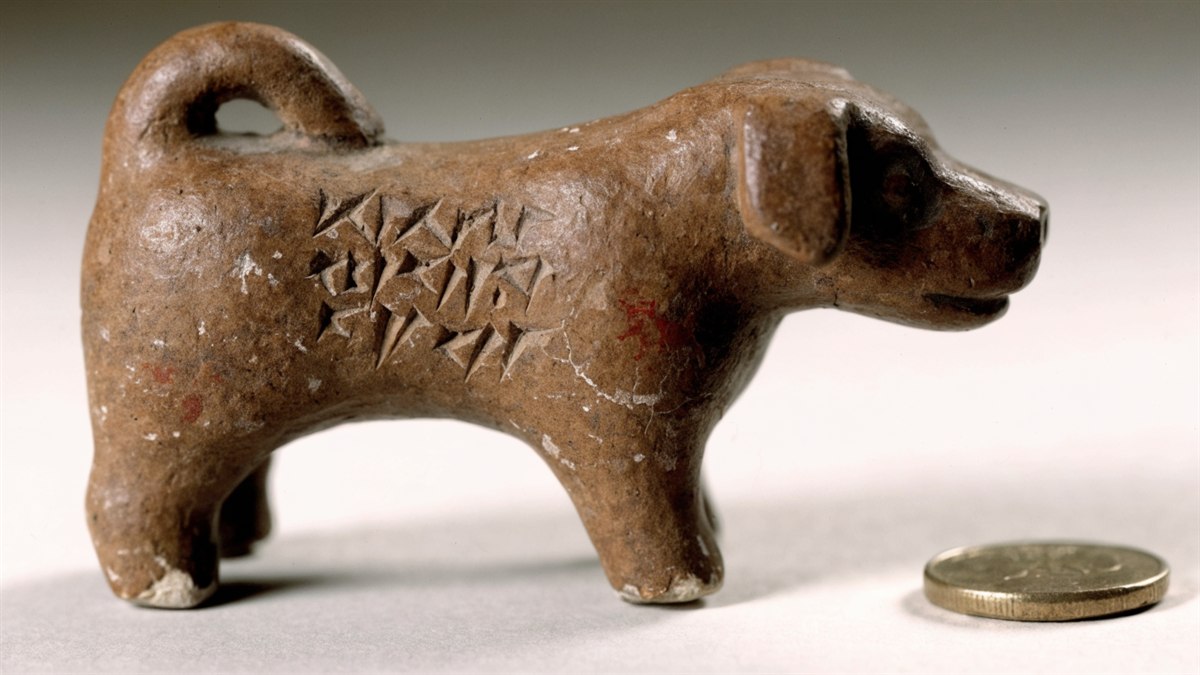
Five painted clay dogs the length of a teaspoon, buried under a doorway at Nineveh in about 645 BC, are the entire physical basis for a breed that four kennel clubs have never heard of. The living dog people mean when they say Assyrian Shepherd already has two other names, and India sells neither.
Quick answer
The Assyrian Mastiff is not a living breed. The name describes heavy dogs shown in Neo-Assyrian art and modelled as protective clay figurines at Nineveh around 645 BC, and Wikipedia files it among extinct types. No FCI, AKC, UKC, Royal Kennel Club or Kennel Club of India register carries it, no written breed standard exists under the name, and nobody in India sells one.
This guide is general information for Indian pet owners and is not a diagnosis. No breed-specific veterinary literature, screening scheme or health survey exists for the Assyrian Mastiff, so nothing here should be read as a health profile for any individual dog. Consult a registered veterinarian who has examined your dog before acting on anything you read here.
Assyrian Mastiff at a glance, rated for India
What the Assyrian Mastiff is, and what it is not
The Assyrian Mastiff is a name, not a living breed. It describes the heavy dogs that appear in Neo-Assyrian palace art and in small painted clay figurines from Nineveh, and English writing has since stretched it to cover living Middle Eastern guardian dogs that already have their own names. No register anywhere carries it, and nobody in India can sell you one.
Start with the encyclopedia everybody starts with, because it settles more than it seems to. Wikipedia's article opens in the past tense. The Assyrian Mastiff 'was a landrace of dog found in Assyria', and the infobox field for breed status reads a single word, Extinct. A landrace is not a breed. It is a regional population shaped by work and geography rather than by a written standard and a closed studbook, and the distinction runs through everything below.
The same encyclopedia says it twice. Wikipedia's separate List of dog breeds runs to 625 entries and splits them into living breeds and a section headed 'Extinct and critically endangered breeds, varieties and types'. The Assyrian Mastiff sits in the extinct section, beside the Alaunt, the Alpine Mastiff, the Bullenbeisser, the Molossus and this site's own Belgian Mastiff. The Kurdish Mastiff, the Akbash, the Aksaray Malaklisi and the Kangal Shepherd Dog all sit in the living list. One document, two lists, and the answer is on the page.
Three different things share the name
- An archaeological label. Writers apply it to the broad-headed dogs carved on Assyrian palace reliefs and modelled in clay and bronze. Those are objects in museums, catalogued as figurines and sculpture, and no museum record uses the phrase Assyrian Mastiff.
- A borrowed name for a living dog. The big flock guardian of the Pishder district in Iraqi Kurdistan is called the Pshdar dog locally and the Kurdish Mastiff in English, and some regional writing calls it the Assyrian ShepherdQassim Khidhir, 'The Pishdar. That dog is alive, working and countable.
- A label of convenience. Because nobody owns the name and no standard defines it, it can be pinned to any large dark-masked dog with nothing to contradict it.
Bonbeno's position is the first of those three, and the page is organised so a reader can tell them apart. The archaeology is real, well dated and worth reading. The living dogs are real and already named. The gap between them is where the marketing lives.
Why an ancient type is not an ancient breed
Genetics closed this question in 2012 and the conclusion has not moved. Larson and colleagues, writing in the Proceedings of the National Academy of Sciences, state that 'there is a major disconnect between truly ancient dogs and modern breeds' and that 'the vast majority of modern breeds were only created in the past 150 y';, emerging from a relatively homogeneous gene pool after millennia of human migration mixed previously separate dog lineages. The paper's own worked example of an unsupported antiquity claim is the Irish Wolfhound. The Assyrian Mastiff is the same move made with older raw material.
That is not a slight on any dog. Large guardian dogs almost certainly have worked continuously across Iraq, Iran and Turkey for thousands of years, because wolves, flocks and shepherds are all still there. Continuity of a job is a fair inference. Continuity of a documented pedigree from a specific animal carved at Nineveh to a specific animal alive now is not, and nobody has produced one.
If a seller in India offers you an Assyrian Mastiff, they are not selling you the breed named on the tin, because that breed has no register, no written breed standard, no studbook and no living population under that name. They are selling you something else with an evocative label attached. What that something else usually turns out to be is set out in the price section below.
One more thing worth fixing early, because it recurs. This animal is not a lost Indian breed and has no Indian history. Assyria sat in what is now northern Iraq, roughly 3,000 km from Delhi. The only Indian connection the record supports is a nineteenth-century guess, repeated on Wikipedia, that the ancestors of these dogs came from 'the region between India and Persia';. That sentence has no citation attached to it beyond a hobby website, and no genetic study supports it.
The archaeology is real, and it is smaller than you think
The Assyrian dog evidence is genuine, precisely dated and held in public collections, and it consists mostly of objects you could hold in one hand. Five painted clay figurines from a doorway at Nineveh are the most famous of them. Reading their museum records rather than the blog summaries changes what the name can honestly be made to mean.
In the mid nineteenth century William Kennett Loftus excavated five fired clay dog figurines from under a doorway in the North Palace at Nineveh, in Room S, Door d. They went to the British Museum, where they carry the numbers 30001 to 30005 and where five of the five are still catalogued under the object type figurineRuth A. Horry, 'The model dog that became…. Each was painted a different colour and each was inscribed in cuneiform with a working name.
| British Museum number | Cuneiform name | Translation | Pigment |
|---|---|---|---|
| BM 30001 | musesu lemnuti | Expeller of evil | White with red spots |
| BM 30002 | kasid ayyab | Catcher of the enemy | Red |
| BM 30003 | e tamtallik epus paka | Don't think, bite! | White |
| BM 30004 | munassiku garisu | Biter of his foe! | Turquoise |
| BM 30005 | dan rigissu | Loud is his bark! | Black |
Read the dimensions before you read the mythology
The British Museum's record for BM 30005 gives a production date of about 645 BC, a Neo-Assyrian culture attribution, and a size: height 5.60 cm, length 7.30 cm, width 2.80 cm. That is roughly the length of a teaspoon. It is on display in Room 55. Whatever the Assyrian Mastiff is supposed to be, its most-cited physical evidence is a hand-modelled object shorter than a smartphone, made to be buried out of sight.
These were never portraits. A cuneiform tablet from Assur, written in the reign of Ashurbanipal, prescribes keeping evil out of a building by burying two sets of five model dogs beneath a doorway, and the Nineveh group matches the prescription closely. The objects are apotropaic ritual equipment. Expecting breed detail from them is like reconstructing a horse from a chess knight.
The figurine that spent sixty years being a cat
Six bronze dogs came out of a well in Room NN of Assurnasirpal II's Northwest Palace at Nimrud during Max Mallowan's 1951 to 1952 season, each about the size of a human thumb, and were split between the Iraq Museum, Cambridge, the Metropolitan Museum, the British Museum and an Australian collection. One of them, ND 2183, reached Cambridge in 1956 and was entered in the accession register as a 'bronze figurine of cat'. It stayed a cat for about sixty years, until the Nimrud Project studied the group together in 2013 and concluded it was a dog after all.
Mallowan himself wrote in 1952 that 'some of these beasts obviously represent the Assyrian breeds of dogs of the time, but at least one of them was feline in character';. If the excavator, holding the objects, could not reliably tell a dog from a cat, then the same objects cannot support a description of coat, ear carriage, weight or temperament. That is the honest ceiling on what Assyrian figurines can tell anyone about a dog.
The museum object actually called a Mastiff is not Assyrian
The Metropolitan Museum owns a large ceramic dog it catalogues under the plain title Mastiff, object number 1989.233, 42.4 cm long. Its period field does not read Assyrian. It reads Kassite, dated to about the middle of the 2nd millennium BCE, geography Mesopotamia. The Kassites ruled Babylonia roughly eight centuries before the Neo-Assyrian palaces were built. The single most impressive Mesopotamian mastiff sculpture in a major collection is therefore catalogued to a different people and a different millennium from the one the name invokes.
The Met is careful with the word in the other direction too. Describing its small bronze dog from Nimrud, the curatorial entry notes that the legs are relatively short and the body compact, 'suggesting a dog smaller than the mastiffs sometimes represented as guard dogs in Mesopotamian art';. Mastiff there is a descriptive shape word for a class of image. It is not a breed name, and no museum record Bonbeno opened uses the phrase Assyrian Mastiff at all.
Auditing the page that ranks first, line by line
Wikipedia's Assyrian Mastiff article holds position one on the India result page and gets three checkable things wrong. Bonbeno opened its sources rather than summarising them, and the dating error is out by roughly thirteen centuries. None of this is malice; it is a stub article that nobody has audited, and it is the seed of almost everything else written about this name.
Error one, the date is out by about 1,355 years
Wikipedia's history section says that 'several mastiff type figures of the Assyrian era around 2000 BC were discovered with carved-in names';, and the source attached to that sentence is a Weebly hobby page called Canine Heritage. The British Museum's own record for the objects being described gives a production date of about 645 BC. The Nimrud Project dates the same Nineveh doorway group to c.645 BC independently, and the Metropolitan Museum, describing the same five clay dogs, places them in a later Assyrian palace at Nineveh. Three institutions agree. The gap between 2000 BC and 645 BC is 1,355 years, which is longer than the entire recorded history of most breeds.
The names are garbled too. Wikipedia gives 'Consume his life', 'Don't stop to think, bite' and 'Catcher of the hostile one'. The museum translations are 'Don't think, bite!' and 'Catcher of the enemy';, and 'Consume his life' matches none of the five. Paraphrases of a cuneiform translation are not a citation problem on their own, but they are a reliable sign that a page is copying a copy.
Error two, the only illustration is Babylonian
The article carries exactly one image, and its caption reads 'A drawing of a terracotta tablet found in Babylon', credited to Austen Henry Layard's 1882 narrative of his second Assyrian expedition, page 302. Babylon is not in Assyria. It sat about 400 km to the south and was Assyria's rival and, in 612 BC, one of the powers that destroyed it. The single picture used to show readers what an Assyrian Mastiff looked like is a nineteenth-century drawing of an object from the other side.
Bonbeno read Layard in full rather than trusting the caption. The book lists the engraving in its own table of illustrations as Terracotta Tablet from Babylon, representing a Dog, and prints it beside page 303 inside a passage about Babylonian trade routes and Phoenician shipping, where it functions as a decorative vignette rather than as evidence about a dog.
The same full-text read settles something larger. Across all 1,019,415 characters of Layard’s narrative, the word mastiff appears exactly once, in the introduction, where hounds pulling down a wounded wild ass are described as ‘apparently of the mastiff breed’. The excavator of Nineveh hedged the word, applied it to hunting hounds, and never wrote the phrase Assyrian Mastiff at all.
Error three, the living-descendant claim rests on one page from 1933
The sentence that launches a thousand listings is this one. 'The modern Assyrian Shepherd (in more recent years also known as the Kurdish Mastiff) is likely to be a descendant of the Assyrian mastiff.' Bonbeno followed its single citation. It is R. D. S. Gwatkin, 'Dogs and human migrations', published on page 160 of volume 4, issue 3 of the Journal of the South African Veterinary Association on 1 March 1933.
| Field | What the publisher's record shows |
|---|---|
| Author | R. D. S. Gwatkin |
| Author's affiliation | Permanent Force, South African Field Artillery, Roberts Heights |
| Journal | Journal of the South African Veterinary Association, volume 4, issue 3 |
| Page | 160, a single page |
| Date | 1 March 1933, ninety-three years before this page was written |
| Abstract subject | A general essay opening on the dog as 'man's first ally' |
| Recorded downloads | 40 |
Bonbeno could not read page 160 itself. The publisher's PDF endpoint returns HTTP 403 to a direct request and the online reader loads a document that could not be extracted, so no figure or sentence is quoted from it here and none should be quoted from it anywhere else. What can be verified is the bibliographic record above, and that is enough for the point. An artillery officer's one-page note from 1933 is the entire published foundation for the claim that a living dog descends from the dogs of Nineveh.
Almost every English page about this name traces back to the Wikipedia stub, and the stub traces back to two Victorian and Edwardian dog books, a 1933 artillery officer, a Weebly page and a hobby association's history tab. Follow the chain far enough and there is no independent authority at the bottom of it, only writers reading each other. That is not evidence of a breed. It is evidence of a phrase in circulation.
Registry recognition: four kennel clubs, four absences, four controls
No kennel club recognises the Assyrian Mastiff on any basis. Bonbeno read the FCI, AKC, UKC and Royal Kennel Club lists in full on 23 August 2026 and confirmed the breed names printed inside each document rather than trusting a search result, because an absence is only worth reporting when the search that produced it is proved to work.
Every check below is paired with a control, which means a breed that is on the list and that sits close enough to prove the list is the right one and covers this kind of dog.
| Register | Document read | Assyrian Mastiff | Control that passed |
|---|---|---|---|
| FCI, definitive | Nomenclature filtered to A, 23 breeds from Affenpinscher 186 to Azawakh 307 | Absent | Aidi 247 and Alaskan Malamute 243 both present and correctly numbered |
| FCI, definitive | Nomenclature filtered to K, 14 breeds | Absent, and no Kurdish Mastiff | Kangal Coban Kopegi 331 and Caucasian Shepherd Dog 328 both present |
| FCI, provisional | The provisional list printed inline on the nomenclature index, 21 breeds with recognition dates | Absent | Andalusian Terrier 371 dated 3 September 2024, matching Bonbeno's independent finding on that breed; four breeds added 11 February 2026 |
| AKC | Breeds A to Z, second page of the alphabetical run | Absent. The list goes straight from Appenzeller Sennenhund to Australian Cattle Dog | Anatolian Shepherd Dog present, and Barbado da Terceira present, so the list does carry rare regional guardians |
| UKC | Breed-standards inventory, a register that states it recognises over 300 breeds | Absent, and no Kurdish Mastiff or Pshdar | Kangal Dog, Akbash, Sarplaninac, Alentejo Mastiff, Majorca Mastiff, Pyrenean Mastiff and Spanish Mastiff all present |
| Royal Kennel Club (UK) | Breed standards index, all seven groups in one page | Absent from every group | Pastoral carries Anatolian Shepherd Dog and Turkish Kangal Dog; Working carries Mastiff, Neapolitan Mastiff, Pyrenean Mastiff and Tibetan Mastiff |
Read the control column rather than the absence column. Each of these registers does list rare regional mastiffs and Middle Eastern flock guardians, some of them obscure. The FCI recognises the Kangal at number 331 and the Caucasian Shepherd Dog at 328. The UKC publishes standards for the Alentejo Mastiff and the Majorca Mastiff. The Royal Kennel Club carries the Pyrenean Mastiff on its imported breed register. These are not lists that exclude unfashionable dogs. They simply have nothing to enter under this nameAmerican Kennel Club, Dog Breeds A to ZUnited Kennel Club, Breeds landing page.
What a real breed standard looks like, for comparison
The nearest recognised neighbour is the Kangal, and its FCI standard runs to eight pages. It specifies height at the withers of 72 to 78 cm for males with a 2 cm tolerance and 65 to 73 cm for females, weight of 48 to 60 kg for males and 40 to 50 kg for females, a body 10 to 12 percent longer than tall, a chest depth of about 50 percent of height, and a muzzle 40 to 44 percent of head length. It lists disqualifying faults, among them 'aggressive or overly shy dogs';.
That is what the phrase breed standard means. Nothing of the kind exists for the Assyrian Mastiff, in any language, published by anybody. There is no height range, no weight range, no coat description, no fault list and no body to write one.
The Indian position
The Kennel Club of India publishes no list of recognised breeds on its website, so Bonbeno makes no claim about whether it would register such a dog. What the KCI does publish is a set of downloadable forms, including single dog registration, litter registration and a tariff sheet effective 1 April 2024. Every one of those forms assumes a breed that already exists somewhere with paperwork behind it. A dog with no standard, no studbook and no issuing authority arrives at that counter with nothing to hand over, and no such dog has arrived, because none has been imported.
This project has been served a complete and correctly formatted document for the wrong breed at HTTP 200 on the FCI's own site before now. While researching this page, a guessed British Museum registration number returned a real record at HTTP 200 for an alabaster pedestal, not a dog. It was caught by reading the object title printed inside the returned page, which is the only defence that works. Every absence above was confirmed the same way.
The living dog behind the name is the Kurdish Mastiff, and it already has two others
One real living population carries the name Assyrian Shepherd, and it is the Pshdar dog of Iraqi Kurdistan, known in English as the Kurdish Mastiff. It is a genuine landrace of a few thousand head, it has been measured in a published study, and it has no breed standard, no studbook and no club. If a page tells you the Assyrian Mastiff survives, this is the dog it is pointing at.
Wikipedia's Kurdish Mastiff article opens by giving three names for the same animal: Kurdish Mastiff, Assyrian Shepherd, or Pisder dog, Kurdish Segi Pisderi. It is described as a landrace native to the mountainous Kurdistan Region of Iraq, particularly the Pisder district of Sulaymaniyah Governorate, kept as a livestock guardian and numbering around a few thousand head. The separate Wikipedia title 'Pshdar dog' redirects to the same article, so the encyclopedia holds one dog under four labels.
Reporting from the region uses all of them. Rudaw, filming a breeder in Saqqez in February 2020, introduced the animals as 'Kurdish Mastiffs, otherwise known as the Pshdar or Assyrian Shepherd';. The Kurdistan Chronicle, in November 2023, wrote that 'some historians refer to the Pishdar dog as the Assyrian Shepherd';. Neither publication calls it an Assyrian Mastiff. That English compound appears to be a later merger of two separate names.
What has actually been measured
One quantitative study exists. Alsada, Al-Barzinji and Abbass measured 74 Pishdar dogs, 46 males and 28 females aged one to twelve years, across nine locations in Sulaymaniyah Governorate, and published the results in Biochemical and Cellular Archives in April 2020.
| Measure | Figure |
|---|---|
| Dogs measured | 74 (46 male, 28 female) |
| Mean body weight | 73.50 kg, standard deviation 13.33 kg |
| Heaviest location, Qala-Diza | 80 kg mean, standard deviation 18.25 kg |
| Lightest location, Sangasar | 67.5 kg mean, standard deviation 8.21 kg |
| Body dimensions recorded | 25 per dog |
| Locations sampled | 9, including Dukan, Halabja, Rania, Sitak and Sulaymaniyah |
Now divide, because the spread is the whole finding. A standard deviation of 13.33 kg on a mean of 73.50 kg is 13.33 divided by 73.50, or 18.1 percent. Within the single district of Qala-Diza the deviation is 18.25 kg on an 80 kg mean, which is 22.8 percent. A breed with a written standard does not vary like that, because the standard is precisely the instrument that stops it: the FCI gives the Kangal a 12 kg male weight range and a 2 cm height tolerance. The paper's own conclusion is that there are 'high genetic variations among dogs for these traits'; and that selection could therefore improve growth performance. Selection improving things in future is the technical description of a landrace, not of a breed.
Wikipedia summarises this study as ranging 'from 67kg in Sangasar to 80kg in Qira Diza';. The paper says 67.5 kg at Sangasar and spells the other location Qala-Diza. Half a kilogram and a spelling are trivial in themselves. They are recorded here because this page's whole argument is that the chain of copying is where the errors enter, and it would be dishonest to audit Wikipedia's dates and stay quiet about a discrepancy that happens to be small.
No standard, no studbook, no club
Bonbeno found no written breed standard for the Pshdar dog, no studbook, and no breed club publishing either. The closest thing to a record in the reporting is a breeder in Saqqez who makes his own: 'First of all I make them ID cards. I record their date of birth and the vaccines and the medications they need';. That is conscientious animal husbandry and it is not a register. Nobody can verify it, nobody audits it, and it does not travel with the dog.
This site has a Kurdish Mastiff entry queued but not yet written, so there is no page to send you to. What matters here is the naming point. If someone offers an Assyrian Mastiff and means a real dog, the honest name for that dog is Pshdar or Kurdish Mastiff, and it belongs to a population of a few thousand animals in one region of northern Iraq.
Is anyone rebuilding it? The revival claim traces to an AI-written page
No reconstruction programme for the Assyrian Mastiff exists. The claim that one does appears on a single hobby-forum article that holds position seven on the India result page, names no person, no club and no country, and ends with the line 'Generated by CoPilot!'. Bonbeno traced it because a reconstruction, if real, would be the most important fact on this page.
The sentence in question reads: 'Today, efforts are underway to revive the Assyrian Mastiff. Breed enthusiasts study ancient texts, artifacts, and historical accounts to reconstruct their lineage.' It appears on Molosser Dogs, an article with 12,522 views, and it is the only revival claim Bonbeno could find anywhere.
The same article is the sole source of several other details that circulate as fact. It supplies the alternative name Ashur-Ku, which appears in no museum record, no dictionary and no academic source Bonbeno opened. It gives a height of 30 to 34 inches. And it states that the dog's 'ears stood erect';, which contradicts the Victorian description Wikipedia quotes, where the ears are 'of medium size' and the skin hangs down the face 'in enormous wrinkles or folds', and contradicts the drop-eared shape of the surviving figurines.
The tell is printed at the bottom of the article
Below the last paragraph, above the comments, the page carries three words: 'Generated by CoPilot!';. The article does not merely read as machine-written; it says so. The same site publishes, in the same series and by the same account, breed profiles for the Elymaean Mastiff, the German Malchower, the Miniature Mastiff, the Imperial USA Bulldog, the King Dane and the Griffin Bandog. The teaser for the German Malchower opens by conceding that the name does not refer to an officially recognised breed.
A language model asked to write about a lost breed will produce a revival paragraph, because that is how articles about lost breeds usually end. It is a narrative reflex, not a finding. Before repeating that Assyrian Mastiffs are being reconstructed, ask the four questions that any real programme answers instantly: who runs it, where, since when, and which body has recognised the result. For this name there is no answer to any of the four.
What a genuine reconstruction looks like, for calibration
Bonbeno is not sceptical of reconstruction in principle, because this site has documented one. The Belgian Mastiff went completely extinct at the start of the 1960s and has been rebuilt in Flanders since 2000. That programme can be checked at every step. It has a named founding breeder, a dated start, an association founded in 2006, a written standard approved on 25 September 2010, a national status granted by Belgium's FCI member kennel club, and a published population count.
| Test | Belgian Mastiff | Assyrian Mastiff |
|---|---|---|
| Who runs it | A named association in Flanders | Nobody named |
| Since when | A dated programme beginning in 2000 | No date given |
| Written standard | Approved 25 September 2010 | None, in any language |
| Recognised by anyone | Nationally, by Belgium's kennel club | No |
| Published population | Yes, a counted figure | None |
| Source of the claim | The kennel club and the association | One article ending 'Generated by CoPilot!' |
That is the bar, and it is not a high one. A reconstruction that exists leaves paperwork, because the entire point of a reconstruction is to persuade a registry. The Assyrian Mastiff revival leaves one paragraph on a forum.
And a reconstruction could not lawfully be attempted in India
This matters for any Indian reader tempted to start one. The Prevention of Cruelty to Animals (Dog Breeding and Marketing) Rules 2017, Second Schedule Part II, paragraph 6(9), states in full: 'Breeding to create new breeds of dogs or unusual looks shall be strictly prohibited';. Recreating an extinct type by selecting for an appearance taken from palace art is breeding to create a breed. Paragraph 6(3) of the same schedule closes the other door, prohibiting in breeding and incest breeding, including matings between relatives of the second to fourth grade within four generations, which is exactly the tool a small reconstruction pool would need.
The Assyrian label has been grafted onto at least two living breeds
Two real breeds already carry an Assyrian claim, and neither of them is called the Assyrian Mastiff by the people who breed it. The Kurdish Mastiff is sometimes called the Assyrian Shepherd. The Aksaray Malaklisi is marketed as an Assyrian war dog. The second claim can be checked with nothing more than subtraction, and it fails.
In August 2019 the Aksaray Malaklisi Breed Improvement Association told the Ihlas News Agency that its dog, the largest of the Anatolian sheepdogs, had been an Assyrian war dog. Daily Sabah ran it, and the Assyrian International News Agency picked it up, which is why both sit on the India result page for this term today.
The article disagrees with itself, and then with the calendar
The headline says the dog was used by Assyrians 2,500 years ago. The article's own URL slug says 2,000 years ago. And the association's chairman, quoted in the body, says: 'The breed was used as a war dog 2,000 years ago during the time of the Assyrians';. Three figures, one article.
Now subtract. Assyria was destroyed in 612 BC, when a coalition of Babylonians and Iranian peoples took Nineveh, a date the Metropolitan Museum uses in its own catalogue entry for the Nimrud bronze dog.
| Claim as published | Counting back from 2019 | Years after Assyria fell in 612 BC |
|---|---|---|
| 2,000 years ago, quoted from the association chairman | AD 19 | 631 |
| 2,500 years ago, the headline figure | 481 BC | 131 |
Both figures land after the empire had ceased to exist. The chairman's own number puts an Assyrian war dog six and a quarter centuries into the Roman imperial period. The generous headline figure still misses by 131 years. Nothing more sophisticated than arithmetic is needed, and no page currently ranking has done it.
The claim's origin is worth noting without sneering at it. The association exports about 100 Aksaray Malaklisi dogs a year from central Turkey and told the same reporter that the breed 'is not yet recognized internationally, but efforts are underway to gain certification';. An ancient pedigree is a useful thing to have while you are seeking recognition. This site covers that dog on its own terms at Aksaray Malaklisi, where it is a real and impressive animal without needing Ashurbanipal.
Every large regional guardian gets offered the same story
- Kurdish Mastiff, Iraq. Called the Assyrian Shepherd in some regional writing, and the only living population with a genuine claim on the phrase.
- Aksaray Malaklisi, Turkey. Marketed by its breeders' association as an Assyrian war dog, on a timeline that does not work.
- Kangal Shepherd Dog, Turkey. FCI number 331, the recognised breed the Pshdar is most often compared to.
- Sarabi, Iran, and the Central Asian Shepherd Dog. Both drift under the label in English listings whenever a large masked dog needs a heritage.
- Tibetan Mastiff. A separate, fully recognised breed at FCI 230 that attracts the same ancient-origins marketing, covered here at Tibetan Mastiff.
Ask which century, then check whether the civilisation named still existed in it. Assyria, Sumer, Babylon and Persia get used interchangeably in dog marketing as though they were one continuous thing, and they are separated by centuries and by conquest. The Metropolitan Museum's largest Mesopotamian dog sculpture is catalogued Kassite rather than Assyrian for exactly this reason. A breeder who cannot tell you which empire, and when, is telling you a mood rather than a history.
None of this makes the living dogs less impressive. It makes the label useless. If two different breeds from two different countries can both be sold as the Assyrian dog, the word Assyrian is carrying no information about the animal in front of you.
Assyrian Mastiff price in india: there is no price, and that is the answer
No Assyrian Mastiff price in india exists, because no Indian breeder, marketplace or retailer sells one. Bonbeno ran the query with a control in the same session on 23 August 2026 to be sure the absence was real rather than a broken search, and it is real. What the query returns instead is a substitute, and knowing which substitute is more useful than any rupee figure.
Run 'assyrian mastiff price in india puppy for sale' with the location set to India and twelve results come back. Every one of them is a live Indian commercial page, which is the control: the search surface plainly does reach Indian puppy retail. Not one of them offers this breed. They offer the Tibetan Mastiff at Delhi and Bengaluru kennels, the English Mastiff, the Neapolitan Mastiff and, in one video, a Korean Mastiff. The two results that mention the name at all are an Instagram comment on a most-expensive-dogs reel and a Facebook post reproducing the Wikipedia opening sentence.
Tighten it to the exact phrase and the commercial results vanish entirely. Twelve results, and the breakdown is a Wikipedia list, a Scribd document, a YouTube title conflating four names, three social posts, a hobby blog, a TikTok tag page and a print shop. Zero listings. Zero prices. Zero breeders.
The directory page that ranks sixth on that result set makes the same point against itself. It is a marketplace, it carries an Assyrian Mastiff category, and every panel on it is empty: no active listings, no herdbook records, no public profiles and no breeders. A commercial site that has built a product page for this breed and has nothing to put in it is the clearest available evidence that nothing is being traded under the name anywhere, let alone in India.
A zero can be a blocked search wearing a result page, and zero was exactly the answer expected here, which is when a researcher is most likely to accept it. The control is the first query: it returned twelve genuine Indian for-sale pages with rupee prices on them. A search reaching that much Indian commercial inventory and still finding nothing under this name has proved itself. Had the control also returned nothing, no conclusion would be drawn from either result.
What Rs 98,999 actually is, and why it keeps appearing
Anyone researching Indian mastiff prices from search snippets meets the figure Rs 98,999 attached to the French Mastiff, the Bull Mastiff, the English Mastiff and the Tibetan Mastiff on the same retailer. It is not any of their prices. Opening the Tibetan Mastiff page shows what it is. The live Tibetan Mastiff listings run Rs 1,55,999 to Rs 1,92,499. The Rs 98,999 sits further down the page in a shared 'Other Available Pets' carousel, where it is the price of a Maltipoo and a Doxiepoo.
The carousel renders identically on every product page on that site, so the same small-dog price leaks into the meta description of every large-dog listing and is then reported by anyone reading snippets rather than pages. If an Assyrian Mastiff listing ever appears in India, expect Rs 98,999 to appear beside it, and expect it to mean nothing about the dog.
| What is offered | Published Indian price | Relationship to the Assyrian Mastiff |
|---|---|---|
| Tibetan Mastiff, live listings at a Delhi retailer | Rs 1,55,999 to Rs 1,92,499 | A different breed, FCI 230, from the Himalayas |
| English, French and Neapolitan Mastiff | Listed, prices vary by tier | Different breeds, all European |
| Maltipoo and Doxiepoo in the cross-sell carousel | Rs 98,999 | The source of the recurring figure. A crossbred toy dog |
| Assyrian Mastiff | No listing, no price, no breeder | Not offered by anyone in India |
The exchange-rate test has nothing to run on
Bonbeno divides suspicious Indian rupee figures by 84.38, because Indian pages routinely publish a US dollar price run through one exchange rate and present it as a local market rate. This site has caught that three times. Here the test cannot be run, for the simplest possible reason: no Indian rupee figure for this name exists to divide. That absence is itself worth recording, because a nominal breed with no supply chain generates no fake prices either. Nobody bothers inventing a price for a dog nobody is asking to buy.
For scale, the one real price in the record is foreign. The Kurdistan Chronicle reports that in the Kurdistan Region of Iraq, prices for some Pishdar dogs exceed 10,000 US dollars. Converted at the same 84.38, that is about Rs 8,43,800. If an Indian page ever prints Rs 8.4 lakh for an Assyrian Mastiff, you now know where the number came from and that it is a conversion rather than a quote.
None of this is a price you can act on, because the supply route does not exist. The import section below sets out why, and it is not a matter of scarcity or expense. It is a matter of law.
Why no lawful route into India exists, even if you found a dog
India permits dog imports for three purposes only, and buying an unusual breed is not among them. Trade Notice 22/2022-23 makes dogs a Restricted import and states that applications for trading or breeding purposes shall be rejected. Combine that with the absence of any registry recognition and no lawful supply chain for this name can form at all.
The Directorate General of Foreign Trade issued the governing document on 19 December 2022. Bonbeno downloaded the five-page PDF and extracted the text rather than reading a summary of it, because summaries of Indian pet-import rules are a known source of invented clause numbers on this subject.
Under ITC(HS) heading 01061900, 'Mammals: Other', the import policy is a single word: Restricted.
The three permitted purposes, quoted
- A pet dog 'with valid pet book and relevant records/documents in the name of importer'.
- Research, for dogs 'imported by the R&D Organisations for conducting research with the recommendation of CPCSEA'.
- Internal security, 'by the Defence and Police Force'.
Policy Condition (8) then closes the gap in one sentence: 'Import of commercial dogs for breeding or any other commercial activities other than the purposes mentioned above is not permitted.' Paragraph 6 repeats it as an instruction to officials, stating that 'any applications for trading/breeding purposes, or applications made on behalf of some another person/entity shall be duly rejected';.
The remaining route is the personal-pet one, and it is narrower than most readers expect. Import as passenger baggage without a DGFT import authorisation is available only to a person transferring residence to India after two years of continuous stay abroad, and only for up to two animals. Anything else, including a shorter stay abroad or a third animal, needs an import authorisation from DGFT with the application examined by the Department of Animal Husbandry and Dairying. Entry is permitted only through Delhi, Mumbai, Chennai, Hyderabad, Bangalore and Kolkata, quarantine may be applied at those ports, and the notice advises starting the process at least two months before travel. DAHD added a seventh port, Cochin International Airport at Kochi, for pets arriving under the baggage rules in October 2024. The full route is set out in how to import a dog to India.
| Step | Requirement | Status for this name |
|---|---|---|
| Identify the dog | A breed that exists with a name a document can carry | Fails. No standard, no register, no issuing body |
| Buy abroad and import for resale | Barred by Policy Condition (8) | Fails. Commercial import for breeding is not permitted |
| Import as a personally owned pet | Two years continuous stay abroad, valid pet book in your own name, max two animals | Theoretically open, but the pet book must name a breed |
| Register the dog in India | An export pedigree from a recognised authority | Fails. No authority issues one |
Either fact alone would leave a gap. Together they do not. A commercial import is prohibited outright, and the one open personal route needs paperwork that identifies the animal by a recognised breed name, which for the Assyrian Mastiff no body on earth issues. A dog could physically arrive as somebody's pet; it could not arrive as this breed, because the breed has no documentary existence to declare.
The Indian rules a seller would also have to satisfy
Suppose, hypothetically, that dogs sold under the name did appear in India. The Prevention of Cruelty to Animals (Dog Breeding and Marketing) Rules 2017 would apply immediately, and three of its provisions bite hardest on a large unrecognised guardian type. Rule 8(1)(a) requires that 'pups less than eight weeks in age are not sold'. Rule 8(1)(b) requires that dogs over six months are not sold without first being sterilised, unless the buyer is another licensed breeder. And the Second Schedule Part II paragraph 6(8) forbids 'tail docking, ear cropping de-barking, de-clawing, branding, dyeing'; and any change of appearance by artificial means.
That last one is worth flagging against the regional practice. The FCI's Kangal standard notes that cropped ears, where cropping is allowed, are evaluated as the non-cropped ones, which reflects the reality that guardian dogs in parts of the region are still cropped. In India that is prohibited outright, with no show-ring exception. A cropped guardian puppy offered in India is evidence of an offence, not of authenticity.
Cost of ownership: what can honestly be costed, and what cannot
No monthly cost of ownership can be published for the Assyrian Mastiff, because costing an animal requires knowing its adult weight, its coat, its lifespan and its disease risks, and none of those are established for this name. What can be costed is the weight class, and only as an illustration of scale rather than as a budget for a dog you will own.
Bonbeno will not print a monthly rupee table here. Doing so would imply a dog exists to spend the money on, and the whole finding of this page is that it does not. Inventing a feeding cost from a weight that itself comes from a Copilot-generated article would compound two errors into a number that looks authoritative.
What can be said honestly is what drives cost for any animal in this weight class, so a reader can recognise how large the commitment would be if they were actually contemplating a Kurdish Mastiff or one of the recognised guardian breeds.
- Body weight sets almost everything. The measured Pishdar mean is 73.50 kg. Food, most medication, anaesthesia, parasite prevention and boarding are all dosed or priced by weight, so a 73 kg dog is not twice a 36 kg dog in running cost, it is worse, because the large-breed products cost more per kilogram too.
- Containment is a capital cost, not an accessory. A guardian dog that patrols needs secure perimeter fencing before it arrives. That is a one-off spend in the tens of thousands of rupees on any real plot, and it is the single item most Indian buyers of large guard dogs underbudget.
- Emergency surgery capacity is the real insurance. Deep-chested giant dogs carry a bloat risk that turns into an out-of-hours abdominal surgery. The cost that matters is not the routine month, it is the one night you need a surgical clinic at 2 am.
- Space has a price in Indian cities. This is not a dog a flat can hold, so the honest cost line for most urban readers is a house with land, which dwarfs every other figure on the list.
A dog reported to need at least 10 kilometres of running a day and weighing about 73 kg is a livestock guardian on a farm, and its true cost is the farm. Every attempt to run one on an urban budget produces the same outcome: an under-exercised, under-contained, over-fed animal that becomes a welfare problem and then a liability.
One cost that is genuinely zero is the purchase price, because nothing is for sale. That is not a saving. It is the sign that this is not a purchase decision at all.
Heat tolerance: a desert dog that has never met a monsoon
The Mesopotamian guardian type is genuinely heat-adapted, and that adaptation does not transfer to most of India. Its home summers are as hot as Delhi's and roughly four times drier, and a dog cools itself by evaporating water from its airways. Take away the dryness and you take away the cooling, which is why Mumbai in July is a harder place for this dog than Mosul in July.
Bonbeno queried NASA POWER by explicit latitude and longitude rather than by place name, and checked the coordinates echoed back in each response, because place-name climate lookups have served this project six wrong cities at HTTP 200. Read the two temperature columns differently. The mean columns are monthly means across 2001 to 2020. The record-high column is NASA POWER's T2M_MAX, which is the highest temperature the climatology recorded at that point in the whole period, not an average afternoon, so it describes the hottest day on record rather than a routine one.
| Place | Annual mean | January mean | July mean | July record high | July relative humidity |
|---|---|---|---|---|---|
| Pishdar district, Iraq (36.163N, 45.118E) | 17.8 C | 3.7 C | 32.1 C | 46.1 C | 19.5% |
| Nineveh and Mosul (36.36N, 43.15E) | 20.5 C | 6.0 C | 35.2 C | 49.4 C | 16.4% |
| Delhi | 25.6 C | 13.6 C | 32.3 C | 46.8 C | 62.7% |
| Chennai | 28.0 C | 24.1 C | 29.7 C | 39.3 C | 67.5% |
| Bengaluru | 23.7 C | 21.1 C | 23.5 C | 34.0 C | 76.8% |
| Pune | 23.9 C | 19.9 C | 23.9 C | 32.7 C | 89.1% |
| Mumbai | 26.8 C | 23.2 C | 26.6 C | 34.2 C | 89.6% |
The temperature column is not the problem
Read the July mean column first and the surprise is how little separates them. Pishdar's July mean is 32.1 C and Delhi's is 32.3 C, and Nineveh runs hotter than both at 35.2 C. The record-high column says the same thing about the worst days: 46.1 C at Pishdar, 49.4 C at Nineveh and 46.8 C at Delhi, all of them period extremes rather than routine afternoons. What differs is timing. Delhi is already at a 35.1 C monthly mean in May, while Nineveh is still at 24.5 C and does not reach 35 C until July, so the Indian hot season arrives about two months earlier than the one this dog was bred for. A dog from the Mesopotamian plateau is not going to be startled by North Indian dry heat in July. It has never met a North Indian May. In pure temperature terms it is still one of the more heat-tolerant large breeds a reader could consider.
The humidity column is the problem
Now read the last column. Pishdar in July sits at 19.5 percent relative humidity and Nineveh at 16.4 percent. Mumbai in July sits at 89.6 percent and Pune at 89.1 percent. Divide it out: 89.6 divided by 19.5 is 4.6, so Mumbai's monsoon air holds about four and a half times the relative moisture of the air this dog's ancestors panted in, a gap of just over 70 percentage points.
That matters because dogs do not sweat to cool. They move air across wet surfaces in the mouth and airways and lose heat as that water evaporates. Evaporation slows as the surrounding air approaches saturation, so the same 32 C is a different physiological event at 19 percent humidity and at 89 percent humidity. A heavy double coat over a 70 kg body is survivable in dry heat and dangerous in humid heat, and no ranking page for this term makes that distinction.
Pishdar district averages 3.7 C in January. This is a mountain dog with a cold-winter coat, not a desert sighthound. Chennai's January averages 24.1 C, which is 20.4 C warmer than the coldest month the coat was built for. There is no season in coastal or southern India in which that undercoat is doing a useful job, and shaving it is not the answer, because the coat also insulates against radiant heat.
Where in India the origin climate comes closest
If the question is academic, the honest answer is that inland North India in the dry season is the nearest match India offers. Delhi's annual relative humidity of 45.6 percent is the only figure in the table close to the Iraqi 42 to 44 percent, and Delhi's pre-monsoon May is a fair analogue for a Mesopotamian summer. What Delhi then does that Mosul never does is turn 62.7 percent humid in July. There is no Indian city that stays dry all year, so there is no Indian city that matches the origin climate across twelve months.
Coastal and southern India are the worst fit by a wide margin. Mumbai, Pune, Chennai and Bengaluru all combine warm nights with monsoon saturation, which is the exact combination that removes a large dog's ability to shed heat overnight.
Temperament: what the living dog is like, and the part sellers leave out
No temperament description exists for the Assyrian Mastiff, because no standard describes it and no population is available to observe. What can be described is the temperament of the living dog the name is borrowed from, and the honest version includes something most pages omit: the Pshdar is openly bred and traded for fighting in its home region.
Everything in this section is about the Kurdish Mastiff or Pshdar dog. Nothing in it should be read as a description of a dog you can buy in India, because you cannot.
A livestock guardian decides for itself
The job explains the animal. A flock guardian works alone, at night, at distance from any human, and judges for itself whether something approaching the sheep is a threat. A shepherd in Pishdar district described wolves, bears and foxes as the daily reality and said plainly: 'Basically, if you don't have a Pishdar, you can't be a shepherd here.'; He recounted two of his dogs turning back three raiding wolves. Independence is not a training failure in this kind of dog. It is the specification.
One owner of eleven of them describes them as calm and obedient but permanently alert and ready to charge if they sense danger. Both halves of that sentence are true at once, and the second half is what an urban household underestimates.
The fighting problem, stated plainly
Two independent sources report the same thing. Rudaw's report on a breeder in Saqqez states that he brings puppies from Iraqi Kurdistan to raise and sell in Iran 'for guard duties or blood sport', and that his customer values the dogs because 'they are great fighters and make good guard dogs';. The Kurdistan Chronicle reports that despite being prohibited in the Kurdistan Region of Iraq, dog fighting in Pishdar happens monthly through autumn and winter, drawing crowds of around 2,000 people, and that Iranian buyers are purchasing increasing numbers of the dogs for fights involving gambling.
That is not an incidental detail about a distant place. It is a selection pressure. A population in which a proportion of breeding decisions are made on fighting record is a population being selected, in part, for a trait that every recognised standard for this kind of dog treats as a defect. The FCI's Kangal standard lists 'aggressive or overly shy dogs'; among its disqualifying faults and describes the correct temperament as 'steady and bold without aggression'. Where these dogs have been written down by people who judge them, fighting drive disqualifies.
Section 11 of the Prevention of Cruelty to Animals Act 1960 makes it an offence to incite any animal to fight, under clause (1)(m)(ii), and to organise, keep, use or manage any place for animal fighting, under clause (1)(n). The penalty has never been updated. A first offence carries a fine of not less than ten rupees which may extend to fifty rupees; a second offence within three years, up to one hundred rupees or three months' imprisonment. Dog fighting is illegal in India and the maximum first-offence fine is fifty rupees, which is less than a kilogram of dog food costs. Anyone importing a fighting line into India is not deterred by that number, and an Indian buyer should not assume the law is doing the work.
Who this kind of dog suits, and who it does not
- Suits a working property with livestock, secure perimeter fencing and an owner who has kept a large guardian breed before.
- Suits an owner who accepts night barking as correct behaviour rather than a fault to be trained out.
- Does not suit a flat, a shared compound, or any home in a dense Indian neighbourhood where a 70 kg territorial dog meets unfamiliar foot traffic daily.
- Does not suit a first dog, under any circumstances.
- Does not suit anyone attracted by the word Assyrian, which is the honest description of most people arriving at this term.
Reserve with strangers is normal for the type and aggression is not the same thing. Learning to see the difference takes experience with the category, which is precisely what a buyer drawn in by an ancient-war-dog story does not have.
Training a guardian type: containment first, obedience second
To train any dog of this type, build the containment before the dog arrives and accept that you are shaping judgement rather than installing commands. A livestock guardian is bred to act without consulting anyone, so the training goal is a dog whose independent decisions are ones you can live with. No breed-specific training literature exists under the Assyrian Mastiff name, and none should be invented.
Be clear about the evidence base first. There is no training guide, no club, no working test and no breed-specific protocol for this name. What follows applies to the guardian category generally and to the Pshdar in particular, and it is offered so an Indian reader can judge the size of the undertaking, not as instructions for a dog they are about to acquire.
The order of operations that actually works
- Fence the perimeter before the puppy arrives. A guardian dog that can leave the property will, and a roaming 70 kg dog in an Indian neighbourhood is a legal and welfare emergency waiting to happen.
- Decide the job on day one. A working prospect that will guard stock should be raised with stock. A dog that will live with a family should be handled and socialised with people. The two paths pull in opposite directions from the first weeks and cannot both be run.
- Socialise deliberately and early, because the default setting is suspicion. Exposure to visitors, delivery riders, traffic and other dogs during the socialisation window is the difference between a discriminating guardian and a dangerous one.
- Train handling, not tricks. Nail trims, ear checks, muzzle acceptance and being moved off furniture matter far more on a 70 kg dog than sit and stay, because they are what a veterinarian will need at year eight.
- Never train for aggression, ever. Under section 11(1)(m)(ii) of the Prevention of Cruelty to Animals Act 1960, inciting an animal to fight is an offence in India, and the FCI's standard for the nearest recognised breed disqualifies aggressive dogs outright.
What the breed resists
Recall is the honest weak point. A dog selected for centuries to leave the flock, investigate a noise on a ridge and come back when it judges the matter settled is not going to develop a competition-standard recall, and buying one in the belief that consistent training will produce one is the commonest planning error with the whole category. Manage it with fencing and leads rather than optimism.
Night barking is the second. It is working behaviour, not disobedience. In a Pishdar valley it is the point of the dog. In an Indian apartment block it is a neighbour dispute every night, and no amount of training removes it without removing the dog's function.
If you ever encounter someone in India breeding large guardian dogs, the 2017 Rules require the breeder to be registered with the State Animal Welfare Board and prohibit both in breeding and incest breeding under Second Schedule Part II paragraph 6(3), which defines in breeding to include matings between relatives to the fourth grade within four generations, such as cousin to cousin or grandparent to grandchild. Small rare-breed populations reach for exactly those matings. In India that is not a grey area.
The single most useful training decision available to an Indian reader considering this type is the one made before any dog is bought: choose a breed that has a standard, a club and published temperament expectations, so that what you are training toward is written down somewhere by someone other than the seller.
Exercise: ten kilometres a day, and an Indian city cannot supply it
Owners of the living dog put the daily requirement at a minimum of ten kilometres of running, and they say plainly that it cannot be met in a home or a flat. That single figure disqualifies the type for almost every Indian reader who arrives at this page, and it is the most decision-relevant number in the whole article.
The figure comes from an owner of eleven Pshdar dogs near Ranya, who keeps every one of them at a farm outside the town because, in his words, they need to run at least 10 kilometres every day. He takes them daily to run and swim at Ranya Lake a few hundred metres from the farm, and states that Pishdars are not suitable as pets in a home or an apartment. That is not a vet's prescription and Bonbeno does not present it as one. It is what a person keeping eleven of them says the animals need.
Now put that requirement inside an Indian day
Ten kilometres of running for a 73 kg double-coated dog has to happen when the ambient conditions allow heat loss. Working from the climatology above, that means before sunrise or well after dark for most of the Indian year, and in the monsoon it may not be possible at all, because July relative humidity of 89.6 percent in Mumbai or 89.1 percent in Pune removes most of the evaporative cooling the dog depends on. A pre-dawn run is not a lifestyle inconvenience here. It is the only window.
| City | The usable window | The month it gets hardest |
|---|---|---|
| Delhi | Before sunrise. May averages 35.1 C and has recorded 48.1 C | May and June, on temperature |
| Mumbai | Before sunrise, and in July often not safely at all | July, on humidity at 89.6 percent |
| Pune | Early morning. Cooler than Mumbai but July humidity is 89.1 percent | July and August, on humidity |
| Chennai | Before sunrise. Warm nights, January still averages 24.1 C | May, on combined heat and humidity |
The failure mode is a chain, and it is an offence
A large guardian dog whose exercise need is not met does not become calm. It becomes frustrated, then reactive, then destructive, and the commonest Indian response to that sequence is confinement, usually a chain or a small rooftop enclosure. That response is itself against the law. Section 11 of the Prevention of Cruelty to Animals Act 1960 makes it an offence, under clause (1)(f), to keep an animal chained or tethered for an unreasonable time on an unreasonably short or heavy chain, and separately, under clause (1)(g), for an owner to neglect to exercise reasonably any dog habitually chained up or kept in close confinement.
Indian law contains a clause written specifically for the situation this breed type creates in cities. A dog kept in close confinement must still be exercised reasonably, and failing to do so is an offence in its own right, quite apart from any cruelty. Anyone who cannot commit to the pre-dawn hour, every day, for a decade, has already answered the question of whether to keep a guardian dog of this size.
The comparison worth drawing is with a dog that evolved in the climate it lives in. The Indian Pariah Dog needs a fraction of that mileage, thermoregulates for Indian conditions without help, and is available free from any Indian street or shelter. For a reader whose actual want is a watchful, weather-hardy, independent dog, that is the honest recommendation, and it is made again in the adoption section.
Grooming: nothing is published for this name, and the coat is guesswork
No coat description exists for the Assyrian Mastiff, because no breed standard defines one. The frequently repeated 'dense double coat' comes from an article that ends by declaring it was generated by an AI, so Bonbeno does not treat it as evidence. What can be said comes from the recognised neighbours and from Indian humidity, and it is short.
Here is the state of the evidence, stated once. The Copilot-generated ranking page describes a dense double coat in colours from deep tan to reddish-brown, and gives the dog erect ears. The Victorian description Wikipedia quotes describes loose skin hanging in folds and pendulous lips, and medium-sized ears. These are not the same animal, and neither is a standard. Nobody should groom a dog on the basis of either.
The recognised neighbour does have a written coat description. The FCI's Kangal standard requires a short, dense double coat and treats 'coat very short and smooth, devoid of undercoat'; as a disqualifying fault. If a living dog turns up in India under the Assyrian name, that is the coat it is most likely to have, and the advice below assumes it.
The three things that actually matter in Indian humidity
- Brush through the undercoat, weekly and then daily in moult. A short dense double coat sheds year-round in Indian conditions rather than in two clean seasonal drops, because the temperature cue that triggers a proper moult never arrives.
- Never shave a double coat for heat. The undercoat insulates against radiant heat as well as cold, and removing it in a country with this much solar load makes the dog hotter and exposes skin to sunburn.
- Dry the dog properly after any bath, and check the ears. Ambient July humidity of 89.6 percent in Mumbai means a coat that is left to air dry stays damp for hours, and a heavy drop ear over a damp canal is the standard route to otitis in an Indian monsoon.
Guardian-breed guidance written in Anatolia or the American West routinely says to towel a dog off and let it air dry. That is sound in 20 percent humidity. It is poor advice in a Pune or Mumbai monsoon at close to 90 percent, where the air will not take the water and the coat simply stays wet. Dry actively, and plug or protect drop ears before bathing rather than after.
The realistic grooming answer for this page, though, is the same as the realistic answer everywhere else on it. There is no coat to groom, because there is no dog to acquire. This section exists so a reader who is actually considering a Kangal, an Akbash or a Caucasian Shepherd Dog knows what the category demands in Indian conditions.
Health problems and life expectancy: no data exists, and here is how that was established
No health data exists for the Assyrian Mastiff. There is no breed health survey, no registry screening scheme, no published disease prevalence and no lifespan study, because there is no registered population to survey. Bonbeno says so three times rather than borrowing a related breed's numbers once, and the sections below set out what was searched and what an Indian owner of any giant guardian should screen for instead.
Three separate things are missing, and it is worth naming them separately because writers routinely substitute one for another.
- No breed club health survey, because there is no breed club anywhere in the world under this name.
- No registry screening scheme, because no registry recognises the name, so no hip, elbow or eye scheme can be attached to itThe Royal Kennel Club (United KingdomUnited Kennel Club, Breeds landing page.
- No orthopaedic statistics. The Orthopedic Foundation for Animals requires 100 hip evaluations, or 50 for its other databases, before a breed appears in its statistics at all. A population that has never been registered cannot accumulate them.
Life expectancy: one journalistic figure, no study
The only life expectancy figure Bonbeno could find for any dog under any of these names is in the Kurdistan Chronicle, which gives Pishdar dogs 10 to 13 years. That is a reporter's line in a culture feature, not a cohort study, and no methodology accompanies it. It is recorded here because it exists and because leaving it out would be as misleading as dressing it up. It should not be quoted as a breed lifespan, and this page carries no lifespan figure of its own.
For calibration, 10 to 13 years would be unusually long for a dog averaging 73.50 kg. Giant breeds generally do not reach it. That does not make the figure wrong, but it does mean it should not be relied on until somebody counts properly.
What Indian law says must be screened, which is more than most buyers know
India does not leave genetic screening to the breeder's conscience. The Prevention of Cruelty to Animals (Dog Breeding and Marketing) Rules 2017, Second Schedule Part III, paragraph 8(10), requires that dogs 'shall have been tested for genetic defects, including hip dysplasia, progressive retinal atrophy, night blindness, hypothyroidism, entropion, ectropion, overshot, undershot jaw'; and further faults, before breeding.
Read the first item on that list against this dog. Hip dysplasia is named in Indian law, and it is the single most predictable orthopaedic risk in a rapidly growing 70 kg animal. Any Indian breeder offering a giant guardian dog without hip screening on both parents is not merely being casual. They are outside the Rules.
With an unregistered population the breed name tells you nothing, so the only useful questions are about the two specific animals that produced the puppy. Ask for hip grading on both parents, with each dog identified by microchip number rather than by name. Ask which veterinarian performed it and when. A seller who answers with a story about ancient bloodlines instead of a radiograph has answered the question.
The two risks that dominate planning for any giant deep-chested dog
Bloat, meaning gastric dilatation and volvulus, is the emergency that kills large deep-chested dogs fastest, and the planning for it happens before it occurs: know the signs, which are restlessness, unproductive retching, drooling and a distended drum-tight abdomen, and know the address of your nearest clinic that can perform abdominal surgery out of hours. Hip and elbow dysplasia is the slow one, and it is managed by screening the parents and by not conditioning a heavy puppy like an adult while its growth plates are open. Your veterinarian, not this page, sets the timing for that individual dog.
Beyond those, the routine matters more here than exotic breed risks do. Indian conditions bring tick-borne disease pressure, monsoon skin and ear problems, and a heavy frame that punishes every extra kilogram. None of that is breed-specific, which is precisely the point: with no breed data available, generic good practice for a giant dog is all anybody honestly has.
What the veterinary literature holds, and the one paper that does exist
PubMed holds nothing at all on the Assyrian Mastiff, and Bonbeno proved the search worked before reporting that. It holds exactly one paper on the living dog the name is borrowed from, and that paper is about a tick-borne pathogen carried by a tick every Indian dog owner already knows.
Absence is a strong claim, so it has to be earned. Bonbeno searched PubMed through the National Library of Medicine's own programmatic endpoint on 23 August 2026, recorded the query translation PubMed applied to each term, and ran controls in the same session.
| Search term | Records | Verdict |
|---|---|---|
| Assyrian Mastiff | 0 | Genuine absence. PubMed broadened the query to Assyrian people AND mastiff and still returned nothing |
| Kurdish Mastiff | 0 | Genuine absence, same broadened translation |
| Pishdar dog | 0 | Genuine absence |
| Pshdar | 1 | Non-zero. Record opened and confirmed to be about the dog |
| Kangal dog | 4 | CONTROL passed |
| Tibetan Mastiff | 31 | CONTROL passed |
| livestock guardian dog | 80 | CONTROL passed |
| hip dysplasia dog | 873 | CONTROL passed |
Read the controls before the zeros. PubMed indexes 4 papers on the Kangal, 31 on the Tibetan Mastiff and 80 on livestock guardian dogs generally, so the database plainly does carry rare guardian breeds and the zeros above are not an artefact of a broken query. Note also what PubMed did with the phrase: it translated 'Assyrian Mastiff' into a search for the Assyrian people combined with mastiff, which is a wider net than asked for, and it still caught nothing.
The single genuine record, opened rather than counted
A count is not a finding until somebody reads the records, because a search can return plenty of the wrong thing. The one hit for 'Pshdar' was opened and it is real and on topic. Arif, Khan, Al-Sada, Al-Barzinji and colleagues published 'Molecular detection of Anaplasma platys in Pshdar Kurdish shepherd dogs of Sulaymaniyah Province, Iraq' in Veterinary World on 14 December 2024.
- 75 dogs were sampled across the Sulaymaniyah centre, Dukan and Ranya districts, none showing clinical signs.
- Two dogs, 2.7 percent, tested positive by PCR for the 16S rRNA gene of Anaplasma platys. Divide it out and 2 of 75 is 2.67 percent, so the published figure checks.
- The sequence was deposited in GenBank as OR467538 and showed 99.72 percent similarity to strains recovered from human infections.
- The vector named is the brown dog tick, Rhipicephalus sanguineus.
Rhipicephalus sanguineus is the dominant tick on Indian dogs, which makes this the one point in the entire body of literature where the living population's health and Indian conditions genuinely intersect. The finding is not that the dog is unusually susceptible; 2.7 percent in clinically normal animals is a low carriage rate. The finding is that the only peer-reviewed health datum anyone has for this dog concerns a tick-borne pathogen, and tick-borne disease is exactly the pressure an Indian owner of any large outdoor dog is managing all year.
Two of the authors of that paper also produced the 74-dog body-weight study cited throughout this page. That is the whole research base: one team at the University of Sulaimani and Salahaddin University-Erbil, two papers, roughly 150 dogs between them. It is honest, local work and it is nowhere near enough to describe a breed. Nobody has published a lifespan study, a hip survey, a genetic diversity assessment of the founder population or a written standard.
So when this page says no health data exists for the Assyrian Mastiff, that is what was searched, how, and with which controls. An unproven absence is a broken query. This one is proven.
Feeding a 73 kg guardian dog in India, judged by body condition not by a chart
To feed a dog in this weight class in India, feed to body condition rather than to a printed quantity, split the day's ration into several smaller meals, and keep the animal lean while it grows. No feeding guidance exists for the Assyrian Mastiff specifically, so what follows is generic large-breed practice anchored to the one measured weight in the record.
The only measured figure available is the Pishdar mean of 73.50 kg, with a standard deviation of 13.33 kg across 74 dogs. That spread is the practical warning. Two adult dogs from the same population can differ by 25 kg or more, so any chart that prescribes grams per day by breed name would be wrong for most individuals before it left the printer.
The four rules that survive the absence of breed data
- Score the body, not the bowl. You should feel ribs easily under a thin fat cover and see a waist from above. On a heavy-coated dog you have to use your hands, because the coat hides the outline entirely.
- Keep a growing giant lean. Excess growth rate and excess weight both load developing hips, and hip dysplasia is the risk Indian law itself names for breeding stock. A slightly lean giant puppy is the safer error.
- Split the ration. Several smaller meals rather than one large one, and no hard exercise immediately around mealtimes, is standard practice for deep-chested breeds because of bloat risk.
- Provide water continuously and in volume. A 70 kg double-coated dog panting through an Indian afternoon loses water fast, and dehydration compounds every heat problem described earlier.
The Indian availability question
Large-breed and giant-breed formulations are available in Indian metros through the usual retail and online channels, and a dog at this weight will eat a great deal of whatever you choose. That is the honest scale point: a 73 kg dog eats roughly three times what a 25 kg dog eats, so a food that seems affordable per kilogram becomes the largest recurring line in the household pet budget.
Fresh and home-prepared feeding is common in India and can work, but on a giant growing dog the calcium-to-phosphorus balance and the total energy density are not things to guess at. A dog this size gives you very little margin for a mistake made over months. Take the formulation to a veterinarian who can see the animal rather than to a forum.
In their home region these are shepherds' dogs, fed on what a mountain flock economy produces rather than on formulated diets, and the reporting describes owners bringing a veterinarian weekly rather than following a feeding plan. That is not a model to copy in an Indian city, and it is a useful reminder that the population has never been fed, measured or bred under the conditions a pedigree breed's feeding guidance assumes.
The first year, anchored on the dates Indian law actually fixes
No breed-specific puppy timeline exists for this name, so the only reliable anchors in an Indian first year are the ones written into Indian law and into veterinary practice. Those anchors apply to any large guardian puppy, and they are worth knowing because the dates a seller quotes are the first place a bad transaction shows itself.
Two of these dates are legal requirements rather than advice, and a seller who breaches them has told you what kind of seller they are before you have paid anything.
| Age | What happens | Where it comes from |
|---|---|---|
| Under 8 weeks | Sale is prohibited. A puppy offered below this age is an offence, not a bargain | Rule 8(1)(a) of the 2017 Rules |
| 7 to 8 weeks | Vaccination may begin | Second Schedule Part III paragraph 8(9) |
| 8 weeks and over | Individual health records must be maintained for every animal above this age | Second Schedule Part III paragraph 8(3) |
| 8 to 20 weeks | The socialisation window. A working prospect bonds to stock here; a family dog meets people, traffic and visitors here. The two cannot both be done | Livestock guardian practice |
| Around 18 weeks | The initial vaccination course is usually completed | Second Schedule Part III paragraph 8(9) |
| 6 months and over | A dog may not be sold without first being sterilised, unless the buyer is another licensed breeder | Rule 8(1)(b) of the 2017 Rules |
| Growth plates open | No conditioning like an adult, no forced distance running, no stairs work. Your veterinarian sets the individual date | Large-breed orthopaedic practice |
| Never, at any age | Tail docking, ear cropping, de-barking, de-clawing, branding or dyeing | Second Schedule Part II paragraph 6(8) |
The eight-week line is worth dwelling on because it is the one most often broken in the Indian market and the one buyers most often waive. Rule 8(1)(a) is unambiguous: 'pups less than eight weeks in age are not sold';. There is no exception for a rare breed, a long journey or an eager buyer.
The one that surprises people
Rule 8(1)(b) requires that dogs over six months in age are not sold without first being sterilised, unless they are being sold to another licensed breeder. Anyone in India buying an older guardian dog as breeding stock, which is exactly how a rare-breed enthusiast would try to start a line, runs into this clause immediately unless both parties hold breeder licences from the State Animal Welfare Board.
The 2017 Rules number their provisions twice. There is a Rule 8, headed Conditions for sale, in the body of the Rules, and a separate paragraph 8, headed Veterinary care, in Part III of the Second Schedule. Both are cited above and each is labelled with which one it is. Bonbeno extracted the gazette PDF with pypdf and grepped the text rather than relying on a summary, because summaries of this document have produced invented clause numbers on this project before.
None of this timeline will ever be used for an Assyrian Mastiff, because no litter will be registered under that name in India. It is here so that a reader who ends up with a large guardian puppy of some kind, under whatever name the seller used, knows which dates are negotiable and which are not.
Head to head: what an Indian buyer is actually being offered instead
Compare the Assyrian Mastiff against the dogs an Indian search actually surfaces and the difference is not size or temperament, it is documentation. Every alternative below has a written breed standard, a register that will name it, and a verifiable Indian or international supply route. The Assyrian Mastiff has none of the three.
The table is arranged by the only question that matters when a name has no paperwork behind it: can anyone independent confirm what the animal is?
| Breed | Written standard | Register | Available in India | Indian climate fit |
|---|---|---|---|---|
| Assyrian Mastiff | None, in any language | None. Absent from FCI, AKC, UKC and the Royal Kennel Club | No. No listing, no price, no breeder | Cannot be assessed. No dog exists to assess |
| Kurdish Mastiff (Pshdar) | None. One measurement study of 74 dogs | None | No | Dry heat yes, monsoon humidity poor |
| Kangal Shepherd Dog | Yes, FCI 331, eight pages with tolerances | FCI, definitive | Rarely, and not through mainstream retail | Dry heat good, monsoon humidity poor |
| Aksaray Malaklisi | No FCI standard. Not yet recognised internationally | None internationally | No | Dry heat good, monsoon humidity poor |
| Tibetan Mastiff | Yes, FCI 230 | FCI, definitive, and KCI registered dogs exist | Yes. Rs 1,55,999 to Rs 1,92,499 at one Delhi retailer | Poor. A cold-climate coat in Indian heat |
| Indian Pariah Dog | No formal standard, but a documented indigenous population | Not needed. Free from any shelter | Yes, everywhere, at no cost | Excellent. It evolved here |
Two rows in that table deserve reading together. The Tibetan Mastiff is what the Indian market actually delivers when somebody searches for an ancient giant guardian, at prices from about Rs 1.55 lakh to Rs 1.92 lakh at a single Delhi retailer. It is a real, recognised, purchasable breed, and it is also a Himalayan dog with a coat built for altitude, which makes it a poor answer to an Indian plains summer. Buying it because the Assyrian Mastiff was unavailable is a substitution nobody planned and nobody should make casually.
What you are really choosing between
- If you want a documented giant guardian, choose a breed with an FCI number and read the standard before you meet a breeder. The Kangal at 331 and the Caucasian Shepherd Dog at 328 both qualify.
- If you want a livestock guardian for actual stock in India, look first at indigenous working dogs such as the Bakharwal and the Himalayan Sheepdog, which already work Indian flocks in Indian conditions.
- If you want a large, watchful, weather-hardy dog for a family, the Indian Pariah Dog does most of the job, costs nothing, and thermoregulates for the climate it is standing in.
- If you wanted the history, read the [archaeology section](#archaeology) above and visit Room 55 of the British Museum, where BM 30005 is on display. That is the closest anyone gets to an Assyrian Mastiff, and it is 7.3 cm long.
Ask the seller which registry issues papers for the breed they are naming, then check that registry's own list yourself. It takes two minutes and it settles the question every time. Bonbeno did exactly that with four registries for this page, and every one of them came back emptyAmerican Kennel Club, Dog Breeds A to ZUnited Kennel Club, Breeds landing pageThe Royal Kennel Club (United Kingdom.
What Indian readers get wrong about this breed
Six mistakes account for almost every wrong belief about the Assyrian Mastiff, and five of them are inherited from pages that rank above this one. Each is listed with the correction and the source that settles it, so a reader can check rather than take Bonbeno's word.
1. Believing the dogs are 4,000 years old
The named figurines date to about 645 BC, on the British Museum's own record for BM 30005. Wikipedia's 'around 2000 BC' rests on a Weebly hobby page and is wrong by roughly 1,355 years. Older sounds better, which is why the error spreads, but the seventh-century date is the checkable one and three institutions agree on it.
2. Treating a ritual figurine as a breed portrait
The Nineveh dogs were buried under a doorway to keep evil out, following a prescription written on a cuneiform tablet at Assur, and one of the related bronzes was catalogued as a cat for sixty years by the museum that held it. Objects that ambiguous cannot establish ear carriage, coat type or weight. Anyone quoting a height in inches from Assyrian art is quoting an invention.
3. Assuming the name means one dog
It means at least three. An extinct type on Wikipedia's extinct list, the living Kurdish Mastiff or Pshdar which some writers call the Assyrian Shepherd, and a Turkish breed marketed as an Assyrian war dog on a timeline that lands centuries after Assyria fellWikipedia, 'Kurdish Mastiff'Daily Sabah, 'Turkey's Aksaray Malaklisi…. Establish which one a page means before you read another sentence of it.
4. Repeating a revival that traces to a chatbot
The claim that enthusiasts are reconstructing the breed comes from one article that names nobody, dates nothing, and ends 'Generated by CoPilot!';. The same article is the origin of the name Ashur-Ku and of the erect ears. Neither appears in any museum, registry or academic source Bonbeno opened.
5. Reading Rs 98,999 off a search snippet
That figure appears in Google's snippet for the French, Bull, English and Tibetan Mastiff pages at one Indian retailer. On the page itself it is the price of a Maltipoo and a Doxiepoo in a cross-sell carousel that renders on every product page. The Tibetan Mastiffs on the same page are listed at Rs 1,55,999 to Rs 1,92,499. Open the page before you quote the number.
6. Assuming heat tolerance transfers to India
This is the subtle one, and it catches careful readers. The origin climate is genuinely hot, with a July mean of 32.1 C at Pishdar against Delhi's 32.3 C, and July record highs of 46.1 C and 46.8 C respectively. What does not transfer is the dryness. Pishdar sits at 19.5 percent July humidity against Mumbai's 89.6 percent, about 4.6 times as much, and evaporative cooling is what a panting dog runs on. A hot-climate dog is not automatically a humid-climate dog.
Every one of these errors survives because the name sounds like it should have an answer behind it. Assyria is real, the artefacts are real, the museums are real, and a reader reasonably assumes the breed is real too. It is not, and no amount of genuine archaeology behind a name turns that name into a dog. If nobody can tell you which registry issues its papers, you are reading marketing wearing a history costume.
Adoption and what to do instead
To act on this page, stop looking for an Assyrian Mastiff and work out which part of the idea you actually wanted. Almost everyone arriving at this term wants one of three things, and all three are available in India today at a fraction of the trouble. Adoption answers two of them outright.
There is no Assyrian Mastiff rescue, because there is no Assyrian Mastiff population. There is no waiting list to join and no breeder to enquire with. Anyone who tells you otherwise is describing a dog they have relabelled.
Work out which of the three you wanted
- You wanted the history. Then read the archaeology rather than buying an animal. The objects are public: BM 30001 to 30005 are British Museum property, BM 30005 is on display in Room 55, the Metropolitan Museum's Nimrud bronze is object 54.117.23, and the Nimrud Project publishes the whole story free. That costs nothing and is more interesting than any listing.
- You wanted a large, independent, weather-hardy guard dog. Then adopt an Indian dog. The Indian Pariah Dog is watchful, territorial, genuinely heat-tolerant, needs a fraction of the exercise, and is free from any Indian shelter. It is also the only dog in this article's comparison table that evolved in the climate it will live in.
- You wanted a documented giant guardian breed. Then choose one with a written breed standard and a register behind it, read the standard before you meet a seller, and verify the parents' hip screening by microchip number rather than by reputation.
How to verify any seller who uses this name
If a listing appears in India under the Assyrian Mastiff name, treat the name itself as the first warning and work through the following. Every item is checkable in minutes.
- Ask which registry issues papers for it, then open that registry's own breed list and look. Four registries were checked for this page and all four came back empty.
- Ask for the import documentation. A dog that legitimately entered India carries a DGFT trail, and commercial import for breeding is prohibited outright, so any imported breeding stock under this name has a problem.
- Ask the puppy's date of birth in writing. Sale under eight weeks is prohibited by Rule 8(1)(a).
- Check the ears and tail. Cropping and docking are prohibited in India under Second Schedule Part II paragraph 6(8), with no show exception. A cropped guardian puppy is evidence of an offence.
- Walk away from any mention of fighting lines or a dog's record. Inciting an animal to fight is an offence under section 11(1)(m)(ii) of the Prevention of Cruelty to Animals Act 1960, and the practice is documented in the source population.
Nobody can sell you an Assyrian Mastiff, and that is a useful thing to know rather than a disappointment. The archaeology is real, free to read and better than the marketing. The living dogs the name borrows from already have their own names, their own countries and their own problems. And the dog that will actually suit an Indian home, garden or farm is almost certainly already waiting in an Indian shelter.
Bonbeno does not broker sales, does not recommend breeders and takes nothing from anyone who does. Where a figure could not be verified against a primary source, this page says so rather than printing it. That is why this article carries no height, no weight range and no lifespan for the Assyrian Mastiff: nobody has ever measured one.
Assyrian Mastiff questions, answered from the museums and the registers
Is the Assyrian Mastiff a real breed?
No. It is a name applied to heavy dogs shown in Neo-Assyrian art and to living Middle Eastern guardian dogs that already have other names. No written breed standard exists under it and no kennel club register carries it, so nothing meets the definition of a breed.
Is the Assyrian Mastiff extinct?
Wikipedia says so, filing it under extinct and critically endangered types alongside the Alaunt and the Molossus, and writing about it in the past tense as a landrace. The more precise answer is that there was never a standardised breed to go extinct, only a type recorded in art.
What is the Assyrian Mastiff price in India?
There is no Assyrian Mastiff price in India. No Indian marketplace, breeder or price index publishes a rupee figure for it. Searching the phrase returns Tibetan, English and Neapolitan Mastiff listings instead, which are different breeds entirely.
Can I buy an Assyrian Mastiff in India?
No. Nobody in India sells one, no lawful import route exists for a breed with no recognised name, and India permits dog imports only for a personally owned pet, for CPCSEA-approved research, or for Defence and Police use. Trading and breeding applications are rejected.
Is the Assyrian Mastiff the same as the Kurdish Mastiff or Pshdar dog?
Often that is what people mean. The Pshdar dog of Iraqi Kurdistan is called the Kurdish Mastiff in English and the Assyrian Shepherd in some regional writing, and it is alive, working and numbering a few thousand head. It is not the same thing as the ancient type.
How big was the Assyrian Mastiff?
Nobody knows and nobody can know. No standard was ever written and the surviving evidence is ritual figurines a few centimetres long, one of which its own museum catalogued as a cat for sixty years. Heights quoted in inches online come from an article generated by an AI.
Is anyone bringing the Assyrian Mastiff back?
No verifiable programme exists. The revival claim appears on one forum article that names no person, club, country or start date, and that ends with the line Generated by CoPilot. A genuine reconstruction leaves a standard, an association and a registry decision behind it.
How old are the Assyrian dog figurines?
The British Museum dates the five inscribed clay dogs from the Nineveh doorway to about 645 BC, Neo-Assyrian, excavated by William Kennett Loftus. The widely repeated date of around 2000 BC comes from a hobby website and is wrong by roughly thirteen centuries.
Were Assyrian Mastiffs war dogs?
Assyrian art shows large dogs handled on leads in hunting scenes, and the figurines were buried for protection, so large working dogs are documented. The specific claim that a surviving Turkish breed served as an Assyrian war dog fails on dates, because the figures quoted fall after Assyria was destroyed in 612 BC.
Is the Assyrian Mastiff good for Indian weather?
The question cannot be answered for a dog that does not exist, and for the living population the answer is split. Its home summers are as hot as Delhi's but roughly four and a half times drier, and evaporative cooling is what a panting dog runs on, so the monsoon is the problem rather than the heat.
What is the Assyrian Mastiff life expectancy?
No study exists, so this page publishes no lifespan. The only figure in circulation is a journalistic 10 to 13 years given for Pishdar dogs in a culture feature, with no methodology, which would be unusually long for a dog averaging over 73 kg.
Why do so many websites describe this breed in detail?
Because the detail is generated rather than researched. The position seven result invents a name, a height and erect ears, then signs off Generated by CoPilot, and other pages copy it. Peer-reviewed work is clear that most modern breeds were created in the past 150 years and that ancient dogs and modern breeds are largely disconnected.
How expensive is a Mastiff dog?
For the Assyrian Mastiff, there is no price, because nobody sells one and nobody bothers inventing a price for a dog nobody is asking to buy. For the mastiffs the Indian market actually delivers, the live Tibetan Mastiff listings at one Delhi retailer run Rs 1,55,999 to Rs 1,92,499. Ignore the Rs 98,999 that Google's snippet attaches to the French, Bull, English and Tibetan Mastiff pages of that retailer: on the page itself it is the price of a Maltipoo and a Doxiepoo in a cross-sell carousel that renders on every product page, and it means nothing about any mastiff.
Compare with similar breeds
Assyrian Mastiff sits in 3 Bonbeno groups. Each one compares it directly against the breeds it is genuinely an alternative to, on the same figures.