
Dog breed profile
Akbash Dog: The White Turkish Guardian India Cannot Actually Buy
Which registries recognise the Akbash, which treat it as an Anatolian Shepherd, why four official documents disagree about its size by 19 cm, and why a white Anatolian flock guardian rates 1 of 5 for heat tolerance on the Indian plains.
Quick answer
The Akbash dog is a white Turkish livestock guardian recognised by the United Kennel Club since 1998 and registered by Turkey's own government in 2006, but not recognised by the FCI, which lists only the Kangal. In India it is effectively unavailable, no credible Indian price exists, and Bonbeno rates its heat tolerance 1 of 5.
This guide is general information for Indian pet owners and is not a diagnosis. Always consult a registered veterinarian near you before acting on anything you read here, and treat any sudden change in your dog's condition as urgent.
Akbash at a glance, rated for India
What an Akbash dog actually is
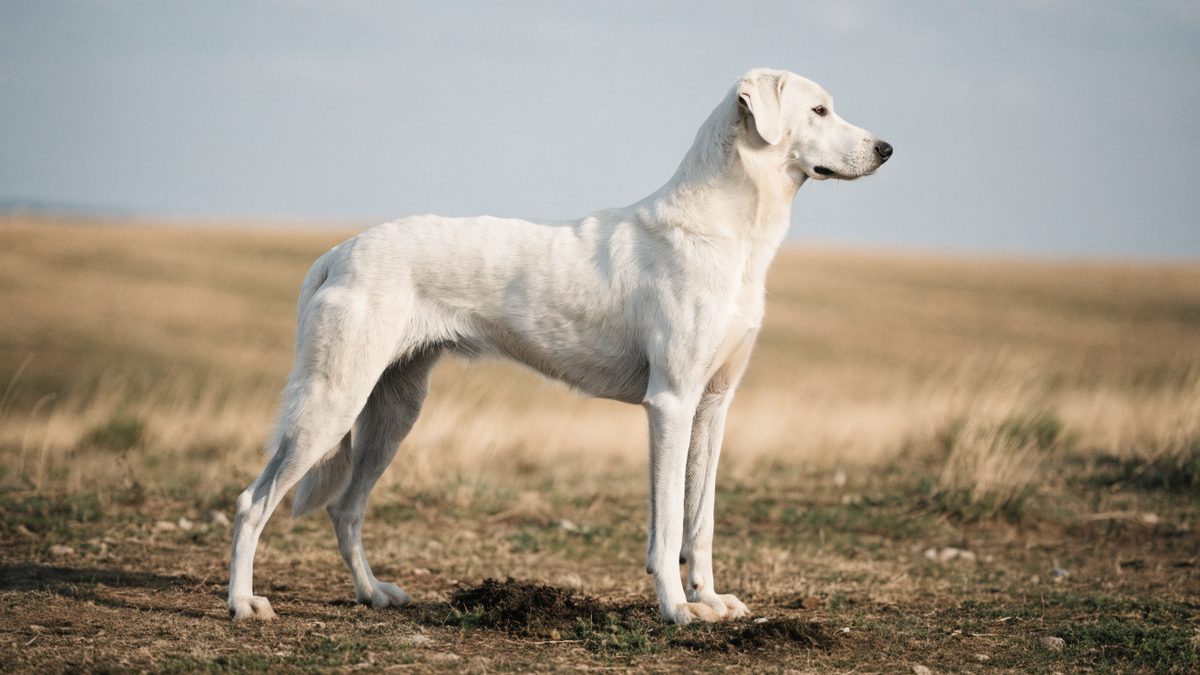
An Akbash dog is a white livestock guardian breed from the plains and mountains of western Anatolia, bred by Turkish villagers and shepherds to protect sheep from wolves and other predators. The Turkish word akbaş means white head, which is what distinguishes this dog from the karabaş, or black head, the older name for the Kangal. It is a flock guardian and not a herding dog, and it has no herding ability at all.
Read the United Kennel Club standard and one sentence does most of the work. The Akbash is described as a long-legged, lean, muscular dog of imposing size and strength, and as a very rare and special mixture of Mastiff and gazehound characteristics. That second half is unusual. The gazehound influence shows in the long legs, deep chest, arched loin, shallow lower jaw, tucked-up flank, speed and agility, while the Mastiff side contributes height, weight, a broader head and the overall impression of power. Judges are told to prefer dogs that balance the two.
That matters more than it sounds. Most white European flock guardians, the Great Pyrenees and the Maremma among them, are heavy, slow-moving dogs. The Akbash is built to run. Turkey's own registration document describes an athletic and graceful stance, a deep chest reaching to the elbows, a narrow loin and hip and a tucked-up belly. A buyer who expects a placid white teddy bear has bought the wrong picture.
Colour is not decoration, it is the job
The Akbash is always white. Light biscuit or grey shading around the ears or in the undercoat is never penalised as long as the dog reads as white overall, but any other overall colour, defined spots on the outer coat, black whiskers, black eyelashes and albinism are all disqualifications. The Turkish standard was equally strict, requiring the dog to be entirely white with only seasonal cream shading permitted on the ears and back, and never in patches. KIF withdrew that standard in its 2026 site rebuild, and the replacement entry keeps the colour while dropping the detail, listing the breed's colour simply as white and its country of origin as Turkey.
The reason is operational. A white coat lets the shepherd tell the dog from a predator, even in the dark, because most predators are dark Hill's Pet Nutrition. These dogs are not albinos and carry dark pigment around the eyes, nose and mouth. Turkey's registration entry records that no signs of albinism, subalbinism or progressive retinal atrophy were detected in the breed, though multifocal retinal dysplasia that causes no vision defect has been observed.
The four official size frames, and how far apart they sit
Four official or peer-reviewed documents describe how big an Akbash should be, and they do not agree. This is the single most useful table on this page for anyone being offered a dog described as an Akbash, because a seller can quote whichever frame flatters the animal in front of you.
| Source | Height at withers, males | Weight, males |
|---|---|---|
| United Kennel Club standard, revised 1 April 1998 | 30 to 34 in, about 76 to 86 cm | Average 120 lb, about 54 kg |
| KIF standard, Turkey, as published until the 2026 rebuild and now withdrawn | 67 to 72 cm | Stated only as proportional to height |
| Turkish Standards Institution TS 12891, 2002 | 60 to 85 cm | 45 to 65 kg |
| Resmî Gazete registration, Ek-32, 9 July 2006 | 63 to 81 cm, mean 71.21 cm | 40 to 60 kg |
| Measured population, 59 dogs in four provinces | Mean 75.9 cm, standard error 0.84 | Mean 44.9 kg, standard error 1.07 |
Look at what that table does. The UKC's minimum height for a male, about 76 cm, sits above the 72 cm maximum in the Turkish Kennel Club's withdrawn standard Köpek Irkları ve Kinoloji Federasyonu. A dog that is correct in Turkey would be a severe fault in an American ring, where varying more than one inch from the stated range is explicitly a severe fault. The two countries are not describing quite the same animal, and that is a registry problem, not a measurement error.
The measured figures land in between. A survey of 59 Akbash dogs, 34 male and 25 female, across the provinces of Afyon, Ankara, Eskişehir and Manisa found a mean live weight of 44.9 kg and a mean height at the shoulders of 75.3 cm. There were no significant differences between males and females for any morphological trait measured, which is unusual in a large breed. Regional variation was larger than sex variation: dogs in Eskişehir averaged 48.8 kg while dogs in Afyon and Manisa averaged 40.6 kg and 40.3 kg.
Two coats, one of them a problem in India
The Akbash carries a double coat of longer, coarse outer guard hairs over a dense undercoat of soft, fine hair, and normally sheds that undercoat annually. There are two equally acceptable coat lengths and no preference between them. The medium coat lies flat and gives a sleek, racy look with only a slight ruff. The long coat is distinctly longer, often slightly wavy, with a distinct ruff and profuse feathering on the forelegs, thighs and tail.
The Turkish standard put a number on it, specifying a double-layered coat 4 to 7 cm long and making absence of an undercoat a disqualifying fault. That is the sentence to hold on to when someone tells you an Akbash will adapt to Chennai by shedding out. The standard required the undercoat to be there, and KIF's replacement entry drops the measurement and says only that the Akbaş coat is not as long as that of its European white flock-guardian cousins.
History, and the two men who started the Western population
The Akbash has a long documented history in its homeland. The Turkish Kennel Club's own summary points to Evliya Çelebi, the seventeenth-century Turkish traveller, who described dogs known as Ankara mohair goat dogs and praised their courage and their attachment to their shepherds. Reports of large white guardian dogs in the region have been placed as far back as 750 to 300 BC.
The Western population has a much shorter and much better documented history. David and Judy Nelson, an American couple posted to Turkey with the diplomatic corps, began field-studying the white guardians in the 1970s and brought the first Akbash to the United States in 1978, a bitch called Cybele White Bird who arrived carrying pups. Those pups became the foundation of the breed outside Turkey in 1979. The Nelsons went so far as to lease a flock of sheep, complete with shepherd and guard dog, to control a mating and confirm that the dogs bred true in type and not merely in colour. They imported more than 40 Akbash dogs in total.
In 1980 the United States Department of Agriculture brought Akbash dogs into its predator control programme, where they performed successfully. That project, based at the US Sheep Experiment Station in Dubois, Idaho under Jeff Green and Roger Woodruff, worked with the Akbash, the Great Pyrenees and the Komondor, and a number of the dogs used were direct imports from Turkey.
The Akbash is a fast, lean, all-white Anatolian flock guardian with a mandatory undercoat, a long working history in Turkey and a short, well-documented one in North America. Almost everything contested about it is about paperwork, not about the dog.
Which registries recognise the Akbash, and which fold it into the Anatolian Shepherd
Recognition of the Akbash is genuinely split, and the split runs along a clean line. Turkey and the United Kennel Club treat the Akbash as its own breed. The Fédération Cynologique Internationale does not list it at all, and the American Kennel Club does not recognise it either, registering instead an umbrella breed called the Anatolian Shepherd Dog Hill's Pet Nutrition. Every claim below is taken from the registry's own document rather than from another breed page.
| Body | Position on the Akbash | Source read |
|---|---|---|
| Turkish Ministry of Agriculture and Rural Affairs | Registered as a native breed in 2006 under Annex 32 of Communiqué 2006/32, published in the official gazette | Resmî Gazete number 26223, 9 July 2006 |
| Turkish Standards Institution | Published standard TS 12891 for the Akbaş Turkish Shepherd Dog in 2002 | Cited in the peer-reviewed survey of the breed |
| Köpek Irkları ve Kinoloji Federasyonu, the Turkish kennel club and an FCI full member | Lists the Akbaş Çoban Köpeği in Grup 11, its group for breeds the FCI does not recognise, under breed code AKB, with a registered breed club and a full descriptive entry. Entering an Akbaş in KIF's studbook costs ₺250 | KIF breed database entry, member associations register and fee table, all read 27 August 2026 Köpek Irkları ve Kinoloji Federasyonu Köpek Irkları ve Kinoloji Federasyonu |
| United Kennel Club, United States | Recognised the Akbash Dog on 1 January 1998, placed in the Guardian Dog Group | UKC breed standard, revised 1 April 1998 |
| Fédération Cynologique Internationale | Not listed anywhere in the nomenclature. The letter A runs from Affenpinscher to Azawakh with no Akbash entry | FCI breeds nomenclature, letter A |
| American Kennel Club | Not recognised. The AKC registers the Anatolian Shepherd Dog in the Working Group instead | AKC breed listing and Hill's club-recognition record Hill's Pet Nutrition |
| Continental Kennel Club, United States | Recognised as the Akbash Dog in Breed Group 9, Large Guardian Pastoral and Mountain Dogs, with a full published standard | CKC breed standard |
| The Kennel Club, United Kingdom | No Akbash breed. Registers the Anatolian Shepherd Dog in the Pastoral Group, under a standard that permits all colours | Kennel Club breed standard, updated 1 April 2025 |
The Turkish government settled this in its own gazette
Turkey's registration of the Akbaş is the document nobody else quotes, and it is the most direct evidence available. On 9 July 2006 the Ministry of Agriculture and Rural Affairs added the Akbaş to the national register of native animal breeds as Annex 32, alongside the Malya sheep as Annex 31. The entry is a full breed description: species Canis familiaris, breed Akbaş, international name Akbash dog, distribution around Eskişehir, Afyon, Polatlı and Sivrihisar though bred in various regions of Turkey, and purpose flock protection and guarding.
Under the heading of genetic characteristics the gazette entry carries a single sentence that decides the argument from the Turkish side. Translated, it reads that scientific studies have proven that Kangal and Akbaş dogs are different from one another. That is a government of Turkey statement in a government of Turkey publication about a Turkish breed, and no ranking page for this term quotes it.
The peer-reviewed literature is more careful, and worth reporting honestly rather than trimming to fit. The 2012 survey of 59 Turkish Akbash dogs concluded that they had a very close resemblance to the Turkish Kangal and Kars shepherd dogs in body measurements, while also noting that molecular work has been used to argue the Akbash is strictly a different breed. Both things are true. They look alike on a measuring stick and they are registered separately.
Why the FCI has no room for a white Turkish guardian
The FCI recognises exactly one Turkish shepherd breed, standard number 331, the Kangal Çoban Köpeği, accepted definitively on 6 June 1989 and published in its current English form on 15 June 2018. There is no Akbash entry in the nomenclature.
Read standard 331 and you find that the Akbash could not be squeezed into it even if someone wanted to. It requires the whole body to be one colour, from fawn to wolf sable, and it states plainly that the dog must have a black mask. White or lighter colour on the chest is tolerated only up to 10 cm of width, white on the throat is not preferred, and a white patch on the neck is listed as a fault. Having no mask on the muzzle is a disqualifying fault. An all-white Akbash is structurally excluded from the only FCI standard that covers a Turkish shepherd dog.
This is not a permanent state of affairs. The Turkish kennel club publicly describes the Akbaş çoban köpeği as one of the native breeds it is working to have recognised by the FCI, and its own About page is precise about how far that work has got: complete for the Kangal, whose FCI registration was obtained on 25.06.2018, and started, with significant progress recorded, for the Akbaş, the Zerdeva and the Aksaray Malaklısı. That is a clean confirmation from the national member body that recognition has not happened yet.
What a Grup 11 listing actually gets an Akbaş owner is worth spelling out, because it is more than the group's name suggests. KIF runs a registered breed club for the dog, the Akbaş Çoban Köpeğini Koruma ve Araştırma Derneği under Cem Karademir, listed among the federation's member associations with the Akbaş Çoban Köpeği as its responsible breed. KIF's published fee table, current from 7 January 2026, charges ₺250 to enter an Akbaş or another native breed in its studbook, against ₺400 for a Kangal and ₺1,250 for a general dog registration. So the Akbaş is a breed KIF registers, shows and charges a fee for. What it lacks is FCI recognition, not a Turkish studbook.
Four separate things get called recognition, and the Akbaş has three of them, which is exactly why this breed is not the Aksaray Malaklısı. It is named in KIF's mission statement as a native breed the federation is working to get recognised by the FCI. It is listed in KIF's breed database, in Grup 11, with breed code AKB, a registered breed club and a full descriptive entry. It is on Turkey's state register of native breeds, entered as Annex 32 on 9 July 2006. It is not in the FCI nomenclature. Bonbeno's Aksaray Malaklisi guide describes a dog that has only the first two, with a bare code where this one has a club, a gazette entry and a documented standard history. Grup 11 is the same shelf. The two breeds are not in the same condition on it.
The Anatolian Shepherd, and where the name came from
The Anatolian Shepherd Dog is the name used in the United States for dogs descended from regional Turkish livestock guardians, particularly the Kangal but also the Akbash, from the late 1960s. The founding pair, Zorba and Peki, were acquired in the Ankara region in 1967 by a US Navy lieutenant, Robert Ballard, and bred their first American litter in 1970.
The Anatolian Shepherd Dog Club of America, the AKC parent club for that breed, dates itself to 1970, the year of that first litter. There is no equivalent AKC parent club for the Akbash, because there is no AKC Akbash.
The problem was geographic. Most of the founding imports came from the intermediate zone between the main breeding centres of the Akbash and the Kangal, where examples of both types occur, and the American enthusiasts assembled them without an understanding of the regional Turkish varieties. The result was a registered breed that could throw various coat lengths, colours and colour patterns, where in Turkey the separate breeds breed far truer to type. The name Anatolian Shepherd Dog is unknown in Turkey, and Turkish authorities still refuse to recognise the Anatolian as a purebred Turkish breed.
The Akbash breed club puts the same history from the other side, and it is worth quoting because it names the disagreement directly. While some Westerners, primarily Americans, Germans and Britons, claimed that all shepherds' dogs in Turkey were the same breed and were Anatolian Shepherds, livestock producers working with Akbash dogs came to recognise the Akbash as a unique, separate breed.
In Britain, a white Akbash-type dog is an Anatolian Shepherd
The United Kingdom shows the folding-in mechanism at work more clearly than anywhere else. The Kennel Club has no Akbash breed. It registers the Anatolian Shepherd Dog in the Pastoral Group, under a standard last updated on 1 April 2025 whose colour clause reads: all colours, with or without black mask and black ears, merle unacceptable. One qualification belongs here, added on 31 August 2026. Britain did not fold every Turkish guardian into a single breed. The same registry separately recognises a Turkish Kangal Dog, with its own Pastoral-group breed standard, recognised in 2013 according to the Kennel Club's own newsroom. So the British position is not that Turkish flock guardians are one breed: it is that the Kangal was split out and the Akbash was not.
All colours includes white. A white Anatolian flock guardian in Britain is therefore registrable, but only as an Anatolian Shepherd Dog, which is exactly the outcome the Akbash's supporters spent forty years arguing against. The size clause fits too, giving 74 to 81 cm and 50 to 64 kg for males, which brackets both the UKC and the Turkish figures.
One clause does not fit, and it is the one that quietly excludes half the breed. The UK coat clause requires a short, dense, flat, close-lying coat, neither fluffy nor wavy, with no feathering on ears or legs. The long-coated Akbash is defined by profuse feathering on the forelegs, thighs and tail and a coat that is often slightly wavy. A medium-coated white Akbash could pass as an Anatolian in a British ring. A long-coated one could not.
The three registries that recognise the Akbash disagree about what it is
Here is the finding that should give any buyer pause, and no ranking page states it. Three bodies publish an Akbash standard, and they contradict each other on the breed's single defining characteristic.
| Point | United Kennel Club | Turkish Kennel Club, withdrawn standard | Continental Kennel Club |
|---|---|---|---|
| Colour | Always white. Any overall colour other than white is a disqualification | Must be entirely white, seasonal cream shading only, never in patches | All coat colours and patterns are equally permissible |
| Coat | Two lengths, medium and long, with profuse feathering permitted on the long coat | Double-layered, 4 to 7 cm, wavy or curly coat disqualified | Short to medium only, never abundantly long or silky |
| Height, males | 30 to 34 in, about 76 to 86 cm | 67 to 72 cm | 28 to 32 in, about 71 to 81 cm |
| Weight, males | Average about 54 kg | Proportional to height, no figure given | 90 to 140 lb, about 41 to 64 kg |
| Published lifespan | Not stated | Not stated | 11 to 14 years |
The colour row is the one that matters. A dog whose whiteness is the entire meaning of its name can be registered as an Akbash by one American registry in any colour at all. That is not a small drafting difference. It means that an Akbash registration certificate, on its own, does not tell you the dog is white, and it undercuts the argument that registration papers settle what this breed is.
For an Indian buyer the practical rule follows directly. Read the issuing body, not just the breed name. A UKC or Turkish registration is being measured against a white-only standard. A Continental Kennel Club registration is not.
How the UKC came to recognise it, and what that recognition is worth
The route to UKC recognition ran through Turkey, not around it. In 1996 American experts on the breed were invited to the First International Symposium on Turkish Shepherd Dogs at Selçuk University in Konya, among them David Nelson, the USDA biologist Jeff Green and a Texas livestock producer, Tamara Taylor. In 1997, as a direct result of that symposium and a summary letter setting out the Turkish position on the country's native dog breeds, the United Kennel Club approached the Akbash Dog Association of America about recognising the breed and opening a studbook. Recognition followed on 1 January 1998.
The UKC placed the Akbash in the Guardian Dog Group and revised the standard on 1 April 1998. As of 2007 the breed club recorded the United Kennel Club as the only national or international kennel club in the world to recognise and register the Turkish Akbash Dog, and the FCI nomenclature still bears that out.
One further detail belongs here, because it explains why old pedigrees are messy. In 1987 a breakaway group split from the association and began registering its own dogs, using the original foundation stock, and names and kennel names were sometimes changed on re-registration. Anyone tracing an Akbash pedigree from that era should expect the same dog to appear under more than one name. That breakaway body, Akbash Dogs International, still operates today as a worldwide organisation for the breed and other rare livestock guardian types, and the older association's policy has been to treat its dogs as pure Akbash eligible for UKC registration.
Ask which registry issued the papers and read the breed name printed on them. A UKC certificate says Akbash. An AKC or FCI certificate cannot say Akbash, because neither body recognises the breed, so a paper claiming otherwise is either an Anatolian Shepherd registration or a fake.
One warning from our own research, and a correction to how this page recorded it. Until KIF rebuilt its website in 2026 its site served the Kangal standard at one plausible-looking Akbaş address and the real Akbaş standard at another, so we checked the breed name printed at the top of each page before taking a single figure off it. Both of those addresses now return HTTP 404, along with the old native breeds page, because the rebuild replaced them with a breed database at a new address. A page that loads is not the same thing as a page about the dog you asked for.
That leaves the Turkish measurements on this page in a position worth stating plainly rather than papering over. The 67 to 72 cm height, the 4 to 7 cm double coat, the undercoat disqualification and the never-in-patches colour clause all came from the KIF standard page that KIF has since withdrawn, and no live document reproduces them. They cannot be re-checked at source today, so read them as a dated reading of a withdrawn Turkish standard rather than as KIF's current published position. KIF's replacement entry keeps the breed's colour, origin, history, proportions and character, and drops every measurement.
They are not the Kangal's figures, though, and that is checkable four ways. FCI standard 331 gives the Kangal a coat of 3 to 7 cm rather than 4 to 7, a height of 72 to 78 cm with 2 cm of tolerance rather than 67 to 72, an explicit weight of 48 to 60 kg where the Turkish Akbaş standard gave none, and a coat running fawn to wolf sable with a mandatory black mask, which lists a white patch on the neck as a fault. Not one of them matches what this page attributes to the Turkish standard, and an entirely-white colour clause cannot come from a document about a masked fawn dog. The figures were read off the right breed even though the address filed against them was the wrong one, and the two passages this page takes from KIF's prose, the Evliya Çelebi history and the note that flock protection requires independent decisions, both survive word for word in the live Akbaş entry.
Akbash dog price in India: the honest answer is that there is no price
There is no credible Akbash dog price in India, and Bonbeno will not publish one. We ran two India-located searches on 16 August 2026 and opened every result that claimed to offer the breed. Not one was a dog. The market that Indian search results appear to describe does not exist.
This is the section where a directory is most tempted to invent a number. A range like Rs 80,000 to Rs 2,50,000 would look plausible, would rank, and would be entirely fabricated. So here is exactly what an India-restricted search for this breed returns, and what each result actually is.
| Result | What it actually offers | A live Akbash? |
|---|---|---|
| Flipkart product listing | A printed book titled Akbash Dog, 152 mm, 104 g | No |
| Amazon.in listing | An owner's guide paperback at Rs 2,155 | No |
| Etsy India listing | A downloadable dxf, svg and png clipart file at Rs 353 | No |
| Justdial category page | Ten ordinary pet shops in Haldwani, none of which mentions the breed | No |
| Supertails price list | A general dog price list covering the top 40 breeds in India, which does not include the Akbash | No |
| US listing sites | American puppy classifieds quoting US dollars, not rupees | No |
The Justdial pages are a template, not a market
The most convincing-looking Indian result is a Justdial page headed Best Pet Shops For Akbash Dog in Haldwani, and it is worth taking apart because the same pattern repeats across dozens of Indian towns. The page lists Himalaya Dog Center, Johari Pet Shop, Bahuguna Dog Farm, Buzzo Dog Kennel, Pet Life Care Point, Uttrakhand Dog Lover, Dogs World Dehradun Branch, Sai Pet Solutions, Gill Pet Shop and Nainital Dog Kennel. Not one of those listings mentions an Akbash.
The page's own meta description gives the mechanism away. It tells search engines the page covers pet shops, pet shops for dog, pet shops for Labrador dog, dog kennel dealers and pet shops for German Shepherd dog in Haldwani. The breed name is a variable dropped into a template. A directory page carrying a breed name is not evidence that the breed is sold there.
What the breed costs where a market does exist
For scale rather than for planning, American classified listings quote roughly 1,000 to 2,500 US dollars for Akbash puppies from working or health-tested stock. We are reporting that as a US figure and nothing more. Converting it into rupees would produce a number that no Indian buyer can act on, because there is no lawful route to bring a puppy into India for sale, as the next section sets out.
There is one honest historical figure worth knowing. In 1996 the registered Akbash population in the United States was about 1,500 dogs, all registered through the Akbash Dog Association of America. The same peer-reviewed paper notes that the breed's numbers in Turkey were falling year by year, and raises the possibility that more Akbash dogs then lived in the United States than in Turkey. Hill's records the breed's prevalence simply as rare. This is a scarce dog in its own homeland, let alone in India.
Treat it as a misdescribed dog until proven otherwise. The realistic possibilities are a white Indian pariah cross, a white Central Asian Shepherd, a Great Pyrenees, or an unregistered white farm dog. Ask for the registry, the registration number and the breed name printed on the paper, and remember that no Indian registry recognises this breed.
We would rather publish a gap than a guess. If a verified Indian transaction is ever documented, with a registry number and a traceable import record, we will add it here and date it. Until then, the correct answer to the Akbash price in India question is that no reliable figure exists, and any site quoting one has made it up.
The legal position in India: named in a 2024 ban, then set aside by two High Courts
The Akbash dog was named by the Government of India in a letter dated 12 March 2024 that sought to prohibit the import, breeding and sale of two dozen dog breeds. That letter no longer has legal effect. The Karnataka High Court quashed it on 10 April 2024 and the Delhi High Court set it aside on 16 April 2024. Understanding both halves matters, because Indian coverage of this breed reports only one or the other.
What the 12 March 2024 letter said
The letter came from the Department of Animal Husbandry and Dairying under the Ministry of Fisheries, Animal Husbandry and Dairying, and was addressed to the Chief Secretaries of all States and Union Territories. It followed Writ Petition 15673 of 2023 before the Delhi High Court, in which the court had directed on 6 December 2023 that the Union of India decide the petitioner's representation after consulting all stakeholders, preferably within three months.
An expert committee chaired by the Animal Husbandry Commissioner then identified a list of breeds it considered ferocious and dangerous to human life. The list, quoted verbatim from the letter, names Pitbull Terrier, Tosa Inu, American Staffordshire Terrier, Fila Brasileiro, Dogo Argentino, American Bulldog, Boerboel, Kangal, Central Asian Shepherd Dog, Caucasian Shepherd Dog, South Russian Shepherd Dog, Tornjak, Sarplaninac, Japanese Tosa and Akita, Mastiffs, Rottweiler, Terriers, Rhodesian Ridgeback, Wolf dogs, Canario, Akbash dog, Moscow Guard dog, Cane corso and every dog of the type commonly known as a Ban Dog.
The committee recommended that those breeds, including cross breeds, be prohibited for import, breeding and selling as pet dogs, that local bodies issue no licences for their sale, breeding or keeping, and that dogs already kept as pets be sterilised so that further breeding could not happen.
No public reasoning was published for any individual breed. Read the list and the pattern is a set of large guardian and fighting types collected by name, with the Kangal, the Caucasian Shepherd and the Central Asian Shepherd sitting alongside the Akbash. It reads as a catalogue of livestock guardian and molosser breeds rather than as a bite-incidence analysis of dogs actually kept in India.
How the courts dealt with it
The circular was challenged almost immediately. The Karnataka High Court quashed it on 10 April 2024 in Writ Petition 8409 of 2024. Six days later a division bench of the Delhi High Court, comprising Acting Chief Justice Manmohan and Justice Manmeet Pritam Singh Arora, set the circular aside in Sikander Singh Thakur v. Union of India, reported at 2024 SCC OnLine Del 2803.
The ground was procedural fairness rather than the merits of any breed. Counsel for the Union of India admitted that apart from governmental bodies, no private entities had been consulted before the circular was issued, and did not object to it being set aside so that a fresh notification could follow proper consultation. The court directed the department to publish a public notice in a national newspaper and on its website inviting written objections, and to examine those objections before issuing any final notification. It expressly clarified that it was not commenting on the Karnataka judgment.
The department complied on 2 May 2024, issuing a public notice that invited written comments with scientific reasoning by 1 June 2024 and stated in terms that the letter of 12 March 2024 shall not be enforced until further order.
| Date | Event | Effect on the Akbash |
|---|---|---|
| 6 December 2023 | Delhi High Court directs the Union to decide a representation after consulting stakeholders | None yet |
| 12 March 2024 | DAHD letter names the Akbash dog among the breeds to be prohibited | Import, breeding and sale sought to be banned |
| 10 April 2024 | Karnataka High Court quashes the circular | Circular struck down |
| 16 April 2024 | Delhi High Court sets the circular aside for want of consultation | Circular set aside |
| 2 May 2024 | DAHD public notice confirms the letter shall not be enforced until further order | Not enforceable |
| 1 June 2024 | Deadline for written objections with scientific reasoning | Consultation stage |
So the position today is that no central Indian law bans the Akbash. What exists is a set-aside circular, a completed consultation, and the standing possibility of a fresh notification issued with proper process. A buyer should also check locally, because municipal licensing rules vary by city and are administered by local bodies rather than by the centre.
Import policy is the harder wall, and it has not moved
Even with the circular gone, there is no lawful way to found an Akbash breeding population in India. Live dogs fall under ITC (HS) code 01061900, where the import policy is Restricted. Policy Condition 7 allows the import of dogs only for three purposes: a pet dog with a valid pet book and records in the name of the importer, dogs imported by research and development organisations with the recommendation of the CPCSEA, and dogs for internal security by the Defence and Police forces. Policy Condition 8 states that the import of commercial dogs for breeding or any other commercial activity is not permitted.
The practical route is narrow. Up to two pets may be imported as passenger baggage without DGFT authorisation, and only by a person transferring residence to India after two years of continuous stay abroad. Anything beyond that requires an import authorisation from the DGFT, examined with supporting documents by the Department of Animal Husbandry and Dairying. Applications made for trading or breeding purposes, or on behalf of another person, are to be rejected outright. Imports are permitted only through the airports and seaports of Delhi, Mumbai, Chennai, Hyderabad, Bengaluru and Kolkata and, since October 2024, Kochi airport, and an advance no objection certificate must be obtained from the quarantine officer seven days before travel Department of Animal Husbandry…. The full route is set out in how to import a dog to India.
Put the two together and the picture is clear. A returning Indian family that already owns an Akbash abroad can bring it home. Nobody can lawfully import a pair to breed and sell. That is why the Indian market for this breed is empty, and why it is likely to stay empty.
The DGFT advises pet owners to begin the import authorisation process at least two months before travel. For a dog of this size, add time for a crate that meets airline live-animal rules and for the quarantine no objection certificate, which is issued seven days before the date of travel and relaxable only up to three days.
What an Akbash would actually cost to keep in India
We cannot give you a verified monthly rupee figure for an Akbash in India, because no Indian owner base exists to derive one from. What we can do is set out the cost structure honestly, name the two breed-specific facts that move it, and flag the one line that is far larger than new owners expect.
Every other site that publishes a monthly cost for a rare breed in India is extrapolating from a Labrador. We are not going to do that, because the extrapolation fails in both directions for this dog: the food line is lower than the size suggests, and the containment line is far higher.
Food: the one giant breed that eats less than it looks
Two independent sources agree that the Akbash is unusually cheap to feed for its size, and this is the most surprising cost fact about the breed. Turkey's registration entry describes the Akbash as a frugal dog that, despite its large build, does not consume much food. Hill's independently describes the breed as easy keepers that stay fit on a minimum amount of food, a direct consequence of their working background.
That is a real structural saving. A 45 kg working guardian bred to sit on a hillside watching a flock has a different energy budget from a 45 kg dog bred to run. It also creates a trap, which the feeding section covers: an easy keeper in a household that feeds by eye gets fat quickly, and excess weight is the single modifiable factor most strongly tied to heat-related illness risk.
Containment is the line people underestimate
Turkey's own registration entry states the breed is generally suitable for farms or houses with large gardens, and that the dog should be under control by day and free at night. That is a specification for a property, not a preference. A guardian bred to patrol territory and challenge intruders needs secure, high fencing on a real perimeter, and in Indian cities that means building it rather than assuming a compound wall will do.
Add the digging. Hill's rates digging at three of five for this breed and attributes it to the dog trying to keep itself warm or cool while working. In an Indian summer, a dog that cannot cool any other way will dig, and it will dig under a fence line as readily as anywhere else.
The recurring cost lines, ranked by how breed-specific they are
| Cost line | Breed-specific driver | Direction versus an average large dog |
|---|---|---|
| Food | Frugal working metabolism, described as an easy keeper by two sources Hill's Pet Nutrition | Lower than size implies |
| Tick and parasite control | Dense double coat over a large surface area, in a country where 49.7 percent of surveyed dogs carried a tick-borne pathogen | Materially higher |
| Grooming | Double coat needing at least weekly attention and more when shedding | Higher, and non-optional |
| Containment and fencing | Territorial guardian specified for farms or large gardens | Much higher, and one-time |
| Cooling | Mandatory undercoat on a dog that can exceed 50 kg Hall, E.J., Carter, A.J. and O'Neill, D.G. | Higher in every plains city |
| Training and behaviour support | Independent decision-maker that matures slowly over two to three years | Higher and longer |
| Acquisition | No lawful Indian supply route | Not applicable |
The only verified Indian rupee figure anywhere in this chain is a regulatory one. Under the Prevention of Cruelty to Animals (Dog Breeding and Marketing) Rules 2017, a breeder must register each establishment with the State Animal Welfare Board on payment of a non-refundable fee of five thousand rupees, with the certificate valid for two years and renewable on payment of the same amount. We publish that because it is documented. We are not going to surround it with invented puppy prices.
A dog that reaches 45 to 55 kg costs more per treatment than a mid-sized dog for the simple reason that drugs are dosed by weight. Anaesthesia, antibiotics, tick preventives and sedation for grooming all scale with body mass. If you are pricing a guardian breed against a Labrador, scale the medicine line, not just the food line, and confirm the dosing with your nearby vet.
Heat tolerance: why we rate the Akbash 2 of 5 for Indian conditions
Bonbeno rates the Akbash 2 of 5 for heat tolerance in India. That is one point better than we rate the Tibetan Mastiff or the Caucasian Shepherd Dog, and the extra point is earned, not given. The reasoning below separates what the breed genuinely has going for it from what Indian conditions do to it anyway.
The case for the extra point
Three things genuinely help this dog in heat, and they are worth stating before the bad news, because they are the reason the rating is not 1.
- The coat is shorter and the build is leaner. The UKC standard describes a long-legged, lean, muscular dog with a deep chest, arched loin and tucked-up flank, not a heavy-coated mountain molosser. The Turkish standard specifies a coat 4 to 7 cm long, which is short by guardian-breed standards.
- The undercoat thins seasonally. Thickness of the undercoat varies significantly with climate and exposure, and the long-coated Akbash appears significantly sleeker without a heavily developed undercoat during summer or in warm climates. The dog does adapt.
- The homeland already gets hot. The Akbash triangle of Ankara, Afyon and Eskişehir, plus Manisa in the Aegean, has genuinely hot dry summers. This is not a Himalayan dog, and comparing it to one is lazy.
- White reflects. The all-white coat that exists so shepherds can tell the dog from a predator also reflects rather than absorbs solar radiation.
Why it still fails most of India
Now the constraints, in order of how much they matter.
The undercoat is not optional. The Turkish standard made absence of an undercoat a disqualifying fault before KIF withdrew it, and the UKC standard defines the breed as double-coated. A seasonally thinner undercoat is still an undercoat. Anyone planning to solve an Indian summer by clipping the dog should understand that they would be removing the guard coat that shields the skin from direct sun, and the breed is presented in a completely natural condition precisely because that coat is functional.
Adult males sit in the highest-risk weight band. The largest study of heat-related illness in dogs under primary veterinary care found that dogs over 50 kg had 3.42 times the odds of heat-related illness compared with dogs under 10 kg, with a 95 percent confidence interval of 1.54 to 7.57. The UKC gives the average weight of a male Akbash in good condition as 120 pounds, about 54 kg, and Turkey's register gives an adult male range of 40 to 60 kg. A correctly built male Akbash is inside that band. The same study found that purebred dogs had 1.86 times the odds of crossbred dogs, and that heat-related illness events carried a fatality rate of 14.18 percent.
Humidity is the difference India adds. The Anatolian plateau is dry. Panting is evaporative cooling, and evaporative cooling loses efficiency as ambient humidity rises. A dog that manages a 38 degree afternoon in Eskişehir on dry air is facing a different physical problem in Mumbai, Chennai or Kolkata, where the humid coastal air blunts the only cooling mechanism it has. No study has measured this in the Akbash specifically, and we are not going to pretend one has, but the mechanism is not in dispute.
Turkey's own paperwork claims cold hardiness and never claims heat hardiness. The registration entry states that the breed is resistant to cold climate conditions and makes no equivalent claim about heat. That silence is more telling when you set it beside the FCI standard for the Kangal, the other Turkish guardian, which states explicitly that the breed is capable of enduring extremes of heat and cold. When one Turkish guardian's standard makes the heat claim and the other's does not, the omission is worth reading.
What an Indian heat wave actually means for this dog
The India Meteorological Department declares a heat wave when a station's maximum temperature reaches at least 40 degrees Celsius in the plains or at least 30 degrees in hilly regions, and severe heat wave conditions when the actual maximum reaches 47 degrees. Heat waves in India typically run from March to June and occasionally into July, with five to six events on average each year over the northern parts of the country, and May as the peak month. For coastal stations the criterion is a departure of 4.5 degrees or more from normal, provided the actual maximum is 37 degrees or more.
Set that against the trigger data. Exercise is the most common cause of heat-related illness in dogs, accounting for 74.2 percent of events with a known trigger, followed by environmental heat at 12.9 percent and vehicular confinement at 5.2 percent. The practical implication for a guardian breed is unusual: the danger is not that you will over-exercise this dog, because it does not want much exercise. The danger is that it will patrol a compound in the afternoon because that is its job, and nobody will register that as exercise.
| Setting | Assessment | Why |
|---|---|---|
| Hill stations and high-altitude districts, for example Ladakh, Spiti, upper Himachal, Sikkim | The only genuinely suitable band | Cold-adapted breed on documented record, with the IMD hill heat wave threshold at 30 degrees rather than 40 World Health Organization India |
| Dry inland plateau with land, for example rural Rajasthan, inland Maharashtra, Telangana | Difficult but not impossible with shade, water and night-only work | Dry heat matches the homeland better than coastal humidity, but summer maxima far exceed Anatolian norms |
| Humid coastal metros, for example Mumbai, Chennai, Kochi, Kolkata | Not appropriate | High humidity blunts panting, and a 50 kg-plus double-coated dog is in the highest heat-illness odds band |
| Any apartment, in any city | Not appropriate on welfare grounds | A territorial guardian specified for a farm or a large garden cannot do its job in a flat, and cannot stop trying |
| Gangetic plains cities in April to June, for example Delhi, Lucknow, Patna | Not appropriate without air conditioning | Five to six heat wave events a year over northern India, peaking in May |
The one genuinely helpful thing about this breed's body clock
Turkey's registration entry records a behavioural detail that matters more in India than anywhere else: the Akbash is active at night and calm and inactive by day. The same document recommends that the dog be kept under control by day and free at night. That is a nocturnal working pattern, and it happens to be exactly the pattern an Indian owner should want. A dog that naturally rests through the afternoon and patrols after dark is far easier to keep safe in a hot climate than one that wants a midday walk.
Work the dog before sunrise and after dark, provide deep permanent shade and unlimited water, and give it a dug-out or a cool hard floor to lie on rather than blocking the digging entirely. Never shave the guard coat. Watch for heavy laboured panting, brick-red gums, unsteadiness or collapse, start active cooling with cool running water immediately, and get to a veterinarian, because roughly one in seven heat-related illness events recorded in the largest study ended in death.
Temperament and household fit
The Akbash temperament is calm, quiet and steady, and independent enough to respond correctly to changing circumstances without human direction. It is loyal, gentle and quietly affectionate with its own family, including children and family pets, while remaining aloof and suspicious toward strangers. Those two halves are not in tension. They are the same trait doing its job.
Turkey's register describes the same dog in different words: loyal to its owner and family members, calm and affectionate, with a developed protective instinct and a sceptical attitude toward strangers. It adds that the breed is brave, strong, intelligent, docile and loyal, does its job without needing to be prompted, and neutralises an adversary with power, courage, speed and agility.
The Turkish kennel club adds the nuance that explains most household friction: because flock protection requires the ability to make independent decisions, the Akbash can sometimes present as distant. This is not a dog that checks in with you. It has already decided.
The behaviour that decides whether this dog can live in an Indian city
One number should govern the decision, and it comes from the largest breed-comparison survey of working livestock guardians ever run in North America. Green and Woodruff surveyed 948 livestock producers across 47 US states and 7 Canadian provinces and received 399 written responses reporting on 763 dogs. For the 62 Akbash dogs in that dataset, 100 percent were reported as aggressive toward predators and 92 percent as aggressive toward other dogs.
Ninety-two percent is the highest dog-directed aggression figure of any major breed in that table except the Maremma, and it is well above the Great Pyrenees at 67 percent. The breed club states the trait plainly and treats it as a selling point for sheep producers: an innate dislike of stray dogs made Akbash dogs popular with producers whose livestock was vulnerable to intruding dogs. Hill's frames the same behaviour from the pet owner's side, noting that Akbash dogs may not get along with dogs they were not raised with, regarding them as predators approaching their flock.
India has free-ranging community dogs on almost every residential street. A breed with a documented 92 percent rate of aggression toward intruding dogs, weighing 45 to 55 kg and built for speed, is being asked to walk past them daily. That is not a training problem you solve. It is a structural mismatch between the breed's function and the Indian urban street, and it is the strongest single argument against keeping this dog in a city here.
With people, and with children
The people-directed picture is better, and the same survey supports it. Of the 62 Akbash dogs, 6 percent were reported to have bitten people, against 17 percent for Komondors and 9 percent for Anatolians, with the Great Pyrenees lowest at 4 percent. The breed club summarises the research finding as the Akbash being less inclined to bite people than the Komondor and less inclined to chase and injure sheep than the Anatolian Shepherd.
Twenty percent of the Akbash dogs in the survey were reported to have injured sheep, against 14 percent of Anatolians and 7 percent of Great Pyrenees. That number belongs on a page about a family dog because it says something about impulse control around small, fast-moving, squealing things. A household with a toddler and a guardian breed is a household that needs supervision, not a household that needs reassurance.
The UKC standard is unambiguous that a properly socialised and trained Akbash is an ideal family pet and home guardian. It is equally unambiguous that viciousness, marked shyness and cowardliness are all disqualifications, which tells you the breed's own registry considers unstable temperament a defect rather than a variant.
Barking, and what it means for an Indian neighbourhood
Hill's rates barking at five of five for this breed, its highest rating, and states that the guarding tendencies can make these dogs prone to alarm barking, sometimes to excess. Combine that with the documented nocturnal activity pattern and you get a dog that barks at night, in a country where housing density is high and residents' associations are not tolerant.
This single combination has probably ended more guardian-breed placements in Indian cities than any health problem. A dog doing exactly what it was bred to do, at exactly the hour it was bred to do it, becomes a complaint.
Who should and should not take on this breed
| Household | Verdict | Reasoning |
|---|---|---|
| Working farm or orchard with livestock, in a cool district | Suitable | This is the job the breed was made for, and USDA-era research rated it very effective in 69 percent of cases and an economic asset in 71 percent |
| Large rural or semi-rural property, secure fencing, cool or dry climate | Workable for an experienced owner | Meets the space specification in Turkey's own register |
| Urban house with a compound and one committed handler | Marginal, and only outside the hot plains | The dog-directed aggression rate and the night barking both bite hardest here Hill's Pet Nutrition |
| Apartment in any Indian metro | Not suitable | No space, no perimeter, and a breed specified for a farm or a large garden |
| First-time dog owner | Not suitable | The breed matures slowly over two to three years and makes independent decisions throughout |
| Household with other resident dogs added later | High risk | 92 percent of surveyed Akbash dogs were aggressive to intruding dogs |
Training an independent guardian, and what this breed will not give you
To train an Akbash, start from what the breed was selected to do, which is to make correct decisions without human direction. The UKC standard states that although independent in nature, the Akbash responds well to basic training. Both halves of that sentence are load-bearing. You will get reliable basic obedience. You will not get a dog that defers to you when it believes it is right.
Hill's is blunter about the practical consequence: this independence can make Akbash dogs more difficult to train and requires a steady but firm hand to make them acceptable family pets. Read firm as consistent, not harsh. A breed disqualified for marked shyness and cowardliness is a breed you damage by intimidating.
The maturation timetable nobody plans for
The Akbash matures slowly, both physically and temperamentally, with individuals requiring two to three years to reach their prime, and females tend to mature faster than males. Turkey's register agrees, describing it as a late-developing breed at two to three years, with females developing earlier than males. The measured growth data supports the physical half: Akbash dogs grow to about two years of age and show only minor growth after that.
The behavioural implication is the one people miss. Protective and guarding instincts are demonstrated at a young age, but judgement arrives years later. You get an adult-sized dog with adult-strength guarding drive and adolescent decision-making, and that gap is the window in which most guardian-breed placements fail.
The USDA-era findings put numbers around it. Temperament can be evaluated as early as 8 weeks but may be inconsistent up to 18 months, and successful dogs displayed good guarding behaviour as early as 3 months. Between three months and eighteen months you cannot yet trust the assessment you are making.
The socialisation window, and why it is different for this breed
For most breeds the socialisation window is about building confidence with novelty. For a livestock guardian it is about calibrating a threat response that is going to fire regardless. The Green and Woodruff survey found that success was significantly higher when dogs were reared with livestock from before two months of age, and 50 percent of the dogs surveyed were acquired by three months and 82 percent by one year.
Translate that to an Indian household. Whatever this dog is going to accept as its flock, it should meet before eight weeks and live with continuously. Children, resident dogs, the household cat, the domestic help who comes daily, the security guard, the milk delivery: all of these are either inside the circle early or outside it for life. The breed club's own guidance is that a confident pup may be more reliable in its protective role than a shy one, and that shyness toward people is often simply a lack of human contact rather than a temperament fault.
A realistic first-year training plan
- Introduce every category of person and animal the dog must accept for life, before eight weeks and then repeatedly, because rearing with the charges from before two months predicted success in the largest survey.
- Teach a rock-solid recall and a settle on a mat, and accept that recall will be conditional near a perceived intruder rather than absolute.
- Handle the dog daily for grooming, nail work and mouth checks, so that a 50 kg adult tolerates veterinary handling without sedation.
- Walk at low-traffic hours on a fixed route, so encounters with free-ranging dogs are planned rather than ambushed.
- Reward disengagement from other dogs rather than punishing the reaction, because a guardian that learns to expect correction near strange dogs gets worse, not better.
- Reassess temperament at 18 months rather than at 6, since the earlier reading is documented to be inconsistent.
Do not train the bark out, manage the trigger
Alarm barking is not a training failure in this breed, it is the product. A dog rated five of five for barking that is naturally active at night will announce what it hears. The workable approach is environmental: reduce the line of sight to the street, bring the dog inside during peak street activity at night, and give it a defined patrol area rather than a view of everything.
The UKC presents this breed in a completely natural condition and tells judges that honourable scars or other evidence of injury from working in the field are not to be penalised. That is a registry telling you the dog is a worker, not an exhibit. Train it as a colleague with a job description, not as a pet that needs to obey.
Daily exercise: far less than you expect, at hours you may not expect
An adult Akbash needs about 20 to 40 minutes of exercise a day, and its energy level is rated as average rather than high. That is a startlingly modest requirement for a 45 to 55 kg athletic dog, and it is one of the few genuinely good pieces of news for an Indian owner, because it means the daily walk can be fitted entirely into the cool hours.
The reason is occupational. These are not dogs bred to run all day. They would patiently sit on a hillside watching their flock, and young Akbash dogs need more exercise than mature ones. The stamina is real but it is reserve stamina, held for the moment a predator appears rather than spent on daily mileage.
That reserve is not decorative. The UKC standard credits the breed with the size, strength and courage to challenge large predators and the speed and agility to chase fleet predators, and the gait description has the hind legs reaching far under, meeting or even passing the imprints of the front legs, with the legs converging toward single tracking as speed increases. Turkey's register makes the same point about the front assembly, noting a 60 degree angle between the shoulder blade and the upper arm that suits fast running.
Schedule it against the Indian sun, not against the clock
Exercise is the trigger behind 74.2 percent of heat-related illness events with a known cause, far ahead of environmental heat at 12.9 percent. For a breed that only needs 20 to 40 minutes, there is no reason for any of that to happen in daylight between March and June, when Indian heat wave season runs.
The breed's own body clock cooperates. It is active at night and calm and inactive by day, so a pre-dawn walk and a post-sunset patrol match both the physiology and the climate.
| Time | Activity | Why this slot |
|---|---|---|
| Before 6 am | 20 to 25 minute lead walk on a fixed low-traffic route | Coolest hour, fewest free-ranging dogs, matches the natural activity peak |
| Mid-morning to late afternoon | Rest in deep shade or indoors, no exertion | Matches the documented daytime inactivity and avoids the exertional trigger Hall, E.J., Carter, A.J. and O'Neill, D.G. |
| After dark | 15 minute patrol of the secured perimeter, plus scent work or a food puzzle | Gives the guarding drive a legitimate outlet without street encounters |
| Any time | Free access to shade, water and a cool surface | Cooling is continuous, not scheduled |
What happens without enough of the right kind of activity
Under-worked guardians do not usually get hyperactive. They get more vigilant, and that shows up as more barking at more things. Hill's already rates this breed five of five for barking. It also digs, at a rated three of five, in part to make itself a cool or warm hollow while working. Both behaviours intensify when the dog has territory to guard and nothing else to do.
The fix is not more mileage. It is a job. Give the dog a defined perimeter to check, a routine to own and something to solve, and you satisfy the drive that the walk does not touch.
The gazehound build tempts owners into jogging or cycling with an Akbash. Do not, in Indian plains conditions. Sustained exertion is the dominant heat-related illness trigger, the dog is likely to be in the over-50 kg odds band United Kennel Club, and this breed was never selected for endurance work in the first place.
Grooming a double coat through Indian humidity and monsoon
Groom an Akbash at least once weekly, and more often through the shedding period. The coat is a double coat of longer, coarse outer guard hairs over a dense undercoat of soft, fine hair, and the dog normally sheds that undercoat annually. In India the routine matters less for looks than for two things the coat hides: ticks and skin.
The Turkish standard, in the form KIF published until 2026, put the coat at 4 to 7 cm, double-layered, shorter on the head and ears, and possibly longer under the tail. It disqualified a wavy or curly coat and disqualified absence of the undercoat. The UKC recognises two equally acceptable lengths, a medium coat that lies flat with a slight ruff, and a long coat that is distinctly longer, often slightly wavy but never curled or matted, with a distinct ruff and profuse feathering on the forelegs, thighs and tail.
Both coats shed heavily. A white dog in an Indian home means white hair on every dark surface for several weeks a year, which is a lifestyle fact rather than a health one, but it is the fact that surprises people most.
Why brushing is a tick inspection in India
This is where an Indian grooming routine diverges from an American one. A survey of canine tick-borne diseases across four Indian regions found that 261 of 525 dogs, 49.7 percent, were infected with one or more tick-borne pathogens, and that 53 percent were visibly infested with ticks on inspection. In Tamil Nadu, 229 of 230 dogs examined, 99.6 percent, were infested by ticks, with a mean intensity of 5.6 ticks per dog. In Andhra Pradesh, 397 of 442 dogs, 89.81 percent, carried ticks, and every tick identified was Rhipicephalus sanguineus.
Now put a dense 4 to 7 cm double coat on top of that. A tick that is easy to spot on a short-coated Indian pariah dog is invisible on an Akbash until it has fed. Weekly brushing is not grooming in India, it is a physical examination, and it should run over the ears, between the toes, under the collar, in the ruff and along the tail feathering, which are the sites the coat hides best.
Monsoon, humidity and skin
A dense undercoat that stays damp is a skin problem waiting to happen. Through the monsoon, dry the dog to the skin rather than to the guard coat after any soaking, pay particular attention to the ruff and the feathering, and check the pendant ears, which lie flat to the skull and trap moisture by design.
The humid months are also when weekly brushing slips, because the dog is not visibly shedding and the coat looks fine. That is the wrong time to relax it.
The one thing not to do
Do not shave an Akbash to cool it down. The guard coat is the layer that shields the skin from direct sun, the breed is presented in a completely natural condition, and Turkey's standard treated the loss of the undercoat as a disqualifying structural fault rather than a grooming choice. A shaved double-coated dog in Indian sun is a dog with less protection and no better cooling.
| Task | Frequency | Indian reason |
|---|---|---|
| Full-body brush-out to the skin | At least weekly, more when shedding | Doubles as a tick check in a country where half of surveyed dogs carry a tick-borne pathogen |
| Undercoat rake through the annual shed | Daily for two to three weeks | Removes dead insulation before it mats in humid air |
| Ear check and dry | Twice weekly, daily in monsoon | Pendant ears lie flat to the skull and trap moisture |
| Paw and interdigital check | Weekly | Ticks and monsoon fungal infection both start here |
| Nail trim | Every three to four weeks | A 50 kg dog on hard urban surfaces still overgrows nails without turf work |
| Vet-directed tick preventive | As prescribed | 83.48 percent of owners in the Andhra survey were already using acaricidal treatment and infection was still found |
Many Akbash dogs are born with double dewclaws on the rear legs, as Great Pyrenees and Briards are. The UKC standard accepts dewclaws absent, single or double, and allows removal. Double rear dewclaws catch and tear, so include them in the weekly nail check.
Health, lifespan and what is honestly known
Published lifespan for the Akbash is disputed by three years at each end. Hill's gives 9 to 11 years and describes the breed as fairly healthy while still requiring routine maintenance and preventive care, while the Continental Kennel Club gives 11 to 14 years. Neither figure comes from a longevity study, and no peer-reviewed lifespan dataset for the Akbash exists that we could retrieve. We publish the spread rather than splitting the difference. Always consult a registered veterinarian near you before acting on anything in this section.
What Turkey's own registration record says about breed health
The most specific health statements available for the Akbash come from the 2006 Turkish registration entry, and they are notable mostly for what they rule out. The entry records that although the dog is white, no signs of albinism, subalbinism or progressive retinal atrophy have been detected in the breed, and that multifocal retinal dysplasia has been observed which causes no visual defect.
That is a meaningful finding, because white coat colour in dogs is often linked to deafness and to eye defects. The Turkish record explicitly separates the Akbash's white from an albino white, and Hill's makes the same point independently, noting that these dogs are not albinos and carry dark pigment around the eyes, nose and mouth. The UKC standard reinforces it by disqualifying albinism outright and requiring pigmented eye rims, nose and lips.
Reproductive and survival figures from the Turkish register
| Measure | Recorded value |
|---|---|
| Mean litter size | 6.21 puppies |
| Survival to two months | 90.81 percent |
| Mean birth weight | 0.507 kg |
| Mean weaning weight | 4.46 kg |
| Mean weight at 6 months | 19.38 kg |
| Mean weight at 12 months | 37.66 kg |
| Adult weight, males | 40 to 60 kg |
| Adult weight, females | 35 to 45 kg |
| Age at full maturity | 2 to 3 years, females earlier than males |
A survival rate of 90.81 percent to two months is a working-population figure from Turkish villages, not a kennel figure, and it is the kind of number that simply does not exist for most rare breeds. Use it as a benchmark when a breeder describes puppy losses.
On orthopaedic screening, and why we are not quoting numbers
The Orthopedic Foundation for Animals maintains Akbash Dog as its own breed entry, separate from Anatolian Shepherd, in its breed index. We were not able to retrieve a verified breed-specific screening dataset for the Akbash from that database, and we are not going to publish hip or elbow percentages we could not read.
That caution is deliberate and it is worth explaining, because it is exactly the failure mode that produces confident wrong data about rare breeds. Breed statistics systems take short codes, and a guessed code returns a complete, plausible table for a different breed entirely. We hit a version of the same trap during this research: a plausible-looking address on the Turkish kennel club's own site returned a full standard, correctly formatted, for the Kangal rather than the Akbaş. That address, and the real one beside it, have both since been retired in KIF's site rebuild. If a source will not open for the breed you asked for, it is not a source.
What we can say is what the breed's own documents say. The UKC standard's disqualification list is behavioural and structural rather than medical: cryptorchidism, viciousness, marked shyness or cowardliness, cropped ears on a domestic-bred dog, complete lack of pigmentation on nose, eye rims or lips, blue eyes, any overall colour other than white, defined spots, black whiskers, black eyelashes and albinism. Obese, soft condition is listed as a fault, which is unusual and tells you the registry treats body condition as a breed-quality issue.
The Indian health risks that actually matter for this dog
For an Akbash in India, the realistic health threats are environmental rather than inherited, and there is good Indian data on all of them.
- Tick-borne disease. 49.7 percent of 525 dogs surveyed across four Indian regions carried at least one tick-borne pathogen, led by Hepatozoon canis at 30 percent and Ehrlichia canis at 20.6 percent. City-level figures for Ehrlichia canis were 39.5 percent in Delhi and 27.2 percent in Mumbai.
- Heat-related illness. Dogs over 50 kg had 3.42 times the odds of heat-related illness compared with dogs under 10 kg, and 14.18 percent of recorded events were fatal.
- Weight gain in an easy keeper. Dogs at or above the mean adult bodyweight for their breed and sex showed increased heat-related illness risk compared with dogs below it, which matters for a breed two sources describe as staying fit on very little food Hill's Pet Nutrition.
- Co-infection load. In Andhra Pradesh, 12.67 percent of 442 dogs were PCR-positive for at least one tick-borne pathogen despite 83.48 percent of owners already using acaricidal treatment.
- Multi-pathogen exposure. In Tamil Nadu, 67.8 percent of 230 dogs were positive for at least one pathogen, with Hepatozoon canis at 37.8 percent, Anaplasma platys at 22.6 percent and Ehrlichia canis at 16.1 percent.
None of those are Akbash problems. They are India problems, and the Akbash's dense coat and outdoor working preference make it a worse-than-average candidate for spotting them early. That is the honest framing: this breed does not bring a heavy inherited disease load to India, but India brings a heavy environmental load to this breed.
Heavy laboured panting that does not settle in shade, brick-red or very pale gums, unsteadiness, vomiting or collapse in hot weather, sudden lethargy with pale gums or nosebleeds, which can indicate ehrlichiosis, and any tick attached for more than a few hours in a dog that is off its food. Begin cooling with cool running water while you travel, and call your nearby vet before you set off so they are ready.
One structural point for prospective owners anywhere. A breed with a small global population and a documented registry split in the 1980s, where the same dogs were re-registered under changed names by a breakaway club, carries a genetic-diversity question that no health test answers. Ask any breeder directly about coefficient of inbreeding and about how many distinct founder lines sit behind the litter.
Feeding an easy keeper without letting it get heavy
Feed an Akbash less than its size suggests, and watch body condition weekly rather than watching the bowl. Two independent sources describe this breed as staying fit on a minimum amount of food: Turkey's registration entry calls it a frugal dog that does not consume much despite its large build, and Hill's calls Akbash dogs easy keepers for the same reason.
That agreement is the most actionable feeding fact on this page, and it inverts the usual giant-breed advice. Owners who scale portions from a Labrador chart, or who feed by a printed guideline meant for an active dog of the same weight, will overfeed this breed.
Why overfeeding is a heat problem, not just a joint problem
In the largest study of heat-related illness in dogs under primary veterinary care, dogs at or above the mean adult bodyweight for their breed and sex had significantly increased odds of heat-related illness compared with dogs below that mean. Every bodyweight group above 10 kg had significantly higher odds than dogs under 10 kg, and dogs over 50 kg had the highest odds of all at 3.42 times.
For an Indian owner of a breed that sits at 40 to 60 kg for males, that turns the feeding bowl into a climate decision. Keeping the dog lean is the cheapest heat-mitigation measure available, and the UKC standard already asks for a well-muscled, lean appearance and lists obese, soft condition as a fault.
The growth curve, from the Turkish register
Turkey's registration entry gives a growth curve for the breed that is unusually complete for a rare dog, and it is the right thing to weigh a puppy against. Mean birth weight is 0.507 kg, mean weaning weight 4.46 kg, mean weight at 6 months 19.38 kg and mean weight at 12 months 37.66 kg, against an adult male range of 40 to 60 kg.
Read that curve carefully. A puppy reaches roughly half its adult weight by six months and roughly 80 to 90 percent by twelve months, then grows only slightly to full size at around two years. The heavy growth happens early, which is exactly when overfeeding does the most skeletal damage in a large breed. Feed to the curve, not to appetite.
Practical feeding in Indian conditions
- Split the daily ration into two or three meals for an adult and three or four for a growing puppy, and never feed immediately before or after hard activity.
- Shift the main meal to the cool hours, since a dog that is calm and inactive by day digests better when it is not thermally stressed.
- Score body condition by hand every week, feeling for ribs under a dense coat that hides shape completely, because a double-coated white dog can gain five kilograms before it looks different.
- Provide unlimited clean water in more than one location, refreshed through the day, because a large dog in an Indian summer drinks far more than the bowl was sized for.
- Confirm any large-breed puppy formulation and its calcium levels with your nearby vet, since skeletal growth in a dog heading for 50 kg is not a place to improvise.
- Recheck the ration after neutering and again after the second birthday, when growth stops but appetite does not.
On availability, large-breed and giant-breed formulations are widely stocked in Indian metros and increasingly available by delivery in tier-two cities, so the diet is not the constraint here. The constraint is portion discipline in a breed engineered to thrive on little.
Run flat palms along the ribcage. You should feel individual ribs easily under a thin fat layer without pressing, and see a waist from above and a tuck from the side once the coat is wet and flattened. If you have to push through the coat and then through fat to find a rib, the dog is carrying weight it cannot afford in an Indian summer.
The first year, month by month
An Akbash puppy grows from a mean 0.507 kg at birth to a mean 19.38 kg at six months and 37.66 kg at twelve months, while its judgement lags years behind its body. The timeline below sets the physical milestones from Turkey's register against the behavioural windows from the USDA-era guardian research, because those two clocks run at different speeds and that mismatch is what catches owners out.
| Age | Physical marker | What to do this month |
|---|---|---|
| Birth to 8 weeks | Birth weight about 0.507 kg, weaning weight about 4.46 kg | The puppy stays with the litter. Under Indian rules a pup under eight weeks may not be sold. Success was highest for dogs reared with their charges from before two months |
| 8 to 12 weeks | Rapid frame growth begins | Temperament can first be assessed at 8 weeks, though it may stay inconsistent to 18 months. Introduce every person, animal and routine the dog must accept for life |
| 3 months | Roughly a quarter of adult weight | Good guarding behaviour can already appear at 3 months. Start handling drills for grooming, ears, paws and mouth |
| 4 to 5 months | Fast growth, loose coordination | Keep exercise low-impact. Begin lead work at cool hours on a fixed route |
| 6 months | About 19.38 kg, roughly half adult weight | Discuss neutering timing with your nearby vet. Indian rules require dogs over six months to be sterilised before sale unless sold to another licensed breeder |
| 7 to 9 months | Adolescent testing, guarding drive sharpens | Do not punish reactivity toward strange dogs. Reward disengagement and manage the environment |
| 10 to 12 months | About 37.66 kg by 12 months | The dog now looks adult and is not. 82 percent of working guardians in the largest survey were acquired by one year |
| 12 to 18 months | Growth slows sharply | Reassess temperament at 18 months, since earlier readings are documented to be unreliable |
| 18 months to 3 years | Grows to about 2 years then only minor growth | Full maturity at 2 to 3 years, females earlier than males |
The two windows that do not reopen
The first is social. Whatever the puppy learns to count as its own before roughly eight weeks becomes its flock, and everything else stays a potential intruder. The Green and Woodruff survey found significantly higher success in dogs reared with their livestock from before two months of age, and the same logic governs children, cats and household staff in a domestic setting.
The second is confidence. The breed club's guidance from the USDA work is that while a shy pup may still bond to its charges, a confident pup is more reliable in the protective role, and that apparent shyness toward people often reflects a lack of human contact rather than a temperament fault. A puppy raised in a shed and handled twice a week is not a shy Akbash, it is an unsocialised one.
Summer-born puppies in India need a different plan
A puppy born into the March to June heat wave season is growing fastest at the worst time of year. Keep growth-phase activity to the pre-dawn and post-sunset slots from the start, so the habit is already fixed by the time the dog is heavy enough to be at real risk. Do not compensate for restricted daytime movement with a longer evening session, because exertion is the dominant heat-illness trigger.
Two independent official records give full maturity at 2 to 3 years Resmî Gazete (Official Gazette…. Plan for a three-year project, not a one-year one, and judge the dog you have at three rather than the one you have at nine months.
Akbash compared with the guardians Indian buyers actually consider
Buyers who reach the Akbash almost never start there. They arrive from the Kangal, the Anatolian Shepherd, the Caucasian Shepherd Dog or the Tibetan Mastiff, looking for a big white guardian. The table below sets the Akbash against that cross-shopping set on the two things that decide the outcome in India, availability and heat.
| Breed | FCI recognition | Documented adult male weight | Bonbeno heat tolerance | Realistic Indian availability |
|---|---|---|---|---|
| Akbash | Not listed | 40 to 60 kg | 2 of 5 | Effectively none |
| Kangal Shepherd Dog | Recognised, standard 331 since 1989 | 48 to 60 kg | Not rated by Bonbeno yet | Occasionally advertised, usually unverified |
| Anatolian Shepherd Dog | Covered by standard 331 in FCI terms; AKC Working Group | Up to about 68 kg | Not rated by Bonbeno yet | Rare, and often the label put on mixed guardians |
| Caucasian Shepherd Dog | Recognised | Commonly over 50 kg | 1 of 5 | Sold in Indian metros at widely disputed prices |
| Tibetan Mastiff | Recognised as Do-Khyi, standard 230 | Commonly 40 to 70 kg | 1 of 5 | Sold in Indian metros, price claims heavily inflated |
| Indian Pariah Dog | Not applicable | Typically 15 to 25 kg | 5 of 5 | Free to adopt in every Indian city |
Akbash against the Kangal, the comparison Turkey itself makes
These two are the same country's two guardians, and Turkey treats them as distinct. The Resmî Gazete entry for the Akbaş states that scientific studies have proven the Kangal and the Akbaş to be different from one another, and the Turkish kennel club lists them as separate breeds in different groups, the Kangal in Grup 2 with breed code KAN and a linked FCI standard, the Akbaş in Grup 11 with breed code AKB and none.
Physically they are close and the literature says so honestly. The 2012 survey concluded that Turkish Akbash dogs closely resemble Turkish Kangal and Kars shepherd dogs on body measurements, while noting that the Akbash's body length was smaller than the other two, giving it a more compact structure. The differences that matter to a buyer are colour and paperwork: the Akbash must be entirely white Köpek Irkları ve Kinoloji Federasyonu, while FCI standard 331 for the Kangal requires a black mask and treats a white patch on the neck as a fault.
Akbash against the Anatolian Shepherd, which is the naming question
This is not a like-for-like breed comparison, it is a question about what a label means. The Anatolian Shepherd Dog is an American-assembled breed built from Turkish regional guardians, particularly Kangals but also Akbash, from founding stock sourced in the zone where both types occur. Because the founders did not distinguish the regional varieties, the American breed can throw various coat lengths, colours and patterns, while the Turkish breeds run truer to type.
The practical consequence for an Indian buyer is simple. A white dog registered as an Anatolian Shepherd is not an Akbash with different paperwork, and an Akbash cannot be registered as an Anatolian and remain an Akbash in registry terms. No Akbash registry has ever put the word Anatolian in the breed name.
Akbash against the Caucasian Shepherd and the Tibetan Mastiff
Against the two heavy mountain guardians Bonbeno has already covered, the Akbash is the lighter, faster, shorter-coated animal, which is why it earns one more heat-tolerance point than either. Its coat is specified at 4 to 7 cm and its build is explicitly lean and long-legged with gazehound influence, where both of those breeds carry substantially heavier coats and heavier frames.
It also loses on availability in a way that matters. The Caucasian Shepherd Dog and the Tibetan Mastiff are genuinely sold in Indian metros, with all the price disputes that entails. The Akbash is not sold in India at all, so there is no market to be careful in.
The working data, where the Akbash beats everything
If the question is guarding livestock rather than living in a flat, the comparative record is strong. In the Green and Woodruff survey, 69 percent of the 62 Akbash dogs were rated very effective as predator deterrents, 71 percent were considered an economic asset, and 71 percent stayed with the sheep most of the time, against 53 percent for the Great Pyrenees.
| Breed | Dogs in survey | Very effective | Aggressive to predators | Aggressive to other dogs | Stays with sheep most of the time | Bit people |
|---|---|---|---|---|---|---|
| Akbash | 62 | 69 percent | 100 percent | 92 percent | 71 percent | 6 percent |
| Anatolian | 56 | 77 percent | 96 percent | 86 percent | 69 percent | 9 percent |
| Great Pyrenees | 437 | 71 percent | 95 percent | 67 percent | 53 percent | 4 percent |
| Komondor | 138 | 69 percent | 94 percent | 77 percent | 50 percent | 17 percent |
| Maremma | 20 | 70 percent | 94 percent | 94 percent | 79 percent | 5 percent |
| All breeds | 763 | 71 percent | 95 percent | 74 percent | 55 percent | 7 percent |
Two columns in that table describe the same dog from opposite ends. The 100 percent predator aggression and the 71 percent stay-with-flock rate are why sheep producers rated the breed so highly. The 92 percent dog aggression is why an Indian city is the wrong place for it.
Mistakes Indian buyers make with this breed
Most Akbash mistakes in India happen before the dog arrives, because the first mistake is believing a dog on offer is an Akbash at all. The six below are ordered by how much damage they do.
1. Believing an Indian listing
There is no lawful route to import dogs into India for breeding or any commercial activity, and none of the Indian search results for this breed offer a live dog. Anyone advertising Akbash puppies in India is either mislabelling another white dog or selling something that could not have arrived legally. Ask for the registry, the registration number and the breed name printed on the certificate, and remember that neither the FCI nor the AKC can issue an Akbash registration Hill's Pet Nutrition.
2. Treating the 2024 banned breeds list as settled law in either direction
Both errors are common. Some Indian coverage still reports that the Akbash is banned, when the 12 March 2024 letter that named it was quashed by the Karnataka High Court on 10 April 2024 and set aside by the Delhi High Court on 16 April 2024, and the department itself confirmed it would not be enforced until further order. Other coverage treats the matter as closed, when the courts directed a fresh consultation and left the door open to a properly issued notification. The accurate position is that the breed is not currently banned and could be named again.
3. Assuming a white guardian is a gentle giant
The white coat exists so a shepherd can tell the dog from a predator in the dark, not because the dog is soft. This is a breed rated 100 percent aggressive to predators and 92 percent aggressive to intruding dogs in the largest working survey available. Owners who buy the picture rather than the job description are the ones who end up rehoming.
4. Buying into an apartment
Turkey's own registration record specifies farms or houses with large gardens, with the dog under control by day and free at night. An apartment provides no perimeter for a territorial guardian to hold, which does not stop the dog from trying to hold the corridor. Add a breed rated five of five for barking that is naturally active at night, and the outcome is predictable.
5. Shaving the coat for the summer
This is the most common and the most counterproductive heat intervention. The guard coat shields the skin, the breed is shown in a completely natural condition, and the Turkish standard treated the absence of undercoat as a disqualifying fault rather than a seasonal option. Manage heat with timing, shade, water and airflow instead.
6. Overfeeding an easy keeper
Two official sources describe a giant that eats less than its size implies Hill's Pet Nutrition, and owners who feed by size rather than by condition put weight on fast. The UKC standard already lists obese, soft condition as a fault, and dogs at or above their breed and sex mean bodyweight carry a higher heat-illness risk. In an Indian summer that is not a cosmetic issue.
7. Missing ticks in a dense white coat
Owners see a white dog and assume ticks would be obvious. They are not, under 4 to 7 cm of double coat. Half of surveyed Indian dogs carried at least one tick-borne pathogen, and in the Andhra survey nearly 90 percent carried ticks despite most owners already using preventives. The weekly brush is the inspection.
Which registry issued the papers, and what breed name is printed on them? What is the registration number and can it be checked with the issuing body? Where were the parents bred and by whom? If the answer to the first question is the FCI or the AKC, the dog is not a registered Akbash, because neither body recognises the breed Hill's Pet Nutrition.
Adoption, responsible sourcing and what Indian law requires
Adoption is the realistic route to a guardian-type dog in India, and for the Akbash specifically it is very close to the only route, because there is no lawful commercial import channel. This section covers what Indian breeding law actually requires, how to verify a seller, and what to do if you want the qualities rather than the label.
What the law requires of anyone breeding dogs in India
The Prevention of Cruelty to Animals (Dog Breeding and Marketing) Rules 2017 were notified on 23 May 2017 as G.S.R.496(E). They are not advisory. No breeder may carry on any breeding activity, or own or house dogs for breeding and sale, without a certificate of registration from the State Animal Welfare Board in respect of that establishment. The certificate must be prominently displayed, and no local authority may grant a licence to an establishment whose breeder is not registered.
Registration costs a non-refundable five thousand rupees per establishment, requires inspection by a team including a veterinary practitioner, is valid for two years and is non-transferable. A registered establishment must be inspected at least once each year.
| Requirement | What it means for a buyer |
|---|---|
| Pups under eight weeks may not be sold | Walk away from any eight-week-minus puppy, whatever the reason given |
| Dogs over six months must be sterilised before sale, unless sold to another licensed breeder | An unsterilised adult sold to a pet home is a rule breach |
| Each pup sold must be micro-chipped, with treatment and vaccination records maintained | Ask for the microchip number and scan it |
| Pups may not be displayed in public places for immediate sale | A puppy in a shop window or at a market stall is a red flag |
| A receipt must be issued and retained with the microchip number and buyer details | Insist on the receipt, it is the traceable record |
| The breeder must screen prospective purchasers, especially for a large breed, on grooming, socialising, spatial and veterinary capacity | A breeder who asks you nothing is not complying |
| The breeder must track and check on the health of every dog sold at least once a year | Expect a follow-up relationship, not a one-off transaction |
Note the sixth line. The rules single out large breeds by name and require the breeder to satisfy themselves that you can meet the dog's spatial needs. For a guardian specified for a farm or a large garden, a compliant breeder should be turning apartment buyers away.
The breeding standards themselves are also worth knowing, because they are how you judge an establishment. Only healthy females that have reached eighteen months may be bred, certified healthy by a veterinary practitioner at least ten days beforehand, no female may produce litters in two consecutive breeding seasons, only one litter per year is allowed, no female may produce more than five litters in her lifetime, and artificial insemination and rape stands are prohibited.
If you want the qualities rather than the name
Be honest with yourself about which quality you actually want, because each has a much better Indian answer.
- Want a serious property guardian? The Bully Kutta and the Rajapalayam are Indian guardians already adapted to Indian heat, and the Rajapalayam is white.
- Want a livestock guardian for a hill farm? The Himalayan Sheepdog does the same job in the same climate band, and is native.
- Want a large, heat-hardy, low-maintenance dog? The Indian Pariah Dog is free to adopt, thermally adapted and the most under-rated dog in the country.
- Want a hunting-built guardian with a short coat? Look at the Kombai or the Chippiparai.
- Want the look? Accept that a white double-coated Anatolian guardian in Chennai is a welfare decision, not an aesthetic one.
The welfare question, stated plainly and without moralising
A livestock guardian kept as an urban pet in India is not automatically a cruelty case, and nobody should be shamed for owning one. It is, however, a dog whose entire selected function has been removed. The behaviours remain: territorial patrolling, alarm barking at night, independent decision-making and a documented 92 percent rate of aggression toward unfamiliar dogs. Those do not switch off because there is no flock.
So the question to answer honestly before acquiring one is not whether you can keep the dog alive. It is whether you can give the drive something legitimate to do, in a climate that permits it, with a perimeter it can actually hold. If the answer is no, the dog does not stop being a guardian. It just becomes a frustrated one, and frustrated guardians are the ones that end up surrendered.
How to verify any breeder or rescue, in five questions
- Ask for the State Animal Welfare Board registration certificate and check it is current and displayed.
- Verify the microchip number on the pup against the paperwork by scanning it yourself.
- Confirm the pup is at least eight weeks old and see it with its dam.
- Register your own expectations early by asking what the breeder wants to know about you, since screening buyers is a legal duty for large breeds.
- Adopt instead if any of the above cannot be produced, because a seller who cannot meet documented statutory minimums is not going to have met undocumented ones.
Every Indian city has large, healthy, heat-adapted dogs waiting in shelters and with street-rescue networks. They cost nothing, they are already acclimatised, and no import authorisation, registry dispute or banned breeds list applies to them. If what you want is a big dog that will guard your home and live comfortably through an Indian May, the answer has been on your street the whole time.
Akbash dog questions Indians actually ask
Is the Akbash dog banned in India?
No. The Akbash dog was named in a Department of Animal Husbandry and Dairying letter dated 12 March 2024 that sought to prohibit the import, breeding and sale of two dozen breeds, but the Karnataka High Court quashed that letter on 10 April 2024 and the Delhi High Court set it aside on 16 April 2024. The department then confirmed in a public notice that the letter would not be enforced until further order. A fresh notification issued after proper consultation remains possible, so the position could change.
What is the Akbash dog price in India?
No credible Akbash dog price in India exists, and Bonbeno will not publish one. Two India-located searches on 16 August 2026 returned a book on Flipkart, a paperback on Amazon, a clipart file on Etsy, a Justdial category page listing ordinary pet shops that never mention the breed, and American classifieds quoting dollars. There is no Indian market to price, because Indian import policy permits no commercial or breeding imports of dogs.
Is the Akbash the same as an Anatolian Shepherd?
No, though the confusion is understandable. Anatolian Shepherd Dog is a name used in the United States for a breed assembled from Turkish regional guardians, particularly the Kangal but also the Akbash, from founding stock imported in the late 1960s. Turkey registers the Akbaş separately and Turkish authorities still refuse to recognise the Anatolian as a purebred Turkish breed. No Akbash registry has ever put the word Anatolian in the breed name.
Which kennel clubs recognise the Akbash?
The United Kennel Club recognised the Akbash Dog on 1 January 1998 and places it in the Guardian Dog Group. Turkey recognises it too, through a Turkish Standards Institution standard published in 2002, a Ministry of Agriculture registration published in the official gazette in 2006, and the Turkish kennel club's native breeds register. The Fédération Cynologique Internationale does not list it at all, and the American Kennel Club does not recognise it.
Is the Akbash the same as a Kangal?
No. Turkey's own registration entry for the Akbaş states that scientific studies have proven the Kangal and the Akbaş to be different from one another, and the Turkish kennel club lists them as separate native breeds. They do resemble each other closely on body measurements, which peer-reviewed work confirms, but the Akbash must be entirely white while the FCI standard for the Kangal requires a black mask and faults white on the neck.
Can an Akbash survive an Indian summer?
In hill districts, yes. On the plains and the humid coast, it is a poor fit, which is why Bonbeno rates heat tolerance 2 of 5. Turkey's own record describes the breed as resistant to cold climate conditions and makes no heat claim, the undercoat is a mandatory part of the standard, and dogs over 50 kg carry 3.42 times the odds of heat-related illness compared with dogs under 10 kg.
How big does an Akbash get?
Official sources disagree by up to 19 cm. The UKC standard gives 30 to 34 inches at the withers for males, about 76 to 86 cm, while the Turkish kennel club gives 67 to 72 cm and Turkey's government register gives 63 to 81 cm with a mean of 71.21 cm. A measured survey of 59 dogs in four Turkish provinces found a mean height at the shoulders of 75.3 cm and a mean live weight of 44.9 kg.
Are Akbash dogs good with other dogs?
Generally no, and this is the single most important thing to know before considering one in an Indian city. In the largest North American survey of working livestock guardians, 92 percent of the 62 Akbash dogs were reported aggressive toward other dogs, against 67 percent for the Great Pyrenees. Their breed club describes an innate dislike of stray dogs as a feature that made them popular with livestock producers.
Can I import an Akbash into India?
Only as your own pet, and only in narrow circumstances. Live dogs are a Restricted import, and policy permits import only for a pet dog with a valid pet book in the importer's name, for research organisations with CPCSEA recommendation, or for the Defence and Police forces. Up to two pets may come as passenger baggage without DGFT authorisation, and only for someone transferring residence after two years abroad. Commercial and breeding imports are not permitted.
How long do Akbash dogs live?
Published lifespan is 9 to 11 years, which is typical for a dog of this size. We flag that this figure comes from a breed profile rather than from a peer-reviewed longevity study, and no such study exists for the Akbash that we could retrieve. Turkey's register does record a working-population survival rate of 90.81 percent to two months of age, which is a genuinely useful puppy benchmark.
Do Akbash dogs bark a lot?
Yes. Hill's rates barking at five of five, its highest level, and notes the breed's guarding tendencies can produce alarm barking to excess. Turkey's register adds that the breed is active at night and calm and inactive by day, so the barking tends to land after dark. In dense Indian housing that combination causes more neighbour complaints than any other trait.
Is the Akbash a good family dog?
It can be, in the right home. The UKC standard describes a dog that is loyal, gentle and quietly affectionate with its own family including children and family pets, and says a properly socialised and trained Akbash is an ideal family pet and home guardian. The qualifiers matter. It needs early socialisation, secure space, two to three years to mature, and it is not a first dog.
Can an Akbash live in an apartment?
No, and this is a welfare judgement rather than a snobbery one. Turkey's own registration record specifies that the breed is generally suitable for farms or houses with large gardens, kept under control by day and free at night. A territorial guardian in a flat has no perimeter it can legitimately hold, but the drive to hold one does not switch off, and the result is chronic frustration and night barking.
How much does it cost to keep an Akbash in India?
No verified Indian monthly figure exists, because there is no Indian owner base to derive one from. What is documented is the cost shape: food is lower than the dog's size implies, since two sources describe it as a frugal easy keeper, while tick prevention, grooming, fencing and weight-scaled veterinary treatment all run higher. The one verified Indian rupee figure in the chain is the Rs 5,000 breeder registration fee under the 2017 Rules.
Are Akbash and Great Pyrenees the same?
No. They are both large white flock guardians and are constantly confused, but the Akbash is from western Turkey and the United Kennel Club standard describes it as a very rare and special mixture of Mastiff and gazehound characteristics, long-legged, lean and built to run, where the Great Pyrenees and Maremma are heavy, slow-moving European guardians. Both carry double rear dewclaws. In the USDA-era survey of working guardians, 92 percent of 62 Akbash dogs were reported aggressive toward other dogs against 67 percent of Great Pyrenees, 6 percent had bitten people against 4 percent, and 71 percent stayed with the sheep against 53 percent.
Is Akbash a rare breed?
Yes, in its own homeland and everywhere else. Hill's records the breed's prevalence simply as rare. In 1996 the registered Akbash population in the United States was about 1,500 dogs, and the same peer-reviewed paper noted that numbers in Turkey were falling year by year and raised the possibility that more Akbash dogs then lived in the United States than in Turkey. The measured Turkish population behind the published size figures was 59 dogs in four provinces. In India there is no market at all, no registry that recognises the breed, and no lawful route to import breeding stock.
How much is an Akbash dog?
In India, there is no credible price and Bonbeno will not publish one. Two India-located searches returned a book on Flipkart, a paperback on Amazon, a clipart file on Etsy, a Justdial category page of ordinary pet shops and American classifieds quoting dollars, and Indian import policy permits no commercial or breeding imports of dogs. For scale only, American classified listings quote roughly 1,000 to 2,500 US dollars for Akbash puppies from working or health-tested stock. Converting that into rupees would produce a number no Indian buyer can act on, because there is no lawful route to bring a puppy in for sale.
Compare with similar breeds
Akbash sits in 2 Bonbeno groups. Each one compares it directly against the breeds it is genuinely an alternative to, on the same figures.