
Indian breed profile
Kombai Dog: Price, Temperament and Full Breed Guide
Tamil Nadu's boar-hunting guard dog, bred by the Maravar warrior community and later carried into battle against British troops. Cheap to buy, cheap to keep, and genuinely unsuitable for most homes.
Quick answer
The Kombai dog costs Rs 6,000 to Rs 25,000 in India, and as little as Rs 5,000 to Rs 10,000 in Tamil Nadu where the breed originates. It is a muscular tan guarding and boar-hunting breed from Theni district, fiercely loyal to its family and sharp with strangers. It is a working dog, not an apartment pet, and it needs an experienced owner.
This guide is general information for Indian pet owners and is not a diagnosis. Always consult a registered veterinarian near you before acting on anything you read here, and treat any sudden change in your dog's condition as urgent.
Kombai at a glance
What the Kombai is
The Kombai is an Indian guarding and hunting breed from Kombai, a town in the Theni district of Tamil Nadu, developed to hunt wild boar in the forests of the south. It is also spelled Combai, and the two names refer to the same dog.
The Maravars, an ancient Tamil warrior community, developed the Kombai in the 15th century to hunt wild boar, deer and other large prey in South Indian forests. Local memory and records push the lineage back further still, with some accounts holding that the Marava kings kept the breed as a royal hunting dog as early as the 9th century.
Appearance
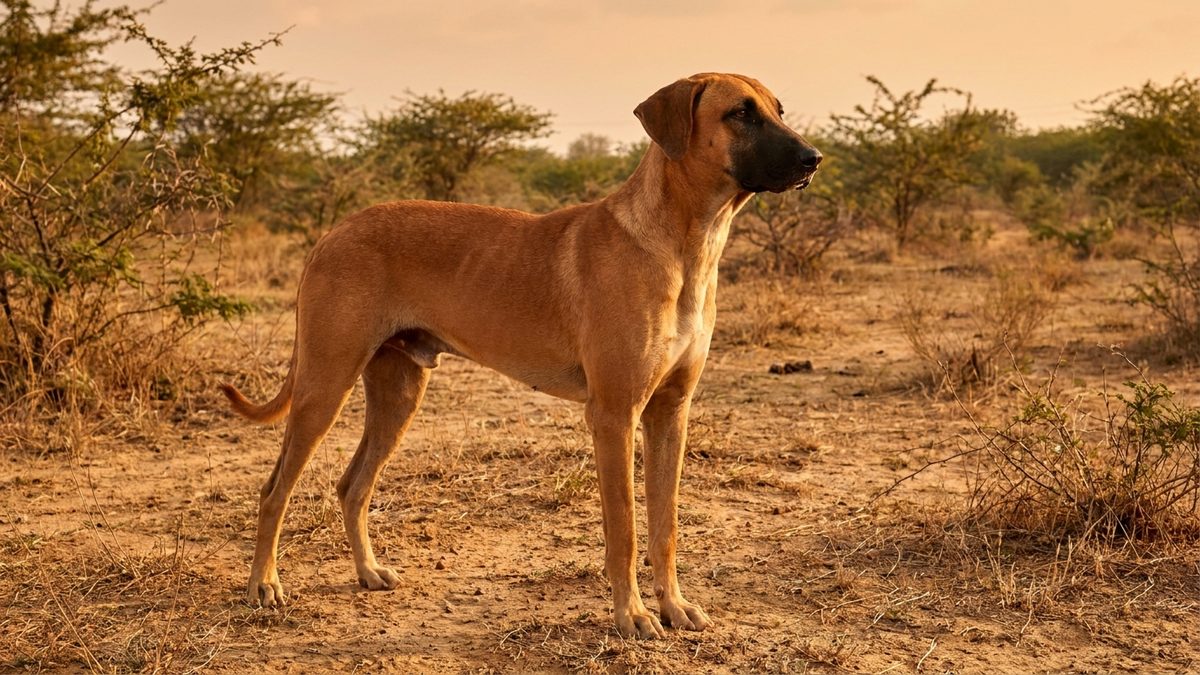
Kombais are usually tan or red-brown with a black muzzle. The back and sides are darker than the rest of the body, and the underside is sometimes white. The build is muscular and agile rather than lean, which separates the Kombai visually from India's sighthounds such as the Rajapalayam and the Mudhol Hound.
| Attribute | Detail |
|---|---|
| Type | Guarding and hunting breed |
| Origin | Kombai, Theni district, Tamil Nadu |
| Also called | Combai |
| Coat | Short, tan to red-brown |
| Markings | Black muzzle, darker back and sides, sometimes white underside |
| Build | Muscular, agile |
| Original role | Boar and big-game hunting, estate guarding |
| Temperament | Fiercely loyal, sharp with strangers |
A war dog, not just a hunting dog
The Kombai's history runs through conflict as well as hunting. The zamindars of Kombai are recorded as gifting these dogs to Hyder Ali and Tipu Sultan for their armies, and by tradition the Marudhu Pandiyar brothers of Sivagangai used Kombais against British troops during the Polygar Wars. The same war is where the Rajapalayam earned its reputation, and the two Tamil breeds are often mentioned together for that reason.
Historically the breed was used to track and hunt genuinely dangerous quarry, including wild boar, bears and bison. That is the temperament you are buying. It has not been bred out.
What the breed was actually used for
The Kombai's working role was broader than hunting. Beyond boar and big game it was kept as an estate and livestock guardian across the southern districts, which is the job most surviving working lines still do. That dual history explains a temperament that reads as contradictory to new owners: intense toward a perceived threat and entirely settled at home with its own people.
It also explains the breed's stamina. A dog expected to work a field boundary all day and then course a boar is built for endurance rather than sprints, which is why structured daily work suits it better than one long weekend outing DogPack, Kombai: The Brave and Loyal Indian….
Kombai dog price in India
A Kombai puppy costs Rs 10,000 to Rs 25,000 across India and as little as Rs 5,000 to Rs 10,000 in Tamil Nadu. It is among the cheapest purebred dogs available in the country, and the low price reflects local availability rather than low quality.
Published price bands disagree, as they do for every Indian breed. Bonbeno compared the sources currently publishing figures.
| Source | Stated range | Scope |
|---|---|---|
| Best For Pets | Rs 10,000 to Rs 25,000 | India-wide |
| kombai.dog | Rs 6,000 to Rs 10,000 (male), Rs 5,000 (female) | Tamil Nadu |
| hachi.dog | Rs 7,000 to Rs 15,000 | India-wide |
| Best For Pets, upper band | Rs 10,000 to Rs 30,000+ | Pedigree or strong bloodline |
Two patterns are worth understanding before you negotiate.
- Tamil Nadu is cheapest. The breeding population sits in and around Theni district, so prices there run roughly half the India-wide figure. This is the same inversion seen with the Rajapalayam, and the opposite of how imported breeds are priced.
- Males cost more than females. Sellers price males higher because they are larger and carry more perceived breeding value. That is a seller's logic, not a buyer's. It says nothing about which dog suits your household.
- Bloodline claims drive the upper band. Puppies described as coming from a strong bloodline or carrying a pedigree are priced higher. Ask what documentation exists, because with a breed this rarely registered the claim is often unverifiable.
A Rs 6,000 Kombai and a Rs 60,000 imported breed cost broadly the same to feed, vaccinate and treat over a decade. The purchase price is the smallest number in the calculation. Choose this breed for its temperament fit, never because it is inexpensive.
Monthly cost of owning a Kombai
A Kombai is cheaper to run than most imported breeds of comparable size, mainly because the short coat needs no professional grooming and the dog is adapted to the local climate. Food remains the dominant recurring cost.
No Indian source publishing Kombai monthly costs states a method, so Bonbeno does not repeat a total. Our verified owner cost survey across eight metros is in progress and will be published with its sample size and collection date. The cost structure below is what is actually knowable now.
Where the money goes
- Food. A muscular working-build dog of this size eats substantially. This is the largest recurring line.
- Preventive veterinary care. Core vaccination, boosters, deworming, and tick and flea control. Tick-borne disease pressure is high across Tamil Nadu and most of South India.
- Training and socialisation. Budget for this as a real line item rather than an optional extra. With a guarding breed it is the difference between a manageable dog and a liability.
- Secure fencing or containment. A hunting breed with prey drive needs physical containment, not a gate that latches most of the time.
- Grooming. Effectively nil. A weekly brush is the whole routine.
When we publish cost figures we state the sample size, the cities covered and the collection date. Where we cannot verify a number we say so rather than repeating an unsourced estimate.
Heat tolerance and the Indian climate
The Kombai handles Indian heat well because it was developed in the dry forests of southern Tamil Nadu rather than imported into them. Its short single coat is a genuine practical advantage over any double-coated breed kept in India.
The breeds most at risk of heat stroke in India are the double-coated imports, specifically German Shepherds, Golden Retrievers, Labrador Retrievers, Huskies and Collies, whose dense coats trap heat. Peak summer temperatures cross 45 C in several parts of the country. A short-coated native breed sits on the right side of that line.
Adaptation is not immunity, and heat stroke remains a veterinary emergency in any breed. The Kombai's specific risk is that it is a high-drive working dog that will keep going past the point of sense if a person keeps asking it to.
- Move hard work to early morning and late evening, which is the standard veterinary recommendation during Indian summers.
- Keep constant access to fresh water, since hydration and monitoring are the most effective preventive measures available to owners.
- Stop the dog before it stops itself. A working breed in drive will not self-regulate reliably in heat.
- Provide shade rather than confinement, because the answer to midday heat for an active dog is timing and shade, not a closed room.
Temperament and household fit
The Kombai is a guarding breed for experienced owners, and this is the section that should decide whether you buy one. It bonds fiercely to its family and is sharp with strangers, so early socialisation and an experienced handler are essential. It is a working breed, not an apartment pet.
The breed is celebrated for fearless loyalty and strong guarding instincts, and is frequently compared to Rottweilers and Bull Terriers in temperament. Those comparisons are useful. If you would not take on a Rottweiler, do not take on a Kombai because it is cheaper.
The hunting instincts sit close to the surface. This was a dog used against boar, bear and bison, and that drive does not disappear in a domestic setting. It shows up as intensity toward unfamiliar animals and unfamiliar people.
Who this breed suits
- Good fit. Experienced dog owners, independent houses with secure outdoor space, rural or semi-rural properties, owners who specifically want a guarding dog and will train seriously.
- Poor fit. First-time owners, apartments, homes with frequent visitors, households with other small pets, anyone wanting a sociable family dog.
- Non-negotiable. Early and sustained socialisation from puppyhood. An unsocialised guarding breed of this power is a danger to visitors and a legal exposure to you.
The most common reason Kombais are surrendered is a mismatch between what the buyer wanted and what the breed is. Wanting an Indian breed is a good instinct. If you want a companion rather than a guardian, the Indian Pariah Dog is the better choice and costs nothing to adopt.
Training a Kombai
Train a Kombai with positive reinforcement and accept from the outset that this breed is not suitable for first-time owners. It responds well to reward-based methods, needs mental work alongside physical, and can be genuinely stubborn.
Socialisation is the safety decision
The socialisation window runs from about 3 weeks to 14 weeks and is largely closed by 16 weeks. In a breed developed to confront boar and bred by the Maravars for guarding, what happens in that window determines whether the adult dog is discriminating or indiscriminate.
Kombai puppies are often sociable. The guarding behaviour emerges between six and twelve months, well after the socialisation window has closed. Owners who judge the breed by an eight-week-old puppy and delay socialisation get a reactive adult and no way back.
What works
- Reward-based methods only. The breed responds to positive reinforcement and hardens against correction.
- Mental work alongside physical. Regular mental stimulation is part of the requirement, not an enrichment extra.
- Short sessions, high value. Stubbornness in this breed is usually boredom rather than defiance.
- Manage arrivals deliberately. Teach a place command and use it for every visitor, because a guarding breed with no instruction defaults to its own judgement.
| Skill | Start | Reliable by |
|---|---|---|
| Name response | Week 1 home | 3 to 5 weeks |
| Sit, down, place | Week 1 home | 4 to 8 weeks |
| Loose-lead walking | Month 2 | 6 to 10 months |
| Recall, no distraction | Month 2 | 4 to 8 months |
| Controlled greeting of visitors | Month 2 | Ongoing management |
| Reliable around unfamiliar dogs | Month 2 | Ongoing management |
How much exercise a Kombai needs
An adult Kombai needs at least 60 to 90 minutes of vigorous exercise a day, which can include running, fetch and dog sports such as agility or obedience work. This is a working breed and the requirement is not negotiable.
One thing separates this breed from most. The Kombai wants to work with its person rather than beside them, and the only thing it enjoys more than exercise is exercise with its owner. A dog left to exercise itself in a yard is not being exercised.
| Stage | Guidance |
|---|---|
| Puppy | Short frequent sessions, no forced distance or stairs work |
| Adult | 60 to 90 minutes vigorous, split across two sessions |
| Senior | Shorter, gentler, still daily |
| Peak summer | Both sessions moved to early morning and late evening |
- Fetch and structured work beat wandering. A retrieve or a training game delivers more than a longer aimless walk.
- Dog sports suit this breed. Agility and obedience give the mental load it needs.
- Never exercise off-lead in an unsecured area. Prey drive from boar and big-game work sits close to the surface.
- Stop the dog before it stops itself. A working breed in drive does not self-regulate in Indian heat.
Grooming a Kombai
Grooming a Kombai takes minutes a week. The short, close coat has no undercoat to strip and no seasonal blow-out, which makes it one of the lowest-maintenance coats available to an Indian owner.
There is none of the humidity-driven matting that affects double-coated breeds such as the Golden Retriever in Indian conditions. What the coat does need is inspection rather than work.
- Brush weekly with a rubber curry or hound glove to lift dead hair and distribute oils.
- Bathe rarely, only when genuinely dirty, since frequent bathing strips protective oils.
- Check for ticks at every brush, particularly around ears, neck and between toes. This matters more than the brushing itself in most of India.
- Inspect working injuries. An active dog in scrub picks up cuts and thorn wounds that a short coat makes easy to spot if you look.
Nails and ears go on the same weekly schedule. Because the grooming session is so short, these are the two things owners most often skip.
Tick and flea pressure across Tamil Nadu peaks with the monsoon, and a humid coat that stays damp invites skin infection. Increase inspection frequency through the wet months rather than sticking to a fixed weekly routine.
Health and lifespan
The Kombai is a robust landrace breed with fewer inherited problems than most pedigree imports, which is the direct benefit of centuries of functional rather than cosmetic selection. The honest caveat is that the evidence base is thin.
Indian breeds have nothing comparable to the large prospective cohort studies that exist for popular Western breeds. There is no Kombai equivalent of the Golden Retriever Lifetime Study, so breed-level disease prevalence figures of the kind quoted for imported breeds simply do not exist here.
That gap is beginning to close. Formal phenotypic characterization work on the Kombai has been published in Indian veterinary literature, and the breed has been described in the research literature as a distinct genetic resource of India. Institutional interest of this kind did not exist twenty years ago. The Haofa Tangkhul Hui, Manipur's hunting and guarding hound, has the same kind of study behind it, a 2024 paper that measured 100 adult dogs, and it was still not on the ICAR-NBAGR register when Bonbeno checked in August 2026.
Any page telling you a precise disease prevalence percentage for the Kombai is extrapolating, not reporting. Bonbeno states what is documented and flags what is not, rather than borrowing a number from a Western breed to fill the gap.
What to actually do
- Keep vaccination current, since a working outdoor dog has higher exposure than a housebound one.
- Run year-round tick and flea control, because tick-borne disease is the realistic health threat in South India, not an exotic inherited condition.
- Keep the dog lean and conditioned. A muscular breed carrying excess weight loads its joints for no benefit.
- See both parents where possible, which remains the single most useful health screen available for a breed without formal registries.
The two conditions that actually matter
Two problems account for most veterinary visits in this breed, and both are consequences of what the Kombai is rather than of poor breeding.
- Hip dysplasia. As an active breed the Kombai can develop hip dysplasia, where the joint does not seat correctly in the socket. Regular exercise and keeping the dog at a healthy weight both reduce the risk. This is one of the few conditions where the owner's daily habits genuinely change the outcome.
- Skin infection. The short coat that makes this breed so easy to groom also leaves it prone to skin infections, particularly in humid climates. Across coastal Tamil Nadu, Kerala and Mumbai that is most of the year rather than a monsoon-only problem.
Neither is a reason to avoid the breed. Both are reasons to weigh the dog monthly and run a hand over its skin at every brush, which between them cost nothing and catch the two things most likely to go wrong.
Feeding a Kombai
Feed a Kombai as an active, muscular medium-to-large breed, matching intake to workload rather than to a fixed chart. A working dog exercised properly eats considerably more than the same dog kept as a yard guard.
Body condition is the measure that matters. A Kombai should carry visible muscle definition with a light covering over the ribs. Indian owners frequently overfeed guarding breeds in the belief that bulk equals power, which is the opposite of how this dog was built to work.
- Match intake to actual workload, adjusting between working and resting periods rather than feeding a constant amount.
- Split daily intake across two meals rather than one large meal.
- Keep fresh water available continuously, especially in a dog that is worked or guards outdoors.
- Adjust in peak summer, when appetite commonly drops. Persistent inappetence is a veterinary matter, not a preference.
Bonbeno reviews Indian pet food brands separately and tests products first-hand before publishing a verdict. See our testing method for what a Bonbeno food review does and does not claim.
Kombai puppy: the first year
A Kombai matures into a medium dog of around 58 cm at the shoulder with a lifespan of 10 to 14 years. The first year decides temperament far more than genetics does in this breed.
- 8 to 16 weeks. Vaccination course. Structured socialisation to people, dogs, surfaces and noise, which is the highest-value work you will ever do with this breed. Handling and grooming habits start now.
- 4 to 6 months. Loose-lead work. Keep exercise frequent and light rather than long, since forced distance work damages developing joints in an active medium breed.
- 6 to 12 months. Guarding behaviour emerges. This is the critical window and the one most owners misread as the dog turning aggressive. Continue socialising rather than withdrawing the dog from the world.
- 12 months onward. Adult exercise load of 60 to 90 minutes vigorous daily. Weight management begins, since hip dysplasia risk in an active breed is aggravated by excess weight.
Kombai bite-force figures circulate widely online and none trace to a measured study of the breed. Bonbeno does not publish a number, because no reliable one exists. Treat any specific PSI figure for an Indian breed as marketing.
Kombai vs Rajapalayam
Choose a Kombai for close guarding and a Rajapalayam for coursing. Both come from Tamil Nadu, both were used against British troops in the Polygar Wars, and Indian buyers routinely treat them as interchangeable. They are not.
| Factor | Kombai | Rajapalayam |
|---|---|---|
| Type | Guarding and hunting breed | Sighthound |
| Origin | Kombai, Theni district | Rajapalayam, Virudhunagar district |
| Build | Muscular, agile, compact | Tall, lean, deep-chested |
| Height | About 58 cm | Up to 76 cm |
| Coat | Tan to red-brown, black mask | White, short and fine |
| Working style | Bay and catch, close work | Sight and scent coursing |
| Containment need | Secure boundary | Walled compound, clears fences |
| Key health flag | Hip dysplasia, humid-climate skin infections | Congenital deafness with white coat |
| Lifespan | 10 to 14 years | 9 to 12 years |
The practical difference is containment and exercise type. A Kombai needs a secure boundary and structured work with its owner. A Rajapalayam needs a walled compound and room to run flat out, because it clears human-height fences and cannot be recalled mid-pursuit.
Both are demanding breeds for experienced owners with space. If what you want is an Indian dog for a normal household, the Indian Pariah Dog is better tempered for family life, longer-lived, and free to adopt.
Mistakes Indian Kombai owners actually make
These repeat across households and are ranked by how much damage they do.
- Buying as a first dog. The breed is explicitly unsuitable for first-time owners, and cheap purchase prices make that mistake easy to make.
- Under-socialising because the puppy seems friendly. Guarding behaviour emerges months after the socialisation window closes.
- Under-exercising. 60 to 90 minutes vigorous daily is the requirement, and a bored working breed becomes a destructive one.
- Exercising the dog without the owner. This breed wants work with its person, not a yard.
- Ignoring skin through the monsoon. Short coats in humid climates are prone to skin infections.
- Letting it carry weight. Hip dysplasia risk in an active breed is worsened by excess weight.
- Believing the bite-force numbers. No measured study supports the figures circulating online.
- Using harsh correction on stubbornness. The breed responds to positive reinforcement and hardens against force.
Sourcing a Kombai, and the adoption route
Buy a Kombai in or near Theni district from breeders who will show you the parents working, and consider adoption first if what you want is a companion rather than a guardian.
Is the Kombai a street dog?
No. The Kombai is a distinct, historically documented breed from a specific district of Tamil Nadu, developed by an identifiable community for a specific working purpose. The confusion arises because tan short-coated dogs are common among India's free-ranging population, and because both are loosely grouped as indie dogs in casual speech. A free-ranging tan dog is not a Kombai, and a Kombai is not a street dog.
Sourcing checklist
- Buy near the source. Theni district and surrounding Tamil Nadu hold the working population and the lowest prices.
- See both parents, ideally in their working context rather than posed. Temperament is the whole decision with this breed.
- Test the seller on temperament honesty. A breeder who tells you a Kombai is good with everyone is either inexperienced or selling.
- Verify any registration claim directly with the Kennel Club of India rather than trusting a photocopy, remembering that KCI certifies pedigree and not health.
- Decline any seller who will not let you visit the place the puppies were raised.
Adoption
Kombais and Kombai crosses appear in shelters across Chennai, Coimbatore and Bengaluru, typically surrendered when an urban household discovers what a guarding breed actually requires. Adopting an adult removes the largest unknown in the purchase, which is temperament, because an adult's character is already formed and observable. If a guarding breed is not what your home needs, the Indian Pariah Dog is better tempered for family life and free to adopt.
The breed is also spreading beyond Tamil Nadu. Kombais now appear with owners in Karnataka and Maharashtra, which is good for the breed's numbers and bad for individual dogs placed with buyers who chose an unfamiliar guarding breed on price alone.
Kombai questions Indians actually search
Are Kombai dogs aggressive?
Kombais are sharp with strangers and strongly protective rather than indiscriminately aggressive. The breed bonds fiercely to its family and was developed to hunt boar, bear and bison, so the drive is real. Early sustained socialisation and an experienced owner are what separate a controlled guarding dog from a dangerous one.
Is Kombai a good family dog?
Only for the right family. A Kombai is devoted to its own household but sharp with visitors, needs secure containment and serious training, and is a working breed rather than an apartment pet. Families wanting a sociable dog around frequent guests and small children should choose differently.
What is the Kombai dog price?
A Kombai puppy costs Rs 10,000 to Rs 25,000 across India, and Rs 5,000 to Rs 10,000 in Tamil Nadu where the breeding population sits. Males are usually priced higher than females. Puppies described as having a strong bloodline reach Rs 30,000 or more, though that documentation is often unverifiable.
Is Kombai a street dog?
No. The Kombai is a documented breed from Kombai town in Theni district, Tamil Nadu, developed by the Maravar community from at least the 15th century for boar hunting. The confusion comes from tan short-coated dogs being common in India's free-ranging population, but a free-ranging tan dog is not a Kombai.
Can a Kombai live in an apartment?
Not well. This is a working guarding breed with high prey drive that needs secure outdoor space and substantial daily output. Apartment living combines confinement with a constant stream of unfamiliar people in shared corridors, which is close to the worst possible setup for a territorial breed.
How does a Kombai handle Indian summers?
Well. It was developed in the dry forests of southern Tamil Nadu and carries a short single coat, unlike the double-coated imports such as Golden Retrievers and Huskies that face the highest heat-stroke risk in India. The practical risk is that a high-drive working dog will not stop itself in heat, so the handler must.
What colour is a Kombai?
Kombais are tan or red-brown with a black muzzle, with the back and sides darker than the rest of the body and the underside sometimes white. The black mask over a tan body is the most reliable visual marker separating the breed from similarly coloured free-ranging dogs.
What is the difference between a Kombai and a Rajapalayam?
They are different types of dog from different parts of Tamil Nadu. The Kombai is a muscular tan guarding and boar-hunting breed from Theni district, while the Rajapalayam is a lean white sighthound from Virudhunagar district with a pink nose. Both were used against British troops during the Polygar Wars, which is why they are often mentioned together.
How much exercise does a Kombai need?
An adult Kombai needs at least 60 to 90 minutes of vigorous exercise daily, including running, fetch and dog sports such as agility or obedience. The breed specifically wants to work with its owner rather than alone, so a dog left in a yard is not being exercised.
Is a Kombai good for first-time owners?
No. The Kombai is explicitly unsuitable for first-time dog owners. It needs substantial daily exercise, structured training and heavy early socialisation, and it can be stubborn. The low purchase price makes it easy to buy on impulse, which is exactly how mismatched placements happen.
Compare with similar breeds
Kombai sits in 3 Bonbeno groups. Each one compares it directly against the breeds it is genuinely an alternative to, on the same figures.