
Subcontinental breed profile
Gull Dong: Size, Price, Temperament and Care in India
A Pakistani bandog created for the fighting pit, sold in India under at least eight different names, and described so inconsistently that published height figures for it differ by half a metre. Here is what the sources actually support, and what they do not.
Quick answer
The Gull Dong is a crossbred guarding and fighting dog of Pakistan and north India, produced by crossing the Gull Terrier with the Bully Kutta, and it is unsuitable for essentially every Indian pet household. No kennel club recognises it, no breed standard governs it, and no source publishes a Gull Dong price in India. Published heights for it range from 46 cm to 107 cm across mainstream breed pages, which tells you how little is actually known. Dog fighting, the purpose this cross was created for, is a criminal offence in India under the Prevention of Cruelty to Animals Act, 1960.
This guide is general information for Indian pet owners and is not a diagnosis. Always consult a registered veterinarian near you before acting on anything you read here, and treat any sudden change in your dog's condition as urgent.
Gull Dong at a glance
What the Gull Dong actually is
The Gull Dong is a crossbred working dog of India and Pakistan, produced by crossing a Gull Terrier with a Bully Kutta, and it is used for dog fighting, hunting and guarding. Call it what it is before anything else. This is a bandog, a purpose-made fighting and guarding cross, not a settled breed with a standard behind it.
Start with breed recognition, because it changes how you read every number below. The Gull Dong has no kennel club recognition anywhere, no archived records and no standardised or documented breeding records. It is not recognised by the American Kennel Club, the United Kennel Club or the Federation Cynologique Internationale, and there is no official written breed standard governing what a Gull Dong must look like or how it must behave. Wikipedia's own article on it is tagged as a stub. Everything else on this page sits on top of that fact.
The naming is genuinely confused, and no page publishes the confusion
The same dog is sold and described under at least eight English names, and different sources disagree about which of them refer to the same animal. That matters directly to a buyer being shown papers. Below is what each source actually calls it, quoted as stated.
| Source | Names it uses |
|---|---|
| Wikipedia | Gull Dong |
| Dog Scanner | Bully Gull Terr, Gull Dong, Indian Bulldog, Indian Gull Dong, Pakistani Bulldog, Pakistani Gull Dong, South Asian Bulldog, South Asian Gull Dong |
| Wag! | Bully Gull Terr, Paskistani Bull Dog, Gull Dang, Kanda |
| Molosser Dogs | Gull Dong, Guldung, Bullygullterr, Bully Gull Terr |
| National Purebred Dog Day | Gull Dong, known in Pakistan as the Bully Gull Terr |
| Creatures | Pakistani Bull Dog, Gull Dong Bull Terrier |
| Petzcare India | Gull Dong, also known as the Pakistani Bull Dog |
| Animalia | Gull Dong, with parents given as the Kutta Bully and the Terr Gull |
Two things in that table are worth pausing on. One international page renders the parent breeds as Kutta Bully and Terr Gull, both name components reversed, and another publishes Paskistani Bull Dog with the typo intact. These are the pages ranking for this breed. A record this loose is not a record you can verify a pedigree against, and any seller offering you papers is offering you papers from nowhere.
The lineage has a circularity problem
The standard account is simple. Bull Terriers were introduced to the northwestern Indian subcontinent during the British Raj, the breed soared in popularity, a Bull Terrier Club of India was established in Calcutta, and imported Bull Terriers were crossed with local breeds to produce the Gull Terrier, often called the Indian Bull Terrier and now also the Pakistani Bull Terrier. Crossing that Gull Terrier with the Bully Kutta produced the Gull Dong, which is celebrated in India and Pakistan for its speed and tenacity.
Now read the parent breed's own entry. The Gull Terrier is described as a direct descendant of the British Bull Terrier, with indigenous subcontinental dogs including the Bully Kutta playing a major role in its breeding development and considered a direct ancestor of the modern Gull Terrier. If that is right, the Bully Kutta sits on both sides of the Gull Dong cross, as a parent and as an ancestor of the other parent. A third account describes the Gull Dong developing from the Gull Terr through crosses with Indian Bullterriers and Bully Kutta fighters, making it a three-way rather than a two-way cross. Bonbeno does not pick a winner here. The sources genuinely disagree and the disagreement is the finding.
Dates and purpose, where the sources do agree
On timing and purpose the sources finally agree. The cross began in colonial India, during the 1900s in the area that became Pakistan in 1947, which puts it at over 120 years old. On purpose they converge harder still. It is described as primarily a bear-baiter, sometimes pitted against other dogs, as a guard dog, family protection dog and bear hunter that was and still is found in fighting pits, and as a formidable opponent both in the ring and outside it. Wikipedia files it under the category of dog fighting breeds.
Size, where the sources fall apart completely
Published height figures for this breed span 46 cm to 107 cm, which is not a range but a collapse of the record. Averaging them would hide the single most useful thing a buyer can learn, so here is what each source states.
| Source | Height stated | Weight stated |
|---|---|---|
| Wikipedia | 46 to 56 cm, both sexes | 25 to 39 kg (males), 20 to 29 kg (females) |
| Animalia | 46 to 56 cm | 25 to 39 kg |
| Molosser Dogs | About 69 cm (27 inches) average | None stated |
| Wag!, page header | 76 to 86 cm (30 to 34 inches) | 41 to 64 kg (90 to 140 lb) |
| Wag!, average size block | 86 to 107 cm males, 76 to 86 cm females | 41 to 64 kg, both sexes |
| National Purebred Dog Day | None stated | Up to 64 kg (140 lb) |
| Creatures | Declines to publish a figure | Declines to publish a figure |
Three findings come out of that table and none of them appears on a ranking page. First, one source contradicts itself inside a single page, giving 30 to 34 inches in its header and 34 to 42 inches for males a few lines down. Second, the 107 cm upper figure would exceed the tallest dogs ever reliably recorded and should be read as an error rather than data. Third, one page refuses the question outright, stating that there is no registry standard and no published morphometric study of this population, that circulating figures are unsourced and give conflicting sex-specific numbers including some heights that would rival a Great Dane, and that it will not repeat a range because any such range would be invented precision.
There is also an arithmetic problem that nobody has flagged. Wikipedia gives the Gull Terrier parent at 25 to 29 kg for males and the Bully Kutta parent, on its own record, as a giant mastiff far heavier than either. A cross between a terrier of under 30 kg and a mastiff of 70 kg or more, coming out at 25 to 39 kg, is a dog barely heavier than the lighter parent. Either the parent figures are wrong, the cross figures are wrong, or the name is being applied to more than one kind of dog. Bonbeno's Bully Kutta guide sets out the published spread for that side of the cross in detail rather than repeating it here.
Coat and coat colour
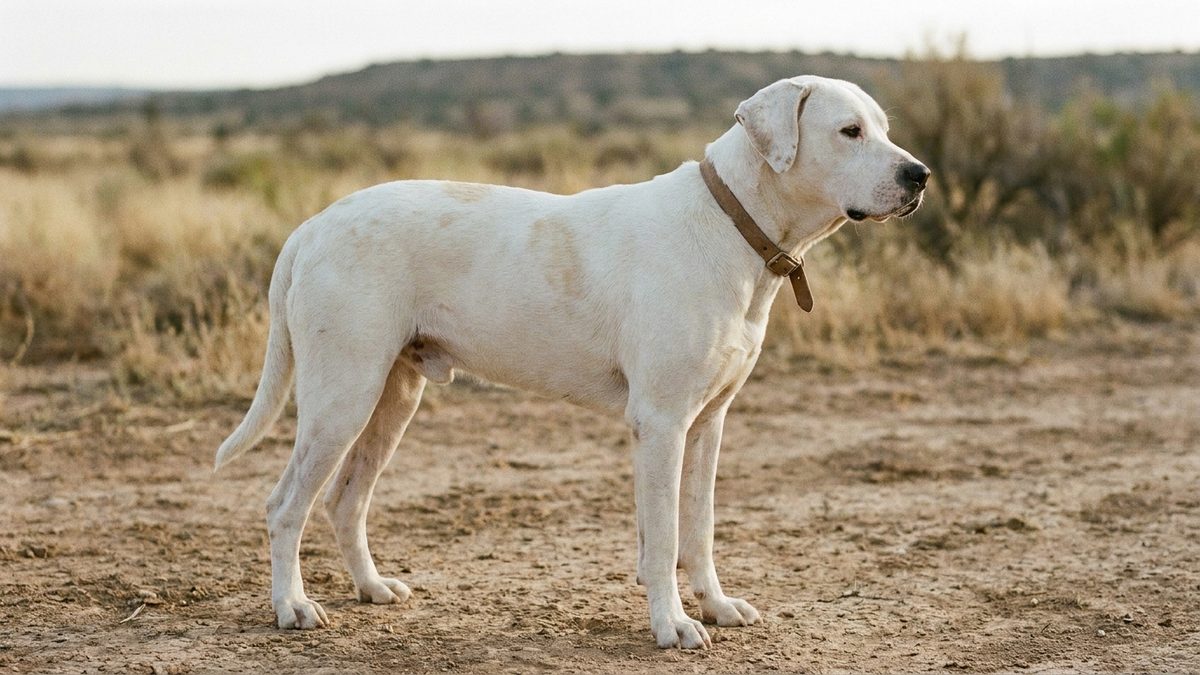
The coat is short and dense on the mainstream record, and short, smooth and flat on two others Animalia, All about the Gull Dong breed. On coat colour the sources drift. Wikipedia gives white, or white with occasional dark-coloured markings on the face and body. One page says it must be entirely white or carry some black markings, and adds that the ears should be flat rather than erect. Another records that the only accepted colour has traditionally been uniform white, though other colourings now exist. A fourth lists white, black, gray and brindle. The white default is not cosmetic trivia, and the [health](#health) section explains why it is the most important physical fact on this page.
Bonbeno publishes no bite-force figure for the Gull Dong. No measured study of this population exists, there is no registry standard and no published morphometric study to anchor any number, and a PSI figure with no method behind it is marketing rather than data. For a dog with this reputation, that marketing is what gets the dog destroyed after an incident.
Gull Dong price in India
No source publishes a Gull Dong price in India. Bonbeno searched the ranking set for this breed and for the price query directly, and not one page carries a rupee figure. That is the honest answer, and it is more useful than a number would be.
This is unusual and it is worth understanding why it happens. For most breeds sold in India, several sales platforms and breed databases publish tiered rupee bands, and the disagreement between them is the story. For the Gull Dong there is nothing to disagree about. Below is exactly what each source publishes on cost.
| Source | Figure published | Market covered |
|---|---|---|
| Creatures | None. States there is no reliable published price and declines to invent one | Refuses to publish |
| Wag! | Food $1.50 to $1.90 a day, $39 to $52 a month; veterinary costs typically $1,000 to $3,000 a year | United States |
| Wikipedia | None | Not covered |
| Animalia | None | Not covered |
| Molosser Dogs | None | Not covered |
| National Purebred Dog Day | None | Not covered |
| Petzcare India | None | Not covered |
| Dog Scanner | None | Not covered |
The single US-market source publishes running costs rather than a purchase price, and those dollar figures do not transfer to India in either direction. Indian food, veterinary and boarding costs sit on a different base, and converting a US annual veterinary figure into rupees would produce a number with no evidence behind it. Bonbeno will not do that.
Why there is no published price, and what that tells you
- There is no registry, so there is nothing to price against. Records are not archived and breeding records are neither standardised nor documented. Indian puppy price tiers are built almost entirely on registration and bloodline claims, and here there is no issuing body to claim from.
- Outside its home region the breed is genuinely rare, with only a small scattered set of people working with the type. In Pakistan and neighbouring areas it is far more available and sold as a working dog, with price tracking an individual dog's lineage, working ability and the breeder's reputation.
- The absence of a breed standard means the name guarantees nothing. Two dogs sold under it can differ a good deal in size, structure and temperament. You are not buying a known quantity at any price.
- A quoted price is a private negotiation, not a market rate. With no comparable published sales, whatever a seller names is unanchored. Treat any confident rupee figure, including one on a video thumbnail, as a claim to verify rather than information.
Whatever you pay, the recurring costs are identical: food for a 25 to 39 kg working dog, a boundary engineered to hold it, professional training, a hearing test, preventive veterinary care, and the money to fund an emergency abdominal surgery at 2 am. If the purchase price is the part of this decision you are optimising, you are optimising the wrong number.
One more point, because it is the most practical thing in this section. The parent breed has a documented Indian retail market with published price bands, and the Bully Kutta guide sets out how far those bands disagree with each other. A seller who cannot show you a published market for the Gull Dong will sometimes quote you the Bully Kutta's premium tier instead, on the argument that a Gull Dong is the better fighting cross. That argument is a description of a criminal use of the animal, and it is covered in the [temperament](#temperament) section.
What a Gull Dong actually costs to keep
The recurring cost of a Gull Dong in India cannot be stated as a monthly figure, because no source publishes an Indian monthly cost for this breed. What can be published is the cost structure, which is the part that decides whether you can afford the dog at all.
Take the one documented consumption figure as a starting point. One breed reference puts intake at three cups of food a day for an adult. That is a real anchor for a 25 to 39 kg dog, and you can price it against whatever food you actually buy in your own city rather than against a US dollar estimate. Everything else on the list below is a structural cost that most Indian buyers of guarding breeds discover after the purchase.
Where the money actually goes
- Food. The largest recurring line, at roughly three cups a day for an adult, adjusted against body condition rather than against a chart.
- Secure containment. This dog needs a large securely fenced yard and is not suited to apartments at all, with dog-proof fencing described as not optional. Budget it as a capital cost before the dog, not as a problem you solve afterwards.
- Professional training. This dog is difficult to train and needs someone highly skilled with aggressive and dominant animals. That is a paid professional, not a weekend video.
- A hearing test. The line item nobody budgets and the one most specific to this breed. Hearing testing in white dogs is a recommended test here, and the objective version is the brainstem auditory evoked response, which needs a special-purpose computer and subdermal electrodes rather than a clap test, with limited availability and high equipment cost. Identify a facility before you commit to a puppy.
- Preventive veterinary care. Routine ear examination matters here, because ear infections are one of only two published health concerns for the breed. Add the standard Indian load of deworming and monthly tick and flea prevention through the monsoon.
- An emergency surgery fund. Bloat is listed as an occasional diagnosis for this breed and it is a surgical emergency. Of dogs presented alive with gastric dilation-volvulus at UK emergency practices, 49.7 percent survived to discharge overall, rising to 79.3 percent of those managed surgically. Surgery is what changes the outcome, and surgery costs money you either have at 2 am or do not.
The cost of the fighting economy, for contrast
One published budget shows what the trade in this breed's home region actually spends. Reporting on dog fighting in Pakistan, which names the Gull Dong directly among the breeds most commonly trained and bred to fight, records the daily regime for these dogs as a kilogram of raw meat, 250 grams of oil mixed with desi butter, ground chicken and almonds, and two litres of milk, with training built around a thirty-minute swim in ice-cold water and long-distance running, and millions of rupees at stake on the winning dogs. That is not a care recommendation. It is published to make one point. The money in this breed's home market flows through an illegal blood sport, and a domestic buyer who pays a premium for a Gull Dong is often paying into that supply chain whether they intend to or not.
When we publish cost figures we state the sample size, the cities covered and the collection date. Our verified owner cost survey across eight metros is in progress. Until it publishes, we report other people's numbers as other people's numbers, name the market they were collected in, and refuse to convert a US figure into rupees to fill a gap.
Heat tolerance and the Indian climate
The Gull Dong handles Indian heat better than its mastiff parent and worse than its own marketing suggests. Three things work in its favour, and one thing works against it hard enough to matter.
The favourable side is real. The coat is short and dense, the muzzle is long and powerful rather than flat, and at 25 to 39 kg the body mass is roughly a third of a Bully Kutta's. Set that against the documented risk groups for heatstroke, which are overweight animals, flat-faced breeds such as Pugs and French Bulldogs, pets with thick coats, old or very young animals, and animals with pre-existing airway, lung or heart problems. The Gull Dong sits outside every one of those categories on conformation alone. That is a genuine advantage and this page will not pretend otherwise.
The unfavourable side is behavioural rather than anatomical. Heatstroke occurs from exposure to hot or humid environments or from overly strenuous exercise, and dogs have sweat glands only on their paws and must rely on panting to cool down. Normal canine body temperature runs between 100.5 and 102.5 degrees Fahrenheit, and heatstroke results when the dog cannot regulate and the temperature reaches 105 degrees or higher. It does not have to be hot for this to happen. Exercising excessively in warm weather, or being left in a warm or humid poorly ventilated environment, causes animals to quickly overheat. A working-line guarding dog with high drive, worked hard on a merely warm morning in an unventilated yard, is exactly the animal that description was written for.
There is a study that settles which of those two triggers matters more, and its finding should change how Indian owners of working breeds think about summer. Across a review of more than 900,000 veterinary records, exertional heat-related illness accounted for 74.2 percent of heat-related illness cases in dogs, making exercise rather than hot cars the dominant trigger, and male dogs and younger dogs were more susceptible. The authors argue directly that public awareness should widen beyond the hot-car message to cover the risk of exercising dogs in high temperatures. For a muscular young working cross in an Indian summer, that is the whole warning. The danger is not that you will leave this dog in a car. The danger is that you will train it at ten in the morning in May because it looked keen.
One Indian source disagrees, and here is how to read it
An Indian breed page states that Gull Dongs are well suited to the Indian climate thanks to their resilience and adaptability, that the short coat helps them manage the heat, and that owners should provide adequate shade and water during peak summer and exercise during cooler parts of the day. The first half of that is defensible on conformation. The second half is the operative part and it is the half that gets skipped. Resilience is not a substitute for timing, shade and water, and a dog that is genuinely better built for heat than a mastiff will still overheat if it is worked at noon in June.
What that means city by city
- Punjab, Haryana and Delhi NCR. The region where this breed is actually present in India, and the region where dogfighting cases have been documented. Move both exercise sessions to before sunrise and after dark from March through June.
- Mumbai, Chennai and Kolkata. Humidity rather than peak temperature is the problem, because panting cools poorly in humid air. Watch the ears specifically through the wet months, since ear infections are a published concern for this breed.
- Bengaluru and Pune. The mildest fit in India, and still not a licence to exercise at midday.
- Any city, any month. Continuous access to drinking water, real shade indoors and outdoors, genuine ventilation rather than a closed room, and restricted exercise on warm days.
Learn the early signs and act on those rather than waiting for the obvious ones. Panting that progresses to distressed or noisy breathing, restlessness or agitation, pacing, seeking shade or water, drooling, red gums or tongue, an increased heart rate, and vomiting or diarrhoea come first, with lethargy, confusion, weakness, collapse and seizures following. Prolonged elevated body temperature damages every organ, and heatstroke commonly leads to acute kidney injury, blood clotting issues and shock.
The Royal Veterinary College's stated first aid position for a dog with heatstroke is to cool first and transport second. Move the dog somewhere cool and ventilated, offer small sips of water without forcing, and cool it actively. Cold water immersion is effective for young healthy dogs, while evaporative cooling with water cooler than the dog plus air movement suits older dogs or those with underlying problems. Do not use ice-cold water, which reduces blood flow to the skin and can trigger shivering that generates more heat. Then call your vet, and have the dog checked even if it seems fine.
Temperament, and the fighting problem
The Gull Dong is a loyal and intelligent dog that is known to be aggressive and strong-willed, and it is not a dog for the novice owner. Any honest account of its temperament has to start with the fact that this cross was made for the pit, because that is the selection pressure that produced everything else on the list.
Four independent sources describe this dog in near-identical terms, which is itself the signal. It is a sturdy, aggressive working breed that is aggressive with other dogs, wary of people it does not know, and not well suited to life as an urban companion. It is very dog-aggressive with a sharp temperament and wariness of strangers. It has a grumpy disposition and a dominant nature, and at this size is a danger to other pets, dogs and people it deems to be strangers. It is strong willed with a tendency towards dominant behaviour, and in the wrong hands can be aggressive.
The other half is equally consistent and equally real. These dogs form strong bonds with their families and show extreme loyalty when protecting them, and they are loyal, devoted and affectionate to their owners. Owners who describe their Gull Dong as gentle and easy are usually describing its behaviour with the family, which was never the question. The question is what it does with the delivery rider at the gate.
Two drives, not one, and they need managing separately
Territoriality is what makes the dog react to a person at the boundary. Prey drive is a separate inheritance, and this cross carries it from a documented history as a bear-baiter and bear hunter National Purebred Dog Day, The Gull Dong. One reference is explicit that the dog should be kept on a leash at all times because it is aggressive towards other dogs and pets. A household can manage one of those drives and be undone by the other, so assess both honestly against what actually lives on your street, including community dogs, cats and poultry.
One published source is more careful, and it is worth reading
One source is more careful than the rest, noting that all of the above is what keepers report rather than the output of any behavioural study, because none exists for this population. The veterinary position is worth taking from the primary source. The American Veterinary Medical Association opposes breed-specific legislation and states that any dog can bite regardless of breed, that research linking breed to bite risk finds the connection weak or absent, and that socialisation, neutering and proper containment are much more strongly indicated as risk factors. Bonbeno accepts that and will not run it in reverse to manufacture a breed-specific aggression profile. Read carefully it strengthens this page, because those three variables are exactly the ones a normal Indian household struggles hardest to supply, general size is named among the factors determining whether a bite causes serious injury, and dogs are more likely to become aggressive when unsupervised, unneutered and not socially conditioned. The case against this dog for a typical home is about ownership conditions rather than breed destiny, and it survives the AVMA position intact. What is not in dispute is the intent behind the cross, which was to bond hard with its people and treat what falls outside that circle as a threat.
Dog fighting is a criminal offence in India
Forcing dogs to fight is illegal in India under the Prevention of Cruelty to Animals Act, 1960. Section 11(1)(m)(ii) makes it an offence, solely with a view to providing entertainment, to incite any animal to fight or bait any other animal. Section 11(1)(n) separately makes it an offence to organise, keep, use or act in the management of any place for animal fighting or for the purpose of baiting any animal, to permit or offer any place to be so used, or to receive money for the admission of any other person to such a place.
That drafting distinction is worth publishing because nobody else does. The baiting offence under section 11(1)(m)(ii) is qualified by the words solely with a view to providing entertainment, while the offence of organising or managing a place for animal fighting under section 11(1)(n) carries no such qualifier. Running the venue is an offence on its own terms regardless of stated purpose.
The penalty is the uncomfortable part, and it explains the market. Under section 11 the punishment for a first offence is a fine of not less than ten rupees which may extend to fifty rupees, and for a second or subsequent offence within three years a fine of not less than twenty-five rupees which may extend to one hundred rupees, or imprisonment up to three months, or both. Those figures have not been revised. A statutory maximum fine of fifty rupees for a first offence is why a criminal offence has functioned in practice as a cost of doing business, and it is the single most useful legal fact on this page.
Prosecutions are correspondingly rare. Police in Punjab registered what officials described as possibly the first case against illegal dog fights in the state under the Prevention of Cruelty to Animals Act only in June 2018, in Moga district's Nihal Singh Wala town, after organisers put up posters inviting entries at a fee of Rs 500 per dog. A dog trainer quoted in that report said dog fights are very common in rural Punjab, that betting takes place, that breeds like the Pit Bull and Pakistan Bully are specially reared for it, and that although nobody had been booked for organising such fights the videos were easy to find on social media.
Investigations since then keep finding the same thing. A Fauna Police investigation provided to PETA India documented dogs being mangled and killed in secretly organised fights in open fields and dogfighting rings in Haryana, Maharashtra, Punjab, Rajasthan and Uttar Pradesh, and in the union territories of Delhi and Jammu. Those fights can last up to two hours, common injuries include severe bruising, deep puncture wounds and broken bones, and dogs that lose or refuse to fight are used as target practice or killed by their owners. The account also records that many of these dogs endure ear cropping, described as an illegal process that involves cutting part of a dog's ears to prevent another dog from grabbing them during a fight.
Any seller who presents gameness, fighting ability, pit lineage or aggression as a desirable trait is describing a criminal use of the animal under sections 11(1)(m)(ii) and 11(1)(n) of the PCA Act 1960. So is any photograph of a cropped-ear dog, since ear cropping is itself illegal. Walk away, and consider reporting the listing. A seller worth buying from talks about temperament stability, hearing status and placement suitability, and will refuse a sale to the wrong home.
Who this breed suits
- Good fit. Experienced owners on independent rural property or a smallholding with genuinely secure boundaries, who want a working guardian, will train seriously for the life of the dog, and can fund emergency surgery. Rural properties, farms and smallholdings suit the breed far better than city apartments.
- Poor fit. First-time owners, apartments, households with frequent visitors, homes with small children or other pets, and anyone who wants a sociable family dog. They are not suited for apartments at all.
- Non-negotiable. Structured socialisation from the first weeks, a hearing test before you commit, containment engineered for a driven 35 kg dog, and honesty with yourself about whether you can physically hold this animal on a lead when it has decided something is a threat.
The Gull Dong is unsuitable for essentially every Indian pet household, and the argument does not rest on the dog being dangerous by nature. It rests on four things a normal home cannot supply. Containment rated for a driven working dog. A socialisation and training load that never ends. Legal and social exposure in a country where this dog is unregistered and unrecognised. And the plain fact that this is a purpose-bred fighting cross whose Indian market is shadowed by an illegal trade. Wanting a guardian is reasonable. This is the wrong dog to satisfy it with.
Training a Gull Dong
Train a Gull Dong with reward-based methods from the day it arrives, and hire a professional before it arrives rather than after something goes wrong. The published record on trainability contradicts itself, and the contradiction is instructive.
Set the two claims side by side. The parent Gull Terrier is described as highly trainable. The Gull Dong is described as intelligent and quick to pick up basic training but also difficult to train, needing someone highly skilled in training and socializing a dog that can be extremely aggressive and dominant, and requiring a firm and consistent handler. A third source says it is intelligent and alert and makes a good watchdog, but requires responsible handling and proper training. The resolution is that this dog learns fast and complies selectively. Teaching it what to do is easy. Getting it to accept your judgement over its own about a stranger at the gate is the hard part, and that is the part that decides whether the dog is manageable.
Socialisation is the safety decision, not the polish
The first three months is the most important socialisation period in a puppy's life, and the American Veterinary Society of Animal Behavior states that it should be the standard of care for puppies to receive socialisation before they are fully vaccinated. Behavioural problems, not infectious disease, are the greatest threat to the owner-dog bond. In a territorial guarding cross this socialisation window decides whether the adult dog is discriminating or indiscriminate, and there is no second attempt at it.
Do it on surfaces that are easily cleaned and disinfected, ideally indoor environments, and avoid dog parks and other areas that are not sanitised or are highly trafficked by dogs of unknown vaccination status. Puppy classes before three months of age are an excellent means of improving training, strengthening the human-animal bond and socialising puppies in an environment where the risk of illness can be minimised. Owners of puppies past that milestone are strongly encouraged to keep socialising to as many people, pets and locations as is practical.
One breed reference adds a specific instruction that applies here more than to most dogs. Start the grooming process early during puppyhood and get the dog used to having its paws, ears and teeth handled, because that early education helps later when you are grooming a very large adult. The same logic covers the veterinary handling this breed needs, particularly ear examinations.
A puppy that cannot hear you will read as stubborn, distractible and slow to learn a recall, and most owners diagnose that as temperament rather than deafness. Unilateral deafness in particular cannot be detected reliably by behavioural testing at home, because the only behavioural sign is difficulty localising a sound and many dogs adapt to that. A puppy that does not wake to a loud noise is almost certainly deaf in both ears, but the one-eared case is invisible without an objective test. Test the hearing before you train the dog, not after you have decided it is defiant.
What works
- Use reward-based methods throughout. Reward-based training builds the cooperative relationship you want with a dog strong enough to make its own decisions if you let it.
- Establish calm, consistent leadership. Be firm and consistent in your management, because without a strong handler this dog becomes willful and a handful to manage.
- Prioritise the boring skills. Sit, down, place, recall and loose-lead walking matter far more than tricks, because they are what you use to manage a visitor at the gate.
- Hire a professional who has handled powerful breeds. This is a paid line item, not an optional extra.
- Keep the dog on a lead under your control at all times in public. It must be taught to respect humans and should be leashed whenever it is out.
- Manage arrivals deliberately. Teach a place command and use it for every visitor without exception, because a guarding cross with no instruction falls back on its own judgement.
- Add a visual cue to every verbal one. Hand signals cost nothing to teach a hearing dog and are the whole system if the dog turns out to be deaf. Deaf dogs learn to respond to hand signals, flashing lights and vibrating collars.
| Skill | Start | Reliable by |
|---|---|---|
| Name response, verbal and visual | Week 1 home | 3 to 5 weeks |
| Sit, down, place | Week 1 home | 6 to 10 weeks |
| Handling of paws, ears and teeth | Week 1 home | 4 to 8 weeks |
| Loose-lead walking at adult weight | Month 2 | 9 to 15 months |
| Recall, no distraction | Month 2 | 6 to 12 months |
| Controlled greeting of visitors | Month 2 | Ongoing management, never finished |
| Reliable around unfamiliar dogs | Month 2 | Ongoing management, never finished |
Two rows in that table say ongoing management rather than a date, and that is deliberate. One source states outright that multi-dog households and off-leash dog parks are a bad bet with this type unless you know the individual dog very well. With a territorial working cross you manage the situation for the life of the dog rather than training the instinct away, and any trainer who promises otherwise is selling you something.
How much exercise a Gull Dong needs
A Gull Dong needs about 70 minutes of activity a day and roughly 22 km of walking a week on the one published figure available, and its activity level is rated high. Treat that as a floor rather than a target, because this is a working dog that was never bred to sit still.
The requirement is not only physical. This is a dog that loves to work and is best suited as a working dog where it can expend its energy in a positive way. Another source is blunter, stating that a guardian breed with nothing to do is a recipe for problems and that you should plan for real daily physical exercise plus mental work through structured walks, secure off-lead running on your own land, and training or task work. A bored, powerful working dog will find its own outlets, and in an Indian residential context those outlets are your gate, your fence and your neighbours.
Where and how, which matters more than how long
- Keep the dog leashed at all times in public. A daily walk is required and is an ideal time to socialise and train, but the dog stays on a lead because it is aggressive towards other dogs and pets.
- Never exercise off-lead in an unsecured area. Off-lead running belongs on your own securely fenced land, not in a park.
- Walk the dog on equipment that will actually hold. A driven 25 to 39 kg dog needs a lead, collar and fixing point rated for it and checked rather than assumed.
- Structured beats aimless. A training game or a scent problem delivers more than a longer wandering walk, and training or task work is named as part of the requirement rather than an addition.
- Stop before the dog stops itself. Overly strenuous exercise is a documented cause of heatstroke, exertional cases account for 74.2 percent of heat-related illness in dogs, and a working dog in drive will not self-regulate. Younger dogs were more susceptible in that dataset, which is exactly the age at which owners of this breed push hardest.
- Move both sessions in summer. Restrict exercise on warm days and walk early in the morning or later in the evening to avoid the hottest part of the day. Hot pavement burns paws, and if you cannot hold your hand on it, it is too hot for the dog.
| Stage | Guidance |
|---|---|
| Puppy to 18 months | Short frequent sessions, free movement only, no forced distance and no jogging while the dog is still gaining weight rapidly |
| Adult | About 70 minutes daily, split across two sessions, structured rather than aimless |
| Senior | Shorter and gentler, still daily and still structured |
| Peak summer, any age | Both sessions before sunrise and after dark |
On growth, no skeletal maturity study exists for this breed, and the one published growth chart is unreliable in its absolute values, as the [puppy timeline](#puppy-timeline) sets out. The usable signal is that this dog is still growing well past its first birthday. Hold off sustained high-impact running until it has clearly stopped gaining height, and let your own veterinarian assess the individual animal.
Grooming a Gull Dong in Indian humidity
Grooming a Gull Dong is the easiest part of owning one. The coat is short and medium in density and needs a good brushing once a week to remove loose hair, and the dog rarely requires a bath. The ears are where the actual work is.
Groom this dog on a weekly rhythm and it will look after itself. The short, flat coat is low-maintenance and needs routine brushing, occasional baths, nail trims and standard ear and dental care. Regular brushing helps to remove loose hair and keep the coat healthy, and bathing should be done as needed rather than frequently, to avoid stripping the natural oils from the skin. Brush the teeth several times a week to avoid dental problems, and clip the nails when required.
The ears are the exception, and in India they are the whole job
Ear infections are one of only two specific health concerns published for this breed, and ear examination is listed as a recommended test. Like all dogs, the ears can be a trap where debris and parasites cause infection, so regular checks are necessary, and you should never poke pointed objects into the ear canal but instead gently wipe it out and dry it with a soft cloth. In Mumbai, Chennai, Kochi or Kolkata humidity, and through the monsoon anywhere in India, a damp ear canal is a warm closed pocket, which is where infection starts. Check the ears weekly as standard and every few days through the wet months.
- Brush weekly with a slicker brush or deshedder to lift dead hair.
- Bathe rarely, because the short hair always looks groomed. A rub down with a damp cloth is a good idea, especially for white dogs.
- Check and dry the ears at every brush, and increase to every few days through the monsoon.
- Check for ticks at every brush, particularly around the ears and between the toes, and run monthly tick and flea prevention through the wet season.
- Clean the teeth several times a week and trim the nails when needed. On a heavy dog, overgrown nails change how it loads its joints.
- Handle the paws, ears and teeth from puppyhood, because that early education is what makes grooming a large adult possible at all.
The recommendation to wipe a white dog down with a damp cloth reads like cosmetic advice and mostly is. But the weekly handling session it forces is also the moment you check the ears, feel for ticks, look at the skin and weigh what you are seeing. On a dog with only two published health concerns and no breed health survey behind it, that hands-on weekly inspection is a larger part of your health monitoring than it would be for a well-studied breed.
Health, deafness and lifespan
The Gull Dong has no breed health survey, no screening scheme and no published disease prevalence data, because it has never been formally registered or studied as a standardised breed. What is published for it is short, and the most important item on that short list is the one every other page treats as a footnote.
Here is the complete published health record for this breed, as stated. Major concerns, none known. Minor concerns, ear infections and deafness in white dogs. Occasional diagnoses, bloat. Recommended occasional tests, hearing in white dogs, ear examination, full blood work, serum chemistry tests and blood glucose tests. That is it. Everything else has to be reasoned from what is documented for large, deep-chested, heavily built dogs in general, and this page will say clearly which is which.
Deafness in a white breed, which is the finding no ranking page develops
Start with the coat, because the white coat is not a cosmetic detail but a health variable. This is a predominantly white dog. Its traditional and only accepted colour was uniform white, its mainstream record gives white or white with occasional dark markings, and its Gull Terrier parent is recorded as white. That founding lineage runs back through the English Bull Terrier.
Now connect it to the veterinary literature, which nobody writing about this breed has done. Congenital hereditary sensorineural deafness is usually seen in dog breeds with white pigmentation, and in breeds carrying the piebald or merle genes the loss of cochlear hair cells is secondary to degeneration of the cochlear blood supply, driven by an absence of melanocytes in the stria vascularis that the piebald genes suppress. Crucially for a white breed, in breeds that occur in both white and non-white phenotypes, specifically the Bull Terrier and the English Cocker Spaniel, there is a clear increased prevalence in the white phenotype. The Bull Terrier is the founding ancestor of this dog's own parent breed.
The scale of the problem in affected breeds is documented. The highest rates are seen in Dalmatians, of which 30 percent are deaf in one or both ears, and rates in other strongly affected breeds range from 8 to 20 percent, with typically two to three unilaterally deaf animals for every bilaterally deaf one. Congenital deafness has been reported in over 80 breeds, including the Dalmatian, Bull Terrier, Border Collie and Australian Cattle Dog.
The largest hearing study of at-risk breeds sharpens this considerably, and it lands directly on this dog's ancestry. Hearing was tested in 11,300 dogs between 1986 and 2002 across eight breeds at risk of pigment-associated congenital deafness, and prevalence ranged from 29.9 percent affected in the Dalmatian down to 6.9 percent in the English cocker spaniel. Within the Bull Terrier specifically, white Bull Terriers were more likely than coloured Bull Terriers to be deaf. The mechanism behind that is the pigmentation gene itself, because the white Bull Terrier is homozygous for the extreme-white piebald allele while the coloured Bull Terrier carries only Irish spotting. A predominantly white subcontinental dog descended from the white Bull Terrier is standing in exactly that genetic position.
One further finding from that study is the most useful question a buyer can ask. Having one or more parent with a deaf ear was positively associated with deafness in the offspring across the Dalmatian, English setter and English cocker spaniel. Parental hearing status is therefore evidence, not small talk. No gender difference in deafness was observed, so do not let a seller steer you toward a male or a female on that basis.
No prevalence figure for deafness in the Gull Dong exists, and this page publishes none. The pigment association is also not uniform across every breed. A study of 899 Australian Cattle Dogs found overall deafness prevalence of 10.8 percent, with 7.5 percent unilaterally deaf and 3.3 percent bilaterally deaf, and reported no significant association between deafness and coat colour within that breed. The honest position is that a predominantly white breed descended from the Bull Terrier sits in a documented risk category, that one breed reference independently flags deafness in whites and recommends hearing testing for this dog, and that nobody has measured it. That is a reason to test your individual puppy, not a reason to quote a number.
The practical consequences are what make this the most important section on the page. Deaf animals present real liabilities for their owners. When startled they may reflexly bite, which is a special concern around infants and toddlers, and anxious or aggressive personalities may develop in deaf dogs from constantly being subjected to startle, with familiar family members and friends attacked without warning or cause. Deaf animals are also at risk of injury or death from undetected dangers such as motor vehicles, and bilaterally deaf dogs are very difficult to raise and train, which is why they often end up in shelters. Put that on top of a territorial guarding cross that one reference already calls a danger to people it deems strangers, and the risk stacking is obvious.
How to test the hearing, and when
- Do not rely on a home clap test. Behavioural hearing assessment at home or in the clinic is of limited reliability, because responses adapt quickly, stressed dogs with intact hearing may fail to respond, and unilateral deafness cannot be detected this way at all. Puppies in a litter also cue off their littermates' behaviour.
- Ask for a brainstem auditory evoked response. The BAER detects electrical activity in the cochlea and auditory pathways using small subdermal needle electrodes and a special-purpose computer, tests each ear individually, and is usually complete in 10 to 15 minutes with no sedation needed.
- Time it correctly. Pigment-associated deafness appears at 3 to 4 weeks of age as the stria degenerates, so hearing testing is typically not performed until an animal reaches at least 5 weeks. This form of deafness can be identified in pups from about six weeks of age.
- Plan for limited availability. A limited number of BAER testing sites blocks some owners from access, driven by equipment cost and a shortage of formal training outside neurology residencies. In India, identify a referral centre before you commit to a puppy rather than after.
- Understand what a positive result means for breeding. Deaf animals in breeds with a high prevalence of unilateral or bilateral deafness should not be bred, and unilaterally deaf animals carry the genetic defect with one ear spared.
Bloat, the emergency to plan for before you need it
Bloat is listed as an occasional diagnosis for this breed, and deep-chested breeds carry an elevated risk of gastric dilatation and volvulus, a sudden life-threatening emergency requiring immediate veterinary care. In a prospective cohort study of 1,637 large and giant breed dogs, cumulative incidence of GDV over the study period was 6 percent, and the factors significantly associated with increased risk were increasing age, having a first-degree relative with a history of GDV, faster speed of eating, and a raised feeding bowl. Approximately 20 percent of cases among the large breed dogs in that study were attributed to the raised feed bowl, rising to about 52 percent among the giant breed dogs.
Read that carefully rather than borrowing the bigger number. At 25 to 39 kg the Gull Dong is a large breed rather than a giant one, so 20 percent is the figure that applies to it. It is still the most actionable thing on this page and it still runs against common Indian retail practice, where raised feeding stands are sold to large-breed owners as a comfort upgrade. Feed at floor level, slow the dog down, and ask any seller directly whether either parent has a GDV history, because family history was an independent risk factor.
Speed decides the outcome. In a cross-sectional study of 77,088 dogs attending UK emergency-care practices, presumptive GDV prevalence was 0.64 percent, and of the dogs presented alive 49.7 percent survived to discharge, rising to 79.3 percent among those managed surgically. Roughly half the dogs that reach a clinic alive do not go home, and surgery is what changes that. Identify a 24-hour veterinary hospital that can perform abdominal surgery before you bring this dog home, and know how long it takes you to get there at 2 am.
Lifespan, and what a crossbred figure actually looks like
One Indian source gives the Gull Dong a lifespan of 10 to 12 years. That is the only breed-specific figure published, it cites no basis, and no other source in the ranking set gives one at all. Set it against the largest longevity dataset available rather than treating it as measured.
| Source | Figure | Basis |
|---|---|---|
| Petzcare India | 10 to 12 years | None stated, breed-specific claim |
| 584,734 UK dogs, all animals | 12.5 years median survival | Kaplan-Meier estimates, 284,734 deaths |
| 584,734 UK dogs, purebreds | 12.7 years median survival | 473,681 dogs |
| 584,734 UK dogs, crossbreds | 12.0 years median survival | 111,053 dogs |
| 584,734 UK dogs, large purebreds | 11.9 years median survival | 123,072 dogs |
| 584,734 UK dogs, crossbred males | 11.9 years median survival | Male crossbred subgroup |
Two of those rows matter here specifically. The Gull Dong is a crossbred by definition, and it is a large dog. Median survival for crossbreds was 12.0 years against 12.7 for purebreds, and median survival for large purebreds was 11.9 years against 12.7 for small breeds, with large males and females showing a 1.28-fold and 1.17-fold faster time to death respectively than the longest-living small females. The mechanism is documented separately. After fitting mortality hazard models to death data from 74 dog breeds, researchers concluded that large dogs die young mainly because they age quickly, with a strong positive relationship between size and ageing rate.
The Indian 10 to 12 year claim is therefore not implausible, and it may be slightly optimistic at the top end for a large crossbred. Plan for senior care from about eight years rather than assuming you have twelve.
What else to watch, honestly labelled as general rather than breed-specific
- Joint disease. Big dogs are prone to joint issues such as hip and elbow problems. No hip screening scheme exists for this breed, so keep the dog lean and ask your veterinarian to assess it.
- Heatstroke. A life-threatening emergency caused by hot or humid environments and overly strenuous exercise, covered in full in the [climate](#climate) section.
- Ear infection. One of only two named published concerns for this breed, and one where the honest reading cuts partly in the dog's favour. Across 22,333 UK dogs, one-year otitis externa prevalence was 7.30 percent, and breed and breed-associated ear carriage were the highest ranked predisposing factors, with pendulous and V-shaped drop ears carrying the higher risk. This breed's small prick ears that occasionally fold over sit on the protected side of that split, so treat the published concern as real but not as a pendulous-eared breed's burden. Indian humidity is the variable that UK dataset does not capture, which is why the weekly ear check still stands.
- Cold exposure. A short single coat offers limited protection against cold, which matters in north Indian winters where this breed is actually kept.
- Unknown inherited risk. Because the gene pool for a working cross is variable and often undocumented, buying from someone who can speak honestly about the health of the parents matters more than usual.
Feeding a Gull Dong
Feed a Gull Dong from the floor, split the daily ration across at least two meals, and adjust against body condition rather than against a chart. The one published intake figure is three cups of food a day for an adult, and it is a starting point rather than a prescription.
The general principle is uncontroversial. Like all dogs, Gull Dongs require a well-balanced diet, should be fed high-quality dog food supplemented appropriately, and should always have constant access to clean fresh water. An Indian source adds the life-stage structure, with high-protein puppy food supporting rapid growth, a balanced adult diet with portion control to avoid obesity, and lower calorie intake with joint support in older dogs. None of that is specific to this breed, and this page will not dress it up as though it is.
The three rules that actually matter
- Feed from the floor. A raised feeding bowl was associated with approximately 20 percent of GDV cases among large breed dogs in the largest prospective study of the condition. This costs nothing to act on today and it reverses standard Indian retail advice.
- Slow the dog down. Faster eating speed was an independent risk factor for GDV in the same study. Use a slow feeder or split the ration further.
- Split the daily intake across at least two meals. This matters more in a deep-chested dog than in most, given that bloat is a listed diagnosis for the breed.
Body condition beats any chart, especially here
You should be able to feel the ribs easily without pressing, over visible working muscle. That matters more for this dog than for a well-documented breed, for one specific reason. There is no agreed adult weight to feed toward. Published adult weights for the Gull Dong run from 25 kg to 64 kg across sources National Purebred Dog Day, The Gull Dong, and one page declines to publish a figure at all because none is reliable. If you feed toward a target weight you read online, you may be feeding toward a number that was never measured. Weigh the dog monthly once it is adult, track the trend, and let body condition set the ration.
Portion control to avoid obesity is named directly in the Indian guidance, and it has a compounding effect worth stating. Overweight animals are a named high-risk group for heatstroke, and older or overweight dogs are at higher risk. In Indian summers, keeping this dog lean is a heat-safety measure as much as a joint one.
- Keep fresh water available continuously, which is both a hydration and a heatstroke-prevention measure.
- Offer frequent opportunities to drink on walks and pack a water bottle.
- Adjust in peak summer, when appetite commonly drops. Persistent inappetence in a large dog is a veterinary matter rather than a preference.
- Do not copy the fighting-dog diet. The regime documented for these dogs in their home region, of a kilogram of raw meat plus oil, desi butter, ground chicken, almonds and two litres of milk daily, is a conditioning protocol for an illegal blood sport and not a companion feeding plan.
- Route dietary decisions through a veterinarian who can examine the individual dog. Bonbeno reviews Indian pet food brands separately and tests products first-hand before publishing a verdict.
Gull Dong puppy: the first eighteen months
A Gull Dong puppy needs a hearing test, a socialisation programme and a containment plan inside its first four months, and the order matters. What you do in this window sets the temperament, and none of it is recoverable afterwards.
The single unusual instruction for this breed is that one source states these dogs need to be properly socialized at an early age and adopted as a puppy, while the same body of sources describes the adult as difficult to train and dominant. Take that seriously. This is a dog where the first twelve weeks do more work than the next twelve months.
- 5 to 8 weeks, before you take the puppy. Ask for a BAER hearing test, which can be performed from about five weeks once pigment-associated deafness has appeared at 3 to 4 weeks. This window exists in law as well as in biology, because a breeder may not sell a pup under eight weeks of age, so the puppy is legally still with the breeder at exactly the age it can first be tested. Ask about both parents' hearing too, since a parent with a deaf ear is positively associated with deafness in the offspring. Collect the microchip numbers of the pup and both parents while you are there.
- 8 to 12 weeks. Begin structured socialisation immediately rather than waiting for full vaccination, on clean controllable surfaces and away from dog parks and unsanitised areas. Start handling the paws, ears and teeth daily so the adult accepts it. Introduce hand signals alongside every verbal cue from day one.
- 12 to 16 weeks. Close out the critical socialisation window with as much varied positive exposure as you can manage safely, because the first three months is the most important socialisation period in a puppy's life. Enrol in a professional class run by someone who has handled powerful breeds. Have the containment built and tested by now, not planned.
- 4 to 6 months. Loose-lead work becomes urgent, because the dog is about to outweigh whoever is holding the lead. Keep exercise frequent, short and free-moving. Check the ears every few days through the monsoon.
- 6 to 12 months. Guarding behaviour emerges and most owners misread it as the dog turning aggressive. Keep socialising rather than withdrawing the dog from the world. This is the stage where the leash rule stops being optional.
- 12 to 18 months. The dog is still gaining weight substantially through this period on the one published growth chart available, so hold off sustained high-impact running. Begin monthly weighing and set food by body condition rather than by the bag.
- 18 months onward. Move to the adult load of about 70 minutes of structured daily activity. Keep the dog lean for life, and keep managing visitors deliberately for the life of the dog.
Gull Dong puppies are often sociable, and guarding behaviour emerges months later, well after the socialisation window has closed. Owners who judge the breed by a ten-week-old puppy and postpone the work end up with a reactive adult they cannot physically restrain. Behavioural problems, not infectious disease, are the greatest threat to the owner-dog bond, and with this cross that threat is also a safety problem for whoever walks past your gate.
One reference publishes a growth chart giving 10.4 kg at six months, 23.8 kg at twelve months and 48.8 kg at eighteen months. Those eighteen-month figures exceed the 25 to 39 kg adult weight published elsewhere, so do not use the chart to judge whether your puppy is on track. Weigh your dog, plot your own curve, and ask your veterinarian whether the trend looks right for the animal in front of them.
Gull Dong vs Gull Terrier
Choose the Gull Terrier over the Gull Dong if you are choosing between these two at all, because the parent breed is the same height on the published record, up to 10 kg lighter in males, and described as highly trainable where the cross is described as difficult to train. The comparison also exposes how thin the record for both actually is.
These two are cross-shopped constantly, partly because the names overlap and partly because sellers use them interchangeably. One source lists Bully Gull Terr as a name for the Gull Dong while another lists Gull Terr as a name for the Gull Terrier. If you cannot tell which dog you are being offered from the name alone, you are not alone. Here is what the record actually says about each.
| Factor | Gull Dong | Gull Terrier |
|---|---|---|
| Type | Crossbred guarding and fighting dog | Rare breed, direct descendant of the British Bull Terrier |
| Parentage | Gull Terrier crossed with Bully Kutta | Bull Terrier crossed with local breeds including the Bully Kutta |
| Origin | India and Pakistan, cross began in colonial India | Punjab region of Pakistan and India, believed several hundred years old |
| Height, both sexes | 46 to 56 cm | 46 to 56 cm |
| Weight, males | 25 to 39 kg | 25 to 29 kg |
| Weight, females | 20 to 29 kg | 20 to 25 kg |
| Coat and coat colour | Short, dense; white or white with dark markings | Short, dense; white |
| Trainability, as published | Difficult to train, dominant, needs a highly skilled handler | Highly trainable |
| Attitude to strangers | Very wary, territorial, danger to those it deems strangers | Wary of strangers, protective of owners and territory |
| Fighting association | Named among Pakistan's most commonly used fighting breeds | Named in the same list, and originally used in bull baiting and dog fighting |
| Kennel club recognition | None | None recorded in the mainstream account |
| Prohibited by name in NYC public housing | Yes, listed as Gull Dong | Yes, listed as Gull Terr |
Four things fall out of that table and none of them appears anywhere else.
- The published heights are identical. Both breeds are given as 46 to 56 cm for both sexes Gull Terrier, Wikipedia. If the Gull Dong is the mastiff-crossed heavier animal, it should not be exactly the same height as its terrier parent. Either one figure was copied from the other, or the difference between these two dogs is smaller than the marketing suggests.
- The only published difference is at the top of the weight range. Males differ by 10 kg at the ceiling and females by 4 kg Gull Terrier, Wikipedia. That is the entire measured distinction between a parent breed and its cross on the mainstream record.
- A third source contradicts both. Molosser Dogs puts the Gull Dong at around 69 cm and describes it as smaller than most examples of the Bully Kutta but much larger than the Indian Bull Terr. That height sits above both Wikipedia ranges, and that description is incompatible with identical published heights.
- The trainability claims run backwards from expectation. The parent is called highly trainable and the cross is called difficult to train and dominant. Nobody has explained how crossing a highly trainable terrier with a mastiff produces a harder dog to handle, and nobody has measured it either.
The Bully Kutta side of the cross
The other parent is a giant mastiff of the subcontinent, covered in full in the Bully Kutta guide. Two points from that side are load-bearing. It contributes the documented Indian fighting-market association, which is the context you buy into whether you want it or not. And on the Gull Terrier's own record it is an ancestor of that parent too, so the Bully Kutta sits on both sides of the pedigree, a genuine inbreeding question no source addresses.
Both of these are demanding, unrecognised working dogs with fighting histories and no health data. If what you want is a capable Indian guardian for a normal household, the Kombai does the guarding job at a manageable size with a documented origin. If you want a native Indian dog that is genuinely suited to family life and the climate, the Indian Pariah Dog is healthier, longer-lived, adapted to Indian heat and free to adopt. Neither carries this breed's legal or reputational baggage.
Mistakes Indian Gull Dong owners actually make
These repeat across households and are ranked by how much damage they do.
- Buying it as a first dog. Every source that addresses the question says this is not a dog for the novice owner and that it needs a strong, consistent, highly skilled handler.
- Never testing the hearing. A predominantly white dog descended from the Bull Terrier sits in a documented deafness risk category, one breed reference recommends hearing testing for it directly, and unilateral deafness is undetectable at home. Most Indian buyers never ask.
- Buying from anyone who markets fighting ability. Dog fighting is an offence under sections 11(1)(m)(ii) and 11(1)(n) of the PCA Act 1960, and the trade continues to be documented across Indian states. Money spent there funds it.
- Accepting a cropped-ear dog. Ear cropping is an illegal mutilation performed to stop another dog grabbing the ears in a fight. A cropped dog is evidence about the seller.
- Using a raised feeding bowl. Associated with approximately 20 percent of GDV cases among large breed dogs in the largest prospective study available. This one is free to fix today.
- Trusting the published size figures. Heights for this breed run from 46 cm to 107 cm across mainstream pages Wag!, Gull Dong Dog Breed Facts…, one page contradicts itself internally, and one refuses to publish a number because none is reliable. Judge the parents in front of you.
- Believing a quoted rupee price is a market rate. No source publishes a Gull Dong price in India, and with no registry there is nothing for a price to be anchored to.
- Letting the dog off-lead. It should be on a leash under your control at all times, because it is aggressive towards other dogs and pets.
- Under-fencing. A boundary that holds a Labrador does not hold a driven 35 kg working guardian. Secure high fencing and a genuinely dog-proof yard are described as not optional, and containment failure is what turns a private decision into a public one.
- Keeping it in an apartment. They are not suited for apartments at all and excel in a country setting, and one public housing authority prohibits the breed by name.
- Skipping ear checks in the monsoon. Ear infections are one of only two published health concerns for this breed, and Indian humidity is what makes them recur.
- Exercising at midday in summer. Overly strenuous exercise in hot or humid conditions is a documented cause of heatstroke, which commonly leads to acute kidney injury, clotting problems and shock.
Sourcing a Gull Dong, adoption, and the legal checks
Adopt rather than buy if you are genuinely equipped for this dog, and if you do buy, verify the seller's legal registration first, because most Indian breeders and pet shops are not registered and the law requires them to be.
The registration check almost nobody runs
This is the single most useful practical test available to an Indian buyer and it takes one question. Under the Prevention of Cruelty to Animals (Dog Breeding and Marketing) Rules, 2017, dog breeders must register themselves with their respective state animal welfare board, and under the Prevention of Cruelty to Animals (Pet Shop) Rules, 2018, pet shops must register with their state's animal welfare board. Right to information replies reveal that most pet shops and breeders in India are not registered, and a Member of Parliament has stated that there are over one lakh illegal pet shops and breeders in the country.
Bonbeno read the gazette text of those Rules rather than relying on a summary, because the exact wording gives you four things to demand. Rule 3(1) provides that no breeder shall carry on or continue any breeding activity, or own or house dogs for breeding and sale, unless the breeder has obtained a certificate of registration for the establishment from the State Board. Rule 3(2) requires every breeder to prominently display that certificate in the establishment, and Rule 3(3) requires the premises to be kept open for inspection by a person authorised by the State Board. Registration is granted only after an inspection team that includes a veterinary practitioner reports that the breeder and the establishment meet the requirements, so a breeder's standing rests on a current certificate rather than on self-declaration.
Two conditions of sale in the same Rules are worth knowing before you are shown a litter. Every breeder must ensure that pups less than eight weeks in age are not sold, and that dogs over six months in age are not sold without first being sterilised unless they are being sold to another licensed breeder. A seller offering you a six-week-old Gull Dong puppy is breaking the law in front of you, and that tells you everything about the rest of the transaction.
The most useful provision for this breed specifically is the record-keeping rule, and it solves a problem the rest of this page keeps running into. Every breeder must maintain records of individual dogs including breed, micro-chip number, sex, colour and markings, date of birth, and the names and microchip numbers of the sire and dam. Read that against the fact that no kennel club recognises this dog and no registry archives its breeding records. The microchip trail required by Indian law is therefore the only traceable identity document that exists for a Gull Dong anywhere. Ask for the puppy's microchip number and the microchip numbers of both parents. It is not a pedigree, but it is verifiable, and nothing else on offer is.
Ask to see the state animal welfare board registration before you discuss price. A seller who cannot produce it is operating outside the rules, and with an unregistered, unrecognised breed that registration is the only piece of paper in the entire transaction that means anything. There is no kennel club certificate to fall back on, because no registry recognises this dog.
Why unregistered sellers matter more with this breed
The specific harm is documented. Unscrupulous traders sell dogs bred for fighting to unsuspecting members of the public without any warning that these dogs have been bred for fighting, and some buyers then keep them caged or chained, which severely damages the dog's psychological wellbeing and can make it neurotic, anxious and aggressive. Section 11(1)(f) and (g) of the PCA Act separately make it an offence to keep an animal chained or tethered on an unreasonably short or heavy chain for an unreasonable time, or, being the owner, to neglect to exercise a dog habitually chained up or kept in close confinement. Chaining a guarding dog in a yard is not a management strategy in Indian law.
If you buy, verify these before money changes hands
- See the state animal welfare board registration certificate, which the breeder must prominently display in the establishment and without which no breeding or housing of dogs for sale is lawful. Pet shops carry an equivalent requirement under the 2018 rules.
- Ask for the microchip numbers of the puppy and of both parents, which every registered breeder is required to record. On a breed with no kennel club papers, this is the only verifiable identity trail that exists.
- Visit where the puppies were raised and decline any seller who will not let you. Provenance and honesty matter enormously with an undocumented breed, because verifying that a dog is what a seller claims is harder than with a registered breed.
- Meet both parents and judge their temperament, not just their size. With no behavioural study for this population, the parents in front of you are the best evidence available.
- Ask for BAER hearing results for the litter and for both parents, and if none exist, arrange the test yourself from five weeks. Parental hearing status is real evidence, because having one or more parent with a deaf ear was positively associated with deafness in the offspring. Ask specifically whether any pup in the litter was deaf, because deaf animals in affected breeds should not be bred and unilaterally deaf animals still carry the defect.
- Ask directly about bloat in the line. A first-degree relative with a history of GDV was an independent risk factor in the largest prospective study of the condition.
- Test the seller on temperament honesty. Be wary of anyone who is cagey about the parents' behaviour or who talks up fighting lineage as a virtue. A responsible source will be as interested in whether you are the right home as in whether you can pay.
- Confirm your own legal and insurance position. Powerful molosser and bull types are subject to breed-specific restrictions, mandatory insurance or outright bans in some jurisdictions, and some insurers exclude them. Check your housing society rules and your policy before you commit rather than after.
Where this breed is already banned
The Gull Dong is not banned in India, and no Indian breed-specific ban applies to it. Elsewhere it is named directly. The New York City Housing Authority's revised pet policy, introduced in May 2009 because of an increase in biting incidents, lists Gull Dong and Gull Terr among its prohibited breeds, alongside Bully Kutta, Alangu Mastiff and Bull Terrier, and separately caps permitted dogs at a projected full-grown adult weight of 25 pounds. The mainstream record on the parent breed also states that Gull Terriers and Gull Dongs are banned in the Cayman Islands, though Bonbeno was unable to open the primary import list that claim rests on and reports it as that source's claim rather than as verified.
A New York housing rule does not govern Delhi, and the AVMA's position is that breed bans are the wrong instrument anyway. The reason to publish it is narrower. The entire lineage of this dog, the breed, both parents and its founding ancestor, lands on one prohibited list written after biting incidents in dense housing, and dense housing is where most Indian buyers actually live.
Adoption is the better route, and here is the honest caveat
Adopting an adult removes the largest unknown in this transaction, which is temperament. An adult's character is already formed and observable, its hearing status is usually already known to whoever has been living with it, and a shelter that has handled the dog will tell you its triggers plainly. You cannot get any of that about an eight-week-old puppy at any price, and with a breed that has no behavioural study behind it, observation is the only evidence there is.
The caveat is that the Gull Dong is genuinely rare outside its home region and is not a breed Indian shelters routinely list by name. What Indian shelters do hold are large, powerful, mixed-heritage guardian-type dogs, often surrendered by owners who could not manage them, and those dogs need the same containment, the same training investment and the same honesty from you. If your reason for wanting a Gull Dong is that you want a serious working guardian and you are equipped for one, a shelter is where you should look first.
Reporting cruelty
Report suspected dog fighting to the police and to an established animal welfare organisation. The offences are set out in section 11 of the Act and quoted in full in the [temperament](#temperament) section above. The 2018 Punjab case shows the offence is prosecutable when somebody reports it, since that FIR was triggered by residents seeing the organisers' posters and alerting a Union minister's office, which then alerted the state government.
The Gull Dong is primarily a Pakistani breed. It is far more common in Pakistan and neighbouring areas than anywhere else, it was developed in the area that became Pakistan in 1947 Wag!, Gull Dong Dog Breed Facts…, it is popular in Pakistan and Northern India, and Wikipedia files it under both Pakistani and Indian origin categories. Indian pages that present it as an Indian breed are describing a real presence in north India, not an Indian origin. If you want a genuinely Indian guarding breed, the Kombai and the Rajapalayam are documented Indian dogs with traceable regional origins.
Gull Dong questions people actually search
Is the Gull Dong a recognized breed?
No. The Gull Dong is not recognised by the American Kennel Club, the United Kennel Club or the Federation Cynologique Internationale, and there is no official written breed standard. A separate source states it is not recognised by any established registry or kennel club, so records are not archived and current breeding records are neither standardised nor documented.
What two breeds make a Gull Dong?
The Gull Dong is the result of crossing a Gull Terrier with a Bully Kutta, a cross that began in colonial India. The Gull Terrier is itself descended from the English Bull Terrier crossed with local breeds. One account complicates this by describing the Bully Kutta as also being a direct ancestor of the modern Gull Terrier, which would put it on both sides of the cross.
Is the Gull Dong a good family dog?
No, not for most families. One breed reference states that although the dog is loyal and affectionate to family members, it should not be left to play with children, and that this rule should be firmly adhered to including with older children. It is described as very wary of strangers, territorial, and a danger to other pets, dogs and people it deems to be strangers.
How big does a Gull Dong get?
Nobody reliably knows. Published heights run from 46 to 56 cm on the mainstream record to 86 to 107 cm on one breed page that also contradicts itself internally. Published weights run from 25 kg to 64 kg. One source declines to publish any figure, stating there is no registry standard and no morphometric study, and that circulating figures are unsourced.
Is it legal to own a Gull Dong?
Yes in India, where no breed-specific ban applies to it. What is illegal is dog fighting, an offence under sections 11(1)(m)(ii) and 11(1)(n) of the Prevention of Cruelty to Animals Act, 1960, covering inciting an animal to fight and organising or managing a place for animal fighting. Ownership legality elsewhere varies, and the breed is prohibited by name in New York City public housing.
Why is the Gull Dong so hard to find outside Pakistan?
There is no Western registry or established breed club, only a small scattered set of keepers, and importing a large guardian breed across borders involves veterinary and legal hurdles. That scarcity is what makes genuine stock uncommon and hard to verify outside its home region, and it is also why no reliable published price exists.
Is the Gull Dong an Indian or a Pakistani breed?
It is primarily Pakistani, with a real presence in north India. The cross was developed in British Colonial India in the area that became Pakistan in 1947, and it is described as rare worldwide but popular in Pakistan and Northern India. Wikipedia files it under both Pakistani and Indian origin categories, so calling it purely Indian misrepresents the record.
What is the Gull Dong price in India?
No source publishes a Gull Dong price in India. Bonbeno checked every page ranking for the breed and for the price query, and not one carries a rupee figure. One source states outright that no reliable published price exists and declines to invent one, because there is no registry and no established breed club to anchor a market against.
What is the bite force of a Gull Dong?
No measured study of this breed's bite force exists, so Bonbeno publishes no figure. There is no registry standard and no published morphometric study of this population, and any specific PSI number circulating online for it is unsourced. Treat any confident bite-force figure for a subcontinental breed as marketing rather than data.
Are white Gull Dongs deaf?
Some may be, and nobody has measured how many. One breed reference lists deafness in whites as a concern and recommends hearing testing for this dog. Congenital hereditary sensorineural deafness is usually seen in breeds with white pigmentation, and in the Bull Terrier, this dog's founding ancestor, prevalence is clearly higher in the white phenotype. Ask for a BAER test from five weeks.
What is the difference between a Gull Dong and a Gull Terrier?
Less than the marketing suggests. On the mainstream record both are given as 46 to 56 cm tall for both sexes, and the only published difference is the top of the weight range, 39 kg against 29 kg in males. The Gull Terrier is described as highly trainable while the Gull Dong is described as difficult to train and dominant. Both are white, both are unrecognised.
How long does a Gull Dong live?
One Indian source gives 10 to 12 years and states no basis, and no other source publishes a figure. For context, across 584,734 UK dogs median survival was 12.0 years for crossbreds and 11.9 years for large purebreds, against 12.7 years for purebreds overall. A large crossbred at the top of a 12-year claim would be doing well rather than typically.
Is the Gull Dong banned anywhere?
Yes. The New York City Housing Authority prohibited the Gull Dong by name in its revised pet policy from May 2009, introduced because of an increase in biting incidents, alongside the Gull Terr, the Bully Kutta, the Alangu Mastiff and the Bull Terrier. It is not banned in India, where the relevant law targets dog fighting rather than the breed.
How much exercise does a Gull Dong need daily?
About 70 minutes of activity a day, with roughly 22 km of walking a week, and its activity level is rated high. Mental work counts toward that requirement rather than sitting outside it, because a guardian breed with nothing to do is a recipe for problems. Keep the dog leashed in public and move both sessions out of the midday heat in summer.
What is a Gultair dog?
Gultair, also written Gull Terr, is the Gull Terrier, the parent breed of the Gull Dong. It descends from British Bull Terriers imported during the Raj and crossed with local subcontinental dogs including the Bully Kutta, and is also called the Indian Bull Terrier or Pakistani Bull Terrier. On the published record it stands 46 to 56 cm, males weigh 25 to 29 kg, it is white, and it is described as highly trainable. Sellers use the names Gull Terr and Gull Dong interchangeably, so ask which dog you are actually being offered.
Is Bully Kutta aggressive?
This page does not assess the Bully Kutta's temperament; Bonbeno's separate Bully Kutta guide does. What this page records is that the Bully Kutta is a giant mastiff of the subcontinent, one parent of the Gull Dong and, on the Gull Terrier's own record, an ancestor of the other parent, that it carries the documented Indian dog-fighting market association, and that the New York City Housing Authority lists it alongside the Gull Dong among prohibited breeds in a policy introduced after an increase in biting incidents.
Compare with similar breeds
Gull Dong sits in 3 Bonbeno groups. Each one compares it directly against the breeds it is genuinely an alternative to, on the same figures.