
Indian breed profile
Bully Kutta: Price, Size, Temperament and Care in India
A giant subcontinental guardian with an ugly modern reputation. Most of what circulates about this breed online is written by or for people who fight dogs, which is a criminal offence in India. Here is what the sources actually support.
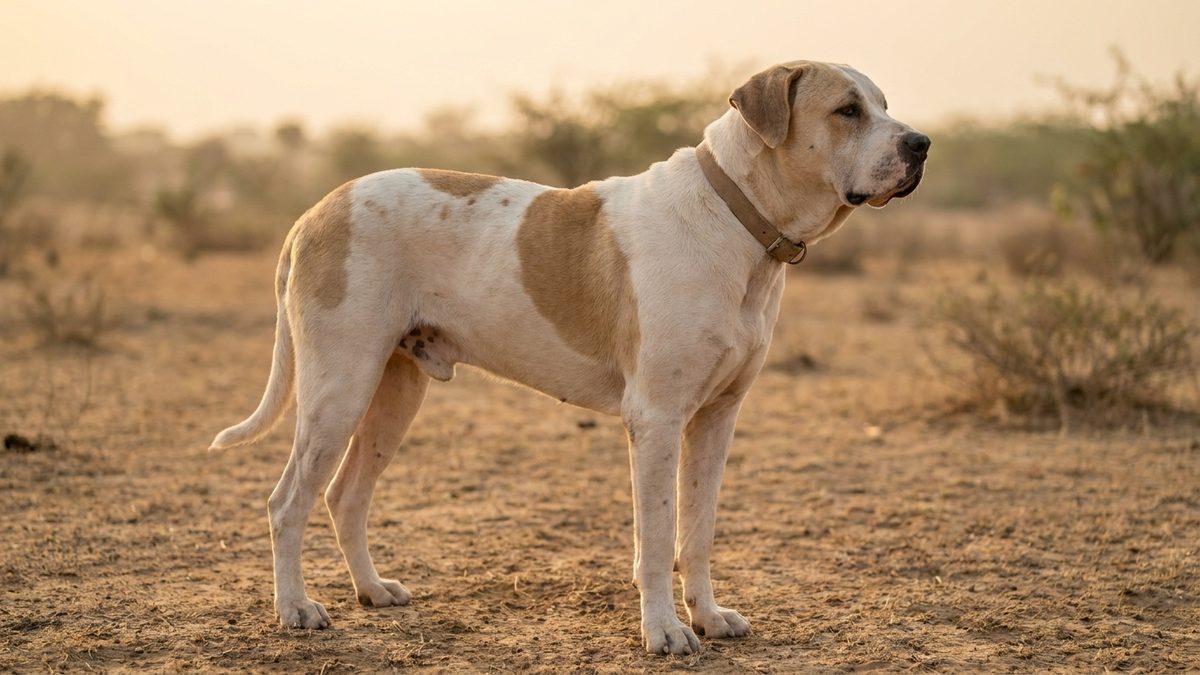
Quick answer
Bully Kutta prices in India are published anywhere from Rs 15,000 to over Rs 2,00,000, and no source explains the gap. The Bully Kutta is a giant mastiff-type guarding breed of the Indian subcontinent, also called the Indian Mastiff, Pakistani Mastiff and Alangu Mastiff. It is genuinely unsuitable for almost every Indian household, and much of the online material about it is written by people involved in dog fighting, which is a criminal offence in India.
This guide is general information for Indian pet owners and is not a diagnosis. Always consult a registered veterinarian near you before acting on anything you read here, and treat any sudden change in your dog's condition as urgent.
Bully Kutta at a glance
What the Bully Kutta actually is
The Bully Kutta is a giant mastiff-type working dog of the Indian subcontinent, used for hunting and guarding, and most common in the Punjab region of India and Pakistan including Haryana and Delhi. It is a type rather than a tightly standardised breed, which is why published figures for it vary so much.
Start with the name, because the naming is genuinely confused and no ranking page handles it honestly. The same dog is recorded under at least seven English names, specifically Alangu Mastiff, Indian mastiff, Indian bully, Pakistani mastiff, Pakistani bully, Indo-Pakistani mastiff and Sindhi mastiff. Indian retail pages treat Indian Mastiff and Bully Kutta as one breed with two names. At least one Indian source instead calls Bully Kutta a blanket term covering several fighting-dog types in Pakistan rather than a single breed. Bonbeno does not pick a winner here, because the sources genuinely disagree and the disagreement matters to a buyer who is being sold a pedigree claim.
Where the name comes from
Bully Kutta translates roughly as heavily wrinkled dog. Kutta is simply the Punjabi, Hindi and Urdu word for dog, while Bully is traced to the Punjabi root Bohli, meaning heavily wrinkled, and separately to bull, meaning lips. Indian sources repeat the Bohli derivation and connect it to the heavily folded neck skin that is the breed's most reliable visual marker. That wrinkled neck is not decorative. It is the part of the dog you will be cleaning for the next decade.
History that is documented, and history that is not
The documented history is thinner than the marketing suggests. Wikipedia's own editors flag the 16th-century origin claim as needing a better source. What is better attested is that the type originated in the Punjab and Sindh regions, that the Mughal emperor Akbar owned one and used it for hunting, and that an Indian Mastiff was exhibited at the Second International Dog Show at Islington Agricultural Hall in London on 28 May 1864. Indian sources repeat the 1864 show appearance and add descent from the extinct Alaunt war dog.
Read claims about royal and imperial lineage the way you would read any other sales copy. A verified 1864 show entry is a fact. A breeder's assertion that a particular puppy descends from Akbar's dogs is not.
Size, and why every source gives a different answer
Published size and weight figures for this breed vary enormously, and averaging them would hide the single most useful thing a buyer can learn. Every source agrees the dog is thickly boned and heavily muscular. None of them agrees on how big it actually gets. Below is what each source states.
| Source | Height stated | Weight stated |
|---|---|---|
| Wikipedia | 76 to 84 cm (males), 75 to 80 cm (females) | 70 to 90 kg (males), 60 to 70 kg (females) |
| BARF India | 74 to 84 cm | 60 to 100 kg |
| Mr n Mrs Pet | 71 to 86 cm | 50 to 75 kg |
| Dog Academy | 71 to 112 cm | 59 to 77 kg |
| Petsworld | 76 to 107 cm | 70 to 90 kg |
| Wag! | Up to 112 cm (males), up to 91 cm (females) | Up to 77 kg or more |
Two of those upper heights, 107 cm and 112 cm at the shoulder, exceed the tallest dogs ever reliably recorded and should be read as errors rather than data. The 112 cm figure traces to a single international breed page stating 44 inches at the withers for a male, and it has been copied onward from there. The credible overlap sits at roughly 74 to 86 cm and 60 to 90 kg, which still describes a genuinely giant dog. Bonbeno publishes the spread rather than a tidy average because the spread is the finding. No governing standard is being enforced consistently, so nobody can tell you with confidence how big your puppy will finish.
The coat description is disputed too, and it matters for grooming. The mainstream record calls the coat simply short, while one international breed page describes it as short but dual-layered. Expect a short coat, and expect a dog that drools heavily because of its pendulous lips.
Bonbeno publishes no bite-force figure for the Bully Kutta. Specific PSI numbers circulate widely, including on Indian breed pages that present them as measured, and none of them trace to a study that measured this breed. A number with no method behind it is marketing, and for a breed with this reputation it is marketing that gets dogs killed.
Registration status
The Indian National Kennel Club and the Indian Mastiff Registry both recognise the type, and breeders in Punjab, Haryana, Rajasthan, Tamil Nadu and Maharashtra work under Indian Mastiff Registry guidelines. Separately, Indian sellers advertise Kennel Club of India registration as a paid tier. Those are different bodies with different papers, and a certificate from one proves nothing about the other. Verify any registration claim directly with the issuing body before it changes what you pay.
Bully Kutta price in India
Bully Kutta price in India is published anywhere from Rs 15,000 to more than Rs 2,00,000, a spread of over Rs 1.85 lakh for the same breed name. No published source explains the gap, so the honest answer is that there is no single market price for this dog in India.
That spread is not noise. It is the clearest signal available that Bully Kutta is a loose type rather than a controlled breed, and that what you are buying depends entirely on who is selling. Compare the published bands directly.
| Source | Stated range | What the price is said to buy |
|---|---|---|
| Happy Pet | Rs 15,000 to Rs 50,000 | Cost of buying, no tiering given |
| BARF India, basic | Rs 15,000 to Rs 20,000 | Basic quality |
| BARF India, superior | Rs 30,000 to Rs 50,000 | Superior quality |
| BARF India, show | Rs 50,000 to Rs 1,00,000+ | Show or championship lineage |
| Mr n Mrs Pet, basic | Rs 60,000 to Rs 1,00,000 | Pet quality, no show or breeding rights |
| Mr n Mrs Pet, KCI registered | Rs 1,00,000 to Rs 1,50,000 | Kennel Club of India certification and lineage |
| Mr n Mrs Pet, champion line | Rs 1,50,000 to Rs 2,00,000 | Imported or award-winning parents |
Three patterns are worth understanding before you negotiate.
- The bottom of one source is below the bottom of another by four times. BARF India's basic tier starts at Rs 15,000 while Mr n Mrs Pet's basic tier starts at Rs 60,000 Mr n Mrs Pet, Bully Kutta. Both describe the same product in the same country in the same year.
- The premium is paid for paperwork, not for the dog. Every tiered source moves the price up on registration and bloodline claims rather than on anything you can observe in the puppy. Verify the paperwork with the issuing club directly, because an unverifiable certificate is the most expensive part of the transaction.
- One national listing platform showed six Bully Kutta listings for the whole of India. That is a thin market. Thin markets price on scarcity and seller confidence rather than on comparable sales, which is exactly how a Rs 1.85 lakh spread survives.
A Rs 20,000 Bully Kutta and a Rs 2,00,000 Bully Kutta eat the same amount, need the same fencing, and carry the same legal exposure if either one bites someone. Over a decade the purchase price is a rounding error against food, veterinary care and containment. Never buy a guarding breed because a listing looked cheap.
What a Bully Kutta actually costs to keep
Published monthly cost estimates for a Bully Kutta in India range from Rs 3,000 to Rs 15,000, and none of the sources publishing them states a method. Bonbeno reports the range and the structure rather than inventing a single figure.
Compare what the sources say, then read the structure underneath.
| Source | Monthly estimate | Stated scope |
|---|---|---|
| Happy Pet, basic | Rs 4,900 | Food Rs 3,000, veterinary Rs 1,200, grooming Rs 700 |
| Happy Pet, premium | Rs 7,650 | Food Rs 4,500, veterinary Rs 1,950, grooming Rs 1,200 |
| Mr n Mrs Pet | Rs 3,000 to Rs 7,000 | Food, grooming, vet visits, routine care |
| BARF India | Rs 5,000 to Rs 15,000 | Raw food diet only, plus Rs 2,000 to Rs 20,000 annually for veterinary care |
The BARF India figure is a raw-feeding budget published by a company that sells raw food, which is worth knowing before you treat it as neutral. Read every cost estimate against who benefits from it being high or low.
Where the money actually goes
- Food. A 70 kg working-build dog is the largest recurring line by a wide margin, and every published estimate agrees on that much.
- Secure containment. Fencing, gates and a physical boundary that holds against a 70 kg dog is a real capital cost and the one Indian owners most often skip. Budget it before you budget the puppy.
- Professional training. Treat this as a line item, not an optional extra. With a giant guarding breed it is the difference between a manageable dog and a liability you cannot insure your way out of.
- Preventive veterinary care. Core vaccination, boosters, deworming every three months given India's parasite load, and monthly tick and flea control through the monsoon.
- Grooming. Low in absolute terms, roughly Rs 700 to Rs 1,200 a month on one published estimate, because the short coat needs little work. The neck folds still need daily attention and that costs time rather than money.
- Emergency surgery fund. Bloat is a surgical emergency in giant breeds and it arrives without warning. If you cannot fund an out-of-hours abdominal surgery, you cannot fund this breed.
When we publish cost figures we state the sample size, the cities covered and the collection date. Our verified owner cost survey across eight metros is in progress. Until it publishes, we report other people's numbers as other people's numbers and tell you who paid for them.
Heat tolerance and the Indian climate
The Bully Kutta handles Indian heat less well than its native origins suggest, and this is the section where the popular story and the evidence part company. The short coat is an advantage. The giant body mass is a much larger disadvantage, and body mass wins.
Here is the contradiction nobody else prints. The breed developed in the Punjab and Sindh regions, which are among the hottest inhabited places in South Asia, and it carries a short coat. On that reasoning most pages call it heat-adapted. Yet an Indian breed database gives its ideal weather as 10 to 25 C, a band that excludes daytime temperatures across most of India for most of the year. Both statements come from mainstream sources and they cannot both be the whole picture.
The resolution is physical rather than cultural. A large animal has less surface area per kilogram of body mass to shed heat from, and a dog cools mainly by panting rather than sweating. Heatstroke in dogs is a life-threatening emergency caused by hot environments and vigorous exercise, and older and overweight dogs are specifically identified as more vulnerable. A 70 to 90 kg dog is carrying the risk factor permanently.
The other point most Indian owners miss is that heat stroke does not need an extreme temperature. It can occur in non-extreme weather through excessive exercise or poor ventilation alone, and the recognised high-risk groups are overweight animals, flat-faced breeds, dogs with thick coats, the very young and the very old, and any animal with a pre-existing condition. A heavy adult Bully Kutta worked hard on a merely warm morning in an unventilated yard is squarely inside that description.
What that means city by city
- Delhi, Haryana and Punjab. The breed's own heartland, and the place where the summer risk is highest. Move all hard work to before sunrise and after dark from March through June.
- Mumbai, Chennai and Kochi. Humidity is the problem rather than peak temperature, because panting cools poorly in humid air and the neck folds stay damp. Expect skin problems as the recurring issue.
- Bengaluru and Pune. The mildest fit in India for a giant breed, and still not a licence to exercise at midday.
- Any city, any month. Continuous access to fresh water, shade rather than a closed room, real ventilation, and a handler who stops the dog before the dog stops itself.
Learn the signs before you need them, and monitor for the early ones rather than waiting for the obvious ones. Panting that progresses to distressed or noisy breathing, restlessness, pacing, drooling, red gums and an increased heart rate come first, with lethargy, confusion, seizures and collapse following. Heatstroke commonly leads on to acute kidney injury, clotting problems and shock. Prevention is timing, shade, water and limiting exercise in heat. Treatment is a veterinary emergency and speed changes the outcome.
Owners of short-coated giant breeds routinely assume the coat settles the question. It does not. Mass, humidity and workload matter more, and a working-line dog in drive will not self-regulate. Rate this breed as moderately heat tolerant for its size and manage it accordingly.
Temperament, and the fighting problem
The Bully Kutta is a dominant guarding breed that should only be handled by well-experienced owners, on the record of a named Indian veterinarian. Any honest account of its temperament has to deal with dog fighting, because that is what has shaped the Indian population of this dog over the last decade.
The breed is described in the mainstream record as intelligent, alert, responsive, energetic and aggressive. Indian and international breed pages add protective, devoted, independent and strong-willed, and consistently say it takes an experienced owner. One international guide states plainly that the breed generally does not tolerate children or other pets well.
Two traits do the practical damage and they are not the same thing. The first is territoriality, which is what makes the dog react to a person at the gate. The second is prey drive, inherited from a working history of hunting as well as guarding, which is what makes it react to a cat, a chicken or a smaller dog moving fast. A household can manage one and be undone by the other, so assess both honestly against what actually lives on your street. Owners who describe their Bully Kutta as loyal and easy are usually describing its behaviour with the family, which was never the question.
Dog fighting is a criminal offence in India
Forcing dogs to fight is illegal in India under the Prevention of Cruelty to Animals Act, 1960. Section 11(1)(m)(ii) makes it an offence to incite any animal to fight or bait any other animal, and section 11(1)(n) makes it an offence to organise, keep, use or act in the management of any place for animal fighting, to permit or offer a place to be so used, or to receive money for admission to such a place. This is not a grey area and it is not a regional custom with legal cover.
The enforcement record is the uncomfortable part. Under section 11 the penalty for a first offence is a fine of not less than ten rupees and not more than fifty rupees, and for a second offence within three years a fine of twenty-five to one hundred rupees or imprisonment up to three months. Those figures have not been revised. A statutory maximum fine of fifty rupees is why a criminal offence has functioned in practice as a cost of doing business, and it is the single most useful legal fact on this page. International animal-welfare assessments of Indian law reach the same conclusion independently, identifying weak enforcement driven by low penalties as the central failure of the 1960 Act.
Prosecutions are correspondingly rare. Police in Indian Punjab filed a First Information Report against dog-fight organisers for the first time only in June 2018, and reporting on that case describes it as a rare FIR, triggered when organisers circulated posters publicising the events. Investigations by animal-welfare groups continue to document mastiff-type dogs used in illegal fights across several Indian states, driven by gambling, with losing dogs killed or maimed.
What that does to the dogs, and to the market
A Delhi shelter that has taken in Bully Kuttas describes the trend directly. Its account links the breed's rapid rise in popularity in Punjab, Haryana and Delhi NCR to the growth of dog fighting, and records five Bully Kuttas arriving at the shelter over roughly two years, including two rescued from a fighting ring in Punjab. It also describes the breeding practices used to produce fighting dogs, including the use of a restraint device to force mating where the female will not accept the male. That is what the supply chain looks like at its worst.
The same shelter is equally clear that the dogs themselves are not the problem. It notes that research at the University of Georgia found bully breeds show no mechanical or morphological difference in jaw structure compared with other dogs and no locking capability, and that on American Temperament Test Society testing reported in 2009 bully breeds scored better than several breeds rarely associated with aggression, including beagles and collies. Their conclusion is that properly trained and socialised, these are working guard dogs that can be raised as excellent companions.
Any seller who presents aggression, gameness or fighting ability as a desirable trait is describing a criminal use of the animal. Walk away, and consider reporting the listing. A breeder worth buying from talks about temperament stability, health testing and placement suitability, and will refuse a sale to the wrong home.
Who this breed suits
- Good fit. Experienced giant-breed owners on independent property with genuinely secure boundaries, who want a guardian, will train seriously, and can fund emergency surgery.
- Poor fit. First-time owners, apartments, homes with frequent visitors, households with small children or other pets, and anyone who wants a sociable family dog.
- Non-negotiable. Structured socialisation from the first weeks, secure containment, and honesty with yourself about whether you can physically manage a 70 kg dog that has decided something is a threat.
Training a Bully Kutta
Train a Bully Kutta with reward-based methods from the day it arrives, and accept that this is not a first-time owner's dog. The breed is strong-willed and independent, and it takes an experienced handler to get consistent obedience.
Socialisation is the safety decision, not the polish
The first three months are the most important socialisation period in a puppy's life, and the American Veterinary Society of Animal Behavior states that it should be the standard of care for puppies to receive socialisation before they are fully vaccinated. Behavioural problems, not infectious disease, are the greatest threat to the owner-dog bond and the most common reason dogs are surrendered. In a 70 kg guarding breed that window decides whether the adult dog is discriminating or indiscriminate.
Indian sources recommend starting the moment the puppy arrives home, ideally between 10 and 12 weeks, and warn that delayed socialisation is the most common mistake new owners of this breed make. One Indian breed database puts the critical window at up to about 16 weeks of age. Socialise on clean, controllable surfaces and avoid dog parks and other unsanitised, heavily trafficked areas while vaccination is incomplete.
Bully Kutta puppies are often sociable. Guarding behaviour emerges months later, well after the socialisation window has closed. Owners who judge the breed by a ten-week-old puppy and postpone the work end up with a reactive adult they cannot physically restrain, and there is no way back from that at 70 kg.
What works
- Establish calm leadership from day one. The breed responds to confidence rather than force.
- Use positive reinforcement exclusively. Reward-based training is what Indian and international sources agree on for this breed.
- Prioritise the boring skills. Sit, down, place, recall and loose-lead walking matter far more than tricks, because they are what you use to manage a visitor at the gate.
- Enrol in professional large-breed classes. Work with a handler who has actually trained giant breeds, not one who has only read about them.
- Manage arrivals deliberately. Teach a place command and use it for every single visitor, because a guarding breed with no instruction defaults to its own judgement.
- Socialise past the window, not only inside it. Owners of puppies past three months are strongly encouraged to keep socialising to as many people, pets and locations as is practical.
| Skill | Start | Reliable by |
|---|---|---|
| Name response | Week 1 home | 3 to 5 weeks |
| Sit, down, place | Week 1 home | 6 to 10 weeks |
| Loose-lead walking at weight | Month 2 | 9 to 15 months |
| Recall, no distraction | Month 2 | 6 to 12 months |
| Controlled greeting of visitors | Month 2 | Ongoing management, never finished |
| Reliable around unfamiliar dogs | Month 2 | Ongoing management, never finished |
Two rows in that table say ongoing management rather than a date. That is deliberate. With a territorial giant breed you manage the situation for the life of the dog rather than training the instinct away, and any trainer who promises otherwise is selling you something.
How much exercise a Bully Kutta needs
An adult Bully Kutta needs a minimum of 60 to 90 minutes of structured exercise daily, ideally split into a 30 to 45 minute morning walk and a 45 to 60 minute evening session. Mental work through obedience drills, scent work and puzzle feeders is part of the requirement rather than an extra.
One Indian breed database gives a lower figure of 30 to 60 minutes and rates the breed's energy level as high. Where sources disagree on an exercise floor, plan for the higher number and scale down if your individual dog settles, because an under-exercised giant guarding breed becomes a destructive one indoors and a difficult one at the gate.
The growth-plate rule matters more here than in most breeds
Avoid sustained high-impact running until the growth plates close at around 18 months, because over-exercising a giant-breed puppy can cause permanent joint damage. This breed grows rapidly through its first 18 months and inadequate management during that window leads to lifelong joint and bone problems. A Bully Kutta puppy that is jogged with its owner at eight months is being injured on a schedule.
| Stage | Guidance |
|---|---|
| Puppy to 18 months | Short frequent sessions, free movement only, no forced distance, no stairs work, no jogging |
| Adult | 60 to 90 minutes structured, split across two sessions |
| Senior | Shorter, gentler, still daily and still structured |
| Peak summer | Both sessions moved to before sunrise and after dark |
- Structured beats aimless. A training game or a scent problem delivers more than a longer wandering walk.
- Never exercise off-lead in an unsecured area. A hunting and guarding breed at this weight cannot be recalled once it has committed.
- Walk the dog on equipment that will hold. A 70 kg dog needs a lead and collar rated for it, checked rather than assumed.
- Stop before the dog stops itself. Vigorous exercise in a hot environment is a documented cause of heatstroke.
Grooming a Bully Kutta in Indian humidity
Grooming a Bully Kutta is easy for the coat and demanding for the skin folds. The short coat needs a weekly brush and a bath every four to six weeks, while the wrinkled neck skin needs daily cleaning and drying to prevent bacterial dermatitis.
That split is the whole grooming story and most Indian buyers get it exactly backwards. They are told the breed is low maintenance, they brush it occasionally, and they never once open a neck fold. In Mumbai, Chennai or Kolkata humidity, a damp fold is a warm closed pocket against skin, which is where infection starts.
- Clean and dry every neck fold daily. Wipe, then dry properly rather than leaving it damp. This is the single highest-value grooming habit for this breed.
- Brush weekly with a rubber curry or hound glove to lift dead hair. Shedding is moderate rather than heavy.
- Bathe every four to six weeks, or when genuinely dirty, which is enough to keep the dog clean without stripping protective oils.
- Check for ticks at every brush, particularly around ears, neck folds and between toes, and run monthly tick and flea prevention through the monsoon.
- Clean ears and trim nails on the same weekly schedule. On a dog this heavy, overgrown nails change how it loads its joints.
Be sceptical of grooming advice that does not match the dog. One Indian sales page states that Bully Kuttas have dense curly coats needing trimming every four to six weeks, which contradicts every other source including the mainstream record describing a short coat. A seller who cannot describe the coat correctly is not a source for anything else on that page either.
Tick and flea pressure peaks with the monsoon across most of India, and folds that stay damp invite skin infection. Increase inspection frequency through the wet months rather than sticking to a fixed weekly routine, and dry the dog properly after every soaking.
Health and lifespan
The Bully Kutta carries the standard giant-breed health risk profile, dominated by bloat and joint disease, and the published lifespan figures for it disagree by ten years. No breed-specific screening scheme or health survey exists for it in India, so anyone quoting a precise prevalence percentage is extrapolating.
Lifespan, where the sources disagree most sharply
Published lifespan claims for this breed run from 8 years to 20 years. That is not a range, it is a contradiction, so here is what each source states.
| Source | Stated lifespan | Basis given |
|---|---|---|
| Dog Academy | 8 to 10 years | None stated |
| Petsworld | 8 to 10 years | None stated |
| Mr n Mrs Pet | 8 to 12 years | None stated |
| Happy Pet | 10 to 12 years | None stated |
| BARF India | 15 to 20 years | Attributed to raw feeding, no study cited |
| Peer-reviewed comparison | 11.8 years (male), 12.0 years (female) | Median survival for large purebred dogs, 584,734 UK dogs |
The 15 to 20 year claim comes from a company selling raw dog food and is attributed to diet without a cited study. Set it against the largest longevity dataset available. Across 584,734 UK dogs, median survival for large purebreds was 11.8 years for males and 12.0 years for females, against 12.7 and 12.8 years for small breeds. The mechanism is documented separately. Analysis of mortality across 74 dog breeds found that larger dogs age faster and carry higher early mortality, producing a genuine trade-off between size and life span within the species. Large body size is associated with shorter life, not longer. A giant guarding breed living to 20 is not a documented outcome, and treating it as an expectation leads owners to skip senior screening at exactly the age it starts to matter.
There is no Bully Kutta equivalent of the Golden Retriever Lifetime Study, no Indian breed health survey, and no published screening scheme. Bonbeno states what is documented for giant breeds generally and flags what is not documented for this breed specifically, rather than borrowing a convenient number to fill the gap.
Bloat is the emergency to understand before you buy
Gastric dilatation-volvulus is the condition most likely to kill this dog suddenly. In a prospective cohort study of 1,637 large and giant breed dogs, cumulative incidence of GDV over the study period was 6 percent, and the factors significantly associated with increased risk were increasing age, having a first-degree relative with a history of GDV, faster eating speed, and a raised feeding bowl. Approximately 52 percent of GDV cases among the giant breed dogs in that study were attributed to the raised feed bowl alone.
That last finding is the most actionable thing on this page and it runs directly against common Indian practice. Raised feeding stands are sold to large-breed owners as a comfort upgrade. In the study population they were associated with more than half the giant-breed bloat cases. Feed at floor level, slow the dog down, and ask any breeder directly whether either parent has a GDV history, because family history was an independent risk factor.
The survival figures are the reason speed matters. In a cross-sectional study of 77,088 dogs attending UK emergency-care practices, GDV prevalence was 0.64 percent, and of the dogs presented alive 49.7 percent survived to discharge, rising to 79.3 percent among those managed surgically. Roughly half of dogs that reach a clinic alive do not go home, and surgery is what changes that. Identify a 24-hour veterinary hospital that can perform abdominal surgery before you bring this breed home, and know how long it takes you to get there at 2 am.
The conditions that actually appear
- Bloat, or GDV. A surgical emergency in deep-chested giant breeds, and the reason you need an emergency fund and a 24-hour clinic identified before you need it BARF India, Indian Mastiff or Bully Kutta.
- Hip dysplasia and elbow dysplasia. Hip dysplasia is common across large breeds and is named for this one by both Indian and international sources. Controlled puppy exercise and keeping the adult lean are the two levers an owner actually controls, and hip scoring from 12 months is how you find out where you stand.
- Skin fold infection. Bacterial dermatitis in the wrinkled neck skin, prevented by daily cleaning and drying. In humid coastal India this is a year-round job.
- Obesity. A hearty appetite on a giant frame, and every extra kilogram loads joints that are already carrying 70 kg.
- Arthritis in older dogs. Managed with weight control, appropriate exercise and veterinary guidance.
- Heatstroke. A life-threatening emergency, more likely in a heavy dog exercised in a hot environment.
- Infectious disease. Canine distemper, parvovirus and heartworm are named among the common health issues for this breed in India, which is a vaccination and prevention question rather than a genetic one.
The preventive schedule that is worth keeping
Core vaccination follows the standard Indian schedule, with distemper and parvovirus at 6 to 8 weeks, 10 to 12 weeks and 14 to 16 weeks, and distemper, parvovirus and rabies at one year, confirmed with your own veterinarian. Deworm every three months given India's environmental parasite load, run monthly tick and flea prevention, and take bi-annual veterinary check-ups including hip scoring after 12 months.
Feeding a Bully Kutta
Feed a Bully Kutta as a giant breed with a controlled growth curve, splitting the daily ration across at least two meals and feeding at floor level rather than from a raised stand. Getting puppy feeding wrong in this breed causes joint damage that does not reverse.
Published intake estimates put a Bully Kutta puppy at roughly 1,400 to 2,000 kilocalories a day and an adult at 2,500 to 3,000 kilocalories, with monthly food costs of Rs 3,000 to Rs 4,500. Treat those as starting points to be adjusted against body condition rather than as a prescription, because a guarded yard dog and a properly exercised adult have very different requirements.
The three rules that matter most
- Feed from the floor. A raised feeding bowl was associated with approximately 52 percent of GDV cases among giant breed dogs in the largest prospective study of the condition. This costs nothing to act on.
- Slow the dog down. Faster eating speed was an independent risk factor for GDV in the same study. Use a slow feeder or split the ration further.
- Control the growth curve. The breed grows rapidly through its first 18 months and inadequate diet in that window leads to lifelong joint and bone issues. Fast growth in a giant-breed puppy is a problem, not a sign of success.
Body condition beats any chart
A Bully Kutta should carry visible muscle with a light covering over the ribs, and you should be able to feel the ribs easily without pressing. Indian owners routinely overfeed guarding breeds in the belief that bulk equals capability, and obesity is specifically named as a risk in this breed. Weigh the dog monthly once it is adult, because on a 70 kg frame a five kilogram gain is invisible to the eye and significant to the joints.
- Split daily intake across two meals rather than one large one, which matters more in a deep-chested breed than in most.
- Keep fresh water available continuously, which is both a hydration and a heatstroke-prevention measure.
- Adjust in peak summer, when appetite commonly drops. Persistent inappetence in a giant breed is a veterinary matter, not a preference.
- Avoid the standard toxic list, specifically onions, garlic, grapes, raisins, chocolate and coffee.
Bonbeno reviews Indian pet food brands separately and tests products first-hand before publishing a verdict. Read cost and diet advice from anyone who sells food with that interest in mind, including the raw-feeding budgets published by raw food companies.
Bully Kutta puppy: the first eighteen months
A Bully Kutta puppy needs eighteen months of managed growth rather than twelve, because the growth plates do not close until around 18 months. What you do in that window sets both the joints and the temperament, and neither is recoverable afterwards.
- 8 to 12 weeks. Begin the vaccination course, with distemper and parvovirus from 6 to 8 weeks. Start structured socialisation immediately rather than waiting for full vaccination, on clean controllable surfaces. Begin daily neck-fold cleaning and handling now so the adult accepts it.
- 12 to 16 weeks. Close out the socialisation window with as much varied, positive exposure as you can manage safely. Enrol in a professional large-breed puppy class. Teach place and a reliable name response.
- 4 to 6 months. Loose-lead work becomes urgent, because the dog is about to outweigh the person holding the lead. Keep exercise frequent, short and free-moving, with no forced distance and no stairs work.
- 6 to 12 months. Guarding behaviour emerges and most owners misread it as the dog turning aggressive. Continue socialising rather than withdrawing the dog from the world. Take the first hip score from 12 months.
- 12 to 18 months. Growth plates are still closing, so still no sustained running or jogging. Begin monthly weighing and adjust food to body condition rather than to the bag.
- 18 months onward. Move to the adult load of 60 to 90 minutes structured exercise daily. Keep the dog lean for life, because obesity and joint disease are the two problems that compound.
The most common physical damage done to this breed in India is caused by kind owners. They take a strong, willing nine-month-old on long runs because it wants to go, and the growth plates take the load. Wait until 18 months. There is no way to undo it afterwards.
Bully Kutta vs Kombai
Choose a Kombai over a Bully Kutta unless you specifically need mass, because the Kombai is a documented Indian guarding breed at roughly two-thirds the shoulder height and without this breed's fighting association. Indian buyers looking for a native guarding breed routinely cross-shop these two, and the difference in scale is the whole decision.
| Factor | Bully Kutta | Kombai |
|---|---|---|
| Type | Giant mastiff-type guardian and hunting dog | Medium guarding and boar-hunting breed |
| Origin | Punjab and Sindh regions of the subcontinent | Kombai, Theni district, Tamil Nadu |
| Also called | Indian Mastiff, Pakistani Mastiff, Sindhi Mastiff, Alangu Mastiff | Combai |
| Weight, males | 70 to 90 kg | No published weight figure in the mainstream record |
| Height | 76 to 84 cm | About 58 cm |
| Build | Thickly boned, heavily muscled, pendulous lips, heavy drooler | Muscular, short smooth coat, dark red to tan with a black mask |
| Key health flag | Bloat, hip and elbow dysplasia, skin fold infection BARF India, Indian Mastiff or Bully Kutta | No breed-level health data published in the mainstream record |
| Published price, India | Rs 15,000 to Rs 2,00,000+ | See the Bonbeno Kombai guide for its published price bands |
| Rarity | Thin market, six national listings on one platform | Described as a rare breed with efforts underway to increase numbers |
| Fighting association | Documented, illegal, and shapes the Indian market Friendicoes SECA, Meet the Bully Kutta | Not a recognised fighting breed |
| Containment need | Engineered boundary rated for a 70 kg dog | Secure boundary |
The practical difference is what happens when the dog is wrong. A medium guarding breed at about 58 cm making a bad decision about a delivery rider is a serious incident. A guarding dog of 70 to 90 kg making the same decision is a different category of event, for the person, for the dog, and for your legal exposure. Mass converts an error into an injury, and it also decides whether you can physically pull the dog off.
The second practical difference is the market you are buying into. Both breeds are described as rare Wag!, Bully Kutta Dog Breed Facts…, but only one is shadowed by an illegal trade. The Bully Kutta is priced across a Rs 1.85 lakh spread with no explanation, sold thinly, and its rise in Indian popularity is linked directly by a Delhi shelter to the growth of dog fighting in Punjab, Haryana and Delhi NCR. The Kombai carries no comparable association in the published record. You are buying into that context whether you want to or not.
Both are demanding guarding breeds for experienced owners with real space. If what you want is an Indian dog for a normal household, the Indian Pariah Dog is better tempered for family life, longer-lived, adapted to the climate, and free to adopt.
Mistakes Indian Bully Kutta owners actually make
These repeat across households and are ranked by how much damage they do.
- Buying as a first dog. Every source that addresses the question says this breed needs an experienced owner, including a named Indian veterinarian on the mainstream record.
- Buying from anyone who markets fighting ability. Dog fighting is an offence under sections 11(1)(m)(ii) and 11(1)(n) of the PCA Act 1960, and the trade continues to be documented across Indian states. Money spent there funds it.
- Using a raised feeding bowl. Associated with approximately 52 percent of GDV cases among giant breed dogs in the largest prospective study available. This one is free to fix today.
- Jogging the puppy before 18 months. Growth plates close at around 18 months and high-impact work before then causes permanent joint damage.
- Never opening the neck folds. The wrinkled skin needs daily cleaning and drying to prevent bacterial dermatitis, and Indian humidity makes it a year-round job in coastal cities.
- Postponing socialisation because the puppy is friendly. The first three months are the critical period and behaviour problems, not disease, are the leading reason dogs are surrendered.
- Believing the bite-force numbers. No measured study of this breed supports the PSI figures published about it. Treat any specific figure as marketing.
- Believing the 20-year lifespan. Median survival for large purebred dogs across 584,734 UK dogs was under 12 years. Planning for 20 means skipping senior care at the age it starts to matter.
- Under-fencing. A boundary that holds a Labrador does not hold a 70 kg guarding breed, and the containment failure is what turns a private decision into a public one.
- Exercising at midday in summer. Vigorous exercise in a hot environment is a documented cause of heatstroke, which commonly leads to acute kidney injury and shock.
Sourcing a Bully Kutta, and the adoption route
Adopt a Bully Kutta rather than buying one if you are genuinely equipped for the breed, because rescued adults exist in Indian shelters, their temperament is already observable, and adopting takes a dog out of a supply chain rather than paying into it.
Adoption is a real option for this breed
Bully Kuttas turn up in Indian shelters and are among the hardest dogs to place. A Delhi shelter recorded five arriving over roughly two years, including one found abandoned on the streets of Gurgaon, two handed over after rescue from a fighting ring in Punjab, and one surrendered by an owner who could not manage him. The shelter's account of placing them is instructive. One adopter and her brother visited weekly for eight months to walk and bond with the dog before the shelter was satisfied with the match. That is the standard of care this breed warrants, and it is the standard almost no commercial sale meets.
Adopting an adult removes the largest unknown in the transaction, which is temperament. An adult's character is already formed and observable, and a shelter that has lived with the dog will tell you its triggers plainly. The shelter's own records describe individual dogs with specific, manageable triggers, one uneasy with shabbily dressed strangers and frightened of crackers, another calm but reactive to sudden movement or sound with age. You cannot get that information about an eight-week-old puppy at any price.
If you buy, verify these before money changes hands
Bully Kutta breeders in India are concentrated in Punjab, Haryana, Rajasthan, Tamil Nadu and Maharashtra, and the Indian Mastiff Registry publishes guidelines that breeders in those states work under BARF India, Indian Mastiff or Bully Kutta. Concentration is not a quality signal on its own, because the same regions carry the heaviest documented dog-fighting activity. Use the checklist below rather than geography.
- Visit where the puppies were raised. Decline any seller who will not let you. Doorstep-delivery models remove your only chance to see the conditions.
- See both parents and health test them. Hip scoring at minimum, plus eye and cardiac clearances, is what a responsible breeder of this type provides.
- Ask directly about GDV in the line. A first-degree relative with a history of GDV was an independent risk factor in the largest prospective study of the condition. Most Indian buyers never ask this question.
- Verify every registration claim with the issuing body. The Indian National Kennel Club, the Indian Mastiff Registry and the Kennel Club of India are separate organisations. A photocopy proves nothing.
- Test the seller on temperament honesty. A breeder who tells you a Bully Kutta is good with everyone is either inexperienced or selling. So is one who tells you it is a fighting dog.
- Walk away from fighting language entirely. Gameness, fighting ability and aggression presented as selling points describe a criminal use of the animal.
Reporting cruelty
Report suspected dog fighting to the police and to an established animal welfare organisation. The offences are set out in section 11 of the Prevention of Cruelty to Animals Act, 1960, and cover inciting animals to fight, organising or managing a place for animal fighting, permitting a place to be used for it, and receiving money for admission. The 2018 Punjab FIR was triggered by organisers publicising the event, which shows the offence is prosecutable when someone reports it.
If what you want is a native Indian dog rather than this specific one, you have better options. The Kombai does the guarding job at a manageable size, the Rajapalayam is a coursing sighthound with a very different temperament, and the Indian Pariah Dog is the healthiest and most climate-adapted dog in the country. None of them carries this breed's baggage.
Bully Kutta questions Indians actually search
What is the average price of a Bully Kutta in India?
Published Bully Kutta prices in India range from Rs 15,000 to over Rs 2,00,000, and the sources do not agree. One Indian breed database gives Rs 15,000 to Rs 50,000 while a national sales platform gives Rs 60,000 to Rs 2,00,000 for the same breed. The premium is charged for registration and bloodline claims rather than for anything observable in the puppy.
What is the difference between an Indian Mastiff and a Bully Kutta?
Most sources treat Indian Mastiff and Bully Kutta as two names for the same dog, alongside Pakistani Mastiff, Sindhi Mastiff, Indian bully and Alangu Mastiff. One Indian source instead uses Bully Kutta as a blanket term covering several fighting-dog types rather than a single breed. The naming is genuinely inconsistent across published sources and no single answer is settled.
How long does a Bully Kutta live?
Published claims run from 8 to 20 years, which is a contradiction rather than a range. Most breed pages give 8 to 12 years. The 15 to 20 year figure comes from a raw food company and cites no study. Across 584,734 UK dogs, median survival for large purebreds was 11.8 years for males and 12.0 years for females.
Is the Indian Mastiff or Bully Kutta good with families and children?
Not for most families. One international breed guide states plainly that the breed generally does not tolerate children or other pets well and needs an experienced owner. Even in a well-socialised dog, a 70 kg guardian makes any accident serious, and visiting children rather than the household's own are the specific risk.
How much exercise does an Indian Mastiff or Bully Kutta need daily?
An adult needs 60 to 90 minutes of structured exercise daily, ideally split into a 30 to 45 minute morning walk and a 45 to 60 minute evening session, plus daily mental work. Avoid sustained running until the growth plates close at around 18 months, because high-impact work before then causes permanent joint damage.
What are the most common health problems in the Indian Mastiff or Bully Kutta?
Bloat, hip and elbow dysplasia, skin fold infection, obesity and arthritis are the conditions named across sources. Bloat is the one that kills suddenly. In a prospective study of 1,637 large and giant breed dogs, cumulative GDV incidence was 6 percent, and a raised feeding bowl was associated with about 52 percent of giant-breed cases.
How much does it cost to maintain a Bully Kutta in India monthly?
Published monthly estimates run from Rs 3,000 to Rs 15,000 and none states a method. One Indian database gives Rs 4,900 basic and Rs 7,650 premium, split across food, veterinary care and grooming. The Rs 15,000 upper figure is a raw-feeding budget published by a company that sells raw food.
Do Bully Kuttas require special attention during certain seasons?
Yes. In Indian summer, provide shade, constant access to cool water and avoid vigorous activity in heat, because vigorous exercise in a hot environment is a documented cause of heatstroke. In the monsoon, the priority shifts to drying the neck folds daily and running tick and flea prevention, since damp folds invite bacterial dermatitis.
How can I make sure that my Bully Kutta gets socialized properly from an early age?
Start the moment the puppy arrives and treat the first three months as the critical window. The American Veterinary Society of Animal Behavior states that socialisation before full vaccination should be the standard of care, on clean controllable surfaces rather than dog parks. Behaviour problems, not infectious disease, are the leading reason dogs are surrendered.
Should I buy or adopt a Bully Kutta?
Adopt if you are genuinely equipped for the breed. Bully Kuttas reach Indian shelters, including dogs rescued from fighting rings, and an adult's temperament is already observable rather than a gamble. One Delhi shelter required an adopter to visit weekly for eight months before approving a match, which is the standard this breed warrants.
Is the Bully Kutta banned in India?
No. The Bully Kutta is not banned in India and is recognised by the Indian National Kennel Club and the Indian Mastiff Registry. What is banned is dog fighting, which is an offence under sections 11(1)(m)(ii) and 11(1)(n) of the Prevention of Cruelty to Animals Act, 1960, covering inciting animals to fight and organising or managing a place for animal fighting.
What is the bite force of a Bully Kutta?
No measured study of this breed's bite force exists, so Bonbeno publishes no figure. Specific PSI numbers circulate widely, including on Indian breed pages that present them as measured, and none trace to a method. Treat any specific bite-force figure for a subcontinental breed as marketing rather than data.
Where can I buy a Bully Kutta puppy from?
Buy only from a breeder who will let you visit where the puppies were raised, show you both parents, produce hip scores and health clearances, and answer directly about bloat in the line. Decline doorstep-delivery models that remove your chance to see conditions, and walk away from any seller who markets fighting ability.
Do Bully Kutta require professional grooming?
No. The short coat needs a weekly brush and a bath every four to six weeks, with moderate shedding. What it does need is daily cleaning and drying of the wrinkled neck folds to prevent bacterial dermatitis. Any source describing this breed as having a dense curly coat needing trimming is describing a different dog.
Compare with similar breeds
Bully Kutta sits in 4 Bonbeno groups. Each one compares it directly against the breeds it is genuinely an alternative to, on the same figures.