
Dog breed profile
Dogo Sardesco: The Sardinian Mastiff No Register Holds
Sardinia has two native working dogs of molossoid type. One of them is inside Italy's national register with a standard, a breed code and ten years of registration statistics. The other is the Dogo Sardesco, and it is in no register at all. This page works out why that matters.
Quick answer
The dogo sardesco is a rustic Sardinian working mastiff, called cani pertiatzu in Sardinian, kept to guard stock and property and to hold wild boar. No breed standard has ever been written for it and no register anywhere holds it. That absence is the finding, because Italy runs an open register for exactly this kind of population, and the other Sardinian native breed, the Cane Fonnese, is inside it while this one is not.
This guide is general information for Indian pet owners and is not a diagnosis. No health survey, screening scheme or lifespan study exists for the Dogo Sardesco, so this page publishes no life expectancy and no disease prevalence for it. Where health data appears it belongs to other breeds or to large mastiff types generally and is labelled as such. Consult a registered veterinarian who has examined your dog before acting on anything you read here.
Trait ratings, and what each one is derived from
What the Dogo Sardesco is, and why its register status is the whole story
The Dogo Sardesco is a rustic Sardinian working molossoid kept to guard stock and property and to hold wild boar, and the single most useful fact about it is that no register anywhere holds it while its island neighbour is inside one.
Italian Wikipedia describes it as a dog fairly widespread in Sardinia, used to guard herds and, in the past, for dog fighting, and states twice in the same article that a breed standard has never been fixed. The Italian agricultural atlas that Wikipedia itself points to is blunter still, printing the FCI classification as RAZZA NON RICONOSCIUTA, unrecognised breed, and under the heading Standard the single sentence that no standard exists.
That is a common enough situation for a landrace. What makes this one worth a page is the comparison sitting one island away from nothing. Sardinia's other native working dog, the Cane Fonnese, is inside Italy's national register through an open route built for exactly this kind of population, with a downloadable standard, a breed code and ten years of registration statistics. Two rustic Sardinian dogs, one door, one of them through it.
What it was and is used for
- Guarding livestock, property and sheepfolds, which the Italian sources put first in every list.
- Recovering the semi-wild Sardinian cattle that are raised free-range in the mountains, a job that needs a dog willing to face a hostile bovine.
- Working as a catch dog on big game, principally wild boar, holding rather than killing.
- Fighting other dogs, which Italian Wikipedia records in the past tense and which is a criminal offence in India today.
- Serving as a war dog, which the same article lists among its historical uses without a source.
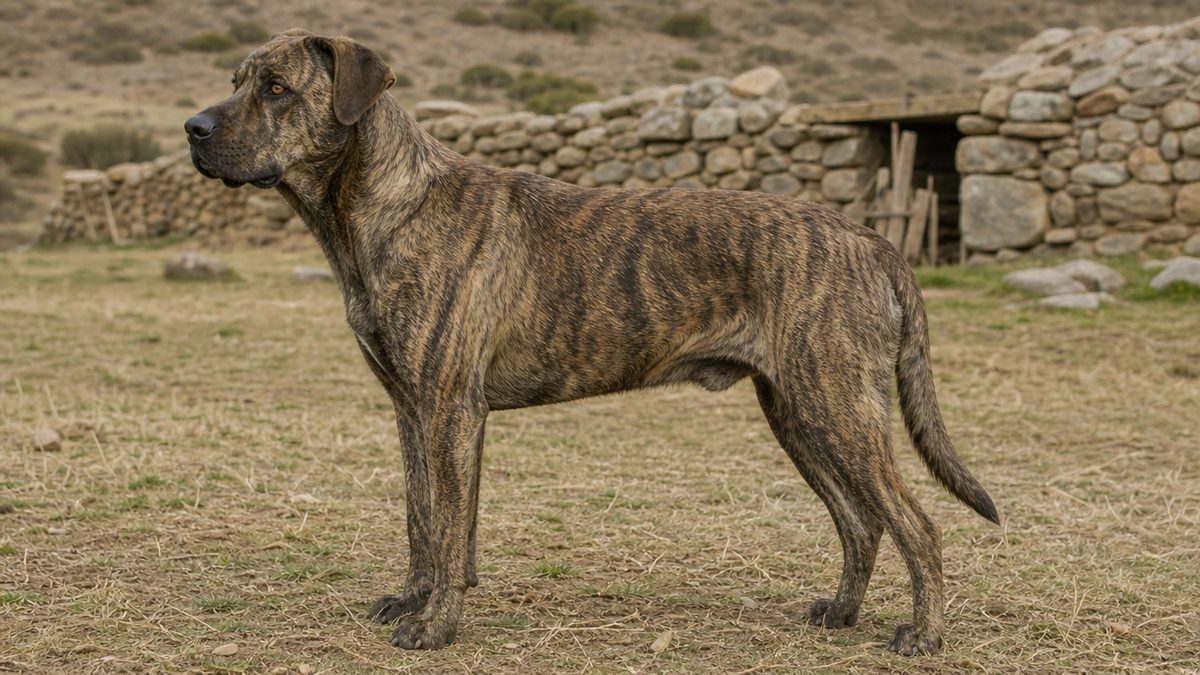
The working profile explains the physical description. This is a light molossoid rather than a heavy one, with tight skin over visible musculature, pronounced masseter muscles and a square head. It is a gripping dog built to stay on its feet on rough ground, not a mass-and-bone guard dog of the Neapolitan pattern.
Why Bonbeno is publishing this
Bing with the region set to India returns about 47 results for this term, which is the lowest count this site has recorded for any breed. A control search for a common breed in the same session returned about 47,500, roughly a thousand times more. So the ranking set is tiny, and every page in it is a general-purpose breed database rather than a source.
An independent Firecrawl web search for the same term with the location set to India returned a partly different result set on the same day, surfacing Italian Wikipedia, the Australian breed database, the molosser site and an auto-generated marketplace page, plus two social posts. Two different search engines, two overlapping sets, and not one primary document between them.
Neither ENCI's register nor the Italian agricultural atlas ranks on that first page, which means the two documents that actually answer the recognition question are invisible to an English-language reader. This page reads them and prints what they say.
The Dogo Sardesco is not the Cane Fonnese. One is short-coated, the other is bearded and shaggy, and the two are sold under each other's names constantly. If the dog in the photograph has a beard, it is not this breed.
The name problem, and what Sardinian actually calls this dog
This breed has at least a dozen names across Italian and Sardinian, the English name Dogo Sardesco is the least used of them in Italy, and knowing which name a source uses tells you how close it stood to the dog.
Start with the local vocabulary, because it carries information the English name does not. Italian Wikipedia gives the Sardinian names as jàgaru, trighinu and cani pertiatzu, and lists sorgolìnu, pastore gavoese, cani perdigatzu, cani beltigadu, pertiziau, perziaddu, alano di Bonorva and cane sardo antico as further regional labels, alongside dogo sardo and sardesco.
| Name | Language | Who uses it | What it tells you |
|---|---|---|---|
| Cani pertiatzu | Sardinian | Italian field sources and the agricultural atlas | Closest to the dogs themselves. The atlas puts it in its own page title |
| Dogo sardo | Italian | Italian Wikipedia, Italian breed press, the enthusiasts' association | The modern Italian name, and the one Italian sources prefer |
| Dogo sardesco | Italian, older form | English databases, and Italian sources noting it as the documented older form | The form the English-language internet has standardised on |
| Trighinu, jàgaru, sorgolìnu | Sardinian | Local usage, village by village | Regional variation, which is itself evidence of an unstandardised population |
| Sardinian mastiff | English | English breed databases only | A translation with no Italian counterpart |
| Alano di Bonorva | Italian, local | One town's usage | A reminder that the type varies by district |
Why the variety of names is a finding rather than trivia
A dozen local names for one animal is what an unstandardised working population looks like from the inside. Italian Wikipedia says the dog varies in appearance by area of origin, attributing this mainly to inbreeding and to the isolation of certain districts, and adds that a technical selection was never pursued because keepers privileged temperament, rusticity and working aptitude almost exclusively. Names track valleys because dogs tracked valleys.
Compare that with a registered breed, where one name in one standard replaces the local vocabulary. That substitution is precisely what the register process does, and it has not happened here.
The English name is the weakest of them
Sardesco reaches English through breed databases rather than through Italian usage, and Italian sources treat it as the older documented form of the modern dogo sardo. The English-language sites then translate it again into Sardinian mastiff, a term with no Italian equivalent at all Creatures.com, 'Dogo Sardesco: Breed Facts. Each translation step moves further from anyone who has seen the animal, which is a reasonable rule of thumb for any rare breed.
There is a practical consequence for anyone researching this dog. Searching in English returns database pages, and searching cani pertiatzu or dogo sardo in Italian returns the atlas entry, the Italian encyclopedia article and the working-dog forums where the actual argument about this breed happens.
Search dogo sardo and cani pertiatzu in Italian rather than dogo sardesco in English. The Italian-language material is where the field descriptions, the photographs of named dogs and the recovery-project account live.
Breed recognition: Italy runs an open register for exactly this case, and this breed is not in it
No kennel club anywhere recognises the Dogo Sardesco, and the finding that matters is not the absence itself but that Italy operates an open register designed for populations in recovery, holds six of them in it, and has never entered this one.
Start with the body that would hold it. The Ente Nazionale della Cinofilia Italiana keeps the Italian studbook under the supervision of the Ministry of Agriculture, Food Sovereignty and Forests. Alongside the main ROI register and the RSR supplementary register for recognised breeds, paragraph 4 of its own description of the studbook provides for a registro supplementare aperto, an open supplementary register, for the enrolment of subjects belonging to typical Italian populations in the phase of recovery as breeds. Populations, not breeds. That is the exact category this dog sits in.
It is not in it. ENCI's Group 2 list, covering Pinscher and Schnauzer types, Molossoids and Swiss Cattle Dogs, was read in full on 27 August 2026 and contains no Dogo Sardo and no Dogo Sardesco. A separate check of every breed ENCI lists under the letter D returns nine entries, of which the two under Molossoidi are the Dogo Argentino and the Dogue de Bordeaux, and neither Sardinian name is among them. Nor is it among the 18 breeds on ENCI's dedicated Razze Italiane page.
The open register is being used, and Sardinia is using it
ENCI's Group 2 list does hold the Cane Fonnese, and its breed page states the position twice over in bold: razza ammessa al RSA, a breed admitted to the open supplementary register, for which recognition procedures have been started. That page also carries an FCI code of 902, a placement in Group 2 Section 2 Molossoids, a downloadable standard, a breeders list, a champions list, a specialist-association link and a chart of registration numbers for each of the ten years from 2015 to 2024.
Six populations sit in that RSA category by English Wikipedia's tally of the same ENCI pages: the Cane da Pastore della Sila, the Cane delle Alpi Apuane, the Cane di Mannara, the Cane d'Oropa, the Cane Fonnese and the Pastore della Lessinia e del Lagorai. So the recovery route exists, it is open, it is being used, and one of this breed's closest neighbours has walked through it.
The route does lead somewhere, and recently
The RSA is not a holding pen. ENCI's own Libro genealogico news column carries an item dated 5 March 2026 announcing the official recognition of the Segugio dell'Appennino, and that breed now appears among the 18 Razze Italiane Ente Nazionale della Cinofilia Italiana. The FCI's provisional register records the same breed at standard number 375 with a provisional recognition date of 11 February 2026. That is a complete worked example of the path, running from open register to national recognition to an international standard number, finishing this year.
Two of ENCI's 18 Italian breeds are worth naming for the same reason. The Mastino Siciliano, also called the Cane di Mannara, and the Spino degli Iblei both appear on the Razze Italiane page today, while English Wikipedia's list, last edited on 14 August 2026, still records the Cane di Mannara as ENCI (partial). Where a register and an encyclopedia disagree by a fortnight, read the register.
There is no register anywhere that can issue a Dogo Sardesco pedigree, so any document offered as one is for a different breed or is not genuine. Italy's Kennel Club registers against FCI nomenclature and ENCI's own lists, and this breed appears in neither.
Both FCI registers, checked with controls
The Federation Cynologique Internationale keeps two registers and neither holds this breed, and both were checked with a control that returned a result in the same session so the absence is a finding rather than a broken query.
The FCI's definitive nomenclature is organised by group. Group 2 holds the molossoid types, and its mastiff-type section lists breeds under twelve countries of origin: Argentina, Brazil, China, Denmark, France, Germany, Great Britain, Italy, Japan, Portugal, Spain and Uruguay. Italy is represented there by exactly two breeds, the Cane Corso Italiano at standard 343 with a validity date of 25 September 2023, and the Mastino Napoletano at standard 197. There is no third Italian mastiff.
That is the control passing. The register does hold Italian molossoids, both entries open correctly, and the query returned a complete list rather than an empty one. So the absence of a Sardinian entry is a real absence.
The provisional register, which is where a new breed appears first
The FCI's second register holds breeds recognised on a provisional basis, which are not eligible for the CACIB until definitive recognition but are eligible for FCI titles, and whose pedigrees carry the FCI logo. That list was read in full on 27 August 2026. It holds 20 breeds running from standard 351 to standard 378, with the four newest, the Macedonian Shepherd Dog Karaman, the Sabueso Fino Colombiano, the Segugio dell'Appennino and the Tatransky Duric, all dated 11 February 2026.
Neither Sardinian breed is on it. Not the Dogo Sardesco, and not the Cane Fonnese either, despite the Fonnese carrying an FCI code on its ENCI page. The control here is the Segugio dell'Appennino at 375, which proves both that Italian breeds reach this register and that the list is current to this year.
| Register | Dogo Sardesco | Cane Fonnese | Control run in the same session | Control result |
|---|---|---|---|---|
| ENCI Group 2 list | Absent | Present, Molossoidi section | Dogo Argentino, Dogue de Bordeaux | Both present |
| ENCI letter D list | Absent | Not applicable | Dogo Argentino | Present under Molossoidi |
| ENCI Razze Italiane, 18 breeds | Absent | Absent | Cane Corso, Mastino Napoletano | Both present |
| FCI Group 2 definitive | Absent | Absent | Cane Corso 343, Mastino Napoletano 197 | Both present |
| FCI provisional, 20 breeds | Absent | Absent | Segugio dell'Appennino 375 | Present, dated 11 February 2026 |
The FCI code on the Fonnese page does not resolve, and that is worth knowing
ENCI's Cane Fonnese page prints an FCI code of 902 and offers a Download da FCI link built on it. Following that link on 27 August 2026 returns HTTP 200 and serves the FCI breeds nomenclature index page, titled FCI Breeds Nomenclature, rather than any breed page. So the 902 code is an internal or pending identifier rather than a live FCI nomenclature number, and the link is dead.
That detail matters beyond the Fonnese. It is a working example of the rule this site applies to every register check, which is to read the title of the document that actually came back rather than trusting the URL that was clicked. A link labelled FCI that serves an index page is not evidence of FCI recognition.
India's position follows automatically
Both Italy and India appear on the FCI's own members and contract partners register, Italy under Europe and India under Asia, Africa and Oceania. India's member body registers dogs against FCI nomenclature, so a breed absent from the FCI has no Indian registration route either. That is the practical end of the recognition question for an Indian reader.
Neither FCI register holds this breed, and both checks passed a control in the same session. Italy has two mastiffs in the FCI and neither is Sardinian.
The genetics: Sardinia has been sequenced, and this dog is not in the data
Two peer-reviewed genomic studies of Italian and Sardinian dog populations exist, both were retrieved and machine-searched, and between them they use the word Fonni 145 times and the word dogo not once.
This is the cheapest check on this page and the one that settles how much genuinely is known. Sardinian dogs have been studied at the genome level, and the study population does not include this breed.
Dreger and colleagues published a whole-genome study in Genetics in 2016 under the title Commonalities in Development of Pure Breeds and Population Isolates Revealed in the Genome of the Sardinian Fonni's Dog. The full text was retrieved on 27 August 2026 and searched. It uses Fonni 134 times, Sardinia or Sardinian 22 times, and dogo zero times.
Talenti and colleagues published a companion study in Ecology and Evolution in 2018 covering modern Italian dog populations, and its full text was searched the same way. It uses Fonni 11 times, Italian breeds 23 times, Paratore 7 times, Cane Corso 14 times, Mastino 8 times, Levriero 5 times, and dogo zero times.
| Term searched | Dreger 2016 | Talenti 2018 | What it means |
|---|---|---|---|
| Fonni | 134 | 11 | The other Sardinian breed is the subject of one paper and a reference point in the other |
| Sardinia or Sardinian | 22 | 5 | The island is squarely inside the research |
| Cane Corso | 25 | 14 | Italian molossoids are in the sample |
| Paratore | 32 | 7 | Even unrecognised Italian regional populations are in the sample |
| Levriero | 14 | 5 | Unrecognised Italian sighthound populations are in the sample |
| dogo | 0 | 0 | This breed is absent from both |
Why those zeros are trustworthy
A zero is only evidence when the same instrument returns non-zero for something it should find, and it does here, six times over in the same query run. The retrieved documents also confirm themselves on their own faces, the Dreger paper carrying its full title inside the returned page. So the search worked and the absence is real.
The comparison with the Cane Paratore is the sharpest one. That breed is an unrecognised Abruzzese droving population with no register entry either, and it still appears 32 times in one study and 7 in the other, because samples of it were collected. Being unrecognised did not keep the Paratore out of the literature. Nobody has sampled this one.
What that costs the breed
Three things follow that a Sardinian enthusiast would want reversed. There is no inbreeding coefficient for this population, so nobody can say how narrow the gene pool is. There is no clade placement, so the repeated claim that it shares root stock with the Cane Corso and the Neapolitan Mastiff is untested rather than supported. And there is no genetic evidence to distinguish it from the Fonnese, which is exactly the confusion the whole literature complains about.
The broader genomic framework these studies sit in does exist and is worth naming. Parker and colleagues built a cladogram of 161 domestic dog breeds grouped into 23 clades, which is the standard against which a new population would be placed. Placing this one is a solvable problem that nobody has funded.
There is no genetic study of the Dogo Sardesco. Where a page tells you it descends from the Cane Corso, the Neapolitan Mastiff or the ancient Roman war dog, it is repeating a tradition, not reporting a result.
Appearance: a light molossoid described three different ways
The Dogo Sardesco is a light molossoid with tight skin, a square head and a short coat, and every published size figure for it disagrees with at least one other, because there is no standard to settle them.
The most detailed description comes from the Italian agricultural atlas, written by a named author working from photographed dogs in Sardinian sheepfolds. It calls the breed a typical light molossoid with a square head and short muzzle, sometimes truncated-cone shaped, with well developed masseter muscles, and notes that because selection was based on the dog's usefulness there is today a wide phenotypic variety, always traceable back to the light molosser.
The head, and one feature that matters in India
Build is where the three descriptions converge rather than fight. The molosser profile calls it a very muscular and athletic working dog that differs from the Cane Corso in some facial features, having a longer muzzle and tighter skin, with a lean strong body, a powerful neck and sturdy legs. Italian Wikipedia agrees on the substance, giving a very athletic, agile, resistant and strong molossoid of notable bulk, with robust and well-set forelegs, strongly muscled hindquarters and a well developed chest. Lean and powerful rather than massive is the whole of it.
Three head features recur across the Italian sources. The masseter muscles must be prominent. The bite closes as a scissor or a pincer. And the dog is brachicefalo with a very pronounced occipital protuberance. Italian Wikipedia adds an imposing and solid dentition with canines of great length and a very developed third upper incisor, and gives the muzzle as slightly shorter than the length of the skull.
Brachycephalic is the word to carry forward. A shortened muzzle limits the surface area available for evaporative cooling through panting, and the largest study of heat-related illness in dogs found that brachycephalic dogs had greater odds of all three types of heat illness compared with dogs of other skull shapes. That finding is at the level of skull shape and this breed was obviously not in a 2016 United Kingdom caseload, but the mechanism transfers and the climate section returns to it.
Coat and colour, where the sources nearly agree
The coat is short, and the atlas is specific about what short does not mean here. It is not raso or glossy the way a Boxer's is, and dogs with ruffled or boar-bristle coats betray crosses with the Cane Fonnese. Colour runs through fawn in various tones, frumentino or wheaten, which the atlas calls a rare colour considered very typical and ancient, brindle in various tones, with black and grey rare.
Italian Wikipedia gives essentially the same palette, listing a usually reddish, fawn, grey, black or brindle coat of medium-short hair. A brindle coat is the colour the Sardinian name attaches to, since cani pertiatzu and cani trinu beltigadu both describe a striped dog. Eyes are amber or brown, and the atlas notes that many dogs from Gavoi have a markedly yellow eye.
Size, where they do not agree at all
The atlas gives 55 to 65 cm at the withers and 30 to 45 kg, and says plainly that size varies greatly from dog to dog and from line to line. Italian Wikipedia's infobox gives 55 to 65 cm and 35 to 50 kg; its body text, two paragraphs below, gives an average of 56 to 68 cm and current specimens at 30 to 45 kg, and adds that males start from 60 cm with larger dogs common. The molosser literature says the dog rarely exceeds 24 inches, meaning about 61 cm.
Bonbeno publishes the spread rather than averaging it. The two figures that agree across the most independent sources are 55 to 65 cm and 30 to 45 kg, and the 68 cm upper bound comes from one paragraph of one uncited encyclopedia article, from which every English database has copied it.
The molosser literature records that the ears are usually cropped and sometimes removed completely, and that the tail may be docked or left natural. Both procedures are prohibited outright in India, so no image on this site shows this breed cropped or docked, and the legal position is set out in the Indian law section below.
History and origin, and a recovery project with names and dates
The Dogo Sardesco has a documented eighteenth-century description, a medieval legal mention, and a named modern recovery project, which is more history than most unregistered landraces can show.
Italian Wikipedia records two early references and they are worth separating, because one is a naturalist and the other is a law. The Jesuit Cetti, writing around 1700, described Sardinian dogs as a perfect union between a sighthound and a large dog, which gave them several appreciable peculiarities. The Carta de Logu of the Giudicato di Arborea describes a dog of strong temperament used for the guard and the defence of its handler.
The second of those is the more interesting reference. The Carta de Logu was the legal code of a medieval Sardinian judicate, so a dog appearing in it appears as a thing the law had to deal with, which is a firmer kind of evidence than a breed tradition.
What it was made to do
The Italian sources converge on a working list rather than a single job. The atlas gives an excellent guard dog that was and still is used on big-game hunts as a catch dog, and calls it excellent for recovering the semi-wild Sardinian cattle raised free-range in the mountains. Italian Wikipedia adds guarding property and sheepfolds, hunting ungulates, and, in the past, use as a war dog and in dog fighting.
That combination explains why the dog is a light molossoid rather than a heavy one. Recovering a hostile bovine in mountain country and holding a boar are both jobs for an athletic gripping dog that can stay on its feet, not for mass.
The recovery project, which is the part nobody in English reports
From the early 2000s the cynologist Roberto Balia began publishing the results of years of fieldwork in the Sardinian countryside searching for the dogo sardo, and alongside it the Cane Fonnese, the Levriero Sardo and the Volpino Sardo. Numerous articles in the main Sardinian daily newspapers revived interest in the breed, and many dogs were made available so that a serious and careful selection could begin and the ever-present danger of crossbreeding could be averted, given the presence of Boxers and Pit Bulls on the island. The turning point in the recovery process was the publication in 2005 of the book Canis Gherradoris, also by Balia.
The same account names individual dogs, which is unusual and useful. Its photographs are captioned Tzitzone, described as the progenitor of the best bloodlines existing today, brindle specimens in a sheepfold at Gavoi, and Nur, son of Tzitzone. A named foundation dog and a named son is what the start of a studbook looks like.
The judgement that account reaches, and the question it leaves
The atlas closes by saying that today one can say the breed, though rare, is no longer at risk of extinction. Twenty years after Canis Gherradoris, the breed is still in no ENCI list, while the Cane Fonnese, which the same researcher was also documenting, is in the open register with recognition procedures under way.
Bonbeno has no evidence about why, and does not speculate. What can be said is that the two Sardinian populations had comparable starting points and different outcomes, and that the difference is administrative rather than biological.
English pages date this breed to clay statues 3,000 years old and descend it from the Neapolitan Mastiff and Cane Corso. Neither claim carries a source, and the genomic studies that could test the second one have never sampled this breed.
Dogo Sardesco price in India: there is none, and here is how that was proved
There is no dogo sardesco price in India, no Indian listing and no Indian breeder, and the absence was proved with a control search that returned a live market for a comparable breed in the same session.
Say it first, because the ranking pages either avoid the question or fill the field from a template. A commercial-intent search run from India on 27 August 2026 returned zero Indian puppy listings and zero Indian prices for this breed.
What the search returned instead
| What came back | What it actually is | Price attached |
|---|---|---|
| An Etsy printed poster | A novelty definition print for wall decor | A price for the poster |
| An eBay sticker decal | A vinyl sticker | A price for the sticker |
| An OLX Pakistan dogs page for Bahawalpur | Opened on 27 August 2026 and returned HTTP 404 with category navigation and no listings | No verifiable listing, so no price is taken from it |
| A breed-database page | Its own price field prints as unavailable and its breeders section returns zero records | None |
| Indian puppy listings | Zero | None |
The OLX row is the one worth explaining, because it is where a careless page would have found a number. A Pakistani classifieds page appeared in the result set with a rupee figure in its snippet. Opening the page returned HTTP 404 with nothing on it but category links. A price visible only in a search snippet, on a page that will not load, is not a price, and Bonbeno publishes none from it.
The control, which is what makes the zero evidence
A zero result proves nothing unless the same instrument returns something when it should. The identical query shape run for the Dogo Argentino in the same session returned a live Indian market immediately: a national listing site quoting Rs 50,000 to Rs 1,20,000, with a per-city table for Hyderabad, Bangalore, Delhi, Chennai, Lucknow, Mumbai, Jaipur and Pune, plus a kennel site and a regional buyers' group. A second control on Bing India for a common breed returned about 47,500 results against this breed's 47 Bing web search for the exact term 'dogo….
| Tier as the seller describes it | Published Indian price band |
|---|---|
| Basic quality | Rs 50,000 to Rs 80,000 |
| KCI registered | Rs 80,000 to Rs 1,00,000 |
| Champion bloodline | Rs 1,00,000 to Rs 1,20,000 |
| Dogo Sardesco, any tier | No listing, no price, no supply |
The middle row closes the section. A registration premium of roughly Rs 20,000 exists on that breed because a kennel club can issue papers for it against FCI nomenclature. No such premium can exist here, because no register in the world can issue a paper carrying this breed's name.
Why no fabricated rupee band has appeared yet
Indian rare-breed pages usually invent a price, and Bonbeno has repeatedly caught the mechanism on other breeds, where a set of rupee figures divides cleanly by a single dollar exchange rate and turns out to be an American price list run through a converter. That has not happened here, for a simple reason: this term returns about 47 results in India, which is too little traffic for anyone to bother building a page around.
Treat it as proof the page was generated. There is no Indian supply and no lawful import route for breeding stock, so a specific rupee figure can only have been made up or copied from a different dog.
Cost of ownership: what can honestly be costed, and what cannot
No cost of ownership can be calculated for this breed in India, because there is no Indian population to survey, so this section costs a comparable 40 kg working molossoid instead and labels every line as a substitute.
A monthly figure needs three things: an animal, a bodyweight and a market. This breed supplies none of them in India. What follows is the recurring cost structure for a large short-coated working mastiff in an Indian metro, offered so that a reader arriving through a rare-breed search sees the real order of magnitude before looking at a living breed.
| Cost head | What drives it | Why it matters for this body type |
|---|---|---|
| Food | Bodyweight. A 40 kg dog eats roughly two and a half times what a 16 kg dog eats | The largest recurring line for any dog over 30 kg |
| Veterinary preventive care | Vaccination, deworming, and year-round tick and flea control | Tick-borne disease pressure in India is documented and does not stop in winter |
| Cooling | Fans, a cooled room, or air conditioning through the pre-monsoon months | On a brachycephalic short-coated dog this is a health cost, not a comfort one |
| Emergency surgical reserve | Gastric dilatation-volvulus risk in large and giant breeds is established | A reserve rather than a monthly cost, and the reason large-breed owners need one |
| Containment | Secure fencing and equipment sized for a determined guarding dog | The Italian sources describe a strongly territorial working animal |
Why the containment line is not padding for this type
Every Italian description of this dog leads with guarding. The atlas opens its temperament section with excellent guard dog, and Italian Wikipedia lists guarding herds, property and sheepfolds first among its uses Wikipedia, 'Dogo sardo', Italian edition. A dog selected for centuries to hold a boundary in open country does not become a balcony dog in a Mumbai flat, and the cost of getting containment wrong is somebody else's injury.
The bloat reserve, and where the figure comes from
Glickman and colleagues established the non-dietary risk structure for gastric dilatation-volvulus in large and giant breed dogs, and it is the reason every giant-breed guide on this site tells owners to split meals, rest the dog afterwards and keep a surgical reserve. That is not a Dogo Sardesco finding and this page does not present it as one. It is a bodyweight-and-chest-depth finding, and this body type is inside it.
The honest bottom line
Bonbeno publishes no monthly rupee figure for this breed. There is no dog to feed in India, no veterinary caseload to price against and no owner to survey. Where a breed database prints a cost anyway, the number came from a template rather than from a household.
If you arrived here costing a large guarding dog for an Indian home, cost a living one. The Cane Corso and Bullmastiff guides carry real Indian figures with sources attached.
Indian law on the practices attached to this breed
Indian law reaches three specific things in this breed's published description, and reading the clauses rather than paraphrasing them changes what can honestly be said about each.
Nobody in India owns one of these dogs. What can be discussed is what Indian law says about the practices its own literature describes, because those practices are alive here on other breeds.
Ear cropping, which the molosser literature calls usual
The molosser profile for this breed states that the ears are usually cropped, sometimes completely removed, and that the tail can be either docked or left natural. In India both procedures are prohibited outright. Second Schedule Part II paragraph 6(8) of the Prevention of Cruelty to Animals (Dog Breeding and Marketing) Rules, 2017 states that there shall be no tail docking, ear cropping, de-barking, de-clawing, branding, dyeing, injecting substances to enhance visual appeal, performing a surgery or procedure to camouflage or hide any defect or infirmity or any other kind of mutilation of any body part of the pup, and that any change of appearance by artificial means is strictly forbidden.
Note what that is and is not. It is a Second Schedule paragraph, not a Rule, and writing it as Rule 6(8) sends any reader who looks it up to a different provision, because the Rules' own Rule 6 is headed Requirements to be met by breeders and establishments and is what gives the Schedule its force. Note also that the clause covers de-clawing, which matters for any breed whose keepers remove dewclaws as routine.
Dog fighting, and the clause most pages state too loosely
Italian Wikipedia records that this dog was used in the past for fights between dogs. In India, section 11(1)(m)(ii) of the Prevention of Cruelty to Animals Act, 1960 makes it an offence to incite any animal to fight or bait any other animal, under a chapeau covering acts done solely with a view to providing entertainment, and section 11(1)(n) separately covers organising, keeping, using or acting in the management of any place for animal fighting Section 11 in The Prevention of Cruelty….
Two details get dropped constantly. Section 31 makes clauses (l), (n) and (o) cognizable, so the venue offence is cognizable and the inciting offence is not. And the penalties under section 11(1) are small: a first offence attracts a fine of Rs 10 to Rs 50, and a second within three years attracts Rs 25 to Rs 100, or up to three months, or both. Neither fighting provision existed in the Act as passed in 1960; both took their current form through section 10 of Act 26 of 1982, with effect from 30 July 1982.
Recovering a landrace, and the clause a revival project would hit
This one is specific to breeds in the Dogo Sardesco's position. Second Schedule Part II paragraph 6(3) prohibits two named mating techniques: in-breeding, defined as breeding between relatives of the 2nd to 4th grade in straight or side line within the first four generations, giving uncle to niece, nephew to aunt, cousin to cousin and grandparent to grandchild as its examples; and incest breeding, meaning mating between parents and children or between brother and sister.
Any attempt to rebuild a rare population in India from a handful of founders runs straight into that clause, and paragraph 6(9) adds that breeding to create new breeds of dogs or unusual looks shall be strictly prohibited. An Indian breeder who imagined importing a few Sardinian dogs and building a line would be planning something the Rules forbid, quite apart from the import barrier.
Import, which closes the question anyway
Dogs sit under ITC (HS) 01061900 as a Restricted import. Entry is permitted only for a pet dog with a valid pet book in the importer's own name, for research organisations with a CPCSEA recommendation, or for Defence and Police use, and applications for trading or breeding purposes shall be duly rejected. No lawful Indian breeding population of this dog can form.
Three of the four provisions above are Second Schedule paragraphs rather than Rules, and one is a section of the parent Act as amended in 1982. Bonbeno names which is which, because a reader searching the 2017 Rules for Rule 6(8) will not find it.
Indian climate: Sardinia's interior is genuinely hot, and that is not the reason this dog would struggle here
Sardinia's uplands reach 41 degrees Celsius in August, which is within two degrees of Chennai's hottest month, so the honest heat argument for this breed is about humidity and duration rather than about peak temperature.
The lazy version of this section would say a Mediterranean dog cannot cope with Indian heat. The data says otherwise on peak temperature, so the argument has to be built properly. Every figure below was queried from NASA POWER by explicit latitude and longitude, and every response echoed back the coordinates it answered for, which is the check that stops a place-name lookup serving another location's document.
| Place | Coordinates queried | Hottest monthly mean maximum | Annual mean temperature | Humidity in the hottest month | Months with mean above 20 C |
|---|---|---|---|---|---|
| Gavoi, Sardinia | 40.1500 N, 9.2167 E | 41.0 C in August | 14.8 C | 52.5 percent | 4 |
| Nuoro, Sardinia | 40.3213 N, 9.3298 E | 41.5 C in August | 15.0 C | 53.6 percent | 4 |
| Cagliari, Sardinia | 39.2238 N, 9.1217 E | 33.0 C in August | 18.2 C | 69.5 percent | 5 |
| Chennai | 13.0827 N, 80.2707 E | 42.7 C in May | 27.9 C | 64.5 percent | 12 |
| Mumbai | 19.0760 N, 72.8777 E | 44.9 C in April and May | 26.8 C | 60.2 percent | 12 |
| Nagpur | 21.1458 N, 79.0882 E | 48.4 C in May | 26.9 C | 25.2 percent | 12 |
Peak temperature is not the difference. Three other things are
Gavoi is the village the Italian atlas names as the breed's heartland, and its hottest month reaches 41.0 C, against Chennai's 42.7 C Pietro Perra, 'Dogo Sardo - Cani…. On that single number the two places are close. The differences are elsewhere and they are large.
- Humidity. Gavoi's hottest month runs 52.5 percent relative humidity, Chennai's 64.5 percent and Mumbai's August 90.4 percent. Panting is evaporative cooling, so dry heat at 41 C is a solvable problem and humid heat at 40 C is not.
- Duration. Gavoi has four months with a mean above 20 C. Chennai and Mumbai have twelve. A dog built for a three-month summer meets a nine-month one.
- Recovery. Gavoi's annual mean is 14.8 C and its January mean is 6.6 C, so the dog gets a real winter to recover in. Chennai's coldest month averages 24.1 C.
- Night. An upland at 558 metres cools sharply after dark. An Indian coastal city in May frequently does not.
The skull shape, which is the part specific to this breed
The Italian atlas describes the Dogo Sardo as brachicefalo, brachycephalic, with a very pronounced occipital protuberance, and the English databases repeat that it is a brachycephalic molossoid. The largest study of heat-related illness in dogs reports that brachycephalic dogs had greater odds of all three types of heat-related illness compared with dogs of other skull shapes.
That study covered 905,543 dogs under primary veterinary care in the United Kingdom in 2016 and identified 1,259 heat-related illness events from 1,222 dogs, of which the 879 events with a recorded trigger split into 652 exertional, or 74.2 percent, 113 environmental and 46 vehicular confinement. This breed was not in that caseload and no odds ratio from it is transferred here. What transfers is the mechanism and the dominance of exertion as a trigger.
What that means in practice
For any brachycephalic working dog in India, the rule is that work is the risk rather than weather alone. Exertion accounted for nearly three quarters of the triggered heat-illness events in the largest study available, and the India Meteorological Department's heatwave thresholds, summarised by WHO India, mark the days on which such a dog should not be worked or walked at all.
It would have been easier to write that Sardinia is cool and India is hot. Gavoi hits 41 C, so that sentence would have been false. The real argument is humidity, duration and recovery time, and it is stronger for being checkable.
Temperament: what the Italian sources describe, and what the English ones invented
The Italian sources describe a strongly territorial working guard dog selected for temper and rusticity rather than for sociability, and the English pages turn that into an aggression rating with nothing behind it.
Read the Italian material first, because it is written by people who saw the dogs. The agricultural atlas is brief and functional: an excellent guard dog, used on big-game hunts as a catch dog, and excellent for recovering the semi-wild Sardinian cattle raised free-range in the mountains.
Italian Wikipedia adds the selection history that explains the temperament. A technical selection of these dogs was never pursued; keepers privileged almost exclusively subjects of strong temper and notable rusticity, along with aptitude for work. So whatever this dog is like, it is like that because working ability was the only trait anyone selected for, over centuries.
What that means for a household
A dog selected on temper and working aptitude alone, in a landrace with no standard and no temperament testing, is not a predictable animal. Italian Wikipedia describes appearance varying by district because of inbreeding and geographic isolation, and behaviour in an unselected population varies at least as much as morphology does.
There is one nearby data point worth borrowing carefully. ENCI's page for the Cane Fonnese, Sardinia's other native working dog, describes its characteristic aggressive temperament as not unmotivated aggression but the instinct to defend property, and notes that outside its own boundaries the Fonnese almost always loses that aggression. That is a territorial rather than a general disposition, and it is a plausible description of the type. It is a description of a different breed, and this page labels it as one.
What the English pages print instead
One ranking page states that the breed is highly valued for its aggressive temperament, that it is intelligent but stubborn, that obedience training is a challenge because the dog grows bored with repetitive exercises, and that it has already found itself on breed banning lists due to the aggressive nature. No source is given for any of that, and the banning-list claim names no jurisdiction, no statute and no date.
Bonbeno cannot verify a banning-list claim for a breed that appears in no register, because a legislature cannot ban a name that no studbook defines. Where a breed-specific restriction exists anywhere it is written against a named breed, and this one has no name in law.
The rating problem
Behavioural ratings on unregistered landraces are guesses formatted as data. There is no breed club survey for this population, no temperament test, no registration base to sample from and no published behavioural study. Where this page rates anything, the trait note says exactly what the rating is derived from, and there is no affection rating, no child-compatibility rating and no trainability rating here, because nothing supports one.
This is a territorial working guard dog from a population selected on temper and rusticity with no standard and no testing. That is a real description and it is also a warning. It is not a family-dog profile, and any page giving you one for this breed has written it from a template.
Training: what the working record implies, and what does not transfer
Nothing published about this breed amounts to training guidance, and the two things the working record does establish are that the dog was selected to work independently and that it was never selected for biddability.
A breed page normally answers what works and what the breed resists. For an unregistered landrace with no club and no training literature, the honest answer is that nobody has written it down, and inventing it is what the ranking set does.
The two things the record does establish
First, independence. The jobs the Italian sources describe are guarding a sheepfold, holding a boar and recovering semi-wild cattle in mountain country. All three are jobs a dog does at a distance from its handler, deciding for itself. A dog bred for centuries to make its own decisions in open country is not a dog that offers obedience easily, and that is a structural fact rather than a personality flaw.
Second, the absence of selection for biddability. Italian Wikipedia is explicit that keepers selected almost exclusively for strong temper, rusticity and working aptitude. Trainability was never on the list, so there is no reason to expect it to have been fixed.
What does not transfer
Two claims in the ranking set do not survive contact with the sources. One page says obedience training is a challenge because the dog grows bored with repetitive exercises, which is an observation about a dog somebody trained, and nobody has published training observations on this breed. The same page calls the animal stubborn, independent, confident and dominant, a vocabulary that belongs to twentieth-century dominance training rather than to any Italian source here.
The dog-fighting history is the other thing that does not transfer, and it needs saying plainly. Italian Wikipedia records fighting among the breed's past uses. Nothing about that history is a training method an Indian reader should reproduce, and inciting an animal to fight is an offence under section 11(1)(m)(ii) of the Prevention of Cruelty to Animals Act, 1960 as amended in 1982.
What an Indian reader should take from this
If you came here looking for training guidance for a large territorial guarding dog in India, it is not on this page and should not be. The transferable material lives on the guides for breeds that exist here. Read the Cane Corso guide for a modern Italian working molossoid with a national club behind it, and the Bullmastiff guide for a guarding breed with published temperament expectations.
One principle does carry across from the working description. A dog selected to hold a boundary needs its boundary defined by management rather than by correction, which means secure containment, controlled introductions and early, calm exposure to people. Building guarding behaviour by provoking a dog is both ineffective and prosecutable here.
An unregistered working landrace has no training literature because it had no owners who wrote one. Treat every confident training paragraph about this breed as fiction until somebody names the dogs they trained.
Exercise: the working pattern, and why no daily figure is published here
No daily exercise requirement can be stated for this breed, and the working pattern the Italian sources describe is short bursts of high-intensity work in rough country rather than sustained daily distance.
This section exists because the required section list demands it, and because the honest content is a working description rather than a number of minutes.
What the work actually looked like
Three jobs, three different physical demands. Guarding a sheepfold is low-output vigilance across long hours. Holding a boar is a maximal effort lasting seconds. Recovering semi-wild cattle across mountain ground is sustained moderate work over broken terrain. A dog kept for all three is an athletic animal with a high ceiling and a low resting output, which is exactly what the atlas means by a light molossoid selected on utility.
That pattern is the opposite of the modern pet-dog pattern of a fixed daily walk. It is also the pattern with the highest heat risk, because exertional triggers accounted for 652 of the 879 heat-related illness events with a recorded trigger in the largest study of the subject, or 74.2 percent.
Why no minutes-per-day figure appears on this page
There is no registration base to survey, no breed club to publish guidance and no owner population to ask. Any figure would be a guess dressed as advice. What can be said is the shape of the requirement, which is that a dog of this type needs a job or a substitute for one, and that the substitute has to respect an Indian summer.
| Demand from the working record | Indian substitute | The constraint |
|---|---|---|
| Long low-output vigilance | A secure garden or terrace it can patrol | Containment must be genuine, not decorative |
| Occasional maximal effort | Structured play in the coolest hour of the day | Exertion is the dominant heat-illness trigger |
| Sustained work on broken ground | Early-morning walking on varied surfaces | Stop entirely on IMD heatwave days |
| Mental work through decision-making | Scentwork and problem-feeding | Cheap, indoor, and heat-safe |
The rule that does transfer to any heavy short-coated dog in India
Work in the coolest hours, keep water available throughout, watch for panting that does not settle within a few minutes of stopping, and treat the India Meteorological Department heatwave threshold for your region as a hard stop rather than a caution. On a brachycephalic dog, add that panting is already less efficient than it is on a long-muzzled breed.
Divide the weekly distance a page gives by seven, then by the daily minutes it gives. If the result is a speed no dog of that size sustains, the two fields were populated independently and neither is evidence.
Grooming: a short coat is the easy part, and the ears are not
A short coat needs almost no brushing, so the real grooming work on this type in India is weekly ear checks, daily tick checks through the warm months and drying after every wetting.
Every Italian source agrees the coat is short, and the atlas is precise about what short means here: short but not raso or glossy like a Boxer's, and a ruffled or boar-bristle coat betrays a cross with the Cane Fonnese. Italian Wikipedia gives medium-short hair over skin well adherent to the musculature. Tight skin over a short coat is the easiest grooming brief in the mastiff group.
Ears, and two Indian series that disagree
The natural ear on this breed is not well described, because the molosser literature says the ears are usually cropped and sometimes removed entirely, which is illegal in India and leaves the natural carriage under-recorded. Whatever the carriage, a working dog in a humid Indian summer needs its ears checked, and two Indian series have measured how much the problem varies.
A cross-sectional analysis in the Palam Valley of Himachal Pradesh screened 2,476 dogs and found 81 otitis externa cases, attributing 69.13 percent to pendulous-eared breeds against 30.86 percent erect. That table carries a real internal error worth flagging: it prints the pendulous count as 53, and 53 divided by 81 is 65.43 percent rather than 69.13, while 69.13 percent of 81 is 56 and 56 plus 25 balances to 81. The percentage is consistent with the rest of the table; the count of 53 is not.
A separate series in and around Durg district in Chhattisgarh found prevalence peaking in summer at 41.18 percent against 33.33 percent in the monsoon, which is the opposite of the seasonal pattern most Indian care advice assumes. Bonbeno prints both rather than choosing, and the practical conclusion is that the ear check is weekly all year rather than seasonal.
Ticks, which is the real job
On a short-coated dog in India the most consequential grooming task is not coat care at all. A survey of canine tick-borne diseases in India established the disease pressure that makes a daily tick check a health measure rather than a chore. The short coat helps, because ticks are easy to find on it. The discipline is doing it every day through the warm months, checking the ear margins, the axillae, the groin and between the toes.
The one imported instruction to ignore
Northern-hemisphere breed guidance routinely says to towel a dog and let it air dry. In an Indian monsoon that is wrong for any dog with a heavy jaw and loose lip, because trapped moisture in a fold is a fungal and bacterial problem rather than a cosmetic one. Dry the folds and the ear bases after every bath and every wet walk.
Weekly ear check, daily tick check through the warm months, thorough drying after every wetting, and a rubber curry mitt every week or two for the coat. Any page recommending an undercoat rake for this breed is printing a default equipment list.
Health: no data for this breed, one real datum for its neighbour, and no lifespan published here
No health survey, screening scheme, registry dataset or lifespan study exists for the Dogo Sardesco, so this page publishes no life expectancy for it and explains what the disease lists on the ranking pages actually rest on.
Start with what is not known, because that is the honest headline. There is no breed club running a health scheme, no orthopaedic registry entry, no published mortality dataset and no peer-reviewed veterinary paper on this population. Two genomic studies covering Italian and Sardinian dog populations were retrieved and searched and neither contains the word dogo Talenti A, Dreger DL.
The disease list on the ranking pages, and where it comes from
One page lists hip dysplasia, elbow dysplasia, a likeliness to develop cancer, entropion, ectropion, primary lens luxation, cherry eye, obesity and bloat, and gives a lifespan of about 10 to 12 years. That is the standard large-molossoid template, and it is printed for a breed with no register from which any of it could have been measured. Bonbeno reproduces none of it as this breed's risk profile.
Bonbeno also publishes no life expectancy. An absent figure honestly reported is worth more than a confident one that cannot be traced, and there has never been a lifespan study of this population.
The one real health datum from Sardinia, clearly labelled
ENCI's Cane Fonnese page carries a health note that is worth quoting because it is the only Sardinian working-dog health observation on this page attached to an actual examination programme. It records that the veterinary examinations carried out in recent years in order to declare the Fonnese officially a breed showed that despite the poor conditions in which the dogs are often kept, very few individuals were positive for leishmaniasis and none for other diseases.
That is the Cane Fonnese, not the Dogo Sardesco, and this page labels it as such. It is included for two reasons. It shows what a recognition process produces, which is health data where none existed. And it names leishmaniasis, which is the Mediterranean canine disease most relevant to any Sardinian dog and one that also occurs in parts of India.
Type-level risks, none of them measured on this breed
| Risk | What the evidence says | Applies to |
|---|---|---|
| Exertional heat illness | 652 of the 879 UK heat-illness events with a recorded trigger, 74.2 percent, were exertional | Any heavy dog worked in Indian heat |
| Skull shape and heat | Brachycephalic dogs had greater odds of all three types of heat-related illness | Shortened muzzles, which the Italian atlas records here |
| Gastric dilatation-volvulus | Non-dietary risk factors in large and giant breeds are established | Deep-chested dogs over roughly 30 kg |
| Otitis externa | Two Indian series disagree on the peak season but both find substantial prevalence | Any dog in a humid Indian region |
| Tick-borne disease | Documented year-round pressure across India | Every dog kept in India |
State the heat figure precisely. It is 652 of the 879 events that had a trigger recorded, not 74.2 percent of the study's 1,259 events, because 74.2 percent of 1,259 would be 934. This breed was not in that caseload, so no odds ratio from it is imported here.
What Indian law requires, and the gap in it
Second Schedule Part III paragraph 8(10) of the 2017 Rules requires that dogs shall have been tested for genetic defects, including hip dysplasia, progressive retinal atrophy, night blindness, hypothyroidism, entropion, ectropion, overshot and undershot jaw where the incisors do not touch or mesh, wry mouth, two or more missing teeth, and unilateral or full cryptorchidism. The word is including, so the list is illustrative rather than closed.
Read that against a breed whose Italian description specifies a scissor or a pincer bite Wikipedia, 'Dogo sardo', Italian edition. A pincer or level bite is normal in this population and is not among the defects the clause names, so the clause does not bite here the way it does on breeds whose standards mandate an undershot jaw. The list also contains no hearing test and no patella grade, so the mandatory Indian screen misses several things that matter in large breeds.
It does not borrow the Cane Fonnese's numbers, or a Cane Corso's, and print them as this breed's. Where the record is empty this page says so rather than substituting a plausible figure from a relative.
Feeding: no published ration, and what transfers to a 40 kg working dog in India
No feeding guidance exists for the Dogo Sardesco, and the sensible substitute is the feeding pattern for any 35 to 45 kg deep-chested working dog in an Indian household.
There is no published ration for this breed, no breed club nutrition guidance and no owner survey. The Italian sources describe the dog's work in detail and say nothing at all about what it eats, which is what you would expect of a working landrace fed on whatever a Sardinian sheepfold produced.
What transfers, for a living dog of this size
- Feed to body condition rather than to a cup count, because calorie density varies by more than 30 percent between Indian dry foods and a cup measure ignores it.
- Split the daily ration across at least two meals and never one large meal, because meal size sits among the established non-dietary risk factors for gastric dilatation-volvulus in large and giant breeds.
- Rest the dog around meals rather than working it, for the same reason.
- Keep growth slow on a large-breed puppy and use a large-breed puppy formulation, because rapid growth loads immature joints on a heavy frame.
- Raise and monitor water intake through the pre-monsoon months, when a brachycephalic short-coated dog loses far more to panting than an owner expects.
The bloat point is the one that changes outcomes rather than merely tidying a routine. Glickman and colleagues established the non-dietary risk structure that all large-breed feeding advice rests on. None of that is a Dogo Sardesco finding and this page does not dress it as one.
Indian availability, which is the practical constraint
Large-breed dry foods are widely available in Indian metros and thinly available outside them, and the cost scales with bodyweight rather than with breed name. A 40 kg dog eats roughly two and a half times what a 16 kg dog eats, which is the single line that dominates the cost of keeping any working molossoid here.
That arithmetic is worth knowing before a reader moves from this page to a living breed, because it does not change with rarity. A rare dog and a common dog of the same weight cost the same to feed.
Bonbeno publishes no ration for this breed. There is no dog to feed in India, no measured bodyweight anyone agrees on, and no owner population to survey. Everything above is labelled as guidance for a living working molossoid and carries its own source.
The first year, month by month, anchored on the dates Indian law fixes
No Dogo Sardesco puppy timeline exists, so this section sets out the first year for the large working molossoid an Indian reader might realistically acquire instead, with the two dates Indian law actually fixes marked.
This is where a generated breed page does the most damage, because it reads like practical advice. Nothing has been recorded about litters, growth or rearing in this population, and any month-by-month schedule you find for it was written from a template.
What follows is explicitly not this breed's timeline. It is the first year of a large working molossoid in an Indian home.
| Age | What matters | Legal or evidential anchor |
|---|---|---|
| 0 to 8 weeks | The puppy stays with its dam and littermates | Rule 8(1)(a) of the 2017 Rules: pups less than eight weeks in age are not sold. This is a Rule, not a Schedule paragraph |
| 8 to 12 weeks | Home arrival, core vaccination course, first tick prevention | Indian tick-borne disease pressure is documented and year-round |
| 3 to 5 months | Socialisation window. Short, calm exposure to people, surfaces and traffic | The only period in which a guarding breed's adult behaviour is genuinely shaped |
| 5 to 8 months | Growth plates still open. No forced running, no stairs work, no jumping | Rapid growth on a heavy frame loads immature joints |
| 6 to 12 months | First Indian summer. The heat protocol starts in earnest | Exertion accounted for 652 of 879 triggered heat-illness events |
| 9 to 12 months | Meal splitting and post-meal rest become permanent habits | Non-dietary GDV risk factors are established in large breeds |
| 12 months | Adult food transition, and adult guarding behaviour is now largely set | No cosmetic surgery at any age: docking, cropping and de-clawing are forbidden under Second Schedule Part II para 6(8) |
The eight-week rule is the one a buyer can actually check
Rule 8(1)(a) of the Prevention of Cruelty to Animals (Dog Breeding and Marketing) Rules, 2017 states that pups less than eight weeks in age are not sold. It is a genuine Rule in the main body of the instrument rather than a Second Schedule paragraph, and it needs nothing but a date of birth and a calendar to verify. A seller who will hand over a six-week puppy is showing you how the rest of the operation runs.
The last row matters more for this type than most
The molosser literature says this breed's ears are usually cropped and sometimes removed completely. An Indian owner of any molossoid will be offered cropping by somebody, and Second Schedule Part II paragraph 6(8) forbids it outright along with docking, de-barking and de-clawing. Say no at eight weeks and the question never arises again.
The heat year, which no imported timeline covers
Overseas breed clubs write first-year timelines for climates whose hottest month tops out near 30 degrees. In India the puppy's first summer is a survival event. Nagpur reaches a mean maximum of 48.4 C in May and Delhi 48.8 C in June, and the India Meteorological Department's heatwave thresholds mark the days on which a heavy short-coated puppy should not go outside at all.
Every row above is for a living dog you might actually bring home. None of it records how Dogo Sardesco puppies are raised in Sardinia, because no such record has been published, and a page that presents one has invented it.
Dogo Sardesco compared with the breeds an Indian buyer can actually get
Compared head to head, the dogo sardesco loses on every practical axis to mastiff types already available in India, and the comparison is worth printing because it shows exactly what a register does for a buyer.
The honest framing is that this is not a purchase decision, because there is no Indian supply. The table exists to make the register column visible, since that single column is the difference between a breed you can verify and a name someone can attach to any dog.
| Breed | ENCI status | FCI status | Published standard | Available in India |
|---|---|---|---|---|
| Dogo Sardesco | Absent from every ENCI list | Absent from both registers | None has ever been written | No |
| Cane Fonnese | Admitted to the RSA open register, recognition procedures started | Absent from both registers | Yes, downloadable from ENCI | No |
| Cane Corso | Fully recognised, one of ENCI's 18 Italian breeds | Group 2, standard 343, valid from 25 September 2023 | Yes | Yes, in metro cities |
| Mastino Napoletano | Fully recognised, one of ENCI's 18 Italian breeds | Group 2, standard 197 | Yes | Rarely, by import |
| Dogo Argentino | Listed in ENCI's Group 2 register | Group 2, standard 292, valid from 10 November 2011 | Yes | Yes, at Rs 50,000 to Rs 1,20,000 |
Read the first two rows together, because that pair is the whole argument. Both dogs come from the same island, both are rustic working molossoids, and only one of them is inside a register Ente Nazionale della Cinofilia Italiana. Nothing about the Cane Fonnese's biology made it eligible and the Dogo Sardesco's biology ineligible. What differed was that somebody assembled a population, wrote a standard and filed it.
What the register column actually buys you
A register entry gives a buyer four things that no amount of breeder enthusiasm substitutes for. It gives a written standard against which a dog can be judged. It gives a studbook, so a pedigree can be checked against a third party rather than against the seller. It gives registration statistics, so you can see how many dogs actually exist. And it gives an appeals route if a document turns out to be false.
The Cane Fonnese has all four. Its ENCI page carries a downloadable standard, a breed code, a ten-year registration chart running from 2015 to 2024, a breeders list and a specialist-association link. The Dogo Sardesco has none of them, which is why the sentence any Indian reader needs is that a Dogo Sardesco pedigree cannot exist, anywhere, from anyone.
The comparison the ranking set makes instead
One page ranking for this term compares it against nothing and simply scores it. Another prints a colour list of roughly fifty entries including albino, leucistic, harlequin, blue merle and red tick, alongside headings for a herdbook, breeder listings and marketplace listings that all return zero records. A page whose own herdbook section says no herdbook records yet is telling you, accurately, that there is no herdbook.
If what you want is the dog rather than the name
For the working-molossoid outline in an animal you can verify, the Cane Corso is the closest legitimate substitute, and unlike this breed it has an FCI standard, an Italian national club and an Indian population. For a heavier and more extreme version, read the Mastiff and Bullmastiff guides. For a catch dog with comparable grip and a real Indian market, the Dogo Argentino guide carries current Indian prices.
If what draws you is specifically a hardy, unregistered, landrace working dog with a huge gene pool and no inherited-disease baggage, then the honest answer is on your own street. The Indian Pariah Dog is that dog, it is adapted to this climate rather than to a Mediterranean upland, and the Bully Kutta guide covers the subcontinent's own large unregistered mastiff type if that is the shape you are after.
The interesting comparison is not this breed against a Cane Corso. It is this breed against the Cane Fonnese, its neighbour on the same island, which went through Italy's open register and now has a standard, a code and a count. That is a difference in paperwork, not in dogs.
What readers get wrong about the Dogo Sardesco, and what the documents show
The commonest mistake with this breed is confusing it with the Cane Fonnese, and the second commonest is treating a copied size figure as a measurement.
Nobody in India owns one of these dogs, so the mistakes here are informational rather than practical. They matter anyway, because an answer engine reading the current ranking set will repeat every one of them.
Mistake 1: treating the Dogo Sardesco and the Cane Fonnese as one dog
These are two different Sardinian breeds and the molosser literature is explicit about the confusion. It notes reports of two separate Sardinian breeds under this name, one being a typical bearded sheepdog, while the real Dogo Sardo is known locally as the Cane Pertiatzu and is a short-haired bully type similar to the Cane Corso, and traces the muddle to the name being wrongly applied to the smooth-coated variety of the Fonnese.
The Italian agricultural atlas gives the practical test. On a Dogo Sardo the coat is short but not smooth or glossy like a Boxer's, and dogs with ruffled or boar-bristle coats betray crosses with the Cane Fonnese. A bearded or shaggy dog offered as a Dogo Sardesco is a Fonnese or a cross, and the two have completely different register positions.
Mistake 2: quoting the height figure as though anyone measured it
Three Italian and Australian sources give three different sizes and none of them cites a measurement.
| Source | Height at withers | Weight | What kind of source it is |
|---|---|---|---|
| Agraria.org, Pietro Perra | 55 to 65 cm | 30 to 45 kg | Italian agricultural atlas, ISSN registered, with field photographs |
| Italian Wikipedia infobox | 55 to 65 cm | 35 to 50 kg | Encyclopedia article carrying its own unsourced-content banner |
| Italian Wikipedia body text | 56 to 68 cm | 30 to 45 kg | The same article, two paragraphs below its own infobox |
| Pet Paw | 56 to 68 cm | 30 to 45 kg | English database, copying the Italian body text |
| Molosser Dogs | Rarely exceeds 24 inches, about 61 cm | Not given | Molosser specialist site |
| An FCI or ENCI standard | No standard exists | No standard exists | Would be the primary source, if it existed |
The Italian Wikipedia article contradicts itself inside one document, giving 55 to 65 cm and 35 to 50 kg in its infobox and 56 to 68 cm and 30 to 45 kg in its body. The English database then copied the body text and dropped the infobox, which is how 56 to 68 cm became the figure the English-speaking internet repeats. Bonbeno prints the spread rather than a single band, and notes that the agricultural atlas is the only one of them written by a named author working from photographed dogs.
Mistake 3: reading a disease list as a health profile
One ranking page lists hip dysplasia, elbow dysplasia, a likeliness to develop cancer, entropion, ectropion, primary lens luxation, cherry eye, obesity and bloat for this breed, and a lifespan of about 10 to 12 years. There is no register, no health scheme, no breed club survey and no published study for this population, so none of those figures can have been measured on it. That list is the standard large-molossoid template.
Mistake 4: trusting an English page's history
The same page states that clay statues depicting this breed were found from 3,000 years ago and that the breed was traditionally assumed to descend from the Neapolitan Mastiff and Cane Corso. Its own English is machine-spun, printing statutes for statues and opening a sentence with his instead of this, which is the visible seam of scraped and rewritten text. Where a source cannot spell its way through a paragraph, do not take a date from it.
Mistake 5: assuming English Wikipedia has an article
It does not. A MediaWiki API query on the English Wikipedia for the title Dogo Sardesco returns a redirect straight to List of Italian dog breeds, page id 67107509. The navigation box at the foot of that list then links Dogo Sardesco under Mastiffs, pointing back to the page it is already on. Anyone citing English Wikipedia for this breed is citing one table row that says recognition: none.
Ask which register issued the pedigree, then look the breed up on that register's own website. No ENCI list contains it and neither FCI register contains it, so a document presented as a Dogo Sardesco pedigree is for a different breed or is not genuine.
Adoption and responsible sourcing for a breed with no register
To source this breed responsibly in India, accept first that you cannot, then apply the same three checks to whatever you are offered instead, because the offer will not be a dogo sardesco.
No lawful route exists to bring this dog to India, and the reason is a legal fact rather than a market observation. Dogs sit under ITC (HS) 01061900 as a Restricted import, entry is permitted only for a pet dog travelling with a valid pet book in the importer's own name, for research organisations holding a CPCSEA recommendation, or for Defence and Police use, and the trade notice states plainly that applications for trading or breeding purposes shall be duly rejected.
There is a second obstacle on the Italian side, and it is cultural rather than legal. The molosser literature records that the dogs are so valued by Sardinian keepers that they routinely refuse to sell puppies to strangers, and notes that this is itself part of why the breed's heritage is hard to establish. A population that will not sell to outsiders does not produce an export market.
The three checks that matter on any rare-breed offer in India
- Verify the register. Ask which body issued the pedigree, then look the breed up on that body's own site rather than on the seller's. ENCI's Group 2 list, its letter D list and its 18 Italian breeds all lack this name, and both FCI registers lack it too.
- Verify the import. Ask for the DGFT import authorisation number and the quarantine no-objection certificate that every lawfully imported dog carries, because a seller advertising a rare European breed with no import paperwork is telling you the parents were either not imported or not that breed.
- Verify the age. Rule 8(1)(a) of the Prevention of Cruelty to Animals (Dog Breeding and Marketing) Rules, 2017 requires that pups less than eight weeks in age are not sold, and it is the one provision a buyer can check with nothing but a date of birth.
Add a fourth check that is specific to this breed. Look at the coat. A bearded or shaggy dog is a Cane Fonnese or a cross, not this animal, and the two are constantly sold under each other's names Molosser Dogs, 'Dogo Sardo'.
What the Italian recovery work actually looks like
The serious version of preserving this dog is documented and named. From the early 2000s the cynologist Roberto Balia published the results of years of fieldwork in the Sardinian countryside searching for the Dogo Sardo, and for the Cane Fonnese, the Levriero Sardo and the Volpino Sardo alongside it. Articles in the main Sardinian dailies revived interest, owners made animals available for a serious selection programme, and the turning point was the publication in 2005 of the book Canis Gherradoris.
That account ends with the judgement that the breed, though rare, is no longer at risk of extinction. Twenty years on it is still outside the register, which is the open question this page keeps returning to. An Indian reader who wants to help this breed helps it by citing it accurately, not by trying to buy one.
Adopt the dog this one actually resembles
Every Indian shelter holds dogs that do what this breed does. The functional description in the Italian sources is a medium-large, tight-skinned, short-coated, weather-hardy dog that guards property and stock and works semi-wild cattle in rough country. That is a working village dog, and India has millions of them. The Indian Pariah Dog is heat-adapted in a way no Mediterranean import is, carries an open gene pool, and costs nothing.
If it is the guarding molossoid specifically, Indian metro rescue networks regularly take in surrendered Cane Corso, Bullmastiff and Boerboel crosses whose owners underestimated the food bill and the heat load. Those dogs are already in the country lawfully and need homes now.
Do not try to acquire this dog. Read the Italian sources, get the register position right, and give a working Indian dog a home instead. If the rustic unregistered landrace is what appeals, the one on your street qualifies on every count and is available this afternoon.
Dogo Sardesco questions, answered from the registers
What is a Dogo Sardesco?
The Dogo Sardesco, also called the Dogo Sardo or in Sardinian the cani pertiatzu, is a rustic Sardinian working molossoid kept to guard livestock and property, to recover semi-wild mountain cattle and as a catch dog on wild boar. No breed standard has ever been written for it.
Is the Dogo Sardesco recognised by any kennel club?
No. It is absent from ENCI's Group 2 register list, from its letter D list and from its 18 recognised Italian breeds, and from both the FCI's definitive and provisional registers. Every one of those checks was paired with a control that returned a result in the same session.
Why does it matter that the Dogo Sardesco is not in the ENCI register?
Because ENCI runs an open supplementary register, the RSA, created specifically for typical Italian populations in the phase of recovery as breeds. Six populations sit in it, including Sardinia's other native dog, so the door exists, works and is being used.
Is the Dogo Sardesco the same as the Cane Fonnese?
No, and confusing them is the commonest error about this breed. The Fonnese is a bearded shaggy dog that sits in ENCI's open register with a downloadable standard and ten years of registration statistics. The Dogo Sardesco is short-coated and is in no register at all.
What is the Dogo Sardesco price in India?
There is none, because there is no Indian supply. A commercial-intent search from India returned zero listings and zero prices, against a control search for a comparable mastiff type that immediately returned a live Indian market at Rs 50,000 to Rs 1,20,000.
How big is a Dogo Sardesco?
The sources disagree because there is no standard to settle them. The Italian agricultural atlas gives 55 to 65 cm and 30 to 45 kg, Italian Wikipedia's infobox gives 55 to 65 cm and 35 to 50 kg, and its own body text two paragraphs later gives 56 to 68 cm and 30 to 45 kg.
How long does a Dogo Sardesco live?
Nobody knows and Bonbeno publishes no figure. The 10 to 12 year lifespan repeated across English pages cites no study, and no lifespan study of this population has ever been carried out because there is no register to survey.
Has the Dogo Sardesco been studied genetically?
No. Two peer-reviewed genomic studies of Italian and Sardinian dog populations were retrieved and searched, and between them they use the word Fonni 145 times and the word dogo not once, while other unrecognised Italian populations such as the Cane Paratore do appear.
Can I buy a Dogo Sardesco in India?
No. There is no Indian supply, no lawful import route for breeding stock, and Indian trade rules state that import applications for trading or breeding purposes shall be duly rejected. Sardinian keepers are also reported to refuse selling puppies to strangers.
Could a Dogo Sardesco cope with Indian heat?
Peak temperature is not the problem. Its own uplands reach 41.0 C in August against Chennai's 42.7 C. The differences are humidity, at 52.5 percent against 64.5, and duration, at four months above 20 C against twelve.
Is the Dogo Sardesco aggressive?
The Italian sources describe a strongly territorial working guard dog from a population selected almost exclusively for temper, rusticity and working aptitude. That is a real description and a genuine warning, and it is not the same as the unsourced aggression ratings printed on English database pages.
Why does the Dogo Sardesco have so many names?
Because it is an unstandardised working population whose type varies by district. Sardinian gives jagaru, trighinu and cani pertiatzu, and Italian Wikipedia lists sorgolinu, pastore gavoese, cani beltigadu and alano di Bonorva among others.
Does English Wikipedia have a Dogo Sardesco article?
No. A MediaWiki API query for that title returns a redirect straight to List of Italian dog breeds, where the breed occupies one table row giving its recognition status as none and citing a single Italian page the article itself flags as possibly unreliable.
Are Dogo Sardesco ears cropped?
The molosser literature says the ears are usually cropped and sometimes removed completely, and that the tail may be docked. Both procedures are prohibited outright in India under Second Schedule Part II paragraph 6(8) of the 2017 Rules, so no image on this site shows a cropped or docked dog.
What should I read instead if I want a working molossoid in India?
Read the guides for breeds that exist here and can be verified. The Cane Corso has an FCI standard, an Italian national club and an Indian population, and the Bullmastiff and Dogo Argentino guides carry real Indian price data and documented health risks.
What breed of dog is a Dogo?
Dogo is a word several molossoid breeds carry rather than one breed. On this page it names the Dogo Sardesco, also called the Dogo Sardo, a rustic Sardinian light molossoid with tight skin, a square head and a short coat, kept to guard stock, recover semi-wild mountain cattle and hold wild boar, for which no standard has ever been written and which sits in no register. The only dogo in ENCI's letter-D molossoid list is the Dogo Argentino, alongside the Dogue de Bordeaux.
Compare with similar breeds
Dogo Sardesco sits in 1 Bonbeno group. Each one compares it directly against the breeds it is genuinely an alternative to, on the same figures.