
Breed profile
Dogo Argentino in India: Price, Deafness, Heat and the Law
One in four Dogos in the largest published hearing study was deaf in at least one ear, the March 2024 circular that named this breed is not in force, and no page ranking in India tells you either thing. This one does, with the denominators.
Quick answer
The Dogo Argentino is an all-white Argentine big-game hunting dog of 40 to 45 kg, recognised as FCI Standard 292 and built in Córdoba province from the extinct Córdoba fighting dog. Owning one in India is lawful today, because the March 2024 circular that named the breed was quashed by the Karnataka High Court and set aside by the Delhi High Court. Its defining health issue is pigment-linked deafness, found in 209 of 811 dogs BAER tested.
This guide is general information for Indian pet owners and is not a diagnosis. The deafness, tumour and genetic findings below come from published studies of dogs outside India, and no Indian cohort of this breed has been studied. Hearing loss, skin lesions on white skin, and any lump on a large white dog need a registered veterinarian who has examined the animal. Consult one before acting on anything you read here.
Dogo Argentino traits, rated for India
What a Dogo Argentino is, in its own standard's words
The Dogo Argentino is an all-white Argentine big-game hunting dog of 40 to 45 kg, recognised by the Fédération Cynologique Internationale as Standard 292 and bred in Córdoba province from the extinct Córdoba fighting dog. Its own standard states the job in three words under Utilization, big-game hunting dog.
Start with the document rather than with a breed page. FCI Standard 292 was published in English on 2 August 2012 from a Spanish original valid since 10 November 2011, translated by Jorge Nallem, and it prints DOGO ARGENTINO on its own first page. The nomenclature entry places the breed in Group 2, section Molossian type, subsection Mastiff type, country of origin Argentina, recognised on a definitive basis since 31 July 1973, and not subject to a working trial.
The creator was a surgeon. The standard names Dr Antonio Nores Martinez, 1907 to 1956, and describes his work as the methodical crossbreeding of the Old Fighting Dog of Cordoba, a type it says was itself the product of crossing dog of the breeds Bulldogs and Bull Terriers. He selected completely white dogs that were not undershot, with heavy heads and long muzzles, and crossed the base type with eight further breeds, listed in the standard as English Bull Dog, Great Dane, Pyrenean Mastiff, Bull Terrier, Boxer, Pointer, Dogue de Bordeaux and Irish Wolfhound. By 1947 the breed was created and its genotype and phenotype stabilised, and the standard was presented at the Hunter's Club in Buenos Aires the same year.
The ancestor matters and is covered separately. Read the Córdoba Fighting Dog for what that animal actually was, how it disappeared, and which parts of its story are folklore. One point is worth carrying across here: the founding lists for the two breeds are different lengths and Indian pages routinely merge them. The FCI names two breeds behind the Córdoba and eight crossed into the Dogo, and neither list is the other.
Three sources, three different sizes for the same dog
The size figures do not agree, and one of the disagreements is inside a single page.
| Source | Height, males | Height, females | Weight, males | Weight, females |
|---|---|---|---|---|
| FCI Standard 292 | 60 to 68 cm, ideal 64 to 65 | 60 to 65 cm, ideal 62 to 64 | 40 to 45 kg | 40 to 43 kg |
| AKC breed page | 24 to 26.5 in, about 61 to 67 cm | 24 to 25.5 in, about 61 to 65 cm | 80 to 100 lb, about 36 to 45 kg | Not stated separately |
| Wikipedia infobox | 60 to 68 cm | 60 to 65 cm | 40 to 48.5 kg | 40 to 43 kg |
| Wikipedia body text | 60 to 68 cm | 60 to 65 cm | 40 to 45 kg | Slightly less |
Two things fall out of that table. Wikipedia's infobox gives a male weight of 40 to 48.5 kg and footnotes it to FCI Standard 292, while Wikipedia's own body text gives 40 to 45 kg from the same footnote, and the standard itself says 40 to 45 kg Wikipedia, Dogo Argentino. The infobox overshoots its own cited source by 3.5 kg, and that inflated top figure is what Indian pages tend to copy. Separately, the AKC's lower weight bound of 80 pounds is 36.3 kg, four kilograms below the FCI floor, and the FCI lists as a fault males and females whose weight does not comply with the official valid standard American Kennel Club. A dog can be within the AKC range and faulted under the FCI one.
The coat, and the one line in the standard that matters most in India
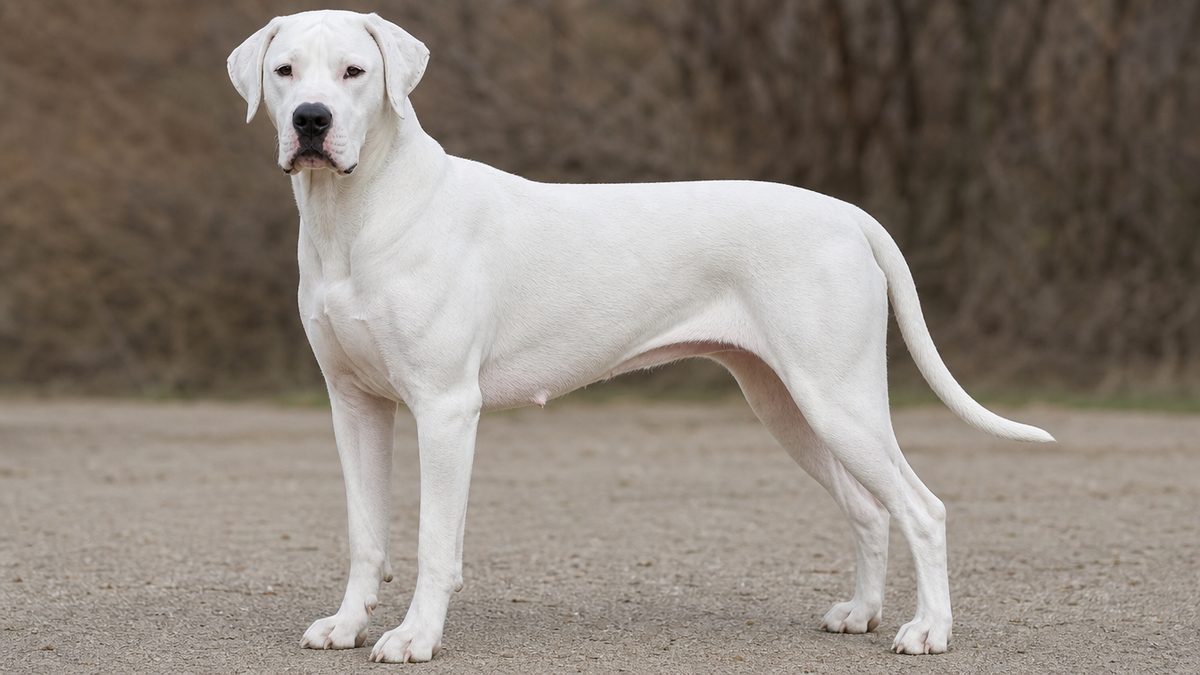
The coat is uniform, short and smooth, with an average length of 1.5 to 2 cm, and the standard adds five words that no Indian page quotes: density and thickness vary according to climate. Colour is entirely white, with at most one black or dark patch on the skull, which may sit on one ear or around one eye and must not exceed 10 percent of the head. Comparing two dogs of equal quality, the standard says the whiter should be preferred.
FCI Standard 292 lists Deafness among its disqualifying faults, alongside aggressive or overly shy temperament, an over or undershot mouth, eyes of different colour or blue, spots on the body coat and more than one spot on the head. A registry does not disqualify a trait unless that trait turns up often enough to need disqualifying. That single line is the strongest clue on the page to what the health section below sets out with numbers.
Auditing the history, including one place we disagree with our own sibling page
Four separate history claims about this breed do not survive checking, and one of them appears on Bonbeno's own Córdoba Fighting Dog page. Publishing that disagreement rather than quietly matching the house line is the only way a reader can tell which parts of a breed history are documented and which are repeated.
Every breed history is a chain of copies, and the Dogo Argentino's chain is short enough to walk. Read the Córdoba Fighting Dog alongside this page, because that one audits the ancestor's story and this one audits the descendant's.
1. Two founding lists get merged, and they are different lengths
Keep the two lists apart. FCI Standard 292 says the Old Fighting Dog of Cordoba was the product of crossbreeding among dog of the breeds Bulldogs and Bull Terriers, naming two, and then separately lists the eight breeds crossed into the Dogo programme as English Bull Dog, Great Dane, Pyrenean Mastiff, Bull Terrier, Boxer, Pointer, Dogue de Bordeaux and Irish Wolfhound. Two for the ancestor, eight for the descendant, and Indian pages routinely print one list under the other's heading.
2. Wikipedia's infobox drops five of the eight
Wikipedia's foundation stock field lists four entries, the Old Cordoba Fighting Dog, Bull Terrier, Pyrenean Mastiff and Irish Wolfhound, while its own body text names the Irish Wolfhound, Boxer, Great Dane, Bull Terrier, Dogue de Bordeaux and Spanish Mastiff. The Spanish Mastiff appears in neither the infobox nor FCI Standard 292, and the FCI names Pyrenean Mastiff instead. These are two different FCI breeds with two different standards, and treating them as interchangeable is not reading either.
Wikipedia's body also carries a specific generational claim sourced to a 2018 Spanish-language book, that a Pyrenean Mastiff bitch was introduced in the eighth generation and that the dogs were breeding true by the twelfth. FCI Standard 292 says nothing about generation counts. Bonbeno could not open that book and therefore reports the claim as attributed rather than as established.
3. Three different years for the first standard, and here we disagree with our own page
| Year | What is claimed | Source |
|---|---|---|
| 1928 | First breed standard written, with the founder's own drawings | AKC breed history, as recorded on Bonbeno's Córdoba fighting dog page |
| 1947 | Breed created and stabilised; standard presented at the Hunter's Club, Buenos Aires | FCI Standard 292, read directly |
| May 1947 | Standard published in the magazine Diana | Modern Molosser, as recorded on Bonbeno's Córdoba fighting dog page |
| 1948 | Breed standard published in the magazine Diana | Wikipedia, citing Vianini, El Dogo Argentino, 2018 |
The first two are not in conflict and our sibling page is right to say so: a private draft in 1928 and a formal presentation in 1947 describe two different events. The third and fourth rows are a genuine conflict, and it is between Bonbeno and Bonbeno. Our Córdoba fighting dog page dates the Diana publication to May 1947 on the authority of Modern Molosser. Wikipedia dates the same event to 1948 on the authority of Vianini's 2018 book. This page did not open Modern Molosser and could not open Vianini, so it resolves nothing and flags both. A reader who needs the date should know it is contested by about a year, which is more useful than being handed either figure alone.
4. The per-breed purposes are not in the standard
You will read that the Pointer was added for scenting, the Great Dane for height, the Bull Terrier for the white coat, the Pyrenean Mastiff for calm temperament, the Boxer for tractability and the Bulldog for jaw power. That allocation comes from the AKC's breed-history article, not from the standard. FCI Standard 292 lists the eight crossed breeds and attributes a purpose to none of them. It says only that the founder selected completely white dogs, not undershot, with heavy heads and long muzzles, and that his aim was accomplished through different generations.
So the white coat is attributed by the standard to selection, not to a named donor breed. That distinction matters for this page in particular, because the white coat is the trait the deafness attaches to. A story that assigns the colour to one breed makes it sound like an inherited gift. The standard describes a breeder choosing whiter dogs over many generations, which is the mechanism by which pigment-linked deafness accumulates in a population.
Four things about this history are settled and come straight off primary documents. The breed originates in Córdoba province, Argentina Fédération Cynologique Internationale. It was recognised by the Federación Cinológica Argentina and the Sociedad Rural Argentina in 1964, which opened their studbook. The FCI accepted it on a definitive basis on 31 July 1973. And the American Kennel Club recognised it in 2020, placing it at 101 of 210 on its own popularity chart. Everything in dispute above sits in the twenty years before 1947.
Deafness in the Dogo Argentino, with the denominators
Roughly one Dogo Argentino in four is deaf in at least one ear, 209 of 811 dogs BAER tested in the largest published series, or 25.77 percent. Of those, 165 were deaf in one ear only and 44 in both, and a dog deaf in one ear is invisible to an owner without a machine.
This is the breed's central health question and it is measurable, which makes it unusual. Congenital sensorineural deafness in the Dogo Argentino is associated with white pigmentation, and until 2021 no prevalence data existed. George M. Strain at Louisiana State University then published a retrospective study of dogs tested by brainstem auditory evoked response with phenotype data recorded for sex, iris colour, presence or absence of a head patch, and parent hearing status.
| Hearing status | Percentage reported | Dogs, from 811 |
|---|---|---|
| Bilaterally hearing | 74.23% | 602 |
| Unilaterally deaf | 20.35% | 165 |
| Bilaterally deaf | 5.43% | 44 |
| Deaf in one or both ears | 25.77% | 209 |
The counts in the right-hand column are derived, and the arithmetic closes exactly, which is the check worth running on any percentage before quoting it. 165 divided by 811 is 20.345 percent, which rounds to the published 20.35, and no neighbouring integer does. 44 divided by 811 is 5.425 percent, matching 5.43, and again uniquely. 165 plus 44 is 209, and 209 of 811 is 25.77 percent, exactly as the paper prints. The 811 figure is the number of dogs with both BAER results and phenotype data, not the number of dogs in a clinic register, so it is the correct denominator.
The head patch is protective, and the blue eye finding is not usable
Dogs without a patch had a significantly higher deafness rate than patched dogs, and blue-eyed dogs had higher rates than brown-eyed dogs, but on the second finding the sample was too small for the chi-square association to be considered valid. The author states that limitation himself. So the patch result is a real finding you can act on and the blue-eye result is a signal you should not quote as a rate.
There is an uncomfortable consequence for the show ring. FCI Standard 292 permits one dark patch on the head and then says that, comparing two dogs of equal quality, the whiter should be preferred. The same standard lists deafness as a disqualifying fault. A preference for the whiter of two equal dogs and a measured protective effect of a head patch point in opposite directions, and Bonbeno has found no source that reconciles them. Both statements are quoted here rather than averaged.
A second series, in Poland, found a much higher rate
Publish the disagreement rather than the average. A Wrocław University series that BAER tested 32 Dogos Argentinos found 12 deaf, or 37.5 percent, against 14.5 percent in 117 Bull Terriers, 21.9 percent in 32 English Setters and 4.8 percent in 62 Australian Cattle Dogs measured in the same study. Thirty-two dogs is a small sample and the true rate could sit anywhere in a wide band, so the useful reading is that both studies put this breed at the top end of the deafness-predisposed group, not that the rate is precisely 25.77 or precisely 37.5 percent.
What the deafness physically is
The mechanism was described in 2003 from a single pup. Two bilaterally deaf and three unilaterally deaf pups were identified in one litter of ten Dogos Argentinos presented for electrophysiological hearing evaluation, and a 43-day-old bilaterally deaf female was examined histologically. Both inner ears showed cochlear degeneration with atrophy of the stria vascularis, collapse of the cochlear duct, degeneration of the organ of Corti and an abnormal tectorial membrane, while the vestibule and the spiral and vestibular ganglia were essentially normal. The authors classified it as cochleosaccular degeneration, the same pattern described in deaf Dalmatian pups and other white-coated breeds.
Two practical points follow from that description. The damage is in the cochlea and it is degenerative and congenital, so it is present before the puppy leaves the litter and no training, supplement or surgery reverses it. And five of ten pups in that one litter were affected in at least one ear, which is what a bad pairing looks like at litter level rather than at population level.
The American Kennel Club's Dogo Argentino breed page describes the breed as in general a healthy dog with few genetic problems and lists the national breed club's recommended health tests as hip evaluation, cardiac exam and BAER testing. The word deaf does not appear anywhere on that page. A reader is told to run the test without being told what it is for, and an Indian buyer skimming it will not learn that a quarter of the breed fails it.
BAER testing in India, and the gap in Indian law
Indian law mentions deafness zero times and BAER zero times, so nothing obliges an Indian breeder of this breed to test hearing. That absence is verifiable rather than asserted, and it is the single most important thing an Indian buyer of a Dogo Argentino needs to know before paying a deposit.
Bonbeno downloaded the machine-readable gazette text of the Prevention of Cruelty to Animals (Dog Breeding and Marketing) Rules 2017, G.S.R. 496(E) of 23 May 2017, and extracted all fourteen pages with pypdf, giving 51,953 characters. Searching that extraction case-insensitively returns zero occurrences of BAER and zero occurrences of deaf. The word hearing occurs once, in Rule 10(2), where it is the opportunity of hearing given to a breeder appealing to the Secretary, Animal Husbandry of the State, and not an auditory test.
That absence is not an oversight in a vague instrument. The Rules are specific elsewhere. Second Schedule Part III paragraph 8(10) reads that the dogs shall have been tested for genetic defects, including hip dysplasia, progressive retinal atrophy, night blindness, hypothyroidism, entropion, ectropion, overshot, undershot jaw (when incisors do not touch or mesh), wry mouth, two or more missing teeth, unilateral cryptorchid or full cryptorchid males. Eleven named conditions, an eye list, a jaw list, and no hearing test.
How the 2017 list lands on this particular breed
Read paragraph 8(10) against FCI Standard 292 and the fit is close in places and absent in the one that matters.
| Named in the Indian clause | What FCI Standard 292 says about it | Verdict |
|---|---|---|
| Entropion, ectropion | Both listed as faults | Aligned. Indian law requires the test the standard implies |
| Overshot, undershot jaw | Over or undershot mouth is a disqualifying fault | Aligned |
| Two or more missing teeth | Full dentition is recommended, teeth large with normal implant | Aligned |
| Cryptorchidism | Males should have two apparently normal testicles fully descended | Aligned |
| Hip dysplasia | Not mentioned in the standard; the AKC breed club recommends hip evaluation | Aligned in practice |
| Deafness | Listed as a disqualifying fault by the FCI | Absent from the Indian clause entirely |
So the position is precise and slightly absurd. Indian law obliges a breeder of this breed to have tested for a jaw fault and an eyelid fault, both of which a buyer can see, and says nothing about the one condition affecting a quarter of the breed that a buyer cannot see Strain GM, Congenital sensorineural…. The word in the clause is including, so the list is illustrative rather than closed, and a determined regulator could argue deafness falls inside it. No Indian page Bonbeno found makes that argument, and no buyer should rely on it.
Getting a BAER test done in India
BAER is an electrophysiological test, not a behavioural one, and it needs equipment rather than expertise alone. It works by placing subdermal electrodes and delivering a click stimulus to each ear separately while recording the brainstem response, which is how it separates a unilaterally deaf ear from a hearing one. That separation is the whole point, because a dog with one working ear orients, responds to its name and passes every kitchen test an owner can devise.
- Ask a veterinary neurologist first, because BAER lives with neurology rather than with general practice, and the same rigs are used for brainstem work.
- Try veterinary college teaching hospitals in your state, which are where diagnostic equipment of this kind is most often installed.
- Test at five to six weeks where a breeder will allow it, since the response is mature well before the eight-week minimum sale age set by Rule 8(1)(a) of the 2017 Rules.
- Ask for the printed trace, not a verbal result, and keep it with the registration papers.
- Test both parents too, because a unilaterally deaf parent is the commonest hidden contributor and Strain's study could not assess parent hearing effects for exactly that reason, too few dogs with a unilaterally deaf parent were present.
Bonbeno is not naming clinics. Diagnostic equipment moves, referral arrangements change, and a named list would be wrong within a year. What does not change is the question to ask, which is whether the practice performs brainstem auditory evoked response testing and can supply the trace.
A unilaterally deaf dog lives a normal life and most owners never find out. What changes is safety management rather than welfare. Sound localisation is what fails, so a dog deaf on one side cannot reliably tell which direction a scooter, a call or another dog is coming from. Treat recall in open ground as unreliable, use a long line near traffic, and approach the dog from the hearing side when it is asleep, because a startled 45 kg dog is a different problem from a startled 5 kg one.
Is the Dogo Argentino banned in India? The precise answer
No Indian law in force today bans owning, breeding or selling a Dogo Argentino. A central circular did name the breed on 12 March 2024, and that circular was quashed by the Karnataka High Court on 10 April 2024 and set aside by the Delhi High Court on 16 April 2024, and the Union told the Bombay High Court in January 2025 that it is not acting on it at present.
Get the instrument right first, because it was never a statute. The document is circular number D.O.V-11/1/2024-ANLM.DADF dated 12 March 2024, a letter from Dr O.P. Chaudhary, Joint Secretary in the Department of Animal Husbandry and Dairying, Ministry of Fisheries, Animal Husbandry and Dairying, addressed to the chief secretaries of all states and union territories Khadija Khan, How three high courts have…. The Karnataka High Court reproduced it verbatim in its judgment, which is why this page can quote it rather than paraphrase a news summary.
The Dogo Argentino is on the list. The circular records that an expert committee under the chairmanship of the Animal Husbandry Commissioner has identified the following breeds of dogs as ferocious which are dangerous for human life, and the list opens breeds (including mixed and cross breeds) like Pitbull Terrier, Tosa Inu, American Staffordshire Terrier, Fila Brasileiro, Dogo Argentino, American Bulldog, Boerboel, Kangal, Central Asian Shepherd Dog (ovcharka), Caucasian Shepherd Dog (ovcharka), South Russian Shepherd Dog (ovcharka), Tornjak, Sarplaninac, Japanese Tosa and Akita, Akbash dog Moscow Guard dog, Cane corso and every dog of the type commonly known as a Ban Dog (or Bandog).
It asked local bodies and animal husbandry departments to issue no licences or permits for sale, breeding or keeping of those breeds, to issue implementation guidelines, and directed that the dogs which have already kept as a pet shall be sterilized so that further breeding may not happen.
Nobody agrees how many breeds were on it
Count the list yourself and you will not reach 23. As reproduced by the Karnataka High Court the list has missing commas in two places, Japanese Tosa and Akita and Akbash dog Moscow Guard dog, and resolves to 19 named entries. The Indian Express, quoting the same circular ten days after it issued, prints six further entries the court's reproduction does not contain, namely Mastiffs (boerbulls), Rottweiler, Terriers, Rhodesian Ridgeback, Wolf Dogs and Canario. The press settled on 23 breeds Express News Service, SCC Online's report of the Delhi judgment says 24, and the two published versions of the list differ by six entries. Bonbeno cannot tell from these documents whether the court abridged the list, a transcription dropped a line, or the two are quoting different versions, and says so rather than picking one. The Dogo Argentino is in every version.
What each of five courts did to the March 2024 circular
Five courts touched the March 2024 circular in thirteen months, and two of them killed it. The Karnataka High Court quashed it on 10 April 2024 and the Delhi High Court set it aside on 16 April 2024, after stays in Karnataka and Calcutta and a notice from Delhi in the same week of March.
What each court did, in order
| Court | Date | What happened |
|---|---|---|
| Delhi High Court, WP 15673/2023 Khadija Khan, How three high courts have… | 6 Dec 2023 | Origin of the whole affair. Recorded the Union's undertaking to decide a representation after consulting all stakeholders. It did not order any ban |
| Karnataka High Court | 19 Mar 2024 | Circular stayed, in Karnataka, pending production of the decision-making documents |
| Calcutta High Court, Tanmay Dutta v State of West Bengal | 21 Mar 2024 | Partial stay. It did not extend to the import and sale ban, because of the commercial connotation of those activities |
| Delhi High Court, Sikander Singh Thakur v UOI | 21 Mar 2024 | Response sought from the Centre |
| Karnataka High Court, WP 8409/2024 | 10 Apr 2024 | Circular quashed. Justice M. Nagaprasanna |
| Delhi High Court, 2024 SCC OnLine Del 2803 | 16 Apr 2024 | Circular set aside. Manmohan ACJ and Manmeet Pritam Singh Arora J, with a direction to issue a public notice inviting written objections |
| Department of Animal Husbandry and Dairying | 2 May 2024 | Public notice issued seeking objections |
| Bombay High Court | 24 Jan 2025 | Union states it is not acting on the circular at present and will decide after considering objections |
The Karnataka reasoning is the part worth reading, because it says why rather than only what. Its summary of findings records that the Union had undertaken to the Delhi High Court to hear all stakeholders and that it is an admitted fact that none of them are heard; that the composition of the Committee is not in consonance with the Rules framed under the Prevention of Cruelty to Animals Act, 1960; and that the Union could not have imposed a blanket ban, in the teeth of the Rules in force, because the circular travels beyond what is found in the Rules. Counsel for the Union admitted before the Delhi bench that apart from governmental bodies no private entities were consulted.
The Karnataka court expressly held that the obliteration will not come in the way of the Union of India bringing in an amendment to any of the Rules framed under the Prevention of Cruelty to Animals Act, 1960, after following due process of law, and that if it does, stakeholders including an organisation certifying breeds and PETA must be heard. The Delhi court likewise directed that objections be examined before any final notification. The route to a lawful breed restriction is open. What was struck down was a circular used to do a statute's job.
One further clarification, because Indian sellers muddle it. The Dogo Argentino is prohibited by name in the United Kingdom, where the section 1(1)(c) power under the Dangerous Dogs Act 1991 was exercised to designate the breed with effect from 12 August 1991. A British prohibition has no effect in India. It is also not, as some listings imply, a mark of quality.
Where the breed standard collides with Indian breeding law
FCI Standard 292 describes two procedures that Indian law strictly forbids, ear cropping and the removal of dewclaws. An Indian breeder who followed the standard on either point would be in breach of the Prevention of Cruelty to Animals (Dog Breeding and Marketing) Rules 2017, and Indian pages reproduce the standard's wording without saying so.
This is the sharpest example on the site of a breed standard written for one jurisdiction being copied into another. The standard is not wrong; it simply assumes a legal environment India does not have.
The ears. The standard says cropped, the Rules say forbidden
FCI Standard 292 describes the ears as set high and lateral, and then states that functionally, they should be cropped and erect, in triangular shape and with a length that should not exceed 50% of the front edge of the auricle of the natural ear. It goes on to describe the uncropped alternative as medium length, broad, thick, flat and rounded at the tip, hanging down to cover the back of the cheeks. So the standard permits both and recommends one.
Indian law permits only one. Second Schedule Part II paragraph 6(8) of the 2017 Rules reads, verbatim from the gazette text, There shall be no tail docking, ear cropping de-barking, de-clawing, branding, dyeing, injecting substances to enhance visual appeal, performing a surgery or procedure to camouflage or hide any defect or infirmity or any other kind of mutilation of any body part of the pup and any change of appearance by artificial means is strictly forbidden. There is no cosmetic exception and no breed-standard exception.
The Indian page currently ranking for the breed's price reproduces the standard's ear description, telling readers that cropped ears ought to be triangular, short, and erect, and says nothing about paragraph 6(8). An Indian reader following that page would ask a breeder for exactly what the Rules forbid.
The dewclaws. The standard says without, the Rules say no de-clawing
The same clash appears again and almost nobody notices it. Under Hindquarters, FCI Standard 292 specifies a dog well muscled, with short pasterns and tight-fitting toes, without dewclaws, and repeats it under the hock, which is described as strong, almost cylindrical and vertical, without dewclaws. Paragraph 6(8) names de-clawing in its list of forbidden procedures alongside ear cropping and tail docking.
The honest reading is narrower than it first looks and worth stating carefully. A dog born without hind dewclaws meets the standard and breaches nothing. A breeder who removes them to meet the standard is performing a procedure paragraph 6(8) names. The standard describes a state; Indian law prohibits an act.
The tail, where there is no conflict at all
The tail is the easy one and it is worth saying plainly, because owners of docked breeds assume every large guarding dog is docked. FCI Standard 292 requires a tail that is long, not to exceed the hock joint, thick medium set, hanging down at rest and raised in an arc when the dog is in action. The standard describes no docked alternative. So a docked Dogo Argentino is not a standard-compliant dog anywhere, and in India it is also evidence of a procedure paragraph 6(8) forbids.
| Feature | FCI Standard 292 | Second Schedule Part II para 6(8) | What to do in India |
|---|---|---|---|
| Ears | Should functionally be cropped and erect; natural ears also described | Ear cropping forbidden | Natural ears only. Refuse a cropped puppy |
| Tail | Long, not exceeding the hock. No docked alternative described | Tail docking forbidden | Natural tail. Standard and law agree |
| Hind dewclaws | Hindquarters and hocks described as without dewclaws | De-clawing forbidden | Do not have them removed. Absence at birth is not a breach |
| Coat colour | Entirely white; whiter preferred between two equal dogs | Dyeing forbidden; any change of appearance by artificial means forbidden | Never whiten or bleach a coat for a show or a sale |
Two of the only occurrences of the word sun in the whole 2017 gazette text are requirements. Shade must be provided that is large enough to contain all the animals at once and protect them from the direct rays of the sun, and outdoor shelters must provide the animals with protection from the direct rays of the sun and the direct effect of wind, rain, snow or other precipitation. Those clauses bind breeding establishments, not pet owners, but they are the closest thing in Indian law to an acknowledgement that sun is a welfare issue for a dog kept here, and for this breed it is the central one.
Dogo Argentino price in India, and what the numbers survive
The published Dogo Argentino price in India runs from Rs 42,000 to Rs 1,20,000 in 2026, and the three sources that publish city tables disagree by nearly a factor of three for the same dog in the same city. Unusually for an imported breed, those rupee figures survive the exchange-rate tests, so they appear to be set in rupees rather than converted from an American list.
Bonbeno compared every published Indian puppy price claim it could open for this breed. They do not agree, and one of them disagrees with itself.
| Source | Headline band | How it is broken down | Internal problem |
|---|---|---|---|
| Mr n Mrs Pet | Rs 50,000 to Rs 1,20,000 and above | Basic Rs 50,000 to 80,000; KCI registered Rs 80,000 to 1,00,000; champion bloodline Rs 1,00,000 to 1,20,000, plus an eight-city table | Six of the eight cities open at exactly Rs 50,000 and all eight close at exactly Rs 1,20,000. Only Bangalore and Chennai differ, by Rs 5,000 |
| PatMyPets | Rs 60,000 to Rs 80,000 | Eight-city table from Rs 60,000 to Rs 1,00,000 | Its own city table exceeds its own headline band. Delhi is given as Rs 64,000 to Rs 1,00,000 on a page whose spec box says Rs 60,000 to Rs 80,000 |
| Petsyfy | Rs 50,000 to Rs 80,000 | Male and female bands for ten cities and states, lowest female Rs 42,000 in Kerala, highest male Rs 75,000 in Pune, Tamil Nadu and Hyderabad | Lists Chennai and Tamil Nadu as separate rows with different prices, though Chennai is in Tamil Nadu |
| TradeIndia, one live seller listing | Rs 15,000 approximate | Filed under Livestock, minimum order quantity 2 Pair/Pairs | A quarter of the lowest consumer figure, sold in fours, on a business-to-business portal |
We ran the exchange-rate tests, and this time they came back negative
Indian breed pages routinely publish a price that is a US dollar figure divided by one exchange rate, which is why Bonbeno divides every suspicious rupee figure before trusting it. Thirty distinct rupee figures were taken from the four sources above and tested against the four rates this site has caught in circulation.
| Rate | Figures dividing to a whole dollar | Verdict |
|---|---|---|
| 84.38 | 1 of 30 (Rs 47,000 = USD 557) | Noise. A single hit in thirty is chance |
| 74.00 | 1 of 30 (Rs 55,500 = USD 750) | Noise |
| 80.00 | 13 of 30 | Structurally meaningless on its own, see below |
| 66.67 | 0 of 30 | No |
The 80 result needs the caveat this site learned the hard way. One thousand divided by 80 is 12.5, so any rupee figure ending in three zeros divides cleanly at 80 by construction, and thirteen hits proves nothing by itself. The test that matters is the quotient. Here the thirteen quotients are 375, 525, 575, 625, 650, 700, 750, 800, 825, 1000, 1125, 1250 and 1500, of which only four are numbers a seller would actually print. Seventeen of the thirty figures refuse 80 outright, so this is not a wholesale converted list either. The conclusion is that Indian Dogo Argentino prices are rupee-native, set by Indian sellers in rupees, which makes them genuine market claims and not arithmetic. It does not make them accurate.
What the listing layer actually looks like when you read the rows
One live Indian listing repays reading in full because it shows what the price layer is. TradeIndia carries a Dogo Argentino from a Gorakhpur seller, filed under Livestock, with a price range of Rs 15,000 approximate, a minimum order quantity of 2 Pair/Pairs, a supply ability of MANY Per Day and a delivery time given as hours Hours. Its People Also Viewed rail offers Sojat goats, Totapari goats, HF cows, Rathi cows and Murrah buffaloes. The same seller's neighbouring listing is titled Dogo Argentino Dog Cas No: 2277-92-1, which is a CAS chemical registry number sitting where a product code belongs.
Search India for this breed's price and one result advertises Price: 200 INR, MOQ 200 Kilograms. Open the page and that figure belongs to a dog-biscuit listing in the related-products rail, not to the dog. Nothing about the snippet flags it. This is worth doing yourself on any price you are about to act on: open the page and find the row, because a number in a search result is not a number in a table.
What the price does and does not buy
Understand what the middle tier means before paying for it. Mr n Mrs Pet's second tier is labelled KCI registered and priced Rs 80,000 to Rs 1,00,000, a premium of roughly Rs 30,000 over its basic tier. Kennel Club of India registration is real, and it is issued against FCI nomenclature in which this breed sits as standard 292. What it certifies is parentage and breed identity. It certifies nothing about hearing, hips or the HCRTR2 duplication, because registration and health screening are separate everywhere in the world. A Rs 30,000 pedigree premium buys you a document about who the parents were, not about what they were tested for.
Bonbeno does not broker puppy sales, does not publish breeder listings and does not recommend sellers. Every figure above is reported from a third-party page so an Indian buyer can see the spread and the inconsistencies rather than be handed an average of them.
Monthly cost of ownership for a Dogo Argentino in India
No reliable published monthly cost figure exists for a Dogo Argentino in India, and the one Indian page that publishes a full breakdown does not state whether its numbers are monthly or annual. What can be said with confidence is which costs this breed adds over an average large dog, and two of them appear on no Indian cost list at all.
Start with what is actually published, and read it critically. Petsyfy's cost page for this breed gives Rs 10,000 to Rs 15,500 for good dog food, Rs 12,000 to Rs 17,000 for regular vet check-ups, Rs 2,500 to Rs 4,000 for vaccines, Rs 200 to Rs 500 for deworming medicines, Rs 10,000 to Rs 15,000 for neutering, Rs 4,000 to Rs 7,000 for grooming and coat care, Rs 6,000 to Rs 9,000 for insurance, and Rs 10,000 to Rs 20,000 for training each month. It then states that the breed may end up making you spend at least 1.5 lac to 2 lac annually.
Those figures do not reconcile unless one assumption is made that the page never states. Everything except training sums to between roughly Rs 35,200 and Rs 53,000 if read as annual, which is nowhere near Rs 1.5 lakh. The headline only works if a professional trainer is retained every month of the year at the low end of the quoted Rs 10,000 to Rs 20,000 band, which alone supplies Rs 1,20,000. So the page's annual figure is a training figure with a dog attached to it, and an Indian buyer reading it will overestimate the running cost or underestimate the training commitment, depending on which half they believe.
What this breed genuinely adds over an average large dog
Four cost lines are specific to a 40 to 45 kg all-white working dog in India, and two of them appear on no Indian cost page Bonbeno opened.
- Food volume, which scales with bodyweight, not with breed. The FCI standard puts males at 40 to 45 kg and females at 40 to 43 kg, so budget as you would for any dog of that mass rather than from a breed-specific figure.
- A BAER test, which is a one-off and appears on no Indian cost list. It is the single most decision-relevant spend on this breed and no Indian page prices it, because no Indian page mentions it.
- Year-round tick prevention rather than seasonal. Potential tick vectors were found on 278 of 525 dogs examined across four Indian cities, 53 percent, and 261 of the 525, 49.7 percent, carried at least one tick-borne pathogen by PCR.
- Lump surveillance from middle age. The median age at first mast cell tumour diagnosis in a 600,000-dog Swedish cohort was 7.93 years, and this breed carried the study's highest breed relative risk at 30.0. Budget for cytology on anything you find rather than for watching it.
The cooling cost nobody puts a number on
Heat management is a real running cost in most of India and it is not a grooming line. Nagpur's warmest month averages a daily maximum of 43.2 degrees C and Delhi's 41.9, while Mumbai reaches 39.5 and Chennai 36.6, all measured as ten-year means of the daily maximum from NASA POWER by explicit coordinate. A 40 kg dog that must be kept indoors through the hottest six hours of the day in those cities is an air-conditioning or fan load on your electricity bill for months at a stretch. Bonbeno will not invent a rupee figure for that, because it depends on your tariff, your floor area and your insulation, and every published estimate we found was a guess presented as data.
| Cost line | Driver | Published Indian figure? |
|---|---|---|
| Food | 40 to 45 kg bodyweight | Rs 10,000 to Rs 15,500, period unstated |
| BAER hearing test | 25.77 percent breed prevalence | None found |
| Tick prevention | 49.7 percent pathogen prevalence in Indian dogs | None specific to this breed |
| Routine veterinary care | Large-breed baseline | Rs 12,000 to Rs 17,000, period unstated |
| Vaccination | Puppy course from seven to eight weeks per the 2017 Rules | Rs 2,500 to Rs 4,000 |
| Neutering | One-off; Rule 8(1)(b) requires it before sale over six months | Rs 10,000 to Rs 15,000 |
| Grooming | Short coat, 1.5 to 2 cm | Rs 4,000 to Rs 7,000 |
| Training | Working breed, high drive | Rs 10,000 to Rs 20,000 per month |
| Cooling | Mean daily maxima to 43.2 degrees C | None. Depends on your tariff and floor area |
The grooming line on this breed is genuinely small. A 1.5 to 2 cm coat needs a weekly brush and little else, and every Indian page correctly says so. What replaces it is a daily habit, walking at first light and after dark, watching unpigmented skin for the early signs of solar dermatitis, and running your hands over a 40 kg dog for ticks and lumps. None of that costs anything and all of it costs time, which is the constraint most Indian buyers of a large working breed actually run out of first.
Indian climate suitability, measured against Córdoba
Chennai's coolest month is warmer than the warmest month in the breed's homeland, which is the cleanest way to state the problem. Córdoba province averages 23.5 degrees C in its hottest month and 10.0 in its coldest, while Chennai runs from 24.2 to 31.3, so a Dogo Argentino in Chennai never gets the winter its ancestors were built around.
Bonbeno queried NASA POWER by explicit latitude and longitude for five Indian cities and for Córdoba, Argentina, taking ten-year calendar-month means from 2015 to 2024 for mean temperature, relative humidity and the all-sky surface ultraviolet index, and computing every mean daily maximum from the daily series over the same window and the same coordinates. The daily series is the right source for that column, because POWER's monthly T2M_MAX field is the single hottest day of the month rather than an average of the month's daily maxima, and averaging it overstates a routine afternoon by four to five degrees. Coordinates rather than place names, because a slug lookup can silently return a different city and a heat rating is one of the few things on a breed page that is genuinely ours.
| Place | Hottest month, mean daily max | Coldest month, mean temp | Annual mean temp | Wettest-month humidity |
|---|---|---|---|---|
| Córdoba, Argentina (31.42S, 64.19W) | 31.3 C in January | 10.0 C in July | 17.1 C | 73.3% in May |
| Bengaluru (12.97N, 77.59E) | 36.3 C in April | 20.9 C in December | 24.0 C | 80.2% in September |
| Chennai (13.08N, 80.27E) | 36.6 C in April | 24.2 C in January | 28.0 C | 83.3% in November |
| Mumbai (19.08N, 72.88E) | 39.5 C in April | 22.9 C in January | 26.8 C | 90.3% in July |
| Nagpur (21.15N, 79.09E) | 43.2 C in May | 19.5 C in December | 26.7 C | 87.0% in August |
| Delhi (28.61N, 77.21E) | 41.9 C in May | 13.2 C in January | 25.4 C | 77.0% in August |
Two comparisons carry the whole argument. Córdoba's warmest month averages 23.5 degrees C, and Chennai's coolest month averages 24.2 NASA Langley Research Center. There is no month in Chennai as cool as the coolest month in Córdoba, and no month in Chennai as cool as the warmest. Córdoba's annual mean is 17.1 degrees C against Chennai's 28.0, an eleven-degree gap in the ambient temperature the breed was selected in.
Peak heat is the smaller problem. Sustained heat is the bigger one
Look again at the hottest-month column and something counterintuitive appears. Córdoba's mean daily maximum peaks at 31.3 degrees C in January, five degrees below Bengaluru's 36.3 in April and Chennai's 36.6 NASA Langley Research Center. This breed is less used to a hot afternoon than its reputation suggests, and it is not a stranger to one either: Córdoba records about 21 days a year at or above 35 degrees C, against 52 in Bengaluru, 88 in Chennai, 106 in Mumbai, 110 in Nagpur and 135 in Delhi NASA Langley Research Center. What it has never met is a year that never stops being hot. Córdoba drops to a July mean of 10.0 degrees C, and its coolest mean daily maximum is 18.8 in June, with seven consecutive months from April to October averaging below 20 degrees C. Delhi has a version of that recovery period and Chennai has none at all, which is why the two Indian cities that look hardest on paper are not the hardest to manage.
| City | Months with mean daily max at or above 35 C | Months with mean temp below 20 C | Practical reading |
|---|---|---|---|
| Delhi | 4 (April to July) | 4 (November to February) | Brutal summer, real winter recovery |
| Nagpur | 4 (March to June) | 2 (December and January) | Brutal summer, brief recovery |
| Mumbai | 3 (March to May) | 0 | Milder peak, no recovery, and 90.3% humidity in July |
| Chennai | 2 (April and May) | 0 | Lowest peak of the four hot cities, hardest sustained load |
| Bengaluru | 2 (March and April) | 0 | The one Indian metro where this breed is genuinely manageable |
| Córdoba, Argentina | 0 | 7 (April to October) | The climate the breed was actually selected in |
Bengaluru is the answer if you are choosing a city. It sits at 841 metres and its hottest month averages a daily maximum of 36.3 degrees C with an annual mean of 24.0, the mildest of the five by a clear margin. That is still seven degrees warmer on the annual mean than Córdoba, so it is the least bad Indian option rather than a match.
What the heat-illness evidence says, and what it does not
Exercise, not weather, is the commonest trigger of heat-related illness in dogs, accounting for 652 of the 879 UK events with a recorded trigger, or 74.2 percent. The Dogo Argentino was not in that study, so only its breed-independent risk factors are used here, and both of the ones that apply come from bodyweight rather than from breed.
What the heat-illness evidence does and does not say about this breed
Be careful with the most-quoted statistic in dog welfare, because this breed is not in it. A UK VetCompass study of 905,543 dogs identified 1,259 heat-related illness events from 1,222 dogs, of which 380 had no trigger recorded. Of the remaining 879 events with a recorded trigger, 652 were exertional, or 74.2 percent, followed by environmental at 113 events and vehicular confinement at 46. The string Dogo does not appear anywhere in that paper, so the breed was not modelled and no breed-specific odds ratio from it applies here.
Two of its findings do transfer, because they are about body and behaviour rather than breed. Dogs of 40 to under 50 kg had 2.15 times the odds of exertional heat illness compared with dogs under 10 kg, with a confidence interval of 1.31 to 3.53, and purebred dogs had 1.84 times the odds of non-designer crossbreds. A Dogo Argentino is squarely in that weight band and is purebred, so both apply. A third finding cuts the other way and is worth stating for balance: brachycephalic dogs had 1.32 times the odds of exertional heat illness against mesocephalic dogs, and FCI Standard 292 describes this breed as mesocephalic, with a muzzle the same length as the skull. This is not a flat-faced dog. Its heat risk comes from its mass and from what its owner asks it to do.
Of the 652 exertional heat-illness events, the type of exercise was not specified for 101. Of the remaining 551, 372 followed walking, 97 followed high-intensity activity such as running or cycling, 76 followed play and 6 followed canine competitions. Two thirds of the identifiable cases were a walk. Nobody who lost a dog to heat that way thought they were doing anything unusual.
Sun, unpigmented skin and solar dermatitis in India
A white dog in Chennai gets seven consecutive months at an ultraviolet index of 2.0 or above, against four scattered months in the breed's homeland. That sustained load falls on skin the FCI standard requires to be unpigmented, under a coat the same standard caps at 2 cm, and no Indian page covering this breed mentions it.
This is the most under-covered health issue for the Dogo Argentino in India, and it follows directly from the standard. FCI Standard 292 requires a coat that is entirely white with an average length of 1.5 to 2 cm, and states that between two dogs of equal quality the whiter should be preferred. The haircoat, the stratum corneum and melanin pigmentation are exactly what normally protects skin from ultraviolet radiation. This breed's standard asks for less of two of the three.
The ultraviolet load, measured the same way in both places
Bonbeno pulled the NASA POWER all-sky surface ultraviolet index for the same coordinates and the same ten-year window used for the temperature figures above NASA Langley Research Center. One caveat before the table. This parameter is a monthly average across all hours, including night, not the solar-noon peak index a weather app shows, so the absolute numbers are much lower than the 0 to 11 scale people recognise. They are used here only to compare places measured identically.
| Place | Annual mean | Highest month | Lowest month | Months at or above 2.0 |
|---|---|---|---|---|
| Bengaluru | 2.0 | 2.5 (March, April) | 1.5 (November, December) | 7 |
| Chennai | 1.9 | 2.3 (April) | 1.4 (November, December) | 7, consecutive from March to September |
| Córdoba, Argentina | 1.7 | 2.9 (January, December) | 0.5 (June) | 4 |
| Mumbai | 1.7 | 2.5 (May) | 1.1 (December) | 3 |
| Nagpur | 1.7 | 2.4 (May) | 1.0 (December) | 3 |
| Delhi | 1.3 | 2.0 (May) | 0.5 (January, December) | 1 |
Read the lowest-month column, not the highest. Córdoba's peak of 2.9 is higher than any Indian city's, so this is not a breed naive to strong sun. What it is naive to is the absence of a break. Córdoba falls to 0.5 in June, roughly a sixth of its January figure, while Chennai's worst month is 1.4, only two thirds below its best NASA Langley Research Center. Solar damage in dogs is described as arising from intermittent chronic exposure, and chronic is the operative word. A Córdoba winter is a five-month recovery. A Chennai winter is not.
What canine solar dermatitis looks like, and where to look for it
Canine solar dermatitis, or chronic sunburn, occurs on non-pigmented skin at four sites, the medial aspect of the legs, the ventrolateral abdomen and thorax, the lateral flank, and the bridge of the nose, with distribution depending on how the individual animal behaves and how long it is exposed. Lesions start as redness and scaling and evolve into thick, firm, wrinkled skin with hair loss, comedones, which are dilated hair follicles, and occasional raised red nodular masses.
The progression is the reason to act early. Ultraviolet A at 320 to 400 nm and ultraviolet B at 290 to 320 nm cause direct free-radical damage to keratinocytes, immune suppression and inhibition of tumour suppression, and intermittent chronic exposure produces keratinocyte proliferation, mutagenesis and premalignant actinic keratosis, which can evolve into squamous cell carcinoma, hemangioma and cutaneous hemangiosarcoma. The stated best treatment is the obvious one, to minimise exposure to sunlight.
The nose is protected by the standard rather than exposed by it. FCI Standard 292 requires a nose that is strongly black pigmented, with black-pigmented lips, and makes total lack of nose pigmentation in a dog aged two or more a disqualifying fault. Since the bridge of the nose is one of the four commonest solar dermatitis sites, a correctly pigmented Dogo starts with melanin exactly where a lot of white dogs do not. The belly, inner thighs and flanks get no such help.
Managing sun exposure on a white dog in an Indian city
Manage sun exposure in five habits, of which the first is the same instruction the heat evidence already gives, walk at the ends of the day. The rest are a weekly skin check on four named sites, control of where the dog sunbathes, real shade, and taking any persistent lesion for biopsy rather than treating it as an infection.
Managing it in an Indian city, in five habits
- Shift the walks to the ends of the day. This is the same instruction the heat evidence gives, which makes it the cheapest decision on the page.
- Watch the four sites weekly, meaning the inner thighs, the belly and lower chest, the flanks and the nose bridge, and look for redness, scaling or thickening rather than waiting for a lump.
- Stop the dog sunbathing on a terrace or balcony, which is where an Indian owner most often loses control of exposure without noticing, because the dog chooses it.
- Give real shade, not a wall. India's own breeding Rules require shade large enough to contain all the animals at once and protect them from the direct rays of the sun for licensed establishments, which is a reasonable standard to hold yourself to at home.
- Take any persistent lesion to a veterinarian for biopsy rather than treating it as an infection. Early solar dermatitis resembles pyoderma, ringworm, cutaneous lymphoma or an autoimmune disease, and a definitive diagnosis can only be reached by histopathological examination of a skin biopsy.
This breed carries the highest breed relative risk of mast cell tumour in a 600,000-dog Swedish cohort, at 30.0, and it carries a heavy ultraviolet load on unpigmented skin in India. It would be easy and wrong to join those two sentences. The tumours the solar-dermatitis literature names as ultraviolet-induced are squamous cell carcinoma, hemangioma and cutaneous hemangiosarcoma, and mast cell tumour is not among them. No source Bonbeno opened links sun exposure to mast cell tumour in this or any breed. Two independent reasons to examine this dog's skin, not one mechanism.
One honest limit on the whole section. The Kansas State list of frequently affected short-coated, lightly pigmented breeds names Beagles, Boxers, Bull Terriers, Dalmatians, pit bulls and Whippets, and does not name the Dogo Argentino. What transfers here is the mechanism, which is about coat length and pigment rather than about breed identity, and the Bull Terrier on that list is one of the breeds the FCI names in this dog's own foundation. No study has measured solar dermatitis prevalence in Dogos Argentinos anywhere, let alone in India, and this page does not pretend otherwise.
Temperament, and why this is a poor watchdog by design
The Dogo Argentino is required by its own standard to be silent and never to bark on the trail, which makes it a bad alarm dog and is the opposite of what most Indian buyers think they are buying. The same standard says it should never be aggressive toward humans and makes aggression a disqualifying fault.
Read the temperament clause of FCI Standard 292 in full, because it contains two surprises. It states the dog should be silent, never barking on the trail, with a keen nose and excellent flair, vent, agile, strong, robust and especially brave, that it should never be aggressive toward humans, a feature that will be severely observed, and that it must give you love without conditions or reservations. Aggressive or overly shy is then listed among the disqualifying faults.
The silence is a working trait, not a personality quirk. A pack hunting boar needs to close without announcing itself, so quietness was selected for deliberately. An Indian buyer who wants a dog that barks at the gate is buying against the breed standard, and a Dogo that does bark a lot is more likely bored, under-exercised or anxious than doing its job.
What the breed was built to be, and what it was built out of
Direction of travel matters here more than for almost any other breed. The Dogo Argentino was made from a fighting dog and made deliberately away from fighting. The FCI records the intended utilization in three words, big-game hunting dog, and describes the founder's method as methodical crossbreeding of the Old Fighting Dog of Cordoba with eight other breeds. A dog that works in a pack cannot be intolerant of other dogs, and pack tolerance is precisely what the outcrossing programme was for. Read the Córdoba Fighting Dog for what the starting material actually was.
So a seller who pitches you a Dogo Argentino on its fighting ancestry is selling you the one quality its creator spent two decades breeding out. That is not a claim about how any individual dog will behave. It is a claim about what the written standard asks for, and the standard is the only thing about temperament that is documented rather than asserted.
Household fit in an Indian home
Assess three things before this breed enters an Indian household, and none of them is temperament in the abstract.
- Weight against the smallest person in the house. A 40 to 45 kg dog that greets enthusiastically will knock over a child or an elderly relative without any aggressive intent at all. One Indian breed page notes exactly this, that toddlers may get knocked over by the dog's size.
- Hearing, before anything else. Roughly one dog in five in the largest series was deaf in one ear, and a dog that cannot localise sound is startled more easily from the deaf side. On a 45 kg animal a startle response is a management problem, not a quirk.
- Whether anyone in the house is home in the middle of the day. A working breed that cannot be exercised between roughly 10 am and 5 pm for four months of the year in Delhi needs its energy spent at the ends of the day, which requires somebody willing to get up before sunrise year-round.
- Society and landlord permissions in writing. No Indian law bans this breed today, but housing societies write their own rules, and a breed that was named in a central circular in 2024 is a breed a resident welfare association will have heard of. Get the permission before the puppy, not after.
Who should not buy this breed
Rule yourself out honestly on any one of four grounds. A first-time dog owner should not start here, as one Indian page correctly states, because the breed is physically strong and strong-willed and needs a handler who can hold a line without force. A household that cannot commit to dawn and dusk exercise for the life of the dog should not start here. Anyone buying for guarding should not start here, because the standard asks for silence. And anyone unwilling to pay for a BAER test before purchase should not start here, because a quarter of the breed fails it.
Dogo Argentino was found to be statistically associated with DEA 1 negative blood type in a study of 1,037 purebred and mongrel dogs in Italy, where 62 percent of dogs overall were DEA 1 positive and 38 percent negative. That is not a health problem. It is a practical fact worth telling your veterinarian before an emergency, because blood type governs transfusion compatibility and the Indian canine blood-banking network is thin. Note the study measured Italian dogs, not Indian ones, and blood-type frequencies vary by population.
Training a Dogo Argentino, and how deafness changes it
Train this breed on hand signals from week one whether or not it is deaf, because a quarter of the breed cannot hear normally and a fifth is deaf in one ear without the owner ever knowing. Everything else about training a Dogo is ordinary large-working-breed practice; the hearing question is what makes it different.
Test hearing before you design a training plan. In the largest published series, 165 of 811 dogs were deaf in one ear only, and unilateral deafness produces a dog that responds to its name, orients to the fridge door and passes every informal test an owner can invent. What it cannot do is tell which direction a sound came from, and that is the ability recall in open ground depends on.
Build the whole foundation on hand signals
Pair a visual marker with every verbal one from the day the puppy arrives, and you have insured yourself against a result you do not have yet.
- Give every cue a hand signal as well as a word, taught together, so the dog learns both and neither is the only route in.
- Use a visual marker instead of a clicker where hearing is uncertain, such as a thumbs-up or a torch flash, because a clicker is useless to a deaf ear and ambiguous to one.
- Teach a check-in, meaning the dog looks back at you at intervals without being called, which is what replaces recall for any dog whose hearing you cannot rely on.
- Teach a touch cue for waking, approaching from the hearing side or with a floor vibration, so a startled 45 kg dog is never the way you discover the problem.
- Keep a long line on in open ground until you have a BAER result in hand, not a hopeful impression.
What the breed resists, and what it does not
This is a strong, independent working dog rather than a biddable one. Indian breed pages describe it as intelligent and independent, not always wanting to please, responding well to positive reinforcement, and needing a firm handler who can keep it in line without resorting to force or physical punishment. That description is unremarkable across the large guarding and hunting breeds, and Bonbeno has found no study measuring trainability in this breed specifically, so treat it as practitioner consensus rather than as data.
The standard adds one thing worth training around. It describes a dog with noticeable modification when showing interest in something, changing into an alert attitude and responding with quick reflexes, typical for this breed. That is a written description of a fast switch from calm to committed, which is exactly the moment a handler needs to already own. Build an interrupt cue early and proof it at low arousal long before you need it at high arousal.
Realistic timelines, and the Indian constraint on them
| Age | Priority | The Indian complication |
|---|---|---|
| 8 to 16 weeks | Socialisation, handling, hand-signal foundation, crate | Vaccination course runs from seven to eight weeks and usually completes at eighteen weeks, so socialise carefully rather than not at all |
| 4 to 6 months | Loose-lead walking before the dog outweighs the handler | Sessions must fit the dawn and dusk windows once summer starts |
| 6 to 12 months | Interrupt cue, check-in, impulse control around other dogs | Off-lead space is scarce in Indian metros, so most work happens on a long line |
| 12 to 24 months | Proofing everything at higher arousal as adult drive arrives | This is when surrenders happen, and the reason is almost always unspent energy |
One published Indian figure exists for professional help and it is large. Petsyfy quotes trainers at Rs 10,000 to Rs 20,000 approximately each month, and notes that the figure moves between states. As set out in the cost section, that single line is what drives its headline annual figure of Rs 1.5 lakh to Rs 2 lakh, and the page never says so. Decide deliberately whether you are buying a trainer for a few months or retaining one indefinitely, because those are very different commitments wearing the same number.
Guard-dog and protection work is marketed hard on this breed in India, and it sits badly against the document. FCI Standard 292 says the dog should never be aggressive toward humans, a feature that will be severely observed, and makes aggression a disqualifying fault. Separately, section 11(1)(m)(ii) of the Prevention of Cruelty to Animals Act 1960 makes it an offence, solely with a view to providing entertainment, to incite any animal to fight or bait any other animal, and section 11(1)(n) separately covers anyone who organises, keeps, uses or acts in the management of, any place for animal fighting. Section 31 makes the venue offence under clause (n) cognizable while the inciting offence under clause (m) is not, which is a distinction worth stating rather than blurring. A 45 kg dog trained toward suspicion of people is a liability you own personally.
Daily exercise, and the Indian scheduling problem it creates
A Dogo Argentino needs substantial daily exercise and cannot safely take it during the Indian day for four to six months of the year. That collision, not the amount of exercise, is the real constraint on keeping this breed here, and it is the single reason most large working dogs in Indian cities are under-exercised.
Start with what the breed was built to do. FCI Standard 292 records the utilization as big-game hunting dog and describes strength, tenacity, sense of smell and bravery that make it the best in a pack for hunting wild boar, peccaries and pumas across the vast and diverse regions of Argentina. Its gait clause describes an extended trot with good front suspension and powerful rear propulsion, and a gallop in which the dog displays all of its energy. That is a description of an animal designed to cover ground for hours.
Bonbeno has found no study measuring the daily exercise requirement of this or any breed in minutes, and any page giving you a precise figure invented it. What can be sourced is the direction: a purpose-bred pack hunting dog of 40 to 45 kg is at the demanding end of the range, and the AKC's own trait framing places it high on energy level and high on mental stimulation needs.
The window, city by city
Work backwards from when it is safe rather than forwards from how much the dog needs. Using ten-year means of the daily maximum from NASA POWER, the months in which the mean daily maximum reaches 35 degrees C or more are April to July in Delhi, March to June in Nagpur, March to May in Mumbai, April and May in Chennai, and March and April in Bengaluru.
| City | Hardest months | Practical window | What changes in the monsoon |
|---|---|---|---|
| Delhi | April to July | Before sunrise and after dark only | August humidity reaches 77.0%, so cooling by evaporation gets harder even as the peak falls |
| Nagpur | March to June | Before sunrise and after dark only | August humidity reaches 87.0% with the mean daily max down to 29.9 C |
| Mumbai | March to May | Early morning; evenings stay warm | July humidity reaches 90.3%, the highest of the five, at a mean daily max of 28.7 C |
| Chennai | May | Early morning year-round | There is no cool season. November humidity reaches 83.3% |
| Bengaluru | Peak stays near 36 C | Morning and evening, most of the year | September humidity reaches 80.2% at a mean daily max of 28.4 C |
Humidity is the part owners underestimate, and the table above is why the monsoon is not relief. A dog sheds heat mainly by evaporating water from its respiratory tract, and evaporation slows as the air approaches saturation. Mumbai in July sits at 90.3 percent relative humidity with a mean daily maximum of 28.7 degrees C. That is a lower temperature than April and a harder thermoregulatory problem.
The evidence on what actually causes heat illness
Exercise, not weather, is the commonest trigger. In a UK study of 905,543 dogs under primary veterinary care, 1,259 heat-related illness events were identified from 1,222 dogs, and 380 of those events had no trigger recorded. Of the remaining 879 events with a recorded trigger, 652 were exertional, or 74.2 percent, against 113 environmental and 46 from vehicular confinement. Within the 652 exertional events, the exercise type was unspecified for 101, and of the remaining 551 events 372 followed walking, 97 followed running or cycling, 76 followed play and 6 followed competition.
Two things follow for an Indian owner. Ordinary walking is the commonest trigger, so the mental picture of a heat-stroke case as a dog raced in the sun is wrong. And dogs of 40 to under 50 kg carried 2.15 times the odds of exertional heat illness compared with dogs under 10 kg, confidence interval 1.31 to 3.53, which is the band this breed sits in. The breed itself was not in that study and no breed-specific figure from it is used here.
What to do instead when the window closes
- Move the load to scentwork and problem-solving. The standard singles out a keen nose and excellent flair, so nosework indoors uses the part of the dog the weather has not shut down.
- Split the day rather than lengthening one walk. Two shorter outings at the ends of the day beat one long one, because heat load accumulates.
- Watch the ground, not the air. Tarmac and concrete hold heat well past sunset in a city whose daily maximum has been above 40 degrees C.
- Stop on the dog's behaviour, not on your plan, since a dog bred to pursue dangerous game will keep going past the point at which it should have stopped.
- Never leave the dog in a parked vehicle, which accounted for 46 of the 879 triggered events and is the one cause that is entirely preventable.
The failure mode for a large working breed in an Indian flat is not aggression, it is destruction, then frustration, then a surrender at eighteen months. If you cannot commit to dawn and dusk exercise for ten to fifteen years, that is a reason to choose a different dog rather than a problem to solve later with a trainer at Rs 10,000 to Rs 20,000 a month.
Grooming a short white coat in Indian humidity
Grooming a Dogo Argentino takes about fifteen minutes a week, and that is the least important thing about its coat. The work on this breed is skin inspection, ear checks after every wetting, and tick searching, none of which a groomer does and all of which matter more in India than a brush ever will.
The coat itself is simple and the standard says so. FCI Standard 292 describes hair that is uniform, short, smooth, with an average length of 1.5 to 2 cm, over skin described as homogeneous, thick but elastic, with semi-loose subcutaneous tissue and no wrinkling except at the throat. Indian pages agree that a weekly brush with a mitt or bristle brush and a bath only when genuinely dirty is the whole routine.
The standard adds one clause that matters here and appears on no Indian page. Density and thickness of the coat vary according to climate. A Dogo raised in Chennai will not carry the coat a Dogo raised in a Córdoba winter carries, which is worth knowing before you conclude that a thin-looking dog is unhealthy or a thicker-looking one is off type.
The four checks that replace grooming on this breed
| Check | What you are looking for | Why it matters here |
|---|---|---|
| Skin on the belly, inner thighs, flanks and nose bridge | Redness, scaling, thickened wrinkled skin, hair loss, comedones | The four commonest sites for canine solar dermatitis on non-pigmented skin |
| Ticks, over the whole dog and inside the ears | Attached or engorging ticks | Ticks were found on 278 of 525 dogs examined across four Indian cities, 53 percent |
| Ears, after every bath and every swim | Moisture, odour, wax build-up | The uncropped ear hangs down covering the back of the cheeks, and one Indian page notes the breed's propensity for waxy ears |
| Lumps, anywhere | Any new mass, however small | Highest breed relative risk of mast cell tumour in a 600,000-dog cohort, at 30.0 |
Bathing and ears in an Indian monsoon
Do not adopt an overseas club's air-drying advice without asking what climate it assumes. Grooming guidance written for a temperate country routinely says to towel a dog and let it air dry, which is fine where the air is dry and slow where it is not. Mumbai runs at 90.3 percent relative humidity in July, Nagpur at 87.0 percent in August and Bengaluru at 80.2 percent in September, all as ten-year monthly means. Air that close to saturation dries a wet ear canal very slowly.
So dry the ears actively rather than leaving them, particularly on a natural-eared dog whose pinna covers the canal. Bonbeno is stating that as reasoning from the humidity figures and the ear conformation, not as a measured finding, because no study has measured otitis incidence in this breed in India. Where a claim on this page is inference rather than evidence, it is labelled as such.
What not to do to a white coat
- Never whiten, bleach or blue-rinse the coat for a show or a sale. Second Schedule Part II paragraph 6(8) of the 2017 Rules names dyeing and forbids any change of appearance by artificial means.
- Never clip the coat down for the heat. The coat is already 1.5 to 2 cm, and coat is one of the three things that normally protects skin from ultraviolet radiation. Removing it on an already lightly pigmented dog in India makes the sun problem worse, not the heat problem better.
- Do not treat a persistent red patch as a fungal or bacterial infection on your own. Early solar dermatitis resembles pyoderma, dermatophyte infection, cutaneous lymphoma and autoimmune disease, and only a skin biopsy distinguishes them.
- Do not bathe more often to keep the dog looking white. One Indian page correctly advises bathing only when dirty, precisely because a white coat shows every mark, and over-bathing a short coat is how ear and skin problems start.
A dark, engorging tick is visible against white hair long before it would be on a black or brindle dog. Given that 261 of 525 dogs in four Indian cities carried at least one tick-borne pathogen by PCR, 49.7 percent, and only 12 of the 525 infections, 2.3 percent, were detectable on a blood smear, finding the tick early is worth more than any test. This is the single grooming advantage the breed's colour gives an Indian owner, and it is worth using deliberately.
Health risks and lifespan, and the whole literature is twelve papers
The entire peer-reviewed literature on the Dogo Argentino is twelve PubMed records, and three of them are about deafness. Beyond hearing, the strongest evidence concerns mast cell tumour, where the breed carried the highest breed relative risk in a 600,000-dog Swedish cohort, and the weakest concerns lifespan, where no cohort study exists at all.
Bonbeno searched PubMed for the exact phrase "Dogo Argentino" through the NCBI E-utilities endpoint on 27 August 2026. The count was 12, and the query translation returned by the engine was `"Dogo Argentino"[All Fields]`, meaning the phrase was searched as written rather than silently broadened into something larger and irrelevant. All twelve abstracts were then retrieved and read.
| Subject | Records | What they are |
|---|---|---|
| Congenital deafness | 3 | A prevalence study of 811 dogs, a four-breed BAER series, and one inner-ear histopathology report Płonek M, Giza E, Niedźwiedź A, Kubiak K Coppens AG, Steinberg SA, Poncelet L |
| Mast cell tumour | 2 | Two multi-breed epidemiological studies, Swedish and Austrian Leidinger EF, Freeman K, Kirtz G |
| Single-gene disease | 2 | Narcolepsy and disproportionate dwarfism, both breed-specific variants Rudd Garces G, Turba ME, Muracchini M |
| Reproduction | 1 | A survey of 149 intact bitches in Córdoba province |
| Blood group | 1 | A DEA 1 frequency study of 1,037 dogs in Italy |
| Individual case reports | 3 | Aspiration pneumonia with megaesophagus, canine leishmaniasis in Iran, and post-mortem leptospirosis |
That table is the honest health profile. Twelve records for a breed the FCI has recognised on a definitive basis since 1973 is very little, and three of the twelve are single animals. Any page presenting you with a confident list of eight or ten conditions for this breed is drawing on breed-club folklore and general large-dog medicine rather than on evidence about Dogos.
Mast cell tumour, the strongest non-deafness finding
Check every lump on this dog from middle age onward. A cohort of just over 600,000 insured Swedish dogs covering 2011 to 2016 recorded 917 dogs with veterinary care claims for mast cell tumour, an incidence rate of 5.23 cases per 10,000 dog-years at risk, and found the Dogo Argentino at the highest breed relative risk in the study, 30.0, with a 95 percent confidence interval of 9.70 to 70.2. The Boxer, long the textbook example, came second at 9.78.
Read that interval honestly. A range from 9.70 to 70.2 is very wide, which means the study saw few Dogos and the true value is uncertain in magnitude. The direction is not uncertain: even the lower bound is nearly ten times baseline. A separate Austrian retrospective covering 2000 to 2010 reached the same conclusion independently, listing the Dogo Argentino among breeds not previously identified in the literature as carrying a significantly increased odds ratio for mast cell tumour. Median age at first diagnosis in the Swedish cohort was 7.93 years, and 11.6 percent of affected dogs had multiple mast cell tumour events.
Lifespan, and one predisposition we could not verify
Nobody has measured how long a Dogo Argentino lives. Four published figures exist, one giving a six-year band with no source and three giving 10 to 12 years from a breed book and an unnamed survey, and no lifespan cohort study appears anywhere in the breed's twelve-record literature.
Lifespan, where the sources disagree and none of them is a study
| Source | Figure | What it rests on |
|---|---|---|
| American Kennel Club | 9 to 15 years | Stated without a source. A six-year band |
| Wikipedia body text | 10 to 12 years | Cited to a Dorling Kindersley breed book, 2020 |
| An Indian breed page | 10 to 12 years | Attributed to a survey conducted in the United States which it does not name |
| An Indian seller listing | 10 to 12 years | A product specification field |
No cohort study of Dogo Argentino longevity appears in the twelve PubMed records, so none of these figures traces to a measurement. The AKC's 9 to 15 band and the widely repeated 10 to 12 are not two findings that need averaging; they are one guess and one book. The Indian page's appeal to an unnamed United States survey is the least reliable of the four, because a citation you cannot follow is not a citation. Bonbeno publishes all four and endorses none.
Laryngeal paralysis, which Bonbeno could not verify
Handle this one carefully because it matters in Indian heat and the evidence is thin. Wikipedia states that the Dogo is predisposed to the laryngeal paralysis and polyneuropathy complex, attributing it to a named veterinary neurology textbook. Bonbeno could not open that textbook and therefore does not present the predisposition as established.
Two things sit beside it without proving it. A 2026 case report describes an 11-year-old spayed female Dogo Argentino with megaesophagus managed on mechanical ventilation for aspiration pneumonia, which is the kind of presentation a polyneuropathy can produce, though a single case establishes nothing about breed risk. And the UK heat-illness literature names laryngeal paralysis explicitly as a respiratory disease that impairs effective heat dissipation. So if the predisposition is real, it compounds the heat problem this page has already set out. That conditional is doing real work and is not a hedge.
The recommended health tests from the national breed club, as published on the AKC breed page, are a hip evaluation, a cardiac exam and BAER testing. Three tests, one of which is for a condition the same page never names. Ask an Indian seller for all three by name. Hip and cardiac results are what Second Schedule Part III paragraph 8(10) of India's 2017 Rules is closest to requiring, since it names hip dysplasia expressly, and BAER is the one Indian law does not mention at all.
Two breed-specific genetic diseases, and what breeding data exists
Two single-gene diseases have been mapped in this breed and nowhere else, familial narcolepsy caused by a tandem duplication in HCRTR2 and disproportionate dwarfism caused by a PRKG2 splice-site variant. Both inherit recessively, so both appear in puppies whose parents are clinically normal, and neither is on any Indian breeder's checklist.
Recessive inheritance is the point of this section. A carrier looks like a normal dog, breeds like a normal dog and sells like a normal dog. The only way either of these conditions is found before it appears in a litter is a DNA test that no Indian rule requires.
Familial narcolepsy, HCRTR2
A 2025 case-control study at North Carolina State University investigated ten Dogos Argentinos, three narcoleptic and seven clinically normal, of which four were related and three unrelated to the affected dogs. Whole-genome sequencing of two affected dogs identified a novel tandem duplication in the HCRTR2 gene, present in all three affected dogs and in the clinically normal parents of one of them, which is the signature of autosomal recessive inheritance. The duplication was absent from a comparison database of 2,766 dogs.
The gene is not new to canine narcolepsy but the mutation is. Familial narcolepsy has been associated with HCRTR2 in Labrador Retrievers, Dachshunds and Doberman Pinschers, with a different causal mutation in each breed. The authors conclude that further genetic testing in this breed is warranted to identify carriers and prevent the further spread of the condition. Clinically, narcolepsy in dogs presents as sudden episodes of collapse or sleep, often triggered by excitement, which an owner easily mistakes for a seizure or a faint.
Disproportionate dwarfism, PRKG2
A University of Bern study investigated a family of nine Dogos Argentinos in which two were affected by disproportionate dwarfism. Radiographs of an affected dog showed a decreased level of endochondral ossification in the growth plates and premature closure of the distal ulnar physes, and the pedigree fitted monogenic autosomal recessive inheritance.
The genome of an affected dog was compared with 795 control genomes, and prioritising private variants produced a clear top candidate, PRKG2:XM_022413533.1:c.1634+1G>T, which affects the splice donor site of a gene encoding a known regulator of chondrocyte differentiation. Genotypes were perfectly associated with phenotype in the studied family, and loss-of-function variants in the same gene cause disproportionate dwarfism in humans, cattle, mice and rats. The authors describe it as a candidate causative variant rather than a proven one, which is how this page describes it too.
| Condition | Gene and variant | Inheritance | Study size |
|---|---|---|---|
| Familial narcolepsy | HCRTR2, novel tandem duplication | Autosomal recessive | 10 dogs, 3 affected, against a 2,766-dog database |
| Disproportionate dwarfism | PRKG2 c.1634+1G>T splice donor | Autosomal recessive | 9 dogs, 2 affected, against 795 control genomes |
Both study sizes are small, which is normal for founding descriptions of a rare recessive and is a reason to treat frequency as unknown. Neither paper estimates how common the variants are in the breed at large, and nobody has looked in India at all.
What breeding data exists, and where it came from
One reproductive dataset exists and it comes from the breed's home province. Researchers at the Universidad Nacional de Río Cuarto collected 149 surveys from breeders in Córdoba province, one for each intact Dogo Argentino bitch aged one to fourteen.
- Puberty at an average of 8.93 months.
- Vulval bleeding lasting a mean of 11.11 days, which the authors note is often longer than proestrus itself.
- Whelping rate of 84 percent.
- Outcomes across 299 pregnancies, of which 89.30 percent were normal parturitions, 6.69 percent dystocia, 2.68 percent needed caesarean section and 1.34 percent aborted. Those four figures sum to 100.01 percent, which is rounding rather than error.
The authors conclude that the breed's high whelping rate, low incidence of dystocia and good maternal ability make it a good reproductive breed with normal reproductive function. That is genuinely useful and it is also the ceiling of what is known, since the study surveyed breeders rather than examining dogs, and it is fourteen years old.
Second Schedule Part III paragraph 8(10) of the 2017 Rules requires testing for genetic defects including hip dysplasia, progressive retinal atrophy, night blindness, hypothyroidism, entropion, ectropion, overshot and undershot jaw, wry mouth, two or more missing teeth and cryptorchidism. Narcolepsy and dwarfism are not on that list, and neither is deafness. The word including means the list is illustrative rather than closed, so a regulator could in principle reach further. No Indian breeder is currently obliged to test for either variant, and an Indian buyer who wants that certainty has to ask for it in writing.
Feeding a 40 to 45 kg working dog in India
Feed a Dogo Argentino to a body condition score rather than to a number on a page, because the FCI standard puts adult weight at 40 to 45 kg for males and 40 to 43 for females and makes weight outside the standard a fault. No study has measured this breed's energy requirement, and every Indian page giving you a gram figure is guessing.
The standard is unusually specific about weight and unusually blunt about what happens when it is wrong. FCI Standard 292 gives approximately 40 to 45 kg for males and 40 to 43 kg for bitches, and lists among its faults males and females whose weight does not comply with the official valid standard and not in proportion to the size of the dog. It also faults lack of bone and muscle development (weakness). So both underweight and overweight are written into the document as faults, which is rarer than it sounds.
Notice the mismatch with the AKC figure. The AKC breed page gives 80 to 100 pounds with no split between the sexes, and 80 pounds is 36.3 kg, nearly four kilograms below the FCI floor. If you are feeding to a target, decide which document you are feeding to, because the two do not describe the same dog.
Life-stage feeding, and the one clause Indian law sets
| Stage | The priority | The Indian complication |
|---|---|---|
| 8 weeks to 6 months | Controlled growth on a large-breed puppy formulation, fed to condition not to appetite | Rule 8(1)(a) sets eight weeks as the minimum sale age, so a younger puppy is being sold unlawfully |
| 6 to 18 months | Slow, steady growth to the 40 to 45 kg adult frame | Growth-plate stress rises with any rapid gain in a dog this size |
| 18 months to 7 years | Hold body condition against an exercise routine the heat keeps interrupting | Summer under-exercise plus unchanged feeding is how Indian large dogs gain weight |
| 7 years and older | Weight control, plus lump checks, since median age at first mast cell tumour diagnosis was 7.93 years | Any unexplained weight loss in an older dog of this breed is a veterinary visit, not a diet success |
Water and heat, which is a feeding question in India
Treat water as the most important thing in the bowl for six months of the year. Nagpur averages a daily maximum of 43.2 degrees C in its hottest month and Delhi 41.9, while Mumbai reaches 39.5 and Chennai 36.6, all ten-year means of the daily maximum from NASA POWER. One Indian page correctly emphasises that clean fresh water should be available at all times, which is the only universally right piece of feeding advice on any of them.
Shift the main meal away from the heat as well as the exercise. A dog fed heavily and then walked is a dog exercising on a full stomach, and exertion was the trigger in 652 of the 879 UK heat-illness events with a recorded trigger, 74.2 percent. Feeding after the evening walk rather than before it separates two loads that do not need to coincide.
What Indian pages claim about diet, and what to do with it
One Indian page publishes specific macronutrient targets for this breed, stating that 22.5 percent protein is insufficient for their daily diet and that only 10 percent fat will keep them fit. Those figures carry no source, no basis of measurement and no indication of whether they are percentages of dry matter or of as-fed weight, and the same page describes the Dogo's coat as shiny, short and thick with a satin-like texture while the FCI standard calls it uniform, short and smooth at 1.5 to 2 cm Fédération Cynologique Internationale. Take nutritional numbers from that page at the value its coat description earns them.
The right approach is unglamorous. Choose a complete large-breed food, feed to the manufacturer's guidance as a starting point only, and then adjust on what you can feel. You should be able to feel ribs under a thin layer of cover without seeing them, and the dog should show a waist from above and a tuck from the side. That check works regardless of what any page claims about grams.
Large-breed complete diets are widely available across Indian metros and online, so food supply is not what limits keeping this breed here. The constraints are the ones this page has already set out, which are heat scheduling, sun exposure on unpigmented skin and a hearing test nobody offers you. A breed page that spends its length on food brands and its footnote on deafness has its priorities inverted.
The first year, month by month
Book the BAER test in month two and the ear question in month zero, because those are the two decisions in a Dogo Argentino's first year that cannot be revisited later. Everything else on this timeline is ordinary large-breed puppy work fitted around an Indian summer.
Before the puppy arrives
Settle four things before any money moves. Confirm the whelping date, because Rule 8(1)(a) of the 2017 Rules states that pups less than eight weeks in age are not sold. Confirm in writing that the ears and tail are natural, since paragraph 6(8) forbids ear cropping, tail docking and de-clawing outright. Ask for the BAER results for both parents. And get your housing society's permission in writing, because a breed named in a 2024 central circular is a breed a committee will have heard of.
| Age | What happens | What you do | The Indian complication |
|---|---|---|---|
| 0 to 8 weeks | With the breeder. Vaccination course can start at seven to eight weeks | Visit. See the dam. Ask for the litter's BAER results | Collection before eight weeks is a breach of Rule 8(1)(a) |
| 8 to 10 weeks | Homecoming, crate, house training, handling | Book the BAER test. Start hand signals alongside every verbal cue | Avoid collecting a puppy in peak summer if you can choose the litter |
| 10 to 16 weeks | Socialisation window. Vaccination usually completes around eighteen weeks | Controlled exposure to people, surfaces, traffic sounds and other vaccinated dogs | Socialisation outings compete with the only cool hours of the day |
| 4 to 6 months | Rapid growth. Adult teeth. Loose-lead work before the dog outweighs you | Start tick checks as a daily habit, not a seasonal one | Monsoon humidity above 80 percent means ears need drying after every wetting |
| 6 to 9 months | Adolescence begins. Recall degrades in every breed here | Long line in open ground. Proof the interrupt cue at low arousal | Rule 8(1)(b) requires sterilisation before sale over six months, which matters if you are buying an older pup |
| 9 to 12 months | Frame filling out toward the 40 to 45 kg adult weight | Feed to body condition, not to appetite. Start weekly skin checks on the four solar sites | Summer under-exercise plus unchanged feeding is how the weight goes on |
| 12 to 24 months | Adult drive arrives. Nose pigment should be complete by two years | Proof everything at higher arousal. Keep the dawn and dusk routine fixed | This is when surrenders happen, and the cause is almost always unspent energy |
The two irreversible decisions
Book the hearing test early, in months rather than years. Congenital sensorineural deafness in this breed is degenerative damage in the cochlea, present before the puppy leaves the litter, and no training, supplement or surgery reverses it. A test at eight to ten weeks tells you what you are training and whether this dog can ever be reliable off lead. A test at three years tells you what you should have known.
The ears are the second. A cropped puppy cannot be uncropped, and in India the procedure that produced it is forbidden by paragraph 6(8) of the 2017 Rules even though FCI Standard 292 says the ears should be cropped and erect. If a breeder offers to crop, refuse and reconsider the breeder.
What the standard says should be visible, and when
Two features develop on a clock and are worth watching because they are written into the standard. Nose pigmentation must be complete: total lack of pigmentation of the nose in dogs aged 2 years or more is a disqualifying fault, so a partly pink nose on a nine-month-old is a normal stage rather than a defect. And the adult topline shows a median furrow along the spine caused by the prominence of the spinal muscles, which the standard describes in adults specifically. A yearling that does not yet have it is not underdeveloped.
In the largest published series, 602 of 811 Dogos Argentinos, 74.23 percent, heard normally in both ears. This page has spent a lot of words on the quarter that did not, because that quarter is what nobody tells an Indian buyer. Three dogs in four are fine, and a tested puppy from tested parents is a normal, robust, straightforward large dog to raise. The test is what turns a gamble into a decision.
Dogo Argentino compared with the breeds Indian buyers cross-shop
Compare the Dogo Argentino on the three things that have actually been measured, deafness, tumour risk and legal status, rather than on the temperament adjectives every breed page shares. On two of the three it sits at the top of the group an Indian buyer is choosing between, and on the third it is named in law twice.
Most breed-versus-breed tables set two dogs side by side using figures lifted from two different studies with two different methods, which measures the studies rather than the dogs. The three tables below avoid that. Each one comes from a single study that tested several breeds at once, so the comparison is internally fair even where the absolute numbers would move in another population.
Deafness, four breeds tested in one Polish series
One BAER series at Wrocław University tested 243 dogs across four breeds predisposed to congenital sensorineural deafness, and the Dogo Argentino came out worst of the four.
| Breed | Dogs tested | Deaf in one or both ears | Rate |
|---|---|---|---|
| Dogo Argentino | 32 | 12 | 37.5% |
| English Setter | 32 | 7 | 21.9% |
| Bull Terrier | 117 | 17 | 14.5% |
| Australian Cattle Dog | 62 | 3 | 4.8% |
Two cautions before you use that table. Thirty-two dogs is a small sample and the confidence interval around 37.5 percent is wide, so treat it as a rank order rather than a rate. And the abstract's own summary line does not reconcile: it reports 156 of 243 dogs (81 percent) with a normal BAER, but 243 minus the 39 deaf dogs it counts is 204, not 156, and neither 156 nor 204 is 81 percent of 243. The per-breed figures do reconcile exactly, which is why only those are quoted here.
Mast cell tumour risk, one Swedish insurance cohort
A cohort of just over 600,000 insured Swedish dogs found the Dogo Argentino at the highest breed risk of mast cell tumour of any breed in the study, three times the risk of the Boxer Engdahl K, Saellström S, Hedhammar Å.
| Breed | Relative risk | 95% confidence interval |
|---|---|---|
| Dogo Argentino | 30.0 | 9.70 to 70.2 |
| Boxer | 9.78 | 7.02 to 13.3 |
| Jämthund | 0.10 | 0.01 to 0.35 |
| Cavalier King Charles Spaniel | 0.06 | 0.00 to 0.35 |
Read the interval, not the point estimate. A relative risk of 30.0 with a range from 9.70 to 70.2 means the study saw few Dogos, so the true figure is uncertain in size but not in direction. Even the bottom of that range is nearly ten times the baseline. An independent Austrian series covering 2000 to 2010 reached the same conclusion by a different route, naming the Dogo Argentino among breeds not previously flagged in the literature that showed a significantly increased odds ratio for mast cell tumour. Two studies, two countries, two decades, same answer.
Which of these breeds law has actually named
The Dogo Argentino is the only breed in this comparison named in both the British statute and the Indian circular, and only one of those two is in force.
| Breed | UK Dangerous Dogs Act 1991 s.1 | March 2024 Indian circular | In force in India today |
|---|---|---|---|
| Dogo Argentino | Designated 12 August 1991 | Named | No. Circular quashed and set aside |
| Fila Brasileiro | Designated 12 August 1991 | Named | No |
| American Bulldog | Not designated | Named | No |
| Cane Corso | Not designated | Named | No |
| Rottweiler | Not designated | Named in the press text, absent from the court's | No |
| Indian Pariah Dog | Not designated | Not named | Never was |
The British designation is worth understanding properly because Indian sellers quote it as proof of quality. Section 1 of the Dangerous Dogs Act 1991 applies to pit bull terriers and Japanese tosas by name, and the Secretary of State added the Dogo Argentino and the Fila Brasileiro by order with effect from 12 August 1991. The effect is a prohibition on breeding, selling, gifting or advertising such a dog, a muzzle-and-lead requirement in public, and on conviction up to six months in prison. That is a statute about public safety, not a compliment.
You will find pages that put the Dogo Argentino's Indian price beside the Cane Corso, the Rottweiler and the Boerboel in one tidy table. We have not, because the Indian price figures for those breeds come from the same listing sites whose Dogo figures we show below to be internally inconsistent, and a comparison built on four unreliable numbers is worse than no comparison. Where a genuine multi-breed dataset exists, as with the two above, we use it. Where it does not, we say so.
Nine mistakes Indian Dogo Argentino owners actually make
Avoid nine specific mistakes with a Dogo Argentino in India, starting with the one that cannot be undone later, buying a puppy that was never BAER tested. Each mistake below traces to something a ranking Indian page currently gets wrong, and each has a check you can run before money moves.
1. Buying without a BAER certificate for the puppy and both parents
Ask for the BAER printout before the deposit, not after. One in four dogs in the largest published series was deaf in at least one ear, 209 of 811, and the national breed club's own recommended health tests, as published by the AKC, list BAER testing alongside hips and cardiac. A unilaterally deaf dog looks and behaves normally to an owner and can only be found on a machine. If the seller has never heard of the test, the litter was not tested.
2. Believing the Indian page that says deafness affects about 10 percent
The most-linked Indian breed-and-price page for this dog states that pigment-related deafness affects about 10 percent of Dogos Argentinos, and cites nothing for it. The measured figure in a US population of 811 BAER-tested dogs is 25.77 percent, and a Polish series of 32 found 37.5 percent. An Indian buyer working from the 10 percent number is underestimating the risk by a factor of between two and four.
3. Letting a breeder crop the ears because the standard describes it
Refuse ear cropping, whatever the standard says. FCI Standard 292 states that functionally the ears should be cropped and erect, and Indian pages reproduce that line without qualification. In India, Second Schedule Part II paragraph 6(8) of the Prevention of Cruelty to Animals (Dog Breeding and Marketing) Rules 2017 states there shall be no tail docking, ear cropping de-barking, de-clawing and that any change of appearance by artificial means is strictly forbidden. The standard is written for elsewhere. The Rules are written for here.
4. Exercising in the middle of the day because the dog seems willing
Walk at first light and after dark, and let the dog's willingness count for nothing. Exertion was the trigger in 652 of the 879 UK heat-illness events with a recorded trigger, 74.2 percent, ahead of environmental heat at 113 events and hot vehicles at 46. Of the 652 exertional events, 372 followed an ordinary walk rather than anything strenuous. Chennai's warmest month averages a daily maximum of 36.6 degrees C and Delhi's reaches 41.9. A dog bred to run down peccaries will keep going past the point where it should stop.
5. Treating the white coat as low maintenance rather than low protection
Manage sun exposure, not shedding. Coat, stratum corneum and melanin are what normally protect skin from ultraviolet radiation, and short-coated lightly pigmented dogs are affected by solar dermatitis more often as a result. The FCI standard requires a coat of 1.5 to 2 cm over skin the same standard wants unpigmented. Grooming this dog is fifteen minutes a week. Protecting it from the sun is a daily habit.
Four more mistakes, six to nine
Avoid four further mistakes that all come from trusting an Indian page without checking what it is describing, starting with the price table that calls this breed Arctic. Each has a check you can run in under a minute.
6. Reading a price table that was written for a different dog
Check whether the page quoting you a price knows what breed it is describing. One Indian price page that ranks in the top twelve closes by explaining that India is unsuitable because the hot and humid weather does not work for a dog who is meant for surviving in the Arctic. The Dogo Argentino comes from Córdoba province in subtropical Argentina, where the coldest month averages 10.0 degrees C and the FCI records the country of origin as Argentina. That sentence is template text from a northern breed, and everything else on the page deserves the same suspicion.
7. Buying from a business-to-business livestock portal
Do not buy a dog listed under Livestock with a minimum order quantity. One live Indian listing for this breed sits in the Livestock category, quotes a price range of Rs 15,000 approximate, sets a minimum order quantity of 2 Pair/Pairs, states a supply ability of MANY Per Day, and appears alongside Sojat goats and Murrah buffaloes in the same portal's related categories. The same seller's neighbouring listing is titled Dogo Argentino Dog Cas No: 2277-92-1, which is a CAS chemical registry number on a page that is supposed to be selling a puppy.
8. Skipping the tick check because the dog looks clean
Run your hands over the dog daily and look at what comes off. Across four Indian cities, 261 of 525 dogs, 49.7 percent, carried at least one tick-borne pathogen by PCR, and potential tick vectors were found on 278 of the dogs examined, 53 percent. Only 12 of 525 infections, 2.3 percent, were visible on a blood smear, so a normal-looking dog proves nothing. The white coat helps here and it is one of the few places it does: a dark engorging tick shows against white hair long before it would on a Rottweiler.
9. Assuming the breed is banned, or assuming the question is closed
State the position correctly in both directions. No Indian law in force today prohibits owning a Dogo Argentino: the March 2024 circular that named the breed was quashed by the Karnataka High Court on 10 April 2024 and set aside by the Delhi High Court on 16 April 2024. Equally, the Karnataka judgment expressly left the door open for the Union to amend the Rules after due process, and the Union told the Bombay High Court in January 2025 only that it is not acting on the circular at present. Neither a ban nor a settled all-clear is the correct summary.
Ask the seller three questions in writing and keep the reply. What is the BAER result for this puppy and for both parents? Are the ears and tail natural, and will you confirm in writing that nothing was cropped or docked? What is the KCI registration number of the sire and dam? A seller who answers all three has probably done the work. A seller who answers none is selling you a white dog with a story attached.
Adoption and rehoming of a Dogo Argentino in India
Adoption is the realistic route to this breed in India for most people, and where it is not, verify four things before any money moves, the BAER result, the ears and tail, the KCI paperwork and the breeder's registration under the 2017 Rules. Bonbeno does not broker sales, recommend breeders or publish listings, so everything below is a checklist you run yourself.
Rehoming is the realistic route to this breed in India for most people, because the dogs that come up are exactly the ones the breed produces in the wrong hands. A 40 to 45 kg working dog bought on the strength of its fighting ancestry, kept in a flat, under-exercised in a city whose warmest month averages a daily maximum above 40 degrees C, and then surrendered at eighteen months is a common story for every large guarding breed sold on image. Ask breed-specific rescue groups, general shelters in your metro, and veterinary practices that see large dogs, because surrenders often reach the vet before they reach a shelter.
What to check on an adult rehome, in order
- Test hearing first. A BAER test on an adult costs far less than the animal, and it changes how you train, whether you can ever work the dog off lead, and how you manage a startle response. Roughly one in five dogs in the largest series was deaf in one ear only, 165 of 811, which an owner cannot detect at home.
- Look at the skin, not the coat. Check the belly, the inner thighs, the flanks and the bridge of the nose, which are where canine solar dermatitis presents on non-pigmented skin, and look for erythema, scaling, thickened wrinkled skin, hair loss and comedones.
- Feel for lumps and get any of them aspirated. This breed carried the highest breed relative risk of mast cell tumour in a 600,000-dog Swedish cohort, at 30.0, and the median age at first diagnosis in that cohort was 7.93 years, so an adult rehome is arriving in the window.
- Ask about collapse or sudden sleep episodes. Familial narcolepsy in this breed is caused by a tandem duplication in HCRTR2 and inherits recessively, so it appears in dogs whose parents are clinically normal.
- Confirm the ears and tail are natural, and if they are not, ask when and where the procedure was done, because both are forbidden in India under Second Schedule Part II paragraph 6(8) of the 2017 Rules.
Verifying an Indian breeder against the 2017 Rules, clause by clause
Check an Indian breeder against five clauses of the Prevention of Cruelty to Animals (Dog Breeding and Marketing) Rules 2017, and note the one thing those Rules never mention. Indian breeding law is specific and checkable, which makes it a better verification tool than any breeder's own assurances.
Verifying a breeder against Indian law, clause by clause
Indian breeding law is specific and checkable, and it is written into the Prevention of Cruelty to Animals (Dog Breeding and Marketing) Rules 2017, notified as G.S.R. 496(E) on 23 May 2017. Two numbering schemes run inside that instrument, a main rule set and a Second Schedule, and both contain a paragraph 8, so each clause below names which one it is.
| Clause | What it says | What you ask for |
|---|---|---|
| Rule 8(1)(a) | Pups less than eight weeks in age are not sold | The dam's whelping date, and refuse collection before eight weeks |
| Rule 8(1)(b) | Dogs over six months are not sold without first being sterilised, unless sold to another licensed breeder | The sterilisation record if the dog is over six months |
| Second Schedule Part II para 6(4) | Female dogs shall not be mated after the age of eight years | The dam's age, certified by a veterinary practitioner |
| Second Schedule Part II para 6(8) | No tail docking, ear cropping, de-barking, de-clawing, branding or dyeing, and any change of appearance by artificial means is strictly forbidden | Written confirmation that the ears and tail are natural |
| Second Schedule Part III para 8(10) | The dogs shall have been tested for genetic defects, including hip dysplasia, progressive retinal atrophy, night blindness, hypothyroidism, entropion, ectropion, overshot, undershot jaw, wry mouth, two or more missing teeth and cryptorchidism | The test results for the sire and dam, item by item |
Note what paragraph 8(10) does not say. Across all fourteen pages of the gazette text, BAER appears zero times and deaf appears zero times. The one occurrence of the word hearing is an appeal hearing before the Secretary, Animal Husbandry, under Rule 10(2), not an auditory test. For the breed whose own FCI standard lists deafness as a disqualifying fault, Indian law imposes no hearing requirement at all. That gap is why the BAER certificate has to come from you asking, not from the law.
Where the paperwork route actually leads
Kennel Club of India registration is the pedigree route, and it is real but narrow. India is a full member of the Fédération Cynologique Internationale, represented by the KCI, so Indian pedigrees are issued against FCI nomenclature, and the Dogo Argentino sits in that nomenclature as standard 292, recognised on a definitive basis since 31 July 1973. What a KCI paper proves is parentage and breed identity. It does not prove that the sire and dam were BAER tested, screened for hips, or free of the HCRTR2 duplication, because registration and health testing are separate things everywhere in the world.
If what appeals is a large, confident, short-coated dog that suits Indian heat, the Indian Pariah Dog evolved in this climate, is free to adopt, carries no pigment-linked deafness risk of this magnitude, and has no legal history to explain to a landlord. If the appeal is specifically the white catch-dog look, read the Bull Terrier and the Dalmatian first, because both carry the same pigment-linked deafness question at lower body weight and both are far easier to source here. And read the Córdoba Fighting Dog before you buy this breed on its ancestry, because that page sets out what the ancestor actually was.
Dogo Argentino questions Indian buyers actually ask
Is Dogo Argentino banned in India?
No. No Indian law in force today bans the Dogo Argentino. A central circular of 12 March 2024 named the breed, and the Karnataka High Court quashed that circular on 10 April 2024 while the Delhi High Court set it aside on 16 April 2024. The Union told the Bombay High Court in January 2025 that it is not acting on it at present.
Is Dogo Argentino legal in India?
Yes, owning, breeding and selling a Dogo Argentino is lawful in India today. What is regulated is how it is bred and sold, under the Prevention of Cruelty to Animals (Dog Breeding and Marketing) Rules 2017, which set an eight-week minimum sale age and forbid ear cropping and tail docking outright. Housing societies may still impose their own rules, so get permission in writing.
How much is Dogo Argentino in India?
Published Indian prices run from Rs 42,000 to Rs 1,20,000 and the four sources disagree by nearly a factor of three. One site quotes Rs 50,000 to Rs 1,20,000 across three quality tiers, another Rs 60,000 to Rs 1,00,000, a third Rs 42,000 to Rs 75,000 split by sex, and a business-to-business livestock listing quotes Rs 15,000 with a minimum order of two pairs.
Can Dogo Argentino survive in India?
Yes, with a schedule built around the heat rather than around the dog. Its home province averages 23.5 degrees C in the hottest month and 10.0 in the coldest, while Chennai never drops below a monthly mean of 24.2, so the dog gets no seasonal recovery. Bengaluru is the most manageable Indian metro, since its mean daily maximum peaks at 36.3 degrees C.
Why are Dogo Argentino white?
Because the breed's founder selected for it. FCI Standard 292 records that he selected completely white dogs for breeding across successive generations, and the standard now requires an entirely white coat with at most one dark patch on the head covering no more than 10 percent of it. The standard also states that between two dogs of equal quality the whiter should be preferred.
Why are Dogo Argentino ears cropped?
Because the breed standard describes cropping as the functional form. FCI Standard 292 states that the ears should functionally be cropped and erect, in a triangular shape. That instruction does not transfer to India. Second Schedule Part II paragraph 6(8) of the 2017 Rules states there shall be no tail docking or ear cropping, and forbids any change of appearance by artificial means.
What is Dogo Argentino bite force?
No peer-reviewed measurement of this breed's bite force exists. The complete PubMed literature for the exact phrase Dogo Argentino runs to twelve records, and none of them measures bite strength. Every figure in circulation, usually quoted in PSI, traces to a blog rather than to a study, so Bonbeno publishes no number for it rather than repeating one.
Is Dogo Argentino a good family dog?
It can be, with two caveats most pages skip. The breed standard requires that it should never be aggressive toward humans and makes aggression a disqualifying fault, so the written type is a stable dog. Against that, an adult weighs 40 to 45 kg and can knock over a child without any aggressive intent, and roughly one dog in four is deaf in at least one ear.
Is Dogo Argentino a guard dog?
No, and this surprises most Indian buyers. FCI Standard 292 requires the dog to be silent and never to bark on the trail, because a pack hunting boar has to close without announcing itself. A dog selected for silence is a poor alarm dog. If you want a dog that barks at the gate, you are buying against the breed standard.
How much do Dogo Argentino shed?
Little, and shedding is the wrong thing to worry about on this breed. The coat is uniform, short and smooth at an average length of 1.5 to 2 cm, so a weekly brush handles it. What replaces grooming is a weekly skin inspection for solar dermatitis on the belly, inner thighs, flanks and nose bridge, plus daily tick checks.
Are Dogo Argentinos pitbulls?
No. The Dogo Argentino is a distinct FCI breed, standard 292, recognised on a definitive basis since 31 July 1973, of Molossian type and Argentine origin. The confusion comes from British law, where section 1 of the Dangerous Dogs Act 1991 covers pit bull terriers by name and the Dogo Argentino was added separately by order in August 1991.
Are Dogo Argentino and Cane Corso the same?
No, they are separate breeds with separate FCI standards and separate countries of origin, the Dogo Argentino from Argentina and the Cane Corso from Italy. Both were named in the March 2024 Indian circular that two High Courts struck down, which is probably why the two names travel together in Indian search results.
Why were Dogo Argentino bred?
To hunt big game in a pack. FCI Standard 292 records the utilization in three words, big-game hunting dog, and describes strength, tenacity, sense of smell and bravery that suit it to hunting wild boar, peccaries and pumas. The extinct Córdoba fighting dog was the starting material, and the whole crossbreeding programme was aimed at producing a dog that could work alongside others.
Is Dogo Argentino available in India?
Yes. Multiple Indian listing sites carry the breed with rupee prices across eight to ten cities, and the Kennel Club of India issues pedigrees against FCI nomenclature in which the breed sits as standard 292. What is hard to find in India is a seller who BAER tests litters as a matter of course, because no Indian rule requires it.
What health tests should a Dogo Argentino breeder have done?
Three, and one of them is invisible to you. The national breed club's recommended tests, as published by the American Kennel Club, are a hip evaluation, a cardiac exam and BAER hearing testing. Indian law separately requires testing for eleven named genetic defects under Second Schedule Part III paragraph 8(10) of the 2017 Rules, and deafness is not among them.
How long do Dogo Argentinos live?
Nobody has measured it. The American Kennel Club states 9 to 15 years, a six-year band with no source attached, while Wikipedia, an Indian breed page and an Indian seller listing all give 10 to 12 years from a breed book and an unnamed survey. No lifespan cohort study appears anywhere in the breed's twelve-record literature.
Why are Dogo Argentinos illegal?
Only in the United Kingdom, where the section 1(1)(c) power under the Dangerous Dogs Act 1991 designated the breed a prohibited type from 12 August 1991. In India a central circular of 12 March 2024 named it among breeds an expert committee called ferocious, but the Karnataka High Court quashed that circular on 10 April 2024, finding the committee not composed as the Rules require, stakeholders unheard and a blanket ban beyond the Rules in force, the Delhi High Court set it aside on 16 April 2024, and the Union told the Bombay High Court in January 2025 it is not acting on it.
Is Dogo Argentino a friendly dog?
By its written standard, yes towards people. FCI Standard 292 requires that it should never be aggressive toward humans and makes aggression a disqualifying fault, and it requires the dog to be silent and never bark on the trail, which makes it a poor watchdog by design. Two caveats apply in a home: an adult weighs 40 to 45 kg and can knock a child over without any aggressive intent, and roughly one dog in four is deaf in at least one ear.
Is Dogo Argentino powerful than pitbull?
No measurement exists to say. No peer-reviewed bite-force figure for the breed exists, the complete PubMed literature for the exact phrase runs to twelve records and none of them measures strength, and every PSI figure in circulation traces to a blog. What is documented is that the Dogo Argentino is a distinct FCI breed, standard 292 since 31 July 1973, at 40 to 45 kg, and that the two names travel together because British law names pit bull terriers and added the Dogo separately in August 1991.
Compare with similar breeds
Dogo Argentino sits in 1 Bonbeno group. Each one compares it directly against the breeds it is genuinely an alternative to, on the same figures.