
Dog breed profile
Boerboel Price in India, Legal Status and Honest Breed Guide
What a Boerboel actually costs in India, where the breed is banned and where it is not, what the hip and elbow numbers really say, and why a short coat on a 70 kg dog is not heat tolerance.
Quick answer
Boerboel price in India runs Rs 38,000 to Rs 5,50,000 in 2026, and published sources disagree by more than Rs 5 lakh for the same breed. No enforceable Indian ban names the Boerboel today: the 12 March 2024 central circular that did was quashed in Karnataka and set aside in Delhi. The breed is banned outright in Denmark and Bermuda and restricted in Romania and Ukraine.
This guide is general information for Indian pet owners and is not a diagnosis. Always consult a registered veterinarian near you before acting on anything you read here, and treat heat stress, sudden collapse or any rapid change in a large dog's condition as an emergency.
Boerboel at a glance
What a Boerboel is
The Boerboel is a large South African mastiff-type farm guardian, and South African law treats it as a national genetic resource rather than as an ordinary pedigree breed. It is a declared indigenous landrace protected under the Animal Improvement Act No. 62 of 1998, and only one body may lawfully register one.
The American Kennel Club standard opens by placing the breed historically. The Boerboel developed as a general farm dog for settlers in South Africa from the seventeenth century, was often the first line of defence against predators, and was used in tracking and holding down wounded game. The United Kennel Club standard says the same thing in blunter language, describing a dog with the structure to work the fields by day and protect at night.
Organised breeding is recent. The first breed society, the SABT/SABBA, formed in 1983 in the Senekal district of the Free State, and its founding members set a breed standard that specifically excluded piebald and black dogs. Four breakaway organisations followed over the next twenty-five years. The dispute ended in court. On 23 August 2014 the High Court of South Africa ruled that the suspension of the South African Boerboel Breeders' Society was unlawful and that its registration had to be published in the Government Gazette, which left SABBS as the only body that may officially register Boerboels in South Africa under the Act.
Three standards, one dog, three different ways of saying it
Three registries publish a Boerboel standard and none of them describes size the same way.
| Registry | Male | Female | How size is expressed |
|---|---|---|---|
| SABBS (South Africa) | Ideal 66 cm, minimum 60 cm | Ideal 61 cm, minimum 55 cm | A single ideal with a hard floor |
| UKC (United States) | Ideal 26 in, never under 23 in | Ideal 24 in, never under 21 in | An ideal plus an eliminating fault |
| AKC (United States) | Preferred 24 to 27 in | Preferred 22 to 25 in | A preferred band, no ideal |
The SABBS ideal of 66 cm and the UKC ideal of 26 inches are the same measurement written twice, since 26 inches is 66.04 cm. The AKC instead gives a band and then says plainly that balance, proportion and sound movement matter more than size. That is not a contradiction so much as a warning. A seller quoting a bigger number is not quoting a better dog.
The coat, and why it misleads people
Every standard describes the same coat. The AKC calls it short, dense, smooth and shiny over thick, loose skin, and the UKC calls it sleek, short, smooth and dense. Long or curly hair is a disqualification in the UKC ring and a long coat is a disqualification under the AKC standard.
That matters because the marketplace page currently ranking second in India for this query tells buyers that Boerboels have dense, curly coats needing trimming every four to six weeks. No Boerboel has a curly coat, and a Boerboel that did would be disqualified in two of the three rings that judge the breed. The same page also thanks the reader for choosing its Corgi breeders. Both lines are template text.
The AKC and UKC standards both allow a docked tail, traditionally at the third or fourth caudal vertebra, and SABBS specifies the third vertebra for an adult tail of about 8 cm. SABBS adds four words that matter in India, 'subject to the legislation applicable to the breeder'. Tail docking is prohibited in India, so a docked Boerboel puppy offered here was either imported already docked or docked in breach of the 2017 Rules. Cropped ears are worse. SABBS lists a dog with cropped ears as a disqualification, and prick or semi-erect ears are disqualifications under both American standards.
Recognition history is short and worth knowing before you pay for papers. The American Boerboel Club became the AKC parent club in February 2014, the breed became eligible for AKC registration on 1 December 2014, and it entered the Working Group on 1 January 2015. The UKC recognised the South African Boerboel on 1 January 2016. Those dates matter, because a breed recognised by the AKC only in 2015 and by the UKC in 2016 has a very short paper trail outside South Africa, which is what makes an Indian pedigree premium worth interrogating.
How big a Boerboel actually gets, and who should not own one
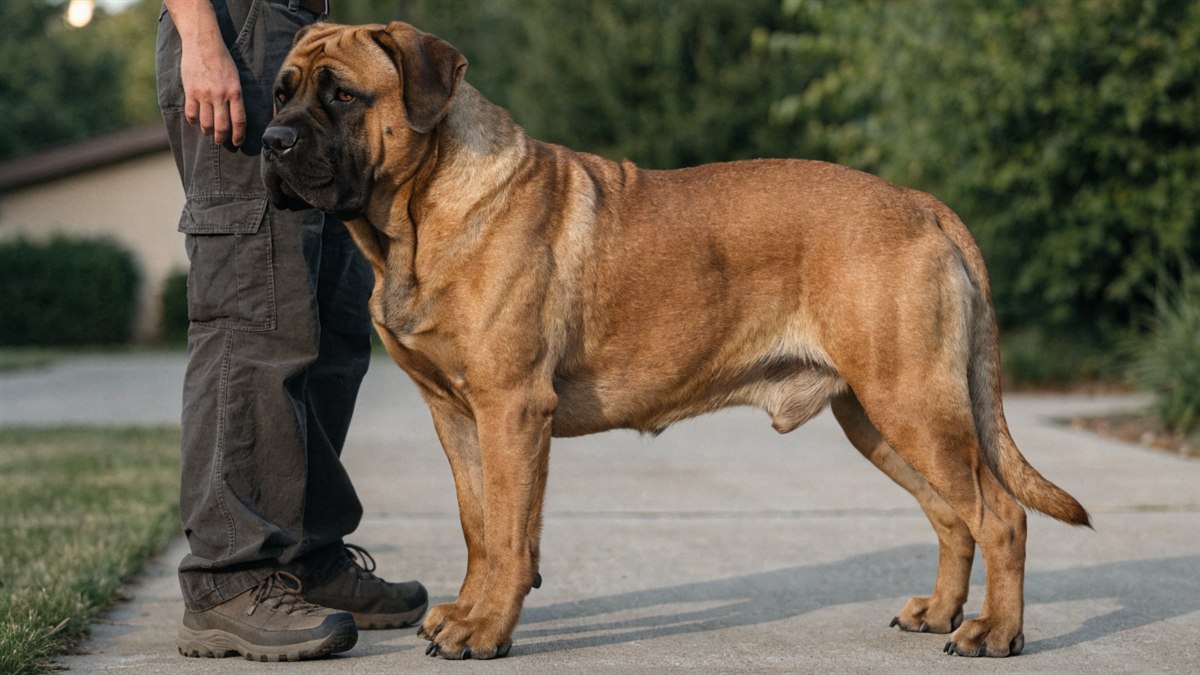
An adult male Boerboel stands 24 to 27 inches at the withers and weighs 150 to 200 pounds, which is 68 to 91 kg. That is the whole argument of this page in one line. Everything about cost, housing, insurance, law and heat follows from the mass.
The SABBS standard is the only one that ties mass to height with a formula. It gives an ideal male height of 66 cm and an ideal female height of 61 cm, and then states that height must always be in relation to mass, at an ideal ratio for a full-grown dog of approximately 1:1 to 1:1.2 cm per kg. Run the arithmetic on the ideal male and the standard is asking for a dog between 66 kg and about 79 kg. The AKC's separately published 150 to 200 lb band reaches higher, to 91 kg. Publish the disagreement rather than averaging it, because the two figures describe different upper bounds and a buyer planning a house, a gate and a car should plan for the higher one.
What the measured dogs weigh
Two independent measurements exist and both come in under the standard. A Nigerian study measured 53 Boerboels and found height at the shoulder of 62.0 cm plus or minus 1.6 cm in males and 57.0 cm plus or minus 1.5 cm in females. Both means sit below the SABBS ideals of 66 cm and 61 cm and only a few centimetres above the SABBS minimums of 60 cm and 55 cm. A South African case report separately records a five-year-old castrated male Boerboel at 58 kg. Real Boerboels are not automatically at the top of the published band, and a seller quoting 90 kg for a puppy's adult weight is quoting the ceiling as if it were the average.
| Source | Male | Female | n |
|---|---|---|---|
| AKC breed page, weight | 150 to 200 lb (68 to 91 kg) | 150 to 200 lb (68 to 91 kg) | Not stated |
| SABBS standard, height | Ideal 66 cm, min 60 cm | Ideal 61 cm, min 55 cm | Not stated |
| AKC standard, height | 24 to 27 in (61 to 69 cm) | 22 to 25 in (56 to 64 cm) | Not stated |
| Measured, Nigeria | 62.0 cm mean at shoulder | 57.0 cm mean at shoulder | 53 dogs |
One number you will meet everywhere is worth refusing. Published bite force figures for the Boerboel circulate on Indian and international pages in pounds per square inch, and none of them traces back to a measurement of this breed. No registry standard states a bite force, and the AKC standard describes the jaws only as strong, deep and wide, tapering slightly to the front. Judge the dog by the two figures that are measured instead, which are a muscular 68 to 91 kg body and thick muscles from neck to rump on a broad and blocky head. A bite force number with no study behind it tells you nothing that the weight does not already tell you.
Five people who should not buy this breed
The breed's own paperwork answers this question better than any opinion. Five categories of buyer are ruled out by the standards themselves.
- First-time dog owners. The AKC states plainly that the Boerboel is not a breed for a novice dog owner and might be way too much dog for a novice to handle. SABBS lists among the breed's defining characteristics 'a dog requiring training and firm handling from an early age';.
- Anyone who wants a dog that likes other dogs. The AKC standard says an aggressive or belligerent attitude towards other dogs should not be faulted. A judge in the ring is instructed to ignore it. The AKC's own care advice adds that Boerboels will not take kindly to challenges from other dogs and that visiting dog parks is not recommended.
- Anyone who wants an off-lead dog. Because of the protective instinct, the AKC advises that the Boerboel should never be allowed off leash. In a country where most walking happens on shared streets, that is a permanent condition, not a training phase.
- Anyone who cannot physically hold one. A 70 kg dog that decides to move takes an adult with it. This is a handling limit, not a courage test, and it is the reason Romania requires owners of this morphological type to be at least 18 with full legal capacity.
- Anyone planning to travel with the dog. Denmark refuses entry to Boerboels including those of tourists, and Bermuda lists the breed as prohibited from import entirely.
SABBS disqualifies a dog at appraisal for an overly aggressive or uncontrollable temperament, for timidity or insecurity, and for biting its owner. The UKC disqualifies for viciousness or extreme shyness. Both registries treat a nervy Boerboel as a failed Boerboel. If a seller in India describes a nervous or snappy puppy as 'protective', that is the opposite of what the breed's own registries say.
Where the Boerboel is banned or restricted, with the instrument and the date
Four jurisdictions name the Boerboel in law. Denmark and Bermuda prohibit it, Romania places it in the most heavily controlled of two dangerous-dog categories, and Ukraine lists it as a dangerous breed that triggers compulsory owner liability insurance. Every statement below comes from the text of the instrument itself, not from a summary of it.
Denmark, prohibited since 1 July 2010
Denmark's Dog Act prohibits possession and breeding of thirteen named dogs and the Boerboel is number seven on that list. The prohibition extends to crossbreeds in which any listed dog appears, and commercial import of any of them is separately prohibited. Section 1b then states that dogs kept or imported in breach of section 1a are put down by the police, and that where there is doubt about a dog's breed the police may require the keeper to document it. The transitional provision let people who already possessed such a dog on 17 March 2010 keep it, but they may not transfer it, and in public it must be leashed on a fixed line of no more than 2 metres and muzzled. Breeding businesses established by that date could continue only until 30 June 2015.
The Danish Veterinary and Food Administration states the practical consequence for a visitor. It is prohibited for everyone, including tourists, to bring a prohibited dog into Denmark, there is no possibility of obtaining an exemption, and the only carve-out is transit, where a dog passing through may be briefly walked outside the vehicle.
Bermuda, prohibited breed
The Government of Bermuda lists the Boerboel, in its own table, as 'Boerboel (South African Mastiff)' under Prohibited Breeds. Prohibited dogs may not be imported, bred or used for breeding. An illegally held dog of a prohibited breed is not eligible for licensure and is not eligible to remain in Bermuda, and the owner must arrange to deport or euthanise it. Restricted breeds, by contrast, can be legitimised. The Boerboel is not one of them.
Romania, category I dangerous dog
Romanian law splits dangerous dogs into two categories and puts the Boerboel type in the stricter one. Article 1(a) of Emergency Ordinance 55/2002, as republished in Monitorul Oficial no. 146 of 27 February 2014, defines category I as fighting and attack dogs assimilated by morphological characteristics to the Pit Bull, Boerbull and Bandog types and their crossbreeds. Note the spelling and the mechanism. The statute uses 'Boerbull' and it classifies by morphology rather than by pedigree, so a dog that looks the part is caught whether or not it has papers.
The consequences are heavy and specific.
- Import or commercialisation of a category I dog is a criminal offence punishable by three months to two years imprisonment or a fine, under article 13.
- Compulsory sterilisation of every category I dog regardless of sex, under article 10(1), within 60 days of the ordinance taking effect and at the owner's cost.
- Owner conditions under article 3(1), being at least 18 years old, having full legal capacity, and having no conviction for an offence against the person.
- Registration with the Romanian Kennel Club and a warning plate of at least 15 by 25 cm reading 'Caine periculos' at the entrance to the property, under article 3(2).
- Compulsory civil liability insurance and a declaration lodged at the local police station, under article 4(1).
- No access to public premises or public transport at all, under article 6(1), and a muzzle plus collar and lead on public roads, under article 6(2).
Ukraine, listed dangerous breed
Ukraine lists 'Burbul pivdennoafrykanskyi', the South African Boerboel, in the schedule to Cabinet of Ministers Resolution No. 1164 of 10 November 2021. The resolution does not ban the breed. It approves the list of dangerous dog breeds and then amends the Procedure and Rules for compulsory third-party liability insurance of dog owners so that paragraph 8 of those rules points at this new list instead of the old annex. Owning one in Ukraine is lawful and insured, not prohibited.
Russia does not list the Boerboel. Government Decree No. 974 of 29 July 2019 approves a list of potentially dangerous dogs with twelve entries plus their crossbreeds, and the twelve are Akbash, American Bandog, Ambulldog, Brazilian Bulldog, Bully Kutta, Alapaha Blue Blood Bulldog, Bandog, wolf-dog hybrids, wolfdog, Gull Dong, Pitbullmastiff and North Caucasian dog. Belarus does not list it either. The list of potentially dangerous breeds approved by Resolution No. 40 of 12 December 2001 runs to forty entries and the Boerboel is not among them. Pages that put Russia or Belarus on a Boerboel ban list are repeating something the instruments do not say.
Is the Boerboel banned in India? The precise answer
No enforceable Indian law names the Boerboel as a banned breed today. A central circular did name it on 12 March 2024, and that circular was quashed by the Karnataka High Court on 10 April 2024 and set aside by the Delhi High Court on 16 April 2024. A Gurugram order that named the breed in 2022 was stayed by the Punjab and Haryana High Court. Both stories are worth knowing in full, because both could come back.
The 12 March 2024 circular did name the Boerboel
The circular is not guesswork, but the judgment is the wrong place to read it. The Karnataka High Court's reproduction is abridged and drops six entries. The complete list survives in CBIC Instruction 05/2024-Customs of 14 March 2024, whose operative sentence identifies as ferocious and dangerous for human life 'breeds (including mixed and cross breeds) like Pitbull Terrier, Tosa Inu, American Staffordshire Terrier, Fila Brasileiro, Dogo Argentino, American Bulldog, Boerboel, Kangal, Central Asian Shepherd Dog (ovcharka), Caucasian Shepherd Dog (ovcharka), South Russian Shepherd Dog (ovcharka), Tornjak, Sarplaninac, Japanese Tosa and Akita, Mastiffs (boerbulls), Rottweiler, Terriers, Rhodesian Ridgeback, Wolf dogs, Canario, Akbash dog, Moscow Guard dog, Cane corso and every dog of the type commonly known as a Ban Dog (or Bandog)';. That is 24 comma-separated entries, and press reports say 23 because they fold the closing Bandog clause in, and 25 appears where Japanese Tosa and Akita is split into two. The Boerboel is named twice on it, once by name and once inside Mastiffs (boerbulls).
The circular asked local bodies and animal husbandry departments to issue no licences or permits for sale, breeding or keeping of those breeds, and directed that dogs already kept as pets be sterilised so that further breeding could not happen.
What the courts did to it
| Court | Date | Outcome |
|---|---|---|
| Karnataka High Court, WP No. 8409 of 2024 | 10 April 2024 | Circular quashed. The Court found no stakeholder was heard, the expert committee was not constituted in accordance with the Rules, and the circular travelled beyond the Rules in force |
| Delhi High Court, division bench SCC Online, Delhi High Court sets aside… | 16 April 2024 | Circular set aside, with a direction to issue a public notice inviting written objections before any fresh notification |
| Calcutta and Karnataka High Courts, reported | March 2024 | Circular stayed |
| Bombay High Court, PIL hearing | 24 January 2025 | Union told the Court it is not acting on the circular at present, having issued a public notice on 2 May 2024 inviting objections |
The Karnataka judgment is the more useful of the two to read, because it says why. Its summary of findings records that the Union of India had given the Delhi High Court an undertaking on 6 December 2023 to hear all stakeholders, that none were heard, that the committee's composition did not conform to the Rules framed under the Prevention of Cruelty to Animals Act 1960, and that a circular could not impose a blanket breed-specific ban in the teeth of those Rules. The Court expressly left the door open, noting that obliteration would not stop the Union bringing an amendment to the Rules after due process, and that if it does, stakeholders including a body that certifies breeds must be heard.
Gurugram, 2022, and what happened to it
On 15 November 2022 the district consumer disputes redressal forum in Gurgaon directed the Municipal Corporation of Gurugram to ban eleven foreign breeds, and the Boerboel was on that list alongside the American Pit Bull Terrier, Dogo Argentino, Rottweiler, Neapolitan Mastiff, Presa Canario, wolf dog, Bandog, American Bulldog, Fila Brasileiro and Cane Corso. The order went further than a breed list. It directed the MCG to cancel every licence issued for those breeds with immediate effect and take the dogs into custody, to limit each family to one dog, to charge a registration fee of at least Rs 12,000 a year, and to impose fines from Rs 20,000 up to Rs 2 lakh with imprisonment of one month to two years in default.
Two weeks later the Punjab and Haryana High Court stayed that order, in Shivani Dasmahapatra and Anr v State of Haryana and Ors, on pleas arguing that the consumer forum had exceeded the jurisdiction vested in it by the Consumer Protection Act. The confiscation direction never took effect.
We can confirm that the Gurugram consumer forum order named the Boerboel and that it was stayed Bar and Bench, Punjab and Haryana High…. We can confirm that the Ghaziabad Municipal Corporation proposal of October 2022 covered three breeds, being the pit bull, Rottweiler and Dogo Argentino, and did not name the Boerboel. We could not find any Indian municipal by-law currently in force that names the Boerboel, and we are not claiming that none exists. Municipal by-laws in India are not published in one searchable place, so an absence here is an absence of evidence rather than evidence of absence. Ask your own municipal corporation in writing before you buy, and keep the reply.
So the honest summary is this. Owning a Boerboel in India is lawful. Bringing one into India commercially is not, for reasons that have nothing to do with breed lists, and that is covered next.
Importing a Boerboel into India, and why no lawful trade route exists
Live dogs are a Restricted import into India and may enter for only three purposes, none of which is trade or breeding. That single fact governs the Indian Boerboel market far more than any breed list, and it applies to every breed equally.
The instrument is Trade Notice 22/2022-23, issued by the Directorate General of Foreign Trade on 19 December 2022. It reproduces the import policy for ITC (HS) 01061900, 'Mammals, Other', as Restricted, subject to Policy Condition 6.
Policy Condition 7 then limits dog imports to three purposes.
- A pet dog with a valid pet book and relevant records or documents in the name of the importer.
- Dogs imported by R&D organisations for research, with the recommendation of the CPCSEA.
- Dogs for internal security by the Defence and Police Force.
Policy Condition 8 closes the gap. Import of commercial dogs for breeding or any other commercial activity other than the purposes above is not permitted. Paragraph 6 of the Trade Notice repeats it operationally, stating that any applications for trading or breeding purposes, or applications made on behalf of another person or entity, shall be duly rejected.
What a lawful personal import actually looks like
The Trade Notice sets out the route in detail, and it is narrow.
| Requirement | What the Trade Notice says |
|---|---|
| Baggage route | Allowed without DGFT authorisation only to persons transferring residence to India after two years of continuous stay abroad, and only for cats and dogs |
| Number of animals | Up to two under baggage. More than two always requires DGFT import authorisation |
| When authorisation is needed | If continuous stay abroad is under two years, or the pet is not travelling as passenger baggage, or the pet cannot be imported under baggage rules |
| Ports | Airports and seaports of Delhi, Mumbai, Chennai, Hyderabad, Bangalore and Kolkata only, with quarantine at the government station where required; DAHD added Kochi for pets arriving under the baggage rules in October 2024 |
| Lead time | Start the import authorisation application at least two months before travel |
| Advance NOC | From the Regional or Quarantine Officer (AQCS) at one of those ports, seven days before travel, relaxable to three days |
| Trading or breeding | Applications shall be duly rejected |
Seven ports, two animals, a two-year residence test and an outright bar on breeding applications add up to a supply position that no amount of demand can change. A kennel in India cannot lawfully import breeding stock, and a buyer cannot lawfully have someone else import a puppy on their behalf, because the Trade Notice rejects applications made on behalf of another person or entity. The full route is set out in how to import a dog to India.
The registration problem nobody in the Indian market mentions
Indian sellers charge a large premium for a 'KCI Registered Boerboel', typically Rs 2,50,000 to Rs 4,50,000 against Rs 1,50,000 to Rs 2,50,000 for a basic-quality puppy. Understand what that paper is and is not.
SABBS states on its own home page that it is the only organisation legally authorised in terms of the SA Animal Improvement Act No. 62 of 1998 to officially register Boerboels, and that it is responsible for the standards governing identification, recording, evaluation and improvement of the breed. Its history page puts the same point more starkly. After the 2014 court ruling, only dogs registered via SABBS may be called and sold as Boerboels, and the rival bodies EBBASA and Boerboel International may no longer register Boerboels bred and exported from South Africa. SABBS registration also carries an appraisal, so a registered dog has been physically assessed against the standard rather than merely recorded on a pedigree.
A Kennel Club of India certificate records what the applicant declared about a dog's parentage. It is not an appraisal, and it is not recognition by the registry that South African law puts in charge of this breed. If a seller quotes a premium for papers, ask which registry issued them, ask for the SABBS registration or appraisal number of the sire and dam, and ask to see the hip and elbow certificates by number. One Indian ranking page even sells 'SABT' pedigree quality, and the SABT dissolved as an association on 5 December 2014. Paper that names a body which no longer exists is worth exactly nothing.
Boerboel price in India
The Boerboel price in India runs Rs 38,000 to Rs 5,50,000 in 2026, and the three published sources disagree by more than Rs 5 lakh for the same breed. That spread is larger than the entire purchase price of most pedigree dogs in India, so no single figure on this page or any other is trustworthy on its own.
Bonbeno compared every published Indian rupee figure we could open for this breed. They do not agree, and they do not overlap cleanly.
| Source | Published band | Sub-bands given | Monthly cost given |
|---|---|---|---|
| Mr n Mrs Pet | Rs 1,50,000 to Rs 5,50,000+ | Basic Rs 1,50,000 to 2,50,000; KCI registered Rs 2,50,000 to 4,50,000; champion bloodline Rs 4,50,000 to 5,50,000 | Rs 3,000 to Rs 7,000 |
| Times of India, 2023 | Rs 1,25,000 to Rs 2,25,000 | None | None |
| Inside Scroller | Rs 38,000 to Rs 1,50,000+ | Chennai and Kolkata from Rs 38,000; imported Rs 80,000 to 1,50,000+ | Rs 8,000 to Rs 18,000 |
Two things are wrong in that table and both are informative. The low source and the high source cannot both be describing a Boerboel from a health-tested pairing, and the source with the lowest purchase price quotes the highest monthly cost, which is the reverse of what a genuine quality gradient looks like.
We ran the exchange-rate test and it came back clean
Indian breed pages frequently publish a 'price' that is a US dollar figure converted at one rate, which is why Bonbeno divides every suspicious rupee figure by 84.38 before trusting it. On this breed the test passes.
| Figure | Divided by 84.38 | Round dollar amount? |
|---|---|---|
| Rs 1,50,000 | USD 1,777.7 | No |
| Rs 2,50,000 | USD 2,962.8 | No |
| Rs 4,50,000 | USD 5,333.0 | No |
| Rs 5,50,000 | USD 6,518.1 | No |
| Rs 1,25,000 | USD 1,481.4 | No |
| Rs 2,25,000 | USD 2,666.5 | No |
| Rs 38,000 | USD 450.3 | Close, but isolated |
| Rs 80,000 | USD 948.1 | No |
None of these figures resolves to a round dollar amount, so unlike several other imported breeds on this site, the Indian Boerboel numbers appear to be set in rupees rather than converted from a US listing. The single near miss at Rs 38,000 does not repeat anywhere else in the set, so we treat it as coincidence rather than evidence.
Run the test in the other direction and something more useful appears. Published US Boerboel prices sit around USD 2,000 to USD 6,000. Converted at 84.38 that is Rs 1,68,760 to Rs 5,06,280, which lands almost exactly on the Mr n Mrs Pet band of Rs 1,50,000 to Rs 5,50,000 and nowhere near the Inside Scroller band of Rs 38,000 to Rs 1,50,000. The high Indian band tracks the international market for the breed. The low band does not.
A genuine Boerboel puppy from parents with certified hips and elbows cannot be produced in India for Rs 38,000, because the parents themselves cost more than that to acquire and screen. A puppy at that price is most likely a mastiff-type crossbreed, an unregistered dog of unverified parentage, or a listing that exists to start a phone conversation. Ask for the sire and dam's SABBS numbers and hip and elbow certificate numbers before any money moves. If the seller cannot produce them, the price is not a discount, it is a different animal.
Check whether the price table you are reading is even about this breed
Inside Scroller publishes a city-by-city table for the Boerboel with rows for Delhi NCR, Mumbai, Bangalore, Hyderabad, Chandigarh, Chennai, Kolkata and tier-2 cities. The same site publishes structurally identical tables, with the same row labels and the same Rs 4,000 to Rs 18,000 monthly-cost format, for the Basenji, the Papillon, the American Bully and the French Barbet. City price tables that repeat across unrelated breeds are templates, not market data.
Bonbeno does not broker puppy sales and does not publish breeder listings. The figures above are reported from third-party sources so an Indian buyer can see the disagreement rather than being handed an average of it.
Monthly cost of owning a Boerboel in India
The purchase price is the smallest number in Boerboel ownership. Published Indian monthly estimates range from Rs 3,000 to Rs 18,000, a six-fold spread, and neither source explains its method, so this section sets out the cost structure rather than inventing a total.
Two Indian sources publish a monthly figure and they contradict each other. Mr n Mrs Pet gives Rs 3,000 to Rs 7,000 covering quality food, grooming, vet visits and routine care. Inside Scroller gives Rs 8,000 to Rs 18,000, built from premium large-breed food at Rs 3,500 to Rs 7,000 a month, grooming at Rs 600 to Rs 1,200 a session, veterinary care at Rs 10,000 to Rs 22,000 a year, training at Rs 10,000 to Rs 30,000 once, and vaccinations at Rs 2,500 to Rs 5,000 a year.
The lower figure fails a basic sanity check. Rs 3,000 a month is roughly Rs 100 a day for a dog that the AKC puts at 68 to 91 kg. That does not buy adequate large-breed food for an animal of that mass in any Indian metro, before a single vaccination.
What you actually pay for
- Food. A 68 to 91 kg adult eats like two Labradors. Food is the single largest recurring line item and it scales directly with the dog's weight.
- Preventive veterinary care. Core vaccination, boosters, deworming, and tick and flea control. Tick-borne disease pressure is high across Indian metros and the breed has a documented babesiosis literature of its own.
- Orthopaedic provisioning. This is the line most Indian buyers skip. On OFA's own figures 39.3 percent of evaluated Boerboels are hip dysplastic and 34.1 percent have abnormal elbows. Budgeting for joint management is arithmetic, not pessimism.
- Climate control. Air conditioning or at minimum a cooled room in summer is a running electricity cost, not an optional comfort, for reasons set out in the climate section.
- Professional training. One-off but substantial, and non-negotiable for a guarding breed of this mass.
- Third-party liability cover. Not legally required in India, but Romania and Ukraine both make it compulsory for this breed, which tells you what actuaries elsewhere think of the risk.
The two costs nobody quotes
Anaesthesia and surgery both scale with body mass. A hip or elbow procedure on a 70 kg dog uses more of every drug and more theatre time than the same procedure on a 25 kg dog, and Indian veterinary pricing reflects that. So does anything requiring sedation, including the radiographs used to grade hips and elbows in the first place.
Grooming is the reverse, and this is the one place the breed is genuinely cheap. The coat is short, dense, smooth and shiny, so there is no clipping, no de-matting and no professional strip. The Indian marketplace claim that a Boerboel needs trimming every four to six weeks to prevent matting describes a coat this breed does not have.
We are running a verified owner cost survey across Indian metros and will publish the results with the sample size and collection method stated. Until that is complete, the honest position is that no reliable India-wide monthly figure for this breed exists. What we can say with confidence is that the true figure sits nearer the top of the published range than the bottom, because the bottom figure does not survive division by the dog's own body weight.
Heat tolerance, argued from the numbers rather than the coat
A short coat on a 70 kg dog is not heat tolerance. The Boerboel comes from a high, dry interior plateau that is far cooler than any Indian metro, and its body mass sits in the single category that the largest study of canine heat-related illness identified as highest risk. Both halves of that sentence are measurable, so here are the measurements.
The origin climate is a highveld, not a hot country
The breed society was founded in 1983 in the Senekal district of the Free State, and Senekal sits at 1,534 metres above sea level. Pretoria, the other centre of Boerboel breeding and the home of the pedigree study cited later on this page, sits at 1,199 metres. Altitude is the whole story. Bonbeno queried NASA POWER for daily maximum temperature and relative humidity at each location by explicit latitude and longitude, for the ten years from 1 January 2015 to 31 December 2024, which is 3,653 days per site, and computed the same three statistics everywhere.
| Location | Elevation | Hottest month, mean daily max | Days a year at or above 35 C | Days a year at or above 38 C | Mean relative humidity |
|---|---|---|---|---|---|
| Senekal, Free State | 1,534 m | 30.3 C (January) | 9.2 | 0.4 | 51.5% |
| Johannesburg | 1,538 m | 29.1 C (October) | 5.7 | 0.1 | 54.1% |
| Pretoria | 1,199 m | 32.0 C (November) | 33.5 | 4.9 | 49.9% |
| Bengaluru | 842 m | 36.3 C (April) | 51.9 | 10.7 | 68.4% |
| Chennai | 49 m | 36.6 C (April) | 88.1 | 14.0 | 73.6% |
| Hyderabad | 495 m | 39.5 C (April) | 100.1 | 62.3 | 61.5% |
| Mumbai | 97 m | 39.5 C (April) | 106.3 | 63.3 | 68.4% |
| Delhi | 206 m | 41.9 C (May) | 135.1 | 87.8 | 48.5% |
Delhi records 135.1 days a year at or above 35 C against Senekal's 9.2. That is 14.7 times as many. At the 38 C threshold the gap widens to 87.8 days against 0.4, which is a ratio of more than 200 to 1. Even Bengaluru, the mildest large Indian city in the table and itself at 842 metres, gives a Boerboel 51.9 days a year above 35 C, five and a half times Senekal's count.
Why a short coat does not rescue a heavy dog
Heat production scales with body mass, and a dog sheds heat across a surface. A 70 kg Boerboel produces roughly three times the metabolic heat of a 23 kg Indian Pariah Dog but does not carry three times the skin area or three times the airway to evaporate it from, so it warms faster and cools slower at the same air temperature. The coat length changes the insulation term. It does not change the mass-to-surface arithmetic underneath it.
The largest primary-care study of canine heat-related illness measured exactly this. Hall, Carter and O'Neill followed 905,543 dogs at 886 UK veterinary practices during 2016 and found that dogs weighing over 50 kg had 3.42 times the odds of heat-related illness compared with dogs weighing under 10 kg, with a 95 percent confidence interval of 1.54 to 7.57. Every adult male Boerboel of standard weight is in that top category, and so is almost every female.
The same study puts the stakes in numbers. Among 395 heat-related illness events in 2016, 56 dogs died, an event fatality rate of 14.18 percent, and of the 54 deaths where the manner was recorded 35 were by euthanasia and 19 were unassisted. That is a UK case fatality rate, in a country whose hottest month barely reaches an Indian April.
Hall and colleagues found brachycephalic skull shape to be an independent risk factor for heat-related illness. The Boerboel is not a flat-faced breed, but it is not a long-muzzled one either. The AKC standard puts the muzzle at slightly more than a third of the total head length, and a 2017 case series in Veterinary and Comparative Orthopaedics and Traumatology describes its three subjects, one of which was a Boerboel, as 'juvenile large-breed brachycephalic dogs';. Evaporative cooling in a dog happens across the nasal turbinates and tongue. A shortened muzzle gives less of it, and this breed has a shortened muzzle on a very large body.
The practical conclusion is narrow and firm. A Boerboel can live in India. It cannot exercise in an Indian afternoon between March and June in any city in that table except perhaps Johannesburg, which is not in India.
Humidity, the monsoon, and the daily routine that follows
Humidity is the half of the heat problem that temperature charts hide. A panting dog cools by evaporating water from its airway, and evaporation slows as the air fills with moisture, so the same 35 C is a harder day in Chennai than in Pretoria. The origin climate is dry and every coastal Indian city is not.
The gap is measurable on the same NASA POWER data used above. Mean relative humidity over ten years is 51.5 percent at Senekal and 49.9 percent at Pretoria, against 73.6 percent at Chennai, 68.4 percent at Mumbai and 68.4 percent at Bengaluru. Chennai's April, its hottest month by mean daily maximum, runs at 64.9 percent humidity while Pretoria's November runs at 49.9 percent.
Read Chennai and Delhi together and the two failure modes appear. Delhi is the extreme-temperature city, with 87.8 days a year at or above 38 C but a mean humidity of 48.5 percent, close to the highveld. Chennai is the opposite, with far fewer extreme days at 14.0 above 38 C but the highest humidity in the table. A Boerboel in Delhi is at risk from raw air temperature. A Boerboel in Chennai is at risk because its cooling mechanism is working at reduced efficiency for most of the year.
A workable daily routine, by city type
| City type | Example | The binding constraint | Practical rule |
|---|---|---|---|
| Hot and dry interior | Delhi, Hyderabad | 87.8 and 62.3 days a year at or above 38 C | No exercise between 09:00 and 18:00 from March to June. Walk before sunrise |
| Hot and humid coastal | Chennai, Mumbai | Mean humidity 73.6 and 68.4 percent | Shorten every session year round, not only in summer. Panting is less effective here on any given day |
| Elevated and milder | Bengaluru at 842 m | 51.9 days a year at or above 35 C | The most workable large Indian city for this breed, and still five times Senekal's count |
Skin, folds and the monsoon
The Boerboel's skin is described by every standard as thick and loose, fitting smoothly over the body United Kennel Club. Loose skin plus high humidity plus a heavy dog that lies down on cool floors is the standing setup for moist dermatitis. The places to check daily during the monsoon are the neck and dewlap folds, the facial wrinkles that appear when the dog is attentive, the armpits, the groin and between the toes.
OFA's eye data records exposure keratopathy syndrome in 2 of 169 examined Boerboels, which is 1.2 percent. That condition involves the cornea drying because the eyelids do not fully protect it, and a dog with any degree of eyelid laxity in a dusty, hot Indian summer is more exposed than the same dog in a temperate climate. Flush the eyes with sterile saline after dusty walks rather than wiping them.
The short, dense coat is a solar barrier as well as insulation, and clipping it exposes thin, pigmented skin to direct Indian sun. The AKC and UKC standards both disqualify a long coat, so there is nothing to clip in the first place United Kennel Club. If your dog is overheating, the answer is shade, airflow, cool water, a wet floor and a schedule change, not scissors.
One more practical point about drying. Overseas breed-club care advice written for temperate countries routinely says to towel a dog and let it air dry. In an Indian monsoon a 70 kg dog with loose skin folds does not air dry, it stays damp in the folds for hours. Towel dry into the folds, then use a cool fan on the neck, armpits and groin until the skin is genuinely dry to the touch.
Temperament and household fit
The Boerboel is a dominant, territorial guarding dog that bonds hard to its own family and treats everyone else as a question to be answered. That is not a criticism, it is the AKC standard's own wording, and an Indian household should decide against that description rather than against a marketing one.
The AKC standard describes the breed as a dominant and intelligent dog with strong protective instincts and a willingness to please, calm, stable and confident when approached, at times displaying a self-assured aloofness, and loving with children and family. SABBS gives the same picture with one extra clause that buyers should read twice, listing the breed as manageable, reliable, obedient, trainable and intelligent, self-confident and fearless, and 'a dog requiring training and firm handling from an early age';.
The line in the standard that decides most Indian households
The AKC standard states that an aggressive or belligerent attitude towards other dogs should not be faulted. A show judge is instructed not to penalise it. The AKC's care guidance is blunter still, saying Boerboels will not take kindly to challenges from other dogs, that visiting dog parks is not recommended, and that because of the protective instinct the dog should never be allowed off leash.
Now place that in an Indian city. Most Indian walking happens on shared streets with free-ranging community dogs. A breed whose standard accepts dog-directed aggression, in an environment where uninvited dog encounters are guaranteed, produces a management problem every single day rather than an occasional one. This is the single most decision-relevant fact on the page for a flat-dwelling buyer, and no ranking Indian page mentions it.
Guarding is the default, not a trained extra
The UKC standard says the protective character remains sought after, that the breed is the guarding dog of choice among current-day South African farmers and popular for the same reason in urban communities, and that Boerboels should be discerning and accepting of friendly strangers with proper introductions, although many will remain reserved and aloof. Read the qualifier. Acceptance is conditional on proper introductions, which means an Indian household running a normal stream of domestic help, delivery riders, plumbers, meter readers and relatives has to manage introductions deliberately and permanently.
A behavioural finding unique to this breed
One neurological condition in the veterinary literature presents specifically as fear behaviour in Boerboels, and every Indian owner of the breed should know it exists. Researchers at Utrecht University described five client-owned Boerboel littermates presented for sudden episodes of severe fear-related behaviour, with onset at three months of age in all five. During episodes the dogs howled loudly, showed an extremely fearful facial expression and trembled, and all had autonomic or motor signs alongside. Blood work, imaging and metabolic screening were generally unremarkable, and histopathology showed vacuoles in neurons throughout the deeper cerebral cortex. The family history and pedigree analysis suggested autosomal recessive inheritance.
The authors conclude that this is a newly recognised hereditary focal epilepsy and that veterinarians should be aware that sudden episodes of unusual behaviour can represent focal epilepsy. In a 70 kg guarding dog, an episode like this is easy to misread as aggression or as a nervous temperament, and the wrong response is correction. If a Boerboel under a year old shows abrupt, self-limiting episodes of extreme fear with trembling or howling, take a phone video and show it to a veterinarian rather than a trainer.
SABBS and the UKC both treat unstable temperament as disqualifying rather than acceptable. SABBS disqualifies an overly aggressive or uncontrollable dog, a timid or insecure dog, and a dog that bites its owner, and the UKC disqualifies for viciousness or extreme shyness. Two of the three registries that judge this breed would refuse the nervy, snappy dog that Indian sellers sometimes present as 'a proper guard'.
Training a Boerboel, and what the breed resists
To train a Boerboel, start structured obedience before four months and keep it running for years, because the breed's own registries treat early, firm handling as a defining requirement rather than a recommendation. The breed learns quickly. What it resists is inconsistency and late starts.
SABBS lists among the six characteristics that define the breed 'a dog requiring training and firm handling from an early age';. The AKC puts the timing more precisely, advising that training and socialisation should begin early, before a pup becomes a dominant adult, and warning that Boerboel puppies are easygoing and pliant so inexperienced owners may be lulled into thinking the dog will remain that way, when in fact consistent training must be well underway before those qualities fade.
That is the trap in one sentence. The Boerboel puppy that arrives in an Indian home at eight weeks is soft, biddable and easy, and stays that way for months. The window closes quietly.
A realistic Indian timeline
| Age | Priority | Why this window |
|---|---|---|
| 8 to 16 weeks | Socialisation to people, surfaces, traffic noise, vehicles and handling. Neutral exposure to other dogs at distance | The primary socialisation window closes early and cannot be reopened later |
| 3 to 6 months | Loose-lead walking established while the dog is still liftable. Name, recall, place, and a reliable settle | You will not out-muscle this dog after 30 kg, so the habits must be set before then |
| 4 to 12 months | Formal obedience with a professional trainer. Muzzle conditioning as a positive game | The AKC says structured, long-term obedience training must start young |
| 12 to 24 months | Maintenance and generalisation. Introductions protocol for visitors made routine | Guarding behaviour matures in the second year, not the first |
| Lifelong | Never off lead in public | The protective instinct does not switch off with training |
Muzzle training is not an admission of failure
Two jurisdictions require a muzzle for this breed in public as a matter of law. Romania requires a muzzle, collar and lead for category I dogs on public roads and bars them from public premises and public transport entirely, and Denmark's transitional rules require the pre-2010 dogs still lawfully held there to be muzzled and leashed on a fixed line of no more than 2 metres in public. Teach the muzzle as a positive-conditioning game at four months, long before you need it for a vet visit, a flight or a crowded street.
What does not work
- Correction-first handling. A dog the standard already describes as dominant and fearless does not become safer under confrontation, it becomes more confident about confrontation.
- Dog-park socialisation. The AKC advises against dog parks for this breed specifically, and the standard declines to fault dog-directed aggression.
- Guard training added on top. The guarding is already installed. What needs training is the off switch, meaning a reliable settle, a recall under distraction and a visitor protocol.
- Waiting until there is a problem. By the time a Boerboel presents a handling problem it weighs 60 kg and the owner has lost the physical argument permanently.
The AKC records that the breed often enjoys obedience, rally, weight pull and agility competition, as well as protection sports and stock work, and calls it a trainable, versatile breed eager to spend time with its people. The UKC standard says temperament, biddability and working structure must be emphasised over any shortcomings in conformation. This is a working dog that wants a job. Give it one that is not guarding your gate.
Daily exercise, and the Indian scheduling problem
A Boerboel needs daily structured exercise with its owner, and the AKC specifies long walks on a leash or play sessions in a securely fenced area, plus mental stimulation and interaction. In India the difficulty is not the amount. It is that the safe hours and the convenient hours barely overlap for four months of the year.
The requirement is moderate rather than extreme. This is a mastiff, not a working sheepdog. The UKC standard nonetheless insists the breed has the structure and stamina to work the fields by day and protect at night, and a Boerboel with no daily outlet becomes a Boerboel that patrols, guards harder and reacts more.
The safe window in an Indian summer
Use the NASA POWER figures rather than a feeling. Delhi averages 135.1 days a year at or above 35 C and 87.8 at or above 38 C, and Hyderabad and Mumbai both exceed 100 days above 35 C. On those days the only workable slots are before sunrise and well after dark, and the surface matters as much as the air. Asphalt and concrete hold heat for hours after the air cools, and a 70 kg dog puts more weight per square centimetre on its pads than a light dog does.
- Test the ground with the back of your hand for seven seconds. If you cannot hold it there, the dog cannot walk on it.
- Walk before 06:00 and after 20:00 from March to June in Delhi, Hyderabad, Mumbai and Chennai.
- Shorten every session in coastal humidity. Chennai runs at 73.6 percent mean relative humidity and Mumbai at 68.4 percent, so panting clears less heat per breath there than the temperature alone suggests.
- Substitute mental work on unusable days. Scentwork, food puzzles, obedience repetitions and a chew of appropriate size all cost the dog effort without generating exercise heat.
What growth does to the schedule
Do not run, jog or cycle with a Boerboel under 18 months, and do not use forced repetitive exercise on hard surfaces during growth. Two of the breed's three commonest documented orthopaedic problems are developmental joint disease, with 39.3 percent of evaluated Boerboels hip dysplastic and 34.1 percent showing abnormal elbows on OFA's figures. Growth plate closure in giant breeds runs late, and loading an open growth plate during that period is one of the few environmental variables an owner actually controls.
The Prevention of Cruelty to Animals (Dog Breeding and Marketing) Rules 2017 draw a related line for breeders, requiring at Second Schedule Part II para 5(7) that no male dog be used for breeding until he has reached his eighteenth month and is certified healthy by a veterinary practitioner at least ten days before mating. Eighteen months is the maturity marker Indian law itself uses for this size of dog.
Stop and cool the dog if you see loud, laboured panting that does not settle within a few minutes of rest, brick-red or very pale gums, unsteadiness, vomiting or a refusal to move. Heat stroke is the severe end of this and it is not rare enough to gamble on. Heat-related illness killed 14.18 percent of affected dogs in the UK primary-care study, in a far cooler country. Cool with room-temperature water over the neck, armpits and groin, move air across the dog, and go to a veterinarian rather than waiting to see if it passes.
Fencing is the other structural requirement. The AKC recommends play sessions in a securely fenced area, and Bermuda's rules for legitimising a restricted dog put a number on what secure means, requiring a fenced area of at least 60 square feet, which is 5.6 square metres, approved by the planning department. Treat that as the floor rather than the target for a dog of this mass.
Grooming a short-coated giant in Indian humidity
Boerboel grooming is genuinely low effort and the ranking Indian pages get this badly wrong. The coat is short, dense, smooth and shiny, there is nothing to clip or de-mat, and the real work is skin, ears, eyes and nails rather than hair.
Start by discarding the claim you will meet first. The Indian marketplace page ranking second for this query states that Boerboels have dense, curly coats that need trimming every four to six weeks to prevent matting. No Boerboel has a curly coat. A long coat is a disqualification under the AKC standard and long or curly hair is a disqualification under the UKC standard United Kennel Club. Paying a salon Rs 600 to Rs 1,200 a session to trim a coat that does not exist is a pure transfer of money.
The weekly routine that actually matters
- Rubber curry mitt, twice a week. It lifts dead hair from a dense short coat better than a bristle brush and doubles as a body check for lumps, ticks and hot spots.
- Fold check, daily in the monsoon. Neck and dewlap, the facial wrinkles that appear when the dog is attentive, armpits, groin and between the toes. Dry, do not damp-wipe.
- Ears, twice weekly. V-shaped drop ears carried close to the head trap warm humid air. Check, smell and dry the canal opening rather than flushing routinely.
- Nails, every two to three weeks. A 70 kg dog on overlong nails loads its toes and pasterns wrongly, and the standards call for short, preferably black toenails on thick, tough pads.
- Eyes, after every dusty walk. OFA's examination data records exposure keratopathy syndrome in 1.2 percent of examined Boerboels and distichiasis in 1.8 percent, both of which make a dusty environment less forgiving.
Bathing, and the drying rule that overseas advice gets wrong
Bathe monthly at most, and less in winter. The point of restraint is the skin rather than the coat, because the skin is thick, loose and well pigmented and frequent detergent strips it.
Overseas breed-club and kennel-club care advice, written for temperate countries, commonly tells owners to towel the dog and let it air dry. That instruction assumes air that will accept moisture. In a Mumbai or Chennai monsoon, with mean relative humidity of 68.4 and 73.6 percent respectively, a heavy dog with loose neck folds stays damp in those folds for hours and that is where moist dermatitis starts. Towel into the folds, then move cool air across the neck, armpits and groin until the skin is dry to the touch.
Shedding, allergies and what the standard does not say
The Boerboel sheds. A short coat is not a non-shedding coat and no standard makes any claim about reduced shedding or allergy suitability United Kennel Club South African Boerboel Breeders' Society. The Indian marketplace specification card for the breed answers the hypoallergenic question with a plain 'No';, which is correct and worth crediting.
Against a Golden Retriever or a Siberian Husky in the same climate, the Boerboel's grooming bill is close to nothing. Budget for a rubber mitt, a nail grinder, ear cleaner and towels. Do not budget for a monthly salon appointment, and be suspicious of any Indian cost estimate that includes one for this breed, because it suggests the estimate was written from a template rather than from the standard.
Hips, elbows and lifespan, with the denominators attached
The Boerboel has one of the worst joint records of any breed in the OFA database. 39.3 percent of 712 evaluated Boerboels were graded hip dysplastic and 34.1 percent of 696 were graded abnormal on elbows, which places the breed 15th worst of 221 for hips and 8th worst of 168 for elbows. Every figure below carries its sample size, because a percentage without a denominator is not a population rate.
OFA publishes a breed row only once there is enough data to mean something. A breed needs at least 100 hip evaluations to appear in the hip table and at least 50 in any other database. The Boerboel clears both comfortably, with 712 hip and 696 elbow evaluations, so these are usable figures rather than a handful of cases.
| Breed | Hip evaluations | Hip dysplastic | Elbow evaluations | Elbow abnormal |
|---|---|---|---|---|
| Boerboel | 712 | 39.3% | 696 | 34.1% |
| Neapolitan Mastiff | 277 | 49.5% | 120 | 34.2% |
| Cane Corso | 3,862 | 37.2% | 3,096 | 21.1% |
| Bullmastiff | 7,569 | 25.7% | 4,126 | 17.2% |
| Rottweiler | 108,931 | 21.1% | 27,340 | 38.8% |
| German Shepherd Dog | 146,653 | 20.4% | 68,125 | 18.7% |
| Labrador Retriever | 324,642 | 11.3% | 148,525 | 9.9% |
| All breeds | 1,711,844 | 14.2% | 649,602 | 12.0% |
Divide the numbers out. The Boerboel's hip dysplasia rate of 39.3 percent is 2.77 times the all-breed rate of 14.2 percent, and its elbow abnormality rate of 34.1 percent is 2.84 times the all-breed 12.0 percent. The breed is worse than the Cane Corso on both joints and worse than the Rottweiler on hips, while the Rottweiler is worse on elbows.
The severity breakdown softens the hip picture slightly and should be reported honestly. Of the 39.3 percent dysplastic, 25.8 points are mild, 11.8 moderate and only 1.7 severe. Those three add to 39.3 exactly. On the normal side, 8.0 percent graded Excellent, 33.7 percent Good and 17.1 percent Fair, which add to 58.8. The elbow figures run the other way. Of the 34.1 percent abnormal, 18.7 points are Grade 1, 10.6 Grade 2 and 4.7 Grade 3, so 15.3 points of the 34.1 sit at the two worse grades, which is 44.9 percent of the affected dogs. Those three grades sum to 34.0 rather than the printed 34.1, which is OFA's own rounding rather than an error on this page.
A second, independent measurement from the breed's home country, and it is worse
OFA data is voluntary and American. South Africa produced its own figure and it does not agree. Kirberger and Stander graded 1,919 canine elbow dysplasia evaluations in South Africa between 1999 and 2006, of which 1,827 were graded by the senior author and form the basis of their paper. The Rottweiler had the highest incidence at 55 percent, followed by the Bullmastiff, Chow Chow, Boerboel and Golden Retriever, all with elbow dysplasia incidences above 38 percent. The authors compared their results with the OFA's American figures and found the South African incidence much higher.
Publish that disagreement rather than resolving it. Two independent datasets, twenty years apart, on two continents, put the Boerboel's elbow dysplasia rate above a third, and the origin-country study puts it higher than the American one. Neither is reassuring.
Ask for the sire's and dam's hip and elbow certificates by number, not a verbal assurance and not a photograph of a radiograph. On these rates, roughly two in five Boerboels from unscreened parents will have dysplastic hips and one in three abnormal elbows. Indian law is on your side here: Second Schedule Part III para 8(10) of the 2017 Rules requires that dogs shall have been tested for genetic defects including hip dysplasia. A breeder who cannot produce screening is not merely careless, they are outside the Rules.
Lifespan, and why this page gives a range rather than a number
The AKC publishes a life expectancy of 9 to 11 years for the Boerboel. Indian marketplace pages publish 10 to 12 years. We can find no peer-reviewed lifespan or mortality study for the breed. A PubMed search for the term Boerboel on 21 August 2026 returned 31 records in total, none of them a life-table or mortality study, and the search behaved correctly in the same session, returning 1,810 records for Labrador Retriever and 1,068 for hip dysplasia in dogs. The absence is real, not a broken query. Treat 9 to 12 years as the published range and treat any single figure quoted with confidence as unsourced.
Eyes, eyelids and the entropion and ectropion question
Every registry that judges the Boerboel disqualifies both entropion and ectropion, and Indian law requires a breeding dog to have been tested for both. The screening data, however, records entropion in the breed and does not record ectropion at all, which is a distinction worth getting right before you pay for a puppy.
Start with what the standards demand. The AKC lists entropion or ectropion among its disqualifications. The UKC lists entropianism and ectropianism separately among its disqualifications. SABBS requires eyelids that are firm and well pigmented with 'no structural deviations such as entropion, ectropion, distichiasis or signs of surgical intervention', and adds that the third eyelid should not be visible. Three registries, one position, and the SABBS wording also catches a dog whose eyelids have been surgically corrected.
What the eye screening actually found
OFA's eye register holds 170 Boerboel examinations, of which 92.4 percent were normal, 7.6 percent abnormal and none breeder-option, ranking the breed 44th. The condition-by-condition tables use a denominator of 169 examined dogs and read as follows.
| Finding | Affected | Percent |
|---|---|---|
| Normal | 123 | 72.8% |
| Retinal dysplasia, folds | 8 | 4.7% |
| Entropion | 6 | 3.6% |
| Cataract, significance unknown | 6 | 3.6% |
| Persistent pupillary membranes, iris to cornea | 4 | 2.4% |
| Distichiasis | 3 | 1.8% |
| Exposure keratopathy syndrome | 2 | 1.2% |
| Retinopathy, CMR or CMR-like | 2 | 1.2% |
| Ectropion | Not listed | Not listed |
Check the arithmetic before trusting any of it. 6 of 169 is 3.55 percent, which rounds to the printed 3.6. 8 of 169 is 4.73, which rounds to 4.7. 123 of 169 is 72.78, which rounds to 72.8. The table is internally consistent.
The ectropion absence is real, and we proved the search works
OFA maintains a separate ectropion table and the Boerboel does not appear in it. That table is populated, so this is not a broken query. It lists the Neapolitan Mastiff at 45 affected of 98 examined, which is 45.9 percent, the Mastiff at 195 of 2,196 or 8.9 percent, the Bulldog at 42 of 1,240 or 3.4 percent, the Bullmastiff at 19 of 1,762 or 1.1 percent and the Tibetan Mastiff at 1 of 127 or 0.8 percent. Five mastiff-type breeds return values in the same table in which the Boerboel returns none.
So the honest position is this. Ectropion is a disqualification in three Boerboel standards and a named test in Indian law, but OFA's examination data does not currently record a single ectropion case in the breed, while it does record entropion in 3.6 percent. If a page tells you ectropion is common in Boerboels, ask where the number came from.
The one eye condition with a real breed-specific literature
Canine multifocal retinopathy is documented in the Boerboel at both the clinical and the genetic level. A 2014 case report described a seven-month-old male Boerboel with bilateral multifocal serous retinal detachments found incidentally, confirmed homozygous for a BEST1 mutation, a C73T/R25X change producing a premature termination codon. Electroretinography and optical coherence tomography showed no photoreceptor dysfunction and the lesions had not progressed three months later. The authors record it as the first report of canine multifocal retinopathy in the breed.
OFA's DNA data shows why that matters commercially. Of 53 Boerboels tested for canine multifocal retinopathy, 69.8 percent were clear, 28.3 percent were carriers and 1.9 percent were affected, which ranks the breed second highest of all breeds tested. Those percentages resolve to 37 clear, 15 carriers and 1 affected, which sums to 53 exactly.
OFA's threshold for a non-hip database is 50 evaluations, so the multifocal retinopathy figure sits barely above the line at 53 dogs. A 28.3 percent carrier rate on 53 tests is a real signal from a small, self-selected sample, not a settled breed prevalence. It is enough to justify asking for a BEST1 result on both parents. It is not enough to quote as the breed's carrier rate without saying 53 in the same breath.
Inherited disease, cancer risk and the reproductive questions
Beyond joints and eyes, the Boerboel carries four documented problems with real published numbers behind them, and one widely repeated claim that has no breed-specific evidence at all. Cancer risk, a newly described immune disorder, a urinary mutation and a heart-screening gap are the four. Vaginal hyperplasia is the fifth.
Lymphoma, with a caution about the statistics
Two South African studies looked for breed predispositions to canine lymphoma and the later one names the Boerboel. Harris and colleagues ran a retrospective case-control study of 342 histopathologically confirmed lymphoma cases matched with 342 non-lymphoma controls, and reported that the Boerboel had an increased risk with an odds ratio of 1.63 and a confidence interval of 1.02 to 2.62, while the Yorkshire Terrier had a decreased risk. Median population age was eight years. An earlier study of 49 breeds by Van Rooyen and colleagues found fourteen breeds with significantly increased odds and one with decreased odds, with median lymphoma ages of 6.5 and 8.0 years across its two populations.
The 2024 lymphoma paper reports the Boerboel's odds ratio of 1.63 with a confidence interval running from 1.02 to 2.62, and a p-value of 0.002. An interval whose lower bound is 1.02 describes an effect that is only marginally distinguishable from no effect, which would ordinarily carry a p-value near 0.04 rather than 0.002. We report the figures exactly as published and flag the tension rather than quietly picking whichever number reads better. The safe reading is that the Boerboel showed a raised but marginal lymphoma risk in one South African case-control study of 342 cases.
A disease first described in this breed, in 2026
Autoimmune lymphoproliferative syndrome had never been reported in dogs until it was found in Boerboels. Two papers published in the Journal of Veterinary Internal Medicine in January 2026 describe four affected pups from one prospectively studied litter plus two retrospectively identified littermates from a different litter, with 17 unaffected relatives genotyped. Affected pups presented with lymphadenomegaly, splenomegaly and variable cytopenias. Whole genome sequencing of two affected pups identified a homozygous 14-base-pair duplication in exon 2 of the FAS gene, predicted to produce a premature stop codon, absent from 3,023 canine whole genome sequences in the comparison database. Every affected dog was homozygous for the variant while unaffected littermates and both parents were heterozygous or clear.
The companion paper reports treatment. Sirolimus, alone or with prednisolone, was associated with resolution or near resolution of lymphadenomegaly and abdominal distension, improvement in haematologic variables and reduced corticosteroid requirements, and at fourteen-month follow-up the index litter showed sustained improvement, with one pup off all drugs and clinically well. This is a two-week-old finding in publication terms and no Indian page mentions it.
Hyperuricosuria and the heart
The Boerboel is one of ten breeds in which the canine hyperuricosuria mutation was identified in a survey of 3,530 dogs across 127 breeds, with mutant allele frequencies across those breeds ranging from 0.001 to 0.15. OFA's own DNA data puts 13.2 percent of 68 tested Boerboels as carriers with none affected. The condition predisposes to urate stones, and a DNA test exists, so it is cheap to design out of a mating.
Cardiac screening tells a more reassuring story with better numbers behind it. Basic cardiac auscultation on 492 Boerboels returned 99.6 percent normal, congenital cardiac on 177 returned 97.7 percent normal, and advanced cardiac, which is the echocardiographic tier, returned 90.1 percent normal, 5.5 percent equivocal and 4.4 percent abnormal on 272 dogs. Degenerative myelopathy DNA testing on 53 dogs returned 100 percent clear.
Vaginal hyperplasia, and what can honestly be said
Vaginal hyperplasia is a real large-breed problem and there is no Boerboel-specific evidence for it. The Merck Veterinary Manual states that vaginal hyperplasia has been reported in as many as 8 to 10 percent of bitches, that there is no documented breed predisposition, and that brachycephalic breeds are overrepresented. A 2022 case series notes that several authors report a prevalence in large breeds, and that medium and large breeds and brachycephalic dogs seem predisposed.
A PubMed search combining Boerboel with vaginal or reproductive terms returned five records on 21 August 2026, none of them about vaginal hyperplasia, in a session where the same tool returned 1,810 records for Labrador Retriever. The search worked and the literature is empty. The correct statement for an Indian owner is that a large, heavy-bodied bitch in her first three seasons sits in the recognised risk group for this condition, and that no study has measured it in this breed.
Feeding a Boerboel through growth and adulthood in India
Feed a Boerboel a large-breed formulation at controlled portions, keep it lean through the whole of the first two years, and weigh it monthly rather than eyeballing it. On a breed where 39.3 percent of evaluated dogs are hip dysplastic, growth rate is one of the few risk factors an owner controls directly.
The AKC's own nutrition guidance is short and applies here without translation. A high-quality food appropriate to the life stage, whether commercially manufactured or home-prepared with veterinary supervision, with attention to calorie consumption because some dogs are prone to getting overweight, and clean fresh water at all times.
Body condition, measured rather than judged
A study of 53 Boerboels measured body weight, shoulder height and waist circumference to derive a body mass index and found it rose with age, from 112.4 kg per square metre in dogs under 23 months to 133.4 in dogs of 24 to 47 months and 137.9 in dogs over 48 months. There were no significant differences in body weight, waist circumference or BMI between the sexes, though males were significantly taller at 62.0 cm against 57.0 cm. The practical reading is that an adult Boerboel gains condition steadily with age and that the owner, not the dog, has to hold the line.
SABBS states the same thing as an appraisal requirement. Animals presented for appraisal must be in good general condition and weight must be in relation to the size of the dog. A dog too heavy for its frame fails on that clause alone.
| Stage | Priority | The specific Indian risk |
|---|---|---|
| 8 weeks to 6 months | Large-breed puppy formulation, measured meals, three to four a day | Overfeeding to reach a size the seller promised |
| 6 to 18 months | Controlled growth. Keep ribs easily felt under a thin fat cover | Rapid growth loading immature hips and elbows |
| 18 months to 6 years | Adult maintenance, two meals a day, portions set by weight not by bowl | Condition creep, which the measured BMI data shows rises with age |
| 6 years and older | Senior formulation, joint monitoring, weight reduction if needed | Carrying adult weight on joints that are already 39.3 percent likely to be dysplastic |
Bloat, and the two habits that reduce the risk
Gastric dilatation and volvulus is the emergency that kills deep-chested dogs, and the Boerboel is built exactly to that pattern. Every standard describes a chest whose depth reaches the point of the elbow, approximately half the total height at the withers South African Boerboel Breeders' Society. Split the daily ration into two or more meals, avoid a single large feed, and do not exercise the dog hard in the hour either side of eating. If a Boerboel retches unproductively, drools heavily and has a distending abdomen, that is an emergency and the drive to the veterinarian starts immediately.
One diet-linked finding specific to the breed
Boerboels carry the canine hyperuricosuria mutation, at a 13.2 percent carrier rate among 68 OFA-tested dogs and identified in the breed in a survey of 3,530 dogs. A dog that tests affected for that mutation needs purine-restricted feeding, which is a diet decision that follows directly from a cheap DNA test. Ask for the result rather than guessing.
Rule 8(1)(a) of the Prevention of Cruelty to Animals (Dog Breeding and Marketing) Rules 2017 requires every breeder to ensure that pups less than eight weeks in age are not sold. A giant-breed puppy taken off the dam early misses both the nutritional and the behavioural end of weaning. If an Indian seller offers a six-week-old Boerboel, that sale is unlawful and the puppy has already been set back.
Month by month through the first year
The first year decides whether you have a manageable 70 kg adult or an unmanageable one, and the decisive months are two to six rather than nine to twelve. Use this as a checklist against the seasons, because an Indian summer removes several weeks of usable outdoor time from the socialisation window.
| Age | What should be happening | What to watch for |
|---|---|---|
| 8 to 10 weeks | Home. Lawful earliest purchase age under Rule 8(1)(a) of the 2017 Rules. Vaccination course begun, which the Rules note can start at seven to eight weeks | A seller offering a younger puppy is breaking the Rules |
| 10 to 16 weeks | Primary socialisation. People of all kinds, floors, stairs, traffic noise, car travel, handling of feet, ears and mouth | The AKC warns that easygoing puppy behaviour hides what is coming and that training must be underway before it fades |
| 3 months | Watch for abrupt fear episodes. Onset was three months in all five dogs in the Boerboel focal-epilepsy series | Howling, trembling and an extremely fearful expression, self-limiting. Video it and see a veterinarian |
| 4 months | Loose-lead walking established while the dog is still liftable. Muzzle introduced as a game. Vaccination course completing, usually by eighteen weeks | Pulling that is tolerated now becomes permanent at 50 kg |
| 5 to 7 months | Formal obedience with a professional. Visitor protocol becomes routine. Ration recalculated monthly against weight | Growth spurts. Keep ribs easily felt |
| 6 months | Sterilisation decision. Rule 8(1)(b) requires dogs over six months to be sterilised before sale unless sold to another licensed breeder | Discuss timing with your vet, since giant-breed timing is contested |
| 8 to 12 months | Guarding behaviour begins to surface. Territorial barking, reactivity at the gate, closer attention to strangers | This is normal breed development, not a training failure |
| 12 months | Preliminary hip and elbow radiographs are possible from twelve months. OFA final grading is at 24 months | Given a 39.3 percent hip and 34.1 percent elbow rate, screen even a pet dog |
| 18 months | Structured running and jogging may begin. Indian law uses eighteen months as the minimum breeding age for males | Do not start road running earlier, whatever the dog looks like |
Fit the socialisation window around the weather
A puppy that arrives in February in Delhi has roughly six usable weeks before daytime outdoor exposure becomes unsafe, since Delhi averages 135.1 days a year at or above 35 C. Plan socialisation outings for the early morning through March, April and May, and use indoor environments such as stairwells, lift lobbies, parking basements and the vet's waiting room for the middle of the day. Socialisation is about variety of experience, not about distance walked.
Two documents to collect in the first fortnight
- The parents' screening certificates by number. Hips, elbows and an eye examination at minimum. Second Schedule Part III para 8(10) of the 2017 Rules requires testing for genetic defects including hip dysplasia, progressive retinal atrophy, night blindness, hypothyroidism, entropion, ectropion and jaw defects, so a compliant Indian breeder already holds these.
- The individual health record. Sub-paragraph (3) of the same Part requires individual health records to be maintained for all animals above the age of eight weeks. Ask for the copy rather than a verbal summary.
Tail docking is prohibited outright in India under Second Schedule Part II para 6(8) of the 2017 Rules, and both American standards state that an undocked tail is fully equivalent United Kennel Club. A docked Boerboel puppy bred in India was docked in breach of the Rules. It is also not cosmetic-only: a documented case in a three-week-old Boerboel reported complications requiring management.
The Dog Breeding and Marketing Rules 2017 applied to this breed
Indian breeding law names three of the Boerboel's documented problems by name and prohibits one practice the breed's own standards still permit. Read the gazette text rather than a summary of it, because the summaries circulating online invent clause numbers for this instrument.
The instrument is the Prevention of Cruelty to Animals (Dog Breeding and Marketing) Rules 2017, notified as G.S.R. 496(E) on 23 May 2017 by the Ministry of Environment, Forest and Climate Change. Two separate numbering schemes run inside it, a main rule set and a Second Schedule, both of which contain a paragraph 8, so every clause below names which one it is.
Para 8(10) names hip dysplasia, entropion and ectropion
Second Schedule Part III, paragraph 8(10) reads that 'The dogs shall have been tested for genetic defects, including hip dysplasia, progressive retinal atrophy, night blindness, hypothyroidism, entropion, ectropion, overshot, undershot jaw (when incisors do not touch or mesh), wry mouth, two or more missing teeth, unilateral cryptorchid or full cryptorchid males';.
Read that list against the Boerboel's own screening record and the fit is close to exact. Hip dysplasia is the breed's single worst OFA statistic at 39.3 percent of 712. Entropion appears in 3.6 percent of 169 examined dogs. Ectropion is a disqualification in all three registry standards United Kennel Club South African Boerboel Breeders' Society. Indian law has, without naming the breed, written a screening requirement that lands squarely on this breed's three commonest structural faults. Elbow dysplasia, which is the breed's second worst statistic at 34.1 percent, is not on the statutory list, which is a genuine gap rather than an oversight to paper over.
Docking is prohibited, and this breed is docked elsewhere
Second Schedule Part II, paragraph 6(8) states that 'There shall be no tail docking, ear cropping de-barking, de-clawing, branding, dyeing, injecting substances to enhance visual appeal, performing a surgery or procedure to camouflage or hide any defect or infirmity or any other kind of mutilation of any body part of the pup and any change of appearance by artificial means is strictly forbidden';.
The Boerboel is docked in practice. The AKC standard states that the tail may be docked or left undocked, both being equivalent, and that docked tails are traditionally docked at the third or fourth caudal vertebrae. SABBS specifies the third caudal vertebra for an ideal adult tail of about 8 cm and, crucially, prefaces the whole clause with 'Subject to the legislation applicable to the breeder of a dog';. In India that legislation prohibits it, so a SABBS-compliant Indian breeder must leave the tail long. The UKC goes further and states that no dog in any UKC event shall be penalised for a full tail or natural ears.
Ear cropping is not a Boerboel practice anywhere and every standard is against it. SABBS lists 'A dog with cropped ears' as a disqualification, and prick or semi-erect ears are disqualifications under both American standards American Kennel Club United Kennel Club. On ears, Indian law and the breed's registries agree completely.
A 2016 paper in BMC Veterinary Research reviewed the global controversy over cosmetic tail docking and reported complications in a three-week-old male Boerboel that required management, alongside inconsistent practice among breeders and veterinarians in West Africa. The authors call on the African veterinary profession to take a decisive position. India already has one.
Inbreeding, the 2017 Rules, and what the breed's own pedigree shows
Indian law prohibits in breeding and incest breeding outright, and the Boerboel is a breed whose published pedigree analysis records 91.2 percent of animals as inbred with a maximum inbreeding coefficient of 50 percent. Those two facts belong on the same page.
Second Schedule Part II, paragraph 6(3) of the Prevention of Cruelty to Animals (Dog Breeding and Marketing) Rules 2017 prohibits two mating techniques. In breeding is defined as mating between dogs where at least one ancestor is present on the side of both sire and dam, being relatives of the second to fourth grade in straight or side line within the first four generations, with uncle to niece, nephew to aunt, cousin to cousin and grandparent to grandchild given as the examples. Incest breeding, meaning parent to child or brother to sister, is prohibited outright. Only out breeding and line breeding are permitted.
Second Schedule Part II, paragraph 6(3) prohibits two mating techniques. In breeding is defined as mating between dogs where at least one ancestor is present on the side of both sire and dam, being relatives of the second to fourth grade in straight or side line within the first four generations, with uncle to niece, nephew to aunt, cousin to cousin and grandparent to grandchild given as examples. Incest breeding, meaning parent to child or brother to sister, is prohibited outright. Only out breeding and line breeding are permitted.
That prohibition has real force here. A pedigree analysis of 87,755 Boerboel records from animals born between 1971 and 2019, drawn from South Africa's INTERGIS database, found 91.2 percent of the population inbred, with average inbreeding of 7.5 percent, a maximum of 50 percent, an inbreeding rate of 0.20 percent per year and an effective population size of 83.1. Only ten ancestors explain more than half the entire population's genetic diversity, and the effective number of founders was 57.4 for males and 60.1 for females against 348 and 356 actual founders. The authors conclude the population is not critically endangered but has experienced significant loss of genetic variability, unequal founder contributions and a genetic bottleneck.
A maximum inbreeding coefficient of 50 percent is the value produced by a full-sibling or parent-offspring mating. Somewhere in that pedigree, matings that Indian law prohibits outright have already happened.
Four more breeding limits an Indian buyer can check
- One litter a year. Second Schedule Part II para 5(5) permits only one litter in one year and prohibits artificial insemination and rape stands. Paragraph 5 is headed 'Breeding requirements' and is numbered separately from paragraph 6, 'Common breeding techniques'.
- Five litters in a lifetime. Para 5(6) states that no female dog shall be exploited to give birth to more than five litters during her lifespan, and para 5(3) bars litters in two consecutive breeding seasons.
- Eighteen months for both sexes. Para 5(2) requires a female to have reached her eighteenth month before being bred and para 5(7) requires the same of a male, each certified healthy by a veterinary practitioner at least ten days before mating.
- No mating after eight years. Para 6(4) bars mating a female dog after the age of eight, and para 6(5) requires the breeder to furnish veterinary-certified proof of a breeding female's age.
The Boerboel is a young registry breed built from a small founder base, with ten ancestors explaining more than half its genetic diversity. In a population shaped like that, the temptation to double up on a good line is strong and the legal line is narrow. Ask any Indian breeder for a four-generation pedigree for both parents and look for repeated names, because that is exactly what para 6(3) is written to prevent.
Boerboel against the breeds Indian buyers actually cross-shop
Indian buyers looking at a Boerboel are usually also looking at a Cane Corso, a Rottweiler or a Tibetan Mastiff. On the two measures that decide a large guarding dog's life in India, joint health and heat, the Boerboel is not the best choice in that group, and the honest comparison says so.
| Breed | Hip dysplastic (n) | Elbow abnormal (n) | Named in the circular text the customs instruction reproduces |
|---|---|---|---|
| Boerboel | 39.3% (712) | 34.1% (696) | Yes, by name |
| Neapolitan Mastiff | 49.5% (277) | 34.2% (120) | No |
| Cane Corso | 37.2% (3,862) | 21.1% (3,096) | Yes, by name |
| Bullmastiff | 25.7% (7,569) | 17.2% (4,126) | No |
| Rottweiler | 21.1% (108,931) | 38.8% (27,340) | Yes, by name |
| Tibetan Mastiff | 16.7% (1,403) | 16.3% (889) | Not by name, though the list carries an undefined Mastiffs (boerbulls) entry |
| German Shepherd Dog | 20.4% (146,653) | 18.7% (68,125) | No |
Read the sample sizes alongside the percentages. The Boerboel's 712 hip evaluations are a solid figure but a small one next to the Labrador's 324,642, and voluntary registries are self-selecting, since owners of visibly lame dogs submit less often. That bias, if anything, understates the true rate. Both the Boerboel figure and its comparators carry the same bias, so the ranking between them holds even if the absolute numbers do not.
The one number that separates the Boerboel from the group
Body mass. An adult male Boerboel weighs 68 to 91 kg, which is heavier than a typical adult of any other breed in that table and puts both sexes clearly over 50 kg. That places it squarely in the highest heat-risk weight category identified by the UK primary-care study, where dogs over 50 kg had 3.42 times the odds of heat-related illness compared with dogs under 10 kg. In a country with 135.1 days a year above 35 C in Delhi, mass is not a neutral trait.
The Indian alternatives nobody offers you
If the requirement is a serious guarding dog for an Indian property, three native or naturalised options exist and none of them appears on a foreign restriction list. The Indian Pariah Dog is the most heat-adapted dog available in India and is free from a shelter. The Rajapalayam and the Bully Kutta are large indigenous guarding types with a fraction of the import problem. Compare the Boerboel with those before comparing it with another import.
| Jurisdiction | Boerboel | Cane Corso | Rottweiler |
|---|---|---|---|
| Denmark | Prohibited, section 1a(7) | Not on the list of 13 | Not on the list of 13 |
| Bermuda | Prohibited breed | Prohibited breed | Restricted breed |
| Romania | Category I, the stricter tier | Category II | Category II |
| Ukraine | Listed dangerous breed | Listed dangerous breed | Listed dangerous breed |
| Russia | Not listed | Not listed | Not listed |
Grooming, by a distance. Against a Golden Retriever, a Siberian Husky or a Tibetan Mastiff in the same Indian climate, the Boerboel's short, dense coat needs a rubber mitt and nothing else. It is also, on the AKC's own assessment, the most agile of the mastiff types, which makes it a more trainable and more athletic dog than its size suggests. Neither advantage offsets 39.3 percent hip dysplasia or 91 kg in a Delhi May, but both are real.
Mistakes Indian owners actually make with this breed
The eight most common mistakes Indian owners make with this breed are listed below, and seven of them are made before the dog arrives. Each one is tied to a specific published fact rather than to an opinion about the breed.
- Reading a short coat as heat tolerance. The breed comes from a plateau at 1,199 to 1,538 metres where Senekal sees 9.2 days a year at or above 35 C, against Delhi's 135.1. Coat length is the insulation term. Body mass is the term that matters, and dogs over 50 kg had 3.42 times the odds of heat-related illness in the largest study of the question.
- Paying a premium for KCI papers. SABBS is the only body legally authorised under South Africa's Animal Improvement Act to register Boerboels, and it appraises each dog physically. A KCI certificate records a declaration. Indian sellers charge Rs 2,50,000 to Rs 4,50,000 for the registered tier, so this mistake costs about a lakh.
- Skipping hip and elbow certificates. 39.3 percent of 712 evaluated Boerboels are hip dysplastic and 34.1 percent of 696 have abnormal elbows, and the South African elbow figure is higher still at above 38 percent. Indian law already requires genetic-defect testing including hip dysplasia.
- Buying a docked puppy. Tail docking is strictly forbidden in India under Second Schedule Part II para 6(8), and both American standards treat an undocked tail as fully equivalent United Kennel Club. There is no aesthetic argument left, only a legal one.
- Booking a monthly salon trim. The coat is short, dense, smooth and shiny and a long or curly coat is a disqualification. The Indian page telling you it needs trimming every four to six weeks is running template text, on a page that also thanks you for choosing its Corgi breeders.
- Socialising at a dog park. The AKC advises specifically against dog parks for this breed and against ever letting it off leash, and the AKC standard declines to fault an aggressive attitude towards other dogs.
- Starting training at eight months. The AKC warns that Boerboel puppies are easygoing and pliant and that inexperienced owners are lulled into thinking the dog will stay that way, when training must be well underway before those qualities fade. SABBS lists firm handling from an early age as a defining breed characteristic.
- Correcting a fear episode instead of filming it. Five Boerboel littermates in a published series showed sudden severe fear episodes with howling and trembling from three months of age, and the diagnosis was hereditary focal epilepsy. Punishing a seizure is both useless and harmful.
The mistake made by the pages, not the owners
Two claims circulate on Indian pages about this breed and neither survives checking. The first is that the Boerboel is banned in India. It is not; the circular that named it was quashed by the Karnataka High Court on 10 April 2024 and set aside by the Delhi High Court on 16 April 2024, and the Union told the Bombay High Court in January 2025 that it is not acting on it The Indian Express. The second is that Russia bans the breed. Decree No. 974 of 29 July 2019 lists twelve breeds and the Boerboel is not among them.
Ask the seller for the sire's and dam's SABBS registration numbers and their hip and elbow certificate numbers, in writing, before discussing price. A legitimate breeder has them to hand because their own registry requires certified hip status even to list a male as an approved semen donor. A seller who deflects to lineage photographs, champion bloodline language or a phone call has told you what you needed to know.
Adoption and responsible sourcing
Adopt before you buy, and if you buy, verify before you pay. A Boerboel is one of the harder dogs in India to rehome once surrendered, because its size, its guarding drive and its documented dog-directed tolerance all narrow the pool of homes that can take it.
Where a Boerboel in India actually comes up for adoption
Surrendered giant guarding breeds reach Indian rescue through four routes. Owners who bought on impulse and could not manage a 60 kg adolescent. Owners relocating to housing societies or rental agreements that bar large dogs. Owners hit by the recurring wave of city-level breed restrictions, of which the November 2022 Gurugram order was the sharpest example even though it was stayed Bar and Bench, Punjab and Haryana High…. And breeders exiting the breed. Contact the large-breed rescue networks and the mastiff-specific groups directly rather than waiting for a listing, and ask to be put on a waiting list with your fencing, experience and household composition already documented.
Consider a mastiff-type crossbreed rather than holding out for a purebred. On the genetics, a crossbred is likely to be the healthier animal. The Boerboel pedigree study found 91.2 percent of the population inbred with an effective population size of 83.1 and ten ancestors accounting for more than half the breed's genetic diversity. Hybrid vigour is not a slogan in a population shaped like that.
If you buy, this is the verification sequence
- Ask for the SABBS registration and appraisal numbers of both parents, in writing, before discussing price. SABBS is the only body legally authorised to register Boerboels under South Africa's Animal Improvement Act.
- Ask for hip and elbow certificate numbers for both parents. Given 39.3 percent hip dysplasia and 34.1 percent abnormal elbows, this is the single highest-value question you will ask.
- Ask for an eye examination result and a BEST1 result. Canine multifocal retinopathy is documented in the breed at the gene level and OFA records 28.3 percent carriers among 53 tested dogs.
- Ask to see the breeder's registration under the 2017 Rules and the puppy's individual health record, which the Rules require for all animals above eight weeks.
- Confirm the puppy is at least eight weeks old, which Rule 8(1)(a) requires.
- Confirm the tail is natural. Docking is strictly forbidden in India and both American standards treat an undocked tail as equivalent United Kennel Club.
- Visit and meet the dam. A dam that cannot be met is a dam that cannot be assessed, and SABBS disqualifies temperament faults including timidity and biting the owner.
Before the dog comes home
- Written permission from your housing society or landlord, naming the breed. Get it before payment, not after.
- A written enquiry to your municipal corporation about whether any breed condition applies locally. We could find no Indian municipal by-law currently in force naming the Boerboel, but municipal by-laws are not centrally published, so ask and keep the reply.
- Secure fencing. The AKC recommends a securely fenced area for exercise, and Bermuda's own regulations set a floor of 60 square feet, which is 5.6 square metres, for a restricted dog's enclosure.
- Third-party liability cover. Romania and Ukraine both require it for this breed by law. India does not, which is a gap in Indian regulation rather than a reason to go without.
- A veterinarian who handles giant breeds, identified and visited before the dog arrives, not during the first emergency.
We publish no breeder listings, take no commission and link to no puppy advertisements. Everything above is a verification checklist you can use against any seller. If a seller cannot answer the first two questions on it, the correct response is to walk away rather than to negotiate, because on this breed's published screening figures the risk you are being sold is measurable.
Boerboel questions Indian buyers actually ask
What is the average price of a Boerboel in India?
There is no reliable average, because published Indian sources disagree by more than Rs 5 lakh. Mr n Mrs Pet quotes Rs 1,50,000 to Rs 5,50,000, the Times of India quoted Rs 1,25,000 to Rs 2,25,000 in 2023, and Inside Scroller quotes Rs 38,000 to Rs 1,50,000. The high band tracks international Boerboel prices once converted; the low band does not.
Can I own a boerboel in India?
Yes. No enforceable Indian law currently names the Boerboel as a banned breed. The 12 March 2024 central circular that did name it was quashed by the Karnataka High Court on 10 April 2024 and set aside by the Delhi High Court on 16 April 2024, and the Union told the Bombay High Court in January 2025 that it is not acting on it.
Which dogs are banned in India in 2026?
No breed is banned nationwide in India in 2026. The 12 March 2024 circular was quashed in Karnataka and set aside in Delhi. Its full list survives in CBIC Instruction 05/2024-Customs of 14 March 2024 and prints 24 comma-separated entries, running from the Pitbull Terrier through the Tosa Inu, American Staffordshire Terrier, Fila Brasileiro, Dogo Argentino, American Bulldog, Boerboel, Kangal, three Ovcharkas, Tornjak, Sarplaninac, Japanese Tosa and Akita, Mastiffs (boerbulls), Rottweiler, Terriers, Rhodesian Ridgeback, Wolf dogs, Canario, Akbash dog, Moscow Guard dog and Cane Corso to the Bandog type. Press reports say 23 and some say 25, which is punctuation rather than substance.
How much does it cost to maintain a Boerboel in India monthly?
Published Indian estimates range from Rs 3,000 to Rs 18,000 a month, a six-fold spread with no stated method behind either end. The lower figure is roughly Rs 100 a day for a dog of 68 to 91 kg, which does not buy adequate large-breed food in any Indian metro. Plan nearer the upper figure.
Do Boerboel require professional grooming?
No. The Boerboel coat is short, dense, smooth and shiny, and a long or curly coat is a disqualification under both the AKC and UKC standards. There is nothing to clip or de-mat. Indian pages claiming the breed needs trimming every four to six weeks are describing a coat this breed does not have.
What should I check before buying a Boerboel puppy in India?
Check four things in writing before any money moves. The sire's and dam's SABBS registration numbers, their hip and elbow certificate numbers, an eye examination result, and the puppy's age, which must be at least eight weeks under Rule 8(1)(a) of the 2017 Rules. Confirm the tail is natural, since docking is prohibited in India.
Where can I buy a Boerboel puppy from?
Bonbeno does not recommend breeders or link puppy listings. What we can tell you is what to demand from any seller, which is SABBS registration and appraisal numbers for both parents plus hip and elbow certificates by number, and that a commercial import into India for breeding or trading is not permitted under DGFT Trade Notice 22/2022-23.
Should I buy or adopt a Boerboel?
Adopt first. Surrendered giant guarding breeds reach Indian rescue regularly through impulse purchases, housing restrictions and city-level breed scares. A mastiff-type crossbreed is also likely to be genetically healthier, since a pedigree study of 87,755 Boerboel records found 91.2 percent of the population inbred with an effective population size of 83.1.
Where can I find a healthy Boerboel puppy in India?
Health in this breed is a documented number rather than an impression. On OFA figures 39.3 percent of 712 evaluated Boerboels were hip dysplastic and 34.1 percent of 696 had abnormal elbows, so a healthy puppy means one whose parents both hold certificates. Ask for the certificate numbers, not for reassurance.
Is the Boerboel banned anywhere in the world?
Yes, in Denmark and Bermuda. Denmark's Dog Act section 1a lists the Boerboel seventh among thirteen prohibited breeds, extends the ban to crossbreeds and to tourists, and allows no exemption. Bermuda lists it as a Prohibited Breed that may not be imported, bred or legitimised. Romania and Ukraine restrict rather than ban it.
Can a Boerboel handle Indian heat?
Poorly, and the short coat is misleading. The breed's home range in the Free State sees 9.2 days a year at or above 35 C against Delhi's 135.1, and dogs over 50 kg had 3.42 times the odds of heat-related illness in a study of 905,543 UK dogs. Every adult Boerboel is in that weight category.
How big does a Boerboel get?
An adult male stands 24 to 27 inches at the withers and weighs 150 to 200 pounds, which is 68 to 91 kg. SABBS gives an ideal male height of 66 cm with a 60 cm minimum, and ties mass to height at roughly 1 to 1.2 kg per centimetre, implying about 66 to 79 kg for an ideal male.
Is tail docking allowed for Boerboels in India?
No. Second Schedule Part II para 6(8) of the Prevention of Cruelty to Animals (Dog Breeding and Marketing) Rules 2017 states that tail docking, ear cropping, de-barking and de-clawing are strictly forbidden. Both American standards treat an undocked tail as fully equivalent, so nothing is lost by complying.
Is a KCI registered Boerboel worth the extra money?
Probably not on its own. SABBS is the only body legally authorised under South Africa's Animal Improvement Act to register Boerboels, and its registration involves a physical appraisal against the standard. A KCI certificate records a declared pedigree. Indian sellers charge roughly a lakh extra for the registered tier.
Are Boerboels good with children and other dogs?
The AKC standard calls the breed loving with children and family, and in the same paragraph says an aggressive or belligerent attitude towards other dogs should not be faulted. The AKC also advises against dog parks and against ever letting the dog off leash, which matters on Indian streets shared with community dogs.
Compare with similar breeds
Boerboel sits in 1 Bonbeno group. Each one compares it directly against the breeds it is genuinely an alternative to, on the same figures.