
Dog breed profile
Bull Terrier Price in India: The Egg-Headed Terrier, Verified
What a Bull Terrier costs in India, why the egg-shaped head is written into the breed standard rather than bred by accident, how much of the white variety is born deaf, and which two tests a buyer should demand before paying.
Quick answer
The Bull Terrier price in India runs Rs 45,000 to Rs 3,00,000 in 2026, and only two Indian pages publish a figure at all, disagreeing on the floor by Rs 10,000 and on the KCI registered band by Rs 20,000. The breed is the only registered dog defined by an egg-shaped head. One puppy in ten is born deaf, rising to roughly one in five among white dogs, and Chandigarh's 2025 pet by-laws name the breed.
This guide is general information for Indian pet owners and is not a diagnosis. Always consult a registered veterinarian near you before acting on anything you read here, and treat any sudden change in your dog's condition as urgent.
Bull Terrier at a glance
What a Bull Terrier actually is
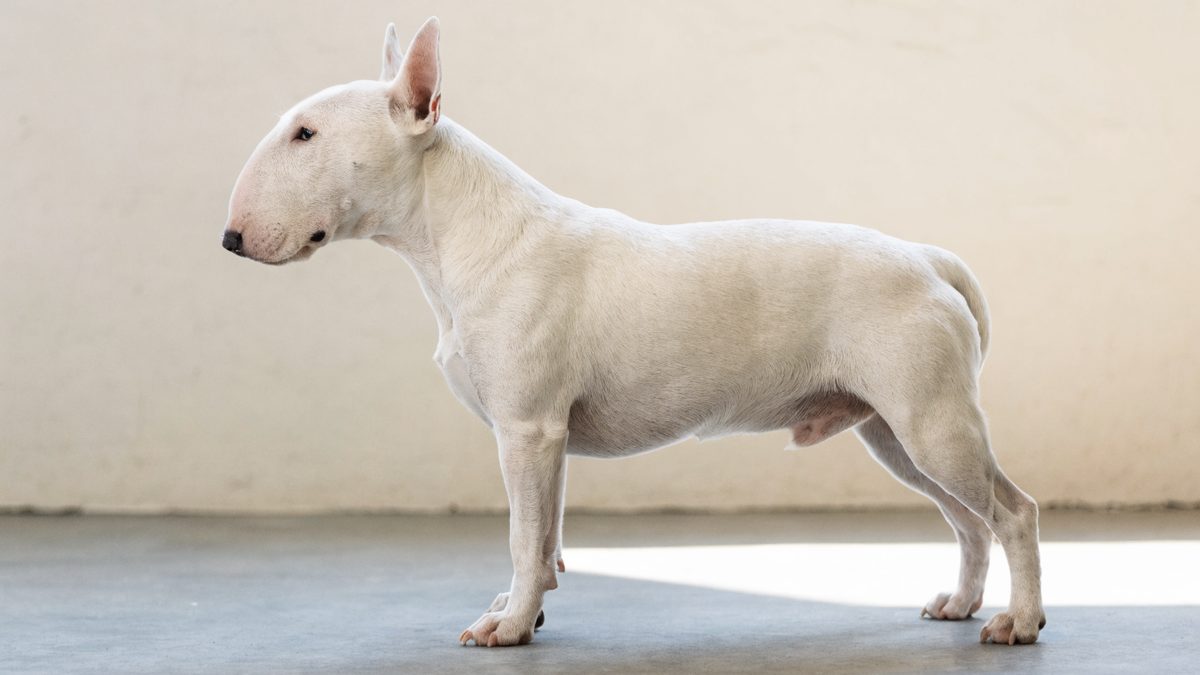
A Bull Terrier is a strongly built, muscular English terrier of roughly 21 to 22 inches and 50 to 70 pounds whose breed standard requires an egg-shaped head, and it is the only registered dog breed defined by that head. Every other feature follows from it.
The Federation Cynologique Internationale places the breed in Group 3 Terriers, Section 3 Bull type Terriers, and describes the unique feature in one line, a downfaced, egg-shaped head. The Royal Kennel Club standard says the same thing from the front, that the head viewed from the front is egg shaped and completely filled, its surface free from hollows or indentations. The American Kennel Club standard adds the profile, that it should curve gently downwards from the top of the skull to the tip of the nose. Three registries, one shape.
That shape is not an accident of fashion and it is not a deformity that crept in. James Hinks standardised the breed type in the 1850s and deliberately selected for the egg-shaped head, and the breed was first shown in its present form at Birmingham in 1862. The Bull Terrier Club was formed in 1887 and the American Kennel Club recognised the breed in 1885 American Kennel Club. A buyer in Pune looking at a puppy with a slightly domed forehead and a visible stop is looking at a dog that departs from the breed standard, not at a rarer variety worth more money.
Where the breed came from
The modern Bull Terrier descends from a cross between the Bulldog and the now-extinct White English Terrier, and it was bred for fighting in the nineteenth century. Hinks is credited with stabilising type with the addition of new blood, with Collie sometimes suggested for the length of muzzle and the Dalmatian as a possible contributor. The fighting history is real and this page does not soften it. What matters to a buyer in 2026 is that the breed has been selected for showing and companionship for well over a century since, and that the FCI standard now lists aggressive or overly shy dogs as a disqualifying fault.
White and Coloured are two varieties, not two breeds
The American Kennel Club standard is written twice, once for White and once for Coloured, and the difference is only the colour clause. For the White variety the coat is white, head markings are permissible, and markings elsewhere are severely faulted. For the Coloured variety any colour other than white is acceptable, brindle is preferred all other things being equal, and a dog which is predominantly white is disqualified. Blue eyes disqualify a dog in both varieties. The Royal Kennel Club and the FCI use softer wording, calling blue or partly blue eyes undesirable rather than disqualifying, and both add that blue and liver coats are highly undesirable Federation Cynologique Internationale.
This split matters in India for one reason that has nothing to do with showing. White is the colour associated with congenital deafness in this breed, and the history is explicit about it. Coloured Bull Terriers became more frequently seen in the 1920s and were valuable in the breeding programme precisely because deafness in the all-white dogs had become a problem. An Indian buyer choosing the classic white dog from a photograph is choosing the higher-risk coat, and should read the health section before paying.
| Source | Height | Weight | Stated lifespan |
|---|---|---|---|
| American Kennel Club breed page | 21 to 22 inches | 50 to 70 pounds (22.7 to 31.8 kg) | 12 to 13 years |
| PDSA (UK charity) | 51 to 61 cm | 22 to 31 kg | Over 10 years |
| Hill's Pet breed page | Male 22 in, female 21 in | Male 55 to 65 lb, female 45 to 55 lb | 11 to 14 years |
| Mr n Mrs Pet (Indian seller) | Male 21 to 22 in, female 20 to 22 in | Male 24 to 32 kg, female 20 to 30 kg | 11 to 13 years |
| Tradeindia listing, New Delhi | Not stated | Not stated | 10 to 12 years |
| Royal Kennel Club and FCI breed standards | No height limit | No weight limit | Not stated |
| UK life table, 4,503 Bull Terriers | Not applicable | Not applicable | Median 12.0 years (95% CI 11.9 to 12.2) |
Read that table twice. The two registries that define the breed publish no size limits at all, because the standard says there are neither weight nor height limits, only the impression of maximum substance for the size of dog consistent with quality and sex Federation Cynologique Internationale. Every number in the first five rows is a description of typical dogs, not a rule. The last row is the only figure in the table drawn from a measured population rather than an editorial estimate, and it is the one this page uses.
If a seller in Delhi or Hyderabad tells you a puppy is undersized or oversized for the breed standard and prices it accordingly, the claim has no basis. Neither the Royal Kennel Club nor the FCI publishes a height or weight limit for the Bull Terrier. The Miniature Bull Terrier is a separate registered breed and the only difference in its standard is that it does have a height limit.
Bull Terrier price in India, and why the published figures disagree
The Bull Terrier price in India runs from Rs 45,000 to Rs 3,00,000 across the published sources in 2026, and the honest answer is that only two Indian pages publish a figure at all Wrapinfur, Bull Terrier Dog Price in India. This is a rare breed here, and thin coverage is exactly why the numbers wobble.
Start with what the two Indian sources actually say. Mr n Mrs Pet, a broker, states an average of Rs 55,000 to Rs 1,50,000 and splits it three ways. Wrapinfur, an editorial site, states Rs 45,000 to Rs 1,50,000 and splits it four ways, adding an imported-bloodline band that runs to Rs 3,00,000 and beyond. They disagree on the floor by Rs 10,000, on the KCI-registered band by Rs 20,000, and on whether an imported band exists at all. Neither page mentions the other.
| Tier | Mr n Mrs Pet | Wrapinfur | Gap |
|---|---|---|---|
| Pet or basic quality | Rs 55,000 to Rs 90,000 | Rs 45,000 to Rs 70,000 | Rs 10,000 to Rs 20,000 |
| KCI registered | Rs 90,000 to Rs 1,20,000 | Rs 70,000 to Rs 1,00,000 | Rs 20,000 |
| Show or champion bloodline | Rs 1,20,000 to Rs 1,50,000 | Rs 1,00,000 to Rs 1,50,000+ | Rs 20,000 at the floor |
| Imported bloodline | Not offered as a tier | Rs 1,50,000 to Rs 3,00,000+ | Entire tier disputed |
| Stated overall range | Rs 55,000 to Rs 1,50,000+ | Rs 45,000 to Rs 1,50,000 | Rs 10,000 at the floor |
The city table is where the disagreement gets more interesting, because only one source publishes one. Wrapinfur gives seven cities, and the spread across them is wider than the spread between its own tiers.
| City | Published range |
|---|---|
| Mumbai | Rs 60,000 to Rs 1,80,000 |
| Pune | Rs 50,000 to Rs 1,30,000 |
| Delhi | Rs 50,000 to Rs 1,50,000 |
| Bangalore | Rs 50,000 to Rs 1,40,000 |
| Hyderabad | Rs 45,000 to Rs 1,20,000 |
| Chennai | Rs 45,000 to Rs 1,20,000 |
| Kolkata | Rs 45,000 to Rs 1,10,000 |
What the third Indian result publishes, which is nothing
The Tradeindia marketplace listing from Pets Collection in New Delhi ranks on page one for this query and prints no price at all. It describes a medium, short-coated, high-activity dog with a 10 to 12 year lifespan and replaces the figure with a Get Latest Price button. That is not an oversight, it is how a thin market behaves. When a breed is rare enough that a seller cannot predict what the next enquiry will bear, the price becomes a negotiation rather than a listing.
What KCI registered actually buys you
A Kennel Club of India registration certifies parentage and nothing else. The KCI is the body that registers litters and pedigrees in India and publishes its own tariff sheet, revised with effect from 1 April 2024. It is a record of who the parents were. It is not a health certificate, it does not certify that the puppy has been BAER tested for congenital deafness, and it does not certify that either parent has been screened for kidney disease or heart disease. Both Indian price pages present KCI registration as the middle rung on a quality ladder, which is precisely the confusion this page exists to correct Wrapinfur, Bull Terrier Dog Price in India.
For a Bull Terrier the four documents that change the odds are a BAER hearing certificate for the puppy, an advanced cardiac exam including an echocardiogram for both parents, a urine protein creatinine ratio for both parents dated within the last year, and a DNA result for lethal acrodermatitis. Those four are the Bull Terrier Club of America's own minimum for breeding stock, and the American Kennel Club lists the same four as the national breed club's recommended tests.
Ask for all four before you discuss price, because they are the only claims a seller makes that you can independently verify. A price is an opinion. A dated laboratory result signed by a named veterinarian is a verified fact, and you can ring the clinic that issued it. The Bull Terrier Club of America sets these as the minimum for both stud dogs and bitches, and requires the kidney test annually rather than once. The American Kennel Club publishes the identical list as the national breed club recommendation, which is patella evaluation, cardiac exam, BAER testing and a kidney urine protein creatinine ratio.
The legal status you must check before you buy
One Indian city has named this breed by name. The Municipal Corporation Chandigarh Pet and Community Dogs Bye-Laws, 2025, notified at the end of October 2025, prohibit the registration of the Bull Terrier along with the American Bulldog, the American Pitbull or Pitbull Terrier, the Pakistan Bull Terrier, the Cane Corso, the Dogo Argentino and the Rottweiler. Existing owners got a 45-day buffer to register, after which keeping, breeding or harbouring a banned breed attracts penalties and immediate seizure of the dog by authorised authorities. Reported penalties run up to Rs 13,400. Even dogs registered before the notification must be muzzled at all times while walking and leashed with equipment strong enough to keep them under control.
Two national outlets even disagree on how many breeds the Chandigarh list contains, because NDTV counts six and both the Hindustan Times and the Times of India count seven Hindustan Times, Chandigarh tightens leash… The Times of India. Bonbeno prints that disagreement rather than picking the convenient number. What all three agree on, and what matters to a buyer, is that the words Bull Terrier appear on the list.
Outside Chandigarh there is no nationwide ban. The central circular of 12 March 2024 that Indian listicles still quote was quashed by the Karnataka High Court on 10 April 2024 and set aside by a Delhi High Court division bench of Acting Chief Justice Manmohan and Justice Manmeet Pritam Singh Arora on 16 April 2024, after the Centre's own counsel said he had no objection to it being set aside. The Delhi bench directed that a fresh notification could only follow a public notice inviting written objections. The circular never named the Bull Terrier individually in any case, though it did carry the bare word Terriers in its list, which is one of the reasons the drafting was attacked. Gurugram's eleven-breed prohibition, effective 15 November 2022, does not name the Bull Terrier either. Our pitbull price in India guide covers how the same circular hit the American breeds much harder.
Breed prohibition in India is municipal, not national, and it changes. Chandigarh moved in October 2025. Before you commit money on a Bull Terrier, ring your municipal corporation's veterinary or public health office and ask whether your city's current pet by-laws name the breed. Do not rely on a listicle, and do not rely on this page being current in your city on the day you read it.
Monthly cost of a Bull Terrier in India
The published monthly cost of a Bull Terrier in India runs from Rs 5,000 to Rs 15,000, and the two Indian sources disagree on the ceiling by Rs 5,000 Wrapinfur, Bull Terrier Dog Price in India. Neither figure includes the screening this breed specifically needs, which is where the real budget goes.
Mr n Mrs Pet puts average monthly expenses at Rs 5,000 to Rs 10,000, covering quality food, grooming, vet visits and routine care. Wrapinfur puts the total at Rs 5,000 to Rs 15,000 and breaks it into five lines. The floor agrees. The ceiling does not, and the gap is a third of the total.
| Line | Wrapinfur monthly range | Notes |
|---|---|---|
| Food and nutrition | Rs 2,500 to Rs 6,000 | The largest single line, and the one that scales with a 22 to 31 kg adult |
| Vet and healthcare | Rs 500 to Rs 3,000 | Routine only. Does not include cardiac or kidney screening |
| Grooming | Rs 300 to Rs 1,000 | A short flat coat needs a weekly brush, not a salon |
| Training and exercise | Rs 500 to Rs 3,000 | Realistic for a breed the AKC calls an independent free-thinker |
| Toys and accessories | Rs 500 to Rs 2,000 | Underrated for a dog that destroys soft toys in minutes |
| Stated total | Rs 5,000 to Rs 15,000 | Mr n Mrs Pet gives Rs 5,000 to Rs 10,000 for the same dog |
The costs neither Indian page counts
Both Indian monthly figures leave out the screening that defines responsible Bull Terrier ownership. The Bull Terrier Club of America requires a urine protein creatinine ratio annually for breeding dogs, and the same annual urine check is the cheapest early warning a pet owner has for the breed's kidney disease. An advanced cardiac exam has to be performed by a veterinary cardiologist and must include an echocardiogram, which is why the Orthopedic Foundation for Animals made it a CHIC requirement only from May 2025. Veterinary cardiologists exist in Mumbai, Delhi, Bengaluru, Chennai and Hyderabad, and almost nowhere else in India. Budget for a travel day, not just a consultation fee.
The one-off genetic test is the cheapest item on the list and the one most Indian owners never hear about. PennGen at the University of Pennsylvania runs the lethal acrodermatitis test on a cheek swab or EDTA blood for USD 75, and the result is permanent. One swab, one payment, one answer for the dog's whole life.
What a US cost guide will do to your budget
A page called How Much Does It Cost to Own a Bull Terrier ranks on the first page of Indian results and quotes USD 1,800 to USD 3,000 to buy and USD 130 to USD 600 a month to keep. Converted naively, that monthly figure lands between roughly Rs 11,000 and Rs 50,000, which is three times the top of the Indian published range. It also lists emergency vet care at USD 500 to USD 10,000 and pet sitting at USD 25 to USD 100 a night, neither of which resembles an Indian quote. Indian food, veterinary and boarding costs are not American costs, and the conversion is meaningless. Use Indian figures for Indian budgets.
A realistic first-year total
Add the purchase, the initial vaccination course, neutering if you choose it, a crate, a strong flat collar and lead, and one round of baseline screening, and the first year costs meaningfully more than twelve months of the running figure. The published purchase range alone spans Rs 45,000 to Rs 3,00,000. A buyer who budgets only the sticker price and Rs 5,000 a month has budgeted for the cheapest possible version of this dog and none of the tests that make it a good decision.
Destructive chewing. The AKC describes a dog with a higher commitment to fun and games than to a work ethic, and Bull Terrier owners routinely report the chaos being the point. Budget for genuinely tough rubber toys rather than replacing soft ones weekly, and count that as a health cost rather than an indulgence, because swallowed toy fragments are a common and expensive emergency.
Can a Bull Terrier handle the Indian climate?
A Bull Terrier handles Indian heat moderately well and earns a heat tolerance of 3 out of 5, because it has a normal muzzle rather than a flat one but carries a lot of muscle on a compact frame and has no meaningful insulating coat. The downface is long, not squashed, and that single fact separates it from every brachycephalic breed sold alongside it.
Get the anatomy right first, because the ranking pages muddle it. The breed standard requires a head that is long, strong and deep right to the end of the muzzle, with the distance from the nose tip to the eyes perceptibly greater than that from the eyes to the top of the skull Federation Cynologique Internationale. That is a long muzzle presented in an unusual shape. A Bull Terrier is not brachycephalic, and it does not carry the airway compromise that makes a Bulldog or a Pug dangerous to walk in a Chennai May. The largest UK study of heat-related illness identified brachycephalic skull shape as a significant risk factor and named the Chow Chow, Bulldog and French Bulldog specifically, not the Bull Terrier.
That study also sets the scale of the problem honestly. From the clinical records of 905,543 dogs under UK veterinary care in 2016, 395 confirmed heat-related illness events were identified, an incidence of 0.04 percent, and 14.18 percent of those events were fatal. One event in seven killed the dog. Those are UK ambient temperatures. India runs hotter for longer.
What raises a Bull Terrier's risk anyway
Three things on the same list of risk factors do apply to this breed. Higher bodyweight relative to the breed and sex mean was a significant risk factor, and Hill's warns explicitly that Bull Terriers become obese easily if overfed Hill's Pet Nutrition. Being over two years of age was a risk factor, and this is a dog that stays boisterous well past two. And the breed's own temperament works against it, because a dog that will chase a ball in 38 degree heat until it collapses is at exertional risk in a way a self-regulating dog is not. Most Indian heat emergencies in this breed will be exertional, not a dog left in a car.
The white coat problem nobody mentions
A white Bull Terrier has thin, unpigmented skin over most of its body, and the breed standard notes that skin pigmentation is not to be penalised precisely because many white dogs lack it. Unpigmented skin under Indian sun burns. On a midday walk in Ahmedabad or Nagpur the exposed belly, the bridge of the nose and the ear leathers are the first places to redden. Coloured dogs, and white dogs with pigmented skin, carry less of this risk. Nobody in the ranking set connects the breed's signature colour to Indian sun exposure at all.
| City type | Example cities | Practical verdict |
|---|---|---|
| Hot and dry summers | Delhi, Jaipur, Ahmedabad, Nagpur | Workable with hard timing discipline. Walk before 07:00 and after 20:00 from April to June. Pavement, not air temperature, is the limit |
| Hot and humid, coastal | Mumbai, Chennai, Kochi, Kolkata | The harder brief. Humidity blocks evaporative cooling from panting, so a dog can overheat at a lower air temperature than the thermometer suggests |
| Moderate year round | Bengaluru, Pune, Hyderabad plateau | The easiest Indian fit for this breed. Outdoor exercise stays possible most of the year |
| Cool winters, hot summers | Chandigarh, Lucknow, Bhopal | Physically fine, but check Chandigarh's 2025 by-laws before you buy, because the breed is named on them |
| Hill and northern cold | Shimla, Dehradun, Gangtok | Comfortable. A soft-textured undercoat may appear in winter, which the FCI standard permits |
The numbers that matter when something goes wrong
Learn two temperatures. A raised body temperature of 40.5 degrees Celsius or above is the danger threshold, and active cooling stops when the dog reaches 39.4 degrees Celsius. Move the dog into shade or air conditioning, spray or sponge the body with cool water that is not cold, run a fan over it, and gently massage the legs and body to help circulation. Never plunge a dog into ice water, because that constricts surface blood vessels and slows heat loss. Then get to a vet, because cooling the dog is first aid and not treatment.
The other Indian climate risk is not heat at all. A PCR survey of 525 dogs across four Indian cities found 261 of them, 49.7 percent, infected with at least one tick-borne pathogen, with Hepatozoon canis at 30 percent, Ehrlichia canis at 20.6 percent, Mycoplasma haemocanis at 12.2 percent, Anaplasma platys at 6.5 percent and Babesia vogeli at 5.5 percent. Ticks were found on 53 percent of the dogs examined. A short flat coat makes ticks easy to see, which is one of the few Indian advantages this breed has. Use it. Check the ears, the armpits and between the toes after every monsoon walk.
Press the back of your hand to the road surface and hold it for seven seconds. If you cannot, the dog cannot walk on it. In most of India that rules out roughly 11:00 to 17:00 for four months of the year, regardless of what the air temperature reads. A Bull Terrier's compact feet, described in the standard as round and compact with well arched toes, sit close to the ground and take the full heat.
Temperament and who should not buy one
A Bull Terrier is courageous, full of spirit and fun loving, of even temperament and amenable to discipline, and although obstinate is particularly good with people, which is the FCI standard's own wording and an unusually candid one. The word obstinate is in the breed standard. Take it seriously.
The American Kennel Club puts the same trait less diplomatically. This is an independent free-thinker with a higher commitment to fun and games than to a work ethic, operating on the principle that if it is fun, they will do it, and if not, why bother. That is a playful, stubborn dog described by the body that registers it. Hill's calls the breed very energetic. PDSA says English Bull Terriers suit active families and are best suited to experienced owners.
Good with children, with one honest caveat
The breed is generally good with children and every authority says so, but the caveat is physical rather than behavioural. A 22 to 31 kg dog built for maximum substance for its size, moving with what the standard calls a typical jaunty air that suggests agility and power, will knock a small child over without any intention of harm PDSA, English Bull Terrier breed…. Older children who can stay upright do better than toddlers. The Indian seller pages that describe the breed as great with older kids have this one right.
The behaviour trait that is genuinely breed-specific
Compulsive tail chasing is a documented Bull Terrier problem with real numbers attached, and no ranking page publishes them. A survey and case-control study of 333 Bull Terriers, comprising 145 tail chasers and 188 unaffected dogs, found the median age of onset at 6 months with a range from 2 months to 6 years. Of the 109 affected dogs for whom frequency was recorded, 74 percent chased their tail daily. The study found tail chasing significantly associated with sex, with trance-like behaviour and with episodic aggression, and males were at an 8 percent greater risk of the diagnosis than females.
Read that carefully, because it is easy to over-read. Phobias and owner-directed aggression did not significantly associate with tail chasing. The association is with trance-like states and episodic aggression, not with a dog that turns on its family. What it tells an Indian buyer is that a spinning puppy at six months is not a funny quirk to film, it is the documented onset window for a compulsive disorder, and it warrants a veterinary behaviour consultation rather than a laugh.
Living with other dogs
Terriers were selectively bred to be brave and tough and to pursue vermin above and below ground, and the Bull Terrier carries that inheritance on a bulldog frame. Same-sex dog tolerance is the usual weak point in this group. Two Bull Terriers of the same sex in one Indian flat is a decision that needs a plan, not optimism. Cats and small pets in the same household need a properly managed introduction from puppyhood, and even then supervision does not stop being necessary.
First-time owners, honestly
This is not a first-time dog. PDSA describes the breed as great for experienced owners with time to train and socialise. The combination that makes it hard is specific, a dog that is strong, stubborn, easily bored, physically robust enough to keep going when a softer dog would stop, and prone to a compulsive disorder if under-stimulated. A first-time Indian owner in a two-bedroom flat who works long hours will produce an unhappy dog and a damaged flat. Someone who has already raised one strong terrier will find this breed enormously rewarding.
| Buy one if | Do not buy one if |
|---|---|
| You have owned a strong, wilful dog before | This is your first dog |
| Someone is home for most of the day | The flat is empty from 09:00 to 20:00 |
| Your children are old enough to stay on their feet | You have a toddler and no separate space |
| You can commit an hour of real exercise daily, split around the heat | Your walking window is a hot midday break |
| You will pay for cardiac, kidney and hearing screening | You are buying on price alone |
| Your city's pet by-laws do not name the breed | You live in Chandigarh, where the 2025 by-laws do |
Nothing above is a warning that the breed is unfriendly. Bull Terriers are affectionate to the point of being physically demanding about it, and owners describe a dog that wants to be on the sofa, on the bed and on the person. The difficulty is energy and stubbornness, not temperament toward people. If you want a dog that ignores you politely, this is the wrong breed.
Training a Bull Terrier, and what the breed resists
To train a Bull Terrier, make every session short, food-led and genuinely fun, because the American Kennel Club's own guidance is that the breed will do what is fun and skip what is not. Drilling a repetition twenty times is the fastest way to lose the dog.
Positive reinforcement with food or toys is an excellent place to start, and there is no limit to what Bull Terriers can do if trained in a positive manner with patience and humour. That is the registry's advice, not a trainer's opinion, and the word humour is doing real work in it. A Bull Terrier that finds a session boring will invent a better game, usually involving your furniture.
A realistic Indian training timeline
- Weeks 8 to 12. Name response, hand feeding, crate as a good place, and exposure to autorickshaw noise, lift doors, delivery riders and building watchmen. This window closes fast and you cannot reopen it.
- Weeks 12 to 16. Loose-lead walking on a flat collar or a Y-front harness, before the dog outweighs the handler's ability to correct a pull. Start now or spend two years fixing it.
- Months 4 to 6. A reliable recall built on food, not on shouting. Also the documented onset window for compulsive tail chasing, so watch for spinning and act early rather than filming it.
- Months 6 to 12. Impulse control work, settle on a mat, and a solid leave it. Adolescence in this breed is loud and physical, and obedience trained before it will hold through it.
- Months 12 to 24. Maintenance plus a real job. Scent games, flirt-pole work in the cool hours and structured play beat repetitive obedience for a dog with this attention profile.
What actually works, and what does not
Bull Terriers can excel at agility, flyball, freestyle, weight pull and carting, and in working roles including bomb detection, search-and-rescue and as service, assistance, health-alert and therapy dogs. The common thread is that all of those involve movement and problem solving. Formal heelwork in a hot Indian afternoon does not. Reframe the training goal from obedience to occupation and the breed becomes far easier.
Harsh handling is the specific failure mode to avoid. This is a dog the FCI standard calls courageous and obstinate, and confrontation with an obstinate dog produces a contest rather than compliance. Aversive tools also sit badly with Indian law, because section 11(1)(a) of the Prevention of Cruelty to Animals Act, 1960, covers any person who beats, kicks or otherwise treats any animal so as to subject it to unnecessary pain or suffering. The first-offence fine in that section has never been revised from a minimum of ten rupees and a maximum of fifty, which is why it deters nobody and why Indian trainers still sell shock collars openly. The law is weak. The training argument against aversives is not, because they make an obstinate dog more obstinate. Train the dog with food.
The training problem specific to a deaf puppy
Roughly one Bull Terrier puppy in ten is deaf in at least one ear, so a proportion of Indian buyers will unknowingly own a unilaterally deaf dog. A unilaterally deaf dog trains almost normally but cannot locate sound, which matters on an Indian street where the traffic can be on either side. A bilaterally deaf dog needs a hand-signal vocabulary from day one, a vibration collar as an attention cue rather than a correction, and a permanent commitment to leads and secure gardens. None of that is impossible. All of it needs to be a decision, and you can only decide it if the puppy has had a BAER test.
BAER testing can be done from about five weeks of age and the Bull Terrier Club of America wants it done on every puppy before it leaves for its new home. Ask the Indian breeder for the certificate. If the answer is that the puppy responds to a clap, that is not a test, because a unilaterally deaf puppy responds to a clap perfectly well.
Daily exercise, and what the published figures disagree about
A Bull Terrier needs between 40 minutes and a full hour of real exercise a day, and the published sources disagree by a factor of one and a half. In India the constraint is not the total, it is that the total has to fit into the cool hours.
Hill's rates the breed very energetic and puts the requirement at 40 minutes a day. PDSA says at least one hour of exercise a day. The Royal Kennel Club's breed characteristics panel splits the difference at up to one hour per day. The American Kennel Club describes daily moderate exercise providing good mental and physical stimulation, such as long walks with the family. Take an hour as the planning figure and treat 40 minutes as the floor on a bad-weather day.
| Source | Stated requirement | Framing |
|---|---|---|
| PDSA | At least one hour a day | A floor, stated as a minimum |
| Royal Kennel Club | Up to one hour per day | A ceiling, stated as a maximum |
| Hill's Pet | 40 minutes a day | Paired with a very energetic rating |
| American Kennel Club | Daily moderate exercise | No number given at all |
Notice that PDSA calls one hour a minimum and the Royal Kennel Club calls one hour a maximum. Those are opposite claims about the same number, published by two respected UK bodies, and no ranking page notices The Royal Kennel Club, Bull Terrier. This is what happens when breed pages copy each other rather than measure anything.
An Indian daily schedule that actually works
- Morning, before 07:00 from March to June: 30 to 40 minutes of brisk walking plus five minutes of sniffing time, which tires the dog more than the distance does.
- Midday, indoors: 10 minutes of scent work, a snuffle mat or a frozen stuffed toy. This replaces the walk you cannot take, not the walk you skipped.
- Evening, after 20:00: 20 to 30 minutes on the lead plus short bursts of flirt-pole or tug in a shaded compound, stopping before the dog stops.
- Twice a week: something the dog has to solve rather than just do, because an under-occupied Bull Terrier redirects into the tail chasing described above.
- Monsoon days: the indoor block doubles. A wet dog with a short flat coat is fine, but wet floors and a 28 kg dog at full speed are not.
What happens without it
An under-exercised Bull Terrier does not become quietly sad. It becomes destructive, vocal and, in the specific case of this breed, at higher risk of the compulsive behaviour with a documented median onset at six months. It also gains weight, and higher bodyweight relative to the breed mean is itself a significant risk factor for heat-related illness Hill's Pet Nutrition. In an Indian summer those two problems compound. A bored, overweight Bull Terrier is a dog with worse heat tolerance than a fit one of exactly the same breeding.
This breed does not self-regulate well in heat, because the standard's own description of a jaunty air suggesting agility and power is a description of a dog that keeps going. On any day above about 30 degrees Celsius, end the session while the dog still looks keen. The tell is a wide, curled tongue and a change from rhythmic to frantic panting. Cool the dog then, not later.
Grooming a short coat in Indian humidity
Grooming a Bull Terrier takes one brushing a week and nothing else routine, because the coat is short, flat, harsh to the touch and glossy, with the skin fitting the dog tightly The Royal Kennel Club, Bull Terrier. The work in India is skin care, not coat care.
The American Kennel Club is specific about the method. A weekly brushing with a soft-bristle brush or a hound glove removes dirt and loose hair, the ears should be regularly inspected and cleaned if needed, and the nails should be trimmed often because overly long nails cause discomfort and problems walking and running. PDSA agrees that a brush once a week is enough. The Indian seller pages calling this a low grooming needs breed are correct, and it is one of the few claims on those pages this guide does not have to qualify.
The FCI standard adds one detail the others skip. A soft-textured undercoat may be present in winter. In Delhi, Chandigarh or the hills you will see a genuine seasonal shed in spring. In Chennai or Mumbai you will mostly see year-round light shedding instead, because the dog never gets a real winter signal.
Why this breed's skin is the actual job
Atopy, meaning environmental skin allergy, is on PDSA's list of the breed's common health problems, and it is the single most common reason an Indian Bull Terrier ends up at the vet repeatedly. A white dog with unpigmented skin shows every flare, which is diagnostically useful and cosmetically alarming. Humid coastal cities push the fungal and bacterial load up, and a dog that comes home damp from a monsoon walk and stays damp in a skin fold behind the elbow is the standard Indian case.
- Dry the dog properly after every wet walk, paying attention to the armpits, the groin and between the toes.
- Brush once a week with a hound glove, which also lets you find ticks on a short coat in about ninety seconds.
- Bathe only when genuinely dirty, because over-bathing strips a harsh coat and worsens atopy.
- Check the ear canals weekly, since erect ears stay drier than drop ears but still trap dust in dry-season Indian cities.
- Trim nails every three to four weeks, more often for a flat-dwelling dog that never wears them down on rough ground.
The sunburn point
White Bull Terriers with unpigmented skin burn. The breed standard's line that skin pigmentation is not to be penalised exists because many white dogs have little of it. On the nose bridge, the ear tips and the belly, an Indian summer produces real sunburn on a white dog left in a sunny courtyard. Shade, timing and a vet-recommended animal-safe sunscreen on the exposed nose are the answer. Human sunscreen containing zinc oxide is not, because dogs lick it off and zinc is toxic to them.
Hard, cracked, crusted lesions on the paws and around the face of a Bull Terrier puppy, together with poor growth, are the classic presentation of lethal acrodermatitis, an inherited disease covered in the health section below. That is not an allergy, it is not a grooming failure, and it does not respond to shampoo. If you see it, consult your nearby vet the same week and ask specifically about the MKLN1 DNA test.
Health risks, screening and lifespan
The Bull Terrier's four defining health risks are congenital deafness, kidney disease, heart disease and lethal acrodermatitis, and every one of them has a screening test that exists today Bull Terrier Club of America. Three of the four can be checked before you pay. This section is general information for Indian owners and not a diagnosis, so consult your nearby vet before acting on any of it.
Start with what the Orthopedic Foundation for Animals requires for a Bull Terrier to earn a Canine Health Information Center number, because that list is the closest thing the breed has to an official health contract. It runs to five items, patellar luxation evaluation, cardiac evaluation by advanced cardiac exam, congenital deafness by BAER hearing test, kidney disease by OFA evaluation, and a DNA-based lethal acrodermatitis test. From May 2025 the cardiac requirement became an advanced cardiac exam, limited to veterinary cardiologists and required to include an echocardiogram.
Congenital deafness, the number nobody publishes
Congenital sensorineural deafness affected 10.19 percent of 1,060 English Bull Terrier puppies BAER tested in England, with 8.21 percent unilaterally deaf and 1.98 percent bilaterally deaf. That is one puppy in ten. The coat association is stark. Of the deaf puppies, 96.29 percent had a white coat, and 19.29 percent of all white-coated puppies were deaf, against a population that was 50.85 percent white with or without a patch. Heritability was estimated at 0.15 to 0.16 across all coat types and 0.25 within the white and patched dogs alone.
Say that plainly for an Indian buyer. Roughly one white Bull Terrier puppy in five is deaf in at least one ear. The breed's own history admits the mechanism, because coloured Bull Terriers were valued in the 1920s breeding programme precisely because deafness in the all-white dogs had become a problem. Every ranking page on this query says the breed can be deaf. None of them publishes the one in five.
| Measure | Figure |
|---|---|
| Overall prevalence of congenital sensorineural deafness | 10.19% |
| Unilaterally deaf | 8.21% |
| Bilaterally deaf | 1.98% |
| Deaf puppies that had a white coat | 96.29% |
| White-coated puppies that were deaf | 19.29% |
| Puppies with a white coat, with or without a patch | 50.85% |
| Heritability, white and patched dogs only | 0.25 |
The screening register tells its own story. The Royal Kennel Club's BAER scheme results for the Bull Terrier including the Miniature, complete to 30 June 2026, fit on two pages and record a single dog as affected bilaterally, with every other entry reading unaffected. That is not evidence the breed is nearly free of deafness, it is evidence that almost nobody submits results to the scheme, and that the dogs who do are the ones already screened by careful breeders. A tiny voluntary register with a clean sheet proves nothing. Ask for the individual puppy's certificate instead.
Kidney disease, the silent one
Two separate kidney diseases run in this breed and they are checked in different ways. Polycystic kidney disease is autosomal dominant, and a study that genotyped 149 Bull Terriers, 47 affected and 102 unaffected, found a non-synonymous mutation in exon 29 of the canine Pkd1 gene in all 47 affected dogs and in none of the 102 unaffected ones. Every affected dog was heterozygous, and chronic renal failure develops in middle to old age. Hereditary nephritis is the other, and it is the one the urine test is for.
The Bull Terrier Club of America requires a urine protein creatinine ratio on all breeding dogs annually and on bitches before each breeding, and sets the recommended value below 0.5. Note that the club's own published figure is below 0.5 while several breed-community sources circulate a stricter threshold of 0.3, which is a disagreement an Indian buyer should know exists rather than discover mid-argument. The American Kennel Club lists the same kidney urine protein creatinine ratio among the national breed club's four recommended tests. The test is a urine sample. It costs almost nothing in India and it is the single most useful annual check this breed gets.
Heart disease, and why the priority order is wrong everywhere
A study of 101 English Bull Terriers found heart disease in 65 percent of them, with mitral valve abnormalities in 47 percent and aortic stenosis in 29 percent. Healthy English Bull Terriers in that study had a smaller mitral valve area and a smaller mitral annulus diameter than dogs of similar body surface area, and a higher mean transmitral gradient than other breeds, which is why the authors recommend that those three measurements be added to the standard echocardiographic protocol for the breed. A general cardiac screen that does not measure them can miss what it is looking for.
The Orthopedic Foundation for Animals register points the same way from a different direction. Among Bull Terriers submitted for advanced cardiac examination, 70.4 percent were normal, 21.5 percent were abnormal and 7.7 percent equivocal, from 247 dogs tested. Compare that with patellar luxation in the same breed, where 278 dogs were tested and 97.8 percent were normal with only 2.2 percent abnormal. Yet every ranking breed page leads its health list with patellar luxation and treats the heart as an afterthought. The numbers say the opposite.
| Screening | Dogs tested | Normal | Abnormal |
|---|---|---|---|
| Advanced cardiac | 247 | 70.4% | 21.5% (plus 7.7% equivocal) |
| Congenital cardiac | 298 | 95.0% | 2.7% (plus 2.3% equivocal) |
| Patella | 278 | 97.8% | 2.2% |
| BAER hearing test | 173 | 98.8% | 0.6% |
| Kidney | 167 | 99.4% | 0.6% |
| Hips | 133 | 89.5% | 7.5% dysplastic |
| Eyes | 53 | 88.7% | 11.3% |
Read that table with one caveat firmly in mind. OFA data is voluntarily submitted, so it is biased toward dogs whose owners expected a good result, and the BAER row showing 98.8 percent normal sits beside a peer-reviewed prevalence of 10.19 percent in unselected puppies De Risio L, Freeman J, Lewis T. Prevalence. Where a register and a study disagree this sharply, believe the study and treat the register as a floor.
Lethal acrodermatitis, the one you can end permanently
Lethal acrodermatitis is an autosomal recessive disease of Bull Terriers and Miniature Bull Terriers caused by a single splice-site variant, MKLN1 c.400+3A>C, which causes complete skipping of exon 4 in the MKLN1 messenger RNA in skin. Affected puppies show poor growth, immune deficiency, characteristic skin lesions especially at the paws, diarrhoea, bronchopneumonia, coat colour dilution and a hard palate deformation, and typically die before reaching two years old. The variant segregated perfectly across 46 cases and 294 controls and was absent from 462 dogs of 62 other breeds.
Here is the number that should decide an Indian buyer's behaviour. Among 166 unaffected Finnish Bull Terriers, 37 were heterozygous carriers, a carrier rate of 22 percent. Roughly one apparently healthy dog in five carries it. Two carriers bred together produce affected puppies. The test costs USD 75 at PennGen on a cheek swab or EDTA blood, and it is the only one of the breed's four big problems that a single piece of paper eliminates completely.
Lifespan, and what the biggest dataset says
The Bull Terrier's median life expectancy is 12.0 years with a 95 percent confidence interval of 11.9 to 12.2, calculated from 4,503 UK Bull Terriers of which 2,151 were deceased. That figure comes from a study of 584,734 dogs across 155 breeds, the largest such dataset published. It sits exactly on the crossbred median of 12.0 years and 0.7 years below the all-purebred median of 12.7 years Dogs Trust, Life expectancy for 155 breeds…. The AKC's 12 to 13 years, Hill's 11 to 14 years and PDSA's over 10 years are all editorial estimates around that measured number PDSA, English Bull Terrier breed….
The rest of the list
Patellar luxation, atopy and demodectic skin disease complete the picture, and none of them is breed-defining PetMD, Bull Terrier Dog Breed Health…. PetMD's health list of patellar luxation, mitral valve dysplasia, hereditary nephritis and partial or total deafness is a reasonable summary of the literature, and its main flaw is the ordering rather than the content. The Royal Kennel Club places the breed in Breed Watch category 2, meaning there are points of concern for judges to watch, and it will not register merle puppies whelped from a mating on or after 1 March 2011, nor any puppy from a merle to merle mating born on or after 1 January 2013, because of impaired vision and hearing associated with the merle gene in this breed.
Merle is not a Bull Terrier colour. The Royal Kennel Club's breed standard colour list runs to twenty entries and merle is not among them, and the club refuses to register merle puppies at all because of the vision and hearing risk. A seller in India offering a merle Bull Terrier at a premium is offering a dog with an outcrossed coat gene in a breed that already carries a one in ten deafness rate. Walk away.
Everything above is general information for Indian pet owners drawn from published research and registry data. It is not a diagnosis and it cannot replace an examination. Consult a registered veterinarian near you before acting on any of it, and treat sudden collapse, laboured breathing, blood in the urine or a temperature at or above 40.5 degrees Celsius as an emergency rather than something to read about.
Feeding a Bull Terrier in India
Feed a Bull Terrier a diet appropriate to its life stage and weigh the dog monthly, because Hill's warns that care must be taken not to overfeed as the breed becomes obese easily American Kennel Club. Weight is not a cosmetic issue in this breed, it is a heat risk and a joint risk at once.
The American Kennel Club's guidance is deliberately plain, that any diet should be appropriate to the dog's age, meaning puppy, adult or senior. There is no breed-specific formula and any Indian seller claiming one is inventing it. What matters more is portion control and body condition, because a 22 to 31 kg adult that gains four kilograms has gained roughly fifteen percent of its bodyweight and no longer looks obviously fat to its owner.
Body condition beats the scale
Use body condition scoring rather than a target weight, because the breed standard sets no weight limit and the impression of maximum substance for the size of dog is what a correct Bull Terrier looks like. Run your hands along the ribs. On a correctly conditioned dog you should feel each rib easily under a thin layer of muscle, see a waist from above and a clear upward tuck from brisket to belly, which the standard itself describes as a graceful upward curve. If the tuck has gone, the dog is overweight regardless of what the number says.
The heat link makes this urgent in India. Higher bodyweight relative to the breed and sex mean was a significant risk factor for heat-related illness in a study of 905,543 dogs. An overweight Bull Terrier in Chennai in May is measurably more likely to have a heat emergency than a lean one, and 14.18 percent of heat-related illness events in that study were fatal.
A life-stage feeding plan
- 8 to 16 weeks. Four meals a day of a large-breed or all-breed puppy food, kept on whatever the breeder fed for the first fortnight to avoid a diet change on top of a home change.
- 4 to 6 months. Three meals a day. This is the fastest growth phase and the point at which overfeeding does lasting joint damage.
- 6 to 12 months. Two meals a day. Keep the dog visibly lean through adolescence rather than filling it out early.
- 12 months onward. Two meals a day of adult food, portioned to body condition and adjusted seasonally, because most Indian dogs need slightly less in peak summer when activity drops.
- 7 years onward. Two meals a day of a senior formulation, with an annual urine protein creatinine ratio alongside it, because kidney disease in this breed presents in middle to old age.
The kidney point that changes the feeding conversation
A Bull Terrier with confirmed kidney disease is a dog whose diet becomes a medical decision rather than a shopping one, and prescription renal diets are available in India through veterinary clinics in most metros. Do not put a healthy Bull Terrier on a renal diet as a precaution. Do run the annual urine protein creatinine ratio the breed club recommends, because a value that starts drifting is the trigger for a diet conversation with your vet, and a value above the club's recommended 0.5 warrants further testing rather than panic, since a urinary tract infection can raise it too.
Indian availability, honestly
Every major life-stage line is available in Indian metros and online, and the practical constraints are storage and monsoon humidity rather than supply. Buy pack sizes you will finish within about six weeks, store kibble in an airtight container rather than a rolled-down bag, and never leave wet food out in a humid coastal kitchen. Home-cooked Indian diets can work for this breed but need a veterinary nutritionist to balance calcium and phosphorus, which matters more than usual here given the breed's kidney profile. Consult your nearby vet before switching a Bull Terrier off a commercial diet.
Most Indian clinics will let you use the scale without an appointment. One weight a month, written down, catches the slow drift that owners genuinely cannot see. For a breed where obesity worsens heat tolerance, joint load and anaesthetic risk all at once, that is thirty seconds a month very well spent.
The first year, month by month
A Bull Terrier's first year has four fixed checkpoints that no other breed shares, the BAER hearing test at about five weeks, the lethal acrodermatitis result before purchase, the compulsive behaviour watch at around six months, and a baseline urine protein creatinine ratio at twelve months Moon-Fanelli AA, Dodman NH, Famula TR. Everything else is ordinary puppy work.
Indian law sets the earliest date. Under the Prevention of Cruelty to Animals (Dog Breeding and Marketing) Rules, 2017, notified on 23 May 2017, a registered breeder must ensure that pups less than eight weeks in age are not sold. A seller offering a six-week-old Bull Terrier is either unregistered or breaking their own conditions, and either answer is reason enough to leave.
| Age | What happens | What you do |
|---|---|---|
| 5 to 7 weeks | BAER hearing test can be performed from about five weeks and is usually stable for life | Ask the breeder for the certificate. This happens before you collect the puppy, not after |
| 8 weeks | Earliest legal sale age under the 2017 Rules | Collect the puppy, the KCI paperwork, the vaccination card and the parents' health results together |
| 8 to 10 weeks | First vaccinations and deworming, settling in | Keep the diet unchanged for a fortnight. Start crate and name work indoors in the cool hours |
| 10 to 14 weeks | The socialisation window | Lift doors, autorickshaws, watchmen, delivery riders, other vaccinated dogs. This window does not reopen |
| 3 to 4 months | Teething and the first destructive phase | Tough rubber chews only. A Bull Terrier destroys soft toys and swallows the pieces |
| 4 to 6 months | Growth spurt, adolescence begins | Three meals a day, keep visibly lean, and start loose-lead work before the dog can out-pull you |
| 6 months | Documented median onset of compulsive tail chasing | Watch for spinning. If it starts, book a veterinary behaviour consultation rather than filming it |
| 6 to 9 months | Neuter decision window, discussed with your vet | The 2017 Rules require dogs over six months to be sterilised before sale by a breeder, which is a licensing rule and not veterinary advice for your own dog |
| 9 to 12 months | Adolescence at full volume | Hold the training line. Most Indian Bull Terriers are surrendered in this window |
| 12 months | Adult | Two meals a day, a baseline urine protein creatinine ratio, and a full physical with your vet |
What to check in the litter, before you fall for a puppy
Look at the head first. The profile should already curve gently downwards from the top of the skull to the tip of the nose at eight weeks, and a puppy with a pronounced stop and a domed forehead will not grow out of it. Look at the eyes second. They should be small, triangular, obliquely placed, set near together and high up on the head, and as dark as possible, because blue eyes are an outright disqualification in the AKC standard. Look at the coat third, and remember that a predominantly white dog registered as Coloured is disqualified while head markings on a White dog are permissible.
Then look at the paperwork, which matters more than any of that. Rule 9 of the 2017 Rules requires a registered breeder to keep detailed records including individual dog information, vaccination records and sale documentation for at least eight years. A breeder who cannot produce records for a puppy sold last month is not keeping records for eight years.
The two questions that separate a real Indian breeder from a broker
- Ask to see the dam with the litter, in the place the litter was raised. A broker will offer to deliver the puppy anywhere in India instead, which is the single clearest tell.
- Ask for the sire's and dam's advanced cardiac results and the dam's most recent urine protein creatinine ratio, by date. A breeder who screens will name the cardiologist. A broker will say the parents are healthy.
Both Indian pages that publish a Bull Terrier price advertise delivery anywhere in India. A puppy flown across the country at eight weeks arrives dehydrated, stressed and unsocialised, in a breed that already needs an exceptional socialisation window. If the only way to get this breed in your city is to have one shipped, that is a reason to reconsider the breed, not a logistics problem to solve.
Bull Terrier compared with the breeds Indian buyers cross-shop
Indian buyers cross-shop the Bull Terrier against three other bull breeds and one size variant, and the honest separations are head shape, size, legal exposure and which inherited diseases have tests Dogs Trust, Life expectancy for 155 breeds…. On lifespan they are almost identical, which surprises most buyers.
| Breed | Median life expectancy (UK data) | Dogs in that dataset | Defining separator |
|---|---|---|---|
| Bull Terrier | 12.0 years | 4,503 | The only breed whose standard requires an egg-shaped head with a downface profile |
| Staffordshire Bull Terrier | 12.0 years | 36,216 | Much smaller at 13 to 17 kg, and far more common in India |
| Miniature Bull Terrier | 12.2 years | 268 | Same standard as the Bull Terrier except that it has a height limit |
| American Staffordshire Terrier | 12.5 years | 142 | Conventional broad terrier head, no downface |
| Crossbred, all types | 12.0 years | 111,053 | The Bull Terrier matches the crossbred median exactly |
| All purebreds combined | 12.7 years | 473,681 | The Bull Terrier sits 0.7 years below the purebred median |
That table is the strongest argument this page can make against buying a Bull Terrier for prestige. On the largest longevity dataset published, 584,734 dogs across 155 breeds, the Bull Terrier's 12.0 years is identical to the Staffordshire Bull Terrier's and identical to the median for crossbred dogs of every description. You are not buying extra years. You are buying a specific head and a specific temperament.
Bull Terrier against the Staffordshire Bull Terrier
Size is the first separator and it is large. A Staffordshire Bull Terrier is a 13 to 17 kg dog while a Bull Terrier is a 22 to 31 kg dog, so they are not interchangeable in an Indian flat. Head shape is the second. Nothing about a Staffy's head is egg-shaped, and a seller who calls a Staffy a Bull Terrier or the reverse is either confused or counting on you being. Legal exposure is the third, and it now runs the other way from what most buyers expect, because the Chandigarh 2025 by-laws name the Bull Terrier and not the Staffordshire Bull Terrier. Our full Staffordshire Bull Terrier price in India guide covers that breed's own DNA tests, which are different again.
Bull Terrier against the American Pit Bull Terrier
These are separate breeds with separate registries and separate health profiles, and the confusion is almost entirely an Indian marketing problem. The word pitbull covers several breeds and the price band attached to it in India is different from the Bull Terrier's. On the law, both are exposed in Chandigarh, where the 2025 list names the Bull Terrier, the American Pitbull or Pitbull Terrier, and the Pakistan Bull Terrier separately. Gurugram's eleven-breed list names American Pit-bull Terriers and not the Bull Terrier. Read our pitbull price in India guide and our American Bully guide for how the same word is used to sell three different dogs.
Bull Terrier against the Miniature Bull Terrier
The Miniature Bull Terrier is the same dog with a height limit. The FCI records that a smaller Bull Terrier has been known since the early nineteenth century, fell out of favour before the First World War and was removed from the Kennel Club Breed Register in 1918, and that a revival was led from 1938 by Colonel Richard Glyn and the Miniature Bull Terrier Club, with a standard identical to the Bull Terrier's except for the height limit. The Royal Kennel Club still permits a Miniature Bull Terrier and a Bull Terrier to be bred together to produce Miniature puppies, with prior approval. The health picture carries across too, since the lethal acrodermatitis test is offered for both varieties.
The honest Indian alternative
If what appeals is a robust, short-coated, affectionate dog that handles Indian heat and costs a fraction as much to acquire, the Indian Pariah Dog does all of that with none of the inherited disease load, and shelters across every Indian city have them today. Read our Indian Pariah Dog guide before you commit Rs 1,50,000 to a breed with a one in ten deafness rate. Buyers who specifically want a stubborn, comic, high-energy terrier and have the experience for it may also want to compare the Jack Russell Terrier, which brings the same attitude in a 6 to 8 kg package.
Against the brachycephalic breeds sold at similar prices in India, the Bull Terrier wins on airway. It has a long muzzle in an unusual shape, not a shortened one, and it does not appear among the breeds identified as high risk for heat-related illness in the largest UK study. If you were choosing between a Bull Terrier and a Bulldog for an Indian summer, this is the one that can be walked.
Mistakes Indian Bull Terrier owners actually make
The seven mistakes below all come from the same root, which is that the Bull Terrier is rare enough in India that neither buyers nor most general-practice vets have seen many, so the breed-specific risks are simply never raised De Risio L, Freeman J, Lewis T. Prevalence.
1. Buying the white dog because it looks like the famous one
The white Bull Terrier is the image everyone recognises, and 19.29 percent of white-coated puppies in the largest study were deaf in at least one ear against an overall breed rate of 10.19 percent. Choosing white without asking for a BAER certificate is choosing the higher-risk coat blind. A coloured dog, and brindle is the standard's preferred colour all other things being equal, carries measurably less of that risk.
2. Accepting a clap test instead of a BAER test
A unilaterally deaf puppy hears a clap perfectly. Since 8.21 percent of puppies in the study were unilaterally deaf against 1.98 percent bilaterally, most deafness in this breed is exactly the kind a clap cannot detect. The Bull Terrier Club of America wants an electronic BAER test done on every puppy before it leaves for its new home, performed once after 35 days of age and stable for life.
3. Screening the knees and skipping the heart
Indian buyers who do ask for health tests usually ask about joints, because that is what they have been trained to ask about by Labrador and German Shepherd content. In this breed the OFA register shows 97.8 percent normal patellae from 278 dogs and only 70.4 percent normal advanced cardiac results from 247 dogs. A study of 101 English Bull Terriers found heart disease in 65 percent. Ask about the heart first.
4. Never running the urine test
The urine protein creatinine ratio is cheap, available at any Indian clinic and recommended annually by the breed's own parent club, yet almost no Indian pet owner runs it because nobody tells them to. Kidney disease in this breed is called silent for a reason, and polycystic kidney disease presents as chronic renal failure in middle to old age, by which point the window for management has narrowed.
5. Treating a spinning puppy as entertainment
Tail chasing in this breed has a median onset at 6 months, and among dogs whose frequency was recorded 74 percent chased daily. It is associated with trance-like behaviour and episodic aggression. An Indian owner who posts the video and waits usually returns to a vet a year later with an entrenched compulsive disorder that would have responded far better at six months.
6. Walking at the wrong hour and calling it exercise
The breed needs 40 minutes to an hour a day and cannot get it between 11:00 and 17:00 for four months of the Indian year. Owners who compress the walk into a hot midday break produce a dog that is simultaneously under-exercised and heat-stressed, and higher bodyweight relative to the breed mean then raises the heat risk further. Split the hour around the heat instead.
7. Assuming the 2024 circular still applies, or that no rule does
Both errors are common and both are wrong. The central circular of 12 March 2024 was quashed by the Karnataka High Court on 10 April 2024 and set aside by the Delhi High Court on 16 April 2024, so there is no nationwide ban. But Chandigarh's Pet and Community Dogs Bye-Laws, 2025 do name the Bull Terrier, and existing owners there had only a 45-day buffer to register before penalties and seizure applied Hindustan Times, Chandigarh tightens leash…. Indian breed regulation is municipal and it moves. Check your own city.
Buying a rare breed in a market that has no depth in it. There are only two Indian pages publishing a price for this dog, no Indian breed club with published health data, and very few Indian veterinary cardiologists. That is not a reason never to own a Bull Terrier. It is a reason to arrive with the questions already written down, because nobody in the transaction is going to raise them for you.
Adoption and responsible sourcing
Adopting a Bull Terrier in India is uncommon but not impossible, and the realistic route is a breed-aware rescue or a surrendered adolescent rather than a puppy. Most Bull Terriers that reach Indian rescue are between nine and eighteen months old, which is exactly the window this page has warned about twice.
Understand why that window exists. Adolescence in this breed is loud, strong and stubborn, and the American Kennel Club describes an independent free-thinker with a higher commitment to fun and games than to a work ethic. An Indian family that bought a comic-looking white puppy and discovered a 28 kg adolescent with a compulsive spinning habit is the standard surrender story. The dog is rarely the problem. The purchase decision was.
Where to look in India
- Municipal and NGO shelters in your own city first, because a Bull Terrier surrendered locally is usually listed nowhere online.
- Bull breed and terrier rescue groups, which in India operate mostly through social media rather than through websites.
- General adoption networks, filtering for medium, short-coated, high-energy dogs rather than searching the breed name, since mixed-breed Bull Terrier types are far more common here than purebreds.
- Veterinary clinics in metros, which often know about a dog needing rehoming before any shelter does.
- Your local Indian Pariah Dog population, which is the honest alternative if what you want is a robust, affectionate, heat-adapted dog rather than this specific head shape.
What to test on an adopted adult
An adopted Bull Terrier arrives with no health history, so run the breed's own list yourself. Book a BAER test if the dog's hearing is uncertain, because a unilaterally deaf adult behaves normally at home and unpredictably near traffic. Run a urine protein creatinine ratio immediately as a baseline and repeat it annually. Book an advanced cardiac exam with an echocardiogram, given that 65 percent of English Bull Terriers in one study had heart disease Orthopedic Foundation for Animals. None of that is optional in a breed with this profile, and all of it costs less than the price difference between two Indian puppy tiers.
The genetic test matters less for an adopted pet you will not breed from, since lethal acrodermatitis is autosomal recessive and an adult dog that reached adulthood is not affected. Affected puppies typically die before two years old. Carrier status only matters if the dog will be bred, which for an adopted dog it should not be.
If you are buying rather than adopting
Buy only from a breeder registered under the Prevention of Cruelty to Animals (Dog Breeding and Marketing) Rules, 2017, because Rule 3 states that no breeder shall carry on breeding activity or house dogs for breeding and sale unless the breeder has obtained a certificate of registration. Ask to see that certificate. Then apply Rule 8, which requires that pups less than eight weeks in age are not sold, and Rule 9, which requires records including vaccination and sale documentation to be kept for at least eight years. A breeder who cannot produce a registration certificate, a dam on the premises and the four health results is not a breeder.
| Document | Who issues it | Why it matters |
|---|---|---|
| BAER hearing certificate for the puppy | A veterinary neurologist or referral clinic | One puppy in ten is deaf, and 19.29% of white puppies are |
| Advanced cardiac exam with echo, both parents | A veterinary cardiologist | 21.5% of Bull Terriers in the OFA advanced cardiac register are abnormal |
| Urine protein creatinine ratio, both parents, dated | Any veterinary clinic | The breed club wants this annually and below 0.5 |
| Lethal acrodermatitis DNA result | PennGen or an equivalent lab, USD 75 | 22% of one unaffected national cohort were carriers |
| Breeder registration certificate | The State Animal Welfare Board | Required by Rule 3 of the 2017 Rules |
| KCI litter registration | Kennel Club of India | Certifies parentage only. Not a health document |
This page names no breeder, links to no listing and quotes no live price as an offer. The figures here are reported from published sources so that you can see the spread and argue from it. If a page ranking for this query offers to deliver a Bull Terrier puppy to your city, that page is a seller and its price is a marketing decision, not a market rate.
Bull Terrier questions Indian buyers actually ask
What is the average Bull Terrier dog price in India?
Published Indian figures run from Rs 45,000 to Rs 1,50,000, with an imported bloodline band quoted as high as Rs 3,00,000 by one source. Only two Indian pages publish a price at all, and they disagree on the floor by Rs 10,000 and on the KCI registered band by Rs 20,000, so treat any single number as one seller's asking position rather than a market rate.
Is the Bull Terrier banned in India?
No, there is no nationwide ban. The central circular of 12 March 2024 was quashed by the Karnataka High Court on 10 April 2024 and set aside by the Delhi High Court on 16 April 2024. However, Chandigarh's Pet and Community Dogs Bye-Laws, 2025 do name the Bull Terrier among the prohibited breeds, so the answer depends entirely on your municipality.
Is a Bull Terrier a good family dog?
Yes for families with older children and prior dog experience, and no for first-time owners with toddlers. The FCI breed standard calls the breed courageous, fun loving and particularly good with people while also calling it obstinate. A 22 to 31 kg dog will knock a small child over without any intent to harm.
Do Bull Terriers require a lot of exercise?
They need 40 minutes to a full hour of real exercise every day, and the published sources disagree by a factor of one and a half. PDSA calls one hour a minimum while the Royal Kennel Club calls one hour a maximum. In India the constraint is fitting that hour into the cool morning and evening windows.
Can Bull Terriers live in apartments?
Yes, apartment living works if someone is home for much of the day and the exercise happens outside. The Royal Kennel Club rates the breed as suited to a small house with a small or medium garden. What fails in an Indian flat is not the square footage, it is nine hours alone with nothing to do.
Are Bull Terriers easy to train?
No, they are trainable but not easy. The American Kennel Club describes an independent free-thinker with a higher commitment to fun and games than to a work ethic, which operates on the principle that if it is fun they will do it. Short, food-led, genuinely playful sessions work. Repetitive drilling does not.
Why do Bull Terriers have egg-shaped heads?
Because James Hinks deliberately selected for it when he standardised the breed type in the 1850s, and all three major registries now write it into the standard. The FCI calls a downfaced, egg-shaped head the breed's unique feature, and the AKC standard requires the profile to curve gently downwards from the top of the skull to the tip of the nose.
Are white Bull Terriers deaf?
Roughly one in five is deaf in at least one ear. In a study of 1,060 BAER-tested English Bull Terrier puppies, 19.29 percent of white-coated puppies were deaf against an overall breed rate of 10.19 percent, and 96.29 percent of all deaf puppies were white. Ask for a BAER certificate before you buy a white puppy.
What kidney problems do Bull Terriers get?
Two, and they are checked differently. Polycystic kidney disease is autosomal dominant and linked to a mutation in exon 29 of the canine Pkd1 gene, presenting as chronic renal failure in middle to old age. Hereditary nephritis is caught by an annual urine protein creatinine ratio, which the Bull Terrier Club of America wants kept below 0.5.
How long do Bull Terriers live?
The median is 12.0 years, from a UK dataset of 4,503 Bull Terriers of which 2,151 were deceased. That is exactly the crossbred median and 0.7 years below the all-purebred median of 12.7 years. Published editorial estimates range from over 10 years to 11 to 14 years, all of which cluster around the measured figure.
Is a Bull Terrier the same as a pitbull?
No. They are separate breeds with separate registries, separate standards and separate health profiles. The Bull Terrier is defined by its egg-shaped head, which no pit bull type breed has. Indian sellers use the names loosely, and Chandigarh's 2025 by-laws list the Bull Terrier, the American Pitbull or Pitbull Terrier and the Pakistan Bull Terrier as three separate entries.
What is the difference between a Miniature Bull Terrier and a Bull Terrier?
Only a height limit. The FCI records that the Miniature's standard is identical to the Bull Terrier's except that it has one. The Royal Kennel Club still permits the two to be interbred with prior approval, and the UK life table gives the Miniature 12.2 years against the Bull Terrier's 12.0.
How much does it cost to maintain a Bull Terrier in India monthly?
Published Indian monthly figures run Rs 5,000 to Rs 15,000, with the two sources agreeing on the floor and disagreeing on the ceiling by Rs 5,000. Neither figure includes the annual urine test, the advanced cardiac exam or the one-off genetic test that this breed specifically needs, so budget above the published range.
Do Bull Terriers require professional grooming?
No. The coat is short, flat and harsh, and one brushing a week with a soft-bristle brush or hound glove is enough. The real work in India is skin care rather than coat care, because atopy is common in the breed and white dogs with unpigmented skin sunburn on the nose bridge, ear tips and belly.
Why does my Bull Terrier chase its tail?
Compulsive tail chasing is a documented breed problem with a median onset at 6 months and a range from 2 months to 6 years. Of affected dogs whose frequency was recorded, 74 percent chased daily, and the behaviour was significantly associated with trance-like states and episodic aggression. Book a veterinary behaviour consultation rather than waiting.
What is lethal acrodermatitis in Bull Terriers?
An autosomal recessive disease caused by the MKLN1 c.400+3A>C variant, causing poor growth, immune deficiency, crusted paw and face lesions and death usually before two years of age. Around 22 percent of one unaffected national cohort carried the variant. A single DNA test on a cheek swab, USD 75 at PennGen, settles it permanently.
Is a Bull Terrier a good house dog?
Yes, if someone is home for much of the day and the exercise happens outside. The Royal Kennel Club rates the breed as suited to a small house with a small or medium garden, and an Indian flat is workable on the same terms. What fails is not floor area but nine hours alone, which in this breed produces destruction and compulsive spinning rather than quiet boredom. Same-sex dog tolerance is the usual weak point, so two same-sex Bull Terriers in one household needs a management plan, and cats and small pets need a managed introduction from puppyhood.
Compare with similar breeds
Bull Terrier sits in 1 Bonbeno group. Each one compares it directly against the breeds it is genuinely an alternative to, on the same figures.