
Breed profile
Miniature Bull Terrier in India: One Sentence Separates It From a Bull Terrier
Two registries call it a breed, one calls it a variety, and its own standard differs from the Bull Terrier's by a single sentence. That one sentence is the only thing you can safely carry between them.
Quick answer
The Miniature Bull Terrier is a British bull-type terrier whose height must not exceed 35.5 cm, registered as FCI Standard 359. That ceiling is the only substantive thing separating its standard from the Bull Terrier's, which is 98 percent identical text. India publishes no price for it, and the figure Google India returns belongs to the standard Bull Terrier. Expect a heat-sensitive white-coated dog, a testable eye risk, and no Indian supply chain.
This page reports published veterinary research and registry documents for general education. It is not a diagnosis and it is not a treatment plan. Several conditions described here are documented in the Bull Terrier rather than in the Miniature Bull Terrier, and the page says so each time, because a figure borrowed across the two is not evidence about your dog. Primary lens luxation is painful and can blind an eye within days, so a dog with a suddenly cloudy, red or painful eye needs a veterinary surgeon the same day. Take any dog that is drinking or urinating more than usual, losing weight, breathing noisily, or off its food to a registered veterinary practitioner. Do not start, stop or change any medicine or diet on the strength of a web page.
Miniature Bull Terrier at a glance
What a Miniature Bull Terrier is, and the one sentence that defines it
The Miniature Bull Terrier is a British bull-type terrier registered as FCI Standard 359, in Group 3 Terriers, Section 3 Bull type Terriers, and its defining feature is a breed standard rule that the height at the withers should not exceed 35.5 cm Federation Cynologique Internationale. Everything else in its written standard is the Bull Terrier's.
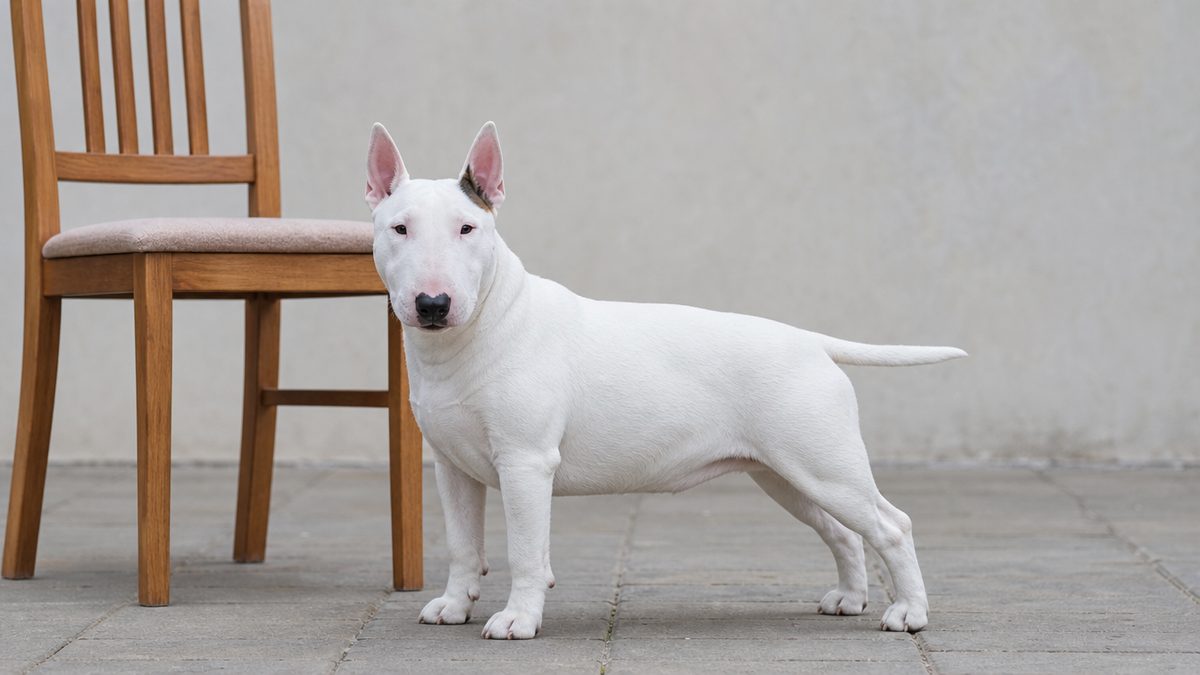
The FCI describes the general appearance as strongly built, muscular, well balanced and active with a keen, determined and intelligent expression, and says a unique feature is a downfaced, egg-shaped head. That head is the breed. The standard asks for a head long, strong and deep right to the end of the muzzle, viewed from the front egg-shaped and completely filled, its surface free from hollows or indentations, with the profile curving gently downwards from the top of the skull to the tip of the nose.
The history in the standard is short and it is shared. It credits James Hinks with first standardising the breed type in the 1850s, selecting the egg-shaped head, records that the breed was first shown in its present form at Birmingham in 1862, and that the Bull Terrier Club was formed in 1887. Then it adds the part that is specific to the smaller dog: a smaller example of the Bull Terrier has been known since the early 19th century but fell out of favour prior to the First World War and was removed from the Kennel Club Breed Register in 1918, with a revival spearheaded in 1938 by Colonel Richard Glyn and a group of fellow enthusiasts who formed the Miniature Bull Terrier Club.
Temperament, in the registry's own words
The FCI gives the behaviour and temperament in one line worth quoting whole, because it contains its own warning. The breed is courageous, full of spirit, with a fun loving attitude, of even temperament and amenable to discipline, and although obstinate is particularly good with people. Read the clause carefully. It commits to good with people. It says nothing at all about other dogs, and that silence is deliberate in a breed built from bulldog and terrier stock.
| Field | Bull Terrier (Miniature) | Bull Terrier |
|---|---|---|
| Size band | Small | Medium |
| Exercise | Up to 1 hour per day | Up to 1 hour per day |
| Size of home | Small house | Small house |
| Grooming | Once a week | Once a week |
| Coat length | Short | Short |
| Sheds | Yes | Yes |
| Lifespan | Over 10 years | Over 10 years |
| Vulnerable native breed | Yes | No |
| Size of garden | Small/ medium garden | Small/ medium garden |
Nine fields, and only two of them differ. The size band and the vulnerable-native-breed flag are the whole distinction the Royal Kennel Club draws between the two dogs in its own summary The Royal Kennel Club. Everything an owner plans around, the exercise, the grooming, the housing and the shedding, is identical.
India is a full FCI member represented by the Kennel Club of India in Chennai, so a KCI pedigree is written against FCI nomenclature. That means FCI Standard 359 is the governing document for a KCI-registered Miniature Bull Terrier, and the 35.5 cm ceiling with no weight limit is the rule that applies, not the American Kennel Club's 18 to 28 pounds. Ask which registry the pedigree is under before you accept any measurement.
One more registry document is worth knowing about, because it treats the two dogs as one. The Nordic Kennel Clubs' Breed Specific Instructions, published in the FCI's own nomenclature documents, carries a single entry headed Bull Terrier/Miniature Bull Terrier and names three areas of risk: a narrow lower jaw with canine teeth going up into the upper palate, skin irritation and sparse coat without gloss, and undersized eye openings. It adds that the unique type of head explains the tendency for faulty bite. So a judging document written for show rings treats them as one breed while the register that governs them treats them as two.
Separate breed or size variety? The two standards are 98 percent identical text
The registries genuinely disagree, and the disagreement is measurable rather than semantic. Bonbeno downloaded FCI Standard 359 and FCI Standard 11, extracted both with pypdf, normalised whitespace and replaced the breed name in each, and compared them character by character. They are 98.07 percent identical Federation Cynologique Internationale.
The differences are so few they can be listed in full. FCI Standard 11 carries the line Working trial optional and FCI Standard 359 does not. The size clause differs. Beyond a comma and a colon, that is everything.
| Clause | FCI 11, Bull Terrier | FCI 359, Miniature Bull Terrier |
|---|---|---|
| Size and weight | There are neither weight nor height limits, but there should be the impression of maximum substance for size of dog consistent with quality and sex | Height should not exceed 35,5 cms. There should be an impression of substance to size of dog consistent with quality and sex. There is no weight limit. Dog should at all times be balanced |
| Working trial | Working trial optional | not stated; the register records not subject to a working trial |
| History, general appearance, temperament, head, eyes, ears, mouth, neck, body, tail, limbs, gait, coat, colour, faults, disqualifying faults | identical text | identical text |
The Miniature's own standard contradicts its own size clause
FCI Standard 359 quotes the rule it then overrides. Its Brief Historical Summary says the truly interesting thing about the breed is that the standard says quite deliberately, and then quotes in full: there are neither weight nor height limits, but there should be the impression of maximum substance for size of dog consistent with quality and sex. Three pages later the same document imposes a 35.5 cm ceiling. A reader who stops at the history section comes away with the opposite rule from the one that governs.
The Bull Terrier's standard has the mirror-image problem. FCI Standard 11 contains the sentences about a smaller example of the Bull Terrier being removed from the Kennel Club Breed Register in 1918 and revived in 1938, and it contains the sentence the standard is the same as that of the Bull Terrier with the exception of a height limit. That sentence is in the Bull Terrier's own document, where it describes a different breed and says nothing about the dog the document is for. Both standards carry both histories, which is what you would expect if one was produced by editing a copy of the other.
| Registry | Name used | Status | Key date |
|---|---|---|---|
| FCI | MINIATURE BULL TERRIER (359) | separate breed, own standard number | definitive acceptance 5 July 2011 |
| FCI | BULL TERRIER (11) | separate breed, own standard number | definitive acceptance 26 June 1993 |
| Royal Kennel Club | Bull Terrier (Miniature) | described as a separate variety | first recognised as a separate variety in 1943 |
| American Kennel Club | Miniature Bull Terrier | separate breed page and popularity rank | ranked 105 of 210 |
| Nordic Kennel Clubs BSI | Bull Terrier/Miniature Bull Terrier | one combined judging entry | third edition 2023, applicable from 2024 |
Note the FCI dates, and note how they are printed. The register writes them American-style as 7/5/2011 and 6/26/1993, and the second one settles the format for the whole table, because 26 cannot be a month. The German-language version of the same page prints 05.07.2011, confirming 5 July rather than 7 May. So the Bull Terrier was definitively recognised in 1993 and the Miniature in 2011, eighteen years apart, as two separate numbers.
It decides what you may safely believe. The Royal Kennel Club's screening lists for the two breeds do not overlap at all, and the veterinary literature measured deafness in one and lens luxation in the other. A 98 percent identical standard is not 98 percent identical evidence. Where a page tells you the Miniature is just a small Bull Terrier, it is repeating the standard, and the standard is the one document that genuinely is the same.
One practical consequence follows for India. Because the written type is identical and the only rule is a height ceiling, a seller cannot show you a photograph and prove the breed. The only thing that separates a Miniature Bull Terrier from an undersized Bull Terrier or an oversized Miniature is a tape measure and a pedigree, and you should bring the first and read the second.
Size and weight: two registries set no weight limit and a third prints one
To measure a Miniature Bull Terrier correctly you take the height at the withers and stop, because both the FCI and the Royal Kennel Club impose a height ceiling of 35.5 cm and state explicitly that there is no weight limit The Royal Kennel Club. The American Kennel Club prints 18 to 28 pounds anyway, which is 8.2 to 12.7 kg.
The Royal Kennel Club's size clause reads in full: height should not exceed 35.5 cms (14 ins), there should be an impression of substance to size of dog, there is no weight limit, dog should at all times be balanced. It then adds a note for prospective puppy buyers saying the breed standard is a guide and description of the ideal, that the size described does not imply a dog will match the measurements given, and that a dog might be larger or smaller than the standard states. That is the club telling you in advance that the ceiling is aspirational.
| Source | Height | Weight | Nature of the figure |
|---|---|---|---|
| FCI Standard 359 | not to exceed 35.5 cm | no weight limit | a ceiling, with over- or undersize judged as a fault |
| Royal Kennel Club standard | not to exceed 35.5 cm (14 in) | no weight limit | the same ceiling, with an explicit buyer caveat |
| American Kennel Club | 10 to 14 inches | 18 to 28 pounds | a range with a floor and a printed weight band |
| Puppiezo, Miniature page | 10 to 12 inches | 7 to 10 kg | an Indian seller's product field |
| Puppiezo, Bull Terrier page | 10 to 14 inches (Miniature) | 9 to 15 kg (Miniature) | the same seller, different page, different numbers |
Read the last two rows together. The same Indian seller publishes two different weight ranges for the same breed on two different pages of its own site, 7 to 10 kg on its Miniature Bull Terrier page and 9 to 15 kg in the Miniature column of its Bull Terrier page. The two bands overlap by one kilogram. Neither matches the FCI or the Royal Kennel Club, both of which decline to give a weight at all.
Why the absence of a weight limit is the point, not an oversight
A breed defined only by a height ceiling has no lower bound and no mass rule, which is exactly what the standard means by an impression of substance to size of dog consistent with quality and sex. The dog is supposed to look like a full Bull Terrier that happens to be short, not like a scaled-down or lightened one. The FCI's general appearance clause says so directly: irrespective of size dogs should look masculine and bitches feminine.
That has a practical consequence an Indian buyer can act on. A Miniature Bull Terrier that looks fine-boned, leggy or light is not a well-bred small one, it is a badly bred one, and a seller describing a delicate 6 kg dog as a rare small line is describing a fault. Equally, a 16 kg dog under 35.5 cm is within the written standard on weight and outside it on nothing, which is why the height measurement is the only check that matters.
Measure from the ground to the top of the shoulder blades with the dog standing square, not from the ground to the top of the head. Do it on an adult, because a puppy tells you nothing. Measure both parents. If either exceeds 35.5 cm, you are being sold a small Bull Terrier, which is a perfectly good dog and a different registration. The FCI treats over- or undersize as a fault to be judged in proportion to its degree, so this is a real line rather than a preference.
One number does transfer usefully from the heat literature, and only one. The UK heat-illness work found that dogs at or above their own breed and sex mean bodyweight carried higher odds of heat-related illness at an odds ratio of 1.42 with a 95 percent confidence interval of 1.12 to 1.80, in 905,543 dogs. That factor is defined against each breed's own mean, so it applies to a heavy Miniature Bull Terrier without the breed needing to be modelled separately. Bonbeno could not confirm this breed appeared in that paper's breed list, so no breed-specific odds ratio is quoted here. With no published weight standard to compare against, keeping the dog lean is judged by eye and by ribs rather than by a number.
Registration numbers: the Kennel Club's own web table is wrong in exactly two cells
The Miniature Bull Terrier's UK registration numbers are stable, and the Kennel Club's rendered web table makes them look catastrophic. Bonbeno pulled four of the club's own documents and diffed the Bull Terrier (Miniature) row cell by cell across ten years. Eight of the ten years agree everywhere. Two do not, and both wrong figures belong to the Bullmastiff.
| Year | Web table | 10-yearly Terrier PDF | Vulnerable-breeds PDF | Verdict |
|---|---|---|---|---|
| 2016 | 493 | 172 | 172 | web disagrees |
| 2017 | 189 | 189 | 189 | all agree |
| 2018 | 221 | 221 | 221 | all agree |
| 2019 | 200 | 200 | 200 | all agree |
| 2020 | 185 | 185 | 185 | all agree |
| 2021 | 364 | 364 | 364 | all agree |
| 2022 | 293 | 293 | 293 | all agree |
| 2023 | 264 | 264 | 264 | all agree |
| 2024 | 165 | 165 | 165 | all agree |
| 2025 | 143 | 185 | 185 | web disagrees |
Now put the Bullmastiff beside it. The Bullmastiff is a Working-group breed, so it does not appear in the Terrier PDF at all, but it does appear in the vulnerable-breeds PDF, immediately above Bull Terrier (Miniature) in alphabetical order, and in the 10-yearly Working PDF The Royal Kennel Club.
| Year | Web table | 10-yearly Working PDF | Vulnerable-breeds PDF |
|---|---|---|---|
| 2016 | 172 | 493 | 493 |
| 2025 | 185 | 143 | 143 |
| All other years | identical | identical | identical |
That is a clean, complete, two-way transposition in exactly two cells. In 2016 the web table gives the Miniature 493 and the Bullmastiff 172, while both PDFs give the Miniature 172 and the Bullmastiff 493. In 2025 the web gives the Miniature 143 and the Bullmastiff 185, while both PDFs reverse it. Nothing is lost and nothing is invented: each breed's row received the other's value, and only in the first and last columns of the ten-year range.
A fourth document settles which figure is right
The quarterly Terrier statistics prove the 2025 number from its own components. It gives Bull Terrier (Miniature) quarters of 60, 33, 47 and 45, and prints an annual figure of 185. 60 plus 33 plus 47 plus 45 is 185. The quarterly table is self-corroborating, three documents agree on 185, and the web table's 143 is the odd one out and is the Bullmastiff's figure.
Read the web table and the Miniature Bull Terrier fell from 493 registrations in 2016 to 143 in 2025, a collapse of 71 percent. Read the PDFs and it went from 172 to 185, a rise of about 7.6 percent. Those are opposite conclusions about whether the breed is dying, drawn from the same club's own numbers, and every page that cites the web table is repeating the wrong one.
Bonbeno also checked the rest of the Terrier group rather than only the cells it needed, because looking for a discrepancy you have been told about is how a warning becomes a bias. Comparing all 190 shared cells between the web table and the 10-yearly Terrier PDF found five differing: the two Bull Terrier (Miniature) cells above, Manchester Terrier 2019 at 243 on the web against 133 in the PDF, Dandie Dinmont Terrier 2021 at 124 against 123, and Soft Coated Wheaten Terrier 2021 at 227 against 277. Comparing the two PDFs against each other across 140 shared cells found only the last two, both in 2021 The Royal Kennel Club.
The column totals reconcile almost perfectly. Summing the 27 breed rows of the 10-yearly Terrier PDF against its own printed totals balances exactly in nine of ten years. The exception is 2023, where the rows sum to 18,209 against a printed 18,211, a gap of two dogs. Report agreement where you find it, and nine of ten columns balancing to the dog is agreement.
- Prefer a PDF over the rendered web table for any Kennel Club registration figure, and say which document you read.
- Where the quarterly and the ten-yearly tables both exist, the quarterly is self-checking because its quarters sum to its own annual figure.
- This breed is a vulnerable native breed on the club's list, added later in 2006, and 185 registrations in 2025 keeps it well under the 300-puppy threshold The Royal Kennel Club.
- For scale in the same 2025 column, the Bull Terrier recorded 943 and the Staffordshire Bull Terrier 5,375.
- The Royal Kennel Club's own per-breed field agrees here, printing Vulnerable native breed: Yes for the Miniature and No for the Bull Terrier, which is worth noting because that field is not always reliable The Royal Kennel Club.
Miniature Bull Terrier price in india: the number you are given belongs to another dog
There is no published Miniature Bull Terrier price in india. Every rupee figure returned for that query describes the standard Bull Terrier, and Google India's own AI answer relabels it. Asked the question on 2 September 2026, it replied that a Miniature Bull Terrier puppy in India generally costs between Rs 55,000 and Rs 1,50,000, and cited two pages that are both about the Bull Terrier.
The citations are checkable and they do not support the claim. The first is Wrapinfur, whose article is titled Bull Terrier Dog Price in India (2026) and whose own snippet reads that the average Bull Terrier dog price in India ranges between Rs 45,000 and Rs 1,50,000. The second is Mr n Mrs Pet, whose page is titled Bull Terrier Puppies For Sale In India and states that the average price of a Bull Terrier puppy in India ranges between INR 55,000 to INR 1,50,000 or more. Neither page is about the Miniature Bull Terrier and neither claims to be.
This is a different failure from the ones Bonbeno usually finds. The citation is real, the page loads, the number genuinely appears on it, and the number is still wrong for the breed asked about, because it belongs to a dog roughly twice the height. A real citation under a relabelled figure is harder to catch than an invented one, and an Indian buyer reading that answer has no way to see the substitution without opening both sources.
| Figure | What it actually describes | Source | /84.38 | /74 | /80 |
|---|---|---|---|---|---|
| Rs 55,000 | Bull Terrier average floor | Indian marketplace | 651.81 | 743.24 | 687.50 |
| Rs 1,50,000 | Bull Terrier average ceiling | Indian marketplace | 1,777.67 | 2,027.03 | 1,875.00 |
| Rs 45,000 | Bull Terrier, pet quality floor | Indian blog | 533.30 | 608.11 | 562.50 |
| Rs 70,000 | Bull Terrier, KCI registered floor | Indian blog | 829.58 | 945.95 | 875.00 |
| Rs 2,00,000 | Bull Terrier, rare or imported | Indian blog | 2,370.23 | 2,702.70 | 2,500.00 |
| Rs 3,00,000 | Bull Terrier, imported ceiling | Indian blog | 3,555.34 | 4,054.05 | 3,750.00 |
| Rs 25,000 | Bull Terrier floor | national price list | 296.28 | 337.84 | 312.50 |
| Rs 100 | a Bull Terrier listing | Indian classifieds | 1.19 | 1.35 | 1.25 |
Read the quotients. Nothing divides to a whole number of dollars at 84.38 or at 74, so these are not a converted American price list. Several appear to divide at 80, but every one of them is a round multiple of ten thousand rupees and 1,000 divided by 80 is 12.5, so that test passes by construction and carries no information. The figures are rupee-native. The last row is the tell that the market is not real: an Indian classifieds page ranking on this query lists a Bull Terrier at Rs 100, which is a placeholder rather than a price.
What the marketplaces actually hold
India's largest pet marketplace has a Bull Terrier page and no Miniature Bull Terrier page. The most-cited Indian breed platform has a Bull Terrier guide and returns 404 for the Miniature Bull Terrier. The national price list running to forty breeds includes the Bull Terrier at Rs 25,000 to Rs 70,000 and no Miniature Bull Terrier at all. One Indian seller does have a Miniature Bull Terrier page, and it lists no Miniature Bull Terrier puppies and no Miniature Bull Terrier price.
Its only rupee figures are an Other Available Pets carousel of two Maltipoos at Rs 98,999, two Poodles at Rs 92,599, a Cane Corso at Rs 94,999, a Goldendoodle at Rs 1,20,000, a Rottweiler at Rs 76,499 and a Doxiepoo at Rs 98,999. Not one of the eight animals is a bull-type terrier of any size. The identical carousel at the identical prices appears on the same site's Bull Terrier page. Rs 98,999 is a recurring house price point on that site rather than any breed's price, and it appears three times here on three unrelated dogs.
Published prices do exist outside India and Bonbeno reports them without converting. A United States breed directory gives a Miniature Bull Terrier puppy range of 1,500 to 4,000 dollars with an average of 2,500 to 3,500. Converting that into rupees would manufacture exactly the Indian price this page says does not exist, so no conversion is offered. Note only that the round-lakh Indian figures above sit close to that band at a flat rate of 80, which is an observation and not a finding.
The honest summary is short. Nobody in India publishes a price for this breed, the engine that answers the question substitutes the Bull Terrier's, and the one Indian page dedicated to the breed has nothing in stock. Ask a seller for the parents' heights and the pedigree registry before you ask for a price, because if the height is over 35.5 cm the price was never for this breed either.
Monthly cost: India's only figure is a constant shared with six other breeds
No Indian source publishes a monthly cost for the Miniature Bull Terrier, because no Indian breed platform has a page for it. The nearest figure is the Bull Terrier's, given as Rs 3,550 basic to Rs 5,400 premium, and that exact pair is printed for at least five other breeds on the same site.
Bonbeno tested it the only way that works, by pulling unrelated breeds from the same platform and comparing the lines to the rupee. The Whippet, the Basset Hound, the American Pit Bull Terrier, the Boxer and the Dalmatian all print Rs 3,550 to Rs 5,400, the same figure as the Bull Terrier, and all six print a monthly food line of Rs 2,250 to Rs 3,000 HappyPet.care, Basset Hound breed guide.
| Breed | Monthly running cost | Monthly food line | Stated purchase price |
|---|---|---|---|
| Bull Terrier | Rs 3,550 to Rs 5,400 | Rs 2,250 to Rs 3,000 | Rs 25,000 to Rs 80,000 |
| Whippet | Rs 3,550 to Rs 5,400 | Rs 2,250 to Rs 3,000 | Rs 20,000 to Rs 50,000 |
| Basset Hound | Rs 3,550 to Rs 5,400 | Rs 2,250 to Rs 3,000 | Rs 20,000 to Rs 60,000 |
| American Pit Bull Terrier | Rs 3,550 to Rs 5,400 | Rs 2,250 to Rs 3,000 | Rs 20,000 to Rs 80,000 |
| Boxer | Rs 3,550 to Rs 5,400 | Rs 2,250 to Rs 3,000 | Rs 20,000 to Rs 50,000 |
| Dalmatian | Rs 3,550 to Rs 5,400 | Rs 2,250 to Rs 3,000 | Rs 20,000 to Rs 60,000 |
| Miniature Bull Terrier | no page exists, returns 404 | no page exists | no page exists |
A Whippet and a Boxer do not eat the same amount of food, and a Basset Hound and a Dalmatian do not cost the same to keep. A single figure covering all six is a template constant, not a measurement, and the only field that varies per breed is the purchase price. Notice also that the last row is the honest one: for the breed this page is about, the platform has nothing at all.
What the bill for this breed actually looks like in India
The good news is real and it is structural. This is a short-coated dog the Royal Kennel Club rates at grooming once a week, so there is no salon cycle to fund, which removes the single largest recurring line that coated small breeds carry. On grooming alone it is one of the cheapest imported breeds an Indian household can keep.
The bad news is that the money moves to veterinary care, and it is front-loaded rather than spread. Two of this breed's documented risks are one-off testable events rather than chronic costs, and both are worth paying for before purchase rather than after. A DNA test for primary lens luxation and an eye screening certificate are the two the Royal Kennel Club names as best practice, and a dog without them can present with a luxated lens that is a surgical emergency.
- One-off before purchase: primary lens luxation DNA result and eye certificate for both parents, plus a BAER hearing result if the breeder will supply one.
- Recurring, low: grooming at once a week with a rubber mitt at home, which costs nothing but time on a short coat.
- Recurring, real: sun protection in India, meaning shade, timing and a veterinary-recommended barrier for a white dog's exposed skin.
- Recurring, moderate: food for a dense, muscular dog whose weight the standard deliberately leaves unbounded, so portion by body condition rather than by a chart.
- Contingent and expensive: ophthalmic surgery for a luxated lens, and airway assessment if the dog develops noisy breathing, both of which are referral-level costs in Indian metros.
There is no Indian source to quote and inventing one would be fabrication. What can be said is the shape of the bill, which is low on grooming, ordinary on food and unusually front-loaded on screening. Budget for the tests before the dog arrives, because they are the only part of this breed's cost that buys you information rather than paying for a problem.
One import note belongs here rather than in the price section. With no Indian breeding population, any Miniature Bull Terrier in India is either imported or produced from imported stock, and the cost of that is not in any published band. Ask where the parents were registered, because a dog whose pedigree traces to a country with mandatory eye and hearing schemes is worth more than the price difference, and a dog whose paperwork stops at an Indian kennel name tells you nothing about either.
Heat tolerance: Birmingham's hottest recorded day is Mumbai's coolest month
A Miniature Bull Terrier's heat tolerance is poor, and a short coat does not fix it. Bonbeno queried NASA POWER by explicit coordinate for the breed's homeland at Birmingham and for four Indian cities. The 20-year annual mean is 9.56 C at Birmingham against 25.60 C in Delhi and 27.95 C in Chennai NASA POWER, 20-year climatology 2001-2020… NASA POWER, 20-year climatology 2001-2020….
Every coordinate was checked against the real town's elevation first, because NASA POWER returns a grid cell rather than a point. Birmingham's cell reports 103.17 m against a city near 140 m, a difference of about 37 m. Chennai reports 48.95 m against a city near 6 m, Delhi 206.37 m against 216 m, Mumbai 97.15 m against 14 m. All four are plains sites, all four cells are honest, and none needs a lapse-rate correction.
| Place | Cell elevation | Annual mean temp | Annual mean RH | Highest recorded T2M |
|---|---|---|---|---|
| Birmingham, homeland | 103.17 m | 9.56 C | 86.74 % | 31.97 C in July |
| Delhi | 206.37 m | 25.60 C | 45.56 % | 48.79 C in June |
| Mumbai | 97.15 m | 26.77 C | 67.39 % | 44.91 C in April |
| Chennai | 48.95 m | 27.95 C | 72.39 % | 42.70 C in May |
One comparison in that table does more work than the rest. The highest 2 m air temperature the Birmingham cell records in twenty years is 31.97 C. Mumbai's coolest month, August, records 32 C. In other words, the hottest day this breed's homeland has produced in two decades is roughly the mildest month Mumbai offers, and Delhi's June reaches 48.79 C, which is sixteen and a half degrees above anything Birmingham has recorded at all.
The homeland is not dry either
Birmingham's 20-year annual mean relative humidity is 86.74 percent, higher than Chennai's 72.39, Mumbai's 67.39 and Delhi's 45.56. Its monthly figures never fall below 80 percent and reach 94 and 95 percent in January, November and December. So the coat was not built for dry air, it was built for cool wet air, and what India adds is heat rather than moisture. The combination of heat and humidity together is the part the dog has never met.
FCI Standard 359 lists pure white with skin pigmentation and head markings not to be penalised as one of two colour groups. A predominantly white dog with a short coat over unpigmented skin sunburns, and the Nordic Kennel Clubs' judging document already names skin irritation and sparse coat without gloss as an area of risk for this breed. Indian sun on white skin is a dermatology problem, not a comfort problem, and it is worse in Delhi and Rajasthan than the temperature alone suggests. A coloured dog, which the standard prefers brindle for, carries less of this risk.
The heat literature points at the right precaution rather than the obvious one. The UK work recorded 1,259 heat-related illness events from 1,222 dogs, of which 879 had a recorded trigger, and 652 of those 879 events, which is 74.2 percent, were exertional rather than environmental, against 113 environmental and 46 from confinement in a vehicle. The dog that overheats is usually the dog that was being exercised. For a powerful, willing, hard-charging terrier that will run itself into trouble, that is the whole safety brief.
- Walk before 7 am and after 7 pm from March through June in Delhi, Mumbai, Chennai and Kolkata, and use indoor work in between.
- Test the pavement with the back of your hand for five seconds before every walk, because a short-coated dog with a low body carries its chest close to the ground.
- Stop the dog rather than trusting it to stop itself. This breed's willingness is the risk factor the exertional figure describes.
- Keep a white dog out of direct midday sun entirely, and check the nose, ear tips, belly and any thinly coated area for pink or flaking skin weekly.
- Never leave the dog in a parked car, which accounted for 46 of the 879 triggered events and is entirely preventable.
Indian law backs the indoor rule. The Prevention of Cruelty to Animals (Dog Breeding and Marketing) Rules 2017, Second Schedule Part IV paragraph 21(1), bars keeping in outdoor facilities, without the attending veterinary practitioner's written approval, dogs not accustomed to the temperatures prevalent in the area and breeds that cannot tolerate them, and the same Schedule requires separate outside areas of shade large enough to hold all the animals and protect them from the direct rays of the sun. A Miniature Bull Terrier is an indoor dog in India, and the rating on this page is 2 out of 5, which is heat-sensitive rather than impossible.
Temperament and household fit: good with people, and the standard says nothing about dogs
The Miniature Bull Terrier suits an experienced, physically capable Indian household that wants a playful, comic, intensely people-focused dog and can manage a strong terrier on a lead. FCI Standard 359 describes it as courageous, full of spirit, with a fun loving attitude, of even temperament and amenable to discipline, and although obstinate is particularly good with people.
Read that clause for what it does not say. It commits to good with people and it is silent on other dogs. The Royal Kennel Club's summary line for the breed is the same sentence, courageous, full of spirit, with a fun loving attitude. The American Kennel Club is blunter and funnier: in most every way the Miniature Bull Terrier is a Bull Terrier, only smaller, upbeat, mischievous, equipped with terrier fire and fearlessness, and a candidate for the title Clown Prince of Dogdom.
The part Indian households have to plan for
This breed descends from bulldog and terrier stock bred for fighting other dogs in 19th-century Britain, which the Royal Kennel Club states plainly in its history of the parent breed. That does not make an individual dog aggressive and it does make dog tolerance something you manage rather than assume. In an Indian city, where free-roaming dogs are a feature of most walks, that is the single trait that decides whether the dog is livable.
- Households this breed fits: adults or older children, someone physically able to hold a determined 12 kg dog, a household that finds a clownish dog funny rather than exhausting.
- Households it does not fit: a first-time owner, a home with a resident small pet, anyone who wants an off-lead dog, anyone out for twelve hours.
- With children: sturdy and famously tolerant of family life, but powerful and low-slung enough to knock a toddler flat by accident rather than by intent.
- With other dogs: manageable with early, deliberate exposure and honest supervision, and never something to test on a crowded Indian street.
- With cats and small pets: a terrier with real prey drive, so a rabbit or a hamster in the same home is a genuine risk rather than a theoretical one.
One trait Indian buyers ask about is not in the standard at all, and its absence is informative. Nothing in FCI Standard 359 describes the breed as a guard dog or as suspicious of strangers, and the only temperament words it uses are courageous, full of spirit, fun loving, even-tempered, amenable to discipline, obstinate and particularly good with people. English Wikipedia's summary of the breed reaches the same place, describing a small, muscular dog of Bull Terrier type. This is an alert dog rather than a guarding one, and an owner who wants a watchdog is choosing the wrong bull-type terrier: it will notice the visitor and then try to sit on them.
The word obstinate in the standard is doing real work and it is not a euphemism. This is a dog that understands the instruction and decides. It is trainable rather than biddable, and the difference matters most at the moment you need it to disengage from something interesting. That is a training problem with a physical component, which is why the breed is not a beginner's dog even at 35 cm.
The whole point of the standard is that the smaller dog should look and behave like the bigger one. FCI 359's general appearance clause reads irrespective of size dogs should look masculine and bitches feminine, and its temperament clause is the Bull Terrier's word for word Federation Cynologique Internationale. Anyone choosing this breed over the Bull Terrier expecting a milder temperament has misread what was miniaturised, which was the height and only the height.
One quiet advantage does come with the size, and it is the reason the breed makes sense in an Indian flat at all. A 35 cm dog can be physically controlled by one person in a way a 55 cm one cannot, can be picked up in an emergency, and fits a lift lobby and a stairwell without becoming a neighbour's problem. The Royal Kennel Club lists size of home as small house and garden as small to medium, and an Indian seller's own page gives ideal space as apartment Puppiezo, Miniature Bull Terrier product….
Separation is the last thing to weigh. This is a people-oriented breed by every account, and a bored, under-exercised, unsupervised bull-type terrier is destructive in a way a small companion breed is not. Decide honestly how many hours a day the dog will be alone before you decide anything else, because no amount of training substitutes for company in a breed selected to be with people.
Training: a stubborn dog with a short window, and a deaf puppy needs a different plan
To train a Miniature Bull Terrier, use short reward-based sessions, teach disengagement before obedience, and confirm the puppy can hear before you conclude it is ignoring you. The FCI standard calls the breed amenable to discipline and stubborn in the same clause, and both halves are the training brief.
Start with the hearing question because it changes everything downstream. Congenital sensorineural deafness is documented in bull-type terriers and is strongly associated with white coats. In 1,060 English Bull Terrier puppies tested by brainstem auditory evoked response as complete litters at 30 to 78 days of age, 10.19 percent were deaf, and 96.29 percent of the deaf puppies had a white coat, while 19.29 percent of white-coated puppies were deaf. That figure is the Bull Terrier's and Bonbeno has found no published equivalent for the Miniature, so it is quoted here as a reason to test rather than as this breed's rate.
In that study 8.21 percent of puppies were deaf in one ear and only 1.98 percent in both. A dog deaf in one ear hears you, cannot locate you, and appears to ignore direction that comes from the wrong side. Owners read that as defiance and escalate, which teaches the dog that training is unpleasant. A BAER test settles it in one appointment and is available at referral centres in Indian metros. Ask the breeder for the litter's results first.
The socialisation window, and what Indian conditions do to it
The socialisation window closes early, and Indian law brackets it on both sides. The Prevention of Cruelty to Animals (Dog Breeding and Marketing) Rules 2017 require at Rule 8(1)(a) that pups less than eight weeks in age are not sold, and at Second Schedule Part III paragraph 8(9) that all pups shall be vaccinated, which can start at seven to eight weeks and is usually completed at eighteen weeks. Those ten weeks are both the most important for temperament and the ones during which the puppy should not meet unvaccinated street dogs.
Socialise inside that window without ground contact. Carry the puppy through a market. Sit with it on a balcony above traffic. Invite known vaccinated adult dogs into the house rather than taking the puppy out to strange ones. For this breed specifically, the priority is not friendliness with people, which comes free, but calm neutrality toward other dogs, which does not.
- Weeks 8 to 12: name response, crate as a good place, daily handling of the mouth, feet and ears so a vet examination is never a fight.
- Weeks 10 to 16: carried exposure to Indian street noise, lifts, security guards, delivery riders and children, with no paws on shared ground.
- Weeks 12 to 20: lead work indoors, and a taught disengagement cue, meaning look away from that and back at me, practised on food and toys before it is ever needed on a dog.
- Months 5 to 9: long-line recall only. A bull-type terrier with prey drive is not an off-lead dog on an Indian street at any age.
- Months 9 to 18: adolescence, when the dog re-tests everything and when most owners lose the disengagement cue they never fully proofed.
Use a well-fitted harness and a strong lead rather than a neck collar. This is a dog with a thick neck, a low centre of gravity and real drive, and the physics of that on a slip collar is a tracheal injury waiting to happen. Two-point attachment, a front clip and a back clip, gives an ordinary adult mechanical control of a determined 12 kg dog without any force.
Not in obedience class. On the third unplanned street-dog encounter, when the owner discovers that the disengagement cue was never proofed under arousal and the dog has learned that lunging works. Train that one behaviour to a boring standard before you need it, and the rest of this breed's training is easy and genuinely enjoyable.
One more practical note about a breed with an unusual head. The FCI's judging guidance flags a narrow lower jaw with canine teeth going up into the upper palate as an area of risk, and says the unique type of head explains the tendency for faulty bite. Get the puppy comfortable with having its mouth opened and looked at from week eight, because this is a breed whose dentition genuinely needs checking and a dog that fights a mouth examination gets checked less often.
Exercise needs: an hour a day, and the hour is where the heat risk lives
The Miniature Bull Terrier's exercise needs are up to 1 hour per day according to the Royal Kennel Club, which is the identical band the club gives the full-sized Bull Terrier. The Indian seller's page gives energy level high with an apartment as the ideal space.
An hour is deliverable in an Indian city, and this breed makes it harder than the number suggests for one reason. It does not self-regulate. The exertional figure from the UK heat literature is the relevant one: of 879 heat-related illness events with a recorded trigger, 652, or 74.2 percent, were exertional rather than environmental. A willing dog that will keep going is the dog that arrives at the clinic, and this breed's temperament clause is built around willingness.
| Season | Morning | Evening | Indoor |
|---|---|---|---|
| March to June | 25 to 30 min before 7 am | 25 to 30 min after 7 pm | two short scent or puzzle sessions in the afternoon |
| July to September, monsoon | 30 min when dry | 30 min when dry | dry the dog fully after any wet walk |
| October to February | 30 to 40 min | 30 min | one training session, mostly for the dog's brain |
| Any season, first year | shorter and more frequent | shorter and more frequent | no forced running or stairs while joints are growing |
What the hour should contain
Distance is the least useful part of it. A terrier bred to work vermin gets far more out of problem-solving than out of pavement, and in an Indian summer the indoor half of the routine is the half that actually happens. Scatter food in a folded towel and let the dog work it out. Teach a trick a week. Use a flirt pole in a corridor for two short bursts, then stop before the dog wants to.
- Keep every outing on a lead. The parent breeds' prey drive plus an Indian street is not a combination that rewards optimism.
- Prefer two shorter walks to one long one, which halves the peak exertion and doubles the toilet and sniffing opportunities.
- Avoid hard repetitive running on concrete in the first year, because this is a heavy-boned dog on short legs.
- Stop the dog yourself. Do not wait for it to slow down, because the exertional heat data says it will not.
- Carry water on every walk from March onward, and offer it before the dog looks like it needs it.
A Miniature Bull Terrier that develops a change in its bark, noisy inspiration, or exercise intolerance needs an airway assessment rather than more conditioning. An early-onset laryngeal paralysis risk factor has been mapped in this breed, and homozygosity for the RAPGEF6 insertion carried a 10 to 17-fold increased risk in that study. In Indian heat, a dog with a compromised airway cannot cool itself by panting, which turns a manageable condition into an emergency on a warm evening.
The good news is that the hour is genuinely an hour. Unlike the working breeds Bonbeno covers that need two hours or more, this dog is satisfied by a routine an ordinary Indian household can keep in a small flat with a lift and no garden. The constraint on this breed in India is timing and control, not volume, and both are things you decide rather than things you have to find space for.
Grooming: the easiest coat on this site and the hardest skin
To groom a Miniature Bull Terrier you brush the short coat once a week and spend the rest of your attention on the skin underneath. The Royal Kennel Club rates grooming for this breed at once a week, coat length short, and sheds yes. There is no clipping, no stripping and no salon cycle.
The FCI describes the coat as short, flat and even throughout, harsh to the touch with a fine gloss, with the skin fitting the dog tightly, and notes that a soft textured undercoat may be present in winter. That is a five-minute-a-week coat. A rubber curry mitt once or twice a week lifts the dead hair, and a damp cloth does the rest.
The skin is the whole job. The Nordic Kennel Clubs' judging document, published in the FCI's own nomenclature documents, names skin irritation and sparse coat without gloss as one of three areas of risk for Bull Terrier and Miniature Bull Terrier together. A registry-level judging document flagging skin means this is a breed-level tendency, not bad luck, and Indian conditions add to it rather than subtracting.
White skin in Indian sun
FCI Standard 359 recognises two colour groups, pure white with skin pigmentation and markings on the head not to be penalised, and coloured, where colour predominates and brindle is preferred all other things being equal. The Royal Kennel Club's standard colours for the breed run to eleven entries including White and White With Black Head Markings, and it places the breed in Colour Watch Category 0, meaning no non-breed-standard colour registration options exist at all.
A white dog with a short coat over unpigmented skin burns in Indian sun, and the exposed sites are predictable. The nose, the ear tips, the eyelids, the belly and the inner thighs carry the least hair and the least pigment. Check those five places weekly for pink, flaking or thickened skin, and keep a white dog out of direct sun between roughly 10 am and 4 pm from March through June. Ask a veterinarian about a barrier product formulated for dogs rather than reaching for a human sunscreen, several of which contain zinc oxide that is toxic if licked.
| Frequency | Task | Why it matters for this breed |
|---|---|---|
| Once or twice a week | rubber mitt over the whole coat | removes dead hair from a coat that does shed, despite being short |
| Weekly | skin check at nose, ear tips, eyelids, belly, inner thighs | the five least-pigmented sites on a predominantly white dog |
| Weekly | look inside both ears | erect ears collect less debris but dry slowly in monsoon humidity |
| Every 3 to 4 weeks | nails, and a full mouth and bite check | the standard's own judging guidance flags jaw and dentition risk |
| As needed, not scheduled | bath | over-bathing strips a tight, thinly coated skin that is already flagged as a risk area |
| After every wet walk | dry the dog fully, especially the folds behind the elbows | Mumbai runs 90 percent relative humidity in July and August |
Against the coated small breeds an Indian buyer cross-shops, this coat saves real money. A Miniature Schnauzer needs a professional appointment every four to six weeks for its whole life; this breed needs none. Spend what you save on the eye and hearing tests, which are the two places where money genuinely buys information about this dog.
One last grooming-adjacent item belongs here because nobody budgets for it. This breed's tight skin and short coat make external parasites easy to see and easy to miss at the same time, since a single tick on a white dog is obvious and a flea burden on a short coat is not. In Indian conditions, keep a veterinary-prescribed parasite programme running year-round rather than seasonally, and check the dog by hand after every walk in grass.
Health issues: four conditions, and each one belongs to a different population
The Miniature Bull Terrier's inherited risks are shared with the Bull Terrier in some places and separate in others, and the difference is the most important thing on this page. Four well-documented conditions sit in four different relationships to the two breeds, and borrowing a figure across them is the commonest error made about this dog.
| Condition | Population studied | Headline finding | Applies to the Miniature? |
|---|---|---|---|
| Primary lens luxation | Miniature Bull Terriers named specifically | ADAMTS17 mutation frequency 0.27 to 0.39 | yes, this is its own figure |
| Laryngeal paralysis | mapped in Miniature Bull Terriers | 10 to 17-fold risk in homozygotes | yes, and the allele exists in both breeds |
| Lethal acrodermatitis | one combined cohort of both breeds | 46 cases, 294 controls, perfect association | yes, jointly, by the authors' own design |
| Congenital deafness | English Bull Terrier only | 10.19 percent of 1,060 puppies | unknown, no published Miniature figure |
| Polycystic kidney disease | Bull Terrier only, named BTPKD | linkage to canine pkd1, LOD 6.59 | unknown, no published Miniature figure |
Primary lens luxation, the one risk that is measurably this breed's own
Primary lens luxation is the condition an Indian buyer should ask about first. A study screening PLL-affected dogs of 30 breeds identified the ADAMTS17 c.1473+1 G>A mutation, already associated with PLL in Miniature Bull Terriers, Lancashire Heelers and Jack Russell Terriers, in PLL-affected dogs from 14 additional breeds. In the Miniature Bull Terrier, estimates of mutation frequency ranged from 0.27 to 0.39, corresponding to 7.3 to 15.2 percent PLL-affected dogs in the breed.
That pair of numbers checks out against itself, which is worth saying because a percentage that does not reproduce from its own inputs is the cheapest fabrication detector there is. For a recessive condition the affected proportion is the square of the allele frequency: 0.27 squared is 0.0729, or 7.3 percent, and 0.39 squared is 0.1521, or 15.2 percent. The paper's arithmetic reconciles exactly. The same study also found an increased risk of PLL associated with heterozygosity, meaning carriers carry a low risk of developing it themselves.
A second study looked specifically for what else is going on in this breed, examining potential modifying loci associated with primary lens luxation, pedal hyperkeratosis and ocular phenotypes in Miniature Bull Terriers. The practical point for an owner is simpler than the genetics. A luxated lens is painful and can blind an eye within days, and a suddenly cloudy, red or painful eye in this breed is a same-day emergency rather than something to watch.
Ask for the ADAMTS17 DNA result on both parents rather than asking whether the line has eye problems. A carrier-to-carrier mating produces affected puppies at the rate the frequency predicts, and at 0.27 to 0.39 in this breed that is not a remote possibility. The test is cheap, the surgery is not, and an eye lost to a luxated lens does not come back.
Health screening: the Kennel Club's two lists for these breeds do not overlap at all
To screen a Miniature Bull Terrier properly, ask for a DNA test for primary lens luxation and an eye screening certificate under the BVA, Kennel Club and ISDS Eye Scheme, which are the two the Royal Kennel Club names as best practice for this breed. Then ask for the hearing test as well, because the club does not list it here and it lists it for the Bull Terrier.
The two lists are genuinely disjoint, which is easy to verify because both pages are public. Bonbeno counted the terms on each. The Bull Terrier (Miniature) page contains primary lens luxation once and Eye Scheme once, and contains BAER and deafness zero times. The Bull Terrier page contains BAER once and deafness twice, and contains primary lens luxation and Eye Scheme zero times The Royal Kennel Club.
| Test | Bull Terrier (Miniature) | Bull Terrier |
|---|---|---|
| DNA test for primary lens luxation (PLL) | listed as best practice | not listed |
| Eye testing, BVA/KC/ISDS Eye Scheme | listed as best practice | not listed |
| Hearing testing for deafness, KC BAER Scheme including litter screening | not listed | listed |
| Breed club health scheme | listed | listed |
| Conformational concerns flagged | yes | yes |
Two breeds whose written standards are 98 percent identical are given two entirely different screening lists by the same club Federation Cynologique Internationale. That is not an inconsistency to be complained about, it is information. It says the club considers the eye risk demonstrated in the smaller dog and the hearing risk demonstrated in the larger one, which is exactly what the published literature shows.
A screening list is a statement about where evidence exists, not a statement about where risk stops. The congenital deafness data comes from white-coated bull-type terriers, and this breed is white-coated. The laryngeal paralysis allele exists in both breeds and was mapped in this one. Ask for the PLL DNA result, the eye certificate and the BAER result, and treat a breeder who supplies all three as worth a premium and a wait.
What Indian breeding law asks for instead
None of the three. The Prevention of Cruelty to Animals (Dog Breeding and Marketing) Rules 2017, Second Schedule Part III paragraph 8(10), requires that dogs shall have been tested for genetic defects including hip dysplasia, progressive retinal atrophy, night blindness, hypothyroidism, entropion, ectropion, overshot, undershot jaw, wry mouth, two or more missing teeth, and cryptorchidism.
Bonbeno extracted the whole gazette with pypdf and counted the words. Cataract, urolith, bladder, patella, BAER and deaf appear zero times across the fourteen pages. The clause opens with the word including, so the list is illustrative rather than closed, and one item on it does bite here: a narrow lower jaw with canine teeth going into the upper palate is precisely the faulty-bite risk the FCI's judging guidance names for this breed, and undershot jaw when incisors do not touch or mesh is on the statutory list.
- Ask which registry the pedigree is issued under. A KCI pedigree runs against FCI nomenclature, so FCI Standard 359 governs.
- Ask for the PLL DNA result for both parents, in writing, with the testing laboratory named.
- Ask for the eye scheme certificate, which is a clinical examination rather than a DNA test and catches things the DNA test cannot.
- Ask for the BAER result on the litter even though Indian law and the Miniature's own screening list do not require it.
- Measure both parents' height at the withers. Over 35.5 cm and you are buying a small Bull Terrier under a Miniature Bull Terrier's name and price.
- Ask to see the dam with the litter, at the place the puppies were raised.
Expect most Indian sellers to have none of it, and understand why rather than assuming bad faith. There is no Indian breeding population of this dog, no Indian breed club running a health scheme for it, and no statutory requirement to test for anything it actually carries. A breeder who has the results anyway has gone a long way past what India asks, and that is the signal an Indian buyer should be paying for rather than paying for a colour or a bloodline name.
Feeding: a breed with no weight standard has to be fed by body condition
To feed a Miniature Bull Terrier in India, portion by body condition rather than by a chart, because neither of the two registries that govern the breed publishes a weight. FCI Standard 359 says there is no weight limit and the Royal Kennel Club's standard says the same The Royal Kennel Club. There is no target number to feed toward.
The American Kennel Club's 18 to 28 pounds is the only published band and it is a range across the whole breed rather than a target for your dog. An Indian seller gives 7 to 10 kg on one page and 9 to 15 kg on another Puppiezo, Bull Terrier product page. Four published weight bands across three sources, spanning 7 to 15 kg, is not a feeding guide. Use your hands instead.
| Stage | Meals per day | Priority | Breed-specific reason |
|---|---|---|---|
| 8 to 16 weeks | 3 | measured growth food, never free-fed | a heavy-boned dog on short legs should not grow fast |
| 4 to 12 months | 2 to 3 | steady, unhurried growth | no published adult weight means no growth curve to aim at |
| 1 to 8 years | 2 | lean condition, weighed portions | bodyweight at or above the breed mean is the transferable heat risk factor |
| 8 years and over | 2 | watch for weight loss and increased thirst | renal disease in this breed's larger relative presents this way |
| Any age, hot season | 2, both outside peak heat | never a large meal before exercise | exertional events dominate the heat-illness data |
Body condition scoring is easy on this coat and that is a genuine advantage. Run your hands along the ribs. You should feel them under a thin layer of cover without pressing, see a waist from above and a tuck from the side. A short flat coat hides nothing, unlike the wire and long coats on comparable small breeds, so an owner who looks will always know.
What is actually available in India
Feeding this breed in India is unusually straightforward, which is worth saying because most Bonbeno breed pages have to work around a supply problem. A dog with no prescription-diet requirement, no documented food-responsive breed condition and an ordinary adult size can eat any complete, reputable Indian-market adult food appropriate to a small to medium dog. The constraint is portion discipline, not product availability.
- Weigh the food on a kitchen scale rather than using a cup, which is the single change that fixes most portion drift.
- Use part of the measured daily ration as training rewards instead of adding treats on top, which solves the reward problem and the weight problem together.
- Keep water in more than one room and refresh it, because a heat-sensitive dog that will not walk to the kitchen will not drink.
- Feed at least an hour before or after exercise in the hot season, given that 74.2 percent of triggered heat-illness events in the UK data were exertional.
- Skip Indian table food entirely. Ghee, fried snacks and festival sweets are not this breed's specific problem, and they are every dog's weight problem.
A dog with a documented laryngeal paralysis risk should not be fed and then exercised, and should be watched for coughing or gagging while eating or drinking as it ages. Laryngeal function and swallowing share anatomy, so a change in how the dog eats can be the first sign of the same problem that later shows up as noisy breathing. Mention any such change to your veterinarian rather than waiting for the bark to change.
Puppies deserve one specific caution. Lethal acrodermatitis presents as poor growth alongside skin lesions and immune problems, and it is a recessive condition with a DNA test available. A Miniature Bull Terrier puppy that is not thriving on adequate food is a veterinary problem on the same day, not a feeding problem to be solved with a richer diet. That is the one situation in this breed where changing the food first would waste time that matters.
The first year, month by month, for an Indian household
A Miniature Bull Terrier puppy may not lawfully be sold in India before eight weeks, and its vaccination course normally finishes at eighteen weeks. The Prevention of Cruelty to Animals (Dog Breeding and Marketing) Rules 2017 state both, at Rule 8(1)(a) and at Second Schedule Part III paragraph 8(9). Those ten weeks decide the dog.
| Age | Health and legal | Breed-specific task |
|---|---|---|
| Before collection | confirm the pup is at least eight weeks, Rule 8(1)(a) | get the PLL DNA result, eye certificate and BAER result in writing |
| Month 2 | first vaccinations, deworming | daily mouth, ear and foot handling; start a white dog's shade routine now |
| Month 3 | vaccination course continuing | carried exposure to lifts, markets and traffic, with no ground contact |
| Month 4 | course usually complete by eighteen weeks | start the disengagement cue on food and toys, long before it is needed on dogs |
| Month 5 | worming cycle; ask about a BAER test if none was supplied | fit a two-point harness and teach loose-lead walking properly |
| Month 6 | discuss neutering timing with your vet | first hot season planning: fix the pre-7 am and post-7 pm routine |
| Months 7 to 9 | adolescent growth; monitor condition monthly | long-line recall only; proof the disengagement cue under mild distraction |
| Months 10 to 12 | baseline eye examination if not already done | re-measure height at the withers against the 35.5 cm ceiling |
Two of those rows are Indian rather than general. The ten weeks between collection and the end of the vaccination course fall inside the socialisation window, and Indian streets carry an unvaccinated free-roaming dog population that temperate-country guides do not have to plan around. Carry the puppy rather than skipping the exposure. And the first hot season usually arrives before the dog is a year old, so the summer routine has to exist before it is needed rather than being invented in April.
The height check nobody does
Re-measure at twelve months and again at eighteen. The breed is defined by a ceiling of 35.5 cm and by nothing else, and the FCI treats over- or undersize as a fault judged in proportion to its degree. A dog that finishes over the ceiling is not a defective Miniature Bull Terrier, it is a Bull Terrier, and knowing that changes which health literature applies to it and which breed club can help you.
FCI Standard 359 specifies small, thin ears placed close together which the dog should be able to hold stiffly erect, and a tail that is short, set on low and carried horizontally, thick at root and tapering to a fine point. Both are natural. Indian law forbids both procedures outright at Second Schedule Part II paragraph 6(8). A cropped or docked bull-type terrier offered to you in India is evidence about the seller, and in this breed there is not even a show convention to hide behind.
- Ask for both parents' height at the withers in centimetres, and compare it to 35.5 cm rather than to a description.
- Ask whether the litter was BAER tested, and if the seller does not know what that is, you have your answer about the rest.
- Ask for the PLL DNA result. A clear-by-parentage claim without a test certificate behind it is not a result.
- Ask where the puppies were raised and see the dam there. A breeder who cannot show you the mother has nothing else you want.
- Ask what happens if the dog develops a health problem, and get the answer in writing rather than in a WhatsApp message.
One last first-year note about a breed that grows into its strength. This dog will be physically stronger relative to its size than almost anything else in an Indian flat, and the habits it forms at four months are the habits you live with at four years. Teach loose-lead walking and a reliable disengagement cue while the dog still weighs seven kilograms, because retro-fitting them onto a confident adult bull-type terrier is a professional's job rather than an owner's.
Head to head against the bull-type terriers an Indian buyer is actually offered
An Indian buyer looking for a Miniature Bull Terrier will be offered a Bull Terrier, a Staffordshire Bull Terrier, an American Pit Bull Terrier or a Gull Terrier instead, because those are the bull-type breeds that exist in the Indian market. Compare them on availability, size and what is actually documented about each.
| Breed | Size rule | UK registrations 2025 | Indian market presence |
|---|---|---|---|
| Miniature Bull Terrier | must not exceed 35.5 cm, no weight limit | 185 | no marketplace listing, no price, one empty seller page |
| Bull Terrier | no height or weight limit at all | 943 | listed on every Indian marketplace, Rs 25,000 to Rs 1,50,000 published |
| Staffordshire Bull Terrier | 35.5 to 40.5 cm in its own standard | 5,375 | widely available and the default Indian bull-type terrier |
| American Pit Bull Terrier | not an FCI breed | not registered by the RKC | widely listed, and carries the same shared Indian cost table |
| Gull Terrier | a subcontinental breed | not registered by the RKC | genuinely local, and suggested by Google alongside this query |
The registration column is the honest availability signal, and it says something uncomfortable. The Staffordshire Bull Terrier outnumbers the Miniature Bull Terrier by about twenty-nine to one in the same table. In India the gap is larger still, because the Staffordshire has Indian listings and the Miniature has none at all.
Against the Bull Terrier specifically
This is the comparison that actually matters, and the answer is not what the size difference suggests. The two share a 98 percent identical standard, an identical temperament clause, an identical exercise band, an identical grooming rating and an identical coat Federation Cynologique Internationale The Royal Kennel Club The Royal Kennel Club. The Miniature is not a calmer Bull Terrier. It is a shorter one.
| Dimension | Miniature Bull Terrier | Bull Terrier |
|---|---|---|
| Height | must not exceed 35.5 cm | no limit stated |
| Kennel Club size band | Small | Medium |
| Vulnerable native breed | Yes | No |
| Screening listed by the RKC | PLL DNA test and eye scheme | BAER hearing scheme |
| Where its own literature was measured | lens luxation, laryngeal paralysis | deafness, polycystic kidney disease |
| Indian availability | effectively none | real, with published prices |
| Physical control by one adult | realistic at about 12 kg | harder at roughly twice that |
Choose it over the Bull Terrier when the deciding factor is physical manageability in a flat, which is a real and sufficient reason. A 35 cm dog can be held, lifted and controlled by one ordinary adult in a lift lobby; a 55 cm one is a different proposition on the day it decides something. Do not choose it expecting a softer temperament, a lower exercise need or an easier training job, because the registries give it none of those.
One alternative deserves naming because Google itself surfaces it. Its People Also Search For panel on this query includes Gull Terrier price in india, and a video titled Gull Terrier Price In India appears in the image results for a Miniature Bull Terrier search. The Gull Terrier is a subcontinental bull-type terrier rather than a British one, and it is a genuinely different dog. Confusing the two is a category error a seller can profit from, so ask which breed you are being shown and check it against the egg-shaped head the FCI standard describes.
For an Indian household weighing all of this honestly, the shortest version is this. The Miniature Bull Terrier is a good dog and a poor Indian proposition, not because of temperament but because of supply. There is no Indian population, no Indian price, no Indian breed club and no Indian testing culture for its two documented risks. A Staffordshire Bull Terrier from a health-tested Indian line is a better-evidenced purchase than a Miniature Bull Terrier from nowhere in particular, and that is a supply judgment rather than a verdict on the breed.
What Indian buyers actually get wrong with this breed
Five mistakes account for almost everything that goes wrong with a Miniature Bull Terrier in India, and four of them are made before the dog arrives. None is about effort. All are about accepting a published figure that describes a different dog.
Mistake one: paying a Bull Terrier's price for a Bull Terrier and calling it a Miniature
The only Indian price attached to this breed is the standard Bull Terrier's, relabelled by an answer engine. If a seller quotes you Rs 55,000 to Rs 1,50,000, that is the Bull Terrier's published band from two Indian pages that both say Bull Terrier in their titles. The correction is a tape measure. Measure both parents at the withers, and if either exceeds 35.5 cm you are buying the breed the price came from.
Mistake two: assuming a small Bull Terrier is a mild Bull Terrier
The FCI standards for the two breeds are 98 percent character-identical, and the identical part includes the entire temperament clause Federation Cynologique Internationale. The Royal Kennel Club gives both the same exercise band, the same home size and the same grooming rating The Royal Kennel Club. What was miniaturised was the height and nothing else, and a buyer who chose the smaller dog expecting a softer one has a training problem in eighteen months.
Mistake three: skipping the eye test because the dog looks fine
Primary lens luxation is not visible in a puppy and it is the one risk with this breed's own published frequency, at an ADAMTS17 mutation frequency of 0.27 to 0.39 corresponding to 7.3 to 15.2 percent affected dogs. There is a DNA test, the Royal Kennel Club names it as best practice, and Indian breeding law does not mention the eye at all beyond progressive retinal atrophy and night blindness Prevention of Cruelty to Animals. A luxated lens can blind an eye within days, and the test costs a fraction of the surgery.
Mistake four: reading a deaf puppy as a stubborn one
In the Bull Terrier data, 8.21 percent of puppies were deaf in one ear against 1.98 percent in both, and 96.29 percent of deaf puppies were white-coated. A unilaterally deaf dog hears but cannot locate sound, so it appears to ignore instructions from one side. Owners escalate, the dog learns that training is unpleasant, and a solvable problem becomes a behavioural one. A BAER test settles it in one appointment. The figure belongs to the Bull Terrier, and that is a reason to test rather than a reason to relax.
Mistake five: treating a short coat as a hot-climate coat
The homeland's highest recorded 2 m temperature in twenty years is 31.97 C, which is below Mumbai's coolest month's maximum, and its annual mean relative humidity is 86.74 percent NASA POWER, 20-year climatology 2001-2020…. Short hair does not confer heat tolerance, and on a predominantly white dog it removes the sun protection a pigmented coat provides. The FCI's own judging guidance already flags skin irritation as a breed risk area. The Indian problem is sun on skin as much as heat in air.
If you researched this breed by asking Google India what it costs, you were told Rs 55,000 to Rs 1,50,000 with two citations, and both citations are about the standard Bull Terrier. Nothing in the answer flags the substitution and both linked pages are real. An answer engine relabelling a neighbouring breed's price is not something an ordinary buyer can be expected to catch, which is precisely why this page shows the sources rather than the summary.
- Do not accept a puppy photograph as proof of breed. The two standards describe the same dog, so only height and pedigree separate them.
- Do not buy a cropped or docked bull-type terrier. Second Schedule Part II paragraph 6(8) forbids both, and this breed's standard asks for neither.
- Do not walk an unproofed adolescent past free-roaming dogs and hope. Proof the disengagement cue first.
- Do not exercise the dog in the middle of an Indian day, given that 74.2 percent of triggered heat-illness events were exertional.
- Do not quote the Kennel Club's web registration figure for this breed. It is wrong in two cells and both belong to the Bullmastiff The Royal Kennel Club.
The pattern behind all five is the same. This breed sits so close to a commoner one that almost every number attached to it in India was measured on the other dog. Check which population a figure came from before you plan anything around it, and the breed becomes a great deal more predictable than the internet makes it look.
Adoption and responsible sourcing in India
To adopt a Miniature Bull Terrier in India, register with bull-breed rescues and metro shelters and expect to wait a long time, because the breed has no Indian population to surrender from. There is no Indian marketplace listing, no Indian breed-platform page and no published Indian price for it anywhere on this page's research Supertails, Dog Price List in India 2026.
That absence is worth naming precisely rather than gesturing at. India's largest pet marketplace has a Bull Terrier page and no Miniature Bull Terrier page. The most-cited Indian breed platform returns 404 for the breed. The national forty-breed price list omits it. The one Indian seller with a dedicated page for it lists no puppies and no price, and the only rupee figures on that page belong to two Maltipoos, two Poodles, a Cane Corso, a Goldendoodle, a Rottweiler and a Doxiepoo. A page with a breed's name on it and none of that breed in it is not a supply chain.
What you will actually be offered instead
Three things, and it is worth being able to tell them apart. An undersized Bull Terrier, which is a good dog registered under a different standard. A Staffordshire Bull Terrier, which is a different breed with its own standard and a real Indian market. Or a bull-type crossbreed with no pedigree at all. All three are legitimate dogs and none of them is a Miniature Bull Terrier, and only the pedigree and a tape measure tell you which one is in front of you.
- Which registry issued the pedigree? A KCI pedigree runs against FCI nomenclature, so FCI Standard 359 and its 35.5 cm ceiling govern.
- What is the height at the withers of the dam and the sire, in centimetres? Verify it yourself with a tape rather than accepting a number.
- Is there a DNA test for primary lens luxation for both parents, with the laboratory named?
- Is there an eye scheme certificate, which is a clinical examination the DNA test does not replace?
- Is there a BAER hearing result on the litter, even though this breed's own screening list does not require one?
- Where were the puppies raised, and may I see the dam there?
Expect a no to most of that, and understand what a no means. Indian breeding law names nine genetic defects to test for and none of them is this breed's actual risk: the words cataract, urolith, bladder, patella, BAER and deaf appear zero times in the gazette. So an Indian breeder who has not tested is not necessarily breaking a rule. A breeder who has tested anyway has gone past what the country asks, and on a breed with no Indian population that is the only quality signal available.
Bonbeno names no breeder, links no litter and brokers no sale. It also publishes no Indian price for this breed, because there is not one, and converting a United States figure into rupees would manufacture exactly the number this page says does not exist. Check that any kennel you contact is currently registered with the relevant State Board under the 2017 Rules, and walk away from a seller who will not tell you where the puppies were raised.
Adoption is the better route here for a reason that is specific to this breed rather than a general sentiment. An adopted adult shows you the finished height, which is the only thing that defines the breed; shows you the temperament rather than a projection; and has already passed the age at which lethal acrodermatitis presents. On a breed defined by a size ceiling, an adult is the only animal you can actually verify. Ask bull-breed rescues in Mumbai, Bengaluru, Delhi and Chennai to flag anything under 36 cm at the withers.
The last word belongs to the dog rather than to the paperwork. A Miniature Bull Terrier that is kept indoors through the Indian summer, walked twice a day around the heat, taught early to disengage rather than to escalate, screened for its eyes and its hearing, and fed to a lean body condition is a funny, robust, deeply people-centred companion that fits an Indian flat better than most imported breeds do. Everything hard about it is knowable in advance, and this page exists because almost none of it is currently knowable from anything else written about the breed in India.
Miniature Bull Terrier questions Indian buyers actually search
Which dog is under RS 5000?
Indian breeds and adopted Indies are the dogs available under Rs 5,000, and the Miniature Bull Terrier is not one of them. India's most-circulated price list puts a Mudhol Hound at Rs 3,000 to Rs 15,000 and an adopted Indie at nothing, while the cheapest bull-type terrier on it, the Bull Terrier, starts at Rs 25,000. There is no Indian Miniature Bull Terrier price at any level.
Which dog is under 10,000 rupees?
Adoption is the honest answer under Rs 10,000 in India, along with Indian breeds bought locally. No imported bull-type terrier sits in that band. The Bull Terrier's published Indian floor is Rs 25,000 on one national list and Rs 45,000 on another, and the Miniature Bull Terrier has no published Indian floor at all because no Indian seller lists one.
Which dog comes under 3000?
Only adoption reliably comes under Rs 3,000 in India, plus some regionally bred Indian hounds. Treat any imported breed offered to you at that price as evidence about the seller rather than a bargain, because a Miniature Bull Terrier at Rs 3,000 is not a Miniature Bull Terrier. One Indian classifieds listing on this query even prints a Bull Terrier at Rs 100, which is a placeholder rather than a price.
Which dog costs 20 crore?
No dog has a verified sale price of Rs 20 crore, and Bonbeno publishes no such figure. The question appears in Google India's People Also Ask box for this breed because the box is filled with generic Indian dog-price questions rather than anything about the Miniature Bull Terrier. Headline prices of that scale circulate as unverified press claims and should be read as marketing, not as market data.
What is the difference between a Bull Terrier and a Miniature Bull Terrier?
Height, and formally nothing else. FCI Standard 359 says the height should not exceed 35.5 cm while FCI Standard 11 says there are neither weight nor height limits, and the two documents are otherwise 98 percent character-identical after normalising whitespace. The Miniature's own standard even states that the standard is the same as that of the Bull Terrier with the exception of a height limit.
Is the Miniature Bull Terrier a separate breed or a size variety?
It depends which registry you ask, and both answers are current. The FCI treats it as a separate breed with its own standard number 359 and its own definitive recognition on 5 July 2011, eighteen years after the Bull Terrier's. The Royal Kennel Club calls it Bull Terrier (Miniature) and describes it as first recognised as a separate variety in 1943. A KCI pedigree in India follows FCI nomenclature.
How much does a Miniature Bull Terrier cost in India?
No Indian seller publishes a price for this breed, so there is no Indian figure to quote. Google India's AI Mode answers the question with Rs 55,000 to Rs 1,50,000, but it cites two pages that are both about the standard Bull Terrier, so that number describes a different dog. Published United States prices run 1,500 to 4,000 dollars, which Bonbeno reports without converting.
Are Miniature Bull Terriers deaf?
Some are, and the measured figure belongs to the Bull Terrier rather than to this breed. In 1,060 English Bull Terrier puppies BAER-tested as complete litters, 10.19 percent were deaf, 8.21 percent in one ear and 1.98 percent in both, and 96.29 percent of the deaf puppies had a white coat. Bonbeno has found no equivalent published prevalence for the Miniature and will not transfer that number.
What health tests should I ask an Indian breeder for?
Ask for the DNA test for primary lens luxation and an eye screening certificate, which are the two the Royal Kennel Club names as best practice for this breed. Ask for the BAER hearing result as well even though the club lists it for the Bull Terrier rather than for the Miniature, because congenital deafness is a white-coat problem in bull-type terriers generally and a deaf puppy is a different dog to live with.
Can a Miniature Bull Terrier live in Indian heat?
It manages Indian heat badly and Indian sun worse. The 20-year annual mean at its Birmingham homeland is 9.56 C against 25.60 C in Delhi, and the highest 2 m temperature the Birmingham cell records in twenty years is 31.97 C, which is below Mumbai's coolest month's maximum. A predominantly white coat over unpigmented skin adds a sunburn risk a coloured dog does not carry.
How long do Miniature Bull Terriers live?
The American Kennel Club publishes 11 to 13 years and the Royal Kennel Club says only over 10 years. Bonbeno has found no VetCompass-style study measuring age at death in this breed specifically, so no median is quoted here. Treat the low teens as the planning figure and treat any page quoting a precise breed median as quoting something it has not sourced.
Is ear cropping or tail docking legal for this breed in India?
No. The Prevention of Cruelty to Animals (Dog Breeding and Marketing) Rules 2017, Second Schedule Part II paragraph 6(8), states that tail docking, ear cropping, de-barking, de-clawing and any change of appearance by artificial means is strictly forbidden. FCI Standard 359 asks for small naturally erect ears and a short low-set natural tail anyway, so nothing about the breed requires either procedure.
How rare is the Miniature Bull Terrier?
It is a Kennel Club vulnerable native breed, with 185 UK registrations in 2025 against 943 for the Bull Terrier and 5,375 for the Staffordshire Bull Terrier in the same table. In India it is rarer still, with no marketplace listing, no Indian breed-platform page and no published Indian price. Rarity here is a supply fact, not a quality claim.
Compare with similar breeds
Miniature Bull Terrier sits in 2 Bonbeno groups. Each one compares it directly against the breeds it is genuinely an alternative to, on the same figures.