
Breed profile
Bullmastiff: The Complete India Guide
A 50 to 59 kg English guard dog that two independent scientific datasets classify as brachycephalic, born in a country whose hottest month is cooler than Bengaluru's coldest.
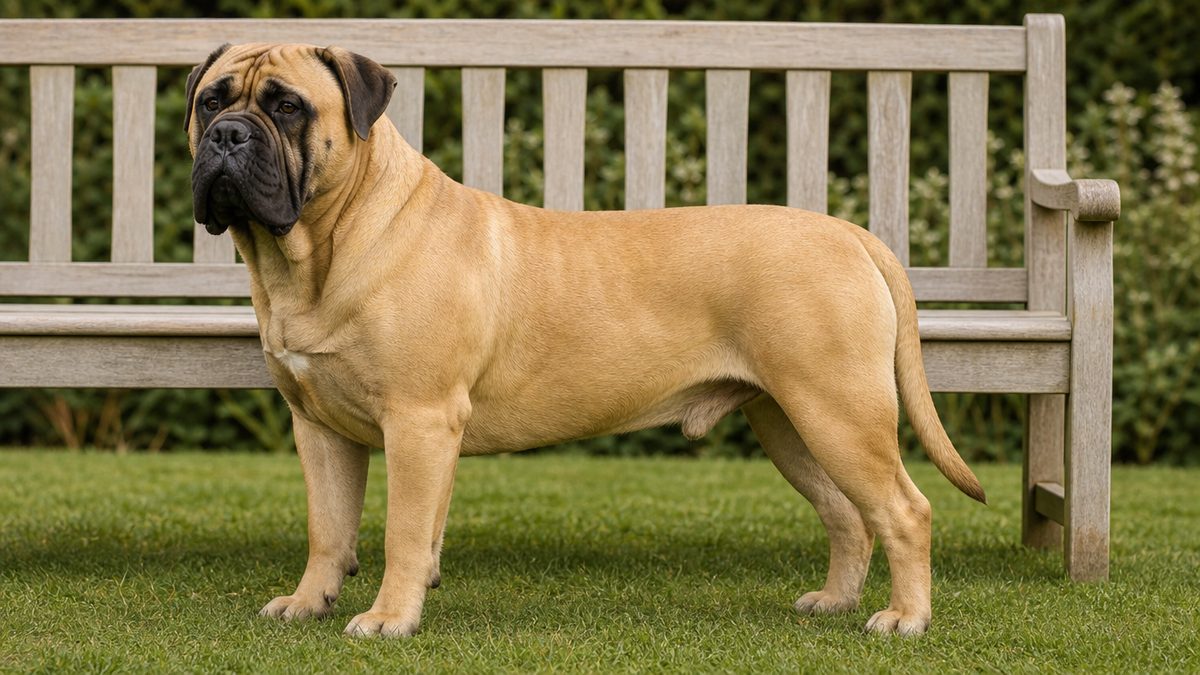
Quick answer
The Bullmastiff is a 50 to 59 kg English guard dog, FCI standard 157, bred from roughly 60 percent Mastiff and 40 percent Bulldog to hold poachers. Indian sellers quote Rs 25,000 to Rs 4,50,000, an eighteenfold spread. Heat tolerance rates 1 out of 5, because UK data give dogs over 50 kg 3.42 times the odds of heat-related illness and brachycephalic dogs 2.10 times.
This page summarises published veterinary research, registry screening data and breed-club guidance for general information. It is not a diagnosis and it is not treatment advice. Consult a registered veterinarian about your own dog before acting on anything here, and treat a rectal temperature at or above 41.0 degrees Celsius, noisy or obstructed breathing that does not settle with rest, a distended painful abdomen with unproductive retching, or sudden collapse in a large-breed dog as an emergency.
Bullmastiff at a glance
What the Bullmastiff is, and what FCI-157 actually says
The Bullmastiff is a large, short-coated, square-headed English guard dog of mastiff type, recognised by the Fédération Cynologique Internationale as breed number 157 in Group 2, Section 2.1, Molossoid breeds, Mastiff Type, without working trial, and its listed utilization is a single word: watchdog.
FCI-157 sets the size without hedging. Males stand 64 to 69 cm at the withers and weigh 50 to 59 kg; bitches stand 61 to 66 cm and weigh 41 to 50 kg. That upper male figure is the most important number on this page for an Indian reader, because it puts the breed inside the exact bodyweight band that United Kingdom primary-care data treat as carrying the highest odds of heat-related illness.
The standard's general appearance clause is four adjectives and one warning. The dog is of powerful build, symmetrical, showing great strength, but not cumbersome, and it must be sound and active. Behaviour and temperament get five more: powerful, enduring, active and reliable, then high-spirited, alert and faithful. A Bullmastiff that cannot move freely is not meeting its own standard, whatever the seller says about substance.
The head, and the measurement that makes this a short-muzzled breed
One clause decides how this dog breathes. The muzzle is short, and the distance from the tip of the nose to the stop is approximately one third of the length from the tip of the nose to the centre of the occiput. The Royal Kennel Club prints the identical sentence in its own standard, and the American Kennel Club states the same ratio differently, giving the muzzle length against the entire head as approximately 1 is to 3. Three registries, one geometry: the Bullmastiff is a short-muzzled dog by written definition, not by accident of breeding.
The rest of the head follows from that. The skull is large and square viewed from every angle, broad and deep, with fair wrinkle when interested but not in repose, and the stop is pronounced. The muzzle is broad under the eyes and holds nearly the same width to the end of the nose, blunt and cut off square, forming a right angle with the upper line of the face. The nose is broad with widely spreading nostrils and flat in profile, neither pointed nor turned up. Flews are not pendulous and never hang below the level of the lower jaw.
Eyes are dark or hazel, of medium size, set apart the width of the muzzle with a furrow between, and light or yellow eyes are highly undesirable. Ears are V-shaped, folded forward, set on wide and high level with the occiput so that the skull reads square, which the standard calls most important. They are small, deeper in colour than the body, and the point of the ear sits level with the eye when the dog is alert. Rose ears are highly undesirable.
Coat, colour and the black mask
The coat is short and hard, weather-resistant, lying flat to the body, and long, silky or woolly coats are highly undesirable. Read that against the Broholmer or the Tibetan Mastiff and the difference is real: FCI-157 does not mention an undercoat at all. This is a single-layer northern European jacket on a very large body, which helps in Indian heat rather less than owners expect, because a 55 kg dog's problem is surface area, not coat depth.
Colour is any shade of brindle, fawn or red, pure and clear, and a black mask is essential, toning off towards the eyes with dark markings around the eyes contributing to expression. A slight white marking on the chest is permissible; other white markings are undesirable. The Royal Kennel Club's registration system recognises exactly six colours for the breed, Brindle, Brindle With Black Muzzle, Fawn, Fawn With Black Muzzle, Red and Red With Black Muzzle, and files the Bullmastiff under Colour Watch Category 0, meaning there are no non-breed-standard colour registration options at all. Any Indian seller offering a blue, chocolate, merle or white Bullmastiff is describing a dog no registry will record as that colour.
| Item | What FCI-157 states |
|---|---|
| Breed number and group | 157, Group 2, Section 2.1 Molossoid breeds, Mastiff Type, without working trial |
| Country of origin | Great Britain |
| Official authentic language | English |
| Valid standard published | 10 August 2023, English text dated 11 September 2023 |
| Utilization | Watchdog |
| Height and weight | Male 64-69 cm and 50-59 kg, bitch 61-66 cm and 41-50 kg |
| Muzzle proportion | Nose to stop about one third of nose to centre of occiput |
| Coat | Short and hard, weather-resistant, lying flat to body |
| Colour | Any shade of brindle, fawn or red, black muzzle essential |
| Disqualifying faults | Aggressive or overly shy; any dog clearly showing physical or behavioural abnormalities |
The American Kennel Club's official standard opens its general appearance clause with a sentence of history: 'The foundation breeding was 60 percent Mastiff and 40 percent Bulldog';. That figure everyone repeats online is a normative statement inside a 1992 breed standard, and the only peer-reviewed genetics paper on the breed sources the same figure to a 1992 fanciers' manual rather than to a registry record.
Three registries, three different heads: where FCI, the Kennel Club and the AKC disagree
The three standards that govern this breed agree on height and on male weight and then part company on the stop, on bitch weight, on how severely faults are regarded and on whether an undershot bite is tolerated, allowed or preferred, which means a judge in Chennai working from the FCI text and a judge working from the AKC text are being asked for two different dogs.
Start with the head, because that is where the disagreement is sharpest. The Kennel Club and the FCI both call the stop pronounced Fédération Cynologique Internationale. The American Kennel Club calls it moderate. Those are not two ways of saying the same thing. The stop is the step between the skull and the muzzle, and it is the single feature that decides whether a short-muzzled head reads as deep-set and Bulldog-derived or as a shallower, more open Mastiff head.
Bitch weight is the second real difference and the more expensive one for a buyer. The Kennel Club and the FCI both give bitches 41 to 50 kg, printed in imperial by the Kennel Club as 90 to 110 pounds Fédération Cynologique Internationale. The AKC gives bitches 100 to 120 pounds, which is 45.4 to 54.4 kg. The American bitch is ten pounds heavier at both ends of the range, and the AKC adds that, other things being equal, the more substantial dog within these limits is favoured. An Indian buyer told a 52 kg bitch is 'to standard' is being told the truth under one registry and not under another.
The bite: tolerated, allowed, or preferred
Three registries, three degrees of permission for the same mouth. The Kennel Club says a level bite is desired but slightly undershot is tolerated. The FCI says a level pincer bite edge to edge is desired but slightly undershot is allowed but not preferred. The AKC says preferably level or slightly undershot, which places the undershot mouth alongside the level one rather than below it. This matters in India for a reason none of the three registries had to think about, and the indian-law section below sets it out: the Prevention of Cruelty to Animals (Dog Breeding and Marketing) Rules 2017 list an undershot jaw among the genetic defects a breeding dog must be tested for.
| Clause | Kennel Club (UK) | FCI-157 | AKC (1992) |
|---|---|---|---|
| Stop | Pronounced | Pronounced | Moderate |
| Bitch weight | 41-50 kg (90-110 lb) | 41-50 kg | 45.4-54.4 kg (100-120 lb) |
| Dog weight | 50-59 kg (110-130 lb) | 50-59 kg | 49.9-59 kg (110-130 lb) |
| Bite | Slightly undershot tolerated | Slightly undershot allowed but not preferred | Preferably level or slightly undershot |
| Light or yellow eyes | Undesirable | Highly undesirable | Not mentioned; eyes dark and medium |
| Rose ears | Undesirable | Highly undesirable | Not mentioned |
| Splayed feet | Undesirable | Highly undesirable | Splay feet a serious fault |
| Coat | Short and hard, weather resistant | Short and hard, weather-resistant | Short and dense, good weather protection |
| Non-standard colour | Any other colour unacceptable | Colour to be pure and clear | White marking beyond a very small chest spot is a fault |
| Proportion | Not stated | Not stated | Nearly square; length exceeds height only slightly |
| Disqualifying faults | None listed | Aggressive or overly shy; physical or behavioural abnormalities | None listed |
The severity language is the quiet difference and it is systematic, not random. On three separate faults, light or yellow eyes, rose ears and splayed feet, the FCI text says highly undesirable where the Kennel Club text says only undesirable. Since the FCI standard for a British breed is a translation of the Kennel Club's own text, one of the two has been edited and the other has not, and neither document tells you which. The Kennel Club page carries a 1 August 2025 update stamp; the FCI text is dated 11 September 2023 with the valid standard published 10 August 2023.
We cross-checked the AKC text two ways before publishing these differences, because a standard reprinted on a magazine site is exactly the sort of document that can drift. ShowSight Magazine's reprint of the Official Standard of the Bullmastiff matches the American Kennel Club's own PDF word for word on every clause quoted here, including the stop, the bitch weight range and the 1 to 3 muzzle proportion, and both carry the same approval date of 8 February 1992 American Kennel Club.
Only one of the three standards states a proportion you can measure. The AKC says the length from the tip of the breastbone to the rear of the thigh exceeds the height from withers to ground only slightly, resulting in a nearly square appearance. Neither the Kennel Club nor the FCI gives any body-proportion clause at all. If you are looking at a long-bodied dog in a Delhi kennel and the seller tells you the standard permits it, the honest answer is that two of the three standards simply do not address it and the third says the dog should look nearly square.
Only the FCI text carries disqualifying faults, and the first is 'aggressive or overly shy';. A guard breed whose governing standard disqualifies aggression is telling you something the marketing does not. If a seller presents a Bullmastiff's reactivity as proof of quality, the standard the dog is registered under disagrees with the seller.
The Gamekeeper's Night Dog, and the three recognition dates nobody reconciles
The Bullmastiff was built for one job between about 1860 and 1924 in England, to track a poacher silently at night, knock him down and hold him without mauling him, and the breed was recognised by the Kennel Club in 1924 after four generations of pure descent were required, then by the American Kennel Club in a year that three sources give three different ways.
The parent club dates the known history to about 1860. Large English estates employed gamekeepers to protect game, and poaching carried the death penalty, which made poachers dangerous and made the gamekeeper's dog a working necessity rather than a luxury. The requirement was specific: a dog that could track quietly, cover short distances quickly, and pin and hold a man without tearing him up. Mastiffs were tried and found too slow. Bulldogs of that era, a very different animal from the modern one, were tried and found too ferocious.
The Kennel Club's own history puts it in the same terms and adds a detail that matters for anyone choosing a colour in India. In the early days the gamekeeper preferred brindle dogs for camouflage when working at night, and the fawn, often with a black mask, is now the more numerous colour. Brindle was a working feature before it was a show colour. The American Kennel Club records that the breed was known for some time simply as the Gamekeeper's Night Dog.
1924: the year the studbook closed
The Kennel Club recognised the Bullmastiff as a breed in 1924, and the condition attached is the part that is usually dropped. Dogs had to show a minimum of four generations of descent from Bullmastiff stock without input from either Bulldog or Mastiff, and cross-bred animals could not be registered. That closed studbook is the origin of every genetic-diversity number later in this page. A breed created from two parent breeds and then sealed off from both of them inherits a fixed pool, and the peer-reviewed genetics agrees: a neighbour-joining tree built from more than 80,000 SNP loci places the Bullmastiff closest to the English Bulldog, one of its founding breeds.
The only peer-reviewed genetics paper on the breed states the 1924 date and the 60 to 40 formula together, and sources both to a 1992 fanciers' manual rather than to a registry record. That is worth knowing before you repeat the ratio as a measured fact. What has been measured is the divergence since: a composite selection signals analysis against 22 other breed groups and against the two formative breeds found significant differentiated regions on 15 chromosomes, with the strongest on CFA1, CFA9 and CFA18, and 458 genes in the multi-clade analysis. A century of closed breeding produced a genuinely distinct genome, not a Mastiff-Bulldog blend held in suspension.
1933, 1934 or both: the AKC date nobody has fixed
Three sources give three answers for one event, and two of them are the same page. The American Kennel Club's own breed page states plainly that the Bullmastiff has been with the AKC since 1933. The American Bullmastiff Association's About the Breed page says in its opening paragraph that the breed was recognised 'by the AKC in 1934', and then, four paragraphs later on the same page, that it was 'accepted as a recognized breed of the American Kennel Club in October 1933'. Wikipedia carries 1934. The likeliest reading is that the breed was accepted in October 1933 and took effect in the 1934 stud book, but no source we opened says so, and we are not going to invent the reconciliation.
The FCI date is the one that is unambiguous. The FCI's nomenclature record gives the date of acceptance on a definitive basis as 23 April 1955, with English as the official authentic language and Great Britain as the country of origin. That is the date that governs Kennel Club of India paperwork, because the KCI is the FCI member body for India.
| Year | Event | Source |
|---|---|---|
| about 1860 | Known history of the type begins in England | American Bullmastiff Association |
| 1924 | The Kennel Club recognises the breed; four generations of pure descent required | Wikipedia, citing the breed history |
| 1928 | De Beers imports Bullmastiffs to South Africa to guard diamond mines | Wikipedia |
| 1933 or 1934 | American Kennel Club recognition; sources disagree | AKC breed page and American Bullmastiff Association |
| 23 April 1955 | FCI accepts the breed on a definitive basis as standard 157 | FCI nomenclature |
| 8 February 1992 | Current AKC standard approved, effective 31 March 1992 | AKC official standard |
| 10 August 2023 | Current FCI standard published | FCI-Standard N° 157 |
| 1 August 2025 | Kennel Club breed standard page last updated | The Royal Kennel Club |
A dog selected to work in silence is a dog that does not warn you before it acts. That is the opposite of what most Indian buyers think they are buying when they buy a guard dog, and it is the single biggest reason the temperament and training sections below take socialisation more seriously than the marketing does.
The word no Indian seller uses: the Bullmastiff is a brachycephalic breed
The Bullmastiff is classified as brachycephalic by its own home registry and by the largest UK canine longevity dataset ever published, which changes the entire Indian argument, because brachycephalic dogs carry between 2.10 and 4.21 times the odds of heat-related illness depending on the care setting studied.
The Royal Kennel Club settles this on the breed's own page. Under Health, the Bullmastiff entry carries a section headed Health issues in flat-faced dogs, which opens 'Dogs with a flat, wide shaped head, are said to be brachycephalic', and it is followed by two subsections, Breathing difficulties and Skin problems. The same page adds the sentence 'This breed can be affected by conformational concerns.' No Indian listing page we opened carries either statement.
The second confirmation is independent and quantitative. McMillan and colleagues built a UK longevity dataset of 584,734 unique dogs including 284,734 deceased, covering 155 recognised breeds, and their supplementary breed table assigns every breed a cephalic index. The Bullmastiff's entry reads Brachycephalic, alongside body size Large and Kennel Club group Working. That classification is not a blogger's opinion; it is the covariate the study used to test whether skull shape predicts lifespan.
The breed standards support the classification without using the word. All three give the muzzle as roughly one third of the head, and the AKC adds a warning that only makes sense in a breed already at the short end: 'Lack of foreface with nostrils set on top of muzzle is a reversion to the Bulldog and is very undesirable'. A standard that has to warn breeders against losing the foreface entirely is describing a breed that sits close to the edge and can be pushed over it.
What the flat face costs, in numbers
Two UK studies give two odds ratios from two care settings, and both are large. In 905,543 dogs under primary veterinary care in 2016, brachycephalic dogs had 2.10 times the odds of heat-related illness compared with mesocephalic dogs, with a 95 percent confidence interval of 1.68 to 2.64. In 167,751 dogs presenting to UK emergency practices in 2022, brachycephalic dogs had 4.21 times the odds, with an interval of 3.22 to 5.49. The second figure is higher partly because emergency caseloads are skewed towards severe events, and partly because 2022 was the hottest year on record in the UK. India does not need a record year.
A third study separates the mechanisms and finds no shelter in any of them. Analysing 1,259 heat-related illness events from 1,222 dogs, Hall and colleagues found that brachycephalic dogs had greater odds of all three trigger types, exertional, environmental and vehicular, compared with mesocephalic dogs. There is no version of Indian dog ownership in which a flat face stops mattering.
| Risk factor | Odds ratio | 95% CI | Population studied |
|---|---|---|---|
| Bodyweight over 50 kg vs under 10 kg | 3.42 | 1.54-7.57 | 905,543 UK primary-care dogs, 2016 |
| Brachycephalic vs mesocephalic | 2.10 | 1.68-2.64 | 905,543 UK primary-care dogs, 2016 |
| Brachycephalic vs mesocephalic | 4.21 | 3.22-5.49 | 167,751 UK emergency dogs, 2022 |
| Purebred vs crossbred | 1.86 | 1.39-2.49 | 905,543 UK primary-care dogs, 2016 |
| Aged 12 years or more vs under 2 | 1.75 | 1.14-2.70 | 905,543 UK primary-care dogs, 2016 |
Skin is the second cost and the one that bites in the monsoon. The Kennel Club's flat-faced section states that some brachycephalic dogs carry an excess of skin which creates folds, especially around the front of the face, and that those folds make a warm, moist environment perfect for bacteria and yeast to grow, possibly leading to infection and severe itching. FCI-157 asks for fair wrinkle when the dog is interested. Fair wrinkle plus 90 percent relative humidity in a Mumbai July is a different proposition from fair wrinkle in Leicestershire.
The eye consequence shows up in the register. OFA's eye-condition table for the Bullmastiff records exposure keratopathy syndrome in 10 of 1,762 examined dogs, a corneal condition of shallow orbits and incomplete blink that is characteristic of shortened skulls, alongside entropion in 107 dogs and ectropion in 19. Those are small percentages individually. They are not small when you remember that they arise from head shape rather than from bad luck.
The English Wikipedia article states that the Bullmastiff 'is brachycephalic, flat-faced and short-muzzled, but this does not affect its breathing', and the sentence carries the inline tag failed verification. The most-read free page on this breed contains a reassurance its own volunteers could not source. Orvis, which ranked fifth on the same search, contradicts it in a single line: 'As brachycephalic dogs, Bullmastiffs are not built for long swims because it is difficult for them to keep their snouts above water';.
Effective population size 29.1, and the three other numbers that belong beside it
The Bullmastiff's effective population size is quoted online as 29.1 with an inbreeding coefficient of 0.035, and that pair is real, verified here against the paper itself, but it is one of four published estimates for the same breed and the only reason to quote it alone is that nobody has read past the abstract.
The source is Mortlock, Khatkar and Williamson, published in PLoS ONE in January 2016 and still the only peer-reviewed genome-diversity study of the breed. Two datasets sit inside it. The genealogical analysis used pedigree records of Bullmastiffs registered in Australia between 1980 and 2013, supplied by Dogs NSW. The molecular analysis genotyped 188 Bullmastiffs on the 170,000 SNP Illumina CanineHD BeadChip, of which 185 survived call-rate filtering, with a reference population of 993 dogs made up of the genotyped animals and their ancestors.
Those two methods give two different effective population sizes for the same breed, and both are in the same table. Pedigree data give Ne 41 with a mean inbreeding coefficient of 0.047 for the genotyped dogs and 0.039 across the full registry. SNP data give Ne 29.1 with a mean inbreeding coefficient of 0.035, mean multilocus heterozygosity of 0.206, and runs of homozygosity covering 16.44 percent of the genome at the greater-than-1-megabase threshold. The internet quotes the second pair and drops the first.
The two numbers from Britain that nobody attaches
The Kennel Club's own analysis of its whole registry reaches a very different figure. Lewis, Abhayaratne and Blott computed genetic parameters for every Kennel Club breed over 1980 to 2014, and Appendix 1 gives the Bullmastiff a rate of inbreeding of 0.00151 per annum, a mean generation interval of 3.25 years, and an effective population size of 101.47. The Australian authors were aware of it and reported the reconciliation in their discussion: the UK figure of 101.5 covers the whole 1980 to 2014 period, while the median across five-year blocks within that period was only 29.2, which is almost exactly the Australian SNP estimate.
That is the finding worth carrying away. A single UK number computed across thirty-four years hides a breed that, block by block, has been running an effective population size near thirty for most of that time. Both national populations, measured independently, land in the high twenties when you look at them at the resolution that breeding actually happens.
| Estimate | Value | Method | Population |
|---|---|---|---|
| Ne, pedigree | 41 | PEDIG, reference population of 993 dogs | Australia, Dogs NSW, 1980-2013 |
| Ne, molecular | 29.1 | Linkage disequilibrium, SNP genotypes | Australia, 185 to 188 genotyped dogs |
| Ne, molecular, discussion figure | 29.8 | Linkage disequilibrium, same paper | Australia, same dogs |
| Ne, whole period | 101.47 | Rate of inbreeding 1980-2014 | United Kingdom, Kennel Club registry |
| Ne, median of five-year blocks | 29.2 | Rate of inbreeding within blocks | United Kingdom, Kennel Club registry |
The threshold that gives those numbers meaning is fifty. A population with an effective population size under 50 is considered more at risk from the effects of inbreeding depression, and the Bullmastiff sits below it on three of the five estimates above and only clears it on the one computed across the longest span. The rate of inbreeding tells the same story: an inbreeding rate below 1 percent per generation is the accepted ceiling for limiting inbreeding depression, and the Bullmastiff's is 1.2 percent.
Where the narrowness comes from: twenty ancestors
The founder arithmetic locates the problem precisely. The breed's Australian registry traces to 142 observed founders, but the effective number of founders is 79 and the effective number of ancestors is 62, and 20 ancestors account for more than 50 percent of the genetic diversity in the population. The ratio of effective founders to observed founders, 0.56, is actually much better than the 0.18 average for Australian registries of similar size, so the Bullmastiff is not unusually badly managed. It is simply a small closed pool in which a handful of animals were used very heavily.
Fine-scale network analysis of the genotyped dogs resolved eleven distinguishable subpopulations, and the arithmetic of relatedness inside them is the practical warning. The average relationship coefficient across all genotyped dogs was 0.02; inside each cluster it averaged 0.18. A buyer choosing two Bullmastiffs at random from one Indian kennel's stock is not choosing from the breed, they are choosing from one cluster.
India has no published Bullmastiff pedigree analysis, and the Kennel Club of India registered 32,219 puppies across all breeds in 2025. A national population that small, importing from a global pool whose effective size is already near thirty, cannot be assumed to be more diverse than the source. It is almost certainly less.
Reading the only Bullmastiff genetics paper against itself
Check the paper everyone quotes against its own tables and six internal disagreements appear, none of which changes the conclusion but every one of which changes which number you should print, and the most important is that the famous 16.44 percent homozygosity figure is not the one that can be compared with other breeds.
This is not an attack on the study. Mortlock and colleagues did the only genome-wide diversity work that exists on this breed, they published their genotype data openly, and their conclusion, that Bullmastiffs have mid-range diversity with a relatively small effective population size, survives every check below. But a page that quotes a decimal from an abstract without opening the tables is repeating, not reporting, and this breed's numbers have been repeated a great deal.
Six places where the paper disagrees with itself
The registry size is the clearest. The abstract states the genealogical analysis used a database of 16,378 Bullmastiff pedigrees. The Materials and Methods say pedigree records of 16,739 Bullmastiffs registered between 1980 and 2013 were provided by Dogs NSW, the Results repeat 16,739, and footnote b of Table 1 gives 'Bullmastiff database of 16 739 registered dogs';. Four occurrences of 16,739 against one of 16,378. The abstract carries a transposition, and the correct figure is 16,739.
The molecular inbreeding coefficient appears twice with different values. The abstract and Table 1 give 0.035. The Results text reads 'The mean inbreeding coefficient, MLH and effective population size estimated from the 185 Bullmastiff dogs using molecular data was 0.033, 0.206 and 29.1';. The sample size shifts in the same sentence too: 188 dogs were genotyped, three were removed for a call rate below 73 percent, and 185 remained, so the abstract's 188 is the recruitment figure and 185 is the analysed figure.
The effective population size appears twice as well. Abstract and Table 1 give 29.1; the Discussion states 'Using LD, an Ne of 29.8 was estimated for Bullmastiffs'. Both refer to the same linkage-disequilibrium computation on the same dogs. Either is defensible; quoting one to two decimal places as though it were fixed is not.
The homozygosity figure appears three times with three values, and this is the one that matters. The abstract and Table 2 give runs of homozygosity covering 16.44 percent of the genome at greater than 1 megabase. Table 1 gives 16.17. And the multi-breed section, which used only the SNPs common to the Bullmastiff and the comparison dataset, gives 14.10 percent, described in the paper's own words as 'the second highest out of the 13 breeds';.
| Breed | Genome covered by runs of homozygosity over 1 Mb | Position |
|---|---|---|
| British Bulldog | 14.69% | Highest of 13 |
| Bullmastiff | 14.10% | Second highest of 13 |
| Jack Russell Terrier | 6.08% | Lowest of 13 |
So the honest cross-breed statement is this: on the only apples-to-apples comparison in the paper, the Bullmastiff carries the second most homozygous genome of thirteen breeds tested, sitting just below the British Bulldog, one of its own founding breeds. The 16.44 percent figure that circulates is from the Bullmastiff-only SNP set and cannot be lined up against other breeds. Anyone who has printed 16.44 percent next to another breed's number has compared two different measurements.
The two remaining slips are smaller and both are arithmetic. The paper reports that 77,912 SNPs were removed from an original 172,939, made up of 3,365 that failed the call-rate threshold and 74,607 that failed the minor allele frequency test; those two components sum to 77,972, sixty more than the stated total. And the paper explains that runs over 8 megabases correspond to a common ancestor occurring 'only six generations ago', then twice states that the Bullmastiff's greater-than-8-megabase coefficient of 0.002 represents 'a common ancestor only 3 generations past'. Six or three; the paper says both.
Every headline conclusion holds: the inbreeding rate of 1.2 percent per generation exceeds the 1 percent ceiling, twenty ancestors account for over half the diversity, and the effective population size is in the high twenties to low forties depending on method. The buyer's question is therefore not 'is this breed inbred' but 'what is the coefficient of inbreeding on this specific pairing, and can you show me the four-generation pedigree it was calculated from'. Under Indian law, that pedigree is not optional.
What the Kennel Club's own 2025 dataset shows: a shrinking breed with ten very busy sires
The Kennel Club published a full demographic analysis of 222 pedigree breeds in 2025, and its within-breed supplementary tables put hard numbers on the Bullmastiff for the first time: a population falling 8.77 percent a year since 2010, only 6 percent of males bred from, and ten sires producing thirty-six more litters each than the breed median.
The dataset is the Kennel Club's own electronic register, extracted in late 2022, covering 11,159,418 dog records across 222 breeds. Three population definitions are used and they nest: Litter Registrations are dogs registered in the UK through litter registration and born since 1990, Breed Register adds imported dogs and dogs with Authority To Compete, and Whole Pedigree adds every ancestor including dogs born before 1990. For the Bullmastiff the three figures are 52,541 in the Whole Pedigree, 41,948 in the Breed Register, and 41,305 litter registrations.
Put that in context. The mean breed size across all 222 breeds in the Whole Pedigree was 50,268, ranging from 56 in the American Water Spaniel to 1,408,204 in the Labrador Retriever. The Bullmastiff at 52,541 is almost exactly an average-sized Kennel Club breed. It is not rare in Britain, which is precisely why the Australian genetics and the British demography can be read together with confidence.
The population is falling, and falling faster
Proportional population growth for the Bullmastiff is negative 4.84 percent a year across 1990 to 2021, with a 95 percent interval of negative 6.26 to negative 3.41. Narrow the window to 2010 to 2021 and it is negative 8.77 percent a year, interval negative 12.10 to negative 5.32. The decline is not noise and it is accelerating. A breed losing nearly nine percent of its registrations a year is a breed whose gene pool is contracting while you read this, which is the demographic mechanism behind the effective population size figures in the section above.
Imports are the counterweight, and they are growing fast. The imported Bullmastiff population in the UK grew 8.48 percent a year from 1990 to 2021, interval 6.05 to 10.97, and import-bred litters now make up 21.29 percent of the breed's litters, up 13.09 percent over time. Roughly one Bullmastiff litter in five in Britain is now bred from imported stock. That is directly relevant to an Indian buyer, because the semen and the dogs moving into Britain come from the same international pool an Indian breeder would import from.
| Measure | Bullmastiff value | 95% confidence interval |
|---|---|---|
| Whole Pedigree population | 52,541 | n/a |
| Breed Register, born since 1990 | 41,948 | n/a |
| Litter Registrations, born since 1990 | 41,305 | n/a |
| Population growth per year, 1990-2021 | -4.84% | -6.26 to -3.41 |
| Population growth per year, 2010-2021 | -8.77% | -12.10 to -5.32 |
| Dogs born 2005-2015 that were bred from | 11.81% of 12,041 | 11.24 to 12.40 |
| Males born 2015 that were bred from | 6.00% of 300 | 3.59 to 9.32 |
| Dogs holding a Stud Book Number | 4.67% of 52,541 (2,454 dogs) | 4.49 to 4.85 |
| Purpose-bred litters | 34.69% (2,486 litters) | 33.58 to 35.80 |
| Import-bred litters | 21.29% (158 litters) | 18.40 to 24.42 |
| Extra litters, 10 highest-producing sires vs breed median | 36.00 | 28.72 to 43.28 |
Six percent of males, and a popular-sire effect you can measure
Of 300 litter-registered male Bullmastiffs born in the UK in 2015, 6.00 percent were ever bred from. Ninety-four percent of a birth cohort's males contributed nothing genetically. Across both sexes born between 2005 and 2015, 11.81 percent of 12,041 dogs were bred from. A breed does not get a small effective population size because it has few dogs; it gets one because it uses few of them.
The ten highest-producing Bullmastiff sires produced, on average, 36.00 more litters than the breed's median sire, with a confidence interval of 28.72 to 43.28, and they had their first litter 4.87 months earlier than the median. That is the popular-sire effect, quantified inside the breed's home registry, and it is exactly the mechanism the Australian genetics paper blamed for the low effective population size: twenty ancestors accounting for more than half the diversity, and extensive use of popular sires named as a major contributor to a high inbreeding rate in the UK population too.
Two smaller findings round it out. Sires holding a Stud Book Number, awarded for winning a qualifying award at a Kennel Club activity, produced 3.37 more litters on average than sires without one, interval 2.63 to 4.11, so show success converts directly into genetic contribution. And among the ten highest-producing sires born 1990 to 2021, six held a Stud Book Number and none was imported; among those young enough to be presumed alive, born since 2015, none held a Stud Book Number and two were imported.
First, how many litters has this sire produced, in total, and what proportion of the Indian Bullmastiff population is already descended from him. Second, is the sire or his semen imported, and from which national population. Neither question needs a genetics degree, and a breeder who cannot answer the first one is not tracking the thing that determines this breed's future.
Bullmastiff price in India: three published bands that disagree by eighteen times
Bullmastiff price in India runs from Rs 25,000 to Rs 4,50,000 across the three sellers that publish a figure, an eighteenfold spread on one breed, and the gap is not explained by quality tiers because the cheapest seller and the dearest seller are describing the same animal in the same country in the same year.
Unlike most breeds this site covers, the Bullmastiff has a genuine Indian market. It is small. One national listing platform returned 29 Bullmastiff listings on the day we pulled it, against 650 Shih Tzu, 549 Siberian Husky, 487 Golden Retriever, 454 Labrador Retriever, 412 German Shepherd, 274 Beagle, 263 Poodle, 162 Rottweiler, 136 Pomeranian and 134 Cane Corso in its own most-popular-breeds sidebar. The Bullmastiff is available here and it is roughly a twentieth as available as a Shih Tzu.
Three sellers publish a puppy price. They do not agree.
| Seller | Published band | What the page says it covers |
|---|---|---|
| Marshalls Petzone | Rs 25,000 to Rs 32,000 | 'One can easily purchase Bull mastiff puppy in between the range... across India' |
| Petsworld | Rs 45,000 to Rs 80,000 | 'usually priced at Rs. 45000 and can range up to Rs 80,000', Delhi and NCR |
| Mr n Mrs Pet, basic | Rs 1,20,000 to Rs 2,00,000 | 'suitable for families... but without show or breeding rights' |
| Mr n Mrs Pet, KCI registered | Rs 2,00,000 to Rs 3,50,000 | 'Kennel Club of India certification, verified lineage, complete vaccinations, and a vet health check' |
| Mr n Mrs Pet, overall | Rs 1,20,000 to Rs 4,50,000 and above | stated as the average price range for the breed in India |
The distance between the ends is the story. Marshalls Petzone's ceiling of Rs 32,000 is below Mr n Mrs Pet's basic floor of Rs 1,20,000 by nearly four times, and Mr n Mrs Pet's top figure of Rs 4,50,000 is fourteen times Marshalls' ceiling Mr n Mrs Pet, Bullmastiff Puppies For Sale…. Petsworld sits between them at Rs 45,000 to Rs 80,000 and describes the same product, a Bullmastiff puppy from a Delhi or NCR breeder. No page explains the gap, and the tier language does not close it, because Marshalls is not selling a lesser tier, it is selling the whole breed at a price the other seller charges for nothing at all.
What actually drives the difference
Only one variable in the published tiers is verifiable by a buyer, and it is the Kennel Club of India paper. Mr n Mrs Pet's own breakdown prices KCI registration as the step from Rs 1,20,000-2,00,000 to Rs 2,00,000-3,50,000, so on that seller's own numbers the certificate is being priced at roughly Rs 80,000 to Rs 1,50,000. That is an extraordinary premium for a registration document, and it is worth knowing what the document is: the KCI is the FCI's member body for India, and in 2025 it registered 32,219 puppies across every breed it recognises, down from 88,261 in 2021.
Everything else in the tier language is unverifiable at the point of sale. 'Champion bloodline', 'show quality' and 'superior genetics for breeding' are seller assertions unless a pedigree, a hip score and an elbow score are put in front of you, and this is the breed where those three documents matter most: 25.7 percent hip dysplasia in 7,569 OFA evaluations and 65.1 percent in 355 Swedish screenings Engdahl K, Malm Persson S, Andersson L. A Rs 3,50,000 puppy with no parental hip score is worse value than a Rs 45,000 puppy with two.
For scale, the overseas figures sit well below the top Indian band. The A-Z Animals price page that ranked tenth on the Indian commercial search states that a purebred Bullmastiff puppy costs 'anywhere from $1,000 to $2,000 to bring one home', with adoption averaging $50 to $500. At 84.38 rupees to the dollar that purchase range is Rs 84,380 to Rs 1,68,760, so Mr n Mrs Pet's ceiling of Rs 4,50,000 is roughly 2.7 times the top of the American range for a breed whose entire global registry sits in Britain, America and Australia.
Every figure above is a published editorial price reported as content. Bonbeno does not sell animals, does not link listings and does not recommend breeders. If a seller quotes you a number outside the Rs 25,000 to Rs 4,50,000 range above, that does not make it wrong; it makes it unpublished, and you should ask what the number is attached to before you ask whether it is fair.
Testing every rupee figure, and what the Indian listings actually contain
Divide each published Indian Bullmastiff price by 84.38 and by 74, the two exchange rates that have exposed converted foreign price lists on this site before, and not one figure resolves to a round dollar amount, which is the clean result: these prices were written in rupees by people selling in India, and the eighteenfold spread is a real disagreement rather than an artefact.
The test is simple and any reader can repeat it in a calculator. Indian pages routinely publish 'prices' that are an American dollar figure run through one exchange rate, and the tell is that the rupee number divides to something round. Both rates have been caught on this site: 84.38 on one breed's page where nine cost figures came back as round dollar amounts, and 74 on another where Rs 1,33,200 resolved to exactly USD 1,800.
| Rupee figure | Divided by 84.38 | Divided by 74 | Verdict |
|---|---|---|---|
| Rs 25,000 | 296.28 | 337.84 | No round dollar value |
| Rs 32,000 | 379.24 | 432.43 | No round dollar value |
| Rs 45,000 | 533.30 | 608.11 | No round dollar value |
| Rs 80,000 | 948.09 | 1,081.08 | No round dollar value |
| Rs 1,20,000 | 1,422.14 | 1,621.62 | No round dollar value |
| Rs 2,00,000 | 2,370.23 | 2,702.70 | No round dollar value |
| Rs 3,50,000 | 4,147.90 | 4,729.73 | No round dollar value |
| Rs 4,50,000 | 5,333.02 | 6,081.08 | No round dollar value |
| Rs 8,000 monthly | 94.81 | 108.11 | No round dollar value |
| Rs 12,000 monthly | 142.21 | 162.16 | No round dollar value |
Ten figures, twenty divisions, and not one clean quotient. That is a finding worth stating plainly, because it is unusual: on several breeds this site has covered, the entire Indian price table dissolved under this test. The Bullmastiff's does not. Whatever else is wrong with the numbers, they were typed by Indian sellers about Indian stock, which is why the disagreement between them is worth taking seriously instead of dismissing.
One more control passed. Rs 98,999, the recurring house charm price that one Indian listing site attaches to whichever puppy is in stock and which has now been caught on ten separate breed pages, appears nowhere on any Bullmastiff page we opened Marshalls Petzone. Neither does Rs 92,599, Rs 94,999 or Rs 76,499, the other members of that carousel.
What the pages get wrong in other ways
The prices are real; the pages around them are not carefully maintained, and two errors are visible without leaving the tab. Marshalls Petzone's own breed grid prints 'One can easily purchase Labrador puppy in between the range of Rs.20,000 to Rs.15,000 across India', a band running from high to low. A price range typed backwards is not a scandal, but it tells you the table is not proofread, which is relevant when you are relying on the Bullmastiff row on the same grid.
Mr n Mrs Pet's monthly-cost answer contains a fragment from another breed's template. Asked how much a Bullmastiff costs to maintain monthly, the page answers Rs 8,000 to Rs 12,000 and then adds 'Bullmastiffs typically cost less to maintain than Standard ones'. There is no 'Standard' Bullmastiff. That sentence belongs to a Poodle or a Dachshund page, which means the monthly figure beside it should be treated as generic filler rather than as a measurement, and the cost-of-ownership section below builds its own estimate from scratch instead.
What the commercial search page is made of
Search 'bullmastiff price in india' from an Indian location and the first page is mostly not editorial content. Position 1 and position 4 are YouTube videos from Indian kennels, titled 'Biggest & Cheapest Bullmastiff Kennel In India' and 'Bullmastiff puppies price in india 2022 from Bullmastiff breeder'. Position 7 is a Facebook posting of the first of those two videos under the same title. Position 6 is an Instagram tag page and position 8 is a Pinterest pin. Position 9 is a retailer's listicle on the most expensive dog breeds in India, and when we opened it, the word Bullmastiff appeared zero times on the page. Of the ten results, three carry an Indian price we could open and read.
The honest summary of Bullmastiff puppy price in India is a band, not a point: Rs 25,000 to Rs 4,50,000 in print, with the great majority of listings clustering below Rs 1,00,000 on the two cheaper sellers and above Rs 1,20,000 on the third. Ask what documentation moves a puppy from one end to the other, and if the answer is not a KCI certificate plus hip and elbow scores on both parents, the premium is not buying you anything you can verify.
Importing a Bullmastiff into India, read from the trade notice itself
You can import a Bullmastiff into India only as your own pet, because live dogs sit at ITC(HS) 01061900 as a Restricted item and the governing trade notice permits entry for exactly three purposes, of which breeding and trading are not among them, and applications for those purposes 'shall be duly rejected'.
The instrument is Trade Notice No. 22/2022-23, issued by the Directorate General of Foreign Trade on 19 December 2022 and addressed to all international airlines, all Indian embassies and consulates abroad, and pet owners. We extracted the five-page PDF ourselves rather than relying on a summary, because summaries of Indian pet legislation have been fabricated before.
Policy Condition (7) lists the only three purposes for which a dog may be imported. First, a pet dog with a valid pet book and relevant records or documents in the name of the importer. Second, dogs imported by research and development organisations with the recommendation of the Committee for the Purpose of Control and Supervision of Experiments on Animals. Third, for internal security by the Defence and Police Force. Policy Condition (8) then closes the door explicitly: 'Import of commercial dogs for breeding or any other commercial activities other than the purposes mentioned above is not permitted';.
Paragraph 6 repeats it as an instruction to the officials processing the file: 'any applications for trading/breeding purposes, or applications made on behalf of some another person/entity shall be duly rejected'. Both halves matter. You cannot import a Bullmastiff to breed from, and you cannot import one on someone else's behalf, which rules out the arrangement where a buyer funds an import that a kennel technically owns.
| Item | What the notice states |
|---|---|
| Tariff line | ITC(HS) 01061900, Mammals: Other, Restricted, subject to Policy Condition 6 |
| Permitted purposes | Pet with valid pet book in importer's name; R&D with CPCSEA recommendation; Defence and Police internal security |
| Breeding or trading | Not permitted; applications shall be duly rejected |
| Up to two pets, permanent | Allowed as passenger baggage without DGFT authorisation only for persons transferring residence after two years continuous stay abroad |
| More than two pets | DGFT import authorisation always required, with justification submitted to DAH&D |
| Temporary imports | DGFT import authorisation always required |
| Mandatory documents | Vaccination Book or Pet Passport or Pet Book; Certificate for Emotional Support; Passport of the Pet |
| Application route | ANF-2M against your own IEC, or the permanent IEC number IIHIE0153E for personal-use imports |
| Lead time | Begin the authorisation process at least two months before travel |
| Entry points | Airports and seaports of Delhi, Mumbai, Chennai, Hyderabad, Bangalore and Kolkata only; DAHD added Kochi for pets arriving under the baggage rules in October 2024 |
| Advance NOC | From the Regional or Quarantine Officer (AQCS) seven days before travel, relaxable to three days |
The quarantine body named in paragraph 8 is real and reachable. Animal Quarantine and Certification Services sits under the Department of Animal Husbandry and Dairying and runs stations at Delhi, Mumbai, Kolkata, Chennai and Bengaluru, publishing its own import guidelines for dogs and its quarantine charges, while the department's trade division publishes the Standard Operating Procedures for import clearance of live animals including pets by AQCS. The Advance No Objection Certificate comes from that officer at your arrival port, not from DGFT.
Seven ports is a real constraint for this breed rather than a formality. A 55 kg dog in an airline crate is a cargo problem, and if you land anywhere other than Delhi, Mumbai, Chennai, Hyderabad, Bengaluru, Kolkata or, since October 2024, Kochi, the animal cannot lawfully enter Department of Animal Husbandry…. Where required, the notice adds, the animal shall also be quarantined in the government quarantine station of that port for a stipulated period. A quarantine station in a Chennai May, where the mean daily maximum is 42.7 degrees Celsius, is the worst place on earth to put a brachycephalic 55 kg dog. The full route is set out in how to import a dog to India.
What this means for the Indian gene pool
Britain refreshes its Bullmastiff gene pool through imports: 21.29 percent of UK Bullmastiff litters are import-bred and the imported population has grown 8.48 percent a year since 1990. India cannot do the same thing legally, because the only lawful import of a dog is a pet accompanying its owner, and a pet imported that way is still a single animal, not a breeding programme. Frozen semen is a separate customs question this page does not cover, and any breeder who tells you they 'import bloodlines' should be asked precisely which instrument permits it.
The practical consequence is that the Indian population is close to a closed system layered on a global one whose effective size is already in the high twenties. Treat 'imported bloodline' as a claim to verify rather than a feature to pay for.
Start two months out, confirm your entry airport is one of the seven, get the Advance NOC from the AQCS seven days before travel, and book the flight for a night arrival. Every hour of the transfer between aircraft and air-conditioned vehicle happens outdoors, and the heat-illness data in this page's climate section apply to airport tarmac more sharply than to anywhere else you will take this dog.
What a 46 kg dog costs to keep in India, bounded honestly
The only published Indian monthly figure for a Bullmastiff is Rs 8,000 to Rs 12,000, and it appears in an FAQ answer that also contains the sentence 'Bullmastiffs typically cost less to maintain than Standard ones', which is template text from another breed, so treat that band as a starting point rather than a measurement and build the estimate from the four things that actually scale with a 46 kg body.
Start with the measured adult weight, not the standard. VetCompass Australia recorded 2,771 Bullmastiffs over a decade and found adult males averaging 46.6 kg and adult females 40.5 kg. That is the animal you will actually feed, and it is meaningfully lighter than the 50 to 59 kg the standard describes. Every recurring cost below scales off that number rather than off the show ring.
Four categories scale with body weight and one does not. Food, therapeutic drug doses, anaesthetic drug doses and parasite preventives are all dosed or portioned by kilogram, so a 46 kg dog costs roughly four times a 12 kg dog on each of them. Vaccination, consultation fees and microchipping do not scale, so they cost the same as for a small dog. Anyone quoting you a monthly figure that is only three or four thousand rupees above a Labrador's has not priced the first group properly.
The growth year is the expensive year
Bullmastiff puppies gain approximately one kilogram every ten days through their first year, with a slower second year and a plateau at adulthood. At that rate a puppy adds around 36 kg in twelve months. Food volume therefore rises continuously for a year, and it rises fastest at exactly the age when the diet must be a large-breed growth formula rather than a general puppy food, because growth rate is one of the modifiable inputs into hip and elbow dysplasia in a breed that already runs 25.7 percent and 17.2 percent on the OFA registers.
| Cost line | Scales with weight? | What makes this breed different |
|---|---|---|
| Complete adult food | Yes, directly | Portioning for 46.6 kg males and 40.5 kg females, measured, not for the 59 kg the standard allows |
| Large-breed puppy food, months 2-14 | Yes, and rising monthly | About 1 kg of bodyweight gained every 10 days through year one |
| Monthly tick and flea preventive | Yes, dosed by weight | Rhipicephalus sanguineus is the vector for Ehrlichia canis across India, and dogs over 20 kg were over-represented in an Odisha series |
| Annual vaccination and consultation | No | Same as any dog; the size premium is in everything else |
| Hip and elbow radiographs, once | Yes, sedation dosed by weight | Non-optional in this breed; the Kennel Club strongly recommends both plus an eye test before breeding |
| Air conditioning or cooling, March to October | No, but hours rise | Driven by the two heat odds ratios, not by comfort |
| Emergency surgery reserve | Yes | Bloat, cruciate rupture and mass removal are the three that recur in this breed's records |
| Grooming | Barely | Short hard coat, brushed weekly; the cost is skin and eye care, not clipping |
The screening line is the one Indian buyers skip and should not. The Royal Kennel Club strongly recommends three tests before breeding from this breed, and lists them by name: elbow testing under the BVA and Kennel Club Elbow Dysplasia Scheme, eye testing under the BVA, Kennel Club and ISDS Eye Scheme, and hip testing under the BVA and Kennel Club Hip Dysplasia Scheme. The OFA's CHIC requirements for the breed are the same three in American form: a hip evaluation by OFA radiograph or PennHIP, an OFA elbow evaluation, and an ACVO eye examination. Two registries on two continents ask for the identical trio.
The costs that arrive as one large bill
Three events dominate the unplanned spending, and each has a published probability attached. Gastric dilatation-volvulus was measured at 26 cases per 1,000 dog-years at risk in giant breeds over 45 kg in a prospective cohort of 1,914 dogs, with 30 of the 105 affected dogs dying, a 28.6 percent case fatality. That study followed eleven breeds and the Bullmastiff was not among them, so the figure is a giant-breed benchmark rather than a breed measurement, and this page will not pretend otherwise.
Cancer is the second. In Australian veterinary records, mass lesions were the single commonest cause of death in the breed at 28.2 percent, and UK pathology data give the Bullmastiff an odds ratio of 9.6 for osteosarcoma and 14.2 for cutaneous haemangiosarcoma. Heat-related illness is the third: the UK event fatality rate was 14.18 percent in primary care in 2016 and 26.56 percent in emergency care in 2022 Beard S, Hall EJ, Bradbury J, Carter AJ. Budget for one significant surgical or oncology episode in this dog's life, because the arithmetic says most owners will meet one.
Indian food, veterinary and medication prices vary by city and by brand far more than by breed, and the only published Bullmastiff-specific number we could find is contaminated by another breed's template text. Publishing a tidy figure we cannot source would be worse than useless. Price the eight lines above with your own vet and your own retailer, and treat the screening trio as fixed rather than optional.
Heat tolerance: two odds ratios that both apply, and an English summer cooler than Bengaluru's winter
The Bullmastiff rates 1 out of 5 for heat tolerance, the lowest score this site gives, because it is the rare breed that lands inside two separate high-risk categories in the same UK dataset at the same time: dogs over 50 kg carry 3.42 times the odds of heat-related illness, and brachycephalic dogs carry 2.10 times, and this dog is both.
Take the weight first. In 905,543 dogs under primary veterinary care in the UK in 2016, dogs weighing over 50 kg had 3.42 times the odds of heat-related illness compared with dogs under 10 kg, with a 95 percent confidence interval of 1.54 to 7.57, and every bodyweight group above 10 kg carried significantly higher odds than the lightest. FCI-157 places male Bullmastiffs at 50 to 59 kg, and the measured Australian average for adult males is 46.6 kg, so a real Indian male sits at the top of the second-heaviest band or inside the heaviest one.
The authors explain the mechanism in one sentence worth memorising. Smaller dogs have a high heat-storage to radiative-surface-area ratio that results in more rapid heat loss compared with larger dogs, meaning they can exercise for longer before overheating. A Bullmastiff generates heat in proportion to its mass and sheds it in proportion to its surface, and mass wins.
Then add the head. The same study put brachycephalic dogs at 2.10 times the odds of mesocephalic dogs, interval 1.68 to 2.64, and both the Royal Kennel Club and a 584,734-dog UK longevity dataset classify the Bullmastiff as brachycephalic McMillan KM, Bielby J, Williams CL. A dog cools by moving air across the wet surfaces of its nose, mouth and throat. Shortening the muzzle to one third of the head shortens that surface, which is why the standard's own geometry is a heat statistic.
Where the breed came from, measured
We queried NASA POWER by explicit latitude and longitude rather than by place name, and the API echoed the coordinates back. Leicester in the English East Midlands was requested at 52.6369 north, 1.1398 west, and returned coordinates of longitude -1.14, latitude 52.637, elevation 101.77 metres. Burslem in Stoke-on-Trent was requested at 53.0455 north, 2.1889 west, and returned longitude -2.189, latitude 53.045, elevation 132.32 metres. Both sit in the English midland counties where the large game estates that created this breed were worked.
| Place | Annual mean | Hottest month, mean | Coolest month, mean |
|---|---|---|---|
| Leicester, England (52.637 N, 1.140 W) | 9.6 C | July, 16.5 C | January, 3.6 C |
| Burslem, Stoke-on-Trent (53.045 N, 2.189 W) | 9.1 C | July, 15.6 C | January, 3.5 C |
| Bengaluru | 23.7 C | April, 28.4 C | December, 20.2 C |
| Pune | 23.9 C | April, 28.9 C | December, 19.6 C |
| Delhi | 25.6 C | June, 35.9 C | January, 13.6 C |
| Kolkata | 25.8 C | May, 31.5 C | January, 17.3 C |
| Hyderabad | 26.1 C | May, 33.3 C | December, 20.8 C |
| Mumbai | 26.8 C | May, 31.2 C | January, 23.2 C |
| Ahmedabad | 27.6 C | May, 35.1 C | January, 19.9 C |
| Chennai | 27.9 C | May, 31.5 C | January, 24.1 C |
Read the two ends of that table together. Bengaluru's coolest month averages 20.2 degrees Celsius, which is 3.7 degrees warmer than the hottest month in Leicester and 4.6 degrees warmer than the hottest month in Burslem. Chennai's coolest month, at 24.1 degrees, is 7.6 degrees warmer than an English July. The city an Indian buyer thinks of as the mild one is warmer in December than the breed's homeland is in high summer.
The humidity argument, and why it is usually made backwards
Owners assume a British breed cannot cope with Indian humidity. The data say something more precise and more useful. Leicester runs 80 to 95 percent relative humidity every month of the year, and Burslem runs 82 to 96 percent. England is not a dry country. Mumbai peaks at 90 percent in July and August, Pune at 91 percent in August, Kolkata at 89 percent in August and September. The monsoon humidity an Indian owner worries about is, in isolation, no worse than the breed's own homeland.
The difference is what the humidity sits on top of. English humidity of 80 percent arrives at a mean of 16 degrees Celsius. Mumbai's 90 percent arrives at 26.6 degrees, and Chennai's 65 percent arrives at 31.5 degrees. Evaporative cooling, which is the entire mechanism a panting dog relies on, fails when the air is both warm and near saturation. So the honest statement is that this breed is not humidity-intolerant; it is intolerant of monsoon humidity at Indian temperatures, and the two months that combine them worst are July and August on the west coast and May in the south and east.
A PubMed search for canine heatstroke in India returned a single record, and it is a review of climatic heat events in animal models generally rather than a canine clinical series. The same session's controls returned 20 genuine Indian papers on canine ehrlichiosis and 937 records for a common control breed term, so the search was working. There is no published Indian canine heat-illness epidemiology, which is why every figure on this page comes from the United Kingdom and should be read as a floor rather than a ceiling for Indian conditions.
Exercise is the trigger, not the car: the routine that keeps an Indian Bullmastiff alive
Run the heat protocol around exercise rather than around parked cars, because in the largest analysis of canine heat-related illness triggers, exertional heat illness caused 74.2 percent of events while confinement in a vehicle caused 5.2 percent, and the Royal Kennel Club's published exercise figure for this breed is the single most dangerous piece of imported advice an Indian owner will follow.
The trigger split comes from 1,259 heat-related illness events identified in 1,222 dogs within the same 905,543-dog UK dataset. Exertional heat-related illness was the predominant trigger at 74.2 percent of the 879 events where a cause was recorded, followed by environmental at 12.9 percent and vehicular confinement at 5.2 percent. The authors titled the paper 'Dogs Don't Die Just in Hot Cars' for a reason, and the reason applies with more force in India than in Britain.
Two further findings from that study shape the routine below. Young male dogs had the greater odds of exertional heat illness, while older dogs and dogs with respiratory compromise had the greatest odds of environmental heat illness. So the risk moves across a Bullmastiff's life: at eighteen months the danger is the walk, and at eight years, with a shortened airway that has been working hard for a decade, the danger is simply being outdoors. The odds of death following vehicular heat illness were statistically similar to those following the exertional form, at an odds ratio of 1.47.
The Kennel Club figure that does not transfer
The Royal Kennel Club's breed characteristics panel for the Bullmastiff lists exercise as more than 2 hours per day. In Leicestershire, where the hottest month averages 16.5 degrees Celsius, that is sound advice for a large working-bred dog. In Chennai, where the coolest month averages 24.1 degrees, it is an instruction to spend two hours a day inside the dominant risk category for a dog that carries both of the identified risk factors. This is exactly the pattern this site keeps finding: overseas breed-club care guidance written for a climate the reader does not live in, copied verbatim onto Indian pages.
The correction is not less exercise, it is differently placed exercise. Split the volume, move it to the two coolest hours of the day, and replace the middle of it with work the dog does lying down.
| Season | Outdoor movement | Indoor substitute | Hard stop |
|---|---|---|---|
| November to February, north India | Two walks of 30-40 minutes, morning and evening | Scentwork twice a week | Any day above 32 C at walk time |
| November to February, south and coastal | Two walks of 20-30 minutes, before sunrise and after dark | Scentwork twice a week | Any day above 30 C at walk time |
| March to June | Two walks of 15-20 minutes, before sunrise and after 9pm only | Daily food-puzzle and short obedience sets | No midday outing at all |
| Monsoon, July to September | Two walks of 15-20 minutes, timed to breaks in rain | Daily; add fold and ear drying after every walk | Any walk when relative humidity is above 85 percent and temperature above 28 C |
| October | Rebuild slowly to the winter pattern | Maintain | Do not resume full duration in the first fortnight |
The eight rules that matter
- Walk the dog before sunrise and after dark, and treat the clock rather than the sky as the rule.
- Test the pavement with the back of your hand for five seconds before every walk, because a 46 kg dog cannot be carried home.
- Carry water on every outing and offer it every ten minutes rather than at the end.
- Stop the moment panting becomes loud, wide-mouthed or noisy rather than rhythmic.
- Cool with room-temperature water poured over the neck, chest and inner thighs, and move air across the wet dog.
- Keep a rectal thermometer at home and know the number: 41.0 degrees Celsius or above is an emergency, not a wait-and-see.
- Never muzzle this breed in a way that restricts panting, and never crate it in a vehicle without active air conditioning.
- Book every non-urgent veterinary visit for the first appointment of the morning.
Two fatality rates set the stakes. In UK primary care in 2016 the event fatality rate for heat-related illness was 14.18 percent, interval 11.08 to 17.96. In UK emergency practice in 2022 it was 26.56 percent, interval 21.66 to 32.25. Those are different care settings and different years and should not be read as a trend, but both say the same thing: roughly one in six to one in four dogs that reach a vet with heat illness does not survive it.
Replace distance with scent. A Bullmastiff that spends fifteen minutes finding hidden food across two rooms is mentally tired and thermally unloaded, and the breed's own history says it can do this: gamekeepers selected it to track a man in the dark. Scentwork is the only form of hard work for this dog that Indian heat cannot take away.
City by city: where a Bullmastiff is least unreasonable in India
Bengaluru and Pune are the least unreasonable Indian cities for this breed, because both hold an annual mean near 24 degrees Celsius with no month averaging above 29, while Chennai and Ahmedabad are the worst, and Delhi is the strangest case, offering four genuinely comfortable months and four that are among the most hostile in the country.
Every figure below is NASA POWER climatology pulled by explicit latitude and longitude, with the returned coordinates checked against the request. The ranking is by annual mean temperature, and the two columns that follow it matter more than the ranking does, because a dog does not experience an annual average.
| City | Annual mean | Hottest month | Coolest month | Peak humidity month | Verdict |
|---|---|---|---|---|---|
| Bengaluru | 23.7 C | April, 28.4 C | December, 20.2 C | October, 81% | Least unreasonable; flat year, no relief either |
| Pune | 23.9 C | April, 28.9 C | December, 19.6 C | August, 91% | Close second, but the August humidity is the worst on this list |
| Delhi | 25.6 C | June, 35.9 C | January, 13.6 C | August, 75% | Four workable months, four dangerous ones; the widest swing |
| Kolkata | 25.8 C | May, 31.5 C | January, 17.3 C | August, 89% | A real winter, then a hot wet summer at 89% humidity |
| Hyderabad | 26.1 C | May, 33.3 C | December, 20.8 C | September, 83% | Hot and dry in April-May, which is marginally kinder than hot and wet |
| Mumbai | 26.8 C | May, 31.2 C | January, 23.2 C | July, 90% | No cool season at all, plus three months near saturation |
| Ahmedabad | 27.6 C | May, 35.1 C | January, 19.9 C | August, 83% | The highest hot-month mean outside Delhi, with dry air as the only mercy |
| Chennai | 27.9 C | May, 31.5 C | January, 24.1 C | November, 82% | Worst on this list; the coolest month is warmer than an English July |
Delhi deserves the extra sentence. Its January mean of 13.6 degrees Celsius is actually cooler than the hottest month in Leicester, so a Delhi winter is genuinely comfortable for this breed and long walks are reasonable from mid-November to late February. Its June mean of 35.9 degrees is the highest of any month in any city on this list. No other Indian city asks an owner to run two completely different routines four months apart.
The dry-heat cities carry a smaller premium than owners expect. Ahmedabad in May sits at 35.1 degrees with 36 percent relative humidity, and Chennai in May sits at 31.5 degrees with 65 percent. Dry heat lets a panting dog shed more heat per breath, which helps. It does not help enough to move a 46 kg brachycephalic dog out of the risk category, because the two odds ratios attach to the dog, not to the air.
Nothing on this list is a good climate for a Bullmastiff. Bengaluru at 23.7 degrees annual mean is still 14 degrees warmer than Leicester and its coolest month is warmer than an English July. If the argument for buying this breed rests on living somewhere cool, the only Indian places that genuinely qualify are hill stations, and that is a much smaller list than the eight cities above.
Temperament, and the household that should not buy one
The Bullmastiff is a possessive, territorial, physically overwhelming dog that its own parent club describes as not the breed for everyone, and the number that should decide the question for an Indian buyer is this: behavioural disorders accounted for 4.8 percent of deaths in a population of 2,771 Bullmastiffs under Australian veterinary care.
The standards give the flattering half. FCI-157 calls the breed powerful, enduring, active and reliable, then high-spirited, alert and faithful. The AKC standard asks for a dog that is fearless and confident yet docile, combining the reliability, intelligence and willingness to please required in a dependable family companion and protector. Both are describing an ideal, and both are worth holding a real dog against.
The parent club gives the unflattering half and gives it in capitals. The American Bullmastiff Association writes that Bullmastiffs are 'possessive, territorial, loyal dogs with an innate sense of who does and who doesn't belong on one's property', that 'THE BULLMASTIFF IS NOT THE BREED FOR EVERYONE', and that 'if this type of dog ends up with wishy-washy or inappropriate people, there is going to be a problem'. It adds the sentence Indian buyers most need: 'The worst thing that can happen to a Bullmastiff is to belong to someone who is incapable of commanding that dog's obedience and respect.'
The silence is the risk, not the noise
A watchdog barks and gives you time. This breed was selected to do the opposite. Gamekeepers wanted a dog that could track a man in the forest at night, work quietly, and then spring to a hard charge and hold him down. That selection pressure has not been bred out in a century, and it produces a dog that often announces once and then acts. For an Indian household with a gate, a doorbell, a domestic helper, a delivery rider and a watchman, silence before action is the harder management problem, not the easier one.
The behavioural mortality figure makes this concrete rather than theoretical. In VetCompass Australia's decade of records on 2,771 Bullmastiffs, the causes of death ranked mass lesions at 28.2 percent, old age at 9.9 percent, musculoskeletal disease at 9.9 percent, neurological disease at 5.3 percent and behavioural disorders at 4.8 percent. Roughly one Bullmastiff death in twenty-one was recorded as a behaviour problem, in a country with good veterinary access and strong dog-control culture. That is not a rare outcome.
| Household | Verdict | Why |
|---|---|---|
| Independent house with a walled compound and a lift-free ground floor | Workable | The Kennel Club asks for a large house and a large garden for this breed |
| Large flat with a working lift and air conditioning | Workable with discipline | Space to lie down matters more than space to run |
| Walk-up flat above the second floor | Avoid | Stairs on a growing giant breed, and no way to carry a 46 kg dog in an emergency |
| First dog for the household | Avoid | The parent club names owner capability as the breed's main failure mode |
| Home with heavy daily visitor traffic | High management load | Territorial by design and quiet before it acts |
| Household with resident toddlers | Manageable, with supervision | Risk is mass and leaning, not malice |
| Household wanting a dog that barks a warning | Wrong breed | Selected to work silently |
| Owner away more than nine hours a day | Avoid | A bored, territorial 46 kg dog is a neighbour problem before it is a training problem |
The ranking pages tell you the good half only. The temperament article that held sixth position on the Indian search lists exactly six Bullmastiff traits under its own H3 headings, and they are brave, affectionate, relaxed, loyal, smart and outgoing. Every one of those is true of a well-socialised, well-managed Bullmastiff. None of them is a description of what happens when the dog is not socialised, and the parent club's own page is far more honest about that than any content site on the first page of results.
One trait genuinely favours the Indian household. FCI-157 disqualifies both aggression and extreme shyness, so a correctly bred Bullmastiff should be neither reactive nor nervous, and the AKC's word for the temperament is docile American Kennel Club. A stable Bullmastiff is a remarkably steady animal to live with. The problem is that stability in this breed is produced, not delivered, and the production window is the first four months.
If this dog decides, silently and on its own judgement, that a visitor does not belong, can you physically stop it? A 46 kg dog is heavier than most adults who will be handling it. If the honest answer is no, the correct decision is a different breed, and the comparison section below sets out four that do the same job at a weight you can hold.
Training a dog that will outweigh you, and the window that closes at four months
Train a Bullmastiff by building cooperation early rather than by winning arguments later, because the breed's own parent club identifies the owner's ability to command respect as the main failure mode, and by the time a Bullmastiff is old enough to argue with, it weighs more than the person holding the lead.
The arithmetic sets the deadline. A Bullmastiff puppy gains about one kilogram every ten days through its first year. Indian law says a pup may not be sold below eight weeks of age, under Rule 8(1)(a) of the Prevention of Cruelty to Animals (Dog Breeding and Marketing) Rules 2017, so the puppy arrives small enough to lift. Twelve weeks later it has gained roughly nine kilograms on top of that. Every behaviour you have not installed by then, you will be negotiating with a dog you cannot physically move.
The parent club describes the correct relationship without using training jargon. It writes that the standard is describing 'a dog that will have no hesitation in protecting what he considers his own, he is sure of his abilities to do so, and can be controlled without undo effort', a dog bright enough to learn what you want and willing to do what you ask. Controlled without undue effort is the target. If you are hauling on a lead, the training has already failed, and on a 46 kg dog it will keep failing.
What works
- Pay generously and early, because the AKC standard credits this breed with a willingness to please and that willingness is the whole lever.
- Keep sessions short and frequent, five minutes several times a day, since a heavy brachycephalic dog fatigues thermally before it fatigues mentally.
- Teach a rock-solid settle on a mat before you teach anything impressive, because settling is what you will actually use for fifteen years.
- Build a hand-target and a name response first, so you can move 46 kg with a gesture rather than with a leash.
- Socialise deliberately to the specific Indian stimuli this dog will meet: the doorbell, the gate, the delivery rider, the domestic helper, the watchman, the neighbour's child.
- Run all of it indoors between March and October, because the heat protocol and the training plan are the same plan.
What this breed resists
Correction-based handling is the method that goes wrong here, and it goes wrong in a specific way. A dog selected to hold a poacher without releasing does not respond to escalating physical pressure by yielding; it responds by bracing. The parent club frames the same point from the other side, warning that the breed does badly with owners who cannot command obedience and respect, and stressing that security for the dog comes from knowing its boundaries. Clear rules, applied identically by everyone in the household, do more than any correction will.
Repetition drills also fail. Orvis notes the breed is not a good candidate for sporting dog training and that, while agility is useful for a slow-moving Bullmastiff, the dog may not be keen to participate. That is a fair description. This is a dog that learns a task quickly and then sees no reason to do it eleven more times, which is temperament rather than stupidity, and it means the trainer should stop while the dog is still interested.
| Age | Target | The Indian complication |
|---|---|---|
| 8-12 weeks | Name, hand target, mat settle, crate as a rest place, handling of feet, ears and facial folds | Vaccination course incomplete; socialise by carrying and by controlled visits, not by public ground |
| 12-16 weeks | Lead manners at 15 kg, doorbell and gate protocol, meeting the household's regular visitors | This is the window; heat may already restrict outdoor sessions if the pup is born in spring |
| 4-8 months | Recall, stationing away from the door, calm greeting, no jumping | Dog now 25-35 kg; a jumping habit is now a household injury risk |
| 8-14 months | Consolidation; adolescent testing of every established rule | Growth plates still open; no forced running or stairs work |
| 14-24 months | Adult manners; hips and elbows can now be screened | Sweden requires this breed to be at least 18 months old before official hip screening |
One legal point saves a great deal of trouble. Under Rule 8(1)(b) of the same 2017 Rules, a breeder may not sell a dog over six months of age without first sterilising it, unless the sale is to another licensed breeder. If an Indian seller offers you an entire eight-month-old Bullmastiff as a pet, they are offering you something the Rules do not permit, and that is a signal about everything else in the transaction.
Teach the dog to go to a named place and lie down when the gate opens, then pay it every single time for a year. It converts the breed's strongest instinct, deciding for itself who belongs, into a behaviour you control, and it is the one skill that makes a territorial 46 kg dog liveable in an Indian housing society.
The daily exercise requirement, and what happens to an Indian Bullmastiff without it
A Bullmastiff in India needs roughly 40 to 60 minutes of movement a day split across the two coolest hours, not the more than two hours the Royal Kennel Club publishes, and the reason to insist on that 40 to 60 minutes rather than dropping it altogether is that being heavy for a Bullmastiff is itself an independent risk factor for heat-related illness.
Start with the finding that closes the loop between exercise and heat. In the same UK multivariable analysis that produced the weight and skull-shape odds ratios, higher bodyweight relative to the breed and sex mean was independently associated with heat-related illness. That is not the same as being a big breed. It means a Bullmastiff that is heavy for a Bullmastiff carries extra risk on top of the risk it already carries for being a 46 kg brachycephalic dog. Under-exercising this breed in India to keep it cool makes it more heat-vulnerable, not less.
The measured benchmark is useful here. Australian veterinary records give adult male Bullmastiffs a mean of 46.6 kg and adult females 40.5 kg across 2,771 dogs. If your adult male is at 55 kg, he is nine kilograms above the population mean for his sex, and the standard's permission to weigh up to 59 kg is a show-ring allowance, not a health target.
What the ranking pages say, and what transfers
The Royal Kennel Club's breed characteristics panel lists exercise for the Bullmastiff as more than 2 hours per day, alongside a large house and a large garden. Orvis, from the other direction, describes the breed as 'slow-moving' and says it is not a good candidate for sporting dog training. Both are describing the same animal in the same climate band, and neither figure was written for a country where the coolest month in the mildest big city averages 20.2 degrees Celsius.
| Age | Total daily movement | Format | Hard limits |
|---|---|---|---|
| 8-16 weeks | Free play only, no structured walks | Short, self-paced, indoors or in a shaded compound | No stairs, no forced walking, no jumping down from furniture |
| 4-8 months | 15-25 minutes, split into two | Flat ground, loose lead, stop before the pup does | No running on hard surfaces; growth plates are open |
| 8-14 months | 25-40 minutes, split into two | Flat ground plus scentwork indoors | Still no forced running, no repetitive stair work, no weighted work |
| 14 months to 7 years | 40-60 minutes, split into two | Two walks at the coolest hours plus daily scentwork | Reduce to 20-30 minutes March to June; no midday outings ever |
| 7 years and older | 20-40 minutes, split into two or three | Shorter and more frequent, on soft ground where possible | Older dogs and dogs with respiratory compromise carry the highest odds of environmental heat illness |
What under-exercising actually produces
Three consequences follow, and only one of them is the obvious one. The first is weight gain, which the UK data show is an independent heat-risk multiplier in its own right. The second is joint loading: musculoskeletal disease accounted for 9.9 percent of Bullmastiff deaths in Australian veterinary records, level with old age, in a breed where 25.7 percent of 7,569 OFA hip evaluations were dysplastic. Carrying extra mass on hips that are already the 32nd worst of any breed on that register is a compounding problem.
The third is behavioural, and it is the one Indian owners report first. A territorial, under-occupied 46 kg dog does not become destructive in the Labrador sense; it becomes more invested in the gate. Guarding intensity rises when nothing else in the day has occupied the dog, which is why the heat-management section puts scentwork on the same footing as walking rather than treating it as a wet-weather substitute.
The growth window deserves its own rule. A puppy gaining a kilogram every ten days is laying down cartilage under a rising load, and Sweden requires this breed to be at least 18 months old before official hip screening, against 12 months for most breeds, precisely because the joints are still settling. Until then, self-paced play on soft ground beats structured walking, and stairs are the single easiest thing to remove from an Indian puppy's day.
A correctly exercised adult Bullmastiff has a visible waist from above, ribs you can feel under a thin layer without pressing, and settles within ten minutes of coming indoors. If the dog is still restless an hour later, add scentwork rather than distance. If you can see no waist, the answer is not more walking in Indian heat; it is measured food.
Grooming in Indian humidity: the coat takes ten minutes, the face takes every day
Groom a Bullmastiff's coat once a week and its face every day, because the coat is short, hard and lying flat and the Royal Kennel Club asks for nothing more than weekly brushing, while the head carries wrinkle, heavy flews, forward-folded ears and an eye register showing entropion in 107 of 1,762 examined dogs.
The coat is the easy part and the standard says why. FCI-157 describes it as short and hard, weather-resistant, lying flat to the body, with long, silky or woolly coats highly undesirable. The Royal Kennel Club's breed panel lists grooming as once a week, coat length as short, and sheds as yes. Note the last one, because Indian sellers occasionally market large short-coated breeds as low-shedding: this breed sheds, its own registry says so, and no dog is hypoallergenic.
Do not shave it. The standard calls the coat weather-resistant, and on a short single-layer coat the hair is the only barrier between Indian sun and pigmented skin. Clipping a Bullmastiff removes protection and gains nothing, because the coat is not what is trapping heat; the dog's mass and its shortened airway are.
The face is the actual grooming job
Two registry statements set the standard of care. The Royal Kennel Club's flat-faced section warns that some brachycephalic dogs carry an excess of skin creating folds, especially around the front of the face, and that those folds make a warm, moist environment perfect for bacteria and yeast, possibly leading to infection and severe itching. FCI-157 asks for fair wrinkle when the dog is interested. In Mumbai's July, at 90 percent relative humidity and a mean of 26.6 degrees Celsius, that warm moist environment is the ambient air.
The eye numbers make the daily check non-negotiable. OFA's eye-condition register for the breed, built on 1,762 examined Bullmastiffs, records entropion in 107 dogs (6.1 percent), distichiasis in 40 (2.3 percent), ectropion in 19 (1.1 percent) and exposure keratopathy syndrome in 10 (0.6 percent). Entropion is an inward-rolling eyelid that drags hair across the cornea, and at 6.1 percent it is the single commonest recorded finding in the breed's eyes. It is also, uniquely among the conditions on this page, something an owner can spot at home: a dog that squints, waters or rubs one eye repeatedly needs an ophthalmic examination, not a wipe.
| Task | Frequency | Why it is on this list |
|---|---|---|
| Brush the coat with a rubber curry or hound glove | Weekly | The Kennel Club's own figure for this breed |
| Wipe and dry facial folds and the muzzle crease | Daily, twice daily in monsoon | The Kennel Club names folds as a bacterial and yeast site in flat-faced breeds |
| Check both eyes for squinting, discharge or rubbing | Daily | Entropion in 6.1 percent and distichiasis in 2.3 percent of 1,762 examined dogs |
| Lift both ears, look and dry | After every wet walk and every bath | Forward-folded ears lying close to the cheek hold moisture |
| Full-body tick sweep, especially ears, neck, groin and between toes | Daily, March to October | Rhipicephalus sanguineus is the Ehrlichia canis vector across India |
| Trim nails | Every 3-4 weeks | The standard prefers dark toenails, so the quick is invisible; take small amounts often |
| Bath | Every 6-8 weeks, or after heavy monsoon soaking | Over-bathing a short hard coat strips it; plug the ears and dry completely |
| Check skin folds behind the elbows and in the groin | Weekly | Pressure points and skin-on-skin contact on a heavy dog in humid heat |
The short coat gives one genuine Indian advantage and it is worth using deliberately. Ticks are easy to see and easy to remove on a dog with a flat, close coat, which matters because a study of 178 dogs in Bhubaneswar found that 79 percent of the dogs infected with Ehrlichia canis had a history of tick infestation, and dogs over 20 kg were over-represented among the infected at 75 percent. A five-minute daily tick sweep on a Bullmastiff is faster and more reliable than the same sweep on a Golden Retriever, and it is one of the few care tasks this breed makes easier rather than harder.
Drying is the discipline that separates a comfortable monsoon from a miserable one. After any wet walk, dry the folds, the ear canals' outer surfaces, the space between the toes and the skin behind the elbows before the dog settles. A wet 46 kg dog lying on a cool floor for two hours is a fold dermatitis case in the making, and the Kennel Club's flat-faced guidance says exactly why.
A cheap head torch. Every high-value check on this list, folds, eyes, ear openings, between the toes, needs light in a crease, and every one of them is done badly under a ceiling fan at nine at night. Nothing else in a Bullmastiff's grooming kit changes outcomes as much.
Hip dysplasia: 25.7 percent on one register, 65.1 percent on another, and why both are right
Hip dysplasia is the Bullmastiff's defining orthopaedic problem, and the two largest datasets give 25.7 percent and 65.1 percent for the same breed, a gap that is not a contradiction but a lesson in what a screening percentage actually counts, and an Indian buyer who understands the difference will ask a much better question of a breeder.
The American figure comes from the Orthopedic Foundation for Animals, whose Bullmastiff hip table rests on 7,569 evaluations, the 32nd largest dysplasia burden of any breed on that register. It grades 71.3 percent normal, split into 4.5 percent excellent, 45.9 percent good and 20.8 percent fair, and 25.7 percent dysplastic, split into 16.4 percent mild, 8.0 percent moderate and 1.3 percent severe. Those subcategories sum correctly: 16.4 plus 8.0 plus 1.3 is 25.7.
The Swedish figure comes from the Swedish Kennel Club's population screening programme, analysed across 114,568 dogs of 72 breeds screened between 2007 and 2016. For the Bullmastiff, 355 dogs were graded: 47 at HD A (13.2 percent), 77 at HD B (21.7 percent), 143 at HD C (40.3 percent) and 88 at HD D or E (24.8 percent), giving 231 dogs, or 65.1 percent, at grade C or worse. That is the second highest hip dysplasia prevalence of all 72 breeds, behind only the Dogue de Bordeaux at 75.4 percent and ahead of the American Staffordshire Terrier at 64.2 percent.
Two reasons the numbers differ, and neither is a mistake
The first reason is the grading line. The Swedish study classifies hip dysplasia as present at FCI grades C, D and E, and absent at A and B. OFA's scale counts excellent, good and fair as normal, and only mild, moderate and severe as dysplastic. FCI grade C is broadly the territory OFA calls fair. Add OFA's fair band of 20.8 percent to its dysplastic 25.7 percent and you get 46.5 percent, which moves a long way towards the Swedish figure without reaching it.
The second reason is who submits. Sweden's programme requires that all radiographs obtained by veterinary clinics be sent to the Swedish Kennel Club for evaluation, through a referral procedure, so a bad film cannot quietly disappear. OFA is a voluntary registry: an owner who dislikes a result is not obliged to submit it. Every voluntary registry in the world is therefore biased optimistic, and the honest reading is that OFA's 25.7 percent is a floor and Sweden's 65.1 percent is closer to the population truth.
| Breed | Evaluations | Normal % | Dysplastic % | OFA rank |
|---|---|---|---|---|
| Bulldog | 1,656 | 27.0 | 70.8 | 3rd worst |
| Dogue de Bordeaux | 1,013 | 40.0 | 57.2 | 5th worst |
| Cane Corso | 3,862 | 60.9 | 37.2 | 20th worst |
| Bullmastiff | 7,569 | 71.3 | 25.7 | 32nd worst |
| Rottweiler | 108,934 | 76.9 | 21.1 | 49th worst |
| Mastiff | 14,023 | 76.8 | 20.3 | 52nd worst |
| Boxer | 7,713 | 85.6 | 12.7 | 101st |
| Great Dane | 19,264 | 86.0 | 12.5 | 105th |
| Labrador Retriever | 324,662 | 87.5 | 11.3 | 121st |
That table contains a finding nobody appears to have published. On the same register, the Bulldog runs 70.8 percent dysplastic and the Mastiff 20.3 percent, and the Bullmastiff sits at 25.7 percent, between its two founding breeds and much closer to the Mastiff end. A breed described in its own AKC standard as 60 percent Mastiff and 40 percent Bulldog has hips that land where that ratio predicts. It is a single observation from one register and should not be over-read, but it is checkable and it is the sort of thing an encyclopedia should notice.
Both governing registries ask for the same thing before breeding. The Royal Kennel Club strongly recommends hip testing under the BVA and Kennel Club Hip Dysplasia Scheme, and OFA's CHIC requirements for the Bullmastiff accept either an OFA radiographic hip evaluation or a PennHIP evaluation registered with OFA. Indian law goes further and makes it compulsory: paragraph 8(10) of the Second Schedule to the 2017 Rules requires that dogs be tested for genetic defects including hip dysplasia.
Ask to see the hip score for both parents, on paper, with the dog's identification on it. If the answer is that the dogs 'have no problems' or 'move well', that is not a hip score. On a breed where a population screening programme found 65.1 percent affected, an unscreened pairing is a coin toss weighted against you, and this page publishes the sample size beside every percentage precisely so you can check whether the figures have moved since.
Elbows, and the co-occurrence Indian buyers are never told about
Elbow dysplasia affects 17.2 percent of 4,126 Bullmastiffs on the OFA register and 22.0 percent of 287 screened in Sweden, and unlike the hips the two datasets nearly agree, which tells you something useful about both, but the finding that should change how you buy is that a Bullmastiff with the worst hip grade has a 39 percent chance of an abnormal elbow against 8 percent for a dog with the best hip grade.
The OFA elbow table for the Bullmastiff rests on 4,126 evaluations, ranking the breed 28th worst. It grades 82.5 percent normal and 17.2 percent dysplastic, split into 12.4 percent grade 1, 3.5 percent grade 2 and 1.2 percent grade 3. The Swedish Kennel Club screened 287 Bullmastiffs for elbows between 2007 and 2016 and graded 224 at ED 0 (78.1 percent), 40 at ED 1 (13.9 percent), 14 at ED 2 (4.9 percent) and 9 at ED 3 (3.1 percent), giving 22.0 percent at grade 1 or worse.
Now compare the two disagreements. On hips, OFA said 25.7 percent and Sweden said 65.1 percent, a factor of 2.5. On elbows, OFA says 17.2 percent and Sweden says 22.0 percent, a factor of 1.3. The elbow scales line up because both count grade 1 upward as abnormal, whereas the hip scales differ over where normal ends. That is a strong argument that the hip gap is mostly a definitional artefact plus submission bias, and it makes the elbow figure the more transferable of the two for an Indian reader.
| Breed | Evaluations | Normal % | Dysplastic % | OFA rank |
|---|---|---|---|---|
| Bulldog | 1,054 | 58.4 | 40.2 | 2nd worst |
| Rottweiler | 27,343 | 60.8 | 38.8 | 3rd worst |
| Dogue de Bordeaux | 826 | 73.5 | 26.2 | 14th worst |
| Cane Corso | 3,096 | 78.9 | 21.1 | 19th worst |
| German Shepherd Dog | 68,130 | 81.2 | 18.7 | 24th worst |
| Bullmastiff | 4,126 | 82.5 | 17.2 | 28th worst |
| Mastiff | 8,702 | 84.2 | 15.5 | 32nd worst |
| Labrador Retriever | 148,542 | 90.0 | 9.9 | 49th |
| Great Dane | 5,898 | 95.0 | 5.0 | 84th |
| Boxer | 1,784 | 98.8 | 1.1 | 141st |
The pattern from the hip table repeats exactly. Bulldog 40.2 percent, Bullmastiff 17.2 percent, Mastiff 15.5 percent. On both joints the Bullmastiff sits between its two founding breeds and lands nearer the Mastiff, which is what a 60 to 40 foundation would predict.
The number that should change how you shop
The Swedish study cross-tabulated hip grade against elbow grade within each breed, and the Bullmastiff's table is significant at p = 0.008. Among Bullmastiffs graded HD A, the best hips, 33 of 36 had normal elbows, 1 had ED 1, 2 had ED 2 and none had ED 3, so 8.3 percent had any elbow abnormality. Among Bullmastiffs graded HD D or E, the worst hips, 36 of 59 had normal elbows, 12 had ED 1, 6 had ED 2 and 5 had ED 3, so 39.0 percent had an elbow abnormality, and 18.7 percent had moderate to severe disease.
That is a nearly fivefold difference within one breed, and it is the practical case for insisting on both scores rather than one. A breeder who shows you a hip score and shrugs about elbows is showing you the weaker predictor. The Swedish authors also ranked breeds by the co-occurrence of moderate-to-severe elbow disease with severe hip disease, and the Bullmastiff came fourth of 46 breeds at 4.3 percent, behind the Dogue de Bordeaux at 10.6 percent, the Chow Chow at 8.8 percent and the Newfoundland at 4.9 percent.
Both registries treat elbows as compulsory pre-breeding work, and the British scheme is more thorough than most owners realise: each dog's radiographs are assessed by a panel of veterinary scrutineers working in pairs, and more than 5,300 dogs had their elbows graded under the scheme in 2025. The Royal Kennel Club strongly recommends elbow testing under that scheme, and OFA's CHIC requirements for the breed list an OFA radiographic elbow evaluation as one of three mandatory screens. Indian law names hip dysplasia in its compulsory genetic-defect list but not elbow dysplasia, which is a gap in the 2017 Rules rather than a reason to skip the test.
In Sweden hip and elbow screening is usually performed at the same time, after the dog's identity is checked. That is worth telling your Indian vet: one sedation, one positioning session, both joints. On a 46 kg dog the sedation is the expensive and the risky part, so doing the elbows separately later costs more and exposes the dog twice.
Three certificates, three languages, one joint: how to read a hip score
A Bullmastiff's hips can be certified in three mutually untranslatable ways, as a word by the American registry, as a letter by the FCI, and as a number out of 106 by the British scheme, which is why the same breed appears at 25.7 percent on one dataset and 65.1 percent on another and why an Indian buyer needs to know which document is in front of them.
The British Veterinary Association and Kennel Club scheme does not grade at all; it scores. Each hip joint is assessed on nine parameters, three primary changes describing the fit of the femoral head into the acetabulum and six secondary changes describing the arthritic response, giving each hip a score from 0 to 53 and a total from 0 to 106, where lower is better. The FCI system, used by the Swedish Kennel Club and by the Kennel Club of India's parent body, issues a single letter from A to E. OFA issues a word: excellent, good, fair, borderline, mild, moderate or severe.
| Scheme | Output | Where disease starts | Assessed by |
|---|---|---|---|
| BVA and Kennel Club (UK) | A number from 0 to 106, lower is better | No fixed cut-off; compared against the published breed mean or median | Panel scrutineers working in pairs |
| FCI (Sweden, Europe, India's parent body) | A letter from A to E | Grade C and worse counted as affected in population studies | National kennel club evaluators |
| OFA (United States) | A word from excellent to severe | Mild and worse counted as dysplastic; fair counted as normal | Three independent board-certified radiologists, on voluntary submission |
Two consequences follow, and both explain the numbers in the section above. First, the disease threshold moves: the FCI-based Swedish study counts grade C as affected, whereas OFA counts its rough equivalent, fair, as normal Orthopedic Foundation for Animals. Second, submission differs: Sweden requires all radiographs taken by veterinary clinics to be sent to the Swedish Kennel Club through a referral procedure, while OFA depends on owners choosing to submit. A voluntary register cannot show you the films that were never sent.
The BVA's own caution belongs here, because Indian sellers use hip scores as a marketing claim. Its guidance states that breeding from dogs with hip scores below the published breed means or medians reduces the incidence of disease but does not eliminate it completely, and that dogs whose parents and other relatives have good hip scores may still have poor scores, because hip dysplasia is multifactorial. A good parental score improves the odds. It does not buy a guarantee.
The elbow side is more consistent, which is why the two elbow figures for this breed nearly agree at 17.2 and 22.0 percent while the hip figures differ by a factor of 2.5 Engdahl K, Malm Persson S, Andersson L. Both the International Elbow Working Group scale used in Sweden and the OFA scale count grade 1 upward as abnormal, so there is no definitional gap to explain away. Under the British scheme, radiographs are assessed by scrutineers working in pairs, and more than 5,300 dogs had elbows graded in 2025.
Which scheme issued it, on what date, and what is the breed mean or median for a Bullmastiff under that scheme. A number without a scheme is meaningless, a letter without a scheme is ambiguous, and a word without a registry is a seller's adjective. All three schemes publish their results publicly, so a certificate you cannot look up is a certificate you should not pay for.
What 1,762 eye examinations actually found, and the retinal claim that does not hold
OFA's summary eye table says 96.4 percent of examined Bullmastiffs are normal, and OFA's own condition-by-condition register says only 74.2 percent are, because the two tables answer different questions, and the register is the one that tells an Indian buyer what to look for on a puppy's face.
The headline table first. OFA's EYES row for the Bullmastiff covers 1,766 evaluations and reports 96.4 percent normal, 3.6 percent abnormal and no breeder-option results, ranking the breed 145th. Read alone, that is a reassuring number and it is the one that gets quoted.
The condition register is built on 1,762 examined dogs and opens with a different figure: 1,308 dogs, or 74.2 percent, recorded as normal with no finding at all. The two are not in conflict. The summary table records whether an examination produced a result the registry treats as failing; the condition register records every finding an ophthalmologist wrote down, including many that are incidental, cosmetic or of unknown significance. So roughly one Bullmastiff in four leaves an eye examination with something noted, and about one in twenty-eight leaves it with something that fails.
| Finding | Dogs | Percent |
|---|---|---|
| Normal, no finding | 1,308 | 74.2 |
| Entropion | 107 | 6.1 |
| Persistent pupillary membranes, iris to iris | 85 | 4.8 |
| Retinal dysplasia, folds | 61 | 3.5 |
| Other, suspected as not inherited | 60 | 3.4 |
| Cataract, significance unknown | 42 | 2.4 |
| Distichiasis | 40 | 2.3 |
| Ectropion | 19 | 1.1 |
| Incipient cataract, anterior cortex | 11 | 0.6 |
| Incipient cataract, equatorial cortex | 11 | 0.6 |
| Persistent pupillary membranes, iris to cornea | 11 | 0.6 |
| Exposure keratopathy syndrome | 10 | 0.6 |
| Uveal cyst, single | 10 | 0.6 |
Three of the top four are structural rather than degenerative, and that matters. Entropion at 6.1 percent, ectropion at 1.1 percent and exposure keratopathy at 0.6 percent are all consequences of eyelid and orbit conformation on a heavy, short-skulled head. They are the eye version of the Kennel Club's warning about conformational concerns in this breed, and they are the ones an owner can spot: a dog that squints, waters, rubs an eye or holds one lid tighter than the other needs an ophthalmic examination.
The progressive retinal atrophy claim, followed back to its source
Wikipedia's health section states that 'an autosomal dominant form of progressive retinal atrophy is common in the breed' and that 'a mutation to the RHO gene is responsible';. We followed the citation. The primary paper identified a naturally occurring dominant retinal degeneration caused by a Thr4Arg point mutation in the RHO gene, and the dogs in which it was found and characterised were English Mastiffs, not Bullmastiffs.
The register does not support 'common' either. OFA has recorded 82 Bullmastiff progressive retinal atrophy DNA results, and 100 percent of them are clear. In 1,762 clinically examined dogs, generalized retinal atrophy was recorded in exactly one. Eighty-two is a small denominator and this page will not claim the mutation is absent from the breed, but a dominant mutation described as common should not produce 82 consecutive clear results and one clinical case in 1,762 examinations. The honest position is that the RHO form is a Mastiff finding, that Bullmastiffs are tested for it, and that the published Bullmastiff data show no burden.
One inherited eye condition does show a real carrier load. OFA's canine multifocal retinopathy DNA table for the Bullmastiff records 88 dogs tested, 86.4 percent clear, 13.6 percent carriers and no affected animals, ranking the breed 12th. Roughly one Bullmastiff in seven that has been tested carries one copy. Since the condition is recessive, carriers are healthy and the only way to produce an affected puppy is to mate two of them, which is precisely what a DNA test prevents.
Both governing bodies require an eye examination before breeding. The Royal Kennel Club strongly recommends eye testing under the BVA, Kennel Club and ISDS Eye Scheme, and OFA's CHIC programme for the Bullmastiff requires an ACVO eye examination registered with OFA. Indian law is on the same side and is unusually specific: paragraph 8(10) of the Second Schedule names progressive retinal atrophy, night blindness, entropion and ectropion among the genetic defects a breeding dog must be tested for.
The same Wikipedia health section reads 'Entropion, hypothyroidism affecting 2.8% of individuals';. One percentage is attached to two unrelated conditions, and it matches neither: the live OFA register puts entropion at 6.1 percent of 1,762 examined dogs and autoimmune plus compensative autoimmune thyroiditis at a combined 2.3 percent of 1,043 tested dogs. The same section's hip figure of 24.5 percent and elbow figure of 13.8 percent have both drifted since they were written, which is why every percentage on this page carries its denominator.
Cancer is what kills this breed, and the evidence is unusually strong
Mass lesions were the single commonest cause of death in 2,771 Bullmastiffs under Australian veterinary care, at 28.2 percent, and three independent datasets from three countries agree that this breed carries genuinely elevated cancer risk rather than simply the risk that comes with being large.
The mortality figure comes first because it frames everything else. VetCompass is a research programme that collects de-identified electronic patient records directly from first-opinion veterinary practices, which is why its figures describe ordinary pet dogs rather than referral cases. VetCompass Australia assigned standardised diagnostic codes to the most appropriate cause of death for every deceased Bullmastiff in a decade of records, and mass lesions accounted for 28.2 percent, ahead of old age at 9.9 percent, musculoskeletal disease at 9.9 percent, neurological disease at 5.3 percent and behavioural disorders at 4.8 percent. More than one Bullmastiff death in four was a tumour.
The second dataset gives the specific tumour types and the effect sizes. The Small Animal Veterinary Surveillance Network's pathology tumour registry holds over 1.1 million canine tumour records from 1.02 million UK dogs collected between 2010 and 2023, and a case-control analysis of 130,998 histologically confirmed tumours produced breed odds ratios against a first-opinion denominator population.
| Tumour | Bullmastiff odds ratio | 95% CI | Where the breed ranks |
|---|---|---|---|
| Cutaneous haemangiosarcoma | 14.2 | 8.4-23.9 | 2nd highest of any breed, behind the Mastiff at 20.8 |
| Osteosarcoma | 9.6 | 5.6-16.6 | 4th of the ten highest-odds breeds |
| Mast cell tumour | 2.2 | 1.9-2.5 | Within a cluster of Bulldog-derived breeds |
The haemangiosarcoma finding deserves the emphasis. Cutaneous haemangiosarcoma normally sits in lightly pigmented, thin-coated breeds and is treated as sun-driven, yet the authors identify a distinct cluster of molossoid breeds, the Bullmastiff, Mastiff, Boxer and Bulldog, with markedly elevated odds despite dark pigment and thicker skin, and suggest a non-actinic, genetically driven subtype. For an Indian owner that reverses the intuitive advice: a dark-pigmented Bullmastiff is not protected by its pigment, and any persistent raised skin lesion needs a biopsy rather than a wait.
The mast cell finding has a lineage explanation the paper spells out. The Bullmastiff sits inside what genomic analysis defines as the European Mastiff clade, alongside the Boxer, Bull Terrier, Boston Terrier, French Bulldog and Bulldog, all of which showed consistently elevated odds for mast cell tumour. The idea traces to a 1969 observation that high mast cell tumour prevalence in Boxers, Boston Terriers and Bull Terriers could be traced to a common lineage involving the Bulldog. The breed's 40 percent Bulldog inheritance is not only in the head.
Lymphoma arrives before the dog is six
The third dataset is the one that should change an Indian buyer's expectations most. A genome-wide association study of lymphoma risk in Bullmastiffs reported that the average age at lymphoma diagnosis in 55 cases was less than 6 years, matched by a similar median in 64 further cases from the authors' clinical and pathology databases. Set that against a measured age at death of 8.5 years in Australia and a median survival of 10.2 years in the UK McMillan KM, Bielby J, Williams CL. Lymphoma in this breed is not a disease of old age; it arrives in the middle of the dog's life.
The study compared 49 genotyped cases against 281 controls and localised the strongest signal to a roughly 1.2 megabase region on canine chromosome 13, containing the MYC proto-oncogene and a region syntenic with the human PVT1 oncogene, with a second 380 kilobase region on chromosome 33 containing SENP7 and NFKBIZ. There is no commercial test for this risk. The finding matters because it establishes that the lymphoma burden is heritable and structural rather than incidental.
The fourth dataset asks whether all this is simply a big-dog effect, and answers no. Nunney tested lifetime cancer mortality against body size across three independent breed datasets and found that, of 85 breeds present in more than one dataset, only the flat-coated retriever showed significantly elevated mortality, with the Scottish terrier, Bernese mountain dog and bullmastiff showing notable risk defined as greater than 50 percent over expected. Of the 36 breeds present in all three datasets, the Bernese mountain dog and the Bullmastiff were the only two whose mean cancer mortality retained evidence of elevated risk after the size correction.
First, biopsy skin lumps in this breed rather than monitoring them, because cutaneous haemangiosarcoma odds of 14.2 do not respect dark pigment. Second, treat lameness in a young adult Bullmastiff as an osteosarcoma question until radiographs say otherwise, since high-odds breeds are diagnosed at a younger median age of 8.08 years against 10.00 in low-odds breeds. Third, do not dismiss enlarged lymph nodes in a four-year-old as an infection; get a needle aspirate.
The Bullmastiff's own genetic disease: mitochondrial fission encephalopathy
The Bullmastiff has one inherited disease that is properly its own, mitochondrial fission encephalopathy, caused by a frameshift variant in the MFF gene that showed perfect segregation across four affected and seventy unaffected dogs, and it presents in a growing puppy at around six months rather than in an adult.
Familial cerebellar ataxia with hydrocephalus was described in Bullmastiffs almost forty years ago as a monogenic autosomal recessive trait, and in 2022 a Swiss and British team found the mutation. Two young Bullmastiffs developed progressive gait and behavioural abnormalities with onset at around 6 months of age, and magnetic resonance imaging showed intra-axial bilateral symmetrical focal lesions localised to the cerebellar nuclei.
The genetics are unusually clean. Sequencing the genome of one affected Bullmastiff and comparing it against 782 control genomes from diverse breeds revealed a private homozygous frameshift variant in the MFF gene, predicted to truncate 55 percent of the wild-type open reading frame. Genotyping a cohort of four affected and 70 unaffected Bullmastiffs showed perfect segregation with the disease phenotype, and the authors proposed renaming the condition mitochondrial fission encephalopathy, in analogy with the equivalent human disorder.
A second case, published in 2024, confirmed the picture and extended it. A nine-month-old male Bullmastiff cross presented with progressive proprioceptive ataxia and behaviour changes; imaging showed diffuse cerebral sulci widening, dilation of the ventricular system, and bilaterally symmetrical lesions affecting the olivary nuclei, a location not previously reported in dogs with this disease, and genetic analysis confirmed the homozygous MFF frameshift. That is why the condition matters to an Indian owner even though it is rare: it presents in the second half of the first year, in a growing puppy, and it looks at first like clumsiness.
Neurological disease accounted for 5.3 percent of Bullmastiff deaths in Australian veterinary records, fourth behind mass lesions, old age and musculoskeletal disease. Most of that will not be mitochondrial fission encephalopathy. But a Bullmastiff puppy between four and twelve months that becomes progressively unsteady, or whose behaviour changes, needs a neurological work-up rather than reassurance.
Progressive unsteadiness rather than puppy clumsiness, a gait that gets worse over weeks rather than better, and behaviour change without an obvious trigger. In the published cases these signs began around six months and around nine months Suiter E, Baiker K, Kaczmarska. A Bullmastiff puppy showing them needs a neurological work-up, and the MFF variant can be tested for directly.
The registers where the Bullmastiff looks healthy, and the predisposition list that does not hold up
On four screening registers, patellas, dentition, basic cardiac and thyroid, the Bullmastiff returns results between 91.9 and 100 percent normal, so the honest picture of this breed is a narrow set of severe problems rather than a dog that is unwell everywhere, and the ten-item predisposition lists on ranking pages do not survive an audit against those denominators.
OFA's degenerative myelopathy DNA table for the breed covers 98 tested dogs: 91.8 percent clear, 7.1 percent carriers and 1.0 percent at risk, ranking the breed 62nd. The carrier load is modest, the at-risk count is a single dog, and the test is cheap. Two clear parents cannot produce an at-risk puppy, which is the entire argument for testing.
Thyroid screening covers a much larger denominator and the result is reassuring. Of 1,043 evaluated Bullmastiffs, 91.9 percent were normal, 0.5 percent had autoimmune thyroiditis, 1.8 percent had compensative autoimmune thyroiditis, none had idiopathic hypothyroidism and 5.8 percent were equivocal. That combined disease burden of 2.3 percent is low for a large breed. It matters in India anyway, because paragraph 8(10) of the Second Schedule to the 2017 Rules names hypothyroidism among the genetic defects a breeding dog must be tested for.
| Screen | Dogs evaluated | Normal | Notable finding |
|---|---|---|---|
| Patella | 281 | 100.0% | No luxation recorded at all; ranked 163rd |
| Dentition | 54 | 100.0% | Small denominator, but no abnormality recorded |
| Basic cardiac | 234 | 99.6% | One equivocal result, none abnormal |
| Congenital cardiac | 1,375 | 98.4% | 1.1% equivocal, 0.5% abnormal |
| Thyroid | 1,043 | 91.9% | 2.3% combined thyroiditis, 5.8% equivocal |
| Advanced cardiac | 911 | 91.9% | 4.7% equivocal and 3.4% abnormal, the weakest of the cardiac set |
| Degenerative myelopathy DNA | 98 | 91.8% clear | 7.1% carriers, 1.0% at risk |
| Progressive retinal atrophy DNA | 82 | 100.0% clear | No carriers or affected dogs recorded |
The advanced cardiac row is the one to watch rather than dismiss. Basic cardiac screening, which is auscultation, returns 99.6 percent normal on 234 dogs, while advanced cardiac screening, which involves echocardiography, returns 91.9 percent normal on 911 dogs with 3.4 percent abnormal and 4.7 percent equivocal. A stethoscope on a 46 kg chest finds less than an ultrasound does, and that gap is a reason to ask for the advanced result rather than the basic one when a breeder offers a cardiac clearance.
One last cross-check is worth publishing, because it is the sort of thing an encyclopedia should do and a listicle does not. The veterinary practice page that held third position on the Indian search for this breed lists ten genetic predispositions under its own headings: bloat, bone and joint problems, cancer, knee ligament tear, neurological disease, eye problems, heart disease, bladder or kidney stones, reproductive difficulties and allergies. Audited against the registers, four of those are strongly supported for this breed, bone and joint problems, cancer, neurological disease and eye problems, and each is quantified in the sections above. Heart disease is partly supported: 3.4 percent abnormal on 911 advanced cardiac screens but only 0.5 percent on 1,375 congenital cardiac screens. Bloat rests on a giant-breed benchmark that never included the Bullmastiff. And bladder or kidney stones, reproductive difficulties, allergies and knee ligament tear have no Bullmastiff-specific published denominator we could find. A list is not the same thing as evidence, and this page has tried to show the difference.
Mitochondrial fission encephalopathy, because it presents in a growing puppy and segregates perfectly with a single variant. Canine multifocal retinopathy, because 13.6 percent of tested Bullmastiffs carry it. Degenerative myelopathy, because 7.1 percent carry it and the test is inexpensive. Progressive retinal atrophy, because Indian law requires it whether or not the breed carries a burden.
Life expectancy: 10.2 years measured on 1,169 deaths, and why Australia says 8.5
The Bullmastiff's median life expectancy is 10.2 years with a 95 percent confidence interval of 9.9 to 10.5, measured on 1,169 recorded deaths within a UK dataset of 584,734 dogs, which places the breed 2.5 years below the purebred median and gives it a hazard ratio of 1.31 against crossbred dogs.
This is one of the few figures on this page that is a real measurement rather than a breed-club estimate. McMillan and colleagues applied Kaplan-Meier survival analysis to 584,734 unique UK dogs including 284,734 deceased, covering 155 recognised purebreds plus a crossbred group. The Bullmastiff's supplementary row gives a median survival of 10.2 years (9.9 to 10.5) from 1,169 deaths, with a hazard ratio of 1.31 (1.24 to 1.39) against the crossbred reference and p less than 0.001.
The comparisons in the same study place it. Median survival across the whole dataset was 12.5 years (12.5 to 12.6). Purebreds returned 12.7 years (12.6 to 12.7) from 473,681 dogs and crossbreds returned 12.0 years (12.0 to 12.1) from 111,053. So a Bullmastiff lives, on the median, 2.5 years less than the average pedigree dog and 1.8 years less than the average crossbreed. It is also, per the same study's supplementary breed table, classified as brachycephalic and large, the two covariates the study used to test skull shape and body size against longevity.
| Figure | Source | What it actually measures |
|---|---|---|
| 10.2 years (9.9-10.5) | UK, 584,734-dog dataset, 1,169 Bullmastiff deaths | Kaplan-Meier median survival, a real estimate with an interval |
| 8.5 years | VetCompass Australia, 2,771 Bullmastiffs over a decade | Age at death among dogs recorded as deceased in practice records |
| Under 10 years | The Royal Kennel Club breed panel | A banded editorial statement, no denominator |
| 8-10 years | American Bullmastiff Association | A breed-club range, no denominator |
The Australian figure of 8.5 years and the British figure of 10.2 look like a contradiction and are not McMillan KM, Bielby J, Williams CL. They measure different things. A Kaplan-Meier median accounts for dogs still alive at the end of the observation window, whereas an age-at-death figure computed only from the dogs recorded as having died will run lower whenever the living population is young, and the Australian cohort's median age was just 2.8 years. Both numbers are correct answers to different questions, and neither should be quoted as the other.
The two breed-club statements sit inside that range and do not add information. The Royal Kennel Club's breed characteristics panel simply bands the Bullmastiff as under 10 years, and the American Bullmastiff Association gives 8 to 10 years with no source. Neither is wrong. Neither is a measurement, and a page that quotes them without the McMillan figure is giving a reader an opinion where a number exists.
What shortens it, and one thing that lengthens it
The largest identifiable driver is cancer, which took 28.2 percent of Bullmastiff deaths in the Australian records, with lymphoma diagnosed at an average age under six. Inbreeding is a second and subtler one: a three-dataset analysis of 85 breeds found that increased breed inbreeding shortened expected lifespan while having no overall effect on cancer mortality specifically. Given effective population size estimates in the high twenties, that finding is not academic for this breed.
One intervention showed a measurable benefit in the Australian data. Neutering was protective against mortality from urogenital causes, with an odds ratio of 0.14 (0.02 to 0.52, p = 0.003), and the authors report that it had a positive effect on longevity overall. That is a breed-specific finding on 2,771 dogs rather than a general recommendation, and it is worth putting in front of an Indian owner who is being told to leave a guard dog entire. Indian law is aligned here too: a breeder may not sell a dog over six months old without first sterilising it, unless the buyer is another licensed breeder.
Plan for eight to eleven years and budget for one major medical episode inside that window. The UK median of 10.2 years comes from a country where no month averages above 17 degrees Celsius, and India adds two heat odds ratios and a tick-borne disease burden that the UK cohort never faced Chakraborty A, Rath PK, Panda SK. Nobody has measured Indian Bullmastiff survival, so treat 10.2 years as a ceiling that was earned in a cooler country.
The Indian health risks no British source has to think about
Three risks change materially when a Bullmastiff lives in India rather than Britain, and only one of them is heat: tick-borne ehrlichiosis is endemic across the country and over-represents heavy dogs, monsoon humidity turns the breed's facial folds into a chronic problem, and the way Indian households actually house a guard dog puts the animal outdoors in exactly the conditions the UK data warn about.
Start with ticks, because the exposure is universal and the vector is the same everywhere. Two recent Indian studies measured Ehrlichia canis in dogs, and both identified Rhipicephalus sanguineus, the brown dog tick, as the vector. In Andhra Pradesh, 442 clinically suspected dogs presented to 90 veterinary dispensaries across the state were tested: blood smear microscopy detected E. canis in 37 dogs (8.37 percent) and PCR detected it in 51 (11.54 percent). In Bhubaneswar, Odisha, 178 dogs were screened and 56 (31.46 percent) were positive.
The Odisha study's risk-factor breakdown is the one that names this breed's profile without naming the breed. Infection was over-represented in male dogs at 68 percent, in dogs over 20 kg bodyweight at 75 percent, in the summer months at 55 percent, and in dogs housed in pukka houses with exposure to the outside at 59 percent, and 79 percent of infected dogs had a history of tick infestation at some point. A 46 kg male Bullmastiff kept in a built house with access to a compound is the described animal.
The Andhra Pradesh study adds the two modifiable factors. Kennel dogs and dogs with tick infestation had significantly higher odds of infection, while dogs with a history of tick-control measures had lower odds. Monthly preventive dosed correctly by weight, plus the daily tick sweep the grooming section recommends, is the single highest-value routine intervention on this page, and the breed's short flat coat makes it easier than it would be on almost any other large dog.
| Risk | British baseline | Indian modifier | What to do |
|---|---|---|---|
| Heat-related illness | 3.42 odds over 50 kg, 2.10 brachycephalic, 14.18% event fatality | No Indian month in the eight cities studied is cooler than an English July | Run the heat protocol as a permanent routine, not a summer measure |
| Ehrlichia canis | Not endemic | 8.37% to 31.46% positivity in Indian series; dogs over 20 kg over-represented | Year-round weight-dosed acaricide plus daily tick sweep |
| Facial fold dermatitis | Kennel Club warns of it in flat-faced breeds | Relative humidity 89-91% in Mumbai, Pune and Kolkata for three months | Dry the folds twice daily in monsoon; treat itching early |
| Exertional heat illness | 74.2% of heat events with a recorded trigger | Owner follows a 'more than 2 hours per day' figure written for England | Split the walk, move it to the two coolest hours, substitute scentwork |
| Outdoor housing | Rare | Common for guard dogs in Indian households | This breed cannot be an outdoor dog in India between March and October |
The housing pattern that does the most damage
Indian households buy this breed to guard, and guarding in India usually means the dog lives in the compound, on the terrace, or by the gate. That arrangement puts a 46 kg brachycephalic dog outdoors for most of the day in a country where the coolest month in the mildest of eight major cities averages 20.2 degrees Celsius and Delhi's hottest month averages 35.9. The UK data attach the highest odds of environmental heat illness, as distinct from exertional, to older dogs and to dogs with respiratory compromise, which describes an eight-year-old Bullmastiff precisely.
There is no way to reconcile this. A Bullmastiff kept outdoors in an Indian summer is a dog placed permanently in the highest-risk configuration the published literature describes. If the reason for buying the breed is that it will live outside and guard the property, the honest answer is that the reason and the breed are incompatible, and the comparison section below names breeds that are not.
What nobody has measured here
Three gaps deserve stating plainly rather than filling. There is no published Indian canine heat-illness epidemiology: a PubMed search returned one record, a general review of climatic heat events in animal models, while control searches in the same session returned 20 genuine Indian canine ehrlichiosis papers and 937 records for a common breed term, so the database was working and the absence is real. There is no Indian Bullmastiff pedigree or health survey of any kind. And gastric dilatation-volvulus, which affected 26 per 1,000 dog-years at risk in giant breeds over 45 kg with a 28.6 percent case fatality, has never been measured in this breed at all: the prospective cohort that produced those figures followed eleven breeds and the Bullmastiff was not one of them.
Pale gums with lethargy and a history of ticks points at ehrlichiosis, where Indian series report anaemia and thrombocytopenia as the consistent haematological findings. A distended, painful abdomen with unproductive retching in a deep-chested dog is a bloat emergency. A rectal temperature at or above 41.0 degrees Celsius after exercise is a heat emergency. All three are same-hour problems, and all three are more likely in this breed in this country than in the country that wrote the care guides.
Feeding a giant puppy that gains a kilogram every ten days
Feed a Bullmastiff to grow slowly and to stay lean, because Australian veterinary records show the breed gains about one kilogram every ten days through its first year and settles at a measured adult mean of 46.6 kg for males and 40.5 kg for females, and being heavy for a Bullmastiff is an independently identified risk factor for heat-related illness.
The growth curve is the whole feeding problem. VetCompass Australia recorded that Bullmastiffs grow rapidly in their first year with an average gain of approximately 1 kg every 10 days, that a slower rate continues through the second year, and that growth plateaus as adulthood is reached. A puppy that legally cannot leave its breeder before eight weeks under Rule 8(1)(a) of the 2017 Rules therefore adds roughly its own arrival weight every six or seven weeks for the rest of the year.
Two targets follow. First, use a large-breed puppy formulation, not a general puppy food, from the day the puppy arrives until at least 14 months, because the controlled variables in a large-breed growth diet are calcium, phosphorus and energy density, and all three influence how fast a skeleton loads. Second, feed to the leaner side of the body-condition range throughout, because this breed's hips run 25.7 percent dysplastic across 7,569 OFA evaluations and 65.1 percent at grade C or worse across 355 Swedish screenings Engdahl K, Malm Persson S, Andersson L, and growth rate is one of the few inputs an owner controls.
| Stage | Meals per day | Diet type | The check that matters |
|---|---|---|---|
| 8 weeks to 4 months | 4 | Large-breed puppy, measured by weight not by scoop | Ribs easily felt; a soft, round puppy is growing too fast |
| 4 to 8 months | 3 | Large-breed puppy | Weigh fortnightly; roughly 1 kg per 10 days is the expected rate |
| 8 to 14 months | 3, then 2 | Large-breed puppy, transitioning at 14 months | Visible waist from above throughout |
| 14 months to 7 years | 2, never 1 | Large-breed adult | Target the measured means: about 46.6 kg male, 40.5 kg female |
| 7 years and older | 2 to 3 smaller meals | Adult or senior large-breed | Watch for weight creep as exercise volume drops in Indian heat |
Two meals, never one, and never around exercise
The breed is deep-chested and large, which places it in the population where gastric dilatation-volvulus was measured at 26 cases per 1,000 dog-years at risk in giant breeds over 45 kg, with 30 of 105 affected dogs dying, a case fatality of 28.6 percent. The Bullmastiff was not one of the eleven breeds in that cohort, so this is a benchmark rather than a breed measurement, and this page says so rather than borrowing the number as if it were the breed's own.
The practical rules are the same regardless. Split the daily ration into at least two meals, leave a clear gap between eating and any activity in both directions, and do not let a Bullmastiff gulp a large volume of water immediately after a meal. In India there is a heat overlay: the two coolest hours of the day are also your two walking windows, so plan meals to sit outside them rather than inside them.
Weight is a heat variable, not a vanity one
The UK primary-care analysis identified higher bodyweight relative to the breed and sex mean as an independent risk factor for heat-related illness, separate from absolute weight and separate from skull shape. That is the strongest argument for feeding this breed lean that exists in the literature, and it is entirely absent from Indian seller pages. A Bullmastiff carried at 55 kg against a population mean of 46.6 kg is not an impressive dog; it is a dog with a third risk factor stacked on top of the two it was born with.
Indian availability is not the constraint people expect. Large-breed puppy and adult formulations from the major international manufacturers are widely sold across Indian metros, and the practical constraint is volume rather than choice: a 46 kg dog eats several times what a 12 kg dog eats, so bag size and storage in humid conditions become real considerations. Store food sealed and dry, and do not decant a month's supply into an open bin during the monsoon.
One further finding from the Australian data belongs here. Neutering was protective against urogenital mortality with an odds ratio of 0.14 (0.02 to 0.52, p = 0.003) and had a positive effect on longevity in this breed. Neutering also lowers maintenance energy requirement, so the ration must come down when the surgery is done, otherwise the longevity benefit is traded away for the weight-related heat risk described above.
Once a month, run both hands along the ribs and look down at the dog from above. You should feel ribs under a thin covering without pressing, and see a waist behind the ribcage. If you cannot feel ribs, cut the ration by ten percent and recheck in four weeks. If the ribs are sharp and the waist is deep, add ten percent. That loop is more reliable than any feeding chart printed on a bag.
What Indian law requires of a Bullmastiff breeder, and the trait the standard tolerates
Indian law requires a Bullmastiff breeder to test for eleven named genetic defects before breeding, and three of them, undershot jaw, entropion and ectropion, sit directly on the breed's own conformation, which produces a collision no other page has set out: the breed standard tolerates a bite the Prevention of Cruelty to Animals (Dog Breeding and Marketing) Rules 2017 classify as a defect.
The governing instrument is notification G.S.R. 496(E), issued by the Ministry of Environment, Forest and Climate Change on 23 May 2017 under the Prevention of Cruelty to Animals Act, 1960. We extracted the fourteen-page gazette text ourselves and quote only clauses we read, because summaries of this document have been fabricated repeatedly. The Rules number their clauses twice, once in the body and once in the Second Schedule, so every reference below names which.
Paragraph 8(10): the eleven tests, and three that name this breed
Part III of the Second Schedule, paragraph 8(10), states that dogs 'shall have been tested for genetic defects, including hip dysplasia, progressive retinal atrophy, night blindness, hypothyroidism, entropion, ectropion, overshot, undershot jaw (when incisors do not touch or mesh), wry mouth, two or more missing teeth, unilateral cryptorchid or full cryptorchid males'.
Read that list against this breed's own paperwork. The Kennel Club standard says a level bite is desired but slightly undershot is tolerated; the FCI says slightly undershot is allowed but not preferred; the AKC says preferably level or slightly undershot Fédération Cynologique Internationale American Kennel Club. Indian law names the undershot jaw as a genetic defect requiring a test. Both positions can be defended, the standards are describing a jaw shape within the breed's type and the Rules are describing a dentition that does not mesh, but an Indian breeder is working under both documents at once and nobody has told them so.
Entropion and ectropion are the sharper case, because the register puts numbers on them. OFA's eye-condition table for the Bullmastiff records entropion in 107 of 1,762 examined dogs (6.1 percent) and ectropion in 19 (1.1 percent). Both are named in paragraph 8(10). Both arise from the conformation of a heavy, short-skulled head that the Royal Kennel Club files under conformational concerns. An Indian breeder who has not had an ophthalmologist examine both parents is not complying with the Rules.
| Requirement | Clause | Why it bites for this breed |
|---|---|---|
| Pups under eight weeks may not be sold | Rule 8(1)(a) | A Bullmastiff puppy arrives at roughly 4-5 kg and doubles within six weeks |
| Dogs over six months may not be sold unsterilised, except to a licensed breeder | Rule 8(1)(b) | Rules out the entire eight-month 'ready-trained guard dog' sale an Indian buyer is often offered |
| Only dogs in good health that have received medical care may be sold | Rule 8(1)(d) | A screening trio exists for this breed; 'looks healthy' is not the test |
| Testing for eleven named genetic defects | Second Schedule Part III, para 8(10) | Names hip dysplasia, PRA, hypothyroidism, entropion, ectropion and undershot jaw |
| All pups vaccinated from seven to eight weeks, usually completed by eighteen weeks | Second Schedule Part III, para 8(9) | Sets the window the socialisation plan in the training section has to work around |
Two of those clauses are worth an Indian buyer memorising because sellers routinely breach them in the open. Rule 8(1)(b) means a breeder cannot lawfully sell you an entire eight-month-old Bullmastiff as a pet, and Rule 8(1)(d) means 'the parents look healthy' is not a substitute for the screening the Royal Kennel Club and OFA both require The Royal Kennel Club, Bullmastiff Orthopedic Foundation for Animals.
This document numbers clauses twice. There is a Rule 8, Conditions for sale, in the body of the Rules, and a separate paragraph 8, in Part III of the Second Schedule, on health-related requirements. The eight-week rule is Rule 8(1)(a); the genetic-defect testing list is Second Schedule Part III paragraph 8(10). Any source that cites 'Rule 8(10)' has conflated the two.
The breeding rules an Indian Bullmastiff kennel has to satisfy, and the one that is hardest
Indian law permits only out breeding and line breeding, prohibits any mating between relatives within four generations, caps a female at five litters in her lifetime and forbids breeding for unusual looks, and in a breed where twenty ancestors hold more than half the genetic diversity, the inbreeding clause is the one that genuinely constrains what an Indian kennel can do.
Part II of the Second Schedule sets the mechanics. A female may only be bred from her eighteenth month and must be certified healthy by a veterinary practitioner at least ten days before mating, under paragraph 5(2), and the same eighteen-month floor applies to males under paragraph 5(7). Paragraph 5(3) forbids litters in two consecutive breeding seasons, 5(4) requires twelve months between litters, 5(5) permits only one litter a year and prohibits artificial insemination and rape stands, and 5(6) caps a female at five litters in her lifetime.
| Requirement | Clause | Effect on a Bullmastiff kennel |
|---|---|---|
| Females bred only from the eighteenth month, vet-certified ten days prior | Para 5(2) | Matches the age Sweden requires for official hip screening in this breed exactly |
| Males used only from the eighteenth month, vet-certified ten days prior | Para 5(7) | So no lawful window exists in which an unscreened Bullmastiff must be bred |
| One litter a year, never two consecutive seasons, twelve months apart | Para 5(3), 5(4), 5(5) | Slows the popular-dam pattern; nothing in the Rules caps a sire the same way |
| Maximum five litters per female, lifetime | Para 5(6) | The UK data show the top ten sires exceeding the breed median by 36 litters each |
| Only out breeding and line breeding permitted | Para 6(2) | The binding constraint in a breed with an effective population size near thirty |
| In breeding and incest breeding prohibited | Para 6(3) | Covers uncle to niece, cousin to cousin and grandparent to grandchild within four generations |
| No docking, cropping, de-barking, de-clawing, dyeing or mutilation | Para 6(8) | The Bullmastiff standard already requires natural ears and an undocked tail, so compliance costs nothing |
| Breeding for new breeds or unusual looks prohibited | Para 6(9) | Rules out the extreme-head, extreme-mass 'show line' language on Indian listings |
Paragraph 6(3) is the hard one. It prohibits in breeding, defined as mating between relatives of the second to fourth grade in straight or side line within the first four generations, giving uncle to niece, nephew to aunt, cousin to cousin and grandparent to grandchild as examples, and prohibits incest breeding between first-grade relatives outright. Now set that against the genetics: this breed's effective population size is estimated between 29.1 and 41 depending on method, and 20 ancestors account for more than 50 percent of the genetic diversity in the largest analysed registry.
In a country where the Kennel Club of India registered 32,219 puppies across all breeds in 2025 and where importing a dog for breeding is prohibited outright, obeying paragraph 6(3) genuinely constrains an Indian Bullmastiff kennel. That is not an argument against the rule; it is an argument for the four-generation pedigree, because in this breed the law and the arithmetic sit close enough together that a breeder cannot know they are compliant without one.
Paragraph 6(8) is the clause that decides what your dog looks like. It forbids tail docking, ear cropping, de-barking, de-clawing, branding, dyeing, injecting substances to enhance visual appeal, surgery to camouflage a defect, and 'any other kind of mutilation of any body part of the pup and any change of appearance by artificial means', described as strictly forbidden. For the Bullmastiff this is easy, because the breed standard already calls for V-shaped natural ears folded forward and a tail reaching to the hocks. A cropped or docked Bullmastiff in India is not a stylistic choice; it is evidence of a breach.
Paragraphs 5(2) and 5(7) set the minimum breeding age at eighteen months for both sexes, and the Swedish Kennel Club sets the minimum age for official hip screening in the Bullmastiff at eighteen months too, against twelve for most breeds. The dates match exactly. An Indian breeder can screen hips and elbows and still breed at the first lawful opportunity, so there is no timing excuse for an unscreened Bullmastiff litter in this country.
The first year, month by month, in an Indian household
Plan the first year around three fixed dates rather than around milestones: the eight-week legal minimum for sale, the eighteen-week end of the primary vaccination course, and the point around four months when the puppy becomes too heavy to lift, and remember that at roughly three kilograms of gain a month everything you postpone becomes harder every fortnight.
The growth rate is the schedule. Australian veterinary records give an average gain of approximately one kilogram every ten days through the first year, which is about three kilograms a month, with a slower second year before the plateau at the measured adult means of 46.6 kg for males and 40.5 kg for females. Indian law fixes the start: Rule 8(1)(a) prohibits the sale of pups under eight weeks, and Second Schedule paragraph 8(9) sets vaccination starting at seven to eight weeks and usually completing at eighteen weeks.
| Age | Approximate gain since arrival | Priority | The Indian complication |
|---|---|---|---|
| 2 months | arrival month | Name, hand target, mat settle, handling of face, ears and feet | Vaccination course incomplete; socialise by carrying and by controlled home visits |
| 3 months | about 3 kg | Crate as a rest place, four meals a day, first fold-cleaning routine | If it is March to June, all training moves indoors from now on |
| 4 months | about 6 kg | Lead manners while you can still physically manage the pup | Vaccination course now complete; controlled outdoor socialisation opens |
| 5 months | about 9 kg | Doorbell and gate protocol; stationing away from the door | The territorial instinct starts showing; install the protocol before it does |
| 6 months | about 12 kg | Recall in a safe enclosed space; three meals a day | Watch for unsteadiness or behaviour change; mitochondrial fission encephalopathy presents around now |
| 7-8 months | about 15-18 kg | No-jumping rule enforced by everyone in the household | A jumping 30 kg adolescent is a household injury risk, not a phase |
| 9-10 months | about 21-24 kg | Adolescent retesting of every rule; hold the line calmly | Growth plates open; still no forced running and no stair work |
| 11-12 months | about 27-30 kg | Transition to two meals; begin the adult exercise pattern | Rebuild outdoor duration only in the cool season, never in May |
| 14 months | plateau approaching | Switch from large-breed puppy food to large-breed adult | Body condition, not the bag chart, sets the ration |
| 18 months | near adult weight | Hip and elbow radiographs, one sedation, both joints | The legal minimum breeding age and the Swedish screening minimum both fall here |
Three things to do in the first fortnight
- Teach the puppy to accept its face being handled, because you will be checking folds and eyes every day for the next decade and a 46 kg dog that objects cannot be overruled.
- Set the heat routine on day one, so that the two coolest hours of the day are already the walking hours before the dog is heavy enough for it to matter.
- Get the four-generation pedigree and the parents' hip, elbow and eye results in writing while the seller still wants to please you.
Month six deserves the flag it gets in the table. Mitochondrial fission encephalopathy, the breed's own recessive neurological disease, presented in the published cases with progressive gait and behavioural abnormalities at around 6 months of age, and a second case was a nine-month-old with progressive proprioceptive ataxia. A puppy that becomes clumsier rather than steadier over a few weeks, or whose temperament shifts without an obvious cause, needs a neurological examination rather than more training.
Two structural rules run through the whole year and neither is negotiable. No stairs, because a dog adding three kilograms a month is loading joints that Sweden will not officially grade until eighteen months. And no midday outings at any age from March to October, because the exertional form causes 74.2 percent of heat events and a puppy has less thermal tolerance, not more.
By four months a Bullmastiff puppy has gained roughly six kilograms on top of its arrival weight, and by eight months it is heavier than most Indian primary school children. Every behaviour that depends on you being able to physically reposition the dog, lead manners, greeting, not jumping, has to be installed while that is still true. After that you are negotiating, and the parent club's warning about owners who cannot command respect is describing exactly this moment.
Bullmastiff against the guard breeds India actually sells
Compared with the six large guard breeds an Indian buyer usually shortlists alongside it, the Bullmastiff sits in the middle on lifespan and near the bottom on joints, outlived by the Boxer, the Great Dane and the Rottweiler and outliving the Mastiff and the Cane Corso, with every figure below drawn from the same two datasets so the comparison is like for like.
Two sources make this table possible. Median survival comes from the UK dataset of 584,734 dogs, where every breed's estimate carries its own death count and confidence interval. Hip and elbow figures come from the OFA registers, where every percentage carries its own denominator. Nothing here is averaged across sources, and no figure is borrowed from a related breed.
| Breed | Median survival (UK) | Deaths behind it | Hips dysplastic (OFA) | Elbows dysplastic (OFA) | Hazard ratio vs crossbred |
|---|---|---|---|---|---|
| Labrador Retriever | 13.1 years | 16,155 | 11.3% of 324,662 | 9.9% of 148,542 | 0.80 |
| Boxer | 11.3 years | 5,925 | 12.7% of 7,713 | 1.1% of 1,784 | 1.18 |
| German Shepherd Dog | 11.3 years | 10,773 | 20.4% of 146,658 | 18.7% of 68,130 | 1.24 |
| Great Dane | 10.6 years | 864 | 12.5% of 19,264 | 5.0% of 5,898 | 1.20 |
| Rottweiler | 10.6 years | 3,442 | 21.1% of 108,934 | 38.8% of 27,343 | 1.27 |
| Bullmastiff | 10.2 years | 1,169 | 25.7% of 7,569 | 17.2% of 4,126 | 1.31 |
| Neapolitan Mastiff | 9.3 years | 210 | 49.5% of 277 | 34.2% of 120 | 1.77 |
| Mastiff | 9.0 years | 1,419 | 20.3% of 14,023 | 15.5% of 8,702 | 2.32 |
| Cane Corso | 8.1 years | 101 | 37.2% of 3,862 | 21.1% of 3,096 | 2.44 |
Three readings of that table are worth spelling out. First, the Boxer is the standout molosser: it lives a full year longer than the Bullmastiff at 11.3 years against 10.2, and its elbow dysplasia rate of 1.1 percent is the lowest of any breed in this comparison by a wide margin. If the requirement is a molossoid guard dog and joints matter, the Boxer wins on the data.
Second, the Great Dane is heavier and sounder. It carries 12.5 percent hip dysplasia across 19,264 evaluations and 5.0 percent elbow dysplasia across 5,898, both roughly half the Bullmastiff's rates, and lives 0.4 years longer McMillan KM, Bielby J, Williams CL. Buyers often assume greater size means worse joints. On this register it does not.
Third, the Rottweiler trade is real but specific. It lives slightly longer than the Bullmastiff and has better hips, but its elbow dysplasia rate of 38.8 percent across 27,343 evaluations is more than double the Bullmastiff's. That is a genuine trade rather than a clean win, and it is the sort of thing a page that quotes one number per breed cannot show you.
What the table cannot tell you, and the Indian breeds it leaves out
Every breed above is measured in Britain, Sweden or the United States. None of these datasets contains an Indian dog, and none of them was collected in a country where the coolest month in the mildest major city averages 20.2 degrees Celsius. Add the heat layer and the ranking changes, because the Bullmastiff carries both the over-50-kilogram odds ratio of 3.42 and the brachycephalic odds ratio of 2.10, while the Great Dane and the Rottweiler carry only the first.
The Indian breeds do not appear in the table because no comparable data exist for them, and that absence is worth saying rather than papering over. The Bully Kutta is a genuine subcontinental molosser that fills the same guarding role at a weight and a coat evolved for this climate. The Rajapalayam is a large South Indian guarding breed built for South Indian heat. The Indian Pariah Dog is locally adapted, free to adopt, and carries no brachycephalic burden at all. None of the three has an OFA register or a UK life table, so this page cannot rank them against the imports, and it will not pretend to.
Rank the shortlist by three questions in this order. Can you physically control the dog at its adult weight? Does it carry a shortened muzzle? Is there published screening data for its joints? On those three, the Bullmastiff answers no for most owners, yes, and yes-but-poorly. A Boxer answers yes, yes, and yes-well. A locally adapted Indian breed answers yes, no, and no-data.
Ten mistakes Indian owners make with this breed
Nine of the ten mistakes below come from applying British care guidance to an Indian climate, and the tenth comes from buying on price, and every one of them is checkable against a number published in this page rather than against an opinion.
1. Following the two-hour exercise figure
The Royal Kennel Club lists more than 2 hours per day for this breed. Exertional heat illness causes 74.2 percent of canine heat events, and this dog carries both the over-50-kilogram odds ratio and the brachycephalic one. Split the volume, move it to the two coolest hours, and substitute scentwork for distance.
2. Keeping the dog outdoors because it is a guard dog
A Bullmastiff living in the compound between March and October is a brachycephalic 46 kg dog placed permanently in the highest-risk configuration the literature describes, and older dogs carry the greatest odds of the environmental form. This breed cannot be an outdoor guard dog in most of India.
3. Buying on price without asking for hip and elbow scores
Indian sellers publish figures from Rs 25,000 to Rs 4,50,000 for the same breed Mr n Mrs Pet, Bullmastiff Puppies For Sale…. Neither end of that range is meaningful without documents: 25.7 percent of 7,569 OFA-evaluated Bullmastiffs are hip dysplastic and 65.1 percent of 355 Swedish-screened dogs are grade C or worse.
4. Assuming a short coat means heat tolerance
The coat is short, hard and lying flat, and it is not the problem. Mass and a shortened airway are. A short-coated dog is not automatically heat-tolerant: smaller dogs shed heat faster because of a higher radiative surface area relative to heat storage, which is why a 46 kg short-coated dog overheats faster than a 10 kg long-coated one.
5. Believing the flat face does not affect breathing
Wikipedia says exactly that, and its own editors have tagged the sentence 'failed verification';. The Royal Kennel Club files this breed under health issues in flat-faced dogs, and a 584,734-dog longevity study classifies it as brachycephalic.
6. Missing the four-month training deadline
A Bullmastiff gains about three kilograms a month through year one. Lead manners, greeting behaviour and the no-jumping rule have to be installed while you can still physically reposition the dog, and the parent club names owner capability as the breed's main failure mode.
7. Feeding to the standard rather than to the measurement
FCI-157 permits males up to 59 kg. Australian veterinary records put the real adult male mean at 46.6 kg, and being heavy relative to the breed and sex mean is an independent risk factor for heat-related illness. Feeding a Bullmastiff to the top of the standard adds a third risk factor to the two it already has.
8. Watching a skin lump instead of biopsying it
The Bullmastiff has the second highest odds of cutaneous haemangiosarcoma of any UK breed, at 14.2 with a confidence interval of 8.4 to 23.9, and dark pigment does not protect it because the molossoid cluster's risk appears non-actinic. Mass lesions caused 28.2 percent of deaths in the Australian records.
9. Dismissing enlarged lymph nodes in a young adult
The average age at lymphoma diagnosis in 55 Bullmastiff cases was less than six years, against a UK median survival of 10.2 years. A four-year-old Bullmastiff with swollen nodes needs a needle aspirate, not a course of antibiotics and a review in a fortnight.
10. Buying an entire eight-month-old as a ready-made guard dog
Rule 8(1)(b) of the 2017 Rules prohibits selling a dog over six months of age without first sterilising it, unless the buyer is another licensed breeder. A seller offering an entire eight-month-old Bullmastiff as a pet is offering something the Rules do not permit, and that tells you what to expect from the rest of the paperwork.
Skipping the daily tick sweep, in a country where Indian series report 8.37 to 31.46 percent Ehrlichia canis positivity and where dogs over 20 kg were over-represented among the infected Chakraborty A, Rath PK, Panda SK. And accepting a cropped or docked Bullmastiff, which is both a breach of Second Schedule paragraph 6(8) and a departure from a standard that already calls for natural ears and a tail reaching to the hocks Fédération Cynologique Internationale.
Adoption and responsible sourcing: the verification list, and the honest alternative
Adopt rather than buy where you can, and where you cannot, verify five documents before money changes hands, because in a breed with 25.7 percent hip dysplasia on a voluntary register and 65.1 percent on a compulsory one, the paperwork is the only part of the transaction that carries information.
Adoption of a Bullmastiff is realistic where the breed is numerous. The US price page that ranked on the Indian search puts adoption at $50 to $500 against $1,000 to $2,000 for a purebred puppy. In India the picture is different and we are not going to invent it: no Indian Bullmastiff rescue statistics exist that we could open.
What can be said about India is structural. The Kennel Club of India registered 32,219 puppies across all breeds in 2025, down from 88,261 in 2021, and one national platform showed 29 Bullmastiff listings against 650 Shih Tzu Mr n Mrs Pet, Bullmastiff Puppies For Sale…. The breed is present but thinly, so an Indian buyer will usually be pointed at a litter rather than a rescue, which makes the verification below the whole ballgame.
The five documents, in the order you should ask for them
- Hip scores for both parents, on paper, with each dog's identification on the certificate. The Royal Kennel Club and OFA both require this screen, and Indian law names hip dysplasia in its compulsory testing list.
- Elbow scores for both parents, from the same radiograph session. A Bullmastiff with the worst hip grade has a 39.0 percent chance of an abnormal elbow against 8.3 percent for the best hip grade.
- An ophthalmologist's eye certificate for both parents, dated within the last year. Entropion sits at 6.1 percent of 1,762 examined dogs and Indian law names entropion, ectropion and progressive retinal atrophy.
- A four-generation pedigree, so you can check the mating against the prohibition on breeding relatives within four generations. In a breed where twenty ancestors hold over half the diversity, this is not a formality.
- The KCI registration certificate itself, not a photograph of one, and not a promise that it will follow.
Three sale conditions are set by law rather than by custom, and a seller who breaches any of them has told you something about the rest. Pups under eight weeks may not be sold, under Rule 8(1)(a). Dogs over six months may not be sold unsterilised except to another licensed breeder, under Rule 8(1)(b). And only dogs in good health that have been provided medical care may be sold, under Rule 8(1)(d).
| What you will hear | What it means | The question that resolves it |
|---|---|---|
| 'Champion bloodline' | A claim about ancestors, not about this dog's joints | Show me the four-generation pedigree and both parents' hip scores |
| 'The parents are healthy, they move well' | An observation, not a screening result | Which scheme graded them, and on what date? |
| 'Imported bloodline' | Importing a dog for breeding is prohibited in India | Under which instrument was the import permitted? |
| 'KCI papers will come later' | The certificate is the thing being priced | Show me the certificate now or reduce the price to the unregistered tier |
| 'Show quality, extreme head' | Breeding for unusual looks is prohibited under para 6(9) | The standard asks for fair wrinkle only when alert; does this dog meet it? |
| 'He is eight months and already trained to guard' | Sale of an entire dog over six months is not permitted | Is he sterilised, and are you a licensed breeder selling to another? |
| 'Rare colour, blue or chocolate' | The Kennel Club recognises six colours and no non-standard registration options | Which registry will record that colour? |
The alternative that is genuinely better for most Indian households
If what you actually want is a large, loyal, territorial dog that will live with your family and deter a stranger, the honest recommendation is a locally adapted animal. The Indian Pariah Dog is free to adopt, carries no brachycephalic burden, and is the lowest-risk large dog anyone in this country can own. The Rajapalayam and the Bully Kutta are subcontinental guarding breeds evolved in the climate you live in. None of the three has an OFA register or a UK life table, which is a real gap in the evidence, but none of them carries a 3.42 odds ratio for weight stacked on a 2.10 odds ratio for skull shape either.
If you still want this breed, buy it with your eyes open. A well-bred, well-socialised Bullmastiff kept indoors in a Bengaluru or Delhi winter is a calm, steady, deeply attached dog, and the standards that govern it disqualify both aggression and shyness. The case against it in India is not that it is a bad dog. It is that the country's climate and this dog's body were designed by different committees.
Ask yourself whether you can commit to running the heat protocol every day for ten years, because that is the actual purchase. Ask the breeder how many litters this sire has produced in total, because the UK data show the ten highest-producing Bullmastiff sires exceeding the breed median by 36 litters each, and a breeder who has never counted is not managing the thing that determines whether this breed still exists in fifty years.
Bullmastiff questions Indian buyers actually ask
What is the price of Bullmastiff dogs in India?
There is no single average, because the three Indian sellers that publish a figure disagree by eighteen times. Marshalls Petzone quotes Rs 25,000 to Rs 32,000, Petsworld quotes Rs 45,000 to Rs 80,000, and Mr n Mrs Pet quotes Rs 1,20,000 to Rs 4,50,000 with a KCI-registered tier at Rs 2,00,000 to Rs 3,50,000. Every figure divides to a non-round dollar amount at both 84.38 and 74, so these are rupee-native prices rather than converted foreign lists.
How much does it cost to maintain a Bullmastiff in India monthly?
The only published Indian figure is Rs 8,000 to Rs 12,000 a month, and it appears in an FAQ answer that also contains the sentence 'Bullmastiffs typically cost less to maintain than Standard ones', which is template text from another breed. Price it yourself instead: food, drug doses, anaesthetic doses and parasite preventives all scale with a 46.6 kg body, while vaccination and consultation fees do not.
Can a Bullmastiff survive Indian heat?
It can be kept alive in India with a strict routine, but it carries two heat risk factors at once. UK primary-care data give dogs over 50 kg 3.42 times the odds of heat-related illness and brachycephalic dogs 2.10 times, and both categories apply to this breed. Walk it before sunrise and after dark, never at midday, and treat any rectal temperature at or above 41.0 degrees Celsius as an emergency.
Is a Bullmastiff a brachycephalic breed?
Yes. The Royal Kennel Club's own Bullmastiff page carries a section headed 'Health issues in flat-faced dogs' with subsections on breathing difficulties and skin problems, and a UK longevity study of 584,734 dogs classifies the breed as brachycephalic in its supplementary breed table. All three governing standards give the muzzle as roughly one third of the head. Wikipedia's claim that this does not affect breathing carries a 'failed verification' tag from its own editors.
What is the Bullmastiff's life expectancy?
Median survival is 10.2 years with a 95 percent confidence interval of 9.9 to 10.5, measured on 1,169 recorded deaths in a UK dataset of 584,734 dogs. That is 2.5 years below the purebred median of 12.7 years and gives a hazard ratio of 1.31 against crossbred dogs. Australian records give an age at death of 8.5 years, which measures a different thing and should not be quoted as the same number.
How much exercise do they need?
The Royal Kennel Club publishes more than two hours a day, and that figure was written for a country whose hottest month averages 16.5 degrees Celsius. In India, 40 to 60 minutes split across the two coolest hours, plus daily scentwork indoors, is the workable version, because exertional heat illness causes 74.2 percent of canine heat events against 5.2 percent for hot cars.
Are Bullmastiffs hypoallergenic?
No, and no dog breed is. The Royal Kennel Club's own breed panel records that this breed sheds. A study measuring the major dog allergen Can f 1 across 196 dogs of so-called hypoallergenic breeds against 160 control dogs found higher allergen levels in the hypoallergenic group, at 2.26 against 0.77 micrograms per gram of hair, and concluded there is no evidence for classifying any dog breed as hypoallergenic.
What type of owner suits a Bullmastiff dog?
One who can physically control a 46 kg dog and who will run a heat protocol every day for a decade. The breed's own parent club writes that the Bullmastiff is not the breed for everyone, that it is possessive and territorial, and that the worst thing that can happen to one is to belong to someone incapable of commanding its obedience and respect.
Are Bullmastiffs difficult to train?
They are willing rather than biddable, and the window is short. A Bullmastiff gains about three kilograms a month through its first year, so lead manners, greeting behaviour and the no-jumping rule must be installed while you can still physically reposition the dog. Correction-based handling fails on a breed selected to hold a man without releasing; short paid sessions and consistent household rules work.
How much space does a Bullmastiff need?
The Royal Kennel Club asks for a large house and a large garden. The real Indian constraint is floor area rather than running area, because this is a dog that lies across doorways and leans on people, plus a working lift, since a 46 kg dog cannot be carried down a hot stairwell during a power cut.
What should I check before buying a Bullmastiff puppy in India?
Five documents, in order: hip scores for both parents, elbow scores from the same radiograph session, a dated ophthalmologist's eye certificate for both parents, a four-generation pedigree, and the KCI registration certificate itself. Indian law requires testing for hip dysplasia, progressive retinal atrophy, hypothyroidism, entropion, ectropion and undershot jaw, so screening is a legal requirement rather than a premium feature.
Can I import a Bullmastiff into India?
Only as your own pet. Live dogs sit at ITC(HS) 01061900 as a Restricted import, and Trade Notice 22/2022-23 permits entry only for a pet with a valid pet book in the importer's name, for research and development with CPCSEA recommendation, or for Defence and Police internal security. Applications for trading or breeding purposes shall be duly rejected, and entry is limited to seven ports.
How big do they get?
The standard gives males 64 to 69 cm at the withers and 50 to 59 kg, and bitches 61 to 66 cm and 41 to 50 kg. Real dogs are lighter: Australian veterinary records on 2,771 Bullmastiffs give adult means of 46.6 kg for males and 40.5 kg for females. The American Kennel Club standard allows bitches ten pounds heavier at both ends than the Kennel Club and FCI standards do.
Do Bullmastiff require professional grooming?
No. The coat is short, hard and lies flat, and the Royal Kennel Club asks for brushing once a week. The daily work is the face rather than the coat: wipe and dry the facial folds, check both eyes for squinting or discharge, and run a tick sweep, because OFA's eye register records entropion in 107 of 1,762 examined Bullmastiffs.
Should I buy or adopt a Bullmastiff?
Adopt where you can. Overseas adoption of this breed runs $50 to $500 against $1,000 to $2,000 for a purebred puppy, and no Indian Bullmastiff rescue statistics exist that we could open. If what you want is a large territorial family dog in India, an Indian Pariah Dog is free to adopt, locally adapted and carries no brachycephalic burden at all.
Do Bullmastiffs like water?
They should not be asked to swim far. Orvis puts it plainly: as brachycephalic dogs, Bullmastiffs are not built for long swims because it is difficult for them to keep their snouts above water. Shallow water a dog can stand in is a legitimate Indian cooling tool; deep water is a risk this breed's skull shape does not tolerate.
Are Bullmastiffs aggressive?
Not by the standard that governs them. FCI-157 lists aggressive or overly shy as its first disqualifying fault, and the AKC's word for the temperament is docile, so a correctly bred Bullmastiff should be neither reactive nor nervous. The breed was selected to hold poachers in silence, and its parent club describes it as possessive and territorial by design, which is why stability has to be produced through socialisation in the first four months rather than assumed.
Is a Bullmastiff a good family dog?
The AKC standard asks for exactly that, a fearless and confident yet docile dog with the reliability, intelligence and willingness to please required in a dependable family companion and protector, and FCI-157 disqualifies both aggression and shyness. The cautions are physical and climatic: 50 kg of dog that leans and blocks is a hazard to a toddler by accident, the parent club calls the breed possessive and territorial, and in most of India it cannot be the outdoor guard dog buyers usually want.
Compare with similar breeds
Bullmastiff sits in 1 Bonbeno group. Each one compares it directly against the breeds it is genuinely an alternative to, on the same figures.