
Breed profile
Dogue de Bordeaux: The Complete India Guide
A French guard dog whose own FCI standard calls it a brachycephalic molossoid, with 5.31 times a Labrador's odds of heat-related illness and the fifth worst hips in the OFA database.
Quick answer
The Dogue de Bordeaux is a French guard dog of at least 50 kg whose FCI standard calls it a typical concave lined brachycephalic molossoid. In India that combination is the problem. UK primary-care data give the breed 5.31 times a Labrador Retriever's odds of heat-related illness, and OFA records 57.2 percent dysplastic hips across 1,013 evaluations, the fifth worst of any breed.
This page summarises published veterinary research, registry screening data and kennel club guidance for general information. It is not a diagnosis and it is not treatment advice. Consult a registered veterinarian about your own dog before acting on anything here, and treat noisy or obstructed breathing that does not settle within a few minutes of rest, a rectal temperature at or above 41.0 degrees Celsius, a distended or drum-tight abdomen, unproductive retching, sudden collapse, or blue or grey gums as an emergency that needs a veterinarian immediately rather than a wait-and-watch at home.
Dogue de Bordeaux at a glance
What the Dogue de Bordeaux is, and what FCI-116 actually says
The Dogue de Bordeaux is a large, short-coated French guard dog of mastiff type, recognised by the Fédération Cynologique Internationale as breed number 116 in Group 2, Section 2.1, Molossoid breeds, and its listed utilization is three words: guard, defence and dissuasion.
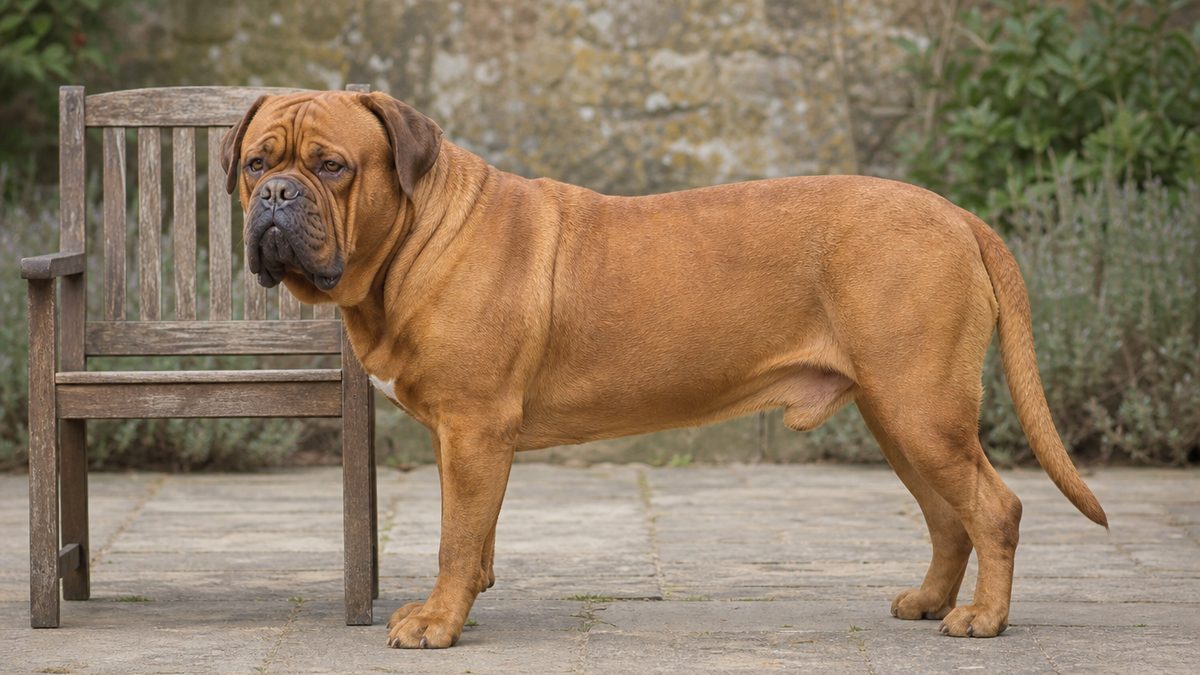
The breed standard opens with the sentence that decides everything else on this page. Under General Appearance, FCI-116 describes the breed as a 'typical concave lined brachycephalic molossoid', a very powerful dog with a very muscular body, built rather close to the ground, stocky, athletic and imposing, with a very dissuasive aspect. Most breed pages describe this dog as short-muzzled. Its own standard uses the clinical word.
Size is set without hedging. Males stand 60 to 68 cm at the withers and bitches 58 to 66 cm, with 1 cm under and 2 cm over tolerated, and the weight clause reads 'Dogs: at least 50 kg. Bitches: at least 45 kg';. The Royal Kennel Club prints identical figures, adding the imperial equivalents of 110 lb and 99 lb. Note what the standard does not do: it sets a floor and no ceiling. A 65 kg male is not oversized by the written standard, which is why Indian listing pages quoting 54 to 65 kg are not contradicting it.
The proportions that make this a short-muzzled breed by definition
Four ratios in the Important Proportions clause define the head. Body length from point of shoulder to point of buttock exceeds height at the withers in the proportion 11 to 10. Chest depth is more than half the height at the withers. The maximum length of the muzzle equals one third of the length of the head, and the minimum length equals one quarter. In the male, the perimeter of the skull corresponds more or less to the height at the withers, which on a 68 cm dog means a skull measuring about 68 cm around.
That muzzle ratio is not a stylistic preference. The standard makes a long narrow head with a muzzle measuring more than a third of head length a disqualifying fault, and it makes a 'bulldoggy hypertype', with a flat skull and a muzzle under a quarter of head length, a severe fault. So the standard fences the breed into a narrow band of muzzle length and calls the result brachycephalic. The Royal Kennel Club expresses the same range as 'length from nose to stop between a quarter and one third of the length of the head';.
The undershot jaw, which Indian law names as a genetic defect
The bite is where the breed standard and Indian breeding law collide, and the page returns to this below. FCI-116 states that the jaws are undershot, 'the undershot condition being a characteristic of the breed', and specifies that 'the back of the lower incisors is in front of and not in contact with the front face of the upper incisors';. A mouth that is not undershot is a disqualifying fault. The Royal Kennel Club prints the same sentence.
Coat and colour, and what disqualifies
The coat is fine, short and soft to the touch, over thick and sufficiently loose-fitting skin without excessive wrinkles. The colour is self-coloured, in all shades of fawn from mahogany to isabella, with limited white patches permissible on the forechest and the extremities of the limbs. Three masks are allowed: a black mask that must not invade the cranial region, a brown mask, and no mask at all, in which case the skin appears red. Brindle and solid brown, called chocolate, are disqualifying faults, as is white on the head or body.
Google India's related searches for this breed include 'White french mastiff price in india', 'Black french mastiff price in india' and 'Mini french mastiff price in india';. FCI-116 disqualifies any coat colour other than fawn, and it disqualifies white on the head or body. A dog sold in India as a black or white French Mastiff is either a different breed, a cross, or a Dogue de Bordeaux that could never be registered or shown.
History: an old French breed that nearly died twice
The Dogue de Bordeaux descends from the ancient French dogues and is probably a descendant of the Alans, and in particular the alan vautre that Gaston Phebus, Count of Foix, wrote about in the 14th century in his Livre de Chasse, saying it 'holds his bite stronger than three sighthounds'.
The word dogue appeared at the end of the 14th century. By the middle of the 19th century these ancient dogues were hardly renowned outside the region of Aquitaine, where they were used for hunting large game such as boar, for fighting, often codified, for guarding houses and cattle, and in the service of butchers. Dogs Australia adds draught and droving work to that list, including hauling the butcher's cart and taking wounded soldiers from the battlefield.
The first French dog show took place in Paris in 1863 in the Jardin d'Acclimatation, and the Dogues de Bordeaux were entered under their present name. Three regional types existed, the Toulouse type, the Paris type and the Bordeaux type, and it is the Bordeaux type that produced today's dog.
Two world wars and a rebuild from a small base
The breed suffered greatly during the two world wars, to the point of being threatened with extinction after the second, and got off to a fresh start only in the 1960s. That single sentence in the standard explains most of the health data further down this page. Dogs Australia states the consequence plainly: 'The breed comes from a small gene pool, and as such suffers a number of heritable disorders';.
The Israeli cardiac study puts numbers on the same mechanism from the other end. Its authors write that the breed 'has gone through several genetic bottle necks and has a relatively small effective population size', and that limited importing into Israel narrowed the local gene pool further and increased the chances of inherited defects. Pedigree analysis in that study identified three ancestors that might have introduced two congenital heart defects into the local population.
Four standards in a century, and who wrote them
The written standard has been rebuilt four times. The first appeared in Pierre Megnin's Le Dogue de Bordeaux in 1896, the second in J. Kunstler's Etude critique du Dogue de Bordeaux in 1910, the third by Raymond Triquet with Vet. Dr Maurice Luquet in 1971, and the fourth, reformulated to the FCI's Jerusalem model, by Triquet with Philippe Serouil, then president of the French Dogue de Bordeaux club, in 1993. Precisions were added in 2007. The FCI recognised the breed on a definitive basis on 1 January 1954, and the currently valid standard was published on 4 November 2008 with the English translation dated 23 January 2009.
Where the breed sits in the registries today
The American Kennel Club recognised the Dogue de Bordeaux only in 2008 and ranks it 95th of 210 breeds by registration. Dogs Australia places it in Group 6, Utility, rather than the FCI's Group 2, which is a difference of national grouping and not of recognition. India is a full FCI member represented by the Kennel Club of India in Chennai, so the KCI issues pedigrees against FCI nomenclature and FCI-116 is the standard an Indian pedigree is written against.
A breed rebuilt from near-extinction in the 1960s has had roughly sixty years of population recovery, and every inherited-disease figure on this page sits on top of that founder bottleneck. It is the reason a screening document from the parents matters more in this breed than in a Labrador Retriever, whose OFA hip database alone holds 324,743 evaluations against this breed's 1,013.
Brachycephaly: the word is in the breed's own standard
The Dogue de Bordeaux is brachycephalic by written definition, not by inference, because FCI-116 opens its General Appearance clause by calling the breed a typical concave lined brachycephalic molossoid.
That matters because most large brachycephalic breeds have to be classified by a third party. Here the recognising registry did it in the first line of its own standard. Dogs Australia says the same thing in plainer words, listing 'short muzzle (brachycephalic)' among the specific elements of breed type. The Royal Kennel Club standard describes the same geometry without using the word, calling the muzzle 'powerful, short and slightly hollowed below the eyes' with a pronounced stop forming a near right angle.
What a short muzzle does to cooling
A dog sheds heat by panting, which works by moving air across the moist surfaces of the nasal passages and upper airway. Shortening the muzzle shortens that surface without shrinking the soft tissue inside it, and the result is both a smaller radiator and a narrower pipe. Brachycephalic airway obstruction is the clinical consequence, and Dogs Australia lists brachycephalic airway syndrome as an issue in this breed, advising breeders to select for clean breathing animals and owners to keep their dogs lean, because excess weight makes it harder for the dog to keep cool and worsens the syndrome.
The standard already treats noisy breathing as a fault
FCI-116's severe faults list includes, in four words, 'Excessive shortness of breath, rasping';. That is the breed standard itself saying that a Dogue de Bordeaux which cannot breathe quietly is not meeting the standard. It sits alongside 'Bulldoggy hypertype', defined as a flat skull with a muzzle measuring less than a quarter of the total length of the head, a swollen roll behind the nose, and important folds around the head.
So a buyer has a written test available. A dog whose muzzle is visibly shorter than a quarter of its head length, or which rasps at rest, is faulted by its own breed standard. This is the rare case where the welfare argument and the show ring point the same way, and an Indian buyer can hold a seller to the seller's own document.
The measured cost, in odds
United Kingdom primary-care data put brachycephalic dogs at 2.10 times the odds of heat-related illness compared with mesocephalic dogs, with a 95 percent confidence interval of 1.68 to 2.64. Split by trigger, the effect is larger for environmental heat illness, at 2.36 times the odds with a confidence interval of 1.50 to 3.72, than for exertional heat illness at 1.32 with an interval of 1.10 to 1.60. Environmental heat illness is the type that happens without exercise, which is to say the type an Indian summer produces on its own.
| Model | Odds ratio | 95% CI | p |
|---|---|---|---|
| All heat-related illness | 2.10 | 1.68 to 2.64 | not stated in text |
| Environmental heat illness | 2.36 | 1.50 to 3.72 | <0.001 |
| Exertional heat illness | 1.32 | 1.10 to 1.60 | 0.004 |
Read the two rows together and the practical rule falls out. Exercise is the commonest trigger overall in that dataset, but skull shape bites hardest on the non-exercise pathway. A Dogue de Bordeaux lying on a balcony in Chennai in May is exposed by its head shape even if it never leaves the flat.
Any sedation or surgery in a short-muzzled dog carries added airway risk, and this breed will need anaesthesia at some point given its joint profile. Tell your veterinarian the breed is brachycephalic before any procedure, and ask specifically about recovery monitoring rather than assuming a routine day case.
Life expectancy: 11.1 years measured, against 5 to 8 printed
The Dogue de Bordeaux has a median survival of 11.1 years with a 95 percent confidence interval of 10.6 to 11.7, built on 1,204 recorded deaths in the largest UK longevity study yet published, and that figure sits far above the 5 to 8 years the American Kennel Club prints on its own breed page.
McMillan and colleagues merged, cleaned and deduplicated records for 584,734 individual dogs in the United Kingdom from 18 sources, of which 284,734 were deceased, and published breed-level survival for 155 recognised purebreds. The Dogue de Bordeaux row in Supplementary Table 3 reads: median survival 11.1 years, lower 95 percent confidence limit 10.6, upper limit 11.7, hazard ratio 1.4 with an interval of 1.32 to 1.48 against the crossbred group, p less than 0.001.
Why this page quotes the death count and not the sample size
The paper's own supplementary tables disagree about how many dogs are in this breed's row, and Bonbeno has checked both. Supplementary Table 3 gives 3,427 dogs and 1,204 deaths. Supplementary Tables 6 to 11 give 2,311 living plus 1,204 deceased, which totals 3,515 McMillan et al. 2024. The two totals differ by 88 dogs. The death count is identical in both, at 1,204.
Whatever produced that discrepancy does not touch deaths, so the honest way to state this breed's lifespan is on the deaths and the median with its interval, which is what this page does. Bonbeno publishes the disagreement rather than picking whichever N is more convenient, and the same pattern has now been observed on three other breeds in the same tables.
Three published lifespans, and which one is measured
| Source | Stated life expectancy | What it is built on |
|---|---|---|
| McMillan et al. 2024, Supplementary Table 3 | 11.1 years median, 10.6 to 11.7 | 1,204 recorded deaths in a 584,734-dog UK dataset |
| American Kennel Club breed page | 5 to 8 years | No sample size, method or source printed |
| Puppiezo, Indian listing site | 10 to 12 years | No sample size, method or source printed |
| Woodgreen Pets Charity search snippet | 'gentle but short-lived' | No figure given in the snippet |
Only one of those four rows names a denominator Puppiezo, French Mastiff Price in India…. An Indian buyer told by a seller that this dog lives five to eight years is being given a number with nothing behind it, and one that happens to make a Rs 1,50,000 purchase look like a shorter commitment than it is.
Short compared with what
The breed is shorter-lived than the average dog and longer-lived than most of the molossers it is grouped with. The purebred median in the same dataset is 12.7 years and the crossbred median is 12.0, so the Dogue de Bordeaux sits 1.6 years below the purebred figure. Ranked against all 156 rows in Supplementary Table 3, it is the 27th shortest-lived, well behind the Caucasian Shepherd Dog at 5.4 years, the Presa Canario at 7.7 and the Cane Corso at 8.1.
Restrict the comparison to breeds with at least 1,000 recorded deaths, which removes the small-sample rows that move most, and the Dogue de Bordeaux is the seventh shortest-lived of 42, behind the Mastiff at 9.0 years, the Bulldog and French Bulldog at 9.8, the Bullmastiff at 10.2, and the Chinese Shar Pei and Rottweiler at 10.6. So 'one of the shortest-lived breeds in the world' overstates it, and 'shorter-lived than almost every dog an Indian family is likely to have owned before' is accurate.
Plan on eleven years of a 50 kg dog, not five. That changes the food budget, the flat you rent, and whether you can realistically manage a dog that may need help getting up in its last two years. Google India's People Also Ask box for this breed carries the question 'Why do Dogues de Bordeaux have a short lifespan?'. The premise is half right, and the measured answer is 11.1 years.
Heat risk: 5.31 times a Labrador's odds, and the breed is in the model
The Dogue de Bordeaux carries 5.31 times the odds of heat-related illness of a Labrador Retriever, with a 95 percent confidence interval of 1.99 to 14.21 and a p value of 0.001, and that figure is breed-specific rather than borrowed, because the breed appears by name in the published model.
That distinction matters. Odds ratios from Hall, Carter and O'Neill's 2016 VetCompass study are the most useful heat numbers available anywhere, and it is tempting to apply them to any large or short-muzzled breed. Several breeds fall below the paper's inclusion threshold and are absent from the model entirely, so their pages can only use the transferable skull-shape and bodyweight factors. This breed is not one of them. It is named in Table 2, in the discussion, and in the incidence figure Hall EJ, Carter AJ.
Where the breed sits among 34 breed types
| Breed type | Odds ratio | 95% CI | p |
|---|---|---|---|
| Chow Chow | 16.61 | 6.21 to 44.44 | <0.001 |
| Bulldog | 13.95 | 8.01 to 24.29 | <0.001 |
| French Bulldog | 6.49 | 3.62 to 11.63 | <0.001 |
| Dogue de Bordeaux | 5.31 | 1.99 to 14.21 | 0.001 |
| Greyhound | 4.26 | 1.88 to 9.70 | 0.001 |
| Pug | 3.24 | 1.67 to 6.29 | <0.001 |
| Boxer | 2.26 | 0.95 to 5.34 | 0.064 |
| Rottweiler | 0.86 | 0.20 to 3.69 | 0.841 |
| Labrador Retriever | Base |
Nine breeds had significantly higher odds than the Labrador Retriever, and this one is fourth of the nine. Five of those nine are brachycephalic, and the Dogue de Bordeaux is among them. Note the Rottweiler row for contrast: at 0.86 with an interval spanning 1, the guard breed Indian buyers most often cross-shop shows no measurable heat penalty at all in the same model.
Two more factors that both apply to this dog at once
Skull shape and bodyweight were each substituted into the model in place of breed type, and both land on this breed. Brachycephalic dogs had 2.10 times the odds of mesocephalic dogs, interval 1.68 to 2.64. Dogs over 50 kg had 3.42 times the odds of dogs under 10 kg, interval 1.54 to 7.57. FCI-116 sets the male minimum at exactly 50 kg, so a male Dogue de Bordeaux is inside that top bodyweight band by definition rather than by chance.
A third factor is under the owner's control. Dogs whose bodyweight was at or above the mean for their breed and sex had 1.42 times the odds of dogs below it, interval 1.12 to 1.80. Purebred dogs had 1.86 times the odds of crossbreds, interval 1.39 to 2.49.
Incidence, and what it does not mean
The breed's one-year incidence of heat-related illness in that UK population was 0.17 percent, with a 95 percent confidence interval of 0.07 to 0.39 percent, the fourth highest of any breed measured, behind the Chow Chow at 0.50 percent, the Bulldog at 0.42 and the French Bulldog at 0.18. Across all dogs the incidence was 0.04 percent and the event fatality rate was 14.18 percent, interval 11.08 to 17.96.
Now read that 0.17 percent for what it is. It is a British figure, measured in a country whose warmest month averages 21.5 degrees Celsius at Bordeaux's own latitude. Nobody has measured the equivalent incidence in India, and this page will not invent one. Nor is any large short-coated breed automatically heat-tolerant, which is precisely the assumption these odds ratios contradict. What can be said is that the risk factors the model identifies, brachycephaly, bodyweight over 50 kg, purebred status and condition at or above breed mean, all apply to this dog simultaneously, in a country far hotter than the one where they were measured.
This is the lowest rating Bonbeno gives, and it rests on three published odds ratios that all land on this dog at once: 5.31 for the breed itself, 2.10 for brachycephalic skull shape, and 3.42 for a bodyweight above 50 kg. No other breed on this site has been in all three categories.
Indian climate: Bordeaux in July is cooler than Chennai in January
Bordeaux, the city this breed is named after, has a warmest month averaging 21.5 degrees Celsius, and Chennai's coolest month averages 24.1 degrees, so an Indian coastal city at its mildest is 2.6 degrees hotter than the breed's home city at its hottest.
Those figures come from NASA POWER's climatology point service, queried by explicit latitude and longitude rather than by a place name, because climate sites routinely serve a document for the wrong city at HTTP 200. Bordeaux was queried at 44.8378 north, 0.5792 west. Its annual mean 2-metre air temperature is 13.4 degrees Celsius, its warmest month is July at 21.5 degrees, and its coolest is January at 5.9 degrees.
| Place | Annual mean | Warmest month | Coolest month | Gap to Bordeaux's annual mean |
|---|---|---|---|---|
| Bordeaux (44.8378 N, 0.5792 W) | 13.4 | 21.5 (Jul) | 5.9 (Jan) | 0.0 |
| Chennai (13.0827 N, 80.2707 E) | 27.9 | 31.5 (May) | 24.1 (Jan) | +14.5 |
| Ahmedabad (23.0225 N, 72.5714 E) | 27.6 | 35.1 (May) | 19.9 (Jan) | +14.2 |
| Mumbai (19.0760 N, 72.8777 E) | 26.8 | 31.2 (May) | 23.2 (Jan) | +13.4 |
| Hyderabad (17.3850 N, 78.4867 E) | 26.1 | 33.3 (May) | 20.8 (Dec) | +12.7 |
| Kolkata (22.5726 N, 88.3639 E) | 25.8 | 31.5 (May) | 17.3 (Jan) | +12.4 |
| Delhi (28.6139 N, 77.2090 E) | 25.6 | 35.9 (Jun) | 13.6 (Jan) | +12.2 |
| Pune (18.5204 N, 73.8567 E) | 23.9 | 28.9 (Apr) | 19.6 (Dec) | +10.5 |
| Bengaluru (12.9716 N, 77.5946 E) | 23.7 | 28.4 (Apr) | 20.2 (Dec) | +10.3 |
Three readings of that table are worth having. Chennai and Mumbai never get as cool as Bordeaux gets hot, because their coolest months average 24.1 and 23.2 degrees against Bordeaux's July peak of 21.5 NASA POWER climatology point API. Bengaluru comes closest to a survivable climate for this dog and still only reaches Bordeaux's July figure at its December minimum of 20.2 degrees. And Delhi, which has the mildest winter of the eight at 13.6 degrees, has the harshest summer, averaging 35.9 degrees through June.
Peaks, not averages, are what actually kill
Monthly means understate the problem because a dog collapses on a bad afternoon, not on an average one. NASA POWER's maximum 2-metre temperature for the same coordinates records 48.8 degrees Celsius in June for Delhi, 48.6 in May for Ahmedabad, 46.8 in May for Kolkata, 44.9 in April and May for Mumbai, 42.7 in May for Chennai and 40.4 in April for Bengaluru NASA POWER climatology point API. Bordeaux's own maximum, 41.9 degrees in August, is below every one of those except Bengaluru's.
Humidity decides whether panting works at all
Panting sheds heat by evaporation, and evaporation slows as the air saturates. Mumbai runs 90 percent mean relative humidity in July and August, Pune 89 to 91 percent, Kolkata 87 to 89 percent and Bengaluru 79 to 81 percent from August to October. Those are the months when a short-muzzled dog has the least cooling capacity available, and they are also, awkwardly, the months when the air temperature drops and owners assume the danger has passed.
- Chennai and Mumbai: the year has no cool season by this breed's standards, so climate control is not seasonal equipment.
- Delhi and Ahmedabad: three or four survivable months, then a summer above anything measured at Bordeaux.
- Bengaluru and Pune: the two most workable Indian cities on this table, and still 10 degrees above the breed's home annual mean.
- Kolkata: a mild January at 17.3 degrees, then 87 to 89 percent humidity through the monsoon.
- Hyderabad: a 33.3 degree May mean with only 38 percent humidity, which is the one Indian combination where panting still works reasonably well.
Dogs Australia, writing for a country with a comparable summer, reaches the practical conclusion for us. It states that the breed comes from a cooler climate and is most suited to being an inside dog, and that with their high muscle mass and shortened muzzle they need to be able to seek a cool area in hot weather, naming air conditioning and bathroom tiles. That is a kennel club, in a hot country, telling owners this dog needs a cooled room.
Dogue de Bordeaux price in India: Rs 45,000 to Rs 3,50,000, and nobody agrees
Indian sources put the Dogue de Bordeaux puppy price anywhere from Rs 45,000 to Rs 3,50,000 and beyond, a spread of more than seven times, and this page prints all of them rather than averaging them into a number that describes nothing.
The breed is sold in India under the name French Mastiff far more often than under its own, so an Indian buyer searching the correct name sees a different price landscape from one searching the trade name. Both were harvested for this page.
| Source | Tier or context | Published price |
|---|---|---|
| Mr n Mrs Pet | Overall range | Rs 75,000 to Rs 3,50,000 and above |
| Mr n Mrs Pet | Basic quality | Rs 75,000 to Rs 1,50,000 |
| Mr n Mrs Pet | KCI registered | Rs 1,50,000 to Rs 2,50,000 |
| Mr n Mrs Pet | Champion bloodline | Rs 2,50,000 upward |
| Google India AI Overview | Overall range | Rs 45,000 to Rs 1,50,000 |
| Google India AI Overview | KCI registered | Rs 55,000 to Rs 70,000 |
| Instagram listing hub | Overall range | Rs 45,000 to Rs 1,00,000 |
| Puppiezo carousel | Prices shown beside the breed page | Rs 76,499 to Rs 1,20,000 |
| TradeIndia, Variety Kennel | The listing itself | No price. 'Get Latest Price' |
The two rows worth staring at are the KCI-registered ones. Mr n Mrs Pet puts a Kennel Club of India registered puppy at Rs 1,50,000 to Rs 2,50,000. Google India's AI Overview, answering the same query on the same day, puts the same tier at Rs 55,000 to Rs 70,000. The gap between those two answers is larger than the entire price of a KCI-registered puppy on the cheaper reading.
What actually moves the price
Mr n Mrs Pet lists its own drivers as size and type, breeder reputation and location, KCI registration and lineage, puppy age and colour, and grooming and vaccinations already given. Only one of those is verifiable by a buyer before payment, and it is the registration paperwork. Ask for the KCI registration number and check it, because it is the only line item in that list that leaves a document behind.
The colour that should not be for sale
One TradeIndia listing for a French Mastiff prints its specification panel as Breed: French Mastiff, Coat: Short, Colour: Brown, Weight: Variable, Height: Variable, Lifespan: 8 to 10 years. Under FCI-116, solid brown, called chocolate, where each hair is entirely brown, is a disqualifying fault. A dog advertised in India as a brown French Mastiff is being sold in a colour its own breed standard disqualifies, and it could never be registered or shown against that standard.
Every figure in the table above comes from a listing site or an AI summary of listing sites. No Indian veterinary body, kennel club or consumer survey publishes a price for this breed, so there is no authoritative number to report and this page does not invent one. What it does instead is show where the published figures come from, which is the section below.
The honest summary for a buyer is a range with a caveat attached. Expect Rs 75,000 to Rs 1,50,000 to be quoted for a pet-quality puppy and Rs 1,50,000 upward for one with papers, treat anything under Rs 50,000 as a reason to ask what breed you are actually being offered, and understand that not one of those numbers rests on a survey.
Where Indian French Mastiff prices actually come from
None of the fourteen published rupee figures collected for this page divides to a whole number of US dollars at either of the two exchange rates that have exposed converted price lists on this site, which means these are rupee-native numbers rather than an American list run through a calculator.
Indian breed pages frequently publish a dollar price list converted wholesale into rupees, and the tell is arithmetic. Bonbeno tests every rupee figure it collects against 84.38, the rate that has caught three converted lists, and against 74.00, the rate that caught a 155-breed price table. Here is what happened.
| Rupee figure | At 84.38 | At 74.00 | At a flat 80 |
|---|---|---|---|
| Rs 45,000 | 533.30 | 608.11 | 562.50 |
| Rs 75,000 | 888.83 | 1,013.51 | 937.50 |
| Rs 1,00,000 | 1,185.11 | 1,351.35 | 1,250.00 |
| Rs 1,20,000 | 1,422.14 | 1,621.62 | 1,500.00 |
| Rs 1,50,000 | 1,777.67 | 2,027.03 | 1,875.00 |
| Rs 2,50,000 | 2,962.79 | 3,378.38 | 3,125.00 |
| Rs 3,50,000 | 4,147.90 | 4,729.73 | 4,375.00 |
| Rs 98,999 | 1,173.25 | 1,337.82 | 1,237.49 |
Zero clean whole numbers at 84.38 and zero at 74.00. Six of the fourteen figures divide cleanly at a flat 80, and that is the weak test rather than the strong one, because a rupee figure only has to be a multiple of 80 to pass it. Look at what those six quotients are: 875, 1,250, 1,500, 1,875, 3,125 and 4,375. The first three are prices a seller might print. The last three are not. No breeder anywhere quotes a puppy at 3,125 dollars.
So the conclusion here differs from the one this site has reached on several other breeds. These are not converted American prices. They are rupee-native figures chosen by Indian sellers, which means they carry no information about the international market and no information about cost, only about what a seller thinks an Indian buyer will pay.
The Rs 98,999 carousel, now on its eleventh page
One Indian listing site's page titled 'French Mastiff Price in India, Buy Healthy Dogue de Bordeaux Puppies Online' carries an 'Other Available Pets' carousel of eight priced puppies. Not one of them is a Dogue de Bordeaux.
| Puppy | Breed | Age | Price |
|---|---|---|---|
| Fizey | Maltipoo | 8 weeks | Rs 98,999 |
| Kuzo | Poodle | 8 weeks | Rs 92,599 |
| Dugu | Poodle | 8 weeks | Rs 92,599 |
| Kazuka | Cane Corso | 8 weeks | Rs 94,999 |
| Doir | Goldendoodle | 8 weeks | Rs 1,20,000 |
| Samy | Maltipoo | 8 weeks | Rs 98,999 |
| Tugi | Rottweiler | 8 weeks | Rs 76,499 |
| Yoki | Doxiepoo | 8 weeks | Rs 98,999 |
Three of the eight carry the identical Rs 98,999. That figure is a house price point rather than a breed price, and Bonbeno has now recorded it on eleven separate pages of the same site, attached to whichever puppy is in stock. It divides to 1,173.25 dollars at 84.38, so it is not even a conversion. Never quote it as this breed's price, and be suspicious of any Indian source that does.
A snippet is not a row
Google's result snippet for a TradeIndia page titled 'French Mastiff at Best Price in Nilokheri, Haryana' advertised 'Price: 26500.0 INR' and 'Price: 1.99 USD'. Open the page and the French Mastiff listing itself carries no price at all, only a 'Get Latest Price' button. The Rs 26,500 belongs to a stainless steel dog bath tub and the 1.99 dollars to a plush dog toy, both sitting in the related-products rail below. Taken at face value the snippet would have produced a dramatic and entirely false claim about what this breed costs in Haryana.
Take any rupee price you are quoted and divide it by 84.38 and by 74. If it lands on a round dollar figure a shop would print, such as 800 or 1,500, you are probably looking at an American number in rupee clothing. If it lands on something like 1,173.25, the figure was typed by someone in India who wanted it to end in 999.
Monthly cost of ownership: about Rs 10,000 on food before anything else
Feeding a Dogue de Bordeaux in India costs roughly Rs 8,500 to Rs 11,300 a month on a mainstream large-breed kibble, and that arithmetic is for a 44 kg dog, which is six kilograms lighter than this breed's own minimum.
Two published Indian numbers produce that figure without any guesswork. Royal Canin India's Maxi Adult daily feeding table gives 405 g a day for a 44 kg dog at low activity, 473 g at medium and 538 g at high. Heads Up For Tails prices the 14 kg pack at Rs 9,724 and prints the unit price on the same page as Rs 70 per 100 g, which is Rs 700 a kilogram.
| Activity level | Grams per day | Rupees per day | Rupees per 30 days | Days a 14 kg pack lasts |
|---|---|---|---|---|
| Low | 405 | 284 | 8,505 | 35 |
| Medium | 473 | 331 | 9,933 | 30 |
| High | 538 | 377 | 11,298 | 26 |
Now put that beside what Indian buyers are being told. Google India's AI Overview for 'french mastiff price in india' gives monthly maintenance as Rs 5,000 to Rs 5,500 for standard dog food and Rs 6,500 to Rs 7,650 for premium, plus Rs 500 to Rs 900 for grooming and care. The premium figure is roughly Rs 2,000 to Rs 3,600 a month below what the manufacturer's own table and an Indian retailer's own shelf price produce, for a dog lighter than this one.
The table stops before the breed starts
Royal Canin India's Maxi Adult product is described as a complete feed for adult large breed dogs from 26 to 44 kg, and the last row of its daily feeding recommendation is a 44 kg dog. FCI-116 sets the male Dogue de Bordeaux minimum at 50 kg and the bitch minimum at 45 kg, with no upper limit written. So every male of this breed, and most females, sit above the range the product was formulated for and above the last printed feeding row.
That is not a reason to panic, but it is a reason to stop extrapolating in your head. Ask a veterinarian to set the daily amount against body condition score, and weigh the dog monthly rather than annually, because bodyweight at or above the breed and sex mean carries 1.42 times the odds of heat-related illness in this breed's own risk model.
The costs this page will not put a number on
- Veterinary consultation, vaccination and deworming. Indian fees vary by city and clinic and Bonbeno has verified no published schedule, so it publishes none.
- Hip and elbow radiographs under sedation. These need a clinic with a plate reader and an anaesthetist comfortable with a brachycephalic patient, which narrows the choice and raises the price.
- Air conditioning through the summer. Dogs Australia's advice for this breed in hot weather is a cooled room, so treat the electricity as a line item, not an extravagance.
- Emergency surgery for bloat. Gastric dilatation-volvulus is reported at 7.2 percent prevalence in this breed, and the treatment is an out-of-hours laparotomy.
- Joint management in the last three years. On a median of 11.1 years and a 57.2 percent dysplastic hip rate, budget for it rather than hoping.
Add the purchase price and the picture is stark. A Rs 1,50,000 puppy that eats Rs 10,000 a month for eleven years has consumed roughly Rs 13,20,000 in food alone before a single veterinary bill. That is the number an Indian family should be deciding on, not the sticker price.
Is the Dogue de Bordeaux banned in India? No, and it was never on the list
No Indian law in force today bans owning, breeding or selling a Dogue de Bordeaux, and the 2024 circular that several Indian pages list this breed on does not name it at all in the version the Karnataka High Court reproduced verbatim.
Circular D.O.V-11/1/2024-ANLM.DADF, issued by the Department of Animal Husbandry and Dairying on 12 March 2024, asked local bodies to stop issuing licences for the import, breeding, sale and keeping of a list of breeds it called ferocious, and to sterilise those already kept as pets. Bonbeno has not seen the circular itself. What it has read is the High Court of Karnataka's judgment of 10 April 2024, which quotes the operative paragraph in full.
The list, as the court prints it, reads: 'breeds (including mixed and cross breeds) like Pitbull Terrier, Tosa Inu, American Staffordshire Terrier, Fila Brasileiro, Dogo Argentino, American Bulldog, Boerboel, Kangal, Central Asian Shepherd Dog (ovcharka), Caucasian Shepherd Dog (ovcharka), South Russian Shepherd Dog (ovcharka), Tornjak, Sarplaninac, Japanese Tosa and Akita, Akbash dog Moscow Guard dog, Cane corso and every dog of the type commonly known as a Ban Dog (or Bandog)';. Resolved entry by entry that is 19 named breeds. The Dogue de Bordeaux is not among them, and the word Bordeaux appears nowhere in the 53,791-character judgment.
How many breeds, and why this page hedges
The breed count is genuinely disputed. The Karnataka reproduction above resolves to 19. Press coverage settled on 23. A report of the Delhi judgment gives 24, and one contemporaneous newspaper quote adds six more names to reach 25. Bonbeno has not seen the source document, so this page says 19 in the version it read and notes that other counts circulate, rather than asserting a figure it cannot check.
What the courts did, in order
- Karnataka High Court, 10 April 2024. The writ petition was allowed and the circular of 12 March 2024 'stands quashed'.
- The court's reasons were procedural and substantive. Stakeholders were not heard despite an undertaking to the Delhi High Court, the expert committee's composition was not in consonance with the Rules framed under the Prevention of Cruelty to Animals Act, 1960, and 'the Union of India by the impugned circular could not have imposed a blanket ban, in the teeth of the Rules in force'.
- Delhi High Court, 16 April 2024, set the circular aside.
- The Centre told the Bombay High Court in January 2025 that it is not acting on the circular.
- The door was left open. The Karnataka order records that quashment 'will not come in the way of the Government acting in accordance with law', and that any replacement must hear stakeholders and a certifying body.
So both of the two easy summaries are wrong. 'The Dogue de Bordeaux is banned in India' is wrong twice over, because the breed was not on the list and the list has no legal force. 'The matter is settled' is also wrong, because Karnataka expressly preserved the Union's power to amend the Rules after due process.
What actually governs this dog in India
Two instruments do the real work, and neither mentions breeds by name. The Prevention of Cruelty to Animals (Dog Breeding and Marketing) Rules, 2017 governs how the dog may be bred and sold, and the Prevention of Cruelty to Animals (Pet Shop) Rules, 2018 governs the shop it may be sold from. The 12 March circular itself pointed at both, asking states to implement them. The next section reads the 2017 Rules against this breed's standard, and the collision is sharper than any ban would have been.
Nothing above stops a resident welfare association writing its own rule about large dogs, and many in Indian metros have. That is a private-law question about your society's bye-laws, not a question about the 2024 circular, and it is worth settling in writing before you buy a dog that will weigh 50 kg.
Indian breeding law names the undershot jaw this breed's standard requires
Second Schedule Part III paragraph 8(10) of the Dog Breeding and Marketing Rules, 2017 requires that breeding dogs have been tested for genetic defects including 'undershot jaw (when incisors do not touch or mesh)', and FCI-116 makes exactly that jaw a characteristic of the breed and a mouth without it a disqualifying fault.
The clause reads, verbatim from the gazette text: 'The dogs shall have been tested for genetic defects, including hip dysplasia, progressive retinal atrophy, night blindness, hypothyroidism, entropion, ectropion, overshot, undershot jaw (when incisors do not touch or mesh), wry mouth, two or more missing teeth, unilateral cryptorchid or full cryptorchid males';. Bonbeno extracted the 14-page gazette copy and read the clause rather than relying on a summary, because this document has repeatedly been paraphrased with invented rule numbers.
Now read FCI-116 beside it. 'Jaws powerful, broad. Undershot (the undershot condition being a characteristic of the breed). The back of the lower incisors is in front of and not in contact with the front face of the upper incisors';. The Royal Kennel Club prints the same sentence. A mouth not undershot is a disqualifying fault.
So Indian law lists as a genetic defect the precise dental configuration the breed standard mandates, and defines it in the same terms the standard uses. The clause does not prohibit the trait, it requires testing for it, and the word before the list is 'including', which makes the list illustrative rather than closed. But a breeder in India cannot claim their breeding stock is free of the listed defects while breeding to a standard that disqualifies the alternative.
Two more clauses that land on this breed
Entropion and ectropion are also named in 8(10), and OFA's own detail rows record entropion in 44 of 244 examined Dogues de Bordeaux and ectropion in 33 Orthopedic Foundation for Animals. Hip dysplasia heads the list, and this breed runs 57.2 percent dysplastic across 1,013 evaluations. Three of the eleven named defects are conditions this breed carries at rates well above the canine population.
The mutilation clause, and what it does not require here
Second Schedule Part II paragraph 6(8) reads: 'There shall be no tail docking, ear cropping, de-barking, de-clawing, branding, dyeing, injecting substances to enhance visual appeal, performing a surgery or procedure to camouflage or hide any defect or infirmity or any other kind of mutilation of any body part of the pup and any change of appearance by artificial means is strictly forbidden';. Note that this is a Second Schedule paragraph and not a Rule, so cite it as 6(8) of Part II rather than as 'Rule 6(8)'.
For most guard breeds that clause bites, because their standards describe cropped ears or a docked tail. Here it does not. FCI-116 asks for ears that fall forward against the cheek and a tail thick at the base whose tip preferably reaches the hock, carried low. A correct Dogue de Bordeaux is already an uncropped, undocked dog, which makes this one of the few molossers where the breed standard and Indian law agree without argument.
One smaller point does need care. The standard's hindquarters clause reads 'Metatarsus (Rear pastern): Robust, no dewclaws', and 6(8) forbids de-clawing Animal Welfare Board of India. A breeder who removes rear dewclaws to meet that line would be performing a procedure the Rules name. The standard is describing what the breed is born with, not licensing surgery.
Breeding technique, and the eight-week line
Second Schedule Part II paragraph 6(3) prohibits two named techniques. In breeding is defined as breeding between relatives of the 2nd to 4th grade in straight or side line within the first four generations, giving uncle to niece, nephew to aunt, cousin to cousin and grandparents to grandchildren as examples. Incest breeding is mating between parents and children or between brother and sister. Only out breeding and line breeding are permitted. That is a live constraint for a breed rebuilt from a small post-war base.
Rule 8(1)(a), in the main body of the Rules rather than the Schedule, states that every breeder shall ensure that 'pups less than eight weeks in age are not sold';. Paragraph 6(9) adds a single sentence: 'Breeding to create new breeds of dogs or unusual looks shall be strictly prohibited.'
Across all 14 pages of the gazette text, the words patella, luxation, BAER, deaf and brachycephalic appear zero times. There is no Indian patella-testing requirement, no hearing-test requirement, and, more pointedly for this breed, no mention of skull shape anywhere in the country's breeding law.
Temperament: calm, dominant males, and a very high stimulus threshold
FCI-116 describes the Dogue de Bordeaux as gifted for guarding, which it assumes with vigilance and great courage but without aggressiveness, a good companion very attached to its master and very affectionate, calm and balanced with a high stimulus threshold, and it adds one flat sentence: 'The male normally has a dominant character.'
That last line is the standard telling you something useful. It is not a warning about aggression, which the same clause explicitly rules out, but a statement that an intact male of this breed will test where it sits in the household. The Royal Kennel Club expresses the whole temperament in one line: 'Natural guarding instincts, vigilant and courageous without aggression. A good companion and very affectionate';.
What a high stimulus threshold means day to day
A high stimulus threshold is the reason this dog is genuinely calm indoors and genuinely alarming at the gate. It does not react to the doorbell, the neighbour's cat or a dropped plate. It reacts to something it has decided is worth reacting to, and by then it is already committed. Dogs Australia describes the same dog as naturally gifted for guarding but calm and balanced, with males tending to be dominant.
For an Indian household that translates into two specific realities. A dog that ignores ordinary noise is a good flat-mate in a dense apartment block. A dog that commits fully when it does react is a serious liability at a gate that opens onto a shared corridor with delivery riders, domestic staff and children passing all day.
Who this breed suits
- Suits a household with an air-conditioned room the dog can use all summer, because Dogs Australia's own guidance for hot weather is a cooled area.
- Suits an owner who has raised a large dog before, because a dominant 55 kg male is not a first dog.
- Suits a family that is home, because this is a strongly bonded breed that does badly left alone all day.
- Suits a ground-floor home with hard floors, because a heavy dog with dysplastic hips needs grip, not polished tile.
- Suits someone who genuinely does not mind drool, which Dogs Australia raises before anything else about living with the breed.
Who should not buy one
Anyone in Chennai or Mumbai without climate control should not buy this dog, and that is a temperament question as much as a climate one, because a hot, breathless dog is an irritable dog. Nor should anyone whose plan is an outdoor guard dog on a terrace or in a compound: Second Schedule Part IV paragraph 21(1) of the Indian Rules bars keeping breeds that cannot tolerate local temperatures in outdoor facilities without a veterinarian's written approval.
Children are a genuine strength of the breed and a genuine risk of its size. Dogs Australia states that Dogues de Bordeaux make excellent family dogs with a particular patience and love of children. They also weigh more than most Indian adults, and a calm dog turning around in a small room will knock over a toddler without any intent whatever.
Google India's People Also Ask box asks 'Is a Dogue de Bordeaux a good family dog?'. Yes, on temperament, by the account of two kennel clubs. The reason to think twice is not the dog's character. It is 50 kg of brachycephalic dog in a country whose coolest coastal month is warmer than the breed's home city at its hottest.
Training: socialise early, and stop training when the dog gets hot
Train a Dogue de Bordeaux by front-loading socialisation into the first six months and by scheduling every session for the coolest part of the Indian day, because the breed's high stimulus threshold makes it slow to switch on and its skull shape makes it fast to overheat.
Dogs Australia gives the socialisation window plainly: puppies should be well socialised from the earliest occasion following final vaccination, and are excellent with other animals if given the opportunity of early exposure. Read that sentence as conditional, because it is. The good outcome with other animals is described as following from early exposure, not as a default.
The Indian complication is that final vaccination lands around 16 weeks, and in much of the country the months after that are hot. An owner in Delhi whose puppy completes its course in April faces a choice between socialising in 45 degree afternoons and skipping the window. The answer is neither: socialise at 6 am, in short sessions, in shade, on grass rather than tar.
What this breed resists
- Repetition for its own sake. A dog with a high stimulus threshold disengages from drilling faster than a Labrador does.
- Physical correction. On a dog the standard calls powerful and dominant, escalation is a contest you will eventually lose.
- Long sessions. Heat is the binding constraint here, not attention span.
- Being trained by only one person. This breed attaches hard, and a dog that takes instruction from one adult is a household problem when that adult travels.
- Late socialisation. What is easy at 16 weeks is a project at 10 months and 40 kg.
Realistic timelines
Expect house training in three to six weeks, a reliable name response in two, a sit and a down in a fortnight of short sessions, and a genuinely reliable recall at somewhere between nine and eighteen months, because recall competes with the guarding instinct the standard describes. Expect the dominance the standard names in males to surface between eight and eighteen months and to be managed rather than cured.
Two training decisions in this breed are health decisions rather than obedience decisions. Teach the dog to accept handling of the feet and ears early, because it will need hip and elbow radiographs and repeated ear checks. And teach it to lie still on a cool surface on cue, which sounds trivial and is the single most useful command an Indian owner of a brachycephalic dog can install.
Guard-dog training, and why to be careful
The breed's listed utilization in FCI-116 is guard, defence and dissuasion, and its standard describes courage without aggressiveness. Formal protection training on a dominant 55 kg dog in a dense Indian neighbourhood adds risk to a dog that already has presence. The dissuasion the standard names is passive. A Dogue de Bordeaux standing in a gateway does the job without being taught anything at all.
Exertional heat-related illness accounted for 652 of the 879 UK events with a recorded trigger, and 372 of the 551 specified exertional events followed an ordinary walk. A twenty-minute training session in an Indian April afternoon is exertion in exactly the sense that dataset measures.
Exercise: moderate need, and the walk itself is the risk
A Dogue de Bordeaux needs two short low-intensity outings a day rather than one long walk, and in India the timing matters more than the duration, because walking is the single commonest recorded trigger of canine heat-related illness in the largest dataset available.
Dogs Australia calls the breed 'only moderately active';. That is a useful counterweight to the general assumption that a big guard dog needs an hour of hard exercise. It does not, and giving it one in an Indian summer is actively dangerous.
The number that should change how Indians walk this dog
In UK primary-care records, 380 of 1,259 heat-related illness events had no trigger recorded. Of the remaining 879 events with a recorded trigger, 652 were exertional, which is 74.2 percent, against 113 environmental at 12.9 percent and 46 from vehicular confinement at 5.2 percent. Within those 652 exertional events, the type of exercise was unspecified for 101, and of the remaining 551, 372 followed walking, 97 followed high-intensity activity such as running or cycling, and 76 followed play.
So 67.5 percent of exertional heat events where the activity was known followed a walk. Not a run. In Britain. An Indian owner who has decided that a walk is the safe option and running is the dangerous one has the risk ordering backwards.
A practical Indian schedule
| City | Hardest months | Monthly mean in those months | Practical window |
|---|---|---|---|
| Chennai | March to June | 28.4 to 31.5 C | Before 6.30 am only, and a short evening toilet break |
| Delhi | April to July | 30.4 to 35.9 C | Before 6 am; skip the evening walk in May and June |
| Mumbai | March to May | 28.7 to 31.2 C | Before 6.30 am, and watch humidity in the monsoon instead |
| Kolkata | April to June | 29.9 to 31.5 C | Before 6 am; monsoon humidity reaches 87 to 89 percent |
| Bengaluru | March to May | 26.8 to 28.4 C | Before 7 am and after 8 pm, the widest window on this table |
| Pune | March to May | 26.2 to 28.9 C | Before 7 am and after 8 pm |
Those windows come from monthly mean temperatures at explicit coordinates NASA POWER climatology point API NASA POWER climatology point API NASA POWER climatology point API. Use the mean rather than the forecast maximum for planning, then check the actual temperature before you leave.
What happens without exercise, and what happens with too much
Under-exercised, this breed gains weight, and weight is a measured risk factor: dogs at or above the mean for their breed and sex carried 1.42 times the odds of heat-related illness. Excess weight also worsens airway obstruction, which is why Dogs Australia asks owners to keep Dogues lean specifically so the dog can cool itself.
Over-exercised in Indian conditions, the failure is faster and worse. Watch for a change in the pitch of the panting, for the tongue widening and curling at the tip, for the dog slowing and then stopping, and for any stumble. Stop, get the dog into shade, wet it with cool water and get to a veterinarian. Do not wait to see whether it settles.
Swimming, which this breed actually likes
Dogs Australia records that Dogues de Bordeaux generally love to swim and play in water. In India that is the single best exercise option available, because it removes load from dysplastic hips and solves the cooling problem at the same time. Rinse and dry the ears and the facial folds afterwards, for the reasons set out in the grooming section below.
Grooming: the coat is nothing, the wrinkles are everything
Grooming a Dogue de Bordeaux in India means managing skin folds and ears rather than coat, because the hair is fine, short and soft to the touch while the head carries deep symmetrical wrinkle ropes that trap moisture in a climate built to supply it.
FCI-116 describes the coat in seven words and the wrinkles in a paragraph. The head 'is furrowed with symmetrical wrinkles, each side of the median groove', and 'these deep ropes of wrinkle are mobile depending on whether the dog is attentive or not';. The wrinkle running from the inner corner of the eye to the corner of the mouth is described as typical. The Royal Kennel Club adds a warning the FCI does not: 'Folds on the ribs or limbs highly undesirable';.
The skin itself is thick and sufficiently loose fitting, 'without excessive wrinkles';. That qualifier is the one to hold a seller to. A Dogue de Bordeaux marketed on how wrinkled it is, is being marketed on a feature its standard explicitly caps.
A weekly routine that fits Indian conditions
- Wipe the facial folds daily in the monsoon and every second day otherwise, then dry them. Wet is the problem, not dirt.
- Check the ears after every swim and every bath, and dry them rather than letting them air dry.
- Brush the short coat weekly with a rubber mitt. Puppiezo's own spec card for the breed prints Shedding: Yes, so this is not a non-shedding dog.
- Check the eyelids in daylight weekly, because entropion and ectropion both run high in this breed.
- Look at the footpads monthly. Hereditary footpad hyperkeratosis is a recognised genetic disease in the breed with a test available.
Two Indian studies, and they disagree about the worst season
Indian dermatology data does not settle into one answer, and this page publishes the disagreement rather than picking the tidier series. At Palampur in Himachal Pradesh, 2,671 dogs were presented between February 2021 and April 2022 and 227, or 8.40 percent, were diagnosed with a dermatological disorder. Cases peaked in the monsoon at 46.69 percent, followed by winter at 22.46 percent, summer at 16.29 percent and autumn at 14.53 percent.
At Udaipur in Rajasthan, 987 dog cases produced 205 skin cases, 20.77 percent, over July 2017 to June 2018. There the rainy season led at 39.51 percent but summer was close behind at 36.58 percent, with winter at 23.90 percent. And one condition inverted entirely: demodectic mange peaked in summer at 18 of 45 cases, 40.00 percent, against 15 in the rains, 33.33 percent, and 12 in winter, 26.66 percent.
That inversion matters for this breed specifically, because demodicosis is the skin disease it is most predisposed to. In UK primary-care data the Dogue de Bordeaux had 5.92 times the odds of juvenile-onset demodicosis compared with crossbred dogs, with a 95 percent confidence interval of 3.30 to 10.62 and p less than 0.001, based on 13 cases among 733 dogs under two years old. Across all ages its one-year period prevalence was 0.91 percent against 0.17 percent for the whole population.
Overseas breed guidance written for temperate climates routinely says to towel a dog and let it finish drying on its own. In Indian monsoon humidity, which reaches 90 percent mean relative humidity in Mumbai in July and August, a wrinkled face and a pendulous ear that are merely towelled will stay damp for hours. Dry the folds and the ear canals properly, every time.
Hip dysplasia: 57.2 percent dysplastic, the fifth worst breed on record
The Dogue de Bordeaux runs 57.2 percent dysplastic hips across 1,013 evaluations in the Orthopedic Foundation for Animals database, which ranks it fifth of every breed OFA lists and puts it more than five times above the Labrador Retriever's 11.3 percent.
OFA's hip table for this breed reads: 1,013 evaluations, 40.0 percent normal, of which 1.7 percent excellent, 22.9 percent good and 15.4 percent fair, and 57.2 percent dysplastic, of which 27.6 percent mild, 23.0 percent moderate and 6.5 percent severe. The normal components sum to exactly 40.0. The dysplastic components sum to 57.1 against a printed 57.2, a rounding gap of one tenth, and the two headline figures together account for 97.2 percent of evaluations, with the remainder in the borderline category OFA does not print in that row.
Read the severity split rather than the headline. Nearly a quarter of all evaluated dogs, 23.0 percent, are graded moderate, and 6.5 percent severe. Those are not radiographic curiosities. A moderately dysplastic 55 kg dog is an animal that will need pain management, and in India often stairs it cannot manage in a building whose lift is out during a power cut.
Against the breeds it is sold beside
| Breed | OFA rank | Evaluations | Normal % | Dysplastic % | Severe % |
|---|---|---|---|---|---|
| Dogue de Bordeaux | 5 | 1,013 | 40.0 | 57.2 | 6.5 |
| Neapolitan Mastiff | 9 | 277 | 47.3 | 49.5 | 9.0 |
| Cane Corso | 20 | 3,865 | 60.9 | 37.2 | 2.5 |
| Bullmastiff | 32 | 7,570 | 71.3 | 25.7 | 1.3 |
| Rottweiler | 49 | 108,941 | 76.9 | 21.1 | 1.5 |
| Mastiff | 52 | 14,024 | 76.8 | 20.3 | 0.7 |
| Great Dane | 106 | 19,268 | 86.0 | 12.5 | 0.2 |
| Labrador Retriever | 121 | 324,743 | 87.5 | 11.3 | 0.8 |
The Great Dane is the correction to the folk theory. It is the tallest breed on that table and has the second soundest hips on it, at 12.5 percent dysplastic across 19,268 evaluations. Size is not what is wrong with this breed's hips.
A live register moves, so read the sample size
OFA counts change as evaluations are submitted. The figures above were pulled on 27 August 2026 and the sample size is printed beside every percentage on this page for exactly that reason: a later editor can tell whether a number has drifted, and a reader can tell how much weight it carries. This breed's 1,013 hip evaluations is a real sample but a small one beside the Rottweiler's 108,941.
There is also a selection effect worth naming honestly. Owners and breeders submit radiographs voluntarily, and a breeder who has seen a bad plate is less likely to send it in. That bias runs toward understating disease, not overstating it, which means 57.2 percent is more likely a floor than a ceiling.
What a buyer should actually do
- Ask for both parents' hip scores as documents, and ask which scheme issued them. The national breed club's own recommended test list starts with a hip evaluation.
- Ask what the scores were, not whether they were 'clear'. A fair grade is a pass and it is not the same as an excellent one.
- Do not accept a photograph of a radiograph. Accept the certificate.
- Budget for the dog's own screening at around 18 months, under sedation, from a clinic comfortable with a brachycephalic patient.
- Keep the dog lean for its whole life. It is the only variable in this list you control after purchase.
English Wikipedia states that the Dogue de Bordeaux is predisposed to hip dysplasia 'with the prevalence ranging from 25.5% in the US, to 32.2% in France, and 47% in Finland';. The source it cites for that sentence is Roels et al. 2024, whose title is 'Prevalence of elbow dysplasia in 13 dog breeds in France' and whose 32.2 percent is an ELBOW figure. The joint has been swapped in transit. OFA's actual US hip figure for the breed is 57.2 percent, not 25.5.
Elbows and shoulders: two registries, two very different pictures
The Dogue de Bordeaux runs 26.2 percent abnormal elbows in the American OFA database and 32.24 percent in the French national screening data, and the two datasets disagree profoundly about how severe that disease is.
OFA records 826 elbow evaluations for this breed, 73.5 percent normal and 26.2 percent abnormal, split as 16.8 percent grade 1, 7.0 percent grade 2 and 2.3 percent grade 3. So in the American registry, mild disease dominates and severe disease is 2.3 percent of dogs evaluated.
The French study reads almost the opposite. Roels and colleagues assessed 18,870 elbow radiographs taken between 2002 and 2022, kept 13 breeds with at least 150 radiographs each, and scored every joint on the International Elbow Working Group scale. The Dogue de Bordeaux row covers 1,191 dogs, 810 females and 381 males, representing 7.57 percent of the breed's 15,725 French births over the period. Its results: 807 normal at 67.76 percent, 133 grade 1 at 11.17 percent, 43 grade 2 at 3.61 percent and 208 grade 3 at 17.46 percent, giving 384 affected dogs and 32.24 percent overall.
| Dataset | Dogs | Abnormal % | Grade 1 % | Grade 2 % | Grade 3 (severe) % |
|---|---|---|---|---|---|
| OFA, United States | 826 | 26.2 | 16.8 | 7.0 | 2.3 |
| Roels 2024, France | 1,191 | 32.24 | 11.17 | 3.61 | 17.46 |
Severe disease is 2.3 percent in one dataset and 17.46 percent in the other, a difference of more than sevenfold. Bonbeno cannot resolve that and does not pretend to. What can be said is that the two use different scoring systems, that submission behaviour differs between a voluntary American registry and a French club scheme screening 7.57 percent of all births, and that the French study is explicit about one striking finding: mild disease was the commonest grade in every breed it studied except one, and the exception was the Dogue de Bordeaux, in which severe disease was the most prevalent grade.
For context in the same French study, the overall prevalence across all 13 breeds was 11.4 percent, ranging from 1.1 percent in the Czechoslovakian Wolfdog to this breed's 32.2 percent. The Rottweiler came second at 21.3 percent, the Bernese Mountain Dog third at 19.7 and the Cane Corso fourth at 15.7. Elbow dysplasia was significantly commoner in males than females across the study, at 17.5 percent against 10.5 percent.
The shoulder screen nobody in India asks for
The Dogue de Bordeaux ranks second of all breeds in OFA's shoulder database, with 7.8 percent abnormal across 411 evaluations, behind only one breed and ahead of the Great Dane at 5.6 percent of 233, the Rottweiler at 5.0 percent of 139, the Cane Corso at 4.3 percent of 161 and the Labrador Retriever at 1.8 percent of 1,010.
Dogs Australia names the mechanism: osteochondritis dissecans, 'most commonly of the shoulder joint';. That is why the American Kennel Club's list of tests recommended by the national breed club runs hip evaluation, elbow evaluation, cardiac exam and shoulder evaluation, and why the fourth item is not a typographical oddity.
One joint that is a non-issue
Patellar luxation is not this breed's problem. OFA records 453 patella evaluations at 99.1 percent normal and 0.9 percent abnormal, all grade 1, ranking the breed 118th. Worth stating plainly because Indian sellers sometimes offer a patella certificate as evidence of thorough screening, and in this breed it is the cheapest possible pass. Indian law does not require one either: the words patella and luxation appear zero times across all 14 pages of the Dog Breeding and Marketing Rules, 2017.
Heart disease: a murmur in 72 percent of one Danish cohort
Cardiac disease is the best-documented inherited problem in the Dogue de Bordeaux, and the sharpest single figure is Danish: a left-basilar ejection murmur was audible in 38 of 53 dogs examined, which is 72 percent.
Höllmer and colleagues at the University of Copenhagen auscultated 53 Dogues de Bordeaux in Denmark and gave each a full echocardiographic examination, using a peak aortic velocity above 2.5 m/s from a subcostal view as their criterion for aortic stenosis. A left-basilar ejection murmur was detected in 38 dogs, 72 percent. An aortic ejection velocity above 2.5 m/s was identified in 9 dogs, 17 percent.
Two anatomical findings came with it. The aortic annulus in the Dogue de Bordeaux was smaller than that considered normal in other breeds of comparable body size, and a decreased aortoseptal angle was noticed in dogs with aortic stenosis. The authors conclude that the breed 'may be highly predisposed to aortic stenosis' and that these features might reflect key aetiological elements.
The Israeli study, and two defects instead of one
An Israeli group examined 56 Dogues de Bordeaux between 2003 and 2010 and looked for congenital subaortic stenosis and tricuspid valve dysplasia. Among all breeds in that country, tricuspid valve dysplasia was highest in the Dogue de Bordeaux, which also displayed the second highest proportion of subaortic stenosis. Echocardiographic measurements were reported from 26 normal dogs, 18 with subaortic stenosis and 12 with tricuspid valve dysplasia.
Segregation and pedigree analysis of genealogical data from 13 of 21 affected dogs pointed to an autosomal recessive mode of inheritance as most probable, and identified three ancestors who might have introduced both defects into the local population. The authors write that excluding those three dogs and their progeny from future mating could reduce prevalence.
What the OFA registry adds
OFA holds three separate cardiac databases and this breed's results diverge across them. In the advanced cardiac database, which is where adult-onset disease is recorded, the Dogue de Bordeaux ranks 13th of all breeds with 10.6 percent abnormal and 3.5 percent equivocal across 311 evaluations. In the congenital cardiac database it ranks 25th, with 0.8 percent abnormal across 710 evaluations. In the basic cardiac database it ranks 124th, with 151 evaluations and no abnormal results at all.
| Breed | OFA rank | Evaluations | Abnormal % |
|---|---|---|---|
| Dogue de Bordeaux | 13 | 311 | 10.6 |
| Boxer | 36 | 2,440 | 5.6 |
| Mastiff | 50 | 395 | 4.3 |
| Labrador Retriever | 56 | 9,661 | 3.8 |
| Bullmastiff | 63 | 911 | 3.4 |
| Rottweiler | 71 | 2,733 | 3.1 |
| Cane Corso | 86 | 420 | 2.4 |
So on the register most closely tied to adult cardiac disease, this breed sits nearly three times above the Labrador Retriever and roughly double the Boxer, a breed whose cardiomyopathy is far better known. Dogs Australia states the practical version: subaortic stenosis is a common heritable heart condition in the breed and breeding animals should be hip, elbow and heart certified by relevant specialists.
An Italian group recruited 39 healthy adult Dogues de Bordeaux and published echocardiographic reference limits from 31 of them, derived by regression against body surface area. That matters in India, because a heart measurement read against generic large-breed values can look abnormal in a breed whose aortic annulus is documented as smaller than comparable breeds. Ask your cardiologist whether breed-specific reference ranges are being used.
Eyes: OFA's own summary contradicts OFA's own detail rows
OFA's eye summary for the Dogue de Bordeaux reports 5.7 percent abnormal across 244 evaluations, while its own detail rows record entropion alone in 44 of those same 244 dogs, which is 18.0 percent, and a part cannot exceed its whole.
Both numbers come from the same source on the same day, and this page prints both rather than choosing. The summary row reads: Dogue de Bordeaux, rank 75, 244 evaluations, 94.3 percent normal, 0.0 percent breeder option, 5.7 percent abnormal. The detail rows, drawn from the same 244 examined dogs, read as follows.
| Finding | Affected | Tested | Percent |
|---|---|---|---|
| Normal | 134 | 244 | 54.9 |
| Entropion (eyelids 21.000) | 44 | 244 | 18.0 |
| Ectropion (eyelids 22.000) | 33 | 244 | 13.5 |
| Distichiasis (eyelids 25.110) | 23 | 244 | 9.4 |
| Other, suspected as not inherited | 11 | 244 | 4.5 |
| Persistent pupillary membranes, iris to iris | 10 | 244 | 4.1 |
| Dystrophy, epithelial or stromal (cornea) | 9 | 244 | 3.7 |
| Cataract, significance unknown (lens) | 5 | 244 | 2.0 |
Check the arithmetic yourself. 44 divided by 244 is 18.0 percent. 33 divided by 244 is 13.5 percent. 134 divided by 244 is 54.9 percent. Every detail row reproduces from its own counts, so the detail table is internally consistent. What it is not is consistent with a summary claiming 94.3 percent of the same dogs were normal, because the detail table says 54.9 percent were.
The two figures are almost certainly measuring different things, most plausibly a pass or fail on a breeder-relevant subset of findings against a record of every finding noted. OFA does not say so on the page, so this page does not guess. It publishes both, shows the division, and states that they are inconsistent. Neither should be quoted alone as this breed's eye disease rate.
Why the eyelid findings matter under Indian law
Entropion and ectropion are both named in Second Schedule Part III paragraph 8(10) of the Dog Breeding and Marketing Rules, 2017, among the genetic defects a breeding dog must have been tested for. On OFA's detail rows those two findings together account for 77 of 244 dogs examined. An Indian breeder who has never had a breeding dog's eyelids examined is outside a clause written in plain words in the gazette.
The mechanism is not mysterious. Entropion rolls the eyelid inward so the lashes abrade the cornea; ectropion rolls it outward so the conjunctiva is exposed and dries. Both are consequences of loose facial skin on a heavy head, which is to say both are consequences of exactly the head this breed's standard describes.
What to look at, and when
- Look at both lower lids in daylight, from the side. A lid that sits away from the eyeball is ectropion; one that curls in is entropion.
- Watch for squinting, a wet face below the eye, or a dog that rubs its face on furniture. All three point to lid disease before any redness appears.
- Ask whether either parent has had eyelid surgery. A surgically corrected lid is a defect camouflaged, and Part II paragraph 6(8) forbids 'performing a surgery or procedure to camouflage or hide any defect or infirmity';.
- Expect Indian dust and monsoon humidity to make a marginal lid worse rather than better.
- Get any persistent discharge looked at rather than wiping it, because a dry or abraded cornea in a brachycephalic dog escalates quickly.
One reassuring result sits alongside these. Hereditary footpad hyperkeratosis, a recognised genetic disease in the breed with a DNA test available, shows 59 OFA evaluations at 100.0 percent normal and no carriers, and Dogs Australia records that it 'does not appear to be common in Australian Dogues';. Two independent sources agreeing on a negative is worth as much as either agreeing on a positive.
Bloat, thyroid and the conditions that kill quickly
Gastric dilatation-volvulus is reported at 7.2 percent prevalence in the Dogue de Bordeaux, the third highest of the breeds named in a 2020 genetic study, and it is the one condition on this page that can kill a healthy dog in an afternoon.
A 2020 study of genetic susceptibility factors for canine gastric dilatation-volvulus opens its discussion of risk by naming the breeds most commonly affected: Great Danes at 14.0 percent prevalence, Akitas at 9.2 percent, Dogue de Bordeaux at 7.2 percent, Irish Setters and Weimaraners at 7.1 percent. That figure is reported by those authors from an earlier source rather than measured by them, and this page reports it the same way rather than upgrading it.
The American Kennel Club puts bloat first in its list of concerns for the breed, saying owners should educate themselves to recognise the signs and know what actions to take. Dogs Australia agrees, noting the breed is prone to bloat as with most deep chested breeds. FCI-116 describes the chest as 'powerful, long, deep, broad, let down lower than the elbows', with a circumference 25 cm to 35 cm greater than the height at the withers. The conformation and the risk are the same fact.
Unproductive retching, a distended or drum-tight abdomen, restlessness that will not settle, drooling more than usual and a hunched stance are the signs. Get to a veterinarian immediately. In an Indian city, know before you need it which clinic within thirty minutes of your home does out-of-hours surgery, because finding out at 11 pm is the part that costs dogs.
Thyroid, where the equivocal rate is the story
OFA's thyroid table for this breed reads 287 evaluations, 76.0 percent normal, 0.0 percent autoimmune thyroiditis, 1.7 percent compensative autoimmune thyroiditis, 0.7 percent idiopathic hypothyroidism and 21.6 percent equivocal. Add those and 22.3 percent of tested dogs came back either equivocal or with some thyroid finding, but the classic autoimmune result was zero.
That is a useful pattern to recognise. Hypothyroidism is named in Second Schedule Part III paragraph 8(10) as a genetic defect Indian breeding dogs must have been tested for, and an equivocal result is not a diagnosis. If an Indian seller shows you a thyroid panel, ask which category the result fell in rather than accepting a summary.
Skin, and the demodicosis number again
Demodicosis deserves repeating in a health section because its odds ratio in this breed is among the highest published for any condition. UK primary-care data give the Dogue de Bordeaux 5.92 times the odds of juvenile-onset demodicosis against crossbred dogs, interval 3.30 to 10.62, from 13 cases among 733 dogs under two years old. Only four breeds scored higher: the British Bulldog at 11.26, the Staffordshire Bull Terrier at 7.11 and the Chinese Shar Pei at 6.57.
The adult-onset picture is different and much weaker. The breed's adult-onset odds ratio was 6.59 but with an interval of 0.86 to 50.34 and a p value of 0.069, based on a single case among 590 dogs over four. One case is not a finding, and this page will not report it as one.
Reproduction, where Bonbeno publishes no breed figure
The Norwegian Kennel Club cohort of 10,810 litters across 224 breeds is the standard reference for perinatal mortality, and it reports population-level figures of 4.3 percent stillbirth and 3.7 percent early neonatal mortality, with 8 percent of puppies dying before eight days. Breed-level rows exist in that paper's tables. Bonbeno could not open those tables and therefore publishes no breed-specific stillbirth or caesarean figure for the Dogue de Bordeaux, rather than repeating one it has not read.
Feeding: a dog that starts above the last row of the feeding chart
Feed a Dogue de Bordeaux by body condition rather than by the printed table, because the mainstream large-breed products sold in India are formulated for dogs up to 44 kg and this breed's own standard sets the male minimum at 50 kg.
Royal Canin India's Maxi Adult is described as a complete feed for adult large breed dogs from 26 to 44 kg, aged 15 months to 5 years, and its daily feeding recommendation table runs from a 26 kg dog to a 44 kg dog and stops. The last row gives 405 g a day at low activity, 473 g at medium and 538 g at high. FCI-116 sets this breed at 50 kg minimum for dogs and 45 kg for bitches.
That gap is not a crisis, but it does mean an Indian owner is extrapolating from the moment the puppy becomes an adult. The right response is to stop reading the chart as an instruction and start using it as a starting point that a veterinarian adjusts against body condition score every few months.
Life stage by life stage
- Eight weeks to four months. Feed a large or giant breed puppy formula, four meals a day, and resist the temptation to push growth. Rapid growth on a heavy frame is the wrong bet in a breed running 57.2 percent dysplastic hips.
- Four to twelve months. Three meals a day. Weigh monthly and plot it, because in this breed weight is a measured heat risk factor, not a vanity metric.
- Twelve to eighteen months. Move to two meals and to an adult formula only when your veterinarian says the growth plates justify it. Royal Canin India's own adult product specifies 15 months and over.
- Adult. Two meals a day, never one, and never immediately before or after exercise, given the breed's bloat profile.
- Senior, from about seven years. Expect intake to fall and joint support to matter more. On a median of 11.1 years, seven is not early.
Two feeding rules that are specific to this dog in India
Split the ration and slow it down. Two smaller meals in a deep-chested breed is standard advice everywhere, and in India there is a second reason: a large meal raises metabolic heat production at exactly the time of day when an owner is likely to be feeding, which is the evening.
Feed after the heat, not before. If the evening walk happens at 7 pm, feed at 8.30 pm rather than 6 pm. A full stomach and exertion is the combination the bloat literature warns about, and in Indian summer the walk itself is already the commonest recorded heat-illness trigger.
What is actually available in India
Royal Canin's Indian range is imported and marketed by Royal Canin India Private Limited from Goregaon East in Mumbai, with the Maxi Adult product's country of origin printed as South Africa. Indian pack sizes for that product run 1 kg at Rs 966, 2.5 kg at Rs 2,214, 4 kg at Rs 3,176, 10 kg at Rs 6,908 and 14 kg at Rs 9,724, and the per-100g price falls from Rs 97 on the 1 kg pack to Rs 70 on the 10 kg and 14 kg packs.
For a dog eating roughly half a kilogram a day, buying the 1 kg pack costs about 39 percent more per kilogram than the 14 kg pack. On an eleven-year median lifespan that difference is not trivial, and it is the single easiest saving available to an Indian owner of this breed.
You should be able to feel the ribs under a thin layer of fat without pressing, see a waist from above, and see a tuck-up from the side. FCI-116 asks for an abdomen 'neither pendulous nor too tucked up';. If you cannot feel ribs on a dog carrying 1.42 times the odds of heat illness for being over its breed mean, the chart is wrong and the dog is telling you so.
The first year, month by month, on an Indian calendar
Plan a Dogue de Bordeaux puppy's first year around two fixed points: the socialisation window closes early and the Indian hot season does not care where you are in it, so the month the puppy comes home determines most of what follows.
Rule 8(1)(a) of the Dog Breeding and Marketing Rules, 2017 requires that pups under eight weeks are not sold, so week eight is the earliest lawful start of this timeline in India.
| Age | What happens | The Indian complication |
|---|---|---|
| 8 to 10 weeks | Home, settling, four meals a day, vaccination course under way | If this falls in April or May, the puppy will spend its first weeks indoors. Accept it. |
| 10 to 16 weeks | Vaccination course completes, house training consolidates | Socialisation cannot start properly until the course finishes, which compresses the window |
| 16 to 20 weeks | The socialisation push. New people, surfaces, sounds, vehicles, other dogs | Only before 7 am in most Indian cities from March to June |
| 4 to 6 months | Rapid growth, three meals, first adult teeth | Weigh monthly. Growth on a heavy frame is the wrong thing to accelerate |
| 6 to 9 months | Adolescence. Testing begins, particularly in males | Heat sensitivity is already fully present at this size |
| 9 to 12 months | Two meals, adult formula only when the vet agrees, recall consolidates | First full hot season as a large dog |
| 12 to 18 months | Hip, elbow, shoulder and cardiac screening once growth is complete | Book a clinic comfortable anaesthetising a brachycephalic patient |
The socialisation window is the part Indian owners lose
Dogs Australia's instruction is to socialise from the earliest occasion following final vaccination. In practice that gives an Indian owner roughly four to eight weeks of usable window, and if those weeks land in a Delhi May the usable window is one hour a day at dawn. Plan the litter you buy from around this if you can, and if you cannot, do the work at 6 am rather than skipping it.
What to screen, and when
The national breed club's recommended tests are hip evaluation, elbow evaluation, cardiac exam and shoulder evaluation. Joint screening waits for skeletal maturity, so 18 months is the usual point. The cardiac exam does not wait: a left-basilar ejection murmur was audible in 38 of 53 dogs in the Danish cohort, and congenital lesions are present from the start. Ask for auscultation at the first veterinary visit and echocardiography if anything is heard.
Growth targets, and why this page gives none
No published growth curve for the Dogue de Bordeaux was verifiable for this page, so none is printed. What can be said is where the dog ends up: FCI-116 gives adult males 60 to 68 cm at the withers and at least 50 kg, and bitches 58 to 66 cm and at least 45 kg, with 1 cm under and 2 cm over the height range tolerated. Track the individual puppy against its own curve and its body condition rather than against a number from the internet.
- Weigh the puppy on the same scale on the same day each month and write it down.
- Photograph the puppy from above and from the side monthly. Waist and tuck-up are easier to judge in a photograph than in the room.
- Keep stairs to a minimum before twelve months, and put mats on polished floors.
- Introduce ear handling, foot handling and lying still on a cool surface in the first month, because all three become health tools later.
- Do not let a well-meaning relative feed the puppy up. In this breed, condition above the breed mean is a measured heat risk.
If you are buying rather than adopting, buy in October or November in most Indian cities. It gives a puppy four to five cool months to complete vaccination, socialisation and the first growth spurt before it meets its first real summer as a large dog.
Dogue de Bordeaux against the four molossers Indian buyers cross-shop
Against the Bullmastiff, Cane Corso, Rottweiler and Great Dane, the Dogue de Bordeaux lives longest of the group on measured data and has by far the worst hips, which is an uncomfortable combination because it means more years spent on joints that are more likely to be dysplastic.
Google India's own 'people also search for' strip for this breed names the Bullmastiff, English Mastiff, Neapolitan Mastiff and Cane Corso. Add the Rottweiler and the Great Dane, which Indian guard-dog buyers shortlist for the same job, and the table below covers the real decision. Every column comes from one of two datasets, so the breeds are compared like with like rather than across sources.
| Breed | Median survival (years) | Deaths in dataset | OFA hips dysplastic % | OFA elbows abnormal % |
|---|---|---|---|---|
| Dogue de Bordeaux | 11.1 (10.6-11.7) | 1,204 | 57.2 of 1,013 | 26.2 of 826 |
| Bullmastiff | 10.2 (9.9-10.5) | 1,169 | 25.7 of 7,570 | 17.2 of 4,127 |
| Cane Corso | 8.1 (6.5-9.5) | 101 | 37.2 of 3,865 | 21.1 of 3,101 |
| Mastiff | 9.0 (8.9-9.2) | 1,419 | 20.3 of 14,024 | 15.5 of 8,703 |
| Neapolitan Mastiff | 9.3 (8.8-10.2) | 210 | 49.5 of 277 | 34.2 of 120 |
| Rottweiler | 10.6 (10.4-10.7) | 3,442 | 21.1 of 108,941 | 38.8 of 27,349 |
| Great Dane | 10.6 (10.4-11.0) | 864 | 12.5 of 19,268 | 5.0 of 5,898 |
| Labrador Retriever | 13.1 (13.0-13.1) | 16,155 | 11.3 of 324,743 | 9.9 of 148,619 |
Read the table by column and three things fall out. The Dogue de Bordeaux is the longest-lived of the six molossers on median survival, beating the Rottweiler and Great Dane by half a year and the Cane Corso by three full years. It is also the worst of the six on hips, at 57.2 percent dysplastic against the Great Dane's 12.5 percent, which is a difference of more than four and a half times. And it is not the worst on elbows: the Rottweiler is, at 38.8 percent across 27,349 evaluations.
The size-equals-bad-joints assumption does not survive this table
Bodyweight does not order this table, and that is the useful correction. The Great Dane is the heaviest breed here and has the soundest hips and elbows of the six. The Mastiff outweighs the Dogue de Bordeaux and runs 20.3 percent dysplastic hips against 57.2 percent. So an Indian buyer who has been told that giant breeds simply have bad joints is being sold a generality that the registry data contradicts. What separates these breeds is breeding history and screening culture, not mass.
Where each breed actually wins
- Choose the Great Dane for joints. It is the soundest of the six on both hips and elbows despite being the tallest, though it shares the bloat problem.
- Choose the Labrador Retriever for heat. It is the reference breed in Hall 2020, meaning every other odds ratio on this page is measured against it, and it lives a median 13.1 years.
- Choose the Bullmastiff for a shorter muzzle budget. It is also classified brachycephalic, but its hips run 25.7 percent dysplastic against this breed's 57.2 percent.
- Choose the Rottweiler for hips and accept elbows. It is 21.1 percent dysplastic on hips and 38.8 percent abnormal on elbows, the reverse of this breed's profile.
- Avoid the Cane Corso on lifespan alone. Its 8.1-year median is the third shortest of 156 breeds measured, on 101 recorded deaths.
One column is missing from that table on purpose. The Neapolitan Mastiff's 277 hip evaluations and 120 elbow evaluations are thin next to the Rottweiler's 108,941 and 27,349, so its percentages move more with each new submission and should be read as indicative rather than settled. Always read the sample size beside the percentage on any registry table, including this one.
For the head-to-head detail on each of these, see Bullmastiff, Mastiff, Cane Corso, Rottweiler, Great Dane and Boxer.
Six mistakes Indian Dogue de Bordeaux owners actually make
The most common mistake is treating this dog as a large short-coated breed rather than a brachycephalic one, because short-coated reads as low-maintenance in Indian heat and brachycephalic is the trait that actually kills.
Every mistake below is tied to a figure elsewhere on this page. None of them is a matter of opinion.
1. Walking the dog because it is not running
Exertional heat-related illness caused 652 of the 879 UK events with a recorded trigger, 74.2 percent, and of the 551 exertional events where the type of exercise was specified, 372 followed a walk rather than a run. That is 67.5 percent of specified exertional events caused by walking. An Indian owner who thinks a slow 6 pm walk in May is a rest day is describing the commonest trigger in the dataset.
2. Reading the AKC lifespan and planning for it
The American Kennel Club prints 5 to 8 years for this breed. The largest measured dataset puts the median at 11.1 years on 1,204 recorded deaths. Both cannot be right, and planning a Rs 1,50,000 purchase around a five-year horizon understates the commitment by roughly half. Budget for eleven years and be pleasantly surprised, not the reverse.
3. Buying on a listing price without asking what the carousel contains
One Indian listing page titled 'French Mastiff Price in India' shows eight priced puppies beside the breed description, and not one of them is a Dogue de Bordeaux: two Maltipoos, two Poodles, a Cane Corso, a Goldendoodle, a Rottweiler and a Doxiepoo. Three of the eight carry the same Rs 98,999. Ask which specific animal a quoted price attaches to before you treat it as the breed's price.
4. Skipping the shoulder screen because nobody in India asks for it
The national breed club's recommended tests are a hip evaluation, an elbow evaluation, a cardiac exam and a shoulder evaluation. The shoulder one is the surprise, and OFA explains it: this breed ranks second of all breeds for abnormal shoulders, at 7.8 percent of 411 evaluations. Dogs Australia names the reason, osteochondritis dissecans, most commonly of the shoulder joint. Indian buyers routinely ask for hips and stop there.
5. Letting the dog carry condition because the breed looks like that
Dogs at or above their breed and sex mean bodyweight had 1.42 times the odds of heat-related illness in the same UK model, and the breed's own club guidance in Australia asks owners to keep Dogues in lean body condition precisely because excess weight makes it harder to cool and worsens airway obstruction Dogs Australia (Australian National Kennel…. A heavy, muscular, imposing Dogue de Bordeaux is the breed standard's look and also, at the top of its range, a measurable risk factor.
6. Feeding to a table that stops before the dog starts
Royal Canin India's Maxi Adult range is formulated for adult dogs from 26 to 44 kg, and its published daily feeding table ends at a 44 kg dog. FCI-116 sets the male minimum at 50 kg. Owners feed to the last printed row and quietly underfeed a growing dog, or guess upward and overfeed one. Ask a veterinarian to set the amount against body condition score instead of extrapolating a table that was never drawn for this weight.
Nobody in India is making the docking and cropping mistake with this breed, because FCI-116 already asks for natural ears and an undocked tail reaching the hock. That is worth saying plainly: unlike the Dobermann or the Cane Corso, a correct Dogue de Bordeaux and a lawful Indian Dogue de Bordeaux are the same animal.
Adopting a Dogue de Bordeaux in India, and what to verify first
Adopt this breed only after you have answered one question honestly: can you keep a 50 kg brachycephalic dog cool through an Indian May, including during a power cut. Everything else about sourcing follows from that answer.
India has no breed-specific Dogue de Bordeaux rescue that Bonbeno could verify, and this page will not name one it has not confirmed. What does exist is a steady flow of surrendered giant-breed dogs through general municipal and NGO shelters in the metros, where adoption is free or close to it, usually surrendered for exactly the reasons this page has documented: cost, size, and a joint or breathing problem that became expensive. A four-year-old Dogue de Bordeaux in a shelter is a normal outcome for this breed, not a rare one.
What to verify before you take any dog home
- Watch the dog breathe at rest for two full minutes. FCI-116 lists excessive shortness of breath and rasping as a severe fault, so noisy breathing at rest is a fault of the individual dog and not a trait of the breed.
- Watch the dog rise from lying down and walk twenty metres. Hip dysplasia runs 57.2 percent across 1,013 OFA evaluations, so a stiff rise is the likeliest single finding.
- Ask for an auscultation by a veterinarian before you commit. A left-basilar ejection murmur was audible in 38 of 53 Danish Dogues de Bordeaux, 72 percent, so a murmur in this breed is common enough that its absence is the informative result.
- Check the eyelids in daylight. OFA's own detail rows record entropion in 44 of 244 examined dogs and ectropion in 33, so rolled-in or drooping lids are worth a specific look.
- Ask what the dog weighed six months ago. Weight at or above the breed and sex mean carries 1.42 times the odds of heat-related illness.
Buying instead of adopting, and the eight-week line
If you buy, Rule 8(1)(a) of the Prevention of Cruelty to Animals (Dog Breeding and Marketing) Rules, 2017 states that every breeder shall ensure that 'pups less than eight weeks in age are not sold';. That is a Rule in the main body of the instrument, not a Second Schedule paragraph, and it is the single easiest thing for an Indian buyer to check. A seller offering a six-week-old puppy is breaking a rule you can read for yourself in the gazette.
The same Rule 8 adds a second line that almost no Indian listing mentions: dogs over six months in age are not to be sold without first being sterilised, unless they are being sold to another licensed breeder. An unsterilised eight-month-old Dogue de Bordeaux advertised to a pet home is outside that provision.
Questions that separate a real breeder from a reseller
- Ask to see the sire and dam's hip and elbow scores as documents, not as a claim, and ask which scheme issued them.
- Ask whether the parents have had a cardiac exam, and by whom. Subaortic stenosis is described by Dogs Australia as a common heritable heart condition in the breed.
- Ask how the parents are related. Second Schedule Part II paragraph 6(3) prohibits in breeding, defined as breeding between relatives of the 2nd to 4th grade in straight or side line within the first four generations, and incest breeding between parents and children or brother and sister.
- Ask where the litter is housed in May. Second Schedule Part IV paragraph 21(1) bars keeping breeds that cannot tolerate local temperatures in outdoor facilities without a veterinarian's written approval.
- Ask for the price in writing before you see the puppies, then compare it against the published spread on this page.
This page reports published prices and registry data as editorial content. It does not recommend breeders, link puppy listings, or quote any figure here as an offer. If you want a Dogue de Bordeaux, start with adoption at a shelter, and if you buy, buy from someone who hands you screening documents without being asked twice.
Dogue de Bordeaux questions Indian buyers actually ask
Is a Dogue de Bordeaux a good family dog?
Yes on temperament. FCI-116 describes a calm, balanced dog with a high stimulus threshold that is very affectionate and very attached to its master, and Dogs Australia calls the breed excellent with children. The reason to hesitate in India is not character but heat: this dog carries 5.31 times a Labrador Retriever's odds of heat-related illness.
Why do Dogues de Bordeaux have a short lifespan?
The premise is half right. The largest measured dataset gives a median survival of 11.1 years on 1,204 recorded deaths, which is 1.6 years below the purebred median of 12.7 rather than the 5 to 8 years the American Kennel Club prints. The gap is driven by joint disease, cardiac disease and bloat in a breed rebuilt from a small post-war gene pool.
How much does a Bordeaux dog cost?
Indian sources published between Rs 45,000 and Rs 3,50,000 and above for a puppy in August 2026, a spread of more than seven times. Mr n Mrs Pet quotes Rs 75,000 to Rs 1,50,000 for basic quality and Rs 1,50,000 to Rs 2,50,000 for a KCI-registered puppy. No Indian survey exists, so every figure comes from a seller.
How much does a French Mastiff cost?
French Mastiff is the trade name for the same breed in India, and the same price spread applies: Rs 45,000 to Rs 3,50,000 and above. Google India's own AI Overview answers this question with Rs 45,000 to Rs 1,50,000, which is narrower than the range the page it links to actually prints.
Are mastiffs legal in India?
Yes. No Indian law in force today bans owning, breeding or selling any mastiff breed. The 12 March 2024 circular that listed breeds it called ferocious was quashed by the Karnataka High Court on 10 April 2024 and set aside by the Delhi High Court on 16 April 2024, and the Centre told the Bombay High Court in January 2025 it is not acting on it.
Is the Dogue de Bordeaux on India's 2024 banned breed list?
No. The Karnataka High Court's judgment reproduces the circular's list verbatim and the Dogue de Bordeaux does not appear in it. The word Bordeaux occurs zero times across the whole 53,791-character judgment. Several Indian pages list the breed anyway, and they are wrong on a point that is checkable in one search.
Can a Dogue de Bordeaux survive in Chennai or Mumbai?
Only in a climate-controlled home. Chennai's coolest month averages 24.1 degrees Celsius and Mumbai's 23.2, both above the 21.5 degrees that Bordeaux averages in its hottest month, July. Dogs Australia, writing for a comparably hot country, says the breed comes from a cooler climate and needs a cooled area such as air conditioning or bathroom tiles.
How bad are the hips in a Dogue de Bordeaux?
Worse than almost any breed on record. OFA lists 57.2 percent dysplastic across 1,013 evaluations, ranking the breed fifth of every breed in the database, with 23.0 percent graded moderate and 6.5 percent severe. The Labrador Retriever runs 11.3 percent across 324,743 evaluations by comparison.
What health tests should a Dogue de Bordeaux breeder show me?
Four, and the fourth surprises people. The national breed club recommends a hip evaluation, an elbow evaluation, a cardiac exam and a shoulder evaluation. The shoulder is on the list because this breed ranks second of all breeds for abnormal shoulders in OFA data, at 7.8 percent of 411 evaluations, driven by osteochondritis dissecans.
Is the Dogue de Bordeaux brachycephalic?
Yes, by written definition rather than inference. FCI-116 opens its General Appearance clause by calling the breed a typical concave lined brachycephalic molossoid, and the standard caps the muzzle at one third of head length. UK data give brachycephalic dogs 2.10 times the odds of heat-related illness against mesocephalic dogs.
What is the no. 1 lazy dog?
The Dogue de Bordeaux is not it, despite appearing in this search alongside that question. Dogs Australia describes the breed as only moderately active but notes it retains a puppy-like nature into old age. Low energy is not the same as low need, and in India the walk itself is this breed's biggest single risk.
How much does it cost to feed a Dogue de Bordeaux in India each month?
About Rs 8,500 to Rs 11,300 a month on a mainstream large-breed kibble, and that arithmetic is for a 44 kg dog, which is lighter than this breed's own 50 kg minimum. It comes from Royal Canin India's feeding table and a 14 kg pack retailing at Rs 9,724, or Rs 70 per 100 g.
Does the Dogue de Bordeaux get bloat?
Yes, and it is the fastest-moving risk on this page. A 2020 genetic study names the breed third among those most commonly affected, at 7.2 percent prevalence behind the Great Dane at 14.0 percent and the Akita at 9.2 percent. Unproductive retching and a tight abdomen need a veterinarian the same hour.
Which dog's price is 1 crore?
Not this one. That question appears in Google India's People Also Ask box alongside French Mastiff price searches and refers to imported novelty purchases reported in Indian media, not to the Dogue de Bordeaux. Published Indian prices for this breed top out around Rs 3,50,000 for a champion bloodline puppy.
Compare with similar breeds
Dogue de Bordeaux sits in 1 Bonbeno group. Each one compares it directly against the breeds it is genuinely an alternative to, on the same figures.