
Breed profile
Miniature Schnauzer in India: Price, Heat, Health and Honest Costs
The smallest Schnauzer is a real Indian breed with a real Indian market, and almost everything published about its size, its price and its coat is wrong in a way you can check.
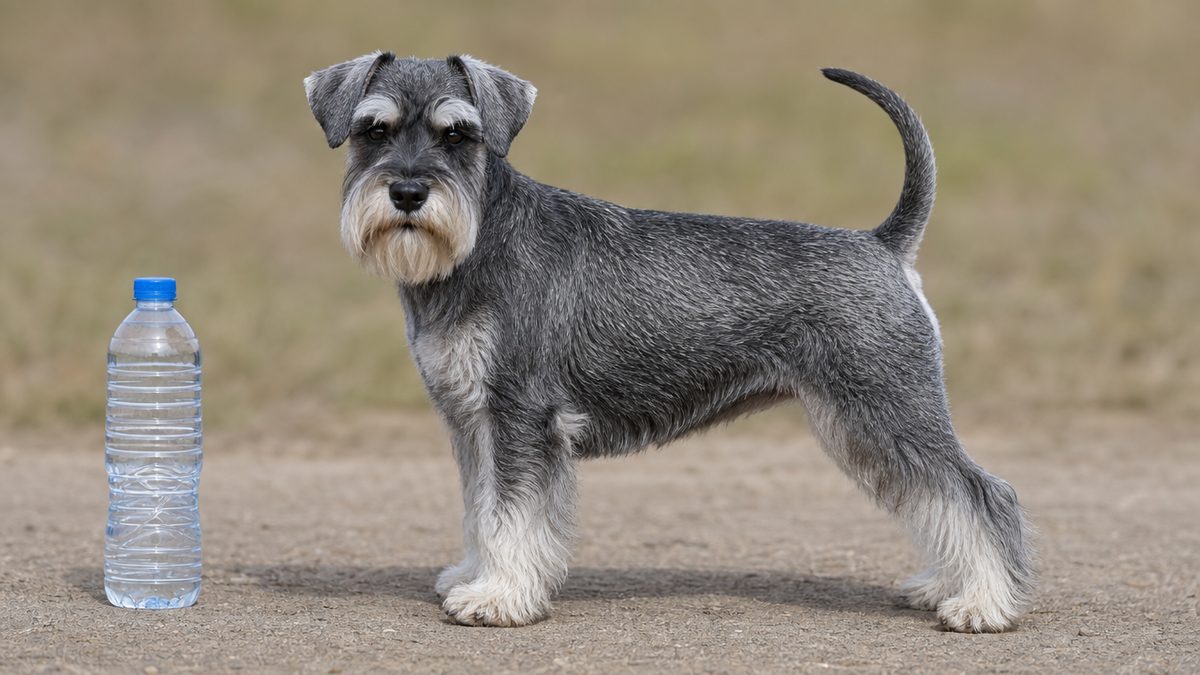
Quick answer
The Miniature Schnauzer is a 30 to 35 cm German wire-coated companion, FCI Standard 183, and one of the few imported small breeds with a genuine Indian market. Published Indian prices run Rs 25,000 to Rs 80,000 and are rupee-native rather than converted. Expect a heat-sensitive dog heavier than its own breed standard allows, a grooming bill you cannot skip, and inherited risks around the pancreas, liver and bladder that Indian law never requires a breeder to test for.
This page reports published veterinary research and registry data for general education. It is not a diagnosis and it is not a treatment plan. Miniature Schnauzers carry specific inherited risks around the pancreas, the liver, the urinary tract and blood lipids, and several of those conditions are silent until they are advanced. Take any dog that is vomiting, straining to urinate, drinking or urinating more than usual, losing weight, or off its food to a registered veterinary practitioner the same day. Do not start, stop or change a prescription diet, a supplement or any medicine on the strength of a web page.
Miniature Schnauzer at a glance
What a Miniature Schnauzer is, and which registry you are buying under
The Miniature Schnauzer is a small, sturdy, wire-coated German companion dog standing 30 to 35 cm at the height at the withers, registered internationally as FCI Standard 183 under its German name Zwergschnauzer. India follows that nomenclature, because the Kennel Club of India is the FCI's full member for India and issues pedigrees against FCI standards Kennel Club of India, official site.
The breed was made by shrinking an existing dog rather than by discovering a new one. The FCI standard's own history says that around the turn of the century a dwarf Schnauzer from the Frankfurt am Main area went on his way, at that point still described as a rough haired Zwergpinscher, and that it was no easy task to evolve a small dog with the appearance and the characteristic qualities of his bigger brother, the Schnauzer. The Royal Kennel Club puts the parent Schnauzer in Germany from at least the 14th century and credits the miniaturisation to an infusion of Affenpinscher blood, with the miniature variety first officially recorded in 1888.
That origin story explains the dog you actually get. The FCI describes the general appearance as small, strong, stocky rather than slim, rough coated and elegant, a reduced image of the Schnauzer without the drawback of a dwarfed appearance, on a square build in which the height at the withers is nearly equal to the body length. Nothing about it is delicate. It was a farm ratter with a watchdog job attached, and the temperament section of the standard says so plainly.
Three registries, three group placements, one dog
The Miniature Schnauzer is filed in a different group by every major registry, and the placement tells you what each body thinks the dog is for. The FCI puts it in Group 2, Pinscher and Schnauzer, Molossoid breeds and Swiss Mountain and Cattle Dogs, Section 1, without working trial, and gives the utilisation as House and Companion Dog. The Royal Kennel Club files it in the Utility group. The American Kennel Club files it in the Terrier group. An Indian buyer will meet all three claims on different websites in the same afternoon.
| Field | FCI Standard 183 | Royal Kennel Club | American Kennel Club |
|---|---|---|---|
| Group | Group 2, Section 1, no working trial | Utility | Terrier |
| Height | 30 to 35 cm, both sexes | Standard published, size band Small | 12 to 14 inches, 30.5 to 35.6 cm |
| Weight | approximately 4 to 8 kg, both sexes | not stated as a band on the A to Z page | 11 to 20 pounds, 5.0 to 9.1 kg |
| Colours | four, including pure white | four standard, including White | three, white not among them |
| Stated life expectancy | not stated | over 10 years | 12 to 15 years |
| Ears | natural drop ears, V-shaped, set high | per breed standard | per breed standard |
Read that table before you read any price. The weight rows differ by more than a kilogram at the ceiling, the colour rows disagree outright, and the life expectancy rows differ by five years at the top. Those are not rounding differences between kennel club documents. They are three organisations describing the breed to three different audiences, and an Indian seller will quote whichever one flatters the puppy in front of you.
India is a full FCI member represented by the Kennel Club of India in Chennai, so a KCI pedigree is written against FCI nomenclature. If a seller quotes AKC height and weight at you for a KCI-registered dog, they are quoting the wrong document. Ask which registry the pedigree is issued under, then read that registry's standard.
The breed is genuinely popular, which separates it from most imported breeds Bonbeno covers. The American Kennel Club ranks it 18th of 210 breeds for registrations, and the UK VetCompass study found Miniature Schnauzers made up 3,857 of 455,557 dogs under primary veterinary care, which is 0.85 percent of every dog in that dataset. That popularity is why there is real Indian supply, real Indian pricing and real veterinary literature to draw on, and it is why this page can say more than a rare-breed page can.
Size and weight: the standard says 8 kg and the measured dog says 9.9 kg
Most adult Miniature Schnauzers weigh more than their own breed standard allows. FCI Standard 183 gives approximately 4 to 8 kg for dogs and bitches alike, and the Royal Veterinary College's VetCompass study of 3,857 Miniature Schnauzers under UK primary veterinary care measured a mean adult bodyweight of 9.9 kg with a standard deviation of 2.2 kg.
The study publishes its weight bands, so the gap can be counted rather than estimated. Among adult males aged 18 months or over, 99 of 1,177 dogs weighed under 8.0 kg, which is 8.4 percent. Among adult females, 338 of 1,174 weighed under 8.0 kg, which is 28.8 percent. Turn those round and 91.6 percent of adult male Miniature Schnauzers and 71.2 percent of adult females in that population sat above the FCI standard's stated weight ceiling.
| Weight band | Males (n) | Males (%) | Females (n) | Females (%) |
|---|---|---|---|---|
| Under 8.0 kg, inside the FCI band | 99 | 8.4 | 338 | 28.8 |
| 8.0 to under 10.0 kg | 358 | 30.4 | 531 | 45.2 |
| 10.0 to under 12.0 kg | 407 | 34.6 | 236 | 20.1 |
| 12.0 to under 14.0 kg | 220 | 18.7 | 55 | 4.7 |
| 14.0 kg and over | 93 | 7.9 | 14 | 1.2 |
The median figures say the same thing in one line. Median bodyweight across all ages was 10.1 kg for males, with an interquartile range of 8.4 to 11.9 kg and an observed range running to 20.0 kg, against 8.4 kg for females. A 20 kg Miniature Schnauzer is two and a half times the standard's ceiling.
Why an Indian buyer should care about a UK weight table
Bodyweight drives the one heat risk that transfers to a small dog. The UK heat-illness work found that dogs at or above their own breed and sex mean bodyweight carried higher odds of heat-related illness, at an odds ratio of 1.42 with a 95 percent confidence interval of 1.12 to 1.80, in a cohort of 905,543 dogs. That factor is defined against each breed's own mean, so it applies to a heavy Miniature Schnauzer without needing the breed to be modelled separately. Bonbeno could not confirm from the published paper text that the Miniature Schnauzer was included in that model's breed list, so no breed-specific odds ratio is quoted here, only the transferable bodyweight factor.
The second reason is that obesity is already this breed's second most common recorded problem. Overweight or obese was recorded in 164 of 1,972 Miniature Schnauzers examined in detail, a prevalence of 8.3 percent with a 95 percent confidence interval of 7.1 to 9.6. A dog that is already above its standard weight, then allowed to gain in an Indian summer, is compounding two problems that a breeder's weight claim will never mention.
Weigh the parents. Not the puppy, the parents. If a seller quotes you 4 to 8 kg from the FCI standard and the sire is 12 kg, the standard is describing an ideal and the sire is describing your dog. Ask for the actual adult weight of both parents in writing, and compare it to the FCI band rather than to the seller's description of the dog as small.
The figures were checked in the standard's own authentic language
FCI standards are published in several languages and only one of them governs, so a figure can drift in translation. FCI Standard 183 states its own answer on its second page, where the English text records the translation as by Mrs C. Seidler and the official language as DE. German is the authentic version, so Bonbeno extracted the German PDF as well and compared the numbers. The German text gives Widerristhohe: Ruden und Hundinnen zwischen 30 und 35 cm and Gewicht: Ruden und Hundinnen ca. 4 bis 8 kg. Both figures match the English exactly. There is no drift in this standard, and recording a negative result is worth as much as recording a discrepancy.
The breed number itself was read off the FCI's own register rather than assembled, because an FCI URL resolves on its trailing number and will serve a different breed without warning. The FCI's nomenclature entry for 183 returns a page headed MINIATURE SCHNAUZER, Group 2, Section 1, without working trial, and records FCI recognition on 13 July 1955. English Wikipedia's account agrees on the essentials, describing a German breed of small dog of Schnauzer type originating in Germany in the late nineteenth century.
Height is the one measurement everybody agrees on, and it is the one that gets misreported anyway. The FCI asks for 30 to 35 cm at the withers, treats over or undersize up to 1 cm as a fault, over or undersize of more than 1 cm but less than 2 cm as a serious fault, and over or undersize of more than 2 cm as a disqualifying fault. The AKC's 12 to 14 inches is the same range in other units. An Indian breed directory that has carried the breed for years gives 30 to 36 cm and 6 to 7 kg, which is close on height and optimistic on weight. Verify the height with a tape at the shoulder rather than accepting a description.
Coat colour: the white Miniature Schnauzer is standard in India and not in America
A pure white Miniature Schnauzer is a correct, registrable dog under the standard India follows. FCI Standard 183 lists four colours, pure black with black undercoat, pepper and salt, black and silver, and pure white with white undercoat, and the FCI's own varieties register confirms all four carry CACIB awards separately.
The Royal Kennel Club agrees, and publishes its own breed standard for the Miniature Schnauzer under the Utility group. Its breed standard colours for the breed are Black, Black and Silver, Pepper and Salt, and White. The American Kennel Club does not. Its breed page gives the hard wiry coat in three colour patterns, salt and pepper, black and silver, and solid black. So the same dog is a show prospect under two registries and outside the standard under a third, and which answer applies to your puppy depends entirely on which pedigree it carries.
This matters in India specifically, because Indian pedigrees run through the Kennel Club of India against FCI nomenclature Kennel Club of India, official site. An Indian seller who tells you a white puppy is a defect, or charges a premium for it as a rarity, is either quoting the AKC at a KCI dog or is selling you a story. The Indian breed platform that ranks for this breed lists the coat variants as Solid Black, White and Black and Silver, which is closer to the FCI position than to the AKC one.
The colours that are outside every standard
Chocolate, liver and parti-colour Miniature Schnauzers are outside the standard everywhere, and the Royal Kennel Club tracks them explicitly. It places the breed in Colour Watch Category 2, meaning more than 2 and up to 10 percent of registrations are in non-breed-standard colours, and its published non-breed-standard list runs to seventeen entries including Chocolate, Chocolate and Tan, Liver, Liver and Tan, and eight separate Parti combinations.
| Colour | FCI Standard 183 | Royal Kennel Club | American Kennel Club |
|---|---|---|---|
| Pepper and salt | standard | standard | standard, written salt and pepper |
| Black and silver | standard | standard | standard |
| Pure black | standard | standard | standard, written solid black |
| Pure white | standard | standard | not listed |
| Chocolate, liver, parti | not listed | non-breed-standard | not listed |
The FCI adds a breeding instruction that Indian buyers never see. Its register of breeds with varieties records the note to avoid breeding pepper and salt to black and silver, in order to preserve the recessive black and silver colour in the breed. That is a conservation instruction about a recessive, not a rule against a colour, and it is worth knowing because it explains why a serious breeder may refuse a mating that looks harmless to you.
The Prevention of Cruelty to Animals (Dog Breeding and Marketing) Rules 2017 state at Second Schedule Part II paragraph 6(9) that breeding to create new breeds of dogs or unusual looks shall be strictly prohibited, and at paragraph 6(8) that dyeing and any change of appearance by artificial means is strictly forbidden. A registered Indian breeder marketing a rare chocolate or merle Miniature Schnauzer at a premium is selling exactly the unusual look that clause names. Bonbeno takes no view on how the clause would be enforced, and states only what the gazette says.
One more detail from the standard is worth carrying into a viewing. In every colour variation the FCI requires a dark mask that adapts harmoniously to the colour, and treats distinct light markings on head, chest and limbs as undesirable, with white or spotted coat in black or pepper and salt dogs listed as a serious fault. So a black puppy with a white chest patch is not a rare colour. It is a fault the seller has renamed.
Miniature Schnauzer price in india, and what the ranking pages are actually selling
Four Indian sources publish a Miniature Schnauzer price in india and they span Rs 25,000 to Rs 80,000, with an Indian kennel putting a show-quality dog at Rs 50,000 to Rs 65,000 and a KCI-certified one at Rs 65,000 to Rs 75,000. None of those figures survives a conversion test, which is good news: they are rupee-native numbers rather than a converted American price list.
| Figure | Source | Divided by 84.38 | Divided by 74 | Divided by 80 |
|---|---|---|---|---|
| Rs 25,000 | Indian breed platform, floor | 296.28 | 337.84 | 312.50 |
| Rs 60,000 | Indian breed platform, ceiling | 711.07 | 810.81 | 750.00 |
| Rs 25,000 | Indian retailer, floor | 296.28 | 337.84 | 312.50 |
| Rs 70,000 | Indian retailer, ceiling | 829.58 | 945.95 | 875.00 |
| Rs 30,000 | National price list, floor | 355.53 | 405.41 | 375.00 |
| Rs 80,000 | National price list, ceiling | 948.09 | 1,081.08 | 1,000.00 |
| Rs 50,000 | Indian kennel, show quality floor | 592.56 | 675.68 | 625.00 |
| Rs 75,000 | Indian kennel, KCI-certified ceiling | 888.84 | 1,013.51 | 937.50 |
Read the quotients rather than the divisions. Not one figure lands on a whole number of dollars at 84.38 or at 74. Seven of the eight appear to divide at 80, but that test is worthless here, because 1,000 divided by 80 is 12.5 and any rupee figure ending in three zeros passes by construction. The quotients it produces, 312.50 and 937.50 among them, are not prices any seller prints. These are rupee-native asking prices, arbitrary rather than converted, which is a different and more honest failure mode than the converted dollar lists Bonbeno finds on most imported breeds.
The page ranking first is about a different dog
The page holding position one on Google India for this query is not about the Miniature Schnauzer. Puppiezo's Miniature Schnauzer page gives the height as 24 to 28 inches and the weight as 27 to 45 kg, illustrates the breed with four image files named GIANT-SCHNAUZER-1 through GIANT-SCHNAUZER-4, and its body copy reads that the Giant Schnauzer is a large and powerful breed originally bred in Germany for herding and guarding, naming the Giant Schnauzer three times. The correct Miniature Schnauzer figures are 12 to 14 inches and 5 to 9 kg.
The mechanism is checkable in one request. Requesting `puppiezo.com/product/giant-schnauzer/` returns HTTP 301 redirecting to `/product/miniature-schnauzer/`, so the site merged its Giant Schnauzer product into the Miniature Schnauzer URL and kept the Giant's body copy and photographs. The same site's genuinely Miniature Schnauzer page survives at a slug reading `toy-schnauzer`, correctly titled Miniature Schnauzers Puppies For Sale, correctly giving 12 to 14 inches and 5 to 9 kg, with four images named MINIATURE-SCHNAUZER. Requesting `/product/standard-schnauzer/` returns 404.
The template seam confirms it rather than merely suggesting it. On the contaminated page, every heading that auto-fills from the product title says Miniature Schnauzer, including Find Miniature Schnauzer Puppies and Never feed these foods to Miniature Schnauzer. Every line a human pasted names the Giant Schnauzer. That split between what the software filled in and what a person typed is the signature of an assembled page, and it is the same seam Bonbeno has documented on other Indian breed sites.
Both the Giant-bodied page and the genuinely Miniature page list the identical five Schnauzer puppies at the identical five prices, Rs 1,12,499, Rs 1,13,999, Rs 1,15,999, Rs 1,89,999 and Rs 2,37,499 Puppiezo, product page slugged…. A price attached to two different breeds at two different adult weights is not a price for either of them. Bonbeno does not report these as Miniature Schnauzer prices.
Both pages also carry an identical Other Available Pets carousel containing two Maltipoos at Rs 98,999, two Poodles at Rs 92,599, a Cane Corso at Rs 94,999, a Goldendoodle at Rs 1,20,000, a Rottweiler at Rs 76,499 and a Doxiepoo at Rs 98,999, and no Schnauzer of any size. Rs 98,999 is a recurring house price point on that site rather than any breed's price, and it appears three times in one carousel here attached to three unrelated animals.
India's largest pet marketplace publishes no Miniature Schnauzer price at all. Its Schnauzer page returns six results, all male, five in Bangalore and one in Delhi, with every price replaced by a View Price link leading to a sign-up form, while its own popular-breeds sidebar on the same page counts 650 Shih Tzus, 549 Siberian Huskies, 487 Golden Retrievers, 454 Labrador Retrievers, 412 German Shepherds and 274 Beagles. Six undifferentiated Schnauzers against 650 Shih Tzus is the real measure of Indian supply, and it is a more useful number than any band above.
Monthly cost: the Indian figure you will be quoted is a shared template constant
The monthly cost published for a Miniature Schnauzer by India's most-cited breed platform is Rs 3,300 basic to Rs 5,400 premium, and that exact pair is printed for at least four other breeds on the same site. It is a template constant, not an observation of this breed.
Bonbeno tested it the only way that works, by pulling unrelated breeds from the same site and comparing the lines to the rupee. The Shih Tzu, the Lhasa Apso, the Bichon Frise and the West Highland White Terrier all print Rs 3,300 to Rs 5,400, the same figure as the Miniature Schnauzer. The Pug and the Beagle print Rs 2,200 to Rs 3,750 instead. The Giant Schnauzer prints Rs 5,700 to Rs 8,550.
| Breed | Monthly running cost | Monthly food line | Stated purchase price |
|---|---|---|---|
| Miniature Schnauzer | Rs 3,300 to Rs 5,400 | Rs 1,200 to Rs 1,800 | Rs 25,000 to Rs 60,000 |
| Shih Tzu | Rs 3,300 to Rs 5,400 | Rs 1,200 to Rs 1,800 | Rs 15,000 to Rs 50,000 |
| Lhasa Apso | Rs 3,300 to Rs 5,400 | Rs 1,200 to Rs 1,800 | Rs 20,000 to Rs 50,000 |
| Bichon Frise | Rs 3,300 to Rs 5,400 | Rs 1,200 to Rs 1,800 | Rs 15,000 to Rs 50,000 |
| West Highland White Terrier | Rs 3,300 to Rs 5,400 | Rs 1,200 to Rs 1,800 | Rs 40,000 to Rs 80,000 |
| Pug | Rs 2,200 to Rs 3,750 | Rs 1,200 to Rs 1,800 | Rs 10,000 to Rs 50,000 |
| Beagle | Rs 2,200 to Rs 3,750 | Rs 1,200 to Rs 1,800 | Rs 15,000 to Rs 50,000 |
Two things fall out of that table. The running-cost total is shared across five breeds with wildly different coats, and the food line is shared across all seven, including two breeds in a different total band. So the rows are assembled from independent preset lines rather than copied whole, and a partial match is still evidence of boilerplate. What genuinely varies per breed is the stated purchase price, which is why a page can look breed-specific while its cost table is not.
A hand-stripped wire terrier coat, a Shih Tzu's floor-length silk and a Lhasa Apso's double coat are three different jobs at three different prices in every Indian grooming salon. A single figure covering all three is a placeholder. When you see Rs 3,300 to Rs 5,400 quoted as the Miniature Schnauzer's monthly cost, you are reading a constant this site also prints for four unrelated breeds, not a measurement.
A second Indian source publishes a different and higher set, and the disagreement is worth showing rather than averaging. An Indian retailer gives food at Rs 2,500 to Rs 4,000, grooming at Rs 2,000 to Rs 5,000 and veterinary care at Rs 1,000 to Rs 3,000, for a total of Rs 5,500 to Rs 12,000 or more per month. That is roughly double the platform figure at the floor and more than double at the ceiling, and the difference sits almost entirely in the grooming line.
What actually drives the bill in India
Grooming is the cost you cannot design away. The Royal Kennel Club rates grooming for this breed at more than once a week, and an Indian retailer's own guidance is to brush three to four times a week with a professional appointment every four to six weeks. Eight to thirteen salon visits a year at Indian metro rates is the single largest recurring line for this breed, and it is the line the template constant hides.
Veterinary cost is the second driver and it is genuinely breed-specific here. This is a breed with documented risks around blood lipids, the pancreas, the bladder and the adrenal glands, and several of those are managed with prescription diets and repeat blood work rather than a one-off treatment Johnson-Pitt A, Mellersh CS, Taylor C. Budget for annual bloods from middle age rather than for an annual vaccination alone, if you want a number that survives contact with the dog.
Bonbeno publishes no single monthly figure for the Miniature Schnauzer in India. The two published Indian figures disagree by a factor of two, one of them is demonstrably shared with four other breeds, and neither states a city, a sample or a date. What Bonbeno can say is the shape of the bill, which is grooming-dominated, front-loaded in the first year, and higher than for a same-sized short-coated dog.
Heat tolerance: the homeland is wetter than Chennai and 17 degrees colder
A Miniature Schnauzer's heat tolerance is limited by its double coat rather than by its size, and the size is the part working in its favour. Bonbeno queried NASA POWER by explicit latitude and longitude for the breed's homeland and for six Indian cities, and the 20-year annual mean runs 10.29 C at Frankfurt am Main against 27.95 C at Chennai, a gap of 17.66 C NASA POWER, 20-year climatology 2001-2020….
Every coordinate was checked against the real town's elevation before the figures were used, because NASA POWER returns a grid cell rather than a point and a mountain cell can be wrong by more than a kilometre. All seven points here are plains or low-plateau sites and the cells are honest. Frankfurt's cell reports 171.61 m against a city near 112 m, a difference of about 60 m. Chennai reports 48.95 m against a city near 6 m. Delhi reports 206.37 m against 216 m. Bengaluru reports 841.72 m against roughly 920 m. None of these is a hill station and none of the cells needs a lapse-rate correction.
| Place | Cell elevation | Annual mean temp | Annual mean RH | Highest recorded T2M |
|---|---|---|---|---|
| Frankfurt am Main, homeland | 171.61 m | 10.29 C | 78.25 % | 39.82 C in July |
| Bengaluru | 841.72 m | 23.74 C | 67.94 % | 40.38 C in April |
| Pune | 635.99 m | 23.86 C | 66.80 % | 43.20 C in April |
| Delhi | 206.37 m | 25.60 C | 45.56 % | 48.79 C in June |
| Kolkata | 7.35 m | 25.81 C | 73.93 % | 46.81 C in May |
| Hyderabad | 494.59 m | 26.10 C | 60.30 % | 45.00 C in May |
| Mumbai | 97.15 m | 26.77 C | 67.39 % | 44.91 C in April |
| Chennai | 48.95 m | 27.95 C | 72.39 % | 42.70 C in May |
The humidity finding is the opposite of what Indian pages assume
Frankfurt is more humid than every Indian city in that table, on an annual mean. Its 78.25 percent beats Kolkata's 73.93, Chennai's 72.39, Bengaluru's 67.94, Mumbai's 67.39, Pune's 66.80, Hyderabad's 60.30 and Delhi's 45.56. The Miniature Schnauzer did not come from a dry place. What India adds is not humidity, it is heat, and the two arriving together is the actual problem.
The monthly numbers show why. Frankfurt's most humid months are January and December at 93 percent, when the highest recorded 2 m temperature in the cell is 13 to 14 C. Its driest month is July at 61 percent, which is also its hottest. Mumbai runs the pattern backwards, reaching 90 percent relative humidity in July and August. A wire coat in 93 percent humidity at 13 C dries. The same coat in 90 percent humidity at 32 C does not. That single inversion explains most of what goes wrong with this breed's skin in an Indian monsoon, and no ranking page states it.
This breed never enters the steepest heat-risk band. The UK heat-illness work found odds of 3.42 with a 95 percent confidence interval of 1.54 to 7.57 for dogs over 50 kg. At 4 to 8 kg on paper and a measured mean of 9.9 kg, a Miniature Schnauzer is nowhere near it. Its heat risk is a coat and bodyweight problem, not a mass problem, and that makes it a far more realistic Indian dog than either of its larger relatives.
The Indian breed platform prints an ideal weather band of 15 to 25 C for this breed. Not one Indian city in the table above has an annual mean inside it. Bengaluru at 23.74 C and Pune at 23.86 C are the closest, and both exceed 40 C at the top of their recorded range. That band is not wrong as a statement about the dog. It is useless as a statement about India, and printing it without saying so is how an Indian buyer concludes the breed will be fine.
Indian law has a clause that applies directly here. The Prevention of Cruelty to Animals (Dog Breeding and Marketing) Rules 2017 at Second Schedule Part IV paragraph 21(1), Outdoor housing facilities, bars keeping in outdoor facilities, without the attending veterinary practitioner's written approval, dogs that are not accustomed to the temperatures prevalent in the area and breeds that cannot tolerate them. The same Schedule requires one or more separate outside areas of shade large enough to hold all the animals at once and protect them from the direct rays of the sun. A Miniature Schnauzer is an indoor dog in India, and the gazette says so in its own way.
One more figure from the UK heat work reframes what an Indian owner should worry about. The companion paper recorded 1,259 heat-related illness events from 1,222 dogs, of which 879 had a recorded trigger, and 652 of those 879 events, which is 74.2 percent, were exertional rather than environmental. Environmental heat accounted for 113 events and confinement in a vehicle for 46. The dog that overheats is usually the dog that was being walked, not the dog that was sitting still, and that is exactly the risk an Indian owner controls by moving the walk rather than by buying a cooling mat.
Practically, the rating on this page is 2 out of 5 for heat tolerance and that is a heat-sensitive dog rather than an impossible one. Walk before 7 am and after 7 pm from March through June. Keep the dog indoors with a fan or air conditioning through the afternoon. Carry water on every outing. Watch for the early signs, which are heavy panting that does not settle within a few minutes of stopping, brick-red gums, and a dog that lies down and will not get up.
Temperament and household fit: an alert farm ratter in an apartment body
The Miniature Schnauzer suits an Indian apartment household that wants an involved, alert, opinionated small dog and can live with noise. FCI Standard 183 says its nature is determined by the temperament and behaviour of a small dog, and that intelligence, fearlessness, endurance and alertness make it an agreeable house dog as well as a watch and companion dog which can be kept even in a small apartment without problems.
That last clause is unusual and worth weighing. Very few breed standards state outright that a dog is suited to a small flat. The Royal Kennel Club backs it, listing size of home as flat or apartment, size of garden as small or medium, and town or country as either. For an Indian buyer in a two-bedroom flat in Mumbai or Bengaluru, that is a registry saying yes rather than a marketplace saying yes.
The barking is the part Indian buyers underestimate
This is a vocal breed and every source says so in its own way. India's oldest breed directory calls it an enthusiastic barker that makes an excellent guard dog. An Indian retailer warns that they are easily spoiled and left to yap without training. The FCI puts alertness in the temperament clause itself. A dog bred to announce vermin will announce the lift, the delivery rider, the neighbour's door and the pigeon on the grille.
In an Indian apartment block that is a social problem before it is a training problem. Shared walls, open stairwells and close balconies mean a barking small dog is audible to eight households, and society complaints about pets are common enough to end an adoption. Decide before you buy whether your building and your family can absorb a dog that talks, because the alternative is trying to suppress a trait the breed was selected for.
- Households this breed fits: an adult or teenage family at home for part of the day, a flat with a door the dog cannot see through, owners who want a dog with opinions rather than a passive one.
- Households it does not fit: anyone out twelve hours a day, anyone who wants silence, anyone unwilling to book a groomer every four to six weeks for the next twelve years.
- With children: sturdy enough for family life at 9 to 11 kg, unlike the toy breeds it is cross-shopped against, but it is a terrier-type dog and will not tolerate being mauled by a toddler.
- With other dogs: workable with early exposure, and worth planning, because an Indian source notes it may show dominance and that early socialisation matters.
- With cats and small pets: a ratting breed with a live prey drive, so a hamster or a rabbit in the same home is a genuine risk rather than a theoretical one.
The prey drive is not decorative. The American Miniature Schnauzer Club, the AKC parent club, writes that they delight in chasing and sometimes catching small prey, and that a fenced yard or on-leash walks are therefore recommended. In an Indian city that means a lead on every walk without exception, because the alternative is a 10 kg dog going under a parked car after a rat on a main road.
This is not a lap dog in a wire coat. It is a working ratter that happens to fit in a flat, and the traits people complain about later, the barking, the chasing, the stubbornness, are the traits it was built from. Buy it because you want that dog, not because it is small.
One thing this breed does not have is a separation-friendly personality. The parent club writes that they need to live as a part of their family, going where they go, doing what they do, and that being near their people is their greatest joy. Indian working households that leave a dog alone from 9 to 7 will get barking, chewing and a stressed animal, and no amount of training fixes an absence.
Training: a trainable dog that will argue, and a socialisation window that closes early
To train a Miniature Schnauzer, use short reward-based sessions and give it a job, because this is a trainable breed that learns fast and resists repetition. The AKC breed standard, quoted by the parent club, describes a dog that is alert and spirited, yet obedient to command, friendly, intelligent and willing to please, and never overaggressive or timid.
The parent club adds that they are intelligent and learn quickly, that many have excelled in formal obedience trials and agility competitions, and that although the breed was not originally bred to go to ground it will gladly chase rodents wherever they go, and is eligible for Earthdog trials. That is a description of a dog with a working brain, and a working brain in a flat needs something to do or it invents something.
The socialisation window, and why it is harder in India
The socialisation window in dogs closes early, and Indian conditions make the first weeks harder rather than easier. The Prevention of Cruelty to Animals (Dog Breeding and Marketing) Rules 2017 require at Rule 8(1)(a) that pups less than eight weeks in age are not sold, and at Second Schedule Part III paragraph 8(9) that all pups shall be vaccinated, which can start at the age of seven to eight weeks and is usually completed at the age of eighteen weeks. Those two clauses bracket the problem exactly.
A puppy that arrives at eight weeks and finishes its course at eighteen weeks has ten weeks in which its owner is told to keep it away from unvaccinated dogs, and those are the ten weeks that matter most for temperament. Socialise inside that window without exposing the puppy to street dogs or unvaccinated animals. Carry it through a market. Sit with it on a balcony above a busy road. Invite vaccinated adult dogs from known households. Let it meet delivery riders, security guards, children and the building lift while it is still small enough to carry.
- Weeks 8 to 12: name response, crate as a good place, handling of feet, ears and beard every day so grooming is never a fight later.
- Weeks 10 to 16: controlled exposure to sound and people, carried rather than walked where the ground is shared with street dogs.
- Weeks 12 to 20: lead work indoors and on quiet stretches, plus a deliberate quiet cue introduced before barking becomes a habit.
- Months 5 to 9: recall on a long line only, because a ratting breed with a live prey drive is not an off-lead dog in an Indian city.
- Months 9 to 18: consolidate. This is when adolescent dogs test everything they learned, and when most Indian owners give up on the quiet cue.
Deal with the barking as a trained behaviour rather than a nuisance to be suppressed. Teach a quiet cue by rewarding the pause after the bark rather than by shouting, which the dog reads as joining in. An Indian retailer's own summary of the breed warns that they are smart but can be obstinate and are easily influenced by positive reinforcement, and that they are easily spoiled and left to yap without training. That is the same advice in blunter words.
Most Miniature Schnauzer training failures in India are not obedience failures. They are grooming failures that became behaviour failures. A dog that was never taught to stand still for its beard, feet and ears at eight weeks becomes a dog that must be sedated for grooming at three years, and then the owner stops grooming, and then the coat mats and the skin goes. Handle the puppy daily from the day it arrives.
Watch for one honest limit. This breed's alertness is a selected trait, not a training gap, and the goal is management rather than removal. A Miniature Schnauzer that never announces anything is either exceptionally well trained or unwell. Aim for a dog that barks twice and stops on cue, and treat that as success.
Exercise needs: up to an hour a day, split around the Indian heat
A Miniature Schnauzer's exercise needs are up to 1 hour per day according to the Royal Kennel Club, and that is the most deliverable requirement of any Schnauzer in an Indian city. The Giant Schnauzer's band on the same scale is more than 2 hours. This breed is the one you can actually walk in June.
Indian sources land in the same place from a different direction. An Indian retailer gives 30 to 45 minutes of daily activity across walks, indoor play and training sessions, and warns that without it the dog develops barking issues and destructive behaviour. The Indian breed platform gives 30 to 60 minutes. Puppiezo's genuinely Miniature Schnauzer page gives 30 minutes daily against 1 hour daily on its Giant-bodied page, which is one of the few places the contaminated page and the real one disagree usefully.
| Source | Daily requirement | What it is measuring |
|---|---|---|
| Royal Kennel Club | up to 1 hour per day | the club's standard banding across all breeds |
| Indian breed platform | 30 to 60 minutes | a per-breed field on an Indian guide |
| Indian retailer | 30 to 45 minutes | walks, indoor play and training combined |
| Puppiezo, Miniature page | 30 minutes daily | a per-product field |
Take the Royal Kennel Club's hour as the planning figure and the Indian half hour as the floor on a bad-heat day. The parent club's line is that they are as much at home in the city with a moderate amount of exercise as they are in the country, where they appear tireless. Both halves of that are true, and the Indian version of it is a moderate amount, split.
How to split it in an Indian summer
Two walks beat one. From March to June in Delhi, Chennai, Mumbai, Kolkata and Hyderabad, put the first walk before 7 am and the second after 7 pm, and use the middle of the day for indoor work. That is not a general precaution. Delhi's cell records a highest 2 m temperature of 48.79 C in June and Kolkata's 46.81 C in May, and pavement in either city holds heat long after the air starts cooling.
- Test the pavement with the back of your hand for five seconds. If you cannot hold it there, the dog cannot stand on it.
- Replace one walk with scent work indoors on the worst weeks. Hide food in a folded towel and let the dog work it out, which tires a ratting brain faster than distance does.
- Use a harness rather than a collar for a dog that pulls toward every rustle, because a 10 kg dog lunging on a neck collar is a tracheal problem waiting to happen.
- Keep recall on a long line outdoors for life. The parent club's own advice is a fenced yard or on-leash walks, and Indian streets supply neither fencing nor a shortage of rats.
- Skip the walk entirely on a day the dog is already panting indoors, and do not compensate the next day with a double session.
Exercise is also the main lever on the second most common problem this breed has. Overweight or obese was recorded in 8.3 percent of Miniature Schnauzers examined in the UK VetCompass sample, second only to periodontal disease. In India, where afternoon walks are genuinely unsafe for four months of the year, the walk that gets dropped in April is often not restored in October. Set a fixed indoor routine for the hot season rather than treating exercise as weather-dependent.
One caution specific to this breed. A dog with a history of pancreatitis or high blood triglycerides should not be exercised hard immediately after a meal, and should not be rewarded with fatty treats during training. Use a portion of the dog's measured daily ration as training rewards instead, which solves the treat problem and the weight problem in one move.
Grooming: hand stripping, a beard that stays wet, and what Indian humidity changes
To groom a Miniature Schnauzer properly you brush it three to four times a week and book a professional appointment every four to six weeks, and the Royal Kennel Club rates the breed's grooming at more than once a week. The coat is meant to be maintained by hand stripping rather than clipping, and clipping softens the wiry texture permanently.
FCI Standard 183 describes what you are maintaining. The coat should be wiry, harsh and dense, consisting of a dense undercoat and a not too short top coat lying close to the body, with the top coat rough, sufficiently long to allow the checking of its texture, neither bristly nor wavy. Typical characteristics are the not too soft beard on the muzzle and the bushy eyebrows which slightly shade the eyes. Too short, too long, soft, wavy, shaggy or silky coat is listed as a fault.
That fault list is the whole argument for stripping. To hand strip is to pull the dead top coat out at the root so the new harsh coat grows in. To clip is to cut it, which leaves the soft undercoat proportionally dominant and changes the texture within two or three cycles. A clipped Miniature Schnauzer is not ruined and it is not a welfare problem, but it stops being a wire-coated dog, and in India that has a practical consequence rather than a cosmetic one.
Why the Indian monsoon is the real grooming problem
The homeland is humid and the homeland is cold, and that combination is what the coat was built for. Frankfurt's grid cell runs 93 percent relative humidity in January and December, when the highest recorded 2 m temperature is 13 to 14 C, and drops to 61 percent in July. Mumbai runs 90 percent in July and August with the same cell recording daytime highs in the thirties. Ninety percent humidity at 13 C is a coat that dries. Ninety percent humidity at 32 C is a coat that does not.
So the Indian monsoon rule is drying, not bathing frequency. A dense undercoat that stays damp against warm skin is where hot spots, yeast and bacterial dermatitis start, and cutaneous disorders were already the third most common grouped problem in the UK data at 12.7 percent with a 95 percent confidence interval of 11.2 to 14.2. Towel first, then dry to the skin with a dryer on a cool setting, then check that the armpits, the groin and the beard are actually dry before the dog is left alone.
The parent club writes that Miniature Schnauzers adapt easily to any change of condition or climate. That is a reasonable sentence in a temperate country and it does not transfer. A double-coated dog moving from a 10.29 C annual mean to a 27.95 C one is not adapting easily to anything. Read overseas club care guidance for technique and ignore it on climate.
The beard is the maintenance item nobody budgets for. It is a feature of the breed standard, it goes into every bowl of food and water, and in Indian humidity it stays wet. An Indian retailer's guidance is that the beard needs washing after meals and the eyebrows need trimming. Do the washing, then dry it. A permanently damp beard produces staining, smell and skin irritation around the muzzle, and it is the single most common reason an Indian owner asks a groomer to shave the face off a Schnauzer.
- Weekly at home: brush three to four times, comb the beard and leg furnishings out to the skin, check between the pads for grass seed and matting.
- Every four to six weeks: professional appointment, either hand stripping to keep the harsh coat or a clip if you have accepted the texture change.
- Every three to four weeks: bath, per Indian retail guidance, and always with a full dry afterwards rather than air drying.
- Every day in monsoon: dry the beard after every meal, and dry the whole dog after any walk in rain.
- Every visit: ask the groomer to check the ears, because aural disorders ran at 10.0 percent in the UK data with otitis externa alone at 5.0 percent.
Finding a groomer who can hand strip is the genuine Indian constraint. Most metro salons clip, because clipping is faster and stripping is a skill. Ask before you book whether the salon strips, ask to see a stripped Schnauzer they have done, and accept that in a smaller city the honest answer may be that only clipping is available. That is a reason to choose the breed with open eyes rather than a reason to skip grooming.
Health issues and life expectancy: 11.6 years measured, not 12 to 15 claimed
The measured life expectancy of the Miniature Schnauzer is a median age at death of 11.6 years, with an interquartile range of 9.3 to 13.1 years and an observed range of 0.5 to 17.0 years, across 86 recorded deaths in the Royal Veterinary College's VetCompass study. Every Indian page repeats 12 to 15 years, which is the American Kennel Club's published figure, and the Royal Kennel Club says only over 10 years.
Those three answers are not equally weighted. The 11.6-year figure comes from counting real deaths in a defined population of 3,857 dogs under primary veterinary care. The 12 to 15 range is a breed-page descriptor. When a page tells you this breed is long-lived, ask which of those two it is quoting. The honest framing for an Indian buyer is a dog that usually reaches its low teens, with a quarter of deaths before 9.3 years.
Male and female longevity did not differ. Median age at death was 11.6 years for females with an interquartile range of 9.3 to 13.5 across 42 dogs, and 11.6 years for males with an interquartile range of 9.2 to 12.9 and a range of 3.3 to 15.4 across 44 dogs, at a p value of 0.465.
| Cause | Deaths | Percent | 95% CI |
|---|---|---|---|
| Neoplasia | 11 | 14.7 | 7.6 to 24.7 |
| Collapse | 10 | 13.3 | 6.6 to 23.2 |
| Mass-associated disorder | 8 | 10.7 | 4.7 to 19.9 |
| Brain disorder | 8 | 10.7 | 4.7 to 19.1 |
| Renal disease | 6 | 8.0 | 3.0 to 16.6 |
| Enteropathy | 5 | 6.7 | 2.2 to 14.9 |
| Anorexia | 3 | 4.0 | 0.8 to 11.2 |
| Endocrine disorder | 3 | 4.0 | 0.8 to 11.3 |
| Other | 21 | 28.0 | 18.2 to 39.6 |
Those nine rows sum to 75, which is the printed total, so the table reconciles against itself. Note the denominator carefully. The percentages are computed on the 75 dogs with a recorded cause, not on the 86 deaths and not on the 3,857 dogs in the study, and neoplasia at 14.7 percent means 11 of 75 rather than 14.7 percent of the breed.
What actually gets recorded at the vet
Disorder prevalence in the same study comes from a simple random sample of 1,972 of the 3,857 dogs, which is 51.1 percent, whose full clinical records were read by hand. Of those, 1,345 or 68.2 percent had at least one disorder recorded during 2013 and the remaining 627 had none. The median annual disorder count was 1.
| Disorder | Dogs | Prevalence | 95% CI |
|---|---|---|---|
| Periodontal disease | 343 | 17.4 % | 15.7 to 19.1 |
| Overweight or obese | 164 | 8.3 % | 7.1 to 9.6 |
| Anal sac impaction | 114 | 5.8 % | 4.8 to 6.9 |
| Vomiting | 100 | 5.1 % | 4.1 to 6.1 |
| Otitis externa | 99 | 5.0 % | 4.1 to 6.1 |
| Dental, grouped | 378 | 19.2 % | 17.5 to 21.0 |
| Enteropathy, grouped | 270 | 13.7 % | 12.2 to 15.3 |
| Cutaneous, grouped | 250 | 12.7 % | 11.2 to 14.2 |
| Aural, grouped | 197 | 10.0 % | 8.7 to 11.4 |
Read that list and notice what is not on it. Not one of the conditions this breed is famous for appears in the top five. No pancreatitis, no bladder stones, no high triglycerides, no Cushing's syndrome. The commonest recorded problems are teeth, weight, anal sacs, vomiting and ears, which is a list of ordinary small-dog problems.
A 2026 owner survey of UK Miniature Schnauzer owners received 4,786 responses, analysed 2,910, and found pancreatitis reported in 7.6 percent of dogs, with hyperlipidaemia reported in 1 percent overall rising to 3.3 percent in dogs over nine years. Its authors state plainly that this differs from previous veterinary epidemiological studies. Bonbeno publishes both figures rather than picking one. Owners may over-report a diagnosis they were told about years ago; clinical records may under-record a condition managed at a referral practice. Neither number is wrong, and the gap between them is exactly why a buyer should ask a specific question rather than accept a general reassurance.
Two small internal defects in the VetCompass paper are worth flagging for anyone checking these numbers. Its abstract gives median longevity as 11.6 years while its results text refers to 11.7 years, its plain-language summary gives the study count as 3,847 against 3,857 elsewhere, and the brain-disorder confidence interval prints as 4.7 to 19.10. None of these changes any conclusion on this page, and all of them are the kind of thing you find only by adding the columns up.
Health screening: two tests the Royal Kennel Club names, and nine Indian law names instead
To screen a Miniature Schnauzer properly, ask the breeder for two results the Royal Kennel Club names as best practice for this breed, a DNA test for Mycobacterium avium complex susceptibility and eye testing under the BVA, Kennel Club and ISDS Eye Scheme including litter screening. Indian breeding law requires neither of them.
The Mycobacterium avium complex test exists because of a specific mutation found in this breed. A 2024 study identified a codon deletion in the CARD9 gene, c.493_495del, p.Lys165del, on chromosome 9, in Miniature Schnauzers developing progressive systemic MAC infections. Pedigree analysis was consistent with an autosomal recessive trait, the association was mapped using 8 infected dogs, 9 non-infected relatives and 160 control Miniature Schnauzers, every tested infected dog was homozygous for the mutant allele, and genotyping found that allele present worldwide.
That last word matters for India. A worldwide allele in an imported breed is an allele that arrives with imported lines, and CARD9 deficiency impairs defence against mycobacteria and fungi rather than against one organism. The authors describe these dogs as the first spontaneous animal model of CARD9 deficiency. Ask for the CARD9 genotype of both parents in writing. A clear-by-parentage claim without a test result behind it is not a result.
Neither of the Royal Kennel Club's two best-practice items is exotic or expensive. The MAC test is a DNA test that can be run from a cheek swab, and the eye scheme is a clinical examination by a listed ophthalmologist. Ask for both parents' results before you see the puppies, because a breeder who has them will send them and a breeder who does not will change the subject.
What OFA's own screening database holds on this breed
The Orthopedic Foundation for Animals publishes breed-level screening results, and the Miniature Schnauzer appears in eleven of its tables with genuinely useful sample sizes, including 14,486 eye evaluations and 1,567 patella evaluations. Every percentage below was recomputed from the counts printed beside it.
The retrieval is worth describing because it is easy to get a false negative from. The database renders through JavaScript, and the page still prints the string Searching Database, Please wait. alongside the fully populated tables, so that string is not evidence the tables failed. The pull returned about 2.21 million characters. Breed names are in capitals. A control run in the same retrieval returned 109 matches for LABRADOR, which is the expected count, so the pull is sound and any absence reported below is a real absence rather than a broken query.
| OFA table | Evaluations | Result as printed |
|---|---|---|
| Eyes | 14,486 | 97.4 % normal, 2.5 % abnormal |
| Patella | 1,567 | 99.3 % normal, 0.7 % abnormal (0.4 grade 1, 0.2 grade 2, 0.1 grade 3) |
| Congenital cardiac | 1,252 | 99.8 % normal, 0.2 % equivocal |
| Basic cardiac | 1,070 | 99.9 % normal, 0.1 % equivocal |
| Hips | 324 | 97.2 % normal, 2.8 % dysplastic (17.0 excellent, 73.5 good, 6.8 fair) |
| Advanced cardiac | 316 | 96.5 % normal, 3.2 % abnormal |
| Myotonia congenita | 198 | 99.5 % normal, 0.5 % carrier, 0.0 % affected |
| Degenerative myelopathy | 129 | 98.4 % normal, 1.6 % affected |
| Progressive retinal atrophy | 102 | 94.1 % normal, 5.9 % carrier, 0.0 % affected |
| Mycobacterium avium complex | 91 | 100.0 % normal, 0.0 % carrier |
| Dentition | 68 | 100.0 % normal |
Two of those rows are the breed's own genetics rather than general screening. OFA runs a Mycobacterium avium complex table and the Miniature Schnauzer is in it, which is the same immunodeficiency the CARD9 codon deletion causes and the same test the Royal Kennel Club names as best practice. Across 91 evaluations, 100.0 percent were normal and none were carriers. Note that OFA's own heading spells it AVIAN rather than avium, which matters only if you are searching the table by name.
The myotonia congenita row is the second. Across 198 evaluations, 99.5 percent normal and 0.5 percent carrier, which on that denominator is a single carrier dog. The progressive retinal atrophy row shows 102 evaluations at 94.1 percent normal and 5.9 percent carrier, which is about six carriers and no affected dogs.
The patella number is the surprise
Patellar luxation is the classic small-breed orthopaedic problem, and this breed largely does not have it. Across 1,567 patella evaluations, 0.7 percent were abnormal, split 0.4 percent grade 1, 0.2 percent grade 2 and 0.1 percent grade 3, and those three sum to the 0.7 percent printed as the total. Hips are similarly unremarkable at 2.8 percent dysplastic across 324 evaluations, with the excellent, good and fair shares summing to 97.3 against a printed 97.2 normal, which is rounding.
An Indian buyer reading the health sections above could reasonably conclude this is a fragile breed. OFA's orthopaedic and cardiac numbers say the opposite. Hips, patellas, congenital cardiac and basic cardiac all sit at or above 97 percent normal on four-figure or three-figure samples. The Miniature Schnauzer's problems are metabolic, urinary and ocular rather than structural, and that is a genuinely different ownership proposition from a breed with joint disease.
Four absences are worth recording because the control passed. The Miniature Schnauzer has no row at all in OFA's elbow, thyroid, dilated cardiomyopathy or Factor VII deficiency tables, while the Giant Schnauzer or the Standard Schnauzer or both do appear in each of them. OFA publishes a breed only once it clears a submission threshold, so this means too few Miniature Schnauzers have been submitted for those screens rather than that the breed is free of those conditions. Absent from a table is not the same as clear, and no page should read it that way.
One caveat applies to every figure here. OFA is a live register and its counts move as evaluations are added, which is why the sample size is printed beside every percentage above rather than the percentage alone. Quote the pair or quote neither.
The eye numbers, where OFA's summary and its own detail rows disagree
OFA's eye summary says 97.4 percent of 14,486 Miniature Schnauzers were normal. Its own per-diagnosis detail tables, on a denominator of 14,425, record 12,688 normal dogs, which is 87.96 percent, printed as 88.0. The two numbers differ by 9.4 percentage points and cannot both describe the same thing.
That gap is a known property of OFA's eye registry rather than anything specific to this breed, and it is worth putting in proportion. The largest such gap Bonbeno has on record is 65.3 points, so 9.4 points is at the mild end of a well-documented pattern. It is reported here because quoting either number alone would mislead, not because it is extreme.
The denominators differ too, at 14,486 in the summary against 14,425 in the detail, a difference of 61 evaluations. Neither figure is wrong on its face and Bonbeno has no way to reconcile them from the published tables, so both are printed above.
This is the part that makes the arithmetic work. Of 14,425 dogs, 12,688 were normal, leaving 1,737 dogs with at least one recorded finding, which is 12.04 percent. But the individual diagnosis rows sum to 2,506 recorded findings, because one dog can carry several. That is about 1.44 findings per affected dog. Anyone who adds the diagnosis columns and reports the total as a percentage of dogs will overstate the problem by roughly 44 percent.
What the eyes are actually finding
| Finding | Dogs | Percent of dogs examined |
|---|---|---|
| Other, suspected as not inherited | 337 | 2.34 % |
| Cataract, significance unknown | 322 | 2.23 % |
| Distichiasis | 273 | 1.89 % |
| Persistent pupillary membranes, iris to iris | 208 | 1.44 % |
| Persistent pupillary membranes, lens pigment | 192 | 1.33 % |
| Punctate cataract, anterior cortex | 134 | 0.93 % |
| Corneal dystrophy, epithelial or stromal | 72 | 0.50 % |
| Retinal atrophy, generalized | 14 | 0.10 % |
Add the lens-coded rows together and the picture sharpens considerably. Across every cataract and lens opacity category OFA records for this breed, from significance-unknown through punctate, incipient, incomplete, Y-suture, generalized and resorbing, the counts total 1,135 findings. That is 7.87 percent of the 14,425 dogs examined and 45.3 percent of all 2,506 recorded findings. Persistent pupillary membranes of all types add a further 435, or 3.02 percent.
So nearly half of everything OFA finds in this breed's eyes is a lens opacity, which is the single most useful sentence on this page for an owner deciding what to watch for. It also explains why the Royal Kennel Club names eye testing including litter screening as best practice for the breed rather than leaving it to the DNA test alone.
Set that beside the generalized retinal atrophy row, which records 14 dogs, or 0.10 percent, and beside the separate PRA DNA table showing 5.9 percent carriers and no affected dogs across 102 tests. The breed's eye burden is overwhelmingly lens rather than retina, and an Indian buyer told to worry about blindness from PRA is being pointed at the smaller of the two problems.
Ask for an eye examination certificate on both parents dated within the last twelve months, not a DNA test alone. Lens opacities are found by looking, they are not all covered by any single genetic test, and they are what 45.3 percent of OFA's findings in this breed actually are. In India, where no breeding rule mentions the word cataract at all, nobody will offer this unless you ask.
The risks you cannot test for before you buy, starting with bladder stones
Miniature Schnauzers are one of the five breeds most commonly affected by bladder stones, and that is the condition most likely to put an Indian owner in an emergency clinic at midnight. Unlike the two tests in the previous section, this one has no pre-purchase screen, which makes recognising the signs the whole of the preparation.
The scale comes from the largest published series. In 40,637 canine bladder uroliths submitted to the Canadian Veterinary Urolith Centre between 1998 and 2008, struvite and calcium oxalate together made up more than 85 percent of all submissions, and the Shih Tzu, Miniature Schnauzer, Bichon Frise, Lhasa Apso and Yorkshire Terrier were the breeds most commonly affected for both stone types. Struvite was commonest in female dogs and calcium oxalate in males.
There is no screening test for this. What there is instead is a symptom list worth memorising, because an obstructed male dog is an emergency measured in hours rather than days. Straining without producing urine, frequent small squats, blood in the urine, licking at the penis or vulva, or a dog crying when picked up around the belly all mean the same thing on the same day.
| Risk | Evidence | Test before you buy? |
|---|---|---|
| MAC susceptibility | CARD9 codon deletion, autosomal recessive, allele found worldwide | Yes, DNA test, RKC best practice |
| Eye disease | RKC best practice is BVA/KC/ISDS screening including litter screening | Yes, eye scheme certificate |
| Bladder stones | One of five breeds commonest in 40,637 Canadian urolith submissions | No test, manage by diet and water |
| Cushing's syndrome | Odds 3.05 (95% CI 1.67 to 5.57) against crossbreds in 905,544 dogs | No test, watch drinking and coat |
| Congenital liver shunt | 1.37 percent incidence in 582 Finnish puppies from 121 litters | Yes, bile acid screen of the litter |
| Phaeochromocytoma | Named as a significantly predisposed breed in 2,250,741 dogs | No test, rare at 1 per 100,000 |
| Blood lipid disease | Low-fat diet corrected lipoprotein profiles in 9 of 16 affected dogs | Yes, a fasted triglyceride panel |
Cushing's syndrome deserves its own line. In 905,544 dogs under UK primary care, the one-year period prevalence was 0.17 percent, and the Miniature Schnauzer carried the third highest odds of any breed at 3.05 with a 95 percent confidence interval of 1.67 to 5.57, behind the Bichon Frise at 6.17 and the Border Terrier at 5.40. Bodyweight greater than the breed-sex mean also increased the odds, which is the second time on this page that being a heavy Miniature Schnauzer costs you something.
Congenital liver shunts are the one risk a good breeder can screen out cheaply. A Finnish study screened 582 puppies from 121 litters, which was 58 percent of all Miniature Schnauzers born and registered in Finland in a year, by measuring postprandial serum bile acid at 6 to 12 weeks. Elevated bile acids appeared in 3.3 percent, and 8 of 582 puppies were confirmed with a congenital portosystemic shunt, an incidence of 1.37 percent against an estimated 0.18 to 0.76 percent in dogs generally. A bile acid result on the litter is a cheap blood test and it is the single most useful thing an Indian buyer can ask for.
The Prevention of Cruelty to Animals (Dog Breeding and Marketing) Rules 2017, Second Schedule Part III paragraph 8(10), requires that dogs shall have been tested for genetic defects including hip dysplasia, progressive retinal atrophy, night blindness, hypothyroidism, entropion, ectropion, overshot, undershot jaw, wry mouth, two or more missing teeth, and cryptorchidism. Bonbeno extracted the whole gazette and counted. The words cataract, urolith, bladder, pancreas, pancreatitis, liver, hepatic, triglyceride, lipid, patella, BAER and deaf appear zero times in it. The clause opens with the word including, so the list is illustrative rather than closed, but nothing in Indian law puts this breed's actual risks in front of a breeder. Every one of them is a question you have to ask yourself.
One rarer association is worth recording without alarm. A 2025 study of 2,250,741 dogs found 92 confirmed phaeochromocytoma cases, an estimated incidence risk of 1 per 100,000 dogs in 2019, and named the Soft-Coated Wheaten Terrier, German Pointer and Miniature Schnauzer as showing significant breed predispositions. A predisposition to a tumour that affects one dog in a hundred thousand is a fact, not a warning, and it belongs on the page because it is true rather than because it should change anyone's decision.
Is the Miniature Schnauzer hypoallergenic? No dog breed is
No dog breed is hypoallergenic, and the Miniature Schnauzer is not an exception to a rule that does not exist. The largest measurement study compared Can f 1 levels in the hair and coat of 196 dogs of breeds marketed as hypoallergenic against 160 control dogs, found significantly higher levels in the marketed group, and concluded that there is no evidence for the classification of certain dog breeds as being hypoallergenic.
The numbers are worth quoting because they run the wrong way for the marketing. Hair samples from the so-called hypoallergenic group had a geometric mean of 2.26 micrograms per gram against 0.77 in the control group, and coat samples 27.04 against 12.98. Settled floor dust was lower only for Labradoodles, and there was no difference in airborne allergen levels between any of the groups.
The four breeds in that study's hypoallergenic group were the Labradoodle, Poodle, Spanish Waterdog and Airedale Terrier, against Labrador Retrievers and a control group. The Miniature Schnauzer was not tested. Bonbeno will not transfer a breed-specific figure onto a breed a study excluded. What the study supports is the general conclusion its authors drew, that the hypoallergenic classification is unevidenced. What it does not supply is a Miniature Schnauzer number, and no page that quotes one has a source for it.
The closest coat type the study did test is the Airedale Terrier, which is a hand-stripped wire-coated terrier like the Miniature Schnauzer, and it sat in the group that came back with more allergen rather than less. That is a reason for caution rather than a measurement, and it is stated here as such.
What the breed's own parent club says, and why it is not enough
The American Miniature Schnauzer Club writes that the Miniature Schnauzer does not shed, so they often can be enjoyed by people who are allergic to other breeds of dogs. That is the parent club making an allergy claim on its own breed, and it is the source most Indian pages are ultimately echoing. It is worth separating the two halves of it. Low shedding is real and observable. Being enjoyed by allergic people is a claim about human immune responses that the club has not measured.
Indian pages handle this better than most, which is worth saying. An Indian retailer's own guide opens by stating that Miniature Schnauzers do shed less but are not hypoallergenic, that no dog is 100 percent hypoallergenic, that allergy sufferers may react to dander, saliva and skin oils, and that the people who benefit most are mild allergy sufferers and those sensitive to excessive shedding. That is an accurate summary and it is the correct framing for an Indian buyer.
- The mechanism people mean: less loose hair in the room, so less allergen-carrying dander distributed around the home.
- The mechanism they get: the same major dog allergen, Can f 1, produced in dander, saliva and skin oils regardless of coat type.
- What the evidence shows: no difference in airborne allergen between marketed and control breeds in the only large measurement study.
- What that means practically: a low-shedding coat may reduce nuisance and may reduce visible mess, and it does not make a dog safe for an allergic person.
- What to do instead: spend two hours in a home with an adult Miniature Schnauzer before committing, and repeat it on a second day.
The registry position is quieter and more honest than the marketing. The Royal Kennel Club's A to Z entry for the breed simply records Sheds as No, and makes no allergy claim at all. FCI Standard 183 describes the coat's texture and density in detail and says nothing whatever about allergies. Where a breed standard is silent and a marketplace is confident, follow the standard.
For an Indian buyer paying a premium specifically for an allergy-safe dog, this is the sentence that matters. There is no premium worth paying for hypoallergenic status, because the status does not exist. Buy this breed for its size, its temperament and its manageable exercise load, and treat the low shedding as a housekeeping convenience rather than a medical feature.
Feeding: low fat is a clinical instruction for this breed, not a preference
To feed a Miniature Schnauzer well, measure the portions, keep the fat content low and watch the body condition monthly. A low-fat diet trial in Miniature Schnauzers with hypertriglyceridaemia cut median serum triglycerides from 480 and 493 mg per decilitre before the change to 177 and 168 after it, and cut mean cholesterol from 381 and 380 to 257 and 178.
That trial is small and it is specific. It ran on 16 Miniature Schnauzers with hypertriglyceridaemia against 28 without, with four blood samples taken across the diet change. Before the change, 15 of 16 affected dogs, or 94 percent, were classified as hyperlipidaemic on their lipoprotein profiles alone. After it, 7 of 16, or 44 percent, still were, an odds ratio of 19.3 with a 95 percent confidence interval of 2.0 to 184.0 and a p value of 0.006.
Read the residual honestly. Nine of sixteen dogs corrected and seven did not. A low-fat diet is the first intervention rather than a cure, the confidence interval on that odds ratio is enormous because the study is small, and any dog with a genuinely abnormal fasted triglyceride result needs a veterinarian rather than a food swap chosen from a web page.
Life stages, and what to actually put in the bowl in India
| Stage | Meals per day | Priority | Breed-specific reason |
|---|---|---|---|
| 8 to 16 weeks | 3 | growth food, measured, never free-fed | sets portion discipline before appetite sets habits |
| 4 to 12 months | 2 to 3 | steady growth, avoid rapid weight gain | obesity is the second commonest recorded problem |
| 1 to 7 years | 2 | low to moderate fat, weighed portions | hypertriglyceridaemia risk rises with age |
| 7 years and over | 2 | add an annual fasted lipid panel | hyperlipidaemia reported in 3.3 percent of dogs over nine |
| Any age after a pancreatitis episode | 2 to 3 small | veterinary low-fat prescription diet only | pancreatitis was owner-reported in 7.6 percent of the breed |
Indian availability is genuinely good for this breed's needs. Veterinary low-fat and urinary prescription diets from the major international manufacturers are stocked by Indian online pet retailers and by most metro veterinary clinics, and an Indian retailer's own breed guide lists prescription diet food as a category alongside its Miniature Schnauzer article. That is not true of every specialist diet, and it removes the usual Indian excuse for not following a clinical instruction.
Fat first. Table scraps, ghee, fried food, paneer, mithai and the fatty trimmings from a family meal are the ordinary Indian route to a pancreatitis episode in a breed already reported at 7.6 percent. Water second. A breed among the five commonest for both struvite and calcium oxalate bladder stones needs its urine kept dilute, which in an Indian summer means water in every room, refreshed, and wet food or added water in the bowl if the dog is a poor drinker.
Portion control needs a number rather than an eye. The Indian breed platform gives monthly food expenses of Rs 1,200 to Rs 1,800 for this breed, but that figure is shared with six other breeds on the same site including the Pug and the Beagle, so it tells you nothing about how much this dog should eat. Use the manufacturer's chart for the dog's target weight rather than its current weight, weigh the food on a kitchen scale, and re-check the target every three months.
Body condition scoring beats the bathroom scale for a coated dog. Run your hands along the ribs. You should feel them easily under a thin layer of cover without pressing, see a waist from above and a tuck from the side. A wire coat hides two kilograms comfortably, which is exactly how a breed with a 9.9 kg mean adult weight ends up at 13 kg without anyone noticing.
The first year, month by month, for an Indian household
A Miniature Schnauzer puppy may not lawfully be sold in India before eight weeks, and its vaccination course normally finishes at eighteen weeks, so the first four months are the ones that decide the dog. The Prevention of Cruelty to Animals (Dog Breeding and Marketing) Rules 2017 state both at Rule 8(1)(a) and Second Schedule Part III paragraph 8(9).
| Age | Health and legal | Breed-specific task |
|---|---|---|
| Before collection | confirm the pup is at least eight weeks, Rule 8(1)(a) | ask for the litter bile acid result and both parents' CARD9 genotype |
| Month 2 | first vaccinations under way, deworming | handle beard, feet and ears daily so grooming is never a fight |
| Month 3 | vaccination course continuing | carry the pup through markets and lifts, no ground contact with street dogs |
| Month 4 | course usually complete by eighteen weeks | first groomer visit for handling only, no full strip yet |
| Month 5 | first adult worming cycle | introduce the quiet cue before barking becomes habit |
| Month 6 | discuss neutering timing with your vet | first full professional groom, four to six week cycle starts |
| Months 7 to 9 | adolescent growth, monitor weight monthly | long-line recall only, prey drive is now switched on |
| Months 10 to 12 | baseline blood work if the line has lipid history | settle the summer indoor routine before the first hot season |
Two things on that table are Indian rather than general. The first is that the ten weeks between collection and the end of the vaccination course fall inside the socialisation window, and Indian streets carry an unvaccinated free-roaming dog population that a temperate-country guide does not have to plan around. Carry the puppy rather than skipping the exposure. The second is that the first hot season arrives before the dog is a year old for most Indian litters, so the summer routine has to exist before it is needed.
Growth, and the weight trap
Expect a dog that finishes above its own breed standard. FCI Standard 183 asks for approximately 4 to 8 kg, and the measured adult mean in UK primary-care data is 9.9 kg with only 8.4 percent of adult males under 8.0 kg. Plan the growth curve toward 9 to 11 kg and treat anything past 12 kg as a conversation with your vet rather than a big-boned puppy.
Book the first groomer visit at around four months, before the coat needs anything, purely so the puppy learns that a table, a dryer and a stranger's hands are ordinary. A four to six week grooming cycle for twelve years is roughly a hundred and thirty appointments. The dog's opinion of them is formed at the first one.
- Ask the breeder for the dam's and sire's adult weights in writing, and compare them to the FCI band rather than to a description.
- Ask whether the litter was bile acid screened, and if the answer is a question, explain what it is rather than dropping it.
- Ask for the CARD9 genotype rather than a verbal assurance that the line is clear.
- Ask which registry the pedigree is under, because a KCI pedigree is written against FCI nomenclature and an AKC-style colour claim does not apply to it.
- Ask to see the dam with the litter. A breeder who cannot show you the mother has nothing else you want.
Ear cropping and tail docking should not arise, and if they do, the answer is no. FCI Standard 183 specifies natural V-shaped drop ears set high and a natural tail in sabre or sickle carriage, and Indian law forbids both procedures outright at Second Schedule Part II paragraph 6(8). An Indian kennel page selling this breed nonetheless describes the ears as typically cropped and the tail as usually docked to a short length, which is a description of an American show convention rather than of a lawful Indian dog. A cropped or docked Miniature Schnauzer offered to you in India is evidence about the seller.
Head to head against the small breeds Indian buyers actually cross-shop
An Indian buyer choosing a Miniature Schnauzer is usually deciding between it, a Shih Tzu, a Lhasa Apso, a Bichon Frise and a Beagle, and the deciding factors are grooming skill, noise and urinary risk rather than price. Compare them on those three and the choice makes itself.
| Breed | Coat job | Bladder stone risk | Live Indian listings | Noise |
|---|---|---|---|---|
| Miniature Schnauzer | hand stripping, four to six weeks | top five breed | 6 undifferentiated Schnauzers | high, bred to alert |
| Shih Tzu | daily brushing, long coat | top five breed | 650 | moderate |
| Lhasa Apso | daily brushing, long double coat | top five breed | not counted on that page | high, sentinel breed |
| Bichon Frise | clipping, four to six weeks | top five breed | not counted on that page | moderate |
| Beagle | weekly brushing, short coat | not in the top five | 274 | very high, scent hound bay |
Four of those five breeds are the same four named together in the Canadian urolith series, alongside the Yorkshire Terrier, as the breeds most commonly affected for both struvite and calcium oxalate stones. That is a striking coincidence for anyone who thought they were choosing between them on temperament. If you are cross-shopping small imported companions in India, you are largely cross-shopping within one urinary risk group, and the Beagle is the outlier rather than the Miniature Schnauzer.
The Bichon Frise beats the Miniature Schnauzer on the endocrine risk too, and not in a good way. Its odds of Cushing's syndrome against crossbred dogs were 6.17 with a 95 percent confidence interval of 4.22 to 9.00, against the Miniature Schnauzer's 3.05, in the same population of 905,544 dogs. Anyone rejecting the Schnauzer over Cushing's and choosing a Bichon has moved in the wrong direction.
Against the other two Schnauzers
| Breed | FCI size | RKC exercise band | Indian availability |
|---|---|---|---|
| Miniature Schnauzer | 30 to 35 cm, about 4 to 8 kg | up to 1 hour per day | real but thin, six listings on the main marketplace |
| Schnauzer, the middle size | FCI Standard 182, registered simply as SCHNAUZER | not covered on this page | no page on any Indian platform checked, two 404s |
| Giant Schnauzer | 60 to 70 cm, 35 to 47 kg | more than 2 hours per day | thin, and its content is sitting on the Mini's URL |
One naming point matters before the availability point. The FCI does not use the words Standard Schnauzer at all. Its Group 2 nomenclature lists three separate breed numbers, RIESENSCHNAUZER (181), SCHNAUZER (182) and ZWERGSCHNAUZER (183), so the middle dog is simply the Schnauzer and the other two are named against it. An Indian seller offering a Standard Schnauzer is using an American convention, which is fine, and is describing FCI breed 182.
The middle Schnauzer effectively does not exist in the Indian online market. Puppiezo returns 404 for it, the Indian breed platform returns 404 for it, and India's largest marketplace lists Schnauzer and Miniature Schnauzer in its breed dropdown with no Standard Schnauzer entry at all HappyPet.care, Miniature Schnauzer breed…. A seller offering you a Standard Schnauzer in India is offering something no Indian platform stocks, and the most likely explanations are an oversized Miniature or an undersized Giant.
Against the Giant Schnauzer specifically, the Miniature is the realistic Indian choice by a wide margin. The Giant carries a Royal Kennel Club exercise band of more than two hours a day and sits in a 35 to 47 kg weight range, which brings it far closer to the heat-illness weight bands that matter. The Miniature does the same job in the same character at a size that fits a Mumbai flat and a Chennai summer.
Choose it over the alternatives when you want an alert, involved, sturdy small dog rather than a lap dog, you can commit to a groomer every four to six weeks for a decade, and your building can tolerate a dog that announces things. Choose a short-coated Indian dog instead if the grooming cycle is the part you were hoping to skip, because that is the part of this breed that cannot be negotiated.
One alternative deserves naming because an Indian source names it. When grooming is the concern, an Indian retailer suggests the Indian Spitz or the Beagle as alternatives to consider. The Indian Spitz is the more honest suggestion of the two, since it needs no stripping, no imported line and no premium, and it is already adapted to the climate the Miniature Schnauzer is merely tolerating.
What Indian owners actually get wrong with this breed
The five mistakes below are the ones that turn a good Indian Miniature Schnauzer into a surrendered one, and four of them are made in the first year. None of them is about affection or effort. All of them are about accepting a published claim instead of checking it.
Mistake one: buying the size on the standard rather than the size on the dog
Owners plan for a 6 kg dog and get a 10 kg one. FCI Standard 183 gives approximately 4 to 8 kg while the measured mean adult bodyweight in UK primary-care data is 9.9 kg, with 91.6 percent of adult males above the standard's ceiling. Carriers, crates, harnesses and airline cabin allowances all get bought for the wrong dog. Buy equipment for 11 kg and be pleasantly surprised.
Mistake two: clipping a coat that was meant to be stripped, then blaming the coat
The FCI describes the correct coat as wiry, harsh and dense with a not too short top coat lying close to the body, and lists a soft, wavy, shaggy or silky coat as a fault. Indian salons clip by default because stripping is a skill and clipping is fast. Two or three clipped cycles later the coat is soft, holds water, dries slowly in the monsoon, and the owner concludes the breed has bad skin. Ask whether the salon strips before you book, not after the texture has gone.
Mistake three: treating hypoallergenic as a medical guarantee
Indian buyers pay a premium for an allergy-safe dog and there is no such thing. The only large measurement study found higher Can f 1 in the hair and coat of breeds marketed as hypoallergenic than in controls, and no difference in airborne allergen at all. An allergic family member who reacts to the dog at month three has a dog they cannot keep, and that is one of the commonest routes into rescue for this breed.
Mistake four: feeding the family's food to a breed with a pancreas problem
Ghee, fried snacks, mutton trimmings and festival sweets reach a lot of Indian dogs, and this is a poor breed to do it to. Pancreatitis was owner-reported in 7.6 percent of UK Miniature Schnauzers, and a reported pancreatitis diagnosis was associated with increased odds of a diabetes diagnosis. A low-fat diet corrected the lipoprotein profiles of nine of sixteen affected dogs in a clinical trial. The kitchen is the intervention.
Mistake five: quoting a monthly cost that belongs to five other breeds
Owners budget Rs 3,300 to Rs 5,400 a month because that is the figure India's most-cited breed platform prints, and the same pair of numbers appears on that site for the Shih Tzu, the Lhasa Apso, the Bichon Frise and the West Highland White Terrier. A second Indian source gives Rs 5,500 to Rs 12,000 or more for the same breed. The difference is grooming, and grooming is the line the constant hides.
If you researched this breed on Google India and read the first result, you read about a 27 to 45 kg dog. Puppiezo's Miniature Schnauzer page gives the height as 24 to 28 inches and the weight as 27 to 45 kg, and its Giant Schnauzer URL 301-redirects into it. Anyone who set their expectations from that page set them for a Giant Schnauzer, which is a different animal at four to five times the weight and more than twice the daily exercise.
- Do not skip the bile acid question because the breeder looks professional. A 1.37 percent congenital shunt incidence is one puppy in seventy-three.
- Do not leave the beard wet after a monsoon walk. Cutaneous disorders ran at 12.7 percent in the UK data before India's humidity was added.
- Do not accept an afternoon viewing appointment in May and judge the dog's energy from it. Judge it in the evening.
- Do not buy a cropped or docked dog. Second Schedule Part II paragraph 6(8) forbids both procedures outright.
- Do not assume a quiet puppy stays quiet. Alertness is a selected trait in this breed and it switches on with adolescence.
The mistake behind all of these is the same one. Indian breed pages for this dog are assembled from templates, shared constants and other breeds' body copy, and they look authoritative because they are formatted well. Check the figure against a registry document or a study before you plan your household around it.
Adoption and responsible sourcing in India
To adopt a Miniature Schnauzer in India, register your interest with breed rescues and metro shelters and be prepared to wait, because the breed reaches rescue as adults rather than as puppies. Adoption costs a nominal fee against a purchase price of Rs 25,000 to Rs 80,000 across the four Indian sources on this page.
The surrender pattern for this breed is predictable, which is useful for anyone waiting. Miniature Schnauzers reach rescue at two to five years old, when the grooming cycle has become a real bill, when the barking has drawn a society complaint, or when an allergic family member did not stop reacting. All three of those are the mistakes in the section above, and all three produce a healthy adult dog that needs a household that understood the breed before it arrived.
That makes an adopted adult a genuinely good outcome here rather than a consolation. You see the finished size instead of guessing it, you see the adult coat and whether it has been clipped soft, you see the temperament rather than a projection, and a two-year-old dog has already passed the age at which congenital liver shunts present.
If you buy, the questions that separate a breeder from a seller
- Which registry is the pedigree issued under? A KCI pedigree runs against FCI nomenclature, so FCI Standard 183 is the document that governs it Kennel Club of India, official site.
- What are the adult weights of the dam and the sire, in kilograms, in writing? Compare them to 4 to 8 kg rather than to the word small.
- What is the CARD9 genotype of both parents? The Royal Kennel Club names the MAC DNA test as best practice for this breed Mizukami K, Dorsey-Oresto A, Raj K.
- Was the litter bile acid screened? A 1.37 percent congenital shunt incidence justifies one blood test.
- Is there an eye scheme certificate, including litter screening? That is the second of the two tests the Royal Kennel Club names.
- May I see the dam with the litter, at the place the puppies were raised?
Expect most Indian sellers to have none of these. That is not automatically dishonesty, because Indian breeding law requires none of them: the gazette's genetic-defect clause names hip dysplasia, progressive retinal atrophy, night blindness, hypothyroidism, entropion, ectropion, jaw faults, missing teeth and cryptorchidism, and contains the words cataract, urolith, bladder, pancreas, liver, triglyceride and lipid zero times. A breeder who has the answers anyway has gone beyond what India asks, and that is the signal worth paying for.
Bonbeno names no breeder, links no litter and brokers no sale. India's oldest breed directory carries a Miniature Schnauzer breeders' list with listings dating from 2021 and earlier, and a listing being old is a reason to verify it rather than to trust it. Check that any kennel you contact is currently registered with the relevant State Board under the 2017 Rules, and walk away from a seller who will not tell you where the puppies were raised.
Two verification steps cost nothing and catch most problems. First, ask the seller for the breed's height and weight range before you tell them what you know, and check the answer against 30 to 35 cm and 4 to 8 kg. A seller quoting 24 to 28 inches and 27 to 45 kg is reading the contaminated page that ranks first on Google India. Second, ask what the puppy's price includes, because a price behind a sign-up form is not a published price at all.
The last word belongs to the dog rather than the transaction. A Miniature Schnauzer that is groomed on schedule, fed low fat and measured, walked around the heat, and taught early that handling is ordinary is a genuinely excellent Indian apartment dog with a registry saying so in its own standard. Everything difficult about the breed is predictable, and everything predictable can be planned for before the dog arrives rather than after.
Miniature Schnauzer questions Indian buyers actually search
How much does a dog cost in India in 2026?
Published Indian dog prices in 2026 span roughly Rs 3,000 for an Indian sighthound to over Rs 3,00,000 for an Akita, and a Miniature Schnauzer sits in the middle at Rs 30,000 to Rs 80,000 on the widest-circulating Indian price list. Treat every one of those numbers as a published figure rather than a market rate, because none of them comes with a sample size or a date of sale.
How much does a puppy cost in India?
A Miniature Schnauzer puppy is quoted at Rs 25,000 to Rs 60,000 by one Indian breed platform, Rs 25,000 to Rs 70,000 by an Indian retailer, Rs 30,000 to Rs 80,000 by a national pet marketplace and Rs 50,000 to Rs 75,000 by an Indian kennel that sells the breed. The spread of Rs 55,000 between the lowest floor and the highest ceiling is the honest answer, and the purchase price is the smallest number you will pay.
How much does it cost to adopt a dog in India?
Adoption from an Indian shelter or a breed rescue is normally free or a nominal fee covering vaccination, deworming and sterilisation, which is a fraction of any purchase price on this page. Miniature Schnauzers do reach Indian rescue, usually as adults surrendered when the grooming bill or the barking becomes real, so ask the shelters in your city to flag the breed rather than assuming none exist.
Which dog breeds are affordable in India?
Indian breeds are the affordable ones. The same national price list that puts a Miniature Schnauzer at Rs 30,000 to Rs 80,000 prices a Mudhol Hound at Rs 3,000 to Rs 15,000 and a Rajapalayam at Rs 5,000 to Rs 20,000, and an adopted Indie starts at nothing. A Miniature Schnauzer is not an affordable dog in India once you add the grooming cycle it cannot skip.
How big does a Miniature Schnauzer actually get?
FCI Standard 183 asks for 30 to 35 cm at the withers and approximately 4 to 8 kg for both sexes, but the measured dog is bigger. Across 3,857 Miniature Schnauzers under UK primary veterinary care the mean adult bodyweight was 9.9 kg, and only 8.4 percent of adult males weighed under 8.0 kg. Buy expecting a 9 to 11 kg dog, not a 6 kg one.
Are Miniature Schnauzers hypoallergenic?
No dog breed is hypoallergenic, and the Miniature Schnauzer is not an exception. The largest measurement study compared 196 dogs of breeds marketed as hypoallergenic against 160 control dogs and found higher Can f 1 in the hair and coat of the marketed group, concluding there is no evidence for the classification. The Miniature Schnauzer was not one of the four breeds tested, so nothing in that study is specifically about it, but nothing in it supports the claim either.
Can a Miniature Schnauzer survive Indian heat?
A Miniature Schnauzer manages Indian heat better than any larger Schnauzer, because it never enters the over-50 kg weight band that carries the steepest heat-illness odds. It is still a double-coated dog from a city whose 20-year annual mean is 10.29 C, against 25.60 C in Delhi and 27.95 C in Chennai, so it needs indoor living, walks before 7 am and after 7 pm from March to June, and constant water.
How long do Miniature Schnauzers live?
The median age at death across 86 recorded deaths in the UK VetCompass data was 11.6 years, with an interquartile range of 9.3 to 13.1 years. That is shorter than the 12 to 15 years the American Kennel Club publishes and shorter than the 12 to 15 years every Indian breed page repeats, and it is the only one of the three figures that comes from counting real deaths.
What health tests should an Indian buyer ask for?
Ask for the eye screening result, the CARD9 genotype and a bile acid result from the litter. The Royal Kennel Club's best-practice list for this breed is exactly two items, a DNA test for Mycobacterium avium complex susceptibility and eye testing under the BVA, Kennel Club and ISDS scheme including litter screening. Indian breeding law requires neither, so nobody will offer them unless you ask.
Is a white Miniature Schnauzer a real Miniature Schnauzer?
Yes, under two registries and no under a third. FCI Standard 183 lists pure white with white undercoat as one of four permitted colours, and the Royal Kennel Club lists White among its breed standard colours. The American Kennel Club recognises only salt and pepper, black and silver, and solid black. So a white dog is a correct Miniature Schnauzer in India, which follows FCI nomenclature through the Kennel Club of India.
How much grooming does a Miniature Schnauzer need in India?
Plan on brushing three to four times a week, a professional appointment every four to six weeks, and washing and drying the beard after every meal. The Royal Kennel Club rates grooming for this breed at more than once a week. The wiry coat is meant to be hand stripped rather than clipped, and clipping softens the texture permanently, which matters more in Indian humidity than in Germany.
Do Miniature Schnauzers get bladder stones?
Yes, and they are one of the five breeds most commonly affected. In a Canadian series of 40,637 canine bladder uroliths submitted between 1998 and 2008, the Shih Tzu, Miniature Schnauzer, Bichon Frise, Lhasa Apso and Yorkshire Terrier were the breeds most commonly affected for both struvite and calcium oxalate stones. Straining, blood in the urine or frequent small urinations is a same-day veterinary visit.
Is ear cropping or tail docking legal for a Miniature Schnauzer in India?
No. The Prevention of Cruelty to Animals (Dog Breeding and Marketing) Rules 2017, Second Schedule Part II paragraph 6(8), states that tail docking, ear cropping, de-barking, de-clawing and any change of appearance by artificial means is strictly forbidden. FCI Standard 183 asks for natural drop ears and a natural tail anyway, so a cropped or docked Miniature Schnauzer is both unlawful in India and non-standard.
Compare with similar breeds
Miniature Schnauzer sits in 3 Bonbeno groups. Each one compares it directly against the breeds it is genuinely an alternative to, on the same figures.