
Breed profile
Giant Schnauzer: the toe-cancer breed nobody in India warns you about
One breed, three registries, and a 10 kg disagreement about what it should weigh. Plus the single strongest breed-cancer signal in the veterinary literature, and what all of it means in Delhi in June.
Quick answer
The Giant Schnauzer is a 60 to 70 cm German working breed that is not actually a giant dog, only the largest of the three Schnauzers. It is rare in India, with no dedicated listing category on the country's largest pet marketplace. It also carries the strongest breed cancer signal in the veterinary literature: odds of subungual squamous cell carcinoma 56.7 times those of dogs in general.
This page reports published veterinary research and registry screening data for general information. It is not a diagnosis and it is not treatment advice. A swollen toe, a lost or split nail, persistent lameness, sudden abdominal distension, collapse in heat or any change in coat or thirst needs an in-person veterinarian urgently, and nothing on this page replaces that examination.
Giant Schnauzer at a glance
What the Giant Schnauzer actually is
The Giant Schnauzer is a large German working breed developed around Munich to drive cattle, and its name describes its rank among the three Schnauzers rather than its size class. FCI Standard 181 calls it an enlarged, powerful image of the Schnauzer, and it is the only one of the three that carries a working trial.
FCI Standard 181, titled Riesenschnauzer, was published on 10 June 2021 against an official valid standard dated 25 May 2021, sits in Group 2, Section 1, Pinscher and Schnauzer type, and is listed with working trial. Its own history section is unusually datable for a working breed: the Giant Schnauzer was used in Southern Germany to drive cattle, was registered in a stud book from 1913, and was officially recognised as a working dog in 1925. The Royal Kennel Club adds the local name and the recipe, describing a dog once known as the Munich Schnauzer, developed by cattle farmers who took the Standard Schnauzer as a foundation and added Rottweiler, Great Dane, sheepdogs and perhaps Bouvier.
Wikipedia fills in what happened next, and the trajectory matters for an Indian buyer weighing rarity. The breed guarded breweries, butchers' shops, stockyards and factories across Bavaria, was unknown outside Bavaria until it was used as a military dog in the two world wars, and reached America in the 1930s. AKC registrations went from 23 new dogs in 1962 to 386 in 1974 and around 1,000 in 1987, then fell to 95 in 2011 and 94 in 2012. This is a rare breed almost everywhere, and it is rarer in India than anywhere else this page looked.
Appearance, in the standard's own words
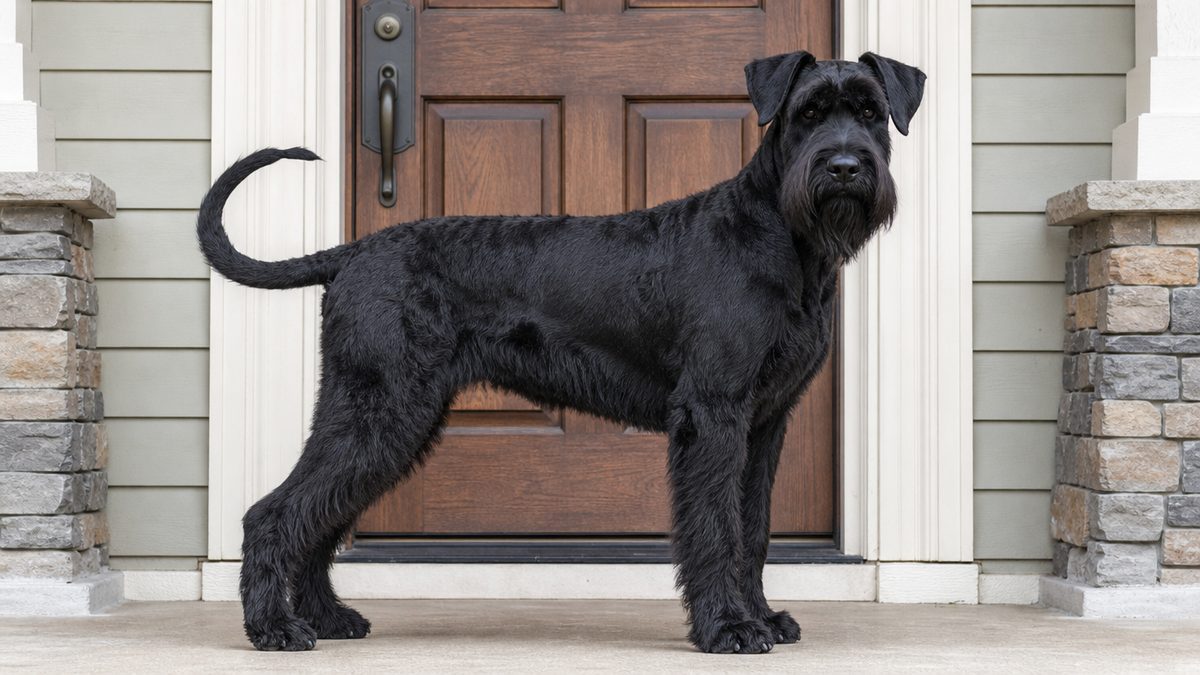
The look is a square, powerful, wiry-coated black or grey dog with a beard, bushy eyebrows and drop ears. The FCI describes a square build in which height at the withers is nearly equal to body length, and gives a head proportion rule that is worth knowing because it is measurable: the length of the head from the tip of the nose to the occiput corresponds to half the length of the topline from the withers to the set on of the tail. The Royal Kennel Club states the same rule as an approximate 1:2 ratio. Ears are neat, V-shaped, set high and dropping forward to the temple in both standards, and the FCI's tail entry reads simply: natural, with a sabre or sickle carriage sought after The Royal Kennel Club.
Coat colour, and the one the standards recently widened
Three colours are permitted and everything else is out. The FCI lists pure black with black undercoat, pepper and salt, and black and silver, and its 2021 text marks the entire Black/Silver passage in bold as its latest amendment, describing white markings over the eyes, on the cheeks, at the beard, at the throat, in two divided triangles at the front of the chest, on the front pasterns, on the feet, on the inside of the hind legs and around the anus. The Royal Kennel Club lists the same three and adds that any other colour or combination of colours is unacceptable. Its Colour Watch entry is Category 0, meaning the breed has no non-breed-standard colour registration options at all.
The FCI lists not clearly separated triangles on the chest as a fault and a patchy black-and-silver coat as a severe fault. If you are being sold a black and silver Giant Schnauzer in India, that chest marking is the cheapest single check you can run on the photograph before you travel.
The coat itself is the thing most Indian owners get wrong, so it is worth stating precisely. The FCI requires it to be wiry, harsh and dense, consisting of a dense undercoat and a not too short topcoat lying close to the body, with the topcoat rough and sufficiently long to allow the checking of its texture, neither bristly nor wavy. That last clause is a judging instruction, and it is also a maintenance instruction: a coat you cannot check the texture of has been clipped.
Size and weight, where three registries give three answers
Measure a Giant Schnauzer against the FCI, the AKC and the Royal Kennel Club and you get three incompatible answers, and the weight gap reaches 10 kg. That is not trivia here, because bodyweight relative to the breed mean is the single heat-illness risk factor that genuinely transfers to this breed.
| Registry | Height, males | Height, females | Weight, males | Weight, females |
|---|---|---|---|---|
| FCI Standard 181 | 60-70 cm | 60-70 cm | 35-47 kg | 35-47 kg |
| AKC | 25.5-27.5 in, 64.8-69.9 cm | 23.5-25.5 in, 59.7-64.8 cm | 75-95 lb, 34.0-43.1 kg | 55-80 lb, 24.9-36.3 kg |
| The Royal Kennel Club | 65-70 cm | 60-65 cm | None published | None published |
Three separate disagreements sit in that table. The FCI declines to split the height by sex and gives one 60 to 70 cm band for both, while the AKC and the Royal Kennel Club both split it, which means an FCI-correct 61 cm male is undersize under the other two American Kennel Club The Royal Kennel Club. The Royal Kennel Club publishes no weight at all, and then attaches a note to prospective puppy buyers explaining that the size described does not imply a dog will match the measurements given, height or weight, for a weight it never gave. And the AKC's female floor of 55 pounds is 24.9 kg, which is 10.1 kg below the FCI's minimum of 35 kg for either sex.
Why the 10 kg gap is the load-bearing number on this page
A bitch weighing 26 kg is a correct AKC Giant Schnauzer and a disqualifiably light FCI one, and the difference changes how she experiences an Indian summer. The UK heat-illness analysis found dogs with bodyweight equal to or greater than the relative breed and sex mean had 1.42 times the odds of heat-related illness, 95 percent confidence interval 1.12 to 1.80. That factor is expressed relative to the breed mean, so the mean you use matters, and an owner who has silently adopted the AKC's lighter American population as the reference will misjudge where their own dog sits.
The over-50 kg band does not apply, and the arithmetic says so
The same study found dogs over 50 kg carried 3.42 times the odds of heat-related illness, 95 percent confidence interval 1.54 to 7.57, compared with dogs under 10 kg. It is tempting to reach for that figure on a breed people call giant. It does not apply. The FCI's ceiling is 47 kg, which is 3 kg below the threshold, and the AKC's ceiling is 95 pounds, or 43.1 kg, which is nearly 7 kg below it American Kennel Club. No dog built to either standard enters that band. Only an overweight one does, which is a different argument and a better one.
Two papers by the same authors, on the same 905,543-dog VetCompass 2016 cohort, are routinely cited as one. The Scientific Reports paper, 10:9128, identifies 395 confirmed heat-related illness events and is the source of the 1.42 bodyweight odds ratio and the 3.42 over-50 kg figure. The Animals paper, 10(8):1324, identifies 1,259 events from 1,222 dogs and is the source of the exertional trigger split. Neither models the Giant Schnauzer. The Animals paper's breed list includes the Miniature Schnauzer at 0.49, not significant, and no Giant Schnauzer at all.
The size dispute has one more practical consequence. FCI 181 grades deviation rather than ignoring it: over or undersize up to 2 cm is a fault, more than 2 cm but less than 4 cm is a severe fault, and more than 4 cm disqualifies. The Royal Kennel Club simply calls variations outside its limits undesirable. So an Indian buyer with a tape measure can grade a puppy's parents against the FCI scale precisely, and cannot against the British one.
Giant Schnauzer price in india, and why almost none of it is verifiable
One Indian source publishes a Giant Schnauzer price in india of Rs 30,000 to Rs 80,000 and does not say how it got there, and India's largest marketplace publishes no Schnauzer price at all. Everything below is what could actually be observed, with the conversion tests shown.
The India-restricted search results for this breed are unusual in that they are not contaminated by another breed, they are simply thin. Positions one and two are an Instagram tag page and a Facebook page titled Life with India's First Giant Schnauzer, whose own search description is polluted with a motorcycle advertisement. Position three is an Indian breed guide with a price band. Position four is a marketplace page for undifferentiated Schnauzers. Positions six and seven are a United States breeder and a Canadian guide. That is the entire Indian evidence base for this breed's price.
| Figure | Source | Divided by 84.38 | Divided by 74 | Divided by 66.67 |
|---|---|---|---|---|
| Rs 30,000 | Indian breed guide, bottom of band | 355.54 | 405.41 | 450.00 |
| Rs 80,000 | Indian breed guide, top of band | 948.09 | 1,081.08 | 1,200.00 |
| Rs 40,000 | Instagram carousel, basic puppy | 474.05 | 540.54 | 600.00 |
| Rs 5,700 | Indian breed guide, basic monthly | 67.55 | 77.03 | 85.49 |
| Rs 8,550 | Indian breed guide, premium monthly | 101.33 | 115.54 | 128.24 |
Read the quotients, not the divisions. Nothing clears 84.38 or 74 as a whole number of dollars. The three purchase figures do divide neatly at 66.67 into 450, 1,200 and 600, but 66.67 is 200 divided by 3, so every multiple of 1,000 passes that test by construction and it carries no information at all. The one detail that gives pause is that Rs 80,000 at 66.67 lands on 1,200 and a Canadian guide co-ranking on the same query quotes 1,200 to 3,500 dollars as its bottom figure. That is a coincidence worth recording and not enough to call a conversion, so Bonbeno records it and calls nothing.
The marketplace tells you more than the price does
India's largest pet platform has no Giant Schnauzer category at all. Its breed dropdown runs to several hundred entries and includes Miniature Schnauzer, Schnoodle, Schnorkie, an undifferentiated Schnauzer and even the German Spitz, but no Giant Schnauzer and no Standard Schnauzer. The Schnauzer page it does serve returns six dogs, all male, five in Bangalore and one in Delhi, with sizes never stated, and every price replaced by a View Price link that leads to a sign-up form. Its own popular-breeds sidebar on the same page lists 650 Shih Tzus, 549 Siberian Huskies, 487 Golden Retrievers, 454 Labrador Retrievers and 412 German Shepherds.
Six listings with hidden prices, no size division and no stated pedigree standard is not a market you can benchmark against. Bonbeno publishes no Indian price band for the Giant Schnauzer, because the only published band comes from a single page that also prints a monthly cost table generated by multiplying its own basic column by 1.5. Ask three sellers directly, in writing, and compare their answers to each other rather than to anything online.
For context on what a real Indian market looks like, the same marketplace carries hundreds of listings per breed for the popular imports and publishes city-by-city bands for them. The Giant Schnauzer has none of that. India is a full FCI member through the Kennel Club of India in Chennai, so the breed is registrable here and an FCI-nomenclature pedigree is possible Kennel Club of India, official site. What does not exist is a supply chain deep enough to produce a price you could call a market rate.
Monthly cost of ownership, and the one Indian table that exists
One Indian page publishes a monthly figure of Rs 5,700 basic and Rs 8,550 premium for this breed, and its arithmetic shows how the number was made. Bonbeno reproduces it, shows the working, and explains what it leaves out.
| Line item | Basic | Premium | Premium divided by basic |
|---|---|---|---|
| Food | Rs 3,000 | Rs 4,500 | 1.5 |
| Veterinary | Rs 1,500 | Rs 2,250 | 1.5 |
| Grooming | Rs 1,200 | Rs 1,800 | 1.5 |
| Total | Rs 5,700 | Rs 8,550 | 1.5 |
Both totals reconcile exactly, which is to the page's credit, and every premium figure is exactly 1.5 times its basic counterpart, which is not. A survey of Indian food, veterinary and grooming costs would not return the same multiplier across three unrelated categories. This is a base column with a formula applied to it, and a reader should treat the premium column as an assumption rather than as data.
Four costs that table does not contain
- Toe surveillance and the surgery it leads to. This is the breed's defining expense and no Indian page prices it. Digital amputation is the treatment for subungual squamous cell carcinoma, and 27 of 41 surveyed Giant Schnauzers went on to need it on a further toe. Budget for repeat surgeries in the second half of the dog's life, not one.
- Hand stripping. A wiry coat is stripped, not clipped, and the Royal Kennel Club grades grooming for this breed as every day. Few Indian groomers strip, so the realistic outcome is that you learn to do it or you accept a clipped coat and its consequences.
- Screening you have to arrange yourself. Hip and elbow scoring, a prcd-PRA DNA test, DCM and PRA5 DNA tests, eye screening and hyperuricosuria are all named by the Royal Kennel Club for this breed. Almost none of that is routine in Indian general practice, so it is a cost and a logistics problem.
- Cooling. For a black, dense-coated 40 kg dog in Delhi, where the June mean is 35.88 C, air conditioning through the afternoon is not a luxury line item, it is part of the animal's welfare.
Food is the line most likely to be understated. The same Indian guide puts an adult Giant Schnauzer at 2,300 kcal a day and a puppy at 2,000 kcal, and Rs 3,000 a month for 2,300 kcal a day works out to about Rs 100 a day, which buys a modest quantity of mid-tier Indian kibble and very little else. A large working dog fed to condition on a good diet in an Indian metro will cost more than that, and the honest instruction is to price your own dog's daily ration at your own local rate rather than to trust the band.
Bonbeno publishes an Indian cost table when it has Indian sources for each component. For this breed there is exactly one published table and its premium column is a multiplier. Reproducing it with the arithmetic exposed is more useful than inventing a competing number, and building your own from three local quotes will beat both.
Suitability for the Indian climate
The Giant Schnauzer is heat-sensitive in every Indian metro, and the case rests on bodyweight, coat colour and coat density rather than on a borrowed odds ratio. Munich, where the breed was built, runs an annual mean of 8.47 C against Delhi's 25.60 C.
| Location | Annual mean air temperature | Hottest month mean | 20-year maximum | Annual mean relative humidity |
|---|---|---|---|---|
| Munich, the breed's home city | 8.47 C | 18.32 C in July | 35.44 C | 83.20 percent |
| Delhi | 25.60 C | 35.88 C in June | 48.79 C | 45.56 percent |
| Chennai, Tamil Nadu | 27.95 C | 31.51 C in May | 42.70 C | 72.39 percent |
The gap that matters is the mean, not the peak. Delhi runs 17.13 C warmer than Munich on the annual mean, and Delhi's June mean of 35.88 C is 17.56 C above Munich's warmest month. Chennai never gets a cool season at all: its coldest month averages 24.41 C, which is 6.09 C warmer than Munich's hottest. A Giant Schnauzer in Chennai spends its whole life above the temperature its breed's home city reaches at the top of summer.
Reasoning the heat rating rather than borrowing one
This breed was not modelled in either UK heat-illness paper, and a search of both texts for Schnauzer returns nothing in the Scientific Reports analysis and only the Miniature Schnauzer in the Animals analysis Hall EJ, Carter AJ. So the breed-specific odds ratios are unavailable and borrowing one would be fabrication with a citation attached. Three things do transfer honestly. Bodyweight at or above the breed and sex mean carries 1.42 times the odds. Purebred dogs carry 1.86 times the odds of crossbreds, confidence interval 1.39 to 2.49. And the paper's own discussion identifies coat type as a probable risk factor, noting that the very thick-coated Chow Chow had the greatest risk of all breeds studied at an odds ratio of 16.17.
The Giant Schnauzer is a heavy, purebred, dense double-coated dog that is most commonly black. Black absorbs more solar radiation than pepper and salt does, and that is a genuine difference between two dogs of the same breed standing in the same Indian sun. Bonbeno rates heat tolerance at 2 out of 5 on that reasoning, notes that the over-50 kg band does not apply because the standards cap the breed at 47 kg, and shows the working rather than asserting a number.
The trigger Indian owners consistently misjudge
The dangerous moment is a walk, not a car. In the companion analysis, 380 of 1,259 heat-illness events had no trigger recorded, and of the remaining 879, 652 were exertional, which is 74.2 percent, against 113 environmental and 46 from vehicular confinement. Exertional events occurred year-round with a 7.6 percent fatality rate. For a breed the Royal Kennel Club places in its top exercise band at more than two hours a day, that is the central conflict of owning one in India: the dog needs the exercise that is also the main way it gets hurt.
Munich's annual mean relative humidity is 83.20 percent, higher than Chennai's 72.39 percent and far higher than Delhi's 45.56 percent NASA POWER, 20-year climatology NASA POWER, 20-year climatology. Humidity alone does not distinguish the climates. Humidity at 28 C rather than at 8 C does, because evaporative cooling from panting collapses as the air approaches saturation at high temperature. Chennai is the harder posting for this dog, not Delhi, despite Delhi's higher peaks.
Temperament and household fit
The Giant Schnauzer is a bold, composed, intensely loyal working guardian, and the households it suits are the ones that will actually work it. Every standard agrees on the temperament, and every standard also assumes a job.
The FCI describes good natured, even temperament and incorruptible loyalty towards its master, alongside highly developed sense organs, intelligence, trainability, strength, endurance, speed and resistance to weather and diseases, and says the breed's inborn ability to bear strain and its self-assurance make it best suited to being a companion, sporting, utility and working dog. The Royal Kennel Club condenses the same thing to four words for temperament, bold, reliable, good natured and composed, and characterises the breed as versatile, strong, hardy, intelligent and vigorous.
Neither of those descriptions is of a passive family pet, and the honest reading is that this is a working dog that can also be a family dog if it is worked. Wikipedia records that in several countries including Germany a Giant Schnauzer must earn a Schutzhund champion title before it can qualify as a conformation champion, and that European Schnauzer clubs focus on working ability rather than show wins. That is the culture that shaped the temperament you are buying.
Who should buy one in India
- Owners with a house, a garden and genuinely two free hours a day, which is the Royal Kennel Club's own specification for this breed.
- People who want a dog sport. Obedience, tracking, agility, nosework and protection sport are what this brain was built for, and India's dog sport scene in Bengaluru, Pune and the NCR is now large enough to support it.
- Households needing a real deterrent who understand that a real deterrent is a liability as well as an asset.
- Experienced owners who have already raised a large, driven dog and know what adolescence looks like at 40 kg.
Who should not
- Apartment dwellers. The Royal Kennel Club specifies a large house and a large garden, and this is the recommendation Indian buyers most often ignore.
- First-time dog owners, for whom the combination of size, drive, coat and cancer surveillance is genuinely too much.
- Anyone in a city where the dog cannot be walked for nine months of the year at any hour they are awake.
- Anyone buying for looks. A cropped, clipped Giant Schnauzer bought as a status object is a mutilated dog with a ruined coat, and both of those are avoidable choices.
One published trait is worth flagging because it is reassuring and slightly surprising. The Royal Kennel Club's Breed Watch entry for the Giant Schnauzer is Category 1, meaning no points of concern specific to this breed have been identified for special attention by judges beyond those already covered by the breed standard, and there are no breed-specific breeding restrictions in place. For a large working breed, that is a good conformation record, and it is worth saying alongside the cancer figures rather than instead of them.
Training a Giant Schnauzer, and the window that closes at sixteen weeks
Train a Giant Schnauzer with structured daily work from the day it arrives, and spend the socialisation window before sixteen weeks on strangers rather than on obedience. This breed learns faster than most owners teach, which is the whole problem.
The FCI names trainability directly, in a list with intelligence, strength, endurance and speed. The Royal Kennel Club calls the breed intelligent and vigorous. Nothing in the literature suggests this dog is difficult to teach. What it is, is difficult to under-teach: a guarding breed with a fast brain and no job will invent one, and the job it invents in an Indian building is usually managing who comes down the corridor.
The socialisation window, in Indian conditions
Use the socialisation window between roughly three and sixteen weeks on people, not on commands. For a guarding breed the highest-value exposures are the ones an Indian household repeats daily: house help arriving and leaving, watchmen, delivery riders in helmets, lift doors, other residents, children on stairs, and the sound of a gate. Each one should be paired with food and end in nothing happening. The complication is the vaccination schedule, which the Dog Breeding and Marketing Rules describe as starting at seven to eight weeks and usually completing at eighteen weeks, after the window has shut. Socialise on clean surfaces, in low-density settings, from week eight, rather than waiting for the last shot.
A five-step plan for the first year
- Book the daily session before the daily walk. Fifteen minutes of structured work, twice a day, does more for a Giant Schnauzer than an extra half hour of walking, and it can happen indoors at 2 pm in May when walking cannot.
- Teach a settle on a mat before you teach anything impressive. A 40 kg dog that can switch off in a room full of visitors is the single most valuable behaviour you will ever install.
- Put the guarding on cue rather than trying to remove it. Reward one alert bark and a look at you. A breed selected to guard breweries will not stop noticing arrivals, and pretending otherwise sets both of you up to fail.
- Handle the feet from week eight, every day. This breed needs its toes examined for life, and a dog that dislikes foot handling turns a two-minute check into a sedation.
- Give it a sport by nine months. Nosework is the most heat-compatible option in India, because it can run indoors, and this breed is genuinely good at it.
What this breed resists
It resists boredom and it resists inconsistency. A dog that has already understood a cue will stop offering it if the tenth repetition pays nothing, and an adolescent guardian that gets a different answer from each family member will pick the most permissive one. Realistic timelines are a settled house-training routine by twelve to sixteen weeks, a solid indoor recall by four months, reliable mat settling by six months, and adolescence peaking somewhere between eight and fourteen months, which is exactly when most owners quietly give up on the two-hour exercise requirement.
Daily exercise needs, and the two published figures that differ by 100 percent
Give an adult Giant Schnauzer about 90 minutes of real work a day in India, split across the two safe hours, and accept that this is a compromise against the Royal Kennel Club's own figure. Two published sources disagree by a factor of two, and this page publishes both.
| Source | Figure published | Basis |
|---|---|---|
| The Royal Kennel Club | More than 2 hours per day | Its highest exercise band, on the breed's own A to Z entry |
| Indian breed guide | 60 to 90 minutes | Stated as an exercise routine, no method given |
| Bonbeno | About 90 minutes, split, plus daily brain work | Reasoned below |
The Royal Kennel Club, the registry that writes this breed's British standard, puts it in its top exercise band at more than two hours per day. The leading Indian breed guide gives 60 to 90 minutes. Those cannot both be right, and the gap is not a rounding difference. Bonbeno lands nearer the Indian figure than the British one, and it is worth being explicit about why, because the reason is not that the British figure is wrong.
Justifying the lower number honestly
The Royal Kennel Club's figure describes what the breed needs. The Indian figure describes what an Indian owner can safely deliver. In Delhi from March to October there are roughly two hours a day, before sunrise and after dark, when a black 40 kg dog can work on outdoor surfaces without meeting the exertional heat risk that accounted for 74.2 percent of triggered heat-illness events in the UK data. Ninety minutes of genuine work inside that window, plus 20 to 30 minutes of indoor scentwork or training at midday, is closer to two hours of load than the raw walking figure suggests. Publishing two hours and letting an owner attempt it at 4 pm in June would be worse advice than publishing 90 minutes and saying when.
How to split an Indian day
- Before sunrise, 45 to 60 minutes. The main session. Fast walking, hill work if you have it, and structured heeling rather than a sniff-and-stroll.
- After dark, 30 to 40 minutes. Test the tarmac with the back of your hand first, because a surface that felt survivable at 6 pm still holds heat at 8 pm.
- Midday, indoors, 20 to 30 minutes. Nosework, food puzzles, retrieve-to-hand, mat work. This is not a substitute for walking and it is not optional either.
- Never between 11 am and 5 pm from March to October in Delhi, Ahmedabad, Nagpur, Hyderabad or anywhere with a comparable summer.
- Cool the dog before it looks hot. Wet the belly, groin and paws rather than pouring water over a dense back coat, which mostly wets the topcoat and traps heat underneath.
The consequence of under-exercising is not a bored dog, it is a heavier dog. Weight gain in this breed loads hips that OFA already records as 17.5 percent dysplastic across 5,902 evaluations, and it pushes the animal toward the bodyweight-above-breed-mean band that carries 1.42 times the heat-illness odds Hall EJ, Carter AJ. The exercise problem and the heat problem are the same problem, running in a loop.
Grooming a harsh wiry coat in Indian humidity
Hand strip a Giant Schnauzer rather than clipping it, brush the beard and furnishings daily, and dry the undercoat to the skin after every wetting. The Royal Kennel Club grades this breed's grooming as every day, which is the highest it uses.
The coat you are maintaining is described precisely. The FCI requires wiry, harsh, dense hair, a dense undercoat under a not too short topcoat lying close to the body, with the topcoat rough and sufficiently long to allow the checking of its texture, neither bristly nor wavy, and hair on the limbs that tends to be less harsh. The Royal Kennel Club adds that the coat should be just short enough for smartness on the body, clean on throat, skull, ears and under tail, with a good undercoat and harsh hair on the legs.
Why clipping is the wrong answer, and what to do in Indian heat instead
Clipping cuts the harsh outer hair rather than removing it at the root, and the regrowth is softer, denser and duller. On a breed whose standard asks a judge to check the texture of the topcoat, that is a permanent change, and in Indian conditions a soft dense coat holds moisture and heat better than a harsh open one does. The correct summer intervention is to strip out the dead topcoat and thin the undercoat, which removes the layer actually trapping heat, and to leave the working coat structure alone. Very few Indian groomers strip. Ask before you book, and be prepared to learn it yourself with a stripping knife and a rhythm of small sections weekly rather than one heroic session a year.
A working routine for an Indian household
- Beard and moustache, daily. The FCI's not too soft beard on the muzzle is a food and water trap, and in Indian humidity a permanently damp beard turns yeasty fast.
- Leg furnishings and eyebrows, every two days. Harsh hair on the legs mats where it meets the softer body coat, and matting on the lower legs hides ticks.
- Body coat, weekly stripping in sections. Rolling the coat in small weekly sessions is far easier on the dog and on you than a full strip twice a year.
- Dry to the skin after every bath and every monsoon walk. A dense undercoat that stays damp at 28 C is a hot spot in waiting, and towel drying only reaches the topcoat.
- Feet, weekly, with the toes examined individually. This is the highest-value ten minutes in this breed's entire care routine, and it belongs in the grooming habit rather than in a separate health task.
The Royal Kennel Club's A to Z entry answers Sheds with a flat No, while the Indian breed guide records Moderate Shedding, and the FCI standard specifies a dense undercoat that has to go somewhere HappyPet.care, Giant Schnauzer Breed Guide Federation Cynologique Internationale. Bonbeno publishes both and sides with neither absolutely. A stripped wiry coat sheds very little into a room. An unstripped one drops dead undercoat continuously, especially in a climate with no clear seasonal cue. What you experience depends on how you groom, which is probably why the two sources disagree.
Health issues, screening and life expectancy
Check this dog's toes every week for its whole life, because the Giant Schnauzer carries the largest single-breed odds ratio in the canine digital-tumour literature. Hips, elbows, thyroid and eyes come next, and all four have real published numbers.
Start with the register. The Giant Schnauzer holds OFA breed code GSC, read directly from OFA's own markup rather than guessed, and OFA files it under the AKC Working Group, the CKC Working Group, the UKC Guardian Dog Group and the Kennel Club Working Group. Unlike many breeds it has substantial published statistics, which makes it one of the better-evidenced large breeds an Indian buyer can research.
| Registry | Evaluations | Normal | Key abnormal finding | Rank |
|---|---|---|---|---|
| Hips | 5,902 | 81.1 percent | 17.5 percent dysplastic, split 12.0 mild, 4.9 moderate, 0.6 severe | 68 |
| Elbows | 1,701 | 89.9 percent | 9.9 percent abnormal, split 8.3 grade 1, 1.4 grade 2, 0.2 grade 3 | 50 |
| Thyroid | 1,565 | 80.8 percent | 5.4 percent compatible with autoimmune thyroiditis, 12.2 percent equivocal | 27 |
| Eyes | 1,190 | 96.2 percent | 3.8 percent abnormal | 138 |
| Patella | 67 | 100 percent | No abnormal results recorded | 167 |
Every row sums correctly, which is worth checking and worth saying. On hips, 11.9 excellent plus 52.9 good plus 16.2 fair is 81.0 against a printed normal of 81.1, and 12.0 plus 4.9 plus 0.6 is exactly the printed 17.5 dysplastic. On elbows, 8.3 plus 1.4 plus 0.2 is exactly 9.9. On thyroid, 80.8 plus 1.0 plus 5.4 plus 0.6 plus 12.2 is exactly 100. Note the patella row's denominator: 67 evaluations is too small to mean much, and a 100 percent normal figure on 67 dogs should not be read as evidence the breed has no patella problem.
OFA's eye summary for this breed reports 96.2 percent normal across 1,190 evaluations, while a per-diagnosis detail row on the same 1,190 denominator reports 938 affected, which is 78.8 percent. Those two cannot describe the same population. Bonbeno could not resolve which diagnosis that detail row is labelled with in this retrieval, so it publishes the summary, names the inconsistency, and quotes neither figure as the breed's eye disease rate.
Toe cancer, the finding that should decide the purchase
Subungual squamous cell carcinoma is a tumour of the nail bed that destroys the bone of the toe, and the Giant Schnauzer is the most predisposed breed ever measured for it. In a Canadian retrospective covering 278,630 canine biopsy submissions from 2003 to 2021, 1,518 were subungual squamous cell carcinomas, and 100 of the 422 submissions from Giant Schnauzers, 23.7 percent, were that one tumour. The resulting odds ratio against dogs in general is 56.7, with a 95 percent confidence interval of 45.0 to 71.4, the highest in the study. Standard Schnauzers came second at 20.3, Gordon Setters third at 18.3, black Standard Poodles at 11.1, Kerry Blue Terriers at 9.4 and Rottweilers at 7.0.
Two numbers change what an owner should do. First, recurrence on other toes: of 41 surveyed Giant Schnauzers, 27, or 66 percent, developed a further tumour on an additional digit, most within two years of the first diagnosis. Second, the prognosis is far better than the word cancer suggests: there were no local recurrences after digital amputation across the whole survey, and suspected metastasis occurred in 4 of 106 dogs, or 4 percent. So the correct posture is surveillance and early amputation, not fear. A toe examined weekly and amputated early is a dog that keeps living.
Three studies, one breed, a four-fold disagreement
| Study | Region | Odds ratio | Reference group | Giant and Standard separated? |
|---|---|---|---|---|
| Chiu et al. 2022 | Canada, 278,630 submissions | 56.7 (45.0-71.4) | All dogs in the series | Yes |
| Goldschmidt and Shofer 1998 | Pennsylvania | 14.6 (5.8-36.3) | Dogs in general | Yes |
| Grassinger et al. 2021 | Germany and 23 other European countries | log OR 2.61, about 13.6 | Mongrels | No, pooled as Schnauzer |
A four-fold spread across three good studies needs an explanation rather than an average, and the most likely one is visible in the third row. Grassinger's European series contained 411 Schnauzers, 228 giant and 183 standard, and reported a single pooled log odds ratio of 2.61 for Schnauzer against mongrels. Chiu's Canadian series, which did separate them, gives the Standard Schnauzer 20.3 against the Giant's 56.7. Pooling a breed at 56.7 with a breed at 20.3 in near-equal numbers necessarily drags the combined figure down toward the lower one. That is a reading rather than a proof, and it is offered as such, but it fits both datasets and no source has published it.
Grassinger's study is worth reading for a second reason. It found Schnauzers significantly less likely than mongrels to develop subungual keratoacanthoma, the benign lookalike, at log OR minus 0.97, and significantly less likely to develop digital inflammation, at log OR minus 1.71. The authors suggest the low keratoacanthoma rate implies de novo development of digital squamous cell carcinoma rather than malignant transformation of a benign precursor. For an owner that has a blunt practical meaning: in this breed, a sore toe is less likely to be a simple infection than it would be in a mongrel, so it warrants imaging and biopsy sooner.
Everything beyond the toes, including what to screen for and how long the breed actually lives, is covered in the next section.
What else the breed carries, and what to screen for
Screen a Giant Schnauzer for hips, elbows, eyes, thyroid and heart, in that order of published evidence. The Royal Kennel Club splits its own recommendations into two tiers for this breed, and both tiers are worth asking a seller about by name.
| Tier | Test or scheme | What it covers |
|---|---|---|
| Good Practice | BVA and Royal Kennel Club Hip Dysplasia Scheme | Hip scoring, against an OFA-recorded 17.5 percent dysplastic rate |
| Good Practice | BVA and Royal Kennel Club Elbow Dysplasia Scheme | Elbow grading, against an OFA-recorded 9.9 percent abnormal rate |
| Good Practice | DNA test, prcd-PRA | A late-onset inherited form of progressive retinal atrophy |
| Good Practice | Prioritising genetic diversity | Inbreeding coefficient of the proposed mating |
| Best Practice | DNA test, dilated cardiomyopathy | Heart muscle disease, with a published list of tested dogs |
| Best Practice | DNA test, PRA5 | A second inherited retinal atrophy variant |
| Best Practice | BVA, Kennel Club and ISDS Eye Scheme, including litter screening | Clinical eye examination rather than a DNA result |
| Best Practice | Hyperuricosuria | A urinary stone risk variant |
Ask for all eight by name and expect not to get all eight. Almost none of this is routine in Indian general practice, so a domestic breeder is unlikely to hold BVA scheme certificates, and an honest one will say so rather than producing a vague health certificate. What a serious breeder can always produce is a hip and elbow result from somewhere, a dated eye examination, and a DNA panel from a commercial laboratory, and a seller who cannot produce any of the three has screened for nothing.
The Canadian study's abstract gives its denominator as 278,812 canine biopsy submissions, while its Results section and its Table 3 both give 278,630. That is a 182-submission discrepancy inside one paper. It is far too small to move any odds ratio meaningfully, and it is worth naming rather than quietly picking one, because a reader checking this page against the abstract would otherwise think Bonbeno mistyped. Every figure on this page uses 278,630, which is what the paper's own results and tables carry.
What else the breed carries
- Hip and elbow dysplasia, both described as common and both covered by BVA screening schemes the Royal Kennel Club places under Good Practice.
- Hypothyroidism, including an autosomal recessive form, with OFA recording 5.4 percent compatible with autoimmune thyroiditis and 12.2 percent equivocal on 1,565 tests Wikipedia, Giant Schnauzer.
- Eye disease, including keratoconjunctivitis sicca, glaucoma, cataracts, multifocal retinal dysplasia and generalised progressive retinal atrophy, with prcd-PRA and PRA5 DNA tests both named by the Royal Kennel Club.
- Dilated cardiomyopathy, for which the Royal Kennel Club lists a DNA test under Best Practice and publishes a list of tested dogs.
- Selective cobalamin malabsorption, central diabetes insipidus, narcolepsy and cataplexy, all reported in the breed and all rare.
- Skin conditions including seasonal flank alopecia, vitiligo and follicular cysts, plus a general predisposition to skin tumours in dark-coated dogs.
Life expectancy
Three sources give three answers. The AKC publishes 10 to 13 years, the Royal Kennel Club publishes over 12 years, and one Indian guide publishes 12 to 15 The Royal Kennel Club HappyPet.care, Giant Schnauzer Breed Guide. The measured evidence is a 2024 UK analysis of 584,734 dogs including 284,734 deceased, which gives median survival of 12.5 years across all dogs, 12.7 years for purebreds against 12.0 for crossbreds, and 11.9 years for large purebreds specifically. That paper's breed-level medians sit in a supplementary table Bonbeno could not open, and Wikipedia reads that table as giving the Giant Schnauzer 12.1 years. Wikipedia's accompanying figures of 12.7 and 12.0 match the paper's published body exactly, which is partial corroboration, but the 12.1 itself is reported here as Wikipedia's reading rather than as a figure verified against the source. For a wider baseline, a separate UK life-table analysis puts life expectancy at age 0 for all UK companion dogs at 11.23 years.
Feeding and body condition
Feed a Giant Schnauzer to a visible waist and a felt rib, and split the daily ration into two meals for the whole of the dog's life. A dense wiry coat hides weight gain, and weight gain is the mechanism that links this breed's joints to its heat risk.
Check condition by hand every week rather than by eye. You should feel the ribs easily under a thin fat cover, see a waist behind the ribcage from above, and see an abdominal tuck from the side, which the FCI describes in the standard itself as flanks not too tucked up, forming a well curved line with the underside of the ribcage. On a coated black dog the visual check that works on a short-coated breed fails, and owners routinely discover three or four kilograms only when a groomer strips the coat.
Life-stage feeding for a large, slow-maturing working breed
- 8 to 16 weeks: four meals a day of a large-breed puppy food. Large-breed formulations matter here because controlled calcium and controlled growth rate reduce developmental joint disease in a breed already carrying 17.5 percent dysplastic hips.
- 4 to 8 months: three meals a day, and resist the temptation to push growth. A leaner adolescent large-breed dog has better joints at five years.
- 8 to 18 months: two meals a day. This breed matures slowly and adolescent appetite peaks well before adult size is finished.
- Adult: two meals a day, portioned to hold condition through the seasons. Indian summers cut activity sharply, so the January portion is usually too much in May.
- Senior, from about 7 to 8 years: two meals, watch for muscle loss over the topline and hindquarters, and reassess if walking distance falls. This is also the age band in which toe tumours start appearing, with a mean age at first diagnosis around 10 years.
Never feed one large meal a day and never exercise hard on a full stomach. Bloat appears on the Indian breed guide's own health list for this breed, and while Bonbeno found no Giant Schnauzer-specific incidence figure it could verify, the deep-chested large-breed pattern is well established and the management is free. Split the ration, let the dog settle for an hour either side of hard work, and treat sudden unproductive retching with a distended abdomen as an emergency rather than as indigestion.
What is available in India, and one number to sanity-check
Large-breed complete diets from the major brands are stocked in every Indian metro and that is the practical baseline. The Indian guide puts an adult at 2,300 kcal a day and a puppy at 2,000 kcal, which is in a plausible range for a 40 kg working dog, and prices food at Rs 3,000 to Rs 4,500 a month. Divide that out and the basic figure is about Rs 100 a day for 2,300 kcal, which is achievable on mid-tier Indian kibble and not on a premium large-breed diet. Price your own dog's actual daily ration at your own local rate before you trust the band.
A black, dense-coated 40 kg dog in an Indian summer loses a great deal of water to panting, and central diabetes insipidus is among the conditions reported in the breed, which presents as dramatically increased thirst and urination. Keep genuinely cool water available at all times, and treat a sudden sustained jump in water intake as a reason to see a veterinarian rather than as a reason to buy a bigger bowl.
The first year, month by month
Get the socialisation, the foot handling and the growth rate right in the first six months and the rest of this dog's life is manageable. Here is what each stage requires in an Indian household.
| Age | What is happening | What you do |
|---|---|---|
| Under 8 weeks | Still with the litter. Sale below this age is prohibited under Rule 8(1)(a) | Visit, measure and weigh both parents against the FCI's 60-70 cm and 35-47 kg, and ask for hip, elbow and prcd-PRA results. Do not take the puppy |
| 8 to 12 weeks | Vaccination starts around seven to eight weeks. The socialisation window is open | Daily controlled exposure to house help, watchmen, delivery riders and lifts. Begin daily foot handling and two-minute grooming sessions |
| 12 to 16 weeks | Window closes near sixteen weeks. Adult teeth begin | The highest-value weeks of the dog's life for a guarding breed. Start mat settling. Keep exercise short and low-impact on growing joints |
| 4 to 6 months | Vaccination usually completes near eighteen weeks. Rapid growth | First stripping session with a professional if you can find one. Large-breed puppy food, measured. Recall games indoors and in enclosed space |
| 6 to 9 months | Adolescence. Guarding behaviour emerges. Coat texture changes | Hold the training line and the exercise routine through the hot season. Book a veterinary joint check. Introduce a sport |
| 9 to 12 months | Approaching adult height, still filling out | Move to two adult meals a day. Establish the weekly toe examination as a permanent habit. Baseline eye examination |
The three moments that decide the outcome
Twelve to sixteen weeks is the one you cannot redo. The socialisation window shuts near sixteen weeks while the Indian vaccination course typically completes at eighteen. On a guarding breed, an owner who waits for the last injection before letting the puppy meet strangers gets an adult that treats every stranger as an event, and at 40 kg that is not a quirk.
The first hot season is the second. A puppy that arrives in Delhi in December meets its first 48 C-capable summer with a full adult coat coming in and no experience of the heat. Move the schedule before the heat arrives, and take the first summer as the year you build the indoor training habit that will carry every subsequent summer.
The first stripping is the third. An owner who has only ever brushed the coat will meet a dead, dull, blown topcoat somewhere around eight to twelve months and will be told by a groomer to clip it. Find someone who strips, watch them, and learn the rhythm. This is the decision that determines what the dog's coat looks like and how it copes with heat for the next decade.
Giant Schnauzer compared with the breeds Indian buyers cross-shop
Compare a Giant Schnauzer against the large black working dogs it is confused with and the differences are registry facts and published odds ratios, not opinions. The table below uses each breed's governing document and the same toe cancer study for all four.
| Breed | Height in its own standard | Toe cancer odds vs dogs in general | Royal Kennel Club group | AKC group |
|---|---|---|---|---|
| Giant Schnauzer | 60-70 cm both sexes per FCI 181 | 56.7, the highest measured | Working | Working |
| Standard Schnauzer | 48 cm dogs, 45.7 cm bitches per the Royal Kennel Club | 20.3 | Utility | Working |
| Miniature Schnauzer | Not covered by the standards read here | Not separately measured | Utility | Terrier |
| Rottweiler | Not covered by the standards read here | 7.0 | Working | Working |
| German Shepherd | Not covered by the standards read here | 0.5, a negative control | Pastoral | Herding |
The last row is the most important one on this page. The study deliberately included Newfoundlands, Bernese Mountain Dogs and German Shepherds as negative controls for large black and large black-and-tan dogs, and all three came back at or below the general population, at odds ratios of 1.1, 1.0 and 0.5. The authors' own conclusion is that being moderately large and black is not, by itself, enough to explain the breed predilections. So this is a Schnauzer problem specifically, not a big-dark-dog problem, and a buyer who has been told otherwise has been told something the data refutes.
The three Schnauzers are three breeds, filed three different ways
The AKC states it plainly on its own page: the Giant Schnauzer is not in fact a giant breed but simply the largest of the Schnauzers, and the three Schnauzers are distinct breeds. What no page mentions is that the registries then disagree about where they belong. Read from OFA's own breed register markup, the Giant Schnauzer is filed under the AKC Working Group, the CKC Working Group, the UKC Guardian Dog Group and the Kennel Club Working Group; the Standard Schnauzer under AKC Working but Kennel Club Utility; and the Miniature Schnauzer under the AKC Terrier Group but the Kennel Club Utility Group. The Royal Kennel Club's own standards index confirms it, serving the Giant Schnauzer from its Working path and the Schnauzer and Miniature Schnauzer from Utility The Royal Kennel Club.
What the Standard Schnauzer buys you instead
A Standard Schnauzer is the same dog at roughly two thirds the height and a third of the toe cancer odds. The Royal Kennel Club's ideal is 48 cm for dogs and 45.7 cm for bitches, with variations of more than 2.5 cm undesirable, against 65 to 70 cm for a Giant male The Royal Kennel Club. Its odds ratio for subungual squamous cell carcinoma is 20.3 against the Giant's 56.7. For an Indian buyer in a flat, with two safe walking hours a day and a hot nine months, that is a materially easier dog with the same beard, the same brain and the same wiry coat.
Bonbeno has not yet published Standard Schnauzer or Miniature Schnauzer pages, so the figures above come from the Royal Kennel Club and from the toe cancer study directly rather than from a sibling guide. When those pages are built they must reconcile against this table, and any disagreement should be published rather than smoothed.
Mistakes Indian Giant Schnauzer owners actually make
Never checking the toes is the mistake that kills, and it is the one no Indian page warns about. Six more follow, in the order they cost owners.
- Treating a swollen toe or a lost nail as an injury. In this breed it is a cancer until a pathologist says otherwise. Subungual squamous cell carcinoma accounted for 100 of 422 Giant Schnauzer biopsy submissions in a Canadian series, 23.7 percent, with a mean age at first diagnosis of about 10 years. Ordinary nail-bed inflammation is actually less common in Schnauzers than in mongrels, which makes a sore toe more suspicious, not less.
- Clipping the coat instead of stripping it. A harsh wiry coat is maintained by hand stripping. Clip it and the harsh outer texture is replaced by softer regrowth that holds heat and dirt, and the standard's requirement of a topcoat rough and sufficiently long to allow the checking of its texture stops being satisfiable.
- Buying a cropped puppy because the photographs showed cropped dogs. All three photographs on the leading Indian breed guide for this breed show dogs with cropped ears, and one alt text names a docked tail as well. Both procedures are strictly forbidden under Second Schedule Part II paragraph 6(8) of the Dog Breeding and Marketing Rules 2017, and the current FCI standard specifies drop ears and a natural tail.
- Under-exercising, then blaming the breed. The Royal Kennel Club places this dog in its top exercise band at more than two hours per day. An Indian owner who delivers 45 minutes has an unhappy, destructive, overweight guard dog, and none of that is the dog's fault.
- Walking on hot tarmac. Delhi's June mean air temperature is 35.88 C with a 20-year maximum of 48.79 C. Of the 879 UK heat-illness events with a recorded trigger, 652, or 74.2 percent, were exertional rather than a hot car.
- Skipping the thyroid test. OFA's thyroid table gives the breed 80.8 percent normal across 1,565 evaluations, with 5.4 percent compatible with autoimmune thyroiditis and a further 12.2 percent equivocal. Those five figures sum to exactly 100, so the table is internally consistent, and the equivocal share is large enough to justify retesting rather than ignoring.
- Assuming a big Indian house solves it. The Royal Kennel Club specifies a large house and a large garden, but a garden in Chennai at 42.7 C is not usable space for a black double-coated dog for most of the day NASA POWER, 20-year climatology. Air-conditioned indoor space matters more here than lawn.
The mistake that belongs to the pages, not the owners
The leading Indian breed guide publishes a monthly cost table that is arithmetic rather than research. Its basic column gives food at Rs 3,000, veterinary at Rs 1,500 and grooming at Rs 1,200, totalling Rs 5,700, and its premium column gives Rs 4,500, Rs 2,250 and Rs 1,800, totalling Rs 8,550. Every premium figure is exactly 1.5 times its basic counterpart, and both totals reconcile perfectly. A cost survey does not produce a uniform multiplier across three unrelated categories. A spreadsheet formula does, and the page never says which it is.
The same guide prints an Ideal Weather of 10 to 25 C for this breed. Chennai's annual mean is 27.95 C, Delhi's is 25.60 C with a June mean of 35.88 C, and Munich, where the breed was made, sits at 8.47 C NASA POWER, 20-year climatology NASA POWER, 20-year climatology. By the page's own criterion, no major Indian city is inside the band for most of the year, and the page never draws that conclusion. Bonbeno does.
One more that is worth naming because it looks like diligence. Owners often accept the health list on an Indian breed page as breed-specific. The one for this breed lists bloat, heartworm, hip dysplasia, kennel cough, parasites, panosteitis, canine influenza and leptospirosis. Five of those eight are infectious diseases any dog of any breed can contract, and the list omits both the toe cancer that defines the breed's risk profile and the hypothyroidism that OFA actually measures. A list that would fit any dog is not a breed health list.
Adoption, sourcing and how to verify a Giant Schnauzer in India
Adopt rather than import if you want this type of dog in India, because the domestic Giant Schnauzer supply is close to non-existent and the rescue route for large black working dogs is not. The verification checklist below applies whichever way you go.
Start with the honest position on availability. India's largest pet marketplace carries no Giant Schnauzer category in a breed list running to several hundred entries, which includes Miniature Schnauzer, Schnoodle, Schnorkie and an undifferentiated Schnauzer, and even includes the German Spitz. Its undifferentiated Schnauzer page returns six dogs, all male, five in Bangalore and one in Delhi, against 650 Shih Tzus, 549 Siberian Huskies and 454 Labrador Retrievers on the same site. That is the real scale of this breed's Indian presence, and it is a stronger fact than any price.
Six checks before money changes hands
- Measure both parents at the withers and weigh them. The FCI wants 60 to 70 cm and 35 to 47 kg for both sexes. If the seller quotes AKC figures instead, a 25 kg bitch is inside the AKC range and 10 kg below the FCI floor, so ask which standard the pedigree is written against.
- Ask which registry issued the pedigree. India is an FCI full member represented by the Kennel Club of India in Chennai, so a KCI pedigree runs on FCI nomenclature and FCI Standard 181 applies Federation Cynologique Internationale.
- Refuse a cropped or docked puppy, and say why. The procedures are prohibited in India and the FCI standard specifies drop ears and a natural tail. A breeder producing cropped dogs is telling you what else they are willing to do.
- Ask for hip and elbow scores on both parents. OFA records 17.5 percent dysplastic hips across 5,902 Giant Schnauzer evaluations and 9.9 percent abnormal elbows across 1,701, and the Royal Kennel Club lists both schemes under Good Practice.
- Ask for a prcd-PRA DNA result. The Royal Kennel Club places it alongside hips and elbows in Good Practice rather than in the softer Best Practice tier.
- Refuse a puppy under eight weeks. Rule 8(1)(a) of the Dog Breeding and Marketing Rules 2017 requires that pups less than eight weeks in age are not sold, and Rule 8(1)(b) additionally bars the sale of dogs over six months without prior sterilisation unless the buyer is another licensed breeder.
What adoption realistically looks like here
No Indian rescue network is going to hand you a purebred Giant Schnauzer, and pretending otherwise wastes a reader's time. What Indian shelters in Mumbai, Bengaluru, Hyderabad, Pune and Kolkata do carry is large, black, coated, intelligent working-type dogs and their crosses, which is most of what a buyer actually wants from this breed minus the pedigree and minus the cancer odds. If your requirement is a big trainable guardian rather than a specific standard, the adoption route is not a compromise, it is the better option in this climate.
Subungual squamous cell carcinoma in this breed presents at a mean age of around 10 years, and 100 percent of the affected Giant Schnauzers surveyed in the Canadian series were black. An adult dog of known age lets you start toe checks immediately and skip the entire growth-stage joint gamble that a puppy represents on a breed with 17.5 percent dysplastic hips.
Giant Schnauzer questions Indian buyers actually ask
Is a Giant Schnauzer a good family dog?
A Giant Schnauzer suits an experienced, active family with space, and suits almost nobody else. The FCI standard describes good natured, even temperament and incorruptible loyalty towards its master, and the Royal Kennel Club calls it bold, reliable, good natured and composed. Against that, the Royal Kennel Club specifies a large house, a large garden, more than two hours of exercise a day and daily grooming. A family that cannot supply all four should choose another breed.
Are Giant Schnauzers available in India?
Barely, and not through any organised channel Bonbeno could find. India's largest pet marketplace has no Giant Schnauzer category in its breed list at all, only an undifferentiated Schnauzer page returning six dogs, five in Bangalore and one in Delhi, with every price hidden behind a sign-up wall. India is a full FCI member through the Kennel Club of India in Chennai, so the breed is registrable here in principle, but principle is not supply.
Are Giant Schnauzers good for dogs?
Giant Schnauzers can live well with other dogs when socialised early, and the FCI standard specifies a good natured and even temperament with no aggression toward people. The complication is the guarding drive the breed was selected for, plus its size. A confident 45 kg dog that has not been deliberately socialised with other dogs before sixteen weeks is difficult to manage on an Indian street, and the risk is not that it is unfriendly but that it is large enough for any mistake to matter.
Is a Giant Schnauzer a good pet?
Yes, for the right household, and it is the exercise figure that decides. The Royal Kennel Club places the Giant Schnauzer in its highest exercise band, more than two hours per day, and grades grooming as every day. An Indian owner has roughly two safe walking hours in a summer day, before sunrise and after dark, so the whole requirement has to fit inside them. If it cannot, this is not a good pet for you.
What is the Giant Schnauzer price in India?
One Indian breed guide publishes Rs 30,000 to Rs 80,000 for the purchase, and no page Bonbeno checked explains how that band was derived. An Instagram carousel quotes around Rs 40,000 for a basic puppy with KCI-registered and show-quality dogs higher. India's biggest marketplace publishes no price at all for any Schnauzer, hiding all six of its listings behind a sign-up wall, so treat every figure as unverified.
How big does a Giant Schnauzer get?
It depends which registry you ask, and the disagreement is largest on weight. The FCI gives 60 to 70 cm and 35 to 47 kg for both sexes. The AKC splits by sex at 25.5 to 27.5 inches and 75 to 95 pounds for males and 23.5 to 25.5 inches and 55 to 80 pounds for females. The Royal Kennel Club gives heights of 65 to 70 cm for dogs and 60 to 65 cm for bitches, and publishes no weight at all.
What is the biggest health risk in a Giant Schnauzer?
Toe cancer, by a wide margin, and it is under-reported everywhere. In a Canadian series of 278,630 biopsy submissions, Giant Schnauzers had 56.7 times the odds of subungual squamous cell carcinoma compared with dogs in general, the highest of any breed measured, with 100 of 422 submissions from the breed being that one tumour. Of 41 affected dogs surveyed, 27 developed a further tumour on another toe.
Can a Giant Schnauzer handle Indian heat?
Not comfortably. Munich, where the breed was developed, runs an annual mean air temperature of 8.47 C against Delhi's 25.60 C and Chennai's 27.95 C. The breed is large, dark and dense-coated, and the transferable risk factor from the UK heat-illness research is bodyweight at or above the breed mean, which carries 1.42 times the odds. Walk only before sunrise and after dark from March to October.
Is it legal to crop a Giant Schnauzer's ears in India?
No. Second Schedule Part II paragraph 6(8) of the Prevention of Cruelty to Animals (Dog Breeding and Marketing) Rules 2017 states that there shall be no tail docking, ear cropping, de-barking, de-clawing, branding, dyeing or any other kind of mutilation, and that any change of appearance by artificial means is strictly forbidden. The current FCI standard specifies drop ears and a natural tail anyway, so a cropped dog is both unlawfully altered and outside the standard.
How long does a Giant Schnauzer live?
Published figures span 10 to 15 years, which is too wide to be useful without a source. The AKC gives 10 to 13 years, the Royal Kennel Club gives over 12 years, and one Indian breed guide gives 12 to 15. The nearest measured evidence is a 2024 UK analysis of 584,734 dogs whose overall figures are 12.7 years for purebreds and 12.0 for crossbreds, and whose breed-level table Wikipedia reads as 12.1 years for the Giant Schnauzer.
What health tests should a Giant Schnauzer breeder have done?
The Royal Kennel Club names hip scoring and elbow scoring under the BVA schemes plus a prcd-PRA DNA test as Good Practice, and adds DNA tests for dilated cardiomyopathy and PRA5, eye screening under the BVA scheme including litter screening, and hyperuricosuria as Best Practice. Ask for all of them in writing, and for a thyroid result, because OFA's own data shows 12.2 percent of tested Giant Schnauzers returning an equivocal thyroid.
What is the difference between a Giant, Standard and Miniature Schnauzer?
They are three separate breeds, not three sizes of one, and even the registries file them differently. The Royal Kennel Club puts the Giant in the Working group and both the Schnauzer and the Miniature Schnauzer in the Utility group, while the AKC puts the Giant and the Standard in the Working group and the Miniature in the Terrier group. Only the Giant Schnauzer's FCI standard carries a working trial.
Compare with similar breeds
Giant Schnauzer sits in 3 Bonbeno groups. Each one compares it directly against the breeds it is genuinely an alternative to, on the same figures.