
Dog breed profile
Bouvier des Flandres Price in India, Coat Care and Full Breed Guide
Every published Indian price for this breed is an American dollar figure at 74 rupees, and the standard that describes it asks for a docked tail that Indian law forbids.
Quick answer
No honest Bouvier des Flandres price in India exists, because none is verifiably on sale here. The ranking pages print an unsourced Rs 50,000 to Rs 1,00,000 band, a Rs 1,33,200 figure that is 1,800 US dollars at Rs 74, or Rs 98,999 attached to a Maltipoo. The breed is a 35 to 40 kg Belgian cattle dog with a harsh 6 cm double coat, a median lifespan of 11.3 years, and a docked tail Indian law forbids.
This guide is general information for Indian pet owners and is not a diagnosis. Always consult a registered veterinarian near you before acting on anything you read here, and treat noisy breathing, a red or cloudy eye, collapse, a distended abdomen or any sign of heat distress as urgent.
Bouvier des Flandres at a glance
What the Bouvier des Flandres actually is
The Bouvier des Flandres is a 35 to 40 kg Belgian and French cattle-driving dog carrying an abundant harsh double coat about 6 cm long, a full beard and moustache, and a working temperament the standard protects by name. FCI recognised it on a definitive basis on 1 November 1955 as breed 191, Group 1 Sheepdogs and Cattle Dogs, Section 2 Cattle Dogs, with a working trial attached.
Two numbers define the dog before anything else. A male stands 62 to 68 cm at the withers and weighs approximately 35 to 40 kg; a female stands 59 to 65 cm and weighs 27 to 35 kg, with 65 cm and 62 cm named as the ideal heights. The American standard gives the same animal in inches, 24 and a half to 27 and a half for dogs and 23 and a half to 26 and a half for bitches, and says any dog outside those limits "shall be severely penalized".
The coat is the second defining number. FCI-191 calls it "very abundant", with the outer coat forming with the dense undercoat "a protective layer perfectly adapted to the sudden climatic changes in this breed's native land". The hair "must be coarse to the touch, dry and matt, neither too long nor too short (about 6 cm), slightly tousled but never woolly or curly", and the undercoat is "a padding made up of fine dense hair which grows beneath the outer coat and together with the topcoat it forms a waterproof covering";. The American standard sets the topcoat at approximately 2 and a half inches, which is 6.35 cm, so the two texts agree to within half a centimetre.
That coat is not decoration. It was specified for Flanders. Bonbeno queried NASA POWER by explicit coordinates for Roeselare in West Flanders, at 50.9469 N and 3.1233 E, and got a ten-year mean air temperature of 11.2 C across 3,653 days. A dog insulated for 11.2 C is the starting point for every other judgement on this page.
The head is the breed's signature
The head reads as massive because of hair, not bone. FCI-191 says "The head has a massive appearance, still more accentuated by the beard and moustache", and the coat clause specifies that "The upper lip carries a moustache and the chin a full beard, giving the forbidding expression so typical of this breed";. The French authentic text calls that expression "rébarbative", which is closer to forbidding than to gruff. The eyebrows are raised hairs that accentuate the brow "without ever veiling the eyes".
A beard on a dog that drinks from a bowl in Chennai humidity is a maintenance item, not a styling note, and this page returns to it in the grooming sections.
Where the breed came from
The name is literal. FCI-191 records that the Bouvier des Flandres is native to Flanders, both the Belgian and the French regions, "since they are not divided by any natural frontiers", and that cowmen and drovers selected local dogs purely on working ability. Its other names are Vlaamse Koehond, Vuilbaard, which means dirty beard, and Toucheur de Boeuf, cattle drover.
The First World War nearly ended it. The Royal Kennel Club records that many regional Bouvier types were "wiped out in the battles of the First World War", and that a Belgian army vet, Captain Barbry, rescued a Bouvier during the war and later founded a careful breeding programme from that dog. A single national type and a written standard followed in 1922, drafted by the Club National Belge du Bouvier.
FCI-191 lists the original jobs as herding dog, draught dog and churning dog, and then states plainly what mechanisation did to them: "nowadays the Bouvier des Flandres is above all used as a guard dog for the estate and the farm, as a defence and police dog";. This is a protection breed that used to be a farm breed, and Indian buyers should read it that way round.
FCI-191 states "It is essential that the Bouvier des Flandres should retain its aptitude for work. Any change which could harm this must be penalised." A registry that writes that clause into a standard is telling you the dog is not being bred down into a companion.
One more clause matters in India and appears in no ranking page. Under Hindquarters, FCI-191 specifies of the rear pasterns: "No dewclaws." The American standard turns the same point into an instruction, "If born with dewclaws, they are to be removed", and UKC says "Any dewclaws are to be removed"; United Kennel Club. Two of the three standards therefore ask a breeder to amputate something, which is exactly the kind of instruction the next section tests against Indian law.
What each breed standard actually says about the ears and the tail
Three registries describe this breed's ears and tail, and they do not say the same thing. Read them side by side before you read any Indian page, because the differences are the whole legal question.
The AKC standard, published by the parent club, is the strictest. On the tail it states, without condition: "Tail is to be docked, leaving 2 or 3 vertebrae. It must be set high and align normally with the spinal column. Preferably carried upright in motion. Dogs born tailless should not be penalized." On the ears it is permissive rather than mandatory: "Ears placed high and alert. If cropped, they are to be a triangular contour and in proportion to the size of the head." On the hind legs it is mandatory again: "Metatarsi hardy and lean, rather cylindrical and perpendicular to the ground when standing. If born with dewclaws, they are to be removed.";
FCI-191 inverts the emphasis. It leads with the cropped ear: "EARS: Cropped in triangle, carried upright, set high, very mobile; a crop proportioned to the head size is recommended."; It then describes the natural ear in full as an accepted alternative, "Un-cropped ears: Position: Set high, above eye level, flaps falling vertically", and lists only "Uncropped ears which are curled or folded" as a serious fault, not the uncropped ear itself. The French authentic text is identical in structure, "OREILLES : Coupées en triangle... Oreilles non amputées";.
On the tail, FCI-191 does something the AKC text does not. It says the tail "should be docked in the first week of birth leaving 2 or 3 vertebrae", and then adds a carve-out in the same clause: "In countries where docking is banned, the whole tail is admitted."; The French reads "Dans les pays où la caudectomie est interdite, la queue entière est admise";. FCI also describes the rear pasterns simply as having no dewclaws, rather than instructing anyone to remove them.
UKC sits between the two and is the most explicit about the world outside America. Its tail clause reads "The tail is customarily docked to about four inches; leaving two to three vertebrae", its ear clause is conditional, "If cropped, they are triangular in contour", and its hind-leg clause is mandatory, "Any dewclaws are to be removed". UKC then prints a closing paragraph: "The docking of tails and cropping of ears in America is legal and remains a personal choice. However, as an international registry, the United Kennel Club is aware that the practices of cropping and docking have been forbidden in some countries. In light of these developments, the United Kennel Club feels that no dog in any UKC event, including conformation, shall be penalized for a full tail or natural ears.";
| Point | AKC (parent club text) | FCI-191 | UKC |
|---|---|---|---|
| Ears | "If cropped", triangular, proportioned to the head. Natural ears not faulted | Leads with "Cropped in triangle", a proportioned crop "is recommended". Uncropped ears described in full and accepted | "If cropped", triangular. Natural ears described in full |
| Tail | "Tail is to be docked, leaving 2 or 3 vertebrae." No exception given | Docked in the first week leaving 2 or 3 vertebrae, but "In countries where docking is banned, the whole tail is admitted" | "Customarily docked to about four inches". Dogs born tailless not penalised |
| Hind dewclaws | "If born with dewclaws, they are to be removed" | "No dewclaws", stated as a description of the rear pastern | "Any dewclaws are to be removed" |
| Explicit relief for banned countries | None in the standard text | Yes, in the tail clause itself | Yes, a general clause covering full tails and natural ears at UKC events |
The parent club has said in writing that it will not change
The American Bouvier des Flandres Club wrote to AKC judges to set out its position, and the letter is public. It states "Our breed is traditionally docked, and we do not have plans to change our standard", quotes the tail clause, and points out that the standard carries no disqualifications, so the severity of an undocked tail as a fault "is entirely at the judge's discretion";.
The same letter records the AKC Board policy adopted in April 2011, that a judge must examine and gait a dog with an undocked tail in a traditionally docked breed, and may then give the dog an award, withhold one, or excuse it. So an undocked Bouvier can be shown in America. It simply carries a fault of undefined weight.
Almost every Bouvier image an Indian buyer will see online is an American show dog with a docked tail, and often with cropped ears. That is not what a lawfully bred Indian Bouvier looks like. Both FCI-191 and UKC describe the natural version in full, and the natural version is the one to picture.
Tail docking and ear cropping under Indian law, read from the gazette
An Indian breeder may not dock a Bouvier's tail or crop its ears. The prohibition sits in the Second Schedule, Part II, paragraph 6(8) of the Prevention of Cruelty to Animals (Dog Breeding and Marketing) Rules 2017, notified as G.S.R. 496(E) in the Gazette of India Extraordinary Part II Section 3(i) on 23 May 2017. Bonbeno extracted the gazette text with pypdf and read the clause rather than a summary of it.
Here is the clause as printed, in full. Second Schedule, Part II, General Requirements to be Adhered to by Breeders, paragraph 6, Common breeding techniques, sub-paragraph (8):
"There shall be no tail docking, ear cropping de-barking, de-clawing, branding, dyeing, injecting substances to enhance visual appeal, performing a surgery or procedure to camouflage or hide any defect or infirmity or any other kind of mutilation of any body part of the pup and any change of appearance by artificial means is strictly forbidden."
Three details in that text are worth pausing on. The clause names tail docking and ear cropping first and by name, so there is no interpretive gap. Its closing words, "any change of appearance by artificial means", are wide enough to catch the hind-dewclaw removal that the AKC and UKC standards instruct a breeder to perform, which means an Indian breeder cannot lawfully satisfy that clause of either standard American Bouvier des Flandres Club United Kennel Club. And the Schedule header reads "[See rules 5(2) and 6]", which is why some Indian write-ups mislabel the paragraph. The paragraph number is 6(8) inside the Second Schedule, not rule 6(8) of the Rules themselves.
Who the rule binds, and who it does not
Say the limit plainly. The Second Schedule is the standard a breeder must meet, imposed by Rule 6, "Every breeder shall comply with the standards and requirements set out in the Second Schedule";. It is addressed to registered breeding establishments. It does not, on its face, say anything about a private owner who imports an adult dog that was docked lawfully abroad, and nothing in the Rules makes an owner retrospectively liable for a procedure carried out in another country before the dog reached India.
That is the honest boundary, and this page will not pretend the Rules go further than they do. The general cruelty provisions of the Prevention of Cruelty to Animals Act 1960 sit behind them, but an Indian owner asking a vet to crop an adult dog's ears is a different legal question from a breeder doing it to a litter, and it has not been settled the way paragraph 6(8) settles the breeder's position.
Cosmetic removal is not the same as a veterinary procedure
Every word of paragraph 6(8) is about appearance. It forbids mutilation "of the pup" and "any change of appearance by artificial means", and it specifically forbids surgery "to camouflage or hide any defect or infirmity";. It is not a ban on amputating a tail that has been crushed in a gate, degloved, or found to carry a tumour. A vet who amputates for a diagnosed medical reason is treating a patient, not altering a look.
International drafting makes the same split explicitly. Article 10 of the Council of Europe's European Convention for the Protection of Pet Animals prohibits "Surgical operations for the purpose of modifying the appearance of a pet animal or for other non-curative purposes" and lists "the docking of tails" and "the cropping of ears" first, then permits exceptions "if a veterinarian considers non-curative procedures necessary either for veterinary medical reasons or for the benefit of any particular animal";. India's 2017 clause has no equally worded exception, but its own subject matter is appearance, so a therapeutic amputation on veterinary indication is outside what it forbids. Keep the diagnosis and the clinical record; that record is what distinguishes the two.
The Indian show position is genuinely unsettled
A show entrant faces a live conflict rather than a rule. In November 2011 the Animal Welfare Board of India directed that tails not be docked or ears trimmed, and wrote to kennel clubs asking them not to register dogs with clipped ears or docked tails. In April 2013 the Times of India reported that the Kennel Club of India had reversed that position through the Indian Kennel Gazette, following a Madras High Court judgment which held that "it was perfectly fine for dog owners to have their puppy's tails docked or ears cropped at the hands of a qualified veterinarian" and that AWBI had no authority to prohibit it.
Read the dates. That judgment was about an AWBI executive instruction, and it predates the 2017 Rules by four years. The 2017 Rules are subordinate legislation notified by the Central Government in the Gazette, not a board circular, so the reasoning that AWBI lacked power to issue a direction does not reach them. Bonbeno could not find a published KCI statement updating its 2013 position to the 2017 Rules, and does not claim one exists either way.
Ask the show secretary in writing before you enter, and keep the reply.
Why the FCI ban on cropped and docked dogs does not catch this breed
The 2025 FCI ban on showing cropped and docked dogs never applied to the Bouvier des Flandres, and it is on hold anyway. Both halves of that sentence get misreported, so here is the paper trail.
FCI Circular 57/2021, published on 22 December 2021 as a reminder of Circular 8/2016, told members that "effective from 1st January 2025, the dogs with cropped ears/docked tail, belonging to breeds for which no reference is made to the cropped ears/docked tail in the FCI breed standards, will not be allowed anymore to be shown in any conformation event where the FCI breed standards are used".
The trigger is the wording of the standard, not the practice. The circular lists exactly eleven breeds by standard number: Dobermann 143, Deutscher Boxer 144, Rottweiler 147, Riesenschnauzer 181, Schnauzer 182, Zwergschnauzer 183, Deutscher Pinscher 184, Zwergpinscher 185, Mastino Napoletano 197, Deutsche Dogge 235 and Cane Corso Italiano 343. Those are the standards from which the cropped and docked descriptions were deleted. Standard 191 is not among them, because FCI-191 still describes a cropped ear and a docked tail in its own text.
Then the circular stopped. Reporting the FCI General Assembly at Helsinki in 2025, the Kennel Union of Southern Africa records under agenda item 17.5 that "FCI Circular 57/2021, which came into effect on 01.01.2025, has been put on hold with immediate effect", that a working group was to be formed to address the issue, and that "In the interim, Circular 8/2016 will remain effective";. No definite decision was taken.
- The FCI show ban applies to eleven named breeds and the Bouvier des Flandres is not one of them.
- FCI-191 still prints both a cropped-ear description and a docked-tail instruction, which is precisely why the breed sits outside the ban.
- The ban itself was suspended at Helsinki in 2025 pending a working group, so its current force is uncertain even for the eleven.
- None of this touches Indian law. Paragraph 6(8) of the Second Schedule binds an Indian breeder whatever the FCI does with its show rules.
The clause that does bite in India is inside FCI-191 itself
FCI-191's tail clause carries its own conditional: "In countries where docking is banned, the whole tail is admitted";. India has a gazetted prohibition on tail docking by breeders. On the plain words of the standard, an entire tail is therefore admitted on an Indian-bred Bouvier at any event judged to FCI-191, and a judge who penalised the full tail would be applying the American text rather than the FCI one.
That is a small point with a large practical consequence. An Indian breeder who reads the AKC standard, sees "Tail is to be docked", and acts on it is following a document written for a country where the procedure is lawful, and breaking a gazetted Indian rule to do it. Check any overseas breed instruction against the 2017 Rules before you repeat it.
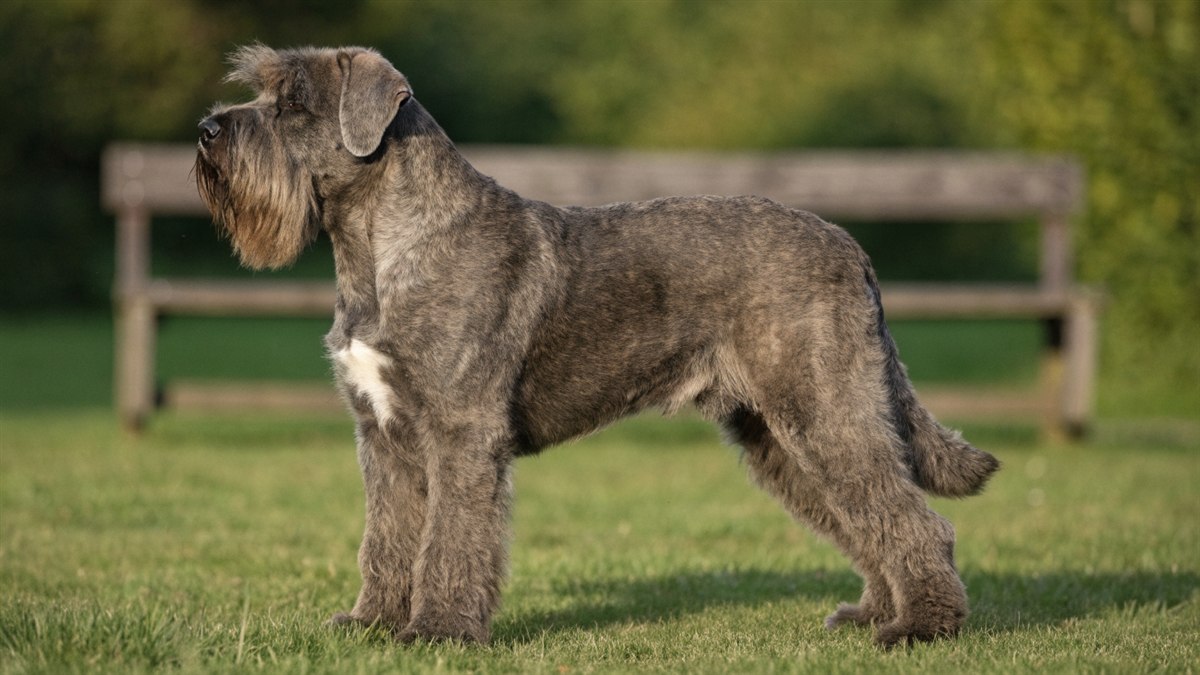
Natural drop ears lying flat against the cheeks in an equilateral triangle, and an entire tail set relatively high and continuing the line of the backbone. Both are described in full in FCI-191, so nothing about that dog is off-standard. Some Bouviers are also born naturally tailless, which FCI-191, the AKC text and UKC all say must not be penalised.
One further note for anyone comparing registries. Even in the countries where the practice remains lawful, the direction of travel is one way. UKC, an American registry, already tells its own judges that "no dog in any UKC event, including conformation, shall be penalized for a full tail or natural ears";, and the Council of Europe convention that most of Western Europe works under has prohibited both procedures for non-curative purposes since 1987. India is not an outlier here. It is with the majority.
Bouvier des Flandres price in India, and what the published numbers really are
No honest Bouvier des Flandres price in India can be quoted, because Bonbeno could not find a single verified Bouvier des Flandres offered for sale in India. Every rupee figure on page one is either an unsourced round number, a United States dollar price multiplied by 74, or a price attached to a different breed of dog.
Start with the arithmetic, because it settles the biggest number on the SERP. Pet House publishes a Dog Price List In India that gives the Bouvier des Flandres an average price of Rs 1,33,200 and a range of Rs 1,11,000 to Rs 1,85,000. Divide each by 84.38, the exchange rate that has caught three fabricated Indian price sets on this site, and you get 1,578.57, 1,315.48 and 2,192.46 dollars. Nothing round. Divide instead by 74 and the three numbers resolve exactly: 1,800 dollars, 1,500 dollars and 2,500 dollars.
Now look at position five on the same SERP. Dogbreedslist.info, an American breed database, gives the Bouvier des Flandres a puppy price of "Average $1500 - $2500 USD";. Pet House's Indian price range is that American band, converted at 74 rupees to the dollar and printed as a local market rate.
| Figure as published | Divided by 84.38 | Divided by 74 |
|---|---|---|
| Rs 1,33,200 average | USD 1,578.57 | USD 1,800 exactly |
| Rs 1,11,000 low | USD 1,315.48 | USD 1,500 exactly |
| Rs 1,85,000 high | USD 2,192.46 | USD 2,500 exactly |
The rest of the table confirms it rather than contradicting it. On Pet House's list, Rs 37,000 is 500 dollars, Rs 74,000 is 1,000, Rs 1,48,000 is 2,000 and Rs 2,77,130 is 3,745, all exact at 74. The only rows that refuse to divide cleanly are the Indian breeds someone typed in by hand: the Rajapalayam at Rs 15,000 gives 202.70 dollars, the Indian Spitz at Rs 15,000 the same, and the Caravan Hound at Rs 11,000 gives 148.65. An imported price list with local breeds bolted on is exactly what those two patterns look like.
Rs 74 to the dollar is also stale. It is roughly where the rupee sat around 2020 and 2021, so even as a conversion the figure is several years behind, and the underlying number was never an Indian price to begin with.
Rs 1,33,200 is not this breed's price either
The same Rs 1,33,200 appears on four other rows of the identical table: Belgian Sheepdog, Coton de Tulear, Pekingese and Wire Fox Terrier. A number shared by a 30 kg Belgian herding dog, a 5 kg Malagasy companion, a 5 kg Chinese toy and a 9 kg terrier is a price band on a spreadsheet, not a valuation of any dog.
Rs 98,999 is a Maltipoo
Puppiezo holds two of the top ten results and prints Rs 98,999 on its Bouvier des Flandres page. Bonbeno opened the page and read every card in the block headed "Available Bouvier Des Flandres Puppies For Sale". There are eight, and not one is a Bouvier des Flandres. They are Fizey, a Maltipoo at Rs 98,999; Kuzo and Dugu, both Poodles at Rs 92,599; Kazuka, a Cane Corso at Rs 94,999; Doir, a Goldendoodle at Rs 1,20,000; Samy, a Maltipoo at Rs 98,999; Tugi, a Rottweiler at Rs 76,499; and Yoki, a Doxiepoo at Rs 98,999.
So the Rs 98,999 on this page is attached to two Maltipoos and a Doxiepoo. Bonbeno has now caught the same Rs 98,999 on ten breed pages across Indian listing sites. It is a house price point applied to whatever puppy is in stock, and it is not a Bouvier des Flandres price.
The two round-number bands, and why they look invented
Asia Pets, holding positions one and three, prints Rs 50,000 to Rs 1,00,000 with no source. Those divide by 84.38 into 592.56 and 1,185.12 dollars and by 74 into 675.68 and 1,351.35, so neither is a converted dollar figure. They are simply round rupee numbers, and Asia Pets gives no breeder, no litter and no date behind them.
Call4Dog, at position nine, prints no price at all. It shows the FCI weight and height figures and a WhatsApp link reading "Please Share Best Price". Its own page title is "Bouvier Des Flandres Manufacturer 2 in cat - dog, Exporter in cat - dog";. That is an auto-generated shell that treats a dog as a manufactured line item, and it is the most honest page in the set only because it quotes nothing.
Is anyone in India actually selling a Bouvier des Flandres?
Not on any page Bonbeno could verify. Every listing site that ranks for the query returns zero Bouviers and then substitutes other breeds, and the substitution is visible in the page's own markup.
Asia Pets' dedicated sale page prints, in its own words, "Showing 0 results";. Directly beneath that it prints the line "Here are available pets of the same breed from other locations" and renders three cards: a Chihuahua, a Yorkshire Terrier and a Toy Pom. Three toy breeds under a heading that says same breed, on a page for a 40 kg cattle dog.
Mr n Mrs Pet, at position four, prints "3 Result Found";. The three cards it renders are a Border Collie in Pune, an Australian Shepherd in Delhi and a French Bulldog in Jammu, under a sub-heading reading "Similar breeds at other locations". No card on the page names a Bouvier des Flandres.
The control that proves the search works
A zero is worthless without a control, so here is one from inside the same page. Mr n Mrs Pet's own sidebar lists live counts for its most popular breeds: Shih Tzu 650, Siberian Husky 549, Golden Retriever 487, Labrador Retriever 454, German Shepherd 412, Beagle 274, Poodle 263, Rottweiler 162, Pomeranian 136 and Cane Corso 134. The site's inventory counter works and returns large numbers for breeds that are genuinely traded here. It returns nothing for this one.
| Page | What it says it has | What it actually shows |
|---|---|---|
| Asia Pets, sale page | Showing 0 results | A Chihuahua, a Yorkshire Terrier and a Toy Pom, under the heading same breed |
| Mr n Mrs Pet | 3 Result Found | A Border Collie, an Australian Shepherd and a French Bulldog, labelled similar breeds |
| Puppiezo | Available Bouvier Des Flandres Puppies For Sale | Two Maltipoos, two Poodles, a Cane Corso, a Goldendoodle, a Rottweiler and a Doxiepoo |
| Call4Dog | Manufacturer and Exporter | No dog, no price, one WhatsApp link |
| Pet House | Rs 1,33,200, range Rs 1,11,000 to Rs 1,85,000 | A United States price band multiplied by 74 |
Why no lawful supply chain can form
Two documents explain the emptiness. DGFT Trade Notice No. 22/2022-23, dated 19 December 2022, classifies live dogs under ITC (HS) 01061900 as Restricted. Its Policy Condition (7) states that "Import of dogs is allowed only for the following specific purposes", and lists three: a pet dog with a valid pet book and records in the importer's name, dogs imported by R&D organisations with a CPCSEA recommendation, and dogs for internal security by the Defence and Police Force. Policy Condition (8) adds that "Import of commercial dogs for breeding or any other commercial activities other than the purposes mentioned above is not permitted";.
Paragraph 6 of the same notice is blunter: "any applications for trading/breeding purposes, or applications made on behalf of some another person/entity shall be duly rejected". Paragraph 7 limits entry to the airports and seaports of Delhi, Mumbai, Chennai, Hyderabad, Bangalore and Kolkata, six ports in total, with quarantine where required. DAHD added a seventh port, Cochin International Airport at Kochi, for pets arriving under the baggage rules in October 2024. The full route is set out in how to import a dog to India.
So a founder population cannot be imported to breed from. The only lawful route in is a returning resident bringing up to two personal pets as baggage after two continuous years abroad, which is a route for one family's dog and not a route for a market. That is the whole reason the price pages have nothing to sell and have to fill the space with a Maltipoo.
Monthly cost of keeping a Bouvier des Flandres in India
Budget Rs 8,000 to Rs 16,000 a month for a 35 to 40 kg Bouvier des Flandres in an Indian metro, and treat that as a construction from published Indian large-breed and giant-breed figures rather than as an observed number. No Indian source publishes a cost for this breed, because no Indian household appears to keep one on the record.
Food is the anchor and it can be calculated instead of guessed. Royal Canin India's Maxi Adult feeding table gives a 38 kg dog 366 g a day at low activity, 424 g at medium and 482 g at high. A working-line dog getting the exercise this breed needs sits at the top of that range, so 480 g a day is 14.6 kg of dry food a month. A 30 kg female at medium activity needs 355 g a day, which is 10.8 kg a month.
Supertails, which ranks seventh for this query, publishes a monthly cost table by size. For a large breed it gives food at Rs 4,000 to Rs 6,000, routine vet visits at Rs 1,000 to Rs 2,000, annual vaccination at Rs 1,800 and grooming at Rs 500 to Rs 1,200 a month. For a giant breed it gives food at Rs 6,000 to Rs 10,000, vet at Rs 1,500 to Rs 3,000, vaccination at Rs 2,000 a year and grooming at Rs 600 to Rs 1,500. At 35 to 40 kg the Bouvier sits at the top of large and the bottom of giant, so read across both columns.
| Line | Monthly, rupees | Where the figure comes from |
|---|---|---|
| Dry food, 11 to 15 kg a month | 5,000 to 9,000 | Royal Canin India feeding table for 30 to 40 kg, priced against Supertails' large and giant food bands |
| Professional grooming | 1,000 to 2,000 | One full groom every 8 to 12 weeks for a double-coated dog, amortised. wagNbush puts a large-breed full groom at Rs 1,500 to Rs 3,000 and Bengaluru large breeds at Rs 3,000 onward |
| Routine vet, preventives, deworming | 1,200 to 2,500 | Supertails large and giant routine vet bands, plus year-round tick and flea cover |
| Vaccination, annualised | 150 to 170 | Supertails, Rs 1,800 to Rs 2,000 a year |
| Consumables, bedding, toys, replacement gear | 700 to 1,500 | Scales with body size and jaw strength |
| Total, ordinary month | 8,050 to 15,170 | Sum of the above |
Where the published Indian figures disagree
Publish the conflict rather than averaging it. Supertails' own page gives two different national ranges in two places: its summary says monthly upkeep costs Rs 3,000 to Rs 18,000, and its body text a few lines later says the average monthly maintenance cost "varies between Rs 3,000 and Rs 11,000";. A seven-thousand-rupee gap inside one article tells you how soft these numbers are.
Grooming is the sharper disagreement. Supertails puts large-breed grooming at Rs 500 to Rs 1,200 a month. wagNbush, pricing actual Indian salon work in 2026, puts a large-breed full groom at Rs 1,500 to Rs 3,000 and a giant-breed full groom at Rs 2,000 to Rs 4,000 or more, with Bengaluru large breeds starting at Rs 3,000 and premium Gurugram salons charging Rs 1,850 to Rs 2,200. One full groom at the Bengaluru rate is two and a half times Supertails' monthly grooming allowance. For this coat, believe the salon price list.
The lines an Indian Bouvier owner should expect and most budgets miss
- Add a de-matting charge whenever a groom is skipped. wagNbush names heavy matting as the single most common add-on, and a 6 cm harsh coat over a dense undercoat mats faster than a Labrador's does.
- Add medicated or anti-tick bathing at Rs 1,000 to Rs 1,500 a session during the monsoon, which Indian dermatology data says is the peak season for skin disease.
- Add an echocardiogram once. The breed's own health foundation recommends an echocardiogram by a cardiologist after 12 months rather than stethoscope auscultation alone, and that is a referral-hospital cost in an Indian metro.
- Add air conditioning through summer. Indian pages already price this for the Siberian Husky and this dog carries a comparable insulating load at a much higher body mass.
- Budget for a large-breed orthopaedic workup. OFA records 15.6 percent of 9,881 evaluated Bouviers as dysplastic, and hip radiographs under sedation are not a small bill.
First-year cost sits far above the monthly figure. Supertails advises budgeting Rs 80,000 to Rs 2,00,000 for the first year across purchase, vaccination, food, training and supplies for a pedigree dog. For an imported Bouvier, add the import authorisation process, air transport for a 40 kg dog in a crate, and quarantine at one of the seven permitted ports, none of which that figure contains Department of Animal Husbandry….
Heat tolerance: the coat and the mass, argued from the standard
Rate the Bouvier des Flandres 1 out of 5 for heat tolerance in India. The argument is mechanical rather than impressionistic, and it rests on two things the breed standard itself specifies: an abundant harsh double coat about 6 cm long over a dense waterproof undercoat, carried on a body of 35 to 40 kg.
FCI-191 states the purpose of that coat in its own words. The outer coat forms with the dense undercoat "a protective layer perfectly adapted to the sudden climatic changes in this breed's native land", and the undercoat "together with the topcoat forms a waterproof covering";. Bonbeno queried NASA POWER by explicit latitude and longitude for that native land, Roeselare in West Flanders at 50.9469 N and 3.1233 E, for the 3,653 days from 1 January 2016 to 31 December 2025. The same query was run for six Indian cities by coordinate, so no city name was ever guessed from a slug.
| Location | Mean air temp | Days max 30 C or above | Days max 35 C or above | Days above 30 C with humidity 60 percent or more | Nights that never fall below 25 C |
|---|---|---|---|---|---|
| Roeselare, West Flanders (50.9469 N, 3.1233 E) | 11.2 C | 21 | 1 | 15 | 0 |
| Pune (18.5204 N, 73.8567 E) | 23.8 C | 1,323 | 784 | 265 | 12 |
| Bengaluru (12.9716 N, 77.5946 E) | 23.9 C | 1,800 | 544 | 795 | 13 |
| Kolkata (22.5726 N, 88.3639 E) | 26.0 C | 2,293 | 819 | 1,877 | 1,743 |
| Mumbai (19.0760 N, 72.8777 E) | 26.8 C | 2,359 | 1,052 | 1,061 | 1,047 |
| Delhi (28.6139 N, 77.2090 E) | 25.3 C | 2,385 | 1,332 | 861 | 1,246 |
| Chennai (13.0827 N, 80.2707 E) | 28.0 C | 2,522 | 878 | 2,341 | 1,995 |
The headline ratio is Chennai against Flanders: 2,522 days at or above 30 C versus 21, which is 120 times as many, out of the same 3,653 days. Delhi crossed 35 C on 1,332 days against West Flanders' one. West Flanders' hottest reading in ten years was 35.6 C. Delhi's was 48.5 C.
Why 40 kg makes it worse, not just bigger
Body mass is the second half of the argument and it works against this dog twice. A dog sheds heat across its skin, and skin area scales roughly with mass to the power of two-thirds, so skin area per kilogram scales with mass to the power of minus one-third. Take the breed's 37.5 kg midpoint against a 6.5 kg terrier: the cube root of 37.5 divided by 6.5 is 1.79, so the Bouvier has about 44 percent less skin per kilo of body to dump heat through. Against a 25 kg dog it still has about 13 percent less. Every kilo of a big dog is harder to cool than every kilo of a small one, before you add any hair at all.
Then add the hair. The standard does not permit you to remove it either: a "flat coat should be avoided because it denotes a lack of undercoat", and lack of undercoat is listed as a serious fault. The insulation is not optional equipment on this breed. It is the breed.
Humidity is the part Indian owners underestimate
Dogs shed heat by panting, and panting is evaporative, so it stops working as the air fills with water. That is why the humidity column above matters more than the temperature column. Chennai had 2,341 days that were both above 30 C and at 60 percent relative humidity or higher. West Flanders had 15. On those days a panting dog is moving air that cannot accept much more moisture.
The night column is the one almost nobody prices. In Chennai, 1,995 of 3,653 nights never dropped below 25 C, and in Kolkata 1,743. West Flanders had none in ten years. A heavily coated dog that cannot dump its heat load overnight starts the next day already warm, and heat injury is cumulative across days rather than a single-afternoon event.
The one thing in the breed's favour, and the condition that cancels it
The Bouvier has a normal muzzle. McMillan and colleagues classify it as large and mesocephalic in their 2024 UK life-table study, which puts it in the skull group with the best survival rather than with the brachycephalic breeds whose airways fail first in heat. On airway anatomy alone, this dog starts better than a Bulldog or a Pug.
That advantage is conditional on the larynx working, and in this breed it sometimes does not. A hereditary laryngeal paralysis with an autosomal dominant pattern is documented in the Bouvier des Flandres and usually presents before 12 months of age. A dog whose vocal folds cannot abduct is a dog that cannot pant properly, in a city with 2,341 days a decade above 30 C and 60 percent humidity. The health section sets out the evidence in full, and it is the single strongest reason to rate this breed 1 rather than 2.
Every Indian city on this table is hard on the breed, and the dog is heat-sensitive in all six, but the ranking differs. Pune and Bengaluru are the least bad, mainly because their nights still cool down: 12 and 13 warm nights in ten years against Chennai's 1,995. Delhi is a dry-heat problem, 1,332 days above 35 C. Mumbai, Kolkata and Chennai combine daytime heat with humidity that blunts panting and nights that never recover. None of the six is a climate this coat was specified for.
The monsoon problem: a waterproof undercoat in a wet season
The Indian monsoon is a harder test for this coat than the Indian summer. Two published Indian series both put the peak of canine skin disease in the rains, and the Bouvier carries the one coat architecture that holds water against the skin for hours after a walk.
Start with the Indian evidence, not with a guess. Khinchi and colleagues studied 987 dog cases presented to the Veterinary Clinical Complex at Navania, Udaipur, between July 2017 and June 2018. 205 of the 987, which is 20.77 percent, had a dermatological affection, and the seasonal split was rainy 39.51 percent, summer 36.58 percent and winter 23.90 percent. Those percentages divide out exactly against 205 cases: 81 in the rains, 75 in summer, 49 in winter.
A second Indian series agrees. Working from the Madras Veterinary College Teaching Hospital and the Saidapet Polyclinic in Chennai, Bhavya reports 7,560 of 26,361 dogs seen in the study period had dermatological problems, and of 661 dogs examined in detail for infectious skin disease the seasonal distribution was monsoon 38 percent, summer 32 percent and cold 30 percent, a difference significant on a chi-square of 6.85 with 2 degrees of freedom. Note the arithmetic: 7,560 of 26,361 divides out at 28.7 percent, and the paper prints 28.6, so read the counts rather than the rounded rate.
Two independent Indian centres, one in dry Rajasthan and one on the humid Coromandel coast, both peak in the rains. That is a real finding and it is not what a Belgian care guide is written for.
Why this coat in particular
FCI-191 describes the undercoat as "a padding made up of fine dense hair which grows beneath the outer coat and together with the topcoat it forms a waterproof covering";. Waterproof cuts both ways. It keeps a Flanders drizzle off the skin, and it keeps a Chennai downpour in once the outer coat is soaked through, because the same density that resists water entering resists it leaving.
The Bouvier rescue grooming guide most widely circulated among owners is explicit about what mats do, and it was written for a temperate climate: mats "can harbor dirt, debris, parasites, moisture, conceal hot spots (severe skin infection which can spread), inhibit new coat growth". In a month where 38 to 39 percent of a clinic's skin caseload arrives, a mat that holds moisture against the skin is not a cosmetic problem.
Where a Bouvier mats, and where to look first
The same guide names the sites, and they are the sites an Indian owner should check weekly through the rains: the forearm pits, behind and under the ears, in the beard under the lower jaw, around the lips, high between the scrotum and inner thigh on a male, and on the belly between the nipples on a female. It also warns of lipfold dermatitis in the deep folds at the outsides of the mouth, which needs veterinary treatment when it ulcerates.
The beard is the Indian-specific one. A dog with a full beard and moustache required by the standard drinks from a bowl several times a day in 30 C heat and walks back inside with a wet beard every time. In a Flanders spring that dries. In a Mumbai August, with 1,061 days a decade above 30 C at 60 percent humidity or more, it does not.
Where the overseas guide does not transfer
One instruction should be changed for India rather than copied. The widely republished Bouvier grooming article advises "occasional bathing (3-4 times/year)" and says the breed "does not require bathing any more frequently than grooming visits (every 2-4 months)";. That is sound in a temperate climate where the coat dries and stays dry. It is written for a place with 15 hot humid days a decade, not 2,341.
Bonbeno's position, stated as an adjustment rather than a contradiction: keep the low full-bath frequency, because over-bathing does soften and damage a harsh coat, but raise the frequency of targeted washing and, above all, of active drying. Wash and dry the beard daily. Dry to the skin with a force dryer after any monsoon walk instead of towelling and leaving it. Comb to the skin weekly all year and twice weekly in the rains.
The Chennai series reports that purebred dogs, particularly Labradors, and short-haired breeds were more likely to get skin infections. That is the opposite of what a coat-density argument predicts, and it is real data. The honest reading is that coat length alone does not determine risk, and that what matters is whether the skin gets dry, not how much hair sits above it. On that measure a 6 cm double coat is harder work, not automatically worse.
Temperament, and who should not own one
The Bouvier des Flandres is a calm, powerful, independent-minded protection dog that decides things for itself. FCI-191 describes "the calm, thoughtful character of a sensible, but fearless dog" whose "lively look indicates intelligence, energy and audacity", and then insists that the breed "should absolutely conserve its aptitude for work"; Federation Cynologique Internationale.
Read the job description before the personality. FCI-191 lists the breed's modern use as "a guard dog for the estate and the farm, as a defence and police dog", with tracking, messenger and gamekeeper work added on the strength of its scenting ability and initiative. UKC records that the breed has served in police and army work, as a personal guard dog, as a guide dog for the blind, and in search and rescue. This is a dog bred to make decisions on its own about strangers.
The parent club is unusually direct about the downsides for a document whose job is to attract buyers. Its guidance for prospective owners opens "There is a lot to learn about this highly intelligent and willful breed", warns "They have significant coat requirements", notes "They have lots of prey drive and love to chase moving things (and critters)", adds "They do not understand their size and often they could care less about where their paws land", and describes the breed as "protective to a fault".
What the ranking pages agree on, for once
The Indian pages are thin on almost everything, but their trait scores line up with the standard. Asia Pets rates the breed 5 out of 5 with family, 4 with children, 3 with other pets and 2 with strangers, and lists among its own considerations "Strong-willed", "Needs experienced owner", "Large and powerful" and "Can be dominant". Dogbreedslist gives Watchdog Ability 5 stars, Stranger Friendly 2 stars, and puts the breed at rank 29 for working intelligence.
The same source adds the sentence Indian buyers most need: the Bouvier "is independent and confident of its own judgment, yet biddable and willing to please. It can be domineering. It is reserved, even protective, toward strangers and can be aggressive with strange dogs. It is very good with children, although it may nip at heels in play". Heel-nipping is a cattle dog's factory setting, not a fault of upbringing, and it needs redirecting rather than punishing.
Who should not buy this breed
- Skip this breed as a first dog. Two of the ranking pages say so independently, and the combination of size, guarding instinct and independence is not a beginner's project.
- Skip it if your home is a flat on a shared corridor with daily delivery riders, domestic staff, plumbers and courier calls. A dog rated 2 out of 5 with strangers meets ten of them a day in an Indian apartment block, and every one of those meetings is a training repetition you did not plan.
- Skip it if nobody at home is physically able to hold 40 kg on a lead when a street dog appears. This breed is reported to be aggressive with strange dogs, and Indian pavements have free-roaming dogs on them.
- Skip it if you want a dog that will not chase. The parent club names prey drive explicitly, and cats, squirrels, monkeys, cattle and two-wheelers all trigger it.
- Skip it if the plan is a garden guard dog left outside. The 2017 Rules place conditions on outdoor housing, and this coat in Indian sun is a welfare problem regardless of the rules.
Who it suits
The breed suits an experienced handler in a house with a real garden who wants a calm, low-fuss indoor dog and a serious deterrent outdoors, and who will do daily work with it. The Royal Kennel Club's own summary of what the breed needs is a large house and a large garden. Given daily exercise the Bouvier is genuinely quiet in the house, which is why it works for people who can meet the requirement and fails badly for people who cannot.
FCI-191 lists "Timid dog" as a serious fault and "Aggressive or overly shy" as a disqualifying fault. A Bouvier that lunges at everyone and a Bouvier that cowers are both off-standard. If a seller presents either as normal for the breed, they are describing a badly bred dog, not the breed.
One last honest point. Because so few of these dogs exist in India, an Indian buyer offered one has almost no way to meet the parents, watch a littermate grow up, or find a local breed mentor. In a breed where temperament is a written part of the standard and the parent club calls it protective to a fault, buying blind is a much bigger risk than it would be with a Labrador Retriever.
Training: what works, and what this breed resists
To train a Bouvier des Flandres, start earlier than you think, spend the first four months on strangers rather than on obedience, and give the dog a reason for every instruction. This breed learns fast and complies slowly, which is a different problem from a dog that cannot learn.
Dogbreedslist describes the training profile accurately: "Moderately Easy Training: Training for the Bouvier Des Flandres is no arduous task. The breed is quite intelligent and will remember any command that is learned for the rest of their life. A firm and consistent pack leader is a necessity with this breed. Obedience school is recommended at a young age";. Set against the parent club's word "willful" and the standard's "independent and confident of its own judgment", the picture is a dog that understands the cue on the third repetition and then decides whether the cue is worth obeying.
The socialisation window is the whole game
Prioritise strangers above sit and stay. On a breed rated 2 out of 5 with strangers whose parent club calls it protective to a fault, the socialisation window in the first few months is the single highest-value training investment an Indian owner makes, and it is the one thing that cannot be redone later.
In an Indian metro the raw material is free and constant. Deliberately arrange calm, rewarded, non-confrontational exposure to the people this dog will meet for the rest of its life: the security guard, the lift, the delivery rider's helmet and backpack, the cook, the maid, the plumber, the cylinder man, the pressure horn, the temple loudspeaker, the crowded footpath, the cow at the corner and the pack of street dogs across the road. Do not let the dog rehearse barking at any of them.
What actively backfires
- Avoid confrontational corrections. A 40 kg dog confident of its own judgment does not become more compliant when it is intimidated, it becomes better at deciding you are unpredictable.
- Avoid protection or bite work with a hired trainer before the dog is adult and fully socialised. The instinct is already in the standard, which lists defence and police work as the breed's modern use; nothing needs adding to it.
- Avoid long sessions. Short, varied, food-paid repetitions suit an intelligent working dog. Drilling bores it and boredom is where this breed invents jobs.
- Avoid off-lead work in unfenced Indian space at any age. The parent club names prey drive plainly, and there is no recall that beats a monkey on a wall.
The three commands that actually matter here
Teach a rock-solid place cue, so the dog can be parked when the doorbell goes and the flat fills with strangers. Teach a leave it that works at distance and under arousal, for street dogs, cattle and food waste. Teach loose-lead walking properly before the puppy reaches 20 kg, because a Bouvier that has learned to pull is stronger than most Indian handlers.
Add one more that is specific to this coat and this climate: teach the dog to be handled and dried. A dog that will lie still on its side for twenty minutes of combing and stand for a force dryer will get groomed. A dog that will not, will be shaved by a frustrated salon, and this page argues in the next two sections that shaving this coat is the wrong outcome.
Realistic timelines
| Age | What is achievable | What is not yet |
|---|---|---|
| 8 to 16 weeks | Name, food lure, crate, handling for grooming, wide stranger and surface exposure | Reliability of any kind. This is exposure work, not obedience |
| 4 to 6 months | Sit, down, place, lead manners on a light lead, reliable toilet routine | Anything under arousal. The dog is still small enough to hold, which hides the problem coming |
| 6 to 12 months | Loose-lead walking at 25 to 35 kg, leave it at distance, settling through visitors | Adult judgement. Guarding behaviour is starting to switch on and needs managing |
| 12 to 24 months | A dog that thinks before it reacts, and can be taken out in public | Full maturity. The parent club advises that soundness and stable temperament are "rarely, if ever, determined before the age of two" |
That last row is the parent club's own line about breeding stock, and it is a useful yardstick for owners too. Judge the dog you have at two years, not at ten months.
Daily exercise, and how to fit it into an Indian day
Plan 60 to 90 minutes of real work a day, split across two sessions, both of them outside the heat. Published figures for this breed run from "up to 1 hour per day" to "60-90 minutes per day", and the honest reading is that the low end keeps the dog quiet and the high end keeps it sane.
The Royal Kennel Club puts the requirement at up to 1 hour per day. Puppiezo's own spec card, on the page that has no Bouviers to sell, prints an exercise routine of 60-90 minutes per day and an energy level of High. Dogbreedslist calls the breed "a fairly energetic dog that will require a good long daily walk or run", and adds a warning worth heeding: "They should not be made to run during the younger years of development though. This could cause issues with muscle and skeletal growth";.
Take the higher figure and expect to work for it, because the standard describes a dog that was expected to drive cattle and pull a cart all day.
The Indian timing problem
The exercise budget is not the constraint in India. The window is. NASA POWER records 2,522 days in ten years at or above 30 C in Chennai and 2,385 in Delhi, and in Chennai 1,995 nights that never fell below 25 C. That leaves a pre-dawn slot and a post-dusk slot, and on many days the post-dusk slot is still warm.
- Walk before sunrise, not at 7 am. Ground temperature lags air temperature, and tarmac that is comfortable to a bare human hand is the test, not the weather app.
- Walk again after full dark, and carry water for the dog rather than for yourself.
- Fill the middle of the day indoors with scent work, food puzzles, a chew and short obedience games. Mental work tires a working dog usefully and costs nothing in heat load.
- Swap to indoor work entirely on any day when the dog pants at rest, and treat that as a symptom rather than a mood.
- Split the session rather than extending it. Two 40-minute walks beat one 80-minute walk for a heavily coated dog in humidity.
What happens without it
An under-exercised Bouvier does not become a couch dog. It becomes a bored, powerful, self-employed guard dog in a flat. Dogbreedslist notes the breed is "relatively inactive indoors" given enough exercise, and rates apartment living 3 out of 5 with the condition "will do okay in an apartment if it is sufficiently exercised";. The conditional is doing all the work in that sentence.
The failure mode is predictable: barking at corridor noise, destruction of furniture, guarding of doorways and resources, and a dog that is progressively harder to walk because every outing is now overstimulating.
Growth-stage limits, and why they matter more in a heavy breed
Do not run a Bouvier puppy on hard surfaces, do not use stairs as exercise, and do not add forced roadwork until the growth plates close, which in a 35 to 40 kg breed is late in the first year. OFA records 15.6 percent of 9,881 evaluated Bouvier des Flandres as dysplastic on the hip. Hip dysplasia is heritable, but the environmental half of it is body condition and loading during growth, and both are inside an owner's control.
Carting, herding, tracking and search work all appear in the breed's own record, and the AKC parent club runs draft-dog and herding programmes for it. In an Indian city the practical equivalents are structured scent games, a weighted-pack walk in cool weather, and tracking on grass at first light. A working dog given a job is a quieter dog.
Grooming: what the standard actually asks for
The Bouvier des Flandres needs a comb to the skin every week and a professional groom every 8 to 12 weeks, and the standard asks for a coat that looks slightly untidy rather than sculpted. Get the texture right and the styling barely matters. Get the texture wrong and no amount of scissoring rescues it.
FCI-191 sets the target texture in one sentence: the hair "must be coarse to the touch, dry and matt, neither too long nor too short (about 6 cm), slightly tousled but never woolly or curly". It is "particularly harsh and rasping on the upper part of the back", shorter on the head, near-shaved on the outside of the ears, with the inner ear flap protected by medium-long hair. UKC puts the same thing more bluntly: "a rough, tousled coat, giving an unkempt appearance";.
Then read what the standard punishes, because that is where owners go wrong. FCI-191's serious faults include "Silky coat, lack of undercoat, puffed up coat, shiny, over-groomed", which in the French authentic text is "robe gonflée, brillante, apprêtée";. The AKC standard says the coat "may be trimmed slightly only to accent the body line" and that "Overtrimming which alters the natural rugged appearance is to be avoided", and it faults a coat that is too long, too short, silky or woolly.
Almost no other breed standard lists over-grooming as a serious fault. FCI-191 does. A Bouvier that arrives back from a salon glossy, fluffed and precisely scissored has been groomed away from its own standard, not towards it.
Comb, do not brush
The most useful practical instruction in the Bouvier literature comes from the grooming guide circulated by Bouvier rescue, and it contradicts what most Indian salons do. "I prefer NO brushing, just combing", the author writes, because "Brushes tend to give you the illusion that you have the dog done, but more often than not, with a brush, you are not getting down to the undercoat which is where the mats begin";. Use a steel comb roughly 7.5 inches long with two tine spacings, start at the base of each leg, lift the hair, and comb down to the skin a handful at a time.
That is a weekly job on this coat, and a twice-weekly job in the Indian monsoon. It is also the cheapest thing an owner does, because matting is what turns a Rs 2,000 groom into a Rs 3,500 one.
Stripping, clipping, and what is actually required
Hand stripping is the show answer and it is not the only answer. Writing in the professional trade magazine Groomer to Groomer, Kathy Rose explains that "Hand stripping will help to keep the coat harsh and weather resistant, but keep in mind the hand stripping is not exactly like terrier stripping. The dead coat is removed, but not down to a short layer";. She adds the styling caution directly from the standard: "The standard calls for a 'tousled' appearance so avoid scissoring and over stylizing."
For a pet, the same article gives a legitimate alternative: "For the pet, a shorter trim may be requested, but it is still possible to keep inline with the breed profile. Some light stripping and carding of the body will help to keep the desired coat texture. Snap on combs can be used to achieve a shorter pet trim", with the leg length left several combs longer than the body. This matters enormously for India and is worth stating plainly: a Bouvier is not a Border Terrier. You can clip a pet Bouvier with a snap-on comb and keep the outline, provided the body is carded and lightly stripped to hold the texture.
The parts most Indian owners forget
- Comb the beard daily, and wash and dry it. It is the wettest, dirtiest part of the dog and it is required by the standard, which specifies a moustache on the upper lip and a full beard and moustache on the chin.
- Check the lip folds. The rescue guide warns that residue collects in the deep folds near the outsides of the mouth and can ulcerate into lipfold dermatitis, which needs veterinary treatment.
- Pluck and clean the ears monthly, more often if there is odour or scratching. Groomer to Groomer notes that show grooming shaves the inside and outside of the ear with a #15 or #30 blade all the way to the base, which is also the most hygienic option in Indian humidity.
- Trim nails at least monthly on an adult and more often on a puppy, so the dog loads its pads rather than its nails.
- Never bathe a coat that has not been combed out first. Wetting a mat sets it, and the same applies after a swim or a walk in the rain.
One number to hold on to. The Royal Kennel Club summarises the breed's grooming requirement in a single word: Every day. Dogbreedslist rates grooming 5 out of 5 and calls it "High Maintenance: Grooming should be performed often to keep the dog's coat in good shape. Professional groomers can be sought after for assistance. Professional trimming or stripping needed";. Both are describing the same dog, and neither is exaggerating.
Can an Indian groomer actually handle this coat?
Mostly yes, and that is a genuine difference from the harsh-coated terriers. A pet Bouvier can be maintained with combing, carding and a snap-on comb trim, all of which Indian salons already do. The specialist skill, hand stripping, is taught in India and advertised by at least one salon, but Bonbeno could not find it priced on a single Indian salon menu.
Bonbeno searched Indian domains for the service and then ran a control in the same session, because an absence is worthless without one. Searching "hand stripping" site:.in returned a grooming powder on Amazon India, a grooming diploma course, two Amazon ebooks, a job board listing vacancies in Spalding England, a scraped page quoting dollar prices per hour, and exactly one Indian salon. Searching "de-shedding" site:.in in the same session returned a page of genuine Indian salon menus, including Pawgo, PetCure, JustGroom, Pet Vanity and a Salem grooming service. The search works. The term is simply rare here.
The one Indian salon, read carefully
Pet Style in Jaipur states on its home page that "We offer breed specific cuts, creative styles and colors, hand stripping and coat maintenance", and names a groomer certified by Starwood Art of Dog Grooming in Bangkok. That is a real Indian claim by a real salon with a real certification, and it deserves to be reported.
It also deserves reading to the end. The salon's own Our Services block lists Regular Bath, Basic Grooming (bath, blow dry, ear cleaning, nail trimming, anal gland cleaning, de shedding, brushing), Custom Haircut, Tick and Flea Bath, Small Pets Grooming, Cat Grooming, Natural Therapy and Aroma Therapy. Hand stripping is not among them. It appears in the welcome paragraph, not on the bookable menu, and no price is attached anywhere on the site.
It is taught here, with practicals in one city
Petgroomers, an Indian doorstep grooming service, runs a ten-module Dog Grooming Diploma Course whose module 7, Styling in Practice, covers "advanced finishing techniques like hand stripping and carding". The online plan costs Rs 14,999 plus 18 percent GST, a total of Rs 17,699. The plan that adds five hands-on practical sessions costs Rs 20,000 plus GST, a total of Rs 23,600, and the site states that "Offline practical sessions are available in Chennai". The skill is therefore taught in India, and the hands-on half of it is taught in one city.
An Indian salon-pricing framework published by ABK Grooming also lists hand stripping among the advanced services that "require specialist knowledge" and should carry a senior groomer's hourly rate, alongside hand scissoring, Poodle patterns and show preparation. It is guidance for salon owners on how to price the service, and it prices nothing.
What this means for your dog
| What the coat needs | Available in India? | What it costs |
|---|---|---|
| Weekly combing to the skin | Yes, at home. This is the job that matters most and it is free | A steel comb and twenty minutes |
| Bath, force dry, de-matting, nail and ear work | Yes, on almost every Indian salon menu | Rs 1,500 to Rs 3,000 for a large-breed full groom, Rs 2,000 to Rs 4,000 or more at giant size |
| Snap-on comb pet trim keeping the breed outline | Yes. This is ordinary clipper work and preserves a workable pet coat | Usually inside the full groom, sometimes a breed-cut surcharge |
| Carding to thin the undercoat | Occasionally, and often unnamed on the menu. Ask for it by describing it | Add-on, typically a de-shedding line item |
| Full hand stripping for show texture | Rare. Advertised in prose by one Jaipur salon, taught on one diploma with practicals in Chennai, priced on no menu found | No published Indian price exists |
So the honest position is narrower than the one this site has published for the Border Terrier and the Airedale Terrier, where clipping genuinely wrecks the coat and the missing service is the whole problem. For a pet Bouvier in India, the coat can be kept correct enough with combing, carding and a snap-on trim. Only a show entrant is stuck.
A summer shave-down. It is the most common Indian response to a big hairy dog in May, and it is wrong for this breed. FCI-191 makes a flat coat and a lack of undercoat serious faults, and the undercoat is the layer that slows solar gain reaching the skin. Shaving a double coat removes the insulation in both directions and exposes skin that has never seen sun. Ask for the coat carded and thinned, not removed.
Health issues, screening data with real denominators, and lifespan
The Bouvier des Flandres carries four documented problems worth screening for: hip dysplasia, elbow dysplasia, primary angle-closure glaucoma and subaortic stenosis. Its own parent club names exactly those, telling prospective buyers that a breeder "should be knowledgeable about genetic diseases including hip and elbow dysplasia, glaucoma and other eye disorders and the heart problem of sub-aortic stenosis".
Every figure below comes from the Orthopedic Foundation for Animals' own disease-statistics tables, retrieved on 23 August 2026, matched on the breed label BOUVIER DES FLANDRES printed in the table rather than on a guessed registry code. That last point is not pedantry. OFA's own code table gives the Bouvier des Flandres the code BF, while BDF belongs to the Braque Francais, a French pointer. Guessing the obvious three letters would have returned a complete, plausible table for the wrong dog.
| Register | Evaluations | Normal | Abnormal | Detail |
|---|---|---|---|---|
| Hips | 9,881 | 82.5% | 15.6% dysplastic | 7.1% excellent, 54.5% good, 20.8% fair; 10.6% mild, 4.5% moderate, 0.5% severe |
| Elbows | 4,624 | 90.0% | 9.9% | 8.0% grade 1, 1.6% grade 2, 0.4% grade 3 |
| Congenital cardiac | 3,487 | 99.1% | 0.3% | 0.7% equivocal |
| Eyes (CAER) | 2,175 | 94.9% | 5.1% | Detail in the eye section below |
| Thyroid | 1,736 | 85.0% | 3.1% combined | 0.2% autoimmune thyroiditis, 2.4% compensative, 0.5% idiopathic hypothyroidism, 11.9% equivocal |
| Patella | 534 | 99.4% | 0.6% | All grade 1 |
| Advanced cardiac (echo) | 452 | 96.7% | 0.7% | 2.7% equivocal |
| Basic cardiac (auscultation) | 333 | 100.0% | 0.0% | Which is the problem, see the heart section |
Every one of those rows clears OFA's own publication threshold of 100 hip evaluations or 50 for the other databases, so each is a population rate rather than an anecdote. Bonbeno ran a case-insensitive control on the same retrieved document: LABRADOR returned 109 rows, all in capitals, while a case-sensitive search for "Labrador Retriever" returned zero. The tables were populated and the search worked.
Read the arithmetic before you read the headline
OFA's hip row does not sum to 100. Normal is printed as 82.5 percent while excellent, good and fair add to 82.4, and dysplastic is printed as 15.6 with mild, moderate and severe adding to exactly 15.6. 82.5 plus 15.6 is 98.1, so roughly 1.9 percent of evaluations sit in neither bucket, which is the borderline grade. Anyone quoting "82.5 percent normal, so 17.5 percent dysplastic" has invented two percentage points. The elbow row rounds the same way: 8.0 plus 1.6 plus 0.4 is 10.0, printed as 9.9.
In absolute terms, 15.6 percent of 9,881 evaluations is roughly 1,541 dysplastic hips on record. That is a real and substantial burden for a breed this size, and it is the single most screenable thing about it.
The submission bias you must price in
OFA is a voluntary open registry, and owners of poor results are not obliged to publish them for most databases. Treat every figure above as a floor rather than a true population rate, and treat the basic cardiac row, 333 dogs and 100.0 percent normal, as the clearest evidence of that. No screening register of any real breed returns a perfect result on 333 animals unless something is filtering what arrives.
Lifespan, from a real sample, with the sample size attached
The largest recent life-table study of UK dogs covers 584,734 animals, of which 284,734 were deceased, across 155 recognised purebreds. Its Supplementary Table S3 gives the Bouvier des Flandres a median survival of 11.3 years, 95 percent confidence interval 10.4 to 11.9, from 151 dogs of which 79 had died, with a hazard ratio against the crossbred group of 1.07 (0.86 to 1.34) at p = 0.52. Supplementary Table S6 gives the same 151 as 72 alive and 79 deceased.
Two honest caveats belong with that number. First, 151 dogs is one of the smaller breed samples in the study, which is why the confidence interval is a year and a half wide. Second, p = 0.52 means the breed did not differ significantly from crossbred dogs, whose median was 12.0 years; large-sized purebreds as a group came in at 11.9. So the fair statement is that a Bouvier lives about as long as a typical large dog, and rather less than the 12.5-year median across all dogs in the study.
Every Indian page ranking for this breed prints "10-12 years" with no source Dog Breeds List, Bouvier des Flandres breed… Call4Dog, Bouvier Des Flandres page. The measured figure of 11.3 sits inside that band, so they are not wrong, but they cannot tell you what it is built on and this page can.
Hip and elbow scores on both parents, a CAER eye certificate on both parents dated within the last twelve months, and an echocardiogram report from a cardiologist on both parents taken after 12 months of age. Anything less is not screening this breed.
Glaucoma: why one eye exam is not a clean bill of health
Primary angle-closure glaucoma is the eye disease that matters in this breed, and the number that matters is not the one on an OFA certificate. A single eye exam records what the eye looks like today. A nine-year study of the same breed recorded what happened next, and the two numbers are two hundred times apart.
OFA's cross-sectional data first. Of 2,175 Bouviers des Flandres given a CAER eye examination, 2 were recorded with glaucoma, which is 0.1 percent. Read alone, that looks like a breed with no eye problem.
Now read the longitudinal data. Reviewing the canine primary glaucomas, Miller and Bentley describe an "almost 9-year longitudinal study of approximately 100 bouvier des Flandres dogs" and report that "the rate of development of glaucoma in dogs with at least one eye with a narrow or closed cleft was 24% (8/33) compared with 1.8% (1/57) in dogs with bilaterally open clefts". Divide those out: 8 of 33 is 24.2 percent and 1 of 57 is 1.75 percent. Both check.
The same study found a strong association between glaucoma and the corrected angle index at p less than 0.001, with the odds of glaucoma doubling for every 0.20-unit decrease in the index, and "Dogs with an angle index of less than or equal to 1 had a 21% risk of developing PACG compared with a risk of 1.9% for other dogs";. Every dog that developed glaucoma over the nine years had pectinate ligament dysplasia at the first examination.
A CAER certificate that says normal today is not a prediction. What predicts glaucoma in this breed is the shape of the drainage angle, which is measured by gonioscopy, not by a standard eye exam. Ask specifically whether the parents have been gonioscoped and what the angle looked like.
One male dog is in most of the affected pedigrees
The founder effect in this breed is documented and stark. In the same American study of almost 100 Bouviers, "a single male dog was the father or grandfather of all affected dogs, even though affected dogs had 5 different mothers";. One popular sire behind every case is the clearest possible argument for pedigree research before purchase, and it is an argument an Indian buyer with no access to the pedigree cannot act on.
The Bouvier des Flandres also appears by name among the breeds that dominate large-scale surveys of primary angle-closure glaucoma in the United States, alongside the American and English Cocker Spaniels, Basset Hound, miniature and toy Poodles, Great Dane, Flat-Coated Retriever, Chow Chow, Shar Pei and Welsh Springer Spaniel. The same review's reference list cites a Swiss paper titled Goniodysplasie beim Bouvier des Flandres, published in Schweizer Archiv fur Tierheilkunde in 1996, which shows how long this has been recognised in the breed. Bonbeno has not read that 1996 paper and reports it only as a reference the review carries.
What else OFA's eye detail shows
The eye register breaks 2,175 examinations down by finding, and the picture is more interesting than 5.1 percent abnormal suggests. Only 1,457 of 2,175, which is 67.0 percent, were recorded as fully normal with no finding at all. The commonest single entries were cataract of unknown significance at 237 dogs, 10.9 percent, persistent pupillary membranes iris to iris at 201, 9.2 percent, Y-suture tip opacities at 138, 6.3 percent, and findings suspected as not inherited at 114, 5.2 percent.
| Finding | Dogs | Percent |
|---|---|---|
| Normal, no finding recorded | 1,457 | 67.0% |
| Cataract, significance unknown | 237 | 10.9% |
| Persistent pupillary membranes, iris to iris | 201 | 9.2% |
| Y-suture tip opacities | 138 | 6.3% |
| Other, suspected as not inherited | 114 | 5.2% |
| Distichiasis | 13 | 0.6% |
| Entropion | 11 | 0.5% |
| Retinal atrophy, generalised | 4 | 0.2% |
| Glaucoma | 2 | 0.1% |
| Ectropion | 1 | 0.0% |
Most of those findings are minor, and cataract of unknown significance is not the same as a cataract that will blind a dog. The point of printing the table is that the headline 94.9 percent normal on the register and the 67.0 percent with no finding at all are both true, and only one of them is usually quoted.
There is an Indian legal footnote here too. The Second Schedule, Part III, paragraph 8(10) of the 2017 Rules requires that breeding dogs "shall have been tested for genetic defects, including hip dysplasia, progressive retinal atrophy, night blindness, hypothyroidism, entropion, ectropion" and several dentition and cryptorchid faults. Every one of hip dysplasia, entropion, ectropion, generalised retinal atrophy and hypothyroidism appears in this breed's OFA record. An Indian breeder who ignores that paragraph is skipping tests the law names.
Subaortic stenosis: the reason a stethoscope is not enough
Subaortic stenosis, also written subvalvular aortic stenosis or SAS, is a congenital narrowing below the aortic valve that makes the left ventricle work against an obstruction. It is one of the most common congenital heart defects in dogs, and the Bouvier des Flandres is a named predisposed breed with a described mode of inheritance.
Reviewing the genetics of canine SAS, Ontiveros and Stern state that "The prevalence of this disease was reported at 4.7 % in a large veterinary referral hospital" and that "The mode of inheritance for this disease has also been described in breeds with a high disease prevalence such as the Bullmastiff, Bouvier des Flandres, Dogue de Bordeaux, Golden Retriever, Newfoundland, and Rottweiler".
Read that 4.7 percent carefully, because it is easy to misuse. It is the share of dogs seen by a cardiology service at a referral hospital that were diagnosed with SAS, across all breeds. It is not the prevalence of SAS in Bouviers des Flandres, and Bonbeno found no published breed-specific prevalence figure for this breed that it could verify. Saying so is more useful than borrowing a number from a related breed.
The same review lists the breeds diagnosed with SAS more often than others: "Boxers, Bouvier des Flandres, Bull Terriers, Bullmastiffs, German Shepherds, Dogues de Bordeaux, Golden Retrievers, Newfoundlands, and Rottweilers";. It also notes that only a single causative variant has been published for SAS in any breed, in Newfoundlands, so there is no DNA test to buy for a Bouvier.
What the breed's own health foundation says
The Bouvier Health Foundation states that "Cardiovascular diseases such as subaortic stenosis (SAS) continue to be an inherited problem in the Bouvier breed", that its occurrence "has been significantly reduced over the last 20 years", and credits cardiac testing and the exclusion of affected dogs from breeding. It describes SAS as "a common and potentially fatal inherited heart defect" whose signs, in moderate and severe cases, are "weakness, breathing difficulty, fainting, and, sudden death".
The Foundation has since 2015 funded work with a veterinary cardiologist to find the genetic markers, and cites a 2021 UC Davis doctoral chapter titled "Whole Genome Sequencing Identifies a Missense variant in the Stabilin-1 (STAB1) Gene associated with a Familial Subvalvular Subaortic Stenosis in the Bouvier des Flandres Dog";. Bonbeno has not read that dissertation chapter itself and reports it here only as what the Foundation cites, not as a verified finding.
The recommendation the OFA numbers make obvious
The Foundation formally proposed changing the cardiac requirement for a CHIC certificate in this breed, recommending that the advanced cardiac exam, an echocardiogram, rather than the basic cardiac exam by auscultation, should be the required test. OFA's own tables show exactly why.
The basic cardiac register holds 333 Bouviers and returns 100.0 percent normal. The advanced cardiac register holds 452 and returns 96.7 percent normal, 2.7 percent equivocal and 0.7 percent abnormal. The congenital cardiac register holds 3,487 and returns 99.1 percent normal, 0.7 percent equivocal and 0.3 percent abnormal. Listening to 333 hearts through a stethoscope found nothing at all. Imaging 452 hearts found 3.4 percent that were not clean.
A mild SAS lesion often produces a murmur so soft that a general practice consultation misses it, and severity changes as the dog grows. The Foundation's advice is an echocardiogram by a cardiologist in dogs 12 months or older. In India that means a referral hospital in a metro, and it is not a routine vaccination-visit cost.
One further practical point about a 35 to 40 kg deep-chested dog. Gastric dilatation-volvulus is a separate risk that comes with the body shape rather than with the breed's genetics. Glickman and colleagues found a cumulative incidence of 6 percent in large and giant breeds and identified increasing age, a first-degree relative with a history of GDV, faster eating and a raised feeding bowl as significant risk factors, attributing about 20 percent of large-breed cases to the raised bowl alone. Bonbeno found no breed-specific GDV figure for the Bouvier des Flandres and does not offer one. Feed from the floor, feed twice a day, and slow the dog down.
Hereditary laryngeal paralysis, the condition that makes Indian heat dangerous
The Bouvier des Flandres is one of two breeds in which laryngeal paralysis is documented as an inherited disease of young dogs rather than an old dog's problem. In a country with 2,522 days a decade above 30 C, a dog that cannot open its larynx cannot cool itself, and that is why this page rates the breed 1 out of 5 for heat tolerance rather than 2.
The mechanism first, because it explains the danger. A dog has almost no functional sweat glands over its body. It sheds heat by panting, which moves air across the wet surfaces of the mouth and upper airway, and panting requires the vocal folds to swing open on every breath. Laryngeal paralysis is the failure of that abduction. The airway narrows exactly when the dog most needs it wide.
Reviewing the condition, Kitshoff and colleagues write that "A hereditary form of LP has been described in Siberian huskies and bouviers des Flandres" and that "A loss of motor neurons in the nucleus ambiguus as a result of an autosomal dominant trait, with secondary Wallerian degeneration of the recurrent laryngeal nerves, has been identified in the bouvier des Flandres";.
The age of onset is the part Indian buyers must register. The same review states that the disease "results in either unilateral or bilateral paralysis and, generally, presents in dogs less than 12 months of age", and that "Bouviers des Flandres and Siberian huskies less than 12 months of age with only respiratory problems are suspected to suffer from hereditary LP". The primary reference behind that is a Dutch paper, Venker-van Haagen, published in Tijdschrift voor Diergeneeskunde in 1982 under the title "Laryngeal paralysis in bouviers Belge des Flandres and breeding advice to prevent this condition".
Noisy, harsh inspiratory breathing, a change or loss of the bark, gagging when drinking, and exercise intolerance that gets worse in heat. The review adds a bedside detail: the difficulty in breathing in "does not resolve with open mouth breathing and will worsen with mild lateral compression over the larynx". Any of these in a dog under a year old is a same-week veterinary appointment, not a wait-and-see.
Why this compounds every other number on this page
Set the three facts beside each other. NASA POWER records 2,341 days in ten years in Chennai that were both above 30 C and at 60 percent relative humidity or higher, conditions in which evaporative cooling is already blunted. The standard specifies an abundant harsh coat about 6 cm long over a dense waterproof undercoat. And the breed carries an inherited disease of the one organ that makes panting work.
A Labrador with laryngeal paralysis in Chennai is in trouble. A 40 kg dog under a Flanders winter coat with laryngeal paralysis in Chennai is in a different category of trouble, because it has less skin per kilo to radiate through and more insulation over what it has.
What an Indian owner should actually do about it
- Ask the breeder directly whether either parent, or any dog in the line, has had a laryngeal problem or a change in bark. There is no DNA test to buy, so the pedigree question is the only screening available.
- Record your puppy's normal breathing sound on video in the first month you have it, so you have a baseline to compare against later.
- Treat any noisy inspiration in a dog under 12 months as a referral question, not a kennel cough.
- Never use a collar that loads the throat on this breed. Use a well-fitted harness, particularly if the dog pulls.
- Cool a distressed dog with water to the skin on the belly, groin and inner thighs rather than over the back, because the coat is specified as waterproof and pouring water over it wets hair, not dog.
One honest limit on all of this. Bonbeno found no prevalence figure for hereditary laryngeal paralysis in the Bouvier des Flandres, in any register or study, and OFA runs no register for it. The condition is well described and its inheritance is characterised; how common it is in the living population is not a number anyone appears to have published. This page will not invent one.
Does a Bouvier des Flandres shed, and is it hypoallergenic?
The Bouvier des Flandres is not hypoallergenic, and its own parent club says so in writing. Four sources give four different answers on shedding, which is a useful signal in itself: the breed standards, the documents with actual authority, say nothing about shedding at all.
Line the claims up. Dogbreedslist prints "Hypoallergenic: Yes" in its health block, and in the same table prints "Shedding Level: 3 stars. Moderate Shedding: Expect this dog to shed regularly. Be prepared to vacuum often". One page, two contradictory claims, in adjacent rows.
The Royal Kennel Club's breed characteristics panel prints Sheds: No The Royal Kennel Club. Puppiezo's Indian spec card prints Shedding: YES. Neither cites anything.
The American Bouvier des Flandres Club, the AKC parent club and the body with the least commercial reason to say it, tells prospective buyers: "They have low dander, but are not hypoallergenic."; That is the sentence to keep.
The evidence on hypoallergenic dogs is settled
Vredegoor and colleagues measured Can f 1, the major dog allergen, in hair, coat and home dust across breeds sold as hypoallergenic and control breeds. In 196 dogs of so-called hypoallergenic breeds against 160 control dogs, the hypoallergenic group came back higher, not lower: geometric mean 2.26 micrograms per gram in hair against 0.77, and 27.04 against 12.98 in coat samples. No difference was found in airborne allergen levels. The authors conclude: "There is no evidence for the classification of certain dog breeds as being 'hypoallergenic.'";
So an Indian buyer paying a premium on the strength of an allergy claim is paying for something the measurement does not support, and the breed's own club agrees.
What the standards say about shedding, which is nothing
Read FCI-191 and the AKC text end to end and neither mentions shedding, moulting, or allergy American Bouvier des Flandres Club. What they describe is a dense undercoat that the AKC standard says becomes "thicker in winter", which is the definition of a coat that changes seasonally. A coat that thickens in winter thins at some point, and the thinning goes somewhere.
In practice a combed Bouvier drops relatively little loose hair around the house, because the dead undercoat stays trapped in the harsh outer coat instead of falling out. That is not low shedding. It is shedding that ends up in a mat rather than on the sofa, which is why the combing schedule in the grooming section is not optional.
The Indian page selling this breed prints Shedding YES on its own spec card while the query that brings buyers to it is often about a low-shedding dog. When a listing site and a breed database disagree about something as basic as whether a dog sheds, neither has measured anything. Believe the parent club and the allergen study.
One India-specific consequence. A dog whose dead undercoat stays in the jacket rather than dropping is a dog carrying a warm, humid layer around with it through a monsoon. Carding, which pulls that dead undercoat out with a stripping-style tool without shortening the guard hair, is the single most useful thing an Indian salon can do for this coat in June, and it is worth asking for by description if the menu does not name it.
Feeding a 35 to 40 kg working dog in India
Feed an adult Bouvier des Flandres roughly 350 to 480 g of a large-breed dry food a day, split into two meals, adjusted every fortnight against body condition rather than against the bag. Royal Canin India publishes the numbers for this weight band, so the starting point can be read rather than guessed.
Royal Canin India's Maxi Adult feeding table, which covers dogs of 26 to 44 kg, gives the following daily quantities. A 30 kg female needs 307 g at low activity, 355 g at medium and 404 g at high. A 38 kg male needs 366 g, 424 g and 482 g across the same three activity levels. A 40 kg male needs 381 g, 441 g and 501 g.
A Bouvier getting the 60 to 90 minutes of real work this page recommends is a medium to high activity dog, so a 38 kg male lands near 424 to 482 g a day, which is 12.9 to 14.7 kg of food a month. That is the line that dominates the monthly budget, and it is why the cost section starts there.
Two meals, floor level, and slow
This is a large, deep-chested breed, and the feeding routine should be built around gastric dilatation-volvulus rather than around convenience. Glickman and colleagues found a 6 percent cumulative incidence of GDV in large and giant breeds and identified faster eating and a raised feeding bowl as significant risk factors, attributing roughly 20 percent of large-breed cases to the raised bowl. So feed from the floor, feed twice a day rather than once, use a slow-feeder bowl if the dog gulps, and avoid hard exercise for an hour either side of a meal.
The breed's beard complicates the bowl choice in a way no ranking page mentions. A wide, shallow, heavy-based stainless bowl keeps the beard out of the food better than a deep narrow one, and it matters because a beard that goes into wet food twice a day is a beard that needs washing twice a day in Indian humidity.
Puppy feeding is where the damage is done
Grow a large-breed puppy slowly. Use a food formulated for large-breed puppies with controlled calcium and energy density, follow the feeding chart for the expected adult weight rather than the current weight, and resist the urge to add calcium, meat toppers or growth supplements. OFA records 15.6 percent of 9,881 evaluated Bouviers as dysplastic on the hip, and while the genetics are the breeder's responsibility, the growth rate and body condition during the first year are the owner's.
Dogbreedslist's caution about exercise applies equally to feeding: the breed "should not be made to run during the younger years of development", because "This could cause issues with muscle and skeletal growth";. A fat, fast-growing Bouvier puppy that is also being jogged is the worst combination available.
Body condition beats the number on the bag
You cannot see a Bouvier's waist under 6 cm of harsh coat, which makes visual assessment useless on this breed and makes hands mandatory. Feel for the ribs weekly with flat fingers, not fingertips. Ribs that are easy to count under a thin fat layer are correct. Ribs you have to press for are a dog that is already overweight, and in a breed with a 15.6 percent dysplastic rate and 2,522 days a decade above 30 C, every extra kilogram costs the dog twice.
Indian practicalities
- Budget Rs 4,000 to Rs 6,000 a month for large-breed food and Rs 6,000 to Rs 10,000 at giant-breed volumes, which is where a 40 kg working dog sits.
- Store dry food in a sealed airtight container, not the opened bag. Indian humidity turns a 15 kg bag rancid and mould-prone faster than a temperate kitchen does.
- Shift the main meal to the cool end of the day in summer. Digestion generates heat, and a heavily coated dog does not need a large meal at 2 pm in May.
- Provide water in more than one place and refresh it through the day. A dog with a full beard fouls a water bowl quickly.
- Discuss any home-cooked or raw plan with a veterinarian before starting it. A 40 kg growing dog is the least forgiving animal to get calcium and phosphorus wrong on.
A 38 kg Bouvier at high activity eats 482 g a day, which is about the same as a 40 kg Labrador and materially more than most Indian households budget when they picture a hairy dog rather than a heavy one. The coat hides the mass. The feeding chart does not.
Month by month through the first year
The first year of a Bouvier des Flandres in India runs on three clocks at once: a socialisation clock that closes early, a growth clock that runs to about 18 months, and a health clock with two hard checkpoints, the larynx before 12 months and the heart after 12 months. Plan against all three.
| Age | Body and health | What you should be doing |
|---|---|---|
| 8 to 10 weeks | Rule 8(1)(a) of the 2017 Rules prohibits the sale of pups under eight weeks in age, so no lawful Indian puppy arrives earlier. Vaccination usually starts at seven to eight weeks | Crate, toilet routine, handling for grooming from day one. Introduce a steel comb and a switched-off dryer as games |
| 10 to 16 weeks | Vaccination course typically completes around 18 weeks | The socialisation window. Guards, lifts, delivery riders, staff, traffic, cattle, other dogs at a distance. Every exposure calm, short, paid |
| 4 to 6 months | Rapid growth. Adult coat texture starting to come through under the puppy coat | First professional groom booked as a short, positive visit. Sit, down, place, lead manners. No forced running |
| 6 to 9 months | Listen for noisy inspiration or a change in bark. Hereditary laryngeal paralysis in this breed generally presents before 12 months | Loose-lead work while the dog is still under 30 kg. Start guarding management before guarding starts |
| 9 to 12 months | Adolescent testing, guarding behaviour switching on, dog-to-dog tolerance narrowing | Hold the routine. Do not escalate corrections. Keep the dog on lead in unfenced space permanently |
| 12 to 18 months | Echocardiogram window opens. The breed health foundation advises an echo by a cardiologist in dogs 12 months or older | Book the cardiac echo. Discuss hip and elbow radiographs with your vet. Growth plates closing, so structured exercise can increase |
| 18 to 24 months | Physical and mental maturity. The parent club says soundness and temperament are "rarely, if ever, determined before the age of two" | Judge the adult dog you have. Neutering timing, if any, is a conversation to have with a vet who knows large-breed orthopaedics |
Three Indian-specific notes on the timeline
The first monsoon falls somewhere in this year for almost every Indian puppy, and it is the moment the coat problem becomes real. Two Indian series put the peak of canine skin disease in the rains, at 39.51 percent of cases in Udaipur and 38 percent in Chennai Bhavya, Epidemiological pattern and risk…. A puppy that has learned to enjoy being combed and force-dried by then will be fine. One that has not will be matted by August.
The first summer is the one to plan the walk schedule around. A growing dog carrying a thickening double coat through a Delhi May, with 1,332 days above 35 C in the ten-year record, needs the walk moved before dawn and the middle of the day filled indoors.
The eight-week rule is worth quoting to any Indian seller who offers a younger puppy. Rule 8(1)(a) of the 2017 Rules requires every breeder to ensure that "pups less than eight weeks in age are not sold", and rule 8(1)(b) adds that dogs over six months are not sold without first being sterilised unless the buyer is another licensed breeder. A seller who does not know that is a seller who has not read the rules they are meant to be registered under.
Lying calmly on the side for grooming. Everything else on this page, the combing, the drying, the mat checks, the beard washing, the ear cleaning, the monsoon routine, depends on it. The Bouvier grooming guide most owners follow suggests getting an older puppy used to it by attaching a lead to a chair leg so both your hands are free, and talking to the dog throughout.
Bouvier des Flandres against the breeds Indian buyers actually cross-shop
Almost nobody in India chooses between a Bouvier des Flandres and another Bouvier. They choose between a big, hairy, protective European working dog and the four breeds below, all of which are genuinely available here. On the two things that matter most in India, heat and grooming, the Bouvier loses to all four.
| Bouvier des Flandres | Rottweiler | German Shepherd | Black Russian Terrier | Indian Pariah Dog | |
|---|---|---|---|---|---|
| Adult weight | 35 to 40 kg male, 27 to 35 kg female | Heavy, comparable to the Bouvier | Large, generally lighter | Larger, harsh coated | 15 to 25 kg typically |
| Coat | Abundant harsh double coat about 6 cm, dense undercoat, beard and moustache | Short double coat | Medium double coat | Harsh double coat with beard | Short single coat |
| Grooming load | Comb to the skin weekly, groom every 8 to 12 weeks, daily beard care | Weekly brush | Heavy seasonal shed, weekly brush | Comparable to the Bouvier | Almost none |
| Heat tolerance in Indian metros | 1 out of 5 | Poor but better | Poor but better | Comparable to the Bouvier | Adapted to it |
| Available in India | No verified listing found | Widely, 162 live listings on one site alone | Widely, 412 on the same site | Rare | Free, in every shelter |
| Documented breed-specific risks | Hip dysplasia 15.6% of 9,881, glaucoma, subaortic stenosis, hereditary laryngeal paralysis | Hip and elbow, cardiac | Hip and elbow, degenerative myelopathy | Hip and elbow, eye disease | No published breed-specific inherited disease burden |
The live-listing counts in that table come from a single Indian marketplace's own sidebar on the day this page was researched: Rottweiler 162, German Shepherd 412, and no Bouvier des Flandres card at all. That is the availability question answered by the market rather than by opinion.
If you want the guarding, without the coat
The Rottweiler gives you comparable mass, comparable deterrent value and a short coat that an Indian salon can manage in twenty minutes. It brings its own health list and its own handling requirement, and it is not an easy dog either, but the grooming and heat arithmetic are simply less hostile.
The German Shepherd is the default Indian answer to this brief and there are reasons it became the default, including a supply of trainers who know the breed. Its coat sheds heavily rather than matting, which is a different problem and a cheaper one.
If the harsh coat and beard are the point
The Black Russian Terrier is the closest thing to a Bouvier that occasionally appears in India: a large, harsh-coated, bearded working guard dog with a comparable grooming load. It is not an easier dog and it is not cooler in the heat. It is simply more findable.
If what appealed was the harsh weatherproof jacket at a size an Indian flat can hold, look at the Airedale Terrier or the Border Terrier instead, and read what those pages say about hand stripping in India before you commit.
The comparison this page actually recommends
For most Indian readers arriving at this page, the honest recommendation is the Indian Pariah Dog. It is adapted to the climate that defeats the Bouvier, it needs no professional grooming, it carries no inherited disease burden anyone has had to publish a register for, and it is available free from a shelter in every Indian city.
Both Indian marketplaces that rank for this query substitute other breeds when they have no Bouvier: a Border Collie, an Australian Shepherd, a French Bulldog, a Chihuahua, a Yorkshire Terrier and a Toy Pom Asia Pets, Bouvier des Flandres Puppies…. Those are not similar breeds to a 40 kg Belgian cattle dog. A site that offers you a Toy Pom instead is not comparing anything.
Mistakes Indian owners and buyers actually make with this breed
Nine mistakes account for almost everything that goes wrong with a Bouvier des Flandres in India, and seven of them are made before the dog arrives. They are listed in the order in which they happen.
Before you buy
- Paying a published price as though it were a market rate. Pet House's Rs 1,33,200 is 1,800 United States dollars at 74 rupees, and its Rs 1,11,000 to Rs 1,85,000 range is the dogbreedslist.info band of 1,500 to 2,500 dollars converted at the same stale rate. Divide any Indian price by 84.38 and by 74 before you believe it.
- Treating Rs 98,999 as a Bouvier price. On the page that prints it, that figure is attached to two Maltipoos and a Doxiepoo, and no card in the block is a Bouvier des Flandres.
- Not asking what breed you are actually being shown. One site prints Showing 0 results and offers a Chihuahua under the words same breed; another prints 3 Result Found and shows a Border Collie Mr n Mrs Pet, Bouvier des Flandres Puppies…. Ask for the KCI papers and the parents' names before you send a deposit.
- Assuming an import can be arranged commercially. DGFT Trade Notice 22/2022-23 states that any application for trading or breeding purposes, or made on behalf of another person, "shall be duly rejected", and limits entry to six ports. DAHD added a seventh port, Cochin International Airport at Kochi, for pets arriving under the baggage rules in October 2024. An agent promising to import you a puppy is promising something the notice says will be refused.
- Buying on the allergy claim. The parent club says the breed has "low dander, but are not hypoallergenic", and the measurement study found so-called hypoallergenic breeds carried more Can f 1, not less Vredegoor D W, Willemse T, Chapman M D.
After the dog arrives
- Shaving the coat in summer. It is the commonest Indian response to a big hairy dog in May and it removes the undercoat that slows heat reaching the skin. FCI-191 makes a flat coat and a lack of undercoat serious faults for a reason. Card and thin it instead.
- Brushing instead of combing. The Bouvier grooming literature is explicit that a brush "gives you the illusion that you have the dog done" while leaving the undercoat where mats begin. Use a steel comb and go to the skin.
- Towelling the dog after a monsoon walk and leaving it to air dry. That advice is written for temperate climates. Two Indian series put the peak of canine skin disease in the rains. Force dry to the skin.
- Accepting a stethoscope as a cardiac clearance. OFA's basic cardiac register found nothing abnormal in 333 Bouviers, while its echocardiogram register found 3.4 percent not clean in 452. The breed's health foundation has formally recommended the echo over auscultation.
The two mistakes that are specific to this breed and this country
Reading the AKC standard as an instruction manual. It says "Tail is to be docked, leaving 2 or 3 vertebrae" and "If born with dewclaws, they are to be removed", and an Indian breeder who follows either is in breach of Second Schedule Part II paragraph 6(8), which forbids tail docking, ear cropping and "any other kind of mutilation of any body part of the pup"; Prevention of Cruelty to Animals. FCI-191 already provides the answer: "In countries where docking is banned, the whole tail is admitted";.
Dismissing a noisy young dog as kennel cough. Hereditary laryngeal paralysis in this breed generally presents before 12 months of age, and a dog that cannot abduct its vocal folds cannot pant properly through a Chennai summer. Harsh inspiratory noise or a changed bark in a Bouvier puppy is a referral question.
Buying a dog specified for a place that averages 11.2 C, to live somewhere that spends 2,522 days a decade above 30 C. Nothing on this page fixes that. It can only be managed, at a cost in money, routine and the dog's comfort, every single year.
Adoption, responsible sourcing, and how to verify a seller
Adopt rather than import, and if you will not adopt, verify before you pay. Because there is no verified Indian supply of Bouviers des Flandres, almost every Indian buyer of this breed is dealing with either a rehoming case or a seller who does not have the dog they are advertising.
Where a real Indian Bouvier would actually come from
Three routes exist, and only three. A returning resident brings the dog in as personal baggage after two continuous years abroad, which DGFT Trade Notice 22/2022-23 permits for up to two pets with a valid pet book in the importer's name. A diplomatic or expatriate household relocates with one. Or a dog already in India is rehomed. Every one of those is a rehoming opportunity rather than a purchase, and all three are the reason to check rescue and rehoming networks first.
The AKC parent club runs a breed rescue partner, the American Bouvier Rescue League, and there is an equivalent in South Africa whose grooming guidance this page has cited Arden Shaw, Grooming the Bouvier. India has no Bouvier-specific rescue that Bonbeno could find, so the practical route here is a general large-breed rescue, a city shelter, or a breed-specific social group that hears about rehomings first.
Verify a seller in five questions
- Ask for the State Animal Welfare Board registration certificate for the breeding establishment. The 2017 Rules require it, and Rule 13 provides that no licence is granted without registration.
- Ask to see the dam, on video at minimum, with the puppies. A seller who cannot show the mother does not have the litter.
- Ask for hip and elbow scores, a CAER eye certificate and a cardiologist's echocardiogram report on both parents. All three are what this breed's own club expects.
- Ask how old the puppy is and refuse anything under eight weeks. Rule 8(1)(a) requires that "pups less than eight weeks in age are not sold";.
- Ask whether the tail was docked or the ears cropped, and if the answer is yes on an Indian-bred dog, understand that you are being offered a puppy produced in breach of paragraph 6(8).
Red flags specific to this breed's Indian listings
A page that shows you a different breed. A price that divides cleanly into round dollars. A price that appears identically on four unrelated breed pages. A site whose own title describes itself as a manufacturer and exporter of dogs. A seller who offers pan-India delivery of a puppy they have not shown you. Any one of those is enough to stop.
The alternative worth naming
If the appeal was a large, watchful, weatherproof dog that will guard a house and settle indoors, an Indian shelter has that dog and it will not need a Rs 3,000 groom every ten weeks. The Indian Pariah Dog evolved in the climate this page has spent 2,522 days a decade explaining is hostile to a Bouvier. Adoption is free, the dog is already here, and no import authorisation is involved.
Nothing on this page is an argument for giving up a dog you already have. It is an argument for a specific routine: comb to the skin weekly and twice weekly in the rains, wash and dry the beard daily, walk before dawn and after dark, book the cardiologist's echo, ask your vet about gonioscopy, and never let a salon talk you into a shave-down. Managed that way, this is a magnificent dog. Bought without knowing any of it, it is a hard year.
Bonbeno does not sell dogs, does not broker sales and does not recommend breeders. Every price on this page is reported from a published source as editorial content, and none of it is an offer.
Bouvier des Flandres questions Indian buyers actually ask
What is the Bouvier des Flandres price in India?
No verified Indian price exists, because Bonbeno could not find a single Bouvier des Flandres genuinely for sale in India. The published figures are an unsourced Rs 50,000 to Rs 1,00,000 band, a Rs 1,33,200 average that divides exactly into 1,800 United States dollars at 74 rupees, and a Rs 98,999 tag that on its own page belongs to a Maltipoo.
Are Bouviers good guard dogs?
Yes, and that is the problem as much as the point. FCI-191 lists the breed's modern use as a guard dog for the estate and farm and as a defence and police dog, and its parent club describes it as protective to a fault. In an Indian apartment with daily delivery riders and domestic staff, a natural guard dog rated 2 out of 5 with strangers is a management job, not a feature.
Can I dock my Bouvier's tail or crop its ears in India?
An Indian breeder cannot. Second Schedule Part II paragraph 6(8) of the Dog Breeding and Marketing Rules 2017 states that there shall be no tail docking, ear cropping, de-barking, de-clawing or any other kind of mutilation of any body part of the pup, and that any change of appearance by artificial means is strictly forbidden. A therapeutic amputation on veterinary indication is a different thing, because that clause is about appearance.
Is the Bouvier des Flandres hypoallergenic?
No. Its own AKC parent club tells prospective buyers the breed has low dander but is not hypoallergenic. A study measuring the major dog allergen Can f 1 across 196 dogs of so-called hypoallergenic breeds and 160 control dogs found the hypoallergenic group carried more allergen in hair and coat, not less, and concluded there is no evidence for classifying any breed as hypoallergenic.
What is the average lifespan?
A median of 11.3 years, with a 95 percent confidence interval of 10.4 to 11.9, measured from 151 UK Bouviers of which 79 had died, inside a study of 584,734 dogs. That is about the same as large purebreds generally, at 11.9 years, and less than the 12.5-year median across every dog in the study.
What are the common health issues?
Hip dysplasia at 15.6 percent of 9,881 OFA evaluations, elbow dysplasia at 9.9 percent of 4,624, primary angle-closure glaucoma linked to a narrow drainage angle, subaortic stenosis that the breed's own health foundation calls a continuing inherited problem, and a hereditary laryngeal paralysis that usually appears before 12 months of age.
Is this suitable for apartment living?
Poorly. The Royal Kennel Club's own summary of the breed's requirements is a large house and a large garden. A breed database rates apartment life 3 out of 5 but only on the condition that the dog is sufficiently exercised, and in an Indian metro the exercise window collapses into pre-dawn and post-dusk slots for eight months of the year.
Can the Bouvier des Flandres handle Indian heat?
Badly, and this page rates it 1 out of 5. The standard specifies an abundant harsh double coat about 6 cm long over a dense waterproof undercoat, built for a home region averaging 11.2 C, on a body of 35 to 40 kg. Chennai recorded 2,522 days above 30 C in ten years against 21 in West Flanders, and 1,995 nights that never fell below 25 C against none.
How much does dog grooming cost in India for this breed?
Expect Rs 1,500 to Rs 3,000 for a large-breed full groom and Rs 2,000 to Rs 4,000 or more at giant size, with Bengaluru large breeds starting around Rs 3,000 and premium Gurugram salons charging Rs 1,850 to Rs 2,200. Budget one groom every 8 to 12 weeks, plus a de-matting surcharge every time you skip the weekly combing.
Does a Bouvier des Flandres need hand stripping, and can Indian groomers do it?
Hand stripping keeps the coat harsh and is the show answer, but a pet Bouvier can be maintained with combing, carding and a snap-on comb trim, which Indian salons already do. Hand stripping itself is taught on an Indian grooming diploma with practicals in Chennai and advertised in prose by one Jaipur salon, but Bonbeno found it priced on no Indian salon menu.
Can I import a Bouvier des Flandres into India?
Only as your own pet. DGFT Trade Notice 22/2022-23 makes live dogs a Restricted import allowed for three purposes only, a pet dog with a valid pet book in the importer's name, research with a CPCSEA recommendation, or Defence and Police use, and states that applications for trading or breeding purposes shall be duly rejected. Entry is limited to seven ports.
What is the monthly maintenance cost?
Budget Rs 8,000 to Rs 16,000 a month in an Indian metro, built from Royal Canin India's feeding table for a 30 to 40 kg dog, published large and giant-breed cost bands, and real Indian salon prices. No Indian source publishes a cost for this breed specifically, because no Indian household appears to keep one on the record.
Is KCI registration important for this breed?
Papers matter less than screening here. Ask for hip and elbow scores, a current CAER eye certificate and a cardiologist's echocardiogram on both parents, because those are what this breed's own club expects and what the OFA data says the risks are. A registration certificate tells you a dog's parents were recorded, not that its heart or hips were checked.
When should training start?
The day the puppy arrives, and it should start with strangers rather than with sit. On a breed rated 2 out of 5 with strangers whose club calls it protective to a fault, the socialisation window in the first few months is the highest-value work an Indian owner does, and it is the one thing that cannot be redone at eighteen months.
What documents should be checked before buying?
The State Animal Welfare Board registration certificate for the breeding establishment, the parents' hip, elbow, eye and cardiac reports, the puppy's date of birth showing it is at least eight weeks old as Rule 8(1)(a) requires, and the vaccination and deworming record. If the dog was imported, ask for the DGFT import authorisation and the quarantine paperwork.
Is a Bouvier a good family dog?
With its own family, yes; with everyone else, only under management. FCI-191 describes the calm, thoughtful character of a sensible but fearless dog, the breed is rated 5 out of 5 with family and 4 with children, and it is described as very good with children although it may nip at heels in play, a cattle dog's factory setting. It is also rated 2 out of 5 with strangers, reported aggressive with strange dogs, called protective to a fault by its own parent club, and needs a large house, a large garden and an experienced handler.
Are Bouvier des Flandres aggressive?
Protective by design, and aggressive only when badly bred. FCI-191 lists the breed's modern use as a guard dog for the estate and farm and as a defence and police dog, describes a fearless dog that decides things for itself, and then lists a timid dog as a serious fault and an aggressive or overly shy dog as a disqualifying fault. It is reserved with strangers and can be aggressive with strange dogs, so a Bouvier that lunges at everyone and one that cowers are both off-standard.
Are Bouvier dogs expensive?
In India no verified price exists, because not one Bouvier des Flandres could be found genuinely for sale here. The published Indian figures are an unsourced Rs 50,000 to Rs 1,00,000 band, a Rs 1,33,200 average that divides exactly into 1,800 US dollars at 74 rupees, and a Rs 98,999 tag that on its own page belongs to a Maltipoo. The running cost is real: budget Rs 8,000 to Rs 16,000 a month in an Indian metro, with a large-breed full groom at Rs 1,500 to Rs 3,000.
Compare with similar breeds
Bouvier des Flandres sits in 3 Bonbeno groups. Each one compares it directly against the breeds it is genuinely an alternative to, on the same figures.