
Dog breed profile
Airedale Terrier Price in India, Grooming Cost and Full Breed Guide
What an Airedale Terrier actually costs in India, why every published running cost on page one is a converted dollar figure, and what a hand-stripped wire coat means in Indian humidity.
Quick answer
The Airedale Terrier price in India runs Rs 40,000 to Rs 1,60,000 in 2026, though that band traces to a single lead-generation page and no site ranking in India verifies it independently. The larger cost is the coat. This wire-coated breed needs hand stripping, no Indian salon publishes a price for that service, and Purina's own Indian site calls the breed unsuitable for apartment living.
This guide is general information for Indian pet owners and is not a diagnosis. Always consult your nearby vet, a registered veterinarian who has examined your dog, before acting on anything you read here, and treat any sudden change in your dog's condition as urgent.
Airedale Terrier at a glance, rated for India
What an Airedale Terrier actually is
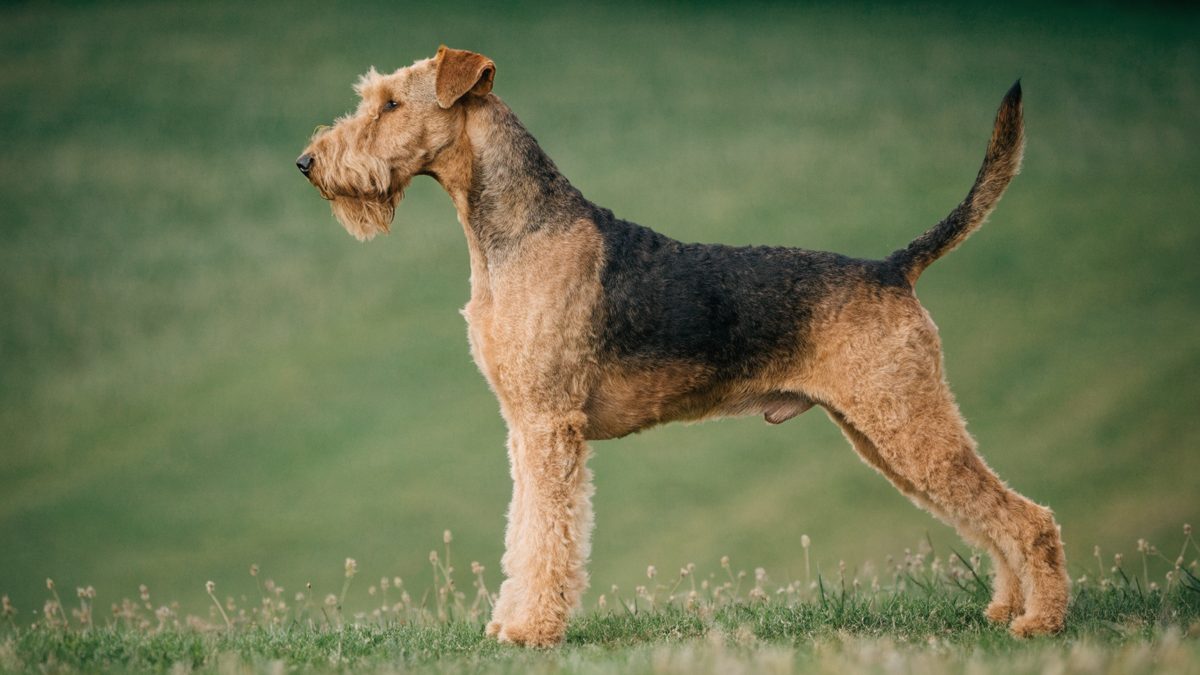
The Airedale Terrier is the largest of the terrier breeds, a British working dog standing about 58 to 61 cm at the withers with a harsh wiry outer coat over a shorter, softer undercoat. It was assembled in the Aire, Wharfe and Calder valleys of Yorkshire in the nineteenth century to do several jobs at once, and almost everything that makes it difficult in an Indian flat comes from that job description.
Three kennel clubs publish a standard for this breed and all three agree on the shape of it. FCI Standard No. 7 places the Airedale in Group 3 Terriers, Section 1, large and medium sized terriers, and gives height at the withers as about 58 to 61 cm for males and 56 to 59 cm for females. The Royal Kennel Club standard, last updated on 1 April 2025, gives the same figures in both units, 58 to 61 cm or 23 to 24 inches for dogs and 56 to 59 cm or 22 to 23 inches for bitches. The American Kennel Club standard, approved on 14 July 1959 and unchanged since, simply says dogs should measure approximately 23 inches at the shoulder and bitches slightly less.
No breed standard anywhere gives a weight
Read those three standards again and notice what is missing. Not one of them specifies a weight. The AKC standard runs to a full scale of points totalling 100 and never mentions kilograms or pounds. FCI Standard No. 7 has a heading reading Size and Weight and then lists only height. The Royal Kennel Club standard gives height alone, and adds a note for prospective puppy buyers stating that the size described does not imply a dog will match the measurements given, in height or weight.
That matters because the Indian pages selling this breed print weight figures with total confidence, and they do not agree with each other.
| Source | Height | Weight |
|---|---|---|
| FCI Standard No. 7 | 58 to 61 cm males, 56 to 59 cm females | Not specified |
| Royal Kennel Club standard | 58 to 61 cm dogs, 56 to 59 cm bitches | Not specified |
| AKC official standard | About 23 inches for dogs | Not specified |
| AKC breed page | 23 inches | 50 to 70 lb, about 23 to 32 kg |
| Purina India | 59 cm males | 22 to 27 kg males, 18 to 21 kg females |
| Tailsbuddy, India | 22 to 24 inches | 18 to 30 kg |
| Puppiezo, India | 22 to 24 inches | 20 to 30 kg |
The page ranking first in India for this query manages to disagree with itself inside a single section, giving a fit standard Airedale as 19 to 25 kg, then UK males as 30 to 35 kg, then American males as 40 to 70 pounds. A buyer trying to work out how much dog is arriving cannot get a straight answer from any of them. Use Purina India's 22 to 27 kg for a male as the planning figure, because it is the narrowest band published by an organisation with no puppy to sell.
The coat is the whole breed
The Airedale's coat is described in near-identical language by the Royal Kennel Club and the FCI, and the wording is worth reading closely because it governs every grooming decision an Indian owner will make. The coat should be hard, dense and wiry, not so long as to appear ragged, lying straight and close, with an outer coat that is hard, wiry and stiff and an undercoat that is shorter and softer. The hardest coats are crinkling or just slightly waved, and a curly or soft coat is highly undesirable. The AKC standard adds that at the base of the hard very stiff hair there should be a shorter growth of softer hair termed the undercoat.
Two facts follow from that description. A soft coat is a fault, not a variation, and the harsh outer jacket is a functional structure rather than decoration. Both matter later, because the routine maintenance that keeps a wire coat hard is the one grooming service India does not sell.
Colour, and a claim to ignore
The colour clause is short and absolute. The body saddle is black or grizzle, as is the top of the neck and the top surface of the tail, and all other parts are tan, with ears often a darker tan and a few white hairs between the forelegs acceptable. The Royal Kennel Club then states in bold that any other colour or combination of colours is unacceptable. The Royal Kennel Club also files the breed under Colour Watch Category 0, meaning there are no non-breed-standard colour registration options at all.
The Indian page ranking first carries a section headed Coat Colors, including Gray and White Variants. The Indian page it cites for its own price data says flatly that these dogs are only found in a single coat colour, black or grizzle with tan. When a page contradicts its own cited source on a point this basic, treat everything else on it as unverified.
Where the breed came from, and its Indian footnote
The breed was built by crossing the now-extinct Black and Tan Terrier for coat, the Otterhound for nose, and the Bull Terrier for tenacity, by Yorkshire hunters who wanted a terrier that could protect fishermen's catches from otters. It was shown as the Waterside Terrier before the Airedale Show gave it the name it kept. The FCI standard records that the Airedale has remarkable scenting powers and has been used in Africa, India and Canada for tracking, and has served with police and armed forces in Britain and Russia. India appears in the breed's own standard, which is more than most imported breeds can say, though the tracking work referred to belongs to the colonial period rather than to any current Indian population.
The temperament clause is the same in both European standards and is unusually specific. Outgoing and confident, friendly, courageous and intelligent, alert at all times, not aggressive but fearless Federation Cynologique Internationale. That last phrase is the honest summary of the breed. An Airedale is not looking for a fight and will not step back from one, which is a different animal from the bull-and-terrier crosses covered on our Bull Terrier and Staffordshire Bull Terrier pages.
How rare is it in India
Rare enough that no Indian dataset describes it. The Kennel Club of India registered 33,880 pure-bred dogs across every breed in 2025, against an estimated 17.1 million dogs in the country, and the club has 342 individual members and 80 member clubs. The Airedale's share of that is not published separately. A useful proxy comes from the Airedale Terrier Club of America's health survey, where owners were asked where their dog was born. Of the responses, 90 percent said North America, 6 percent Europe or the United Kingdom, 2 percent Australia, and 3 dogs in total said Asia. That is the global picture into which an Indian buyer is stepping.
Both the FCI and Royal Kennel Club standards begin the tail clause with the words previously customarily docked, then describe docked and undocked tails as equally acceptable. Imported Airedale photography still shows short docked tails, which sets the wrong expectation for an Indian buyer. Tail docking is prohibited in India, and we cover the legal position in detail on the Jack Russell Terrier page. An Indian-bred Airedale should have a full tail.
Airedale Terrier price in India, and why the number is thinner than it looks
The Airedale Terrier price in India is published as Rs 40,000 to Rs 1,60,000 across three bands, and the useful thing to know is that essentially one page generates that figure for the whole Indian internet. This is not a case of sources disagreeing. It is a case of there being almost no sources.
Bonbeno read every page on the first page of Google in India for this query. Here is what each one actually publishes.
| Source | Position | Price published | Sells puppies |
|---|---|---|---|
| Pets Army | 1 | Rs 40,000 to Rs 60,000 basic, Rs 60,000 to Rs 1,00,000 KCI, Rs 1,00,000 to Rs 1,60,000 show | No, but links to a seller |
| Puppiezo | 2 | Rs 45,000 to Rs 50,000 or more | Yes |
| Mr n Mrs Pet | 3 | None visible. Prices behind a sign-up wall | Yes |
| Breed n Breeder | 6 | None anywhere on the page | Yes |
| Tailsbuddy | Cited by position 1 | Rs 40,000 to Rs 60,000 basic, Rs 60,000 to Rs 1,00,000 KCI, Rs 1,00,000 to Rs 1,60,000 show | Refers buyers by WhatsApp |
| Royal Canin India | 11 | None. Breed data only | No |
| Purina India | 12 | None. Breed data only | No |
Strip out the duplicates and the empty pages and two independent Indian figures remain. Tailsbuddy's three bands, and Puppiezo's Rs 45,000 to Rs 50,000. The page ranking first does not derive its bands independently, it links directly to Tailsbuddy for them Tailsbuddy, Airedale Terrier Price…. Tailsbuddy states no method, no sample, and no collection date, and closes with a WhatsApp number for buyers who want connecting to a source.
The result sitting sixth in India carries the title Airedale Terrier Puppy Price in Uttar Pradesh. Read the whole page and there is no rupee figure on it. What it contains is a breed dropdown, a state dropdown, a city dropdown and a phone number. The result sitting third promises Airedale Terrier price in India in its opening line and puts every actual number behind a sign-up form. Two of the six Indian pages competing for this query answer the query with a lead form.
What the three bands are supposed to mean
The three-band structure is standard across Indian breed pricing and it is worth knowing what separates them, because only one of the differences is about the dog.
- Basic, Rs 40,000 to Rs 60,000. Dogs and puppies not registered with any kennel club including the KCI. No pedigree documentation exists for these animals, so nothing about the parents can be verified.
- KCI registered, Rs 60,000 to Rs 1,00,000. Registration with the Kennel Club of India, which brings a registration certificate and eligibility for KCI shows. It documents lineage. It certifies nothing whatsoever about health.
- Show quality, Rs 1,00,000 to Rs 1,60,000. A dog judged closest to the breed standard. Tailsbuddy is straightforward that if you are not planning to show, it does not matter much whether you buy show quality or pet quality.
Notice what is absent from all three tiers. No band is defined by whether the parents were hip-scored, cardiac-screened or eye-tested, which are the four evaluations the breed's own national club actually recommends. In India you can pay Rs 1,60,000 for proximity to a breed standard and receive no screening information at all.
Why the price is high for a breed nobody wants
Scarcity, not quality. Tailsbuddy is candid that demand and availability of this breed are on the lower side in India, and that dogs which are not readily available cost more. Puppiezo's own page demonstrates the point. It advertises Airedale Terrier puppies for sale in India at Rs 45,000 to Rs 50,000, and the puppies actually shown as available on that page are a Maltipoo, two Poodles, a Cane Corso, a Goldendoodle, a Rottweiler and a Doxiepoo. The breed page exists. The breed does not.
That has a direct consequence for a buyer. When a rare breed is quoted at a price but no stock exists, the quoted price is a marketing anchor rather than a transaction record. Any Airedale that does appear in India will most likely be a one-off import or the product of a small, unregistered litter, and neither route gives you a market rate to compare against.
Ask three questions before the number. Can the seller show you the sire and dam on the premises where the litter was raised? Can they produce hip and cardiac evaluation results for both parents, which is what the national breed club recommends? Can they produce a certificate of registration issued by the State Animal Welfare Board, which every breeder in India is legally required to hold and to display prominently in the establishment? A seller who answers all three has earned the top of the band. A seller who answers none has not earned the bottom of it.
Bonbeno does not broker puppy sales and publishes no breeder listings. The figures above are reported from third-party sources so buyers can see exactly how thin the evidence is.
Monthly cost of an Airedale Terrier in India, and the arithmetic behind the published figures
Every recurring cost figure published for this breed in India is a United States dollar amount converted at roughly Rs 84.38 to the dollar. That is not an inference from tone. It is arithmetic, and it is reproducible in about ninety seconds with a calculator.
The page ranking first in India for this query publishes a full running-cost breakdown. Food at Rs 3,375 to Rs 5,062 a month, professional grooming at about Rs 7,594, yearly healthcare at Rs 8,438 to Rs 25,314, adoption fees at Rs 4,219 to Rs 42,190, and a lifetime total of Rs 10,12,565 to Rs 13,50,087. Those are oddly precise numbers for estimates. Divide each of them by 84.38 and the precision explains itself.
| Published as an Indian figure | Rupees | Divided by 84.38 |
|---|---|---|
| Food per month, lower bound | Rs 3,375 | USD 40 |
| Food per month, upper bound | Rs 5,062 | USD 60 |
| Professional grooming | Rs 7,594 | USD 90 |
| Yearly healthcare, lower bound | Rs 8,438 | USD 100 |
| Yearly healthcare, upper bound | Rs 25,314 | USD 300 |
| Adoption fee, lower bound | Rs 4,219 | USD 50 |
| Adoption fee, upper bound | Rs 42,190 | USD 500 |
| Lifetime total, lower bound | Rs 10,12,565 | USD 12,000 |
| Lifetime total, upper bound | Rs 13,50,087 | USD 16,000 |
Nine figures, nine round dollar amounts, one exchange rate. And the adoption band is traceable to a specific document. The Dogster 2026 United States cost guide for this breed opens by stating you can generally expect to pay USD 50 to USD 500 if you adopt an Airedale Terrier, or USD 800 to USD 2,000 from a reputable breeder. Rs 4,219 to Rs 42,190 is that sentence, in rupees.
United States dog-care costs and Indian dog-care costs are not related by an exchange rate. Indian veterinary consultation, boarding, grooming labour and kibble are priced against Indian wages and Indian supply chains, not against the dollar. Converting a US figure produces a number that looks Indian, reads as researched, and describes a market that does not exist. An Indian buyer using Rs 7,594 as a grooming budget is working from a US salon rate. The same page also carries unresolved citation placeholders in its published copy, including bracketed markers such as link_1 and bare numbers where sources should be, which is a visible sign the text was assembled rather than researched.
What the cost structure genuinely looks like in India
Bonbeno does not have a verified Indian owner-cost survey for the Airedale Terrier, and there is no honest way to manufacture one. There are perhaps a few dozen of these dogs in the country. What we can do is set out the cost structure with real Indian prices for each line where a real Indian price exists, and mark the lines where it does not.
| Cost line | Indian figure available | Basis |
|---|---|---|
| Professional grooming, per session | Rs 1,500 to Rs 3,000 for a large breed, from Rs 3,000 in Bengaluru | Published 2026 Indian rate cards |
| Full groom in Delhi NCR | Rs 1,849 to Rs 2,199 | Gurugram salon rate card |
| Hand stripping, the correct method for this coat | No Indian price published anywhere we could find | Absent from both Indian rate cards |
| Medicated or anti-tick bath | Rs 1,000 to Rs 1,500 | Indian rate card |
| De-matting surcharge | Charged extra, amount not published | Listed as a hidden cost by an Indian salon |
| Food | No Airedale-specific Indian figure exists | The only published figure is a converted USD amount |
| Veterinary care | No Airedale-specific Indian figure exists | The only published figure is a converted USD amount |
Take the one line where Indian evidence is solid and follow it through. The AKC says a full groom, whether stripped or clipped, should be done three or four times a year. At published Indian large-breed rates of Rs 1,500 to Rs 3,000 a session, that is Rs 4,500 to Rs 12,000 a year, or Rs 375 to Rs 1,000 a month, for a clipped coat. In Bengaluru, where large-breed grooming starts at Rs 3,000, the same schedule is Rs 9,000 to Rs 12,000 a year.
That is the floor, not the bill. Both Indian rate cards charge separately for de-matting, and one lists a de-matting surcharge among its hidden costs alongside a behavioural fee for anxious dogs and a de-shedding add-on at Rs 199 to Rs 299. A wire coat that is not being stripped will mat, and a matted coat is billed as extra time.
The lines nobody prices, and why they are large
- Parasite control. Half of Indian dogs tested in a four-city study carried a tick-borne pathogen, and ticks were found on 53 percent of the dogs examined. A dense wire coat over a soft undercoat hides ticks from an owner's eye better than a short coat does, so this is a monthly product cost plus a real weekly inspection habit, not an occasional one.
- Skin and allergy management. Allergies and skin problems are the first and third most common concerns named by Airedale owners in the breed's own health survey. In Indian humidity this is the line most likely to become a recurring veterinary cost rather than a grooming one.
- Air conditioning. Not a pet cost on any published list, and for a heavy-coated imported breed in a metro summer it is one. Purina India names lack of acclimatisation as a heat-stroke risk factor in its own right.
- Space. Purina India says this breed needs a large-ish house and garden and is best in a rural environment. In Mumbai, Bengaluru or Delhi that is a rent decision, and it is by far the biggest number on this page.
When we publish a cost figure we state the source, the city and the collection date. Where no Indian figure exists we say so and leave the line blank rather than converting a foreign number and presenting it as local. A blank is more useful to a buyer than a confident wrong number, because a blank tells you to go and get a quote.
Can an Airedale Terrier handle the Indian climate?
An Airedale Terrier can live in India, but it sits in the awkward middle of the heat-tolerance range and the Indian pages selling it place it far too high. We rate heat tolerance 2 out of 5 for Indian conditions, above the plush double-coated northern breeds and well below the comfortable rating that a hot-climate buyer is being sold.
The claim to examine first comes from the page that supplies India's Airedale prices. It says these dogs have a good tolerance to both high and low temperatures, which means they can comfortably thrive in both hot and cold places, and repeats it lower down as a reason the breed might suit you. No source is given for either sentence. Purina's own Indian site, which has no puppy to sell, names dogs with heavy coats among the breeds at particular risk of heat stroke.
What the coat actually does in heat
The Airedale jacket is a harsh, stiff outer coat lying straight and close over a shorter, softer undercoat. That is a genuinely different structure from the plush, air-trapping double coat of a Husky or a Golden Retriever, and it is the reason the Airedale is not at the bottom of the Indian heat-tolerance table. A correctly maintained wire coat is relatively open at the skin and offers real protection from direct sun.
Three things then pull the rating back down.
- The saddle is black or grizzle. The breed standard requires the body saddle, top of neck and top surface of the tail to be black or grizzle. That is the largest surface area of the dog, in the darkest colour, under Indian sun.
- The correct maintenance is unavailable here. A wire coat stays open and functional when the dead coat is stripped out. Clipping cuts the harsh guard hairs and leaves the soft undercoat in place, and the ranking pages themselves report that clipped pet Airedales develop a softer coat over time. A softer, denser coat is exactly the wrong coat for humidity.
- The exercise requirement is high. Purina India puts it at one to two hours a day and the Royal Kennel Club at up to an hour. Purina India also warns that vigorous exercise in hot weather can produce heat stroke in as little as 30 minutes. A working terrier that needs an hour of real work is being asked to do it inside a narrow safe window.
Humidity is the part Indian buyers underestimate
Purina India lists excessive humidity as a heat-stroke risk factor in its own right, alongside lack of water, enclosed space, obesity, intense exercise, old age and lack of acclimatisation. Panting cools a dog by evaporation, and evaporation works badly in humid air. That is why the same air temperature is a different problem in Mumbai or Chennai than it is in Pune or Bengaluru.
Lack of acclimatisation deserves its own sentence for this breed. An Airedale arriving in India as an import, or bred from recently imported stock, has no adaptation to the climate at all. It is not a native or long-established Indian population like the Indian Pariah Dog or the Rajapalayam, both of which handle Indian heat far better than any imported wire or double coat.
| City | Dominant problem | Practical consequence |
|---|---|---|
| Mumbai | Humidity year round | Coat dries slowly after every bath and every monsoon walk. Highest hot-spot and skin risk on this list. |
| Chennai | Heat plus coastal humidity | Both cooling mechanisms compromised at once. Exercise window is narrowest here. |
| Delhi NCR | Extreme dry summer heat | Sun on a black saddle is the main risk. Cooling by evaporation still works, so water and shade go further. |
| Bengaluru | Mildest of the metros | The most workable Indian city for this breed, and also where large-breed grooming starts highest at Rs 3,000. |
| Pune | Dry heat, cooler nights | Early morning and late evening sessions are genuinely usable for most of the year. |
| Kolkata | Prolonged humid heat | Similar to Mumbai. Monsoon skin management is the recurring cost. |
What actually reduces the risk
- Move all work to early morning and late evening. Purina India's advice is explicit that the hottest part of the day should be avoided entirely for exercise.
- Keep the coat stripped or at least raked out, never shaved. The aim is to remove dead coat so air reaches the skin, which is the opposite of removing the coat.
- Watch for the specific signs. Severe panting, difficulty breathing, heavy salivation, vomiting, diarrhoea, a temperature of 40.5 C or above, blood in the urine, nosebleeds, then collapse.
- Cool with cool water, not cold. Wet the belly and the inside of the legs so water reaches skin rather than running off the coat, use a fan, and never plunge the dog into an ice bath because that prevents the core temperature falling.
- Stop cooling at 39.4 C to avoid tipping the dog into hypothermia, then get to a clinic.
A car at 26 C outside reaches 32 C inside within five minutes and 43 C within 25 minutes. Indian summer temperatures start well above 26 C. Do not use a car as a waiting room, and if you suspect heat stroke, cool the dog on the way to your nearby vet rather than instead of going. Consult your nearby vet about a hot-weather plan for your individual dog before the summer, not during it.
Temperament, and who should not buy one
The Airedale Terrier is outgoing and confident, friendly, courageous and intelligent, alert at all times, not aggressive but fearless, which is the wording both European standards use Federation Cynologique Internationale. Read it as a warning as well as a recommendation, because fearless and vocal in a shared Indian building is a different proposition from fearless on a Yorkshire riverbank.
Purina India's breed summary is the most decision-relevant description of this dog published on any Indian site, and almost none of it appears on the pages selling the breed. It records the Airedale as a chatty and vocal dog, a guard dog that barks and alerts, a dog that may require training to live with other pets, a dog that may require training to live with kids, and one suitable for owners with some experience.
The apartment question, answered by the brand rather than the seller
Purina India states in its living considerations that the breed is not suitable for apartment living, and in its space requirements section that the Airedale needs a large-ish house and garden plus space to exercise, so is best in a rural environment. The Royal Kennel Club independently records the breed's requirements as a large house and a large garden. Royal Canin's Indian page lists requires outdoor space among just three key facts.
Three organisations with no puppy to sell say the same thing. The Indian seller ranking second for this query rates the breed's ideal space as medium to large and offers pan-India home delivery. If you live in a metro flat, that disagreement is the single most important thing on this page for you.
Prey drive and other animals
This is a terrier built to hunt otters and kill vermin along a riverbank. Purina India warns that a typical terrier may not be reliable with small furry animals and cats, and may not be entirely friendly to unknown dogs. In the breed's own health survey, where owners described aggression their dog displayed, same-sex conflict accounted for 52 percent of reported dog-directed aggression and dominance or status-based conflict for 55 percent. Those figures come from a self-selected, unverified owner survey and OFA says so plainly, so treat them as a pattern rather than a prevalence.
For an Indian household the practical translation is short. A community-cat colony outside the gate, a neighbour's Pomeranian in the lift, and a building full of free-roaming indies are all daily events, and this breed needs a trained response to each of them rather than an assumed one.
Good fit and poor fit
- Good fit. An independent house with a secure garden, an active family with older children, an owner who has kept a working breed before, and somewhere outside the hottest metros.
- Poor fit. A flat in a housing society with noise complaints, a household out for ten hours, a first-time owner, a home with cats or small pets, and any household that cannot service a wire coat.
- Watch item. Purina India recommends the breed for active families with older children and notes it may be too big for younger ones. A 22 to 27 kg dog at full speed is a physical hazard to a toddler regardless of intent.
Training an Airedale Terrier, and what it will resist
Train an Airedale with reward-based methods and constant variety, because this is a quick dog with an independent streak and the failure mode is boredom rather than stupidity. Purina India calls the breed a joy to train that loves working with its owner, provided it is kept motivated with reward-based training and plenty of variety.
The AKC frames the same point as a warning. An intelligent dog is an easily bored dog, so varied training sessions will be more successful than repetitive ones, and a bored dog left alone for long periods will develop undesirable behaviours. The AKC also recommends obedience training explicitly on grounds of the breed's size, strength and rambunctiousness.
The three things that reliably go wrong
- Barking. Purina India lists the Airedale as chatty and vocal and as a guard dog that barks and alerts. In an Indian housing society this is the behaviour that generates formal complaints, and it is far easier to shape a quiet-on-cue response in the first six months than to suppress an established habit later.
- Recall around prey. Purina India advises that the breed needs early and ongoing socialisation to stay reliable around other dogs, and should be taught a strong recall. A terrier in pursuit is not being disobedient, it is doing the job it was selected for.
- Testing the boundary. Terrier independence reads as stubbornness to owners who expect a retriever. The answer is consistency, not escalation, and harsh handling on a fearless breed is the fastest route to a dog that stops offering behaviour at all.
Grooming is a training subject, not a grooming subject
This is the piece Indian owners of wire-coated breeds most often miss. Hand stripping takes far longer than a clip and involves sustained handling of a standing dog. A dog that has not been taught to accept it will be labelled difficult and will end up clipped by default. Teach a puppy to stand still, to have its feet, ears and beard handled, and to accept a stripping knife against the skin before it is six months old, and the coat question stays open for life. Leave it, and the coat question is closed by the dog.
| Skill | Start | Reliable by |
|---|---|---|
| Name response and handling | Week 1 home | 3 to 5 weeks |
| Toilet routine | Week 1 home | 4 to 6 months |
| Standing calmly for grooming | Week 2 home | 4 to 6 months |
| Quiet on cue | Month 2 | 6 to 10 months |
| Loose-lead walking | Month 2 | 6 to 9 months |
| Recall away from a cat or squirrel | Month 2 | 12 to 18 months, and never absolute |
Purina India notes the Airedale can excel at dog sports such as agility, can become expert at scent work, and loves having a job to do. Scent work is the single best Indian answer to this breed, because twenty minutes of nose work tires it more than twenty minutes of walking and can be done indoors during a heatwave.
Daily exercise, and what the published figures disagree about
An adult Airedale Terrier needs between one and two hours of activity a day, and the published sources genuinely disagree about where in that range the truth sits. The Royal Kennel Club records exercise as up to 1 hour per day. Purina India puts it at one to two hours daily including games and training. Puppiezo, selling the breed in India, says one hour.
The AKC describes it differently again, as a daily play session of moderate length plus walks or backyard time several times a day. That phrasing assumes a backyard, which is the assumption an Indian flat-dweller cannot make. Plan for the Purina India figure and treat the Royal Kennel Club's hour as the absolute floor for a healthy adult.
The Indian constraint is the clock, not the total
The middle of the day is unusable for much of the Indian year, and Purina India warns that vigorous exercise in hot weather can produce heat stroke in as little as 30 minutes. That collapses a one to two hour requirement into two windows, roughly before 7 am and after 7 pm for the summer months. Anyone who cannot commit to both windows, every day, is not going to meet this breed's needs in an Indian metro.
- Split it. Two sessions beat one long one, and the two cool windows are where they go.
- Substitute scent work for distance. Twenty minutes of nose work is a real replacement, not a consolation prize, and it works indoors on a 42 C afternoon.
- Test the pavement. If you cannot hold your palm on it for five seconds, it will burn paw pads, and it is also radiating heat straight into a dog standing 60 cm tall.
- Carry water on every walk. Purina India lists lack of water first among heat-stroke risk factors.
- Do not let a bored dog earn its exercise by destruction. The AKC is direct that a bored Airedale left alone develops undesirable behaviours.
Puppies need less
The Airedale is a large breed carrying a measurable orthopaedic load, with 11.5 percent of 7,343 OFA hip evaluations returning dysplastic and 8.6 percent of 946 elbow evaluations returning dysplastic. Growth plates in a dog of this size do not close until well into the second year, so forced road walking, stair repetitions and jogging alongside a bicycle before the first birthday stack an avoidable risk on top of an inherited one. Free play on soft ground, in short sessions, is the whole first-year exercise plan.
Purina India records that this breed is prone to bloating and stomach problems and recommends smaller, more frequent meals to minimise the risk. Keep hard exercise well clear of feeding time in both directions, and read the feeding section below for what the evidence on gastric dilatation actually says about bowls.
Grooming a wire coat in Indian humidity, and the service India does not sell
Grooming an Airedale Terrier correctly means hand stripping the dead coat out rather than clipping it off, and no Indian salon we could find publishes a price for hand stripping at all. That single fact governs coat care, heat tolerance and skin health for this breed in India, and no page ranking for this query mentions it.
Start with what the standard requires. The coat should be hard, dense and wiry, lying straight and close, with a hard, wiry, stiff outer coat and a shorter, softer undercoat, and a curly or soft coat is highly undesirable Federation Cynologique Internationale. Softness is a fault written into the standard, not a matter of taste.
Now the two ways of maintaining it. Hand stripping pulls dead outer hairs out at the root, either with fingers or a stripping knife, so the new coat grows in hard and the skin stays open to air. Clipping cuts the outer hairs off and leaves the roots and the soft undercoat in place. The AKC describes full grooming as the dog being bathed, brushed, and stripped or clipped, three or four times a year, either by the owner or a professional groomer. The Indian page ranking first reports the consequence of choosing the second option, that pet Airedales which are clipped instead of hand-stripped often look more grey and tan, and that the coat may get softer and lighter over time.
What Indian salons actually sell
Bonbeno read the two published Indian dog-grooming rate cards that rank for 2026 pricing and listed every service on them.
| Service | wagNbush, India | Furrvana, Gurugram |
|---|---|---|
| Full groom, large breed | Rs 1,500 to Rs 3,000 | Rs 1,849 to Rs 2,199 |
| Bath and blow-dry | Rs 500 to Rs 1,250 | Rs 899 to Rs 1,249 |
| Breed-specific or full haircut | Rs 800 to Rs 1,600 | Rs 1,349 to Rs 1,599 |
| De-shedding or undercoat removal | Rs 200 to Rs 500 add-on | Rs 199 to Rs 299 add-on |
| Medicated or anti-tick bath | Rs 1,000 to Rs 1,500 | Rs 1,199 to Rs 1,299 |
| Nail trimming | Rs 200 to Rs 300 | Rs 299 |
| Ear cleaning | Rs 250 to Rs 400 | Rs 299 to Rs 400 |
| De-matting | Charged extra | Listed as a hidden surcharge |
| Hand stripping | Not listed | Not listed |
Sources also disagree sharply about how often the job needs doing, and the gap has a rupee value. The AKC says three or four full grooms a year. A tertiary summary of breed practice puts it at every 6 to 8 weeks, on the grounds that Airedales do not shed and so must have the dead coat taken off. Those are not the same schedule. Three or four grooms a year at Indian large-breed rates of Rs 1,500 to Rs 3,000 comes to Rs 4,500 to Rs 12,000 annually. Every seven weeks is roughly 7.5 grooms a year, or Rs 11,250 to Rs 22,500, and in Bengaluru where large-breed grooming starts at Rs 3,000 it is Rs 22,500 or more. Budget against the higher figure, because the coat, not the calendar, decides.
Every service a wire-coated dog might plausibly need is on those rate cards except the one it actually needs. The gap is not a pricing quirk, it is a skills-market gap. Hand stripping is slow, physically demanding, and priced by the hour in markets where it exists, so a salon only offers it if enough wire-coated dogs walk through the door to justify training a groomer. With a few dozen Airedales, Wire Fox Terriers and Schnauzers in a city, that demand does not exist.
Assume you will either learn to hand strip the dog yourself or accept a clipped coat. Both are legitimate choices and neither is the disaster the show world implies, but only one of them keeps the coat doing its job in humidity. If you plan to clip, budget the Rs 1,500 to Rs 3,000 large-breed rate three or four times a year and accept a softer, denser coat that holds moisture. If you plan to strip, buy a stripping knife before the puppy arrives and train the dog to stand for it in the first four months, because you will not find a groomer to do it for you.
The humidity problem underneath all of it
A soft, dense coat sitting close to the skin in Mumbai or Kolkata does not dry properly between a monsoon walk and the next one. That is the mechanism behind hot spots and the skin problems Airedale owners report at high rates. In the breed's own health survey, owners named skin problems as a top-two breed concern 39 percent of the time and allergies 41 percent of the time, the two most common answers given. Of the allergy diagnoses reported, 47 percent were seasonal inhalant atopy, 37 percent food allergies, 30 percent topical or contact allergies and 23 percent flea allergies. OFA notes the respondents are self-selected and unverified, so read these as what owners worry about rather than as a prevalence estimate.
The weekly routine that actually matters in India
- Brush to the skin weekly, not over the surface. The Royal Kennel Club records grooming for this breed as every day and Purina India as every other day, which is far more than the ranking pages' claim that the coat needs relatively little maintenance.
- Break mats with fingers first, then comb them out. The AKC's instruction is exactly this, and it is cheaper than a de-matting surcharge.
- Dry the dog completely after every bath and every wet walk. Damp coat against skin in humid air is the single biggest driver of skin trouble in this coat type.
- Do a tick check every week, with your fingers. Ticks were found on 53 percent of the dogs examined in a four-city Indian survey, and a wire jacket hides them from sight.
- Clean the beard and check the ears weekly. The beard traps food and water, and the AKC flags routine ear checking to remove foreign matter and avoid wax buildup.
- Never shave the dog to cool it down. Shaving removes the sun protection the outer coat provides and does not solve a heat problem that is being caused by humidity and exercise timing.
Health issues, screening and life expectancy
The Airedale Terrier has a measured median life expectancy of 12.0 years, with a 95 percent confidence interval of 11.8 to 12.3, from a Dogs Trust breed table built on 1,270 Airedale Terriers of which 556 were deceased. That is a real number from a real dataset, and it is lower than what the pages selling this breed in India tell you.
Purina India calls the Airedale generally a hardy breed, and by the standards of large imported dogs it is. The Royal Kennel Club places it in Breed Watch Category 1, meaning no points of concern specific to this breed have been identified for special attention by judges. Both statements are true. Neither is the same as long-lived.
Every published lifespan, compared
| Source | Life expectancy given | Basis |
|---|---|---|
| Dogs Trust breed table | 12.0 years median, 95% CI 11.8 to 12.3 | Measured across 1,270 dogs, 556 deceased |
| American Kennel Club | 11 to 14 years | Breed page, no method stated |
| Royal Kennel Club | Over 10 years | Breed characteristic band |
| Royal Canin India | 10 to 13 years | Breed page, no method stated |
| Puppiezo, India | 11 to 14 years | Seller page |
| Tailsbuddy, India | 10 to 14 years | Price page |
| Pets Army, India | 10 to 13 years, said to be longer than other dogs of similar size | Blog, no method stated |
Note the last row. The page ranking first in India states that the breed's lifespan runs longer than other dogs of similar size. The measured table says the opposite. In the same Dogs Trust dataset, the crossbred group also sits at 12.0 years, so the Airedale matches the average crossbreed rather than beating it.
The King of Terriers is among the shortest-lived terriers
This is the finding no page for this breed publishes, and it is uncomfortable. In a table covering 155 breeds, only two terrier-named breeds have a lower median life expectancy than the Airedale, and the Airedale ties with two more at 12.0.
| Breed | Median life expectancy |
|---|---|
| Black Russian Terrier | 10.9 years |
| Boston Terrier | 11.8 years |
| Airedale Terrier | 12.0 years |
| Bull Terrier | 12.0 years |
| Staffordshire Bull Terrier | 12.0 years |
| Scottish Terrier | 12.7 years |
| Jack Russell Terrier | 13.3 years |
| Yorkshire Terrier | 13.3 years |
| Wire Fox Terrier | 13.5 years |
| Welsh Terrier | 13.8 years |
| Cairn Terrier | 14.0 years |
| Border Terrier | 14.2 years |
The pattern is size, not terrier-ness. The Jack Russell Terrier reaches 13.3 years and the Yorkshire Terrier the same, while the three largest terriers in the table sit at the bottom. Buying the biggest terrier means buying the shortest terrier lifespan.
What the screening data actually shows
OFA maintains cumulative all-time testing statistics for this breed under breed code AT, and the numbers are reassuring in some registers and not in others.
| Register | Dogs evaluated | Result |
|---|---|---|
| Hips | 7,343 | 87.3% normal, 11.5% dysplastic |
| Elbows | 946 | 91.4% normal, 8.6% dysplastic |
| Eyes, ACVO | 377 | 90.2% normal, 9.8% abnormal |
| Basic cardiac | 178 | 100% normal |
| Congenital cardiac | 139 | 99.3% normal |
| Thyroid | 82 | 76.8% normal, 13.4% abnormal, 9.8% equivocal |
Two readings matter. First, hip dysplasia is the real orthopaedic issue and screening has moved it. Broken down by birth year, the dysplastic rate falls from 16.1 percent for dogs born up to 1990 to 8.1 percent for those born from 2021 onward. That halving is the argument for buying from a breeder who hip-scores, stated as a measurement rather than an opinion.
Second, the thyroid figure rests on only 82 dogs, which is far too small a sample to carry a prevalence claim, and we flag it rather than headline it. The same caution applies to the eye register at 377 dogs.
Which tests to ask a breeder for
OFA's CHIC programme for the Airedale Terrier requires a hip evaluation, either an OFA evaluation at a minimum age of 24 months or a PennHIP evaluation registered with OFA, plus a cardiac evaluation by basic auscultation or an advanced cardiac exam. An ACVO eye examination, an autoimmune thyroiditis evaluation and a radiographic elbow evaluation are listed as optional. Permanent identification by microchip or tattoo is required across all participating breeds.
The AKC's own breed page lists the national breed club's recommended tests as hip evaluation, cardiac exam, ophthalmologist evaluation and kidney disease screening. OFA's CHIC requirement list for the same breed names hips and cardiac as required with eye, thyroid and elbow optional, and carries no kidney item at all. Two pages published by organisations that work together disagree about what to test. Ask for kidney screening anyway, for the reason below.
In the United Kingdom the picture is different again. The Royal Kennel Club's best practice for this breed is elbow testing and hip testing under the BVA and Kennel Club schemes, and it offers no breed-specific DNA testing package for the Airedale because none is warranted. There is no single-gene DNA test that resolves a health question in this breed the way one does in the Jack Russell Terrier.
What owners themselves report
The Airedale Terrier health survey hosted by OFA asked owners to name the two most serious health problems facing the breed. Allergies came first at 41 percent, other cancers joint first at 41 percent, and skin problems third at 39 percent, followed by vaccine reactions and autoimmune conditions at 16 percent, cardiac issues at 14 percent, mast cell cancer at 13 percent and kidney failure at 13 percent. Among reported kidney disorders, renal dysplasia accounted for 22 percent and familial kidney disease for 12 percent, which is why the AKC's kidney screening recommendation is worth honouring even though CHIC does not require it. Among reported endocrine disorders, hypothyroidism accounted for 58 percent.
OFA states plainly that respondents are self-selected, that responses are not verified and that duplicates are not checked. These are owner concerns, not prevalence figures, and we present them as such. What they establish is the shape of the risk, and for an Indian buyer that shape is skin.
What Airedales actually die of
Two older breed health surveys agree closely on cause of death, and both are reported through a tertiary source rather than read by us in the original, which we flag rather than hide. A 2004 UK Kennel Club survey recorded cancer at 39.5 percent, old age at 14 percent, urologic causes at 9 percent and cardiac causes at 7 percent. A 2000 to 2001 USA and Canada health survey recorded cancer at 38 percent, urologic causes at 17 percent, old age at 12 percent and cardiac causes at 6 percent. Cancer leads in both, and urologic disease is the second or third cause in both, which is a further argument for the kidney screening the AKC recommends.
The same source reports a study of North American teaching hospitals finding hip dysplasia in 6.22 percent of Airedale Terriers against 3.52 percent across all breeds, and notes that the oversized Oorang type is significantly more prone to it than standard-sized dogs. Read the 6.22 percent alongside OFA's 11.5 percent rather than instead of it, because the two figures come from different populations, a hospital caseload and a voluntary screening register. The peer-reviewed longevity work behind the Dogs Trust table is published separately for anyone wanting the method.
The Indian addition to the list
Tick-borne disease is the health risk that does not appear on any Western Airedale page and dominates the Indian one. In a survey of 525 dogs across four Indian cities, 49.7 percent tested PCR-positive for at least one canine tick-borne pathogen, with a 95 percent confidence interval of 45.4 to 54.1. Hepatozoon canis was found in 30 percent, Ehrlichia canis in 20.6 percent, Mycoplasma haemocanis in 12.2 percent, Anaplasma platys in 6.5 percent and Babesia vogeli in 5.5 percent, and 39 percent of infected dogs carried more than one pathogen at once. Ticks were present on 53 percent of the dogs examined.
A harsh wire jacket over a soft undercoat is a good place for a tick to hide. Weekly tick checks by hand are a health intervention for this breed in India, not a grooming nicety.
Everything above is general information drawn from published registers and surveys, and none of it is a diagnosis for your dog. Screening results, tick prevention protocols, thyroid testing and any decision about anaesthesia or surgery must be set with your nearby vet, a registered veterinarian who has examined the animal in front of them. Treat any sudden change in your dog's condition as urgent and go, rather than reading further.
Feeding an Airedale Terrier in India
Feed an Airedale Terrier at least twice daily in smaller, more frequent meals, because Purina India records that the breed is prone to bloating and stomach problems and names smaller, more frequent meals as the way to minimise that risk. That single instruction shapes the whole feeding plan for this breed.
The rest of the nutrition advice is unremarkable and worth stating anyway. Purina India recommends a balanced diet covering the main nutrient groups, a constant supply of fresh water, regular body condition scoring, and feeding in accordance with the guidelines on the particular food. The AKC adds that any diet should be appropriate to the dog's life stage, that some dogs in this breed are prone to getting overweight, and that treats used in training can tip a dog into obesity if they are not counted.
What the bloat evidence actually says
Gastric dilatation and volvulus is the reason the feeding advice for large deep-chested dogs looks the way it does. The largest prospective study on non-dietary risk factors followed 1,637 dogs aged six months and over and found a cumulative incidence of gastric dilatation and volvulus of 6 percent across large and giant breeds during the study period. Four factors were significantly associated with increased risk: increasing age, having a first-degree relative with a history of the condition, faster speed of eating, and having a raised feeding bowl.
That last one reverses what most Indian pet shops sell to owners of large dogs. Roughly 20 percent of gastric dilatation cases among the large breeds in that study were attributed to having a raised feed bowl, rising to 52 percent among giant breeds.
The Airedale Terrier was not one of the eleven breeds in that cohort. The study followed Akitas, Bloodhounds, Collies, Great Danes, Irish Setters, Irish Wolfhounds, Newfoundlands, Rottweilers, Saint Bernards, Standard Poodles and Weimaraners. The finding is about large deep-chested dogs as a class, and the Airedale has a deep chest by standard, approximately level with the elbows. Combined with Purina India's separate statement that this breed is prone to bloating, that is enough to act on, and it is not the same as a breed-specific prevalence figure. Set your dog's feeding plan with your nearby vet.
The practical Indian feeding plan
- Feed twice daily as a minimum, three times for a puppy. Smaller, more frequent meals are the breed-specific recommendation.
- Use a floor-level bowl, not a raised stand, on the evidence above.
- Slow a fast eater down. Speed of eating was an independent risk factor, and a slow-feeder bowl is the cheapest intervention on this page.
- Separate hard exercise from meals in both directions by a clear margin.
- Body condition score monthly rather than weighing. No breed standard gives a target weight, so the dog's ribs are a better guide than any published kilogram figure.
- Expect appetite to drop in peak summer. A short seasonal dip is normal. Persistent inappetence is a veterinary matter.
On Indian availability, large-breed formulations from the major brands are widely stocked in metros and increasingly in tier-2 cities, so food supply is not a constraint for this breed the way grooming is. Bonbeno reviews Indian pet food separately and tests products first-hand before publishing a verdict. See our testing method for what a Bonbeno food review does and does not claim.
The first year, month by month
Plan an Airedale Terrier's first year around three deadlines: the socialisation window that closes around four months, the coat-handling habit that has to be built before the dog is strong enough to refuse, and the growth plates that keep hard exercise off the table until well into the second year.
No Indian source publishes an Airedale growth chart, and we are not going to invent one. What follows is the developmental sequence that matters, with the breed-specific items flagged.
- 8 to 12 weeks. Eight weeks is the legal floor for sale in India, set by rule 8(1)(a) of the Prevention of Cruelty to Animals (Dog Breeding and Marketing) Rules, 2017. Home, name, toilet routine, and the start of daily handling of feet, ears and beard. Begin to socialise the puppy to lifts, traffic, stairs and other dogs under supervision, because Purina India stresses early and ongoing socialisation for reliability around other dogs.
- 3 to 4 months. The socialisation window narrows sharply here. Introduce the stripping knife as an object, not yet as a procedure, and pay the dog for standing still. Teething peaks, so mouthing peaks with it. Keep exercise to short free play on soft ground.
- 4 to 6 months. First real grooming session, whether you strip or clip. If this falls in an Indian summer, heat management becomes real and both walks move to the cool windows. Start quiet-on-cue work before barking becomes a habit the neighbours have noticed.
- 6 to 9 months. Adolescence begins and trained behaviours wobble. The saddle pattern is still darkening and will keep changing. Sterilisation timing is a conversation for your nearby vet, because in a large breed it interacts with growth-plate closure.
- 9 to 12 months. Peak adolescence and peak boundary testing. Hold the line on reward-based methods. Recall around cats and squirrels is the skill to drill now, and it will never be absolute in a terrier.
- 12 to 18 months. Growth plates close through this period. Adult exercise load, meaning the full one to two hours Purina India describes, can be built up gradually from here.
The paperwork a legal Indian litter comes with
India's breeding rules are specific about what a buyer should receive, and almost no Indian buyer asks. Every pup sold must be micro-chipped with a complete record of treatment and vaccination maintained, and a receipt must be issued carrying the micro-chip number along with the purchaser's name, address and phone number. The breeder must furnish the purchaser in writing with details of feeding, the dates of inoculations and de-worming, and the name and address of the veterinary practitioner attending the pup.
Rule 8(3) requires every breeder to screen prospective purchasers to ascertain their potential to take proper care of the breed, especially if it is a large one, to attend to its grooming, socialising, spatial and veterinary needs, and to bear the expense of its upkeep. That clause names grooming and space, for a large breed, in Indian law. It describes the Airedale Terrier's two hardest requirements and it is legally the breeder's job to check you can meet them. A seller offering tiered delivery packages and a replacement guarantee with no screening step is not applying it.
Airedale Terrier compared with the breeds Indian buyers cross-shop
Choose an Airedale Terrier over the smaller terriers only if you have a house with a garden and can service a wire coat yourself, because on every other axis that matters in India the smaller terriers win. The Airedale's advantages are size and presence. Its costs are space, coat and lifespan.
Indian buyers who reach this breed usually arrive from one of two directions. Either they want a terrier and have worked up through the sizes, or they want a large alert family dog and have worked across from the guarding breeds. The comparison looks different depending on which door you came through.
| Factor | Airedale Terrier | Jack Russell Terrier | Bull Terrier | Indian Pariah Dog |
|---|---|---|---|---|
| Height | 58 to 61 cm | 25 to 30 cm ideal | About 53 cm | Medium, no formal standard |
| Coat | Harsh wire over soft undercoat | Smooth, broken or rough | Short and flat | Short and heat-adapted |
| Grooming burden | Highest. Hand stripping, unavailable in India | Low. Ten minutes a week | Lowest. One brushing a week | Lowest. Essentially none |
| Heat tolerance in India | 2 of 5 | 3 of 5 | 3 of 5 | 5 of 5 |
| Median life expectancy | 12.0 years | 13.3 years | 12.0 years | Not measured in any breed table |
| Apartment living | Not suitable | Workable with real daily work | Workable if someone is home | Workable |
| Availability in India | Almost none. No stock on the seller pages ranking | Available in metros | Available in metros | Free, everywhere |
| Published Indian price | Rs 40,000 to Rs 1,60,000 | Rs 20,000 to Rs 1,20,000 | Rs 45,000 to Rs 3,00,000 | Nil, adoption only |
Read the life expectancy row against the grooming row and the decision gets simpler. The Jack Russell Terrier gives you 1.3 more years of median life and a coat you can maintain in ten minutes a week, in a dog that fits an Indian flat. The Airedale asks for a garden, a stripping knife and a shorter dog.
If you came from the guarding breeds
The Airedale is a genuine alert dog. Purina India lists it as a guard dog that barks and alerts, and the standards describe a dog that is alert at all times, not aggressive but fearless Federation Cynologique Internationale. Against a German Shepherd it is smaller, sheds far less, and is described by the Royal Kennel Club as a non-shedding breed. Against a Labrador Retriever it is sharper with strangers and far less suited to a flat.
The Airedale's real edge over both is shedding. The Royal Kennel Club records Sheds: No, and the AKC notes that weekly brushing removes dead hair that would otherwise end up around the house, adding that some people with dog allergies have found they can share a living space with a well-brushed Airedale American Kennel Club. Do not upgrade that into a hypoallergenic claim. Purina India's own Indian breed page lists the Airedale explicitly as a non hypoallergenic breed, which directly contradicts the Indian price page that lists it as hypoallergenic: Yes. The coat is commonly called hypoallergenic, and studies have found no significant difference in allergen levels between Airedales and other dogs. Low shedding is not low allergen.
It should not be a contest. The honest answer for an Indian household that ranks heat above everything is a native breed such as the Indian Pariah Dog or the Rajapalayam, which are adapted to the climate, free or nearly free to adopt, and need no coat service that India cannot supply.
Mistakes Indian Airedale Terrier owners actually make
The failure modes for this breed in India are specific and mostly happen in the first year. They are listed below in rough order of how much damage they do.
- Budgeting from a converted dollar figure. Every running cost published for this breed in India is a United States amount divided by nothing and multiplied by about 84.38 Dogster, Airedale Terrier Price. Get local quotes for grooming, boarding and veterinary care in your own city before you commit, because the published numbers describe a market that is not yours.
- Buying the breed for a flat. Purina India says the Airedale Terrier is not suitable for apartment living and is best in a rural environment, and the Royal Kennel Club records a requirement for a large house and a large garden. This is the mistake that ends in a rehoming.
- Assuming the coat is low maintenance. The ranking pages say the wiry coat needs relatively little maintenance. The Royal Kennel Club records grooming as every day and Purina India as every other day. Believing the first version means arriving at a matted coat and a de-matting surcharge.
- Not teaching the puppy to stand for grooming. By the time an adult Airedale objects to being handled for an hour, the coat decision has been made for you. This is a four-month job, not a four-year one.
- Shaving the dog for summer. It removes the outer coat's sun protection without addressing the actual heat drivers, which are humidity, exercise timing and lack of acclimatisation.
- Exercising in the middle of the day. Vigorous exercise in hot weather can produce heat stroke in as little as 30 minutes. Two cool-window sessions beat three that include one dangerous one.
- Using a raised feeding bowl because the dog is tall. A raised bowl was one of four factors significantly associated with increased gastric dilatation risk in a 1,637-dog prospective cohort, and about 20 percent of large-breed cases in that study were attributed to it.
- Skipping the tick check because the coat looks clean. Ticks were found on 53 percent of dogs examined across four Indian cities, and half of all dogs tested were PCR-positive for a tick-borne pathogen. A wire jacket hides them.
- Treating KCI papers as a health guarantee. Registration with the Kennel Club of India documents lineage and grants show eligibility. It certifies nothing about hips, heart, eyes or kidneys.
- Paying the show-quality band without asking why. The Indian source that publishes that band says outright that if you are not planning to show, it does not matter much whether you buy show quality or pet quality.
Buying into a metro flat is the one that costs the most, and it is not a money cost. Everything else on this list can be corrected with a better bowl, an earlier walk or a better brush. Living space cannot be corrected after the dog arrives, which is precisely why Indian law puts the duty to check it on the breeder rather than the buyer.
Adoption, and how to verify a breeder against Indian law
Adopt before you buy, and if you buy, verify the breeder against the Prevention of Cruelty to Animals (Dog Breeding and Marketing) Rules, 2017 rather than against a website's own claims. India regulates dog breeding, most buyers do not know it, and the rules give you a precise checklist.
The adoption route is real for this breed
Airedale Terriers do reach rescue. In the breed's own health survey, 14 percent of owners said they obtained their dog through breed rescue and a further 2 percent through a shelter, so roughly one Airedale in six in that sample came through a rescue route rather than a breeder. In India the population is small enough that a breed-specific rescue does not exist, but a wire-coated terrier or terrier cross does turn up in metro shelters, usually surrendered when a family discovers the coat and the noise.
Indian shelters are explicit about where their dogs come from and why. CUPA's Second Chance Adoption Centre in Bangalore describes itself as a shelter for pets abandoned or abused by their owners or discarded by breeders, and has rehomed 4,861 dogs. It names the usual reasons dogs are given up, which are relocation, job changes, a new baby, marriage, senior parents moving in, and allergies. That last one is worth sitting with, given that an Indian page selling this breed advertises it as hypoallergenic when the evidence shows no significant allergen difference from other dogs Wikipedia, Airedale Terrier. A family that buys a low-shedding breed to solve an allergy problem, and finds it has not been solved, is the family that surrenders the dog.
Adoption also removes the two largest unknowns in an Indian Airedale purchase, which are temperament and early health history, and it removes the third one this page keeps returning to. An adult dog already has the coat it has, so you can see and feel it before you commit rather than discovering in month eight that no one in your city will hand strip it.
What the law requires of an Indian breeder
The rules were notified on 23 May 2017 as G.S.R. 496(E) under the Prevention of Cruelty to Animals Act, 1960, and they are binding on every breeder in the country.
- Registration is compulsory. No breeder may carry on any breeding activity without a certificate of registration from the State Animal Welfare Board, and every breeder must display that certificate prominently in the establishment.
- The premises must be open to inspection. A registered establishment is inspected at least once each year, and the breeder must keep it open to a person authorised in writing by the State Board.
- No pup under eight weeks may be sold.
- Every pup sold must be micro-chipped, with a complete record of treatment and vaccination maintained and a sale receipt issued carrying that micro-chip number.
- Pups may not be displayed in public places for immediate sale.
- The breeder must screen you. Rule 8(3) requires the breeder to ascertain a buyer's potential to attend to the breed's grooming, socialising, spatial and veterinary needs, especially where the breed is a large one.
- Records are kept for eight years, including the sire and dam micro-chip numbers, the date of whelping and the cause of death of any dog that dies on the premises.
A registration certificate is issued in a prescribed form, names the specific breeds the establishment may deal in, is valid for two years, is non-transferable, and must be displayed prominently. Ask to see it, and check that Airedale Terrier is one of the breeds named on it. A seller who cannot produce one is operating outside the rules whatever else the website says, and Bonbeno does not recommend or link to breeders.
The verification sequence, in order
- See the dam with the litter, at the place the puppies were raised. Decline any arrangement that involves a car park, a courier or a delivery slot.
- Read the State Board registration certificate and confirm the breed named on it.
- Ask for hip and cardiac results on both parents, which are the two evaluations CHIC requires for this breed, and for eye and kidney screening on top.
- Verify KCI registration with the Kennel Club of India directly rather than trusting a photocopy, and remember it documents pedigree only.
- Take the written record of feeding, inoculation dates, de-worming dates and the attending veterinary practitioner's name and address, which the breeder is legally required to furnish.
- Confirm the micro-chip number on the receipt matches the scan before you leave.
One closing note on scale. The Kennel Club of India registered 33,880 pure-bred dogs of all breeds in 2025, down from a peak of 89,571 in 2021, against roughly 17.1 million dogs in the country. Registered pedigree breeding is a very small corner of Indian dog ownership, and a rare imported terrier sits in a corner of that corner. If you cannot find a breeder who clears the checklist above, the correct answer is to wait or to adopt, not to lower the checklist.
Airedale Terrier questions Indian buyers actually ask
What is the Airedale Terrier price in India?
The Airedale Terrier price in India is published as Rs 40,000 to Rs 60,000 for an unregistered puppy, Rs 60,000 to Rs 1,00,000 for a KCI-registered one and Rs 1,00,000 to Rs 1,60,000 for show quality. Those bands come from one Indian lead-generation page with no stated method, and the only independent Indian figure on page one is Rs 45,000 to Rs 50,000.
Is an Airedale Terrier good for an apartment in India?
No. Purina India states in its own living considerations that the Airedale Terrier is not suitable for apartment living, needs a large-ish house and garden, and is best in a rural environment. The Royal Kennel Club independently records a requirement for a large house and a large garden. The breed is also chatty and vocal, which is what generates complaints in Indian housing societies.
Can Airedale Terriers survive in Indian heat?
Yes, with active management, but not as comfortably as the Indian selling pages claim. Purina India names dogs with heavy coats among those at particular risk of heat stroke, and lists excessive humidity and lack of acclimatisation as risk factors. Vigorous exercise in hot weather can cause heat stroke in as little as 30 minutes, so all work moves to early morning and late evening.
How much does it cost to groom an Airedale Terrier in India?
A large-breed full groom in India costs Rs 1,500 to Rs 3,000 a session in 2026, rising to Rs 3,000 and above in Bengaluru. At the three or four full grooms a year the AKC recommends, that is Rs 4,500 to Rs 12,000 annually for a clipped coat, before de-matting surcharges. The Rs 7,594 figure published by the top-ranking Indian page is USD 90 converted.
Do you have to hand strip an Airedale Terrier?
Hand stripping is the correct method, because it removes dead hair at the root and keeps the coat hard and open to air, while clipping cuts the outer hairs and leaves a softer, denser coat that holds moisture. In India the decision is usually made for you. Neither published Indian grooming rate card lists hand stripping at any price, so most Indian owners either learn it themselves or clip.
Are Airedale Terriers hypoallergenic?
No. Purina India lists the Airedale Terrier explicitly as a non hypoallergenic breed on its Indian page. The Indian price page that supplies most of this breed's Indian pricing lists it as hypoallergenic, which is wrong. The AKC says only that some people with dog allergies have found they can share a living space with a well-brushed Airedale, which is a much weaker claim.
How long do Airedale Terriers live?
Median life expectancy is 12.0 years, with a 95 percent confidence interval of 11.8 to 12.3, measured across 1,270 Airedale Terriers of which 556 were deceased. That matches the crossbred median in the same table exactly, and it is lower than almost every smaller terrier. Published claims of 10 to 14 years are not measurements.
How much exercise does an Airedale Terrier need?
Published figures disagree between up to one hour a day from the Royal Kennel Club and one to two hours a day from Purina India, including games and training. Treat one hour as the floor for a healthy adult and two hours as the realistic target, split into a morning and an evening session because the middle of the Indian day is unusable.
Do Airedale Terriers shed?
Barely. The Royal Kennel Club records the breed as a non-shedding one, and the AKC explains that weekly brushing removes dead hair that would otherwise be shed around the house. That is the breed's strongest practical advantage over a German Shepherd or a Labrador in an Indian home, and it is bought with a much higher grooming workload.
Is an Airedale Terrier a good first dog?
Not really. Purina India rates the breed as suitable for owners with some experience rather than for beginners. The combination of terrier independence, a strong prey drive around cats and small animals, a vocal alerting habit and a coat that Indian salons do not service correctly is a demanding first project for any new owner.
How big does an Airedale Terrier get?
Males stand about 58 to 61 cm at the withers and females about 56 to 59 cm, which is the figure given identically by FCI Standard No. 7 and the Royal Kennel Club. No breed standard anywhere specifies a weight for this breed. Purina India's 22 to 27 kg for males and 18 to 21 kg for females is the most useful planning figure available.
Are Airedale Terriers available in India?
Barely. The Indian seller ranking second for this query publishes an Airedale price page and displays no Airedale puppy in stock, showing a Maltipoo, two Poodles and a Cane Corso instead. Two further Indian pages titled as Airedale price guides publish no price at all. Expect a one-off import or a small unregistered litter rather than a market.
Is an Airedale Terrier a good family dog?
For an active family with older children in an independent house with a secure garden, yes. Purina India recommends the breed for active families with older children and notes it may be too big for younger ones, and a 22 to 27 kg dog at full speed is a physical hazard to a toddler regardless of intent. Both European standards describe an outgoing, confident, friendly, courageous, intelligent dog, not aggressive but fearless. It is a poor fit for a flat in a housing society, a household out for ten hours, a first-time owner, or a home with cats or small pets.
Do Airedale terriers bark a lot?
Yes. Purina India records the Airedale as a chatty and vocal dog and a guard dog that barks and alerts, and both European standards describe a dog that is alert at all times. In an Indian housing society this is the behaviour that generates formal complaints, and it is far easier to shape a quiet-on-cue response in the first six months than to suppress an established habit later. Bonbeno's realistic timeline is to start the quiet cue in month two and expect it to be reliable by six to ten months.
How intelligent are Airedales?
Quick enough that boredom, not stupidity, is the failure mode. Purina India calls the breed a joy to train that loves working with its owner provided it is kept motivated with reward-based training and plenty of variety, and notes it can excel at agility and become expert at scent work. The AKC frames the same point as a warning: an intelligent dog is an easily bored dog, so varied sessions beat repetitive ones, and a bored Airedale left alone for long periods develops undesirable behaviours. Terrier independence reads as stubbornness to owners who expect a retriever.
Are Airedales dog friendly?
Not reliably with unknown dogs, and training is needed rather than assumed. Purina India warns that a typical terrier may not be entirely friendly to unknown dogs and may not be reliable with small furry animals and cats, and says the breed needs early and ongoing socialisation to stay reliable around other dogs. In the breed's own OFA health survey, same-sex conflict accounted for 52 percent of reported dog-directed aggression, from a self-selected owner sample. In an Indian building with a neighbour's Pomeranian in the lift and free-roaming indies outside, that needs a trained response.
Compare with similar breeds
Airedale Terrier sits in 2 Bonbeno groups. Each one compares it directly against the breeds it is genuinely an alternative to, on the same figures.