
Breed profile
Lakeland Terrier in India: Price, Coat, Heat and Supply
A vulnerable native breed whose UK registrations have fallen 58 percent in a decade, with a hand-stripped coat that almost no Indian salon will maintain, exactly two papers in the entire veterinary literature, and an Indian price that belongs to a Maltipoo.
Quick answer
Lakeland Terrier price in India cannot be sourced honestly, because the pages ranking for it are not selling the breed. India's number one result prices eight puppies and not one is a Lakeland Terrier: two Maltipoos, two Poodles, a Cane Corso, a Goldendoodle, a Rottweiler and a Doxiepoo, three of them at the same Rs 98,999. India's deepest 40-breed price list omits the breed entirely.
This page is reference information, not veterinary advice. Distichiasis, cataract, laryngeal paralysis, osteochondromatosis and heat stress all need a veterinarian who has examined your dog. A Lakeland Terrier that is noisy on the intake breath, or that develops a sudden cloudy or painful eye, needs seeing rather than watching. Use this page to prepare your questions, not to answer them.
Lakeland Terrier traits, rated for India
What a Lakeland Terrier is, and the two standards that disagree about its weight
A Lakeland Terrier is a small British working terrier of not more than 37 cm at the shoulder, bred in the fell country of Cumberland and Westmorland to run all day with hound packs and then go to ground after fox. Two kennel clubs publish a standard for it, and they convert the same imperial weight into two different metric numbers.
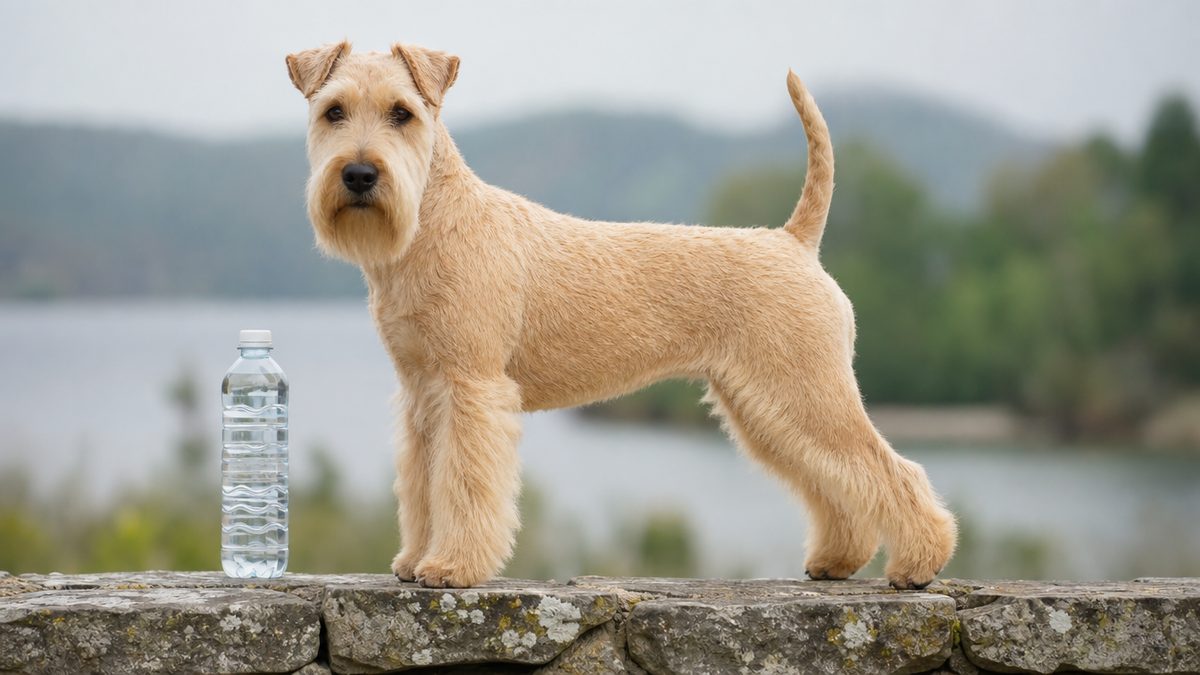
The Royal Kennel Club describes the breed as smart, workmanlike, well balanced and compact, with a gay, fearless demeanour, keen of expression, quick of movement, on the tip-toe of expectation, and a temperament that is bold, friendly and self-confident. It places the breed in the Terrier group and gives height not exceeding 37 cm with an average weight of 8 kg for dogs and 7 kg for bitches.
FCI Standard 70 gives the same 37 cm ceiling and the same imperial weights of 17 and 15 pounds, but converts them to 7.7 kg and 6.8 kg rather than 8 and 7. Seventeen pounds is 7.71 kg and fifteen is 6.80, so the FCI is arithmetically correct and the Royal Kennel Club has rounded up by nearly 300 grams on a 7 kg dog. It is a small discrepancy and it is worth knowing about, because it tells you the pounds are the original figure and the kilograms are downstream of them.
| Point | Royal Kennel Club | FCI Standard 70 |
|---|---|---|
| Height | Not exceeding 37 cm (14 and a half inches) | Not exceeding 37 cm (14 and a half inches) |
| Weight | Dogs 8 kg (17 lbs), bitches 7 kg (15 lbs) | Dogs 17 lbs (7.7 kg), bitches 15 lbs (6.8 kg) |
| Coat | Dense, harsh and weather-resisting with good undercoat | Dense, harsh and weather resisting with good undercoat |
| White markings | Small tips of white on feet and chest tolerated | Small tips of white on feet and chest undesirable but permissible |
| Mahogany or deep tan | Highly undesirable | Not typical |
| Eyes | Dark or hazel, moderately small; large, round, protruding or light eyes undesirable | Dark or hazel; slanting eyes undesirable |
| Group | Terrier | Group 3 Terriers, Section 1 Large and medium-sized Terriers |
Read the last four rows and a pattern appears. The two standards agree completely on measurements and diverge on the language of faults. The Royal Kennel Club calls mahogany highly undesirable while the FCI calls it not typical, and each club names a different eye fault. Measurements travel between standards reliably; adjectives do not.
Eight colours, which is the practical identifier
The Royal Kennel Club lists eight breed standard colours: black, black and tan, blue, blue and tan, liver, red, red grizzle and wheaten. That range is the single most useful thing to know when you are trying to identify one, because the terriers it is confused with have far narrower colour lists.
Where the breed came from
The Royal Kennel Club's own account is specific about place and purpose. In the counties of Cumberland and Westmorland, an area known as the Lake District, several different valleys developed their own type of working terrier, and it is from these that the Lakeland Terrier was developed. Behind the Lakeland is the Black and Tan Terrier, the root blood of many English native terrier breeds, with perhaps some input from the Welsh Terrier, the Border Terrier and the Fox Terrier, and some suggesting Bedlington input.
The job description matters as much as the ancestry. The breed was developed to run with packs of hounds and their foot followers over the steep and rocky fells of the Lake District, so stamina, agility and courage to bolt or kill fox or badger were required. Every difficult thing about owning this dog in an Indian flat traces back to that sentence.
A small, bold, harsh-coated British working terrier under 37 cm and around 7 to 8 kg, in one of eight colours, bred to work fells all day, recognised by the Kennel Club in 1921 and now down to 93 UK puppy registrations a year.
It is not a Welsh Terrier, a Border Terrier or a Patterdale, and here is how to tell
The Lakeland Terrier is confused with three other British terriers constantly, and all three confusions are settled by opening the Royal Kennel Club's own standards side by side. Colour separates it from the Welsh, weight from the Border, and a registry from the Patterdale.
These four names get used interchangeably in English-language sources, and an Indian buyer looking at photographs has almost no way to tell them apart without the numbers. So here are the numbers, each from the relevant club's own published standard.
| Breed | Height | Weight | Permitted colours | Tail clause |
|---|---|---|---|---|
| Lakeland Terrier | Not exceeding 37 cm | Dogs 8 kg, bitches 7 kg | Eight: black, black and tan, blue, blue and tan, liver, red, red grizzle, wheaten | Previously customarily docked; docked and undocked both described |
| Welsh Terrier | Not exceeding 39 cm | 9 to 9.5 kg | Two: black and tan for preference, or black grizzle and tan | Previously customarily docked; docked and undocked both described |
| Border Terrier | No height given at all | Dogs 6 to 7 kg, bitches 5 to 6.5 kg | Four: red, wheaten, grizzle and tan, blue and tan | No docking provision; moderately short, set high |
| Patterdale Terrier | Not held by the Royal Kennel Club | Not held by the Royal Kennel Club | Not held by the Royal Kennel Club | Registered by the United Kennel Club only |
Against the Welsh Terrier: colour settles it in one look
The Welsh Terrier standard permits black and tan for preference, or black grizzle and tan, free from black pencilling on toes, and states that any other colour or combination of colours is unacceptable. The Lakeland permits eight colours including red, wheaten, blue and liver. So a red Lakeland or a wheaten Lakeland cannot be a Welsh Terrier, and there is no ambiguity at all.
Where both dogs are black and tan the colour test fails, and size takes over. The Welsh is 2 cm taller at its ceiling and roughly 1.5 kg heavier at its floor: 39 cm and 9 to 9.5 kg against 37 cm and 7 to 8 kg The Royal Kennel Club, Breed Standards. On a dog this small, 1.5 kg is a fifth of its bodyweight and it is visible.
Against the Border Terrier: weight and the tail clause
The Border Terrier standard gives no height at all and weights of 6 to 7 kg for dogs and 5 to 6.5 kg for bitches, so a Border is meaningfully lighter than a Lakeland at every point of the range. The two also share colours: red, wheaten and blue and tan appear in both lists, which is exactly why weight rather than colour is the test here.
The tail clause is the second tell and it is absolute. The Border Terrier standard contains no docking provision whatsoever, describing a tail that is moderately short, fairly thick at base then tapering, set high and carried gaily. The Lakeland standard still prints Previously customarily docked and then gives two separate descriptions, one docked and one undocked. A historic photograph of a docked terrier of this shape is a Lakeland or a Welsh, and it is not a Border.
Against the Patterdale: a registry, not a measurement
The Patterdale Terrier is not held by the Royal Kennel Club, is not in the FCI's registers and is not listed by the American Kennel Club. It is registered by the United Kennel Club and by nobody else that matters, so there is no Royal Kennel Club standard to compare against. That is a difference in documentation rather than in dogs, and it is the whole point: you can check a Lakeland against a published standard and you cannot check a Patterdale against a British one.
An Indian seller offering a small wire-coated terrier has very little to fear from a buyer who cannot name the breed. The colour list and the weight range above are the two checks that take ten seconds and cannot be argued with, because both come from the breed's own kennel club.
The fell terrier is a type, the Lakeland is a breed, and the difference is a document
The Lakeland Terrier was standardised out of fell terrier stock, and the fell terrier itself remains a working type that no register anywhere holds as a breed. That distinction decides whether a puppy can be checked against anything at all.
A type is a group of dogs defined by function and locality, held together by what its keepers select for. A breed is a closed population with a written standard and a studbook. The fell terrier is the first thing. The Lakeland Terrier is one of several attempts, made at different times by different people, to turn some of that material into the second thing.
Bonbeno's fell terrier guide checked four registers one by one, each with a control that returned a result in the same session, and none of them holds a fell terrier. The Lakeland is in all of them: the Royal Kennel Club since 1921, the FCI as standard 70 in Group 3, the American Kennel Club since 1934, and the United Kennel Club American Kennel Club. The fell terrier sits on this site's dog types that are not breeds cluster for exactly that reason.
Do not borrow measurements across that line
The temptation runs in both directions and both are wrong. Reading the Lakeland's 37 cm ceiling and 8 kg average onto a fell terrier gives a false precision the type has never had, because nobody is judging a fell terrier against anything. Reading a fell terrier's working range onto a Lakeland is equally wrong, because the Lakeland has a standard and the standard is the answer.
The Royal Kennel Club's own account puts the two on the same timeline without confusing them: several Lake District valleys developed their own type of working terrier, and it is from these that the Lakeland Terrier was developed, with the first breed club formed in 1912 and Kennel Club recognition following in 1921. The type predates the breed, and the breed is a slice of it written down.
- The Lakeland Terrier has a standard, a studbook and four registries; a puppy can be checked against a document.
- The fell terrier has none of those, so no pedigree can exist under that name anywhere in the world.
- The Patterdale, which came out of the same stock, has one registry: the United Kennel Club, since 1995.
- An Indian seller offering paperwork with a fell terrier is offering paperwork for a different dog, or empty paperwork.
What the type still contributes
The reason the fell terrier connection is worth a section rather than a footnote is temperament. The Lakeland is not a scaled-down show terrier that happens to have a rustic origin story; it is two or three generations of standardisation away from dogs that were selected purely on whether they would go into a rock earth after a fox. The Royal Kennel Club's phrase for what was required is stamina, agility and courage to bolt or kill fox or badger.
That is what an Indian buyer is actually taking home, and it is the reason the prey drive rating on this page is a 5.
Ask which register the dog is on and look the register up yourself. A breed has one. A type does not. Everything else about this distinction is commentary.
A vulnerable native breed down 58 percent, checked in three documents
The Royal Kennel Club registered 93 Lakeland Terrier puppies in the United Kingdom in 2025 against 220 in 2016, a fall of 58 percent, and lists the breed as a vulnerable native breed. Those ten figures were checked in three separate club documents before being printed here.
The vulnerable native breed category is defined as 300 or fewer puppy registrations in the UK in the previous year, and it held 39 breeds in 2026. The Lakeland Terrier has been inside it throughout the decade and its trajectory is downward.
| Year | Registrations |
|---|---|
| 2016 | 220 |
| 2017 | 196 |
| 2018 | 139 |
| 2019 | 94 |
| 2020 | 145 |
| 2021 | 174 |
| 2022 | 135 |
| 2023 | 109 |
| 2024 | 86 |
| 2025 | 93 |
Why three documents, and what the cross-check found
This club's web tables and its PDFs are known to disagree on some cells, so a figure taken from only one of them is not safe. All ten Lakeland Terrier years were therefore compared across the web version of the vulnerable-breeds table, the vulnerable-breeds PDF and the ten-yearly Terrier group PDF The Royal Kennel Club The Royal Kennel Club. Every cell agrees in all three. That is the result worth reporting, and it means the 58 percent fall above can be stated without hedging.
The same comparison did surface real disagreements elsewhere in the Terrier group, which is why the check was worth running. The web table gives the Manchester Terrier 243 for 2019 while both PDFs give 133, and the web table transposes the Bullmastiff and Bull Terrier (Miniature) rows against both PDFs in 2016 and 2025. Where the club's web figure and its PDFs disagree, the two PDFs agree with each other, so the web is the outlier.
One further defect turned up in the Terrier group's own arithmetic. The ten-yearly Terrier PDF's 27 breed rows reconcile against its printed column totals in nine of the ten columns; the 2023 column sums to 18,209 against a printed total of 18,211. Nine columns balancing and one missing by two is a small defect, and it is the kind of thing that only shows up if you add the column.
The comparison that gives the number meaning
A 58 percent fall sounds alarming until you look at what a stable vulnerable breed looks like. The Lancashire Heeler, also a vulnerable native breed, ran 90, 119, 112, 140, 92, 114, 149, 108, 75, 92 across the same decade and finishes essentially where it began. Both breeds carry the vulnerable label. Only one of them is actually shrinking.
| Registry | Status | Detail |
|---|---|---|
| Royal Kennel Club | Full, Terrier group | First breed club 1912, recognition 1921; vulnerable native breed |
| FCI | Definitive, standard 70 | Group 3 Section 1; original valid standard 26.03.2009, English text 19.05.2009 |
| American Kennel Club | Full, Terrier Group | Recognised 1934; popularity printed as 157 of 210 |
| Kennel Club of India | Via FCI nomenclature | India is a full FCI member represented by the KCI, Chennai |
Note one difference from its stablemate on this site. Where the Lancashire Heeler sits only on the FCI's provisional register, the Lakeland Terrier is definitively recognised as standard 70, so an Indian pedigree issued against FCI nomenclature carries no CACIB restriction Federation Cynologique Internationale. On paper the Lakeland is the better-documented of the two breeds. In practice neither is obtainable here.
Where a registration figure matters, say which document it came from. This page uses the ten-yearly Terrier group PDF as its primary and confirms against two others, and it says so, because a bare number from a kennel club website is not as solid as it looks.
Lakeland Terrier price in India: eight puppies, none of them Lakelands
There is no honest Lakeland Terrier price in india, because the pages that rank for the query are not selling the breed. The number one Indian result prices eight puppies and not one of them is a Lakeland Terrier.
Open the top result and the spec card looks plausible. It gives height 10 to 12 inches, weight 4 to 6 kg, origin England, shedding yes, and a list of five traits. Both of those measurements are wrong against the breed's own standard, which gives a 37 cm ceiling, roughly 14 and a half inches, and 7 to 8 kg. The page understates the height by around a fifth and the weight by around a third.
Then scroll to the section headed Other Available Pets, which is where the prices are.
| Name | Breed | Price |
|---|---|---|
| Fizey | Maltipoo | ₹98,999 |
| Kuzo | Poodle | ₹92,599 |
| Dugu | Poodle | ₹92,599 |
| Kazuka | Cane Corso | ₹94,999 |
| Doir | Goldendoodle | ₹1,20,000 |
| Samy | Maltipoo | ₹98,999 |
| Tugi | Rottweiler | ₹76,499 |
| Yoki | Doxiepoo | ₹98,999 |
Zero Lakeland Terriers. Two Maltipoos, two Poodles, a Cane Corso, a Goldendoodle, a Rottweiler and a Doxiepoo. Anyone who searched for a Lakeland Terrier puppy price, landed here and wrote down a number has recorded the price of a Maltipoo named Fizey.
Rs 98,999 is a house price point, not a breed price
That figure appears three times in the eight rows above, attached to a Maltipoo, another Maltipoo and a Doxiepoo. Bonbeno has now recorded the identical Rs 98,999 across eleven separate breed pages on this one site, always attached to whichever puppy is in stock, and the recurring animals are these same Fizey, Samy and Yoki. It appears on pages for breeds the site does not stock at all.
It is not even a currency conversion. Rs 98,999 divided by 84.38 is 1,173.25 dollars, which no seller anywhere would print. It is a rupee-native charm price, and the correct thing to do with it is name what the carousel actually contains rather than quote it as any breed's puppy price.
The one Indian rupee figure for the dog itself
happypet.care prints Cost of buying ₹80,000 to ₹1,20,000 for the Lakeland Terrier. Run the division tests: at 84.38 that is 948.09 and 1,422.14, at 74 it is 1,081.08 and 1,621.62, and at a flat 80 it is exactly 1,000 and 1,500.
Only the 80 test produces round numbers, and 80 is the structurally weak test because any rupee figure ending in three zeros divides cleanly at it by construction. So this is suggestive rather than proven. What can be said is that the quotients 1,000 and 1,500 are prices a shop would print, and that the site's American co-ranking neighbour gives a different band again: its table says Average $1800 to $2500 USD while its own prose on the same page says usually around $1,500 to 2,800 with premium dogs over $3,000. A page that cannot agree with itself within one screen is not a source for a price.
India's deepest ranking price page settles the matter from the other end. Its 40-breed table contains no Lakeland Terrier at all; the only terriers in it are the Bull Terrier at ₹25,000 to ₹70,000 and the Scottish Terrier at ₹30,000 to ₹80,000.
We will not print Rs 98,999 as a Lakeland Terrier price, and we will not convert an American figure into rupees and call it an Indian one. Naming what the carousel actually holds is more useful to a buyer than any number on that page.
Three Indian marketplaces rank for this breed and all three are empty
Every Indian page selling Lakeland Terrier puppies for sale is a template with nothing behind it, and the three that rank fail in three different ways. Documenting how each one fails is more useful to a buyer than any price would be.
Failure one: a carousel of other breeds
The number one result lists eight priced puppies under Other Available Pets and none of them is the breed in the page title. The page is not lying exactly; the heading says Other Available Pets. But a buyer who arrived searching for a Lakeland Terrier price sees eight rupee figures on a Lakeland Terrier page, and the design does the rest.
Failure two: three results that are three other dogs
The third result prints 3 Result Found in bold and then shows three cards. On 2 September 2026 those three were a Cavalier King Charles Spaniel in Delhi, a Shiba Inu in Indore and a French Bulldog in Thiruvananthapuram, sitting under a heading reading Similar breeds at other locations, with every price gated behind a sign-up redirect. The count is real. It is a count of something else.
The same site generates one page per breed per city, including cities where no dog of any breed is listed, which is why a Lakeland Terrier Puppies for sale in Bhind page exists at all.
Failure three: a spinner that never resolves
The fifth result is a programmatic breed by state template. It contains zero rupee characters anywhere on the page, its listings grid renders only a loading spinner that never resolves even after eight seconds with a stealth proxy, and it prints no empty-state wording of any kind. Every price signal on it is a phone number or a lead form, and its one H2 reads that a named salesperson will discuss the process of selecting the perfect Lakeland terrier puppy at best Price in Karnataka.
A page with no inventory and no no-results message is the hardest of the three to read correctly, because nothing on it tells you the search failed.
| Position | Site | What it actually contains |
|---|---|---|
| 1 | Marketplace | Eight priced puppies, zero of them Lakeland Terriers, three at the same Rs 98,999 |
| 2 | US breed encyclopedia | Dollar prices only, and its table and its prose disagree with each other |
| 3 | Marketplace | 3 Result Found, then a Cavalier, a Shiba Inu and a French Bulldog |
| 4 | Indian price list | 40 breeds, none of them this one |
| 5 | Marketplace | Zero rupee figures, a spinner that never resolves, no empty state |
The controls that make this a finding rather than a guess
An absence is only evidence when the instrument worked. The India-restricted search that produced these results returned genuine Indian breeder listings with rupee prices for the Labrador control in the same session, so the instrument was working and the emptiness of these five pages is a real observation about the market.
Two other instruments failed their own controls and are therefore not used here at all. Bing India returned substituted result sets and its Labrador control came back as soap-opera message boards; DuckDuckGo returned a CAPTCHA challenge wearing a result page. Neither supports a claim in either direction.
The import route, as far as it can be verified
India's foreign trade rules permit a dog to enter only as a pet with a valid pet book in the importer's name, for research by an organisation with a CPCSEA recommendation, or for internal security by the Defence and Police Force, and import of commercial dogs for breeding or any other commercial activity is not permitted. Bonbeno is quoting that from a compliance tracker's reproduction rather than from the notice itself, because the DGFT document could not be opened during this research, and says so rather than implying a source it did not read.
Search the page for the breed name and count how many priced animals actually carry it. If the answer is zero, you have found a template rather than a seller, whatever the heading says.
Hand stripping: the reason this breed is hard to own in India
A Lakeland Terrier's harsh wire coat is meant to be hand stripped rather than clipped, and no Indian grooming salon found during this research publishes a hand stripping price at any figure. That single service gap is the most decision-relevant fact on this page.
The breed standard describes a coat that is dense, harsh and weather-resisting with good undercoat. Harsh is a technical word here, not a description of feel: it means an outer coat of stiff, dead-tipped hairs that release when pulled and that regrow with the same texture.
The AKC explains what maintaining that requires, and it is worth quoting because it is unusually frank. Lakelands have a beautiful, harsh double coat when maintained properly by hand plucking. Finding someone who can pluck, or strip, a coat is difficult, however. Clippering the coat will also suffice, but with this the color and texture of the coat will fade. Once clipped the coat becomes soft, with loose curls.
Clipping is a one-way door
That last sentence is the part Indian buyers need. Clipping cuts the hairs rather than removing them, so the dead outer coat stays in the follicle and the new growth comes through softer and paler. The change is cumulative and it does not reverse on its own; a Lakeland that has been clipped for two years has a soft, wavy, faded jacket that no longer sheds water and no longer looks like the breed.
The Royal Kennel Club rates grooming for this breed as more than once a week, the highest frequency it gives any breed on this site. That weekly work is brushing and tidying; the stripping itself is a session every eight to twelve weeks in the breed's home market.
What the Indian grooming market actually offers
A national chain's Bengaluru price list gives pet bathing from ₹934, a haircut from ₹1,359 and a complete bath and hair styling from ₹1,869, and offers no stripping service at any price. That is representative of what searching produced: Indian salons mention hand stripping as a capability occasionally and never with a rupee figure attached. Every published hand stripping price list found during this research was British or American.
So the honest statement is that hand stripping is not a priced service in the Indian market, and Bonbeno is not going to invent a figure for it. What an Indian owner is realistically choosing between is learning to strip the dog themselves, which is genuinely learnable and takes a stripping knife and a few hours a session, or accepting that the coat will be clipped and will change.
- Brush at least twice a week with a slicker and a comb, working through the leg furnishings and beard.
- Strip the jacket by hand every eight to twelve weeks, or learn to, because nobody local will.
- Clip only if you accept the texture change, and understand that it is permanent in practice.
- Wash the beard after every meal, because a wet beard in Indian humidity sours fast.
- Dry the dog properly after any bath rather than letting it air dry, which is standard British advice that does not transfer to a monsoon.
The shedding question, which is not what the coat suggests
The Royal Kennel Club records Sheds: No for this breed and the AKC says the hairs tend to not drop out, instead staying caught up in the coat. Both statements are describing the same mechanical fact: hairs that would fall out of a smooth coat stay trapped in a wire one until they are removed by hand. That is a real difference in what lands on your floor. It is not a difference in what the dog produces, and the next section deals with what that means for allergies.
Ring three groomers in your city and ask whether they hand strip a wire coat and what they charge. If none of them does, you have your answer about this breed before you have a dog, which is the only useful time to have it.
The non-shedding claim, and the only study that has tested it
The American Kennel Club calls the Lakeland Terrier a non-shedding breed suitable for people who cannot tolerate lots of dander, and the only controlled study of that class of claim found the opposite. An Indian buyer paying a premium for an allergy-safe dog is the exact reader who needs this section.
The claim as printed is specific. The AKC says the hairs tend to not drop out, instead staying caught up in the coat, so the Lakeland is considered a non-shedding breed suitable for people who can't tolerate lots of dander. The Royal Kennel Club's breed characteristics panel records Sheds: No The Royal Kennel Club, Breeds A to Z.
Neither club uses the word hypoallergenic, and that restraint is worth crediting. But the sentence a buyer takes away is the same one.
What the evidence actually says
Vredegoor and colleagues measured Can f 1, the major dog allergen, in hair and coat samples from 196 dogs of so-called hypoallergenic breeds against 160 non-hypoallergenic dogs and a control group, and also sampled settled floor dust and airborne dust in the dogs' homes. The hypoallergenic group came back higher, not lower: a geometric mean of 2.26 micrograms per gram in hair against 0.77 in the controls, and 27.04 against 12.98 in coat samples. No differences in airborne levels were found between breeds. The paper's conclusion is that there is no evidence for the classification of certain dog breeds as being hypoallergenic.
One thing must be said precisely: that study did not include the Lakeland Terrier. Its hypoallergenic group was the Labradoodle, Poodle, Spanish Waterdog and Airedale Terrier. The Airedale is the closest available comparison, because it is the large wire-coated terrier built on the same coat type as the Lakeland, and it is the only one of the four that carries a genuinely harsh jacket.
| Sample | So-called hypoallergenic breeds (n=196) | Non-hypoallergenic dogs (n=160) |
|---|---|---|
| Hair | 2.26 micrograms per gram | 0.77 micrograms per gram |
| Coat | 27.04 micrograms per gram | 12.98 micrograms per gram |
| Airborne, in the home | No difference between groups | No difference between groups |
Why a trapped hair is not a safe hair
The mechanism the AKC describes is real and it is being misread. A hair that stays caught in a wire coat is a hair that is not on your sofa, which genuinely reduces what a vacuum has to pick up. It is not a hair that has stopped carrying allergen, and it is released in bulk the moment the coat is stripped or brushed. On a breed whose coat needs working through more than once a week, that is a lot of concentrated release events.
The practical consequence for an allergic household in India is that the shedding advantage is a housekeeping advantage, not a medical one. Anyone buying this breed for an allergy reason should meet an adult of the breed first, in a home, for at least an hour, and should not rely on either kennel club's shedding field.
A Lakeland Terrier drops less hair on your floor than a smooth-coated dog. It does not produce less allergen, no study has ever shown that it does, and the one study that tested the whole category found the supposedly safe breeds carried more allergen on hair and coat than the controls.
Heat tolerance: an 8.9 degree fell against a 27.9 degree city
A Lakeland Terrier is a cool-wet-climate working dog, and no Indian plains city has a single month inside its homeland range. The gap on the annual mean is 19.1 degrees against Chennai, and the coat that makes it weatherproof in Cumbria is insulation it cannot remove here.
Queried by explicit latitude and longitude, NASA POWER returns a grid cell at -3.135, 54.601 for Keswick in the heart of the Lake District, reporting an elevation of 164.07 m. Keswick itself sits near 76 m, so the cell is about 88 m high, which is a modest and usable error for a valley town. That cell gives an annual mean of 8.89 degrees Celsius, a warmest monthly mean of 14.71 in July, and an annual mean wet bulb of 7.98 degrees.
A second Lake District point was queried and deliberately discarded. The cell covering Kendal reports 284.06 m against a town near 40 m, an error of about 244 m, because the cell averages in the surrounding fells. That is the terrain artefact this site checks for on every mountain query, and the honest response is to use the cell that is close and say why the other was dropped.
| Place | Cell elevation | Annual mean | Warmest month mean | Peak wet bulb |
|---|---|---|---|---|
| Keswick, Cumbria | 164.07 m | 8.89 C | 14.71 C (Jul) | 13.44 C (Jul) |
| Bengaluru | 841.72 m | 23.74 C | 28.37 C (Apr) | 22.66 C (May) |
| Pune | 635.99 m | 23.86 C | 28.93 C (Apr) | 23.56 C (Jun) |
| Delhi | 206.37 m | 25.60 C | 35.88 C (Jun) | 27.74 C (Jul) |
| Kolkata | 7.35 m | 25.81 C | 31.53 C (May) | 27.86 C (Jun) |
| Chennai | 48.95 m | 27.95 C | 31.51 C (May) | 27.36 C (May) |
Chennai's coolest month averages 24.09 degrees. Keswick's warmest averages 14.71. The coldest month in Chennai is 9.4 degrees hotter than the hottest month in the fells this breed was made for, so there is no Indian coastal month with any equivalent in the dog's native range.
Humidity is the part the coat cannot answer
Keswick's annual mean relative humidity is 88.8 percent, which is higher than any of the five Indian cities on that table. That looks like an argument in the breed's favour until you read it against temperature. Cool damp air is what a weather-resisting double coat is for. Warm damp air is the combination that defeats evaporative cooling, and Keswick's peak monthly wet bulb of 13.44 degrees against Chennai's 27.36 is the number that matters.
Bengaluru and Pune are the two least hostile Indian options at 23.74 and 23.86 degrees annual mean, and both are genuinely cooler than the coast. Neither is cool by this dog's standards; Bengaluru's April still averages 28.37 degrees, which is 13.7 above Keswick's warmest month.
What the heat literature does and does not cover
Neither of Hall 2020's two papers models this breed: the Lakeland Terrier is named nowhere in either the Scientific Reports paper or the Animals paper Hall EJ, Carter AJ. Its breed-specific odds ratios cannot be borrowed here, and this page does not borrow them.
Two of its findings are not breed-specific and do transfer. Of 1,259 heat-related illness events from 1,222 dogs, 879 had a recorded trigger and 652 of those, 74.2 percent, were exertional rather than environmental. And dogs at or above the mean bodyweight for their breed and sex carried an odds ratio of 1.42. A high-drive terrier that will not self-limit, kept a kilo over its standard weight, is exactly the profile those two findings describe.
Exercise before 07:00 and after 19:00 from March to October in any Indian plains city, keep the dog lean, and never let a terrier's willingness decide when a session ends. The dog will keep going. You have to stop it.
Temperament: bold, friendly and self-confident, which is not the same as easy
The Lakeland Terrier's own breed standard calls it bold, friendly and self-confident, with a gay, fearless demeanour and quick movement, on the tip-toe of expectation. Every one of those words is accurate and none of them means biddable.
Read the standard's characteristics clause carefully and it is describing a dog permanently ready for something to happen: keen of expression, quick of movement, on the tip-toe of expectation. That is a compliment in a terrier and a warning in a two-bedroom flat. Even the Indian listing page that has none of these dogs in stock gets this part right, rating the breed's energy level high and its top five traits as alert, lively, brave, clever and tenacious. An energetic working terrier is exactly what the standard describes.
The friendliness is real and it is the breed's best household quality. A well-socialised Lakeland is a genuinely sociable dog with people, which is not universal among working terriers. What it is not is a dog that defers, because it was bred to make its own decisions underground where no handler could see it.
Prey drive is the limiting trait in an Indian city
The breed was developed to bolt or kill fox or badger over steep and rocky fells. In Cumbria that instinct has somewhere to go. In Chennai or Pune it lands on cats on compound walls, squirrels, rats in the drain, and free-roaming dogs, all of which are constant features of an Indian street and none of which is a safe target.
The practical consequence is that off-lead life in an unfenced Indian space is not available to this breed, and no amount of recall training changes that reliably. A terrier in pursuit is not disobedient; it is doing the job it was selected for over roughly two centuries.
Who this breed suits in India, and who it does not
- Suits an owner who will learn to strip a coat, because the alternative is a permanently changed jacket.
- Suits a household that accepts a leashed or securely fenced dog for life, with no exceptions on a good day.
- Suits someone who wants a small, hardy, long-lived dog with real personality and does not want a placid one.
- Does not suit a household with cats or small pets, unless the dog is raised with them and even then with care.
- Does not suit an owner who wants a low-maintenance coat, because this is the highest-maintenance coat on this site.
- Does not suit a buyer who wants a dog this month, because there is no verified Indian supply at all.
If the temperament appeals but the coat does not, the Jack Russell Terrier is the small working terrier an Indian buyer can actually find, with a far simpler coat and a similar prey drive. If the coat appeals but the size does not, the Airedale Terrier is the same jacket on a much larger dog.
Bold, friendly and self-confident is the standard's own wording, and it is honest. This is a friendly dog. It is not a compliant one, and in India the difference shows up on a lead beside a cat rather than in a training class.
Training: build the lead skills first, because off-lead is not coming
To train a Lakeland Terrier in India, put your effort into lead manners, an interrupt cue and a settle, and treat off-lead reliability as something you may never fully own. That is not defeatism; it is the correct plan for a dog bred to chase and kill.
This is a trainable dog by terrier standards, which is a real qualification. It learns fast, it enjoys work, and it will also decide that a cat outranks your recall cue, because in the environment that shaped it the cat outranked everything.
The four skills that actually matter here
- Loose-lead walking, first and most, because this dog will spend its whole life on a lead in India and a 7 kg terrier can pull hard enough to make walks miserable.
- An interrupt cue, rehearsed for weeks at zero stakes so it exists at high ones. Two minutes a day in a boring room beats one long session a week.
- A settle on a mat, because a terrier that cannot switch off indoors becomes a terrier that patrols and barks in a flat.
- A formal chase outlet with rules, a flirt pole or structured tug, run at cool hours, so the drive has a legitimate destination rather than only illegitimate ones.
Recall is deliberately not on that list as a primary goal. Build it, use a long line, and never bet a cat's life or your dog's on it.
Socialise inside the window, whatever the weather
The 2017 Rules record that all pups shall be vaccinated starting at seven to eight weeks and usually completed at eighteen weeks, which is precisely the period a puppy needs to meet Indian street life. Carry the puppy to the edge of a market at 07:00 rather than waiting for the course to finish, because a terrier that first meets traffic at eight months is a reactive adult.
Socialisation for this breed also has a specific extra item. Introduce the stripping process itself in the first four months, in ninety-second sessions, long before the coat needs real work. A dog that finds hand stripping normal is manageable at eight months; one that meets it first at a year is a two-person job for life.
Realistic timelines
Expect a settle-on-mat inside six weeks, workable lead manners in three to four months, and an interrupt cue you would rely on around a distraction in six to nine months of daily rehearsal. Adolescence between six and twelve months will undo some of it temporarily, which is normal and is not a reason to escalate.
A well-fitted harness, a five-metre long line for open spaces, a flirt pole, and a stripping knife you use in short friendly sessions from twelve weeks. Three of those four are about managing what the breed is rather than changing it.
Exercise: an hour a day, and the mental half is the harder half
A Lakeland Terrier needs up to one hour of exercise per day by the Royal Kennel Club's rating, split across the cool ends of an Indian day. That number covers the body. The working brain behind it needs a separate plan.
The Royal Kennel Club rates exercise at up to one hour per day and size of home as small house. For a dog bred to follow hound packs across fells all day that is a surprisingly modest figure, and it is achievable in an Indian city if the timing is right.
| Slot | Duration | Content |
|---|---|---|
| Before 07:00, daily | 30 min | Lead walk with real sniffing time, plus interrupt-cue rehearsal |
| Midday, daily | 15 min | Scentwork, a snuffle mat or a food puzzle, indoors with a fan |
| After 19:00, daily | 30 min | Lead walk, with a flirt pole session if the ground is cool |
| Three times a week | 10 min | Coat handling and short stripping practice, which is also mental work |
| March to October | Zero | Outdoor exercise between 10:00 and 17:00 |
Why the mental half is not optional
A terrier bred to go to ground solves problems for a living. Give it an hour of walking and nothing to think about and it will find its own project, and in a flat that project is usually the skirting board, the door frame or the person walking past outside. Scentwork is the cheapest and most effective substitute: hiding ten pieces of kibble around a room and letting the dog find them costs nothing and tires this breed more than a second walk.
That is also the one activity that works in the middle of an Indian afternoon, when going outside is not an option for four months of the year.
Surfaces and the ground-clearance problem
At under 37 cm this dog carries its body close to a surface that holds heat long after sunset in an Indian city. The back-of-hand test on the pavement is a better guide than the air temperature: if you cannot hold your palm on the ground for five seconds, the walk waits.
The other consequence of low ground clearance is the monsoon. A wire coat with heavy leg furnishings collects water, grit and seeds, and a dog that goes back into an air-conditioned flat damp stays damp for hours. Towel the legs and check between the toes after every wet walk.
Wide frantic panting that does not slow when the dog stops; a dark red tongue; stumbling or sudden reluctance; vomiting. Move to shade, wet the belly and paws with cool water rather than iced, and get to a veterinarian. Hall 2020 found most heat-related illness in dogs is exertional, and a terrier is the profile that produces it.
Health: two papers in the entire literature, and no recommended tests
The Lakeland Terrier's health issues are notable mostly for how little is published about them. Its national breed club in the United States recommends no health tests at all, and the entire veterinary literature on the breed consists of two single-patient case reports from 1993 and 1999.
Start with what the two parent clubs ask for. The AKC's page states plainly that there are no health conditions specific to the Lakeland Terrier, and none that have been reported at more than a very low incidence, and its Recommended Health Tests From the National Breed Club section reads, in full, No recommended health tests. The Royal Kennel Club's only Best Practice item is eye testing using the BVA/KC/ISDS Eye Scheme, with prioritising genetic diversity as its sole Good Practice item.
That is an unusually light screening burden, and it is a genuine advantage of the breed. It is also a claim that should be read carefully, because absence of published data is not the same as absence of disease.
The literature, counted rather than characterised
A PubMed search for the breed on 2 September 2026 translated the phrase intact and returned exactly two records. Controls in the same session returned 1,814 for Labrador Retriever and 54 for Labrador Retriever with hip dysplasia, so the instrument was working, and sibling searches returned 35 for Border Terrier, 6 for Welsh Terrier and 2 for Patterdale Terrier. Two records is a real finding, not a failed query.
| Year | Paper | Journal | What it reports |
|---|---|---|---|
| 1993 | Osteochondroma causing progressive posterior paresis in a lakeland terrier puppy | Veterinary Record 132(24):608-9 | One puppy with hindlimb ataxia and thoracic spinal pain, a lesion on the dorsal neural arch of T4, cord compression on myelography, cured by surgical excision |
| 1999 | Everted laryngeal saccules: ultrasonographic findings in a young Lakeland terrier | Journal of Small Animal Practice 40(7):338-9 | One young dog with laryngeal eversion due to bilateral laryngeal paralysis, described ultrasonographically |
Both are case reports of a single animal. Neither establishes a breed predisposition, and it would be wrong to write that Lakeland Terriers get osteochondromas or that the breed is prone to laryngeal paralysis. What they do give an Indian owner is two named things a veterinarian has seen in this breed at least once.
What each one means in practice
The 1993 report describes a puppy with progressive hindlimb ataxia and pain in the thoracic spine, in which plain radiographs showed a lesion on the fourth thoracic vertebra and surgical excision cured the clinical signs, with histopathology supporting osteochondromatosis. The transferable lesson is that a growing puppy with worsening hindlimb weakness and back pain deserves imaging rather than rest.
The 1999 report describes bilateral laryngeal paralysis producing everted laryngeal saccules in a young dog. Laryngeal function matters more in India than in Britain, because the larynx is the airway through which a panting dog cools itself. A Lakeland Terrier that becomes noisy on the intake breath, that has a changed bark, or that tires unusually fast in heat, is worth having examined rather than watched.
What OFA records, and what it does not
The Orthopedic Foundation for Animals publishes one summary row for this breed, in the eyes table, and no row at all in the hips, elbow, patella, thyroid, cardiac, shoulder or dentition tables. Read that absence correctly: OFA requires 100 hip evaluations, or 50 for its other databases, before publishing a breed. The correct phrasing is no row in OFA's published statistics tables, and the Labrador control returned a row in every one of those tables in the same document.
Ask for eye certificates on both parents and you have done most of what either kennel club asks for this breed. That is a genuinely low bar compared with almost any other terrier, and it is the strongest health argument the Lakeland has.
The eye register contradicts itself by 28.9 points on the same 97 evaluations
OFA publishes two figures for the Lakeland Terrier's eyes that cannot both be right, 96.9 percent normal and 68.0 percent, on the same 97 evaluations. Bonbeno publishes both, shows the arithmetic, and quotes neither as the rate.
The summary row is easy to read and easy to quote. Lakeland Terrier, rank 167, 97 evaluations, 96.9 percent normal, 0.0 percent breeder option, 3.1 percent abnormal.
The detail tables sit lower in the same document, share a header reading Breed, Tested, Affected, %, and break out one table per diagnosis. The first is titled NORMAL, and the Lakeland Terrier row in it reads 97 tested, 66, 68.0 percent. Sixty-six divided by ninety-seven is 68.04 percent, exactly as printed, on the same denominator as the summary.
| Finding | Affected | Percent |
|---|---|---|
| Normal | 66 | 68.0 |
| Persistent pupillary membranes, lens pigment foci, no strands | 14 | 14.4 |
| Persistent pupillary membranes, iris to iris | 10 | 10.3 |
| Distichiasis | 8 | 8.2 |
| Cataract, generalized or complete | 3 | 3.1 |
| Cataract, significance unknown | 2 | 2.1 |
| Cataract, punctate posterior sutures | 2 | 2.1 |
| Corneal dystrophy, epithelial or stromal | 1 | 1.0 |
| Cataract, punctate anterior cortex | 1 | 1.0 |
| Cataract, incipient anterior cortex | 1 | 1.0 |
| Cataract, incipient posterior cortex | 1 | 1.0 |
| Y-suture tip opacities | 1 | 1.0 |
| Other, suspected as not inherited | 1 | 1.0 |
Read that table and the 68.0 percent figure is the coherent one. Thirty-one of ninety-seven evaluations carry a named finding, and the findings are ordinary ophthalmology rather than catastrophe: two forms of persistent pupillary membrane account for twenty-four of the thirty-one between them. The summary line's 96.9 percent cannot be reconciled with a detail table in which the non-normal rows alone come to about a third of the sample.
This is a known defect across the register, not a Lakeland problem
Bonbeno has recorded the same shape of contradiction on the Field Spaniel, the English Shepherd, the Entlebucher, the Dandie Dinmont, the Clumber Spaniel and the Dogo Argentino: a high normal percentage on the summary line and a much lower one on the detail rows, on the same or near-identical denominators. The Lancashire Heeler shows it at 95.6 percent against 59.1 percent, a gap of 36.5 points, which is wider still. The Lakeland's 28.9 points is not an outlier; it is the register behaving as it usually does.
What is actually worth screening for
The one finding on that list that materially affects a dog's comfort is distichiasis, at 8 of 97, 8.2 percent. Extra eyelashes emerging through the meibomian gland openings rub the cornea, and in a dusty, hot Indian environment a mildly irritated cornea is more likely to progress than in a cool wet one. It is easy to see on an eye examination and easy to treat.
The cataract rows are worth reading as a group rather than individually. Six separate cataract categories appear, totalling ten of ninety-seven, of which three are recorded as generalized or complete. That is the number a buyer should ask about, and it is invisible if you read only the summary line.
A page that tells you 96.9 percent of Lakeland Terriers have normal eyes is reading one line of a table whose own detail rows say 68.0 percent. Cite both, show the division, and say that the source is inconsistent with itself. That is the only honest handling.
Life expectancy: 14.2 years on 601 deaths
The Lakeland Terrier's life expectancy is well documented for a rare breed. McMillan 2024 gives a median of 14.2 years with a 95 percent confidence interval of 13.9 to 14.5, built on 601 deaths, and names the breed among the purebreds least at risk from early death.
The study analysed 584,734 dogs and produced survival estimates for 155 recognised purebreds against a crossbred comparison group whose own median was 12.0 years. The Lakeland Terrier's hazard ratio is 0.66 with a confidence interval of 0.61 to 0.71, meaning a materially lower risk of early death than a crossbred dog of the same era.
| Breed | Deaths | Median survival | 95% CI | Hazard ratio |
|---|---|---|---|---|
| Lancashire Heeler | 110 | 15.4 years | 14.7 to 15.9 | 0.49 (0.41, 0.59) |
| Lakeland Terrier | 601 | 14.2 years | 13.9 to 14.5 | 0.66 (0.61, 0.71) |
| Border Terrier | 2,427 | 14.2 years | 14.1 to 14.3 | 0.53 (0.51, 0.55) |
| Welsh Terrier | 146 | 13.8 years | 13.5 to 14.6 | 0.54 (0.46, 0.64) |
| Labrador Retriever | 16,155 | 13.1 years | 13.0 to 13.1 | 0.80 (0.78, 0.81) |
| Crossbred comparison group | 72,445 | 12.0 years | 12.0 to 12.1 | reference |
| French Bulldog | 2,495 | 9.8 years | 9.4 to 10.1 | 2.22 (2.13, 2.31) |
Two rows on that table are worth pausing on together. The Lakeland and the Border Terrier share an identical 14.2-year median, and the Border's hazard ratio is lower at 0.53 against 0.66. Medians and hazard ratios answer different questions, and a page that quotes one without the other is giving half the picture.
Quote the death count, because the two tables disagree on N
The paper's supplementary tables give two different sample sizes for this breed. Table S3 records 1,068 individuals; Table S6 records 466 alive, 601 deceased and 1,067 total McMillan et al. 2024. The deaths are identical in both, at 601. This site has now recorded the same pattern across eleven breeds, with the two N values differing and the death count always agreeing, and the gap runs in both directions. So the sentence to build is about deaths and the median with its interval, not about N.
One number on that pair is worth noticing on its own. In Table S6 the Lakeland Terrier's deceased count of 601 exceeds its alive count of 466, which is not true of the Lancashire Heeler, where 168 are alive against 110 deceased. That is what a declining registered population looks like in a survival dataset, and it matches the 58 percent fall in registrations directly.
Two further checks were run before quoting the median. Supplementary Table S5 records the breed as included with no phylogeny reclassification, which matters because that table folds some breeds into close relatives so their medians silently describe two breeds at once. And the paper's Author Correction was read in full: it changes one Miniature Dachshund value in a figure legend and touches no supplementary table.
The other UK life-table paper does not include this breed
Teng 2022's life tables for companion dogs in the United Kingdom are the other standard reference, and the Lakeland Terrier appears nowhere in that paper against six occurrences of the Labrador control. There is one good UK life-expectancy estimate for this breed, not two. The AKC's 12 to 15 years is compatible with it and less informative.
A 14.2-year median means half of these dogs live longer than that. In India that is a commitment spanning at least one house move and quite possibly a change of city, and the coat care problem travels with you.
Monthly cost in India, from shop prices, and the table you should ignore
The monthly cost of keeping a Lakeland Terrier in India is knowable even though its price is not, because vaccination, deworming, parasite prevention, food and licensing are published Indian prices for any dog under 10 kg. The one figure to ignore is the monthly cost table printed on Indian breed sites.
At 7 to 8 kg this breed sits inside two useful Indian product bands. Royal Canin Mini Adult states on its own page that it is for dogs up to 10 kg, and Bravecto's 250 mg tablet is banded 4.5 to 10 kg Supertails product page for MSD Animal…. Both fit without interpolation.
| Line | Published price | Frequency | Source |
|---|---|---|---|
| Adult annual booster course | From ₹3,199 | Yearly | Vetic clinic network |
| Full puppy vaccination schedule | From ₹6,499 | First year only | Vetic clinic network |
| Anti-rabies, single shot | From ₹699 | Yearly | Vetic clinic network |
| Deworming, strip of 6 tablets | ₹754 (MRP ₹838) | One tablet per dose, every 3 months | Supertails, Drontal Plus |
| Tick and flea, Bravecto 250 mg | ₹1,650 (MRP ₹1,875) | Every 12 weeks | Supertails |
| Dry food, Royal Canin Mini Adult | ₹73 to ₹94 per 100 g | Continuous | Supertails |
| Full groom, Bengaluru | From ₹1,869 | Does not include stripping | Vetic Bengaluru |
| Boarding, Bengaluru | ₹650 per night | As needed | Premium Pet, Uttarahalli |
| Municipal dog licence, Delhi | 500 | Yearly renewal | MCD pet portal |
The recurring spine is straightforward. Four Bravecto doses a year at ₹1,650 is ₹6,600. Four deworming doses at one tablet each come from a ₹754 strip of six. The annual booster course starts at ₹3,199. The Delhi licence renewal is 500, with a late fee of Rs 100 per month if you miss the one-month grace period pegged to the anti-rabies certificate's expiry. Boarding runs ₹650 a night at a Bengaluru facility, so a fortnight away is roughly ₹9,100.
Food rewards buying the large bag. The same product runs ₹94 per 100 g at 2 kg, ₹84 at 4 kg and ₹73 at 8 kg, so the 8 kg bag is 22 percent cheaper per gram than the 2 kg.
The coat line has no Indian price at all
Every other line on that table has a published Indian figure. Hand stripping does not. The Bengaluru grooming list gives a bath from ₹934, a haircut from ₹1,359 and a full groom from ₹1,869, none of them banded by dog size and none of them a stripping service. A Lakeland Terrier owner in India is therefore budgeting either for a stripping knife and their own time, or for a clipped coat.
The Indian monthly cost table that is not about this breed
happypet.care gives the Lakeland Terrier average monthly expenses of ₹2,200 basic to ₹3,750 premium, built from food ₹1,200 to ₹1,800, veterinary ₹300 to ₹750 and grooming ₹700 to ₹1,200. Pulling the Pug from the same site returns the identical block to the rupee, ₹2,200 to ₹3,750 with the same three component lines. So do the Beagle, the Norwich Terrier and the Lancashire Heeler. The Welsh Terrier, in a larger band, carries ₹4,650 to ₹6,600 with different components.
It is a size-band constant dressed as breed research, and the tell is which line is identical. Grooming is the one figure that genuinely must differ between a smooth-faced Pug and a hand-stripped wire terrier, and the site gives them both ₹700 to ₹1,200. Purchase price does vary per breed on that site, which is what makes the cost block look breed-specific when it is not.
Before using any Indian breed page's monthly cost figures, open a completely unrelated breed of the same size on the same site. If the numbers match to the rupee, you are reading a template default and not an observation of your dog.
Feeding: a compact working dog that must stay lean in the heat
Feed a Lakeland Terrier to body condition rather than to a scoop, and keep it at the lean end, because bodyweight above the breed mean is one of the few heat-risk factors that transfers to a breed the heat literature never studied.
The size band makes Indian shopping simple. Royal Canin Mini Adult is stated on its own page as being for dogs up to 10 kg, which covers a 7 to 8 kg Lakeland comfortably, at ₹73 to ₹94 per 100 g depending on pack size.
Why lean matters more here than in Cumbria
Hall 2020 found an odds ratio of 1.42 for heat-related illness in dogs at or above the mean bodyweight for their breed and sex. That finding is about weight relative to breed mean rather than about any particular breed, so it transfers honestly to a breed the paper did not model. In an Indian summer, a kilo of extra weight on a 7 kg terrier is a measurable risk rather than a cosmetic issue.
Check by hand rather than by scale. Fingertips along the ribs with light pressure should feel each one distinctly, like knuckles on the back of your hand. From above there should be a waist behind the ribs; from the side, a tuck-up. If any of the three is missing, reduce the portion by a tenth and check again in three weeks.
The beard problem, which is a feeding problem
A wire-coated terrier eats through its beard, and in Indian humidity a damp food-soaked beard sours within hours and becomes a skin problem at the chin. This is the one genuinely breed-specific feeding note on this page.
- Use a narrow, deep bowl rather than a wide shallow one, so the beard clears the food surface.
- Wipe the beard with a damp cloth and dry it after every wet meal, not only after messy ones.
- Prefer dry food or a firm wet food over gravy-heavy formats, which coat the furnishings.
- Check the chin skin weekly during the monsoon, when a sour beard turns into dermatitis fastest.
- Keep two water bowls in different rooms and change them twice daily, because a small dog rationing water in April is a real risk.
Life stages
Four meals a day to four months, three to eight months, then two meals for life on an adult small-breed formulation. Reassess weight every three months from nine years onward, because activity falls before appetite does. Subtract training treats from the daily ration rather than adding them, because a 7 kg dog reaches its daily calories on very few.
Any mainstream small-breed adult food sold in India will feed this dog properly. Spend your attention on the ribs and the beard, which are the two things that actually vary between one Lakeland Terrier and another.
The first year, month by month, with the coat work built in
A Lakeland Terrier's first year in India runs on four clocks: socialisation, vaccination, Indian law, and the coat. The fourth is the one no other breed page needs, and starting it late is the commonest avoidable mistake with this breed.
Two Indian legal facts anchor the start. Rule 8(1)(a) of the Dog Breeding and Marketing Rules 2017 requires that pups less than eight weeks in age are not sold, and the Second Schedule records that all pups shall be vaccinated which can start at the age of seven to eight weeks and are usually completed at eighteen weeks.
| Age | What happens | Notes for India |
|---|---|---|
| Before 8 weeks | Nothing. The puppy stays with its litter | Rule 8(1)(a): sale below eight weeks is prohibited |
| 8 weeks | Earliest lawful collection | Ask for both parents' eye certificates now |
| 7 to 18 weeks | Vaccination course runs | Full puppy schedule from ₹6,499 at a national chain |
| 8 to 16 weeks | Socialisation window | Carried exposure at 07:00; traffic, lifts, autos, cats seen but not chased |
| 12 weeks | First coat handling sessions begin | Ninety seconds with a stripping knife, three times a week, all reward |
| 12 weeks | Deworming already underway | One tablet per 10 kg; this dog needs one |
| 16 to 20 weeks | First tick and flea dose | Bravecto 250 mg covers 4.5 to 10 kg, every 12 weeks |
| 4 to 6 months | Lead manners and interrupt cue | Before adolescence, not during it |
| 6 months | Municipal registration | Delhi charges 500, renewed against the rabies certificate |
| 6 to 9 months | First real strip of the puppy coat | The session that decides whether the adult tolerates stripping |
| 6 to 12 months | Adolescence, prey drive sharpens | The months when off-lead accidents happen |
| 12 months | First annual booster course | From ₹3,199; switch to adult food if not already done |
The vaccination and parasite lines cost what they cost regardless of breed: a full puppy schedule from ₹6,499 and an adult booster course from ₹3,199, a single deworming tablet per dose from a ₹754 strip of six, and Bravecto 250 mg at ₹1,650 every twelve weeks.
The coat clock is the one that is easy to miss
A puppy coat is soft and does not need stripping, which is exactly why owners leave the handling until it does. By then the dog is eight or nine months old, in adolescence, and being asked to stand still for an hour while someone pulls its hair for the first time. That session goes badly and the association lasts.
Start at twelve weeks with ninety-second sessions, three times a week, taking a few hairs and giving food. The goal at that age is not to strip the dog; it is to make a stripping knife the most boring object in the house before it ever has a job to do.
The socialisation item unique to this breed
Introduce cats, chickens and small animals during the window, at a distance, always paired with food and never with an opportunity to chase. A terrier that has rehearsed chasing at five months has learned the most self-rewarding behaviour available to it, and unlearning that is the hardest work in this breed.
Eye certificates on both parents under the BVA/KC/ISDS scheme or its local equivalent, the registration papers, and the dam visible with the litter in the place it was raised. This breed asks for less screening than most, which makes the little it does ask for non-negotiable.
Indian law and the docked tail this standard still describes
Tail docking is prohibited in India, and the Lakeland Terrier's breed standard still prints a docked description alongside an undocked one. That collision is the one legal question this breed actually raises here, and it is settled in the reader's favour.
The Royal Kennel Club standard's tail clause opens Previously customarily docked, then gives two descriptions: docked, well set on, carried gaily but not over back or curled; and undocked, the same, in overall balance with the rest of dog. FCI Standard 70 carries the identical two-part clause. Both documents therefore describe an animal that may lawfully exist in some countries and may not in others.
India is one of the countries where it may not. Second Schedule Part II paragraph 6(8) of the Dog Breeding and Marketing Rules 2017 states that there shall be no tail docking, ear cropping, de-barking, de-clawing, branding, dyeing, injecting substances to enhance visual appeal, performing a surgery or procedure to camouflage or hide any defect or infirmity or any other kind of mutilation of any body part of the pup, and that any change of appearance by artificial means is strictly forbidden.
So the standard's undocked clause is the only one available in India, and an Indian Lakeland Terrier is an undocked dog. That is not a compromise: the undocked description is a full description in both standards, not a concession.
| Provision | Correct citation | What it says |
|---|---|---|
| Tail docking prohibited | Second Schedule Part II para 6(8) | No tail docking; any change of appearance by artificial means strictly forbidden |
| Sale below eight weeks | Rule 8(1)(a) | Pups less than eight weeks in age are not sold |
| Sterilisation before sale | Rule 8(1)(b) | Dogs over six months are not sold without first being sterilised, unless sold to another licensed breeder |
| In-breeding and incest breeding | Second Schedule Part II para 6(3) | Only out breeding and line breeding are permitted |
| Breeding for unusual looks | Second Schedule Part II para 6(9) | Breeding to create new breeds or unusual looks is strictly prohibited |
| Genetic defect testing | Second Schedule Part III para 8(10) | A named list including hip dysplasia, PRA, night blindness, hypothyroidism, entropion and ectropion |
| Puppy vaccination window | Second Schedule Part III para 8(9) | Starts at seven to eight weeks, usually completed at eighteen weeks |
| Outdoor housing in heat | Second Schedule Part IV para 21(1) | Dogs not accustomed to local temperatures may not be kept outdoors without a vet's written approval |
The heat clause, cited correctly
Second Schedule Part IV paragraph 21(1) prohibits keeping in outdoor facilities, without the attending veterinary practitioner's written approval, dogs that are not accustomed to the temperatures prevalent in the area or region in question, dog breeds that cannot tolerate them such as long-haired breeds in high temperature locations, and sick, infirm, aged or young animals. The correct citation is that Second Schedule paragraph and not Rule 21: the Rules themselves stop at Rule 13, and the string Rule 21 appears zero times in the gazette.
A Lakeland Terrier in an Indian plains city falls under limb (i) of that clause. Its homeland grid cell averages 8.89 degrees Celsius against Chennai's 27.95. Whether a harsh double coat also engages limb (ii) is arguable; limb (i) is not.
The eye clause the genetic-defect list does reach
Second Schedule Part III paragraph 8(10) requires testing for genetic defects including entropion and ectropion among a longer named list. Distichiasis, which OFA records in 8 of 97 Lakeland Terrier eye evaluations, is not on that list by name. The clause opens with the word including, so the list is illustrative rather than closed, but an Indian breeder complying literally with the named items would not be looking for the eyelash finding this breed actually carries.
Historic Lakeland Terrier photographs almost all show docked dogs, and that is what a buyer's mental image is built on. In India that appearance is unlawful to create. A correctly presented Indian Lakeland Terrier has a full tail, and any seller offering a docked puppy is telling you something important about themselves.
Lakeland Terrier against the breeds an Indian buyer actually cross-shops
An Indian buyer looking at a Lakeland Terrier is choosing between an unobtainable dog with a demanding coat and several obtainable ones without it. This table sets the breed against four alternatives on sourced figures rather than impressions.
| Breed | Height or weight | Median lifespan | Coat work | Indian availability |
|---|---|---|---|---|
| Lakeland Terrier | Max 37 cm, 7 to 8 kg | 14.2 years | Hand stripping, no Indian service market | None verified |
| Welsh Terrier | Max 39 cm, 9 to 9.5 kg | 13.8 years | Hand stripping, same problem | Rare |
| Border Terrier | 6 to 7 kg dogs, 5 to 6.5 kg bitches | 14.2 years | Harsh coat, less demanding than the Lakeland | Occasionally available |
| Jack Russell Terrier | Small working terrier | Not quoted here | Smooth or broken, low | Widely available in India |
| Lancashire Heeler | 30 cm dogs, 25 cm bitches | 15.4 years | Once a week, short flat coat | None verified |
Read the coat column down and the argument for India writes itself. Two of these five need hand stripping, a service that does not exist at a published price anywhere in the Indian market, and three do not.
Against the Border Terrier, which is the closest real choice
The Border Terrier shares the Lakeland's 14.2-year median and beats it on hazard ratio at 0.53 against 0.66. It is lighter, at 6 to 7 kg for dogs against 8 The Royal Kennel Club, Breed Standards. Its coat is harsh and dense with a close undercoat but is conventionally tidied rather than fully stripped to a show jacket, which is a meaningfully lower burden. And it has a far larger literature: 35 PubMed records against the Lakeland's two.
The Lakeland's advantages over it are aesthetic and specific: eight permitted colours against four, and a more clearly rectangular outline. Neither is a reason to choose a harder coat in a hot country.
Against the Lancashire Heeler, its stablemate on this site
Both are vulnerable native breeds with no verified Indian supply, and the comparison is instructive. The Lancashire Heeler lives longer at a 15.4-year median, has a lower hazard ratio at 0.49, needs grooming once a week rather than more than once, and holds flat registrations where the Lakeland's have fallen 58 percent The Royal Kennel Club.
The Lakeland's advantages are real too. It is definitively recognised by the FCI where the Heeler is only provisional, its national breed club recommends no health tests where the Heeler's recommends two, and it does not carry a 36.6 percent carrier rate for a blinding eye disease. On documented inherited risk the Lakeland is the safer dog; on practical Indian ownership the Heeler is.
- For the terrier temperament with an Indian supply chain, the Jack Russell Terrier.
- For the same working-terrier build with a lighter coat burden, the Border Terrier.
- For a small alert long-lived dog with almost no coat work, the Lancashire Heeler.
- For the same harsh jacket on a much bigger frame, the Airedale Terrier.
- For the whole group side by side, our terrier breeds in India page.
If you want this breed for its look, understand that the look is the part India cannot maintain. A clipped Lakeland is a soft, pale, curly dog, and that is what almost every Indian Lakeland Terrier would become.
Seven mistakes Indian buyers make with this breed
Most Lakeland Terrier mistakes in India are made in the research phase, before any dog exists, and every one of them is caused by a ranking page that does not say what it does not know.
- Writing down a price from the number one Indian result. That page lists eight priced puppies and not one is a Lakeland Terrier. Three of the eight carry the same Rs 98,999, which this site has now tracked across eleven separate breed pages on one domain.
- Believing 3 Result Found. The third-ranking Indian page prints that in bold and then shows a Cavalier King Charles Spaniel, a Shiba Inu and a French Bulldog under a Similar breeds heading.
- Reading a spinner as an empty shop. The fifth-ranking page has no rupee figure anywhere, renders a loading spinner that never resolves, and prints no no-results message, so nothing on it tells you the search failed.
- Using an Indian breed site's monthly cost table. The Lakeland Terrier, the Pug, the Beagle, the Norwich Terrier and the Lancashire Heeler are all given ₹2,200 to ₹3,750 a month with identical component lines, including identical grooming.
- Buying for the coat and then clipping it. Clipping is permanent in practice: the colour and texture fade and the jacket becomes soft with loose curls, and no Indian salon found during this research offers the alternative at a published price.
- Buying for allergies. The AKC calls this a non-shedding breed suitable for people who cannot tolerate dander, and the only controlled study of the category found so-called hypoallergenic breeds carried more allergen on hair and coat than controls.
- Trusting the summary eye figure. OFA prints 96.9 percent normal on one line and 68.0 percent on its own detail rows, on the same 97 evaluations.
The mistake behind all seven
Every item traces to the same cause: pages that rank for this breed in India were not written about this breed. Three are marketplace templates with no stock, one is an American encyclopedia that disagrees with itself within a screen, and one is a generic price list that omits the breed. None of them says so.
The defence is the same each time. Ask which document a number came from, open that document, and check the number is in it. On this breed the primary sources are unusually clean: two published breed standards, two kennel club health tiers, a registry statistics table, a longevity study with supplementary tables, and a veterinary literature small enough to read in full in twenty minutes.
One more, specific to the coat
The eighth mistake, which did not fit the list because it happens after purchase rather than before, is leaving coat handling until the coat needs work. A twelve-week-old puppy that has met a stripping knife three times a week for ninety seconds becomes an adult that stands quietly. A nine-month-old adolescent meeting one for the first time becomes a dog that is clipped for life because nobody can strip it.
Ring three groomers in your city and ask what they charge to hand strip a wire coat. Their answers will tell you more about whether this breed works for you than any breeder conversation will.
Adoption and responsible sourcing when the breed is not here
Adopting a Lakeland Terrier in India is not a realistic plan, and saying so plainly is more useful than a list of rescue links that will never have one. What is realistic is adopting the dog that answers the same brief.
Why there is no rescue route here
A rescue population is downstream of a sale population. With no verified Indian sellers, no Indian registrations and three ranking marketplace pages that are empty, there is no pipeline into Indian rescue for this breed and there will not be one. Breed-specific rescue exists in Britain and the United States, attached to the breed clubs, and those organisations do not rehome internationally into a country with no local support network.
That reframes the question usefully. For most people asking about a Lakeland Terrier the underlying want is a small, bold, hardy, long-lived dog with real personality, and India has thousands of those in shelters today.
What to adopt instead, honestly
- An Indian pariah-type adult from a municipal or NGO shelter, which is heat-adapted, typically healthy and available in every city.
- A small mixed-breed adult, where size and temperament are already visible rather than predicted.
- A terrier-type mix, which turns up in Indian rescue regularly and often carries the working temperament without the show coat.
- A surrendered adult of any small breed, which removes the entire inherited-risk gamble because a veterinarian can examine the dog today.
Adopting an adult also removes this breed's specific gamble, which is not disease but coat. You can see and feel an adult dog's jacket before you commit, and you will know within one session whether it will tolerate handling.
If a Lakeland Terrier genuinely does appear in India
Treat it as extraordinary and verify accordingly. There is no lawful commercial import route for breeding or sale, so a dog here would have arrived with a relocating family or through a route worth asking about directly.
- Ask for the export pedigree and check the issuing kennel club against the FCI members register.
- Ask for eye certificates on both parents, because that is the one screening item both kennel clubs actually ask for.
- Check the colour against the standard's eight permitted colours, and reject mahogany or deep tan, which the Royal Kennel Club calls highly undesirable.
- Measure the height: not exceeding 37 cm. A 39 cm dog of this shape is more likely a Welsh Terrier.
- Refuse any docked puppy, because docking is prohibited in India and a docked Indian puppy means the rules were broken.
- Ask the age in weeks and refuse anything under eight, under Rule 8(1)(a).
- Ask to see the dam with the litter, in the place the litter was raised.
What Bonbeno will not do on this page
We do not link puppy listings, name breeders or quote a live price as an offer. We report published price ranges as editorial fact, and on this breed the honest report is that the Indian pages printing prices are printing them for other dogs. If a real Indian market forms, this page changes with it, and the change will be sourced the same way everything above it is.
You cannot verifiably buy a Lakeland Terrier in India today, and if you could, you could not get its coat maintained. Knowing both of those in five minutes is what this page is for.
Lakeland Terrier questions an Indian buyer actually needs answered
What is the Lakeland Terrier price in India?
No honest Indian price exists. The number one result in India for the query lists eight priced puppies and not one is a Lakeland Terrier: two Maltipoos, two Poodles, a Cane Corso, a Goldendoodle, a Rottweiler and a Doxiepoo, with three of them at the identical Rs 98,999. One Indian breed site prints ₹80,000 to ₹1,20,000, and India's deepest 40-breed price list does not contain the breed at all.
Why does the same price appear on so many different breed pages?
Because it is a house price point rather than a breed price. Rs 98,999 has now been recorded across eleven separate breed pages on one Indian listing site, attached to whichever puppy is in stock, and the recurring animals are two Maltipoos named Fizey and Samy and a Doxiepoo named Yoki. It divides to 1,173.25 dollars at the usual rate, so it is not even a conversion. It is a rupee-native charm price.
What is hand stripping, and can I get it done in India?
Hand stripping is pulling dead outer hairs from the coat by hand rather than cutting them, which is how a harsh wire jacket keeps its texture and colour. The AKC says finding someone who can strip a coat is difficult even in the United States, and no Indian grooming salon found during this research publishes a hand stripping price at any figure. That is the single hardest practical problem with owning this breed here.
Is the Lakeland Terrier hypoallergenic?
No, and the claim is unsupported. The AKC calls the breed non-shedding and suitable for people who cannot tolerate lots of dander, and the Royal Kennel Club records Sheds: No. The only controlled study of the question measured Can f 1 in 196 dogs of so-called hypoallergenic breeds against 160 controls and found the hypoallergenic group carried higher allergen levels in hair and coat, concluding there is no evidence for the classification.
How do I tell a Lakeland Terrier from a Welsh Terrier?
By colour first and size second. The Royal Kennel Club permits eight colours in the Lakeland, including red, wheaten, blue and liver, and permits only black and tan or black grizzle and tan in the Welsh Terrier. The Welsh is also taller and heavier, at up to 39 cm and 9 to 9.5 kg against the Lakeland's 37 cm ceiling and 7 to 8 kg. A red or wheaten dog of this shape cannot be a Welsh Terrier.
Is a Lakeland Terrier the same as a fell terrier?
No. The fell terrier is a working type that no register anywhere holds as a breed, and the Lakeland is one of the breeds that was standardised out of that stock. The Royal Kennel Club recognised the Lakeland in 1921 after its first breed club formed in 1912, and the FCI holds it as standard 70. The fell terrier has neither a standard nor a studbook, so its measurements do not belong to the Lakeland and the Lakeland's do not belong to it.
What is the lifespan of a Lakeland Terrier?
McMillan 2024 gives a median of 14.2 years with a 95 percent confidence interval of 13.9 to 14.5, built on 601 deaths, and places the breed among the purebreds least at risk from early death with a hazard ratio of 0.66. That is 2.2 years above the study's crossbred median of 12.0 years. The Royal Kennel Club's own breed page says over 12 years.
Can a Lakeland Terrier handle Indian heat?
Not comfortably on the plains. The NASA POWER grid cell nearest Keswick in the breed's Lake District homeland reports an annual mean of 8.89 degrees Celsius and a warmest monthly mean of 14.71 in July. Chennai's coolest month averages 24.09 and its annual mean is 27.95. A harsh double coat over a high-drive working terrier is a poor combination in that climate, and exercise has to move to the cool ends of the day.
What health tests should a Lakeland Terrier breeder have done?
Fewer than for most breeds, which is a genuine advantage and also a warning. The AKC's national breed club recommends no health tests at all, and the Royal Kennel Club's only Best Practice item for the breed is eye testing under the BVA scheme. Ask for eye certificates on both parents. Note that absence of published data is not the same as absence of disease in a breed with only two papers to its name.
How rare is the Lakeland Terrier?
Rare and getting rarer. The Royal Kennel Club registered 93 Lakeland Terrier puppies in the UK in 2025 against 220 in 2016, a fall of 58 percent, and lists the breed as a vulnerable native breed, a category defined as 300 or fewer annual puppy registrations. Those ten figures agree cell for cell across the club's web table, its vulnerable-breeds PDF and its ten-yearly Terrier group PDF.
Can I dock a Lakeland Terrier's tail in India?
No. The Prevention of Cruelty to Animals (Dog Breeding and Marketing) Rules 2017, Second Schedule Part II paragraph 6(8), state that there shall be no tail docking, ear cropping, de-barking, de-clawing and that any change of appearance by artificial means is strictly forbidden. The breed standard still carries a docked description alongside an undocked one, so an Indian Lakeland Terrier must be shown and photographed with the undocked form.
How much does a Lakeland Terrier cost per month in India?
The dog cannot be priced but its upkeep can. An annual booster course from ₹3,199, a ₹754 strip of six deworming tablets at one tablet per dose under 10 kg, Bravecto at ₹1,650 every twelve weeks, Royal Canin Mini Adult at ₹73 to ₹94 per 100 g and a ₹500 Delhi licence are all published Indian prices for a dog this size. Ignore any Indian breed site's monthly table, because it is a size-band constant.
Do the two breed standards agree on the Lakeland Terrier's weight?
Not exactly, and the difference is instructive. Both are converting the same imperial figures of 17 and 15 pounds. The Royal Kennel Club rounds them to 8 kg and 7 kg; the FCI converts them precisely to 7.7 kg and 6.8 kg. Seventeen pounds is 7.71 kg, so the FCI is arithmetically right and the RKC has rounded up by nearly 300 grams on a 7 kg dog.
Is a Lakeland Terrier a good family dog?
Friendly, yes; biddable, no. The breed standard calls it bold, friendly and self-confident, and a well-socialised Lakeland is genuinely sociable with people, which is not universal among working terriers. It was bred to bolt or kill fox and badger over rocky fells without a handler, so it makes its own decisions, and in an Indian city that prey drive lands on cats, squirrels, rats and street dogs. Off-lead life in an unfenced space is not available to this breed.
How much does a Lakeland Terrier puppy cost?
In India, no honest price exists. The number one Indian result for the price query lists eight priced puppies and not one is a Lakeland Terrier, three of them at the identical Rs 98,999 house price point. One Indian breed site prints Rs 80,000 to Rs 1,20,000 without a dog behind it, and India's deepest 40-breed price list does not contain the breed at all. There is no lawful commercial import route for breeding or sale either.
Do Lakeland Terriers bark a lot?
Nobody has measured it, and the standard describes a dog permanently ready for something to happen: keen of expression, quick of movement, on the tip-toe of expectation. The Indian listing page rates the breed alert and its energy level high. In a flat, a terrier that cannot switch off indoors becomes a terrier that patrols and barks, so a settle on a mat belongs among the first things taught. A changed bark or noisy intake breath is also a reason for a veterinary check, because the breed's literature includes a laryngeal paralysis case.
Compare with similar breeds
Lakeland Terrier sits in 1 Bonbeno group. Each one compares it directly against the breeds it is genuinely an alternative to, on the same figures.