
Breed profile
Norfolk Terrier: The Drop-Eared Half of a Breed Split in 1964
One breed until 1964, two ever since, and the only thing that separates them is the set of the ear. Here is the register evidence for the split, the heart data that makes this a cardiac breed, and why the two Indian pages ranking for its price show you a French Bulldog and a Shiba Inu instead.
Quick answer
The Norfolk Terrier is a small British working terrier of about 25 cm, and the only thing separating it from the Norwich Terrier is the ear: the Norfolk's drop ears fold forward against the cheek, the Norwich's prick ears stand up. There is no reliable Norfolk Terrier price in India, because the two pages ranking for that query show no dog of the breed. Buy on the heart, not the price.
This guide summarises kennel-club breed standards and registration statistics, orthopaedic and cardiac registry data, peer-reviewed veterinary research, Indian breeding and import law and satellite climate data as general information for Indian pet owners. It is not a diagnosis and it is not treatment advice. Consult a registered veterinarian near you before acting on anything you read here, and treat collapse, a cough that will not settle, laboured breathing, straining to pass urine, or sudden weakness as an emergency and go straight to a clinic.
Norfolk Terrier trait ratings for an Indian home
What a Norfolk Terrier is, in one paragraph and one measurement
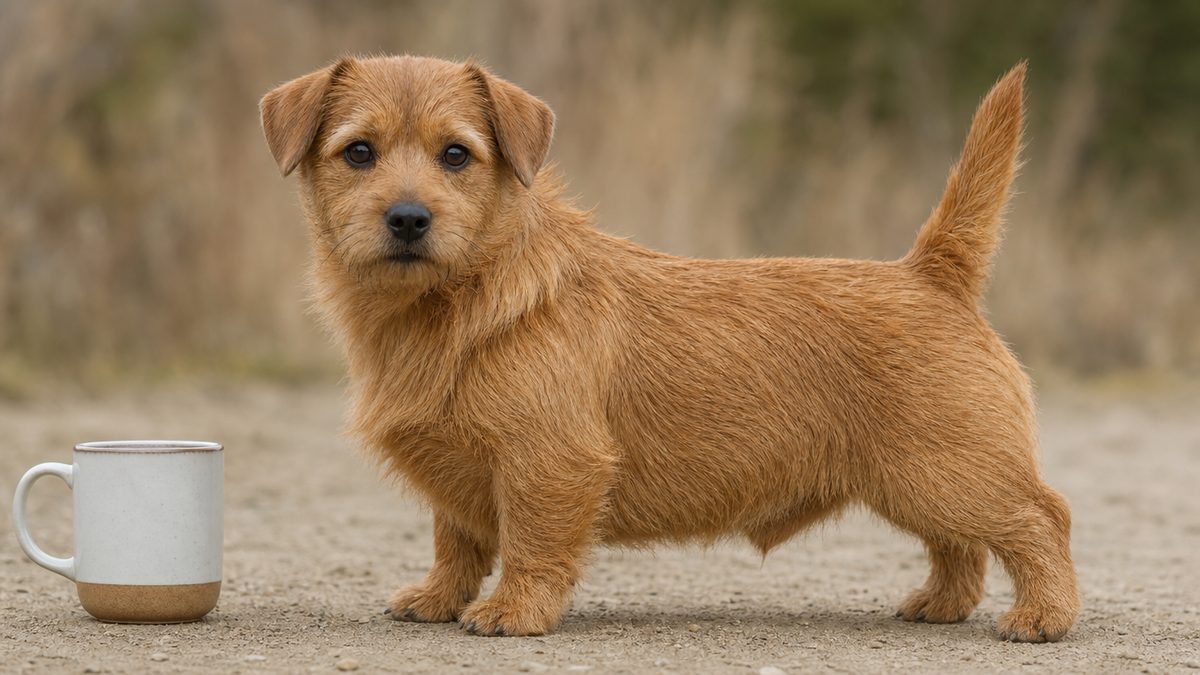
A Norfolk Terrier is a small British working terrier of about 25 cm at the withers with a hard wire coat and ears that fold forward against the cheek. That last clause is the whole breed. Everything else about it, the size, the coat, the temperament, the job, it shares with the Norwich Terrier, and the two were a single registered breed until 1964.
The Royal Kennel Club standard, last updated on 1 August 2025, opens with eleven words: 'Small, low, keen dog, compact and strong, short back, good substance and bone';. It gives one measurement, an ideal height at withers of 25 cms (10 ins), and no weight at all. The American Kennel Club, working from its own standard, gives 9 to 10 inches and 11 to 12 pounds, so an adult sits at roughly 5 to 5.5 kg. That is a dog you can carry up four flights of stairs during a power cut, which in most Indian cities is a practical consideration rather than a joke.
The breed is British in origin and East Anglian in particular, and it takes its name from the county rather than from any person. The FCI standard is blunt about how ordinary its beginnings were: 'turning the clock back to the early and mid-1800s there was no such distinction, this being just a general farm dog';. It was bred to go to ground after fox and badger and to kill rats, and the United Kennel Club standard still describes the job in working language, 'developed to go to ground to bolt a fox, or to find and dispatch other vermin';.
The appearance, clause by clause
The coat is the second thing you notice after the ears. All three standards agree that it is hard, wiry and straight and lies close to the body, longer and rougher on the neck and shoulders, with short smooth hair on the head and ears except for slight whiskers and eyebrows FCI-Standard N 272, NORFOLK TERRIER. Colour runs to all shades of red, wheaten, black and tan, or grizzle. A grizzle Norfolk is a red or black-and-tan dog whose hairs are banded, so the jacket reads as a smoky mix rather than a solid colour, and it changes with each stripping.
Where the three standards stop agreeing is instructive, and it is covered in full further down this page. In summary, the FCI and the United Kennel Club both permit white markings while calling them undesirable, and the Royal Kennel Club calls them undesirable and then adds a catch-all making 'any other colour or combination of colours unacceptable'; FCI-Standard N 272, NORFOLK TERRIER United Kennel Club. Only the United Kennel Club puts a number on the coat, 'about 1 and a half to 2 inches long', and only the United Kennel Club says there is 'a definite undercoat'. Neither of the other two mentions an undercoat at all, which matters more in Chennai than it does in Cambridgeshire.
The temperament the standard actually claims
The Royal Kennel Club describes 'One of the smallest of terriers, a demon for its size. Lovable disposition, not quarrelsome, hardy constitution', and under temperament, two words: 'Alert and fearless';. Read that carefully, because 'not quarrelsome' is a real claim and it is unusual in a terrier standard. This breed was worked in packs alongside foxhounds rather than singly, and the parent club describes it as 'game and hardy, with expressive dropped ears';. It is a terrier that tolerates other dogs better than most, and that has consequences for an Indian flat with a second dog in it.
If the ears stand up, it is not a Norfolk Terrier. Everything else on this page can be argued about; that cannot.
The 1964 split, from the register rather than from folklore
The Kennel Club separated the Norfolk Terrier from the Norwich Terrier in 1964, thirty-two years after registering them as one breed with two permissible ear types. The registry publishes its own account of the argument, and it is worth quoting because almost every Indian page skips it.
The Royal Kennel Club's breed history reads: 'Until 1964, what we now know as the Norfolk Terrier and the Norwich Terrier were both shown as the Norwich Terrier. This breed, recognised in 1932 had two permissible types of ear, the drop eared variety now known as the Norfolk and the prick eared variety now known as the Norwich';. It then describes the campaign plainly: 'In 1957 Norwich Terrier breeders decided to treat the two types as separate breeds and cross breeding was discouraged and so the campaign started to have the two types recognised as two separate breeds. They met some opposition from The Kennel Club and the campaign became at times quite heated. In 1964 The Kennel Club relented and the drop eared variety received its nomenclature as the Norfolk Terrier';.
That is a registry admitting it was pushed. It gives the reader three dates rather than one, and the gap between them is the interesting part: breeders stopped interbreeding the two types in 1957, and the paperwork caught up seven years later. Any Norfolk Terrier pedigree tracing before 1964 runs back into Norwich Terrier records, because that is what the dogs were registered as.
The FCI confirms the date and adds two years
FCI Standard 272 gives the same account in its own words: 'The Norwich Terrier was accepted on the Kennel Club Breed Register in 1932, and were known as the drop-eared Norwich Terrier (now known as the Norfolk Terrier) and prick-eared Norwich Terrier. The breeds were separated in 1964 and the drop-eared variety gained the name Norfolk Terrier';. The international register then took its own time. The FCI's nomenclature entry records the date of acceptance on a definitive basis as 1 October 1966, two years after the British split.
The FCI prints dates in month/day/year order and the entry reads 10/1/1966, which could be 1 October or 10 January. The same page settles it: the four standard publication dates on it read 2/16/2011, 6/15/2012, 4/11/2011 and 2/16/2011, and 16 and 15 cannot be months. So the first field is the month and the acceptance date is 1 October 1966.
The breed numbers are the clearest evidence of who came first
The FCI holds the Norwich Terrier as standard 72 and the Norfolk Terrier as standard 272 Federation Cynologique Internationale. Two hundred numbers separate them, and they describe the same dog with different ears. Numbers in the FCI nomenclature run roughly in order of acceptance, so the gap is a fossil of the argument: the prick-eared half kept the original registration and the drop-eared half was issued a new one.
The United States moved faster than the FCI in one sense and slower in another. Both the American Kennel Club and the United Kennel Club recognised the Norfolk Terrier separately in 1979, fifteen years after the British split.
Two registries, two different ancestor lists, and neither is wrong
The FCI and the United Kennel Club publish incompatible accounts of which breeds went into the Norfolk Terrier. Both are official, both are current, and the honest answer is that the breed's early history was never written down properly.
FCI Standard 272 names three: 'Glen of Imaals, red Cairn Terriers and Dandie Dinmonts are among the breeds behind these East Anglian terriers and from the resultant red progeny emerged the present Norwich and Norfolk Terrier';. The United Kennel Club standard names a different set: 'It is speculated that the Norfolk Terrier was developed using the small Irish Terriers and crossing them with other Terrier breeds, including the Border and Cairn';.
| Ancestor named | FCI Standard 272 | UKC standard, revised 2007 |
|---|---|---|
| Cairn Terrier | Yes, specified as red Cairn Terriers | Yes |
| Glen of Imaal Terrier | Yes | Not mentioned |
| Dandie Dinmont Terrier | Yes | Not mentioned |
| Irish Terrier | Not mentioned | Yes, given as the starting point |
| Border Terrier | Not mentioned | Yes |
Only the Cairn Terrier appears on both lists. The United Kennel Club is at least honest about its confidence level, opening with 'It is speculated that', while the FCI states its three as fact. Bonbeno does not adjudicate between them, because there is no studbook from the 1800s that would settle it: the FCI standard itself says that in the early and mid-1800s the dog was 'just a general farm dog' with no distinction drawn.
Why this matters to a buyer rather than a historian
An ancestor list is a health prediction in disguise. If the Cairn Terrier is genuinely behind this breed, then the shared beta1-tubulin platelet variant found in both Norfolk and Cairn Terriers is a family inheritance rather than a coincidence, and it is. If the Dandie Dinmont and the Glen of Imaal are behind it, that is two more short-legged, long-backed breeds in the mix, and the low, long build both of those carry is exactly the conformation that loads a small dog's spine and hips. Which brings us to the hip figures further down this page, which are worse than anyone expects for a 5 kg dog.
When two registries disagree on history, check whether they are following different documents before calling either one wrong. Here they are, and both are reproduced above rather than averaged into a comfortable middle.
Is the Norfolk Terrier a vulnerable breed? No, and the file that says so also says why
The Norfolk Terrier sits on the Royal Kennel Club's AT WATCH list, not on its vulnerable native breeds list. The distinction is a number: vulnerable means fewer than 300 UK registrations a year, at watch means between 300 and 450. The breed registered 365 puppies in 2025.
This is worth getting right, because the file the figure lives in is titled '10 year VULNERABLE BREED STATS' and a reader who stops at the filename will report the breed as vulnerable. Inside, the document carries two blocks under two sub-headings. The Norfolk Terrier row sits under AT WATCH. The Norwich Terrier row sits above it, under the vulnerable heading.
| Breed | 2016 | 2019 | 2021 | 2023 | 2024 | 2025 | Status |
|---|---|---|---|---|---|---|---|
| Norfolk Terrier | 600 | 482 | 490 | 365 | 382 | 365 | At watch |
| Norwich Terrier | 145 | 128 | 140 | 150 | 140 | 116 | Vulnerable |
| Lakeland Terrier | 220 | 94 | 174 | 109 | 86 | 93 | Vulnerable |
| Cairn Terrier | 683 | 464 | 498 | 437 | 467 | 447 | At watch |
| Terrier group total | 19,436 | 17,219 | 24,498 | 18,211 | 15,952 | 14,963 | - |
Read the top two rows together and the more interesting fact appears. Sixty-one years after one breed was split into two, the drop-eared half registers more than three times as many puppies in Britain as the prick-eared half: 365 against 116 in 2025. The Norfolk Terrier has fallen by 39 percent from its 2016 figure of 600, but the Norwich has fallen from a much lower base and is now genuinely at risk.
The order reverses in the United States
The American Kennel Club's 2024 popularity ranking puts the Norwich Terrier at 104 and the Norfolk Terrier at 130, out of 201 breeds counted. So the two halves of the same 1964 split are the opposite way round on the two sides of the Atlantic. Bonbeno has no evidence for why, and offers none; the observation itself is the finding, and no other page on this breed states it.
Which document to trust, and why this one was checked
The Royal Kennel Club's own web tables and its own PDFs are known to disagree in the Terrier group, so the Norfolk Terrier row was checked across four documents before being printed here. The web table, the 10-yearly Terrier PDF and the 2025 vulnerable-breeds PDF all read 600, 521, 542, 482, 358, 490, 423, 365, 382, 365. The quarterly PDF's four 2025 quarters, 111 plus 78 plus 80 plus 96, sum to exactly 365. The cells this page uses agree everywhere, and that agreement is reported here because a warning about a source is not a licence to assume the worst of it.
Two defects were reproduced in passing, which is a reason to keep checking rather than a reason to distrust the Norfolk figures. The web table prints the Manchester Terrier's 2019 registrations as 243 while both PDFs read 133. And the Terrier group's 2023 column sums to 18,209 across its own 27 breed rows against a printed total of 18,211, while every other one of the ten columns balances exactly.
The Royal Kennel Club's own Norfolk Terrier page prints the characteristics field 'Vulnerable native breed: No';. That is correct on the vulnerable list and misleading on the at-watch one, since the same organisation lists the breed under AT WATCH two clicks away. Read the vulnerable-breeds table, not the per-breed field.
Norfolk Terrier price in India: nobody ranking for that query is selling one
There is no verifiable Norfolk Terrier price in India, and Bonbeno publishes none. That is not a gap in this page. It is the most useful thing this page can tell an Indian buyer, and it is evidenced from the pages that rank for the term rather than from an empty search result.
India's most-read general dog price reference runs from about 2,000 rupees for an indie dog to over 1,50,000 for a KCI-registered show-quality one, and it carries no Norfolk Terrier row at all. Three Indian sources carry something that looks like a price for this breed. One of them has no rupee figure in its markup at all. One of them shows you three dogs, none of which is the breed. The third prints a number that its own sister page prints for a different breed. Taken together they do not establish an Indian market; they establish that the query has been monetised without any dogs behind it.
| Source | Position | Price shown | Dogs of this breed shown |
|---|---|---|---|
| puppiezo.com | 1 | None in the raw HTML, across 512,785 characters | Zero |
| mrnmrspet.com | 2 | Behind a sign-up wall | Zero. It prints '3 Result Found' over two French Bulldogs and a Shiba Inu |
| happypet.care | 3 | Rs 50,000 to Rs 1,00,000, cost of buying | None offered; it is a guide, not a listing |
| supertails.com | 4 | A 40-breed Indian price list | No Norfolk Terrier row at all |
| breednbreeder.com | 6 | None. A phone number | Zero |
The one published number, and the tests it passes and fails
HappyPet India prints a cost of buying of 50,000 to 1,00,000 rupees. It is the only structured Indian figure that exists for this breed, so it is reported here with the arithmetic done in public rather than quietly reused. Divided by 84.38, the exchange rate this site has repeatedly caught behind converted Indian price lists, 50,000 gives 592.6 dollars and 1,00,000 gives 1,185.1, which are not prices a shop would print. Divided by 74 they give 675.7 and 1,351.4, also not round. Divided by a flat 80 they give exactly 625 and 1,250, which are plausible; but any rupee figure ending in three zeros divides cleanly at 80 by construction, so a match there proves nothing on its own.
The honest reading is that this is a rupee-native band rather than a converted one, and that it is a guess about what such a dog would cost if one existed rather than an observation of a sale. Nothing on that page, or on any page Bonbeno opened, is an actual Norfolk Terrier for sale in India at any price.
What the law does to the supply chain
No lawful commercial route exists to import one. DGFT Trade Notice 22/2022-23 places dogs under ITC(HS) 01061900 as a Restricted import and permits entry only for a pet travelling with a valid pet book in the importer's name, for research with a CPCSEA recommendation, or for Defence and Police use, and it directs that applications for trading or breeding purposes be rejected. So an Indian buyer's only genuine routes are a domestic litter, which Bonbeno could not verify exists, or bringing a personal pet in on the baggage route when relocating.
An absent market is not an affordable one. When a breed has no verifiable Indian supply, the listings that do appear are the least trustworthy in the market, because there is no competitor to contradict them.
The page ranking first for the price has no price in it
Puppiezo ranks first in India for 'norfolk terrier price in india', and its raw HTML contains zero rupee figures. A search engine's own summary of that page quotes three: 98,999, 92,599 and 94,999. Those numbers are not in the document the citation points at.
The page was fetched directly on 2 September 2026, HTTP 200, 512,785 characters of markup, with the title read back as 'Norfolk Terrier Puppies For Sale in India At Best Prices | Puppiezo'. A regular-expression sweep for the rupee sign, its HTML entity and the string 'Rs' followed by digits returned nothing. Whether the figures are injected by JavaScript after load or were never on the page, the position for a reader is the same: the number a search summary attributes to this page cannot be verified in the page.
What the shop window actually holds
The stock carousel on the Norfolk Terrier page and the stock carousel on the same site's Norwich Terrier page are the same carousel. Both pages carry Maltipoos, Poodles, a Goldendoodle, a Rottweiler, a Cane Corso and a Doxiepoo, with the recurring animal names Fizzy, Samy, Yoki, Kuzo and Kazuka appearing on both. Neither carousel contains a Norfolk Terrier or a Norwich Terrier. Only the chrome differs: the Norfolk page's lead images are named NORFOLK-TERRIER-1 through 4 and the Norwich page's are named Norwich-Terrier-1 through 3, so a human chose breed photographs and the stock underneath was never touched.
The second-ranking page is worse, and more legible
Mr n Mrs Pet's Norfolk Terrier page prints the words '3 Result Found', which reads like three Norfolk Terriers. The three cards are a French Bulldog named Chilly in Kanpur, a French Bulldog named racy in Hyderabad and a Shiba Inu named Nick in Kochi, sitting under a heading that says 'Similar breeds at other locations';. The heading is doing the disclosure and the count is doing the selling. Every price on those three cards links to a sign-up page rather than to a figure.
| Name shown | Breed shown | City | Price |
|---|---|---|---|
| Chilly | French Bulldog | Kanpur | Behind sign-up |
| racy | French Bulldog | Hyderabad | Behind sign-up |
| Nick | Shiba Inu | Kochi | Behind sign-up |
How to use this if you are actually shopping
Open the page, not the search result. If a summary quotes you a price, search the page itself for that exact figure before you believe it, because a citation can be real while the number is not. Then look at what the seller is actually holding: a carousel of Maltipoos on a terrier page tells you the seller has no terrier, whatever the heading says. And treat a result count as a count of cards rather than a count of the breed you searched for.
That single figure has now been recorded across many breeds on one Indian listing site, attached to whichever puppy is in stock, including breeds it does not stock at all. It is a house price point, not a Norfolk Terrier price.
Monthly cost of ownership, and why the one published Indian figure is not a figure
Budget roughly 4,000 to 8,000 rupees a month for a 5 kg wire-coated dog in an Indian metro, built from vaccination, food and stripping costs you can check yourself. The single published Indian monthly cost for this breed, 2,200 to 3,750 rupees, is a template constant rather than an observation, and here is the proof.
HappyPet India prints the Norfolk Terrier's average monthly expenses as 2,200 rupees basic and 3,750 premium, split into food at 1,200 or 1,800, veterinary at 300 or 750 and grooming at 700 or 1,200. The same site's Norwich Terrier page prints food at 1,200 or 1,800, veterinary at 300 or 750 and grooming at 700 or 1,200, for the same 2,200 to 3,750 total. Identical to the rupee, on every line, for two breeds.
That set is already on record on this site for the Lakeland Terrier, the Lancashire Heeler, the Pug and the Beagle. The Norfolk Terrier makes six. The grooming line is what gives it away: a Pug and a hand-stripped wire terrier cannot cost the same to groom, because one needs a wipe and the other needs a stripping knife and ninety minutes.
What does vary between the two pages, and what that tells you
Two fields differ. The cost of buying reads 50,000 to 1,00,000 for the Norfolk and 60,000 to 1,00,000 for the Norwich. The ideal weather band reads 15 to 25 C for the Norfolk and 10 to 25 C for the Norwich HappyPet India, Norwich Terrier breed…. So a page can look breed-specific in its headline fields while its cost table is boilerplate, and the fields that vary are the ones a human typed.
Build the number yourself, from Indian prices you can verify
Every figure below is a published Indian rate, not an estimate. A first-year puppy needs its full course, and Vetic's Indian clinic network prices anti-rabies from 699 rupees, Puppy DP from 849, the 9-in-1 DHPPiL from 899, canine corona from 899 and kennel cough from 1,349, with a whole puppy package from 6,499 and an adult annual package from 3,199.
| Line | Monthly, rupees | Where the number comes from |
|---|---|---|
| Food | 1,200 to 2,500 | A 5 kg dog eats little; the range is the gap between an Indian mid-market kibble and an imported small-breed diet |
| Vaccination, amortised | 270 | Vetic's adult annual package at 3,199 divided by twelve |
| Deworming and parasite control | 300 to 600 | Monthly in most Indian cities because of year-round tick pressure |
| Hand stripping | 800 to 1,500 | One professional session every 8 to 12 weeks, spread monthly; nil if you learn to strip |
| Boarding, if you travel | 650 to 850 per night | Premium Pet Boarding, Bengaluru, published 2026 rates |
| Cardiac screening from age 6 | About 250 | One echocardiogram a year, amortised. See the health section for why this is not optional |
That lands between about 4,000 and 8,000 rupees a month before boarding, which is above the published 2,200 to 3,750 and below what an Indian owner of a large breed pays. The boarding line comes from one Bengaluru facility's published 2026 rates, 650 rupees a night standard and 850 premium, with full-day daycare at 500. The cardiac line is the one no other page includes, and it is the one this breed most needs.
Learning to hand strip your own dog removes the largest recurring line on the table. A stripping knife costs a few hundred rupees, the technique takes an afternoon to learn badly and a season to learn well, and it is the difference between an affordable wire terrier and an expensive one.
Can a Norfolk Terrier handle the Indian climate? The heat tolerance answer
A Norfolk Terrier can live comfortably in most Indian cities if you move its exercise to early morning and late evening, and the reason is that its risk is exertional rather than ambient. It is a heat-sensitive breed in the sense that matters least and in the sense that matters most: the coat is manageable, the temperament is not.
Start with where the dog is from. NASA POWER was queried by explicit latitude and longitude for Norwich in Norfolk, 52.6309 N and 1.2974 E, and returned a grid cell at 1.297, 52.631 with an elevation of 30.68 m against a real city elevation near 20 m. That is a difference of about 11 m, so the cell describes the place and the figures can be used. The cell gives an annual mean of 10.11 C, a warmest month of 17.13 C in July and a coldest of 3.96 C in January.
| Place | Annual mean C | Coolest month C | Warmest month C | Cell elevation m |
|---|---|---|---|---|
| Norwich, Norfolk | 10.11 | 3.96 (Jan) | 17.13 (Jul) | 30.68 |
| Bengaluru | 23.74 | 20.22 (Dec) | 28.37 (Apr) | 841.72 |
| Pune | 23.86 | 19.62 (Dec) | 28.93 (Apr) | 635.99 |
| Delhi | 25.60 | 13.61 (Jan) | 35.88 (Jun) | 206.37 |
| Kolkata | 25.81 | 17.31 (Jan) | 31.53 (May) | 7.35 |
| Mumbai | 26.77 | 23.19 (Jan) | 31.19 (May) | 97.15 |
| Chennai | 27.95 | 24.09 (Jan) | 31.51 (May) | 48.95 |
Read the Chennai row against the Norwich row and the scale of the change is clear. Chennai's coolest month, at 24.09 C, is 6.96 C warmer than the warmest month this breed's home county ever sees. A Norfolk Terrier in Chennai never experiences a month as cool as an English July.
Why that is survivable, and where the real danger sits
This is not an Arctic breed under a heavy double coat. The Royal Kennel Club and FCI standards describe a hard wire jacket lying close to the body with short smooth hair on the head and ears, and neither mentions an undercoat at all; only the United Kennel Club records 'a definite undercoat';. A 5 kg dog with a close jacket sheds heat far better than a Saint Bernard, and Bengaluru and Pune, both under 24 C annual mean, are genuinely comfortable for it.
The danger is behavioural. Hall and colleagues, working from 905,543 UK dogs under primary veterinary care in 2016, recorded 1,259 heat-related illness events, of which 879 had a recorded trigger. Of those 879, 652 events, 74.2 percent, were exertional, against 113 environmental and 46 from confinement in a vehicle. Heat kills working dogs while they are working. A terrier bred to bolt a fox and to hunt rats will keep going through the point at which a sensible dog lies down, and that is precisely the animal that gets into trouble on a Delhi afternoon in June, where the cell mean for the warmest month is 35.88 C.
One Indian city where the satellite cannot help you
Shimla was queried in the same session and returned a cell elevation of 897.65 m against a real town elevation near 2,200 m, an error of about 1,302 m. Its figures are therefore too warm for the real town and are not printed in the table above. The general rule is cheap: for a plains city the grid cell is the town, and for a hill station check the elevation before you use the number. Every Indian city in the table sits within 85 m of its real elevation, so those rows stand.
Second Schedule Part IV paragraph 21(1) of the Dog Breeding and Marketing Rules 2017 bars keeping in outdoor facilities, without the attending veterinary practitioner's written approval, dogs 'not accustomed to the temperatures prevalent in the area or region in question' and breeds that 'cannot tolerate' them. An imported Norfolk Terrier in its first Indian summer is squarely inside the first limb of that clause.
Temperament and household fit: a pack terrier in a flat
A Norfolk Terrier suits an Indian flat better than almost any other working terrier, because it was bred to work in company rather than alone. The Royal Kennel Club standard says so in two words most terrier standards would never risk: 'not quarrelsome';.
The full characteristics clause reads 'One of the smallest of terriers, a demon for its size. Lovable disposition, not quarrelsome, hardy constitution', and the temperament clause is 'Alert and fearless';. The FCI text carries the same words in the same order. The United Kennel Club adds the working context that explains them: 'Developed to go to ground to bolt a fox, or to find and dispatch other vermin, the Norfolk is a demon for its size. He is alert and fearless, not aggressive';.
That combination, fearless towards a fox and tolerant towards other dogs, comes from the job. This breed went out with mounted packs, which meant working near foxhounds and near other terriers, and a dog that started fights was not taken again. It is why a Norfolk Terrier is a more realistic second dog in a two-dog Indian household than a Jack Russell Terrier or a Scottish Terrier.
Who this breed suits
- Flat dwellers who walk twice a day, because size is not the constraint and boredom is.
- Households with a second dog, because the standard's 'not quarrelsome' is a real and unusual claim.
- Families with school-age children, because the dog is small and sturdy rather than fragile.
- Owners willing to learn hand stripping, or to pay for it every eight to twelve weeks.
- Buyers who will screen a heart before they buy, and again every year after the dog turns six.
Who should not buy one
- Anyone with a rabbit, a hamster, a guinea pig or free-flying birds, because the prey drive is not trainable away.
- Anyone who wants an off-lead dog in an unfenced Indian park, because recall competes with a squirrel and loses.
- Anyone buying on price, because there is no verifiable Indian price and the listings that quote one show other breeds.
- Anyone who wants a quiet dog by default, because a terrier alerts and an unexercised terrier alerts constantly.
- Anyone who cannot commit to a garden bed being dug, or to a lawn that is no longer a lawn.
The noise question, honestly
This breed barks. It was bred to give tongue underground so the handler could locate it, and that instinct does not switch off in a Mumbai flat. The mitigation is not a training trick, it is a schedule: a Norfolk Terrier that has had forty-five minutes of real work in the morning is a quiet dog by four in the afternoon, and one that has had a lap of the compound is not. Indian apartment associations are a real constraint on dog ownership, and a barking terrier is the fastest route to a complaint.
Because it worked with other dogs, a Norfolk Terrier often takes better to being left with a companion animal than to being left alone. If you are out ten hours a day, the honest answer is that this is not your breed, whatever its size suggests.
Training a Norfolk Terrier: what works, what it resists, and how long it takes
To train a Norfolk Terrier, pay it for attention rather than for obedience, and start the recall work before the prey drive comes online at around four months. It is intelligent and food-motivated, so the mechanics are easy; it was bred to make decisions underground out of the handler's sight, so the compliance is not.
Separate two things that Indian training advice usually merges. Teaching a behaviour is easy with this breed: sit, down, stay, a mat settle and a clean lead walk all come quickly to a small, food-motivated terrier, and most owners have them inside three weeks. Getting the behaviour when a street cat crosses the road is a different problem entirely, and it is the only training problem this breed really has.
A realistic first-year timetable
- Weeks 8 to 16, the socialisation window. Socialise deliberately and daily: autorickshaw noise, lift doors, building watchmen, other dogs on the compound stairs, a vet visit with no procedure. This window does not reopen.
- Weeks 10 to 16, name and food games. Charge the name until it produces a head turn every time, indoors, with nothing else happening. This is the foundation of every recall you will ever get.
- Months 4 to 7, the prey drive arrives. The dog that came when called at fourteen weeks now hears you and keeps going. Move recall practice to a long line and stop giving it the chance to fail.
- Months 6 to 12, impulse control. Wait at the door, leave it, a settle on a mat while you eat. These matter more than tricks in an Indian flat.
- Months 12 to 18, maturity and testing. Expect a period where a solid behaviour breaks down. Train it again rather than assuming it was lost.
What this breed genuinely resists
Recall against live quarry is the honest ceiling. A dog selected to bolt a fox from a rock earth was selected for exactly the trait that makes it ignore you at the sight of a squirrel, and no amount of obedience work removes that. Manage it rather than fixing it: a long line in unfenced spaces, a securely fenced area for off-lead running, and a rock-solid emergency stop trained as its own behaviour rather than as part of recall.
Digging is the second. It is not a behaviour problem, it is the job description, and in an Indian building with a small garden it is the fastest way to fall out with your neighbours. Give the dog a sandpit or a digging box it is allowed to destroy and it will mostly leave the flowerbeds alone.
Methods that suit the breed
Reward-based work, short sessions and real food. A 5 kg dog fills up on training treats fast, so use part of the daily ration rather than adding to it, which matters given what the growth study below says about how easily this breed is overfed. Harsh handling is counterproductive with a dog the standard calls fearless: it does not shut down, it argues. And because it works well with other dogs, group classes suit it better than they suit most terriers.
Train a reliable settle on a mat before you need it. Indian flats have doorbells, deliveries, domestic help arriving and lift traffic, and a terrier that has a job to do when the bell rings barks far less than one that has to invent a response every time.
Daily exercise requirement, and what happens in an Indian flat without it
Give a Norfolk Terrier 45 to 60 minutes a day, split across two walks and at least one thinking session. Below that, in an Indian flat, you get barking, digging and destruction rather than a calm small dog, and the size of the animal is no protection at all.
This is a working terrier in a 5 kg body. The FCI standard describes gait as 'True, low and driving' with 'great powers of propulsion', which is a description of stamina rather than of a lapdog. The Indian guide pages that rank for this breed give 45 to 60 minutes and 30 to 60 minutes respectively HappyPet India, Norwich Terrier breed…, and for once the template figure is about right.
| Season | Morning | Evening | Indoors |
|---|---|---|---|
| Winter, Nov to Feb | 30 min walk, any time before 10 am | 30 min walk plus off-lead in a fenced space | Light |
| Summer, Mar to Jun | 25 to 30 min, before 6.30 am | 25 to 30 min, after 8 pm | Two scent games or a food puzzle to replace lost outdoor time |
| Monsoon, Jun to Sep | 20 to 30 min between showers | 20 to 30 min | Dry the coat and the ears properly every single time |
| Heat wave, as declared by the IMD | 15 min, before 6 am, lead only | 15 min, after 9 pm | All real exercise moves indoors |
The heat wave row is not decoration. The World Health Organization's India page sets out the India Meteorological Department criteria under which a heat wave is declared and the guidance issued with it, and those are the days on which an exertional heat event happens to a dog that will not self-regulate. Hall's UK data found that 652 of 879 heat-illness events with a recorded trigger were exertional, and the dogs in that study were not being walked in a Delhi June.
Thinking work counts, and for this breed it counts double
Twenty minutes of nose work tires a terrier more thoroughly than forty minutes of lead walking, which is useful when the outdoor window shrinks to an hour a day in May. Scatter part of the meal in a towel and let it hunt through the folds. Hide a treat in one of three boxes. Teach it to find a named toy. All of these use the part of the brain the breed was actually selected for, and all of them work in a two-bedroom flat.
The failure mode, described honestly
An under-exercised Norfolk Terrier does not become a couch dog. It becomes a loud one. It digs at the sofa edge, patrols the balcony barking at the compound, chews skirting boards, and greets every visitor at a volume that generates a housing-society complaint. Owners then describe the dog as difficult, when what has actually happened is that a working animal has been given no work.
A 5 kg dog can be genuinely tired out on a staircase, in a corridor and on a terrace. That is not true of a Labrador, and it is why this breed is a better fit for Indian apartment life than its energy level suggests.
Grooming a wire coat in Indian humidity, and the clipping mistake
Brush a Norfolk Terrier twice a week and hand strip it every eight to twelve weeks. Do not clip it. Clipping is faster, cheaper and available in every Indian grooming salon, and it permanently softens the harsh jacket the breed standard describes.
All three standards describe the same coat: 'Hard, wiry, straight, lying close to body. Longer and rougher on neck and shoulders. Hair on head and ears short and smooth, except for slight whiskers and eyebrows. Excessive trimming undesirable';. The FCI text is word for word the same. Only the United Kennel Club puts a length on it, 'about 1 and a half to 2 inches long', and only the United Kennel Club records 'a definite undercoat'.
Why stripping and clipping are not alternatives
A wire coat grows in cycles, and each hair loosens in its follicle when it is mature. Hand stripping pulls those dead hairs out, which triggers the next cycle and keeps the new growth harsh and weather-resistant. A clipper cuts the hair off above the follicle, leaving the dead root in place. Do it repeatedly and the coat comes back soft, pale and open, the guard hairs give way to undercoat, and the jacket that used to shed a Norfolk mud puddle now holds water against the skin. In Indian humidity that is not a cosmetic loss; it is a skin problem waiting to happen.
| Task | Frequency | Why it matters here |
|---|---|---|
| Brush with a slicker and a comb | Twice a week | Finds ticks before they attach properly and lifts trapped dead coat |
| Hand strip the body coat | Every 8 to 12 weeks | Maintains the harsh texture; the only method the standard's wording supports |
| Roll the coat, stripping a section at a time | Monthly, once you are confident | Keeps the dog presentable year round instead of bald for a month |
| Check and dry the ears | After every wet walk | Drop ears plus monsoon humidity is the classic Indian otitis setup |
| Nails | Every 3 to 4 weeks | Tile and marble floors do not wear nails down the way earth does |
| Bath | Rarely, and never before stripping | Washing softens the coat and makes it grip badly for stripping |
The ears, because this breed folds them over
Drop ears trap warm moist air against the canal, and India supplies both. After any wet walk, and after any bath, lift the ear flap, dry underneath it and let air get in for a few minutes. Do not pour cleaner into the canal as a routine. If you see head shaking, a tilted head, a smell, or the dog rubbing an ear along the floor, that is a veterinary visit rather than a home remedy, because a painful ear is one of the few things that will make an otherwise sound terrier bite.
The hypoallergenic claim, answered once
The Indian page ranking third for this breed answers 'Are Norfolk Terriers hypoallergenic?' with 'Yes, it is said to be hypoallergenic since it sheds little and produces little dander';. That is marketing. Vredegoor and colleagues measured Can f 1, the major dog allergen, across 196 dogs of so-called hypoallergenic breeds against 160 control dogs and found the hypoallergenic group carried more allergen on hair and coat, not less, with no difference in airborne allergen. Neither the Royal Kennel Club standard nor the FCI standard makes any claim about shedding at all.
Most Indian grooming salons default to a clipper because it is quick and most Indian clients ask for it. Write 'hand strip only, no clipper, no scissors on the body' on the booking and repeat it at drop-off. A clipped wire coat takes two or three full cycles to recover, and sometimes never fully does.
Health risks and life expectancy: this is a heart breed, and nobody tells Indian buyers
The most important Norfolk Terrier health issue is degenerative mitral valve disease, and the figure that should decide how you buy is this: 41 of 48 overtly healthy Norfolk terriers aged six or over had echocardiographic evidence of it, and 18 of those had no heart murmur at all. A clear stethoscope does not clear this breed.
Trafny and colleagues recruited 48 apparently healthy Norfolk terriers aged six years or more through three veterinary hospitals and put every one through physical, electrocardiographic and two-dimensional colour-flow Doppler echocardiographic examination. Twenty-three dogs (48 percent) had murmurs, two (4 percent) had mid-systolic clicks, eleven (23 percent) had ECG P pulmonale, and 41 (85 percent) had echocardiographic evidence of degenerative mitral valve disease. By stage, 7 were normal, 28 were ISACHC 1a and 13 were ISACHC 1b. Those three numbers add to 48, and 41 dogs with disease minus 23 with a murmur leaves the 18 silent cases the paper reports.
A second, independent study reaches the same place from a different country and a different recruitment route. Bodegard-Westling, Tidholm and Haggstrom examined 79 privately owned Swedish Norfolk terriers recruited through the national breed club. Fifteen (19 percent) had a murmur on the day. On Doppler echocardiography, 35 (44 percent) had mitral regurgitation, of which 23 (29 percent) also had tricuspid regurgitation and 12 (15 percent) had mitral regurgitation alone, with a further 7 (9 percent) showing tricuspid regurgitation only. Prevalence rose with age at p less than 0.0001.
| Finding | Trafny 2012, USA, n=48 aged 6+ | Bodegard-Westling 2017, Sweden, n=79 asymptomatic |
|---|---|---|
| Murmur audible | 23 dogs, 48 percent | 15 dogs, 19 percent |
| Valve disease or regurgitation on echo | 41 dogs, 85 percent | 35 dogs, 44 percent |
| Dogs with disease but no murmur | 18 | Not separately reported |
| Relationship with age | Cohort restricted to 6 years and over | Prevalence rose with age, p less than 0.0001 |
The two headline percentages differ because the populations differ: Trafny's dogs were all six or over, Bodegard-Westling's were all ages. Read together they say the same thing. Mitral valve disease is common in this breed, it arrives early enough to matter, and auscultation alone will miss a large share of it.
What that means for an Indian buyer, in practical terms
Ask the breeder for the parents' echocardiogram results, not for a statement that the parents are healthy. A murmur-free parent is not a cleared parent in this breed. Then budget one echocardiogram a year from the dog's sixth birthday. Echocardiography is available in most Indian metros at referral practices and at the larger corporate clinic chains, and one scan a year is a smaller line on the budget above than a single month of professional grooming.
Life expectancy, from the UK life tables
The Norfolk Terrier's median lifespan is 13.5 years, with a 95 percent confidence interval of 13.1 to 13.8, computed on 297 recorded deaths in McMillan and colleagues' study of 584,734 dogs McMillan et al. 2024. The crossbred comparison group in the same table sits at 12.0 years. So this is a long-lived small breed, and the hazard ratio of 0.71 against crossbreds is a real effect.
The comparison everyone will want is with the Norwich Terrier, and it needs care. The Norwich's median in the same table is 14.0 years, apparently half a year longer. But it rests on 45 deaths against the Norfolk's 297, and its confidence interval runs from 13.5 to 15.1, which overlaps the Norfolk's 13.1 to 13.8. Two intervals that overlap do not establish a difference. The honest statement is that the two breeds are not distinguishable on lifespan, and no other page says so.
Supplementary Table S5 records no phylogeny reclassification for either terrier, so neither median is a merged figure covering two breeds. And Table S3's first column reads 905 for the Norfolk while Table S6 gives 673 alive and 970 total, a known discrepancy in this paper's supplementary tables; the death count, 297, is identical in both, which is why the sentence above is built on deaths.
What the OFA registry holds, including one figure that refutes Wikipedia
OFA's published tables rank the Norfolk Terrier first of the breeds listed for congenital cardiac abnormality and second for advanced cardiac, and record 35.3 percent of its hip evaluations as dysplastic. Every figure below was matched to its own printed column header and re-added from its components.
The breed codes were read out of OFA's own markup rather than reasoned out, because this is exactly where a plausible guess goes wrong. The Norfolk Terrier is NFT and the Norwich Terrier is NT Orthopedic Foundation for Animals. Anyone who assumed the Norfolk was NT would have pulled a complete, correctly formatted table for the other breed and never known.
| Database | Norfolk Terrier | Norwich Terrier | All breeds |
|---|---|---|---|
| Hips, evaluations | 419 | 1,885 | 1,713,098 |
| Hips, percent dysplastic | 35.3 (rank 22) | 13.8 (rank 91) | 14.2 |
| Hips, percent excellent | 0.5 | 6.8 | 14.6 |
| Patella, evaluations | 604 | 1,728 | 225,831 |
| Patella, percent abnormal | 5.1 (rank 38) | 6.6 (rank 21) | 3.5 |
| Congenital cardiac, evaluations | 592 | 418 | 209,851 |
| Congenital cardiac, percent abnormal | 5.1 (rank 1) | 0.0 (rank 107) | 0.5 |
| Advanced cardiac, evaluations | 361 | 53 | 93,492 |
| Advanced cardiac, percent abnormal | 17.5 (rank 2) | 0.0 (rank 112) | 5.4 |
| Eyes, evaluations | 981 | 1,755 | 887,684 |
| Eyes, percent normal on the summary line | 94.5 | 97.5 | 93.4 |
| Elbows | No published row | 267 evaluations, 2.2 percent abnormal | 650,594 |
The cardiac rows, in plain numbers
The Norfolk Terrier's congenital cardiac abnormality rate of 5.1 percent is ten times the all-breeds figure of 0.5 percent, and it is the highest of the 167 breeds in that table. Its advanced cardiac rate of 17.5 percent is a little over three times the all-breeds 5.4 percent, and only the Bull Terrier is worse. The patella row is the mildest of the four: patellar luxation is recorded in 5.1 percent of 604 evaluations, above the all-breeds 3.5 percent but below the Norwich Terrier's 6.6 percent of 1,728. Set beside the two echocardiographic studies above, three independent bodies of data point the same way, and no Indian page mentions any of them.
The hip rows, which are worse than the size suggests
OFA records 419 Norfolk Terrier hip evaluations, of which 63.0 percent are normal, split 0.5 percent excellent, 26.0 good and 36.5 fair, and 35.3 percent dysplastic, split 28.4 mild, 5.5 moderate and 1.4 severe. Both sets add up: 0.5 plus 26.0 plus 36.5 is 63.0, and 28.4 plus 5.5 plus 1.4 is 35.3. That 35.3 percent is two and a half times the all-breeds rate and, more strikingly, two and a half times the Norwich Terrier's 13.8 percent on a larger sample, for a breed that was the same breed in 1963.
Wikipedia's Norfolk Terrier article, which ranks second in India for the bare breed name, states that 'There has never been a Norfolk Terrier recognized by the Orthopedic Foundation for Animals (OFA) as having excellent rated hips';. OFA's own hip table prints 0.5 percent excellent on 419 evaluations, which is about two dogs. The claim is refuted by the register it names.
Two things this page will not do with the OFA eye data
OFA's eye summary line for the Norfolk Terrier gives 94.5 percent normal on 981 evaluations. The per-diagnosis detail tables, on the same denominator of 981, include a row of 638 dogs (65.0 percent) and another single row of 209 dogs (21.3 percent). A single diagnosis at 21.3 percent cannot sit inside an overall abnormal rate of 5.5 percent, so the summary and the detail are not measuring the same thing. This page therefore quotes neither as 'the' eye rate. And the diagnosis labels for those detail tables were not exposed in the rendering Bonbeno retrieved, so no condition is named here; an unnamed row is better than a guessed one.
Separately, OFA's own ALL BREEDS hip row prints 84.3 percent normal with excellent at 14.6, good at 0.0 and fair at 0.0, components that cannot sum to the whole, while every individual breed row on the same table adds up exactly. That is a reason to use the per-breed rows and not the aggregate as a baseline, which is what the table above does.
Three Norfolk Terrier problems that behave differently in India
Three conditions in this breed change character in an Indian home: calcium oxalate bladder stones, which heat and low water intake make worse; an inherited platelet variant that looks exactly like a tick-borne disease; and a skin defect that lives in the two places an Indian dog sweats and rubs.
1. Bladder stones, and why Indian heat is the multiplier
Two independent European series put the Norfolk Terrier among the breeds at highest risk of calcium oxalate uroliths, and they put its sibling alongside it. A Swiss survey of 490 stones names 'Norwich Terriers, Norfolk Terriers, Miniature Schnauzers, Miniature Pinscher and Yorkshire Terriers' as having a significantly increased risk of calcium oxalate stones. A German series of 22,456 uroliths submitted between 1979 and 2015 lists the five highest odds ratios for calcium oxalate monohydrate as 'Norwich terrier, keeshond, Norfolk terrier, fox terrier, sheltie'. The Norwich is first on that list and the Norfolk third.
Calcium oxalate stones form in concentrated urine. An Indian dog in May drinks less relative to its losses than a British dog in May, spends more of the day indoors holding on, and produces more concentrated urine as a result. The practical countermeasures are unglamorous and they work: water available in more than one room, wet food or water added to kibble, and enough toilet opportunities that the dog is not holding urine for ten hours. If your dog strains, passes urine in small frequent amounts, or you see blood, that is an emergency in a male dog because a stone can obstruct the urethra.
2. A low platelet count that is not a disease, in a country full of a disease that lowers platelets
This is the most useful thing on this page for an Indian veterinarian. Gelain and colleagues sequenced the beta1-tubulin gene in 20 clinically healthy dogs, 13 Norfolk and 7 Cairn Terriers, and found a G5A single nucleotide polymorphism in exon 1. Dogs homozygous for it were macrothrombocytopenic, with platelet counts ranging from 19,000 to 110,000 per microlitre, while remaining clinically well; heterozygous and wild-type dogs had normal counts and morphology.
Now put that in an Indian clinic. Thrombocytopenia is the classic laboratory finding in canine ehrlichiosis and anaplasmosis, both of which are endemic across India and were documented in a national survey of canine tick-borne disease. A healthy Norfolk Terrier carrying two copies of this variant can walk into an Indian clinic with a platelet count of 19,000 and be treated for a tick-borne infection it does not have. The tell is on the blood smear rather than in the number: the platelets are abnormally large, the dog is well, and there is no fever, no lethargy and no history of tick exposure. Ask for a manual smear review and mention the breed.
3. A skin defect that lives in the armpit and the groin
Barnhart and colleagues described a heritable keratinization defect in seven related Norfolk terriers, with lesions present at birth and a pedigree consistent with autosomal recessive inheritance. The affected dogs had hyperpigmented skin that scaled after mild trauma, and the paper is specific about where: 'most prominent in the glabrous skin of the axillary and inguinal regions, areas where the epidermis is not protected by hair and is subject to frequent trauma'. Keratin 10 was absent from the superficial epidermis.
The armpit and the groin are exactly where an Indian dog gets heat, friction and trapped moisture, and where a harness rubs. This is a rare finding rather than a common one, and seven related dogs is seven related dogs. But if you see darkened, flaking skin in those two places on a Norfolk Terrier from puppyhood, it is worth naming this paper to your vet rather than treating it as a routine allergy.
A single Norfolk terrier has been described with dystrophin-deficient muscular dystrophy caused by a one base pair deletion in exon 22 of the DMD gene. One dog, one mutation, one paper. It is recorded here for completeness and it is not a breed risk.
Feeding a Norfolk Terrier, with the only breed-specific growth study in the literature
Feed a Norfolk Terrier puppy less than the standard growth equation tells you to. A WALTHAM trial run on seventeen puppies of this breed alone found that the energy intake needed to hold an optimal body condition was significantly lower than the National Research Council 2006 equation predicts, at every single time point from 10 to 52 weeks.
This is unusual and it is worth dwelling on. Most breed pages have to borrow feeding guidance from a size category. This one has a controlled study of its own breed. Bradley and colleagues at the WALTHAM Petcare Science Institute fed seventeen Norfolk terrier puppies individually on complete and balanced diets, in amounts set to maintain an optimal body condition score, recording intake daily and weight and condition weekly, with veterinary examination, haematology, plasma biochemistry and serum bone-turnover markers every twelve weeks and dual-energy X-ray absorptiometry at 26 and 52 weeks.
The puppies grew normally and stayed clinically healthy. The energy that took to achieve was significantly lower than the NRC 2006 equation predicts at all time points, with a largest mean difference of 285 kJ per kg to the power 0.75 per day at 10 weeks. The authors state the consequence plainly: fed to the NRC 2006 equation, those dogs would have been in positive energy balance, possibly leading to obesity.
What to do with that in an Indian kitchen
Feed to body condition, not to the bag. Indian kibble bags carry feeding tables built on the same universal equations this study found too generous, and a 5 kg terrier has almost no margin: fifty extra grams a day is a large proportional overfeed. Run your hands along the ribs weekly. You should feel them easily under a thin covering, with a visible waist from above and a tucked abdomen from the side. If you cannot feel ribs, cut the ration by ten percent and check again in three weeks.
| Stage | Meals a day | The point |
|---|---|---|
| 8 to 16 weeks | 4 | Small stomach, high demand. Weigh the daily amount once and split it, rather than free-feeding |
| 4 to 6 months | 3 | Growth slows before it looks like it does. This is where overfeeding starts |
| 6 to 12 months | 2 | Condition-score fortnightly. Treats and training food come out of the ration, not on top of it |
| 1 to 6 years | 2 | Adult maintenance. A neutered dog usually needs about ten percent less |
| 6 years and over | 2 | Watch weight closely: extra kilos on a dog with mitral valve disease are not neutral |
Two Indian specifics
Water first. Given the calcium oxalate stone risk documented above, water intake is a health intervention for this breed rather than a housekeeping detail. Adding water to kibble, or feeding part of the ration wet, raises total water intake more reliably than hoping the dog drinks more. In summer, put a second bowl somewhere the dog passes often.
Then treats. Indian households feed roti, rice and biscuit far more casually than feeding tables assume, and on a 5 kg dog that is the whole problem. If the family will not stop, take the calories out of the meals rather than fighting the habit. A fat Norfolk Terrier with a leaking mitral valve is a worse outcome than a slightly indulged thin one.
Seventeen puppies of one breed in one facility is a small, well-run trial, not a universal law. What it licenses is caution about the standard equation for this breed. It does not license a specific gram figure, and this page gives none.
The first year, month by month, for a Norfolk Terrier in India
Plan the Norfolk Terrier's first year around three fixed points: the vaccination course that ends at about eighteen weeks, the socialisation window that closes at sixteen, and the arrival of the prey drive somewhere around four months. Everything else is negotiable.
| Age | What is happening | What you do |
|---|---|---|
| 8 weeks | The legal floor for sale in India. Rule 8(1)(a) requires that pups under eight weeks are not sold | Refuse any younger puppy, and ask for the parents' echo results, not a health statement |
| 8 to 10 weeks | Settling, house training, first vaccines under way | Four meals a day. Start name games. Handle ears and feet daily so grooming is never a fight |
| 10 to 16 weeks | The socialisation window, and it does not reopen | Autorickshaws, lifts, watchmen, other dogs, a vet visit with no procedure. Carry the puppy where it cannot walk yet |
| 16 to 18 weeks | Vaccination course completes. Vetic's Indian schedule finishes around 120 days | Full outdoor access. Start proper lead walks in cool hours |
| 4 to 5 months | Prey drive arrives. Recall degrades sharply | Move to a long line outdoors. Stop letting the dog rehearse ignoring you |
| 5 to 7 months | Adult coat starts coming through under the puppy coat | First hand stripping. Book it as stripping, in writing, and say no clippers |
| 6 to 9 months | Growth slows; appetite does not | Condition-score fortnightly. This is where the WALTHAM finding bites |
| 9 to 12 months | Adolescence. Trained behaviours wobble | Retrain rather than escalate. Keep sessions short |
| 12 months | Physically mature, mentally not quite | Move to two meals. Reassess the ration, especially if neutered |
The monsoon puppy, which is a different animal
A puppy that arrives in June faces a harder first year than one that arrives in November. Its socialisation window falls in weeks when going outside means wet paws, its ears stay damp, and its house training competes with a floor that never quite dries. Compensate deliberately: socialise indoors and in covered spaces, dry the ears every single time the dog comes in, and accept that house training will take two weeks longer than a friend's winter puppy did.
What to check at every visit in year one
- Body condition, by hand rather than by weight alone.
- Ears, under the fold, dried and odour-free.
- Ticks, along the neck, in the ears and between the toes, given India's year-round pressure.
- Heart, auscultated at every visit, so a murmur that appears is dated rather than discovered late.
- Patellae, checked by the vet at each vaccination visit, because Indian law mandates no patella testing and nobody else will do it.
Ask your vet to record a baseline cardiac auscultation in the notes at six months, even though nothing is expected. In a breed where 18 of 41 affected dogs had no murmur, a documented starting point is what makes a later change legible.
Indian law: the breed standard describes a tail this country forbids
All three Norfolk Terrier breed standards still describe a docked tail, and tail docking is prohibited in India. Second Schedule Part II paragraph 6(8) of the Prevention of Cruelty to Animals (Dog Breeding and Marketing) Rules 2017 is unambiguous, and it is the clause an Indian buyer should know by number.
The clause reads, verbatim from the gazette: 'There shall be no tail docking, ear cropping de-barking, de-clawing, branding, dyeing, injecting substances to enhance visual appeal, performing a surgery or procedure to camouflage or hide any defect or infirmity or any other kind of mutilation of any body part of the pup and any change of appearance by artificial means is strictly forbidden';. It is a Second Schedule paragraph, not a Rule; the Rules themselves stop at Rule 13, so a citation reading 'Rule 6(8)' is wrong on its face.
What each standard says about the tail
| Standard | Wording | Lawful to produce in India? |
|---|---|---|
| Royal Kennel Club, updated 1 Aug 2025 | 'Docking of tail previously optional', then a docked and an undocked description | The undocked description, yes. The docked one, no |
| FCI Standard 272, 2011 | 'Docking of tail previously optional', then Docked and Undocked clauses | Same |
| United Kennel Club, revised 2007 | 'The tail is customarily docked to a sufficient length to insure a balanced outline' | No, as written |
The United Kennel Club then does something the other two do not, and it deserves credit for it. Its standard adds: 'The docking of tails and cropping of ears in America is legal and remains a personal choice. However, as an international registry, the United Kennel Club is aware that the practices of cropping and docking have been forbidden in some countries. In light of these developments, the United Kennel Club feels that no dog in any UKC event, including conformation, shall be penalized for a full tail or natural ears';. An Indian owner showing an undocked dog under UKC rules is explicitly protected.
The genetic testing clause, and the gap in it
Second Schedule Part III paragraph 8(10) requires that breeding dogs 'shall have been tested for genetic defects, including hip dysplasia, progressive retinal atrophy, night blindness, hypothyroidism, entropion, ectropion, overshot, undershot jaw (when incisors do not touch or mesh), wry mouth, two or more missing teeth, unilateral cryptorchid or full cryptorchid males';. Hip dysplasia is on that list, which bites hard for a breed OFA records at 35.3 percent dysplastic.
Two things are not on it. The words 'patella' and 'luxation' appear zero times in the whole gazette, so there is no Indian legal requirement to grade a patella despite OFA recording 5.1 percent of this breed as abnormal. And nothing in the Rules mentions cardiac screening at all, which is the single most important test for this breed. Indian law will not make a breeder echo the parents. You have to ask.
The two other clauses worth knowing
Rule 8(1)(a), a genuine Rule rather than a Schedule paragraph, requires that 'pups less than eight weeks in age are not sold';. And Second Schedule Part IV paragraph 21(1) bars keeping in outdoor facilities, without written veterinary approval, dogs 'not accustomed to the temperatures prevalent in the area or region in question', breeds that cannot tolerate them, and sick, infirm, aged or young animals.
If an Indian seller offers you a docked Norfolk Terrier puppy, you are not being shown a show-quality dog. You are being shown a breach of paragraph 6(8), performed on an animal too young to be sold, and it tells you what else that breeder is willing to do.
Norfolk Terrier against the four breeds buyers confuse it with
Compare the Norfolk Terrier on ear carriage first, because that is the only difference between it and the Norwich Terrier, and on availability second, because that is what decides whether an Indian buyer can act at all. On every other axis these five small terriers are closer than their marketing suggests.
| Breed | Ear | Ideal height | UK registrations 2025 | Coat care | Real Indian availability |
|---|---|---|---|---|---|
| Norfolk Terrier | Drop, folded forward to the cheek | 25 cm | 365, at watch | Hand stripped | None verifiable |
| Norwich Terrier | Prick, erect | About 25 cm | 116, vulnerable | Hand stripped | None verifiable |
| Cairn Terrier | Small, pointed, erect | 28 to 31 cm | 447, at watch | Hand stripped | Occasional |
| Lakeland Terrier | Small, V-shaped, dropping forward | 37 cm | 93, vulnerable | Hand stripped | None verifiable |
| Jack Russell Terrier | Button or dropped | 25 to 30 cm | 503, not listed | Smooth or broken, low | Genuinely available |
The ear test, in a form you can use at a viewing
The American Kennel Club states it in one sentence: 'To tell them apart, look at the ears: The Norwich has erect, pointed ears; Norfolk ears are neatly folded over';. The United Kennel Club gives the more precise version, and it is the one to take to a viewing: the Norfolk's ears 'drop neatly, with a break at the skull line; are carried close to the cheek and do not fall lower than the outer corner of the eye';.
So there are two checks, not one. First, is there a fold at the skull line, with the ear leather lying against the cheek rather than standing away from it. Second, does the tip stay above the outer corner of the eye. A Norfolk whose ears hang below that line is a Norfolk with a fault; a dog whose ears stand upright is a Norwich, whatever the paperwork says. Do this on the puppy at eight weeks and again on both parents, because ear carriage is the one thing in this breed you can verify with your own eyes and no equipment.
Norfolk against Norwich, on everything except the ear
On paper they are the same dog. On the registry data they are not. The Norfolk registers three times as many UK puppies (365 against 116) but ranks lower in American popularity (130 against 104) American Kennel Club. On hips the gap is large and consistently measured: 35.3 percent dysplastic of 419 Norfolk evaluations against 13.8 percent of 1,885 Norwich. On the heart it runs the other way in the OFA tables, where the Norwich records 0.0 percent abnormal on both cardiac databases against the Norfolk's 5.1 and 17.5 percent, though the Norwich's advanced cardiac sample is only 53 dogs. On lifespan the two are not distinguishable, because their confidence intervals overlap.
One condition is genuinely the Norwich's and not the Norfolk's, and Indian pages blur it. Norwich Terrier upper airway syndrome is a documented, named, gene-associated disease of that breed, with a case series of 16 dogs and an associated ADAMTS3 missense variant Marchant TW, Dietschi E, Rytz U. There is no equivalent literature for the Norfolk. The Indian guide page for the Norfolk nonetheless advises that 'their breathing issues make regular vet visits important';, which is the sibling's disease imported onto the wrong dog.
If you cannot find one, which is the likely outcome
The Jack Russell Terrier is the same idea with a supply chain. It is the only breed in the table above with genuine Indian availability, it registered 503 UK puppies in 2025 against the Norfolk's 365, and it holds an FCI number so a pedigree can be checked. It is louder, harder-headed and needs more exercise. It is also a dog you can actually buy in India this year, which the Norfolk Terrier is not.
If the FCI standard is right that red Cairn Terriers sit behind this breed, the Cairn is the nearest living relative an Indian buyer can occasionally find. It shares the wire coat, the hand stripping, the size class and, as it happens, the beta1-tubulin platelet variant.
The mistakes Indian owners make with this breed, in order of cost
Five mistakes account for almost every bad outcome with a Norfolk Terrier in India, and the most expensive one is made before the dog arrives. They are listed here worst first.
- Buying on a murmur-free parent. The single costliest error. Forty-one of 48 overtly healthy Norfolk terriers aged six or over had echocardiographic mitral valve disease, and 18 of those had no murmur. Ask for echocardiogram reports on both parents. A breeder who says the parents are healthy has not answered the question.
- Paying a deposit against a listing that shows another breed. The two Indian pages ranking above every other result for this breed's price show zero Norfolk Terriers between them, and one prints '3 Result Found' over two French Bulldogs and a Shiba Inu. Ask to see the actual puppy and the actual dam, on a video call, in the room they live in.
- Clipping the coat. Every Indian salon can clip and few can hand strip, and a clipped wire coat softens permanently. Both standards call excessive trimming undesirable and describe a hard, wiry jacket. Write 'hand strip only' on the booking and repeat it at drop-off.
- Treating a low platelet count as a tick-borne disease. A clinically well Norfolk carrying two copies of the beta1-tubulin variant can run 19,000 to 110,000 platelets per microlitre and be entirely healthy. In a country where ehrlichiosis is endemic, that number gets treated. Ask for a smear review and say the breed out loud.
- Exercising it at the wrong hour. The risk in India is exertional, not ambient: 652 of 879 UK heat-illness events with a recorded trigger were exertional. A terrier will not stop on its own. Move the walks to before 6.30 am and after 8 pm from March to June and the problem mostly disappears.
Two smaller ones that still cost money
Overfeeding is sixth on the list and it is easy to do, because the standard growth equation is too generous for this breed by the WALTHAM study's own measurement and because Indian households feed table food casually. On a 5 kg dog the margin for error is tiny, and weight on a dog with a leaking mitral valve is not neutral.
Ignoring water is seventh. Two European urolith series put this breed and its sibling among the highest-risk breeds for calcium oxalate stones Hesse A, Frick M, Orzekowsky H, Failing K, and Indian summers concentrate urine. Water in two rooms and wet food are cheap interventions against an expensive surgery.
Deciding not to buy this breed because you cannot verify a litter is the correct decision, not a failure. There is no verifiable Norfolk Terrier price in India and no verifiable Indian supply, and walking away from that is what a careful buyer does.
Adoption and responsible sourcing, when the breed has no Indian supply chain
Adopt an Indian dog, or import a personal pet lawfully, or wait. Those are the three honest routes to living with a Norfolk Terrier in India, and buying from a listing that shows you a French Bulldog is not among them.
Route one: adopt, and take the breed's own advice about type
No Norfolk Terrier rescue operates in India, and Bonbeno found no Indian Norfolk Terrier in any shelter listing. What Indian shelters do have, in every city, is small wire-coated terrier-type street dogs with the same size, the same prey drive, the same personality and vastly better heat adaptation. If what attracted you was a compact, fearless, hardy small dog that fits a flat, that dog exists in your city today and costs nothing. Bonbeno's guide to the Indian Pariah Dog covers what to expect.
Route two: import a personal pet, lawfully
If you are relocating to India and already own the dog, that is the one route the law is built for. DGFT Trade Notice 22/2022-23 permits entry for a pet accompanied by a valid pet book in the importer's name, and separately directs that applications to import for trading or breeding purposes be rejected. India is a full FCI member, so an FCI pedigree carrying standard 272 is recognised nomenclature here, and the Kennel Club of India publishes a checklist of the documents needed to register an imported dog. Start that paperwork months ahead, not weeks.
Route three: if you are determined to buy, verify like this
- See the dam in the room the litter lives in, on live video if you cannot travel. Not a photo, not a clip.
- Ask for echocardiogram reports on both parents, dated, with the practice named. This breed's central risk is invisible to a stethoscope.
- Ask for hip evaluations. OFA records 35.3 percent of this breed's hips as dysplastic, and Indian law names hip dysplasia in its mandatory testing clause.
- Check the ears on both parents against the two-part test above. Prick ears mean a Norwich somewhere in the pedigree.
- Refuse any puppy under eight weeks, and refuse any docked puppy. Both are breaches of the 2017 Rules.
- Ask which kennel the grandparents came from, and how many of them came from the same one.
Why that last question is the sharpest one
Wellmann and Bennewitz studied this exact breed's population structure and found something counterintuitive. The historic loss of genetic diversity in the Norfolk Terrier was driven mainly by large, popular kennels rather than by popular sires, small population size or the founder event, with a test for the popular-kennel effect significant at p less than 0.001. Dogs from those kennels contributed disproportionately to later generations, producing an asymmetric gene flow from a few nuclei into the whole breed. So the useful question to a breeder is not 'is this line famous' but 'how many different kennels are in the last four generations'. A pedigree that keeps naming one prefix is the risk that paper describes.
What to do with a Norfolk Terrier you already own
If you already have one in India, three things move the odds. Book an annual echocardiogram from age six. Keep the dog lean, using body condition rather than a bag chart. And find a groomer who will strip rather than clip, or learn to do it yourself. None of those is expensive, and together they address the three findings on this page that are specific to this breed rather than general to all small dogs.
This is a good dog with an excellent evidence base and no Indian supply chain. If you can verify a litter, verify the hearts. If you cannot verify a litter, adopt something that is already here and needs a home. Both of those are better outcomes than a deposit paid against a carousel of Maltipoos.
Why searching for this breed is harder than searching for any other
Searching 'norfolk terrier' in India returns the English county and the American city, not the dog, and adding the word 'dog' does not fix it. That is worth knowing before you start shopping, because the wall a researcher hits is the same wall a buyer hits.
Bing India was queried for 'norfolk terrier price in india' with the country parameter set to IN. It returned HTTP 200, the correct page title and 'About 384,000 results', and then served ten organic results that were every one of them about a place: Wikipedia's article on the English county of Norfolk, Wikipedia's article on Norfolk, Virginia, Britannica's county entry, VisitNorfolk, two TripAdvisor pages, the official City of Norfolk Virginia website, Simple English Wikipedia and Norfolk County Council. Not one result was about a dog.
How that was diagnosed rather than assumed
The first question is always whether the search engine is broken or whether the query is ambiguous, because the two look identical and call for opposite conclusions. So a control was run through the same endpoint in the same session: 'labrador retriever price in india' returned 'About 29,300 results' and ten genuine Indian Labrador price pages. The instrument was working.
The second question is whether disambiguation helps. It did not. A completely different question about the same breed, 'norfolk terrier dog breed temperament', returned a byte-identical set of ten results and the identical 'About 384,000 results' count. Two different questions producing the same answer means the engine is not reading the difference between them. A third form, the quoted phrase with the country parameter dropped, returned 'About 379,000 results' and a fresh place-name set weighted towards Virginia, which is a different substitution rather than the truth.
| Query | Reported results | What came back |
|---|---|---|
| norfolk terrier price in india, cc=IN | About 384,000 | Ten pages about Norfolk the county and Norfolk, Virginia |
| norfolk terrier dog breed temperament, cc=IN | About 384,000 | The identical ten pages |
| "norfolk terrier" puppy price, no country | About 379,000 | Ten more place pages, Virginia-weighted |
| labrador retriever price in india, cc=IN (control) | About 29,300 | Ten genuine Indian Labrador price pages |
Two conclusions, and one that is deliberately not drawn
First, this page records no People Also Ask questions for this breed and invents none, because a result set that ignores the query is evidence of nothing in either direction. Second, and more useful to a reader: if you are trying to research this dog, put the word 'terrier' at the front, or search the sibling name, or search a registry directly. The county has four hundred years of head start on the breed.
What is deliberately not concluded is anything about market size. Note that the control, the thickest commercial dog query in India, reported only 29,300 results against the county's 384,000. A big number is a measure of how many pages mention a word, not of how many dogs exist, and reading a raw result count as demand is a mistake this site has had to correct on its own pages before.
Search 'terrier norfolk kennel club' or the FCI standard number 272 rather than the breed name alone. Both cut straight past the county.
Norfolk Terrier questions people actually ask
How much is a Norfolk Terrier?
There is no verifiable Norfolk Terrier price in India, and Bonbeno publishes none. The page ranking first for that query carries zero rupee figures in its raw HTML across 512,785 characters, and the page ranking second prints three results that are two French Bulldogs and a Shiba Inu. The one structured Indian cost table, at 50,000 to 1,00,000 rupees, sits on a page whose monthly running costs are a template constant shared with other breeds.
What is the difference between a Norfolk Terrier and a Norwich Terrier?
The ears, and almost nothing else. The Norfolk has drop ears that fold forward close to the cheek; the Norwich has prick ears that stand erect. They were one breed on the Kennel Club register from 1932 until 1964, and the American Kennel Club still puts the test plainly: look at the ears, because the Norwich's are erect and pointed and the Norfolk's are neatly folded over.
Are Norfolk Terriers hypoallergenic?
No. No dog breed is, and the evidence is settled. Vredegoor and colleagues measured Can f 1 across 196 dogs of so-called hypoallergenic breeds against 160 controls and found the hypoallergenic group carried more allergen on hair and coat, not less, with no difference in the air. The Indian page that answers this question 'Yes' is repeating marketing, not evidence.
How long do Norfolk Terriers live?
The UK life tables give a median of 13.5 years with a 95 percent confidence interval of 13.1 to 13.8, computed on 297 recorded deaths, against 12.0 years for crossbred dogs. That is a genuinely long-lived small breed. The Norwich Terrier's median in the same table is 14.0 years, but it rests on only 45 deaths and its interval overlaps the Norfolk's, so the two are not distinguishable.
Do Norfolk Terriers have heart problems?
Yes, and this is the most important health fact about the breed. Forty-one of 48 overtly healthy Norfolk terriers aged six or over had echocardiographic evidence of degenerative mitral valve disease, and 18 of those had no heart murmur at all. A separate Swedish study found mitral regurgitation in 35 of 79 asymptomatic dogs. A clear chest on a stethoscope does not rule it out.
Is the Norfolk Terrier a rare breed?
It is uncommon rather than rare, and the label matters. The Royal Kennel Club places it on the 'at watch' list, for breeds registering between 300 and 450 dogs a year, not on the vulnerable native breeds list, which is for breeds under 300. It registered 365 UK puppies in 2025. Its sibling the Norwich Terrier, at 116, is genuinely vulnerable.
Can a Norfolk Terrier live in Indian heat?
Yes in most Indian cities, with the walks moved to early morning and late evening. Its home county averages 10.11 C across the year and 17.13 C in July, while Chennai's coolest month averages 24.09 C, so every Indian metro is warmer in its mildest month than Norfolk is at its warmest. The risk is exertional rather than ambient, because this dog does not know when to stop.
How much does it cost to keep a Norfolk Terrier per month in India?
The only published Indian figure is 2,200 to 3,750 rupees a month, and it is not an observation of this breed. The same site prints food at 1,200 or 1,800, veterinary at 300 or 750 and grooming at 700 or 1,200 on its Norwich Terrier page too, identical to the rupee, and this site has recorded the same set on four unrelated breeds. Build your own budget from vaccination, food and stripping costs instead.
Do Norfolk Terriers need hand stripping?
Yes, if you want the coat the breed standard describes. The wire coat is hard, wiry and straight and lies close to the body, and both the Royal Kennel Club and the FCI call excessive trimming undesirable. Hand stripping every eight to twelve weeks maintains that texture. Clipping is faster and cheaper and it softens the jacket permanently, which is the commonest grooming mistake made with this breed.
Is tail docking allowed for Norfolk Terriers in India?
No. All three breed standards still describe a docked tail, the United Kennel Club calling it customary, but Second Schedule Part II paragraph 6(8) of India's Dog Breeding and Marketing Rules 2017 states that there shall be no tail docking and that any change of appearance by artificial means is strictly forbidden. A docked Norfolk Terrier puppy offered in India is evidence of a breach, not of quality.
Do Norfolk Terriers get hip dysplasia?
More than most people expect for a dog this small. OFA records 35.3 percent of 419 Norfolk Terrier hip evaluations as dysplastic, against 14.2 percent across all breeds and 13.8 percent of 1,885 evaluations for the Norwich Terrier, which was the same breed until 1964. Hip dysplasia is also one of the defects Indian law names in the mandatory pre-breeding testing clause.
Are Norfolk Terriers good with kids?
Generally yes, with the usual terrier caveats. The Royal Kennel Club standard describes a lovable disposition and calls the breed 'not quarrelsome', and it was bred to work in packs rather than alone, which shows in how it handles company. It is small and sturdy rather than fragile, but it has a real prey drive and should never be left alone with a hamster or a rabbit.
Why do Norfolk Terriers get bladder stones?
Two independent European series put both Norfolk and Norwich Terriers among the breeds at highest risk of calcium oxalate stones. A Swiss survey of 490 stones names them among five breeds with significantly increased risk, and a German series of 22,456 uroliths puts the Norwich first and the Norfolk third for the highest odds ratios for calcium oxalate monohydrate. In Indian heat, water intake stops being a detail.
Can I get a KCI-registered Norfolk Terrier in India?
In principle yes, in practice Bonbeno found no verifiable Indian litter. India is a full FCI member, so an FCI standard number reaches Indian pedigrees, and the Kennel Club of India publishes a checklist for registering an imported dog. But importing one to breed or sell is barred: DGFT Trade Notice 22/2022-23 makes dogs a restricted import and directs that applications for trading or breeding purposes be rejected.
Are Norfolk Terriers good family dogs?
Yes, and better suited to an Indian flat than almost any other working terrier, because it was bred to work in a pack rather than alone. The Royal Kennel Club standard calls it 'Lovable disposition, not quarrelsome, hardy constitution', two words most terrier standards would never risk, and the United Kennel Club adds 'alert and fearless, not aggressive'. It fits families with school-age children and households with a second dog. It does not fit anyone who wants a quiet dog by default, because a terrier alerts.
What are the disadvantages of a Norfolk Terrier?
Five, in order of cost. It barks, because it was bred to give tongue underground. It needs 45 to 60 minutes of real work a day or it digs and patrols the balcony. The wire coat needs hand stripping every eight to twelve weeks. Its heart is the big one: 41 of 48 overtly healthy Norfolk Terriers aged six or over had echocardiographic evidence of degenerative mitral valve disease, 18 of them with no murmur at all. And OFA records 35.3 percent of 419 hip evaluations as dysplastic, unusual for a 5 kg dog.
Do Norfolk Terriers bark a lot?
Yes. The breed was developed to go to ground to bolt a fox and to give tongue underground so the handler could locate it, and that instinct does not switch off in a Mumbai flat. The mitigation is a schedule rather than a training trick: a Norfolk Terrier that has had forty-five minutes of real work in the morning is a quiet dog by four in the afternoon, and one that has had a lap of the compound is not. Train a settle on a mat before the doorbell, deliveries and lift traffic need it.
Compare with similar breeds
Norfolk Terrier sits in 2 Bonbeno groups. Each one compares it directly against the breeds it is genuinely an alternative to, on the same figures.