
Extinct breed
Norfolk Spaniel: A Breed That Had a Standard and Maybe Never Existed
It was called the commonest dog in England, it was given a written breed standard, and the men who actually saw it argued in print about whether it was a breed at all. Here is what each of them wrote, what the Duke of Norfolk said when somebody finally asked him, and why the registry of its successor breed still repeats the story he denied.
Quick answer
The Norfolk Spaniel is extinct and cannot be bought in India or anywhere else. It was a liver-and-white or black-and-white English land spaniel that the Kennel Club folded into the English Springer Spaniel at the turn of the twentieth century. Whether it was ever a distinct breed was disputed in print at the time, and the Duke of Norfolk it is named after denied any connection to it.
This guide summarises nineteenth-century sporting literature, kennel-club records and breed standards, Indian breeding and import law and satellite climate data as general information for Indian pet owners. It is not a diagnosis and it is not treatment advice. No health data exists for this breed, and nothing here should be read as guidance about a living dog. Consult a registered veterinarian near you before acting on anything you read here, and treat collapse, laboured panting that does not settle, or a painful ear as an emergency and go straight to a clinic.
Norfolk Spaniel trait ratings, and what can honestly be rated
What the Norfolk Spaniel was, and the question every other page skips
The Norfolk Spaniel was a liver and white or black and white English land spaniel of about 17 to 18 inches, worked to flush and retrieve game on land and in water, and extinct as a name since the Kennel Club replaced it in 1902. Whether it was ever a breed is a separate question, and the men who saw the dog argued about it in print for sixty years.
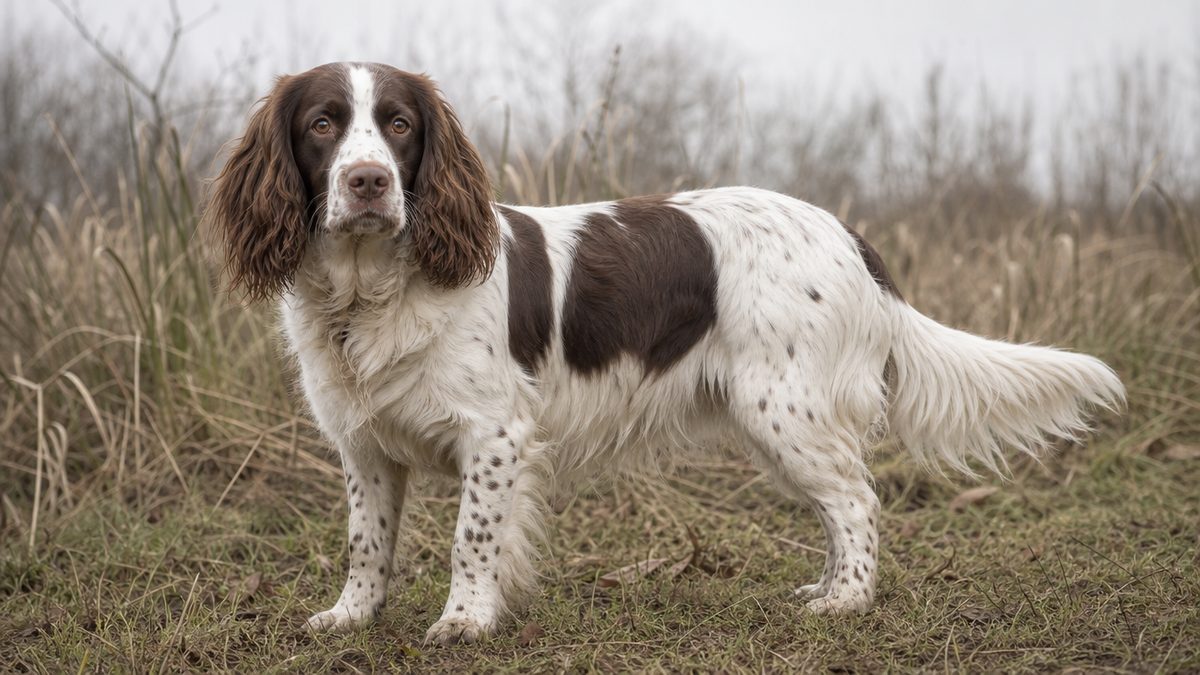
Start with what nobody disputes. It was a medium land spaniel, not a toy and not a giant. Stonehenge, writing in 1872, described a dog that 'resembles a thick-made English setter in shape and general proportions, but is of smaller size, seldom exceeding 17 or 18 inches in height';. Dalziel put its average weight at about 40 lb. It was leggy for a spaniel of its day, which is the whole reason it survived the 1902 reclassification while the short-legged spaniels went elsewhere.
The colour is the second fixed point. Stonehenge again: 'The colour is black and white, or liver and white, accompanied by ticks of either on the white';. In his later cocker chapter he adds 'rarely lemon and white; usually a good deal ticked with colour in the white';. That freckling through the white is the feature every period writer notices, and it is the feature no modern page gets right.
The name points at two counties, which is itself a clue
It was also called the Shropshire Spaniel. Norfolk and Shropshire are two hundred kilometres apart and have nothing in common except that both are English farming counties where somebody shot birds over a liver and white dog. A breed name that can be swapped for another county's name without anyone objecting is describing a colour and a build, not a place, and Rawdon Lee made exactly that argument about Devonshire in 1893.
The question this page actually answers
Every page ranking for this breed tells you what the Norfolk Spaniel was like: friendly, loyal, good in water. Not one asks whether it was a breed. That is the question its contemporaries were arguing about, it is answerable from documents that are online today, and the answer turns out to be genuinely split rather than a slogan. The sections below go through the authorities one at a time, in the order they wrote, and then apply Bonbeno's own two-condition test to what they said.
This is not the Norfolk Terrier. They share a county name and nothing else: one is an extinct 18 kg gundog, the other a living 5 kg wire terrier separated from the Norwich Terrier in 1964. One page ranking for the spaniel illustrates its article with a photograph of a small prick-eared wiry terrier.
Nine authorities, in the order they wrote, and which side each took
Nine writers describe this dog at first hand between 1845 and 1907, and they do not agree. The earlier ones accept it and hedge; the later ones deny it. One of them, Vero Shaw, does both, in two editions of the same book nine years apart.
| Year | Author | Verdict | The sentence that gives it away |
|---|---|---|---|
| 1845 | William Youatt | A distinct breed | 'cultivated by the late Duke of Norfolk, and thence called the Norfolk Spaniel' |
| 1872 | 'Stonehenge', J. H. Walsh | A real variety, no definable type | 'so intermixed with other breeds that it is impossible to select any particular specimen as the true type' |
| 1872 or later | 'Idstone', Rev. Thomas Pearce | Real, with a purity test, but of unknown origin | 'those of the highest caste invariably have them' set against 'nor do I believe that their origin is known' |
| 1881 | Vero Shaw, first edition | A real breed, hard to describe | 'credited with having been for years a protege of the Duke of Norfolk' |
| 1881 | Hugh Dalziel | Nominally real, no content | 'XXIV. Norfolk Spaniel. Same as the cocker.' |
| 1890 | F. H. F. Mercer | Real enough to standardise and police | Prints the club standard and doubles nothing yet: negative points total 10 |
| 1890 | Vero Shaw, second edition | Reversed. Probably not a breed | 'there are fair grounds for considering the variety apocryphal nowadays' |
| 1893 | Rawdon B. Lee | Not a breed | 'I do not consider the liver and white spaniel any particular variety at all' |
| 1903 | William Arkwright | Not a breed; name rejected | 'this appellation, after serious consideration, the Kennel Club has finally rejected' |
| 1904 | Herbert Compton | Not a breed; name being withdrawn | 'I am conscious I should not write Norfolk at the head of this section' |
| 1906 | James Watson | A real working variety, correctly named | 'it is a name far more appropriate than many which have been given to dogs' |
| 1907 | Robert Leighton | Gone, and badly replaced | The new name is 'a very clumsy name for a breed' |
The believers all hedge in the same place
Between 1872 and 1881 four writers accept the Norfolk Spaniel as real, and every one then admits he cannot say what one looks like. Stonehenge: it is 'impossible to select any particular specimen as the true type';. Vero Shaw: 'In the face of so many cross-bred Spaniels, which are spread about the country and styled Norfolks by their owners, there is a considerable difficulty in giving a description of what a Norfolk Spaniel should be';.
And Dalziel does something sharper than any of them without appearing to argue at all. His book gives every breed a Standard of Excellence with a full points table. Entry XXIV, in its entirety, reads: 'Norfolk Spaniel. Same as the cocker.'; A man who believed this was a distinct breed had a page on which to say what distinguished it, and wrote four words instead.
Idstone is the most interesting believer, because he offers a test
Idstone does not simply assert the breed. He gives it a diagnostic marker and applies it to a specific dog, which is the closest anyone in this literature comes to a falsifiable claim. Of one bitch he writes that 'she was very highly bred, but she was not purely bred; for she had no freckles on her legs or nose, and those of the highest caste invariably have them'. He adds, on the same page, that 'I have known some families in which the breed has been maintained for many generations with the best results'.
That is a genuine two-part position and it deserves quoting as one. He believes the breed exists, believes it can be maintained, and believes there is a physical sign that separates the pure from the merely well bred. Then on the next page he concedes the rest: 'Only the best judges can determine as to the correct breeding of Norfolks, as the breed has been very much mixed for years; nor do I believe that their origin is known, or that any person at the present time is very remarkable as a breeder ... Clumbers are so much in vogue that I doubt the resuscitation of a Norfolk breed';.
Vero Shaw argues with himself, and that is the best evidence on this page
The same author, the same book, two editions, opposite conclusions. The 1881 first edition states at page 448 that the dog 'is credited with having been for years a protege of the Duke of Norfolk'. The 1890 second edition deletes that sentence entirely, inserts in its place 'Indeed, as will be seen below, there are fair grounds for considering the variety apocryphal nowadays', and prints James Farrow's signed denial.
One further change in the same revision shows how carefully Shaw was retreating. His 1881 appearance clause reads 'In appearance the Norfolk Spaniel is inclined to be higher on the leg'. The 1890 version reads 'From what we have heard stated by believers in the existence of the variety, the Norfolk Spaniel is inclined to be higher on the leg'. He has moved from describing a dog to reporting what a faction says about a dog, and he has done it inside a single sentence.
The two editions are cited interchangeably almost everywhere, so 'Vero Shaw says the Norfolk Spaniel was a Duke of Norfolk breed' and 'Vero Shaw says it was apocryphal' are both true, of different books. Always name the edition. And the word 'apocryphal' in the 1881 edition attaches at page 424 to the NORFOLK RETRIEVER, a different animal entirely, which is very easy to mis-file as a verdict on the spaniel.
A negative result worth printing
The word 'misnomer' is often attributed to these writers on this breed, and it appears in none of them. It occurs zero times in Vero Shaw's 1881 and 1890 editions Vero Shaw, 'The Illustrated Book…, and exactly once in Idstone's whole book, where it describes the eyes of Japanese lapdogs and has nothing to do with any spaniel. Lee, the strongest denier of the three, never uses it either and proposes no replacement name. Any source that puts 'misnomer' in these men's mouths about this dog has invented it. Shaw's word is apocryphal.
Dalziel also quietly contradicts the origin story he is repeating
In the same chapter Dalziel writes that the variety 'is stated to have been produced by a cross with a black and tan terrier, and was often so marked, and was bred and kept by a late Duke of Norfolk';. Note the hedge, 'is stated to have been'. Then he reports his own observation: 'The specimens I have seen at Eastern Counties shows, and represented to be pure Norfolk, were free from tan markings.' The dogs he actually looked at did not carry the mark the origin story requires, and he prints both facts without reconciling them.
Watson is the honest late dissent
James Watson in 1906 is the one late writer who defends the name, and on a ground nobody else uses. He argues the dog genuinely belonged to the county's kind of shooting: 'as this variety of spaniel was not only well known in the county which called for a dog fit for work on land and in water, but had the appearance of being exactly fitted for the sports associated with Norfolk and the east coast, it is a name far more appropriate than many which have been given to dogs';. He is defending the county, not the Duke, and he demolishes the Duke in the same chapter.
The Duke of Norfolk story: one sentence in 1845, denied in print by 1890, still live in 2026
The Duke of Norfolk had nothing to do with this dog, and we know because somebody wrote and asked him. The story traces to a single sentence by William Youatt in 1845, was repeated for forty-five years, was retracted by one of its own repeaters in 1890, was struck from the Spaniel Club's standard as an error in 1904, and still appears on the Royal Kennel Club's website today.
Step one, 1845: where it starts
Youatt's whole basis is one sentence: 'From a cross with the terrier a black and tan variety was procured, which was cultivated by the late Duke of Norfolk, and thence called the Norfolk Spaniel';. No source, no Duke named, no date. Everything downstream is this sentence.
Step two, 1881: it is repeated as the only theory available
Vero Shaw quotes Youatt's passage word for word and then says: 'The above is the only theory which we can discover of the origin of the Norfolk Spaniel';. In the same edition he states as fact that the dog 'is credited with having been for years a protege of the Duke of Norfolk'. That is an honest admission followed by a hardening, and it is the moment the claim becomes a fact for everyone who reads Shaw instead of Youatt.
Step three, 1890: the same author retracts it
This is the strongest single link in the chain, because it is one man changing his mind in public rather than two men disagreeing. Shaw's second edition deletes the protege sentence, replaces it with 'Indeed, as will be seen below, there are fair grounds for considering the variety apocryphal nowadays', and prints James Farrow's signed denial. He also rewrites his own appearance clause to begin 'From what we have heard stated by believers in the existence of the variety'.
That fixes a date most accounts get late. Farrow's conclusion was in print by 1890, not 1904. The 1904 material adds the underlying correspondence and the club's decision to act on it, but the denial itself had been public for fourteen years by then.
Step four, 1893: Lee attacks the chronology
'Youatt, writing in 1845, says the breed was first brought into note by the late Duke of Norfolk, who was supposed to have produced them by crossing with a black and tan terrier and a springer ... This, however, is not at all likely to be correct, for, long prior to that time, brown and white spaniels were found. Indeed, I fancy that was the prevailing spaniel colour';. If liver and white spaniels predate the alleged cross, the cross cannot have produced them.
Step five, 1904: the correspondence itself, and the club acts
John S. Cowell, honorary secretary of the Spaniel Club, reported in Compton's volume: 'With a view to finally settling the question, Mr. James Farrow wrote to the late Duke of Norfolk, who replied to the effect (I quote from memory) that he knew nothing of any breed of liver and white spaniels named Norfolk, and his family never owned such a strain'. Cowell then states the consequence: 'it is proposed to discontinue the description in the next issue of our Standard of Points, and at our next general meeting steps will be taken to withdraw that which was inserted in error many years ago.'
Compton's own verdict on Youatt is blunt: 'he was drawing on his imagination';.
Step six, 1906: Watson names the actual dogs
Watson supplies the positive correction rather than just a denial. 'As for any association of the Duke of Norfolk with this breed, that is quite erroneous, for the Duke of Norfolk's spaniels, that is, the spaniels which were particularly associated with the Duke of that name about one hundred years ago, and the only dogs ever so associated with the name, were what we know as King Charles spaniels';. A toy black and tan spaniel, not a 40 lb gundog.
The Duke of Norfolk does appear in the Kennel Club Stud Book for 1874, and he appears in Class XIV, CLUMBER SPANIELS, as a breeder in pedigrees such as 'By the Duke of Norfolk's Trudge out of Earl Spencer's Moll';. His documented spaniel interest in the official record is Clumbers. That is a fourth independent line of evidence, from a document neither Youatt nor his critics were arguing about.
Step seven, 2026: it is still there
The Royal Kennel Club's own page for the English Springer Spaniel, the breed the Norfolk became, currently reads: 'At one stage the breed was called the Norfolk Spaniel as it was reputed that the Duke of Norfolk developed the breed';. The word 'reputed' is doing a lot of work, but the sentence is the 1845 claim, on the successor breed's own registry page, one hundred and thirty-six years after one of its own popularisers retracted it and one hundred and twenty-two years after the Spaniel Club voted to strike it out as an error.
| Year | What happened | Effect on the claim |
|---|---|---|
| 1845 | Youatt writes one unsourced sentence | Created |
| 1881 | Vero Shaw reprints it as the only theory available | Hardened |
| 1890 | Shaw deletes it and prints Farrow's signed denial | Retracted by its own populariser |
| 1893 | Lee refutes it on chronology | Refuted |
| 1904 | Spaniel Club moves to withdraw it as an error | Formally struck |
| 1906 | Watson identifies the Duke's real spaniels as King Charles | Replaced with the correct fact |
| 2026 | The Royal Kennel Club still prints it | Alive |
A historical source is evidence of what its author wrote, not evidence that the claim is true. Youatt is a real, citable, correctly-quoted primary source for the Duke of Norfolk story, and the story is false. Any page that treats an old book as automatically authoritative will reproduce this error, which is exactly what happened for a hundred and eighty years.
Was it a breed? Bonbeno's two-condition test, settled inside one book
The Norfolk Spaniel passes one of Bonbeno's two conditions for a breed and fails the other. A written breed standard genuinely existed, at least four printings of it. A studbook class never did. The Kennel Club's own Stud Book for 1875 proves both halves of that in a single volume, and this is the document the argument now rests on.
Bonbeno maintains a page for dog types that are not breeds, and the rule it applies is that a breed has a written standard and a studbook, so a puppy can be measured against a document. A type is a description, several unrelated dogs satisfy it at once, and there is nothing to check. The Halls Heeler fails both conditions and belongs there. The fell terrier fails both and belongs there. The Norfolk Spaniel does not fail both.
Condition one: was there ever a written standard? Yes, and it was revised.
| Standard | By whom | Where it survives | What it specifies |
|---|---|---|---|
| Standard of Points for Judging Norfolk Spaniels, 1881 | Vero Shaw | The Illustrated Book of the Dog, p. 449 | A 50-point scale: head 5, ears and eyes 5, body and chest 10, legs and feet 5, loins 5, coat 5, colour and markings 5, general appearance 10 |
| The Spaniel Club's standard, as printed 1890 | The Spaniel Club | Mercer, The Spaniel and Its Training, p. 140 | Full description, positive points, and negative points of carriage of stern 5 and topknot 5, total 10 |
| The Spaniel Club's standard, as printed 1904 | The Spaniel Club | Compton, vol. II, pp. 26 to 28 of the club booklet | The same standard with the negative points doubled to 10 and 10, total 20 |
| The ideal Norfolk spaniel, 1904 | H. G. Bleazby | Compton, vol. II, pp. 256 to 257 | A private ideal, printed by Compton as an epitaph on a departing classification |
The Spaniel Club's version is the one that matters, because a club standard is the document a buyer could have measured a puppy against. Its wording, from Compton's 1904 reprint: 'Ears. Long, low-set, and lobular ... Body (including size and symmetry). Fairly heavy body; legs rather longer than in other field spaniels, but not so long as in Irish; medium size ... Coat. Not woolly, not curly, but may be broken. Colour. Liver and white, and black and white. General Appearance. An active, useful, medium-sized dog';.
And the standard was maintained, which is itself evidence
The earliest full text of the club standard is not Lee or Compton but Mercer's 1890 book, printed under the running head 'STANDARDS ADOPTED BY THE ENGLISH SPANIEL CLUB';. Comparing Mercer 1890 against Compton 1904 shows the same club's standard being edited between printings rather than sitting inert:
| Clause | Mercer, 1890 | Compton, 1904 |
|---|---|---|
| Negative point, carriage of stern | 5 | 10 |
| Negative point, topknot | 5 | 10 |
| Negative points total | 10 | 20 |
| Coat | 'Hard, not woolly' | 'Not woolly' |
| Stern | 'Docked' | The word 'Docked' has gone |
Doubling the penalty for a topknot and for a badly carried stern is a club tightening its own document against the two faults it kept seeing. That is what an active breed standard looks like, and it is a stronger form of condition one than a single printed list would have been. Two smaller drifts appear between Lee's 1893 printing and Compton's 1904 one as well: Lee reads 'Neck. Long, strong, slightly arched' where Compton reads 'Lean, long, and slightly arched'; Herbert Compton, 'The Twentieth Century Dog….
Condition two: was there ever a studbook class? No, and here is the proof.
The Kennel Club Calendar and Stud Book, volume II, for 1875, prints both halves of this question in one book, forty pages apart.
In the section headed 'DOG SHOWS, 1874', Division I Sporting Dogs, at pages 26 to 27, the volume records the Norwich show held at the Corn Hall on 9 and 10 December 1874, under Kennel Club Rules, with 394 entries, judged by Mr W. Lort and Mr E. Sandell. One of its classes reads, in the volume's own imperfect scan: 'Nobfolk Spaniels. - 1st, Mr. A. W. Langsdale's Lena; 2nd, Mr. E. H. Willett's Floss.' The OCR renders Norfolk as 'Nobfolk' and Langdale as 'Langsdale', and the underlying words are not in doubt.
So a Norfolk Spaniel class existed, at a Kennel Club show, in the Kennel Club's own record. Now turn to the registration pages of the same volume.
| Where in volume II | Heading | Lena | Floss |
|---|---|---|---|
| pp. 26-27, Dog Shows 1874 | Norfolk Spaniels (show class) | 1st, Mr A. W. Langdale's | 2nd, Mr E. H. Willett's |
| pp. 130-132, registrations | Class XIX. Field Spaniels | Entry 4429, by Bebb (No. 2101, Vol. I) out of Fuss | Entry 4427, pedigree unknown |
| Chief Performance recorded | - | 'Norwich, 1st prize (for Norfolk spaniels)' | 'Norwich, 2nd prize (for Norfolk spaniels)' |
The Kennel Club named the show class and then filed the dogs as Field Spaniels. It even wrote the class name into each dog's performance line, in brackets, as a description of a prize rather than as a category of animal. That single volume is the distinction this page has been drawing: a show class is a judging convenience, and a studbook class is a closed record of parentage. In 1875 the Kennel Club operated the first and declined to create the second, on the same two dogs, in the same book.
Vero Shaw independently corroborates one of them. He records a Sussex Spaniel's littermate 'shown by Mr. A. W. Langdale, at Norwich, as a Norfolk Spaniel in 1874, upon which occasion she won first prize';. That is Lena, described from the other side, six years later, by a writer who was not looking at the Stud Book.
The other volumes say the same thing
Volume I for 1874 contains the exact string 'Norfolk Spaniel' zero times in 1,631,119 characters; all 22 occurrences of 'Norfolk' are county addresses, street names, or the Duke appearing as a breeder inside Clumber Spaniel pedigrees. Volumes III (1876) and XI (1884) give the spaniel registration classes as Irish, Water other than Irish, Clumber, Sussex and Field, with no Norfolk heading. Volume IV (1877) does contain the phrase twice, and both times it is descriptive rather than structural, inside the pedigrees of entries 6312 Bess II and 6317 Floss II, each recorded as 'out of Smut (black and white ticked Norfolk spaniel)'.
Volume XI adds a closing detail. By the time of the Eastern Counties show at Ipswich on 20 and 21 November 1883, the schedule offers only 'Spaniels. - Large ... Small';. The Norfolk class was no longer even a fixture in East Anglia, nine years after Lena won it at Norwich.
Five British Kennel Club Stud Book volumes could be located and all five were read: I (1874), II (1875), III (1876), IV (1877) and XI (1884), plus a Google-scanned duplicate of XI. An Internet Archive identifier search returns exactly those five. Volumes V to X and XII onward could not be located anywhere, and a HathiTrust catalogue search returns no British Kennel Club Stud Book at all, its seven hits being American Kennel Club volumes. So this is five volumes checked directly plus contemporary testimony, not a complete run.
The contemporary testimony, which points the same way
H. G. Bleazby owned a Norfolk spaniel called Toss and wanted the breed recognised. Writing in 1904 he complains that 'the classification granted by the Kennel Club ... classes a pure Norfolk spaniel with any cross-bred spaniel that is high on the leg. A distinct breed, having a distinct type, should be recognised.' And then: 'For want of a classification I have to show my spaniel Toss in any other variety classes'. That is an aggrieved insider stating, thirty years after Lena, that the Kennel Club still provided no Norfolk category.
Arkwright says the same from the other side in 1903: 'this appellation, after serious consideration, the Kennel Club has finally rejected';. And Lee, in 1893, gives the cleanest summary of the split: 'The Norfolk spaniel is not now acknowledged by the public as a variety, though it is by the Spaniel Club'.
Bonbeno's verdict, unchanged
The Norfolk Spaniel does not belong on the dog types that are not breeds page under that page's own rule. That rule says what puts a dog there is the missing standard, and this dog had a standard, published by a national club, printed in at least four places, revised between printings, that a buyer in 1895 could genuinely have measured a puppy against. What it lacked was a register. The better description is a retired breed name: a real dog with a real document and no closed studbook, whose name was formally withdrawn by the two bodies that had used it. The nearest thing on this site is not the fell terrier but the English Water Spaniel, another English spaniel with written descriptions and no surviving population.
What it became, and the date most pages get slightly wrong
The Norfolk Spaniel became the English Springer Spaniel by administrative merger, and the date on the primary document is 1902, not 1903. William Arkwright, writing the spaniel chapter of Drury's third edition, states plainly when the Kennel Club created the class.
Arkwright's account of the mechanism: 'This good old English name has been recently revived by the Kennel Club to designate the old-fashioned, medium-legged Spaniels of all colours that are neither Clumber nor Sussex Spaniels, and to distinguish between them and the short-legged variety, which is for the future to be classed under the (appropriately modern) title of Field Spaniel';. So one reclassification produced two modern breeds: the leggy dogs became English Springers, the short-legged ones became Field Spaniels.
The date comes from the same chapter, in the Welsh Springer section: the Welsh Springer's elevation to a class of its own in the Kennel Club Stud Book 'was announced in 1902, in the same honour-list as that of his relative the English Springer'. That is a contemporary insider naming the year, in a book published the following year.
The replacement designation, in full, and what people made of it
Robert Leighton records the Kennel Club's new heading verbatim: 'English Springers other than Clumbers, Sussex, and Field', and calls it 'a very clumsy name for a breed'. Compton, writing three years earlier, had made the same complaint in his own words: the dog 'is now classified by the Kennel Club as the English springer, other than Clumber, Sussex, and field, a considerably bigger mouthful to pronounce than the neat and natty Norfolk';. Two independent writers, both irritated by the same phrase, is good evidence that the phrase is quoted correctly.
Leighton also settles a small attribution question this page had to get right. The Sporting Spaniel Society's own standard was headed 'English Springer', not Norfolk Spaniel. The club standard for the Norfolk belonged to the Spaniel Club, which is the body Mercer, Lee, Compton and Watson all name, and confusing the two societies would put the standard in the wrong hands.
Where 1903 comes from, and why both dates float about
Wikipedia's lead sentence says the breed 'has been extinct since the early 20th century' and its article says the breed 'ceased to exist after 1903', while its own body text puts the Kennel Club designation in 1902 citing Drury. Both dates are defensible if you say which event you mean. 1902 is when the Kennel Club created the replacement class. 1904 is when the Spaniel Club moved to strike its Norfolk standard. Compton, writing in 1904, describes the standard as still in print and condemned: 'I know these three pages are doomed to be eliminated';. Nothing happened in 1903 that anyone has documented.
The dog got taller after it stopped being a Norfolk
This is a real and checkable difference, and no page states it. Stonehenge recorded the Norfolk at 'seldom exceeding 17 or 18 inches', which is 43 to 46 cm. The current Royal Kennel Club standard for the English Springer Spaniel gives an approximate height of 51 cms (20 ins) and describes the breed as 'Highest on leg and raciest in build of all British land Spaniels'. The breed that inherited the Norfolk's dogs is two to three inches taller than the dog those writers measured.
The colour argument that decided the name, and why it was wrong
Arkwright records precisely why the Kennel Club would not use the name Norfolk: 'because of the prevalent belief, deeply rooted though fallacious, that the Norfolk Spaniel was always liver-and-white in colour';. Read that beside the Spaniel Club's own standard, which specifies 'Colour. Liver and white, and black and white';, and beside Stonehenge's 1872 description, which gives 'black and white, or liver and white';. The Kennel Club rejected the name on the strength of a belief that the breed's own written standard contradicted, and Arkwright says so in the same sentence by calling the belief fallacious.
The two breeds that escaped the merger still exist by name
This is the sharpest way to see what happened. The 1902 reclassification swept up every medium-legged land spaniel except two, and those two, the Clumber and the Sussex, were explicitly excluded. More than a century later both are still separately registered British breeds, both on the Royal Kennel Club's vulnerable native breeds list: the Clumber registered 160 UK puppies in 2025 and the Sussex 15 The Royal Kennel Club. The English Springer Spaniel, which absorbed the Norfolk, registered 5,845 in the same year, down from 9,827 in 2016.
Meyrick called the Norfolk Spaniel the commonest breed in England in the 1860s. The two rarest spaniels in Britain today are the two that were kept out of the merger it was swept into. Being excluded from a reclassification turned out to be how a nineteenth-century spaniel name survived.
What it looked like, from the descriptions rather than from the modern pictures
Reconstruct the Norfolk Spaniel's appearance from the three period sources that give measurements, and ignore the modern pages, which give figures nobody could have measured. The consistent picture is a leggy medium land spaniel, freckled liver and white, with long lobular ears and a flat coat that was never curly.
| Source | Height | Weight | Coat and colour |
|---|---|---|---|
| Stonehenge, 1872 | Seldom exceeding 17 or 18 inches | Not given | Black and white or liver and white, ticked on the white |
| Stonehenge, cocker chapter | Higher on the leg than Clumber or Sussex | Not given | Liver and white, sometimes black and white, rarely lemon and white |
| Dalziel, about 1881 | 'Rather a leggy dog' | About 40 lb | Generally liver and white; ears long, lobular, deeply fringed with soft hair |
| The Spaniel Club standard | Legs longer than other field spaniels, shorter than Irish | 'Fairly heavy body'; medium size | Not woolly, not curly, but may be broken. Liver and white, and black and white |
| Bleazby's ideal, 1904 | Not given | About 45 to 50 lb | A deep but rather short head, ears large and set high |
| The Spaniel Club standard, as printed 1890 | Not given | Not given | Coat 'Hard, not woolly'; stern 'Docked'; negative points total 10 |
Four of those five agree on the essentials and the fifth, Bleazby's, is explicitly a private ideal rather than a description of what existed. The dog is medium, leggy for a spaniel, liver and white with ticking, long-eared, and flat-coated.
The one feature that separates it from a water spaniel
'Coat. Not woolly, not curly, but may be broken';. The earlier printing of the same club standard, in Mercer 1890, opens that clause with a word Compton has lost: 'Coat.-Hard, not woolly';. Either way the clause is doing real work. Lee proposed that the Norfolk originated in 'a cross between a curly-coated water spaniel and one of the ordinary Sussex or other breed';, and if that were visible in the coat the dog would be an English Water Spaniel rather than a land spaniel. The standard rules it out explicitly. Any modern illustration showing a tightly curled jacket is showing a different dog.
There is a genuine ambiguity here, and it is in the sources
English-language accounts file the Norfolk firmly under the springers, and so do Stonehenge, Idstone, Dalziel and Vero Shaw. But the Swedish Wikipedia article frames the same dog as a water spaniel and files it among extinct British water spaniels, citing Lee. Both readings can point at real text: Lee proposed a curly-coated water spaniel ancestor, and Watson stresses the dog's water work heavily. Bonbeno follows the majority and treats it as a land spaniel, and records the disagreement rather than hiding it.
The tail, and why it matters in India
Mercer's 1890 printing of the Spaniel Club standard gives the stern as 'Docked';, and Lee's 1893 printing specifies 'Stern. Docked; low carried';. By Compton's 1904 printing the word Docked has gone. So this breed's own standard required tail docking across two printings and at least fourteen years. Under Indian law that is now prohibited: Second Schedule Part II paragraph 6(8) of the Dog Breeding and Marketing Rules 2017 states that 'There shall be no tail docking, ear cropping de-barking, de-clawing ... and any change of appearance by artificial means is strictly forbidden';. Bonbeno's illustration of this breed therefore shows an undocked dog, and says so.
One ranking page gives an adult weight of 20 to 25 kg and a double medium coat; another gives 13 to 23 kg, 41 to 48 cm and a wavy coat in its table while its prose says 18 to 25 pounds and 14 to 16 inches. Not one of those is traceable to a period source, and the second page contradicts itself on the same screen.
Norfolk Spaniel price in India: there is none, and here is why that is the answer
No Norfolk Spaniel price exists in India or anywhere else, because the breed is extinct and no register holds the name. Bonbeno publishes no figure. What is worth knowing is what the pages promising a price are actually offering.
Three things have to be true at once for a breed price to exist: living animals, a way to identify them, and a lawful route to move them. This breed has none of the three. The population ended when the Kennel Club replaced the class in 1902. No studbook ever held the name. And India is a full FCI member whose pedigrees run against FCI nomenclature, which contains no Norfolk Spaniel, so the Kennel Club of India's checklist for registering an imported dog has nothing to register.
The law would stop it even if the dog existed
DGFT Trade Notice 22/2022-23 places dogs under ITC(HS) 01061900 as a Restricted import. Entry is permitted only for a pet accompanied by a valid pet book in the importer's name, for research with a CPCSEA recommendation, or for Defence and Police use, and applications for trading or breeding purposes are to be rejected. So no lawful commercial supply chain could form for this name even in principle.
What the pages promising a price are actually selling
| Page | What it promises | What is actually there |
|---|---|---|
| creatures.com | Title reads 'Breed Facts, Prices & Breeders' | A marketplace, a herdbook, a profile directory and a breeder directory, all four empty, plus a gestation calculator |
| petlur.com | 'Norfolk Spaniel Dog Breed Info, Size, Price, Height' | Price (Avg.) listed as 'Unavailable', beside a daily cost of $20 to $30 and a monthly cost of $50 to $100 |
| snoutastic.com | A full ownership profile | Feeding portions, exercise minutes and an annual hip evaluation schedule for an extinct dog |
| siwalusoftware.com | An app to scan your dog and identify it | A photo classifier offered for a breed with no living reference population |
| pets4homes.co.uk | Ranked ninth on the Indian search | Cocker Spaniel puppies for sale in the county of Norfolk |
That last row is the honest one, and it is instructive. Pets4Homes is not pretending: it is selling Cocker Spaniels in Norfolk, and the search engine matched it because the county name is in the query. Every other row is a page that has generated commerce furniture around a name with no animals attached to it.
What an Indian reader should take from this
If you searched this term because you wanted to buy one, the answer is that you cannot, and that anything offered to you under the name is a different dog. If you searched because you own a liver and white spaniel and someone told you it was a Norfolk, what you have is almost certainly an English Springer Spaniel or a springer-type crossbreed, which is exactly what the name meant for most of its life anyway.
An extinct name is the easiest thing in the world to sell, because no competitor can contradict the seller and no register can be checked. Treat any Indian listing under this name as a listing for an unidentified dog.
Auditing the pages that rank: a gestation calculator and an annual hip scan for a dog dead since 1902
Two of the pages ranking in India for this breed are content farms this site has caught fabricating on other extinct breeds, and both are doing it again here. One publishes a full modern ownership manual for a dog it says is extinct. The other runs a marketplace, a herdbook and a breeding calculator for it, and illustrates it with a terrier.
The one that declares extinction and then prescribes care
Snoutastic's page carries a Conservation Status block reading 'This breed is extinct and no longer exists in its original form';. On the same page it publishes a lifespan of 10 to 12 years, an adult weight of 20 to 25 kg, a coat described as 'Double, Medium', an exercise requirement of 60 minutes a day, a feeding portion of '2-3 cups per day, divided into two meals for adults', and star ratings including a Cuddle Factor of 4 out of 5 and Apartment Life of 2 out of 5.
Then it goes further than any of that. Under Preventive Care it prescribes a 'Hip Evaluation, Annually after 2 years of age', an 'Ophthalmic Examination, Every 1-2 years, especially in older dogs' and a 'Hearing Test, At least once during the dog's lifetime, preferably as a puppy';. There has been no puppy of this breed to test for a hundred and twenty years.
Two details give the generator away. The coat is described as double, which contradicts the Spaniel Club standard's 'Not woolly, not curly, but may be broken';. And its Similar Breeds engine offers to 'Compare side by side' against the Dikkulak at an 86 percent match, a Turkish word meaning erect ear that Bonbeno already files as a description rather than a breed. An extinct English land spaniel and a Turkish adjective, matched at 86 percent, is what a similarity engine does when it has nothing to compare.
The one whose prose is right and whose furniture is not
Creatures.com is the more interesting case, because its text is careful and correct. It states that the Norfolk Spaniel is 'a historical English sporting spaniel rather than a living standardized breed', and it even warns that 'Modern breeders should avoid presenting recreated or loosely labeled dogs as direct continuations unless records support the claim';. That is better than most of the page's competitors manage.
Everything around that text contradicts it. The page's own title promises 'Breed Facts, Prices & Breeders'. It invites the reader to 'Get an alert the moment a new Norfolk Spaniel listing goes live on the Creatures marketplace'. It offers a Norfolk Spaniel Herdbook, a Norfolk Spaniel Profiles directory and a Norfolk Spaniel Breeders directory, all four reading zero. It offers, under 'Norfolk Spaniel Tools', a Dog Gestation Calculator to 'Estimate due dates, windows, and reproductive milestones'.
| Source | Colours permitted | Count |
|---|---|---|
| The Spaniel Club standard, as printed 1904 | Liver and white, and black and white | 2 |
| Stonehenge, 1872 and later | Black and white, liver and white, rarely lemon and white, ticked | 3 |
| creatures.com, 2026 | Albino, Apricot, Bicolor, Black, Black and Tan ... Blue Merle ... Harlequin ... Leucistic ... Merle ... Reverse Brindle ... Tuxedo, White, Yellow | 54 |
Albino, harlequin, blue merle and leucistic are not colours anyone recorded in this dog, and several of them are genetically impossible in a nineteenth-century English land spaniel. This is a site-wide colour template applied to a breed name, and it is the same pattern this site has recorded on another extinct breed where the list ran past seventy colours.
The two tells that confirm it
First, the featured listings on the Norfolk Spaniel page include a 'Blue pullet' in Ravenna, Texas. A pullet is a young hen. The same listing has previously been recorded by this site on a completely different extinct dog's page on the same domain, which means the module is not breed-aware at all.
Second, and this one closes the circle with the other half of the county name: creatures.com illustrates its Norfolk Spaniel page with a photograph of a small red prick-eared wiry terrier. That is not a spaniel by size, coat, ear carriage or colour. It is a Norwich or Norfolk Terrier type. The page that most confidently sells you a Norfolk Spaniel is showing you a Norfolk Terrier.
And a third page that contradicts itself in one screen
Petlur's specification table records 'Recognized by: Not recognized by the American Kennel Club. And Not recognized by FCI.' Its History section, on the same page, states: 'In recent years, however, the Norfolk Spaniel has been making a comeback, and is now recognized as a distinct breed by both the Kennel Club of England and the American Kennel Club';. It also offers, as a reason for the extinction, 'The outbreak of World War II, which resulted in many dog breeds becoming extinct', for a name the Kennel Club retired in 1902. And it lists coat colours as 'White & Black' only, omitting liver and white, which is the exact colour the Kennel Club named as its reason for rejecting the breed name.
None of these pages is a source for a fact about this dog. They are usable only as evidence of what happens to an extinct breed name in a market that rewards publishing something. Where a page prints a lifespan, a portion size or a hip-screening interval for an animal with no population, the number was generated rather than measured.
Temperament: what the period sources report, and what nobody can tell you
Every temperament claim about the Norfolk Spaniel traces to a handful of nineteenth-century sentences, and they describe a dog that was attached, obstinate and often noisy. That is not a modern behavioural assessment and this page does not present it as one.
Youatt in 1845 gives the fullest account, and it is not flattering: the Norfolk 'often forms a strong individual attachment, and is unhappy and pines away when separated from its master. It is more ill-tempered than the common springer, and, if not well broken in, is often exceedingly obstinate'. He then quotes a veterinary surgeon who 'used to say that there were two breeds which he never wished to see in his infirmary, namely, the poodle and the Norfolk spaniel; for, although not always difficult to manage, he could never attach them to him, but they annoyed him by their pitiful and imploring gaze during the day, and their mournful howling at night.'
That is a specific and unusual observation: a dog so bonded to one person that it was miserable in a hospital kennel. It is also a single veterinary surgeon's impression, reported second-hand, in 1845.
The noise, which several sources mention independently
Period accounts describe some of these dogs giving tongue on the hunt in the manner of a hound, a habit sporting writers called babbling. Others were quiet. That variability is exactly what you would expect from a population that Stonehenge said was 'so intermixed with other breeds that it is impossible to select any particular specimen as the true type';: a name applied to many different dogs will produce many different temperaments.
The claim that gets reversed by modern pages
One aggregator page states that these dogs 'were eager to please and responded well to positive reinforcement'. That is the opposite of every period source. Youatt says obstinate and ill-tempered; the working literature says the dog needed breaking in. The modern sentence is not a summary of the record, it is the default sentence a generator writes about any gundog.
What can honestly be said
- It bonded hard to one person, on Youatt's account, and suffered when separated.
- It was obstinate rather than biddable, and needed thorough breaking to be useful.
- Some individuals were noisy on the hunt and some were not, and the sources disagree because the dogs did.
- It worked willingly in water, which several writers single out.
- Nothing about guarding, protectiveness or aggression towards people appears anywhere in the record.
These are nineteenth-century impressions of a variable population, written by sportsmen, not behavioural data. There is no temperament test, no survey and no cohort for this dog, and there never will be. Anything presented as a modern temperament rating for the Norfolk Spaniel was invented.
Suitability for the Indian climate, worked from the origin cell and the job
A dog of this description would have been a poor fit for most of India without deliberate management, and the reason is the job rather than the coat. Norfolk averages 10.11 C across the year and 17.13 C in July, while Chennai's coolest month averages 24.09 C, so no Indian metro is ever as cool as an English summer.
NASA POWER was queried by explicit latitude and longitude for Norwich in Norfolk, 52.6309 N and 1.2974 E, and returned a grid cell at 1.297, 52.631 with an elevation of 30.68 m against a real city elevation near 20 m. A difference of about 11 m means the cell describes the place, so the figures are usable: annual mean 10.11 C, warmest month July at 17.13 C, coldest month January at 3.96 C, annual mean relative humidity 85.41 percent.
A second point was queried at 52.8300 N, 0.8480 E in north Norfolk, which returned a different cell at 15.89 m elevation with an annual mean of 10.29 C and a warmest month of 16.81 C in August. Two different cells agreeing to within 0.2 C is a genuine confirmation of the county figure rather than one cell reported twice.
| Place | Annual mean C | Coolest month C | Wettest-season humidity | Cell elevation m |
|---|---|---|---|---|
| Norwich, Norfolk | 10.11 | 3.96 (Jan) | 79.5 percent (Jul) | 30.68 |
| Pune | 23.86 | 19.62 (Dec) | 90.80 percent (Aug) | 635.99 |
| Kolkata | 25.81 | 17.31 (Jan) | 89.07 percent (Aug) | 7.35 |
| Delhi | 25.60 | 13.61 (Jan) | 74.90 percent (Aug) | 206.37 |
| Mumbai | 26.77 | 23.19 (Jan) | 90.36 percent (Aug) | 97.15 |
| Chennai | 27.95 | 24.09 (Jan) | 72.41 percent (Aug) | 48.95 |
The coat is not the problem; the work is
This was not a heavy double-coated northern dog. The Spaniel Club standard describes a coat that is 'Not woolly, not curly, but may be broken';, which is a flat, feathered land spaniel jacket that sheds heat reasonably well. A dog of that type living quietly in a Pune or Bengaluru flat would be no worse off than a modern English Springer Spaniel, which is a breed Indian owners keep successfully.
The risk sits in what the dog was for. Every period source describes hard work in heavy cover and water: Dalziel says they were 'useful in high turnips and other cover, in beating which a smaller and weaker dog would be lost sight of and soon tire';. A dog selected to keep quartering until the handler stops it is the dog that overheats, and the modern evidence is specific about this. Hall and colleagues, working from 905,543 UK dogs, found that of 879 heat-related illness events with a recorded trigger, 652, or 74.2 percent, were exertional rather than environmental. That mechanism transfers to any working gundog in India; the breed itself was never modelled by anyone.
What Indian law would say about it
Second Schedule Part IV paragraph 21(1) of the Dog Breeding and Marketing Rules 2017 bars keeping in outdoor facilities, without the attending veterinary practitioner's written approval, dogs 'not accustomed to the temperatures prevalent in the area or region in question' and breeds that 'cannot tolerate' them. An imported working spaniel in its first Indian summer sits inside the first limb of that clause, and the clause is the reason a kennel cannot simply put such a dog in an outdoor run.
The heat tolerance rating on this page is derived from origin climate and job description, not from measurement. Nobody ever took a rectal temperature on a Norfolk Spaniel, and nobody ever will. The comparison is real; the rating is an estimate and is labelled one.
Health and life expectancy: three things that are genuinely unknown
No health data exists for the Norfolk Spaniel. No lifespan, no disease prevalence, no screening result and no genetic finding has ever been published for it, because the population ended before any of those instruments existed. Bonbeno publishes no figure, and says so three times rather than borrowing one once.
There is no life expectancy figure for this breed. The modern UK life tables that give a median lifespan for 155 purebreds are built on dogs under veterinary care in the twenty-first century. The Norfolk Spaniel has no row in them and cannot have one. It was gone roughly eighty years before the data collection began.
There is no disease prevalence for this breed. Registry screening schemes such as hip and elbow scoring, eye certification and cardiac auscultation all postdate its disappearance by decades. Any figure you meet for hip dysplasia, ear infections or obesity in the Norfolk Spaniel was generated rather than measured.
There is no genetic finding for this breed. No sample was banked, no pedigree study was run, and no living population exists from which one could be run now.
What the pages ranking for this breed publish anyway
| Source | Lifespan given | What it could be based on |
|---|---|---|
| snoutastic.com | 10 to 12 years | Nothing. The same page states the breed is extinct |
| petlur.com, spec table | 11 to 14 years | Nothing, and it contradicts its own prose |
| petlur.com, prose | 12 to 14 years | Nothing, and it contradicts its own table |
| A social post ranking second | 12 to 14 years | Nothing |
| Bonbeno | No figure published | The absence of any data, stated as the finding |
Four published figures, three different ranges, one of them printed twice on the same page in two incompatible forms. That spread is what invented numbers look like when several generators work on the same empty input.
What can legitimately be said about health
Two things, and both are about type rather than breed. A long-eared, heavily feathered land spaniel that works in water carries the ear-canal risk every drop-eared spaniel carries, and Indian humidity makes that risk worse than it was in Norfolk. And a working gundog of about 18 kg carries the exertional heat risk described in the climate section above. Neither of those is a Norfolk Spaniel finding. Both are things that were true of the shape of dog it was.
Where to look instead
If you want real health data for a dog of this type, the breed to read is the English Springer Spaniel, which inherited the Norfolk's dogs and now carries a full published screening programme: hip and elbow scoring, eye testing with gonioscopy, and DNA tests for acral mutilation syndrome, fucosidosis, phosphofructokinase deficiency and progressive retinal atrophy cord1. That is what a breed with a studbook and a century of records looks like, and it is the clearest illustration on this page of what the Norfolk Spaniel never had.
If a page gives you a health statistic for the Norfolk Spaniel, that page is not reporting, it is generating. This is a dog for which the correct number of health figures is zero.
Monthly cost of ownership: no breed price, but the care costs are real
A medium spaniel of this size costs roughly Rs 5,000 to Rs 10,000 a month to keep in an Indian metro, built from published Indian vaccination, food and boarding rates. That figure is for the kind of dog the Norfolk Spaniel was, not for the breed, because the breed cannot be bought.
The distinction matters and it is worth being explicit about. There is no Norfolk Spaniel price in India and inventing one would be fabrication. But Indian vaccination, deworming, consultation, food and boarding costs are real published figures, they apply to any 18 kg dog living in India, and they are what a reader who is really shopping for a springer-type spaniel actually needs.
Vetic's Indian clinic network prices anti-rabies from Rs 699, Puppy DP from Rs 849, the 9-in-1 DHPPiL from Rs 899, canine corona from Rs 899 and kennel cough from Rs 1,349, with a full puppy package from Rs 6,499 and an adult annual package from Rs 3,199. Premium Pet Boarding in Bengaluru publishes standard boarding at Rs 650 a night, premium at Rs 850, and full-day daycare at Rs 500.
| Line | Monthly | Where the number comes from |
|---|---|---|
| Food | Rs 2,500 to Rs 4,500 | An 18 kg active dog on Indian mid-market to imported kibble |
| Vaccination, amortised | Rs 270 | Vetic's adult annual package at Rs 3,199 divided by twelve |
| Deworming and parasite control | Rs 500 to Rs 900 | Monthly, because Indian tick pressure runs year round |
| Grooming and ear care | Rs 800 to Rs 1,500 | Feathering and drop ears need professional attention every 6 to 8 weeks |
| Routine veterinary | Rs 400 to Rs 800 | One consultation a quarter, amortised |
| Boarding, if you travel | Rs 650 to Rs 850 per night | Premium Pet Boarding, Bengaluru, published 2026 rates |
That lands between about Rs 5,000 and Rs 9,000 a month before boarding. It is a real number for a real dog, and it is deliberately not attached to a breed price, because the breed has none.
The costs one ranking page publishes instead
Petlur gives 'Daily Cost $20-$30' and 'Monthly Cost $50-$100' for this breed. Set aside that the two lines are arithmetically incompatible with each other, since twenty dollars a day is six hundred dollars a month. The figures are in dollars, on a page ranking in India, for an animal that does not exist. There is nothing to convert and nothing to check.
If you are budgeting for a springer-type spaniel in India, use the table above and read the English Springer Spaniel guide for the breed-specific lines. The Norfolk Spaniel contributes the shape of the dog and nothing else.
Training: what the period sources demanded, and what still applies to the breed it became
The nineteenth-century sources agree that this dog needed thorough breaking rather than light training, and they say so in the language of their time. Youatt records a dog that is 'exceedingly obstinate' 'if not well broken in', which is the closest thing to a training verdict the record contains.
Breaking, in Victorian gundog usage, meant a long formal apprenticeship: steadiness to shot and to fur, quartering within range, dropping to command, and retrieving to hand. It was not obedience in the modern sense and it was not gentle. What Youatt is saying is that this dog would not do the job without it, and that an unbroken one was difficult.
Idstone adds the practical corollary from the other direction. He notes that 'some specimens are to be seen of very great beauty, silky-coated, strong, short, compact, moderately-eared dogs, which are not only useful but ornamental', but that finding one was a matter of luck because 'the breed has been very much mixed for years';. Buyers were selecting from a pool, not from a line, and the trainability they got varied accordingly.
The claim modern pages make, and why it is backwards
One aggregator states that these dogs 'were eager to please and responded well to positive reinforcement'. Nothing in the record supports it. Youatt says ill-tempered and obstinate. The generated sentence is the default a language model writes about a spaniel, and it inverts the only first-hand testimony there is.
What transfers to a living dog
If you are training the breed the Norfolk became, three things from the period record still hold, because they follow from the job rather than from the name. A dog bred to quarter ahead of a walking gun will range, so recall and a stop whistle come before anything ornamental. A dog bred to retrieve from water will pick things up and carry them, which in an Indian flat means teaching a formal hold and give early rather than chasing the dog around a sofa. And a dog that bonds hard to one person, as Youatt describes, does badly when left alone for ten hours, which is a real constraint on Indian working households.
- Socialise deliberately between eight and sixteen weeks, because that window does not reopen for any breed.
- Train recall on a long line before the hunting instinct comes online, not after.
- Teach a hold and a give, because a spaniel will carry things whether or not you asked.
- Build a settle on a mat, which is the single most useful behaviour in an Indian apartment.
- Do not leave it alone all day, on the strength of the one temperament observation the record actually contains.
None of this is Norfolk Spaniel training advice, because there is no Norfolk Spaniel to train. It is what the period record says about a type of dog, set beside what still applies to its living descendant.
Exercise: the workload the sources describe, and the Indian hours that make it survivable
The Norfolk Spaniel was worked hard, and a living dog of the same type needs 60 to 90 minutes a day. In India that has to be split across the cool hours, because the risk to a working spaniel here is exertional rather than ambient.
Dalziel is the clearest on the workload: these were dogs 'useful in high turnips and other cover, in beating which a smaller and weaker dog would be lost sight of and soon tire';. Stonehenge notes that the Norfolk was 'higher on the leg than the Clumber or the Sussex' and 'generally more active than either, sometimes almost rivalling the setter in lightness of frame';. That is a description of stamina, not of a companion that will settle for a walk round the compound.
| Season | Morning | Evening | Indoors |
|---|---|---|---|
| Winter, Nov to Feb | 40 min, any time before 10 am | 40 min, including free running in a fenced space | Light |
| Summer, Mar to Jun | 35 min, before 6.30 am | 35 min, after 8 pm | Scent games and a water tub to replace lost outdoor time |
| Monsoon, Jun to Sep | 30 min between showers | 30 min | Dry the ears and the feathering thoroughly every time |
| Declared heat wave | 15 to 20 min, before 6 am, lead only | 20 min, after 9 pm | All real work moves indoors |
The reason for the split is quantified. Hall and colleagues found that of 879 UK heat-related illness events with a recorded trigger, 652, or 74.2 percent, were exertional, against 113 environmental and 46 from confinement in a vehicle. Heat takes working dogs while they are working, and a spaniel bred to keep quartering is precisely the animal that does not stop on its own.
Water work, which is the one thing this type was best at
Every period source that mentions the water is enthusiastic about it, and Watson's chapter title puts it plainly: 'An Excellent All-round Worker on Land or in Water';. In an Indian context that is genuinely useful, because swimming is the one form of hard exercise a dog can take in May without overheating. A safe, clean body of water, or even a large tub for a young dog, does more for a spaniel-type in an Indian summer than any amount of lead walking.
A ranking page gives this extinct breed an exercise requirement of exactly 60 minutes a day; another gives 30 minutes and 10 miles of walking a week. Both are generated. The 60 to 90 minute range above is inferred from the described workload and labelled as an inference.
Grooming a feathered spaniel coat in Indian humidity, and the ear problem
Brush a feathered land spaniel two or three times a week and dry its ears after every wet outing. The Norfolk Spaniel's own standard describes a coat that is 'not woolly, not curly, but may be broken', which is a flat feathered jacket, and that coat has one serious weakness in India: it holds water against a long dropped ear.
The standard's coat clause is short and it rules out more than it prescribes: 'Coat. Not woolly, not curly, but may be broken';. Broken, in period usage, means slightly rough or wavy rather than flat and silky. Dalziel adds the ear detail that matters most: 'the ears long and lobular, deeply fringed with soft hair';.
Why the ear is the whole grooming problem in India
A long dropped ear covered in soft fringe does two things at once in Indian conditions. It seals the canal, so warm moist air sits against the skin. And the fringe itself holds water for hours after a swim or a monsoon walk. That combination is the standard setup for otitis externa, and it is why an English grooming routine written for a dry climate transfers badly here.
The rule to apply is simple and it contradicts most imported guidance. Overseas spaniel care guides commonly say to towel the dog and let it air dry. In an Indian monsoon that is not enough. Lift the ear flap, dry underneath it, dry the fringe itself, and give the canal a few minutes of open air before the dog goes back to lying down. Do not pour cleaner into the canal as a routine, and treat head shaking, a tilted head, an odour or the dog rubbing an ear along the floor as a veterinary visit rather than a home fix.
| Task | Frequency | Why it matters here |
|---|---|---|
| Brush the body and comb the feathering | 2 to 3 times a week | Feathering mats fast in humidity and hides ticks |
| Check and dry the ears | After every wet walk and every bath | The single highest-value grooming act for any drop-eared spaniel in India |
| Trim the hair between the pads | Monthly | Wet fur between the toes is where monsoon interdigital problems start |
| Tick check along the neck, ears and toes | Twice a week with the brush | India has year-round tick pressure, not a season |
| Nails | Every 3 to 4 weeks | Tile and marble do not wear nails the way field work did |
| Bath | As needed, then dry thoroughly | A half-dried feathered coat is worse than an unwashed one |
What the standard does not say
It says nothing about an undercoat, nothing about shedding and nothing about hypoallergenic qualities, because those are modern marketing categories. One ranking page describes the coat as 'Double, Medium';, which no period source supports and which materially changes the heat argument. Another gives the coat texture as 'Wavy' with a density of 'Medium' and recommends six specific brush types including an undercoat rake. Neither can be checked against a dog.
The English Springer Spaniel carries the same ears and the same feathering, and its Indian grooming problem is identical. Everything in the table above applies to it directly and is worth doing.
Feeding a working land spaniel in India, and the one figure nobody can give you
Feed a springer-type spaniel to body condition rather than to a chart, in two meals, at roughly Rs 2,500 to Rs 4,500 a month in an Indian city. No breed-specific feeding figure exists for the Norfolk Spaniel, and every one you will meet was generated.
Start with what is real. An 18 kg active dog in India eats between about 300 and 450 grams of dry food a day depending on the diet's energy density and how hard the dog works, and the cost range in the table in the cost section is built on Indian retail prices rather than on a foreign guide. Split it into two meals, and take training treats out of the daily ration rather than adding them on top.
Condition scoring beats any chart
Run your hands along the ribs weekly. You should feel them easily under a thin covering, see a waist from above and a tuck from the side. On a feathered spaniel the coat hides weight gain for months, which is why the hand check matters more here than on a smooth-coated dog. If you cannot feel ribs, cut the ration by ten percent and check again in three weeks.
Two Indian specifics that are not in any imported guide
Water first, and in more than one room. A working-type dog in an Indian summer loses far more than a British one, and dehydration compounds every other risk on this page. Second, resist household food. Indian homes feed roti, rice and biscuit casually, and on a dog this size that is the fastest route to an overweight spaniel with a soft coat and sore ears.
The feeding figures published for this breed, and why none is usable
One page prescribes '2-3 cups per day, divided into two meals for adults' and gives a feeding schedule of 'Adults: 2 meals a day; Puppies: 3 meals a day';. Another gives '1.5 to 2.5 cups of high-quality dry food a day' and a 'Cups Per Day' figure of 1.5. Two pages, two ranges that do not overlap at the bottom, for a dog neither has fed. A cup is also not a unit of energy, so even a genuine figure in cups would tell an Indian reader with a different kibble almost nothing.
Feed the energy figure on your actual bag, adjusted by weekly condition scoring, and ignore any cup count attached to a breed name. That advice is dull and it is the only advice that survives contact with a real dog and a real Indian kibble.
The first year, for the dog this breed became
There is no Norfolk Spaniel puppy to raise, so this timeline is written for a springer-type land spaniel in India, which is the living animal a reader who searched this name is most likely to end up with. The three fixed points are the vaccination course, the socialisation window, and the arrival of the hunting instinct.
| Age | What is happening | What you do |
|---|---|---|
| 8 weeks | The legal floor for sale in India, under Rule 8(1)(a) | Refuse any younger puppy, and refuse any docked one |
| 8 to 10 weeks | Settling and first vaccines. Vetic's Indian schedule starts at day 30 with Puppy DP | Four meals a day. Handle the ears daily so ear care is never a fight |
| 10 to 16 weeks | The socialisation window, which does not reopen | Lifts, autorickshaws, watchmen, other dogs, a vet visit with no procedure |
| 16 to 18 weeks | Vaccination course completes around day 120 | Full outdoor access. Lead walks in the cool hours only |
| 4 to 6 months | The nose switches on and recall degrades | Move to a long line. Introduce water in a controlled, shallow place |
| 6 to 9 months | Coat feathering starts coming through | Begin the twice-weekly comb-through before matting starts, not after |
| 9 to 12 months | Adolescence. Trained behaviours wobble | Retrain rather than escalate. Keep the settle on a mat solid |
| 12 to 18 months | Physical maturity in a medium spaniel | Two meals. Reassess the ration, especially after neutering |
The monsoon puppy problem
A spaniel puppy that arrives in June has a harder first year than one that arrives in November, and the reason is the ears. Its socialisation window falls in weeks when every outing ends wet, and a feathered ear that is never quite dry through the whole of a puppy's first monsoon is how a chronic ear problem starts. Dry them every single time, without exception, from the first week.
What to check at every visit in year one
- Ears, under the flap and through the fringe, dried and free of odour.
- Body condition by hand, because feathering hides weight gain.
- Ticks along the neck, in the ear folds and between the toes.
- Feet, especially between the pads after monsoon walks.
- Eyes, because the living descendant breed carries published eye conditions worth catching early.
Nothing here is Norfolk Spaniel specific and nothing could be. No period source describes rearing one, no growth study exists, and any month-by-month schedule published under this breed name was written for a generic spaniel and relabelled.
The Norfolk Spaniel against the spaniels it was confused with, then and now
Compare the Norfolk Spaniel on leg length first, because that is the axis the 1902 reclassification actually used. The Kennel Club sorted land spaniels into medium-legged and short-legged, and every breed below sits somewhere on that line.
| Breed | Leg length | Status after 1902 | UK registrations 2025 |
|---|---|---|---|
| Norfolk Spaniel | Medium, 17 to 18 in overall height | Name absorbed and retired | Does not exist |
| English Springer Spaniel | Medium; 'highest on leg of all British land Spaniels' | The class that absorbed it, approx 51 cm | 5,845 |
| Welsh Springer Spaniel | Medium | Given its own class in the same 1902 announcement | 213 |
| Field Spaniel | Short | The name given to the short-legged half | 48 |
| Clumber Spaniel | Short and heavy | Explicitly excluded from the merger | 160 |
| Sussex Spaniel | Short and heavy | Explicitly excluded from the merger | 15 |
| English Cocker Spaniel | Small | Separated as its own breed | 21,618 |
The two that were excluded are the two that survived by name
That is the clearest single fact in this table and it inverts what you would expect. The Clumber and the Sussex were kept out of the 1902 reclassification because they were distinctive enough to stand alone, and both are still separately registered British breeds today, both on the Royal Kennel Club's vulnerable native breeds list at 160 and 15 puppies a year. The Norfolk, which Meyrick called the commonest breed in England in the 1860s, is a name in a footnote.
How to tell the Norfolk from the two it was confused with, in period terms
The Spaniel Club's standard defines it by comparison rather than by measurement, which tells you how the argument was framed at the time: 'legs rather longer than in other field spaniels, but not so long as in Irish';. Stonehenge puts it the same way: 'Higher on the leg than the Clumber or the Sussex, he is generally more active than either';. So the Norfolk sits between the heavy short-legged spaniels and the leggy Irish Water Spaniel, and the coat clause rules out the Irish end: 'not woolly, not curly'.
And the comparison that is not a spaniel at all
The most common confusion an Indian reader will hit is not with another spaniel. It is with the Norfolk Terrier, a living wire-coated terrier of about 5 kg separated from the Norwich Terrier in 1964, which shares nothing with this dog but a county. The confusion is not hypothetical: one of the pages ranking for the spaniel illustrates its article with a photograph of exactly that terrier. If a page shows you a small prick-eared wiry dog under this name, you are looking at the wrong animal.
The living answer is the English Springer Spaniel or, if you want something smaller, the English Cocker Spaniel. Both hold current standards, both have real Indian availability, and both are what the Norfolk's dogs actually became.
The mistakes Indian readers make about this breed, in order of cost
Five mistakes account for almost everything that goes wrong with this name in India, and the most expensive is paying money for it. They are listed worst first.
- Paying a deposit for one. The breed is extinct and no register anywhere holds the name, so any Indian listing is for an unidentified dog. Two of the pages ranking for the term run marketplaces or breeder directories for it with zero animals in them.
- Believing the Duke of Norfolk story. It came from one sentence by Youatt in 1845, the 15th Duke denied it in writing, and the Spaniel Club voted in 1904 to withdraw 'that which was inserted in error many years ago';. The Royal Kennel Club still prints it, which is why so many people still repeat it.
- Taking a health or lifespan figure from a ranking page. Four different lifespans are published for this dog and there is no data behind any of them. The correct number of health statistics for a breed with no population is zero.
- Confusing it with the Norfolk Terrier. They share only a county name. One is an 18 kg gundog, the other a 5 kg terrier, and at least one ranking page has already merged them at the image level.
- Assuming an extinct name means an unregulated bargain. Indian law is indifferent to whether a breed exists: Rule 8(1)(a) still bars selling a pup under eight weeks and Second Schedule Part II paragraph 6(8) still forbids tail docking, whatever the puppy is called.
Two subtler ones
Sixth, treating an old book as automatically authoritative. Youatt is a genuine primary source, correctly quoted by everyone who repeats him, and he was wrong. A nineteenth-century book is evidence of what its author wrote; it becomes evidence of a fact only when something independent supports it, and here the independent evidence points the other way.
Seventh, reading Bonbeno's own verdict as harsher than it is. Saying that the Norfolk Spaniel was probably not a distinct breed is not saying the dogs were not real or not good. They were extremely real: Meyrick called them the commonest dog in England, and they did a hard job well for a century. What is in doubt is whether the name described a closed population, and the answer to that is no.
If someone offers you a Norfolk Spaniel, the question to ask is not the price. It is which register the dog is on. There is no answer to that question, and that is the whole story of this breed.
Adoption: what to do instead, and how to verify anything sold under this name
Adopt an Indian dog, or buy a living spaniel with a checkable pedigree. Those are the only two honest routes, and both are better than anything offered under a name that no register holds.
Route one: adopt, which is what this page actually recommends
No Norfolk Spaniel rescue exists anywhere. What Indian shelters do have, in every city, is dogs that are already acclimatised to Indian heat and humidity, cost nothing, and need homes now. If what drew you to this page was the idea of a friendly, water-loving, medium working dog, that dog is in a shelter near you and is not called anything in particular. Bonbeno's guide to the Indian Pariah Dog covers what to expect.
Route two: buy the living descendant, and verify it properly
The English Springer Spaniel is the breed the Norfolk's dogs became, it holds a current Royal Kennel Club standard, and it carries a published pre-breeding health programme: hip and elbow scoring, eye testing with gonioscopy for primary lens abnormality, and DNA tests for acral mutilation syndrome, dyserythropoietic anaemia and myopathy syndrome, fucosidosis, phosphofructokinase deficiency and progressive retinal atrophy cord1. That list is what a breed with a studbook can offer a buyer, and it is precisely what the Norfolk Spaniel could never have offered.
How to verify any dog offered to you under this name
- Ask which register the dog is on and for the registration number. There is no register for this name, so any answer is either a different breed or nothing.
- Ask to see the dam, live, in the room the litter lives in. Not a photograph and not a stock video.
- Look at the picture the seller uses. If it shows a small prick-eared wiry dog, you are being shown a terrier.
- Refuse any puppy under eight weeks and any docked puppy, both of which breach the 2017 Rules.
- Ask for the parents' health test results. If the seller cannot name a scheme, there is no scheme.
- Treat 'recognised by the Kennel Club and the American Kennel Club' as a red flag rather than a reassurance, because one ranking page prints exactly that sentence about this breed and it is false.
Why the verification advice matters more here than on most pages
On a living breed, a buyer who cannot verify a claim can walk away and buy from someone else. Here there is nothing to buy at all, which means every seller offering this name is offering something unverifiable by construction. That is a rare situation and it makes the name unusually attractive to anyone selling an unidentified dog, because no competitor and no register can contradict them.
What this breed's ending is actually for
The useful thing about the Norfolk Spaniel is not the dog. It is the demonstration that a name can be common, published in three separate breed standards, argued over by nine authorities, and still turn out to describe no closed population at all. The Kennel Club worked that out in 1902, the Spaniel Club conceded it in 1904, and a hundred and twenty years later the origin story they both rejected is still on the successor breed's registry page. If you take one thing from this guide, take the habit of asking which document a claim rests on, and then opening it.
A real dog, a real standard, no studbook, and a false origin story that outlived everybody who argued about it. If you want the animal, look for an English Springer Spaniel or adopt locally. If you want the name, it is a piece of history and nobody is selling it.
Why this breed is easier to search for than its terrier namesake
Searching 'norfolk spaniel' in India returns the dog. Searching 'norfolk terrier' in the same session, on the same engine, with the same country setting, returns the English county and the American city. One word of difference decides it, and the reason is worth knowing before you trust any search result about either animal.
The Bing India results page for 'norfolk spaniel' returned HTTP 200, the correct page title, 'About 57,100 results', and ten organic results genuinely about the dog: Wikipedia first, then a run of breed-information sites. It also carried a live People also ask module with four questions, which are recorded verbatim in this page's research block and answered in the FAQ below, including the awkwardly-phrased 'Are Norfolk Spaniels good defenders?', left exactly as the engine printed it.
The same endpoint, in the same session, queried for 'norfolk terrier price in india' with the same country parameter, returned 'About 384,000 results' and ten results about the county of Norfolk, the city of Norfolk in Virginia, VisitNorfolk, TripAdvisor and Norfolk County Council. Not one was about a dog.
| Query | Results reported | What came back | PAA box |
|---|---|---|---|
| norfolk spaniel | About 57,100 | Ten results about the dog | Yes, four questions |
| norfolk terrier price in india | About 384,000 | Ten results about two places called Norfolk | None observable |
What the difference tells you
The word 'spaniel' is rare enough in ordinary English to pin the query to a dog. The word 'terrier' apparently is not, or at least is not enough to outweigh a county and an American city with a naval base. That is not a fact about either breed's popularity. Note that the county query reports six times as many results as the spaniel query, and the county has four hundred years of head start on both dogs.
It is also a caution about reading result counts as demand, which is a mistake this site has had to correct on its own pages before. A big number means many pages mention a word. It says nothing about how many people want the thing, and nothing at all about how many of the animals exist, which in this case is none.
The practical version
If you are researching either Norfolk breed, put the second word first, or search a registry directly. 'Spaniel Club standard of points' finds the 1897 document. 'FCI 272' finds the terrier. 'Norfolk' on its own finds a county.
One page that gets the caution right and one detail wrong
DogBreedInfo deserves a note in its favour, because it is the only aggregator ranking for this breed that hedges honestly on lifespan and uses period drawings rather than modern photographs. It then states that 'in 1885 however, the Spaniel Club was organized and the Norfolk Spaniel became its own breed', which is the exact claim Lee spent two chapters denying. A club standard is not a breed, and the difference between those two sentences is the subject of this whole page.
The four People also ask questions on this breed are answered in the FAQ in the exact words the engine used, including the odd ones. They are not tidied, because a tidied question no longer matches what anybody actually asked.
Norfolk Spaniel questions people actually ask
What breed of dog is a Norfolk Spaniel?
A Norfolk Spaniel was a liver-and-white or black-and-white English land spaniel of about 17 to 18 inches, worked to flush and retrieve game on land and in water. It is extinct as a name. The Kennel Club folded all medium-legged spaniels that were neither Clumber nor Sussex into a new English Springer Spaniel class announced in 1902, and the Norfolk went with them.
What are Norfolk Spaniels useful for?
They were useful for rough shooting. Period writers describe a dog that worked high turnips and heavy cover where a smaller spaniel would tire, and that was as good in water as on land. Dalziel wrote that they were staunch and, from their height and strength, useful in cover 'in beating which a smaller and weaker dog would be lost sight of and soon tire'. No living dog does this job under this name.
Are Norfolk Spaniels good defenders?
No, and nothing in the record suggests anyone wanted them to be. This was a flushing and retrieving gundog, and the temperament words the period authorities use are attachment, obstinacy and noise, not guarding. Youatt in 1845 wrote that it 'often forms a strong individual attachment, and is unhappy and pines away when separated from its master', which is the opposite of a guarding disposition.
Is a Norfolk Spaniel a sensitive dog?
Sensitive in the sense of attached, not in the sense of soft. Youatt described a dog that pines when separated from its owner and is at the same time 'more ill-tempered than the common springer, and, if not well broken in, is often exceedingly obstinate'. A veterinary surgeon he quotes named the Norfolk spaniel as one of two breeds he never wished to see in his infirmary, because of their howling at night.
Was the Norfolk Spaniel ever really a breed?
It had a written breed standard and it never had a studbook class, so the honest answer is half. At least four printings exist, one by Vero Shaw in 1881 and the Spaniel Club's own in Mercer 1890 and Compton 1904, and the club revised it between those two. But the Kennel Club Stud Book carried no Norfolk registration category. Its volume for 1875 puts the point beyond argument: it records a Norfolk Spaniels class at the 1874 Norwich show and then registers the two dogs that won it as Field Spaniels. Rawdon Lee summarised the position in 1893: 'The Norfolk spaniel is not now acknowledged by the public as a variety, though it is by the Spaniel Club.'
Did the Duke of Norfolk create the Norfolk Spaniel?
No. He said so himself. James Farrow wrote to the Duke of Norfolk to settle the question, and the Spaniel Club's honorary secretary reported the reply: the Duke 'knew nothing of any breed of liver and white spaniels named Norfolk, and his family never owned such a strain'. The story traces to a single sentence written by William Youatt in 1845, which Herbert Compton later said was Youatt 'drawing on his imagination'.
What is the Norfolk Spaniel price in India?
There is none, because the breed does not exist and no register anywhere holds the name. Anything offered under it in India is a different dog. Importing one for trade or breeding would in any case be barred: DGFT Trade Notice 22/2022-23 makes dogs a restricted import and directs that applications for trading or breeding purposes be rejected.
Is the Norfolk Spaniel the same as the English Springer Spaniel?
It became part of it, but the two are not identical as described. The Norfolk was recorded at 17 to 18 inches by Stonehenge; the current English Springer Spaniel standard gives approximately 51 cm, which is 20 inches. So the modern breed is two to three inches taller than the dog whose name it replaced, and the Royal Kennel Club describes it as the highest on the leg of all the land spaniels.
How long did Norfolk Spaniels live?
Nobody knows and no honest figure exists. Several pages ranking for this breed publish a life expectancy of 10 to 12, 11 to 14 or 12 to 14 years, and none of them can have measured anything, because the population ended around 1902. Bonbeno publishes no lifespan for this breed. The English Springer Spaniel it became does appear in the modern UK life tables.
Is the Norfolk Spaniel the same as the Norfolk Terrier?
No, and the confusion is now visible in print. They share only a county name: one is an extinct medium gundog of about 40 lb, the other a living wire-coated terrier of about 5 kg separated from the Norwich Terrier in 1964. One page ranking for the spaniel illustrates its article with a photograph of a small prick-eared wiry terrier, which is not a spaniel by size, coat or ear.
Why was the name Norfolk rejected by the Kennel Club?
Because of a colour belief that was itself wrong. Arkwright records that the appellation was rejected 'because of the prevalent belief, deeply rooted though fallacious, that the Norfolk Spaniel was always liver-and-white in colour'. The Spaniel Club's own standard for the breed permitted 'Liver and white, and black and white', so the Kennel Club rejected the name on the strength of a belief the breed's own standard contradicted.
Was the Norfolk Spaniel also called the Shropshire Spaniel?
Yes, and the second name is itself an argument. A dog named for two counties two hundred kilometres apart is a dog whose name is describing a colour and a build rather than a place. Rawdon Lee made exactly that point about Devonshire, noting that similar liver and white spaniels worked there and that 'the Devonshire men ever claim them as a distinct variety' is precisely what never happened.
Can I adopt a Norfolk Spaniel in India?
No, because there are none anywhere. If what appeals is the working land spaniel, the English Springer Spaniel and the English Cocker Spaniel both exist, both hold current breed standards and both are occasionally available in India. If what appeals is a hardy, heat-adapted dog available today, an Indian street dog from a local shelter is free and already acclimatised.
Compare with similar breeds
Norfolk Spaniel sits in 2 Bonbeno groups. Each one compares it directly against the breeds it is genuinely an alternative to, on the same figures.