
Vulnerable native breed
Field Spaniel: The Breed That Was Bred Into a Cripple
It is a Royal Kennel Club vulnerable native breed with 48 puppies registered in 2025, and its own nineteenth-century history is the clearest documented case in dog breeding of a show ring wrecking a working dog. Here is what four volumes of the Kennel Club Stud Book actually record, what OFA holds today, and why the only Indian page selling one is showing you two Maltipoos and a Rottweiler.
Quick answer
The Field Spaniel is not sold in India and no Indian listing for one is genuine. It is a medium British gundog, about 46 cm at the shoulder and 18 to 25 kg, that the Royal Kennel Club classes as a vulnerable native breed after registering 48 puppies in 2025. Its own standard says it is not suitable for city living and it needs more than two hours of exercise a day.
This guide summarises kennel-club registration tables, nineteenth-century stud books and sporting literature, orthopaedic registry data, peer-reviewed veterinary research, Indian breeding and import law and satellite climate data as general information for Indian pet owners. It is not a diagnosis and it is not treatment advice. Consult a registered veterinarian near you before acting on anything you read here, and treat collapse, laboured panting that does not settle, a head held tilted with a painful or foul-smelling ear, or sudden lameness as an emergency and go straight to a clinic.
Field Spaniel traits, rated for Indian conditions
What a Field Spaniel actually is
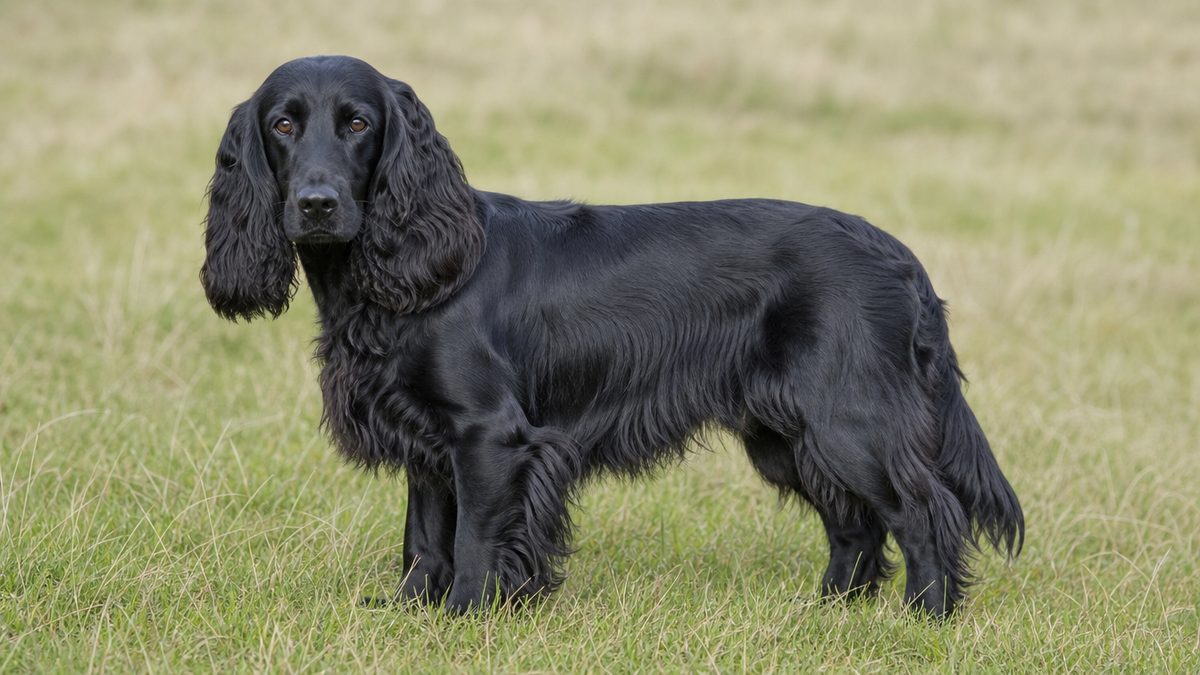
A Field Spaniel is a medium British flushing gundog of about 46 cm at the shoulder and 18 to 25 kg, most often solid black or solid liver, and the Royal Kennel Club classes it as a vulnerable native breed on the strength of 48 puppies registered across the whole of the United Kingdom in 2025 The Royal Kennel Club.
The current breed standard opens with four words that do most of the work: well-balanced, noble, upstanding, sporting Spaniel built for activity and endurance. Hold on to *upstanding*, because a hundred and twenty years ago the same breed's written description opened with long and very low, and the distance between those two phrases is the story this page tells.
The dog in front of you today is a moderate one. Legs of moderate length, a deep chest whose depth roughly equals the length of the foreleg from elbow to ground, a long lean muzzle, and long low-set pendulous ears carrying setter-like feathering. The American Kennel Club puts a number on the outline that the British standard leaves to the eye: the ratio of length to height is approximately 7:6, measured from the foremost point of the shoulder to the rearmost point of the buttocks. At the ideal 18 inch height for a dog, that is about 21 inches long. It is longer than tall, and it is nothing like a Basset. Set beside the English Water Spaniel, which Phineas Bullock is said to have crossed in, it is the survivor of the two.
| Source | Height | Weight |
|---|---|---|
| Royal Kennel Club breed standard, updated 1 August 2025 | Approximately 46 cm (18 in) at the shoulders | 18 to 25 kg (40 to 55 lb) |
| American Kennel Club official standard | 18 in dogs, 17 in bitches, one inch deviation either way acceptable | 35 to 50 lb (about 16 to 23 kg) per the AKC breed page |
| Wikipedia infobox | 40 to 48 cm (16 to 19 in) | 16 to 27 kg (35 to 60 lb) |
| Wikipedia body text, citing the Kennel Club standard | Approximately 46 cm (18 in) | 18 to 25 kg (40 to 55 lb) |
Two things follow from that table and both matter. The kennel clubs are close: the British standard's 18 to 25 kg and the American 35 to 50 lb overlap almost entirely, and both put the height at 18 inches. Wikipedia disagrees with itself, giving one range in its infobox and a different, narrower one four paragraphs later in text that cites the Kennel Club standard directly. Since Wikipedia holds position one in India for this breed name, its infobox is what an answer engine is most likely to quote, and it is the one figure on the page with no document behind it.
Colour is where the breed is strictest
The Royal Kennel Club permits eight colours and then bans the obvious ones. Black, black and tan, blue roan, blue roan and tan, liver, liver and tan, liver roan and liver roan and tan are all standard, while clear black and white, clear liver and white, orange, red, golden and sable are unacceptable. The American standard goes further and makes the sable pattern an outright disqualification. If someone offers you a golden or a parti-coloured white-ground Field Spaniel, they are offering you a different dog.
The coat itself is single, not double. Long, flat or slightly waved, silky, glossy, dense and weatherproof, with abundant feathering on the chest, under the body and behind the legs, and clean from hock to ground. That single silky coat is one of the very few pieces of good news this breed carries into an Indian summer, and the section on grooming returns to it.
Under Characteristics, the Royal Kennel Club's own breed standard says the Field Spaniel is 'Ideal for rough shooting or companion for the country dweller. Not suitable for city'. Its breed page repeats the point in its own summary boxes: Town or country, Country; Size of garden, Large garden; Exercise, more than 2 hours per day. Bonbeno does not know another breed whose parent registry rules out urban living in the standard itself. In a country where the buyers for an imported gundog are overwhelmingly in metros, that sentence is the single most useful fact on this page.
The registration numbers, taken from the PDF and checked against the web table
The Royal Kennel Club registered 48 Field Spaniel puppies in 2025 and 612 across the ten years from 2016 to 2025, an average of 61 a year, which sits far below the club's own 300-a-year threshold for the vulnerable native breed list.
This site now treats Royal Kennel Club registration figures as contested, because a sibling guide established that the club's web tables and its own group PDFs disagree in nine cells across seven breeds, with two breeds transposed outright. So the numbers below were taken from the PDF, the document was named and dated, and the web table was then read as a cross-check.
The document is Comparative Tables of Registrations for the Years 2016 - 2025 Inclusive, gundog group, 161,354 bytes, one page, extracted with pypdf rather than through a scraper, because Firecrawl has previously been caught silently dropping rows from a Kennel Club statistics PDF.
| Year | Web table | Agree | |
|---|---|---|---|
| 2016 | 80 | 80 | Yes |
| 2017 | 50 | 50 | Yes |
| 2018 | 48 | 48 | Yes |
| 2019 | 67 | 67 | Yes |
| 2020 | 69 | 69 | Yes |
| 2021 | 45 | 45 | Yes |
| 2022 | 53 | 53 | Yes |
| 2023 | 79 | 79 | Yes |
| 2024 | 73 | 73 | Yes |
| 2025 | 48 | 48 | Yes |
All ten cells agree, and so does every other gundog breed that appears on both documents. Spaniel (Clumber), Spaniel (Irish Water), Spaniel (Sussex), Spaniel (Welsh Springer), English Setter, Gordon Setter, Irish Red and White Setter, Retriever (Curly Coated) and the at-watch Pointer row all match cell for cell between the PDF and the web page. The known disagreements sit in other groups, so the gundog table can be quoted with more confidence than the Terrier or Toy tables can.
One further check was run because the PDF prints its own column totals. The rows sum to the printed total in all ten columns exactly, once the Barbet row is aligned correctly: it carries eight values rather than ten, and those eight are precisely the residuals for 2018 to 2025, so the Barbet was simply not a separate registration line in 2016 and 2017. A table that balances in ten of ten columns is a table you can build an argument on.
The finding nobody else has printed: this breed missed the boom
2021 was the largest registration year British dog breeding has ever recorded, and the Field Spaniel went down in it. The gundog group as a whole rose from 95,652 to 144,265, up 50.8 percent. The Labrador rose from 39,905 to 61,559, up 54.3 percent. The Cocker rose 52.2 percent and the English Springer 59.8 percent. The Field Spaniel fell from 69 to 45, down 34.8 percent, and that 45 is the lowest of its ten years.
Spaniel (Sussex) did the same thing, falling from 44 to 30 in the same year. So the two rarest native British spaniels both shrank during the single biggest surge in demand for puppies in living memory. That is what a genuinely small breeding base looks like from the outside: when demand triples, a breed with a handful of active breeders cannot answer it, and the extra puppies get bought somewhere else.
The Royal Kennel Club's own wording is that it created 'the vulnerable native British and Irish breeds list (breeds with fewer than 300 registrations a year) and the at watch list (breeds with between 300 and 450 registrations a year)'. The Field Spaniel's highest year in the window is 80. It is not near the line. It has never been near the line in the published series, and its breed page carries the flag 'Vulnerable native breed: Yes' without qualification.
What the Kennel Club Stud Book records, volume by volume
The Kennel Club's first stud book did not have a Field Spaniel breed at all; it had Class XVI, Spaniels (Field, Cocker, and Sussex), one register holding three of today's breeds and dividing them only by weight.
The Kennel Club Calendar and Stud Book is digitised and searchable, so this can simply be read rather than repeated from secondary sources. Four volumes were read in full for this page, and the class heading changes in every one of them.
| Volume | Year | Class as printed |
|---|---|---|
| I | 1874 | CLASS XVI. SPANIELS (FIELD, COCKER, AND SUSSEX) |
| II | 1875 | XIX. Field Spaniels, page 128, now separate from Clumber Spaniels and Sussex Spaniels |
| III | 1876 | Class XIX. FIELD SPANIELS, pages 121 to 124 |
| XI | 1884 | Class XX. SPANIELS, FIELD, from page 190 |
In the 1874 volume the register runs the Field Spaniel, the Cocker and the Sussex together and annotates each animal only by weight, over 25 lb or under 25 lb. The Royal Kennel Club's own history says the same thing in modern words: in the late nineteenth century the term field spaniel described all the land spaniels, apportioned by size and colour, with smaller dogs called cockers and larger solid-coloured ones called Fields. The stud book is the primary evidence for that claim and no ranking page quotes it.
Volume II of 1875 is the year the split begins: its contents page lists XIX. Field Spaniels at page 128 as a class of its own, separate from XVII. Clumber Spaniels and XVIII. Sussex Spaniels, and its show reports divide the entries by Large Size and Small Size rather than by breed. By Volume XI in 1884 the class had become Class XX, SPANIELS, FIELD, and its show reports subdivide it into Champion Class, Black, Cockers, and Any other Colour than Liver or Black. The Cocker was still a sub-heading inside the Field Spaniel class ten years after the first stud book, which is why the English Cocker Spaniel shares this breed's ancestors.
1876, and how completely the Bullock kennel owned the class
Volume III's Field Spaniel section runs to a little over three pages and holds roughly forty animals. Mr Phineas Bullock of Bilston, Staffordshire appears eight times in it, as owner of Bob (2106) and Sam (5265) and Nellie (2225), and as breeder of Bounce (5269), Peg (5275), Rachael (5276) and Ruth (5278), with Mask (5263) bred by Mr S. Bullock. Prizes are recorded by weight band throughout: Birmingham 1st prize (over 25 lb), Birmingham 1st prize (under 25 lb), Birmingham 3rd prize (over 20 lb), Birmingham 1st prize (under 20 lb).
The volume also prints an editor's note beside the neighbouring class that says more about Victorian spaniel identity than any modern summary: the dogs in that class are registered as Sussex Spaniels solely because they have won in classes for Sussex Spaniels at the dog shows. Breed membership was decided by the show ring, not by ancestry.
Bebb, and what a dog looked like before the fashion took hold
The single most useful entry in the whole run is Bebb (No. 2101), the sire behind a dozen prize winners in the same class. Volume I records him as bred by Mr Phineas Bullock, born 1866, liver coloured, Sussex, weight 38 lb, height 18 and a half inches. A dog of 38 lb standing 18 and a half inches is a normal, leggy spaniel. It is almost exactly the height the standard asks for today, at the top of today's weight range.
The same volume records Bob (2106), Bullock's black dog born January 1869, with a pedigree tracing through Jones's Bob to Burdett's Bob, and separately registers Bob (2107) as belonging to the late Mr F. Burdett of Edgbaston, Birmingham, born 1856. Those two entries are the documentary root of every account of this breed's origin.
A volume records the animals entered that year and the shows they won at, not a census of living dogs. So eight Bullock entries in one class does not mean Bullock owned a fifth of the breed. What it does establish, in a document nobody can accuse of an opinion, is that a single kennel dominated the class at the exact moment the type began to change, and that the class itself contained the ancestors of three modern breeds under one heading.
Correcting the most-copied sentence about this breed
The man who supplied the black spaniels was Mr F. Burdett of Edgbaston, Birmingham, and he was not Sir Francis Burdett the radical Member of Parliament, because that Sir Francis Burdett died on 23 January 1844.
Wikipedia's Field Spaniel article states that the low-slung variety was developed by Phineas Bullock from dogs previously owned by Sir Francis Burdett, the secretary of the Birmingham Dog Show, and links the name to the article on the 5th Baronet. That link is where the error becomes checkable, and it is worth checking because this sentence has been copied into dozens of breed pages and into at least one AI-generated summary.
| Claim | What the document says |
|---|---|
| Sir Francis Burdett, 5th Baronet | Born 25 January 1770, died 23 January 1844 at 25 St James's Place, London, aged 73 |
| Secretary of the Birmingham Dog Show | The first Birmingham show in the Kennel Club's own retrospective lists is 1859, fifteen years after that death |
| Owned the black spaniels Bullock used | The Stud Book registers Bob (2107) as bred by the late Mr F. Burdett of Edgbaston, Birmingham, born 1856, twelve years after that death |
| The period name | The New Book of the Dog, 1907, calls him Mr F. Burdett throughout and gives him no title |
The 1874 stud book's own retrospective show list opens with Newcastle 1859 and Birmingham 1859 and then runs year by year through Birmingham 1860 to 1873. A man who died in January 1844 was not the secretary of a show first held in 1859, and he did not breed a dog born in 1856.
The 1907 account is unambiguous about who he actually was. It says the first strain of blacks of which anything is known belonged to Mr F. Burdett, and was obtained from a Mr Footman, of Lutterworth, Leicestershire, and that at Burdett's death most of his spaniels became the property of Mr Jones of Oscott and Mr Phineas Bullock of Bilston. Mr Footman of Lutterworth appears in no modern breed page Bonbeno has read, and he is the first named person in the breed's traceable history.
Why this is worth a section rather than a footnote
An encyclopedia earns its place by being checkable. Three documents were opened here, none of them hard to reach, and between them they retire a claim that sits at position one in India for this breed's name. The correction also changes the story's shape. Attaching the breed's origin to a famous baronet makes it sound aristocratic. The record says it began with a Leicestershire man named Footman, passed to a Birmingham owner, and ended up in the hands of a Bilston kennel in the Black Country The Kennel Club Calendar and Stud Book.
Open the Kennel Club Calendar and Stud Book, Volume I, 1874, on the Internet Archive and search the text for 'Burdett'. Entry 2107 gives the owner as 'The late Mr. F. Burdett's, Edgbaston, Birmingham; breeder, owner; born 1856'. Then open Wikipedia's own article on Sir Francis Burdett and read the death date in the first line. Bonbeno reports the disagreement rather than resolving it silently, because a reader who repeats either version should be able to see the evidence for both.
The period verdict, in the words of people who watched it happen
Judges, not breeders, took the blame at the time, and the 1910 verdict is worth reading in full because every modern page paraphrases it into something much softer.
Robert Leighton, writing on the black spaniels in 1910, put it this way:
'If Black Spaniels are not quite so popular at present as they were some years ago, the fault lies with those breeders, exhibitors, and judges (the latter being most to blame) who encouraged the absurd craze for excessive length of body and shortness of leg which not very long ago threatened to transform the whole breed into a race of cripples, and to bring it into contempt and derision among all practical men. No breed or variety of dog has suffered more from the injudicious fads and crazes of those showmen who are not sportsmen also. At one time among a certain class of judges, length and lowness was everything, and soundness, activity, and symmetry simply did not count.'
Three things in that passage do not survive the usual paraphrase. It blames judges most, not breeders. It says explicitly that soundness, activity and symmetry did not count, which is a description of a judging standard rather than a breeding accident. And it dates the recovery: public opinion had already turned by 1910, but not before a great deal of harm had been done.
The American Kennel Club's own summary of the same events is blunter and worth setting beside it. Phineas Bullock of England, it says, is credited with perpetuating a dog of tremendous body length and lowness to the ground, together with phenomenal bone, which culminated for a time in a grotesque caricature of a spaniel instead of the Field Spaniel we know today.
And the written standard was still asking for it
Here is the part that makes the case airtight, and it comes from the same book, a few pages after the passage above. Leighton prints the Spaniel Club's own description of the Black Field Spaniel, and under Body it reads 'Long and very low, well ribbed up to a good strong loin ... weight from about 35 lbs. to 45 lbs.', with legs described as 'straight and immensely boned, strong and short';.
So in 1910 the breed's official written description still demanded, in its own words, exactly the thing the surrounding text called an absurd craze. Nobody had changed the document. That is the difference between a breed that drifted and a breed whose paperwork was pointing the wrong way, and it explains why recovery took another fifty years.
| Clause | Spaniel Club description, printed 1910 | Royal Kennel Club standard, updated 1 August 2025 |
|---|---|---|
| General appearance | Not stated; the description opens at the head | Well-balanced, noble, upstanding, sporting Spaniel built for activity and endurance |
| Body | Long and very low, well ribbed up to a good strong loin | Chest deep and well developed. Length of rib cage is two-thirds of the body length |
| Legs | Straight and immensely boned, strong and short | Legs of moderate length. Straight, flat bone |
| Weight | About 35 lb to 45 lb | 18 to 25 kg, which is 40 to 55 lb |
| Movement | Not stated | Long, unhurried stride with great drive from the rear. Short, stumping action highly undesirable |
Read the last row twice. Short, stumping action highly undesirable is a sentence a standard only bothers to write when the breed has been there. It is a scar in a legal document, and it is why the Field Spaniel is the most useful case study in dog breeding for what a show ring can do to a working animal in one generation.
How the breed was rebuilt, and how close it came to going
The Field Spaniel Society was formed in 1923, and in the 1940s the average annual registration was fewer than ten dogs across the whole of the United Kingdom.
That single figure is the low-water mark and it comes from the Royal Kennel Club's own breed page rather than from a breed history. Fewer than ten registrations a year is a population that survives on the decisions of a handful of individual people. The 2016 to 2025 mean of 61 a year, which looks alarming on its own, is roughly six times the 1940s figure The Royal Kennel Club.
The rescue was an outcross, and the club says so plainly. Another English Springer Spaniel outcross was used and from that new blood came a resurgence of breeding stock and of interest in the breed, which is also where the roan colours entered. Earlier, the same account records much use of Sussex Spaniel blood and later outcrossing with the Springer and even Basset Hound. The Basset detail is the one modern pages leave out, and it is the mechanical explanation for how a spaniel got that low in the first place.
The American record, and two dates that do not agree
The American Kennel Club contradicts itself about this breed on its own website, and both versions are in circulation.
| AKC page | What it says |
|---|---|
| Field Spaniel breed page | 'The Field Spaniel was recognized as a breed by the AKC in 1884' |
| Field Spaniel History: A Type Brought Back From Extinction | 'The first Field Spaniel in the United States was registered with the AKC in 1894, Coleshill Rufus, a dog bred by Mr J. Smith in Warwickshire, England' |
| Bing India's AI-generated summary, 28 August 2026 | 'The American Kennel Club officially recognized the breed in 1894' |
Bonbeno has not seen a primary AKC register entry that settles which year is right, so both are printed here and neither is asserted. What is worth noticing is that the AKC was itself founded in 1884, which makes an 1884 breed recognition possible but tight, and that the named dog and named breeder in the 1894 version are the kind of detail a records office produces rather than a summary American Kennel Club.
The American collapse is documented more precisely than the British one. AKC records show that the last Field Spaniel of that period was registered in 1916, not to be seen again until the late 1960s. That is a fifty-year gap in the register of the world's largest purebred registry, for a breed that had been recognised for two decades. Establishing the breed in the United States afterwards required Springer and Cocker crosses to eliminate the exaggerations, which is also how the American Cocker Spaniel diverged from the same stock.
It is a real, standardised, registered breed with a living population, and that is not in doubt. The FCI accepted it on a definitive basis on 27 December 1954 as standard 123, Group 8, Section Flushing Dogs, country of origin Great Britain, subject to a working trial. It ranks 148 of 210 in AKC popularity. Its Royal Kennel Club Breed Watch rating is Category 1, meaning no points of concern specific to this breed have been identified for special attention by judges beyond those already covered by the standard. A breed that spent fifty years as a caricature now carries the registry's cleanest conformation rating, which is the strongest single argument that this kind of damage is reversible.
Recognition, and what it means for a buyer in India
The Field Spaniel is fully recognised everywhere that matters to an Indian buyer, and that answer is checkable rather than assumed, because India is a full member of the FCI represented by the Kennel Club of India.
The Kennel Club of India publishes no browsable breed list, so querying it directly returns nothing for this breed and nothing for every control, which is a broken instrument rather than a finding. The route that does work runs through the FCI. The FCI members and contract partners register lists INDIA as a Full member, represented by the Kennel Club of India, Nr 28, AA Block, First Street, Anna Nagar, Chennai 600 040. A full member issues pedigrees against FCI nomenclature, so FCI status effectively answers the India recognition question.
| Body | Status | Detail |
|---|---|---|
| Federation Cynologique Internationale | Recognised on a definitive basis | Standard 123, Group 8 Retrievers, Flushing Dogs and Water Dogs, Section Flushing Dogs, accepted 27 December 1954, valid standard published 27 July 2021, official authentic language English, subject to a working trial |
| Royal Kennel Club | Recognised, Gundog group | Breed standard last updated 1 August 2025. Flagged as a vulnerable native breed, Breed Watch Category 1, Colour Watch Category 0 |
| American Kennel Club | Recognised, Sporting group | Popularity 148 of 210. Parent club the Field Spaniel Society of America, established 1978 |
| Kennel Club of India | Reachable through FCI nomenclature | India is an FCI full member, so an FCI-numbered breed has a pedigree route in principle |
| United Kennel Club | Recognised, Gun Dog group | Recorded in the Orthopedic Foundation for Animals breed-group field for this breed |
The last row deserves a word about method. The Field Spaniel's OFA registry code was read out of OFA's own breed-selector markup rather than guessed, because guessed OFA codes have repeatedly served this project a complete and plausible table for the wrong breed. The markup reads value="FS" data-name="FIELD SPANIEL" with the group field "AKC Sporting Group;CKC Sporting Group;UKC Gun Dog Group;TKC Gundog Group (SPANIEL (FIELD))";. That one attribute confirms the code and four registries in a single string.
Recognition is not the constraint here
It is worth being precise about what recognition does and does not get an Indian buyer. It means a Field Spaniel imported with an FCI-recognised pedigree can in principle be registered in India, and it means the breed has a written standard a buyer can hold a dog against. It does not create a supply. There is no evidence of any Field Spaniel breeding in India, and the price section below shows what the one Indian listing that ranks for the breed name is actually selling.
The Municipal Corporation of Greater Mumbai's online dog licence application carries FIELD SPANIEL in its breed dropdown, between English Toy Terrier and Finnish Spitz. That is a genuine Indian administrative artefact and it is the closest thing to an official Indian mention of the breed that this research found. It proves that somebody building a form copied a long breed list. It does not prove that a single Field Spaniel has ever been licensed in Mumbai, and Bonbeno makes no claim that one has.
Field Spaniel price in India
No Field Spaniel is for sale in India at any price, and the one Indian listing that ranks for the breed name contains eight animals, none of which is a Field Spaniel.
That is the honest answer and it belongs in the first line rather than at the end. A search for the breed plus price in India returns, in order, three English Cocker Spaniel price pages, one page from a listing site titled 'Field Spaniel Puppies for Sale in India at Best Prices', and two American breed encyclopedias quoting United States figures. There is no Indian price in india figure for this breed because there is no Indian market for it.
The listing, audited animal by animal
The page that ranks is titled 'Field Spaniel Puppies for Sale in India at Best Prices' and its meta description promises purebred pups from KCI registered breeders. Its 'Other Available Pets' block was read in full on 28 August 2026. Here is everything it contains.
| Name | Breed as the page itself labels it | Price |
|---|---|---|
| Fizey | Maltipoo | Rs 98,999 |
| Kuzo | Poodle | Rs 92,599 |
| Dugu | Poodle | Rs 92,599 |
| Kazuka | Cane Corso | Rs 94,999 |
| Doir | Goldendoodle | Rs 1,20,000 |
| Samy | Maltipoo | Rs 98,999 |
| Tugi | Rottweiler | Rs 76,499 |
| Yoki | Doxiepoo | Rs 98,999 |
Two Maltipoos, two Poodles, a Cane Corso, a Goldendoodle, a Rottweiler and a Doxiepoo. Zero Field Spaniels. Every animal is listed at eight weeks and every one carries the same Platinum tier badge. The Rs 98,999 figure appears three times on this single page, attached to a Maltipoo, a second Maltipoo and a Doxiepoo.
That figure is a house price point, not a breed price. Bonbeno has now recorded it on eleven pages of this one site, attached to whichever animal is in stock, including on pages for breeds the site does not stock at all. The recurring animals are the same ones: Maltipoos named Fizey and Samy and a Doxiepoo named Yoki.
What the page claims about the dog itself
The same listing prints a spec card for the Field Spaniel giving height 15 to 17 inches and weight 16 to 23 kg. The Royal Kennel Club standard says approximately 46 cm, which is 18 inches, and 18 to 25 kg. The listing is short by one to three inches at the top of its range and by two kilograms at the bottom, which matters only because it shows the card was assembled rather than checked.
If an Indian seller quotes you a Field Spaniel price, ask to see the dog, the dam, and the FCI or Kennel Club of India pedigree naming the breed. What is being sold under this name in India today, on the evidence of the only page that ranks for it, is a Poodle cross at a charm price. Bonbeno does not recommend breeders and does not broker sales, and it is reporting what the listing contains rather than what it claims.
Running the division tests on those rupee figures
None of the eight rupee figures on that listing is a converted dollar price, and the way to show it is arithmetic a reader can repeat in a calculator.
Indian breed pages routinely publish 'prices' that are a United States dollar figure run through one exchange rate, and this site has caught it repeatedly at 84.38, at 74.00, at a flat 80.00 and once at 66.67. So every rupee figure that reaches a Bonbeno page gets divided by all of them, and the quotient gets printed rather than just the verdict, because a match at a rate is worthless if the quotient is not a number a seller would ever print.
| Rupee figure | At 84.38 | At 74.00 | At 80.00 | At 66.67 |
|---|---|---|---|---|
| Rs 98,999 | 1,173.25 | 1,337.82 | 1,237.49 | 1,484.91 |
| Rs 94,999 | 1,125.85 | 1,283.77 | 1,187.49 | 1,424.91 |
| Rs 92,599 | 1,097.40 | 1,251.34 | 1,157.49 | 1,388.92 |
| Rs 76,499 | 906.60 | 1,033.77 | 956.24 | 1,147.43 |
| Rs 1,20,000 | 1,422.14 | 1,621.62 | 1,500.00 | 1,799.91 |
Not one row lands on a whole dollar at any rate. The single clean quotient in the whole table is Rs 1,20,000 at 80.00, which gives exactly 1,500, and that proves nothing on its own: 1,000 divided by 80 is 12.5, so any rupee figure ending in three zeros divides cleanly at 80 by construction. Every other figure ends in 99 or 599 or 499, which is the fingerprint of a charm price typed by a person, not of a script converting a dollar list.
So these are rupee-native and arbitrary. That is a different contamination mechanism from a converted list and it needs saying differently. A converted list leaves a quotient a shop would print, like 500 or 800 or 1,500. This one leaves 1,173.25 and 1,097.40. Nobody anywhere prices a puppy at 1,173 dollars and 25 cents.
The stripped-symbol test, run for completeness
A third mechanism exists in which no arithmetic is done at all: a page takes an American price like $1,000 to $2,500, deletes the dollar signs, and reprints the same digits as rupees. It defeats every division test because there is no quotient to find. The tell is that the numbers become implausible as rupees in an obvious way, with a working-line puppy at Rs 1,000 and a top of Rs 20,00,000.
That test comes back negative here too. Rs 76,499 to Rs 1,20,000 is a perfectly plausible band for a premium designer-cross puppy in an Indian metro, which is exactly what these animals are. The figures are not stolen from anywhere. They are simply not Field Spaniel prices, because there is no Field Spaniel on the page.
What a Field Spaniel would cost if one existed here
Bonbeno prints no rupee figure for this breed, and that is a deliberate refusal rather than a gap. The only ways to produce one would be to convert a foreign price, which manufactures a number no Indian seller has ever quoted, or to repeat a listing figure that belongs to a Maltipoo. Both are fabrication with a decimal point.
Take the rupee figure and divide it by 84.38, by 74, by 80 and by 66.67. Write down the four quotients rather than just asking whether one is 'close'. If one of them is a round number a seller would print, such as 800 or 1,500 or 2,500, you are probably looking at a converted American price rather than an Indian one. If none of them is, and the rupee figure ends in 99 or 999, you are looking at a locally set charm price. Then search the same digits against United States sources, because a stripped currency symbol leaves no quotient at all.
What a dog this size actually costs to keep in India
Budget for the running costs of a 20 kg gundog with heavily feathered pendulous ears, because those two facts drive almost the whole monthly cost and neither depends on the breed being available.
This section gives no purchase price and no total, because a fabricated Indian cost table for a breed with no Indian population would be exactly the kind of tidy invention this page exists to warn about. What follows instead is the cost structure: the line items a Field Spaniel would generate, ranked by how much they differ from a generic medium dog, so a reader can price them against their own city's vet and their own brand of food.
- Ear care is the line that separates this breed from a Labrador. Long, low-set, heavily feathered pendulous ears in Indian humidity mean routine cleaning, and a share of dogs will need repeated veterinary treatment for otitis externa rather than home care.
- Coat maintenance is weekly, not seasonal. The Royal Kennel Club rates grooming at more than once a week and confirms the breed sheds. The feathering on chest, belly and behind the legs is what mats.
- Food scales with a 18 to 25 kg adult, which is the middle of the Indian pet-food market rather than the expensive end.
- Exercise has an indirect cost in India, because more than two hours a day of real work cannot be done at midday for most of the year, which pushes owners towards early mornings, late evenings and often paid help.
- Hip screening is a real recurring item for anyone breeding, and the OFA figures in the health section explain why.
The one cost that is genuinely breed-specific
Ear disease is not a hypothetical for a dog built like this. A Bengaluru hospital series of 1,008 otitis externa cases drawn from 76,161 dogs found drop-eared dogs made up 47.72 percent of cases, against 24.21 percent for intermediate ears and 28.07 percent for prick ears. In the same series the rainy season carried 41.87 percent of cases against 32.83 percent in winter and 25.30 percent in summer.
A UK primary-care study puts a number on the conformation rather than the season: breeds with pendulous ears carried 1.76 times the odds of otitis externa compared with breeds with erect ears, with a 95 percent confidence interval of 1.48 to 2.10. Budget for ear consultations the way you would budget for vaccination, and read the ears section below before you buy any long-eared spaniel in a monsoon country.
Bonbeno publishes no rupee total here because it has no verified Indian cost data for this breed and refuses to convert a foreign one. Price the five line items above against quotes from your own vet, your own groomer and your own food brand, and treat any page that hands you a tidy monthly figure for a breed with no Indian population as having made it up. That refusal costs this page points on one quality score, and it is still the right answer.
Field Spaniel heat tolerance and the Indian climate
Chennai's coolest month averages 24.09 C, which is 7.70 C hotter than the warmest month in the Staffordshire town where this breed was made, so the heat tolerance rating on this page is arithmetic rather than opinion.
The heat rating is one of the few figures on a breed page that is genuinely ours rather than borrowed, and calling a breed heat-sensitive is worthless without a number behind it, so it was built from satellite climatology queried by explicit latitude and longitude rather than by place name. Three origin points were used instead of one, because this breed has three documented home kennels and they sit at three corners of England.
- Bilston, in Wolverhampton, longitude -2.0730 latitude 52.5660, where Phineas Bullock's kennel stood.
- Beverley, East Riding of Yorkshire, longitude -0.4270 latitude 53.8420, Mr W. W. Boulton's kennel, which produced Beverlac and Rolf NASA POWER 20-year climatology.
- Newton Abbot, Devon, longitude -3.6100 latitude 50.5290, Mr T. Jacobs's kennel, which carried the breed from 1879 NASA POWER 20-year climatology.
| Place | Annual mean C | Coolest month C | Warmest month C | Annual max C |
|---|---|---|---|---|
| Beverley, Yorkshire | 9.41 | 3.79 (Jan) | 15.89 (Jul) | 27.60 |
| Bilston, Wolverhampton | 9.56 | 3.62 (Jan) | 16.39 (Jul) | 31.97 |
| Newton Abbot, Devon | 10.92 | 6.08 (Feb) | 16.20 (Jul) | 25.94 |
| Shillong, Meghalaya | 17.96 | 10.74 (Jan) | 22.38 (Aug) | 29.91 |
| Bengaluru | 23.74 | 20.22 (Dec) | 28.37 (Apr) | 40.38 |
| Pune | 23.86 | 19.62 (Dec) | 28.93 (Apr) | 43.20 |
| Delhi | 25.60 | 13.61 (Jan) | 35.88 (Jun) | 48.79 |
| Kolkata | 25.81 | 17.31 (Jan) | 31.53 (May) | 46.81 |
| Mumbai | 26.77 | 23.19 (Jan) | 31.19 (May) | 44.91 |
| Chennai | 27.95 | 24.09 (Jan) | 31.51 (May) | 42.70 |
The three English kennels span 1.51 C of annual mean between them, from Beverley's 9.41 to Newton Abbot's 10.92 NASA POWER 20-year climatology. The eight Indian points in the wider comparison span 10 C. In other words, the whole geographic range in which this breed was created is narrower than the difference between two Indian cities, and all of it sits below anything India offers.
The hill-station test, and why it does not rescue the breed
Shillong was added as the fairest possible Indian case, because it is the coolest large settlement most readers could realistically move to. Its annual mean of 17.96 C is 8.40 C above Bilston's, and its warmest month of 22.38 C is 5.99 C above Bilston's warmest. Even the mildest option in India runs a full English summer hotter than the ground this breed was bred on.
Bengaluru and Pune, the two mildest large cities, are worse again. Bengaluru's coolest month of 20.22 C in December is 3.83 C above Bilston's July, and Pune's 19.62 C in December is 3.23 C above it NASA POWER 20-year climatology.
Bilston's warmest month averages 16.39 C. Chennai's coolest month averages 24.09 C. January in Chennai is 7.70 C hotter than July in the Black Country, and Chennai's annual mean of 27.95 C is above anything Bilston reaches as a monthly average at all NASA POWER 20-year climatology. Nothing about that is fixable with a fan.
The humidity trap, and why wet-bulb is the number that matters
Bilston is more humid than every Indian city in this comparison, which sounds like good news until wet bulb temperature is computed, at which point the ranking inverts completely.
The raw humidity figures point the wrong way and are worth printing for exactly that reason. Bilston's annual mean relative humidity is 86.74 percent. Kolkata's is 73.93, Chennai's 72.39, Shillong's 81.91, Bengaluru's 67.94, Mumbai's 67.39, Pune's 66.80 and Delhi's 45.56 NASA POWER 20-year climatology. Beverley reaches 87.11 and Newton Abbot 87.13 NASA POWER 20-year climatology.
So the shorthand that a British breed will struggle in India because India is humid is simply wrong for this dog. The English Midlands are a damp maritime climate, and this spaniel worked wet ground in them all winter. Moisture on its own was never the problem.
Wet-bulb, which combines the two
Wet-bulb temperature folds heat and moisture into the single figure that governs whether a body can shed heat by evaporation. Computed from each point's monthly mean temperature and relative humidity using the Stull formulation, the ranking flips.
| Place | Annual RH % | Annual wet-bulb C | Peak monthly wet-bulb C | Peak month |
|---|---|---|---|---|
| Beverley | 87.11 | 8.05 | 13.82 | July |
| Bilston | 86.74 | 8.16 | 14.08 | July |
| Newton Abbot | 87.13 | 9.53 | 14.38 | August |
| Shillong | 81.91 | 15.80 | 21.33 | July |
| Pune | 66.80 | 19.43 | 22.97 | June |
| Bengaluru | 67.94 | 19.48 | 21.86 | May |
| Delhi | 45.56 | 17.80 | 26.50 | July |
| Mumbai | 67.39 | 22.20 | 25.77 | June |
| Kolkata | 73.93 | 22.25 | 27.09 | June |
| Chennai | 72.39 | 24.04 | 26.11 | May |
Bilston's hardest month reaches a wet-bulb of 14.08 C. Kolkata's June wet-bulb is 27.09 C, which is 13.01 C higher. Chennai's annual mean wet-bulb of 24.04 C is 9.96 C above Bilston's single worst month, so Chennai spends every month of the year past anything this breed's home climate ever produced.
Mumbai is the clearest illustration of the reversal. Its relative humidity of 67.39 percent is nineteen points below Bilston's, which on the lazy reading should make it the easier climate, and its June wet-bulb of 25.77 C is 11.69 C above Bilston's hardest month. Lower humidity, vastly higher heat load.
Delhi shows the same trap from the other side. Its annual humidity of 45.56 percent is the lowest here by more than twenty points, which makes it look like the dry, tolerable option, and its July wet-bulb of 26.50 C is the third highest of the ten, because the monsoon lands on top of extreme heat.
Plan exercise by wet-bulb rather than by air temperature, for any thick-feathered dog you actually own. Bengaluru and Pune, at annual wet-bulbs of 19.48 and 19.43 C, are genuinely the mildest large Indian cities for a working gundog, and they still sit eleven degrees above this breed's home ground. That does not make India workable for a Field Spaniel. It does make the difference between Indian cities visible, which is useful for whatever dog is in front of you.
What actually puts dogs in the clinic, and why it matters for a gundog
Exercise, not a parked car, is the dominant trigger of heat-related illness in dogs, and the walk is the exercise that does it.
The largest primary-care study of the question reviewed 905,543 UK dogs under veterinary care at 886 clinics in 2016 and identified 1,259 heat-related illness events from 1,222 dogs. Of those events, 380 had no trigger recorded, which is 30.2 percent. Of the remaining 879 events with a recorded trigger, 652 were exertional, which the paper prints as 74.2 percent.
| Trigger | Events | Share of the 879 |
|---|---|---|
| Exertional | 652 | 74.2% |
| Environmental | 113 | 12.9% |
| Vehicular confinement | 46 | 5.2% |
| Under the care of a vet or groomer | 40 | 4.6% |
| Building confinement | 24 | 2.7% |
| Blanket entrapment | 4 | 0.5% |
| Total with a recorded trigger | 879 | 100% |
Those six counts sum to 879 exactly, and the percentages sum to 100.1 with rounding, so the table reconciles against itself. The denominator matters more than it looks: 74.2 percent is 652 of the 879 events with a recorded trigger, not of the 1,259 total events. Applied to 1,259 the same percentage would imply 934 exertional cases, which is not what the paper reports.
It was mostly just a walk
The detail that should change behaviour sits one level deeper. Of the 652 exertional events, the type of exercise was not specified for 101. Of the remaining 551, 372 events, 67.5 percent, happened after walking. High-intensity activity such as running or cycling accounted for 97 events, 17.6 percent; play for 76, 13.8 percent; and formal canine competition for 6, 1.1 percent. Those four counts sum to 551.
Two thirds of the exertional cases were dogs on a walk. Not a working trial, not a hunt, not a race. And exertional heat-related illness in that dataset occurred year-round and carried a 7.6 percent overall fatality rate.
The Field Spaniel does not appear in this paper's breed analysis, so none of its breed-specific odds ratios may be applied to it, and Bonbeno applies none. What the paper does say is that seven breed types had greater odds of exertional heat-related illness than Labrador Retrievers, and that list includes the English Springer Spaniel and the Cavalier King Charles Spaniel. That is worth knowing beside a Field Spaniel rather than transferred onto one. What genuinely transfers is the trigger split, which is not breed-specific: exertion dominates, walking dominates exertion, and it happens in every month of the year.
Now set that against what this breed is for. The FCI lists it as subject to a working trial. The Royal Kennel Club rates its exercise requirement at more than two hours a day and describes it as ideal for rough shooting The Royal Kennel Club. A dog bred to flush game through heavy cover for hours, asked to do two hours a day in a Chennai May at a wet-bulb of 26.11 C, is the exertional case in that dataset with the volume turned up.
Temperament, and who should not buy one
The Royal Kennel Club describes the Field Spaniel in four words, unusually docile, active, sensitive, independent, and the American standard uses three of the same four, which is unusual agreement between two registries.
The American standard expands it: unusually docile, sensitive, fun-loving, independent and intelligent, with a great affinity for human companionship, and possibly somewhat reserved in initial meetings. It then does something most standards do not, and makes temperament a scoring matter: any display of shyness, fear, or aggression is to be severely penalised.
Read those adjectives as instructions rather than as marketing. Sensitive means this dog does not absorb harsh handling; it shuts down. Independent means it will make its own decisions in the field and will not be a robot in the house. Docile means it is unlikely to be the dog that starts anything. Reserved in initial meetings means the family's guests are not automatically its friends.
Who this breed suits
- Households with time, because more than two hours of daily exercise is the registry's own figure and not an enthusiast's exaggeration.
- Owners who train with reward, because a sensitive dog punished for a mistake stops offering behaviour rather than correcting it.
- People at home, because the breed forms strong bonds and is not suited to long isolation.
- Rural or peri-urban homes with a large garden, which is exactly what the Royal Kennel Club's own breed page specifies.
Who should not
- Anyone in an Indian metro flat, because the breed standard itself says not suitable for city.
- First-time owners who want a guard dog, because a docile, reserved spaniel is the wrong animal for that job and asking it to do it will make it anxious.
- Households out all day, because separation problems are the predictable outcome.
- Anyone buying on looks, because a glossy black spaniel photographs beautifully and needs weekly grooming, daily work and a climate this one does not have.
This is a gentle, biddable, moderately sized gundog that most Indian buyers would enjoy owning and almost none can house correctly. The temperament is not the obstacle. The two hours of daily exercise, the country-not-city clause in the standard, the pendulous ears in a monsoon and the total absence of any Indian supply are the obstacles, and no amount of good nature in the dog fixes any of them.
Training a sensitive, independent spaniel
Train a Field Spaniel with reward and repetition rather than correction, because the standard's own word for the breed is sensitive and a sensitive dog answers pressure by stopping.
The American Kennel Club's own breed guidance calls these thinking dogs and says they thrive on clear communication and reward with minimal correction, and that they require early socialisation and a family sensitive to their needs. That is a strong claim for a registry to make, and it is the practical difference between this breed and a Labrador.
A realistic timeline
| Age | Priority | Why it matters here |
|---|---|---|
| 8 to 16 weeks | Socialise hard and early, and handle the ears daily | The ears are the health story of this breed, and a dog that will not let you look inside them at eight months is a dog that gets treated under sedation |
| 3 to 6 months | Recall on a long line, name response, place command | An independent spaniel that learns to self-release into cover is very hard to recall later |
| 6 to 12 months | Loose lead, settle, retrieve games, and heat rules | This is when owners start increasing exercise; in India that has to happen at dawn and dusk, not at 11 a.m. |
| 12 to 24 months | Scent work, structured retrieves, real problem-solving | The breed's boredom shows as invented projects rather than as barking |
| Throughout | Never punish a mistake in a sensitive dog | Correction produces a dog that offers nothing rather than a dog that offers the right thing |
Train short and often. Twenty focused minutes twice a day beats an hour of drilling, and it suits a household that has to work around Indian heat anyway. Build the recall before the dog is physically able to outrun you, because a gundog's nose will beat your voice from about six months onwards.
The one training problem specific to India
The breed's exercise requirement and India's climate pull in opposite directions, and training is where the conflict shows first. More than two hours a day is the registry figure. In Chennai, Kolkata or Mumbai, the hours when that is safe are the hours when most owners are asleep or commuting. The result is a bored, under-worked, intelligent dog and an owner who describes it as stubborn.
Socialise the puppy to the routine you can actually keep, not the one you intend to keep. If the walk will be at 5.30 a.m. for eight months of the year, start it at 5.30 a.m. in week one.
Scent work is the single best substitute for distance in a hot country. A gundog asked to find ten hidden articles in a shaded room is doing real cognitive work at a fraction of the heat load of a walk. It will not replace the two hours entirely, and the honest position is that no Indian city lets you meet this breed's published requirement year-round. It does replace the part of it that would otherwise be done at a dangerous wet-bulb.
Exercise: more than two hours a day, and what happens without it
The Royal Kennel Club rates the Field Spaniel's exercise requirement at more than 2 hours per day, which places it in the registry's highest band and alongside working gundogs rather than companion spaniels.
That figure is not an enthusiast's estimate. It sits in the club's own structured breed characteristics beside Size Medium, Grooming More than once a week, Sheds Yes, Town or country Country, and Size of garden Large garden. Read the whole set together and the registry is describing a rural working household.
The FCI's entry adds the formal version of the same point: the Field Spaniel is subject to a working trial according to the FCI Breeds Nomenclature. That is a status the FCI applies to breeds whose working ability is meant to be tested, and it is not applied to companion breeds.
What the exercise has to contain
- Ground covered at a trot, because the standard asks for a long, unhurried stride with great drive from the rear and calls short stumping action highly undesirable.
- Cover to work, because a flushing spaniel quartering scrub is doing what it is built for and a dog walked on a pavement is not.
- Water where it is safe and clean, because this is a gundog with webbed feet and a water-repellent coat.
- Retrieves, because the neck clause of the standard exists so the dog can retrieve game without undue fatigue.
- Mental work, because the AKC describes a problem-solver that invents its own projects when under-stimulated.
The Indian timetable, by wet-bulb
The safe hours shrink as the wet-bulb rises, and the wet-bulb is what governs whether panting works at all. Chennai's May wet-bulb of 26.11 C, Kolkata's June figure of 27.09 C and Delhi's July figure of 26.50 C all sit around twelve degrees above the peak this breed's home country produces NASA POWER 20-year climatology. Bengaluru at 21.86 C and Pune at 22.97 C are the mildest large-city peaks in the set and are still eight degrees above it.
One more Indian hazard belongs in the exercise plan rather than in the health section, because the exercise creates it. A heat-sensitive gundog worked through Indian scrub is a tick magnet, and tick-borne disease is a live risk here rather than a theoretical one: Ehrlichia canis occurrence, risk factors and molecular detection have been surveyed in dogs across South India. Check the ear feathering, the armpits and between the toes after every session in cover, on the same pass as the ear check.
So exercise this dog at first light and after dark, split the two hours into three or four sessions rather than one, carry water, and stop on the first sign of a pant that will not settle. Two thirds of the exertional heat cases in the UK dataset happened after an ordinary walk, in a country with no month as warm as an Indian winter.
It does not usually look like hyperactivity. In a docile, sensitive, independent dog it looks like self-appointed jobs: digging, dismantling, obsessive licking, following one family member from room to room, and a slow slide into anxiety when left alone. The Royal Kennel Club's own breed characteristics put this dog in a large garden in the country for a reason, and an owner who cannot supply the hours should choose a different breed rather than a smaller version of this one.
Grooming a silky single coat in Indian humidity
Groom a Field Spaniel more than once a week, which is the Royal Kennel Club's own rating, and concentrate on the feathering rather than the body, because that is where a humid climate does its damage.
The coat is the one part of this breed's build that India does not punish. It is single, not double: long, flat or slightly waved, silky, glossy, dense and weatherproof, with abundant feathering on the chest, under the body and behind the legs, and clean from hock to ground. A single coat sheds heat far better than the double coat of a northern breed, and it does not hold a dense insulating undercoat against the skin.
The American standard adds a working caveat that is unexpectedly useful in India: an overabundance of coat, or cottony texture, impractical for field work should be penalised, and trimming is limited to what enhances the natural appearance. In other words the breed's own standard prefers less coat, which means an Indian owner keeping the feathering tidy is following the standard rather than departing from it.
The weekly routine that actually matters
- Comb the feathering twice a week, on chest, belly, behind the legs and behind the ears, because those are the four places that mat.
- Dry the ears and the leg feathering completely after every bath, every swim and every wet walk. Do not leave a heavily feathered dog to air dry in a monsoon.
- Check the ear canal weekly and look at it, not just at the outside of the flap.
- Keep the hock to ground area clean, which the standard already asks for and which stops grass seed and damp collecting.
- Trim conservatively, because heavy scissoring is a show habit and this standard limits trimming on purpose.
Air drying is advice written for a different climate
Overseas breed-club grooming guidance routinely says to towel a spaniel and let it air dry. That is correct in the English Midlands, where the annual mean is 9.56 C and evaporation from a wet coat is fast relative to bacterial growth. It is wrong in an Indian monsoon.
The Bengaluru hospital series makes the seasonal shape of the risk explicit. Across 1,008 otitis externa cases, the rainy season carried 41.87 percent, winter 32.83 percent and summer 25.30 percent. A wet, heavily feathered, low-set pendulous ear in July is the exact micro-environment those cases describe, and the paper's own explanation is that increased humidity, temperature and moisture alter the microenvironment in the ear canal.
The Field Spaniel is not hypoallergenic and no dog is. The Royal Kennel Club's own breed characteristics list Sheds: Yes, and the American Kennel Club's breed page describes perpetually shedding coats among the breed's habits. The evidence behind the general claim is settled: measuring Can f 1 across 196 dogs of so-called hypoallergenic breeds against 160 control dogs, the hypoallergenic group came back higher, not lower, on hair and on coat, with no difference in airborne allergen, and the authors concluded there is no evidence for the classification of certain dog breeds as hypoallergenic. Nobody markets this breed on allergy claims, which is one small mercy, but the answer is the same if they do.
The ears are the health story, and India makes them worse
A Field Spaniel's ears are long, wide, low-set, heavily feathered and pendulous, and pendulous ear carriage carries 1.76 times the odds of otitis externa compared with erect ears, with a 95 percent confidence interval of 1.48 to 2.10 American Kennel Club.
That odds ratio comes from a UK primary-care study of a random sample of 22,333 dogs drawn from 905,554 under veterinary care in 2016 across 784 clinics, in which the one-year period prevalence of otitis externa was 7.30 percent, 95 percent CI 6.97 to 7.65. It is a conformation finding rather than a breed finding, which is exactly why it transfers cleanly here.
| Factor | Odds ratio | 95% CI |
|---|---|---|
| Erect ear carriage | Base | |
| Semi-erect ear carriage | 1.03 | 0.86 to 1.24 |
| V-shaped drop ear carriage | 1.84 | 1.53 to 2.21 |
| Pendulous ear carriage | 1.76 | 1.48 to 2.10 |
| Spaniel type against non-spaniel type | 1.24 | 1.05 to 1.47 |
| Kennel Club Gundog group | 1.42 | 1.23 to 1.65 |
The Field Spaniel is not named in that study, and no breed-level number from it is applied here. What is applied are three category memberships the breed unambiguously holds: it has pendulous ears by its own standard, it is a spaniel type, and it sits in the Kennel Club Gundog group The Royal Kennel Club. All three point the same way.
The Indian series, which is the one that should change your routine
A twelve-year hospital series at the Veterinary College, Hebbal, Bengaluru screened 76,161 dogs and diagnosed 1,008 cases of otitis externa, a prevalence of 1.33 percent of all dogs presented and 52.47 percent of the 1,921 dogs presenting with any ear disease.
| Ear type | Cases | Share |
|---|---|---|
| Drop, that is pendulous | 481 | 47.72% |
| Prick, that is erect | 283 | 28.07% |
| Intermediate, that is semi-erect | 244 | 24.21% |
| Total | 1,008 | 100.00% |
That table reconciles exactly: 481 plus 283 plus 244 is 1,008, and the three percentages sum to 100.00. The difference between ear types is significant at p below 0.00001 with a chi-square of 26.4368. Nearly half of Indian canine otitis cases in that series were in drop-eared dogs.
Look inside the ear canal weekly rather than at the outside of the flap. Dry both ears completely after every bath, swim and wet walk. Do not pour cleaner into an ear you have not looked at, and do not treat a painful ear at home. Go to a vet on the first head shake, head tilt, or smell, because in a low-set feathered ear an early infection becomes a chronic one quickly. This is the single most predictable veterinary cost of owning any long-eared spaniel in India, and it applies just as much to the American Water Spaniel and every other drop-eared gundog.
Field Spaniel health issues, from the orthopaedic registry
Hip dysplasia is the breed's one substantial orthopaedic problem: 16.4 percent of 1,612 Field Spaniel hips submitted to the Orthopedic Foundation for Animals were graded dysplastic, against 0.8 percent abnormal elbows of 650 and 0.7 percent abnormal patellae of 408.
Those numbers were taken from OFA's own tables and each row was matched to its own printed column header rather than to its position, because OFA's hip, elbow and patella tables share a near-identical layout. The breed code was read out of OFA's markup as value="FS" data-name="FIELD SPANIEL";, never guessed, because guessed codes have repeatedly served this project a complete and plausible table for a different dog.
| Registry | Evaluations | Normal % | The finding |
|---|---|---|---|
| Hips | 1,612 | 82.1 | 16.4% dysplastic: 9.7 mild, 6.0 moderate, 0.7 severe. Excellent 12.5, good 54.7, fair 15.0 |
| Elbows | 650 | 99.1 | 0.8% abnormal, all of it Grade 1; Grade 2 and Grade 3 both 0.0 |
| Patella | 408 | 99.3 | 0.7% abnormal, all Grade 1 |
| Thyroid | 794 | 90.1 | 0.4% autoimmune thyroiditis, 1.8% compensative, 0.4% idiopathic hypothyroidism, 7.4% equivocal |
| Eyes | 1,976 | 97.1 | 2.9% abnormal, 0.0% breeder option |
| Advanced cardiac | 267 | 85.0 | 9.4% abnormal, 5.6% equivocal |
| Congenital cardiac | 376 | 98.1 | 0.3% abnormal, 1.6% equivocal |
| Basic cardiac | 141 | 98.6 | 0.0% abnormal, 1.4% equivocal |
The hip table checks out against itself, which is worth doing before quoting any registry figure. The three normal grades sum to 82.2 against a printed 82.1, which is rounding. The three dysplastic grades sum to exactly the printed 16.4. Sixteen point four percent of 1,612 is about 264 dogs graded dysplastic.
What that hip figure means and does not mean
OFA figures come from dogs whose owners chose to submit radiographs, so they are not a population prevalence and they are not comparable to a random survey. What they are is the largest phenotypic dataset that exists for this breed, at 1,612 hips, and a number that moves as evaluations are added, so it should always be quoted with its sample size.
Set the registry evidence beside the screening advice. The Royal Kennel Club's Best Practice pre-breeding tests for this breed are exactly three: hip scoring under the BVA/KC Hip Dysplasia Scheme, elbow scoring under the BVA/KC Elbow Dysplasia Scheme, and eye testing under the BVA/KC/ISDS Eye Scheme. Two of those three match the OFA picture precisely, and the eye scheme is where the picture gets complicated.
The Indian retailer page that ranks for this breed lists patellar luxation among the health concerns owners should expect. OFA's patella table for the Field Spaniel reports 99.3 percent normal across 408 evaluations, with the entire 0.7 percent abnormal sitting in Grade 1. The Royal Kennel Club recommends no patella scheme for this breed at either the Good Practice or Best Practice level. Two registries and one dataset all say the same thing, and the ranking page says otherwise. Note also that Indian law mandates no patella grade: the Prevention of Cruelty to Animals (Dog Breeding and Marketing) Rules 2017 do not mention patella or luxation anywhere.
OFA's eye tables disagree with each other, by 26.8 points
OFA's summary eye registry reports the Field Spaniel at 97.1 percent normal across 1,976 evaluations, while its own per-diagnosis eye rows for the same breed report 1,381 normal of 1,964 examined, which is 70.3 percent.
Both figures were retrieved from the same page on the same day, and both are printed by OFA. They cannot both be measuring the same thing, and this page prints both rather than picking the flattering one.
| Table | Denominator | Normal | Normal % |
|---|---|---|---|
| Summary eye registry | 1,976 evaluations | about 1,919 implied | 97.1 |
| Per-diagnosis rows, NORMAL (OTHER .000) | 1,964 examined | 1,381 | 70.3 |
The denominators differ by 12 and the normal rates differ by 26.8 percentage points. On the summary table, 2.9 percent abnormal of 1,976 implies about 57 abnormal dogs. On the detail rows, 1,964 minus 1,381 leaves 583 dogs, 29.7 percent, carrying at least one recorded finding. Those two statements are ten times apart.
The likely explanation is that the certification registry counts many findings as acceptable while the diagnosis rows count every finding, and OFA's own summary reports 0.0 percent breeder option for this breed, which is exactly the column that would normally absorb them. Bonbeno cannot resolve it from the published tables, so it reports the conflict and quotes neither figure as the rate.
What the detail rows actually contain
| Finding | Dogs | % |
|---|---|---|
| Retinal dysplasia, folds | 140 | 7.1 |
| Persistent pupillary membranes, iris to iris | 126 | 6.4 |
| Other, suspected as not inherited | 105 | 5.3 |
| Distichiasis | 88 | 4.5 |
| Cataract, significance unknown | 82 | 4.2 |
| Persistent pupillary membranes, lens pigment foci | 64 | 3.3 |
| Corneal dystrophy, epithelial or stromal | 30 | 1.5 |
| Imperforate lacrimal punctum | 19 | 1.0 |
| Entropion | 3 | 0.2 |
| Ectropion | 2 | 0.1 |
Forty-four diagnosis rows carry a Field Spaniel entry and they sum to 839 findings across 583 non-normal dogs, which is consistent because one dog can carry several findings. The four largest are retinal folds, persistent pupillary membranes, distichiasis and cataract of unknown significance, and none of them is blinding in most affected dogs. That is the charitable reading, and it is probably why the certification registry treats them differently.
A part cannot exceed its whole, and a division that takes ten seconds caught a 26.8 point disagreement inside a primary source that every serious breeder in the world uses. The practical instruction for a buyer is simple: ask for the actual eye certificate and read the findings line, rather than accepting the words 'eye tested'. The eye scheme is one of the three tests the Royal Kennel Club puts in Best Practice for this breed, and the certificate says more than the summary statistic does.
There is almost no veterinary literature on this breed, and the registry says why
PubMed holds four records for the exact phrase 'Field Spaniel' and not one of them is a study of the breed, which is why this page leans on registry data instead.
That is a strong claim, so the search was earned rather than assumed. The query ran through NCBI's own E-utilities endpoint and the returned query translation reads "Field Spaniel"[All Fields], so the phrase was searched as given and not silently rewritten into something broader. Controls run in the same session on the same endpoint came back sane: 'Cocker Spaniel' 370 records, 'Border Collie' 277, 'English Springer Spaniel' 107. The instrument works.
All four records were then opened rather than counted.
| PMID | Year | Journal | What it actually is |
|---|---|---|---|
| 37277710 | 2023 | BMC Genomics | A multi-breed genomic survey identifying SNP clusters and structural variants across dog breeds. The breed appears as one row in a survey |
| 35080123 | 2022 | J Vet Emerg Crit Care | A single case report: arterial malformations causing bilateral spontaneous renal haemorrhage in one dog |
| 28892425 | 2017 | J Am Anim Hosp Assoc | A single case report: laparoscopic resection of a pancreatic beta cell tumour in one dog |
| 9503355 | 1998 | J Vet Intern Med | Renal calculi in dogs and cats, a breed and mineral-type survey covering 1981 to 1993 |
Two case reports of one dog each, one urolith survey from a period ending in 1993, and one multi-breed genomics paper. Zero breed-specific epidemiological studies. For comparison, the Sussex Spaniel returns the same count of four, and one of those four is the same 2023 genomics survey. Rare native British spaniels are simply not studied.
The registry's own answer: the problem is the gene pool
The Royal Kennel Club splits pre-breeding health advice into Good Practice, meaning tests it strongly recommends as a minimum because evidence indicates the conditions are a significant concern in the breed, and Best Practice, meaning tests that are still significant but less critical. For the Field Spaniel the entire Good Practice list is one item, and it is not a disease. It is 'Prioritising genetic diversity'.
Hip, elbow and eye screening all sit in the lower Best Practice tier. The club also states that it offers no breed-specific DNA testing package for this breed. So the registry's own reading is that the Field Spaniel's principal health risk is the size and relatedness of its breeding population, not any single inherited condition.
That reading is consistent with everything else on this page. Fewer than ten registrations a year in the 1940s, a rebuild that required an English Springer Spaniel outcross, 612 registrations across the last decade, and a fall of 34.8 percent in the single biggest puppy year on record.
The American Kennel Club gives a life expectancy of 12 to 13 years for the breed, and the Royal Kennel Club's breed characteristics say only 'Over 10 years';. Wikipedia attributes 13.1 years to a 2024 UK study of purebred longevity against 12.7 for purebreds generally. Bonbeno could not open that study's supplementary breed table to read the Field Spaniel's own death count and confidence interval, and this site has a standing rule not to quote a longevity figure from a table it has not seen, because the paper's two supplementary tables are known to disagree on sample size. So the registry range of 12 to 13 years stands here, and the 13.1 figure is reported as an attribution rather than adopted.
Feeding an 18 to 25 kg gundog in India
Feed a Field Spaniel to a visible waist and a rib you can feel under light pressure, because the standard's weight range of 18 to 25 kg is wide enough that a number on a bag will not tell you what your dog needs.
This is a medium dog in the middle of the Indian pet-food market. Everything sold for a Cocker or a Beagle sits in the right size band, and everything sold for a Labrador is one size up. Nothing about this breed's feeding is exotic, which is worth saying plainly because rare-breed pages tend to invent requirements.
| Stage | What matters | Available in India |
|---|---|---|
| 8 weeks to 4 months | Four meals a day, a medium-breed puppy food, steady growth rather than fast growth | Yes, every major brand sells a medium-breed puppy line |
| 4 to 12 months | Three meals falling to two; do not over-supplement calcium in a breed with a 16.4 percent OFA hip dysplasia rate | Yes |
| 1 to 7 years | Two meals, adult medium-breed food, portions set by body condition not by the bag | Yes |
| 7 years onwards | Two meals, watch weight as exercise falls, joints first | Yes, senior lines are widely stocked |
The two Indian-specific points
First, heat suppresses appetite and a dog exercised at dawn will often eat better after that session than before it. Feeding a working spaniel a full meal and then walking it in Indian heat is the wrong order for a deep-chested dog, and the standard describes this breed's chest as deep and well developed.
Second, weight is the lever an owner actually controls on hip dysplasia. The OFA figures put 16.4 percent of 1,612 evaluated Field Spaniel hips in the dysplastic grades. Genetics decide the joint, but a dog kept lean carries less load through it for its whole life, and body condition is the one input available to an owner who did not choose the breeding.
The American Kennel Club's own note about the breed's habits mentions sloppy drinking, which sounds trivial and is not in a country where a long-eared dog dips those ears in the water bowl at every drink. Use a narrow, deep bowl or a snood at mealtimes, and dry the ear feathering afterwards, for the reasons the ears section sets out.
You should feel the ribs easily under a thin layer of fat, see a waist from above, and see an upward tuck from the side. If you cannot feel ribs, cut the portion by ten percent and hold it for a month. That single habit does more for a breed with a 16.4 percent hip dysplasia rate than any supplement sold for joints, and it costs nothing.
The first year, month by month
Plan the first year around three things a Field Spaniel puppy in India actually needs: daily ear handling, heat-safe exercise hours, and joint-sparing growth.
| Age | What to do | The Indian catch |
|---|---|---|
| Under 8 weeks | Nothing. The puppy stays with its dam | Rule 8(1)(a) of the Prevention of Cruelty to Animals (Dog Breeding and Marketing) Rules 2017 says every breeder shall ensure that pups less than eight weeks in age are not sold. A seller offering a six-week puppy is breaking the law |
| 8 to 12 weeks | Handle both ears every single day. Socialise to floors, traffic noise, monsoon rain, other dogs | Vaccination and the monsoon overlap; socialise indoors and in clean private spaces rather than skipping it |
| 3 to 4 months | Short lead walks, recall on a long line, first proper ear inspection routine | Do not walk at midday from March onwards in any city in the climate table |
| 4 to 6 months | Teething, bite inhibition, settle on a mat, car travel | Ear feathering is coming in; this is when matting behind the ear starts |
| 6 to 9 months | Build distance slowly on soft ground, keep jumping low | A growing dog in a breed with a 16.4 percent OFA hip dysplasia rate should not be doing repetitive impact work |
| 9 to 12 months | Scent games, structured retrieves, real recall proofing | Heat limits the hours, so use the nose indoors on the worst days |
| 12 months onwards | Move towards the adult requirement of more than two hours a day | That requirement is the Royal Kennel Club's own and it is the hardest single thing to deliver in an Indian city |
Growth and joints
Keep a growing Field Spaniel lean and keep impact low. The registry evidence for this breed puts 16.4 percent of 1,612 evaluated hips in the dysplastic grades, which is not a trivial rate, and hip scoring sits in the Royal Kennel Club's Best Practice tests for the breed. Nothing an owner does creates or cures dysplasia, but a lean puppy on soft ground with no repetitive jumping is the kindest version of whatever joint it inherited.
The ear routine starts on day one
A dog that has had its ears lifted, looked into and dried every day since eight weeks will stand for an ear examination at five years old. A dog whose ears were only touched when they already hurt will not, and in a country where drop-eared dogs account for 47.72 percent of otitis cases in a large Bengaluru series, that is a difference measured in sedations.
Some spaniel standards abroad still contemplate a docked tail, and the American Field Spaniel standard says docked tails preferred, natural tails are allowed. In India the answer is settled and it is not a matter of preference. The Second Schedule Part II paragraph 6(8) of the 2017 Rules states that there shall be no tail docking, ear cropping, de-barking, de-clawing, branding, dyeing, injecting substances to enhance visual appeal, performing a surgery or procedure to camouflage or hide any defect or infirmity or any other kind of mutilation of any body part of the pup, and that any change of appearance by artificial means is strictly forbidden. A docked Field Spaniel puppy in India is evidence of an offence, not of quality.
Indian law, and where this breed's own standards collide with it
Two provisions of Indian law bite directly on this breed: the docking prohibition in the 2017 breeding Rules, and the import restriction that makes a lawful commercial supply chain impossible Directorate General of Foreign Trade.
Both documents below were downloaded and extracted for this page rather than summarised from another site, because this site has repeatedly been handed invented rule numbers for the 2017 Rules. The gazette copy runs to 14 pages and yielded 51,953 characters of machine-readable text, so every clause quoted here was read.
The docking clause, and the standard that disagrees with it
The Second Schedule Part II paragraph 6(8) of the Prevention of Cruelty to Animals (Dog Breeding and Marketing) Rules 2017 reads, verbatim: 'There shall be no tail docking, ear cropping, de-barking, de-clawing, branding, dyeing, injecting substances to enhance visual appeal, performing a surgery or procedure to camouflage or hide any defect or infirmity or any other kind of mutilation of any body part of the pup and any change of appearance by artificial means is strictly forbidden.'; Note the citation form: this is a paragraph of the Second Schedule, not a Rule, and calling it a Rule would misdirect anyone who looked it up.
The American Kennel Club's official standard for this breed says 'Docked tails preferred, natural tails are allowed';. The Royal Kennel Club's standard describes the tail as previously customarily docked and then gives full descriptions for both docked and undocked dogs. An Indian owner should be clear that the preference expressed in an American standard has no standing here and that acting on it is prohibited.
Breeding, if anyone ever breeds one here
Paragraph 6(3) of the same Schedule prohibits two named techniques and defines them. In breeding is breeding between relatives of the 2nd to 4th grade in straight or side line within the first four generations, giving uncle to niece, nephew to aunt, cousin to cousin and grandparent to grandchild as examples. Incest breeding is mating between parents and children or between brother and sister. Only out breeding and line breeding are permitted. For a breed whose principal published health priority is genetic diversity, that is the right law and a hard constraint on any small founding population.
Paragraph 8(10) requires that dogs shall have been tested for genetic defects, including hip dysplasia, progressive retinal atrophy, night blindness, hypothyroidism, entropion, ectropion, overshot, undershot jaw, wry mouth, two or more missing teeth and cryptorchidism. Hip dysplasia, entropion and ectropion all appear in this breed's OFA tables, so the clause is not abstract here. The word is including, so the list is illustrative rather than closed.
Directorate General of Foreign Trade Trade Notice 22/2022-23 puts live dogs at ITC(HS) 01061900 as Restricted. Policy Condition 7 permits import only for a pet dog with a valid pet book in the importer's name, for research organisations with CPCSEA recommendation, or for internal security by the Defence and Police Force. Policy Condition 8 states that import of commercial dogs for breeding or any other commercial activity other than those purposes is not permitted, and paragraph 6 states that any applications for trading or breeding purposes shall be duly rejected. Paragraph 7 allows entry only through the airports and seaports of Delhi, Mumbai, Chennai, Hyderabad, Bangalore and Kolkata. DAHD added a seventh port, Cochin International Airport at Kochi, for pets arriving under the baggage rules in October 2024. So the only lawful route by which a Field Spaniel reaches India is in the arms of a returning owner who already owned it.
Field Spaniel against the breeds it is confused with
Compare the Field Spaniel against the four spaniels it shared a stud book class with, because in 1874 all of them were registered together and the differences a buyer needs are still the ones the show ring invented.
Every breed in this table except the Irish Water Spaniel appeared inside the same Kennel Club spaniel classes in the 1870s and 1880s, and three of them, the Field, the Cocker and the Sussex, shared one register. The registration figures are all from the same gundog group PDF, so they are directly comparable.
| Breed | RKC height | 2025 UK registrations | Ten-year total | Vulnerable native breed |
|---|---|---|---|---|
| Field Spaniel | About 46 cm | 48 | 612 | Yes |
| Sussex Spaniel | Not compared here | 15 | 375 | Yes |
| Irish Water Spaniel | Not compared here | 40 | 791 | Yes |
| Clumber Spaniel | Not compared here | 160 | 2,134 | Yes |
| Welsh Springer Spaniel | Not compared here | 213 | 2,502 | Yes |
| English Springer Spaniel | Not compared here | 5,845 | 91,466 | No |
| Cocker Spaniel | Not compared here | 21,618 | 255,761 | No |
The scale gap is the point. The English Cocker Spaniel, which shared one register with the Field Spaniel in 1874, was registered 21,618 times in 2025. The Field Spaniel was registered 48 times. The Cocker outnumbers it by a factor of 450 in a single year. Both descend from the same class of dogs, and the difference is entirely what happened in the show ring between 1874 and 1950.
How to tell them apart in front of you
- Against the Cocker: the Field Spaniel is taller at about 46 cm, longer in muzzle, and its solid black or liver is the norm rather than one option among many.
- Against the English Springer: the Springer is normally parti-coloured on a white ground, and clear black and white or clear liver and white are explicitly unacceptable in a Field Spaniel.
- Against the Sussex: the Sussex is lower and heavier and golden liver; the 1876 stud book shows the two classes were adjacent and their dogs overlapped.
- Against the Clumber Spaniel: the Clumber is a much heavier white dog with lemon or orange markings, and it had its own class from the first volume onwards.
None of the five vulnerable native spaniels above is obtainable in India. The breeds an Indian buyer will actually be offered when searching for a Field Spaniel are the Cocker Spaniel, which has a real Indian market and a real Indian price, and whatever Poodle cross the listing site has in stock. If the appeal is a mid-sized, gentle, biddable gundog with a silky coat, the English Cocker is the version of that dog which exists here, and an Indian shelter is full of dogs that will meet the same need.
What Indian buyers get wrong about this breed
The five mistakes below are all avoidable with one document each, and every one of them has been made by a page currently ranking in India for this breed's name.
1. Believing an Indian listing that ranks
The page titled 'Field Spaniel Puppies for Sale in India at Best Prices' contains eight animals and none of them is a Field Spaniel. Verify any offer by asking to see the dam and the pedigree naming the breed, not the website. If the site has a carousel that shows the same Maltipoo on multiple breed pages, you are looking at stock, not at a breeding programme.
2. Reading a result count as evidence
Bing India returns 'About 378,000 results' for this breed name and then serves ten dictionary definitions of the word field, while the same engine returns 'About 29,800 results' for labrador retriever and serves correct dog pages Bing India results page for 'labrador…. The larger number belongs to the wrong results. Re-running the query as 'field spaniel dog breed' does recover correct results, and then hands you an AI-generated summary stating that the American Kennel Club recognised the breed in 1894, which is not what the AKC's own breed page says American Kennel Club. Read the titles of what came back before concluding anything, in either direction.
3. Trusting the infobox
Wikipedia's Field Spaniel infobox gives 40 to 48 cm and 16 to 27 kg. Its own body text, citing the Kennel Club standard, gives approximately 46 cm and 18 to 25 kg. The infobox is what an answer engine quotes and it is the figure with no document behind it. Register the standard as your reference, not the summary card.
4. Buying a country gundog for a city flat
The Royal Kennel Club's breed standard says 'Not suitable for city' and its breed page specifies a large garden, country living and more than two hours of exercise a day The Royal Kennel Club. Most Indian buyers for an imported gundog live in a metro flat. This is the mismatch, and it is stated in the breed's own paperwork rather than being Bonbeno's opinion.
5. Ignoring the ears until they smell
Drop-eared dogs accounted for 47.72 percent of 1,008 otitis externa cases in a Bengaluru hospital series, and 41.87 percent of those cases presented in the rainy season. Pendulous ear carriage carries 1.76 times the odds of otitis externa against erect ears in UK primary care. Weekly inspection of a long-eared dog is not fussiness, it is the main preventive job the owner of this breed has.
Do not repeat that Sir Francis Burdett supplied the breed's black spaniels. He died on 23 January 1844, and the Kennel Club Stud Book records the dog he is credited with breeding as born in 1856 The Kennel Club Calendar and Stud Book. The period sources call him Mr F. Burdett of Edgbaston, Birmingham, and say he got the strain from a Mr Footman of Lutterworth, Leicestershire. Three documents, ten minutes, one retired claim.
Adoption, and the realistic route to a dog like this in India
Adopt rather than wait for a Field Spaniel, because no Indian rescue holds one and the traits an Indian buyer actually wants from this breed are common in dogs that already need homes.
There is no Field Spaniel rescue network in India and there is no Indian breeding population to produce surrenders. In the United Kingdom the Royal Kennel Club runs breed-specific rescue services and a Find a Rescue search, and in the United States the Field Spaniel Society of America is the American Kennel Club parent club and handles referrals American Kennel Club. Neither route ends in an Indian home for anything other than a dog whose owner is relocating with it.
What the buyer is usually actually after
Strip the name away and the wish list behind a Field Spaniel search is a medium, gentle, biddable, silky-coated dog that likes people and likes work. That description fits a very large share of the dogs in Indian shelters, including the Indian pariah dog, which comes with the enormous advantage of having evolved in the climate you live in rather than at an annual mean of 9.56 C.
- Indian pariah dogs are heat-adapted, prick-eared and therefore in the lowest otitis risk category in both the UK and the Bengaluru datasets.
- Surrendered Cocker Spaniels appear regularly in Indian metro rescues, and the English Cocker Spaniel is the same family of dog at a size and price that exists here.
- Adult dogs of any breed let you see the temperament rather than betting on it, which matters for a household choosing on the strength of the word docile.
- Breed-specific rescue abroad is the only honest route to this actual breed, and it means importing under a personal pet route rather than buying.
If you are importing your own dog into India
The lawful route exists and it is narrow. Trade Notice 22/2022-23 permits a pet dog with a valid pet book in the importer's name, and states that any application for trading or breeding purposes shall be duly rejected. Entry is through the airports and seaports of Delhi, Mumbai, Chennai, Hyderabad, Bengaluru and Kolkata and, since October 2024, Kochi airport, with quarantine at the government station of those ports where required and an advance No Objection Certificate from the Regional or Quarantine Officer Department of Animal Husbandry…. Start the import authorisation at least two months before travel, which is the notice's own advice. The full route is set out in how to import a dog to India.
This site does not recommend breeders, does not link puppy listings and does not broker sales. On this breed the recommendation is simpler than usual: if you live in an Indian city, do not try to acquire a Field Spaniel. The breed's own standard says it is not suitable for city, its registry asks for a large garden and more than two hours a day, the climate table shows every Indian city running twelve degrees of wet-bulb above its home ground, and the only Indian listing selling one is selling something else. Adopt a dog that suits the country you live in, and read this page for what it teaches about how a breed gets ruined and rebuilt rather than as a shopping guide.
Field Spaniel questions, answered from documents
How much is a Field Spaniel?
There is no Field Spaniel price in India, because no Field Spaniel is offered for sale here. The one Indian page ranking for the breed name lists eight animals, and they are two Maltipoos, two Poodles, a Cane Corso, a Goldendoodle, a Rottweiler and a Doxiepoo at prices from Rs 76,499 to Rs 1,20,000. None of them is a Field Spaniel.
Are Field Spaniels a rare breed?
Yes. The Royal Kennel Club registered 48 Field Spaniel puppies in the United Kingdom in 2025 and 612 across the ten years from 2016 to 2025. The club's vulnerable native breed list covers breeds with fewer than 300 registrations a year, so this breed sits at about one sixth of the threshold and is flagged as vulnerable on its own breed page.
How big does a Field Spaniel get?
About 46 cm, which is 18 inches, at the shoulder, and 18 to 25 kg, which is 40 to 55 pounds, according to the Royal Kennel Club breed standard updated on 1 August 2025. The American standard gives 18 inches for dogs and 17 for bitches with a one inch deviation acceptable either way, and sets the ratio of length to height at approximately 7:6.
Is a Field Spaniel a good pet?
Yes for temperament and usually no for logistics. Both registries describe the breed as unusually docile, sensitive and independent, and the American standard says shyness, fear or aggression must be severely penalised. The obstacle is the requirement: more than two hours of exercise a day, a large garden, and a standard that states the breed is not suitable for city.
Why did the Field Spaniel nearly go extinct?
Show breeders selected it for extreme body length and shortness of leg until it stopped being able to work. Writing in 1910, Robert Leighton blamed judges most, saying the craze for excessive length of body and shortness of leg threatened to transform the whole breed into a race of cripples. The American Kennel Club calls the result a grotesque caricature of a spaniel.
How long do Field Spaniels live?
The American Kennel Club gives 12 to 13 years and the Royal Kennel Club's breed characteristics say only over 10 years. A 2024 UK longevity study is credited with 13.1 years for the breed, but Bonbeno could not open that paper's supplementary breed table to read the death count behind it, so the figure is reported as an attribution rather than adopted here.
Do Field Spaniels have health problems?
Hip dysplasia is the substantial one. Of 1,612 Field Spaniel hips evaluated by the Orthopedic Foundation for Animals, 16.4 percent were graded dysplastic, made up of 9.7 percent mild, 6.0 percent moderate and 0.7 percent severe. Elbows and patellae are clean by comparison, at 0.8 and 0.7 percent abnormal across 650 and 408 evaluations.
Do Field Spaniels get ear infections?
The conformation is a risk factor. Breeds with pendulous ear carriage had 1.76 times the odds of otitis externa compared with breeds with erect ears in a UK study of 22,333 dogs, with a 95 percent confidence interval of 1.48 to 2.10. In a Bengaluru series of 1,008 Indian cases, drop-eared dogs accounted for 47.72 percent and the rainy season for 41.87 percent.
Are Field Spaniels hypoallergenic?
No, and no dog is. The Royal Kennel Club lists this breed as Sheds: Yes. Measuring the major dog allergen Can f 1 across 196 dogs of so-called hypoallergenic breeds against 160 control dogs found the hypoallergenic group higher on hair and on coat, with no difference in airborne allergen, and the authors concluded there is no evidence for the classification.
Can a Field Spaniel live in an Indian city?
The breed standard itself says no. Under Characteristics the Royal Kennel Club standard reads: ideal for rough shooting or companion for the country dweller, not suitable for city. Its breed page specifies a large garden, a country setting and more than two hours of exercise a day, which no Indian metro flat and few Indian daily routines can supply safely.
Is the Field Spaniel recognised by the Kennel Club of India?
In principle, through FCI nomenclature. The Field Spaniel is FCI standard 123, recognised on a definitive basis on 27 December 1954, and the FCI members register lists India as a full member represented by the Kennel Club of India in Anna Nagar, Chennai. That gives a pedigree route for an imported dog. It does not create any Indian supply.
Can you dock a Field Spaniel's tail in India?
No. The Second Schedule Part II paragraph 6(8) of the Prevention of Cruelty to Animals (Dog Breeding and Marketing) Rules 2017 states that there shall be no tail docking, ear cropping, de-barking, de-clawing, branding, dyeing or any other kind of mutilation of any body part of the pup, and that any change of appearance by artificial means is strictly forbidden.
Where do Field Spaniels come from?
England, and originally from a single Kennel Club show class rather than a distinct population. The Kennel Club Stud Book of 1874 registers Class XVI as Spaniels (Field, Cocker, and Sussex), one register covering three of today's breeds and divided only by whether a dog weighed over or under 25 lb. The FCI gives the country of origin as Great Britain.
Is a Field Spaniel a Cocker Spaniel?
No, but the two breeds began in one register. The Kennel Club's first stud book of 1874 had no Field Spaniel breed at all; it had Class XVI, Spaniels (Field, Cocker, and Sussex), a single register holding three of today's breeds and dividing them only by weight, over or under 25 lb. By the 1884 volume the Cocker was still a sub-heading inside the Field Spaniel class, which is why the English Cocker Spaniel shares this breed's ancestors even though the two are separate breeds today.
Compare with similar breeds
Field Spaniel sits in 1 Bonbeno group. Each one compares it directly against the breeds it is genuinely an alternative to, on the same figures.