
Breed profile
Clumber Spaniel: The Heaviest Spaniel, Assessed Honestly for India
A 29.5 to 34 kg white flushing spaniel from Nottinghamshire, built long, low and heavy, and the only breed on earth whose own FCI standard warns that it has been allowed to get heavier since the 1950s. Its hips are the 16th worst of any breed OFA measures.
Quick answer
No Indian source publishes a rupee price for a Clumber Spaniel. Four Indian pages rank for the query and between them list zero dogs of the breed. The Clumber Spaniel is a 25 to 34 kg white British flushing spaniel with the 16th worst hips OFA records, 39.0 percent of 1,527 evaluations dysplastic, plus 20.6 percent entropion and 15.4 percent ectropion of 926 eyes examined.
This guide is general information for Indian pet owners and is not a diagnosis. Consult a registered veterinarian before acting on anything you read here, and treat collapse after exercise, laboured breathing in heat, or sudden hind-limb weakness in a heavy low-slung dog as an emergency that needs a vet the same hour.
Clumber Spaniel at a glance, rated for Indian conditions
What a Clumber Spaniel actually is
The Clumber Spaniel is the heaviest spaniel in the world, a long, low, heavily boned white flushing dog from Nottinghamshire that weighs 29.5 to 34 kg for males and 25 to 29.5 kg for females under FCI standard 109. The AKC calls it the largest of its flushing spaniels and gives 17 to 20 inches at the shoulder, with a small female around 55 pounds and a large male reaching 85.
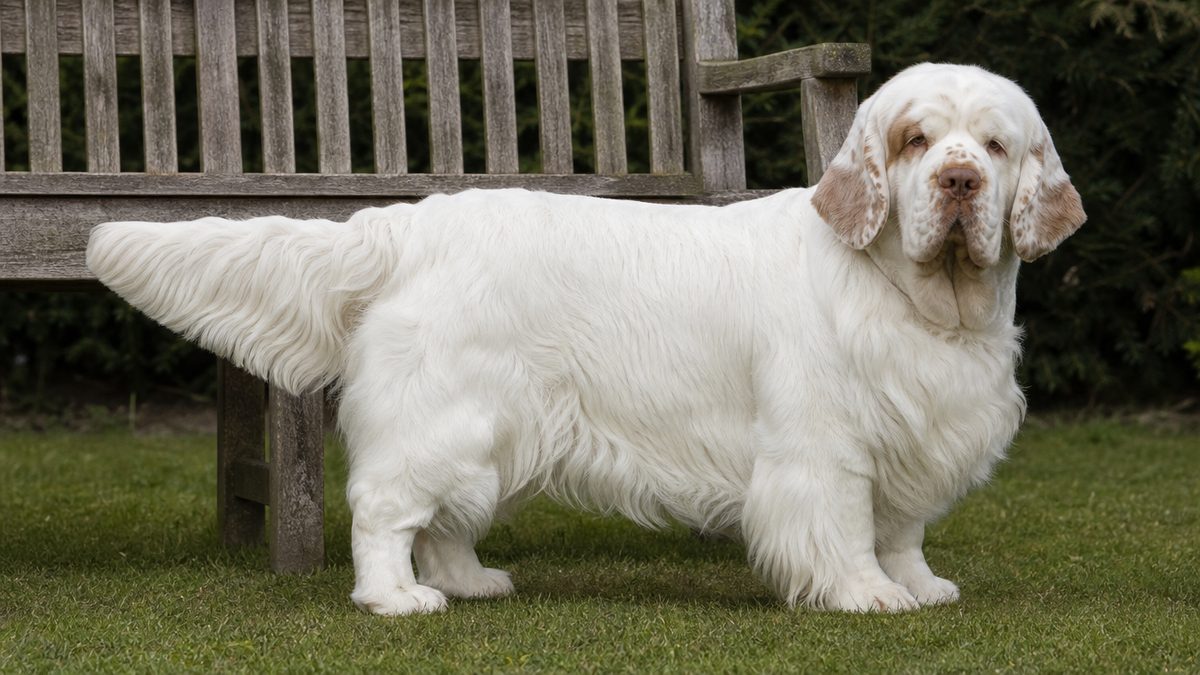
Picture a spaniel that has been compressed downward. The head is large and square with a broad skull, a decided occiput, heavy brows and a deep stop. The lips carry well developed flews, which is why the breed drools. The ears are large and vine-leaf shaped, hanging slightly forward. The body is long, the chest deep with well sprung ribs carried well back, the legs short and heavily boned, the hock low. The coat is abundant, close, silky and straight, plain white by preference with lemon markings and a freckled muzzle, orange permissible.
The standard itself says the breed has been getting heavier
FCI standard 109 contains a paragraph that no other breed standard on this site matches for candour. Under its historical summary it states that the Clumber's weight has been allowed to become ever heavier since around the 1950s, that although the top weight for dogs now stands at 34 kg it would appear that some are in excess of even this figure, and that lovers of the breed should make certain that his great size does not encourage any weakness in his hindquarters. Hold that sentence next to the OFA hip data further down this page. The standard predicted the problem and named the mechanism.
| Source | Male weight | Female weight | Height |
|---|---|---|---|
| FCI standard 109 | 29.5 to 34 kg | 25 to 29.5 kg | not specified |
| American Kennel Club | up to about 38.6 kg (85 lb) | from about 25 kg (55 lb) | 17 to 20 inches |
| Call 4 Dog, Delhi seller | 32 to 39 kg | 25 to 32 kg | 46 to 51 cm / 43 to 48 cm |
The AKC tolerates a dog 4.6 kg heavier than the FCI's ceiling, and the Indian seller's top figure of 39 kg exceeds the FCI cap by five. On a breed whose own standard warns about creeping weight, that spread is not a rounding difference. It is the disagreement itself, and a buyer should know that the number a seller quotes may sit outside the standard the seller invokes.
Where it came from, and why the origin story matters
The breed takes its name from Clumber Park in Nottinghamshire, seat of the Dukes of Newcastle, and the second Duke is credited with introducing and developing it after being presented with dogs of the type by the Duc de Noailles around 1770. A 1788 portrait of the Duke by Francis Wheatley, Return from Shooting, shows six dogs, three unmistakably of Clumber type. Cameron and colleagues date the breed's origin to 1760 and record the Duc de Noailles's purpose directly: a hunting dog with a gentle temperament suitable for the elderly gentleman.
That purpose is the reason for everything else. A dog deliberately bred to be slow, heavy and calm enough to walk beside an old man is a dog selected against athleticism, and the FCI standard still describes its pace of working as more leisurely than that of other Spaniels. The Clumber was one of the first nine breeds the AKC recognised, in 1884, and the first was registered in 1878 Dog Breeds List, Clumber Spaniel.
A vulnerable native breed: 160 puppies registered in Britain in 2025
The Clumber Spaniel is officially at risk in its own country. The Royal Kennel Club lists it among 39 vulnerable native breeds, the category for British and Irish breeds registering fewer than 300 puppies a year, and its 2025 figure was 160. For scale, the top ten breeds in Britain account for more than 60 percent of all annual puppy registrations between them.
| Breed | 2016 | 2019 | 2021 | 2023 | 2024 | 2025 |
|---|---|---|---|---|---|---|
| Spaniel (Clumber) | 171 | 175 | 285 | 223 | 155 | 160 |
| Spaniel (Welsh Springer) | 299 | 243 | 271 | 167 | 174 | 213 |
| Spaniel (Field) | 80 | 67 | 45 | 79 | 73 | 48 |
| Spaniel (Irish Water) | 116 | 69 | 116 | 76 | 53 | 40 |
| Spaniel (Sussex) | 49 | 52 | 30 | 27 | 24 | 15 |
The Clumber is the healthiest of a sick group, which is a low bar. Its own trend is a peak of 285 in the lockdown puppy boom of 2021, then a fall to 155 in 2024 and a partial recovery to 160 in 2025, a 44 percent drop from the 2021 peak in four years. The Sussex Spaniel, the breed that shares the Clumber's PDP1 mutation, registered fifteen puppies in Britain in 2025.
Registration numbers are a health story, not a fashion story
A small closed population means a small pool of breeding animals, which means rising relatedness. The Clumber Spaniel Club's 2021 annual health report gives the breed's inbreeding coefficient as 15.9 percent. Cameron and colleagues, tracing the PDP1 mutation, noted that the breed size is relatively small and the register closed, and that the pedigree they examined ran to over 200 individuals. That is the mechanism by which a recessive mutation reaches one dog in nine.
Where the breed sits in the three registries that recognise it
- American Kennel Club: recognised in 1884, one of the first nine breeds on the register, with the first Clumber recorded in 1878 Dog Breeds List, Clumber Spaniel. Its AKC popularity rank has sat between 134 and 149 across 2015 to 2022.
- Federation Cynologique Internationale: standard number 109, Group 8 Retrievers, Flushing Dogs and Water Dogs, Section 2 Flushing Dogs, with working trial, origin Great Britain.
- The Royal Kennel Club: Gundog group, vulnerable native breed, Breed Watch Category 2, with no breed-specific breeding restrictions currently in place.
- Kennel Club of India: status not verifiable from the KCI's public website, which publishes no breed list for any breed.
One place the registries contradict each other on this breed
The Royal Kennel Club added an exercise induced collapse DNA test to this breed's Good Practice list from December 2025 and explains the move by citing the high prevalence of exercise induced collapse in the Clumber Spaniel, advising breeders to breed it out gradually and to keep using tested carriers in order to avoid a rapid loss of genetic diversity. OFA's exercise induced collapse database, meanwhile, records 139 Clumber Spaniel evaluations at 97.1 percent clear, 2.9 percent carrier and zero affected.
These are separate populations, and they may also be separate diseases in ordinary speech. EIC and PDP1 deficiency both present as a dog that collapses after exercise, and the Royal Kennel Club lists them as two different tests, EIC in Good Practice and PDP-1 in Best Practice. When a breeder tells you the parents are tested for collapse, ask which test, and ask to see the certificate naming it.
Clumber Spaniel price in India: nobody publishes one, and here is the proof
No Indian source publishes a rupee price for a Clumber Spaniel. Four Indian commercial pages rank for this exact query, and between them they list zero dogs of the breed. That is the answer to the question, and everything below is the evidence for it rather than a hedge around it.
What the number one result actually contains
Puppiezo holds position one in India for this query with a page titled Clumber Spaniel Puppies For Sale. Under its Available Clumber Spaniel Puppies heading it displays eight live puppies with names, ages and prices. Not one of them is a Clumber Spaniel. The eight are Fizey a Maltipoo at Rs 98,999, Kuzo a Poodle at Rs 92,599, Dugu a Poodle at Rs 92,599, Kazuka a Cane Corso at Rs 94,999, Doir a Goldendoodle at Rs 1,20,000, Samy a Maltipoo at Rs 98,999, Tugi a Rottweiler at Rs 76,499 and Yoki a Doxiepoo at Rs 98,999.
Bonbeno has now recorded this exact figure on eleven separate pages of this one seller, attached to whichever puppy is in stock. It appears three times on this single Clumber page alone, on two Maltipoos and a Doxiepoo. It is not a converted dollar figure either: Rs 98,999 divided by 84.38 is 1,173.25 dollars, which is not a price anybody quotes. It is a rupee-native charm price ending in 999, recycled across breeds the seller does not stock.
The other three ranking pages
Mr n Mrs Pet prints the heading Clumber spaniel Puppies For Sale followed by the counter 3 Result Found, and the three results are two Shiba Inus, in Ahmedabad and Coimbatore, and a Goldendoodle in Mumbai, displayed under the sub-heading Similar breeds at other locations. The counter is real. The breed is not. Call 4 Dog, a Delhi seller, advertises 100 percent KCI Registered Clumber Spaniel Puppies in its meta description, publishes no price whatsoever, and offers only a WhatsApp link whose pre-filled message reads Please Share Best Price. Dog Breeds List, the only page in the top ten carrying a real published price, is an American reference site quoting dollars.
The control, because an absence has to be earned
A search returning nothing proves nothing unless you show the search works. Running the identical query for the Labrador Retriever in the same tool in the same session returned rupee figures from every direction: Mr n Mrs Pet's own tiered table at INR 30,000 to INR 1,20,000 across eight named cities, split into basic quality at 30,000 to 60,000, KCI registered at 60,000 to 90,000 and champion bloodline at 90,000 to 1,20,000. The instrument is working. The Clumber Spaniel absence is real.
The only real published price is in dollars, and here is what it converts to
Dog Breeds List gives an average United States price of 1,200 to 1,500 dollars, an average purchase price of 1,500 dollars, and a full range of 800 to 2,400 dollars, adding that purebred Clumber Spaniels are very rare in the US. Converted honestly, and labelled as a conversion rather than an Indian market rate, that is the table below.
| US figure | At 84.38 | At 80.00 | At 74.00 |
|---|---|---|---|
| 800 USD (low) | Rs 67,504 | Rs 64,000 | Rs 59,200 |
| 1,200 USD | Rs 1,01,256 | Rs 96,000 | Rs 88,800 |
| 1,500 USD (average) | Rs 1,26,570 | Rs 1,20,000 | Rs 1,11,000 |
| 2,400 USD (high) | Rs 2,02,512 | Rs 1,92,000 | Rs 1,77,600 |
One coincidence in that table is worth naming so nobody builds an argument on it. The Goldendoodle listed on the Puppiezo Clumber page at Rs 1,20,000 divides by exactly 80 to give 1,500 dollars. That is arithmetic noise, not evidence: any rupee figure ending in three zeros divides cleanly at 80, because 1,000 divided by 80 is 12.5. The strong test is 84.38, and none of the eight carousel prices survives it.
What to do with all this
Treat any rupee price you are quoted for a Clumber Spaniel in India as a claim requiring proof of the dog, not proof of the price. Ask to see the animal, its parents and their screening certificates before any figure is discussed. A seller who can produce a Clumber Spaniel in India can produce paperwork; a seller who cannot will move you toward whatever is in the carousel, which is exactly what the top-ranking page is built to do.
Why no lawful Clumber Spaniel supply chain can form in India
Indian import law closes the route by which a Clumber Spaniel population could establish here. DGFT Trade Notice No. 22/2022-23, dated 19 December 2022, places pet animals under ITC (HS) code 01061900, Mammals: Other, with an Import Policy of Restricted. Restricted is not a formality; it means each consignment needs a licence, and the notice then narrows the grounds on which one will be given.
Policy Condition 7 of that notice states that import of dogs is allowed only for three specific purposes: a pet dog with valid pet book and relevant records or documents in the name of the importer; dogs imported by R&D organisations for conducting research with the recommendation of CPCSEA; and for internal security by the Defence and Police Force. Policy Condition 8 then says plainly that import of commercial dogs for breeding or any other commercial activities other than the purposes mentioned above is not permitted.
Paragraph 6 removes the remaining ambiguity. It reads that any applications for trading or breeding purposes, or applications made on behalf of some another person or entity, shall be duly rejected. The gazette prints trading and breeding separated by a slash rather than the word or, and it also catches proxy applications, which is the loophole a would-be importer would otherwise use.
Seven cities, and nowhere else
Paragraph 7 confines entry to the airports and seaports of six cities. The notice names them as Delhi, Mumbai, Chennai, Hyderabad, Bangalore and Kolkata, and adds that where required the animals shall also be quarantined in the government quarantine station of the said ports for a stipulated period. DAHD added a seventh port, Cochin International Airport at Kochi, for pets arriving under the baggage rules in October 2024. An advance no-objection certificate from the quarantine officer at those ports is required seven days before travel. The full route is set out in how to import a dog to India.
A returning Indian family can bring their own Clumber Spaniel home on a valid pet book in their own name. Nobody can bring one in to breed from, and nobody can bring in a pair. So the only Clumber Spaniels that can lawfully exist in India are individually imported family pets and their offspring, which is not a population. That is why the price question has no answer.
The Kennel Club of India question, answered honestly
Whether the Kennel Club of India recognises the Clumber Spaniel cannot be established from the KCI's public website, and this page will not pretend otherwise. Enumerating the site's own XML sitemap on 26 August 2026 returned ten URLs in total, and fetching all ten pages plus the seven PDFs they link found the word spaniel zero times. The control settles it: labrador and german shepherd also returned zero across the same corpus, so the site publishes no breed list for any breed rather than omitting this one. The KCI's registration data sits behind a login wall.
That matters because Call 4 Dog's meta description advertises 100 percent KCI Registered Clumber Spaniel Puppies. Bonbeno cannot verify that claim and neither can a buyer, because the register is not public. Ask for the registration number and the certificate, and check it with the KCI directly before you accept the word registered as meaning anything.
What a Clumber Spaniel would cost to keep in India, honestly bounded
Budget Rs 6,000 to Rs 12,000 a month for a healthy adult Clumber Spaniel in an Indian metro, and treat that as a floor rather than a forecast. Food is the only line in that budget with a published Indian price attached to this weight of dog; everything else varies by city, clinic and the dog's luck.
| Line | Monthly range | Basis |
|---|---|---|
| Dry food, large-breed formula | Rs 3,375 to Rs 6,000 | Supertails Royal Canin Maxi pricing at 250 to 400 g a day |
| Preventive parasite control | Rs 500 to Rs 1,200 | Tick, flea and worm control, higher in monsoon states |
| Grooming consumables | Rs 400 to Rs 1,000 | Ear cleaner, cotton wool, shampoo, brushes |
| Routine veterinary care, amortised | Rs 800 to Rs 2,000 | Annual vaccination, one or two consultations, spread across twelve months |
| Professional grooming, if used | Rs 0 to Rs 2,000 | Optional; the coat is home-manageable |
| Total, healthy adult | Rs 5,075 to Rs 12,200 | Sum of the above |
The lines that make this breed expensive are the ones nobody budgets
This is where the Clumber differs from a Labrador of the same weight, and it is not the food. Three of the breed's headline conditions are managed by specialists rather than by a general practice, and India has few of them.
- Ophthalmology. With 20.6 percent entropion and 15.4 percent ectropion recorded at OFA examinations, surgical eyelid correction is a realistic possibility rather than a remote one.
- Orthopaedics. A severe hip grade, which is 10.3 percent of screened Clumber hips, means lifelong pain management or surgery.
- Neurology and spinal imaging. Disc disease in this breed showed a median age at first signs of 4.8 years, so it arrives in a dog's prime rather than at the end.
- Repeat ear treatment. A quarter of dogs in the breed club's 2019 survey of 118 owners reported ear problems.
This page publishes no rupee figure for hip surgery, eyelid surgery or spinal imaging in India, because we could not source one to a clinic price list we had actually read. Indian specialist pricing is quoted per case and is not published. Ask two referral hospitals in your city for an indicative range before you buy the dog, not after, and treat any single number you find online as unverified.
One-time costs at the start
Budget separately for the things a heavy, long-backed dog needs on day one: non-slip runners or rubber matting across every polished floor the dog will use, a raised food bowl if your vet recommends one, a well-fitted harness rather than a collar, a ramp for any furniture or vehicle, and a crate large enough for a 32 kg dog to lie flat. None of that is optional for this breed, and buying it after the first slip is worse value.
Finally, factor in the thing that has no price. Indian import law means a Clumber Spaniel here is almost certainly a single imported pet or its offspring, so there is no local breeder network, no local rescue, no experienced local mentor and, in most cities, no vet who has previously handled the breed. You are the breed's entire support system, and that costs time rather than money.
Indian climate: Chennai's coolest month is hotter than Clumber Park's hottest
The Clumber Spaniel is badly suited to the Indian plains, and the arithmetic is not close. Queried by explicit latitude and longitude so no other place can be served by mistake, NASA POWER gives Clumber Park in Nottinghamshire an annual mean of 9.35 C and a July mean of 16.17 C. Chennai's coolest month, January, averages 24.09 C. The breed's home has no month as warm as Chennai's coldest.
| Place | Annual mean | Hottest month mean | Peak wet-bulb | Coolest month mean |
|---|---|---|---|---|
| Clumber Park, Nottinghamshire | 9.35 C | 16.17 C (Jul) | 13.89 C (Jul) | 3.42 C (Jan) |
| Bengaluru | 23.74 C | 28.37 C (Apr) | 21.86 C (May) | 20.22 C (Dec) |
| Pune | 23.86 C | 28.93 C (Apr) | 22.97 C (Jun) | 19.62 C (Dec) |
| Delhi | 25.60 C | 35.88 C (Jun) | 26.50 C (Jul) | 13.61 C (Jan) |
| Kolkata | 25.81 C | 31.53 C (May) | 27.09 C (Jun) | 17.31 C (Jan) |
| Mumbai | 26.77 C | 31.19 C (May) | 25.77 C (Jun) | 23.19 C (Jan) |
| Chennai | 27.95 C | 31.51 C (May) | 26.11 C (May) | 24.09 C (Jan) |
Three numbers in that table matter more than the rest. Chennai's coolest month runs 7.92 C above Nottinghamshire's hottest, so a Clumber in Chennai never gets the recovery season the breed evolved with. Even Bengaluru, the mildest large Indian city on the list, sits 4.05 C above Clumber Park's July in its own coldest month. And Delhi's June daily maximum reaches 48.79 C in the climatology, against a July maximum of 31.26 C at the breed's origin.
Wet-bulb, because humidity is what actually kills
A panting dog cools by evaporating water from its airways, and evaporation slows as the air fills with moisture. Wet-bulb temperature captures both variables in one number. Kolkata peaks at 27.09 C wet-bulb in June, Delhi at 26.50 C in July, Chennai at 26.11 C in May, all against 13.89 C at Clumber Park. Mumbai in July runs 89.6 percent relative humidity, so the air-temperature figure of 26.63 C badly understates the load.
What the research says about a dog this size and shape
The largest primary-care study of canine heat-related illness examined 905,543 UK dogs in 2016 and found 395 events, an incidence of 0.04 percent with an event fatality rate of 14.18 percent. Forty percent of cases, 158 of 395, fell in a single month, July. Purebred dogs had 1.86 times the odds of crossbreds, brachycephalic dogs 2.10 times the odds of mesocephalic dogs, and dogs over 50 kg 3.42 times the odds of dogs under 10 kg.
The Clumber Spaniel does not appear in that paper's breed model at all. The model required a breed to contribute at least five heat-related illness cases or five thousand dogs to the study population, and the breed is far too rare in UK primary care to qualify. And a 29.5 to 34 kg Clumber is not in the over-50 kg band that carried the 3.42 odds ratio. So this page does not claim a measured heat risk for the breed. It reasons from the risk factors that were measured.
The factor that does apply, and that you control
Dogs whose bodyweight was at or above the mean for their own breed and sex had 1.42 times the odds of heat-related illness, 95 percent confidence interval 1.12 to 1.80. That is the one risk factor on the list an owner can move. The Royal Kennel Club already asks show judges to watch this breed for being too fat, and the FCI standard warns that the breed has been getting heavier since the 1950s. Weight is the lever.
One further note on the head. The Clumber is not a brachycephalic breed and this page will not call it one. But the Clumber Spaniel Club of America's letter to veterinarians records that rarely, excessively short muzzles or an elongated soft palate may make anaesthetic recovery a bit more comparable to brachycephalic breeds. That is an anaesthesia observation, not a heat claim, and the club makes no statement about heat tolerance anywhere. Bonbeno rates the breed's heat tolerance at 2 of 5 on the evidence above, not on a source that does not exist.
A month-by-month heat protocol for a Clumber Spaniel in India
Manage a Clumber in India by moving its life to the cool hours and keeping it lean, because those are the two levers that work. Everything else, from cooling mats to air conditioning, helps at the margin; the walk timing and the body condition decide whether the dog copes.
| City | Hardest months | Practical walking window | What changes |
|---|---|---|---|
| Chennai | March to September | Before 06:30 and after 20:30, all year | There is no easy season. January at 24.09 C is the best it gets |
| Delhi | April to July | Before 06:00 and after 21:00 in summer | December to February is genuinely comfortable at 13.61 to 17.40 C |
| Mumbai | April to June, then the monsoon | Before 06:30 and after 21:00 | Monsoon drops the air temperature and raises humidity to 89.6 percent |
| Kolkata | April to August | Before 06:00 and after 21:00 | June wet-bulb of 27.09 C is the highest in this set |
| Bengaluru | March to May | Before 07:30 and after 19:30 | The mildest metro, and December at 20.22 C is workable |
| Pune | March to May | Before 07:00 and after 20:00 | Similar to Bengaluru, with a hotter April at 28.93 C |
The rules that do not change by city
- Test the ground with the back of your hand for five seconds before every walk. If you cannot hold it there, the dog cannot stand on it, and a short-legged dog carries its chest close to that surface.
- Carry water on every outing, not just long ones, and offer it before the dog looks like it needs it.
- Wet the groin, armpits and paw pads rather than the back, because water on a dense coat traps heat instead of releasing it.
- Move play indoors from March to June and replace it with scentwork, which tires a flushing spaniel's brain without raising its core temperature.
- Never leave the dog in a parked car, in a closed balcony or on a terrace, and never in an unshaded outdoor kennel.
Recognising heat-related illness in a dog bred not to complain
The FCI standard describes this breed as stoical, steady, reliable, kind and dignified. A stoical dog is a dog that will keep walking past the point where it should have stopped. Watch for heavy or noisy panting that does not settle within a few minutes of rest, brick-red or very pale gums, thick ropey drool, staggering, vomiting or diarrhoea, and any collapse. Fourteen percent of confirmed heat-related illness events in the UK study ended in the dog's death, and of the 54 deaths with a recorded manner, 35 were by euthanasia.
Move the dog into shade or air conditioning. Pour or spray cool, not iced, water over it continuously, concentrating on the belly, groin and paws, and get air moving over the wet coat with a fan. Offer small amounts of water to drink if the dog is conscious and swallowing. Then get to a veterinary clinic immediately, and keep cooling on the way. Do not wrap the dog in a wet towel and leave it, because a soaked towel over a dense coat becomes insulation.
The 2017 Rules already say something about this
Indian breeding law addresses climate directly, in the Second Schedule rather than in a numbered Rule. Second Schedule Part IV paragraph 21(1) states that dogs not accustomed to the temperatures prevalent in the area, and dog breeds that cannot tolerate the temperatures prevalent in the area or region in question, such as long-haired breeds in high temperature locations, shall not be kept in outdoor facilities unless that practice is specifically approved by the attending veterinary practitioner in writing. Paragraph 15 of the same Part requires the temperature within indoor housing to be ambient and comfortable depending on the breeds housed, and paragraph 16 requires ventilation by windows, doors, vents or air conditioning.
Two things about that are worth knowing before anyone quotes it at you. It binds breeding establishments, not private owners. And the Rules contain no numeric temperature anywhere: Part I paragraph 3(ii) refers to limits set forth for that species and age of animal, and those limits are never actually set forth in the instrument. Any page citing a degree figure to these Rules has invented it.
Temperament: a dog deliberately bred to be slow, and who that suits
The Clumber Spaniel suits a quiet household that wants a large dog without a large dog's energy, and suits almost nobody else. The FCI standard describes it as stoical, great-hearted, highly intelligent with a determined attitude, a silent worker with an excellent nose, and steady, reliable, kind and dignified, more aloof than other Spaniels and showing no tendency towards aggression.
That temperament is not an accident of history; it was the commission. Cameron and colleagues record that the breed was originated in 1760 by the Duc de Noailles as a hunting dog with a gentle temperament suitable for the elderly gentleman, and that the Clumber, along with the Field Spaniel, was generated to produce dogs with a gentle temperament. Two and a half centuries of selection for calm produced exactly that, and produced the low-energy metabolism that goes with it.
What the breed is like in a home
The AKC describes Clumbers as sweet and easygoing at home, a bit wary around strangers, friendly dogs who bark only when they have something to say and therefore make indifferent watchdogs, and sturdy childhood playmates, which is the closest any registry comes to rating this breed's temperament with kids. The Royal Kennel Club's own breed data sheet rates the breed as needing up to one hour of exercise a day, suiting a large house with a small to medium garden, and being better suited to country than town.
The wariness with strangers is the part Indian owners under-plan for. More aloof than other Spaniels is the standard's own phrase, and in a flat with a doorbell, a delivery culture and a domestic staff that changes, an aloof dog that has not been socialised becomes a dog that retreats or grumbles. Socialise deliberately in the first sixteen weeks, using the building lift, the security desk, the gate and the stairwell as training locations rather than obstacles.
Who this breed genuinely fits in India
- A ground-floor home or a house with a lift, because stairs are a spinal problem for this breed rather than an inconvenience.
- A household with someone at home for most of the day, since a dog bred for company is poorly served by an empty flat.
- An owner who is not looking for a running partner, a guard dog or a jogging companion.
- A budget that can absorb orthopaedic and ophthalmic care without a crisis, given what the screening data shows.
- A cooler city, and realistically a hill station or Bengaluru rather than Chennai or coastal Kerala.
Who it does not fit
A household with very young kids on hard floors, or a first-time owner in a hot metro flat on a fifth floor with no lift, is the worst combination for this breed, and it is also the commonest Indian buying scenario. Anyone attracted by the phrase calm family dog should notice that calm is doing a lot of work: this is a 32 kg dog that sheds heavily all year, drools from well developed flews, needs its head folds wiped and its ears dried, and cannot safely be exercised in the middle of an Indian day for most of the year American Kennel Club.
The Royal Kennel Club's data sheet marks this breed Sheds: Yes, and Dog Breeds List rates shedding at the maximum, describing it as constant, moderate to heavy year round Dog Breeds List, Clumber Spaniel. Puppiezo's own spec card prints Shedding: Yes on the page it uses to sell the breed. There is no version of this dog that does not shed white hair onto everything you own.
Training a dog that thinks before it obeys
Train a Clumber Spaniel by giving it a reason, because it will decide whether to comply rather than simply complying. The AKC describes the breed as steady and reliable, thorough and tenacious, and says those traits can sometimes make them a challenge to train, because they tend to stop and think things through before deciding to do them, adding that most will require a reason to do as they are told.
This is not stubbornness in the terrier sense and it is not slowness. The FCI standard calls the breed highly intelligent with a determined attitude enhancing his natural ability, and a silent worker with an excellent nose. Dog Breeds List places it 37th on its intelligence ranking and rates the breed trainable, describing training as moderately easy, with the caveat that the breed needs a gentle hand and does not respond well to heavy-handed discipline. The AKC says the same thing more bluntly: they do not take well to a heavy-handed trainer.
What works
- Pay for every repetition. The AKC notes Clumbers are very food oriented, which makes food the obvious currency, and warns to use treats in moderation given the weight problem.
- Keep sessions short and varied. Five minutes three times a day beats twenty minutes once, and the AKC advises keeping sessions interesting to hold the dog's attention.
- Use the nose. A silent worker with an excellent nose will work far harder for a scent problem than for a heel exercise, and scentwork is the one form of hard exercise that does not raise core temperature much.
- Train the handling early. This breed will need its ears dried, its head folds wiped, its eyes checked and its weight taken every month for fifteen years, so teach it to accept all four before it is sixteen weeks old.
- Teach a reliable settle. A dog that can be sent to a mat is a dog that can be managed through a doorbell, a delivery and a full house of guests.
What does not work
Corrections, raised voices and physical handling produce a dog that shuts down rather than one that complies, and both the AKC and Dog Breeds List say so in almost identical terms Dog Breeds List, Clumber Spaniel. Repetition drills fail for the same reason: a dog that stops to think things through gets slower, not faster, when asked the same question forty times.
The India-specific training problems
Three things trip Indian owners with this breed. The first is the lift and the stairwell, which have to be trained rather than endured, because carrying a 30 kg dog up five floors is not a plan. The second is street dogs: an aloof, slow, heavy dog is poorly equipped to leave a confrontation, so a solid recall and a confident handler matter more here than in a country with no free-roaming dog population. The third is heat, because the only training windows that work for eight months of the year are before dawn and after dark, and a dog trained only in the dark is a dog that has never rehearsed anything in daylight.
The Clumber's aloofness with strangers makes it quiet rather than reactive. The AKC notes Clumbers bark only when they have something to say and therefore make indifferent watchdogs. In an Indian apartment block, a large dog that does not bark at every passing footstep is worth a great deal, and it is the single strongest argument for the breed in a flat.
Exercise: up to an hour a day, and none of it should be jumping
A healthy adult Clumber Spaniel needs up to an hour of exercise a day, which is the Royal Kennel Club's own figure for the breed. Puppiezo's spec card gives 30 to 60 minutes daily and rates the breed's energy level as moderate. The disagreement between those two is small; the disagreement about what kind of exercise is the important one.
Do not read moderate as optional. The FCI standard is explicit that the Clumber should be firm, fit and capable of a day's work in the field, printed in bold as a recent amendment, and the AKC warns that despite their lumbering appearance the Clumber can be a very active dog that benefits from long walks. A soft, unexercised Clumber is the dog that ends up too fat, which is one of the four things the Royal Kennel Club asks judges to watch for.
The shape of the hour
| Activity | Share of the hour | Why |
|---|---|---|
| Steady lead walking on soft ground | 30 to 40 minutes | Builds the rear muscling that supports a shallow hip socket without impact |
| Scentwork and food searching | 10 to 15 minutes | Uses the breed's strongest instinct and raises core temperature least |
| Retrieving on flat ground | 5 to 10 minutes | The AKC notes Clumbers love to retrieve and will exercise themselves fetching |
| Swimming, where clean water exists | as available | Non-weight-bearing, and the breed likes it |
| Jumping, stairs, twisting fetch, hard surfaces | none | Every one of these loads a spine carrying two copies of the CFA12 retrogene |
Puppies need less, and the reason is skeletal
Dog Breeds List records that Clumber Spaniel puppies are very active and slow down considerably as adults, which sets a trap. A puppy willing to go further than it should is a puppy that will go further than it should. The AKC notes that growing too rapidly can cause eosinophilic panosteitis in Clumber puppies, something they usually outgrow, and the club's IVDD survey found a median age at first disc signs of just 4.8 years, which means the damage accumulates in the years an owner assumes are safe.
A workable rule for the first year is five minutes of formal lead walking per month of age, twice a day, with free pottering and sniffing on top. At four months that is twenty minutes twice a day. Build to the full hour by around twelve to fourteen months, not before.
The two conditions that change the prescription entirely
If the dog will not finish a short walk, stop increasing the exercise and get it investigated. Eleven percent of Clumber Spaniels in OFA's database are PDP1 carriers, and although carriers are clinically normal, an affected dog cannot complete a walk of a few blocks Froman R, DVM, for the Clumber Spaniel Club…. And a dog with disc disease needs a veterinary exercise plan, not a general one. Pushing either dog through it makes both worse.
The commonest Indian adaptation to heat is to cut the walk. For this breed that is the wrong lever, because losing the exercise produces the weight gain that raises the heat risk in the first place: dogs at or above their breed and sex mean bodyweight carried 1.42 times the odds of heat-related illness. Move the hour to before dawn and after dark instead, and keep its length.
Grooming a white, heavily shedding coat in Indian humidity
Groom a Clumber Spaniel twice a week with a brush and a medium comb, and wipe the head folds far more often than that. The AKC describes the coat as very easy care, requiring little more than a thorough grooming once or twice a week, and puts the real work elsewhere: routine ear cleaning, monthly nail trims, monthly bathing for a dog not working in the field, and regular once-overs of the heavy head folds with a damp cloth.
FCI standard 109 describes the hair as abundant, close, silky and straight, with legs and chest well feathered, plain white by preference with lemon markings and a freckled muzzle, orange permissible. Note what the standard does not say: it does not describe an undercoat or a double coat. Call 4 Dog's Indian spec card asserts a double coat, which is not in the standard the seller is implicitly invoking, and it matters because coat structure drives every drying and clipping decision an Indian owner makes.
The folds are the Indian problem
The AKC is unusually specific here: wrinkles that are not kept dry can easily set up a yeast infection that has a bad odour and is unpleasant for the dog. A deep stop, heavy brows and well developed flews mean a Clumber has permanently damp skin creases around the muzzle and under the lip. In Mumbai's July, at 89.6 percent relative humidity, nothing air-dries. Wipe the folds daily with a damp cloth and then dry them properly, and check the lip fold every time you check the ears.
A realistic Indian grooming week
- Daily: wipe and dry the head and lip folds, and look at both eyes in good light.
- Every second or third day: brush through with a slicker and follow with a medium comb, concentrating on the feathering behind the ears, on the chest and behind the elbows where mats form first.
- Weekly: check inside both ear leathers, trim the hair between the pads, and run your hands over the whole dog for ticks.
- Monthly: bathe, trim nails, and weigh the dog and record the number.
- Never: shave the coat down to beat the heat, because the coat is the dog's shade and a shaved white dog on an Indian terrace is a sunburn case.
The white coat, and what India does to it
A plain white body is the breed standard's preference, and white shows everything. Expect tear staining around the eyes on a breed with 20.6 percent entropion and 15.4 percent ectropion, because a lid that does not sit against the eye produces a permanently wet face. Expect road dust in the leg feathering. And expect to see fleas and ticks earlier than an owner of a dark dog would, which is the one advantage.
The Royal Kennel Club marks the breed Sheds: Yes and rates grooming as more than once a week. Dog Breeds List puts shedding at the maximum of its scale and calls it constant, moderate to heavy, year round. Indian homes with ceiling fans running eight months a year distribute that hair everywhere. If anyone in the household reacts to dog hair, this is not the breed, and no grooming regime will change that.
One grooming decision worth taking early: teach the dog to lie on its side for the whole routine before it weighs 30 kg. A Clumber that objects to having its ears handled at eight weeks is manageable. The same dog at four years is not, and by then the ear checks are the thing keeping it comfortable.
Ears: large drop leathers, an Indian monsoon, and 59 percent of cases in two months
Clean and dry a Clumber Spaniel's ears weekly, and after every bath and every swim, because the breed combines the two biggest risk factors for otitis externa: a large pendulous ear and a love of water. The Royal Kennel Club asks show judges to watch this breed for obvious ear irritation, one of only four points of concern it lists.
FCI standard 109 describes the ears as large, vine leaf-shaped, well covered with straight hair, hanging slightly forward, with the feather not extending below the leather. That is a lid over the ear canal. The AKC states the consequence directly: as with all breeds with heavy, low-set ears, routine cleaning of the ears is a must to avoid ear infections.
What the Indian data actually shows
A cross-sectional study at Palampur in Himachal Pradesh screened 2,476 dogs presented to veterinary clinics between June 2022 and July 2023 and diagnosed otitis externa in 81, a hospital prevalence of 3.27 percent. The seasonal split is the number that matters for India.
| Season | Cases | Share |
|---|---|---|
| Rainy, July to August | 48 | 59.25% |
| Summer, April to June | 15 | 18.51% |
| Winter, December to March | 10 | 12.34% |
| Autumn, September to November | 8 | 9.87% |
Nearly six cases in ten fell in two months. The same study recorded moisture accumulation in the ear canal in 33.33 percent of cases and linked 20.98 percent to water entry, and found that 30.86 percent of cases occurred in erect-eared breeds, which leaves the remaining 69.14 percent in drop-eared dogs. The Clumber is emphatically in the second group.
Breed and kennel-club guidance written for temperate countries routinely tells owners to towel a spaniel off and let it air dry. In an Indian monsoon that instruction is actively wrong, and the Palampur figures are why: 59.25 percent of cases in July and August, a third of them with recorded moisture in the canal. Dry inside the leather with cotton wool every time the dog gets wet, and do not use cotton buds, which push debris down the canal.
A weekly ear routine that takes ninety seconds
- Lift the leather and look at the canal in daylight or under a torch. Healthy skin is pale pink and dry.
- Smell it. A yeasty or sweet smell is the earliest sign and precedes any visible discharge.
- Wipe the visible folds of the leather with cotton wool moistened with a vet-recommended ear cleaner, never with water or spirit.
- Dry the entrance to the canal with dry cotton wool, and let the dog shake.
- Record anything you saw. A pattern across weeks is what tells your vet whether this is one infection or a recurring one.
Get a head shake that will not stop, a head tilt, redness, a discharge or any smell seen by a vet rather than treating it at home. Repeated over-the-counter treatment of the wrong organism is how a simple otitis externa becomes a chronic one, and the AKC notes that hypothyroidism in this breed carries skin and ear issues as a side effect, so a Clumber with recurrent ear disease deserves a thyroid test rather than a fourth bottle of drops.
Hips and elbows: the Clumber Spaniel has the 16th worst hips OFA measures
The Clumber Spaniel's hips are the single most important number on this page. The Orthopedic Foundation for Animals has evaluated 1,527 Clumber Spaniel hips and graded 39.0 percent of them dysplastic, which ranks the breed 16th worst out of the roughly 190 breeds it reports. The Labrador Retriever, on 324,731 evaluations, sits at 11.3 percent. The Clumber's rate is 3.45 times the Labrador's.
| Grade | Clumber Spaniel (1,527) | Labrador Retriever (324,731) |
|---|---|---|
| Excellent | 4.7% | 21.7% |
| Good | 42.0% | 57.1% |
| Fair | 13.6% | 8.6% |
| Normal, all three grades | 60.3% | 87.5% |
| Mild dysplasia | 11.4% | 6.5% |
| Moderate dysplasia | 17.3% | 4.0% |
| Severe dysplasia | 10.3% | 0.8% |
| Dysplastic, all three grades | 39.0% | 11.3% |
Read the moderate and severe rows, because that is the real finding
In almost every breed OFA reports, mild dysplasia is the commonest dysplastic grade and severe is the rarest. The Labrador follows that pattern exactly, 6.5 mild against 0.8 severe. The Clumber Spaniel inverts it: 11.4 percent mild, 17.3 percent moderate, 10.3 percent severe. Moderate outnumbers mild, and severe nearly equals it. Among the twenty worst-hipped breeds in the database, only the Bulldog at 12.1 percent has a higher severe-grade share.
That distinction changes what an owner is buying. A mildly dysplastic dog often lives a normal life on weight control and sensible exercise. A severely dysplastic 32 kg dog is a surgical or long-term analgesia case, and in India that means a specialist orthopaedic referral, which exists in perhaps a dozen cities.
The standard predicted this, in writing
FCI standard 109 does something almost no breed standard does. In its historical summary it states that the Clumber's weight has been allowed to become ever heavier since around the 1950s, that although the top weight for dogs now stands at 34 kg it would appear that some are in excess of even this figure, and that lovers of the breed should make certain that his great size does not encourage any weakness in his hindquarters. The Royal Kennel Club's Breed Watch entry for the breed, Category 2, asks judges to give special attention to incorrect hind conformation and poor rear movement, and to dogs that are too fat.
Elbows, which are less bad but not good
OFA has evaluated 881 Clumber Spaniel elbows and found 10.4 percent abnormal, ranking the breed 47th, against the Labrador's 9.9 percent of 148,607 and the English Cocker Spaniel's 0.3 percent of 1,532. Broken down, that is 8.6 percent grade 1, 1.7 percent grade 2 and 0.1 percent grade 3. So the elbow picture is roughly Labrador-like and the hip picture is nothing like it, which points at load and conformation rather than a general joint weakness.
The AKC's Clumber Spaniel page opens its health section with the sentence that Clumbers are generally a healthy breed, although certain conditions are sometimes seen, and then lists hypothyroidism, entropion or ectropion, eosinophilic panosteitis, hip dysplasia, intervertebral disc disease and immune mediated haemolytic anaemia. Both halves are published by the same body, and the Clumber Spaniel Club of America prints the identical paragraph on its own general health page. A breed with 39.0 percent dysplastic hips on 1,527 evaluations is not generally healthy in the sense a buyer will read that phrase, and this page prints the disagreement rather than choosing a side.
Two practical consequences follow for India. Insist on hip and elbow scores for both parents, which the Royal Kennel Club lists as Good Practice for this breed rather than optional extras. And keep the dog lean for its whole life, because bodyweight is the one variable an owner controls and it acts directly on the joint the breed cannot afford to lose.
Entropion and ectropion: one in five Clumber eyes examined, and Indian law names both
One in five Clumber Spaniels examined by an OFA ophthalmologist has entropion. The number is 191 affected of 926 tested, 20.6 percent, alongside ectropion in 143 of 926, 15.4 percent. The Labrador Retriever, on 101,187 examinations, records 0.5 percent and 0.2 percent. The Clumber's entropion rate is 41 times the Labrador's and its ectropion rate is 77 times.
Entropion is an eyelid rolled inward so the lashes abrade the cornea. Ectropion is a lower lid rolled outward, exposing the conjunctiva and letting the eye dry and collect debris. A single dog can have both, one on the upper lid and one on the lower, which is where the loose diamond-eye look comes from.
| Breed | Examined | Entropion | Ectropion |
|---|---|---|---|
| Chinese Shar-Pei | 307 | 36.2% | 1.0% |
| St. Bernard | 415 | 22.2% | 23.6% |
| Clumber Spaniel | 926 | 20.6% | 15.4% |
| Bloodhound | 232 | 14.2% | 16.4% |
| Bulldog | 1,240 | 14.2% | 3.4% |
| Basset Hound | 469 | 3.4% | 9.2% |
| Labrador Retriever | 101,187 | 0.5% | 0.2% |
The standard permits the thing the law names
FCI standard 109 describes the Clumber eye as clean and dark amber, states that full light eyes are highly undesirable, and then says it is acceptable to have some haw showing but without excess, and that the eye should be free from obvious eye problems. Both of those phrases are printed in bold, and the standard's own closing line reads that the latest amendments are in bold characters, so they are recent tightenings rather than long-standing text. The direction of travel is toward less loose eyelid, which tells you where the breed had got to.
Second Schedule Part III paragraph 8(10) names hip dysplasia, entropion and ectropion
India's Prevention of Cruelty to Animals (Dog Breeding and Marketing) Rules 2017 contain a genetic-defect testing clause, and it names this breed's three worst screening results by name. It sits in the Second Schedule, Part III, paragraph 8(10), inside the paragraph headed Veterinary care, and it is a Schedule paragraph rather than a numbered Rule. It reads that the dogs shall have been tested for genetic defects, including hip dysplasia, progressive retinal atrophy, night blindness, hypothyroidism, entropion, ectropion, overshot, undershot jaw, wry mouth, two or more missing teeth, unilateral cryptorchid or full cryptorchid males.
Across all fourteen pages of G.S.R. 496(E), the phrase hip dysplasia occurs once, entropion occurs once and ectropion occurs once, and all three occurrences are inside that single sentence. Indian law names three genetic defects out of the thousands it could have named, and the Clumber Spaniel leads or nearly leads its comparison set on all three. Note also the connecting word: including, not namely. The list is illustrative and open, so a defect is not outside the clause merely because it is unlisted.
For an Indian buyer the practical reading is simple. Anyone breeding Clumber Spaniels in India is required by that paragraph to have had the breeding dogs tested for hip dysplasia, entropion and ectropion before mating, and that testing produces documents. Ask for them. A breeder who has not tested is not merely cutting corners on this breed; they are outside the Second Schedule the Rules make binding.
One more OFA figure belongs here for completeness and because it disagrees with itself. OFA's summary eye table records 927 Clumber Spaniel evaluations at 91.7 percent normal and 8.1 percent abnormal. That cannot be the same measurement as 20.6 percent entropion on a base of 926, because 20.6 exceeds 8.1 on its own. The two tables count different things, the summary scoring an examination's overall certification outcome and the diagnosis-code tables recording every finding ever coded. Bonbeno publishes both rather than quoting whichever is more convenient.
The long back: intervertebral disc disease in a chondrodystrophic spaniel
The Clumber Spaniel is chondrodystrophic, and chondrodystrophy is what causes disc disease. In the only published breed survey to include the breed, all six Clumber Spaniels tested carried two copies of the CFA12 FGF4 retrogene, an allele frequency of 1.00, and none carried the CFA18 retrogene at all. That variant carries an odds ratio of 51.23 for Hansen type I intervertebral disc disease, 95 percent confidence interval 46.69 to 56.20.
Six dogs is a very small sample and this page will not pretend otherwise. The University of California Davis Veterinary Genetics Laboratory lists the Clumber Spaniel among the breeds in which the CDDY variant has been found and among the breeds appropriate for testing, but its published allele-frequency table covers only the 64 breeds for which at least 30 dogs have been tested, and the Clumber is not in it. So the honest statement is that every Clumber tested so far was homozygous, which points to fixation without proving it. The underlying survey genotyped 3,223 dogs across 75 breeds and found the CFA12 retrogene in at least one dog from 40 of them and the CFA18 retrogene in 32, with both present in 23.
What the variant actually does
The CFA12 FGF4 retrogene causes premature calcification of the nucleus pulposus, the gel core of the disc, from birth to one year of age, so all the discs degenerate while the dog is still young. Those abnormal discs are then predisposed to herniate into the spinal canal, where inflammation and haemorrhage cause severe pain and neurological dysfunction. Inheritance for the IVDD risk is dominant: one copy is enough. For breeds where the allele is fixed, the VGL states it is reasonable to assume all dogs in that breed are homozygous and that testing is unnecessary.
The breed's own survey puts real numbers on it
The Clumber Spaniel Club, working with the Royal Veterinary College, surveyed 204 Clumber Spaniels and found intervertebral disc disease in 16.2 percent of them, 33 dogs of 204, with a median age at first clinical signs of 4.8 years from 27 dogs whose age was recorded, interquartile range 2.1 years. Among 59 deceased dogs in the same survey, spinal neurological disorder was the commonest recorded cause of death at 14 dogs, 23.7 percent, ahead of cancer at 7 dogs, 11.9 percent.
Read that with the sample bias stated. The survey was advertised as an IVDD survey, and the report says so itself, so both the 16.2 percent prevalence and the cause-of-death ranking are inflated relative to the breed as a whole. What survives the caveat is the age: a median of 4.8 years at first signs means this is a young-adult disease in this breed, not an old-dog disease. The AKC states the same predisposition in plainer words, noting that because the Clumber body is quite long they are somewhat predisposed to intervertebral disc disease, cervical and thoracic.
One caveat that cuts the other way
Dogs with calcified type I discs in the wider literature were significantly smaller, median 8.1 kg against 25 kg, and younger at surgery, 5.5 years against 9. A 32 kg Clumber sits far above that 8.1 kg median, so the classic Dachshund pattern may not transfer cleanly. In the same work, dogs carrying at least one copy of the CFA12 retrogene and treated surgically for disc disease were significantly younger, smaller and more likely to have radiographically calcified discs than dogs without it, and mixed-breed dogs carrying it showed the highest breed-level relative risk in the study at 15.1. The genotype says high risk and the bodyweight says atypical presentation, and both are worth telling your vet.
What an Indian owner does about it
Nothing on this list is expensive, and all of it is structural rather than medical.
- Lay runners or rubber mats on granite, marble and vitrified tile, because a slip splays a long back.
- Ban sofa and bed jumping from day one, and use a ramp or steps if the dog is already on the furniture.
- Carry a puppy up and down stairs until at least twelve months, and use a lift where one exists.
- Walk on a harness rather than a neck collar, since cervical discs are named in the breed's own risk list.
- Keep the dog lean, because every extra kilogram is carried by the same spine.
Treat sudden reluctance to jump, a hunched back, yelping when lifted, wobbling in the hind legs or dragging a paw as an emergency and get to a vet the same hour. Disc herniation is time-critical, and India has few centres that can image and operate on a spine at short notice, so knowing which one before you need it is part of owning the breed.
PDP1 deficiency: the mutation only this breed and the Sussex Spaniel carry
The Clumber Spaniel is rank one in OFA's pyruvate dehydrogenase phosphatase deficiency database, and the table contains exactly two breeds. The Clumber shows 11.0 percent carriers of 428 evaluations and the Sussex Spaniel 10.9 percent of 92, with an all-breeds line of 524 evaluations at 10.9 percent. Since 428 plus 92 is 520, the remaining four evaluations belong to breeds below the display threshold.
PDP1 deficiency is a null mutation in the gene for pyruvate dehydrogenase phosphatase 1, the enzyme that switches on the pyruvate dehydrogenase complex. Without it the complex stays phosphorylated and inactive, the dog cannot burn pyruvate aerobically, lactate accumulates and the animal runs out of energy. Cameron and colleagues identified the causal change as c.754C greater than T, a premature stop codon that truncates the protein from 537 amino acids to 251, and showed it segregates with the clinical picture.
What an affected dog looks like
It is an inability to finish a normal walk. The Clumber Spaniel Club of America describes affected dogs presenting with the complaint that they cannot make it through a daily walk of a few blocks. In Cameron's series one affected male walked normally for about 300 metres, then tired, sat down, and if pushed further would lie down and sleep. Clinical signs typically began at one year of age, though one bitch was evaluated at four months.
Inheritance, which is the part that decides your purchase
PDP1 deficiency is a simple autosomal recessive. Only dogs carrying two copies are affected; carriers are clinically healthy and show no exercise intolerance at all. That has one blunt consequence for a buyer: a carrier parent is invisible without a DNA test, and OFA records zero affected dogs among 428 evaluations, so the test is finding carriers rather than patients. The club's breeding rule is that carrier dogs should not be bred to other carriers but may safely be bred to clear dogs.
A dog that stops after 300 metres in Nottinghamshire is obviously ill. A dog that stops after 300 metres on a Chennai afternoon looks like a dog that is hot, and every owner around you will tell you so. Heat exhaustion and PDP1 exercise intolerance present identically to an untrained eye, and India gives you a ready-made wrong explanation for eight months of the year. If a young Clumber will not finish a short walk even at 6 am in December, that is not the weather.
There is a treatment, and it is dietary
Cameron's paper reports that a diet high in fat and low in carbohydrate may be beneficial to PDP1 deficient dogs, because the body must then generate energy through fatty acid oxidation rather than through the blocked pyruvate route, and notes one Sussex Spaniel that was stable on the diet for six months and a Clumber for which the same therapy proved beneficial. That is a veterinary decision, not a self-prescription, and it needs a diagnosis first.
The Royal Kennel Club places the PDP-1 DNA test in Best Practice for this breed, and the AKC's national breed club lists it among four recommended tests alongside hip, elbow and ophthalmologist evaluations American Kennel Club. The test is a cheek swab and the result is permanent. Ask for the parents' certificates by name, and check that the certificate says PDP1 rather than a general panel.
Where the breed's own experts disagree with the registries
The Clumber Spaniel's parent clubs dispute how the registry numbers should be read, and the dispute is substantive rather than defensive. Bonbeno publishes both sides here rather than picking the one that makes a better headline, because a buyer who only sees the OFA figures will misjudge the breed in one direction and a buyer who only reads the club material will misjudge it in the other.
Disagreement one: is a shallow Clumber hip socket a defect or breed anatomy
The Clumber Spaniel Club of America's letter to veterinarians, written by Roe Froman DVM, states that hip dysplasia is not uncommon in the breed, that their substantial bone and heavy rear muscling often seem to minimize overt clinical signs in Clumbers even though their radiographs may show changes which could be crippling in other breeds, and that Clumbers are a chondrodystrophic dwarf breed with an acetabular conformation which is naturally shallower than that of retrievers, Rottweilers, or German shepherd dogs.
That is a real argument and it cuts both ways. If the Clumber's socket is naturally shallow, a scoring system calibrated on retrievers will over-report dysplasia in the breed, which would inflate the 39.0 percent. But the same paragraph says the radiographic changes could be crippling in other breeds and that heavy muscling masks the clinical signs, which is a warning that a Clumber can be worse than it looks. Notice also that the club does not publish a percentage of its own. The 39.0 percent stands as the only quantified figure either side has.
Disagreement two: diamond eyelids against ectropion
The same letter states that Clumber eyelids are often v or diamond shaped in accordance with the breed standard, that entropion may occur but minor deviations may require only monitoring until full head maturation at about two to three years, and that care must be taken not to confuse the normal, diamond shape of the lower lid with ectropion. So the club's position is that some OFA ectropion codes in this breed are misreadings of breed-normal lid shape.
Two things sit against that. FCI standard 109 permits some haw showing but without excess and requires eyes free from obvious eye problems, and both phrases are printed in bold as recent amendments, which suggests the standard-writers thought the lid had drifted too far. And the Royal Kennel Club asks show judges to watch specifically for eyelids not in normal contact with the eyeball, turned inwards or outwards. Neither body treats loose lid as merely cosmetic.
Disagreement three: the PDP1 carrier rate is three different numbers
Three sources give three carrier rates for the same mutation, and the spread is not small. Cameron and colleagues reported in 2007 that 20 percent of the then Clumber and Sussex spaniel population were carriers, from 100 Clumber DNA samples of which 20 were carriers and one was homozygous mutant. OFA's current database gives 11.0 percent carriers of 428 Clumber evaluations. The Clumber Spaniel Club in Britain reports that there are 261 PDP1 test results recorded on the club's database and only 4 carriers have ever been found in the UK, which is 1.5 percent.
They measure different populations at different times. Cameron sampled an American-dominated pool in 2006 before any DNA test existed, so nothing had been bred out. OFA's 428 evaluations are mostly American and accumulated since. The UK club's 261 results are a separate national population that may simply have started with fewer carrier founders. What the sequence shows is a mutation being driven down by testing, which is the argument for asking a breeder for the certificate rather than the reassurance.
Disagreement four: club morbidity surveys run lower than OFA
The Clumber Spaniel Club's 2019 breed health survey of 118 living dogs recorded entropion in 14.50 percent, ectropion in 6.80 percent, dry eye in 12 percent, ear problems in 24 percent, elbow dysplasia and lameness in 14.40 percent, hip dysplasia and lameness in 10 percent and slipped discs in 5.90 percent. Its 2014 survey of 97 dogs gave entropion 21 percent, dry eye 20 percent, ectropion 11 percent, spinal problems 12 percent, elbow 8 percent and hip 6 percent.
Owner-reported morbidity in living dogs is a different measurement from a specialist's finding at a screening examination, so the gap is expected rather than suspicious. The useful reading is the direction: the club's own owners report entropion in one dog in seven and ear problems in one in four, which is not a healthy breed by any reading, and the club publishes it.
How long a Clumber Spaniel lives, and why most published figures have no denominator
The best-evidenced life expectancy figure for the Clumber Spaniel is a median lifespan of 12.3 years, 95 percent confidence interval 11.7 to 13.9, from 85 recorded deaths in McMillan and colleagues' 2024 study of 584,734 UK dogs. Its hazard ratio against crossbreds is 0.99, confidence interval 0.8 to 1.23, p equals 0.94, meaning the breed is statistically indistinguishable from a crossbred dog on survival.
Compare that with what the Indian and commercial pages print. Puppiezo gives 10 to 12 years, Call 4 Dog gives 10 to 12 years, and Dog Breeds List gives 10 to 12 years, none of them citing a source or a sample Dog Breeds List, Clumber Spaniel. Three pages, one identical unattributed life expectancy range, no denominator anywhere. The Royal Kennel Club's own breed page says only over 10 years.
One caution about the 12.3 figure, taken from the paper itself
McMillan's supplementary tables do not agree with each other on sample size. Table S3 records 300 Clumber Spaniels and Table S6 records 338, made up of 253 alive and 85 deceased. The death count is identical in both tables at 85, so that is the number this page builds on. Anyone quoting a single N for this breed from that paper has picked one of two disagreeing figures without saying so.
Two large surveys that contain no Clumber lifespan at all
The Kennel Club's 2004 Purebred Dog Health Survey, 928 pages covering 136 breeds, contains no Clumber Spaniel section whatsoever. The reason is stated on the survey's own face: breed-specific summary reports were produced only for breeds whose individual response rate reached 15 percent. Lewis and colleagues' 2018 study of Kennel Club deaths recorded 13 Clumber Spaniel deaths, 0.2296 percent of 5,663 total, and reported median longevity only for the 25 breeds with at least 50 deaths, so the Clumber falls below the threshold and no median exists there either.
| Source | Figure | Sample |
|---|---|---|
| McMillan 2024 | 12.3 years median (11.7 to 13.9) | 85 deaths |
| Clumber Spaniel Club IVDD survey | 9.6 years median (range 3.9 to 13.8) | 39 deaths, IVDD-selected |
| Lewis 2018 | no median published | 13 deaths, below threshold |
| Kennel Club 2004 survey | breed absent entirely | 0 |
| Puppiezo, Call 4 Dog, Dog Breeds List | 10 to 12 years | none stated |
The Clumber Spaniel Club and Royal Veterinary College survey reports a median age at death of 9.6 years from 39 dogs, interquartile range 6.8 years, range 3.9 to 13.8. The report itself warns that the most common cause of death was spinal neurological disorder and that there will be a possible bias to this subset as this was an IVDD specific survey. A survey advertised to owners of dogs with disc disease will over-recruit dogs with disc disease. The figure is real, it is worth knowing, and it is not the breed's lifespan.
Bonbeno also found, in that report's own cause-of-death table, that the manner-of-death counts sum to 58 while the cause-of-death counts sum to 59, a one-dog discrepancy in the published document. It changes nothing material, and it is the kind of thing a reader deserves to be told about a source they may go and check.
Feeding: the one thing that decides how this breed's joints age
Feed a Clumber Spaniel to keep it lean, and treat that as a medical intervention rather than a preference. The AKC states it plainly: it is very important that a Clumber not become overweight, as excess weight puts strain on joints and bones supporting the breed's sturdy, heavy build. With 39.0 percent of screened hips dysplastic and 17.3 percent of them moderate, there is no margin to spend on surplus kilograms.
Two things about this breed make weight control harder than usual. The AKC notes Clumbers are very food oriented, which makes them easy to over-treat, and advises using training treats in moderation and never feeding cooked bones or fatty table foods. And a heavily boned white dog conceals fat well, which is why the Royal Kennel Club has to ask trained show judges to watch for dogs that are too fat. Judge by hand and by scale, not by eye, and ask your vet to teach you to run a body condition score so the monthly weigh-in has something to be checked against.
Which size band the breed sits in, and what that costs in India
A 25 to 34 kg Clumber falls inside the large-breed feeding bracket rather than the medium one. Royal Canin's Maxi Adult range in India is formulated for large breed dogs of 26 to 44 kg, and Supertails quotes it at approximately Rs 9,000 to Rs 10,000 for 20 kg, Rs 5,000 to Rs 5,500 for 10 kg, Rs 2,500 to Rs 2,800 for 4 kg and Rs 700 to Rs 750 for 1 kg. The 20 kg pack works out at roughly Rs 450 to Rs 500 a kilogram, which is the cheapest tier in that range.
| Daily intake | 20 kg pack lasts | At Rs 9,000 per 20 kg | At Rs 10,000 per 20 kg |
|---|---|---|---|
| 250 g | 80 days | Rs 3,375 a month | Rs 3,750 a month |
| 300 g | 67 days | Rs 4,050 a month | Rs 4,500 a month |
| 400 g | 50 days | Rs 5,400 a month | Rs 6,000 a month |
Bonbeno is not prescribing a daily amount, because the correct figure depends on the individual dog's age, neuter status, activity and current body condition, and it belongs to the pack's feeding chart and your veterinarian. The table exists so you can do the arithmetic once you have that number.
Life stages, briefly
- Puppy to about twelve months: a large-breed puppy food, fed to a lean body condition rather than to maximum growth. The AKC notes that growing too rapidly can cause eosinophilic panosteitis in Clumber puppies.
- Adult, roughly one to seven years: a maxi adult formula, split into two meals rather than one.
- Senior, from about seven or eight: reassess portion size, because a slowing dog on an unchanged portion gains weight quietly.
- Any dog diagnosed with PDP1 deficiency: a veterinary-directed high-fat, low-carbohydrate diet, which Cameron and colleagues report as beneficial in both an affected Sussex Spaniel and an affected Clumber.
Two things this page cannot tell you
First, Bonbeno found no published figure for gastric dilatation and volvulus incidence in this specific breed. The FCI standard does describe the chest as deep with well sprung ribs carried well back, so this is a deep-chested breed, which is the conformation associated with the condition in general, but a general association is not a breed figure and this page will not invent one. Feed two smaller meals rather than one large one and avoid hard exercise immediately around meals, which is ordinary caution rather than a breed-specific finding.
Second, there is no Indian feeding data for the Clumber Spaniel at all, because there is no Indian population. Every figure above is a large-breed figure applied to a dog in the large-breed weight band, and it is labelled that way rather than dressed up as breed research.
The first year, month by month, for a long-backed puppy in India
Plan the first year around three things a Clumber Spaniel puppy cannot get back: socialisation before sixteen weeks, joints protected from impact, and a body condition that never runs above lean. Everything else can be fixed later. Those three cannot.
Weeks 8 to 12: arrival, and what the law says must come with the puppy
A puppy under eight weeks cannot lawfully be sold in India. Rule 8(1)(a) of the Prevention of Cruelty to Animals (Dog Breeding and Marketing) Rules 2017, in the numbered Rule headed Conditions for sale rather than in the Second Schedule, requires every breeder to ensure that pups less than eight weeks in age are not sold. Rule 8(1)(e) requires each pup sold to be micro-chipped with a complete record of treatment and vaccination maintained, and Rule 8(2) requires the breeder to give the purchaser, in writing, details of feeding, the dates of inoculations and de-worming, and the name and address of the attending veterinary practitioner.
Second Schedule Part III paragraph 8(9) sets the vaccination window: all pups shall be vaccinated, which can start at the age of seven to eight weeks and is usually completed at the age of eighteen weeks. Get those documents at handover, not later. In the first fortnight, put the runners down, set the crate up, and start handling the ears, folds, feet and eyes daily so the routine is normal before it is necessary.
Weeks 12 to 16: the socialisation window, and it closes
Introduce the lift, the stairwell, the security desk, the gate, traffic noise, the vacuum cleaner, umbrellas, children, and every category of person who will enter your home over the next fifteen years. The FCI standard calls the breed more aloof than other Spaniels, so this is corrective work rather than optional enrichment. Formal walks stay at roughly five minutes per month of age, twice a day, on grass or earth rather than concrete.
Months 4 to 6: growth, and the trap inside it
This is when the puppy is most active and most fragile at once. Dog Breeds List records that Clumber puppies are very active and slow down considerably as adults, and the AKC warns that growing too rapidly can cause eosinophilic panosteitis in Clumber puppies, something they usually outgrow. Feed a large-breed puppy formula to a lean condition, keep the dog off furniture entirely, and carry it on stairs. Book the first proper eye examination in this window, because entropion and ectropion declare themselves as the head develops.
Months 6 to 9: heat, and the first Indian summer
If these months fall between March and June, the puppy's first real summer arrives before it has any conditioning. Move all exercise to before dawn and after dark, test the ground with the back of your hand every time, and watch weight closely, because a puppy exercising less on unchanged food gains fast. Weigh monthly and write the number down.
Months 9 to 12: adolescence, and the tests that matter
Build formal lead walking toward the adult hour, still without jumping, twisting fetch or stairs. This is also when a PDP1-affected dog would usually have declared itself, since Cameron's affected Clumbers began showing exercise intolerance at around one year. A young dog that cannot finish a short walk on a cool morning is a veterinary case, not a lazy dog.
| Age | Do this | Why |
|---|---|---|
| 8 weeks | Collect microchip number, vaccination record and the vet's details in writing | Required of the breeder by Rule 8(1)(e) and Rule 8(2) |
| 12 to 16 weeks | Complete socialisation, including the lift and the stairwell | The standard calls the breed aloof with strangers |
| 16 to 18 weeks | Finish the primary vaccination course | Second Schedule Part III para 8(9) |
| 4 to 6 months | First ophthalmic examination | Entropion and ectropion emerge with head development |
| 6 months onward | Monthly weigh-in, recorded | Bodyweight at or above the breed mean raises heat risk 1.42 times |
| 12 months | Discuss hip and elbow radiography timing with your vet | Screening schemes have minimum ages; ask before you book |
Every visitor will tell you a big puppy needs more exercise. For this breed, in this country, they are wrong twice over: a chondrodystrophic puppy with discs calcifying from birth to one year needs protection from impact, and an Indian afternoon needs avoiding. Give it more sniffing and more thinking instead. The nose is the strongest thing this breed has, and using it costs the joints nothing.
Indian law and this breed: the clause that names its three worst problems
India's Prevention of Cruelty to Animals (Dog Breeding and Marketing) Rules 2017 name hip dysplasia, entropion and ectropion by name, and the Clumber Spaniel leads or nearly leads its comparison set on all three. That is the single most India-specific fact on this page, and it sits in the Second Schedule rather than in a numbered Rule.
Second Schedule Part III paragraph 8(10), quoted and located
The clause sits in the Second Schedule, Part III, headed Health related requirements, inside paragraph 8, Veterinary care, at sub-paragraph (10). It is a Schedule paragraph, not a Rule, and citing it as Rule 8(10) sends a reader to the wrong place, because Rule 8 is a different provision headed Conditions for sale. It reads that the dogs shall have been tested for genetic defects, including hip dysplasia, progressive retinal atrophy, night blindness, hypothyroidism, entropion, ectropion, overshot, undershot jaw when incisors do not touch or mesh, wry mouth, two or more missing teeth, unilateral cryptorchid or full cryptorchid males.
Two details in that sentence do a lot of work. The connecting word is including, which makes the list illustrative rather than closed, so a defect is not outside the clause simply because it is unlisted. And the tense is shall have been tested, a precondition on the breeding animals rather than a duty owed after the litter arrives.
Across all fourteen pages of G.S.R. 496(E), hip dysplasia occurs once, entropion occurs once and ectropion occurs once, and all three occurrences are inside that one sentence. Set that against OFA's Clumber Spaniel figures of 39.0 percent dysplastic hips, 20.6 percent entropion and 15.4 percent ectropion, and Indian law reads as though it were drafted with this breed in front of it. It was not. The overlap is the point.
Docking, and what an Indian Clumber must look like
FCI standard 109 records the tail as previously customarily docked, and describes both a docked and an undocked tail as acceptable, both set low, well feathered and carried level with the back. In India only one of those is lawful. Second Schedule Part II paragraph 6(8) states that there shall be no tail docking, ear cropping de-barking, de-clawing, branding, dyeing, injecting substances to enhance visual appeal, performing a surgery or procedure to camouflage or hide any defect or infirmity or any other kind of mutilation of any body part of the pup, and that any change of appearance by artificial means is strictly forbidden. The gazette prints no comma between ear cropping and de-barking, which is worth knowing if you are checking a quotation against the source.
Breeding restrictions that apply to anyone breeding this dog here
Second Schedule Part II paragraph 6(3) prohibits two mating techniques. It defines in-breeding as mating between dogs that are related, being breeding between relatives of the second to fourth grade in straight or side line within the first four generations, giving uncle to niece, nephew to aunt, cousin to cousin and grandparents to grandchildren as its examples; and it defines incest breeding as mating between parents and children or between brother and sister, first grade relatives. Paragraph 6(2) permits out breeding and line breeding.
That collides with the Royal Kennel Club's own guidance for this breed, which asks breeders to keep using tested carriers of exercise induced collapse in order to avoid a rapid loss of genetic diversity, and with a breed whose UK inbreeding coefficient the breed club puts at 15.9 percent. A vulnerable breed with 160 puppies a year in its home country has very few unrelated matings available, and Indian law does not make an exception for rarity.
Two things people wrongly attribute to these Rules
The Rules contain no numeric temperature anywhere. Second Schedule Part I paragraph 3(ii) refers to limits set forth for that species and age of animal, and those limits are never set forth in the instrument. And the Rules contain no absolute kennel floor area: Part IV paragraph 21(5) sets enclosure length at four times the dog's nose-to-tail-base length and breadth at twice that length, with paragraph 21(7) requiring interior height at least six inches above the tallest dog's head and paragraph 23(2) capping a primary enclosure at twelve adult dogs. Any page quoting a square-foot figure to these Rules has invented it.
Clumber Spaniel compared with the spaniels and hounds Indian buyers cross-shop
Compared head to head on published screening data, the Clumber Spaniel is the worst of its cross-shop set on eyes and close to the worst on hips. The table below uses one source for every cell, the OFA's own breed statistics, so the columns are measured the same way rather than assembled from four different marketing pages.
The comparison that matters in India is not Clumber against Labrador in the abstract. It is Clumber against the dog a family actually ends up buying when the Clumber turns out not to exist here, which is usually a Cocker Spaniel or a Labrador, and Clumber against the two breeds it is genuinely related to, the Sussex Spaniel and the Field Spaniel.
| Breed | Hips dysplastic | Severe hips | Entropion | Ectropion |
|---|---|---|---|---|
| Clumber Spaniel | 39.0% (1,527) | 10.3% | 20.6% (926) | 15.4% |
| Sussex Spaniel | 38.1% (396) | 5.3% | not listed (222) | 5.0% |
| Basset Hound | 39.5% (286) | 1.7% | 3.4% (469) | 9.2% |
| English Cocker Spaniel | 6.0% (10,119) | 0.2% | 0.5% (3,661) | 0.1% |
| Labrador Retriever | 11.3% (324,731) | 0.8% | 0.5% (101,187) | 0.2% |
Read the severe column, not just the first one. The Basset Hound's headline dysplasia rate of 39.5 percent is marginally worse than the Clumber's 39.0 percent, but only 1.7 percent of Basset hips are graded severe against 10.3 percent of Clumber hips. Among the twenty worst-hipped breeds in OFA's database, only the Bulldog at 12.1 percent has a higher severe-grade share than the Clumber. The Clumber is not a breed with slightly loose hips. It is a breed whose bad hips tend to be badly bad.
The Sussex Spaniel is the true sibling, and it shares the same rare mutation
The Sussex Spaniel is the only other breed on earth that carries the PDP1 exercise-intolerance mutation. OFA's pyruvate dehydrogenase phosphatase deficiency table contains exactly two named breeds, the Clumber Spaniel at 11.0 percent carriers of 428 tests and the Sussex Spaniel at 10.9 percent of 92, with an all-breeds line of 524 evaluations at 10.9 percent. Cameron and colleagues traced the shared mutation to the two breeds' common descent, and noted that Clumber, Sussex and Field Spaniels were all bred toward a gentle, low-energy temperament.
The Field Spaniel is the instructive contrast, because it came from the same stock and did not follow the same path. Its OFA hip figure is 16.4 percent dysplastic of 1,611 evaluations against the Clumber's 39.0 percent, its elbow figure is 0.8 percent abnormal of 649 against 10.4 percent, and its ectropion rate is 0.1 percent of 1,964 eyes against 15.4 percent. Three closely related British spaniels, one of them radically heavier, and the heavy one carries the damage.
What each of these dogs actually costs an Indian buyer
Only two of the five are purchasable in India at a published price. Mr n Mrs Pet quotes the Labrador Retriever at INR 30,000 to INR 1,20,000 across eight named cities, tiered as basic quality, KCI registered, and champion bloodline. The same site's Clumber Spaniel page prints three results, none of them a Clumber. The Sussex Spaniel, at 15 UK registrations in 2025, is rarer still than the Clumber's 160.
If you want a white, calm, heavy, low-slung gundog in India, there is no near substitute, and that is the real finding. What is available instead is a Cocker Spaniel, which is a different dog: lighter, faster, far better hipped, and far worse for distichiasis at 49.7 percent of 16,920 eyes examined. Every breed trades something. The Clumber trades joints and eyelids for calm.
Six mistakes Indian owners make with a heavy, low, white spaniel
The commonest mistake is letting the dog gain weight, because every other problem on this page gets worse with it. The Royal Kennel Club lists Too fat among the four points it asks show judges to watch for in this breed, alongside eyelids turned in or out, obvious ear irritation, and poor rear movement. That list reads like a summary of what goes wrong.
1. Feeding a 34 kg dog like a 34 kg Labrador
A Clumber carries its weight on short legs over a long back, so the same surplus kilos load a different structure. Dogs at or above the mean bodyweight for their own breed and sex had 1.42 times the odds of heat-related illness in a study of 905,543 UK dogs, 95 percent confidence interval 1.12 to 1.80. The AKC puts it plainly for this breed: excess weight puts strain on joints and bones supporting the breed's sturdy, heavy build. Weigh the dog monthly and score its body condition rather than judging by eye, because a heavy-boned white dog hides fat well.
2. Assuming a calm dog is a heat-tolerant dog
Calm and heat-tolerant are unrelated. The Clumber's stillness is temperament, not thermoregulation. It is a 29.5 to 34 kg dog with heavy flews and an abundant close coat, bred for a place whose hottest month averages 16.17 C NASA POWER, Prediction of Worldwide Energy…. Indian owners read the FCI's stoical and the AKC's mellow as evidence the dog will cope. It will simply not complain, which is worse.
3. Letting a puppy do stairs, jumps and slippery floors
The Clumber is a chondrodystrophic breed. Every one of the six Clumber Spaniels in the only published survey to include the breed carried two copies of the CFA12 FGF4 retrogene, the variant that causes premature disc degeneration from birth to one year of age and carries an odds ratio of 51.23 for Hansen type I intervertebral disc disease University of California Davis Veterinary…. Indian flats are full of polished granite and vitrified tile. Put runners down, ban sofa jumping, and carry the puppy on stairs.
4. Treating an eye that is always a little wet as normal
Some haw showing is permitted by the standard, without excess. Owners take that as licence to ignore a lower lid that has rolled out. OFA records ectropion in 15.4 percent of 926 Clumber eye examinations and entropion in 20.6 percent, against 0.2 and 0.5 percent for the Labrador. A dog whose lid is not in contact with the eyeball is a dog whose cornea is exposed to Indian dust, and that is a surgical problem, not a wiping problem.
5. Bathing the dog and letting the ears air dry
Overseas breed guides written for temperate climates advise towelling and air drying. In the Palam Valley series of 81 canine otitis externa cases, 59.25 percent presented in the July to August rains, moisture accumulation in the ear canal was noted in 33.33 percent of cases, and 20.98 percent were linked to water entry. A Clumber's ear is large, vine-leaf shaped and lies flat to the head. Dry inside the leather with cotton wool after every bath and every swim.
6. Accepting a sulfa antibiotic without mentioning the breed
The AKC records immune mediated haemolytic anaemia in the breed and states that all Clumbers should avoid being treated with sulfa drugs. Sulfonamide combinations are common, cheap and widely dispensed in India. Say the words Clumber Spaniel and sulfa drugs to your vet at the first consultation, before anything is prescribed, and write it on the dog's file yourself.
Adopting a Clumber Spaniel in India, and what to verify if one is offered to you
There is no Clumber Spaniel rescue in India, because there is no Clumber Spaniel population in India to rescue from. The honest adoption route for an Indian reader who wants this dog's temperament is either a calm adult from a local shelter, or the recognition that the specific breed is not obtainable here on any lawful footing.
The breed's own rescue infrastructure sits in the countries that have the dogs. The AKC directs Clumber enquiries to the Clumber Spaniel Club of America's rescue placement service, and the Royal Kennel Club runs a breed rescue network for its vulnerable native breeds and explicitly asks people considering one to contact the breed club first The Royal Kennel Club. Neither of those routes ships dogs to India, and Indian import rules do not permit a dog to be brought in for sale or breeding in any case.
What a genuine Clumber offer would have to produce
If somebody offers you a Clumber Spaniel in India, the paperwork is the whole test. Ask for these six documents before you discuss money, and treat any refusal as an answer.
- Hip score for both parents, from OFA or the BVA and Royal Kennel Club Hip Dysplasia Scheme. The Royal Kennel Club lists hip testing as Good Practice for this breed, not optional.
- Elbow grade for both parents, also Good Practice under the same standard.
- Eye examination certificate for both parents under the BVA, Royal Kennel Club and ISDS Eye Scheme, dated within the last twelve months.
- PDP1 DNA certificate for both parents, naming the c.754C>T mutation. This is Best Practice under the Royal Kennel Club Health Standard and the AKC national breed club's recommended test list American Kennel Club.
- Exercise induced collapse DNA result for both parents, which the Royal Kennel Club added to this breed's Good Practice list from December 2025.
- The registration certificate itself, with the registry named and a searchable number, not a photograph of a generic certificate.
The adoption argument that actually applies in India
What an Indian buyer usually wants from a Clumber is a large, quiet, low-drive dog that will lie in a room and not need an hour of running. Indian shelters are full of adult dogs that already demonstrate that temperament, and an adult has a decisive advantage over a puppy here: you can see the hips move, see whether the eyelids sit against the eye, and see how the dog copes with a 34 C afternoon before you commit. Every one of the three risks this page is built around is invisible in an eight-week-old puppy and visible in a four-year-old adult.
The Royal Kennel Club publishes, per dog, the results of every screening scheme and DNA test on its register, through its Health Test Results Finder, and publishes downloadable lists of tested dogs for this breed's EIC and PDP-1 status. Any seller can be asked for the equivalent. If a dog is real and tested, the numbers exist and are quotable.
Do not send money for a dog you have not seen, and do not accept transport-first arrangements. Bonbeno reports published prices as editorial content and does not broker, recommend or link to any seller.
Clumber Spaniel questions Indian readers actually ask
How much is a Clumber Spaniel?
No Indian source publishes a rupee price for a Clumber Spaniel. The only real published figure anywhere in the ranking set is American: Dog Breeds List gives an average of 1,200 to 1,500 dollars with a full range of 800 to 2,400 dollars, adding that purebred Clumber Spaniels are very rare in the US. At 84.38 rupees to the dollar, that average converts to about Rs 1,26,570, which is a conversion rather than an Indian market rate.
Why are Clumber Spaniels so rare?
The Clumber Spaniel is rare because British registrations have collapsed and never recovered. The Royal Kennel Club lists it as a vulnerable native breed, its category for British and Irish breeds registering fewer than 300 puppies a year, and the 2025 figure was 160, down from a lockdown-boom peak of 285 in 2021. In India it is rarer still, because import law permits entry only as an individual pet, for CPCSEA-recommended research, or for Defence and Police use.
Are Clumber Spaniels good pets?
Clumber Spaniels are excellent pets for a quiet household in a cool climate and poor ones almost everywhere else. The temperament is genuinely easy: the FCI standard calls the breed stoical, steady, reliable, kind and dignified, and the AKC says they bark only when they have something to say. What is not easy is the health picture, with 39.0 percent of screened hips dysplastic and one in five examined eyes showing entropion.
Do Clumber Spaniels shed a lot?
Yes, Clumber Spaniels shed heavily and constantly. The Royal Kennel Club marks the breed Sheds: Yes and rates grooming at more than once a week, and Dog Breeds List puts shedding at the top of its scale, describing it as constant, moderate to heavy, year round. The hair is white and short enough to weave into fabric, and Indian ceiling fans distribute it through the whole flat.
Is a Clumber Spaniel a good family dog?
A Clumber Spaniel is a good family dog for the temperament and a difficult one for the logistics. The AKC describes them as sturdy childhood playmates who are sweet and easygoing at home. Against that, this is a 25 to 34 kg dog that must not be jumped on or pulled about, because every tested Clumber so far carries two copies of the chondrodystrophy variant that causes early disc degeneration.
How long do Clumber Spaniels live?
Clumber Spaniels live a median of 12.3 years, with a 95 percent confidence interval of 11.7 to 13.9 years, from 85 recorded deaths in a UK study of 584,734 dogs. Ignore the unattributed 10 to 12 years that three commercial pages print without a source or a sample size. A separate breed-club survey gives 9.6 years, but that sample was recruited for disc disease and is biased downward.
Can a Clumber Spaniel survive the Indian climate?
A Clumber Spaniel can be kept in India only with the whole day rearranged around heat. Its home park in Nottinghamshire averages 9.35 C a year and 16.17 C in July, while Chennai's coolest month averages 24.09 C, which is 7.9 C above the breed's hottest month at origin. Bengaluru and Pune are the least hostile Indian metros; Chennai, Kolkata and coastal Kerala are the worst.
Is the Clumber Spaniel recognised by the Kennel Club of India?
This cannot be verified from the KCI's own website, and Bonbeno will not guess. Enumerating the site's XML sitemap on 26 August 2026 returned ten pages in total, and the word spaniel appears zero times across all of them and the seven PDFs they link. The control settles it: labrador and german shepherd also return zero, so the site publishes no breed list for any breed. The register sits behind a login wall.
What health tests should a Clumber Spaniel breeder show me?
Ask for five documents on both parents: a hip score, an elbow grade, a current eye examination certificate, a PDP1 DNA certificate and an exercise induced collapse DNA result. The Royal Kennel Club places hip, elbow, eye and EIC testing in Good Practice for this breed and the PDP-1 DNA test in Best Practice, and the AKC's national breed club recommends hip, elbow, ophthalmologist and PDP1 testing.
Does Indian law say anything specific about this breed's health problems?
Yes, and unusually directly. Second Schedule Part III paragraph 8(10) of the Prevention of Cruelty to Animals (Dog Breeding and Marketing) Rules 2017 requires that breeding dogs shall have been tested for genetic defects, including hip dysplasia, entropion and ectropion. Across the whole fourteen-page gazette each of those three phrases appears exactly once, all in that single sentence, and they are the three findings on which this breed scores worst.
Why does the top Google result for Clumber Spaniel price in India show Maltipoos?
Because the seller ranks for a breed it does not stock. The position one page lists eight live puppies under a Clumber Spaniel heading, and they are two Maltipoos, two Poodles, a Cane Corso, a Goldendoodle, a Rottweiler and a Doxiepoo. Three of them carry the identical price of Rs 98,999, a figure Bonbeno has now recorded on eleven separate pages of that one seller attached to whichever puppy is in stock.
Is a Clumber Spaniel's tail docked, and is that legal in India?
Docking is unlawful in India, so an Indian Clumber Spaniel must have a full natural tail. FCI standard 109 records the tail as previously customarily docked and describes both docked and undocked forms as acceptable, but Second Schedule Part II paragraph 6(8) of the 2017 Rules states that there shall be no tail docking and that any change of appearance by artificial means is strictly forbidden.
What is PDP1 deficiency and should I worry about it?
PDP1 deficiency is a recessive mutation that stops a dog activating the pyruvate dehydrogenase complex, so it cannot sustain aerobic exercise and collapses after a few hundred metres. OFA records 11.0 percent carriers among 428 Clumber Spaniels and zero affected dogs, and the Clumber and the Sussex Spaniel are the only two breeds in that database. Carriers are clinically normal, so only a DNA test on both parents settles it.
Should a Clumber Spaniel ever be given sulfa drugs?
No, and this is the single most useful thing to tell an Indian vet at the first consultation. The AKC's breed health statement records immune mediated haemolytic anaemia in the breed and says all Clumbers should avoid being treated with sulfa drugs. Sulfonamide combinations are cheap and widely dispensed in India, so say the words Clumber Spaniel and sulfa drugs before anything is prescribed, and write it on the dog's file.
Compare with similar breeds
Clumber Spaniel sits in 1 Bonbeno group. Each one compares it directly against the breeds it is genuinely an alternative to, on the same figures.