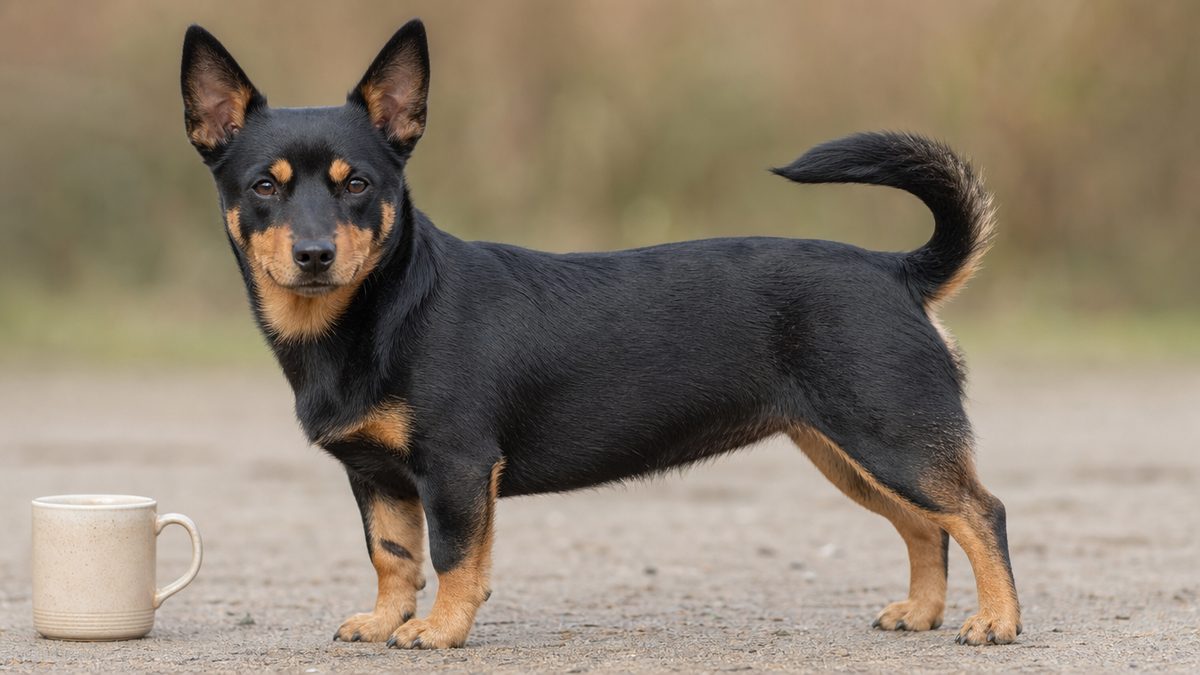
Lancashire Heeler in India: Price, PLL, Heat and Supply
Britain's smallest herding breed, a vulnerable native breed at 92 UK registrations in 2025, holding the longest median life expectancy of the 155 purebreds McMillan 2024 measured, and carrying primary lens luxation in more than a third of every dog the Royal Kennel Club has published a test result for.
By Bonbeno EditorialVeterinary review: Dr. Ashish J., MVScUpdated 2 September 202624 min read
Quick answer
Lancashire Heeler price in India cannot be sourced, because no Indian seller has one. The first result in India for the query is a crystal glass figurine at ₹12,002, the second is a paperback, and India's deepest 40-breed dog price list does not contain the breed. One Indian site does print ₹2,00,000 to ₹4,00,000, and that figure divides at a flat 80 into exactly the $2,500 to $5,000 a United States marketplace prints on the same page of results.
Health information notice
This page is reference information, not veterinary advice. Primary lens luxation, Collie eye anomaly, persistent pupillary membranes, patellar luxation and heat stress all need a veterinarian who has examined your dog. Primary lens luxation in particular is an emergency: a suddenly painful, cloudy or reddened eye needs a veterinary ophthalmologist the same day, because sight is lost in hours rather than days. Use this page to prepare your questions, not to answer them.
234Primary lens luxation carriers, Royal Kennel Club published resultscarriers and 10 affected among 639 dogs tested, 36.6 percent carriersSource: The Royal Kennel Club
2Collie eye anomaly carriers, Royal Kennel Club published resultscarriers and 0 affected among 115 dogs tested, 1.7 percent carriersSource: The Royal Kennel Club
15.4 yearsMedian life expectancy, UKon 110 deaths, the longest of 155 purebreds studiedSource: McMillan et al. 2024
0.49Hazard ratio against the crossbred baseline(0.41 to 0.59), the joint lowest in the studySource: McMillan et al. 2024
Built in a corner of Lancashire whose grid cell averages 9.93 degrees Celsius a year and peaks at a monthly mean of 15.65 in August. Chennai's coolest month is 24.09. This is a heat-sensitive northern dog with a weatherproof double coat, and no Indian plains city has a single month inside its homeland range.
Grooming load2 of 5
Genuinely low. The Royal Kennel Club puts grooming at once a week and the American Kennel Club calls the short, hard, flat coat dense and waterproof, needing very little grooming. In Indian humidity that low load is a real advantage, because there is no long coat to hold damp against the skin.
Exercise need3 of 5
Up to one hour a day by the Royal Kennel Club's own rating. That is a modest number for a herding breed, and it is achievable in an Indian city if you walk before 07:00 and after 19:00 rather than in the afternoon.
Apartment suitability4 of 5
The Royal Kennel Club rates size of home as flat or apartment and size of garden as small to medium, which makes this one of the very few herding breeds it rates for apartment living at all. Noise, not space, is the constraint.
Trainability4 of 5
The FCI standard calls the breed trainable but says it does best under a firm, kindly owner, and the AKC ranks it as intelligent and versatile. It learns fast and it also learns what it can get away with, so consistency matters more than repetition.
Noise level2 of 5
A vocal terrier-influenced heeler in a shared-wall Indian flat is the commonest reason these dogs are rehomed abroad. The breed works cattle by barking and nipping at heels, and neither instinct switches off indoors.
Inherited eye risk2 of 5
The single biggest health question on this breed. Primary lens luxation carrier rate runs to 36.6 percent of every Lancashire Heeler the Royal Kennel Club has published a DNA result for, and the breed has its own named paper on Collie eye anomaly. Buy only from parents with both DNA tests.
Longevity5 of 5
McMillan 2024 gives a median of 15.4 years on 110 deaths, the longest median of the 155 recognised purebreds in that study, with a hazard ratio of 0.49 against the crossbred baseline. This is a genuinely long-lived breed.
Indian availability1 of 5
Zero. No Indian seller lists the breed, India's deepest 40-breed price list omits it, and the marketplace pages that rank for it are shells with no stock.
First-time owner fit3 of 5
Manageable size, low grooming and long life on one side; heeling instinct, noise and a demanding health-screening checklist on the other. Workable for a first-time owner who has read the DNA test results, difficult for one who has not.
What a Lancashire Heeler is, and what the two standards actually say
A Lancashire Heeler is a small British cattle dog of about 30 cm at the shoulder, bred in the Ormskirk area of west Lancashire to drive cattle by nipping at their heels and to kill rats between jobs. Two kennel clubs publish a standard for it, and between them they describe a dog with no official weight at all.
The Royal Kennel Club opens its standard with five words that do most of the work: small, powerful, sturdily built, alert energetic worker. It places the breed in its Pastoral group and gives an ideal height at shoulder of 30 cm for dogs and 25 cm for bitches. The FCI places it in Group 1, Sheepdogs and Cattle Dogs, Section 1, and gives exactly the same two heights. Neither document contains a weight. That is worth pausing on, because almost every page ranking for this breed prints one.
The weight nobody's standard gives
Three secondary sources print three different weights for a dog whose breed standard gives none. The American Kennel Club says 9 to 17 pounds, roughly 4.1 to 7.7 kg. Petfinder repeats 9 to 17 pounds. Dogbreedslist, ranking fifth in India for the price query, says 6 to 13 pounds, roughly 2.7 to 5.9 kg. The lowest floor and the highest ceiling are almost three times apart.
The practical consequence for an Indian buyer is simple. A seller quoting you a weight is quoting a secondary source, not a breed standard, and you cannot use that number to check whether the dog in front of you is typical. Height you can check. Weight you cannot.
Royal Kennel Club breed standard, updated 1 April 2025
Ideal 30 cm dogs, 25 cm bitches
Not given
FCI Standard 360, valid from 04.04.2016
Ideal males 30 cm, females 25 cm
Not given
American Kennel Club breed page
10 to 12 inches
9 to 17 pounds
Petfinder breed page
10 to 12 inches
9 to 17 pounds
Dogbreedslist.info
10 to 12 inches (25 to 31 cm)
6 to 13 pounds (3 to 6 kg)
Colour is the one thing both standards are strict about
Only two colours are permitted, and everything else is unacceptable. The Royal Kennel Club allows black and tan or liver and tan with a distinct black or liver thumb mark immediately above each front foot, and states plainly that any other colour or combination of colours is unacceptable. The FCI wording matches, with one small difference worth recording: the Royal Kennel Club says a small white spot on the forechest is tolerated, while the FCI says it is permissible but undesirable and adds that white is to be discouraged.
That liver colour has its own paper. Wright and colleagues at the Kennel Club Genetics Centre identified a novel TYRP1 variant associated with liver and tan coat colour in Lancashire Heelers, published in Animal Genetics in 2019. A rare breed with its own colour-genetics publication is not a common thing.
Where the dog came from
The Royal Kennel Club's account is that cattle were herded from Wales to markets in the Ormskirk area, and that the Welsh heeler met the Manchester Terrier there. The FCI standard's brief historical summary tells the same story in the same words, adding that the origins are not clearly defined. Both credit the thumb mark to the terrier side and the lowness to ground and heeling instinct to the corgi side.
The old local names were the Ormskirk Heeler and the Ormskirk Terrier, and both are still worth searching when you are looking for information on this breed. If you are cross-shopping, our guides to the Cardigan Welsh Corgi and the Manchester Terrier's small British terrier neighbours cover the two sides of that ancestry.
The one-line summary
A small, alert, hardy, black and tan or liver and tan herding dog, 30 cm at the shoulder, with a natural undocked tail, a thumb mark above each front foot, and no weight in either of its two breed standards.
The FCI holds this breed provisionally, and that decides what an Indian pedigree can do
The Lancashire Heeler sits on the FCI's provisional register as standard 360, not its definitive one, and because the Kennel Club of India is a full FCI member that fact travels directly to any Indian pedigree. A provisionally recognised breed cannot compete for the CACIB.
Read the FCI's own provisional register and the breed is there: LANCASHIRE HEELER (360), sitting between the Segugio Maremmano at 361 and the Australian Stumpy Tail Cattle Dog at 351. Read the FCI's nomenclature entry for the breed and the document names it on its own face, gives Group n 1 Sheepdogs and Cattledogs (except Swiss Cattledogs), and dates the English standard to 30 May 2016. The standard PDF itself gives 04.04.2016 as the date of publication of the official valid standard.
The register prints the consequence in its own words. FCI breeds recognised on a provisional basis are not eligible for the CACIB until they are recognised on a definitive basis, but are eligible for the FCI titles, and the pedigrees issued to dogs of these breeds have to carry the FCI logo.
Why that matters in Chennai and not just in Thuin
India is a full FCI member. The FCI's own members register prints INDIA (Full member) and names the Kennel Club of India at Nr 28, AA Block, First Street, Anna Nagar, Chennai 600 040. That is the route by which FCI nomenclature governs what an Indian pedigree means, and it is why the recognition question for India is answerable from the FCI register rather than from guesswork about the KCI's own breed list.
So the honest answer to an Indian buyer asking whether the breed is recognised here is layered. The FCI recognises it provisionally. India follows FCI nomenclature. A Lancashire Heeler could therefore in principle be registered on that basis, and could not compete for the CACIB.
Breed standard last updated 1 April 2025; listed as a vulnerable native breed
FCI
Provisional only, standard 360
Group 1 Section 1; not eligible for the CACIB
American Kennel Club
Full, Herding Group
Recognised 2024; parent club since October 2017
Kennel Club of India
Via FCI nomenclature
India is a full FCI member represented by the KCI, Chennai
The AKC arrived in 2024, which is why the Indian press covered it
The American Kennel Club recognised the Lancashire Heeler as a breed in 2024 and placed it in the Herding Group. That recognition is the reason the breed has any Indian media footprint at all: the Economic Times ran a piece on the new AKC breed, giving 9 to 17 pounds and a 12 to 15 year lifespan and quoting no Indian price. The United States Lancashire Heeler Club has been the official AKC parent club since October 2017.
One further recognition date circulates and Bonbeno cannot confirm it. Dogbreedslist states that the Kennel Club recognised the breed in 1981 and that the United Kennel Club recognised it on 1 November 2009, citing nothing but a YouTube video. The Royal Kennel Club's own breed page gives no recognition year at all. Treat 1981 as unverified rather than as fact.
Provisional is not the same as unrecognised
Several breeds sit on the FCI's provisional register for decades. Provisional means the standard is published and pedigrees carry the FCI logo; it does not mean the breed is disputed. What it changes is show eligibility, and that is a narrow but real difference an Indian buyer paying for a pedigree should know about.
Lancashire Heeler price in India: the first result is a glass figurine
There is no Lancashire Heeler price in india to report, because no Indian seller has the breed. What the Indian search results do contain is a crystal ornament, two books, an American marketplace and one rupee figure that fails its own arithmetic.
The figurine is the cleanest illustration this site has found
That ₹12,002 is a real Indian rupee price, and it is not a price for a dog. The listing's own product metadata gives the currency as GBP and the amount as 90.00, so Etsy is converting £90 live for an Indian viewer. Better still, the same shop prints ₹12,002 for its Curly Coated Retriever figurine, its Scottie and its Smooth Dachshund. The number is a price per lump of glass, not per breed. Anyone quoting an Indian price they found for this breed should check whether they have found the dog or the ornament.
The one Indian rupee figure, and the arithmetic that undoes it
One Indian breed site does print a purchase price. happypet.care gives Cost of buying ₹2,00,000 to ₹4,00,000 for the Lancashire Heeler, updated 28 August 2025. Run the standard division tests and the result is unusually clean.
Both figures divide at a flat 80 into exactly USD 2,500 and USD 5,000. On its own that proves little, because any rupee figure ending in three zeros divides cleanly at 80 by construction, and this site has warned about exactly that weakness before. What lifts it above arithmetic noise is the quotient itself and where else it appears. Good Dog, ranking three places above happypet.care on the same Indian results page, states that nationally prices usually range from $2,500 to $2,500. The quotient is not a plausible-looking round number. It is the co-ranking American figure, to the dollar.
Note also the shape of Good Dog's own claim. A range whose floor and ceiling are the same number is a single data point wearing a range, and the page's H1 advertises 40+ puppies while its own title tag says 25. The American source is thin too. It is simply honest about being American.
What the other rupee figures in the ranking set are worth
Dogbreedslist prints Puppy Prices, Average $800 to $1200 USD, in dollars, with no Indian figure anywhere. India's deepest ranking price page, a 40-breed list with city-wise costs, does not contain the breed at all: a case-insensitive search of its full text returns zero hits for lancashire, zero for heeler and zero for lakeland, and the only terriers in its table are the Bull Terrier at ₹25,000 to ₹70,000 and the Scottish Terrier at ₹30,000 to ₹80,000.
What Bonbeno will not do
We will not convert $2,500 into rupees and print it as an Indian puppy price. There is no Indian supply chain for this breed, so there is no Indian price, and inventing one by arithmetic is the exact failure this page exists to document.
Proving the absence, and what Indian listings are actually selling
Absence is only evidence when the instrument that found it was working, so every search behind this page ran with a control. The controls that passed prove there is no Indian supply; the controls that failed are reported as broken instruments rather than as findings.
Four instruments were run. The India-restricted web search returned a genuine Indian result set for the breed and, critically, returned real Indian breeder listings with rupee prices for the Labrador control in the same session. That is a passing control, so the absence of Indian Lancashire Heeler sellers is reportable.
Two other instruments failed their own controls and are therefore reported as broken rather than as evidence. Bing India returned substituted result sets twice, once serving ten thesaurus entries for the word happy and once serving unrelated Reddit threads, and in the same session its Labrador control came back as ten soap-opera message boards. DuckDuckGo returned an HTTP 202 carrying a CAPTCHA challenge. Neither can support a claim in either direction, and neither is used here.
The Indian marketplace pages for rare breeds are shells
A useful sanity check on any rare breed is to look at what a comparable Indian marketplace page actually contains when it does rank. For the Lancashire Heeler none does. For the closely comparable Lakeland Terrier two do, and both are empty: one lists eight priced puppies of which not one is the breed in the title, and the other prints three results that turn out to be a Cavalier King Charles Spaniel, a Shiba Inu and a French Bulldog under a Similar breeds heading. That is the shape of the Indian market for a rare British breed, and it is why the absence here is unsurprising rather than mysterious.
The import route, as far as it can be verified
Anyone hoping to import a Lancashire Heeler runs into a narrow policy. India's foreign trade rules permit a dog to enter only as a pet with a valid pet book in the importer's name, for research by an organisation with a CPCSEA recommendation, or for internal security by the Defence and Police Force, and import of commercial dogs for breeding or any other commercial activity is not permitted.
Bonbeno is quoting that from a compliance tracker's reproduction of the notice rather than from the notice itself, because the DGFT document could not be opened during this research. The export schedule that was reachable covers a different question entirely and does not support any import claim, so it is not cited here. Treat the policy conditions above as reliably reported and independently checkable, and read the notice yourself before acting on it.
There is no lawful commercial route to import this breed into India for breeding or sale.
There is a lawful route for a family already abroad who owns the dog and is relocating with it.
No Indian seller currently offers puppies for sale of this breed, so any listing you find is worth interrogating rather than trusting.
The absence claim on this page rests on a control search that succeeded in the same session, not on a search that simply returned nothing.
The useful version of a negative
Knowing that nobody in India sells this breed saves an Indian buyer more money than any price would. It redirects the question from what does it cost to what am I actually being offered, and on this SERP the honest answer is a book, an ornament and an American waiting list.
Monthly cost of keeping a 7 kg dog in India, from shop prices rather than guesses
The monthly cost of a Lancashire Heeler in India is knowable even though its price is not, because vaccination, deworming, parasite prevention, food and licensing are published Indian prices that apply to any dog of this size. Every figure below comes from a shop page or a government portal.
A Lancashire Heeler weighs somewhere in the 5 to 8 kg range on the secondary sources that give a weight at all, which puts it neatly inside two Indian product bands. Royal Canin Mini Adult states on its own page that it is for dogs up to 10 kg, and Bravecto's 250 mg tablet is banded 4.5 to 10 kgSupertails product page for MSD Animal…. That clean fit is unusual and it makes the arithmetic honest.
Take the parasite and vaccination spine alone. Four Bravecto doses a year at ₹1,650 is ₹6,600. Four deworming doses at one tablet each, from a ₹754 strip of six, is roughly a strip and a bit. The annual booster course from ₹3,199 sits on top. The Delhi licence renewal is 500 with a late fee of Rs 100 per month if you miss the one-month grace period, which the portal pegs to the expiry of the anti-rabies certificate.
Boarding is the line that catches people out when they travel. A Bengaluru facility publishes standard boarding at ₹650 per night, premium boarding at ₹850 and full-day daycare at ₹500, with a note that all prices are starting rates and may vary by breed size. Two weeks away is therefore roughly ₹9,100 at the standard rate, which is more than a year of boosters.
Food is the largest and most variable line, and it is the one where the pack size does the work. Royal Canin Mini Adult runs ₹94 per 100 g in a 2 kg bag, ₹84 per 100 g at 4 kg and ₹73 per 100 g at 8 kg. Buying the 8 kg bag rather than the 2 kg saves 22 percent per gram on the identical food, which for a small dog is the single easiest saving available.
Three cost figures Bonbeno will not print
A routine in-clinic consultation fee could not be sourced from any Indian clinic's own page. India's clinic chains advertise discounts and free consultations with vaccination but publish no walk-in rupee figure, one national chain's consultation page returns a 404, and the largest hospital group publishes no prices at all. Third-party editorial quotes ₹500 to ₹1,000 and Bonbeno is not repeating it as a price.
Neutering could not be sourced from a clinic rate card either. Only editorial ranges exist, and none of them is banded by weight, so a figure for a 7 kg dog specifically does not appear to be published anywhere in India.
And the monthly running cost printed by Indian breed sites is not a breed observation at all. happypet.care gives the Lancashire Heeler average monthly expenses of ₹2,200 basic to ₹3,750 premium, built from food ₹1,200 to ₹1,800, veterinary ₹300 to ₹750 and grooming ₹700 to ₹1,200. Pulling four unrelated breeds from the same site returns the identical block to the rupee: the Pug, the Beagle, the Norwich Terrier and the Lakeland Terrier all carry ₹2,200 to ₹3,750 with the same three component lines. The Welsh Terrier, in a different size band, carries ₹4,650 to ₹6,600. It is a size-band constant dressed as breed research, and the tell is that grooming, the one line that genuinely should differ between a Pug and a wire terrier, is identical for both.
Check the band, not the breed
If an Indian breed page gives you a monthly cost, open a completely different breed of the same size on the same site before you use it. If the numbers match to the rupee, you are reading a template default. On happypet.care that test takes thirty seconds and it fails.
Heat tolerance: a 9.9 degree homeland against a 27.9 degree city
A Lancashire Heeler is a cool-climate dog with a weatherproof double coat, and no Indian plains city has a single month inside its homeland's temperature range. The gap is 18 degrees on the annual mean, and the honest planning assumption is that outdoor life is a cool-season and early-morning activity only.
The breed was made around Ormskirk in west Lancashire. Queried by explicit latitude and longitude, NASA POWER returns a grid cell at -2.886, 53.569 reporting an elevation of 58.39 m, which sits about 28 m above the town itself and is therefore a usable plains cell rather than a mountain artefact. That cell gives an annual mean of 9.93 degrees Celsius, a warmest monthly mean of 15.65 in August, an annual peak daily maximum of 26.14 and an annual mean wet bulb of 8.84 degrees.
Read the first two columns of that table together and the argument is settled. Chennai's coolest month, January, averages 24.09 degrees. Ormskirk's warmest month, August, averages 15.65. The coldest month in Chennai is 8.4 degrees hotter than the hottest month in the dog's home range, which means there is no Indian coastal month this breed's climate has any experience of.
Wet bulb is the number that decides whether panting works
A dog cools almost entirely by evaporation from the respiratory tract, so humidity matters as much as temperature. Ormskirk's peak monthly wet bulb is 14.31 degrees. Chennai's is 27.36 and Kolkata's 27.86. At those wet bulb values evaporative cooling becomes progressively less effective, and a small dog with a dense double coat has less surface area to work with than a large one.
Bengaluru and Pune are the two least hostile options at 23.74 and 23.86 degrees annual mean, and both are genuinely cooler than the coastal cities. Neither is cool. Bengaluru's April still averages 28.37 degrees, which is 12.7 above Ormskirk's warmest month.
What the heat literature does and does not say about this breed
Hall 2020 is the standard reference for canine heat-related illness in the UK, and it is the temptation on every page like this one. Neither of its two papers models the Lancashire Heeler: the breed's name appears zero times in either the Scientific Reports paper or the Animals paperHall EJ, Carter AJ. Its breed-specific odds ratios therefore cannot be borrowed here.
What does transfer is the paper's finding about triggers, which is not breed-specific. Of 1,259 heat-related illness events from 1,222 dogs, 879 had a recorded trigger, and 652 of those 879 events, 74.2 percent, were exertional rather than environmental. That is directly relevant to a small herding dog whose owner is told it needs an hour of exercise a day. In India the danger is not the parked car. It is the walk.
The practical rule
Exercise this breed before 07:00 and after 19:00 from March to October in any Indian plains city, and treat an afternoon walk in May as a decision rather than a routine. Hall 2020's exertional finding is the reason, and it applies whatever the breed.
Temperament: an affectionate small dog that still thinks it is working cattle
The Lancashire Heeler is courageous, happy and affectionate to its owner by its own breed standard, and it works cattle with terrier instincts when rabbiting and ratting. Both halves of that description matter in an Indian flat, and it is the second half that surprises people.
The Royal Kennel Club standard is unusually direct about the working temperament: works cattle but has terrier instincts when rabbiting and ratting, courageous, happy, affectionate to owner. The FCI standard repeats it word for word and adds that the Heeler is an intelligent, eager-to-please fellow with a love of people, possessed of a prodigious amount of energy in his small frame.
Those two sentences are the whole household-fit question. You are getting an affectionate, people-loving dog that is also a heeler and a ratter, in a body small enough for an apartment.
Heeling is a behaviour, not a metaphor
A heeler moves cattle by nipping at their heels. That is a hardwired, self-rewarding behaviour, and in a home without cattle it lands on whatever moves fastest, which is usually a running child or a delivery rider's ankles. It is not aggression and it does not respond to being told off, because the dog is not misbehaving by its own lights. It responds to being given a legitimate outlet and a reliable interrupt cue.
Barking is the same problem in a different register. The dog's job description involves noise, and the Royal Kennel Club rates its home requirement as flat or apartment while saying nothing about the acoustic consequences. In an Indian apartment with shared walls, this is the trait that decides whether the arrangement lasts.
Who this breed suits, and who it does not
Suits an owner who wants a small, alert, long-lived dog and will actually train the heeling instinct rather than hoping it fades.
Suits a household that can walk twice daily at the cool ends of the day, every day, in an Indian city.
Suits someone who reads health test results before choosing a puppy, because this breed's risk is genetic and screenable.
Does not suit a household that wants a quiet dog, because the breed's working method is noise.
Does not suit anyone who wants a lap dog in a small package, because the frame is small and the energy is not.
Does not suit a buyer in a hurry, because there is no Indian supply and the honest waiting time is measured in years.
If the description appeals but the availability does not, the closest genuinely obtainable Indian equivalents are the Indian Spitz, which is small, alert and heat-adapted, and the Pembroke Welsh Corgi, which shares the corgi half of the Heeler's ancestry and is actually sold here.
The line worth remembering
The FCI standard says the breed does best under a firm, kindly owner. Firm and kindly are both load-bearing. This is a dog that will negotiate with an inconsistent handler and will shut down under a harsh one.
Training: teach an interrupt cue before you teach anything else
To train a Lancashire Heeler, put your effort into a reliable interrupt cue and a legitimate outlet for the heeling instinct, because everything else this breed learns quickly and on its own. The FCI standard calls the dog trainable and says it does best under a firm, kindly owner, which is an accurate warning about consistency rather than about difficulty.
This is a clever dog. The AKC leads its breed description with intelligent, versatile and affectionate, and the FCI standard calls it an intelligent, eager-to-please fellow. Recall, sit, place and loose-lead walking are not the hard part. The hard part is that a heeler generates its own job if you do not give it one, and the job it picks is chasing.
The first ninety days matter more than the next year
Socialisation windows do not wait for convenience. The 2017 Rules record that pups are vaccinated starting at seven to eight weeks and usually completed by eighteen weeks, which is exactly the period in which a puppy needs to meet traffic, lifts, autos, delivery riders, tiled floors and other dogs. In an Indian city that is a scheduling problem, because the safest hours to be outside are also the hours when the least is happening.
The practical compromise is to socialise in carried and controlled form early, then convert to on-ground exposure as the course completes. Sitting on a bench at the edge of a market at 07:00 with a puppy on your lap does more for a heeler's adult temperament than three obedience classes at six months.
A training order that works for this breed
Name response first, paid every single time, before any other cue exists.
An interrupt cue, taught cold and rehearsed at low arousal for weeks before it is ever needed at high arousal.
A settle on a mat, because a dog that cannot switch off in a flat becomes a dog that barks in one.
Recall away from a moving target, built with two people and a long line rather than in an open park.
A legitimate chase outlet, such as a flirt pole or a formal tug game with rules, run at cool hours only.
Loose-lead walking last, once arousal management is in place, because a heeler that cannot settle cannot walk.
Notice what is not on that list. There is no place for physical correction, and no place for the pack-leader framing that one page ranking for this breed still recommends, which advises demonstrating that the owner is the pack leader to avoid Small Dog Syndrome. That is dated advice on a breed that responds to clarity and consistency rather than to confrontation.
Realistic timelines
Expect a reliable name response in two to three weeks, a settle-on-mat in four to six, and a recall you would actually bet on in six to nine months of consistent work. The interrupt cue is the slow one: a cue that works when a cyclist goes past at speed takes months of rehearsal at boring, low-stakes moments, and most owners stop rehearsing it before it is ready.
The one exercise worth doing daily
Two minutes of interrupt-cue practice at home, in a boring room, with no distraction at all. It feels pointless, which is precisely why it works: you are building the reflex when the stakes are zero, so it is available when they are not.
Exercise: one hour, split, and never in the middle of an Indian day
A Lancashire Heeler needs up to one hour of exercise per day by the Royal Kennel Club's own rating, and in India that hour has to be split across the two cool ends of the day. The number is modest for a herding breed; the timing is the part that is not negotiable.
The Royal Kennel Club rates exercise at up to one hour per day, size of home as flat or apartment and size of garden as small to medium. For a working breed that is a genuinely low requirement, and it is the main reason this dog appears on apartment-friendly lists at all.
Splitting it matters more than the total. Two thirty-minute outings, one before 07:00 and one after 19:00, deliver the same hour with roughly half the heat exposure of a single midday walk, and they give a heeler two arousal peaks and two settle-downs rather than one of each.
Walk with sniffing time, plus two minutes of interrupt-cue rehearsal
Midday, daily
10 to 15 min
Indoor scentwork or a food puzzle, at floor level with a fan running
After 19:00, daily
25 to 35 min
Walk, with a short flirt-pole or tug session if the surface is cool
Twice a week
15 min
Formal training session, indoors, short and early
March to October
Zero
Outdoor exercise between 10:00 and 17:00
What happens without it
An under-exercised heeler does not become calm. It becomes a heeler indoors: it patrols, it barks at the corridor, it herds the household, and it starts chasing things that move in the flat. That is the behaviour profile that gets small working dogs rehomed, and it is preventable with an hour that most owners can find.
The opposite failure is also real and more dangerous in India. A prodigious amount of energy in a small frame, in the FCI's phrase, means this dog will keep going past the point where it should stop. Hall 2020 found that 652 of the 879 heat-related illness events with a recorded trigger were exertional, and a willing dog that does not self-limit is exactly the profile that produces those events.
Surfaces, not just air
Tarmac and concrete in an Indian city hold heat long after sunset, and a 30 cm dog carries its whole body about 25 cm above that surface. The five-second back-of-hand test on the pavement is a better guide than the air temperature: if you cannot hold your hand on it comfortably, the walk waits.
Signs to stop immediately
Wide, frantic panting that does not slow when the dog stops moving; a dark red tongue; stumbling or reluctance to continue; vomiting. Move to shade, wet the belly and paws with cool not iced water, and get to a veterinarian. Heat-related illness in dogs is an emergency, not a rest-and-see.
Grooming: the easiest coat on any vulnerable native breed
Grooming a Lancashire Heeler takes about ten minutes a week, and that is a real advantage in Indian humidity rather than a minor convenience. The coat is a short, hard, flat topcoat over a fine undercoat, and it is one of the few things about owning this breed in India that is genuinely easy.
The breed standard describes a fine undercoat covered throughout by a weather resistant, short, thick, hard, flat topcoat, slightly longer on the neck, and states that a long or excessively wavy coat is highly undesirable. The Royal Kennel Club rates grooming at once a week and coat length as short. The AKC puts it more plainly still: the short, hard, flat coat is dense and waterproof, needing very little grooming, and a light brushing and occasional bath will keep your Heeler happy and clean.
Why a short hard coat is the right coat for India
A dense double coat is a heat problem, but a short one is a far smaller heat problem than a long one, and it is a much smaller skin problem in the monsoon. Long coats hold moisture against the skin for hours after a bath or a wet walk, and that trapped damp is where humid-climate skin trouble starts. A flat topcoat that sheds water and dries in minutes avoids the whole mechanism.
Note that this breed is not a shedding-free dog and is not sold as one. The Royal Kennel Club records Sheds: Yes, and Petfinder records hypoallergenic: no The Royal Kennel Club, Breeds A to ZPetfinder breed page for the Lancashire…. That honesty is worth having, because it is the opposite of what buyers are told about several superficially similar terriers.
Never shave this dog
Indian groomers routinely offer a summer shave for double-coated dogs, and it is the wrong intervention here. The undercoat is insulation in both directions, and removing it exposes skin that has never seen direct sun to Indian UV while removing the air layer that slows heat gain. A weekly brush that thins the undercoat naturally does what a clipper cannot undo.
Brush weekly with a rubber curry or a firm bristle brush, more often during a seasonal coat drop.
Bathe only when the dog is actually dirty, and dry the ears thoroughly afterwards.
Check between the toes after monsoon walks, because that is where damp and grit collect on a low dog.
Trim nails with clippers or a grinder before they touch the ground on a level surface.
Skip the salon unless you want to; a full groom in Bengaluru starts at ₹1,869 and this coat does not need one.
That last line is a genuine saving. A published full groom at a national chain in Bengaluru starts at ₹1,869 for a 120-minute bath and hair styling, with a bath alone from ₹934, and the price list is not banded by dog size. A Lancashire Heeler owner can skip that line entirely, which is not true of the wire-coated terriers this breed is often shelved beside.
Ten minutes, weekly
Brush, check ears, check between the toes, check nails. That is the whole routine for this coat, and doing it on a fixed day of the week is how you notice a lump, a tick or a sore ear early enough for it to be a small problem.
Health: a long-lived breed whose health issues are almost entirely in the eyes
The Lancashire Heeler's health issues concentrate in the eye to an unusual degree, and every one of them is screenable before you buy. This is a healthy, long-lived breed carrying two named inherited eye diseases with DNA tests, and a buyer who checks both tests removes most of the risk on the page.
Start with what the breed's own kennel club asks of breeders. The Royal Kennel Club's Good Practice tier for the Lancashire Heeler is prioritising genetic diversity plus eye testing using the BVA/KC/ISDS Eye Scheme, and its Best Practice tier adds a DNA test for Collie eye anomaly and choroidal hypoplasia and a DNA test for primary lens luxation. The club sells the two DNA tests as a breed-specific package. The AKC's parent club recommends exactly the same two tests.
Two clubs on two continents naming the same two tests is a strong signal about where the risk lives.
Below OFA's 50-evaluation threshold for those databases
Read the absences correctly. A missing row does not mean the breed has no hips; it means OFA requires 100 hip evaluations, or 50 for its other databases, before it publishes a breed at all. The correct phrasing is no row in OFA's published statistics tables, and the control breed used to prove the document was working returned 109 hits in the same file.
The patella number is better than the breed's reputation
One ranking page lists patellar luxation among the breed's problems. OFA's own table gives 92.3 percent normal across 78 evaluations, with the entire 7.7 percent abnormal sitting in grade 1 and nothing at all in grades 2 or 3. For a small breed that is a good result, and it is worth knowing before you pay for a patella check you may not need.
It is also worth knowing that Indian law does not require one. The Dog Breeding and Marketing Rules 2017 mandate testing for genetic defects including hip dysplasia, progressive retinal atrophy, night blindness, hypothyroidism, entropion, ectropion and jaw defects, and the word patella appears zero times in the whole gazette.
The neurological finding nobody has written up for buyers yet
In January 2025 a Helsinki-led team reported a homozygous nonsense variant in the ITPR3 gene in Lancashire Heeler dogs, presenting with a severe developmental enamel defect and reduced nerve conduction velocity: a spontaneous canine model of Charcot-Marie-Tooth neuropathy type 1J with amelogenesis imperfecta. The paper reports that the variant produced a complete absence of full-length IP3R3 protein, and describes it as the first spontaneous mammalian phenotype caused by a nonsense variant in ITPR3.
For a buyer the practical translation is narrow and specific. If a Lancashire Heeler puppy has visibly abnormal, thin or discoloured enamel, that is not a cosmetic finding and it is worth raising with a veterinarian, because in this breed it has now been tied to a nerve phenotype in a peer-reviewed paper. No commercial screening test is described in that paper, and Bonbeno is not going to imply one exists.
Read this before any deposit
Ask for both parents' primary lens luxation and Collie eye anomaly DNA results in writing, from the testing laboratory rather than from the seller. Everything else about this breed's health is comparatively easy. These two are not, and they are the only part of the risk you can eliminate with paperwork.
Primary lens luxation: 234 carriers in 639 published Royal Kennel Club results
Primary lens luxation is this breed's defining health problem, and counting the Royal Kennel Club's own published DNA test list gives a carrier rate of 36.6 percent. That is the single most useful number on this page, and no page ranking in India for this breed reports it.
The Royal Kennel Club publishes, as a downloadable PDF, every Lancashire Heeler on its register with a PLL DNA result. Counting that 26-page document line by line gives 639 dogs with a published test result: 395 clear, 234 carriers and 10 affected, plus a further 24 dogs recorded hereditarily clear by parentage. The arithmetic closes exactly: 395 plus 234 plus 10 is 639.
Royal Kennel Club published DNA results for the Lancashire Heeler, counted from the club's own PDFs The Royal Kennel Club
Test
Dogs with a published result
Clear
Carrier
Affected
Carrier rate
Primary lens luxation
639
395
234
10
36.6%
Collie eye anomaly / CH
115
113
2
0
1.7%
The two registries disagree, and they disagree in opposite directions
Bonbeno publishes both and calls neither the rate. The two populations are different, the sample sizes are very different, and both lists record dogs whose owners chose to test, which is not a random sample of the breed. What survives the caveats is the direction: on both sides of the Atlantic, PLL carriage in this breed is measured in double-digit percentages, and it is worth testing for.
Why a carrier is not simply a safe dog
The mutation is a c.1473+1 G>A change in ADAMTS17, and it was first mapped in this breed. Sargan and colleagues used a genome-wide microsatellite screen in miniature bull terriers and Lancashire heelers to place the disease locus in a 6.3 Mbp region of chromosome 3. Gould and colleagues then screened PLL-affected dogs of 30 breeds, found the same ADAMTS17 mutation in 14 additional breeds, and reported something buyers are rarely told: an increased risk of PLL associated with heterozygosity at ADAMTS17, meaning carriers themselves carry a low risk of developing the disease.
So the safe breeding rule and the safe buying rule are not identical. A carrier bred to a clear dog produces no affected puppies, which is why carriers are still bred from responsibly. A carrier puppy in your home is still a dog with a small residual risk in its own right, and you are entitled to know which you are being sold.
What PLL looks like, and why it is an emergency
The lens sits suspended behind the pupil on fine zonular fibres. In PLL those fibres break down and the lens moves, most dangerously forward into the anterior chamber, where it blocks fluid drainage and drives intraocular pressure up fast. The eye becomes suddenly painful, often cloudy or blue-tinged, sometimes visibly red, and the dog squints or rubs it. Vision is lost in hours, not days.
The AKC's account of the breed's history with this disease is worth quoting for context: primary lens luxation was found in 2006, and aggressive action by breeders and research by animal health organizations has reduced the incidence. That is true and it is also why the carrier figure is still high: a carrier is not an affected dog, and clearing carriers out of a population of this size would collapse an already narrow gene pool.
Same-day, not next-week
A Lancashire Heeler with a suddenly painful, cloudy or reddened eye needs a veterinary ophthalmologist that day. This is one of the few genuinely time-critical emergencies in small-breed ownership, and in most Indian cities the referral takes longer to arrange than the eye can wait, so find out now where your nearest one is.
Collie eye anomaly: a breed with its own paper, and a 30-year change in the numbers
Collie eye anomaly in the Lancashire Heeler has its own named publication, and the picture has changed enormously since it was written. A 1996 survey found 13.7 percent affected; the Royal Kennel Club's current DNA list shows 2 carriers among 115 tested dogs.
Peter Bedford of the Royal Veterinary College described an ocular disease ophthalmoscopically identical to Collie eye anomaly in the Lancashire heeler in the Veterinary Record in 1998, reporting survey work completed in 1996 that demonstrated a significant incidence of 13.7 per cent. The paper found bilateral choroidal hypoplasia, papillary or peripapillary coloboma and neuroretinal non-attachment together in a non-collie breed, which the author argued confirms that the three lesions are parts of one disease. He suggested the name congenital posterior segment anomaly instead.
Thirty years on, the Royal Kennel Club's published CEA/CH DNA result list for the breed contains 115 dogs: 113 clear, 2 carriers and 0 affected, plus 25 more recorded hereditarily clear by parentage. That is a carrier rate of 1.7 percent.
Do not read that as a 12-point improvement
The two figures are not measuring the same thing and cannot be subtracted. Bedford's 13.7 percent was an incidence of the visible eye lesion, found by looking into eyes with an ophthalmoscope across a survey population. The Royal Kennel Club's 1.7 percent is a carrier frequency for a single genetic variant, found by testing dogs whose owners chose to test them, which skews heavily toward active breeding stock in a breed with an organised health culture.
A comparison that does bite is the American one. OFA's Collie eye anomaly DNA table gives the Lancashire Heeler 85.7 percent normal and 14.3 percent carrier across 56 evaluations, ranking the breed seventh in that table. Fourteen point three against one point seven, on DNA tests in both cases, is a real difference between two populations and not a methodological artefact.
The eye finding that is commoner than either of them
OFA's eye-registry detail rows record something no ranking page mentions. Across 159 Lancashire Heeler eye evaluations, persistent pupillary membranes running iris to iris were recorded in 28 dogs, 17.6 percent, and persistent pupillary membranes as lens pigment foci with no strands in 24 dogs, 15.1 percent. Lens subluxation or luxation itself was recorded in 2 of 159, 1.3 percent.
Persistent pupillary membranes are remnants of the fetal blood supply to the lens. Most are visually insignificant and many resolve; iris-to-lens and lens-pigment forms are the ones an ophthalmologist will want to grade. At 17.6 percent this is by far the commonest thing the American eye registry actually records in the breed, and a buyer who has only been told about PLL and CEA has an incomplete picture.
Both tests, both parents
The Royal Kennel Club sells the two DNA tests together as a breed package, and both parent clubs recommend both. There is no scenario in which testing one and not the other is the sensible choice, and the cost of both is trivially small against a fifteen-year dog.
The OFA eye register contradicts itself here by 36.5 points, on the same 159 evaluations
OFA publishes two views of the Lancashire Heeler's eye results that cannot both be right, and the gap between them is 36.5 percentage points. Bonbeno publishes both, shows the arithmetic, and quotes neither as the rate.
The detail tables sit further down the same document, share a single header reading Breed, Tested, Affected, %, and are broken out one table per diagnosis. The first of them is titled NORMAL (OTHER .000), and the Lancashire Heeler row in it reads 159 tested, 94, 59.1 percent. On that line, fewer than three in five had normal eyes.
The arithmetic on the detail row checks out: 94 divided by 159 is 59.1 percent, exactly as printed. The denominators are identical. So the two figures are not a rounding artefact and they are not measuring different sample sizes; they are two different claims about the same 159 evaluations.
This is a known defect across the register, not a fact about this breed
Bonbeno has recorded the same shape of contradiction on the Field Spaniel, the English Shepherd, the Entlebucher, the Dandie Dinmont, the Clumber Spaniel and the Dogo Argentino, always with the summary line reporting a high normal percentage and the detail rows reporting a much lower one on the same denominator. The Lakeland Terrier shows it too, at 96.9 percent against 68.0 percent, a gap of 28.9 points. The Lancashire Heeler's 36.5 points is wider than that, and it is not the widest Bonbeno has found: the Neapolitan Mastiff reaches 65.3 points, the Wire Fox Terrier 47.3 and the Welsh Springer Spaniel 45.6. That is the point. A defect that recurs across a dozen breeds, on denominators from 69 to 21,532, is a property of how OFA builds these tables rather than a finding about any one breed.
The detail rows are the ones that name actual diagnoses, and their contents are internally coherent: persistent pupillary membranes at 17.6 and 15.1 percent, corneal dystrophy at 2.5 percent, cataract findings scattered across six categories at under 1.5 percent each, other-suspected-as-not-inherited at 5.7 percent. Add the non-normal findings up and a 59.1 percent normal rate is the plausible one. Add nothing up and the 95.6 percent summary is the comforting one.
Never quote the summary line alone
A page that tells you 95.6 percent of Lancashire Heelers have normal eyes is reading one line of a table whose own detail rows say 59.1 percent. Cite both, show the division, and let the reader see that the source is inconsistent with itself. That is more useful than a confident number and it is the only honest option.
A worldwide effective population of 28, and what that costs the breed
The Lancashire Heeler's whole worldwide registered population traces to a very small number of ancestors, with a realised effective population size of 28. That number is the reason carrier frequencies stay high and the reason the breed's own researchers recommend bringing unregistered farm dogs back into breeding.
Katariina Mäki analysed nearly the entire worldwide registration history of two breeds, including 4,782 Lancashire Heeler individuals, and published the result in the Journal of Animal Breeding and Genetics in 2010. For the Lancashire Heeler she reports a pedigree depth of 6.0 complete generation equivalents, an effective number of founders of 15.2, an average inbreeding coefficient of 0.10, an average kinship of 0.08, and a realised effective population size of 28. More than 50 percent of the genetic diversity in the reference population is explained by five ancestors.
Individuals in the near-complete worldwide registration history
4,782
Pedigree depth of the reference population
6.0 complete generation equivalents
Effective number of founders
15.2
Ancestors explaining more than half the genetic diversity
5
Average inbreeding coefficient
0.10
Average kinship
0.08
Realised effective population size
28
An effective population size of 28 is small. Conservation genetics conventionally treats 50 as the short-term threshold below which inbreeding depression accumulates measurably, so this breed sits well under it worldwide, not merely in one country. The paper's own conclusion is blunt: failure to use available genetic resources for sustainable breeding has resulted in depletion of genetic variation, a larger proportion of dogs should be used in reproduction, and in the Lancashire Heeler it is necessary to use the unregistered farm dogs in breeding.
Why that connects directly to the carrier rate
A 36.6 percent PLL carrier frequency in a population descended from an effective 28 animals is not a coincidence and it is not a failure of breeder diligence. It is what a founder mutation does in a small closed population. It is also why the breed cannot simply breed carriers out: removing 36.6 percent of the gene pool from a population with an effective size of 28 would do more harm than the disease.
That is the case for testing rather than culling, and it is exactly what both parent clubs recommend. Test, know each dog's status, and pair so that no affected puppy is produced. The Royal Kennel Club's Good Practice tier names prioritising genetic diversity first, before any disease test at all, which is the same conclusion arrived at from the other direction.
The Indian consequence
For an Indian buyer, the practical meaning of an effective population of 28 is that any Lancashire Heeler that ever reaches India will be closely related to every other one. There is no local population to outcross into, no Indian registry depth behind the breed, and no realistic prospect of either. That is a reason to treat the breed as a project rather than a purchase, and a reason the adoption route below matters more here than on almost any other page.
What good breeding looks like in this breed
Not zero carriers. A breeder who tells you every dog in their kennel is PLL clear in a breed with a 36.6 percent carrier rate is either extraordinarily lucky or not telling you everything. A breeder who shows you the results, explains which pairings they use and why, and can name the inbreeding coefficient of the litter is doing the job properly.
Life expectancy: 15.4 years, the longest median of 155 purebreds measured
The Lancashire Heeler's life expectancy is the best documented thing about it. McMillan 2024 gives a median of 15.4 years with a 95 percent confidence interval of 14.7 to 15.9, built on 110 deaths, and names the breed first among the purebreds least at risk from early death.
The study analysed 584,734 dogs, of which 473,681 were purebred, and produced Kaplan-Meier survival estimates and Cox proportional hazards outputs for 155 recognised purebreds against a crossbred comparison group. Its own results text lists the least at-risk breeds in order and puts the Lancashire Heeler at the head of that list, at 15.4 years with a hazard ratio of 0.49.
McMillan 2024 Supplementary Table S3, the Lancashire Heeler in context McMillan et al. 2024
Breed
Deaths
Median survival
95% CI
Hazard ratio
Lancashire Heeler
110
15.4 years
14.7 to 15.9
0.49 (0.41, 0.59)
Lakeland Terrier
601
14.2 years
13.9 to 14.5
0.66 (0.61, 0.71)
Border Terrier
2,427
14.2 years
14.1 to 14.3
0.53 (0.51, 0.55)
Welsh Terrier
146
13.8 years
13.5 to 14.6
0.54 (0.46, 0.64)
Labrador Retriever
16,155
13.1 years
13.0 to 13.1
0.80 (0.78, 0.81)
Crossbred comparison group
72,445
12.0 years
12.0 to 12.1
reference
French Bulldog
2,495
9.8 years
9.4 to 10.1
2.22 (2.13, 2.31)
Read the last two rows against the first. A Lancashire Heeler's median is 3.4 years longer than a crossbred dog's and 5.6 years longer than a French Bulldog's. On a fifteen-year animal that is not a marginal advantage.
Quote the death count, because the two supplementary tables disagree on N
The paper's supplementary tables give two different sample sizes for this breed. Table S3 records 241 individuals; Table S6 records 168 alive, 110 deceased and 278 totalMcMillan et al. 2024. The deaths are identical in both, at 110. This site has now recorded that same pattern on eleven breeds, always with the two N values differing and the death count agreeing, and the gap runs in both directions: here S3 is smaller than S6, while for the Labrador Retriever S3's 43,428 is larger than S6's 43,182. So the sentence to build is the one about deaths and the median with its interval, not the one about N.
Two further checks were run before quoting this figure at all. Supplementary Table S5 records the Lancashire Heeler as included in the survival analysis with no phylogeny reclassification, which matters because that table folds some breeds into their close relatives and their medians then silently describe two breeds at once. And the paper's Author Correction was read in full: it changes a single Miniature Dachshund value in a figure legend and touches no supplementary table.
The other UK life-table paper does not include this breed
Teng 2022's life tables for companion dogs in the United Kingdom are the other standard longevity reference, and neither the Lancashire Heeler nor the Lakeland Terrier appears anywhere in that paper: a search of its full text returns zero for both, while the Labrador control returns six. So there is one good UK life-expectancy estimate for this breed, not two, and it is McMillan's.
You are committing to a fifteen-year animal, and a fifteen-year animal in India will outlive at least one house move, probably one job change and possibly one city. That is a longer planning horizon than most people budget for, and it is the strongest single argument for treating this decision slowly.
Feeding: a 7 kg working dog that is easy to overfeed
Feed a Lancashire Heeler to body condition rather than to a scoop measure, because it is a compact working breed with a high energy drive and a small daily requirement. The whole feeding problem for this breed in India is that the dog acts hungry and needs very little.
Start with the size band, because it makes Indian shopping simple. Royal Canin Mini Adult states on its own page that it is formulated for dogs up to 10 kg, which covers this breed at any plausible adult weight. The same product's own pricing rewards buying large: ₹94 per 100 g in the 2 kg pack, ₹84 at 4 kg and ₹73 at 8 kg.
Run your fingertips along the dog's side with light pressure. You should feel the ribs easily, the way you feel the knuckles on the back of your hand, without pressing. Look down from above and there should be a visible waist behind the ribs. Look from the side and the belly should tuck up. If any of those three is missing, the dog is carrying weight it does not need, whatever the bag says.
That matters more than usual on this breed for a specific reason. Hall 2020 found that dogs at or above the mean bodyweight for their breed and sex carried an odds ratio of 1.42 for heat-related illness. That finding is about bodyweight relative to breed mean rather than about any particular breed, so it transfers to a breed the paper did not model, and it is a direct argument for keeping a Lancashire Heeler lean in an Indian climate.
Life stages
Puppy to four months: four meals a day, on a puppy formulation, with the vaccination schedule running alongside from seven to eight weeks.
Four to eight months: three meals a day, watching that the waist stays visible through the growth spurt.
Eight months onward: two meals a day, on an adult small-breed formulation.
Nine years onward: same two meals, reassessed for weight every three months, because activity falls before appetite does.
Throughout: subtract training treats from the daily ration rather than adding them, because a 7 kg dog reaches its daily calories on surprisingly few.
Fresh water is the other half of Indian feeding, and it is easy to under-provide for a small dog. Two bowls in different rooms, changed twice daily, cost nothing and materially reduce the chance of a dog rationing itself in April.
The Indian food question nobody answers
Any mainstream small-breed adult food sold in India will feed this dog properly. The brand matters far less than the portion, and the portion matters far less than checking the ribs once a week. Spend your attention there rather than on the ingredient panel.
The first year, month by month, with the Indian legal dates in it
A Lancashire Heeler's first year in India runs on three clocks at once: the socialisation window, the vaccination schedule, and Indian law. Two of those three have fixed dates, and this timeline puts them in one place.
Two Indian legal facts anchor the start. Rule 8(1)(a) of the Dog Breeding and Marketing Rules 2017 requires that pups less than eight weeks in age are not sold, and the same rules' Second Schedule records that all pups shall be vaccinated which can start at the age of seven to eight weeks, and are usually completed at the age of eighteen weeks. A puppy offered to you at six weeks is being sold in breach of the rules, and that is a reason to walk away rather than to negotiate.
Between eight and sixteen weeks a puppy forms its default response to novelty, and in an Indian city the novelty is relentless: horns, generators, festival drums, cattle in the road, delivery riders, lifts, marble floors. A heeler that meets all of that calmly at three months is a manageable adult. A heeler that meets it first at eight months is a barking, chasing, reactive adult, and no amount of later training fully undoes it.
Do that work at 07:00 and after 19:00. The heat rule and the socialisation rule point at the same hours, which is convenient, and it is why the two schedules are on one table above.
The paperwork to insist on at eight weeks
Both parents' PLL DNA results and both parents' CEA/CH DNA results, on laboratory letterhead, with the dogs' registered names matching the pedigree. A seller who cannot produce those for a breed whose own kennel club sells the two tests as a package has not done the basic work.
What Indian law does and does not require for this breed
Indian law regulates how this dog may be bred and sold but names neither of its two inherited diseases. The Dog Breeding and Marketing Rules 2017 mandate testing for a list of genetic defects in which the words lens, luxation, collie and anomaly appear zero times.
Second Schedule Part III paragraph 8(10) of the 2017 Rules sets out the testing requirement in full: the dogs shall have been tested for genetic defects, including hip dysplasia, progressive retinal atrophy, night blindness, hypothyroidism, entropion, ectropion, overshot, undershot jaw, wry mouth, two or more missing teeth, unilateral cryptorchid or full cryptorchid males.
Searching the whole gazette returns zero occurrences of lens, zero of luxation, zero of collie, zero of anomaly, zero of choroid and zero of DNA. So the two tests both of this breed's parent clubs recommend, and that the Royal Kennel Club sells as a breed package, are outside the list Indian law names.
The clause opens with the word including, which makes the list illustrative rather than closed, so it would be wrong to say that a PLL test is excluded. What can be said accurately is that an Indian breeder complying literally with the named list would not test for this breed's signature disease, and that the reader has to ask for it themselves.
Dogs over six months are not sold without first being sterilised, unless sold to another licensed breeder
In-breeding and incest breeding
Second Schedule Part II para 6(3)
Only out breeding and line breeding are permitted
Docking, cropping, de-clawing
Second Schedule Part II para 6(8)
Any change of appearance by artificial means is strictly forbidden
Breeding for unusual looks
Second Schedule Part II para 6(9)
Breeding to create new breeds or unusual looks is strictly prohibited
Genetic defect testing
Second Schedule Part III para 8(10)
The named list, which does not include lens luxation
Puppy vaccination window
Second Schedule Part III para 8(9)
Starts at seven to eight weeks, usually completed at eighteen weeks
Outdoor housing in heat
Second Schedule Part IV para 21(1)
Dogs not accustomed to local temperatures may not be kept outdoors without a vet's written approval
The heat clause is the one that bites hardest here
Second Schedule Part IV paragraph 21(1) prohibits keeping in outdoor facilities, without the attending veterinary practitioner's written approval, dogs that are not accustomed to the temperatures prevalent in the area or region in question, dog breeds that cannot tolerate them such as long-haired breeds in high temperature locations, and sick, infirm, aged or young animals. Note that the correct citation is a Second Schedule paragraph, not Rule 21: the Rules themselves stop at Rule 13, and the string Rule 21 appears zero times in the gazette.
A Lancashire Heeler in an Indian plains city falls squarely into the first category. Its homeland grid cell averages 9.93 degrees Celsius against Chennai's 27.95, and it is not a long-haired breed, so the clause that catches it is limb (i) rather than limb (ii). The Rules also require, at Second Schedule Part IV, that the temperature within indoor housing shall be ambient and comfortable depending on the breeds housed inside, and that ventilation be ensured by windows, doors, vents or air conditioning.
The tail clause the standard makes irrelevant
Docking is prohibited in India under Second Schedule Part II paragraph 6(8), and for once that creates no conflict at all with the breed standard. The Royal Kennel Club specifies a tail set on high and left natural, and the FCI standard says the sameFederation Cynologique Internationale. A correctly presented Lancashire Heeler is an undocked dog everywhere in the world, so an Indian owner never faces the choice that the Lakeland Terrier page has to work through.
Penalties are small, and saying so is honest
Indian law prohibits a good deal here, and the enforcement reality is thin. Read the clauses as a checklist for choosing a breeder rather than as a guarantee that a bad one will be stopped. The document that protects your puppy is the DNA certificate, not the statute.
Lancashire Heeler against the breeds an Indian buyer actually cross-shops
An Indian buyer looking at a Lancashire Heeler is almost always choosing between an unobtainable ideal and something available now. This table sets the breed against the four dogs that occupy the same slot, using each one's own registry data rather than impressions.
Breed-specific tests exist; check current guidance
Pembroke Welsh Corgi
Small herding
Not quoted here
Widely available in India
Hip and eye screening
Indian Spitz
Small spitz
Not quoted here
Widely available, heat-adapted
No breed-specific DNA test
The first two rows are the direct comparison, and they diverge more than their similar sizes suggest. Both are vulnerable native breeds. Both were rated over 12 years by their own kennel club. But the Lancashire Heeler's median is 1.2 years longer, its hazard ratio is 0.49 against the Lakeland's 0.66, and its coat needs a tenth of the work.
The registration trend tells two different stories
Set the two vulnerable native breeds side by side across a decade of Royal Kennel Club registrations and they behave in opposite ways. The Lakeland Terrier ran 220, 196, 139, 94, 145, 174, 135, 109, 86, 93 across 2016 to 2025, a fall of 58 percent from its own starting point. The Lancashire Heeler ran 90, 119, 112, 140, 92, 114, 149, 108, 75, 92, which begins and ends at essentially the same number.
Both are vulnerable by the Royal Kennel Club's definition of 300 or fewer annual puppy registrations, a category holding 39 breeds in 2026. Only one of them is actually declining. That distinction is invisible on every page that simply prints the vulnerable label.
Those ten Lancashire Heeler figures were checked in three separate Royal Kennel Club documents before being printed here, because this club's web tables and its PDFs are known to disagree on some cells. The web version of the vulnerable-breeds table, the vulnerable-breeds PDF and the ten-yearly Pastoral group PDF agree on all ten years for this breed. The Pastoral PDF's 41 breed rows also reconcile against its own printed column totals in every one of the ten columns, which is not true of every group the club publishes.
The breed also carries a small piece of institutional history worth recording. When the Royal Kennel Club held the first open show dedicated to British and Irish vulnerable native breeds, drawing more than 550 dogs across all 34 breeds then on the list, the host was the Lancashire Heeler Association.
The choice most Indian buyers are really making
If the appeal is a small, clever, alert dog that will live a long time and fit a flat, the Lancashire Heeler is genuinely excellent and genuinely unobtainable here. The realistic alternatives split by which half of that description matters most.
For the small, alert, heat-adapted companion, the Indian Spitz, which has the additional advantage of being built for this climate.
For the terrier temperament in a British package, the Border Terrier, which McMillan 2024 also places among the least at-risk breeds at 14.2 years.
For the same rare-British-breed problem with a harder coat and a docking question, the Lakeland Terrier.
For an actual dog today, an adult from a local rescue, which is the only one of these options where the animal already exists near you.
The comparison that is not on the table
The Australian Cattle Dog is also called a heeler and is the breed Indian search results confuse this one with most often. It is three times the weight and a completely different proposition. Read our Australian Cattle Dog guide before assuming the names describe similar dogs.
Seven mistakes Indian buyers make with this breed
Most Lancashire Heeler mistakes in India are made before the dog arrives, in the research phase, and every one of them is caused by a ranking page that does not say what it does not know. These are the seven worth naming.
Taking the ₹2,00,000 to ₹4,00,000 figure at face value. It divides at a flat 80 into exactly the $2,500 to $5,000 an American marketplace prints three places above it on the same Indian results page. Run the division before you budget.
Reading a price for the breed and buying an ornament. The number one organic result in India for this query is a glass figurine at ₹12,002, and the same shop sells a Dachshund and a Scottie at the identical price.
Using an Indian breed site's monthly cost table. happypet.care gives this breed ₹2,200 to ₹3,750 a month, and gives the Pug, the Beagle, the Norwich Terrier and the Lakeland Terrier exactly the same numbers with the same three component lines. It is a size band, not a breed observation.
Skipping the PLL DNA test because the seller says the line is clean. More than a third of every Lancashire Heeler the Royal Kennel Club has published a result for is a carrier. A verbal assurance in that population is not evidence.
Assuming a carrier is a safe dog. Gould 2011 found an increased risk of PLL associated with heterozygosity, so carriers themselves run a low but real risk. Carrier status is a breeding fact and a health fact.
Trusting a quoted weight. Neither breed standard gives one. The three secondary sources that do give one disagree by nearly three times, from 6 pounds to 17.
Walking the dog at the hour that suits you. Hall 2020 found that 652 of 879 heat-related illness events with a recorded trigger were exertional, and a heeler will not stop before you do.
The mistake behind all seven
Every item on that list comes from the same root cause: pages that rank for this breed in India were not written about this breed. They are American encyclopedias, marketplace shells, template pages and a book listing. None of them is dishonest exactly. None of them is about a Lancashire Heeler in India, and none of them says so.
The defence is the same in every case. Ask what document a number came from, open that document, and check whether the number is actually in it. On this breed that habit removes almost the entire risk of being misled, because the primary sources are unusually good: two published breed standards, two national kennel club health tiers, two downloadable DNA result lists, a registry statistics table, a population-genetics paper and a longevity study with supplementary tables.
One thing to do before anything else
Download the Royal Kennel Club's own PLL result list for the breed. It is a public PDF, it names every tested dog, and it will tell you more about what you are buying than any breeder conversation.
Adoption and responsible sourcing when the breed is not here
Adopting a Lancashire Heeler in India is not a realistic plan, and saying so is more useful than a list of rescue links that will never have one. What is realistic is adopting the dog that fits the same brief, and knowing exactly what to demand if a Lancashire Heeler ever does appear.
Why there is no rescue route for this breed here
A rescue population is downstream of a sale population. With no Indian sellers, no Indian registrations and no evidence of any Lancashire Heeler in the country, there is no pipeline into Indian rescue and there will not be one. Breed-specific rescue for this dog exists in the United Kingdom and the United States, attached to the breed clubs, and those organisations do not rehome internationally into a country with no local support network.
That is not a counsel of despair. It reframes the question from where do I adopt this breed to what am I actually looking for, and for most people asking about a Lancashire Heeler the honest answer is a small, clever, alert, long-lived dog that suits a flat. India has thousands of those in shelters today.
What to adopt instead, honestly
An Indian pariah-type adult from a municipal or NGO shelter, which is heat-adapted, typically healthy and available in every city.
A small mixed-breed adult, where what you see is what you get on size and temperament, unlike a puppy.
An Indian Spitz, which turns up in Indian rescue regularly and answers the same small-alert-companion brief.
A surrendered adult corgi or corgi cross, which appears in Indian rescue more often than people expect and carries the herding half of the Heeler's ancestry.
Adopting an adult also removes the single largest variable on this page. You are not gambling on a puppy's inherited eye disease; you are meeting a dog whose eyes a veterinarian can examine today.
If a Lancashire Heeler genuinely does appear in India
Treat it as extraordinary and verify accordingly. There is no lawful commercial import route for breeding or sale, so a dog in India would have arrived with a relocating family or through a route worth asking about directly.
Ask for the export pedigree and check the issuing kennel club against the FCI members register.
Ask for both parents' PLL DNA certificates and both parents' CEA/CH DNA certificates, from the laboratory rather than the seller.
Cross-check the dogs' registered names against the Royal Kennel Club's own published result lists, which are free public PDFs.
Ask the age in weeks and refuse anything under eight, because Rule 8(1)(a) prohibits that sale outright.
Ask to see the dam with the litter, in the place the litter was raised.
Check the colour against the standard: black and tan or liver and tan only, with any other colour unacceptable to both kennel clubs.
Walk away from any seller who cannot produce paperwork for a breed whose entire buying case rests on paperwork.
What Bonbeno will not do on this page
We do not link puppy listings, name breeders or quote a live price as an offer. We report published price ranges as editorial fact, and on this breed the honest report is that no Indian published price for the dog exists at all. If that changes, this page changes with it, and the change will be sourced the same way everything above it is.
The most useful sentence on this page
You cannot buy a Lancashire Heeler in India today. Knowing that in five minutes, rather than after three months of enquiries and a deposit to someone who was going to send you a different dog, is what this page is for.
Lancashire Heeler questions an Indian buyer actually needs answered
What is the Lancashire Heeler price in India?
No Indian price exists to report. No Indian seller lists the breed, India's deepest 40-breed dog price list does not contain it, and the first organic result in India for the query is a crystal glass figurine at ₹12,002 that the same shop also sells as a Dachshund and a Scottie. One Indian breed site prints ₹2,00,000 to ₹4,00,000, and that figure divides at a flat 80 into exactly the $2,500 to $5,000 an American marketplace prints on the same page of Indian results.
Is the Lancashire Heeler available in India at all?
No. Searching the Indian SERP returns an Etsy figurine, two Amazon books, an American breeder marketplace, two American breed encyclopedias, an Economic Times news article and a generic Indian price list that omits the breed. Not one result is an Indian seller with a dog. The control search for a Labrador in India returned genuine Indian breeder listings in the same session, so the instrument was working and the absence is real.
What is the most important health test for a Lancashire Heeler?
The primary lens luxation DNA test, without qualification. Counting the Royal Kennel Club's own published result list gives 395 clear, 234 carriers and 10 affected among 639 tested dogs, so 36.6 percent of every Lancashire Heeler with a published UK result carries the mutation. Gould 2011 also found that carriers themselves run a low but real risk of the disease, so a carrier is not a risk-free dog.
How long do Lancashire Heelers live?
McMillan 2024 gives a median of 15.4 years with a 95 percent confidence interval of 14.7 to 15.9, built on 110 deaths, and that is the longest median among the 155 recognised purebreds in the study. Its hazard ratio of 0.49 against the crossbred baseline is the joint lowest recorded. The Royal Kennel Club's own breed page simply says over 12 years.
Can a Lancashire Heeler handle Indian heat?
Not comfortably on the plains. The NASA POWER grid cell covering Ormskirk, the breed's home area, reports an annual mean of 9.93 degrees Celsius at 58 metres elevation and a warmest monthly mean of 15.65 in August. Chennai's coolest month, January, averages 24.09. The dog is small and short-coated, which helps, but there is no Indian plains city with a single month inside the breed's native range.
Is the Lancashire Heeler recognised by the Kennel Club of India?
Indirectly and only in part. India is a full FCI member represented by the Kennel Club of India in Chennai, so Indian pedigrees follow FCI nomenclature, and the FCI holds the Lancashire Heeler on its provisional register as standard 360 rather than its definitive one. The FCI states that provisionally recognised breeds are not eligible for the CACIB until they are recognised definitively.
Why do two registries disagree about this breed's eye disease?
Because they are measuring different populations. The Royal Kennel Club's UK list gives 36.6 percent primary lens luxation carriers against 1.7 percent Collie eye anomaly carriers, while the Orthopedic Foundation for Animals reports 17.6 percent PLL carriers of 74 American evaluations and 14.3 percent CEA carriers of 56. The ordering reverses between the two countries. Bonbeno publishes both and calls neither the rate.
How much does a Lancashire Heeler cost per month in India?
Nobody can price the dog, but the running costs are real and sourceable. A ₹3,199 annual booster course, a ₹754 strip of six deworming tablets at one tablet per dose under 10 kg, Bravecto at ₹1,650 every twelve weeks, Royal Canin Mini Adult at ₹73 to ₹94 per 100 g and a ₹500 Delhi licence are all published Indian prices for a dog this size.
Is the Lancashire Heeler good for apartment living?
Better than almost any other herding breed. The Royal Kennel Club rates its size of home as flat or apartment, its exercise at up to one hour per day and its grooming at once a week, which is an unusual combination for a working breed. The genuine constraint is noise: this dog was bred to move cattle by barking and nipping, and neither instinct disappears indoors.
Are Lancashire Heelers rare?
The Royal Kennel Club registered 92 Lancashire Heeler puppies in the United Kingdom in 2025 and lists the breed as a vulnerable native breed, a category defined as 300 or fewer annual puppy registrations and holding 39 breeds in 2026. Unusually, the breed is not in decline: it registered 90 in 2016 and peaked at 149 in 2022.
Does Indian law require a Lancashire Heeler breeder to test for lens luxation?
No. The Dog Breeding and Marketing Rules 2017 require testing for genetic defects including hip dysplasia, progressive retinal atrophy, night blindness and hypothyroidism, and the words lens, luxation, collie and anomaly appear zero times in the whole gazette. The clause says including, so the list is illustrative rather than closed, but no Indian rule names this breed's two actual diseases.
What is the thumb mark on a Lancashire Heeler?
It is a distinct black or liver patch sitting immediately above each front foot, matching the coat colour, and the Royal Kennel Club breed standard calls it desirable. The club's own history attributes it to the Manchester Terrier side of the breed's ancestry, with the lowness to ground and the heeling instinct coming from the corgi side.
Does the Lancashire Heeler have a weight in its breed standard?
No, and that matters when you are checking a seller's claims. Neither the Royal Kennel Club standard nor FCI Standard 360 gives any weight at all; both give only an ideal height of 30 cm for dogs and 25 cm for bitches. The American Kennel Club says 9 to 17 pounds and one ranking encyclopedia says 6 to 13 pounds, so any weight you are quoted comes from a secondary source rather than a standard.
Do Lancashire Heelers make good pets?
Yes, with one condition. The Royal Kennel Club standard calls the breed courageous, happy and affectionate to its owner, the FCI standard adds an intelligent, eager-to-please fellow with a love of people and a prodigious amount of energy in a small frame, and the RKC rates its home as flat or apartment, its exercise at up to one hour a day and its grooming at once a week. The condition is that it still works cattle with terrier instincts, so it needs that hour and an interrupt cue.
Do Lancashire Heelers bark a lot?
Yes, because the job involves noise: this dog was bred to move cattle by barking and nipping, and neither instinct disappears indoors. The Royal Kennel Club rates its home requirement as flat or apartment while saying nothing about the acoustic consequences, and in an Indian apartment with shared walls barking is the trait that decides whether the arrangement lasts. An under-exercised heeler patrols and barks at the corridor, so give it its hour and teach a settle on a mat early.
Is a heeler a good family dog?
For the Lancashire Heeler, yes if the family can meet two needs. It is an affectionate, people-loving dog in a body small enough for a flat, but it is also a heeler and a ratter, and a bored one herds the household and chases whatever moves. Plan on an hour of split exercise, never in the middle of an Indian day, and socialise the puppy to horns, lifts, drums and delivery riders between eight and sixteen weeks, because a heeler that meets all that first at eight months becomes a barking, reactive adult.
Compare with similar breeds
Lancashire Heeler sits in 3 Bonbeno groups. Each one compares it directly against the breeds it is genuinely an alternative to, on the same figures.
Bonbeno does not sell dogs, broker puppies or take commission from breeders. Everything below is reported as editorial fact, not as a recommendation, an endorsement or an offer.