
Breed profile
Glen of Imaal Terrier in India: Price, crd3, Hips and Heat
Ireland's only short-legged terrier, recognised by its own national kennel club in 1934, down to 61 UK registrations in 2025, carrying a 39.0 percent crd3 carrier rate across 484 tested dogs and 25.2 percent dysplastic hips across 436.
Quick answer
Glen of Imaal Terrier price in India cannot be sourced, because no Indian page ranks for the query at all. The first result in India is an Amazon.in listing for a book about the breed, and the nine behind it are American, Canadian, Irish and British. India's oldest breeder directory records no breeders under this breed, and the one Indian marketplace page carries no price and gives the weight as 4 to 6 kg against a standard of 16 kg.
This page is reference information, not veterinary advice. Cone-rod dystrophy, hip dysplasia, elbow incongruity, front limb angular deformity and heat stress all need hands-on assessment by a veterinarian. Consult a registered veterinarian before acting on anything here, and treat sudden lameness, collapse or rapid loss of vision as an emergency.
Glen of Imaal Terrier traits, rated for India
What a Glen of Imaal Terrier is, and what the standards say
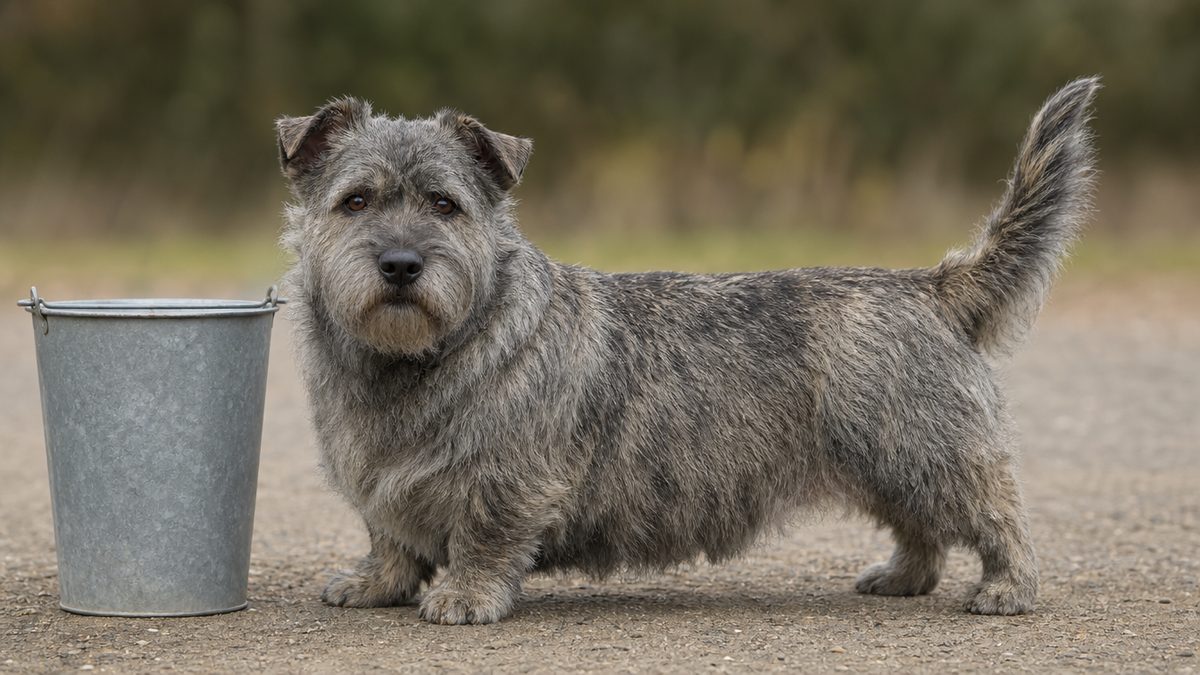
A Glen of Imaal Terrier is Ireland's only short-legged terrier, a medium-sized working dog built longer than high and low to the ground, registered by the Federation Cynologique Internationale as Standard No. 302 under the fuller name Irish Glen of Imaal Terrier, in Group 3 Terriers, Section 1, without working trial.
Origin on the standard's own face is Ireland, the currently valid text was published on 3 September 2024, and the FCI nomenclature record returned for number 302 prints IRISH GLEN OF IMAAL TERRIER in its own title, which is the check this site runs every time because an FCI URL resolves on its trailing number and will serve another breed's document without erroring.
The shape is the breed, and the standards describe it precisely
The FCI gives the important proportion in six words: Body longer than high and low to the ground. The American standard puts a number on it, requiring the length of body from sternum to buttocks and the height at the shoulder blades to sit in a ratio of approximately 5 to 3. Both describe short legs: the FCI says forelegs short, bowed and well boned with front feet turning out slightly from the pasterns, and the American text adds that the forearm should curve slightly around the chest.
| Measure | FCI Standard No. 302 | Royal Kennel Club | AKC |
|---|---|---|---|
| Height, dogs | 14 in (35.5 cm) maximum | 35 to 36 cm (14 in) maximum | 14 in maximum, 12.5 in minimum |
| Height, bitches | Accordingly less | Same maximum as dogs | Same as dogs |
| Weight, dogs | 35 lb (16 kg) | Not stated | Approximately 35 lb |
| Weight, bitches | Accordingly less | Not stated | Somewhat less |
| Body length | Longer than high, low to ground | Slightly longer than height at withers | Length to height about 5 to 3 |
Only the American standard sets a floor. The FCI and the Royal Kennel Club both cap the height and say nothing about a minimum, so a Glen shorter than 12.5 inches would be outside the AKC standard and inside the other two The Royal Kennel Club Federation Cynologique Internationale. The AKC's own breed page rounds the practical range to 12.5 to 14 inches and 32 to 40 pounds.
Coat, colour and the one colour that disqualifies
The coat is medium length, of harsh texture with a soft undercoat, and may be tidied to present a neat outline, which the AKC characterises as that of a rough-and-ready working terrier while warning that over trimming is undesirable. It is a genuine double coat, and the Royal Kennel Club records shedding for this breed as No The Royal Kennel Club.
Colour runs to blue brindle not toning to black, and wheaten from a light wheaten to a golden reddish shade, with puppies often born darker and clearing with maturity. The Royal Kennel Club's breed standard colour list gives Blue, Blue Brindle, Brindle and Wheaten, in Colour Watch Category 0, meaning no non-breed-standard colour registration options exist.
The FCI's disqualifying faults for this breed include Black & Tan colour. On the Gordon Setter, built in the same batch as this page, deep shining coal black with chestnut tan markings is the only colour any standard permits. The same two words are a disqualification in one breed and the entire identity of the other.
The ears are the second identifying feature and they are not a terrier cliche. The standard asks for small rose or half pricked when alert, thrown back when in repose, and calls a full drop or a full prick ear undesirable. That matters practically in India, because a rose ear leaves the canal far better ventilated than the drop ear that carries most Indian ear disease.
Ireland recognised this breed 41 years before the FCI did
The Irish Kennel Club gave the Glen of Imaal Terrier official recognition in 1934, the Federation Cynologique Internationale accepted it on a definitive basis on 17 September 1975, and the American Kennel Club's official standard for the breed was approved on 11 June 2001 and took effect on 1 September 2001 Federation Cynologique Internationale American Kennel Club.
That sequence is unusual and it is worth stating in the order it happened, because most breed pages present the international registries first and Ireland as an afterthought. Here the national club moved first by four decades.
| Date | What happened | Source document |
|---|---|---|
| 17th century | A terrier of this type known in the locality | Royal Kennel Club breed history |
| 1934 | The Irish Kennel Club gives the breed official recognition, at Dublin's St Patrick's Day show, shown in Any Variety | FCI Standard No. 302 and the Royal Kennel Club |
| 1935 | Breed classes gained at the same show | Royal Kennel Club breed history |
| Until 1966 | A working certificate was required before the title of Champion, to prove courage and gameness | Royal Kennel Club breed history |
| 17 September 1975 | FCI acceptance on a definitive basis, authentic language English | FCI nomenclature record for number 302 |
| 11 June 2001 | AKC official standard approved, effective 1 September 2001 | AKC official standard |
| 3 September 2024 | Current FCI standard published | FCI Standard No. 302 |
The 1934 date has two independent sources that agree. The FCI standard's own brief historical summary states that The Irish Kennel Club gave official recognition to the breed in 1934 and a club to promote its interests was soon formed. The Royal Kennel Club adds the detail: the Glen was recognised at Dublin's St Patrick's Day show in 1934 where they were shown in Any Variety and gained breed classes at the same show in 1935.
The working certificate, and the year it ended
One line in the Royal Kennel Club's history explains what kind of dog this was meant to be. In Ireland, until the banning of badger trials in 1966, the Glen had to obtain a working certificate to prove its courage and gameness, before it could achieve the title of Champion. A show title was gated on proven work for the first thirty-two years of the breed's registered existence.
The FCI standard is blunter still about what the earlier centuries looked like. It describes a local dog confined to the bleak area of the Glen of Imaal, kept by farmers descended from soldiers given land in the 16th and 17th centuries, which had to spend long hours propelling dog wheels and was often pitted against other dogs in the dubious sport of dog fighting, customs now disappeared. DogsIndia's own page for the breed says the same thing in one sentence, that it was once a very popular dog, used even in Dog fights.
Where India sits in this
India's national kennel club is a Full member of the FCI, listed as the Kennel Club of India, Nr 28, AA Block First street, Anna Nagar, Chennai. It issues pedigrees against FCI nomenclature, and the Glen of Imaal Terrier holds FCI Standard No. 302, so KCI registration of the breed is possible in principle Federation Cynologique Internationale.
What cannot be verified from any public source is whether a KCI-registered Glen of Imaal Terrier litter has ever existed. The KCI publishes no per-breed register a reader can query, which means a search there returns nothing for this breed and nothing for every control breed too, so it is a broken instrument rather than a finding. The honest statement is that the route exists on paper and no evidence of its use is publicly available.
A breed recognised by its own national club in 1934 has ninety years of pedigree records behind it, which is why DNA test results and eye certificates can be traced back through a line at all. That paperwork is the thing a buyer is actually purchasing when they buy a rare breed, and it is exactly what an unregistered dog sold as this breed in India would not have.
A vulnerable native breed at 61 registrations, and a cross-check that agrees
The Glen of Imaal Terrier is a UK vulnerable native breed, and it recorded 61 registrations in 2025 against a threshold of 300, having never once in the decade exceeded 115 The Royal Kennel Club.
The Royal Kennel Club sets and states the thresholds itself. It created the vulnerable native British and Irish breeds list (breeds with fewer than 300 registrations a year) and the 'at watch' list (breeds with between 300 and 450 registrations a year), and defines the category as dog breeds of British and Irish origin that are considered to be vulnerable due to their declining registration numbers. Irish origin is inside the gate, which is why an Irish breed appears on a British registry's conservation list at all.
The series, from the group PDF
Figures below are read from Comparative Tables of Registrations for the Years 2016 to 2025 Inclusive, terrier group, the Royal Kennel Club's own PDF, extracted with pypdf rather than a scraping tool, because an extraction layer has silently dropped rows from a Kennel Club statistics PDF before.
| Breed | 2016 | 2018 | 2020 | 2021 | 2022 | 2023 | 2024 | 2025 |
|---|---|---|---|---|---|---|---|---|
| Glen of Imaal Terrier | 76 | 48 | 36 | 83 | 115 | 58 | 92 | 61 |
| Kerry Blue Terrier | 168 | 117 | 161 | 156 | 122 | 96 | 77 | 57 |
| Irish Terrier | 326 | 384 | 389 | 457 | 359 | 244 | 295 | 308 |
| Soft Coated Wheaten Terrier | 326 | 307 | 243 | 277 | 168 | 156 | 130 | 92 |
| Dandie Dinmont Terrier | 91 | 145 | 87 | 123 | 112 | 102 | 81 | 88 |
| Skye Terrier | 28 | 50 | 27 | 75 | 71 | 36 | 71 | 45 |
Across the full decade the Glen accounts for 702 registrations, an average of 70.2 a year, with a low of 36 in 2020 and a high of 115 in 2022. In 2025 it made up 61 of the terrier group's 14,963 registrations, which is 0.41 percent of the group.
Unlike its gundog counterpart, this breed did take part in the pandemic boom. The terrier group rose from 18,259 in 2020 to 24,498 in 2021, up 34.2 percent, and the Glen rose from 36 to 83, up 130.6 percent. From so small a base that is volatility rather than recovery, and the 2025 figure of 61 is 19.7 percent below its own 2016 figure of 76.
The web table and the PDF were cross-checked, and this breed is clean
This site has recorded that the Royal Kennel Club's web tables and its group PDFs disagree, and that the known bad cells sit in the terrier and toy groups, so the check was run here cell by cell rather than assumed. For the Glen of Imaal Terrier the two documents agree in all ten cells, 76, 48, 48, 85, 36, 83, 115, 58, 92 and 61 The Royal Kennel Club.
The rest of the group is not clean, and reporting that is what makes the agreement meaningful. Diffing all nineteen terrier breeds present on both documents found five differing cells: Bull Terrier (Miniature) reads 493 on the web against 172 in the PDF for 2016 and 143 against 185 for 2025, which is a straight transposition with the Bullmastiff's own web row of 172 and 185; Manchester Terrier 2019 reads 243 on the web against 133 in the PDF, a 110-dog gap; Dandie Dinmont 2021 differs by one; and Soft Coated Wheaten 2021 reads 227 against 277 The Royal Kennel Club.
The group's own arithmetic fails once too. Summing all 27 breed rows in the PDF reproduces the printed column total exactly in nine of ten years, and in 2023 the printed total of 18,211 exceeds its own rows by two, at 18,209.
Sixty-one puppies a year in the United Kingdom, on top of a small Irish population, is the supply that would have to feed every export market on earth. It is the reason the Indian half of this page reads the way it does. For scale, the Labrador Retriever recorded 29,919 UK registrations in the same year.
Glen of Imaal Terrier price in India: the first result is a book
No Glen of Imaal Terrier price in India exists to report, because no Indian page ranks on page one in India for the query at all. The first organic result is an Amazon.in listing for a 158-page hardcover book about the breed, and the nine behind it are American, Canadian, Irish and British.
That is a different failure from the usual one. On most rare breeds the Indian marketplaces do rank, with pages that turn out to contain no dogs of the breed. Here the engine has nothing Indian to serve, so it fills page one with the countries where the breed exists.
| Position | Source | Country | What it actually offers |
|---|---|---|---|
| 1 | Amazon.in | India | A book. 158-page hardcover, published 1 September 2003 |
| 2 | Glen of Imaal Terriers | United States | Pet puppies USD 3,900, show prospects from USD 4,250 |
| 3 | Adopt a Pet | United States | Adoption and breeder guidance |
| 4 | Emma | Canada | Breed reference page |
| 5 | Good Dog | United States | Marketplace, no price rendered on fetch |
| 6 | Dog Breeds List | United States | USD 1,500 to USD 2,200 |
| 7 | PetMD | United States | Health and care reference |
| 8 | Petfinder | United States | Adoption reference |
| 9 | GOITA | United Kingdom | The breed club's puppy guidance |
| 10 | Puppies.co.uk | United Kingdom | Breed information |
The only rupee figure on page one is a book price
The Amazon.in listing is for Mary Brytowski's Glen of Imaal Terrier: Special Rare-Breed Edition, A Comprehensive Owner's Guide, Companionhouse Books, 158 pages, ISBN 978-1593783204. On the day of the pull it showed a Kindle edition at Rs 471.45 and a used hardcover at Rs 7,468.55. Neither is a dog.
The search result advertising that listing carried the figure Rs 63,595. Opening the page found no such number anywhere on it. A snippet is drawn from a crawler's index, not from the live page, and this is exactly why Bonbeno opens every source rather than quoting the result list. Had that figure been copied across, this page would now carry a fabricated Indian price for a breed that has none, attached to a real and working link.
What the breed costs where it exists
Two foreign figures are verified and are reported in their own currency. A United States breeder publishes on its own adoption agreement page that our pet puppies cost $3900; show prospects start at $4250 USD, and adds a further USD 254 for AKC registration, a three-generation pedigree, microchipping and vaccinations. Dog Breeds List, a general reference, gives an average of USD 1,500 to USD 2,200.
The Good Dog marketplace page ranked fifth and rendered no price at all on fetch, so no figure is taken from it. That is recorded rather than filled in from its search snippet, for the reason above.
The one Indian page, and the number on it that cannot be right
One Indian marketplace does have a Glen of Imaal Terrier page. Puppiezo's is titled Glen of Imaal Terrier Price, Buy Rare Puppies in India, and its meta description promises KCI registered breeders, and it carries no price for the breed anywhere on it. What it does carry is a specification card, and the card is wrong in a way anyone can check.
| Field | Puppiezo | FCI Standard No. 302 | AKC standard |
|---|---|---|---|
| Height | 10 to 12 inches | 14 in (35.5 cm) maximum | 12.5 to 14 inches |
| Weight | 4 to 6 kg | 35 lb (16 kg) for dogs | Approximately 35 lb, 32 to 40 lb on the AKC breed page |
| Ideal space | Apartment | Not addressed | Not addressed |
| Exercise | 30 to 45 minutes daily | Not addressed | Not addressed |
| Life expectancy | 12 to 14 years | Not addressed | 10 to 15 years on the AKC breed page |
A 16 kg standard against a 4 to 6 kg listing is a factor of roughly three. DogsIndia's own entry for the breed, written decades ago, gets it right, saying the dog weighs about 16 kgs and is about 36 cms tall. Puppiezo's height ceiling of 12 inches also falls below the AKC's stated minimum of 12.5 inches, so the animal on its spec card is not this breed at any point in the range.
Bonbeno therefore publishes no rupee figure for this breed and will not convert a foreign one. The breed is neither affordable nor expensive in India, because nothing is for sale here: the honest answer to what a Glen of Imaal Terrier costs in India is that the question has no market behind it.
No Indian supply, proved four ways with working controls
No lawful commercial supply chain for the Glen of Imaal Terrier exists in India, and the proof runs through four separate documents, each with a control that shows the instrument works Breed n Breeder, Gordon Setter page Wrapinfur, Dog Price List in India 2026 Directorate General of Foreign Trade.
One, the breeder directory, reached through its own index
DogsIndia has carried Indian breeder listings since long before the marketplaces existed. Its Glen page reads, under Breeders' List, that There are no breeders listed currently under this breed.
That zero was nearly not earned. An assembled URL at glen_of_imaal_terrier.htm returns 404, and a 404 on a guessed address proves only that the guess was wrong. The site's own breed_list index gives the real path, glen_of_imaal.htm, and that page returns 200 and prints the breed name in its own title DogsIndia, Glen of Imaal breed page…. The control that makes the zero mean something is the same directory's English Setter page, fetched in the same session, which does carry a live breeder listing in Erode, Tamil Nadu.
Two, the marketplace that lists every breed except this one
Breed n Breeder's breed selector holds 295 unique breed names, and it includes the Gordon Setter, the Kerry Blue Terrier, the Soft Coated Wheaten Terrier and a misspelled Dendie Dinmont. It contains no Glen of Imaal Terrier at all. A dropdown that stretches to 295 entries and omits this one is not an oversight about a common dog.
Three, the national price table with no row
Wrapinfur's Dog Price List in India 2026 covers more than 50 breeds, and a case-insensitive search of the whole page returns zero occurrences of Glen and zero of Imaal, against 27 for Labrador. The table renders and the search works. It simply has no row for this breed.
Four, import law closes the last route
DGFT Trade Notice No. 22/2022-23 of 19 December 2022 places dogs under ITC (HS) 01061900, Mammals: Other, Import Policy Restricted. Policy Condition (7) reads: Import of dogs is allowed only for the following specific purposes: i. Pet dog with valid pet book and relevant records/documents in the name of importer. ii. Dogs imported by the R&D Organisations for conducting research with the recommendation of CPCSEA. iii. For the internal security by the Defence and Police Force.
Policy Condition (8) adds that import of commercial dogs for breeding or any other commercial activities other than the purposes mentioned above is not permitted, and paragraph 6 instructs that applications for trading or breeding purposes, or made on behalf of another person or entity, shall be duly rejected.
- The pet route. Up to two pets may enter as passenger baggage without a DGFT authorisation, but only for a person transferring residence to India after two years of continuous stay abroad.
- The authorisation route. Required for a shorter stay, a temporary import, or more than two animals, applied for at least two months before travel.
- The breeding route. Does not exist. It is the case the notice names and rejects.
- Entry points. Import of pet animals is allowed only through the airports and seaports of Delhi, Mumbai, Chennai, Hyderabad, Bengaluru and Kolkata and, since October 2024, Kochi airport, with an advance NOC from the AQCS quarantine officer at that port Department of Animal Husbandry….
The one Indian page that exists for this breed advertises KCI registered breeders in its meta description while carrying no Glen of Imaal Terrier and no price. India is a Full member of the FCI through the Kennel Club of India, so a KCI pedigree is possible in principle. Ask any seller to produce the registration certificates for both parents before a rupee changes hands, and treat the word alone as worth nothing.
The carousel proof, run across two breeds on the same site
The availability block on the one Indian Glen of Imaal Terrier page is site furniture, not stock, and the way to prove it is to open a second breed page on the same site and compare the two lists animal by animal.
Puppiezo's Glen of Imaal Terrier page carries a block headed Other Available Pets with eight animals in it. Its Gordon Setter page, a completely unrelated 29 kg Scottish gundog, carries the same eight animals, in the same order, at the same prices Puppiezo, Gordon Setter Puppies For Sale.
| Name | Breed actually offered | Price |
|---|---|---|
| Fizey | Maltipoo | Rs 98,999 |
| Kuzo | Poodle | Rs 92,599 |
| Dugu | Poodle | Rs 92,599 |
| Kazuka | Cane Corso | Rs 94,999 |
| Doir | Goldendoodle | Rs 1,20,000 |
| Samy | Maltipoo | Rs 98,999 |
| Tugi | Rottweiler | Rs 76,499 |
| Yoki | Doxiepoo | Rs 98,999 |
Not one of the eight is a terrier, and Rs 98,999 appears three times on a single page. This site has now recorded that same figure across eleven separate pages of the same listing site, attached to whichever puppy happens to be in stock. It is a house price point rather than any breed's price, and it does not even resolve as a conversion, dividing to 1,173.25 United States dollars at the rate this site tests first.
Why this test is worth running rather than assuming
The comparison is cheap and it settles the question in one step. A block that is genuinely breed availability changes between breed pages. A block that is identical across a 16 kg Irish terrier's page and a 29.5 kg Scottish gundog's page is a template, and no price inside it describes either animal.
The consequence matters beyond one website. When an answer engine is asked what a rare breed costs in India, these are the pages available to it, and a figure lifted from that carousel becomes a quoted market rate for a breed nobody in the country has. Naming the mechanism is more useful to a reader than any price would be.
The same Puppiezo Glen page appears in the site's Best Guard Dogs in India listing. The FCI standard for this breed describes a dog that is gentle and docile, whose behaviour section stresses that it is silent when working and less easily excited than other terriers. A silent, docile 16 kg terrier is not a guard dog, and a category page that files it as one is not reading the standard.
Monthly cost in India: the lines you can name, the total nobody can source
No published Indian monthly cost estimate for a Glen of Imaal Terrier exists, and Bonbeno prints no rupee total rather than inventing one. The cost structure is nonetheless nameable, and for this breed it is driven by four things: a 16 kg dog on short legs, a harsh double coat that needs stripping rather than clipping, a hip register reading 25.2 percent dysplastic, and cooling Orthopedic Foundation for Animals.
The only Indian page for the breed publishes no monthly figure at all, and its weight field is wrong by roughly a factor of three, so any feeding estimate built on it would be wrong in the same direction. Between every page ranking for this term in India, the number of Indian monthly cost estimates for a Glen of Imaal Terrier is zero.
| Line | Why this breed generates it | Sourceable in rupees? |
|---|---|---|
| Food | A 16 kg adult on the FCI standard, not the 4 to 6 kg the one Indian page prints | No breed-specific Indian figure published |
| Grooming | A harsh medium-length coat with a soft undercoat, which the standards say may be tidied and the AKC says must not be over trimmed | No breed-specific Indian figure published |
| Orthopaedic care | 25.2 percent of 436 OFA hip evaluations dysplastic, and 15.1 percent of 106 front limbs lame on orthopaedic examination in a Finnish study | Depends entirely on the individual dog |
| Eye screening | An adult-onset cone-rod dystrophy with a DNA test and a Kennel Club scheme behind it | No Indian laboratory price could be sourced |
| Cooling | An Irish dog whose homeland averages 8.9 degrees Celsius against 23.7 to 27.9 across seven Indian metros | Household-specific, not a breed figure |
The screening line is the one that is missing from the UK too
Most rare-breed cost sections can at least point at a national screening scheme and say what it costs. Here there is a gap on the other side. The Royal Kennel Club Health Standard lists exactly one Good Practice item for this breed, prioritising genetic diversity, and two Best Practice items, a DNA test for progressive retinal atrophy (PRA crd3) and eye testing under the BVA/KC/ISDS Eye Scheme.
There is no hip scheme and no elbow scheme named for this breed at all, on a dog whose OFA hip row reads 25.2 percent dysplastic across 436 evaluations Orthopedic Foundation for Animals. A buyer who wants a hip score therefore has to ask for one that the breed's own registry does not routinely expect, which is a real and unusual thing to know before making the call.
Bonbeno could produce a confident-looking monthly figure by converting a foreign estimate or by copying a generic small-breed Indian number, and both would be fiction attached to a citation. The honest answer is that this breed has no Indian cost literature because it has no Indian population. Price the five lines above with your own vet and groomer, and treat any quoted all-in monthly figure for a Glen of Imaal Terrier in India as unsourced Wrapinfur, Dog Price List in India 2026.
Heat tolerance: an 8.9 degree glen against a 27.9 degree city
Rate the Glen of Imaal Terrier 2 out of 5 for heat tolerance in India, because the Glen of Imaal in County Wicklow, the valley the breed is named after and was confined to, averages 8.9 degrees Celsius across the year while Chennai averages 27.9, and Bengaluru's coolest month is warmer than a Wicklow July Federation Cynologique Internationale.
The origin point is unusually exact for a breed page, because the standard supplies it: the FCI describes very much a local dog, confined to the bleak area of the Glen of Imaal. Queried at 52.983 N and 6.567 W, elevation 175 m, NASA POWER's 2001 to 2020 climatology returns an annual mean 2 m air temperature of 8.9 degrees Celsius, a July mean of 14.7, a February mean of 4.1, and an annual mean relative humidity of 90.4 percent. Coordinates were supplied explicitly so that no place name could be substituted by accident.
| Place | Annual mean | Warmest month | Coolest month | Annual mean RH | Peak monthly wet-bulb |
|---|---|---|---|---|---|
| Glen of Imaal, Wicklow | 8.9 C | 14.7 C (July) | 4.1 C (February) | 90.4% | 13.1 C (July) |
| Bengaluru | 23.7 C | 28.4 C (April) | 20.2 C (December) | 67.9% | 21.9 C (May) |
| Pune | 23.9 C | 28.9 C (April) | 19.6 C (December) | 66.8% | 23.0 C (June) |
| Delhi | 25.6 C | 35.9 C (June) | 13.6 C (January) | 45.6% | 26.5 C (July) |
| Kolkata | 25.8 C | 31.5 C (May) | 17.3 C (January) | 73.9% | 27.1 C (June) |
| Hyderabad | 26.1 C | 33.3 C (May) | 20.8 C (December) | 60.3% | 23.3 C (June) |
| Mumbai | 26.8 C | 31.2 C (May) | 23.2 C (January) | 67.4% | 25.8 C (June) |
| Chennai | 27.9 C | 31.5 C (May) | 24.1 C (January) | 72.4% | 26.1 C (May) |
Bengaluru's coolest month, December, averages 20.2 degrees Celsius, which is 5.5 degrees warmer than the warmest month Wicklow offers. Chennai in January, its coolest month, sits 9.4 degrees above a Glen of Imaal July. No Indian city and no Indian month falls inside this breed's origin range.
Humidity is the wrong number, and wet-bulb is the right one
The Glen of Imaal is wetter than India. At 90.4 percent annual mean relative humidity it is more humid than every Indian city in the table, including Kolkata at 73.9 percent. Raw humidity therefore misleads, because a dog sheds heat by evaporation and evaporation depends on temperature and humidity together. Wet-bulb figures above are computed from the NASA POWER monthly means using Stull's 2011 approximation.
The Glen of Imaal's peak monthly wet-bulb is 13.1 degrees Celsius. Kolkata's is 27.1, Delhi's 26.5 and Chennai's 26.1 Stull R. Wet-Bulb Temperature from Relative…. Kolkata's peak is 2.07 times the Irish one. Even Bengaluru, the mildest large Indian city here, sits 8.8 degrees above it. A dog under a harsh double coat with a soft undercoat has roughly half the evaporative headroom its body plan assumes.
How dogs actually get heat illness, from 905,543 records
Reviewing 905,543 UK dogs under primary veterinary care in 2016, Hall and colleagues identified 1,259 heat-related illness events from 1,222 dogs. Of 1,259 events, 380 had no trigger recorded, and of the remaining 879, exertional heat illness accounted for 652, or 74.2 percent. Environmental heat accounted for 113 events at 12.9 percent and confinement in a vehicle for 46 at 5.2 percent. The paper's own conclusion is that in the UK exertional heat illness affects and kills more dogs than hot cars do.
That reframes the exercise question for this breed. The Royal Kennel Club puts the requirement at up to 1 hour per day, which is modest, and a modest requirement is much easier to schedule around the heat than a gundog's two hours. The risk here is not that the dog needs too much exercise. It is that a low, heavy, short-legged dog carries its chest close to hot ground and has very little clearance in which to lose heat.
The Gordon Setter, built in the same batch as this page, comes from Gordon Castle in Moray at an annual mean of 7.6 degrees Celsius and needs more than two hours of exercise a day The Royal Kennel Club. This breed comes from a place 1.3 degrees warmer and needs less than half the exercise. Neither is heat-tolerant, and of the two the Glen is the one an Indian household could realistically schedule around.
Managing the heat on a dog that runs close to the ground
Manage this breed's heat load by managing the surface it walks on, because a dog whose standard requires a body low to the ground carries its chest and belly within centimetres of Indian pavement that has been absorbing sun all day.
The Finnish measurements give the clearance a number. Across 53 Glens, mean height at the withers was 32 cm and mean height at the olecranon, the point of the elbow, was 18 cm. A dog whose elbow sits 18 cm off the ground is working inside the hottest layer of air there is on a summer afternoon, and no coat decision changes that.
What Indian law already says about housing a dog by its breed
The Prevention of Cruelty to Animals (Dog Breeding and Marketing) Rules, 2017, Second Schedule Part IV paragraph 15, headed Ambient and comfortable temperature, requires that the temperature within indoor housing facilities for animals shall be ambient and comfortable, depending on the breeds of dogs that are housed insides, and that it be such as provides for their health and well-being. Paragraph 16 accepts air conditioning as a means of meeting the ventilation requirement.
Paragraph 21(1) bars keeping certain dogs in outdoor facilities without written approval from the attending veterinary practitioner, naming dogs that are not accustomed to the temperatures prevalent in the area or region in question and dog breeds that cannot tolerate the temperatures prevalent in the area or region in question, such as long-haired breeds in high temperature locations. This breed's medium-length harsh coat is not long-haired, but the first limb of that clause fits an Irish valley dog in Chennai exactly.
City by city, for this breed
- Bengaluru and Pune are the only comfortable Indian options, at annual means near 23.8 degrees Celsius and peak wet-bulbs below 23.
- Delhi gives this breed a real winter at a 13.6 degree January and the worst summer on the list at a 35.9 degree June.
- Chennai, Mumbai and Kolkata never let up. Chennai's coolest month averages 24.1 degrees Celsius, so there is no season of relief.
- Hyderabad sits between them, with a 20.8 degree December and a 23.3 degree wet-bulb peak in June.
What actually works
- Walk on grass or shaded ground, and test the surface with the back of your hand first. An 18 cm elbow height means the dog is in contact with radiated ground heat that a person standing beside it never feels.
- Move the whole hour to first light, which the Royal Kennel Club's up-to-one-hour requirement makes genuinely practical.
- Cool the dog with airflow rather than with a cold floor alone. Ventilation by fan or air conditioning is what the Rules themselves name.
- Never clip the double coat down. A harsh topcoat over a soft undercoat is radiant-heat protection as well as insulation, and the AKC standard already warns that over trimming is undesirable.
- Treat a hard pant that does not settle within minutes of stopping as an emergency, because exertional events were the largest group in the largest study there is.
The ears. The standard asks for small rose or half pricked ears and calls a full drop ear undesirable, so the canal stays ventilated. In an Indian series of 1,008 otitis externa cases from 76,161 dogs at the Veterinary College, Hebbal, Bengaluru, drop-eared dogs carried 47.72 percent of cases against 28.07 percent for prick ears, and the rainy season carried 41.87 percent of all cases. This is one of the few imported breeds whose ear shape is on the right side of that number.
Temperament: game when asked, docile the rest of the time
The Glen of Imaal Terrier's temperament is set out in one line that all three standards share: Game and spirited with great courage when called upon, otherwise gentle and docile The Royal Kennel Club American Kennel Club.
The FCI adds the two sentences that actually describe living with one. The breed is active, agile and silent when working, and it oozes personality, with a loyal and affectionate nature that makes it a very acceptable house dog and companion. It is said to be less easily excited than other terriers, though he is always ready to give chase when called on.
Silent when working is the unusual half of that. Most earth-working terriers give tongue underground; this one does not, and the Royal Kennel Club records the breed as a small dog suited to a small house with a small or medium garden, in the country rather than the town. A quiet terrier that suits a small house is a rare combination, and it is the strongest argument the breed has for Indian apartment life.
| Question | Royal Kennel Club and FCI | Indian and US reference pages |
|---|---|---|
| Size of home | Small house, small or medium garden | Ideal space: apartment |
| Town or country | Country | Not stated |
| Exercise | Up to 1 hour per day | 30 to 45 minutes daily |
| Noise | Silent when working | Barking tendencies rated 1 star, rare |
| Guarding | Gentle and docile, always ready to give chase | Filed under Best Guard Dogs in India |
| Other pets | Ready to give chase when called on | Cat friendly rated 1 star out of 5 |
The one point on which the sources genuinely agree, and which an Indian buyer should take seriously, is prey drive. The FCI says the dog is always ready to give chase, and the United States reference page rates the breed 1 star out of 5 for cat friendliness while giving it 4 stars for children Dog Breeds List, Glen of Imaal Terrier. In a country where free-roaming cats are on most streets, that is a lead-and-recall problem rather than a personality flaw.
Who should buy one, and who should not
- Buy one if you live in Bengaluru, Pune or a hill station, want a quiet, sturdy, docile dog that will settle indoors, and can walk it at first light every day.
- Buy one if you can accept a genuine terrier prey drive on a lead in an Indian street, and you have no cat.
- Do not buy one for a household that wants a guard dog, because the standard's own words are gentle and docile.
- Do not buy one expecting the 4 to 6 kg lap dog the one Indian page advertises. It is a 16 kg working terrier with heavy bone Puppiezo, Glen of Imaal Terrier Price.
- Do not buy one from any page in the current Indian result set, because there is no Indian result set for this breed.
A terrier that works silently underground is a terrier that does not bark at every doorbell. On a shared Indian apartment wall that is worth more than most of the traits people shop for, and it is stated in the breed standard rather than in a marketing panel.
Two words worth using carefully. This is a hardy dog in an Irish valley that averages 8.9 degrees Celsius, and hardiness in cold and wet does not transfer to a country whose mildest large city never drops below a 20.2 degree monthly mean. And it is a trainable dog in the house rather than an obedient one in the field, because a terrier bred to work out of sight of its handler forms its own opinions.
Training: build recall against a chase instinct, not against boredom
To train a Glen of Imaal Terrier, finish recall before anything else, because the breed standard's own description of the temperament ends with the clause that matters most to a handler: the dog is always ready to give chase when called on.
This is a dog bred to go to ground after badger and fox, and to work in silence while it does it The Royal Kennel Club. Both halves of that show up in training. The drive to dig and to hunt does not switch off in a suburb, and a dog that works quietly gives its handler less warning than a noisier terrier would.
| Window | What to train | What to expect |
|---|---|---|
| 8 to 16 weeks | Name, lead, crate, handling of feet and forelegs, calm greetings | Fast learning, no reliability. Socialise deliberately |
| 4 to 8 months | Recall on a long line, a reliable settle, tolerance of grooming | Growth plates are still open. Keep impact low |
| 8 to 18 months | Recall against live distraction, loose lead, leave-it around cats | The prey drive arrives properly. This is the work |
| 18 months onward | Consolidation, scent games, controlled digging in a sandpit | A steady adult that will still chase if given the chance |
Give the digging somewhere to go
A terrier denied any outlet for digging will find one, and in an Indian flat that means furniture and bedding. Build a digging box or a corner of the garden the dog is allowed to use, bury things in it, and reward the dog for working there. That is a management decision rather than an obedience problem, and it costs almost nothing.
What this breed resists
- Repetition without purpose. A terrier bred to make its own decisions underground disengages from drills faster than a biddable gundog does.
- Recall on cue alone, against a live animal. The standard says the dog is always ready to give chase; a long line stays on until that is proven.
- Impact work while young. A breed carrying front limb angular deformity as a normal feature of its conformation should not be doing repeated jumps as a puppy.
- Hot-weather sessions. Exertional heat illness was the trigger in 652 of the 879 UK events with a recorded trigger.
A dog that accepts having its front legs picked up, flexed and examined from eight weeks is a dog whose carpal joints actually get checked, and carpal pain was the commonest site of pain in the Finnish series at 11.3 percent of 106 limbs. On this breed, handling tolerance is a health intervention rather than a convenience.
Exercise: an hour is enough, and where it happens matters more
Plan up to one hour of exercise a day for an adult Glen of Imaal Terrier, which is the Royal Kennel Club's own figure on its breed page, and treat the surface and the time of day as more important than the distance.
| Source | Stated requirement | What it is |
|---|---|---|
| Royal Kennel Club breed page | Up to 1 hour per day | The registry that holds the UK breed standard |
| Puppiezo, Indian sales page | 30 to 45 minutes daily | A page carrying no Glen of Imaal Terriers |
| Dog Breeds List | Exercise needs rated within its own star scale | United States reference page |
An hour is a genuinely modest requirement for a working terrier, and it is the single biggest practical difference between this breed and most imported working dogs in India. What the hour is spent on matters more than its length, because a low, heavy, short-legged dog on hot tarmac is doing something different from the same dog on grass.
What happens without it
- Digging indoors. An unspent terrier redirects onto whatever is available.
- Weight gain on a compromised frame. Body condition is the cheapest lever there is on a breed with 25.2 percent dysplastic hips, and the WSAVA nine-point chart is how to score it rather than by eye.
- Stiffness in a dog that already has limited carpal flexion. The Finnish series measured the least carpal flexion of three chondrodysplastic breeds in this one, at 36 degrees.
- Loss of the recall. A terrier with unspent drive spends it on the environment, and in India the environment is full of things worth chasing.
Forty minutes on grass at first light and twenty minutes of scent work or a digging box indoors in the evening. That delivers the Royal Kennel Club's requirement without asking a dog with an 18 cm elbow height to work over hot ground Lappalainen AK, Pulkkinen HSM, Molsa S.
Grooming a harsh double coat that is meant to be tidied, not clipped
Groom a Glen of Imaal Terrier more than once a week, which is the Royal Kennel Club's stated interval, and tidy the coat rather than clipping it, because both the FCI and the American standards describe a harsh jacket over a soft undercoat that clipping permanently softens American Kennel Club.
The coat description is identical across the registries. It is medium length, of harsh texture with soft undercoat, and the coat may be tidied to present a neat outline, which the AKC qualifies as the outline characteristic of a rough-and-ready working terrier, adding plainly that over trimming of dogs is undesirable American Kennel Club.
The Royal Kennel Club records shedding for this breed as No The Royal Kennel Club. That is a statement about loose hair rather than about allergens, and no coat type makes a dog safe for an allergic household. It does mean an Indian owner sees less hair on the floor than a double coat would usually imply, and correspondingly more dead coat sitting in the jacket waiting to be stripped out.
The Indian humidity problem, and why this breed has less of it
Most imported coated breeds arrive in India with an ear problem, because a long-feathered drop ear over a warm damp canal is the standard mechanism. In an Indian series of 1,008 otitis externa cases drawn from 76,161 dogs at the Veterinary College, Hebbal, Bengaluru, drop-eared dogs carried 47.72 percent of cases, intermediate ears 24.21 percent and prick ears 28.07 percent, and the rainy season carried 41.87 percent of all cases against 32.83 percent in winter and 25.30 percent in summer.
This breed's standard asks for a small rose or half-pricked ear and calls a full drop ear undesirable, so it sits on the better side of that split. The humid monsoon problem it does have is the coat itself: a harsh jacket over a soft undercoat holds water at the skin, and a dog carried 18 cm off wet ground picks up more of it than a leggy dog does.
- Brush and comb through to the skin twice a week, not just over the top of the jacket.
- Hand strip rather than clip if you want the harsh texture the standard describes, and ask the salon before the first appointment whether it can.
- Dry the undercoat actively after any wet walk. Towel and air dry is a British instruction and it does not transfer to a monsoon.
- Check between the pads and the front feet, which the standard says turn out slightly and which therefore wear unevenly.
- Never shave the coat down for summer. It is radiant-heat protection as well as insulation.
Rule 8(3) of the Prevention of Cruelty to Animals (Dog Breeding and Marketing) Rules, 2017, in the main Rules under the heading Conditions for sale rather than in the Second Schedule, requires every breeder to screen prospective purchasers to ascertain their potential to take proper care of the breed, especially if it is a large one, to attend to its grooming, socialising, spatial and veterinary needs. A seller who asks a buyer nothing is not meeting that clause.
Health: the worst terrier hip figure in the OFA table, and no scheme for it
The Glen of Imaal Terrier's largest orthopaedic number is 25.2 percent dysplastic across 436 hip evaluations, which is the worst of any terrier published by the Orthopedic Foundation for Animals and nearly double the all-breeds figure of 14.2 percent, read under breed code GIT taken from OFA's own markup rather than guessed.
The code was read from the attribute pair value="GIT" data-name="GLEN OF IMAAL TERRIER" in OFA's breed selector, and every table below was confirmed to print the breed name on the row itself before a figure was taken from it. That check matters because a plausible guessed abbreviation returns another breed's statistics without erroring.
| Breed | Evaluations | Normal % | Dysplastic % |
|---|---|---|---|
| Glen of Imaal Terrier | 436 | 72.0 | 25.2 |
| West Highland White Terrier | 979 | 86.3 | 12.8 |
| Cairn Terrier | 222 | 91.4 | 8.1 |
| Kerry Blue Terrier | 1,930 | 93.8 | 5.3 |
| Soft Coated Wheaten Terrier | 7,801 | 94.6 | 5.0 |
| Dachshund | 505 | 94.7 | 4.8 |
| All breeds | 1,712,643 | 84.3 | 14.2 |
The Glen's own row adds up: Excellent 1.8, Good 39.2 and Fair 31.0 sum to exactly the printed 72.0 percent normal, and Mild 21.1, Moderate 3.9 and Severe 0.2 sum to exactly the printed 25.2 percent dysplastic. It is five times the Soft Coated Wheaten Terrier's rate and twice the West Highland White Terrier's, and it ranks 34th worst of the 220 breeds OFA publishes for hips.
The ALL BREEDS summary row on the hips table prints 84.3 percent normal with Excellent 14.6, Good 0.0 and Fair 0.0, components that cannot sum to that whole. Every individual breed row checked here does sum correctly, so the per-breed rows are the reliable ones and the 14.2 percent dysplastic figure is quoted from that aggregate with the caveat attached. OFA counts also move as evaluations are added, which is why the sample size is printed beside every percentage on this page.
And the breed's own registry names no hip test
The Royal Kennel Club Health Standard for this breed lists exactly one Good Practice item, prioritising genetic diversity, and two Best Practice items, a DNA test for progressive retinal atrophy (PRA crd3) and eye testing under the BVA/KC/ISDS Eye Scheme. There is no hip scheme and no elbow scheme named for the Glen of Imaal Terrier at all.
Compare that with the Gordon Setter, whose Good Practice list includes hip testing under the BVA/KC Hip Dysplasia Scheme on a breed whose OFA dysplastic rate is 18.7 percent, six and a half points better than this one. A buyer who wants a hip score on a Glen has to ask for something the breed's own registry does not routinely expect.
| Register | Evaluations | Result | Rank |
|---|---|---|---|
| Hips | 436 | 72.0% normal, 25.2% dysplastic | 34 of 220 |
| Elbows | 306 | 88.6% normal, 11.4% abnormal | 45 of 166 |
| Eyes, summary line | 509 | 95.9% normal, 4.1% abnormal | 129 of 237 |
| PRA cone-rod dystrophy 3 | 484 | 59.3% normal, 39.0% carrier, 1.7% affected | 1 of 1 |
| Degenerative myelopathy | 118 | 80.5% normal, 19.5% carrier, 0.0% affected | 93 of 111 |
| Patella, thyroid, cardiac | no published row | Fewer evaluations than OFA's publication threshold | not ranked |
Read the elbow row against the baseline before worrying about it: 11.4 percent abnormal sits below the all-breeds figure of 12.0 percent, and its grades break down as 10.1 percent Grade 1, 1.0 percent Grade 2 and 0.3 percent Grade 3, which sum to the printed 11.4. The degenerative myelopathy row is better news still: 19.5 percent carriers and no affected dogs at all across 118 tested, against an all-breeds picture of 21.3 percent carriers and 13.2 percent affected across 90,538, and against the Soft Coated Wheaten Terrier's 37.3 percent carriers and 18.5 percent affected.
Read as a set, the breed's health issues divide into three groups with very different evidence behind them. The hips and the front limbs are measured, published and worse than the terrier average. The eyes are measured, published, and managed by a DNA test that works. The spine is not measured at all. A buyer who treats those three as equally settled will worry about the wrong one Dickinson PJ, Bannasch DL. Current….
Life expectancy: 12.1 years, and a hazard ratio that means nothing
The largest UK longevity study gives the Glen of Imaal Terrier a median survival of 12.1 years, 95 percent confidence interval 11.6 to 13.5, built on 40 recorded deaths, against a crossbred median of 12.0 years McMillan et al. 2024.
Its hazard ratio against the crossbred reference group is 1.06 with a confidence interval of 0.78 to 1.44 and a p-value of 0.72. A confidence interval that wide, straddling 1, on 40 deaths, is a statement that the study could not distinguish this breed's mortality from a crossbred's in either direction. It is neither a long-lived breed nor a short-lived one on this evidence; it is an unmeasured one.
The paper's two supplementary tables disagree on how many dogs that median rests on. Table S3 gives 113 and Table S6 gives 64 alive plus 40 deceased for a total of 104 McMillan et al. 2024. The death count of 40 is identical in both, which is why the sentence above is built on deaths and the median rather than on a sample size the authors report two ways.
| Source | Figure | Basis |
|---|---|---|
| McMillan et al. 2024 | Median 12.1 years (11.6 to 13.5) | 40 recorded deaths in a UK dataset |
| Royal Kennel Club breed page | Over 10 years | A registry category, not a measurement |
| American Kennel Club breed page | 10 to 15 years | A five-year band |
| Dog Breeds List | 12 to 14 years | United States reference page |
| Puppiezo, Indian sales page | 12 to 14 years | A page carrying no Glen of Imaal Terriers |
Bonbeno prints the disagreement rather than averaging it. The only figure among these with a denominator attached is the 12.1-year median from 40 deaths, and it is also the least flattering, which is usually how it goes when a measured number meets a marketing one.
Two comparisons inside the same dataset
The Dandie Dinmont Terrier, the other long-backed vulnerable native terrier, has a median of 12.8 years from 66 deaths, and the Gordon Setter 12.4 years from 138. All three sit close to the crossbred median of 12.0 years, and only the Dandie and the Gordon have confidence intervals narrow enough to be worth arguing about.
Forty deaths is a small number, and a wide confidence interval on a rare breed is a statement about the evidence rather than about the dog. The useful reading is that nothing in the largest UK dataset flags this breed as dying early, and that no one should quote 12.1 years as a promise. Quote the interval with it, or quote neither McMillan KM, Bielby J, Williams CL.
Cone-rod dystrophy 3: 39 percent carriers, and the only breed in the table
The defining inherited disease of this breed is cone-rod dystrophy 3, or crd3, an adult-onset progressive retinal atrophy caused by a deletion in the gene ADAM9, and in the OFA register 39.0 percent of 484 tested Glen of Imaal Terriers are carriers, with a further 1.7 percent affected Goldstein O, Mezey JG, Boyko AR.
Two things make that number unusual. The first is its size: a carrier rate of nearly two dogs in five is very high for a screened population. The second is that the Glen of Imaal Terrier is the only breed OFA publishes in that table at all. Its ALL BREEDS row records 489 evaluations against the Glen's 484, so five dogs of every other breed on earth have been tested for this variant and none reaches OFA's publication threshold.
Two independent laboratories found the same deletion
A Cornell group set out to identify the causative mutation in a canine cone-rod dystrophy segregating as an adult onset disorder in this breed. A genome-wide association study placed a peak signal exceeding genome-wide significance on canine chromosome 16, and sequence analysis identified a large genomic deletion of over 20 kb that removed exons 15 and 16 from the ADAM9 transcript, introducing a premature stop.
A German group at the Ruhr University reached the same gene independently, mapping the candidate locus for generalised progressive retinal atrophy in the breed to canine chromosome 16, in a region syntenic with human chromosome 8, and finding a deletion of exons 15 and 16 which alters the reading frame leading to a premature stop codon. Crucially for a buyer, that paper reports that the mutation was absent from 34 other dog breeds.
| Finding | Detail | Source |
|---|---|---|
| Gene | ADAM9, on canine chromosome 16 | Both papers, independently |
| Mutation | Genomic deletion over 20 kb removing exons 15 and 16, premature stop | Goldstein et al. 2010 |
| Breed specificity | Absent from 34 other dog breeds tested | Kropatsch et al. 2010 |
| Mechanism | Failure of the apical microvilli of the retinal pigment epithelium to invest photoreceptor outer segments | Goldstein et al. 2010 |
| Onset by electroretinography | Retinal function normal in very young dogs; cone dysfunction present by 15 months, then both rod and cone function degenerate | Goldstein et al. 2010 |
| Clinical course | Variable and at times very late onset, with relatively mild degeneration at an advanced age | Kropatsch et al. 2010 |
| Human homologue | Orthologous to human cone-rod dystrophy 9 (CORD9) | Both papers |
The arithmetic, and what it does and does not show
OFA's 484 tested dogs break down as 59.3 percent clear, 39.0 percent carrier and 1.7 percent affected, which sums to 100.0. Those genotype proportions imply a mutant allele frequency of about 0.21 in the tested population. State the limit plainly: OFA's register is a self-selected sample of dogs whose owners chose to test them, not a random sample of the breed, so this describes the tested population rather than the breed as a whole.
What it does establish is that a large screened population exists, that carriers are common in it, and that the affected proportion inside it is low, which is what a recessive DNA test is supposed to achieve. The Royal Kennel Club runs an official scheme, listing a DNA test for progressive retinal atrophy (PRA crd3) among its Best Practice tests for the breed, alongside eye testing under the BVA/KC/ISDS Eye Scheme.
The United Kingdom breed club builds its buyer guidance around exactly this, telling prospective owners that the eye status of the parents should always be on the puppy's registration form and listing a Parent's DNA Eye Form among the documents a puppy should arrive with.
Ask for both parents' crd3 DNA results and both parents' eye examination certificates, in writing, with the registered names on them. crd3 is recessive, so a carrier bred to a clear dog produces no affected puppies and a carrier bred to a carrier does, and at a 39.0 percent carrier rate a carrier parent is close to a coin flip. A dog whose retina looks normal at a year old tells you nothing, because cone dysfunction in this disease is not measurable until about 15 months.
The front legs: 34 degrees of rotation, and what it costs the dog
The Glen of Imaal Terrier has the most front limb external rotation of any breed measured in the only study to compare three chondrodysplastic breeds directly, at a mean of 34 degrees with individual dogs reaching 75, and that rotation is associated with measurable pain and lameness rather than being merely cosmetic.
The study measured 224 front limbs from 112 dogs, of which 53 were Glen of Imaal terriers, alongside 30 Standard Dachshunds and 29 Skye terriers. The Glen group was recruited specifically because of breeders' concerns about the front limb conformation in the breed. That is the breed's own community asking the question, which is worth saying.
| Measure | Glen of Imaal Terrier | Skye Terrier | Standard Dachshund |
|---|---|---|---|
| Dogs measured | 53 | 29 | 30 |
| External rotation | 34 deg (0 to 75) | 27 deg | 20 deg |
| Carpal valgus | 22 deg (5 to 52) | 33 deg | 23 deg |
| Humeroradial angle | 74 deg | 61 deg | 78 deg |
| Elbow incongruity grade 0 | 27.3% | 3.7% | 8.3% |
| Elbow incongruity grade 2 | 4.7% | 31.4% | 10.0% |
| Elbow incongruity grade 3 | 0.0% | 7.4% | 3.3% |
| Elbow joint osteoarthritis | 0.0% | 35.2% | 6.7% |
| Lame on orthopaedic examination | 15.1% | 6.9% | 3.3% |
Two results in that table pull in opposite directions and both are real. On elbow incongruity the Glen is the best of the three, with the highest proportion of perfectly congruent elbows at 27.3 percent of 106 limbs, only 4.7 percent at grade 2 and no dogs at all at grade 3. Elbow joint osteoarthritis was found in none of the 106 Glen limbs, against 35.2 percent of Skye terrier limbs.
On lameness the Glen is the worst of the three. Lameness was detected on orthopaedic examination in 16 of 106 limbs, 15.1 percent, more frequently than in either other breed, and the commonest site of pain was the carpal joint at 12 limbs, 11.3 percent. Owners reported lameness before one year of age in 14 limbs, 13.2 percent, and after one year in 13, 12.2 percent. The breed also showed the least carpal flexion of the three at 36 degrees.
The paper's table of pain and lameness is captioned as proportions of dogs, but the percentages only reconcile on limbs: 16 divided by 106 is 15.1 percent, while 16 divided by 53 would be 30.2. This page therefore quotes limbs and prints the counts, so a reader can see exactly what each figure rests on.
The authors' conclusion is the practical one. Rotation, carpal valgus, elbow incongruity and the humeroradial angle were found to be independent of each other and were each associated with measurable clinical abnormalities including pain, lameness, limited range of motion and elbow joint osteoarthritis, which is why they propose that all four be used when choosing dogs suitable for breeding rather than incongruity grading alone.
The breed's own health committee has published twice in the Veterinary Record, a general health survey in 2014 and a Survey on foreleg problems in Glen of Imaal terriers in 2020 Seall A. Survey on foreleg problems in Glen…. Bonbeno could not obtain the full text of either, so no figure from them appears on this page. Their existence is the point: the foreleg is the thing this breed's own people have been counting.
Short legs and the spine: this breed has never been genotyped
The Glen of Imaal Terrier's disc-disease risk is unmeasured, not low, because the breed does not appear in the published FGF4 retrogene genotype table that separates short-legged breeds which get disc disease from short-legged breeds which do not.
The distinction that table exists to draw is the most useful thing anyone has established about short-legged dogs. Chondrodystrophy in dogs is produced by retrogene copies of the FGF4 gene, and the copy on canine chromosome 12 carries the disc-disease risk while the copy on chromosome 18 does not Batcher K, Dickinson P, Giuffrida M. Short legs alone predict nothing. Which gene copy produced them predicts a great deal.
| Breed | Dogs genotyped | CFA12 frequency | CFA18 frequency |
|---|---|---|---|
| Dachshund | 509 | 0.97 | 0.98 |
| Dandie Dinmont Terrier | 28 | 0.88 | 0.98 |
| Welsh Corgi, Pembroke | 63 | 0.83 | 0.98 |
| Skye Terrier | 13 | 0.77 | 1.00 |
| Mixed Breed | 678 | 0.19 | 0.18 |
| Scottish Terrier | 12 | 0.04 | 0.93 |
| Cairn Terrier | 10 | 0 | 0.95 |
| West Highland White Terrier | 10 | 0 | 1.00 |
| Norwich Terrier | 19 | 0 | 0.84 |
| Glen of Imaal Terrier | not in the table | not measured | not measured |
The word Imaal appears zero times in that paper. The table covers 57 breeds including four terriers with CFA12 at zero and two with it above 0.75, and this breed is in neither group because nobody has published its genotype.
Why that absence is the finding, not a gap
It would be easy, and wrong, to reason by resemblance. The Glen is long-bodied and low to the ground like the Dandie Dinmont Terrier, which carries CFA12 at 0.88, and unlike the Cairn Terrier, which is equally short-legged and carries it at zero. The correct conclusion from the table is that short legs do not tell you which side of it a breed sits on, which is precisely why importing the Dandie's figure onto this page would be fabrication wearing a citation.
The risk numbers make the stakes clear. In the largest genotyped series of surgical disc disease, covering 569 cases from 61 breeds plus 127 mixed-breed dogs, one copy of the CFA12 retrogene carried an odds ratio of 18.42 and two copies 44.23, while the CFA18 retrogene showed no significant effect on multivariable analysis. Those odds ratios were calculated in mixed-breed dogs where the variant segregates, and this breed was not one of the 61, so they describe the variant rather than the Glen.
Manage the back as though the risk were real, because the management costs almost nothing and the alternative is a bet on an absence of evidence. Block the furniture or add ramps, lay runners over polished Indian tile, keep the dog lean against the WSAVA nine-point chart, and treat a dog that suddenly will not jump, arches its back or drags a hind foot as a same-day veterinary case Batcher K, Dickinson P, Giuffrida M. If a breeder has run a CDDY genotype on the parents, ask for it, and understand that a result either way would be new information for the breed.
The eye register contradicts itself here too, by 14.4 points
OFA's eye register gives two incompatible answers for this breed on the same denominator of 509 examinations: the summary line says 95.9 percent normal, and the detail rows say 415 of 509, which is 81.5 percent, normal. Bonbeno publishes both with the arithmetic and quotes neither as the rate.
The gap is 14.4 percentage points, too wide to be rounding, and it is not unique to this breed. This site has now recorded the same shape on the Field Spaniel, English Shepherd, Entlebucher, Dandie Dinmont, Clumber Spaniel, Dogo Argentino and the Gordon Setter, always with a high summary percentage sitting above much lower detail rows on the same denominator.
Here the contradiction is provable twice over from inside the table. The summary says 4.7 percent abnormal on 509 examinations. Two separate detail rows each report 21 of 509, which is 4.1 percent, one for distichiasis and one for cataract of unknown significance, and a third reports 30 of 509, 5.9 percent, for findings suspected as not inherited. Any one of those three is close to or larger than the whole the summary describes, and together they plainly exceed it.
| Finding | Dogs | Percent |
|---|---|---|
| Normal | 415 | 81.5 |
| Other, suspected as not inherited | 30 | 5.9 |
| Distichiasis | 21 | 4.1 |
| Cataract, significance unknown | 21 | 4.1 |
| Punctate cataract, anterior cortex | 12 | 2.4 |
| Punctate cataract, equatorial cortex | 6 | 1.2 |
| Incipient cataract, anterior cortex | 5 | 1.0 |
| Retinal dysplasia, folds | 4 | 0.8 |
| Retinal dysplasia, geographic | 4 | 0.8 |
| Retinal atrophy, generalized | 4 | 0.8 |
| Entropion | 1 | 0.2 |
The row that connects this section to the last one is generalized retinal atrophy at 4 of 509, or 0.8 percent. That is the clinical endpoint of crd3, and it is low precisely because the DNA test catches carriers before affected puppies are bred. It is not evidence that the disease is rare in the breed, which the 39.0 percent carrier rate settles Goldstein O, Mezey JG, Boyko AR.
Distichiasis at 4.1 percent and cataract of unknown significance at 4.1 percent are the two commonest findings, and entropion appears in a single dog. Indian law names entropion and ectropion explicitly among the genetic defects a breeding dog must have been tested for, under Second Schedule Part III paragraph 8(10) of the 2017 Rules.
Writing that 96 percent of Glens have normal eyes uses a summary line its own detail rows contradict. Writing that only 81.5 percent do treats detail rows as if they were a clean prevalence. Quote both, show the division, and say the source is inconsistent.
The docked tail, the fighting history, and what Indian law says about both
The FCI standard for this breed opens its tail clause with a single word, Docked, and tail docking is prohibited outright in India, which puts the breed's own international standard and Indian law in direct conflict.
Tail docking: three standards, three positions
| Registry | Tail clause | Effect |
|---|---|---|
| FCI Standard No. 302 | Docked. Pups tails docked to half length. A natural tail (undocked) is allowed for in countries where docking is banned by law | Docked is the default; undocked is the exception |
| Royal Kennel Club | Docking previously optional, then separate descriptions for Docked and Undocked | Both described neutrally |
| American Kennel Club | Docked to approximately half-length, long enough to allow a good handhold. Dogs with undocked tails not to be penalized | Docked described, undocked protected |
India's position is not one of those three. Second Schedule Part II paragraph 6(8) of the Prevention of Cruelty to Animals (Dog Breeding and Marketing) Rules, 2017 reads, verbatim: There shall be no tail docking, ear cropping, de-barking, de-clawing, branding, dyeing, injecting substances to enhance visual appeal, performing a surgery or procedure to camouflage or hide any defect or infirmity or any other kind of mutilation of any body part of the pup and any change of appearance by artificial means is strictly forbidden.
That is a Second Schedule paragraph, not a Rule, and it should be cited that way. Its practical effect is simple: a Glen of Imaal Terrier lawfully bred in India has a natural tail, and the FCI's own text already accommodates that by allowing an undocked tail in countries where docking is banned. An Indian buyer shown a docked puppy of this breed is being shown either an imported dog or an offence.
The fighting history, and the clauses that now cover it
The FCI standard says the breed was often pitted against other dogs in the dubious sport of dog fighting, customs now disappeared, and DogsIndia's own page repeats that it was once a very popular dog, used even in Dog fights DogsIndia, Glen of Imaal breed page…. In India two separate clauses of the Prevention of Cruelty to Animals Act, 1960 cover that conduct, and they are not equivalent.
- Section 11(1)(m)(ii) punishes anyone who, solely with a view to providing entertainment, incites any animal to fight or bait any other animal.
- Section 11(1)(n) punishes anyone who organises, keeps, uses or acts in the management of, any place for animal fighting or for the purpose of baiting any animal, or permits a place to be so used, or takes money for admission.
- Section 31 makes clauses (l), (n) and (o) cognizable offences. So the venue offence is cognizable and the inciting offence is not, which is worth stating precisely rather than writing that dog fighting is simply a cognizable offence.
- The penalty is tiny and is rarely stated honestly. A first offence under section 11(1) carries a fine of not less than ten rupees and not more than fifty; a second within three years, not less than twenty-five and not more than one hundred, or up to three months, or both.
One date correction that matters if a page claims when this became illegal. Neither fighting clause existed in the Act as passed in 1960. The consolidated text's own footnotes record that clause (m) was substituted by section 10 of Act 26 of 1982 with effect from 30 July 1982, that the words for the purposes of his business were omitted from clause (n) by the same section on the same date, and that the penalty wording was substituted then too. Cite the Act by its year of enactment, but date the offence to 1982.
Because the breed's own international standard tells the story, and because a reader who takes the standard at face value could reasonably assume both the tail and the history are settled matters. In India neither is. The tail clause conflicts with a prohibition, and the history describes conduct that took its current statutory form in 1982 and carries a fifty-rupee first-offence maximum that would surprise most people The Prevention of Cruelty to Animals Act.
Feeding: 16 kg, not 5, and lean is the whole strategy
Feed a Glen of Imaal Terrier as a 16 kg dog, which is the weight the FCI standard gives for males, and score the result against the WSAVA nine-point body condition chart rather than by eye, because on a short-legged dog with 25.2 percent dysplastic hips lean condition is the cheapest intervention available Orthopedic Foundation for Animals.
Start by discarding the wrong number. The one Indian page for this breed prints its weight as 4 to 6 kg, against 35 lb or 16 kg in the FCI standard, approximately 35 lb in the American standard, 32 to 40 lb on the AKC breed page and about 16 kg on DogsIndia's own entry American Kennel Club DogsIndia, Glen of Imaal breed page…. A ration calculated from a 5 kg assumption underfeeds this dog by roughly two thirds.
The Finnish study measured live dogs and found a mean weight of 17.5 kg with a range of 8.3 to 24.8 kg across 53 Glens, so real dogs sit at and above the standard rather than below it. That range is worth knowing, because a 24.8 kg Glen on 32 cm legs is carrying a load its skeleton was not designed around.
| Rule | Reason | Source |
|---|---|---|
| Weigh the food rather than scooping it | The published Indian weight for this breed is wrong by a factor of three | Puppiezo against the FCI standard |
| Score body condition monthly on a 9-point chart | Lean condition protects hips already at 25.2 percent dysplastic | WSAVA and OFA |
| Keep growth steady rather than fast | Front limb angular deformity develops during growth | Lappalainen et al. 2022 |
| Re-weigh after any period of reduced exercise | A dog with limited carpal flexion moves less when sore, and gains | Lappalainen et al. 2022 |
| Do not free-feed in hot months | Appetite falls in heat and a topped-up bowl hides it | Practical, from the climate data above |
Water and heat
A dog whose origin climate peaks at a 13.1 degree wet-bulb and which now lives at 21.9 to 27.1 loses far more water to panting than its body plan assumes. Keep more than one water station, refresh rather than top up, and expect intake to move with the season.
Not one Indian source publishes a monthly food figure for a Glen of Imaal Terrier, and the only Indian page that exists gets the dog's weight wrong badly enough that any figure built on it would be meaningless Wrapinfur, Dog Price List in India 2026. Price a small-to-medium breed diet at your own retailer against the daily gram figure on the pack for a 16 kg dog.
The first year, month by month, with the Indian legal dates in it
Plan a Glen of Imaal Terrier's first year around three fixed points: no lawful sale below eight weeks, a vaccination course that Indian law expects to start at seven to eight weeks and finish around eighteen weeks, and a crd3 result that the eye itself will not reveal until about fifteen months.
Two of those dates come from the Prevention of Cruelty to Animals (Dog Breeding and Marketing) Rules, 2017, and it is worth naming which part of the document each sits in, because the Rules number their clauses twice. Rule 8, Conditions for sale, sub-rule (1)(a) requires that pups less than eight weeks in age are not sold. Second Schedule Part III paragraph 8(9), under Veterinary care, says All pups shall be vaccinated which can start at the age of seven-eight weeks, and are usually completed at the age of eighteen weeks.
| Age | What happens | What you do |
|---|---|---|
| 8 weeks | The earliest a puppy may lawfully be sold in India | Collect both parents' crd3 certificates and eye forms |
| 8 to 12 weeks | Socialisation window, and the coat is still soft | Handle the front legs and feet daily so examinations are easy later |
| 12 to 18 weeks | Vaccination course usually completes around eighteen weeks | Short walks on grass. No stairs, no jumping off furniture |
| 4 to 8 months | Growth. Front limb conformation is developing now | Keep growth steady and impact low. Score body condition monthly |
| 6 months | Indian law bars sale over six months without sterilisation, other than to a licensed breeder | Discuss timing with your vet |
| 8 to 18 months | Prey drive arrives properly. The adult jacket comes through | Recall on a long line against live distraction. Start hand stripping |
| 15 months | Earliest point at which cone dysfunction is measurable in an affected dog | An eye examination before this age cannot rule crd3 in or out |
| 18 months onward | A steady adult. Hip scoring becomes possible | Ask for a hip score even though the registry does not require one |
Rule 8(1)(b) adds the six-month line, requiring that dogs over six months in age are not sold without first being sterilised, unless they are being sold to another licensed breeder. And Second Schedule Part II paragraph 6(8) means the puppy's tail should be natural, because docking is forbidden outright in India whatever the FCI standard's default says Federation Cynologique Internationale.
What the first year will not tell you
crd3 is adult-onset. Electroretinography in the founding study found retinal function normal in very young affected dogs, with cone dysfunction present by 15 months and rod and cone function degenerating afterwards, and a second group described the onset as variable and at times very late. A clear eye examination on a puppy is not a clear crd3 result, and only the DNA test on both parents answers the question at the point of purchase.
Both parents' crd3 DNA certificates, both parents' eye examination results, the registration certificate and pedigree, a diet sheet, and the puppy's own inoculation and deworming record naming the attending veterinary practitioner, which Indian law requires the breeder to hand over. The United Kingdom breed club lists almost exactly that set, including a Parent's DNA Eye Form, so asking for it is asking for the normal thing.
Glen of Imaal Terrier against the breeds people cross-shop
Compared head to head against the three other Irish terriers and against the two short-legged terriers it most resembles, the Glen is the rarest, has the worst hips by a wide margin, is the only one with a breed-specific DNA test in its own OFA table, and is the only one whose spinal genotype has never been published Dickinson PJ, Bannasch DL. Current….
| Measure | Glen of Imaal | Kerry Blue | Soft Coated Wheaten | Dandie Dinmont | Cairn |
|---|---|---|---|---|---|
| UK registrations 2025 | 61 | 57 | 92 | 88 | 447 |
| Kennel club list status | Vulnerable native | Vulnerable native | Vulnerable native | Vulnerable native | At watch |
| OFA hips, dysplastic | 25.2% of 436 | 5.3% of 1,930 | 5.0% of 7,801 | no row | 8.1% of 222 |
| OFA elbows, abnormal | 11.4% of 306 | 9.3% of 322 | 8.2% of 1,004 | no row | no row |
| OFA eyes, summary abnormal | 4.1% of 509 | 2.6% of 273 | 2.8% of 2,859 | 3.0% of 232 | 9.2% of 2,127 |
| Breed-specific DNA test | crd3, 39.0% carriers of 484 | none in OFA's tables | none in OFA's tables | none in OFA's tables | none in OFA's tables |
| Degenerative myelopathy carriers | 19.5% of 118, 0% affected | 37.3% of 649, 8.8% affected | 37.3% of 480, 18.5% affected | no row | no row |
| CFA12 FGF4 genotype | never published | not in the table | not in the table | 0.88 of 28 dogs | 0 of 10 dogs |
| UK median lifespan | 12.1 yr, 40 deaths | not extracted | not extracted | 12.8 yr, 66 deaths | not extracted |
| Findable in India | No | No | Rare | No | Rare |
Against the Kerry Blue and the Soft Coated Wheaten, the two Irish terriers a buyer is most likely to compare it with, the Glen loses badly on hips and wins clearly on degenerative myelopathy. Its 25.2 percent dysplastic rate is roughly five times theirs, while its DM register shows 19.5 percent carriers and no affected dogs at all against the Wheaten's 37.3 percent carriers and 18.5 percent affected.
Against the Dandie Dinmont Terrier, the comparison is about what is known rather than what is worse. Both are long-backed vulnerable native terriers with similar registration numbers. The Dandie's CFA12 FGF4 frequency of 0.88 across 28 genotyped dogs tells its owner that the disc-disease variant is present at high frequency; the Glen's owner has no equivalent number in either direction.
Against the Cairn Terrier, the useful point is that short legs alone settle nothing. The Cairn is equally short-legged, carries CFA12 at zero across ten genotyped dogs, and is not a disc-disease breed, which is exactly why this page refuses to reason from the Glen's silhouette to its spine.
None of these six is easy to buy here and three are effectively absent. If the appeal is a small, quiet, sturdy dog that settles indoors and does not need a garden, that describes thousands of adoptable Indian dogs, none of which arrives with a 39.0 percent carrier rate for a retinal disease or a 25.2 percent hip figure. This page exists to describe the breed accurately, not to help anyone source one.
Eight mistakes Indian buyers make with this breed
Most Glen of Imaal Terrier mistakes in India happen before the dog arrives, and the commonest is believing a specification card that puts a 16 kg working terrier at 4 to 6 kg Federation Cynologique Internationale.
- Buying a lap dog and getting a 16 kg terrier. The one Indian page prints 10 to 12 inches and 4 to 6 kg. The FCI standard gives 14 inches maximum and 35 lb, and real dogs measured in Finland averaged 17.5 kg Federation Cynologique Internationale Lappalainen AK, Pulkkinen HSM, Molsa S.
- Taking a price from a search snippet. The snippet for the top Indian result advertised Rs 63,595; the page itself contains no such figure and is selling a book.
- Treating the availability carousel as stock. The identical eight animals, at identical prices, appear on that site's Gordon Setter page, and not one of them is a terrier.
- Buying it as a guard dog. The FCI standard's own words are gentle and docile, and the breed works in silence.
- Assuming short legs mean a bad back, or assuming they do not. The breed has never been genotyped for the FGF4 retrogene that separates the two groups, so both assumptions are guesses.
- Skipping a hip score because the registry does not ask for one. The Royal Kennel Club Health Standard names no hip test for this breed, and OFA records 25.2 percent of 436 evaluations as dysplastic.
- Accepting a clear puppy eye examination as a clear crd3 result. Cone dysfunction is not measurable until about 15 months, and 39.0 percent of tested dogs are carriers.
- Accepting a docked tail. Docking is prohibited outright in India, and the FCI standard itself allows an undocked tail where the law bans it.
Two more for owners rather than buyers
Letting the dog use the furniture is the first. A dog built to a 5 to 3 length-to-height ratio, with an elbow 18 cm off the floor, is loading a long lever every time it lands, and the cost of ramps is trivial against the cost of finding out whether the risk was real.
Ignoring a limp is the second. Lameness was found on orthopaedic examination in 15.1 percent of 106 Glen front limbs in the Finnish series, and the commonest site of pain was the carpal joint at 11.3 percent. On this breed a limp is a conformational finding until proven otherwise, not a strain that will settle.
Check whether the numbers are internally possible before you check whether they are right. A page that gives this breed a 12-inch height ceiling has already put it below the American standard's 12.5-inch floor, and a page that gives it 4 to 6 kg has put it at a third of every published weight. Neither error needs a source to catch. It needs one minute with the standard.
Adoption and responsible sourcing, when the breed is not here
There is no Glen of Imaal Terrier rescue in India and nothing to rescue, because India's oldest breeder directory records no breeders listed currently under this breed, no Indian marketplace stocks one, and no Indian page ranks for it. What follows are the three honest routes and the one route that does not exist.
Route one, adopt an Indian dog instead
Most people drawn to this breed are describing a temperament rather than a silhouette. They want a small, gentle, docile, quiet dog that settles indoors, tolerates a modest walk and does not bark at the door. Indian shelters have those dogs, they are already acclimatised to the wet-bulb figures in the climate table, and none of them arrives with a 39.0 percent carrier rate for a retinal disease.
Route two, breed rescue where the breed exists
The breed genuinely exists in Ireland and the United Kingdom, at 61 UK registrations in 2025 plus an existing adult population, and the United Kingdom breed club publishes buyer guidance for exactly this situation. For a household relocating to or from those countries that is a real route, and a rehomed adult removes the two biggest unknowns of a puppy purchase, because temperament is visible and hips can be scored.
Route three, bring your own dog when you move
DGFT Trade Notice No. 22/2022-23 permits a pet dog with valid pet book and relevant records/documents in the name of importer, and allows up to two pets as passenger baggage without a DGFT authorisation for a person transferring residence after two years of continuous stay abroad. Entry is through Delhi, Mumbai, Chennai, Hyderabad, Bengaluru, Kolkata or, since October 2024, Kochi, with an advance NOC from the quarantine officer at that port Department of Animal Husbandry…. The full route is set out in how to import a dog to India.
The route that does not exist
Importing a Glen of Imaal Terrier to breed from or to sell is not difficult, it is rejected. Policy Condition (8) states that import of commercial dogs for breeding or any other commercial activities other than the purposes mentioned above is not permitted, and paragraph 6 instructs that applications for trading or breeding purposes shall be duly rejected. Anyone offering to source Glen breeding stock into India commercially is describing something the notice forbids.
If you are buying abroad, verify these five things
- Both parents' crd3 DNA certificates, with registered names matching the pedigree, because 39.0 percent of tested dogs are carriers.
- Both parents' eye examination results under a recognised scheme, which the breed club says should appear on the puppy's registration form.
- A hip score for both parents, even though the Royal Kennel Club Health Standard does not name one for this breed.
- A front limb assessment, because rotation, valgus, incongruity and the humeroradial angle are independent of each other and each is associated with clinical signs.
- Sight of the dam with the litter, in person, on the premises where the puppies were raised.
Nothing on this page is an offer, a recommendation of any seller, or a link to a puppy listing. The commercial pages named above are cited as evidence of what the Indian market for this breed actually contains, which is one page with the wrong weight on it, and naming that honestly is more useful to a buyer than any price would be DogsIndia, Glen of Imaal breed page….
Glen of Imaal Terrier questions Indian buyers actually ask
How much does a Glen of Imaal Terrier cost?
No Indian price exists to report. No Indian page ranks on page one in India for the query, the one Indian marketplace page carries no price, and India's oldest breeder directory states there are no breeders listed under this breed. The first organic result is an Amazon.in listing for a book about the breed.
How big is a Glen of Imaal Terrier?
The FCI standard gives a maximum height of 14 inches or 35.5 cm for dogs and a weight of 35 pounds or 16 kg, with bitches accordingly less. Fifty-three dogs measured in a Finnish study averaged 17.5 kg and 32 cm at the withers. Any page giving 4 to 6 kg is wrong by roughly a factor of three.
Is the Glen of Imaal Terrier a good dog?
The breed standard describes a dog that is game and spirited with great courage when called upon, otherwise gentle and docile, with a loyal and affectionate nature that makes it a very acceptable house dog. It is rated 4 stars out of 5 with children and 1 star with cats on the United States reference page.
How rare is a Glen of Imaal Terrier?
Yes. The Royal Kennel Club classifies the breed as a vulnerable native breed, meaning fewer than 300 UK registrations a year, and it recorded 61 registrations in 2025. Across the full decade from 2016 to 2025 it accounts for 702 registrations, an average of 70 a year.
What is crd3 in Glen of Imaal Terriers?
crd3 is cone-rod dystrophy 3, an adult-onset progressive retinal atrophy caused by a genomic deletion of over 20 kb removing exons 15 and 16 from the ADAM9 gene on canine chromosome 16. It is recessive, it has a DNA test, and the Royal Kennel Club lists that test among its Best Practice tests for the breed.
How many Glen of Imaal Terriers carry crd3?
In the OFA register, 39.0 percent of 484 tested Glen of Imaal Terriers are carriers and a further 1.7 percent are affected. The Glen is the only breed OFA publishes in that table, and the mutation was absent from 34 other dog breeds when it was first described.
Do Glen of Imaal Terriers have back problems?
Nobody knows, and that is the honest answer. The breed does not appear in the published FGF4 retrogene genotype table that separates short-legged breeds which get disc disease from short-legged breeds which do not, so its risk is unmeasured rather than low. Manage the back as though the risk were real.
Do Glen of Imaal Terriers shed?
The Royal Kennel Club records shedding for this breed as No, on a medium-length coat of harsh texture with a soft undercoat. That is a statement about loose hair rather than about allergens, and it means more dead coat sits in the jacket waiting to be stripped out.
When did the Glen of Imaal Terrier become a recognised breed?
The Irish Kennel Club gave the breed official recognition in 1934, at Dublin's St Patrick's Day show, and it gained breed classes at the same show in 1935. The FCI accepted it on a definitive basis on 17 September 1975, and the American Kennel Club standard was approved on 11 June 2001.
How long do Glen of Imaal Terriers live?
The largest UK longevity study gives a median survival of 12.1 years with a 95 percent confidence interval of 11.6 to 13.5, built on 40 recorded deaths. Its hazard ratio against crossbred dogs is 1.06 with a p-value of 0.72, so the study could not distinguish this breed's mortality from a crossbred's.
Should a Glen of Imaal Terrier's tail be docked?
Not in India. Second Schedule Part II paragraph 6(8) of the Prevention of Cruelty to Animals (Dog Breeding and Marketing) Rules, 2017 states there shall be no tail docking and that any change of appearance by artificial means is strictly forbidden. The FCI standard itself allows a natural tail where docking is banned by law.
Can I import a Glen of Imaal Terrier into India?
Only as your own pet. DGFT Trade Notice 22/2022-23 makes dogs a Restricted import and permits entry only for a pet dog with a valid pet book in the importer's name, for CPCSEA-recommended research, or for Defence and Police use. Applications for trading or breeding purposes shall be duly rejected.
How much is a Glen of Imaal Terrier?
In India, nothing verifiable, because no Indian seller offers one; the only rupee figures on page one are a Kindle edition of a breed book at Rs 471.45 and a used hardcover at Rs 7,468.55. Where the breed exists, two foreign figures are verified in their own currency: a United States breeder publishes pet puppies at USD 3,900 and show prospects from USD 4,250, plus USD 254 for AKC registration, pedigree, microchipping and vaccinations, and Dog Breeds List gives an average of USD 1,500 to USD 2,200. A search snippet advertising Rs 63,595 for the book listing quoted a number the page does not contain.
Compare with similar breeds
Glen of Imaal Terrier sits in 3 Bonbeno groups. Each one compares it directly against the breeds it is genuinely an alternative to, on the same figures.