
Breed profile
Kerry Beagle Price in India: It Is Not a Beagle, and It Is Not Sold Here
Ireland's native scenthound, twice the height of the dog it shares a name with, and absent from every register outside Ireland.
Quick answer
There is no verifiable Kerry Beagle price in India, and nine of the ten pages Google returns for the query are about a different dog. The Kerry Beagle is Ireland's native scenthound, standing about 61 cm, held by the Irish Kennel Club as a Vulnerable Native Breed and absent from the FCI, the Royal Kennel Club, the American Kennel Club and the United Kennel Club. No Indian marketplace lists it. It is not a beagle.
This page reports registry records, an Irish state inventory and Indian legal text for general information. It is not a diagnosis and it is not treatment advice for your dog. We found no veterinary literature and no published screening statistics for this breed at all, so nothing here should be read as a breed-specific health finding. Consult a registered veterinarian about any dog you are considering or already own, and seek veterinary advice the same day for collapse, laboured breathing, prolonged bleeding or sudden lameness.
Kerry Beagle at a glance
What a Kerry Beagle actually is, and why it is not a beagle
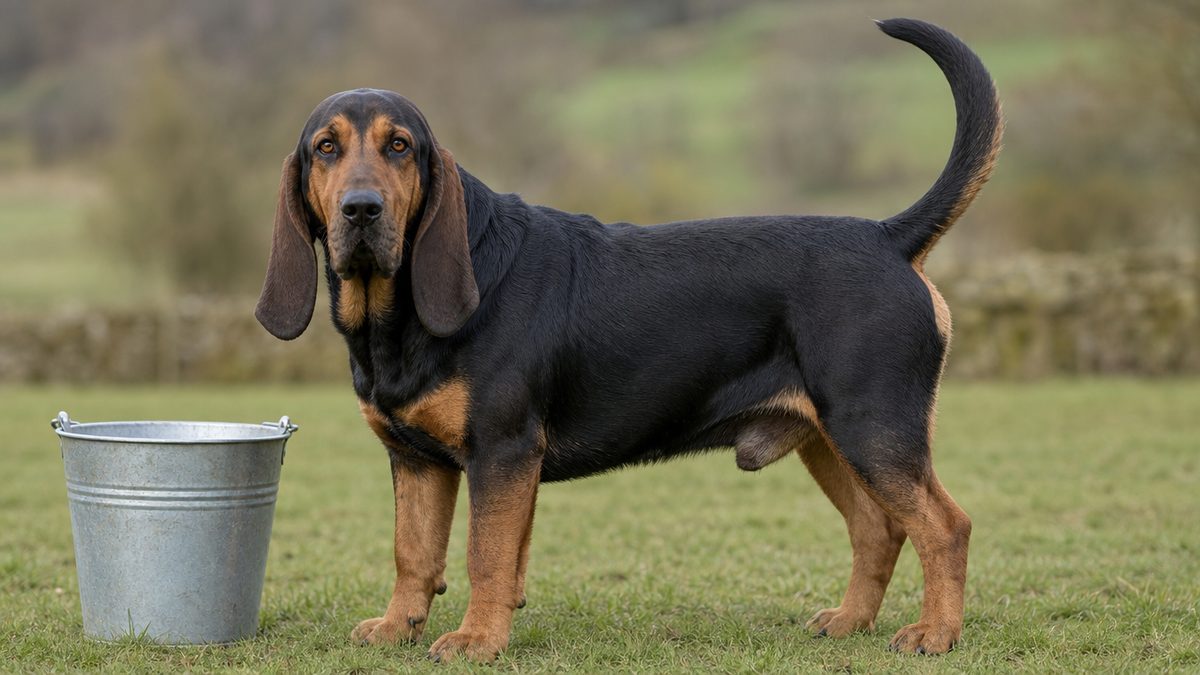
The Kerry Beagle is Ireland's native scent hound, a black and tan pack hound standing about 24 inches, 61 cm, at the withers. FCI standard 161 gives the actual Beagle a desirable maximum of 40 cm. The Kerry Beagle is roughly 21 cm taller, and the two are not the same kind of dog at all.
That single comparison is the thing every page ranking in India for this breed gets wrong or never makes. The Beagle is British, sits in FCI Group 6 Section 1.3 as a small-sized hound, and was bred down from the larger Foxhound to hunt hare with men on foot. The Kerry Beagle is Irish, has no FCI section at all, and was used on stag.
The name is an accident of two languages
The Irish Kennel Club's own breed standard explains it directly, and the explanation is worth quoting because it removes the confusion in one paragraph. The IKC records that the name Beagle "is thought to be derived from the Irish word beag (meaning small) and certainly the Beagle is a small hound used to hunt small game like hares, whereas the Kerry Beagle was often used to hunt stag", and adds that "The present day word for the Beagle in Irish is Pocadan which refers to its use as a hunting dog rather than its size".
So the word beagle in this breed's name is not a claim that it is one. The breed's Irish name is An Pocadan Ciarraioch, the Kerry Pocadan.
What the Irish Kennel Club standard actually specifies
The IKC published the official valid standard on 4 June 2001, places the breed in Group 6, and flags it in its own panel as a Vulnerable Native Breed. The physical description is a working hound's, point by point.
| Point | Kerry Beagle (IKC) | Beagle (FCI 161) |
|---|---|---|
| Origin | Ireland | Great Britain |
| Height | 24 inches, 61 cm, more or less | Desirable 33 to 40 cm |
| Head | Moderately long, broad skull, oval from eyes to poll, forehead low | Fair length, slightly domed skull, well-defined stop |
| Eyes | Large, bright, bright yellow to deep buff or brownish yellow | Dark brown or hazel |
| Ears | Large, pendulous, falling below the neck, set on low | Long, rounded tip, reaching nearly to end of nose, set on low |
| Neck | Slightly arched, skin full in front, dewlap developed | Slightly arched, showing little dewlap |
| Coat | Hard, close and smooth | Short, dense and weatherproof |
| Colour | Black and tan; blue mottled and tan; black, tan and white; tan and white | Tricolour and eight further named colours, no other permissible |
| Tail | Long, thickset at the root, carried curved upwards from the loins | Sturdy, moderately long, set on high, carried gaily |
| Quarry | Hare today, stag traditionally | Primarily hare |
Two things about that standard are worth flagging because they are unusual. Its General Appearance, Important Proportions, Gait, Faults, Disqualifying Faults and N.B. fields are all published empty. And its F.C.I. Classification row reads "Hound Group", which is the IKC mapping the breed into the FCI's group scheme, not evidence of FCI recognition. The recognition section below shows why that distinction matters.
A dog described by how it works
The most useful part of the IKC standard is not the anatomy, it is the behaviour clause, because it describes a pack hound rather than a pet. It reads: "A vibrant hound built for speed and endurance. Temperament is an important way to distinguish the Kerry Beagle from other Fox Hounds. The Kerry Pack will fan out in a large circle when casting and always turn to the first hound that opens. They are also noted for astonishing speed and independence, so that it takes a really good hunter to keep up with them. Their music as their baying is called, can be heard for miles". That is a description of a fast, independent dog that works away from its handler and announces itself.
Ireland's state education portal describes the same animal in fewer words: "a large, fine-looking dog and is an extremely efficient, instinctive hunter", known for its speed and endurance, whose packs are still used in Ireland today for hunting hares, and which was traditionally used to hunt stag.
The history, and how much of it is evidence
The IKC calls the Kerry Beagle "one of the most ancient breeds of Irish dog", popularly thought to descend from a dog known vaguely as the Old Southern Hound, and suggests that next to the Irish Wolfhound it may be the oldest native Irish breed, with the gadhar of Old Irish texts as a possible direct ancestor. Ask About Ireland repeats the gadhar link.
Treat all of that as tradition. The words the IKC itself uses are "popularly thought", "may actually be" and "generally assumed", and Bonbeno will not upgrade them into fact. The one hard historical anchor we found is narrower and much better sourced, and the recognition section returns to it: the Dictionary of Irish Biography dates the Scarteen pack itself "reliably to the early eighteenth century";.
One documented event does sit in the record. The IKC notes that the breed's fortunes "suffered during the great hunger in Ireland in 1847 when they were decimated by starvation";. A pack hound depends on a household that can feed thirty or more dogs, and the Famine removed most of those households.
Kerry Beagle price in India: the query returns a different dog
There is no Kerry Beagle price in India, and the search result you arrived from is not about this breed. Nine of the ten pages Google returns in India for the query are about the ordinary Beagle, and the page ranking second contains the word Kerry zero times.
That is not a subtle failure. It is the whole result set. Position one is a Beagle puppy-cost article, position two a Supertails Beagle price guide, position three a Mr n Mrs Pet Beagle listing, position four a city-wise Beagle price page, positions five and eight Beagle threads on Reddit and Quora, position six a Delhi Beagle price page, position seven an Asia Pets Beagle profile and position nine an Instagram Beagle tag. Only position ten is about the Kerry Beagle, and it is a content farm.
What the hijacked results are actually pricing
The Beagle prices those pages carry are real Indian figures for a real Indian market, and they are worth knowing precisely so you can see they are not this breed's. Supertails gives Rs 35,000 to Rs 50,000 for pet quality, Rs 50,000 to Rs 75,000 for KCI-registered and Rs 75,000 to Rs 1,20,000 and above for show quality, with city bands running from Chennai's Rs 32,000 to Rs 42,000 at the pet-quality end up to Delhi NCR's Rs 85,000 to Rs 1,20,000 at the show end.
Pet House NCR's 155-breed table prices the Beagle at an average of Rs 40,700 with a range of Rs 21,830 to Rs 83,250, and holds no Kerry Beagle row at all. Those three Beagle figures divide at 74.00 to give exactly 550, 295 and 1,125 US dollars, which is the same converted-list signature the Kerry Blue Terrier page documents on that table in detail.
The proof that no Indian supply exists
Two marketplace checks settle it, and both are things you can repeat in a browser.
- Mr n Mrs Pet's breed selector runs to roughly 280 names, from Affenpinscher to Yorkshire Terrier. It includes the Kerry Blue Terrier, the Kombai, the Mudhol Hound, the Rampur Hound, the Chippiparai and the Pashmi Hound. It does not contain a Kerry Beagle. Its popularity counter shows 274 Beagles listed.
- Pet House NCR's 155-breed price table holds the Beagle, the Black and Tan Coonhound, the Bluetick Coonhound, the Redbone Coonhound, the Treeing Walker Coonhound and the Basset Hound. It does not hold a Kerry Beagle.
A directory that has room for the Pashmi Hound and four American coonhounds and still omits this breed is not being careless. It is reflecting the fact that nobody in India has one to sell.
The one on-breed page, and why we cite it only as evidence
Petlur is the sole page in the Indian result set that is genuinely about the Kerry Beagle. It prints "USD $300-$400 Price Avg." with no source. Before you use that number, look at what else the same page says, because it contradicts itself five times inside its own text.
| Claim in its data table | Claim in its own prose | Which is right |
|---|---|---|
| Size: Large. Weight 50 to 60 pounds | "typically weighs between 25 and 35 pounds" | Neither is sourced; the IKC gives height only |
| Height 22 to 24 inches | "males standing at around 21 inches... females at around 19 inches" | The IKC standard says 24 inches, more or less |
| Lifespan 10 to 14 years | "an average lifespan of 12 to 15 years" | The IKC records only Over 10 Years |
| Breed Type: Purebred | "It is a cross between the Irish Wolfhound and the Beagle" | The IKC publishes a breed standard for it |
| "Not recognized by the American Kennel Club. And Not recognized by FCI" | "now recognized as a breed by both the Irish Kennel Club and the Kennel Club of Great Britain" | The data row is right; the Royal Kennel Club has no standard for it |
The claim that the Kerry Beagle is "a cross between the Irish Wolfhound and the Beagle" is exactly the sort of tidy, confident sentence an answer engine repeats. It is contradicted by the same page's own Breed Type field, by the Irish Kennel Club's published standard, and by the Irish state's inscription of the breed as one of nine native pedigree breeds Ireland's National Inventory of Intangible…. Cite that page for what it is, never for what it says.
So the honest price answer has three parts. No Indian seller lists this breed. The rupee figures ranking for the query belong to a different dog. And the only dollar figure attached to the right dog sits on a page that cannot keep its own weight, height, lifespan, ancestry or recognition consistent from one paragraph to the next.
Breed recognition: full in Ireland, absent everywhere else
The Kerry Beagle is recognised by the Irish Kennel Club, inscribed by the Irish state, and unrecognised by every register outside Ireland that we checked. It holds an IKC standard published 4 June 2001 and is absent from the FCI, the Royal Kennel Club, the American Kennel Club and the United Kennel Club Federation Cynologique Internationale United Kennel Club, RECOGNIZED BREEDS.
Recognition is not one thing, and this breed is the clearest illustration of that on the whole site. Four distinct layers apply to it, and the answer differs at every one.
| Body | Status | What we read | Control that passed |
|---|---|---|---|
| Irish Kennel Club | Recognised | Full breed standard, Group 6, published 04/06/2001, flagged Vulnerable Native Breed | The same URL pattern returns the Kerry Blue Terrier at Group 3 |
| Irish state | Inscribed | Named on the National Inventory of Intangible Cultural Heritage as one of nine native Irish pedigree breeds | The other eight breeds are listed alongside it |
| FCI | Absent | Not in the K nomenclature, and Ireland does not appear anywhere in the 22 countries of origin in Group 6 | KERRY BLUE TERRIER appears on the same K page as standard 3 |
| United Kennel Club | Absent | Not in the nine-page RECOGNIZED BREEDS list, between Keeshond and Kishu | Kerry Blue Terrier KBT, Beagle, Beagle Harrier BGLH all present |
| Royal Kennel Club | Absent | No breed standard in the Hound group index | Kerry Blue Terrier, Irish Terrier and Glen of Imaal Terrier all present |
| American Kennel Club | Absent | Not fully recognised, not in Miscellaneous, not in the Foundation Stock Service | Irish Red and White Setter is in FSS |
The sharpest single fact on this page
The United Kennel Club's own RECOGNIZED BREEDS list runs to nine pages and holds every one of Ireland's nine native breeds except this one. Kerry Blue Terrier KBT, Irish Terrier IT, Irish Wolfhound IW, Irish Water Spaniel IWS, Irish Setter IS, Irish Red & White Setter IRW, Soft-Coated Wheaten Terrier SCWT and Glen O Imaal Terrier GLEN are all there, the last under the UKC's own misspelling. The Kerry Beagle is the only one of the nine missing Irish Kennel Club.
That is not a case of a registry ignoring obscure scenthounds. The same list carries the Barak, the Posavaz Hound, the Hygen Hound, the Smaland Hound, the Italian Hound, the Welsh Hound, the Black Forest Hound and the Grand Gascon-Sainttongeois. The UKC has room for a great many rare European hounds. It has no row for this one.
A contradiction inside the Irish state's own description
Ireland's National Inventory of Intangible Cultural Heritage names all nine breeds, including the Kerry Beagle, and then says of the IKC that it "is internationally recognised by the FCI as the authority on and author of the individual description and standards for each of the nine native Irish breeds";.
Read that against the FCI's actual nomenclature. Eight of those nine breeds have FCI numbers; the Kerry Blue Terrier is standard 3 and the Irish Terrier 139. The ninth does not appear in the FCI's K list, and Ireland does not appear anywhere among the 22 countries of origin listed in the whole of FCI Group 6, where a scenthound would have to sit. So the FCI may well treat the IKC as the author of a standard it has not itself adopted, and that is exactly the sort of nuance a buyer needs.
The IKC breed record carries a row reading "F.C.I. Classification: Hound Group";. That is the IKC mapping its own breed into the FCI's group scheme for its own filing, not a statement that the FCI recognises the breed. Anyone reading that row alone would reach the opposite of the truth, which is why we read the FCI's Group 6 nomenclature directly rather than trusting a cross-reference.
What this means for KCI registration in India
It means the Indian route is closed at the first step. The FCI's members register lists India as a full member represented by the Kennel Club of India at Anna Nagar, Chennai. A KCI pedigree is issued against FCI nomenclature, and FCI nomenclature has no Kerry Beagle entry to write against.
So a puppy offered to you in India as a KCI registered Kerry Beagle raises a question the seller has to answer before anything else: registered as what, against which standard, and traced to which studbook. The only certified studbook for this breed is the Irish Kennel Club's, which the Irish state describes as the holder and guardian of the pedigree register since 1922.
Vulnerable, and by whose measure
The vulnerable native breed flag on the IKC record is the breed's own kennel club calling it at risk. Note that this is a different list from the Royal Kennel Club's vulnerable native breeds table, which covers breeds of British and Irish origin registered with the RKC and which does not include the Kerry Beagle because the RKC does not recognise it at all.
Two Irish flags therefore point the same way. The kennel club calls the breed vulnerable, and the state has inscribed the practice of keeping the nine native breeds as intangible cultural heritage, with the explicit aim of safeguarding it. Neither body publishes a population count, and we did not find one anywhere.
What a hound this size costs to keep in India each month
Bonbeno cannot give you a Kerry Beagle monthly cost, because no Indian owner of one exists to price. What we can give you, from named Indian sources, is what a 25 to 30 kg short-coated hound costs to keep here, which is the closest honest answer: roughly Rs 4,700 to Rs 7,200 a month before anything goes wrong.
That figure comes from the Supertails Beagle guide, which prices food, grooming, ear care and healthcare for a medium hound in Indian cities and puts first-year total ownership at Rs 78,400 to Rs 1,85,100. A Kerry Beagle is substantially larger than a Beagle, at 61 cm against 33 to 40 cm, so treat that band as a floor rather than an estimate.
The line items we can source
| Item | Published Indian figure | Frequency |
|---|---|---|
| Full core puppy vaccination course | Rs 3,000 to Rs 6,000 | Once, across the first 16 weeks |
| DHPPi or 7-in-1 dose | Rs 500 to Rs 1,200 | Per dose, four doses |
| Anti-rabies dose | Rs 300 to Rs 600 | Per dose |
| Consultation or injection charge | Rs 300 to Rs 800 | On top of each visit |
| Annual booster, DHPPi plus rabies | Rs 1,000 to Rs 2,000 | Yearly, for life |
| Full groom, large breed | Rs 1,500 to Rs 3,000 | Every 8 to 12 weeks for a short coat |
| Ear cleaning | Rs 250 to Rs 400 | Monthly through the monsoon |
| Medicated or anti-tick bath | Rs 1,000 to Rs 1,500 | As advised |
| Otitis treatment | Rs 2,500 to Rs 8,000 | Per episode |
| Hip dysplasia treatment | Rs 15,000 to Rs 45,000 | If it occurs |
Budget the vaccination line first, because it is the one with the clearest return. The same vet-reviewed Indian guide puts a parvo hospital stay at Rs 15,000 to Rs 50,000, between three and sixteen times the entire first-year vaccine bill.
Why grooming is the cheap part here
This is the one respect in which a Kerry Beagle would be an easy Indian dog. The IKC standard specifies a coat that is "Hard, close and smooth" and its care panel asks for grooming once a week. Indian salons price a large-breed full groom at Rs 1,500 to Rs 3,000 and recommend short-coated dogs every 8 to 12 weeks, against every 4 to 6 weeks for long or curly coats.
Compare that with the Kerry Blue Terrier, the other County Kerry breed, whose soft wavy coat needs cutting every four to six weeks for life at Rs 1,349 to Rs 2,199 a visit. The grooming cost difference between Ireland's two Kerry breeds runs to more than a lakh over a decade, entirely in this breed's favour.
The cost nobody can quote you
Everything above is what a hound of this size costs. What we cannot price is the thing that would actually dominate the bill: acquiring one. There is no Indian seller, no FCI standard for a KCI pedigree to reference, no export market from a breed maintained in working packs, and no published transaction anywhere that we could find Federation Cynologique Internationale.
If somebody quotes you a rupee price for a Kerry Beagle, run three checks before anything else. Divide it by 74.00, by 84.38 and by 80.00, because the 155-breed Indian table ranking for this query prices the Beagle at figures that divide exactly at 74. Ask which studbook the pedigree traces to, since the only certified one is the Irish Kennel Club's. And ask to see the dog, because on this query the marketplaces show photographs of other breeds entirely.
One honest note on precision. Bonbeno's usual practice is to print rupee bands for a breed's own costs. Here we are printing bands for a category, a large short-coated hound, and labelling them as such. That is a weaker claim than we would normally make, and it is the strongest one the evidence supports.
Heat tolerance: Knocklong against seven Indian cities
Heat tolerance is the strongest single argument against this breed in India, and the gap is 18.58 degrees Celsius. NASA POWER queried at the coordinates of Knocklong, Co. Limerick, where the only kennelled pack lives, returns an annual mean air temperature of 9.37 degrees against Chennai's 27.95 Scarteen Hunt, official contact and pack….
We queried NASA POWER by explicit latitude and longitude rather than by place name, because place-name climate lookups have served this project six wrong documents. POWER returns a grid cell rather than a point, so the cell elevation each query reported is printed beside every place below and checked against the real town.
| Place | Cell elevation, m | Annual mean, C | Hottest month mean, C | Annual humidity, % | Warmer than Knocklong by |
|---|---|---|---|---|---|
| Knocklong, Co. Limerick (52.4333 N, 8.3833 W) | 137.08 | 9.37 | 14.87 (July) | 89.75 | baseline |
| Killarney, Co. Kerry (52.0599 N, 9.5044 W) | 142.94 | 9.81 | 14.73 (July) | 88.98 | 0.44 C |
| Tralee, Co. Kerry (52.2713 N, 9.7016 W) | 30.07 | 11.13 | 15.32 (August) | 84.80 | 1.76 C |
| Bengaluru | 841.72 | 23.74 | 28.37 (April) | 67.94 | 14.37 C |
| Pune | 635.99 | 23.86 | 28.93 (April) | 66.80 | 14.49 C |
| Delhi | 206.37 | 25.60 | 35.88 (June) | 45.56 | 16.23 C |
| Kolkata | 7.35 | 25.81 | 31.53 (May) | 73.93 | 16.44 C |
| Hyderabad | 494.59 | 26.10 | 33.30 (May) | 60.30 | 16.73 C |
| Mumbai | 97.15 | 26.77 | 31.19 (May) | 67.39 | 17.40 C |
| Chennai | 48.95 | 27.95 | 31.51 (May) | 72.39 | 18.58 C |
What the elevation column caught
Knocklong's cell sits at 137.08 m against a village elevation near 90 m, about 47 m high, which at the standard lapse rate of 6.5 degrees per 1,000 m makes the returned figures roughly 0.3 degrees cooler than the ground itself. That is a small correction and we publish it rather than hiding it.
The County Kerry cells behave differently from each other, which is worth stating because the breed is named for that county. Killarney's cell reads 142.94 m against a town near 30 m and Tralee's reads 30.07 m against a town near 10 m, and the two towns come back 1.32 degrees apart. They are not the same cell and they are not interchangeable. Coastal Tralee is genuinely milder than the inland cell above Killarney.
The Indian cells are reliable, which is the useful half of the check. Delhi's cell is 206.37 m against about 216, Chennai's 48.95 against about 7, Kolkata's 7.35 against about 9, Mumbai's 97.15 against about 14, Pune's 635.99 against about 560 and Bengaluru's 841.72 against about 920. Those are plains errors of tens of metres. POWER fails in mountains, not in Indian cities.
The comparison that decides it
Set Knocklong's warmest month against each Indian city's coolest. Knocklong's July averages 14.87 degrees. Chennai's coolest month averages 24.09. The gentlest month Chennai offers is 9.22 degrees warmer than the fiercest month this breed's home ground produces. Delhi drops to 13.61 in its coldest month, so a Delhi winter is genuinely within range, and then June arrives at a mean of 35.88 with a monthly mean maximum of 48.79.
Humidity is not the rescue it looks like. Knocklong runs 89.75 percent annual relative humidity, higher than every Indian city here. This hound is adapted to wet air. What it is not adapted to is wet air at 30 degrees, because a dog cools by evaporation and evaporation depends on temperature and humidity together. Cool and humid is Limerick. Hot and humid is Chennai, and it is a different problem.
Why the working job makes this worse
A companion breed can be kept out of the heat. A pack hound cannot be kept out of the running, because the running is what it is for. The IKC describes a hound "built for speed and endurance" and "noted for astonishing speed", and its own care panel asks for up to an hour of exercise a day.
That collides directly with the best evidence on canine heat illness. Hall and colleagues, on 905,543 UK dogs under primary veterinary care, found that 652 of the 879 events with a recorded trigger, 74.2 percent, were exertional, against 113 environmental and 46 from confinement in a vehicle. The companion paper on the same cohort gives a bodyweight at or above the breed and sex mean an odds ratio of 1.42, with an interval of 1.12 to 1.80.
We cannot tell you whether this breed met those papers' inclusion thresholds, and on a breed with no UK registration presence it almost certainly did not, so we claim only the transferable point: heat illness in dogs is mostly caused by activity, and this is a breed defined by activity.
Second Schedule Part IV paragraph 21(1) of the 2017 Rules bars keeping in outdoor facilities, without the attending veterinary practitioner's written approval, dogs "that are not accustomed to the temperatures prevalent in the area or region in question" and breeds "that cannot tolerate the temperatures prevalent in the area or region in question";. A pack hound from a 9.37-degree homeland, kennelled outdoors in an Indian summer, is the paradigm case the clause describes.
Temperament: a pack animal, described by the people who bred it
The Kerry Beagle's temperament is documented by hunt masters rather than by pet owners, and it reads accordingly. The Dictionary of Irish Biography records that, in contrast to the submissive and subdued foxhound, "Kerry beagles were affectionate, excitable, independent and disheartened by excessive discipline".
That sentence is the most useful description of this breed anywhere, and it comes from the Royal Irish Academy's peer-edited biographical dictionary rather than a breed page. Read each of its four words as a practical instruction. Affectionate means the dog wants company. Excitable means it does not settle easily in a busy environment. Independent means it will make its own decisions at distance. And disheartened by excessive discipline means a heavy-handed trainer will shut it down rather than correct it.
The pack behaviour is the breed's defining trait
The IKC standard describes the working pattern precisely: "The Kerry Pack will fan out in a large circle when casting and always turn to the first hound that opens";. That is a description of a dog that coordinates with other dogs and takes its cue from them, not from a person.
Two consequences follow for a household. A Kerry Beagle is likely to be good with other dogs, because it was selected to work in a group of thirty or more. And it is likely to be poor at ignoring another dog's decision, because deferring to the first hound that opens is exactly what it was bred to do.
The voice, which is not negotiable
The single line an Indian buyer should read twice is this one, from the breed's own kennel club: "Their music as their baying is called, can be heard for miles";. That is a feature. A hunt master following on foot needs to locate a pack across a valley by ear.
In a Bengaluru apartment or a Pune housing society it is a complaint, then a series of complaints, then a rehoming. No amount of training removes a hound's voice, and attempting to do so surgically is prohibited: Second Schedule Part II paragraph 6(8) of the 2017 Rules names de-barking explicitly among the procedures that are strictly forbidden.
What the Ryans bred for, and what it tells you
The Dictionary of Irish Biography records what a seventh-generation master actually selected for, which is more informative than any temperament rating. Thady Ryan "bred primarily for nose and voice", loved his hounds' "long, melodious cry", and bred "less for speed, holding that a hound was only as fast as its nose";.
It also records how he handled them: "persuading rather than directing his hounds in the manner of his father";. Persuasion is the operative word, and it is the same conclusion the training section reaches from a different direction.
We found no reliable statement about this breed with children, with cats, or with strangers in a home. The IKC standard has no such clause, the Dictionary of Irish Biography describes working hounds rather than family dogs, and the content farms that make confident claims about it contradict themselves on measurable things like height and weight. Bonbeno will not invent a family-suitability rating for a breed nobody has published one for.
Who this dog would suit, honestly
The realistic profile is narrow and it is not urban. A Kerry Beagle suits somebody with land, other dogs, tolerance for noise, an interest in scent work or drag hunting, and no expectation of off-lead obedience near livestock or wildlife. The IKC rates it Town or Country Either, but pairs that with a small house, a small or medium garden, and a hound whose baying carries for miles.
In India that profile describes a farm in a cool district, not a metro flat. And since no Indian source could supply the dog anyway, the honest advice is to read the temperament as information about a breed rather than as a shortlist entry.
Training a hound bred to ignore you
To train a Kerry Beagle, persuade rather than direct, and accept that recall near a scent will never be reliable. The Dictionary of Irish Biography records a seventh-generation master "persuading rather than directing his hounds", and describes the breed as "disheartened by excessive discipline".
Those two phrases set the whole approach. This is a dog selected for four centuries to work at distance from a handler, to make its own decisions about a line of scent, and to take its cue from the pack rather than from a voice. None of that is disobedience, and none of it is fixable.
The three things worth training, in order
- Socialise early and broadly, because a hound that has never met a lift, a scooter or a street dog at twelve weeks will meet all three badly at twelve months. Early socialisation is the intervention with the largest return on any working breed.
- Train a settle rather than a recall, because a hound that can lie down and stop is more use in an Indian household than one that comes back nine times out of ten and disappears the tenth.
- Screen the environment instead of relying on obedience: long line, secure fencing, no off-lead work near livestock, wildlife or a road.
- Verify what you have taught in the presence of a real scent, not in an empty room, because a hound tested without a scent has not been tested.
Give it the job, because the job is scent
The most productive training for this breed is not obedience at all, it is nose work. The IKC records that "Drag hunting competitions are also regularly held" for the breed in Ireland, alongside foot hunting after the hare. A drag hunt is a laid artificial trail, which is exactly what a scent game in an Indian flat or garden is, scaled down.
That matters practically in India because scent work is the only enrichment the heat cannot cancel. A trail laid across a room at midday costs nothing, tires the dog properly, and works in May in Chennai when a walk does not.
The IKC's description of the working pattern, that the pack fans out in a circle when casting and turns to the first hound that opens, describes a dog highly attuned to other dogs. In practice that usually means a hound that takes cues from a calm, well-trained resident dog faster than it takes them from a person. If you have a settled adult dog, use it.
What not to do
Do not use force. The evidence here is unusually direct: the phrase "disheartened by excessive discipline" comes from a biography of a master who handled these hounds for forty years, and it is a description of a breed that folds rather than fights when pressed. A shut-down hound is harder to work with than a disobedient one and takes far longer to recover.
Do not attempt to train the voice out of it, and do not let anybody offer you a surgical solution. De-barking is named among the procedures strictly forbidden by Second Schedule Part II paragraph 6(8) of the 2017 Rules, in the same sentence as tail docking and ear cropping.
And do not board an unsocialised hound in a crowded Indian kennel. Paragraph 23 of the same Rules permits up to twelve adult dogs in one primary enclosure and requires that dogs with a vicious or aggressive disposition be housed separately, which tells you what a busy Indian boarding facility legally may look like.
The Indian timing advantage
One thing India makes easier. A 5:30 am start in most Indian metros gives you empty streets, cool air and almost no other dogs, which is simultaneously the correct heat management for a hound from a 9.37-degree homeland and the ideal setting for early socialisation and line work. Use that hour while the dog is young. The same street at 8 am is a different training problem entirely.
Exercise: an hour on the label, a working day in the breeding
The Irish Kennel Club's own care panel puts this breed's exercise requirement at up to one hour a day. Read that beside the same page's description of a hound "built for speed and endurance" whose packs "hunt regularly", and treat the hour as a minimum for a companion, not a description of the dog's capacity.
The gap between those two statements is the honest picture. A Kerry Beagle kept as a pet can be kept sound on an hour a day. A Kerry Beagle working in a pack covers ground for hours behind a hare, which is why the IKC notes that "it takes a really good hunter to keep up with them";.
The Indian problem is which hour, not how many
The climate table gives the constraint directly. Chennai's hottest month averages 31.51 degrees with a monthly mean maximum of 42.70, Delhi's June averages 35.88 with a maximum of 48.79, and Kolkata reaches 46.81. A hound adapted to a July mean of 14.87 degrees cannot work an hour in any of those.
| City | Hottest month mean, C | Monthly mean maximum, C | Workable approach |
|---|---|---|---|
| Bengaluru | 28.37 (April) | 40.38 | The most workable large Indian city, still 14.37 C above Knocklong |
| Pune | 28.93 (April) | 43.20 | Early morning only from March to May |
| Mumbai | 31.19 (May) | 44.91 | Humidity limits cooling before the peak temperature does |
| Chennai | 31.51 (May) | 42.70 | Hardest of the seven; January still averages 24.09 C |
| Kolkata | 31.53 (May) | 46.81 | Hot and humid together, the worst pairing for sustained running |
| Hyderabad | 33.30 (May) | 45.00 | Dry heat, so shade and water buy more time than in Chennai |
| Delhi | 35.88 (June) | 48.79 | Four genuinely usable winter months, then four unusable ones |
Split the hour, and cancel rather than shorten
The evidence points to a specific structure. Hall and colleagues found that 652 of the 879 UK heat-related illness events with a recorded trigger, 74.2 percent, were exertional, against 113 environmental. Heat illness is mostly something the dog was doing.
- Walk or trail 35 to 40 minutes before sunrise, leaving by about 5:30 am in an Indian summer.
- Walk 25 to 30 minutes at least an hour after sunset, once pavement stone has released its heat.
- Run 10 to 15 minutes of laid-trail scent work indoors at midday, which is the breed's own discipline scaled down.
- Cancel the outdoor session outright on a day near the city's hottest-month figure, rather than trimming it by ten minutes.
Containment, and the Indian consequence of failing it
A scenthound follows a line. That is not a behaviour problem to be trained away, it is the function the breed exists for, and the IKC's own account of hounds fanning out in a circle when casting describes a dog that ranges widely by design.
In India the failure mode is specific. A loose hound meets free-roaming dogs, and free-roaming Indian dogs carry tick-borne disease at high rates. A survey of 525 dogs across four Indian cities found 261, or 49.7 percent, infected with at least one tick-borne pathogen: Hepatozoon canis at 30 percent, Ehrlichia canis at 20.6 percent, Mycoplasma haemocanis at 12.2 percent, Anaplasma platys at 6.5 percent and Babesia vogeli at 5.5 percent, with concurrent infection in 39 percent of cases and vector ticks found on 278 of the dogs examined, 53 percent.
Do not rely on obedience to keep a scenthound home. Rely on the fence, the long line and the closed gate, and keep year-round rather than seasonal tick control, because the same Indian survey found ticks on more than half the dogs it examined across four cities.
One last honest note. Everything in this section is inference from the breed's documented function and from Indian climate and disease data, because there is no published exercise study, no activity monitoring and no injury series for the Kerry Beagle anywhere. We are reasoning from what the breed was built to do, and we are saying so.
Grooming: the one thing this breed makes easy in India
Grooming a Kerry Beagle takes a weekly brush and an ear check, and that is nearly the whole job. The Irish Kennel Club standard specifies hair that is "Hard, close and smooth", and its care panel asks for grooming once a week.
That makes this the cheapest coat on any Irish breed page Bonbeno publishes. Indian salons price a large-breed full groom at Rs 1,500 to Rs 3,000 and recommend short-coated dogs every eight to twelve weeks, against every four to six weeks for long or curly coats. Most of the year you will not need a salon at all.
The ears are the whole risk
The one grooming problem this breed does carry is structural and it is in the standard. The IKC specifies ears that are "Large, pendulous, falling below the neck, and set on low on the side of the head". A large low-set ear lying flat against the head keeps the canal warm, dark and poorly ventilated.
In Ireland that matters less than it sounds, because a wet dog at 9.37 degrees dries slowly in cool air. In an Indian monsoon the same wet ear sits at 27 to 31 degrees, which is a different environment entirely against the skin.
Hound care written for Limerick assumes a dog that dries in cool air. In an Indian monsoon it does not. Dry the dog properly with a dryer rather than letting it air dry, protect the ears before every bath, and dry inside the ear afterwards. Indian salons price ear cleaning separately at Rs 250 to Rs 400, which is worth paying monthly through the wet months rather than annually. Indian veterinary pricing puts a single otitis episode at Rs 2,500 to Rs 8,000.
The weekly routine, in four steps
- Brush the whole dog once a week with a bristle or rubber brush. A hard, close, smooth coat needs contact rather than detangling.
- Lift both ears, look inside, and smell them. Odour precedes visible discharge by days.
- Run both hands over the dog from nose to tail, checking for ticks in the ear folds, between the toes and under the collar, because Indian vector ticks were found on 53 percent of dogs in a four-city survey.
- Check the feet and nails. The standard asks for feet "round and close", and a working hound's nails wear down on ground that an Indian pavement dog's do not.
The dewlap, which the standard asks for
One detail worth knowing because it differs from the Beagle. The IKC standard asks for a neck with "Skin full in front and dewlap developed";, while FCI standard 161 asks the Beagle for a neck "showing little dewlap";. A developed dewlap is loose skin under the throat, and loose skin in Indian humidity is another fold to dry after a bath or a wet walk.
Neither standard treats it as a health matter and neither should you. It is simply one more place to check and dry, alongside the ears.
Shedding, stated honestly
The IKC's care panel answers this one directly, and its wording is worth keeping. Under "Supposedly sheds?" the answer for this breed is Yes. There is no hypoallergenic claim to rebut here, because nobody makes one about a short-coated pack hound, and a dog that sheds is the normal case rather than a defect.
For an Indian household that means the trade is a straightforward one. You will find hair on the floor and you will not be paying a salon Rs 1,349 to Rs 2,199 every four to six weeks, which is what the other County Kerry breed costs its owners for life. Of the two Kerry breeds, this is by a wide margin the low-maintenance coat.
Health issues and lifespan: what is genuinely not known
Nobody has published a single health statistic about the Kerry Beagle, and that absence is this section's finding rather than its failure. PubMed returns zero genuine records for the breed against controls returning 52 and 46 in the same session, and OFA's statistics dump contains the string KERRY BEAGLE zero times Orthopedic Foundation for Animals.
An absence is a strong claim, so we tested it the way this site requires: with controls, under every name the breed has, in the same session as the searches themselves.
| Search | Result | Control run in the same session | Control result |
|---|---|---|---|
| PubMed "Kerry Beagle" | 3 records, all ordinary laboratory-Beagle papers where Kerry is an author name | "Labrador Retriever" AND "hip dysplasia" | 52 records, all on topic |
| PubMed "Kerry Beagles", plural | The same 3 records; the query translation collapses to Kerry AND beagle | "Beagle" AND "epilepsy" | 46 records, all on topic |
| PubMed Scarteen | 0 records | As above | Instrument working |
| OFA statistics dump, KERRY BEAGLE | 0 occurrences | BEAGLE and HARRIER in the same dump | 61 and 14 occurrences |
| McMillan 2024 Table S5, 344 breed names | No Kerry Beagle row | Beagle and Beagle Harrier in the same table | Both present |
Why the OFA absence is not a scandal
State it carefully, because the correct wording matters. The Kerry Beagle has no row in OFA's published statistics tables, which is not the same as being absent from the OFA database. OFA requires 100 hip evaluations, or 50 for its other databases, before a breed is published at all. A breed maintained in a handful of working packs, whose owners are hunt masters rather than show breeders, will never reach that threshold.
There is a useful control for that reading inside the same dump: the string FOXHOUND appears zero times too. Working pack hounds as a class do not get radiographed and submitted, whatever their numbers. The absence tells you about the culture of the breed's ownership, not about its joints.
Lifespan, and the only figure that exists
The only lifespan statement from any authority is the Irish Kennel Club's own care panel, which records Over 10 Years and nothing more precise. That is a band, not a measurement, and no study we found narrows it.
The largest UK longevity work covers 155 recognised purebreds and lists 344 breed names across its supplementary table, including the Beagle at a median of 12.5 years on 1,552 deaths, the Beagle Harrier, and the crossbred group at 12.0 years on 72,445 deaths McMillan KM, Bielby J, Williams CL. The Kerry Beagle appears nowhere in that 344-row table.
The obvious temptation on a page like this is to transfer the Beagle's 12.5-year median, or the Beagle's known conditions, onto this breed because of the shared name. Do not. The two breeds differ by about 21 cm in height, come from different countries and different FCI sections, and are not close relatives Federation Cynologique Internationale. A figure imported from a breed the study actually measured, onto one it never included, is a fabrication with a citation attached.
The one health-relevant thing the historical record does contain
It is about inbreeding, and it comes from an unexpected place. The Dictionary of Irish Biography records that Thady Ryan, master of the only kennelled pack, "avoided the deleterious effects of inbreeding through recourse to the Kerry beagle foot packs of west Munster", aside from "a few quickly abandoned attempts to develop an outcross with foxhounds";.
Two things follow. First, a named master of this breed treated inbreeding as a live risk and managed it deliberately, which tells you the population is small enough for that to matter. Second, the mechanism he used, drawing on scattered foot packs, only works while those foot packs exist. The same source records that by 1881 Scarteen hosted the only kennelled pack of Kerry beagles in Ireland, with the rest of the breed "scattered in ones and twos across different holdings in west Munster".
That is the closest thing to a population history this breed has, and it is 145 years old.
What an Indian owner should do with all this
Two practical conclusions. Any Indian health screening for a dog sold to you as a Kerry Beagle has to be generic rather than breed-specific: hips, elbows, eyes, thyroid, a coagulation profile before surgery and a full physical, chosen because the dog is a large active hound rather than because the breed is known to carry anything.
And Indian law's own list is the checklist to hand a breeder, because it is the only one that exists here. Second Schedule Part III paragraph 8(10) requires that breeding dogs "have been tested for genetic defects, including hip dysplasia, progressive retinal atrophy, night blindness, hypothyroidism, entropion, ectropion, overshot, undershot jaw... wry mouth, two or more missing teeth, unilateral cryptorchid or full cryptorchid males". The word including makes that list illustrative rather than closed, so nothing is excluded by not being named.
Feeding a large working hound in India
Feed a Kerry Beagle twice a day on a complete diet matched to its life stage, and score body condition monthly rather than watching the bowl. No breed-specific nutritional research exists for this dog, so everything below is what a lean, muscular 61 cm working hound needs, labelled as such.
Two things make feeding this breed different from feeding a companion dog of similar size. The first is that a pack hound is bred to carry no surplus weight at all. The second is that weight is a heat variable in India, not a cosmetic one.
Weight as heat management
Hall and colleagues, on 905,543 UK dogs, found that a bodyweight at or above the breed and sex mean carried an odds ratio of 1.42 for heat-related illness, with a confidence interval of 1.12 to 1.80. That is not obesity. It is being on the heavy side of normal.
For a breed whose homeland averages 9.37 degrees against Chennai's 27.95, keeping the dog at the lean end of its range is one of the few heat interventions an owner fully controls, and it costs nothing. The IKC standard describes a body that is "Muscular, fairly thickset, moderate length, strong, well set on legs" with "Loins: Broad and muscular" and "Thighs thick and slightly curved";. Thickset is not the same as heavy, and a hound built for endurance carries muscle rather than fat.
A practical Indian frame
| Stage | Meals a day | What to watch |
|---|---|---|
| 8 weeks to 4 months | 3 to 4 | Steady growth and formed stools; deworming runs on its own clock, starting at 2 to 3 weeks |
| 4 to 12 months | 2 to 3 | A large hound grows for longer than a terrier; do not push growth with extra food |
| Adult, 1 to 8 years | 2 | Body condition monthly, and the lean end of the range through summer |
| Senior, 8 years and over | 2 | Weight, joint comfort, and the ears, which stay a lifelong watch point |
The IKC records the breed's lifespan only as Over 10 Years, so treat eight as the start of senior monitoring rather than a fixed threshold.
Water and the Indian summer
Fresh water has to be genuinely constant and genuinely fresh, refilled rather than topped up, because a bowl standing all day in 35-degree air grows biofilm. That applies to every dog in India and it applies harder to one that will run for an hour before sunrise and then pant through a Delhi June averaging 35.88 degrees.
The one thing to have checked, and the one thing not to assume
Have the mouth examined properly at the first full veterinary visit and have the dentition written into the record. The IKC standard asks for teeth "level, of elegant form and strong", and Indian law names "two or more missing teeth" among the genetic defects a breeding dog must have been tested for Prevention of Cruelty to Animals. A count costs nothing at the time and gives you a baseline.
We will not print a daily gram figure, a calorie target or a brand recommendation for this breed. There is no published feeding trial, no body-composition work and no breed-club guidance in the public record for the Kerry Beagle, and a specific-looking number invented for a page is worse than an honest range. Ask your veterinarian to set the amount from the individual dog's body condition score, and adjust it every month.
One Indian availability note. The commercial foods sold here are formulated by size and life stage, not by breed, so the absence of a Kerry Beagle formula means nothing. A good large-breed puppy food followed by a good adult formula, fed to condition, is the whole answer, and it is the same answer a vet would give for any 25 to 30 kg active dog.
Month by month through the first year
A Kerry Beagle puppy's first year in India runs on two clocks: the Indian vaccination schedule, which is well documented, and the socialisation window, which closes long before an owner feels ready. The core course starts at 6 to 8 weeks and must finish at or after 16 weeks.
Indian law sets the earliest date you can legally collect a puppy. Rule 8(1)(a) of the Prevention of Cruelty to Animals (Dog Breeding and Marketing) Rules, 2017, headed "Conditions for sale", requires that every breeder ensure "pups less than eight weeks in age are not sold";. Note that clause number carefully: the same document also has a Second Schedule paragraph 8 about veterinary care, so the number alone is ambiguous unless you say which one you mean.
| Age | What happens | What you do |
|---|---|---|
| 2 to 3 weeks | First deworming, at the breeder | Ask for the deworming record when you collect |
| 6 to 8 weeks | First DHPPi dose; Indian law's floor for sale | Walk away from any offer of a younger puppy |
| 9 to 11 weeks | Second DHPPi booster | Begin handling work: ears, feet, mouth, two minutes daily |
| 12 to 14 weeks | Third DHPPi plus first anti-rabies | Controlled meetings with known, vaccinated adult dogs |
| 14 to 16 weeks | Final puppy booster; anti-rabies completed | Keep off unknown ground until about a week after this dose |
| 4 to 6 months | The hound's nose comes online in earnest | Start laid-trail scent games; train a settle, not just a recall |
| 6 months | Rule 8(1)(b) sterilisation threshold for sale applies | Ask for a pre-surgical physical; large hounds are slow to finish growing |
| 6 to 12 months | Adolescence; ranging and independence increase sharply | Long line only outdoors; do not test recall against a live scent |
| 9 to 15 months | Adult height, about 61 cm, is reached | Verify body condition monthly; keep the dog lean through summer |
| 12 months on | Annual booster, DHPPi plus rabies, Rs 1,000 to Rs 2,000 | Lock in year-round tick control rather than seasonal |
The vaccination clock, and why the 16-week dose is the one that counts
The mechanism is worth understanding rather than memorising. A newborn takes in antibodies from its mother's first milk, and that borrowed immunity fades over three to four months. For a stretch in the middle it is too weak to stop a real infection but still strong enough to neutralise a vaccine dose, which is why the course repeats every three to four weeks and why the final dose must land at or after 16 weeks whatever came before it.
Indian law expects something similar of breeders. Second Schedule Part III paragraph 8(9) states that all pups shall be vaccinated, which can start at seven to eight weeks and is usually completed at eighteen weeks.
Every documented account of this breed's temperament describes an independent hound that works away from its handler and takes its cues from other dogs Clavin T. Ryan, Thady. Nothing in the first year matters more than socialisation during the weeks the vaccination course is still running, and nothing is harder to schedule, because those are exactly the weeks the puppy should stay off unknown ground. The answer is controlled exposure: known vaccinated adult dogs, carried trips to see traffic and lifts, and no dog parks.
What the first year costs
The two published Indian anchors are the vaccination course at Rs 3,000 to Rs 6,000 across the first 16 weeks, with a consultation or injection charge of Rs 300 to Rs 800 on top of each visit, and a first-year total ownership figure for a medium hound of Rs 78,400 to Rs 1,85,100 Supertails, How Much Does A Beagle Puppy…. A 61 cm hound sits above the top of that second band on food alone.
Grooming barely features, which is the compensation. A short hard coat needs a weekly brush at home and a salon visit every eight to twelve weeks at most, at Rs 1,500 to Rs 3,000 for a large breed Irish Kennel Club, Breed Details.
One habit worth building and keeping
Check both ears every single week from the day the puppy arrives, and make it a paid, pleasant event rather than a struggle. The standard's large low-set pendulous ear is the breed's one structural vulnerability in Indian humidity, and a single otitis episode costs Rs 2,500 to Rs 8,000 to treat Supertails, How Much Does A Beagle Puppy…. A dog that learned at ten weeks to lie still while somebody lifts an ear is a dog you can check fifty times a year without a fight.
Kerry Beagle against the breeds it is confused with
The Kerry Beagle is cross-shopped against exactly one dog, and by accident: the Beagle, because of the shared word. On height, origin, registry status and Indian availability they have nothing in common, and the comparison below is really a list of the ways the search engine misled you.
| Measure | Kerry Beagle | Beagle | Irish Wolfhound | Kerry Blue Terrier |
|---|---|---|---|---|
| Origin | Ireland | Great Britain | Ireland | Ireland |
| Height | About 61 cm | 33 to 40 cm | Giant sighthound | 44.5 to 49.5 cm |
| FCI standard number | None | 161 | Recognised, number not read by us | 3 |
| FCI group and section | Not in the nomenclature | Group 6, Section 1.3 small-sized | Sighthounds | Group 3, terriers |
| Royal Kennel Club | Not recognised | Recognised | Recognised | Recognised, vulnerable native breed |
| United Kennel Club | Not on the recognized-breeds list | Present, Scenthound | Present, IW | Present, KBT |
| Median survival, McMillan 2024 | Not studied; not in the 344-row table | 12.5 years on 1,552 deaths | 9.9 years on 210 deaths | 12.4 years on 168 deaths |
| Rows in OFA published statistics | Zero | Present | Present | Ten databases |
| Findable in India | No | Yes, 274 listed on one marketplace alone | Rare | No |
Against the Beagle, which is the only comparison anyone actually makes
Start with the number that ends the argument. The Irish Kennel Club gives the Kerry Beagle 24 inches, 61 cm, at the withers. FCI standard 161 gives the Beagle a desirable maximum of 40 cm Federation Cynologique Internationale. A dog 21 cm taller than another dog's ceiling is not a variety of it.
The working history separates them just as cleanly. The FCI records that the Beagle was "bred down from the larger Foxhound to hunt with men on foot, preferably after the hare";. The IKC records that the Kerry Beagle "was often used to hunt stag", and that its packs today go after the hare on foot. One breed was made small to suit the quarry; the other was not made small at all.
And the Indian availability gap is total. One Indian marketplace lists 274 Beagles and does not carry the Kerry Beagle in its roughly 280-name breed selector at all. If you searched for a Kerry Beagle price and found Beagle prices, that is not a near miss. It is a different animal at a different size from a different country with a different registry status.
Against the Irish Wolfhound, the other native Irish hound
The Irish Kennel Club names exactly two native Irish hounds, the Irish Wolfhound and the Kerry Beagle, and its own breed record suggests that "Next to the Irish Wolfhound the Kerry Beagle may actually be the oldest native Irish breed"; Irish Kennel Club, Breed Details.
The practical difference for an Indian reader is documentation. The Irish Wolfhound has an FCI standard, a Royal Kennel Club vulnerable-native-breed row, a UKC entry, OFA statistics and a measured median survival of 9.9 years on 210 recorded deaths in a 155-breed study United Kennel Club, RECOGNIZED BREEDS. The Kerry Beagle has an Irish standard and nothing else. Two breeds, one country, one ancient claim each, and completely different evidence bases.
Against the Kerry Blue Terrier, the other County Kerry breed
The two breeds share a county and almost nothing else. The Kerry Blue Terrier is FCI standard 3, holds a Royal Kennel Club vulnerable-native-breed listing with 57 registrations in 2025, appears in ten OFA databases and has a measured median survival of 12.4 years.
The instructive contrast is cost. A Kerry Blue's soft wavy coat needs cutting every four to six weeks for life at Indian salon prices of Rs 1,349 to Rs 2,199 a visit. A Kerry Beagle's hard, close, smooth coat needs a weekly brush at home wagNbush, Dog Grooming Cost in India 2026. Over a decade that difference alone runs past a lakh, and it runs in the hound's favour.
Line the nine native Irish breeds up against the United Kennel Club's recognized-breeds list and eight of them are there. The Kerry Beagle is the one that is not, on a list that has room for the Barak, the Posavaz Hound, the Hygen Hound and the Smaland Hound Irish Kennel Club. That single row is the truest summary of this breed's position in the world: kept, standardised and celebrated at home, and invisible everywhere else.
So if you came here comparing dogs, the honest conclusion is that the Kerry Beagle is not on your shortlist, because it cannot be. There is no Indian supply, no FCI nomenclature entry for a KCI pedigree to reference, and no health data to compare against anything. What it is instead is one of the most interesting breeds in Ireland, and the page above is what is actually known about it.
What people get wrong about this breed
Five errors dominate everything written about the Kerry Beagle, and four of them appear on pages ranking in India right now. In order of how badly they mislead: assuming it is a beagle, assuming it is extinct, assuming it is a crossbreed, assuming a registry recognises it, and quoting a price for a dog nobody here sells.
One: assuming it is a beagle
The Irish Kennel Club standard gives 24 inches, 61 cm; FCI standard 161 gives the Beagle a desirable maximum of 40 cm Federation Cynologique Internationale. The IKC also explains the name outright, recording that Beagle derives from the Irish beag meaning small, that the Beagle hunts small game, and that the Kerry Beagle was often used on stag. If you were shown a small tricolour hound and told it was a Kerry Beagle, you were not shown this breed.
Two: assuming it is extinct
This one is repeated because a major registry printed it, and it is wrong on four separate pieces of current evidence. The IKC publishes a live standard and names an affiliated Kerry Beagle Club of Ireland. The Irish state inscribed the breed on its National Inventory of Intangible Cultural Heritage among nine native breeds. The Irish Masters of Foxhounds Association describes the Scarteen pack as comprising 23-inch pure-bred Kerry Beagles. And that pack's own site gives its size as 35 couple, which is 70 living hounds.
Three: assuming it is a crossbreed
The only page in the Indian result set that is about this breed states that "It is a cross between the Irish Wolfhound and the Beagle", in the same document whose own data field reads "Breed Type: Purebred";. It is a breed with a published national standard, a certified studbook held by the Irish Kennel Club since 1922, and a state heritage inscription. Nothing supports the cross claim, and the page making it contradicts itself five separate times.
Four: assuming a registry recognises it
This is the error that costs money, because it is what a seller would trade on. The Kerry Beagle is absent from the FCI's nomenclature and from the whole of FCI Group 6, from the United Kennel Club's nine-page recognized-breeds list, from the Royal Kennel Club and from the AKC's Foundation Stock Service United Kennel Club, RECOGNIZED BREEDS Federation Cynologique Internationale. It holds one recognition, from the Irish Kennel Club, and that is genuine and complete.
The IKC breed record carries a line reading "F.C.I. Classification: Hound Group";. That is the IKC filing its own breed into the FCI's group scheme. It is not FCI recognition, and reading it as such produces exactly the wrong conclusion. We checked the FCI's Group 6 nomenclature itself, where 22 countries of origin are listed and Ireland is not among them.
Five: quoting a price
No Indian seller lists this breed. Mr n Mrs Pet's roughly 280-name breed selector does not contain it, and Pet House NCR's 155-breed price table does not either Pet House NCR, Dog Price List In India. The only dollar figure attached to the right dog, USD 300 to 400, sits unsourced on a page that cannot hold its own weight, height, lifespan, ancestry or recognition steady across two paragraphs.
Three smaller ones
- Borrowing the Beagle's health data. The Beagle has a measured median survival of 12.5 years and a well-documented condition list. The Kerry Beagle appears nowhere in the 344-row table that produced those figures McMillan et al. 2024. Transferring one onto the other is fabrication with a citation attached.
- Treating the OFA blank as a health verdict. KERRY BEAGLE appears zero times in OFA's statistics dump, but so does FOXHOUND, while BEAGLE appears 61 times. Working pack hounds do not get submitted for screening. The blank describes an ownership culture, not a set of joints.
- Averaging the two Irish height figures. The Irish Kennel Club says 24 inches and the Irish Masters of Foxhounds Association says 23 inches Irish Masters of Foxhounds Association. Bonbeno prints both and averages neither, because a one-inch disagreement between two Irish authorities is itself information.
The pattern behind all eight is the same. This breed sits at the intersection of two things search engines handle badly, a name that collides with a far more common breed and a body of real information that lives almost entirely on Irish institutional websites nobody links to. The result is that the confident pages are wrong and the correct pages do not rank.
Indian law, and the clauses that would actually apply
No Indian law names the Kerry Beagle, and none needs to. The Prevention of Cruelty to Animals (Dog Breeding and Marketing) Rules, 2017 apply to any dog bred or sold in India, and four of their clauses would bite on this breed specifically. We read the AWBI gazette copy ourselves rather than a summary of it.
One note on citation before the substance, because this document numbers its clauses twice and the confusion is common. The Rules themselves run from Rule 1 to Rule 13 and stop there. Everything numbered above 13 is a Second Schedule paragraph, not a Rule. A citation reading "Rule 21" for this instrument is wrong by construction: the string appears zero times in the gazette.
One: the tail, which nothing asks you to cut
Second Schedule Part II paragraph 6(8) reads: "There shall be no tail docking, ear cropping de-barking, de-clawing, branding, dyeing, injecting substances to enhance visual appeal, performing a surgery or procedure to camouflage or hide any defect or infirmity or any other kind of mutilation of any body part of the pup and any change of appearance by artificial means is strictly forbidden".
The Irish Kennel Club standard is on the same side. It asks for a tail "Long and evenly furnished with hair, thickset at the root, and carried curved upwards from the loins", and contains no docking instruction of any kind. A full natural tail is correct under the standard and lawful under the Rules, and any Indian seller offering a docked one has described an offence.
Two: de-barking, which this breed would attract
The same clause names de-barking explicitly. That matters more for this breed than for almost any other on this site, because its own kennel club describes hounds whose "music as their baying is called, can be heard for miles". A vocal breed in a dense Indian housing society is exactly the situation in which somebody proposes a surgical fix, and paragraph 6(8) forbids it outright.
Three: heat and outdoor kennelling
Second Schedule Part IV paragraph 21(1), headed "Outdoor housing facilities", bars keeping in outdoor facilities, without the attending veterinary practitioner's written approval, three categories of dog: "(i) dogs that are not accustomed to the temperatures prevalent in the area or region in question; (ii) dog breeds that cannot tolerate the temperatures prevalent in the area or region in question, such as long-haired breeds in high temperature locations; and (iii) sick, infirm, aged or young animals".
Category (i) fits this breed precisely, and on measured figures rather than opinion. Knocklong averages 9.37 degrees Celsius a year against Chennai's 27.95. A pack hound is normally kennelled outdoors, which is what makes this clause the one an Indian establishment would have to satisfy in writing.
Four: in-breeding, in a breed maintained by a handful of packs
Second Schedule Part II paragraph 6(3) prohibits two named techniques and defines both: "in breeding ... breeding between relatives of the 2nd to 4th grade in straight or side line within the first four generations e.g. uncle to niece, nephew to aunt, cousin to cousin, grandparents to grandchildren" and "incest breeding, mating between parents and children or between brother and sister, i.e. 1st grade relatives". Only out breeding and line breeding are permitted.
That clause is the one with real bite here, and the breed's own history explains why. The Dictionary of Irish Biography records that the master of the only kennelled pack "avoided the deleterious effects of inbreeding through recourse to the Kerry beagle foot packs of west Munster";. A breed maintained in a small number of packs has a small gene pool, and a small gene pool is precisely where close matings become tempting. An Indian breeder of this breed, in the hypothetical case that one existed, would have no west Munster foot packs to draw on.
Across all 14 pages of the gazette, "patella" appears zero times, "dental" appears zero times, "BAER" appears zero times and "deaf" appears zero times. "Teeth" appears exactly once, inside paragraph 8(10)'s "two or more missing teeth";. There is no Indian patella-testing requirement, no dental requirement and no hearing-test requirement. Never accept a seller's claim that Indian law mandates any of the three.
The two clauses that govern a sale
Rule 8(1)(a) requires that every breeder ensure "pups less than eight weeks in age are not sold". Rule 8(1)(b) requires that "dogs over six months in age are not sold without first being sterilised, unless they are being sold to another licensed breeder". Both are Rules in the main body, not Second Schedule paragraphs, and both are worth quoting to a seller by number.
Alongside them, paragraph 8(2) requires a consultant veterinary practitioner to visit the establishment periodically and to examine every dog at least once a month, with records kept by the breeder, and paragraph 6(5) requires the breeder to furnish proof of a breeding female's age certified by a veterinary practitioner. A breeder who cannot produce a monthly veterinary record is not meeting the Rules, whatever breed is on the paperwork.
Adoption, sourcing, and what to do instead
You cannot adopt a Kerry Beagle in India, and the honest advice is to stop looking for one and take an Indian dog instead. No Indian marketplace lists the breed, no FCI nomenclature entry exists for a KCI pedigree to reference, and the only certified studbook is the Irish Kennel Club's Ireland's National Inventory of Intangible….
That is not a counsel of despair, because the thing most people want when they reach this page is available in every Indian city. If what appealed was a large, short-coated, sociable, low-grooming scenthound with a strong nose and an easy coat, the Indian street dog is closer to that description than almost any imported breed, costs nothing to acquire, and is already acclimatised to a climate 18.58 degrees warmer than the breed's homeland.
Three routes that actually exist
- Take an Indian shelter or street dog. Ask specifically for a scent-driven, medium-to-large young adult, and give it the nose work this page describes. Every enrichment recommendation above transfers without modification.
- Take a rehomed adult hound, if you want the type rather than the name. Adult dogs tell you their temperament and their voice honestly, and voice is this breed type's least reversible trait.
- Go to Ireland's own institutions, if only this breed will do. The Irish Kennel Club is the holder of the certified studbook and lists an affiliated Kerry Beagle Club of Ireland on the breed's own record. That is one route, and it does not end with a puppy shipped to India.
How to check a listing that claims to have one
If somebody in India advertises a Kerry Beagle, five checks settle it before any money moves, and each has already caught something on the pages currently ranking.
| Check | How to run it | What it caught here |
|---|---|---|
| Measure the dog against the standard | The IKC gives 24 inches, 61 cm | A 33 to 40 cm dog is a Beagle, not this breed |
| Ask which studbook the pedigree traces to | In writing | There is no FCI entry for a KCI pedigree to reference |
| Verify the seller lists the breed at all | Check their own breed dropdown | Roughly 280 names on one marketplace, and no Kerry Beagle among them |
| Divide any rupee price by 74.00, 84.38 and 80.00 | A calculator | The Beagle figures on the same Indian table divide exactly at 74 |
| Read the page against itself | Compare the data table to the prose | Five self-contradictions on the one on-breed page that ranks in India |
Ask the seller for the dog's height at the withers and then ask for a photograph of it standing beside a known object. The Irish Kennel Club standard gives 24 inches, 61 cm, more or less, and FCI standard 161 caps the Beagle at 40 cm Federation Cynologique Internationale. That one measurement separates the breed from the dog it is confused with more reliably than any paperwork, and no seller can talk their way around a tape measure.
What Indian law entitles you to ask
Whatever breed is on the paperwork, the 2017 Rules give an Indian buyer specific things to demand. Proof that the pup is at least eight weeks old, under Rule 8(1)(a). Evidence of the breeding female's certified age, under Second Schedule Part II paragraph 6(5). Monthly veterinary examination records for every dog at the establishment, under Part III paragraph 8(2). And a vaccination history consistent with paragraph 8(9), which expects the course to start at seven to eight weeks and finish around eighteen.
Those four requests cost nothing, and a seller who cannot meet them is not meeting the law regardless of what the dog turns out to be.
A closing note on what this breed is for
The Kerry Beagle is not a pet breed that happens to be rare. It is a working pack hound maintained by hunts, standardised by its national kennel club, flagged there as a vulnerable native breed, and inscribed by the Irish state as living heritage Ireland's National Inventory of Intangible…. The Dictionary of Irish Biography records that by 1881 a single kennelled pack survived in Ireland, and that the breed persisted because a handful of families would not let it go.
That is a story worth knowing, and it is the reason this page exists. It is not a reason to buy a dog in India that nobody in India has, at a price nobody can source, with health data nobody has ever collected.
Kerry Beagle in India: the questions the search results never answer
What is the Kerry Beagle price in India?
No Kerry Beagle price in India exists, because no Indian seller lists the breed. Mr n Mrs Pet's breed selector runs to roughly 280 names and does not contain it, and Pet House NCR's 155-breed price table does not either. Nine of the ten pages Google returns for the query are about the ordinary Beagle instead, at Indian prices of roughly Rs 35,000 to Rs 1,20,000.
Is a Kerry Beagle the same as a Beagle?
No, and the size settles it. The Irish Kennel Club's standard gives the Kerry Beagle 24 inches, 61 cm, at the withers, while FCI standard 161 gives the Beagle a desirable maximum of 40 cm. The Kerry Beagle is about 21 cm taller, comes from Ireland rather than Great Britain, and was used on stag rather than hare.
Why is it called a beagle if it is not one?
The Irish Kennel Club explains the name directly. It records that Beagle is thought to derive from the Irish word beag, meaning small, that the Beagle is a small hound used on small game like hares, and that the Kerry Beagle was often used to hunt stag. It adds that the present-day Irish word for a Beagle is Pocadan, which refers to the dog's use rather than its size.
Is the Kerry Beagle a recognised breed?
Yes in Ireland and nowhere else that we could verify. The Irish Kennel Club publishes a full standard for it, dated 4 June 2001, and flags it as a Vulnerable Native Breed. It is absent from the FCI's nomenclature and from the whole of FCI Group 6, from the United Kennel Club's recognized-breeds list, from the Royal Kennel Club and from the AKC's Foundation Stock Service.
Can you register a Kerry Beagle with the Kennel Club of India?
Probably not, and the reason is structural. The FCI's members register lists India as a full member represented by the Kennel Club of India in Chennai, so a KCI registered pedigree is issued against FCI nomenclature. The Kerry Beagle has no FCI number and no FCI standard, so there is no nomenclature entry for a KCI pedigree to be written against.
How many Kerry Beagles are there?
Nobody publishes a count, and we will not invent one. The best hard number we found is the Scarteen pack's own: 35 couple, which is 70 hounds, kennelled at Knocklong in County Limerick. The Irish Masters of Foxhounds Association describes that pack as comprising 23-inch pure-bred Kerry Beagles held by the Ryan family for over 300 years.
How old is the Kerry Beagle breed?
The honest answer is that the sources disagree and none is decisive. The Dictionary of Irish Biography, which is peer-edited by the Royal Irish Academy, dates the Scarteen pack itself reliably to the early eighteenth century. The Irish Kennel Club calls the breed one of the most ancient Irish dogs and links it to the gadhar of Old Irish texts, which is tradition rather than record.
What health problems does the Kerry Beagle have?
Nobody knows, and that is the finding rather than a gap. PubMed returns zero genuine records for this breed under four name forms, against controls returning 52 and 46 in the same session. OFA's statistics dump contains the string KERRY BEAGLE zero times while holding 61 mentions of BEAGLE and 14 of HARRIER. There is no screening data and no published prevalence for anything.
What is the Kerry Beagle's lifespan?
The only figure from the breed's own kennel club is a band rather than a number: the Irish Kennel Club's care panel records Over 10 Years. No study measures it. The largest UK longevity work covers 155 purebreds and lists 344 breed names in its supplementary table, including the Beagle at a median of 12.5 years and the Beagle Harrier, and the Kerry Beagle appears nowhere in it.
Can a Kerry Beagle live in an Indian apartment?
No, on two independent grounds. The Irish Kennel Club rates the breed for a small house with a small or medium garden rather than a flat, and its own standard says the hounds' baying can be heard for miles. Add the climate: Knocklong averages 9.37 degrees Celsius a year against Chennai's 27.95, and this is a hound bred to run for hours.
Is the Kerry Beagle extinct?
No, and the claim circulates because a major registry printed it. The Irish Kennel Club publishes a current standard, names an affiliated Kerry Beagle Club of Ireland, and states that many fine packs hunt regularly in rural Ireland today. The Irish state lists the breed on its National Inventory of Intangible Cultural Heritage. A working pack of 70 hounds is kennelled at Knocklong.
What does the Kerry Beagle look like?
Picture a large black-and-tan hound, not a small tricolour one. The Irish Kennel Club standard asks for a moderately long broad skull, large eyes varying from bright yellow to deep buff, large pendulous ears set on low and falling below the neck, a developed dewlap, short strong legs, and a long tail carried curved upwards from the loins. Coat is hard, close and smooth.
Is it legal to import a Kerry Beagle into India?
That question has never had to be answered, because no lawful supply chain exists to start it. There is no FCI standard for a KCI pedigree to reference, no Indian seller listing the breed, and no published price. What Indian law does say is that Rule 8(1)(a) of the 2017 Rules bars selling pups under eight weeks, and that Second Schedule Part II paragraph 6(8) forbids tail docking and ear cropping outright.
What is the rarest type of Beagle?
The dog this question usually reaches is the Kerry Beagle, and it is not a type of Beagle at all: the Irish Kennel Club gives it 24 inches, 61 cm, at the withers, while FCI standard 161 caps the Beagle at 40 cm, and a dog 21 cm taller than another dog's ceiling is not a variety of it. On rarity it does qualify. The Irish Kennel Club flags it as a vulnerable native breed, the Irish state inscribed it on its National Inventory of Intangible Cultural Heritage among nine native breeds, nobody publishes a count, and the best hard number is the Scarteen pack's own 35 couple, which is 70 hounds, kennelled at Knocklong in County Limerick.
Are there two types of Beagles?
Not if the second type you have in mind is the Kerry Beagle, which is a separate breed that shares only the name. The Irish Kennel Club explains the name directly: Beagle is thought to derive from the Irish word beag, meaning small, the Beagle hunts small game, and the Kerry Beagle was often used on stag. The Irish standard gives the Kerry Beagle 24 inches, 61 cm, at the withers against the Beagle's desirable maximum of 40 cm under FCI standard 161, it is black and tan rather than tricolour, and it comes from Ireland rather than Great Britain. If you were shown a small tricolour hound and told it was a Kerry Beagle, you were not shown this breed.
Compare with similar breeds
Kerry Beagle sits in 1 Bonbeno group. Each one compares it directly against the breeds it is genuinely an alternative to, on the same figures.