
Breed profile
Irish Setter Price in India, and What the Registers Say
The younger of Ireland's two setters, bred out of the red and white, and the one Indian sellers actually price.
Quick answer
Irish Setter price in India is published as Rs 40,000 to Rs 80,000 by one Indian breed page and INR 90,000 to INR 3,00,000 by an Indian marketplace, a gap of two to four times, and neither page shows a purchasable puppy. It is the younger of Ireland's two setters, bred out of the Irish Red and White Setter. Its published rcd4 carrier rate differs by a factor of thirteen between two registers, and its gluten-sensitive enteropathy is a named breed disease.
This page reports published veterinary research, registry screening data and breed standards. It is not veterinary advice and it cannot diagnose your dog. Screening percentages describe populations, not the animal in front of you. Talk to a registered veterinary practitioner before you change a diet, start a preventive, plan a DNA test or a screening radiograph, or act on anything you read here, and treat sudden abdominal swelling, unproductive retching or collapse in a deep-chested dog as an emergency and go to a vet immediately.
Irish Setter at a glance
What an Irish Setter is, and the name the FCI actually uses
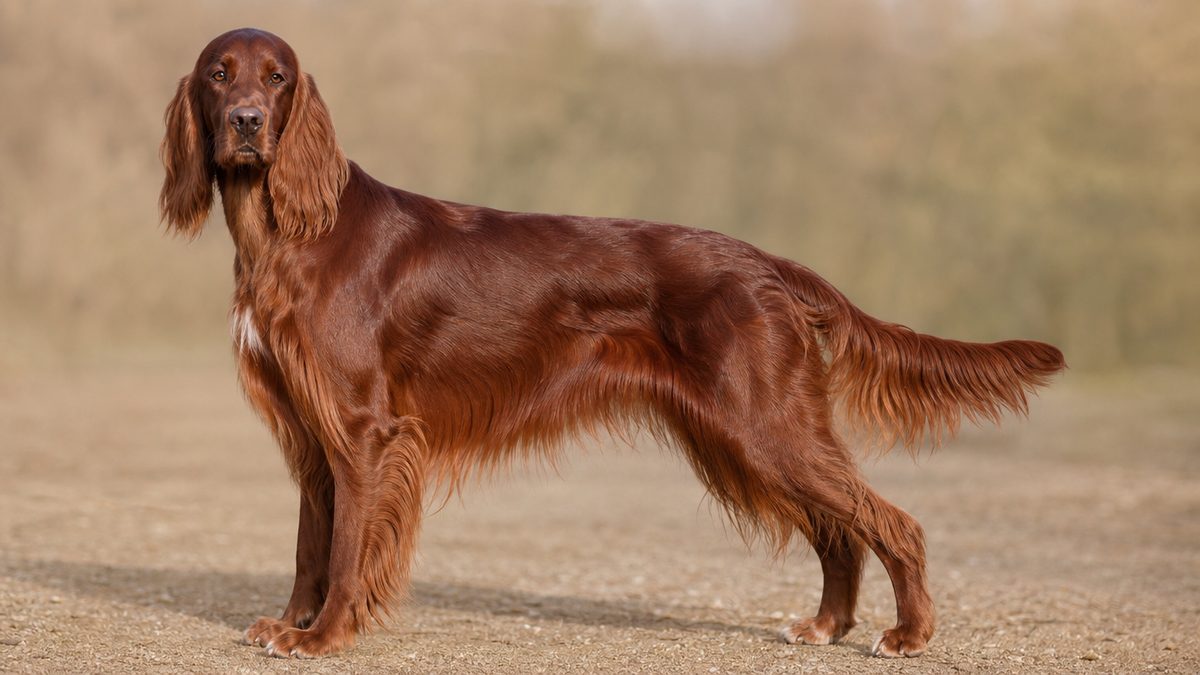
An Irish Setter is a large racy Irish gundog in solid rich chestnut, registered by the FCI as the Irish Red Setter under standard number 120, and its own governing standard records that it was derived from the Irish Red and White Setter.
The breed sits in FCI Group 7, Pointing Dogs, Section 2, British and Irish Pointers and Setters, Subsection Setter, beside the English Setter at number 2, the Gordon Setter at number 6 and the Irish Red and White Setter at number 330. Its country of origin is Ireland, its official authentic language is English, and it is subject to a working trial under FCI nomenclature.
The FCI does not call it the Irish Setter. Its registered name is IRISH RED SETTER, and the Kennel Club's own history explains why: the breed was called the Red Setter to distinguish it from the other two Irish breeds. That matters practically rather than pedantically, because a search for veterinary literature under one name misses papers filed under the other. A 2005 German study of the disease covered later on this page is indexed as being about Irish red setters, not Irish Setters.
Size, and the three registries that cannot agree
| Measure | FCI Standard No. 120 | AKC official standard | Kennel Club | Indian pages |
|---|---|---|---|---|
| Height, dogs | 58 to 67 cm (23 to 26.5 in) | 27 in ideal (68.6 cm) | no size given | 24 to 26 in, and 27 to 30 in |
| Height, bitches | 55 to 62 cm (21.5 to 24.5 in) | 25 in ideal (63.5 cm) | no size given | 22 to 24 in |
| Weight | not stated | about 70 lb dog, 60 lb bitch | no size given | 29 to 34 kg, and 24 to 28 kg |
| Size penalty | none stated | No disqualification as to size | none stated | none |
| Standard date | 13.03.2001 | Approved 14 August 1990 | Last updated 1 April 2025 | undated |
The AKC's ideal male is taller than the FCI's maximum male, and that is a real conflict rather than a rounding difference. The AKC calls 27 inches ideal for a dog and discourages variance beyond an inch either way; the FCI's ceiling is 26.5 inches FCI-Standard N. 120. So a textbook AKC Irish Setter is half an inch over the FCI limit, and a dog at the AKC's tolerated 28 inches is an inch and a half over it. The Kennel Club sidesteps the argument entirely by publishing no Size section at all, which is not a quirk of this breed: its Irish Red and White Setter standard omits size in exactly the same way The Royal Kennel Club breed standard.
A Delhi kennel ranking on page one in India for this term lists the breed as Height 27 to 30 Inches and Weight 24 to 28 Kgs. Read those two lines together. Its floor of 27 inches equals the AKC's ideal and exceeds the FCI's maximum of 26.5 inches, so every dog it describes is above the FCI ceiling, while its top of 30 inches is two inches beyond even the AKC's discouraged limit. Its weight range of 24 to 28 kg is meanwhile below the AKC's ideal of about 70 pounds, which is 31.8 kg. The page therefore describes a dog simultaneously taller and lighter than any published standard, and it carries no rupee price at all, only a phone enquiry form.
Coat and colour, where the breed is decided
Colour is close to absolute in this breed. FCI 120 requires rich chestnut with no trace of black, and permits white on chest, throat and toes, or a small star on the forehead or a narrow streak or blaze on the nose or face, without disqualification. The Kennel Club uses almost identical words and then closes the door: any other colour or combination of colours is unacceptable. So small white marks are normal and a red-and-white patched dog is a different breed, which is the single commonest identification error made about these two dogs.
The coat is short and fine on the head, the fronts of the legs and the tips of the ears, and of moderate length, flat and free from curl everywhere else, with long silky feathering on the upper ears, the backs of the fore and hind legs, the belly, chest and throat, and a fringe on the tail. That distribution decides the grooming job in India, because the feathering is exactly where an Indian dog collects ticks and holds monsoon damp.
The breed is also the reference point for canine red. A 2021 genome-wide study of coat pheomelanin intensity across 3,057 dogs from 63 breeds describes the range of canine red as running from the white coat of the Samoyed to the deep red coat of the Irish Setter, and identified five loci explaining over 70 percent of the variation. The colour that made this breed famous is, quite literally, the extreme of the scale.
The younger breed: what this breed's own standard says about where it came from
The Irish Setter is the younger of Ireland's two setters and was bred out of the Irish Red and White Setter, and FCI Standard 120, which governs this breed, states that descent in its own second paragraph.
Most English-language pages present the Irish Red and White Setter as a white-marked version of the famous red dog. Both breeds' governing standards say the reverse, and this breed's own document is the more decisive of the two, because a registry has no motive to diminish the breed it is describing.
"The Irish Red Setter was developed in Ireland as a working dog for hunting game. The breed is derived from the Irish Red and White Setter and an unknown solid red coloured dog. It was a clearly identifiable type in the 18th century. The Irish Red Setter Club was established in 1882 to promote the Breed. The club issued the Breed Standard in 1886, and has organised field trials and shows to set the Standard for the Breed since that time."
The sibling standard agrees from the other direction, recording that the Red and White Setter is the older of the two and that judicious selective breeding evolved the solid red colour, and that by the end of the nineteenth century the Red Setter had virtually eclipsed the Red and White, which became so rare that it was thought to be extinct. English is the official authentic language of both standards, so neither sentence is a translation artefact.
Ireland had more than two setters, and two of them are gone
The Kennel Club names a third Irish setter and records that it is extinct. Its Irish Setter page explains that the breed was called the Red Setter to differentiate it from the other two Irish breeds, the traditional Red and White and the rarely seen Hail Setter, which had white ticks in its red coat and is now believed to be extinct. A fourth setter is named as extinct on the same registry's English Setter page, where the history records that Richard Purcell Llewellin used Gordon Setters, Red and White Setters and the now extinct Welsh or Llanidloes Setter to widen the gene pool behind the modern English Setter.
Read those two paragraphs together and a fact emerges that no ranking page states. The Red and White Setter is named as a foundation contributor to two separate modern breeds, its own descendant the Irish Setter and, through Llewellin, the English Setter FCI-Standard N. 120 The Royal Kennel Club. The breed that nearly went extinct is upstream of the two setters that did not.
What the show ring did to the red dog
The Kennel Club is unusually candid about the mechanism. Selective colour breeding and some outcrossing to get a racier build and a longer head produced a dog glamorously coated, lighter in bone and finer in the head than its cousins, and the breed became a great success in the show ring in the mid-nineteenth century and overtook the Irish Red and White Setter in popularity. Racy, lighter in bone and finer in the head are the standard's own words for what was selected, and FCI 120 still opens its general appearance clause with "Racy and athletic full of quality";.
The genetics confirm the shared ancestry independently of any pedigree book. Canine leucocyte adhesion deficiency, a lethal recessive first documented in Irish Setters, was found in Irish Red and White Setters in 2002, and the American paper reporting it states plainly that the Irish Red and White Setter has a history of interbreeding with Irish Setters and shares a common ancestry with the Irish Setter breed Debenham SL, Millington A, Kijas J. A shared lethal recessive is harder to argue with than a stud book.
Recognition: admitted first everywhere, by 34 years at the FCI and 131 at the AKC
Every major register admitted the Irish Setter decades before the older Irish Red and White Setter, and the dates are printed on the registers' own pages rather than inferred from breed histories.
| Breed | FCI number | FCI definitive recognition | AKC recognition | AKC popularity |
|---|---|---|---|---|
| English Setter | 2 | 6 March 1963 | not recorded here | not recorded here |
| Gordon Setter | 6 | 28 May 1963 | not recorded here | not recorded here |
| Irish Setter | 120 | 22 December 1954 | 1878 | 73 of 210 |
| Irish Red and White Setter | 330 | 6 June 1989 | 1 January 2009, the 159th breed | 162 of 210 |
The FCI numbering itself records the order of arrival, since a low number means an early entry in the nomenclature, and on definitive-acceptance dates the order is Irish Red Setter first on 22 December 1954, then the English Setter on 6 March 1963, the Gordon Setter on 28 May 1963, and the Irish Red and White Setter last on 6 June 1989 FCI breeds nomenclature entry FCI breeds nomenclature entry.
The FCI prints dates as month/day/year, and each register page proves its own format. This breed's page carries 7/18/2001, 8/31/2001 and 2/22/2002 in its standards table, and 18, 31 and 22 cannot be months, so the first field is the month and 12/22/1954 is 22 December 1954. The Gordon Setter's page carries 5/28/1963 and the English Setter's 10/28/2009, both settling the same way. Reading these fields as day/month would move the English Setter's recognition from 6 March 1963 to 3 June 1963.
The breed club dates are older still, and they are in the standard
The Irish Red Setter Club was established in 1882 and issued the breed standard in 1886, and the same club published the breed's working style in 1998, so the standard and the working style together describe both the physical form and the working ability. The older breed's club arrived much later: FCI 330 records that by 1944 the red and white had re-established itself well enough to have a club of its own, and that the present society was formed in 1981. Sixty-two years separate the two clubs, which is the same story the recognition dates tell.
What recognition means for an Indian buyer
India's answer runs through the FCI and is checkable. The FCI members register lists India as a full member represented by the Kennel Club of India in Chennai, so the KCI issues pedigrees against FCI nomenclature, and a definitively recognised breed such as this one is in principle registrable in India. Several Indian sellers price a KCI-registered dog as a distinct tier, with one marketplace putting basic quality at INR 90,000 to INR 1,20,000, KCI registered at INR 1,20,000 to INR 2,00,000 and champion bloodline at INR 2,00,000 to INR 3,00,000.
A limit on that route is worth stating rather than dressing up. The Kennel Club of India publishes no per-breed registration list, so a query there returns nothing for this breed and nothing for a common control breed either. That is a limitation of the source, not evidence about the breed, and Bonbeno reports it as one. What can be verified is that a KCI certificate is claimed as a price tier by sellers, and that no page examined showed the certificate itself.
The 2025 registration restriction nobody outside the UK has noticed
With effect from 6 January 2025 the Kennel Club closed its register to untested imports of this breed. Imported Irish Setters, and litters from overseas sires, are eligible for registration only if proven clear or carriers of both canine leukocyte adhesion deficiency and progressive retinal atrophy rcd1, or if they hold hereditary clear status. Carriers may still be bred from, provided they are mated only to a dog hereditarily clear or DNA-tested clear of both conditions. The parallel restriction on the red and white breed covers only CLAD, because rcd1 is not its problem.
Irish Setter price in India: two bands that differ by four times, and no puppy behind either
Irish Setter price in India is published as Rs 40,000 to Rs 80,000 by the top-ranked Indian page and INR 90,000 to INR 3,00,000 by an Indian marketplace, a four-fold spread on the same day, and neither page displayed a puppy with an age, a city or a price of its own.
Bonbeno pulled the top ten organic results in India for irish setter price in india on 31 August 2026 and read every figure out of the retrieved page rather than out of a snippet. Four of the ten are Indian commercial pages, one is a video, and the rest are United States sites Mr n Mrs Pet, Irish Setter Puppies For Sale… Poddar Kennel, Irish Setter Dog Puppy… Breed n Breeder, Irish Setter Puppies….
| Position and source | Price given | What the page actually holds |
|---|---|---|
| 1. Happy Pet, India | ₹40,000 to ₹80,000 | A breed guide. Updated 16 May 2025. No listings, no breeder, no dog for sale |
| 2. A YouTube video | none | Title bundles the breed with Golden Retrievers and Dutch Shepherds plus a seller phone number |
| 3. Breed n Breeder, India | none visible | A shell page with a phone number and a 330-breed dropdown. Ranks twice, at 3 and 9 |
| 4. A-Z Animals, United States | USD 1,000 to 3,000 | A US cost article ranking on page one in India, with no rupee figure |
| 5. Petfinder, United States | none | US adoption directory |
| 6. Poddar Kennel, Delhi | none printed | Price gated behind a phone form. Prints Height 27 to 30 Inches, which no standard allows |
| 7. Lancaster Puppies, United States | USD 1,000 to 2,500 | A US marketplace |
| 8. Puppies.com, United States | filter from USD 100 | A US marketplace with a price filter, not an Indian price |
| 9. Breed n Breeder again | none visible | The same shell page as position 3 |
| 10. Mr n Mrs Pet, India | INR 90,000 to INR 3,00,000 | Three quality tiers. Listing cards carry a blank age and a blank city |
Run the conversion tests, because one band divides suspiciously well
| Rupee figure | Divided by 84.38 | Divided by 80 | Divided by 74 | Divided by 66.67 |
|---|---|---|---|---|
| ₹40,000, Happy Pet floor | 474.05 | 500.00 | 540.54 | 599.97 |
| ₹80,000, Happy Pet ceiling | 948.09 | 1,000.00 | 1,081.08 | 1,199.94 |
| INR 90,000, marketplace floor | 1,066.60 | 1,125.00 | 1,216.22 | 1,349.93 |
| INR 1,20,000 | 1,422.14 | 1,500.00 | 1,621.62 | 1,799.91 |
| INR 2,00,000 | 2,370.23 | 2,500.00 | 2,702.70 | 2,999.85 |
| INR 3,00,000, marketplace ceiling | 3,555.34 | 3,750.00 | 4,054.05 | 4,499.78 |
The Happy Pet band is the one to look at twice. Its two endpoints divide by a flat 80.00 to exactly 500 and exactly 1,000 US dollars, and those are prices a seller would actually print. The marketplace band divides at 80 to 1,125, 1,500, 2,500 and 3,750, of which only the middle two look like quotable prices. Treat the 80 test as weak on its own, because any rupee figure ending in three zeros divides cleanly by 80 by construction, and note that neither band divides at 84.38. What raises the Happy Pet figures above noise is that both quotients are round, plausible dollar prices at once.
The marketplace publishes a city-by-city price table for Hyderabad, Bangalore, Delhi, Chennai, Lucknow, Mumbai, Jaipur and Pune. Every one of the eight rows reads INR 90,000 to INR 3,00,000. A table that cannot distinguish Lucknow from Mumbai is not reporting local prices; it is repeating one range eight times to rank for eight city queries. Its listing cards are the same story: each shows Breed Irish Setter and Gender Male, then a blank age, a blank city and no price, with the View link going to a sign-up form.
So the honest reading is that prices are published and puppies are not. Rupee figures for this breed genuinely exist in India, unlike its red and white relative, and Bonbeno reports them as published bands rather than as a market rate. What no page in the set produced was a specific animal, in a named city, at a named price, with a KCI certificate visible. The recurring cost of keeping the dog is far better evidenced, and the cost section below prices it line by line.
What an Irish Setter actually costs to keep in India, in rupees
Keeping an Irish Setter in an Indian metro costs about ₹6,000 to ₹10,000 a month before the purchase price, built from published Indian figures starting at Rs 360 for a DHPPi+L dose at a government teaching hospital and ₹2,499 for one full groom in Bengaluru.
The purchase price is contested and the running costs are not. Everything below is a published rupee figure for a service or product an Indian household actually buys, sized to a 29 to 34 kg long-coated dog, and none of it is converted from a foreign currency.
| Line | Figure as printed | Source and what it is |
|---|---|---|
| DHPPi+L vaccination, one dose | 360 | Madras Veterinary College Teaching Hospital, TANUVAS, published fee structure |
| Anti-rabies vaccination | 160 | Same government fee structure |
| Small animal registration, 7 days | 100 | Same. The hospital also dispenses drugs and fluids free of cost |
| Radiograph | 100 | Same government fee structure |
| Major surgery | 1,500 | Same |
| Emergency surgery | 2,500 | Same. Surgical charge only, not an all-in bill |
| New consultation, private chain | ₹300 to ₹800 | Vetic clinic chain's own published table, April 2026 |
| Radiograph per view, private chain | ₹500 to ₹750 | Same, with light sedation at ₹800 to ₹1,500 |
| Deworming, 6 tablets | ₹778, MRP ₹894 | Tata 1mg listing, Drontal Plus |
| Tick and flea spot-on, 20 to 40 kg | ₹1,561 for 3 pipettes | Supertails listing, about ₹520 a month |
| Complete groom, over 25 kg, long coat | ₹2,499 | Supertails+ clinic grooming, Bengaluru, twelve locations |
| Bath and blow dry, over 25 kg | ₹1,089 | Same price list. Dematting adds ₹599 |
| Boarding, large breed, per day | ₹800 | Aruani PetStop, Sarjapur Road, Bengaluru, August 2026 |
| Large-breed dry food, 15 kg | ₹9,548, MRP ₹11,000 | Supertails listing, Royal Canin Maxi Adult, ₹63 per 100 g |
The top-ranked Indian page for this breed prints three monthly lines, food at ₹3,000 to ₹4,500, healthcare at ₹1,500 to ₹2,250 and grooming at ₹1,200 to ₹1,800, then labels ₹5,700 as Avg Monthly Expenses and ₹8,550 as Basic Lifestyle. Add the three lows: 3,000 plus 1,500 plus 1,200 is exactly 5,700. Add the three highs: 4,500 plus 2,250 plus 1,800 is exactly 8,550. So ₹5,700 is the basic total and ₹8,550 the premium total, and the page has swapped its own two labels. The underlying figures are coherent; the presentation is not. A second Indian marketplace puts monthly cost at INR 5,000 to INR 10,000, which brackets the same range.
Three lines this breed generates that a short-coated dog does not. Grooming is the largest, because the Bengaluru price list charges ₹1,999 for a large short-coated dog over 25 kg and ₹2,499 for a large long-coated one, a ₹500 premium this dog pays at every visit, plus ₹599 if the feathering has matted through a monsoon. Ear care is the second, because drop-eared dogs carried 47.72 percent of 1,008 Indian otitis externa cases against 28.07 percent for prick ears. Tick preventive is the third, at roughly ₹520 a month for a 20 to 40 kg dog, and Indian law makes de-ticking part of grooming rather than an optional extra.
A defensible monthly range is ₹6,000 to ₹10,000 excluding the food brand you choose, constructed from those lines rather than surveyed: roughly ₹1,900 to ₹2,400 of food on a 15 kg bag at ₹63 per 100 g, ₹520 of tick preventive, one ₹2,499 groom amortised over six to eight weeks, and periodic deworming and consultation Vetic Pet Clinic, Dog X-Ray Cost in India. Boarding adds ₹800 a day when you travel.
The cost nobody budgets for is surgical, and for this breed it has a name. A government teaching hospital in Chennai charges Rs 2,500 for emergency surgery and Rs 1,500 for major surgery, and a private metro bill is a different order of magnitude. For a deep-chested setter the event most likely to produce one is gastric dilatation-volvulus, which this breed has its own published study of and which the bloat section below covers.
Heat tolerance: a 10.1 degree homeland against a 27.9 degree city
The Irish Setter comes from a country whose warmest month averages 15.1 degrees Celsius, which is 5.1 degrees colder than the coolest month in Bengaluru, so every Indian metro sits outside the climate this coat was assembled for.
Bonbeno pulled twenty-year monthly climatologies from NASA POWER by explicit latitude and longitude, covering January 2001 to December 2020, for two Irish reference points and seven Indian metros. Wet-bulb temperature is computed from the same monthly means using Stull's 2011 formula, because wet-bulb decides whether a panting dog can shed heat at all.
| Place | Cell elevation | Annual mean | Warmest month | Coolest month | Annual mean RH | Peak monthly wet-bulb |
|---|---|---|---|---|---|---|
| Dublin, Ireland | 46 m | 10.1 C | 15.1 C (July) | 5.6 C (February) | 87.6% | 13.4 C (July) |
| Sligo, Ireland | 31 m | 10.4 C | 14.9 C (August) | 6.5 C (February) | 84.7% | 13.2 C (August) |
| Bengaluru | 842 m | 23.7 C | 28.4 C (April) | 20.2 C (December) | 67.9% | 21.9 C (May) |
| Pune | 636 m | 23.9 C | 28.9 C (April) | 19.6 C (December) | 66.8% | 23.0 C (June) |
| Delhi | 206 m | 25.6 C | 35.9 C (June) | 13.6 C (January) | 45.6% | 26.5 C (July) |
| Kolkata | 7 m | 25.8 C | 31.5 C (May) | 17.3 C (January) | 73.9% | 27.1 C (June) |
| Hyderabad | 495 m | 26.1 C | 33.3 C (May) | 20.8 C (December) | 60.3% | 23.3 C (June) |
| Mumbai | 97 m | 26.8 C | 31.2 C (May) | 23.2 C (January) | 67.4% | 25.8 C (June) |
| Chennai | 49 m | 27.9 C | 31.5 C (May) | 24.1 C (January) | 72.4% | 26.1 C (May) |
Compare the extremes rather than the averages and the problem becomes obvious. Dublin's warmest month averages 15.1 degrees; Bengaluru's coolest month averages 20.2. India's mildest large city is therefore 5.1 degrees warmer in its coldest month than the breed's homeland is in its hottest, and Bengaluru is the best case. Against Chennai the two annual means differ by 17.8 degrees.
NASA POWER returns a grid cell rather than a point, and in mountains a cell's mean elevation can miss the town beneath it by more than a kilometre, which moves temperature by about 6.5 degrees per 1,000 metres. Every place here is a plains or plateau city and every cell lands close to the real ground: Delhi's cell about 10 metres below the city, Chennai's about 43 above, Mumbai's about 83 above, Bengaluru's about 78 below, and Dublin's 46 metres against a city centre near 20. Dublin and Sligo returned different series and different elevations, so they are two genuinely separate cells rather than one queried twice. These Indian figures also reproduce the Gordon Setter page's climate table exactly, which is an independent check on both.
Ireland is more humid than Chennai, and that is not the same problem
Dublin averages 87.6 percent relative humidity against Chennai's 72.4 percent, and Dublin is far safer, which is precisely what wet-bulb exists to express. Dublin's peak monthly wet-bulb is 13.4 degrees and Chennai's 26.1, a gap of 12.7 degrees, because wet-bulb folds heat and moisture into the one number that decides whether evaporative cooling still works. A dog pants to evaporate water from its airways, and that mechanism fails as wet-bulb approaches body temperature.
Kolkata is the hardest Indian city on this measure and it is not the hottest. Its June peak wet-bulb of 27.1 degrees exceeds Delhi's 26.5 and Chennai's 26.1, even though Delhi's warmest month is 4.4 degrees hotter in dry-bulb terms, because Delhi's 45.6 percent annual humidity buys evaporative headroom that Kolkata lacks. So a Kolkata or Mumbai household plans around the monsoon and a Delhi household around May and June, and those are different plans.
One Indian page selling this breed states its ideal weather as 10 to 20 degrees Celsius. No Indian metro in the table has an annual mean inside that band, and the closest, Bengaluru at 23.7 degrees, is 3.7 degrees above its ceiling. The page prints the requirement and the price on the same screen.
Managing the heat, and what Indian law already says about a long-coated dog
Move this breed's exercise to the coolest hours rather than cutting its coat, because the largest study of canine heat-related illness found exertion behind three quarters of triggered cases and most exertional cases following an ordinary walk.
The evidence contradicts the popular advice. Hall, Carter and O'Neill reviewed 905,543 UK dogs under primary veterinary care in 2016 and identified 1,259 heat-related illness events from 1,222 dogs. Of the 879 events with a recorded trigger, 652 were exertional, which is 74.2 percent, against 113 environmental at 12.9 percent and 46 from vehicular confinement at 5.2 percent. Read one layer deeper. Of the 551 exertional events where the exercise type was specified, 372, or 67.5 percent, followed walking, against 97 after high-intensity activity and 76 after play.
Hall's breed variable included only breed types with at least five heat-illness cases or at least 5,000 dogs in the study population; everything else went into grouped categories. The words Irish Setter and setter appear zero times in either 2020 paper, while the Labrador control appears 17 and 19 times, so the absence is real rather than a failed search. The breed therefore sits inside the other purebred category, whose odds ratio against the Labrador Retriever was 1.28 with a confidence interval of 0.76 to 2.14 and a p-value of 0.358, meaning no significant difference. The factor that transfers honestly is bodyweight: dogs at or above their breed and sex mean carried an odds ratio of 1.42, confidence interval 1.12 to 1.80.
The most actionable single number is 4.6 percent. Forty of the 879 triggered events happened while the dog was in the care of a veterinary clinic or a groomer. A long-coated dog in an Indian grooming salon, restrained and under a dryer, sits inside that category, so ask what the drying arrangement is before you book.
Indian law names this breed's exact situation
Second Schedule Part IV paragraph 21(1) of the Prevention of Cruelty to Animals (Dog Breeding and Marketing) Rules 2017 bars keeping certain dogs in outdoor facilities without the attending veterinary practitioner's written approval. The three categories named are dogs not accustomed to the temperatures prevalent in the area or region in question, dog breeds that cannot tolerate those temperatures, for which the Rules give the example "such as long-haired breeds in high temperature locations", and sick, infirm, aged or young animals. A feathered Irish gundog in Chennai is the clause's own worked example.
This is a Second Schedule paragraph, not a Rule. The Rules themselves run only from Rule 1 to Rule 13, ending at No licence without registration, so any citation reading Rule 14 or higher is wrong by construction. The string Rule 21 appears zero times in the gazette. The correct citation is Second Schedule Part IV paragraph 21(1), Outdoor housing facilities.
- Walk before sunrise and after dark, and treat the Kennel Club's more than two hours per day as two blocks at the cool ends rather than one long midday session.
- Watch the wet-bulb, not the thermometer, in Kolkata and Mumbai from June, because a 27.1 degree wet-bulb defeats panting at readings that look mild Stull R. Wet-bulb temperature from relative….
- Keep the dog lean, since bodyweight at or above the breed and sex mean carried an odds ratio of 1.42 in the largest heat study.
- Cool the dog before the walk, not only after it, because most exertional cases followed an ordinary walk rather than sport.
- Question the groomer's dryer, because clinic or groomer care accounted for 40 of 879 triggered events.
- Do not house the dog outdoors in an Indian summer, which the 2017 Rules already restrict for long-haired breeds in high temperature locations.
Seasonality is sharp enough to plan around. In Hall's 2016 UK cohort, 40 percent of incident heat-illness cases, 158 of 395, fell in July alone, and the study put the 2016 incidence of heat-related illness at 0.04 percent with an event fatality rate of 14.18 percent. The Indian equivalents are April to June across the plains and the monsoon months on the coast, and a household that changes its routine for eight weeks removes most of the exposure.
Temperament: demonstrably affectionate, tremendously active, and not a guard dog
The Irish Setter is a demonstrably affectionate family gundog with an untiring readiness to range and hunt, and no standard governing the breed contains a guarding, protective or watchdog clause of any kind.
The three governing standards agree closely. The Kennel Club gives the characteristics as most handsome and refined in looks, tremendously active with untiring readiness to range and hunt under any conditions, and the temperament in two words, demonstrably affectionate. FCI 120 lists keen, intelligent, energetic, affectionate and loyal, and gives the breed's utilisation as gun dog and family dog. The AKC calls it a swift-moving hunter afield and a sweet natured companion at home, and describes a rollicking personality in which shyness, hostility or timidity are uncharacteristic.
An Indian marketplace describes its basic quality tier as suitable for experienced families looking for a loyal and protective companion. Protective appears in no standard for this breed, in any of the three registries. Aggressive or overly shy dogs are a disqualifying fault under FCI 120, which means such a dog cannot be awarded in the ring at all. A page selling a setter as protective is selling a job the breed was not built for, to a buyer who may want exactly that job done.
| Question | Irish Setter | Irish Red and White Setter |
|---|---|---|
| Size category | Large | Large |
| Town or country | Either | Either |
| Size of home | Large house | Large house |
| Size of garden | Large garden | Large garden |
| Exercise | More than 2 hours per day | More than 2 hours per day |
| Grooming | More than once a week | More than once a week |
| Sheds | Yes | Yes |
| Coat length | Medium | Medium |
| Lifespan category | Over 10 years | Over 10 years |
| Vulnerable native breed | No | Yes |
The registry fills in ten fields for the two Irish setters and only one comes back different, and it is rarity rather than behaviour The Royal Kennel Club. Anyone choosing between them on temperament is choosing between two descriptions the Kennel Club writes identically. The genuine differences are the health profiles, which diverge sharply, and how findable each dog is.
Who should not buy this breed
- Anyone wanting protection, since the standards describe an affectionate dog and none mentions guarding.
- Anyone in a small flat without a plan, because the registry specifies a large house, a large garden and more than two hours a day.
- Anyone who dislikes shedding, because the registry answers the shedding question with a flat yes.
- Anyone hoping for a hypoallergenic dog, because no breed is, and the evidence on that is settled.
- Anyone whose household cannot move its walks to before dawn from March to June, which in an Indian metro is not negotiable.
Training: willing, slow to mature, and famously distractible at distance
Train an Irish Setter with short reward-based sessions and finish recall before anything else, because the breed's own standard describes an untiring readiness to range and hunt under any conditions, which is a polite way of saying the dog will leave.
The standard states the training problem in one clause. The Kennel Club calls the breed tremendously active with untiring readiness to range and hunt under any conditions, and FCI 120 lists keen, intelligent and energetic alongside affectionate and loyal FCI-Standard N. 120. Willing plus untiring is the profile of a dog that wants to work with you and will make its own decisions two hundred metres away. Socialise the puppy deliberately from eight weeks, because a ranging gundog that has never met a crowded Indian street will improvise when it finally does.
The working pattern is why recall outranks everything. A setter quarters ground ahead of its handler and then sets, freezing to indicate where the birds are, and the breed's club published a formal working style in 1998 to sit alongside the standard. A dog bred to work at range is a dog that must be recallable at range, and no amount of lead work substitutes.
| Window | What to train | What to expect |
|---|---|---|
| 8 to 16 weeks | Name, lead, crate, daily handling of ears, feet and feathering | Fast learning, no reliability. Grooming tolerance is free now and expensive later |
| 4 to 8 months | Recall on a long line, a trade game for carried objects, settle on a mat | Attention comes and goes. Keep sessions to minutes and finish early |
| 8 to 18 months | Recall against real distraction, loose lead at adult strength | The hardest phase, when the dog is physically adult and mentally not |
| 18 months to 3 years | Scent work, gundog retrieves, off-lead freedom where legal and safe | Judgement arrives. Hip and elbow radiographs become meaningful |
Three things that go wrong in Indian households specifically
Heat shortens every session, so plan around it. Training at midday in an Indian April is a physiology problem rather than a discipline problem, since exertional heat illness accounted for 74.2 percent of triggered events and most followed an ordinary walk. Train early, train short, and use indoor scent games when the wet-bulb is high.
Grooming tolerance is a training subject. A dog whose ears, feet and leg feathering have been handled daily from eight weeks will stand for a comb in a Chennai monsoon; one that has not will need sedating at three years old, and a Bengaluru clinic charges ₹2,499 for the groom either way.
Start at eight weeks, because that is the earliest the law allows the puppy to leave. Rule 8(1)(a) of the 2017 Rules requires that pups less than eight weeks in age are not sold, Rule 8(1)(e) requires that each pup sold is micro-chipped with a complete record of treatment and vaccination, and Second Schedule Part III paragraph 8(9) records that vaccination can start at seven to eight weeks and usually completes around eighteen. The socialisation window and the vaccination course overlap, which every Indian puppy owner has to resolve with their own vet rather than by keeping the puppy indoors until week eighteen.
Exercise: more than two hours a day, against Indian pages that halve it
The Kennel Club places the Irish Setter in its top exercise band at more than two hours per day, and the Indian commercial pages ranking for the breed give 60 to 90 minutes without saying where that figure came from.
| Source | Stated requirement | What the source is |
|---|---|---|
| Royal Kennel Club, Irish Setter | More than 2 hours per day | The breed's home registry, top band |
| Royal Kennel Club, Irish Red & White Setter | More than 2 hours per day | Same registry, same band, sibling breed |
| Royal Kennel Club, Gordon Setter | More than 2 hours per day | Same registry, same band, third setter |
| An Indian breed page | 60 to 90 minutes | Roughly half the registry figure, on a page selling the breed |
| An Indian marketplace | Moderate, only with daily exercise | An apartment-friendliness rating rather than a duration |
The Kennel Club gives all three of its setters the same top band and the Indian pages give this one about half of it The Royal Kennel Club Happy Pet, Irish Setter dog breed guide. Bonbeno takes the registry figure, because it is the body that holds the registrations and it applies the same band consistently across the group. A household planning for ninety minutes is planning for a different dog.
What two hours has to contain
Two hours of lead walking is not two hours of exercise for a ranging gundog. The breed's working pattern is to quarter ground and hold a point, so the requirement is as much mental as physical, and the FCI's decision to make the breed subject to a working trial is a statement about what it is for. Scent work, retrieves and long-line freedom in a safe space do more per minute than pavement mileage.
Forced running, long distance and repetitive jumping before eighteen months load joints that have not finished growing. This breed's published hip record is 11.7 percent dysplastic across 13,508 OFA evaluations, which is mid-table rather than clean, and hip conformation is heritable but expressed through growth. A good pedigree is not a licence to run a nine-month-old on concrete, and hip scoring is done on an adult radiograph for exactly that reason.
In India the binding constraint is the clock, not the dog. Across the seven metros in the climate table the only hours reliably below this breed's comfort range are before sunrise and after dark for about four months of the year. A household that cannot commit to a 5.30 am walk from March to June should not take this breed, and that is the most useful sentence on this page about exercise.
Exercise also interacts with the breed's bloat risk in a way worth knowing. The breed's own published bloat study found no risk attributable to the intensity or duration of exercise, which is unusual and reassuring, while a car journey and recent kennelling did carry raised odds. So the exercise itself is not the danger. Feeding around it is, and the feeding section sets out the timing.
Grooming silky feathering in Indian humidity, and the ears that decide your routine
Groom an Irish Setter more than once a week by combing the feathering through to the skin, and check the ears weekly in dry months and daily through the monsoon, because drop-eared dogs carried 47.72 percent of 1,008 Indian otitis externa cases.
The coat is short over most of the dog and long in six places. FCI 120 gives short fine hair on the head, the fronts of the legs and the ear tips, moderate-length flat hair everywhere else, and long silky feathering on the upper ears, the backs of the fore and hind legs, the belly, the chest and the throat, with a fringe on the tail. All feathering is to be straight and flat. Those six areas are the entire grooming job, and the Kennel Club puts the frequency at more than once a week while answering the shedding question with a flat yes.
Ears, and the Indian number that should set your schedule
Drop ears carried 47.72 percent of 1,008 canine otitis externa cases in a Bengaluru veterinary teaching hospital series, against 24.21 percent for intermediate ears and 28.07 percent for prick ears, at p below 0.00001. This breed's ears are of moderate size, fine in texture, set low and well back and hanging in a neat fold close to the head, with long silky feathering on the upper portion, which is the drop category with an insulating layer on top.
Season matters as much as anatomy. The same series recorded 41.87 percent of cases in the rainy season against 32.83 percent in winter and 25.30 percent in summer, and attributed the monsoon peak to humidity, temperature and moisture altering the microenvironment of the ear canal. So ear checks move from weekly to daily in July and August, and the ears are dried deliberately after every bath rather than left to air dry.
The paper's breed table names thirteen categories and their counts sum to exactly 1,008, so it is the whole case series rather than a top-thirteen extract. Non-descript dogs account for 202 cases, Labrador Retrievers 185, Shih-Tzu 119, Pug 107, German Shepherd 104, Golden Retriever 83, Pomeranian 51, Cocker Spaniel 43, Dachshund 35, Bulldog 23, Siberian Husky 21, Rottweiler 19 and Lhasa Apso 16. Not one setter of any kind appears among 1,008 Indian otitis cases collected between December 2010 and November 2022. Twelve years at a major Indian veterinary college is a reasonable window, and it is the strongest single indication on this page of how few of these dogs are actually here.
Ticks, and the clause in Indian law that names grooming
Feathering is where ticks live, and Indian law folds de-ticking into grooming rather than treating it separately. Second Schedule Part IV paragraph 27 of the 2017 Rules requires that grounds be kept free of accumulations and that weeds, grasses and bushes be controlled so as to control and prevent fleas and ticks, and states that regular de-ticking shall be practised at the time of grooming. The clause is written for breeding establishments and the husbandry logic transfers to any household walking a feathered dog through Indian grass. A 20 to 40 kg spot-on works out at roughly ₹520 a month.
A practical weekly routine takes about twenty minutes. Brush the short body coat first, then comb the six feathered areas through to the skin with a wide-tooth comb, check both ear canals and the base of each flap, run fingers through the belly and chest fringe and between the toes for ticks, and trim only the feet for neatness. Bathe when dirty rather than on a schedule.
The impulse is understandable and the evidence does not support it. Heat-related illness in dogs is overwhelmingly exertional rather than radiant, with 652 of 879 triggered events following exertion and 372 of 551 specified exercise events following an ordinary walk. Clipping changes what the sun does to a dog and changes nothing about what a walk in April does to it. The sibling breed's AKC standard goes further and states outright that the dog is not to be shaved with clippers, and while the Irish Setter's own standard carries no such clause, the physiology is identical. Change the walk time, not the coat.
Health: mid-table joints, a poor thyroid record, and the heaviest test list of the four setters
The Irish Setter's published health issues sit in three groups: joints that are mid-table and better than the Golden Retriever's, a thyroid record ranking 14th worst of 130 breeds, and three separate DNA tests, which is more than any other setter carries.
| Register | Evaluations | Result | Rank |
|---|---|---|---|
| Hips | 13,508 | 87.3% normal, 11.7% dysplastic, 10.4% Excellent | 113 of 222 |
| Elbows | 1,387 | 97.2% normal, 2.8% abnormal | 112 of 168 |
| Thyroid | 2,314 | 82.2% normal, 8.6% compensative autoimmune thyroiditis | 14 of 130 |
| Eyes, summary line | 1,109 | 95.8% normal, 4.1% abnormal | 130 of 239 |
| rcd4 progressive retinal atrophy | 466 | 96.8% normal, 3.2% carrier, 0.0% affected | 6 of 11 |
| Progressive retinal atrophy, other | 1,251 | 99.8% normal, 0.2% carrier | 33 of 48 |
| CLAD, DNA | 570 | 100.0% normal, 0.0% carrier | 2 of 5 |
| Globoid cell leukodystrophy, DNA | 159 | 100.0% normal | 2 of 5 |
| Degenerative myelopathy, DNA | 259 | 95.8% normal, 2.7% carrier, 1.5% affected | 58 of 113 |
| Von Willebrand disease, DNA | 172 | 100.0% normal | 21 of 24 |
| Patella | 54 | 100.0% normal | 170 of 175 |
| Basic cardiac | 58 | 100.0% normal | 84 of 145 |
The hip row survives an arithmetic check, which matters more than the number itself. OFA prints Excellent 10.4, Good 59.6 and Fair 17.3 percent, summing to exactly the 87.3 percent normal it also prints, and mild 7.7, moderate 3.6 and severe 0.4, summing to exactly the 11.7 percent dysplastic. That internal consistency is worth confirming because OFA's own ALL BREEDS summary row on the same hip table fails the same test, printing 84.3 percent normal beside Excellent 14.6, Good 0.0 and Fair 0.0, components that cannot sum to the whole.
In context the joints are respectable. At 11.7 percent dysplastic the breed sits below the Golden Retriever's 19.3 percent across 192,946 evaluations, marginally above the Labrador Retriever's 11.3 percent across 324,780, and well below the Gordon Setter at 18.7 percent and the English Setter at 15.3 percent. The elbow figure of 2.8 percent abnormal is the striking one, against 14.8 percent for the English Setter and 14.2 for the Gordon on comparable denominators.
The thyroid row is where a buyer should ask questions. OFA ranks the breed 14th of 130 published breeds, where rank 1 is worst, at 82.2 percent normal across 2,314 evaluations, with compensative autoimmune thyroiditis at 8.6 percent, autoimmune thyroiditis at 0.3, idiopathic hypothyroidism at 0.1 and 8.7 percent equivocal. The English Setter is rank 1 at 60.4 percent normal and the Irish Red and White Setter rank 4 at 79.4 percent, so three of the four setters cluster at the bad end while the Gordon sits comfortably at rank 80.
Indian law already names the test. Second Schedule Part III paragraph 8(10) of the 2017 Rules requires that dogs shall have been tested for genetic defects, including hip dysplasia, progressive retinal atrophy, night blindness, hypothyroidism, entropion, ectropion and several dentition faults. Five of those named defects appear in this breed's own OFA record, which makes the statutory testing duty and the registry's findings line up almost item for item.
What the Kennel Club asks breeders to do
This breed carries the longest recommended test list of the four setters. Good practice is prioritising genetic diversity plus a DNA test for progressive retinal atrophy rcd4; best practice adds DNA tests for canine leukocyte adhesion deficiency and PRA rcd1, and screening under the BVA/KC Elbow Dysplasia Scheme, the BVA/KC/ISDS Eye Scheme and the BVA/KC Hip Dysplasia Scheme. That is three DNA tests and three schemes. The Irish Red and White Setter carries one DNA test and two schemes, and the English Setter carries one DNA test, NCL8, plus hip, elbow and a BAER hearing scheme this breed does not need The Royal Kennel Club.
Two inherited diseases this breed has beaten, measured in the registry's own published lists
Two of the Irish Setter's three DNA-testable diseases have effectively been eliminated from the UK registered population, with the Kennel Club's own published reports showing zero rcd1 carriers among 418 results and seven CLAD carriers among 317.
Bonbeno counted the Kennel Club's published DNA test reports for this breed row by row. Each result token in those PDFs sits at the end of its own line beside a registered dog's name, so the rows can be counted exactly rather than estimated. The rcd1 report carries 418 results and every one reads Clear. The CLAD report carries 317 results, of which 310 are Clear and 7 are Carrier, with no affected dogs.
| Disease and population | Dogs tested | Carriers | Carrier rate |
|---|---|---|---|
| rcd1 PRA, clinically normal Irish setters, 1994 to 1997 | 436 | 34 | 7.8% |
| rcd1 PRA, Kennel Club published report, 2026 | 418 results | 0 | 0.0% |
| rcd1 PRA, OFA register (all PRA other than rcd4) | 1,251 | 3 | 0.2% |
| CLAD, Irish red setters in Germany, 2005 | 289 | not stated | 11% |
| CLAD, Kennel Club published report, 2026 | 317 results | 7 | 2.2% |
| CLAD, OFA register | 570 | 0 | 0.0% |
| CLAD, Irish Red and White Setters, 2002 | 76 | 6 | 7.9% |
rcd1, the disease the DNA test actually finished
Rod-cone dysplasia 1 is caused by a nonsense mutation at codon 807 of the PDE6B gene, and Aguirre and colleagues sampled 436 clinically normal Irish setters between 1994 and 1997, finding the mutation in one allele of 34 of them, a carrier rate of 7.8 percent. The same mutation was not found in a red wolf or in dogs of 23 other breeds affected with PRA or inherited photoreceptor disease. The authors cautioned that their sample was not random, because some dogs tested were closely related, so the true population rate may have differed.
Roughly three decades later the Kennel Club's published rcd1 report lists 418 results with no carrier and no affected dog at all. The registry still requires the test for imported dogs, and since 6 January 2025 an imported Irish Setter must be proven clear or a carrier of rcd1 to be registered, precisely to stop the allele coming back in. That combination, a cleaned-up domestic population plus an import gate, is what a successful screening programme looks like on paper.
CLAD, the disease the breed exported
Canine leucocyte adhesion deficiency is a lethal recessive immune disease caused by a missense mutation at base pair 107 of the ITGB2 gene, replacing cysteine with serine at amino acid 36. It was first described in the mid-1980s in a crossbred Irish Setter in the United States, and that original dog was later genotyped and shown to carry the same mutation as European Irish Setters, telling the authors the allele had been in the breed for more than two decades before anyone named it.
Pfeiffer and Brenig sequenced 289 Irish red setters in Germany and put the carrier frequency at 11 percent. The disease then crossed into the older Irish breed: Debenham and colleagues found six carriers among 76 Irish red and white setters, the first demonstration that the mutation existed outside the Irish setter population, and an American team found seven carriers among 54 US Irish Red and White Setters, five of them traceable to one United Kingdom sire Foureman P, Whiteley M.
Today the Kennel Club's report shows 7 carriers in 317 results and OFA's register shows none in 570 evaluations Orthopedic Foundation for Animals. The older Irish breed's own published CLAD report tells the same story from a smaller base, carrying 72 results with no carrier and no affected dog at all. Carriers are not excluded from breeding, and that is deliberate: a carrier mated to a clear dog produces no affected puppies while keeping the rest of its genes in a small population, which is why the registry lists genetic diversity as a good-practice priority for both Irish setters.
rcd4: the one disease that has not been beaten, and two registers that disagree thirteen-fold
The Kennel Club's own published rcd4 report shows 40.7 percent carriers and 4.5 percent affected dogs across 1,961 results, while OFA's register shows 3.2 percent carriers across 466, and Hardy-Weinberg arithmetic settles which figure describes the breed.
Rod-cone degeneration 4 is a late-onset progressive retinal atrophy caused by a frameshift mutation in the gene C2orf71, mapped by Downs and colleagues at the Kennel Club Genetics Centre using 16 Gordon Setter cases and 22 controls. The variant was homozygous in 19 of 21 Gordon Setter PRA cases and estimated at an allele frequency of about 0.37 in that breed, and the paper states that it is also present in a number of Irish Setter dogs with PRA, with an estimated allele frequency of 0.26 in the breed.
| Genotype | Kennel Club report, 1,961 results | OFA register, 466 dogs | Predicted at allele frequency 0.26 |
|---|---|---|---|
| Clear | 1,073, 54.7% | 451, 96.8% | 54.8% |
| Carrier | 799, 40.7% | 15, 3.2% | 38.5% |
| Affected | 89, 4.5% | 0, 0.0% | 6.8% |
| Implied mutant allele frequency | 0.249 | 0.016 | 0.260 |
The UK register matches the published allele frequency almost exactly and the American one does not come close. Taking the Kennel Club's counts, the implied mutant allele frequency is 799 halved plus 89, over 1,961, which is 0.249 against Downs' independently estimated 0.26 Downs LM, Bell JS, Freeman J, Hartley C. The predicted Hardy-Weinberg split at 0.26 is 54.8 percent clear, 38.5 percent carrier and 6.8 percent affected, against an observed 54.7, 40.7 and 4.5. Two of those three land within two points, and the third is low in the direction you would expect, because affected dogs are selected against and less likely to be registered and tested.
OFA's 466 dogs imply an allele frequency of 0.016, roughly one fifteenth of the published estimate. Bonbeno does not know why, and will not guess: the two registers cover different countries, different decades of testing and different submission incentives, and OFA publishes results owners choose to submit. What this page will not do is average them or pick the comfortable one. For a buyer the operative number is the one that matches the peer-reviewed allele frequency, and that is the UK figure.
rcd4 is late-onset, which is the whole difficulty. A dog can be bred from repeatedly and only lose its sight afterwards, so selection against affected animals happens too late to remove the allele, whereas an early-onset disease removes itself. The starting allele frequency was also far higher, at an estimated 0.26 against whatever rcd1's was before testing began. That is why the Kennel Club lists rcd4 as good practice, its higher tier, while listing CLAD and rcd1 as best practice: the two beaten diseases are maintenance and rcd4 is live.
A clear rcd4 result is not a guarantee of clear eyes
Progressive retinal atrophy in this breed is genetically heterogeneous. Downs' original paper found that about 10 percent of the Gordon Setter cases studied, 2 of 21, were not associated with the C2orf71 mutation at all, indicating at least two mutations behind PRA in that breed. A follow-up screen of 231 PRA-affected dogs across 36 breeds against 17 known mutations found that in 15 of the 21 breeds where a PRA-associated mutation is known to segregate, cases turned up carrying none of the known mutations. The same study found one Standard Poodle homozygous for the rcd4 mutation previously reported only in Gordon and Irish Setters, so the variant is not confined to the two breeds it was named in.
So the practical instruction has two halves. Ask for the parents' rcd4 results and accept a carrier bred to a clear dog, exactly as for CLAD. Then keep the dog in the BVA/KC/ISDS Eye Scheme through its life anyway, because a DNA test clears one mutation and an eye examination looks at the eye.
The eye register contradicts itself by 28.5 points on the same 1,109 dogs
OFA's eye summary for the Irish Setter reports 95.8 percent normal while its own detail rows report 67.3 percent normal, on an identical denominator of 1,109 examinations, and neither figure should be quoted as the breed's eye rate.
Both numbers come off the same register on the same day. The summary line reads 1,109 evaluations, 95.8 percent normal and 4.1 percent abnormal, ranking the breed 130th of 239. The detail table, which names actual diagnoses, reports 746 dogs normal out of 1,109 examined, which divides to 67.3 percent. The gap is 28.5 percentage points on an identical denominator, so it cannot be a difference of population.
| Finding | Dogs | Percent |
|---|---|---|
| Normal | 746 | 67.3 |
| Persistent pupillary membranes, lens pigment foci, no strands | 74 | 6.7 |
| Persistent pupillary membranes, iris to iris | 70 | 6.3 |
| Other, suspected as not inherited | 69 | 6.2 |
| Cataract, significance unknown | 57 | 5.1 |
| Distichiasis | 49 | 4.4 |
| Persistent hyaloid artery | 25 | 2.3 |
| Punctate cataract, anterior cortex | 24 | 2.2 |
| Entropion | 19 | 1.7 |
| Punctate cataract, capsular | 17 | 1.5 |
| Retinal dysplasia, folds | 11 | 1.0 |
| Retinal atrophy, generalized | 3 | 0.3 |
The arithmetic explains part of the gap and nothing like all of it. Subtracting 746 from 1,109 leaves 363 dogs with at least one non-normal finding, which is 32.7 percent, while the summary line's 4.1 percent abnormal implies about 45 dogs. Across all 47 non-normal diagnosis rows the counts sum to 517 findings, more than 363 dogs, so some animals carry several findings and the rows cannot simply be added. What cannot be reconciled at all is 45 against 363.
The same contradiction appears on the Irish Red and White Setter, where the summary reports 93.3 percent normal of 582 and the detail rows 447 of 582, which is 76.8 percent, a 16.5 point gap. It appears on the Gordon Setter at 95.3 percent against 73.6 percent. Three setters, three identical denominators, three irreconcilable pairs. Any page quoting a single OFA eye percentage for any of these breeds has silently chosen one of two numbers. Bonbeno publishes both, shows the division, and quotes neither as the rate.
Read the diagnoses rather than the headline
Persistent pupillary membranes dominate, and they are mostly benign. The two largest non-normal rows are lens pigment foci without strands at 74 dogs and iris-to-iris strands at 70, which together account for 144 of the 517 findings. These are remnants of foetal blood supply in the eye, and the iris-to-iris form in particular rarely affects vision. Distichiasis, extra eyelashes growing from the meibomian glands, is the breed's standout at 4.4 percent, against 1.9 percent in the Gordon Setter and 1.5 percent in the Irish Red and White.
Two findings matter more than their size suggests. Generalized retinal atrophy appears in 3 dogs, 0.3 percent, which is the clinical endpoint of the rcd4 and rcd1 mutations discussed above. Entropion appears in 19 dogs, 1.7 percent, the highest of the four setters, and Indian law names entropion explicitly as a genetic defect a breeding dog must have been tested for.
So the honest summary is a range. Somewhere between 4.1 and 32.7 percent of examined Irish Setters carry a recorded eye finding, most of them benign membrane remnants or early lens opacities, and the scheme the Kennel Club recommends is a repeatable clinical eye examination rather than a one-off DNA result.
Gluten-sensitive enteropathy: the breed disease that has its own name
Gluten-sensitive enteropathy of the Irish Setter is a recognised breed-specific disease named after the breed in the veterinary literature, an autosomal recessive immune intolerance to gluten that presents as chronic intermittent diarrhoea and weight loss and responds to a gluten-free diet.
Very few dog diseases carry a breed's name in their title, and this one does. The condition is described in the literature as gluten-sensitive enteropathy of the Irish Setter, an immune-mediated intolerance to gluten, the protein found in wheat, barley, rye and oats, and it is explicitly compared with human coeliac disease.
| Feature | What the literature establishes |
|---|---|
| Inheritance | Autosomal recessive |
| Mechanism | Cell-mediated immunity, apparently not humoral immunity |
| Intestinal histology | Partial villous atrophy, lamina propria infiltration by lymphocytes and plasma cells, raised intraepithelial lymphocyte count |
| Presentation | Chronic intermittent diarrhoea and weight loss |
| Antigliadin antibodies | Lower in affected Irish Setters than in healthy dogs, significance unclear |
| Diagnosis and treatment | A gluten-free diet is indispensable for both |
| Genetic marker | Susceptibility is not linked to the major histocompatibility complex |
The antibody finding is the counter-intuitive one and it matters clinically. Levels of antigliadin antibodies in diseased Irish Setters are lower than in healthy dogs, not higher, and the significance of that is not understood. So an antibody test cannot be used the way it is used in human coeliac disease, which is part of why the gluten-free diet is described as indispensable for diagnosis as well as therapy.
There is no DNA test, and one attempt to find the genetic basis came back negative. Polvi and colleagues tested whether susceptibility tracks the canine major histocompatibility complex, the region that carries the human coeliac association, and found it does not. That is a useful negative rather than a dead end: it tells a breeder that the obvious candidate region has been excluded, and it tells an owner that no certificate exists to rule the condition in or out before purchase.
An Irish Setter with chronic intermittent diarrhoea and weight loss should be discussed with a veterinarian as a possible case of this specific breed disease, rather than managed with successive courses of antibiotics. The diagnostic step is a strict gluten-free elimination diet, which in India means reading the ingredient panel of a commercial food carefully, since wheat is a common carbohydrate base. This is not a reason to feed every Irish Setter a gluten-free diet, and it is a reason to know the name of the condition before you are sitting in a consulting room.
Do not confuse this with the general large-breed digestive picture. The breed's other gut problem, gastric dilatation, is acute, surgical and unrelated, and the two share only the organ system. Gluten-sensitive enteropathy is chronic, dietary and manageable; bloat is an emergency measured in hours.
Idiopathic epilepsy: characterised in this breed in 2022, with a mean onset at 41 months
Idiopathic epilepsy is documented in the Irish Setter and its phenotype was described for the first time in 2022, in a study of 48 dogs that found a mean seizure onset at 41 months and cluster seizures in 54 percent of cases.
The breed's epilepsy had been reported but never characterised until recently. Plonek and colleagues at Utrecht University and a Netherlands referral hospital collected owner questionnaires through the Dutch Irish Setter Club and analysed 48 privately owned Irish Setters of both sexes that met tier I criteria for idiopathic epilepsy under the International Veterinary Epilepsy Task Force definition.
| Feature | Finding |
|---|---|
| Dogs included | 48, meeting IVETF tier I criteria, both sexes |
| Mean age of seizure onset | 41 months |
| Dogs with onset after 6 years | 5, reclassified as epilepsy of unknown cause |
| Commonest seizure type | Primary generalized tonic-clonic, seen in almost all dogs |
| Cluster seizures | 54 percent of the studied population |
| Pre-ictal signs reported | 56 percent |
| Post-ictal signs reported | 97 percent |
| Pedigree analysis | 13 affected dogs traced in one subpopulation |
| Mode of inheritance | Simple autosomal recessive inheritance was rejected |
Two numbers in that table are directly useful to an owner. A mean onset at 41 months means the typical affected dog is around three and a half years old when it first seizes, so a clear first two years is not reassurance. And post-ictal signs were reported by 97 percent of owners, which means the recovery phase, not the seizure itself, is what most households will actually be managing.
The inheritance finding is a negative and it is important. A segregation analysis of one traced subpopulation rejected a simple autosomal recessive pattern, which means the condition is not a single recessive gene waiting for a DNA test. The authors present their work as a starting point for further genetic analysis rather than a conclusion, and no commercial test exists.
A corrigendum to the 2022 study was published in Frontiers in Veterinary Science in March 2023, volume 10, article 1145556. Bonbeno flags its existence because a page citing the original without noting the correction is quoting an uncorrected paper, and because this is the second study on this page to carry a post-publication correction, the other being the 2024 longevity study. Checking for a correction takes one lookup and is worth doing on any paper a health decision rests on.
Put the epilepsy finding beside the eye findings and a pattern emerges about this breed's health data. Three conditions have DNA tests and two of those have effectively been cleared from the UK registered population. The conditions without DNA tests, epilepsy and gluten-sensitive enteropathy, are the ones a buyer cannot screen for and must instead ask about in the line. Ask a breeder directly whether either has occurred in the pedigree, because no certificate will answer it.
Bloat: one of the few breeds with a study of its own, and it disagrees with the big one
The Irish Setter is one of very few dog breeds with a published breed-specific gastric dilatation study, and that study found speed of eating was not a risk factor, which directly contradicts the largest multi-breed cohort.
The anatomical risk comes straight from the standard. FCI 120 requires a chest as deep as possible, rather narrow in front, and the Kennel Club standard uses the same words The Royal Kennel Club breed standard. Depth of chest relative to width is the conformational feature most consistently associated with gastric dilatation-volvulus in large breeds.
Unlike almost every other breed on this site, the Irish Setter was studied on its own. Elwood used questionnaires to compare 74 Irish Setters that had suffered gastric dilatation against age and gender-matched Irish Setter controls. Risk rose with age at p below 0.01 and was not associated with gender.
| Factor | Odds ratio | Significance | Type |
|---|---|---|---|
| Aerophagia, air swallowing | 12.44, unadjusted | P < 0.001 | Predisposing |
| A single food type | 3.15, adjusted | P < 0.01 | Predisposing |
| Feeding once daily | 2.90, adjusted | P < 0.02 | Predisposing |
| Recent kennelling | 100, unadjusted | P < 0.005 | Precipitating |
| A car journey | 3.29, unadjusted | P < 0.025 | Precipitating |
| Dry food diet | not confirmed by logistic regression | n/a | Apparent only |
| Body condition score under 2 | not confirmed by logistic regression | n/a | Apparent only |
| Exercise intensity or duration | no risk attributed | n/a | Tested, negative |
| Speed of eating | no risk attributed | n/a | Tested, negative |
Elwood found no risk attributable to speed of eating in 74 Irish Setters. Glickman's non-dietary risk factor study of 1,637 large and giant breed dogs found faster speed of eating significantly associated with increased risk. Both are real findings and neither is a correction of the other. The breed-specific study has the smaller sample and the closer match to your dog; the multi-breed study has vastly more power and includes the Irish Setter among its eleven breeds. Bonbeno's reading is that a slow-feeder bowl is cheap, harmless and supported by the larger study, so use one, but do not let anyone tell you it is settled science for this breed specifically.
The kennelling figure needs reading carefully rather than repeating. An unadjusted odds ratio of 100 is enormous, and it is unadjusted, from a questionnaire study of 74 cases, so the confidence around it will be wide. What it supports is the practical instruction, which is to be careful about feeding and settling in the days immediately after boarding, not a claim that kennelling multiplies risk a hundredfold.
What the multi-breed studies add, and where this breed sits in them
The Irish Setter is one of the eleven breeds in the largest prospective bloat cohort, alongside the Akita, Bloodhound, Collie, Great Dane, Irish Wolfhound, Newfoundland, Rottweiler, Saint Bernard, Standard Poodle and Weimaraner. Across 1,914 dogs the incidence was 23 cases per 1,000 dog-years at risk for the seven large breeds of 23 to 45 kg and 26 for the four giant breeds, with a cumulative incidence of 5.7 percent, and of the 105 dogs that developed the condition 30 died, a case fatality of 28.6 percent.
In the UK the breed appears again, and in the more reassuring of two lists. Evans and Adams surveyed 15,881 pedigree dogs of 165 breeds that had died in the previous ten years and found gastric dilatation-volvulus was the cause of death for 389 of them, 2.5 percent of all reported deaths, at a median age at death of 7.92 years. The Irish setter is named among the five breeds at greatest risk of GDV morbidity, and it is not among the four named at greatest risk of GDV mortality. So this breed gets bloat comparatively often and, on that survey's evidence, survives it comparatively well.
A dog with a distended, tight abdomen that is retching without producing anything needs a veterinary surgeon immediately, not in the morning. Case fatality was 28.6 percent in a prospective cohort with ready surgical access. Find your nearest twenty-four-hour surgical facility now and save the number, because Indian metros vary enormously in overnight surgical cover, and a government teaching hospital in Chennai lists emergency surgery at Rs 2,500 while a private metro bill is a different order of magnitude.
Life expectancy: 12.9 years, for a group that quietly includes another breed
The Irish Setter's best-evidenced median survival is 12.9 years with a 95 percent confidence interval of 12.6 to 13.1, on 547 recorded deaths, and the paper's own supplementary table records that this figure covers a group into which the Irish Red and White Setter was folded.
The relevant study is McMillan and colleagues, 2024, covering 155 recognised purebreds. Its Table S3 gives the Irish Setter a median survival of 12.9 years, a confidence interval of 12.6 to 13.1, and a hazard ratio of 0.74 against crossbred dogs with a confidence interval of 0.68 to 0.80 at p below 0.001. A hazard ratio below 1 means lower mortality than a crossbred dog of the same age, which is a good result.
Table S5 lists every breed included in the survival analysis with a phylogeny reclassification column, defined in its own caption as the KC and FCI breeds included in each Breed category. The row for Irish Setter carries Irish Red & White Setter in that column. The English Setter and Gordon Setter rows carry NA, meaning they were analysed as themselves. So the widely quoted 12.9-year Irish Setter median describes both Irish setters together, and Bonbeno has found no page anywhere that says so.
| Breed | Recorded deaths | Median survival | 95% CI | Hazard ratio vs crossbred |
|---|---|---|---|---|
| Irish Setter | 547 | 12.9 yr | 12.6 to 13.1 | 0.74 (0.68, 0.80), p < 0.001 |
| English Setter | 238 | 13.1 yr | 12.7 to 13.6 | 0.70 (0.62, 0.80), p < 0.001 |
| Gordon Setter | 138 | 12.4 yr | 12.1 to 12.8 | 0.85 (0.72, 1.01), p = 0.06 |
| Labrador Retriever | 16,155 | 13.1 yr | 13.0 to 13.1 | 0.80 (0.78, 0.81), p < 0.001 |
| Golden Retriever | 4,252 | 13.2 yr | 13.1 to 13.2 | 0.76 (0.74, 0.78), p < 0.001 |
| Irish Red and White Setter | no separate row | folded into the Irish Setter | n/a | n/a |
For the Irish Setter, Table S3 gives 1,487 dogs and Table S6 gives 952 alive plus 547 deceased for a total of 1,499. The same mismatch appears on every breed checked: English Setter 596 against a 573 total, Gordon Setter 393 against 410, Labrador Retriever 43,428 against 43,182. The death count is identical in both tables in every case. So the discrepancy is systematic rather than a per-breed error, and Table S3's first column tracks Table S6's TOTAL rather than its alive count, to within a few percent. Quote the deaths and the median with its interval, which the two tables agree on. The paper also carries an Author Correction, Scientific Reports 14:8772 of 16 April 2024, changing only a Miniature Dachshund figure in a legend from 12.2 to 14.0 years, which touches nothing used here.
A second large study covers the breed only at group level, and says so. Teng and colleagues built life tables from 30,563 UK dogs that died between 1 January 2016 and 31 July 2020, reporting life expectancy at age 0 of 11.23 years across the whole population. Their breed-level tables cover 18 breeds accounting for 50.6 percent of the population and no setter of any kind is among them, but their Gundog group figure of 11.67 years, on 5,354 gundogs, does genuinely include this breed.
| Source | Figure | What it is |
|---|---|---|
| McMillan et al. 2024 | 12.9 years (12.6 to 13.1) | 547 recorded deaths, for a group including the red and white breed |
| Teng et al. 2022, Gundog group | 11.67 years (11.59 to 11.76) | Life expectancy at age 0 for 5,354 UK gundogs, which includes this breed |
| Royal Kennel Club breed page | Over 10 years | A registry category, not a measurement |
| American Kennel Club breed page | 12 to 15 years | A registry page figure with no stated basis |
| An Indian marketplace | 12 to 15 years | Matches the AKC page, with no source given |
| An Indian breed page | 11 to 15 years | Matches the AKC page for the sibling breed instead |
Read the two registry figures as what they are. The Kennel Club's over 10 years is a bucket applied across many breeds and the AKC's 12 to 15 years is a page figure rather than a standard. Both Indian pages examined reprint one of those two ranges without attribution Happy Pet, Irish Setter dog breed guide. Only McMillan and Teng carry confidence intervals, and only they should be quoted as measurements.
Feeding: several small meals, a large-breed diet, and a body condition score you actually check
Feed an Irish Setter a complete large-breed diet split across two or three meals a day and score its body condition monthly on a nine-point chart, because once-daily feeding carried an adjusted odds ratio of 2.90 for gastric dilatation in this breed's own study.
The feeding advice for this breed is unusually well evidenced, because someone studied the breed. Elwood's case-control study of 74 Irish Setters with gastric dilatation found feeding once daily at an adjusted odds ratio of 2.90, a single food type at 3.15, and aerophagia, meaning air swallowing, at an unadjusted 12.44. Two of those three are things you control at the bowl, and the third is often a consequence of how fast and how anxiously a dog eats.
| Rule | Reason | Source |
|---|---|---|
| Split the ration into two or three meals | Once-daily feeding carried an adjusted odds ratio of 2.90 | Elwood, 74 Irish Setters |
| Do not feed a single food type exclusively | A single food type carried an adjusted odds ratio of 3.15 | Elwood, same cohort |
| Reduce air swallowing at the bowl | Aerophagia carried an unadjusted odds ratio of 12.44 | Elwood, same cohort |
| Feed from the floor, not a raised bowl | A raised bowl was significantly associated with increased risk | Glickman, 1,637 large and giant dogs |
| Use a slow feeder anyway | Speed of eating raised risk in the multi-breed study, though not in the breed study | Glickman against Elwood |
| Large-breed growth diet to about 18 months | Controlled growth protects developing joints | Hip scoring is done on an adult radiograph |
| Score body condition monthly on 9 points | Lean bodyweight is the transferable heat risk factor | WSAVA chart; Hall bodyweight odds ratio 1.42 |
| Do not free-feed in the Indian hot season | Appetite falls in heat and a topped-up bowl hides it | Practical, from this page's climate figures |
Lean is the single instruction that pays twice. Hall and colleagues found dogs at or above their breed and sex mean bodyweight carried an odds ratio of 1.42 for heat-related illness, with a confidence interval of 1.12 to 1.80, and that factor is about weight rather than breed, so it transfers to this dog honestly even though the breed itself was not modelled. In an Indian climate a lean dog has thermal margin a heavy one does not, and the margin is free.
Score with your hands, not your eyes. The WSAVA Global Nutrition Committee publishes a nine-point body condition chart designed to be used by touch, and on a heavily feathered dog the eye is actively misleading because the coat hides the waist. A monthly body condition check catches drift months before the scale does.
The breed disease that changes what goes in the bowl
Gluten-sensitive enteropathy is a named disease of this breed and it is dietary. It is an immune-mediated intolerance to gluten, the protein in wheat, barley, rye and oats, transmitted by autosomal recessive inheritance, presenting with chronic intermittent diarrhoea and weight loss, and a gluten-free diet is indispensable both to diagnose it and to treat it. That does not mean every Irish Setter needs a gluten-free diet, and it does mean that an Irish Setter with chronic intermittent diarrhoea should be discussed with a vet as a possible case rather than managed with successive antibiotics.
What is available in India is not the constraint. Large-breed complete diets are sold widely in Indian metros, with one retailer listing a 15 kg bag of a large-breed adult food at ₹9,548 against an MRP of ₹11,000, working out at ₹63 per 100 g by the retailer's own rate. Daily quantity comes off the manufacturer's chart for the dog's adult weight and activity, then gets adjusted by the monthly condition score rather than by the number on the bag.
Two Indian-specific adjustments are worth making. Water intake rises sharply in Indian summers and a dog on dry food alone falls behind, so a second water station and soaked kibble from April to June is cheap insurance. And meal timing should sit well away from the walk, because feeding immediately before or after exertion combines two things a deep-chested dog does not want at once.
The first year, month by month, with the Indian legal dates written in
An Irish Setter puppy may lawfully leave its breeder at eight weeks in India, must be micro-chipped when sold, and cannot be hip-scored until it is an adult, so year one is about socialisation, grooming tolerance and controlled growth rather than about anything a certificate can settle.
| Age | What happens | What you do |
|---|---|---|
| 8 weeks | The earliest a pup may lawfully be sold in India, under Rule 8(1)(a) | Collect the microchip record, the vaccination record and the parents' rcd4, rcd1, CLAD and hip papers |
| 8 to 12 weeks | Socialisation window, and the cheapest time to build handling tolerance | Comb ears, feet and leg feathering daily so grooming is never a fight later |
| 7 to 18 weeks | Vaccination usually starts at seven to eight weeks and completes around eighteen | Plan safe socialisation with your vet rather than waiting indoors until week eighteen |
| 4 to 6 months | Rapid growth, coordination lagging behind size | Weigh food, score body condition monthly, and do no forced running |
| 6 months | Indian law bars sale of a dog over six months without sterilisation, other than to a licensed breeder | Discuss timing with your vet for a large, slow-maturing breed |
| 6 to 12 months | Feathering comes in properly; adolescence begins | Long-line recall every session, against real distraction |
| 12 to 18 months | Physically adult, mentally not. The hardest phase | Short sessions, no correction-based training, walking early and late only |
| 18 months onward | Adult judgement arrives; hip and elbow radiographs become meaningful | Screen hips, elbows and eyes before any breeding decision, under the BVA/KC schemes |
Three provisions of the 2017 Rules govern the transaction and every Indian buyer should know all three. Rule 8(1)(a) requires that pups less than eight weeks in age are not sold. Rule 8(1)(b) requires that dogs over six months in age are not sold without first being sterilised, unless the sale is to another licensed breeder. Rule 8(1)(e) requires that each pup sold is micro-chipped, with a complete record of treatment and vaccination maintained. A seller who cannot produce a microchip number is failing a statutory condition of sale, not merely being disorganised.
Second Schedule Part III paragraph 8(9) of the 2017 Rules records that vaccination can start at the age of seven to eight weeks and is usually completed at about eighteen weeks. The socialisation window closes across roughly the same period. Keeping a puppy indoors until eighteen weeks produces a fully vaccinated dog with no social experience, which for a large ranging gundog is by far the more expensive failure. Work out a middle course with your own veterinarian rather than from a page, and note that one Indian breed page's own vaccination table gives core vaccines at 6 to 8, 10 to 12 and 14 to 16 weeks, then leptospirosis and kennel cough at 12 to 16 weeks.
What can and cannot be settled before you buy
Three things can be settled before the puppy is born, and all three are DNA tests on the parents. rcd4, rcd1 and CLAD are single-mutation tests, and a carrier bred to a clear dog produces no affected puppies, which is exactly why the Kennel Club permits carrier breeding under that condition. Since 6 January 2025 an imported Irish Setter must be proven clear or a carrier of both CLAD and rcd1 before the registry will accept it.
Hip and elbow conformation cannot be scored on a puppy. Both the BVA/KC schemes the Kennel Club recommends and OFA's registers are built on adult radiographs, which is why a breeder can show you the parents' scores and nobody can show you the puppy's. On a breed recording 11.7 percent dysplastic across 13,508 evaluations, the parents' scores are the only evidence available at eight weeks.
Eye findings are largely late, which cuts both ways. rcd4 is a late-onset disease, so an affected dog may see normally through its whole breeding career, and the dominant non-genetic OFA eye findings in this breed are membrane remnants and early lens opacities rather than puppy findings. The BVA/KC/ISDS Eye Scheme exists to be repeated through a dog's life rather than done once.
Irish Setter against the three setters buyers confuse it with
Compare the Irish Setter against the other three setters on published register data and it wins the elbows outright, sits mid-table on hips, loses the thyroid table to only one of them, and is the only setter of the four that is not a vulnerable native breed.
Four setter breeds sit in the same FCI subsection, Group 7 Section 2 Subsection Setter, and an Indian buyer searching for one is shown all four. Every cell below comes from the register named in its row, not from a breed-comparison site.
| Measure | Irish Setter | Irish Red & White | English Setter | Gordon Setter |
|---|---|---|---|---|
| FCI standard number | 120 | 330 | 2 | 6 |
| FCI definitive recognition | 22 Dec 1954 | 6 Jun 1989 | 6 Mar 1963 | 28 May 1963 |
| UK registrations, 2025 | 480 | 22 | 176 | 93 |
| UK registrations, 2021 peak | 935 | 46 | 293 | 244 |
| UK vulnerable native breed? | No | Yes | Yes | Yes |
| OFA hip evaluations | 13,508 | 624 | 13,431 | 7,198 |
| OFA hips, dysplastic | 11.7% | 4.2% | 15.3% | 18.7% |
| OFA elbows, abnormal | 2.8% of 1,387 | 0.7% of 277 | 14.8% of 4,950 | 14.2% of 1,594 |
| OFA thyroid, normal | 82.2% of 2,314 | 79.4% of 379 | 60.4% of 2,265 | 90.5% of 262 |
| OFA thyroid rank | 14 of 130 | 4 of 130 | 1 of 130 | 80 of 130 |
| rcd4 carriers, OFA | 3.2% of 466 | no row | no row | 28.5% of 771 |
| Kennel Club DNA tests listed | CLAD, rcd1, rcd4 | CLAD | NCL8 | rcd4, CLAD |
| Kennel Club screening schemes | Hip, elbow, eye | Hip, eye | Hip, elbow, BAER hearing | Hip, elbow, eye |
| Median survival, McMillan | 12.9 yr, 547 deaths | no separate row | 13.1 yr, 238 deaths | 12.4 yr, 138 deaths |
| Hazard ratio vs crossbred | 0.74, p < 0.001 | not modelled alone | 0.70, p < 0.001 | 0.85, p = 0.06 |
The elbow row is the one nobody quotes and it is the breed's best number. At 2.8 percent abnormal across 1,387 evaluations the Irish Setter is roughly five times cleaner than the English Setter at 14.8 percent and the Gordon Setter at 14.2 percent, and cleaner than the Labrador Retriever's 9.9 percent across 148,654. Its hips are mid-table at 11.7 percent dysplastic, better than the Golden Retriever's 19.3 percent and marginally behind the Labrador's 11.3.
13,508 hip evaluations for the Irish Setter and 13,431 for the English Setter are substantial samples. 624 for the Irish Red and White Setter and 277 elbow evaluations are not, and OFA screening is voluntary, so owners who suspect a problem are less likely to submit. Compare the big samples against each other with some confidence and treat the small ones as indicative. Publishing the sample size beside every percentage is how a reader can tell which is which.
On rarity the Irish Setter is the comfortable one, and it is still shrinking. The Royal Kennel Club registered 480 in 2025 against 935 at the 2021 peak, a fall of 49 percent in four years, and it is the only one of the four setters absent from both the vulnerable native breeds list and the at-watch list. At 480 it sits 30 dogs above the at-watch threshold of 450, so one more year like the last would put it on a list its three relatives are already on.
The Kennel Club publishes setter numbers twice, in its Gundog group ten-year registration PDF and in its vulnerable native breeds web table. Bonbeno compared all ten cells for the Irish Red and White Setter, the Gordon Setter and the English Setter across both documents and found zero disagreements. The gundog PDF's own column totals also reconcile: summing every breed row gives 84,780 for 2016 through to 74,960 for 2025, matching the printed totals in all ten columns once the Barbet's short row, which starts in 2018, is aligned. That check matters because the same registry's Terrier and Toy group tables are known to disagree with their web equivalents. The Irish Setter appears only in the PDF, because at 480 registrations it is on neither web list.
How to tell the two Irish setters apart at a glance
Three features separate them and all three come from the standards. Colour is the obvious one and the least reliable, because an Irish Setter is permitted white on chest, throat, chin or toes plus a facial blaze. The skull is the reliable one: the Irish Setter standard requires an oval skull with a well-defined occipital protuberance, and the red and white standard requires a domed skull without one, naming this breed to make the contrast. Size is a fourth difference and the registries disagree about it. The AKC calls 27 inches ideal for an Irish Setter dog with a show weight of about 70 pounds, and gives the red and white breed 24.5 to 26 inches with no weight in its standard at all, while its breed page lists 42 to 60 pounds for a male American Kennel Club American Kennel Club breed page. Build is the third: this breed must be racy, and the Irish Red and White Setter must be athletic rather than racy FCI-Standard N. 330.
The registries even use different temperament words for the two. The Kennel Club gives the red and white breed the characteristics biddable, highly intelligent, good worker, and gives this breed most handsome and refined in looks, tremendously active with untiring readiness to range and hunt. Only one of the two is described as biddable, and it is not this one.
Nine mistakes Indian buyers make with this breed
The commonest mistake an Indian buyer makes with an Irish Setter is treating a published price as evidence of a puppy, because every Indian page ranking for the breed prints a price and none of them showed an animal with an age, a city and a certificate.
- Taking either Indian price band as a market rate. One page says ₹40,000 to ₹80,000 and a marketplace says INR 90,000 to INR 3,00,000, a four-fold spread on the same day, and the marketplace repeats its identical range across all eight of its city pages.
- Paying the KCI premium without seeing the certificate. A marketplace prices KCI registration as a distinct tier at INR 1,20,000 to INR 2,00,000, above basic quality. India is an FCI full member represented by the Kennel Club of India, so the certificate is real and checkable, and no page examined displayed one.
- Believing a spec panel over a standard. One Delhi kennel prints Height 27 to 30 Inches, every value of which exceeds the FCI maximum of 26.5 inches for a male, beside a weight of 24 to 28 kg that is below the AKC's ideal of about 70 pounds FCI-Standard N. 120 American Kennel Club.
- Buying it as a guard dog. An Indian marketplace describes the breed as a loyal and protective companion. No standard for the breed contains a guarding clause, and aggressive or overly shy dogs are a disqualifying fault under FCI 120 FCI-Standard N. 120.
- Confusing it with the older Irish breed. These are two FCI standards, 120 and 330, recognised 34 years apart, and this breed's own standard says it was derived from the other one.
- Skipping the rcd4 result because the parents can see. rcd4 is late-onset, so an affected dog can breed for years before losing vision, which is why the Kennel Club's own published report still shows 40.7 percent carriers and 4.5 percent affected across 1,961 results Downs LM, Bell JS, Freeman J, Hartley C.
- Clippering the coat for the heat. Heat-related illness is overwhelmingly exertional, with 652 of 879 triggered events following exertion and 372 of 551 specified exercise events following an ordinary walk. Change the walk time, not the coat.
- Ignoring the ears through the monsoon. Drop-eared dogs carried 47.72 percent of 1,008 Indian otitis externa cases against 28.07 percent for prick ears, and the rainy season carried 41.87 percent of cases against 25.30 percent in summer.
- Managing chronic diarrhoea with antibiotics instead of investigating it. Gluten-sensitive enteropathy is a named disease of this breed, transmitted by autosomal recessive inheritance, and a gluten-free diet is indispensable both to diagnose and to treat it.
No standard for the Irish Setter describes a docked tail or cropped ears, so a natural dog already meets every standard in every registry. Indian law forbids both procedures regardless, under Second Schedule Part II paragraph 6(8) of the Prevention of Cruelty to Animals (Dog Breeding and Marketing) Rules 2017, which states that there shall be no tail docking, ear cropping, de-barking, de-clawing, branding, dyeing, injecting substances to enhance visual appeal or any other kind of mutilation, and that any change of appearance by artificial means is strictly forbidden. A seller offering a docked setter is offering a problem, not a breed feature.
One further mistake is structural rather than individual, and it is worth naming. The genetics of this breed are unusually well characterised, with three single-mutation DNA tests, two of which the UK registered population has effectively cleared. None of that reaches an Indian buyer through any page ranking for the breed, because the Indian pages compete on price tiers and none of them mentions a DNA test by name. Asking for three certificates costs nothing and is the single highest-value thing an Indian buyer of this breed can do.
Adoption, import rules, and responsible sourcing
Adopt locally or import your own dog under the personal pet route, because India's import rules permit dogs only for a personal pet, for research or for state security, and reject outright any application made for trading or breeding purposes.
The import rules, quoted rather than summarised
Dogs are a Restricted import in India under ITC(HS) 01061900. DGFT Trade Notice 22/2022-23 of 19 December 2022 sets out Policy Condition 7, allowing import of dogs only for three purposes: a pet dog with a valid pet book and relevant records in the name of the importer, dogs imported by research and development organisations with the recommendation of the CPCSEA, and dogs for internal security by the Defence and Police Force. Policy Condition 8 adds that import of commercial dogs for breeding or any other commercial activity beyond those purposes is not permitted.
Paragraph 6 of the same notice removes any remaining ambiguity, stating that applications for trading or breeding purposes, or applications made on behalf of another person or entity, shall be duly rejected. Paragraph 7 limits entry to the airports and seaports of Delhi, Mumbai, Chennai, Hyderabad, Bangalore and Kolkata, with quarantine at the government station of those ports where required. DAHD added a seventh port, Cochin International Airport at Kochi, for pets arriving under the baggage rules in October 2024. The full route is set out in how to import a dog to India.
A person transferring residence to India after more than two years of continuous stay abroad may bring up to two cats or dogs as passenger baggage without a DGFT authorisation. Anything else, a shorter stay abroad, a pet not travelling as baggage, more than two animals, or a temporary import, needs an import authorisation applied for through DGFT with documents examined by the Department of Animal Husbandry and Dairying, and the notice advises starting at least two months before travel. An advance No Objection Certificate from the Animal Quarantine and Certification Station of the arrival port must be obtained seven days before travel, relaxable to three.
Five checks before you accept any dog offered as this breed
- Ask for the three DNA certificates, rcd4, rcd1 and CLAD, with the issuing laboratory named, because these are the tests the breed's home registry lists and a carrier bred to a clear dog is acceptable.
- Ask for both parents' hip and elbow scores and the scheme they were issued under, because neither can be assessed on an eight-week puppy.
- Ask for the KCI registration document itself rather than the claim, and check the registering body against the FCI members list, where India is a full member represented by the Kennel Club of India in Chennai.
- Ask for the microchip number and the date of birth, because Indian law requires that pups under eight weeks are not sold and that each pup sold is micro-chipped.
- Ask to see the dam, and read the skull and the colour, because a well-defined occipital protuberance and a solid chestnut coat with no trace of black are what the standard requires FCI-Standard N. 120.
What adoption looks like for this dog in India
No breed-specific Irish Setter rescue could be verified in India, and pretending otherwise would waste your time. What exists in every Indian metro is a supply of medium to large, active, drop-eared, feathered gundog crosses surrendered for exactly the reason this breed gets surrendered, which is a household that underestimated more than two hours of daily exercise. Contact your city's municipal shelter and the established rescues, describe the dog by requirement rather than by breed, and ask for an adult so the energy level is already visible.
Adopting an adult removes the two largest unknowns. Hip and elbow conformation can be assessed in an adult and cannot be predicted in a puppy, which is why every screening scheme is built on adult radiographs. Temperament is likewise observable rather than promised. A third unknown shrinks too, because rcd4 is late-onset, so an adult that has reached five or six years with clear eyes on a scheme examination is telling you something a puppy cannot.
One international marker is worth knowing before you pay a premium for imported lineage. The older Irish breed's American parent club publishes a breeders directory listing 26 kennels, 24 across twelve United States and two in Ontario, and none anywhere in Asia. The Irish Setter is far commoner than its relative, but the same geography applies: the breeding populations that matter are in Europe and North America, and an Indian dog with genuinely imported lineage should have paperwork proving the journey.
If you live in an Indian metro, want a large feathered gundog and can genuinely give it two hours a day plus a cool room from April to June, adopt a local gundog cross and spend the difference on ear care, a good tick preventive and a body-condition-scored diet. If you specifically want an Irish Setter, buy only against three DNA certificates and two parental hip scores, and treat any seller who cannot produce them as selling something else. If you are moving to India from abroad, bring your own dog under the baggage route and start the paperwork two months before you travel, as the DGFT itself advises.
Irish Setter questions, answered from the registers
How much does an Irish Setter cost in India?
Two Indian pages give bands that disagree by two to four times. One quotes ₹40,000 to ₹80,000 and an Indian marketplace quotes INR 90,000 to INR 3,00,000 or more, on the same day. Neither showed a purchasable puppy with an age, a city or a price on its own listing card, so treat both as advertising rather than as a market rate.
What is an Irish Setter?
An Irish Setter is a large solid chestnut Irish gundog, FCI standard number 120, accepted by the FCI on a definitive basis on 22 December 1954. Its own FCI standard states that the breed is derived from the Irish Red and White Setter and an unknown solid red coloured dog, and that it was a clearly identifiable type in the 18th century.
Are Irish Setters good family pets?
Yes, with one large caveat about time. The Kennel Club describes the breed as demonstrably affectionate and tremendously active, and places it in a large house with a large garden needing more than two hours of exercise a day. It is not a guard dog and no standard for the breed contains a guarding clause.
How much does it cost to adopt a dog in India?
Adoption fees from Indian shelters are typically nominal or nil, and the real cost is the recurring care. Published Indian figures include Rs 360 for a DHPPi+L dose and Rs 160 for anti-rabies at a government teaching hospital in Chennai, ₹2,499 for a full groom on a large long-coated dog in Bengaluru, and ₹800 a day for large-breed boarding.
Is the Irish Setter the same as the Irish Red and White Setter?
No. They are two separate FCI standards, 120 and 330, with definitive recognition dates 34 years apart and separate registration series. The Irish Setter is the younger breed: its own standard says it was derived from the Irish Red and White Setter, and the Kennel Club calls the red and white the original Irish Setter.
What health tests should an Irish Setter have?
The Kennel Club lists genetic diversity and a DNA test for progressive retinal atrophy rcd4 as good practice, and DNA tests for canine leukocyte adhesion deficiency and PRA rcd1 plus hip, elbow and eye screening as best practice. Since 6 January 2025 an imported Irish Setter must be proven clear or a carrier of both CLAD and rcd1 to be registered.
Do Irish Setters get bloat?
Yes, and the Irish Setter is one of very few breeds with its own published bloat study. Elwood's case-control study of 74 Irish Setters with gastric dilatation found aerophagia at an unadjusted odds ratio of 12.44, a single food type at 3.15 and once-daily feeding at 2.90, and risk rising with age.
Can an Irish Setter live in the Indian climate?
It can with real adjustments, and no Indian city resembles Ireland. Dublin's warmest month averages 15.1 degrees Celsius while Bengaluru's coolest month averages 20.2 degrees, so India's mildest large metro is warmer year round than the breed's homeland is at its hottest. Walking has to move to before sunrise and after dark for about four months.
How long do Irish Setters live?
The largest UK longevity study gives a median survival of 12.9 years with a 95 percent confidence interval of 12.6 to 13.1, on 547 recorded deaths, and a hazard ratio of 0.74 against crossbred dogs. That figure covers a group that also includes Irish Red and White Setters, which the paper's own supplementary table records and almost nobody reports.
Are Irish Setters hypoallergenic?
No, and no dog breed is. Vredegoor and colleagues measured Can f 1 allergen across 196 dogs of so-called hypoallergenic breeds against 160 control dogs and found the hypoallergenic group higher, not lower, concluding there is no evidence for classifying certain dog breeds as hypoallergenic. The Kennel Club answers the shedding question for this breed with a flat yes.
Do Irish Setters have eye problems?
Two inherited retinal diseases are known in the breed, rcd1 and rcd4 progressive retinal atrophy, and both have DNA tests. The Kennel Club's own published rcd1 report now lists 418 results with zero carriers and zero affected dogs, against a 7.8 percent carrier rate measured in 436 clinically normal Irish setters in the 1990s.
Why does my Irish Setter have chronic diarrhoea?
Gluten-sensitive enteropathy is a named breed disease of the Irish Setter and is worth ruling out with a vet. It is an immune-mediated gluten intolerance transmitted by autosomal recessive inheritance, presenting with chronic intermittent diarrhoea and weight loss, and a gluten-free diet is indispensable both to diagnose it and to treat it.
Compare with similar breeds
Irish Setter sits in 3 Bonbeno groups. Each one compares it directly against the breeds it is genuinely an alternative to, on the same figures.