
Breed profile
English Setter in India: Price, Deafness, Thyroid and Heat
A UK vulnerable native breed with 176 registrations left, ranked first of 129 breeds in the OFA thyroid register, and sold in India on a price nobody can source.
Quick answer
English Setter price in India is quoted at Rs 20,000 to Rs 50,000 by the one Indian page that gives a figure, and no Indian marketplace has a single one in stock. India's oldest breeder directory carries exactly one listing, in Erode, which states the puppies are not KCI registered. In the UK the breed is down to 176 registrations a year.
This page is reference information, not veterinary advice. Deafness, thyroid disease, inherited neurological disease and heat stress all need hands-on assessment by a veterinarian. Consult a registered veterinarian before acting on anything here, and treat collapse, seizures or rapid vision loss as an emergency.
English Setter trait ratings for Indian homes
What the English Setter actually is
The English Setter is a large British pointing gundog, recognised by the FCI on a definitive basis as standard number 2 since 6 March 1963, and described by its own standard as of medium height, clean in outline, elegant in appearance and movement.
The FCI places the breed in Group 7, Pointing Dogs, Section 2.2, British and Irish Pointers and Setters, subsection Setter, with its utilisation given as pointing dog and its status as recognised on a definitive basis. It is subject to a working trial under FCI nomenclature, which means the FCI's own title system still assumes the breed works. Country of origin is Great Britain, and the standard number is 2, which is worth remembering for a reason explained at the end of this section.
That recognition reaches India directly. The FCI members register lists India as a Full member represented by the Kennel Club of India at Anna Nagar, Chennai, so an Indian pedigree for this breed is issued against FCI nomenclature.
Belton, and the village it is named after
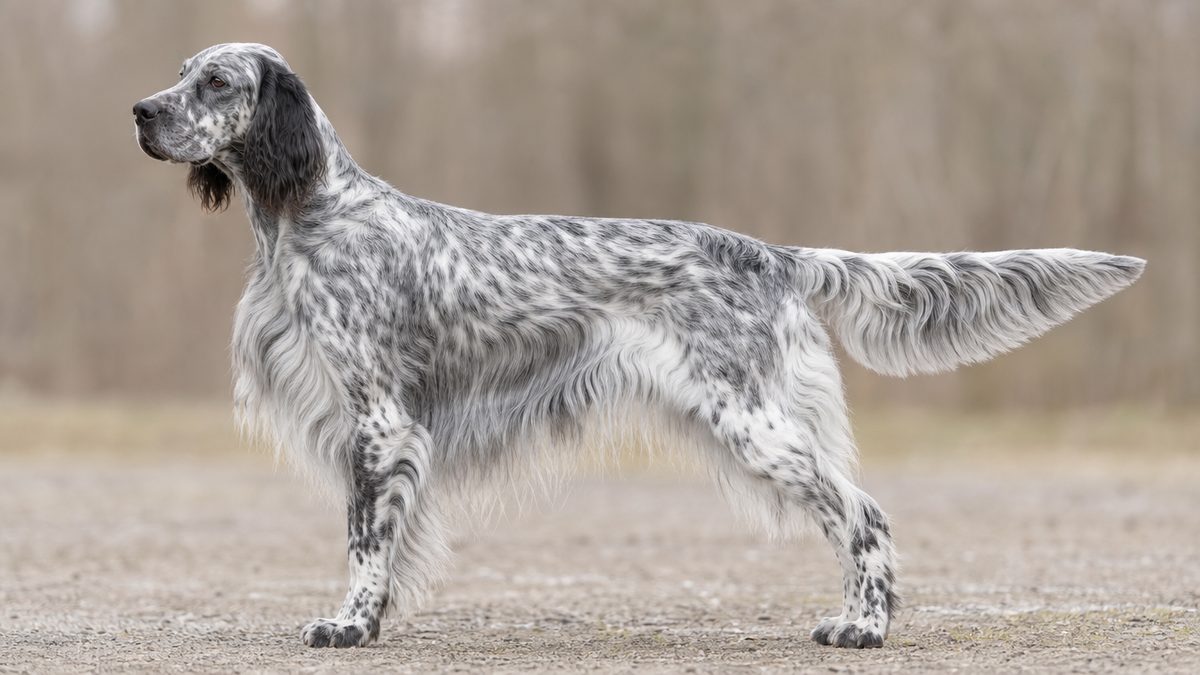
The breed's colour vocabulary is unique to it. The FCI standard lists black and white as blue belton, orange and white as orange belton, lemon and white as lemon belton, liver and white as liver belton, and tricolour as blue belton and tan or liver belton and tan, preferring dogs flecked all over without heavy patches of colour on the body. Its Standard Committee then adds a note almost nobody quotes: Belton is the customary term for the distinctive coat-ticking of the English Setter, and Belton is a village in Northumberland, the expression having been created and spread by the book about the English Setter written by Edward Lavarack, the breeder who had a preponderant influence upon the breed's appearance.
The Royal Kennel Club lists the same colours and then closes the clause harder than the FCI does: any other colour or combination of colours is unacceptable. The AKC lists orange belton, blue belton described as white with black markings, tricolor, lemon belton and liver belton, and prefers flecking all over with head and ear patches acceptable but heavy body patches undesirable.
Size: three registries, three answers, and no weight anywhere
| Source | Height, dogs | Height, bitches | Weight |
|---|---|---|---|
| FCI standard 2 | 65 to 68 cm | 61 to 65 cm | none given |
| Royal Kennel Club | 65 to 69 cm | 61 to 65 cm | none given |
| AKC standard | about 25 in, 63.5 cm | about 24 in, 61 cm | none given |
| Purina India | 61 to 69 cm, sexes merged | 61 to 69 cm | 27 to 36 kg |
| DogsIndia | 61 to 69 cm, sexes merged | 61 to 69 cm | 25 to 30 kg |
| Asia Pets | 58 to 69 cm, sexes merged | 58 to 69 cm | 20 to 36 kg |
| Puppiezo | 23 to 27 in, 58 to 69 cm | 23 to 27 in | 20 to 36 kg |
No registry anywhere states a weight for this breed, and four Indian sources state four different weight bands spanning 20 kg to 36 kg DogsIndia, English Setter breed page… Asia Pets, English Setter Puppies for Sale… Puppiezo, English Setter Puppies for Sale…. A 16 kg spread on a figure that appears in no standard is not a measurement, it is an estimate copied and re-copied.
The height disagreement is smaller but sharper. The AKC's ideal male at about 25 inches is 63.5 cm, which sits below the FCI's and the Royal Kennel Club's minimum of 65 cm for a male Federation Cynologique Internationale The Royal Kennel Club. An American-bred English Setter of ideal size would be undersized on an FCI bench, which is the kind of thing that matters if you are importing.
One warning for anyone verifying this breed online
The FCI's own website will serve you an English Setter page when you ask for something else. The URL fci.be/en/nomenclature/breeds-recognised-on-a-provisional-basis-2.html returns HTTP 200 and resolves to the ENGLISH SETTER page, because the trailing 2 in that address is this breed's FCI standard number and the words in front of it are ignored. The genuine provisional register lives at fci.be/en/nomenclature/provisoire.aspx and lists 21 breeds, from the Macedonian Shepherd Dog Karaman at 378 down to the Australian Stumpy Tail Cattle Dog at 351, with no setter of any kind among them.
Anyone checking whether a rare breed is provisionally recognised by following that first URL would have landed on a complete, correct, HTTP 200 English Setter page, found no mention of their breed, and drawn a correct conclusion from entirely the wrong document.
A vulnerable native breed: 176 registrations left
The English Setter is on the Royal Kennel Club's vulnerable native breeds list, which covers British and Irish breeds falling below 300 registrations a year, and in 2025 it recorded 176.
The Royal Kennel Club states the two thresholds in its own words: it created the vulnerable native British and Irish breeds list, breeds with fewer than 300 registrations a year, and the at watch list, breeds with between 300 and 450 registrations a year, so that it can monitor them. The English Setter has been on the vulnerable list throughout the published decade and has never once crossed back above 300.
| Breed | 2016 | 2019 | 2021 | 2023 | 2024 | 2025 |
|---|---|---|---|---|---|---|
| English Setter | 285 | 267 | 293 | 250 | 185 | 176 |
| Gordon Setter | 263 | 243 | 244 | 137 | 165 | 93 |
| Irish Red & White Setter | 63 | 39 | 46 | 46 | 49 | 22 |
| Spaniel (Clumber) | 171 | 175 | 285 | 223 | 155 | 160 |
| Irish Setter, not on the list | 775 | 678 | 935 | 684 | 647 | 480 |
| Whole gundog group | 84,780 | 86,035 | 144,265 | 92,670 | 83,027 | 74,960 |
Read the trajectory rather than the single number. The breed's best year in the decade was 2021 at 293, which was the pandemic puppy peak that lifted the whole gundog group to 144,265. Since then it has fallen every year: 212 in 2022, 250 in 2023, 185 in 2024 and 176 in 2025, a 38.2 percent fall from the 2016 figure of 285 The Royal Kennel Club. Its lowest recorded year was 2020, at 140.
What that means for an Indian buyer, concretely
- The export pool is tiny and shrinking. 176 puppies registered in a whole year, across an entire country, is roughly three a week. Very few of those leave the UK, and almost none reach India.
- Health-tested stock is a subset of a subset. The genetic screens that matter in this breed live inside a population of a few hundred registered dogs a year.
- Waiting lists are the norm, not a sales tactic. For a breed at this level of scarcity, a breeder without a waiting list is worth a second look rather than a deposit.
- Price does not track scarcity here. The only Indian page publishing a figure quotes Rs 20,000 to Rs 50,000, which is ordinary Labrador money in India for a breed rarer than the Clumber Spaniel.
Vulnerable is not the same as unhealthy
It is easy to read vulnerable native breed as a health warning. It is not one. The list is a registration count and nothing else, and this breed's median lifespan of 13.1 years is longer than the Labrador's, the Irish Setter's and the Gordon Setter's. What a small population does affect is the gene pool available to breeders, which is why the Kennel Club approved two DNA testing schemes for the breed in 2019 and why the American parent club made a thyroid screen compulsory for a health certificate in 2014 English Setter Association of America.
The comparison worth holding on to is the Gordon Setter, which fell to 93 registrations in 2025 and whose median lifespan of 12.4 years is the only one in this page's comparison table that is not statistically distinguishable from the crossbred group. Rarity and longevity are separate axes, and the English Setter sits in the rare-but-long-lived quadrant.
Not one page ranking in India for this breed's price says the English Setter is a vulnerable native breed, gives its registration count, or explains why the supply is what it is Asia Pets, English Setter Puppies for Sale… Puppiezo, English Setter Puppies for Sale…. A buyer told that Rs 20,000 buys an English Setter, and not told that only 176 were registered in a whole year with the breed's own home registry, is being sold a fantasy about availability rather than a price.
Laverack and Llewellin: the show and field split, in a register
The English Setter runs in two historic strains, the Laverack show line and the Llewellin field line, and the Orthopedic Foundation for Animals holds them under two separate breed codes with materially different results.
Purina's own Indian page lists the breed's alternative names as Lawerack, Laverack, Llewellin or Llewellyn, and Setter, which is the split hiding in plain sight on a page most buyers scroll past. It adds that it is generally agreed that Sir Edward Lavarack was the most instrumental in establishing the English Setter as a distinct and recognised breed, and the FCI's own standard credits the same man's book with spreading the term belton Federation Cynologique Internationale.
The Royal Kennel Club goes one step further than the FCI and writes the split into the standard itself. Its general appearance clause reads: of medium height, clean in outline, elegant in appearance and movement, and then adds the working English Setter may be proportionally lighter in build. The FCI's 2009 text carries no such sentence, so the acknowledgement of a working type is a British addition.
Two codes, two sets of numbers
The Orthopedic Foundation for Animals registers ENGLISH SETTER under the code ES and LLEWELLIN SETTER separately under LS, and both have their own rows in the disease-statistics tables Orthopedic Foundation for Animals. Nobody publishes the comparison, so here it is.
| Screen | English Setter (ES) | Llewellin Setter (LS) |
|---|---|---|
| Hips, evaluations | 13,431 | 214 |
| Hips, normal | 83.3% | 79.4% |
| Hips, dysplastic | 15.3% | 19.6% |
| Hips, severe grade | 0.8% | 3.3% |
| Eyes, evaluations | 244 | 57 |
| Eyes, abnormal | 6.1% | 12.3% |
| Breed rank, eyes | 69 | 10 |
The Llewellin rows are worse on both screens, and the eye gap is the wider one at 12.3 percent abnormal against 6.1 percent. Read that with real caution. The Llewellin samples are 214 hips and 57 eyes against 13,431 and 244, so the confidence around those percentages is far looser, and OFA's own threshold for listing a breed at all is 100 hip evaluations or 50 for other databases. The Llewellin eye row clears that floor by seven dogs.
What the comparison does establish is that the strain distinction is real enough to have its own registry code and its own numbers, which is more than can be said for most claimed splits in most breeds. It also establishes that a buyer asking which strain a litter comes from is asking a question the register itself recognises.
What the split means in an Indian home
- Coat and grooming. A lighter-built working setter carries less coat than a bench setter, and in 88 percent monsoon humidity that is the difference between weekly combing and daily combing.
- Drive and settle. A field line bred to quarter open ground for hours does not switch off in a flat. Purina describes the English Setter as slow to mature and warns against ever taking its tolerant nature for granted.
- Size. The AKC ideal male at 63.5 cm is already below the FCI minimum of 65 cm, and field-bred stock tends lighter still, so an Indian buyer measuring against an FCI standard should expect a mismatch.
- Paperwork. Neither the FCI, the Royal Kennel Club nor the AKC recognises the Llewellin as a separate breed. Only OFA separates them, and only as a registry code.
Ask which strain the litter descends from and what the parents were bred for, showing or working. No Indian page ranking for this breed mentions Laverack, Llewellin, show lines or field lines at all Asia Pets, English Setter Puppies for Sale… Puppiezo, English Setter Puppies for Sale…. Purina India names both strains in a single alternative-names line and never explains them.
English Setter price in India, and why one page is the whole market
English Setter price in India is quoted as Rs 20,000 to Rs 50,000 by exactly one Indian publisher, and that publisher is a poodle care site with no dogs to sell, which is as close to a market as this breed has here.
Search the term in India and the first organic result is a United States cost guide putting the breed at 600 to 1,500 dollars. The second is India's oldest breeder directory, which gives no price. Two of the ten results are about the Irish Setter, a different breed, one of them quoting Rs 60,000 to Rs 85,000. The engine is substituting a related breed because there is nothing breed-specific to serve.
| Source | Price given | What it is |
|---|---|---|
| Poodles Petcare | Rs 20,000 to Rs 50,000 | A care guide on a poodle site, no listings, no seller |
| DogsIndia | none | One breeder listing, Erode, Tamil Nadu, stating the puppies are not KCI registered |
| Puppiezo | none for the breed | Carousel of 2 Maltipoos, 2 Poodles, a Cane Corso, a Goldendoodle, a Rottweiler and a Doxiepoo |
| Mr n Mrs Pet | behind a sign-up wall | India-wide listing page |
| Asia Pets | none | Prints Showing 0 results, then offers a Chihuahua, a Yorkshire Terrier and a Toy Pom |
| Wrapinfur 50-breed list | no row at all | India's most comprehensive breed price table omits the English Setter entirely |
| SpiritDog Training | USD 600 to 1,500 | A United States guide, ranked first in India for the Indian query |
The carousel proof
Puppiezo's English Setter page carries an availability carousel of eight animals. Its English Springer Spaniel page carries the same eight animals, in the same order, at the same prices: Fizey the Maltipoo at Rs 98,999, Kuzo and Dugu the Poodles at Rs 92,599, Kazuka the Cane Corso at Rs 94,999, Doir the Goldendoodle at Rs 1,20,000, Samy the Maltipoo at Rs 98,999, Tugi the Rottweiler at Rs 76,499 and Yoki the Doxiepoo at Rs 98,999 Puppiezo, English Springer Spaniel Puppies…. Comparing two breed pages on the same site settles it: that block is site furniture, not stock, and no price in it belongs to either breed.
Mr n Mrs Pet, the fourth ranking marketplace, puts its English Setter prices behind a sign-up wall, so no figure is publicly readable there either. Between the five Indian commercial pages that rank for this term, the number of publicly stated English Setter prices is one, and it comes from a poodle care site.
Asia Pets does the same thing more plainly. Its English Setter page prints Showing 0 results and then offers three animals under the heading available pets of the same breed from other locations, and those three are a Chihuahua, a Yorkshire Terrier and a Toy Pom. The identical three appear on its English Springer Spaniel page, which is how you know they are a default rather than a coincidence.
The division tests on the one real figure
| Rupee figure | Divided by 84.38 | Divided by 74 | Divided by 80 | Divided by 66.67 |
|---|---|---|---|---|
| Rs 20,000, floor | 237.02 | 270.27 | 250.00 | 299.98 |
| Rs 50,000, ceiling | 592.56 | 675.68 | 625.00 | 749.96 |
| Rs 3,000, monthly food floor | 35.55 | 40.54 | 37.50 | 45.00 |
| Rs 5,700, monthly total floor | 67.55 | 77.03 | 71.25 | 85.49 |
| Rs 8,550, monthly total ceiling | 101.33 | 115.54 | 106.88 | 128.24 |
Nothing divides cleanly at 84.38, the strong test, and nothing divides cleanly at 74. Two figures resolve to whole dollars at 80, giving 250 and 625, and that proves nothing, because 1,000 divided by 80 is 12.5 and any rupee figure ending in three zeros passes at 80 by construction. Both of these do. Nothing resolves at 66.67 either. No exchange rate explains this band, so it is rupee-native rather than a converted dollar list.
Then apply the second test, which is whether the number is plausible as rupees at all. Rs 20,000 is ordinary Indian Labrador money, and the Labrador recorded 29,919 UK registrations in 2025 against this breed's 176 Wrapinfur, Dog Price List in India 2026. A price band that puts one of the rarest gundogs in the world at the same level as the most numerous breed in Britain is not describing a market. It is describing an estimate made in the absence of one.
Bonbeno will not average Rs 20,000 to Rs 50,000 with the American 600 to 1,500 dollars to manufacture a middle figure, and will not convert the American band into rupees and print the result as an Indian price. Both moves would produce a number that exists in no market, and the second is precisely the mechanism this site has documented repeatedly on other breeds Poodles Petcare, English Setter Price….
Monthly cost in India, and the one estimate that actually adds up
Budget Rs 5,700 to Rs 8,550 a month for an English Setter in India on the only published Indian estimate, then add two lines it leaves out entirely, because the estimate's arithmetic is sound but its assumptions about the coat and the climate are not.
Give the one Indian source its due first. Poodles Petcare breaks its monthly figure into three components and they reconcile exactly: food Rs 3,000 to Rs 4,500, grooming Rs 1,200 to Rs 1,800 and health Rs 1,500 to Rs 2,250, summing to a stated total of Rs 5,700 to Rs 8,550. Add the floors and you get 5,700. Add the ceilings and you get 8,550. That is more internal consistency than most Indian price tables manage.
| Line | Published monthly, Rs | Comment |
|---|---|---|
| Food and treats | 3,000 to 4,500 | Stated calorie basis is 1,400 kcal a day for an adult and 1,600 for a growing pup |
| Grooming | 1,200 to 1,800 | Described as feathering trims and ear care |
| Health | 1,500 to 2,250 | Vaccination, deworming and parasite prevention |
| Stated total | 5,700 to 8,550 | Arithmetic reconciles exactly at both ends |
| Cooling, eight months a year | not costed | Absent from the estimate |
| Thyroid testing and treatment | not costed | Absent, for the breed ranked 1 of 129 in the OFA thyroid register |
The grooming line is built on a coat the breed does not have
The same page classifies the coat type as short to medium and recommends a quick weekly brush with a soft curry brush to keep it tidy. Four sections later, the same page says English Setters have a silky flat coat with luxurious feathering flowing from the ears, chest, legs and belly, and that India's monsoon humidity turns that feathering into matted clumps within days without dedicated combing.
Both statements cannot be true, and the standards settle which one is. The FCI describes a coat that is slightly wavy, not curly, long and silky, with breeches and forelegs nearly down to the feet well feathered. The AKC describes a flat coat without curl or wooliness, with feathering on ears, chest, abdomen, underside of thighs, the back of all legs and the tail. Purina India puts the requirement at grooming every other day. A weekly curry brush is not a grooming plan for this coat, and the Rs 1,200 to Rs 1,800 line is costed against the wrong dog.
Two lines the estimate does not carry at all
The first is cooling. The breed's own home country averages 8.9 degrees Celsius annually, the Indian page itself gives the breed's comfortable range as 7 to 20 degrees, and every large Indian city is above 20 degrees as an annual mean Poodles Petcare, English Setter Price…. Whatever a household spends keeping a room at a workable temperature for eight months a year is a real cost of owning this dog and appears nowhere in the estimate.
The second is thyroid. The American parent club has required a thyroid screen for a health certificate since 1 January 2014, and the breed sits first of 129 breeds in the OFA thyroid register with 39.6 percent of 2,263 evaluations not normal Orthopedic Foundation for Animals. A thyroid panel is not expensive in India, and lifelong levothyroxine for a diagnosed dog is not expensive either, but neither is free and neither is budgeted.
A defensible Indian budget
- Take the published Rs 5,700 to Rs 8,550 as the floor, not the answer.
- Move grooming to the top of its range or above it, because the coat is feathered rather than short and Purina puts the interval at every other day.
- Add ear treatment as an expected annual cost. Drop-eared dogs carried 47.72 percent of 1,008 otitis externa cases at a Bengaluru veterinary college.
- Add an annual thyroid panel from year two. It is the cheapest test on the list and the one this breed most needs.
- Add cooling for eight months. It is not optional in Chennai, Mumbai, Kolkata, Hyderabad or Delhi.
Rs 8,000 to Rs 13,000 a month in a large Indian city, once grooming is costed against a feathered coat, cooling is included and an annual thyroid panel is budgeted. That is above the only published Indian estimate, and it is above it for reasons that can be pointed at rather than guessed Orthopedic Foundation for Animals NASA POWER Source Native Resolution….
Heat and humidity: the breed's own name comes from a 8.9 degree village
Rate the English Setter 2 out of 5 for heat tolerance in India, because Belton in Northumberland, the village its coat pattern is named after, averages 8.9 degrees Celsius across the year and 14.7 in July, while Chennai's coolest month averages 24.1.
The FCI standard's own note tells you where to look: belton is the customary term for this breed's coat-ticking, and Belton is a village in Northumberland. That is an unusually precise origin point for a breed page, so this page uses it. Queried at 55.633 N and 1.867 W, 102 m elevation, NASA POWER's 2001 to 2020 climatology returns an annual mean 2 m air temperature of 8.9 degrees Celsius, a July mean of 14.7, a February mean of 4.0 and an annual mean relative humidity of 87.5 percent. Coordinates were given explicitly so that no place name could be substituted by accident.
| Place | Annual mean | Warmest month | Coolest month | Annual mean RH | Peak monthly wet-bulb |
|---|---|---|---|---|---|
| Belton, Northumberland | 8.9 C | 14.7 C (July) | 4.0 C (February) | 87.5% | 12.9 C (July) |
| Bengaluru | 23.7 C | 28.4 C (April) | 20.2 C (December) | 67.9% | 21.9 C (May) |
| Pune | 23.9 C | 28.9 C (April) | 19.6 C (December) | 66.8% | 23.0 C (June) |
| Delhi | 25.6 C | 35.9 C (June) | 13.6 C (January) | 45.6% | 26.5 C (July) |
| Kolkata | 25.8 C | 31.5 C (May) | 17.3 C (January) | 73.9% | 27.1 C (June) |
| Hyderabad | 26.1 C | 33.3 C (May) | 20.8 C (December) | 60.3% | 23.3 C (June) |
| Mumbai | 26.8 C | 31.2 C (May) | 23.2 C (January) | 67.4% | 25.8 C (June) |
| Chennai | 27.9 C | 31.5 C (May) | 24.1 C (January) | 72.4% | 26.1 C (May) |
The comparison that settles it is the floor, not the peak. Bengaluru's coolest month, December, averages 20.2 degrees Celsius, which is 5.5 degrees warmer than the warmest month Belton has ever offered. Chennai in January, its coolest month, is 9.4 degrees above a Northumberland July. The Indian page that gives this breed a comfortable band of 7 to 20 degrees Celsius is quietly telling its readers that no Indian city is inside it for any month of the year, and then selling them a puppy anyway.
Why humidity is the wrong comparison and wet-bulb is the right one
Northumberland is humid. At 87.5 percent annual mean relative humidity, Belton is more humid than every Indian city in the table. That is exactly why raw humidity misleads, because a dog cools by evaporation and evaporation depends on temperature and humidity together. Wet-bulb figures above are computed from the NASA POWER monthly means using Stull's 2011 approximation.
Belton's peak monthly wet-bulb is 12.9 degrees Celsius. Kolkata's is 27.1, Delhi's 26.5 and Chennai's 26.1 Stull R. Wet-Bulb Temperature from Relative…. That is more than double. Even Bengaluru's 21.9 sits 9.0 degrees above the English peak. A long-coated, feathered, large gundog panting in Kolkata in June has roughly half the evaporative headroom its body plan assumes.
How dogs actually get heat illness, from 905,543 records
Reviewing 905,543 UK dogs under primary veterinary care in 2016, Hall and colleagues identified 1,259 heat-related illness events from 1,222 dogs. Of those, 380 had no trigger recorded, and of the 879 events that did carry a recorded trigger, 652, or 74.2 percent, were exertional. Environmental heat accounted for 113 events at 12.9 percent and confinement in a vehicle for 46 at 5.2 percent.
Then look at what counted as exertion, because it is not what most owners assume. Of the 652 exertional events, the activity was unspecified in 101. Of the remaining 551, 372, or 67.5 percent, followed walking, against 97, or 17.6 percent, after high-intensity activity such as running or cycling. The paper's own conclusion is that in the UK exertional heat illness affects more dogs and kills more dogs than confinement in a hot vehicle.
City by city, for this breed
- Bengaluru and Pune are the only workable options, with an annual mean near 23.8 degrees Celsius and a peak wet-bulb below 23.
- Delhi is the split case. Its January mean of 13.6 degrees Celsius gives this breed a genuine working winter, and its June mean of 35.9 gives it the worst summer on the list.
- Chennai, Mumbai and Kolkata are the hardest, because the floor never drops. Chennai's coolest month is 24.1 degrees Celsius, so there is no season of relief at all.
- Hyderabad sits between the two groups, with a December mean of 20.8 degrees Celsius and a wet-bulb peak of 23.3.
The long silky coat described by both standards insulates against radiant heat as well as cold, and shaving a feathered gundog removes that protection while exposing thin pink skin to Indian sun American Kennel Club. Shade, airflow, water and a shifted schedule work. Clippers do not.
Temperament and who should not buy one
Buy an English Setter if you want a gentle, quiet, slow-maturing gundog and can give it country-scale exercise, and avoid one if you live in a small flat, because Purina's own Indian page says plainly that this is not a dog that thrives in the town or city.
The three registries agree on temperament to an unusual degree. The FCI says very active with a keen game sense, intensely friendly and good natured. The Royal Kennel Club says the same thing in fewer words: very active with a keen game sense, intensely friendly and good natured. The AKC says gentle, affectionate, friendly, without shyness, fear or viciousness. There is no aggression literature attached to this breed and no standard hedges on the point.
Purina India adds the practical detail. The English Setter is friendly and amiable, bonds well with family and is a little more reserved with strangers, is less enthusiastic or exuberant than some of the Setter family, and is easy going with other dogs and household pets. It then adds the sentence that matters most: the breed is slow to mature, and care should be taken to socialise and habituate sensitively, never overwhelming it or taking its tolerant nature for granted.
The household fit, honestly
- Works well with: families with older children, homes with a garden or terrace, households in Bengaluru or Pune, owners who walk for pleasure rather than duty, homes with other dogs or cats already in them.
- Works badly with: small city flats, households out all day, families with toddlers, first-time owners who wanted a low-effort large dog, anyone whose only outdoor space is a hot pavement.
- Purina's own verdict on children: better suited to families with older children, because a young English Setter, particularly a male, can be boisterous in play and unaware of its own size, making it a risk to very small children and sometimes clumsy around very small dogs.
- Purina's own verdict on space: a large garden and a moderate to large home are recommended, ideally with space for a wet muddy setter to dry off after walks, and the breed is better suited to countryside or leafy suburbs.
Quiet, and that is genuinely rare in a large gundog
Purina India's need-to-know panel lists this breed as a quiet dog, not a guard dog, great with other pets and a great family dog. For an Indian housing society that combination is unusually good news, and it is the opposite of the English Springer Spaniel, which the same publisher's panel describes as a chatty and vocal dog. A large, quiet, non-guarding dog is one of the easier large breeds to keep on a shared wall, provided the exercise is genuinely being delivered.
Prey drive and the recall problem
This is a pointing breed, and pointing is what it does with birds. The FCI records its utilisation as pointing dog and lists it as subject to a working trial. Purina notes that the breed is predisposed to be distracted by birds both on the ground and in the air, that plenty of work must go into building a bond and into recall, and that careful management is needed until training is of a high enough standard. In an Indian city, crows, pigeons and mynas are everywhere and at every height, so the distraction the breed is built for is continuous rather than occasional.
Purina's own honest ending to that paragraph is worth quoting as a warning about expectations: the aim is that they will come back when called, most of the time. A gundog trainer's most of the time is a road safety problem in Bengaluru traffic.
Ask the seller how the puppy's parents behave when left alone for four hours. Purina says the English Setter loves his family and is not happy when isolated in a yard or kennel for long periods. In an Indian dual-income household that is the constraint that decides the outcome, not the heat and not the coat.
Training an English Setter in India
Train an English Setter with patience and short sessions folded into daily life, because Purina's own guidance is that this is not a dog who enjoys repetitive training for its own sake and that patience is the key with any Setter.
Purina India's training paragraph is the most useful piece of writing on any Indian page about this breed, and it is British copy. It says patience is the key, that the breed is predisposed to be distracted by birds on the ground and in the air, that plenty of work must be put into building a bond and into recall, that this is not a dog who enjoys repetitive training for its own sake, and that owners should slip training into everyday activities instead while managing the dog carefully until recall is reliable.
Set that against the standard's own framing. The AKC describes the breed as gentle, affectionate, friendly, without shyness, fear or viciousness, and the FCI as intensely friendly and good natured Federation Cynologique Internationale. This is a soft dog. Harsh handling does not produce compliance in a soft, slow-maturing gundog; it produces a dog that disengages.
A realistic Indian timeline
| Age | Priority | Why it is timed here |
|---|---|---|
| 7 to 8 weeks | BAER test before the puppy leaves, then name response and handling | The parent club recommends BAER as close as possible to seven weeks or older, and Indian law sets eight weeks as the earliest sale |
| 8 to 16 weeks | Socialisation to traffic, lifts, tiled floors, other dogs, the groomer | Purina warns the breed is slow to mature and must be habituated sensitively, never overwhelmed |
| 4 to 6 months | Recall on a long line, in the presence of birds | Bird distraction is the breed's defining training problem, not an incidental one |
| 6 to 12 months | Settle on a mat, alone-time in short blocks, indoor scent work | Builds the off-switch that eight months of Indian heat will force on you anyway |
| 12 to 24 months | Keep going. Do not assume the dog is finished | A slow-maturing breed is still developing well past its first birthday |
What this breed resists
- Drilling. Purina is explicit that repetitive training for its own sake is not what this dog enjoys, and that training should be slipped into everyday activities.
- Being asked to ignore birds. It cannot, because pointing birds is the function the FCI still tests it on. Build a recall that competes rather than a correction that punishes.
- Pressure. Purina warns against overwhelming the breed or taking its tolerant nature for granted. A tolerant dog that stops tolerating is a training failure that arrived slowly.
- Pavement-only routines. Purina's own words are that pavement walks are unlikely to keep an English Setter amused for long, and that secure space for free running is important.
The three Indian-specific problems
First, the training window is the cool window. If the only safe hours are before 7 am and after dark, the whole plan has to fit inside them, and a household that cannot get up early will not train this dog. Second, a deaf or unilaterally deaf puppy needs a different plan from day one, and 4.5 percent of UK English Setter puppies tested were affected, so this is not a remote possibility. Hand signals, vibration collars used as attention cues rather than corrections, and a permanently long line change from optional to structural. Third, community-dog and bird encounters are constant, so the recall has to be trained against real distraction rather than in an empty park at six in the morning.
The compensating advantage is that indoor scent work runs in any weather. A pointing dog's nose is its main instrument, and hiding food across a room is a full workout that ignores the monsoon and the May heat entirely.
A large drop ear over a feathered head has to be lifted, wiped and dried weekly for thirteen years. Teach it in week one with food, when the puppy is small enough to hold, and it stays easy. Retrofit it at three years and it becomes a two-person job.
Daily exercise, and what the Indian heat does to the number
An English Setter needs 60 to 90 minutes of real exercise a day plus free running space, and in most Indian cities that has to be split across two windows at the ends of the day for eight months of the year.
The published requirements disagree by a factor of three, and the disagreement is instructive.
| Source | Stated daily requirement | Written for |
|---|---|---|
| Puppiezo | 1 hour | India, seller spec card |
| Poodles Petcare | 60 to 90 minutes | India, care guide |
| Purina India | several hours per day through a variety of country locations | United Kingdom, served on purina.in unchanged |
| Bonbeno, for an Indian city | 60 to 90 minutes across two windows, plus 15 minutes of scent work | India, adjusted for the safe temperature window |
Purina's several hours is correct for Northumberland, where the July mean is 14.7 degrees Celsius. It is unworkable in Chennai, where the annual mean is 27.9 and the coolest month still averages 24.1. Purina's Indian page adds that pavement walks are unlikely to keep an English Setter amused for long and that secure space for free running is important, which is a fair description of the breed and a poor description of what most Indian owners can offer.
To its credit, the Indian care guide gets this one right where it gets the coat wrong. It says that because the breed does best in cooler weather, Indian owners should schedule the 60 to 90 minutes for early morning or evening and never push it in peak heat. That is the correct advice, and it is the only Indian page giving it.
Why the walk is the risk, not the run
In the VetCompass heat-illness data, 652 of the 879 events with a recorded trigger were exertional, and within the 551 exertional events where the activity was specified, 372, or 67.5 percent, followed walking rather than running, cycling or any high-intensity work. Only 97 events, 17.6 percent, followed high-intensity activity. A dog does not have to be sprinting to overheat. It has to be moving, in air it cannot shed heat into, and Kolkata's peak monthly wet-bulb of 27.1 degrees Celsius is more than double Belton's 12.9 Stull R. Wet-Bulb Temperature from Relative….
A workable Indian plan
- Morning block, 40 to 60 minutes, from first light. Lead walk with real sniffing time, then free running if you have a secure space. This is the day's main exercise, every month of the year.
- Evening block, 20 to 30 minutes, after the pavement cools. Check the surface with the back of your hand for five seconds before you set off.
- Scent work, 10 to 15 minutes, indoors, at any hour. For a pointing breed this is not a substitute, it is a second workout.
- Free running only inside a fence. Purina calls secure space for free running important, and a pointing dog following a bird across an Indian road is the failure mode.
- Nothing at all between 11 am and 4 pm from March to October, in every city in the climate table except a Delhi winter.
Feed and rest around exercise, not through it
This breed carries a specific warning that most gundogs do not. Purina India states that the English Setter is prone to bloating and stomach problems and that smaller, more frequent meals help minimise the risk, and the Indian care guide repeats the advice to serve two smaller meals and enforce calm rest afterwards. Combine that with the heat rule and the sequence is fixed: exercise first in the cool, then rest, then feed, then rest again.
Stop and cool the dog at heavy open-mouth panting that does not settle within two minutes of shade, a brick-red or very pale tongue, unsteadiness, or vomiting. Wet the coat down to the skin with cool water, move air across it, and get to a veterinarian. Exertional heat illness in the UK data killed at a rate similar to a dog shut in a hot car.
Grooming a feathered coat in Indian humidity
Groom an English Setter every other day and treat the ears as a separate weekly job, because the coat is long, silky and heavily feathered and the ear is a low-set drop over a warm damp ear canal.
Start with what the coat actually is, because the one Indian price page gets this wrong twice on the same page. The FCI describes it as slightly wavy from the back of the head in line with the ears, not curly, long and silky, with breeches and forelegs nearly down to the feet well feathered. The AKC describes it as flat without curl or wooliness, with feathering of good length on ears, chest, abdomen, underside of thighs, the back of all legs and the tail, but not so excessive as to hide the true lines and movement or affect the dog's function as a sporting dog. Purina India puts the maintenance requirement at grooming every other day.
The Indian care guide classifies the coat type as short to medium and recommends a weekly brush with a soft curry brush, and then, in a different section of the same page, says the feathering turns into matted clumps within days in Indian monsoon humidity without dedicated combing. Follow the second sentence and the standards, not the first. A weekly curry brush on a feathered setter in Mumbai in July produces mats, not a tidy dog.
The ear is the health problem, not the coat
In the UK VetCompass study of 22,333 dogs, the one-year period prevalence of otitis externa was 7.30 percent, with a 95 percent confidence interval of 6.97 to 7.65, and ear carriage was one of the two highest-ranked risk factors. Breeds with pendulous ear carriage carried 1.76 times the odds of otitis externa compared with erect-eared breeds, confidence interval 1.48 to 2.10, and V-shaped drop ears 1.84 times, 1.53 to 2.21. The English Setter is not among the sixteen individually named high-risk breeds in that paper, so this page transfers only the conformational finding, which applies directly: all three standards describe a moderate-length ear set on low and hanging in neat folds close to the cheek, with a thin leather covered in silky hair American Kennel Club The Royal Kennel Club.
The Indian evidence points the same way. Across 1,008 otitis externa cases drawn from 76,161 dogs presented at the Veterinary College, Hebbal, Bengaluru, drop-type pendulous ears accounted for 481 cases, 47.72 percent, against 283 prick-eared at 28.07 percent and 244 intermediate at 24.21 percent, with a chi-square of 26.4368 and p below 0.00001.
Indian series disagree about the season
| Series | Setting | Finding |
|---|---|---|
| Chaudhary and Mirakhur, 1,008 cases from 76,161 dogs | Veterinary College Hebbal, Bengaluru | Rainy season 41.87%, winter 32.83%, summer 25.30% |
| Nainika and Sharma, 81 cases from 2,476 dogs | Palam Valley, Himachal Pradesh | 59.25% of cases in July and August alone |
| Parmar and colleagues, 116 dogs | Anand Agricultural University, Gujarat | A microbiological series, cultured rather than seasonal |
Bonbeno publishes the disagreement rather than resolving it Nainika and Sharma P. Otitis externa… Parmar JJ, Rao N, Shah AI, Sadhu DB. The wet season leads in both seasonal series, but this site has recorded an Indian series elsewhere in which summer led the monsoon, so the safe reading is that the wet season is the highest-risk period in most of India and the risk is never zero. One arithmetic caveat on the Palam Valley paper: its ear-carriage table prints pendulous ear breed 53, 69.13 percent, and 53 divided by 81 is 65.43 percent, so the count and the percentage disagree. The 69.13 percent figure is the one consistent with the rest of that table.
The routine that works here
- Comb every other day, working through the feathering on ears, chest, abdomen, thighs, the back of the legs and the tail, which is where mats start.
- Check the ear weekly, lifting the leather to look and to smell. A sour smell precedes visible discharge by days.
- Dry the ear after every swim, bath and heavy rain. The VetCompass authors recommend a dry paper cloth, judicious use of ear cleaners with antimicrobial properties and avoidance of overzealous ear-cleaning. Daily flushing is the wrong response.
- Trim the hair between the pads before the monsoon, because it holds water and grit.
- Do not shave the coat. It insulates against radiant heat and shaving exposes pale skin to Indian sun.
The coat is not short to medium and this is not a hypoallergenic breed. Purina India labels the English Setter non hypoallergenic on its own panel, and the settled evidence agrees: Vredegoor and colleagues measured Can f 1 across 196 dogs of so-called hypoallergenic breeds against 160 controls and found the hypoallergenic group higher, not lower, concluding there is no evidence for classifying certain dog breeds as hypoallergenic.
Health and lifespan, from the registers rather than the breed pages
The English Setter's median lifespan of 13.1 years beats its own size class by 1.2 years, its hips and elbows sit slightly worse than the all-breed average, and the condition that actually distinguishes it is thyroid disease.
Every figure below is read off the Orthopedic Foundation for Animals disease-statistics tables, matched to the printed breed label rather than a guessed code, using the code ES that OFA's own breed markup gives for this breed Orthopedic Foundation for Animals. Sample sizes are printed beside every percentage, because a live register moves as evaluations are added.
| Screen | Evaluations | Result | Breed rank | All-breed figure |
|---|---|---|---|---|
| Hips | 13,431 | 15.3% dysplastic, 83.3% normal | 84 | 14.2% dysplastic of 1,712,430 |
| Elbows | 4,950 | 14.8% abnormal, 85.0% normal | 35 | 12.0% abnormal of 650,073 |
| Eyes | 244 | 6.1% abnormal, 93.9% normal | 69 | 6.5% abnormal of 886,790 |
| Patella | 57 | 0.0% abnormal, 100.0% normal | 165 | - |
| BAER hearing | 700 | 3.3% abnormal, 96.6% normal | 5 of 31 | 4.0% abnormal of 46,830 |
| Thyroid | 2,263 | 60.4% normal, 39.6% not normal | 1 of 129 | 84.8% normal of 121,430 |
Joints: slightly worse than average, and the sub-grades matter
At 15.3 percent dysplastic across 13,431 hip evaluations the English Setter sits just above the all-breed 14.2 percent. Broken out, that is 8.9 percent mild, 5.6 percent moderate and 0.8 percent severe, summing to the 15.3 printed, against 12.1 percent excellent, 56.9 percent good and 14.2 percent fair among the 83.3 percent normal. The elbows are similar at 14.8 percent abnormal on 4,950 evaluations, made of 11.1 percent grade 1, 3.4 percent grade 2 and 0.3 percent grade 3, against an all-breed 12.0 percent.
Both are worse than the Labrador and better than the Golden Retriever's hips, which puts this breed squarely mid-table rather than in trouble. Read them with the register's own limitation attached: OFA is voluntary, so the dogs in it are disproportionately the dogs a breeder chose to screen, which understates disease in unscreened stock.
The eye number is small and should be read as such
The English Setter's 6.1 percent abnormal eyes sits marginally better than the all-breed 6.5 percent, but it rests on 244 evaluations against 886,790 across all breeds. For a breed with 13,431 hip evaluations, 244 eye examinations is a thin file, and the Royal Kennel Club's health standard does not list an eye scheme for this breed at all. Purina India, by contrast, says the breed can suffer from various hereditary eye disorders and that eye testing before breeding is therefore important. Bonbeno reports the disagreement rather than resolving it.
Lifespan: two studies, two measures
McMillan and colleagues, working from 584,734 UK dogs including 284,734 deaths, put the English Setter's median survival at 13.1 years, 95 percent confidence interval 12.7 to 13.6, on 238 recorded deaths, with a hazard ratio of 0.70 against the crossbred group at p below 0.001 McMillan et al. 2024. The paper classes the breed as large and mesocephalic, and large purebreds in the same study had a median of 11.9 years, so this breed outlives its own size class by 1.2 years.
One caveat travels with that number. The two supplementary tables disagree on how many dogs it came from: Table S3 gives 596 and Table S6 gives 573, made of 335 alive plus 238 deceased McMillan et al. 2024. The death count is identical in both, so the median and its interval stand, and this page quotes deaths rather than choosing between the two totals.
The Indian pages all state 10 to 12 years, and none cites a source Asia Pets, English Setter Puppies for Sale…. That figure is a full year below the bottom of McMillan's confidence interval. Where a peer-reviewed study of 238 recorded deaths disagrees with an uncited spec card, this page follows the study and prints both.
Bloat, which every Indian source does flag
Purina India states that the English Setter is prone to bloating and stomach problems and that smaller, more frequent meals help minimise the risk. The Indian care guide lists bloat first among the breed's health watchpoints and advises two smaller meals plus rest after eating. This is the one point on which the Indian coverage and the international coverage agree, and it is worth acting on: a deep-chested large breed, fed once daily and exercised straight afterwards, is the classic presentation.
One further limit is worth naming, because it is the reason this page leans so hard on a single study. The other large UK life-table analysis, built from 30,563 dogs that died between 2016 and 2020, covers only 18 breeds and crossbreeds, and the English Setter is not one of them. For a breed producing 176 UK registrations a year that is unsurprising, and it means McMillan's 238 recorded deaths is not one source among several. It is the source.
Hips and elbows once, at maturity. BAER once, before the puppy is sold. Thyroid from two years and then annually, because compensative autoimmune thyroiditis is progressive and this breed leads the register Orthopedic Foundation for Animals. Ears weekly, forever.
Deafness: the number that should decide the purchase
Ask for both parents' BAER hearing results before anything else, because puppies with two parents of unknown hearing status were 4.6 times more likely to be deaf, and 4.5 percent of UK English Setter puppies tested were affected.
The best data on this breed comes from a single UK study of complete litters. Marsh and colleagues at the Animal Health Trust searched their database for English Setter puppies undergoing brainstem auditory evoked response testing between 2000 and 2018, requiring the test at five to ten weeks of age, complete litters and available phenotypic data. 447 puppies met the inclusion criteria.
| Finding | Result | What it means for a buyer |
|---|---|---|
| Bilaterally normal hearing | 427 puppies, 95.5% | The large majority of puppies hear normally in both ears |
| Unilateral deafness | 3.6% | Deaf in one ear; passes every household hearing test you can devise |
| Bilateral deafness | 0.9% | Deaf in both ears; obvious early, and a very different dog to own |
| Total prevalence of congenital deafness | 4.5% | Roughly one puppy in twenty-two |
| Females against males | 3.3 times more likely to be deaf | Sex is a real risk factor in this breed |
| Both parents of unknown hearing status | 4.6 times more likely to be deaf | The single most actionable number on this page |
The arithmetic reconciles cleanly, which is worth checking on any figure of this kind: 3.6 plus 0.9 is 4.5, and 95.5 plus 4.5 is 100. On 447 puppies, 4.5 percent is 20 dogs, which is exactly the 447 minus 427 the paper reports as not bilaterally normal.
Why unilateral deafness is the one that catches buyers out
A unilaterally deaf puppy hears. It turns to a clap, comes when called and passes every test an owner or a seller can perform at home. It cannot localise sound, which means it cannot tell which direction a car, a bicycle or a shouted recall is coming from. In an Indian street that is not a cosmetic finding. The only way to detect it is a BAER test, which measures each ear separately, and 3.6 percent of the puppies in this study had it.
The register agrees on the direction. OFA's BAER hearing table lists 31 breeds with enough evaluations to appear, and the English Setter ranks 5th, with 3.3 percent abnormal across 700 evaluations. Read the all-breed comparison carefully, though: OFA's all-breeds line is 4.0 percent abnormal across 46,830 evaluations, but 13,868 of those are Dalmatians at 10.1 percent abnormal, so the all-breed figure is dominated by one breed and is not a fair baseline. The honest statement is that the English Setter is fifth of the 31 breeds screened often enough to be listed.
When to test, and why seven weeks
The English Setter Association of America runs its own BAER database and gives a specific timing warning. There has been a significant number of reported cases of puppies testing abnormal when tested prior to 6 weeks then retested with normal results several weeks later, so its board suggests testing as close as possible to seven weeks or older, and retesting any puppy found affected on an earlier test. It also specifies what a valid tracing must carry: the test date, the dog's identification linked to the test form, the diagnosis by the tester and the tester's signature or stamp.
That timetable fits Indian law neatly. Rule 8(1)(a) of the Prevention of Cruelty to Animals (Dog Breeding and Marketing) Rules, 2017 requires that pups less than eight weeks in age are not sold, so a correctly run litter is BAER-tested at seven weeks and sold at eight, with the certificate already in hand.
What Indian law says about hearing, which is nothing
Across all fourteen pages of the gazette text of the 2017 Rules the words BAER and deaf appear zero times, and the word hearing appears once, describing an appeal hearing before the Secretary of the state animal husbandry department. Second Schedule Part III paragraph 8(10) requires that dogs shall have been tested for genetic defects, including hip dysplasia, progressive retinal atrophy, night blindness, hypothyroidism, entropion, ectropion, overshot, undershot jaw when incisors do not touch or mesh, wry mouth, two or more missing teeth, unilateral cryptorchid or full cryptorchid males. The word is including, so the list is illustrative rather than closed, but deafness is not on it, and no Indian seller is under any legal obligation to BAER test.
Ask: have both parents been BAER tested, and can I see the tracings. If the answer is that both are recorded normal, the risk falls by a factor of 4.6 against a litter where neither parent's hearing status is known. No Indian page ranking for this breed tells a buyer to ask it Asia Pets, English Setter Puppies for Sale… Puppiezo, English Setter Puppies for Sale….
Thyroid disease and the two DNA tests nobody in India mentions
The English Setter ranks first of 129 breeds in the Orthopedic Foundation for Animals thyroid register, and it has an official Kennel Club DNA scheme for neuronal ceroid lipofuscinosis that no Indian page mentions at all.
Take the thyroid finding first, because it is the largest single number on this page. OFA's thyroid table lists 129 breeds ranked by how far they depart from normal, and the English Setter is rank 1, with only 60.4 percent of 2,263 evaluations normal.
| Breed | Rank | Evaluations | Normal | Compensative autoimmune thyroiditis | Equivocal |
|---|---|---|---|---|---|
| English Setter | 1 | 2,263 | 60.4% | 23.4% | 14.9% |
| Airedale Terrier | 2 | 82 | 76.8% | 12.2% | 9.8% |
| Kuvasz | 3 | 491 | 76.6% | 11.0% | 10.6% |
| Irish Red & White Setter | 4 | 379 | 79.4% | 11.9% | 7.9% |
| Shetland Sheepdog | 5 | 2,396 | 79.2% | 10.6% | 8.9% |
| All breeds | - | 121,430 | 84.8% | 4.5% | 10.0% |
The English Setter's full breakdown is 60.4 percent normal, 1.1 percent autoimmune thyroiditis, 23.4 percent compensative autoimmune thyroiditis, 0.2 percent idiopathic hypothyroidism and 14.9 percent equivocal, which sums to exactly 100.0. The 23.4 percent compensative figure is 5.2 times the all-breed 4.5 percent, and no other breed in the register exceeds 12.2 percent. Its own nearest relative, the Irish Setter, sits at 8.6 percent on a near-identical sample of 2,314.
Two caveats belong with that. OFA is voluntary, so the tested population is self-selected toward dogs whose breeders suspected a problem, and it is largely American. Neither explains a 5.2-fold gap, and the American parent club evidently agrees, because it made thyroid a compulsory screen for a health certificate with effect from 1 January 2014.
The registries disagree with each other on this
The English Setter Association of America's CHIC requirements are hips, elbows, BAER hearing and thyroid, and it states plainly that the dog does not need normal results on any of them, only to be tested and to allow the result into the public domain. The Royal Kennel Club's Health Standard for the English Setter lists hip scoring as good practice and elbow scoring plus the BAER programme as best practice, and does not mention thyroid at all.
That is a genuine divergence between two national bodies about the same breed, and Bonbeno publishes it rather than picking a side. For an Indian buyer the practical answer is simple: the test is a blood draw, it is cheap in India, and the register says this breed leads all others.
Neuronal ceroid lipofuscinosis, and the DNA test that exists for it
Neuronal ceroid lipofuscinosis is a fatal inherited neurodegenerative disease of the English Setter, and it has been studied in this breed as a model of the human disease for decades. Katz and colleagues located the causative mutation in 2005: a T-to-C transition in the CLN8 gene predicting a p.L164P missense change, near the q telomere of canine chromosome 37, at a leucine conserved in four other mammalian species. The C allele co-segregated with disease in a two-generation English Setter family in a pattern consistent with autosomal recessive inheritance: all four affected family members were C/C homozygotes, all four obligate carriers were C/T heterozygotes, and 103 unrelated dogs were all T/T.
The Kennel Club acted on it. In August 2019 it approved two new official DNA testing schemes for the English Setter, for progressive retinal atrophy (PRA-rcd4) and for neuronal ceroid lipofuscinosis, following consultation with the breed's health coordinator on behalf of the breed clubs, describing NCL as a severe inherited disease causing gradual degeneration of the nervous system with dementia, vision loss and epilepsy.
What OFA does and does not hold on NCL
OFA publishes a neuronal ceroid lipofuscinosis table covering 10 breeds and a separate ceroid lipofuscinosis table, and the English Setter appears in neither. That is not evidence the disease is absent. OFA's own listing threshold is 100 hip evaluations or 50 for other databases, and its ceroid lipofuscinosis table states outright that no individual breeds have had 50 or more individuals tested. So the correct reading is that fewer than 50 English Setters have submitted an NCL result to OFA, which says something about testing uptake rather than about carrier rate.
Because of that, no published carrier rate for NCL in the English Setter can be quoted here, and this page does not invent one. What can be said is that the mutation is identified, the test is an official Kennel Club scheme, and a breeder who has not run it on the parents cannot tell you whether a litter is at risk.
Nothing. The only Indian page publishing a price lists the breed's health issues as bloat, hip dysplasia, parasites and parvovirus, with no mention of thyroid disease, deafness or neuronal ceroid lipofuscinosis. Purina India does at least name deafness as an inherited disorder that can be tested for from a young age, which makes it the most accurate Indian page on this breed by some distance.
Feeding an English Setter in India, by life stage
Feed an adult English Setter two smaller meals a day to a body condition score rather than to a weight target, because no breed standard states a weight for this breed and the four Indian sources that do disagree across a 16 kg range.
There is no official weight for the English Setter. The FCI standard gives heights and nothing else, the Royal Kennel Club does the same, and the AKC states only that dogs stand about 25 inches and bitches about 24 The Royal Kennel Club American Kennel Club. Against that silence, Purina India prints 27 to 36 kg, DogsIndia prints 25 to 30 kg, and Asia Pets and Puppiezo both print 20 to 36 kg DogsIndia, English Setter breed page… Asia Pets, English Setter Puppies for Sale… Puppiezo, English Setter Puppies for Sale…. A dog described as weighing between 20 kg and 36 kg is not being described at all.
Because the target is contested, feed to condition. The WSAVA nine-point body condition score chart is the standard tool and is free. Ribs easily felt under a thin fat cover, a visible waist from above and an abdominal tuck from the side is a 4 or 5 out of 9, which is where a working-built gundog should sit at any weight.
Two smaller meals, and the reason is bloat
This breed carries a specific feeding instruction that most gundogs do not. Purina India states that the English Setter is prone to bloating and stomach problems and that smaller, more frequent meals can help minimise the risk. The Indian care guide says the same thing independently: serve two smaller meals to guard against bloat, and pair good nutrition with routine deworming. Both are describing a deep-chested large breed, and both are right.
The sequence that follows is fixed and worth writing on the fridge. Exercise in the cool hours, rest, then feed, then rest again. Never feed immediately before exercise, and never exercise a full dog in heat.
| Stage | Meals per day | Priority | Indian note |
|---|---|---|---|
| 8 to 16 weeks | 4 then 3 | Large-breed puppy food, controlled growth rate | Keep the puppy lean; 14.8 percent of this breed's OFA elbow evaluations are abnormal |
| 4 to 12 months | 3 | Large-breed growth formula, calcium not supplemented | Never add calcium to a complete puppy food |
| 1 to 7 years | 2 | Adult maintenance, portioned to condition | Cut portions in summer when exercise drops, not the reverse |
| 7 years plus | 2 | Joint support and weight control | Watch for weight gain as the dog slows and thyroid function drifts |
| Any age | 2 | Rest before and after every meal | Bloat risk is the reason, and it applies for life |
On the Indian calorie and macro figures
The one Indian care guide is unusually specific, giving roughly 1,400 calories a day for an active adult and 1,600 for a growing puppy, with a macro split of 30 percent protein, 40 percent carbohydrate, 20 percent fat, 5 percent vitamins and 5 percent minerals, and a monthly food spend of Rs 3,000 to Rs 4,500. Those percentages sum to 100, which is more than several Indian pages manage, and the calorie figures are in a plausible band for a 25 to 30 kg active dog.
Treat them as a starting point rather than a prescription. Neither figure carries a source, neither is adjusted for an Indian dog exercising 60 minutes rather than working a moor all day, and neither accounts for a hypothyroid dog, whose energy requirement falls. Weigh the food, weigh the dog monthly, and let the body condition score arbitrate.
Three Indian feeding realities
- Summer appetite drops and owners over-feed to compensate. A setter that eats less in May is behaving normally, and toppers added to tempt it become weight the hips and elbows carry.
- Roti and rice as filler is the commonest Indian error. It moves a working breed's diet toward calories it is not burning in a Chennai summer.
- Thyroid disease shows up as weight gain first. For the breed ranked first of 129 in OFA's thyroid register, unexplained weight gain, coat change or lethargy in a middle-aged dog is a blood test, not a diet problem.
Ignore all four published Indian weight bands and use the dog. If you cannot feel the ribs through a thin layer, feed 10 percent less for four weeks and re-check against the WSAVA chart. For a large breed at 15.3 percent dysplastic hips, every extra kilogram is loaded onto a joint that is already slightly worse than the all-breed average.
Month by month through the first year
Plan an English Setter puppy's first year around four fixed dates: the BAER test at seven weeks, the legal sale floor at eight, the socialisation window closing near sixteen, and the first monsoon whenever it lands.
The first two dates are not negotiable and they sit one week apart. The English Setter Association of America recommends BAER testing as close as possible to seven weeks or older, after a significant number of puppies tested abnormal before six weeks and normal on retest weeks later. Rule 8(1)(a) of the Prevention of Cruelty to Animals (Dog Breeding and Marketing) Rules, 2017 requires every breeder to ensure that pups less than eight weeks in age are not sold. A correctly run litter is therefore tested at seven weeks and sold at eight, with the tracing already in the buyer's hand.
| Age | Health and care | Training and handling | Watch for |
|---|---|---|---|
| 7 weeks, at the breeder | BAER test on the whole litter, tracing signed by the tester | Litter handling, ear touching | A seller who has not tested and will not |
| 8 to 10 weeks | Arrives no earlier than eight weeks by law; vaccination course begins | Name, hand feeding, crate as rest place, daily ear handling | Loose stools from a diet change made too fast |
| 10 to 16 weeks | Vaccination course completes; deworming to schedule | Traffic, lifts, tiled floors, groomer visit with no grooming done | The socialisation window closing while you wait for the last shot |
| 4 to 6 months | First adult ear check; teething | Long-line recall trained against birds, not in an empty park | Bird chases near roads; the breed is built for exactly this |
| 6 to 12 months | Growth plates still open; monthly body condition score | Settle on a mat, alone-time in short blocks, indoor scent work | Jumping down from height and stairs, both elbow loads |
| 12 months | Ask the breeder for the parents' hip, elbow and thyroid results again | Adult exercise level reached, recall still not finished | The first monsoon ear infection, usually around now |
| 24 months | Baseline thyroid panel | Training continues; this breed is slow to mature | Weight gain as growth stops but portions do not |
Why the growth year decides the joints
This breed carries 15.3 percent dysplastic hips across 13,431 OFA evaluations and 14.8 percent abnormal elbows across 4,950, both slightly worse than the all-breed averages. Hip and elbow dysplasia are developmental, so the months when the joints are forming are the months when management matters. Keep the puppy lean against the WSAVA chart, avoid repeated jumping down from furniture, avoid forced running on hard surfaces, and do not supplement calcium into a complete large-breed puppy food.
The monsoon deadline nobody plans for
Whatever month the puppy arrives, its first wet season is coming, and this is a long-coated dog with a low-set drop ear. Build the ear-handling habit in week one, because a puppy that already accepts having its ear lifted, wiped and dried is a dog you can check weekly for thirteen years. In the Bengaluru series the rainy season carried 41.87 percent of 1,008 otitis externa cases, and drop ears carried 47.72 percent of all of them.
Four things to get in writing at collection
- BAER tracings for the puppy and for both parents, each carrying the test date, the dog's identification, the tester's diagnosis and the tester's signature or stamp.
- Hip and elbow scores for both parents, which the Royal Kennel Club lists for this breed and the American parent club requires.
- Thyroid results for both parents, compulsory for a CHIC number since 1 January 2014.
- NCL and PRA-rcd4 DNA certificates, both official Kennel Club schemes for this breed since August 2019.
If a seller can produce none of those four, that is information rather than an obstacle. It tells you the litter has not been screened, which is the normal position in India and is exactly why the one Indian directory listing states plainly that its puppies are not KCI registered.
One clause of Indian law is unusually well aimed at this breed. Second Schedule Part III paragraph 8(10) of the same Rules states that the dogs shall have been tested for genetic defects, including hip dysplasia, progressive retinal atrophy, night blindness, hypothyroidism, entropion, ectropion, overshot, undershot jaw when incisors do not touch or mesh, wry mouth, two or more missing teeth, unilateral cryptorchid or full cryptorchid males. Hypothyroidism and progressive retinal atrophy are both named, which covers the breed's leading register finding and one of its two Kennel Club DNA schemes. The word is including, so the list is illustrative rather than closed.
It ends with a lean twelve-month-old that recalls off a bird most of the time, settles on a mat for an hour, accepts ear handling without protest, has never been walked between 11 am and 4 pm, and has a folder holding a BAER tracing, two joint scores and two DNA certificates. None of that is expensive. All of it is far easier to do than to retrofit.
English Setter against the breeds Indian buyers cross-shop
Compare the English Setter against the Irish Setter, the Gordon Setter, the Labrador and the Golden Retriever on published numbers, and it wins on lifespan, sits mid-table on joints, and loses badly on thyroid disease.
Hip and elbow percentages below are Orthopedic Foundation for Animals all-data figures with the sample size printed beside each one, read off the tables by their printed breed label rather than a guessed code Orthopedic Foundation for Animals. Median lifespans come from McMillan and colleagues, built on 584,734 UK dogs including 284,734 deaths. Registrations are the Royal Kennel Club's own 2025 counts.
| Breed | OFA hips dysplastic | OFA elbows abnormal | Thyroid not normal | Median lifespan | UK registrations 2025 |
|---|---|---|---|---|---|
| English Setter | 15.3% of 13,431 | 14.8% of 4,950 | 39.6% of 2,263, rank 1 of 129 | 13.1 yr (12.7-13.6) | 176 |
| Irish Setter | 11.7% of 13,507 | 2.8% of 1,386 | 17.8% of 2,314, rank 14 | 12.9 yr (12.6-13.1) | 480 |
| Gordon Setter | 18.7% of 7,197 | 14.2% of 1,593 | 9.5% of 262, rank 80 | 12.4 yr (12.1-12.8) | 93 |
| Labrador Retriever | 11.3% of 324,743 | 9.9% of 148,619 | 10.5% of 1,453, rank 84 | 13.1 yr (13.0-13.1) | 29,919 |
| Golden Retriever | 19.3% of 192,927 | 11.8% of 84,073 | 13.5% of 6,542, rank 32 | 13.2 yr (13.1-13.2) | 9,976 |
| All breeds, OFA register | 14.2% of 1,712,430 | 12.0% of 650,073 | 15.2% of 121,430 | crossbred 12.0 yr | gundog group 74,960 |
The thyroid column is the finding, and no other page carries it. The English Setter is ranked first of the 129 breeds in OFA's thyroid register, with only 60.4 percent of 2,263 evaluations normal. The next breed down, the Airedale Terrier, sits at 76.8 percent normal on 82 evaluations, and the all-breed figure is 84.8 percent. Its nearest relative in the table, the Irish Setter, is 82.2 percent normal on a near-identical sample of 2,314. This is not a setter problem. It is an English Setter problem.
One arithmetic note on that column. The not normal figures above are 100 minus the normal percentage, which folds together autoimmune thyroiditis, compensative autoimmune thyroiditis, idiopathic hypothyroidism and equivocal results. For the English Setter that breaks down as 1.1 percent autoimmune thyroiditis, 23.4 percent compensative autoimmune thyroiditis, 0.2 percent idiopathic hypothyroidism and 14.9 percent equivocal, which sums to 39.6 and to 100.0 with the normals.
Joints put it mid-table, not at the bottom
At 15.3 percent dysplastic hips across 13,431 evaluations the English Setter is slightly worse than the all-breed 14.2 percent, better than the Gordon Setter at 18.7 percent and the Golden Retriever at 19.3 percent, and worse than the Labrador at 11.3 percent. Elbows tell a similar story at 14.8 percent abnormal on 4,950 evaluations, rank 35 of all breeds, against an all-breed 12.0 percent.
Lifespan is a genuine strength
The English Setter's median survival is 13.1 years, 95 percent confidence interval 12.7 to 13.6, on 238 recorded deaths, with a hazard ratio of 0.70 against the crossbred group at p below 0.001. It matches the Labrador and beats the Irish Setter at 12.9 and the Gordon Setter at 12.4, and the Gordon's figure is not statistically significant at p equal to 0.06. McMillan classes the English Setter as a large breed, and large purebreds in that study had a median of 11.9 years, so this breed beats its own size class by 1.2 years.
Carry one caveat with that number. The paper's supplementary tables disagree on how many dogs it came from: Table S3 gives 596 English Setters and Table S6 gives 573, made of 335 alive plus 238 deceased McMillan et al. 2024. The death count is identical in both, so the median and its interval stand, and this page quotes deaths rather than choosing between the two totals.
At 176 UK registrations in 2025 the English Setter is outnumbered by the Labrador Retriever 170 to one and by the Irish Setter almost three to one in its own home registry. In India the practical choice is not between five gundogs. It is between one non-KCI-registered litter listed in Erode and importing.
Eight mistakes Indian buyers make with this breed
The commonest English Setter mistake in India is buying on a price nobody can source, because exactly one Indian page publishes a rupee figure for the breed and the three marketplaces that rank for the term have none in stock.
- Trusting a price band with no seller behind it. The single Indian page quoting Rs 20,000 to Rs 50,000 sells nothing, and neither divides cleanly at 84.38 or 74. India's most comprehensive 50-breed price list does not carry an English Setter row at all.
- Reading a marketplace carousel as availability. Puppiezo's English Setter page shows eight animals, and its English Springer Spaniel page shows the same eight animals in the same order at the same prices: two Maltipoos, two Poodles, a Cane Corso, a Goldendoodle, a Rottweiler and a Doxiepoo. That is a site-wide carousel, not stock.
- Skipping the BAER test because the puppy responds to a clap. A unilaterally deaf puppy hears normally in one ear and passes every household test. In 447 UK English Setter puppies BAER-tested at five to ten weeks, 3.6 percent were unilaterally deaf and 0.9 percent bilaterally deaf.
- Ignoring thyroid entirely. The American parent club has required a thyroid screen for a CHIC number since 1 January 2014, and the breed ranks first of 129 in OFA's thyroid register. No Indian page mentions thyroid disease in this breed at all.
- Believing the coat is short. The one Indian price page describes the coat type as short to medium and recommends a weekly brush with a soft curry brush, and then, four sections later, says the feathering turns into matted clumps within days in Indian monsoon humidity without dedicated combing. Both standards describe a long, silky, well-feathered coat American Kennel Club.
- Walking the dog at the wrong hour. Of the 551 UK exertional heat-illness events where the activity was specified, 372, or 67.5 percent, followed walking rather than running or any high-intensity activity. A midday walk is the commonest recorded trigger, not an exception to the rule.
- Reading purina.in as Indian advice. Purina's Indian English Setter page says the breed enjoys walking more than two hours a day, needs several hours per day through a variety of country locations, is not a dog that thrives in the town or city, and needs space for a wet muddy setter to dry off after walks. It does not mention Indian heat, humidity or the monsoon once.
- Assuming a docked or cropped import is normal. Neither standard describes a docked English Setter, and in India Second Schedule Part II paragraph 6(8) of the Prevention of Cruelty to Animals (Dog Breeding and Marketing) Rules, 2017 states that there shall be no tail docking, ear cropping, de-barking, de-clawing, branding, dyeing, injecting substances to enhance visual appeal, performing a surgery or procedure to camouflage or hide any defect or infirmity or any other kind of mutilation of any body part of the pup, and that any change of appearance by artificial means is strictly forbidden.
The mistake that produces the wrong dog entirely
Search this breed's price in India and the engine will hand you a different setter. On Bing India the first organic result for the Indian price query is a United States cost guide quoting 600 to 1,500 dollars, and two of the ten results are pages about the Irish Setter, one of them quoting Rs 60,000 to Rs 85,000. Purina India's own page anticipates exactly this confusion, noting that although many people believe English, Gordon and Irish setters are representatives of different colours or varieties of the same breed, they are three separate breeds.
And the one that costs the most later
Buying a puppy whose parents have no BAER result is the single most expensive shortcut available in this breed. Puppies with both parents of unknown hearing status were 4.6 times more likely to be deaf than puppies with at least one parent recorded as normal. That is not a small edge. It is the difference between a routine question at the point of sale and a lifetime of managing a deaf dog in Indian traffic.
It lists parvovirus among the conditions the English Setter can be predisposed to, and parvovirus is an infectious disease every unvaccinated puppy of every breed is exposed to, not a breed predisposition. And its health list of bloat, hip dysplasia, parasites and parvovirus omits deafness, thyroid disease and neuronal ceroid lipofuscinosis, which are the three conditions this breed is actually known for Orthopedic Foundation for Animals Katz ML, Khan S, Awano T, Shahid SA.
Adoption, sourcing and how to verify an English Setter in India
Verify an English Setter in India by asking for the parents' BAER hearing results before anything else, because a hearing certificate is the one document that changes the odds by a factor of 4.6 and the one that no Indian seller currently volunteers.
India does have a supply route for this breed, which is more than can be said for most rare gundogs. DogsIndia, the country's oldest breeder directory, carries exactly one English Setter listing, placed by a breeder in Erode, Tamil Nadu, offering blue belton, lemon belton and tri-colour belton puppies described as dewormed and vaccinated to schedule, first posted on 28 February 2025. Bonbeno neither recommends nor has vetted that listing. It reports it because one line inside it matters more than the rest.
That line reads: Please Note: The Puppies Are NOT KCI REGISTERED. The breeder states it upfront, which is honest, and it tells an Indian buyer exactly what they are and are not getting. India is a Full member of the FCI represented by the Kennel Club of India in Chennai, so a KCI pedigree is issued against FCI nomenclature and is the only paper trail that ties an Indian dog to FCI standard number 2 Federation Cynologique Internationale. Without it there is no verifiable lineage, and lineage is where every health screen in this breed lives.
That single listing is worth more than it looks. The same directory's Springer Spaniel page states that there are no breeders listed currently under that breed at all, on the identical template. So the English Setter has something the English Springer Spaniel does not have in India: one named breeder, in one town, offering one colour range, once a year.
Five checks, in the order that matters
- BAER results for both parents. Puppies with both parents of unknown hearing status were 4.6 times more likely to be deaf. Ask for the tracing, which must carry the test date, the dog's identification, the tester's diagnosis and the tester's signature or stamp.
- A thyroid result for both parents. The American parent club has required one for a CHIC number since 1 January 2014, and the breed ranks first of 129 breeds in the OFA thyroid register.
- Hip and elbow scores. The Royal Kennel Club lists hip scoring as good practice for this breed and elbow scoring as best practice, and the parent club requires both.
- The NCL DNA certificate. The Kennel Club approved an official neuronal ceroid lipofuscinosis DNA scheme for the English Setter in August 2019, alongside PRA-rcd4.
- Measure the dog against a standard, not a spec card. The FCI gives 65 to 68 cm for dogs and 61 to 65 cm for bitches, the Royal Kennel Club 65 to 69 and 61 to 65, and neither states a weight. Any Indian page quoting 58 cm at the bottom is below every standard.
What Indian law already gives you
Rule 8(1)(a) of the Prevention of Cruelty to Animals (Dog Breeding and Marketing) Rules, 2017 requires every breeder to ensure that pups less than eight weeks in age are not sold. That deadline collides usefully with this breed's screening timetable, because the parent club recommends BAER testing at seven weeks or older after a significant number of puppies tested abnormal before six weeks and normal on retest. A correctly run litter is therefore BAER-tested before it is legally saleable.
Note what the Rules do not say. Across all fourteen pages of the gazette the words BAER and deaf appear zero times, and patella appears zero times. So Indian law mandates a hypothyroidism test on this breed but says nothing about the hearing test it needs most.
The realistic routes
- A documented import from a health-tested European or American line, slow and expensive, and the only route that reliably produces BAER and thyroid paperwork.
- The Indian listing, with the paperwork gap understood. The breeder says the puppies are not KCI registered, so verify the parents in person and commission a BAER test yourself before purchase.
- Breed-specific rescue abroad. English Setter rescue networks exist in the UK and the United States, and an adult arrives with its hearing, thyroid status and temperament already known.
- A different breed. If the reason you want a setter is the look, the Irish Setter has almost three times the UK registrations and one fifth the elbow abnormality rate.
An adult English Setter arrives with its hearing observable, its grooming load visible, its thyroid testable on one blood draw and its temperament already formed. For a breed whose main risks are congenital deafness, adult-onset thyroid disease and a juvenile neurological condition, an adult of four or more has already answered two of the three.
English Setter questions Indian buyers actually ask
Are English Setters good pets?
Yes, for the right household. All three registries describe the breed as gentle, affectionate and friendly without shyness or viciousness, and Purina rates it a great family dog that is quiet, not a guard dog and great with other pets. The constraint is not temperament, it is space and exercise: this is not a dog that thrives in a city flat.
Are English Setters easy to train?
Moderately. The breed is biddable but slow to mature and dislikes repetition, so Purina advises slipping training into everyday activities rather than drilling. The hard part is recall, because the dog is predisposed to be distracted by birds on the ground and in the air, which in an Indian city means constant distraction.
What is an English Setter Dog?
An English Setter is a large British pointing gundog, FCI standard number 2 in Group 7, recognised definitively since 6 March 1963. It stands 65 to 68 cm for dogs and 61 to 65 cm for bitches, carries a long silky coat flecked in belton markings, and no breed standard anywhere states a weight for it.
Do English Setters need grooming?
Yes, every other day. The coat is long, silky and heavily feathered on the ears, chest, abdomen, thighs, the back of all legs and the tail, and Indian monsoon humidity turns that feathering into mats within days without dedicated combing. The ears need a separate weekly check and drying.
What is the English Setter price in India?
One Indian page quotes Rs 20,000 to Rs 50,000 and it sells nothing. No Indian marketplace has one in stock, India's 50-breed price list has no row for the breed, and the first result for the query in India is an American guide quoting 600 to 1,500 dollars. There is no verifiable Indian market price.
Is the English Setter a hardy dog for Indian conditions?
Not in the sense buyers usually mean. It is a long-lived breed with a median of 13.1 years, but it is built for a climate averaging 8.9 degrees Celsius, ranks first of 129 breeds in the thyroid register, and needs a hearing test most Indian sellers have never heard of. Hardy in longevity, fragile in climate fit.
Can the English Setter handle hot Indian summers?
Only with a managed routine. The breed's own comfortable range is given as 7 to 20 degrees Celsius and no large Indian city has an annual mean inside it. Peak monthly wet-bulb temperature in Kolkata is 27.1 degrees Celsius against 12.9 in Northumberland, so exercise moves to first light and after dark for eight months.
Why do English Setters need a BAER hearing test?
Because 4.5 percent of 447 UK English Setter puppies tested were congenitally deaf, and 3.6 percent were deaf in only one ear, which passes every household hearing test. Puppies with both parents of unknown hearing status were 4.6 times more likely to be deaf than those with at least one recorded normal parent.
Do English Setters have thyroid problems?
More than any other breed in the register. The English Setter ranks first of 129 breeds in the Orthopedic Foundation for Animals thyroid table, with only 60.4 percent of 2,263 evaluations normal and 23.4 percent showing compensative autoimmune thyroiditis against an all-breed figure of 4.5 percent.
Is the English Setter a rare breed?
Yes, and formally so. The UK Kennel Club classes it a vulnerable native breed, a list covering British and Irish breeds with fewer than 300 registrations a year, and it recorded 176 in 2025 against 285 in 2016. Its home registry produced roughly three English Setter puppies a week last year.
Will an English Setter retrieve like a Labrador?
Not naturally in the same way. Its original function was setting, crouching to indicate hidden birds, and the FCI lists its utilisation as pointing dog rather than retriever. It can be taught to retrieve and enjoys the game, but the instinct it was selected for is finding and freezing, not fetching and delivering.
Which DNA tests should an English Setter breeder have done?
Two by name: neuronal ceroid lipofuscinosis and PRA-rcd4, both approved as official Kennel Club schemes for this breed in August 2019. Add hips, elbows, BAER hearing and thyroid, which are the four screens the American parent club requires for a health certificate.
Compare with similar breeds
English Setter sits in 2 Bonbeno groups. Each one compares it directly against the breeds it is genuinely an alternative to, on the same figures.