
Breed profile
French Spaniel (Épagneul Français): The India Guide
France's oldest pointing dog, measured against Indian heat, with the one hereditary disease every ranking page leaves out.
Quick answer
The french spaniel is a large white and brown French pointing dog, FCI standard 175, with 236 registrations in the whole of France in 2025. No genuine Indian listing exists: the page ranking for its Indian price advertises KCI-certified French Spaniel puppies and shows two French Bulldogs and a Goldendoodle. It carries acral mutilation syndrome, a recessive disease that removes pain sensation from the feet, which no ranking page names.
This page summarises published breed-standard text, national studbook statistics, government notifications and peer-reviewed veterinary research for general information. It is not a diagnosis and it is not treatment advice. Consult a registered veterinarian near you about your own dog before acting on anything here. Two things in this breed are worth acting on the same day rather than watching. A puppy between 3.5 and 12 months that licks, bites or chews at a foot needs veterinary assessment immediately, because acral mutilation syndrome removes pain sensation from the feet and affected dogs do not limp, so lameness will never warn you. And a dog that pants heavily, staggers, vomits or collapses after activity in Indian heat is a heat-illness emergency: begin cooling with cool water at once and go to a veterinarian, because the event fatality rate for heat-related illness in the largest published study was 14.18 percent.
French Spaniel at a glance
What the French Spaniel is, and what the breed standard actually says
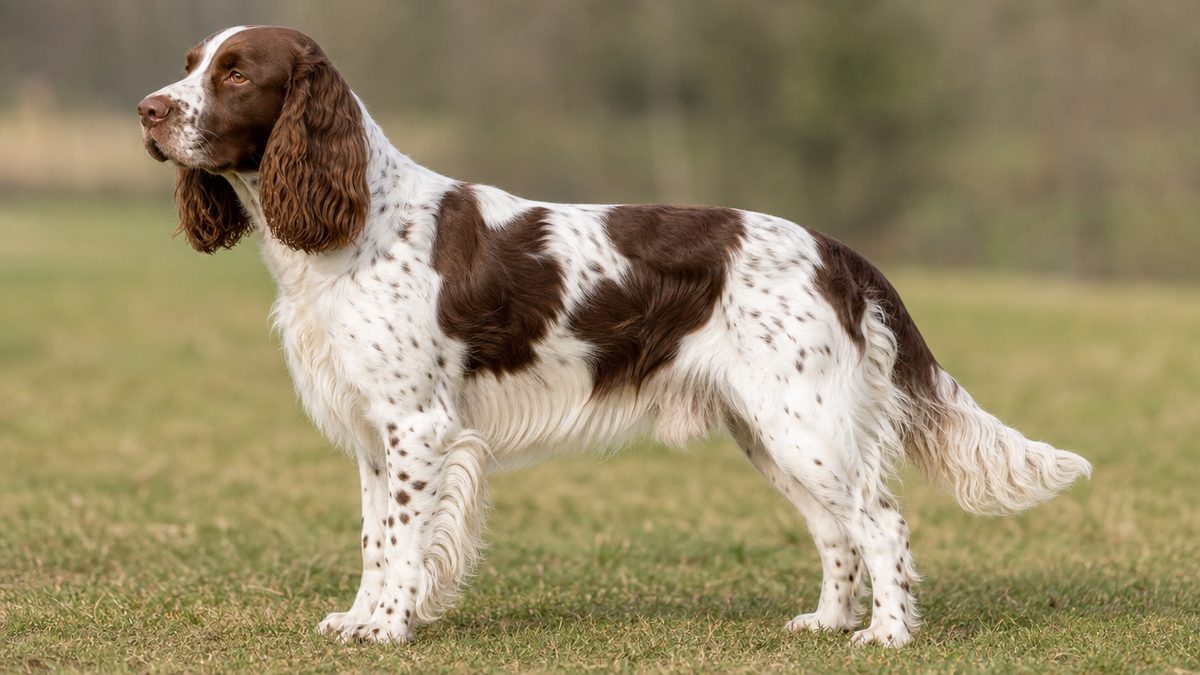
The French Spaniel is a large white and brown continental pointing dog, and the FCI holds it as standard 175 in Group 7 under its French name, Épagneul Français, with French as the standard's authentic language.
The FCI nomenclature entry prints EPAGNEUL FRANÇAIS at the top and gives FRENCH SPANIEL as the English name on the same row, so the two names describe one dog and not two. It sits in Group 7 Pointing Dogs, Section 1.2 Continental Pointing Dogs, Spaniel type, was accepted on a definitive basis on 25 June 1955, comes from France, and is subject to a working trial.
One detail changes how you should read everything below. The official authentic language of this standard is French, so the English PDF is a translation by Jennifer Mulholland with Raymond Triquet and the French text governs. We read both. On size and colour they agree exactly, which is worth confirming rather than assuming, because an FCI standard's translated passages have drifted before.
| Point | The standard's own wording |
|---|---|
| Height at the withers | Males 56 to 61 cm, females 55 to 59 cm, with a tolerance of plus 2 cm and minus 1 cm |
| Weight | Not specified anywhere in the document |
| Type | Braccoid, medium size, elegant and muscled, bone structure strong without being coarse |
| Proportion | Body length exceeds height at the withers by 2 to 3 cm |
| Nose | Brown, well pigmented, with wide open nostrils |
| Coat | Long and wavy on ears, backs of legs and tail. Flat, silky and well furnished on the body. Short and fine on the head |
| Colour | White and brown with medium spotting, irregular patches, slightly or moderately flecked and roan without excess. Brown varies from cinnamon to dark liver |
| Tail | Not docked, reaching the point of the hock |
| Temperament | Balanced, frank, gentle, calm and docile, enthusiastic hunter, sociable with other dogs and an ideal companion in all circumstances |
Read the size line carefully, because this is exactly where secondary sources go wrong. The French text gives 56 to 61 cm for males and 55 to 59 cm for females, then adds a tolerance of plus 2 cm and minus 1 cm as a separate clause. That is not the same as a range of 55 to 63 cm. A tolerance is what a judge may forgive; the range is what the breed should be. Any page that folds the two together is printing a number that appears in no document.
Three registries, three weights, and a standard with none
The FCI specifies no weight at all. Everyone else does anyway, and they disagree. The American Kennel Club gives 50 to 60 pounds. Dog Breeds List gives 44 to 55 pounds and 20 to 25 kg in its data table, then says 45 to 60 pounds and 20 to 27 kg in its own overview paragraph a few centimetres further down the same page. Three published weight bands for a breed whose recognising body publishes none.
Height fares no better on that page. Its table gives males 22 to 24 inches (55 to 61 cm); its overview gives 22 to 24 inches (56 to 61 cm). Same imperial range, two different metric conversions, one page. We give the standard's figures and say plainly that no official weight exists.
The disqualifying faults matter more here than usual
Two of them collide with Indian law and are dealt with in the import section below. The standard disqualifies presence of dewclaws on the hindlegs and any teeth missing except PM1, along with any colour other than white and brown, wall eyes, a white patch surrounding the eye, and depigmentation. It also states the tail is not docked, which is convenient, because docking is illegal in India.
The United Kennel Club in the United States publishes its own Epagneul Francais standard and has recognised the breed since 1 January 1996. The American Kennel Club records it in the Foundation Stock Service rather than in a fully recognised group. Wikipedia and the UK owners' group both report that The Kennel Club in Britain does not recognise it. UK French Spaniels, About French Spaniels
Where it sits among the French spaniels, in numbers
The French Spaniel is the most numerous of the four French spaniels after the Brittany, at 236 French registrations in 2025, and it is also the one falling fastest apart from the Blue Picardy.
We pulled the Société Centrale Canine's own Statistiques LOF PDFs rather than quoting a summary of them, and extracted the rows with pypdf, because this site has previously caught a scraping layer silently dropping rows from a kennel-club statistics PDF. The 2025 table's columns are headed Races, Variétés, Inscr 2024, Inscr 2025, Conf 2025, Conf/Inscr 2025 and % inscr 2024-2025, and the arithmetic in every row we used reconciles.
| Breed | FCI no. | 2024 | 2025 | Change |
|---|---|---|---|---|
| Epagneul Breton (Brittany) | 95 | 3,953 | 3,793 | -4 percent |
| Epagneul Français (French Spaniel) | 175 | 344 | 236 | -31 percent |
| Epagneul Picard (Picardy Spaniel) | 108 | 145 | 168 | +16 percent |
| Epagneul Bleu de Picardie (Blue Picardy) | 106 | 142 | 84 | -41 percent |
| Epagneul de Pont Audemer (Pont-Audemer) | 114 | 19 | 8 | not printed |
Two things follow. The French Spaniel is roughly sixteen times rarer than the Brittany in the breed's own country, and the four non-Brittany French spaniels together registered 496 dogs in the whole of France in 2025. And the fall of 31 percent in a single year is the steepest one-year drop the breed has recorded in the decade we checked.
The ten-year view is not a straight line, and that matters. Registrations were 387 in 2016 and 383 in 2019, rose to 461 in 2021, fell to 356 in 2022 and 306 in 2023, recovered to 344 in 2024 and then dropped to 236 in 2025. Société Centrale Canine Société Centrale Canine Société Centrale Canine Société Centrale Canine Société Centrale Canine A breed that added 32 percent in one year and lost 31 percent in another is small enough that a handful of active kennels moves the whole national figure, so read any single year with caution and the direction of travel with more confidence.
| Year | Registrations | Change on the previous year |
|---|---|---|
| 2016 | 387 | not compared here |
| 2019 | 383 | flat over three years |
| 2020 | 350 | down |
| 2021 | 461 | +32 percent |
| 2022 | 356 | down |
| 2023 | 306 | -14 percent |
| 2024 | 344 | +12 percent |
| 2025 | 236 | -31 percent |
A figure nobody else publishes: the confirmation rate
France runs a two-stage studbook. A puppy is registered at birth, and the dog is later presented as an adult for confirmation, which is what makes the entry definitive. The 2025 table shows 125 confirmations against 236 registrations, a rate of 53 percent. Check it: 125 divided by 236 is 52.97 percent, which is what the SCC prints.
That number is unusually high for a pointing dog. In the same table the Brittany confirms at 27 percent, the English Setter at 36 percent and the Picardy Spaniel at 24 percent. A 53 percent confirmation rate means more than half of all French Spaniels born are taken back to a judge as adults, which is a working-and-showing population rather than a pet population. It is also the best available proxy for how seriously this breed's owners take the studbook, and it is better than most.
Staying consistent with the sibling page
Bonbeno's Blue Picardy Spaniel guide reads the four French spaniel standards side by side and reports that three of the four have a brown nose, with the Blue Picardy the only black-nosed outlier. Our reading of FCI 175 agrees: the French Spaniel's nose is brown, well pigmented, and depigmentation is a disqualifying fault. That page's LOF 2025 figure for the French Spaniel, 236, is the same figure we extracted independently from the same PDF, so the two pages agree and neither is quoting the other.
One difference is worth stating. The Picardy trio are administered by a single club, the Club des Épagneuls de Picardie et Pont-Audemer. The French Spaniel has its own separate club, the Club de l'Épagneul Français, affiliated to the Société Centrale Canine and approved by the French Ministry of Agriculture, which ran its 46th Nationale d'Élevage in 2025 at Landrethun-le-Nord. Forty-six annual breed shows is a long institutional record for a breed this small.
History: a medieval dog rebuilt by a priest after the First World War
The French Spaniel traces to the bird dogs described by Gaston Phébus in the Middle Ages, nearly died out around 1900, and survives because one priest rebuilt it from a handful of dogs and founded its club in 1921.
The FCI standard's historical summary is short and unusually specific. The French Spaniel descends from the bird dogs described by Gaston Febus and used in the Middle Ages, its ancestors are more than likely at the origin of the diverse varieties of sporting spaniels, and the first standard was drawn up in 1891 by James de Connick, revised several times since. The French authentic text says the same, with the same spelling.
The breed club tells a fuller version and spells the name differently, as James de Coninck, a Norman cynophile called to the breed's bedside in 1886 who wrote the first standard in 1891. We print both spellings rather than picking one, because the FCI uses Connick in both its languages and the club uses Coninck, and neither is obviously the error.
| When | What happened |
|---|---|
| Middle Ages | Gaston Phébus, Count of Foix, describes a dog he calls espaignol, said to come from Spain, a claim the club disputes because Spanish pointing dogs today are all short-haired braques |
| Middle Ages onward | Chiens d'oysel, bird dogs, used to mark game so it could be trapped in nets called rets, which the club gives as the origin of the term chien d'arrêt |
| The Empire | French breeds formally classified, which the club credits with fixing the characteristic brown and white coat |
| From about 1850 | British hunters arrive with their dogs and the Brittany is created, and the French breeds decline |
| 1886 | James de Coninck called in to save the breed |
| 1891 | The first standard written |
| After 1918 | Abbé Fournier rebuilds the almost extinct breed in his kennel at Saint-Hilaire-la-Treille in Limousin, from the few dogs he had to hand |
| 1921 | Fournier founds the Club de l'Épagneul Français |
| 1955 | FCI definitive recognition as standard 175 |
| 04.11.2008 | The current standard published, issued in English 23.01.2009 |
The club's own summary of that history is one sentence: without the club, there would be no French Spaniels today. That is worth taking at face value. A breed rebuilt from a handful of survivors by one priest in one kennel has a narrow founding base by construction, and any modern health discussion has to start from that fact rather than from the breed's medieval pedigree.
The breed also has a second homeland that is rarely mentioned in India. It was developed as a hunting dog in France and Canada, it is recognised by the Canadian Kennel Club, and Quebec has had its own Club de l'Épagneul Français since 1978. Its alternative names, French Setter and Canadian Setter, come from that history.
This dog is not a spaniel in the English sense. It points and retrieves rather than flushing, the FCI files it with the pointing dogs in Group 7, and the UK owners' group describes it as best understood as a spaniel-like setter. UK French Spaniels, About French Spaniels A buyer expecting a bigger Cocker Spaniel has misread the name.
Indian heat: the wet-bulb comparison, city by city
France's hottest month, measured where this breed was rebuilt, has a lower wet-bulb temperature than Bengaluru's coolest month, so no Indian city offers a season resembling the climate the French Spaniel works in.
We use wet-bulb temperature rather than air temperature because a dog cools by panting, which is evaporative, and evaporation stalls as humidity rises. Thirty degrees at 30 percent humidity and thirty degrees at 85 percent are different environments for a dog. Every figure below comes from NASA POWER's 2001-2020 monthly climatology queried by explicit latitude and longitude, converted with the Stull 2011 formula. Stull R. Wet-Bulb Temperature from Relative…
We query by coordinates on purpose. Slug-based climate sites have handed this project six wrong cities at HTTP 200, including a request for Chennai that returned a town in New Zealand. A latitude and longitude cannot silently substitute another place, and we checked the coordinates the API echoed back against the ones we sent for every row.
| Place | Coordinates queried | Warmest month, mean air | Highest monthly wet-bulb | Lowest monthly wet-bulb |
|---|---|---|---|---|
| Saint-Hilaire-la-Treille, Limousin | 46.15 N, 1.35 E | 19.99 C (August) | 16.04 C (July) | 2.45 C (January) |
| Landrethun-le-Nord, Pas-de-Calais | 50.85 N, 1.83 E | 17.69 C (August) | 15.55 C (August) | 4.09 C (February) |
| Paris | 48.86 N, 2.35 E | 19.34 C (July) | 15.87 C (July) | 2.22 C (January) |
| Dehradun | 30.32 N, 78.03 E | 26.05 C (June) | 20.94 C (July) | 3.87 C (January) |
| Bengaluru | 12.97 N, 77.59 E | 28.37 C (April) | 21.86 C (May) | 16.41 C (January) |
| Mumbai | 19.08 N, 72.88 E | 31.19 C (May) | 25.77 C (June) | 16.62 C (January) |
| Chennai | 13.08 N, 80.27 E | 31.51 C (May) | 26.11 C (May) | 21.00 C (January) |
| Delhi | 28.61 N, 77.21 E | 35.88 C (June) | 26.50 C (July) | 7.58 C (January) |
| Kolkata | 22.57 N, 88.36 E | 31.53 C (May) | 27.09 C (June) | 13.21 C (January) |
Three readings come straight off that table. The hottest month at Saint-Hilaire-la-Treille, where Abbé Fournier rebuilt the breed, reaches 16.04 C wet-bulb, while Bengaluru's coolest month is 16.41 C. India's mildest large city is warmer in January than the breed's home in July. Chennai's coolest month is 21.00 C, about 5 C above anything France offers. And Kolkata's June, at 27.09 C, is the hardest single month in this comparison, more than 11 C above the French maximum.
France is warmer than Finland, so the French Spaniel is marginally less climate-mismatched than a Nordic breed. Marginally. The gap between a French July and a Bengaluru January is still on the wrong side of zero, and the gap between a French July and a Chennai May is 10 C of wet-bulb, which is a different planet as far as a panting dog is concerned.
Where in India this breed comes closest to working
Dehradun is the best realistic answer. At 1,404 m the NASA POWER grid returns a January wet-bulb of 3.87 C, colder than anything Paris sees between April and October, and a July peak of 20.94 C. From November to March a French Spaniel there gets weather it recognises. The monsoon is still 5 C hotter in wet-bulb terms than a French summer, so the year splits into a workable half and an unworkable one.
That seasonal split is the honest framing for the whole country. A French Spaniel in an Indian hill town has a real winter. A French Spaniel in a coastal metro has no season at all in which its designed workload is safe, and that is a climate fact rather than a matter of effort.
This is not a thick northern coat. It is flat and silky with feathering, and the standard describes no undercoat requirement at all. The heat problem here is not insulation, it is the workload the dog is built to perform and the humidity that stops it dumping the heat that work generates.
Heat illness: why the exertional pattern is the one that matters
Exertional heat illness, not a hot car, is the dominant trigger in the largest study of the subject, and a pointing dog quartering ground at a sustained gallop is precisely that pattern.
Two papers by the same three authors in the same year are constantly conflated, so we name both. Hall, Carter and O'Neill 2020 in Animals reviewed 905,543 UK dogs under primary veterinary care in 2016 and found 1,259 heat-related illness events from 1,222 dogs. Of the 879 events where a trigger was recorded, 652 were exertional, the 74.2 percent the paper prints, against 12.9 percent environmental and 5.2 percent vehicular confinement. The percentage is computed on 879 and not on 1,259, and pages that attach it to the bigger number are quoting arithmetic that does not exist.
Hall, Carter and O'Neill 2020 in Scientific Reports uses the same cohort with a stricter case definition, finds 395 confirmed events, an incidence of 0.04 percent and an event fatality rate of 14.18 percent (95% CI 11.08 to 17.96). Its multivariable model names breed, bodyweight above the breed and sex mean, age over two years, a brachycephalic skull and a bodyweight over 50 kg.
Applying that honestly to this breed takes two sentences. The French Spaniel is not brachycephalic; the standard describes a muzzle a little shorter than the skull with slightly divergent axes, which is a normal mesocephalic head. At the 20 to 27 kg range secondary sources report it is nowhere near the over-50 kg band. The transferable factors are bodyweight relative to the breed mean, which you control, and the exertional trigger, which is about what the dog does rather than what it is.
What the breed club says its dog needs to do
The Club de l'Épagneul Français describes a dog whose quest is rather ample, often at a sustained gallop, a little less fast than its Brittany or British cousins but sure and very long in the nose. The club's welfare instruction is unambiguous: for its wellbeing you should do with it the passion it loves most, hunting for its master, and no walk and no fenced ground will replace that activity for it.
Now put that alongside a Chennai May at 26.11 C mean wet-bulb, or a Kolkata June at 27.09 C. A sustained gallop across open ground in those conditions produces exactly the exposure the Animals paper found to be the commonest trigger of heat-related illness. The breed's own club is telling you the dog needs the one activity the climate makes dangerous.
- Move all sustained work before sunrise and after dark, because ground surfaces hold heat for hours after air temperature falls.
- Hold the dog at or below its breed and sex mean bodyweight, the single modelled risk factor an owner directly controls.
- Cool with cool water over the whole body and go to a veterinarian, rather than watching and waiting, if a dog collapses after activity.
- Replace galloping with nose work in the hot months, because scent games are the only exercise that stays safe at 26 C wet-bulb.
- Treat heavy panting with staggering or vomiting after exercise as an emergency, given a published event fatality rate of 14.18 percent.
One caution about borrowing statistics. The French Spaniel is not a UK-registered breed in any number and appears in neither model, so no page should quote a breed-specific odds ratio for it. What transfers is the mechanism and the bodyweight factor. What does not transfer is a figure computed for a different breed.
Acral mutilation syndrome: the disease no ranking page names
The French Spaniel carries a recessive mutation that removes pain sensation from the feet, and affected puppies chew their own toes off without feeling it, yet not one page ranking for this breed in India mentions it.
Acral mutilation syndrome, also called hereditary sensory neuropathy, was described in this breed by Paradis and colleagues in 2005 in a series of 13 French spaniels in Canada. Read that abstract slowly, because it is the most important paragraph on this page. Clinical signs are first noted between 3.5 and 12 months of age. Affected dogs lick, bite and severely self-mutilate their distal extremities, producing ulcers with secondary bacterial infection. Auto-amputation of claws, digits and footpads occurs in severe cases. Single or multiple feet can be affected. Affected dogs walked on their severely mutilated feet without evidence of pain, lameness or ataxia. The majority were euthanised within days to months of diagnosis.
| Question | Answer |
|---|---|
| Catalogue entry | OMIA:001514-9615, acral mutilation syndrome, species-specific symbol AMS |
| Inheritance | Autosomal recessive, single-gene, key variant first reported 2016 |
| Variant | chr4.g.70,875,561C>T, a substitution with a regulatory effect |
| Where it sits | 90 kb upstream of GDNF, in the last exon of the long intergenic non-coding RNA GDNF-AS |
| Mechanism | The mutation alters binding of a regulatory complex, significantly decreasing GDNF and GDNF-AS mRNA expression |
| Breeds documented | French Spaniel, English Pointer, English Springer Spaniel, German Shorthaired Pointer, and separately the Miniature Pinscher |
| What is spared | Proprioception, motor abilities and spinal reflexes remain intact. Only pain sensation in the feet is lost |
Plassais and colleagues mapped it in 2016 to a 1.8 Mb homozygous haplotype on chromosome 4 shared by all affected dogs across four sporting breeds, sequenced the region in four affected and four unaffected dogs, found 478 variants, and identified the single one that segregated perfectly with recessive inheritance. Online Mendelian Inheritance in Animals It was never present in 900 unaffected dogs from 130 other breeds, which is about as clean a result as canine genetics produces.
One number in that literature disagrees with itself and we print both rather than choosing. OMIA quotes Plassais 2016 saying the variant segregated in 300 sporting dogs of known clinical status, and quotes Correard 2017 saying 250. The 900-dog control figure is identical in both. The discrepancy does not touch the conclusion, and nobody should quote either number without saying which paper it came from.
Why this matters far more in India than in France
A dog that cannot feel its feet is a different animal on Indian ground. Every mechanism in the Paradis series is a self-injury mechanism, and India adds injuries a French field does not: road surfaces that reach painful temperatures in the afternoon, thorn and glass in unswept ground, and a monsoon that turns any open wound into a bacterial one within hours. The 2005 series already found ulcers with secondary bacterial infection as the standard complication in a temperate climate.
The practical consequence is narrow and absolute. Any French Spaniel entering India should have a documented AMS genotype for both parents, or its own genotype, before it travels. The test exists, it is offered commercially, and the disease is recessive, so two carriers are the only combination that produces an affected puppy. A breeder who cannot supply that status for a breed in which the mutation was characterised twenty years ago is not a breeder to buy from.
Wikipedia's summary reads that the French Spaniel is a friendly breed that has few health issues, but can be affected by a syndrome called acral mutilation and analgesia. The UK owners' group reproduces that passage word for word, sentence before and sentence after intact, with the acral mutilation clause deleted, leaving only: it is a friendly breed that has few health issues. That is the breed's own UK advocates removing the one clause a buyer most needs.
Health issues beyond AMS, and an audit of the few health issues claim
The French Spaniel has no published population health survey anywhere, so the honest position is that its health is largely unmeasured rather than proven good, and the widely repeated claim that it has few health issues rests on nothing we could find.
Start with what is missing. There is no national health screening programme with published per-grade counts for this breed, of the kind Finland runs for its own breeds. There is no publicly downloadable breed health survey from the Club de l'Épagneul Français. And with 236 registrations in France in 2025 and about 140 dogs in the whole United Kingdom, the population is too small for the large primary-care datasets to model it.
That absence is a finding, and it is the opposite of the claim everyone repeats. "Few health issues" is not a measurement. It is what you get when nobody has counted. For a breed rebuilt after 1918 from the few dogs one priest had to hand, an unmeasured health status should raise a question rather than settle one.
| Claim | Evidence status |
|---|---|
| Acral mutilation syndrome occurs in the breed | Documented. Case series of 13 dogs, causal variant mapped and published |
| The AMS mutation is autosomal recessive with a DNA test available | Documented, OMIA:001514-9615 |
| Hip dysplasia occurs | Plausible for any 25 kg working dog, but no breed-specific screening figures were found |
| Otitis externa risk is elevated | Inferable from ear conformation using UK primary-care odds ratios, not measured in this breed |
| Life expectancy is 10 to 12 years | Repeated by the AKC and by Royal Canin India, with no dataset cited by either |
| The breed has few health issues | No supporting evidence found. Treat as unmeasured |
The ear conformation, and what the numbers say about it
The standard sets ears well set back at eye level, carried close to the cheeks, long enough that the end of the cartilage just reaches the base of the nose when pulled gently forward, with fringes more or less long and wavy. That is a heavily furnished pendulous ear over a closed canal, which is the conformation with the best-quantified risk in the literature.
In a random sample of 22,333 dogs drawn from 905,554 under UK primary veterinary care, the one-year prevalence of otitis externa was 7.30 percent, and breeds with pendulous ear carriage had 1.76 times the odds of otitis externa (95% CI 1.48 to 2.10) against erect-eared breeds, while V-shaped drop ears carried 1.84 times the odds. India adds the humidity: an Indian hospital series screening 2,476 dogs at Palampur diagnosed 81 with otitis externa, a hospital prevalence of 3.27 percent, with 59.25 percent of cases falling in the rainy season.
Neither figure is a French Spaniel figure and we do not present them as one. They are the risk attached to the ear this standard mandates, in the climate this page is written for, and together they are the strongest health argument for weekly ear checks that this breed's own literature cannot supply.
Two structural notes in the standard's favour
The standard asks for a skin supple and well fitting to the body, with no wrinkles or folds specified anywhere, which removes the skin-fold dermatitis that dominates care advice for many imported breeds. And it requires complete dentition with a scissor or pincer bite, disqualifying any missing tooth except PM1, so the breed is not selected toward a malocclusion. Those are real advantages, and they are worth more than an unevidenced claim about few health issues.
Life expectancy: one number, repeated everywhere, sourced nowhere
Every source gives the French Spaniel a life expectancy of 10 to 12 years and none of them names a dataset, so treat the figure as a convention rather than a measurement.
The American Kennel Club gives 10 to 12 years. Royal Canin India gives an average life expectancy of 10 to 12 years. Dog Breeds List gives 10 to 12 years. Three independent-looking sources, one identical range, and not one of them says where it comes from.
We looked for the underlying data and could not find any. France's studbook publishes registrations and confirmations, not mortality. There is no equivalent of the Finnish Kennel Club's cause-of-death register for this breed, and the large longevity studies that do exist are built on UK and North American primary-care records in which a breed registering 236 dogs a year in its home country does not appear in usable numbers.
| Source | Figure | Dataset named |
|---|---|---|
| American Kennel Club | 10 to 12 years | None |
| Royal Canin India | 10 to 12 years | None |
| Dog Breeds List | 10 to 12 years | None |
| Société Centrale Canine | Not published | Studbook records registrations, not deaths |
| Bonbeno's reading | Unmeasured | We publish no figure of our own |
Compare that with what a measured breed looks like. Bonbeno's Finnish Hound page can report 12,258 recorded deaths at a mean age of 8 years 6 months, because Finland's kennel club runs a public cause-of-death register. Nothing of the kind exists for the French Spaniel, and a page that prints 10 to 12 years without saying so is passing a convention off as evidence.
What actually shortens a French Spaniel's life, where we can say
One cause is documented, and it is not old age. In the founding acral mutilation series, the majority of affected dogs were euthanised within days to months of diagnosis, at an age between 3.5 and 12 months. That is not a lifespan statistic for the breed, because the disease is recessive and rare, but it is the one mortality event this breed has in the peer-reviewed literature, and it happens in puppyhood.
For an Indian owner the second is heat. The largest published study of canine heat-related illness gives an event fatality rate of 14.18 percent once an episode occurs, and that risk is entirely a function of what an owner allows the dog to do in what conditions. Neither of those is captured in a 10 to 12 year range, and both are more actionable than it is.
A range with no dataset behind it is not a lie, and 10 to 12 years is a reasonable expectation for a 25 kg working dog. What it is not is a finding. If a breeder or a page quotes it to you as evidence of the breed's health, ask what it is measured on. Nobody we could find has an answer.
Temperament: the calmest thing in this family, and still a hunting dog
The FCI standard calls the French Spaniel balanced, frank, gentle, calm and docile and an ideal companion in all circumstances, and its own breed club says in the same breath that no walk will replace hunting for it.
The standard's temperament line is one of the warmest in the whole FCI nomenclature: balanced, frank, gentle, calm and docile, enthusiastic hunter, sociable with other dogs and an ideal companion in all circumstances, an excellent pointing dog with a talent for retrieving. The gait clause adds the other half of the picture, asking for movement that is easy, supple, even and energetic while remaining elegant, so the calm and the energetic side are both written into the same document. Aggression or excessive shyness is a disqualifying fault. The UK owners' group adds the practical version, describing a dog larger and less busy than a springer or cocker spaniel and calmer at home.
Both halves of that are true and buyers only read one. The club president describes the same dog on the ground: an ample quest, often at a sustained gallop, a very long nose, standing and dominant points, and a tendency to want to track a little too much during the quest, which training relaxes. The calm indoors is real; it is what a dog looks like when its work has already happened.
Who this dog suits in India
- Households in hill towns with a genuine winter and unrestricted ground, where a sustained gallop is safe for months rather than hours.
- Owners who will do daily scent work, since a nose this good is the cheapest way to tire the dog when the climate forbids running.
- Families with children and other dogs, because the standard asks for a sociable, docile dog and disqualifies aggression.
- Owners who accept a shedding, feathered coat and will brush it two or three times a week.
- People who want a soft-handled dog, since the breed responds to a gentle, consistent approach rather than to pressure.
Who it does not suit
- Apartment owners in a coastal metro, where the exercise this dog needs cannot be delivered safely in any month.
- Anyone wanting a guard dog, given a standard that asks for a dog sociable with everything.
- Owners who cannot verify an AMS genotype, because the one documented hereditary disease in this breed is preventable only by testing.
- Households with no tolerance for feathering in the house, since the coat is long on ears, legs and tail and sheds.
- Buyers looking for a widely available breed, because 236 dogs were registered in the whole of France in 2025.
One temperament trait deserves a specific Indian warning. The club describes a dog that wants to track during its quest, and tracking dogs follow lines across boundaries. Combine that with a breed the standard describes as sociable with everything and you have an animal that will not defend itself and will happily leave with anyone. In Indian traffic and Indian street-dog density, that is an argument for a fence and a long line rather than for trust.
Training: soft-handled, biddable, and still a pointing dog
Train a French Spaniel gently and consistently, because the standard describes a docile dog that points firmly, and the ranking pages disagree with each other about whether it is easy or hard to train.
Two claims circulate and one page carries both. Dog Breeds List rates trainability at one star out of five and calls it Difficult Training, saying the breed responds quickly to the tone of your voice and is easily intimidated, requiring consistent, firm but gentle handling. In its own overview paragraph the same page says the breed is eager to please and thus can be trained easily. Those are opposite conclusions on one page.
The standard settles it. It asks for a dog that is balanced, frank, gentle, calm and docile. Docile is not the same as easy. A soft dog that reads your tone quickly will learn fast from a handler who is calm and shut down under a handler who is not. What that page calls difficult is a handler requirement, not a dog defect, and saying so is more useful than a star rating.
What actually works
- Socialise across the 8 to 16 week window, since a sociable standard describes potential rather than a guarantee.
- Keep sessions short, food-led and low-pressure, because a dog easily intimidated will disengage rather than argue.
- Build recall on a long line first, then in a fenced space, and never test it against a live scent line.
- Reward the point rather than the chase, since the breed points firmly by instinct from early on and the instinct is the training material.
- Relaunch the dog when it starts tracking during a quest, which is the correction the breed club itself recommends for this specific fault.
That last item comes straight from the club president, who notes the breed sometimes wants to track a little too much in its quest and says the dog will forget the habit with a little relaunching in training. It is a rare case of a breed club publishing a specific, actionable training correction for a specific, predictable fault.
The Indian constraint on training time
Training a pointing dog means moving it across ground, and ground work in India is bounded by the clock rather than by the calendar. In Chennai, where the coolest month carries a mean wet-bulb of 21.00 C, the usable window for anything sustained runs roughly from 4.30 am to 6.30 am and after 9 pm. Plan the entire programme inside those hours rather than shortening midday sessions.
Do not let anyone remove this dog's dewclaws or dock its tail. Second Schedule Part II paragraph 6(8) of the Prevention of Cruelty to Animals (Dog Breeding and Marketing) Rules 2017 states there shall be no tail docking, ear cropping, de-barking, de-clawing, branding, dyeing, injecting substances to enhance visual appeal, performing a surgery or procedure to camouflage or hide any defect or infirmity or any other kind of mutilation of any body part of the pup, and that any change of appearance by artificial means is strictly forbidden. The FCI standard independently requires an undocked tail.
Exercise: what the breed club says, and what an Indian city can give
The French Spaniel's own club states that no walk and no fenced ground will replace hunting for this dog, which is the clearest exercise verdict any breed club on this site has published.
Quoted in full, because it decides the question: for its wellbeing you should do with it the passion it loves most, hunting for its master, and no walk and no fenced ground will replace that activity for it, even if in the evening its place is in your dining room. That is a breed club telling prospective owners that the substitutes most pet owners rely on do not work.
The working picture behind it is a dog with an ample quest at a sustained gallop, holding standing points, and covering enough ground that its handler follows rather than leads. French field trials for the breed run through the club's interclub calendar, and 53 percent of registered dogs are presented for adult confirmation, so this is a population that still works. Société Centrale Canine
| Setting | Usable outdoor hours in the hot season | Realistic daily work |
|---|---|---|
| French hunting season | All daylight hours, wet-bulb below 16.1 C even in July | Hours of quartering at a sustained gallop |
| Dehradun, November to March | Most daylight hours, January wet-bulb 3.87 C | 2 to 3 hours of ground work and scent work |
| Bengaluru or Pune | Roughly 5 am to 7.30 am and after 8 pm | 60 to 90 minutes across two sessions |
| Mumbai or Chennai | Roughly 4.30 am to 6.30 am and after 9 pm | 45 to 75 minutes, mostly low intensity |
| Kolkata or Delhi, May to September | Before sunrise only, June and July wet-bulb above 26.5 C | 30 to 60 minutes of walking, no galloping |
An Indian metro supplies between a tenth and a quarter of the workload this breed is designed for, and only outside daylight. That gap is not closed by a bigger flat, a treadmill or a dog park. It is a climate constraint on a dog whose club says walks are not a substitute in the first place.
The substitutions that genuinely help
- Scatter-feed the entire daily ration so the dog hunts for every meal rather than eating from a bowl.
- Lay indoor tracking lines on cool floors, extending the distance weekly, which uses the breed's strongest asset.
- Hide and retrieve games, since the standard credits this breed with a talent for retrieving as well as pointing.
- Swim in clean water where it exists, because it cools and loads the whole body at once.
- Split the day into three short outings rather than one long one, since heat load accumulates within a session.
A French Spaniel denied all of this does not become a lazy dog. It becomes a frustrated one, and a frustrated pointing dog with a very long nose and a sociable temperament is a dog that leaves the property to follow a scent and does not come back. That is the failure mode to plan against.
Grooming: feathering, shedding and the ears that matter most
Brush a French Spaniel two or three times a week for the feathering, and treat the ears as the real job, because the standard mandates a long, heavily fringed pendulous ear and India adds the humidity.
The standard describes hair long and wavy on the ears, falling beyond the cartilage, and on the backs of the legs and the tail, flat, silky and well furnished on the body with a few waves behind the neck and above the root of the tail, and short and fine on the head. Feathering is distinctly longer at the forearm and falls to the pastern, and is particularly profuse behind the upper thighs. Lack of fringes is a severe fault, and so is curly hair on the body.
Coat and colour together are the identification test. The colour is white and brown, with irregular patches, slightly or moderately flecked and roan without excess, the brown ranging from cinnamon to dark liver, and any other colour is a disqualifying fault. A black-and-white, tricolour or solid dog offered as a French Spaniel is not one, whatever the paperwork says.
Shedding is where the ranking set contradicts itself again. Dog Breeds List gives grooming 2 stars, calling French Spaniels light shedders and generally a low maintenance dog, and four rows later rates shedding 5 stars with the note Constant Shedding, be prepared to vacuum often. Our reading of the standard is that a flat silky body coat with long feathering on ears, legs and tail sheds moderately and needs brushing two or three times a week, mainly to keep the feathering from matting behind the elbows and thighs.
The ears, with the numbers attached
The standard sets ears well set back at eye level, carried close to the cheeks, long enough that the cartilage tip reaches the base of the nose when drawn forward, with long wavy fringes. That is a closed, furnished, pendulous canal. UK primary-care data on a random sample of 22,333 dogs put the one-year prevalence of otitis externa at 7.30 percent overall, with pendulous ear carriage at 1.76 times the odds of erect-eared breeds (95% CI 1.48 to 2.10).
India then supplies the season. A Himachal Pradesh hospital series screened 2,476 dogs between June 2022 and July 2023, diagnosed 81 with otitis externa at a hospital prevalence of 3.27 percent, and found the incidence peaking in the rainy season at 59.25 percent of cases, with dogs aged 1 to 5 worst affected at 41.97 percent and presenting signs of pruritus, head shaking, ear pain, swelling and purulent discharge.
- Dry the ear canal deliberately after every bath and swim, rather than towelling and letting the dog air dry, which is normal advice in France and wrong in an Indian monsoon.
- Lift and check both ears weekly, and daily through July and August.
- Clean only on veterinary advice, since the UK study's authors warn specifically against overzealous ear-cleaning.
- Brush the feathering behind elbows and thighs twice weekly, where mats form first and hide moisture.
- Never clip the coat to cool the dog, because a flat silky jacket is still its sun barrier.
One genuine advantage over most long-coated imports. The standard specifies skin supple and well fitting to the body with no folds or wrinkles anywhere, so the skin-fold dermatitis that dominates grooming advice for wrinkled breeds in Indian humidity simply does not apply here. The grooming bill for this dog is a brush, an ear cleaner and no professional appointment, which makes it one of the more affordable coats to maintain in an Indian city.
French Spaniel price in India: what the listing actually contains
The page that ranks in India for French Spaniel puppies advertises KCI-certified French Spaniels from verified breeders, reports three results, and lists two French Bulldogs and a Goldendoodle.
We publish no Indian price for the French Spaniel, because no genuine Indian offer exists to price. That is a strong claim, so here is exactly how we tested it, including the control that proves the instrument works.
The listing, opened and read
The India-located search for the breed name plus price returns Mr n Mrs Pet's French Spaniel page at position three. The page is headed French spaniel Puppies For Sale, prints 3 Result Found, and says in its own copy that it provides healthy, purebred KCI-certified French Spaniel Puppies in India available for sale online near you, from verified French Spaniel dog breeders. Its meta description promises KCI registered French Spaniel puppies at affordable prices from responsible dog breeders.
We read the three results. Under a heading reading Similar breeds at other locations, they are a male French Bulldog called Bear in Lucknow, a female French Bulldog called Lana in Bangalore, and a male Goldendoodle called Chotu in Bangalore. There is no French Spaniel on the page. No price is displayed for any of the three either; every price sits behind a View Price link that leads to a sign-up form.
| French Spaniel page | Labrador Retriever page (control) | |
|---|---|---|
| Results shown | 3, none of them the breed | 454 live listings |
| Breeds actually listed | French Bulldog, French Bulldog, Goldendoodle | Labrador Retriever |
| Rupee price published | None | INR 30,000 to INR 1,20,000 |
| Quality tiers | None | Basic, KCI Registered, Champion Bloodline |
| City breakdown | None | Hyderabad, Bangalore, Delhi, Chennai, Lucknow, Mumbai, Jaipur, Pune |
The site is its own control, which is as clean as this kind of test gets. Same domain, same template, same commercial intent, run in the same session. For the Labrador the template fills with real Indian commerce. For the French Spaniel it fills with two French Bulldogs, which is a name-similarity substitution, and a Goldendoodle, which is not even that.
The only price on the results page is in dollars
The one figure anyone publishes is Dog Breeds List's Average $1500 - $2000 USD, on a page that ranks fifth in India for the rupee query. It is a US dollar figure and it is presented as such, so there is nothing here to divide by 84.38, by 80, by 74 or by 66.67. That matters, because this site has repeatedly caught Indian breed pages publishing dollar lists converted at a single rate and printed as rupees, and one case where the dollar sign was simply deleted and the digits reprinted.
No such conversion exists here, because no Indian page prints a rupee figure for this breed at all. The contamination pattern we look for needs an Indian rupee number to test, and there is none. Reporting that is more useful than manufacturing a range.
Ask for the litter's LOF or Canadian Kennel Club number and check it. France registered 236 French Spaniels in the whole of 2025 and confirmed 125 of them. A dog with no traceable studbook entry in a breed this small is not a French Spaniel with papers, whatever the invoice says.
What Indian searches return instead, and how to tell
Four recognisable things carry the French Spaniel name in Indian results, and none of them is a French Spaniel you can buy here.
We read every result on the India-located pages for the breed name and for the breed name plus price. They sort into four types.
| Type | Example | What it really is |
|---|---|---|
| A different breed with a similar name | A listing page returning two French Bulldogs and a Goldendoodle | Name-similarity substitution inside a for-sale template |
| A different spaniel entirely | Cocker Spaniel and French Bulldog price guides at positions 1 and 2 | The search engine answering a question nobody asked |
| A breed name in a drop-down menu | An Indian rehoming service whose selector carries French Spaniel and Finnish Hound | An FCI breed list pasted into a form |
| Indian-domain editorial with no Indian dogs | Royal Canin India's French Spaniel page and an Indian pet retailer's breed page | Global content served on a .in path |
The drop-down case is the most instructive and the easiest to misread. ThePetNest, an Indian rehoming service, carries French Spaniel in its breed selector immediately after Fox Terrier (Smooth) and French Bulldog. That is a nomenclature list in a form field. It tells you the site could accept a French Spaniel listing, not that one exists. An Indian buyer who finds the breed name on an Indian domain and infers availability has mistaken a menu for an inventory.
The quality of what does rank
Royal Canin India publishes a genuine French Spaniel breed page on its .in domain, describing the breed as a passionate hunter that finds and points with great aplomb and has a talent for retrieving, with an average life expectancy of 10 to 12 years. That is accurate and it is not evidence of Indian dogs. A global brand's Indian site carries every FCI breed.
Dog Breeds List is the one page to distrust outright. It files this FCI Group 7 pointing dog under Hound, with a parenthetical Guardian Dog (UKC). The FCI classifies it as a Continental Pointing Dog, Spaniel type, in Group 7. The United Kennel Club places it in its Gun Dog group. Calling a pointing breed a guardian dog is not a nuance; it is a category error, and it sits on the same page that contradicts itself on shedding, trainability, height and weight.
None of the ten ranking pages carries a French registration figure, and none names acral mutilation syndrome. The Société Centrale Canine publishes the registration number in a downloadable PDF, and the disease has been in the peer-reviewed literature since 2005 with a causal variant published in 2016. Paradis M, de Jaham C, Page N, Sauve F Plassais J, Lagoutte L, Correard S Both are freely available. Neither is on any page an Indian buyer will find.
Importing one, and two clauses where the standard collides with Indian law
India permits a pet dog to be imported only in a personal capacity with a valid pet book in the importer's name, and two of this breed's disqualifying faults sit awkwardly against the 2017 breeding Rules.
The controlling instrument is DGFT Trade Notice No. 22/2022-23 of 19 December 2022. Dogs sit under ITC(HS) 01061900, Restricted. Policy Condition (7) permits import only for a pet dog with a valid pet book and records in the importer's name, for R&D organisations with a CPCSEA recommendation, or for Defence and Police internal security. Policy Condition (8) states that import of commercial dogs for breeding or any other commercial activity is not permitted.
Two sentences are worth quoting because they are routinely paraphrased wrongly. Paragraph 6 reads that any applications for trading or breeding purposes, or applications made on behalf of some another person or entity, shall be duly rejected. Paragraph 7 reads that import of pet animals is allowed only through airports and seaports of Delhi, Mumbai, Chennai, Hyderabad, Bangalore and Kolkata, with quarantine at the government station of those ports where required. DAHD added a seventh port, Cochin International Airport at Kochi, for pets arriving under the baggage rules in October 2024.
| Route | Allowed? | Conditions |
|---|---|---|
| Bringing your own dog when you relocate | Yes | Up to two pets as passenger baggage without DGFT authorisation, on transfer of residence after two years of continuous stay abroad |
| Importing a puppy to keep as a pet | Authorisation required | Application to DGFT with a pet book, begun at least two months before travel |
| Importing to breed or resell | No | Applications for trading or breeding purposes shall be duly rejected |
| Having an agent import for you | No | Applications made on behalf of another person or entity shall be duly rejected |
The two collisions
The Prevention of Cruelty to Animals (Dog Breeding and Marketing) Rules 2017 would apply to anyone breeding this dog in India. We read the machine-readable gazette copy directly, because summaries of this document have repeatedly been fabricated, and grepped it clause by clause.
First collision, the hind dewclaw. The FCI standard lists presence of dewclaws on the hindlegs as a disqualifying fault. Second Schedule Part II paragraph 6(8) of the 2017 Rules forbids de-clawing along with tail docking, ear cropping, de-barking, branding, dyeing, and any other kind of mutilation of any body part of the pup, and states that any change of appearance by artificial means is strictly forbidden. So a French Spaniel born with hind dewclaws is show-disqualified for life, and removing them in India is illegal. That is a real bind, and the resolution is simply that such a dog is a pet rather than a show dog.
Second collision, the teeth. The standard disqualifies any teeth missing except PM1. Second Schedule Part III paragraph 8(10) of the Rules requires that breeding dogs have been tested for genetic defects, including hip dysplasia, progressive retinal atrophy, night blindness, hypothyroidism, entropion, ectropion, overshot, undershot jaw, wry mouth, two or more missing teeth, and unilateral or full cryptorchid males. The clause says including, so its list is illustrative rather than closed. Here the two documents agree rather than conflict, which is worth saying: both treat missing teeth as a defect.
- Rule 8, Conditions for sale, sub-clause 8(1)(a): every breeder shall ensure that pups less than eight weeks in age are not sold.
- Second Schedule Part II paragraph 6(3): in breeding, defined as breeding between relatives of the 2nd to 4th grade in straight or side line within the first four generations, and incest breeding, mating between parents and children or brother and sister, are both prohibited.
- Second Schedule Part II paragraph 6(9): breeding to create new breeds of dogs or unusual looks shall be strictly prohibited.
We searched the whole gazette. BAER appears zero times, deaf zero times, patella and luxation zero times, dental zero times. India mandates no patella grading and no hearing test, and nobody should tell you otherwise. Note also that paragraph 6(3) contains no father-to-daughter or half-sibling wording, so do not attribute either to it.
Monthly cost of ownership, bounded honestly
We publish no rupee purchase price because none exists, and the running costs below are the costs of keeping any 25 kg feathered gundog in an Indian city, which is what the evidence can honestly support.
Two things get conflated and should not be. The purchase price of a French Spaniel in India is unknowable, because the only Indian listing for the breed contains two French Bulldogs and a Goldendoodle and shows no price at all. The running cost of a medium feathered working dog in India is knowable in structure, though not as one national figure, because it varies with city, brand and how much veterinary care you use.
| Line item | What drives it for this breed specifically |
|---|---|
| Food | Bodyweight and activity. A working-bred dog denied work still needs a maintenance ration, not a working one |
| Grooming | Low. Brushing two or three times a week for the feathering, and no professional appointment |
| Ear care | The one predictable recurring line, given a long fringed pendulous ear and an Indian monsoon |
| Routine veterinary care | Vaccination, deworming, parasite prevention. No breed-specific screening is offered in India |
| AMS genotype | A one-off overseas laboratory test, and the only genetic test this breed genuinely needs |
| Containment | A secure boundary or a long line, for a tracking dog the standard describes as sociable with everything |
| Emergency reserve | Heat illness and, in an AMS-affected dog, chronic foot wounds with secondary infection |
We will not print a monthly rupee total. The house rule is that every figure traces to a source, and no Indian cost dataset exists for a breed with no Indian population. What we can do is say which lines are unusually low and which are unusually high, which is what actually changes a decision.
The lines that differ from an average dog
Grooming is cheaper than the coat looks. Long feathering on ears, legs and tail sounds expensive and is not, because the body coat is flat and silky with nothing to strip or clip and the skin has no folds. Against a Cocker Spaniel or a Golden Retriever in a humid Indian city, a French Spaniel owner saves the whole professional grooming line.
Ear care is more expensive. With pendulous ears at 1.76 times the odds of otitis externa and an Indian series putting 59.25 percent of cases in the rainy season, assume at least one veterinary ear consultation in a typical monsoon and budget for it rather than being surprised by it.
One line has no Indian supplier at all. The AMS genotype test is offered by overseas laboratories and is not a routine Indian panel, so an owner importing this breed should have it done before the dog travels rather than after. It is a one-off cost and it is the highest-value money anyone spends on this breed.
Nothing in the Indian pet insurance market is priced for a breed with no Indian population. Expect a generic medium-breed band and expect any hereditary-condition exclusion to be untestable locally, since no Indian laboratory offers the GDNF-region AMS test as routine.
Feeding: body condition is a heat decision here
Feed a French Spaniel in India to hold it at or below its breed and sex mean bodyweight, because that is the one heat-illness risk factor in the published model an owner directly controls.
This is not a general wellness point. The Scientific Reports analysis of 905,543 UK dogs found higher bodyweight relative to the breed and sex mean to be a significant risk factor for heat-related illness, alongside brachycephaly, age over two years and bodyweight over 50 kg. The French Spaniel is neither brachycephalic nor a giant, so the bodyweight factor is the transferable one, and it is set at the bowl.
| Stage | What changes |
|---|---|
| 8 weeks to 4 months | Four meals a day of a medium to large breed puppy diet. Do not free-feed, because food is your main training currency with a soft dog |
| 4 to 9 months | Three meals. Growth is fastest here and joint loading matters for a 25 kg working frame |
| 9 to 14 months | Two meals, moving to adult food at the lower end of the range, since an Indian dog does a fraction of the French workload |
| Adult, 1 to 7 years | Two meals, ration set on body condition rather than on a bag chart written for a hunting dog |
| Senior, 7 years and over | Two meals, reduced ration, and closer attention to feet and ears as mobility and grooming tolerance change |
The bag chart is the trap. Feeding guides for a medium gundog assume a dog that quarters ground for hours. A French Spaniel in Bengaluru getting 75 minutes of split walking is doing perhaps a fifth of that, and the difference shows up as weight within three months. Set the ration from ribs you can feel without pressing and a waist visible from above, then adjust monthly.
Indian availability is not a constraint. Every major brand sold in India makes a medium-breed adult formulation, and nothing in this breed's documented health profile calls for a specialised diet. There is no breed-specific dietary condition in the literature we could find.
Three Indian adjustments
- Move the main meal to the coolest part of the day, because digestion generates heat and a full stomach before an Indian afternoon is a poor combination.
- Serve the ration as scatter-feeding and tracking rewards, which turns a feeding routine into the scent work the climate otherwise denies this dog.
- Watch water intake through the hot months, because a panting dog loses water fast and dehydration compounds heat risk.
One thing not to do: do not underfeed a growing puppy in the hope of protecting its joints. No breed-specific hip data exists for the French Spaniel, and the intervention that works for any large-framed puppy is controlled steady growth on a complete diet, not restriction.
The first year, month by month
Plan a French Spaniel puppy's first year around three fixed points: the socialisation window that closes at 16 weeks, the acral mutilation signs that begin between 3.5 and 12 months, and the first Indian hot season.
| Age | What to do | What to watch |
|---|---|---|
| 0 to 8 weeks | With the breeder. Indian law prohibits sale below eight weeks under Rule 8(1)(a) of the 2017 Rules | Get the AMS genotype for both parents in writing before the puppy leaves |
| 8 to 12 weeks | Home, vaccinations, four meals a day, crate and toilet routine | Handle the feet daily from day one, which is how you will notice a problem early |
| 12 to 16 weeks | Socialisation sprint: traffic, lifts, tiled floors, monsoon rain, cattle, autorickshaws, other dogs | The window closes here, and a soft dog under-socialised now is hard to fix later |
| 3.5 to 6 months | Long-line recall work begins. Three meals. First scent games and first points | The AMS window opens. Any licking, biting or chewing at a foot is a same-day veterinary question |
| 6 to 9 months | Adolescence and the first real recall failures. Never off-lead outside a fence | Continued foot checks. Joint loading, so avoid repetitive stair and jump work |
| 9 to 12 months | Two meals, adult food. Structured tracking replaces random walking | The first hot season. Move all activity before sunrise and after dark |
| 12 months | Assess adult structure against the standard, and settle a permanent exercise routine around the climate | Weight creep as growth stops but the bag chart does not |
The 3.5 to 6 month row is the one to read twice. Paradis and colleagues report clinical signs first noted between 3.5 and 12 months of age in 13 affected French spaniels, beginning as licking and biting of the distal extremities and progressing to ulcers, secondary bacterial infection and, in severe cases, auto-amputation of claws, digits and footpads. Affected dogs walked on severely mutilated feet without evidence of pain or lameness.
Two practical consequences follow. You cannot rely on limping as a warning sign, because affected dogs do not limp. And because the dog feels nothing, the owner's eyes are the entire early-warning system, which is why daily foot handling from eight weeks is on the list above and not an afterthought.
Socialisation, Indian version
A French puppy is socialised to fields, hedgerows and quiet. An Indian puppy has to be socialised to horns, crowds, street dogs, cattle, festival firecrackers and monsoon flooding, all before 16 weeks, and it has to be done gently because this is a breed the ranking pages themselves describe as easily intimidated. That is a heavier programme than the breed's home country requires, delivered with a lighter hand.
Head to head against the gundogs an Indian buyer can actually get
Compare the French Spaniel with the gundogs genuinely available in India and the decision resolves quickly, because a Labrador or a Cocker gives you most of what attracts people to this breed, from a market that exists.
| French Spaniel | Labrador Retriever | English Cocker Spaniel | Indian Pariah Dog | |
|---|---|---|---|---|
| Available in India | No genuine listings found | Yes, widely | Yes, widely | Yes, free from any shelter |
| Origin climate, hottest wet-bulb | 16.04 C in Limousin | Newfoundland and England | England | The Indian subcontinent |
| Height | 56-61 cm males, 55-59 cm females | About 56-57 cm | About 39-41 cm | Roughly 51-64 cm |
| Job | Pointing and retrieving | Retrieving | Flushing and retrieving | None, and none needed |
| Coat work | Brush 2 to 3 times a week, no clipping | Weekly brush | Regular trimming, professional appointments | Weekly brush |
| Ear risk | Long pendulous, high | Drop, moderate | Long pendulous, high | Usually erect, low |
| Documented hereditary disease | Acral mutilation syndrome, DNA test available | Extensively screened worldwide | Extensively screened worldwide | No closed gene pool |
| Heat tolerance | Low | Low to moderate | Moderate | High, adapted here |
| Cost to acquire in India | No market | INR 30,000 to 1,20,000 published | Established market | Free |
The Labrador is the honest substitute for most people and it is not close. It gives you a biddable, sociable, retrieving gundog of similar height, from an Indian market with published prices, veterinary familiarity and a screening infrastructure that actually exists here. What it does not give you is the pointing instinct, which in an Indian city you will almost never be able to use.
The Indian pariah dog is the better answer for a larger share of readers than anyone says. It is a medium, short-coated, scent-driven dog evolved in this climate, free from any shelter, with erect ears that carry the lowest otitis risk in the UK data and no closed gene pool to screen. If what draws you to the French Spaniel is a lean, elegant, biddable dog that covers ground, that animal is already here.
Against the other French spaniels
Within its own family the French Spaniel is the largest and the most numerous after the Brittany, at 236 French registrations in 2025 against the Picardy Spaniel's 168, the Blue Picardy's 84 and the Pont-Audemer's 8. Bonbeno's Blue Picardy Spaniel page covers the identification differences in detail. The short version for a buyer looking at a photograph is that the French Spaniel is white and brown with a brown nose, and any other colour is a disqualifying fault.
One axis where the French Spaniel genuinely wins over its cousins and over most imports: the confirmation rate. Fifty-three percent of French Spaniels registered in 2025 were presented for adult confirmation, against 24 percent for the Picardy Spaniel and 27 percent for the Brittany. That is a population whose owners still take the studbook seriously, and for a buyer trying to verify a pedigree it is the single most useful fact about the breed's administration.
Mistakes Indian owners make with gundogs like this one
Six mistakes account for most of what goes wrong with a feathered pointing dog in an Indian home, and five of them are decisions made before the dog arrives.
1. Reading the spaniel in the name
This dog points and retrieves. The FCI files it in Group 7 with the pointing dogs, and the UK owners' group describes it as best understood as a spaniel-like setter that hunts, points and retrieves. UK French Spaniels, About French Spaniels A buyer expecting a larger Cocker Spaniel has bought a different job description at a different exercise budget.
2. Believing the few health issues line
Wikipedia's summary says the breed has few health issues but can be affected by acral mutilation and analgesia, and the UK owners' page reproduces the passage with that clause deleted. The disease has a published case series, a mapped causal variant and a commercially available DNA test. Plassais J, Lagoutte L, Correard S Ask for the genotype.
3. Waiting for a limp
In the founding case series, affected dogs walked on severely mutilated feet without evidence of pain, lameness or ataxia. Lameness is the sign owners watch for and it is the one sign this disease does not produce. Handle the feet daily instead.
4. Exercising in the morning instead of before dawn
An 8 am walk in Chennai in May is not an early walk. The monthly mean wet-bulb there is 26.11 C and road surfaces hold heat long after air temperature drops. Exertional heat illness was the commonest trigger in the largest study of the subject.
5. Letting the ears air dry
Advice written in a temperate climate says towel the dog and let it dry. In an Indian monsoon, with a pendulous-eared breed carrying 1.76 times the odds of otitis externa and an Indian series putting 59.25 percent of cases in the rainy season, that advice is wrong here. Dry the canal deliberately.
6. Substituting walks for work, against the club's own advice
The Club de l'Épagneul Français states that no walk and no fenced ground will replace hunting for this dog. Most Indian owners cannot supply hunting, and the honest workaround is daily scent work rather than a longer walk. A breed club telling you its own dog is not satisfied by walking is a rare and useful piece of candour.
If an Indian listing offers you a French Spaniel, look at what is actually on the page. The one that ranks for the price query promises KCI-certified French Spaniel puppies from verified breeders and lists two French Bulldogs and a Goldendoodle. The burden of proof sits entirely with the seller, and a photograph is not proof.
Adoption: the realistic route, and the better question
You will not adopt a French Spaniel in India, and the useful answer is what to do instead if the breed's qualities are what drew you to it.
No French Spaniel rescue exists in India and no Indian shelter realistically holds one. The world population sits in France, Canada and a scatter of European countries, with about 140 dogs in the whole United Kingdom and 236 registrations in France in 2025. Société Centrale Canine An Indian rehoming service carrying the breed name in a drop-down menu is carrying an FCI breed list, not a dog.
If the elegant biddable gundog is what you want
- Adopt an Indian pariah dog, the same size and the same short-coated build, already adapted to this climate, from any municipal shelter.
- Adopt a surrendered Labrador or Labrador cross, of which Indian rescues hold many, since Labradors are bought and surrendered here in large numbers.
- Look at Cocker Spaniel rescue if the feathered spaniel look is the draw, because the Indian Cocker population is large enough to have a rescue pipeline.
- Take a working-bred gundog only if you have work for it, since the failure mode is a frustrated dog that leaves the property on a scent line.
If you are moving to India with one
This is the one realistic French Spaniel in India scenario, and the law accommodates it. A resident transferring residence after two years of continuous stay abroad may bring up to two pets as passenger baggage without DGFT authorisation, through Delhi, Mumbai, Chennai, Hyderabad, Bengaluru, Kolkata or, since October 2024, Kochi, with quarantine at the government station where required. Directorate General of Foreign Trade Begin the paperwork at least two months before travel, obtain the advance no-objection certificate from the quarantine officer seven days before, and time the arrival for the cool season. The full route is set out in how to import a dog to India.
Then plan the dog's Indian life around one number. The hottest month where this breed was rebuilt reaches 16.04 C wet-bulb, and Bengaluru's coolest month is 16.41 C. Your dog has never experienced an Indian winter, let alone an Indian summer, and its first year here is the dangerous one. Move exercise before sunrise, keep it lean, dry the ears after every bath, and check the feet daily.
Responsible sourcing if you must import
There is one honest checklist and it is short. Ask for the LOF or Canadian Kennel Club registration number and verify it. Ask whether the dog was confirmed as an adult, since France confirms 53 percent of this breed. Ask for the acral mutilation syndrome genotype of both parents, in writing, before money changes hands, because it is a simple recessive with a published causal variant and a commercial test. Ask what the parents do, since a French Spaniel from non-working stock is unusual. And then ask yourself honestly whether the climate section above changes your answer.
Bonbeno does not sell dogs, broker puppy sales or take payment from breeders. We have no commercial reason to talk you into this breed and none to talk you out of it. We are reporting what the French studbook, the FCI standard and the veterinary literature actually say.
French Spaniel questions Indian readers actually ask
What is the French Spaniel price in India?
No genuine Indian price exists, because no genuine Indian offer does. The page ranking for that query advertises KCI-certified French Spaniel puppies from verified breeders, reports three results, and lists two French Bulldogs and a Goldendoodle with no price shown. The same site's Labrador page, checked in the same session, returns 454 listings and a published band of INR 30,000 to INR 1,20,000.
Can a French Spaniel live in India?
It can live here with careful management and it cannot work here. The hottest month where the breed was rebuilt in France reaches 16.04 C wet-bulb, while Bengaluru's coolest month is 16.41 C and Chennai's is 21.00 C. Exercise moves permanently to before sunrise and after dark, and Dehradun in winter is the closest India comes to a usable season.
What is acral mutilation syndrome in French Spaniels?
Acral mutilation syndrome is an autosomal recessive hereditary sensory neuropathy that removes pain sensation from the feet. Affected dogs lick, bite and self-mutilate their extremities from between 3.5 and 12 months of age, with ulcers, secondary infection and in severe cases auto-amputation of claws, digits and footpads, while walking on the damaged feet without lameness.
Is there a DNA test for French Spaniel acral mutilation?
Yes. The causal variant was published in 2016 and sits 90 kb upstream of the GDNF gene, in the last exon of a long intergenic non-coding RNA. Because the disease is recessive, only two carriers bred together can produce an affected puppy, so testing both parents prevents it entirely. Ask for both parents' genotypes in writing before any money changes hands.
How rare is the French Spaniel?
France registered 236 French Spaniels in 2025, down 31 percent from 344 the year before, in the same studbook table that records 3,793 Brittanys. That makes it roughly sixteen times rarer than the Brittany in its own country, though still the most numerous of the four French spaniels after the Brittany itself.
How big does a French Spaniel get?
The FCI standard sets 56 to 61 cm at the withers for males and 55 to 59 cm for females, with a separate tolerance of plus 2 cm and minus 1 cm. It specifies no weight at all, which is why the American Kennel Club, Dog Breeds List and that page's own overview paragraph give three different weight figures.
Is the French Spaniel recognised by the AKC?
Not as a fully recognised breed. The American Kennel Club records the French Spaniel in its Foundation Stock Service, which is the preliminary register rather than a conformation group. The United Kennel Club recognised the breed on 1 January 1996 and publishes its own standard, and The Kennel Club in Britain does not recognise it.
Do French Spaniels get ear infections?
The ear shape raises the risk. UK primary-care data on a random sample of 22,333 dogs put the one-year prevalence of otitis externa at 7.30 percent overall, with pendulous-eared breeds carrying 1.76 times the odds of erect-eared breeds. An Indian series in Himachal Pradesh found 59.25 percent of otitis cases occurring in the rainy season, so dry the canal after every bath and swim.
How long do French Spaniels live?
Every source says 10 to 12 years and none of them names a dataset. The American Kennel Club, Royal Canin India and Dog Breeds List all print the same range with no supporting figures, and no national mortality register for this breed exists. Treat the number as a convention for a 25 kg working dog rather than as a measurement.
Are French Spaniels good family dogs?
The standard describes a balanced, frank, gentle, calm and docile dog, sociable with other dogs and an ideal companion in all circumstances, and the UK owners' group calls it calmer at home than a springer or cocker spaniel. The obstacle in India is not temperament, it is that the breed club itself says no walk and no fenced ground replaces hunting for this dog.
How much exercise does a French Spaniel need?
More than an Indian city can safely deliver. The breed works an ample quest at a sustained gallop over open ground, and the realistic Indian supply is 45 to 90 minutes split across two sessions outside daylight hours. Substitute scatter feeding, indoor tracking lines and retrieve games for the distance the climate forbids.
Can I import a French Spaniel to India?
Only as your own pet. DGFT Trade Notice 22/2022-23 classifies dogs as Restricted and permits import for a pet dog with a valid pet book in the importer's name, for R&D with a CPCSEA recommendation, or for Defence and Police use. Applications for trading or breeding purposes, or made on behalf of another person, shall be duly rejected.
Is the French Spaniel the same as the Brittany or the Picardy Spaniel?
No. All are French spaniels in FCI Group 7 and all are separate breeds with separate standards and clubs. In 2025 France registered 3,793 Brittanys, 236 French Spaniels, 168 Picardy Spaniels, 84 Blue Picardy Spaniels and 8 Pont-Audemer Spaniels. The French Spaniel is the largest of them and has its own club, founded in 1921.
What health tests should a French Spaniel have?
Ask for one test above all others, the acral mutilation syndrome genotype for both parents, because it is the single documented hereditary disease in this breed and it is a simple recessive. Then ask for hip screening if the breeder offers it, and treat the absence of any national screening figures for the breed as a reason to ask more questions rather than fewer.
Which breed should I get in India instead?
Choose a Labrador Retriever if the biddable retrieving gundog is the draw, since it is a similar height with an established Indian market and familiar veterinary support. Adopt an Indian pariah dog if what appeals is a lean, medium, scent-driven dog that covers ground, because that animal is already adapted to this climate and is free from any shelter.
What are the key differences between a French Spaniel and a Springer spaniel?
Size and pace, according to the people who keep both. The UK owners' group describes the French Spaniel as larger and less busy than a springer or cocker spaniel and calmer at home, and the FCI standard sets it at 56 to 61 cm at the withers for males and 55 to 59 cm for females. What the two share is a hereditary disease: the acral mutilation syndrome variant is documented by OMIA in the French Spaniel, the English Springer Spaniel, the English Pointer and the German Shorthaired Pointer, so the same DNA test applies to both.
What is the temperament of the French spaniel?
The FCI standard calls it balanced, frank, gentle, calm and docile, an enthusiastic hunter, sociable with other dogs and an ideal companion in all circumstances, and it disqualifies aggression or excessive shyness. The gait clause asks for movement that is easy, supple, even and energetic, so the calm and the energetic side are written into the same document. The breed club president describes the working half: an ample quest, often at a sustained gallop, and a very long nose. The calm indoors is what the dog looks like when its work has already happened.
Compare with similar breeds
French Spaniel sits in 2 Bonbeno groups. Each one compares it directly against the breeds it is genuinely an alternative to, on the same figures.