
Breed profile
Braque Français: Two Breeds, One Name, and What That Means in India
One name covers two separate FCI breeds. This guide separates them clause by clause and tests both against Indian heat, humidity and law.
Quick answer
Braque Francais is not one breed. The FCI recognises two, standard 133 for the Braque Français type Gascogne at 60 to 69 cm in males and standard 134 for the Braque Français type Pyrénées at 51 to 58 cm. Both are short-coated French pointing dogs with long pendent ears and chestnut colouring. Neither is bred in India, and no lawful purchase route exists here.
This page reports published veterinary research and registry data for general information. It is not a diagnosis and it is not treatment advice. Consult a registered veterinarian about any individual dog, because breed-level statistics describe populations and not the animal in front of you.
Braque Français at a glance
What the Braque Français is, and why it is two breeds
The Braque Français is two separate FCI breeds that share one name. Standard 133 covers the Braque Français type Gascogne, the large one, and standard 134 covers the Braque Français type Pyrénées, the small one. Both are French pointing dogs from the south-west of France, both sit in FCI Group 7, Section 1.1 Continental Pointing Dogs, subsection Braque type, and both are subject to a working trial.
Read the two nomenclature entries side by side and the split is unambiguous. The FCI accepted the Gascogne on a definitive basis on 17 January 1955 and the Pyrénées on 18 January 1955, one day apart, under separate numbers that have never been merged. Both current standards were published on 22 September 2023 and both carry France as country of origin and French as the official authentic language.
This matters more than a taxonomic footnote, because the two dogs are not the same size of animal and are not bought for the same reasons. A male Gascogne stands 60 to 69 cm at the withers. A male Pyrénées stands 51 to 58 cm. At the extremes that is an 18 cm difference in height, roughly the gap between a Labrador Retriever and a Beagle, sold under one search term.
If a seller, a listing or a blog says only Braque Français, it has not told you which breed it means. Ask for the FCI standard number. 133 is the large Gascogne. 134 is the small Pyrénées. Every other question, from crate size to food budget to whether the dog fits your flat, follows from that one answer.
What both breeds look like
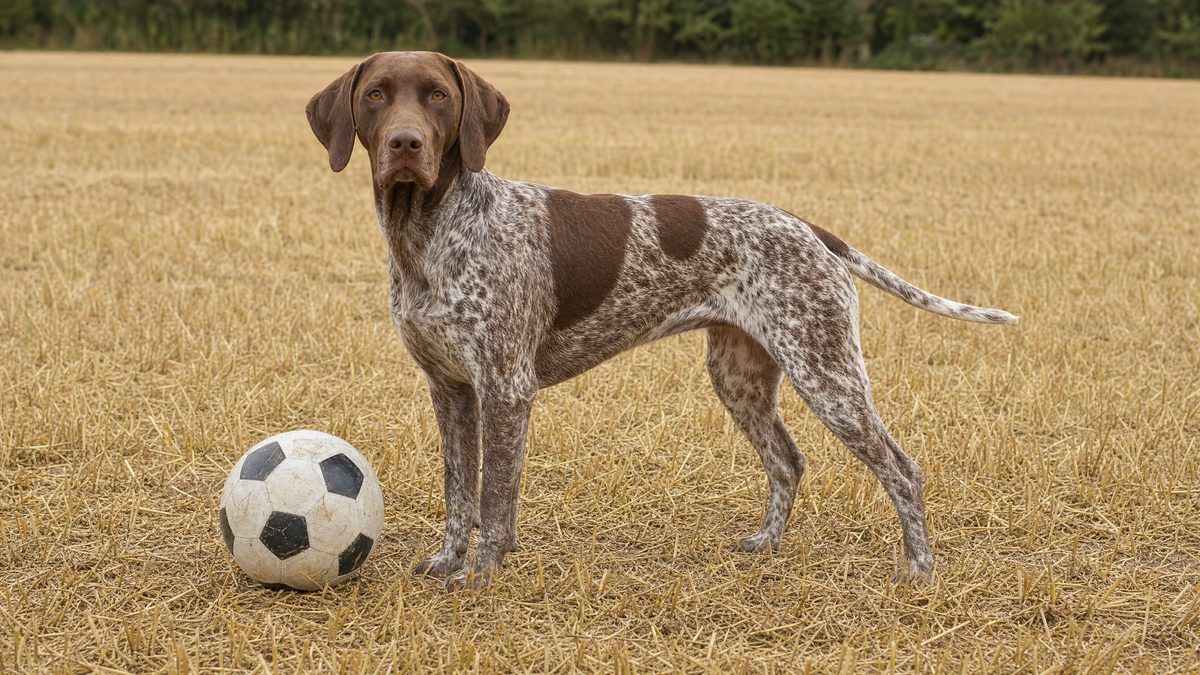
Both are chestnut brown dogs with short coats, long drop ears and a brown nose. The Gascogne standard permits chestnut brown, chestnut brown and white, chestnut brown and white strongly speckled, and chestnut brown marked with tan above the eyes, at the lips and on the legs. The Pyrénées standard does not restate colour, because it is written as a list of departures from the Gascogne and only names the points on which the two differ. That drafting choice is why so many secondary pages garble the comparison. They read the shorter document as though it were complete.
Neither standard specifies a weight. The only published weight figure for either dog comes from the American Kennel Club, which lists 40 to 55 pounds, roughly 18 to 25 kg, for the Pyrenean alone. Treat that as a registry estimate rather than a measured population, because the AKC holds the breed only in its Foundation Stock Service and publishes no sample behind the number.
Where the two breeds came from
The Gascogne standard opens with the history in one sentence. It states that there are two different types of French Pointing Dog, the large size Gascogne type and the small size Pyrenean type, that both types are originally from the South-West of France and the Central Pyrenees, and that they stayed there in pure state. Nineteenth-century crossing scattered the original stock, and when breeders went looking for unmixed dogs at the end of that century they found two regional populations rather than one.
France runs both breeds through a single organisation, the Club du Braque Français, an official breed club affiliated to the Société Centrale Canine, with separate sections for the Gascogne and the Pyrénées. That club is still an active working-dog body rather than a show club. Its 2026 news page lists the Coupe de France des Jeunes and a natural-game field trial at Revel.
Where they stand in the English-speaking registries
| Registry | Gascogne / large | Pyrénées / small |
|---|---|---|
| FCI | Standard 133, definitive | Standard 134, definitive |
| Société Centrale Canine | Registered, own LOF line | Registered, own LOF line |
| United Kennel Club | Braque Francais de Grande Taille, recognised 2006 | Braque Francais de Petite Taille, recognised 2006 |
| American Kennel Club | Not listed at all | Braque Francais Pyrenean, Foundation Stock Service, Sporting Group |
| Royal Kennel Club | Absent from the gundog standards index | Absent from the gundog standards index |
| Kennel Club of India | No public breed list published | No public breed list published |
The United Kennel Club recognised both in 2006 under a third set of names again, De Grande Taille and De Petite Taille, and its own standard opens by explaining that there are two types United Kennel Club. The American Kennel Club lists only the Pyrenean. Its Foundation Stock Service Sporting Group holds exactly 17 breeds, among them the Braque du Bourbonnais, the Braque Francais Pyrenean and the Braque St. Germain, and the Gascogne type appears nowhere in that list or in the AKC's alphabetical breed selector. The Royal Kennel Club gundog standards index carries the Braque d'Auvergne but no Braque Français of either type. It will recognise 230 breeds of pedigree dog from 1 October 2026, when the Braque du Bourbonnais joins the Gundog Group on the Imported Breed Register, and neither Braque Français is among the 230.
Gascogne against Pyrénées, clause by clause
Size is the obvious difference and it is not the only one. Standard 134 is written as an explicit list of departures from standard 133, opening with the statement that the small size Pyrenean type shows the same general characteristics as the Gascogne type while keeping all proportions, with more reduced dimensions and lighter shapes, and that the two differ only on the points that follow. Nine of those points are listed below, taken clause by clause from the two documents.
| Clause | Gascogne, standard 133 | Pyrénées, standard 134 |
|---|---|---|
| Height, male | 60 to 69 cm | 51 to 58 cm |
| Height, female | 58 to 68 cm | 49 to 56 cm |
| General appearance | Powerful, robust, strong bone | Rustic, not heavy but sufficiently muscled |
| Skin | Supple, quite loose | Tighter than the Gascogne |
| Lips | Pendent, labial commissure quite folded | Less pendent or less convex |
| Ear set | At eye level | Above the eye line |
| Ear fold | Slightly folded | Barely folded |
| Ear length | Tip must reach the rear rim of the nose leather | Tips must end 2 cm from the nose leather |
| Dewlap | Always a slight dewlap | Slight or no dewlap |
| Belly | Only slightly tucked up | Less let down than the Gascogne |
| Coat | Rather thick and well furnished | Finer and shorter |
| Forequarters | Strong, well muscled | Lighter than the Gascogne |
| Tail | Generally docked, long tail not a fault | Fine, docked or naturally short |
The ear clause is the one worth reading twice, because the two standards do not merely differ on it, they invert each other. Standard 133 requires that the tip of the Gascogne's ear leather reach the rear rim of the nose leather. Standard 134 lists as a fault, in the Pyrénées, leathers that are set at eye level and too long, touching the nose. The exact ear that is correct on the large dog is a written fault on the small one. Any page that describes one generic set of Braque Français ears has misread at least one of the two documents.
How the disqualifying faults differ
The two lists of disqualifying faults are not identical either, and the difference tells you what each standard is defending. Standard 133 disqualifies skull and muzzle lines that converge or diverge too much, and an overshot or undershot mouth. Standard 134 carries neither of those, and instead of the Gascogne's absence of tail it disqualifies anury by name. Both disqualify aggression or extreme shyness, a split nose, pronounced depigmentation, entropion, ectropion, pink spots on the eyelids, and syndactyly, surplus toes or absent toes.
What that means for a buyer looking at photographs
- Measure the dog, or ask for a withers measurement in centimetres. A 2 cm gap now separates the Pyrénées maximum of 58 cm from the Gascogne minimum of 60 cm in males.
- Look at the throat. A visible dewlap points to the Gascogne, because standard 133 says there is always a slight dewlap and standard 134 says slight or none.
- Fold the ear forward. Reaching the nose leather points to the Gascogne. Stopping about two finger-widths short points to the Pyrénées.
- Feel the coat. The Gascogne coat is rather thick and well furnished, the Pyrénées coat is finer and shorter.
- Watch the skin over the ribs. Loose, mobile skin belongs to the Gascogne. Tight skin belongs to the Pyrénées.
Working style also separates them, though no standard says so. Gun Dog Magazine describes the Pyrénées as a quick dog that moves fast without sprinting and the Gascogne as slower moving Wikipedia, Braque Français (English). Project Upland, the best of the ranking pages on this point, treats both types as classically appealing and loving bird dogs and covers their field work, pointing and retrieving together rather than separately.
Why almost every size figure you will read is out of date
The FCI revised both standards on 22 September 2023 and moved four of the eight size limits, and most English-language pages still print the 1998 numbers. That is why the same dog is described as 47 cm tall on one page and 51 cm on another. Both figures were once correct. Only one of them still is.
| Breed and sex | Pre-2023 figure still in circulation | Current standard, 01.08.2023 | Change |
|---|---|---|---|
| Gascogne male | 58 to 69 | 60 to 69 | minimum up 2 cm |
| Gascogne female | 56 to 68 | 58 to 68 | minimum up 2 cm |
| Pyrénées male | 47 to 58 | 51 to 58 | minimum up 4 cm |
| Pyrénées female | 47 to 56 | 49 to 56 | minimum up 2 cm |
Under the old figures the two breeds overlapped. A 58 cm male sat inside both ranges at once, which made the size test useless at exactly the point where a buyer needs it. The 2023 revision closed that by lifting the Gascogne minimum to 60 cm while leaving the Pyrénées maximum at 58 cm, so a 2 cm gap now separates them FCI Standard No 134. The revision pulled the two breeds further apart rather than blurring them.
If a page says the Pyrenean starts at 47 cm or 18.5 inches, it is quoting the 1998 standard. If it says 51 cm, it has read the 2023 one. That single number tells you whether the writer opened the current document or copied an older summary.
Which sources are still on the old numbers
Wikipedia gives the Gascogne as 58 to 69 cm and the Pyrenean as 47 to 58 cm, and its two supporting references are both dated 7 August 1998. The American Kennel Club lists the Pyrenean at 18.5 to 23 inches, which converts to 47 to 58 cm, the pre-2023 male range. The United Kennel Club, whose standards were adopted in 2006, gives De Petite Taille as 18.5 to 23 inches and De Grande Taille as 23 to 27 inches, so the two UKC breeds still meet at exactly 23 inches with no gap between them.
None of that is dishonest. It is what happens when a standard is revised and the derivative pages are not. The practical consequence for a buyer is simple. A 59 cm male Braque Français is now outside both current FCI standards, and a seller quoting 1998 numbers will tell you it is fine.
Where the English text is ambiguous, read the French. Both nomenclature entries record French as the official authentic language, and both PDFs are published in parallel French and English versions translated by the same person FCI breeds nomenclature entry. The French original of standard 133 and the French original of standard 134 are the documents that govern if the two ever conflict.
The aggregator pages go further and merge the two breeds
a-z-animals, at position 10 for this term, tells its readers that the Braque Francais can grow to 18.5 to 27 inches tall and weigh between 40 and 80 pounds. That is not a breed. It is the union of two breeds' ranges printed as though it described one animal, and it spans 21.6 cm of height. The same page's own data card lists Lifespan 5 years and Weight 32 lbs, both of which contradict its body text, and its Life Cycle block gives In Captivity 10 to 15 years a few lines further down.
Emma.ca does the same thing inside a single article. Its Size and Build paragraph says the Pyrenean weighs 35 to 65 pounds and stands 20 to 24 inches, and its own FAQ, lower on the same page, says a full-grown Pyrenean stands 18.5 to 27 inches and weighs 40 to 80 pounds. It also states that the Canadian Kennel Club recognises the Pyrenean, where Wikipedia records the CKC as recognising only the Gascogne Wikipedia, Braque Français (English). We have not resolved that conflict, because we could not reach a live CKC breed standard, so treat CKC recognition as unverified on this page.
Read the two FCI PDFs instead. They are four and five pages long, they are free, and they are the only documents that both registries and every derivative page are supposed to be quoting.
How many exist, from the French studbook
France registered 623 Braque Français type Pyrénées and 35 Braque Français type Gascogne in 2025. Those two lines come from the Société Centrale Canine's own LOF statistics, and they are the clearest measure available of how lopsided the split has become. The Pyrénées outnumbers the Gascogne by roughly 18 to 1 in the country both breeds come from.
| Breed | Registered 2024 | Registered 2025 | Confirmations 2025 | Confirmed as share of registrations |
|---|---|---|---|---|
| Setter Anglais (English Setter) | 4,900 | 5,086 | 1,828 | 36 percent |
| Epagneul Breton (Brittany) | 3,953 | 3,793 | 1,036 | 27 percent |
| Braque Allemand à poil court (German Shorthaired Pointer) | 1,138 | 1,287 | 343 | 27 percent |
| Braque de Weimar (Weimaraner) | 801 | 829 | 171 | 21 percent |
| Braque Français, type Pyrénées | 606 | 623 | 176 | 28 percent |
| Braque d'Auvergne | 203 | 159 | 73 | 46 percent |
| Braque du Bourbonnais | 51 | 61 | 23 | 38 percent |
| Braque Français, type Gascogne | 14 | 35 | 8 | 23 percent |
| Braque Saint-Germain | 44 | 16 | 10 | 63 percent |
| Whole of Group VII | 18,073 | 17,777 | 5,476 | 31 percent |
The Pyrénées is the eleventh most registered pointing breed in France and accounts for 3.5 percent of Group VII, dividing 623 by 17,777. The Gascogne accounts for 0.20 percent, dividing 35 by 17,777. Put another way, France registers four German Shorthaired Pointers for every Braque Français of any type, and it registers 145 English Setters for every Gascogne.
The registry itself only split the two lines recently
Older LOF tables did not separate the types at all. The 2009 table carries a single line, BRAQUE FRANCAIS, at 606, and the 2016 table carries a single line at 614 Société Centrale Canine. By the 2020 table the SCC prints two lines, BRAQUE FRANCAIS TYPE PYRENEES at 615 and BRAQUE FRANCAIS TYPE GASCOGNE at 40. So the registry's own reporting caught up with the FCI's two standard numbers somewhere between 2016 and 2020, and any Indian page quoting a single Braque Français population figure is quoting a category the French registry no longer uses.
The Gascogne line is also volatile in a way that small populations always are. It reads 34 in 2019, 40 in 2020, 49 in 2023, 14 in 2024 and 35 in 2025 Société Centrale Canine Société Centrale Canine. A drop from 49 to 14 and a recovery to 35 is not a trend, it is two or three litters either way. Never read a year-on-year percentage off a breed registering fewer than fifty puppies.
What the confirmation column actually means
France does not simply register a puppy and stop. A dog enters the Livre des Origines Français at birth on a litter declaration, and it must then pass the examen de confirmation, a judge's assessment against the breed standard, before its own offspring can be registered. The SCC describes the exam as the step that allows a dog to become a future breeding animal and to have its descendants recorded in the Livre des Origines.
Only 176 of 623 Pyrénées registered in 2025 were confirmed that year, 28 percent, against 31 percent across the whole pointing group. For the Gascogne it is 8 of 35, or 23 percent. Roughly three quarters of registered puppies of both breeds never enter the breeding pool. The effective population is a fraction of the headline number, and that is the figure that governs inherited disease.
That mechanism matters differently here than it does for French pack hounds. A pack hound kennel that never shows simply stays outside the studbook. These are individually owned gundogs bought one at a time by hunters, so they do get registered at birth, and the filter falls at the next step instead. The count of puppies is honest. The count of breeding animals is 28 percent of it.
For scale on the Indian side, the Kennel Club of India registered 32,219 puppies with its studbook in 2025, down from a 2021 peak of 88,261, a fall of 63.5 percent. Against an approximate national dog population the FCI records as 17,111,342, KCI registrations account for 0.19 percent of dogs in India. We could not read a per-breed breakdown of that studbook, because the Kennel Club of India publishes no public breed list. Its breeds page returns HTTP 404 and a site map of the domain surfaces only forms and PDFs, so we make no claim either way about how many Braque Français it holds. What the KCI does publish is a checklist for registering an imported dog, which demands the export pedigree in original, the airway bill, the air ticket, the boarding pass, a DGFT licence, customs clearance, quarantine clearance, a pet passport and a notarised affidavit.
Braque Français price in India, and why no honest one exists
There is no Braque Français price in India, because there is no Braque Français for sale in India. We searched the term from an India-located query and found no listing, no breeder and no rupee figure attached to either breed. That is the answer, and the rest of this section is the evidence and the traps to avoid.
What the Indian search actually returns
An India-located search for the breed name plus price returns an Amazon paperback, an Etsy dog-tag print at ₹1,567, an Etsy handbag at ₹5,691, an eBay listing for the same paperback, a Facebook post about a different Braque, and a Justdial category page. Not one is a dog. The control run in the same session, labrador retriever price in india, returned Supertails, a full Mr n Mrs Pet price table quoting ₹30,000 to ₹1,20,000 across three quality tiers, and a TradeIndia supplier page. The search works. The breed is simply not there.
Mr n Mrs Pet, the site that carries that Labrador price table, has no Braque Français page at all. The slug for it redirects to a page reading 404 Page Not Found, while the Labrador slug on the same host returns a complete pricing page. India's largest puppy listing site does not stock, list or price this breed.
What the Justdial result really is
The Justdial page titled Popular Pet Shops For Braque Francais Dog in Kosamba is an auto-generated category shell, and reading it settles the question. Kosamba is a town in Gujarat. The three shops the page lists are in Jhansi in Uttar Pradesh, Dehradun in Uttarakhand and Surat in Gujarat, and none is in Kosamba. The first listing's own catalogue image filename reads pet-shops-for-psittacula-parrot. The same Braque Francais category link appears in the sidebar of unrelated Justdial pages for Ashera cats in Dehradun, hamsters in Surat and birds in Balasore. It is a URL template, not a supply chain.
This exact figure recurs across Indian puppy listing pages attached to whichever animal is in stock, including breeds the site does not stock at all. It is not a conversion either. Divide it by 84.38 and you get 1,173.25 dollars, and by 74 you get 1,337.82, neither of which is a round dollar amount. It is a rupee-native charm price. If you are ever shown ₹98,999 for a Braque Français, you are being shown a template field.
Run the conversion tests on any rupee figure you are shown
Indian pages routinely publish a dollar price run through one exchange rate and print it as a local price. Two rates have been caught doing this repeatedly, 84.38 and 74. The published overseas figures for this breed convert as follows, so if a rupee number lands on one of these rows it was manufactured rather than observed.
| Published figure | Source | × 84.38 | × 74 |
|---|---|---|---|
| USD 800 | Emma.ca puppy low end | ₹67,504 | ₹59,200 |
| USD 1,200 | A-Z Animals puppy low end | ₹1,01,256 | ₹88,800 |
| USD 1,500 | Emma.ca puppy high end | ₹1,26,570 | ₹1,11,000 |
| USD 2,500 | A-Z Animals and Good Dog high end | ₹2,10,950 | ₹1,85,000 |
The overseas figures themselves disagree, and two of the three sources are worth distrusting on their own terms. Good Dog states that prices nationally usually range from $2,500 to $2,500, a range with one number in it. Emma.ca gives $800 to $1,500 on a page that is visibly machine-generated, with illustration URLs on the koala.sh image endpoint, and that contradicts its own size figures twice. A-Z Animals gives $1,200 to $2,500 for puppies and separately prints Purchase Cost $800 to $2,500 and Lifetime Cost $20,000 to $55,000 in its data card.
Why the absence is structural rather than temporary
Two facts together mean no lawful Indian supply chain can form. Dogs are a Restricted import under ITC (HS) 01061900, and DGFT Trade Notice 22/2022-23 states at Policy Condition (8) that import of commercial dogs for breeding or any other commercial activity is not permitted, and at paragraph 6 that any applications for trading or breeding purposes shall be duly rejected. Separately, we found no Kennel Club of India breed standard for either type and the KCI publishes no public breed list to check against, so a buyer cannot confirm in advance that a lawfully imported pet would have a domestic conformation route. A market cannot be seeded, and it is not clear it could be judged.
Adoption is the realistic route to a similar dog in India, and it is covered further down this page.
What a dog this size actually costs to run in India
Budget the cost of ownership by bodyweight, not by breed name, because no Indian cost data exists for either Braque Français. A Pyrénées at the AKC's 18 to 25 kg and a Gascogne at roughly a third more are ordinary medium to large dogs, and Indian running costs for that weight class are knowable even when the breed is not. The mass-market end is genuinely affordable. The premium end is not.
Food is the anchor and it is the one line you can price exactly. Pedigree Adult, the mass-market Indian dry food, sells at ₹3,006 for a 20 kg bag against an MRP of ₹3,340, which works out at ₹150 per kg discounted and ₹167 per kg at MRP. The premium end of the same retailer runs far higher. Royal Canin Giant Puppy is ₹3,034 for 3.5 kg, ₹867 per kg, and Royal Canin Mini Starter is ₹6,375 for 8 kg, ₹797 per kg.
| Line | Mass-market build | Premium build | Basis |
|---|---|---|---|
| Dry food, roughly 350 g a day | ₹1,575 | ₹8,295 | 10.5 kg a month at ₹150 and ₹790 per kg |
| Tick and flea control | ₹400 | ₹900 | Monthly topical or chewable, retail range |
| Deworming | ₹80 | ₹200 | Quarterly, amortised |
| Routine vet, vaccination amortised | ₹500 | ₹1,500 | Annual costs spread over twelve months |
| Ear cleaner and consumables | ₹150 | ₹400 | Weekly ear routine, see the ears section |
| Monthly total | ₹2,705 | ₹11,295 | Excludes illness, boarding and training |
The food line is priced from a published Indian retail listing. The other lines are indicative retail bands for a dog of this size and are not breed data, because none exists. Treat the total as a planning range, not a quotation, and expect a single tick-borne illness episode to exceed a month of it.
The costs that are genuinely breed-specific here
Two lines are higher for a Braque Français than for a prick-eared dog of the same weight, and both trace to the standards. The ears are long, pendent and set to fall against the head, which on the Gascogne means the leather reaches the rear rim of the nose. That is a weekly cleaning routine in Indian humidity rather than a monthly one, and it is the cheapest insurance you will buy. The second is exercise, because a pointing breed that is under-run in a city becomes a behaviour problem, and behaviour problems in India are usually solved by paying a trainer.
One large cost is unquantifiable and you should treat it as a stop sign rather than a line item. Importing a dog under DGFT Trade Notice 22/2022-23 requires an import authorisation unless the owner is transferring residence to India after two years of continuous stay abroad, and applications should be started at least two months before travel. Entry is permitted only through the airports and seaports of Delhi, Mumbai, Chennai, Hyderabad, Bengaluru and Kolkata and, since October 2024, Kochi airport, with quarantine at the government station of those ports where required Department of Animal Husbandry…. Nobody publishes a total for that, because it is not a retail transaction. The full route is set out in how to import a dog to India.
Where the ranking pages get cost wrong
A-Z Animals prints a Lifetime Cost of $20,000 to $55,000 for this breed. Converted at 84.38 that is ₹16.9 lakh to ₹46.4 lakh, and at 74 it is ₹14.8 lakh to ₹40.7 lakh. Those are American veterinary and boarding economies and they do not transfer. The Indian mass-market total above, ₹2,705 a month, comes to ₹32,460 a year and roughly ₹3.9 lakh across a twelve-year life before illness. The gap between those two figures is not a disagreement about the dog. It is a disagreement about which country you live in, and it is exactly why an imported cost table should never be reprinted for an Indian reader.
Heat tolerance, argued from the two home climates
Chennai's coolest month is hotter than the hottest month in either home region of the Braque Français. That single comparison does more work than any adjective, and it is checkable. Every figure below comes from one source, NASA POWER's native-resolution climatology, queried by explicit latitude and longitude so the wrong place cannot be served by accident.
The method, stated so you can repeat it
We queried NASA POWER's single-point climatology API for three parameters, mean air temperature at 2 m, maximum air temperature at 2 m and relative humidity at 2 m, at seven named coordinates. Two are origin sites. Auch in the Gers, the historic capital of Gascony, at 43.646 N, 0.586 E, which the API returns at 231 m elevation. A central Pyrenean point at 43.233 N, 0.078 E, which the API returns at 981 m elevation. Five are Indian cities. We use the mean temperature of the warmest month rather than a record maximum, because a mean describes what the dog lives in and a record describes one afternoon.
| Place and coordinates | Elevation | Warmest month | Mean temp of that month | Mean relative humidity that month |
|---|---|---|---|---|
| Auch, Gascony, 43.646 N 0.586 E | 231 m | July and August | 22.6 °C | 63.3 and 61.2 percent |
| Central Pyrenees, 43.233 N 0.078 E | 981 m | August | 18.3 °C | 68.6 percent |
| Palampur, 32.111 N 76.536 E | 1,112 m | June | 28.9 °C | 40.8 percent |
| Pune, 18.520 N 73.857 E | 636 m | April | 28.9 °C | 42.1 percent |
| Chennai, 13.083 N 80.271 E | 49 m | May | 31.5 °C | 64.5 percent |
| Kolkata, 22.573 N 88.364 E | 7 m | May | 31.5 °C | 67.5 percent |
| Delhi, 28.614 N 77.209 E | 206 m | June | 35.9 °C | 36.4 percent |
The arithmetic, done out loud
Delhi's warmest month runs 13.3 °C above Gascony's, subtracting 22.6 from 35.9, and 17.6 °C above the Pyrenean site's, subtracting 18.3 from 35.9. Chennai's warmest month runs 8.9 °C above Gascony's and 13.2 °C above the Pyrenean site's. Even Pune and Palampur, the two mildest Indian entries here, sit 6.3 °C above Gascony and 10.6 °C above the Pyrenean point in their own warmest month.
Chennai's coolest month is January at a 24.1 °C mean. That is 1.5 °C hotter than the hottest month in Gascony and 5.8 °C hotter than the hottest month at the Pyrenean site. A Braque Français living in Chennai never experiences a single month as cool as the hottest month its breed was built for.
Why humidity multiplies the temperature gap
Dogs shed heat mainly by evaporating water from the respiratory tract during panting, and evaporation slows as the surrounding air approaches saturation. So the same air temperature is a heavier load at high humidity than at low. Read the table's last column with that in mind. Delhi's June is brutally hot at 35.9 °C but dry at 36.4 percent, so panting still works. Kolkata's monsoon is cooler at 28.7 °C in July but sits at 87.0 percent, and Pune's August runs 23.3 °C at 90.8 percent. Gascony's August, by contrast, is 22.6 °C at 61.2 percent.
That gives an Indian owner two distinct problems in one year rather than one. The pre-monsoon months are a straight temperature problem, and the monsoon is an evaporative problem at a temperature that looks harmless. A dog that copes with 33 °C in Delhi in May can struggle at 29 °C in Kolkata in August, and owners who judge by the thermometer alone get caught by exactly that.
The origin climate is damp too, and that is not the same thing
Do not conclude that these are dry-country dogs. Auch runs 85.4 percent relative humidity in January and the Pyrenean site 84.7 percent. The difference is that origin humidity arrives at 5.7 °C and 2.0 °C mean temperatures. Cold and damp loads the coat and the ears. Warm and damp loads the coat, the ears and the cooling system at the same time. Only the second combination is dangerous, and India supplies it for three to four months a year in most of the country.
The heat risk is exercise, not the coat
Exercise triggers three quarters of canine heat-related illness, and a pointing breed is an exercise dog. The largest primary-care study on the question reviewed 905,543 UK dogs and found that of 879 heat-related illness events with a recorded trigger, 652, or 74.2 percent, were exertional. Environmental exposure accounted for 113 events, 12.9 percent, and confinement in a vehicle for 46, 5.2 percent.
Those numbers come from Hall, Carter and O'Neill's VetCompass analysis, which identified 1,259 heat-related illness events among 1,222 dogs, with no trigger recorded in 380 of them, 30.2 percent. The remaining categories were care at a veterinary clinic or groomer at 40 events, building confinement at 24 and blanket entrapment at 4. The six categories sum exactly to 879.
Where the type of exercise was recorded, walking accounted for 372 events of 551, or 67.5 percent. Running or cycling accounted for 97, play for 76 and formal competition for just 6. Heat-related illness in dogs is not mostly a sporting-event problem. It is mostly an ordinary-walk problem, which is precisely the exposure an Indian owner repeats twice a day.
What the risk factor list does and does not say about this breed
The companion paper from the same dataset put the 2016 incidence of heat-related illness at 0.04 percent of dogs under primary veterinary care, with an event fatality rate of 14.18 percent. Nine breeds carried higher odds than the Labrador Retriever, and the list is worth reading because of who is on it. Chow Chow, Bulldog, French Bulldog, Dogue de Bordeaux, Greyhound, Cavalier King Charles Spaniel, Pug, English Springer Spaniel and Golden Retriever.
No short-coated continental pointer appears on that list, and neither Braque Français is a brachycephalic breed. Both standards describe skull and muzzle lines that are slightly divergent, with a muzzle somewhat shorter than the skull, which is a straightforwardly mesocephalic head FCI Standard No 134. So the honest position is that this is not an inherently heat-sensitive breed in the way a Pug is. The risk sits in what the dog is asked to do, not in how it is built.
Two of the study's non-breed risk factors do apply directly. Dogs at or above the mean bodyweight for their own breed and sex carried higher odds of heat-related illness, at an odds ratio of 1.42 with a confidence interval of 1.12 to 1.80, and dogs over two years old carried higher odds than dogs under two, rising to an odds ratio of 1.75 in dogs aged twelve or more. A heavy, middle-aged, under-conditioned pointer is the profile at risk, and that describes a great many pet gundogs in Indian cities.
A workable Indian routine
- Move both walks outside the heat window. Exercise before sunrise and after full dark, not at 7 am and 6 pm.
- Judge the day by humidity as well as temperature. A 29 °C monsoon morning at 90 percent humidity is a harder day than a 33 °C dry morning.
- Watch bodyweight against the breed mean, because heavier-than-average dogs carried 1.42 times the odds in the study above.
- Carry water on every outing and wet the dog rather than only offering a drink, since evaporative cooling from the coat supplements panting.
- Acclimatise slowly after any cool spell or after arriving from a hill station, and treat the first hot week as a training setback rather than a plateau.
- Stop the walk on the first sign of a change in panting pattern, and do not finish the route out of habit.
One thing the coat does not do is protect the dog by being short. A short coat sheds heat faster once the dog is already hot, and it also removes the layer that reflects solar load, so a chestnut brown dog absorbs sun directly onto skin. Never conclude from a short coat that the dog is heat-tolerant. Conclude that the dog cools quickly in shade and heats quickly in sun, which is a different and more manageable property.
Long ears in Indian humidity, and a published number that does not add up
Pendulous ears are the single most Indian-relevant feature of this breed, and the best local evidence for the risk contains an arithmetic error worth correcting before you rely on it. A cross-sectional study at Palampur in Himachal Pradesh screened 2,476 dogs between June 2022 and July 2023 and diagnosed otitis externa in 81, a hospital prevalence of 3.27 percent.
The study's Table 5 lists predisposing factors, and the pendulous-ear row reads 53 cases at 69.13 percent. Divide it out. 53 divided by 81 is 65.43 percent, not 69.13 percent. Work backwards instead and 69.13 percent of 81 is 56.00. The count should read 56.
First, the erect-ear row in the same table reads 25 cases at 30.86 percent, and 25 divided by 81 is 30.864 percent, which the paper truncates to 30.86. Second, 56 plus 25 is exactly 81, the full case series, whereas 53 plus 25 leaves three cases unclassified in a binary pendulous-or-erect split. Third, the paper truncates rather than rounds in almost every unambiguous cell, from 19 of 81 printed as 23.45 to 48 of 81 printed as 59.25, and 56 divided by 81 truncates to precisely 69.13. Read as 56, the predisposing-factor table is internally consistent.
The stray 53 is not random, and finding where it came from settles the matter. The same paper's results text states that bacterial infections were present in 65.43 percent of cases, with cocci-shaped bacteria in 30 of 81 and rod-shaped bacteria in 23 of 81. Thirty plus 23 is 53, and 53 divided by 81 is 65.43 percent. The bacterial count has been transposed into the pendulous-ear cell of Table 5. The percentage in that cell is right and the integer beside it belongs to a different variable.
Every other percentage in the paper, divided out
| Reported figure | Printed percent | Count divided by 81 | Verdict |
|---|---|---|---|
| Pendulous ear breed, 53 | 69.13 | 65.43 | Fails. Should read 56 |
| Erect ear breed, 25 | 30.86 | 30.86 | Correct |
| Rainy season, 48 | 59.25 | 59.25 after truncation | Correct |
| Labrador Retriever, 19 | 23.45 | 23.45 | Correct |
| German Shepherd, 12 | 14.81 | 14.81 | Correct |
| Pomeranian, 10 | 12.43 | 12.34 | Digits transposed |
| Mongrel, 10 | 12.43 | 12.34 | Digits transposed |
| Pug, 8 | 9.80 | 9.87 | Typographical |
| Beagle, 5 | 6.17 | 6.17 | Correct |
| Male, 65 | 80.25 | 80.2469 | Correct, rounded not truncated |
| Hypersensitivity, 37 | 45.67 | 45.67 | Correct |
| Excessive moisture, 17 | 20.98 | 20.98 | Correct |
Three cells fail and the rest hold, and all three failures are transcription rather than fabrication. The counts in Tables 1 to 4 each sum to exactly 81, which is the check that matters most. Use the paper. Just use 56 for the pendulous-ear count.
What the corrected finding means for this breed
Sixty-nine percent of one Indian hospital's otitis externa caseload sat in pendulous-eared breeds, against 31 percent in erect-eared breeds. The Gascogne standard requires the ear leather to reach the rear rim of the nose leather and the Pyrénées to end 2 cm short of it, so both breeds sit squarely in the higher-risk group FCI Standard No 134. The paper attributes the mechanism to poor ventilation and moisture retention, citing Paterson.
Season is the other half of the picture and it is starker than the breed split. Forty-eight of 81 cases, 59.25 percent, presented in the rainy season, which that study defines narrowly as July and August alone. Two months carried nearly three fifths of a full year's cases. Summer, April to June, carried 15 cases at 18.51 percent, winter 10 at 12.34 percent and autumn 8 at 9.87 percent.
A UK primary-care study of the same disease put a number on the ear shape itself. Across a random sample of 22,333 dogs drawn from 905,554 under veterinary care, breeds with pendulous ear carriage had 1.76 times the odds of otitis externa compared with erect-eared breeds, at a confidence interval of 1.48 to 2.10, and breeds with a V-shaped drop ear had 1.84 times the odds. So the direction of the Palampur finding is not local noise. It is the same effect measured in a temperate country with far less monsoon pressure.
The two studies also disagree in a way worth naming rather than smoothing over. The UK one-year period prevalence was 7.30 percent, with a confidence interval of 6.97 to 7.65. The Palampur hospital prevalence was 3.27 percent. The Indian figure is less than half the UK figure, which is the opposite of what the climate argument would predict. That is a study-design difference rather than a risk difference. Palampur counted dogs diagnosed among all dogs presented to one teaching hospital, while the UK study counted a one-year period prevalence across a random primary-care sample where minor ear disease is routinely recorded. Do not read the Indian number as evidence that Indian dogs get less ear disease.
Temperament and household fit
Both Braques Français are soft, biddable, people-oriented gundogs with high prey drive, and the softness is the part Indian buyers most often underestimate. The standards say almost nothing about character, so most of what circulates comes from breeders and field writers rather than from a document. Read the following as reported experience with named sources, not as measured data.
The FCI standards address behaviour only twice each, and both times negatively. Aggression or excessive shyness is a disqualifying fault in standard 133 and in standard 134 FCI Standard No 134. Standard 133 also asks for a frank expression in the eye. Everything else you will read about temperament is observation.
Gun Dog Magazine describes the breed as having high prey drive with an intense desire to please the owner and a very high level of trainability, which makes it unusually trainable for a dog with that much drive. Windy Ridge Gundogs, an American kennel, frames the same trait pair in its own page heading as bird hunting machines with an off switch. Great Lakes Gun Dogs calls it a versatile hunting breed that will readily hunt upland birds or waterfowl, and notes that females run about 38 to 45 lb and males 45 to 55 lb. Project Upland's profile treats both types together and stresses temperament and home life as a strength rather than a compromise.
The American Kennel Club puts it more plainly still. Its breed page calls the Pyrenean gentle, friendly, sociable and submissive, and describes it as the smaller and more popular of the two types with a natural retrieve instinct and a love of water. That is a docile profile in an athletic, muscular dog, and the combination is exactly what makes the breed appealing and exactly what makes it easy to spoil. Its hunting abilities and its household manners come from the same selection for close partnership with one handler.
A dog bred to work in close partnership with one handler shuts down under harsh correction rather than pushing back. That is a real limitation in India, where a lot of commercial obedience training still uses aversive methods. If you cannot control who handles the dog, do not buy a soft breed.
Who this breed suits in an Indian household
- Suits a household with ground-floor access or a compound, because the dog needs off-lead running rather than pavement walking.
- Suits an owner who is home most of the day, since a biddable breed bonds hard and copes badly with long solitude.
- Suits a family with older children, because the dog is large enough to knock over a toddler while working a scent.
- Suits an owner willing to do scent work indoors, which substitutes for hunting when the weather forbids exercise.
- Suits a first-time owner only if that owner has time, not merely enthusiasm.
Who should not buy one
- Avoid this breed in a high-floor apartment with lift-only access and no safe enclosed running ground.
- Avoid it if the household keeps free-ranging poultry, rabbits or a cat that will be treated as quarry.
- Avoid it if nobody can walk the dog before sunrise, because the Indian heat window closes the useful part of the day.
- Avoid it if the plan is to leave the dog alone for a nine-hour working day.
- Avoid it if you want a guard dog, since neither standard asks for protectiveness and the breed is bred to like people.
Prey drive against Indian street realities
High prey drive is the single most consequential temperament trait for an Indian city. A pointing dog that breaks after a cat, a monkey or a street dog on a busy road is a traffic incident. The mitigation is boring and it works. Keep the dog on a fixed-length lead in any unfenced public space regardless of recall quality, socialise deliberately with street dogs from puppyhood, and build recall in an enclosed space before ever testing it outdoors.
One temperament claim on the SERP is worth flagging rather than repeating. Greenfield Puppies states that the Braque Français is the most popular pointing dog in France. The French registry does not support that. In 2025 the Setter Anglais registered 5,086, the Epagneul Breton 3,793 and the German Shorthaired Pointer 1,287, all far ahead of the Pyrénées at 623. It is the most popular French-origin Braque, which is a much smaller claim.
Training approach, and what this breed resists
Train a Braque Français with reward and repetition, and expect it to resist pressure rather than resist instruction. Both FCI standards subject the breed to a working trial, which means the FCI treats field performance as part of what the breed is rather than an optional extra, and that is the frame to train in.
The working-trial requirement appears in the classification block of both documents, immediately under Section 1.1 Continental Pointing Dogs, type Braque FCI Standard No 134. In France the club that runs the breed is a field-trial body first. Its August 2026 news page lists the Coupe de France des Jeunes and a natural-game competition at Revel. If you socialise and train the dog as a pet only, you are working against a hundred and seventy years of selection.
A realistic first-year timeline
| Age | Focus | What good looks like |
|---|---|---|
| 8 to 12 weeks | Socialisation window, name, crate | Calm around traffic, street dogs and lift doors |
| 3 to 5 months | Recall in an enclosed space, lead manners | Comes off a mild distraction indoors |
| 5 to 8 months | Impulse control, place training, scent games | Holds a down while food is prepared |
| 8 to 12 months | Recall under moderate distraction, retrieve | Returns from twenty metres in a fenced ground |
| 12 to 18 months | Proofing, longer scent problems | Recall holds past a bird or a squirrel |
| 18 months onward | Maintenance and new problems monthly | Settles indoors after a satisfying morning |
Pointing breeds mature slowly and their recall collapses precisely when prey drive switches on, usually between eight and fourteen months. Owners who read an early biddable puppy as a finished dog get their recall tested by a street cat and lose. Assume eighteen months before you trust the dog off lead anywhere unfenced, and in an Indian city assume you never will.
What the breed resists
- Resists harsh handling, because a soft dog under pressure freezes rather than works.
- Resists repetition without purpose, since the breed was selected to solve scent problems rather than drill patterns.
- Resists being asked to ignore birds, which is a losing battle worth not starting.
- Resists indoor-only routines, because unspent drive comes out as chewing, digging and noise.
- Resists inconsistency between family members more than most breeds, because it reads the handler closely.
The one genuinely breed-specific training finding
A 2024 genome-wide association study on 44 unrelated Braque Français type Pyrénées dogs scored twelve morphological and hunting traits on a one-to-six scale and looked for markers behind them. It found 378 SNP-phenotype associations with posterior odds of association above one, and the strongest associations were for eye conformation, the skull-to-muzzle ratio and, notably, connection to the hunter. Six significant markers mapped within SETDB2, a gene already linked to pointing behaviour in dogs.
Read that carefully rather than triumphantly. It is a preliminary study on 44 dogs, and a marker association is not a training prediction for your puppy. What it does support is the ordinary observation that handler focus in this breed is partly heritable, which is an argument for buying from working lines if you want a dog that works with you, and an argument for not expecting a show-line dog to behave like a field-line one.
For an Indian owner with no access to game birds, the substitute is scent work. Hide-and-find games with a scented dummy give a pointing dog a job at 6 am indoors when the outdoor temperature already rules out a run, and they are the cheapest way to socialise a young dog's brain to problem-solving.
Daily exercise requirement, and what happens without it
Plan on 60 to 90 minutes of real activity a day, split across two sessions, and plan on taking both of them outside the Indian heat window. That figure is not from a study, because no exercise study exists for either Braque Français. It is the band the breeder and aggregator sources converge on, and the disagreement between them is worth seeing.
| Source | Figure given | What kind of source it is |
|---|---|---|
| Emma.ca, Training and Exercise section | 45 to 60 minutes a day | Machine-generated breed article |
| Emma.ca, FAQ on the same page | 60 to 90 minutes of vigorous activity | Same page, contradicting itself |
| Good Dog breed card | Moderate energy | Marketplace attribute, no minutes |
| FCI standards 133 and 134 | No figure, but a working-trial requirement | Primary breed document |
Emma.ca gives two different answers on one page, 45 to 60 minutes in its body and 60 to 90 minutes in its FAQ. Good Dog rates the breed as moderate energy with easy coat care and moderate shedding, and gives no duration at all. Neither FCI standard sets a figure, but both subject the breed to a working trial, which is the registry's way of saying the dog is expected to work a day in the field FCI Standard No 134. Take the higher end of the published range and treat 90 minutes as the working figure for a fit adult.
How to fit that into an Indian day
- Run the main session before sunrise, when Delhi's June mean of 35.9 °C and Chennai's May mean of 31.5 °C have not yet been reached.
- Keep the evening session short and shaded, because urban surfaces hold heat for hours after sunset.
- Replace one outdoor session a day with indoor scent work through the pre-monsoon peak, from roughly April to June.
- Swim the dog where clean water is available, since the breed takes readily to water and swimming removes the thermal penalty.
- Build a fixed rest block after each session, because a pointing breed that never learns to settle becomes a household problem.
In the UK VetCompass data, 372 of 551 exertional heat-illness events with a recorded activity followed a walk, against 97 after running or cycling and 6 after competition. Adding a second daily walk in an Indian summer is not a safe substitute for one properly timed run. It is more exposure at the exact activity that produced two thirds of the cases.
What under-exercise actually looks like
An under-run pointing dog does not become calm. It becomes noisy, destructive and hard to settle indoors, and it starts inventing work. The specific failure pattern in Indian flats is a dog that patrols the balcony, barks at every corridor sound, chews skirting and cannot be left alone. None of that is a character flaw. It is unspent drive in a breed selected across a hundred and seventy years to quarter ground for hours.
The corrective is not more walking. It is more problem-solving. Twenty minutes of scent work tires a pointing dog more than an hour of pavement, and it can be done at 6 am in a corridor with three cardboard boxes and a piece of chicken. Owners who make that switch usually report the settle problem resolving inside a fortnight.
One caution on conditioning. The heat-illness study found dogs at or above the mean bodyweight for their own breed and sex carried 1.42 times the odds of an event. An unfit, slightly heavy dog that is suddenly given a long weekend hike in April is the exact profile that gets into trouble. Build fitness in the cool months and hold it, rather than swinging between sedentary weeks and heroic weekends.
Coat care in Indian humidity
Groom this breed for skin and ears, not for coat, because the coat is the easy part. Both standards describe short hair, rather thick and well furnished on the Gascogne and finer and shorter on the Pyrénées, and neither describes an undercoat that needs stripping or blowing out.
The coat difference between the two breeds is real but small in practice. Standard 133 calls the Gascogne's hair rather thick and well furnished, finer on the head and ears. Standard 134 says only that the Pyrénées coat is finer and shorter than the Gascogne's. Either way you are brushing a short coat, which a rubber curry mitt handles in five minutes twice a week.
The weekly ear routine, which is the actual job
- Lift the leather and look at the canal in daylight once a week, and more often through July and August.
- Smell the ear, because a yeasty or sour smell precedes visible discharge by days.
- Dry the ear canal entrance after every swim and every bath, and never let a wet dog air dry with the leather flat against the head.
- Clean with a veterinary ear cleaner only when the ear needs it, since over-cleaning irritates the canal.
- Take head shaking, pawing or a head tilt to a veterinarian rather than treating it at home.
Guidance written for temperate countries routinely says to towel a gundog and let it air dry. In an Indian monsoon that leaves a warm, closed, humid canal under a heavy leather for hours. One Indian series recorded 48 of 81 otitis externa cases, 59.25 percent, presenting in July and August alone. Its predisposing-factor table lists excessive moisture in 17 cases, 20.98 percent, and its text separately reports moisture accumulation in the ear canal in 33.33 percent of cases, which is 27 of 81. Dry the ear actively.
Bathing frequency and skin
Bathe less often than you think and rinse more thoroughly than you think. A short-coated dog in a humid climate does not need weekly shampooing, and stripping the coat's oils invites the surface bacterial and yeast overgrowth that Indian dermatology cases are full of. In the Palampur series every one of the 81 otitis cases showed secondary bacterial and fungal overgrowth on cytology, with yeast in 13 of 81. Skin and ear disease in a humid climate is usually a moisture-management problem before it is a shampoo problem.
Ticks are the other reason to run your hands over the dog rather than merely brushing it. A survey of 525 dogs across four Indian climatic zones found 278, or 53 percent, carrying ticks on visual inspection, with Rhipicephalus the commonest genus, and infestation rates of 80 percent in Mumbai and 75.3 percent in Delhi against 17 percent in Sikkim and 11 percent in Ladakh. Check the ear margins, the axillae, the groin and between the toes, which are the sites a brush never reaches.
Shedding and the allergy question
Both breeds shed, and neither standard says otherwise. Good Dog rates the Pyrenean as moderate shedding with easy coat care, and the AKC breed page carries shedding and grooming-frequency scales rather than any claim of low shedding. Nobody markets this breed as hypoallergenic, which is one fewer myth to correct than most rare breeds attract.
Nail and tooth care are ordinary. Trim nails every three to four weeks in a city dog, because pavement does not wear them the way field work does, and brush teeth several times a week. Neither is breed-specific, and neither is optional in a dog that will live twelve years or more.
Health risks and lifespan, with the denominators shown
The Orthopedic Foundation for Animals holds 135 hip evaluations and 139 eye evaluations for the Braque Français under breed code BDF, and holds nothing at all for elbows, patellae, thyroid, cardiac, dentition, shoulder or hearing. Those are the only population-scale health numbers that exist for this breed anywhere, and both are small. Every list of common health issues you will read for this breed rests on them or on nothing.
We verified the code rather than guessing it. OFA's Browse By Breed page called with breed=BDF returns a page whose own heading reads BRAQUE FRANCAIS and whose page title is the same string. The same breed label appears on the rows we took from OFA's Disease Statistics dump, which we searched case-insensitively and against a control. OFA's selector list also contains a separate entry, BRAQUE FRANCAIS PYRENEES, and that entry carries no rows in any statistics table, so every figure below sits under the undifferentiated BRAQUE FRANCAIS label.
| Screen | Evaluations | Normal | Abnormal | Breed rank in that table |
|---|---|---|---|---|
| Hips | 135 | 131, 97.0 percent | 4 dysplastic, 3.0 percent | 203 |
| Eyes (CAER) | 139 | 128, 92.1 percent | 11, 7.9 percent | 40 |
| Elbows | No entry | n/a | n/a | n/a |
| Patella | No entry | n/a | n/a | n/a |
| Thyroid | No entry | n/a | n/a | n/a |
| Cardiac, all three databases | No entry | n/a | n/a | n/a |
| Dentition, shoulder, BAER hearing | No entry | n/a | n/a | n/a |
The hip breakdown divides as 33 excellent at 24.4 percent, 91 good at 67.4 percent and 7 fair at 5.2 percent, which sums to 131 normal, and 3 mild plus 1 moderate plus 0 severe, which sums to 4 dysplastic. Every percentage checks out against 135. Four dysplastic dogs out of 135 is 2.96 percent, printed as 3.0.
OFA publishes summary statistics only where it holds 100 or more individuals tested, and its empty tables carry the message that no individual breeds have had 50 or more individuals tested Orthopedic Foundation for Animals. So 135 hips clears the hip threshold and 139 eyes clears the fifty-evaluation floor for other databases. Both are legitimate rates. Neither is robust. The hips-by-birth-year row for dogs born 2021 or later reads 12.5 percent dysplastic, which on eight dogs means one dog. Do not report that as a trend.
What the eye data actually contains
The CAER breakdown is the more interesting of the two, because it is diagnosis-level. Out of 139 dogs examined, the recorded findings include cataract of unknown significance in 8 dogs at 5.8 percent, distichiasis in 6 at 4.3 percent, persistent pupillary membranes iris to iris in 3 and lens pigment foci in 4, retinal dysplasia folds in 1, a single uveal cyst in 1, and other findings suspected as not inherited in 10 at 7.2 percent. Dividing each count by 139 reproduces every printed percentage.
Read those as flags for what a screening eye examination is looking for in this breed, not as prevalences you should expect. A CAER database is self-selected, because the dogs in it are the dogs whose owners chose to have them examined, and 139 dogs is a small denominator for a diagnosis that appears in three of them.
The absences, and the controls that make them meaningful
Braque Français is absent from OFA's elbow, patella, thyroid, basic cardiac, advanced cardiac, congenital cardiac, dentition, shoulder and BAER hearing tables. That absence is only worth reporting because the same search found controls in every one of those tables in the same session. Labrador Retriever appears in all nine, with 148,542 elbow evaluations and 4,772 patella evaluations, and German Shorthaired Pointer appears in eight of the nine. The search works. The breed genuinely is not there, which means fewer than 50 dogs have been evaluated in each of those databases.
OFA also states plainly on the breed's own page that this breed is not yet part of the CHIC programme and that the parent club has not initiated a health survey for it. So there is no breed-club screening protocol to follow and no owner survey to read.
Lifespan
No peer-reviewed lifespan estimate exists for either Braque Français. The only published figure is the AKC's 12 to 15 years for the Pyrenean, which is a registry estimate with no stated sample. A PubMed search on the exact phrase Braque Francais returns five records, four of them genuine and all four on the Pyrénées type only, and none of them addresses longevity. Treat 12 to 15 years as a plausible band for a medium-sized mesocephalic gundog and not as measured data for this breed.
Genetic diversity, and where Indian breeding law would bite
The average Braque Français type Pyrénées carries about 11.2 percent genomic inbreeding, which is more than a first-cousin mating produces and less than a full-sibling mating produces. That figure comes from the only body of molecular work on either breed, four papers from one Italian research group, and all four studied the Pyrénées alone.
Mastrangelo and colleagues genotyped 48 unrelated Braque Français type Pyrénées dogs, 27 females and 21 males, on the Illumina CanineHD BeadChip carrying 173,662 SNPs. Average observed heterozygosity came to 0.371 with a standard deviation of 0.142, and expected heterozygosity to 0.359 with a standard deviation of 0.124. They identified 635 runs of homozygosity with a mean length of 2.16 Mb, the longest being 12.5 Mb on chromosome 16.
| Measure | Value | Sample | Source |
|---|---|---|---|
| Inbreeding from runs of homozygosity, mean | 0.112, range 0.0526 to 0.225 | 48 dogs | BMC Research Notes 2018 |
| Inbreeding from marker genotypes, F_IS range | minus 0.127 to 0.172 | 48 dogs | BMC Research Notes 2018 |
| Effective population size, linkage-disequilibrium method | 27.5 | 48 dogs | BMC Research Notes 2018 |
| Effective population size, recent | 51 | 170K SNP panel | PLoS ONE 2018 |
| Observed heterozygosity | 0.371 | 48 dogs | BMC Research Notes 2018 |
| Copy number variant regions, stringent | 45, of which 16 novel | 26 dogs | Animals 2019 |
Note that the two effective population size estimates disagree, 27.5 against 51, and both come from the same research group in the same year. We publish both rather than averaging them. Either way the number is small. An effective population size below 50 is the level at which conservation geneticists start worrying about a closed population, and both estimates sit at or below it.
A single ROH at the start of chromosome 22 was present in 75 percent of the 48 dogs genotyped. That is a founder signature. It means a large block of the breed's genome traces to very few ancestors, which is exactly what a rare breed with 623 annual births in its home country would predict.
How the breed sits against other breeds
The PLoS ONE paper compared the breed against worldwide breeds on a 170K SNP array and found it moderately diverse for a modern breed, highly differentiated, and carrying only low levels of admixture with other breeds. The closest breeds genetically were the Brittany Spaniel, English Setter, Gordon Setter and Weimaraner. Genomic relationships correlated with pedigree relationships at a Pearson coefficient of 0.92, which is a useful finding on its own, because it means the French studbook is accurate.
The copy-number work adds a small but suggestive detail. Forty-five stringent CNV regions across 26 dogs, ranging from 3.5 kb to 458,716 kb and containing 159 genes, showed gene ontology enrichment for muscle structure development and muscle cell differentiation. The authors hypothesise that selection for speed in hunting and retrieval drove those regions.
Where Indian law and rare-breed practice collide
Anyone breeding this dog in India should read the Prevention of Cruelty to Animals (Dog Breeding and Marketing) Rules 2017 before reading any overseas club's advice on managing a small gene pool. The Second Schedule, Part II, paragraph 6(2) permits only two techniques, out breeding and line breeding, and paragraph 6(3) prohibits in breeding and incest breeding outright.
The definition is the part that bites. Paragraph 6(3) defines in breeding as mating between relatives of the second to fourth grade in straight or side line within the first four generations, and gives uncle to niece, nephew to aunt, cousin to cousin and grandparents to grandchildren as examples. A breed whose average genomic inbreeding is already 0.112, above the 0.0625 a single first-cousin mating produces, cannot be managed in India by the cousin matings that small overseas populations quietly rely on. It would be unlawful.
Paragraph 8(10) of Part III separately requires that dogs be tested for genetic defects including hip dysplasia, progressive retinal atrophy, night blindness, hypothyroidism, entropion, ectropion, overshot and undershot jaw. Two of those, entropion and ectropion, are disqualifying faults in both FCI standards, and a third, hip dysplasia, is the one screen OFA holds real data on for this breed FCI Standard No 134 Orthopedic Foundation for Animals. Indian law and the French standard happen to be asking for the same examinations.
Feeding by life stage, and what is actually available in India
Feed to body condition rather than to a chart, because no breed-specific feeding data exists for either Braque Français and the two breeds differ by roughly a third in bodyweight. Start from the AKC's 40 to 55 pound band for the Pyrenean, add roughly a third for a Gascogne, and adjust weekly against ribs you can feel but not see.
Neither FCI standard specifies a weight, so the only published figure is the AKC's 40 to 55 pounds, or about 18 to 25 kg, for the Pyrenean alone. A-Z Animals gives 40 to 80 pounds for a merged Braque Français that does not exist as a single breed, and Emma.ca gives 35 to 65 pounds in one paragraph and 40 to 80 in another on the same page. Use the AKC band for a Pyrénées and estimate upward for a Gascogne rather than trusting a merged range.
| Stage | Meals a day | Focus | Indian availability note |
|---|---|---|---|
| 8 weeks to 4 months | 4 | Large-breed puppy formula, controlled calcium | Royal Canin and Fidele large-puppy lines stocked widely |
| 4 to 8 months | 3 | Steady growth, avoid rapid gain | Mass-market adult food is not adequate here |
| 8 to 14 months | 2 | Transition to adult, watch joints | Most Indian retailers carry both stages |
| 14 months to 7 years | 2 | Maintain lean condition through the heat | Pedigree Adult 20 kg at ₹3,006, ₹150 per kg |
| 7 years onward | 2 | Lower calories, same protein, joint support | Senior lines thinner on the ground outside metros |
The Indian price gap between mass-market and premium food is large enough to change the household budget rather than the shopping list. Pedigree Adult sells at ₹3,006 for 20 kg, which is ₹150 per kg against an MRP of ₹167. Royal Canin Giant Puppy on the same retailer is ₹3,034 for 3.5 kg, ₹867 per kg, and Royal Canin Mini Starter is ₹6,375 for 8 kg, ₹797 per kg. That is roughly a fivefold difference per kilogram at the puppy stage.
Keep the dog at or below the mean bodyweight for its breed and sex. Dogs at or above that mean carried 1.42 times the odds of heat-related illness in the UK VetCompass data, with a confidence interval of 1.12 to 1.80. In an Indian summer that is not a cosmetic argument about waistlines. It is a survival argument.
Feeding through the hot months
Split the daily ration so the larger meal falls after the cool-hour exercise session rather than before it, and never feed a large meal immediately before or after hard work in the heat. Water matters more than food composition through April to June. A working-bred dog drinks heavily after exercise and will drink faster than is comfortable if it arrives home thirsty, so offer water in stages.
Homemade Indian diets are common and workable for this breed, provided somebody has calculated the calcium-to-phosphorus ratio for the growth phase. Rice and chicken alone will not build a 20 kg gundog's skeleton correctly. Ask a veterinarian to balance the recipe rather than copying one from a forum, because growth-plate problems from an unbalanced puppy diet are permanent and a bag of large-breed puppy food is cheaper than the orthopaedic consequences.
One practical note on food storage in India. A 20 kg bag opened in a Kolkata July at 87 percent mean relative humidity will spoil faster than the same bag in a Delhi May at 23.4 percent. Decant into an airtight container, buy the smaller pack through the monsoon even at a higher price per kilogram, and throw out anything that smells rancid rather than feeding it down.
Month by month through the first year
Plan the first year around three fixed constraints, the eight-week legal floor on sale, the socialisation window that closes around sixteen weeks, and the Indian heat calendar that removes the middle of most days from April to June. Everything else in the schedule below bends around those three.
Indian law sets the earliest date. Rule 8, Conditions for sale, at sub-rule 8(1)(a), requires every breeder to ensure that pups less than eight weeks in age are not sold. That is main Rule 8 in the body of the Rules, not the Second Schedule paragraph 8, and the distinction matters because the two are numbered separately in the same document. Sub-rule 8(1)(b) additionally requires that dogs over six months are not sold without first being sterilised, unless the buyer is another licensed breeder.
| Age | Physical and medical | Behaviour and training | Heat and ear management |
|---|---|---|---|
| 8 to 10 weeks | Arrival, first vet visit, vaccination schedule started | Crate, name, house training, gentle handling | Indoor only in the pre-monsoon months |
| 10 to 16 weeks | Vaccination course completed, first deworming cycle | Socialisation window, meet traffic, lifts, street dogs | Begin the weekly ear check as a handling habit |
| 4 to 6 months | Growth spurt, monitor for rapid gain | Recall indoors, lead manners, settle training | First monsoon, dry ears after every wetting |
| 6 to 9 months | Adult teeth in, start tick prevention year-round | Impulse control, scent games, place training | Shift exercise fully to pre-dawn |
| 9 to 12 months | Sexual maturity, discuss neutering timing | Recall under distraction, longer scent problems | Watch for the first hot season as an adult |
| 12 to 18 months | Skeletal maturity, hip screening if breeding is planned | Proofing, gradual off-lead work in fenced ground | Build fitness in the cool months |
The Gascogne standard says the tail is generally docked, and standard 134 says the Pyrénées tail can be docked or naturally short FCI Standard No 134. In India the Second Schedule Part II, paragraph 6(8) of the 2017 Rules states that there shall be no tail docking, ear cropping, de-barking, de-clawing, branding, dyeing or any other kind of mutilation of any body part of the pup, and that any change of appearance by artificial means is strictly forbidden. An Indian puppy of this breed must have its natural tail. Reject any litter presented with docked tails.
The registries have moved in the same direction. The United Kennel Club's standards for both types close with a statement that, as an international registry, it is aware that cropping and docking have been forbidden in some countries and that no dog in any UKC event, including conformation, shall be penalised for a full tail or natural ears United Kennel Club. So an undocked Braque Français is not a disadvantaged dog. It is the only lawful kind in India.
The socialisation window against the Indian calendar
The critical window runs to roughly sixteen weeks, and in India it frequently collides with either the peak heat or the monsoon. Do not skip it either way. Carry the puppy to busy places rather than walking it there in the heat, do short exposures in the cool hours, and use the vaccination gap sensibly by choosing clean environments rather than by staying home. A gundog that has not met traffic, lifts, staircases, street dogs and strangers before sixteen weeks will be a harder adult in a city.
Two litter checks are worth making at the point of purchase, both traceable to the Rules. Paragraph 6(4) of the Second Schedule states that female dogs shall not be mated after the age of eight years, and paragraph 6(5) requires the breeder to furnish proof of the dam's age certified by a veterinary practitioner. Ask for that certificate. A breeder who cannot produce it is not operating to the standard the law sets.
Head to head against the breeds an Indian buyer can actually get
Cross-shop the Braque Français against dogs that exist in India, because the honest comparison is not Gascogne against Pyrénées, it is either Braque Français against something you can lawfully acquire. The table below sets both types beside the three pointing breeds an Indian buyer realistically encounters and against the adoption option.
| Breed | Male height | Available in India | OFA hip evaluations | Indian heat verdict |
|---|---|---|---|---|
| Braque Français type Gascogne | 60 to 69 cm | No lawful purchase route found | 135 combined with the Pyrénées | Manageable with pre-dawn exercise |
| Braque Français type Pyrénées | 51 to 58 cm | No lawful purchase route found | 135 combined with the Gascogne | Manageable with pre-dawn exercise |
| German Shorthaired Pointer | Not stated here, larger build | Yes, established Indian breeders | 23,615 | Same short coat, same exertional risk |
| Labrador Retriever | Not stated here | Yes, the default Indian gundog | 324,662 | Higher hip risk, 11.3 percent dysplastic |
| Indian pariah or mixed-breed adoption | Varies | Yes, everywhere, free | Not applicable | Locally adapted by definition |
The hip column is the one that rewards reading. OFA holds 324,662 hip evaluations for the Labrador Retriever, showing 87.5 percent normal and 11.3 percent dysplastic, and 23,615 for the German Shorthaired Pointer, showing 95.9 percent normal and 3.7 percent dysplastic. The Braque Français figure of 97.0 percent normal looks better than both, but it rests on 135 dogs against 23,615 and 324,662. A rate built on 135 evaluations is not comparable to one built on a third of a million.
A German Shorthaired Pointer gives you the same short coat, the same pointing instinct, the same exercise requirement and the same need for pre-dawn walks, from breeders who exist in India, with a hip database 175 times larger. If what you want is a short-coated continental pointing dog in an Indian city, that is the honest answer, and it is not the Braque Français.
Where the Braque Français would win, if you could get one
Two things distinguish it from a German Shorthaired Pointer on paper. The first is temperament, since the field literature consistently describes the Braque as softer and more biddable, a bird hunting machine with an off switch in one American kennel's phrase Fitzpatrick B, Braque Francais. The second is size, because the Pyrénées at 51 to 58 cm is genuinely smaller than most continental pointers and fits a household that cannot accommodate a large dog.
Neither advantage survives the availability problem. A dog you cannot lawfully buy is not a choice.
The sibling Braques, for readers comparing French pointing breeds
Four other French Braques are being covered on this site and they differ in ways that matter. The Braque d'Auvergne is the only one of the group with a Royal Kennel Club standard and it registered 159 puppies in France in 2025 Société Centrale Canine. The Braque du Bourbonnais registered 61 and becomes Royal Kennel Club recognised on 1 October 2026. The Braque Saint-Germain registered 16, down from 44 the previous year. The Braque Dupuy does not appear in the French studbook at all and is generally recorded as extinct.
Set against those, the Braque Français type Pyrénées at 623 registrations is the healthiest population in the entire French Braque group, and the type Gascogne at 35 is the second smallest that still exists. The same name covers both ends of that range, which is the whole problem this page exists to solve.
Mistakes Indian buyers make with this breed
The commonest mistake is buying a dog described only as Braque Français, because that name covers two breeds that differ by up to 18 cm in height. The next six are the ones that follow from believing what the ranking pages say.
1. Accepting the breed name without the standard number
Ask for the FCI standard number before anything else. Standard 133 is the Gascogne at 60 to 69 cm for males. Standard 134 is the Pyrénées at 51 to 58 cm FCI Standard No 134. A seller who cannot say which one is selling you a photograph, and in India there is a further possibility, that the dog in front of you is a different breed entirely.
2. Trusting a size figure from a page written before August 2023
The current standards took effect on 1 August 2023 and moved four of the eight size limits. Wikipedia, the AKC and the UKC all still publish the earlier ranges American Kennel Club United Kennel Club. A 47 cm or 18.5 inch figure for the Pyrénées is four years out of date.
3. Reading a short coat as heat tolerance
A short coat is not a cooling system. Neither Braque Français appears among the nine breeds with elevated heat-illness odds in the UK VetCompass analysis, so the breed is not inherently fragile, but 74.2 percent of heat-related illness events with a recorded trigger were exertional and 372 of 551 of those followed an ordinary walk Hall EJ, Carter AJ, O'Neill DG. The risk is in the schedule, not the coat.
4. Letting the ears air dry
Overseas gundog guidance routinely says to towel the dog and let it air dry, which is written for a temperate climate. Both standards describe long pendent ears that lie against the head, and a UK study measured pendulous ear carriage at 1.76 times the odds of otitis externa against erect ears. In one Indian series 48 of 81 cases presented in July and August alone. Dry the ear canal entrance actively every time.
5. Paying a rupee figure that was a dollar figure
No Indian rupee price for this breed exists from a source we could verify. If you are shown one, divide it by 84.38 and by 74 before you do anything else. USD 1,200 becomes ₹1,01,256 at the first rate and ₹88,800 at the second, and USD 2,500 becomes ₹2,10,950 and ₹1,85,000. A rupee figure that lands on one of those is a converted American price, not an Indian market observation.
6. Believing an auto-generated listing page is a supply chain
The Justdial category page for this breed lists three pet shops in Jhansi, Dehradun and Surat under a heading that names Kosamba, and its first listing's own image filename refers to a parrot shop. India's largest puppy marketplace has no page for the breed at all and its slug returns a 404, while its Labrador page returns a full price table. Neither is a breeder.
7. Buying a docked puppy
Standard 133 says the Gascogne tail is generally docked, and Indian law prohibits it. Second Schedule Part II, paragraph 6(8) of the 2017 Rules forbids tail docking, ear cropping and any other mutilation, and any change of appearance by artificial means. A docked puppy in India is evidence that the breeder is not following the Rules, which tells you what else they are not following.
Ask three questions. Which FCI standard number, 133 or 134? What is the withers measurement in centimetres? Can I see the DGFT import authorisation and the export pedigree? A genuine imported dog has all three answers on paper, because the Kennel Club of India's own import checklist demands the export pedigree in original, the DGFT licence, customs clearance, quarantine clearance and a pet passport.
The import route, and why it is closed to buyers
India permits a dog to be imported for three purposes only, and buying one is not among them. DGFT Trade Notice 22/2022-23 sets out the position in four short clauses that between them close every commercial route into the country.
Dogs enter under ITC (HS) code 01061900, Mammals other, which carries an import policy of Restricted subject to Policy Condition 6 of that chapter. Policy Condition (7) then states that import of dogs is allowed only for three specific purposes, a pet dog with a valid pet book and relevant records in the name of the importer, dogs imported by research and development organisations with the recommendation of the CPCSEA, and dogs for internal security by the Defence and Police Force.
Policy Condition (8) states that import of commercial dogs for breeding or any other commercial activities other than the purposes mentioned above is not permitted. Paragraph 6 of the same notice states that any applications for trading or breeding purposes, or applications made on behalf of some another person or entity, shall be duly rejected. Read together, there is no lawful way to import a Braque Français in order to sell it, breed from it commercially, or bring it in for somebody else.
| Situation | Authorisation needed | Notes from the notice |
|---|---|---|
| Up to two pets, permanent import, owner transferring residence after two years continuous stay abroad | None, allowed as passenger baggage | Only cats and dogs qualify under the baggage rules |
| Up to two pets, stay abroad under two years | DGFT import authorisation required | Applications go to DAH&D for examination with justification |
| Pet not travelling as passenger baggage | DGFT import authorisation required | Apply at least two months before travel |
| More than two pets | DGFT import authorisation required | Examined case by case |
| Import to trade or breed | Not available | Applications shall be duly rejected |
Entry points are limited too. Paragraph 7 states that import of pet animals is allowed only through the airports and seaports of Delhi, Mumbai, Chennai, Hyderabad, Bangalore and Kolkata, and that where required the animals shall be quarantined at the government quarantine station of those ports. DAHD added a seventh port, Cochin International Airport at Kochi, for pets arriving under the baggage rules in October 2024. Six cities, and a quarantine step that the notice makes conditional rather than automatic.
What the paperwork looks like on the Indian side
The Kennel Club of India publishes a checklist for registering an imported dog, and reading it tells you what a genuine import actually produces. It asks for the single-dog registration form, the export pedigree in original, the airway bill in original from the country of import to the final destination, the air ticket in original, the boarding pass, the DGFT licence, the customs clearance document, the quarantine clearance document, the pet passport and a notarised affidavit.
Notice what the air ticket and boarding pass imply. The Indian registration route assumes a person travelled with the dog, which matches the DGFT baggage framework exactly. A dog that arrives as freight for a buyer does not fit either document set.
Why this closes the market rather than merely slowing it
A breed becomes available in a country when someone can lawfully import breeding stock and register the offspring. Both halves fail here. Commercial and breeding imports are prohibited outright, and we could find no Kennel Club of India breed standard for either type, with no public KCI breed list to check against. That combination means no founder population can be assembled lawfully and no resulting litter has a clear domestic pedigree route.
The route that does remain open is narrow and personal. An Indian returning after two years abroad, bringing their own Braque Français with a valid pet book in their own name, is doing exactly what the notice contemplates. That is a handful of dogs a decade, not a market, and it is why no Indian price exists to quote.
Adoption, and how to verify anything you are offered
Adopt rather than import, because the dog you actually want is available and the dog you are searching for is not. What draws people to a Braque Français is a medium-sized, short-coated, biddable, high-drive dog that likes work and likes people, and Indian shelters are full of exactly that animal without the import authorisation, the quarantine step or the ₹2 lakh conversion arithmetic.
Start from the honest position. We found no Braque Français for adoption or sale in India, and we ran a control to prove the search worked. The India-located query for Labrador Retriever price returned a full Mr n Mrs Pet price table and multiple live Indian retail pages in the same session. The Braque Français query returned books, an Etsy dog tag and an auto-generated directory shell. Both queries ran the same way. Only one found dogs.
What an Indian adoption gives you that an import cannot
- Gives you a dog already acclimatised to the local heat, humidity and tick pressure rather than one adapting from a 22.6 °C summer.
- Gives you an animal whose parents survived local disease pressure, in a country where 261 of 525 sampled dogs carried at least one tick-borne pathogen.
- Gives you a known adult size and temperament if you adopt past adolescence, instead of a puppy-photo gamble.
- Gives you a lawful, documented transfer with no DGFT authorisation, no seven-port restriction and no quarantine question.
- Gives you a shorter ear on most Indian pariah-type dogs, which removes the single biggest climate liability this breed carries.
That tick point deserves its number. A survey of 525 dogs across Sikkim, Ladakh, Delhi and Mumbai found 278, or 53 percent, tick-infested on visual inspection, and PCR found 261 of 525, or 49.7 percent, positive for at least one tick-borne pathogen. Hepatozoon canis led at 30 percent, followed by Ehrlichia canis at 20.6 percent, Mycoplasma haemocanis at 12.2 percent, Anaplasma platys at 6.5 percent and Babesia vogeli at 5.5 percent, with concurrent infection in 39 percent of cases.
Of the 525 dogs, 77 percent were strays and 23 percent were shelter dogs. These are not owned pets on monthly tick prevention, so the figures describe the pathogen pressure in the environment rather than the risk to a well-managed household dog. The geography is the useful part. Tick infestation ran at 80 percent in Mumbai and 75.3 percent in Delhi against 17 percent in Sikkim and 11 percent in Ladakh.
How to verify a dog anybody claims is a Braque Français
- Measure the withers in centimetres and check it against 60 to 69 cm for a male Gascogne or 51 to 58 cm for a male Pyrénées.
- Check the nose colour, because both standards require brown and neither permits black.
- Fold the ear forward and see whether it reaches the nose leather, as the Gascogne standard requires, or stops about 2 cm short, as the Pyrénées standard requires.
- Ask for the export pedigree in original, which the Kennel Club of India's own import checklist demands.
- Ask for the DGFT licence and the quarantine clearance, which that same checklist also demands.
- Treat any dog offered without all of the above as a dog of unknown breeding, and decide whether you want the animal on its own merits.
None of that is meant to discourage the adoption. A dog of unknown breeding that suits your household is a good dog. What it is meant to stop is paying an imported-breed premium for an animal nobody can document, which is the specific way Indian buyers lose money on rare breeds.
If you want a documented pointing dog in India, the German Shorthaired Pointer is the realistic route and it is covered in the comparison above. If you want a dog rather than a breed, your local shelter has one this week, and the Braque d'Auvergne, Braque du Bourbonnais, Braque Saint-Germain and Braque Dupuy pages on this site reach the same conclusion for the same reasons.
Braque Français questions Indian buyers actually ask
Is Braque Français one breed or two?
Two. The Fédération Cynologique Internationale recognises the Braque Français type Gascogne under standard 133 and the Braque Français type Pyrénées under standard 134, both on a definitive basis since January 1955, both in Group 7 Section 1.1 Continental Pointing Dogs. They are separate breeds, not varieties of one.
How big do Braque Francais get?
It depends entirely on which of the two breeds you mean. Under the current standards a male Gascogne stands 60 to 69 cm at the withers and a female 58 to 68 cm, while a male Pyrénées stands 51 to 58 cm and a female 49 to 56 cm. Neither standard specifies a weight.
Is a Braque Francais a good family dog?
Yes for an active household with time, no for a flat with a nine-hour absent working day. The breed is soft, biddable and strongly people-oriented, and both standards disqualify aggression or excessive shyness. High prey drive makes it a poor match for households with free-ranging cats, poultry or rabbits.
What dog breed is similar to Braque Francais?
Genomically the closest breeds are the Brittany Spaniel, English Setter, Gordon Setter and Weimaraner, established by comparing the Pyrénées against worldwide breeds on a 170,000-SNP array. Practically, for an Indian buyer, the German Shorthaired Pointer is the nearest thing that is actually available.
What is the Braque Francais price in India?
No verifiable Indian price exists, because no lawful purchase route exists. Import of dogs for trading or breeding is not permitted and such applications are duly rejected, and we found no Indian listing, breeder or rupee figure for either breed. Any rupee price you are shown should be divided by 84.38 and by 74 to check whether it is a converted dollar figure.
Can I import a Braque Francais into India?
Only as your own pet. DGFT Trade Notice 22/2022-23 permits dog imports for three purposes only, a pet dog with a valid pet book in the importer's own name, research organisations with CPCSEA recommendation, and Defence or Police use. Entry is restricted to the airports and seaports of Delhi, Mumbai, Chennai, Hyderabad, Bengaluru and Kolkata and, since October 2024, Kochi airport.
Can a Braque Francais handle the Indian climate?
Yes with a disciplined schedule, no on a normal Indian walking routine. Its two home regions run 22.6 °C and 18.3 °C in their warmest month, while Delhi runs 35.9 °C in June and Chennai 31.5 °C in May. Chennai's coolest month, at 24.1 °C, is still hotter than the hottest month in either home region.
Do Braque Francais have health problems?
The Orthopedic Foundation for Animals holds 135 hip evaluations showing 97.0 percent normal and 3.0 percent dysplastic, and 139 eye evaluations showing 92.1 percent normal and 7.9 percent abnormal. It holds no entry at all for elbows, patellae, thyroid, cardiac, dentition, shoulder or hearing, meaning fewer than 50 dogs have been evaluated in each.
How long do Braque Francais live?
No peer-reviewed lifespan study exists for either breed. The only published figure is the American Kennel Club's 12 to 15 years for the Pyrenean, which is a registry estimate with no stated sample size. Treat it as a plausible band for a medium-sized gundog rather than as measured data.
Are Braque Francais ears a problem in Indian humidity?
Yes, and it is the breed's biggest Indian liability. Both standards describe long pendent ears lying against the head, and a UK study measured pendulous ear carriage at 1.76 times the odds of otitis externa against erect ears. One Indian series recorded 48 of 81 cases presenting in July and August alone.
Are Braque Francais dogs rare?
France registered 623 type Pyrénées and 35 type Gascogne in 2025, against 5,086 English Setters and 1,287 German Shorthaired Pointers in the same table. The Pyrénées accounts for 3.5 percent of French pointing-dog registrations and the Gascogne for 0.20 percent.
Is the Braque Francais recognised by the AKC?
Only one of the two is. The American Kennel Club lists the Braque Francais Pyrenean in its Foundation Stock Service Sporting Group and does not list the Gascogne type anywhere in its breed selector. The United Kennel Club recognises both, as Braque Francais de Grande Taille and de Petite Taille, since 2006.
Why Braque Francais?
Because you want a soft, biddable pointing dog rather than a hard-driving one, and because the Pyrénées type is genuinely smaller than most continental pointers at 51 to 58 cm. Those are real advantages. Neither survives the fact that you cannot lawfully buy one in India.
Should I get a docked Braque Francais puppy?
No, and in India you should refuse the litter. The Gascogne standard says the tail is generally docked, but the Prevention of Cruelty to Animals (Dog Breeding and Marketing) Rules 2017 forbid tail docking, ear cropping and any other mutilation at Second Schedule Part II paragraph 6(8). The United Kennel Club states no dog shall be penalised for a full tail or natural ears.
What are the differences between the German shorthaired Pointer and the Braque Francais?
Availability, evidence, size and softness. The German Shorthaired Pointer gives the same short coat, pointing instinct and pre-dawn exercise need from breeders who exist in India, with 23,615 OFA hip evaluations at 95.9 percent normal, while the Braque Francais has no lawful purchase route in India and a hip database of 135 dogs at 97.0 percent normal, a figure that cannot be compared with one 175 times larger. On paper the Braque is softer and more biddable, and the Pyrenees type at 51 to 58 cm is genuinely smaller than most continental pointers.
Compare with similar breeds
Braque Français sits in 2 Bonbeno groups. Each one compares it directly against the breeds it is genuinely an alternative to, on the same figures.