
Breed profile
German Shorthaired Pointer in India: Price, Heat and Real Data
A German hunting dog that has to pass a performance test before it can breed at home, sold in India by sites that hide the price behind a sign-up wall and show you French Bulldogs instead.
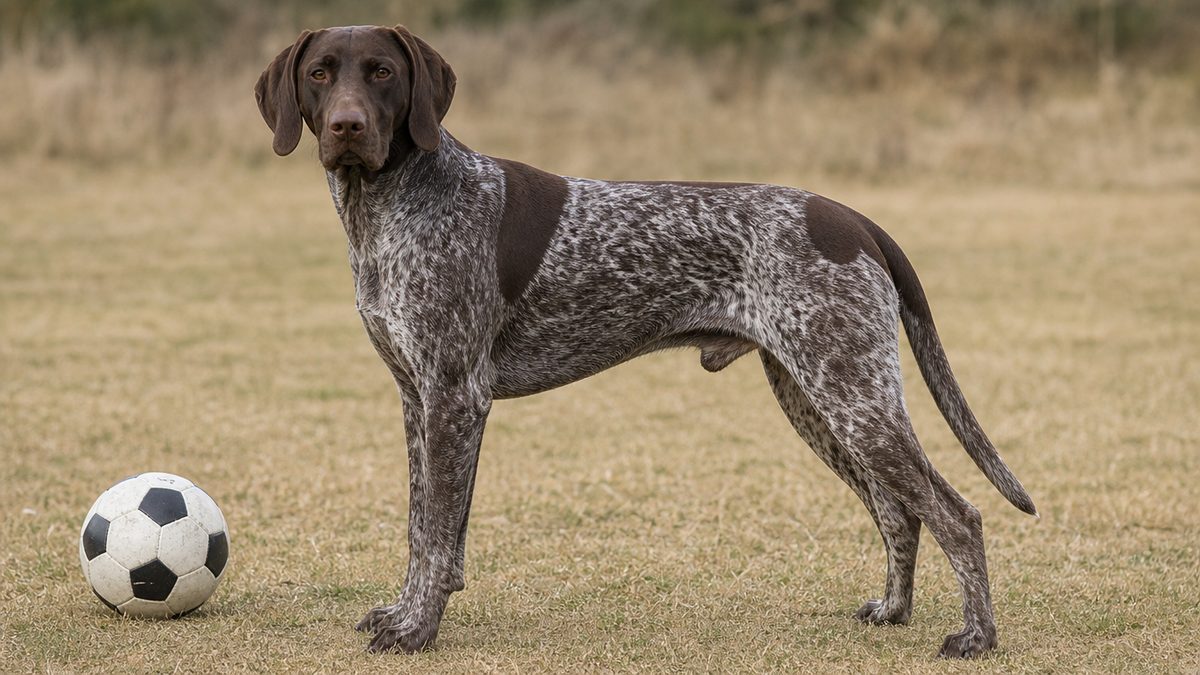
Quick answer
The German Shorthaired Pointer price in India runs Rs 25,000 to Rs 70,000 across the four Indian pages that publish a figure: about Rs 25,000 to Rs 30,000 unregistered, Rs 30,000 to Rs 40,000 KCI registered, Rs 40,000 to Rs 70,000 show quality. None of those bands divides cleanly at 84.38 or 74, so they are rupee-native round numbers rather than converted dollars, and none buys the German screening this breed is bred under.
This guide summarises breed-standard documents, kennel-club register data, peer-reviewed veterinary research, Indian breeding law and satellite climate data as general information for Indian pet owners. It is not a diagnosis and it is not treatment advice. Consult a registered veterinarian near you before acting on anything you read here, and treat collapse, laboured panting that does not settle, a swollen or tight abdomen with unproductive retching, sudden daytime clumsiness or unexplained bruising as an emergency and go straight to a clinic.
German Shorthaired Pointer at a glance
What the German Shorthaired Pointer actually is
The German Shorthaired Pointer is a versatile German hunting dog, registered in Germany as the Deutsch Kurzhaar and recognised by the Federation Cynologique Internationale as standard number 119 in Group 7, Section 1.1, Continental Pointing Dogs of Braque type, subject to a working trial.
The FCI accepted the breed on a definitive basis on 1 January 1954, names German as the official authentic language of its standard, and last published the valid standard on 25 October 2000, with the English translation dated 25 April 2001. The country of origin is Germany, and the words "With working trial" sit in the classification line rather than in a footnote. That single phrase is the whole argument of this page. It means the FCI treats a hunting performance test as part of the breed's definition, not as an optional extra for enthusiasts.
The standard's own history section dates the studbook, the Zuchtbuch Deutsch-Kurzhaar, to 1897, and credits Prince Albrecht zu Solms-Braunfeld with compiling the breed characteristics, the conformation judging rules and the first trial regulations. It then states the breeding aim in one sentence: the standard "stipulates the consitution of the German Shorthaired Pointing Dog, as a versatile hunting dog, which enables him to perform all requirements in connection with hunting activities, even when advanced in age."
In India the same dog is sold as a smart, energetic family pet. That is not wrong, and thousands of German Shorthaired Pointers live happily as companions worldwide. It is incomplete. A dog selected for a century to work all day in cold German fields, on a written performance standard, arrives in an Indian city carrying a set of needs that no Indian listing page prices.
The names you will see, and which one is the register
Four names describe one breed. Deutsch Kurzhaar is the German register name and the FCI's official heading. German Short-haired Pointing Dog is the FCI's English name. German Shorthaired Pointer is the American Kennel Club name and the one Indian sellers use. GSP is the working abbreviation. Bing India's own entity panel lists Deutscher Kurzhaariger Vorstehhund, Deutsch Kurzhaar, Kurzhaar, Kurzhaariger Deutscher Vorstehhund, German Shorthaired Pointing Dog and GSP as alternate names for the same dog.
That matters when you are buying. A pedigree issued against the FCI system will name the breed Deutsch Kurzhaar and carry a German-style Ahnentafel; an AKC-descended pedigree will not. The Kennel Club of India is the FCI's Full member for India, listed at Nr 28, AA Block, First Street, Anna Nagar, Chennai 600 040, so a KCI pedigree is issued against FCI nomenclature. Asking which register a puppy's parents sit in is a more useful question than asking whether it is "KCI registered", because both answers can be yes and mean different things.
Every page currently ranking in India for this breed prices it. None of them uses a German source. This one is built on the FCI standard, the VDH puppy register, the Deutsch-Kurzhaar-Verband's own breeding rules, the OFA statistics tables with their denominators, and NASA satellite climate data for eight Indian cities.
One last point on recognition, because it is the question Indian buyers ask most often and the one most often answered badly. India appears in the FCI's own members index among the national organisations of Asia, Africa and Oceania, and its entry names the Kennel Club of India as a Full member. So the question "is this breed recognised in India" has a clean answer for once: the FCI recognises Deutsch Kurzhaar definitively, and India's FCI member issues pedigrees against FCI nomenclature.
The breed standard, and where the registries disagree
FCI Standard 119 sets height at 62 to 66 cm for dogs and 58 to 63 cm for bitches, and treats a deviation of more than 2 cm from those ranges as a severe fault. The American Kennel Club prints a smaller dog, and Indian pages copy the American figure while using the German name.
The AKC gives 23 to 25 inches for males and 21 to 23 inches for females, which is 58.4 to 63.5 cm and 53.3 to 58.4 cm. Converted, the AKC male range starts about 3.6 cm below the FCI's and ends about 2.5 cm below it, and the AKC female range sits almost entirely under the FCI's. A female at the bottom of the AKC range, 53.3 cm, would be nearly 5 cm below the FCI minimum and disqualified on size at a European show. Neither registry is wrong. They are describing the same breed to different rules, and a buyer comparing an imported pedigree with an Indian seller's spec card is comparing two different documents.
| Source | Male height | Female height | Weight |
|---|---|---|---|
| FCI Standard 119, 25.04.2001 | 62 to 66 cm | 58 to 63 cm | Not stated in the standard |
| American Kennel Club | 23 to 25 in (58.4 to 63.5 cm) | 21 to 23 in (53.3 to 58.4 cm) | 55 to 70 lb male, 45 to 60 lb female |
| Tailsbuddy (India) | 21 to 25 in, both sexes | 21 to 25 in, both sexes | 20 to 32 kg, both sexes |
| BarkJunction (India) | 20 to 25 in, both sexes | 20 to 25 in, both sexes | 20 to 32 kg, both sexes |
Both Indian pages give one range for both sexes, which no registry does. The FCI and the AKC both separate dogs from bitches by several centimetres, because a 4 cm sex difference is real and visible. A spec card that flattens it is a sign the page was assembled rather than checked.
Coat colour, and the colour that is not on the Indian lists
The standard permits solid brown; brown with small white or flecked markings on chest and legs; dark brown roan; light brown roan; white with brown head markings, patches or specks; and black in the same nuances as brown. Yellow tan markings, a blaze, a fleck and speckled flews are all permissible. The AKC registers Liver, Liver and White, Liver Roan, White and Liver, Black and White, Black, and Black Roan. Indian pages usually list liver and its variants and stop there, so an Indian buyer shown a black roan puppy may be told it is not purebred when the standard has permitted black for decades.
Coat itself is short and dense, and the standard describes it as "rough and hard to the touch", somewhat thinner on the head and ears. That is a working jacket, not a smooth show coat, and it is why the dog is short-haired without being low-shedding. The AKC's own care note says the coat "still sheds, especially at certain times of the year", and that the hairs "can become embedded in fabrics and carpet and hard to get out";. One Indian page's data table prints "Shedding: Minimal" and "Grooming: Low maintenance" on the same screen.
One practical note on sourcing. The Deutsch-Kurzhaar-Verband posts its own copy of the standard alongside its breeding regulation, so a buyer can read both documents the German system actually runs on rather than a summary of them. Do that before you accept any seller's account of what the breed standard requires.
Germany will not let this dog breed until it has passed a hunting test
A Deutsch Kurzhaar in Germany cannot be bred until it has passed a field performance test, been graded at least "good" in conformation, been proven hard in actual hunting practice, been X-rayed clear of hip dysplasia and shoulder OCD, and had a blood sample banked for DNA. That is the single biggest fact about this breed, and no page ranking in India mentions it.
The Deutsch-Kurzhaar-Verband publishes the conditions in full. Breeding suitability, Zuchttauglichkeit, requires all of the following, and the association's own wording is a list of lettered sub-clauses rather than a set of recommendations.
- Pass a Solms, AZP, HZP or VGP test with complete water work, under the DK-Verband's or the JGHV's test regulations, plus the separate proof of tracking a live duck.
- Earn a conformation grade (Formwert) of at least "gut", meaning good, at a Deutsch-Kurzhaar club show or from a specialist breed judge.
- Prove hardness (Haerte) in real hunting practice under JGHV rules. The association writes that a male must have provided this proof and a female should have.
- Carry a hip result of A1, A2, B1 or B2 only. Grades C and worse are excluded from breeding.
- Since 1 October 2021, for the 2022 breeding year onward, carry a shoulder OCD examination reading "OCD frei".
- Send a blood sample to the association's DNA bank.
- Provide parentage proof by gene test once both parents' DNA is in the biobank.
The radiographs have their own rules. The dog must be at least 12 months old, the images must be taken under general anaesthesia because correct positioning is otherwise impossible, and bitches should not be X-rayed in season. Assessment fees are 37 euro for hips, 37 euro for shoulder OCD and 20 euro for elbows, which Germany treats as voluntary while Austria makes it compulsory. The DNA sample is 3 ml of EDTA blood sent to Generatio GmbH in Heidelberg, with a storage fee of 47.00 euro, and the sample becomes the property of the association.
What the tests actually are
Four test names appear on a German pedigree and they are not interchangeable. The Derby is a spring natural-ability test for young dogs. The Solms, named after Prince Albrecht zu Solms-Braunfels, is the autumn test of the same dog with more obedience and water work required. The AZP is a Solms for an older dog that missed its autumn test. The VGP, the Verbands-Gebrauchs-Pruefung, is a two-day utility test across field, water, forest and obedience. The JGHV's own report forms exist in English for the autumn breed test and the autumn utility test, which is how the results become comparable across clubs.
The Deutsch-Kurzhaar-Verband adds a competitive layer on top. The Kleemann Ausleseprüfung, run in even years, awards the KS or Kurzhaarsieger title on a pass or fail basis, and the association publishes the results of every Kleemann and every International Kurzhaar test it has ever held. North American Deutsch Kurzhaar Club Reading its own summary, the association claims the breed ranks in the top group at the VGP, the tracking test and above all the lost-game retrieve, relative to its puppy numbers. That is a performance claim resting on a published register, which is a different kind of evidence from a show ranking, and it is exactly the evidence an Indian buyer never sees.
The results are public, which is what separates this from a marketing claim. The association publishes the complete result set of every Dr Kleemann selection test and every International Kurzhaar test it has ever run, as downloadable documents. An Indian buyer offered a dog with German ancestry can therefore check the claim rather than take it.
How many German Shorthaired Pointers exist, from the German register
German breeders registered 1,198 Deutsch Kurzhaar puppies with the VDH in 2025, against 1,236 in 2024, 1,278 in 2023, 1,304 in 2022 and 1,842 in the pandemic year 2021. Those figures come from the Verband fuer das Deutsche Hundewesen's own annual table and were read from a live fetch of the page rather than from a search result.
Fifteen years of the series put the breed in context. The Deutsch Kurzhaar has sat close to 1,200 puppies a year for well over a decade, with 1,225 in 2011, 1,133 at its low in 2016, and the 1,842 spike in 2021 that almost every German breed shared. The Deutsch-Kurzhaar-Verband's own summary says registrations "fluctuate around the figure 1200" over the last ten years and puts the 2021 figure at 1800. The VDH table says 1,842. Neither is hidden and neither is a rounding of the other, so both are given here rather than averaged.
| Breed | 2025 | 2024 | 2023 | 2022 | 2021 |
|---|---|---|---|---|---|
| Deutscher Schaeferhund (German Shepherd) | 6,374 | 6,316 | 6,242 | 8,395 | 10,031 |
| Teckel (Dachshund) | 4,508 | 4,788 | 5,475 | 6,296 | 7,205 |
| Labrador Retriever | 2,401 | 2,367 | 2,326 | 2,630 | 3,219 |
| Deutsch Drahthaar (Wirehaired) | 2,215 | 2,587 | 2,618 | 3,119 | 3,629 |
| Golden Retriever | 2,007 | 1,952 | 1,941 | 2,166 | 2,412 |
| Deutsch Kurzhaar | 1,198 | 1,236 | 1,278 | 1,304 | 1,842 |
| Kleiner Muensterlaender | 1,102 | 1,059 | 1,226 | 1,227 | 1,448 |
| Deutscher Pinscher | 288 | 251 | 246 | 224 | 415 |
Two things follow. First, the Deutsch Kurzhaar is not a rare breed in its homeland: it registers more puppies than the Golden Retriever does in several European countries and sits sixth on this list. Second, its wirehaired sibling outnumbers it by roughly two to one every year, which is worth knowing because Indian sellers rarely distinguish them and both are legitimately called German Pointers.
The association also notes that puppy numbers in France and Italy run well above the German figure, so the German register is not the world total. In the United States the breed is the ninth most popular of 210 AKC breeds as of 2025, and has been AKC-recognised since March 1930. One Indian page states the breed "is currently sitting on #10 spot" on the AKC list. The AKC's own chart reads 9 of 210, so that page is one place out, which is small but checkable, and worth noting because it is the only figure on that page anyone can verify.
The Kennel Club of India publishes no breed-by-breed registration statistics, so nothing equivalent to the VDH table exists for India. Every Indian claim about how common this breed is here rests on marketplace listing counts, not on a register. Say so rather than guessing at a number.
German Shorthaired Pointer price in India
The German Shorthaired Pointer price in India runs from about Rs 25,000 to about Rs 70,000 across the four Indian pages that publish a figure, and the same sites disagree with each other and, in one case, with themselves inside a single article. BarkJunction, German shorthaired pointer… No Indian source publishes a verified transaction, so treat every number below as a published claim rather than a market rate.
| Source | Band published | What it says the band covers |
|---|---|---|
| Tailsbuddy | Rs 25,000 to Rs 30,000 | Basic, meaning not registered with any kennel club |
| Tailsbuddy | Rs 30,000 to Rs 40,000 | KCI registered |
| Tailsbuddy | Rs 40,000 to Rs 70,000 | Show quality |
| Poodles Petcare | Rs 25,000 to Rs 50,000 | Buying price, no tiers given |
| BarkJunction, opening section | Rs 30,000 to Rs 60,000 | Typical puppy cost |
| BarkJunction, price section | Rs 25,000 to Rs 50,000 or more | Basic to top quality from a reputable breeder |
| PetzLover, as quoted by Bing India | Rs 80 to Rs 69,000 | Range across 51 listings; page unreachable on 31 Aug 2026 |
| Mr n Mrs Pet | No price shown | Three listings, every price behind a sign-up wall |
BarkJunction contradicts itself. Its introduction says demand "has moved the typical puppy cost from around Rs 30,000 to Rs 60,000", and its own pricing section four headings later says a basic puppy "can cost around INR 25,000" rising to "INR 50,000 or more";. Those are different claims about the same market on the same page, and neither carries a source.
Tailsbuddy is the only Indian page that separates the tiers, and its structure is the one worth using as a mental model: an unregistered puppy, a KCI registered puppy, and a show quality puppy are three different products. Its own definition of the middle tier is honest about what registration buys, saying it lets you enter KCI shows and gives you a certificate. It does not claim registration guarantees health, and you should not read it that way either.
One factor the Indian pages all name is champion bloodline, meaning a dog with a titled ancestor, and Tailsbuddy says plainly that such a dog's price "can also go fairly high". Ask what the title actually was. In this breed a German title is earned at a working test, not at a show: the Kleemann Ausleseprüfung awards the KS or Kurzhaarsieger title on a pass or fail basis and the Deutsch-Kurzhaar-Verband publishes the results of every one it has ever run. A pedigree full of show placings and no test results describes a different, less athletic animal than the register implies.
What the price does not buy you
None of the Indian bands includes any of the seven things Germany requires before the parents could legally breed. A Rs 70,000 "show quality" Indian puppy and a German puppy from parents holding a VGP, a Formwert of at least good, an HD A or B grade, an OCD-free shoulder and a banked DNA sample are not the same purchase, and the gap is not visible in the price. Ask the seller for the sire's and dam's hip grades in writing. If the answer is that the dogs "look fine", you have your answer.
Adoption is the other route and it is real. Tailsbuddy states plainly that purebred German Shorthaired Pointers occasionally turn up in Indian adoption centres and offers to connect enquirers, and BarkJunction says the same. BarkJunction, German shorthaired pointer… A high-energy gundog rehomed at eighteen months because a family could not exercise it is one of the commoner surrenders in Indian metros, which is unfortunate for the previous owner and a genuine opportunity for the next one.
Testing the Indian price figures: the division tests and the quotients
The Indian German Shorthaired Pointer prices are rupee-native round numbers, not a converted American price list, and the arithmetic is what shows it. Running every published figure through the three exchange rates this site has caught contaminated pages using produces quotients no seller would ever print.
Indian breed pages routinely publish "prices" that are a US dollar figure run through one exchange rate, and this site has caught it three times at 84.38 alone. So the first thing to do with any Indian rupee band is to divide it. Report the quotient, not just whether it divided.
| Rupee figure | Divided by 84.38 | Divided by 74 | Divided by 66.67 | Plausible as a dollar price? |
|---|---|---|---|---|
| Rs 25,000 | 296.28 | 337.84 | 375.02 | No clean hit at 84.38 or 74 |
| Rs 30,000 | 355.54 | 405.41 | 450.00 | No clean hit at 84.38 or 74 |
| Rs 40,000 | 474.05 | 540.54 | 600.00 | No clean hit at 84.38 or 74 |
| Rs 50,000 | 592.56 | 675.68 | 750.00 | No clean hit at 84.38 or 74 |
| Rs 60,000 | 711.07 | 810.81 | 900.00 | No clean hit at 84.38 or 74 |
| Rs 70,000 | 829.58 | 945.95 | 1,050.00 | No clean hit at 84.38 or 74 |
Not one figure divides cleanly at 84.38, and not one divides cleanly at 74. The 66.67 column looks impressive and proves nothing, and it is important to say why. 66.67 is approximately 200 divided by 3, so dividing by it is the same as multiplying by 3 and dividing by 200. Every rupee figure ending in four zeros therefore lands on a round number by construction: Rs 25,000 becomes 375, Rs 30,000 becomes 450, Rs 60,000 becomes 900. The rate did not discover anything about the data. The data's own roundness did.
This is the same structural weakness this site has already documented for the flat-80 test, where 1,000 divided by 80 is 12.5 and so any figure ending in three zeros passes automatically. A division test is evidence only when the quotient is also a price a human being would quote, and when figures that are not round survive it too. Here every published Indian figure is a multiple of Rs 5,000, so no rate can be distinguished from arithmetic noise.
The honest verdict is that these are rupee-native, arbitrary, round numbers. Nobody converted an American price list; somebody typed round rupee figures. That is a different contamination mechanism from the converted lists this site has caught elsewhere, and it needs saying differently. The numbers are not laundered dollars. They are simply unsourced.
The one figure that fails every test
Rs 80 does not divide into anything sensible: 80 divided by 84.38 is 0.95, by 74 is 1.08, by 66.67 is 1.20. No currency conversion produces a dollar or a euro price for a dog at any of those values, and no seller prices a puppy at Rs 80. The figure comes from PetzLover's listing page, which reports its inventory as ranging "from Rs 80 to Rs 69,000" across 51 or more listings. On 31 August 2026 that URL returned HTTP 403 with a CAPTCHA human-verification page, so the claim could not be confirmed on the page itself. The most likely explanation is a filter floor rather than a dog. It is quoted here only because of what happened to it next.
How Rs 80 became the answer to "how much does a GSP cost in India"
Bing India's AI-generated summary answers the query "how much does a german shorthaired pointer cost in india" with the range Rs 80 to Rs 69,000, lifted from a marketplace's own inventory-range line. That is an answer engine restating an implausible figure as a price, and it is the clearest example this site has yet recorded of the mechanism.
The chain is short and every link is checkable. A marketplace publishes a filter range across whatever listings it holds, with Rs 80 at the bottom. A search engine reads that line, treats it as a price band for the breed, and prints it above the organic results as the direct answer, with "View all" underneath and a note that the summary "was generated by AI from multiple online sources";. A buyer who asked a reasonable question in plain English now has a number that is wrong by roughly three orders of magnitude at the bottom end.
The commercial query behaves differently again. Searching the exact phrase german shorthaired pointer price in india on Bing India returns ten on-topic organic results and no People Also Ask module at all, only a People Also Search For strip carrying related queries rather than questions. The four verbatim questions recorded in this page's SERP block came from the plain entity query instead, and nothing has been added to them.
The same search returned a second, better figure further down: Tailsbuddy's "AVERAGE PRICE IN INDIA (BASIC): Rs 25,000 to Rs 30,000";. Tailsbuddy, German Shorthaired Pointer Dog… The engine had the sane number available and led with the other one. Nothing about the presentation tells the reader which is which.
The second laundering route: a marketplace that shows you a different breed
Mr n Mrs Pet ranks for the term and returns exactly three German Shorthaired Pointer listings, with every price hidden behind a "View Price" link that leads to a sign-up page. Below those, under the heading "Similar breeds at other locations", the page shows three cards. All three are French Bulldogs, in Lucknow, Ahmedabad and Mansa. A reader skimming a German Shorthaired Pointer page is being shown a short-faced toy companion at the bottom of it.
The same page carries a genuinely useful number by accident. Its "Most Popular Breeds" sidebar prints live listing counts: Shih Tzu 650, Siberian Husky 549, Golden Retriever 487, Labrador Retriever 454, German Shepherd 412, Beagle 274, Poodle 263, Rottweiler 162, Pomeranian 136 and Cane Corso 134. Against a Labrador control of 454, the German Shorthaired Pointer's three listings are not a rounding error. On India's largest puppy marketplace this breed is roughly 150 times scarcer than a Labrador. That is a real measure of Indian availability, taken from the seller's own counter, and it is the number the price pages should have led with.
Divide it by 84.38, by 74 and by 66.67, and look at the quotient rather than at whether it divided. If the quotient is a number a shop would print, like 500 or 800 or 1,500, you are probably looking at a converted foreign list. If the quotients are absurd, the figure is rupee-native and unsourced. If the figure itself is absurd as rupees, as Rs 80 is, somebody has stripped a currency symbol or published a filter floor.
Suitability for the Indian climate: the homeland numbers
Hannover, in the German lowlands where this breed was made, has never had a month whose 30-year mean air temperature reached 25 degrees Celsius, while Chennai has ten such months a year. That is the heat tolerance question answered with numbers rather than adjectives.
The figures below come from NASA's Prediction Of Worldwide Energy Resources climatology, 1991 to 2020, queried by explicit latitude and longitude so that no place-name slug can silently hand back a different city. Wet-bulb temperature is computed from the same air temperature and relative humidity fields using Stull's approximation. Wet-bulb matters more than air temperature for a dog, because a panting dog cools by evaporation and evaporation stalls as the air approaches saturation.
| Place | Annual mean C | Hottest month | Peak wet-bulb month | Months with mean over 25 C |
|---|---|---|---|---|
| Hannover, Germany (52.376 N, 9.732 E) | 9.29 | Jul, 18.52 | Jul, 15.43 WB | 0 of 12 |
| Berlin, Germany (52.520 N, 13.405 E) | 9.47 | Jul, 20.25 | Jul, 15.84 WB | 0 of 12 |
| Chennai (13.083 N, 80.271 E) | 27.91 | May, 31.57 | May, 26.03 WB | 10 of 12 |
| Mumbai (19.076 N, 72.878 E) | 26.65 | May, 31.03 | Jun, 25.68 WB | 9 of 12 |
| Kolkata (22.573 N, 88.364 E) | 25.83 | May, 31.55 | Jun, 26.99 WB | 8 of 12 |
| Delhi (28.614 N, 77.209 E) | 25.65 | Jun, 35.95 | Jul, 26.43 WB | 7 of 12 |
| Pune (18.520 N, 73.857 E) | 23.74 | Apr, 28.74 | Jun, 22.90 WB | 4 of 12 |
| Bengaluru (12.972 N, 77.595 E) | 23.63 | Apr, 28.41 | May, 21.74 WB | 3 of 12 |
| Dehradun (30.317 N, 78.032 E) | 17.94 | Jun, 26.21 | Jul, 20.85 WB | 2 of 12 |
| Shillong (25.579 N, 91.893 E) | 17.87 | Jul, 22.37 | Jul, 21.29 WB | 0 of 12 |
Compare the wet-bulb column and the gap is stark. Hannover's worst month averages 15.43 C wet-bulb. Kolkata's worst month averages 26.99 C, which is 11.56 points higher. Chennai's is 26.03, Delhi's 26.43, Mumbai's 25.68. Even Bengaluru, the mildest big metro on the list, runs 21.74 against Hannover's 15.43, a gap of 6.31 points in the mildest available comparison.
Chennai deserves its own sentence. Its coolest month, January, averages 23.99 C. Hannover's hottest month, July, averages 18.52 C. The coldest month of the year in Chennai is 5.47 C warmer than the warmest month of the year in the breed's homeland. There is no season in Chennai that resembles a German summer.
What the ranking Indian pages say about heat, and how the numbers score them
Two Indian pages that both rank for this query flatly contradict each other. Tailsbuddy writes that the breed's "tolerance to high temperatures is great (means they can comfortably thrive in a hot country like India)" and separately that "their tolerance to both very high and low temperatures is pretty decent and thus they can comfortably thrive almost anywhere in the whole world";. Poodles Petcare prints a specification line reading "Weather 15 to 25 C" and an FAQ saying the dog is "most comfortable around 15 to 25 degrees Celsius";.
Test the second claim against the satellite record and it is devastating to the first. Chennai's monthly means never fall below 23.99 C and exceed 25 C for ten months of the year. Mumbai exceeds it for nine months, Kolkata for eight, Delhi for seven. On the comfort range that one of these very pages publishes, the breed is above its stated comfortable ceiling for most of the year in every large Indian coastal city. The page recommending the breed contains the evidence against its own recommendation.
That does not make the German Shorthaired Pointer unkeepable in India. It makes it a dog whose exercise has to be moved, not reduced, and whose owner has to plan around a season rather than a day.
Heat management city by city, and what the research says about the risk
Manage this breed's heat risk by moving its work to the coolest hours and watching bodyweight, because the largest UK study of heat-related illness found exertion, not parked cars, to be the dominant trigger.
Hall, Carter and O'Neill, writing in *Animals* in 2020, studied 905,543 UK dogs under primary veterinary care in 2016 and recorded 1,259 heat-related illness events from 1,222 dogs. Of those events, 380 had no trigger recorded, leaving 879 with a recorded trigger, of which 652 were exertional, which is 74.2 percent of the events with a recorded trigger. Environmental heat accounted for 113 and vehicular confinement for 46. The percentages are computed on 879, not on 1,259, and quoting them against the larger number would overstate the count by more than 40 percent.
The same authors, writing in *Scientific Reports* the same year on the same 2016 cohort but with a different case definition, counted 395 confirmed events and reported that dogs at or above their breed and sex mean bodyweight carried an odds ratio of 1.42, with a confidence interval of 1.12 to 1.80, and that dogs over 50 kg carried an odds ratio of 3.42, interval 1.54 to 7.57. These are two different papers with two different case definitions, and neither corrects the other. A German Shorthaired Pointer male sits at 55 to 70 pounds, roughly 25 to 32 kg, so it is nowhere near the over-50 kg band. The transferable finding is the bodyweight one: a GSP carrying extra weight is the version of this dog at measurable risk, and this is a breed that gains weight easily when its exercise is cut for the summer.
A practical schedule by city
- Chennai and Kolkata. Work the dog before sunrise and after dark, all year. Chennai never has a cool month and Kolkata's wet-bulb peaks higher than any other city sampled here, at 26.99 C in June.
- Mumbai. Treat March to October as the restricted season, nine months above a 25 C monthly mean, and use the December to February window for anything demanding.
- Delhi. Split the year. April to June is dry heat at up to 35.95 C mean in June, which the dog handles better than the July and August wet-bulb peak of 26.43 C and 26.13 C. Winter, at a January mean of 13.83 C, is the closest an Indian plain gets to a German autumn.
- Pune and Bengaluru. The two mainland metros where a fit adult can work in the morning most of the year. Bengaluru's peak wet-bulb of 21.74 C is the mildest on this list.
- Dehradun and Shillong. The genuinely comfortable options. Shillong has no month averaging above 25 C at all, and its wet-bulb peak of 21.29 C is the closest India comes to the breed's homeland, though still 5.86 points above Hannover's.
Signs of trouble come in a fixed order and you should know them before you need them. Heavy panting that does not settle within a few minutes of stopping, bright red gums, unsteadiness, and vomiting are an emergency, not a rest break. Cool the dog with tap-temperature water over the whole body and move it to a vet immediately rather than waiting to see if it improves.
Temperament and household fit
The German Shorthaired Pointer is an affectionate, biddable house dog with a working engine that does not switch off, and the standard describes its temperament as "firm, balanced, reliable, restrained", explicitly "neither nervous nor shy or aggressive";. Aggression and extreme shyness are disqualifying faults.
The AKC describes the breed as friendly, smart and willing to please, and warns in the same breath that it "can be extremely challenging from 6 months to 3 years old" and that without a job it becomes destructive. Both halves are true simultaneously. This is a dog that will lean against your leg all evening and dismantle a sofa on a day it did not get out.
Who this breed suits in India
- Households with a person who genuinely runs, cycles or swims, and will keep doing it in July.
- Families with older children who understand a 30 kg dog at full speed is a physical hazard rather than a toy.
- Owners in Pune, Bengaluru, Dehradun or the hills, where the exercise window is not restricted to two hours a day for most of the year.
- Anyone prepared to train a retrieve, a recall and a settle, and to keep training them for three years.
Who it does not suit is easier to state. A GSP in a small flat with two twenty-minute lead walks will be miserable, and it will make its household miserable in return. Tailsbuddy says the same in its own words, listing "not highly recommended for apartment life" and "require a lot of exercise on a daily basis" among its reasons the breed may be ill-suited. That is the most useful paragraph on any ranking Indian page and it sits below three price tables.
Prey drive is the Indian-specific problem
The prey drive that makes this dog useful in a German field is a liability on an Indian street. Tailsbuddy notes the breed is "not very warm and friendly with some small animals like cats, squirrels etc" and will chase them. Indian cities carry free-roaming cats, poultry, goats and community dogs at densities no German suburb has, and a pointer that has locked on to a cat across a road is not listening to you.
The practical answer is unglamorous. Keep the dog on a lead in every unfenced space until its recall is proof-tested under distraction, socialise it heavily to street animals from the day it comes home, and accept that some individuals never become reliable off lead in a city. This is not a training failure. It is the trait the breed was selected for, working correctly in the wrong place.
With other dogs the breed is generally sociable, and the AKC scores it well on getting along with other dogs. With strangers it is open rather than guarding, so it is a poor choice if you want a watchdog. It will announce a visitor and then try to bring them a slipper.
Training approach, and what this breed resists
To train a German Shorthaired Pointer, use short daily sessions built on a real reward and start the recall on the first day, because this is a highly trainable dog that learns bad habits exactly as fast as good ones.
The AKC calls early training essential, names socialisation and puppy classes as vital, and says the breed "learns quickly with consistent training sessions";. Indian pages agree, and BarkJunction reports basic obedience training in India costing INR 5,000 to 15,000, with advanced work to prepare a dog for hunting competition running as high as INR 50,000. Those are the only published Indian training-cost figures found for this breed and they carry no source, so treat them as an order of magnitude rather than a quote.
The four things to teach first, in order
- Recall, before anything else, and pay it every single time for the first year. This is the command that keeps the dog alive on an Indian road.
- Settle on a mat, because a dog that cannot switch off indoors will not cope with the four months a year when its exercise is halved by heat.
- Loose-lead walking, taught while the puppy is under 15 kg rather than after it is 30 kg.
- A retrieve to hand, which is the breed's own instinct and the cheapest way to tire it in a small space.
What the breed resists is repetition without purpose. A GSP asked to sit fifteen times in a row will start offering other behaviours out of boredom, and an owner who reads that as disobedience and escalates will get a dog that avoids training. Keep sessions to five or ten minutes, end while the dog still wants more, and change the picture often.
Use the nose, especially in the hot months
Scent work is the single most useful Indian adaptation for this breed. A dog that has spent twenty minutes finding six hidden pieces of food in a flat is tired in a way that a slow lead walk cannot achieve, and it can be done indoors at two in the afternoon in May. The German testing system rewards exactly this: the VJP includes tracking a hare, and the VGP tests blood tracking, independent forest searching and the lost-game retrieve across two days. You are not inventing an activity. You are running a domestic version of the breed's own examination.
One caution on method. This breed's German selection has always included a formal assessment of hardness in real hunting, which a male must have and a female should have. That word describes resilience in work, not tolerance of harsh handling, and it is routinely mistranslated on English-language forums into a licence for heavy correction. A GSP handled harshly shuts down, and everything the standard calls balanced and reliable disappears with it.
The real daily exercise requirement
Plan on 60 to 90 minutes of hard daily exercise for an adult German Shorthaired Pointer, split across two sessions, and expect destruction on the days you skip it.
The AKC's guidance is that the routine "should ideally include ample physical activity twice a day", giving brisk half-hour walks morning and evening, or running and playing in a securely fenced area, as the baseline. Poodles Petcare puts the exercise requirement at 60 to 90 minutes a day and rates the energy level "Very High". Those two agree, and they are the floor rather than the target. A brisk lead walk is not the same stimulus as a free gallop.
What counts and what does not
| Activity | Where it works in India | Notes |
|---|---|---|
| Free running on a secure ground | Fenced farm, cantonment ground, gated layout park | Highest value per minute. Hardest to find in a metro |
| Swimming | Pool, reservoir, calm river, sea in the cool season | The one activity that works at high air temperature. The breed swims willingly |
| Cycling alongside | Early morning service roads | Good, but only on a fit adult over 18 months and never in heat |
| Retrieve games | Terrace, corridor, small garden | Cheap, breed-appropriate, works indoors |
| Scent and puzzle work | Anywhere, any hour | The monsoon and summer substitute. Tires the dog mentally |
| Lead walking | Everywhere | Necessary, and on its own nowhere near enough |
Swimming deserves emphasis for India specifically. The German breeding rules require a passed test with complete water work before a dog may breed at all, plus separate proof of tracking a live duck, so willingness in water is selected for rather than incidental. For an Indian owner that is a gift: swimming is the only vigorous activity that does not add heat load, and a GSP will usually take to it without persuasion.
The under-exercised GSP, and what it looks like
An under-exercised dog of this breed does not sulk. It chews skirting boards, digs through planters, patrols and barks, escapes, and mouths people. Poodles Petcare lists "chewing, pacing, and escaping when energy is unspent" among its warning signs, and the AKC says plainly that GSPs "need a purpose, and without one they can be destructive";. American Kennel Club If your realistic ceiling is thirty minutes a day, choose a different breed. That is not a moral judgement, it is arithmetic.
The heat complicates this honestly rather than fatally. In Chennai, ten months of the year average above 25 C, so the workable window is roughly 5 am to 7 am and after 8 pm. Build the routine around those hours from the first week rather than discovering them in April.
Grooming a short coat in Indian humidity
Groom a German Shorthaired Pointer with a rubber curry brush or grooming mitt once or twice a week, and dry its ears properly after every swim, because the short coat is easy and the ears are not. American Kennel Club
The coat is genuinely low-effort. The AKC describes it as "easy to groom most of the year, requiring only a good once-over with a brush or grooming glove every few days", with more frequent brushing during heavier shedding periods. Poodles Petcare rates shedding "Moderate" and puts monthly grooming cost at Rs 700 to Rs 1,200. BarkJunction quotes Rs 500 to Rs 2,000 per professional session in India. For a short-haired dog, the honest Indian answer is that you can do the whole job at home with a Rs 300 rubber mitt.
Do not believe the "minimal shedding" line. One ranking Indian page prints "Shedding: Minimal" in its spec table, and the AKC's own care note says the coat sheds and that the hairs "can become embedded in fabrics and carpet and hard to get out";. American Kennel Club Short hairs are harder to remove from upholstery than long ones, not easier. Nor is this a hypoallergenic breed: neither the FCI standard nor the AKC makes any such claim, and Poodles Petcare's own spec line reads "HYPOALLERGENIC: No";.
The ears are the Indian problem, not the coat
The standard describes ears that are "moderately long, set on high and broad, flat and without twisting hanging down close to the head";. A drop ear held against the skull traps moisture, and this is a breed that swims. Overseas care guidance written for a temperate climate often says to towel the dog and let it air dry, which is fine in Lower Saxony and poor advice in a Mumbai August.
The practical routine is short. Dry inside the ear flap with cotton wool after every swim and every bath, check weekly for a smell or a head shake, and treat any brown discharge as a reason to see a vet rather than to buy a drop off a shelf. Poodles Petcare's own guidance says to "keep them dry and clean after swims or wet-weather walks", which is correct and easy to actually do.
Ticks, and why grooming is also a health check
Every brushing session in India is a tick check. In a study of 230 free-ranging dogs in four areas of Chennai, 229 of 230, or 99.6 percent, were infested with ticks, at a mean intensity of 5.6 ticks per dog. Those were stray dogs rather than pets, so the figure is an upper bound, but a short-coated field dog exercising in grass in the same city is exposed to the same tick population. Run your hands over the ears, the neck, between the toes and under the tail every time, and use a veterinary-prescribed preventive year round rather than seasonally.
Health risks and screening, with the denominators
The German Shorthaired Pointer is one of the structurally soundest large breeds in the OFA's records: 3.7 percent dysplastic across 23,618 hip evaluations, against 14.2 percent across 1,712,643 evaluations for all breeds combined. That is not a marketing claim, it is a published table with a sample size, and it is the strongest single argument for the breed.
Every figure below was read from the Orthopedic Foundation for Animals statistics tables, matched on the printed breed label GERMAN SHORTHAIRED POINTER rather than on a guessed code. The code itself, GSP, was read out of OFA's raw markup, where the attribute reads value="GSP" data-name="GERMAN SHORTHAIRED POINTER". A control breed, the Labrador Retriever, returned fourteen populated tables from the same dump in the same session, so the instrument was working.
| Screen | GSP evaluations | GSP result | All breeds | All-breeds result |
|---|---|---|---|---|
| Hips | 23,618 | 95.9% normal, 3.7% dysplastic | 1,712,643 | 84.3% normal, 14.2% dysplastic |
| Elbows | 7,786 | 98.5% normal, 1.4% abnormal | 650,254 | 87.8% normal, 12.0% abnormal |
| Eyes | 5,861 | 96.4% normal, 3.6% abnormal | 887,398 | 93.4% normal, 6.5% abnormal |
| Congenital cardiac | 2,645 | 99.5% normal, 0.1% abnormal | 209,851 | 98.9% normal, 0.5% abnormal |
| Advanced cardiac | 1,227 | 93.6% normal, 2.2% abnormal | 93,487 | 91.2% normal, 5.4% abnormal |
| Thyroid | 939 | 89.7% normal, 8.0% equivocal | 121,451 | 84.8% normal, 10.0% equivocal |
| Patella | 149 | 100.0% normal, 0.0% abnormal | 225,794 | 96.5% normal, 3.5% abnormal |
| Dentition | 66 | 97.0% normal, 3.0% abnormal | 27,779 | 92.9% normal, 7.1% abnormal |
The breed beats the all-breeds average on every one of those screens. Its hip dysplasia rate is roughly a quarter of the all-breeds figure and its elbow abnormality rate roughly an eighth. The hip components reconcile: 28.9 percent excellent plus 60.7 percent good plus 6.3 percent fair equals the 95.9 percent normal, and 2.5 mild plus 1.0 moderate plus 0.2 severe equals the 3.7 percent dysplastic.
OFA's own all-breeds row does not add up, and you should know that before quoting it
Check the arithmetic on the comparison column and it fails. The ALL BREEDS hip row reads 84.3 percent normal, but its component columns read 14.6 percent excellent, 0.0 percent good and 0.0 percent fair. Those three cannot sum to 84.3, and on every individual breed row in the same table they sum exactly. The dysplastic side is fine: 8.8 mild plus 4.6 moderate plus 0.8 severe gives 14.2. So the summary row's normal-side components are broken while the breed rows are not.
This matters because it is the same shape of defect this project has documented repeatedly in OFA's eye registry, where a summary line and its own detail rows disagree by twenty-five points. Publish both numbers and the arithmetic, quote neither as settled, and never build an argument on a summary line you have not added up. The 84.3 percent all-breeds normal figure is used above as a comparator because it is the number OFA prints, with that caveat attached.
Two limits on the eye figure specifically. OFA's published breed table gives only normal, breeder option and abnormal, so the 96.4 percent of 5,861 quoted above is a summary line, and the per-diagnosis detail rows that would let a reader see which conditions those 3.6 percent were could not be reached from this environment on 31 August 2026. This page therefore quotes the summary with its denominator and makes no claim about the breakdown.
Life span is the one figure nobody can source properly. The AKC gives 10 to 12 years, two Indian pages give 12 to 14, and a third gives 10 to 14, none of them citing anything. Poodles Petcare, German Shorthaired Pointer… The largest UK longevity study, covering 584,734 dogs of which 284,734 had died, reports a median survival of 12.5 years across all dogs, 12.7 years for pure breeds across 473,681 individuals, and 11.9 years for large purebred dogs across 123,072 individuals with 61,976 deaths. It also carries a row for this breed. Supplementary Table S3 gives a median survival of 13.4 years, 95 per cent CI 13.3 to 13.6, from 947 recorded deaths, at a hazard ratio of 0.67 (0.63 to 0.72) against the crossbred group. Read one caveat with it: Supplementary Table S5 records that the analysed row labelled German Shorthaired Pointer also contains the Kennel Club's Pointer, so the 13.4 years covers two registry breeds rather than this one alone. Even merged, it is a full year above the study's purebred median and well above every band the registries and the Indian pages print.
The two diseases that are genuinely this breed's own
The German Shorthaired Pointer carries two autosomal recessive diseases that are close to breed-specific and both have validated DNA tests: exfoliative cutaneous lupus erythematosus, caused by a UNC93B1 variant, and cone degeneration, caused by a CNGB3 variant. University of California Davis Veterinary… Neither appears on any Indian page ranking for this breed.
Exfoliative cutaneous lupus erythematosus, the hereditary lupoid dermatosis
Leeb and colleagues, publishing in *Genes* in 2020, mapped this disease to a single missense variant, UNC93B1 c.1438C>A, p.Pro480Thr, on canine chromosome 18. Their study included 877 dogs: 552 German Shorthaired Pointers made up of 26 confirmed cases and 526 controls, 52 German Longhaired Pointers, 210 German Wirehaired Pointers, 7 Braques du Bourbonnais, and 56 Vizslas of which one was a case. The homozygous mutant genotype was found in 23 affected German Shorthaired Pointers and one affected Vizsla, and in none of 845 controls.
The association is about as strong as canine genetics produces. Of 544 German Shorthaired Pointers genotyped for the variant, none of the 520 controls was homozygous for the mutant allele, and 23 of 24 genotyped cases were, with a Fisher exact p value of 1.2 times 10 to the power of minus 39. The authors attribute the single discordant dog to a probable phenotyping error, noting it had an atypically late onset and was never confirmed by a board-certified specialist. Two of the 26 cases in the wider study set were not among the 24 genotyped, which is why the abstract's count of 23 and the methods' count of 26 are both correct and describe different things.
Carriers were also found in German Longhaired Pointers and Vizslas, breeds that share ancestry with the German Shorthaired Pointer, which is consistent with earlier reports that related breeds can be affected. Clinically the disease is a generalised scaling and crusting skin disease of young dogs, and it is not curable.
How much testing is actually happening
The OFA's lupoid dermatosis DNA table holds only two breed rows, and the German Shorthaired Pointer is one of them. It records 341 evaluations for the breed, 97.7 percent normal, 2.3 percent carrier and 0.0 percent affected, against an all-breeds total of just 346 evaluations. So 341 of the 346 lupoid dermatosis results OFA holds for every breed on earth are German Shorthaired Pointers: 98.6 percent of the entire register is this one breed. A carrier rate of 2.3 percent on 341 dogs is about eight carriers.
That number is small, and it is the finding. A validated test has existed since 2020, the disease is monogenic and recessive, and after six years the world's largest open canine health register holds fewer than 350 results for it. It is also absent from the American Kennel Club's list of health tests the national breed club recommends, which names hip, elbow, cardiac, ophthalmologist and the cone degeneration DNA test, and stops there.
Cone degeneration, or day blindness
Cone degeneration is the second one, and it is on the recommended list. Two CNGB3 variants cause it, and the one found in German Shorthaired Pointers is CD2, a single-nucleotide change in exon 6, inherited autosomal recessively. Affected puppies lose day vision and become photophobic between 8 and 12 weeks, while night vision stays normal, and UC Davis notes that an ordinary ophthalmic examination is not informative because it looks normal. Testing costs 58 US dollars as a single test, or 27 dollars added to another test on the same animal, and results can be filed with the OFA.
OFA's cone degeneration table records 2,539 evaluations for the German Shorthaired Pointer, 98.7 percent normal, 1.2 percent carrier and 0.1 percent affected, against an all-breeds total of 2,960. The breed accounts for 85.8 percent of every cone degeneration result in the register. A 1.2 percent carrier rate on 2,539 dogs is roughly 30 carriers, and 0.1 percent affected is roughly three dogs.
Ask for the sire's and dam's hip grades with the assessing body named. Ask whether either parent has a CNGB3 cone degeneration result. Ask whether either parent has a UNC93B1 result. A breeder who can answer the first two is above average anywhere in the world. A breeder who can answer all three is doing something almost nobody does.
The Indian health load nobody imports with the breed
In India this breed's biggest health exposures are ticks and the diseases they carry, not the inherited conditions the overseas breed guides list. A study of 230 free-roaming dogs across four areas of Chennai found 229 of them, 99.6 percent, infested with ticks and 156 of them, 67.8 percent, carrying at least one vector-borne pathogen.
The Chennai sampling ran from October to December 2018 in Pulianthope and Vepery in the north and Velachery and Adyar in the south. The team collected 1,294 ticks, of which 1,230 were adults, 62 nymphs and 2 larvae, and identified 98.3 percent of infestations as *Rhipicephalus sanguineus* sensu lato, the brown dog tick. Mean intensity was 5.6 ticks per dog. The pathogen results are the part that matters clinically.
| Pathogen | Prevalence in dogs | What it causes |
|---|---|---|
| Hepatozoon canis | 37.8% | Canine hepatozoonosis, often subclinical, can cause anaemia and lethargy |
| Anaplasma platys | 22.6% | Cyclic thrombocytopenia, bleeding tendency |
| Ehrlichia canis | 16.1% | Canine monocytic ehrlichiosis, fever, bleeding, marrow suppression |
| Babesia vogeli | 10% | Babesiosis, haemolytic anaemia |
| Anaplasma phagocytophilum | 0.4% | Granulocytic anaplasmosis, zoonotic |
| Babesia gibsoni | 0.4% | Babesiosis, often more severe than B. vogeli |
| At least one pathogen | 67.8% (156 of 230) | Co-infection with H. canis and A. platys was the commonest pair, at 8.3% |
Read the sample honestly. These were free-ranging dogs enrolled through a catch-neuter-vaccinate-release programme, none of them showing clinical signs, so the figures are an upper bound for a well-kept pet on a preventive. But the tick population is the same tick population, and the authors point out that the hot, humid conditions of Tamil Nadu, which they characterise as an average 26 to 29 C, are ideal for tick survival. A field-bred pointer worked through grass in Chennai meets that population more often than a lapdog does.
A second Indian series makes a sharper point in a different state, and it is the one to remember when a vet tells you the smear was clear. Working on 120 suspected dogs in and around Hisar, Haryana, Bhagwan and colleagues found 15 dogs, 12.5 percent, positive by Giemsa-stained blood smear, and 77 dogs, 64.16 percent, positive by PCR. Of the 77 PCR-positive dogs, 56 carried a single haemoparasite and 21 carried two or more. *Hepatozoon canis* led at 35 percent, followed by *Ehrlichia canis* at 25.8 percent, *Babesia vogeli* at 20 percent and *Babesia gibsoni* at 2.5 percent, with H. canis plus E. canis the commonest co-infection at 7.5 percent. A microscope missed roughly four infected dogs in five.
What to actually do about it
- Use a veterinary-prescribed tick preventive year round, not seasonally. The brown dog tick completes its cycle indoors in Indian conditions.
- Check the dog by hand after every field session, concentrating on ear margins, the neck, between the toes and under the tail.
- Treat unexplained fever, lethargy, pale gums, nosebleed or bruising as a reason for a blood smear and a platelet count, not as a wait-and-see.
- Ask your vet to test rather than treat blind. The four common pathogens need different drugs and different durations.
- Keep the environment down as well as the dog. Kennel cracks, bedding seams and cane furniture are where the tick population actually lives.
The other Indian load is monsoon ear and skin disease, and it lands harder on this breed than its short coat suggests because the ears hang flat against the head and the dog swims. Dry the ears after every immersion and treat a head shake as a symptom rather than a habit.
Indian law, and where it collides with this breed's own standard
Two things in FCI Standard 119 are prohibited in India. The standard calls for a tail "about halfway docked for hunting purposes" and lists "dewclaws with or without bony skeleton" as a disqualifying fault, while Indian law forbids both docking and de-clawing outright. Animal Welfare Board of India
The Prevention of Cruelty to Animals (Dog Breeding and Marketing) Rules, 2017 set out the prohibition in the Second Schedule, Part II, paragraph 6(8). The clause reads, verbatim:
"(8) There shall be no tail docking, ear cropping, de-barking, de-clawing, branding, dyeing, injecting substances to enhance visual appeal, performing a surgery or procedure to camouflage or hide any defect or infirmity or any other kind of mutilation of any body part of the pup and any change of appearance by artificial means is strictly forbidden."
Note the citation form. This is a paragraph of the Second Schedule, not a Rule, so it is Second Schedule Part II para 6(8) and never "Rule 6(8)". The Rules' own Rule 6 is a different provision headed "Requirements to be met by breeders and establishments", and it is what makes the Schedule binding. Citing the paragraph as a Rule sends anyone who checks to the wrong text.
The standard itself anticipates half of this. Its tail clause continues: "In countries where tail docking is prohibited by law, the tail can remain in its natural shape. It should reach down as far as the hocks and be carried straight or slightly sabre tail fashion."; So a full-tailed German Shorthaired Pointer in India is correct, not faulty, and any Indian seller who tells you a docked tail is required is describing a procedure that is illegal here.
The dewclaw collision has no such escape clause. The standard lists dewclaws among its disqualifying faults, which in practice means breeders remove them from puppies, and paragraph 6(8) names de-clawing among the prohibited procedures. Where a standard requires what Indian law forbids, the law wins, and an Indian-bred dog carrying its dewclaws is a lawful dog with a disqualifying show fault. That is a real trade-off and a buyer should be told it rather than sold a dog whose dewclaws were removed quietly.
Indian breeding law is stricter than the German breed club's own rule
This is the comparison nobody makes. The Deutsch-Kurzhaar-Verband's breeding regulation prohibits incest matings, defined as first-degree relatives, giving daughter to father and mother to son as its examples. The Indian Rules go considerably further. Second Schedule Part II paragraph 6(3) prohibits two techniques, in this wording:
"(3) The following two mating techniques are not permitted and are prohibited under these rules, namely:- (i) in breeding ... breeding between relatives of the 2nd to 4th grade in straight or side line within the first four generations e.g. uncle to niece, nephew to aunt, cousin to cousin, grandparents to grandchildren; (ii) incest breeding - mating between parents and children or between brother and sister, i.e. 1st grade relatives"
So a cousin-to-cousin or grandparent-to-grandchild mating that the German parent club permits is prohibited in India. An Indian breeder importing a European line-breeding practice would be breaking the law here. That is worth stating plainly, because the usual assumption runs the other way.
The genetic-defect testing clause, and what it does and does not cover
Second Schedule Part III paragraph 8(10) requires that dogs used for breeding "shall have been tested for genetic defects, including hip dysplasia, progressive retinal atrophy, night blindness, hypothyroidism, entropion, ectropion, overshot, undershot jaw (when incisors do not touch or mesh), wry mouth, two or more missing teeth, unilateral cryptorchid or full cryptorchid males."; Three of those bite here. Hip dysplasia is the breed's principal orthopaedic screen. Entropion and ectropion are disqualifying faults in Standard 119 itself. And "two or more missing teeth" maps directly onto the standard's own dentition rules, which disqualify a dog missing more than two of the four PM1 and two M3 teeth.
The word in the clause is "including", so the list is illustrative rather than closed. Do not conclude that a defect falls outside the requirement merely because it is unnamed. Equally, do not overclaim: across all fourteen pages of the gazette the words patella and luxation appear zero times, dental and tooth appear zero times, and BAER and deaf appear zero times. There is no Indian patellar-grading requirement and no Indian hearing-test requirement, whatever a seller tells you.
Monthly cost of ownership in India
Budget roughly Rs 4,900 to Rs 7,650 a month to keep an adult German Shorthaired Pointer in an Indian metro, on the only published Indian breakdown for the breed, and treat that as a floor rather than a forecast.
Poodles Petcare is the one Indian page that splits the monthly cost into components, and its figures are internally consistent: food Rs 3,000 to Rs 4,500, grooming Rs 700 to Rs 1,200, health Rs 1,200 to Rs 1,950, giving a total of Rs 4,900 to Rs 7,650. The arithmetic checks out at both ends, which is more than can be said for most Indian cost tables.
| Line | Published figure | Source |
|---|---|---|
| Food, per month | Rs 3,000 to Rs 4,500 | Poodles Petcare |
| Grooming, per month | Rs 700 to Rs 1,200 | Poodles Petcare |
| Grooming, per professional session | Rs 500 to Rs 2,000 | BarkJunction |
| Health, per month | Rs 1,200 to Rs 1,950 | Poodles Petcare |
| Toys, treats and entertainment, per month | Rs 500 to Rs 1,000 | BarkJunction |
| Routine veterinary check-up | Rs 500 to Rs 1,500 | BarkJunction |
| Surgery or a serious health event | Rs 5,000 to Rs 10,000 and upward | BarkJunction |
| Basic obedience training course | Rs 5,000 to Rs 15,000 | BarkJunction |
| Advanced or field training | Up to Rs 50,000 | BarkJunction |
| Total monthly, published | Rs 4,900 to Rs 7,650 | Poodles Petcare |
None of these figures carries a source, a city or a date. BarkJunction, German shorthaired pointer… They are the best published Indian numbers for this breed and they are still just numbers on a page, so use them to sanity-check a quote rather than as a budget.
What the published tables leave out for this breed specifically
- Year-round tick and flea prevention. Not optional in India, and a recurring monthly line no Indian cost table for this breed includes.
- Hip and elbow radiographs, if you intend to breed or simply want to know. Germany charges 37 euro for the hip assessment alone, on top of the vet's fee for the films and the anaesthesia.
- Two DNA tests. Cone degeneration is 58 US dollars at UC Davis as a single test, 27 dollars as an add-on. A UNC93B1 test is a separate line again.
- Air conditioning or a cooler running through the hot months, which for a Chennai household is ten months of the year on the monthly means.
- Secure fencing or a daily transport cost to somewhere the dog can run. In a metro this is often the largest hidden line of all.
- Insurance and an emergency fund. This is a deep-chested breed at risk of gastric dilatation, and that surgery costs multiples of the routine figures above.
Put together, an honest Indian budget for this breed is the published Rs 4,900 to Rs 7,650 plus a preventive, plus a realistic exercise cost, plus a reserve. A household that can afford the puppy price and not the exercise logistics will end up with an unhappy dog, and that is the commonest way this breed ends up in rescue.
Feeding, body condition and the bloat rule
Feed an adult German Shorthaired Pointer two measured meals a day, never immediately before or after hard exercise, because this is a deep-chested breed at risk of gastric dilatation and volvulus.
The AKC's nutrition guidance is specific about the timing and it is the part worth memorising: because the breed is subject to bloat, dogs "should not be fed immediately after running or other vigorous exercise, nor should they be allowed to run or exercise for at least an hour after eating and drinking", and the ideal evening meal comes after the day's activity is finished. A puppy under six months needs more than two meals a day; an adult is fine on morning and evening.
Poodles Petcare puts an active adult near 1,700 kilocalories a day against roughly 1,500 in puppyhood, and suggests protein near 30 percent, on a monthly food budget of Rs 3,000 to Rs 4,500. Those are plausible for a 25 to 32 kg working-bred dog but they carry no source, so treat the calorie figure as a starting point and adjust to the dog in front of you.
Body condition beats any calorie table
Score the dog rather than the bowl. You should feel the ribs easily under a thin layer of fat without pressing, see a waist from above, and see a tuck-up from the side. That matters more for this breed than for most, because the *Scientific Reports* heat-illness analysis found dogs at or above their breed and sex mean bodyweight carried an odds ratio of 1.42 for heat-related illness, with a confidence interval of 1.12 to 1.80. In an Indian summer, a fat GSP is not just an unfit GSP.
The Indian trap is seasonal. Exercise falls in April and May because the heat allows less of it, food does not fall with it, and the dog puts on two or three kilograms before anyone notices. Weigh the dog monthly on the same scale and cut the ration when the trend moves, not when the shape changes.
Bloat: know the signs before you need them
Gastric dilatation and volvulus is the emergency this breed's shape predisposes it to. The signs are a swollen, tight abdomen, unproductive retching where the dog tries to vomit and nothing comes up, restlessness, drooling and rapid shallow breathing. Poodles Petcare lists the same set and calls a swollen belly with retching "a bloat emergency";. This is a same-hour surgical emergency, not an overnight watch. Know which clinic near you operates after midnight, and know it before you need it.
Practical Indian feeding notes
- Split the daily ration into two, and keep the evening meal at least an hour clear of exercise at both ends.
- Provide water constantly, and carry it on every session from March to October rather than relying on finding some.
- Store dry food in a sealed container. Indian humidity turns an open bag rancid faster than the printed shelf life suggests.
- Introduce any change over seven to ten days. A working gundog's gut is not more robust than any other dog's.
- Do not free-feed. A measured bowl is the only way to catch a weight trend early, and it is the only way to notice the day the dog stops eating.
Month by month through the first year in India
Plan the first year around three fixed points: socialisation finishes early, growth plates close late, and the Indian summer will interrupt everything in between.
Weeks 8 to 12: home, and the window that closes
Indian law fixes the earliest date. Rule 8(1)(a) of the Dog Breeding and Marketing Rules 2017 requires that pups less than eight weeks in age are not sold. Note the citation form again: this one genuinely is a Rule, not a Second Schedule paragraph, and it is the reason a seller offering a six-week-old puppy is breaking the law rather than cutting a corner.
Use these four weeks on socialisation, because the window does not reopen. Introduce street sounds, traffic, lifts, tiled floors, other vaccinated dogs, cats, cows, autorickshaws and handling of the ears, feet and mouth. Do it in short, calm doses. Vaccination timing means the puppy is not yet fully protected, so carry it into busy places rather than walking it there.
Months 3 to 6: growth, and the first heat season
Feed more than twice a day up to six months. Keep exercise to short free play rather than forced running, and avoid stairs and jumping. If these months land in April, May or June, move everything to before sunrise and after dark; a puppy's heat tolerance is worse than an adult's, not better. Start the cone degeneration conversation with your breeder now if it did not happen before purchase, because signs of that disease appear between 8 and 12 weeks and a normal eye examination will not show it.
Months 6 to 12: the difficult stretch
The AKC warns that this breed "can be extremely challenging from 6 months to 3 years old";. Expect a strong-willed adolescent that tests the recall it had perfectly at four months. Hold the training line, keep sessions short, and add scent work as the mental load rises.
Build the exercise gradually toward the adult 60 to 90 minutes, and do not start road cycling with the dog before 18 months. The German association will not X-ray a dog for hips before 12 months of age, which is a reasonable proxy for when the skeleton is finished enough to assess.
| Age | Focus | Exercise | Health |
|---|---|---|---|
| 8 to 12 weeks | Socialisation, name, toilet routine | Free play only, several short sessions | Primary vaccination course, deworming |
| 3 to 6 months | Recall, settle, lead manners | 15 to 20 min twice daily, no forced running | Boosters, rabies, start year-round tick prevention |
| 6 to 9 months | Hold the training line, add scent games | 30 min twice daily, cool hours only | Neuter discussion, weight tracking begins |
| 9 to 12 months | Retrieve to hand, distraction proofing | 40 to 50 min twice daily | Adult food transition, monthly weigh-in |
| 12 months plus | Field work, swimming, dog sport | 60 to 90 min daily | Hip and elbow radiographs if breeding or curious |
One Indian-specific note on the calendar. If your puppy arrives in October, its first serious heat exposure comes at seven or eight months, exactly when you are building distance work. Plan for that rather than being surprised by it, and use the monsoon months for indoor scent work instead of writing them off.
Head to head against the breeds Indian buyers cross-shop
Indian buyers looking at a German Shorthaired Pointer usually also look at a Labrador, a German Shepherd, a Dalmatian or an Indian Pariah Dog, and the honest comparison is about exercise logistics and heat, not price.
| Breed | German 2025 registrations | OFA hip dysplasia | Daily exercise | Indian heat verdict |
|---|---|---|---|---|
| German Shorthaired Pointer | 1,198 (Deutsch Kurzhaar) | 3.7% of 23,618 | 60 to 90 min, hard | Short coat helps, exercise need does not |
| Labrador Retriever | 2,401 | Control breed, 14 OFA tables populated | 45 to 60 min | Double coat, gains weight easily in India |
| German Shepherd | 6,374 (Deutscher Schaeferhund) | See the German Shepherd guide | 60 min plus training | Double coat, well documented heat load |
| German Wirehaired Pointer | 2,215 (Deutsch Drahthaar) | Screened under the same JGHV system | 60 to 90 min, hard | Harsh coat is worse in humidity |
| Indian Pariah Dog | Not registered by the VDH | No published register | 30 to 60 min | Adapted to the climate. Free to adopt |
Read that table the right way. The German Shorthaired Pointer's hip figure of 3.7 percent dysplastic across 23,618 evaluations is genuinely excellent and better than most large breeds manage. It is also the least important number in the table for most Indian households, because the thing that decides whether this dog is happy here is whether somebody will exercise it hard, twice a day, in a city where that is only comfortable for four hours out of twenty-four for much of the year.
Against the Labrador
The Labrador is the default Indian family gundog and it is the easier dog. It is more forgiving of a missed walk, more tolerant of a flat, and vastly more available: on India's largest puppy marketplace, 454 Labradors were listed against three German Shorthaired Pointers on the same day. The GSP is the better athlete, the better nose, and the shorter coat. If your honest weekly exercise commitment is under five hours, choose the Labrador.
Against the German Wirehaired Pointer
These two are constantly confused in Indian listings, and the German register makes the difference easy to see. The Deutsch Drahthaar outnumbers the Deutsch Kurzhaar by roughly two to one in Germany, with 2,215 puppies against 1,198 in 2025. Both are versatile hunting breeds tested under the same JGHV system. The wirehaired coat is harsher, needs stripping, and holds more moisture in humidity, so for India the short-haired one is the more sensible of the two. If a seller says "German Pointer" without specifying, ask which.
Against the Indian Pariah Dog
This is the comparison nobody selling a puppy will make. An Indian Pariah Dog is heat-adapted, costs nothing to adopt, is not subject to any of the inherited conditions discussed on this page, and needs perhaps half the exercise. If what you want is a healthy, intelligent, active companion for an Indian city, it is the better answer for most households. Choose a German Shorthaired Pointer because you want that specific dog and can meet its needs, not because you want a good dog.
What Indian owners actually get wrong with this breed
The commonest Indian mistake with a German Shorthaired Pointer is buying it for its looks and its short coat, then discovering that the coat was never the demanding part.
1. Reading "short coat" as "low maintenance dog"
The coat genuinely is easy, and one Indian page even prints "Shedding: Minimal" and "Grooming: Low maintenance" in its spec table. That is a fair description of the coat and a completely misleading description of the dog. This breed's cost is measured in hours, not in grooming visits. Get the exercise right and everything else on this page becomes manageable.
2. Cutting exercise in summer instead of moving it
The correct summer response is to shift the sessions to 5 am and 9 pm, add swimming, and add scent work. The common response is to shorten the walks and keep the food the same. The dog gains weight, and dogs at or above their breed and sex mean bodyweight carried an odds ratio of 1.42 for heat-related illness in the UK data, with a confidence interval of 1.12 to 1.80. The summer weight gain is what makes the next summer worse.
3. Believing the price band tells you what you are buying
Rs 40,000 to Rs 70,000 buys a show quality puppy according to one Indian page, and nothing in that band references a hip grade, an eye result or a DNA test. Meanwhile Germany will not allow a Deutsch Kurzhaar to breed without a passed performance test, a conformation grade, proven hardness in the field, an HD A or B result, an OCD-free shoulder and a banked DNA sample. Price and screening are unrelated variables in India. Ask about the second one.
4. Trusting an answer engine's price
Bing India answers the direct cost question with Rs 80 to Rs 69,000. Rs 80 is not a price for a dog under any exchange rate, and it comes from a marketplace filter floor. If a summary gives you a range whose bottom end is absurd, the top end is not more reliable, it is just less obviously wrong.
5. Letting a drop ear stay wet
The ears hang flat against the head and the dog swims willingly. Overseas care guidance written for a temperate climate often says to towel the dog and let it air dry, which does not transfer to an Indian monsoon. Dry inside the ear flap every single time.
6. Skipping tick prevention between seasons
In the Chennai study, 229 of 230 dogs carried ticks and 156 of 230 carried at least one vector-borne pathogen. In Hisar, PCR found 64.16 percent of 120 dogs positive where microscopy found 12.5 percent. Neither figure supports treating prevention as seasonal.
7. Feeding around exercise instead of away from it
The AKC's own instruction is that the dog should not be fed immediately after vigorous exercise and should not run for at least an hour after eating and drinking. This is the single cheapest thing you can do about gastric dilatation, and it costs nothing but a change of routine.
8. Assuming a docked tail means a better dog
It means an illegal procedure. Second Schedule Part II para 6(8) forbids tail docking outright, and the standard itself says the tail may remain natural where docking is prohibited by law. FCI-Standard N 119 A full tail on an Indian-bred German Shorthaired Pointer is the correct outcome.
Adoption, and how to verify a seller
Start with adoption, because a high-energy gundog surrendered at eighteen months is one of the commoner rehoming cases in Indian metros, and two of the ranking Indian pages say purebred German Shorthaired Pointers do turn up in Indian shelters. BarkJunction, German shorthaired pointer…
An adult of this breed is easier to assess than a puppy, not harder. You can see the temperament, the structure, the recall and the tolerance of handling on the day you meet it, none of which a nine-week-old puppy can show you. The trade-off is that you inherit whatever training and socialisation it did or did not get, and with this breed that usually means a dog that pulls, that has never been taught to settle, and that has been under-exercised for a year.
Where to look
- Municipal and NGO shelters in your own city first, since transport across states adds cost and stress for a large dog.
- Breed-specific and gundog rescue groups, which in India usually run through social media rather than through websites.
- Your own veterinary clinic, which frequently knows of a family struggling with a dog before any listing appears.
- Working and shooting circles, where a dog that did not make the grade is often rehomed privately and quietly.
If you are buying, verify these seven things
- The puppy's age in writing. Rule 8(1)(a) of the 2017 Rules requires that pups under eight weeks are not sold.
- Both parents on the premises, or at least the dam. A seller who cannot show you the mother is not a breeder.
- Hip grades for sire and dam, with the assessing body named. Germany accepts only A1, A2, B1 or B2 for breeding.
- A cone degeneration DNA result for at least one parent, since the condition is recessive and a normal eye examination will not detect it.
- Registration papers you can read, naming the register. A KCI pedigree is issued against FCI nomenclature because India's FCI Full member is the Kennel Club of India.
- A vaccination and deworming record with dates, product names and the vet's stamp, handed over before payment rather than after.
- Natural dewclaws and an undocked tail. Both removals are prohibited under Second Schedule Part II para 6(8).
Warning signs that should end the conversation
A seller who will not name a price until you sign up, who offers pan-India shipping of a young puppy as a selling point, or whose listing page shows you a different breed entirely, is running a marketplace rather than a breeding programme. The largest Indian marketplace ranking for this breed does all three: three listings, every price behind a sign-up wall, and a similar-breeds carousel containing three French Bulldogs.
Be sceptical of urgency too. A genuine breeder of a working gundog usually has a waiting list and will ask you as many questions as you ask them, including what you intend to do with the dog. A seller who is willing to put a puppy on a flight tomorrow has told you what kind of operation it is.
Ask the seller what the sire and dam's hip grades are and who assessed them. A breeder who answers with a grade and a body is worth talking to. A breeder who says the dogs are healthy, or that hip problems do not happen in this breed, has told you they do not screen. The breed's own OFA record of 3.7 percent dysplastic across 23,618 evaluations exists because other people did screen.
German Shorthaired Pointer questions people actually ask
Where did the German Shorthaired Pointer come from?
The German Shorthaired Pointer came from Germany, and the FCI records it as standard 119 with Germany as the country of origin. Its own standard traces the type to netting and falconry dogs that reached the German courts via France, Spain and Flanders, and dates the Zuchtbuch Deutsch-Kurzhaar to 1897.
How big does a German Shorthaired Pointer get?
FCI Standard 119 gives 62 to 66 cm at the withers for dogs and 58 to 63 cm for bitches, and treats a deviation of more than 2 cm as a severe fault. The AKC prints a smaller dog at 23 to 25 inches for males and 21 to 23 inches for females, with weights of 55 to 70 pounds and 45 to 60 pounds.
Are German short-haired pointers good hunting dogs?
Yes, and Germany treats hunting ability as part of the breed's definition rather than an optional extra. The FCI classifies the breed with a compulsory working trial, and the Deutsch-Kurzhaar-Verband will not approve a dog for breeding until it has passed a Solms, AZP, HZP or VGP test with complete water work and proved hardness in real hunting.
What is a German Shorthair pointing dog?
A German Shorthair pointing dog is the same animal as the German Shorthaired Pointer, and German Short-haired Pointing Dog is the FCI's own English name for the breed it registers as Deutsch Kurzhaar. It is a versatile continental gundog of Braque type, in FCI Group 7, Section 1.1.
What is the German Shorthaired Pointer price in India?
Indian pages publish Rs 25,000 to Rs 70,000, with Rs 25,000 to Rs 30,000 for an unregistered puppy, Rs 30,000 to Rs 40,000 for a KCI registered one and Rs 40,000 to Rs 70,000 for show quality. No Indian source publishes a verified transaction, and one page contradicts itself with a second band of Rs 30,000 to Rs 60,000.
Can a German Shorthaired Pointer handle Indian heat?
It handles Indian heat better than a double-coated breed and worse than its short coat suggests, because the problem is the exercise requirement rather than the coat. One Indian page states the breed is comfortable at 15 to 25 degrees Celsius, and Chennai's monthly means exceed 25 C for ten months of the year and never fall below 23.99 C.
How much exercise does a German Shorthaired Pointer need every day?
Plan on 60 to 90 minutes of hard daily exercise split into two sessions. The AKC asks for ample physical activity twice a day, and an Indian care page rates the energy level very high at 60 to 90 minutes. Without it the breed becomes destructive, which the AKC states in its own guidance.
Do German Shorthaired Pointers have hip dysplasia?
Far less than most large breeds. The OFA records 3.7 percent dysplastic across 23,618 German Shorthaired Pointer hip evaluations, against 14.2 percent across 1,712,643 evaluations for all breeds combined. Elbow abnormality runs 1.4 percent of 7,786 against 12.0 percent for all breeds.
What is hereditary lupoid dermatosis in a German Shorthaired Pointer?
It is exfoliative cutaneous lupus erythematosus, an incurable autosomal recessive skin disease caused by the UNC93B1 variant p.Pro480Thr. The homozygous mutant genotype appeared in 23 affected German Shorthaired Pointers and one Vizsla, and in none of 845 controls. A DNA test exists and the OFA holds only 341 results for the breed.
Is a German Shorthaired Pointer good for an apartment in India?
Usually not. Two Indian sources that rank for this breed say it is not recommended for apartment life and prefers a house with a yard, and the AKC warns it becomes destructive without a job. A flat can work if somebody genuinely delivers 60 to 90 minutes of hard exercise twice a day, all year.
Does a German Shorthaired Pointer shed a lot?
It sheds moderately and constantly, despite the short coat. The AKC says the coat still sheds, especially at certain times of year, and that the hairs become embedded in fabrics and carpet and are hard to remove. An Indian spec table describing shedding as minimal is wrong on this point.
Is it legal to dock a German Shorthaired Pointer's tail in India?
No. Second Schedule Part II paragraph 6(8) of the Dog Breeding and Marketing Rules 2017 states there shall be no tail docking, ear cropping, de-barking or de-clawing, and that any change of appearance by artificial means is strictly forbidden. FCI Standard 119 itself allows a natural tail where docking is prohibited by law.
How long do German Shorthaired Pointers live?
The measured median is 13.4 years, with a 95 per cent confidence interval of 13.3 to 13.6, from 947 recorded deaths in McMillan 2024's Supplementary Table S3. One caveat belongs with it: Table S5 records that this row also contains the Kennel Club's Pointer, so the figure covers two registry breeds. The AKC gives 10 to 12 years, two Indian pages give 12 to 14 and a third gives 10 to 14, none of them citing a study, and all of them run below the measured figure.
What health tests should a German Shorthaired Pointer breeder have done?
The AKC's national breed club recommends a hip evaluation, an elbow evaluation, a cardiac exam, an ophthalmologist evaluation and the cone degeneration DNA test. Germany additionally requires a shoulder OCD examination reading OCD free since the 2022 breeding year, and a banked DNA blood sample.
How common is the German Shorthaired Pointer in India?
Scarce. The Kennel Club of India publishes no breed registration statistics, so the only measure available is marketplace supply: India's largest puppy marketplace listed three German Shorthaired Pointers on the same day it listed 454 Labrador Retrievers, 487 Golden Retrievers and 412 German Shepherds.
Compare with similar breeds
German Shorthaired Pointer sits in 2 Bonbeno groups. Each one compares it directly against the breeds it is genuinely an alternative to, on the same figures.