
Breed profile
Portuguese Pointer (Perdigueiro Portugues): The India Guide
An Iberian gundog with no undercoat, a homeland August hotter than Bengaluru's hottest month, one paper in the entire clinical literature, and a misspelling standing between it and a lifespan figure.
Quick answer
No Portuguese Pointer price in India exists on any Indian page, and the only rupee figure the breed attracts in an India-located search is Rs 796 for a 1:24 scale dollhouse figurine. Ten organic results contain two copies of a book, two Etsy craft items, leather collars, stock photography, a 3D-printed model, a rescue appeal in Greece and a page for a different Portuguese breed. The dog itself is an Iberian gundog with no undercoat and unusually good heat tolerance.
This guide summarises breed-standard documents, kennel-club register data, peer-reviewed veterinary research, Indian breeding law and satellite climate data as general information for Indian pet owners. It is not a diagnosis and it is not a treatment plan. Screening decisions, anaesthetic planning, hearing tests and any judgement about heat stress belong with a veterinarian who has examined your dog. Consult your nearby vet before acting on anything here, and treat sudden collapse, laboured breathing or a dog that stops responding during exercise as an emergency.
Portuguese Pointer at a glance
What the Portuguese Pointer actually is
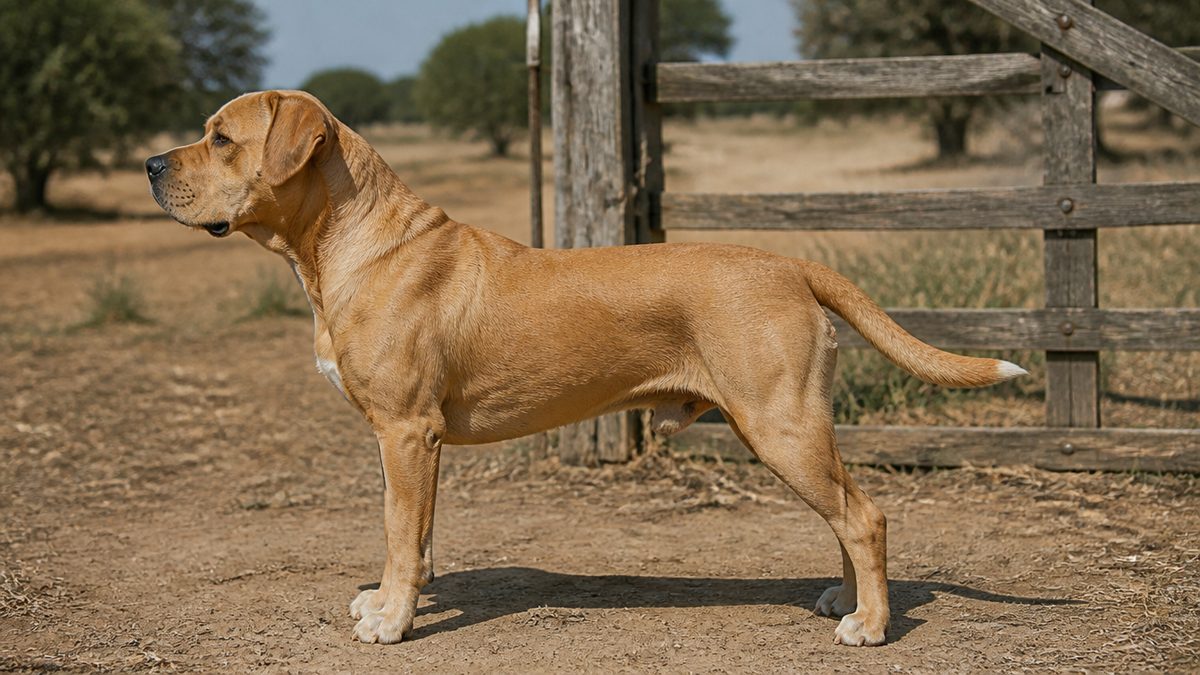
The Portuguese Pointer is a square, medium-sized Iberian hunting breed standing 56 cm plus or minus 4 cm at the withers in males and weighing 20 to 27 kg, held by the Federation Cynologique Internationale as standard 187 under the Portuguese name Perdigueiro Portugues, with a short hard yellow coat that carries no undercoat at all.
Five facts fix the breed before any opinion enters, and all five come from the FCI's own documents rather than from a breed-page spec card.
| Attribute | Value | Source document |
|---|---|---|
| FCI standard number | 187, Group 7, Section 1.1, Braque type | FCI breed record 187 |
| Country of origin | Portugal | FCI breed record 187 |
| Authentic language | English | FCI breed record 187 |
| Definitive acceptance | 13 July 1955 | FCI breed record 187 |
| Working trial | Required | FCI breed record 187 |
| Utilisation | Hunting dog | FCI Standard 187 |
| Height, males | 56 cm plus or minus 4 cm, so 52 to 60 cm | FCI Standard 187 |
| Height, females | 52 cm plus or minus 4 cm, so 48 to 56 cm | FCI Standard 187 |
| Weight, males | 20 to 27 kg | FCI Standard 187 |
| Weight, females | 16 to 22 kg | FCI Standard 187 |
| Coat | Short, hard, close, harsh and dense, without undercoat | FCI Standard 187 |
| Colour | Yellow, light to dark, solid or with limited white | FCI Standard 187 |
One of those rows is genuinely unusual and worth pausing on. The FCI records the official authentic language of standard 187 as English, not Portuguese. Most national breeds have their standard authenticated in their home language, with the other editions marked as translations, and the FCI's own French PDFs carry a line naming which language governs. For this Portuguese breed the governing text is the English one, which means the figures quoted on this page come from the authoritative edition rather than from a translation of it.
A twelfth-century dog named after a partridge
The standard's brief historical summary is unusually specific for an FCI document. The breed originates from the Iberian Peninsula, descending from the old Peninsular Pointing Dog, a common ancestor to other pointing dogs, and its existence in Portugal can be traced back to at least the 12th century. In the 14th century it was known as the podengo de mostra, already showing the capacity for pointing game, and was bred in the royal and nobility kennels and used in falconry. In the 16th century, already named perdigueiro, from perdiz, the common Portuguese name for partridge, it was frequently used by commoners. The definition of the current traits began in the first quarter of the 20th century.
Between those two dates the standard says something no other document in this cluster says: the breed evolved by adapting to the climate, terrain and game, and from the selection imposed by the socio-cultural specificity of the Portuguese, who have been breeding it for centuries for hunting purposes. A gundog whose own standard credits its climate for its form is a gundog worth reading carefully in a hot country, and the coat description backs the claim up.
The coat is a single coat, and the standard says so in those words
The hair is short, hard, close, harsh and dense, covering the body evenly with the exception of the armpits, groin and perianal and genital regions where it is more sparse and softer. It is thinner and shorter on the head, especially on the ears, which have a velvety look. And then, as its own clause: without undercoat. Soft hair is listed as a severe fault.
That single coat is the whole heat argument, and it separates this breed sharply from the wire-coated members of its own FCI group. Compare the Wirehaired Pointing Griffon, whose standard describes a fine dense undercoat under a harsh top coat, or the German Shorthaired Pointer, which is short-coated but not undercoat-free.
The temperament the standard describes, in full
The standard's own words are extremely kind and affectionate, hardy, capable of great endurance and devotion, calm and very sociable, but somewhat haughty towards other dogs, curious by nature, works with persistence and vivacity, always a keen hunting dog that stays in close contact with the hunter.
Two clauses in that passage do real work for a prospective owner. Somewhat haughty towards other dogs is the standard telling you this is not a dog-park breed. And stays in close contact with the hunter describes a pointing dog that checks in rather than ranging out of sight, which is the single most useful trait a gundog can have for an owner who will never actually hunt with it.
Perdigueiro, Portuguese Pointing Dog, Portuguese Pointer, and one misspelling that hides the breed
The Portuguese Pointer carries at least four names across the documents that matter, and one of the most important datasets in canine longevity research files it under a misspelling that makes a correctly spelled search return nothing.
Names are usually a footnote. Here they decide whether a reader finds anything at all, because every major source uses a different one.
| Where | Filed as | What a correctly spelled search returns |
|---|---|---|
| FCI breed record | PERDIGUEIRO PORTUGUES (187) | Found; the English name is on the same page |
| FCI English standard | PORTUGUESE POINTING DOG | Found |
| FCI French standard | CHIEN D'ARRET PORTUGAIS | Found |
| FCI German standard | PORTUGIESISCHER VORSTEHHUND | Found |
| McMillan 2024 Table S5 | Portugese Pointing Dog, misspelled | Nothing at all |
| OFA breed codes | PORTUGUESE POINTER, code PPN | Found, but with zero statistics rows |
| PubMed | None of the above | Zero on five separate name forms |
The misspelling, and why it matters
McMillan 2024's Supplementary Table S5 is the document that decides whether a breed has a lifespan figure. Its row for this breed reads Portugese Pointing Dog, with one u missing, followed by an N flag. Search that table for Portuguese Pointing Dog, spelled correctly, and you find nothing, which reads exactly like a breed the researchers never considered. Search it for the misspelling and the row is there, flagged as considered and excluded.
Never considered and considered-then-excluded are not the same statement. The first would mean the breed fell outside the study's scope entirely. The second means it was in the frame and did not meet the inclusion criteria, almost certainly because too few dogs were in the UK dataset. This page makes the second claim, because that is what the document says once you spell the name the way the researchers did. The same table carries other source misspellings, so this is a property of that document rather than a fact about this breed.
PubMed returns zero on every name form, and the control passed
Five specific name forms were run against a working control on 9 September 2026. Portuguese Pointer in title or abstract returns 0 with a quoted-phrase-not-found warning. Portuguese Pointing Dog returns 0 with the same warning. Perdigueiro Portugues returns 0 with the same warning. The bare term Perdigueiro returns 0 with no warning at all, which means the term is searchable and genuinely absent rather than merely unindexed as a phrase. Perdiguero, the Spanish spelling, returns exactly one record and it is a study of mouse embryonic macrophages, an author surname rather than a dog.
The control settles that this is a real absence rather than a broken query. Labrador retriever hip dysplasia returned 126 records and the quoted phrase Labrador Retriever in title or abstract returned 1,109, both with clean unrewritten translation lines in the same session.
But an exact-phrase zero is never reported here without an unquoted retry, and the retry changed the answer. Dropping the quotation marks makes PubMed rewrite the query into an AND of Portuguese and pointer across all fields, which returns six records. One of them is genuine and the other five are noise: Brazilian adolescent oral health, Portuguese diagnosis-related group costing, a hyperventilation review in traumatic brain injury, and two dental-articulator papers from 1979 and 1983 about an infraorbital pointer. The one genuine record is covered in its own section below, and it is a better finding than the zero would have been.
One Portuguese breed keeps being substituted for another
The seventh organic result in an India-located search for this breed is a page for the Portuguese Podengo Pequeno, a completely different breed: a small primitive-type hound in FCI Group 5 rather than a medium pointing dog in Group 7. The two share a country and the first half of a name, and search engines conflate them routinely. Worth knowing, because the Podengo's own entry in the FCI crossing register lists all six of its size and coat varieties as crossable under number 94, while the Perdigueiro appears in that register not at all. Read the Portuguese Podengo page if that is the dog you actually meant.
Portuguese Pointer price in India
No Indian page publishes a Portuguese Pointer price for a live dog, and the only rupee figure the breed attracts across an entire Indian result set is Rs 796 for a dollhouse figurine.
Ten organic results were captured in an India-located search on 9 September 2026 and classified one at a time. The classification is the finding. Before any of it, three engines were tested against a Labrador Retriever control in the same session, because a search that returns nothing because it was never run is not evidence of anything: Google returned no document at all through the retrieval path available here, Bing India substituted the result set for both the breed query and the control, and DuckDuckGo India was the one engine whose control passed.
| Position | Domain | What it actually is |
|---|---|---|
| 1 | amazon.in | A book about the breed |
| 2 | etsy.com | A personalised mug |
| 3 | ebay.com | The same book |
| 4 | facebook.com | A rescue appeal for an abused dog in Attiki, Greece |
| 5 | marcpetite.com | Leather dog collars |
| 6 | etsy.com | A 1:24 scale dollhouse figurine, Rs 796 |
| 7 | dogbreedslist.info | A page for the Portuguese Podengo Pequeno, a different breed |
| 8 | pinterest.com | A Pinterest board |
| 9 | gettyimages.in | Stock photography |
| 10 | ebay.com | A 3D-printed scale model |
Not one of the ten is an Indian listing for a live animal. Two are the same book, three are craft or model items, one is leather goods, one is stock photography, one is a rescue appeal in Greece and one is a different breed entirely. The book holds the top organic position, and its own description opens by noting that the Portuguese Pointer, or Perdigueiro Portugues as it is known in its country of origin, is a dog breed with noble Portuguese ancestry, which is the only accurate sentence about the breed anywhere in the result set. India-located organic search for this…
A scraper, an answer engine and a hurried reader all treat a rupee figure on a breed-named page as a breed price. Here the number is Rs 796 and the product is a resin model of the dog. That is not an unusual failure; it is the standard shape of Indian search results for a breed with no Indian market, and it is how a fabricated price enters circulation. Before quoting any rupee figure for a rare breed, confirm the listing is for a live animal. On this breed, none of them is.
The one Indian-facing figure, and how to test it
One Indian breed directory does print a buying band for this breed: Rs 60,000 to Rs 80,000, alongside a monthly upkeep row of Rs 3,550 to Rs 5,400 and a Medium size label. Both figures deserve testing rather than quoting.
Start with the monthly row, because it is provably a template. The same site prints the identical Rs 3,550 to Rs 5,400 row for the Vizsla, also labelled Medium. It prints a different row, Rs 4,650 to Rs 6,600, for the Wirehaired Pointing Griffon, which it also labels Medium. And it prints Rs 5,700 to Rs 8,550 for both the German Wirehaired Pointer and the Giant Schnauzer, a 35 to 47 kg dog. Three medium-labelled continental pointing breeds land on two different totals, and a 22 kg pointer shares a row with a 47 kg working dog. Rows on that site are assembled per breed from a small set of preset lines, so a matching total is a consequence rather than a finding.
Now the buying band, and the arithmetic that matters
Run Rs 60,000 to Rs 80,000 through the three exchange rates Indian pages are repeatedly caught using. At 84.38 it gives 711.07 and 948.09 dollars, which are not prices anyone prints. At 74 it gives 810.81 and 1,081.08, likewise. At a flat 80 it gives exactly 750 and exactly 1,000.
The flat-80 test is structurally weak and must never be run alone, because 1,000 divided by 80 is 12.5, so any rupee figure ending in three zeros divides cleanly at 80 by construction. What raises this case above arithmetic noise is the quotient: 750 and 1,000 dollars are exactly the kind of round numbers a seller would actually print, while 711.07 and 810.81 are not. So the band is CONSISTENT WITH a converted US 750 to 1,000 dollar range, and this page says that rather than asserting it. Either way it is not an observation of an Indian transaction, because no Indian seller of this breed could be found at all.
The honest position for an Indian buyer is that the Portuguese Pointer has no Indian price because it has no Indian market, and that importing one for trade or breeding is not lawfully available: dogs are a restricted import and applications to import for trading or breeding purposes are rejected, with the separate personal pet route requiring a genuine pet accompanying its owner with a valid pet book in the importer's name. India's largest breed-listing platform confirms the demand side: its dropdown enumerates more than 250 breeds, includes Vizsla, Weimaraner, Pointer, German Shorthaired Pointer and Portuguese Water Dog as controls, and has no Portuguese Pointer entry.
Monthly cost of ownership in India
A 22 kg Portuguese Pointer costs between about Rs 7,500 and Rs 12,500 a month to keep in an Indian metro, and it is the cheapest breed in this cluster to groom because a single coat with no undercoat needs almost nothing.
Running costs are a function of weight and city rather than of rarity, so this section has firm answers where the price section does not. A 16 to 27 kg dog sits inside the 15 to 30 kg band Indian parasite products are dosed for.
| Line | Figure | Basis |
|---|---|---|
| Tick, flea and worm control | Rs 1,103 per month | NexGard Spectra 15 to 30 kg, 3 tablets at Rs 3,308 |
| Deworming, if dosed separately | Rs 201 to Rs 339 per treatment | Drontal Plus at Rs 125.67 a tablet, one per 10 kg |
| Annual booster, amortised | About Rs 267 per month | Vetic annual booster from Rs 3,199 |
| Anti-rabies, amortised | About Rs 58 per month | Vetic anti-rabies Rs 699 |
| Bath, if outsourced | Rs 934 upward per visit | Vetic grooming, Delhi |
| Salon grooming | Rarely needed | A short single coat needs a rubber mitt, not a haircut |
| Boarding, when you travel | Rs 899 per 24 hours | PawSpace Bengaluru overnight rate |
| Municipal registration, Delhi | Rs 500 a year | MCD Delhi pet dog registration |
| Municipal licence, Chennai | Rs 50 | Greater Chennai Corporation |
Food is the line you compute rather than copy. A 22 kg active dog typically eats 260 to 340 grams a day of a premium adult kibble, which at Indian prices lands between roughly Rs 4,500 and Rs 7,000 a month. Weigh the food rather than scooping it, and check the grams against the pack you actually buy.
Grooming is the line where this breed saves you money
Every other continental pointing breed in this cluster needs either hand-stripping or serious drying discipline. This one needs a rubber curry mitt twice a week. Over a year that is a genuine difference: two or three strips at Rs 1,359 upward, plus more frequent baths, is a four-figure annual saving against a wire-coated dog of the same weight. It is one of the few places where a rare breed is cheaper rather than more expensive.
The delivery model sets the vaccination price, not the drug
One identical nine-in-one vaccine costs Rs 600 at a Goa government veterinary hospital inclusive of the certificate, from Rs 899 at a private clinic chain, and from Rs 1,999 through a vet-at-home service that also charges a Rs 699 visit fee. Anti-rabies spans Rs 100 to Rs 1,199 across the same three routes. A 3.3-fold spread on one product is the most actionable fact in this section: you can halve this line without changing the medicine.
Municipal routes go further. Greater Chennai Corporation charges Rs 50 for a pet licence, issued 9,115 of them in 2024, and runs six municipal pet clinics that provide all treatment and anti-rabies vaccination free of cost. Delhi's Municipal Corporation charges Rs 500 to register a pet dog and Rs 500 to renew, with a Rs 100 per month late fee, and has issued 18,958 certificates since 2021.
Boarding varies most with city and operator. A Bengaluru facility publishes Rs 599 for up to four hours, Rs 799 for daycare to ten hours and Rs 899 for overnight to 24 hours. A widely-cited Indian welfare source gives a broader Rs 500 to Rs 2,000 per day, plus consultation at Rs 500 to Rs 1,000; treat that as a single data point rather than two, because a large general insurer publishes byte-identical ranges for two separate quantities, which is evidence that one copied the other.
Heat tolerance: the one continental pointing breed bred in a hot country
The Portuguese Pointer has the best heat tolerance of any breed in this cluster, because it carries no undercoat and comes from a homeland whose August is hotter than Bengaluru's hottest month, and the FCI standard credits its climate for its form in so many words.
Two independent pieces of evidence point the same way, which is rare enough to be worth stating plainly. The standard says the breed evolved by adapting to the climate, terrain and game of the Iberian Peninsula, and it describes a coat that is short, hard, close, harsh and dense, without undercoat. The satellite record then confirms that the Iberian climate in question is genuinely hot.
| Point | Cell elevation vs real | Annual mean C | Annual RH % | Hottest month | Coolest month |
|---|---|---|---|---|---|
| Evora, Alentejo | 173.11 m vs 300 m, -126.9 m | 16.53 | 69.30 | August, 25.22 C | January, 8.83 C |
| Lisbon | 23.88 m vs 100 m, -76.1 m | 16.54 | 80.37 | August, 20.47 C | February, 12.77 C |
| Bengaluru | 841.72 m vs 920 m, -78.3 m | 23.74 | 67.94 | April, 28.37 C | December, 20.22 C |
| Pune | 635.99 m vs 560 m, +76.0 m | 23.86 | 66.80 | April, 28.93 C | December, 19.62 C |
| Delhi | 206.37 m vs 216 m, -9.6 m | 25.60 | 45.56 | June, 35.88 C | January, 13.61 C |
| Mumbai | 97.15 m vs 14 m, +83.2 m | 26.77 | 67.39 | May, 31.19 C | January, 23.19 C |
| Ahmedabad | 46.53 m vs 53 m, -6.5 m | 27.57 | 48.32 | May, 35.06 C | January, 19.93 C |
| Chennai | 48.95 m vs 6 m, +43.0 m | 27.95 | 72.39 | May, 31.51 C | January, 24.09 C |
Every cell above sits within about 130 m of its town's real elevation, which is what a usable plains or low-hill reading looks like; a cell wrong by a kilometre gives a right answer for the wrong place and this page would say so.
The two Portuguese points make the argument better than one would
Lisbon and Evora return annual means one hundredth of a degree apart, 16.54 and 16.53, and completely different climates underneath. Lisbon is maritime and markedly more humid, running from 12.77 C in February to 20.47 C in August at 80.37 percent relative humidity, which is higher than any Indian city in the table. Evora, ninety miles inland in the Alentejo, runs from 8.83 C in January to 25.22 C in August at 69.30 percent. Two points, one annual mean, sixteen degrees of seasonal range against eight.
Evora's hottest month averages 25.22 C. Bengaluru's hottest month averages 28.37 C and Pune's 28.93 C. That is a gap of about three and a half degrees between the Alentejo in August and the Deccan plateau in April, which is a far smaller gap than any other breed in this cluster faces. For comparison, a French gundog's homeland July averages 17.71 C and a Southern German one's 20.02 C. This breed starts about seven degrees closer to Indian conditions than its group-mates do.
What that does not mean
It does not mean the breed is safe in a Chennai May. Chennai's coolest month averages 24.09 C, which is warmer than Evora's hottest, and its annual mean of 27.95 C is more than eleven degrees above the Alentejo's. A heat-tolerant dog is still a dog, and this one is classified with a working trial and described as capable of great endurance, which means it will keep working past the point where it should stop.
The transferable risk factor is weight. In a cohort of 905,543 UK dogs, bodyweight at or above the breed and sex mean carried odds of heat-related illness of 1.42, with an interval of 1.12 to 1.80, and the study's overall incidence was 0.04 percent with a case fatality of 14.18 percent. No Portuguese Pointer row appears in that paper's modelled breed list, and the inclusion rule is a disjunction, five or more cases and/or 5,000 or more dogs, so the breed simply had neither. This page therefore claims only the bodyweight finding and no breed-specific odds ratio.
The trigger split is where the practical rule comes from. Of 1,259 heat-related illness events from 1,222 dogs, 380 had no recorded trigger, leaving 879 with one. Of those 879, 652 were exertional at 74.2 percent, against 113 environmental at 12.9 percent and 46 from vehicular confinement at 5.2 percent. Nearly three quarters of recorded heat emergencies happened because the dog was working.
City by city: where a Portuguese Pointer can live in India
Bengaluru, Pune and Delhi's winter belt suit a Portuguese Pointer, and Chennai and Mumbai do not, because neither has a month cool enough to give a working dog a break.
Wet-bulb temperature decides whether a panting dog can shed heat at all, because panting is evaporative cooling and evaporative cooling fails as air approaches saturation. The column below is Stull 2011 computed from NASA POWER's T2M and RH2M for the 2001 to 2020 window, labelled as such because a second wet-bulb method exists and the two disagree by up to about 1.5 degrees.
| City | Peak wet bulb C | Month | Coolest month mean C | Verdict for this coat |
|---|---|---|---|---|
| Kolkata | 27.09 | June | 17.31 (January) | Real winter, unworkable monsoon |
| Delhi | 26.50 | July | 13.61 (January) | Excellent November to February, brutal May to July |
| Chennai | 26.11 | May | 24.09 (January) | No cool month at all; indoor cooling is mandatory |
| Ahmedabad | 26.11 | June | 19.93 (January) | Dry heat, which this coat handles better than wet heat |
| Mumbai | 25.77 | June | 23.19 (January) | Never drops below 23 C; same verdict as Chennai |
| Hyderabad | 23.35 | June | 20.76 (December) | Workable outside March to June |
| Pune | 22.97 | June | 19.62 (December) | Comfortable most of the year |
| Bengaluru | 21.86 | May | 20.22 (December) | The best Indian metro for this breed |
Three of those months surprise people and are worth stating because getting one wrong quietly corrupts every seasonal recommendation. Delhi peaks in June at a mean of 35.88 C, not in May. Bengaluru peaks in April at 28.37 C and is coolest in December, not January. Pune likewise peaks in April at 28.93 C and is coolest in December. Chennai, Mumbai and Kolkata genuinely do peak in May.
Both cities peak at 26.11 C wet bulb, Chennai in May and Ahmedabad in June. That is a genuine coincidence to the hundredth of a degree rather than a copied figure, and the two cities present very differently underneath it: Chennai runs 72.39 percent annual humidity with a coolest month of 24.09 C, while Ahmedabad runs 48.32 percent with a coolest month of 19.93 C. For a single-coated dry-country breed, Ahmedabad's dry heat with a real cool season is the easier of the two by a wide margin, even though the peak wet-bulb number is identical.
Delhi is the best fit in mainland India for four months a year
Delhi has the widest annual swing of the eight cities, from a January mean of 13.61 C to a June mean of 35.88 C, and by far the lowest annual humidity at 45.56 percent. For a dry-country Iberian breed with no undercoat, a Delhi winter is close to ideal working weather and a Delhi June is not survivable as a working climate. An owner who plans around that has a manageable year. An owner who expects a constant routine does not.
The monsoon problem this breed does have
A short single coat dries fast, which removes most of the monsoon problems that afflict wire-coated and double-coated breeds. What it does not remove is the ears. The standard describes ears that are thin and velvety and set high, hanging close to the head, and Indian veterinary series report otitis externa concentrating heavily in the monsoon months with bathing without protecting the ears named among the commonest causes. Plug the ears before a bath, dry the canal entrance afterwards with dry cotton wool rather than a bud pushed inward, and check weekly through July and August.
Second Schedule Part IV paragraph 21(1) of the Dog Breeding and Marketing Rules 2017 bars keeping in outdoor facilities, without the attending veterinary practitioner's written approval, dogs not accustomed to local temperatures, breeds that cannot tolerate them, and sick, infirm, aged or young animals. A short-coated dry-country breed clears that clause more easily than a double-coated one, but shade, water and airflow are still requirements rather than courtesies. Note the citation form: this is a Second Schedule paragraph, not a Rule, because the Rules stop at 13.
Temperament and household fit
The Portuguese Pointer is an affectionate, calm, handler-focused hunting breed that suits an active household with outdoor access, and its two limiting traits for Indian living are its exercise need and its reserve towards other dogs.
The standard's description is unusually warm for an FCI document and unusually specific: extremely kind and affectionate, hardy, capable of great endurance and devotion, calm and very sociable, but somewhat haughty towards other dogs, curious by nature, works with persistence and vivacity, always a keen hunting dog that stays in close contact with the hunter.
The two clauses that decide whether this dog fits your life
Stays in close contact with the hunter is the most useful sentence in the whole standard for a pet owner. Pointing breeds vary enormously in how far they range, and a close-working dog is dramatically easier to live with off lead in an unfenced Indian park than a wide-ranging one. This breed was selected to check in.
Somewhat haughty towards other dogs is the counterweight, and Indian pages never quote it. It is not aggression and the standard does not say it is. It describes a dog that is polite and uninterested rather than sociable, which matters in a country where street dogs are present on almost every walk and where apartment complexes run shared dog areas. Plan for parallel walking rather than dog-park play.
Who this breed suits in India
- Households in Bengaluru, Pune, Hyderabad or Delhi's winter belt with a garden or secure outdoor access.
- Owners who already exercise at dawn and will keep doing it through an Indian April.
- Families wanting an affectionate house dog rather than a guard, since the standard names devotion and not defence.
- Owners who prefer a low-grooming dog and will accept a high-exercise one in exchange.
- People who will do scent and tracking work, because a keen hunting dog with no hunting needs a substitute job.
Who this breed does not suit
- Apartment households with no route to open ground twice a day.
- Owners in Chennai or Mumbai without reliable indoor cooling, despite this breed's better heat tolerance.
- Anyone wanting a dog for the shared society dog park, given the standard's note on other dogs.
- First-time owners in India, because there is no local breed community, no local rescue and no local screening data.
- Owners away nine hours a day, since a devoted close-working breed does not settle alone.
Socialise deliberately and socialise to India specifically. The list that matters here is two-wheelers at close range, cattle on the road, festival fireworks, monsoon thunder, street dogs behind gates, lift doors, and the number of unfamiliar adults a dog meets in a dense Indian city in a week. A curious, calm breed handles all of that well if it meets it before sixteen weeks and badly if it does not.
Training approach and what this breed resists
To train a Portuguese Pointer, build everything on the handler relationship the standard describes, keep sessions varied, and use reward rather than pressure, because a kind and affectionate breed that works in close contact is highly trainable and easily discouraged.
The training profile falls straight out of the standard. A dog described as extremely kind and affectionate, calm, curious by nature, working with persistence and vivacity, and staying in close contact with the hunter is a dog that wants to work with you and will keep at a task. That combination is close to ideal for reward-based training and close to worst-case for correction-based training, because a soft breed under pressure disengages rather than complying.
| Age | Priority | Indian-specific note |
|---|---|---|
| 8 to 16 weeks | Socialisation, name, crate, recall foundation | Book the socialisation list before the puppy arrives; the window will not wait |
| 16 to 24 weeks | Recall on a long line, loose lead, settle | Train at dawn only; a hot puppy learns that recall ends the fun |
| 6 to 9 months | Whistle recall, retrieve, monsoon noise work | Thunder-phobic gundogs are made in this window |
| 9 to 14 months | Distance direction, steadiness, water | Growth plates close late in a 22 kg dog; no repetitive jumping yet |
| 14 to 24 months | Scent work, tracking, endurance | Field work is rarely available in India; tracking is the substitute that works |
What it resists, specifically
- Harsh correction, which produces avoidance in a soft breed rather than compliance.
- Repetition without variation, because a curious dog stops offering behaviour once the task is solved.
- Long static obedience, which is the format most Indian group classes are built around.
- Forced dog-to-dog socialising, which fights the standard's own description of the breed.
- Working in the middle of an Indian day, which looks like disobedience and is physiology.
The Indian gap is real and has a good answer. Formal gundog work with access to game is essentially unavailable here, and the FCI attaches a working trial to this breed for a reason. Scent and tracking sport uses the same nose, the same handler partnership and the same persistence, and it can be done before sunrise in a Pune housing-society garden. Hide a scented article, build a search cue, then extend the distance and the age of the track week by week.
Teach an explicit settle on a mat, on cue, from twelve weeks. A hunting breed with no off switch is the commonest reason gundogs are rehomed from Indian apartments, and an off switch is a trained behaviour rather than a temperament trait. Five minutes a day for a month buys a dog that can lie down in a busy room for an hour, which is worth more in an Indian flat than any obedience title.
Daily exercise requirement
A Portuguese Pointer needs about two hours of real activity a day, and its better heat tolerance buys it a wider working window in India rather than a shorter requirement.
The FCI gives this breed's utilisation as Hunting dog, plainly, and attaches a working trial to it. The standard adds hardy, capable of great endurance, works with persistence and vivacity. That is a specification rather than a compliment. This is a genuinely athletic, versatile dog selected to quarter Alentejo scrub ahead of a walking hunter for a morning, and it does not settle on two twenty-minute pavement walks.
What two hours looks like in an Indian city
- Forty-five minutes at first light, off lead where lawful and safe, with recall and quartering.
- Fifteen to twenty minutes of scent or retrieve work indoors during the day, which costs the dog more per minute than walking does.
- Forty-five minutes after dark, on a long line where the ground is not secure.
- One longer session a week, ninety minutes or more, somewhere the dog can range and use its nose.
The indoor block is what Indian owners skip and what pays best. Nose work is the cheapest exercise available in a hot country because it costs the dog real energy and costs the handler no daylight. Ten minutes searching for a hidden article settles a hunting dog more reliably than half an hour of pavement in 34 C.
The heat rule, and why it still applies to a heat-tolerant breed
Exertional heat illness accounted for 652 of the 879 heat-related illness events with a recorded trigger in a UK cohort of 905,543 dogs, which is 74.2 percent, against 46 events at 5.2 percent from vehicular confinement. Dogs are overwhelmingly harmed by being worked. A breed that is better adapted to heat and more willing to keep going is, if anything, more exposed to that specific failure than a breed that quits early.
- Work before sunrise and after full dark from March to July, and treat midday as unavailable.
- Test the pavement with the back of your hand; if you cannot hold it for five seconds the dog should not walk on it.
- Carry water on any session over twenty minutes and offer it every ten.
- Stop on behaviour rather than on a clock: a dog that drifts off line, slows or stops responding is already too hot.
- Cool with room-temperature water over the neck, groin and paws, never ice water, and move air across the dog.
Heat-related illness can deteriorate hours after a dog appears to have recovered, and the study cohort's case fatality was 14.18 percent. If a dog collapses, stops responding, vomits or has diarrhoea after exertion in heat, cool it and get it to a veterinarian the same day rather than watching to see whether it settles.
One advantage worth planning around. Because this coat dries quickly and carries no undercoat, water is a genuinely useful cooling tool for this breed in a way it is not for a double-coated dog, where a wet undercoat traps heat. A short swim or a hose-down before a walk is a real intervention here rather than a gesture.
Grooming a single coat in Indian humidity
Grooming a Portuguese Pointer takes about ten minutes a week, because the standard describes a short hard coat with no undercoat, and the only real job is the ears.
The coat is the easiest in this cluster by a wide margin. The standard asks for hair that is short, hard, close, harsh and dense, covering the body evenly, thinner and shorter on the head and especially the ears which have a velvety look, and explicitly without undercoat. Soft hair is a severe fault.
| Task | Frequency | Indian cost basis |
|---|---|---|
| Rubber curry mitt over the body | Twice a week | Free, five minutes |
| Bath | Every eight to ten weeks, or after mud | Vetic bathing from Rs 934 if outsourced |
| Salon haircut | Never | Not applicable; there is nothing to cut |
| Ear check and dry | Weekly, and after every bath or swim | Free, and the most important line here |
| Nails | Monthly | Vetic add-ons from Rs 99 |
| Teeth | Two or three times a week | Free |
That is the entire grooming programme. Against a hand-stripped wire coat, which needs two or three salon visits a year at Rs 1,359 upward plus weekly beard work, this breed saves an Indian owner both money and the problem of finding a groomer who strips rather than clips.
The ears are the whole job
Thin, velvety, high-set drop ears hanging close to the head are exactly the anatomy that traps moisture, and Indian veterinary series report otitis externa concentrating heavily in the monsoon months, with bathing without protecting the ears named among the commonest causes. Overseas breed guidance written for a Portuguese summer will tell you to towel the dog and let it air dry. That is correct in the Alentejo and wrong in a Kerala July.
- Plug the ears with cotton wool before a bath and remove it immediately afterwards.
- Dry the ear canal entrance with dry cotton wool, never with a bud pushed inward.
- Dry the ears after every swim as well as after every bath.
- Check the ears weekly through June to September, looking for redness, smell or discharge.
- See a veterinarian at the first head shake or smell rather than treating it at home.
Skin, sun and a short yellow coat
A short single coat over a light-coloured dog offers less sun protection than a dense one, and a yellow dog with white patches on the muzzle and chest has thinly covered pink skin in exactly the places that face the sun. On an Indian summer walk that matters. Keep the dog off open ground in the hours either side of noon, which the exercise section already requires for other reasons, and check the nose leather and any white markings for persistent redness or crusting.
A short single coat with no undercoat sheds less bulk than a double coat does, but shedding volume and allergen load are different things. A controlled study measured Can f 1 across 196 dogs of so-called hypoallergenic breeds against 160 control dogs and found the hypoallergenic group HIGHER on both hair and coat, with no difference in airborne allergen, and concluded that there is no evidence for the classification of certain dog breeds as being hypoallergenic. This page makes no allergy claim for this breed, and neither should anyone selling one.
Health issues, screening and the evidence that does not exist
The Portuguese Pointer has no lifespan study, no published OFA screening statistics and one clinical paper in the entire literature, and that triple absence is the most important health fact about the breed for an Indian buyer.
This section is short on numbers because the numbers do not exist. No life expectancy figure has ever been computed for this breed, and saying so precisely is more useful than borrowing figures from a lookalike breed. Each absence below was tested with a control that passed in the same session.
| Question | Answer | How it was established |
|---|---|---|
| Median lifespan | No figure exists | McMillan 2024 Table S5 lists the breed as Portugese Pointing Dog, flagged N for excluded |
| Hip dysplasia rate | No published figure | OFA holds breed code PPN and publishes zero statistics rows; Labrador control 109 rows |
| Elbow dysplasia rate | No published figure | Same OFA parse, same session, same control |
| Eye disease rates | No published figure | Same |
| Named breed-specific gene variants | None published | Five PubMed name forms return zero against a passing control |
| Clinical literature | One paper, on 30 dogs | The one genuine record from an unquoted PubMed retry |
| Congenital deafness | Named as a disqualifying fault, no prevalence | FCI Standard 187's disqualifying-fault list |
The commonest mistake made with rare breeds is to read a blank screening record as evidence of soundness. It is the opposite: it means nobody has looked. OFA states the bar itself, verbatim, in answer to the question My breed isn't listed in your statistics. Why not? Breeds are not included in the OFA statistics tables until a minimum number of individuals have been evaluated. For hips, each breed must have at least 100 evaluations in the database. For all other databases, there must be at least 50. So a zero here means fewer than 100 Portuguese Pointers have ever had hips submitted to that registry. The right conclusion is that you cannot know this breed's orthopaedic risk from published data, and that you should therefore ask for the individual parents' scores rather than relying on a breed reputation.
What the comparable breeds do get, and how to use it
| Breed | Deaths | Median years | 95% CI | HR vs crossbreds |
|---|---|---|---|---|
| Bracco Italiano | 22 | 13.8 | 11.8 to NA | 0.95, p = 0.81 |
| Vizsla | 503 | 13.5 | 13.2 to 13.9 | 0.67, p < 0.001 |
| German Shorthaired Pointer | 947 | 13.4 | 13.3 to 13.6 | 0.67, p < 0.001 |
| German Wirehaired Pointer | 138 | 13.0 | 12.5 to 13.6 | 0.75, p < 0.001 |
| Portuguese Water Dog | 36 | 13.0 | 11.5 to 14.9 | 0.85, p = 0.32 |
| Weimaraner | 1,229 | 12.8 | 12.6 to 13.0 | 0.80, p < 0.001 |
| Spinone Italiano | 215 | 11.9 | 11.6 to 12.4 | 1.00, p = 0.97 |
| Portugese Pointing Dog | Not measured | None | None | Excluded, flag N |
The measured pointing breeds span 11.9 to 13.8 years. That is a range and not a substitute, and this page does not hand this breed any of those numbers. Note also that the hazard ratios in that table are against the crossbred group rather than against all dogs, and that the paper carries an Author Correction which changes only a Miniature Dachshund figure in a figure legend and touches no supplementary table.
The comparators that do have OFA rows, for scale
For an Indian buyer trying to judge what a normal continental pointing breed looks like on screening, the neighbours with published rows are the right reference. The German Wirehaired Pointer records 5,907 hip evaluations at 90.0 percent normal and 8.9 percent dysplastic, plus 2,047 elbow evaluations at 2.9 percent abnormal. The Wirehaired Pointing Griffon records 3,919 hip evaluations at 8.5 percent dysplastic and 1,774 elbow evaluations at 5.2 percent abnormal. The Labrador Retriever, the most-screened breed there is, records 324,934 hip evaluations at 11.3 percent dysplastic.
So a hip dysplasia rate somewhere between 8 and 12 percent is what a screened medium-to-large gundog population typically shows. Whether this breed sits inside that band is unknown, and a breeder who tells you it is free of hip dysplasia is telling you something no dataset supports.
One thing the standard does take seriously
FCI Standard 187's disqualifying-fault list is longer and more clinical than most, and it includes congenital or acquired deafness alongside albinism, total lack of nose pigmentation, wall eye, congenital blindness, undershot or overshot jaws, and a body completely atypical showing signs of crossbreeding to other breeds. A breed standard that disqualifies for deafness is a breed standard whose authors thought hearing was worth writing down, which is not universal among pointing breeds.
Indian law offers no support here. Across the whole Dog Breeding and Marketing Rules 2017 gazette, BAER and deaf each appear zero times, and the word hearing appears exactly once, as an appeal hearing before the Secretary, Animal Husbandry. So there is no Indian hearing-test requirement for any breed, and a buyer who wants a BAER result has to ask for it. Consult your nearby vet about whether BAER testing is available in your city; it is offered in only a handful of Indian referral centres.
The one paper: 30 Portuguese Pointers and the geometry of a normal elbow
The Portuguese Pointer appears exactly once in the clinical literature as a study population, in a 2022 paper in which 60 elbows from 30 dogs of this breed supplied reference values for measuring joint congruence, and it is a better finding than a zero would have been.
Five specific name forms returned zero in PubMed against a passing control. Dropping the quotation marks made PubMed rewrite the query into an AND across all fields, which returned six records, five of them unrelated. The sixth is the breed's entire clinical literature, and it is worth reading rather than counting.
A team at a Portuguese veterinary school set out to quantify how elbow joint congruence varies with joint angle and with weight-bearing, both of which matter in a walking quadruped and neither of which had been measured. Their words: sixty elbows (30 Portuguese Pointer dogs) were studied, on humeroradioulnar joints classified with a Grade 0 dysplasia.
What they did, and why the breed choice matters
The usual screening protocol for elbow dysplasia, which uses mediolateral extended and flexed elbow views, was preceded by a weight-bearing lateromedial standing radiographic view taken without sedation. Minimum distances were then measured at established points on the joint.
| Measurement | Under flexion | Under weight-bearing |
|---|---|---|
| Anconeal process to ulnar trochlear notch space | Increases (p < 0.001) | Decreases |
| Humeral trochlea to trochlear notch, widest point | Decreases | Increases |
| Step and distance, radial head to medial coronoid base | Increases | Decreases |
| Radioulnar joint overall | More incongruent | More congruent |
| Humeroulnar joint overall | More congruent | More incongruent |
Read the study design carefully. The 30 Portuguese Pointers were chosen because their elbows were normal, graded 0, and the point of the work was to establish what normal looks like so that dysplastic joints and other breeds could be compared against it. This breed's single appearance in the world's clinical literature is as the reference population, not as the patient group. That is an unusual place for a rare breed to appear and it says something quietly favourable about the population the researchers had access to.
The authors state the purpose plainly: reference absolute and indexed values obtained allow future comparisons with other breeds and with dysplastic dogs. The same group has published a review of elbow incongruity in canine elbow dysplasia covering diagnostics and biomechanics, so this is a sustained Iberian research programme rather than an isolated paper.
What an Indian owner should take from it
- Elbow dysplasia is a real screening question for this breed, because a Portuguese group thought the breed's elbows were worth 60 radiographs.
- Ask any breeder for elbow scores as well as hip scores, since no population figure exists to fall back on.
- Understand that a screening radiograph's result depends on positioning: the same joint reads more or less congruent depending on flexion and weight-bearing.
- If an Indian vet grades your dog's elbows, ask which protocol and which views were used, because the answer changes the numbers.
- Do not let anyone cite this paper as evidence the breed is prone to elbow dysplasia. Its subjects were all Grade 0.
One methodological note worth carrying to any breed page. Reporting that a breed has no literature is a strong claim, and it has to survive an unquoted retry before it is published. Here the quoted zeros were real and the unquoted retry still found a genuine paper, which is exactly why the retry is mandatory. A page that had stopped at the five zeros would have told an Indian reader the breed had never been studied, which is false.
Indian law and this breed
Indian breeding law reaches this breed at three points, and the sharpest is the tail: FCI Standard 187 permits either a natural or a docked tail, and Indian law permits only the natural one.
Get the citation form right first, because a reader who looks up a wrong number finds nothing. The Prevention of Cruelty to Animals (Dog Breeding and Marketing) Rules, 2017 run from Rule 1 to Rule 13 and there is no Rule 14. Everything numbered above 13 is a Second Schedule paragraph, and the Schedule numbers its paragraphs continuously from 1 to 30 across four Parts.
The tail: the standard offers a choice and Indian law removes one option
FCI Standard 187 describes the tail twice. Natural: of medium length, not reaching below the hock, straight, of medium set, thick at the base and slightly tapering, well set in perfect continuity with the line of the croup, hanging naturally at rest but never between the thighs, and rising horizontally or slightly above the topline in motion but never vertically or sickle-shaped, wagging from side to side. Docked: in order to cover the genitals without surpassing them.
Second Schedule Part II paragraph 6(8) states, verbatim, that there shall be no tail docking, ear cropping, de-barking, de-clawing, branding, dyeing, injecting substances to enhance visual appeal, performing a surgery or procedure to camouflage or hide any defect or infirmity or any other kind of mutilation of any body part of the pup, and that any change of appearance by artificial means is strictly forbidden.
Some breed standards describe only the docked form, leaving an Indian owner with a lawful dog the standard does not describe. This one describes both in full, and describes the natural tail in far more detail than the docked one. So the lawful Indian Portuguese Pointer is completely specified by the standard, its tail is not a fault, and a judge assessing it has a paragraph to read. A docked dog in India is unlawful and no more correct to the standard than an undocked one.
Genetic-defect testing: what the Rules do and do not require
Second Schedule Part III paragraph 8(10) requires that breeding dogs have been tested for genetic defects, including hip dysplasia, progressive retinal atrophy, night blindness, hypothyroidism, entropion, ectropion, overshot, undershot jaw, wry mouth, two or more missing teeth and cryptorchidism. The operative word is including, so the list is illustrative rather than closed.
Two of those items land squarely on this breed's own disqualifying-fault list. FCI Standard 187 disqualifies for undershot or overshot jaws, which paragraph 8(10) names as a defect a breeding dog must have been tested for, and it disqualifies for congenital blindness, which sits beside the eye conditions the paragraph lists. So for this breed the standard and Indian law are pointing at the same defects from two directions, which is convenient for a buyer: the checks a Portuguese judge would make are the checks Indian law expects a breeder to have made.
Two absences in the gazette are citable rather than inferred. Patella and luxation each appear zero times, so there is no Indian patellar-grading requirement for any breed. BAER and deaf each appear zero times, which matters here because the FCI standard disqualifies this breed for congenital deafness and Indian law provides no corresponding testing hook at all.
Breeding practice and import
Second Schedule Part II paragraph 6(3) prohibits in-breeding, defined as breeding between relatives of the second to fourth grade in straight or side line within the first four generations, with uncle to niece, nephew to aunt, cousin to cousin and grandparent to grandchild as its examples, and incest breeding, defined as mating between parents and children or between brother and sister. For a breed with no Indian population, any Indian breeding programme would start from a very small founder base, which is exactly the situation that clause exists to police.
Paragraph 6(9) prohibits breeding to create new breeds of dogs or unusual looks, which reaches any attempt to produce this breed in a colour its standard does not permit. And Rule 8(1)(a), a genuine Rule rather than a Schedule paragraph, prohibits the sale of pups less than eight weeks of age.
On import, the position is that dogs are a restricted import under ITC(HS) 01061900, entry is limited to a small number of named ports, and applications to import dogs for trading or breeding purposes are rejected. The separate personal pet route runs on different machinery and permits entry only for a genuine pet accompanying its owner with a valid pet book in the importer's name. So there is no lawful commercial route by which an Indian market for this breed could form.
Anaesthesia: what the current evidence actually says
Owners of rare breeds often ask whether an unfamiliar breed carries unknown anaesthetic risk. The best current evidence says breed is largely the wrong question. In a prospective multicentre cohort of 54,542 anaesthetics with mixed-breed dogs as the benchmark, overall mortality was 0.69 percent, and after adjustment for ASA physical status excess risk persisted only for the Chihuahua at RR 1.80 and the Spanish Water Dog at RR 2.72, and explicitly not for the German Shepherd Dog or the Bulldog whose crude rates were higher. Brachycephalic dogs' crude 0.82 against 0.65 percent attenuated to RR 1.19 with an interval of 0.96 to 1.47, which does not reach significance, and no FCI group differed. The authors conclude that between-breed differences largely reflected case severity. Discuss your dog's ASA grade with your vet rather than its breed.
Feeding a Portuguese Pointer in India
Feed a Portuguese Pointer to body condition rather than to a chart, because bodyweight at or above the breed mean is the one heat risk factor an Indian owner controls, and this breed's willingness to keep working makes a heavy dog more dangerous rather than merely less fit.
The risk argument comes first. In a cohort of 905,543 UK dogs, dogs at or above their breed and sex mean bodyweight carried odds of heat-related illness of 1.42, with an interval of 1.12 to 1.80, and the cohort's case fatality for confirmed events was 14.18 percent. For a hunting breed that will keep going past the point where it should stop, keeping the dog lean is a safety measure.
Body condition, checked weekly, in ten seconds
- Run both hands along the ribs with light pressure; you should feel each rib clearly under a thin fat cover without pressing.
- Look down at the standing dog from above; a waist should be visible behind the ribs.
- Look from the side; the abdomen should tuck up from the ribcage to the groin.
- If you cannot feel ribs without pressing, cut the daily ration by ten percent and re-check in a fortnight.
- Weigh the dog monthly on the same scale, because a five percent drift is invisible by eye and obvious as a number.
A short single coat makes this easier than it is on a wire-coated or double-coated breed, because you can see the outline. That is a small practical advantage worth using: photograph the dog in profile once a month in the same spot and compare.
| Stage | Meals per day | Focus | Indian note |
|---|---|---|---|
| 8 to 16 weeks | 4 | Medium-breed puppy formula, controlled growth | Split meals to the cool ends of the day; do not free-feed in summer |
| 4 to 9 months | 3 | Steady growth, no supplements without a vet | Deworm on schedule; Drontal Plus is dosed one tablet per 10 kg |
| 9 to 15 months | 2 | Transition to adult formula | Growth plates close late in this size; no repetitive jumping yet |
| 15 months to 7 years | 2 | Maintain a lean body condition | Cut the ration in the hot months when work drops, not when appetite drops |
| 7 years and older | 2 | Joint support, protein maintained | Re-check weight monthly; a stiff dog moves less and gains quietly |
Compute the monthly food figure rather than copying one. Take the grams the pack specifies for your dog's weight and activity level, multiply by 30, and divide the bag price by the bag weight. A 22 kg active adult typically eats 260 to 340 grams a day, which at Indian premium kibble prices lands between roughly Rs 4,500 and Rs 7,000 a month.
Water, and the thing Indian owners get backwards
A working dog in an Indian summer needs water available at all times and actively offered during exercise, not merely left in a bowl at home. Carry water on every session over twenty minutes and offer it every ten. The common error runs the other way: owners restrict water during exercise to avoid stomach upset, which trades a minor risk against a major one in a country where the ground is hot enough to matter.
Deep-chested breeds are commonly advised to avoid exercise around meals because of gastric dilatation-volvulus. This breed has no published incidence figure of its own, so this page gives none rather than borrowing one from a lookalike. The general precaution costs nothing: leave an hour between a full meal and hard work in either direction, and treat unproductive retching with a distended abdomen as an emergency. Consult your nearby vet about whether prophylactic gastropexy is worth discussing at neutering.
The first year, month by month
A Portuguese Pointer puppy's first year in India has three decision points that outrank everything else, and the first two happen before the puppy is yours.
| Age | What happens | What you must do |
|---|---|---|
| Before you buy | The screening decision you cannot revisit | Ask for both parents' hip and elbow scores and a hearing result; no breed-level data exists to fall back on |
| Before you buy | Verify the dog is this breed at all | Yellow coat only, square muzzle, no undercoat, 52 to 60 cm in a male |
| 8 weeks | Legal minimum sale age under Rule 8(1)(a) | Refuse any puppy offered younger; it needs only a date of birth and a calendar |
| 8 to 10 weeks | Core vaccination course begins | A puppy core course starts at Rs 6,499 at one clinic chain; nine-in-one alone is from Rs 899 |
| 8 to 16 weeks | Socialisation window, which does not reopen | Two-wheelers, cattle, thunder, lifts, crowds, street dogs behind gates |
| 12 to 16 weeks | Anti-rabies | Rs 699 at a clinic, Rs 100 at a Goa government hospital, free at Chennai's municipal clinics |
| 4 months | Municipal registration becomes relevant | Delhi MCD Rs 500 a year; Chennai GCC Rs 50; register early rather than late |
| 4 to 6 months | Ear routine becomes a habit or never does | Weekly checks through the monsoon; dry after every bath and swim |
| 6 months | Hunting drive appears | Move to whistle recall and long-line work; start scent games as the substitute job |
| 6 to 9 months | Neutering conversation | Discuss timing with a vet; late neutering is often preferred in working breeds |
| 9 to 15 months | Growth plates closing | No repetitive jumping or forced running on hard surfaces yet |
| 12 months | Annual booster and first adult health check | Annual booster from Rs 3,199; ask for hip and elbow radiographs to be discussed |
The three decisions that actually matter
- Screening before purchase. With no breed-level OFA data and no lifespan study, the individual parents' scores are the only evidence available to you, and once the puppy is home you cannot obtain them.
- Socialisation between eight and sixteen weeks. Everything else can be caught up; this cannot, and in a dense Indian city the list is long.
- The first hot season. A puppy that learns the outside world is unpleasant at midday will still believe it at three years old, so build all its outdoor associations at dawn and dusk.
A puppy going through its socialisation window in an Indian monsoon needs two things at once: deliberate thunder and rain work, because thunder phobia established at twelve weeks is close to permanent, and a weekly ear routine established as a game rather than a chore. Both are easier at twelve weeks than at twelve months. Play recorded thunder quietly during meals and raise the volume across weeks; handle and dry the ears daily so the adult dog accepts it.
One Indian timing note. A puppy arriving in October meets its first summer at around eight months, which is old enough to handle a graduated introduction to heat and young enough that the habits stick. A puppy arriving in February meets its first Indian April inside the socialisation window, which means outdoor socialisation has to happen at dawn and dusk and indoor socialisation has to carry the rest. Neither is a problem; both need the plan adjusted rather than ignored.
Portuguese Pointer compared with the breeds an Indian buyer can actually get
Against the continental pointing breeds available in India, the Portuguese Pointer wins clearly on heat tolerance and grooming load and loses on every axis that depends on evidence, because it has almost none.
The comparison is restricted to breeds that genuinely exist in India, because comparing two unobtainable dogs helps nobody. Every figure comes from a primary document named in the citations.
| Portuguese Pointer | Vizsla | German Shorthaired Pointer | German Wirehaired Pointer | |
|---|---|---|---|---|
| FCI number | 187 | 57 | 119 | 98 |
| Height, males (cm) | 52 to 60 | 58 to 64 | 62 to 66 | 60 to 67 |
| Weight, males (kg) | 20 to 27 | Not in the standard | See breed page | See breed page |
| Undercoat | None, stated in the standard | None | Present | Present |
| McMillan median (years) | None; excluded, flag N | 13.5 on 503 deaths | 13.4 on 947 deaths | 13.0 on 138 deaths |
| OFA hips, % dysplastic | No published row | See breed page | See breed page | 8.9 of 5,907 |
| OFA elbows, % abnormal | No published row | See breed page | See breed page | 2.9 of 2,047 |
| PubMed records as study population | One, on 30 dogs | Several | Many | Several |
| Grooming | Rubber mitt twice a week | Rubber mitt twice a week | Weekly brush | Hand-stripped |
| On India's largest platform | No entry | Yes | Yes | No entry |
Reading that honestly
Three things follow and none of them is about the dog's quality. First, the Portuguese Pointer is the only breed in the row with no lifespan median, no published OFA row and effectively no clinical literature. Orthopedic Foundation for Animals For a buyer, that is a real cost: you are choosing a dog about which the published evidence base cannot tell you anything.
Second, it is the only one whose standard explicitly says the coat has no undercoat and whose homeland August averages 25.22 C. NASA POWER climatology API On the single question that matters most for an Indian household, this breed has the strongest case in the group.
Third, and decisively, it is not available. India's largest breed-listing platform has more than 250 breeds in its dropdown, including the Vizsla and the German Shorthaired Pointer, and no Portuguese Pointer entry. A breed you cannot obtain is not a comparison, it is a different decision.
The Vizsla is the closest available substitute: a single-coated continental pointing breed with no undercoat, a McMillan median of 13.5 years on 503 deaths, a real Indian price band and findable litters. It is not as dry-country adapted as an Alentejo breed, but it has the same coat structure and it exists here. If what draws you is Iberian pointing stock specifically, the Burgos Pointer and the Pachon Navarro pages cover the Spanish half of the same ancestral pool that FCI 187's own history names.
What Indian owners get wrong with this breed
Five mistakes account for most of what goes wrong with a Portuguese Pointer in India, and the first two happen before anyone has seen a dog.
1. Treating a rupee figure on a breed-named page as a price
The only rupee figure across an entire Indian result set for this breed is Rs 796, and the product is a 1:24 scale dollhouse figurine. The rest of the page is a book, a mug, leather collars, stock photography, a 3D-printed model and a page about the Portuguese Podengo. Confirm the listing is for a live animal before quoting anything.
2. Reading an evidence gap as good health
The breed holds OFA code PPN and returns zero rows in OFA's published statistics against a Labrador control of 109 rows, and OFA requires 100 hip evaluations before publishing a row at all. That means fewer than 100 dogs of this breed have ever been submitted, not that the breed has good hips. Ask for the individual parents' scores.
3. Assuming heat tolerance means heat proof
This breed has the best heat tolerance in its group and it is still a working dog in a country where Chennai's coolest month averages 24.09 C, warmer than the Alentejo's hottest. Exertional heat illness accounted for 74.2 percent of the heat emergencies with a recorded trigger in a UK cohort of 905,543 dogs. A more willing dog is more exposed to that failure, not less.
4. Skipping the ears because the coat is easy
Ten minutes a week of grooming makes owners complacent, and the ears are the one part of this dog that needs a routine. Thin, velvety, high-set drop ears hanging close to the head are exactly the anatomy that traps moisture, and Indian otitis series cluster heavily in the monsoon months. Plug before a bath, dry afterwards, check weekly from June to September.
5. Docking the tail because a foreign standard permits it
FCI Standard 187 describes both a natural and a docked tail, and Indian law permits only the first: Second Schedule Part II paragraph 6(8) states that there shall be no tail docking and that any change of appearance by artificial means is strictly forbidden. A breeder who offers you a docked puppy in India has broken the law in front of you, and that tells you what to assume about everything else they have said.
Anaesthetic risk for this breed is not elevated by anything anyone has measured, and rarity does not create risk. In 54,542 anaesthetics with mixed-breed dogs as the benchmark and adjustment for ASA physical status, only the Chihuahua at RR 1.80 and the Spanish Water Dog at RR 2.72 retained excess mortality, no FCI group differed, and overall mortality was 0.69 percent. Discuss ASA status with your vet rather than breed.
Adoption and responsible sourcing in India
You will not adopt a Portuguese Pointer in India because there is no population here to surrender one, so this section is about what to do instead and how to verify any dog offered to you as one.
The evidence that no Indian population exists is the same evidence that no Indian rescue pipeline exists. A breed absent from a 250-breed marketplace dropdown, returning no Indian listing for a live animal across ten organic results, and whose only Indian-facing commercial presence is a book and a resin figurine, has no surrender stream. India-located organic search for this… The one rescue appeal that does appear in the result set is for a dog in Attiki, Greece.
What an Indian reader drawn to this breed should actually do
- Name what attracted you. Usually it is the heat tolerance, the low grooming load, the close-working temperament or the yellow coat.
- Adopt an Indian dog that carries those traits. Short-coated, medium-sized, high-drive dogs with excellent heat tolerance are the commonest dogs in every Indian shelter, and they are adapted to this climate by a far longer selection than any Iberian breed.
- If the pointing temperament is the attraction, look at the Vizsla or the German Shorthaired Pointer, both of which exist here and both of which have real published data behind them.
- If the job is the attraction, take up scent or tracking work with whatever dog you can get. The training is identical and a pedigree adds nothing to it.
- If you still want this specific breed, understand that only the personal pet route exists and that importing for trade or breeding is not lawfully available.
Verifying a dog offered to you as a Portuguese Pointer
Six checks from the breed standard, all doable in a first visit and all cheap.
- Colour. Yellow only, in a light, medium or dark shade. White patches are permitted only on head, neck, chest, limbs below elbow and hock, and the tail tip. Any other colour is a disqualifying fault and albinism is disqualifying.
- Coat. Short, hard, close, harsh and dense, with no undercoat you can feel when you part the hair. Soft hair is a severe fault.
- Height. Males 56 cm plus or minus 4 cm, females 52 cm plus or minus 4 cm. Weigh them too: 20 to 27 kg and 16 to 22 kg.
- Head proportions. The skull to muzzle ratio should be 6:4 and the muzzle should be visibly square. A ratio very different from 6/4 is a severe fault.
- Tail and ears. Both must be natural in India, and the standard fully describes the natural tail so there is nothing to apologise for.
- Pedigree. Check it against FCI nomenclature through the Kennel Club of India, since India is a full FCI member and the KCI issues pedigrees against FCI numbers.
An Indian shelter dog of similar size comes with a known temperament, a local veterinary history, no import paperwork, no shipping stress, and no unknown orthopaedic risk from a breed with fewer than 100 hip evaluations on record anywhere. On this breed, in this country, the adoption route is genuinely the better dog as well as the better decision. Consult your nearby vet or a shelter's veterinary team about matching a dog's energy level to the exercise you can realistically provide in an Indian summer.
Whatever you bring home, register it with your municipal corporation. Delhi charges Rs 500 to register a pet dog and Rs 500 to renew, with a Rs 100 per month late fee, and has issued 18,958 certificates since 2021. Greater Chennai Corporation charges Rs 50 for a pet licence covering pet animals generally, issued 9,115 in 2024, and runs six municipal pet clinics that provide all treatment and anti-rabies vaccination free of cost. For an owner of any breed in Chennai, that last fact is worth more than any price band on this page.
Portuguese Pointer questions Indian buyers actually ask
What is the Portuguese Pointer price in India?
No Indian page publishes one for a live dog. Ten organic results captured in an India-located search on 9 September 2026 contained two copies of a book, two Etsy craft items, leather collars, Getty stock photography, a 3D-printed model, a Facebook rescue appeal for a dog in Greece, a Pinterest board and a page for the Portuguese Podengo, a different breed. The only rupee figure across all ten was Rs 796 for a dollhouse figurine.
Can a Portuguese Pointer handle Indian heat?
Better than any other continental pointing breed this site covers, and that is a real answer rather than a hedge. The FCI standard describes a short, hard, close, harsh and dense coat without undercoat, and its history says the breed evolved by adapting to the climate, terrain and game of the Iberian Peninsula. The NASA POWER cell covering Evora in the Alentejo returns an August mean of 25.22 C, which is hotter than Bengaluru's hottest month at 28.37 C is above its own annual mean.
How long does a Portuguese Pointer live?
Nobody has measured it. McMillan 2024, the largest study of companion-dog longevity ever run, lists this breed in Supplementary Table S5 under the misspelling Portugese Pointing Dog with an N flag, meaning it was considered and excluded from the survival analysis. There is no median for it in that study and this page publishes none. The pointing breeds that were measured span 11.9 to 13.8 years, which is context rather than a substitute.
Is there any health screening data for the Portuguese Pointer?
Almost none, and the absence is documented rather than assumed. The breed holds OFA breed code PPN, read from OFA's own markup, and returns zero rows in OFA's published statistics tables while the Labrador Retriever control returns 109 rows from the same parse. OFA's own FAQ sets the bar at 100 evaluations for hips and 50 for all other databases, so the honest statement is that too few dogs have been screened rather than that the breed is healthy.
How big is a Portuguese Pointer?
Males stand 56 cm at the withers plus or minus 4 cm, so 52 to 60 cm, and weigh 20 to 27 kg. Females stand 52 cm plus or minus 4 cm, so 48 to 56 cm, and weigh 16 to 22 kg. The standard also gives two proportions worth checking on any dog offered to you: the skull to muzzle ratio should be 6:4, and the height at withers to depth of chest should be 2:1.
What colour is a Portuguese Pointer?
Yellow only, in light, medium or dark shades, either solid or with white patches confined to the head, neck, chest, lower extremity of the limbs below the elbows and hocks, and the tip of the tail when undocked. White patches outside those limits are a severe fault and albinism or any colour other than the described type is a disqualifying fault. A liver, black, roan or tricolour dog offered as this breed is not this breed.
Does the Portuguese Pointer have an undercoat?
No, and the standard says so in those words. It describes hair that is short, hard, close, harsh and dense, covering the body evenly except at the armpits, groin and perianal and genital regions where it is more sparse and softer, thinner and shorter on the head and especially the ears which have a velvety look, and then states plainly: without undercoat. That single coat is the reason this breed handles Indian heat better than most of its group.
How much exercise does a Portuguese Pointer need?
About two hours a day of real activity. The FCI gives its utilisation simply as Hunting dog and attaches a working trial to the breed, and the standard describes a dog that is hardy, capable of great endurance, and works with persistence and vivacity. Even a heat-tolerant breed has to do that work at the ends of an Indian day rather than in the middle of one.
Are Portuguese Pointers deaf?
There is no prevalence figure for this breed, but the FCI standard treats hearing seriously enough to make congenital or acquired deafness a disqualifying fault, which most pointing-breed standards do not. Indian law does not help here: across the whole Dog Breeding and Marketing Rules 2017 gazette, BAER and deaf each appear zero times, so there is no Indian hearing-test requirement for any breed. Ask a breeder for a BAER result anyway.
Can you dock a Portuguese Pointer's tail in India?
No. The FCI standard permits either a natural tail of medium length not reaching below the hock, or a docked one cut to cover the genitals without surpassing them. Second Schedule Part II paragraph 6(8) of the Dog Breeding and Marketing Rules 2017 states that there shall be no tail docking and that any change of appearance by artificial means is strictly forbidden, so in India only the natural option is lawful, and the standard already describes it in full.
What does a Portuguese Pointer cost per month in India?
Between about Rs 7,500 and Rs 12,500 for a 22 kg dog if you build the figure from named Indian rate cards. That is Rs 1,103 a month for NexGard Spectra at the 15 to 30 kg band, roughly Rs 4,500 to Rs 7,000 of food, an amortised Rs 3,199 annual booster and very little grooming, because a short single coat needs a rubber mitt rather than a salon. The Rs 3,550 to Rs 5,400 figure one Indian directory prints is a template row it also prints for the Vizsla.
Should I adopt a Portuguese Pointer instead of buying one?
In India the question does not arise, because there is no population here to surrender from. The honest route for an Indian reader drawn to this breed is to adopt a short-coated, medium-sized, high-drive dog from a local shelter, or to consider the Vizsla or the German Shorthaired Pointer, both of which exist here and both of which have real published data behind them. Importing for trade or breeding is not lawfully available.
How much does a Pointer dog cost in India?
Between about Rs 40,000 and Rs 1,40,000 according to Google's own AI answer, and every breed that answer actually discusses is a different one: the English Pointer, the German Shorthaired Pointer and the German Wirehaired Pointer. None of those figures is a Portuguese Pointer price, and the Portuguese Pointer is absent from the Indian platforms that answer cites. If you searched for this breed and were shown that band, you were shown another dog's price.
Are Portuguese pointers easy to train?
Yes, unusually so for a pointing breed, and the standard says why. It describes a dog that is extremely kind and affectionate, calm, curious by nature, working with persistence and vivacity, and always a keen hunting dog that stays in close contact with the hunter. A close-working, handler-focused dog trains readily on reward and disengages under pressure, so keep sessions short and varied and never escalate to correction.
Which dog comes in RS 5000?
No purebred dog from a responsible breeder in India, and this question is not really about this breed at all. It is part of a generic Indian dog-price cluster that Google injects into breed searches regardless of query shape, and variants of it appear on 30 other pages on this site. At Rs 5,000 in India you are looking at an unregistered backyard litter or, far better, an adoption fee from a shelter, which is genuinely the right answer to the question.
Are Pointer dogs good pets?
They are good pets for active households and poor ones for sedentary flats, and the Portuguese Pointer is at the easier end of the group. Pointing breeds are classified by the FCI with working trials and are selected for hours of daily ranging work. What separates this breed is that its standard describes a dog that stays in close contact with the hunter, which makes it far more manageable off lead than a wide-ranging pointer.
Compare with similar breeds
Portuguese Pointer sits in 2 Bonbeno groups. Each one compares it directly against the breeds it is genuinely an alternative to, on the same figures.