
Breed profile
Pachón Navarro: The Complete India Guide
Navarre's hunting dog, legally recognised by its own regional government in 2006 and added to Spain's national canine annex only in 2010: the breed the whole internet calls the double-nosed pointer, whose own legal standard gives that nose exactly one sentence.
Quick answer
The pachón navarro has no price in india, because no Indian breeder, importer or listing offers one and Indian import law forbids bringing a dog in to breed or sell. It is a Spanish pointing breed of 48 to 60 cm and 20 to 30 kg, recognised by the Government of Navarre in 2006 and by the Spanish state in 2010. Its famous double nose appears in only some dogs, and its own legal standard gives that trait a single descriptive sentence.
This page summarises published breed-standard text, government gazettes, registry records and peer-reviewed veterinary research for general information. It is not a diagnosis and it is not treatment advice. Consult a registered veterinarian about your own dog before acting on anything here, and treat any single case report on this page as one animal rather than as a rate for the breed.
Pachón Navarro at a glance
What the Pachón Navarro is
The Pachón Navarro is a Spanish pointing breed of 48 to 60 cm and 20 to 30 kg, recognised by the Government of Navarre in 2006 and added to Spain's national list of canine breeds in 2010.
It is a hunting dog first and everything else second. Navarre's Orden Foral 270/2006, which is the document that created the breed's legal identity, describes its zootechnical function as a pointing dog for small game, fur and feather, adapted to any kind of ground, hunting at the trot in an ordered way close to the hunter, with whom it forms a spontaneous pair. That is not marketing copy. It is the operative wording in a regional government's gazette.
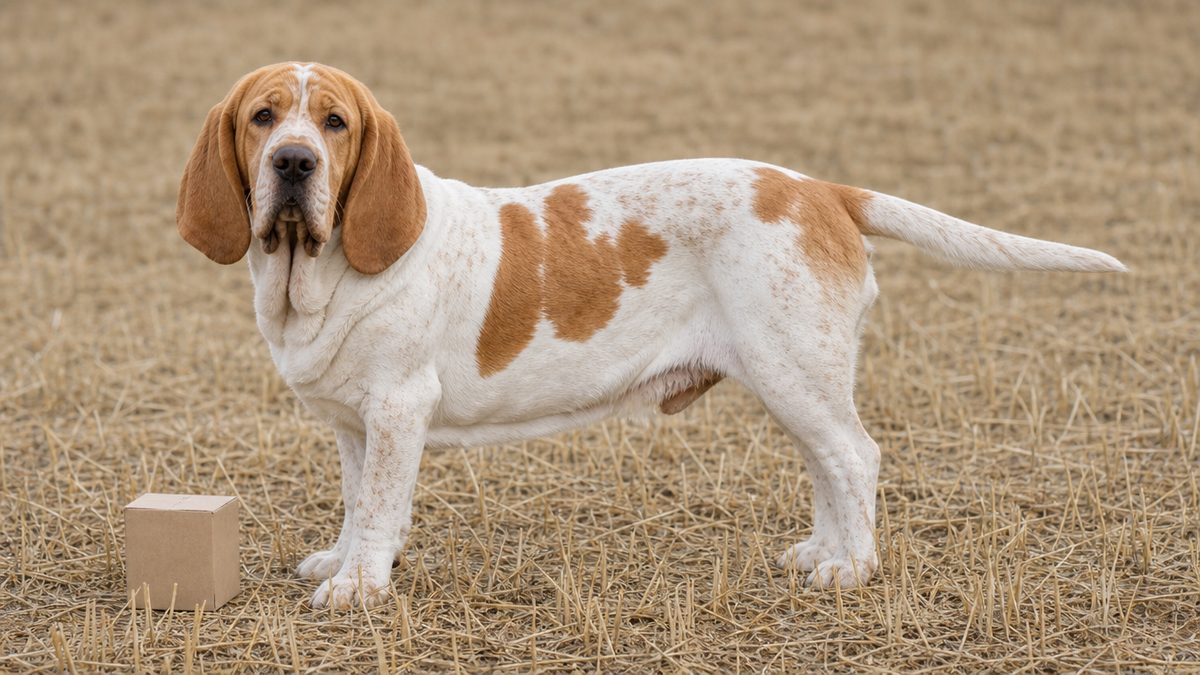
The physical picture the same order draws is a sturdy, rectangular dog with a big square head, a broad skull split by a deep central furrow, a pronounced stop, thick hanging ears set above the line of the eye, rather short limbs, a cylindrical trunk, loose thick skin forming a double dewlap, and a short, smooth coat of hard texture and coarse appearance. The most typical coats are white and orange, white and chestnut, white and black, and white and liver, with patches and ticking on a light ground.
| Measure | Value |
|---|---|
| Height at withers | 48 cm minimum, 60 cm maximum |
| Average male height | about 55 cm |
| Average female height | about 52 cm |
| Weight | 20 to 30 kg |
| Coat | Short, smooth, hard texture, coarse appearance |
| Bite required | Complete dentition, scissor |
| Recognised | Navarre 2006, Spanish state 2010 |
Two things about that table are worth saying out loud. The first is that the breed standard gives a single height range for both sexes rather than separate male and female bands, which is unusual and which makes the averages the only sex-specific figures available. The second is that the Real Sociedad Canina de España, publishing its own Standard No. 409 for the same dog, prints the identical minimum, maximum and weight range. On the measurements the two Spanish authorities agree exactly, which is worth recording because on almost everything else they do not.
The temperament clause reads docile, calm and intelligent, sociable with humans and with other dogs, and in the field a vigorous, resistant trotter naturally inclined to hunt as a team with its handler. Navarre then does something few gundog standards do: it makes a dog of very lively and excitable character a defect that excludes it from recognition altogether. A Spanish government text that disqualifies over-excitability is a useful signal for anyone thinking about a flat in an Indian city.
How rare, and how that rarity is moving
Spain's vulnerable-breed list is republished annually, and comparing two editions is more informative than reading either alone. The list running from 1 May 2025 to 30 April 2026 carried sixteen breeds; the current one, covering 1 May 2026 to 30 April 2027, carries twenty-one Real Sociedad Canina de Espana. Five breeds were added over the year, the Gos d'Atura Català, the Ratonero Bodeguero Andaluz, the Podenco Ibicenco, the Alano Español and the Majorero, and none was removed. The Pachón Navarro is on both editions.
That drift is worth publishing rather than smoothing over, and it also dates a stale claim. English Wikipedia currently says the breed is among 'the sixteen Spanish breeds' the RSCE considers vulnerable, citing the older list. As of 3 September 2026 the correct figure is twenty-one.
The breed is rare and Spain says so formally. The Real Sociedad Canina de España carries it on the list of Spanish breeds it considers vulnerable, and the last population estimate anyone has published is 700 to 1,000 dogs, in 2009 Wikipedia, 'Pachon Navarro'. There is no Indian population at all, and the rest of this page explains why that is a matter of law rather than of taste.
The names this dog answers to, and why they matter
The Pachón Navarro carries at least six names, and every one of them changes what a search engine gives you back.
English Wikipedia records the alternatives as Nafarroako eper txakur in Basque, plus Pachón, Pachón de Vitoria, Pachón español, Perdiguero común and Perdiguero navarro. The nineteenth century is when the spread happened: as hunting became a bourgeois occupation the type turned up across much of Spain under whichever of those names the local shooting community used.
That matters more than a naming footnote usually does, because the entire peer-reviewed record of this breed hangs on a name nobody would guess. Searching PubMed for the phrase Pachón Navarro returns thirteen records and a warning that the phrase was never found, because the engine had already broken it into two very common Spanish surnames. The one paper that genuinely concerns a dog of this breed surfaces only under a field-limited query, and the paper itself calls the animal a Spanish Pachon.
In the same session, the control query for the Perdiguero de Burgos was silently turned into an author search for a person called de Burgos and returned zero, for an FCI-recognised breed that demonstrably does have a literature. A zero on a Spanish breed name is often the search engine's answer to a question you did not ask.
The Basque connection is real but contested in its framing. Wikipedia groups the Pachón Navarro with the Basque Shepherd Dog, the Erbi Txakur, the Villano de Las Encartaciones and the Villanuco de Las Encartaciones as one of five Basque breeds. Navarre's own order simply gives the origin as Navarra, Spain, and says nothing about Basqueness. Both are true statements about different things, and only one of them is a legal text.
For an Indian reader the practical consequence is small but real. If you want to verify anything about this dog for yourself, search the Spanish name in Spanish sources and the Basque name in Basque ones, and treat an English-language result that names no document as a lead rather than as evidence. Every substantive fact on this page came from a Spanish or an Indian gazette, an FCI register, or a journal, and none of it came from the English breed-page internet.
How the Pachón Navarro became an official Spanish breed
Spain recognised the Pachón Navarro in two separate acts four years apart, and the second one is the instrument almost nobody names.
The first act was regional. On 14 August 2006 the Consejero de Agricultura, Ganadería y Alimentación of the Government of Navarre made Orden Foral 270/2006, published in the Boletín Oficial de Navarra number 115 on 25 September 2006. Article 1 recognises the racial and functional standard set out in Annexes I and II. Article 2 creates the breed's Libro Genealógico, defined in Annex III. Article 3 creates a database attached to the Servicio de Ganadería to which the bodies managing the studbook must supply registration and valuation data every six months.
The second act was national, and it took nearly four more years. The preamble to the Navarre order already records that the breed was presented to the Ministry's Comité de Razas on 21 June 2006 and that the Committee approved its inclusion in the annex of Real Decreto 558/2001. The order that actually performed that inclusion is Orden ARM/573/2010 of 4 March 2010, published in the Boletín Oficial del Estado number 62 on 12 March 2010 at page 24841 and signed by the Minister for the Environment and Rural and Marine Affairs.
| Date | What happened | By whom |
|---|---|---|
| 21 June 2006 | Committee approves inclusion in the national annex | Comité de Razas de Ganado de España |
| 14 August 2006 | Racial and functional standard recognised, studbook created | Government of Navarre |
| 4 March 2010 | Breed actually added to the annex of RD 558/2001 | Ministerio de Medio Ambiente, y Medio Rural y Marino |
The state honoured this dog 27 years before it registered it
There is an earlier act of Spanish state recognition, and it is a nice corrective to the idea that a breed's status begins with its paperwork. On 18 May 1983 the Presidencia del Gobierno ordered a four-stamp series called *Perros de raza española*, issued for a world dog show and the Asamblea Cinológica Internacional held that June, with a print run of eight million of each value. The values were 10 pesetas for the Perdiguero de Burgos, 16 for the Mastín español, 26 for the Podenco ibicenco and 38 pesetas, the highest of the four, for the Pachón navarro.
So the Spanish state put this dog on its most valuable dog stamp in 1983, four years after the census that began the recovery, and did not admit it to the national canine annex until 2010. Recognition by a state comes in more than one form, and the postal authority got there first by 27 years.
Read the 2010 order closely and it does one thing only. Its single article says that the pure Spanish canine breed Pachón Navarro is included in the annex of Real Decreto 558/2001, and it stops there. It attaches no racial prototype. That is the explanation for something a reader of the consolidated decree would otherwise find baffling: across all 73 pages of Real Decreto 558/2001, a whitespace-tolerant search for the string Pachón returns exactly one hit, in the alphabetical list, and the decree prints a full prototipo racial for other breeds and none at all for this one.
In that annex the Pachón Navarro sits sixteenth of 33, between the Mastín Español and the Pastor Garafiano. The neighbour is instructive and this site has now built its page too: the Pastor Garafiano was added six years earlier, in 2004, and unlike the Pachón it arrived with a full state-published racial prototype attached. Two breeds, one line apart in the same list, admitted on completely different terms.
Orden ARM/573/2010 explains that references to the Comité de Razas de Ganado de España are now to be read as references to the Comisión Nacional de Coordinación. In doing so it names Real Decreto 2129/2008 and then, one clause later, refers back to 'el citado Real Decreto 2120/2008'. Two different decree numbers for one instrument, in a single sentence, in the order that recognised this breed.
The wrong Spanish catalogue, and why every news report reaches for it
Spanish dog breeds do not live in Spain's official livestock catalogue, and sending a reader there is the commonest error written about Spanish native breeds.
The Catálogo Oficial de Razas de Ganado de España is Annex I of Real Decreto 45/2019. Bonbeno downloaded the consolidated 34-page text and extracted it, and its species headings are bovine, ovine, caprine, porcine, equine (horse), equine (ass), poultry, and a closing 'otras especies' holding the Canary camel and two rabbits. There is no canine section. Article 2 of the same decree limits its own scope to the bovine, porcine, ovine, caprine and equine species.
The search that settles it is cheap and repeatable. Across the whole document the word *canina* appears exactly once and the word *canino* appears not at all. That single occurrence sits in the Disposición final primera, which does nothing more than rewrite Real Decreto 558/2001's power to add new canine breeds to that other decree's annex. In other words, the livestock catalogue's only canine content is a sentence pointing at a different instrument.
That different instrument is Real Decreto 558/2001, whose ANEXO is headed RAZAS CANINAS ESPAÑOLAS and opens 'Las razas caninas españolas son las que figuran a continuación' before listing 33 breeds. This is the only Spanish national register of dog breeds, and it is where the Pachón Navarro actually sits.
- The livestock catalogue, Annex I of RD 45/2019: eight species, no dogs, and one sentence pointing elsewhere.
- The canine annex, the ANEXO to RD 558/2001: 33 Spanish dog breeds, Pachón Navarro sixteenth.
- The amending orders: APA/807/2004 added five breeds with prototypes, ARM/573/2010 added this one without.
The reason to labour the point is that the confusion is not confined to blogs. It is repeated in press coverage of Spanish breed recognition generally, and this site's own sibling pages have caught it independently more than once. If a page tells you a Spanish dog was added to the Catálogo Oficial de Razas de Ganado, it has named a document that contains no dogs, and whatever else it says about that breed's legal status deserves checking before you rely on it.
For the reader, the working rule is simple. Spanish canine recognition is a question about Real Decreto 558/2001 and the ministerial orders that amend its annex, and nothing else. Everything on this page about the Pachón Navarro's official status was read out of those documents directly.
Spain has two standards for this dog and they disagree
The Navarre order and the Real Sociedad Canina de España's Standard No. 409 describe the same breed and take different positions on teeth, coat, colour and disqualification.
Both documents are official, both are free to read, and Bonbeno read both in full. The RSCE standard is plainly derived from the Navarre text: its historical summary is a word-for-word translation, and its size clause reproduces Navarre's figures exactly. What changed in transit is the part that decides whether a dog can be registered.
| Clause | Navarre order (2006) | RSCE Standard No. 409 |
|---|---|---|
| Not a scissor bite, missing teeth, jaw deformation | Listed as defects that do NOT exclude | Listed under faults that EXCLUDE from initial registration |
| Ectropion and entropion | Excluding defect | Absent from the list entirely |
| Tailless specimens | Excluding defect | Absent from the list entirely |
| Long-coated 'sedeño' variant | Recorded as occurring in some litters | Absent |
| Typical coat colours | Four named: white and orange, chestnut, black, liver | Not named, only 'a great variety' |
| Disqualifying colour | Colores abarcinados (brindle) | Rendered as 'Fawn colours' |
| Nose pigmentation | According to the dog's coat | According to the coat, 'avoiding dispigmentations' |
The first row is the consequential one. Under Navarre's order, a Pachón Navarro with missing teeth or a bite that is not a scissor is still a recognisable dog of the breed, because those defects sit in the list headed *defectos no excluyentes del reconocimiento*. Under the RSCE standard the same three faults sit under 'Faults that exclude dogs from the Initial Registration'; Real Sociedad Canina de Espana. One document says a gap in the dentition does not stop you registering the dog; the other says it does.
The colour row is a translation error rather than a policy difference, and it is checkable in three documents. Navarre disqualifies *colores abarcinados*. The RSCE's Spanish-language breed record prints the same word, *abarcinados*. The RSCE's English standard renders it 'Fawn colours';. Abarcinado means brindle. Fawn is a different colour entirely, and reading the English text literally would exclude dogs the Spanish text welcomes.
For anything legal, the Navarre order, because it is the act of a public authority and it is the document the studbook runs on. For anything about showing or registering through the Spanish kennel body, the RSCE standard, because that is the body applying it. Where the two collide, this page prints both rather than choosing, and the collision is itself the most useful thing on the page.
There is one more disagreement, and it is inside the RSCE itself. Its breed record files the Pachón Navarro in 'Grupo 11 - Perros de Muestra Continentales - Tipo Braco', the national group for breeds the FCI does not recognise. Its own downloadable Standard No. 409, on the same site on the same day, prints 'Classification RSCE: Group 7: Pointing Dogs Section 1: Continental Pointing Dogs', and the string Group 11 appears nowhere in it Real Sociedad Canina de Espana. Same body, same breed, two group numbers.
Why the FCI absence decides the Indian question
The Fédération Cynologique Internationale does not hold the Pachón Navarro, and because the Kennel Club of India issues pedigrees against FCI nomenclature, that absence answers the Indian registration question directly.
Bonbeno read the FCI's own Group 7 register with JavaScript enabled rather than trusting a summary. Section 1.1, the Braque type, is listed country by country, and country 8, SPAIN, holds exactly one entry: PERDIGUERO DE BURGOS (90), with a validity date of 5/26/1982. There is no second Spanish line anywhere in Group 7 and no entry under any Pachón, Navarro or Spanish Pointer name.
The in-document controls matter, because this project has repeatedly been served the wrong FCI page at HTTP 200. Denmark's Gammel Dansk Hønsehund (281) is present, France carries six Braque entries, and Section 2 carries the English Pointer (1), the English Setter (2), the Gordon Setter (6) and the Irish Red and White Setter (330). Those are exactly the breeds that must be in a real Group 7 register, so the absence is a finding about the breed rather than about the document.
The register also proves its own date format, which is worth a sentence because this project has published a wrong FCI date before. Rows in the same table read 8/10/2023, 3/24/2004, 2/21/2006, 10/25/2000 and 4/19/2005. Values above 12 appear only in the second field, so the first field is the month and the Perdiguero's 5/26/1982 is 26 May 1982.
From there the Indian consequence follows in one step. The FCI members register lists India as a full member represented by the Kennel Club of India, so the KCI issues pedigrees against FCI nomenclature. A breed the FCI does not hold has no KCI pedigree route, which means a Pachón Navarro in India could not be registered as a pedigree dog even if one somehow arrived.
Do not read this as the KCI having considered and rejected the breed. The Kennel Club of India publishes no breed list at all, so a query there returns nothing for this breed and nothing for any control breed either. That is a broken instrument, not a finding. The FCI register is the checkable route, and it is the one used here.
The RSCE's Grupo 11 is the honest counterpart to that absence. It is headed 'Razas no reconocidas por la FCI' and holds eleven breeds, including the Pachón Navarro, the Ca Mè Mallorquí, the Alano Español, the Maneto and the Perro de Pastor Garafiano. The FCI has ten groups, so an eleventh is a national body's own register, honestly labelled. That is a genuine register and a real status; it is simply not FCI recognition, and no page should present it as such.
What the standard actually says about the double nose
Orden Foral 270/2006 gives the double nose exactly one sentence, says it appears in only some specimens, and places it in neither of the standard's two fault lists.
Here is the clause in full, from the Nariz entry of Annex I. The nose is broad, with large open nostrils and a straight front profile. Then: *'En algunos ejemplares se presenta la denominada nariz partida o doble nariz, característica recogida mayoritariamente por los distintos autores clásicos.'* In some specimens the so-called split nose or double nose is present, a characteristic recorded by most of the various classical authors. The colour of the nose leather and mucous membranes follows the dog's coat. That is the entirety of the legal treatment.
Read what that sentence does and does not do. It does not require the trait. It does not describe it as typical. It reports it, in the past tense of the literature, as something the classical authors wrote about. And it is absent from both of the standard's lists: the *defectos no excluyentes del reconocimiento*, which names a non-scissor bite, missing teeth and jaw deformation, and the *defectos que excluyen del reconocimiento*, which runs to ten items including brindle colouring, ectropion and entropion, taillessness and cryptorchidism.
The RSCE's English Standard No. 409 carries the same sentence, translated: 'In some dogs, it can be seen the so-called splitted nose or double nose, characteristic basically gathered by the different classical authors';. Two Spanish authorities, one regional government and one national kennel body, agree that this is a minority variant reported by old writers.
What the popular sources did with that one sentence
English Wikipedia handles it accurately and briefly, saying that a few examples display an unusual characteristic, a split or bifid nose, and adding that the trait is shared with the Turkish Tarsus çatalburun and is occasionally seen in South American dogs, for which it cites a 2007 BBC News piece headlined 'Double-nosed dog not to be sniffed at'; BBC News, 'Double-nosed dog not to be…. That is a fair summary of the standard. What happened downstream of it was not.
Now set that against what the Indian search results say. The page ranking second for 'pachon navarro dog' in India opens with 'A great big old double nose'. Google's 'People also search for' rail offers the Turkish pointer and the Double-nosed Andean tiger hound. The knowledge panel credits a pointing-dog magazine. The whole English-language framing treats the split nose as the breed's defining feature, and the two documents that define the breed treat it as a footnote.
| Document | Breed | What it says about a split nose |
|---|---|---|
| Orden Foral 270/2006 | Pachón Navarro | Occurs in some specimens; in neither fault list |
| RSCE Standard No. 409 | Pachón Navarro | Same sentence, translated; not an excluding fault |
| FCI Standard No. 90 | Perdiguero de Burgos | DISQUALIFYING FAULT: 'Split nose or black nose' |
That third row is worth the detour, because it shows the trait is not neutral in Spanish cynology. Bonbeno downloaded the English and the authentic Spanish texts of FCI Standard 90 from links printed on the FCI's own breed record, and extracted both. The English disqualifying list reads 'Split nose or black nose'; the authentic Spanish reads 'Nariz partida o negra';. The only Spanish pointing breed the FCI recognises throws a split-nosed dog out of the ring. The one it does not recognise records the trait and moves on.
What the genetics says, and the sentence that changes the argument
The bifid nose is a midline developmental variant, and the best current paper on it links the trait in a related breed to a loss-of-function variant in PDGFRA while reporting that no Pachón Navarro sample was available to test.
The paper is Buckley and colleagues, published in *Genome Research* in May 2025 by a group led from the National Human Genome Research Institute with co-authors in Ankara, Stockholm, Konya, Utrecht and Helsinki. Its headline finding on this trait is a splice-acceptor loss-of-function variant in PDGFRA associated with bifid nose in the Turkish Çatalburun, which the authors read as implicating the gene in midline closure. A second, independent PDGFRA splice-acceptor variant turned up in a bifid-nosed mixed-breed dog, which strengthens the association considerably.
On this breed the paper is explicit and it is a negative. Verbatim: 'An additional breed, the Pachón Navarro, which originates in Spain, is also known for its bifid nose phenotype. Unfortunately, no samples from this breed were available for study';. So the genetic cause of the split nose in the Pachón Navarro is untested and unknown. Anyone telling you the breed carries the Çatalburun variant is going beyond the only paper that has looked.
The paper corroborates the standard on the one point that matters most. It states that 'The Pachón Navarro, like the Çatalburun, is a pointing breed with only some members displaying the characteristic bifid nose phenotype';. A Spanish legal text and an American genomics laboratory, working from completely different evidence, agree that this is a minority trait.
And then comes the sentence that reframes the whole subject: 'because Pachón Navarro dogs are susceptible to cleft palate, they have been used as surgical animal models for palate repair'. A bifid nose and a cleft of the primary palate are both failures of midline closure, and the only bifid-nose case report Bonbeno could find in the indexed veterinary literature describes exactly that combination: a one-year-old Springer Spaniel whose bifid nasal cartilages had to be opposed and sutured through a Y-shaped incision, with two incisor teeth extracted and the cleft mucosa closed.
Buckley cites Paradas-Lara and colleagues 2014 for the cleft-palate model claim. Bonbeno resolved that record individually rather than by position in a batch fetch, and read it: 'Maxillary growth in a congenital cleft palate canine model for surgical research', from the Universidad Complutense de Madrid with the Spanish Ministry of Defence's Centro Militar de Veterinaria. The words Pachón, Navarro, breed and Beagle appear zero times in its abstract, and the full text is paywalled. So this page reports what Buckley asserts and states plainly that the breed could not be confirmed from the cited paper's own abstract.
The companion study from the same Madrid group is readable and is worth knowing about, because it describes what the model involves. Dog pups with congenital cleft palate were left untreated, given a two-flap palatoplasty, or treated with an injection technique in which a hyaluronic-acid hydrogel carrying hydroxyapatite and BMP-2 was placed under the periosteum at the cleft margins at six weeks of age, with the margins closed at week ten. Whatever breed those pups were, that is what a cleft palate means for a puppy.
The double nose against Indian breeding law
Indian law prohibits breeding for unusual looks outright, which makes the split nose a legal question in India rather than a decorative one.
Second Schedule Part II paragraph 6(9) of the Prevention of Cruelty to Animals (Dog Breeding and Marketing) Rules, 2017 is one sentence long: 'Breeding to create new breeds of dogs or unusual looks shall be strictly prohibited';. Bonbeno extracted the gazette itself, all fourteen pages with a real text layer, rather than relying on a summary, because this particular document has handed several people fabricated rule numbers.
A split nose is an unusual look by any ordinary reading. It is also, on the best current evidence, a midline developmental variant that travels with cleft palate. Put those together and an Indian breeder who selected for the trait would be doing precisely what paragraph 6(9) forbids, and doing it for a phenotype the genetics literature associates with an orofacial cleft.
This clause is a Second Schedule paragraph, not a Rule. The Rules themselves run 1 to 13 and there is no Rule 14, so a citation reading 'Rule 21' or 'Rule 6(9)' is wrong on its face. A whitespace-tolerant search of the gazette returns zero hits for the string 'Rule 21'. Cite Second Schedule Part II paragraph 6(9), and Second Schedule Part III paragraph 8(10) for the genetic-defect clause.
The genetic-defect clause bites too, and it bites on the teeth rather than the nose. Second Schedule Part III paragraph 8(10) requires that dogs 'shall have been tested for genetic defects, including hip dysplasia, progressive retinal atrophy, night blindness, hypothyroidism, entropion, ectropion, overshot, undershot jaw (when incisors do not touch or mesh), wry mouth, two or more missing teeth, unilateral cryptorchid or full cryptorchid males';. Note the word *including*: the list is illustrative, not closed.
Set that against the two Spanish standards and a three-way position appears. Navarre files missing teeth as a defect that does not exclude a dog from recognition. The RSCE files the same fault as one that excludes a dog from initial registration. Indian law names two or more missing teeth as a genetic defect a breeding dog must have been screened for The Prevention of Cruelty to Animals. Three authorities, three different treatments of one trait, and an Indian breeder would be bound by the strictest.
There is one clean alignment worth recording, because this site does not only look for conflict. Navarre's excluding list contains ectropion and entropion, and monorchid or cryptorchid males. Paragraph 8(10) names entropion, ectropion and unilateral or full cryptorchid males. On the eyelids and the testicles, a Spanish regional government and the Indian Animal Welfare Board are asking for the same thing.
The tail sentence that is illegal to follow in India
Navarre's standard says a third of the tail is traditionally removed, and Indian law forbids tail docking outright, so an Indian owner following the Spanish text would be breaking the 2017 Rules.
The clause sits under Rabo in Annex I. The tail is of medium set, straight and thick, falling at rest as an extension of the croup and carried cheerfully with a side-to-side movement when hunting. Then: *'Tradicionalmente se elimina un tercio de su longitud total.'* Traditionally a third of its total length is removed. The RSCE's English standard keeps the sentence: 'Traditionally a third of its total length is cut off';.
Second Schedule Part II paragraph 6(8) of the 2017 Rules reads, verbatim: 'There shall be no tail docking, ear cropping, de-barking, de-clawing, branding, dyeing, injecting substances to enhance visual appeal, performing a surgery or procedure to camouflage or hide any defect or infirmity or any other kind of mutilation of any body part of the pup and any change of appearance by artificial means is strictly forbidden';. There is no exception for tradition, for breed standards, or for working dogs.
So a Pachón Navarro kept in India must carry a full tail, and any Indian breeder who docked one would be in breach. This is the general lesson rather than a quirk of one breed: an overseas parent club or a regional government writes for its own jurisdiction, and repeating its care or conformation advice inside India can put a reader on the wrong side of a gazette.
Two details sharpen it. First, Navarre's own excluding-defect list contains *ejemplares anuros*, tailless specimens. So the same standard that describes removing a third of the tail disqualifies a dog born without one, which tells you the sentence is descriptive of a hunting practice rather than prescriptive of an appearance. Second, the RSCE's version of the standard drops taillessness from its fault list entirely while keeping the docking sentence.
The Pastor Garafiano goes the other way. The RSCE's standard for that breed makes 'Cola amputada', an amputated tail, a disqualifying fault, which lines up exactly with Indian law. Two Spanish breeds one line apart in the national annex, and India's rule agrees with one of their standards and contradicts the other.
The practical instruction for an Indian owner is short. Never dock, never crop, and if a seller or an overseas breeder offers a docked dog, understand that the procedure is prohibited here and that the animal's appearance is not the breed's natural one. The image on this page was briefed to show a natural, undocked tail for exactly that reason.
The studbook, and what a Pachón Navarro pedigree actually means
Orden Foral 270/2006 creates a Libro Genealógico with three sections and eight named registers, a mandatory transponder, and six-monthly data returns to the Navarre government.
This is the part of the breed's paperwork that satisfies the harder half of the two-condition test for a real breed: a written standard, plus individuals registered generation after generation in a book of origins. Navarre supplies both by public act, which is unusual. Most of the breeds in this site's Spanish cluster rest on a club's say-so.
| Section | Register | Who goes in it |
|---|---|---|
| Anexa | Registro Auxiliar de Nacimientos (RAN) | Pups with both parents in the Founder register, or one Founder and one Definitive |
| Anexa | Registro Fundacional (RF) | Dogs over 18 months with unknown or unregistered parents, after breed confirmation |
| Anexa | Registro Auxiliar de Adultos (RA) | RAN dogs, which must pass breed confirmation from 12 months |
| Principal | Registro Principal de Nacimientos (RN) | Pups whose parents, grandparents and great-grandparents are all in the book |
| Principal | Registro Definitivo (RD) | RN dogs that pass breed confirmation from 12 months |
| Méritos | Test de Aptitudes Naturales (TAN) | Puppies tested at 5 to 12 months |
| Méritos | Pruebas de Selección | Adults up to 4 years |
| Méritos | Pruebas de Trabajo | Adults over 4 years |
Three features of that structure are worth an Indian reader's attention. The Founder register has a stated expiry: the order says its validity is limited and will be determined by the competent authority. That is an open studbook that is designed to close, which is what a recovery programme looks like when it is being run properly rather than indefinitely.
Breed confirmation is not a formality either. The order requires it to be carried out by expert personnel appointed by the managing bodies, for the purpose of checking a dog's fitness to breed and the absence of transmissible zootechnical and psychic defects, and a positive result is a precondition for a dog's descendants entering the book. In other words, Navarre screens its breeding stock by regulation, not by recommendation.
Identification is mandatory and specific: a subcutaneous transponder, preferably in the left side of the neck, with a tattoo permitted only as a supplement. The transponder code goes into a database from which genealogy, ownership, production and morphological indices can be retrieved, and the bodies managing the studbook must supply that data to the Department of Agriculture every six months. Litters must be registered within six months of birth, and mating and birth must be notified within 30 days.
One live change is worth knowing, because it is a month old. The Real Sociedad Canina de España's governing committee has decided that from 1 August 2026 to 31 July 2028, specimens of vulnerable Spanish breeds making an Initial Registration enter the Registro de Razas Caninas without a DNA test, while DNA remains obligatory for homologating any championship title and for obtaining a Pedigree Plus. The Pachón Navarro is on that vulnerable list, so the rule applies to it directly.
Pachón Navarro price in India
There is no Pachón Navarro price in india, because nobody sells one here, and every rupee figure the Indian search results attach to the breed belongs to merchandise rather than to an animal.
Bonbeno ran the commercial query on a Google India render whose control had already passed in the same session, and the result was not a thin market. It was a different product. 'Pachon navarro price in india' returned 'About 23,200 results' led by Raleigh Navarro bicycles at an Indian cycle retailer, priced at INR 9,565, 11,345, 13,905, 14,845 and 21,085, and the first question in its People also ask box was 'What is the price of a Raleigh Navarro bike?'.
The bare informational query in the same session, 'pachon navarro dog', returned a clean, on-topic result set. So the hijack is a property of the phrasing and not of the breed, and anyone who runs only the commercial form will conclude something false about what exists.
| Figure | What it is | Live animal? |
|---|---|---|
| Rs 987 | A 44-page Kindle handbook on Amazon.in | No |
| Rs 3,580 | An Etsy 'Pachon Navarro shirt' | No |
| Rs 3,435 | A Desertcart import listing | No |
| Rs 865 | A second Desertcart listing | No |
| USD 24.99 | An eBay etched pint glass | No |
| INR 9,565 to 21,085 | Raleigh Navarro bicycles | No |
| 25,000 pesos | Mercado Libre Mexico, and the dogs listed are Pyrenean Mountain Dogs | No, and wrong breed |
Google's own AI answer is worth quoting because it does two contradictory things in one screen. It states that there is no official or stable price for a Pachón Navarro in India because the breed does not exist commercially in the country, and then prints a full cost breakdown anyway. Its import-and-shipping line reads 'Rs 1,500,000 to Rs 3,00,000', a range whose floor is five times its ceiling, which is self-refuting without any research at all.
Its puppy figure is a straight currency conversion wearing an Indian coat. 'EUR 1,000 to EUR 2,000 (approx. Rs 90,000 to Rs 1,80,000)' divides to exactly 90.00 rupees per euro at both ends. That is arithmetic, not an Indian price observation, and this site has now caught the same mechanism at 84.38, 80, 74 and 66.67 rupees to the dollar. Ninety to the euro is a new entry in that list. The source the AI credits for the puppy cost is a page visible on the same results screen titled 'How much does a Beauceron cost?'.
Google printed 'About 118 results' for 'pachon navarro dog' and 'About 182 results' for 'labrador retriever price in india', the thickest commercial breed query in India, on the same render minutes apart. The rare breed and the head term returned counts of the same order. Never read an absolute result count as evidence of demand; what evidences a thin market is composition, and the composition here is books, shirts, glassware and bicycles.
The honest summary is short. Bonbeno found no Indian breeder, no Indian listing, no Indian rescue and no Indian rupee figure attached to a living Pachón Navarro, and publishes none. The next section explains why that is not going to change.
Whether you can import a Pachón Navarro into India
You can bring a Pachón Navarro to India only as your own pet under strict conditions, and you cannot lawfully import one to breed or to sell.
The instrument is DGFT Trade Notice 22/2022-23 of 19 December 2022, which Bonbeno downloaded and extracted rather than summarising from a blog. It places ITC(HS) 01061900, 'Mammals: Other', in the Restricted category subject to Policy Condition 6.
- Policy Condition 7 allows the import of dogs only for a pet dog with a valid pet book and relevant records in the importer's own name, for R&D organisations conducting research with a CPCSEA recommendation, or for internal security by the Defence and Police Force.
- Policy Condition 8 states that import of commercial dogs for breeding or any other commercial activity beyond those purposes is not permitted.
- Paragraph 6 states that any application for trading or breeding purposes, or made on behalf of another person or entity, shall be duly rejected.
- Paragraph 7 limits entry to the airports and seaports of Delhi, Mumbai, Chennai, Hyderabad, Bangalore and Kolkata, with quarantine at those ports where required. DAHD added a seventh port, Cochin International Airport at Kochi, for pets arriving under the baggage rules in October 2024.
- Permanent import as passenger baggage without a DGFT authorisation is open only to a person transferring residence to India after two years of continuous stay abroad, and only for cats and dogs.
Read alongside the FCI absence, those two facts close the question. There is no pedigree route, because the Kennel Club of India issues against FCI nomenclature and the FCI does not hold the breed. And there is no lawful commercial import route, because the only categories that permit a dog to enter are a personal pet, a licensed research programme and the security forces. Either fact alone would stop a market forming. Together they make one impossible.
One caution about the port list, because this site has seen it mis-updated. The six ports above are the ones this notice itself names, and Bonbeno confirmed that the strings Kochi and Cochin appear zero times in it. Personal pet import under the baggage route runs on a different instrument with its own port list, and the two should not be merged. If you need the current list for either route, read that route's own document.
The realistic path for the small number of Indians who might genuinely end up with one of these dogs is therefore a relocation. A family returning to India after two years or more abroad, with a Pachón Navarro already registered in their own name in Spain and a complete pet book, can bring the dog through one of the six ports or, since October 2024, Kochi. Nobody else can, and no amount of willingness to pay changes that. The full route is set out in how to import a dog to India.
Anyone who is offered a Pachón Navarro puppy in India should treat the offer as a red flag rather than an opportunity. Given the population is somewhere between 700 and 1,000 dogs worldwide and the breed has no lawful Indian supply chain, the probability that a puppy advertised here is what it claims to be is very low.
Monthly cost of ownership for a 25 kg dog in India
Keeping a 20 to 30 kg dog in an Indian metro costs roughly Rs 6,000 to Rs 12,000 a month once food, parasite control, vaccination and grooming are counted honestly, and none of that figure is breed-specific.
There is no Pachón Navarro price in India, but the running cost of ownership for a dog of this size is real, published and sourceable, and it is what an Indian reader actually needs. Everything below is a figure from a named vendor's own page, read on 3 September 2026, and none of it is converted from a foreign currency.
| Line | Published figure | Source |
|---|---|---|
| Anti-rabies, single dose | Rs 699 | Vetic clinic |
| 9-in-1 DHPPiL | Rs 899 | Vetic clinic |
| Kennel cough | Rs 1,349 | Vetic clinic |
| Tick, flea and worm cover | Rs 1,103 a month | NexGard Spectra 15-30 kg, Supertails |
| Deworming, single dose | Rs 251 to Rs 377 | Drontal Plus, dosed 1 tablet per 10 kg |
| Bath | from Rs 934 | Vetic grooming, Delhi |
| Boarding, 24 hours | Rs 899 | PawSpace, Bengaluru |
| Dog registration, Delhi | Rs 500 | MCD, new registration |
| Pet licence, Chennai | Rs 50 | Greater Chennai Corporation |
Where the money actually goes
Boarding is the line most owners forget until they need it, and it is the one that varies most by city and by model. A Bengaluru operator publishes Rs 599 for up to four hours, Rs 799 for a ten-hour day and Rs 899 for a full 24 hours. For a one-owner breed that is a cost you should expect to meet more often than average, because this is not a dog that settles easily with strangers.
The parasite line is the one that surprises people, and for this breed it is not optional. A single monthly NexGard Spectra tablet at Rs 1,103 covers the tick and flea role and the roundworm and hookworm role together for a 15 to 30 kg dog. Over a year that is about Rs 13,200, which for many owners is the largest predictable line after food.
Vaccination is where the same product costs wildly different amounts depending on how you buy it, and it is worth understanding before you commit. Vetic's per-vaccine prices are stable across its city pages, but its bundled puppy course price is not, so a course quoted on one city page should never be compared against another city's as though it were a change over time.
Greater Chennai Corporation licenses pet animals for Rs 50 and issued 9,115 licences in 2024, and its six municipal pet clinics provide all treatment and anti-rabies vaccination free of cost. Delhi's MCD charges Rs 500 to register a pet dog and has issued 18,958 certificates since 2021, rejecting 71 of 1,006 applications in 2026-27.
Two lines are deliberately absent from the table. There is no purchase price, because none exists. And there is no monthly food figure, because the retail bag this site priced previously had already changed listing within days, and a monthly food number is arithmetic over a grams-per-day figure rather than a quoted price. Budget for it, weigh the food, and re-price the bag yourself rather than trusting any published monthly cost for kibble, including one on this page.
Add it up and a 25 kg dog in Bengaluru or Delhi runs at roughly Rs 6,000 to Rs 12,000 a month across food, parasite cover, routine veterinary care and occasional grooming or boarding, with the spread driven mostly by which delivery model you use rather than by the dog.
Suitability for the Indian climate
The Pachón Navarro comes from a place whose hottest month is cooler than Bengaluru's coldest, and the risk in India is wet-bulb load rather than humidity or dry heat alone.
Bonbeno queried NASA POWER by explicit latitude and longitude rather than by place name, and echoed the elevation POWER returns for each cell against the town's real elevation, because a grid cell can silently describe somewhere else. Pamplona at 42.8125 N, 1.6458 W returns a cell elevation of 516.50 m against a real 449 m, an error of +67.50 m. That is plains-accurate, so the Navarrese baseline is usable at face value.
The baseline is cold by Indian standards. Pamplona's annual mean is 11.67 C. Its hottest month, August, averages 19.13 C. Its coldest, January, averages 4.86 C. Set that against Bengaluru, the mildest large Indian city on this list, whose coldest month averages 20.22 C. Every month of the year in Bengaluru is hotter than the hottest month in this breed's homeland.
| Place | Annual mean C | Annual RH % | Peak wet bulb C | Month |
|---|---|---|---|---|
| Pamplona (Navarre) | 11.67 | 81.70 | 16.07 | August |
| Bengaluru | 23.74 | 67.94 | 21.86 | May |
| Pune | 23.86 | 66.80 | 22.97 | June |
| Delhi | 25.60 | 45.56 | 26.50 | July |
| Mumbai | 26.77 | 67.39 | 25.77 | June |
| Chennai | 27.95 | 72.39 | 26.11 | May |
| Kolkata | 25.81 | 73.93 | 27.09 | June |
That table contains the single most counter-intuitive fact on this page, and most breed pages get it backwards. Pamplona is more humid than every Indian city listed. At 81.70 percent annual relative humidity it beats Kolkata at 73.93, Chennai at 72.39, Mumbai at 67.39 and Delhi at 45.56. Damp air is this dog's native condition. Anyone who tells you Indian humidity will finish a northern Spanish breed has not looked at northern Spain.
What does hurt it is the two together. Wet bulb is the temperature that matters for a panting animal, because it sets the ceiling on how much heat evaporation can shed, and it rises with heat and humidity jointly. Pamplona's peak is 16.07 C in August. Kolkata reaches 27.09 C, Delhi 26.50 C and Chennai 26.11 C. The gap of 11.02 C between Pamplona and Kolkata is the honest measure of what this dog is being asked to absorb, and it is far larger than any dry-temperature comparison suggests.
Wet bulb here is the Stull 2011 approximation, computed from T2M and RH2M only. It is never computed from T2M_MAX, which in the POWER climatology endpoint is the single highest value recorded in the whole period rather than a mean daily maximum. Feeding an extreme into a wet-bulb formula produces figures above 35 C, which is at the outer edge of anything ever observed on Earth and is always an error.
What that means city by city, and what the law requires
A Pachón Navarro can be walked safely in India only at the margins of the day, and Indian law separately restricts keeping a heat-intolerant dog outdoors.
Because the POWER climatology endpoint cannot give a mean daily maximum, Bonbeno pulled the daily series instead and averaged it: 3,653 days per point across 2015 to 2024. Pamplona's mean daily maximum across the whole year is 17.22 C, rising to 25.86 C in August. Delhi's is 32.59 C, rising to 41.92 C in May. Chennai's is 32.25 C, Bengaluru's 30.47 C.
So a routine May afternoon in Delhi is about 16 degrees hotter than a routine August afternoon in the breed's homeland. That is not a figure that responds to acclimatisation, conditioning or a good attitude. It is the reason the walking window in most of India is dawn and after dark for eight months of the year.
| Place | Year mean daily max C | Hottest month | That month's mean daily max C |
|---|---|---|---|
| Pamplona (Navarre) | 17.22 | August | 25.86 |
| Bengaluru | 30.47 | April | 36.31 |
| Chennai | 32.25 | April | 36.60 |
| Delhi | 32.59 | May | 41.92 |
The statutory hook is specific and it is not widely quoted. Second Schedule Part IV paragraph 21(1) of the 2017 Rules bars keeping in outdoor facilities, without the attending veterinary practitioner's written approval, dogs that are not accustomed to the temperatures prevalent in the area, breeds that cannot tolerate them 'such as long-haired breeds in high temperature locations', and sick, infirm, aged or young animals. The Pachón Navarro is short-haired, so the long-haired example does not catch it directly, but the first limb does: a dog from an 11.67 C annual mean is by definition not accustomed to Chennai.
The heat-illness evidence is worth carrying even though this breed was never in the study. Hall and colleagues, working a VetCompass cohort of 905,543 UK dogs, recorded 1,259 heat-related illness events from 1,222 dogs. Of the 879 events with a recorded trigger, 652, or 74.2 percent, were exertional rather than environmental or vehicular. Heatstroke in dogs is overwhelmingly something that happens on a walk, not in a parked car, and that is the transferable lesson for a working gundog in India.
- Bengaluru and Pune: the only realistic Indian cities, and even there exercise before 07:00 and after 19:00.
- Mumbai, Chennai and Kolkata: peak wet bulb above 25 C for months, so hard exercise is off the table from March to October.
- Delhi: the widest annual swing, with a January mean of 13.61 C the dog would enjoy and a May mean daily maximum of 41.92 C it could not work in.
- Hill stations: verify the elevation before assuming a hill town is cool, because the POWER cell for Ooty reads 784.64 m against a real 2,240 m and the cell for Shimla reads 897.65 m against a real 2,200 m.
No Indian dog of this breed exists to observe, so none of this is a report of how Pachones cope here. It is a statement about the gap between two climates, computed from the same instrument at both ends, with the cell elevation checked at every point. That is the most honest form the question can take.
Temperament and household fit
Navarre's legal standard describes a docile, calm, one-owner dog that is easy to handle, and it disqualifies an over-excitable one, which is unusually specific for a gundog text.
The racial standard's temperament clause is four words long in Spanish and worth all four: docile, calm and intelligent, sociable with humans and with other dogs. The functional standard in Annex II goes further and describes a dog that is easy to train and easy to dominate, mild, calm, of noble spirit, rustic and self-denying, and a one-owner animal.
It also says something about sex differences that few standards bother with: females are invariably precocious, and some males start hunting very early too. And on other dogs, it says the breed tolerates them well and is not quarrelsome, though it will defend what is its own and will fight if it has to over food or over game.
The disqualification is the part that should decide an Indian purchase. Among the defects that exclude a dog from recognition, Navarre lists *ejemplares de carácter muy vivo y excesivamente excitables*. A Spanish government text that throws out an over-excitable pointer is telling you what the breed is supposed to be, and it is not a high-strung dog.
- Suits: a household with a person at home, a garden or a park within reach, and a genuine daily walking habit at dawn and after dark.
- Suits: an owner who wants one dog and will be its person, since the standard describes a one-owner animal.
- Does not suit: a first-time owner who wants a low-input companion, because a gundog with no job becomes a problem in a flat.
- Does not suit: a household that travels constantly, since a one-owner dog handles boarding worse than a socially promiscuous breed does.
One warning about all of the above. This is a written aspiration in a legal instrument, not a behavioural study, and there is no published behavioural research on this breed in the indexed literature. Standards describe what a breed's custodians are selecting for. They are evidence of intent, and they are good evidence, but they are not the same thing as measurements of how the dogs behave.
For an Indian buyer the honest framing is this: if you meet a dog sold to you as a Pachón Navarro and it is sharp, reactive or hard to settle, that is not a variant of the breed. Under the breed's own standard it is a dog that would fail breed confirmation.
Training a pointing breed in an Indian city
Training a Pachón Navarro means giving a strict trotting gundog a search to perform, and in India that has to happen at dawn or after dark for most of the year.
Navarre's functional standard describes a trainable dog: easy to train, easy to dominate, learning quickly to hunt for and with the handler, and understanding cooperation as it accumulates experience. The word the order uses for the breed's characteristic style is *caza inteligente*, intelligent hunting, and it explicitly says the dog learns to work close to the gun because it grasps that the hunt is a team activity.
That is a gift and a constraint. A dog selected to solve a search problem alongside a person will do obedience easily and will also invent problems if nobody sets one. The training that matters for an Indian household is therefore not sit and stay, which this dog will absorb in a fortnight, but a daily scent task that occupies the part of its brain the standard was written about.
- Start scent work at eight weeks. The functional standard notes that carrying objects is innate in Pachón puppies and practised from the earliest age, so build on a retrieve rather than teaching one.
- Socialise deliberately through the first sixteen weeks. Indian street environments deliver noise, traffic and unfamiliar dogs at a scale a Navarrese village does not, and a one-owner breed needs that exposure early.
- Train the recall on grass at dawn. A trotting search breed off-lead in an Indian park at 06:30 is manageable; the same dog at 11:00 in May is a heat casualty waiting to happen.
- Protect the soft mouth. The standard requires a dog that carries game without crushing it and marks hard mouth as a fault, so avoid tug games that reward crushing pressure.
- Do not correct a point. The point is described as innate and reflexive, and punishing a dog for freezing on a scent teaches it to stop telling you what it has found.
The standard's own list of working faults doubles as a training checklist, which is unusual and useful. Frequent abandonment of the trot, an unfixed point, lack of initiative in the search, poor attention to the handler, incomplete retrieves of wounded game, little work in low scrub, and an excessively hard mouth all cost a dog its excellent grade. Continuous galloping, absence of a point, a disproportionate distance from the gun, inattention, disobedience and a mouth that punctures game make it unfit.
None of that translates directly into an Indian flat, and pretending otherwise would be dishonest. What does translate is the underlying requirement: this is a dog that needs to use its nose on a task, in cooperation with a person, most days. Substitute scent games, tracking in a park, and hidden-food searches for the hunt, and the breed's temperament works. Skip them and you have a bored 25 kg dog with a working brain.
One practical note for Indian owners specifically. Because this is a one-owner breed by its own standard, plan the training around whoever will actually be handling the dog day to day, and have that person do the early work. Splitting a one-owner dog's training across a household is how you get a dog that listens to nobody.
The daily exercise requirement, and what happens without it
A Pachón Navarro needs roughly ninety minutes of real work a day, and in India almost all of it has to be scheduled around the heat rather than around the owner.
The breed was selected to trot across broken ground for hours. Navarre's functional standard calls it *un trotador estricto*, a strict trotter, of lively gait and horizontal progression with a cheerful, constant rhythm, whose head and neck form a horizontal line that lifts to take the wind or drops to the ground to trail, and which in open country lengthens its stride without ever abandoning the trot. That is an endurance animal, not a sprinter.
Ninety minutes a day is the working figure, split across two sessions, with at least one of them involving the nose rather than only the legs. In Bengaluru or Pune that is achievable year-round at the edges of the day. In Chennai, Mumbai or Kolkata it is achievable from about November to February and severely constrained the rest of the year, because peak wet bulb sits above 25 C for months.
In a VetCompass cohort of 905,543 UK dogs, 652 of the 879 heat-related illness events with a recorded trigger, or 74.2 percent, were exertional. Heatstroke in dogs is overwhelmingly a walking and working injury rather than a parked-car one, and a breed bred to trot for hours in an 11.67 C annual mean is precisely the animal that will keep going past the point where it should stop.
The behavioural cost of skipping the exercise is predictable in a gundog and it is not subtle: destructive chewing, barking at movement past the door, and a dog that cannot settle in the evening. The standard's own disqualification of over-excitable temperament tells you the breed's custodians consider a settled dog normal, so a Pachón Navarro that will not switch off is usually under-worked rather than badly bred.
- Morning, 06:00 to 07:00: forty-five minutes of walking with ten minutes of scent work at the end.
- Evening, after 19:00: thirty to forty-five minutes, longer in winter.
- Monsoon: keep the sessions but dry the ears and the skin folds afterwards, because this is a dog with a thick loose skin and a double dewlap.
- April to June in the north, March to October on the coasts: shorten, shade, carry water, and cancel rather than push.
Swimming deserves a mention because owners reach for it in Indian summers. It is good exercise and it suits a retrieving breed, but the standard describes thick, somewhat loose skin forming characteristic folds and a double dewlap, and skin folds that stay damp in Indian humidity are where dermatitis starts. Swim the dog, then dry the folds and the ears deliberately rather than letting it air dry.
Grooming and coat care in Indian humidity
The Pachón Navarro's short hard coat needs about ten minutes of grooming a week, and the real work in India is the skin underneath it rather than the hair.
The coat is easy and both Spanish documents say so in the same words: short, smooth, of hard texture and coarse appearance Real Sociedad Canina de Espana. There is no undercoat to blow, no furnishings to mat and no clipping. A rubber curry brush twice a week lifts the dead hair and that is the whole routine. This is a genuinely low-maintenance coat for an Indian climate, which is one of the few things about the breed that works in India's favour.
One difference between the two standards is worth flagging for anyone buying abroad. Navarre records that some litters throw longer-coated dogs, called *sedeños*, which carry longer hair on the extremities and a softer texture than the short-coated dogs. The RSCE standard drops that variant entirely and gives the hair as short and smooth with no mention of it. If you meet a longer-coated Pachón, Navarre's text says it is within the breed and the RSCE's does not describe it at all.
The skin is where an Indian owner actually spends time. Navarre describes it as thick and somewhat loose, forming characteristic folds that produce a double dewlap, and thinner in places where the venous network shows through, at the ears and the face. Loose folds plus Indian humidity plus a dog that swims is the standard recipe for moist dermatitis.
- Dry the dewlap folds after every bath, every swim and every heavy monsoon walk, with a towel rather than by leaving the dog to air dry.
- Check the ear canals weekly. The ears are thick, wide-based and fall forward over the canal, which is the shape that traps moisture.
- Bathe rarely, roughly every six to eight weeks, because a hard short coat does not need more and over-bathing strips it.
- Watch the nails, since the standard describes strong curved nails and a dog that is not doing daily field work will not wear them down.
The ear-drying advice is worth stating firmly, because the standard care line an overseas club would give is to towel a dog and let it air dry. That is sound in northern Spain and poor advice in an Indian monsoon. This site's gundog cluster carries Indian veterinary series in which otitis cases cluster heavily in the monsoon months, and a separate Indian series in which prevalence peaked in summer instead. The two disagree on the season, which is worth saying plainly rather than pretending the question is settled, but neither supports leaving a drop-eared dog wet.
Cost-wise, grooming a short-coated dog in India is close to the floor of the market. A bath at a Delhi clinic chain starts at Rs 934 and a complete bath and styling at Rs 1,869, but a Pachón Navarro does not need styling and most owners of a short hard coat will do the job at home for the price of a brush.
Health risks and what is actually known
The published health evidence for the Pachón Navarro is one case report and nothing else, with no screening scheme, no survey and no life expectancy figure anywhere.
This section is short because the evidence is, and padding it would be the dishonest option. Bonbeno searched PubMed and Europe PMC across every name the breed carries, read the query-translation line on each search rather than the count, and ran controls that passed in the same session. What came back is one paper.
It is Bayón and colleagues, in *Veterinary Ophthalmology* in 2001, from the Universidad de Murcia. Three young dogs were diagnosed with persistent hyperplastic primary vitreous: a Samoyed, a mixed-breed dog, and one the authors describe as a Spanish Pachon. The Pachon presented with unilateral secondary glaucoma associated with uveitis and hyphema in the right eye and leucocoria in both eyes, and ultrasound of the right eye showed microphakia, cataract, a retrolental mass with a hyperechoic strand running from the optic disc to the posterior lens, retinal detachment and vitreous haemorrhage.
That is a single animal inside a three-dog case series published a quarter of a century ago. It is not a prevalence estimate, it does not establish that the breed is predisposed to persistent hyperplastic primary vitreous, and nobody should breed or buy on the strength of it. It is reported here because it is the entire peer-reviewed clinical record for this dog, and because a reader deserves to know how thin that record is.
The figures that do not exist, and why
There is no life expectancy figure. No life-table study carries a row for the breed, no parent-club health survey has been published in a form this site could read, and the historical literature offers nothing usable. Bonbeno prints no lifespan for the Pachón Navarro, which is the same call this site has made on other breeds whose only lifespan citation closed on nothing.
There is also no screening scheme and no hip or elbow statistics, because a breed of 700 to 1,000 dogs will never reach the evaluation thresholds those registries require before publishing. The absence is a property of the population size rather than evidence of soundness.
What the standards do tell you is which health issues the breed's own custodians consider serious enough to exclude a dog from the book. Navarre disqualifies ectropion and entropion, monorchid and cryptorchid males, taillessness, and dogs of excessively excitable character, and files a non-scissor bite, missing teeth and jaw deformation as non-excluding defects. The RSCE moves those last three into its excluding list. Those are the conditions a buyer should ask about, because they are the ones two Spanish authorities have written down.
And there is the orofacial-cleft question, which is the only breed-specific health claim in the recent literature. Buckley and colleagues state that Pachón Navarro dogs are susceptible to cleft palate and have been used as surgical models for palate repair, while also reporting that they could not obtain a single sample of the breed to test for the PDGFRA variant they identified in the related Çatalburun. Bonbeno could not confirm the breed from the abstract of the paper Buckley cites for the model claim, and says so rather than repeating it as settled.
The Indian health risks nobody imports with the breed
An imported European dog in India faces a disease burden its homeland does not have, and tick-borne infection is the largest part of it.
Whatever a European breed's inherited risks are, the conditions that will actually put it in an Indian clinic are local. The Indian veterinary literature on tick-borne disease is substantial, and the figures are large enough that no owner of a dog that works in vegetation should ignore them.
| Place | Dogs tested | Finding |
|---|---|---|
| Andhra Pradesh | 442 | Ehrlichia canis 51 of 442, 11.54 percent by PCR |
| Odisha | 178 | Ehrlichia canis 56 of 178, 31.46 percent; 79 percent had a tick history |
| Kerala | 120 | Babesia 80 of 120, 66.7 percent; peak pre-monsoon, March to May |
| West Bengal | 584 | Babesia gibsoni 76.54 percent; 72.9 percent carried two or more pathogens |
Every one of those studies sampled clinically suspected dogs or a clinic caseload, not a random population. The right way to state the West Bengal figure is that 76.54 percent of dogs tested at veterinary clinics carried Babesia gibsoni, not that three quarters of Indian dogs do. The numbers are still the best Indian evidence available, and they still justify year-round tick control.
Year-round parasite cover is therefore not optional for a dog of this type in India, and it is the single largest predictable line in the budget. A monthly NexGard Spectra tablet for a 15 to 30 kg dog costs Rs 1,103 and covers the tick and flea role together with roundworms and hookworms. Deworming separately with Drontal Plus runs Rs 251 to Rs 377 per dose at one tablet per 10 kg.
Rabies vaccination is the other non-negotiable, and India is the one place where the municipal option is genuinely better than the private one. Greater Chennai Corporation's six pet clinics provide all treatment and anti-rabies vaccination free of cost, against Rs 699 for a single anti-rabies dose at a private clinic chain Vetic Pet Clinic. Registration is Rs 50 in Chennai and Rs 500 in Delhi.
Skin is the third Indian problem and it is the one this breed's conformation invites. A thick, loose skin forming a double dewlap, in 70 to 80 percent humidity, on a dog that swims, is where moist dermatitis begins. There is no Indian prevalence figure for this in a form Bonbeno could source, and rather than reach for a number that does not exist, the honest instruction is behavioural: dry the folds, dry the ears, and inspect both weekly.
None of this is breed-specific, and that is precisely the point. A reader who imports a European gundog and plans for its European health risks has planned for the wrong country.
Feeding and body condition
Feed a Pachón Navarro to a lean working condition rather than to a bowl measurement, because bodyweight above the breed mean is an independent risk factor for heat-related illness.
The single most useful feeding fact for this breed in India is not a quantity. It is that in a cohort of 905,543 UK dogs, being at or above the breed and sex mean bodyweight carried an odds ratio of 1.30 for exertional heat-related illness. A dog that is heavy for its breed is measurably more likely to be brought in with heatstroke, and in an Indian climate that is the risk that matters most.
So the target is the standard's own picture: a dog of 20 to 30 kg with a visible waist behind the ribs, ribs palpable under a thin fat cover, and no rolling over the loin. A 24 kg male in that condition is safer in a Chennai May than a 29 kg male of the same height.
- Weigh the food. Grams per day beats a scoop, because bag densities differ and the difference compounds over months.
- Feed to the dog in front of you. The standard's range spans 10 kg, so a bag's chart for a 25 kg dog may be wrong for yours in both directions.
- Split into two meals and leave a gap before and after exercise, which is ordinary large-breed caution.
- Re-price the bag yourself. Indian retail food listings change fast, and this site has watched a single 15 kg listing change product within days, so no published monthly kibble figure should be trusted without checking.
- Add water in summer. A dog eating dry food in a Delhi May needs more free water than the same dog in a Navarrese August.
Growth deserves specific care in a 20 to 30 kg breed. Rapid growth on a high-calorie adult food is associated with orthopaedic problems across medium and large breeds generally, so a puppy food formulated for the size band and a deliberate refusal to push weight through the first year is the conservative approach. There is no breed-specific Indian feeding study for the Pachón Navarro, and there will not be one, because there are no Indian dogs of the breed to study.
On food availability, an Indian owner of a 25 kg dog has no shortage of options and no breed-specific requirement to meet. There is no published intolerance, no breed-linked metabolic condition and no dietary clause in either Spanish standard. Feed a decent complete food appropriate to life stage and size, keep the dog lean, and spend the attention on parasite cover and heat management instead, where the evidence actually is.
One thing to avoid is buying into a breed-specific diet marketed for a dog with no published nutritional literature. If a product claims to be formulated for this breed, it is formulated for a marketing category rather than for evidence, because the evidence does not exist.
Month by month through the first year
A Pachón Navarro puppy's first year runs on the Spanish studbook's own deadlines at one end and Indian vaccination and heat realities at the other.
The Spanish registration calendar is fixed by Orden Foral 270/2006 and it is worth knowing even if your dog will never be registered, because it tells you what a legitimate breeder is doing. Mating and birth must be notified within 30 days, the litter must be registered within six months, and breed confirmation happens from twelve months.
| Age | Spanish studbook | What an Indian owner does |
|---|---|---|
| 0 to 30 days | Mating and birth notified | Nothing; the pup is with its dam |
| 8 weeks | Transponder fitted, litter being registered | Minimum legal sale age in India under Rule 8(1)(a) |
| 8 to 16 weeks | Litter registration due within 6 months | Core vaccination course; socialise hard and deliberately |
| 3 to 5 months | - | Start monthly tick and flea cover; begin scent games |
| 5 to 12 months | Eligible for the Test de Aptitudes Naturales | Build walking distance in the cool hours only |
| 12 months | Breed confirmation for the Definitive register | Adult booster; reassess body condition |
| 12 to 18 months | Registro Auxiliar dogs must pass confirmation | Full adult exercise load; keep the dog lean |
Two Indian legal points sit inside that table. Rule 8(1)(a) of the 2017 Rules provides that pups less than eight weeks in age are not sold, and that is a Rule of the main body rather than a Second Schedule paragraph, so it is cited differently from the docking and genetic-defect clauses used elsewhere on this page. Anyone offering a six-week-old puppy in India is breaking it.
The vaccination course is where Indian costs concentrate in the first year. Per-vaccine prices at a national clinic chain run Rs 699 for anti-rabies, Rs 849 for puppy DP, Rs 899 for the 9-in-1 and Rs 899 for canine corona, with kennel cough at Rs 1,349. Buying the same vaccines through a municipal clinic in Chennai costs nothing at all.
The heat calendar matters more for a puppy than for an adult, because a growing dog thermoregulates less well and because Second Schedule Part IV paragraph 21(1) expressly names young animals among those who must not be kept in outdoor facilities without written veterinary approval. A Pachón Navarro puppy in an Indian summer belongs indoors during the day, and that is a legal position as well as a sensible one.
Socialisation is the part that cannot be made up later. Take the pup out to meet traffic, crowds, other dogs and hard surfaces through the first sixteen weeks, and socialise it against the specific Indian environment it will live in, because a one-owner breed that meets the world late becomes a reserved adult that is hard to manage in a dense city.
Head to head against the breeds an Indian buyer would actually cross-shop
Anyone in India drawn to the Pachón Navarro is choosing between a dog they cannot get and three they can, so the comparison that matters is against the available alternatives.
The cross-shop is not really between Spanish pointing breeds. It is between an unavailable dog and the continental gundog, the Spanish sibling and the heat-adapted Indian dog that an Indian buyer can actually bring home. Three of the top ten Indian results for pointing-dog queries were selling German Shorthaired Pointers, which tells you what the market substitutes.
| Pachón Navarro | German Shorthaired Pointer | Pastor Garafiano | Indian Pariah Dog | |
|---|---|---|---|---|
| Available in India | No | Yes | No | Yes, freely |
| FCI recognised | No | Yes, number 119 | No | No |
| KCI pedigree route | None | Yes | None | None |
| Homeland annual mean | 11.67 C | About 9 to 10 C | 20.67 C at sea level | India |
| Heat tolerance rating | 2 of 5 | 2 of 5 | 3 of 5 | 5 of 5 |
| Coat | Short, hard | Short, dense | Abundant, long | Short |
| Indian price | None exists | Published Indian ranges exist | None exists | Rs 0 to about Rs 3,000 adoption |
The German Shorthaired Pointer is the honest recommendation for an Indian reader who wants this dog's job. It is FCI 119, it has a KCI route, it is bred in India, and it does the same continental pointing work. Its homeland is no warmer than Navarre, so it brings the same heat constraints and none of the supply problem.
The Pastor Garafiano is the interesting comparison rather than the practical one, and this site has built its page too. It sits one line below the Pachón in Spain's canine annex, it was added six years earlier and with a state-published racial prototype attached, and it is a hardy island herding dog from a place whose sea-level annual mean is 20.67 C rather than 11.67 C. On climate alone it is the more heat-tolerant of the two Spanish breeds, though it carries a long coat that Second Schedule Part IV paragraph 21(1) names explicitly.
The Indian Pariah Dog is the answer to the question the Pachón Navarro cannot answer. It is available everywhere, it costs an adoption fee rather than an import, it is genuinely adapted to the climate this reader lives in, and it needs no import authorisation, no quarantine and no pedigree that does not exist.
The Pachón Navarro is a well-documented, legally recognised, genuinely interesting Spanish breed with a studbook run by a regional government. It is also a dog that no Indian reader can lawfully obtain to breed or sell, that no Indian seller has, and whose Indian search results are books, shirts and bicycles. Both of those things are true at once, and a page that tells you only the first half is selling you something.
What Indian readers get wrong about this breed
The five mistakes below all come from the same root: treating the double nose as the breed and treating the English-language internet as the source.
- Believing every Pachón Navarro has a double nose. Its own legal standard says the trait appears in some specimens, and a 2025 genomics paper independently says only some members display it. The breed is a pointing dog that sometimes has a bifid nose, not a bifid-nose breed.
- Treating the split nose as charming rather than clinical. The only peer-reviewed dog bifid-nose case report describes it combined with a cleft of the primary palate and requiring surgery, and the best current paper says the breed is susceptible to cleft palate.
- Assuming Spanish recognition means FCI recognition. Spain's canine annex holds 33 breeds; the FCI's Group 7 holds exactly one Spanish entry, and it is the Perdiguero de Burgos.
- Looking for the breed in the wrong Spanish catalogue. The Catálogo Oficial de Razas de Ganado de España contains eight species and no dogs at all.
- Reading a rupee figure off the Indian search results. Every one of them is a book, a shirt, a glass, an import listing or a bicycle.
The sixth mistake is the expensive one and it deserves its own paragraph. An Indian buyer who is offered a Pachón Navarro puppy should assume the offer is not what it says. The world population is somewhere between 700 and 1,000 dogs, all of them in Spain, with a studbook that requires a transponder and six-monthly returns to a regional government. A puppy of that breed appearing in an Indian classified listing has no plausible route to have arrived.
A related error is trusting an AI summary for the price. Google's own answer for this breed states that no stable Indian price exists and then prints a full cost breakdown, including a range whose floor is five times its ceiling and a euro conversion at a flat 90.00. A generated answer is not a source, and it is not made into one by being confident.
The last mistake is procedural rather than factual. Several readers will check a claim on this page by running the commercial search, finding bicycles, and concluding the page is wrong. Run the bare informational form instead. The hijack is a property of the phrasing, and 'pachon navarro dog' returned a clean, on-topic result set in the same session that 'pachon navarro price in india' returned Raleigh cycles.
Ask for the transponder number and the register the dog sits in, by name: RAN, RF, RA, RN or RD. Ask whether the dog has passed breed confirmation and at what age. Ask which of the two Spanish standards the breeder works to, because they disagree on whether missing teeth exclude a dog. A breeder who cannot answer those three questions is not working inside the Libro Genealógico.
Adoption and responsible sourcing
Nobody in India will adopt out a Pachón Navarro, so the honest sourcing advice for this breed points at the dogs an Indian reader can actually take home.
Adoption is the only route this page can recommend without qualification, and it is not a route to this breed. There is no Pachón Navarro rescue in India, no breed club, no waiting list and no realistic prospect of one appearing, because the breed's entire population sits in Spain inside a studbook that tracks every registered dog by transponder.
If what drew you here is the pointing-dog job, an Indian shelter will not have a Pachón Navarro but will have gundog-type mixes, and a great many of them. If what drew you here was the nose, the honest answer is that a bifid nose is a midline developmental defect associated with cleft palate rather than a feature to seek out.
- Adopt an Indian Pariah Dog or a shelter mix. Costs between nothing and about Rs 3,000, needs no import authorisation, and is adapted to the climate you live in.
- Register the dog with your municipality. Delhi charges Rs 500 and Chennai Rs 50, and Chennai's six municipal clinics vaccinate free.
- Budget the running costs honestly: roughly Rs 6,000 to Rs 12,000 a month for a 25 kg dog once food, monthly parasite cover and routine veterinary care are counted.
- Start monthly tick cover immediately. Indian clinic series report Babesia in 66.7 to 76.5 percent of dogs tested, and that is the risk an imported-breed fantasy tends to ignore.
For Spanish readers, or Indians living in Spain who may genuinely be able to source one, the responsible route is the studbook rather than a classified advertisement. Ask which register the dog sits in, confirm the transponder, and confirm that the parents passed breed confirmation, because a positive confirmation is what qualifies a dog to breed and puts its offspring into the book at all.
There is a live regulatory change that a prospective owner in Spain should know about. From 1 August 2026 to 31 July 2028 the Real Sociedad Canina de España is accepting Initial Registrations of vulnerable Spanish breeds into the Registro de Razas Caninas without a DNA test, while keeping DNA obligatory for championship-title homologation and for a Pedigree Plus. The Pachón Navarro is on the vulnerable list, so the concession applies, and a buyer should understand that a dog registered under it has not been DNA-verified.
Bonbeno does not broker sales, does not recommend breeders and does not link puppy listings. What this page can do is tell an Indian reader plainly that the dog is not obtainable here, why that is a matter of law rather than of luck, and what the money and effort would buy instead. That is the useful answer, and it is the one the ranking pages do not give.
Pachón Navarro questions Indian buyers actually ask
What type of dog does Ana Navarro have?
Ana Navarro, the American political commentator, has a poodle named ChaCha, and she is not connected to this breed at all. Google returns that question inside the People also ask box for the query pachón navarro dog because the surname Navarro is shared, which is the clearest single sign of how little Indian search traffic the breed itself carries.
What breed of dog did the Spanish Conquistadors use?
Conquistador war dogs were mastiff and alaunt types, not pointing dogs, and the Alano Español is the modern Spanish breed most often connected to that history. The Pachón Navarro is a gundog developed for hunting small game with a shotgun, a role that only makes sense after firearms, so it belongs to a much later chapter than the conquest.
Which dog comes under RS 5000?
No Pachón Navarro is available at any price in India, so the honest answer for this page is a different one. Under Rs 5,000 in India buys an adoption, and an Indian street dog, an Indian Pariah Dog or a rescued mixed-breed costs between nothing and about Rs 3,000 in shelter fees. That is a real route to a dog; importing this breed is not.
Is Pointer a good dog?
A pointing breed is a good dog for a person who walks it hard every day and gives it something to find, and a poor one for anybody else. The Pachón Navarro is a strict trotter bred to quarter ground beside a hunter for hours, and Navarre's own functional standard rates a dog that abandons the trot or shows no initiative in the search as not fit for purpose.
Does the Pachón Navarro really have a double nose?
Some do, and its own legal standard gives the trait one sentence. Orden Foral 270/2006 says that in some specimens the so-called split nose or double nose is present, a characteristic recorded by most of the classical authors. It is not required, it is not a disqualification, and it appears in neither of the standard's two fault lists.
Is the Pachón Navarro recognised by the FCI?
No. The FCI's Group 7 register lists Section 1.1 country by country, and under Spain there is exactly one entry, the Perdiguero de Burgos, number 90, accepted definitively in 1954. Because the Kennel Club of India issues pedigrees against FCI nomenclature, an FCI absence is also the practical answer to whether the breed can be registered in India.
When did Spain officially recognise the Pachón Navarro?
Twice, four years apart, and the two dates answer different questions. The Government of Navarre recognised the breed standard and created its studbook on 14 August 2006. The Spanish state added the breed to the annex of Real Decreto 558/2001 only on 4 March 2010, by Orden ARM/573/2010, after a committee had approved the inclusion on 21 June 2006.
Would docking a Pachón Navarro tail be legal in India?
No. Navarre's standard says that traditionally a third of the tail's total length is removed, and Second Schedule Part II paragraph 6(8) of the Prevention of Cruelty to Animals (Dog Breeding and Marketing) Rules, 2017 states that there shall be no tail docking and that any change of appearance by artificial means is strictly forbidden. An Indian owner following the Spanish tradition would be breaking that rule.
How much does a Pachón Navarro cost in India?
It has no price in india, because nobody sells one here. Every rupee figure Google returns for the commercial query is merchandise rather than an animal, including a Rs 987 Kindle handbook and a Rs 3,580 Etsy shirt, and the top results are Raleigh Navarro bicycles. Google's own AI answer says no stable price exists and then prints one anyway.
How long does a Pachón Navarro live?
No published life expectancy exists for this breed, and Bonbeno prints none. No life-table study carries a row for it, no parent-club health survey has been published in a form this site could read, and the only peer-reviewed paper naming an individual of the breed is a 2001 eye case report on three dogs. Any lifespan figure you find online has no study behind it.
Can you import a Pachón Navarro into India?
Only as your own pet, never to breed or sell. DGFT Trade Notice 22/2022-23 places live dogs in the Restricted category and allows import only for a pet dog with a valid pet book in the importer's name, for research with a CPCSEA recommendation, or for Defence and Police use, with entry limited to six ports and any breeding or trading application duly rejected. DAHD added a seventh port, Cochin International Airport at Kochi, for pets arriving under the baggage rules in October 2024.
Is the double nose a health problem?
The peer-reviewed evidence treats a bifid nose as a midline developmental defect rather than a curiosity. A 2025 Genome Research paper links the trait in the Turkish Çatalburun to a loss-of-function variant in PDGFRA, a gene involved in midline closure, and states that Pachón Navarro dogs are susceptible to cleft palate and have been used as surgical models for palate repair.
How big does a Pachón Navarro get?
Between 48 and 60 cm at the withers and between 20 and 30 kg, with males averaging about 55 cm and females about 52 cm. Unusually for this site, the two official Spanish documents agree exactly on those numbers: the Navarre order and the RSCE's Standard No. 409 print the same minimum, maximum and weight range.
Is the Pachón Navarro a rare breed?
Yes, and Spain says so formally. The Real Sociedad Canina de España lists it among the Spanish breeds it considers vulnerable, and the 2026-27 edition of that list carries 21 breeds against 16 the year before, with five added and none removed. The last population estimate Bonbeno could find is 700 to 1,000 dogs, from 2009.
Compare with similar breeds
Pachón Navarro sits in 2 Bonbeno groups. Each one compares it directly against the breeds it is genuinely an alternative to, on the same figures.