
Breed profile
Old Spanish Pointer: the ancestral type behind Europe's pointing dogs, and why it is not a breed
A historical Iberian pointing stock, named in a Spanish government order as an antiguo tronco rather than a breed, and the source of the double-nose story that a 1902 English author already called a vulgar idea.
Quick answer
The old spanish pointer is a historical type rather than a living breed, and it has no price in india because it has not existed anywhere for roughly a century. Spain's own canine annex lists 33 Spanish breeds and this is not one of them, while the Government of Navarre's 2006 order calls it an antiguo tronco, an ancestral stock, from which the modern Pachon Navarro was selected.
This page reports registry documents, legal instruments and historical sources. It is not veterinary advice and no Bonbeno page can diagnose or treat an animal. The cleft-palate risk discussed under the split nose, and every other health question raised here, needs a qualified veterinarian rather than a web page. Talk to a registered veterinarian before acting on anything you read here.
Old Spanish Pointer at a glance
What the Old Spanish Pointer was, and what the documents actually call it
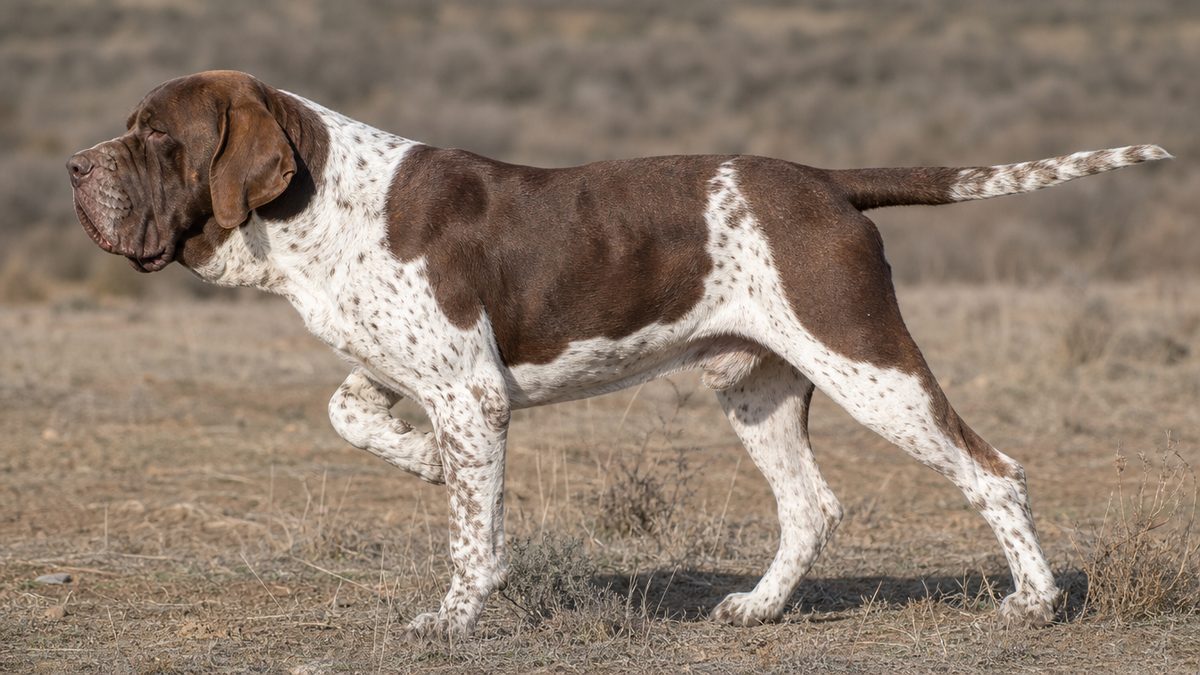
The Old Spanish Pointer was the heavy Iberian pointing dog of the Early Modern period, known in Spanish as the Perro de Punta Espanol and in England simply as the Spanish Pointer, and the best modern source on it calls it a stock rather than a breed.
That source is not an encyclopedia. It is a legal instrument. The Government of Navarre's Orden Foral 270/2006, which created the Pachon Navarro's official standard, describes that living breed as the product of recovery through animals coming from el antiguo tronco del Perro de Muestra Espanol (Old Spanish Pointer), of which the classical authors wrote over recent centuries. A Spanish government order printing the English name in brackets, and calling the thing an *antiguo tronco*, an old trunk or stock, is as close to an official definition as this animal has.
Origins and history, and one date that will not survive checking
The English half of the history is well documented. William Arkwright, writing in 1902, records that at first the Pointer was called in England the Spanish Pointer, and quotes the earliest notice he could find, from *The Gentleman's Recreation*: 'The Spanish Pointer is esteemed the incomparable, and even without teaching will point naturally at a partridge'. Imports are variously credited to a Portuguese merchant or to officers returning from the War of the Spanish Succession, whose campaigns ran from 1705 to 1707 and which ended at the Peace of Utrecht in 1713.
The Spanish half is where a famous date collapses. Popular accounts trace Navarrese pointing dogs to the twelfth century through *Los Paramientos de la Caza*, hunting regulations attributed to King Sancho the Wise of Navarre. Arkwright went looking for it. He could not find it in England, went to Paris for the 1874 pamphlet by M. Castillon d'Aspet, then had the Pamplona archives searched by their own custodians and by Don Juan Iturralde y Suit, Vice-President of the Commission of the Monuments of Navarre.
No known copy of the Fuero General contained the Paramientos. Pressed for references, Castillon gave evasive answers and then, in Arkwright's words, took refuge in absolute silence. The internal evidence settled it: the text mentions coina headgear, which was not used in Navarre until the nineteenth century and spread during the first Carlist war. Arkwright's conclusion is that the Paramientos are nothing but clever fakes. Any page dating Spanish pointing dogs to 1180 is resting on that document.
Physical characteristics, from the only description with numbers in it
One published description of this dog carries measurements, and it is Walter Esplin Mason's *Dogs of All Nations* of 1915, prepared around the Panama-Pacific International Exposition. Its Spanish Breeds section holds two entries, and the first reads in full:
| Field | What Mason printed |
|---|---|
| Colour | Brown and white, red and white, black and white, and pure brown. The white must not predominate |
| Height | 24 in |
| Weight | 80 lbs |
| General appearance | A somewhat heavy, loosely made dog, larger than the English Pointer |
| Head | Indented between the eyes, broad in skull, square, long and broad in muzzle with lips large and pendulous |
| Eyes | Large and somewhat sunken in the head |
| Ears | Thin, loose and of moderate length |
| Body | Chest broad and deep. Back and hind quarters very muscular |
| Tail | Strong at the root, tapering towards the end and is frequently docked |
Twenty-four inches is 61 cm and eighty pounds is 36.3 kg. That matters, because the living Pachon Navarro's own standard allows a maximum of 60 cm and a maximum of 30 kg. Mason's dog is taller than the modern breed's ceiling and more than six kilos heavier than it. The words Perdiguero and Navarro appear nowhere in Mason's book, so the Navarrese identity is a later, Spanish-side attribution rather than something the 1915 description carries.
Breed recognition tested: is the Old Spanish Pointer a breed at all?
The Old Spanish Pointer fails Bonbeno's two-condition test, and it fails on the studbook rather than on the standard, which is a sharper answer than the flat verdict most pages give.
Bonbeno keeps a page for dog types that are not breeds, and the rule it applies is that a breed has a written standard and a studbook behind it, so a puppy can be measured against a document. Both halves get tested here.
Condition one, a written standard: partly, and weakly
No kennel club, registry or government ever issued a standard for this dog. What exists is Mason's 1915 catalogue entry, which is standard-shaped: it prescribes colour, gives a height and a weight, and carries a normative clause in The white must not predominate. That is where Wikipedia's line about breed standards allowing a completely brown dog comes from, since Mason lists pure brown among the colours.
But an exhibition catalogue is not a standard in the sense the test means. No body adopted it, no register enforced it, and no judge ever measured a dog against it. Condition one is met in a weak historical sense and not in the operative one.
Condition two, a studbook: no, and never
There has never been a studbook for this dog anywhere, and three registers were checked with in-document controls. The FCI's Group 7 page lists Section 1.1 country by country, and Spain holds exactly one entry, the Perdiguero de Burgos, number 90, with Denmark, France, Germany, Hungary, Italy, Portugal and Slovakia all present as controls that the page is the real register. Spain's own canine annex under Real Decreto 558/2001 lists 33 Spanish breeds alphabetically from Alano Espanol to Villano de las Encartaciones, and this name appears under none of its forms. The livestock Catalogo Oficial de Razas contains no canine species whatever.
The Real Sociedad Canina de Espana publishes an essay on canine ethnic groups which says that turning a grupo etnico into a modern breed requires selection work by breeders agreed around a common project, that is a racial standard, with individuals registered generation after generation in a libro de origenes, plus at least three generations demonstrating inheritance of the desired characters. That is Bonbeno's two conditions plus a third, written by the Spanish national kennel body, and it names Pachones among the historic ethnic groups.
The verdict, and the disagreement underneath it
The Old Spanish Pointer is a historical type, not a breed. It belongs on the not-a-breed page, and the reason is the missing studbook rather than the missing standard.
There is a genuine conflict between two Spanish authorities about how to describe what happened next, and it is worth publishing rather than resolving. Navarre's order says the Pachon Navarro is the product of the recuperacion, the recovery, of this breed. The Real Sociedad Canina de Espana says the opposite in as many words: it is mistaken to speak of recovering a breed as if such a thing had ever existed, and the truth is that it did not, so the task is not to recover a breed but to select an ethnic group in order to create one. A regional government and the national body disagree about whether there was ever a breed there at all.
What the descendant does have
The Pachon Navarro passes both conditions cleanly, and by act of a public authority rather than by a club's say-so. Orden Foral 270/2006 Article 1 recognises the racial and functional standard, and Article 2 creates the Libro Genealogico. That studbook has three sections and seven named registers.
- Seccion Anexa holds the Registro Auxiliar de Nacimientos, the Registro Fundacional and the Registro Auxiliar de Adultos, and admits dogs with no full pedigree whose ethnic characteristics can contribute.
- Seccion Principal holds the Registro Principal de Nacimientos and the Registro Definitivo.
- Seccion de Meritos holds the Test de Aptitudes Naturales, the Pruebas de Seleccion and the Pruebas de Trabajo.
- Identification is by subcutaneous transponder, mandatorily, preferably on the left side of the neck, with tattoo allowed as a supplement.
- Managing bodies must supply registration and assessment data to the Servicio de Ganaderia every six months, and may verify parentage by paternity testing.
That is an open studbook with a founding register, the same device Italy uses for native populations being selected into breeds, and it is exactly the machinery the Old Spanish Pointer never had.
The double nose, separating what a standard says from what everyone repeats
The double nose is a bifid nose, an anatomical cleft in the nose leather, and the only breed standard that mentions it in this family does not require it, does not reward it and does not treat it as typical.
This is the most mythologised thing about the Old Spanish Pointer and its living descendant, so it is worth setting the documents against the retellings line by line.
What the standard actually says
Navarre's Orden Foral 270/2006 devotes one sentence to it, inside a longer entry on the nose. After describing a broad nose with large open nostrils and a straight front profile, it says only that in some specimens the so-called split nose or double nose appears, a characteristic recorded by most of the various classical authors.
Read what that sentence does and does not do. It reports the trait as occurring in *algunos ejemplares*, some specimens. It attributes the observation to the classical authors rather than adopting it. It sets no requirement. And it is absent from both of the order's fault lists, the non-excluding faults and the faults that exclude a dog from recognition, which run to bite defects, small narrow heads, atypical ears, flat ribcages, brindle colour, ectropion and entropion, taillessness and cryptorchidism.
What a neighbouring standard says about the same trait
FCI Standard 90, for the Perdiguero de Burgos, lists Split nose or black nose among its disqualifying faults. So two Spanish pointing standards, published 24 years apart, take opposite positions on one trait: one disqualifies it outright, the other merely records that it turns up. Craig Koshyk, who has photographed the breed in Navarre, puts it the same way, that when breed standards mention a split or double nose they list it as a serious or disqualifying fault and the Pachon Navarro standard is the only one that permits it.
What Arkwright established in 1902, and nobody has improved on
The debunking is 124 years old. Arkwright wrote:
The vulgar idea of the double-nose is that it is distinctive of the Spanish pointer, instead of being an unsightly malformation peculiar to no country, no breed, but most commonly found in the south of France. Of course the nostrils are not really double, not even more expanded owing to this freak of nature; they are merely split in half by a deep furrow. Equally of course, dogs with this formation have got no keener scent than their normal relatives.
He backs it with cases rather than assertion. He knew a family of double-nosed Irish red setters, and records a kennel of black double-nosed pointers at Gosford in Scotland. He quotes the Real Academia Espanola's dictionary of 1727 under *Braco*, which describes dogs with split and somewhat elevated nostrils and derives them from the French braque or the bracco of Tuscany, and he reads that as effectively disproving a Spanish origin for the feature.
Where the popular account goes beyond the evidence
| What is commonly said | What the sources support |
|---|---|
| A double nose is the breed's defining feature | The Navarre standard says it appears in some specimens; Wikipedia says a few examples |
| It is uniquely Spanish | Arkwright names France, Portugal, Ireland and Scotland; Wikipedia adds Turkey's Tarsus Catalburun |
| A double nose means a better nose | Arkwright, 1902: no keener scent than their normal relatives. Modern breeders agree it is cosmetic |
| Standards celebrate it | FCI 90 disqualifies it. The Navarre standard records it without rewarding it |
| Up to 10 per cent of pups die of cleft palate | Reported by Craig Koshyk as something he was told by breeders, with no study attached. Treat it as anecdote |
The cleft palate point deserves care rather than dismissal. The concern is real in principle, because a bifid nose sits on the same midline developmental axis as a cleft palate, and Koshyk reports being told that up to 10 per cent of pups are stillborn or euthanised where the cleft is profound enough to stop them breathing or nursing. But that figure is an anecdote relayed in an article, not a published rate from a study, and Bonbeno labels it as one. A prospective owner should ask a breeder about it; a website should not print it as a prevalence.
Which breeds actually descend from it, claim by claim with its source
Many breeds are said to descend from the Old Spanish Pointer, and the honest ranking runs from one hedged sentence in a current registry document down to assertions with nothing behind them at all.
Descent claims are the cheapest sentences in dog writing, so each one below is reported with the document that carries it and nothing is asserted that a document does not support.
| Claim | Where it appears | Strength |
|---|---|---|
| The Old Danish Pointer's founding dogs descended from Spanish pointing dogs | FCI Standard 281, a currently valid registry document | Strongest available, and the standard itself says probable |
| The English Pointer was at first called the Spanish Pointer in England | Arkwright 1902, quoting late-17th-century English sporting books | Strong on the naming; a name is not a pedigree |
| The Old Spanish Pointer is the first of its type, from which all modern pointing breeds descend | Wikipedia, citing Fogle 2009, Arkwright and Mason | An encyclopedia summary, not a registry or a genetic study |
| The Burgos Pointer descends from the Old Spanish Pointer | The Burgos parent club and Koshyk, reporting Jose Manuel Sanz Timon | Contested, and Bonbeno's Burgos page publishes the argument on both sides |
| The Pachon Navarro was recovered from the old stock | Orden Foral 270/2006, a Spanish legal instrument | The claim's best source, and the RSCE disputes the framing |
The one physical test that can be run on a descent claim
Bonbeno's Burgos Pointer page makes an argument from head geometry, and this page tested it against the primary document rather than inheriting it. FCI Standard 90 does state that the Burgos Pointer's cranial-facial axes are divergent, and it does list Cranio-facial axes clearly convergent among its disqualifying faults, both verbatim. It also never admits black colour and requires all mucous membranes to be brown and never black, while Mason's 1915 Spanish Pointer explicitly allows black and white. Two independent characters, and both point away from identity. Craig Koshyk records that the Burgos Pointer looks like an old breed and is even called Old Spanish Pointer, while reporting Jose Manuel Sanz Timon's finding that it is in fact a relatively modern descendant of the older stock.
One refinement is worth recording. The sibling page attributes the convergent-skull description of the old dogs to the Burgos parent club, and correctly so. Reading Arkwright's own text end to end, the word convergent appears zero times in the book. The characterisation is the club's reading, which is what the sibling says it is, and it is not Arkwright's own vocabulary.
What a reader should take from this
Treat any sentence of the form 'breed X descends from the Old Spanish Pointer' as a hypothesis until you have seen the document. The type genuinely was widespread and genuinely was exported, and English writers genuinely called their own early pointers Spanish. None of that licenses a specific pedigree for a specific modern breed, and the strongest support any such claim has anywhere is one FCI standard using the word probable.
Old Spanish Pointer price in India, and what the listings are really selling
There is no old spanish pointer price in india and there is no price anywhere, because the animal is extinct, and the practical question for an Indian buyer is what a listing carrying this name is actually offering.
Wikipedia gives the breed status as extinct, and its own navigation box for dogs originating in Spain files this name alone under the heading Extinct. Spain's canine annex lists 33 living Spanish breeds and does not include it. So a price is not merely unpublished; it is not a coherent thing to ask for.
What an India-located search actually returns
Searching this name from India returns three other dogs and one house price band. In an India-located organic search whose control results were on-topic, the top ten held dogbreedinfo.com's page at position one, whose URL path is `perdiguerodeburgos.htm`, whose search title reads Spanish Pointer, and whose H1, printed inside the returned document, reads Perdiguero de Burgos. Position seven, puppyfinder.com, opens 'The Spanish Pointer, also known as the Perdiguero de Burgos'. Three of the ten were German Shorthaired Pointer sellers, including Puppiezo, an Instagram kennel and a Facebook litter post.
A buyer searching this term in India will be offered a German Shorthaired Pointer, a Perdiguero de Burgos article, or a generic Pointer cost table. None of them is the animal searched for, and only one of the ten ranking pages, Craig Koshyk's, flags the name confusion at all. Knowing what you are actually being sold is worth more here than any price band.
The one rupee band in the result set, and why it is not a price
happypet.care's Pointer page prints a cost of buying of Rs 10,000 to Rs 50,000 and monthly expenses of Rs 3,550 to Rs 5,400. Bonbeno pulled two unrelated breeds from the same site in the same session as controls. The German Shorthaired Pointer prints Rs 4,900 to Rs 7,650 and the Beagle Rs 2,200 to Rs 3,750, and all three rows reproduce cost tiers this project has already recorded on that site for breeds with nothing in common. All three also print an identical ideal weather band of 15 to 25 C, and all three print an identical Rs 50,000 ceiling on the cost of buying while only the floor moves. The figure is a template constant shared with named other breeds, not an observation about any pointer.
The division tests were run before quoting. Rs 10,000 and Rs 50,000 fail at 84.38, giving 118.51 and 592.56, and fail at 74, giving 135.14 and 675.68. They appear to pass at 80, giving 125 and 625, but any rupee figure ending in three zeros divides cleanly at 80 by construction, so that is arithmetic rather than evidence. These are round rupee numbers reused as a house band.
The living descendant, and why it has no Indian price either
The Pachon Navarro is a vulnerable Spanish breed with an estimated 700 to 1,000 dogs in 2009. It holds no FCI number, so the Kennel Club of India, which issues pedigrees against FCI nomenclature, has no route for it. And DGFT Trade Notice 22/2022-23 places live dogs in the Restricted category and states that import applications for trading or breeding purposes shall be duly rejected. Two independent barriers, either of which alone would prevent a market forming.
Monthly cost of ownership in India for a dog of this size and type
Keeping a 25 kg short-haired pointing dog in an Indian metro costs roughly Rs 4,000 to Rs 8,500 a month across parasite control, food, grooming and routine veterinary care, and every figure below was re-priced on 3 September 2026.
No price exists for this dog and no price ever will, but the cost of keeping one does exist, and it applies to any 20 to 30 kg working-type dog kept here. That is the number an Indian reader can use, whether they end up with a pointing dog, a Labrador or an Indian street dog of the same size.
| Item | Published price | Source and caveat |
|---|---|---|
| Puppy core course, 4 visits | From Rs 6,499 | Vetic, one chain's promotional floor across ~50 clinics |
| Annual booster | From Rs 3,199 | Vetic, same caveat |
| Anti-rabies, single dose | Rs 699 | Vetic; free at Chennai corporation clinics |
| Tick, flea and worming, 15-30 kg | Rs 3,308 per 3 months | NexGard Spectra at Supertails, Rs 1,102.67 a month |
| Bathing | From Rs 934 | Vetic Delhi; a short coat needs no haircut |
| Full bath and styling | From Rs 1,869 | Vetic Delhi, and largely unnecessary on this coat type |
| Boarding, 24 hours | Rs 899 | PawSpace Bengaluru, against Rs 799 for 10 hours |
| Municipal registration, Delhi | Rs 500 | MCD, renewed at Rs 500 |
| Pet licence, Chennai | Rs 50 | Greater Chennai Corporation |
| Microchipping, Chennai | Rs 1,250 | A named clinic's own transacted price |
The line that is easy to skip and should not be
Parasite control is the single most important recurring spend for a dog of this size in India, at Rs 1,102.67 a month for a pack that covers ticks and fleas together with roundworm and hookworm. The reason is in the Indian literature rather than in a product claim. A West Bengal study of 584 dogs found Babesia gibsoni in 76.54 per cent and Anaplasma in 55.75 per cent, and 72.9 per cent of all 584 dogs screened carrying two or more pathogens. A Kerala study of 120 dogs found Babesia in 80 of them, 66.7 per cent, peaking between March and May.
Both studies sampled dogs presented at veterinary clinics rather than random populations, so 76.54 per cent describes a clinic caseload and not the risk to a well-managed pet. Say among dogs tested at veterinary clinics, or the number is materially misleading. The direction of the finding is still sound and the tick pressure is still real.
The cheap things Indian municipalities give you
Registration costs almost nothing and is a legal requirement in most metros. Delhi charges Rs 500 to register and Rs 500 to renew, with a late fee of Rs 100 a month, and its portal has issued 18,958 certificates since 2021 with 71 of 1,006 applications rejected in FY 2026-27. Chennai charges Rs 50, issued 9,115 licences in 2024, and runs six corporation pet clinics that provide all treatment and anti-rabies vaccination free of cost. Microchipping at a named Chennai clinic is Rs 1,250. Boarding a dog of this size in Bengaluru runs to Rs 899 for 24 hours, against Rs 799 for a ten-hour daycare and Rs 599 for four hours.
Bonbeno obtained no current Mumbai or Bengaluru municipal fee and says so rather than filling the gap. Retail prices move within days; municipal fees rarely move at all, which is why the municipal rows carry more weight here than the retail ones.
Heat tolerance in India, measured against Navarre rather than guessed
Iberian pointing stock has better heat tolerance than any northern European gundog, and it is still not an Indian dog: the Navarre homeland cell averages 11.67 C a year against Chennai's 27.95 C, a gap of 16.3 C.
Bonbeno queried NASA POWER by explicit latitude and longitude and echoed back the elevation each cell reports, because a wrong homeland baseline corrupts a climate comparison exactly as badly as a wrong Indian one.
The homeland cell, and its elevation check
The cell covering Pamplona at 42.82 N, 1.64 W returns an annual mean of 11.67 C, a January mean of 4.86 C, a July mean of 18.79 C, an annual maximum of 37.90 C and annual relative humidity of 81.70 per cent, at a reported elevation of 516.50 m against a real city elevation near 449 m. That 67 m difference is small and the figures are usable, which is worth stating because in hill terrain the same query can be wrong by more than a kilometre.
| Place | Annual mean C | Hottest month mean C | Annual max C |
|---|---|---|---|
| Pamplona, Navarre | 11.67 | 18.79 (July) | 37.90 |
| Bengaluru | 23.74 | 28.37 (April) | 40.38 |
| Pune | 23.86 | 28.93 (April) | 43.20 |
| Delhi | 25.60 | 35.88 (June) | 48.79 |
| Mumbai | 26.77 | 31.19 (May) | 44.91 |
| Chennai | 27.95 | 31.51 (May) | 42.70 |
The honest reading, in both directions
Two things are true at once and most pages report only one of them. Navarre's annual mean of 11.67 C sits 16.3 C below Chennai's, which is a very large gap for a working dog. But Navarre's annual maximum of 37.90 C sits only 4.8 C below Chennai's 42.70 C, so this is stock that has genuinely met hot summers, unlike the Old Danish Pointer, whose homeland cell tops out far lower. That is why the heat rating here is 3 of 5 rather than 2. Better than a northern gundog is not the same as suited, and any dog of this build stays heat-sensitive through an Indian summer.
What Navarre does not supply is Indian heat plus Indian humidity together. Delhi's June mean of 35.88 C is 17.1 C above Navarre's hottest month, and it is the sustained daily mean rather than a peak. A dog can shelter from a 37.90 C afternoon in a dry Pyrenean foothill and cannot shelter from a month whose average is 35.88 C.
Second Schedule Part IV paragraph 21(1) of India's Dog Breeding and Marketing Rules 2017 bars outdoor housing, without a veterinarian's written approval, of dogs not accustomed to local temperatures and of breeds that cannot tolerate them. Separately, Hall and colleagues found that bodyweight at or above the breed and sex mean carried an odds ratio of 1.30 for exertional heat-related illness across 905,543 UK dogs, and that 652 of the 879 events with a recorded trigger, 74.2 per cent, were exertional rather than caused by a hot car.
Humidity gives a counterintuitive reading that needs qualifying rather than quoting. Pamplona's cell reports 81.70 per cent annual relative humidity against Chennai's 72.39 per cent, so on that measure the homeland is the more humid place. Annual mean humidity conflates a cool damp Atlantic-influenced climate with a hot tropical one, and it is the combination of heat and moisture that defeats panting. Printed without that caveat, the number would give exactly the wrong impression.
Temperament and household fit, from a functional standard rather than a blog
The temperament on record is docile, calm and intelligent, sociable with people and with other dogs, and built around co-operation with a handler rather than independence, and it comes from a government functional standard rather than from breeder copy.
Navarre's Annex I gives the temperament in one line: docile, tranquil and intelligent, sociable both with humans and with other dogs, and in the field a vigorous, hardy trotter naturally inclined to hunt as a team with the hunter.
Annex II, the functional standard, is more specific and more useful. It describes a dog that hunts under the gun on any terrain, that is a born retriever and an effective recoverer of wounded game, and it says the intelligence of the Pachon while hunting makes it understand that it does not hunt alone but with the hunter, an understanding the dog absorbs as it gains experience. It also requires a dog that is controllable, reliable and free of false points.
Who this suits, and who it does not
- Suits a household with land, time and someone at home, because the whole temperament is built on partnership with a person.
- Suits a first-time owner better than most working breeds do, since docile and controllable are in the standard rather than in marketing.
- Does not suit an apartment. This is a 20 to 30 kg dog whose functional standard describes methodical work through scrub and brambles.
- Does not suit anyone wanting a guard dog. Sociable with strangers and with other dogs is what the document records.
- Does not suit a household that cannot socialise a puppy properly, since the co-operative temperament is developed rather than automatic.
Nothing in the Spanish documents supports the aggression or stubbornness that rare-breed marketing sometimes implies, and nothing supports the idea that a historical hunting dog is somehow more primitive or harder to live with. The record says the opposite.
Training approach for a strict trotter, and what it resists
To train a dog of this type, reward proximity and method rather than speed and range, because the functional standard defines it as a strict trotter that hunts close to the gun and it resists being made into a wide, fast-quartering dog.
Navarre's functional standard is unusually explicit about pace. It calls the Pachon Navarro un trotador estricto, a strict trotter, of lively gait and horizontal progression with a cheerful, constant rhythm, whose head and neck form a horizontal line that swings up to take wind or drops to the ground to trail. In open ground it moves faster and lengthens its stride without abandoning the trot.
The three things the document says it does naturally
- Points by reflex. The standard says the point is innate and occurs as a reflex on approaching game along the scent, so pointing is shaped rather than taught.
- Retrieves by inclination. A born retriever, in the standard's words, and an effective recoverer of wounded game.
- Works close by understanding, not by compulsion. The document explains hunting near the gun as the product of the dog grasping that it is hunting as a team, absorbed with experience.
Train against any of those and you are working uphill. The commonest error with a close-working continental pointer is to push range, because a handler used to a fast British-type dog reads the trot as a lack of drive.
Realistic timelines, adapted to Indian conditions
The socialisation window closes at about sixteen weeks regardless of breed, so weeks 8 to 16 are the highest-value hours of the whole first year. Take a puppy to traffic, lifts, markets, and other dogs. Then build recall and contact through months 4 to 8, introduce retrieving from about six months, and add duration rather than speed from twelve months.
Two Indian constraints reshape all of it. The usable training window in most metros is before sunrise and after dark for much of the year, and a dog you cannot exercise is a dog you cannot train. Group classes are also where a young dog meets ticks, so tick control belongs in place before socialisation starts rather than after it.
Daily exercise requirement, and the hours India actually allows
A dog of this type needs about an hour to ninety minutes of genuine work a day across at least two outings, and in most Indian cities that has to happen before sunrise and after dark for eight months of the year.
The requirement is written into the functional standard rather than inferred. Navarre describes a dog that works hard in closed scrub, breaks through low brush and esparto, enters brambles when accustomed to it, and combines wind scenting with brief spells of ground trailing according to wind and terrain. That is sustained, methodical effort over hours, and it is what the body was selected for.
Why distance substitutes for speed here
This is a trotting breed rather than a galloping one, so the exercise it needs is long and steady rather than short and fast. Twenty minutes on a lead supplies none of the three things the standard names, which are free movement, scentwork and retrieving. A dog given only the lead walk becomes destructive and vocal indoors, and that is the usual reason working-type dogs are rehomed in Indian cities.
| Season | Morning | Evening | Note |
|---|---|---|---|
| Winter, Nov to Feb | 45 to 60 min from 06:30 | 30 to 45 min after 18:00 | The only comfortable season across most of the country |
| Pre-monsoon, Mar to May | 40 min before 06:00 | 30 min after 20:00 | Delhi's May mean is 35.05 C and the afternoon is unusable |
| Monsoon, Jun to Sep | 45 min, weather allowing | 45 min | Dry the ears after every wet outing |
| Post-monsoon, Oct | 45 min | 45 min | Peak tick season across much of India |
Scentwork is the honest indoor substitute during a heat wave. Hiding food and asking the dog to find it uses the exact faculty the type was built around, costs nothing and can be done late at night in a cooled room. It does not replace running and nothing indoors does.
If that pattern is not achievable, a working pointing dog is the wrong choice, and in India that is true of the obtainable pointing breeds as much as of this extinct one.
Grooming and coat care in Indian humidity, where the lip and the ear are the work
Coat care for a short-haired pointing dog of this type is light, roughly half an hour of brushing a week, and the real grooming work in an Indian climate is the heavy pendulous lip and the broad low-set ear that both the 1915 description and the 2006 standard record.
The coat is agreed across a century of sources. Mason in 1915 describes the type without dwelling on the coat, and Navarre's 2006 standard specifies hair that is short, smooth, of hard texture and coarse appearance, with occasional longer-coated dogs in some litters that Spanish breeders call seduños, carrying longer hair at the extremities and a softer texture.
Shedding, and the hypoallergenic claim that attaches to every short coat
A short-haired dog is not a low-allergen dog. Vredegoor and colleagues measured Can f 1 across 196 dogs of so-called hypoallergenic breeds against 160 control dogs and found the hypoallergenic group higher, at 2.26 against 0.77 micrograms per gram on hair and 27.04 against 12.98 on coat, with no difference in airborne allergen. Neither the Navarre standard nor Mason says anything about shedding or allergy, so any such claim about this type comes from a seller rather than from a document.
The lip and the ear, which is where overseas advice stops transferring
The standard describes thick, hanging lips that help give the muzzle its square look, ears set high and broad but thick, falling forward, rounded and flat and reaching past the corner of the lips, and skin thick and somewhat loose forming a characteristic double dewlap. Every one of those features traps moisture, and in an Indian monsoon that is the difference between a low-maintenance dog and a recurring veterinary bill.
- Dry the ear after every bath, swim and wet walk, not only after baths.
- Plug the ears before bathing, since water entering the canal is a commonly named cause of otitis in Indian veterinary writing.
- Wipe and dry the lip folds daily in humid months, because a deep flew holds food and moisture against skin.
- Check the dewlap and neck folds weekly for damp and smell during June to September.
- Bathe less often than an Indian groomer will suggest, because stripping oils from a hard short coat in humidity invites skin trouble.
Vetic's Delhi list, re-priced on 3 September 2026, runs bathing from Rs 934, a full bath and styling from Rs 1,869 and a haircut from Rs 1,359. A short hard coat needs the bath line and nothing else, so a groomer quoting the styling or haircut package for a dog of this type is selling you something the coat does not need.
Bonbeno found no citable Indian figure for canine otitis seasonality in the indexed literature, and states that absence rather than reaching for a prevalence number. Much Indian veterinary work appears in journals PubMed does not index, so this is a coverage gap rather than evidence the problem is small.
Health risks and lifespan, and the large gaps in what is known
No breed-specific health survey, screening scheme or life expectancy study exists for the Old Spanish Pointer or for the Pachon Navarro, and the honest health section says that three times rather than borrowing a relative's numbers once.
This is the opposite situation from the Old Danish Pointer, where two causal mutations are known, a statutory hip screen applies and a kennel club enforces a DNA test. Here almost none of that machinery exists, and pretending otherwise would be the easiest fabrication on this page.
What the standard itself excludes, which is the nearest thing to a health list
Navarre's order lists faults that exclude a dog from recognition, and two of them are health conditions rather than cosmetic ones. Ectropion and entropion both exclude, as do monorchid and cryptorchid dogs. Non-excluding faults cover bites other than a scissor bite, missing teeth and jaw deformation.
Those overlap neatly with Indian law. Second Schedule Part III paragraph 8(10) of the Dog Breeding and Marketing Rules 2017 requires that breeding dogs have been tested for genetic defects including hip dysplasia, progressive retinal atrophy, night blindness, hypothyroidism, entropion, ectropion, overshot and undershot jaw, wry mouth, two or more missing teeth and cryptorchidism. So an Indian breeder of any pointing dog is already required to screen for the two eye conditions this standard excludes on.
The one type-specific risk, and how to size it honestly
The cleft palate question follows the split nose, because a bifid nose sits on the same midline developmental axis. Craig Koshyk reports being told by breeders that up to 10 per cent of pups are stillborn or euthanised where the cleft is deep enough to prevent breathing or nursing, and also reports that most pachones have only a moderate cleft and are entirely normal. That 10 per cent is an anecdote relayed in an article rather than a published rate, and Bonbeno reports it as one. There is no study to cite, and inventing a prevalence would be worse than saying so.
Genetic diversity, and why the vulnerable listing matters
The living population is small. Wikipedia puts the 2009 estimate at 700 to 1,000 dogs and records that the breed sat among the sixteen Spanish breeds the Real Sociedad Canina de Espana considered vulnerable in 2026. The RSCE's own response tells you how tight the founder base is: from 1 August 2026 to 31 July 2028 vulnerable Spanish breeds making an initial registration enter the Registro de Razas Caninas without a DNA test, while DNA stays mandatory for championship homologation and for a Pedigree Plus. A body relaxes an identity check that way only when it needs more animals in the book.
The Navarre studbook's Seccion Anexa exists for the same reason, admitting dogs with partial or no genealogical documentation whose ethnic characteristics can contribute to improvement. That is an open register doing conservation work, and it is a strength rather than a defect, but it does mean pedigrees are shallow.
Lifespan, stated as unknown
There is no life expectancy figure for either the historical type or the modern breed from any source Bonbeno could open. No large life-table study carries a row for the Pachon Navarro, no parent-club health survey has been published in a form this site could read, and the historical dog obviously has none. Any number you find online for this animal has no study behind it. Bonbeno prints none, which is the honest outcome and the same call this site made on other breeds whose only lifespan citation closed on nothing.
Feeding and nutrition for a 20 to 30 kg working-type dog in India
Feed by body condition rather than by a printed measure, because the only well-evidenced controllable risk factor for heat illness in a working dog is bodyweight at or above the breed mean.
The Navarre standard sets the adult range at 20 to 30 kg with a height of 48 to 60 cm and an average of about 55 cm in males and 52 cm in females. A dog at the top of that range should be muscular rather than heavy, which is a distinction a scale cannot make and a hand on the ribs can.
Why weight is a heat question in India
Hall and colleagues found an odds ratio of 1.30, with a confidence interval of 1.09 to 1.55, for exertional heat-related illness in dogs at or above their breed and sex mean bodyweight, across 905,543 UK dogs under primary veterinary care. In a climate where the usable exercise window is already narrow, carrying extra weight compounds the one risk that matters most. Ribs felt without pressing is the working target, in India more than anywhere.
Life-stage feeding
- Weeks 8 to 16, feed four meals a day of a medium to large breed puppy food, and do not free-feed a growing gundog.
- Months 4 to 12, drop to three meals then two, and keep growth steady rather than fast.
- Months 12 to 18, move to adult food and re-weigh monthly.
- Adult, feed twice daily and place the ration around the cooler exercise window rather than immediately before work.
- Senior, reduce calories and hold protein, and watch weight closely because a slowing working dog gains quickly.
Bonbeno's own Indian cost reference recorded a large-breed food price that had gone stale within days of being taken, with the same retail URL later serving an entirely different product at a different price. At roughly 250 to 350 grams a day for a dog of this size a 15 kg bag lasts about 43 to 60 days, so the only honest way to get a monthly number is to check today's price for the bag size you actually buy.
Availability in India
Nothing about feeding a dog of this size in India is difficult. Medium and large breed dry food, wet food and veterinary diets are all widely stocked in the metros. The line owners most often skip is parasite control at Rs 1,102.67 a month, and given the tick-borne disease pressure set out above that is the least skippable line in the budget.
Month by month through the first year, for the dog you can actually get
No puppy of this type can be bought in India, so the timeline below is written for the pointing dog an Indian household realistically ends up with, and every date in it comes from Indian law, an Indian clinic rate card or the physiology rather than from a breed.
Three clocks run at once in a working dog's first year. The socialisation window closes at about sixteen weeks, the core vaccination course finishes at around day 120, and joints cannot be officially assessed before twelve months.
| Age | What matters | Cost or constraint |
|---|---|---|
| Under 8 weeks | Refuse the puppy. Rule 8(1)(a) prohibits sale of pups less than eight weeks in age | Non-negotiable, and an offer below it disqualifies the seller |
| Days 75 to 120 | Core course across four visits, then vaccinate annually | From Rs 6,499 at one chain; free at Chennai corporation clinics |
| 8 to 16 weeks | Socialise to traffic, lifts, markets, other dogs | Free, and irreplaceable once the window shuts |
| From 8 weeks | Monthly tick and flea cover before any group class | Rs 1,102.67 a month on the 15 to 30 kg pack |
| 3 to 4 months | Register with the municipality and microchip | Rs 500 in Delhi, Rs 50 in Chennai, Rs 1,250 to chip |
| 4 to 8 months | Recall and contact work in the cool window only | Delhi's June mean is 35.88 C; the afternoon is unusable |
| 6 months | First retrieves, and a growth check | Steady growth beats fast growth for joints |
| 12 months | Earliest official joint assessment in most schemes | The gate every responsible breeding decision turns on |
| 12 to 18 months | Adult food, full workload, adult coat | Ears and lip folds still need weekly checks in the monsoon |
One point is specific to this family of dogs. If a puppy of pachon descent has a visible split nose, look at the palate and the suck reflex in the first days rather than at the nose, because it is the palate that matters clinically and the nose that gets photographed.
Head to head against the dogs that share its name
Three living breeds are routinely sold, described or indexed under the Old Spanish Pointer's name, and telling them apart is the single most useful thing this page does for an Indian reader.
| Dog | Standing | Size | Split nose | Obtainable in India |
|---|---|---|---|---|
| Old Spanish Pointer | Extinct historical type, no studbook ever | 24 in and 80 lb in the 1915 description | Occurred; never definitive | No, it does not exist |
| Pachon Navarro | Breed, standard and studbook by Navarre order 2006 | 48-60 cm, 20-30 kg | Recorded in some specimens, not required | No; not FCI-recognised, no import route |
| Burgos Pointer | FCI breed 90, Spain's only Group 7 entry | 62-67 cm males | A disqualifying fault | No |
| German Shorthaired Pointer | FCI breed 119, widely bred | 62-66 cm males | Not a breed feature | Yes, with Kennel Club of India papers |
The size argument, which is checkable arithmetic
Mason's 1915 Spanish Pointer stands 24 in, which is 61 cm, and weighs 80 lb, which is 36.3 kg, and he says it is larger than the English Pointer. The modern Pachon Navarro's standard caps height at 60 cm and weight at 30 kg. So the reconstructed breed is smaller than the 1915 description at both ceilings, by a centimetre on height and by more than six kilograms on weight. That is not a refutation of descent, but it does mean the two are not the same animal, and it is the kind of check that costs one subtraction and is almost never done.
The head and colour argument, verified from the primary standard
FCI Standard 90 states that the Burgos Pointer's cranial-facial axes are divergent and disqualifies dogs whose cranio-facial axes are clearly convergent, disqualifies a split nose or a black nose, requires all mucous membranes to be brown and never black, and never admits black colour. Mason's Spanish Pointer allows black and white among its colours. So on colour and on the nose the two descriptions are directly opposed, which is why treating the Burgos Pointer as the Old Spanish Pointer under a new name does not survive reading either document.
The comparison an Indian buyer will actually face is simpler and blunter. Searching this name returns German Shorthaired Pointer litters, and the German Shorthaired Pointer is a genuinely good, available, well-documented gundog. There is nothing wrong with buying one. There is something wrong with being told it is something else.
Mistakes Indian readers actually make with this name
The commonest mistake is treating Old Spanish Pointer as a breed you could buy, when it names an extinct type whose only living relatives are a vulnerable Spanish breed and a set of dogs that are not it.
Six errors, in the order they cost money
- Paying for a puppy under this name. The dog is extinct, and the ranking pages for the term sell German Shorthaired Pointers.
- Reading Spanish Pointer as one dog. In old English writing it means this historical type; on Indian search pages it usually means the Perdiguero de Burgos.
- Quoting the Rs 10,000 to Rs 50,000 Pointer band. It is a house tier reused across unrelated breeds on the same site, alongside an identical ideal weather band and an identical Rs 50,000 ceiling.
- Dating the type to the twelfth century. That date rests on Los Paramientos de la Caza, which Arkwright demonstrated in 1902 to be a nineteenth-century forgery.
- Believing the double nose improves scenting. Arkwright answered that in 1902 and modern breeders agree it is cosmetic.
- Treating a rare and historical dog as automatically hardy. There is no health survey, no screening scheme and no lifespan figure for this animal at all.
Two mistakes the ranking pages make for you
The page at position one for this term in India is dogbreedinfo.com, whose URL path is perdiguerodeburgos.htm and whose H1, printed inside the document, reads Perdiguero de Burgos, while its search title reads Spanish Pointer. A reader who never opens the page sees the right name and gets the wrong dog. Position seven does the same thing more explicitly, opening 'The Spanish Pointer, also known as the Perdiguero de Burgos'.
The second is Wikipedia's line that breed standards allowed the dog to be completely brown. That is a fair reading of Mason's 1915 catalogue entry, which lists pure brown, but calling an exhibition catalogue a breed standard implies a registry that never existed. Bonbeno quotes what Mason printed and lets the reader judge whether that is a standard.
Do not read 371,000 results for this term as evidence of interest. Bonbeno captured that number on Bing India and the results were a horror film, a state pension portal and dictionary entries for the word old, with the identical count returned for three unrelated queries. The Labrador control in the same session returned 29,300 results and ten genuine Indian pricing pages, so the instrument worked and the query did not.
Adoption and responsible sourcing, and the checklist that does transfer
Nobody can adopt an Old Spanish Pointer, so the useful advice is to adopt an Indian dog and to keep the verification checklist below for whichever pointing breed you do buy.
India's shelters hold large numbers of medium, short-haired, heat-adapted dogs that will do everything a family needs and several things an Iberian gundog cannot do in a Chennai May. That is not a consolation prize; on the climate evidence above it is the better-matched animal.
What to ask, if you are buying a pointing breed here
- Ask for the registering body's own record, not a certificate the breeder printed. For an FCI-nomenclature breed that means the Kennel Club of India entry.
- Ask which scale a joint result is on and what the grade was, because India's Rules name hip dysplasia as a defect to screen for and set no threshold.
- Ask which eye conditions were checked, since the Rules name progressive retinal atrophy, night blindness, entropion and ectropion by name.
- Ask about in-breeding directly. Second Schedule Part II paragraph 6(3) prohibits mating between relatives of the second to fourth grade within four generations, and incest breeding between parents and children or siblings.
- Refuse any puppy under eight weeks, which Rule 8(1)(a) prohibits outright.
- Refuse a docked tail. Paragraph 6(8) forbids docking as a change of appearance by artificial means, whatever a foreign standard says.
Navarre's own order says of the Pachon Navarro's tail that traditionally one third of its total length is removed. An Indian owner following that sentence would be breaking Second Schedule Part II paragraph 6(8), which forbids tail docking outright. Read every foreign breed standard against the 2017 Rules before repeating its advice, because a parent club writes for its own jurisdiction and not for yours.
Two things worth doing whatever dog you end up with
Register it and vaccinate it. Delhi charges Rs 500 to register and has issued 18,958 certificates since 2021. Chennai charges Rs 50, has issued 9,115 licences in 2024, and runs six corporation clinics that provide all treatment and anti-rabies vaccination free of cost. Both are cheap, both are legal requirements in most metros, and rabies vaccination is the highest-value veterinary rupee spent in this country.
Bonbeno does not recommend breeders, link puppy listings or quote a live price as an offer. Where a name has no living animal behind it, the most useful thing a directory can do is say so plainly, name what is being sold under it instead, and point the reader at the dog they can actually help.
Common questions
What is the Old Spanish Pointer price in India?
No old spanish pointer price in india exists, because the dog itself no longer exists. Wikipedia lists the breed status as extinct, and Spain's own annex of 33 canine breeds does not include it under any name. Any Indian listing using this name is selling something else.
Is the Old Spanish Pointer a real breed?
Not on Bonbeno's two-condition test, and not on Spain's either. A breed needs a written standard and a studbook. No body ever issued a standard for this dog and no register ever held one, and the Government of Navarre's 2006 order calls it an antiguo tronco, an ancestral stock, rather than a breed.
Is the Old Spanish Pointer the same as the Pachon Navarro?
No, though popular sources treat the names as synonyms. The Pachon Navarro is a living Spanish breed with a standard published by the Government of Navarre in 2006 and a studbook created by the same order. The order describes the Pachon as the product of recovery from the older stock, which makes them ancestor and descendant rather than one animal.
Is the Old Spanish Pointer the same as the Burgos Pointer?
No, and the confusion is the commonest error in English writing about Spanish pointers. The Burgos Pointer is FCI breed 90, whose standard requires divergent cranio-facial axes and disqualifies both a split nose and any black colour. Old English descriptions of the Spanish Pointer allow black and white and a frequently docked tail.
Did the Old Spanish Pointer really have a double nose?
Some dogs of the type did, and it was never the defining feature. William Arkwright wrote in 1902 that the belief the double nose is distinctive of the Spanish pointer is the vulgar idea, and that it is an unsightly malformation peculiar to no country and no breed, most commonly found in the south of France.
Does a double nose give a dog a better sense of smell?
No. Arkwright answered this in 1902, writing that the nostrils are not really double and not even more expanded, merely split in half by a deep furrow, and that dogs with this formation have no keener scent than their normal relatives. Modern breeders quoted by Project Upland say the same thing.
Which breeds descend from the Old Spanish Pointer?
The claim is made for many breeds and documented for few. A currently valid FCI standard, number 281 for the Old Danish Pointer, says it is probable that its founding dogs descended from Spanish pointing dogs, and that hedged sentence is the strongest registry-level support any descent claim has.
Is the Pachon Navarro recognised by the FCI?
No. The FCI's Group 7 page lists Section 1.1 country by country, and under Spain there is exactly one entry, the Perdiguero de Burgos, number 90. The Real Sociedad Canina de Espana files the Pachon Navarro in its Grupo 11, headed breeds not recognised by the FCI.
Is the Pachon Navarro in Spain's official catalogue of breeds?
It is in the right one. The livestock Catalogo Oficial de Razas contains no canine species at all, only bovine, ovine, caprine, porcine, equine and avian. Dogs sit in a separate instrument, Real Decreto 558/2001, whose annex lists 33 Spanish breeds with the Pachon Navarro sixteenth.
Would docking a Pachon Navarro tail be legal in India?
No, even though the breed's own standard describes it. Navarre's Orden Foral 270/2006 says that traditionally one third of the tail's total length is removed. India's Second Schedule Part II paragraph 6(8) forbids tail docking outright as a change of appearance by artificial means.
How many Pachon Navarro dogs are there?
Roughly 700 to 1,000, on a 2009 estimate, and the breed is officially classed as vulnerable in Spain. That is a very small population, which is why the Real Sociedad Canina relaxed the DNA-test requirement for initial registration of vulnerable Spanish breeds from 1 August 2026.
Can you import a Pachon Navarro into India?
Not to buy or breed from. DGFT Trade Notice 22/2022-23 makes live dogs a Restricted import and states that applications for trading or breeding purposes shall be duly rejected. The breed also has no FCI number, so the Kennel Club of India has no pedigree route for it either.
Is a pointer a good family dog?
The one pointer this page can document says yes, on a government standard rather than breeder copy. Navarre's 2006 order gives the Pachon Navarro's temperament in one line: docile, tranquil and intelligent, sociable both with humans and with other dogs, and in the field a vigorous, hardy trotter naturally inclined to hunt as a team with the hunter. It suits a household with land, time and someone at home, because the whole temperament is built on partnership with a person, and the co-operative side is developed by socialisation rather than automatic.
Which pointer is the calmest?
No source on this page ranks pointers against each other, so Bonbeno does not. What is on record is that the Old Spanish Pointer was described in England as a somewhat heavy, loosely made dog, larger than the English Pointer, and that its living descendant, the Pachon Navarro, is defined by the Government of Navarre's functional standard as docile, tranquil and intelligent, sociable with people and dogs, a trotter built around co-operation with a handler rather than independence.
Are Pointers difficult dogs?
Not on the documents. Nothing in the Spanish sources supports the aggression or stubbornness that rare-breed marketing sometimes implies, and nothing supports the idea that a historical hunting dog is more primitive or harder to live with; Navarre's standard records the opposite, a docile, tranquil, sociable dog that hunts as a team with the hunter. The difficulties are practical rather than temperamental: a 20 to 30 kg working dog needs land, time, proper puppy socialisation, and cool hours to work in an Indian climate.
Compare with similar breeds
Old Spanish Pointer sits in 2 Bonbeno groups. Each one compares it directly against the breeds it is genuinely an alternative to, on the same figures.