
Breed profile
Erbi Txakur: The Basque Hare Dog, and What It Actually Is
Basque law calls it a raza and rates it Critica. Spain's own canine annex does not list it. The Real Sociedad Canina de Espana has no entry for it in any category, not even the one it keeps for ethnic groups on the road to becoming breeds. And the hunting society that keeps it says plainly that its dogs get registered as Sabueso Espanol of a specific line.
Quick answer
The erbi txakur is a Basque hare-hunting hound whose name means hare dog, and its status depends entirely on which register you open. Basque law lists it as a native breed at critical risk. Spain's canine annex does not list it. The Real Sociedad Canina de Espana has no entry for it. The FCI, the Royal Kennel Club and the American Kennel Club do not hold it. Its dogs are registered as Sabueso Espanol of a specific line.
This guide summarises Spanish and Basque legal instruments, kennel club registers and breed standards, orthopaedic registry data, peer-reviewed veterinary literature, Indian import and breeding law and satellite climate data as general information for Indian readers. It is not a diagnosis and it is not treatment advice. Consult a registered veterinarian near you before acting on anything you read here, and treat heavy panting that does not settle, collapse, a painful discharging ear or sudden lethargy in a tick-exposed dog as reasons to see a vet without delay.
Erbi Txakur trait ratings for Indian conditions
What an Erbi Txakur actually is
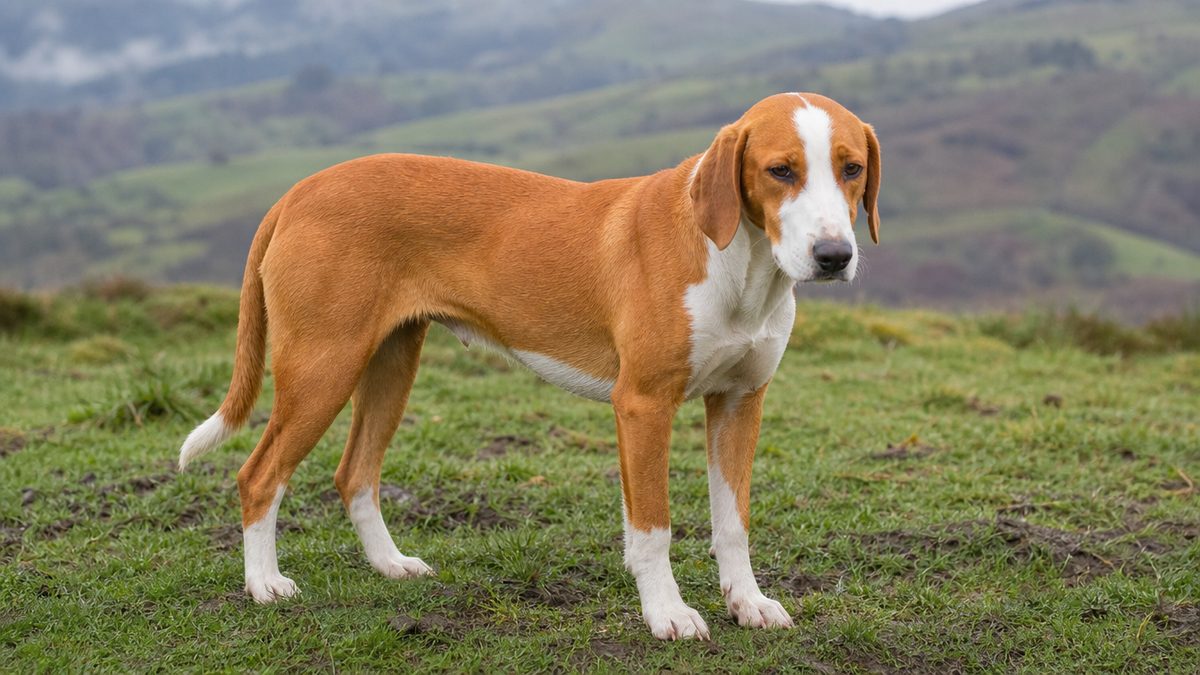
An Erbi Txakur is the traditional hare-hunting dog of the Basque Country, a medium, short-coated, orange and white scent hound from Alava and Bizkaia whose Basque name means, literally, hare dog.
Erbi is hare and txakur is dog. The name is a job description, and it is the only part of this animal's identity that every source agrees on.
Everything after that depends on which document you open, and this page is largely an account of what happens when you open all of them. The Basque Government catalogues the dog as a native Basque breed and rates its conservation status as Critica, critical. The Spanish state's list of Spanish canine breeds does not include it. The Real Sociedad Canina de Espana has no entry for it in any of its categories. The FCI has never held it. And the Basque hunting society that has done most to keep it going says plainly that its dogs are entered in the register as Sabueso Espanol, of a specific line.
The short answer
The Erbi Txakur is real, named, locally maintained and legally recognised in one jurisdiction. It is not a breed in the cynological sense, because it has no approved standard, no studbook of its own and no registry that will issue a pedigree in its name. In the vocabulary the Spanish national kennel club uses, it is closer to an ethnic group than to a raza, and the dogs themselves are registered as a line of another breed.
No kennel club anywhere issues a pedigree for an Erbi Txakur. Any paperwork offered with a puppy under this name is either a Sabueso Espanol registration or it is not a registration at all.
What the dog is for
Hare hunting, worked by nose. The FAO's survey of Basque genetic resources describes the dogs as hunters and trackers with a centuries-old tradition behind them in the Basque Autonomous Community, apparently descended from the Celtic scent hound, with a good sense of smell, strong and very rough, traditionally used on hare, wild boar and roe deer.
Wikipedia adds the modern shift: as the hare became scarce in the Basque country the dogs moved onto wild boar, roe deer and occasionally fox. The Orozko hunting society puts it more sharply than that. It reports that the hare and the dog are both close to extinction, and that a hare farm at Alsasua now exists partly to keep the quarry alive so that the dog has something to hunt.
That is an unusual thing to be able to write about a dog, and it is worth holding on to. This is a working population whose survival is tied to the survival of a wild animal, in one small region, with fewer than a hundred dogs by any published count.
Seven names for one dog, and two of them cannot both be right
The Erbi Txakur carries at least seven published names, and two of them describe opposite kinds of dog, which is the clearest single sign that the name has never been fixed to a defined population.
Wikipedia's infobox lists six alternative names: Braco Navarro, Braco Vasco, Braco Vizcaino, Sabueso Navarro, Euskal Erbi Txakur and Sabueso Pirenaico. No breed standard exists to adjudicate between them, which is why they all survive. The same page cannot even hold its list of Basque dogs steady: its body text names the Pachon de Vitoria among the five Basque breeds while its own navigation box names the Pachon Navarro instead. The FAO paper gives four synonyms, sabueso navarro, braco vasco, braco navarro and braco vizcaino. The Orozko hunting society heads its page 'SABUESO NAVARRO, EUSKAL ERBITXAKURRA' and adds a seventh, Conejero Navarro.
| Name | What it literally says | Source |
|---|---|---|
| Erbi Txakur / Erbi Txakurra | Hare dog, in Basque | Basque decree, Wikipedia, FAO |
| Euskal Erbi Txakurra | Basque hare dog | Wikipedia, Orozkaza |
| Sabueso Navarro | Navarrese scent hound | Wikipedia, FAO, Orozkaza |
| Sabueso Pirenaico | Pyrenean scent hound | Wikipedia, Orozkaza |
| Braco Vasco / Braco Navarro / Braco Vizcaino | Basque, Navarrese or Biscayan POINTER | Wikipedia, FAO |
| Conejero Navarro | Navarrese RABBIT dog | Orozkaza |
Sabueso and braco are not the same animal
A sabueso is a scent hound that trails quarry by nose and gives tongue. A braco is a pointing dog that quarters ground and freezes on game for a gun. They are different jobs, different builds and, in the FCI's own filing system, different groups: Group 6 for scent hounds and Group 7 for pointers. A single dog cannot be both.
The collision has a specific cause. Braco Navarro is also, and much more commonly, a name for the Pachon Navarro, a Spanish pointing breed that does appear in Spain's canine annex. So the Erbi Txakur's alternative-name list contains a name that already belongs to a different, listed breed.
The same author calls it two different things a year apart
Mariano Gomez Fernandez is the researcher whose work sits behind most of what is published about this dog. In 2002, writing on Basque livestock in Basque pastoralism, he describes the Erbi txakur in two sentences: it is 'el perro lebrel tradicional de los cazadores vascos', the traditional lebrel of Basque hunters, and 'un tipo de sabueso especializado en la caza de liebres', a type of scent hound specialised in hunting hares.
A lebrel is a sighthound, a greyhound type that runs down hares by eye. In the following year's FAO paper the same author drops the lebrel entirely and describes a scent hound with a good nose. Bonbeno reports both and does not pick one, but the evidence points to the scent hound: the FAO description, the Orozko society's morphology and the dog's entire published use, trailing hare and boar, are all scent-hound work.
The translation of erbi txakur as lebrel, a sighthound, is centuries old and is preserved in Basque heraldry. Modern writers quoting that heraldry have carried the sighthound reading forward into descriptions of a scent hound.
The Orozko page preserves the mechanism. Quoting a Basque blazon from the Butron family arms at Urduliz, the phrase 'hiru erbi txakur gorri', three red hare dogs, is rendered into Spanish heraldic language as 'tres lebreles rojos de gules';. The translation of erbi txakur as lebrel is centuries old, it is baked into the heraldry, and it has been carried forward into the modern literature by people quoting the heraldry.
Breed, ethnic group or line: the Spanish kennel club publishes the test
Apply the Real Sociedad Canina de Espana's own written test and the Erbi Txakur fails it on every limb, which makes it an ethnic group or a line rather than a breed, whatever the Basque decree calls it.
The RSCE publishes an essay by Carlos Salas Melero on precisely this question, and it is the most useful document in this whole research trail because it was written by the body that would have to do the recognising.
Its definition of an ethnic group: 'Llamamos Grupo Etnico a una poblacion canina que comparte entre sus miembros unos rasgos propios, tanto fisicos como funcionales, fijados por seleccion funcional, a lo largo de los anos, dentro de una determinada area geografica.' A canine population sharing its own physical and functional traits, fixed by functional selection over years, within a defined geographic area. That is the Erbi Txakur exactly.
It then asks the question this page is about, and answers it. 'Puede denominarse a estos grupos etnicos RAZA canina? Desde un punto de vista coloquial, popular e incluso en el ambito de algunas administraciones, asi se ha hecho y se hace.' Can these ethnic groups be called a breed? Colloquially, popularly, and even in the sphere of some administrations, they have been and are. But, it continues, in a strict sense there are essential differences.
The Spanish national kennel club says in writing that calling an ethnic group a breed happens 'even in the sphere of some administrations'. An administration is exactly what calls the Erbi Txakur a raza: the Basque Government, by decree.
The four things a breed needs, and what this dog has
The RSCE sets out what turns an ethnic group into a modern breed: a specific selection effort by breeders, agreed around a common project in the form of a racial standard, with individuals registered generation by generation in a book of origins, reaching a notable level of homogeneity and stability in both phenotype and genotype, demonstrated across at least three generations.
| Requirement | Status for the Erbi Txakur | Evidence |
|---|---|---|
| An agreed racial standard | None approved by any body | Absent from the RSCE index and from Spain's canine annex |
| A studbook of its own | None | Dogs are registered as Sabueso Espanol of a specific line |
| Three complete generations of pedigree | Not demonstrated anywhere | No register holds the name to record them in |
| Homogeneity of type | Explicitly denied by its own keepers | Weight and size vary so much that no general size can be specified |
| Breeders organised around a common project | Partly, through several associations | Euskal Erbi Txakur Elkartea, Erbi Europar, Granja Larrasal, Orozkaza, Euskal Abereak |
That fourth row is not Bonbeno's inference. The Orozko society writes it out: 'El peso y la talla varian mucho de un animal a otro, por lo que no se puede especificar un tamano general.' Weight and size vary so much from one animal to another that a general size cannot be specified. A population whose keepers say that about it does not yet have a standard, because a standard is precisely a statement of general size.
One more line from the RSCE closes the argument, and it is worth quoting because it reframes the whole conservation conversation: 'No se trata de recuperar una raza, sino de seleccionar un grupo etnico para crear una raza.' It is not a matter of recovering a breed, but of selecting an ethnic group in order to create one.
Register by register, each with a control that returned a result
Six registers were checked one at a time and only one of them holds this dog, the Basque Government's catalogue, with every other check paired with a control that returned a result in the same document or the same session.
An absence is worth nothing unless the instrument was tested, so each row below names what was found instead of the Erbi Txakur.
| Register | Erbi Txakur | Control in the same document or session |
|---|---|---|
| Basque Government, Catalogo Oficial de Razas Animales Autoctonas Vascas | PRESENT, status Critica | Euskal Artzain Txakurra, both varieties, En peligro |
| Spain, RD 558/2001 annex, 33 entries | Absent | Euskal Artzain Txakurra takes two of the 33 entries |
| Real Sociedad Canina de Espana, all categories | Absent | Villano de las Encartaciones listed under PAIS VASCO in Otras razas |
| FCI, Group 6 definitive nomenclature | Absent | Sabueso Espanol, standard 204, valid from 26 May 1982 |
| FCI, provisional register, 21 entries | Absent | Four breeds admitted 11 February 2026 |
| Royal Kennel Club and American Kennel Club | Absent from both | Both hold complete published indexes that were read end to end |
The Real Sociedad Canina de Espana, checked four ways
The RSCE index was read in full, and it has four places where this dog could sit. Its FCI groups list Sabueso Espanol alone under Grupo 6. Its Grupo 11, for Spanish breeds not recognised by the FCI, carries eleven entries including the Perro de Pastor Vasco and the Pachon Navarro. Its Grupos Etnicos Caninos section, for populations on the road to recognition, carries eight, among them the Can de Chira and the Presa Navarro. And its Otras razas list of breeds in recovery names them by autonomous community, with 'PAIS VASCO: Villano de las Encartaciones';.
The Erbi Txakur appears in none of the four. The control is the fourth list itself: the RSCE does maintain a Basque entry in its recovery list, so a Basque dog is not excluded by category. This one is simply not there.
The FCI, both registers, and why that answers the India question
The FCI's Group 6 nomenclature was read end to end. Section 1.2, Spain, holds exactly one breed: Sabueso Espanol, number 204, valid from 26 May 1982. The provisional register is a separate document and was read separately, because breeds sit there for years before reaching the definitive list; it holds 21 entries and this is not one of them.
That settles the Indian question without needing to search an Indian site. India is a full FCI member represented by the Kennel Club of India, and the FCI maintains a country statistics page for it Federation Cynologique Internationale. Pedigrees issued in India run against FCI nomenclature, so a breed absent from both FCI registers cannot be registered in India either.
The two English-language registers, for completeness
The Royal Kennel Club publishes one page listing every breed it recognises across seven groups, and its Hound group runs from Afghan Hound to Whippet with no Basque entry. The American Kennel Club's breed selector prints a complete A to Z of everything it lists, recognised and Foundation Stock Service together; between Entlebucher Mountain Dog and Estrela Mountain Dog there is nothing. The 513-page AKC Foundation Stock Service standards compilation, updated 25 June 2026, contains no Spanish scent hound at all.
None of that is surprising for a dog with fewer than a hundred living examples in one Spanish region. It is recorded here because the ranking pages assert kennel club recognition by implication, listing groups and standards for an animal no kennel club holds.
What Basque law actually does, and what it does not do
Basque law lists the Erbi Txakurra by name in an official catalogue of native Basque animal breeds and assigns it the conservation status Critica, but it publishes no racial standard for it and creates no studbook.
The instrument is Decreto 373/2001, de 26 de diciembre, on native Basque animal breeds and the bodies dedicated to promoting them, published in the Boletin Oficial del Pais Vasco number 14 on 21 January 2002. Its annex, printed at page 1087 in Basque and Spanish in parallel columns, is the Catalogo Oficial de Razas Animales Autoctonas Vascas.
Under species ZAKURRAK / CANINA the catalogue lists four names, one of them with two varieties.
| Entry | Status, Basque | Status, Spanish |
|---|---|---|
| Erbi Txakurra | Galtzeko arrisku bizian | Critica |
| Euskal Artzain Txakurra, variedad Gorbeiakoa | Galtzeko arriskuan | En peligro |
| Euskal Artzain Txakurra, variedad Iletsua | Galtzeko arriskuan | En peligro |
| Villano de las Encartaciones | Galtzeko arrisku bizian | Critica |
| Villanuco de las Encartaciones | Galtzeko arrisku bizian | Critica |
It was reaffirmed fourteen years later
This is not a dead 2001 listing. Decreto 81/2015, de 2 de junio, on the conservation, improvement and promotion of native Basque breeds, published in the BOPV on 15 June 2015 and in force from 16 June 2015, carries the same catalogue with the same canine entries and the same statuses. Erbi Txakurra: Critica.
One structural detail in the 2015 decree matters more than it looks. The catalogue is split into RAZAS GANADERAS, livestock breeds, and RAZAS NO GANADERAS, non-livestock breeds, and the canine entries sit under the second heading. The Basque administration had to invent a category to hold dogs, because the Spanish national system that the catalogue otherwise mirrors is a livestock system and has no canine species in it.
What the decree does not contain
Three absences are as important as the listing itself.
- No racial standard. The decree names the breed and rates its risk. It does not print a prototype, unlike the Spanish annex, which prints a full morphological prototype for each of the breeds it covers.
- No studbook. The decree regulates the entities that promote breeds; it does not itself open a libro genealogico for the Erbi Txakurra, and no association has published one.
- No census figure. The status Critica is assigned, but the decree gives no population number to justify it, so the number has to come from elsewhere.
So Basque law recognises the animal as part of the region's genetic heritage. It does not do the cynological work that would turn it into a breed, and it was never designed to. That is a livestock-conservation instrument being asked to carry a dog.
Write that the Erbi Txakur is recognised by decree of the Basque Government as a native Basque breed at critical risk. Do not write that it is a recognised breed, full stop, because every register that issues pedigrees says otherwise.
Spain's own list of Spanish dog breeds has 33 entries and this is not one
The annex to Real Decreto 558/2001 lists 33 named entries as the Spanish canine breeds, the Euskal Artzain Txakurra takes two of them as its two varieties, and the Erbi Txakurra does not appear at all.
The consolidated text of Real Decreto 558/2001, last modified 27 July 2020, runs to 73 pages. Its annex opens with a sentence and then a list: 'ANEXO RAZAS CANINAS ESPANOLAS. Las razas caninas espanolas son las que figuran a continuacion';.
Counted from the gazette text, the list carries 33 entries in alphabetical order, from Alano Espanol to Villano de las Encartaciones. Two of the 33 are the two varieties of one dog, Euskal Artzain Txakurra variedad Iletsua and Euskal Artzain Txakurra variedad Gorbeiakoa, so the 33 entries cover 32 distinct breed names.
That figure is worth stating precisely because it is easy to get wrong in either direction. It is 33 entries, not 34, and it is 32 breeds if you collapse the two Basque shepherd varieties into one dog.
Which Basque dogs made it into the Spanish list
| Dog | Basque catalogue | Spanish annex, RD 558/2001 | RSCE |
|---|---|---|---|
| Euskal Artzain Txakurra | Listed, two varieties, En peligro | Listed, two of the 33 entries | Listed under Grupo 11 |
| Villano de las Encartaciones | Listed, Critica | Listed, one of the 33 entries | Listed under Otras razas, PAIS VASCO |
| Villanuco de las Encartaciones | Listed, Critica | Not listed | Not listed |
| Erbi Txakurra | Listed, Critica | Not listed | Not listed |
Two of the four Basque dogs crossed from the regional catalogue into the national one and two did not. That is the whole finding, and it is checkable in about five minutes by anyone who downloads the consolidated PDF and reads the annex.
How a breed gets added, and why that route stayed open
The decree's third final provision empowers the Minister of Agriculture, Fisheries and Food to adopt the measures needed to develop it, 'y en particular para la modificacion e inclusion en el anexo de nuevas razas caninas, previo informe de la Comision Nacional de Zootecnia', and in particular to modify the annex and include new canine breeds, after a report from the National Zootechnics Commission.
So the door has been open since 2001 and the list has been amended since. Several breeds in the current 33 were added after the original decree, among them the Ca Me Mallorqui, the Gos Rater Valencia and the Podenco Paternino. The Erbi Txakurra has not walked through it, and on the RSCE's own criteria that is unsurprising: there is no standard to submit and no studbook to attach to it.
The Erbi Txakurra is absent from the 33-entry annex of Real Decreto 558/2001. Spain has never included this dog in its official list of Spanish canine breeds, while it does include the Basque Shepherd Dog twice and the Villano de las Encartaciones once.
The only published measurements sit inside the Sabueso Espanol standard
Every published height for the Erbi Txakur falls inside FCI Standard 204 for the Sabueso Espanol, which is the strongest single piece of evidence that this is a regional line of the Spanish Hound rather than a separate breed.
Wikipedia states the difference as a comparison rather than as figures: the Erbi Txakurra 'is somewhat smaller than the Sabueso Espanol but more muscular, and does not have such long ears';. That sentence is the whole published basis for treating the two as different dogs, and no figures accompany it there.
Figures do exist, from one source. The Orozko hunting society reproduces the morphological characteristics recorded by Pedro Solozabal of Elorrio, a veteran hare hunter and, in the society's words, a precursor of the conservation of this old native breed. Set his numbers against the FCI standard and the comparison does not survive.
| Measure | Erbi Txakur (Solozabal, via Orozkaza) | Sabueso Espanol (FCI 204) |
|---|---|---|
| Males | 51 to 56 cm | 52 to 57 cm, 1 cm tolerance |
| Females | 49 to 52 cm | 48 to 53 cm, 1 cm tolerance |
| Coat | Short | Short, fine, dense |
| Colour | Fire red, white chest, head, feet and tail tip | White and orange in irregular, well-defined markings |
Read the female row again. The Erbi Txakur's published female range, 49 to 52 cm, sits entirely inside the Sabueso Espanol's 48 to 53 cm. The male range is one centimetre lower at each end, and FCI 204 tolerates one centimetre above its own limits in well-proportioned dogs. No judge could separate the two populations on height.
The colour descriptions are the same dog too. FCI 204 gives white and orange 'with dominance of one or the other colour and distributed in irregular markings, well defined and without ticking', with the orange running from lemon to an intense russet-brown. The Basque description gives fire red with white on chest, head, feet and tail tip.
And the function is identical
FCI 204 says of the Sabueso Espanol: 'The Sabueso espanol (hound) is a great specialist in hunting the hare with his doubling habit and he is most efficient in blood tracking';. That is the Erbi Txakur's job description, written into the standard of the breed it is registered as.
What the keepers themselves say
The Orozko society does not hide this. In its habitat section it writes that examples survive in Navarre, the Basque Country and Cantabria, and that some of them 'registran en el Registro de Raza Canina como Sabuesos Espanoles, pero de una linea especifica', are registered in the canine breed register as Spanish Hounds, but of a specific line.
That is the accurate description, offered by the people who keep the dogs. A specific line of the Sabueso Espanol, carrying a Basque name, in a Basque region, selected for one quarry.
Two features in the Basque description do not appear in FCI 204: an open-hook tail carriage with a white tip, and a strong preference for a double dewclaw on the hind legs, ranked ahead of a single dewclaw and ahead of none. Those are the kind of details a working line fixes and a national standard ignores.
How many are left, and why four sources give four answers
Nobody publishes a current census, and the four figures in circulation range from fewer than thirty animals to a population described as stable, which is a spread wide enough that Bonbeno reports all four rather than picking one.
| Figure or claim | Date | Source |
|---|---|---|
| 29 dogs presented at the breed's first monograph, at Elorrio in Bizkaia | 2 September 2001 | FAO, Animal Genetic Resources 33 |
| Status Critica in the official Basque catalogue, no number given | 26 December 2001, reaffirmed 2 June 2015 | Decreto 373/2001 and Decreto 81/2015 |
| Fewer than fifty examples | 2009 | Guia de campo de las razas autoctonas espanolas, cited by Wikipedia |
| Fewer than 5 males and 25 females | Page last modified 2021 | Orozkaza, the Orozko hunting society |
| Conservation status Not Extinct, population Stable | 26 November 2024 | Snoutastic |
The three that are evidence
The Elorrio figure is the most concrete thing anyone has published. The FAO paper records that 'The first monograph of this breed was made in Elorrio (Bizkaia) on 2 September 2001, with 29 dogs';. A monograph in this sense is a single-breed gathering where animals are presented and assessed, so 29 is a count of dogs somebody actually stood in a ring and looked at.
The Basque catalogue's Critica rating is a legal classification rather than a count, but it is a classification a government assigned twice, fourteen years apart, and it sits alongside Villano and Villanuco de las Encartaciones at the same level while the Basque Shepherd Dog is rated only En peligro Decreto 81/2015, de 2 de junio.
The Orozko figure is the smallest and the most alarming: 'la cantidad de estos animales es menor de 5 para los machos y de 25 para las hembras', fewer than 5 males and fewer than 25 females. If that is even approximately right, the breeding population is in single figures on the male side, and Bonbeno cannot see how a closed population of that size could be bred forward without exactly the in-breeding that Indian law, and most European breeding codes, prohibit.
The one that is not evidence
Snoutastic, which ranks sixth on an India-located search for the term, states the conservation status as 'Not Extinct', population 'Uncommon', with the note 'This breed is less common but has stable populations in certain regions';. That is contradicted by a decree of the Basque Government in force since 2015 and by the only society that publishes a count.
Note also what would follow if the Orozko figure is right and the Snoutastic page is wrong. A reader deciding this is a stable, uncommon breed they might acquire is being pointed at a population of perhaps thirty dogs whose keepers are trying to save it.
No current census exists. The defensible statement is that the Erbi Txakur is rated Critica by the Basque Government, that 29 dogs were presented at its first and apparently only monograph in 2001, and that the society closest to it reports fewer than 30 animals in total. Anyone publishing a single confident population number for 2026 is guessing.
The history, and how much of it is actually evidenced
The documented history of the Erbi Txakur is short and starts in 2001, and everything before that is heraldry, tradition and a local enthusiast's reconstruction that contradicts itself on dates.
Take the solid part first. The FAO's 2003 survey records a centuries-old tradition of hunting with these dogs in the Basque Autonomous Community, describes them as apparent descendants of the Celtic scent hound, and dates the first monograph to 2 September 2001 at Elorrio in Bizkaia with 29 dogs. Three months later, on 26 December 2001, the Basque Government's decree put the name into an official catalogue.
So the dog's documentary existence as a named breed is almost exactly as old as this century. That does not mean the dogs are new. It means the paperwork is.
The heraldry, which is real but proves less than it looks
The Orozko society's account rests on a coat of arms of the Echebarria-Butron family in the church of Santa Marina at Urduliz in Bizkaia, rebuilt in 1770, whose Basque blazon includes 'hiru erbi txakur gorri', three red hare dogs. The phrase is genuinely old and genuinely uses the name.
What it does not establish is continuity of a population. A heraldic phrase records that Basque speakers in the past called some hunting dog an erbi txakur. It says nothing about whether today's dogs descend from those, and the Spanish rendering of the same blazon translates the phrase as lebreles, sighthounds, which is a different animal from the one the modern name is attached to.
Where the account contradicts itself
The same page describes an Orden de los Caballeros del Erbitxakur Blanco, an order of knights of the white hare dog, and gives two incompatible datings within four sentences: that it 'existio entre 1361-1425', and that 'La orden es de estilo frances, constituida en 1931 y desaparecida con la muerte de Carlos III';. Carlos III of Navarre died in 1425, so the 1931 date cannot be right, and Bonbeno records the contradiction rather than repeating either figure.
The page also asserts descent from the Norman 'Perros del Rey' and kinship with the Porcelaine, the Poitevin and the Billy, all three of which are FCI breeds. No genetic study supports it and none is cited.
Orozkaza is the best source on this dog for morphology, population and registration practice, because those are things its members observe directly. Its medieval history is enthusiast reconstruction and should be read as such. Note also that the site runs an old WordPress installation whose page metadata has been overwritten by an unrelated Italian company, so quote the Basque body text and nothing from the page furniture.
The regional hound family it belongs to
One historical point in the Orozko account is well supported by Iberian cynological literature and is worth keeping. Several regional types of sabueso were distinguished in the Iberian Peninsula, described by the zone they lived in: Asturian, Leonese, Santanderino and the sabueso vizcaino or northern hound, the last with black patches on the back, said to carry Ariegeois or Gascon influence arriving by sea into the ports of Biscay and Cantabria.
That is exactly the picture that produces something like the Erbi Txakur. A widespread hound population, differentiated by valley and by quarry, of which one regional working line kept a Basque name and a hare specialism after the national standard was written around a different subset.
Size and weight, coat colour, and the only real description anyone publishes
One description of this dog exists in any detail, recorded from a Basque hare hunter, and it opens by saying that size and weight vary so much from animal to animal that no general size can be given.
That sentence is the single most informative line published about the Erbi Txakur's appearance, and it comes from the people who breed it: 'El peso y la talla varian mucho de un animal a otro, por lo que no se puede especificar un tamano general';. Weight and size vary greatly from one animal to another, so a general size cannot be specified.
With that caveat stated, here is what Pedro Solozabal of Elorrio recorded, as published by the Orozko hunting society.
| Point | Description |
|---|---|
| Size | Medium |
| Colour | Fire red, with white chest, head, feet and tail tip. Exceptionally white may predominate, and entirely white dogs occur |
| Ear | Medium, set a little low |
| Muzzle | White, with a red or black nose |
| Tail | Open hook carriage, white tip |
| Legs | White front feet, coloured legs |
| Height at withers | Males 51 to 56 cm, females 49 to 52 cm |
| Coat | Short |
| Dewclaws | A double dewclaw is ranked first, a single dewclaw second, and no dewclaw third |
| Requirement of the dog | Good presence, good physical condition, no malformations, within the characteristics, and that it is a hunter |
What that list tells you about the population
Read the last row again. The final requirement is not a physical point at all: 'que sea cazador', that it be a hunter. A list of characteristics that ends by requiring the dog to work is a working-line description, not a breed standard, and it is the clearest evidence on the page that nobody is selecting these dogs on looks.
The dewclaw ranking is the other tell. A double dewclaw on the hind legs is ranked above a single and above none, which is a preference a working population fixes for its own reasons and which no national standard for a Spanish hound records. The FAO description independently notes 'double dew claws in the hindlegs';, so two sources agree on it, which is more than can be said for the height.
The two published descriptions, side by side
The FAO account describes a coat that is white on the paws, chest and forehead with the rest orange, medium-sized ears, an extended nose, a body tending to be long, thin straight tails falling downwards with a white tip, and double dewclaws behind, adding that the dogs 'are not very big';. The Basque account gives fire red with white markings, medium ears set a little low, and an open-hook tail with a white tip.
The two agree on colour pattern, on ear size, on the white tail tip and on the dewclaws. They disagree on tail carriage, straight and falling in one, an open hook in the other. That is a small disagreement between the only two real descriptions in existence, and it is recorded here rather than smoothed over.
Snoutastic gives a height of 51 to 61 cm, a weight of 18 to 27 kg and a medium double coat for a dog every genuine source describes as short-coated and under 57 cm. Those figures appear in no primary document and should not be used.
Erbi Txakur price in India
No Erbi Txakur price in India exists, because no Indian seller lists the dog and because there are probably fewer than thirty of these animals alive anywhere.
Start with the arithmetic rather than the search. The society closest to the population reports fewer than 5 males and 25 females. A dog whose entire world population would fit in a minibus does not have a market anywhere, let alone an Indian one, and any page quoting a rupee figure for it is describing something it has not seen.
The search confirms it, and the search was tested. A query for 'erbi txakur price india puppies for sale', located in India, returned ten results and not one was a seller of any kind. Nine were breed-list posts, auto-generated database pages and Wikipedia's list of dog breeds; one was a Facebook post by an American hound association listing the name among sponsored breeds.
The control, run through the identical tool in the same session, was 'labrador retriever puppies for sale india price'. It returned ten Indian selling pages with rupee bands broken down by city, among them a directory quoting Rs 30,000 to Rs 1,20,000 across Hyderabad, Bangalore, Delhi, Chennai, Lucknow, Mumbai, Jaipur and Pune. The tool works, Indian listings are indexed, and the absence is a fact about the market.
There is no Erbi Txakur price in India and Bonbeno will not publish one. There is no Erbi Txakur price in Spain either that this research could find, beyond a single classified listing for a sabueso puppy using the name.
What an Indian search returns instead
- Auto-generated breed databases. The Bing India results page reports about 46 results in total, and after Wikipedia the entire first page is breedspedia.com, doggycare.org, animalia.bio, thedogsmag.com, snoutastic.com, breedercheck.com, maolaoban.com and dogflux.com. That page does carry a genuine People also ask box with four questions, and the control on the identical endpoint in the same session, 'labrador retriever', returned one too.
- A dog-names page. One image result comes from a page titled '150+ Best Erbi Txakur Names (Basque Rabbit Dog Guide)', which has both invented a rabbit and generated 150 names for a dog with fewer than thirty living examples.
- One genuine Spanish classified. A Milanuncios listing for a 'cachorro sabueso erbi txakur' under hunting dogs, which is consistent with everything else on this page: the dog is sold in Spain as a sabueso, using the Basque name as a descriptor.
Why no converted price appears either
This site routinely catches Indian breed pages publishing a dollar figure divided by an exchange rate and presented as rupees, and the tests for it are simple. There is nothing to test here, because no Indian page publishes any figure for this name at all. That absence is cleaner than a contaminated number would be, and it is worth saying explicitly so that no future reader assumes the omission is an oversight.
For scale rather than for this breed, one Indian directory's published monthly cost for keeping a medium imported hunting dog in India runs from Rs 2,200 at a basic level to Rs 3,750 at a premium one, split across food, veterinary care and grooming. Bonbeno reproduces that as one site's estimate for a dog of roughly this size and not as a cost of keeping an Erbi Txakur, because nobody in India is keeping one.
Why no lawful supply chain can form in India
Three independent obstacles close the route: the population is too small to export from, Indian trade policy forbids importing dogs for breeding, and Indian breeding law forbids the in-breeding a founding population of this size would require.
Take them in order of finality.
One, there is nothing to import
A population of fewer than thirty animals, rated Critica by its own government and concentrated in two Spanish provinces, does not export breeding stock. Every conservation body involved, Euskal Erbi Txakur Elkartea, Erbi Europar, Granja Larrasal, Orozkaza and Euskal Abereak, exists to keep the dogs where they are.
Two, Indian trade policy
Dogs sit under ITC (HS) 01061900, 'Mammals: Other', with an import policy of Restricted, so an import authorisation is required. Policy Condition (7) of DGFT Trade Notice 22/2022-23 permits import 'only for the following specific purposes: i. Pet dog with valid pet book and relevant records/documents in the name of importer. ii. Dogs imported by the R&D Organisations for conducting research with the recommendation of CPCSEA. iii. For the internal security by the Defence and Police Force.'
Policy Condition (8) adds that 'Import of commercial dogs for breeding or any other commercial activities other than the purposes mentioned above is not permitted', and paragraph 6 states that 'any applications for trading/breeding purposes, or applications made on behalf of some another person/entity shall be duly rejected'. Paragraph 7 limits entry to the airports and seaports of Delhi, Mumbai, Chennai, Hyderabad, Bangalore and Kolkata. DAHD added a seventh port, Cochin International Airport at Kochi, for pets arriving under the baggage rules in October 2024. The full route is set out in how to import a dog to India.
The one open route is personal. Following CBIC Circular 15/2013-Customs of 8 April 2013, up to two pets may enter as passenger baggage without a DGFT authorisation, and only for a person transferring residence to India after two years of continuous stay abroad.
Three, Indian breeding law
Even if dogs arrived, they could not be bred forward lawfully. Second Schedule Part II paragraph 6(3) of the Prevention of Cruelty to Animals (Dog Breeding and Marketing) Rules 2017 prohibits two named techniques: 'in breeding ... breeding between relatives of the 2nd to 4th grade in straight or side line within the first four generations e.g. uncle to niece, nephew to aunt, cousin to cousin, grandparents to grandchildren', and 'incest breeding, mating between parents and children or between brother and sister, i.e. 1st grade relatives';.
A founding group drawn from a source population of fewer than thirty related animals, arriving in India two at a time in the baggage of unrelated returning residents, has no lawful path to a second generation. There is no arithmetic that produces an Indian Erbi Txakur population, and the breed's own conservation position in Spain means there should not be one.
If this dog interests you, the useful action is not acquisition. It is knowing that a real, named, critically rare hunting line exists in two Spanish provinces, and being able to tell that from the nine auto-generated pages that rank above the people trying to save it.
What a dog this size would cost to keep in India
Cost of ownership here is a structure rather than a figure, because no Indian household keeps this dog and the published rupee figures belong to other breeds of roughly the same size.
One Indian directory publishes a monthly breakdown for a medium imported hunting dog: food Rs 1,200 to 1,800, veterinary Rs 300 to 750 and grooming Rs 700 to 1,200, summing to a stated Rs 2,200 basic and Rs 3,750 premium. The arithmetic reconciles, which is more than many such tables manage, and Bonbeno reproduces it as a size-band estimate only.
| Line | Published range | What changes for a working scent hound |
|---|---|---|
| Food | Rs 1,200 to 1,800 | A 20 to 25 kg hound worked hard eats at the top of this band or above it |
| Veterinary | Rs 300 to 750 | Understated. Ear disease and tick-borne infection are the recurring Indian bills for a drop-eared, ground-working dog |
| Grooming | Rs 700 to 1,200 | Overstated. A short coat needs a rubber curry and ten minutes a week, not a salon |
| Total | Rs 2,200 to 3,750 | Reported as published, not verified for this breed |
The lines a breed directory never prints
- Cooling. In every mainland Indian city measured on this page the wet-bulb temperature runs 4 to 9 C above the hottest month the dog's homeland records. For a hound bred to run all day, indoor cooling for most of the year is the real largest cost.
- Tick control. A PCR survey of 525 dogs across four Indian cities found 261, or 49.7 percent, carrying at least one tick-borne pathogen, and ticks on 278 of the dogs examined, 53 percent. Year-round acaricide is not optional for a nose-down dog.
- Secure space. A scent hound that picks up a trail is gone. Fencing and a long line are capital items before the dog arrives.
- Time. The largest cost is not money. A hare hound needs an hour or more of purposeful work a day, and in India that has to happen before sunrise and after dark for most of the year.
There is one genuine saving. A short, close coat on a medium hound needs almost nothing done to it, so the grooming line above is the one figure a reader can safely halve.
Everything else in this section is generic to a 20 to 25 kg active dog in India, and that is deliberate. Bonbeno will not manufacture breed-specific Indian costs for an animal that has never been kept in India.
Suitability for the Indian climate, measured rather than guessed
Heat tolerance rates 2 out of 5 for this dog, because the Basque coast it comes from has an annual mean of 14.98 C and a hottest-month wet-bulb of 18.48 C, while Chennai's annual mean wet-bulb alone is 24.94 C.
All climate figures here come from NASA POWER's MERRA-2 monthly climatology, queried by explicit latitude and longitude rather than by place name, because a place-name lookup can quietly return a different location. Each figure carries the coordinates and elevation the service returned.
Two home cells were queried. Bilbao, at 43.2630 N, 2.9350 W, returned longitude -2.935, latitude 43.263, elevation 106.47 m. Vitoria-Gasteiz, at 42.8467 N, 2.6716 W, returned longitude -2.672, latitude 42.847, elevation 530.35 m. One honest caveat: a third query at Elorrio, where the breed's 2001 monograph was held, returned the identical cell to Vitoria-Gasteiz, so the inland figure describes a grid square rather than a valley.
| Location | Annual mean air temp | Hottest month air temp | Annual mean wet-bulb | Hottest month wet-bulb |
|---|---|---|---|---|
| Bilbao, Bizkaia (cell at 106 m) | 14.98 | 21.14 (August) | 12.87 | 18.48 (August) |
| Vitoria-Gasteiz, Alava (cell at 530 m) | 11.85 | 19.10 (August) | 9.98 | 16.35 (August) |
| Chennai | 27.95 | 31.51 (May) | 24.94 | 27.36 (May) |
| Kolkata | 25.81 | 31.53 (May) | 22.85 | 27.86 (June) |
| Mumbai | 26.77 | 31.19 (May) | 22.73 | 26.55 (June) |
| Delhi | 25.60 | 35.88 (June) | 18.03 | 27.74 (July) |
| Hyderabad | 26.10 | 33.30 (May) | 20.96 | 24.44 (June) |
| Pune | 23.86 | 28.93 (April) | 19.66 | 23.56 (June) |
| Bengaluru | 23.74 | 28.37 (April) | 19.80 | 22.66 (May) |
Why wet-bulb is the right axis
A dog sheds heat by evaporating water from its respiratory tract, and evaporation slows as the air gets wetter. Wet-bulb temperature combines heat and humidity into the number that actually limits a panting animal, which makes it the honest basis for a heat rating.
Bilbao's wet-bulb peak is 18.48 C in August. Chennai's annual mean wet-bulb, averaged across every month of the year, is 24.94 C, which is 6.46 C above the hottest thing the Basque coast produces. Kolkata's June figure of 27.86 C is 9.38 C above it and Delhi's July figure of 27.74 C is 9.26 C above it.
The gap is smaller than this site records for northern European breeds, and that is worth saying plainly. Bilbao is an Atlantic city with a mild, wet, humid climate rather than a cold one: annual mean relative humidity 76.76 percent, and only 21.14 C in the hottest month. A dog from there is used to working in damp air. It is not used to working in damp air at 27 C.
The rating is 2 rather than 1 because the coat is short and close, the frame is light and the dog is used to humidity. It is not 3 because the animal is bred to run for hours on a scent line, and no Indian city measured here lets it do that safely for most of the year.
What the heat literature says, and what it does not
Two VetCompass studies of UK dogs supply the physiology. The Animals paper reports that of the 879 heat-related illness events with a recorded trigger, 652, or 74.2 percent, were exertional. That is the finding that transfers: heat illness in dogs is overwhelmingly something a working dog does to itself, not something that happens to it in a parked car.
The Scientific Reports paper, on the same 905,543-dog cohort, found 395 confirmed events, an incidence of 0.04 percent and a fatality rate of 14.18 percent, with higher bodyweight relative to the breed and sex mean, brachycephalic skull shape, age over two years and weight over 50 kg identified as risk factors.
Two of those do not apply. This dog is neither brachycephalic nor anywhere near 50 kg, and it appears in no study's breed list, because no register defines the population that would let it appear. This page claims only the exertional finding and the bodyweight-relative-to-mean one.
City by city, and the one Indian place this dog could work
Gangtok is the only Indian location tested whose wet-bulb sits below the Basque figures, and everything on the mainland runs 4 to 9 C hotter than the dog's home in its worst month.
Run the comparison against Bilbao's August wet-bulb of 18.48 C and the ranking is unambiguous.
| City | Hottest-month wet-bulb | Degrees above Bilbao's peak | Practical reading |
|---|---|---|---|
| Kolkata | 27.86 (June) | +9.38 | Hardest of the set. Long, wet, hot pre-monsoon and monsoon. |
| Delhi | 27.74 (July) | +9.26 | Dry May is manageable in shade; July is not. |
| Chennai | 27.36 (May) | +8.88 | No cool season at all. Annual mean wet-bulb already 24.94. |
| Mumbai | 26.55 (June) | +8.07 | Coastal humidity keeps night-time recovery poor. |
| Hyderabad | 24.44 (June) | +5.96 | Dry heat with a short humid window. |
| Shimla (cell at 898 m) | 24.16 (July) | +5.68 | The real town is higher and cooler than the cell suggests. |
| Pune | 23.56 (June) | +5.08 | Best large mainland option measured here. |
| Bengaluru | 22.66 (May) | +4.18 | Mildest mainland city in the set. |
| Gangtok (cell at 3,240 m) | 12.49 (July) | -5.99 | Only cell cooler than Bilbao, and the altitude is smoothed. |
Reading the hill entries honestly
The Gangtok cell carries an elevation of 3,239.61 m while the town sits far lower, because MERRA-2 grid squares are large and mountainous terrain is smoothed into one representative height. The direction is real and the magnitude is not usable for planning. The Shimla cell has the opposite problem, sitting at 897.65 m against a town well above that, so its figures are too warm.
The honest summary is that hill stations above roughly 1,800 m are the only Indian places where this dog's original working pattern would be possible, and that Bonbeno will not publish a rating per hill station from a smoothed grid.
The comparison that surprised us
Bengaluru is only 4.18 C of wet-bulb above Bilbao's hottest month, which is the narrowest gap this site has recorded for any European working breed. That is not an endorsement. Four degrees of wet-bulb is the difference between a dog that can trail all morning and a dog that overheats in forty minutes, and Bengaluru holds that gap for most of the year rather than for four weeks.
Query the NASA POWER climatology endpoint at your own latitude and longitude, ask for T2MWET, and read the hottest month. Compare it to 18.48 C. If your figure is more than about four degrees above that, plan every outing for before sunrise and after dark.
Temperament and household fit
Very little is documented about this dog's temperament, and what exists describes a working scent hound: independent, nose-led, vocal on a line and selected for stamina rather than for biddability.
Be honest about the evidence first. No breed club has published a temperament description, no standard exists to state one, and the ranking pages that offer detailed personality profiles are describing a herding dog they have confused this one with. What follows is drawn from the two genuine descriptions and from what is generally true of scent hounds.
The FAO account gives three qualities: a good sense of smell, strong, and 'very rough', which in this context means hardy and able to keep working in bad going rather than aggressive. The Basque list of requirements ends with the only temperament clause anyone has written down: the dog must be a hunter.
What a hare hound is like to live with
- Nose over ears. A dog selected across generations to hold a hare line does not stop for a recall once it has scent. Plan for a long line and a fenced space, not for an open maidan.
- Vocal on a trail. Scent hounds give tongue. That is the point of them, since the hunter reads the hunt from the dog's voice. In an Indian apartment block it is a serious problem.
- Independent rather than disobedient. These dogs solve the trail themselves. They are not looking to their handler for the next instruction the way a herding dog does.
- Even-tempered with people. Nothing in the record suggests guarding, suspicion or aggression, and pack-hunted hounds are generally tolerant of dogs and of handling.
- High prey drive towards small animals. A hare specialist and a house cat are not compatible.
Who this dog would suit, if it were available
A rural or semi-rural Indian household with land, a secure boundary, cool early mornings, no small pets, tolerance for a loud dog and a genuine interest in scent work. That is a narrow specification, and it is narrower still once the climate section is taken into account.
Who it would not suit is easier. Flats, families wanting an off-lead dog, households with cats or rabbits, and anyone who reads 'family companion' on a breed database and assumes it means low-maintenance. The FCI standard for the breed these dogs are actually registered under describes a hunting hound for small game that is 'not averse to big game hunting, be it boar, stag, deer, fox, wolf or the bear';. That is the animal.
Snoutastic rates this dog 5 out of 5 for family fit, 4 for kid-friendliness and 4 for training ease, on a profile that also calls it a herding breed and translates its name as 'shepherd dog'. None of those ratings is derived from anything anyone has observed about an Erbi Txakur.
Training approach, and the one thing a scent hound resists
Train a scent hound by paying better than the trail pays, because the single thing this type genuinely resists is being recalled off a line it has committed to.
Answer the heading directly. Everything else, settling, handling, lead manners, crate work, comes at ordinary speed. Interrupting a dog that has locked on to scent is the hard problem, and it is hard because a century of selection made it hard on purpose.
A realistic first-year plan for India
- Weeks 8 to 16, socialise on a written list. Traffic, autos, lifts, tiled floors, monsoon rain on a metal roof, cattle, calm adult dogs, and being handled around the ears and feet. Structured puppy classes are scarce outside the Indian metros, so plan the exposure rather than hoping for it.
- Weeks 10 to 20, build the recall indoors before you need it outdoors. Pay heavily, in the house first, then the gate, then a quiet lane before 7 am. Never call the dog to end something it is enjoying.
- Months 4 to 8, give the nose a legal job. Scatter feeding, a hidden pot of strong-smelling food, and tracking games on a harness and a long line. A hound with nothing to trail invents something to trail.
- Months 6 to 12, proof an emergency stop. One whistle or one word that means lie down where you are. On an Indian road that command matters more than recall.
- Throughout, train in the cool hours. Before 7 am and after 8 pm for at least eight months of the year, for the reasons the climate section sets out.
What does not work
Harsh handling does not work on a hound and it carries a specific risk with a rare working line: a dog that will not face difficult going is useless for the job, so any correction strong enough to shift the behaviour is strong enough to damage the animal you are trying to preserve.
Nor is the original test available. In India there is no hare season, no hunting culture for this dog to join, and no legitimate quarry for a trailing hound. So the whole training programme has to be a substitution, and scent work is the honest substitute: it uses the same nose, the same persistence and the same reward pathway with nothing to catch at the end.
Lay a scent trail with a sealed pot of meat dragged on a string across a garden, let it age twenty minutes, then send the dog. Build up the age of the trail rather than its length. That is the closest lawful Indian equivalent of what this dog was made for.
The daily exercise requirement, and what happens without it
Plan on 60 to 90 minutes of purposeful activity a day for a working hound of this size, with most of it nose work, and split across the cool hours in India.
The number is inferred rather than published, because no breed body has stated an exercise requirement for this dog. It comes from what the animal is: a medium scent hound bred to trail hare for hours over Atlantic hill country, in a country where the FCI standard for the breed it registers under expects it to hunt small game and, if needed, boar and deer.
The shape of the exercise matters more than the quantity. An hour of straight lead walking leaves a trailing hound physically tired and mentally untouched. An hour that includes twenty minutes of tracking leaves it settled.
A workable Indian split
- Before 7 am, 30 to 40 minutes. Lead walk with free sniffing on cool ground. Check the surface with the back of your hand before you set out.
- Midday, 15 minutes indoors. Scatter feeding, a food puzzle, or a short tracking game along a hallway. This is the block most owners drop and the one that does the most work.
- After 8 pm, 20 to 30 minutes. A laid trail in a secure enclosed space, then a proper cool-down before the evening meal.
- Weekly, one longer outing. Unfamiliar ground with unfamiliar smells, on a long line. Novelty is the point, not distance.
What under-exercise looks like in a hound
Not chewing. Roaming. An under-worked scent hound leaves: it works a boundary until it finds a gap, and then it follows whatever it finds outside. In an Indian city that means traffic, free-ranging dogs and a dog that cannot hear you calling because it is two streets away on a line.
The secondary signs are vocal rather than destructive. Sustained baying at night, whining at doors, and an animal that cannot settle indoors even after a long walk.
There is also an Indian failure mode worth naming. Owners who cannot exercise a dog in the heat compensate by exercising it hard at the wrong hour, which is precisely the pattern the heat literature identifies: 652 of 879 UK heat-illness events with a recorded trigger, 74.2 percent, followed exercise. A hound on a scent will not stop, so the handler has to.
Never let a trailing hound choose its own stopping point in Indian heat. It will keep working past the point where it can shed the heat it is making.
Grooming and coat care in Indian humidity
Grooming a short-coated hound takes ten minutes a week, and the real coat work in India is not the coat at all but the ears, the skin folds and the ticks.
The coat first. Both real descriptions agree: the coat is short, and the FCI standard for the breed these dogs register under describes a short, fine, dense jacket. A rubber curry brush once a week, more in a shedding period, is the whole coat routine.
Coat colour, and what it does and does not tell you
The colour is fire red or orange with white on the chest, head, feet and tail tip, and entirely white dogs occur exceptionally. FCI 204 describes the same pattern for the Sabueso Espanol: white and orange in irregular, well-defined markings without ticking, the orange running from lemon to intense russet-brown.
Two practical consequences follow for India, and neither appears on any breed database. A pale, thin-coated muzzle and a white blaze sunburn, so a dog worked in Indian sun needs shade discipline and, on the nose, a vet-approved barrier. And a light coat shows ticks, which for once is an advantage.
The ears are the whole job
This dog has medium ears set a little low. A dropped ear over a warm, humid canal is the standard recipe for otitis externa, and Indian conditions supply the humidity for most of the year.
- Dry the ears every single time the dog gets wet. Plug with cotton wool before a bath, dry the canal opening afterwards, and never let a drop-eared dog air-dry in humid weather.
- Check daily through the monsoon. A head shake, a tilt, or a smell are all earlier signals than visible discharge.
- Do not flush a painful ear at home. A ruptured drum turns a routine problem into a referral.
- Check for ticks along the ear margins, between the toes and under the collar every day in the monsoon, for the reasons the health section sets out.
Where overseas advice does not transfer
Grooming guidance written for an Atlantic climate assumes a dog that gets wet and then dries in cool moving air. An Indian monsoon dries nothing, and a Chennai afternoon dries the outside of a coat while leaving the ear canal wet. That single difference is why an imported grooming routine fails here, and it is the one thing this section would keep if it had to lose everything else.
Health issues, life expectancy, and how little anyone knows
No health data exists for this population, and three databases were searched with controls to establish that rather than to assume it.
| Source | Erbi Txakur | Related Spanish hound | Control |
|---|---|---|---|
| OFA published statistics tables | 0 rows | 0 rows for any Spanish hound | Labrador 109 mentions, Border Terrier 52, Beagle 61 |
| PubMed | 0 genuine records | 0 for Sabueso Espanol | Labrador plus hip dysplasia, 52 records |
| Europe PMC | 0 records | 2 for Sabueso Espanol, both from a 1990s Spanish breed survey | Labrador Retriever, 5,946 |
The Orthopedic Foundation for Animals
The OFA disease statistics page was retrieved as 2,226,021 characters of markdown and searched case-insensitively, because breed names on that page are printed in capitals and a case-sensitive search manufactures its own absence. Labrador returned 109 matches, Border Terrier 52 and Beagle 61, so the instrument was working. Erbi returned zero, txakur zero, sabueso zero, Spanish hound zero and Basque zero.
That last set is the useful one. It is not simply that this dog has no orthopaedic data. No Spanish scent hound of any kind has a published row in OFA's tables, which tells you that the absence is about which populations get screened in North America rather than about this breed in particular.
PubMed, and a textbook example of why the count lies
A search for 'erbi txakur' on PubMed returns zero, and the query translation shows both terms were retained: '"erbi"[All Fields] AND "txakur"[All Fields]';. That is a clean negative, because the engine ran the search it was asked to run and found nothing.
Now search 'erbi txakurra' and the count jumps to 55. The translation explains it in one line: the query collapsed to '"erbi"[All Fields]' alone, dropping the second word entirely. Fifty-five records for the string 'erbi' is not literature about a Basque hound, and a page reporting that number as evidence of research would be inventing a field.
The other searches returned zero with both terms retained: 'sabueso navarro', 'sabueso espanol' and 'basque AND hound'. The control, 'labrador retriever' with 'hip dysplasia', returned 52 in the same session.
Europe PMC agrees. Zero for 'erbi txakur', zero for 'erbi txakurra', and 5,946 for the Labrador control. It returns two records for 'sabueso espanol', both parts of a Spanish study of genetic relationships between Spanish dog breeds, which is the only literature that touches this family of dogs at all.
Life expectancy, which this page will not give you
No life expectancy figure exists for the Erbi Txakur and Bonbeno will not borrow one. For scale, the largest UK study of the question, built on 30,563 dogs that died between 1 January 2016 and 31 July 2020, gives an overall life expectancy at birth of 11.23 years. Snoutastic prints 12 to 15 years for this dog with no source attached. Treat that as a guess.
A registered breed accumulates screening results because a registry asks for them. A working line of fewer than thirty dogs, registered under another breed's name, accumulates nothing. So the correct statement is that nobody has measured this population, not that it has been measured and found sound.
What Indian law would require, and what nobody can supply
Indian law requires a breeding dog to have been tested for a named list of genetic defects, and for this population that requirement is unsatisfiable, because no scheme exists that screens these dogs for anything.
The clause is Second Schedule Part III paragraph 8(10) of the Prevention of Cruelty to Animals (Dog Breeding and Marketing) Rules 2017, and the gazette text reads: 'The dogs shall have been tested for genetic defects, including hip dysplasia, progressive retinal atrophy, night blindness, hypothyroidism, entropion, ectropion, overshot, undershot jaw (when incisors do not touch or mesh), wry mouth, two or more missing teeth, unilateral cryptorchid or full cryptorchid males';.
The operative word is 'including', so the list is illustrative rather than closed. A defect is not outside the clause because it is unlisted.
Three things the Rules do not require
Counted across all 14 pages of the gazette text, the terms 'patella', 'BAER' and 'deaf' each appear zero times. There is no Indian patella-grading requirement and no Indian hearing-test requirement, whatever a breed page may say.
That matters here because the ranking pages assert hip dysplasia and progressive retinal atrophy as this breed's common health issues. Both are in the Indian clause, both are real conditions in dogs generally, and neither has ever been measured in this population. Naming them as breed problems gives a false impression of knowledge.
The Indian disease pressure that would actually matter
Whatever a hare hound's inherited health, the acquired risks in India are what would fill its file. A PCR survey of 525 dogs across four Indian cities found 261, or 49.7 percent, carrying at least one tick-borne pathogen: Hepatozoon canis at 30 percent, Ehrlichia canis at 20.6 percent, Mycoplasma haemocanis at 12.2 percent, Anaplasma platys at 6.5 percent and Babesia vogeli at 5.5 percent, with co-infection in 39 percent of infected dogs and ticks found on 278 of the dogs examined, 53 percent.
A dog whose working method is pushing its nose through undergrowth for an hour at a time is the worst possible candidate for that disease pressure. Year-round acaricide, daily physical checks and a low threshold for testing a lethargic dog would not be optional.
And the clause that would stop breeding before it started
Second Schedule Part II paragraph 6(3) prohibits in-breeding, defined as 'breeding between relatives of the 2nd to 4th grade in straight or side line within the first four generations e.g. uncle to niece, nephew to aunt, cousin to cousin, grandparents to grandchildren', and incest breeding, 'mating between parents and children or between brother and sister, i.e. 1st grade relatives';.
Applied to a founder group drawn from fewer than thirty related dogs, that clause is not a restriction. It is a prohibition on the only breeding that would be arithmetically possible.
Feeding a medium working hound in India
Feed to body condition rather than to a chart, because no breed-specific feeding guidance exists for a population with no standard and the size and weight figures on the ranking pages belong to a different dog.
Start from the frame in front of you. The only real height figures give males 51 to 56 cm and females 49 to 52 cm at the withers, and the source that supplies them says outright that weight varies so much between animals that no general size can be given. The FCI standard for the breed these dogs register under gives 52 to 57 cm and 48 to 53 cm and prints no weight at all.
So there is no target weight to feed towards. There is a body condition to feed towards, and for a hound that is a simple thing to read.
- Ribs. Easily felt under a thin covering. On a short-coated hound in good condition the last two ribs are faintly visible in movement and not in stance.
- Waist. Clearly marked from above, with a tuck-up from the side. A hound that has lost its tuck-up has lost its working shape.
- Hips and spine. Palpable but not prominent. Prominent means underfed, not fit.
- Weekly, not daily. Weigh once a week on the same scale and change portions by ten percent at a time.
Life stages
Puppies of this size do best on three to four meals a day to about four months, three to about six months, then two. Adults stay on two. Splitting the ration matters more in India than in Atlantic Spain, because a full stomach and a hot afternoon are a bad combination for a deep-chested active dog.
For scale rather than for this breed, one Indian directory puts monthly food for a medium imported hunting dog at Rs 1,200 to Rs 1,800. Bonbeno reproduces that as a size-band estimate. Calorie needs vary far more with work than with breed, and a hound doing an hour of tracking needs more than one doing a lead walk.
Three Indian adjustments
- Feed after exercise, not before. In the hot months leave at least an hour between the evening outing and the meal, and let the dog cool properly first.
- Count the water. Multiple bowls, changed twice daily in the heat, and placed where free-ranging animals cannot reach them if they are outdoors.
- Watch the storage. Indian summer storage turns kibble fats rancid quickly. Buy smaller packs more often, keep them sealed and cool, and discard anything that smells off.
There is no breed-specific diet to recommend here and this page will not invent one. A complete food appropriate to life stage, fed to condition, with the ribs and the waist as the judge, is the whole evidence-based answer.
The first year, month by month
Plan a hound puppy's first year in India around three fixed points: a legal minimum age of eight weeks at sale, a vaccination course running from seven to eighteen weeks, and a socialisation window that closes long before the dog is grown.
Indian law fixes the start. Rule 8(1)(a) of the Prevention of Cruelty to Animals (Dog Breeding and Marketing) Rules 2017 requires that 'pups less than eight weeks in age are not sold', and Second Schedule Part III paragraph 8(9) sets the vaccination frame: 'All pups shall be vaccinated which can start at the age of seven-eight weeks, and are usually completed at the age of eighteen weeks';.
| Age | What is happening | What you do |
|---|---|---|
| 8 weeks | Legal minimum age of sale in India | See the dam, start the vaccination course, begin ear handling |
| 8 to 12 weeks | Socialisation window wide open | Traffic, lifts, tiled floors, monsoon noise, cattle, calm adult dogs |
| 10 to 14 weeks | Second and third vaccinations | Short lead walks in the cool hours only, recall built on food indoors |
| 16 to 18 weeks | Vaccination course completes | Wider world, novel surfaces, first controlled meetings with unfamiliar dogs |
| 4 to 6 months | Teething, nose coming online | Scatter feeding, first laid trails, chew provision, no forced exercise |
| 6 to 9 months | Adolescence, recall degrades sharply | Long line becomes standard, emergency stop trained daily |
| 9 to 12 months | Adult stamina, adult nose | Build to 60 to 90 minutes across the cool hours, most of it scent work |
| 12 to 18 months | Physical maturity for a medium hound | Reassess condition by hand, not by the scale alone |
The window that closes
The work between eight and sixteen weeks is the highest-value thing an Indian owner does with a hound, and it cannot be made up later. A scent hound socialised badly is not aggressive; it is anxious, noisy and impossible to settle in a city, which is a harder problem to live with.
One Indian constraint is worth planning around. Structured puppy classes exist in the larger metros and thinly elsewhere, so most owners have to build the exposure list themselves. Write it down, tick it off, and treat it as training rather than as walks.
Do not exercise a hound puppy in the middle of an Indian day at any age. Its judgement does not exist yet, and the exertional pattern that dominates canine heat illness starts young.
Head to head against the hounds an Indian buyer can actually get
Compare the Erbi Txakur against what is genuinely available in India and the answer is unambiguous: three of the four alternatives are better documented, better supported and actually obtainable.
The useful comparison is not Erbi Txakur against Sabueso Espanol. It is Erbi Txakur against the dogs an Indian household could lawfully acquire, register and get breed-specific veterinary advice about.
| Dog | Registry status | Available in India | Published health data | Heat tolerance |
|---|---|---|---|---|
| Erbi Txakur | Basque decree only; no kennel club anywhere | No listings found, control passed | None at all | 2 of 5 |
| Sabueso Espanol | FCI standard 204 since 1982; RSCE Grupo 6 | Not offered in India | No OFA row; two 1990s Spanish papers | 2 of 5 |
| Beagle | FCI 161, Royal Kennel Club, AKC, KCI | Widely available in Indian cities | OFA row with 61 mentions in the dump | 3 of 5 |
| Indian pariah / indie | None, and it does not need one | Free, in every Indian city | None breed-wide, but locally adapted | 5 of 5 |
| Rajapalayam or Chippiparai | Kennel Club of India | Available in Tamil Nadu and beyond | Thin, but Indian | 4 of 5 |
Reading that honestly
If what appeals is a trailing hound, the Beagle is the same idea with an FCI number, a standard, real availability in Indian cities and an actual entry in the orthopaedic registry. Almost every practical reason to want an Erbi Txakur is served better by a Beagle in India, and the exception is romantic rather than functional.
If what appeals is a rare native hunting dog, India has its own. The Rajapalayam and the Chippiparai are Indian sighthounds recognised by the Kennel Club of India, adapted to the climate, and in need of exactly the kind of attention that gets spent on foreign rarities.
If what appeals is a hardy, low-maintenance dog suited to Indian conditions, the Indian pariah dog outperforms every imported option, costs nothing and needs no import authorisation.
Where the Erbi Txakur would genuinely win
One column, if it existed, would favour it. A population selected for a century on whether the dog can hunt has never been selected for an exaggerated head, an oversized eye, a shortened muzzle or a coat that needs professional maintenance. The Orozko society's list of requirements ends with 'que sea cazador' and includes 'que no tenga malformaciones';, which is a soundness test rather than a beauty one.
That is an argument from mechanism, not from data, and this page has already shown that the data to test it does not exist. Keep the argument, hold it loosely, and do not let anyone sell you a dog on it.
Mistakes readers make with this name
Six mistakes account for nearly everything that goes wrong when someone researches the Erbi Txakur, and five of them can be corrected by opening one register.
- Treating a Basque decree as kennel club recognition. The Basque Government catalogues the dog as a native breed at critical risk. That is a conservation instrument, not a studbook, and no register will issue a pedigree in this name.
- Confusing it with the Basque Shepherd Dog. They are different dogs in different groups doing different jobs, and both are listed separately in the same Basque catalogue. The Euskal Artzain Txakurra is the shepherd. The Erbi Txakur is the hare hound.
- Believing the name means shepherd dog. Erbi is hare and txakur is dog. The Basque for shepherd is artzain, which is why the shepherd dog is called Euskal Artzain Txakurra. Any page translating Erbi Txakur as shepherd dog has invented an etymology.
- Calling it a rabbit dog. Two ranking pages do. Erbi is hare; the Basque for rabbit is untxi. The rabbit reading comes from one Spanish synonym, Conejero Navarro, and it is not what the Basque name says.
- Reading Braco as a description. Braco means pointer. The Erbi Txakur is a scent hound, and the Braco Navarro name belongs much more firmly to the Pachon Navarro, a separate breed that Spain does list.
- Taking a published height or weight at face value. The only real figures come from one Basque hunter and sit inside the Sabueso Espanol standard. The 18 to 27 kg and 51 to 61 cm printed by the top-ranking database appear in no primary document.
The sixth-ranked page is the clearest case
Snoutastic, which ranks sixth on an India-located search for this term, files the Erbi Txakur in the Herding group, gives 'Basque Shepherd Dog' as an alternative name, states that its name 'translates to shepherd dog in the Basque language', describes centuries of assisting shepherds with flocks, rates its family fit 5 out of 5 and its conservation status as Not Extinct and Stable.
Set that against a decree of the Basque Government in force since June 2015 rating the breed Critica, and against a hunting society reporting fewer than 5 males and 25 females. The same page then offers the Cumberland Sheepdog as a 92 percent match, which is a breed that no longer exists.
Do not read this as saying the Erbi Txakur is not real. It is real, it is named in law, it has a documented monograph, a described morphology and people working to save it. What it is not is a recognised breed, an available dog, or anything the nine databases ranking above its own keepers are describing.
Adoption, and the honest answer to wanting this dog
You cannot adopt an Erbi Txakur in India, or realistically anywhere, so the useful question is what to do with the interest, and there are three real answers.
The constraint first. No Indian rescue lists this dog, no Indian seller advertises it, and the search that would find either was proved working by a control in the same session that returned ten Indian Labrador listings. In Spain the population is small enough that acquisition would work against conservation rather than for it.
Three routes that are actually open
- Adopt an Indian scent-working street dog. Indian street dogs include plenty of medium, short-coated, nose-led animals that trail, dig and follow a line. They are heat-adapted, disease-experienced, free and immediately available through any municipal shelter or local rescue network.
- Adopt a Beagle through a breed-aware rescue. Beagles are common enough in Indian cities that they reach rescue regularly, usually surrendered by owners who underestimated the nose and the voice. That is the closest registered equivalent, and a rescue will brief you more honestly than a breeder.
- Support the conservation rather than the market. Euskal Erbi Txakur Elkartea, Erbi Europar, Granja Larrasal, Orozkaza and Euskal Abereak are the bodies working on this dog, and the Orozko society publishes a book, Sabuesos en Extincion, at 15 euros.
If somebody in India offers you one
Ask two questions. Which port did the parent stock enter through, and under which policy condition of DGFT Trade Notice 22/2022-23. Neither has a good answer, and asking is faster than arguing about the dog.
The likeliest realities behind such an offer are a Beagle cross, a locally bred hound of no particular ancestry, or a photograph taken from one of the nine auto-generated pages that rank for the name. None of those is a transaction Bonbeno would tell a reader to complete.
Responsible sourcing, when there is nothing to source
The usual advice on this site is to verify the breeder, see the dam, ask for screening results and check the registration. None of it is available here. There is no registration to check, no screening scheme to ask about and no Indian breeder whose premises could be visited. That absence is the sourcing advice.
Adopt an Indian street dog with a working nose. It will be hardier, cheaper, better adapted to your climate, immediately available and legally uncomplicated. If a written standard matters to you, adopt or buy a Beagle from a rescue or a KCI-registered breeder you have visited.
Related reading on this site: the Basque Shepherd Dog page, which covers the other Basque dog and the Spanish annex from the shepherd's side, and the Can de Palleiro page, which works through Galician regional recognition the same way. The Denmark Feist page handles a name problem of a different shape.
Erbi Txakur questions, answered from the registers
Where does Erbi txakurra come from?
The Erbi Txakurra comes from the Basque Autonomous Community in northern Spain, specifically the provinces of Alava and Bizkaia. The FAO's survey of Basque genetic resources places it in Bizkaia and records a centuries-old tradition of hunting with these dogs there. Its first breed monograph was held at Elorrio in Bizkaia on 2 September 2001.
What is Erbi txakur used for?
The Erbi Txakur is used for hunting hare by scent, which is what its Basque name means: erbi is hare and txakur is dog. As the hare has become scarce in the Basque country the dogs have moved onto wild boar and roe deer, and occasionally fox. They work by nose and give tongue on a trail.
Are Erbi txakurra endangered?
Yes, critically. The Basque Government's official catalogue of native Basque animal breeds rates the Erbi Txakurra as Critica, first by Decreto 373/2001 and again by Decreto 81/2015. The Orozko hunting society reports fewer than 5 males and 25 females remaining, and 29 dogs were presented at the breed's first monograph in 2001.
What does a Erbi txakurra look like?
A medium, short-coated scent hound in fire red or orange with white on the chest, head, feet and tail tip, with medium ears set a little low and a tail carried as an open hook. Males stand 51 to 56 cm and females 49 to 52 cm. Its keepers say weight varies so much that no general size can be specified.
Is the Erbi Txakur a recognised breed?
Not by any kennel club. It is listed by decree of the Basque Government as a native Basque breed at critical risk, but it does not appear in the 33-entry annex to Spain's Real Decreto 558/2001, in any category of the Real Sociedad Canina de Espana, in either FCI register, or in the Royal Kennel Club or American Kennel Club lists.
Is the Erbi Txakur the same as the Basque Shepherd Dog?
No. They are separate dogs listed separately in the same Basque catalogue. The Euskal Artzain Txakurra is a herding breed in two varieties that Spain does list, twice, in its canine annex. The Erbi Txakurra is a hare-hunting scent hound that Spain does not list at all.
How are Erbi Txakur puppies registered?
As Sabueso Espanol, of a specific line. The Orozko hunting society states that surviving dogs in Navarre, the Basque Country and Cantabria are registered in the canine breed register as Spanish Hounds but of a specific line, which is the clearest statement anyone has published about what this population is in registry terms.
Is the Erbi Txakur just a line of the Sabueso Espanol?
The evidence points that way. The only published heights sit inside FCI Standard 204 for the Sabueso Espanol, the colour descriptions match, the standard names hare hunting as the Spanish Hound's speciality, and the dogs are registered under that breed. What may be genuinely distinct is the open-hook tail carriage and a strong preference for a double dewclaw.
What is the Erbi Txakur price in India?
There is none, and Bonbeno will not publish one. No Indian seller lists this dog, while a Labrador Retriever control query through the same tool in the same session returned ten Indian selling pages with rupee bands. With fewer than thirty animals alive, no market exists anywhere.
Can an Erbi Txakur be imported into India?
Only as a personal pet, and in practice not at all. DGFT Trade Notice 22/2022-23 places dogs under ITC (HS) 01061900 as Restricted and permits import only for a pet dog with a valid pet book in the importer's name, for R&D with a CPCSEA recommendation, or for Defence and Police use. Trading and breeding applications shall be duly rejected.
Can an Erbi Txakur cope with Indian heat?
Poorly. NASA POWER puts the Bilbao grid cell at an annual mean of 14.98 C with an August wet-bulb peak of 18.48 C, while Chennai's annual mean wet-bulb alone is 24.94 C and Kolkata reaches 27.86 C in June. Heat tolerance rates 2 out of 5 and all exercise would have to move to the cool hours.
What health problems does the Erbi Txakur have?
Nobody knows, and that is the honest answer. The Orthopedic Foundation for Animals holds zero rows for this dog and zero for any Spanish scent hound, against 109 Labrador matches in the same searched dump. PubMed returns no genuine record. There is no breed club screening scheme because there is no register to hold one.
Why does the name have so many versions?
Because the name was never fixed to a defined population. Published synonyms include Sabueso Navarro, Sabueso Pirenaico, Conejero Navarro and three Braco names, and braco means pointer while sabueso means scent hound. One of them, Braco Navarro, belongs much more firmly to a separate Spanish breed, the Pachon Navarro.
Compare with similar breeds
Erbi Txakur sits in 2 Bonbeno groups. Each one compares it directly against the breeds it is genuinely an alternative to, on the same figures.