
Breed profile
Chilean Terrier: The Complete India Guide
A 5 to 8 kg Chilean ratter whose own kennel club files it under Group 11, not-recognised-by-FCI, and whose Fox Terrier ancestry the genomics does not support.
Quick answer
The Chilean Terrier is a 5 to 8 kg white short-coated ratting terrier from Chile, 32 to 38 cm at the withers for a male. The Kennel Club de Chile publishes its standard and files it in Grupo 11, breeds not recognised by the FCI. The FCI does not recognise it, definitively or provisionally. No Indian price exists. Heat tolerance rates 2 out of 5.
This page summarises published veterinary research, registry data and breed-club screening plans for general information. It is not a diagnosis and it is not treatment advice. Consult a registered veterinarian about your own dog before acting on anything here, and treat a rectal temperature at or above 41.0 degrees C as an emergency.
Chilean Terrier at a glance
What the Chilean Terrier is, and what the breed standard actually says
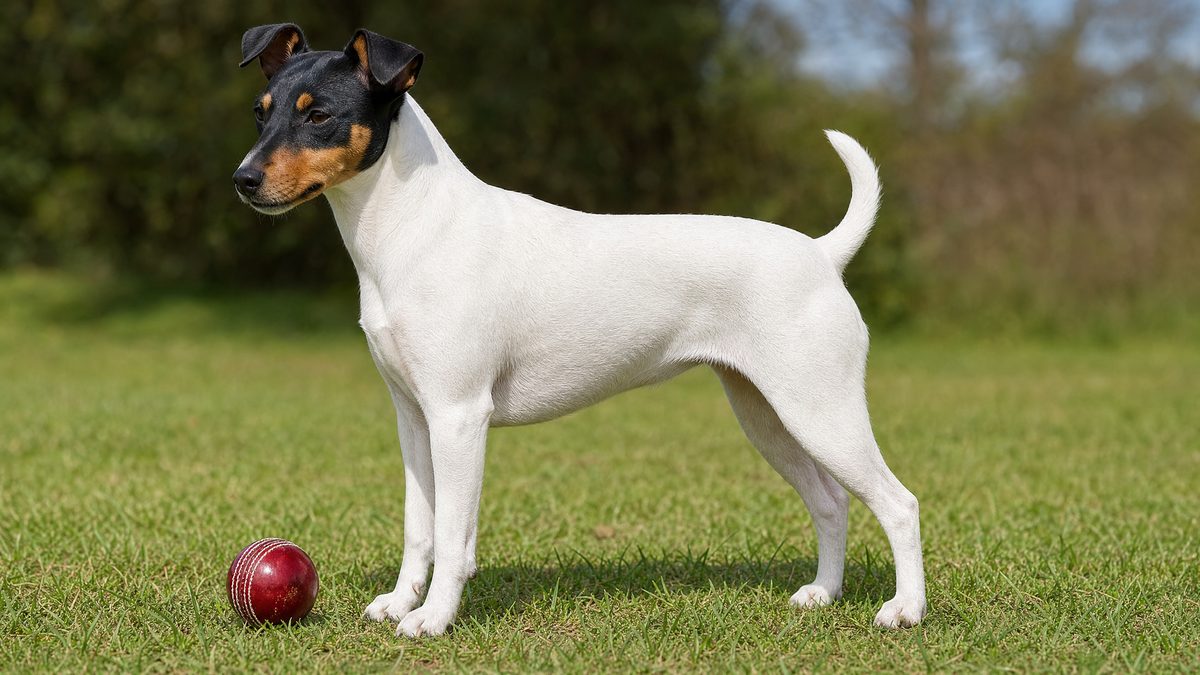
The Chilean Terrier is a small white ratting terrier from Chile, 32 to 38 cm at the withers and 5 to 8 kg for a male, whose only official breed standard is published by the Kennel Club de Chile and dated 2 July 2020.
Read the standard on its own face and the numbers are exact. Males stand 32 to 38 cm at the withers with an ideal of 35 cm, females 28 to 35 cm with an ideal of 32 cm, and the standard allows a margin of 1 cm below those figures provided the dog keeps the proportions that let it do its job. Males weigh 5 to 8 kg with an ideal of 6.5 kg, females 4 to 7 kg with an ideal of 5.5 kg. That puts an adult male at roughly the weight of a large domestic cat, which matters more in an Indian flat than any of the temperament adjectives on the ranking pages.
The standard's own header settles two things people get wrong. Origin is given as Chile, the publication date of the valid official standard is 02/07/2020, and the classification line reads Grupo XI de Razas No Reconocidas por FCI, Group 11 of breeds not recognised by the FCI, with no working trial. The PDF the Kennel Club de Chile links from that page is filed under March 2024, and it prints the same 02/07/2020 date at the top, so the 2024 file is a reissue of the 2020 text rather than a new standard.
Three names, and the one this page uses
The breed carries three names in Chilean usage and all three are formal. The 2007 standard by César Maerten is titled Estándar del Terrier Chileno (Fox Terrier Chileno o Ratonero Chileno), so Terrier Chileno, Fox Terrier Chileno and Ratonero Chileno are the same dog. Bing India's own People also search for block leans on the middle one, printing chilean fox terrier, chilean fox terrier facts, chilean fox terrier identification and fox terrier chileno among eight terms. This page uses Chilean Terrier throughout, because the Fox Terrier half of the name is a claim about ancestry and that claim is tested later on this page rather than assumed.
Coat colours, and the part Wikipedia leaves out
White is the ground colour and it covers the entire body including the neck and the tail; only the head and ears carry colour. Those head markings come in three tricolour patterns, black and tan, brown and tan, or blue and tan, with the tan distributed symmetrically above both eyes, on both cheeks and inside the ears. There is also a bicolour variety, coloured only black or only tan, again limited to the head and ears. English Wikipedia lists the three tricolour patterns and omits the bicolour variety entirely, so a reader working from it would think a solid-black-headed dog is off standard when it is not. Nose pigment follows the coat colours: black in black tricolours, black bicolours and tan bicolours, brown in brown tricolours, and slate in blue tricolours.
A dog with an asymmetric head mask is tolerated and has a Chilean nickname, pirata. Small limited colour patches on the neck, back or tail are tolerated too, but an entirely white dog with no head colour is a serious fault, and so is heavy body spotting.
Ears, tail, build and the working job the standard still describes
The Chilean Terrier's ears are V-shaped and broken at the halfway point, its tail is natural whether short or long, and its build is muscular rather than fine, because the standard still describes a dog expected to work.
A muscular little dog, and what other sites call it
Underneath the white coat the standard describes a genuinely muscular animal rather than a delicate one. The neck is muscular and slightly arched, the back short, firm and muscular, the loin short, firm and strongly muscular with a slight arch, and the croup broad, developed and muscular with a moderate slope. That is the build of a dog that went into a stable and came out again, and it is why the same standard tolerates scars.
The names other sites file it under are worth knowing, because you will meet all of them. Siwalu's Dog Scanner lists the breed under Chilean Terrier with an Also known as block. National Purebred Dog Day writes about the Chilean Terrier and the Brazilian Terrier together under the heading These Terriers are Close but Different. A Chilean pet-food blog publishes a long care guide under the Fox Terrier Chileno name. Every one of them describes the same undocked, natural-tailed, white-bodied Chilean ratter.
Ears, tail and the working job
Ears are set on high, moderately separated, rather small, thin and V-shaped, broken at the halfway point and tapering to a point that falls towards the outer corner of the eye; rose ears are tolerated and fully erect ears are a disqualifying fault. The tail is set low and moderately broad at the base, and the standard states plainly that a significant number of dogs are born completely tailless or short-tailed. Where a tail is present naturally it should not fall below the hock and is carried high in a small curve or sickle, never curled over the back.
Utilisation is given as small-game hunting, farm work and companion. The historical summary adds that the breed is still used in rural areas to exterminate rodents and as a watch dog, because its keen hearing gives immediate warning of danger or threat. Much of its fame at home is owed to Washington, the ever-faithful Chilean Terrier of the comic strip Condorito.
The Kennel Club de Chile's web version of the standard truncates several fault bullets mid-sentence. Its serious-faults list ends at "Nariz color marrón en ejemplares bicolor" and its disqualifying list at "Orejas completamente", while the linked PDF completes them as bicolor fuego and orejas completamente erguidas, fully erect ears. Anyone quoting the HTML page is quoting an incomplete standard.
Exactly what recognition this breed holds, and from whom
The Chilean Terrier holds one real national recognition and one commercial international one: the Kennel Club de Chile publishes its standard and registers it as a Chilean breed, and Alianz Canine Worldwide recognised it on 5 October 2011, while the FCI, the American Kennel Club and the Kennel Club of India all hold nothing for it.
Start with the body that matters, because it is the one that issues the pedigree. The Kennel Club de Chile is the sole FCI member for Chile, and it says so on every page of its own site: the KCC is the only official organisation in Chile recognised by the FCI to organise, keep and maintain the genealogical register of all canine breeds existing in the country, and it does not recognise any pedigree issued by another institution not recognised by the FCI. Its Razas Chilenas section holds exactly two breeds, the Terrier Chileno and the Ovejero Magallánico, and both are filed in the same place: Grupo 11, raza no reconocida, breeds not recognised by the FCI.
That is a genuine, checkable status and it should not be undersold. A Chilean Terrier can hold a KCC pedigree, be judged at KCC championship shows, and appear in KCC rankings. What it cannot do is carry an FCI logo on that pedigree, because the FCI has not admitted the breed to either of its two registers.
| Rung | Status | Document |
|---|---|---|
| Kennel Club de Chile standard | Published, valid from 02/07/2020 | KCC Terrier Chileno standard, reissued as a PDF in March 2024 |
| Kennel Club de Chile classification | Grupo XI, breeds not recognised by the FCI | The classification line inside the standard itself |
| Kennel Club de Chile national-breed status | One of two Razas Chilenas | KCC Razas Chilenas index |
| National breed club | Club Nacional del Terrier Chileno, founded 26 February 2007 | The standard's historical summary and the club's own site |
| Alianz Canine Worldwide | Recognised 5 October 2011, ACW Grupo 3 | ACW Standard Canino Terrier Chileno, Internet Archive capture |
| FCI definitive nomenclature | Not recognised | FCI Group 3 Terriers, eight countries and no Chilean entry |
| FCI provisional register | Not recognised | FCI Breeds recognised on a provisonal basis, 20 breeds |
| AKC Foundation Stock Service | Not recorded | AKC FSS roster of 88 breeds, revised 10 June 2026 |
| Kennel Club of India | No listing, no breed club | KCI has no entry to make for a breed outside FCI nomenclature |
| FCI application | Live, dossier due March 2026 | Club Nacional del Terrier Chileno announcement of 18 December 2025 |
One more Chilean voice is worth quoting because it is the state's own. Marca Chile, the country-brand platform, writes that two unique dog breeds have been determined during the last century and are currently in the process of being officially accepted by international organizations as Chilean, naming the Chilean Terrier and the Magellan sheep dog. That is an accurate description of the position, and it is more careful than most of the English breed pages that rank above it. The Club Nacional del Terrier Chileno's own news index says the same thing in its headlines, running from its winter specialty shows to the December 2025 announcement of the health studies.
Alianz Canine Worldwide is a real organisation that really did recognise this breed, at a general assembly on 5 October 2011, after a study by its veterinary technical commission, and it classifies the breed in its own Grupo 3. It is not the FCI, and the Kennel Club de Chile's own standing notice says it will not recognise a pedigree from an institution the FCI does not recognise. English pages that report the 2011 ACW recognition without saying which organisation it was leave a reader believing the breed is internationally recognised in the sense that decides whether a dog can be registered.
How each absence was checked, and the controls that make it mean something
Every absence on this page was checked against a control in the same session, because a breed missing from a register you cannot prove is working is not evidence of anything.
How each absence was checked, and the control that makes it mean something
The FCI's terrier group was read in full rather than searched. Group 3 lists its breeds by country of origin across four sections, and the countries are Brazil, Germany, Great Britain, Ireland, Australia, the Czech Republic, Japan and the United States of America. Brazil is there, represented by the Terrier Brasileiro at number 341, so the FCI does admit South American terriers. Chile has no line at all. The provisional register was checked separately, because a breed missing from the definitive list can still sit on the other one, and that page carries 20 breeds running from the Australian Stumpy Tail Cattle Dog admitted on 6 July 2005 to four breeds admitted on 11 February 2026. None is Chilean.
The alphabetical indexes were then pulled as a control, because an absence proves nothing if the index is broken. The letter T index returns ten breeds and includes TERRIER BRASILEIRO, so the index works and it does file South American breeds under Terrier. The letter F index returns eight breeds, including FOX TERRIER (SMOOTH) and FOX TERRIER (WIRE), so a Fox Terrier Chileno would have surfaced there if it existed. Neither index has this breed under either of its names.
The American absence, and why it was worth checking
The AKC's Foundation Stock Service is the register a rare breed usually enters first, and the assumption that this breed is outside it had to be tested rather than repeated. The AKC's own roster, revised 10 June 2026, lists 88 breeds broken out by group, and the Terrier Group contains exactly four: the Brazilian Terrier, the Jagdterrier, the Japanese Terrier and the Lucas Terrier. The seven group totals sum to 88, which matches the figure the page prints, so nothing has been dropped in the reading. The list does carry South American breeds, including the Peruvian Inca Orchid in the Hound Group, so the absence is about this breed rather than about the continent.
The live FCI application, and what the register says today
A Chilean bid for FCI recognition is genuinely in progress: three health studies began at the end of November 2025 and a dossier was due at the FCI Scientific Commission in March 2026, and the FCI provisional register checked on 26 August 2026 still does not list the breed.
The Club Nacional del Terrier Chileno published the details itself on 18 December 2025, and they are specific. The club, with the Kennel Club de Chile, its own members and breeders, and teaching staff and veterinary-medicine students from the Facultad de Ciencias Veterinarias of the Universidad San Sebastián at its Concepción campus, began taking samples at the end of November 2025 for physical and health examinations, to be presented during March 2026 to the Comisión Científica of the FCI.
Three studies are running, and they are named. Each dog gets an ophthalmological examination, a cardiological examination and a patellar examination, to establish the absence or presence of physical or health problems in the breed. Sessions ran on Wednesdays from late November, and the December announcement said about a dozen dogs were still outstanding to reach the minimum sample the international organisation requires. The last outstanding samples were to be taken in the first two weeks of March 2026, when the university returned from vacation.
- Eligible dogs must hold a Kennel Club de Chile pedigree.
- Dogs must be older than 15 months and younger than 8 years.
- Females must not be pregnant, and males must be entire and of reproductive age.
- The examinations are free to owners, who pay only travel to the Concepción campus.
- Results will be published once the dossier has gone to the FCI Scientific Commission.
What the register shows five months after the deadline
The FCI provisional register was pulled fresh on 26 August 2026, and it carries 20 breeds. The four most recent admissions all date from 11 February 2026: the Macedonian Shepherd Dog Karaman at number 378, the Sabueso Fino Colombiano at 376, the Segugio dell'Appennino at 375 and the Tatranský Durič at 377. The Buldogue Campeiro was admitted at 374 on 6 August 2025. No Chilean breed appears anywhere on the list.
Read that carefully, because the direction of the absence matters. The FCI is actively admitting breeds, including a South American one in the Sabueso Fino Colombiano, and it admitted four breeds in February 2026, the month before the Chilean dossier was due. So the Chilean Terrier has not been promoted out of the provisional list and it has not been removed from it. It has not yet been admitted to it. Whether the dossier reached the Scientific Commission on time, and what the Commission has done with it, is not published anywhere this page could reach.
This is the third round of Chilean science on the breed
The December 2025 announcement places the current work in a sequence, and says so plainly: these studies add to those already carried out in 2010 by the Universidad de Chile and in 2016 by the Universidad de Concepción. The Universidad de Chile arm is documented and readable, and it is covered in detail further down this page. The 2016 Universidad de Concepción work could not be located as a published document from this environment, so this page reports the club's claim that it exists and does not attach any figure to it.
The ambition is old. In December 2009 the Universidad de Chile's own news service quoted Professor Víctor Martínez of the FAVET-INBIOGEN laboratory saying the point of characterising the founders genetically was so that the breed could be included as an international breed within the international Kennel, and framing the project as an attempt to have the FCI recognise the Chilean Terrier as the first canine breed of Chilean origin. Seventeen years later the register still reads the same way.
A live application is not a recognition, and a page that reports one as the other is not being helpful. If the FCI admits the breed provisionally, an FCI-logo pedigree becomes possible and a Kennel Club of India route becomes conceivable for the first time. Until that happens, the KCI has 80 member clubs and 1,425,001 dogs in a studbook built entirely on FCI nomenclature, and no entry it can make for this dog.
Two breed standards are in circulation, and one of them prescribes tail docking
Two documents call themselves the Chilean Terrier standard, the Kennel Club de Chile text of 2 July 2020 and the Alianz Canine Worldwide text recognised on 5 October 2011, and they disagree on the skull, the ears, the eyes, the feet and the tail.
The tail is the disagreement that matters to an Indian reader. The Kennel Club de Chile standard describes a low-set tail, moderately broad at the base, notes that a significant number of dogs are born completely tailless or short-tailed, and says that where a tail is present naturally it must not fall below the hock and is carried high in a small curve or sickle. Docking is not mentioned anywhere in that text. The ACW standard describes the same low-set tail and the same natural taillessness, and then adds a sentence the Chilean text does not contain: in its country of origin, and because of its use as a rodent exterminator, the tail is cut at the second vertebra.
That instruction is unlawful to follow in India. Second Schedule Part II paragraph 6(8) of the Prevention of Cruelty to Animals (Dog Breeding and Marketing) Rules 2017 states that there shall be no tail docking, ear cropping, de-barking, de-clawing, branding, dyeing, injecting substances to enhance visual appeal, performing a surgery or procedure to camouflage or hide any defect or infirmity, or any other kind of mutilation of any body part of the pup, and that any change of appearance by artificial means is strictly forbidden. An Indian breeder following the older standard would be breaking that paragraph. Anyone quoting the ACW text should say which of the two documents they are quoting.
| Feature | Kennel Club de Chile, 02/07/2020 | Alianz Canine Worldwide, 2011 |
|---|---|---|
| Tail | Natural bobtail or a natural tail, no docking mentioned | Cut at the second vertebra in the country of origin |
| Skull | Flat, moderately broad; an apple head is a serious fault | Rounded, with an almost flat forehead |
| Ears | V-shaped, broken at the halfway point, falling to the outer eye corner | Triangular and semi-erect |
| Hind feet | Cat-like in appearance | Hare feet |
| Blue colour | A blue and tan variety is permitted, with a slate nose | Blue eye colour listed among the breed's defects |
| Utilisation | Small-game hunting, farm work and companion | Companion only |
| Weight | Ideal 6.5 kg males, 5.5 kg females | No ideal weight given |
| Disqualifying faults | Seven listed, including fully erect ears | None listed, only six general defects |
Which one is current, and how to tell
The Chilean text is the current one and it is the only one a Kennel Club de Chile judge uses. Its header prints the publication date of the valid official standard as 02/07/2020, and the file the KCC serves is dated March 2024 and reprints that same date, so the 2024 document is a reissue rather than a revision. The ACW text was captured by the Internet Archive in November 2015 and describes a recognition dated 5 October 2011, so it is at least nine years older than the Chilean text and sits on a domain that no longer serves it.
One more document is worth naming because it is the only full English rendering in circulation. Amira Dog publishes an English translation of the current Chilean standard, and the body of that translation is faithful, down to the 45 to 55 chest-to-leg proportion and the instruction that dewclaws should not be removed. Its header is not faithful. It reads Group 3: Terriers Without working trial, which is the FCI's terrier group, in place of the Chilean original's Grupo XI de Razas No Reconocidas por FCI. A machine reading only that header would file this breed inside the FCI nomenclature, where it does not appear.
Both texts say the same thing about dewclaws: no deben extirparse los espolones, dewclaws should not be removed. That agrees with Indian law, because the same paragraph 6(8) that forbids docking also forbids any other kind of mutilation of any body part of the pup. A Chilean Terrier in India keeps its dewclaws, and any breeder who removes them is in breach on both counts.
The Fox Terrier in the name, and what the genetics actually says about it
The Fox Terrier ancestry in this breed's own alternative name is club history rather than a tested finding, and the only peer-reviewed study of the breed concluded that the Chilean Terrier has no recent European ancestry at all.
The claim itself is old and consistent. The Kennel Club de Chile's historical summary says European immigrants settling in South America brought Fox Terrier Pelo Liso, the Smooth Fox Terrier, and Bodegueros Andaluces, and that crossing those with local dogs of no defined breed gave rise to the Chilean Terrier. The 2011 Universidad de Chile thesis repeats it as theory, saying the breed probably arose from a mixture of European breeds, mainly the English smooth-coated Fox Terrier, with mongrels derived from various breeds. English Wikipedia drops the hedge and states it as fact: the breed results from the crossing of the Smooth Fox Terrier with the Ratonero Bodeguero Andaluz. Animalia copies that, lists both as parent breeds, and cites the Wikipedia article as its only reference.
What the 2023 study did, and what it found
Paola C. Mujica and Víctor Martinez of the FAVET-INBIOGEN laboratory at the Universidad de Chile published the first genomic assessment of the breed in Animal Genetics in October 2023, in volume 54 issue 6 at pages 772 to 785. They genotyped Chilean Terriers on the Illumina HD canine array and compared them against a panel of American and European breeds. Their conclusion is stated twice in the abstract, and it is unambiguous: when Admixture estimates and phylogenetic analysis are considered together with the other breeds, the Chilean Terrier does not have a recent European ancestry, and the results suggest the breed has evolved independently in Chile from other terrier breeds, from an unknown European terrier ancestor.
The comparison panel is the part that makes this decisive rather than suggestive. The Admixture figure names 19 breeds, and the terrier side of it includes the Wire Fox Terrier, the Toy Fox Terrier, the Rat Terrier, the Jack Russell Terrier, the Border Terrier, the Bull Terrier, the Cairn Terrier, the Soft Coated Wheaten Terrier, the Staffordshire Bull Terrier, the Boston Terrier and the Yorkshire Terrier, alongside the Chihuahua, the Peruvian Inca Orchid and the Xoloitzcuintli. The optimal number of clusters was 13, chosen by cross-validation. The linkage-disequilibrium panel compares the Chilean Terrier directly against the Wire Fox Terrier and the Rottweiler.
The Chilean standard names the SMOOTH Fox Terrier as the founding cross. The published figure captions of the 2023 paper name the Wire Fox Terrier and the Toy Fox Terrier in the comparison panel, and do not name the Smooth Fox Terrier. The paper's conclusion is about recent European ancestry as a whole rather than about one Fox Terrier variety, so it does not depend on which of them was on the array. But a reader deserves to know that the exact breed the standard names is not visible in the published captions, and that the full text is paywalled.
What the finding does and does not overturn
It does not say the breed has no European ancestor. The authors' own wording is an unknown European terrier ancestor, which keeps a European founder in the story and removes the specific one. What it removes is recency. A breed formed by crossing imported Smooth Fox Terriers with local dogs in the nineteenth century should still carry a detectable recent European signal, and the analysis did not find one. The colour genetics point the same way: the cross-population analysis flagged candidate regions around FGF5, PAX3 and ASIP as the likely explanation for the breed's distinctive colour pattern, which is a story about selection inside Chile rather than about inheritance from a British breed.
So the practical position is this. Fox Terrier Chileno is a legitimate Chilean name for the breed and has been since at least the 2007 standard, and half the eight terms in Bing India's People also search for block use it. It is a name, not a pedigree. Anyone selling a dog in India on the strength of Fox Terrier blood is charging for something the only genetic study of the breed did not find.
One further detail from the same paper is worth having, because it is the strongest single argument for the breed's conservation. The historical figure caption records the dog working as a rat catcher in mines such as Sewell, near Rancagua, around 1920, with the historical pictures used by permission of the Chilean Terrier Council. Sewell sits in the Andes above Rancagua, where NASA POWER puts the annual mean at 14.66 degrees C at 1,196 m. That is the environment this dog was selected in.
The three Chilean studies, their denominators, and where they disagree
Three pieces of Chilean science exist on this breed and they carry real denominators: 50 unrelated founders in the 2010 and 2011 microsatellite work, 24 samples in the principal components analysis of the 2023 genomic study, and a health dataset from 2016 that this page could not locate.
Take the 2011 thesis first, because it is fully readable and it is the most detailed thing published about this breed anywhere. Paola Mujica Brancoli's veterinary thesis at the Universidad de Chile, supervised by Víctor Martínez Moncada, extracted DNA from buccal mucosa cells of fifty Chilean Terriers selected from Club Nacional del Terrier Chileno pedigree records as unrelated founders of the breed. Seventeen canine microsatellites were genotyped, seven taken from the literature and ten from a commercial Stockmarks parentage kit.
| Measure | Result | Comparison |
|---|---|---|
| Alleles per locus | Mean 8.35, range 4 (FH2010) to 14 (FH2132) | Equal to the highest of 108 AKC breeds in a 9,561-dog study |
| Observed heterozygosity | Mean 0.694 | Bull Terrier 0.39, Airedale Terrier 0.52, Jack Russell Terrier 0.79 |
| Expected heterozygosity | Mean 0.812, range 0.68 to 0.90 | Higher than observed at most loci |
| Polymorphic information content | Mean 0.771 | Above the 0.5 threshold treated as high |
| Inbreeding coefficient Fis | Mean 0.15, range -0.04 (FH2201) to 0.52 (FH2079) | Five loci above 0.25 |
| Hardy-Weinberg equilibrium | 9 of 17 loci deviate significantly at P below 0.05 | Attributed to a heterozygote deficit |
| Combined exclusion probability | 0.9999 across 17 loci, and still 0.9999 across 16 | Literature recommends above 0.9995 for paternity work |
The thesis reads the heterozygote deficit as geography rather than inbreeding, and says so carefully. Because the breed was unrecognised for most of its history it was exempt from reproductive management, and low exchange of dogs between distant zones would have left regional groups reproductively isolated, producing a Wahlund effect where a genuinely subdivided population looks homozygous when treated as one. The authors state that proving this needs a larger study across defined geographical zones, which is exactly what the 2023 paper went on to do.
The 2010 poster and the 2011 thesis do not agree, and both are from the same laboratory
The same work was reported a year earlier at the 32nd conference of the International Society for Animal Genetics, as poster P2052 by Mujica, Jedlicki, Maertens and Martinez. That abstract describes the same 50 unrelated dogs and the same buccal swabs, and then differs on the analysis in three places. It says a total of ten microsatellites were genotyped, one of which, AHTk253, failed to yield a PCR product. It gives an allele range of 11 to 4. It puts mean expected heterozygosity at 0.84. And it states that except for two loci, FH2175 and FH2132, all loci were in Hardy-Weinberg equilibrium.
Set that against the thesis and the difference is real. The thesis reports 17 markers, mean expected heterozygosity of 0.812, and nine loci out of Hardy-Weinberg equilibrium, and its own table shows five of the seven literature-derived markers with P values below 0.05, including both FH2175 at 0.0065 and FH2132 at 0.0279. The poster is best read as an interim report on a smaller marker set, and this page names the disagreement rather than picking the more convenient number. Anyone citing a heterozygosity figure for this breed should say which of the two documents it came from.
The 2023 genomic study, and the denominator it does publish
The 2023 Animal Genetics paper was received on 2 May 2023 and accepted on 9 September 2023. Its abstract does not state how many dogs were genotyped, and the full text is behind a paywall, so this page reports only what is readable. The published caption to figure 5 describes a principal components analysis of 24 Chilean Terrier samples, and the caption to figure 1 says dogs were chosen by the breeding history of each sampling location, across longitudinal variation and climates within Chile.
Two headline numbers are in the abstract and both are quotable. Linkage disequilibrium was relatively low and decayed rapidly, so effective population size came out very high compared with other breeds and similar to other American indigenous breeds such as the Chihuahua, with values of effective population size near 500. The number of effective chromosome segments, obtained from the properties of the genomic relationship matrix, was 2,467. Both point the same way: a genuinely outbred population, not a bottlenecked one.
The paper's data availability statement names an Open Science Framework project. That project, made public on 14 August 2023, carries a component headed VCF_file, and its OSF Storage panel reads "No files are available at this time". So the underlying genotypes cannot be re-analysed from the address the paper gives, and the sample size for the study as a whole remains unverifiable outside the paywall.
Chilean Terrier price in India: there is not one, and here is the proof
No Indian puppy price exists for the Chilean Terrier, because the breed appears on no Indian price list, has no Indian breed club and has no lawful commercial import route, and every rupee figure you will see quoted for it is an overseas dollar price run through an exchange rate.
Start with the controls, because an absence is only evidence when the search demonstrably works. Two of the largest Indian dog price lists were downloaded and read in full on 26 August 2026. Wrap in Fur publishes a fifty-breed table giving puppy price, monthly cost, lifespan and size for each breed, from the Labrador Retriever at Rs 15,000 to 50,000 down to the Indian Pariah Dog at adoption cost to Rs 15,000. Supertails publishes a comparable list. Searched case-insensitively, the word chilean appears zero times on either page, while labrador appears 27 times on one and 30 on the other. The control returns matches. The breed query returns nothing. That is a real absence.
The Wrap in Fur table is worth reading for what it does carry, because it shows the list is not simply short. It runs to fifty breeds, including nine Indian breeds from the Rajapalayam to the Gaddi Kutta, and small imports such as the Miniature Pinscher at Rs 15,000 to 40,000, the Yorkshire Terrier at Rs 25,000 to 80,000 and the Boston Terrier at Rs 35,000 to 80,000. A rare small terrier would have a slot on that table if anybody in India were selling one.
The overseas figures, and both conversion tests
Two international prices are published and they disagree with each other. World Deer gives a purchase price of USD 400 to 800 and an annual cost of USD 900. Wag gives no purchase price but puts food at USD 30 to 40 a month and typical annual vet bills at USD 500 to 1,000. Neither cites a source, and neither is an Indian figure.
| Published USD figure | Divided at 84.38 | Divided at 74 |
|---|---|---|
| USD 400 purchase, World Deer | Rs 33,752 | Rs 29,600 |
| USD 800 purchase, World Deer | Rs 67,504 | Rs 59,200 |
| USD 900 a year, World Deer | Rs 75,942 | Rs 66,600 |
| USD 500 a year in vet bills, Wag | Rs 42,190 | Rs 37,000 |
| USD 1,000 a year in vet bills, Wag | Rs 84,380 | Rs 74,000 |
| Rs 98,999, the recurring Indian house figure | USD 1,173.25 | USD 1,337.82 |
Run the arithmetic the other way and the tell is obvious. Rs 84,380 and Rs 74,000 are not prices a seller would print; they are USD 1,000 wearing rupees. A genuine Indian price for a small terrier looks like the Miniature Pinscher's Rs 15,000 to 40,000, a round band with a human hand behind it. If somebody quotes you a Chilean Terrier at Rs 67,504 or Rs 84,380, divide it and see which dollar figure falls out.
Why the third exchange rate is not used here
This site also tests a flat 80, and it is deliberately not leaned on. The test is structurally weak, because 1,000 divided by 80 is 12.5, so any rupee figure ending in three zeros divides cleanly at 80 by construction. On one page examined for this site twenty of twenty-seven rows matched at 80 by pure arithmetic and only three landed on a number a seller would actually print. The 84.38 test is the strong one, and a match at 80 counts as evidence only when the quotient is also a price a human would quote.
One Indian listing site prints Rs 98,999 against whichever puppy is in stock, and this site has now caught it on eleven separate pages, including pages for breeds that site does not stock at all. It divides to USD 1,173.25 at 84.38 and USD 1,337.82 at 74, neither of them a round dollar amount, so it is not even a conversion. It is a rupee-native charm price. Never accept Rs 98,999 as this breed's price, or as any breed's price.
One last check closes the loop on supply. Chile's own registry is not large: the Kennel Club de Chile registered 8,023 puppies across every breed in 2025, down from 15,709 in 2021, and holds 589,295 pure-bred dogs since its studbook began. That is a 49 percent fall in national registrations in four years. A country registering eight thousand pedigree puppies a year across all breeds is not the source of an export trade in one of them.
The only lawful way this dog reaches India, read from the trade notice itself
One lawful route exists and it is narrow: a Chilean Terrier can enter India as somebody's personal pet with a valid pet book in the importer's name, and DGFT states that applications made for trading or breeding purposes shall be duly rejected.
The policy is set out in Trade Notice No. 22/2022-23, issued by the Directorate General of Foreign Trade at Vanijya Bhawan on 19 December 2022 and addressed to all international airlines, all embassies and consulates of India abroad, and pet owners concerned. It records that mammals under ITC (HS) 01061900 carry an import policy of Restricted, subject to Policy Condition 6 of that chapter.
Policy Condition 7 then names the only three permitted purposes for importing a dog: a pet dog with a valid pet book and relevant records or documents in the name of the importer; dogs imported by research and development organisations for conducting research with the recommendation of CPCSEA; and import for internal security by the Defence and Police Force. Policy Condition 8 closes the gap: import of commercial dogs for breeding or any other commercial activities other than the purposes mentioned above is not permitted.
The mechanics, for the one person this applies to
Permanent import as passenger baggage without a DGFT authorisation is allowed only to persons transferring their residence to India after two years of continuous stay abroad, and only cats and dogs may come in under the baggage rules. An authorisation is required where the continuous stay abroad was under two years, where the pet is not travelling as passenger baggage, or where the pet cannot be imported under the baggage rules. Anything over two pets needs a DGFT authorisation regardless, with applications examined by DAH&D beforehand.
- Apply through the DGFT website under Services, Import Management System, Import Authorisation of Restricted Items, using form ANF-2M.
- Apply against your own Importer Exporter Code, or against the permanent IEC number IIHIE0153E reserved for persons and institutions importing for personal use not connected with trade.
- Carry the vaccination book or pet passport or pet book, and the pet's own passport, for a permanent import.
- Start at least two months before travel, which is DGFT's own advice to pet owners.
- Fly into Delhi, Mumbai, Chennai, Hyderabad, Bengaluru, Kolkata or, since October 2024, Kochi, the only airports and seaports through which pet animals may enter, with quarantine at the government station of that port where required Department of Animal Husbandry….
Paragraph 6 of the trade notice is the sentence that ends any commercial plan, and it is worth quoting exactly: any applications for trading or breeding purposes, or applications made on behalf of some another person or entity, shall be duly rejected. That closes the door on an Indian kennel importing breeding stock, and it also closes the door on an agent importing on a buyer's behalf.
Why this and the registry position compound each other
Two facts have to be read together. There is no lawful commercial import route for breeding stock, and there is no Kennel Club of India registration route for a breed outside the FCI nomenclature. Between them they mean no Indian pedigree pipeline for this breed can lawfully form. Even the Chilean end is closed to an Indian-bred dog, because the Kennel Club de Chile states that it does not recognise any pedigree issued by an institution the FCI does not recognise, and an Indian-bred litter would have no such institution behind it.
The practical consequence is worth stating plainly rather than leaving implied. Any Chilean Terrier legitimately living in India today arrived as one person's pet under Policy Condition 7, and its puppies could not be registered anywhere. That is not a technicality about paperwork. It is the reason an Indian buyer offered a Chilean Terrier puppy is almost certainly being offered a different dog.
The trade notice lists an Advance No Objection requirement in its later paragraphs and names DAH&D as the examining authority for authorisations. Ask any seller which authorisation number the parents entered under and which of the seven permitted ports they cleared. A genuine relocation has both answers written down, and a fabricated story has neither.
What a 6.5 kg terrier costs to keep in India each month
Budget Rs 2,000 to Rs 6,000 a month for a dog this size in India, which is the small-breed band on a fifty-breed Indian cost table, plus a first-year vaccination and neutering block that lands outside the monthly figure.
No Indian cost figure exists for this breed, so this section uses a labelled benchmark rather than inventing one. Wrap in Fur breaks its small-breed monthly total into five heads: food and treats Rs 1,000 to 2,500, grooming Rs 500 to 1,500, veterinary care Rs 500 to 1,500, toys and enrichment Rs 300 to 1,000, and accessories and miscellaneous Rs 300 to 1,000, for an estimated monthly total of Rs 2,000 to 6,000. The same table gives the Miniature Pinscher, the closest same-size smooth-coated dog on it, a monthly figure of Rs 2,500 to 5,000.
| Head | Monthly band | What changes it for this breed |
|---|---|---|
| Food and treats | Rs 1,000 to 2,500 | A 6.5 kg working terrier eats at the top of a small-breed ration, not the bottom |
| Grooming | Rs 500 to 1,500 | Realistically near zero. A short coat needs a rubber mitt, not a salon |
| Veterinary care | Rs 500 to 1,500 | Tick and flea prevention is the recurring item, not the optional one |
| Toys and enrichment | Rs 300 to 1,000 | The highest-value line for a bored ratting terrier in a flat |
| Accessories | Rs 300 to 1,000 | Harness rather than collar, because a small terrier pulls into scent |
| Monthly total | Rs 2,000 to 6,000 | Grooming savings tend to be spent on enrichment instead |
Where the overseas numbers land once converted
The two published overseas cost figures convert into the same territory, which is a mild check on the Indian band rather than a substitute for it. World Deer puts annual cost at USD 900, which is Rs 75,942 at 84.38 or Rs 6,329 a month. Wag puts food alone at USD 30 to 40 a month, or Rs 2,531 to Rs 3,375, and annual vet bills at USD 500 to 1,000, or Rs 42,190 to Rs 84,380 a year. The vet figure is a rich-country number and does not transfer; the food figure sits almost exactly on the Indian small-breed food band.
The first-year costs that sit outside the monthly figure
Three blocks fall outside any monthly budget and should be planned for separately. The core vaccination course runs across the puppy's first eighteen weeks: Indian law's own text notes that pups can start vaccination at seven to eight weeks and are usually completed at eighteen weeks. Neutering is the second, and Rule 8(1)(b) makes it a legal condition of sale for any dog over six months sold by a breeder to anyone other than another licensed breeder. The third is year-round ectoparasite control, which in India is not seasonal.
Tick prevention deserves its own line rather than being folded into veterinary care. A Punjab survey of 719 dogs by multiplex PCR found Babesia gibsoni in 8.9 percent, Hepatozoon canis in 5.1 percent, Ehrlichia canis in 2.6 percent and Babesia vogeli in 1.1 percent, along with concurrent infections, and microscopy alone missed most of it, returning 5.0, 1.0, 1.4 and 0.1 percent for the same four. Prevention is cheaper than treating babesiosis in a 6 kg dog.
Grooming. The standard describes a coat that is short, straight, harsh, close and glossy, finer on the ears, neck, the inner and lower forelegs and behind the thighs. There is nothing to clip, nothing to strip and nothing to blow-dry. In Indian conditions the weekly job is a five-minute tick check and a rubber mitt, so most of the Rs 500 to 1,500 grooming band on the benchmark table is money you do not spend.
Heat tolerance: how far Chile actually is from India
Heat tolerance rates 2 out of 5, because the breed's famous adaptability is adaptability to Chilean climates, and Chile does not have a humid tropical climate anywhere in it.
The claim being tested is in the standard itself. The historical summary says the breed has the virtue of adapting to a great variety of climates and ways of life, and is still used in rural areas to exterminate rodents. The 2023 genomics repeats it in the first sentence of its abstract, describing the breed's hardiness across the diversity of climates encountered within the Chilean landscape. Both statements are true and neither is about India.
Chile's diversity runs north to south through desert, Mediterranean, oceanic and sub-Antarctic. It does not run through humid tropical, because Chile has no humid tropical zone. NASA POWER was queried by explicit latitude and longitude for three Chilean points and seven Indian cities, and every query returned the coordinates it was asked for, so no city was silently substituted for another.
| Place | Annual mean temp, C | Annual mean humidity, percent | Elevation, m |
|---|---|---|---|
| Santiago, Chile | 15.29 | 39.76 | 1,154 |
| Rancagua, Chile | 14.66 | 41.17 | 1,196 |
| Concepcion, Chile | 13.27 | 75.53 | 138 |
| Bengaluru | 23.74 | 67.94 | 842 |
| Pune | 23.86 | 66.80 | 636 |
| Delhi | 25.60 | 45.56 | 206 |
| Kolkata | 25.81 | 73.93 | 7 |
| Mumbai | 26.77 | 67.39 | 97 |
| Ahmedabad | 27.57 | 48.32 | 47 |
| Chennai | 27.95 | 72.39 | 49 |
Read the first column and the gap is 8.5 to 12.7 degrees C. Santiago's annual mean of 15.29 degrees C is 8.45 degrees below Bengaluru, India's mildest metro, and 12.66 degrees below Chennai NASA POWER, monthly climatology point…. There is no Indian city on that list that a Chilean Terrier's origin climate resembles. Even Concepción, the wettest Chilean point measured, runs 10.5 degrees cooler than Chennai on the annual mean.
The number that decides it is not temperature, it is wet-bulb
Call it what it is. This is a heat-sensitive breed in Indian terms, not a heat-tolerant one, and no amount of South American geography changes that. The confusion comes from reading hardy across a diversity of climates as though the diversity included the tropics.
A dog cools by evaporating water from its airway, so dry heat and humid heat are different problems. Santiago's summer is genuinely hot: January averages 22.05 degrees C and the twenty-year record high for that month is 37.86. It is also bone dry, at 31 percent relative humidity in that same month. Chennai's hottest month averages 31.51 degrees C at 65 percent humidity, with a record high of 42.70, and Mumbai and Pune both sit at 80 percent humidity through the monsoon while still running above 25 degrees C.
Applying Stull's 2011 approximation to those NASA POWER monthly means gives peak monthly wet-bulb figures that separate the two countries cleanly. Santiago peaks at 12.6 degrees C in January and Rancagua at 12.3. Bengaluru, the mildest Indian city measured, peaks at 21.9 degrees C, which is 9.3 degrees above Santiago. Pune reaches 23.0, Mumbai 25.8, Chennai and Ahmedabad 26.1, Delhi 26.5 and Kolkata 27.1, which is 14.5 degrees above the breed's origin. These are computed from monthly means rather than measured, so treat them as a comparison rather than a forecast.
What the heat actually does
The largest study of heat-related illness in dogs looked at 905,543 dogs under primary veterinary care in the United Kingdom in 2016 and found 1,259 heat-related illness events in 1,222 dogs. Exertional heat-related illness was the predominant trigger at 74.2 percent of the 879 events where a cause was recorded, environmental heat accounted for 12.9 percent and vehicular confinement only 5.2 percent, and the odds of death after vehicular events were similar to those after exertional ones. The lesson transfers directly: in India the risk to this breed is a midday walk, not a parked car.
Treat a rectal temperature at or above 41.0 degrees C as an emergency and cool the dog while getting to a veterinarian, rather than getting to a veterinarian and then cooling. A 6.5 kg dog has little thermal mass and heats fast, and a white short coat gives no protection from ambient heat, only from direct sun.
City by city, and the undercoat that will not appear
Bengaluru and Pune are the only Indian metros where this breed would live an ordinary outdoor life, Chennai, Mumbai and Kolkata restrict it to dawn and dusk, and Delhi and Ahmedabad make it an indoor dog for four months a year.
The ranking works off two numbers together, the peak wet-bulb temperature and the record high behind it. Read the record-high column as an extreme, because that is what NASA POWER's T2M_MAX is: the hottest reading the climatology holds for that month across the whole period, not an average afternoon. Delhi's record June high is 48.79 degrees C against a June mean of 35.88, Ahmedabad's May record is 48.58 against a mean of 35.06, Kolkata's May 46.81, Mumbai's April 44.91, Pune's April 43.20, Chennai's May 42.70 and Bengaluru's April 40.38. Santiago's January record is 37.86 degrees C against a January mean of 22.05, so even Bengaluru's worst month is hotter than Santiago's on both measures, and it arrives with 49 percent humidity against Santiago's 31.
| City | Hottest month | Record high, C | Humidity that month, percent | Peak monthly wet-bulb, C |
|---|---|---|---|---|
| Santiago | January | 37.9 | 31 | 12.6 |
| Bengaluru | April | 40.4 | 49 | 21.9 |
| Chennai | May | 42.7 | 65 | 26.1 |
| Pune | April | 43.2 | 42 | 23.0 |
| Mumbai | April | 44.9 | 52 | 25.8 |
| Kolkata | May | 46.8 | 67 | 27.1 |
| Ahmedabad | May | 48.6 | 36 | 26.1 |
| Delhi | June | 48.8 | 36 | 26.5 |
The humidity inversion nobody expects
Delhi and Ahmedabad look like the obvious worst cities on temperature and they are not the worst on humidity: Delhi's hottest month runs at 36 percent relative humidity and Ahmedabad's at 36 percent, which is close to Santiago's 31 NASA POWER, Prediction Of Worldwide Energy…. Their peak wet-bulb months are not their hottest months. Delhi's worst wet-bulb month is July at 26.5 degrees C, when the mean temperature has dropped to 32.3 but humidity has climbed to 63 percent. Mumbai's is June, at 28.7 degrees C and 80 percent humidity. Pune's monsoon runs to 91 percent humidity in August.
So the calendar for this breed is not simply avoid summer. In the north it is avoid May and June for direct heat and then avoid July for humid heat. In the west and south it is the monsoon months that are physiologically hardest, even though the thermometer reads lower. A dog that copes in Pune in April can struggle in Pune in August.
The undercoat sentence, and what happens to it in India
The Chilean standard contains one conditional that every English page has turned into a fact. Its coat clause reads that the hair is short, straight, harsh, close and glossy, and then adds that in cold climates a double coat, an undercoat, may develop. The English translation preserves the conditional correctly. Wikipedia does not: its description states that the breed has a shorthaired undercoat that sometimes hints at some dark spots visible through the white mantle. Animalia reproduces that sentence word for word with Wikipedia as its single reference, and Wag goes further and calls it a grey undercoat.
In an Indian home the practical consequence is simple. There is no undercoat to blow, no seasonal moult to manage and no double coat to protect against clipping. What is left is a single close coat that acts as a sun barrier and must not be shaved. The dark spots showing through the white mantle are skin pigment, not a second coat, and they are normal.
- Bengaluru and Pune, October to March: normal walks at any daylight hour, restricted at midday in April and May.
- Chennai, Mumbai and Kolkata: walks before 07:00 and after 19:00 for most of the year, and never on unshaded pavement.
- Delhi and Ahmedabad, April to July: indoors between 10:00 and 18:00, with enrichment replacing the middle walk.
- Everywhere in the monsoon: dry the dog properly and check the ears, because humidity above 85 percent keeps a canal wet all day.
The one Indian setting that genuinely suits this breed is a hill station rather than a metro. Santiago sits at 1,154 m and Rancagua at 1,196 m, and elevation is doing much of the work in both figures. An Indian household at comparable elevation gets much closer to the origin climate than any city on the plains does.
Temperament and household fit, including who should not get one
The standard gives the temperament in four words, docile, alert, lively and reserved with strangers, which is an unusually easy package for a terrier and still rules out any household with rabbits, birds or hamsters.
Four words is all the Kennel Club de Chile commits to, and the restraint is informative. Docile is the word that separates this breed from most working terriers, and it appears first. Reserved with strangers is the one Indian flat-dwellers should weigh, because a reserved dog in a building with a doorbell, a lift and a delivery every evening will find plenty to be reserved about.
The historical summary fills in the working temperament the four words compress. The breed is still used in rural areas to exterminate rodents and as a watch dog, because its keen hearing gives immediate warning in case of danger or threat, and it adapts perfectly to city life as a cheerful and lively companion. Read that as a job description rather than a compliment: the dog was kept to hear things and announce them, and it is good at it.
Who this breed suits
- Households with older children who want a small, robust, low-grooming dog that plays hard and is not fragile.
- First-time owners who want a terrier without the hardest edges, because docile is in the standard and aggression is a disqualifying fault.
- People who want an alert dog and are willing to train a quiet cue rather than resent the barking.
- Ground-floor or independent houses in Bengaluru, Pune or a hill station, where the dog can patrol a boundary in daylight.
- Anyone who would rather scrub a rubber mitt over a short coat once a week than book a groomer once a month.
Who should not
- Any household with rabbits, guinea pigs, hamsters or birds. Two centuries of selection for killing rats is not a training problem.
- Households where nobody is home for nine hours. A bored ratting terrier digs, chews and barks, and the barking is the one the neighbours act on.
- Anyone who wants a silent dog. The standard's own history names the alarm bark as a reason the breed is still kept.
- Households in Delhi or Ahmedabad without air conditioning through May, June and July.
- Anyone buying on the assumption the dog is obtainable, registrable or resaleable in India. None of the three is true.
The temperament descriptions on the ranking pages, and how far they wander
The English pages agree with the standard on the broad picture and add material that is not in it. Wag describes the breed as gentle, alert, lively, mischievous and devoted, and then adds that it can be aggressive with other dogs of the same sex and should not be kept with other pets unless trained, and that it makes a great watchdog although it lacks the size and aggression to be an effective guard dog. World Deer gives it five stars for affection, for being good with children and for good with other dogs simultaneously, which is a rating scale rather than an observation.
The same-sex dog aggression claim is worth flagging as unsourced rather than dismissed. It is plausible for a terrier and it is not in the Chilean standard, which lists timid or aggressive dogs among its disqualifying faults without distinguishing targets. Treat it as a reason to socialise early rather than as an established breed trait.
The general appearance clause of the standard ends with a sentence most breed standards would never carry: scars are tolerated as a sign of the work the dog performs. A show standard that explicitly forgives working injuries is describing a dog that is still expected to go into a stable and deal with rats, not a dog bred for a bench. Plan the household around that animal.
Training: docile on paper, and still a terrier with a nose
Train this breed in short food-paid sessions from eight weeks, put the quiet cue in first, and expect recall to be the one thing that never becomes reliable off lead near moving small animals.
The standard's word is docile, and it is the first of the four temperament words rather than an afterthought. That is genuinely easier material than most terriers offer, and it means correction-based handling is both unnecessary and counterproductive. What docile does not do is switch off two centuries of selection for chasing and killing rodents, so the training plan splits cleanly into what you can teach and what you must manage.
Trainable is the right word for this breed and it is worth being precise about why. Docile in a standard is a statement about handler focus, not about drive, so the dog is trainable in the sense that it wants to work with you and difficult in the sense that a moving rat outranks you. Plan for both at once.
Weeks eight to sixteen, the window that decides everything
Indian law sets the floor for when this work can start with a bought dog. Rule 8(1)(a) of the Dog Breeding and Marketing Rules 2017 requires that pups less than eight weeks in age are not sold, so a legally obtained puppy arrives at eight weeks at the earliest. The same rules note that vaccination can start at seven to eight weeks and is usually completed at eighteen weeks, which is the window during which a puppy is only partly protected. Socialise inside that window anyway, on clean surfaces and with vaccinated dogs, because the behavioural cost of waiting is larger than the infectious one.
- Week 8 to 10: name, hand feeding, crate as a rest place, and the first quiet cue paid every time the dog stops barking on its own.
- Week 10 to 12: lift, doorbell, delivery bag, autorickshaw and traffic noise, each paired with food at a distance the puppy can handle.
- Week 12 to 16: recall on a long line only, plus a formal leave it taught with a stationary object before any moving one.
- Month 4 to 6: handling for the ophthalmological, cardiological and patellar examinations this breed's own club runs, because a dog that tolerates a stethoscope and an ophthalmoscope is easier for life.
- Month 6 to 12: settle on a mat while the household moves around it, which is the single most useful behaviour in an Indian flat.
The quiet cue is the training priority, not an optional extra
Barking is the job this breed was kept for, and the standard says so: it is still used as a watch dog because its keen hearing gives immediate warning in case of danger or threat. In a village that is an asset. In an Indian apartment corridor it is a complaint. Train the cue by rewarding the silence that follows a bark rather than by interrupting the bark, and never by punishing noise, because a reserved dog that is punished for warning becomes a dog that skips the warning.
Recall, and the honest limit
Wag's description of this breed reaches the same conclusion from the other direction, noting that these dogs can be chasers and that it is important to keep them on a leash when out walking in case instinct takes over. Take that as the plan. Build recall properly, use it everywhere, and still do not test it off lead beside a road, a cat colony or a monkey troop. A 6.5 kg dog moving at speed after a rat crosses a road faster than a human reacts.
Two Indian details change the ordinary training routine. Sessions have to move to dawn and dusk for most of the year in Chennai, Mumbai and Kolkata, because the dog cannot concentrate in heat it is not built for. And scent work indoors replaces a middle walk better than a toy does, because a ratting terrier is looking for something to find rather than something to chew.
The Second Schedule permits only out breeding and line breeding and prohibits in breeding, defined as mating between relatives of the second to fourth grade in straight or side line within the first four generations, and incest breeding between parents and children or brother and sister. Temperament is heritable, so a nervous or aggressive dog is not a training project you inherit; it is a breeding decision somebody else made. The standard disqualifies timid and aggressive dogs for exactly that reason.
Daily exercise requirement, and what happens when it is not met
Give this breed 60 to 90 minutes a day across two or three sessions plus indoor scent work, and expect digging, chewing and sustained barking from any dog that gets less.
The published estimates cluster and then disagree at the edges. Wag recommends 60 minutes of activity a day and 14 miles of walking a week, which works out at about 3.2 km a day. World Deer calls the requirement moderate at 30 to 60 minutes and settles on 45 minutes a day. Neither cites anything. This page takes the higher of the two and adds to it, because the standard describes a dog still working as a rodent exterminator on farms rather than a sofa breed.
Split the time rather than pooling it. Two walks of 25 to 35 minutes at dawn and after dark, plus 15 to 20 minutes of scent work or problem solving indoors, gets more out of a ratting terrier than one long walk does. The dog was selected to search, and a search is what tires it.
What the Indian calendar does to that plan
For most of the year in Chennai, Mumbai and Kolkata both walks have to sit outside daylight, because those cities run above 25 degrees C on the monthly mean for nine months or more and the pavement holds heat long after sunset. In Delhi and Ahmedabad the middle of the day is unusable from April to July, when the monthly means run to 35.88 and 35.06 degrees C and the record highs reach 48.79 and 48.58 respectively. Bengaluru and Pune are the only two metros on this list where a daytime walk is routinely reasonable, and even there April and May need moving earlier.
The substitution matters more than the schedule. A missed walk replaced by a chew is not a substitute; a missed walk replaced by ten minutes of finding treats hidden around a room is. The largest heat-illness study in dogs found exertional heat-related illness to be the predominant trigger at 74.2 percent of the 879 events with a recorded trigger across 905,543 dogs, so pushing an under-exercised dog hard on a cooler evening to make up for a hot week is exactly the wrong correction.
- Two walks daily, 25 to 35 minutes each, on a harness rather than a collar because a small terrier pulls into scent.
- One scent game daily, 15 to 20 minutes, hiding food rather than throwing a ball.
- One long-line session weekly on grass, so the dog can run without the recall risk.
- No forced running beside a bicycle in any Indian summer, at any hour.
- Water available on every outing, and a check of the paw pads on any surface you would not stand on barefoot.
Under-exercised dogs of this type produce three predictable behaviours and Indian households report all of them: digging in planters, destructive chewing of skirting and furniture legs, and barking that escalates from event-driven to self-sustaining. The third is the one that ends tenancies, which makes exercise a housing question as much as a welfare one.
This breed's size makes apartment living genuinely feasible, and the standard says it adapts perfectly to city life as a cheerful and lively companion. The condition is the quiet cue. A 6.5 kg dog needs very little floor area and a great deal of occupation, so the flat is not the constraint. The corridor traffic is.
Grooming a short coat in Indian humidity
Grooming this breed takes five minutes a week with a rubber curry mitt, and in India the weekly job that actually matters is a tick and ear check rather than brushing.
The coat is the easiest thing about the breed. The standard describes it as short, straight, harsh, close and glossy, covering the whole body and running finer on the ears, neck, the inner and lower parts of the forelegs and behind the thighs. There is no furnishing to strip, no undercoat to card and no clipping pattern. A sparse coat that lets the skin show through, or a soft coat, is a serious fault, and a long or atypical coat is a disqualifying one.
The one clause that gets misread is the conditional about cold climates, covered earlier on this page. A double coat may develop in cold climates. In Indian conditions it will not, so there is nothing to blow out and no seasonal moult to plan around. The dark spots that show through the white mantle are skin pigment, and they are normal rather than a coat feature.
The weekly routine that suits India
- Rubber curry mitt over the whole body, five minutes, once a week. It lifts dead hair and gives you a reason to run hands over every inch of the dog.
- Tick check in the same session, concentrating on the ears, between the toes, the groin and under the collar. A white coat makes an engorged tick obvious, which is an advantage worth using.
- Ear check weekly and after every bath or swim. Dry the canal rather than leaving it damp.
- Nails kept at medium length with developed pads, which is what the standard asks for, and dewclaws left alone because the standard forbids removing them.
- Bathe only when the dog is actually dirty, with a dog shampoo rather than a human one.
Ears are the Indian-specific risk, and there is Indian evidence
Monsoon humidity above 85 percent keeps an ear canal wet for days at a time, and Pune reaches 91 percent in August, Mumbai 90 percent in July and August and Kolkata 89 percent in August and September. A V-shaped ear that folds at the halfway point and falls over the canal traps that moisture, which is exactly the geometry this breed has.
There is Indian evidence for taking that seriously. A Delhi study swabbed the skin and ears of 87 dogs and performed fungal meta-barcode sequencing on seven with confirmed otitis externa, and found evidence of Candida auris in 4 of the 87 dogs with chronic skin infections, three in the ear canal and one on the skin surface, with whole-genome sequencing of six isolates showing relatedness to Clade I clinical strains. Note the arithmetic when quoting it: the paper prints 4.5 percent, while 4 divided by 87 is 4.6 percent, so this page uses the count rather than the percentage.
A close single coat is the dog's sun barrier, and clipping it removes protection without improving cooling, because a dog sheds heat by panting rather than through its skin. On a predominantly white dog the risk is worse than usual, since white skin under a thin coat sunburns. If a groomer in India offers a summer clip for this breed, decline it.
Health risks and life expectancy, and what nobody has actually measured
No published health survey of the Chilean Terrier exists, no life expectancy figure for the breed traces to a study, and the Orthopedic Foundation for Animals holds zero records for it, so this section reports the absence with its controls rather than borrowing another breed's numbers.
Start with the whole peer-reviewed literature, because it is one paper. An NCBI E-utilities search of PubMed for the exact phrase Chilean Terrier returns a count of 1 and a single identifier, and the query translation returned is the exact phrase rather than a rewrite. That one record is the 2023 population-genomics paper, which measures diversity rather than disease. Searching the two alternative names in the same session returns 0 for Terrier Chileno and 0 for Chilean Fox Terrier, in both cases after PubMed broke the phrase apart.
Controls were run in the same session and they pass. Jack Russell Terrier returns 140 records with an exact phrase translation, and Brazilian Terrier returns 3. So the database is working, it does index terrier breed names as phrases, and it does hold records for a comparably rare South American terrier. The absence of veterinary literature on this breed is a finding rather than a broken query.
The Orthopedic Foundation for Animals holds nothing
OFA's complete disease-statistics tables were pulled and searched case-insensitively. The strings chilean and chile return zero occurrences anywhere in the dump. Three controls in the same document return plenty: labrador appears 109 times, miniature pinscher 44 and rat terrier 30. OFA's tables are in capitals and a case-sensitive search manufactures false absences, which is why the search was run case-insensitively. The breed simply has no rows, which is expected for a breed with no American register entry.
Life expectancy: three figures, no study behind any of them
Three life expectancy figures circulate and none is sourced. World Deer gives 12 to 15 years. Wag gives no lifespan at all in its health block. The Kennel Club de Chile standard, like most FCI-format standards, gives none either. So this page publishes no life expectancy for the Chilean Terrier. A 5 to 8 kg dog would be expected to live longer than a large breed, and that is a statement about size rather than about this breed.
The health lists on the ranking pages, and what they rest on
Wag publishes the most detailed health list anywhere for this breed and cites nothing for any of it. Its major concern is patellar luxation. Its minor concerns are cataract and progressive retinal atrophy. Its occasional diagnoses are von Willebrand's disease, deafness and pulmonic stenosis. Its suggested tests are urinalysis, blood tests, buccal mucosal screening, complete ophthalmologic examination, biochemical profile tests, hearing and ear tests, and radiographic imaging. The page was written by an author its own byline describes as a Golden Labrador Retriever lover, published in March 2018 and last edited in February 2021.
World Deer does something stranger. It prints a heading reading Health Considerations, followed by the sentence that like all breeds, Chilean Terriers may be prone to certain health conditions, and then lists nothing at all before moving on to advise regular veterinary check-ups. An empty list under a health heading is worth naming, because a reader scanning for risks reads the heading and assumes the absence means safety.
The normal move on a breed with no data is to quote the named ancestor's screening figures. OFA holds 715 hip evaluations for the Smooth Fox Terrier, of which 85.7 percent are normal and 13.8 percent dysplastic, made up of 9.5 percent mild, 3.1 percent moderate and 1.3 percent severe. Those three sum to 13.8, so the row is internally consistent. This page does not apply them to the Chilean Terrier, because the only genomic study of the breed found no recent European ancestry. Borrowing a Fox Terrier's numbers would be borrowing from a relationship the evidence does not support.
Three tests in Chile, eleven defects in Indian law, and only one overlap
The Chilean recognition programme screens eyes, hearts and patellae, Indian breeding law names eleven genetic defects that a breeding dog must be tested for, and the only condition on both lists is nothing at all, because the two lists do not intersect on a single named item.
Set the two documents side by side and the mismatch is complete. The Club Nacional del Terrier Chileno's programme, running with the Universidad San Sebastián since November 2025, applies three examinations to each dog: ophthalmological, cardiological and patellar. Second Schedule Part III paragraph 8(10) of the Dog Breeding and Marketing Rules 2017 requires instead that dogs shall have been tested for genetic defects including hip dysplasia, progressive retinal atrophy, night blindness, hypothyroidism, entropion, ectropion, overshot jaw, undershot jaw where the incisors do not touch or mesh, wry mouth, two or more missing teeth, and unilateral or full cryptorchid males.
| Test | Chilean FCI dossier programme | Indian Rules 2017, Second Schedule Part III para 8(10) |
|---|---|---|
| Ophthalmological examination | Yes, on every dog | Only progressive retinal atrophy and night blindness are named |
| Cardiological examination | Yes, on every dog | Not named anywhere in the Rules |
| Patellar examination | Yes, on every dog | Not named anywhere in the Rules |
| Hip dysplasia | Not part of the three | Required |
| Hypothyroidism | Not part of the three | Required |
| Entropion and ectropion | Not part of the three | Required |
| Jaw and dentition faults | Not part of the three | Required, four separate items |
| Cryptorchidism | Not part of the three | Required |
| Deafness | Not part of the three | Not named anywhere in the Rules |
Read across the table and two practical points fall out. An Indian breeder of this breed, in the hypothetical world where one could lawfully exist, would have to run hip radiographs, a thyroid panel, an eyelid examination and a dentition check that the Chilean programme does not run. And the Chilean programme is running a cardiac and a patellar examination that Indian law does not ask for at all.
Note what paragraph 8(10) is actually asking for. It says the dogs shall have been tested for genetic defects, and then names eleven of them, so what Indian law requires of a breeding dog is a genetic test result on file rather than a veterinary opinion. Several of the eleven, such as overshot and undershot jaws and missing teeth, are established by examination rather than by a laboratory, so in practice the requirement is a mixed panel of a genetic test and a clinical check.
Patellar luxation is the one worth taking seriously in India
Patellar luxation is where the two systems come closest in spirit even though neither names it in the other's terms: it is the condition Wag calls this breed's major concern, and it is one of the three examinations the Chilean club is running for the FCI dossier. Indian veterinary literature on it is thin but real. A study at Guru Angad Dev Veterinary and Animal Sciences University in Ludhiana examined articular cartilage and joint capsule from fourteen affected stifle joints and two control joints, and found erosive cartilage lesions across multiple joint subdivisions, with significantly greater chondrocyte loss and significantly reduced proteoglycan content in the Grade 4 group than in lower grades.
Fourteen joints is a small series and this page does not inflate it. What it establishes is that Indian veterinary surgeons see, grade and operate on this condition, and that higher grades do measurable structural damage rather than simply causing a skip in the gait. For a 6.5 kg dog, that is the difference between an early conversation about weight and stairs and a later one about surgery.
The eye and heart tests are worth doing anyway
Neither the ophthalmological nor the cardiological examination is legally required in India for a pet, and both are cheap relative to what they rule out. The Chilean club's own eligibility rules give a sensible template: dogs over 15 months and under 8 years, females not pregnant, males entire. A first eye and heart check at around 18 months, repeated at 5 and 7 years, gives an owner a baseline in a breed where no population data exists to compare against.
Progressive retinal atrophy is named explicitly in paragraph 8(10), and it is also on Wag's uncited minor-concerns list for this breed. No prevalence figure for it exists in this breed anywhere, and OFA holds no eye records for it either. If a dog of this breed is ever bred in India, an ophthalmologist's examination is the one item where the Chilean programme and Indian law actually point at the same organ.
The Indian disease pressure this breed has never met
Tick-borne haemoparasites are the single largest Indian health difference for a dog bred in Chile, and the Punjab prevalence data gives real denominators for what a short white coat in India is walking into.
Chile's dog population does not face the parasite load an Indian dog does, so a breed selected there carries no relevant history of exposure. The best recent Indian numbers come from a molecular survey at Guru Angad Dev Veterinary and Animal Sciences University in Ludhiana, which tested 719 blood samples by both microscopy and a multiplex PCR assay targeting four pathogens.
| Pathogen | By microscopy, percent | By multiplex PCR, percent |
|---|---|---|
| Babesia gibsoni | 5.0 | 8.9 |
| Hepatozoon canis | 1.0 | 5.1 |
| Ehrlichia canis | 1.4 | 2.6 |
| Babesia vogeli | 0.1 | 1.1 |
Two things in that table matter more than the headline numbers. Microscopy underestimates every one of the four, in the case of Hepatozoon canis by a factor of five, so a negative blood smear is not a clear result. And the study reports that breed, sex and location were all significantly associated with Babesia gibsoni infection, along with concurrent infections including Babesia gibsoni with Hepatozoon canis at 0.4 percent and Babesia gibsoni with Ehrlichia canis at 0.4 percent.
The short white coat cuts both ways here. It makes an attached tick easy to see, which is a genuine advantage over a heavy-coated breed, and it does nothing to stop one attaching. Year-round prophylaxis is the plan, not seasonal.
Ear and skin disease in Indian humidity
The second Indian pressure is fungal and bacterial disease in the ear and on the skin, driven by months at 85 to 91 percent relative humidity. A Delhi study of 87 dogs, with fungal meta-barcode sequencing on seven confirmed otitis externa cases, found Candida auris in 4 of the 87 dogs with chronic skin infections, in three ear canals and on one skin surface, and whole-genome sequencing of six isolates from two dogs showed relatedness to Clade I clinical strains. Candida auris is resistant to most antifungal agents, which is why a chronically wet ear in India is a different problem from a chronically wet ear in Concepción.
Heat illness, and the one number to remember
The third pressure is heat, and this breed meets it without any inherited adaptation. The VetCompass study of 905,543 dogs recorded 1,259 heat-related illness events in 1,222 dogs in a single year, and exertional heat-related illness was the trigger in 74.2 percent of the 879 with a recorded trigger. In a country where the mildest metro on this page's table still averages 28.37 degrees C in its hottest month and has recorded 40.38, that percentage is the whole argument for moving walks to dawn and dusk.
- Year-round tick and flea prophylaxis, chosen with a veterinarian rather than off a shelf.
- Weekly tick check built into the grooming session, concentrating on ears, toes, groin and under the collar.
- PCR rather than a blood smear alone when a dog is lethargic, pale or febrile, because microscopy missed most cases in the Punjab series.
- Ears dried after every bath, swim and monsoon walk, and examined weekly.
- A thermometer in the house, and 41.0 degrees C treated as an emergency.
The Delhi Candida auris paper prints 4.5 percent for 4 of 87 dogs, and 4 divided by 87 is 4.6 percent. The gap is trivial and the finding stands, but the habit is not trivial: divide any figure quoted as n of N, X percent before you repeat it. This site has caught two invented statistics that way, and the check costs nothing.
Feeding a 5 to 8 kg working terrier in India
Feed to a body condition score of 4 or 5 on the nine-point WSAVA scale rather than to a cup measure, split the day's ration into two meals, and expect an adult male to sit near 6.5 kg and an adult female near 5.5 kg.
The standard gives the target weights and they are unusually precise for an FCI-format text: males 5 to 8 kg with an ideal of 6.5, females 4 to 7 kg with an ideal of 5.5. Those ideals are the number to feed towards. A dog at the top of its range is not a bigger specimen, it is a heavier one, and on a breed whose most commonly named orthopaedic concern is patellar luxation, every extra 500 g is loading a joint.
Use the body condition score rather than the scale alone. On the WSAVA nine-point chart, the ideal band describes ribs that are easily palpable with minimal fat covering and a waist that is easily noted when viewed from above, while a score of 6 describes ribs palpable with slight excess fat covering and a waist that is discernible but not prominent. On a short-coated white dog the waist is visible without touching, which makes weekly assessment easy.
How much, and what the published figures say
The only published ration figure for this breed comes from Wag, which gives 1.5 cups a day at a food cost of USD 1.20 to 1.40 daily and USD 30 to 40 a month. Converted at 84.38 that is Rs 2,531 to Rs 3,375 a month, which sits almost exactly on the Indian small-breed food band of Rs 1,000 to 2,500 plus treats. Treat the cup figure as a starting point rather than a prescription, because cup volumes and kibble densities differ by brand.
- Two meals a day for an adult, three or four for a puppy under four months.
- A small-breed formulation, because kibble size affects how a 6.5 kg dog chews rather than swallows.
- Scale the ration to current activity rather than to a fixed lifelong amount, which is the sensible half of World Deer's feeding advice.
- Weigh the dog monthly on the same scale and record it, because a 300 g gain on a 6.5 kg dog is nearly 5 percent of body weight.
- Fresh water available at all times, and more of it than you expect in an Indian summer.
The Indian-specific feeding notes
Three things change in an Indian household. Appetite drops in the hot months, and a dog eating less in May is usually thermoregulating rather than ill, so the correction is to move the main meal to the evening rather than to add toppers. Kibble goes stale and attracts pantry moths fast in monsoon humidity, so buy smaller bags more often rather than a 15 kg sack. And a terrier that scavenges will find something on any Indian street, which is a reason for a solid leave it cue and not for a restrictive diet.
No breed-specific dietary sensitivity has ever been reported for this breed, and World Deer says as much, noting no widely reported breed-specific sensitivities and that working stock generally digests robustly. With one peer-reviewed paper on the breed and no health survey at all, absence of a reported sensitivity is not the same as evidence of a robust gut, so treat any suspected reaction as an individual matter for a veterinarian rather than a breed trait.
Hold an adult male at 6.5 kg and an adult female at 5.5 kg, the standard's own ideals. The Ludhiana series on patellar luxation found significantly greater chondrocyte loss and reduced proteoglycan content in Grade 4 cases than in lower grades, so the difference between grades is structural rather than cosmetic. Weight is the one variable in that equation an owner controls daily.
Month by month through the first year, and the growth chart that refutes itself
A Chilean Terrier puppy should reach its adult height of 32 to 38 cm somewhere between eight and eleven months and finish filling out by fifteen, and the only published growth chart for the breed contradicts its own adult figures.
No growth study of this breed exists, so this timeline is built from the standard's adult targets, Indian legal minimum ages, and ordinary small-breed development, and it is labelled as such. Where a published figure exists it is quoted and checked. Where none exists this page says so.
| Age | What is happening | What you do |
|---|---|---|
| Under 8 weeks | Still with the litter. Sale below this age is prohibited in India | Do not accept a puppy. Rule 8(1)(a) forbids selling pups under eight weeks |
| 8 to 10 weeks | Arrival, first fear period, vaccination course begins | Name, crate as a rest place, quiet cue started, hand feeding |
| 10 to 16 weeks | Socialisation window, vaccination usually completes by 18 weeks | Lifts, doorbells, traffic, delivery bags, all paired with food |
| 4 to 6 months | Teething, fast height gain, prey drive switching on | Long-line recall only. Handling practice for eyes, heart and knees |
| 6 months | Sale after this age requires prior sterilisation in India | Discuss neutering timing with a veterinarian for a small breed |
| 8 to 11 months | Adult height of 32 to 38 cm reached in most individuals | Stop growth-formula food; move to adult small-breed maintenance |
| 12 to 15 months | Chest and muscle fill out; adult weight of 5 to 8 kg settles | Monthly weigh-in against the 6.5 kg and 5.5 kg ideals |
| 15 months | Minimum age for the Chilean club's health examinations | Baseline ophthalmological, cardiac and patellar checks |
The published growth chart is not usable, and here is why
Wag publishes the only month-by-month growth figures for this breed and they do not survive being read. Its own header gives an adult male at 13 to 15 inches and 11 to 18 lbs and an adult female at 11 to 14 inches and 9 to 15 lbs. Its growth table then gives a male at six months as 4.5 inches tall and 5.5 lbs, at twelve months as 15.5 inches and 14.5 lbs, and at eighteen months as 17.5 inches and 17.5 lbs.
Three things are wrong on the face of it. A dog cannot go from 4.5 inches at six months to 15.5 inches at twelve, because 4.5 inches is roughly the height of a newborn puppy rather than a half-grown one. The eighteen-month male at 17.5 inches exceeds the same page's stated adult maximum of 15 inches. And the female at eighteen months, at 14.5 inches, exceeds the page's stated female maximum of 14 inches. A chart that contradicts its own header in three places is a template artefact, not a measurement, and no Indian owner should benchmark a puppy against it.
What to measure instead
Use the standard's own numbers, because they are the only measured ones. Males finish at 32 to 38 cm with an ideal of 35, females at 28 to 35 cm with an ideal of 32, and the standard allows 1 cm below those minima where proportions are correct. Body proportion is checked the same way: total length from the point of the shoulder to the point of the buttock should be slightly greater than height at the withers, nearly square in a male, and chest depth to leg length should sit near 45 to 55.
Two developmental notes are specific to this breed. The tail is settled at birth, so a puppy born tailless or short-tailed stays that way and one born with a full tail keeps it; nothing about the tail changes during the first year and nothing should be done to it. And the ear carriage that the standard wants, V-shaped and broken at the halfway point, often settles late in a terrier, so an ear that stands fully upright at four months may still fold. Fully erect ears in an adult are a disqualifying fault, but four months is not an adult.
Rule 8(1)(a) prohibits selling pups less than eight weeks in age, and Rule 8(1)(b) prohibits selling a dog over six months in age without first sterilising it, unless the sale is to another licensed breeder. Both are conditions on the seller rather than on you, and both are useful questions to ask, because a seller who does not know them is not operating inside the Rules at all.
Head to head against the dogs an Indian buyer can actually get
An Indian buyer cannot choose between a Chilean Terrier and anything else, because only one of the five dogs in this table is obtainable in India, so the honest comparison is between what you want and what is legally and practically available.
Start with the registry column, because it decides everything downstream. The Chilean Terrier sits in the Kennel Club de Chile's Grupo XI, breeds not recognised by the FCI. The Brazilian Terrier is FCI standard 341, recognised definitively, and sits in Group 3 Section 1 as the only South American entry in the whole terrier group. The Ratonero Bodeguero Andaluz, named in the Chilean standard as one of the founding crosses, was admitted to the FCI provisional register as number 371 on 3 September 2024. The Jack Russell Terrier is FCI 345 and India sells it. The Indian Pariah Dog needs no registry at all.
| Breed | Size | Registry status | Available in India | Origin climate against India |
|---|---|---|---|---|
| Chilean Terrier | 32 to 38 cm, 5 to 8 kg | Kennel Club de Chile Grupo XI, not FCI recognised | No listing on any Indian price list | Santiago 15.29 C annual, 39.8 percent humidity |
| Brazilian Terrier | 35 to 40 cm males, about 10 kg | FCI 341, definitive since 2007 | No Indian listing either | Sao Paulo, warmer than Santiago, still cooler than India |
| Andalusian Terrier | Small ratter | FCI 371, provisional since 3 September 2024 | No Indian listing | Andalusian, hot and dry rather than humid |
| Jack Russell Terrier | Small terrier, FCI standard 345 | FCI 345, definitive | Yes, widely | British, cool and damp |
| Indian Pariah Dog | Medium, and locally adapted | No registry needed | Yes, free from any shelter | India itself |
Against the Brazilian Terrier, the only close relative that is recognised
The Brazilian Terrier is the comparison most people reach for, and the differences are real rather than cosmetic. FCI-341, read on its own face, puts males at 35 to 40 cm and females at 33 to 38 cm, with a weight of approximately 10 kg, against the Chilean Terrier's ideal of 6.5 kg for a male. Its FCI record shows provisional acceptance in 1995 and definitive acceptance in 2007, so it took twelve years to move from one to the other. The Chilean Terrier has not yet entered the first of those two stages.
Two details in the Brazilian standard are worth putting beside the Chilean one, because they show how alike the two breeds genuinely are. FCI-341 describes a tail that is naturally short or long and mentions docking nowhere, and it lists a fully erect ear among its disqualifying faults. The Chilean standard says the same two things in its own words. Both are predominantly white short-coated ratters with tan markings above both eyes, on both sides of the muzzle and inside the ears, which is exactly why an Indian seller could pass one off as the other.
Against the Jack Russell Terrier, the one you can actually buy
If what you want is a small, hardy, alert, high-drive white terrier, the Jack Russell Terrier delivers it and is sold across India. The 2023 genomics used the Jack Russell as one of its comparison breeds in the cross-population analysis, alongside the Peruvian Inca Orchid and the Chihuahua, so the two are genuinely comparable animals rather than a rhetorical substitution. The Jack Russell also comes with a real cost of ownership you can look up, real Indian vets who know the breed, and a lawful supply chain. What it does not come with is the Chilean Terrier's much larger gene pool.
Against the Miniature Pinscher, the cost benchmark used on this page
The Miniature Pinscher is the closest thing to a like-for-like Indian price benchmark: a smooth-coated, alert, small dog on a fifty-breed Indian list at Rs 15,000 to Rs 40,000 for a puppy and Rs 2,500 to Rs 5,000 a month to keep. It also appeared in the 2023 study's Admixture panel beside the Chilean Terrier, so the pairing is not arbitrary. Where the two part company is the ear: the Miniature Pinscher's standard describes an ear that Indian sellers still crop, and cropping is forbidden here, while the Chilean Terrier's semi-dropped V ear needs no surgery of any kind.
If the appeal is a small white terrier that hunts rats, is easy to groom, barks at strangers and costs little, an Indian street dog of terrier size does all of that, is already acclimatised, and is free. If the appeal is specifically a Chilean national breed, no lawful route exists to obtain one for breeding or trade in India, and the honest answer is that this is a page to read rather than a dog to buy.
Ten mistakes Indian readers make with this breed
The commonest mistake is treating a South American origin as proof of heat tolerance, and the second commonest is accepting a short tail as evidence the dog is a Chilean Terrier rather than a docked something else.
- Assuming a Chilean dog is heat-tolerant. Santiago's annual mean is 15.29 degrees C at 1,154 m with 39.8 percent annual humidity, and its hottest month runs at 31 percent humidity. Chennai's annual mean is 27.95 degrees C at 72.4 percent humidity. Chile has no humid tropical climate anywhere in it.
- Treating a short tail as a breed marker. The standard says a significant number of Chilean Terriers are born tailless or short-tailed, so a natural bobtail is real. It also means a docked mongrel looks identical to a buyer. Ask to see the litter and the dam.
- Repeating the tail docking instruction from the older standard. The Alianz Canine Worldwide text says that in the country of origin the tail is cut at the second vertebra. Doing that in India breaks Second Schedule Part II paragraph 6(8) of the Dog Breeding and Marketing Rules 2017, which strictly forbids tail docking.
- Believing the dog has a permanent undercoat. The standard says a double coat may develop in cold climates, which is a conditional. Wikipedia states a shorthaired undercoat as fact, Animalia copies it with Wikipedia as its only reference, and Wag calls it grey. In Indian heat there is no undercoat to manage.
- Shaving the short coat in summer. A close single coat is the dog's own sun barrier. Clipping it removes protection and does nothing for cooling, because a dog loses heat by panting rather than through skin.
- Paying a premium for the Fox Terrier name. The only peer-reviewed study of the breed found no recent European ancestry and concluded it evolved independently in Chile from an unknown European terrier ancestor. The name is older than the evidence.
- Accepting an ACW or any non-FCI pedigree as equivalent to a Kennel Club de Chile one. The KCC states in its own site-wide notice that it is the only official organisation in Chile recognised by the FCI to maintain the genealogical register, and that it does not recognise any pedigree issued by another institution not recognised by the FCI.
- Expecting the Kennel Club of India to register one. The KCI is an FCI member with 80 member clubs and 1,425,001 dogs in its studbook since inception, and an FCI-aligned registry has no entry to make for a breed outside the FCI nomenclature.
- Skipping tick prevention because the coat is short. A Punjab survey of 719 dogs found Babesia gibsoni in 8.9 percent and Hepatozoon canis in 5.1 percent by multiplex PCR, and breed, sex and location were all significantly associated with B. gibsoni infection. A white short coat makes ticks easy to see, not less likely.
- Trusting an uncited health list. Wag names patellar luxation as the major concern and adds cataract, progressive retinal atrophy, von Willebrand's disease, deafness and pulmonic stenosis without citing a single source, and World Deer prints a Health Considerations heading with nothing under it.
Two more that cost money rather than welfare
Converting an overseas price into rupees and calling it an Indian price is the eleventh mistake, and it is the one this site catches most often. World Deer publishes USD 400 to 800 for the breed. Run through the two rates this site tests, that is Rs 33,752 to Rs 67,504 at 84.38 and Rs 29,600 to Rs 59,200 at 74. Neither number is an Indian price. Nobody in India is selling this dog.
The twelfth is buying on a video. A YouTube result ranks on page one in India for this breed, and a Shutterstock search page whose own counter claims 98,954 Chilean Terrier images ranks above two of the real breed pages. Stock libraries index by keyword, not by pedigree, so a photograph proves nothing about what is in a seller's kennel.
Ask the seller for the parents' Kennel Club de Chile registration numbers and the DGFT import authorisation those parents entered India under. Trade Notice 22/2022-23 states that applications for trading or breeding purposes shall be duly rejected, and permits import only for a pet dog with a valid pet book in the importer's name, for research with a CPCSEA recommendation, or for Defence and Police use. If the seller cannot produce both documents, whatever the dog is, it is not a lawfully bred Chilean Terrier.
Adoption and responsible sourcing, and the honest answer to wanting this dog
You cannot adopt a Chilean Terrier in India, because no Indian rescue holds the breed and no lawful commercial route brings it here, so the responsible options are a shelter dog of the same size and temperament or a genuine relocation route from Chile.
Take the rescue question first. A breed rescue exists where a breed exists in numbers, and this one does not exist in India at all: it appears on no Indian breed listing, on neither of the two largest Indian dog price lists, and there is no Indian breed club. Even at home the population is modest. The Kennel Club de Chile registered 8,023 puppies across every breed in 2025 and holds 589,295 pure-bred dogs in its studbook since inception, across 28 member clubs. That is a small national registry, and the Chilean Terrier is one breed inside it.
What to adopt instead, and why it is not a consolation prize
An Indian shelter will have small, alert, short-coated, rodent-hunting dogs this week, and they are already acclimatised to the climate that will otherwise define this dog's life. The Indian Pariah Dog is the obvious one, and Indian price lists put it at adoption cost up to Rs 15,000 with monthly running costs of Rs 2,000 to Rs 4,000, the lowest band on a fifty-breed table. If size is the point, ask specifically for dogs under 12 kg rather than for a breed name, because shelter intake is by animal, not by pedigree.
The functional match matters more than the label. What a Chilean Terrier gives you is a 6.5 kg dog that is docile with its family, alert, lively and reserved with strangers, and that guards by barking rather than by engaging. Every one of those traits is common in small Indian street dogs, and none of them is exclusive to a Chilean pedigree.
If you are moving to India from Chile with one
One lawful route does exist and it is narrow. DGFT Trade Notice 22/2022-23 permits import of a pet dog with a valid pet book and relevant records in the name of the importer, and permanent import as passenger baggage without a DGFT authorisation only for a person transferring residence to India after two years of continuous stay abroad, limited to two pets. Entry is allowed only through the airports and seaports of Delhi, Mumbai, Chennai, Hyderabad, Bengaluru and Kolkata and, since October 2024, Kochi airport, and owners are advised to start the authorisation process at least two months before travel Department of Animal Husbandry…. The full route is set out in how to import a dog to India.
- Verify the Kennel Club de Chile registration before you leave Chile, because the KCC does not recognise pedigrees from institutions the FCI does not recognise.
- Carry the vaccination book, pet passport and the pet's own passport, which the trade notice lists as mandatory for a permanent import.
- Register the dog with a local Indian veterinarian in the first fortnight and start tick prophylaxis immediately, because a Punjab survey put Babesia gibsoni at 8.9 percent of 719 dogs.
- Plan the arrival month. A dog landing in Delhi in June meets a monthly mean of 35.88 degrees C, with 48.79 as the hottest June reading on the twenty-year record, against a Santiago summer mean of 22.05 degrees C.
How to verify a seller who claims to have one
Anyone offering a Chilean Terrier puppy in India is making four claims at once, and each is separately checkable. The dog is the breed, the parents are registered, the parents entered India lawfully, and the litter meets Indian breeding law. Ask for the Kennel Club de Chile numbers of both parents; ask for the DGFT import authorisation; ask the age of the pups, because Rule 8(1)(a) of the Dog Breeding and Marketing Rules 2017 requires that pups less than eight weeks in age are not sold; and ask whether the dam was over eighteen months at mating, which paragraph 5(2) of the Second Schedule requires.
If you want to help this breed rather than own one, the useful action is not a purchase. The Club Nacional del Terrier Chileno is running free ophthalmological, cardiological and patellar examinations on pedigree dogs over 15 months and under 8 years, with owners paying only travel to the Concepción campus, to complete the sample the FCI requires. A breed becomes recognisable when its health data exists, not when its price goes up.
Chilean Terrier questions Indian readers actually ask
Is the Chilean Terrier recognised by the FCI?
No. The Fédération Cynologique Internationale does not recognise the Chilean Terrier definitively or provisionally. Its Group 3 Terriers list carries breeds from eight countries and no Chilean entry, and its provisional register of 20 breeds, checked on 26 August 2026, does not include it. The Kennel Club de Chile files the breed in its own Grupo XI, breeds not recognised by the FCI.
Is the Chilean Terrier a Fox Terrier?
Not on the genetic evidence. The breed is legitimately called Fox Terrier Chileno in Chile and its standard names the Smooth Fox Terrier as a founding cross, but the only peer-reviewed study of the breed concluded that the Chilean Terrier does not have a recent European ancestry and evolved independently in Chile from an unknown European terrier ancestor.
How much does a Chilean Terrier cost in India?
No Indian price exists. The breed appears on neither of the two largest Indian dog price lists, while the control term labrador appears 27 and 30 times on the same two pages. The only published international figure is USD 400 to 800, which converts to roughly Rs 33,750 to Rs 67,500 at 84.38. Treat any rupee quote as a converted dollar price.
Can you buy a Chilean Terrier in India?
No lawful commercial route exists. DGFT Trade Notice 22/2022-23 makes dogs a Restricted import, permits entry only for a pet with a valid pet book in the importer's name, for CPCSEA-recommended research or for Defence and Police use, and states that applications for trading or breeding purposes shall be duly rejected.
How big does a Chilean Terrier get?
Males stand 32 to 38 cm at the withers with an ideal of 35 cm and weigh 5 to 8 kg with an ideal of 6.5 kg. Females stand 28 to 35 cm with an ideal of 32 cm and weigh 4 to 7 kg with an ideal of 5.5 kg. The standard allows a 1 cm margin below those heights.
How long do Chilean Terriers live?
No study answers this, so this page publishes no life expectancy. World Deer prints 12 to 15 years and cites nothing, and the Kennel Club de Chile standard gives no figure at all. A PubMed search for the exact phrase Chilean Terrier returns one record, and it is a population-genetics paper rather than a health survey.
Is a terrier a good family dog?
Yes for active families with older children, and no for any household with small pets. The Kennel Club de Chile standard describes the temperament in four words, docile, alert, lively and reserved with strangers, and lists timid or aggressive dogs among its disqualifying faults. Two centuries of selection for killing rats makes rabbits and birds a hard constraint.
Do Chilean Terriers have an undercoat?
Only in cold climates. The standard says the coat is short, straight, harsh, close and glossy, and that in cold climates a double coat may develop. That is a conditional. Wikipedia turns it into a permanent shorthaired undercoat, Animalia copies that verbatim, and Wag calls it grey. In Indian conditions no undercoat develops.
Why are some Chilean Terriers born without a tail?
Because natural taillessness is part of the breed. The standard states that a significant number of specimens are born completely tailless or short-tailed, and where a natural tail is present it should not fall below the hock. A superseded Alianz Canine Worldwide standard instead prescribes cutting the tail at the second vertebra, which Indian law strictly forbids.
Can a Chilean Terrier handle Indian heat?
Poorly, which is why heat tolerance rates 2 out of 5 here. Santiago averages 15.29 degrees C a year at 1,154 m with 39.8 percent humidity, and its hottest month runs at 31 percent humidity. Chennai averages 27.95 degrees C at 72.4 percent, and peak monthly wet-bulb in Kolkata sits 14.5 degrees above Santiago's.
What health problems do Chilean Terriers have?
Nobody has measured. Wag names patellar luxation, cataract, progressive retinal atrophy, von Willebrand's disease, deafness and pulmonic stenosis without citing a source, World Deer prints a health heading with an empty list, and the Orthopedic Foundation for Animals holds zero rows for the breed while returning 109 for labrador in the same dump.
What is the Chilean Terrier called in Spanish?
Terrier Chileno is the formal name, and Fox Terrier Chileno and Ratonero Chileno are both used. The 2007 breed standard by César Maerten carries all three in its own title. Four of the eight People also search for terms Bing India returned for this breed use the Fox Terrier form of the name.
Is the Chilean Terrier hypoallergenic?
No, and neither aggregator that ranks for the breed claims otherwise. World Deer's physical characteristics table answers Hypoallergenic with No, and Animalia tags the breed non-hypoallergenic. The Kennel Club de Chile standard says nothing at all about shedding or allergens, which is normal for an FCI-format standard.
Is the Chilean Terrier the same as the Brazilian Terrier?
No. The Brazilian Terrier is FCI standard 341, recognised definitively since 2007, weighs about 10 kg and is the only South American breed in the FCI's terrier group. The Chilean Terrier is not in FCI nomenclature at all and its ideal male weight is 6.5 kg. Both are predominantly white with tan head markings, which is why they get confused.
What type of dog is Chile?
Chile has exactly two breeds of its own, and the Chilean Terrier is one of them. The Kennel Club de Chile, the country's sole FCI member, files two Razas Chilenas, the Terrier Chileno and the Ovejero Magallanico, and places both in its Grupo XI, breeds not recognised by the FCI. Marca Chile, the state's country-brand platform, describes the same two dogs as determined during the last century and currently in the process of being officially accepted by international organisations as Chilean.
Compare with similar breeds
Chilean Terrier sits in 1 Bonbeno group. Each one compares it directly against the breeds it is genuinely an alternative to, on the same figures.