
Indian breed profile
Indian Spitz: Price, Care and Full Breed Guide for India
The breed India built for itself. Cheaper than almost anything else, genuinely suited to a hot climate, one of the healthiest small dogs in the country, and constantly mistaken for a Pomeranian it outperforms in Indian conditions.
Quick answer
The Indian Spitz price in India is Rs 3,000 to Rs 15,000, which makes it one of the most affordable purebred dogs in the country. It was developed in India from German Spitz stock, tolerates tropical heat far better than a Pomeranian, lives 10 to 16 years, and is among the healthiest small breeds available to an Indian household.
This guide is general information for Indian pet owners and is not a diagnosis. Always consult a registered veterinarian near you before acting on anything you read here, and treat any sudden change in your dog's condition as urgent.
Indian Spitz at a glance
What the Indian Spitz is
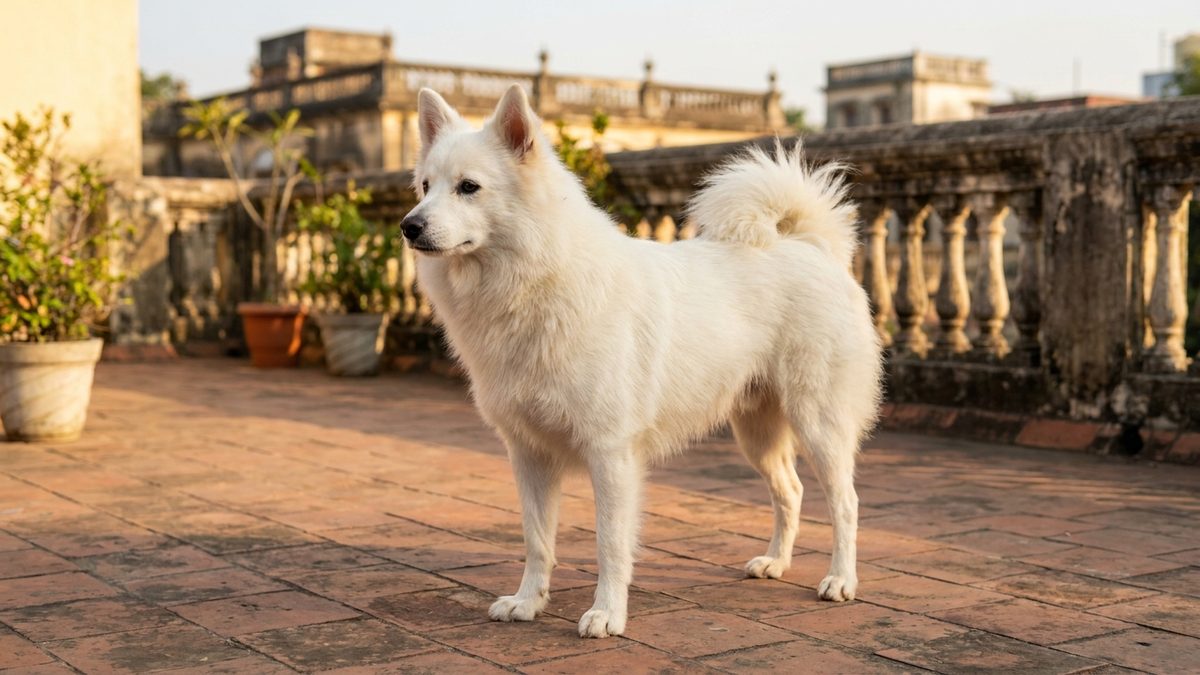
The Indian Spitz is a spitz-type breed developed in India from German Spitz dogs brought over during the British colonial period. It is not a Pomeranian, it is not a Samoyed, and it is not an imported breed, and those three confusions account for most of what is written about it online.
The breed's rise is a piece of Indian policy history rather than kennel history. During the 1980s and 1990s, when import rules for foreign dog breeds tightened, the Indian Spitz became enormously popular because it was the recognisable, fluffy, family-friendly dog Indians could actually get. A generation of Indian households grew up with one.
Two sizes, one breed
The Indian Spitz is divided into the Greater or Bigger Indian Spitz and the Lesser or Smaller Indian Spitz. Both are the same breed. The Greater is the one most people picture, at roughly 15 to 20 kg.
| Attribute | Detail |
|---|---|
| Type | Spitz, developed in India |
| Sizes | Greater (Bigger) and Lesser (Smaller) |
| Weight, Greater | 15 to 20 kg |
| Coat | Thick double coat, less profuse than a Pomeranian's |
| Colours | Pure white, dusky brown, black |
| Lifespan | 10 to 16 years |
| Origin | British colonial India, from German Spitz stock |
| Temperament | Loving, lively, alert |
Colour is limited compared with the Pomeranian. The Indian Spitz appears in pure white, dusky brown and black, while the Pomeranian comes in a wide variety of colours. Anyone selling you a rare-coloured Indian Spitz at a premium is selling you something else.
Which one are you actually being sold
The Greater and Lesser split is the practical question a buyer faces, and sellers are often vague about it because the smaller type reads as more premium to people who want a lap dog. The Greater is the traditional Indian Spitz, the medium dog at 15 to 20 kg that Indian households kept through the 1980s and 1990s. The Lesser is smaller and sits closer to the Pomeranian in size, which is exactly why the two get confused at point of sale.
Ask for the parents' weights rather than the puppy's. A Lesser Indian Spitz sold as a Pomeranian, or a Greater sold as a Lesser, are both common, and neither is detectable from an eight-week-old puppy.
The Indian Spitz is a policy artefact as much as a breeding project. Import restrictions in the 1980s and 1990s made foreign breeds hard to obtain, and the Indian Spitz filled that gap because it was already here, already bred locally, and already suited to the climate. It is the closest thing India has to a national family dog.
Indian Spitz price in India
An Indian Spitz puppy costs Rs 3,000 to Rs 15,000 in India, varying by health, gender, coat, colour and whether it is the Greater or Lesser type. That makes it one of the cheapest purebred dogs available in the country, and the low price reflects local availability rather than low quality.
| Source | Stated range | Note |
|---|---|---|
| HubPages | Rs 3,000 to Rs 15,000 | Varies by type, coat and gender |
| Supertails | Published band | Dedicated price guide |
| Wrapinfur | Published band | 2026 breed guide |
| Retail listings | From about Rs 4,000 | Seller advertisements, not a market rate |
Search this breed and page one fills with puppy sale listings, YouTube offers and Instagram, not with guides. That is because the Indian Spitz is the budget end of the Indian dog market, and the search intent behind it is transactional. Read any quoted price as an advertisement rather than a benchmark.
Bonbeno does not broker puppy sales and does not publish breeder listings. The figures above are reported from third-party sources so buyers can see the range for themselves.
What actually moves the price
- Greater or Lesser type. The larger type generally commands more.
- Coat quality and colour, though the recognised colours are only three.
- Gender, which sellers price differently for breeding reasons rather than pet reasons.
- Health status at sale, which is the only one of these four you should actually pay for.
One structural point about this breed's pricing. Because Indian Spitz puppies are cheap and widely available, the sellers competing for these searches are volume listings rather than specialist breeders, and their quoted prices move with inventory rather than with quality. A price that looks like a bargain usually reflects a litter someone needs to move.
Monthly cost of owning an Indian Spitz
The Indian Spitz is among the cheapest dogs to run in India. It is small to medium, it needs no professional grooming, and it is one of the healthiest small breeds in the country, which removes the three costs that dominate spending on imported breeds.
Indian Spitzes are naturally healthy and independent and need less grooming and veterinary care than Pomeranians. That comparison is the useful one, because the Pomeranian is what most buyers are choosing between.
Where the money goes
- Food. A 15 to 20 kg dog eats moderately. This is still the largest recurring line.
- Preventive veterinary care. Core vaccination, boosters, deworming and year-round tick and flea control.
- Grooming at home. Brushing rather than salon visits. Budget for a brush, not a bill.
- Weight management. The breed is prone to obesity, and obesity is expensive later.
- Skin care. Skin allergies are a known issue with the thick coat.
When we publish cost figures we state the sample size, the cities covered and the collection date. Our verified owner cost survey across eight metros is in progress. Until then we publish the structure rather than a number nobody can check.
Heat tolerance and the Indian climate
The Indian Spitz tolerates tropical climate, and specifically summer, in a way the Pomeranian does not. This is the single strongest practical argument for the breed and the reason it displaced imported lookalikes in Indian homes.
The comparison matters because the two breeds look similar to a casual buyer. The Pomeranian is not suitable for living in a hot climate. The Indian Spitz, developed and bred in India across generations, is.
That said, this is still a double-coated dog, and the breeds most at risk of heat stroke in India are double-coated ones. Peak summer temperatures cross 45 C in several parts of the country, and heat stroke is a veterinary emergency in any breed.
- Walk early morning and late evening through the hot months, which is the standard veterinary recommendation.
- Do not shave the coat. Shaving a double-coated breed removes the insulation that protects skin from direct heat and sunburn.
- Brush out dead undercoat instead, which is what actually improves airflow to the skin.
- Watch the skin through the monsoon, since damp undercoat plus humidity is what drives this breed's known skin problems.
Bonbeno rates the Indian Spitz 4 out of 5 for heat tolerance against 2 out of 5 for the Golden Retriever. For a small fluffy dog in an Indian metro, this breed is the sensible choice and a Pomeranian is not.
Temperament and household fit
The Indian Spitz is loving, lively and alert, which makes it both a good family dog and a genuinely useful watchdog. It is not an aggressive breed. It barks at anything unfamiliar, and that is the trait you are buying whether you want it or not.
The breed forms strong emotional attachments to its people. The flip side is the most important thing a prospective owner needs to know.
Indian Spitzes are social and dislike being alone for long periods. Left alone, they become anxious and sometimes destructive. A household where everyone is out ten hours a day is the wrong home for this breed, and separation-related behaviour is the most common complaint from owners who bought one anyway.
Who this breed suits
- Good fit. Apartments, families with children, first-time owners, households with someone home for part of the day, anyone wanting a watchdog without a guarding breed's risk.
- Poor fit. Homes empty all day, owners who cannot tolerate barking, households in buildings with strict noise complaints.
- Manageable with work. The barking. It is trainable, but it is the default setting rather than an aberration.
Compared with India's guarding breeds such as the Kombai, the Indian Spitz alerts rather than confronts. That is a meaningful safety difference in a household with visitors and children.
The watchdog case, honestly
In an Indian apartment or independent house, an alert dog that announces an unfamiliar person at the gate has real practical value, and the Indian Spitz does that job without the liability a guarding breed carries. It alerts and then defers, which is what most households actually want when they say they want a guard dog.
The trade is noise. A dog that reliably announces the courier also announces the neighbour, the lift and the pigeon. Buyers who want the first without the second are asking for a trait the breed does not have.
Training an Indian Spitz
Train an Indian Spitz with reward-based methods from the first week, and treat barking as the primary training project rather than an afterthought. The breed is intelligent and eager, so the ceiling is high and the common failures are about consistency rather than capability.
The socialisation window runs from about 3 weeks to 14 weeks and is largely closed after 16 weeks. For an alert breed that barks at the unfamiliar, what happens in that window decides how much of the adult dog's life is spent barking.
The barking problem, handled properly
- Socialise heavily to normal building noise. Lifts, doors, delivery riders, other dogs in corridors. A dog that finds these unremarkable does not announce them.
- Reward silence, not just quiet commands. Marking the moment the dog stops is what teaches it.
- Never punish the bark itself. It escalates an anxious dog and teaches nothing about what you do want.
- Manage the trigger where you can. A dog that cannot see the corridor barks at it less.
Realistic timelines
| Skill | Start | Reliable by |
|---|---|---|
| Name response | Week 1 home | 2 to 4 weeks |
| Sit, down, settle | Week 1 home | 3 to 6 weeks |
| Toilet training | Week 1 home | 3 to 5 months |
| Loose-lead walking | Month 2 | 4 to 8 months |
| Recall | Month 2 | 6 to 12 months |
| Managed barking | Month 1 | Ongoing management |
Because this breed becomes anxious when left, teaching it to be alone deserves the same structured effort as toilet training. Start with seconds, build to minutes, and never rehearse failure by leaving a distressed dog for hours.
How much exercise an Indian Spitz needs
An Indian Spitz needs long walks and genuine outdoor play, and it has higher energy levels than the Pomeranian people compare it to. Two proper walks a day plus play is the realistic baseline for an adult.
This is the most commonly underestimated thing about the breed. Buyers see a small fluffy dog and assume a lap dog. Long walks and outdoor play are necessary to keep an Indian Spitz healthy and physically agile, and an under-exercised one is exactly the dog that barks and chews.
| Stage | Guidance |
|---|---|
| Puppy | Short frequent sessions. Five minutes per month of age per session. |
| Adult | Two substantial walks plus play or training games |
| Senior | Shorter and more frequent, kept gentle |
| Peak summer | Shift entirely to early morning and late evening |
- Mental work counts. An intelligent breed in a small flat benefits more from ten minutes of scent games than from another lap of the block.
- Watch the weight. The breed is prone to obesity, and under-exercise plus Indian household feeding habits is how that happens.
- Check pavement temperature before summer walks. If you cannot hold your palm on it for five seconds, it will burn paw pads.
Grooming an Indian Spitz
Brush an Indian Spitz two to three times a week and expect seasonal shedding, but do not expect Pomeranian-level work. The breed is less hairy than a Pomeranian and its tail is less heavily curved and plumed.
Indian Spitzes need less grooming than Pomeranians, which in Indian humidity is a meaningful practical saving rather than a small one.
- Brush two to three times a week, more during seasonal shedding.
- Brush to the skin, not just the surface. Dead undercoat left in place is what mats and what traps humidity.
- Dry thoroughly after every bath. Damp undercoat in Indian humidity is the main driver of skin problems in this breed.
- Inspect skin at every brush. Skin allergies are a documented issue with the thick coat.
- Never shave for summer. It removes protective insulation.
The pure white variety shows dust, pollution staining and tear marks far more than the brown or black. That is a grooming-frequency decision, not a health one, but it is worth knowing before you choose a colour in Delhi or Mumbai.
Health and lifespan
The Indian Spitz is one of the healthiest small breeds in India, with a lifespan of 10 to 14 years typically and up to 16 with good care. That is a genuinely strong record, and it is the direct result of the breed never having been closed into a narrow show gene pool.
Published figures give both 12 to 16 years and 10 to 14 years rising to 16 with good care. No large cohort study of the breed exists. Treat the range as 10 to 16 and any single number as an estimate.
What to actually watch for
| Concern | What it means practically |
|---|---|
| Hip dysplasia | Keep the dog lean and avoid forced exercise while growing |
| Patellar luxation | Common in small breeds. Watch for a skipping hind-leg gait |
| Eye infections | Check and clean routinely, especially in the white variety |
| Skin infections and allergies | Driven by the thick coat plus Indian humidity |
| Obesity | The most preventable item on this list and the most common |
- Keep it lean. Obesity is a documented tendency and it worsens both joint conditions above.
- Year-round tick and flea control, since tick-borne disease is the realistic threat across Indian metros.
- Full core vaccination, regardless of how robust the breed is.
- Watch the hind-leg gait. A skip or hop that resolves on its own is the classic patellar luxation sign and is worth a veterinary opinion.
The underlying reason for that health record is the same one that explains the Indian Pariah Dog. The Indian Spitz was bred for decades as a functional household dog rather than to a closed show standard, so the breed never concentrated inherited disease the way tightly bred pedigree lines do. Where problems do appear they are the ordinary small-breed ones listed above, not breed-defining conditions.
Routine screening for this breed is straightforward and any general small animal practice can do it. Use our veterinary directory to find a clinic near you, and ask specifically for a patellar check at the annual visit, since it is quick and easily skipped.
Feeding an Indian Spitz
Feed an Indian Spitz to body condition on a complete balanced diet and control portions deliberately, because this breed gains weight easily and obesity compounds both of its main orthopaedic risks.
- Measure portions rather than free-feeding. A prone-to-obesity breed in a household that shares food is a predictable outcome.
- Split intake across two meals and feed to condition rather than to a chart.
- Resist table scraps. This is the single largest contributor to weight gain in Indian households and it also aggravates skin allergies.
- Adjust in peak summer, when appetite commonly drops. Persistent inappetence is a veterinary matter, not a preference.
Bonbeno reviews Indian pet food brands separately and tests products first-hand before publishing a verdict. See our testing method for what a Bonbeno food review does and does not claim.
Indian Spitz puppy: the first year
An Indian Spitz reaches most of its adult size within the first year, with the Greater type settling around 15 to 20 kg. The two decisive windows are socialisation and alone-time training, and both close earlier than most owners realise.
- 8 to 16 weeks. Vaccination course, typically starting at 6 to 8 weeks with boosters every 3 to 4 weeks. Structured socialisation to building noise, lifts, visitors and other dogs. Alone-time training starts in seconds, not hours.
- 4 to 6 months. Toilet training consolidates. Loose-lead work begins. First summer arrives for many puppies, so heat routines and no-shaving habits start here.
- 6 to 9 months. Barking behaviour establishes itself. This is where deliberate management pays off and where neglect becomes a decade-long problem.
- 9 to 12 months. Approaching adult size. Build to two substantial daily walks. Watch weight closely, since growth slowing while food stays constant is how obesity starts.
- 12 months onward. Adult routine. Annual boosters, continued weight and skin monitoring.
The socialisation window overlaps the vaccination course almost exactly. The risks of inadequate socialisation, meaning fearfulness, reactivity and eventual relinquishment, outweigh the small infection risk of controlled early exposure. For a breed whose main behavioural issue is barking at the unfamiliar, this is the decision that matters most.
Indian Spitz vs Pomeranian
Choose an Indian Spitz over a Pomeranian for any Indian household, on climate alone. The two are confused constantly because they look similar at a glance, but they are different breeds with different origins and one of them is not built for this country.
| Factor | Indian Spitz | Pomeranian |
|---|---|---|
| Origin | Developed in India from German Spitz stock | Central Europe, direct German Spitz descendant |
| Weight | 15 to 20 kg | 1.4 to 3.2 kg |
| Height | Noticeably larger | 18 to 30 cm |
| Coat | Less hairy | More profuse |
| Tail | Less curved | Tightly curved and plumed |
| Colours | White, dusky brown, black | Wide variety |
| Hot climate | Tolerates tropical summer | Not suitable for hot climate |
| Grooming and vet needs | Lower | Higher |
| Energy | Higher, needs long walks | Lower |
| Price in India | Rs 3,000 to Rs 15,000 | Rs 3,200 term volume, generally higher |
For an Indian household these are not equivalent options with a style preference between them. The Indian Spitz is cheaper, healthier, easier to groom and suited to the climate, and the Pomeranian is explicitly described as unsuitable for hot climates. If you want the look, buy the breed India developed to deliver it here.
The one thing a Pomeranian offers that the Indian Spitz does not is size. If your constraint is genuinely a very small dog, that is a real difference. Energy level is the other, since the Indian Spitz needs more exercise.
Indian insurers and veterinary writers make the same point when comparing the two breeds for local buyers, which is that the climate difference outweighs the cosmetic similarity Paw Pets India, Key Differences Between…. It is the rare case where the cheaper option is also the better-suited one.
Mistakes Indian Spitz owners actually make
The failure modes here are consistent and almost entirely preventable. They are ranked by how much they cost the dog.
- Leaving the dog alone all day. This breed becomes anxious and destructive when left for long periods. It is the single worst mismatch and it is not trainable away entirely.
- Overfeeding. The breed is prone to obesity, and obesity worsens both hip dysplasia and patellar luxation risk.
- Shaving the coat in summer. It removes the insulation that protects skin from heat and sunburn, and in a double coat it often grows back wrong.
- Treating it as a lap dog. It has higher energy than a Pomeranian and needs long walks. Under-exercise is what creates the barking complaints.
- Punishing the barking. Alert barking is the breed's function. Punishment escalates anxiety in a dog already prone to it.
- Skipping socialisation until vaccinations finish. The window closes around 16 weeks, and for an alert breed this is decisive.
- Buying it as a Pomeranian, or the reverse. Sellers exploit the confusion in both directions. Weight settles the question instantly, at 15 to 20 kg against 1.4 to 3.2 kg.
- Ignoring damp coat through the monsoon, which is what drives the breed's known skin problems.
Buying this breed for an empty house. Every other mistake here can be corrected. A social dog left alone ten hours a day for a decade cannot be, and it is the most common reason Indian Spitzes are rehomed.
Buying responsibly, and the adoption route
Verify health before you pay, and check shelters first, because Indian Spitzes and Spitz crosses turn up in Indian rescues in real numbers. This breed's popularity in the 1980s and 1990s left a large descendant population.
What to check before buying
- See the dam with the litter in the place the puppies were raised.
- Ask for a veterinary health certificate dated close to handover. With a breed this cheap, sellers frequently skip veterinary care entirely.
- Check the hind-leg gait of both parents where possible, since patellar luxation is heritable and common in small breeds.
- Confirm which type you are buying, Greater or Lesser, because sellers are not always precise.
- Verify any KCI registration claim directly with the Kennel Club of India, remembering that KCI certifies pedigree and not health.
Because Indian Spitz puppies are cheap, buyers routinely skip the checks they would insist on for an expensive breed. The dog lives 10 to 16 years either way, and the veterinary cost of a poorly raised puppy dwarfs the purchase price several times over.
Adoption
Indian Spitzes and Spitz-type crosses appear regularly in shelters across Indian metros, often surrendered by households that underestimated the exercise requirement or could not manage the barking in an apartment building. An adult has a known temperament and a known noise level, which are the two things you cannot assess in a puppy. If a fluffy small dog is not essential, the Indian Pariah Dog is free to adopt, longer-lived and even better suited to the climate.
Indian Spitz questions Indians actually search
What is the Indian Spitz price in India?
An Indian Spitz puppy costs Rs 3,000 to Rs 15,000 in India, varying by type, coat, colour, gender and health. That makes it one of the cheapest purebred dogs available in the country. Prices quoted in seller advertisements should be read as advertisements rather than as a market benchmark.
Which dog will come in 10,000 rupees?
The Indian Spitz is the most common answer, sitting at Rs 3,000 to Rs 15,000. The Indian Pariah Dog is usually free through adoption, and the Kombai starts around Rs 5,000 to Rs 10,000 in Tamil Nadu. Any imported breed advertised at Rs 10,000 should be treated as a warning sign rather than a bargain.
Which dog is Rs 5000?
An Indian Spitz can fall near Rs 5,000 at the lower end of its Rs 3,000 to Rs 15,000 range, though a puppy at that price rarely comes with veterinary care already done. Indian Pariah Dogs are free through adoption and usually arrive vaccinated and sterilised, which makes them cheaper in real terms.
Which dog under 2000?
Under Rs 2,000 the honest answer is adoption rather than purchase. Shelters across Indian metros rehome healthy dogs for a nominal fee or free, usually including initial vaccination and sterilisation. Any purebred puppy advertised under Rs 2,000 indicates an undocumented, unscreened litter.
Which dog is 20 crore price in India?
The Rs 20 crore figure refers to an offer a Bengaluru breeder said he refused for a Caucasian Shepherd, and the related Rs 50 crore wolfdog claim was debunked. The Enforcement Directorate searched the breeder's residence, found no documentary evidence he owned the animal, and he reportedly said the dog was not his. No verified Rs 20 crore dog sale exists in India.
What is the difference between an Indian Spitz and a Pomeranian?
Size and climate. An Indian Spitz weighs 15 to 20 kg against a Pomeranian's 1.4 to 3.2 kg, is less hairy, has a less curved tail and comes only in white, dusky brown or black. Critically, the Indian Spitz tolerates tropical summer while the Pomeranian is not suitable for hot climates.
Is the Indian Spitz good for an apartment?
Yes, it is among the best apartment dogs available in India. It adapts readily to small spaces given a daily walk, healthy food and company. The one caveat is barking, since this is an alert breed that announces unfamiliar noise, which matters in buildings with strict noise rules.
How long does an Indian Spitz live?
Published figures range from 10 to 14 years typically, reaching 16 with good care, and one source gives 12 to 16 years. Treat the range as 10 to 16 years. It is among the healthiest small breeds in India, which is the more useful fact than any single lifespan number.
Do Indian Spitz dogs bark a lot?
Yes. The breed is alert rather than aggressive, and it barks at unfamiliar activity or sound. That makes it an effective watchdog and a genuine consideration in an apartment building. Barking is manageable with early socialisation to normal building noise, but it is the breed's default setting rather than a fault.
Can an Indian Spitz be left alone during the day?
Not for long periods. Indian Spitzes are social and dislike being alone, and when left they become anxious and sometimes destructive. A household empty ten hours a day is the wrong home for this breed, and separation-related behaviour is the most common reason they are rehomed.
Compare with similar breeds
Indian Spitz sits in 4 Bonbeno groups. Each one compares it directly against the breeds it is genuinely an alternative to, on the same figures.