
Breed profile
Kai Ken (甲斐犬): The India Guide
Japan's brindle mountain hunter, a designated natural monument since January 1934, and a dog whose top Indian search result is a cryptocurrency.
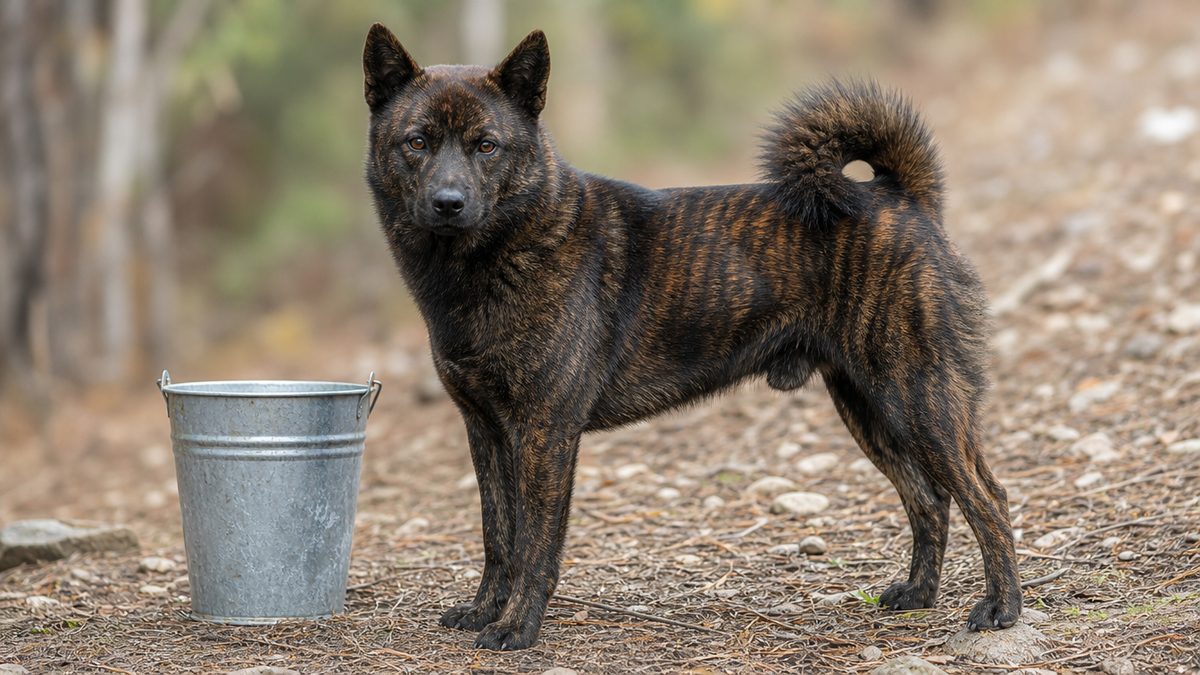
Quick answer
There is no verifiable kai ken price in india, because Bonbeno found no Indian breeder, listing site, marketplace or rescue offering the breed. The Japan Kennel Club registered 60 Kai in 2025 and the preservation society NIPPO another 78, while the breed's own society, the Kai Ken Aigokai, keeps a third and larger studbook it publishes no annual count from. Indian import law rejects applications made for breeding or trading. The one rupee figure the Indian first page returns belongs to a cryptocurrency token.
This page summarises published breed-standard text, kennel-club registry statistics, orthopaedic registry tables, government records and peer-reviewed veterinary research. It is general information and it is not veterinary advice. No page can examine your dog. Discuss vaccination, parasite control, heat management, diet and any eye or joint concern with a registered veterinary practitioner who has seen the animal, and treat any collapse, laboured panting or sudden change in behaviour in Indian heat as an emergency requiring a veterinarian immediately.
Kai Ken at a glance
What the Kai Ken is, and what its breed standard actually says
The Kai Ken is a medium Japanese hunting spitz from the mountains of Kai province in Yamanashi Prefecture, recognised by the FCI as standard 317, permitted in brindle and nothing else, and standing 47 to 53 cm at the withers in males and 42 to 48 cm in females.
Start with the document rather than the folklore. FCI-Standard No 317 was published in English on 9 February 2017 against an official valid standard dated 30 October 2016, and it places the breed in Group 5, Spitz and primitive types, Section 5, Asian Spitz and related breeds, without working trial. The FCI has recognised the Kai on a definitive basis since 1 February 1982, its country of origin is Japan, and English is the official authentic language of the standard, which is unusual for a Japanese breed and means the English text is the original rather than a translation.
The standard's own history paragraph is short and worth quoting for what it commits to. The breed "became established as a breed in the Kai district (Yamanashi Prefecture), which is surrounded by mountains", another name for it is "Kai tora-ken", "a distinguishing feature in this dog is its brindled coat", and the dogs "are used mainly for hunting wild boar and deer";. It adds one sentence that most breed pages skip: their "strong inclination to form a pack is thought to contribute towards maintaining the purity of the breed";.
The measurements, and the one the standard refuses to give
| Point | What the standard says |
|---|---|
| Height, males | 50 cm, with a tolerance of plus or minus 3 cm, so 47 to 53 cm |
| Height, females | 45 cm, with the same tolerance, so 42 to 48 cm |
| Weight | Not stated. The document contains no weight figure at all |
| Proportion | Height at withers to body length 10 : 11, body slightly longer in bitches |
| Colour | Black brindle, red brindle and brindle only |
| Coat | Outer coat harsh and straight, undercoat soft and dense |
| Ears | Triangular, slightly inclining forward, firmly pricked |
| Tail | Set on high, thick, vigorously curled or carried curved like a sickle |
| Temperament | Keen and very alert |
The missing weight matters more than it looks, because every commercial page prints one. The FCI is the recognising authority and it declined to specify a weight for this breed, so any weight you read is somebody's observation rather than the standard's requirement. The most reliable single figure Bonbeno could find is not from a breed site at all: a 2022 veterinary case report from Nippon Veterinary and Life Science University records its patient as an 8-year-old, 18.9 kg, male, intact Kai Ken. One dog is not a range, and it is still worth more than an uncited number.
The disqualifying faults tell you what the breed is not
Read the disqualification list and the dog comes into focus. A Kai is disqualified for ears that are not pricked, for a hanging or short tail, for faded colour, for a coat with many white spots, and for pinto colour. So a Kai Ken is a brindle dog with erect ears and a carried tail, and an animal offered to you as a Kai without visible brindle striping, or with a dropped ear, is either a poor specimen or a different dog. The lesser faults include a light-coloured nose, light eyes, long or short hair, shyness, and, distinctively, lack of sexual dimorphism.
The standard records that "solid colour in puppyhood may turn brindle as the dog grows";, and English Wikipedia adds that the striping can take as long as five years to show fully. English Wikipedia carries a maintenance banner asking for more citations and it is wrong elsewhere on this page, so treat the five-year figure as unverified. The standard's own sentence is enough for the practical point: a solid-looking Kai puppy is not evidence of a mixed dog.
Kai, Kai Ken, Kai Inu, tora-ken: which name to use and why it changes what you find
Use Kai Ken in English and 甲斐犬 in Japanese, and know that the FCI files the breed under the single word KAI, because the name you search decides what you find and, on this breed, most of the names return something that is not a dog.
The FCI's nomenclature entry is headed simply KAI (317). The Japan Kennel Club's registration table lists it as 甲斐 Japan Kennel Club. The Agency for Cultural Affairs register gives the full form 甲斐犬 with the reading かいけん, kaiken. The AKC uses Kai Ken and records the nickname Tora dog, tora meaning tiger in Japanese, from the brindle coat. The FCI standard's own history paragraph gives Kai tora-ken as another name for the breed, and a 2017 American case report describes its patient as a "Kai Ken Tora dog", so that compound is in live clinical use.
Every name form Bonbeno searched, and what it returned
This is not pedantry. Bonbeno ran eight query forms against PubMed on 31 August 2026 and recorded the query-translation line for each, because a count without a translation line is not evidence.
| Query | Records | What PubMed actually searched |
|---|---|---|
| "Kai Ken" | 42 | "kai" AND "ken" as separate words. The phrase was never matched |
| "Kai Tora-ken" | 18,799 | Collapsed to "kai" alone |
| "Kai dog" | 159 | "kai" AND dog as separate terms |
| "Kai dogs" | 2 | Phrase matched. This is the query that works |
| "Kai Kens" | 0 | Split, and no records |
| "Kai inu" | 0 | Split, and no records |
| "Tora inu" | 0 | Split, and no records |
| 甲斐犬 | 0 | Empty translation line. The script was not processed at all |
Two things follow, and both are the opposite of what the raw counts suggest. The 42 records for "Kai Ken" are not 42 papers about this breed, because PubMed silently split the phrase into two common words. And the plural form is the one that works: "Kai dogs" phrase-matched where "Kai dog" did not, which is the difference between a real hit and a rewrite.
Searching 甲斐犬 returned zero records and an empty query-translation line, which means PubMed did not process the Japanese string rather than searching for it and finding nothing. Bonbeno therefore claims no absence from the Japanese-language literature. Controls run in the same session returned 73 records for "Shiba Inu" AND dog, 52 for "Labrador Retriever" AND "hip dysplasia", 23 for Saluki and 31 for Afghan Hound, so the instrument itself was working for Latin script.
The naming problem is worse on a general search engine than on PubMed. A Bing India pull for the target query returned ten organic results about Kai the EXO singer, Kai Cenat the streamer and Kai brand kitchen knives, with not one about a dog, while the Labrador control on the same instrument in the same session returned genuine Indian pricing pages. The word "Kai" is doing the damage, in the same way "Japanese" and "Italian" have done it on other breeds. If you are researching this dog, search Kai Ken or 甲斐犬 and add the word dog, and treat anything that comes back under bare "Kai" as unrelated until you have read it.
Designated a natural monument on 22 January 1934, by the authority that made the designation
Japan designated the Kai Ken a national natural monument on 22 January 1934 under criterion (4), domesticated animals peculiar to Japan, with no geographical area attached to the listing.
That is not from a breed blog. It is record 401/3106 of the National Cultural Properties Database maintained by the Agency for Cultural Affairs, the Japanese government body responsible for the designation. The record gives the name as 甲斐犬, the reading as かいけん, the category as 天然記念物, natural monument, the designation date as 1934.01.22, expressed also in the Japanese era calendar as Showa 9.01.22, the designation criterion as (四)日本に特有な畜養動物, criterion (4), domesticated animals peculiar to Japan, and the prefecture field as 地域を定めない, meaning no area is specified.
On this breed the FCI standard is right, which is worth saying
Bonbeno's Hokkaido guide found that the FCI's Shiba standard dates that breed's designation to 1937 when the government register says 16 December 1936. It would be easy to assume the FCI is unreliable on designation dates generally. On the Kai it is not. FCI-Standard 317 says "The breed was designated as a « natural monument » in 1934";, and the AKC says the Kai "was designated a natural treasure in Japan in 1934 and is protected by law";. Both match the register's year exactly. What neither carries is the day or the legal criterion, which is the whole value of reading the register itself.
The source that is wrong is English Wikipedia. Its History section states that "After the creation of NIPPO in 1928, the Kai Ken was designated a national monument in Japan in 1933". The register says 22 January 1934. A designation made three weeks into January is exactly the kind of date that drifts back a year in retelling, and Wikipedia's Kai Ken article has carried a banner asking for more citations since April 2014.
| Source | What it says | Verdict against record 401/3106 |
|---|---|---|
| Agency for Cultural Affairs, record 401/3106 | 1934.01.22, criterion (4), no area specified | The register itself |
| FCI-Standard No 317 | "designated as a natural monument in 1934" | Correct year, no day, no criterion |
| American Kennel Club | "designated a natural treasure in Japan in 1934" | Correct year, and "treasure" is a loose rendering of the category |
| English Wikipedia, History section | "designated a national monument in Japan in 1933" | Wrong. A year early |
Re-checked against the two sibling records, which held
Bonbeno re-opened the two neighbouring dog records rather than inheriting them from its own earlier pages, because a finding recorded on a sibling page is not evidence until you have seen it. Both held exactly. Record 401/3112 gives the Shiba as designated 1936.12.16, and record 401/3105 gives the Akita as 1931.07.31. All three dogs carry the same criterion (4) and the same "no area specified" prefecture field, so the register treats them as one class of designation made on three different dates.
| Breed | Record | Designated | Criterion |
|---|---|---|---|
| Akita | 401/3105 | 31 July 1931 | (4) domesticated animals peculiar to Japan |
| Kai | 401/3106 | 22 January 1934 | (4) domesticated animals peculiar to Japan |
| Shiba | 401/3112 | 16 December 1936 | (4) domesticated animals peculiar to Japan |
The dog and its quarry are both monuments, four months apart
Here is something no page covering this breed appears to have noticed. The Kai Ken was bred to hunt in steep Yamanashi terrain, and its primary quarry was the Japanese serow, the kamoshika, along with deer, wild boar and occasionally bear. The serow sits in the very next record in the same government database. Record 401/3107 designates カモシカ a natural monument on 1934.05.01, three months and nine days after the dog, and upgrades it to 特別天然記念物, Special Natural Monument, on 15 February 1955.
So Japan listed the hunter in January 1934 and its principal prey in May 1934, then raised the prey to a higher tier of protection twenty-one years later. The two records differ in one instructive way: the dog is filed under criterion (4), domesticated animals peculiar to Japan, while the serow is filed under criterion (1), notable animals peculiar to Japan and their habitats Agency for Cultural Affairs. The register is drawing exactly the line you would want it to draw, between an animal people made and an animal people found.
A natural-monument listing is a cultural-property designation filed, in this case, with no area specified and no export clause visible in the record. Nothing Bonbeno found suggests the designation itself bars taking a Kai out of Japan, and nothing in it is a health guarantee. If a seller uses the words natural monument or national treasure to justify a premium, to explain a delay, or to imply the dog is genetically vetted, none of those follow from the record.
Which register a Kai Ken pedigree comes from, and what each one is worth
Five bodies matter for a Kai Ken pedigree and they do different jobs. The FCI sets the standard, the Kai Ken Aigokai keeps the breed's own and largest studbook, NIPPO and the Japan Kennel Club each publish a separate partial count, and the AKC records the breed without fully recognising it.
- The FCI recognises the Kai on a definitive basis, from 1 February 1982, as standard 317 in Group 5 Section 5, with Japan as country of origin. Definitive is the top tier. It means a Kai can compete for the CACIB, which breeds on the provisional register cannot.
- The Japan Kennel Club is the FCI member for Japan and publishes an annual count of new pedigree registrations by breed. It registered 60 Kai in 2025. The JKC prints its own caveat that this counts one year of new registrations and not the living population.
- The Kai Ken Aigokai is this breed's primary register, and it says so in its own words, describing itself as the single-breed preservation body for the designated natural monument Kai. Founded 3 November 1931, it began studbook registration in April 1934 with 32 dogs and its pedigree serial had reached the late 50,300s by May 2022. It publishes no annual registration count.
- The Nihon Ken Hozonkai, NIPPO, created in 1928, is the association that split the Kai out of the Nihon Ken landrace and protects the six native Japanese breeds. It registered 78 Kai in 2025, and it admits Aigokai-registered dogs only on its provisional tier, which is why its Kai column read zero for the first six years of its published series.
- The AKC records the Kai Ken in its Foundation Stock Service since 1997, approved it for Companion Events from 1 January 2010, and moved it to the Miscellaneous Class in July 2022 with the Working Group designation. Miscellaneous is a step below full recognition, not full recognition.
What about the Kennel Club of India
Bonbeno cannot answer the KCI question from the KCI, and says so rather than guessing. The Kennel Club of India publishes no breed list for any breed, so a query there returns nothing for the Kai Ken and nothing for a control breed either. A search that fails identically for every input is a broken instrument, not a finding, and reporting it as "the breed is not recognised in India" would be false.
The route that does work is indirect and checkable. The FCI members register lists India as a full member represented by the Kennel Club of India, Chennai, so the KCI issues pedigrees against FCI nomenclature. Because the FCI recognises the Kai definitively as standard 317, the breed sits inside the nomenclature the KCI works from. That answers the recognition question honestly without pretending to a KCI document nobody can read.
The FCI trap that fired while researching this page, and how to avoid it
Anyone verifying this breed will be tempted to guess the FCI URL. Do not. Bonbeno requested `fci.be/en/nomenclature/KAI-307.html` and received HTTP 200 with a complete, correctly formatted page for the AZAWAKH, a Malian sighthound, because 307 is the Azawakh's breed number and fci.be discards the name in the slug entirely. Nothing errored. The page was real, the standard PDF attached to it was real, and it was a different dog on a different continent.
The Kai is 317, and the Kishu, the breed most often confused with it in registry listings, is 318. If you are checking any FCI claim about any breed, find the link in the FCI's own alphabetical index rather than assembling the address, and read the breed name printed on the returned document before taking a figure off it.
Ask which register the pedigree is on, and get the register named rather than "international". Confirm the FCI number quoted is 317 and not any other. Ask for the Japanese registering body by name, Kai Ken Aigokai, NIPPO or JKC, since all three exist and issue different documents. Then check the dog against the standard's disqualifying faults, because a pricked-ear brindle dog with a carried tail is the minimum the paperwork should be describing.
Three sources, three different Kai Ken: the size figures do not agree
The FCI, the AKC and Wikipedia publish three incompatible sets of measurements for this breed, and the disagreement is largest on bitches, where the AKC's floor sits 2.6 cm below the floor the FCI standard permits.
Everybody quotes a size. Almost nobody says which document it came from. Put the three side by side and they do not describe the same dog.
| Source | Males | Females | Weight |
|---|---|---|---|
| FCI-Standard 317 | 50 cm plus or minus 3, so 47 to 53 cm | 45 cm plus or minus 3, so 42 to 48 cm | None given |
| American Kennel Club | 18.5 to 19.5 in, so 47.0 to 49.5 cm | 15.5 to 17 in, so 39.4 to 43.2 cm | 30 to 40 lb, 13.6 to 18.1 kg males |
| English Wikipedia infobox | 50 to 56 cm | 45 to 51 cm | 11 to 25 kg, 25 to 55 lb |
| English Wikipedia article body | 18 to 22 in, so 45.7 to 55.9 cm | 17 to 20 in, so 43.2 to 50.8 cm | Not stated in the body |
What each disagreement actually is
- The AKC bitch is a smaller dog. Its 15.5 to 17 inch range converts to 39.4 to 43.2 cm, while the FCI's tolerance floor for bitches is 42 cm FCI-Standard No 317, KAI. The two ranges overlap across barely a centimetre. A bitch at the bottom of the AKC's range would be undersized under the standard the FCI publishes.
- The AKC caps males lower. Its 19.5 inch ceiling is 49.5 cm against the FCI's 53 cm, so a perfectly correct 52 cm FCI male sits above the AKC's stated range.
- Wikipedia's infobox inflates both ends. Its 50 to 56 cm for males takes the standard's single figure of 50 as a floor and invents a 56 cm ceiling that appears in no document; the FCI's actual maximum is 53 FCI-Standard No 317, KAI. The same treatment of the 45 cm bitch figure produces 45 to 51.
- Wikipedia contradicts itself. Its infobox gives males 20 to 22 inches and its own article body gives males 18 to 22 inches, a five-centimetre disagreement inside one article.
The weight problem, and the one dog that has actually been weighed in print
The FCI standard gives no weight at all. Wikipedia's infobox gives 11 to 25 kg while citing the FCI standard as one of its two kennel-club standards, and the FCI document it cites contains no weight. The AKC gives 30 to 40 lb for males, a ceiling of 18.14 kg.
Then there is a real dog. The 2022 case report from Nippon Veterinary and Life Science University records an 8-year-old intact male Kai Ken at 18.9 kg. That single documented animal is 0.76 kg above the AKC's stated male ceiling, and comfortably inside Wikipedia's 11 to 25 kg band, which is so wide it could not be wrong. A range that cannot be falsified is not information.
Buy against the FCI standard, because it is the document the recognising authority publishes and the one a KCI pedigree ultimately references. Expect an adult male around 47 to 53 cm and roughly 15 to 19 kg on the available evidence, and treat any seller quoting 25 kg for this breed as quoting Wikipedia rather than a dog. If you are told a Kai Ken will reach 55 or 56 cm, that figure traces to a Wikipedia infobox and to no standard anywhere.
60 with the JKC, 78 with NIPPO, and a third register nobody counts
The Japan Kennel Club registered 60 Kai in 2025 and NIPPO registered 78, and both are floors rather than totals, because this breed's own society, the Kai Ken Aigokai, has run its own studbook since April 1934 and issues far more pedigrees than either Nihon Ken Hozonkai (NIPPO) Kai Ken Aigokai (甲斐犬愛護会).
The JKC publishes 犬種別犬籍登録頭数, new pedigree registrations by breed, once a year. The 2025 table covers 141 breeds and 302,530 dogs, and 甲斐 sits at rank 70 with 60 dogs. To put that in the same frame a buyer already has, the same table records 3,598 Shiba, 1,467 Japanese Spitz, 386 Japanese Chin, 263 Akita, 58 Japanese Terrier, 51 Shikoku and 24 Hokkaido, while the Kishu does not appear at all.
| Year | Kai registered | Rank | Source |
|---|---|---|---|
| 1999 | 79 | 73 | JKC's earliest published year |
| 2020 | 93 | 68 | The highest of the four |
| 2024 | 43 | 79 | The lowest of the four |
| 2025 | 60 | 70 | 141 breeds, 302,530 dogs in total |
Read that trend carefully, because the obvious story is wrong. This is not a breed in smooth decline. It ran at 79 in 1999, rose to 93 in 2020, fell to 43 in 2024 and recovered to 60 in 2025 Japan Kennel Club, registrations by breed Japan Kennel Club, registrations by breed Japan Kennel Club. What that pattern actually shows is a population so small that ordinary variation looks like a crisis: the entire swing between the best and worst year is 50 dogs. It also moved against the national trend in the most recent year, since total JKC registrations fell from 306,642 to 302,530 while the Kai rose from 43 to 60.
The archive URL that serves the wrong year
One verification note, because a careless check here would produce a fake trend. The JKC archive's own link for 2024 is `/registr-statistics/2024-3/`. The address you would guess, `/registr-statistics/2024/`, returns HTTP 200 and serves a copy of the 2025 table under the 2025 heading. Bonbeno followed the archive index's own links and confirmed the year printed inside each returned document before taking a figure from it. A year-over-year comparison built on the guessed URL would have compared 2025 against itself and reported no change.
The second register, and why 60 is not the breed's output
NIPPO, the preservation society for the six native breeds, runs its own studbook and recorded 78 Kai in 2025 against the JKC's 60. The two books are separate, not subsets, so 2025 produced at least 138 registered Kai between them. NIPPO's own front page places the Kai outside its main constituency, naming the Shiba, the Kishu and the Shikoku as the three of the six it registers in numbers.
NIPPO's Kai column also carries a tell that should stop anyone reading it as a population. It reads 0 in 1998 and 1999, 3 in 2000, then 0, 2 and 2, before jumping to 28 in 2004 and 122 in 2007. No breed goes from zero to 122 in nine years by breeding. What changed was administrative, not biological.
The Kai Ken Aigokai is this breed's own studbook
The register that actually holds this breed is the Kai Ken Aigokai, which describes itself as the single-breed preservation body for the designated natural monument and claims more shows for one breed than any other body in Japan. It began studbook registration in April 1934 with 32 dogs. Its published pedigree serial number stood at 32,300 on 31 August 2000 and had reached the late 50,300s by the end of May 2022.
Set that against NIPPO's column for the same window. Roughly 18,000 pedigree numbers were issued by the Aigokai across those 21 years and 9 months, while NIPPO recorded 1,361 Kai across 2000 to 2022. A serial number is not a headcount, since numbers can be reserved or skipped, so read the comparison as an order of magnitude rather than a ratio. Even read cautiously, the breed's own society is the larger book by roughly ten to one.
| Register | What it is for the Kai | 2025 figure | Published? |
|---|---|---|---|
| Kai Ken Aigokai | The breed's own single-breed studbook, since April 1934 | Serial in the late 50,300s at May 2022 | Serial only, no annual count |
| NIPPO | Six-breed preservation society, Kai outside its main three | 78 | Yes, 28-year table |
| Japan Kennel Club | FCI member body, international pedigrees | 60 | Yes, annual by breed |
Why a single-registry rarity ranking is an artefact
Each Japanese native breed keeps its own preservation society, so any one registry undercounts every breed it is not the main register for. NIPPO publishes the evidence itself. Its transfer page lists eight other Japanese bodies whose pedigrees it accepts and puts the Kai Ken Aigokai in the provisional tier rather than the full one, which is exactly why NIPPO's Kai column sat at zero for years.
The Akita measures the size of the error. NIPPO recorded 5 Akita in 2025, a figure that alone reads as near-extinction. The Akita Inu Hozonkai recorded 1,587 domestic and 637 overseas litter registrations in 2024, plus 140 single-dog registrations, against NIPPO's 12 Akita that year. Those are litters rather than puppies. So a sentence such as the Hokkaido is the rarest Japanese monument breed, which an earlier revision of this page carried, cannot be supported from one register at all.
What sixty dogs a year means for an Indian buyer
It closes the market question, though for a narrower reason than an earlier revision of this page claimed. This page previously said sixty registered puppies a year is the total output of the breed's home country. That was wrong, and Bonbeno withdrew it on 9 September 2026 after reading NIPPO's and the Aigokai's own figures. The correct statement is that Japan's two published registers recorded 138 Kai in 2025 and the breed's own society publishes no annual count Kai Ken Aigokai (甲斐犬愛護会). The conclusion survives, because Japan has its own domestic demand and there is no export surplus at any of these numbers. Layer on Indian import law, which states that applications for trading or breeding purposes shall be rejected, and the arithmetic of an Indian Kai Ken supply chain does not work at any price.
The JKC prints this caveat itself and it is worth repeating: the figure counts one year of new pedigree registrations, not the number of Kai alive. Dogs registered with the Kai Ken Aigokai or with NIPPO are not in the JKC table at all, and the Aigokai publishes no annual count, so no complete figure for this breed exists anywhere. Bonbeno has no total-population figure for this breed and does not publish one.
Kai Ken price in India: there is no Indian price, and the top result is a cryptocurrency
There is no verifiable Kai Ken price in India, because Bonbeno found no Indian breeder, listing site, marketplace or rescue offering the breed. The only page on the Indian first page that gives an actual rupee figure is a memecoin.
Say the negative first and then evidence it. A search restricted to India for the target term returned, in order: a commercial breed-info page, a Facebook group post, a Binance cryptocurrency price page, an American puppy marketplace, an American DNA-testing brand, an Etsy listing for a cloth patch, a Reddit thread, English Wikipedia, a United Kingdom breed site, and the same Reddit thread again. Not one Indian Kai Ken listing. Not one Indian breeder. Not one Indian rescue.
That absence is earned rather than assumed. The control query "labrador retriever puppy price in india", run on the same instrument in the same session, returned genuine Indian Labrador listing pages quoting Indian prices city by city. The search worked. What it found for the Kai Ken is what is there.
The third result is a memecoin with zero trading volume
This is the finding, and it is not a joke at the reader's expense. Position three on the Indian first page for "kai ken price in india" is Binance India's live price page for KAI KEN (KAI), a cryptocurrency token. Read on 31 August 2026 and timestamped by the page itself the same day, it records a price under 0.000001 US dollars, a market capitalisation of 133.8 thousand dollars, a 24-hour trading volume of zero dollars, a circulating supply of 420.7 trillion, and a note that the coin is not listed on Binance for trading.
The page even runs its own question block headed "People Also Ask: Other Questions About KAI KEN", whose first entry asks "How much is 1 KAI KEN (KAI) in INR right now?" and answers with a figure below one millionth of a rupee. So the most prominent answer an Indian searcher gets to the question "how much is a Kai Ken in rupees" is a real, precise, correctly-sourced number about a token that nobody traded that day.
| Source | Figure printed | What it actually is |
|---|---|---|
| Happy Pet (position 1) | ₹50,000 to ₹1,00,000 | An unsourced Indian estimate on a template page. No dog attached |
| Binance India (position 3) | Under ₹0.000001 | A cryptocurrency token with zero 24-hour volume |
| Good Dog (position 4) | "$4,000 to $4,000" | A United States marketplace's national range, printed as an identical floor and ceiling |
| Etsy India (position 6) | ₹597 | A cloth patch. Not a dog |
| kaiken.co.uk (position 9) | £1,500 to £3,000 plus import costs | A United Kingdom breed site's guidance, explicitly before transport |
Running the division tests on the one Indian figure
Indian breed pages routinely publish rupee "prices" that are a dollar figure run through one exchange rate, so the ₹50,000 to ₹1,00,000 band deserves testing rather than repeating. Divide it and here is what comes out. At 84.38 it gives 592.56 and 1,185.12, which are not prices a seller would print. At 74 it gives 675.68 and 1,351.35, likewise. At a flat 80 it gives exactly 625 and 1,250, and at roughly 66.67 it gives almost exactly 750 and 1,500.
Two of those look clean, and neither is evidence. Any rupee figure ending in three zeros divides tidily by 80 by construction, since 1,000 divided by 80 is 12.5, so a match there proves arithmetic rather than provenance. The decisive check is whether the quotient matches a real Kai Ken price anywhere, and it does not: the American marketplace on the same results page quotes 4,000 dollars and the British breed site quotes 1,500 to 3,000 pounds. Nobody sells this breed at 625 or 750 dollars. These are round rupee-native numbers, not converted ones, which is a different kind of unreliable and worth naming as such.
What the ranking page is, on its own evidence
The page quoting that band is assembled from a template rather than written about this breed, and it says so in its own headings. It carries "Prerequisites to pet a Kai Ken" and "Common Health Issues in Kai Kens", the auto-filled forms this pattern always produces. Its list of the breed's health issues opens with canine distemper, canine influenza, heartworm, leptospirosis and parasites, which are infectious diseases every dog on earth can catch and not predispositions of any breed. Its "compare with similar breeds" module offers the Whippet, the Basset Hound, the Bulldog and the American Cocker Spaniel, which is not a set any person who knows this dog would assemble.
The same page attributes its price to whether a puppy is "registered with kennel clubs such as the Kennel Club of India (KCI)";. That is unfalsifiable, because the KCI publishes no breed list against which anyone could check.
DGFT Trade Notice 22/2022-23 states that applications for trading or breeding purposes shall be rejected, and the Japan Kennel Club registered 60 Kai in the whole of 2025. A supply chain cannot form between those two facts, so the price has nothing to converge on. The Kai Ken is not expensive in India and it is not cheap in India. It is unavailable in India, which is a different fact and a more useful one.
What a dog this size actually costs to keep in India, whatever the breed
Budget roughly ₹3,500 to ₹7,000 a month for a 15 to 19 kg double-coated dog in an Indian metro, plus a first-year vaccination and sterilisation load, and treat the purchase price as the smallest number in the decision.
There is no Indian Kai Ken price to report, but there is a real Indian cost of ownership for a dog of this size, and that is the figure a reader can actually use. It applies to any 15 to 19 kg dog with a double coat living in Chennai, Delhi, Bengaluru, Mumbai or Pune, and it does not require inventing anything about this breed.
The commercial Indian page ranking first for this breed publishes a monthly breakdown, and Bonbeno reports it with its provenance attached rather than as a measurement. It gives average monthly expenses of ₹3,550 basic and ₹5,400 premium, split as food ₹2,250 to ₹3,000, veterinary ₹600 to ₹1,200 and grooming ₹700 to ₹1,200. Those numbers carry no source and no method, so treat them as one site's estimate.
| Line | One published Indian estimate | What drives it up or down |
|---|---|---|
| Food | ₹2,250 to ₹3,000 | A working-build dog at 15 to 19 kg eats more than a lap breed and less than a mastiff. Premium imported kibble roughly doubles this line |
| Routine veterinary | ₹600 to ₹1,200 | Averaged across the year. Vaccination and deworming are front-loaded into the first year |
| Grooming | ₹700 to ₹1,200 | A double coat in Indian humidity needs proper drying after every bath, which is what you are paying a groomer for |
| Total, monthly | ₹3,550 to ₹5,400 | Add boarding, transport and any chronic medication separately |
The lines that estimate leaves out
- The first year is not an average year. Indian law expects a pup's core vaccination course to start at seven to eight weeks and to be usually completed by eighteen weeks, so the veterinary line is concentrated rather than spread.
- Sterilisation may already have happened, by law. Rule 8(1)(b) of the 2017 Rules requires that dogs over six months in age are not sold without first being sterilised, unless the sale is to another licensed breeder. Anyone buying an adult rare-breed dog lawfully in India is buying a sterilised animal.
- Cooling is a real line in an Indian summer. For a double-coated northern breed the practical cost is fans, shade and the electricity behind them, and there is no honest way to publish a rupee figure for that without knowing the home.
- Boarding is the line people forget. A reserved, strange-to-handle breed is harder to board than a Labrador, and in practice that means paying for a sitter rather than a kennel.
Even taking the higher published estimate of ₹5,400 a month, twelve years of ownership is roughly ₹7,77,600 in recurring cost before a single illness. That dwarfs any purchase figure anyone quotes for any breed, which is the argument for spending the decision-making effort on whether you can deliver two hours a day of cool-hour exercise rather than on chasing a dog that has no Indian supply.
Heat tolerance: the measured gap between Kai province and an Indian city
A Kai Ken is a poor fit for Indian heat, and the gap is 16.7 degrees of annual mean between the grid cell over its home prefecture and Chennai, before any correction for the fact that the cell sits 460 metres above the town.
Heat tolerance is the one number on a breed page that decides whether an Indian buyer should proceed, and no global breed site rates it. Bonbeno works it from NASA POWER queried by explicit latitude and longitude, echoing back both the coordinates and the grid elevation the service served, because a climate figure attached to the wrong place is worse than no figure.
| Place | Coordinates | Cell elevation | Annual mean | Annual max | Relative humidity |
|---|---|---|---|---|---|
| Kofu, Yamanashi | 35.664N 138.568E | 732.27 m | 11.24 C | 36.77 C | 81.20% |
| Chennai | 13.083N 80.271E | 48.95 m | 27.95 C | 42.70 C | 72.39% |
| Mumbai | 19.076N 72.878E | 97.15 m | 26.77 C | 44.91 C | 67.39% |
| Delhi | 28.614N 77.209E | 206.37 m | 25.60 C | 48.79 C | 45.56% |
| Pune | 18.520N 73.857E | 635.99 m | 23.86 C | 43.20 C | 66.80% |
| Bengaluru | 12.972N 77.595E | 841.72 m | 23.74 C | 40.38 C | 67.94% |
The Kofu cell is 460 metres above the town, and Bonbeno says so rather than hiding it
NASA POWER returns a grid cell rather than a point, and in mountainous terrain the cell's mean elevation can miss the place underneath it badly. Yamanashi is mountainous, and the check fires here. The cell returned 732.27 metres for Kofu, a city that sits at roughly 270 metres on the floor of the Kofu basin. The cell is averaging the basin with the ranges around it, so it is about 460 metres too high.
Correct for that at the standard lapse rate of roughly 6.5 degrees per 1,000 metres and Kofu's real annual mean comes out near 14.2 degrees rather than 11.24. That correction lands within about a degree of Kofu's published climate, which is the check that says the diagnosis is right rather than convenient. Bonbeno publishes the correction as an estimate and never as a measurement.
The correction does not rescue the breed. Even at a corrected 14.2 degrees, Chennai's 27.95 is 13.7 degrees warmer year round, Mumbai is 12.6 warmer, Delhi 11.4, Pune 9.7 and Bengaluru 9.5. The Indian plains cells need no such correction, because POWER tracks flat terrain well: Chennai's cell sits 49 metres up against a city near sea level, Delhi's 206 metres, Mumbai's 97.
The humidity result is the surprising one
Kai province is not dry. The Kofu cell returns 81.20 percent annual relative humidity, which is higher than Chennai's 72.39, Mumbai's 67.39, Bengaluru's 67.94 and far higher than Delhi's 45.56. So a Kai Ken is not a desert-adapted dog meeting humidity for the first time. It is a humid-climate dog meeting heat for the first time, and that distinction changes the advice: the problem to manage is temperature and the drying of a dense undercoat, not humidity as such.
It also means the breed is genuinely hardy in wet conditions in a way a Nordic breed is not, and Wikipedia's note that many Kai love to swim and have been known to cross rivers fits a dog from an 81 percent humidity homeland.
What the heat-illness literature does and does not let us say
Two large United Kingdom studies of heat-related illness are the best evidence available, and neither includes this breed, so Bonbeno borrows only the factors that genuinely transfer. Hall and colleagues, writing in *Scientific Reports* in 2020 on 905,543 dogs under primary veterinary care, found bodyweight at or above the breed and sex mean carried odds of 1.42 (1.12 to 1.80) for heat-related illness, and dogs over 50 kg carried odds of 3.42 (1.54 to 7.57). The companion paper in *Animals*, on the same cohort with a different case definition, reported 1.30 (1.09 to 1.55) and 2.21 (1.02 to 4.79) for exertional illness specifically.
Both sets of numbers are right and neither corrects the other. What matters for a 15 to 19 kg dog is that it sits nowhere near the over-50 kg band, so the single largest risk multiplier in that literature does not apply. The one that does apply is bodyweight relative to the breed mean, which is a plea to keep the dog lean. That is the whole reason this page rates heat tolerance at 2 rather than 1.
The *Animals* paper's central point is in its title: dogs do not die just in hot cars. In its data, of the 879 heat-related illness events that had a trigger recorded, 652, or 74.2 percent, were exertional rather than environmental or vehicular. For a mountain hunting breed with a 60 to 90 minute daily requirement in an Indian city, that is the risk: not a parked car, but a walk at the wrong hour. Exercise before sunrise and after dark, and treat laboured panting that does not settle as an emergency.
Indian import law: what actually blocks a Kai Ken, and what does not
Indian import law, not Japanese heritage law, is what stops a Kai Ken reaching India. Dogs are a Restricted import and applications made for trading or breeding purposes are rejected by rule.
DGFT Trade Notice No. 22/2022-23 dated 19 December 2022, headed Guidelines for import of Pet Animals, sets out the position. It records ITC (HS) 01061900, Mammals: Other, with an Import Policy of Restricted, subject to Policy Condition 6 of the Chapter. Policy Condition (6) as printed in the notice concerns the Wild Life (Protection) Act 1972 and CITES, which does not touch a domestic dog. The operative restrictions for a pet dog sit in the notice's own guidance, and Bonbeno read the text rather than a summary of it.
- No import for trade or breeding. The notice states that "No applications for trading/breeding purposes, or applications made on behalf of some another person/ entity shall be duly rejected". The drafting is clumsy and the intent is not: those applications get refused.
- Seven entry points only. Import of pet animals is allowed only through the airports and seaports of Delhi, Mumbai, Chennai, Hyderabad, Bengaluru and Kolkata and, since October 2024, Kochi airport Department of Animal Husbandry…. The full route is set out in how to import a dog to India.
- Advance NOC required. A quarantine-clearance applicant must obtain an Advance No Objection Certificate from the Regional Officer or Quarantine Officer of the Animal Quarantine and Certification Station at the port, after submitting a copy of the import licence issued by the DGFT and a copy of the health certificate.
- Apply early. The notice advises applicants travelling to India to begin the import authorisation process at least two months in advance of the travel dates.
The consequence, spelled out
Put the trade bar beside the population figure and the Indian market question closes. An Indian breeder cannot lawfully import breeding stock, and there were 60 new JKC-registered Kai in the entire home country in 2025 to import from DGFT Trade Notice No. 22/2022-23 dated 19…. No lawful supply chain can form on those inputs, which is why this page carries no price rather than a wide one.
One caution about a headline you may have seen. A separate instrument, S.O. 4396(E) of 10 October 2024, permits pet dogs and cats through Cochin International Airport under the Livestock Importation Act 1898, with jurisdiction to the Animal Quarantine and Certification Station at Chennai. That governs the personal pet route under a different Act. Bonbeno has not checked it against the DGFT notice's own port list and does not claim it amends that list. Read whichever instrument governs your route.
The natural-monument designation is a cultural-property listing filed with no area specified and no export clause visible in the record. Nothing Bonbeno found suggests the designation itself bars taking a Kai out of Japan, which distinguishes it from the Korean Jindo, whose home country restricts removal from its island. Do not let a seller use the word monument to justify a premium or to explain a delay.
What the 2017 Rules require of anyone breeding or selling this dog in India
The Prevention of Cruelty to Animals (Dog Breeding and Marketing) Rules 2017 govern any Indian sale, and four of their provisions bite specifically on a rare, double-coated, small-gene-pool imported breed.
Cite these correctly or a reader who checks will land somewhere else. Bonbeno extracted the gazette PDF directly with pypdf on 31 August 2026: fourteen pages, 51,953 characters, a real text layer. The Rules themselves run from Rule 1 to Rule 13, and everything numbered above 13 is a paragraph of the Second Schedule rather than a Rule. The Second Schedule is made binding by Rule 6, headed Requirements to be met by breeders and establishments, which is exactly why writing "Rule 6(3)" or "Rule 21" sends a reader to the wrong provision. Across the whole instrument the string "Rule 21" appears zero times.
- Rule 8(1)(a), a genuine Rule in the main body, requires every breeder to ensure that "pups less than eight weeks in age are not sold".
- Rule 8(1)(b), in the same Rule, requires that "dogs over six months in age are not sold without first being sterilised, unless they are being sold to another licensed breeder".
- Second Schedule Part III paragraph 8(10) requires that dogs "shall have been tested for genetic defects, including hip dysplasia, progressive retinal atrophy, night blindness, hypothyroidism, entropion, ectropion, overshot, undershot jaw (when incisors do not touch or mesh), wry mouth, two or more missing teeth, unilateral cryptorchid or full cryptorchid males". The word is including, so the list is illustrative rather than closed.
- Second Schedule Part II paragraph 6(3) prohibits in breeding, defined as "breeding between relatives of the 2nd to 4th grade in straight or side line within the first four generations e.g. uncle to niece, nephew to aunt, cousin to cousin, grandparents to grandchildren", and incest breeding, "mating between parents and children or between brother and sister".
- Second Schedule Part IV paragraph 21(1), Outdoor housing facilities, bars keeping in outdoor facilities, without the attending veterinary practitioner's written approval, "(i) dogs that are not accustomed to the temperatures prevalent in the area or region in question; (ii) dog breeds that cannot tolerate the temperatures prevalent in the area or region in question, such as long-haired breeds in high temperature locations; and (iii) sick, infirm, aged or young animals".
Where these collide with this breed
Paragraph 21(1) applies directly and obviously. A Kai Ken is a double-coated northern mountain breed and India is a high-temperature location, so keeping one in an outdoor facility without written veterinary approval is exactly what that paragraph prohibits. Note the citation form again: it is a Second Schedule paragraph, not "Rule 21", and that string does not exist in the instrument.
Paragraph 6(3) is structural rather than hypothetical. A breed whose entire published Japanese registration runs to 138 dogs a year across two registers has a small gene pool, and any hypothetical Indian line founded on a handful of imports would be inbred inside two generations. Indian law does not permit that, which is a second independent reason no Indian line exists alongside the import bar.
Paragraph 8(10) is the interesting one for this breed. Nothing on OFA's Kai Ken eye tables is on the clause's named list under that wording, but the clause says including, so a breeder could not argue that an unlisted finding falls outside it. Given that OFA's own eye detail rows record persistent pupillary membranes in 22 of 73 evaluated Kai and cataracts of unknown significance in four, any Indian breeding of this breed would run into that clause immediately Prevention of Cruelty to Animals.
Bonbeno searched its own extraction of the whole gazette. The strings "BAER" and "deaf" appear zero times, and "patella" appears zero times; "hearing" appears once and refers to an appeal hearing before the Secretary, Animal Husbandry. So there is no Indian patellar-testing requirement and no hearing-test requirement. Do not let a seller tell you that Indian law mandates a patella grade for this breed, even though OFA happens to publish a patella table for it.
Temperament: what the standard promises, and what it quietly warns about
The FCI standard describes the Kai Ken's temperament in five words, "keen and very alert", and lists shyness as a fault and overt shyness as a disqualification, which together describe a confident, watchful, independent dog rather than a soft one.
Breed standards are short on temperament for a reason: they describe what a judge can see in a ring. FCI-Standard 317 gives the whole of it as "The temperament is keen and very alert", then lists shyness among the faults and "aggressive or overly shy" among the disqualifying faults. Read those together and the standard is asking for a dog that is neither reactive nor fearful, which implies that both failure modes occur in the breed.
The AKC summarises the breed in three words on its own page, "loyal / intelligent / agile". English Wikipedia adds that the Kai is a natural hunter and a good watch dog, reserved with strangers but loyal to its family, often good with children, and not usually aggressive towards other dogs. That article carries a citations banner, so treat its temperament paragraph as breed-community consensus rather than evidence.
The pack sentence, and what it implies about household fit
The standard contains one line that no commercial page quotes and that tells you more than the temperament sentence does. Describing the breed's history, it notes that the dogs' "strong inclination to form a pack is thought to contribute towards maintaining the purity of the breed";. A dog selected for pack cohesion is a dog that bonds tightly to its own group and treats everyone outside it as outside it. In a household that reads as devotion; on an Indian apartment landing shared with twenty families and their visitors, it reads as a dog that needs deliberate, early work.
Who this breed suits, and who it does not
- Suits a household that can give two hours a day outdoors in cool hours, wants a quiet and clean housemate, and actively likes a dog that thinks for itself.
- Suits an owner who has kept a primitive or spitz-type breed before and knows the difference between disobedience and independent assessment.
- Does not suit a first-time owner, because a reserved hunting breed with a hard socialisation window is a demanding first dog.
- Does not suit a household wanting a dog that greets every visitor, since reserve with strangers is the breed's normal temperament rather than a training failure.
- Does not suit anyone who cannot supervise around small pets, because this is a breed whose standard describes it as used mainly for hunting wild boar and deer.
The Indian page ranking first for this breed prints slider ratings for barking, playfulness, friendliness and need for attention, and lists the breed's top five traits as athletic, fearless, intelligent, loyal and protective. None of it carries a source or a method. Bonbeno reports the standard's own words instead, because "keen and very alert" from the recognising authority is worth more than five adjectives from a template.
Training a dog bred to make its own decisions in steep country
Train a Kai Ken by making the behaviour you want more rewarding than the alternative, starting recall and impulse control in the first four months, because this is a hunting dog selected to work at a distance from its handler and it will evaluate an instruction rather than execute it.
Begin from what the breed was for. The FCI standard records that these dogs "are used mainly for hunting wild boar and deer" in a district "surrounded by mountains", and describes limbs that are strong with "hocks remarkably developed";. That is a specification for a dog that climbs, tracks and holds quarry out of sight of the person who sent it. English Wikipedia adds that the Kai has been known to cross rivers and climb trees while chasing prey.
A dog built to solve problems alone does not become biddable because you would prefer it. Training works here, and it works differently: the aim is a dog that chooses your instruction, not one that complies without weighing it.
The three things to get right, in order
- Socialise early and deliberately. A reserved breed needs controlled, positive exposure to strangers, lifts, delivery riders, traffic and other dogs inside the first sixteen weeks. In India that window collides with the vaccination course, which Indian law expects to start at seven to eight weeks and usually finish by eighteen, so plan carried and low-risk exposure rather than skipping it.
- Build recall against real distraction. For a hunting breed, recall is the safety behaviour. Train it on a long line, pay it generously every single time, and never call the dog to end something it enjoys.
- Teach a settle. A dog with a 60 to 90 minute daily requirement that cannot switch off indoors becomes a dog that patrols the flat. Reward stillness explicitly.
Realistic timelines
| Behaviour | Realistic timeline | Note |
|---|---|---|
| House training | 3 to 6 weeks | Naturally clean breed type. Rarely the hard part |
| Reliable name response | 2 to 4 weeks | Pay it every time in the first month |
| Recall in a quiet space | 6 to 10 weeks | Long line throughout |
| Recall against live distraction | 12 to 24 months, and never assume it | This is a hunting breed. Off-lead in unfenced Indian public space is a risk decision, not a training milestone |
| Calm greeting of strangers | Ongoing | Reserve is the breed's normal state, not a fault to train out |
The standard asks for a dog that is keen and very alert and disqualifies one that is overly shy. Punishing a dog for noticing things pushes it toward the fault the standard names, not toward calm. Reward the disengagement, not the silence.
Exercise: a mountain hunting breed on an Indian clock
Plan on 60 to 90 minutes of real exercise a day, split across two sessions in cool hours, because this is a hunting dog built for steep terrain and the Indian constraint is not distance but the time of day it is safe to cover it.
The one published Indian figure for this breed puts the exercise routine at 60 to 90 minutes and rates the energy level High. That is unsourced, and it is also plausible for the type, so Bonbeno reports it with its provenance attached rather than either repeating it as fact or replacing it with a number of its own.
What the standard supports independently is the shape of the requirement rather than its length. It describes a medium dog, sturdily built, with well-developed muscles, "the characteristics of a dog living in mountainous districts of Japan", strong limbs, remarkably developed hocks and a gait that is "light and resilient";. That is an endurance and climbing animal, not a sprinter. It needs duration and varied ground, not a hundred metres of fetch.
The Indian timing problem, in figures
The limiting factor in an Indian city is the thermometer. The POWER cells return annual maximum 2-metre temperatures of 42.70 degrees for Chennai, 44.91 for Mumbai, 48.79 for Delhi, 43.20 for Pune and 40.38 for Bengaluru. Against a corrected home-climate annual mean near 14 degrees, a Kai Ken in Delhi in May is being asked to work in conditions its ancestors never met.
The rule that follows is simple. Exercise before sunrise and after dark, for most of the year, in every one of those cities. Midday walks are not a shorter version of a morning walk; for a double-coated dog they are a different activity with a different risk profile, and the heat-illness literature's central finding is that exertional heat illness accounted for 652 of the 879 events with a recorded trigger, or 74.2 percent.
- Test the ground with your hand. If you cannot hold the back of your hand on the pavement for five seconds, it is too hot for paws.
- Split the load. Two 40-minute outings beat one 80-minute one in Indian heat.
- Add scent work indoors. A hunting breed tires faster from searching than from walking, and a scatter-feed or a search game costs nothing and runs in air conditioning.
- Watch the recovery, not the walk. A dog still panting hard twenty minutes after coming in has been over-worked, whatever the clock said.
An under-exercised hunting breed in a flat does not become a calm dog. It becomes a dog that patrols, vocalises at the corridor, redirects onto furniture and escalates its reactions to normal building noise. That is the commonest reason rare working breeds are surrendered, and it is entirely predictable from the breed's own standard.
Grooming a double coat in Indian humidity, and the drying rule that matters most
Line-brush the double coat once a week and daily through the two annual undercoat sheds, never clip it, and dry it all the way to the skin after every bath, because in Indian humidity the drying is the part that prevents skin disease.
The FCI standard describes the coat precisely: "outer coat harsh and straight; undercoat soft and dense", with the hair on the tail "fairly long and off-standing";. That is a working double coat, not a decorative one. It sheds, and the Indian commercial page rates shedding as Moderate, which for a double-coated breed means a steady background shed plus two heavy seasonal drops.
Never clip a double coat
The outer coat is the dog's insulation against heat as well as cold, and once it is clipped it can regrow patchy and lose that function. There is a widely repeated instinct to shave a northern breed in an Indian summer, and it is the wrong move. Manage heat with shade, water, cool floors, fans and timing instead, and let the coat do the job it evolved for.
The Indian complication is drying, not brushing
Here is where overseas grooming advice fails in India. A dense undercoat will not air dry at 72 to 81 percent relative humidity, and the Kofu cell shows this breed comes from an 81.20 percent humidity homeland where the ambient temperature is 14 degrees, not 28. Warm, wet and undried is the condition that produces hot spots and ear disease. So towel, then force dry to the skin, and check that the undercoat behind the ears, in the armpits and around the tail base is genuinely dry before the dog is left alone.
| Task | Frequency | Why |
|---|---|---|
| Line-brush to the skin | Weekly, daily during a shed | Removes the dead undercoat that traps heat and moisture |
| Bath | Every 6 to 8 weeks, or when actually dirty | Over-bathing strips the harsh outer coat |
| Force dry to the skin | Every single bath | The step that prevents hot spots in Indian humidity |
| Ear check and dry | Weekly, and after every bath and swim | Plug the ears when bathing; water left in a pricked ear still causes otitis |
| Nails | Every 3 to 4 weeks | A climbing breed on smooth Indian flooring does not wear nails down |
| Skin check | Weekly, by hand | A brindle coat hides flakes, ticks and early hot spots that would show on a solid dog |
Black brindle, red brindle and brindle are the only colours the standard permits, and tiger striping is very good at concealing exactly what you want to spot early: a tick, a scab, a thinning patch, a hot spot. On a solid-coloured dog you see these by looking. On a Kai you have to find them with your hands, which is why the weekly skin check is a real task rather than a nicety.
Health: what is actually documented, and the lifespan figure nobody has measured
The Kai Ken has more published screening data than most rare breeds and no measured lifespan at all: OFA publishes an eye table on 73 evaluations and a patella table on 52, while the 12 to 15 year life expectancy every page repeats traces to breed-club convention rather than to any study.
Start with what exists. The Orthopedic Foundation for Animals holds a KAI KEN entry, confirmed by reading OFA's own breed list as raw text rather than guessing a code. Its published statistics tables carry the breed in exactly two summary registers.
| Register | Rank | Evaluations | Result |
|---|---|---|---|
| Eyes | 57 | 73 | 93.2% normal, 0.0% breeder option, 6.8% abnormal |
| Patella | 26 | 52 | 94.2% normal, 5.8% abnormal, all of it Grade 1 |
| Hips | no row | under 100 | OFA requires 100 hip evaluations before publishing a breed |
| Elbows | no row | under 50 | OFA requires 50 for its other databases |
| Thyroid | no row | under 50 | Same threshold |
| Cardiac | no row | under 50 | Same threshold |
Write that absence precisely. The correct statement is "no row in OFA's published statistics tables";, not "absent from the OFA database", because holding a breed code and reaching the publication threshold are different things.
The patella result is genuinely reassuring
On 52 evaluations the Kai Ken comes back 94.2 percent normal, with the entire 5.8 percent of abnormals falling in Grade 1, the mildest grade, and zero dogs in Grades 2 or 3. Fifty-two dogs is a small sample and the figure will move as evaluations are added, so quote it with its denominator attached. Note also that Indian law creates no patellar-testing requirement, since the word patella appears zero times in the 2017 Rules.
There is no measured lifespan for this breed, and the pages that give one are guessing
The AKC gives 12 to 15 years. The Indian commercial page gives 12 to 15 years. The Wisdom Panel entry on the same results page gives 12 to 15 years. Three sources, one number, no study behind any of them.
The two large United Kingdom life-table studies this site normally uses do not help, and Bonbeno says so rather than borrowing a number from a neighbouring breed. Teng and colleagues published life tables of annual life expectancy and mortality for companion dogs in the United Kingdom in *Scientific Reports* in 2022, and the Kai Ken is not among the breeds it reports. McMillan and colleagues published longevity estimates for companion dog breeds in *Scientific Reports* in 2024, and the Kai Ken is not among its breeds either. Both study populations are dogs under United Kingdom veterinary care, and a breed whose two published Japanese registers recorded 138 dogs between them in 2025 does not reach a British dataset in usable numbers.
If you see the McMillan longevity figures quoted anywhere for any breed, check whether the page mentions the Author Correction published in *Scientific Reports* 14(1):8772 on 16 April 2024. Almost no page that quotes the paper mentions it exists. It does not touch the Kai Ken, because the Kai Ken was never in the paper, but it is the kind of thing that separates a page that read the source from a page that copied a number.
The one genuine piece of Kai Ken biology in the literature
The oldest real finding about this breed is a blood marker, not a disease. A 1978 study in the *Journal of Biochemistry* examined red-cell hematosides individually in 31 mongrel dogs and 108 dogs of 23 breeds, and found that "a few mongrel dogs, some Kai dogs, Kishu dogs, Japanese spaniels and most Shiba dogs had NGN-hematoside, whereas all European dogs had NAN-hematoside and no NGN-hematoside". Inheritance was autosomal dominant, and the authors suggested NGN-hematoside is possibly a dog blood group substance.
That is a small, specific, forty-eight-year-old result and it matters for two reasons. It groups the Kai with the Kishu, the Japanese Chin and the Shiba against every European breed tested, which is a measured statement about Japanese native-dog ancestry rather than a story about it. And it is a reminder that a breed can have a blood-group peculiarity that a transfusing veterinarian would want to know about, in a breed with no published transfusion literature at all.
No breed-club health survey, no prevalence estimate for any inherited disease, no hip, elbow, thyroid or cardiac figure, no mortality data and no lifespan study. That is the honest state of the evidence for the Kai Ken. Anyone publishing a confident health profile for this breed is describing Japanese spitz breeds in general, and a page that says so is more useful than one that fills the gap.
The eye tables contradict themselves by 37 points, and both figures come from OFA
OFA's eye summary for the Kai Ken says 93.2 percent of 73 evaluations were normal, while OFA's own eye detail rows on the same 73 evaluations record only 41 dogs as normal, which is 56.2 percent. Neither figure should be quoted as the rate.
This is the largest gap of its kind Bonbeno has found on any breed, and both numbers come from the same organisation, on the same day, on the same denominator.
| Row | Dogs | Percentage | Arithmetic check |
|---|---|---|---|
| Summary: normal | about 68 | 93.2% | 93.2% of 73 is 68.0 |
| Detail row: NORMAL (OTHER .000) | 41 | 56.2% | 41 divided by 73 is 56.16% |
| Summary: abnormal | about 5 | 6.8% | 6.8% of 73 is 4.96 |
| Summary: breeder option | 0 | 0.0% | Zero dogs |
| Gap between the two normal figures | 27 dogs | 37.0 points | 93.2 minus 56.2 |
A part that exceeds its whole
The detail rows make the contradiction unavoidable rather than merely puzzling. A single diagnosis, persistent pupillary membranes with lens pigment foci and no strands, is recorded in 22 of 73 dogs, which is 30.1 percent. That one row alone is more than four times the entire 6.8 percent the summary reports as abnormal. A part cannot exceed its whole, so the summary line and the detail rows cannot be measuring the same thing.
| Diagnosis | Dogs | Percent |
|---|---|---|
| Persistent pupillary membranes, lens pigment foci, no strands | 22 | 30.1 |
| Persistent pupillary membranes, iris to iris | 4 | 5.5 |
| Cataract, significance unknown | 4 | 5.5 |
| Punctate cataract, capsular | 2 | 2.7 |
| Glaucoma (globe) | 1 | 1.4 |
| Dystrophy, epithelial or stromal (cornea) | 1 | 1.4 |
| Uveal cyst, single | 1 | 1.4 |
| Punctate cataract, posterior cortex | 1 | 1.4 |
| Punctate cataract, equatorial cortex | 1 | 1.4 |
| Punctate cataract, anterior sutures | 1 | 1.4 |
| Incipient cataract, posterior cortex | 1 | 1.4 |
| Incipient cataract, equatorial cortex | 1 | 1.4 |
| Incipient cataract, capsular | 1 | 1.4 |
| Persistent hyaloid artery (vitreous) | 1 | 1.4 |
| PHPV or PHTVL, grades 2 to 6 (vitreous) | 1 | 1.4 |
| Vitreous degeneration, syneresis | 1 | 1.4 |
| Retinopathy (fundus) | 1 | 1.4 |
Add the diagnosis rows and they total 45 findings. Since 73 minus 41 leaves 32 dogs not recorded as normal, those 32 dogs carry 45 findings between them, which is consistent because one dog can hold several diagnoses. On that reading 32 of 73 Kai Ken, or 43.8 percent, had at least one eye finding recorded, against a summary line reporting 6.8 percent abnormal.
The likely explanation, offered as a hypothesis and not as a fact
The most plausible reconciliation is that OFA's summary counts an eye as normal when the only findings recorded are ones the registry does not treat as disqualifying, and persistent pupillary membranes confined to lens pigment foci without strands is generally regarded as an insignificant finding. Bonbeno cannot confirm that from the published tables, so it is offered as a hypothesis. What is certain is that the two figures answer different questions, and that neither is "the" rate of eye disease in the Kai Ken.
Ask for a dated eye examination certificate from a board-certified veterinary ophthalmologist for both parents, and ask to see the findings rather than the verdict, because the verdict is precisely the layer where these two figures diverge. A certificate reading normal is compatible with recorded persistent pupillary membranes. On this breed's own numbers, cataracts of some description appear across seven separate diagnosis rows, so an eye examination is the single most useful screen a Kai Ken breeder can offer.
One further caution about live registers. OFA counts move as evaluations are added, so publish the sample size beside every percentage and expect these figures to drift. The 73 and the 52 on this page are the denominators as at 31 August 2026.
Feeding a medium working spitz in India
Feed a Kai Ken to a lean body condition on a complete diet appropriate to its life stage, split across two or three meals, and use the ribs rather than the bowl as the measure, because carrying weight above the breed mean is the one heat-illness risk factor from the literature that genuinely applies to a dog this size.
There is no breed-specific nutritional research on the Kai Ken, and Bonbeno will not invent any. What applies is the general standard of care for a 15 to 19 kg active dog, plus one finding that is specific to Indian conditions.
That finding is the weight one. In the *Scientific Reports* heat-illness study, bodyweight at or above the breed and sex mean carried odds of 1.42 (1.12 to 1.80) for heat-related illness. The Kai Ken sits nowhere near the over-50 kg band that carried odds of 3.42, so the single biggest multiplier in that paper does not apply. The bodyweight factor does, and it is the one an owner controls with a measuring cup.
A practical Indian feeding frame
- Feed to condition, not to the bag. You should feel ribs easily under a thin fat cover and see a waist from above. Adjust portions by what you feel every fortnight.
- Split the day's ration. Two meals for an adult, three for a growing pup, and never a large meal immediately before or after hard exercise in a deep-chested working breed.
- Match the life stage. A growing medium-breed pup needs a diet formulated for growth; an adult does not benefit from staying on it.
- Match the season. A dog exercising 90 minutes in January and 45 minutes in May does not need the same ration in both months.
- Water is the Indian variable. Multiple bowls, refilled and refreshed, in every room the dog uses.
One published Indian figure is available and Bonbeno reports it with its provenance. The commercial page ranking first for this breed puts monthly food expenditure at ₹2,250 to ₹3,000 and gives daily calorie figures of 1,000 kcal for puppies and 900 kcal for adults. Treat the rupee range as a usable planning figure and the calorie figures with more caution, since they carry no bodyweight, no activity assumption and no source.
Everything a Kai Ken needs is sold in India. There is no imported prescription diet, no breed-specific formulation and no exotic requirement attached to this breed, and any seller suggesting otherwise is selling something. The genuinely breed-relevant instruction is the boring one: keep it lean, because a lean dog handles Indian heat measurably better than a heavy one.
The first year, month by month
Front-load socialisation into months two to four, complete the vaccination course by about eighteen weeks, hold recall training on a long line all year, and expect the brindle to be still arriving at twelve months.
This timeline is written for a household that has somehow obtained a Kai Ken lawfully, most likely by relocating to India with a dog already owned abroad. It is not a purchasing guide, because there is no Indian purchase route.
| Age | What is happening | What you do |
|---|---|---|
| 0 to 8 weeks | With the breeder. Indian law prohibits selling a pup under eight weeks | Nothing. A pup offered to you below eight weeks is an unlawful sale, whatever the breed |
| 8 to 12 weeks | Core vaccination course under way, expected to start at seven to eight weeks | Carried socialisation. New surfaces, sounds, people and the lift, before the pup can walk on shared ground |
| 12 to 16 weeks | The socialisation window is closing | The most important month of the dog's life. Controlled exposure to strangers, traffic, other dogs, delivery riders |
| 16 to 20 weeks | Vaccination course usually complete by about eighteen weeks | Ground work begins. Long-line recall from day one |
| 4 to 6 months | Rapid growth. Adult teeth arriving | Moderate, varied exercise. No forced distance running on hard surfaces |
| 6 to 9 months | Adolescence. Recall reliability drops | Expect regression and do not punish it. Reinstate the long line |
| 9 to 12 months | Near adult height. First full undercoat shed | Daily line-brushing through the shed. Establish the weekly hands-on skin check |
| 12 months | Adult size, adolescent brain | Recall against distraction is still a work in progress and will be for another year |
Two things specific to this breed
The coat will not look finished. Puppies are born a solid colour and the brindle develops as the dog grows. A twelve-month-old Kai can still be filling in its striping, and English Wikipedia reports the process sometimes taking as long as five years, which Bonbeno records as unverified. Do not conclude from a plain-looking yearling that you were sold the wrong dog.
The reserve arrives with maturity. A Kai puppy that greets everybody is not evidence that it will remain that way. Reserve with strangers is the adult breed temperament, and the work done in months two to four is what decides whether the adult dog is watchful or worried.
The socialisation window and the vaccination course overlap, and Indian conditions make skipping either one costly. The Rules record that vaccination "can start at the age of seven-eight weeks, and are usually completed at the age of eighteen weeks";. Do not wait for the final shot before socialising, and do not walk an unfinished pup on ground used by unvaccinated dogs. Carried outings, controlled visits and a clean private terrace are how you get both.
Kai Ken against the dogs an Indian buyer can actually get
Every breed an Indian buyer might cross-shop against a Kai Ken is more available than a Kai Ken, and two of them are obtainable in India today, which makes availability the first column of any honest comparison rather than the last.
Comparison tables on breed sites usually compare temperament and coat and leave out the only variable that decides the outcome. Here it goes first.
| Breed | JKC 2025 registrations | Size, from the FCI standard | Available in India? | The honest difference |
|---|---|---|---|---|
| Kai Ken | 60 | 47 to 53 cm males, no weight given | No route found | Brindle only, monument since 1934, a mountain hunter. No Indian supply at any price |
| Shiba Inu | 3,598 | Smaller, the small-size Nihon Ken | Occasionally, at a premium | 60 times more numerous in Japan. The Japanese breed Indians actually meet, and the one a Kai is mistaken for |
| Akita | 263 | The large Japanese monument breed | Occasionally | Designated 31 July 1931, nearly three years before the Kai. Much larger, and much less heat-tolerant at size |
| Hokkaido | 24 | 48.5 to 51.5 cm males | No route found | Rarer than the Kai in its own country. The sibling page that first read this register |
| Shikoku | 51 | Medium Nihon Ken | No route found | Almost exactly as rare as the Kai, and 23.9 percent dysplastic on 176 OFA hip evaluations |
| Japanese Spitz | 1,467 | Small white spitz | Yes, widely | The Japanese breed that is genuinely obtainable in India, at 24 times the Kai's registrations |
| Indian Spitz | not a JKC breed | Small spitz | Yes, widely | Acclimatised, affordable, and needs homes. The realistic answer for most people asking about a Kai |
Kai against Shiba, the comparison that actually gets made
In a photograph with no scale reference these two are easy to confuse, and the confusion runs in the seller's favour. The separations are firm and checkable. A Kai is brindle and only brindle: black brindle, red brindle or brindle, with faded colour and many white spots both disqualifying. A red Shiba with urajiro is a different animal, and a solid red adult dog offered as a Kai does not meet the Kai standard. On size, the Kai's males run 47 to 53 cm against a distinctly smaller Shiba. On numbers, the JKC registered 3,598 Shiba against 60 Kai in 2025, so the prior probability that any Japanese-looking dog offered in India is a Kai is very low.
The hip comparison, where the Kai's absence is the point
OFA's hip register is instructive here even though the Kai has no row in it. The Shikoku sits at 23.9 percent dysplastic on 176 evaluations, the Akita at 13.3 percent on 18,631, the Labrador at 11.3 percent on 324,780 and the Shiba at 6.7 percent on 5,393. The Japanese native breeds do not behave as a block, and the spread between the Shikoku and the Shiba is 17 points. Because the Kai has not reached OFA's 100-evaluation publication threshold, nobody knows where it sits on that spread, and no page should place it there by analogy with its relatives.
Every individual breed row in OFA's hip table adds up: the Shikoku's 15.3 mild plus 6.3 moderate plus 2.3 severe equals its printed 23.9 percent dysplastic. OFA's ALL BREEDS summary row does not: it prints 84.3 percent normal alongside Excellent 14.6, Good 0.0 and Fair 0.0, components that cannot sum to the whole. So the aggregate row is less trustworthy than the per-breed rows beneath it, and should not be used as a baseline without checking it adds up.
Six mistakes Indian buyers make with this breed
The six errors below are the ones this research turned up repeatedly, and the first one costs the most money because it happens before anybody looks at a dog.
- Paying a deposit against a price nobody sourced. The ₹50,000 to ₹1,00,000 band on the top-ranking Indian page has no source, no dog and no seller attached to it, sits on a template that lists canine influenza as a breed health issue, and attributes its own range to KCI registration status that cannot be checked because the KCI publishes no breed list. A price with nothing behind it is an anchor, not information.
- Accepting a solid-coloured dog as a Kai. The FCI standard permits black brindle, red brindle and brindle, and nothing else, and disqualifies faded colour, many white spots and pinto. A very young puppy legitimately looks solid because the striping arrives later, so ask to see the sire and dam rather than the pup's coat.
- Believing that natural monument means health-tested or export-restricted. It means neither. The designation is a cultural-property listing filed with no area specified and no visible export clause, and it says nothing about any individual dog's eyes, hips or temperament.
- Reading a size off Wikipedia. Its infobox gives males 50 to 56 cm and 11 to 25 kg while citing an FCI standard that caps males at 53 cm and states no weight at all, and its own article body contradicts its infobox by five centimetres FCI-Standard No 317, KAI. Buy against the standard.
- Shaving the coat for the Indian summer. The double coat insulates against heat as well as cold and can regrow patchy after clipping. Manage heat with timing, shade and airflow, and put the effort into drying the undercoat to the skin after every bath instead.
- Walking the dog at the wrong hour. In the heat-illness data, exertional illness accounted for 652 of the 879 events with a recorded trigger. For a breed with a 60 to 90 minute daily requirement in a city whose cell records annual maxima between 40.4 and 48.8 degrees, the walk is the risk, not the parked car.
Chasing a dog that has no Indian supply, and then accepting whatever is offered instead. In a market where the breed does not exist, a buyer who has decided on a Kai Ken is a buyer who will be sold a brindle dog of some other description. The most useful thing this page can do is say plainly that the search should stop, and point at the breeds in the comparison table that are genuinely obtainable.
Adoption, and what to do instead of waiting for a Kai Ken
Adopt rather than wait, because there is no Indian Kai Ken adoption route to wait for, and the traits people want from this breed are available today in Indian rescue and in two breeds that are genuinely sold here.
Bonbeno searched for an Indian rescue, rehoming route or breed-specific shelter placement for the Kai Ken and found none, on the same instrument whose Labrador control returned genuine Indian results. That is unsurprising given 60 registered dogs a year in the breed's home country and an import regime that rejects breeding and trading applications. There is no Indian population from which surrenders could arise.
What people actually want when they want a Kai Ken
Break the wish down and every part of it is obtainable in India, just not in one Japanese package.
| What you wanted from a Kai Ken | Where to find it in India |
|---|---|
| A medium, clean, quiet, low-fuss dog | An Indian pariah-type dog from any city shelter. Free, acclimatised, and there today |
| A spitz look with pricked ears and a curled tail | Indian Spitz, sold nationwide and adapted to Indian heat over generations |
| A Japanese breed with papers | Japanese Spitz, at 1,467 JKC registrations in 2025 against the Kai's 60 |
| An independent working hunting dog | Rampur Greyhound, Mudhol Hound or Chippiparai, all Indian natives that need homes and none of which need an import licence |
| A rare dog nobody else has | Almost any Indian native breed. Several are rarer than the Kai and all of them can be adopted |
If you are relocating to India with a Kai Ken you already own
This is the one realistic way a Kai Ken lives in India, and the route is different from buying. Personal pet import runs under the baggage route rather than the commercial one, so read the instrument that governs your route rather than the one this page quotes for trade. Begin the process at least two months before travel, expect to need an Advance No Objection Certificate from the Animal Quarantine and Certification Station at your port of entry, and plan the arrival month deliberately: landing a double-coated northern dog in Delhi in May is a decision, not a formality.
How to verify any breeder claim, if you are buying abroad
- Ask which register the pedigree is on and get a name: Kai Ken Aigokai, NIPPO or JKC. All three exist and issue different documents.
- Confirm the FCI number is 317, and check it in the FCI's own alphabetical index rather than by assembling a URL, because a guessed FCI address returns a real page for whatever breed the number belongs to.
- Ask for a dated eye examination on both parents from a board-certified ophthalmologist, and ask for the findings rather than the verdict.
- Ask to see the sire and dam, since brindle is the only permitted colour and a young puppy's coat cannot confirm it.
- Walk away from anyone who quotes an Indian price, because there is no Indian market for them to be quoting.
For almost everyone reading this in India, the right outcome is a shelter dog or an Indian native breed, and the Kai Ken stays a breed you now know properly rather than one you own. That is not a consolation prize. It is the conclusion the evidence on this page actually supports, and no page that wanted to sell you something would reach it.
Kai Ken questions Indian buyers actually ask
How much is a Kai Ken dog?
There is no verifiable Kai Ken price in India. Bonbeno found no Indian breeder, listing site, marketplace or rescue offering the breed, in a search whose Labrador control returned genuine Indian listings with real Indian prices. The single Indian page quoting a figure gives 50,000 to 1,00,000 rupees with no source attached and no dog to attach it to.
Is the Kai Ken available in India at all?
No Indian source of Kai Ken puppies was found. The structural reason is that the Japan Kennel Club registered 60 Kai in the whole of 2025 across all of Japan, and Indian import law rejects import applications made for breeding or trading purposes, so no lawful supply chain into India can form on those two inputs.
Why does searching Kai Ken price show a cryptocurrency?
Because a memecoin called KAI KEN exists and outranks the dog. Binance India publishes a live KAI KEN price page for a token with a market capitalisation of 133.8 thousand dollars and 24-hour trading volume of zero dollars, and it sits third on the Indian first page for the breed query, above every real breed source.
When was the Kai Ken made a natural monument?
On 22 January 1934. That date comes from record 401/3106 of the Agency for Cultural Affairs' National Cultural Properties Database, the Japanese government body that made the designation, under criterion (4), domesticated animals peculiar to Japan. English Wikipedia's History section says 1933 and is a year early.
How big is a Kai Ken?
The FCI standard gives males 50 cm and females 45 cm at the withers, and the two language versions of that standard do not agree on the tolerance. The authentic English text says "a tolerance of + 3 cm", which reads as 50 to 53 cm and 45 to 48 cm. The French translation says plus or minus 3 cm, which gives 47 to 53 cm and 42 to 48 cm, and the French PDF itself records that English is the authentic language. This page uses the wider range because it is what the breed community and every secondary source use, and flags that the authoritative text is narrower. It gives no weight at all. A published veterinary case report records one adult male at 18.9 kg, which is above the weight ceiling the AKC prints.
Can a Kai Ken handle Indian heat?
Poorly, and the gap is measurable. The NASA POWER cell over Kofu in the breed's home prefecture returns an annual mean of 11.24 degrees against Chennai's 27.95, a difference of 16.7 degrees. This is a double-coated mountain breed, and Indian law separately restricts keeping breeds that cannot tolerate local temperatures in outdoor facilities.
What health tests exist for the Kai Ken?
OFA publishes an eye table on 73 evaluations and a patella table on 52 evaluations for the Kai Ken, and no hip table, because the breed has not reached OFA's 100-evaluation threshold for hips. The eye summary and OFA's own eye detail rows disagree with each other by 37 percentage points, so neither should be quoted as the rate.
Are Kai Ken dogs rare?
Yes, though no single register can state the number exactly. The Japan Kennel Club registered 60 Kai in 2025 and the preservation society NIPPO registered 78, so Japan's two published books recorded 138 between them. The breed's own society, the Kai Ken Aigokai, keeps a third and larger studbook whose pedigree serial reached the late 50,300s by May 2022, and it publishes no annual count. Treat 138 a year as a floor.
Why is the Kai Ken called the tiger dog?
Because of the brindle coat. The FCI standard permits only black brindle, red brindle and brindle, and the AKC records the nickname tora dog, tora meaning tiger in Japanese. Puppies are born a solid colour and the striping develops as the dog grows, sometimes taking several years to show fully.
How much does a dog this size cost to keep in India per month?
The commercial Indian page ranking first for this breed puts monthly expenses at 3,550 rupees basic and 5,400 rupees premium, split as food 2,250 to 3,000, veterinary 600 to 1,200 and grooming 700 to 1,200. Those figures are unsourced, so treat them as one site's estimate rather than a measurement.
Does the Kennel Club of India register the Kai Ken?
Bonbeno cannot answer that from the KCI, because the KCI publishes no breed list at all, so a query there returns nothing for this breed and nothing for every control breed too. What is checkable is that India is a full FCI member represented by the KCI, and the FCI recognises the Kai definitively as standard 317.
Is the Kai Ken good for a first-time dog owner in India?
No, on two separate grounds. It is a mountain hunting breed needing 60 to 90 minutes of daily exercise and early socialisation, which is demanding for a novice. More decisively, it is not obtainable in India, so a first-time buyer chasing one is a buyer who will be sold something else.
Is a Kai Ken a good family dog?
For its own family, yes; for a household that wants a dog that greets every visitor, no. FCI-Standard 317 gives the temperament as keen and very alert, and notes that the dogs' strong inclination to form a pack is thought to have kept the breed pure, which describes a dog that bonds tightly to its own group and treats everyone outside it as outside it. The breed-community consensus adds loyal to its family, reserved with strangers and often good with children. Reserve with strangers is the adult temperament rather than a training failure, so on an Indian apartment landing shared with twenty families it needs deliberate, early work, and this mountain hunting breed needs 60 to 90 minutes of exercise a day.
Are Kai Ken dogs aggressive?
Not by design, and the standard rules it out. FCI-Standard 317 lists shyness among the faults and aggressive or overly shy dogs among the disqualifying faults, so it is asking for a dog that is neither reactive nor fearful, which also implies both failure modes occur in the breed. The breed-community consensus describes a natural hunter and good watch dog that is reserved with strangers and not usually aggressive towards other dogs. Punishing a Kai for noticing things pushes it toward the fault the standard names; reward the disengagement instead.
Compare with similar breeds
Kai Ken sits in 1 Bonbeno group. Each one compares it directly against the breeds it is genuinely an alternative to, on the same figures.