
Breed profile
Kishu Ken (紀州犬): The India Guide
Japan's white boar hound from Wakayama, a designated natural monument since May 1934, recorded at 132 registrations in 2025 by the preservation society NIPPO and at none at all by the Japan Kennel Club.
Quick answer
There is no verifiable kishu price in india, because Bonbeno found no Indian breeder, listing site, marketplace or rescue offering the breed. Japan runs two open registers for the breed and they disagree completely: the preservation society NIPPO recorded 132 Kishu in 2025 while the Japan Kennel Club recorded none at all, so the widely quoted zero describes one register rather than the breed. Indian import law rejects applications made for breeding or trading. Budget instead for Indian care costs of roughly ₹5,000 to ₹9,000 a month for a medium dog.
This page summarises published breed-standard text, government registry records, kennel-club registration statistics, orthopaedic registry tables and peer-reviewed research. It is general information and it is not veterinary advice. No page can examine your dog. Discuss vaccination, parasite control, heat management, diet, and any eye, joint or thyroid concern with a registered veterinary practitioner who has seen the animal, and treat any collapse, laboured panting that does not settle, or sudden change in behaviour in Indian heat as an emergency requiring a veterinarian immediately.
Kishu at a glance
What the Kishu is, and what its breed standard actually says
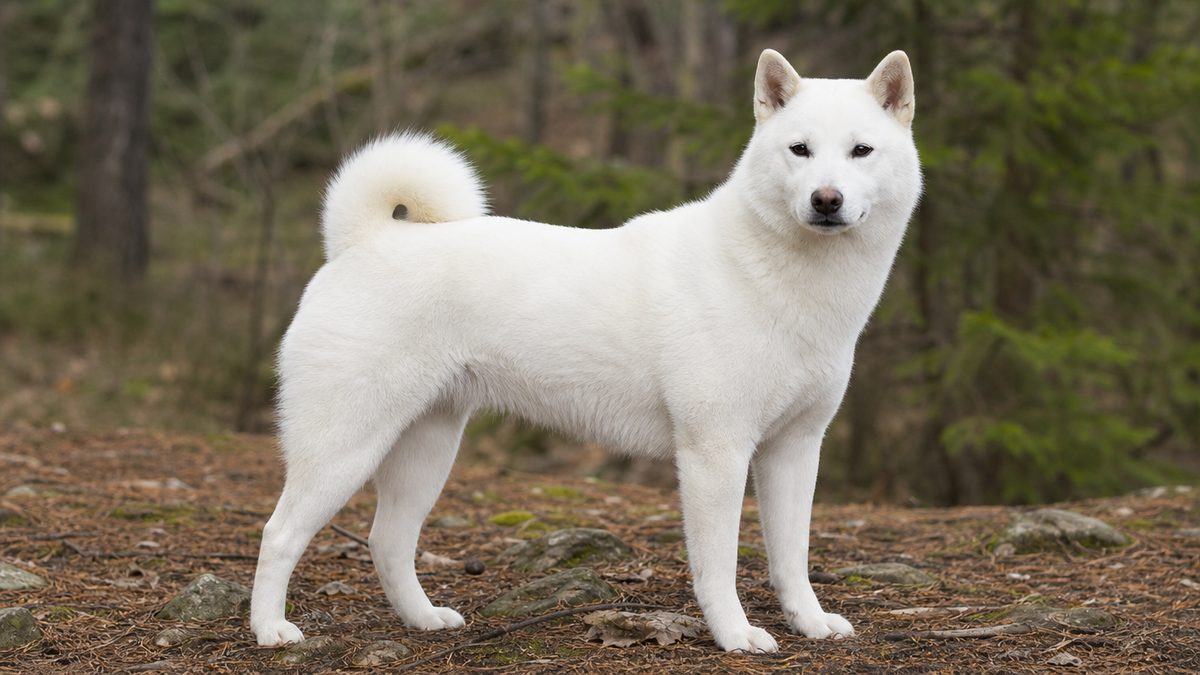
The Kishu is a medium white Japanese spitz-type hunting dog from the mountains of Wakayama and Mie, bred to hold wild boar for a single hunter, and recognised by the FCI as standard 318 since 1 February 1982.
Start with the document rather than the folklore. FCI-Standard No 318 gives the origin as Japan, the utilisation as hunting dog and companion, and the classification as Group 5 Spitz and primitive type, Section 5 Asian Spitz and related breeds, without working trial. The English text is dated 10.02.2017 and the official valid standard behind it is dated 30.10.2016.
The breed standard describes a medium dog, well balanced, with well developed muscles, pricked ears and a curled or sickle tail, strong in conformation, well boned and compact. The ratio of height at withers to length of body is 10 to 11. The head has a broad forehead and a rather abrupt stop with a slight furrow, the muzzle is fairly thick and wedge-shaped, and the eyes are nearly triangular, not too small, dark brown, with the outer corners slightly upturned. Ears are small, triangular, inclining slightly forward and firmly pricked.
Size is where the standard is most specific and most misquoted. It gives males 52 cm and females 49 cm at the withers, then adds the single sentence "There is a tolerance of + 3 cm." It gives no weight at all, anywhere in the six-page document. Any weight you see attached to this breed comes from somewhere else, and the sources that supply one do not agree with each other.
The disqualifying faults tell you what to look at
A breed standard's disqualifying list is the fastest way to check a dog, because it names the things that put an animal outside the breed rather than merely below it. For the Kishu there are five: aggressive or overly shy behaviour, any dog clearly showing physical or behavioural abnormalities, an extremely overshot or undershot mouth, ears not pricked, and a hanging tail or short tail.
Two of those matter in India specifically. A short tail achieved by docking is not merely a fault here, it is illegal: the 2017 Rules forbid tail docking outright. And an undershot jaw is named in the same Rules as a genetic defect a breeding dog must have been tested for, which is covered further down this page.
| Field | What the standard says |
|---|---|
| Origin | Japan |
| Utilisation | Hunting dog, companion |
| Classification | Group 5 Spitz and primitive type, Section 5 Asian Spitz and related breeds, without working trial |
| Height at withers | Males 52 cm, females 49 cm, "a tolerance of + 3 cm" |
| Weight | Not stated |
| Coat | Outer coat harsh and straight, undercoat soft and dense, hair on cheeks and tail fairly long |
| Colour | White, red, and sesame |
| Temperament | "Noteworthy endurance, showing nobility, dignity and naive feeling. The temperament is faithful, docile and very alert" |
| Gait | Light and resilient |
A hound in one register and a spitz in another
The Kishu is filed in two incompatible places by two bodies that both matter. The FCI puts it in Group 5, Spitz and primitive types. The American Kennel Club assigns it the Hound Group, and states plainly why: "Despite appearances, the Kishu Ken is a hound breed used to pursue and detain wild boar". English Wikipedia dates that move, recording that the breed was shifted from Working Group to Hound Group in 2023 "to recognize its function and history";. OFA's own breed list carries the consequence in its markup, filing the Kishu under "AKC Hound Group" while the sibling Kai Ken sits under "AKC Working Group";.
That is not a trivia point. A buyer reading "spitz" expects a companion that looks like a small Japanese Spitz; a buyer reading "hound" expects a dog that works away from its handler and locks onto quarry. The second reading is the useful one, and both registries are describing the same animal honestly from different angles.
The Kishu is a 52 cm white boar dog with a curled tail, a hard outer coat over a dense undercoat, no published weight in its own standard, and a working temperament the standard calls docile and very alert. If a seller describes it as a large dog, a brindle dog, or an easy first pet, they are describing something else.
Kishu, Kishu Ken, Kishu Inu: which name to use and why it changes what you find
Use Kishu when you want the registers, Kishu Ken when you want English-language breed pages, and know that the name Kishu on its own returns mandarin oranges and fermented mackerel far more often than it returns a dog.
This breed carries at least six names and they are not interchangeable as search terms. The FCI files it as KISHU, one word. The AKC and almost every English breed page use Kishu Ken. The Japanese register writes it 紀州犬 with the reading きしゅうけん, kishu-ken. English Wikipedia adds Kishu Inu, Taichi Ken and Kumano Ken. OFA holds it as KISHU KEN under breed code KK.
Bonbeno tested every one of those against PubMed rather than assuming, because a literature absence claimed on a single name form is not an absence at all. Seven query forms were run in one session with the query-translation line recorded for each.
| Query | Records | What actually came back |
|---|---|---|
| "Kishu Ken" | 0 | Phrase not indexed; collapsed to kishu AND ken |
| "Kishu Kens" (plural) | 0 | Nothing |
| "Kishu inu" | 0 | Nothing |
| "Kishu dog" / "Kishu dogs" | 4 | The only form that finds the breed |
| Kishu[Title/Abstract] | 20 | The 4 dog papers plus 16 on citrus, sushi and solar cells |
| "Kishu" all fields | 28 | Adds nanocellulose aerogels and a stroke MRI study |
| 紀州犬 | 0 | Empty translation line: the script was not processed, so this zero is not evidence |
| "Taichi Ken" | 1 | An achondroplasia trial. Author-name noise |
| "Kumano Ken" | 3 | Three surgical case reports. Author-name noise |
Controls run on the same instrument in the same session came back healthy: "Shiba Inu" AND dog returned 73 records and "Labrador Retriever" AND "hip dysplasia" returned 52. So the instrument worked and the thin result is real.
Why Kishu is a bad search term and Kishu dog is a good one
The word Kishu is a place name before it is a dog. It is the old name for Kii province, now Wakayama and Mie prefectures. It is also attached to a mandarin variety and to a regional fermented fish. Searching the bare word in a scientific database returns papers on the Mukaku Kishu seedless mandarin, on Kishu-narezushi fermentation microbiology, and on perovskite solar cells by a Japanese author of that name. That is exactly the pattern this site has documented before, where a breed name that doubles as a place or surname inflates a count with material about something else entirely.
The practical consequence for a reader: if you are searching for information on this dog, put dog in the query. If you are searching for a price, expect the same problem in a worse form, because two separate cryptocurrency tokens are also named after this breed.
Nine query forms, four records, and every one of the four was reachable only through "Kishu dog" or "Kishu dogs". Three name forms returned zero, one returned an empty translation line, and two returned pure author-name noise. An absence reported on any single form would have been wrong in one direction or the other.
Designated a natural monument on 1 May 1934, and here is the record number
Japan designated the Kishu a national natural monument on 1 May 1934 under criterion (4), domesticated animals peculiar to Japan, with no geographical area attached to the listing, and the record is 401/3108.
Every page that mentions this designation gives a bare year. The FCI standard says only that the breed "was designated as a « natural monument » in 1934";. The AKC says "In 1934, the Kishu Ken was designated a national treasure in Japan";. English Wikipedia says it "was designated a living national monument of Japan in 1934";. Three sources, three phrasings, one year, and no day, no criterion and no record number between them.
The record itself has all three. Record 401/3108 of the National Cultural Properties Database, maintained by the Agency for Cultural Affairs, gives the name as 紀州犬, the reading as きしゅうけん, the category as 天然記念物, natural monument, the designation date as 1934.05.01, expressed also in the Japanese era calendar as Showa 9.05.01, the designation criterion as (四)日本に特有な畜養動物, criterion (4), domesticated animals peculiar to Japan, and the prefecture field as 地域を定めない, meaning no area is specified.
Bonbeno verified the date rather than trusting a table, and it held exactly. The year every secondary source prints is right, and the day none of them prints is the first of May.
The dog and a wild goat were designated on the same day
Here is something no page covering this breed appears to have noticed. The record immediately before the Kishu, 401/3107, is カモシカ, the Japanese serow, and it carries the identical designation date of 1934.05.01. The two were listed on the same day under different criteria: the dog under criterion (4), domesticated animals peculiar to Japan, and the serow under criterion (1), notable animals peculiar to Japan and their habitats.
The serow was later raised to 特別天然記念物, Special Natural Monument, on 15 February 1955. The Kishu never was. So on 1 May 1934 Japan listed a hunting dog and a hoofed animal its neighbours hunted in the same batch, sorted them into the right categories, and twenty-one years later gave the wild one a higher tier of protection while the domestic one stayed where it was. The Kai Ken page reaches the same register from the other side and finds the serow three months after that breed rather than the same day as this one, which is what makes the pairing here worth stating.
The seven dog designations, now complete
Criterion (4) contains exactly seven dog designations, and Bonbeno has now read the record for the Kishu and for the extinct Koshi no Inu directly, closing two gaps in its own table.
| Breed | Record | Designated | Still extant |
|---|---|---|---|
| Akita | 401/3105 | 31 July 1931 | Yes |
| Kai | 401/3106 | 22 January 1934 | Yes |
| Kishu | 401/3108 | 1 May 1934 | Yes |
| Koshi no Inu | 401/3110 | 28 December 1934 | No, extinct |
| Shiba | 401/3112 | 16 December 1936 | Yes |
| Tosa-ken | not read here | 15 June 1937 | Yes |
| Hokkaido | 401/3116 | 21 December 1937 | Yes |
Record 401/3110 is 越の犬, Koshi no Inu, reading こしのいぬ, designated 1934.12.28 under the same criterion (4) with the same "no area specified" prefecture field. It is the seventh designation and the one that no longer has a living breed behind it, which is why lists of Japan's native dogs give six and lists of the designations give seven.
One more detail from the same enumeration, because it puts the dogs in context. Record 401/3109, between the Koshi and the Kishu in number, is トキ, the crested ibis, designated on 28 December 1934, the very same day as the Koshi no Inu, under criterion (2). So the dog designations were not a dog programme. They were dogs being processed inside a general wave of animal designations, on the same handful of dates as wild birds and wild goats.
A natural-monument listing is a cultural-property designation filed with no area specified and no export clause visible in the record. Nothing Bonbeno found suggests the designation itself bars taking a Kishu out of Japan, and nothing in it is a health guarantee or a quality mark. If a seller uses the words natural monument, national treasure or protected breed to justify a premium, to explain a delay, or to imply the dog has been genetically vetted, none of those things follow from the record.
Which register a Kishu pedigree comes from, and why the JKC number understates the breed
Four bodies matter for a Kishu pedigree and they do different jobs: the FCI sets the standard, NIPPO is the breed's main register in Japan, the Japan Kennel Club publishes the only public annual count, and the AKC records the breed without fully recognising it.
- The FCI recognises the Kishu on a definitive basis, from 1 February 1982, as standard 318 in Group 5 Section 5, with Japan as country of origin and English as the official authentic language. Definitive is the top tier and it is the same date the sibling Kai received.
- Nihon Ken Hozonkai (NIPPO) is, on English Wikipedia's account, "considered the main registry of the breed in its parent country and is responsible for the original breed standard". NIPPO publishes its annual count openly as 年間犬籍登録数, a 28-row table running from 1998 to 2025, and it recorded 132 Kishu in 2025. NIPPO also names the Kishu on its own front page as one of only three of the six native breeds it registers in numbers. That matters enormously for how the next line is read.
- The Japan Kennel Club is the FCI member for Japan and publishes an annual count of new pedigree registrations by breed. It is the only public series available, and it counts only dogs registered with the JKC.
- The American Kennel Club records the Kishu Ken in its Foundation Stock Service since 2005, approved it for AKC Companion Events from 1 July 2008, and assigns it the Hound Group designation. Foundation Stock Service is two steps below full recognition, and unlike the Kai the Kishu has not moved up to the Miscellaneous Class.
- The National Kishu Ken Club became the official AKC parent club in the United States in 2022, and the breed was moved from Working Group to Hound Group in 2023.
The single most important caveat on this page
The Japan Kennel Club figures further down this page are the backbone of the rarity argument, and they must be read for what they are. They count JKC pedigree registrations, not Kishu. If the breed's serious breeders in Japan register with NIPPO instead, as Wikipedia's account of NIPPO's primacy suggests they do, then a JKC count of zero is a statement about which register Kishu breeders use, not a statement that no Kishu were born.
Bonbeno states that plainly rather than burying it, because the alternative is a dramatic and false claim. What the JKC series does establish is narrower and still useful: the Kishu has essentially vanished from the register that Japan's FCI member keeps, and that is the register a pedigree crossing an international border most often comes from.
What about the Kennel Club of India
Bonbeno cannot answer the KCI question from the KCI, and says so rather than guessing. The Kennel Club of India publishes no breed list for any breed, so a query there returns nothing for the Kishu and nothing for a control breed either. A search that fails identically for every input is a broken instrument, not a finding, and reporting it as "the breed is not recognised in India" would be false.
The route that does work is indirect and checkable. The FCI members register lists India as a full member represented by the Kennel Club of India, Chennai, so the KCI issues pedigrees against FCI nomenclature. Because the FCI recognises the Kishu definitively as standard 318, the breed sits inside the nomenclature the KCI works from. That answers the recognition question honestly without pretending to a KCI document nobody can read.
The FCI trap that fired while researching this page
Anyone verifying this breed will be tempted to assemble the FCI URL. Do not. Bonbeno requested `fci.be/en/nomenclature/2-Spitz-and-primitive-types-5.html` while looking for the Group 5 section list and received HTTP 200 with a complete, correctly formatted page for Group 2, titled "Pinscher and Schnauzer - Molossoid and Swiss Mountain and Cattledogs", listing the Dobermann, the Rottweiler, the Bulldog and the Tibetan Mastiff and containing no spitz breeds at all. Nothing errored. The leading number decided the document and every word after it was discarded.
The correct number for this breed is 318, and it was read off the FCI's own alphabetical index under K, where KISHU sits between KING CHARLES SPANIEL and KLEINER MÜNSTERLÄNDER. The Kai is 317 and the two are adjacent, which is exactly the kind of neighbourhood in which a guessed digit serves you a real page for the wrong dog.
Ask which register the pedigree is on and get it named, not called "international". Confirm the FCI number quoted is 318 and not 317, which is the Kai. Ask for the Japanese registering body by name, NIPPO or JKC, since the two issue different documents and NIPPO is the breed's primary register. Then check the dog against the standard's disqualifying faults, because a solid white or red or sesame dog with small firmly pricked ears and a curled tail is the minimum the paperwork should be describing.
The English and French texts of one FCI standard disagree about this dog's height
FCI Standard 318 sets males at 52 cm and females at 49 cm, then states the tolerance twice and differently: the English text prints "a tolerance of + 3 cm" and the French text prints "± 3 cm", and English is the authentic language.
This is a small sentence with a real consequence, and Bonbeno found it by extracting both PDFs rather than reading one and assuming.
The English text, dated 10.02.2017, reads: "Height at withers: Males 52 cm. Females 49 cm. There is a tolerance of + 3 cm."; The French text of the same standard, dated 27.03.2018, reads: "Hauteur au garrot : Mâles 52 cm. Femelles 49 cm. La tolérance est de ± 3 cm.";
Read literally, those describe different dogs. A one-sided plus-three tolerance puts an acceptable male between 52 and 55 cm. A plus-or-minus-three tolerance puts him between 49 and 55 cm. For a bitch the gap is 49 to 52 against 46 to 52. That is three centimetres of a dog at the bottom of the range, which is precisely the end where a buyer is trying to decide whether a small puppy is undersized or simply young.
| Text | Wording | Males | Females |
|---|---|---|---|
| English (authentic) | "a tolerance of + 3 cm" | 52 to 55 | 49 to 52 |
| French (translation) | "La tolérance est de ± 3 cm" | 49 to 55 | 46 to 52 |
| AKC breed page | no sex split given | 48.3 to 55.9 (19-22 in) | 48.3 to 55.9 (19-22 in) |
| English Wikipedia infobox | no sex split given | 43 to 56 (17-22 in) | 43 to 56 (17-22 in) |
Why this is not a pypdf artefact, and how that was proved
The obvious suspicion is that a plus-or-minus glyph was mangled into a plus sign during extraction. It was not, and the test that settles it is cheap.
Bonbeno extracted a third FCI standard from the same group and the same country. FCI-Standard No 257, the Shiba, prints "Height at withers: Males 39.5 cm. Females 36.5 cm. There is a tolerance of 1,5 cm smaller or taller."; The FCI therefore writes a two-sided tolerance in words when it means one. It did not use a ± sign there at all, so the ± in the French Kishu text and the + in the English Kishu text are both genuine characters doing different work.
A fourth extraction closes the loop. FCI-Standard No 317, the Kai, prints the identical English sentence, "There is a tolerance of + 3 cm";. So both Japanese medium breeds carry the one-sided English form and at least one carries the symmetric form in French. This is a house pattern in the English texts, not a typing slip in one document.
This corrects a Bonbeno sibling page
The Kai Ken guide states that FCI 317 gives a tolerance of "plus or minus 3 cm". Bonbeno's own extraction of that standard shows the English text saying "+ 3 cm", the same one-sided form found here. The sibling page's reading matches the French convention rather than the authentic English text.
Bonbeno publishes that disagreement rather than quietly averaging it, because the honest position is that the FCI's own two texts do not agree and the reader should know which one they are being quoted. The practical advice is unchanged either way, and it is the advice a buyer can actually use: an adult male Kishu should measure at or a little above 52 cm, and a mature male well under 52 cm is small for the breed under the authentic text however generously the French version is read.
The weight problem, and the range that cannot be wrong
FCI Standard 318 gives no weight. Three other sources fill the vacuum and all three give the same very wide band. The AKC gives 30 to 60 pounds, 13.6 to 27.2 kg. Dogbreedslist gives 30 to 60 pounds, 13 to 27 kg. Wikipedia gives 30 to 60 pounds, 14 to 27 kg.
A band running from 13 kg to 27 kg covers a dog that weighs twice what another dog weighs. It cannot be falsified by any real animal, and a range that cannot be wrong is not information. Treat the useful working figure as roughly 15 to 25 kg for an adult in fit condition, understand that no standard supports even that, and judge the dog you are looking at by body condition rather than by a number nobody has measured.
Buy against the FCI breed standard, because it is the document the recognising authority publishes and the one a KCI pedigree ultimately references. Expect an adult male at 52 cm or a little over. Treat any weight quoted as a guess, because the standard contains none. And if a seller tells you a Kishu will reach 56 cm, that figure traces to a Wikipedia infobox and to no standard anywhere FCI-Standard No 318, KISHU.
132 with NIPPO, none with the JKC: the Kishu in both of Japan's registers
NIPPO registered 132 Kishu in 2025 and the Japan Kennel Club registered none, and the distance between those two numbers is what this section is about.
The JKC publishes 犬種別犬籍登録頭数, new pedigree registrations by breed, once a year, and its archive runs back to 1999. Bonbeno retrieved every year, following the archive index's own links and confirming the year printed inside each returned document before taking a figure from it. This series does not exist anywhere else.
| Year | Kishu | Kai | Hokkaido |
|---|---|---|---|
| 1999 | 30 | 79 | 6 |
| 2000 | 21 | 152 | 9 |
| 2001 | 37 | 198 | 7 |
| 2002 | 59 | 201 | 9 |
| 2003 | 25 | 272 | 2 |
| 2004 | 27 | 254 | 6 |
| 2005 | 1 | 242 | 4 |
| 2006 | 3 | 201 | 1 |
| 2007 | 8 | 152 | 2 |
| 2008 | 4 | 111 | 1 |
| 2009 | 8 | 155 | 6 |
| 2010 | 10 | 117 | 8 |
| 2011 | absent | 144 | 6 |
| 2012 | 16 | 227 | 94 |
| 2013 | 21 | 162 | 41 |
| 2014 | 25 | 140 | 38 |
| 2015 | 14 | 150 | 38 |
| 2016 | 1 | 178 | 19 |
| 2017 | 2 | 146 | 33 |
| 2018 | absent | 130 | 27 |
| 2019 | 3 | 113 | 26 |
| 2020 | 1 | 93 | 25 |
| 2021 | 9 | 91 | 35 |
| 2022 | 36 | 106 | 53 |
| 2023 | 2 | 77 | 26 |
| 2024 | 3 | 43 | 20 |
| 2025 | absent | 60 | 24 |
What absent actually means, and what it does not
Absent means zero, and the reason is that these tables have no lower cut-off. The 2025 table covers 141 breeds and 302,530 dogs, and its rank 131 is shared by eleven breeds on one registered dog each, among them the Greyhound, the Bearded Collie, the Tibetan Terrier and the Sloughi. A breed with a single puppy gets a row. The Kishu has no row, so the JKC registered none.
That is confirmed from the breed's own history rather than assumed. In 2005 the Kishu appears with 1 dog at rank 144 of 148 breeds, and in 2016 and 2020 it appears with 1 dog again. The register plainly prints a Kishu when there is one.
What absent does not mean is that the breed had no puppies. It means the JKC issued no Kishu pedigree that year. NIPPO, the register this breed's own breeders use, recorded 132 Kishu in the very same year English Wikipedia, Kishu. Bonbeno holds that distinction firmly, because collapsing it produces a dramatic claim the evidence does not carry.
2025 is the third blank year, not the first
Read naively, a zero looks like the end of something. It is not. 2011 and 2018 are also blank, and the breed came back to 16 dogs and to 3 dogs respectively in the following years. Three blank years in twenty-seven means roughly one year in nine returns nothing, which is what a population this small looks like statistically rather than a collapse in progress.
The volatility is the real story. The series runs 1 dog in 2005, 36 dogs in 2022, and 2 dogs the very next year. A single kennel registering one litter moves the national figure by a factor of ten. Anyone quoting a single year of this series as a trend is quoting noise.
Why one register cannot rank these breeds by rarity
Each Japanese native breed keeps its own preservation society, so any single registry undercounts every breed it is not the main register for. NIPPO says so itself. Its transfer-registration page lists the other Japanese bodies whose pedigrees it accepts, and it names eight of them, being the Akita Inu Hozonkai, the former Akita Dog Association, the Hokkaido Ken Hozonkai, the Kishu Ken Hozonkai and the Japan Kennel Club at full-registration level, with the Kai Ken Aigokai, the Shiba Inu Hozonkai and the Hokkaido Dog Association admitted only provisionally.
The consequence is arithmetic rather than opinion. A rarity ranking built on one registry measures the registry, not the breed. Set the two published series side by side and the ranking inverts.
| Breed | NIPPO 2025 | JKC 2025 | The breed's own single-breed society |
|---|---|---|---|
| Shiba | 13,722 | 3,598 | Shiba Inu Hozonkai |
| Shikoku | 252 | 51 | None found |
| Kishu | 132 | none | Kishu Ken Hozonkai |
| Kai | 78 | 60 | Kai Ken Aigokai |
| Hokkaido | 11 | 24 | Hokkaido Ken Hozonkai |
| Akita | 5 | 263 | Akita Inu Hozonkai |
Read the JKC column alone and the Kishu is the rarest of the six. Read NIPPO's column alone and the Kishu is third of six and twelve times commoner than the Hokkaido. Neither reading is sound. For the Hokkaido, the Kai and the Akita, neither of these two bodies is the breed's main register, and NIPPO states on its own front page that it registers mainly three of the six in numbers, the Shiba, the Kishu and the Shikoku.
The Akita settles the argument outright. NIPPO recorded 5 Akita in 2025, a figure that read alone would describe a breed at the point of disappearing. The Akita Inu Hozonkai, the breed's own society, recorded 1,587 domestic and 637 overseas litter registrations in 2024, plus 140 single-dog registrations, in its own published business report. Those 2,224 entries are litters rather than puppies, so the real distance is wider than the four-hundred-fold the two figures already show. NIPPO's Akita column describes NIPPO.
The Kai gives the same answer from a second direction. The Kai Ken Aigokai has registered the breed since April 1934, when it entered its first 32 dogs, and its pedigree serial reached 32,300 by 31 August 2000 and the late 50,300s by the end of May 2022. Roughly 18,000 pedigree numbers were issued across that window while NIPPO recorded 1,361 Kai in the same years. A serial number is not a headcount, so read that as an order of magnitude rather than a count, and note that NIPPO admits Aigokai dogs only provisionally.
So the honest finding about the Kishu is narrower than a ranking and more useful. This breed is genuinely rare and nobody can say exactly how rare. NIPPO and the JKC between them counted 132 Kishu in 2025, while the Kishu Ken Hozonkai, which Wakayama City names alongside NIPPO as a body issuing Kishu pedigrees, publishes no figure Bonbeno could retrieve.
Both published series do agree on direction, and that is the one conclusion that survives whichever instrument you pick. Across the 27 JKC years the totals are Kishu 366, Hokkaido 566, Kai 3,994, and NIPPO's 28-year table runs the Kishu from 1,450 in 1998 to 119 in 2024 and 132 in 2025. A breed at a tenth of its late-1990s registration level is declining on either register.
What this means for an Indian buyer
It closes the market question before any other argument is needed. A breed whose home country's FCI-member register issued zero pedigrees last year has no export surplus at any price. Layer on Indian import law, which states that applications for trading or breeding purposes shall be duly rejected, and the arithmetic of an Indian Kishu supply chain does not work. There is nothing to convert a rupee figure into.
The JKC prints this caveat itself and it is worth repeating: the figure counts one year of new pedigree registrations, not the number of dogs alive, and it excludes deaths and exports after registration. Dogs registered with NIPPO, or with the Kishu Ken Hozonkai, are not in this table at all. Bonbeno has no total-population figure for the Kishu and does not publish one.
A Kishu is white, red or sesame. If it is brindle, it is a Kai
FCI Standard 318 permits exactly three colours, white, red and sesame, and the second-ranked page in India lists brindle and black among the breed's colours, which are the colours of a different Japanese breed.
The standard's colour line is one sentence and it is not ambiguous: "Colour: White, red, and sesame (well mixture of black, red and white hairs in whole)." Pinto colour is listed among the faults. The French text renders the same three, "Blanc, rouge et sésame";.
Now put the ranking set beside it. Dogbreedslist.info, at position two in India, lists the Kishu's colours as Black, Black and Tan, Brindle, Red, White. That page's only cited reference is the Japan Kennel Club's Kishu breed standard. Two of its five colours are not in the FCI standard, one of them is not in any Kishu standard Bonbeno could find, and the standard's own sesame is missing.
| Colour | FCI 318 | Wikipedia | Dogbreedslist | Where it belongs |
|---|---|---|---|---|
| White | Yes | Yes, "most prevalent" | Yes | The breed's own, and dominant |
| Red | Yes | Yes | Yes | The breed's own |
| Sesame | Yes | Yes | Missing | The breed's own |
| Black and tan | No | Yes, marked "NIPPO only" | Yes | A NIPPO show colour, not an FCI one |
| Black | No | No | Yes | Appears in no Kishu standard found |
| Brindle | No | No | Yes | The Kai's defining colour, FCI 317 |
Brindle is the tell, and it points at a specific other breed
Brindle is not a stray error. FCI-Standard No 317, the Kai, gives its colour as "Black brindle, red brindle and brindle" and calls the brindled coat "a distinguishing feature in this dog". The Kai is standard 317 and the Kishu is 318, adjacent numbers, both Japanese, both Group 5 Section 5, both medium boar hunters designated in 1934. Brindle is the single characteristic that most cleanly separates them, and it has been copied from one page to the other.
An Indian buyer who reads that page and is then offered a brindle puppy as a Kishu has no way to know they are being shown a different breed, a cross, or a mislabelled dog. The Kai Ken guide covers the brindle side of this properly, and the two pages together give a reader the check: solid colour means Kishu, stripes mean Kai, and no correct Kishu is striped at any age.
The black and tan question has a real answer
Black and tan is the one extra colour that is not simply wrong. English Wikipedia lists the accepted show colours as "white, sesame, red, and black & tan (NIPPO only)". So black and tan is recognised by the breed's Japanese preservation society and not by the FCI. That is a genuine registry split of the kind this site looks for, and it is why a dog can be a correctly registered Kishu in Japan and outside the FCI colour standard at the same time.
State it that way rather than calling either body wrong. If you are buying against an FCI pedigree, the white coat, red or sesame are what the standard supports. If you are looking at a NIPPO-registered dog, black and tan is inside its own register's rules.
Why white won, and why it matters in India
The white coat is not decoration, it is working equipment. Wikipedia records that white "is the most common and preferred coat color, as it made the dogs easier to distinguish from prey so the hunter did not accidentally shoot them";. The FCI standard's history section supplies the timing: coats were once "often marked with conspicuous colours such as red, sesame or brindle", but "From 1934, however, only solid colours were accepted for this breed; conspicuously marked coats had disappeared by 1945, never to reappear";.
That 1934 is the same year as the monument designation, and Wikipedia adds that at standardisation "approximately 70% of individuals were said to be non-white";. So within about eleven years a breed that was mostly not white became a breed that is mostly white, by a decision written into its standard.
For an Indian owner the practical consequences of that decision are dust, tear staining and sun. A solid white double coat shows red Indian dust within a walk, marks around the eyes and muzzle faster than any pigmented coat, and gives a thin-coated belly and muzzle less protection against strong direct sun. None of that is a health problem. It is a grooming workload nobody warns buyers about.
Ask the seller which of white, red or sesame the puppy is. A seller who answers "brindle" is not selling a Kishu under FCI Standard 318. A seller who answers "black and tan" may be selling a NIPPO-registered dog, which is legitimate in Japan, and you should then ask to see the NIPPO paperwork rather than an FCI pedigree.
Kishu price in India: there is no Indian price, and four of the ten results are cryptocurrency
There is no verifiable Kishu price in India, because Bonbeno found no Indian breeder, listing site, marketplace or rescue offering the breed, and only one of the ten Indian first-page results is an Indian page about the dog at all.
Say the negative first and then evidence it. A search restricted to India for the target term returned, in order: an Indian breed-information page, an American breed database, a Coinbase cryptocurrency converter, an Indian marketplace listing for a novelty coffee mug, a price guide for the Akita, an Indian finance site's crypto price page, an American veterinary content site, a second crypto converter, a Japanese-run English encyclopedia, and Binance India's page for a second, different token.
Count what that leaves. Four cryptocurrency pages covering two separate tokens. One mug. One page about a different breed. Two American pages. One Japanese page. One Indian page about the dog. Not one Indian listing, not one Indian breeder, not one Indian rescue.
That absence is earned rather than assumed. The control query "labrador retriever puppy price in india", run on the same instrument in the same session, returned ten genuine Indian Labrador pages, including a marketplace publishing a city-by-city rupee table for Hyderabad, Bangalore, Delhi, Chennai, Lucknow, Mumbai, Jaipur and Pune. The search worked. What it found for the Kishu is what is there.
Two different memecoins are named after this dog
This is the finding, and it is not a joke at the reader's expense. Positions three and eight are Kishu Ken (KISHK) and positions six and ten are Kishu Inu (KISHU), two separate cryptocurrency tokens using two of the breed's real names.
Coinbase's KISHK page, read on 31 August 2026 and timestamped by the page itself as 1:06 PM that day, gives a precise figure: 1 KISHK converts to ₹0.00000005371. It also records that the token "is not tradable on Coinbase", a market capitalisation of ₹0, a 24-hour trading volume of ₹0, and a circulating supply of 0 KISHK. Its own market-stats block describes the asset in its own words as "the 1st Sh1tcoin on the Kadena Blockchain".
The page then contradicts itself inside two sentences, opening "Kishu Ken is falling this week" and continuing "The exchange rate of Kishu Ken is increasing";. So the most precise, most confidently formatted rupee number an Indian searcher gets for "how much is a Kishu" describes a coin with no supply, no volume and no coherent price direction.
| Source | Figure printed | What it actually is |
|---|---|---|
| Happy Pet (position 1) | ₹50,000 to ₹1,50,000 | An unsourced Indian estimate on a template page |
| Dogbreedslist (position 2) | $1,800 to $2,200 | A United States average, no country given |
| Coinbase (position 3) | ₹0.00000005371 | A zero-supply cryptocurrency token |
| Ubuy India (position 4) | a mug price | An 11 oz novelty coffee mug. Not a dog |
| Supertails (position 5) | ₹50,000 to ₹1,80,000+ | The Akita's Indian price, a different breed |
| Binance India (position 10) | under ₹0.000001 | A second, different cryptocurrency token |
Running the division tests on the one Indian figure
Indian breed pages routinely publish rupee prices that are a dollar figure run through one exchange rate, so the ₹50,000 to ₹1,50,000 band deserves testing rather than repeating. Divide it and here is what comes out.
| Rate | ₹50,000 becomes | ₹1,50,000 becomes | Would a seller print these? |
|---|---|---|---|
| 84.38 | $592.56 | $1,777.67 | No |
| 80.00 | $625.00 | $1,875.00 | No. $1,875 is not a price point |
| 74.00 | $675.68 | $2,027.03 | No |
| 66.67 | $750.00 | $2,250.00 | No, and the floor matches nothing |
Two of those look tidy and neither is evidence. Any rupee figure ending in three zeros divides cleanly by 80 by construction, since 1,000 divided by 80 is 12.5, so a match there proves arithmetic rather than provenance. The decisive check is whether a quotient matches a documented Kishu price, and none does: the American database on the same results page quotes $1,800 to $2,200, and no rate produces a pair anywhere near that at both ends.
So this is not a converted list. These are round rupee-native numbers, which is a different kind of unreliable and worth naming as such.
The proof that the number is a template default
Bonbeno has a cleaner test available than division, because the same site publishes a Kai Ken page and Bonbeno has read both.
Set the two side by side. Monthly food ₹2,250-₹3,000 on both. Veterinary ₹600-₹1,200 on both. Grooming ₹700-₹1,200 on both. Average monthly expenses ₹3,550-₹5,400 on both. Life expectancy 12-15 years on both. Exercise routine 60-90 minutes on both. Shedding level Moderate on both. Comparison module offering the Whippet, Basset Hound, Bulldog and American Cocker Spaniel on both.
Every recurring figure is identical to the rupee across two different breeds. The only things that differ are the purchase band, ₹50,000-₹1,00,000 for the Kai against ₹50,000-₹1,50,000 for the Kishu, and the ideal-weather range. The shared ₹50,000 floor is a house constant and the ceiling is the only breed-specific digit on the page, with nothing behind it.
The same page carries the auto-filled template heading "Prerequisites to pet a Kishu Ken" and lists the breed's health issues as parvovirus, canine distemper, rabies, heartworm, Lyme disease, parasites, bloat and kennel cough. Those are infectious diseases and general conditions that any dog on earth can get. Not one is a Kishu predisposition, and Lyme disease is not a meaningful Indian risk at all.
DGFT Trade Notice 22/2022-23 states that applications for trading or breeding purposes shall be duly rejected, and the Japan Kennel Club registered zero Kishu in 2025 and three in 2024. A supply chain cannot form between those two facts, so an Indian price has nothing to converge on. The Kishu is not expensive in India and it is not cheap in India. It is unavailable in India, which is a different fact and a more useful one.
What a dog this size actually costs to keep in India, whatever the breed
Budget ₹5,100 to ₹9,000 a month to keep a medium dog in India before boarding or illness, which works out at roughly ₹61,000 to ₹1,08,000 a year, and treat any figure below that as an underestimate rather than a bargain.
There is no Kishu price in India, but there is an Indian cost of ownership, and it is real, published and the more useful of the two numbers. A 15 to 25 kg dog eats, is vaccinated, is dewormed and is groomed at Indian rates whatever its passport says.
Supertails publishes a size-banded monthly table for 2026. For a medium breed, the band a Kishu sits in, it gives food at ₹2,500 to ₹4,000, routine vet visits at ₹800 to ₹1,500, vaccinations at ₹1,500 a year, grooming at ₹800 to ₹1,500, training over six months at ₹2,000 to ₹5,000, and treats and toys at ₹500 to ₹1,000.
| Item | Low | High | Note |
|---|---|---|---|
| Food | ₹2,500 | ₹4,000 | Dry or wet, medium band |
| Routine veterinary | ₹800 | ₹1,500 | Consultations, not treatment |
| Vaccination | ₹125 | ₹125 | ₹1,500 a year spread over 12 months |
| Grooming | ₹800 | ₹1,500 | Higher in humid coastal cities |
| Training | ₹333 | ₹833 | ₹2,000-₹5,000 over six months |
| Treats and toys | ₹500 | ₹1,000 | |
| Monthly total | ₹5,058 | ₹8,958 | Before boarding, illness or emergency |
The source disagrees with itself three times, so read the band not the headline
The same page prints three incompatible answers to the same question. In one place it says "Monthly upkeep costs ₹3,000-₹18,000 depending on breed size and grooming needs". In another it says "The average monthly maintenance cost of a dog in India varies between ₹3,000 and ₹11,000". In a third it gives an annual figure of "₹30,000 to ₹1,00,000", which is ₹2,500 to ₹8,333 a month.
Those three bands cannot all be right. ₹3,000-₹18,000 a month is ₹36,000-₹2,16,000 a year, against the same page's own ₹30,000-₹1,00,000. Bonbeno prints the disagreement rather than picking the convenient one, and works from the itemised medium-breed table instead, because that is the only figure on the page built from components a reader can check line by line.
What the ranking Indian page leaves out
Happy Pet gives average monthly expenses for the Kishu Ken as ₹3,550 to ₹5,400, split as food ₹2,250-₹3,000, veterinary ₹600-₹1,200 and grooming ₹700-₹1,200. That is a lower band than the itemised figures above, and the reason is visible in the breakdown: it contains no training line, no treats line and no vaccination line at all.
Add those three back at published rates and the two sources converge. The gap is not a disagreement about Indian prices. It is a shorter list.
The costs nobody bands, and which matter more for this breed
- Air conditioning or a cooled room. A double-coated dog from a homeland whose coldest month averages 7.70 C needs a cool space in an Indian summer, and that is an electricity bill rather than a pet bill.
- Tick and flea control year round. India does not have the winter break that breaks the parasite cycle in the breed's homeland, so this is twelve months of spend rather than a season's.
- Boarding. A reserved, high-prey-drive hunting breed is not an easy boarding guest, and the specialist end of the market prices accordingly.
- Eye examination and thyroid testing. The screens this breed's own parent club recommends are not on any standard Indian package and have to be asked for and paid for separately.
- Fencing. The single largest one-off cost for this breed, and the one most often skipped.
Plan on ₹5,100 to ₹9,000 a month for a medium dog kept properly in an Indian city, or roughly ₹61,000 to ₹1,08,000 a year, and treat the first year as higher because of the puppy vaccination course and equipment. That figure is real and checkable, unlike any purchase price you will be quoted for this breed.
Heat tolerance: the number that decides it is the coldest month, not the hottest
A Kishu is a poor fit for the Indian plains, and the measurement that shows it is not the summer maximum but the winter mean: the grid cell over Wakayama averages 7.70 C in its coldest month against Chennai's 24.09 C.
Heat tolerance is the one figure on a breed page that decides whether an Indian buyer should proceed, and no global breed site rates it. Bonbeno works it from NASA POWER queried by explicit latitude and longitude, echoing back both the coordinates and the grid elevation the service returned, because a climate figure attached to the wrong place is worse than no figure.
| Place | Coordinates | Cell elevation | Annual mean | Coldest month | Hottest month max | Humidity |
|---|---|---|---|---|---|---|
| Wakayama city | 34.230N 135.171E | 67.81 m | 17.24 C | 7.70 C | 33.06 C | 78.62% |
| Owase, Mie | 34.070N 136.191E | 227.20 m | 15.83 C | 5.51 C | 34.24 C | 81.08% |
| Chennai | 13.083N 80.271E | 48.95 m | 27.95 C | 24.09 C | 42.70 C | 72.39% |
| Mumbai | 19.076N 72.878E | 97.15 m | 26.77 C | 23.19 C | 44.91 C | 67.39% |
| Kolkata | 22.573N 88.364E | 7.35 m | 25.81 C | 17.31 C | 46.81 C | 73.93% |
| Delhi | 28.614N 77.209E | 206.37 m | 25.60 C | 13.61 C | 48.79 C | 45.56% |
| Pune | 18.520N 73.857E | 635.99 m | 23.86 C | 19.62 C | 43.20 C | 66.80% |
| Bengaluru | 12.972N 77.595E | 841.72 m | 23.74 C | 20.22 C | 40.38 C | 67.94% |
The summer gap is smaller than you would expect, and that is the trap
Wakayama's hottest month reaches a mean maximum of 33.06 C, and Owase in Mie reaches 34.24 C. Those are properly hot summers. Bengaluru's hottest month maximum is 40.38 C, only about seven degrees higher. A buyer looking only at summer heat could reasonably conclude this dog is closer to Indian conditions than a Nordic breed, and that conclusion would be half right.
The half that is wrong is winter. Wakayama's coldest month averages 7.70 C and Owase's 5.51 C. Chennai's coldest month averages 24.09 C, Mumbai's 23.19 C and Bengaluru's 20.22 C. The homeland gives this double-coated dog four months a year in which it is genuinely cold, drops its summer undercoat load, and recovers. Chennai never gives it a single one.
That is the argument this page makes and no ranking page makes: a Kishu can survive an Indian summer day; what it cannot do is have twelve of them a year with no season off. Delhi is the interesting exception in the other direction, with a 13.61 C coldest month that genuinely resembles a Japanese winter, paired with a 48.79 C hottest-month maximum that is the most extreme figure in the table.
The humidity result is the surprising one
Kishu province is not dry. The Wakayama cell returns 78.62 percent annual relative humidity and Owase 81.08 percent, higher than Chennai's 72.39, Mumbai's 67.39, Bengaluru's 67.94 and far higher than Delhi's 45.56. So a Kishu is not a dry-climate dog meeting humidity for the first time. It is a humid-climate dog meeting heat for the first time, and that distinction changes the advice: the thing to manage is temperature and coat drying, not humidity as such.
It also means the breed is genuinely hardy in wet conditions in a way a continental breed is not, which is consistent with a dog developed on the Kii peninsula, one of the wettest parts of Japan.
A NASA POWER failure fired on this breed's own homeland
Bonbeno queried four points in the Kishu's origin region and two of them came back byte-identical. Kōyasan at 34.213N 135.585E, a mountain temple town near 800 m, and Hongū at 33.840N 135.774E, a river valley near 90 m, about 45 km apart, both returned a cell elevation of 486.31 m, an annual mean of 13.27 C, a hottest-month maximum of 37.93 C and a humidity of 84.79 percent, to the decimal.
They are not identically warm. They fall inside one grid cell. And the same 486.31 m figure is simultaneously about 314 m too low for Kōyasan and about 396 m too high for Hongū, which is the cleanest possible demonstration that the number belongs to the cell rather than to either town. Bonbeno therefore publishes no figure for the mountain interior of Kishu and works from the Wakayama coastal cell, which sits 67.81 m against a city near 10 m and is usable.
The Indian cells needed no such correction. Chennai came back 43 m high, Mumbai 83 m high, Delhi 10 m low, Pune 76 m high, Bengaluru 78 m low and Kolkata 2 m low, all within the noise for plains cities.
What the heat-illness literature does and does not let us say
Two large United Kingdom studies are the best evidence available and neither includes this breed, so Bonbeno borrows only the factors that genuinely transfer. Hall and colleagues, in *Scientific Reports* in 2020 on 905,543 dogs under primary veterinary care, found bodyweight at or above the breed and sex mean carried odds of 1.42 (1.12 to 1.80) for heat-related illness, and dogs over 50 kg carried odds of 3.42 (1.54 to 7.57). The companion paper in *Animals*, on the same cohort with a different case definition, reported 1.30 (1.09 to 1.55) and 2.21 (1.02 to 4.79) for exertional illness specifically.
Both sets of numbers are right and neither corrects the other. What matters for a 15 to 25 kg dog is that it sits nowhere near the over-50 kg band, so the single largest multiplier in that literature does not apply here. The one that does apply is bodyweight relative to the breed mean, which is a plea to keep the dog lean. That is why this page rates heat tolerance 2 rather than 1.
The *Animals* paper's central point is in its title: dogs do not die just in hot cars. Of the 879 heat-related illness events that had a trigger recorded, 652, or 74.2 percent, were exertional rather than environmental or vehicular. For a boar-hunting breed with an hour-plus daily requirement in an Indian city, that is the risk. Not a parked car, but a walk at the wrong hour. Exercise before sunrise and after dark, and treat laboured panting that does not settle as an emergency.
Indian import law: what actually blocks a Kishu, and what does not
Indian law does not ban the Kishu, and it does block the only route by which a market could form: dogs are a Restricted import and DGFT states that applications for trading or breeding purposes shall be duly rejected.
Get the distinction right first, because Indian breed pages routinely blur it. No Indian instrument names the Kishu. No Indian law prohibits owning one. What Indian law does is make it impossible to lawfully import dogs in order to sell or breed them, which is a different and more consequential thing.
DGFT Trade Notice No. 22/2022-23 of 19 December 2022 classifies dogs under ITC (HS) 01061900, "Mammals: Other", with an import policy of Restricted. Policy Condition (7) permits import of dogs only for three purposes: a pet dog with a valid pet book and records in the importer's name, dogs imported by research organisations with CPCSEA recommendation, and internal security use by Defence and Police forces. Policy Condition (8) then says: "Import of commercial dogs for breeding or any other commercial activities other than the purposes mentioned above is not permitted."
Paragraph 6 of the same notice states it again in operational terms: "any applications for trading/breeding purposes, or applications made on behalf of some another person/ entity shall be duly rejected".
The pet route, which is open, and what it requires
- Seven ports only. Import of pet animals is allowed through the airports and seaports of Delhi, Mumbai, Chennai, Hyderabad, Bengaluru and Kolkata and, since October 2024, Kochi airport, and animals may be quarantined at the government quarantine station of those ports Department of Animal Husbandry….
- Transfer of residence. Up to two pets may be brought in as passenger baggage without a DGFT authorisation, but only by a person transferring residence to India after two years of continuous stay abroad.
- More than two, or a shorter stay, needs an import licence. An import authorisation from DGFT is required if the stay abroad was under two years, if the pet is not travelling as passenger baggage, or for any third animal.
- An Advance NOC. The applicant must obtain an Advance No Objection Certificate from the Regional or Quarantine Officer of the AQCS at the port, seven days before travel, relaxable to three.
- Two months' lead time. DGFT advises starting the authorisation process at least two months before travel dates.
Read together with the register, this closes the question
Take the two facts in sequence. The Japan Kennel Club issued no Kishu pedigrees at all in 2025 and three in 2024. Indian law rejects by rule any import application made in order to breed or trade. There is no surplus at the source and no lawful channel at the destination.
That is why this page carries no Indian price rather than a cautious one. A price is what a market produces, and the two ends of this one cannot connect. A returning Indian resident who has lived in Japan for over two years and already owns a Kishu can bring it home through Chennai. Nobody can lawfully import Kishu to sell.
The breed-ban circular, which does not apply and is not in force anyway
Anyone researching an unusual imported breed in India will meet the 2024 breed circular, and it is worth stating the position plainly. Circular D.O.V-11/1/2024-ANLM.DADF of 12 March 2024 listed breeds for a proposed prohibition, and its full list survives in CBIC Instruction 05/2024-Customs of 14 March 2024, which prints 24 comma-separated entries, while press reports say 23 because they fold the closing Bandog clause in, and 25 appears where Japanese Tosa and Akita is split into two. The Kishu is not on it. One entry names Japanese Tosa and Akita, so the list does reach two Japanese breeds, and neither is this one.
It is also not in force. The Karnataka High Court quashed the circular on 10 April 2024, the Delhi High Court set it aside on 16 April 2024, and the Centre told the Bombay High Court on 24 January 2025 that it is not acting on it. No Indian law in force today bans owning, breeding or selling any of those breeds, and Karnataka expressly left the door open to a properly-made Rules amendment later, so neither "banned" nor "settled all-clear" is the right summary.
The route exists and it is not exotic. Two years of continuous residence abroad, up to two pets, a valid pet book and records in your name, entry through one of the seven named ports, an Advance NOC from the AQCS seven days before travel, and a process started two months ahead Department of Animal Husbandry…. Then read this page's climate and grooming sections, because the paperwork is the easy part. The full route is set out in how to import a dog to India.
What the 2017 Rules require of anyone breeding or selling this dog in India
Anyone breeding or selling dogs in India must register with the State Animal Welfare Board, may not sell a pup under eight weeks, and must have tested breeding dogs for a named list of genetic defects that includes two of the conditions this breed is actually reported to carry.
Bonbeno extracted the Prevention of Cruelty to Animals (Dog Breeding and Marketing) Rules 2017 directly from the gazette PDF with pypdf rather than relying on a summary, because this document has repeatedly been paraphrased into rule numbers that do not exist. The extraction runs to 14 pages and 51,953 characters with a real text layer.
One structural point first, because it saves a reader from a common miscitation. The Rules stop at Rule 13. Everything numbered above that is a Second Schedule paragraph, not a Rule. Across the whole instrument the string "Rule 21" appears zero times.
The heat clause, which applies to this breed directly
Second Schedule Part IV paragraph 21(1), headed "Outdoor housing facilities", provides that the following categories of dogs shall not be kept in outdoor facilities unless specifically approved by the attending veterinary practitioner in writing: "(i) dogs that are not accustomed to the temperatures prevalent in the area or region in question; (ii) dog breeds that cannot tolerate the temperatures prevalent in the area or region in question, such as long-haired breeds in high temperature locations; and (iii) sick, infirm, aged or young animals".
A double-coated Japanese breed from a region whose coldest month averages 7.70 C, in Chennai, is squarely inside limb (i) and arguably inside limb (ii). The clause is written for breeders and boarding establishments rather than for individual owners, but the standard it sets is the one a reasonable owner should apply anyway.
The genetic-defect clause names entropion, and that matters here
Second Schedule Part III paragraph 8(10) reads, verbatim from Bonbeno's own extraction: "The dogs shall have been tested for genetic defects, including hip dysplasia, progressive retinal atrophy, night blindness, hypothyroidism, entropion, ectropion, overshot, undershot jaw (when incisors do not touch or mesh), wry mouth, two or more missing teeth, unilateral cryptorchid or full cryptorchid males".
Two of those items land directly on this breed. Entropion is named by the Kishu's own owner community as one of the two known eye problems, connected in part to the triangular eye shape the standard requires. Hypothyroidism is likewise named as a breed concern. So Indian law already requires a Kishu used for breeding here to have been tested for exactly the two conditions the breed's own literature flags, which is a rare and useful alignment.
Note also that the word is "including", so the list is illustrative rather than closed. A defect is not outside the clause merely because it is unlisted.
The rest of what the Rules require
- Register with the State Animal Welfare Board before breeding. Breeding without registration is prohibited, and a licence does not substitute for it.
- Sell no pup under eight weeks. Rule 8(1)(a) provides that "pups less than eight weeks in age are not sold";.
- Sterilise before selling an older dog. Rule 8(1)(b) provides that "dogs over six months in age are not sold without first being sterilised, unless they are being sold to another licensed breeder";.
- Never dock the tail. Second Schedule Part II paragraph 6(8) forbids tail docking, ear cropping, de-barking, de-clawing, branding, dyeing and "any change of appearance by artificial means";. The Kishu's standard already treats a short tail as a disqualifying fault, so the law and the standard agree here.
- Vaccinate on schedule. Second Schedule Part III paragraph 8(9) provides that all pups shall be vaccinated starting at seven to eight weeks and usually completed by eighteen weeks.
What the Rules do not contain
Absences are citable too, and Bonbeno counted them in its own extraction rather than assuming. Across all fourteen pages the string "patella" appears zero times, "deaf" zero times and "BAER" zero times, and "hearing" appears once, referring to an appeal hearing before the Secretary rather than to an auditory test. So there is no Indian patella-testing requirement and no hearing-testing requirement, whatever a seller may claim.
The heat clause is Second Schedule Part IV paragraph 21(1), not "Rule 21", which does not exist. The genetic-defect clause is Second Schedule Part III paragraph 8(10), not "Rule 8(10)". The eight-week minimum genuinely is a Rule, Rule 8(1)(a). Getting these right matters because a reader who looks up a citation and finds nothing stops trusting the page.
Temperament: what the standard promises, and who should not buy one
The breed standard calls the Kishu faithful, docile and very alert, with noteworthy endurance and a bearing it describes as nobility, dignity and naive feeling, and every one of those words is written about a working boar dog rather than a family pet.
Take the standard's own sentence first: "Dog of noteworthy endurance, showing nobility, dignity and naive feeling. The temperament is faithful, docile and very alert." The AKC's three-word summary is "alert, good-natured, confident";.
Docile is the word that misleads. In a breed standard it describes a dog that accepts handling and does not fight its owner, not a dog that is soft or biddable. Read it beside the disqualifying faults, which exclude a dog that is "aggressive or overly shy", and the picture is of an animal that should be steady, self-contained and neither reactive nor frightened.
What owners and the encyclopedia add
English Wikipedia's account fills in what a standard cannot say. Kishu "often gravitate towards one person in the family, but a properly socialised dog should range from aloof to outgoing". They "have a strong prey drive, and will hunt when given the opportunity". They may "become combative with other dogs who do not respect their boundaries". They are "quite headstrong and willful", "easily housebroken, intelligent, and strong willed", and they "like to keep an eye on whatever is going on, and sometimes find a high place to look out from";.
One more detail is genuinely useful in an Indian apartment building. "Like the Shiba, they are often quiet. Kishu will stalk prey quietly rather than bark."; A silent hunter makes a better neighbour than most spitz-type dogs, and Dogbreedslist rates barking tendencies at the lowest level, "Rare";.
Who should not buy this breed
- First-time dog owners. A headstrong hunting breed that bonds to one person and evaluates instructions is not a starter dog.
- Households with cats, rabbits, poultry or small dogs. The prey drive is the breed's job description, and Wikipedia's own hedge, that "a few have been known to do well with cats if raised with them", is not a plan.
- Anyone who wants a dog for a fenced-free Indian park. Off-lead reliability around street cats and community dogs is not a realistic expectation for a boar hound.
- Anyone relying on a dog to be sociable with visitors. Reserve with strangers is normal for this breed and is not a training failure.
- Anyone in a top-floor Indian flat with no cooled room. That is a climate constraint rather than a temperament one, and it disqualifies more homes than the temperament does.
Who this breed genuinely suits
An experienced single-dog household with no small pets, a securely fenced outdoor space, a person at home for much of the day, and the discipline to walk twice daily in the dark half of an Indian summer. A dog that bonds intensely to one person is a gift to somebody who wants exactly that and a disappointment to a family expecting a dog that greets everyone equally.
The honest framing is that this is a hunting dog that has moved into companionship in a single generation, not a companion breed with a hunting past. English Wikipedia records that the Kishu is "the most commonly used purebred native Japanese breed used for hunting boar to this day".
Every account of this breed, from the standard's exclusion of shyness to the owner-level material, points the same way: socialise the puppy widely and early, because a reserved breed that misses that window becomes a fearful adult rather than a merely aloof one. In India that means deliberate, calm, repeated exposure to lift lobbies, autorickshaws, festival noise and street dogs before sixteen weeks.
Training a dog bred to work one gun, one dog
Train recall, impulse control and a rock-solid lead first, because the Kishu was developed for a hunting method in which a single dog works a single hunter's boar at a distance and makes its own decisions about how.
The training profile follows from the job. Wikipedia records that "The traditional hunting method used with Kishu is called 'one gun, one dog', where a single hunter and their dog stalk boar";. That is not a pack dog taking direction and it is not a retriever waiting for a cue. It is an animal selected across centuries to read terrain, commit, and hold a dangerous animal until the hunter arrives.
Dogbreedslist rates trainability at its lowest star while describing the training itself as "Moderately Easy", an internal contradiction on that page worth noting. The more useful description is Wikipedia's: "quite headstrong and willful, making training necessary", alongside "easily housebroken, intelligent, and strong willed";. Those are consistent. This dog learns quickly and complies selectively.
The four things to train, in order
- Recall, before anything else. A boar dog that has committed to a scent is not listening, so recall must be built to the point of reflex in a fenced space long before it is tested anywhere else.
- Lead manners on a harness. This breed will lock onto a street cat, and a 20 kg dog at full commitment on a neck collar is a tracheal injury waiting to happen.
- Impulse control games. Wait at doors, wait at food, leave-it on a dropped item. These generalise into the prey-drive management that everything else depends on.
- Settle on a mat. A dog that watches everything from a high vantage point needs an off switch, and an Indian flat with a balcony gives it a hundred things to watch.
Realistic timelines for an Indian household
| By | What should be solid | What will not be |
|---|---|---|
| 8 weeks | Name response, crate as a safe place | Nothing else |
| 16 weeks | House training, lead acceptance, handling for grooming | Recall in the open |
| 6 months | Recall inside a fence, sit and settle, calm with the vet | Recall near cats or street dogs |
| 12 months | Reliable lead work, dependable settle, tolerance of building noise | Off-lead freedom in an unfenced Indian park |
| 24 months | A steady adult that can be taken most places on lead | Off-lead reliability around prey. Assume it never arrives |
What does not work
Harsh correction fails here for a specific reason rather than a general one. The standard's disqualifying faults include "aggressive or overly shy" and its ordinary faults include shyness. A reserved, one-person breed pushed with force does not become obedient, it becomes avoidant, and avoidance in a dog this self-directed is the end of the working relationship. Reward-based marker training, short sessions and a genuinely high-value food reward are what this breed is set up for.
Equally, repetition drills fail. A dog with the standard's "noteworthy endurance" and a hunter's judgment will do a thing five times correctly and then start offering variations. Keep sessions short, end them early, and vary the context rather than the count.
The two windows in which this dog can safely be worked in most Indian cities, before sunrise and after dark, are the two windows in which free-roaming community dogs are most active. So the recall you are building is being tested, from the first week, in the hardest possible conditions. Plan for a securely fenced space to do the early work in, and treat that as equipment rather than a luxury.
Exercise: a boar hound on an Indian clock
Plan on 60 to 90 minutes of real work a day, split across before sunrise and after dark for most of the Indian year, and understand that the published figure is a size-band default rather than a measured Kishu requirement.
The top Indian result gives an exercise routine of 60 to 90 minutes and an energy level of High. Dogbreedslist rates exercise needs at the maximum five stars and says the dog "needs adequate space to roam and exercise, meaning a house with a yard or urban environment with a fence";.
Treat the 60 to 90 figure carefully. The identical number appears on that site's Kai Ken page, along with identical food, veterinary, grooming and life-expectancy figures. It is a medium-breed default, not a Kishu measurement. It is nonetheless a reasonable working number for a dog the standard describes as having "noteworthy endurance" with a body built at a 10 to 11 height-to-length ratio for covering mountain ground.
The Indian timetable, worked from the actual temperature data
In Chennai the coldest month of the year averages 24.09 C and the hottest month reaches a mean maximum of 42.70 C. There is no season in which a midday walk is appropriate for a double-coated dog there. Delhi's hottest month reaches 48.79 C, and Kolkata's 46.81 C.
| City | Hottest month max | Morning window | Evening window | Midday |
|---|---|---|---|---|
| Chennai | 42.70 C | Before 06:30 | After 19:30 | Never, all year |
| Delhi | 48.79 C | Before 06:00 Apr-Sep | After 20:00 Apr-Sep | Possible Dec-Jan only |
| Kolkata | 46.81 C | Before 06:30 | After 19:30 | Possible Dec-Jan only |
| Mumbai | 44.91 C | Before 06:30 | After 19:30 | Never, humidity holds |
| Pune | 43.20 C | Before 07:00 | After 19:00 | Possible Dec-Jan |
| Bengaluru | 40.38 C | Before 07:00 | After 19:00 | Possible Nov-Feb |
What counts as exercise for this breed
Distance is not the point and neither is speed. A boar hound's work is scenting, tracking, deciding and holding, so the mental half of the requirement is as large as the physical half. Substitutes that genuinely work for a Kishu in an Indian city:
- Scent work indoors. Hiding food and letting the dog find it in a cooled room satisfies more of this breed than a longer walk does.
- Long-line tracking on grass at dawn, which lets the dog use its nose without the recall risk.
- Structured lead walks with direction changes, rather than a straight-line march.
- Barn hunt, lure coursing, rally and agility, all of which English Wikipedia names as venues Kishu do well in.
- Work for food. Feeding the daily ration out of puzzle toys rather than a bowl converts a five-minute meal into twenty minutes of thinking.
What happens without it
An under-exercised Kishu does not become destructive in the retriever sense of chewing furniture. It becomes a self-employed hunter. Fence testing, escape attempts, obsessive window watching, and increasing reactivity to street dogs and cats are the predictable outputs, and all of them are much harder to reverse than to prevent.
The largest single risk to this dog in India is a well-meaning owner catching up on a missed walk in the afternoon. Exertional heat illness accounted for 652 of the 879 UK heat-related illness events with a recorded trigger, 74.2 percent. A skipped morning walk is better than an afternoon one. Skip it and do scent work indoors instead.
Grooming a white double coat in Indian humidity
Brush the double coat weekly for most of the year and daily through the two annual sheds, dry it to the skin after every bath, and expect a solid white coat to show Indian dust faster than any other colour on this dog.
The coat the standard describes is a working one: "Outer coat harsh and straight, undercoat soft and dense. The hair on cheeks and tail fairly long."; Wikipedia adds the practical consequence: "their stiff topcoat should shed dirt very easily, even when wet and muddy", and "Kishu Kens shed once or twice a year, making grooming at these times needed". Happy Pet rates shedding as Moderate.
So the routine is simple and the exceptions are what matter.
| Task | Frequency | Why, in India specifically |
|---|---|---|
| Line-brushing to the skin | Weekly, daily during a shed | Removes the dead undercoat that traps heat and moisture |
| Bathing | Only when genuinely dirty | Over-bathing strips the harsh outer coat that sheds dirt on its own |
| Drying to the skin after a bath | Every single time | A dense undercoat will not air dry at 78 percent humidity |
| Ear check | Weekly | Monsoon is peak otitis season across Indian series |
| Nail trim | Every 3 to 4 weeks | Indoor flooring does not wear nails down |
| Eye and muzzle wipe | Most days | A white coat stains where a red or sesame one hides it |
The overseas advice that does not transfer
Breed-club and encyclopedia grooming guidance for northern-hemisphere spitz breeds routinely says to towel a dog off and let it air dry. That is correct in Japan and wrong in an Indian monsoon. The Wakayama cell returns 78.62 percent annual relative humidity and Owase 81.08 percent, so the homeland is genuinely humid, but neither of those is Mumbai in August with a dense undercoat holding water against warm skin.
The rule for India is unambiguous: dry a double coat to the skin, with a dryer or with time and towels, after every bath and after every soaking. A damp undercoat over warm skin is the setup for hot spots and for the fungal and bacterial skin disease that Indian practices see most in the monsoon. Plug the ears before bathing, because water in a pricked ear runs straight down the canal.
Never clip this coat
The temptation in an Indian summer is to shave the dog, and it is the single most common serious grooming mistake made with double-coated breeds here. The double coat is insulation in both directions: the dense undercoat holds a layer of still air that slows heat gain as well as heat loss, and the harsh outer coat blocks direct sun. Clipping it removes the sun barrier, exposes pale skin under a white coat to direct Indian sun, and frequently grows back with a different texture.
Brush the undercoat out instead. A properly de-shedded double coat is far cooler than a clipped one and it is the intervention that actually works.
What a white coat costs you in India
Nobody warns buyers about this and it is a real workload. Red Indian dust shows on a white dog within a single walk. Tear staining below the eyes and saliva staining around the muzzle are visible on white and effectively invisible on sesame or red. And pale skin beneath a thin-coated belly is more vulnerable to sun than a pigmented dog's.
None of that is a health problem and all of it is time. Budget more coat maintenance for a white Kishu than the weekly brushing schedule implies, and use the daily wipe rather than more frequent baths, because bathing is what damages the coat.
An undercoat rake, used in lines to the skin rather than skimmed over the top. A slicker brush alone moves the guard hairs and leaves the dead undercoat in place, which is the layer that actually causes heat and skin trouble in an Indian summer. Ten minutes a week with a rake beats an hour a month with anything else.
Health: the breed holds an OFA code and has no row in any OFA table
Almost nothing is published about Kishu health, and that scarcity is the finding: the breed holds OFA breed code KK but appears nowhere in OFA's statistics tables, and no peer-reviewed clinical study of the breed exists.
Bonbeno retrieved OFA's full published statistics dump on 31 August 2026, 5,887,106 characters, and searched it case-insensitively rather than reading it. KISHU appears zero times. Controls present in the same retrieval: LABRADOR 109, AKITA 89, SHIBA 55, HOKKAIDO 22, KAI KEN 20, SHIKOKU 19. The retrieval was verified against an independent pull by the row BERGAMASCO 35 105 75.2 11.4 50.5 13.3 24.8, which matched to the decimal, so the file is the right file and the search worked.
The breed is nonetheless in OFA's system. Read from OFA's own raw markup, the entry is `value="KK" data-name="KISHU KEN" data-key="Hound" data-groups="AKC Hound Group;UKC Northern Group (KISHU)"`, sitting between KING SHEPHERD and KOMONDOR.
The precise statement is therefore "no row in OFA's published statistics tables", not "absent from the OFA database". OFA requires 100 hip evaluations, or 50 for its other databases, before it publishes a breed at all, and the Kishu has not reached that threshold. There is no OFA hip, elbow, eye, patella, thyroid or cardiac percentage for this dog, and any page quoting one has taken it from somewhere else.
The literature is four papers and none of them is clinical
Nine PubMed query forms, run in one session with controls returning 73 and 52 records, found four papers that name this breed. Every one is population or biochemical genetics. There is no case report, no prevalence study, no lifespan analysis and no screening survey.
| Year | Paper | What it says about the Kishu |
|---|---|---|
| 1977 | Tanabe, Omi and Ota, *Anim Blood Groups Biochem Genet* 8(4):191-5 | The GPI-B allele "was observed in the following breeds: San'in-Shiba, Shinshu-Shiba, Shikoku, Kai and Kishu, but not in Hokkaidoes and Akitas" |
| 1978 | Yasue et al., *J Biochem* 83(4):1101-7 | "some Kai dogs, Kishu dogs, Japanese spaniels and most Shiba dogs had NGN-hematoside, whereas all European dogs had NAN-hematoside" |
| 2001 | Kim, Tanabe, Park and Ha, *J Hered* 92(5):398-403 | "All populations except the Kishu and Akita showed statistically significant deviation from Hardy-Weinberg equilibrium at more than one locus" |
| 2016 | Ishiguro et al., *Zoolog Sci* 33(1):44-9 | One dog, "Kishu 25", carried Japanese wolf-specific mtDNA features; none of 426 modern Japanese hunting dogs did |
What is reported at owner level, and how to weigh it
English Wikipedia's health section is the fullest account available and it is not a study. It reports that the Kishu "appear to be prone to allergies and autoimmune illnesses or skin conditions", naming grass and dust-mite allergy specifically, along with Addison's disease and hypothyroidism. On eyes it names persistent pupillary membranes as the most common defect and entropion as the other known issue, "likely connected in part to the triangular shape of the eye in the Kishu Ken", and notes that juvenile cataracts have been seen recently. On joints it reports, from the Finnish database, that most tested Kishu have deformity-free hips while elbows have had the least favourable evaluations.
That is owner-community and registry-derived reporting rather than peer-reviewed evidence, and it should be read as a list of things to screen for rather than as prevalence. It is still the best guidance that exists, and it is internally coherent: a triangular eye shape genuinely does predispose to entropion, and an autoimmune tendency genuinely does predispose to hypothyroidism.
The one real database, which Bonbeno could not open
The Finnish Kennel Club's KoiraNet holds health statistics for the Kishu under FCI breed number 318, and it publishes six sets for the breed: hip joint, elbow, patellar luxation, eye examination, cause of death and spondylosis. That is the only structured Kishu health dataset Bonbeno located anywhere.
Bonbeno could not retrieve the underlying tables. They are served behind a form postback and the numbers did not render, so this page publishes no KoiraNet figure. Saying so is more useful than a figure taken from a summary. If you are buying and can read Finnish, that database is where to look, and it is the source Wikipedia's joint and eye claims ultimately rest on.
Life expectancy: three published figures, no study behind any of them
The AKC gives 12 to 15 years. Happy Pet gives 12 to 15. Dogbreedslist gives 11 to 13. None cites a study. The two large UK datasets that would settle it, Teng 2022 on UK life tables and McMillan 2024 on breed longevity, do not include this breed.
So Bonbeno publishes no life expectancy for the Kishu and prints the disagreement instead. A two-year spread between the sources on a breed with no data behind either is exactly the situation where averaging would manufacture a number nobody measured.
"No published health data" is not "a healthy breed". Dogbreedslist rates health issues at one star with the words "Usually a healthy breed";, and there is no dataset behind that. A breed with zero OFA evaluations and four genetics papers has not been shown to be healthy; it has not been looked at. Screen for eyes and thyroid at minimum, which is what the breed's own AKC parent club recommends, along with dentition, DNA banking and joints.
The wolf claim, tested: one Kishu carried the markers and 426 hunting dogs did not
The AKC states that the Kishu Ken derives some of its ancestry from the extinct Honshu wolf, and the one study that tested the question found Japanese wolf markers in a single named Kishu while finding none in a separate sample of 426 modern Japanese hunting dogs.
This is the breed's best-known origin claim and it is checkable, which makes it worth doing properly. The AKC's breed page states flatly: "The Kishu Ken derives some of its ancestry from the extinct Honshu Wolf."; English Wikipedia gives the folklore behind it, a Kii peninsula legend that the first boar dog was a Honshu wolf pup gifted to a hunter who showed compassion to an injured she-wolf, sourced to John Knight's *Waiting for Wolves in Japan*, Oxford University Press 2003, and notes that "many Kishu dogs include the word 'wolf' in their names";.
Ishiguro and colleagues tested it. Their 2016 paper in *Zoological Science* examined the mitochondrial DNA control region of four ancient Canis specimens, identified each as Japanese wolf by two diagnostic substitutions, the 78-C insertion and the 482-G deletion, and sorted fourteen Japanese wolf samples into two groups on an 8-base-pair insertion or deletion.
Then comes the sentence that matters here. "Interestingly, three dogs (Akita-b, Kishu 25, and S-husky 102) that each contained Japanese wolf-specific features were also classified into Group A or B based on the 8-bp indel." And immediately after: "none of 426 Japanese modern hunting dogs examined contained these Japanese wolf-specific mtDNA sequences";.
| Group tested | Number | Carried Japanese wolf-specific mtDNA |
|---|---|---|
| Ancient Canis specimens identified as Japanese wolf | 4 plus 10 more | All, by definition |
| Named individual dogs with wolf-specific features | 3, including Kishu 25 | Yes |
| Modern Japanese hunting dogs | 426 | None |
| Ancient continental Canis, Russia and China | 113 | None |
So the honest position is precise and more interesting than either the marketing or a flat denial. Japanese wolf mitochondrial markers do turn up in individual Japanese dogs, and one of the three published examples is a Kishu. They did not turn up in a 426-dog modern hunting sample. The claim rests on individuals, not on a breed-wide inheritance, and it concerns maternal-line mitochondrial DNA rather than ancestry as a whole.
A seller telling an Indian buyer that Kishu are part wolf is overstating a real finding rather than inventing one. That distinction is worth making, because the correction is more useful than a debunk.
What the other three papers say, and why they matter to a buyer
The 2001 microsatellite study is the one with a practical implication. Kim and colleagues analysed eight microsatellite loci in 213 animals across eleven East Asian native dog populations. Expected mean heterozygosities ran from 0.310 to 0.718 with a mean of 0.580, the highest diversity was in Korean native dogs and the lowest was in the Shiba. Global F-statistics came out at F(ST) 0.154 and F(IS) 0.072.
The Kishu's result there is unusual: "All populations except the Kishu and Akita showed statistically significant deviation from Hardy-Weinberg equilibrium at more than one locus";. Two of eleven populations held equilibrium and the Kishu was one of them, which for a sample from 2001 is a better sign than the breed's tiny modern registration numbers would suggest. It is a twenty-five-year-old finding on a small sample and it should not be over-read, but it is the only population-genetic data the breed has.
The two 1970s papers place the Kishu in a Japanese cluster on blood biochemistry. The GPI-B allele was found in San'in-Shiba, Shinshu-Shiba, Shikoku, Kai and Kishu but not in Hokkaido or Akita, and NGN-hematoside was found in "some Kai dogs, Kishu dogs, Japanese spaniels and most Shiba dogs" while all European dogs carried the other form.
Both markers group the Kishu with the Kai Ken and the Shiba Inu and separate it from the Hokkaido and the Akita. That is a fifty-year-old signal from two independent blood systems, and it lines up with what the size classification and the geography already suggest.
A breed with four papers gets one of two treatments online: silence, or a wolf legend repeated as fact. Bonbeno prints what the four papers actually found, names the single Kishu individual by the label the authors gave it, and reports the 426-dog negative in the same breath, because a reader deciding whether a seller's claim is true needs both halves.
Feeding a medium working spitz in India
Feed a Kishu to body condition rather than to a chart, budget ₹2,500 to ₹4,000 a month for food at Indian medium-breed rates, and keep the dog visibly lean because bodyweight at or above the breed mean is the one heat-illness risk factor that genuinely applies to it.
The lean-dog rule is not general advice here, it is the specific finding that transfers. Hall and colleagues found that dogs at or above the breed and sex mean bodyweight carried odds of 1.42 (1.12 to 1.80) for heat-related illness. The Kishu sits nowhere near the over-50 kg band that carried 3.42, so weight relative to breed mean is the lever an owner actually has. In an Indian summer that lever is worth pulling.
The complication is that no breed mean exists. FCI Standard 318 states no weight at all, and the three sources that fill the gap all give the same unfalsifiable 13 to 27 kg band American Kennel Club, Kishu Ken breed page English Wikipedia, Kishu. So there is no number to weigh against, and body condition scoring is not a fallback here, it is the only method available.
Body condition, checked by hand
- Ribs. Easily felt under a thin layer, never visible at rest and never buried.
- Waist. A clear tuck behind the ribs seen from above.
- Abdominal tuck. An upward line from ribs to hind legs seen from the side, which the standard's "slightly tucked up" underline describes anyway.
- Weekly check by hand, not by eye. A dense double coat hides two kilograms, and a white coat hides them better than most.
Life-stage feeding
| Stage | Meals per day | What to watch |
|---|---|---|
| 8 to 16 weeks | 4 | Growth food, small frequent meals, never free-fed |
| 4 to 6 months | 3 | Slow, steady growth. Do not push size |
| 6 to 12 months | 2 | Move to adult food around 10-12 months for a medium breed |
| 1 to 7 years | 2 | Adjust for the season: appetite drops in Indian summer and that is normal |
| 7 years plus | 2 | Watch weight gain as exercise drops, and re-check thyroid if it climbs |
Indian availability and cost
Nothing about this breed needs a specialist diet. A good Indian medium-breed dry food, a rotation of fresh protein, and Indian rates apply straightforwardly: the published medium-breed food band is ₹2,500 to ₹4,000 a month. Happy Pet's Kishu page gives ₹2,250 to ₹3,000, which is the same site's figure for the Kai and every other medium dog on it.
Two Indian-specific points are worth making. Summer appetite genuinely falls in a double-coated dog and an owner should not chase it with richer food, because the weight that goes on is the weight that raises heat risk. And water is not a detail: a working spitz in an Indian summer needs multiple bowls, refilled and repositioned into shade, not one bowl by the door.
The allergy question, and why it changes what you feed
This is the one place the breed's own reported health profile touches diet. Kishu are reported at owner level to be prone to allergies and autoimmune skin conditions, with grass and dust mites named specifically rather than food. So the useful discipline is not an elimination diet on arrival. It is keeping the diet boring and stable for the first year, so that when a skin problem appears you have a clean baseline against which to test whether food is involved at all.
Feed at least one meal a day out of a puzzle toy or scattered for the dog to find. A boar hound's day is scenting and problem solving, and converting a two-minute bowl into twenty minutes of work does more for an under-exercised Kishu in an Indian flat than an extra walk in unsafe heat would.
The first year, month by month
Plan the Kishu's first year around three deadlines: socialisation before sixteen weeks, recall built inside a fence before six months, and the first eye examination booked before the first birthday.
This timeline assumes a puppy legally sold in India, which under Rule 8(1)(a) means one at least eight weeks old.
| Age | Focus | The India-specific part |
|---|---|---|
| 8 to 10 weeks | Settling, crate as a safe place, name response | Set up the cooled room now, not in April |
| 10 to 12 weeks | Vaccination course continuing, first handling for grooming | Vaccination starts at 7-8 weeks and usually completes by 18 weeks under the 2017 Rules |
| 12 to 16 weeks | The socialisation window. Lifts, traffic, autorickshaws, festival noise, calm dogs | This is the single highest-value month for a reserved breed and it closes |
| 4 to 5 months | Lead and harness work, leave-it, wait | Establish the dawn and after-dark walking habit before the hot season |
| 5 to 6 months | Recall to reflex, inside a fence only | Prey drive is switching on. Do not test it in an open park |
| 6 to 7 months | Neutering discussion with your vet | Note Rule 8(1)(b): a dog over six months cannot lawfully be sold unsterilised except to a licensed breeder |
| 7 to 9 months | First adult coat change, first real shed | The first Indian monsoon: drying to the skin becomes non-negotiable |
| 9 to 12 months | Adolescent testing, fence checking, selective deafness | Do not increase corrections. Increase management and scent work |
| 12 months | First eye examination and thyroid baseline | Neither is on a standard Indian package. Ask for both by name |
The three deadlines, and why they are deadlines
Socialisation closes. A breed whose standard disqualifies overly shy dogs and whose owners describe it as aloof to outgoing depending on socialisation has a window, and it is roughly three to sixteen weeks. Work done after it is remedial and slower.
Recall is built before the prey drive matures, not after. The behaviour you are competing with is the one this dog was selected for across centuries. Establish the recall as a reflex in a safe space while the drive is still soft, then maintain it.
The eye and thyroid checks are cheap and this breed's own club asks for them. The AKC parent club's recommended screens are eyes, thyroid, dentition, DNA banking and joints, and entropion and hypothyroidism are both named in the Indian genetic-defect clause. A baseline at twelve months is what makes a later change readable.
Two things not to do in the first year
Do not force long-distance road walking on a growing dog to burn energy. A dog built at a 10 to 11 height-to-length ratio for mountain work is not built for repetitive pavement pounding while the growth plates are open. Use scent work and short varied sessions instead.
Do not clip the puppy coat in the first Indian summer, however tempting. The adult double coat has not fully come in and clipping it at this stage is the version of the mistake with the worst long-term outcome for coat texture.
In most Indian cities the socialisation window falls partly inside the hot season, which is exactly when nobody wants to take a puppy out. Do it at dawn, do it briefly, and do it anyway. A reserved hunting breed that misses this month becomes a fearful adult, and that is a far larger problem than a slightly delayed vaccination schedule.
Kishu against the dogs an Indian buyer can actually get
Every dog in this table except the Kishu can be found in India, and the comparison exists to move a reader from a breed with no supply to one with the traits they were actually after.
Two comparisons matter here and they are different questions. The first is how the Kishu sits against its own Japanese siblings, which is a question about registers. The second is what an Indian buyer should look at instead, which is a question about availability.
| Breed | FCI no. | Designated a monument | NIPPO 2025 | JKC 2025 | Own society |
|---|---|---|---|---|---|
| Kishu | 318 | 1 May 1934 | 132 | none | Kishu Ken Hozonkai |
| Kai | 317 | 22 January 1934 | 78 | 60 | Kai Ken Aigokai |
| Hokkaido | 261 | 21 December 1937 | 11 | 24 | Hokkaido Ken Hozonkai |
| Shiba | 257 | 16 December 1936 | 13,722 | 3,598 | Shiba Inu Hozonkai |
| Akita | 255 | 31 July 1931 | 5 | 263 | Akita Inu Hozonkai |
| Japanese Spitz | 262 | not designated | not registered | 1,467 | None, a JKC breed |
| Japanese Chin | 206 | not designated | not registered | 386 | None, a JKC breed |
Read across that row and two things are stark at once. The Kishu is designated, definitively FCI-recognised, and produced no JKC-registered puppies at all last year, while the Kai beside it produced sixty and the Shiba produced 3,598. Yet NIPPO recorded 132 Kishu in that same year, more than its Kai, its Hokkaido and its Akita columns combined. The last column is the reason. Four of these breeds keep their own single-breed society, so neither of the two open registers is a census, and the two right-hand columns should be read as what each body issued rather than as how many dogs exist.
What to look at instead, and why
| If you wanted | Consider | Why it fits | Indian availability |
|---|---|---|---|
| A white Japanese spitz-type dog | Japanese Spitz | White, spitz outline, small, genuinely companionable | Real. 1,467 JKC registrations in 2025 |
| A Japanese native with the same reserve | Shiba Inu | Same independence and cleanliness, far more support and data | Real, and widely sold in Indian metros |
| A white hunting dog with a regional identity | Rajapalayam | India's own white hound, heat-adapted, and needs homes | Real, and adoption is possible |
| A hardy white spitz on an Indian budget | Indian Spitz | Acclimatised, affordable, decades of Indian keeping behind it | Real and everywhere |
The comparison the ranking page offers, and why it is nonsense
The top Indian result's own "Compare with similar breeds" module offers the Whippet, Basset Hound, Bulldog and American Cocker Spaniel. Not one is a spitz, a Japanese breed, a boar hound or a double-coated dog. Two are brachycephalic. The same four appear on that site's Kai Ken page, which is how you know the module is generated rather than chosen.
That matters more than it sounds. An Indian buyer using that comparison to decide between a Kishu and a Bulldog is being steered by software that has not looked at either dog.
Kishu against the Kai, since they are the pair most often confused
| Kishu (FCI 318) | Kai (FCI 317) | |
|---|---|---|
| Colour | White, red, sesame | Black brindle, red brindle, brindle |
| Height, males | 52 cm | 50 cm |
| Height, females | 49 cm | 45 cm |
| Weight in standard | None given | None given |
| Designated | 1 May 1934 | 22 January 1934 |
| ACA record | 401/3108 | 401/3106 |
| AKC status | Foundation Stock Service since 2005 | Miscellaneous Class since July 2022 |
| AKC group | Hound | Working |
| OFA code | KK, no statistics row | KA, eye and patella rows exist |
| JKC 2025 | none | 60 |
The Kishu is the slightly larger dog of the two, with a notably smaller gap between the sexes: 3 cm between male and female against the Kai's 5 cm FCI-Standard No 317, KAI. And the colours do not overlap at all, which is what makes the brindle error on a ranking page so easy to catch.
If the Kishu appeals because you want a quiet, clean, self-contained dog that bonds to one person, the Shiba Inu gives you the same temperament with a real Indian supply, a real health dataset and a real support community. If it appeals because you want a white working dog with history, the Rajapalayam is Indian, heat-adapted and available now.
Six mistakes Indian buyers make with this breed
The most expensive Kishu mistake in India is not overpaying, it is paying at all for a dog that is not a Kishu, and the five that follow it are all avoidable with a document check.
1. Accepting a brindle dog as a Kishu
FCI Standard 318 permits white, red and sesame and nothing else. Brindle is the defining colour of the Kai under standard 317. A brindle puppy offered as a Kishu is a different breed, a cross, or a mislabel, and the reason buyers fall for it is that the second-ranked Indian result lists brindle among the Kishu's colours. Ask the colour before anything else.
2. Treating the ₹50,000 to ₹1,50,000 band as a market rate
That band appears on exactly one Indian page, carries no source, does not divide cleanly by any exchange rate into a price a seller would print, and shares its ₹50,000 floor and every single recurring cost figure with the same site's Kai page. It is a template default. Anyone quoting it to you as the going rate is quoting a web page, not a transaction.
3. Reading a crypto price as a dog price
Four of the ten Indian results for this search are cryptocurrency pages covering two tokens named after the breed. One of them tells you a Kishu Ken costs ₹0.00000005371 and describes itself as "the 1st Sh1tcoin on the Kadena Blockchain", with zero circulating supply and zero trading volume. It sounds absurd stated plainly and it is genuinely what an Indian search returns, which is why an AI summary of this query is a dangerous thing to trust.
4. Believing the designation means the dog is vetted
The natural-monument record is a cultural-property listing with no area specified, no export clause and no health content whatsoever. It says the Japanese state considers the breed culturally significant. It says nothing about hips, eyes, thyroid or temperament, and a seller using "national treasure" to justify a premium is selling you a category error.
5. Assuming no health data means good health
The Kishu has no row in any OFA statistics table and four peer-reviewed papers, none of them clinical. A ranking page rates its health issues at one star with the words "Usually a healthy breed" and has nothing behind that. Absence of evidence is not evidence of health, and for this breed the owner-level reports that do exist name entropion, allergies, autoimmune disease and hypothyroidism.
6. Clipping the coat in the first Indian summer
The double coat insulates in both directions and blocks direct sun, and a white dog's skin underneath it is pale. Clipping removes the sun barrier, often changes the coat texture permanently, and does not make the dog cooler. Rake the dead undercoat out instead, which is the intervention that works.
The bonus mistake: expecting the exercise figure to be measured
Every Indian source giving 60 to 90 minutes for this breed gives the same figure for several other medium breeds on the same site. Use it as a starting point, then watch the dog. A boar hound's requirement is as much mental as physical, and an owner who meets the clock and not the mind gets a fence-testing escape artist anyway.
FCI-Standard No 318, six pages, free, and available in English, French, German and Spanish from the FCI's own site. Read it before you talk to any seller. It settles colour, height, ear carriage, tail carriage and the disqualifying faults, and those five together are the whole practical identity check for this breed.
Adoption, and what to do instead of waiting for a Kishu
No Kishu rescue exists in India and no Indian shelter Bonbeno could find has ever held one, so the honest adoption advice for this breed is to redirect the impulse rather than to join a waiting list.
Start with the arithmetic. The Japan Kennel Club registered zero Kishu in 2025 and three in 2024. Indian law rejects any import application made in order to trade or breed. A search whose control returned ten working Indian Labrador listings found no Indian Kishu breeder, listing, marketplace or rescue. There is no Indian population of this breed, so there is no Indian population of this breed to rescue.
That is not a disappointing answer. It is the answer that stops somebody spending money on a dog that is not what they were promised.
What the impulse usually is, and where it can go
Buyers reach for a Kishu for one of four reasons, and every one of them has a route that works in India today.
- You want a white spitz-type dog. The Indian Spitz is white, hardy, acclimatised and available everywhere, and the Japanese Spitz is the pedigree version with real Indian supply.
- You want a Japanese native with that reserve and cleanliness. The Shiba Inu is the same temperament with a real Indian market and real health data behind it.
- You want a white working hound with a regional identity. The Rajapalayam is India's own, is already heat-adapted, and needs homes now.
- You want a rare dog. Then adopt an Indian dog, because no dog is rarer to its own future than one that does not get a home.
The Indian adoption route, with real numbers
Adoption in India costs ₹0 to ₹3,000, and that fee generally covers vaccinations, deworming and microchipping rather than the dog. Named routes include SPCA branches, World for All and Animal Aid Unlimited, alongside hundreds of city-level rescues. Against a monthly cost of ownership of ₹5,100 to ₹9,000 for a medium dog, the purchase price is the smallest number in the decision either way.
How to verify any dog you are offered as a Kishu
If somebody does offer you one, verify it in this order, and stop at the first failure.
- Colour. White, red or sesame. Brindle means it is not this breed.
- Ears and tail. Small, triangular, firmly pricked ears and a thick tail carried curled or in a sickle over the back. Ears not pricked and a hanging or short tail are disqualifying faults.
- The register, named. NIPPO, JKC or an FCI member's pedigree quoting standard 318, not 317.
- The import trail. Ask which of the seven permitted ports the dog or its parents entered through, and on what basis, since no lawful commercial import route exists.
- The breeder's registration. Anyone breeding or selling dogs in India must be registered with the State Animal Welfare Board, and may not sell a pup under eight weeks.
- Health screening. Ask for eye and thyroid results by name, because the breed's own parent club recommends them and Indian law lists entropion and hypothyroidism among the defects a breeding dog must have been tested for.
A seller who cannot answer items three and four is not selling you a Kishu with a lawful history, whatever the puppy looks like.
There is no verifiable Kishu price in india because there are no Kishu in India, and the two ends of the supply chain, a home register that issued none last year and an import rule that rejects commercial applications, cannot connect. Spend the research energy on a breed you can actually meet, and spend the money on the ₹5,100 to ₹9,000 a month that keeping any medium dog here genuinely costs.
Kishu questions Indian buyers actually ask
What is the average price of a Kishu Ken dog?
No Indian price for a Kishu can be verified. The one Indian page on the first results page quotes ₹50,000 to ₹1,50,000 with no source attached, and every recurring cost figure on that page is identical to the rupee to its own Kai Ken page, which marks the numbers as a template default rather than a Kishu quotation.
How much is 1 Kishu Ken in INR?
About ₹0.00000005371, if you mean the cryptocurrency token, which is what four of the ten Indian results for this search actually describe. Coinbase records that KISHK is not tradable there, with a market capitalisation of zero, a 24-hour volume of zero and a circulating supply of zero coins.
Can I import a Kishu Ken into India?
Only as your own pet, and never to breed or sell. DGFT Trade Notice 22/2022-23 makes dogs a Restricted import and states that applications for trading or breeding purposes shall be duly rejected, permitting entry only through the airports and seaports of Delhi, Mumbai, Chennai, Hyderabad, Bangalore and Kolkata. DAHD added a seventh port, Cochin International Airport at Kochi, for pets arriving under the baggage rules in October 2024.
Is the Kishu Ken recognised by the Kennel Club of India?
Indirectly, through the FCI. The Kennel Club of India publishes no breed list anyone can query, so no direct answer exists, but India is a full FCI member and the FCI recognises the Kishu definitively as standard 318, so the breed sits inside the nomenclature a KCI pedigree references.
How rare is the Kishu dog breed?
Rare, and the exact answer depends on which Japanese register you read. The preservation society NIPPO recorded 132 Kishu in 2025 and 119 in 2024, down from 1,450 in 1998, while the Japan Kennel Club recorded none in 2025 and three in 2024. A third body, the Kishu Ken Hozonkai, also issues Kishu pedigrees and publishes no count, so treat 132 a year as a floor rather than a total.
Are Kishus good family dogs?
For an experienced household with no small pets, yes, and for a first dog, no. The standard calls the temperament faithful, docile and very alert, but this is a working boar hound with an extremely strong prey drive that tends to bond hardest with one person and stays reserved with strangers.
What colour is a Kishu Ken?
White, red or sesame, and nothing else under the FCI standard, with white by far the most common. Any listing offering a brindle Kishu is describing the Kai, a separate breed under FCI standard 317 whose only permitted colours are black brindle, red brindle and brindle.
Can a Kishu Ken handle Indian heat?
Poorly in the plains, and the coldest month is the figure that shows why. The grid cell over Wakayama averages 7.70 C in its coldest month against Chennai's 24.09 C, so the homeland gives this double-coated dog an annual recovery season that no Indian plains city provides.
What health problems does the Kishu Ken have?
Almost nothing is published, which is not the same as nothing being wrong. The breed holds OFA code KK but has no row in any OFA statistics table, and its entire peer-reviewed presence is four papers of population genetics. Owner-level reporting names entropion, allergies, autoimmune disease and hypothyroidism.
How long do Kishu Ken live?
No measured life expectancy exists for this breed. The AKC and the top Indian page both print 12 to 15 years and the second-ranked page prints 11 to 13, none citing a study, and the two large UK lifespan datasets that would settle it, Teng 2022 and McMillan 2024, do not include the breed.
What is the Kishu Ken used for?
Hunting wild boar, and it still is. FCI Standard 318 gives the utilisation as hunting dog and companion and records that the dogs are used 'now mainly wild boar, but at one time also deer', and the traditional Japanese method is one gun, one dog, a single hunter working a single dog.
Is the Kishu Ken really descended from wolves?
One documented Kishu carried Japanese wolf mitochondrial markers and 426 modern Japanese hunting dogs did not. Ishiguro and colleagues found three dogs, one of them 'Kishu 25', carrying Japanese wolf-specific features, while none of a separate 426-dog modern hunting sample did, so the claim rests on individuals rather than the breed.
What is the temperament of a Kishu Ken dog?
FCI Standard 318 gives it in one sentence: a dog of noteworthy endurance, showing nobility, dignity and naive feeling, with a temperament that is faithful, docile and very alert, and the AKC's three-word summary is alert, good-natured, confident. Docile is the word that misleads. In a breed standard it describes a dog that accepts handling and does not fight its owner, not a dog that is soft or biddable, and read beside the disqualifying faults, which exclude aggressive or overly shy dogs, the picture is of a steady, self-contained animal that is neither reactive nor frightened. Every one of those words is written about a working boar hound with an extremely strong prey drive that bonds hardest with one person and stays reserved with strangers.
Compare with similar breeds
Kishu sits in 2 Bonbeno groups. Each one compares it directly against the breeds it is genuinely an alternative to, on the same figures.