
Near-extinct landrace
Sakhalin Husky (Karafuto Ken): What Survives, and What Does Not
A Nivkh sledge landrace, famous for two dogs who survived eleven months alone in Antarctica, and held by no register anywhere on earth. Here is what eight studbooks say, which population figures survive tracing, and why the homeland is damper than Chennai.
Quick answer
The Sakhalin Husky, or Karafuto Ken, is a near-extinct Nivkh sledge landrace with NO breed standard and NO studbook anywhere, confirmed across eight registers read with controls. The best-traced count is about seven dogs on Sakhalin in late 2015, and Japan's last two purebreds were reported in April 2011. Japan's polar institute records 15 dogs left at Showa Station in 1958 and two found alive on 14 January 1959. Northern Sakhalin runs 90.5 percent humidity, damper than Chennai, so the Indian problem is heat.
Nothing on this page is veterinary advice. There is no screening data, no lifespan study and no breed-specific health literature for this animal, so this page gives no lifespan and no health figures for it, and every health figure quoted here belongs to a living breed an Indian reader can actually acquire. A figure measured in one population does not transfer to another. For any decision about a real dog in front of you, consult your nearby vet, who can examine the animal and knows local disease pressure.
Sakhalin Husky trait ratings, and what each rating rests on
What the Sakhalin Husky is, and what is left of it
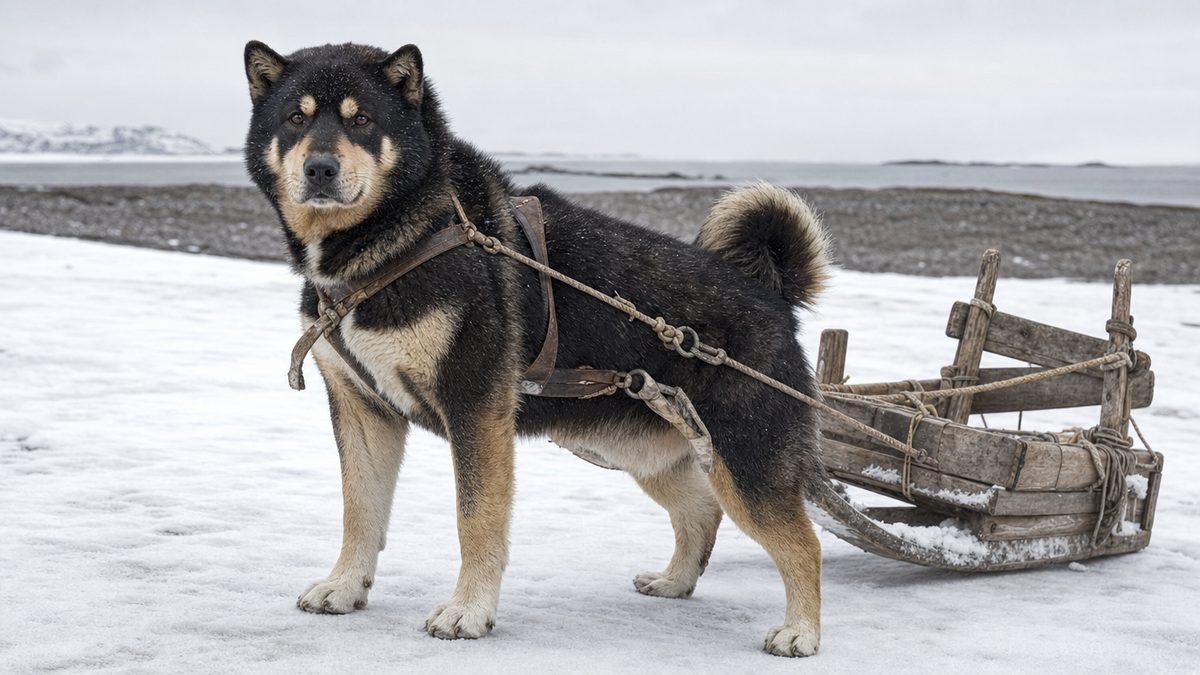
The Sakhalin Husky, or Karafuto Ken, is a near-extinct sledge and hunting landrace from Sakhalin Island and the lower Amur, bred by the Nivkh people, and it has never held a breed standard or a studbook place in any register on earth.
That last clause is the finding, and it took eight registers to establish rather than assert. The animal is real, documented, photographed and historically important. It is not a breed in the documentary sense, and the honest word for it is a landrace: an aboriginal working population shaped by use rather than by a written ideal. It is also, on every measure this page can take, a profoundly heat-sensitive animal, which is what makes the Indian question easy to answer and hard to answer honestly.
It answers to several names and they matter for searching. Karafuto Ken is the Japanese name, after Karafuto, the Japanese colonial name for southern Sakhalin. Sakhalin Laika and Gilyak Laika are the Russian forms, Gilyak being the older exonym for the Nivkh. English-language sources settled on Sakhalin Husky, which is the least accurate of the four, since the dog is not closely related to the Siberian Husky.
Why most people have heard of it
The breed is famous for one event. In 1958 a Japanese Antarctic expedition left fifteen of these dogs chained at Showa Station when a relief party could not land. Two of them, the brothers Taro and Jiro, were found alive eleven months later, and the story became a national one in Japan. The section below sets out what the National Institute of Polar Research actually records about it, because the popular version has drifted.
What this page will not tell you
It will not give you a population figure stated as fact, a lifespan, a price, or a temperament profile drawn from a breed standard, because none of those exists in a form that survives checking. Three of the four population figures in general circulation dissolve when traced, and the section on numbers shows exactly where each one goes.
A real landrace, near-extinct, never standardised and never registered anywhere. Its Antarctic story is well documented by a Japanese state research institute. Its population figures are mostly untraceable. No lawful route exists to acquire one in India, and none is likely to exist again.
Bonbeno's two-condition test, applied to a landrace nobody wrote down
To count as a breed on this site an animal needs two documents: a written breed standard and a studbook. The Sakhalin Husky has neither, in Japan or in Russia, and eight separate registers were read to establish it.
This is the strongest documented absence in this cluster, because it was checked on both sides of a contested border and in four international registers, each with a control breed that returned on the same fetch.
| Condition | Verdict | Evidence |
|---|---|---|
| A written breed standard | None found in any register | No kennel club, preservation society or state body publishes points, a height range or a weight range for this animal. Wikipedia's own claim that no standard exists is sourced to a page that returned zero bytes on two attempts, so even the negative claim is uncited in the popular account |
| A studbook, Russian side | No, and checked in the register that would hold it | The RKF's Regulation on Breeding Work runs to 78 pages and 136,704 extracted characters, and the strings for Sakhalin, Gilyak and Karafuto occur ZERO times in it. Its Appendix 5, the list of breeds the RKF recognises that the FCI does not, gives Group V as exactly six entries and this is not one of them |
| A studbook, hunting register | No | Rosokhotrybolovsoyuz, Russia's separate hunting-dog studbook, lists five laikas in its standards index and the Sakhalin is not among them |
| A studbook, Japanese side | No | NIPPO's studbook table carries six breed columns and none is the Karafuto Ken. NIPPO's own pedigree-transfer page names eleven other Japanese and foreign bodies whose pedigrees it accepts, and no Karafuto or Sakhalin body appears among them |
| International registers | Absent from all four | The FCI letter S index, fetched five times in four languages and returning the identical 42 breeds each time; the Royal Kennel Club's 227-breed A to Z; the AKC's 297-slug index, all 25 pages walked; and the UKC's 387-breed index across all nine groups, each read with controls that returned |
| Japanese natural monument | Not designated | Criterion (4) holds exactly seven dog designations and this is not one. The absence is evidenced rather than assumed: a search for Karafuto alone returns more than twenty non-dog records in the same database, so the string is indexed |
| Formal verdict | Type, specifically a landrace | It fails both documentary conditions on two continents. What existed was a working population selected on the job by Nivkh households, which is how a landrace forms and is not how a breed is made |
One source goes further, and it deserves airing
A Japanese-language feature on the surviving Sakhalin dogs puts it bluntly, in a sentence that would be startling on any breed page: Sakhalin laikas are not purebred, and in essence they are mongrels. That is one journalist's framing rather than a genetic finding, and it sits oddly beside the same era's talk of Japan's last two purebred Karafuto Ken. Both statements are in the record, they cannot both be doing the same work, and this page prints the tension rather than choosing.
The tension is instructive, because "purebred" is a word borrowed from the register system, and there is no register here to make it mean anything. For a landrace the useful question is not purity but continuity, and the population question below is where continuity is actually decided.
Why one registry is never enough for a Japanese native breed
Japan has no single national register for its native dogs, because each native breed has its own preservation society, so any one registry systematically understates the breeds it is not primary for. This is the reason a rarity claim built on one Japanese source is an artefact of that source.
Start with what NIPPO actually is. The Nihon Ken Hozonkai keeps a studbook covering six breeds in three size classes, and its 2025 row reads Shiba 13,722, Kishu 132, Shikoku 252, Hokkaido 11, Kai 78 and Akita 5. Those numbers are real and they are not the whole picture for any breed except perhaps the Shikoku.
NIPPO says so itself, by naming its own competitors. Its pedigree-transfer page lists eleven other bodies whose pedigrees it will accept, in two tiers, including the Akita Inu Hozonkai, the Hokkaido Ken Hozonkai, the Kishu Ken Hozonkai, the Japan Kennel Club, the Kai Ken Aigokai and the Shiba Inu Hozonkai. A registry's transfer page is the cheapest way to find out who else holds the dogs, and almost nobody checks it.
Now apply that to this breed. No Karafuto or Sakhalin body appears on that list of eleven, and the Karafuto Ken appears in neither NIPPO's table nor the Japan Kennel Club's 2024 statistics, whose 139 ranked rows include Shiba at 4,582, Akita at 251 and the Siberian Husky at 2,560. So the absence is not a gap in one register. It is an absence from both of the registers that exist.
The Japan Kennel Club's archive URL ending /registr-statistics/2024/ returns HTTP 200 and serves a table whose own printed title is 2025. The genuine 2024 table sits at /registr-statistics/2024-3/. Every other year slug matches its content, so nothing warns you, and a year-over-year trend built on that URL would compare 2025 against itself. Confirm the year printed INSIDE the document.
The society that does exist, and what it is not
There is a preservation society, and a municipal government vouches for it. Wakkanai City's official chronology records the Wakkanai Karafuto-ken Preservation Society receiving five purebred Karafuto Ken from Nekrasovka village in Sakhalin Oblast in 1999, and its Abe Isamu crossing the Strait of Tartary by dog sled in 2000. The same chronology dates the Antarctic memorial to 1960 and Taro and Jiro's first homecoming to 1998.
A preservation society is not a studbook, and no evidence was found that this one keeps a register. That distinction is the whole of the breed-test verdict, and it is not a criticism of the society, which appears to have done more to keep the animal alive than any registry did.
The Russian side, checked in the document that would hold it
Russia runs two national studbooks and the breed is in neither. The RKF's Regulation on Breeding Work was fetched as bytes and extracted with pypdf: 78 pages, 136,704 characters, and the strings for Sakhalin, Gilyak and Karafuto occur zero times. That document's Appendix 5 is the important one, because it is the RKF's own list of breeds it recognises that the FCI does not. Group V of that list holds exactly six entries, and reading them tells you what a nationally recognised Russian northern breed looks like: East Siberian Laika, West Siberian Laika, Olenegonny Spitz, Russo-European Laika, Chukotka Sledge Dog and Yakutian Laika.
Alphabetically, a Sakhalin laika would fall between the Russo-European Laika and the Samoyed in that document's nomenclature. Nothing is there. The second register, Rosokhotrybolovsoyuz's hunting studbook, lists five laikas in its standards index and the Sakhalin is not among them either.
The contrast with the Chukotka Sled Dog: India Price, Climate and Care is the useful one. That breed is a Russian Arctic sledge dog too, and it IS in Appendix 5. So this is not a case of Russia neglecting its northern working dogs as a class. It is a case of one population falling out of the system entirely.
What this means for the India question
India is a full FCI member represented by the Kennel Club of India in Chennai, which issues pedigrees against FCI nomenclature. Since the Sakhalin Husky holds no FCI number, no KCI pedigree for it can exist, and that is the end of the paperwork question for an Indian buyer. Note the limit of that reasoning honestly: the KCI publishes no breed list for any breed, so querying the KCI directly returns nothing for this breed and nothing for a Labrador either, which is a broken instrument rather than a finding. The FCI absence is what carries the weight.
The 1958 Antarctic expedition, from the Japanese state institute that keeps the record
In January 1958 a Japanese Antarctic expedition left fifteen Karafuto Ken chained at Showa Station, and eleven months later two brothers, Taro and Jiro, were found alive. The figures below come from the National Institute of Polar Research rather than from the films.
NIPR's own museum panel gives the chain of numbers, and it starts much further back than the famous part.
- About 1,000 Karafuto Ken existed when sled-dog use was decided on for the Antarctic programme in 1956.
- 40 to 50 dogs suitable for pulling were selected from them and trained at Wakkanai.
- 22 dogs went south with the First Expedition in November 1956.
- 11 people and 19 dogs carried out the first wintering.
- 15 dogs were left at Showa Station when the Second Expedition could not winter over.
- Only the bitch Shiroko and eight puppies returned safely to Japan.
- Taro and Jiro's survival was confirmed on 14 January 1959.
What happened to the other thirteen is recorded too, and it is not comfortable reading. NIPR's museum blog states that seven were found dead still chained and six were missing. Seven plus six plus the two survivors is fifteen, so the account closes. The same source notes that the dog food left at the base had not been touched, which is why how the two survived remains genuinely open.
Where the two dogs are now, and which institution has which
Both survivors are preserved, in two different museums, and English-language sources routinely get the second one wrong.
| Dog | Fate | Where the specimen is |
|---|---|---|
| Jiro | Died at Showa Station on 9 July 1960 | National Museum of Nature and Science, Tokyo, on permanent display in the Japan Gallery, 2F North Wing |
| Taro | Returned to Japan, died 1970 | Hokkaido University Faculty of Agriculture Museum at the Botanic Garden, specimen number 40000, kept there from May 1961 to August 1970 |
The Taro location is the one to get right. NIPR and Hokkaido University both place him at the Botanic Garden's Faculty of Agriculture Museum, which is a different institution on a different site from the Hokkaido University Museum on the main campus, and English sources commonly say only "the university's museum".
Two things the sources disagree about
The fate of the thirteen. NIPR's blog says seven died chained and six went missing. A 2011 English-language feature instead reports that eight dogs slipped their collars and only two survived. Eight-slipped and six-missing cannot both be right, and this page prints both rather than choosing.
Taro's birth year. The Hokkaido University specimen record gives 1955. The university's own science-communication outlet says he died on 11 August 1970 aged 14 years and 7 months, which implies a birth around January 1956. Both are Hokkaido University sources.
The 2006 Disney film Eight Below and the 1983 Japanese film Nankyoku Monogatari both dramatise this expedition, and a dramatisation is not a record. The documented account is the one above, held by Japan's national polar research institute, and it differs from both films in the numbers, the nationality of the dogs and the ending.
How many Sakhalin Huskies are left, and why three of the four numbers dissolve
Four population figures circulate for this breed and only one of them survives being traced to its source. The exercise below matters more than the answer, because it is the method a reader can apply to any rare-breed claim.
Take them in the order they usually appear.
| The claim | What tracing it finds | Usable? |
|---|---|---|
| 'About 20 dogs remained in 1989' | DISSOLVES. The cited source's only 1989 sits in a biographical note about the musher Dmitry Girev, and it is plainly a typo for 1889, since the same note has him moving house in 1897 and dying in 1932. The nearest 20 is Girev's FAMILY's twenty sled dogs in the 1890s. There is no 1989 count of this breed in the cited source at all | No |
| 'About 20 remain today' | OVERSTATED AS PRECISION. Its two sources say 'more than twenty sled dogs across two kennels' in October 2020, in a yard also holding malamutes, huskies, samoyeds and West Siberian laikas, and 'a few dozen' in February 2023 | Only as a range, with the caveat |
| 'Only 7 left, as of 2011' | NUMBER REAL, DATE WRONG. The 7 originates with a Sakhalin.info feature of about 31 October 2015 naming Oleg Seleverstov as guardian of the seven remaining Karafuto-ken. An English report three days later repeated it, with the 7 appearing only in the standfirst and nowhere in its body. Meanwhile the very source cited for the 2011 dating says the breeder had TWELVE dogs in 2014 | Yes, as 'about seven on the island in late 2015' |
| 'Two purebreds in Japan in 2011' | HOLDS. A named journalist, a dated publication and a named eyewitness: Hana, then 12 and in poor health, and her brother Kuma | Yes, dated to April 2011 |
The two figures that do survive, and what they say together
Metropolis Japan, 7 April 2011, quotes the Wakkanai society's Abe directly: "The Karafuto Ken is effectively extinct, and no one has even noticed";. The same piece records that Abe brought five puppies back from Sergei Lyubykh at Nekrasovka between 1998 and 2000, and that Lyubykh had told him the few he still owned were too closely related to continue breeding effectively.
That last sentence is the one that matters, and it is a genetics statement rather than a headcount. A population can be numerically non-zero and reproductively finished at the same time, and for a closed group with no studbook there is no way to manage around it, because nobody knows who is related to whom.
Two historical figures that are cleanly traceable
For scale, two older numbers survive tracing. One interviewee puts the island's population at 2,000 to 4,000 dogs by the start of the twentieth century, an assertion rather than a census. And the 2015 feature records that about 15 teams survived in the Okhinsky district in the 1970s and 1980s.
The decline in between has a documented cause, and it is not neglect. The dogs ate salmon, and salmon was an export. Sakhalin newspapers of the 1920s and 1930s ran campaign slogans about the struggle against the dog-deviation in the Gilyak economy, and a bounty was paid for a Karafuto pelt as for a wolf's. A working animal was reclassified as a competitor for a commodity, and the population did not recover.
Sakhalin Husky price in India, and why the question has no answer
No Sakhalin Husky price exists in India or anywhere else, because there is no population to sell from and no register to document a sale. Any rupee figure attached to this name is describing a different dog.
The supply question settles before the price question arises, and it settles twice over.
First, there is almost nothing to sell. The best-traced figure is about seven dogs on Sakhalin in late 2015, with the breeder reporting his own remaining animals too closely related to breed Dreux Richard, 'No Tomorrow'. Second, Indian law closes the commercial route regardless. Dogs are a Restricted import under ITC(HS) 01061900, and DGFT Trade Notice 22/2022-23 states that applications to import for trading or breeding purposes "shall be duly rejected";.
What a listing using this name is actually offering
A dog offered in India under this name is one of three things, and none of them is a Karafuto Ken.
- A Siberian Husky, which is a common, widely sold and entirely different breed. It is the substitution to expect, because the English name invites it.
- A husky-type crossbred, sold on appearance. In a market with no register, appearance is the only claim anyone can make.
- An auto-generated listing shell that exists identically for every breed name, with the same carousel of animals attached whatever you search for.
Run the arithmetic checks anyway if you are shown a figure. Divide by 84.38, then by 74, then look at the quotient rather than at whether it divided. Any rupee figure ending in three zeros divides cleanly by 80 by construction, so a match at 80 alone means nothing. And check the host country of any "Rs" figure, since the same abbreviation serves Pakistani rupees.
Bonbeno publishes no Sakhalin Husky price for India. Not a range, not an estimate, not a converted foreign figure. If a seller shows you paperwork for this breed, ask which studbook issued it and what the number is, and then check that studbook against the eight registers listed on this page, none of which holds the breed.
Monthly cost of a large double-coated northern dog in India
A large thick-coated northern dog costs roughly Rs 7,000 to Rs 15,000 a month to keep properly in an Indian metro, and since no Sakhalin Husky is available the figures below are for the Siberian Husky or Malamute a reader will actually be offered instead.
Every rate here is a published Indian price with its source named. They are a structure to price your own city against, not a quote.
| Item | Published rate | Source and caveat |
|---|---|---|
| Puppy core vaccination course | From Rs 6,499 | Vetic national page. A promotional floor from one chain; the same chain quotes Rs 7,199 on its Mumbai page the same day |
| Annual booster | From Rs 3,199 | Same chain, same caveat |
| Anti-rabies, single | Rs 699 | Against which Greater Chennai Corporation's six municipal clinics give anti-rabies vaccination free |
| Consultation | Rs 500 to Rs 1,000 | ONE data point, not two: a stray-dog charity and a general insurer publish byte-identical ranges |
| Tick and flea control, monthly | Rs 1,103 | NexGard Spectra 15-30 kg. A larger dog needs the next weight band up |
| Grooming, per session | Bath from Rs 934, full bath and styling from Rs 1,869 | Vetic Delhi. For a double coat you are paying mainly for the drying |
| Municipal registration | Rs 500 in Delhi, Rs 50 in Chennai | Delhi registers pet dogs only; Chennai licenses pet animals generally and issued 9,115 licences in 2024 |
Cooling is the line that separates a northern dog from an Indian one, and it is an electricity bill rather than a vet bill. Budget for it as equipment, not comfort, and ask any boarding facility about generator backup before booking, because an air-conditioned room without backup is not an air-conditioned room.
Sakhalin Husky heat tolerance, measured against a homeland that is damper than India
Sakhalin runs an annual mean near freezing and an annual mean relative humidity above 88 percent, which is HIGHER than any major Indian city, so the reflex claim that Indian humidity would finish this dog is wrong. The problem is heat, and the honest measure is wet bulb.
Northern Sakhalin is where the Nivkh kept these dogs, so that is where the figures were taken. Two points were usable and one was not.
The cell check, which decides which figures may be published
NASA POWER returns a grid cell, not a point, and in broken terrain the cell's mean elevation can miss the town underneath it badly. Every point below was checked against the real elevation. Okha in northern Sakhalin returned a cell at 8.73 m against a real elevation near 30 m, an error of about 21 m, and Nogliki returned 35.13 m against about 20 m. Both are usable. Yuzhno-Sakhalinsk returned 191.66 m against about 30 m, an error of about +162 m, because the cell picks up the hills behind the city, so it is not quoted here as a town figure.
That matters more than it sounds, because Yuzhno-Sakhalinsk is the city most people would query. Using it would have made the island look about a degree warmer than the north actually is, in the exact direction that flatters the argument.
| Place | Cell elevation vs real | Annual mean | Warmest month | Coolest month | Annual mean RH |
|---|---|---|---|---|---|
| Okha, northern Sakhalin | 8.73 m vs ~30 m (-21) | -0.37 C | 14.47 C (Aug) | -15.73 C (Feb) | 90.5% |
| Nogliki, Sakhalin | 35.13 m vs ~20 m (+15) | -0.65 C | 14.90 C (Aug) | -16.88 C (Jan) | 91.2% |
| Chennai | 48.95 m vs 6 m (+43) | 27.94 C | 31.51 C (May) | 24.09 C (Jan) | 72.4% |
| Mumbai | 97.15 m vs 14 m (+83) | 26.77 C | 31.19 C (May) | 23.19 C (Jan) | 67.3% |
| Delhi | 206.37 m vs 216 m (-10) | 25.57 C | 35.88 C (Jun) | 13.61 C (Jan) | 45.5% |
| Kolkata | 7.35 m vs 9 m (-2) | 25.80 C | 31.53 C (May) | 17.31 C (Jan) | 73.8% |
| Bengaluru | 841.72 m vs 920 m (-78) | 23.74 C | 28.37 C (Apr) | 20.22 C (Dec) | 67.8% |
| Pune | 635.99 m vs 560 m (+76) | 23.86 C | 28.93 C (Apr) | 19.62 C (Dec) | 66.7% |
| Hyderabad | 494.59 m vs 505 m (-10) | 26.09 C | 33.30 C (May) | 20.76 C (Dec) | 60.2% |
| Ahmedabad | 46.53 m vs 53 m (-7) | 27.56 C | 35.06 C (May) | 19.93 C (Jan) | 48.2% |
The humidity claim, and why it is backwards
Okha runs 90.5 percent annual mean relative humidity and Nogliki 91.2 percent. Chennai runs 72.4 and Delhi 45.5. Sakhalin is a cold, foggy, maritime island, and it is materially damper than any Indian city in this table. A page claiming that Indian humidity would be the shock for this dog has not looked at the homeland.
The real load is heat, and heat combined with humidity, which is what wet-bulb temperature expresses. Okha's peak wet bulb is 13.27 C in August. Chennai's is 26.11 C in May. That gap of nearly thirteen degrees is the measure of what an Indian summer asks of an animal built for this island.
Note also the warmest-month column, because the obvious guess is wrong twice. Delhi peaks in June, not May, at 35.88 C, and Bengaluru peaks in April at 28.37 C and is coolest in December. Chennai, Mumbai and Kolkata do peak in May. A table printing May for every Indian city has not been checked.
Nothing about this island prepares a dog for the Indian plains. The gap in annual mean between Okha and Chennai is 28.3 degrees, which is the largest homeland-to-India gap on this site after the Yakutian Laika's. Second Schedule Part IV paragraph 21(1) of the Dog Breeding and Marketing Rules 2017 separately restricts outdoor housing, without a vet's written approval, for dogs not accustomed to local temperatures and for long-haired breeds in high temperature locations.
One limit worth stating on heat risk. The largest study of canine heat-related illness modelled breed types with at least five heat-related illness cases and/or at least 5,000 dogs in a UK population. This breed is nowhere near that threshold and is not in the model, so no breed-specific odds ratio exists and this page invents none. What transfers is the paper's finding that bodyweight at or above the breed and sex mean carried an odds ratio of 1.42, with a confidence interval of 1.12 to 1.80.
Sakhalin Husky temperament, and why no reliable profile exists
No breed standard describes this animal's temperament, so every confident temperament profile you will read for it is either extrapolated from the Siberian Husky or invented. What the historical record does support is a working description rather than a personality one.
Here is the whole of what the sources actually support. These dogs were kept by Nivkh households for sledge haulage in winter, hauling boats along the shore in summer, hunting bear and working in the marine hunt, and the number of dogs a family kept was a measure of its wealth.
That tells you about selection pressure and nothing about how the animal behaves in a living room. A dog selected for endurance in a team, for holding large game and for tolerating other dogs in harness is a dog with a specific set of drives, and those drives are the honest basis for any guess. A guess is what it would be.
What the Antarctic record does show
One behavioural fact is documented rather than inferred, and it is remarkable. When the survivors were found, the dog food left at Showa Station had not been touched. Whatever Taro and Jiro lived on for eleven months, it was not the supplies. That is a statement about the animals' resourcefulness that no temperament chart could give you, and it is properly sourced.
Pages describing the Sakhalin Husky as calm, loyal and good with children are describing a dog they have not met, from a standard that does not exist. Where a page gives this breed a numbered temperament score, it has run a template. The absence of a profile is the accurate finding.
How these dogs were trained, and what transfers to a husky you can actually get
To train any northern sledge type, work with independence rather than against it, build recall on a long line from the start, and expect the dog to make decisions at a distance, because that is what the work selected for.
Since no Sakhalin Husky is available, the practical value here is what transfers to the Siberian Husky or Malamute an Indian buyer will actually be offered.
- Start recall early and keep it on a long line. A sledge type in an unfenced Indian park is a dog you are relying on luck with.
- Train in the cool hours. A thermally uncomfortable dog does not learn well, so the practical Indian window is early morning and late evening.
- Reward with movement as well as food. A dog bred to pull finds forward motion reinforcing, so a release to move is itself a reward.
- Socialise deliberately with traffic and crowds. An Indian street is a harder environment than a Sakhalin one, and habituation has to be built rather than assumed.
- Expect vocalisation and shape it. Northern breeds talk. A rule about when it stops is achievable; a rule that it never starts is not.
Do not import a training claim from a page about this breed specifically, because there is no body of training knowledge attached to a name nobody has worked with in decades. What exists is general northern-breed handling, and it should be labelled as that.
Daily exercise requirement for a northern sledge type in India
A healthy adult northern sledge dog needs one to two hours of real activity a day, split across the coolest hours, and in India the exercise requirement and the heat constraint pull directly against each other.
The historical working standard for these dogs was extreme by pet standards. One account of the type records a capacity to haul more than 70 kilograms, above what an average Malamute is credited with. Whatever the exact figure, it describes an animal with real endurance and a real need to use it.
- Morning, 45 to 75 minutes of brisk walking or trotting in the coolest part of the day.
- Evening, 30 to 45 minutes once the ground has cooled, with training or scent work folded in.
- Indoors, daily, food puzzles and scent games, which do the mental work without the thermal load.
- Never at midday, and never in a parked car, at any time of year, anywhere in India.
Check the ground, not just the air. Put the back of your hand on the road for five seconds before walking a dog on it, because tarmac holds heat long after sunset and a thick-coated dog carries its chest close to that surface.
Grooming a working double coat in Indian humidity
Brush a northern double coat two to three times a week and daily through a moult, dry it completely to the skin after every bath, and never shave it, because the undercoat insulates against heat as well as cold.
The coat that let these dogs survive a Sakhalin winter is the coat that makes them unsuitable for Chennai, and the maintenance problem in India is not the cold-weather one.
The shaving question
Do not shave a double-coated northern dog to cool it down. The coat works by holding a layer of still air against the skin and that layer insulates in both directions. Shaving exposes skin that has never seen direct sun to Indian sun, raises the risk of sunburn and of heat gain at the skin surface, and can produce patchy or altered regrowth. Raking the dead undercoat out is what actually helps, because trapped shed hair is what blocks air movement.
The bathing instruction that has to change for India
Overseas guidance for northern breeds routinely says to towel the dog and let it air dry. That is written for a dry cold climate and it does not transfer to an Indian monsoon. A dense undercoat left damp against the skin in high humidity is a substrate for hot spots and ear disease. Indian veterinary series report a real seasonal signal in canine otitis while disagreeing about which season peaks, one finding most cases in July and August and another from Durg finding a summer peak of 41.18 percent against 33.33 percent in the monsoon. Both are in the record; act on what they agree about, which is that a wet ear in a humid month is a problem.
- Brush two to three times weekly with an undercoat rake, daily during a moult.
- Dry the dog completely with forced air or repeated towels, down to the skin, never by leaving it.
- Plug the ears before bathing and dry them afterwards.
- Check the skin weekly under the ruff and behind the elbows, where matting and hot spots start.
- Budget for professional drying if you cannot do it at home, from about Rs 934 a bath in Delhi.
Sakhalin Husky health, and an absence established rather than assumed
The Sakhalin Husky's documented health issues are, precisely, none: no screening data, no life expectancy study and no breed-specific literature exists, and each of those absences was tested with a control that succeeded in the same session. What exists instead is two Soviet-era papers about dogs on Sakhalin that do not name the breed.
An absence is a strong claim, so here is how each one was earned. Note first what this means practically: a buyer cannot look up this animal's health issues or its life expectancy anywhere, because nobody has measured either.
Screening data: none, and the instrument was proved first
OFA's statistics dump was retrieved in full, 2,224,586 characters, and its in-document controls all returned their expected occurrence counts before any conclusion was drawn: LABRADOR 109, BULLDOG 170, BEAGLE 61. In that proven-working document, SAKHALIN and KARAFUTO each occur zero times, while JAPANESE AKITAINU and KAI KEN are both present. So the dump does hold Japanese native breeds and simply does not hold this one.
OFA's own threshold explains why an absence there is unsurprising rather than damning: "For hips, each breed must have at least 100 evaluations in the database. For all other databases, there must be at least 50";. With a world population in single or low double figures, no such threshold could ever be met. The correct phrasing is that the breed has no row in OFA's published statistics tables, not that it is absent from the OFA database.
Literature: two papers about Sakhalin dogs, neither naming the breed
PubMed returned zero for every name form of the breed, each with its own quotedphrasesnotfound warning, against a control of 126 for Labrador retriever hip dysplasia in the same session. Every exact-phrase zero was retried unquoted, which is what surfaced the two papers that do exist.
- Fujise and colleagues, 1997, found that high-potassium red blood cells were not present in dogs from Taiwan, Indonesia, Mongolia and Sakhalin, Russia. It samples a Sakhalin dog population and does not name the breed.
- Bezdenezhnykh and Shafershtein, 1955, reported carriage of *Leptospira canicola* in dogs on Sakhalin. It has no DOI and no PMC record, and it is one of only two records PubMed holds for Sakhalin and dogs in title or abstract.
The homonym that would have wrecked this search
Searching the Japanese name unquoted returns five records and not one is about a dog. Three are soybean genetics papers on a cultivar called Karafuto-1, one is a history of colonial agriculture and one is a study of Ainu health. A count of five looks like a small literature and is in fact a plant, a colony and a public-health study. Open the records before treating a number as coverage.
And the native-script searches measured nothing at all. Queries in Japanese and in Russian returned zero with a BLANK translation line, which means PubMed emptied the query before running it. So the Japanese and Russian language literature on this animal was not searched and found empty; it was not searchable with this instrument, and those are different claims.
The Arctic dog genomics programme has not sampled it
The major ancient-DNA work on Arctic sled dogs sequenced ten modern Greenland sled dogs, an approximately 9,500-year-old Siberian dog and an approximately 33,000-year-old Siberian wolf. Its full text was searched: Sakhalin, Karafuto, Nivkh, Gilyak, Amur and Japan each occur zero times. So the programme that could settle this animal's relationships has not touched it, and any statement about its genetic position is currently unevidenced.
There is no lifespan figure for this breed and this page prints none. There is no screening data. Borrowing a Siberian Husky's figures would be the single easiest way to make this page confidently wrong, and it is exactly what the ranking pages do. For any decision about a real dog in front of you, consult your nearby vet.
One India-specific risk is worth stating for any imported northern dog, since it is a problem no Sakhalin dog ever met. Indian tick-borne disease surveys report high burdens among dogs presented at veterinary clinics: a West Bengal survey of 584 dogs screened found *Babesia gibsoni* in 76.54 percent and reported that 72.9 percent of the 584 dogs screened carried two or more pathogens. Say the denominator out loud when quoting figures like these, because "of the 584 screened" and "of infected dogs" are different claims.
Feeding a working northern dog, and the salmon problem that killed this one
Feed a large northern dog a complete diet split across two meals and adjust by body condition, and know that this particular breed's decline was a feeding argument rather than a welfare one.
There is no breed-specific feeding research for the Sakhalin Husky, so the guidance below is life-stage guidance for a large active dog, labelled as that rather than dressed as breed science.
- Puppy, to 4 months, three to four meals a day on a complete large-breed growth diet, kept lean rather than round.
- Puppy, 4 to 12 months, two to three meals a day with growth rate controlled deliberately, since rapid growth can worsen the expression of joint disease in a predisposed dog.
- Adult, two meals a day, portioned to a condition where ribs are easy to feel without pressing.
- Senior, two meals a day with the ration reduced as activity falls.
Keeping the dog lean is a heat intervention in India, not a cosmetic one. Dogs at or above the mean bodyweight for their breed and sex carried 1.42 times the odds of heat-related illness, with a confidence interval of 1.12 to 1.80.
The historical footnote that is actually the whole story
This breed's food was the reason it nearly vanished. The dogs were fed on salmon, and salmon was an export commodity, so Soviet-era policy reframed a working animal as a competitor for fish. A bounty was paid for a Karafuto pelt as for a wolf's. It is the clearest case on this site of a dog population destroyed by an economic reclassification rather than by disease, war or fashion.
Month by month through the first year, for the northern puppy you will actually have
No Sakhalin Husky puppy is available anywhere, so this timeline is for the northern-breed puppy an Indian buyer will actually bring home, and its organising fact is that the first hot season arrives before the dog is grown.
- Months 0 to 2. The puppy stays with its dam. Indian law is explicit that pups less than eight weeks of age are not to be sold, under Rule 8(1)(a) of the Dog Breeding and Marketing Rules 2017. A seller offering a younger puppy is offering to break that rule in front of you.
- Month 2 to 4. Core vaccination course, from about Rs 6,499 nationally at one chain. Begin habituation to traffic and handling, and start the undercoat rake now while the coat is easy.
- Month 4 to 6. Monthly parasite control begins, about Rs 1,103 for a 15 to 30 kg dog. Municipal registration where required, Rs 500 in Delhi or Rs 50 in Chennai. Recall on a long line.
- Month 6 to 9. The first real hot season. Move all exercise to the cool hours and treat cooling as equipment.
- Month 9 to 12. Adult coat and first significant moult. Make the weekly skin and tick check routine.
Sakhalin Husky against the northern breeds you can actually get
The only useful comparison for a breed with no living market is against the breeds a buyer will be offered instead, and the honest summary is that they differ in availability and documentation while sharing the same Indian problem.
| Breed | Registry position | Screening data | Availability in India |
|---|---|---|---|
| Sakhalin Husky | None. Absent from eight registers checked with controls | None. Zero rows in OFA | None, and no lawful commercial route |
| Siberian Husky Price in India 2026 and Heat Reality | FCI definitive, long established | Present in OFA with a large denominator | Widely and often irresponsibly sold |
| Alaskan Malamute Price in India 2026 and Heat Reality | FCI definitive | Present in OFA | Sold in India, less common |
| Chukotka Sled Dog: India Price, Climate and Care | In the RKF's Appendix 5, unlike this breed | Check the current table before quoting | Effectively none |
| Greenland Dog (Qimmeq): India Breed Guide 2026 | FCI definitive | Check the current table before quoting | Effectively none |
| Hokkaido Dog Price in India 2026: No Market, No Route | Japanese natural monument, 21 December 1937 | Limited | Effectively none |
If it is the Japanese natives that interest you, note the contrast this page rests on: the Kai Ken Price in India: No Market, and Why, the Kishu Price in India: No Market, and No Dogs and the Shikoku Dog Price in India 2026: No Market, Two Registers are all in NIPPO's studbook and all carry natural-monument designations. The Karafuto Ken has neither, which is why it is the one that nearly disappeared.
And if what you actually want is a dog suited to where you live, the Indie Dog: Indian Pariah Dog Breed and Care Guide 2026 guide is the honest counter-offer to every page on this site about an Arctic breed.
Mistakes people make about this breed
The five mistakes below are the ones that make an otherwise careful page about this animal wrong, and four of them are made by sources a reader would reasonably trust.
- Repeating the 1989 population figure. It dissolves entirely on tracing: the source's only 1989 is a typo for 1889 inside a musher's biography, and the adjacent twenty is his family's dogs in the 1890s.
- Dating the seven-dog figure to 2011. The seven is real and belongs to late 2015. The source usually cited for the 2011 dating actually reports twelve dogs in 2014.
- Borrowing Siberian Husky health and lifespan figures. They are different animals with different histories, and there is no screening data or lifespan study for this one at all.
- Treating the films as the record. The documented account is held by Japan's national polar research institute and differs from both films on the numbers and the ending.
- Building a rarity claim on one registry. Each Japanese native breed has its own preservation society, so any single register understates the breeds it is not primary for. Check the registry's own transfer page, which is where a registry names its competitors.
Every population figure on a rare-breed page should be followed to its origin before it is repeated. Three of the four circulating here fail that test, and all three appear on pages that look careful. A figure with a source is not a figure with a source that says it.
Adoption, and the only realistic route to a northern dog in India
You cannot adopt a Sakhalin Husky, because there is no population anywhere to surrender from. What Indian shelters do hold, in numbers, is the Siberian Husky and Husky crosses given up in their first two summers.
That is the honest adoption section for a breed with no living presence, and it points at a real problem rather than an imaginary one.
Indian shelters and breed-rescue groups in the metros take in northern-breed dogs surrendered for consistent reasons: the coat, the exercise requirement, and an owner who bought a photograph. A dog surrendered for those reasons is not a defective dog. It was placed in the wrong house, and it arrives with its temperament already known to the people fostering it.
- Ask what the dog's summer has looked like, since a northern dog that has already come through an Indian May in your city is a known quantity.
- Verify vaccination and parasite history in writing, and re-test rather than assume if records are thin.
- Budget for the same cooling and grooming costs described above, because adoption changes the acquisition cost and not the running cost.
- Consider an Indie instead, and read the Indie Dog: Indian Pariah Dog Breed and Care Guide 2026 guide first, because a dog already adapted to your climate solves the hardest problem on this page for free.
Bonbeno does not broker sales, recommend breeders or link puppy listings. For this breed there is nothing to link to, and a seller who offers one is offering a different dog.
Indian law and an animal nobody can legally import
No Indian law names the Sakhalin Husky, and two Indian instruments still close the question: the import rules make a commercial route impossible, and the Dog Breeding and Marketing Rules 2017 govern anyone breeding any dog in India.
Import first. Dogs sit under ITC(HS) 01061900 as a Restricted import, with entry permitted for a pet accompanied by a valid pet book in the importer's name, for research with a CPCSEA recommendation, or for Defence and Police use, and with applications for trading or breeding purposes to be "duly rejected";. A separate personal-pet route runs under the Livestock Importation Act, 1898, and the two must not be conflated.
For a breed with perhaps single figures of animals alive on one Russian island, that closes it completely. No lawful supply chain can form, and any Indian listing under this name is selling something else.
The Rules that would apply to any northern dog you do acquire
- Sale below eight weeks is prohibited, at Rule 8(1)(a). A genuine Rule, not a Schedule paragraph.
- In-breeding and incest breeding are prohibited, at Second Schedule Part II paragraph 6(3), which defines in-breeding as breeding between relatives of the second to fourth grade within the first four generations.
- Tail docking, ear cropping, de-barking, de-clawing and any change of appearance by artificial means are strictly forbidden, at Second Schedule Part II paragraph 6(8).
- Breeding to create new breeds or unusual looks is strictly prohibited, at Second Schedule Part II paragraph 6(9). That clause is worth reading by anyone contemplating a revival programme built on crosses.
- Outdoor housing is restricted, at Second Schedule Part IV paragraph 21(1), which bars keeping outdoors, without the attending veterinary practitioner's written approval, dogs not accustomed to local temperatures and breeds that cannot tolerate them, naming long-haired breeds in high temperature locations.
Two citation habits worth copying. The Rules run 1 to 13 and there is no Rule 14, so a citation reading "Rule 21" is wrong on its face, paragraph 21 being a Second Schedule Part IV paragraph. And the gazette numbers clauses twice, with a Rule 8 on conditions for sale and a separate Second Schedule paragraph 8 on veterinary care, so always say which you mean.
Sakhalin Husky: the questions people actually ask
How many Sakhalin huskies are left?
The best-traced figure is about seven dogs on Sakhalin Island in late 2015, and the widely repeated dating of that number to 2011 is wrong. Two other figures dissolve on tracing: the 'about 20 in 1989' claim rests on a typo for 1889 in a musher's biography, and 'about 20 today' comes from sources that actually say 'more than twenty sled dogs across two kennels' and 'a few dozen'. Japan's last two purebreds, the siblings Hana and Kuma, were reported in April 2011. Nobody publishes a current census, because no register exists to keep one.
Do Sakhalin Huskies make good pets?
Nobody can honestly answer that, because there is no breed standard describing this animal's temperament and almost no dogs to observe. What the record supports is the working history: Nivkh households kept them for sledge haulage, for towing boats along the shore in summer, and for hunting bear. Any page giving this breed a confident temperament profile has extrapolated it from the Siberian Husky, which is a different animal. Practically, the question is moot in India, where none is available and none can lawfully be imported to sell.
Is the movie Eight Below based on a true story?
Yes, loosely, and the real story is Japanese. In January 1958 a Japanese Antarctic expedition left fifteen Karafuto Ken chained at Showa Station when a relief party could not land, and two brothers, Taro and Jiro, were found alive on 14 January 1959. Japan's National Institute of Polar Research records that of the other thirteen, seven were found dead still chained and six were missing. Both Eight Below and the 1983 Japanese film Nankyoku Monogatari dramatise those events, and both differ from the documented account on the numbers, the dogs and the ending.
What is the lifespan of a Sakhalin Husky?
No published lifespan figure exists for this breed and Bonbeno prints none. PubMed returns zero records for every name form, with a control of 126 for Labrador retriever hip dysplasia in the same session, so the absence is measured rather than assumed. Any lifespan you see quoted for this breed has been borrowed from the Siberian Husky, which is a different animal with a different history. The one individual lifespan that is documented is Taro's, who was born in 1955 and died in 1970.
Is the Sakhalin Husky extinct?
Not formally extinct, and functionally very close to it. A small number survived on Sakhalin into the mid-2010s, and Japan's last two documented purebreds were reported in April 2011. The more useful statement than any headcount comes from the Sakhalin breeder, who told the Japanese preservation society that the few dogs he still owned were too closely related to continue breeding effectively. A population can be numerically non-zero and reproductively finished at the same time.
Is the Sakhalin Husky the same as a Siberian Husky?
No. They are different animals with different origins, and the English name is what causes the confusion. The Sakhalin Husky is a Nivkh landrace from Sakhalin Island and the lower Amur, with no breed standard and no studbook anywhere. The Siberian Husky is a long-established, definitively FCI-recognised breed with extensive screening data. Health, lifespan and temperament figures do not transfer between them, and borrowing them is the commonest way a page about this animal becomes wrong.
What is a Karafuto Ken?
Karafuto Ken is the Japanese name for the same animal, after Karafuto, the Japanese colonial name for southern Sakhalin. The Russian names are Sakhalin Laika and Gilyak Laika, Gilyak being the older exonym for the Nivkh people who bred them. All four names describe one landrace, and searching only the English form loses most of what has been written about it.
Why did the Sakhalin Husky nearly go extinct?
Because its food was worth more than the dog. The animals were fed on salmon, salmon was an export commodity, and Soviet-era policy on Sakhalin recast a working dog as a competitor for fish, with newspaper campaigns in the 1920s and 1930s and a bounty paid for a Karafuto pelt as for a wolf's. Mechanisation finished what the campaigns started, and about fifteen teams survived in the Okhinsky district into the 1970s and 1980s.
Can you buy a Sakhalin Husky in India?
No. There is no population to buy from and no lawful commercial route. Dogs are a Restricted import under ITC(HS) 01061900, and DGFT Trade Notice 22/2022-23 states that applications to import for trading or breeding purposes shall be duly rejected. A dog offered in India under this name will be a Siberian Husky, a husky-type crossbred, or a listing shell that exists identically for every breed name.
Where are Taro and Jiro now?
Both are preserved, in two different Japanese museums. Jiro, who died at Showa Station on 9 July 1960, is a taxidermy mount on permanent display at the National Museum of Nature and Science in Tokyo, in the Japan Gallery on the second floor of the north wing. Taro returned to Japan and is at Hokkaido University's Faculty of Agriculture Museum at the Botanic Garden, specimen number 40000, where he was kept from May 1961 until August 1970. English sources frequently place Taro at the Hokkaido University Museum, which is a different institution on a different site.
Is the Sakhalin Husky recognised by any kennel club?
No, and this was checked in eight registers rather than assumed. It is absent from NIPPO's studbook and from the Japan Kennel Club's 2024 statistics, from the Russian Kynological Federation's breeding regulation and from Rosokhotrybolovsoyuz's hunting studbook, and from the FCI, the Royal Kennel Club, the AKC and the UKC, each read with control breeds that returned on the same fetch. It also holds no Japanese natural-monument designation, where seven other native breeds do.
How big were Sakhalin Huskies?
No breed standard gives a height or weight, because no register ever wrote one. Figures circulating online are either estimates from photographs or borrowed from the Siberian Husky. What the historical record supports is a working capacity rather than a measurement: one account of the type credits it with hauling more than 70 kilograms, above what an average Alaskan Malamute is credited with. Treat any centimetre range quoted for this breed as an estimate with no document behind it.
Compare with similar breeds
Sakhalin Husky sits in 2 Bonbeno groups. Each one compares it directly against the breeds it is genuinely an alternative to, on the same figures.