
Breed profile
Chukotka Sled Dog: Breed Profile, India Price Reality and Climate Verdict
An RKF-registered Arctic landrace that the Siberian Husky came from, not a variety of it, and one of the worst possible dogs to keep in India.
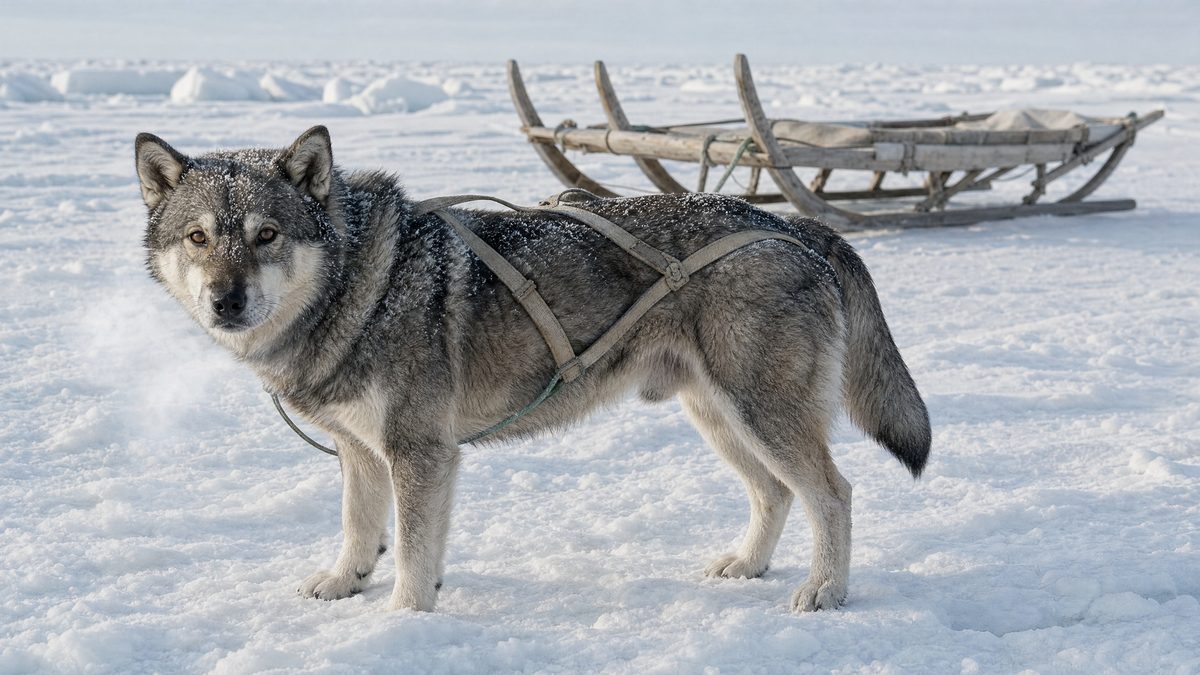
Quick answer
The Chukotka sled dog is an aboriginal Arctic landrace from the Chukchi Peninsula, recognised by the Russian Kynological Federation in 1999 and not by the FCI, AKC or Kennel Club of India. The Siberian Husky was derived from these dogs between 1908 and 1930, not the reverse. No Chukotka sled dog is lawfully sold in India, and its origin climate is roughly 30 degrees Celsius colder than any Indian metro.
This page reports published veterinary and registry evidence and is not veterinary advice. No screening database covers this breed, so nothing here can substitute for examining an actual dog. Consult a registered veterinarian before acting on anything you read here, and take any dog showing heat stress, collapse, laboured breathing or a rectal temperature above 40 degrees Celsius to a veterinarian immediately rather than treating it at home.
Chukotka Sled Dog at a glance
What the Chukotka sled dog is, and what the RKF breed standard actually says
The Chukotka sled dog is an aboriginal breed of working sled dog from the Chukchi Peninsula in far north-eastern Russia, standing 56 to 65 cm at the withers in males, carrying a coarse double coat over a dense waterproof undercoat, and bred by the Chukchi and Yupik peoples to haul on sea ice and mountain tundra rather than to be shown.
Read the governing document rather than the encyclopedia entries and the breed sharpens considerably. The Russian Kynological Federation standard, approved by the Presidium of SOKO RKF on 24 July 2013 in a new edition adopted by the RKF Standards Commission on 19 February 2013, with amendments approved by the RKF Presidium on 8 April 2015, opens by naming the origin as Russia, the Far North-East of Asia, and the use as sled dog and companion. It describes a dog of medium height and slightly stretched build, body index 104 to 109, with body length exceeding height at the withers by 4 to 9 percent, chest depth slightly less than half the height at the withers, and a muzzle roughly equal in length to the skull.
The measurements, including the one the standard disagrees with itself about
The standard states height twice and the two statements do not match. Its General Appearance clause gives males 56 to 65 cm and females 52 to 62 cm; its later Size clause gives males 56 to 65 cm and females 53 to 62 cm. One centimetre is not a large error, but it is worth printing because it shows what happens downstream: Russian Wikipedia reproduces the Size figure, and English Wikipedia prints neither, giving instead 53 to 65 cm for both sexes, which is Bogoslovskaya's field measurement of surveyed dogs rather than a standard at all Wikipedia, Chukotka sled dog (English) Bogoslovskaya LS (Institute of Heritage.
| Source | Males | Females | What it is measuring |
|---|---|---|---|
| RKF standard, General Appearance clause | 56-65 cm | 52-62 cm | The breed standard |
| RKF standard, Size clause | 56-65 cm | 53-62 cm | The same breed standard, later clause |
| Russian Wikipedia | 56-65 cm | 53-62 cm | Quoting the Size clause |
| Bogoslovskaya 2010 | 53-65 cm | 53-65 cm | Field measurement of surveyed dogs, both sexes |
| English Wikipedia | 53-65 cm | 53-65 cm | Reprinting Bogoslovskaya as though it were the standard |
| Weight, all sources | Not stated | Not stated | The standard contains no weight at all |
Note the last row, because it governs everything else on this page. The RKF standard states no weight. The word for kilogram does not appear in the document once. Any weight range you read for this breed was supplied by somebody other than the register.
Coat, head and tail, in the standard's own terms
The coat clause is the most India-relevant part of the RKF standard, and it is unusually specific: double, with well-developed coarse straight guard hair over a dense waterproof undercoat, reaching up to 6 cm on the body, 8 to 10 cm at the neck and rear thighs, and 10 to 12 cm on the tail.
The coat clause is the most India-relevant part of the standard, and it is unusually specific. Coat is double, with well-developed coarse straight guard hair and a dense waterproof undercoat; body coat reaches up to 6 cm; the muzzle, forehead, ears and front of the limbs carry shorter denser hair; neck, withers and the rear of the thighs reach 8 to 10 cm without forming a heavy mane or trousers; and the tail carries the longest hair at 10 to 12 cm without forming a plume. Colours run agouti grey, agouti red, light fawn, red, white, brown, black, spotted, piebald and tan-pointed, with domino-type facial lightening common.
The RKF publishes a companion photo-commentary to the standard, and it adds three details the standard's prose only implies. Its caption on the best representative of the breed at Lorino in 2001 tells the reader to note the horizontal position of the ear flaps, which is the 'often held out sideways' ear the standard describes. A second caption explains that the loosely held, splayed feet give the dogs the most reliable grip on difficult ground. A third states that the magnificent double coat with its dense undercoat lets Chukotka sled dogs sleep under the snow. The head is massive and broad in the forehead, approaching an equilateral triangle viewed from above, with a clear but not abrupt stop and a wedge-shaped blunted muzzle whose profile runs parallel to the forehead line. Ears are erect, relatively small, wide-set, very mobile, and furred inside; absence of hair inside the ear is listed as a serious fault. Eyes are oval, obliquely set, dark brown to light brown. The tail is set slightly below the backline, reaches the hock or shorter, hangs like a log at rest and rises in a sickle or half-ring when the dog is excited; a tail carried in a tight ring is a disqualifying fault.
The RKF standard's history clause explains its own selection priorities without hedging. It says these dogs are indispensable for travel over sea ice and mountain tundra because they have very strong toe pads, and that compared with factory-bred sled breeds they carry a protein-and-fat metabolism that is energetically efficient in polar conditions, with maximum endurance and working capacity. Every clause that follows is downstream of that. It is a specification for an animal that has to work at minus twenty degrees Celsius on a fat-based diet.
Which register recognises the Chukotka sled dog: RKF yes, FCI no, AKC no
The Russian Kynological Federation is the register that recognises the Chukotka sled dog, having approved the first official standard in 1999. The Federation Cynologique Internationale does not recognise it, the American Kennel Club does not list it in any programme including Foundation Stock Service, and no Kennel Club of India recognition exists.
Establish this from the registers themselves rather than from the assumption. The FCI's own nomenclature page for Group 5 Spitz and primitive types, Section 1 Nordic Sledge Dogs, lists exactly five breeds: the Canadian Eskimo Dog (211) under Canada, the Greenland Dog (274) under Greenland, the Samoyed (212) under Northern Russia and Siberia, and the Alaskan Malamute (243) and Siberian Husky (270) under the United States of America. The Chukotka sled dog is not among them. Under the Russian Federation heading in that same group, the FCI lists only the three Laikas, in Section 2 Nordic Hunting Dogs.
The standard claims an FCI classification the FCI has not granted
Here is the wrinkle no ranking page has noticed. The RKF standard is laid out in the FCI template and prints, on its own face, the line 'FCI Classification: Group 5. Spitz and primitive types. Section 1. Northern sled dogs. With working trials';. That is a classification the FCI's Section 1 list does not contain. The two documents are not in conflict about a fact; the RKF is describing where the breed would sit if the FCI recognised it, in the format the FCI uses. Read carelessly, though, that line is exactly how a seller ends up telling an Indian buyer the dog is FCI-registered. It is not.
The American Kennel Club position is equally clean once you read the right page. The AKC's Foundation Stock Service page carries an A-to-Z selector covering every AKC-recognised breed and every FSS breed together, and it includes the Canadian Eskimo Dog, the Nenets Laika, the Yakutian Laika, the Samoyed, the Alaskan Malamute, the Alaskan Klee Kai and the Siberian Husky. It does not include the Chukotka sled dog under any spelling. The breed is absent because it was never admitted, not because it was promoted out.
What RKF recognition actually buys, and what it does not
RKF recognition here means a written standard, a stud register and a judging pathway, and the RKF's own paperwork records how thin that pathway is. Its classification of breeds registered in the RKF places the Chukotka sled dog in the right-hand column of FCI Group 5, headed 'rare breeds in the RKF, for which an experienced RKF judge may sit an extended written examination';. The note attached to that column explains the reason: judges with at least five years' standing who want to open a rare breed may sit a written exam instead where it is practically impossible to provide dogs of that breed for an apprenticeship. Group 5 in that document holds 11 common breeds and 17 rare ones, and this is one of the 17.
The Kennel Club of India is an FCI member national canine organisation, and the FCI publishes its returns: 32,219 puppies registered with the studbook in 2025, 7,412 litters, and 1,425,001 pure-bred dogs registered since the studbook's creation. That is a working register of real size, and it runs on FCI breed numbers. The Chukotka sled dog has none to register under. Combine that with the import position and the conclusion is structural rather than incidental: a dog of this breed cannot be lawfully imported for sale or breeding, and could not be registered in India if it were. No lawful supply chain can form. That is not a temporary gap waiting for a breeder to fill it.
Note also which FCI slot this breed would occupy, because the FCI already recognises one aboriginal Arctic landrace on the same terms the RKF standard claims. FCI standard 274 covers the Greenland Dog under origin Greenland with patronage Denmark, places it in Group 5 Section 1 Nordic Sledge Dogs, and marks it with working trial, describing a very strong polar spitz built for endurance and strenuous work as a sledge dog under Arctic conditions. That is precisely the classification line the RKF standard prints for the Chukotka sled dog. The FCI's template has a place for a dog like this. It has simply not put this one in it. One correction to a common phrasing. The breed is rare, and it is genuinely small in number, but it is not formally listed as endangered by any conservation authority that could be found for this page. Calling it endangered borrows an official-sounding word that no register or agency has applied to it. Rare, aboriginal and undocumented is the accurate description.
The Siberian Husky came from these dogs, not the other way round
The Siberian Husky was derived from Chukotka sled dogs exported to Alaska between roughly 1890 and 1930, and the direction of that relationship is settled in both the historical and the genomic literature. Treating the Chukotka sled dog as a Russian sort of Husky reverses a documented lineage and imports the wrong numbers with it.
Bogoslovskaya, who led the field surveys that produced the breed standard, states the sequence plainly: beginning from the nineteenth century and until the 1930s, Chukotka and Kolymo-Indigirsky dogs were actively exported to Alaska, where they were used by gold diggers, and they gave a start to the purebred Siberian Husky. The genomic literature agrees and dates it more tightly. Smith and colleagues write that the sled dogs of the far north-east of Siberia, east of the Indigirka River and associated with the Chukchi, Koryak, Yukagir and Kamchadal peoples, were the progenitors of the modern Siberian Husky breed, and that a subset of Siberian dogs arriving in Alaska by direct importation between 1908 and 1930 were recognised as the breed's foundation stock by the AKC in 1930.
The AKC's own breed page says the same thing from the receiving end, describing the Siberian Husky as having originated with the Chukchi people of north-eastern Asia as an endurance sled dog carrying a light load in low temperatures with a minimum expenditure of energy. Its FCI standard, meanwhile, files the breed under country of origin U.S.A.. Both are true, and together they describe the split precisely: the raw material is Chukchi, the breed is American.
1930 is the year the two populations stopped exchanging dogs
In 1930 the Soviet Union halted the export of dogs from Siberia and the AKC recognised the Siberian Husky in the same year Smith TN, Srikanth K. From that date the two populations ran separately for close to a century: one inside a closed studbook in North America under written conformation standards, one as a working landrace in Chukchi villages under selection by whether the team came home. Ninety-six years of separate history is why the numbers do not transfer, and it is why the RKF wrote a fresh standard in 1999 rather than adopting the Husky's.
The word 'husky' did not come from Siberia. It descends through Uskee, Uskimay and Huskemaw from a term applied to Arctic peoples, so dogs used by those peoples became the Huskies' dogs and then simply husky dogs. Canadian and American settlers then distinguished the Chukotka imports as Siberian huskies, because Chukotka is part of Siberia. The breed name is a nineteenth-century geographic shorthand applied by people who were not sure where the dogs had come from, and a century later it is still causing encyclopedias to file the parent population as a variety of its own descendant. Animalia.bio literally records 'Siberian Husky' as an alternative name for the Chukotka sled dog.
Two more precise statements are worth having, because sellers blur them. The Chukotka sled dog is related to the Alaskan Malamute, which is a separate American breed with its own FCI standard and its own origin story, and it is not the Malamute's ancestor in the way it is the Husky's. And it is not the same thing as the Alaskan husky, which is not a breed at all but a racing crossbred type.
Six figures a Husky page will give you that are wrong for this dog
Six numbers routinely migrate from Siberian Husky pages onto Chukotka sled dog pages, and every one of them is wrong at the destination. Weight, height, lifespan, hip dysplasia rate, eye colour and price all differ, and in three cases the correct answer is that no figure exists.
Take them one at a time, with the source that governs each.
- Weight. The FCI Husky standard gives 20.5 to 28 kg for males and 15.5 to 23 kg for females. The RKF Chukotka standard gives no weight at all. Copying the Husky band across invents a specification.
- Height. The Husky standard's disqualifying faults include dogs over 60 cm and bitches over 56 cm. The Chukotka standard permits males to 65 cm and females to 62 cm. A correct Chukotka male is disqualifiably tall for a Husky.
- Life expectancy. The AKC gives the Siberian Husky 12 to 14 years. No measured life expectancy exists for the Chukotka sled dog in any source opened for this page, and the RKF standard states none.
- Hip dysplasia. OFA holds 22,666 hip evaluations for the Siberian Husky, of which 97.3 percent are normal and 2.3 percent dysplastic. The Chukotka sled dog does not appear in OFA's statistics at all, which means fewer than the 100 evaluations OFA requires for inclusion.
- Eye colour. Blue eyes are acceptable in the Husky, including one of each. Blue eyes and odd eyes are disqualifying in the Chukotka standard.
- Puppy price. A Siberian Husky puppy price in India runs Rs 40,000 to Rs 1,50,000 and above, with KCI-registered pet-quality pups typically Rs 60,000 to Rs 95,000 in the metros. There is no Indian price for a Chukotka sled dog because there is no Indian supply.
The one place the genomics complicates the story
Do not turn the ancestry into a purity claim, because the best available genomic data points the other way. Smith and colleagues sequenced five modern Chukotka sled dogs from two kennels and found significant European breed ancestry in all five, especially German Shepherd, on an Arctic genetic background. Four of the five clustered with Alaskan sled dogs rather than with Siberian Huskies, one clustered with pet Siberians, and one shared identity-by-descent segments with a large number of modern show and pet Siberian Huskies, suggesting recent admixture with the Husky.
The authors then draw the conclusion that should end the purity argument outright: the modern Siberian Husky, excluding about half the dogs that race, may be the least-admixed Eurasian Arctic lineage remaining. They also report that the modern Chukotka dogs sampled share the least ancestry with the ancient Zhokhov sled dog of any Siberian group at 28 percent, while show and sled-show Siberian Huskies share the most at 42 percent. So on the sampled evidence the show Husky carries more ancient Arctic ancestry than these five aboriginal dogs did.
The authors say so themselves, noting that they sampled only five Chukotka sled dogs from two different kennels and that additional sampling may reveal more isolated populations with less West Eurasian admixture. Treat the finding as what it is: the only genomic look anyone has taken at this breed, based on a sample too small to characterise it. It is enough to refute a purity claim and not enough to establish one in either direction. Anyone quoting a Chukotka admixture percentage as settled is over-reading five dogs.
History: exports to Alaska, the Soviet collapse, and the survey that rebuilt the breed
The Chukotka sled dog's documented history runs in three movements: an export boom to Alaska from the 1890s to 1930, a near-total collapse across Soviet Russia between 1950 and 1970, and a scientific survey campaign from 1987 that produced the standard the RKF approved in 1999.
Dog sledding itself originates in this region. Bogoslovskaya places the region of origin of dog sledding in the north-eastern part of the Eurasian continent, covering Kamchatka, Koryakia, Chukotka and Eastern Yakutia, plus north-western Alaska, and records that from there the culture spread across the Eastern Hemisphere as far as China and Scandinavia. Soviet cynologists in 1946 to 1957 distinguished six Russian sled dog breeds by ethno-geographic principle: Gilyak, Kamchatka, Anadyr, Chukotka, Kolymo-Indigirka and Yenissei. Of those six, the Kolymo-Indigirsky is described as lost, the Gilyak as probably extinct by the late twentieth century, and the Chukotka as surviving.
The mechanisation collapse, with the one number that shows its scale
The collapse was fast and it is quantified. In 1937, in Kamchatka alone, 50,700 dogs were in work, which is over 4,500 complete teams. By 1970 sled dog teams had been replaced by vehicles everywhere. Bogoslovskaya names the causes without softening them: the spread of snowmobiles, the decline of fur hunting and local fishing, mass epizootics brought in with imported dogs, and the hunger of the 1990s when local people could not feed their teams. Smith and colleagues add a policy cause, recording that by the mid-twentieth century dog sledding in Russia was decreed economically inefficient and damaging to the fisheries, and that many sled dogs were killed or interbred with foreign cultured breeds to produce larger dogs.
One region held. Only on the Chukchi Peninsula did a sled dog population survive and even increase during the 1990s, because without the dogs the sea-mammal hunting industry would not be possible, and that hunting saved the native population of Eastern Chukotka from starvation. Smith and colleagues report the complementary genetic reason, that the Chukchi people are believed to be the most likely to have maintained their sled dogs free of foreign admixture, particularly in isolated villages along the north-eastern coast where the harsh climate also influences survival.
How the standard was actually built
The standard came out of fieldwork, not a committee. Chukotka sled dogs were rediscovered in the early 1980s by the Chukotka Zoological Expedition of the Severtsov Institute of Evolutionary Morphology and Ecology of Animals, USSR Academy of Sciences. Between 1987 and 1992, L. Bogoslovskaya, N. Nosov, I. Fradin and V. Belenky described and measured 2,500 dogs across the villages of Yanrakynnot, Lorino, Uelen, Inchoun, Enurmino, Neshkan and Markovo. The description and standard that came out of that work were approved by the RKF in 1999, and after further surveys in 1999, 2001 and 2004 the corrected version was published in the RKF Newsletter, 2005, number 4 (57), pages 24 to 25.
| Date | Event | Source |
|---|---|---|
| Before 500 AD | Archaeological evidence of heavy whale reliance with dogsled as the primary transport to settlements | Wikipedia, citing Potselueva |
| 1890s to 1930 | Active export of Chukotka dogs to Alaska for the Klondike gold rush and the All Alaska Sweepstakes | Bogoslovskaya 2010 |
| 1908 to 1930 | Direct importation of Siberian dogs to Alaska that became AKC foundation stock | Smith et al. 2024 |
| 1911 | Dmitrieva-Sulima describes them as a distinct breed in 'Laika and hunting with it' | Wikipedia |
| 1930 | Soviet export ban; AKC recognises the Siberian Husky | Wikipedia, Smith et al. 2024 |
| 1937 | 50,700 dogs in work in Kamchatka alone, over 4,500 teams | Bogoslovskaya 2010 |
| 1950s-1970 | Mechanisation, whaling prohibition and epizootics collapse the population | Bogoslovskaya 2010 |
| 1987-1992 | 2,500 dogs described and measured across seven villages | Bogoslovskaya 2010 |
| 1988 | Complete census of Providence and Chukotka districts: 1,594 dogs, about 400 of pure type | Bogoslovskaya 2010, Smith et al. 2024 |
| 1999 | RKF approves the first official standard; first RKF Champion title awarded | RKF standard, Bogoslovskaya 2010 |
| 2013, amended 2015 | Current RKF standard text approved | RKF standard |
The first dog of the breed to hold the title RKF Champion was a bitch named Vesta, aged seven, in 1999, and the RKF standard prints her photograph on its own front matter.
How many Chukotka sled dogs are left, and which figure you can actually use
One hard census of this breed exists and it is from 1988: 1,594 dogs across the Providence and Chukotka districts, of which about 400 could be considered of pure type. The widely repeated figure of 4,000 dogs is not a count of purebred Chukotka sled dogs, and no current population figure can be sourced to any authority.
Get the 1988 number right first, because it is the only one with a method behind it. Bogoslovskaya writes that in 1988 the team managed to conduct a complete survey of dog teams simultaneously in all villages of the Providence and Chukotka districts, finding 149 dog teams among 4,195 local residents and a total of 1,594 dogs not counting puppies, among which about 400 dogs could be considered of pure type, the rest being mixes with a varying content of authentic blood. Smith and colleagues quote the same survey and the same two figures independently. Two sources, one method, no disagreement.
What the 4,000 figure actually counts
The 4,000 figure is real but it does not mean what the encyclopedias imply. Bogoslovskaya's sentence is that the number of sled dogs in the entire Chukotka is approximately 4000, and that this is at present the largest group of aboriginal Arctic dogs. That is a count of sled dogs across a region, not of purebred registered animals of this breed, and the same article states there are six large separate populations of Chukotka sled dogs and their mixes with imported dogs. English Wikipedia carries the number with an honest hedge, saying it is unclear how many are purebred, and animalia.bio reproduces that sentence verbatim from it.
Note the date, because it is doing a lot of work. That article was published in The Fan Hitch in March 2010 and originally in the PADS Newsletter in December 2009. A regional estimate made around 2009 is now roughly seventeen years old, and it was written before the sampling that found European admixture in every Chukotka dog tested. Presenting it as a current purebred population is two errors stacked.
This page carries no current population figure for the Chukotka sled dog, because no authority publishes one. The RKF does not publish a per-breed stud book count that could be found for this page. No conservation body lists the breed. No breed club census exists in English. Population claims about aboriginal Arctic dogs are among the most frequently invented figures on the pet internet, so the honest answer here is that the current number is not reliably documented, and a page that gives you one has made it up or has not said where it came from.
The trend statement, and its limits
One directional statement can be sourced. Bogoslovskaya reports that during the twenty years preceding her article the total number of sled dogs of Chukotka noticeably increased and their quality improved, due to a decline in imported dogs as newly arrived people left Chukotka in the 1990s, and separately that over the recent twenty years the total number of dogs grew by approximately 20 percent. That is a trend for the regional sled dog population through roughly 2009. It is not a projection, and nothing in the literature extends it to 2026.
What the genome says about this population, and what five dogs cannot tell you
One study has sequenced Chukotka sled dogs, and it sampled five of them from two kennels. It found significant European breed ancestry in all five, no Pleistocene wolf introgression, and less shared ancestry with the ancient Zhokhov sled dog than modern show Siberian Huskies carry.
Be precise about which papers concern this population, because the Arctic dog literature is large and most of it does not. Sinding and colleagues sequenced an approximately 9,500-year-old Siberian dog from the Zhokhov site associated with archaeological evidence for sled technology, an approximately 33,000-year-old Siberian wolf, and ten modern Greenland sled dogs. That paper establishes that sled dogs represent an ancient lineage going back at least 9,500 years and that gene flow between sled dogs and wolves likely stopped before then. It is foundational and it contains no Chukotka sled dog.
The study that does contain them is Smith, Srikanth and Huson 2024, which analysed 358 canids including 280 registered Siberian Huskies, 42 Alaskan sled dogs, 10 Alaskan Malamutes and five modern Chukotka sled dogs from Russia. That is the entire published genomic evidence base for this breed.
The four findings, stated at the confidence the sample supports
- European admixture in every dog sampled. The modern Chukotka sled dog was found to have significant European ancestry on an Arctic genetic background, comparable to the modern Alaskan sled dog, and present in all five dogs, especially with German Shepherd.
- No ancient wolf ancestry. Pleistocene wolf introgression appeared in the Zhokhov dog, the Port au Choix precontact dog and Greenland sled dogs, but not in Chukotka sled dogs or modern Siberian Huskies.
- Least ancient Arctic ancestry of the Siberian groups. The Seppala and modern Chukotka dogs share the least ancestry with the ancient Zhokhov sled dog at 28 percent, while show and sled-show Siberian Huskies share the most at 42 percent.
- Recent Husky admixture in at least one dog. Two of the five share a large proportion of ancestry with modern Siberians and Alaskans, and one shares identity-by-descent segments with a large number of modern show and pet Siberian Huskies.
The authors give the historical explanation themselves. The systematic breeding of sled dogs in Russia for a larger freighting dog, plus Soviet collectivisation and human migration into eastern Siberia bringing western dogs, is their likely explanation for the sizeable European introgression in these modern dogs. That is the same 1950s-to-1970s collapse described in the history section, seen from the genome.
How old is the lineage, and why two dates circulate
Two dates for the Zhokhov Island site appear in the sources and they do not agree, so both are printed here. Bogoslovskaya writes that the oldest site of hunters with sled dogs in the high Arctic was found on Zhokhov Island in the Novosibirsk Islands, with the remains of the dogs and sleds dated to 7,800 to 8,000 years ago, and separately that bones of dogs found at sites of Asian Eskimos are dated to 2,480 to 2,630 years ago. Sinding and colleagues date the Zhokhov dog they sequenced at approximately 9,500 years, and Smith and colleagues describe a continuous Arctic lineage of dogs for at least 9,500 years on that basis. The gap is roughly 1,500 years and this page does not average it.
Smith and colleagues note that in sled dogs used for long-distance transportation, larger dogs cannot radiate heat fast enough and small dogs have problems conserving heat and keeping up, so a body size of 38 to 55 pounds, which is 17.2 to 24.9 kg, has been shown to be optimal in dogs that pull light loads over long distances. That is a thermoregulatory optimum, arrived at in an Arctic setting where the limiting factor was already heat dissipation during work. A dog optimised at the point where radiating heat becomes the binding constraint at minus fifteen degrees Celsius has no margin left at thirty.
Chukotka sled dog price in India: there is no Indian price, and here is why
No Chukotka sled dog price in India exists, because no Chukotka sled dog is lawfully sold in India. The only real market figure anywhere is a Russian domestic puppy price of 26,000 to 50,000 rubles, and Indian law forbids importing a dog of any breed for trading or breeding.
Say the absence first, because it is the answer to the query. Searching this breed from India returns no seller, no litter, no kennel and no rupee figure. The one page that ranks under the title 'Breed Facts, Prices & Breeders' reports, in its own words, 'No active listings right now', 'No public herdbook records yet', 'No community profiles yet' and 'No breeders listed yet';. Its featured listings block on that Chukotka page shows animals in Tennessee, Iowa and Ravenna, Texas, and one of the three is a blue pullet, which is a chicken. That is what an auto-generated breed shell looks like when you scroll past the headline.
The only genuine market price is in rubles
One published price for this breed could be found and it is Russian. A Russian pet portal gives a puppy price range of 26,000 to 50,000 rubles. Two cautions attach to it. It is a domestic Russian retail figure, so converting it to rupees produces a number that describes nothing available in India. And the same page's own price widget is blank, printing an empty 'from-to' field beside a PHP error message, so the figure lives in the body text rather than in the site's structured data.
Because Indian pages routinely publish a dollar figure run through one exchange rate and call it a rupee price, the arithmetic test was run here anyway, on the nearest thing to an Indian price for a comparable dog. Indian Siberian Husky figures of Rs 40,000, Rs 60,000, Rs 95,000, Rs 1,50,000 and the city bands beneath them were divided by 84.38, by 74.00 and by 80.00. None divides cleanly at 84.38 or at 74. About half divide cleanly at 80, which is exactly the arithmetic noise that test produces by construction, since 1,000 divided by 80 is 12.5 and any figure ending in three zeros will match; Rs 95,000 at 80 gives 1,187.5 dollars, which no seller would print. The honest reading is that Indian Husky prices are rupee-native, and that no conversion signature was found.
| Question | Answer | Source |
|---|---|---|
| Indian puppy price for a Chukotka sled dog | None exists | No Indian listing found |
| Indian breeders | None | Creatures.com breed page: no breeders listed |
| Russian domestic puppy price | 26,000-50,000 rubles | Zoonika |
| Lawful import for sale or breeding | Prohibited | DGFT Trade Notice 22/2022-23 |
| KCI registration route | None, breed has no FCI number | FCI Group 5 Section 1 list |
| Nearest comparable Indian price, Siberian Husky | Rs 40,000 to Rs 1,50,000 and above | Supertails 2026 |
Ask three questions before anything else. Which register issued the pedigree, and what is its number. Under which of DGFT Trade Notice 22/2022-23's three permitted purposes did the parent dogs enter India, given that applications for trading or breeding purposes shall be duly rejected. And are the parents' eyes brown, since blue eyes disqualify under the only standard this breed has. A puppy price quoted without those three answers is a price for an unidentified dog.
What an Indian search for this breed actually returns
An Indian search for the Chukotka sled dog returns one Wikipedia article, several pages that copy it, one peer-reviewed genomics paper, a Russian pet portal and a poster for sale on Etsy at Rs 589. It returns no dog. Tracing where each ranking page got its text explains why every one of them says the same things.
Follow the citation chain and it closes almost immediately. English Wikipedia is the parent document. A Dubai veterinary clinic's Health Library page states in its own footer that its text is 'reused under open licences' from that Wikipedia article, and it prints one identical paragraph twice, once under the heading Temperament and again under the heading Appearance. Animalia.bio lists a single reference and it is the same Wikipedia article. So three of the pages an Indian reader will open are one page.
The specific errors that propagate
- 'Siberian Husky' listed as an alternative name. Animalia.bio records it under 'Other names' alongside 'Chukchi Sled Dog'. English Wikipedia's infobox does the same. That single field is the conflation, encoded as data and ready for any answer engine to repeat.
- A height range for both sexes that is not from the standard. The 53 to 65 cm that appears on almost every English page is Bogoslovskaya's field measurement, and the RKF standard gives separate male and female ranges Russian Kynological Federation.
- A colour list that contradicts the standard. One ranking page attaches more than fifty colours to this breed, including albino, merle, harlequin, blue merle, blue roan and brindle. The standard permits ten and disqualifies brindle and speckled.
- A tail carried in a ring. A Russian portal describes the tail as 'usually carried curled in a ring over the back', while the standard makes a tail in a tight ring a disqualifying fault.
- A template written for another animal. That same page's table of contents lists section 6 as 'How to choose a kitten', on a dog page.
What is actually purchasable in India under this name
Nothing with four legs is purchasable in India under this name. The India-localised result set for this breed carries no litter, no kennel and no seller; the only commercial listing that surfaces at all is a downloadable art print. Everything else that ranks is an encyclopedia entry, a genomics paper, a field article from 2010, or a foreign portal. That is the entire Indian commercial reality of the Chukotka sled dog.
Two search engines were tried directly for this term with India settings. Google refused every engine outright and returned no result page at all. Bing returned HTTP 200, a page correctly titled 'chukotka sled dog - Bing', the line 'About 35,700 results', and then ten organic results of which not one concerned a dog; the first was Microsoft's own 'Windows help and support' and the rest were pages titled 'How to Get Help in Windows';. A confident result count attached to an unrelated result set is not evidence, so no conclusion about Indian demand or about People Also Ask questions is drawn from it anywhere on this page.
Why no lawful supply chain for this breed can form in India
Importing a Chukotka sled dog into India for sale or breeding is prohibited outright, and the prohibition is specific rather than incidental. DGFT Trade Notice 22/2022-23 classes dogs as a Restricted import, permits entry for exactly three purposes, and states that applications for trading or breeding purposes shall be duly rejected.
The trade notice is short and its operative clauses are unambiguous. Under ITC (HS) 01061900, mammals other than those separately listed carry the import policy Restricted. Policy Condition (7) reads that import of dogs is allowed only for the following specific purposes: a pet dog with valid pet book and relevant records or documents in the name of the importer; dogs imported by R&D organisations for conducting research with the recommendation of CPCSEA; and for internal security by the Defence and Police Force. Policy Condition (8) adds that import of commercial dogs for breeding or any other commercial activities other than those purposes is not permitted.
Paragraph 6 of the same notice closes the remaining gap: any applications for trading or breeding purposes, or applications made on behalf of some another person or entity, shall be duly rejected.
The narrow pet route, and what it cannot do
One lawful route exists and it moves a single household's dog, not breeding stock. Up to two pets may enter as passenger baggage without DGFT authorisation, and only for persons transferring their residence to India after two years of continuous stay abroad. Anything else, including a shorter stay abroad, a pet not travelling as baggage, or more than two animals, requires an import authorisation from DGFT, with the application examined by DAH&D first. Import of pet animals is allowed only through the airports and seaports of Delhi, Mumbai, Chennai, Hyderabad, Bengaluru and Kolkata and, since October 2024, Kochi airport, with quarantine at the government station where required, and an Advance No Objection Certificate from the AQCS Regional or Quarantine Officer seven days before travel. The full route is set out in how to import a dog to India.
The breed has no FCI number, so there is no Kennel Club of India registration route for it. And Indian import law forbids bringing dogs in to trade or breed. Neither fact alone would prevent a market; together they mean no lawful supply chain can form. A dog offered for sale in India as a Chukotka sled dog therefore either is not one, or arrived by a route the seller cannot describe.
One further consequence follows for anyone genuinely relocating with such a dog. The pet-book route requires the records to be in the importer's own name, and the notice advises initiating the authorisation process at least two months before travel. An Arctic working dog arriving in Delhi or Chennai on that route is lawful, and the rest of this page is written for exactly that reader, because they are the only person in India who will ever legitimately have one.
Cost of ownership in India: the structure, and the one number nobody can give you
No cost of ownership figure for a Chukotka sled dog in India exists, because no such dog is kept here on record. The nearest honest guide is the published cost structure for the Siberian Husky in India, which runs Rs 9,000 to Rs 17,500 per month, of which cooling electricity alone is Rs 3,000 to Rs 8,000 in the warmer months.
Borrow the structure, not the total, and label the borrowing. Indian ownership guidance for the Siberian Husky, the closest widely kept relative, breaks the monthly bill into food at Rs 3,000 to Rs 6,000, grooming at Rs 1,500 to Rs 3,500, and air-conditioning electricity at Rs 3,000 to Rs 8,000 during the warmer months, giving Rs 9,000 to Rs 17,500 in total, and puts total first-year cost including purchase at Rs 1,50,000 to Rs 4,00,000 and above. Every one of those lines applies to a Chukotka sled dog. Three of them apply harder.
| Line | Siberian Husky in India, per month | Direction for a Chukotka sled dog |
|---|---|---|
| Food | Rs 3,000-6,000 | Higher. The standard describes a protein-and-fat metabolism, and Indian premium diets are grain-forward |
| Grooming | Rs 1,500-3,500 | Higher. Longer coat: 8-10 cm at neck and thighs, 10-12 cm on the tail |
| Cooling electricity | Rs 3,000-8,000 | Higher and non-optional. There is no month in mainland India as cool as its origin at its warmest |
| Routine veterinary care | Included in the range above | Unknown. No breed-specific screening protocol exists to budget for |
| Total | Rs 9,000-17,500 | No published figure. Treat this range as a floor, not an estimate |
The three lines that are genuinely different
Cooling is the line that decides affordability, and for this breed it is not seasonal. A Siberian Husky owner in Delhi can point at genuinely cold Januaries as a recovery window, and Indian guidance does exactly that, noting Delhi winters sometimes drop below 5 degrees Celsius. Delhi's January mean is 13.61 degrees Celsius, which is still 6.3 degrees above the warmest month at Uelen. The recovery season a northern dog needs does not exist here, so the cooling bill runs closer to year-round than the Husky figures imply.
Food is the second line that moves. The RKF standard specifically credits this breed's advantage over factory-bred sled breeds to an energetically efficient protein-and-fat metabolism in polar conditions. Feeding to that in India means a high-animal-protein diet, which sits at the expensive end of the Indian market, and it means feeding less in the heat rather than more, because digestion itself produces heat.
Grooming is the third. A Husky's coat is described by its own standard as double and medium in length, never so long as to obscure the outline, with a long, rough or shaggy coat listed as a fault. The Chukotka standard specifies up to 6 cm on the body, 8 to 10 cm at the neck, withers and rear thighs, and 10 to 12 cm on the tail, and treats a weak undercoat as a serious fault. That is more coat to manage in higher humidity, so budget above the Husky grooming line rather than at it.
Heat tolerance: Delhi's coldest month is warmer than the Chukchi Peninsula's warmest
The Chukotka sled dog rates 1 out of 5 for heat tolerance, the lowest rating this site gives, because Uelen averages 7.35 degrees Celsius in July and Delhi averages 13.61 degrees Celsius in January. No month anywhere in mainland India is as cool as this breed's home villages at their warmest.
Every figure below was pulled from NASA POWER by explicit latitude and longitude, and every query's returned coordinates were checked against the coordinates requested, so no wrong-place document is being read here. The origin points are not a generic 'Siberia'. They are the seven villages where Bogoslovskaya, Nosov, Fradin and Belenky measured 2,500 dogs between 1987 and 1992 to build the standard, plus the regional capital. Uelen was queried at 66.1594 and minus 169.8078 and the service returned minus 169.808, 66.159 at 46.34 m elevation.
The single comparison that settles it
Delhi in January is 6.26 degrees Celsius warmer than Uelen in July. Delhi's January mean of 13.61 degrees Celsius is the coolest month at any mainland Indian point in this comparison, and Uelen's July mean of 7.35 degrees Celsius is the warmest month in the breed's home village. Widen it and the gap grows fast. Chennai's annual mean of 27.95 degrees Celsius sits 32.13 degrees above Uelen's annual mean of minus 4.18, and Chennai's coldest month, January at 24.09 degrees, is 16.74 degrees above Uelen's warmest.
| Place | Annual mean, C | Warmest month, C | Coldest month, C | Peak monthly wet bulb, C |
|---|---|---|---|---|
| Neshkan, Chukotka (origin) | -5.58 | 7.88 (Jul) | -19.03 (Jan) | 7.11 (Jul) |
| Anadyr, Chukotka (regional capital) | -5.46 | 11.73 (Jul) | -21.62 (Jan) | 10.62 (Jul) |
| Lorino, Chukotka (origin) | -4.54 | 9.00 (Jul) | -17.61 (Jan) | 8.06 (Jul) |
| Yanrakynnot, Chukotka (origin) | -4.41 | 9.06 (Jul) | -17.30 (Jan) | 8.15 (Jul) |
| Provideniya, Chukotka (origin) | -4.20 | 8.49 (Jul) | -16.54 (Jan) | 7.72 (Jul) |
| Uelen, Chukotka (origin) | -4.18 | 7.35 (Jul) | -16.21 (Jan) | 6.71 (Jul) |
| Leh, Ladakh | -2.75 | 10.18 (Jul) | -16.01 (Jan) | 4.03 (Aug) |
| Guwahati | 22.94 | 27.89 (Jul) | 14.61 (Jan) | 26.18 (Jul) |
| Bengaluru | 23.74 | 28.37 (Apr) | 20.22 (Dec) | 22.66 (May) |
| Pune | 23.86 | 28.93 (Apr) | 19.62 (Dec) | 23.56 (Jun) |
| Delhi | 25.60 | 35.88 (Jun) | 13.61 (Jan) | 27.74 (Jul) |
| Kolkata | 25.81 | 31.53 (May) | 17.31 (Jan) | 27.86 (Jun) |
| Hyderabad | 26.10 | 33.30 (May) | 20.76 (Dec) | 24.44 (Jun) |
| Mumbai | 26.77 | 31.19 (May) | 23.19 (Jan) | 26.55 (Jun) |
| Ahmedabad | 27.57 | 35.06 (May) | 19.93 (Jan) | 27.62 (Jun) |
| Chennai | 27.95 | 31.51 (May) | 24.09 (Jan) | 27.36 (May) |
State the rating rule plainly so a reader can apply it to any other breed on this site. A heat-tolerant dog is one whose origin climate overlaps its destination climate for part of the year, so that the animal gets a recovery season. On that test the Chukotka sled dog scores 1 rather than 2 for mainland India, because there is no overlap in any month in any mainland city examined. Ladakh is the single exception and it gets its own section below.
Means understate the problem because dogs die on peak days, not average ones. NASA POWER records a maximum 2-metre air temperature of 48.79 degrees Celsius in the Delhi grid cell and 48.58 in the Ahmedabad cell, against 18.55 degrees in the Uelen cell. That is a 30.24 degree difference between the hottest air this breed's home village records and the hottest air Delhi records. A dog whose standard rewards a dense waterproof undercoat has no physiological answer to that.
Wet bulb, monsoon humidity and the IMD's own heat thresholds
Wet bulb temperature decides whether a panting dog can still cool itself, and Uelen's peak of 6.71 degrees Celsius sits 21.15 degrees below Kolkata's 27.86. Every Indian city in this comparison exceeds the origin climate's peak wet bulb by more than twelve degrees.
A dog cannot sweat across its body, so it sheds heat by panting, and panting is evaporative. That makes monsoon humidity, not air temperature alone, the variable that decides whether cooling still works. Wet bulb temperature captures heat and humidity in a single figure, which is why this page prints it beside the mean.
Uelen's wet bulb climatology peaks at 6.71 degrees Celsius in July and its annual mean wet bulb is well below freezing. Kolkata peaks at 27.86 degrees Celsius in June, Delhi at 27.74 in July, Ahmedabad at 27.62 in June, Chennai at 27.36 in May, Mumbai at 26.55 in June, Guwahati at 26.18 in July, Hyderabad at 24.44 in June, Pune at 23.56 in June and Bengaluru at 22.66 in May. Kolkata's peak sits 21.15 degrees above Uelen's. Even Anadyr, the warmest and most continental of the origin points at 10.62 degrees, sits 12.04 degrees below Bengaluru, the mildest mainland Indian city here.
What Indian officialdom already says about those numbers
The India Meteorological Department's declaration criteria put the mismatch in official terms. A heat wave is declared when a plains station reaches at least 40 degrees Celsius, or at least 30 degrees for hilly regions, and for a coastal station when the maximum temperature departure is 4.5 degrees or more from normal provided the actual maximum is 37 degrees or more. On departure from normal, a heat wave is 4.5 to 6.4 degrees and a severe heat wave is above 6.4 degrees. Heat waves typically occur March to June and occasionally into July, the peak month over India is May, and five to six heat wave events occur on average every year over the northern parts of the country.
Read those thresholds against the origin data and the scale is obvious. The hilly-region heat wave threshold of 30 degrees Celsius is 22.65 degrees above Uelen's warmest monthly mean, and the plains threshold of 40 degrees is 32.65 degrees above it NASA POWER, Climatology Resource…. Conditions that India classifies as an emergency for humans are, for this dog, simply a Tuesday in Chennai.
A breed earns 2 out of 5 on this site when its origin climate overlaps the Indian climate somewhere in the year, so a genuinely cool recovery season exists. For this breed there is no overlap anywhere in mainland India, in any month, on either air temperature or wet bulb. The nearest thing to an exception is Ladakh, where the July mean of 10.18 degrees Celsius sits between Lorino's 9.00 and Anadyr's 11.73, and where the peak wet bulb of 4.03 degrees is actually lower than any origin point measured. Ladakh is a real match. It is also 1 percent of India's population and has no route to lawfully acquire the dog.
What the double coat actually does, and what the best heat study can and cannot prove
A double coat insulates in both directions, which is why it does not protect an Arctic dog in Indian heat the way sellers claim, and why shaving it makes things worse rather than better. The largest primary-care study of heat-related illness in dogs supports the risk in three specific ways and is silent on a fourth, because it never modelled coat at all.
Start with what the standard requires, because it is a specification for maximum insulation. The RKF standard calls for a double coat with well-developed coarse straight guard hair and a dense waterproof undercoat, and it lists 'short or excessively long coat, weak undercoat development' among its serious faults. Absence of the undercoat is a disqualifying fault. A correct specimen of this breed is, by definition, the most heavily insulated version of itself available.
The two layers do different jobs and only one of them helps in heat. The coarse outer guard coat sheds water and reflects some solar load. The dense undercoat traps a still-air layer, and still air is a good insulator regardless of which side is hotter. In Chukotka that layer keeps metabolic heat in at minus 17 degrees Celsius, and the RKF's own photo commentary states the point directly: the double coat with its dense undercoat lets these dogs sleep under the snow Wikipedia, Chukotskaya yezdovaya (Russian). In Chennai the same layer slows the loss of metabolic heat the dog is still producing. The coat does not become a cooling system when the gradient reverses.
What Hall 2020 does support
The largest primary-care study of heat-related illness in dogs examined 905,543 dogs under veterinary care at 886 UK practices in 2016, identified 395 confirmed heat-related illness events, and put the annual incidence at 0.04 percent with an event fatality rate of 14.18 percent (95 percent CI 11.08 to 17.96). Three of its findings transfer to this breed directly.
- Bodyweight. Every bodyweight band above 10 kg carried significantly higher odds than dogs under 10 kg. The 20 to under 30 kg band, where a dog of this size most plausibly sits, showed an odds ratio of 2.13 (95 percent CI 1.51 to 3.02).
- Purebred status. Purebred dogs carried 1.86 times the odds of crossbred dogs (95 percent CI 1.39 to 2.49).
- Condition and age. Dogs at or above the breed and sex mean bodyweight carried an odds ratio of 1.42 (1.12 to 1.80), dogs over two years were at greater risk, and dogs of twelve years and over had the greatest odds at 1.75 (1.14 to 2.70).
Two things it does not support, and one it cannot
Do not import the heaviest odds ratio. Dogs over 50 kg carried an odds ratio of 3.42 (1.54 to 7.57), and this breed is not a 50 kg dog on any published figure. Do not import the brachycephalic figure either. Brachycephalic dogs carried an odds ratio of 2.10 (1.68 to 2.64) against mesocephalic dogs, and the RKF standard specifies a muzzle approximately equal in length to the skull, which places this breed in the mesocephalic base category with no elevated skull-shape risk at all.
The third point is the important one. Hall 2020 contains no coat variable. Its model tested breed type, bodyweight relative to breed and sex mean, age, skull shape, purebred status and absolute bodyweight, and coat length or density is not among them. So the largest study available cannot quantify what an Arctic double coat contributes to heat-illness risk, and any page that gives you an odds ratio for a double coat is quoting something that does not exist.
One breed in Hall 2020 does the job indirectly. The Chow Chow, a heavy double-coated northern spitz, carried the highest heat-illness incidence of any breed in the study at 0.50 percent (95 percent CI 0.21 to 1.16), ahead of the Bulldog at 0.42 percent and the French Bulldog at 0.18 percent. That is a UK figure for a UK summer, and the confidence interval is wide because the numbers are small. It is indicative rather than transferable. But it is the only signal in the best available dataset that points at coat rather than at skull, and it points the way you would expect. Read the Chow Chow profile for the fuller picture.
Ladakh is the only Indian answer, and it is a narrow one
Ladakh is the one place in India whose climate genuinely overlaps this breed's origin, and Leh's July mean of 10.18 degrees Celsius sits inside the range measured across the Chukchi villages. Everywhere else in India fails on both air temperature and wet bulb in every month of the year.
The Leh figures are worth stating precisely, because the match is closer than most people expect. Leh was queried at 34.1526 and 77.5771 and NASA POWER returned 77.577, 34.153 at 4,532.61 m elevation, giving an annual mean of minus 2.75 degrees Celsius, a January mean of minus 16.01, a July mean of 10.18 and a peak monthly wet bulb of 4.03 degrees in August. Compare that with Uelen's minus 4.18 annual, minus 16.21 January, 7.35 July and 6.71 peak wet bulb. Leh's January is within 0.2 degrees of Uelen's, its July sits between Lorino's 9.00 and Anadyr's 11.73, and its peak wet bulb is 2.68 degrees lower than Uelen's.
On the numbers, Ladakh is drier at its most humid than the Chukchi Peninsula is at its most humid. That is a real finding and this page will not soften it.
Four reasons Ladakh is still not an answer
- The dog cannot lawfully get there. No FCI number means no KCI registration, and DGFT policy forbids importing dogs for trading or breeding, with such applications to be duly rejected. A climate match does not create a supply chain.
- Import ports are all in the plains. Pet animals may enter only through Delhi, Mumbai, Chennai, Hyderabad, Bengaluru, Kolkata and, since October 2024, Kochi Department of Animal Husbandry…. Every lawful arrival begins in a city whose peak wet bulb exceeds 22 degrees Celsius, with quarantine there where required.
- Leh still reaches 24.70 degrees Celsius as a maximum air temperature in July. That is mild by Indian standards and it is above every monthly mean the breed evolved with.
- Veterinary depth. No screening protocol exists for this breed anywhere, and Ladakh is not where you want to discover that.
The ranking for the rest of India, worst to least bad
Rank the mainland cities by annual mean and the order is Chennai at 27.95 degrees Celsius, Ahmedabad at 27.57, Mumbai at 26.77, Hyderabad at 26.10, Kolkata at 25.81, Delhi at 25.60, Pune at 23.86, Bengaluru at 23.74 and Guwahati at 22.94. That ordering is misleading on its own, though, because it hides the two things that actually matter to a double-coated dog.
Rank instead by the coolest month available, and Delhi comes first at 13.61 degrees Celsius in January, then Guwahati at 14.61, Kolkata at 17.31, Pune at 19.62, Ahmedabad at 19.93, Bengaluru at 20.22, Hyderabad at 20.76, Mumbai at 23.19 and Chennai at 24.09. Then rank by peak wet bulb and Bengaluru comes first at 22.66 degrees, Pune at 23.56, Hyderabad at 24.44, Guwahati at 26.18, Mumbai at 26.55, Chennai at 27.36, Ahmedabad at 27.62, Delhi at 27.74 and Kolkata at 27.86. Delhi has the best cold season and nearly the worst monsoon. Bengaluru has the best monsoon and no cold season at all. Mumbai and Chennai are worst on both counts, since neither has a month below 23 degrees Celsius.
There is no good Indian city for this breed. Delhi buys you roughly eight to ten weeks a year in which an Arctic dog is merely uncomfortable rather than at risk, and charges for it with a July wet bulb of 27.74 degrees Celsius and a grid-cell maximum of 48.79. Bengaluru spreads the same total load more evenly and never lets the dog recover. Neither is a place to bring a dog whose own register describes it as adapted to the harsh climate of the Arctic.
Temperament and household fit: what the standard permits that a Husky standard does not
The RKF standard describes the Chukotka sled dog's reaction to a human as ranging from friendly to passively defensive, which is a materially different temperament clause from the Siberian Husky's. Unmotivated aggression toward humans is a disqualifying fault, but reserve and wariness are inside the standard rather than outside it.
Read the two clauses side by side and the difference is not subtle. The RKF standard's Behaviour section is one line: reaction to a human ranges from friendly to passively defensive. The FCI Siberian Husky standard's is a paragraph: friendly and gentle, alert and outgoing, not possessive like a guard dog, not overly suspicious of strangers or aggressive with other dogs, with some measure of reserve and dignity expected in the mature dog. One register is describing a companion. The other is describing a working dog whose acceptable range includes backing away from a stranger.
That difference is a century of divergent selection showing up in a single sentence. A show register selects for a dog that will stand still while a judge opens its mouth. A landrace selects for a dog that comes home with the team, and a passively defensive animal does that perfectly well.
What this means in an Indian household
Assume a dog that is sociable with its own team and reserved with everyone else, and plan around that rather than against it. The one temperament trait the standard shares with the working literature is team compatibility: these dogs are prized for high endurance, strength, ability to work and trainability, and are expected to have a friendly disposition as required for working in teams Bogoslovskaya LS (Institute of Heritage. Team-friendly is not the same as stranger-friendly, and in an Indian apartment block with shared corridors, lifts and daily deliveries, the distinction is the whole question.
- Socialise early and continuously, because a passively defensive default hardens without exposure.
- Expect a hardy, independent-minded animal rather than a biddable one, since the standard's own history clause credits low maintenance requirements rather than obedience.
- Plan for a muscular medium-sized dog of unknown adult weight, because no published weight comes from the register.
- Treat unmotivated aggression toward a person as disqualifying, which is exactly how the standard treats it, and not as a trait to be managed.
Anyone in a mainland Indian city, for the reasons set out in the climate sections, and specifically anyone in a flat without reliable year-round cooling. Beyond climate, three household types are a poor fit on the standard's own terms: homes with frequent unfamiliar visitors, homes wanting a dog that greets strangers warmly, and first-time owners, since an aboriginal working landrace with no breed-club infrastructure, no health screening database and no local expertise is not a starter dog.
Training: a working contract rather than obedience, and the clause Indian law adds
To train a Chukotka sled dog, give it a job and hold the terms, because the RKF standard describes a breed that learns easily and quickly and retains acquired skills for a long time. It is the only breed in its FCI group notation marked with working trials, and that is the frame the training should take.
The standard's own claim is specific and testable. It states that these dogs have high sled qualities, train easily and quickly, and retain acquired skills for a long time. Retention is the useful half of that sentence. A dog that holds a learned behaviour across a long gap needs fewer repetitions than a biddable breed but responds badly to inconsistency, because each inconsistent repetition is also retained.
The notation nobody comments on
The RKF standard's classification line ends with the words 'with working trials';, where the FCI standards for both the Siberian Husky and the Alaskan Malamute end with 'without working trial'; Federation Cynologique Internationale. On paper, then, this is the only one of the three whose register still expects it to be tested at work. Whether such trials are actually held is a separate question this page cannot answer, but the notation tells you what the standard's authors thought the breed was for.
- Train around traction, not around heel work. The breed's own literature describes dogs that pull, and Chukotka villagers harness them to wheeled carts in summer to move loads. Harness work channels the drive; a loose-lead walk fights it.
- Socialise on a schedule, not opportunistically. The standard's behaviour clause permits a passively defensive reaction, so exposure has to be deliberate.
- Keep sessions short and cool. In India that means before sunrise or after dark, because a training session is exercise and exercise is heat production.
- Do not train in a way that requires the dog to work in daylight heat. Delhi's grid cell maximum air temperature is 48.79 degrees Celsius.
The Indian legal clause that touches training and breeding advice
One provision of Indian law bears on anything you might be told about improving this breed locally. Second Schedule Part II paragraph 6(9) of the Prevention of Cruelty to Animals (Dog Breeding and Marketing) Rules, 2017 states that breeding to create new breeds of dogs or unusual looks shall be strictly prohibited. Anyone in India proposing to cross a Siberian Husky with something to recreate an aboriginal type is describing conduct that clause forbids. The neighbouring paragraph 6(8) forbids tail docking, ear cropping, de-barking, de-clawing and any other kind of mutilation or change of appearance by artificial means, and is described in the gazette as strictly forbidden; it does not bite for this breed, whose standard already requires natural erect ears and an undocked tail.
Cite the Indian breeding rules correctly, because the numbering is a trap. The prohibition on in-breeding and incest breeding lives at Second Schedule Part II paragraph 6(3), and citing it as a Rule of that number is wrong. The Rules' own Rule 6 is a different provision entirely, headed 'Requirements to be met by breeders and establishments used for breeding or housing dogs for breeding', and what it does is make the Second Schedule binding. Citing the paragraph as a Rule sends any reader who looks it up to the wrong text.
Exercise: what these dogs actually do, and why India can only supply it at night
Chukotka sled dogs cover up to 100 km at around 20 km per hour and 400 km or more at 6 to 12 km per hour, which is the working output the breed was selected for. No Indian city can supply exercise at that scale in daylight, so the honest daily plan is two cool-hour sessions and an accepted deficit.
The performance figures come from the researcher who built the standard. Bogoslovskaya records that modern Chukotka sled dogs can cover up to 100 km at a speed of about 20 km per hour, and can cover longer trails of 400 km and more at 6 to 12 km per hour, depending on terrain, snow depth and headwind. She also records the load figures: on a good road a team of 12 to 14 dogs pulled up to 1,000 kg for an unlimited time, and without a road not more than 500 kg.
Note what those numbers describe. They are not a fitness ceiling reached by an athlete. They are routine transport output for a working animal on a fat-based diet in sub-freezing air. A dog bred against that specification does not become a low-drive pet because it has been moved to Pune.
The realistic Indian schedule
- Two sessions daily, both outside daylight. Pre-dawn and post-dusk, every month of the year, not only in summer.
- Harness work over free running. Carting or scootering in cool hours gives the traction outlet the breed was selected for.
- Sixty to ninety minutes total as a floor, split across the two sessions, with the whole plan abandoned on any day the wet bulb is high rather than reduced.
- Indoor enrichment carrying the rest, because the shortfall against the breed's actual capacity is not closeable in India and pretending otherwise produces a frustrated dog and an owner exercising it in the heat.
Understand why nights do not fully solve it either. Wet bulb temperature falls much less overnight than dry air temperature does, because the moisture content of the air does not change. In Kolkata's June, with a monthly peak wet bulb of 27.86 degrees Celsius, a pre-dawn session still asks a dog to shed metabolic heat into air that is close to saturated. Bengaluru's 22.66 degrees is the mildest figure in this comparison and it is still 15.95 degrees above Uelen's July peak.
Stop a session at the first of these: a widened panting posture with the tongue spatulate, a refusal to move forward, staggering, brick-red or unusually pale gums, or vomiting. Heat-related illness carried an event fatality rate of 14.18 percent in the largest primary-care study of it, and dogs over two years of age were at greater risk than younger dogs. Cool the dog with room-temperature water on the belly, groin and paws, move it into airflow, and go to a veterinarian rather than waiting to see whether it settles.
Grooming a double coat in Indian humidity, and the ear clause that matters most
Grooming a Chukotka sled dog in India means brushing a coat that reaches 10 to 12 cm on the tail through a climate it never evolved in, and drying the ears properly every time the dog gets wet. The standard actively requires hair inside the ear, which is protective in Chukotka and a liability in an Indian monsoon.
Know the coat you are managing. The standard specifies body coat up to 6 cm; shorter, denser hair on the muzzle, forehead, ears and the front of the limbs; 8 to 10 cm on the neck, withers and the rear of the thighs without forming a heavy mane or trousers; and the longest hair on the tail at 10 to 12 cm without a plume. The undercoat is dense and waterproof, and Russian Wikipedia's description of the same standard notes it lets the dog sleep under snow.
Brushing, shedding and the one thing not to do
These dogs shed heavily, and in India they shed less predictably than in Chukotka, because the seasonal cues that drive a clean twice-yearly moult are weaker. Plan on brushing to the skin several times a week year-round rather than on two intense moult periods, using an undercoat rake rather than a slicker alone, since the layer that mats is the one against the skin.
Do not shave the coat. Removing the guard layer strips the part that reflects solar load and sheds water, while the dense undercoat that traps still air regrows first and often coarser. The standard treats a weak undercoat as a serious fault and its absence as disqualifying, which tells you the register regards that layer as the breed rather than as an inconvenience. A clipped double coat in Chennai leaves a dog with less sun protection and no more cooling.
Ears, and where overseas grooming habits stop transferring
The ear clause is the one place where this breed's standard actively works against it in India. The RKF standard lists absence of hair inside the ear among its serious faults, so a correct specimen carries a furred ear canal entrance. In Chukotka that hair keeps wind and frost out of an erect ear. In an Indian monsoon it holds moisture against a warm canal, which is the environment ear infections want.
The Indian evidence on this is real but should be read for what it is. A twelve-month survey of dogs in Guwahati from 1 August 2019 to 31 July 2020 found an overall otitis prevalence of 2.11 percent, highest in Labradors at 16.07 percent, with males predominating at 56.25 percent and the 4 to 6 year age group most affected at 30.36 percent. That is a clinic-population prevalence and a breed distribution, not a seasonal breakdown, and no seasonal figure appears in the abstract available for this page, so none is quoted here.
- Dry the ears after every bath and every soaking, rather than letting the dog air-dry, which is standard advice in temperate countries and wrong in an Indian monsoon.
- Check the ear canal weekly for odour, discharge or head-shaking, since erect ears mask early disease less well than owners assume.
- Bathe less often than you would a short-coated dog and dry completely to the skin when you do, because a damp undercoat in high monsoon humidity stays damp.
- Keep the feet dry too, since the standard's very thick tough pad skin is built for ice, not for standing in monsoon water.
Health: the screening databases this breed appears in, and the ones it does not
The Chukotka sled dog appears in no health screening database that could be found for this page. It is absent from all 513 of OFA's disease statistics tables, which means fewer than the 100 hip evaluations OFA requires before a breed is listed, and absence from a screening database is not evidence of health.
Prove the absence properly, because an unproven absence is just a failed query. OFA's full inline statistics dump was retrieved on 26 August 2026 and searched case-insensitively for chukotka, chukchi, chukot and the Cyrillic form, returning zero hits on every one. Two controls were run in the same session and both returned real data: LABRADOR RETRIEVER with 324,731 hip evaluations, and SIBERIAN HUSKY with 22,666. The hip table alone carries 222 breeds, including comparable northern landraces such as the Yakutian Laika and the Canadian Eskimo Dog, so the breed universe is present and the miss is genuine rather than manufactured by the query.
OFA states its own inclusion rule plainly: breeds are not included in the statistics tables until a minimum number of individuals have been evaluated, and for hips each breed must have at least 100 evaluations in the database, with at least 50 for all other databases. So the correct reading of this breed's absence is that fewer than 100 hip evaluations exist, most likely zero. It is not a clean bill of health. It is no bill at all.
| Breed | Hip evaluations | Normal % | Dysplastic % |
|---|---|---|---|
| Chukotka sled dog | Not listed | No figure exists | No figure exists |
| Siberian Husky | 22,666 | 97.3 | 2.3 |
| Alaskan Malamute | 16,165 | 87.2 | 11.7 |
| Samoyed | 20,362 | 87.8 | 11.1 |
| Yakutian Laika | 130 | 83.1 | 13.1 |
| Labrador Retriever (control) | 324,731 | 87.5 | 11.3 |
Read the Yakutian Laika row as a caution rather than a proxy. At 130 evaluations it is barely over OFA's threshold, so its 13.1 percent dysplastic rate rests on a small sample and should not be borrowed for a different breed. It is included here only to show that a Russian aboriginal northern breed can appear in the database once enough dogs are screened, which is the strongest available evidence that the Chukotka sled dog's absence reflects a lack of screening rather than a quirk of OFA's breed list.
What else does not exist
- No breed club health survey. No national breed club publishing prevalence data in English could be found.
- No breed-specific genetic panel. No panel marketed for this breed was found, and the genomics paper that sampled it looked at ancestry and runs of homozygosity rather than at named disease variants.
- No published lifespan. Covered in its own section below.
- No health clause in the standard. The RKF standard's serious and disqualifying faults are conformational, covering build, pigment, coat, eye colour, bite and tail carriage; it prescribes no screening.
What Indian law would require of anyone breeding one here
Indian law is stricter than this breed's own register on health testing. Second Schedule Part III paragraph 8(10) of the Prevention of Cruelty to Animals (Dog Breeding and Marketing) Rules, 2017 states verbatim that the dogs shall have been tested for genetic defects, including hip dysplasia, progressive retinal atrophy, night blindness, hypothyroidism, entropion, ectropion, overshot, undershot jaw (when incisors do not touch or mesh), wry mouth, two or more missing teeth, unilateral cryptorchid or full cryptorchid males. The operative word is 'including', so the list is illustrative rather than closed, and a defect is not outside the clause merely because it is unlisted.
Two of those items line up with the RKF standard rather than against it. The standard makes overshot and undershot bites disqualifying faults, and requires males to have two normally developed testicles fully descended, so an Indian breeder screening to paragraph 8(10) would be rejecting the same dogs the standard rejects Ministry of Environment. One thing the Rules never mention is deafness: across the whole gazette the string 'BAER' appears zero times and 'deaf' appears zero times, and the single occurrence of 'hearing' is an appeal hearing before the Secretary, Animal Husbandry.
The Indian health risks this breed's standard never anticipated
Three Indian disease pressures sit outside anything the RKF standard contemplates: tick-borne haemoparasites, monsoon ear and skin disease, and heat-related illness. None of them exists in Chukotka in a form that would have shaped selection, so a correct specimen of the breed carries no adaptation to any of them.
Tick-borne disease is the first and it is common. A study in and around Hisar, Haryana, tested 120 dogs by both Giemsa-stained blood smear and PCR. Microscopy found 15 dogs, or 12.5 percent, infected with canine tick-borne disease. PCR found 64.16 percent (77 of 120), of which 56 carried a single haemoparasite and 21 carried two or more species. Hepatozoon canis was the most abundant pathogen at 35 percent, followed by Ehrlichia canis at 25.8 percent, Babesia vogeli at 20 percent and Babesia gibsoni at 2.5 percent, with the commonest co-infection being H. canis with E. canis at 7.5 percent.
Read that gap between 12.5 and 64.16 percent carefully, because it is the practical finding. It is a comparison of two diagnostic methods in the same suspected-case population, not a general prevalence estimate for Indian dogs, and the authors' conclusion is a methodological one: PCR was more efficient than blood smear examination, and they recommend using molecular tests alongside microscopy. For an owner, the actionable version is that a negative smear does not clear a dog, and that year-round tick control matters more here than any northern breed's home range would suggest.
Ears and skin through the monsoon
The ear risk was covered in the grooming section and the number bears repeating here in a clinical frame. The Guwahati survey of 1 August 2019 to 31 July 2020 recorded overall otitis prevalence of 2.11 percent in the clinic population, with Labradors highest at 16.07 percent, males at 56.25 percent of cases, and the 4 to 6 year age band most affected at 30.36 percent. The clinical signs it lists are the checklist to watch for: ear pruritus, restlessness, head shaking, pawing at the ear, tilting of the affected ear, circling, purulent discharge, pain on palpation, swelling, foul smell, hyperaemia and hyperpigmentation.
A dense waterproof undercoat behaves differently in 90 percent relative humidity than it does in dry polar air. Water that gets past the guard coat has no fast route out, and a coat that stays damp at the skin against a warm body is the substrate for pyoderma and hot spots. This is not documented for this breed specifically, because nothing is, so it is stated here as mechanism rather than as a measured prevalence.
Heat, stated at the confidence the evidence supports
Heat-related illness is the risk that kills, and the honest position is that no breed-specific figure exists. The UK primary-care study covering 905,543 dogs recorded 395 heat-related illness events in 2016, an incidence of 0.04 percent, and an event fatality rate of 14.18 percent (95 percent CI 11.08 to 17.96), with 40 percent of cases (158 of 395) falling in July alone. Those are UK figures in a UK summer. India's peak heat wave month is May, and northern India averages five to six heat wave events a year. Nobody has run the equivalent Indian study, and this page will not manufacture one by scaling the British numbers.
Year-round tick prevention, discussed with a veterinarian who knows the local resistance picture, because Haryana's PCR-positive rate was 64.16 percent among suspected cases. Ears dried after every wetting and checked weekly. And a written heat protocol that names the temperature and wet bulb at which walks stop, agreed before the hot season rather than during it. Nothing on this page replaces a veterinary examination of an actual dog.
Life expectancy: no measured figure exists for this breed
No measured life expectancy for the Chukotka sled dog exists in any source opened for this page. The RKF standard states none, no longevity study includes the breed, and every lifespan figure you will see attached to it has been borrowed from the Siberian Husky.
Check the obvious sources one at a time and the answer is the same. The RKF standard is a conformation document and carries no lifespan clause; the Russian words for life expectancy do not appear in it. Bogoslovskaya's field article, which is the only substantial primary account of the working population, records team performance, population counts and survey methods, and gives no age-at-death data. The 2024 genomics paper reports effective population size, runs of homozygosity and inbreeding, none of which is a lifespan. The breed is absent from OFA entirely.
The figure that migrates onto this breed's pages comes from next door. The AKC gives the Siberian Husky a life expectancy of 12 to 14 years. That is a real figure for a real breed with a large registered population and a century of records. It describes a closed North American studbook, not a Chukchi village landrace with European admixture in every dog sampled. Transplanting it would be borrowing precision that does not exist.
An unsourced lifespan is one of the cheapest things to invent and one of the hardest for a reader to check, which is why it appears on almost every breed page ever written. This page carries none for the Chukotka sled dog. If a seller quotes you one, ask which study it came from, and treat the answer as a test of the seller rather than of the dog.
One structural point does bear on longevity even without a number. The dogs that survived in Chukotka did so under selection by whether they came home from work, which is a harsh filter that removes unsound animals early and tends to produce robust adults. That is a plausible argument for durability, and it is an argument rather than evidence. It also runs against the modern picture, in which every one of the five dogs sampled carried European breed introgression and one showed recent Siberian Husky admixture. A landrace that is being outcrossed is no longer being filtered the way the argument assumes.
Feeding a protein-and-fat working metabolism in an Indian market
Feed a Chukotka sled dog on high animal protein and fat, because the RKF standard names an energetically efficient protein-and-fat metabolism as one of the breed's specific advantages over factory-bred sled breeds. That is straightforward in Chukotka, where the diet is sea mammal, and expensive in India, where premium food runs Rs 300 to Rs 700 per kilogram.
The metabolic claim is the standard's own, not a marketing line. Its history clause states that compared with factory-bred sled breeds these dogs carry an energetically efficient protein-and-fat type of metabolism in polar conditions, along with maximum endurance and working capacity. The working diet behind that was marine: the dogs existed to make sea-mammal hunting possible and were fed from it. A commercial breed description of the same dogs states the requirement more plainly, calling for a diet high in animal protein supplemented with meat, bones and offal.
What that costs and looks like in India
Use the nearest documented Indian figures and adjust upward. Indian guidance for a 20 to 27 kg Siberian Husky puts daily intake at roughly 200 to 350 grams of quality kibble, with premium medium-to-large breed food at Rs 300 to Rs 700 per kilogram, working out to Rs 3,000 to Rs 6,000 per month. A Chukotka sled dog of similar size fed to a genuinely high-protein, higher-fat specification sits at or above the top of that band, because the Indian market's mid-tier foods are grain-forward and the meat-first options are the expensive ones.
- Puppy, 8 weeks to 12 months. Large-breed puppy formula with controlled calcium and phosphorus, three meals daily to four months and two thereafter. Slow growth is the goal.
- Adult. Two meals daily, meat-first, fed to body condition rather than to a chart, since no breed weight standard exists to feed toward.
- Hot months. Feed the larger meal after the evening walk and the smaller one before dawn, because digestion produces heat and the middle of an Indian day is the worst time to add any.
- Working or carting days. Increase fat rather than bulk, which is what the standard's metabolic description implies, and reintroduce it gradually.
The body-condition rule that replaces a weight chart
Because the RKF standard gives no weight, body condition scoring is not a refinement here, it is the only method available. Ribs should be easy to feel under a thin fat cover, the waist should be visible from above, and the abdomen should tuck up from the side. That matters more for this breed than for most, because Hall 2020 found that dogs at or above their breed and sex mean bodyweight carried an odds ratio of 1.42 (95 percent CI 1.12 to 1.80) for heat-related illness. In an Indian summer, letting a northern dog carry extra condition is a heat decision rather than a cosmetic one.
You will read that Chukotka sled dogs eat remarkably little for their size. The AKC says something similar about the Siberian Husky, noting it was bred to pull a light load at a moderate pace over great distances on the least amount of food, and that Huskies maintain a healthy weight on less food than other breeds of the same size. That is a real observation about a working northern dog in cold conditions, where the fat-based ration is dense. It is not a licence to underfeed a growing puppy in Pune, and no Indian feeding study for this breed exists to calibrate it.
What Indian import law and the 2017 breeding Rules together require
Indian import law makes the Chukotka sled dog unobtainable for sale, and the Prevention of Cruelty to Animals (Dog Breeding and Marketing) Rules, 2017 would make breeding one here difficult even if it were obtainable. Together they explain why this page carries no Indian breeder, no Indian price and no Indian litter.
The import law position was set out in full earlier and reduces to three clauses. Dogs are a Restricted import under ITC (HS) 01061900; entry is permitted only for a pet dog with a valid pet book in the importer's own name, for R&D with CPCSEA recommendation, or for Defence and Police internal security; and any applications for trading or breeding purposes shall be duly rejected. Nothing in that framework creates a route by which breeding stock of a foreign landrace could lawfully enter India.
Four clauses of the 2017 Rules that would bite hardest
- Second Schedule Part II paragraph 6(3): in-breeding prohibited. Only out breeding and line breeding are permitted. In breeding, defined as mating between dogs related to the 4th grade in straight or side line within the first four generations, giving uncle to niece, nephew to aunt, cousin to cousin and grandparents to grandchildren as examples, and incest breeding between parents and children or brother and sister, are both prohibited. Any attempt to build an Indian population from a handful of founders would hit this clause immediately.
- Second Schedule Part III paragraph 8(10): mandatory genetic-defect testing. Dogs shall have been tested for genetic defects including hip dysplasia, progressive retinal atrophy, night blindness, hypothyroidism, entropion, ectropion, overshot and undershot jaw, wry mouth, two or more missing teeth and cryptorchidism. With no OFA presence and no breed panel, a breeder could screen the individual dog but could not interpret the result against any breed baseline.
- Second Schedule Part II paragraph 6(9): no new breeds or unusual looks. Breeding to create new breeds of dogs or unusual looks shall be strictly prohibited. Crossing a Husky toward an aboriginal type is squarely inside that.
- Rule 8(1)(a): no sale below eight weeks. Every breeder shall ensure that pups less than eight weeks in age are not sold. Note this is Rule 8, a Rule in the body of the instrument, and not the Second Schedule paragraph 8; the document numbers clauses twice and the distinction matters when you quote it.
The prohibition on tail docking, ear cropping, de-barking, de-clawing and any other kind of mutilation or change of appearance by artificial means is Second Schedule Part II paragraph 6(8), described in the gazette as strictly forbidden. Citing it as a Rule of that number sends the reader to the wrong text, because the Rules' own Rule 6 is a different provision, headed 'Requirements to be met by breeders and establishments used for breeding or housing dogs for breeding', and its function is to make the Second Schedule binding, which is why the paragraph has force but is not itself a Rule. The same applies to paragraph 6(3), paragraph 6(9) and Part III paragraph 8(10).
Three further provisions worth knowing
Female dogs shall not be mated after the age of eight years, and every breeder shall furnish proof of the age of their breeding females certified by a veterinary practitioner. A male dog shall not be mated before he has reached his eighteenth month and shall be certified healthy by a veterinary practitioner at least ten days before mating. And all pups shall be vaccinated, which can start at the age of seven to eight weeks and is usually completed at eighteen weeks. Those three clauses give an Indian buyer a concrete checklist against any litter, of any breed.
One absence in the Rules is worth recording because it is often asserted otherwise. Across the whole gazette the string 'BAER' appears zero times and 'deaf' appears zero times, and the single occurrence of 'hearing' refers to an appeal hearing before the Secretary, Animal Husbandry. Indian law mandates no hearing test on any breed.
Month by month through the first year of a northern puppy in India
Raising a northern puppy through an Indian first year means treating heat as the organising constraint from week eight onward, and building the socialisation and coat habits before the first hot season arrives. The timeline below is generic to double-coated Arctic breeds, because no breed-specific developmental data for the Chukotka sled dog exists.
Say that limitation up front. There is no published growth curve, no adult weight target and no developmental study for this breed Orthopedic Foundation for Animals. What follows is built from Indian legal requirements, from general Arctic-breed husbandry, and from the climate figures earlier on this page, and every India-specific instruction below traces to one of those.
| Age | What matters | The India-specific instruction |
|---|---|---|
| Under 8 weeks | Not lawfully saleable in India under Rule 8(1)(a) | Refuse any litter offered earlier, whatever the reason given |
| 7-8 weeks | Vaccination can begin, per Second Schedule Part III para 8(9) | Confirm the schedule in writing and that it completes by about 18 weeks |
| 8-12 weeks | Primary socialisation window | Socialise indoors and at dawn, never in midday heat; get the pup used to being brushed to the skin now |
| 3-4 months | Vaccination course completes around 18 weeks | First full hot season may fall here; set the walk-stop rule before it does |
| 4-6 months | Rapid growth, joints vulnerable | Two meals daily, controlled calcium, no forced running, no stairs work |
| 6-9 months | Adolescent testing of boundaries | Introduce harness work in cool hours only; keep training sessions short |
| 9-12 months | Adult coat coming in | Expect heavier shedding and more brushing; do not shave the coat that is arriving |
| 12 months | Still growing in frame | No serious pulling load yet; a male cannot lawfully be mated before 18 months in India |
The four things a first-year owner in India gets wrong
- Delaying the heat protocol until summer. The first hot season can arrive at any point in the first year depending on when the pup was born, so write the rule at eight weeks: walks stop above a named temperature, and stop earlier when the air is humid.
- Skipping coat handling because the puppy coat is easy. The adult coat reaches 8 to 10 cm at the neck and 10 to 12 cm on the tail, and a dog that has never accepted an undercoat rake at four months will not start at fourteen.
- Over-exercising a growing northern dog because the breed is famous for endurance. The 100 km figures belong to trained adult teams in sub-freezing air, not to a nine-month-old in Hyderabad.
- Assuming a puppy will acclimatise. A double coat does not thin permanently in response to a tropical posting, and the standard treats weak undercoat development as a serious fault, which is what breeders have been selecting against for decades.
Teach the puppy to settle in a cool room on cue, before it needs to. A dog that will lie down calmly on tile under a fan on command is a dog you can cool at the first sign of trouble, and heat-related illness carried an event fatality rate of 14.18 percent in the largest primary-care study available. That single habit is worth more in an Indian first year than any obedience exercise.
Chukotka sled dog against the northern breeds India actually sells
Compare the Chukotka sled dog against the Siberian Husky and the Alaskan Malamute and four differences appear immediately, three of which are written into the standards themselves. The aboriginal dog is taller than the Husky at the top of its range, its standard disqualifies the blue eyes the Husky standard permits, it is the only one of the three with no FCI number, and it is the only one with no health record in any screening database.
Start with the register, because that is the difference that produces every other one. The Siberian Husky holds FCI standard 270 and the Alaskan Malamute holds FCI standard 243, both filed under country of origin U.S.A., both in Group 5 Section 1 Nordic Sledge Dogs, and both without working trial Federation Cynologique Internationale. The Chukotka sled dog holds no FCI number at all, and the RKF standard that governs it is marked with working trials Federation Cynologique Internationale. One breed is judged on how it looks. The other is, on paper, still judged on whether it can pull. That notation is not an RKF eccentricity either: the FCI marks the Greenland Dog, the one aboriginal Arctic landrace it does recognise, with working trial as well. Working trials track landraces, not show breeds.
| Chukotka sled dog | Siberian Husky | Alaskan Malamute | |
|---|---|---|---|
| Governing register | RKF | FCI 270, AKC, KCI | FCI 243, AKC, KCI |
| In FCI Group 5 Section 1 | No | Yes | Yes |
| Standard's country of origin | Russia, Far North-East of Asia | U.S.A. | U.S.A. |
| Working trial | With working trials | Without working trial | Without working trial |
| Height, males | 56-65 cm | 53.5-60 cm | 63.5 cm desirable |
| Height, females | 52-62 cm and 53-62 cm, two clauses disagree | 50.5-56 cm | 58.5 cm desirable |
| Weight, males | Not stated in the standard | 20.5-28 kg | 38 kg desirable |
| Blue eyes | Disqualifying | Permitted, one of each permitted | Disqualifying |
| Hip evaluations on record at OFA | None, breed absent | 22,666 | 16,165 |
| Hips normal / dysplastic | No figure exists | 97.3% / 2.3% | 87.2% / 11.7% |
| Published Indian price band | None found | Rs 40,000 to Rs 1,50,000 and above | Sold in India |
Read the height rows together and the conflation collapses. A Chukotka male at the top of his own standard stands 65 cm, and the FCI Siberian Husky standard disqualifies any dog over 60 cm Federation Cynologique Internationale. A correct specimen of the parent population would be thrown out of a Husky ring for being too big. That is not a subtle distinction between varieties. It is two different dogs.
The eye colour that sells the wrong dog
Blue eyes are the single fastest way to tell these two apart on a photograph, and they point the opposite way to what Indian buyers expect. The FCI Husky standard reads that eyes may be brown or blue in colour; one of each or particoloured are acceptable. The RKF Chukotka standard lists blue eyes and odd eyes among its disqualifying faults, and requires eyes from dark brown to light brown. The Alaskan Malamute standard agrees with the aboriginal dog rather than the Husky, calling blue eyes a disqualifying fault. So a blue-eyed dog advertised in India as a Chukotka sled dog is, by the only standard that governs the breed, not one.
Almost nobody in India is choosing between these three breeds. They are choosing between a Siberian Husky and a mixed-breed dog sold as something rarer, because the Chukotka sled dog is not offered here at all. Compare on that basis: a KCI-registered Husky from a documented litter against an undocumented dog with an exotic name. Neither is a good fit for an Indian climate, but only one of them can be verified. Read the Siberian Husky and Alaskan Malamute profiles before you decide, and the Samoyed page if a white coat is what you actually want.
Two further comparisons are worth making because Indian sellers reach for them. The Alaskan Klee Kai is a small companion breed created in the United States to look like a Husky, and it is not a sled dog of any kind. The Japanese Spitz and the Indian Spitz are white spitz-type dogs with no Arctic working history and much better heat tolerance than any of the three above. If the appeal is the look rather than the work, those are the honest options, and the Indian Spitz in particular was bred for this climate.
Nine mistakes Indian buyers make with this breed, and how to catch each one
Nine mistakes recur with the Chukotka sled dog in India, and eight of them are made before the dog arrives. Each one below names the specific check that catches it, because the useful thing here is not a warning but a test you can run in five minutes on a listing.
- Treating 'Chukotka sled dog' as a Siberian Husky variant. The direction runs the other way. Dogs exported from Chukotka to Alaska between the 1890s and 1930 became the foundation stock of the Siberian Husky, and the AKC recognised that breed in 1930 Smith TN, Srikanth K. Catch it by asking which standard the seller is breeding to. There is exactly one, it is Russian, and it disqualifies blue eyes.
- Accepting a weight figure. The RKF standard states no weight anywhere; it gives height only. The single published weight range, 20 to 30 kg, comes from a Russian commercial pet portal and gives the identical band for both sexes, which the standard's own male and female height ranges contradict. Catch it by asking where the number comes from.
- Believing a page titled 'prices and breeders';. One such page ranks for this breed, carries a colour list of more than fifty colours including albino, merle, harlequin and brindle, and then reports no listings, no herdbook records, no breeders and no profiles. The RKF standard permits ten colours and disqualifies brindle and speckled outright. Catch it by scrolling to the listings block before reading anything above it.
- Taking a veterinary clinic's breed page as veterinary knowledge. A Dubai clinic publishes a Chukotka guide under its own Health Library masthead which states in its own footer that the text is reused from Wikipedia, and which prints the same paragraph twice, once under Temperament and again under Appearance. Catch it by reading the footer and by checking whether two headings carry identical text.
- Assuming a rare breed must be expensive. No Indian price exists for this dog because no Indian supply exists. The only real market figure is a Russian domestic band of 26,000 to 50,000 rubles. Any rupee figure you are quoted was produced for the conversation you are having.
- Planning around a lifespan. No measured life expectancy for this breed exists in any source opened for this page. The RKF standard gives none, and the breed is absent from the OFA databases entirely. Catch it by asking for the study.
- Buying the coat for the look and then shaving it. The standard requires a dense waterproof undercoat and lists weak undercoat development among its serious faults. Shaving a double coat removes the layer that reflects solar load without removing the layer that traps heat. Catch it by settling the grooming plan before purchase.
- Exercising in daylight. Delhi's grid cell records a maximum 2-metre air temperature of 48.79 degrees Celsius against 18.55 degrees in the Uelen cell. A dog bred to work at minus 16 degrees does not get a graded introduction to that. Catch it by walking before sunrise and after dark, in every month, not only in May.
- Assuming import is a paperwork problem. It is a prohibition. Dogs are a Restricted import, permitted only as a pet with a valid pet book in the importer's name, for R&D with CPCSEA recommendation, or for Defence and Police use, and applications for trading or breeding purposes shall be duly rejected. Catch it by asking the seller which of those three routes the parent dogs came in on.
Run these four checks on any Indian listing for this breed. Ask for the RKF pedigree number and the kennel's Russian registration. Ask for a photograph of both parents' eyes in daylight, because blue disqualifies. Ask which of DGFT Trade Notice 22/2022-23's three permitted purposes the import used. Ask for the litter's date of birth and confirm the pup is at least eight weeks old, which Rule 8(1)(a) of the Dog Breeding and Marketing Rules 2017 requires of every sale in India. A seller who cannot answer the first three is not selling this breed.
Adoption and responsible sourcing: what to do instead
Adopting a Chukotka sled dog in India is not possible, because there is no population here to adopt from and no lawful route by which one could form. The useful version of this section names what you can actually do, which is adopt a northern-type dog already surrendered in India, or choose a breed that survives this climate.
Indian shelters do take in northern-breed dogs, and they are almost always Siberian Huskies rather than anything rarer. The pattern behind that is documented in the Indian retail market itself: a major Indian pet retailer warns buyers that listings for 'Alaskan Husky', 'Sibercaan' or 'Indian Husky' are 'either different breeds entirely or mixed-breed dogs being marketed under the Husky name';. A dog offered as a Chukotka sled dog in India belongs to that same category until a pedigree proves otherwise.
Where a surrendered northern dog actually comes from
The surrender pattern follows the purchase pattern with a lag of one to three years. Buyers acquire a double-coated Arctic dog in a city whose coolest month is warmer than the breed's origin at its warmest, discover the cooling cost, and give the dog up. That cost is not small and it is documented: Indian ownership guidance for the Siberian Husky puts total monthly cost at Rs 9,000 to Rs 17,500, of which air-conditioning electricity alone runs Rs 3,000 to Rs 8,000 per month in the warmer months. An adopted adult carries that same bill without the purchase price.
- Check breed-specific rescue groups first, since northern-breed rescues in India handle Huskies, Malamutes and their crosses and know the heat protocols.
- Check municipal and NGO shelters in the metros, because that is where surrendered imported breeds concentrate.
- Check with veterinary clinics that see northern breeds, since surrenders are often arranged informally through them.
- Check the dog's age and coat honestly, because an adult that has already survived two Indian summers is a better risk than a puppy that has survived none.
If you want to support this breed rather than own one
Supporting the Chukotka sled dog means supporting the working communities that keep it, not acquiring one. The population survives for a specific reason: Bogoslovskaya recorded that on the Chukchi Peninsula alone did a sled dog population survive and even increase during the 1990s, because without the dogs the sea-mammal hunting industry would not be possible, and that hunting saved the native population of Eastern Chukotka from starvation. The dogs persist because they still have a job. A pet market in a tropical country does nothing for that, and removing founders from a small aboriginal breed with a fragile gene pool actively works against it.
Adopt an Indian street dog or a surrendered adult if you want a dog. If your reason for wanting this breed is Arctic looks, the Indian Spitz gives you an erect-eared white spitz that was bred for this climate rather than against it. If your reason is the working sled-dog history, read the Canadian Eskimo Dog and Chinook pages, both of which document the same conflict between an Arctic working contract and Indian conditions. Browse every profile at Bonbeno's dog breed index.
One thing not to do is buy from anyone who claims to import this breed for sale. That claim describes a transaction Indian law does not permit, so either the claim is false or the import was not lawful, and both answers tell you what kind of seller you are dealing with.
Chukotka sled dog questions, answered from the documents
Is the Chukotka sled dog the same as a Siberian Husky?
No. The Siberian Husky was developed in Alaska from Chukotka sled dogs imported between 1908 and 1930, so the Chukotka dog is the parent population rather than a variety of the Husky. They are governed by different standards: the RKF standard permits males to 65 cm and disqualifies blue eyes, while the FCI Siberian Husky standard disqualifies dogs over 60 cm and accepts blue eyes.
Which kennel club recognises the Chukotka sled dog?
The Russian Kynological Federation recognises it, having approved the first official standard in 1999, with the current text approved in 2013 and amended in 2015. The FCI does not: its Group 5 Section 1 Nordic Sledge Dogs list contains only the Canadian Eskimo Dog, Greenland Dog, Samoyed, Alaskan Malamute and Siberian Husky. The AKC does not list it in any programme, including Foundation Stock Service.
What is the Chukotka sled dog price in India?
There is no Chukotka sled dog price in India, because no such dog is lawfully sold here. Indian import policy classes dogs as Restricted and states that applications for trading or breeding purposes shall be duly rejected. The only published market figure anywhere is a Russian domestic puppy price of 26,000 to 50,000 rubles, which describes nothing available in India.
How much does a Chukotka sled dog weigh?
The RKF breed standard states no weight at all. It gives height only, at 56 to 65 cm for males and 52 to 62 or 53 to 62 cm for females depending on which of its two clauses you read. The one published weight range, 20 to 30 kg, comes from a Russian commercial pet portal and gives the identical band for both sexes, which the standard's own separate male and female heights contradict.
Can a Chukotka sled dog survive in India?
Not comfortably anywhere in mainland India. Delhi's January mean of 13.61 degrees Celsius is the coolest month at any mainland Indian point examined, and it is 6.26 degrees warmer than Uelen's July, the warmest month in the breed's home village. Ladakh is the one genuine climatic match, and no lawful route exists to get a dog of this breed there.
Do Chukotka sled dogs have blue eyes?
Not if they meet the standard. Blue eyes and odd eyes are listed among the disqualifying faults in the RKF standard, which requires eyes from dark brown to light brown. Blue eyes are the Siberian Husky's trait, permitted by its FCI standard including one of each. A blue-eyed dog sold in India as a Chukotka sled dog is, by the only standard the breed has, not one.
How many Chukotka sled dogs are left?
No current figure can be sourced to any authority. The only hard census is from 1988, when a complete survey of the Providence and Chukotka districts found 1,594 dogs, of which about 400 were of pure type. The widely repeated figure of 4,000 counts sled dogs across the whole of Chukotka including mixes, was published around 2010, and is not a purebred population count.
What is the life expectancy of a Chukotka sled dog?
No measured life expectancy exists for this breed in any source opened for this page. The RKF standard states none, no longevity study includes it, and it is absent from OFA entirely. The 12 to 14 years quoted on many pages is the AKC's figure for the Siberian Husky, borrowed from a different breed with a closed studbook and a century of records.
Are Chukotka sled dogs healthy?
Nobody knows, and that is the honest answer. The breed appears in none of the 513 disease tables in OFA's statistics, which means fewer than the 100 hip evaluations OFA requires before listing a breed. No breed club health survey, no genetic panel and no prevalence data could be found. Absence from a screening database is a lack of screening, not a clean bill of health.
Can I import a Chukotka sled dog to India?
Only as your own pet, and only under strict conditions. Dogs are a Restricted import allowed for three purposes: a pet dog with a valid pet book in the importer's own name, R&D with CPCSEA recommendation, or Defence and Police internal security. Import for breeding or commercial activity is not permitted, and entry is limited to Delhi, Mumbai, Chennai, Hyderabad, Bengaluru, Kolkata and, since October 2024, Kochi.
Is the Chukotka sled dog a purebred breed?
It is a registered aboriginal landrace rather than a closed-studbook breed, and the genomic evidence complicates any purity claim. The only study to sequence them examined five dogs from two kennels and found significant European ancestry in all five, especially German Shepherd, with one dog sharing genome segments with many modern show and pet Siberian Huskies.
How much exercise does a Chukotka sled dog need?
More than any Indian city can supply in daylight. Working dogs of this breed cover up to 100 km at about 20 km per hour, and 400 km or more at 6 to 12 km per hour. A realistic Indian plan is two sessions daily totalling sixty to ninety minutes, both outside daylight hours, with harness work rather than free running and indoor enrichment carrying the remainder.
Should I shave a Chukotka sled dog's coat in Indian summer?
No. Shaving removes the coarse guard layer that sheds water and reflects solar load, while the dense undercoat that traps still air regrows first. The RKF standard treats weak undercoat development as a serious fault and its absence as disqualifying, which tells you the register regards that layer as the breed. A clipped double coat gives less sun protection and no more cooling.
Is the Chukotka sled dog good with children?
The standard does not say, and it permits a temperament that gives pause. Its behaviour clause allows a reaction to humans ranging from friendly to passively defensive, which is a wider range than the FCI Siberian Husky standard's friendly and gentle. Unmotivated aggression toward people is a disqualifying fault, but reserve and wariness sit inside the standard rather than outside it.
What is the difference between a Chukotka sled dog and an Alaskan Malamute?
They are separate breeds from opposite sides of the Bering Strait. The Malamute holds FCI standard 243 under country of origin U.S.A., is built for heavy freighting at a desirable 63.5 cm and 38 kg for males, and holds 16,165 hip evaluations at OFA. The Chukotka sled dog has no FCI number, no stated weight and no OFA record. Both standards disqualify blue eyes.
Which breed is the best sled dog?
The only measured working record on this page belongs to the Chukotka sled dog, and it is the parent population of the Siberian Husky, which was developed in Alaska from Chukotka dogs imported between 1908 and 1930. Bogoslovskaya, the researcher who built the breed standard, records modern Chukotka teams covering up to 100 km at about 20 km per hour, trails of 400 km and more at 6 to 12 km per hour, and a team of 12 to 14 dogs pulling up to 1,000 kg on a good road. Those figures belong to trained adult teams in sub-freezing air, not to a dog in an Indian city.
Compare with similar breeds
Chukotka Sled Dog sits in 1 Bonbeno group. Each one compares it directly against the breeds it is genuinely an alternative to, on the same figures.