
Breed profile
East European Shepherd: Breed Profile, India Price Reality and Heat Verdict
A Soviet service breed with its own RKF standard, recognised by the Nordic Kennel Union and not by the FCI, and routinely sold in India as a German Shepherd.
Quick answer
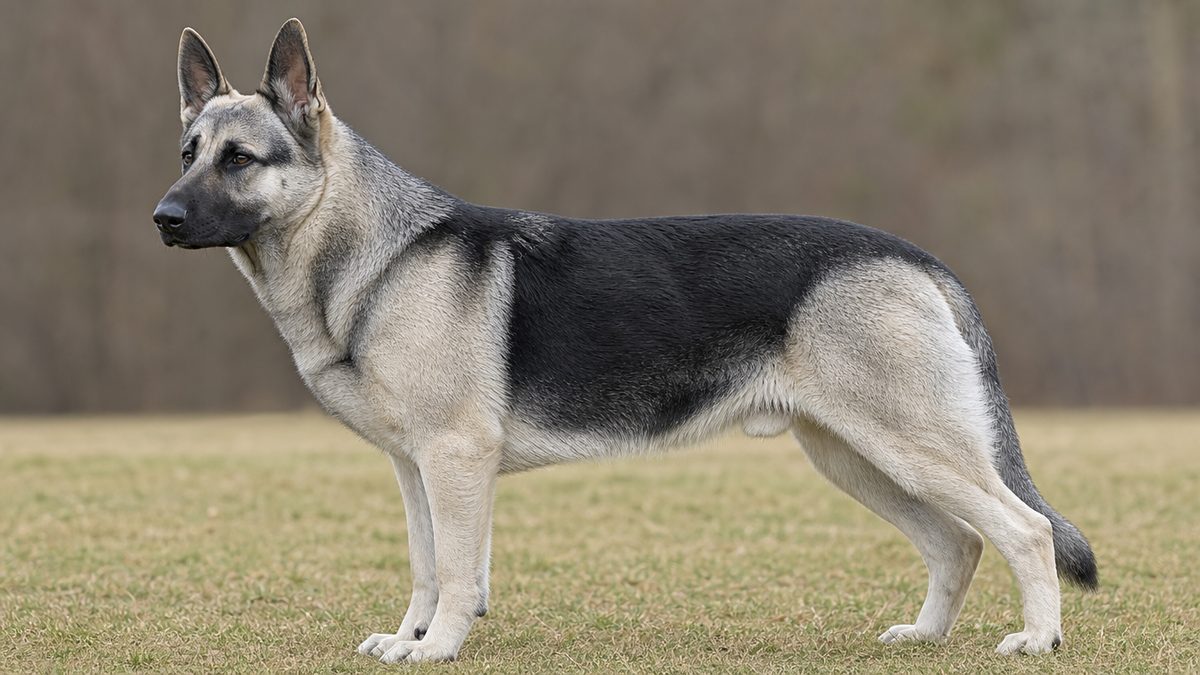
The East European Shepherd is a Russian service breed, not a German Shepherd variety. The Russian Kynological Federation recognised it on 1 November 2002, and its standard sets males at 67 to 72 cm and females at 62 to 68 cm, taller than the German Shepherd it was built from. The Nordic Kennel Union recognised it from 1 January 2017; the FCI does not. No Indian price exists, because an Indian search returns German Shepherd listings and no commercial import route is open.
This page reports published registry, veterinary and legal evidence and is not veterinary advice. No screening database holds enough evaluations of this breed to publish a prevalence figure, so nothing here can substitute for examining an actual dog. Consult a registered veterinarian before acting on anything you read here, and take any dog showing heat stress, collapse, laboured breathing or a rectal temperature above 40 degrees Celsius to a veterinarian immediately rather than treating it at home.
East European Shepherd at a glance
What the East European Shepherd is, and what its breed standard actually says
The East European Shepherd is a Russian service breed built in the USSR from imported German Shepherd stock, and its governing document is the Russian Kynological Federation standard approved by the RKF Presidium on 15 October 2014, with amendments adopted on 18 March 2020.
The breed's Russian name is Vostochnoevropeiskaya Ovcharka, shortened to VEO, and the RKF standard lists its origin as "USSR, Russia" and its purpose as "Universal service dog. Companion dog."; It sits in Group 1, Sheepdogs and Cattledogs, Section 1, and it is classified with working trials, meaning a dog needs a passed working qualification to enter the working class at an RKF show.
Size is where the standard is most specific, and it is the figure most often reported wrongly. The desirable height at the withers is 67 to 72 cm for males and 62 to 68 cm for females, with a departure of up to 2 cm tolerated where the dog is otherwise harmonious. Outside that, the standard bites hard: a male under 65 cm or over 74 cm, or a female under 60 cm or over 70 cm, is disqualified outright.
The standard specifies no weight at all. Nowhere in either the Russian or the English text is a kilogram figure given. Every weight range you will read for this breed, including the 35 to 60 kg for males that the only Indian page in the ranking set prints, comes from somewhere other than the standard. Treat those numbers as folklore until someone shows you the document.
Build, head and the erect ears
The dog is rectangular rather than square: the standard requires the body length to exceed the height at the withers by 10 to 18 percent, and the head to measure about 40 percent of the height at the withers. Bone is strong and the dog is heavily muscular, and sexual dimorphism is explicitly "well-pronounced", with males larger and more massive than females.
The ears are medium, erect, set high and shaped as an isosceles triangle, held parallel to each other when the dog is alert. One or both ears hanging is a disqualifying fault, and soft ears or a tipped ear is a severe fault. Those erect ears matter far more in India than any show ring, for reasons the grooming section sets out.
Eyes are medium, almond, slightly oblique and "dark brown, as dark as possible";. The standard then closes the door: "Any colour, any eye color, any pigmentation of nose, lips or eyelids not described by the standard are disqualifying faults." English Wikipedia nonetheless tells readers the eyes "may be brown, amber or blue", citing a 1995 breed atlas published seven years before the RKF recognised the breed. A blue-eyed East European Shepherd is not a rare variant. It is a disqualified dog.
Coat and coat colour
The coat is a true double coat: a straight, moderately harsh, dense, close-lying outer coat of medium length over a well-developed, thick and soft undercoat. Hair is shorter on the head, ears and front of the legs, slightly longer on the neck, and forms moderate trousers on the back of the thighs. A curly coat, a long coat, a short coat, or an absent undercoat are all disqualifying. That last clause is worth holding onto: this is a breed whose standard disqualifies a dog for not carrying enough coat, which is exactly the wrong instruction for a hot country.
There are four permitted colours and no others. The RKF standard's own stud book table lists them in both languages.
| Russian | English | Notes from the standard |
|---|---|---|
| Черный | Black | Solid black. Small white chest marks allowed but undesirable |
| Палевый с черным чепраком | Pale with black saddle | Saddle of varying intensity, bright red patches undesirable |
| Черный с палевым подпалом | Black with pale tan | Tan from light grey-pale to pale, bright red tan undesirable |
| Зонарно серый | Wolf grey | Zonal or agouti banding, all shades to light red |
The standard adds that all four colours may be bred to each other with no restriction. Anything outside those four, including the "black and silver" that Indian breed pages list, is a disqualifying colour rather than a rare one.
Temperament, in the standard's own words
The standard describes the breed in six words: "balanced, active, self-confident, attentive, easy in training", followed by "Reliable guard and companion."; A confident, balanced, highly trainable guard dog is what the document promises. Aggression or excessive shyness is a disqualifying fault, and so is any dog "clearly showing physical or behavioral abnormalities".
The standard says "Dewclaws should be removed (in the countries, where it is not prohibited by law)." India is such a country. The Prevention of Cruelty to Animals (Dog Breeding and Marketing) Rules 2017, Second Schedule Part II paragraph 6(8), forbids "de-clawing" and "any other kind of mutilation of any body part of the pup". So the standard's own parenthesis settles it: in India the dewclaws stay on.
It is not a German Shepherd, and six German Shepherd figures that do not transfer
The East European Shepherd was developed from German Shepherd stock and is a separate breed with its own standard, so German Shepherd numbers must not be imported onto it, and six of them routinely are.
The relationship is real and one-directional. Between 1924 and 1936 a small number of German Shepherds of varying lines and types were imported from Germany into the Soviet Union, and ministries with an interest in the breed set out to create a new shepherd breed better adapted to the country's varied terrain and climate, crossing in native dogs of unknown origin. That programme produced a distinct breed, not a regional German Shepherd. The Russian Kynological Federation recognised it as its own breed on 1 November 2002.
Every Indian page we found reasons the other way. The only Indian publisher in the ranking set states plainly that the breed may be prone to hip and elbow dysplasia, degenerative myelopathy, bloat and progressive retinal atrophy "due to its large size and German Shepherd lineage";. That is a hypothesis dressed as a finding. Below is what happens when you check each borrowed figure against a document.
| Borrowed figure | Why it fails for this breed |
|---|---|
| German Shepherd height, 60 to 65 cm for males | The RKF standard for this breed gives 67 to 72 cm and disqualifies a male above 74 cm. A dog at the German Shepherd's ceiling would be below this breed's disqualifying floor of 65 cm. |
| German Shepherd heat-illness odds ratio | Hall 2020 reports the German Shepherd Dog at OR 0.92, 95% CI 0.35 to 2.48, p = 0.874, against Labrador Retrievers. The interval spans 1, so it shows no difference, and the words East European appear zero times in the paper. There is no East European Shepherd odds ratio to quote. |
| German Shepherd hip dysplasia prevalence from OFA | OFA registers this breed as VOSTOCHNO-EVROPEISKAYA OVCHARKA under the code VEO but publishes no statistics row for it in any of its 222 databases. Its German Shepherd figure describes German Shepherds. |
| German Shepherd lifespan estimates | No lifespan study covers this breed. The three ranges circulating for it, 10 to 12, 11 to 13 and 10 to 14 years, come from three commercial breed directories and none cites a dataset. |
| The sloping, roached German Shepherd topline | This breed's standard requires a topline that is "very smooth, straight from withers and slightly falling at croup". A roached back is not the breed type here, and buyers judging an East European Shepherd by German Shepherd show conformation will pick the wrong dog. |
| German Shepherd degenerative myelopathy risk | Asserted for this breed by Indian pages on the strength of shared ancestry alone. The Swedish breed club's own health section names pannus, demodicosis, hip dysplasia, elbow dysplasia, cryptorchidism, umbilical hernia and epilepsy, and does not name degenerative myelopathy at all. |
What legitimately does carry over
Shared ancestry is a reason to screen, not a reason to quote a number. Two things transfer honestly. First, the founding population was German Shepherd, so the conditions that segregate in German Shepherds are plausible candidates here and are worth testing for. Second, the Swedish breed club records that abroad there have been cases of hip dysplasia, elbow dysplasia, cryptorchidism, umbilical hernia and epilepsy in this breed, and says a survey of how widespread they are has yet to be carried out. That is a list of candidates with an admission attached, which is the honest form of the claim.
The distinction matters commercially in India, because it is the same distinction that decides whether the dog in front of you is the breed at all. A seller who cannot tell you why this dog is not a German Shepherd is probably selling you a German Shepherd.
This is the same failure the sibling guide to the Chukotka sled dog documents, where six Siberian Husky figures were refused one by one. A breed that lives permanently in a better-known relative's shadow accumulates that relative's data, and the data is never labelled as borrowed.
Recognition: RKF yes, Nordic Kennel Union yes, FCI no
Three registers answer the recognition question, and the middle one is the layer every ranking page omits.
The Russian Kynological Federation recognises the breed. Its Standards Commission recognised the East European Shepherd and adopted a standard on 1 November 2002, and the RKF Presidium approved the current edition on 15 October 2014 with amendments on 18 March 2020. The RKF takes the breed seriously enough that its president, Vladimir Golubev, declared 2025 the Year of the Russian Borzoi and the East European Shepherd, the same national-breed programme that had run for the Central Asian Shepherd in 2023 and the Black Russian Terrier in 2024.
The Nordic Kennel Union recognises it, from 1 January 2017. The Swedish Kennel Club states it on the breed's own page in one sentence: "Rasen är erkänd av den Nordiska Kennelunionen, NKU, men inte av den internationella kennelorganisationen, FCI."; The breed therefore has a Swedish breed standard document, a Swedish breed club, a specialist club in the Swedish Working Dog Club, and dogs registered in a Nordic stud book. This is the regional layer that sits between national recognition and the FCI, and it changes what a European buyer can actually do with the dog.
The Federation Cynologique Internationale does not recognise it, and we checked rather than assumed. The FCI's definitive nomenclature under the letter E lists sixteen breeds, from Eesti Hagijas to Eurasier, and the East European Shepherd is not among them. The provisional register, read at its real address rather than the decoy path that serves an English Setter page, lists twenty-one breeds and does not include it either.
That provisional register is current rather than stale, which is the point of reading it. Its four newest entries, the Macedonian Shepherd Dog Karaman at number 378, the Sabueso Fino Colombiano at 376, the Segugio dell'Appennino at 375 and the Tatranský Durič at 377, all carry a provisional recognition date of 11 February 2026. A register that admitted four breeds this February and still does not list this one is telling you something real.
The RKF agrees. Its own standard prints the line on the front page, in both languages: "The breed is not recognized by FCI by now."; When the national kennel club that created the standard says the FCI has not recognised its breed, the question is settled from both directions.
What this means for India specifically
India is a full member of the FCI, represented by the Kennel Club of India in Chennai. Because the KCI issues pedigrees against FCI nomenclature, FCI recognition status effectively answers the India recognition question, and the answer is that no KCI pedigree can exist for an East European Shepherd as an FCI-nomenclature breed.
We should be careful about how far that goes. The KCI does not publish a breed list, so a query against its site returns nothing for this breed and nothing for every control breed too. That is a limitation of the instrument, not evidence about the dog, and we are not reporting it as non-recognition by the KCI. The FCI route is the one that is checkable, and it is the one stated above.
| Register | Status | Where the answer was read |
|---|---|---|
| Russian Kynological Federation | Recognised, standard adopted 1 November 2002 | RKF breed standard, English and Russian editions |
| Nordic Kennel Union | Recognised with effect from 1 January 2017 | Svenska Kennelklubben breed page and the Swedish breed club's RAS |
| FCI, definitive nomenclature | Not listed | FCI nomenclature, letter E, sixteen breeds |
| FCI, provisional register | Not listed | FCI provisional register, twenty-one breeds, newest four dated 11 February 2026 |
| Kennel Club of India | No FCI-nomenclature pedigree possible | FCI members register listing India as a full member |
| Continental Kennel Club, USA | Recognised, with its own separate standard | CKC breed page and standard text |
The brief for this page said the RKF recognises the breed and the FCI does not, which is true but incomplete. It omitted the Nordic Kennel Union entirely, and the NKU layer is the one that determines whether the dog can be shown and registered across Denmark, Finland, Iceland, Norway and Sweden. Recognition is not binary.
Two documents call themselves this breed's standard, and they contradict each other
Two organisations publish a standard for the East European Shepherd, the Russian Kynological Federation and the Continental Kennel Club in the United States, and they disagree on the bite, the coat length and the eye colour.
This matters to an Indian buyer for one reason. When a seller tells you a dog "meets the standard", you need to know which one, because a dog that passes under the American document can be disqualified under the Russian one.
| Point | RKF standard | Continental Kennel Club standard |
|---|---|---|
| Bite | Scissor bite. "Any departure from scissor bite" is a disqualifying fault | "The bite may be level or scissor" |
| Coat length | Outer coat of medium length. A short coat is a disqualifying fault | Quick Facts panel says "Short double-coat"; the same page's standard text says "medium-length" |
| Eye colour | "Dark brown, as dark as possible". Any other eye colour disqualifies | "Medium to dark brown" |
| Colour | Exactly four colours. Anything else disqualifies | Black, black and tan, agouti, tan with black saddle, creeping or running tan, with or without a melanistic mask |
| Dentition | 42 teeth. Missing any tooth except P1 or M3 disqualifies | 42 teeth, but "Missing or broken teeth due to routine work are not to be penalized" |
| Feet | Oval, arched, tight. No mention of webbing | "Toes are well-webbed for swimming" |
| Weight | No weight figure given anywhere in the document | Males 85 to 105 lb, females 75 to 95 lb |
The Continental Kennel Club page contradicts itself as well as the RKF. Its Quick Facts panel calls the coat a "Short double-coat" while its own standard text on the same page describes "a medium-length, straight, harsh, close-fitting outer coat";. Under the RKF standard, short coat is a disqualifying fault, so the American summary panel describes a dog the Russian standard would put out of the ring.
The webbed-toe line is the tell that a template was reused. Nothing in the RKF standard mentions webbing, this is a Group 1 herding and service breed rather than a water dog, and the phrase reads exactly like boilerplate carried over from a retriever entry.
The RKF's own English translation drops a word, and the sentence becomes impossible
The RKF publishes its standard in Russian and in English, and the English version contains an error you can prove by putting the two side by side. Under Important Proportions the English text reads: "The height at the elbows is equal or a bit more than the height at withers."; That is anatomically impossible, since a dog's elbow cannot sit as high as its withers.
The Russian original says something sensible. It reads "Длина передних конечностей до локтей примерно равна или чуть больше половине высоты в холке", which is: the length of the forelegs to the elbows is approximately equal to, or slightly more than, half the height at the withers. The English translation dropped the word half. The proportion the breed actually calls for is a dog standing on legs slightly longer than half its own height, which is a real and checkable conformation point.
The same English edition carries a second slip, dating the Russian revolution and civil war to "(2017-2021)" where the Russian text and history both give 1917 to 1921. Neither error changes the breed. Both are worth knowing, because they show that the English document is a translation with mistakes in it, and anyone quoting it should check the Russian before building an argument on a single sentence.
How to verify a document is about this breed at all
This breed has already produced a real case of the right document reaching a reader from the wrong place. German Wikipedia's article on the Bolonka Zwetna, a 3 to 4 kg Russian toy bichon, carries an infobox row labelled Zuchtstandards, and the link under it points at rkf.org.ru/wp-content/uploads/2020/04/vostochnoevropejskaja-ang.pdf. That file returns HTTP 200 and serves a complete, correctly formatted RKF standard, with the Presidium dates and the amendment history, for the East European Shepherd. Nothing errors. The document is genuine. It is simply attached to the wrong breed's article.
The defence is one line long and costs nothing. Before you take a single figure from a document, read the breed name printed on the document's own face, not the link text, not the page that linked to it, and not the URL. The East European Shepherd standard names itself in its first heading, in three forms: ВОСТОЧНОЕВРОПЕЙСКАЯ ОВЧАРКА, Vostochnoevropeiskaya Ovcharka, and East European Shepherd. If the heading does not name your breed, you have the wrong document rather than a hard one.
The same discipline works in a kennel. Ask to see the pedigree document itself and read the breed name printed on it. A seller offering an "East European Shepherd" with a KCI pedigree naming a German Shepherd has handed you the answer without meaning to.
History: a state breeding programme, and three countries that claim it
The East European Shepherd was created by a Soviet state programme that ran from 1924 to the 1950s, and three published sources place its origin in three different places.
The RKF standard tells the story as a Moscow story. On the initiative of the cynologist Vsevolod Yazykov, order No. 1089 of the Revolutionary Military Council of the USSR created the Central Educational and Experimental Kennel-school of military and sporting dogs in 1924, which from 1941 became the Central Military Technical Dog Breeding School. The main breeding centre was the Red Star kennel, established in 1947 on the base of that school.
The selection criteria are the most interesting sentence in the whole document, and they cut against the assumption that this is simply a cold-weather dog. The standard says the task was "replenishing domestic services with suitable dogs capable of working in different climate conditions, from Central Asian deserts to the polar tundra", so the main criteria were "physical and working qualities of dogs, endurance, unpretentiousness and climate adaptability, but not their bloods." The breed was selected to acclimatise across a range, not to specialise in cold.
Crossbreeding was deliberate and openly recorded. Purebred dogs and suitable mixes were both used, and in the Far East the programme drew on Amur laikas, themselves crosses of local laikas with German Shepherds. Among them was Ingus, the dog of border-troops colonel Nikita Karatsupa, a Hero of the Soviet Union. During the Great Patriotic War more than 60,000 service dogs served in the Soviet armed forces, across guard, search, sanitary, anti-tank, mine-search, sledge, signal and communication duties.
The standard's own timeline
- 1924. Central Educational and Experimental Kennel-school founded by military order No. 1089.
- 1924 to 1936. A small number of German Shepherds of varying lines imported from Germany into the USSR.
- 1941. The school becomes the Central Military Technical Dog Breeding School.
- 1947. The Red Star kennel established as the main breeding centre.
- 15 September 1955. First standard approved by the DOSAAF USSR Central Committee.
- January 1964. New edition approved by the Presidium of the Utility Dog Breeding Federation of the USSR.
- 1970, 1972 and 1976. Further amendments and new editions.
- 1991. The Russian Kynological Federation founded.
- 1 November 2002. The RKF Standards Commission recognises the breed and adopts its standard.
- 15 October 2014. RKF Presidium approves the current edition, amended 18 March 2020.
One detail from the Swedish breed club fills a gap the Russian document leaves. Until the 1960s every dog was registered as a military dog and belonged to the armed forces, required to report for duty in the event of war. This was not a pet breed that later found police work. It was state property that later became a pet.
Three sources, three countries of origin
The origin question is genuinely unsettled in the published record, and rather than pick one, here are all three.
| Source | Claimed origin | Its own authority |
|---|---|---|
| RKF breed standard | USSR, Russia. Names the Moscow school and the Red Star kennel, and no republic | The document that defines the breed |
| English Wikipedia | Ukrainian SSR, from German Shepherds imported in the 1920s | Morris 2001 and Wilcox and Walkowicz 1995, two commercial breed atlases |
| Continental Kennel Club | Byelorussia, hence "Byelorussian Ovcharka", programme run in the early 1920s | Its own uncited breed history |
Our reading is that the RKF standard carries the most weight, because it is the constitutive document of the breed and it is specific about institutions rather than about republics. But it is also written by the party with the strongest interest in a Russian origin, and it is not neutral. The honest statement is that the breed was made by an all-Union military programme headquartered near Moscow, that German Shepherd imports and local dogs both fed into it, and that claims placing it specifically in Ukraine or Belarus rest on secondary sources rather than on the standard.
One further claim circulates and should be flagged as unverified rather than repeated as fact. Both Wikipedia and the Continental Kennel Club report that the KGB kept only solid black dogs, and destroyed any litter containing an off-colour puppy. Wikipedia sources it to a 2001 breed atlas. We could not find it in any primary Soviet or Russian document, and the RKF standard does not mention it. It is a good story with a thin chain behind it.
East European Shepherd price in India: there is no Indian price, and here is the proof
No East European Shepherd price in india exists, because no Indian seller offers the breed and no lawful commercial import route can supply one.
We searched for it directly, in India, and the result is the finding. A search for "east european shepherd dog breed price india" returned ten organic results of which nine were German Shepherd pages: Supertails, TradeIndia, Mr n Mrs Pet, PetsWorld, KIKI's Cuddle, Quora, a Supertails price list, Shubh Kennel and PetsWorld again. The single result actually about this breed was a Russian-language site quoting rubles.
The two published price figures we could find are both foreign, and neither describes an Indian transaction.
| Source | Figure as published | At 84.38 | At 80.00 |
|---|---|---|---|
| Dog Breeds List, a US directory | USD 900 to 1,200 average | Rs 75,942 to Rs 1,01,256 | Rs 72,000 to Rs 96,000 |
| Zoonika, a Russian breed site | 10,000 to 20,000 rubles | Not a dollar figure | Not a dollar figure |
Neither is an Indian price. A US directory's dollar average tells you what an American buyer might pay a US breeder, and the rupee columns above exist only so you can recognise those numbers if an Indian page ever prints them as though they were local.
The ruble figure comes from a page that cannot keep its own numbers straight, which is worth showing because it is the only breed-specific price in the ranking set. Zoonika's infobox gives the weight as 35 to 80 kg for males and 30 to 65 kg for females; its Appearance section, on the same page, says weight "typically ranges from 30 to 45 kg";. The infobox gives the height as 67 to 72 cm for males, and the body text gives "60 to 70 cm" for the breed. A page whose stated maximum weight varies by 35 kg between two of its own paragraphs is not a source for a price.
The same page carries the seams of a reused template. Its table of contents lists "6. Как выбрать котенка", which is "How to choose a kitten", on a dog breed page. Its markup prints a raw PHP warning to the reader, "Illegal string offset 'label' in ... animals-param-item.php on line 32". Its history section attributes the breed to "local herding, hunting, and wolfhound breeds" and never mentions the German Shepherd at all, which contradicts the RKF standard's own account of German Shepherd imports between 1924 and 1936. It is cited here as evidence of how this breed's data is assembled, not for any fact about the dog.
What an Indian buyer is actually offered, and what it costs
In practice an Indian search for this breed delivers German Shepherd inventory, so the honest price band to quote is the German Shepherd band. One Indian marketplace publishes three tiers on a single page: German Shepherd at Rs 40,000 to Rs 80,000, Z Black German Shepherd at Rs 80,000 to Rs 1,20,000, and White German Shepherd at Rs 1,20,000 to Rs 2,00,000.
Those four figures deserve the conversion test this site runs on every suspicious Indian price, and the result is genuinely inconclusive, which is worth showing rather than hiding.
| Rupee figure | Divided by 84.38 | Divided by 74 | Divided by 80 |
|---|---|---|---|
| Rs 40,000 | 474.05 | 540.54 | 500.00 |
| Rs 80,000 | 948.09 | 1,081.08 | 1,000.00 |
| Rs 1,20,000 | 1,422.14 | 1,621.62 | 1,500.00 |
| Rs 2,00,000 | 2,370.23 | 2,702.70 | 2,500.00 |
Every figure fails at 84.38 and at 74, and every figure divides exactly at 80 to a number a seller would plausibly print: 500, 1,000, 1,500 and 2,500 dollars. That looks like a converted price list until you notice why the test cannot decide it. Any rupee figure ending in three zeros divides cleanly by 80 as a matter of arithmetic, because 1,000 divided by 80 is 12.5, and Rs 40,000, Rs 80,000, Rs 1,20,000 and Rs 2,00,000 are exactly the round rupee numbers an Indian seller would choose anyway. The 80 test cannot separate a converted list from honest round-number pricing here, so we draw no conclusion from it. Saying so is more useful than a verdict the evidence does not support.
Ask three questions before anything else. Which register issued the pedigree, and may I read the breed name printed on it? Which port did the parent dogs enter through, and under which DGFT policy condition? What are the sire's and dam's hip and elbow scores, and who read the plates? A seller with a genuine imported East European Shepherd can answer all three. A seller with a German Shepherd and a story cannot answer any.
Bonbeno does not broker sales and does not link puppy listings. The figures above are reported as published editorial evidence about a market, not as an offer.
What an Indian search for this breed actually returns
An Indian search for the East European Shepherd returns three things, and none of them is the breed: German Shepherd inventory, auto-generated directory shells, and a substituted result set.
1. The only Indian publisher ranking for the breed sells nothing for it
GoofyTails, an Indian pet retailer, is the sole Indian domain in the top ten for "east european shepherd";. Its breed page carries a real article, then a product grid, and the grid renders "We're sorry. There are no results for ''." followed by "Meanwhile checkout some of our bestsellers". The page ranks for the breed and stocks nothing for it, which is the clearest single statement of the Indian market that exists.
Its data is worth checking rather than trusting. The page's height table gives males 66 to 76 cm and females 62 to 72 cm. Under the RKF standard a male over 74 cm and a female over 70 cm are disqualified, so the upper end of both published ranges describes dogs the breed's own standard rejects. Its colour list includes "black and silver", which is not one of the four permitted colours and is therefore a disqualifying coat colour. Its weight range, 35 to 60 kg for males, matches Russian Wikipedia rather than any standard, because the standard gives no weight.
Two of the four photographs on that page are not the breed. One carries the stock caption "Husky dog jumping over the river cliff" and another "German shepherd aggressive dog train obedience";. An Indian reader learning what this dog looks like from that page is being shown a Siberian Husky and a German Shepherd.
2. The directory shells
Justdial publishes "Popular Pet Shops For East European Shepherd Dog in Mumbai" and populates it with general pet shops such as Dogs World India in Thane and Petsbarn in Andheri West. Nothing on the page connects any listed shop to the breed. This is a category page generated by crossing a breed name with a city name, and an identical page exists for breeds no Indian shop has ever stocked. A page titled for a breed is not a page containing that breed.
3. The search engines destroy the breed's name
This is the strangest finding on the page and it explains the other two. The breed's English name is built from three extremely common words, and two separate pieces of search infrastructure discard it.
Bing India returned HTTP 200 for "east european shepherd", with the correct page title and roughly 128 KB of markup, and served ten results about the word "east";: East on Wikipedia, the Merriam-Webster definition of EAST, East India on Wikipedia, the Simple English Wikipedia entry for East, Wiktionary, two Cambridge Dictionary entries, The Free Dictionary, "East meaning in Hindi", and an East India zone map. Not one result concerned a dog. A control query run in the same session against the same endpoint, "labrador retriever price in india", returned ten genuine Indian Labrador price pages, so the tool was working and this result set specifically was substituted.
PubMed does the same thing in its own idiom. Searching "East European Shepherd" returns 46 records, a confident-looking number, because the engine translated the phrase into `east AND ("european people"[MeSH] OR "european") AND ("shepherd" OR "shepherds")`. The first five results are a Parkinson's disease genetics study in Taiwan, a review of minority informal caregivers, a meta-analysis of bowel preparation for colonoscopy, a tuberculosis modelling paper and a second Parkinson's paper. Zero concern dogs.
If a search engine cannot hold this breed's name together, an Indian buyer typing it will be shown German Shepherds and will reasonably conclude the two are the same thing. The confusion this page exists to correct is partly manufactured by the search layer itself.
So the honest summary of the Indian market is short. No Indian seller offers the breed. No Indian publisher carries accurate data on it. No Indian price exists. What exists is a search path that quietly converts the query into a German Shepherd purchase.
Why no lawful commercial supply of this breed can form in India
Indian import law closes the commercial route for this breed entirely, and leaves exactly three narrow doors open, one of which is unusually relevant to a service breed.
The governing instrument is DGFT Trade Notice No. 22/2022-23, dated 19 December 2022. It sets out the import policy for ITC (HS) 01061900, "Mammals: Other", which is where dogs sit, and the policy is Restricted, subject to Policy Condition 6 of the chapter.
Policy Condition 7 lists the only purposes for which a dog may be imported, and there are three:
- Pet dog with a valid pet book and relevant records or documents in the name of the importer.
- Dogs imported by R&D Organisations for conducting research, with the recommendation of the CPCSEA.
- For the internal security by the Defence and Police Force.
Policy Condition 8 then closes the commercial door in one sentence: "Import of commercial dogs for breeding or any other commercial activities other than the purposes mentioned above is not permitted."; There is no lawful way to import East European Shepherds into India in order to breed and sell them. A breeding population therefore cannot form through trade.
The Defence and Police clause is the interesting one for this breed
Most rare-breed pages on this site note Policy Condition 7 and move on, because a decorative breed has no plausible route through clause (iii). This breed does. The RKF standard defines it as a "Universal service dog", it was created by a military programme for army, border-guard and police work, and until the 1960s every registered dog belonged to the Soviet armed forces. Svenska VEO rasklubben
So the one door in Indian law through which East European Shepherds could plausibly arrive in numbers is the service dog door, opened by a Defence or Police force for internal security, not by the pet trade. That is a genuine structural point and it is why an Indian civilian will not find this dog for sale even though the breed is not banned. Nothing here suggests any Indian force has done so, and we found no evidence that it has.
The pet route, and its conditions
The personal pet route is real but narrow. A permanent import of up to two pets is allowed as passenger baggage without DGFT authorisation only for a person transferring residence to India after two years of continuous stay abroad, and only cats and dogs qualify under the baggage rules. DGFT authorisation is required if the stay abroad was under two years, if the animal is not travelling as passenger baggage, or for more than two pets, in which case the application goes to the Department of Animal Husbandry and Dairying for examination.
The notice names its ports: "Import of pet animals is allowed only through airports and seaports of Delhi, Mumbai, Chennai, Hyderabad, Bangalore and Kolkata." Six ports, read from the notice itself. An Advance No Objection Certificate from the Regional or Quarantine Officer of one of those ports is also required, and animals may be quarantined there.
A separate instrument under the Livestock Importation Act 1898, S.O. 4396(E) of 10 October 2024, permits pet dogs and cats through Cochin International Airport, Kochi, under the Animal Quarantine and Certification Station, Chennai. That is a confirmed addition to the personal pet route. The DGFT notice still names six ports for its own licence route, so this page states the notice's list as the notice prints it, and a pet arriving under the baggage rules can land at seven ports today. Both lists are right for their own route, as how to import a dog to India sets out.
The practical consequence for a reader is simple. If you genuinely want this breed in India, the realistic path is to be a person returning from a country where it is established, with a real pedigree, a pet book in your own name, and two years of continuous residence behind you. Everything else on offer is a German Shepherd.
Heat tolerance: how the breed's home climate compares with six Indian cities
The East European Shepherd's heat tolerance is better than the northern-breed stereotype suggests and worse than its Indian sellers imply, and the way to settle it is to compare its home climate with Indian cities using the same instrument.
We used NASA POWER, queried by explicit latitude and longitude rather than by place name, because a climate site that resolves on a slug can silently serve you another city's document. The origin point is Moscow at 55.756 N, 37.617 E, the region of the Central Military Technical Dog Breeding School and the Red Star kennel where the breed was made. Every Indian figure below comes from the same API and the same climatology period.
| Place | Lat, lon | Annual mean | Warmest month | Coldest month |
|---|---|---|---|---|
| Moscow, breed origin | 55.756, 37.617 | 4.28 | 18.98 (Jul) | -10.65 (Jan) |
| Chennai | 13.083, 80.271 | 27.95 | 31.51 (May) | 24.09 (Jan) |
| Mumbai | 19.076, 72.878 | 26.77 | 31.19 (May) | 23.19 (Jan) |
| Kolkata | 22.573, 88.364 | 25.81 | 31.53 (May) | 17.31 (Jan) |
| Delhi | 28.614, 77.209 | 25.60 | 35.88 (Jun) | 13.61 (Jan) |
| Bengaluru | 12.972, 77.595 | 23.74 | 28.37 (Apr) | 20.22 (Dec) |
| Leh, Ladakh grid cell | 34.153, 77.577 | -2.75 | 10.18 (Jul) | -16.01 (Jan) |
One line does most of the work. Chennai's coldest month, January at 24.09 degrees, is 5.11 degrees warmer than Moscow's hottest month, July at 18.98. A dog bred for that origin climate would spend its coolest Chennai week in conditions warmer than any week its home city ever produces.
Where the honest answer differs from the northern-breed cliche
This breed is not the Chukotka sled dog, and pretending otherwise would be lazy. Moscow has a real summer. Its July mean is 18.98 degrees and its all-time maximum in the record is 35.06 degrees, in August. The RKF standard says outright that the founding selection criteria were endurance, unpretentiousness and "climate adaptability", for dogs expected to work "from Central Asian deserts to the polar tundra";. This breed was selected to acclimatise across a range. It is genuinely hardy in a way a purely Arctic landrace is not. But hardy is not the same as heat-tolerant, and that distinction is what the rest of this section measures.
Two Indian facts follow, and they point in opposite directions.
- North Indian winter is genuinely workable. Delhi's January mean of 13.61 degrees is 5.37 degrees cooler than Moscow in July. December at 15.2 and February at 17.4 are also below the breed's home summer. For roughly four months a year, Delhi is climatically easier than Moscow's peak season.
- Delhi's summer is not. Its June mean is 35.88 degrees, its all-time maximum in the record is 48.79 degrees, and there is no analogue for that anywhere in the origin climate.
So the verdict is seasonal rather than absolute, which is a different and more useful answer than "unsuitable". The problem is not that India is warm. It is that the hot season is long, the humid season overlaps it, and a double-coated dog whose standard disqualifies an absent undercoat has no way to reduce its own insulation.
Ladakh, and a caveat about the grid
Leh's grid cell runs colder than the breed's own homeland: an annual mean of -2.75 degrees against Moscow's 4.28, and a July mean of 10.18 against Moscow's 18.98. On temperature alone, Ladakh is the one Indian location where this dog would be under-challenged rather than over-challenged.
State the caveat plainly. The NASA POWER grid cell returned for those coordinates has an elevation of 4,533 metres, well above Leh town at roughly 3,500 metres, so the figures describe the cell rather than the town and will read colder than the streets do. Ladakh is also where the second problem starts, because altitude means ultraviolet exposure, and the one eye condition actually recorded in this breed is a UV-driven one. The health section returns to that.
This page rates heat tolerance 2 out of 5 rather than 1. A 1 belongs to a breed with no summer in its origin climate at all. Moscow reaches 35 degrees, and the standard was written around climate adaptability. A 2 says the dog can survive an Indian winter in the north and will struggle badly from March to October almost everywhere else.
Wet bulb is the number that decides this, not the thermometer
Wet bulb temperature decides whether a panting dog can shed heat at all, and by that measure every Indian metro is further from this breed's origin climate than the air temperature suggests.
A dog cools almost entirely by evaporation from the respiratory tract, so what limits it is not how hot the air is but how much more water the air can absorb. Wet bulb temperature captures exactly that, and it is the figure that separates a dry 40 degrees from a humid 33 that is far more dangerous.
| Place | Annual mean | Worst month | Best month |
|---|---|---|---|
| Moscow, breed origin | 3.14 | 17.11 (Jul) | -11.02 (Jan) |
| Kolkata | 22.85 | 27.86 (Jun) | 13.64 (Jan) |
| Delhi | 18.03 | 27.74 (Jul) | 6.86 (Jan) |
| Chennai | 24.94 | 27.36 (May) | 21.77 (Jan) |
| Mumbai | 22.73 | 26.55 (Jun) | 17.06 (Jan) |
| Bengaluru | 19.80 | 22.66 (May) | 16.43 (Jan) |
| Leh, Ladakh grid cell | -7.66 | 4.03 (Aug) | -18.86 (Jan) |
Moscow's worst wet bulb month, July at 17.11 degrees, is the right yardstick, because it is the most evaporatively hostile month the breed's home climate produces. Counting how many Indian months are worse than that turns the comparison into something a reader can act on.
| City | Months worse than Moscow's worst | Which months |
|---|---|---|
| Chennai | 12 of 12 | Every month of the year |
| Mumbai | 11 of 12 | February to December; January at 17.06 is level with it |
| Bengaluru | 10 of 12 | March to December |
| Kolkata | 9 of 12 | March to November |
| Delhi | 7 of 12 | April to October |
| Leh grid cell | 0 of 12 | None; the annual maximum is 4.03 degrees |
Chennai never gets a break. Its mildest wet bulb month, January at 21.77 degrees, is still 4.66 degrees worse than the worst month Moscow produces. There is no season in Chennai during which this dog's cooling system faces conditions its origin climate would recognise.
Delhi is the interesting case, and it is why a single annual figure misleads. Delhi's annual mean wet bulb of 18.03 degrees looks almost moderate, only 14.89 above Moscow's. But that average hides a January of 6.86 and a July of 27.74, a spread of nearly 21 degrees inside one year. A north Indian owner gets five genuinely comfortable months and seven that are worse than anything the breed was selected against.
The monsoon does the damage the thermometer misses
Relative humidity is where the coastal cities pull ahead of Delhi in the wrong direction. Mumbai reaches 90.4 percent mean relative humidity in August, Kolkata 89.3 percent in September, and Bengaluru 81.0 percent in October, against Delhi's monsoon peak of 74.9 percent in August. Moscow's own relative humidity is higher still on paper, at 87.5 percent annual mean, but at 4 degrees a saturated atmosphere holds almost no water, which is exactly why relative humidity alone is a poor guide and wet bulb is the better one.
For an owner this converts into a rule rather than a number. Walk on wet bulb, not on the thermometer. A 31 degree Mumbai morning in June at a wet bulb near 26.6 is a harder exercise environment for this dog than a 36 degree Delhi afternoon in May at a wet bulb near 21.9, even though the Delhi reading is five degrees hotter.
You do not need to measure wet bulb. Use the proxy: if your shirt stops drying and the air feels heavy, evaporative cooling is failing for you and it is failing far worse for a dog carrying a dense double coat. That is a day for indoor mental work, not for a run.
What the best heat-illness study can and cannot tell you about this breed
The strongest evidence on canine heat illness is Hall 2020, and it does not model the East European Shepherd at all, so only its transferable risk factors may be applied here.
Two companion papers from the same VetCompass cohort carry the numbers. Both drew on 905,543 UK dogs under primary veterinary care in 2016. Hall EJ, Carter AJ The incidence paper identified 395 confirmed heat-related illness events from 390 dogs, giving a one-year incidence risk of 0.04 percent (95% CI 0.04 to 0.05) and an event fatality rate of 14.18 percent (95% CI 11.08 to 17.96).
The trigger paper is the one most often misquoted, so here is the sentence as the paper prints it. Of 1,259 prevalent events, 380 had no trigger recorded, leaving 879 events with a recorded trigger, of which 652 were exertional, 74.2 percent, followed by environmental at 113, 12.9 percent, and vehicular confinement at 46, 5.2 percent. The percentages are computed on 879, not on 1,259. Anyone quoting "74.2 percent of 1,259 events" has produced 934 cases that do not exist.
The practical lesson from that number is the opposite of the folk belief. Most dogs that overheat are not shut in cars. They are exercising, usually with their owner, usually because the owner did not think it was that hot.
The breed is absent from the model, and that must be said
The words "East European" appear zero times in either paper. The breed inclusion rule required a breed to have at least five heat-illness cases and at least 5,000 dogs in the study population, and a Russian service breed with no established UK population meets neither. There is no East European Shepherd odds ratio, and any page that quotes one has invented it.
Three factors from the paper are not breed-specific and do transfer honestly.
| Risk factor | Finding | Relevance here |
|---|---|---|
| Bodyweight at or above the breed and sex mean | OR 1.42, 95% CI 1.12 to 1.80 | Applies directly. Keep the dog lean. This is the single controllable factor an Indian owner has. |
| Age over two years | Greater odds in the 2 to under 4, 6 to under 8 and 12 or more year bands | Applies directly. The risk is not concentrated in puppies. |
| Bodyweight over 50 kg | Greater risk in the alternative bodyweight model | Applies to large males, with a caveat: the RKF standard specifies no weight, so whether a given dog crosses 50 kg is a fact about that dog, not about the breed. |
| Brachycephalic skull shape | Greater risk | Does not apply. This breed is wedge-headed with a muzzle about half the head length. |
And one number that must not be borrowed
In the same model, the German Shepherd Dog sits at OR 0.92, 95% CI 0.35 to 2.48, p = 0.874, against Labrador Retrievers. The confidence interval spans 1 and the p value is 0.874, so the honest reading is that the study found no difference for German Shepherds, not that German Shepherds are heat-resistant. It is nonetheless exactly the figure someone will lift onto this breed to argue it copes fine.
It should not be borrowed, for two independent reasons. It is not this breed, and it is not a significant result even for the breed it describes. For scale, the breeds that were significant ran from the Golden Retriever at OR 2.65 up to the Chow Chow at OR 16.61, and the Siberian Husky came in at 1.18 with an interval of 0.28 to 5.06, another non-result.
One further caution about reading the UK data into India at all. Forty percent of the UK's 2016 cases, 158 of 395, occurred in July, and there were no events at all in February, October or December. A UK dog gets a nine-month recovery season. Chennai's mildest wet bulb month is still worse than Moscow's worst. The incidence figure of 0.04 percent is a UK figure, and there is no reason to expect it to hold here.
Exertional heat illness is the dominant category and exercise is the thing you control. Do not run this dog between 10 am and 5 pm anywhere in mainland India from March to October. That single rule addresses the trigger behind 652 of 879 recorded events.
Cost of ownership in India: borrow the German Shepherd structure, and add the line it omits
No cost of ownership figure exists for an East European Shepherd in India because no Indian owner base exists to survey, so the nearest honest guide is the published German Shepherd cost structure, adjusted for a larger dog with more coat.
Borrow the structure, label the borrowing, and adjust the lines that genuinely differ. India's benchmark guide, vet-reviewed and published in 2026, puts monthly maintenance for a healthy adult German Shepherd at Rs 6,000 to Rs 12,000, covering food, healthcare, grooming and flea and tick prevention, with a further Rs 3,000 to Rs 6,000 a month during training periods.
| Line | German Shepherd in India, first year | Direction for this breed |
|---|---|---|
| Puppy purchase from a good breeder | Rs 30,000 to Rs 50,000 | Not quotable. No Indian source of the breed exists |
| Food, 12 months | Rs 36,000 to Rs 84,000 | Higher. A 67 to 72 cm male is bigger than a 60 to 65 cm one |
| Grooming, 12 months | Rs 9,600 to Rs 24,000 | Higher. Denser undercoat, and Indian humidity makes coat management non-optional |
| Professional training | Rs 10,000 to Rs 30,000 | Similar or higher. A working-line guard breed needs it more, not less |
| Vaccination series | Rs 2,500 to Rs 5,000 | Same |
| Deworming, four rounds | Rs 1,200 to Rs 2,400 | Same |
| Spay or neuter | Rs 5,000 to Rs 12,000 | Same |
| Anti-flea and tick, 12 months | Rs 3,600 to Rs 9,600 | Higher. A dense double coat is harder to inspect for ticks |
| Accessories | Rs 8,000 to Rs 20,000 | Higher. Crate, bedding and collar all size up |
| Total first year | Rs 1,00,000 to Rs 2,40,000 | A floor, not an estimate |
From year two, that guide puts ongoing annual costs at Rs 60,000 to Rs 1,20,000 depending on food quality and veterinary need. Its monthly food table is worth reading directly, because the range is wide: budget kibble at Rs 2,500 to Rs 4,000, premium kibble at Rs 5,000 to Rs 8,000, home-cooked at Rs 3,000 to Rs 5,000 and raw at Rs 4,000 to Rs 7,000.
The line the benchmark leaves out
There is no cooling line anywhere in that cost table. That is a defensible omission for a German Shepherd, which is a moderately coated breed most Indian owners keep without climate control. It is not defensible for a dog whose standard makes an absent undercoat a disqualifying fault and which cannot thin its own insulation.
Budget for it explicitly. In Chennai, where all twelve months exceed the breed's origin worst-case wet bulb, cooling is a year-round line. In Delhi, where seven months do, it is a seven-month line and the winter genuinely is free. Sibling guidance for double-coated northern breeds in India puts air-conditioning electricity at Rs 3,000 to Rs 8,000 a month in the warmer months, and that is the order of magnitude to plan around rather than a figure for this breed.
Two lines a responsible owner adds that the market does not price
- Hip and elbow radiographs. Russia's own breeding rules require a dog born after 2016 to carry hips graded A, B or C and elbows graded 0, 1 or 2, plus a working certificate, before it may be bred. An Indian owner buying into this breed should expect to see those plates for both parents, and to pay for their own dog's.
- A verified pedigree reading. The single highest-value spend is the hour you take to verify the breed name printed on the pedigree document before money changes hands.
A monthly total for this breed in India would have to be invented, because there is no Indian population to survey and no Indian seller to quote. The German Shepherd structure above is real, sourced and labelled as borrowed. Treat it as the floor beneath a larger, hairier dog.
Temperament and household fit: who should keep this dog and who should not
The East European Shepherd is a balanced, self-confident guard dog bred for state service, which makes it a poor first dog and a demanding second one.
The RKF standard's temperament clause is six adjectives long: "balanced, active, self-confident, attentive, easy in training", followed by "Reliable guard dog and companion." The Swedish Kennel Club adds the working perspective in its own words, describing a dog suited to service and utility work as well as companionship in an active family, and noting that it is "an active and attentive dog that does not miss much in its surroundings";.
Read those two together and the picture is specific. This is not a placid family dog with a guarding hobby. It is a dog selected for decades on the ability to hold a border post, and its default state is watchful.
What the standard disqualifies tells you what to avoid
The standard treats temperament failures as seriously as structural ones. "Aggressive or overly shy" is a disqualifying fault, as is "Any dog clearly showing physical or behavioral abnormalities", and "Unsure behaviour" sits among the severe faults. The Swedish breed club goes further in its breeding rules: dogs with physical defects and dogs that are insecure, fearful, gun-shy or aggressive must not be used in breeding, and internationally a dog reacting badly to gunshot should not be bred from.
That matters commercially. Nervousness in this breed is not a quirk to be trained around; it is a fault the governing registry excludes from the gene pool. A breeder who shrugs at a fearful puppy is not breeding to the standard.
Who this dog suits in India
- Experienced handlers who have already lived with a working-line guarding breed and know what a protective dog costs in daily management.
- Households with ground-floor access or a secure yard, where the dog can be moved outside at 5 am without negotiating a lift and a lobby.
- Homes in the north, where December to February give the dog a genuine recovery season that Chennai and Mumbai never provide.
- Owners who will train formally, not casually, and who will keep training for the dog's life rather than for twelve weeks.
Who should not buy one
- First-time dog owners. A large, confident guarding breed is the wrong place to learn.
- Apartment households with no outdoor access, where a 67 to 72 cm dog will be walked in the heat because there is nowhere else to go.
- Anyone buying for appearance. People wanting the look of a big shepherd will be better served, more cheaply and far more safely, by a well-bred German Shepherd from a breeder they can actually visit.
- Anyone who cannot verify the dog. Buying an unverifiable dog of a guarding breed is the one purchase where being wrong has consequences beyond disappointment.
There is an honest counterweight to all of that, and it belongs on the page. The breed's own registry describes it as universal rather than specialist, it served the Soviet economy as everything from a livestock guard to a guide dog for blind people, and the standard calls it easy to train. This is a manageable dog in competent hands. The warning is about the hands, not the dog.
An alert guarding breed in a dense Indian neighbourhood meets free-roaming community dogs, street noise and constant footfall past its gate. Early, structured exposure is not optional here, and it is the single most common thing owners of guarding breeds in India skip.
Training: a working contract, and the Russian requirement that comes with it
To train an East European Shepherd, treat obedience as the entry requirement rather than the goal, because the breed's own home registry will not let a dog breed without a passed working qualification.
The standard classifies the breed with working trials, which is a formal status rather than a description. To enter the working class at any RKF show, a dog needs a qualification from a named list: OKD plus ZKS, IGP 1 to 3, IGP-FH, IPO-MR, IPO-R, KS, IHT 1 to 3, HWT-TS, or the FCI sheepdog trials.
Russia went further in 2016. Under rules introduced that year, a dog born after 2016 must hold a certificate in a working discipline, from IPO R, IPO MR, IPO 1 to 3, IPO FH, IPO ZTP, OKD, ZKS or 3KC, and have hips radiographed A, B or C and elbows graded 0, 1 or 2, before it may be used for breeding. Historically the requirement was that a dog pass obedience, guard and protection examinations and have hips read A, B or C.
That is a useful benchmark for an Indian buyer even though no Indian body enforces it. If a seller cannot show you a working certificate and two radiograph readings for the parents, the dog would not qualify to be bred in the country that created it.
What works, and realistic timelines
- Weeks 8 to 16, socialise deliberately. Structured exposure to traffic, lifts, tiled floors, umbrellas, autorickshaws and calm strangers. This window does not reopen.
- Months 4 to 8, build the recall before the guarding instinct matures. A recall trained at four months holds; one attempted at fourteen competes with the dog's own judgement.
- Months 6 to 14, formal obedience with a professional. India's benchmark cost guide budgets Rs 3,000 to Rs 6,000 a month during training periods for a comparable breed, on top of maintenance.
- Months 12 to 24, controlled protection work only if you are qualified. Amateur bite work on a guarding breed in a dense city is how a manageable dog becomes a liability.
- Lifelong, keep working the dog's head. A trainable dog that is not given work invents its own.
What the breed resists
The standard calls the breed "easy in training", and that is true in the narrow sense that it learns fast. What it resists is inconsistency. A dog selected to make decisions at a border post will make decisions at your gate, and every command you issue and do not enforce teaches it that its own judgement is the tiebreaker.
It also resists heat, which in India becomes a training constraint rather than a welfare footnote. Exertional heat illness accounted for 652 of the 879 events with a recorded trigger in the largest study of the subject. Training sessions between March and October should be short, early, and in shade, and the dog should be trained to work indoors on scent and problem-solving games during the months when outdoor drilling is unsafe.
Overseas working-dog guidance sometimes recommends breeding practices Indian law prohibits. Second Schedule Part II paragraph 6(3) of the 2017 Rules bans in breeding, defined as "breeding between relatives of the 2nd to 4th grade in straight or side line within the first four generations e.g. uncle to niece, nephew to aunt, cousin to cousin, grandparents to grandchildren", and incest breeding, "mating between parents and children or between brother and sister". Only out breeding and line breeding are permitted.
Exercise: the real daily requirement, and why India can only supply it at the edges of the day
An adult East European Shepherd needs 90 to 120 minutes of daily physical work plus deliberate mental work, and in most of India that has to happen before sunrise and after dark.
The Swedish Kennel Club states the requirement without hedging: "Rasen kräver mycket motion, träning och stimulans", the breed requires a great deal of exercise, training and stimulation. It rates the breed's activity level as high and its size as very large. This is a dog built to trot, and the standard describes its typical gait as "spacious trot with strong push", free and ground-covering.
The Indian constraint is not the amount. It is the window.
| City | Months needing restricted hours | Practical window in those months |
|---|---|---|
| Delhi | April to October, 7 months | Before 6:30 am and after 8 pm. Full daytime use returns November to March |
| Kolkata | March to November, 9 months | Before 6 am and after 8:30 pm. December to February are usable |
| Bengaluru | March to December, 10 months | Early morning and evening year-round; the 842 m elevation keeps nights workable |
| Mumbai | February to December, 11 months | Before 6 am only. Evening humidity often stays punishing after dark |
| Chennai | All 12 months | Before 6 am, short sessions, always. There is no easy season |
| Leh grid cell | None on heat grounds | Cold and altitude become the limiting factors instead |
Those windows come from counting the months whose mean wet bulb exceeds the worst month at the breed's origin, 17.11 degrees in Moscow in July. They are deliberately conservative, because the study evidence says exercise is what kills dogs in heat, not sunbathing.
What to do with the hours you cannot use
- Scentwork indoors. Hide-and-find games use a working dog's head hard and generate almost no body heat.
- Food-delivery puzzles instead of a bowl, so the dog works for every meal during the hot months.
- Short, frequent obedience sets of five minutes, several times a day, in air-conditioned rooms.
- Swimming, where it is genuinely available and clean. This is one of the few ways to exercise a double-coated dog hard in an Indian summer.
- Structured rest. A working breed that is bored is a problem, but a working breed that is heat-stressed and being exercised anyway is an emergency.
The failure mode is predictable and it is the reason this section exists. An owner who cannot supply 90 minutes will supply 20, the dog will become destructive, and the owner will respond by exercising it harder at the only time they are free, which in Indian cities is the middle of the day. That sequence is how the exertional category in the heat data gets filled.
Unlike the brachycephalic breeds at the top of the heat-illness table, this dog has a full-length muzzle with a working nose and an unobstructed airway. Its cooling problem is insulation and humidity, not anatomy, and insulation and humidity are things an owner can schedule around. Anatomy is not.
Grooming a double coat in Indian humidity, and the overseas advice that does not transfer
Groom this breed at least twice a week year-round and daily during coat change, which is more than its own national kennel club recommends, because that recommendation was written for Sweden.
The Swedish Kennel Club's grooming guidance is one sentence: "Rasen kräver ingen särskild pälsvård, men vid fällningsperioder behöver pälsen borstas igenom ordentligt", the breed requires no special coat care, but during shedding periods the coat needs a thorough brushing. That is sound advice in Stockholm, where the annual mean is close to the breed's origin climate. It is wrong in Chennai, where all twelve months are more evaporatively hostile than the worst month Moscow produces.
The coat itself is the reason. The standard requires a straight, moderately harsh, dense, close-lying outer coat of medium length over a thick, soft, well-developed undercoat, and it makes an absent undercoat a disqualifying fault. A dog whose registry disqualifies it for carrying too little insulation cannot reduce its own insulation when the weather demands it. Only you can, and only by removing the dead undercoat that traps moisture against the skin.
What to actually do
- Brush twice weekly minimum, and daily through the two annual coat changes. Use an undercoat rake, not a slicker alone.
- Never shave the dog. Removing the outer coat destroys the layer that reflects solar radiation and does nothing about the undercoat that actually holds heat.
- Dry the dog completely after every bath and every swim. Air-drying is the specific instruction that does not transfer, because in Indian humidity a dense undercoat stays damp for hours.
- Check the coat to the skin weekly for ticks, working against the lie of the hair. A dense double coat hides them.
- Expect the dog to shed heavily. This is not a low-maintenance coat in this climate, whatever an overseas club's one-line summary says.
The erect ears are a real advantage, and here is the number
The best evidence on ear disease and ear shape comes from a VetCompass study of a random sample of 22,333 dogs drawn from 905,554 UK dogs under veterinary care in 2016. Its one-year period prevalence of otitis externa was 7.30 percent (95% CI 6.97 to 7.65). Compared with breeds carrying erect ears, breeds with pendulous ear carriage had 1.76 times the odds (95% CI 1.48 to 2.10) and breeds with V-shaped drop ears had 1.84 times the odds (95% CI 1.53 to 2.21) of otitis externa.
This breed's ears are medium, erect, set high and triangular, and a hanging ear is a disqualifying fault. So it sits in the reference category, the lowest-risk conformation. That is a genuine advantage over the drop-eared breeds India buys heavily, and no page currently ranking for this breed mentions it.
Erect does not mean immune, and two Indian series disagree about when
Indian hospital data shows erect-eared dogs turning up with ear disease in numbers. A cross-sectional study in the Palam Valley of Himachal Pradesh screened 2,476 dogs, diagnosed 81 with otitis externa for a hospital prevalence of 3.27 percent, and attributed 30.86 percent of cases, 25 of 81, to erect-eared breeds, predominantly German Shepherds. A Bengaluru series of 1,008 otitis externa cases put prick-eared dogs at 28.07 percent of cases, against 47.72 percent for drop ears and 24.21 percent for intermediate. Two independent Indian series, 28.07 and 30.86 percent, agreeing closely.
The two series disagree sharply about season, and that disagreement is worth publishing rather than resolving.
| Season | Palam Valley, Himachal Pradesh (n=81) | Bengaluru (n=1,008) |
|---|---|---|
| Rainy | 59.25 percent | 41.87 percent |
| Winter | 12.34 percent | 32.83 percent |
| Summer | 18.51 percent | 25.30 percent |
| Autumn | 9.87 percent | Not reported separately |
Both find the monsoon worst, which is the actionable point. But in the Himachal series summer outranks winter, while in the Bengaluru series winter outranks summer by a wide margin. Chaudhary M, Mirakhur KK. Non-descript… The honest reading is that the monsoon is the reliable risk everywhere and the rest of the pattern is local.
The Palam Valley paper prints its ear-carriage table as pendulous 53 cases, 69.13 percent, and erect 25 cases, 30.86 percent. Those cannot both be right on a denominator of 81: 25 divided by 81 is 30.86 percent exactly, but 53 divided by 81 is 65.43 percent, and 53 plus 25 is 78 rather than 81. 69.13 percent of 81 is 56, and 56 plus 25 balances to 81. So the count 53 appears to be the error and the percentage is consistent with the rest of the table. We quote the erect-ear figure, which reconciles, and flag the discrepancy rather than repeating either number silently.
Health: the only real screening data on this breed covers nine dogs
No screening database holds enough East European Shepherds to publish a prevalence figure, and the only breed-specific health data we could find anywhere is a Swedish breed club record covering nine radiographed dogs.
Start with what is absent, because the absences here are earned rather than assumed.
OFA registers the breed and publishes nothing for it
The Orthopedic Foundation for Animals does list this breed, but not under a name anyone would search. It appears in OFA's own markup as `data-name="VOSTOCHNO-EVROPEISKAYA OVCHARKA"` with the registry code VEO. The string "EAST EUROPEAN SHEPHERD" does not appear in OFA's breed list at all, so searching the English name returns nothing and produces a false absence.
Searching the transliterated name gives a real absence. Across OFA's statistics dataset, roughly 5.9 million characters covering 222 statistics tables and 13,165 breed rows, there are zero rows for VOSTOCHNO-EVROPEISKAYA OVCHARKA in any database. The control worked: LABRADOR returns 109 occurrences, with the hips table giving Labrador Retrievers 324,743 evaluations at 87.5 percent normal and 11.3 percent dysplastic, against an all-breeds total of 1,712,430 evaluations at 84.3 percent normal.
The reason is a publication threshold, not a data gap in our search. OFA prints its own suppression notice in tables that fall short, in the words "No individual breeds have had 50 or more individuals tested";. Its hips table does publish some small breeds, including the Yakutian Laika at 88 evaluations, so this breed is below even that. Absent from OFA is a legitimate finding here. A borrowed German Shepherd percentage would not be.
PubMed holds zero papers on this breed
Searching PubMed for "East European Shepherd" returns 46 records, and not one is about a dog. The engine translated the phrase into `east AND ("european people"[MeSH] OR "european") AND ("shepherd" OR "shepherds")`, and the top results are a Parkinson's genetics study in Taiwan, a caregiving meta-synthesis, a colonoscopy preparation review and a tuberculosis modelling paper. Searching the transliterated "Vostochnoevropeiskaya" returns exactly one record, a 1989 Russian paper on tularemia in a vole. Controls run in the same session were healthy: Labrador plus hip dysplasia returned 126, German Shepherd plus hip dysplasia 95, and Siberian Husky 252. The tool works. The literature is empty.
The one real dataset, and its size
The Swedish breed club published hip and elbow dysplasia screening results for its registered dogs in its breeding strategy document. The numbers are small enough that they must be given as counts rather than percentages.
| Screen | Dogs read | Results |
|---|---|---|
| Hips, HD grade | 9 | A: 5, B: 3, C: 1, D: 0, E: 0 |
| Elbows, AD grade | 9 | Clear: 9, Grade 1: 0, Grade 2: 0 |
| Coefficient of inbreeding across registered dogs | All | 0 percent at the time of writing |
Nine dogs is not a prevalence estimate and this page will not turn it into one. What it is worth saying is that no dog in that group was graded dysplastic, and that this is the only breed-specific hip dysplasia screening evidence we could locate anywhere. For context, that population is 25 registered dogs in Sweden as of 17 June 2019, with registrations of 0 in 2017, 24 in 2018 and 1 in 2019, and two kennels breeding.
Named conditions, with their provenance attached
The Swedish club distinguishes what it has seen at home from what is reported abroad, which is exactly the right way to report a rare breed.
- Seen in Sweden: one registered dog diagnosed with chronic superficial keratitis, also called pannus, and one diagnosed with demodicosis. Two dogs, named individually, out of 25.
- Reported abroad: hip dysplasia, elbow dysplasia, cryptorchidism, umbilical hernia, and documented cases of epilepsy. The club states that a survey of how widespread these are has yet to be carried out.
- Not named anywhere in the club's health section: degenerative myelopathy, bloat and progressive retinal atrophy, all three of which Indian pages attribute to this breed on the strength of German Shepherd ancestry alone.
The Swedish Kennel Club's own summary is the most honest sentence published about this breed's health anywhere: "Antalet individer i Sverige är mycket få och man kan därför inte med säkerhet bedöma rasens hälsotillstånd", the number of individuals in Sweden is very few and the breed's state of health therefore cannot be assessed with certainty. A national kennel club saying it does not know is worth more than a breed page that claims it does.
The absence of population data does not excuse the absence of individual data. Ask to see, for both parents, a hip radiograph reading of A, B or C, an elbow reading of 0, 1 or 2, and a working certificate. That is what Russia itself requires of a dog born after 2016 before it may be bred, and it is a standard any serious breeder anywhere can meet.
The Indian risks this breed's own registries never had to consider
Three Indian risks sit outside everything the RKF and the Swedish breed club have written about this dog, and one of them lands hardest in the only part of India where the climate suits it.
1. The Ladakh paradox: the coolest place in India is the highest-risk place for its one recorded eye disease
The only eye condition actually diagnosed in this breed on any registry record is chronic superficial keratitis, also called pannus. One of the 25 East European Shepherds registered in Sweden was diagnosed with it. That is a single case, so it proves nothing about prevalence. It does tell you which condition to watch.
The best risk-factor study for that condition examined proportional hospital accession ratios across 16 US veterinary teaching hospitals from 1976 to 1991, plus 595 affected and 72,877 unaffected dogs at Colorado State. Its central finding is about elevation: prevalence correlated with altitude of residence at r = 0.90, and dogs living above 7,000 feet were 7.75 times more likely to develop lesions than dogs living between 3,000 and 5,000 feet. Dogs aged 4 to 7 were 2.36 times more likely to develop lesions than dogs under 4.
Now put that beside this page's climate finding. Leh sits at roughly 3,500 metres, about 11,500 feet, and the NASA POWER grid cell covering it has an elevation of 4,533 metres. Ladakh is the one Indian location whose temperature and wet bulb suit this breed, and it is far above the 7,000-foot threshold at which the odds of pannus rise nearly eightfold. Solving the heat problem moves the dog into the altitude band that raises its one documented eye risk.
One correction to the folk version of that claim, because this page has to get it right. Popular veterinary writing attributes pannus to ultraviolet exposure. The study above tested that directly and found prevalence correlated with altitude but not with mean annual solar radiation, nor with latitude, longitude or mean annual relative humidity. Altitude is the association the data supports. Do not restate it as a sunlight finding.
2. Tick-borne blood parasites, and how badly microscopy misses them
A dense double coat hides ticks, and Indian tick-borne disease pressure is substantial. A 2024 molecular survey of 719 canine blood samples from Punjab, the region whose winters suit this breed best, found by multiplex PCR: Babesia gibsoni 8.9 percent, Hepatozoon canis 5.1 percent, Ehrlichia canis 2.6 percent and Babesia vogeli 1.1 percent, plus concurrent infections.
The comparison inside that paper is the part an owner needs. Microscopy on the same 719 samples found B. gibsoni in 5.0 percent, H. canis in 1.0 percent, E. canis in 1.4 percent and B. vogeli in 0.1 percent. So routine blood-smear examination detected roughly a fifth of the Hepatozoon canis infections that PCR found, and a little over half the Babesia gibsoni.
| Pathogen | By microscopy | By multiplex PCR |
|---|---|---|
| Babesia gibsoni | 5.0 percent | 8.9 percent |
| Hepatozoon canis | 1.0 percent | 5.1 percent |
| Ehrlichia canis | 1.4 percent | 2.6 percent |
| Babesia vogeli | 0.1 percent | 1.1 percent |
The practical instruction is short. Run year-round tick prevention, inspect to the skin weekly against the lie of the coat, and if a dog with a tick history presents with fever, anaemia or lethargy and the smear is clean, ask about PCR rather than treating the negative smear as an answer. Breed, sex and location were all significantly associated with Babesia gibsoni infection in that study.
3. The monsoon, and a coat that cannot dry
The third risk is the one the grooming section covers, and it belongs here too because it is a health outcome rather than a cosmetic one. Both Indian otitis series place the peak in the rainy season, at 59.25 percent of cases in the Palam Valley and 41.87 percent in Bengaluru. Chaudhary M, Mirakhur KK. Non-descript… This breed's erect ears put it in the lowest-risk conformation, at the reference category against which pendulous ears carry 1.76 times the odds. The risk here is not the ear shape. It is a thick undercoat that stays wet for hours in 90 percent humidity, against skin that then macerates.
None of the above is a prevalence estimate for this breed. The pannus study is not breed-specific, the tick survey sampled the general Punjab dog population, and the otitis series covered whichever breeds walked into two Indian hospitals. They are transferable exposures, applied to a dog we know almost nothing about. Treat them as a watch list, not as a risk profile.
Life expectancy: four published ranges, no study behind any of them
No measured life expectancy exists for the East European Shepherd, and the four ranges in circulation come from four commercial breed directories, none of which names a dataset.
This is the figure buyers most want and the one with the least behind it. Here is every published range we could find, with its source.
| Source | Range published | Evidence cited |
|---|---|---|
| Continental Kennel Club | 11 to 13 years | None |
| Dog Breeds List | 10 to 14 years | None |
| Zoonika | around 12 to 14 years | None. The same page contradicts itself on weight by 35 kg |
| GoofyTails, India | 10 to 12 years | None |
The four ranges span 10 to 14 years, which is to say they collectively assert nothing narrower than "a large dog";. Zoonika, East European Shepherd breed page GoofyTails, Eastern European Shepherd breed… Two of them share no overlap at their extremes: GoofyTails tops out at 12, Zoonika starts at 12.
There is no study to appeal to. PubMed holds zero papers on this breed against working controls run in the same session, and OFA publishes no data for it in any of 222 databases. Orthopedic Foundation for Animals The large UK longevity datasets are built from UK veterinary records, and a breed whose entire Swedish registered population was 25 dogs in 2019 does not appear in them.
So Bonbeno publishes no life expectancy for this breed. That is the honest outcome, and it is more useful than a fifth invented range. What can be said is bounded and sourced: this is a large breed, large breeds are shorter-lived than small ones as a general rule, and the breed's own national kennel club states plainly that it cannot assess the breed's health status with certainty because there are too few dogs.
Ask where the number came from. There is no correct answer available, so a confident one tells you the seller is reciting a breed directory rather than reporting anything about the dogs they breed. A good breeder will tell you what age their own oldest dogs reached and what they died of, which is a smaller claim and a far more useful one.
Feeding: there is no target weight for this breed, so feed to body condition
Feed an East European Shepherd to body condition rather than to a number, because its breed standard specifies no weight at all and the published weight ranges disagree with each other by up to 35 kg.
This is unusual and it changes how you feed the dog. The RKF standard gives heights, tolerances and disqualifying limits, and gives no kilogram figure anywhere in either language edition. The Continental Kennel Club says only that "The weight of males or females is always in proportion to height."; So there is no authoritative adult weight to aim at.
The numbers that circulate instead are irreconcilable. One Indian page gives males 35 to 60 kg; the Continental Kennel Club gives males 85 to 105 lb, which is 38.6 to 47.6 kg; and one Russian directory's infobox gives males 35 to 80 kg while its own body text on the same page says 30 to 45 kg. Continental Kennel Club Zoonika, East European Shepherd breed page Feeding to any of them would be feeding to a guess.
Why leanness is the single most important feeding decision in India
The largest study of canine heat-related illness found that dogs whose bodyweight was at or above the mean for their breed and sex had 1.42 times the odds of heat illness, 95% CI 1.12 to 1.80. That is one of only three risk factors in the model that an owner can actually change, and it is the one that matters most for a heavy, double-coated dog in an Indian summer.
Use a body condition score instead of a scale reading. Ribs should be easily felt under a thin fat cover but not visible from across the room, there should be a visible waist from above, and an abdominal tuck from the side. Have your veterinarian score the dog at every visit and write the score down, because drift is invisible week to week.
Life stage, and the Indian market
- Weeks 8 to 16. A large-breed puppy food, fed in four meals. Indian law prohibits selling a pup below eight weeks under Rule 8(1)(a) of the 2017 Rules, so no correctly sourced puppy arrives earlier than this.
- Months 4 to 12. Three meals, then two. A large breed grows for longer than a medium one, and overfeeding during growth is the classic large-breed error.
- Months 12 to 24. Transition to adult food. Keep the dog visibly lean through this period rather than filling it out.
- Adult. Two meals, adjusted seasonally. Feed less in the hot months, not more, because digestion itself generates heat and an over-conditioned dog carries an extra thermal load it cannot shed.
- Senior, from about seven. Monitor for the age band the heat data flags, since dogs in the 6 to under 8 and 12 or more year categories showed greater odds of heat illness.
What it costs in India
India's benchmark cost guide, for a comparable large working breed, publishes a monthly food range that spans more than threefold: budget kibble at Rs 2,500 to Rs 4,000, premium kibble at Rs 5,000 to Rs 8,000, home-cooked at Rs 3,000 to Rs 5,000, and raw at Rs 4,000 to Rs 7,000, with a twelve-month food line of Rs 36,000 to Rs 84,000. Expect the upper half of those ranges for a dog 7 cm taller at the withers.
Feeding timing matters more here than food brand. Feed the main meal after the evening walk once the dog has cooled, not before a morning session, and never immediately before or after hard exercise in a deep-chested breed.
Nobody markets this dog as hypoallergenic, which is a mercy. What Indian pages do market is "hardy", implying it needs less careful feeding than other large breeds. The RKF standard's word is "unpretentiousness", used about the founding selection criteria for Soviet service dogs in the 1920s, not about the nutritional needs of a modern pet. Do not read a historical breeding criterion as a feeding instruction.
What Indian law actually requires, quoted from the gazette
Three provisions of Indian law bear directly on this breed, and all three are quoted below from the gazette text rather than paraphrased.
The instrument is the Prevention of Cruelty to Animals (Dog Breeding and Marketing) Rules 2017, G.S.R. 496(E). Its main Rules are numbered 1 to 13, and its Second Schedule carries paragraphs 1 to 30 across four Parts, made binding by Rule 6. Getting the citation form right matters, because a reader who looks up "Rule 6(8)" will find a different provision entirely.
1. Dewclaw removal, which this breed's own standard asks for
Second Schedule Part II paragraph 6(8) reads: "There shall be no tail docking, ear cropping de-barking, de-clawing, branding, dyeing, injecting substances to enhance visual appeal, performing a surgery or procedure to camouflage or hide any defect or infirmity or any other kind of mutilation of any body part of the pup and any change of appearance by artificial means is strictly forbidden."
The RKF standard says "Dewclaws should be removed (in the countries, where it is not prohibited by law)."; India is a country where it is prohibited by law, and the standard's own parenthesis resolves the conflict without argument. An East European Shepherd in India keeps its dewclaws, and a breeder who removes them has breached paragraph 6(8). The same clause is why this breed must never be shown to Indian readers with a docked tail, which would in any case be a disqualifying fault under its own standard.
2. The breed could not lawfully be created in India today
Second Schedule Part II paragraph 6(9) is one sentence: "Breeding to create new breeds of dogs or unusual looks shall be strictly prohibited."
The East European Shepherd is, by its own registry's account, a breed deliberately created to a specification by a state programme, crossing imported German Shepherds with native dogs to produce a new shepherd breed adapted to Soviet conditions. Under paragraph 6(9), that programme would be prohibited in India today. This is not an argument against the breed, which exists and is recognised. It is a fact worth knowing about how Indian law now regards the activity that made it.
Paragraph 6(3) also constrains anyone breeding here. It prohibits "in breeding", defined as "breeding between relatives of the 2nd to 4th grade in straight or side line within the first four generations e.g. uncle to niece, nephew to aunt, cousin to cousin, grandparents to grandchildren", and "incest breeding", meaning "mating between parents and children or between brother and sister". Only out breeding and line breeding are permitted. In a breed whose entire Swedish registered population was 25 dogs, that constraint is not theoretical.
3. Mandatory genetic-defect testing, and what it does and does not name
Second Schedule Part III paragraph 8(10) reads: "The dogs shall have been tested for genetic defects, including hip dysplasia, progressive retinal atrophy, night blindness, hypothyroidism, entropion, ectropion, overshot, undershot jaw (when incisors do not touch or mesh), wry mouth, two or more missing teeth, unilateral cryptorchid or full cryptorchid males."
Three of those items line up exactly with this breed's own disqualifying faults. Entropion and ectropion are disqualifying under the RKF standard, which prints them as "Entropy, ectopy"; the absence of any tooth other than P1 or M3 is disqualifying; and any departure from the scissor bite is disqualifying. So Indian law's mandatory test list and the breed's own standard point the same way, which is unusual and worth noting.
The word is "including", so the list is illustrative rather than closed, and a defect is not outside the clause merely because it is unlisted. Two absences are nonetheless real and citable. Across all fourteen pages of the gazette, "BAER" and "deaf" appear zero times, "patella" appears zero times, and "dental" appears zero times. There is no Indian patella-testing requirement and no Indian hearing-test requirement.
These provisions are paragraphs of the Second Schedule, not Rules. Write "Second Schedule Part II para 6(8)", never "Rule 6(8)", because Rule 6 of the main Rules is a different provision headed "Requirements to be met by breeders and establishments". The eight-week minimum age genuinely is a Rule, at Rule 8(1)(a), and should be cited that way.
The quashed 2024 breed circular does not name this breed
The Union circular of 12 March 2024 that asked states to stop licensing certain breeds does not name the East European Shepherd, though it does name three other ovcharkas, and the circular has in any case been struck down by two High Courts.
A Union circular of 12 March 2024 asked states to stop issuing licences for the sale, breeding and keeping of a list of breeds described as dangerous to human life. The full list survives in CBIC Instruction 05/2024-Customs of 14 March 2024, which reproduces the Department's letter and prints 24 comma-separated entries, while press reports say 23 because they fold the closing Bandog clause in, and 25 appears where Japanese Tosa and Akita is split into two. It names three ovcharkas, the Central Asian, the Caucasian and the South Russian. The East European Shepherd is a fourth ovcharka and it is not among them.
The East European Shepherd is not named in either reproduction. The Russian and Central Asian breeds that do appear are the Central Asian Shepherd Dog, the Caucasian Shepherd Dog, the South Russian Shepherd Dog and the Moscow Guard, all of which are separate breeds.
The circular is in any case legally dead. The Karnataka High Court quashed it, holding that the Central government could not impose a blanket ban on dog breeds through a circular in the absence of any such power under the Prevention of Cruelty to Animals Act 1960. The Delhi High Court set it aside, directing that an opportunity be given to all stakeholders before any order prohibiting import, breeding and selling of dogs dangerous to human life. No Indian law in force today bans owning, breeding or selling this breed. The Delhi order expressly leaves the door open to a properly made rule after due process, so "banned" and "settled all-clear" are both wrong.
East European Shepherd against the German Shepherd, measured from both standards
Put the two standards side by side and the East European Shepherd is a taller dog with an almost identical body proportion, a smaller permitted colour palette, and no weight specification at all.
Both documents are read here from the primary text: the FCI's German Shepherd Dog standard 166, English edition published 23 December 2010, and the RKF's East European Shepherd standard approved 15 October 2014 and amended 18 March 2020. Russian Kynological Federation
| Point | East European Shepherd (RKF) | German Shepherd Dog (FCI 166) |
|---|---|---|
| Male height | 67 to 72 cm desirable; under 65 or over 74 disqualifies | 60 cm to 65 cm |
| Female height | 62 to 68 cm desirable; under 60 or over 70 disqualifies | 55 cm to 60 cm |
| Male weight | Not specified anywhere in the standard | 30 kg to 40 kg |
| Female weight | Not specified anywhere in the standard | 22 kg to 32 kg |
| Body length over height | Exceeds by 10 to 18 percent | Exceeds by about 10 to 17 percent |
| Permitted colours | Four only: black, pale with black saddle, black with pale tan, wolf grey | Wider palette; white is not allowed |
| Bite | Scissor. Any departure disqualifies | Scissor bite required |
| FCI status | Not recognised, definitively or provisionally | Recognised on a definitive basis since 1 January 1955 |
| Working trial | With working trials, per the RKF standard | Subject to a working trial per FCI nomenclature |
| India price | None exists | Rs 18,000 to Rs 1,20,000 by quality tier |
The single cleanest way to tell them apart on paper
The tallest permissible German Shepherd is exactly the shortest permissible East European Shepherd. A German Shepherd male tops out at 65 cm, and an East European Shepherd male is disqualified below 65 cm. Russian Kynological Federation The same relationship holds for females: the German Shepherd ceiling of 60 cm is the East European Shepherd's disqualifying floor. The two breeds meet at a point and do not overlap in their intended ranges.
So if a seller shows you a 62 cm adult male and calls it an East European Shepherd, the standard has already answered. That dog is either a German Shepherd or a disqualified East European Shepherd, and either way it is not what you were promised.
Where the popular comparison is wrong
The claim repeated across the ranking set is that this breed is "more rectangular" than the German Shepherd. The standards do not support it. The East European Shepherd's body exceeds its height at the withers by 10 to 18 percent; the German Shepherd's by about 10 to 17 percent. Federation Cynologique Internationale That is a one-point difference at the top of the range and nothing at the bottom. The breeds differ in scale and in topline, not in proportion.
The topline difference is real, and it is what a buyer should actually look at. The RKF standard requires a topline "very smooth, straight from withers and slightly falling at croup to the base of tail", with shoulder angulation of about 90 to 100 degrees. The extreme roach and dropped hocks of the modern German Shepherd show ring are not this breed's type, and a dog bred toward them is being bred away from its own standard.
Against the other breeds Indian buyers cross-shop
- German Shepherd. Available, priced, FCI recognised, KCI registrable, and the breed you will actually be sold. Smaller, with a published weight range and a real Indian population.
- Caucasian Shepherd Dog and Central Asian Shepherd Dog. Both were named on the quashed 2024 circular, unlike this breed. Both are livestock guardians rather than service dogs, and both are harder, not easier.
- Rottweiler. A guarding breed with an established Indian presence and published Indian data. Shorter coat, so a different heat profile.
- Siberian Husky. Cross-shopped only on the basis of the northern-dog association, and a poor comparison. It sits at OR 1.18 in the heat model, another non-significant result, and it is not a guarding breed at all.
Month by month through the first year in India
Plan the first year around three things Indian owners routinely get wrong: the eight-week legal floor, the socialisation window closing during the monsoon, and growth happening through the hottest months.
Weeks 0 to 8, before the puppy is yours
Nothing lawful happens before eight weeks. Rule 8(1)(a) of the 2017 Rules requires that "pups less than eight weeks in age are not sold", and Second Schedule Part III paragraph 8(9) states that vaccination "can start at the age of seven-eight weeks, and are usually completed at the age of eighteen weeks";. A seller offering a six-week puppy is breaking Rule 8(1)(a), and that fact alone tells you everything about the rest of their operation.
Use these weeks to see the parents, read their hip and elbow readings, and read the breed name printed on their pedigree documents.
Months 2 to 4, the window that does not reopen
- Socialise deliberately and daily. Traffic, lifts, tiled and metal floors, umbrellas, autorickshaw horns, calm strangers of every age.
- Complete the vaccination course, usually finishing around eighteen weeks.
- Start tick prevention immediately rather than at six months. Punjab data found Babesia gibsoni in 8.9 percent of sampled dogs by PCR.
- Four meals a day of a large-breed puppy food, and keep the puppy visibly lean.
- Brush every day even though there is little coat yet, so the adult dog accepts an undercoat rake without a fight.
Months 4 to 8, growth in the wrong season for most of India
A puppy bought in winter reaches its fastest growth in the Indian summer, and that is the collision to plan for. Restrict outdoor work to before 6:30 am and after 8 pm through the months your city's mean wet bulb exceeds 17.11 degrees, which is seven months in Delhi and all twelve in Chennai.
Build the recall now, before the guarding instinct matures. Move to three meals a day. Expect the erect ears to go up and down repeatedly through teething; a hanging ear in an adult is a disqualifying fault, but an ear that drops at five months during a growth spurt is normal.
Months 8 to 12, the guarding switch
This is when a friendly puppy starts making its own judgements about visitors, and it is when most owners of guarding breeds first call a trainer. Do it before, not after. Formal obedience with a professional at this stage costs Rs 3,000 to Rs 6,000 a month in India for a comparable breed, which is far cheaper than remediation.
Two meals a day from around twelve months. Radiograph hips and elbows at the age your veterinarian advises, and record the readings whether or not you intend to breed, because it is the only way this breed will ever accumulate data.
Months 12 to 24, still growing
A large breed is not finished at a year. Keep the dog lean through the second year, since bodyweight at or above the breed and sex mean carries 1.42 times the odds of heat illness. The dog also enters the 2 to under 4 age band, which the same study flags as carrying greater odds than dogs under two.
In Mumbai and Kolkata, a puppy's first monsoon arrives somewhere in months 4 to 10 for most litters. Both Indian otitis series place the case peak in the rainy season, at 59.25 and 41.87 percent. Chaudhary M, Mirakhur KK. Non-descript… Dry the coat to the skin after every wetting, and check the ears weekly even though erect ears are the low-risk conformation.
Nine mistakes Indian buyers make with this breed, and how to catch each one
Every mistake below has been made on a page currently ranking for this breed, which is why each one names the specific check that catches it.
- Accepting a German Shepherd as an East European Shepherd. The catch is a tape measure. A German Shepherd male tops out at 65 cm and an East European Shepherd male is disqualified below 65 cm, so the two ranges meet at a point and do not overlap. Russian Kynological Federation Measure the adult parents at the withers.
- Believing a height table from an Indian breed page. The only Indian publisher ranking for this breed prints males 66 to 76 cm and females 62 to 72 cm; the RKF standard disqualifies males over 74 and females over 70. Russian Kynological Federation Read the standard, not the retailer.
- Feeding to a published weight. The standard specifies no weight at all, and the circulating ranges disagree by up to 35 kg within a single source's own page. Zoonika, East European Shepherd breed page Feed to body condition score instead.
- Buying a blue-eyed or odd-eyed dog as a rare colour. The standard requires eyes as dark brown as possible and makes any other eye colour a disqualifying fault, despite what English Wikipedia says. Same for any colour outside the four permitted ones.
- Importing German Shepherd health figures. OFA publishes no statistics row for this breed in any of 222 databases, and PubMed holds zero genuine papers on it. PubMed, National Library of Medicine A confident prevalence percentage for this breed is invented, whatever it is attached to.
- Removing the dewclaws because the standard asks for it. The standard asks only where national law permits, and Second Schedule Part II paragraph 6(8) of the 2017 Rules forbids de-clawing in India.
- Treating a clean blood smear as an all-clear. Punjab PCR data found Hepatozoon canis in 5.1 percent of dogs where microscopy found it in 1.0 percent. Ask about PCR when the clinical picture and the smear disagree.
- Copying overseas grooming advice. The Swedish Kennel Club says the breed requires no special coat care, which is true in Sweden. In Indian humidity a dense undercoat that is left to air-dry stays wet for hours against the skin.
- Exercising at the wrong hour because the thermometer looked fine. Exertional heat illness accounted for 652 of the 879 events with a recorded trigger in the largest study of the subject. A humid 31 degrees is more dangerous for this dog than a dry 36.
The one check that catches most of them at once
Ask to read the pedigree document and look at the breed name printed on its face. Not the link, not the seller's description, not the photograph. This breed has already produced a live case of exactly that failure in the other direction: German Wikipedia's Bolonka Zwetna article links what it labels a Russian Kynological Federation standard, and the file returns HTTP 200 and serves a complete, genuine RKF standard for the East European Shepherd instead. Russian Kynological Federation Nothing about that link looks broken. The only thing that catches it is reading the document's own heading.
Wanting this dog is not one of the mistakes. It is a genuine breed with a real standard, a real working history and a national kennel club that named a year after it. The mistakes above are about how it is sold in India, not about whether it is worth wanting.
Adoption and responsible sourcing: what to do instead
No East European Shepherd is available for adoption in India, so the honest options are a rescued German Shepherd, an Indian breed suited to the climate, or a genuine import under the narrow route the law allows.
Start with the arithmetic of availability. The breed's entire registered population in Sweden was 25 dogs in June 2019, bred by two kennels. India has no registered population at all, no lawful commercial import route, and no FCI nomenclature entry through which the Kennel Club of India could issue a pedigree. Federation Cynologique Internationale There is no Indian rescue pipeline for a breed that was never imported.
1. Adopt a German Shepherd instead, and get a better outcome
This is the recommendation this page actually makes. India has a large German Shepherd population, which means it has a large German Shepherd surrender population. A rescued adult guard dog gives you three things a rare import cannot: a known adult size, a known adult temperament, and a known health history. It also costs a fraction of Rs 1,00,000 to Rs 2,40,000 first-year figure that a purchased puppy carries.
Approach breed-specific rescues and municipal shelters in your city, and adopt an adult rather than a puppy if this is your first guarding breed. An adult's temperament is a fact you can assess rather than a prediction you have to make.
2. Consider an Indian breed, which the climate already suits
The argument for this breed in India runs into a wall that the Indian pariah dog simply does not have. A landrace that evolved here needs no cooling budget, no seven-month exercise curfew and no imported screening protocol. If what you want is a watchful, hardy, low-maintenance dog rather than a specific Russian pedigree, the honest advice is that India already produces one.
3. If you are genuinely importing one, here is the only lawful path
- Qualify under the pet route. A permanent import of up to two pets travels as passenger baggage without DGFT authorisation only for a person transferring residence to India after two years of continuous stay abroad.
- Hold the documents in your own name. Policy Condition 7 permits a "Pet dog with valid pet book and relevant records/documents in the name of importer";.
- Use one of the named ports. The notice allows entry only through Delhi, Mumbai, Chennai, Hyderabad, Bangalore and Kolkata, with an Advance No Objection Certificate from that port's quarantine officer. DAHD added a seventh port, Cochin International Airport at Kochi, for pets arriving under the baggage rules in October 2024.
- Do not attempt a commercial import. Policy Condition 8 states that import of commercial dogs for breeding or any other commercial activity is not permitted.
- Buy from a registry, not a website. Source through the RKF or a Nordic Kennel Union member club, and read the breed name and the hip and elbow gradings printed on the papers before money moves.
What a responsible source looks like, in one paragraph
A serious breeder of this breed anywhere in the world can show you a working certificate for both parents, hip readings of A, B or C and elbow readings of 0, 1 or 2, because that is what Russia itself requires of a dog born after 2016 before it may be bred. They will name what their own dogs have died of and at what age, rather than quoting a breed-directory lifespan. They will not have puppies waiting. In a breed with two kennels in an entire European country, immediate availability is the warning sign, not the convenience.
Bonbeno does not recommend breeders, link puppy listings or take payment for placement. If a page offers you an East European Shepherd puppy in India today, the most likely explanations are a German Shepherd, a crossbreed, or an auto-generated shell page that exists identically for every breed.
East European Shepherd questions, answered from the documents
Is the East European Shepherd just a German Shepherd?
No. It is a separate breed with its own Russian Kynological Federation standard, adopted on 1 November 2002 and currently in the edition approved 15 October 2014. It was developed in the USSR from German Shepherds imported between 1924 and 1936, crossed with native dogs, and it is taller: males 67 to 72 cm against the German Shepherd's 60 to 65 cm.
Is the East European Shepherd recognised by the FCI?
No. It appears in neither the FCI definitive nomenclature under the letter E nor the provisional register, which was current enough to admit four new breeds on 11 February 2026. The RKF's own standard prints the line on its front page: the breed is not recognized by FCI by now.
What is the East European Shepherd price in India?
There is no East European Shepherd price in india, because no Indian seller offers the breed. A search for the term in India returns nine German Shepherd pages out of ten, and Indian German Shepherd listings run from about Rs 40,000 to Rs 2,00,000 depending on variety. Anyone quoting you a rupee figure for this breed is quoting you a different dog.
How big does an East European Shepherd get?
Males are 67 to 72 cm at the withers and females 62 to 68 cm, with a tolerance of 2 cm. Males below 65 or above 74 cm and females below 60 or above 70 cm are disqualified. The standard gives no weight at all, in either its Russian or its English edition, so every weight range you read for this breed came from somewhere other than the register.
Can an East European Shepherd survive in Indian heat?
In north India through the winter, yes, and it is better placed than the northern-breed stereotype suggests. Delhi's January mean of 13.61 degrees Celsius is cooler than Moscow in July. From April to October it struggles, and in Chennai all twelve months carry a mean wet bulb worse than the harshest month in the breed's origin climate.
What is the East European Shepherd's life expectancy?
No measured figure exists. Four commercial breed directories publish four different ranges, 10 to 12, 10 to 14, 11 to 13 and around 12 to 14 years, and none of them names a dataset. PubMed holds zero papers on the breed against working controls, so Bonbeno publishes no life expectancy for it rather than inventing a fifth range.
Do East European Shepherds have hip dysplasia?
Nobody knows the rate. OFA registers the breed as VOSTOCHNO-EVROPEISKAYA OVCHARKA under the code VEO but publishes no statistics row for it in any of its 222 databases. The only screening data found anywhere is a Swedish breed club record of nine radiographed dogs, graded hips A 5, B 3, C 1, with none dysplastic.
Can you import an East European Shepherd to India?
Only as a personal pet, not commercially. DGFT Trade Notice 22/2022-23 makes dogs a Restricted import and permits entry only for a pet dog with a valid pet book in the importer's name, for R&D with CPCSEA recommendation, or for internal security by the Defence and Police Force. Import for breeding or any other commercial activity is not permitted.
Is the East European Shepherd banned in India?
No. The Union circular of 12 March 2024 does not name this breed. Its full list, reproduced in CBIC Instruction 05/2024-Customs of 14 March 2024, prints 24 comma-separated entries and names three ovcharkas, the Central Asian, the Caucasian and the South Russian, but not this fourth one. The circular is legally dead in any case: the Karnataka High Court quashed it and the Delhi High Court set it aside, both in April 2024. No Indian law in force today bans owning, breeding or selling this breed.
Are East European shepherds good pets?
For experienced handlers, yes; for first-time owners, no. Its own standard describes it as balanced, active, self-confident, attentive and easy in training, and as a reliable guard dog and companion. That is a working guarding breed's temperament, and it needs formal training and structured socialisation rather than good intentions.
What colours does an East European Shepherd come in?
Exactly four, per the RKF stud book: solid black, pale with a black saddle, black with pale tan, and wolf grey. Small white marks on the chest are tolerated but undesirable. Any other coat colour is a disqualifying fault, which includes the black and silver that Indian breed pages list.
Can an East European Shepherd have blue eyes?
Not without being disqualified. The standard requires eyes as dark brown as possible and states that any eye colour it does not describe is a disqualifying fault. English Wikipedia says the eyes may be brown, amber or blue, citing a 1995 breed atlas published seven years before the RKF recognised the breed, and that claim contradicts the current standard.
How much exercise does an East European Shepherd need?
Ninety to 120 minutes of physical work daily plus deliberate mental work. The Swedish Kennel Club states the breed requires a great deal of exercise, training and stimulation. In India that has to happen before sunrise and after dark for seven months a year in Delhi and all twelve in Chennai.
Should I remove my East European Shepherd's dewclaws?
No, not in India. The RKF standard asks for dewclaw removal only in countries where it is not prohibited by law, and Second Schedule Part II paragraph 6(8) of the Dog Breeding and Marketing Rules 2017 forbids de-clawing and any other kind of mutilation of any body part of the pup.
What is the difference between a German Shepherd and an East European Shepherd?
They are separate breeds with separate standards. The East European Shepherd was created by a Soviet state programme from German Shepherds imported between 1924 and 1936, crossed with native dogs, and the Russian Kynological Federation recognised it as its own breed on 1 November 2002; the FCI does not recognise it, while the German Shepherd is FCI standard 166. It is taller, at 67 to 72 cm for males against the German Shepherd's 60 to 65, comes in exactly four colours, and its standard defines it as a universal service dog.
Is German Shepherd an Indian dog?
No. The German Shepherd is a German breed, FCI standard 166, and the founding dogs of the East European Shepherd were imported from Germany into the Soviet Union between 1924 and 1936. It is, though, the breed Indian sellers actually offer under this page's name: an India-located search for the East European Shepherd returns nine German Shepherd pages out of ten, with Indian listings running from about Rs 40,000 to Rs 2,00,000 depending on variety.
Compare with similar breeds
East European Shepherd sits in 1 Bonbeno group. Each one compares it directly against the breeds it is genuinely an alternative to, on the same figures.